For this week’s post, I am back on the South Bank looking at the survivals of, and references to the Festival of Britain, 75 years after the festival started the transformation to the place we see today, starting with:
Festival of Britain 1951 – The Moment That Shaped South Bank
A couple of months ago I was asked by the South Bank Employers Group (SBEG) if I would be interested in working with them to create a series of posters for display across the South Bank as part of this year’s London Festival of Architecture and to mark the 75th anniversary of the landmark 1951 Festival of Britain.
I jumped at the opportunity as the South Bank is an area of the city in which I have long had an interest. I started my first London job on the South Bank in 1979, and it was then that I started looking at my father’s photos, taking the negatives of the photos he had taken of the area starting in 1947, to a local film processing studio to get the photos printed out.
I put together a story to be told across the posters, wrote the text, and provided some of my father’s photos.
The SBEG did all the graphic design, put together the overall layout of the posters, and sourced additional images from the National Archives.
They were installed just over a week ago, so if you walk along the South Bank, you will find three locations where there are a number of posters which tell the story of Festival of Britain 1951 – The Moment That Shaped South Bank.
Last week, we went up to take a look, and for me, it is wonderful to see my father’s photos on display, across the area he explored and photographed almost 80 years ago.
Starting at the South Bank end of Westminster Bridge are the first posters:
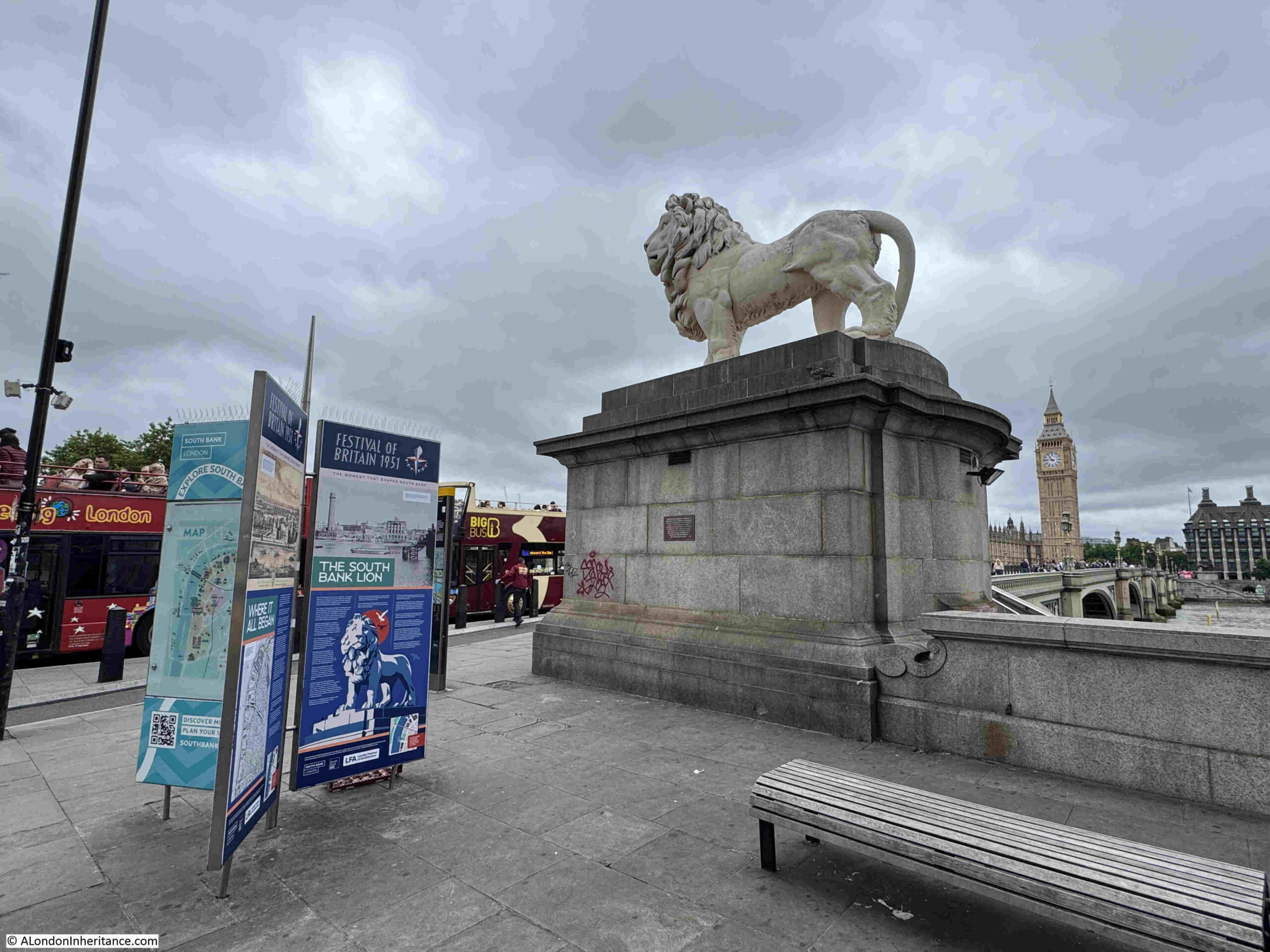
These provide a brief overview of the history of the area now known as the South Bank, and also tell the story of Eleanor Coade, and the Lion that stands at the end of Westminster Bridge, originally on the Lion Brewery which stood where the Royal Festival Hall is today:
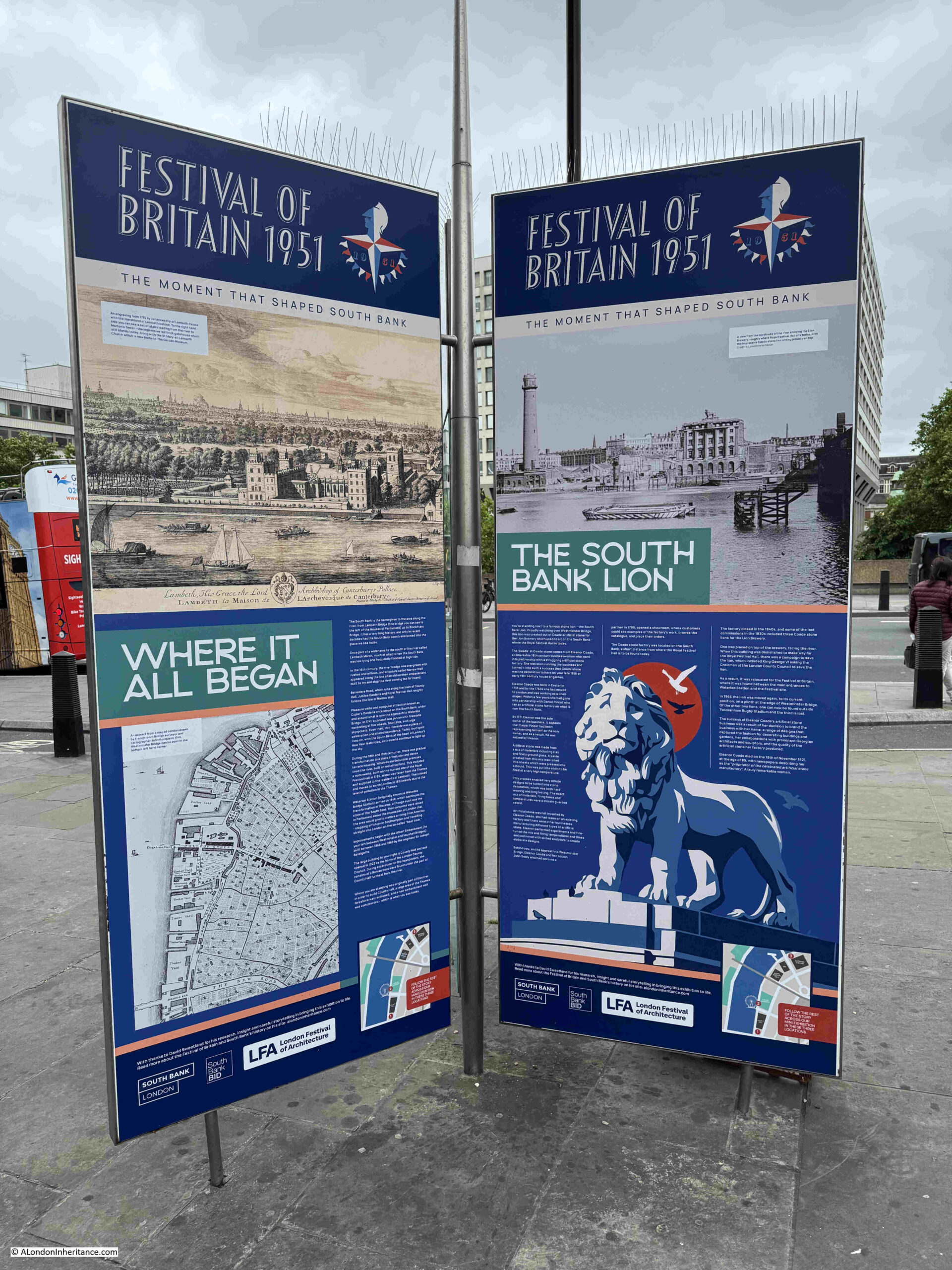
The design of the posters by the SBEG is brilliant, and it is really good to see Britannia, the blue, red and white compass and the bunting of the festival symbol created by Abram Games back on the South Bank.
The following map shows the location of the posters:
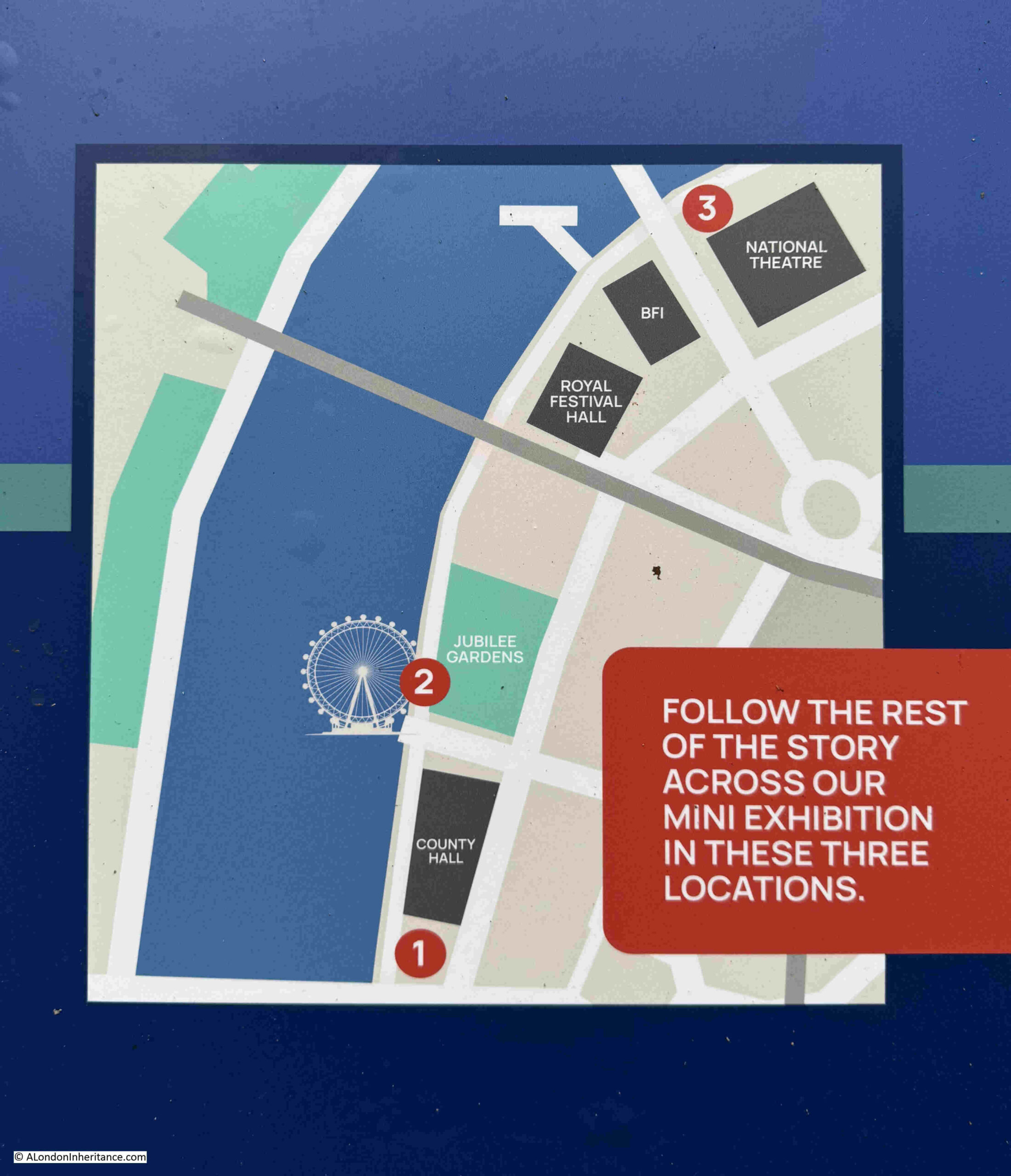
In location 2, between the Jubilee Gardens and the London Eye:
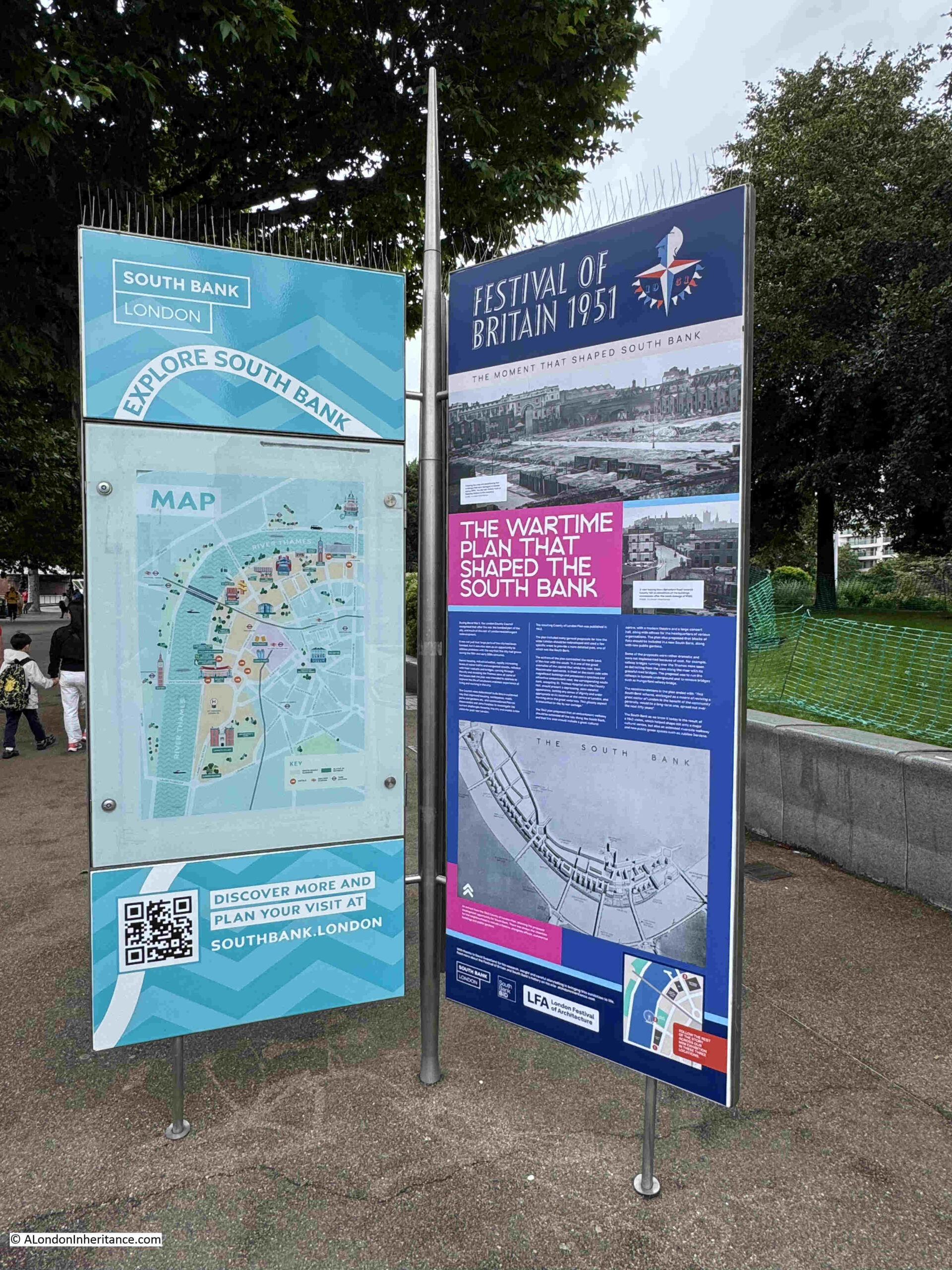
Two more posters on the other side of the above:
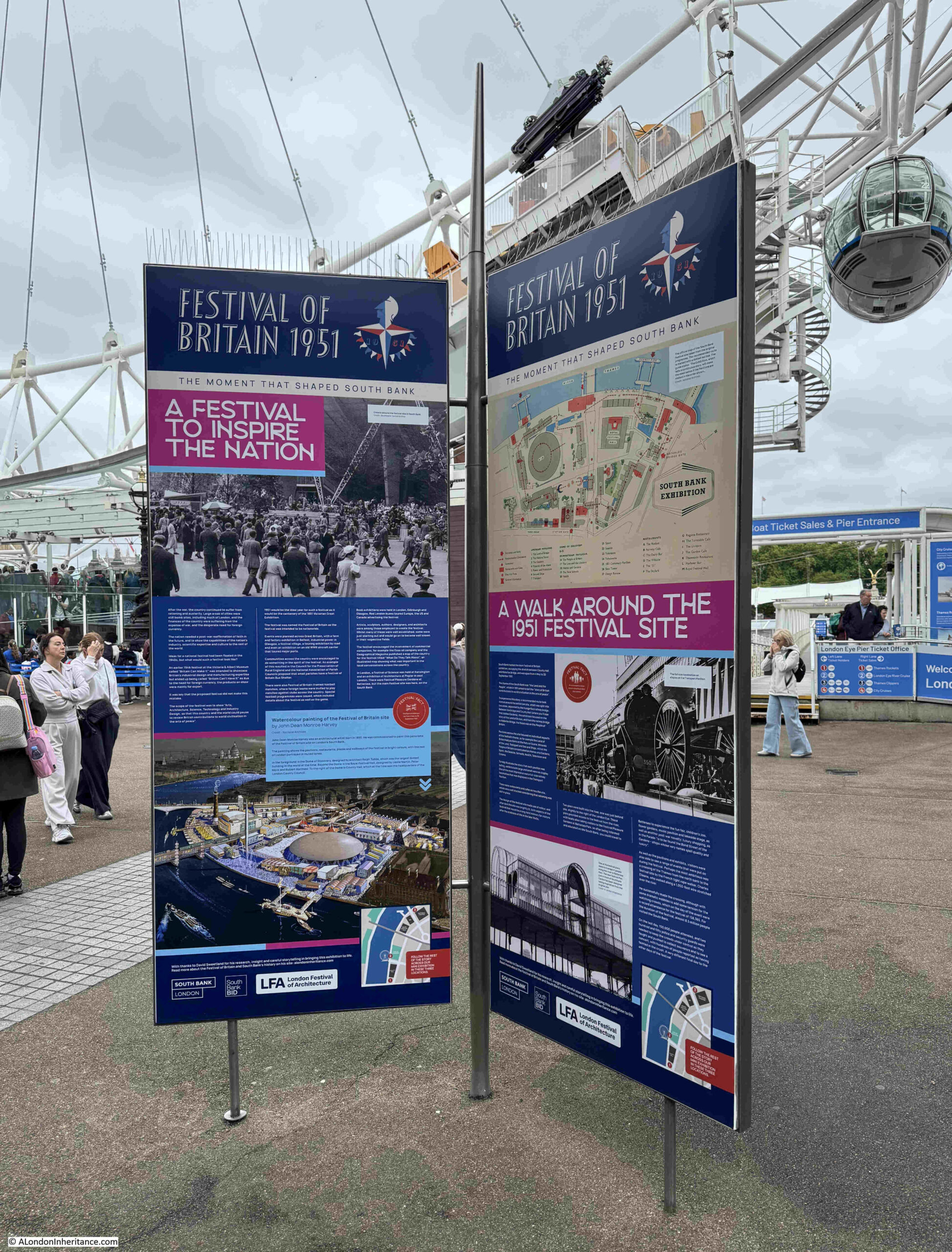
Between the BFI and the National Theatre:
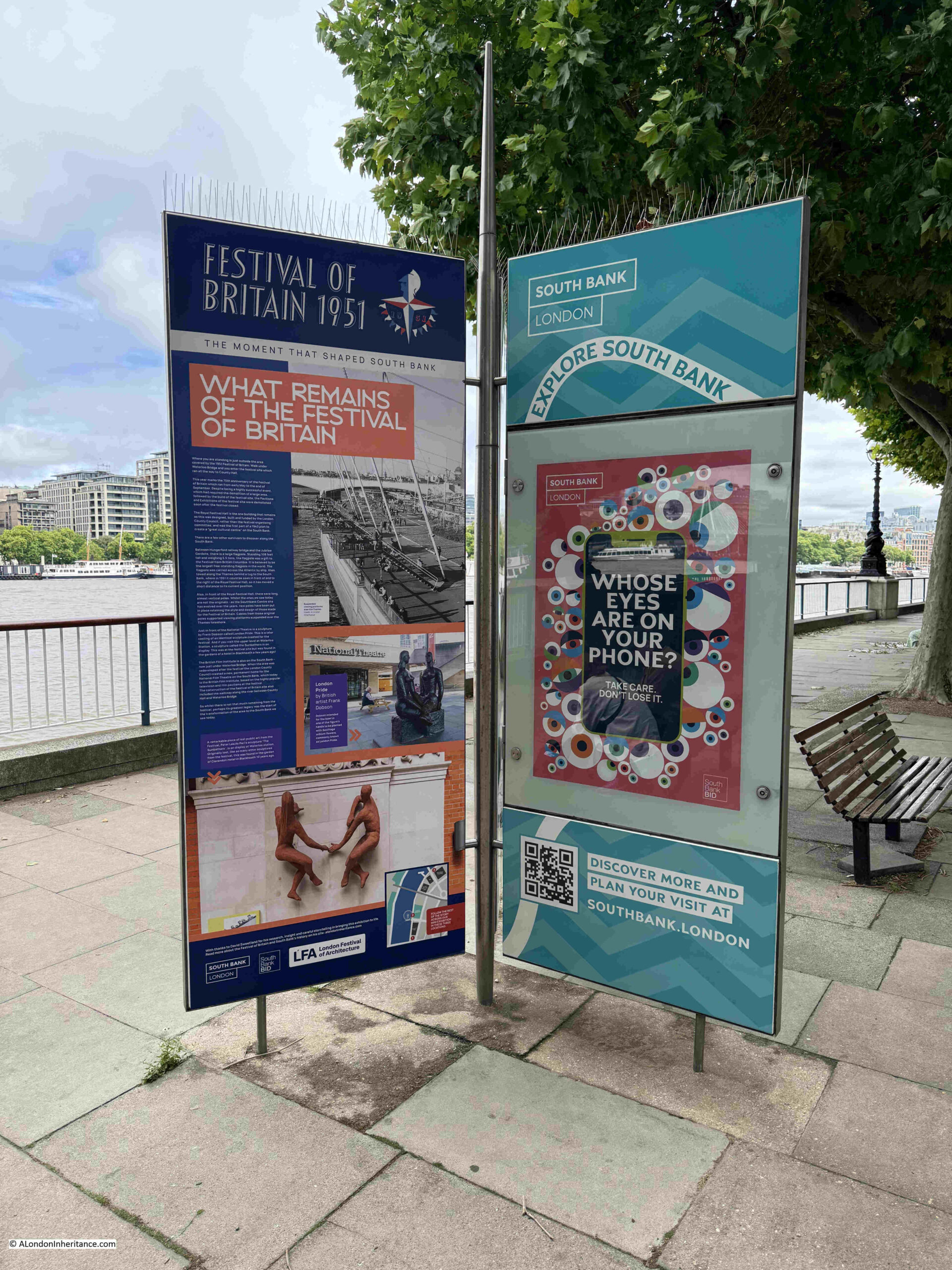
Looking towards Waterloo Bridge (on the right) and the National Theatre (on the left):
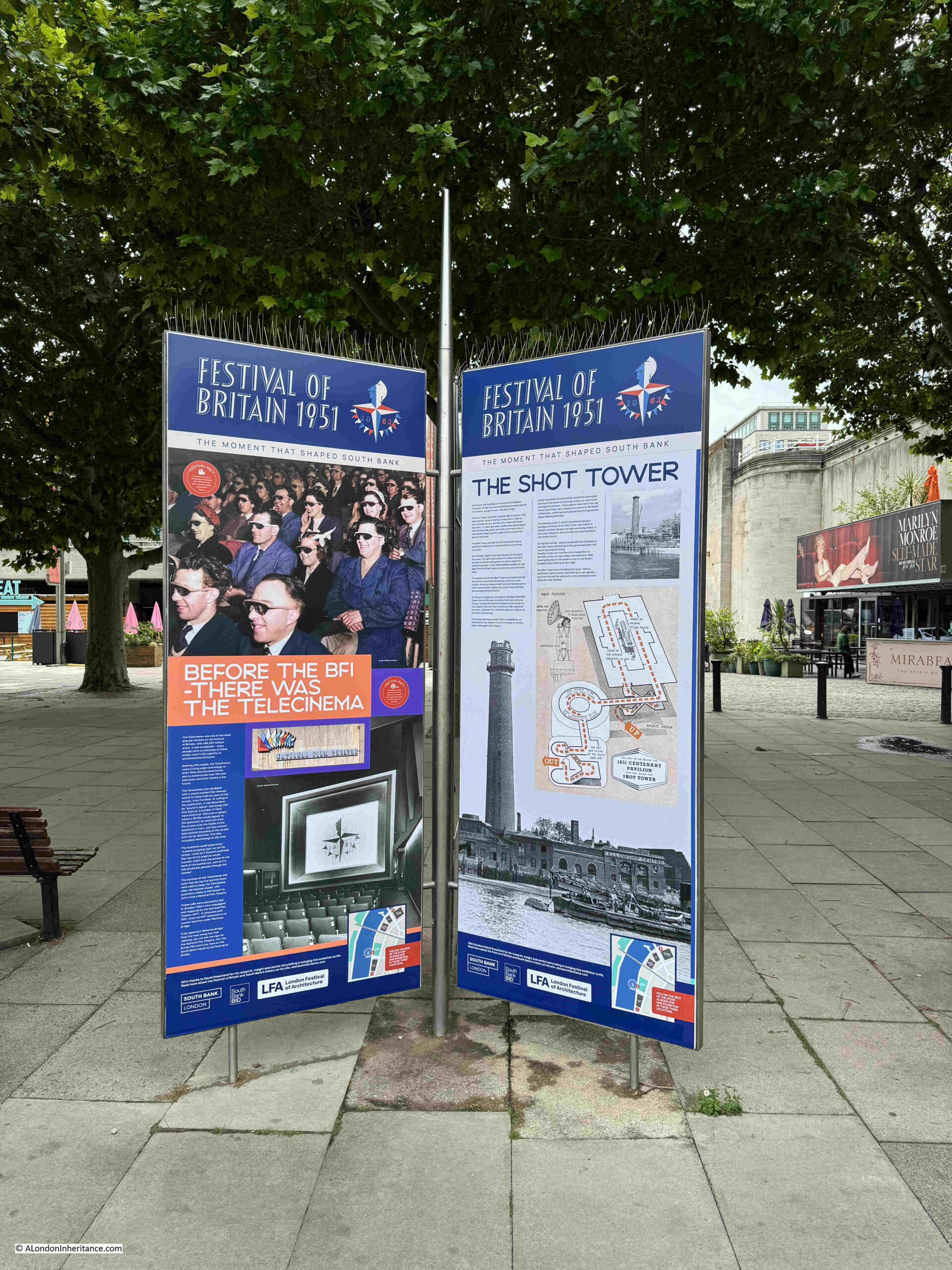
It was a privaledge to have been involved with the creation of these posters, but by far the best part was the chance to get my father’s photos on display, in the place he started exploring as an 18 year old with a Leica camera purchased from a soldier returning from Germany.
If you visit the South Bank over the summer, please do take a look.
The Sunbathers by Peter Laszlo Peri – Waterloo Station
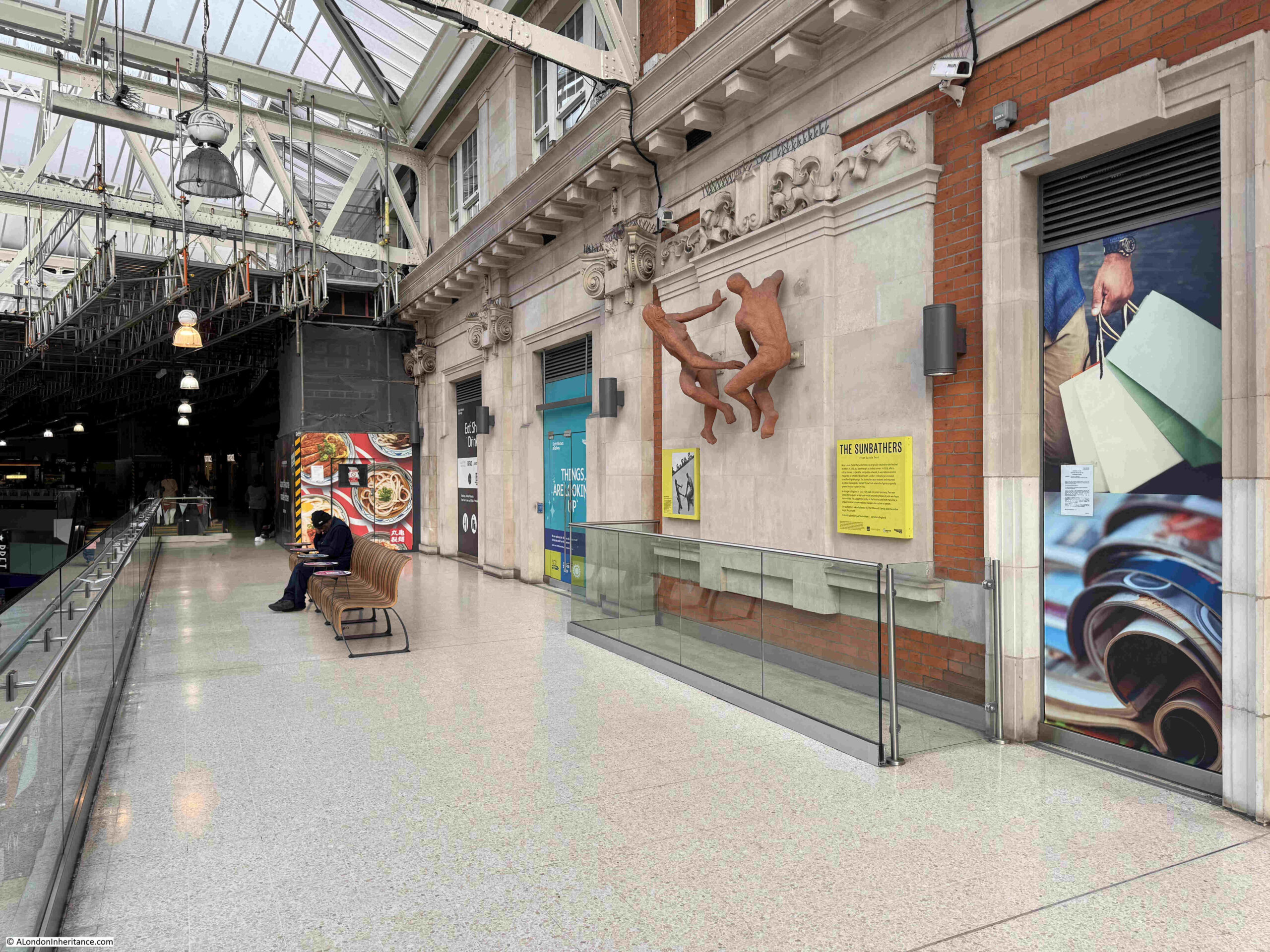
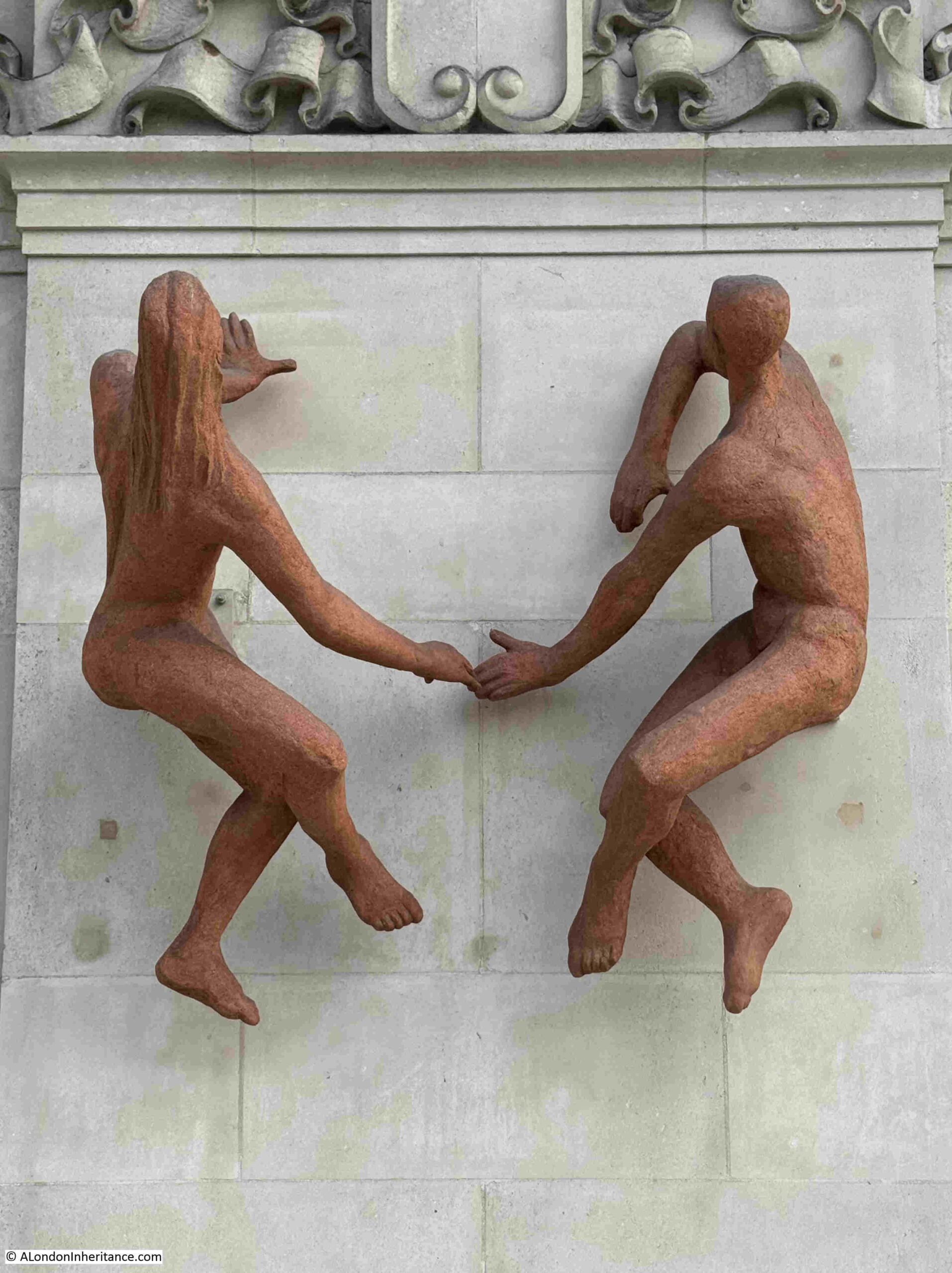
If you head to the upper level of Waterloo Station, there is a sculpture on the wall which has an unusual history. This is the Sunbathers by Peter Laszlo Peri for the Festival of Britain:
Peter Laszlo Peri had an interesting life. He was born in Budapest, Hungary, on the 13th of June, 1899, and was part of a working class Jewish family. He was involved with art, sculpture, the theatre, architecture and travelled widely across Europe.
In 1932 he was in Berlin, and involved in an exhibition of works organised by the Association of German Revolutionary Visual artists. The works on display were removed by the police, and in 1933 the organisation was banned by the Nazi Party.
The organisation was affiliated with the German Communist Party, who Peri and his wife Mary were also involved with, as Mary was arrested in possession of Communist propaganda. Peri was also in trouble with the authorities as during a political demonstration he had punched a Gestapo officer.
The German Communist Party had also been banned in March 1933.
It was after these events that Peri decided that the only course of action was to leave Germany, and they made the move to England.
I cannot find out what happened to Peri’s wife, Mary. She was Mary Macnaghten, the granddaughter of Charles Booth, who is best known for the poverty maps of London. There is no mention of her after her arrest in all the sources I have found (see end of this section), and in 1965 Peri married the artist Heather Hall, so either Mary had died or they had divorced. This is probably down to my own limited time for research.
Peri initially lifted in a flat in Willow Road, Hampstead, and by 1937 he had found a permanent studio in which to work in Camden.
The studio was at 28b Camden Street, and in the early 1960s the whole area was scheduled for demolition, including Peri’s studios.
A documentary was made about the studios, featuring Peter Laszlo Peri by the documentary company Derrick Knight & Partners. It was shown by BBC2 in 1965, and BFI Replay have the documentary online.
It is a remarkable film because it features Peri, along with the other artists working in a small community of studios. It shows Peri’s work, and as well as the area around Camden Street in the early 1960s.
Click here to view the film on BFI Replay.
As usual, whenever I find something interesting when researching a post, it leads to exploring further, and I wanted to find out where Peri’s studio, along with the studios of the other artists featured in the film, were located.
In the following OS map extract, I have circled number 28b. The number is in the central garden featured in the film, and above and below the garden are numbered buildings, each of which was one of the studios featured in the film.
Camden Street is the unnamed street to the left, and College Place is to the right. Plender Street is the short length of street shown in the upper left corner:
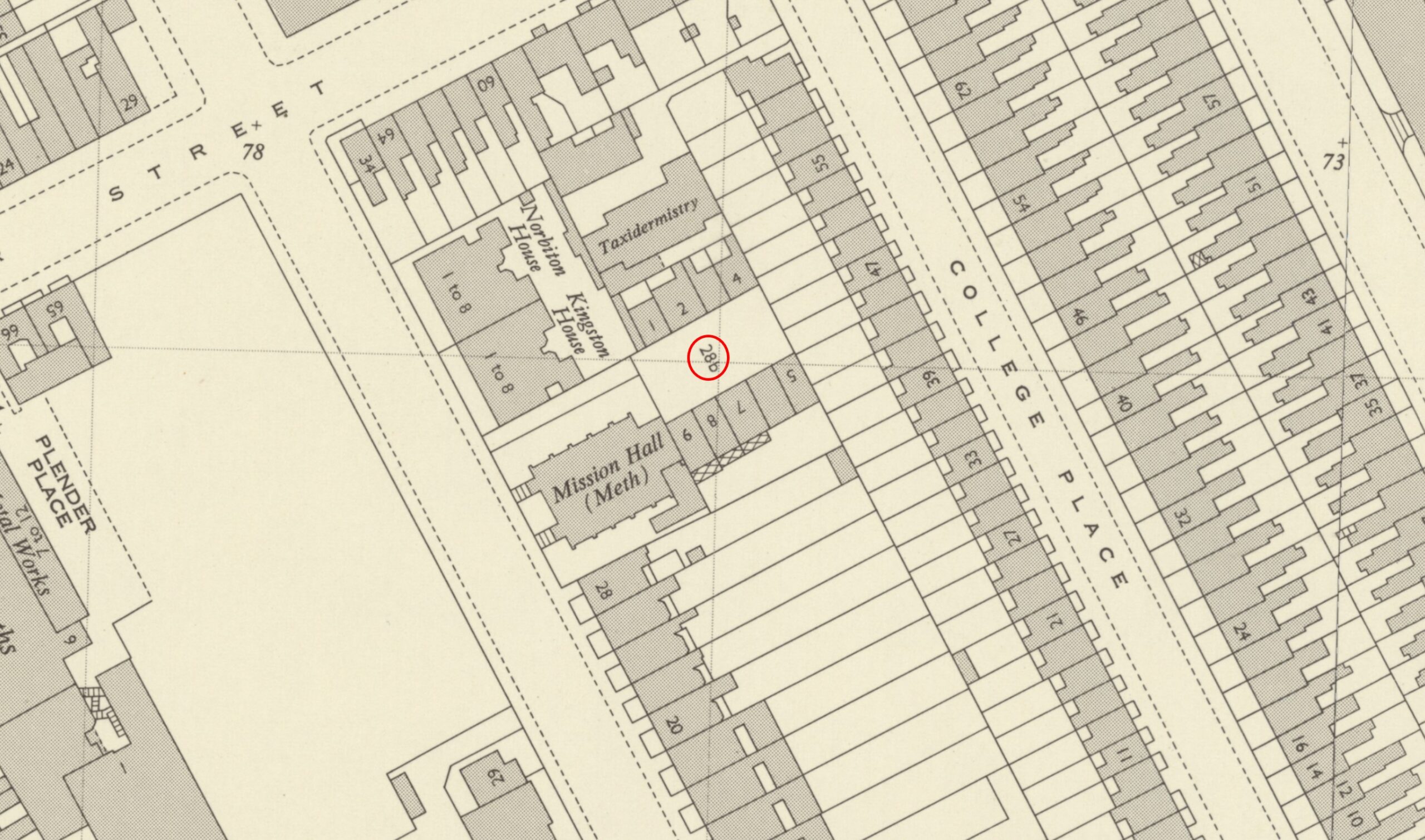
(‘Reproduced with the permission of the National Library of Scotland“)
The demolition of the studios, along with all the surrounding buildings, including the terrace houses seen in the background in parts of the film, which ran along College Place, was to clear space for the construction of new housing blocks.
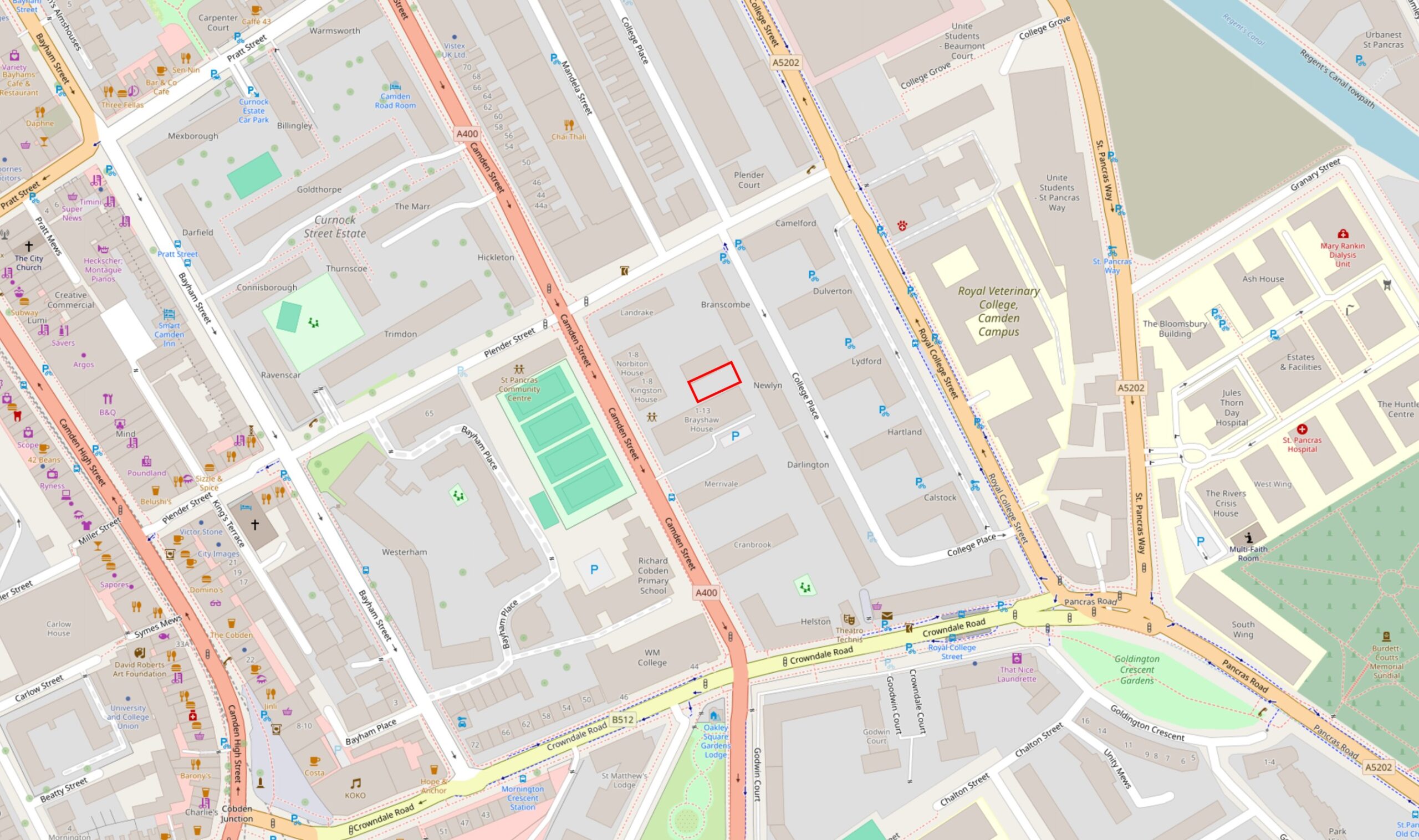
Brayshaw House which today sits on the site of the Mission Hall in the above map appears to be of recent construction. 28b and the artists studios were behind Brayshaw House. I have marked the location of the central garden of the studios with the red rectangle in the centre of the following map (© OpenStreetMap contributors):
The film shows that much of Peri’s work was in concrete, including his own special formulation which he called Pericrete, and this is the material used for the Sunbathers.
Whilst Peri was a long term user of this type of material, many of the other works created by different artists for the Festival of Britain were also made out of materials which were cheap to use and quick to create given the time and financial constraints of the festival.
The use of this type of material, rather than a material such as bronze, was, along with the speed with which the festival site was demolished, one of the reasons why very little sculpture and artwork on display at the Festival of Britain survived.
The Sunbathers was lost after the festival closed.
In 2016, Historic England launched a campaign to find lost public artwork, and the Sunbathers was rediscovered in the garden of the Clarendon Hotel in Blackheath.
Historic England launched a funding campaign to restore and display the Sunbathers.
The work was initially on display in the Royal Festival Hall, and in August 2020, it was put on display in Waterloo Station:
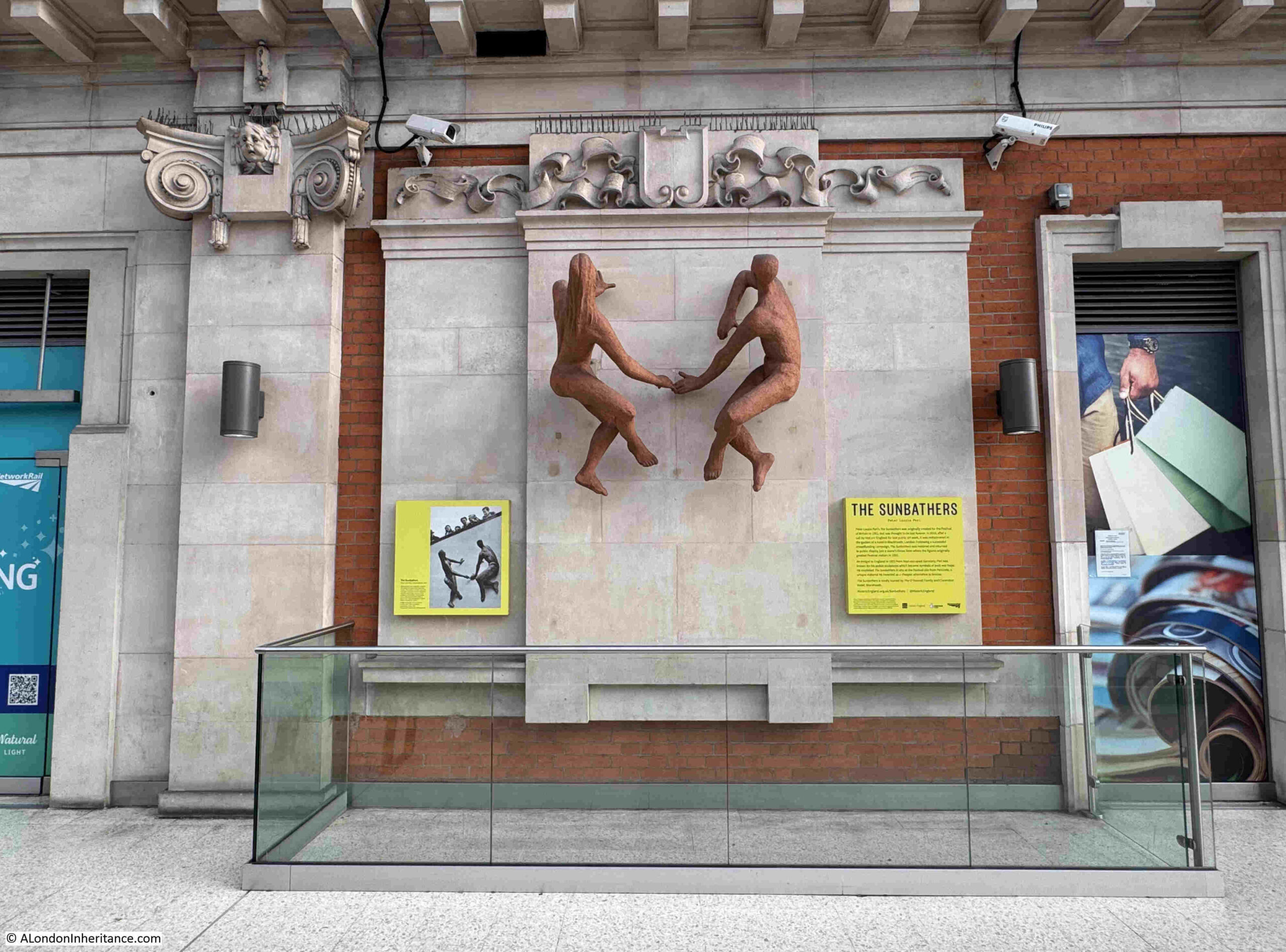
The PA photo agency have an image of the Sunbathers installed during the Festival of Britain, on the side of the Underground Station adjacent to the main Station Gate access point to the festival. Click here to view the photo on PA’s website.
Peri continued to work during the 1950s and 1960s, still using concrete, but also experimenting with Polyester resin.
Camden council rebuilt artists studios on the same site, and Peri did return. I am not sure if they are still there. There are buildings on the alignment of the old studios, with a green space in the middle. One building is occupied by an industrial design company. I am not sure what the other building is used for.
Peri did not have long in his new studio back in Camden, as he died in 1967.
Born in Budapest, escaped the Nazi’s in Berlin and lived just over 30 years in London, it is good that Peri’s work for the Festival of Britain is now on display at Waterloo Station, not that far from when it could be seen in 1951:
There is another reminder of the Festival of Britain in Waterloo Station:
The Lion and the Unicorn, Wetherspoon’s – Waterloo Station
Reader and guide Frank sent me an email about the Wetherspoon’s in Waterloo Station. I had not been down to this part of the station (the Sidings) for some time, so did not realise it was open. A visit was needed to see The Lion and the Unicorn:
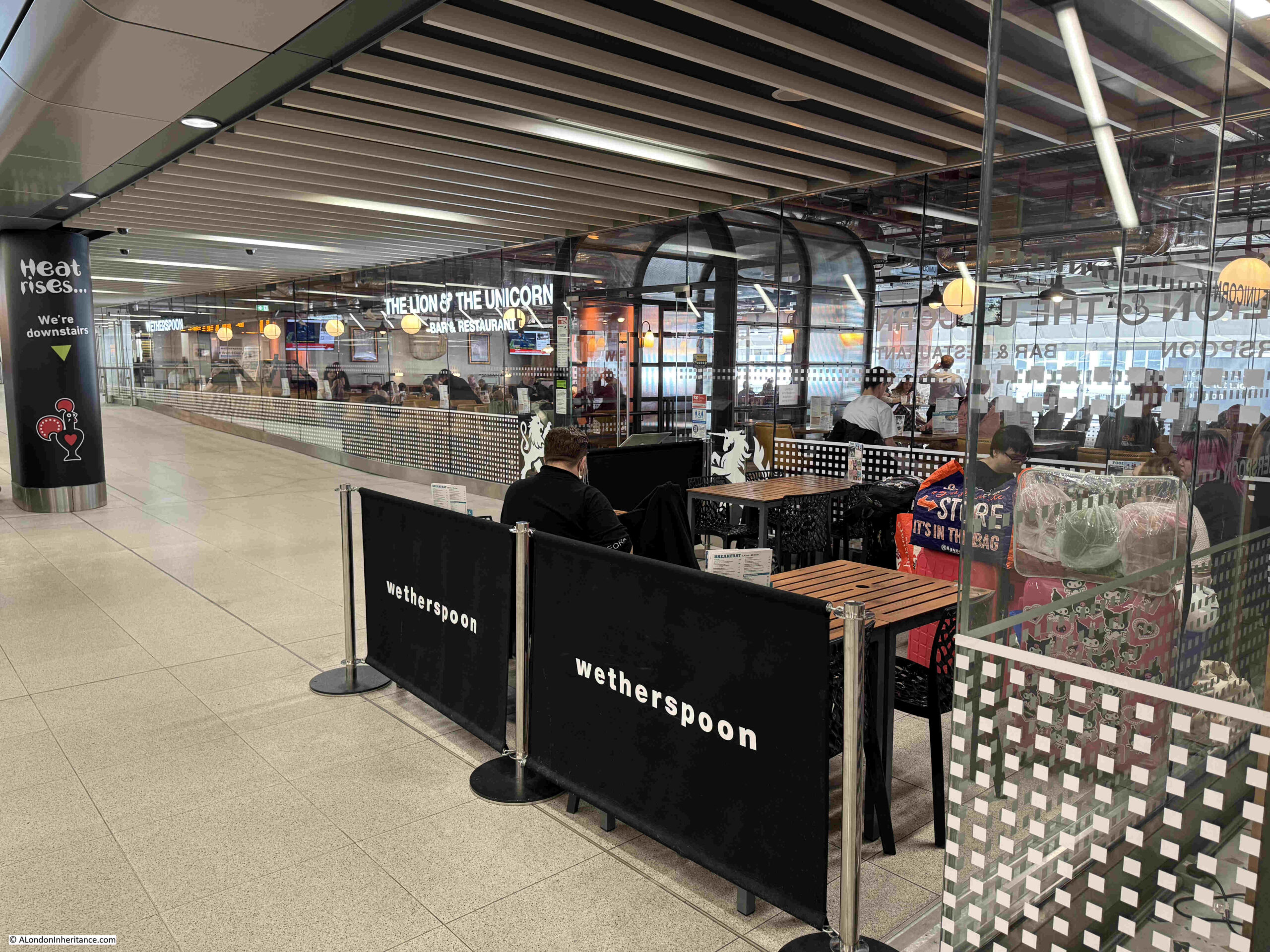
The pub is named after the Lion and the Unicorn pavilion at the Festival of Britain.
The best description of the pavilion comes from the guide to the South Bank festival:
“The British People are something more than the sum of: men with ancestors, children in schools, families in homes and gardens, and patients in hospitals. They are, in addition, compositions of various particular habits, attitudes, instincts, qualities and characteristic moods. but these attributes, not being tangible, are hard to display ‘in the round’, in an exhibition of tangible things.
Nevertheless, we should not like visitors – particularly from overseas – to leave the South Bank without having seen, at least, some token and visible reminders of the British People’s native genius. So this Pavilion offers one or two clues to their character.
The title of the Pavilion – ‘The Lion and the Unicorn’ – serves to symbolise two of the main qualities of the national character; on the one hand, realism and strength, on the other fantasy, independence and imagination.”
As well as the name, the pub includes a number of references to the 1951 pavilion as well as the festival in general
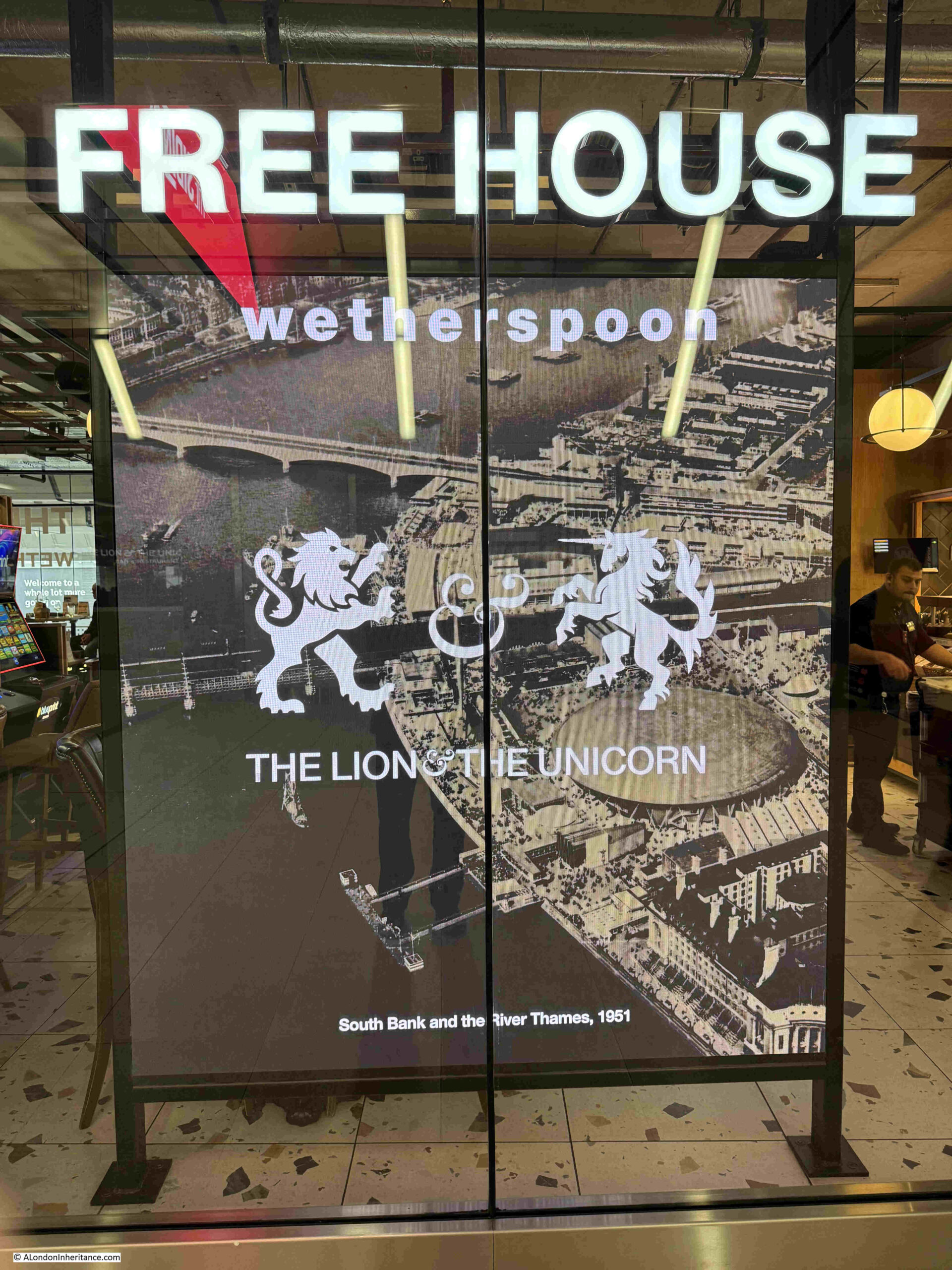
On the large screen close to the entrance is a rotating series of images, one of which is a photo of the overall Festival of Britain site on the South Bank:
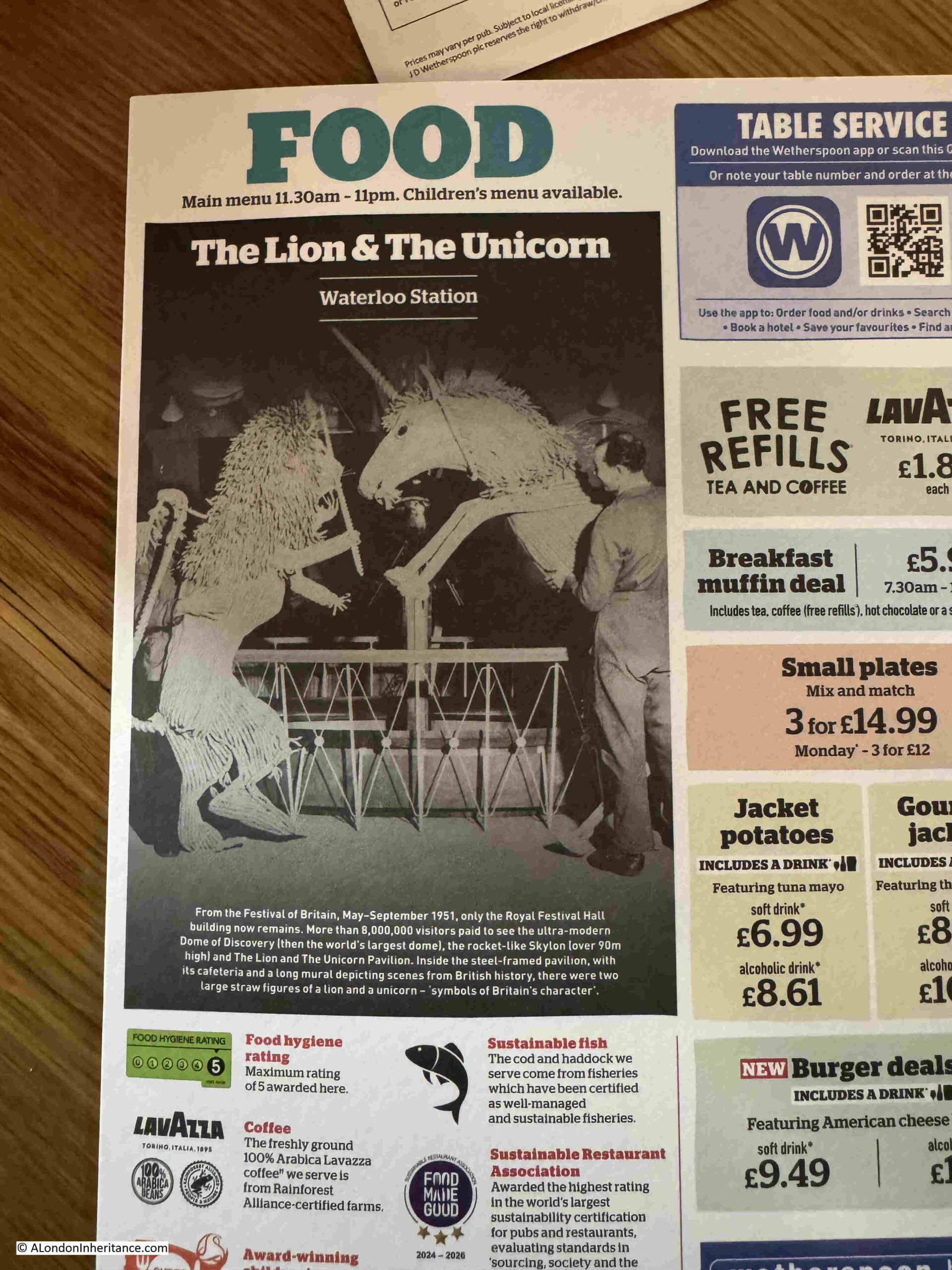
The food menus have a photo of the Lion and the Unicorn from the festival, including a brief summary:
There is also some decoration in the same style as the decoration in the 1951 pavilion.
On the wall at the far end to the bar is an open bird cage, framed by a couple of photos, with birds flying from the open cage:
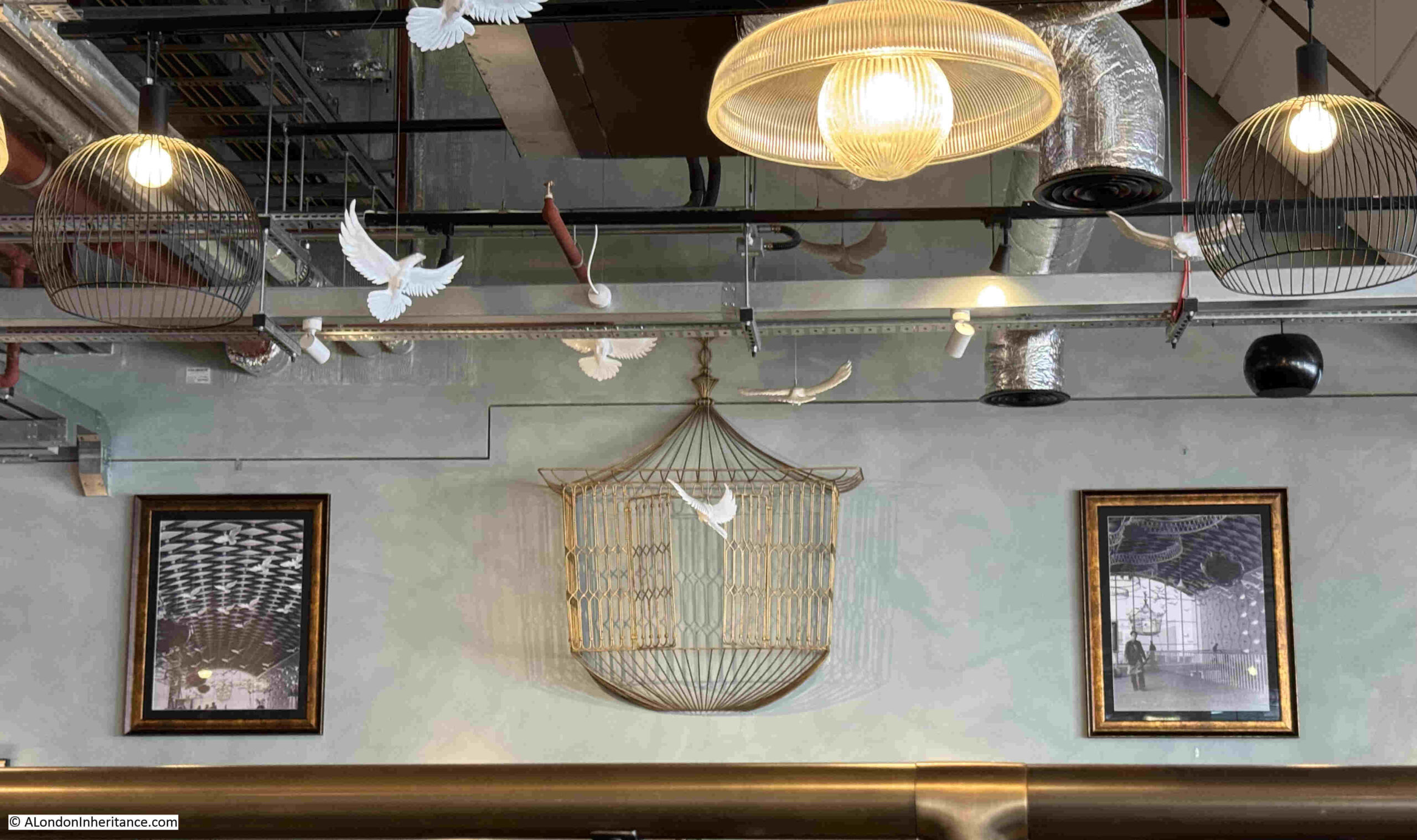
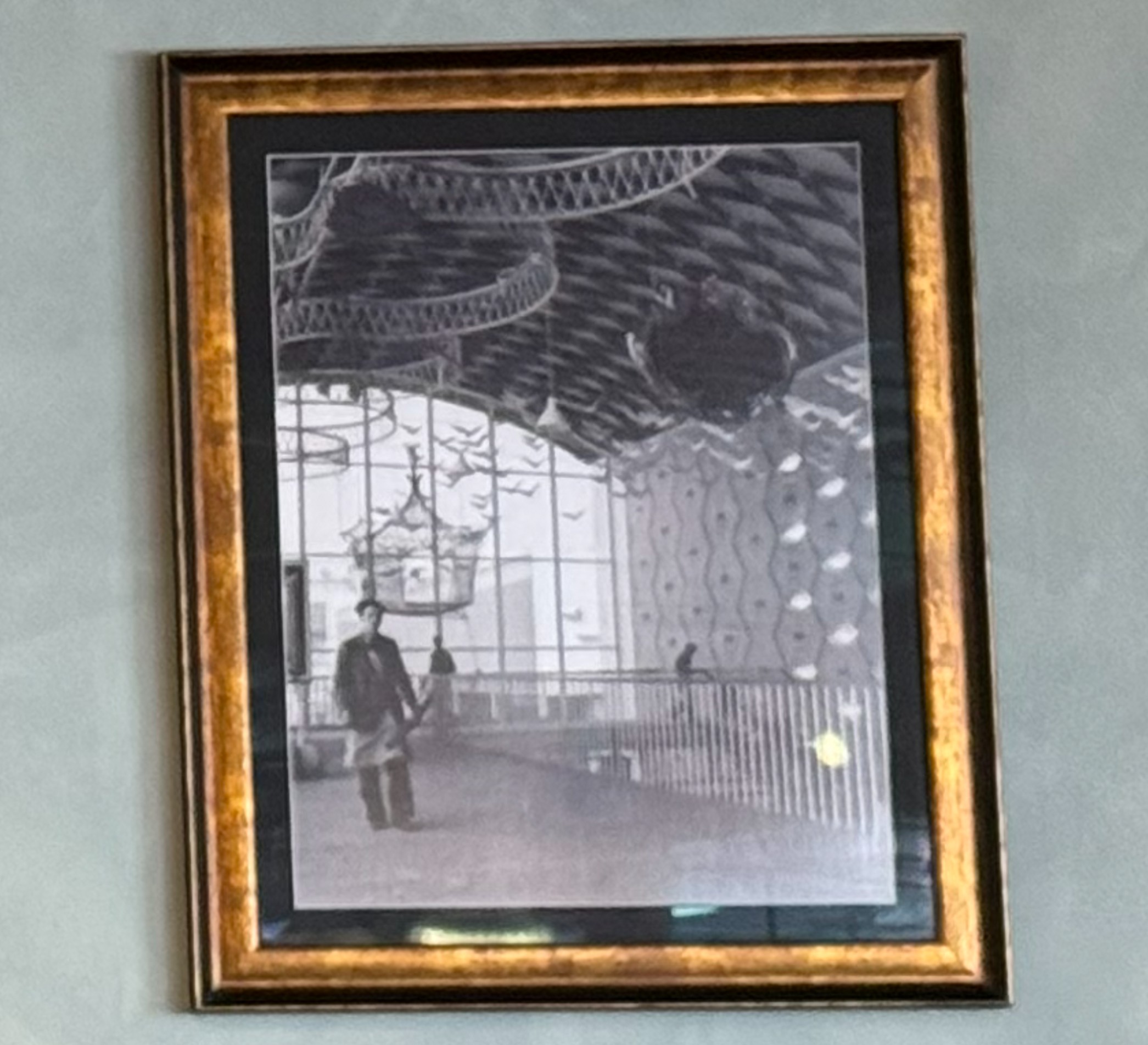
The photo on the right shows the bird cage and birds as they were presented in the 1951 Lion and the Unicorn Pavilion:
I did wonder whether the one in the Wetherspoon’s was an original from the festival (another find of a lost item, similar to the Sunbathers), so I emailed Wetherspoon’s to ask.
Rather surprisingly for a large company, the same day, my question was forwarded to the person responsible for their pub developments who replied that the bird cage was a replica.
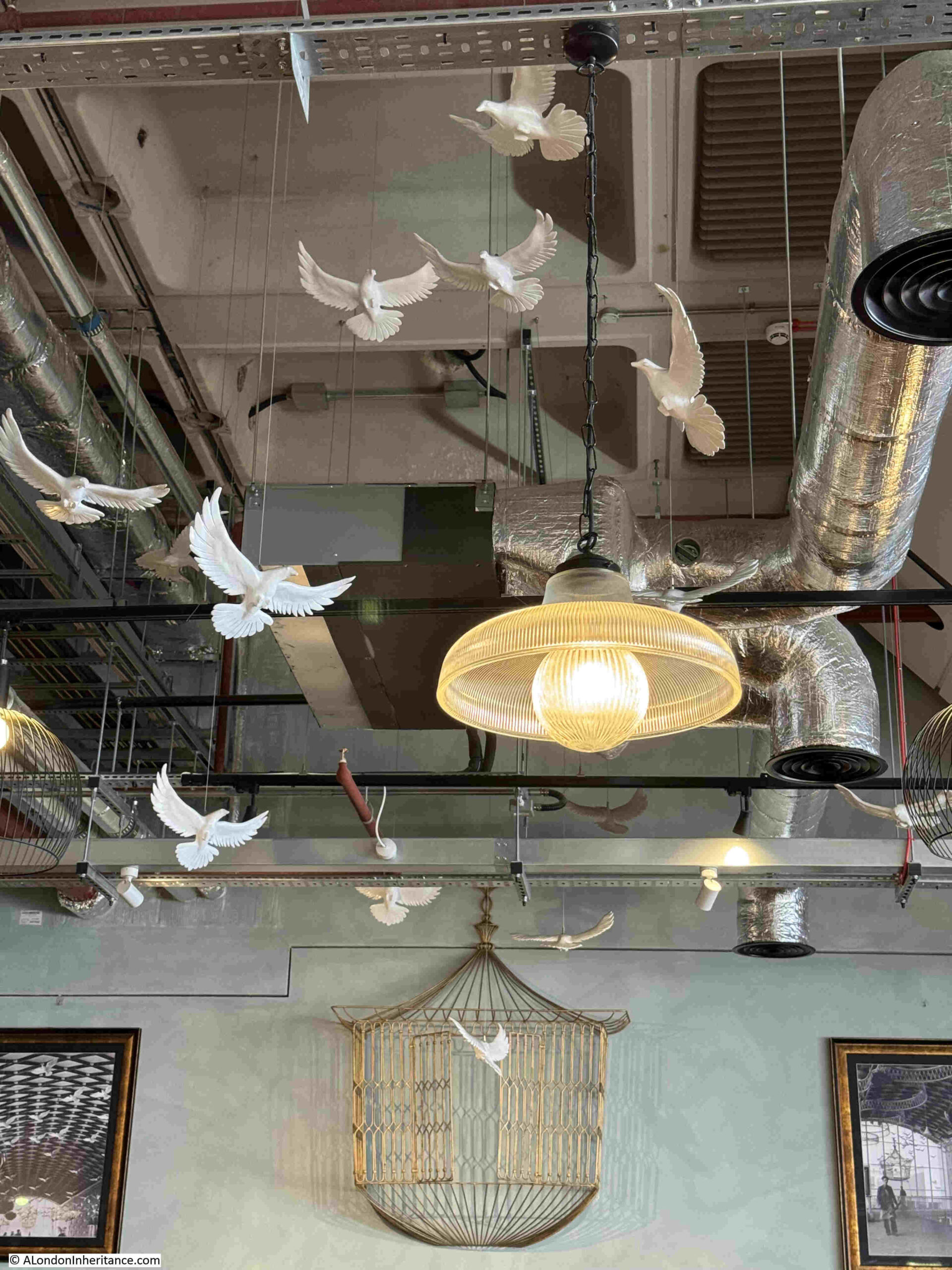
The escaped birds flying from their cage:
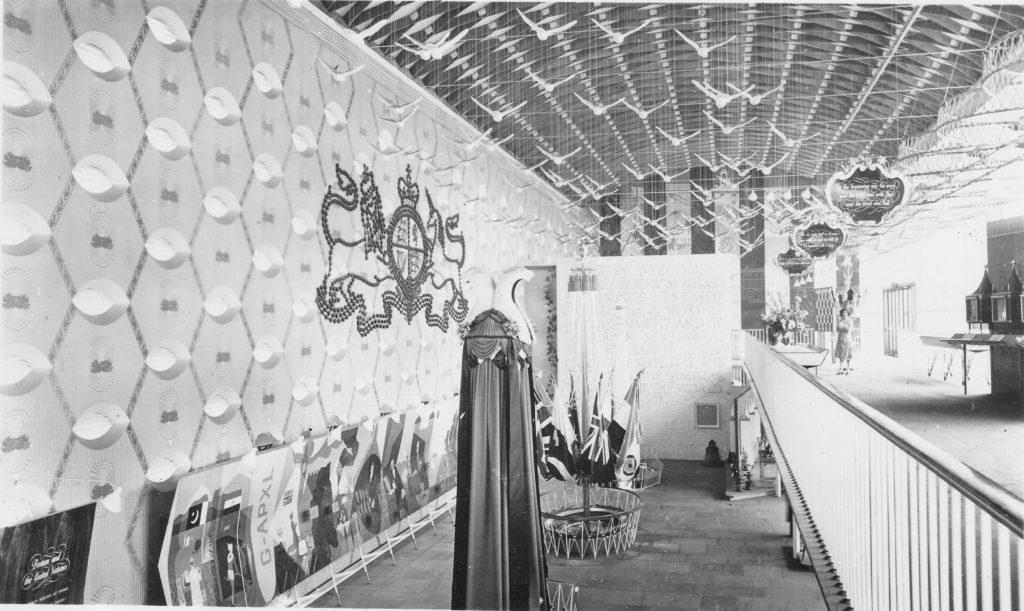
The following postcard from 1951 shows the birds flying along the ceiling of the Lion and the Unicorn pavilion:
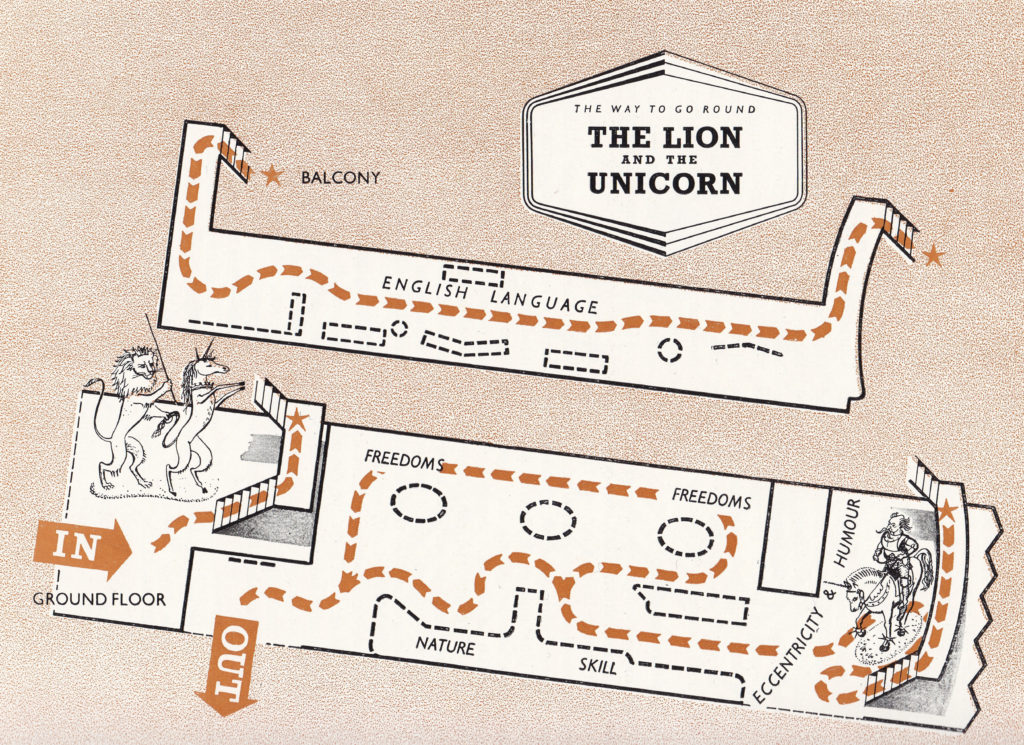
The plan from the Guide to the Festival of Britain on the South Bank showing the route and subjects covered in the Lion and the Unicorn pavilion:
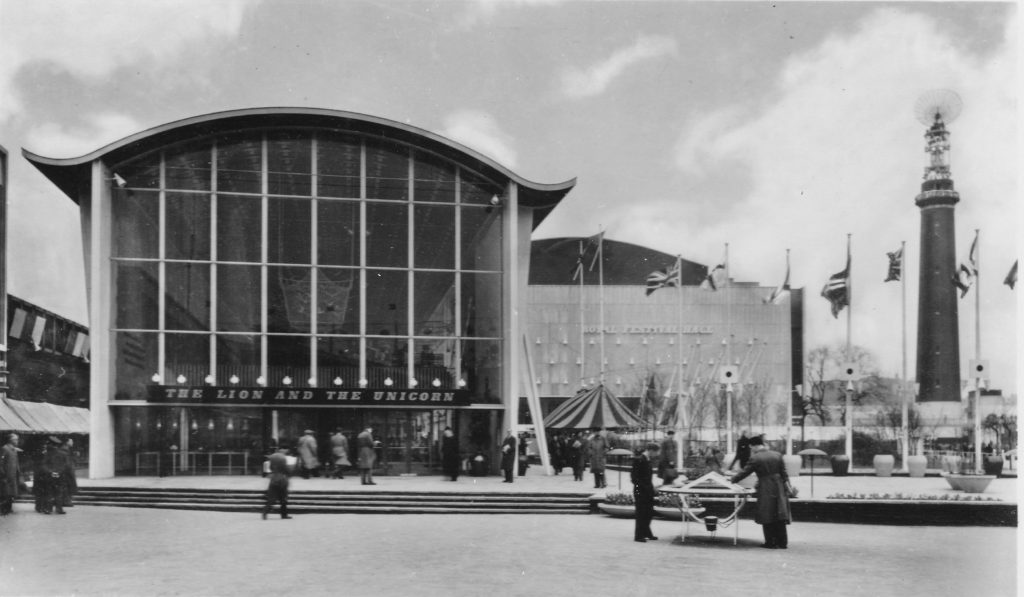
The following postcard from the festival shows the entrance to the Lion and the Unicorn Pavilion. The rear of the Royal Festival Hall is in the background. The pavilion was along side what is now Concert Hall Approach (on the left of the pavilion) and on the site of the Whitehouse Gardens area, in front of the Whitehouse apartments (the old Shell downstream building):
The guide-book acknowledges the challenge of explaining the British Character. The closing paragraphs for the pavilion read:
If, on leaving this Pavilion, the visitor from overseas concludes that he is still not much the wiser about the British national character, it might console him to know that British people are themselves still very much in the dark about it. For them, the British character is as easy to identify, and as difficult to define, as a British nonsense rhyme.
The lion and the unicorn
Were fighting for the crown;
The lion beat the unicorn
All round the town.
Some gave them white bread
And some gave them brown;
Some gave them plum cake
And sent them out of town.
I am not sure how much the average drinker in the Lion and the Unicorn will be aware of the story behind the name of the pub, and the bird cage and birds on the wall, however I believe that Wetherspoon’s are to be congratulated with their choice of name and decoration, and hopefully it will spread a bit more awareness of the Festival of Britain to a few of the drinkers in the Lion and the Unicorn.
The text over the image on the menu includes the words “only the Royal Festival Hall building now remains”, and I find it really strange that the Wetherspoon’s at Waterloo Station has more information on the Festival of Britain than the Royal Festival Hall.
The Royal Festival Hall did have a large celebration over the weekend that marked 75 years since the opening day, however walking in the RFH today, and there is nothing obvious about the Festival of Britain, and the Royal Festival Hall’s place in the festival.
The Royal Festival Hall did have a good exhibition area, along the side wall between the bar that faces the river, and the café at the back. This included the following wonderful model of the festival site:
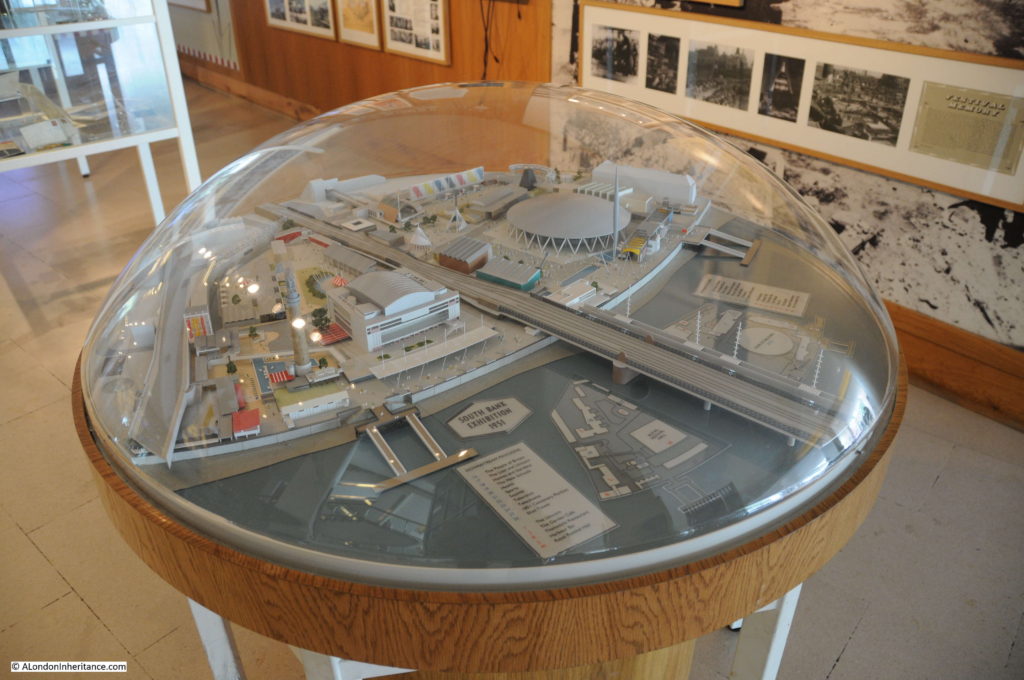
The exhibition and the model disappeared a couple of years ago, with the area now occupied by what looks like a corporate hot desk space.
There is also an archive area to the rear of the building, but this always appears to be closed, and whilst there is window and display space, there is little on display.
A real shame as the Royal Festival Hall was built by the London County Council for the Festival of Britain, and for the long term. It was the first large public building constructed after the war, and is a really wonderful building.
It would be great to see the Royal Festival Hall putting more of its history back on public display.
For my last connection with the Festival of Britain, I am staying on the South Bank for:
Siegfried Charoux’s Motorcyclist sculpture – Southbank Place
This is Siegfried Charoux’s sculpture of a Motorcyclist. It can be found between the new buildings that occupy the space where the Shell Centre office blocks once stood. It is close to Chicheley Street which runs from York Road to Belvedere Road:
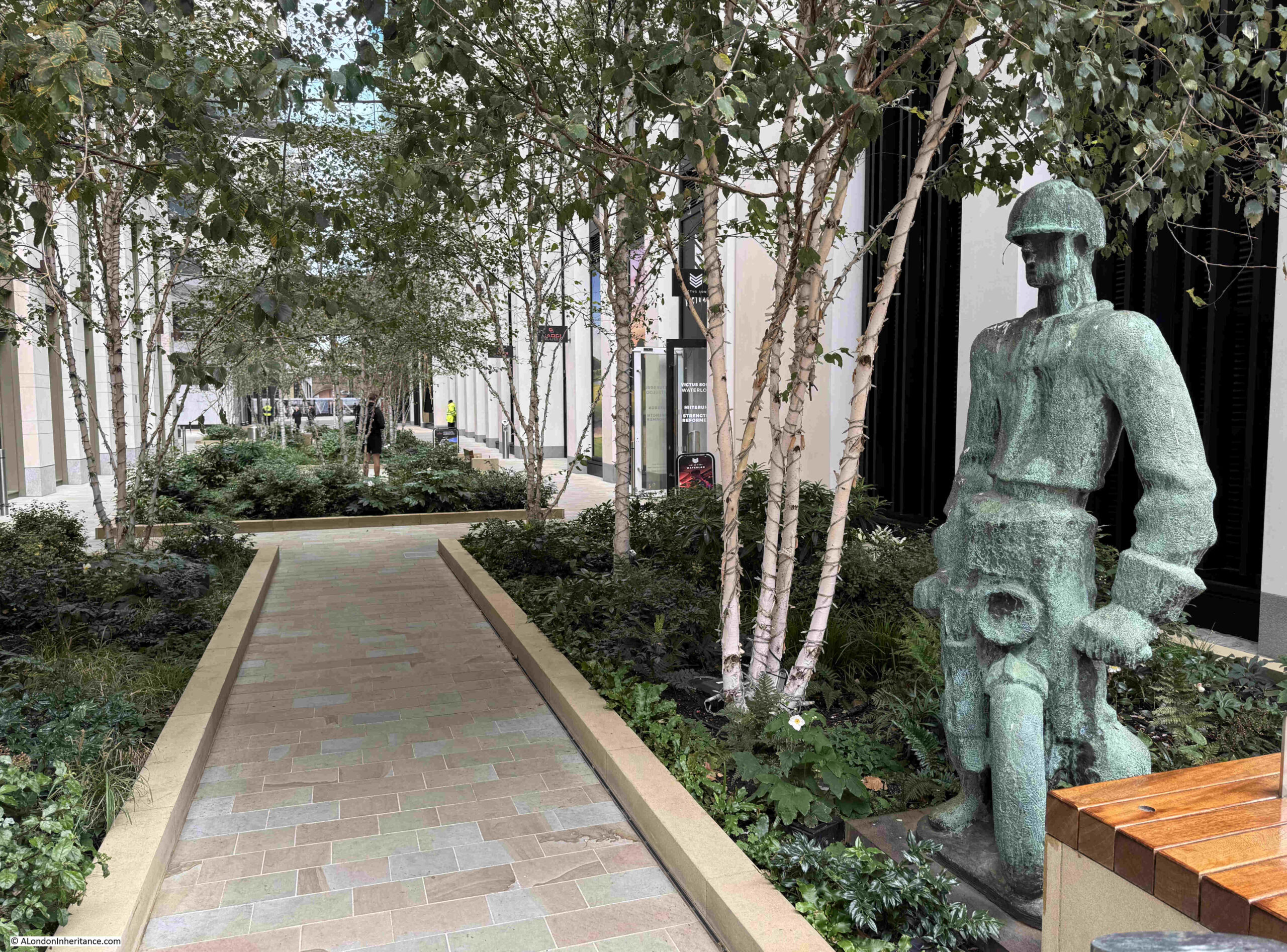
The Motorcyclist was created by Siegfried Charoux and installed in 1962 in front of the recently completed Shell downstream building, and by a strange coincidence given one of the other topics in this week’s post, roughly where the Lion and the Unicorn pavilion was located during the Festival of Britain.
It was installed at its new location in 2019:
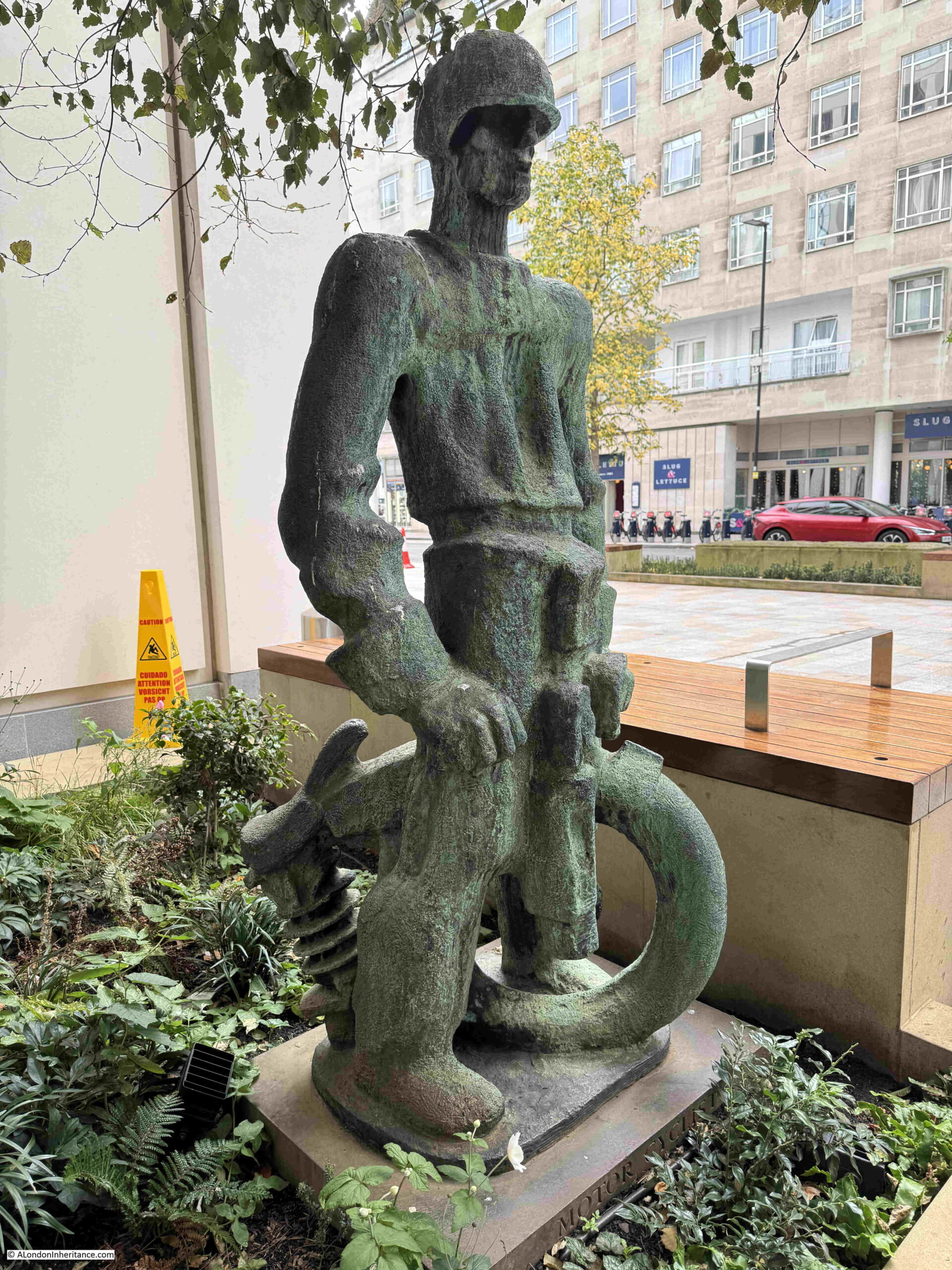
The Motorcyclist therefore has no direct connection with the Festival of Britain, however the creator of the work, Siegfried Charoux, does.
Siegfried Charoux was born in Vienna in 1896, and served in the First World War with the Austro-Hungarian Army. He was invalided out of the army in 1917 after being wounded.
A cartoonist and sculptor, he moved to England in 1935 because of the threat from the Nazi’s who disapproved of his left wing views, and who had destroyed one of his works which displayed a sympathetic view of a Jewish figure. He was able to stay in the country as he had the support of the Tate Gallery Director James Bolivar Manson, who sponsored his Home Office application.
He became a naturalised British citizen in 1946, and continued working as a sculptor.
One of his commissions was a work for the Festival of Britain.
The following is a view of the South Bank festival site from the north bank of the river. The Skylon is on the left and the Dome of Discovery can be seen in the background where Jubilee Gardens are today.
Look in front of the Dome of Discovery, just to the right of the flags on the boat and there is a large sculpture facing the river:
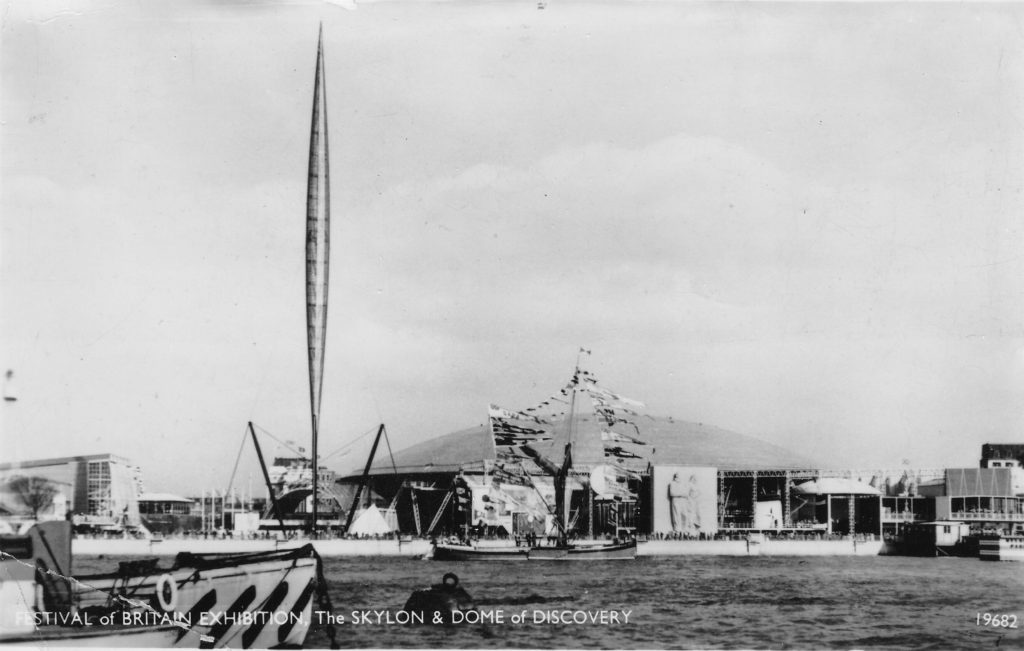
This is the Islanders by Siegfried Charoux:
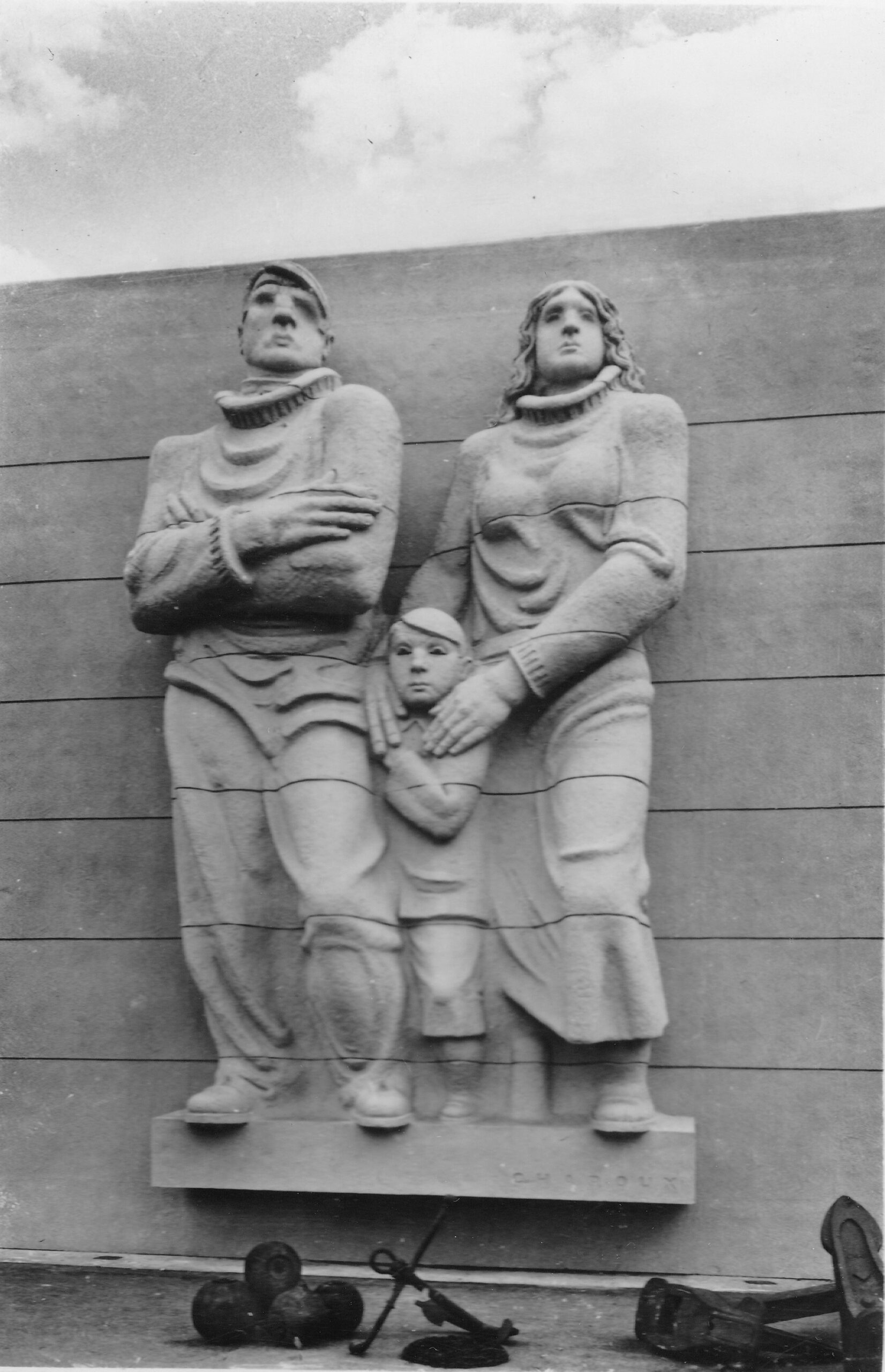
The Islanders was part of the Sea and Ships Pavilion, and intended to portray the struggle and resilience of the British people in their relationship with the seas that surround the country.
The scale of the work is hard to get from the above photo. The earlier photo shows how clearly it was visible from across the river, and if you had stood next to the sculpture in the above photo, your head would have been level with the feet of the three characters. It was truly colossal.
The Islanders was made out of concrete, and was destroyed as part of the demolition of the Festival of Britain site,
Charoux also created another work that was on the South Bank. This was “The Cellist”, which was on display outside the Royal Festival Hall. It was later moved to Kenwood House where it was on temporary display. I have not been able to find any record of where it is now, and do not recall seeing the work on previous visits to Kenwood House.
Charoux created an extensive collection of works and exhibited annually at the Royal Academy between 1940 and 1974.
He died in Hendon on the 26th of April 1967, and his remains were returned to Austria where he was buried in Vienna’s Central Cemetery.
So although the Islanders was destroyed after the closure of the Festival of Britain, Charoux still has a work on display at the South Bank, not far from the original site of the Islanders.
It is part of what fascinates me with the history of London. All the networks of connections you can build between the city of today, and the people and events of the city of the past, including for Peri and Charoux, events in Europe which resulted in their works being part of the Festival of Britain, and works which can still be seen today.
And if you get the opportunity to visit the South Bank, take a look at the posters spread across the three sites.
What a wonderful post about a very special area of London and its historical crowning glory. Every vestige of the F of B that remains is a national treasure and the posters are a great testament to your father’s work.
I have a small collection of Festival of Britain items sparked by finding my parents programme after my father’s death. I look forward to doing a tour with your posters as a guide rather than just my own intuition.
It was such a travesty so much was destroyed when London had not recovered from the ravages of war and this was a symbol of hope.
Thankyou so much for this uplifting welcome to London.
We know many folk will learn about the 1951 ’Tonic to the Nation’
for the very first time, via your posters, and will see how the South Bank has become
such an important public space.
The Festival of Britain was such an optimistic celebration of all the diverse cultures
and peoples that make Britain so special. Well worth celebrating 75 years on…
Your posts are always wonderfully interesting & the legacy of your father’s photos a key part. The story of how he acquired his Leica camera struck a cord: my brother still has the Leica that our father swapped with a German soldier for an army great coat. I wish I had more details of the exchange, but apparently the German soldier was cold & my father had two coats.
So pleased to discover more of The Festival of Britain, an event that made such an impression on my 16 year old father after the war. He was disappointed the site was so quickly cleared.
It must be such a pleasure to incorporate your father’s photos as part of this historic celebration. And a visible presentation of your dedication to London’s history. Congratulations!
Fascinating. Shame Charoux’ Islanders were destroyed – maybe someone should replicate them, they still seem relevant. I love your comment about Wetherspoon’s having more info than RFH. Wetherspoon’s often gets decried in snobbish quarters, but I will always tell anyone and everyone that what they do for the UK’s heritage, particularly in the saving of historical buildings is massively under-estimated and under-appreciated. Their renovations are usually well done and respectful and if you go into a Spoons’ pub at a quiet time, there will always be accurate and informative historical notes to read. England’s town centres would have lost a lot of key heritage buildings without their efforts.
I went onto ancestry.co.uk and someone has Mary Frances Macnaghten on their tree. When Mary Frances Macnaghten was born on 2 February 1903, in Bryanston Square, St Mary, London, her father, Malcolm Martin Macnaghten, was 34, and her mother, Antonia Mary (Dodo), nee Booth, was 29. They were living in Kensington 1911 and 1921 census. She travelled to New York arriving 6 December 1925 and came back to London 5 October 1926. She married Peter Laszlo Peri in 1931 in Berlin. They had three children together. Ann 1932 – 2018, William 1936, and Matthew 1942 – 1961. They were living at 10 Willow Road, Hampstead, London on the 1939 register. The tree states Peter Peri (born 1899) died 6 November 1964. She died in February 1998 at the age of 95.
The autobiographical piece by Mary on the Lazlo website confirms your Ancestry research, see https://www.peterlaszloperi.org.uk/peter-laszlo-peri-between-the-wars
Fantastic to see your father’s work and your continuing love of your city recognised to bring this part of London to a wider audience. Congratulations!
Amazing to think the doorway position, scale and escalator position of the York Rd entrance to the tube station are where they are as a direct result of designing Waterloo Station Gate for the Festival. Shell was built around it.
Huge congratulations, the panels look fab!
Such a shame that so much was lost after the exhibition finished, very short sighted decision making.
Well done…you must be over the moon to see your father’s photos used in those posters and his work and your blog getting deserved recognition. The National Archives have pages on the demolition story https://www.nationalarchives.gov.uk/explore-the-collection/stories/after-the-festival-of-britain/ including accounts which seem to show the demolition for scrap made a profit for the government. The destruction of the gigantic Islanders sculpture was shocking. As a Labour supporter I’ve always assumed there was political enmity at work but it is undeniable that former national exhibition buildings often prove a liability.
Thank you for posting these interesting stories and congratulations on the posters. A good idea, well realised.
The most significant legacy of the Festival was the creation of public realm along the South Bank from Westminster to Tower Bridge. Originally conceptualised by Gordon Cullen (a very significant personality) this proposed the transformation of the industrial waterfront of wharves and factories into a public promenade. The Festival made use of a huge bomb site to begin this transformation. The whole project has taken 50+ years.
It’s also worth considering how the river, factories and railway have provided three kinds of barrier against improvements south of the river. At the same time, these barriers directed investment to the other side of the river.
The South Bank template has provided the basis for the development of Docklands, Stratford and the various railway lands. In general, each of these a great success in the modernisation of London.
My talk to the Gordon Russell Museum about the legacies of the Festival is available online.
A very interesting article this week as
1) I was a visitor, in my pushchair, to the Festival of Britain and I still have the ‘photo of me taken by the Festival’s photographer.
2) I worked for Shell in the late 1960s in the Downstream Building after leaving school but unfortunately I do not remember the Siegfried Charoux’ sculpture The Motorcyclist placed outside. We also visited Kenwood earlier this month but there was no sign of Charoux’s other sculpture, The Cellist.
3) The notes on the official leaflet on The Lion and the Unicorn Pavilion states that the Nursery Rhyme is based on nonsense. It certainly is not. The rhyme refers to the traditionally tense relationship between England, the Lion, and Scotland, the Unicorn. In 1745 Charles Edward Stuart aka Bonnie Prince Charlie, landed in Scotland and after the battles against England at Prestonpans and Carlisle the Unicorn seemed to be winning, however by now the Lion – The Duke of Cumberland, son of George II – was was chasing them and caught up with the Scottish army in 1746 at Culloden where, “the Lion beat the Unicorn all around the town”. The defeated Scottish Army on the run depended on charity and cover, the white/brown bread and plum cake referred to.
Information taken from ‘Pop Goes the Weasal; The Secret Meaning of Nursery Rhymes’ by Albert Jack.
am interested in your remarks about Peter Peri.
I am currently reading The Alienation Effect by Owen Hatherly. He mentions that Mary was arrested briefly in 1933 and also refers to her as Peri’s second wife. And it refers to them coming together to England
I also found this:
https://ancestors.familysearch.org/en/LVVN-1XP/hon.-mary-frances-macnaghten-1903-1998#:~:text=Mary%20Frances%20Macnaghten%20was%20born,son%20with%20Peter%20Laszlo%20P%C3%A9ri.
which says she lived to 95
It is so gratifying to see all your diligent research about this special part of London come to life in these temporary displays for the 75th anniversary of the Festival of Britain with the help of the South Bank Employers Group. I have been an avid reader of your blog for years now and always learn new things even though I am a Londoner. ..always will be even though I am now far away. Ralph Tubbs, who designed the Dome of Discovery, was a cousin or second cousin of my mum’s father, Ronald Tubbs.
This is wonderful, David. I am so glad SBEG had the good sense to reach out to you! And my thanks to Paul Smith above, whose comment also expresses my sentiments exactly.
Great info as always – I would love to know what work of Charoux still exists on the South Bank.
Thank you for another fascinating and illuminating post about the South Bank. I agree that it’s a great shame that the Festival Hall doesn’t make more of its heritage and resource its archive area.
The Lion and Unicorn Pavilion was designed by R.Y. Goodden, my father, and R.D. Russell, brother of Gordon Russell who headed the post-war Council of Industrial Design. It’s pleasing to read such positive comments about it. The idea of the Wetherspoons pub is exemplary but a little half-hearted, with certain incorrect details. But great that they are educating the public about the Festival, which I agree the Festival Hall currently makes little effort to do.
The bird cage was enormous (as can be seen in official photos) and rectangular, unlike the tiny replica.
Three quarters of a century on, the Festival of Britain still exerts a fascination even for those of us too young to have been there.
I went to look at the new posters yesterday and would concur that they’ve been very nicely produced. Thank you for your role in bringing them about and helping to keep the memory alive.
Altogether fascinating.
How good that you have highlighted Wetherspoons contribution to remembering the past in the naming and fabric of their new pub. So often Wetherspoons are portrayed in the media as some refuge of the underclass when they are in fact a beacon of care and respect for all humanity.