Author Archives: admin

St Zachary, St Alban and Blowbladder Street

Back in the City, my next stop was a short walk down Gresham Street to find another small garden in the centre of the city.

This photo is the garden on the former churchyard of St John Zachary taken by my father just after the war.

Site of the church and churchyard of St John Zachary

Site of the churchyard of St John Zachary

The church was partially destroyed in the Great Fire of London in 1666, and was not rebuilt and what remains is the site of the former churchyard. During the blitz the site was converted into a garden and the site won the Best Garden on a Blitzed Site award just after the war. It has remained a garden ever since.

The following photo is taken from roughly where I believe may father took the above photo.
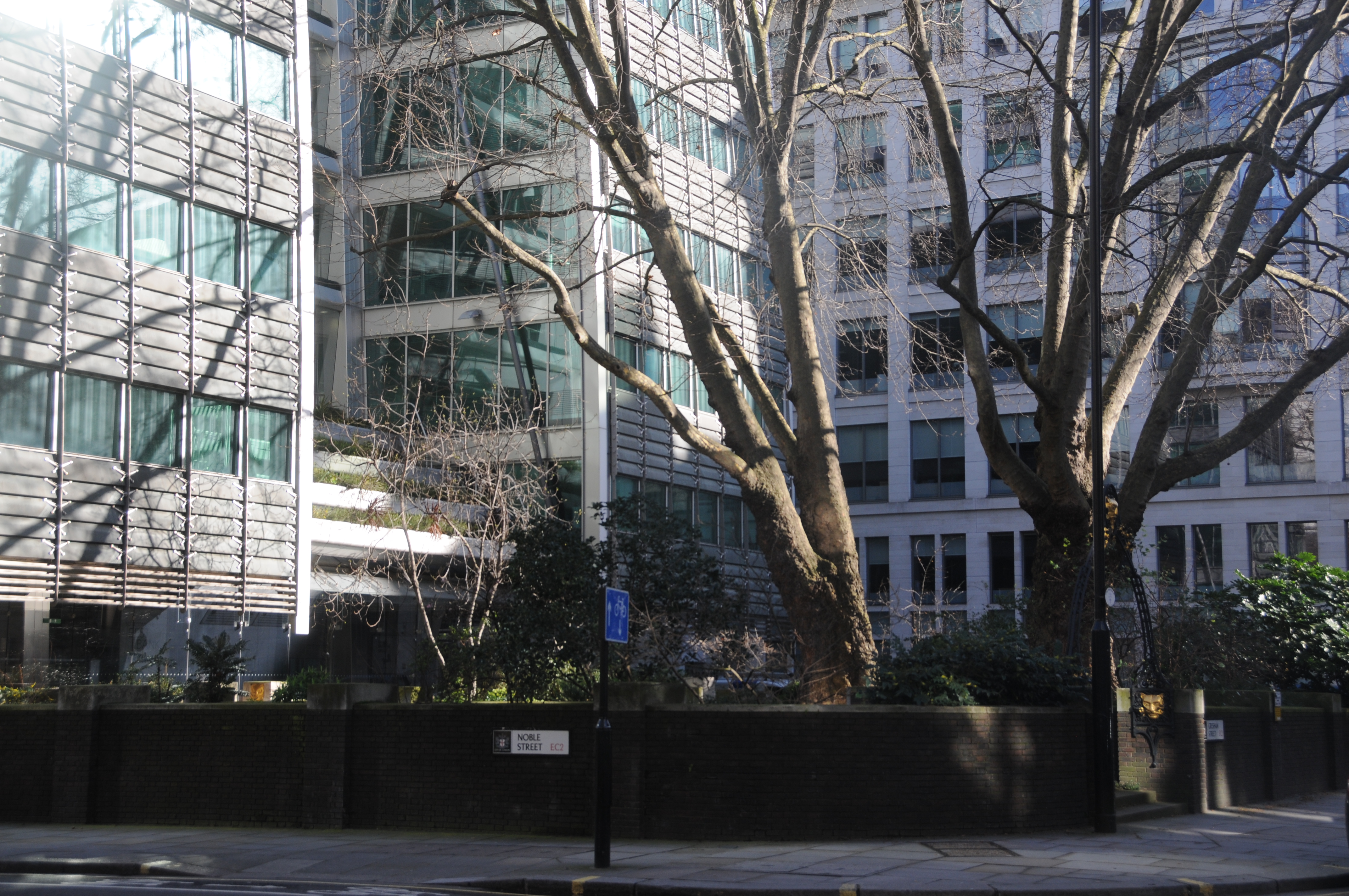
Looking towards the garden at the site of the churchyard of St John Zachary

Looking towards the garden at the site of the churchyard of St John Zachary

The plaque on the wall in the original photo has moved to the right and although not visible is on the wall heading to the right of the above photo.
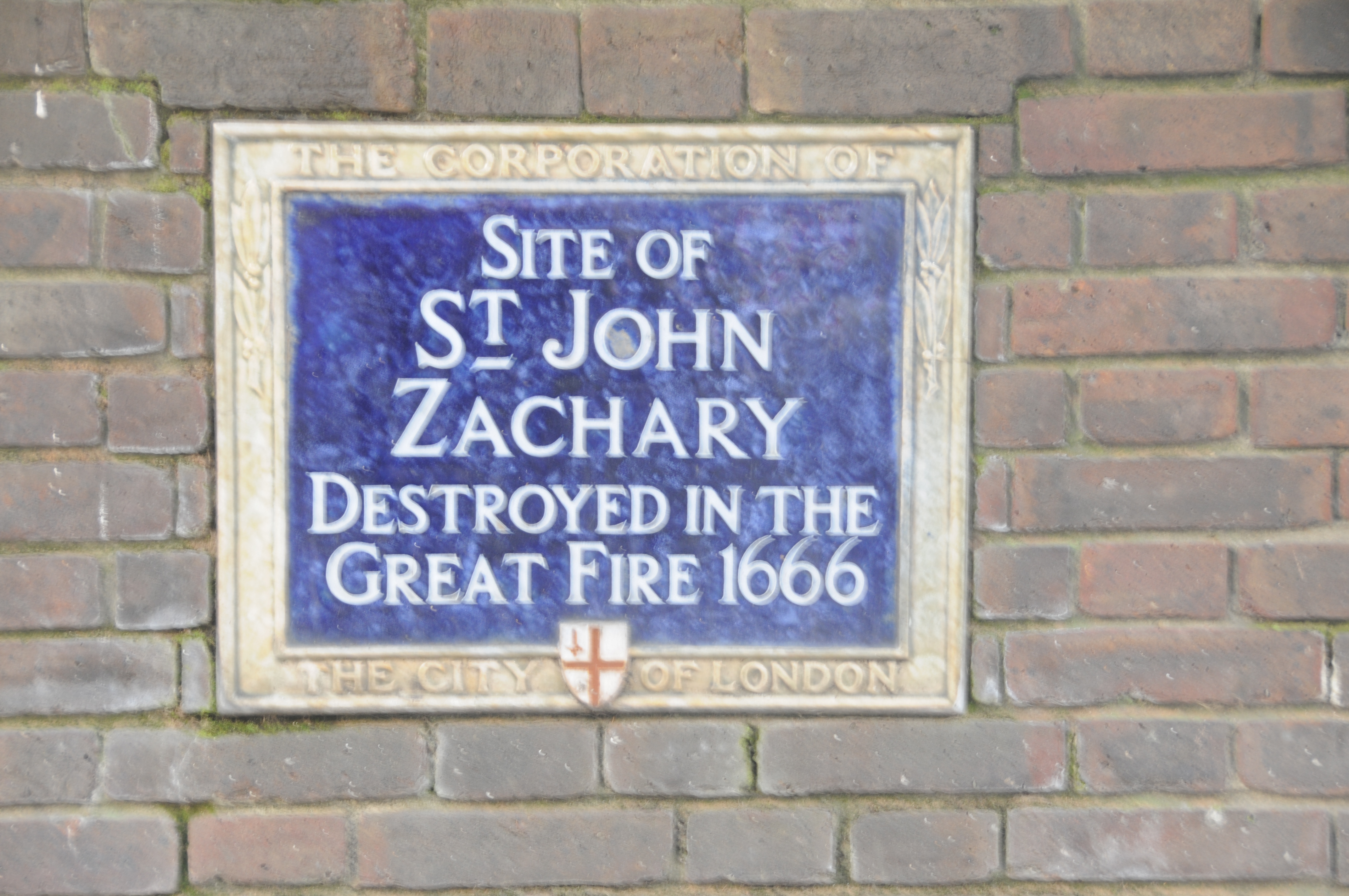
What looks like the original plaque, now slightly relocated.

What looks like the original plaque, now slightly relocated.

I am sure this is the angle the original photo was taken from, as checking the map, the church tower seen in the background of the original photo is St. Alban in Wood Street, Whilst this is now obscured by office blocks, it can clearly be seen in the following map in the correct position from where I took the later photo, from the cross roads, looking across the garden.


View Larger Map
I always like finding locations that appear in the background of photos, so I took a walk round to St Alban and what I found is either one of the most depressing views, or a wonder of survival. The following photo is looking down Wood Street from Gresham Street looking at the tower of St. Alban.

The tower is the only surviving part of the church and where once it had stood clear of the surrounding buildings, it is now surrounded on all sides by towering office blocks that are getting steadily higher and higher. It is no longer a church, the tower now houses the offices of a corporate finance advisory firm.

I am really pleased that the church tower has survived so we continue to have tangible evidence of the number of churches that once supported the population of the City of London and the Wren architecture of these churches that were generally rebuilt after the Great Fire, however I still find it very depressing that a building that once stood taller than its surroundings and held a special place in the daily lives of the population, is now dwarfed by the size and architectural style of the surrounding buildings. Almost being crowded out of a location that has functioned as a church for many hundreds of years.

The following engraving of St Alban from 1810 shows the church standing clear of its surroundings as it would have done from when it was rebuilt between 1682 and 1685 and the later half of the 20th century when the surrounding office blocks were constructed. The change that the tower has seen in the last 330 years is incredible.
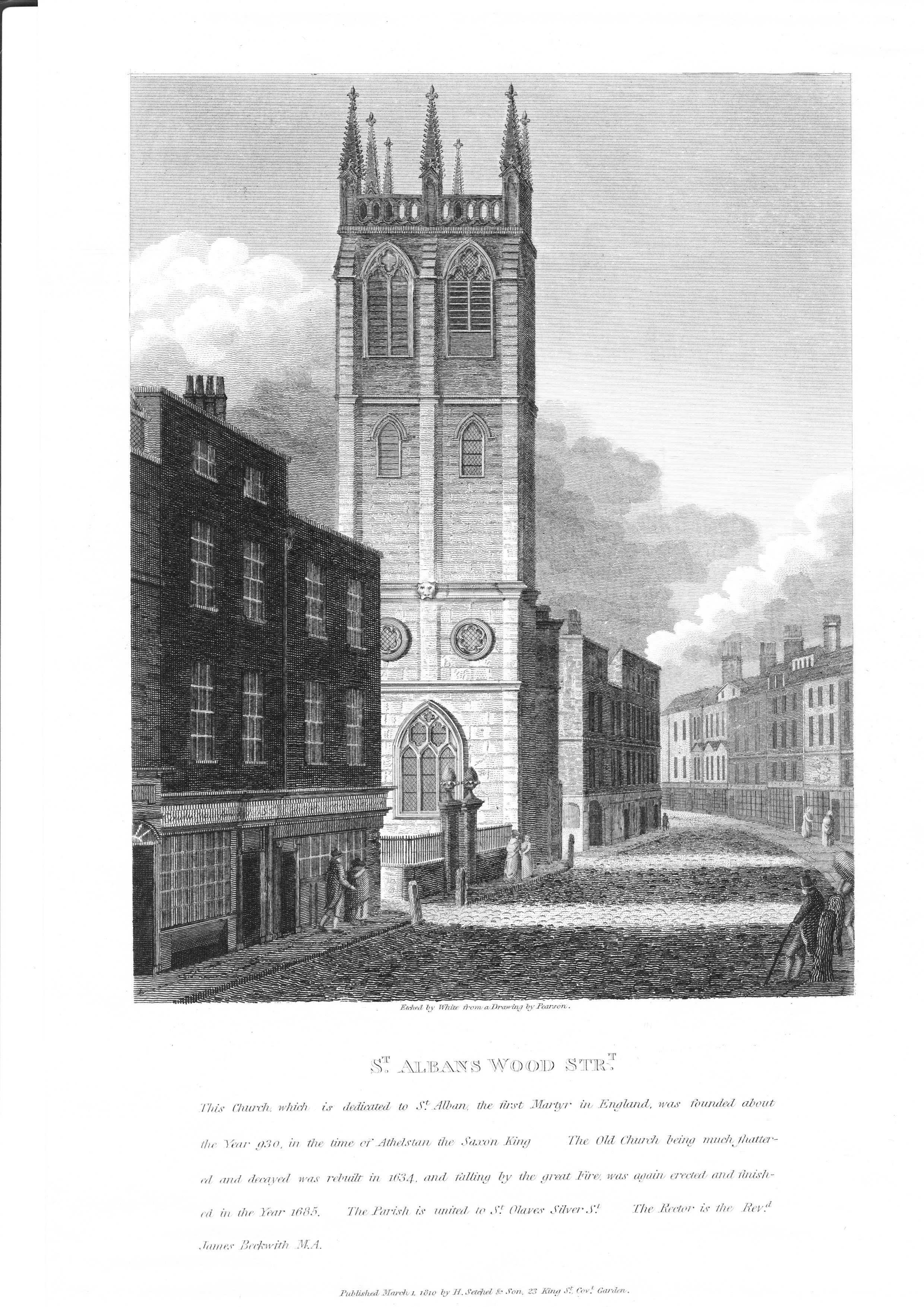
A view of the Wren church of St. Alban Wood Street as it stood in the early nineteenth century (1810). Engraved by William Johnstone White from an original drawing (now in the British Museum) by William Pearson.

A view of the Wren church of St. Alban Wood Street as it stood in the early nineteenth century (1810). Engraved by William Johnstone White from an original drawing (now in the British Museum) by William Pearson.

Where once, standing on the top of the tower would have provided wonderful views over the city, with only the spires of the other city churches breaking above the roof level. Now, you would be staring straight into the floor of an office, with many other floors stretching above.

The streets in the surrounding area also tell a story of both continuity and change. The following map is of Aldersgate Ward from John Strype’s  ‘A Survey of the Cities of London and Westminster’ which was first published in 1598. (reproduced with the kind permission of Motco Enterprises Limited )
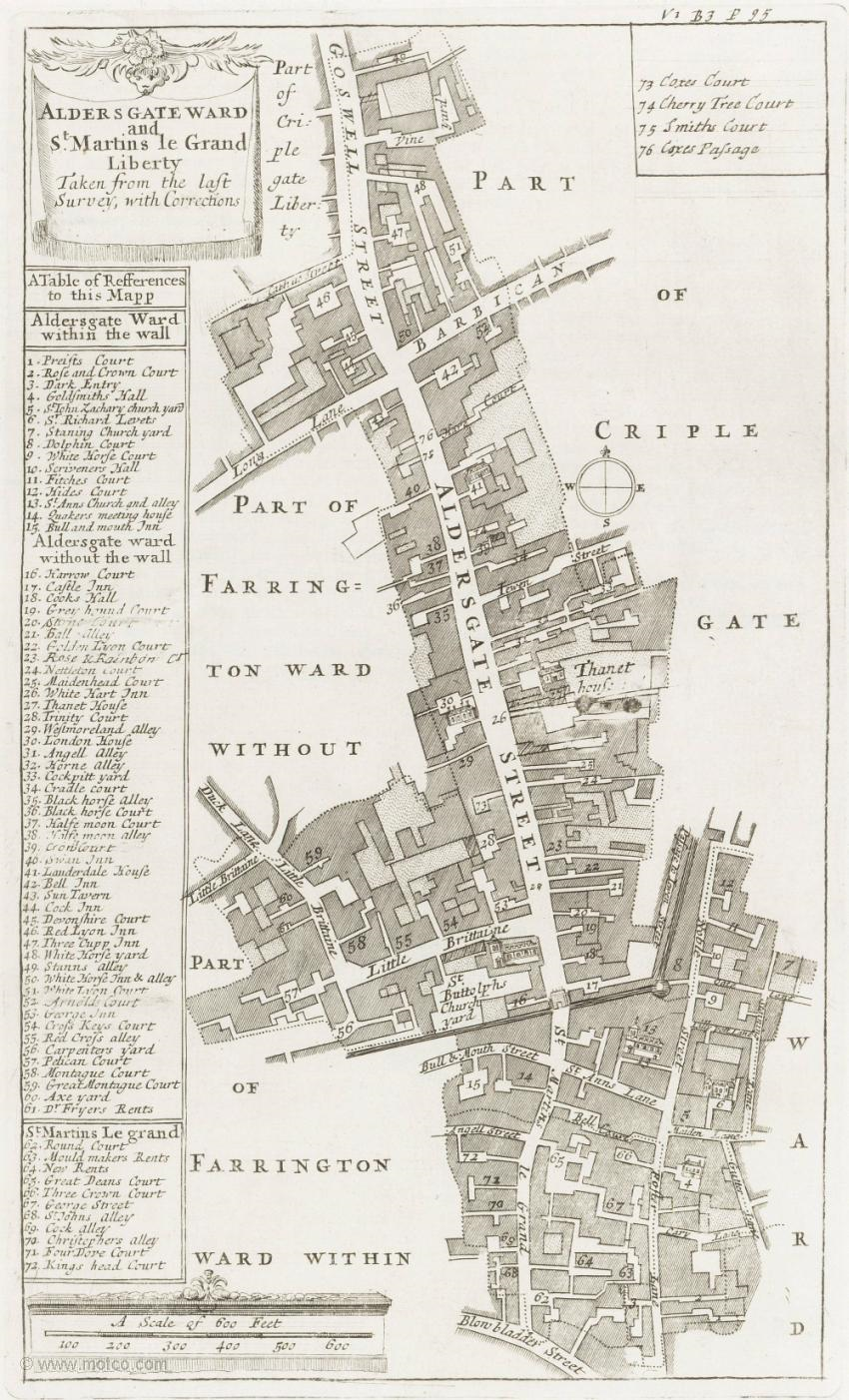
Map of Aldersgate Ward from John Strype's John Strype's ‘A Survey of the Cities of London and Westminster’

Map of Aldersgate Ward from John Strype’s  ‘A Survey of the Cities of London and Westminster’

The churchyard of St. John Zachary is labelled as number 5 in the bottom right of the map (just to the left of A in WARD).

Noble Street (which still exists) is clearly visible running vertically past the churchyard, however Gresham Street does not exist. Maiden Lane running past the churchyard where Gresham Street is now.

If you continue to the bottom of the map there is the wonderfully named Blowbladder Street. Aligning this with current mapping, this is now part of Cheapside.

Defoe gives an origin of the name Blowbladder Street in his “A Journal of the Plague Year” where he states: ” and which had its name from the butchers, who used to kill and dress their sheep there (and who it seems had a custom to blow up their meat with pipes to make it look thicker and fatter than it was, and were punished there for it by the Lord Mayor)”.

Time to move on, but next time you see a church tower standing clear above the surrounding buildings or landscape, please remember the tower of St. Alban fighting to retain a link with the past against the tide of encroaching office blocks.
alondoninheritance.com

The Thames From Hungerford Bridge And A London Bridge Across The Rhine

After leaving St Mary Aldermanbury, I found another location nearby from where one of my father’s photos had been taken, however I am still checking a couple of facts about this location, so lets head out of the City of London, along the Embankment and down to Hungerford Bridge and stand on the footbridge over the Thames looking east.

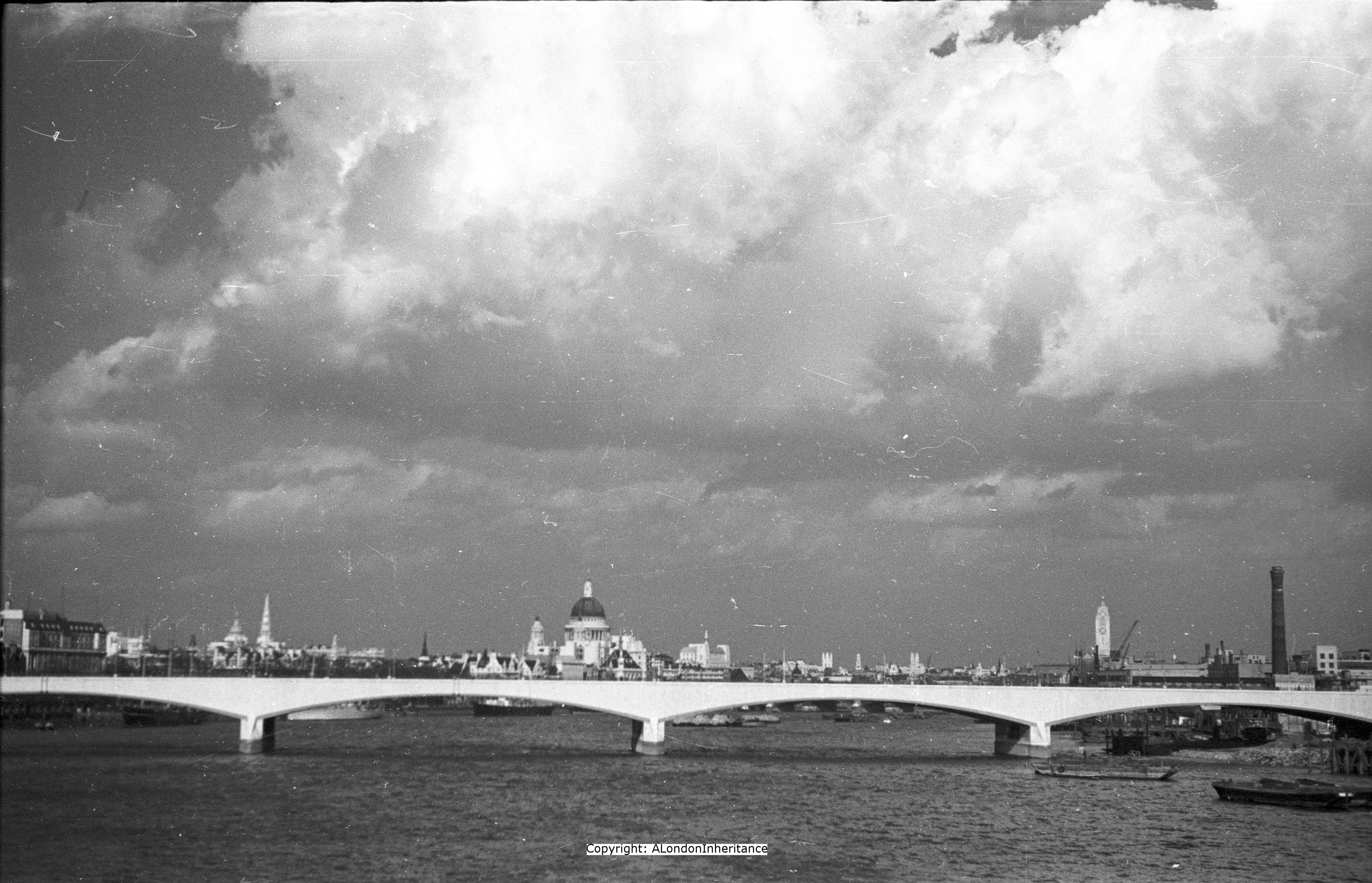
If we had stood here in 1950 the view from Hungerford Bridge would have looked like this:

View from Hungerford Foot Bridge looking east in 1950.

View from Hungerford Foot Bridge looking east in 1950.

The foot bridges alongside Hungerford Bridge (there is one on either side of the railway bridge and they are more formally known as the Golden Jubilee Bridges)  were opened in 2002 and replaced the original narrow footbridge from where this photo was taken. Looking towards the city we can see the Portland Stone of the newly constructed Waterloo Bridge gleaming in the sun. The bridge had been completed 5 years previously in 1945 and due to construction during the war, it was built mainly by women.

This is not the first Waterloo Bridge, the stone for the first was laid on the 11th October 1811 and the bridge opened on the 18th June 1817, the anniversary of the battle of Waterloo. If it was not for this historical event, the original proposal for the bridge was for it to be named the Strand Bridge.

The first bridge was weakening in the early decades of the 20th century and in May 1924 the bridge had to be closed to vehicular traffic owing to the weakening of the main archway and sinking of part of the roadway.

A temporary bridge was constructed and repairs undertaken to the main bridge. The temporary bridge was taken down in November 1943 and stored for use in the war effort. After the capture of Antwerp, the temporary bridge was transported across the channel and after the Germans had destroyed the Rhine bridges, the temporary bridge, with some additional sections, was built across the Rhine at Remagen, and within weeks, tanks, guns, lorries and troops were streaming over the bridge that had originally carried Londoners from the south of the river to the north.

St. Paul’s stands clear above the city, to the right we can see the OXO tower, built in the late 1920’s by the owners of the OXO brand. If we had turned further to the right we would see the Royal Festival Hall under construction as part of the Festival of Britain development. I will cover this in a future post.

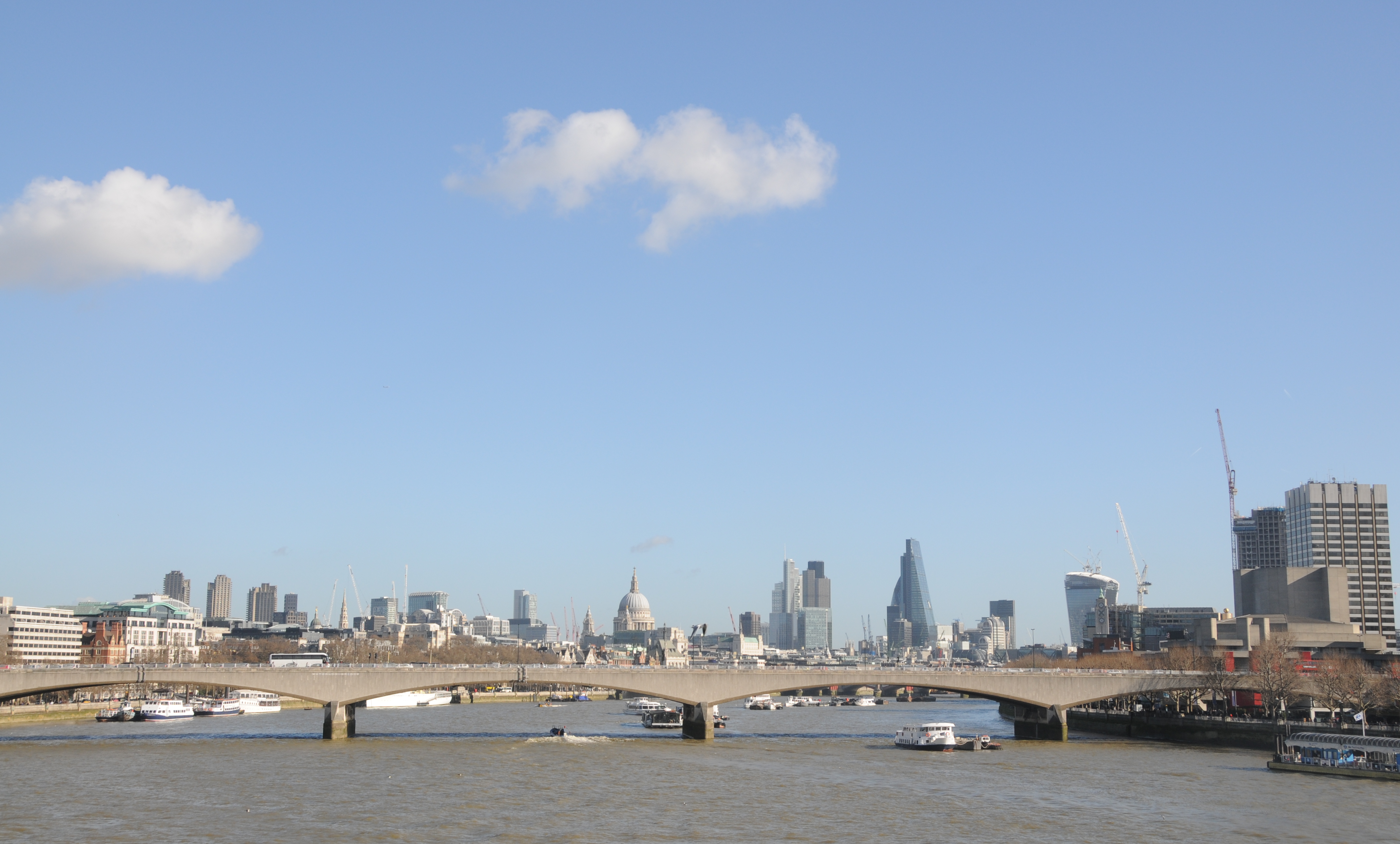
Although the footbridge I am standing on is new, I try to find the position from where this photo was taken. It is an unusually sunny February afternoon, without the dramatic cloudscapes of my father’s photo. I find the position, not far from the north bank, and take the following photo:

Looking east along the Thames - 2014

Looking east along the Thames – 2014

Despite 65 years of building, and thanks to some intelligent city planning, St. Paul’s Cathedral still stands clear of its immediate surroundings, however to the right the march of steel and glass is clearly visible.  The angled shape of the Cheesegrater (or 122 Leadenhall Street to use its official name) and further to the right the Walkie Talkie building (or 20 Fenchurch Street) now dwarfs the OXO Tower.

Whilst there has been very little change along the north bank of the Thames, the south bank has changed dramatically. In the original photo, the chimney is a sign of the industrial activity that ran along the south bank of the river. Wharfs, factories, warehouses have now been transformed into theatres, offices, television studios, shops, restaurants and residential flats.

Comparing the south bank in the old and new photos, it is just possible to see how the Thames is now far more constrained than in the past. Originally along the Thames there were many inlets, wharfs etc. (and centuries ago much of the south bank was marshland), but now the Thames runs through the city constrained by stone and concrete walls.

Time to leave Hungerford Bridge and the Thames and a quick walk back past St. Pauls and to find a location which has changed beyond all recognition.

alondoninheritance.com

The First Bomb And A Church Shipped To America

A dark, wet and windy Thursday evening in February. I am browsing through a couple of thousand of scanned photos that my father took across London just after the war. Negatives, many of them on old nitrate film that are now being viewed on technology not imagined when these photos were taken. I have long wanted to find the current locations of these photos and see how London has since changed.

Where to start? One photo stands out as the logical start point for my journey. It represents the point where the impact of the Second World War first came to central London. The start of the destruction of the city and the resulting rebuilding during the following 65 years.

I print out the photo and a couple of days later find myself standing in Fore Street.


View Larger Map

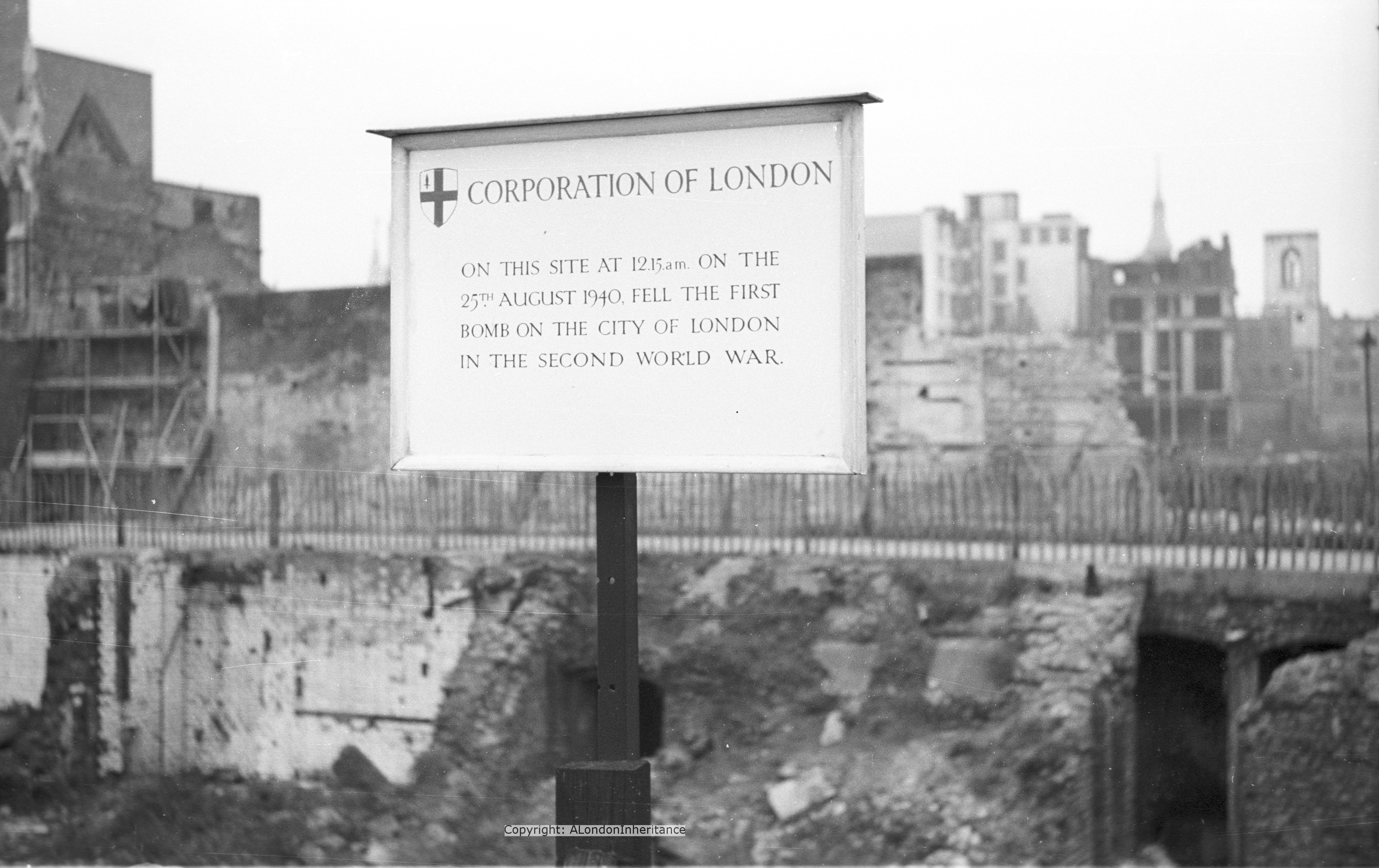
This photo was taken in Fore Street just after the war. The Corporation of London have erected a sign to mark this point as the location where the first bomb fell on the city.

Site of the first bomb on central London during the Second World War

Site of the first bomb on central London during the Second World War

After this first attack on the 25th August 1940, heavy bombing started on Saturday September 7th and continued for the next 57 nights. London then endured many more months of bombing including the night of the 29th December 1940 when the fires that raged were equal to those of the Great Fire of 1666. Hundreds of people were killed or injured, damage to property was enormous and 13 Wren churches were destroyed. Or the night of the 10th May 1941 when over 500 German bombers attacked London. The alert sound at 11pm and for the next seven hours incendiary and high explosive bombs fell continuously across the city.

Behind the sign is a devastated landscape, not a single undamaged building stands, to the right of the photo, the shell of a church tower is visible. All this, the result of months of high explosive and incendiary bombing.

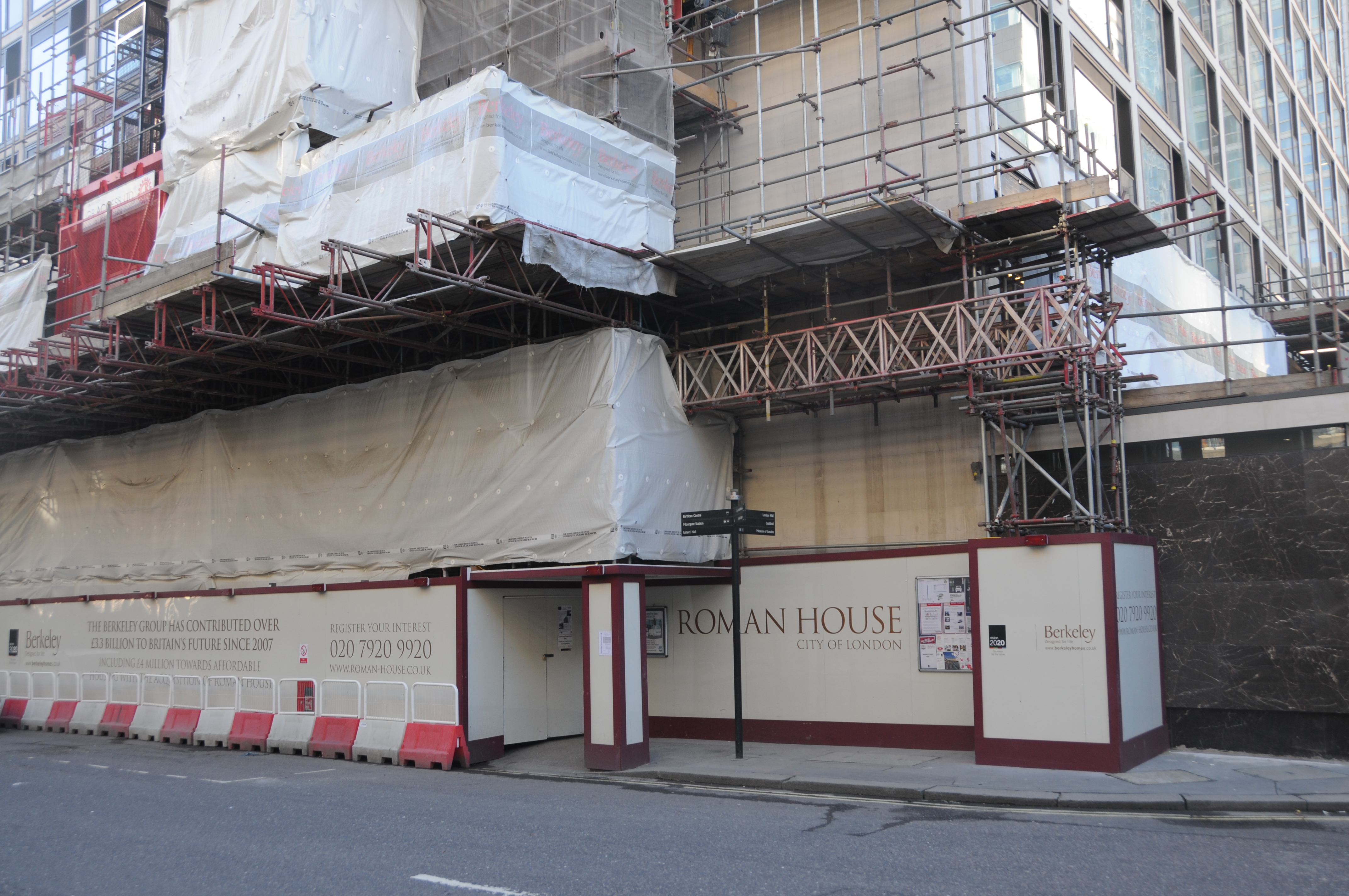
Fore Street is between Moorgate Station and the Museum of London and is in the shadow of the Barbican buildings and the towering office blocks along London Wall. The temporary sign has long gone and was replaced by a stone plaque on the building that stands at the end of Fore Street where it leads into Wood Street, however my visit is not well timed. As is typical with London buildings, the one with the plaque is going through a refurbishment and the side is completely covered. I just hope that in the enthusiasm for rebuilding, this marker of a key event in London’s history will survive.

The plaque should be on the wall behind all this building work.

The plaque should be on the wall behind all this building work.

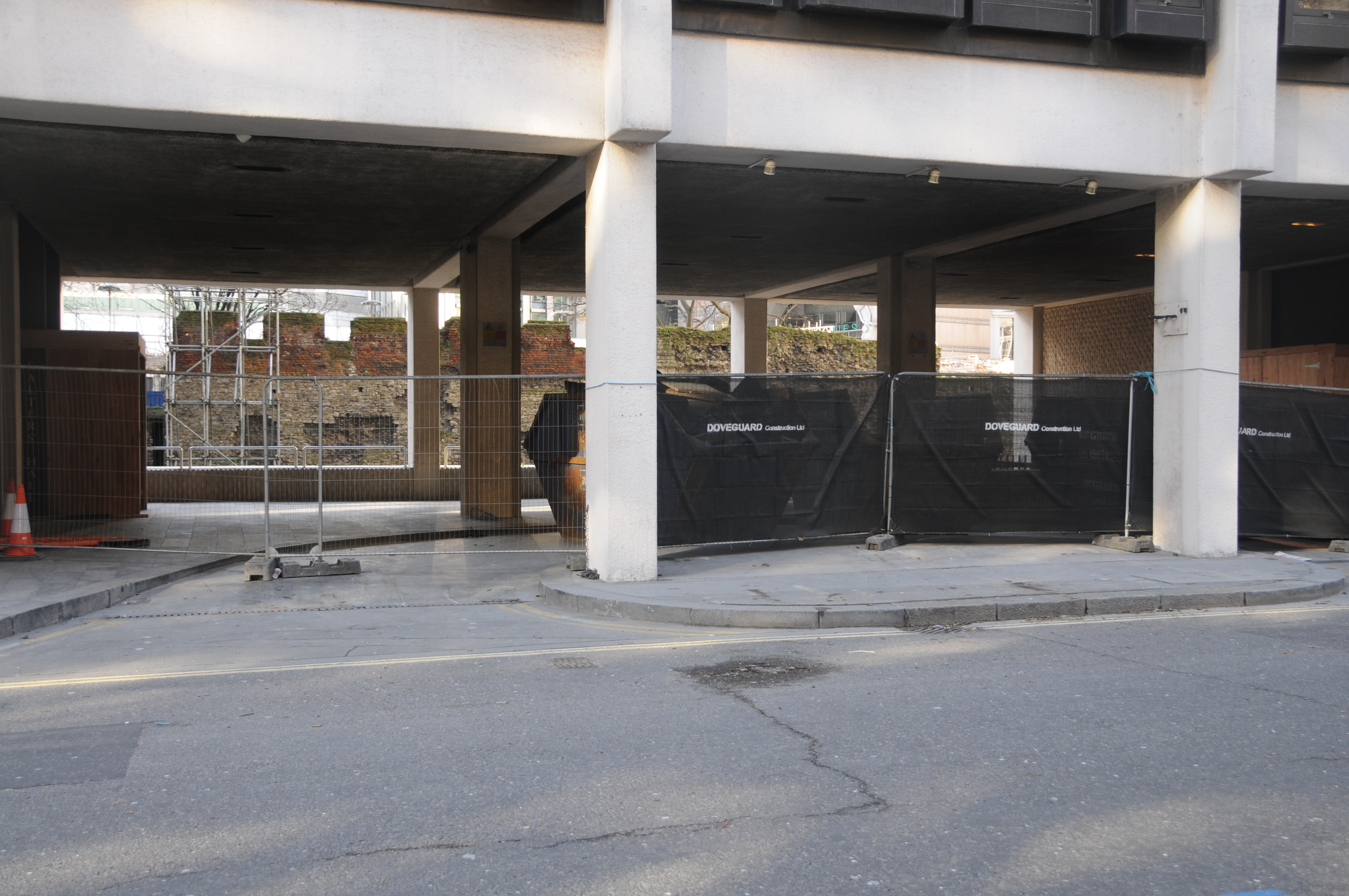
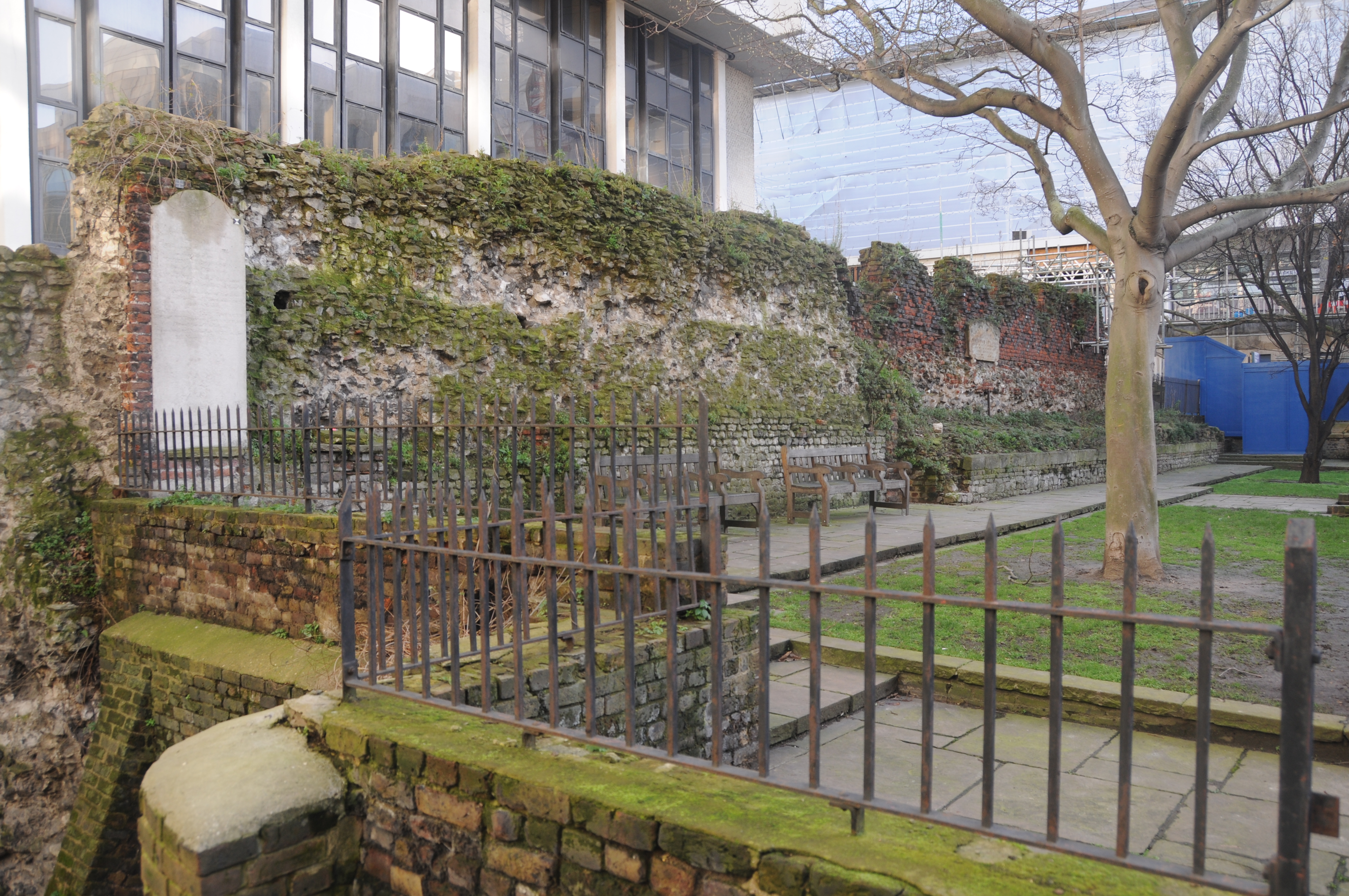
But does anything from the original photo survive? Unlikely, but I decide to look around. Behind the fencing in the original photo, there is a wall, walking down Fore Street and looking through the building entrance I see a wall, castellated on the top on the left of the wall and straight topped to the right. The wall I see through the gap looks the same as the wall in the original photo (although the angle is different, the original must have been taken towards the corner of Fore Street and Wood Street).

Looking towards the remains of the Roman Wall from Fore Street

Looking towards the remains of the Roman Wall from Fore Street

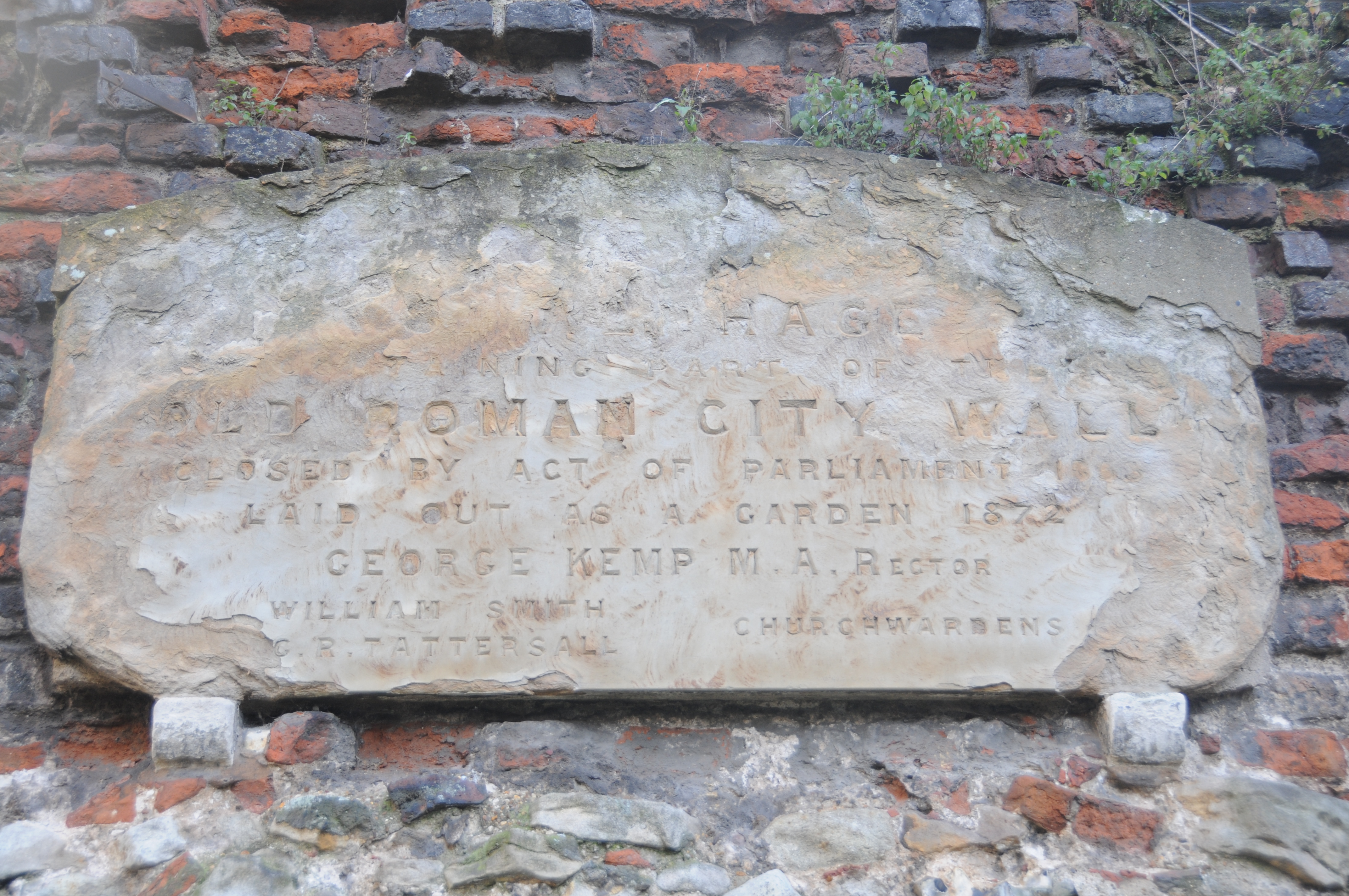
Plaque on the Roman Wall

Plaque on the Roman Wall

I find my way to the back of the building to a small garden, the former churchyard of St Alphage and here stands the wall, a lengthy section of the old Roman Wall. The garden is small, surrounded on all sides by towering offices and I suspect, the majority of the day in their shadow.

The garden at the former churchyard of St Alphage

The garden at the former churchyard of St Alphage

Despite all the building of the last 65 years, there are many locations like this throughout the city. To me, they are the deep foundations of the city, anchoring the city to the bedrock of history reaching back to the Roman foundation of the city as a commercial centre.

Apart from the Roman Wall, the only other structure that may have survived is the church tower seen in the right hand edge of the original photo. The city of London originally had dozens of churches and many of these still survive, if not as working churches, but as the remaining shell of the building, or just a single tower.

If the church tower still stands, it is hidden behind the office blocks of London Wall, so a quick walk across London Wall in the general direction of where the church should be found.

Nothing!

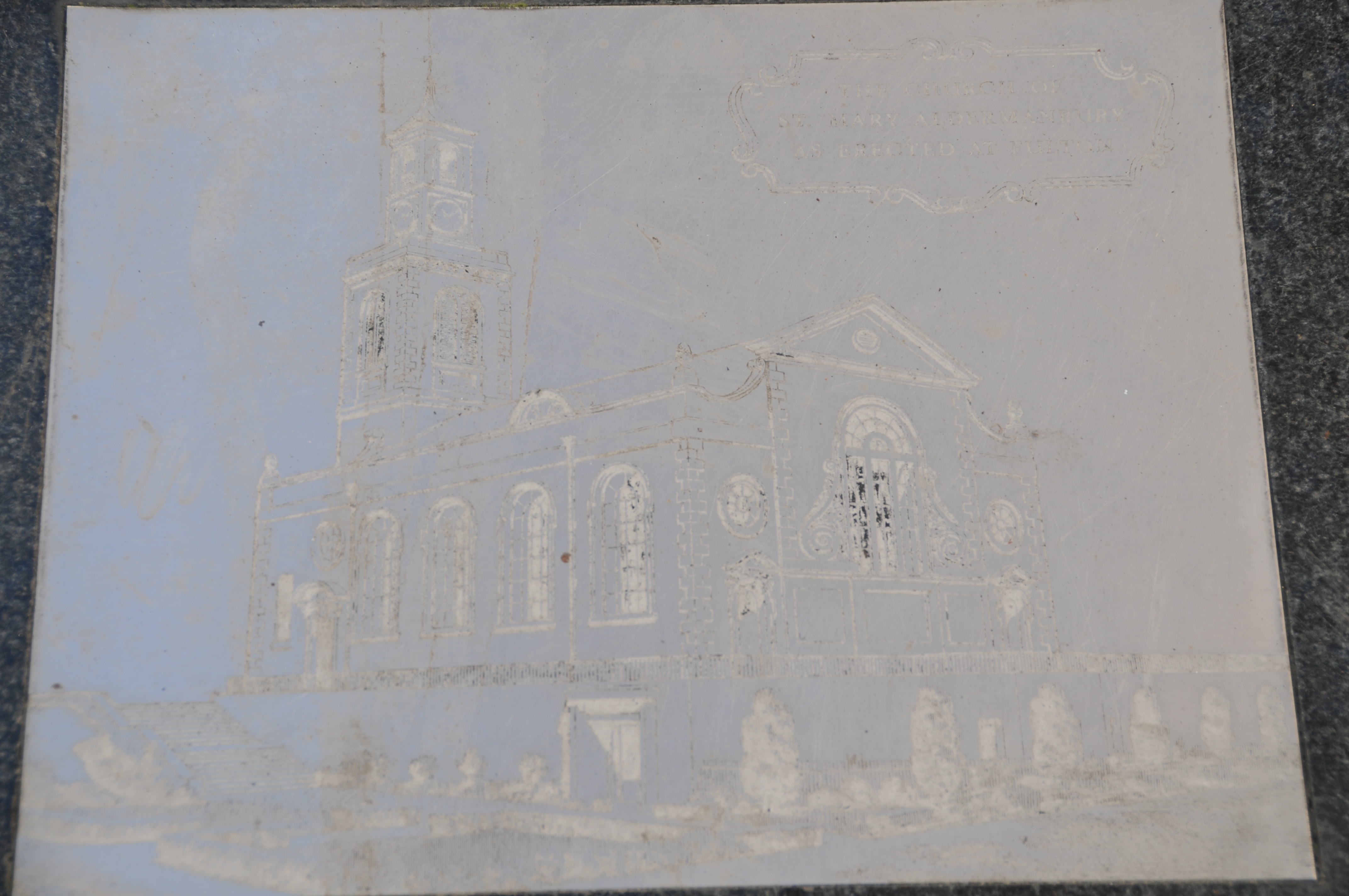
But I do find another small garden, at the end of which there is a plaque on the ground. The plaque has an etching of a church which has the same tower and window style as the one in the
photo. Checking the map, the alignment with the original photo looks right.

The plaque in the garden of St Mary Aldermanbury

The plaque in the garden of St Mary Aldermanbury

This is the site of St Mary Aldermanbury. Records of a church on this site date back to 1181. The original church was destroyed in the Great Fire of London in 1666. As with so many other churches destroyed during the Great Fire, a Wren church was rebuilt on the site. This is the church that was damaged in Second World War.

The garden of St Mary Aldermanbury

The garden of St Mary Aldermanbury

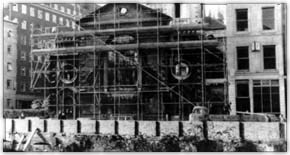
Scaffolding surrounds the Church of St. Mary in London, England. Photograph courtesy of the National Churchill Museum Collections’

Scaffolding surrounds the Church of St. Mary in London, England.
Photograph courtesy of the National Churchill Museum Collections’

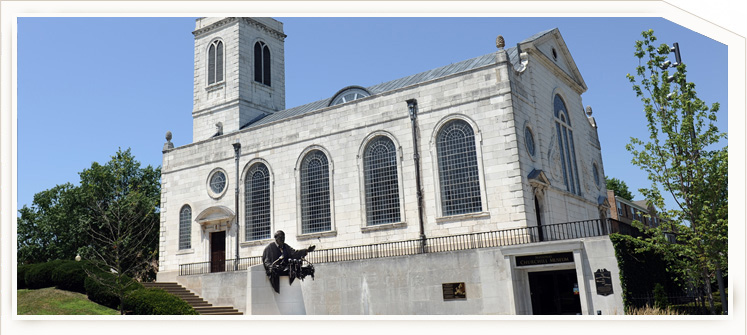
After the war, the heavily damaged church had the unique distinction of being taken apart, shipped to Fulton, Missouri in the USA in 1965, and rebuilt to mark the visit of Churchill to Westminster College in 1946. The church now sits above the National Churchill Museum.

Westminster College was the location of Churchill’s speech that included the famous phrase “An iron curtain has descended across the continent”

St Mary Aldermanbury now rebuilt at the National Churchill Museum. Photograph courtesy of the National Churchill Museum Collections’

St Mary Aldermanbury now rebuilt at the National Churchill Museum.
Photograph courtesy of the National Churchill Museum Collections’

The tower is the church tower that can be seen in the background of the original photo. The National Churchill Museum can be found here along with more information on the move and rebuilding of the church.

Sign at the entrance to the garden on the site of the church of St Alphage

Sign at the entrance to the garden on the site of the church of St Alphage

I wonder how many of the many thousands of people who work next to these locations, who walk along these streets everyday, understand the history around them.

Despite the incredible amount of construction work over the past 65 years and which continues with buildings getting higher and more out of touch with their immediate surroundings, there is still so much to be found across the city.

Sign at the entrance to the garden at St Mary Aldermanbury

Sign at the entrance to the garden at St Mary Aldermanbury


That is my first photo. My next stop is another city garden, where nearby I find an almost fantasy like link to another world, followed by a walk to the Thames to explore a wider view of London.


alondoninheritance.com