Back in October, in a post on two London churches and a Battersea Gas Holder (no connection between them – just some random features of London), I wrote about All Hallows Staining and the 50 Fenchurch development. I was rather frustrated that you could not get a view of the tower of the church on stilts as the main development went on around the ancient remains of All Hallows Staining.
A comment from a reader (thanks Brian J) informed that a view of the building site and the church was available from the viewing area at 120 Fenchurch Street – one of the new public viewing spaces on top of a recent City development.
The Garden at 120, to give the space its correct name, has been on my list of places to visit, but stupidly I had not made the connection between the viewing area and the building site directly in front.
I fixed that last week, with a visit to explore another view across the City.
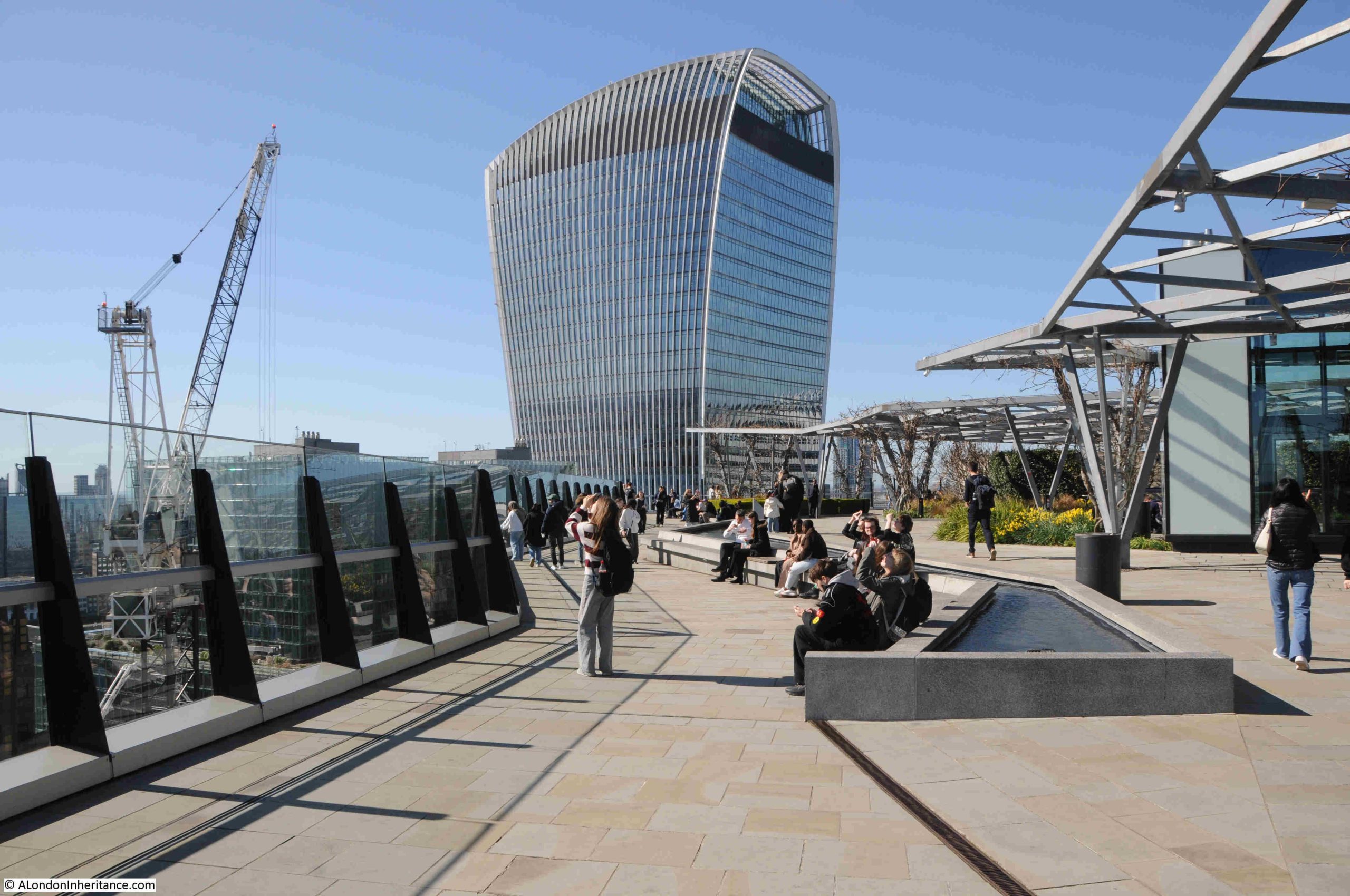
The Garden at 120 is free, does not require a ticket and following a very brief wait in a small queue, the inevitable security check, then the lift took me to the 15th floor, which leads directly out to the viewing area:
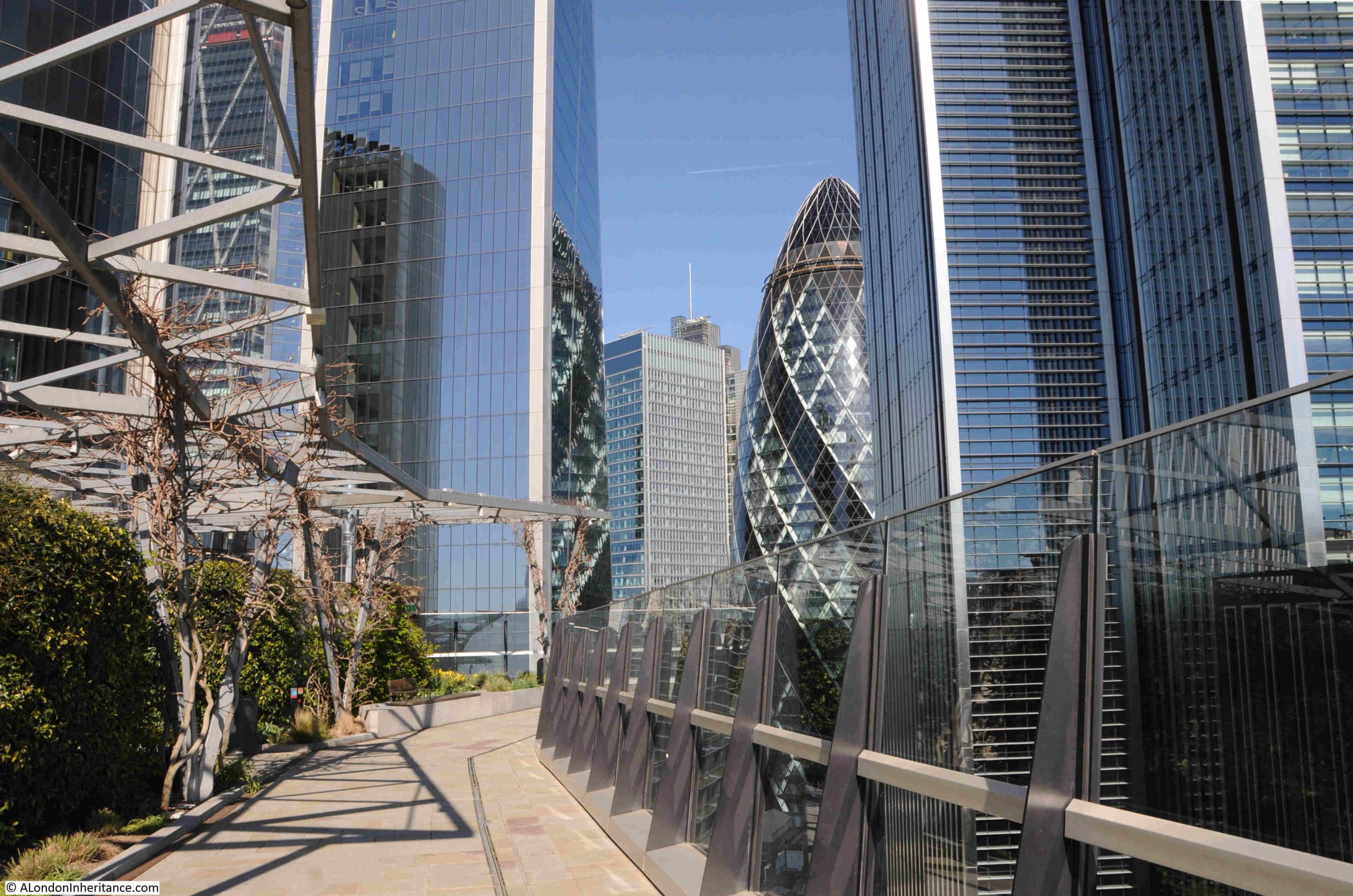
The above view is of the south facing part of the viewing area, which also runs around all four sides.
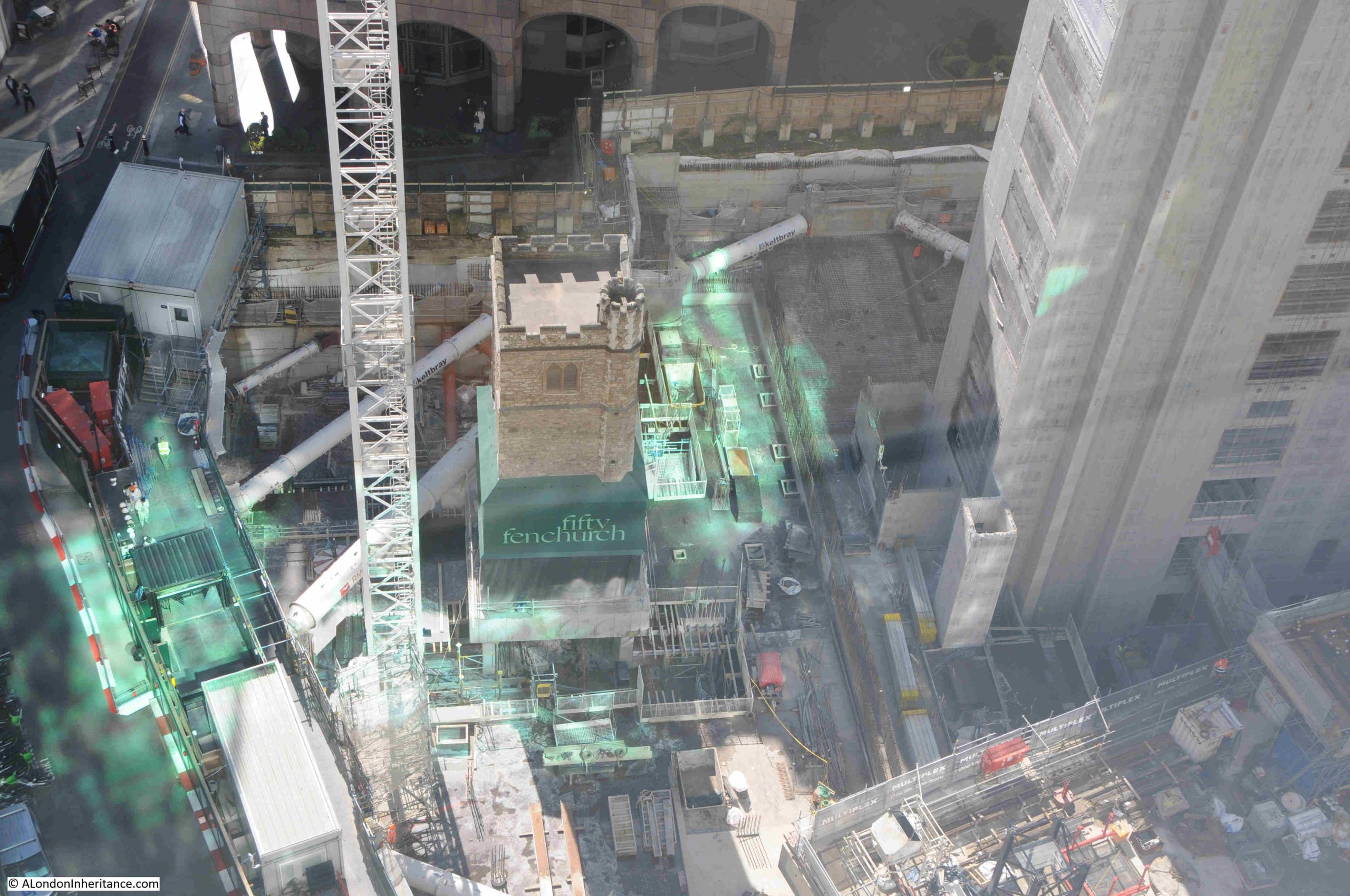
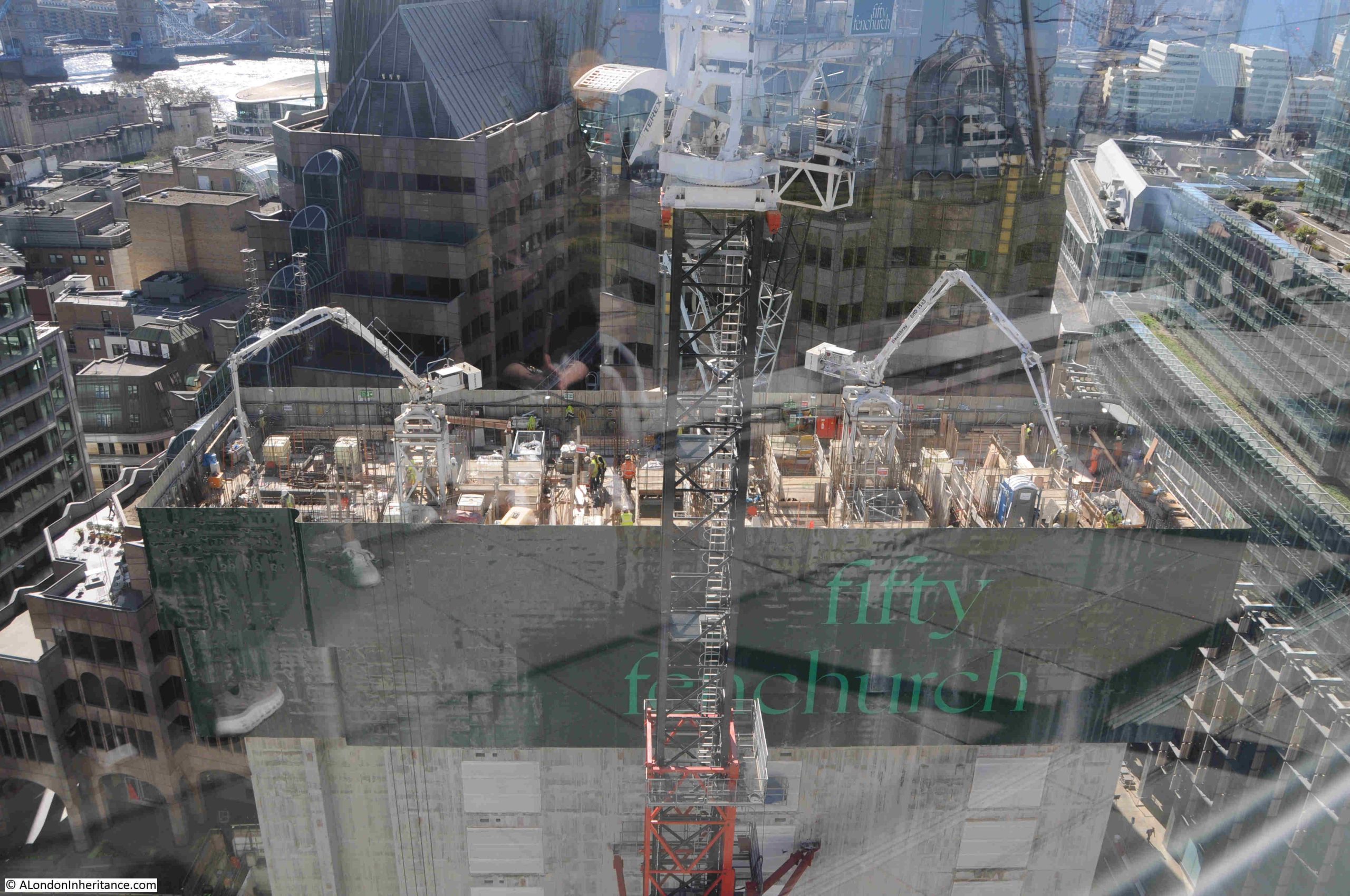
The weather was superb, however I immediately found some problems with taking photos through glass panels looking south, with the sun shining directly into the panels – lots of reflections and strange optical effects, which can be seen in the following photo looking directly down onto the tower of All Hallows Staining:
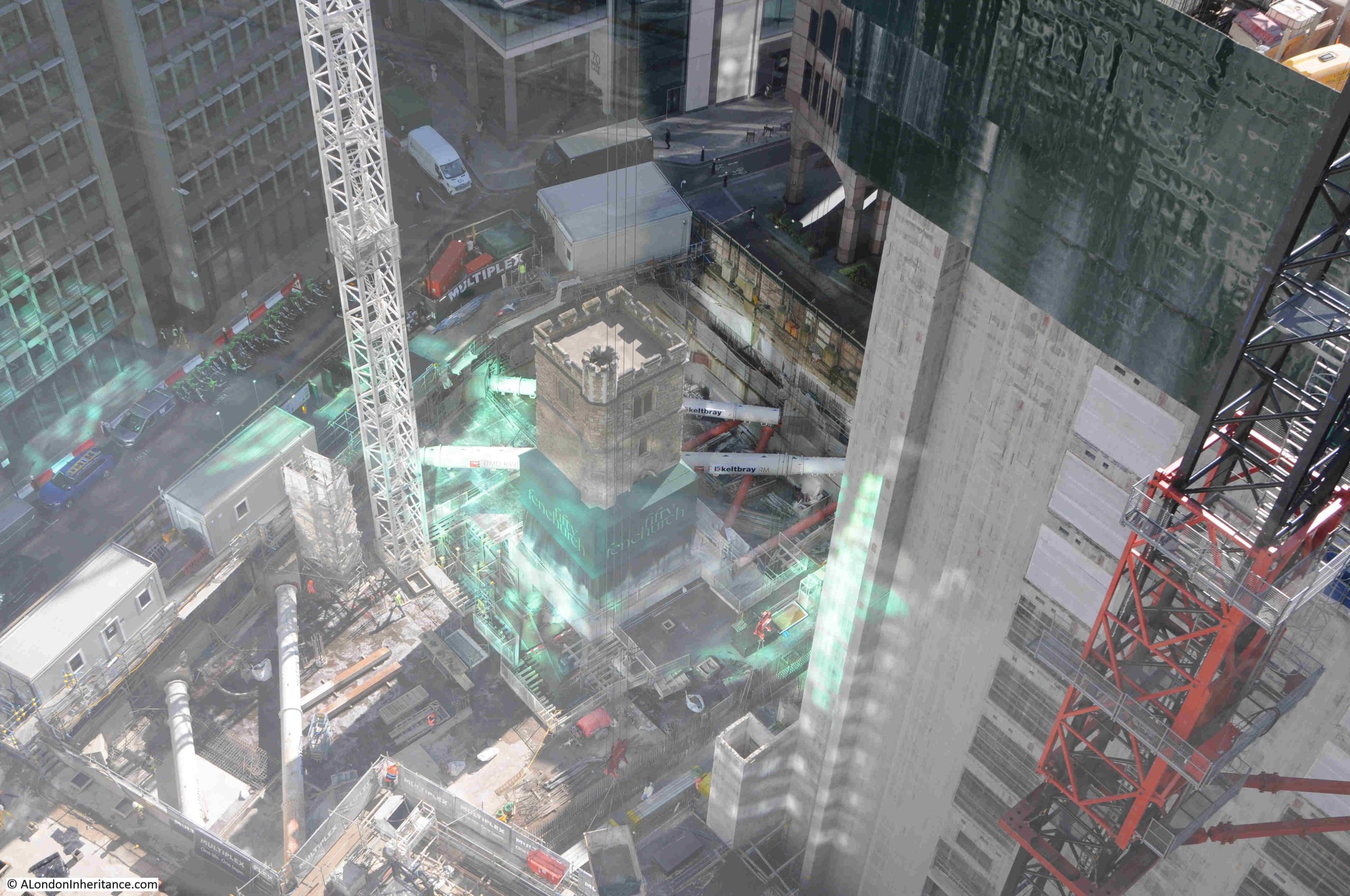
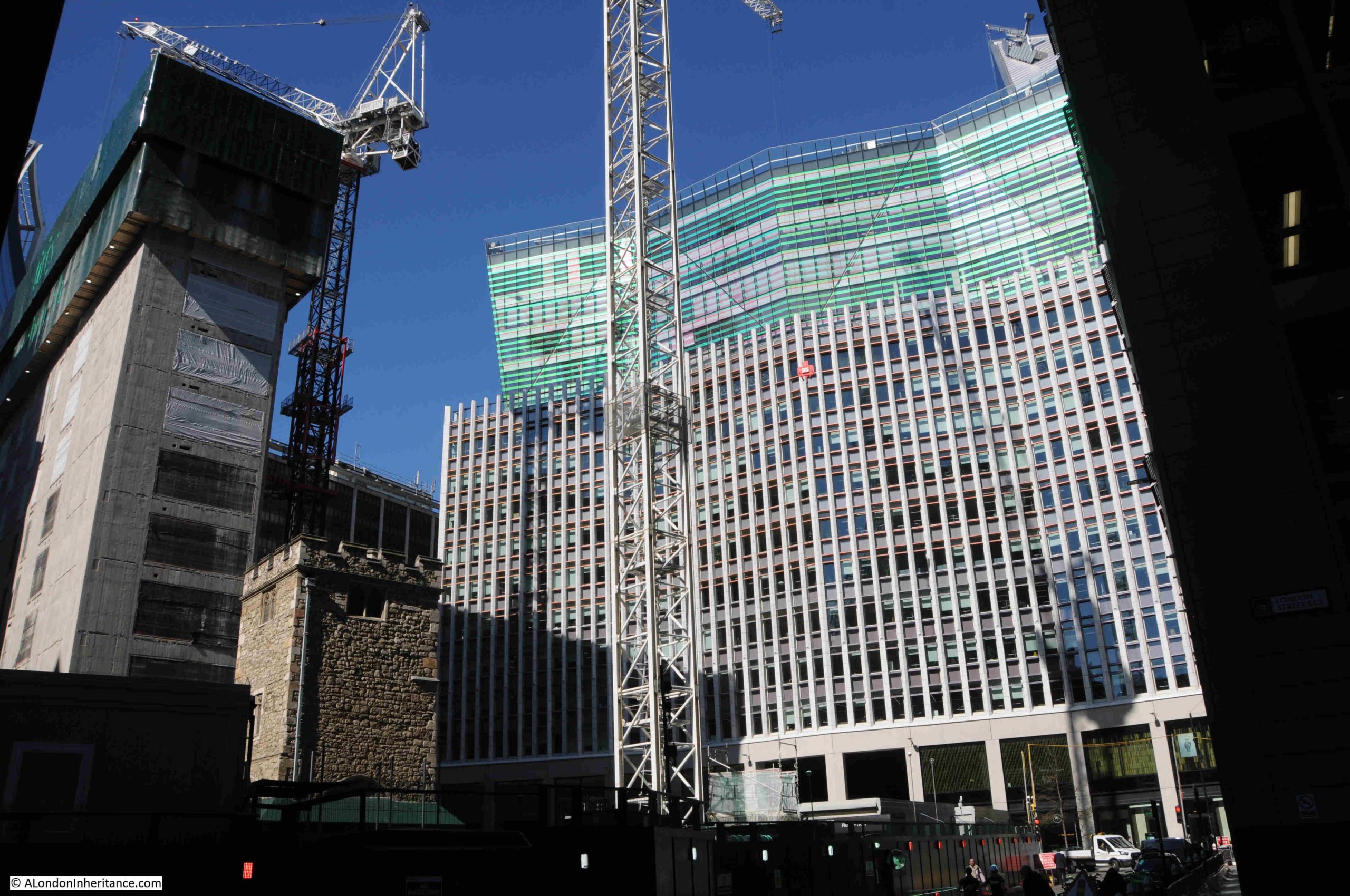
It is just possible to see the tower, standing isolated in the middle of an extensive building site, with the large round metal excavation support struts supporting the retaining walls around the excavation. A view from another angle:
The development in front of 120 Fenchurch Street is Fifty Fenchurch, and when complete will be a 36-storey building, so will be much taller than 120 Fenchurch Street and will block part of the view to the south from the 15th floor garden.
As with almost all new towers in the City, Fifty Fenchurch will also include a public viewing gallery, but strangely this will be at level 10 rather than the roof or upper floors of the building, so the viewing gallery will be lower than the Garden at 120.
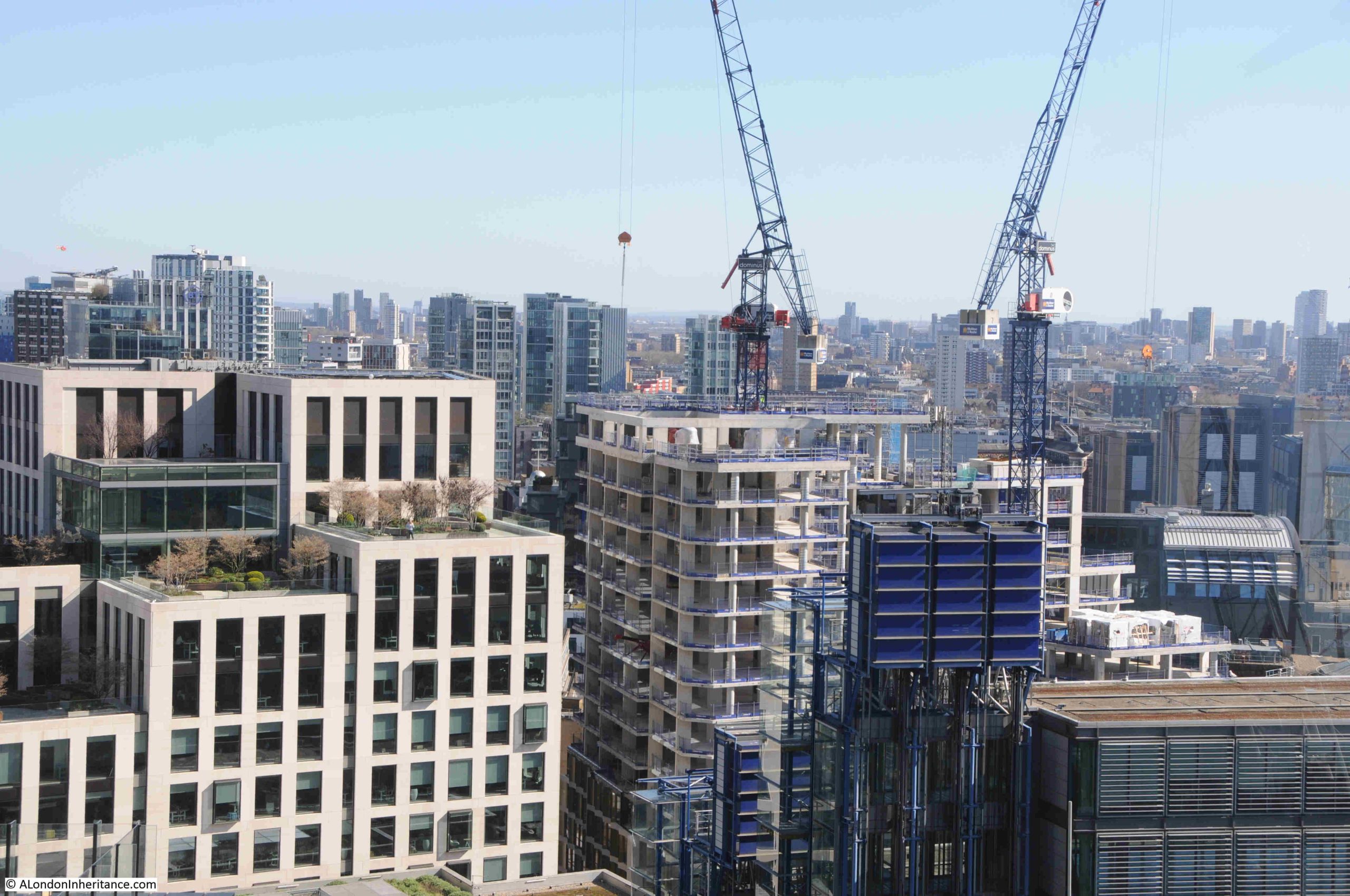
The current upper level of Fifty Fenchurch – the inner concrete core, which still has someway to go:
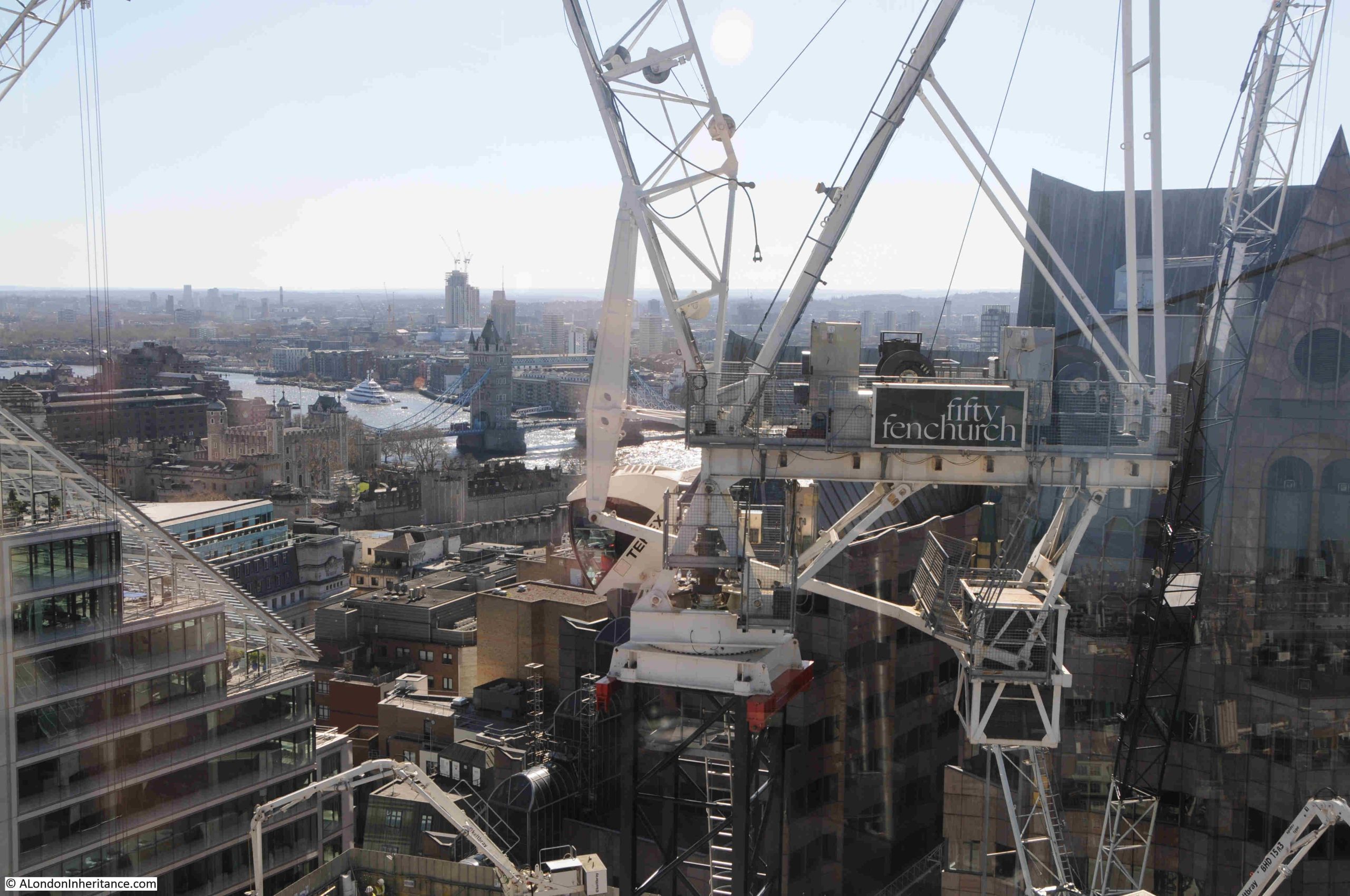
If you have a head for heights, then a job as a crane operator must provide some fascinating views of both construction sites and the wider area, although I would not fancy the climb up the ladders within the central frame to reach the cabin:
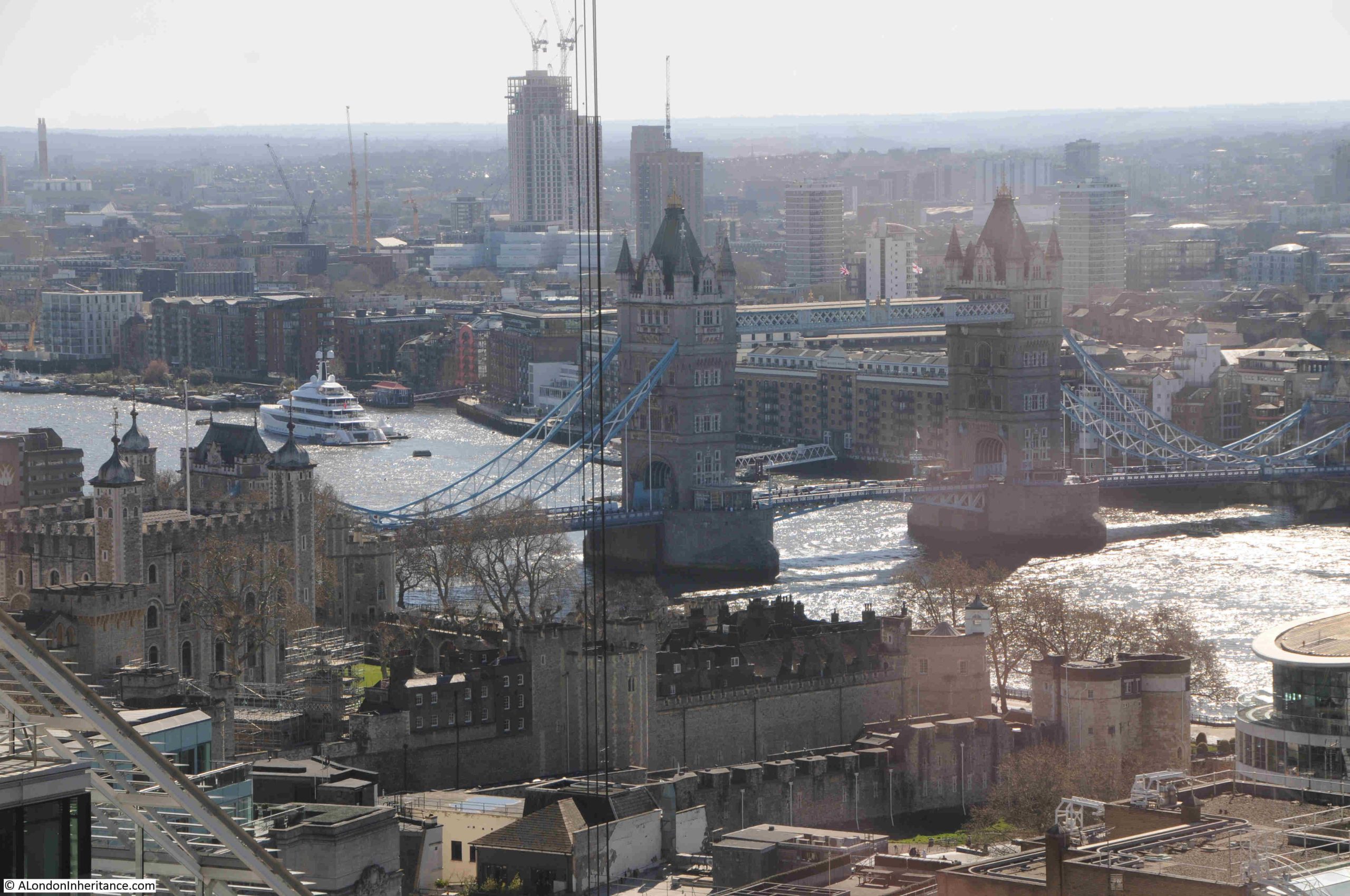
Tower Bridge:
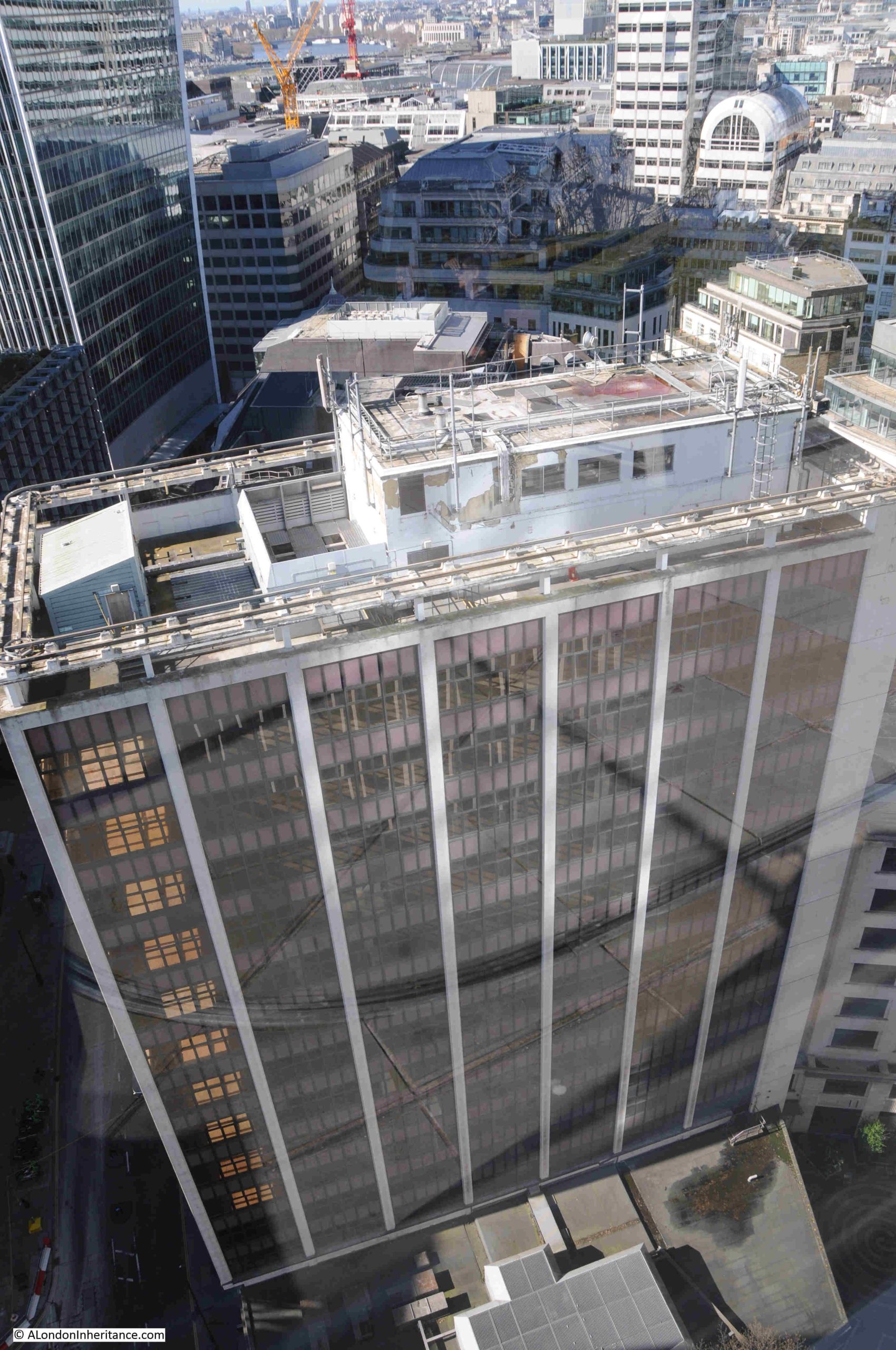
Immediately to the west of 120 Fenchurch Street is Fountain House:
Fountain House was built between 1954 and 1958 to a design by W.H.Rogers and Sir Howard Robertson (Consulting). It was the first London building constructed to the tower and podium formula where a large podium occupies the full area of the plot of land, with a much small central space occupied by a tower block. I have written about the building in this post.
It will probably not be there for much longer, as the City of London Corporation has approved a new development with two new towers, one of 31 storeys and the other with 34, and on the 17th floor there will be a publicly accessible external garden terrace, so there will be three public viewing terraces all next to each other, so visitors to one, will be able to look across to visitors at the other two.
The development replacing Fountain House will also be much taller than 120 Fenchurch Street, so with Fifty Fenchurch to the south, Garden at 120 will be slowly surrounded by higher blocks.
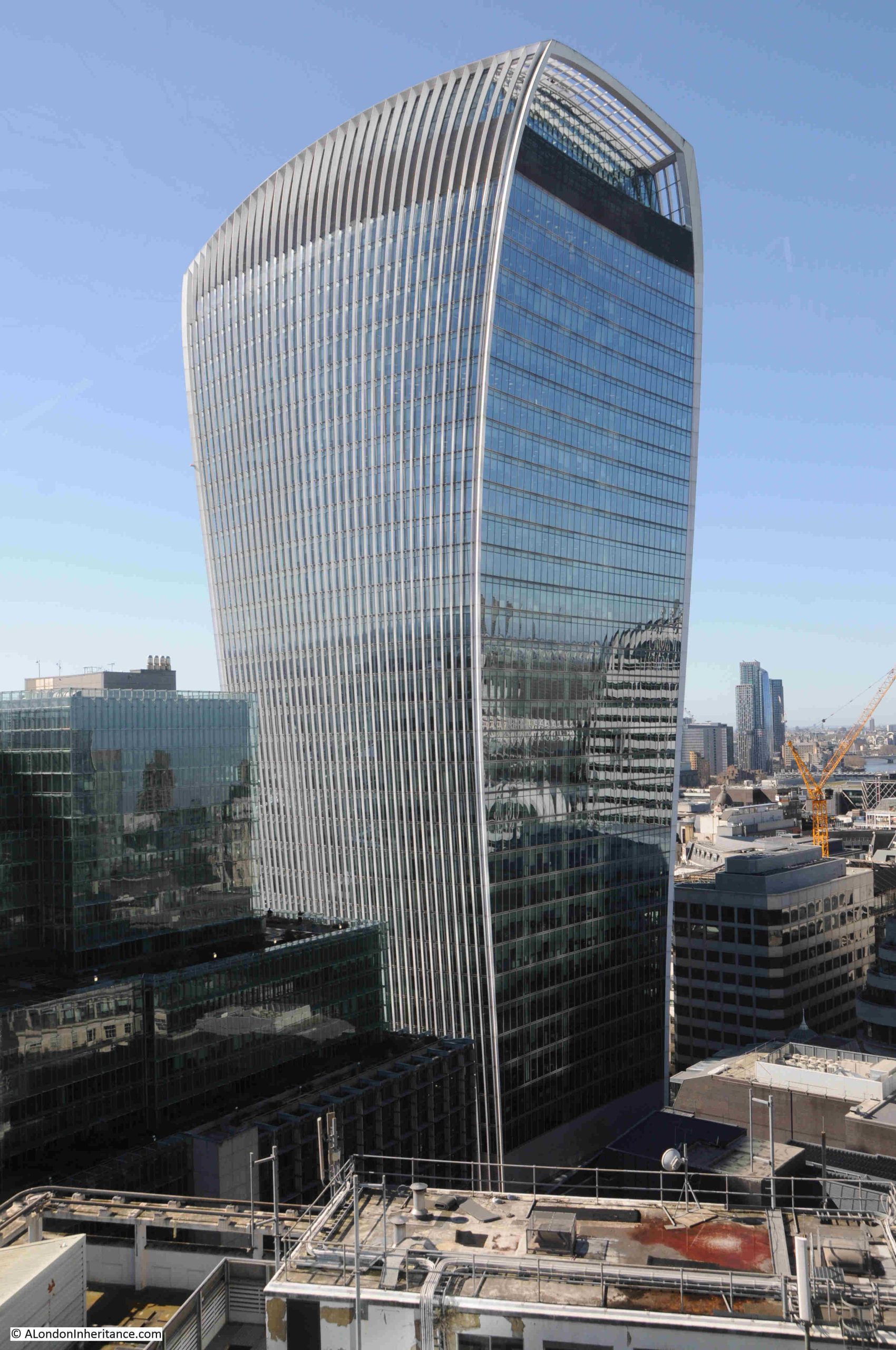
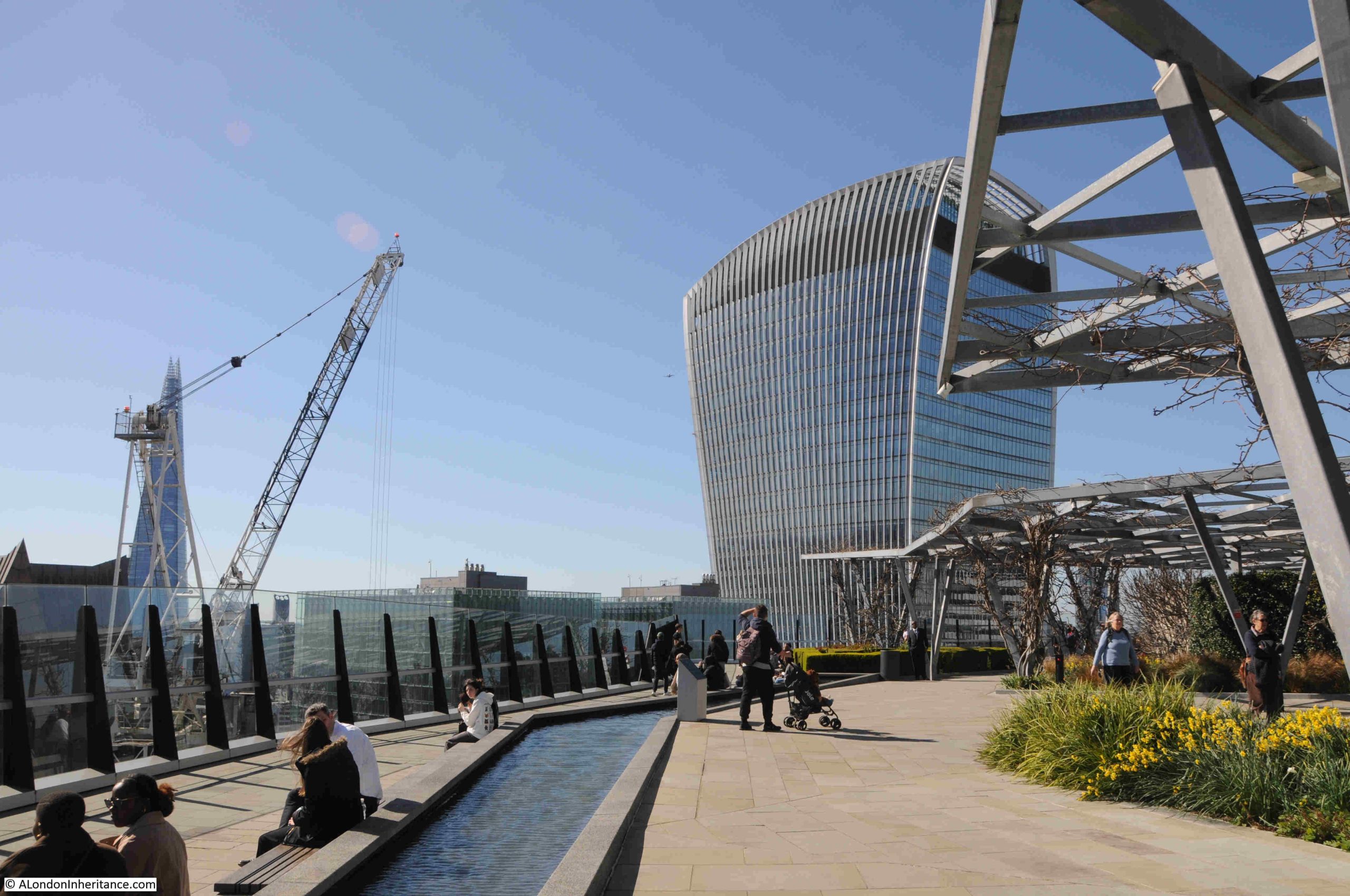
Another building, also with a public viewing gallery is the Walkie Talkie, or more officially. 20 Fenchurch Street. The plan for the replacement of Fountain House implies that the following view of the Walkie Talkie will be obscured from the Garden at 120:
In a few years, you will be able to spend an entire day out visiting the four public viewing terraces all within a short distance along Fenchurch Street.
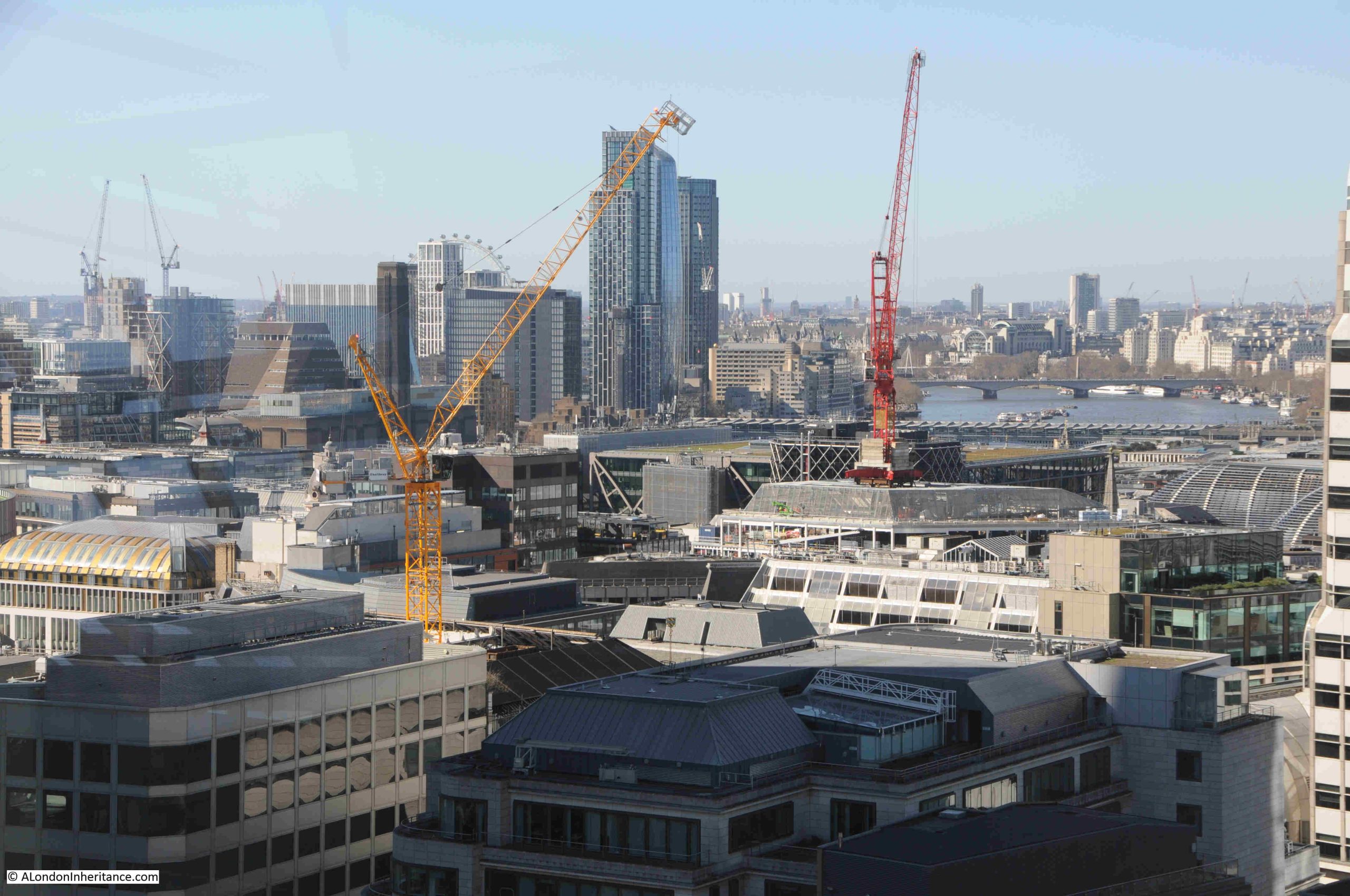
View towards the west with a small stretch of the Thames from Blackfriars Railway Bridge up to Waterloo Bridge:
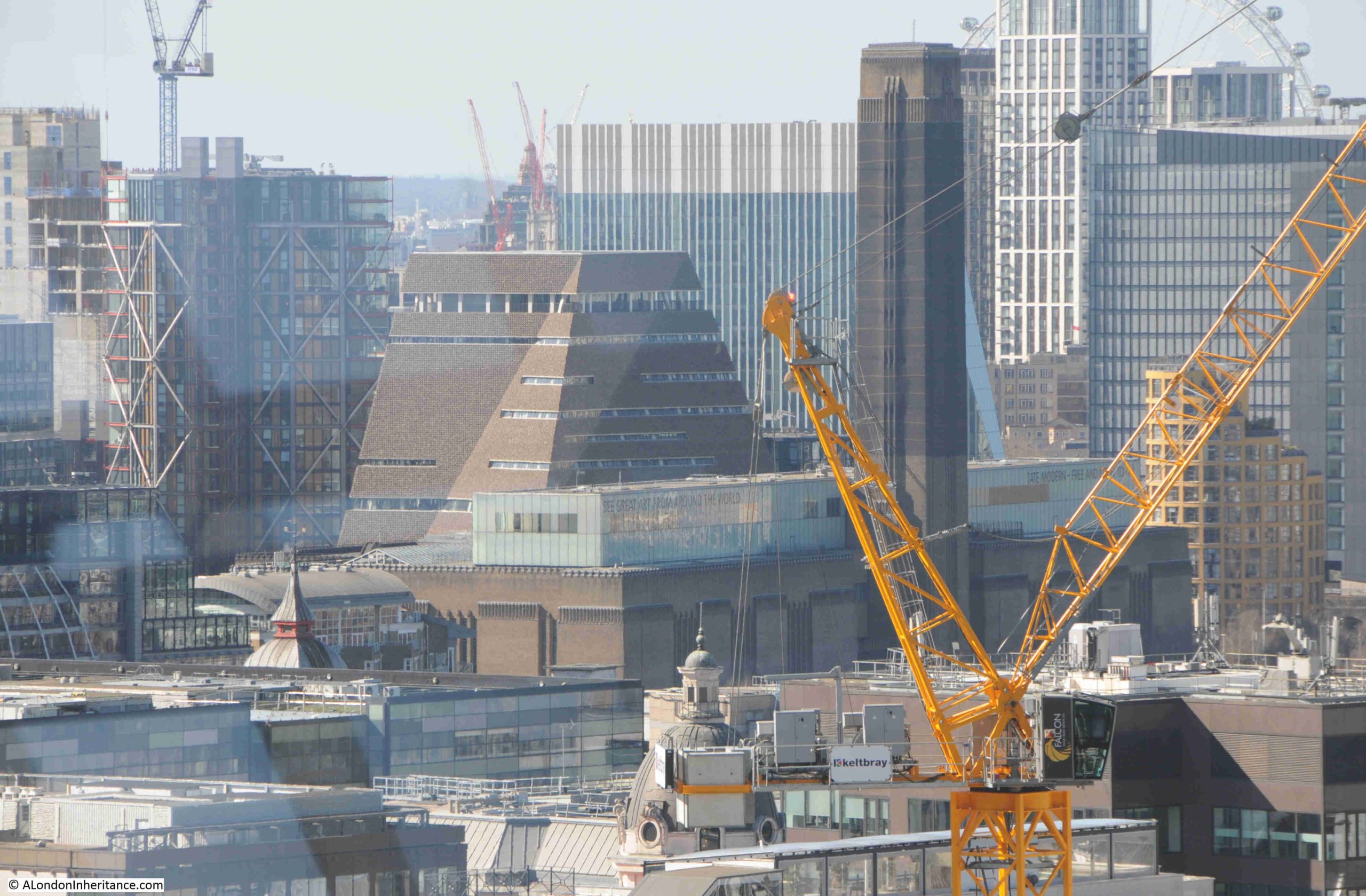
There is another viewing gallery in the above photo, just to the left of the yellow crane, is the Blavatnik Building of Tate Modern, and on the 10th floor is a viewing gallery:
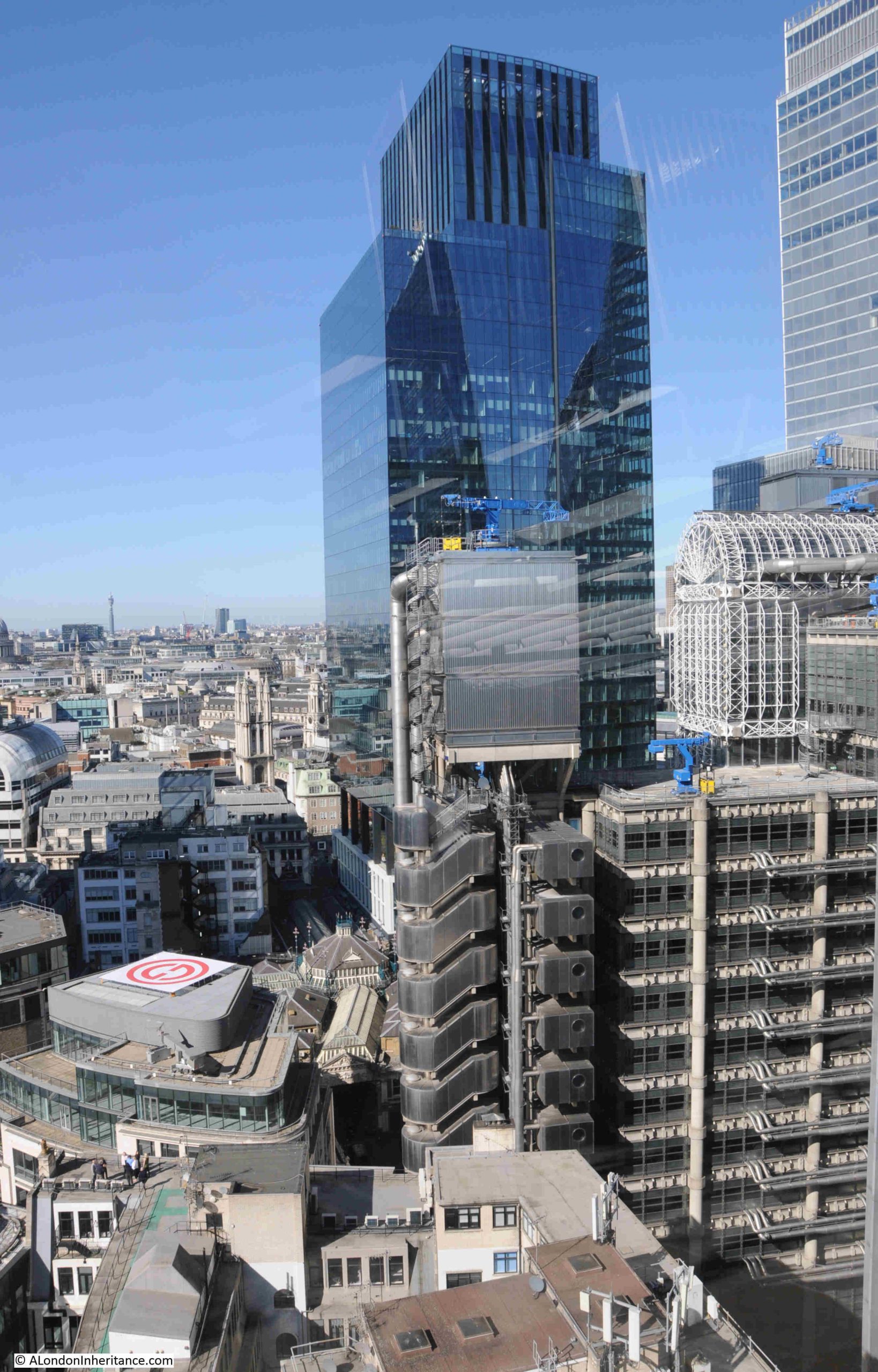
The following photo illustrates how the scale of the modern City has grown exponentially from the historic City, and how historic buildings are reduced to filling in the ever decreasing gaps.
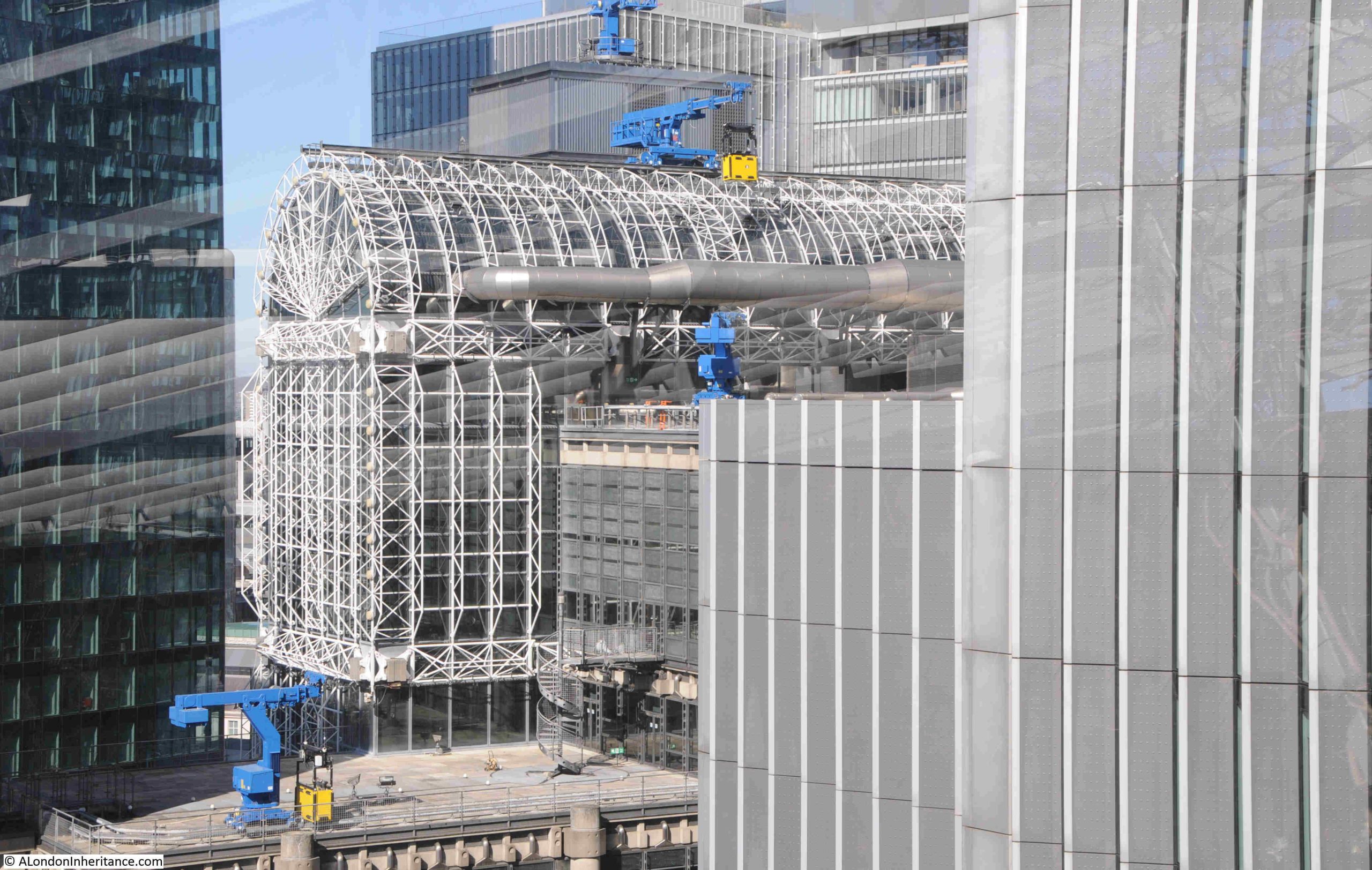
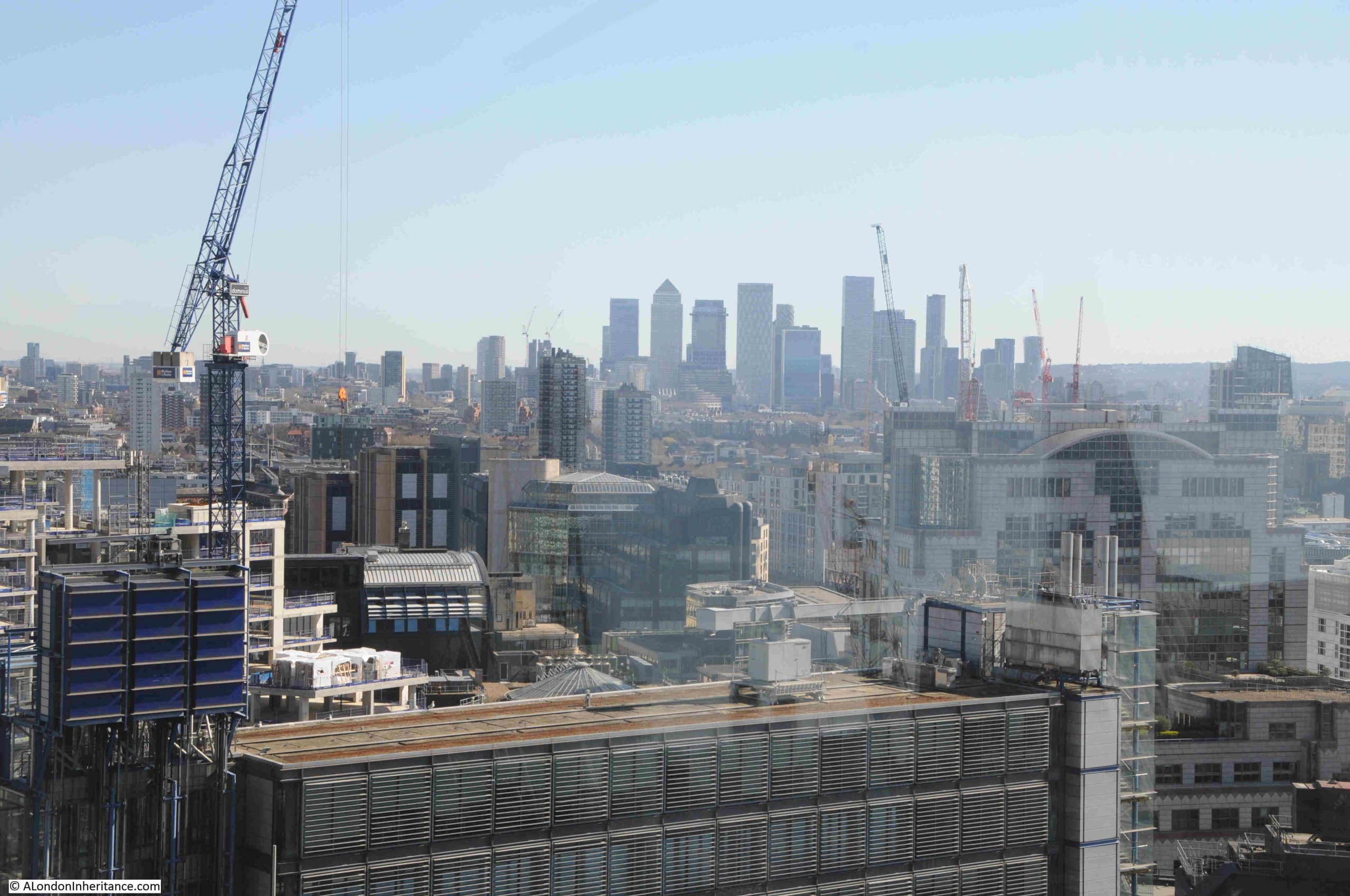
The Lloyd’s of London building is on the right, with the blue cranes along the roof, and the tall tower in the centre is the recently completed One Leadenhall:
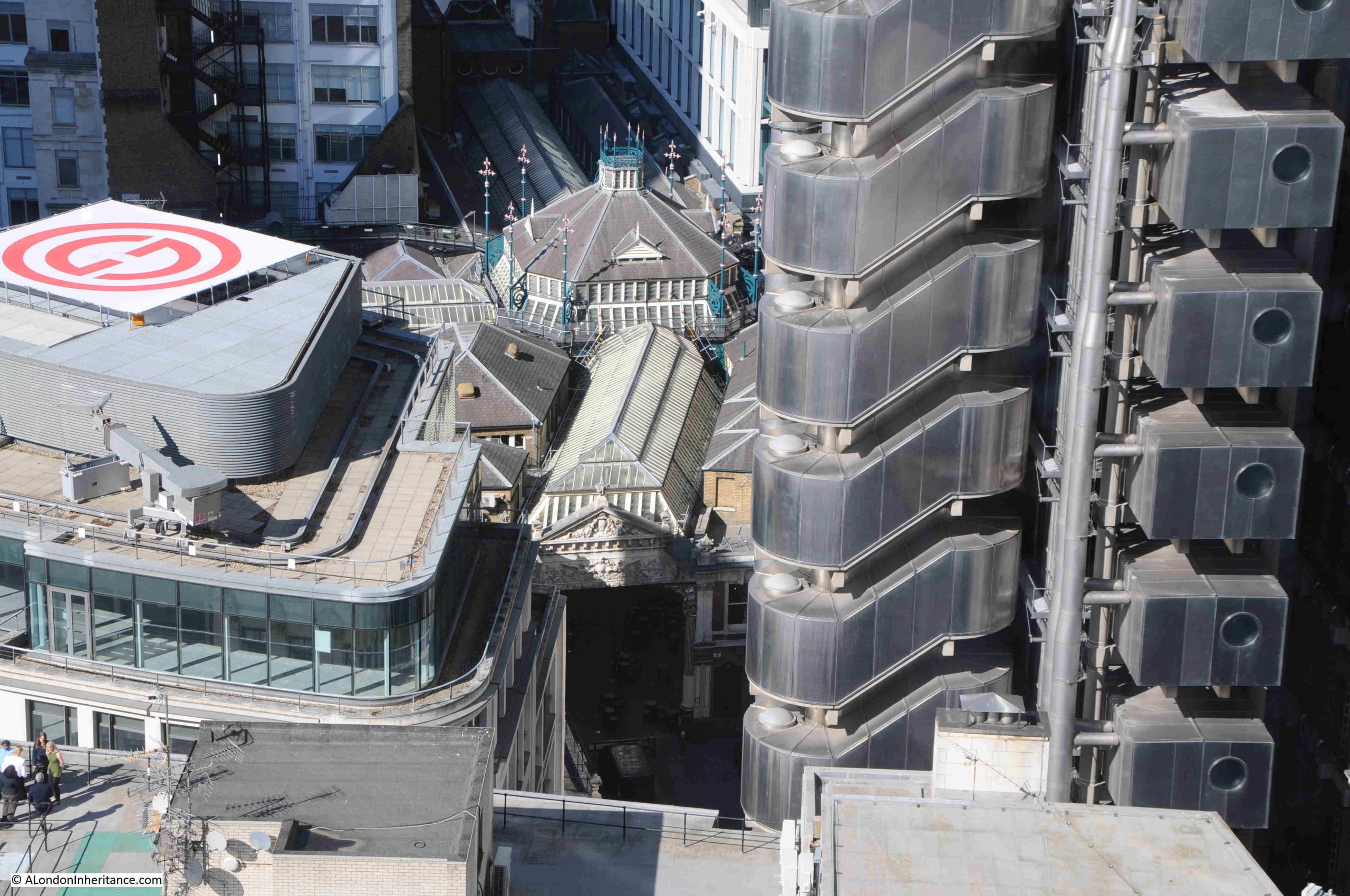
If you look to the lower left of One Leadenhall and the Lloyd’s of London building, you will see a very different structure – the roof of Leadenhall Market:
Although a market has been at the site for centuries, the current market buildings date from 1881, and the height and footprint of buildings in the City has grown so much in the following 145 years, at a scale that, whilst Victorian architects and builders were ambitious, would probably have been beyond their imagining.
There is a brief sequence early on in the 2013 Star Trek film – Into Darkness, where a bomb explodes in an underground facility in the City, and the CGI generated view of the City still shows St. Paul’s Cathedral, but it is surrounded by incredibly tall towers, much higher than we see in the City today.
The film is based in 2259, in 233 years time, and based on the rate of growth since the current Leadenhall Market buildings were completed, the CGI in Star Trek will probably be an accurate vision of the future London.
More of the Lloyd’s of London building – watching the blue crane along the top slowly moving along the roof line was interesting:
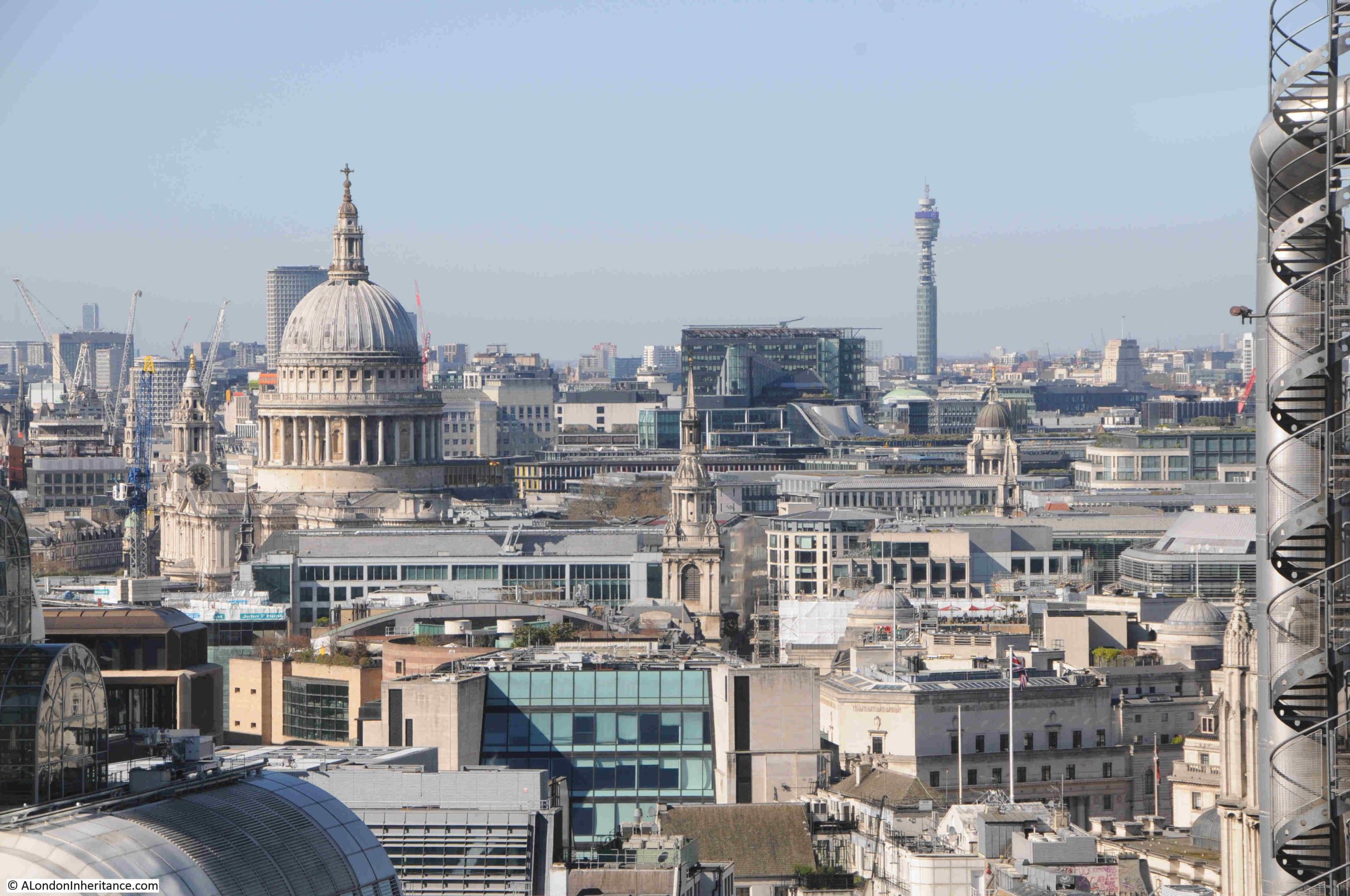
St. Paul’s Cathedral and the Post Office / BT Tower:
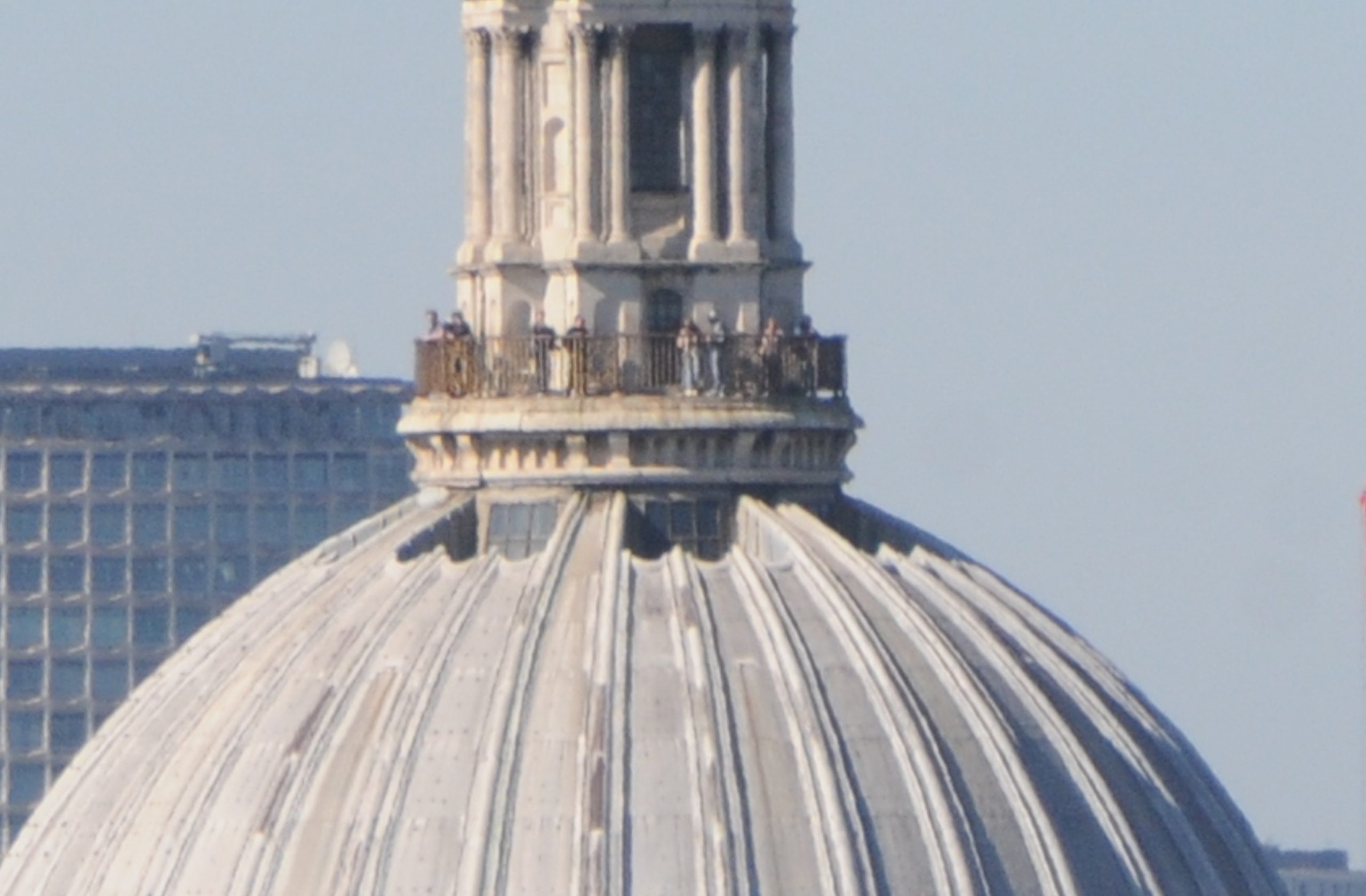
St. Paul’s Cathedral also has a couple of viewing galleries, including the Golden Gallery at the top of the dome, and from the Garden at 120 you can look across at other people enjoying the view of the city:
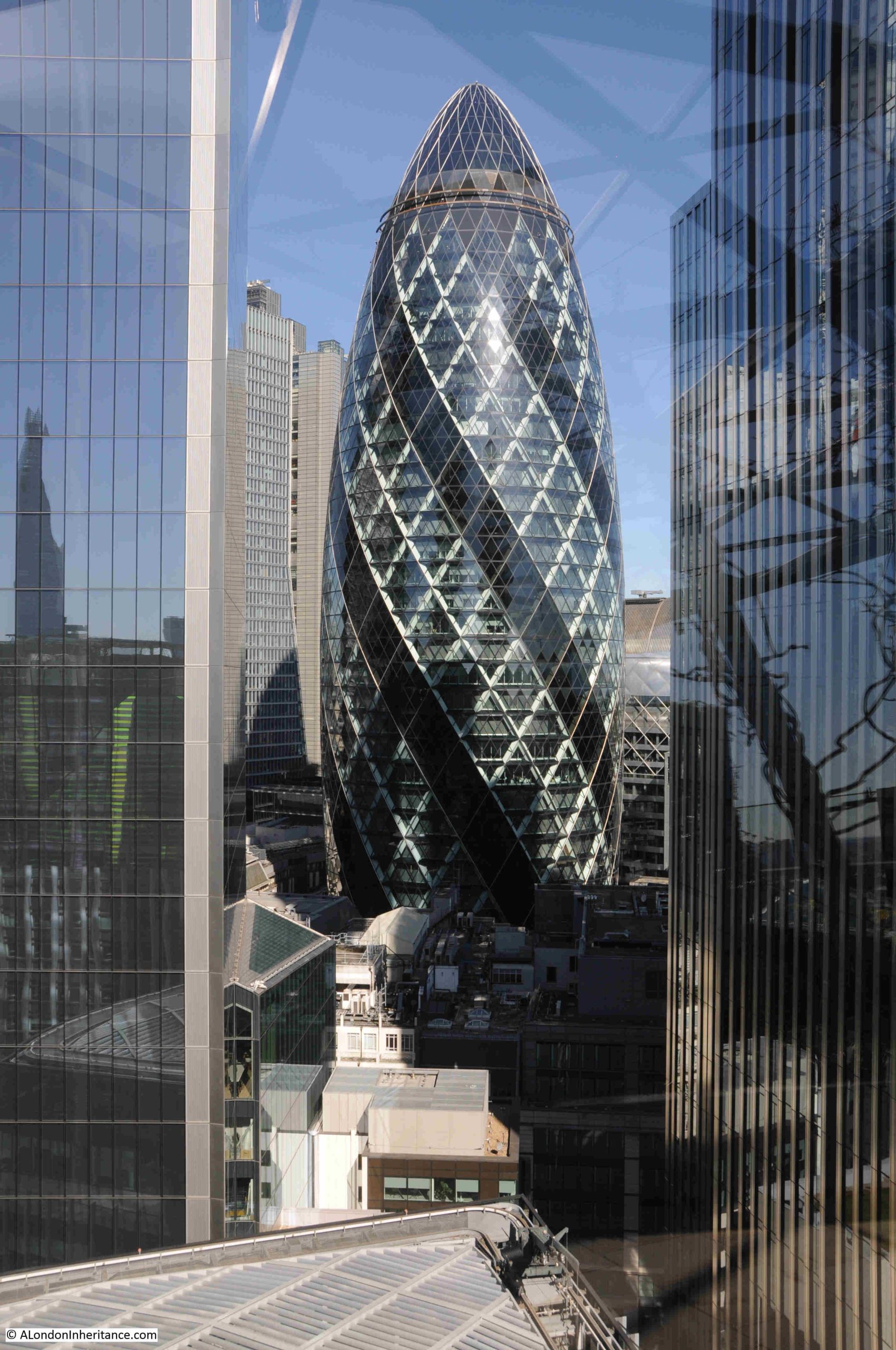
Because The Garden at 120 is on the 15th floor of, by recent standards, a relatively modest building, as you walk to the north of the garden you are looking between gaps in much taller buildings, although this does provide some interesting compositions, where other buildings are framed between towers, including this view of the Gherkin – 30 St. Mary Axe, a building which does not have a viewing gallery at the top, although it did have a bar at the top, which offered good views across London. The bar closed at the start of the year for renovations:
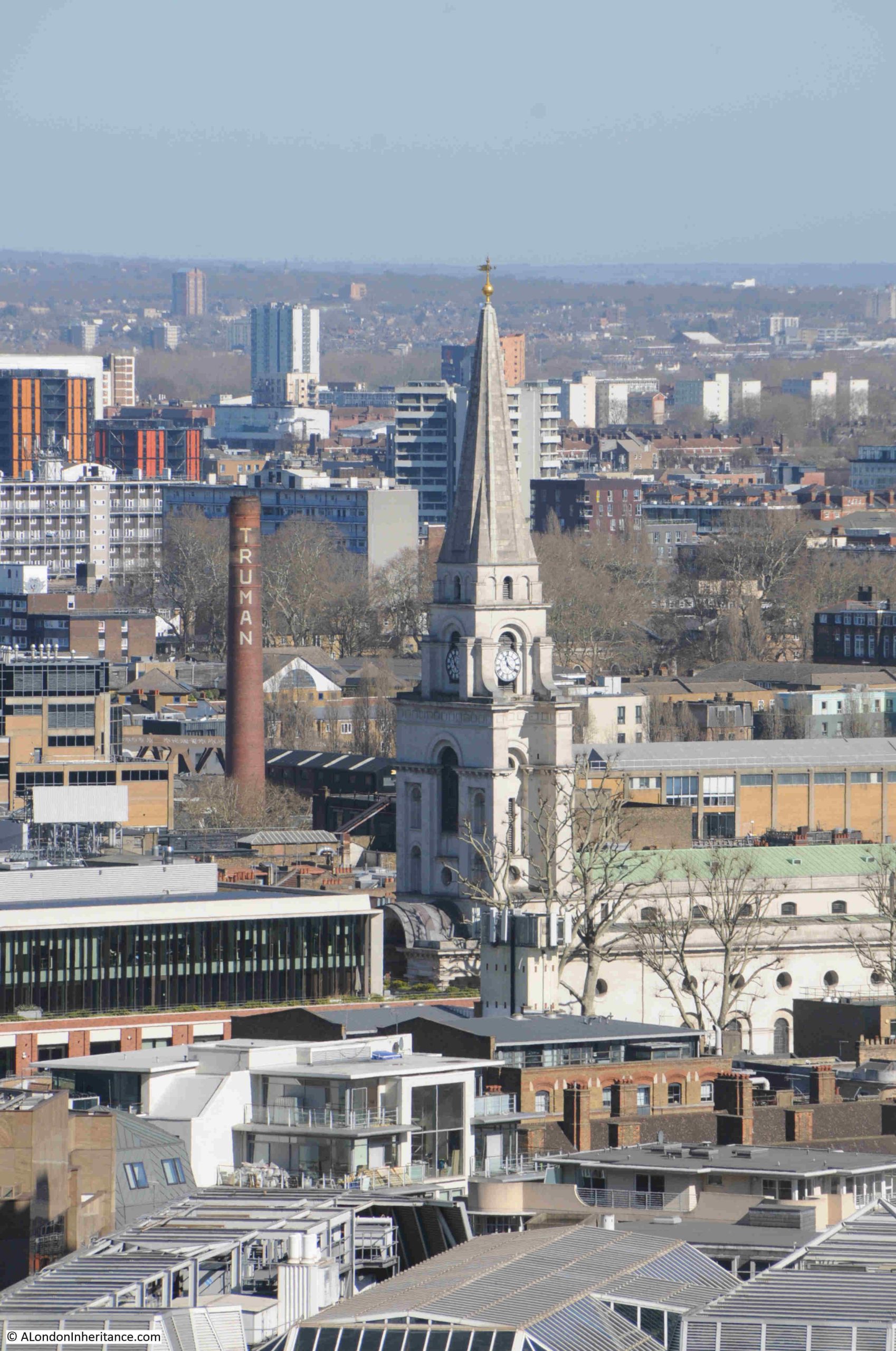
Through another gap we can see Christ Church Spitalfields and the chimney of the old Truman brewery:
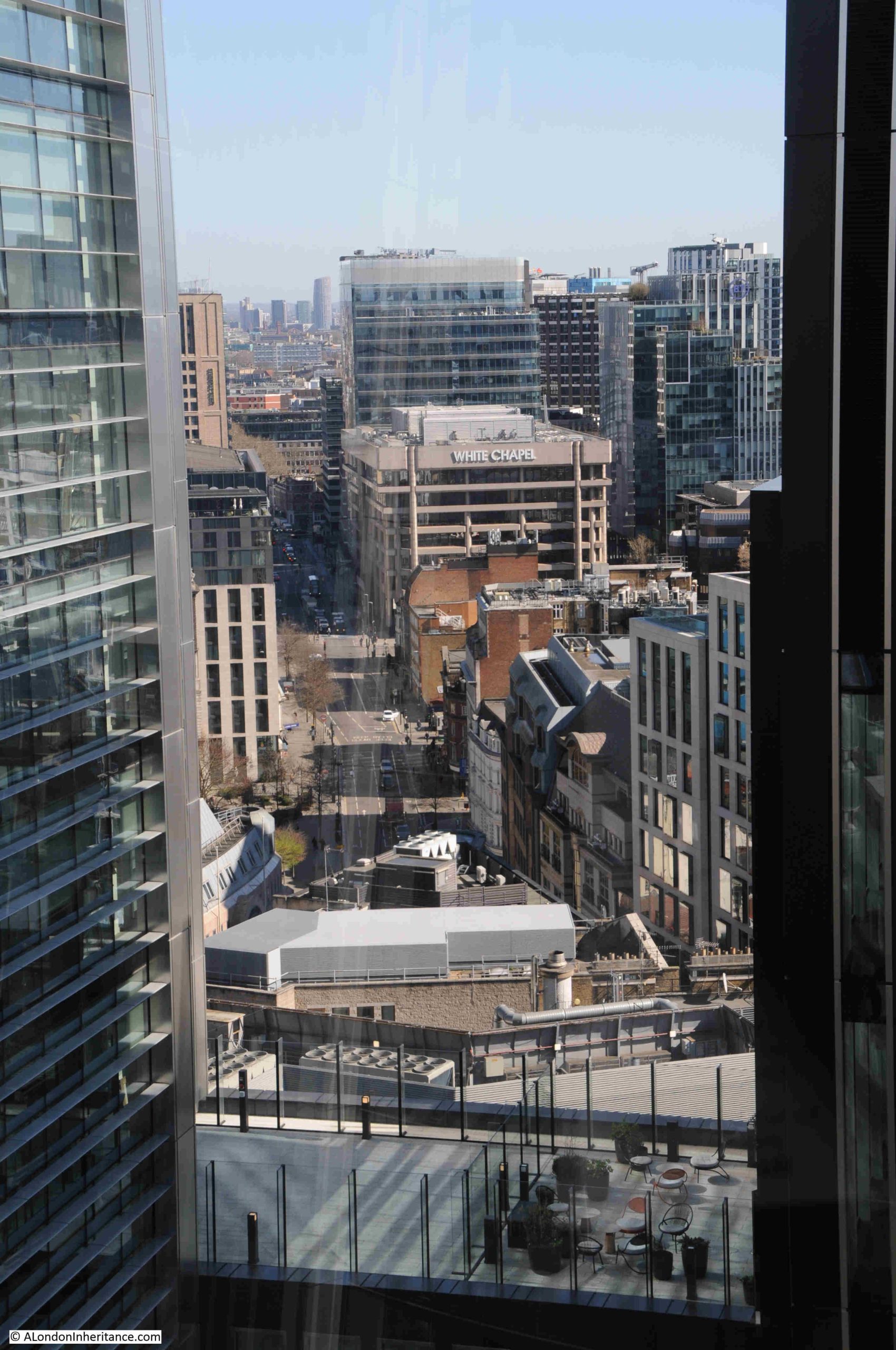
The Whitechapel building stands out on the corner of Whitechapel High Street (the road to the left of the building), and Mansell Street:
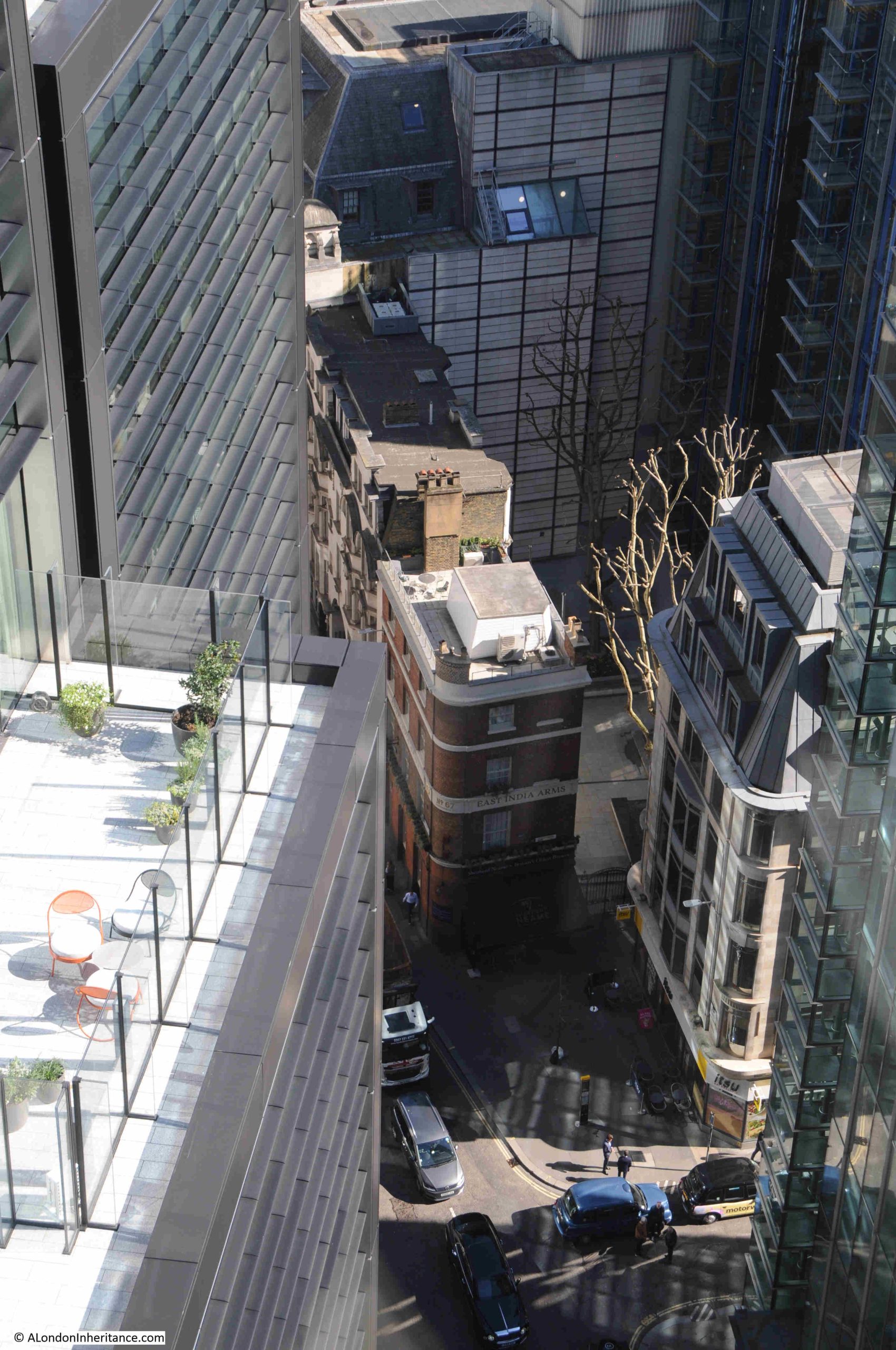
Looking down to a very small part of Fenchurch Street, at the junction with Fenchurch Place, we can see a small part of a terrace of 19th / early 20th century offices, with the distinctive brick built East India Arms pub on the corner:
View to the east:
The office and residential towers of Canary Wharf and the Isle of Dogs:
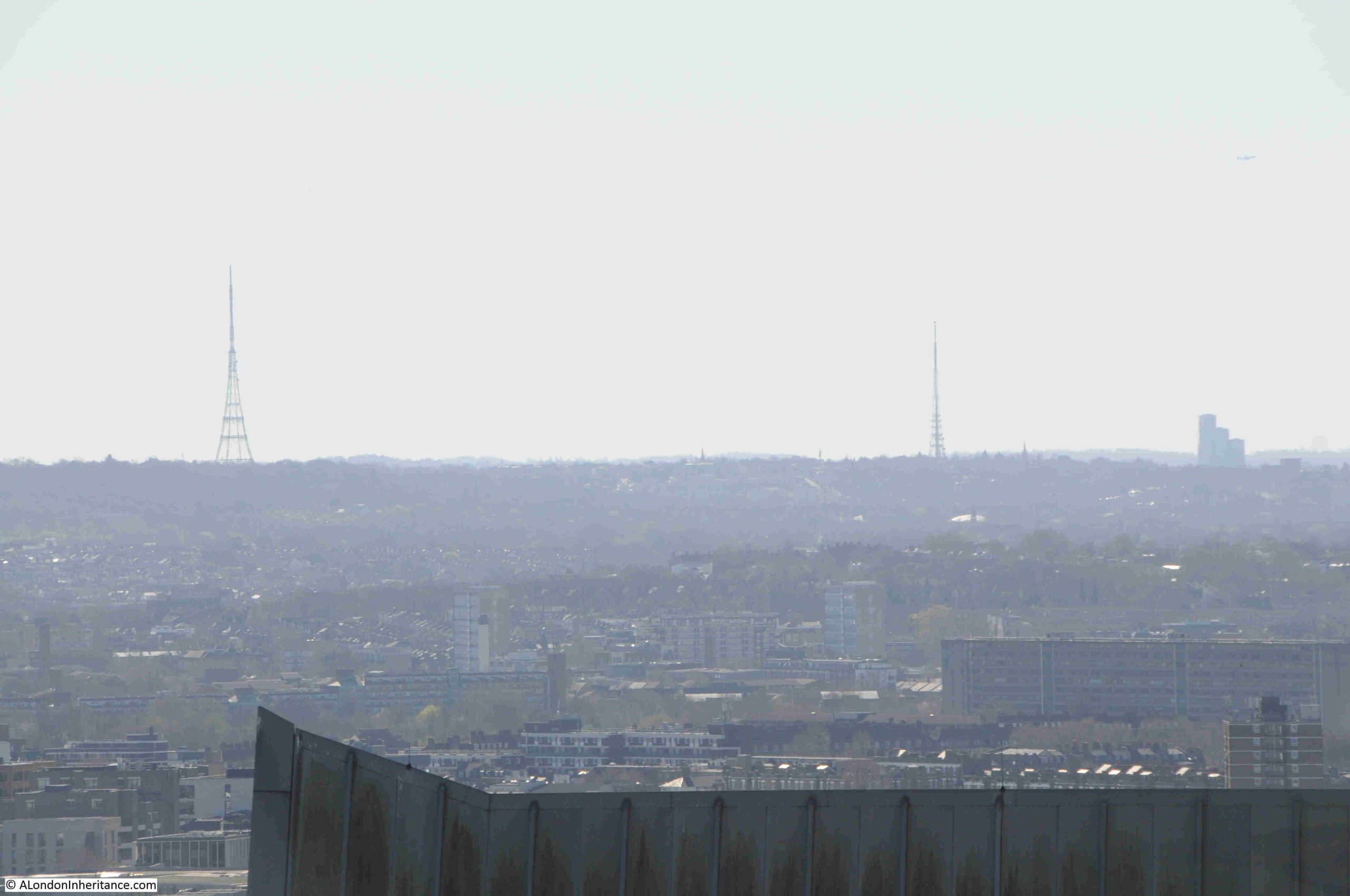
On the horizon, looking to the south, there are two tall radio masts. The one on the left is at Crystal Palace. The mast to the right is at Beaulieu Heights, next to South Norwood Hill:
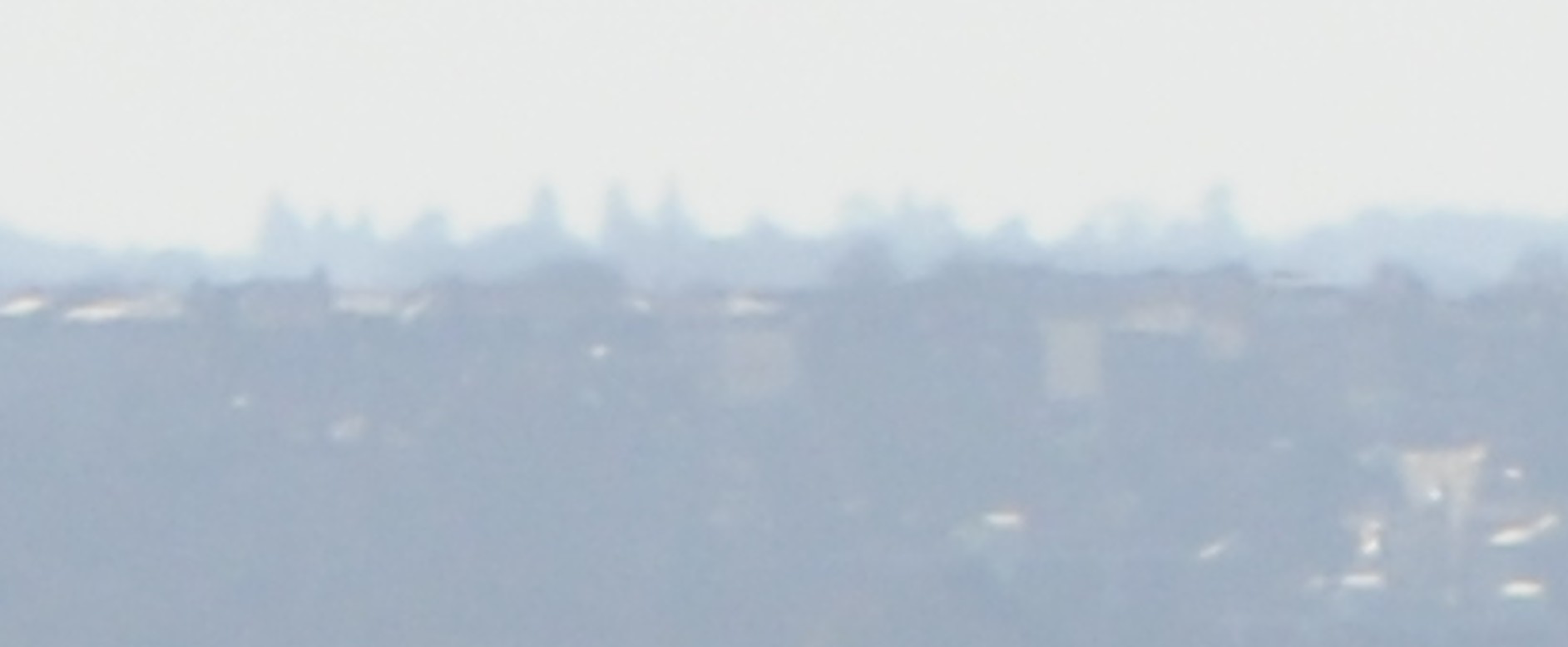
I find it fascinating to see how far you can see from height, and zooming in between these two masts is the following view:
I have no idea what the shadows are on the distant horizon. I did wonder if it was Croydon, however checking on a map, and Croydon is further to the right, and following the line between the two masts from Fenchurch Street, there are no significant clusters of buildings, so I have idea what they are.
I have not mentioned the Garden part of the name of the Garden at 120.
The garden is around the central core of the roof space, with a walkway around the perimeter.
The garden was designed by landscape architects Latz+Partner, and does consist of a good amount and variety of plants. View along the walkway on the eastern side of the roof, with planting on the left:
Having various forms of planting seems to be a core part of the majority of proposals for new towers in the City.
Fifty Fenchurch will include a public roof garden and winter garden at level 10, whilst the Fountain House replacement will have an external garden terrace.
Whilst this may be viewed as greenwashing, it does follow the approach of Fred Cleary, who campaigned and worked for much more planting, flowers and gardens as part of the post war redevelopment of the City, and as described in his 1969 book “The Flowering City”.
The southern side of the Garden at 120, with the main viewing area looking south and planting to the right:
Back on ground level, I walked across to the east of the Fifty Fenchurch building site, next to the tower of All Hallows Staining and looked back at the building with the Garden at 120 on the roof:
There are a growing number of places across London to look across the city from above, and each offers a different perspective of an ever changing city.
It is also interesting to visit these places across the years to see the rapid change taking place, and the view from the Garden at 120 will change significantly in the coming years when Fifty Fenchurch and the Fountain House site developments are completed.
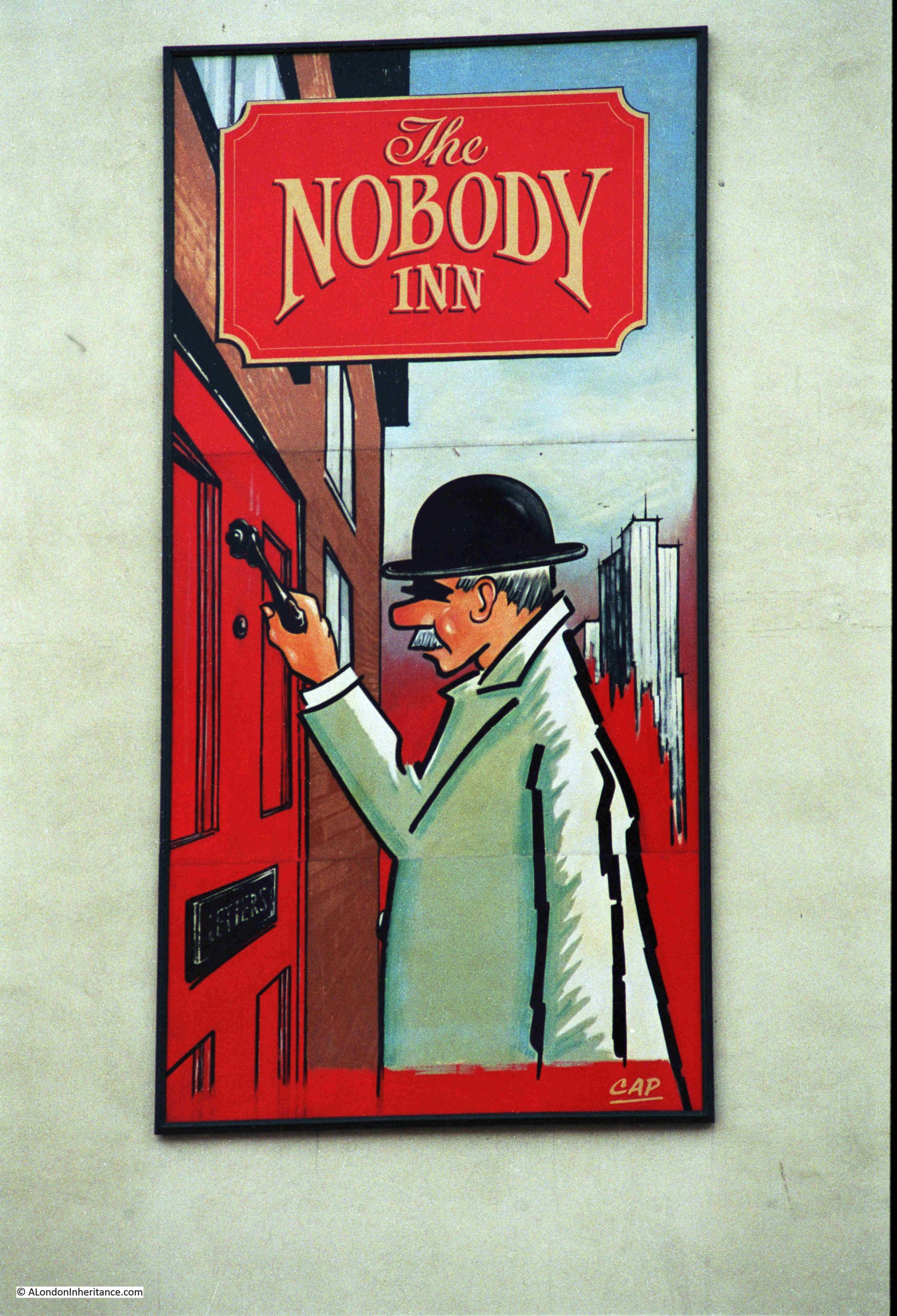
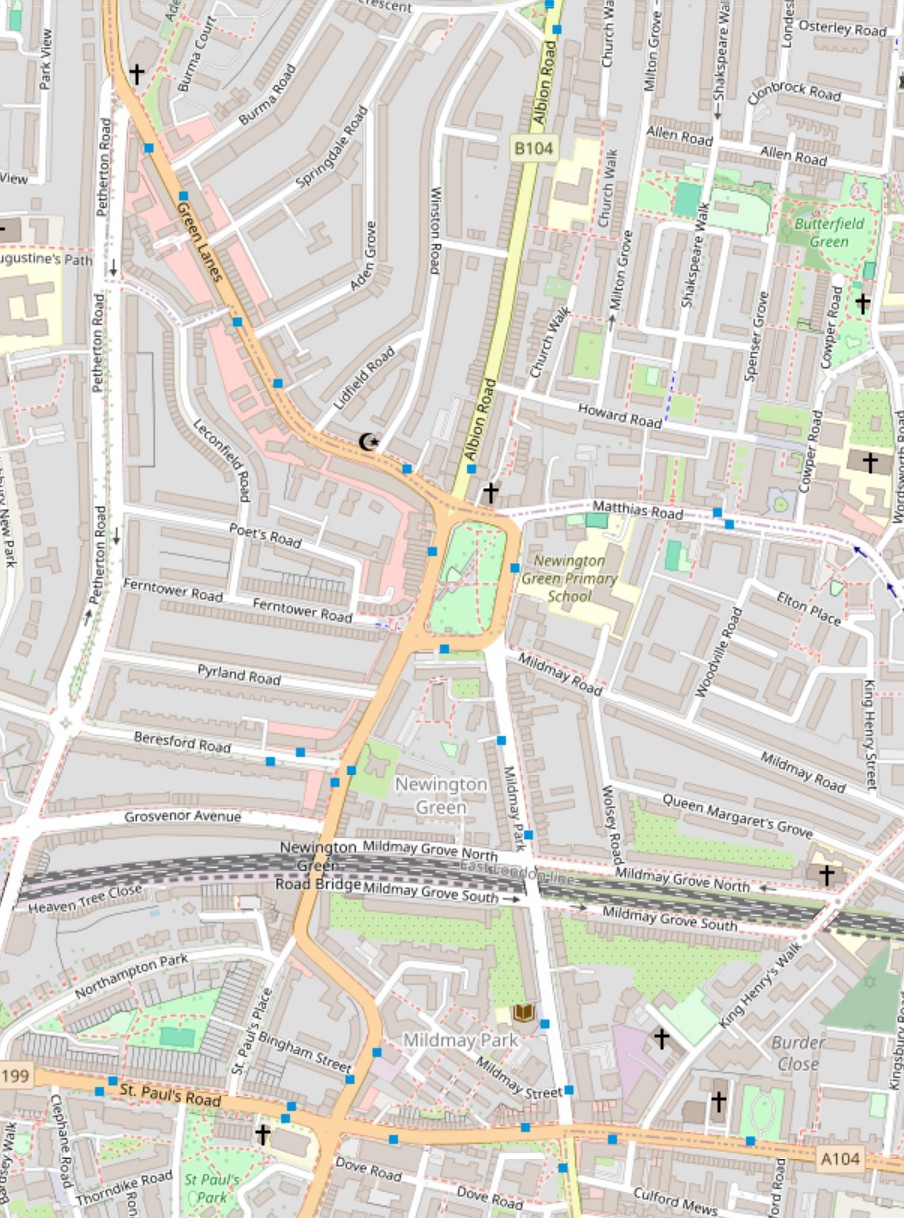
Firstly, thanks to the comments to last week’s post regarding the artist who created the mural, along with some additional background. In this week’s post, I am walking the very short distance along Mildmay Road from the mural featured in last Sunday’s post, to Newington Green, to find the site of another of my father’s 1980s photo’s, this time, the Nobody Inn:
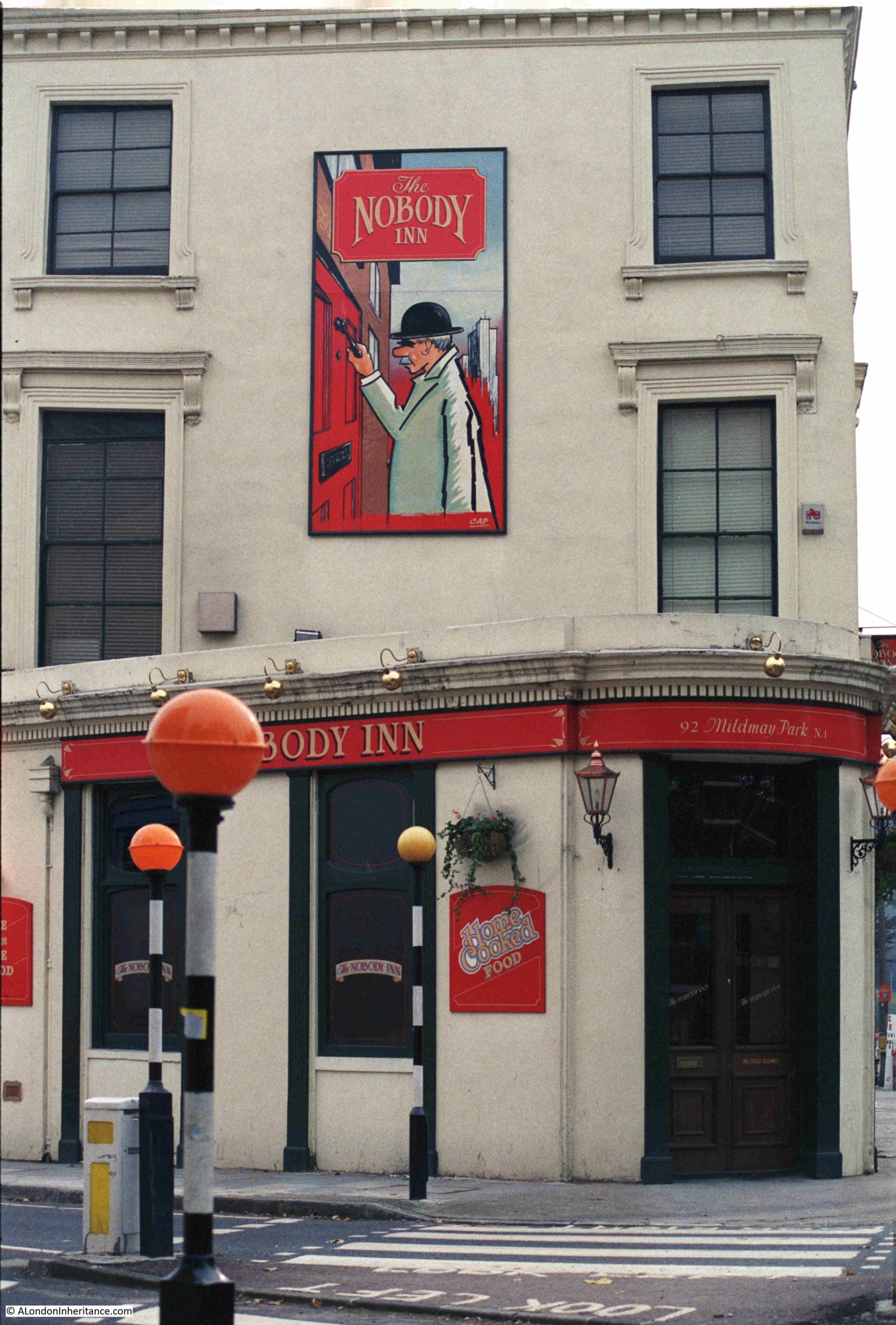
The Nobody Inn was the name of the pub at the south eastern corner of Newington Green, between Mildmay Road and Mildmay Park.
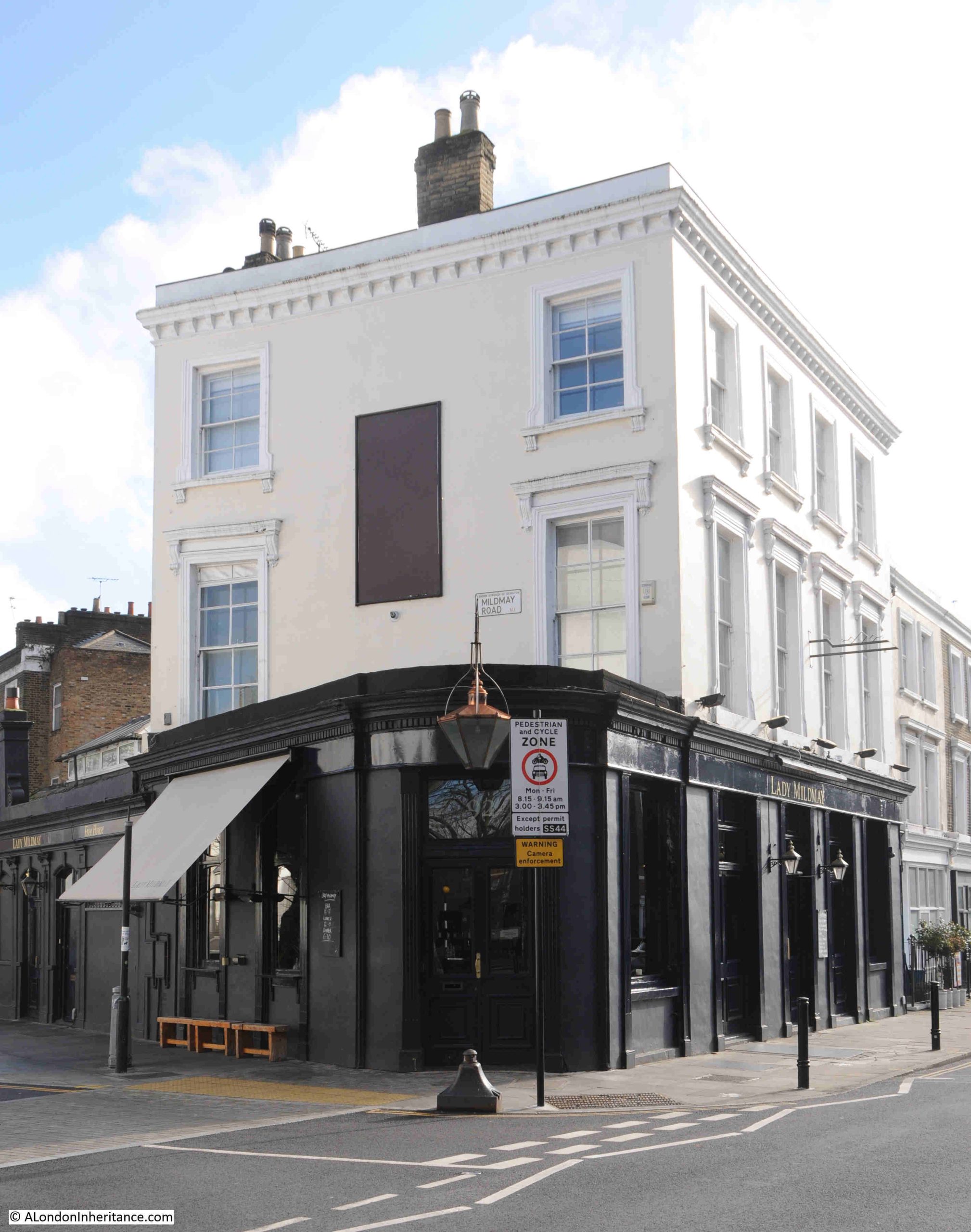
The pub was built in the 1850s and was called the Clarendon, until the name change to the Nobody Inn, which I believe occurred in the early 1980s, but cannot find firm confirmation of this. The Nobody Inn reverted back to the Clarendon around 2012, then had the name the Dissenting Academy, which was in use in 2014, but is now the Lady Mildmay.
One of the first records of the pub I can find is from 1858, when it was referenced in an advert for a house to let, with the Clarendon being given as the point of contact for further information.
The pub then has occasional references in the London press, with the pub being for sale in 1866, and is advertised with the benefit that “The premises are on the high road from the City to the Green Lanes, and are passed by throngs of pedestrians and others, whose numbers no doubt will be considerably increased by the opening of the new Alexandra and Finsbury Parks”.
In 1902, Mrs Sarah Courtin, the landlady of the Clarendon (which in this report was also called a Hotel), had reported a preacher of the Mildmay Mission to police for playing or causing to be played an instrument in the street, to her annoyance.
And throughout 1971, the Clarendon had a regular advert in the London Evening News, that “The Clarendon, Newington Green, offers the finest varied family entertainment each night from Tuesday to Sunday at normal pub prices”.
The 1980s Nobody Inn:
The pub as it is today, but now called the Lady Mildmay. The large panel on the side of the pub which had the image of the man knocking on a door, with the Nobody Inn name is still on the side of the pub – it would be interesting to know if the 1980s image is still there, and it was just painted over:
It is interesting as to why pubs change names. Sometimes it is to change the image of a pub that had problems under previous owners, or to make the image of a pub more contemporary, or to make the pub more relevant to the local area, which I assume is the reason for the current name of Lady Mildmay.
The Mildmay name comes from Henry Mildmay, who became the owner of a large estate at Newington Green which had been owned by the Halliday family. There were no sons to act as an heir to the Halliday family, and the daughter married Henry Mildmay. taking the estate with her.
The Mildmay name is still to be found in the area including street names of Mildmay Road, Mildmay Grove and Mildmay Park, built over the old Mildmay estate.
I cannot find any origin to the Nobody Inn name. It could just be a joke with the joining of two words Nobody and Inn. There is another pub with the same name, the rather excellent Nobody Inn in Devon, however they do not give any origin of their pub’s name.
Newington Green is a fascinating, historic area, and with a number of surrounding streets, is part of the Newington Green Conservation Area.
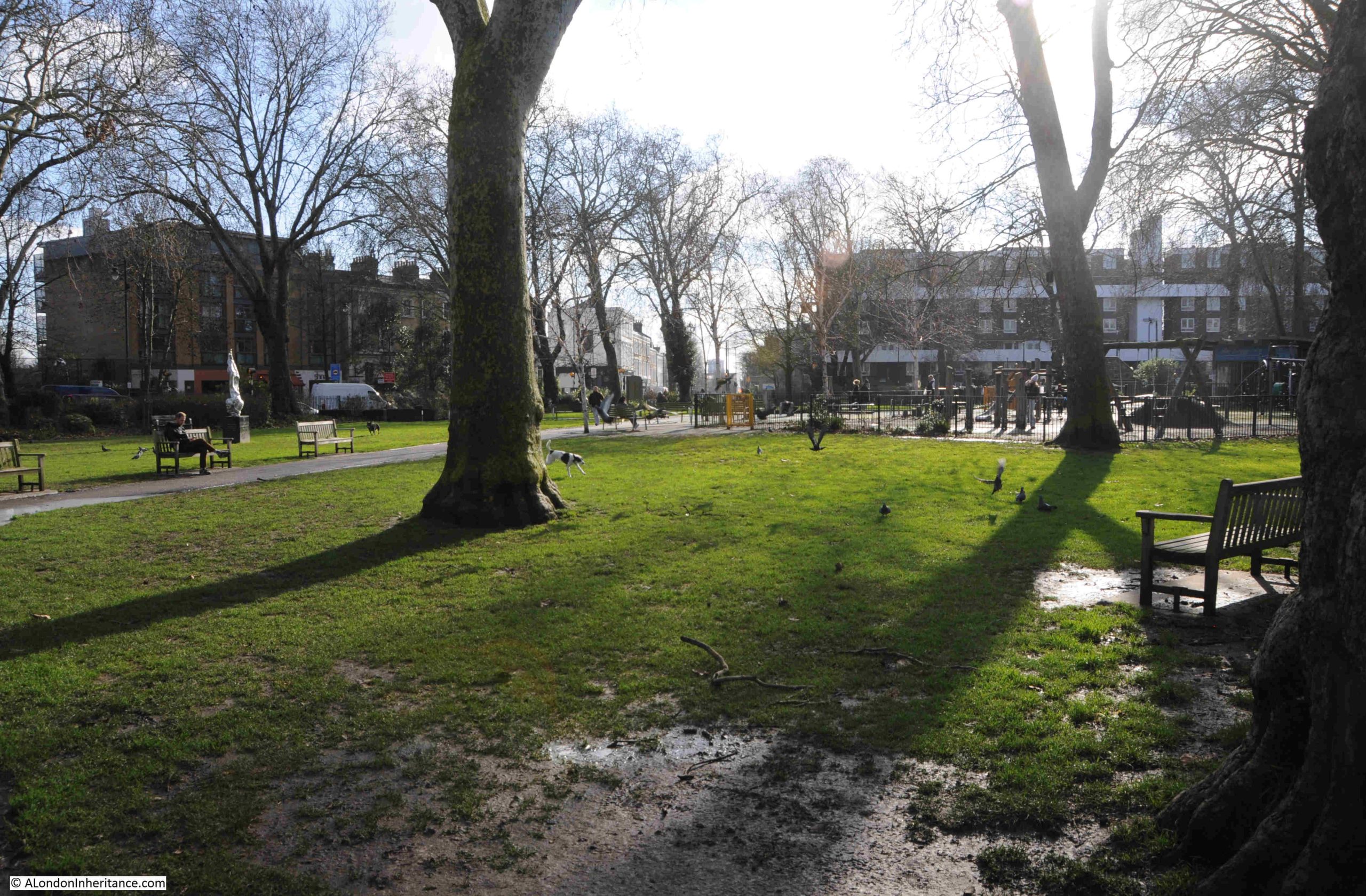
The following photo is looking south across the central space, and the pub can be seen at the south east corner, just to the left of centre:
Newington Green seems to have been formed from a small clearance in the forests that once occupied this part of north London. The first reference to Newington Green dates to 1480, when the sides of the space were occupied by small cottages.
Henry VIII may have had a hunting lodge alongside the green, and in the 16th century a large house called Bishop’s Palace was built at the north east corner of the green, and was probably owned by the Earl of Northumberland after receiving the land from Henry VIII.
Too much “may” and “probably” in the last paragraph, but what is clear is that by the middle of the 18th century, Newington Green was a well defined square, with roads along each side, and seven roads / tracks leading into the green.
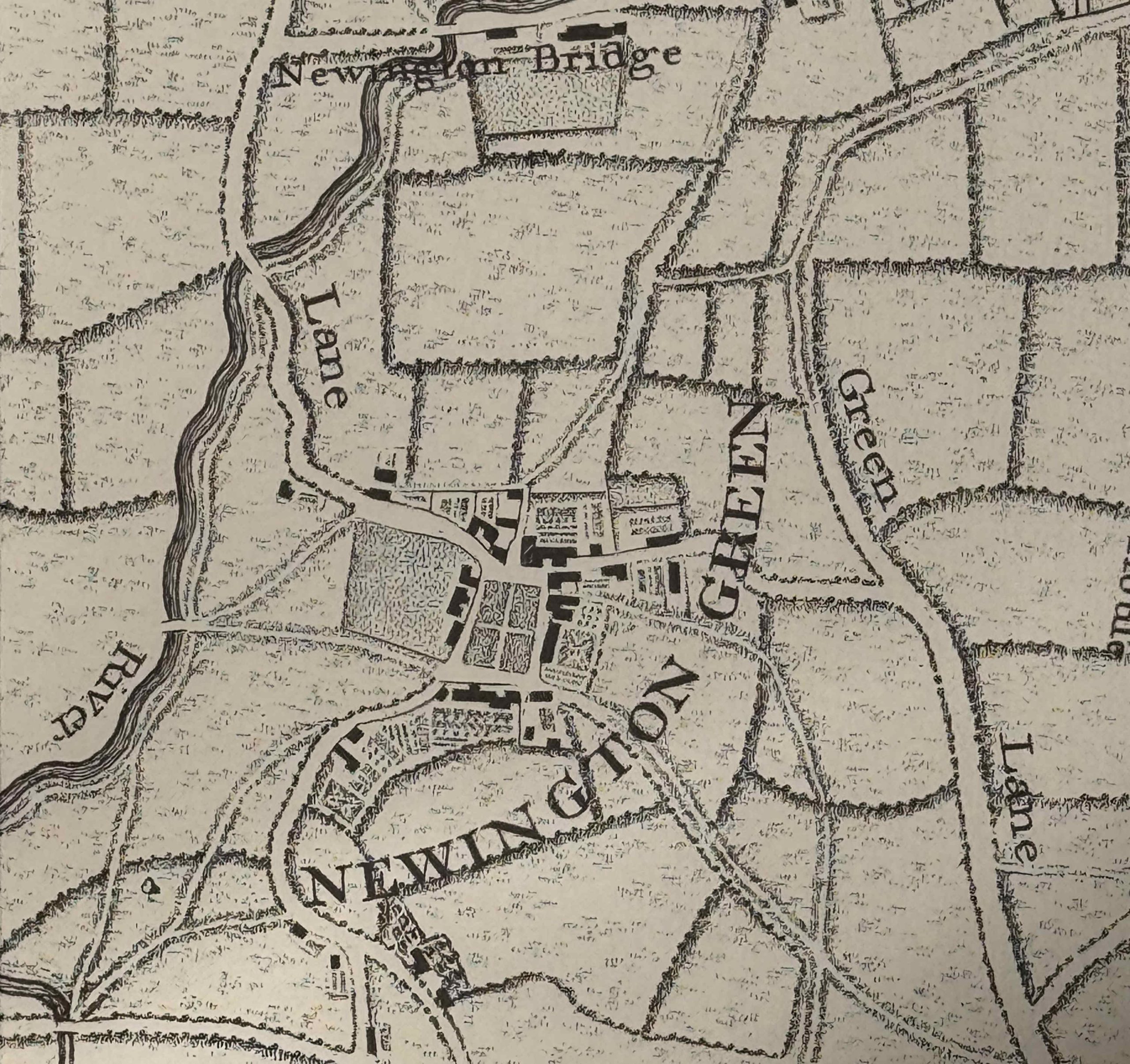
Houses and small holdings / gardens also surrounded the green on all four sides, and the forests that once surrounded Newington Green had been cleared with fields covering the wider area. The New River was also to be found just to the west, as shown in this extract from Rocque’s 1746 map of London:
This small hamlet offered a place of sanctuary to religious dissenters after the Restoration of the Monarchy when Charles II became king.
Charles II had initially tried to accommodate those who had different religious views to the Church of England, however the Bishops and Parliament were trying to push through legislation that would outlaw any dissenting religious practices, and later small rebellions hardened Charles II views towards those outside of the established church.
The 1662 “Act for the Uniformity of Publique Prayers and Administration of Sacrements” was passed on the 19th of May, when Charles II was travelling to Portsmouth to meet Catherine of Braganza, his new Portuguese, Catholic bride.
When the Act came into force on the 24th of August 1662, 936 parish ministers, which included a third of the clergy in London, left their parishes, in the so called “Great Ejection”, as they could not follow the religious practices detailed in the Act.
Another act aimed at dissenters in 1662 was the “Act for Preventing the Frequent Abuses in Printing Seditious, Treasonable and Unlicensed Books and Pamphlets, and for Regulating of Printing and Printing Presses”. This act made the printing and distribution of any publication supporting dissenters or against the king and the church, a criminal offence, up to the level of treason.
As the Monarch was head of the Church of England, any dissent or rebellion against the church was also seen as being against the Monarchy.
A small hamlet, surrounded by fields just outside London would therefore have been a rather attractive place for those who did not conform to the practices and beliefs of the Church of England,
A number of Dissenters went to Newington Green, where they could practice in secret, and in 1667, Charles Morton set up a school for Dissenters in Newington Green, one of the pupils being Daniel Defoe, the writer and Presbyterian.
Morton’s school survived to 1686, but with mounting legal actions, mainly due to teachings at the school, Morton left Newington Green and moved to America, where he taught at Harvard, and became the school’s first vice-president.
There is plenty of evidence of Newington Green’s association with Dissenters, and one that is still in use today is the Meeting House on the north side of the green:
Whilst Newington Green had been a centre for Dissenters during the Civil War and Commonwealth, and in the years following the restoration of the monarchy, from 1660 dissenting religious practice was mainly carried out in secret, however towards the end of the 17th century, Parliament and the Monarchy started to adopt a slightly more tolerant approach.
The 1688 Toleration Act, which was “An Act for Exempting their Majestyes Protestant Subjects dissenting from the Church of England from the Penalties of certaine Lawes” made it easier for Dissenters to practice more openly, and in 1708 the Newington Green Meeting House was built.
There are reminders of two other prominent dissenters who attended the Meeting House in Newington Green, and I will find them as I walk around the square.
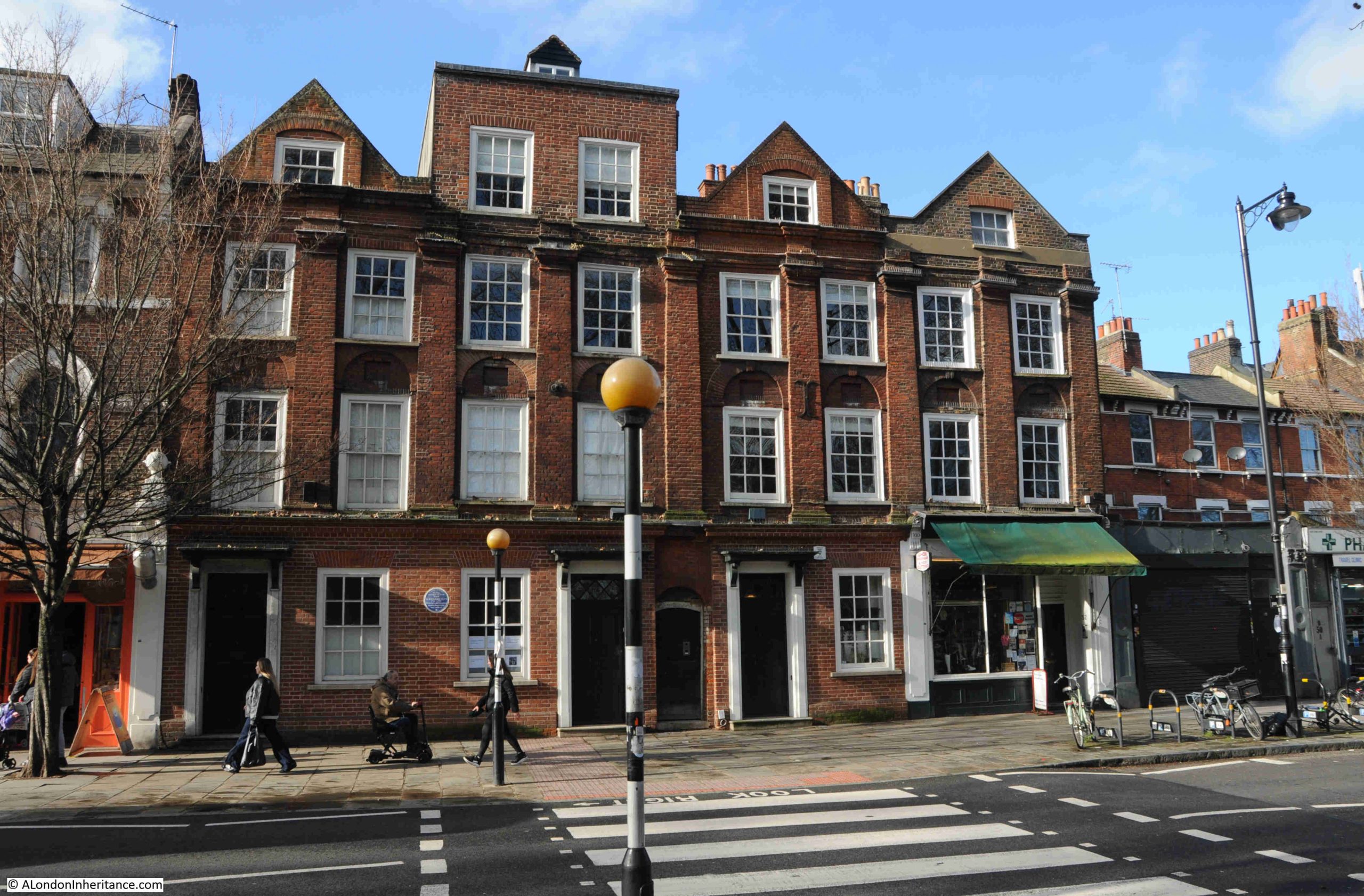
Along part of the western side of the square there is a terrace of houses, believed to be the oldest terrace in London.
The terrace of brick houses in the following photo are all Grade I listed, and the Historic England listing states that “These houses are extremely rare survivals of pre-Restoration and pre-Great Fire town houses, and are thus one of the most remarkable groups of seventeenth-century buildings in London”:
They are dated to 1658, the same year in which Oliver Cromwell died, so only just pre-restoration as detailed in the listing.
There is a blue plaque on the wall towards the left of the terrace. This is to Dr Richard Price who lived in the terrace:
Dr Richard Price was a prominent dissenting minister, who had been born in Llangeinor, Wales. His father had also been a dissenting minister.
He moved to London after the death of his parents, where he attended a dissenting academy in Moorfields.
His association with the Newington area came in 1744, when Price became family chaplain to George Streatfield at Stoke Newington.
Richard Price married Sarah Blundell in June 1757, and shortly after, they moved into the terrace in Newington Green, where he became a minister at the meeting house, a role he continued with for much of the rest of his life.
It is easy to see why both Parliament and the Monarchy were always concerned about Dissenters. Richard Price was a supporter of both the American and French revolutions, with a 1789 sermon titled A Discourse on the Love of our Country, which defended the French Revolution. He was also friends with some of the leading figures involved with the founding of America, including Thomas Jefferson and Benjamin Franklin.
One of his religious objections to many of the practices and teachings of the Church of England included a rejection of the Trinity (the concept that God exists as three distinct identities – the Father, the Son (Jesus Christ) and the Holy Spirit).
Outside of religion, he also worked on, and wrote about statistics, including an Essay on the Population of England, and in 1771, concerned by the actions of successive governments which continued to increase the national debt, he published an “Appeal to the Public on the Subject of the National Debt“.
Richard Price died in 1791. He wife Sarah had died five years earlier in 1786. They are both buried in Bunhill Fields. The sermon at the funeral was given by another prominent dissenter and natural philosopher (an 18th century version of a scientist), Joseph Priestly.
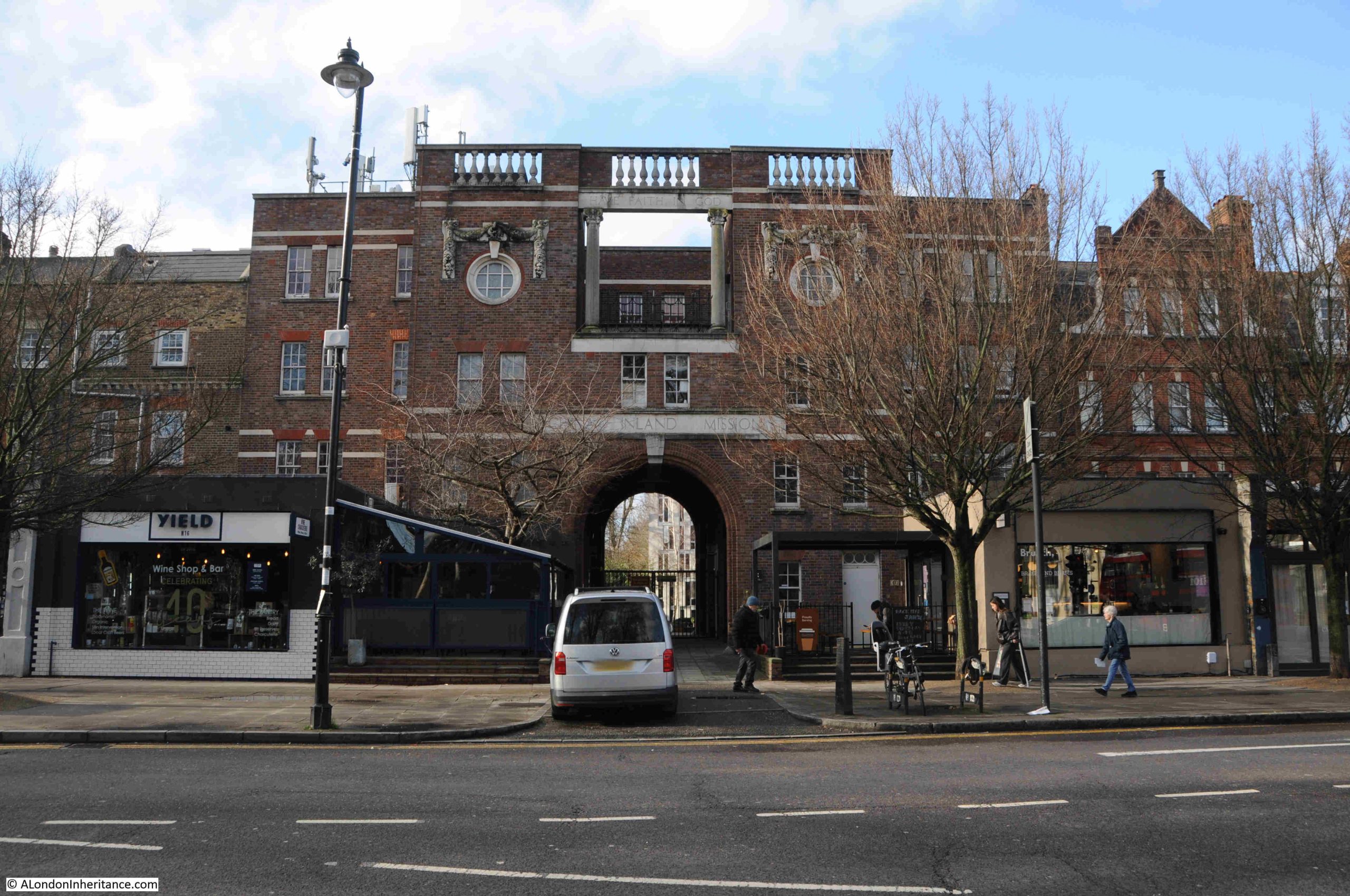
Further along the western side of Newington Green is another interesting building. This was the home of the China Inland Mission:
The name still visible through the trees, just above the arch of the main entrance:
The China Inland Mission was formed in 1865 by James Hudson Taylor, and as the name implies was formed to send missionaries to China so they could spread the gospel and Christianity, and convert the Chinese.
An 1866 newspaper account of the organisation provides a good impression of their approach and challenges:
“The tidings received from China during the past year have been somewhat chequered. Some of our friends there have had serious attacks of illness; but the Lord has graciously restored them to health. Among the native converts, some have caused sorrow rather than joy, and a few have had to be excluded from the privileges of church fellowship. Others, however, who have backslidden, have been restored through the Lord’s goodness; and from time to time, we have had the great jot of hearing of the conversion of heathen Chinese – male and female, young and old – and of their admission into the ranks of the Lord’s redeemed people.
One sign of great promise is the love and zeal prompting some members of the church to spend almost all their spare time in evangelistic efforts. Support for three of these for one year, to enable them to devote all their time to the work, has been kindly sent out by the Foreign Evangelist Society, which has thus rendered us important aid, and the labours of one of them, Fong Nong-kwe, in a village called K’ong-p’o, have been followed by marked encouragement.
Nine persons have, through his efforts, professed to receive the Lord Jesus, and four of them have already been baptized. Another of these evangelists, Vaen Kyiseng, appears to be a very dear and earnest Christian man, his young wife is also spoken of as a very devoted Christian, and a valuable helper among her own sex.”
It was not easy work for the China Inland Mission. The organisation lost 58 missionaries, who were killed during the Boxer rebellion of 1900. A 1935 report illustrates more of the significant challenges they faced:
“CHINA INLAND MISSION – With the loss of missionary lives and the recent kidnapping of the British ship in the China Seas with so many children returning to the Chefoo Schools, the name ‘China Inland Mission’ has been more prominent than usual in the public eye.”
By the start of the Second World War in 1939, the organisation had 1,300 missionaries working in China and approaching 200,000 Chinese had been baptized.
The aftermath of the war, and the communist take over of China in 1949 made it increasingly difficult for the China Inland Mission to operate, and all missionaries were recalled from the country in 1950.
The focus of the organisation changed to other countries in the region, including Thailand, Malaysia, Japan, Philippines and Indonesia, and this change in direction resulted in the name being changed in 1964 to the Overseas Missionary Fellowship.
In 1994, the name was updated to Overseas Missionary Fellowship International.
Today, their UK offices are in Manchester, and the building on Newington Green provides student accommodation, operated by Sanctuary Students, who, on their website state that the building is Grade II listed, however on the Historic England listing database, I cannot find any reference to the building being listed. It is though an interesting building, and with a history that shows how 19th century British Christians tried to spread the religion across the distant regions of the world.
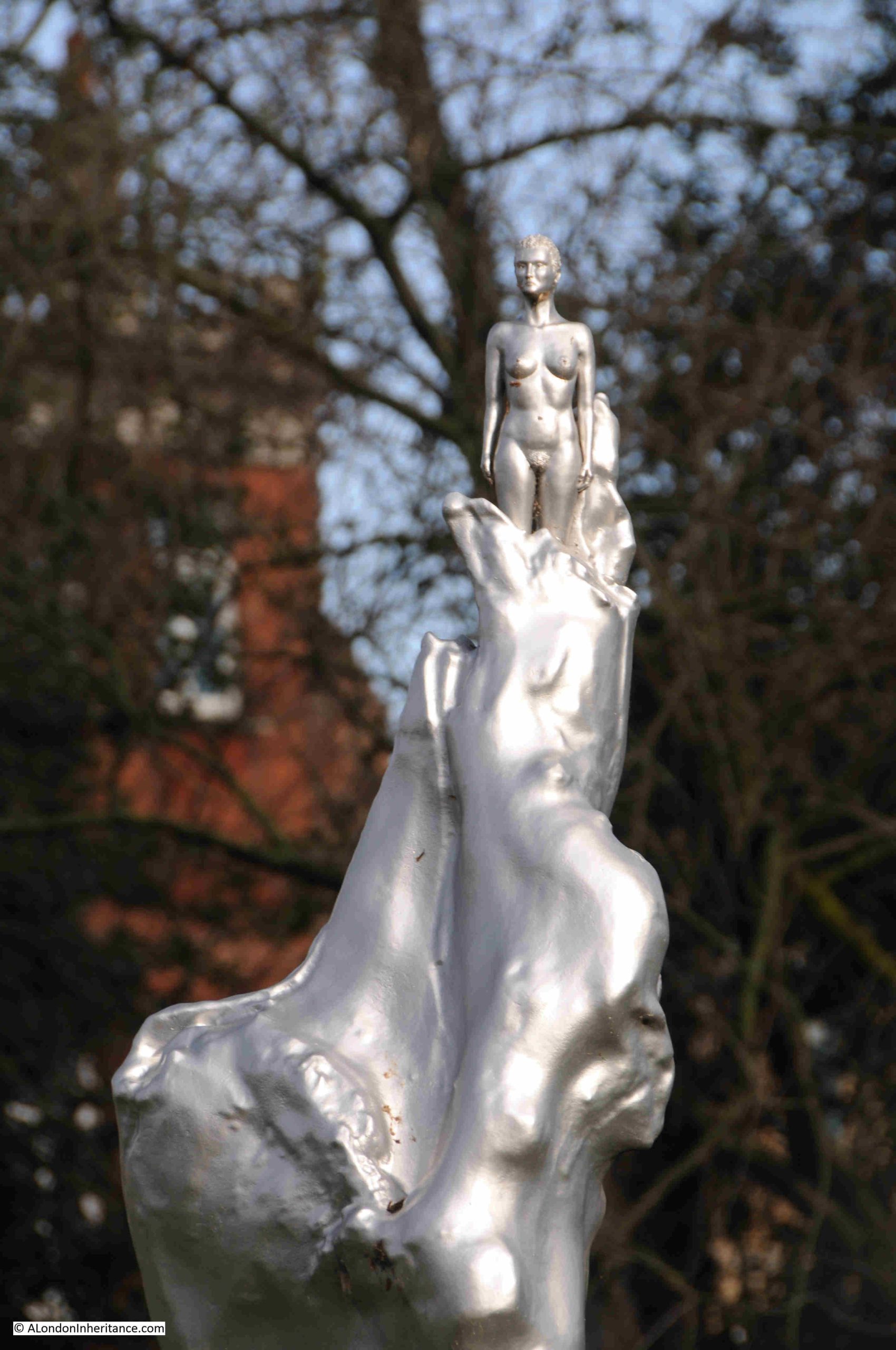
From the streets around Newington Green, we need to head into the central green space to see a sculpture, that, for a brief period after it was unveiled in 2020, was probably the most talked about work of art in London.
This is the sculpture commemorating Mary Wollstonecraft by Maggi Hambling:
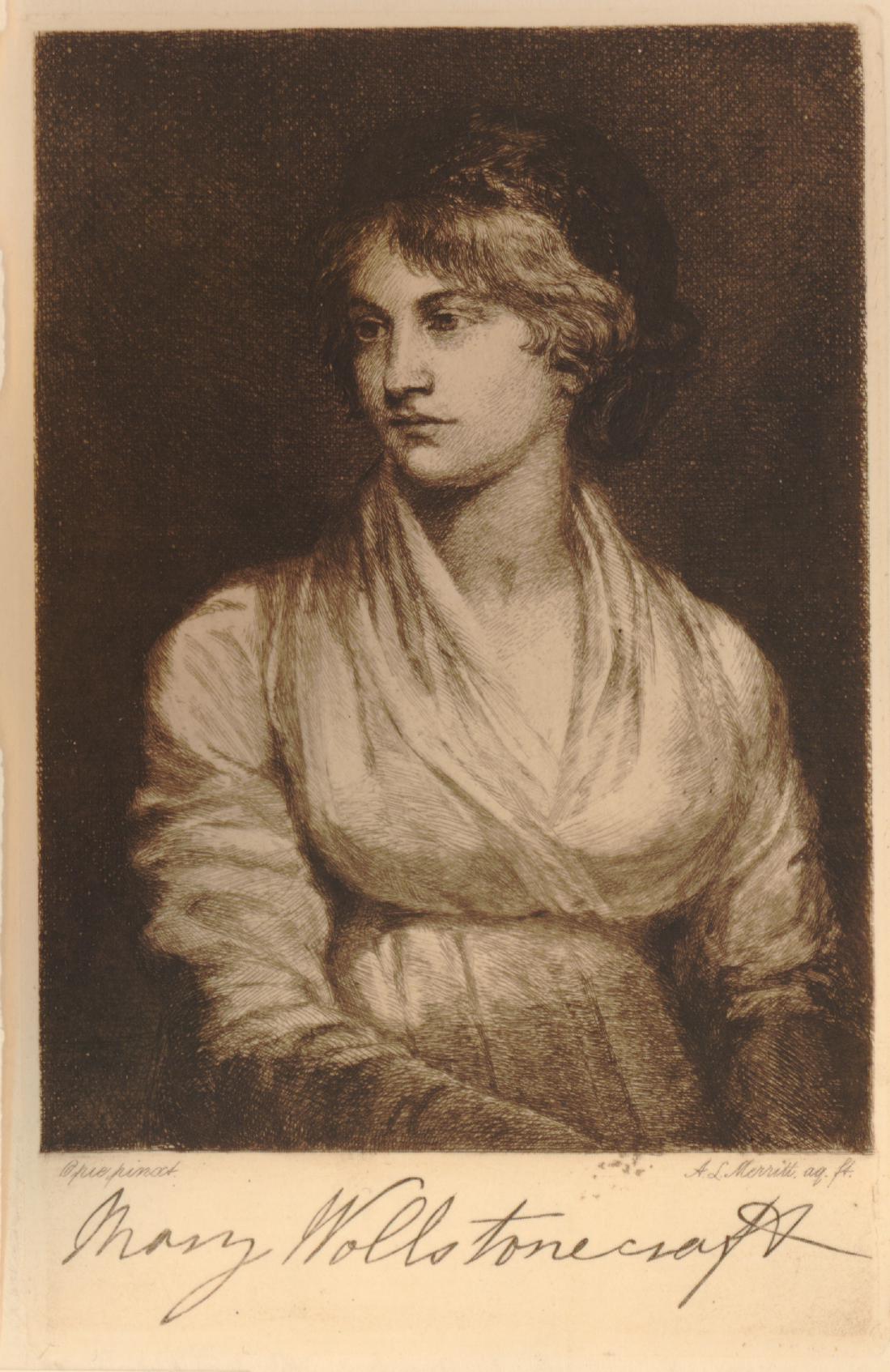
Despite only living to the age of 38 (she died from badly managed complications after child birth), Mary Wollstonecraft’s achievements and challenges were many, and she had a remarkable life.
Mary was born in Spitalfields in April 1759. Her father was reasonably prosperous, but he squandered their money and was also abusive. Mary also had a very limited education, with her brother being given a much more comprehensive education. An attitude towards the education of girls that resulted in her first publication “Thoughts on the Education of Daughters”.
Her links to Newington Green only lasted a few years. Sometime around April 1784 she moved to Newington Green and set up a small children’s day school, along with her sisters Everina Wollstonecraft and Eliza Bishop, and her friend Frances Blood. Mary had helped Eliza separate from her disastrous marriage to Meredith Bishop.
Mary had help from Hannah Burgh, the wife of the prominent dissenter James Burgh, who ran an academy for dissenters, and who also had an extensive library to which Mary had access.
The school took up to 20 children, and along with taking in lodgers, provided just enough funding for the women to survive.
Not long after the establishing the school Frances Blood moved to Lisbon with her husband Hugh Skeys, and soon after Mary visited Frances in Lisbon to support her during child birth,. Frances died a short time after through complications.
Returning to Newington Green, the school soon closed, and her sisters moved away, leaving Mary alone and with significant financial challenges.
With very few options open to her, Mary then took a job as a Governess for Lord and Lady Kingsborough in Cork, Ireland, a role she appears to have hated, found frivolous, and she was fired within a year.
Returning to London, she turned her skills towards writing and it was in 1787 that her book “Thoughts on the Education of Daughters” was published by the radical publisher Joseph Johnson, and it was at dinners arranged by Johnson that Mary was to meet many other radical thinkers.
Mary saw the French Revolution as a way of establishing a more equal society. The author Edmund Burke published in 1790 “Reflections on the Revolution in France” which condemned the social changes resulting from the revolution, and to oppose Burke’s views, Mary published “A Vindication of the Rights of Men” in support of the ideals of the revolution, although she did change her mind after witnessing the corruption and guillotining of so many people after the initial revolution.
After arguing for a more egalitarian society in her book on the Rights of Men, Mary’s next step was to argue for equality of the sexes, with the 1792 publication of “A Vindication of the Rights of Woman”, which argued for the same education and opportunities for women as given to men, and that women should have the opportunity to contribute equally to society.
The plinth supporting the sculpture has a quote from the book on the Rights of Women: “I do not wish women to have power over men; but over themselves”.
In 1793, Mary had a relationship with the American Gilbert Imlay, and in the following year gave birth to her first child.
Imlay was unfaithful throughout their brief relationship, which drove Mary to an attempted suicide by throwing herself off Putney Bridge, fortunately being rescued by a Thames Waterman.
During her relationship with Imlay, he had also sent her to Scandinavia to try and recover a ship that had been stolen from him by a Norwegian sea captain (and Imlay had another affair whilst Mary was trying to do this for him). She used her experiences in Scandinavia to publish “Letters Written During a Short Residence in Sweden, Norway and Denmark”.
Leaving Imlay, Mary then developed a relationship with the radical philosopher, William Godwin, who was opposed to marriage, but did marry Mary when she fell pregnant with his child.
After a long labour, Mary gave birth to her daughter also called Mary, on the 30th of August 1797, who would go one to write the novel Frankenstein, under the name of Mary Shelley, after her marriage to Percy Shelley.
Mary should have had a midwife, however a surgeon badly managed minor complications following childbirth resulting in acute haemorrhaging and infection, and Mary died on the 10th of September 1797, at the young age of 38.
The sculpture commemorating Mary Wollstonecraft seems to have generated very polarising views from the day it was unveiled.
The artist Maggi Hambling said that the work is intended to personify a spirit, the naked everywoman emerging from a swirl of female forms, and that if the figure at the toped were clothed then it would have given her an identity:
Throughout her 38 years, Mary experienced so many challenges, but maintained her belief in an egalitarian society, and in equality of the sexes.
Her dissenting beliefs make Newington Green a good place for the sculpture and whatever your views on the sculpture, the good thing is that it has brought the name of this remarkable woman to much greater public awareness.
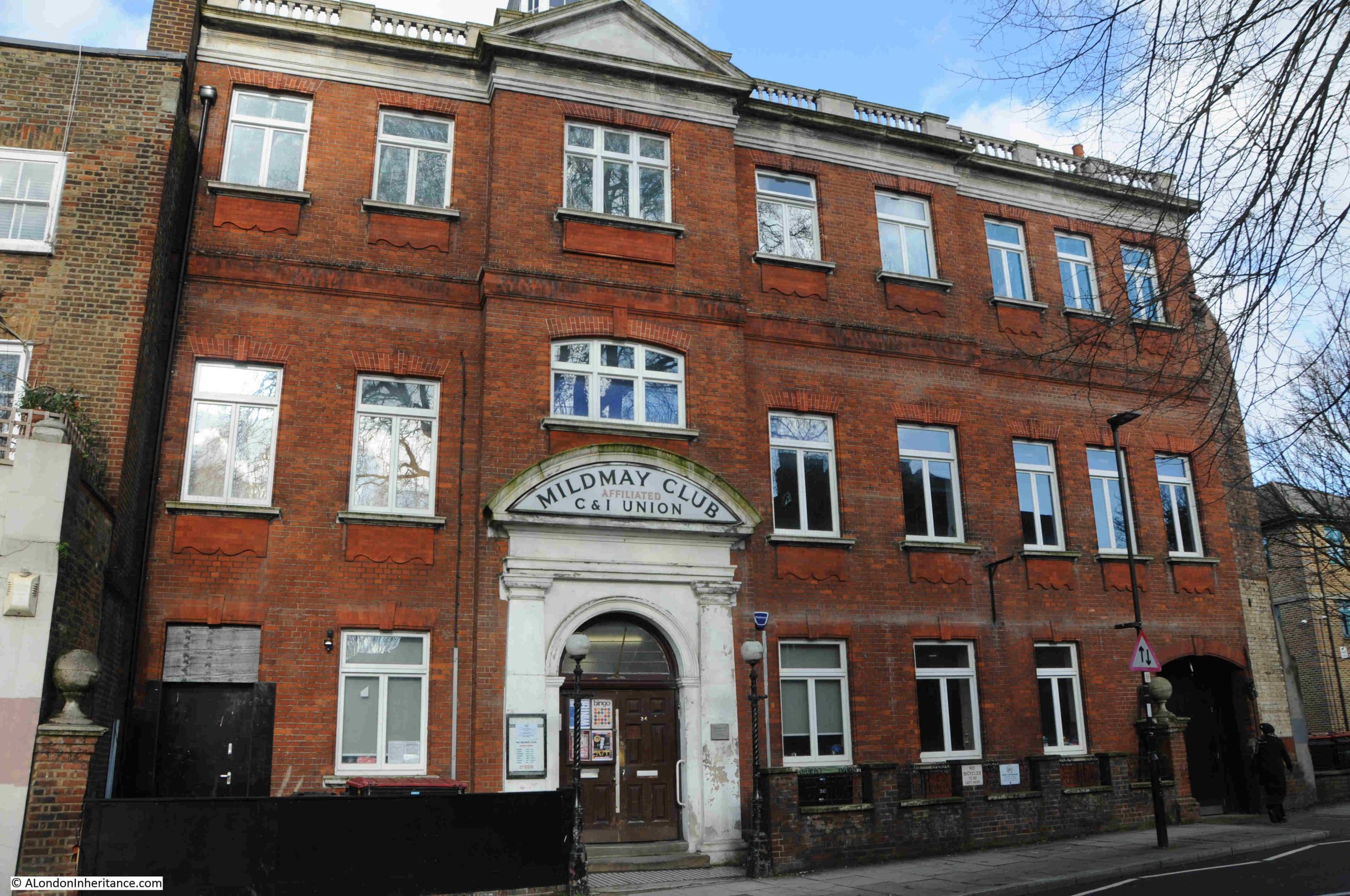
There is a final building associated with dissenting views to be found at Newington Green. As you leave the square at the north east corner, along Matthias Road, you will find the Grade II listed Mildmay Club:
The building dates from 1900 to 1901, and was constructed for the Mildmay Radical Club, which had been founded in August 1888, and was located in Newington Green Road.
The club, like many similar clubs aimed at the working class, was a place of radical politics and social campaigns, and also ran an extensive range of social activities for members, which at their peak, reached around 3,000.
Meetings at the club tended to be based around a lecture or talk on a subject related to the politics of the club, so, for example, on the 29th of January 1903 it was reported that “Last night a public meeting in favour of taxing land values was held in the large hall of the Mildmay Radical Club. The meeting was convened by the Political and Educational Council of the Club in conjunction with the English League for the Taxation of Land Values”.
The concern was that “To all who lived in suburban districts in London, the simple justice of it appealed to all occupiers quite independent of party. It seemed an elementary principle of justice that when public improvements were being made that were going to benefit all, that all should to some extent contribute towards those improvements, But here they had landowners who, especially in London more than anywhere else, got the benefit of these improvements in the increased value of property, and yet as local ratepayers they did not contribute one farthing towards the expenses. The whole cost was thrown on the occupiers of the houses.”
An example of the social events arranged by the club was on the 1st of May 1907, when the Political and Educational Council of the Mildmay Radical Club and Institute arranged an evening “Soiree and Dance” to celebrate the completion of their winter programme of events.
The event was attended by 150 “members, friends, with their wives, sweethearts, sons and daughters”. and dancing was led by “Mr. J. Pennell, the popular and respected instructor to the Mildmay Elementary Dancing Class, who had been invited by the Political and Educational Council to undertake the duties of M.C. and thanks to his energy several extra dances were added to the programme, to the delight of the company”.
The singing and dancing went on till midnight when the evening broke up “with many regrets at its termination”.
The club also arranged many educational visits, not just to radical events, but across London so that members could learn more about the history of the city, and how the city operated. Visits included lecturers at Westminster Abbey and tours to many of the halls of the City Livery Companies.
The radical aspect of working men’s clubs lasted until the First World War, following which their influence and involvement in political causes started to decline, and they became more places for social and entertainment events.
In 1930, the Mildmay Radical Club dropped the radical to become the Mildmay Club to emphasise the non-political status of the club, and the club continues to operate to this day, with a members bar, pool and TV room, and two large halls where entertainment events are regularly hosted.
Newington Green is a small square in north London, but it has a long and fascinating place in the history of religious dissent and radical politics in London and the country, and evidence of this can be found with a walk around the green, as well as a view of the oldest terrace of houses in London.
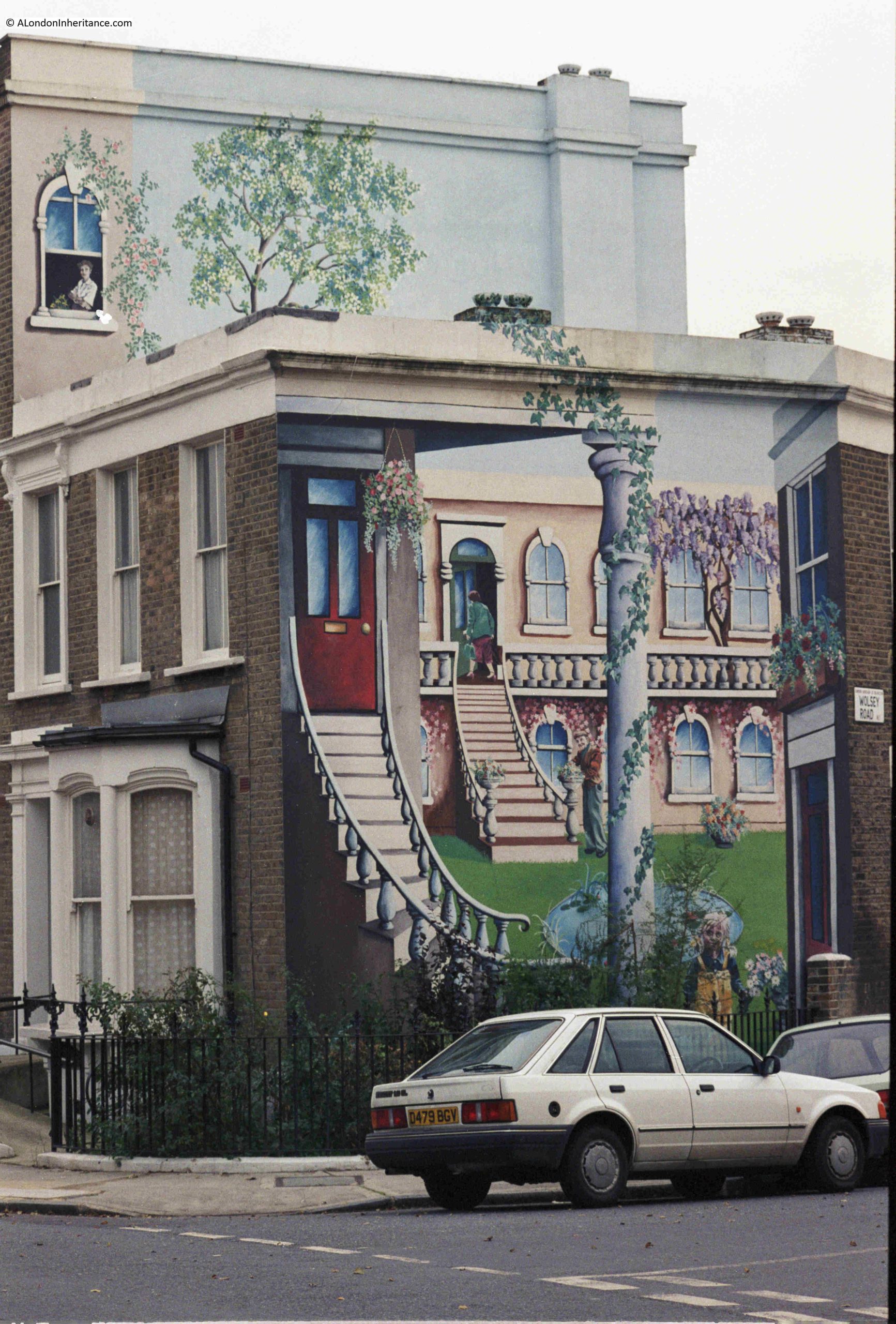
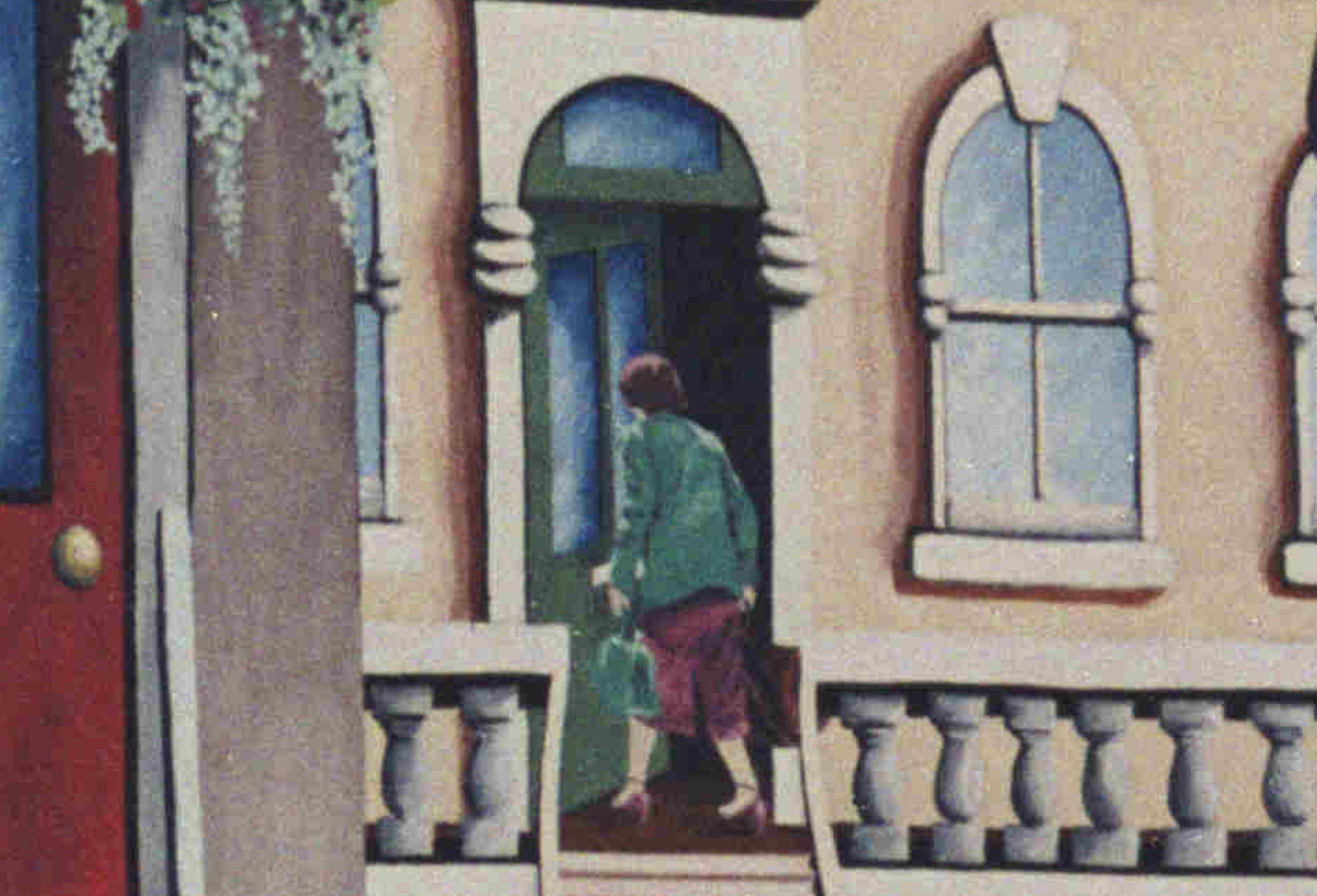
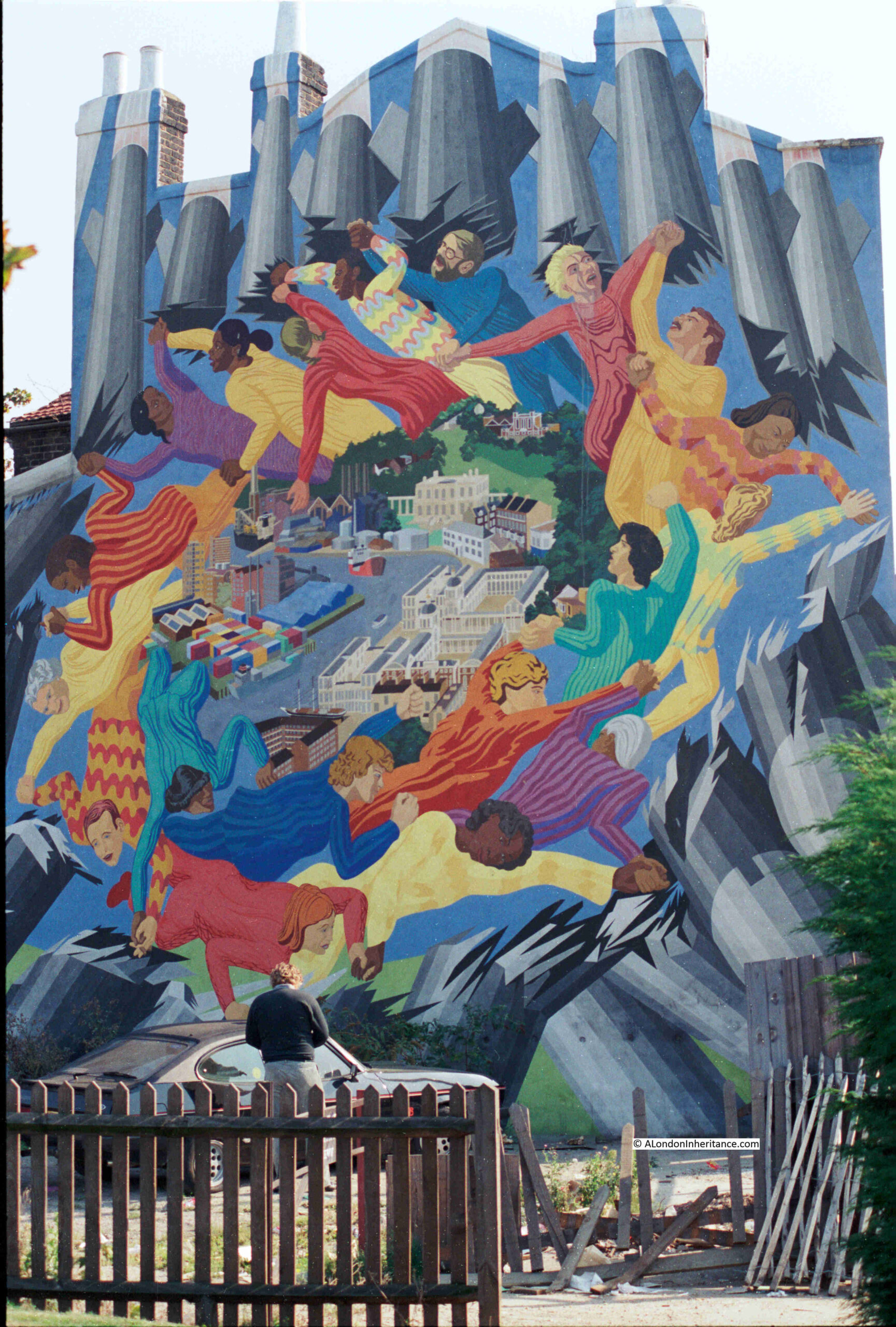
A couple of weeks ago, my post was about His and Hers Hairdressers in Middleton Road, Hackney. After finding the location of my father’s mid 1980s photo of the hairdresser, I continued on towards Newington Green, where one of the approach roads is Mildmay Road, and at the junction of Mildmay and Wolsey Roads, is the location of another of my father’s 1980s photos, this time of a rather wonderful mural:
The mural is remarkable, not just for the subject, the colour and the detail, but also for the three dimensional affect the mural achieves, and that it extends not just along the end wall of the two storey house, but continues across to the third storey of the adjacent house.
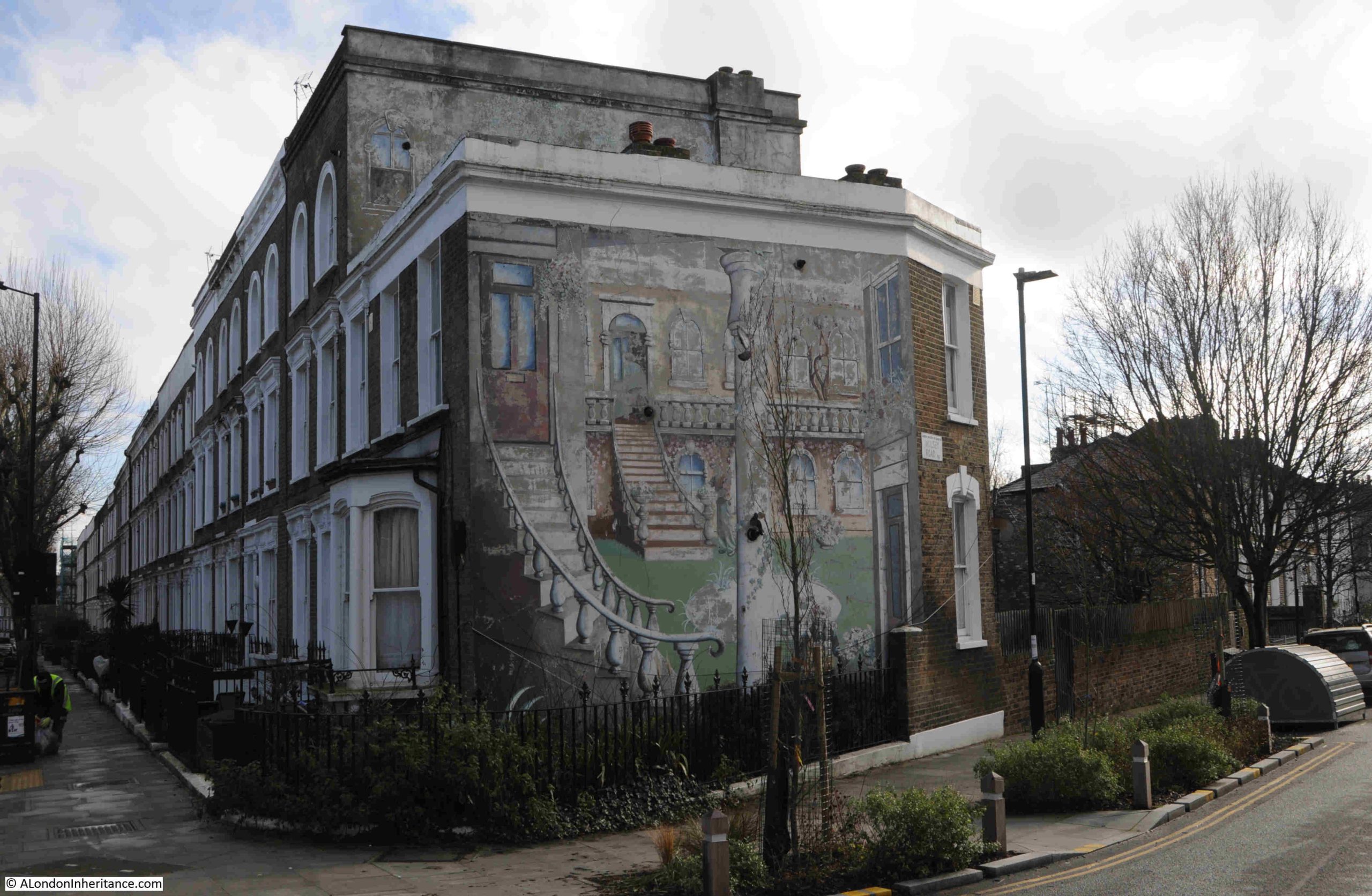
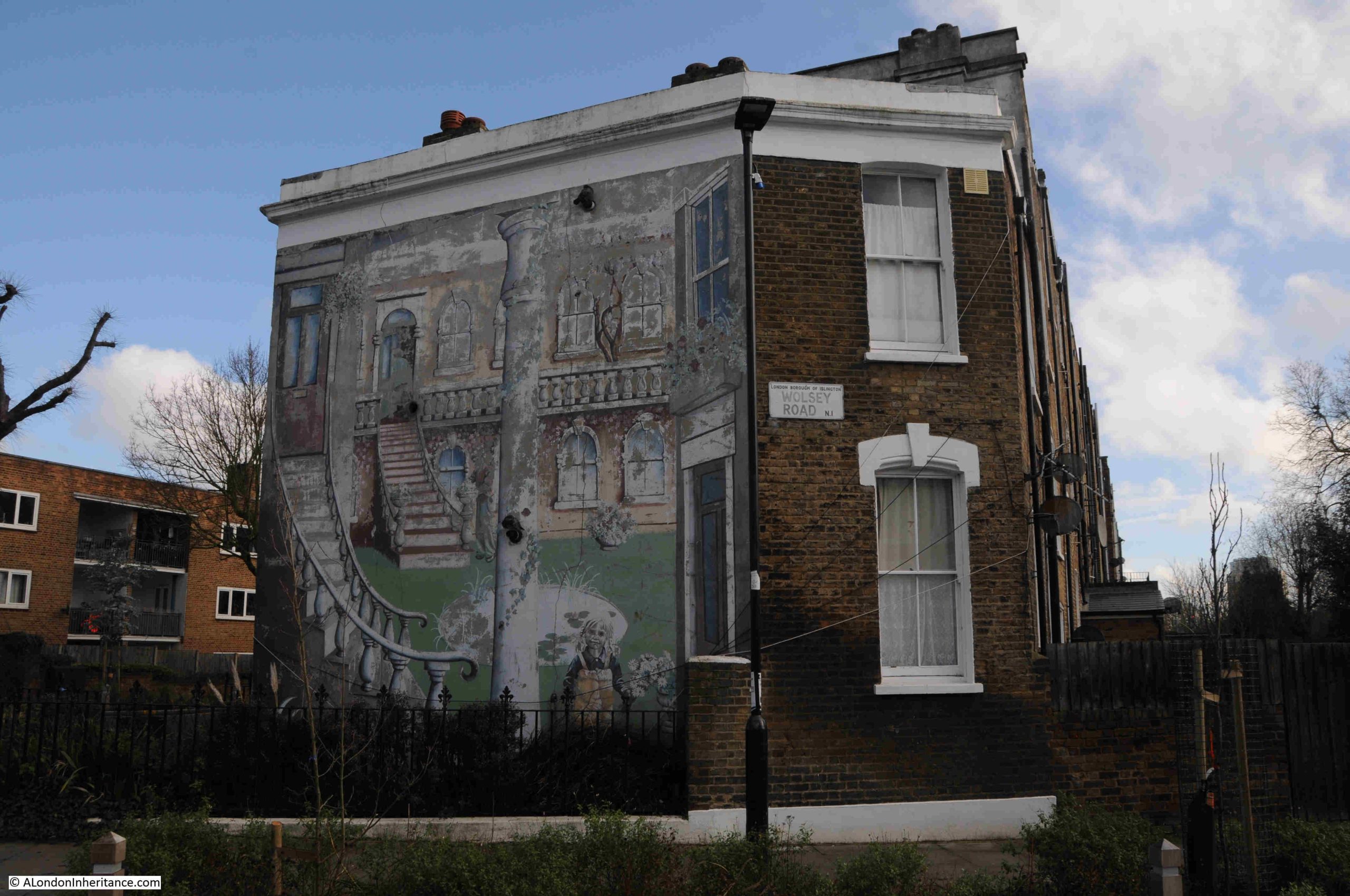
The forty years between the above photo and the mural today, have not been kind to this wonderful artwork, and in 2026 we see a very faded mural, with much of the colour and detail gradually disappearing:
I cannot find any information as to the exact date of the mural, who created the work, and any meaning behind the image, and why on this particular building.
Comments with any information would be greatly received.
In the 1980s photo, we can see details which raise questions, for example there is a green door reached by some stairs leading up from the grass. The door is partly open, and a woman carrying two bags is going through the doorway.
Why is the woman there, who is she, was she a resident of the house, creator or sponsor of the mural?
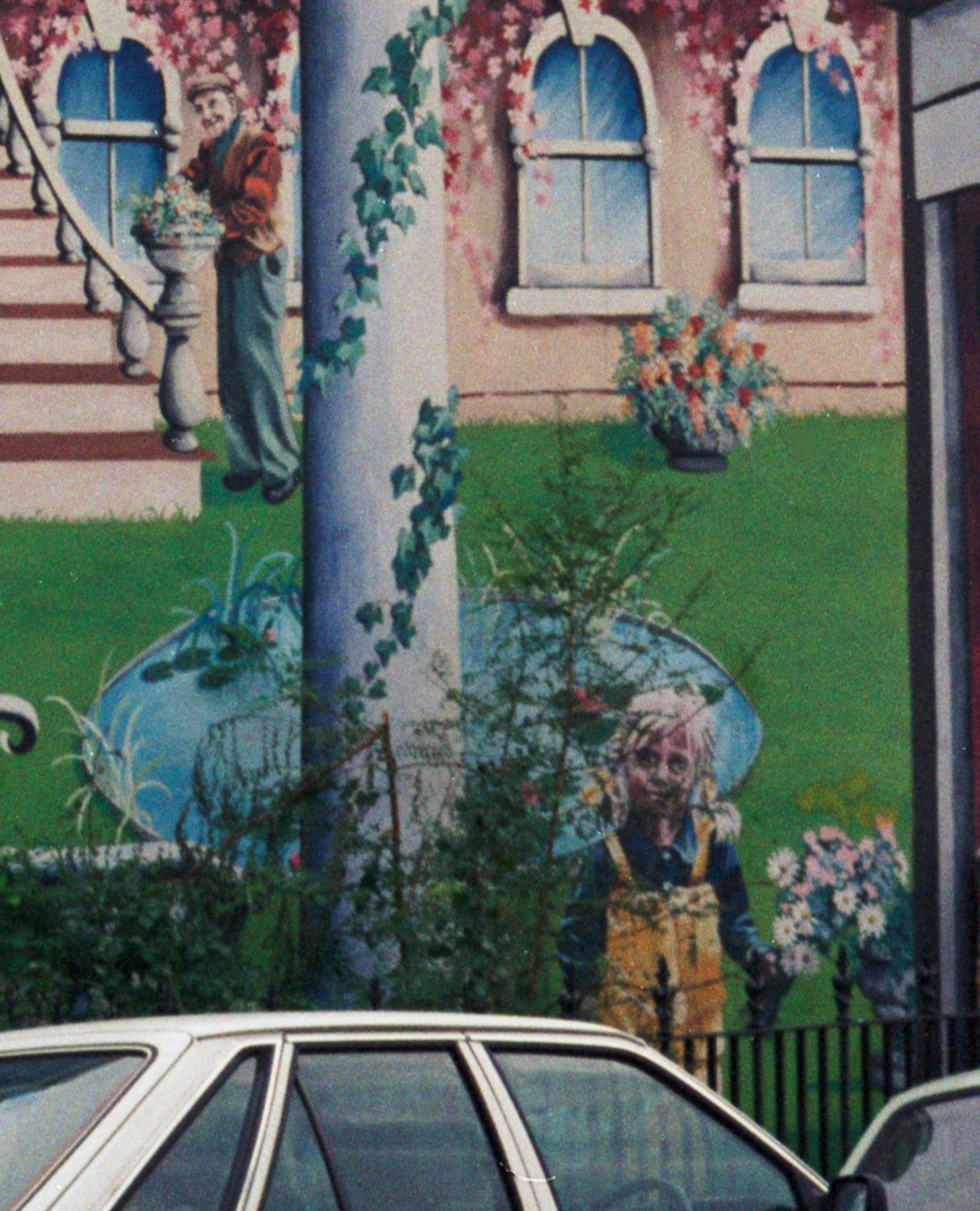
There is also a man at the base of the stairs, and a girl stands on the edge of the grass, holding a bunch of flowers, and looks out towards Mildmay Road. Were they also part of the same family?:
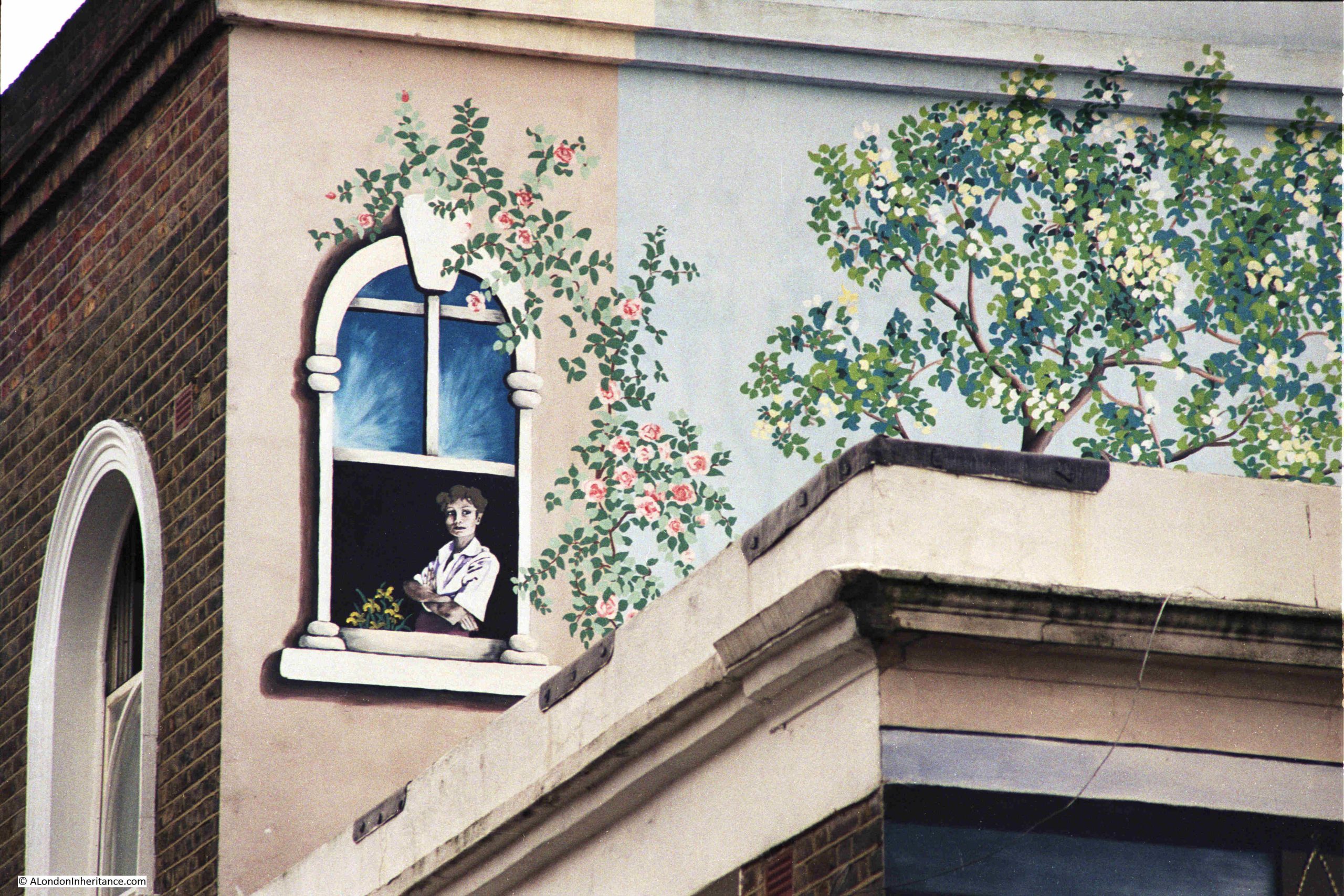
My father’s second photo of the mural was a close up of the part of the mural on the upper floor of the adjacent house, where a woman is looking out of an open window. I wonder if she is the same woman who was going in through the green door?
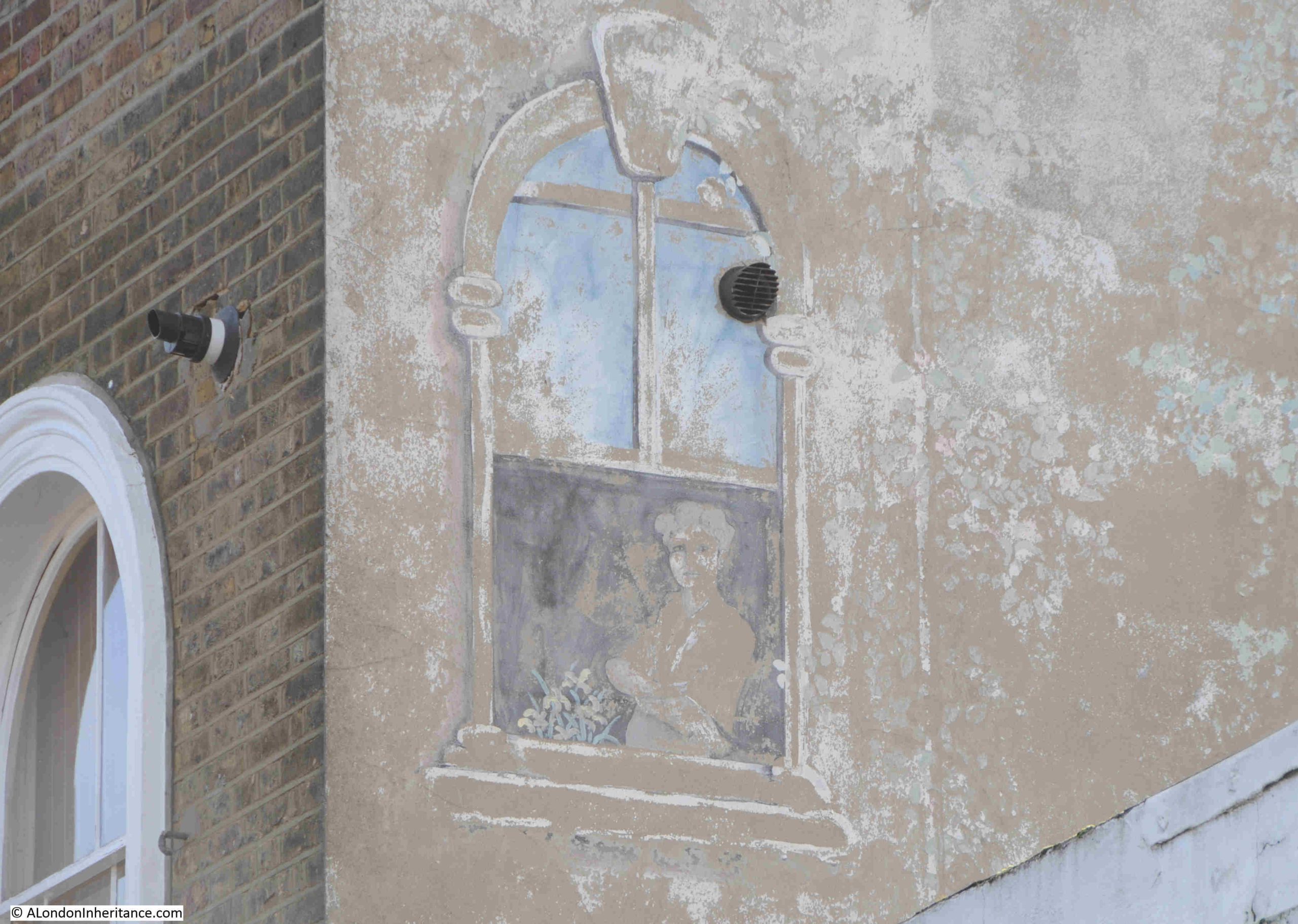
Forty years later, and this section of the mural exists in outline only, with just some of the blue sky in the upper part of the window remaining:
In Wolsey Road we can see that the three dimensional aspect of the mural is still clear. The mural covers a flat wall, and as well as the individual elements of the mural, the two sets of stairs, and the column, the two windows on the right of the mural are painted in such as way as to give the impression that they are on an angled wall:
After forty years, the mural is faded, flaking and losing colour, but enough remains to show what it was like when created, as my father’s 198o’s photos confirm.
The mural is an example of what can be found whilst walking the streets of London, and the pleasure of wandering along London’s ordinary streets is a message I hope I have been able to get across in the last couple of posts on my search for some 1980s photos – The Flower Sellers and London Fields and His & Hers Hairdressers, Middleton Road, Hackney, and is a theme I want to continue in this week’s post, with no deep historical insights, just some views of the streets as I walked up from Middleton Road to Mildmay Road.
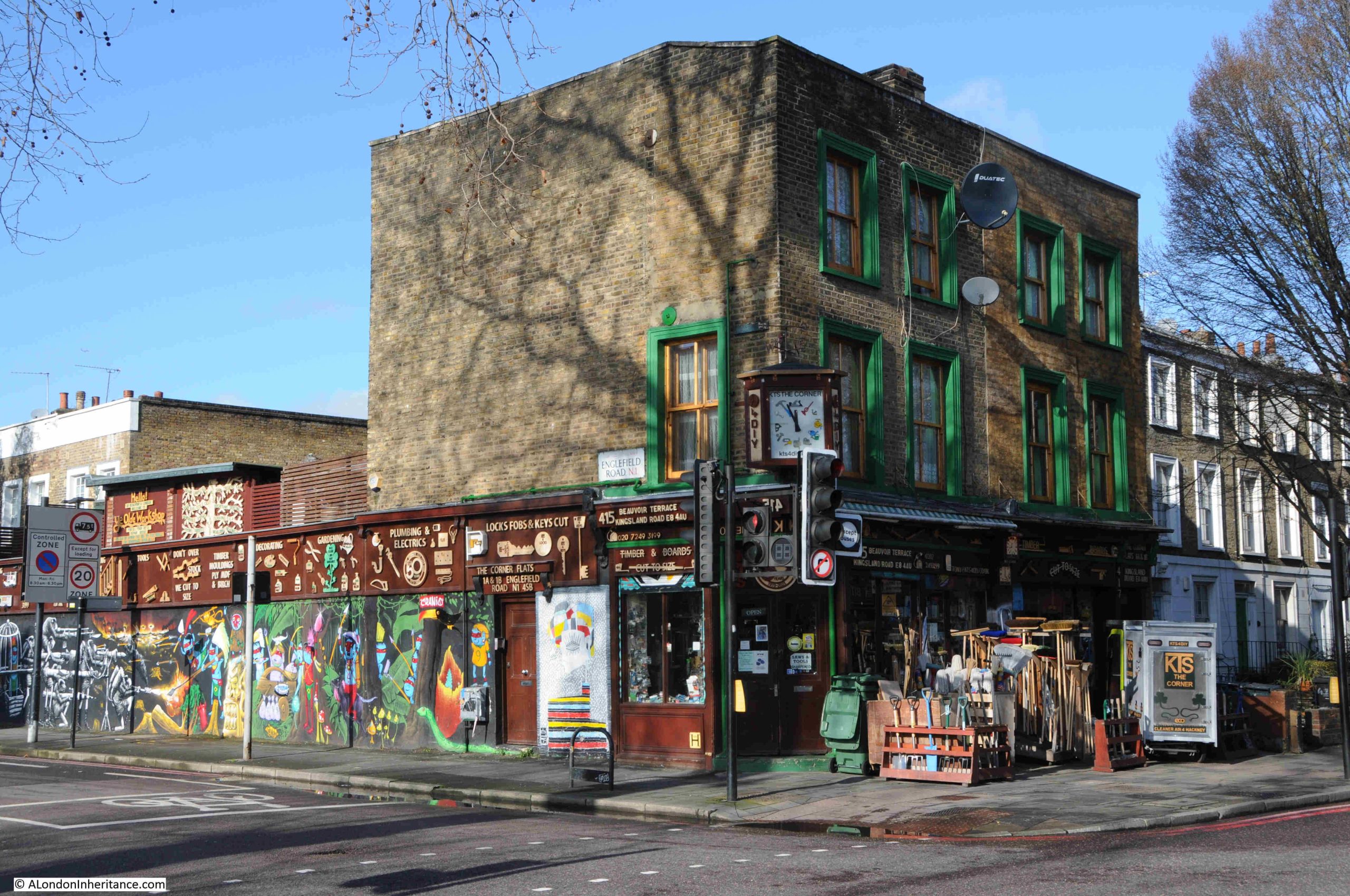
The route took me along Kingsland Road, where at the junction with Englefield Road is KTS DIY, a family run business, which according to their website has been there since 1973:
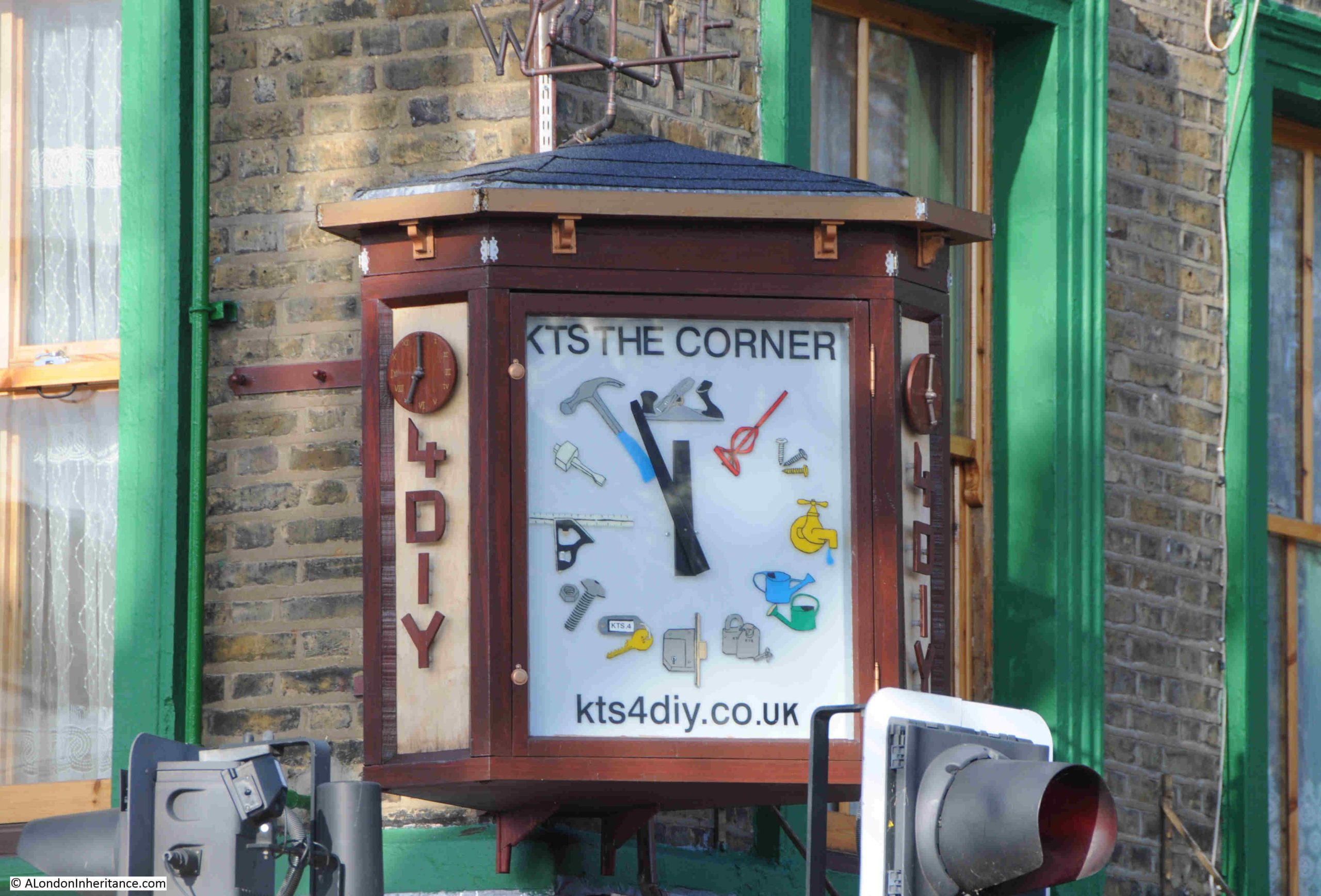
The clock on the corner of the building:
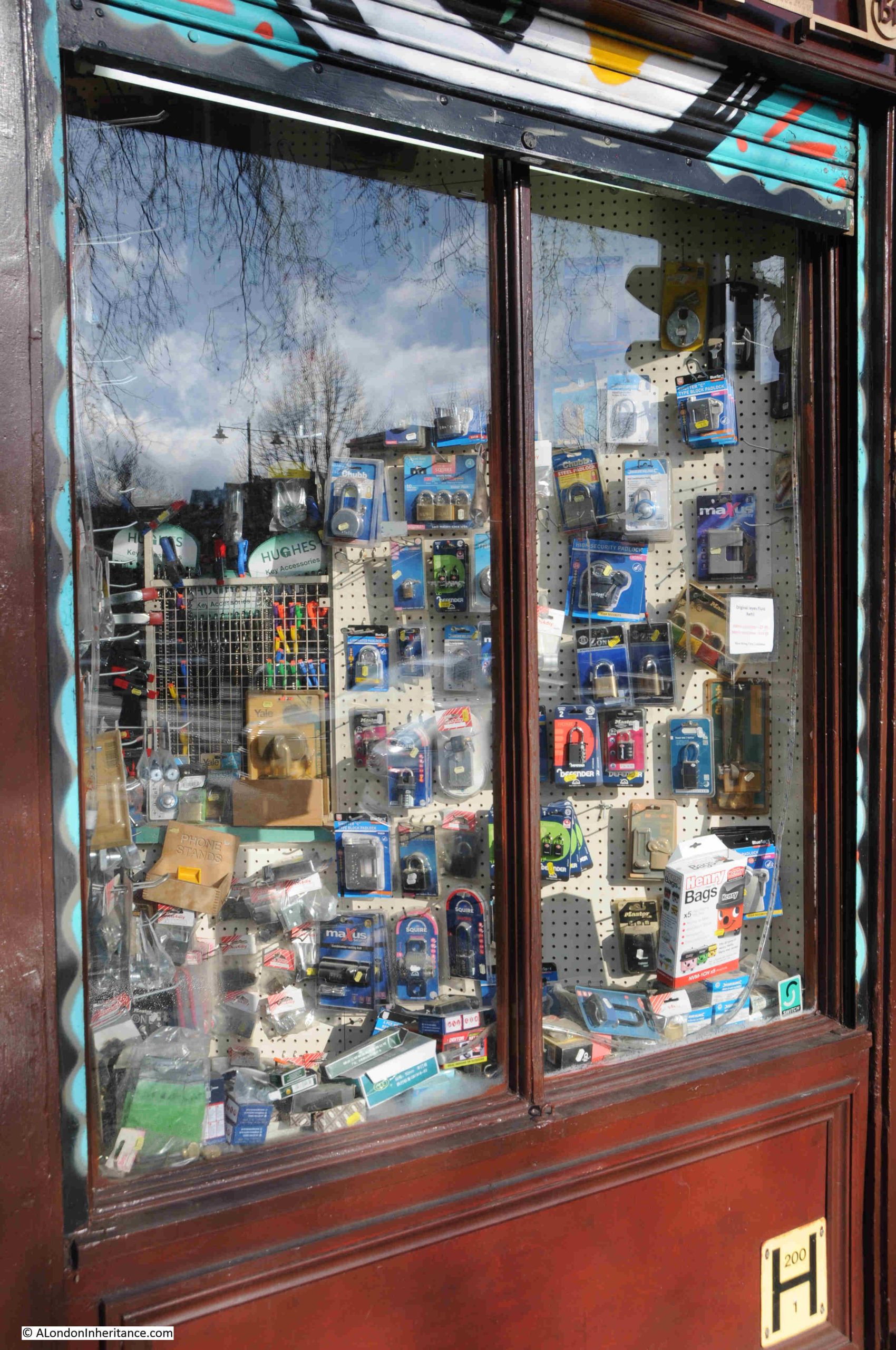
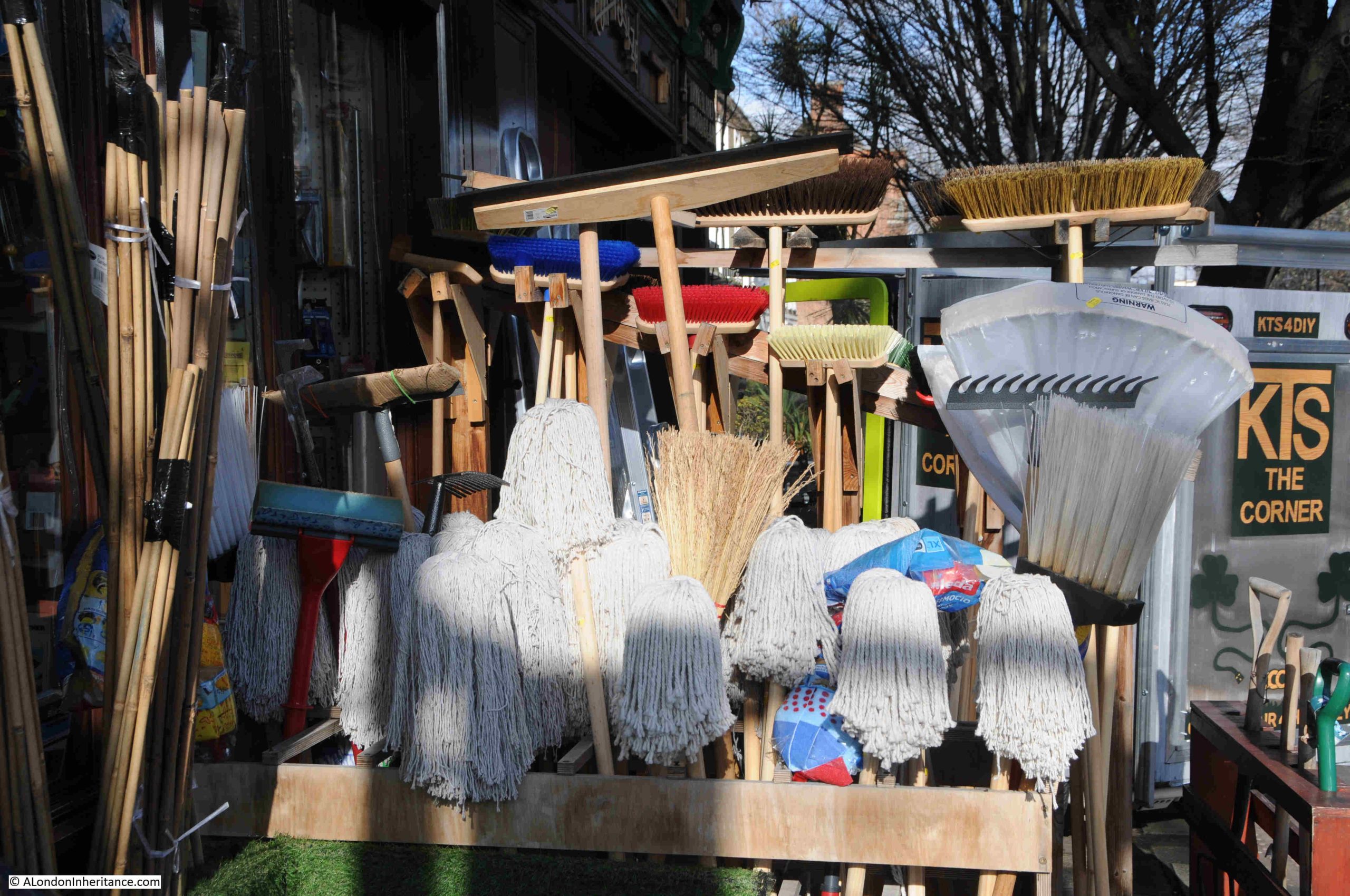
The store stocks a phenomenal range of DIY, building and household maintenance and cleaning equipment. The window display is just a very small part of what can be found inside:
Mops and brooms in the February sunshine on Kingsland Road:
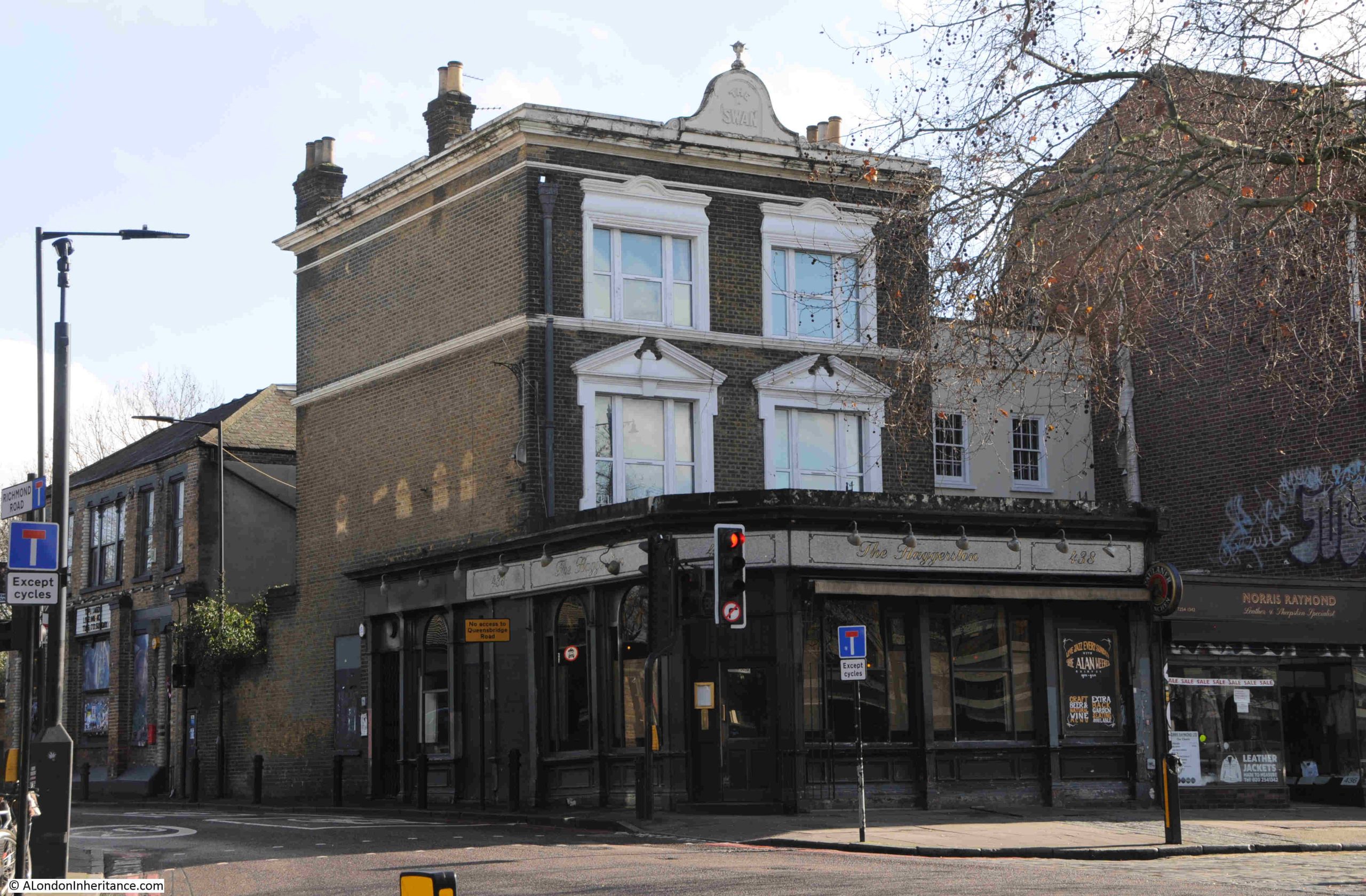
Opposite KTS DIY is the Haggeston, a pub which also has regular live music:
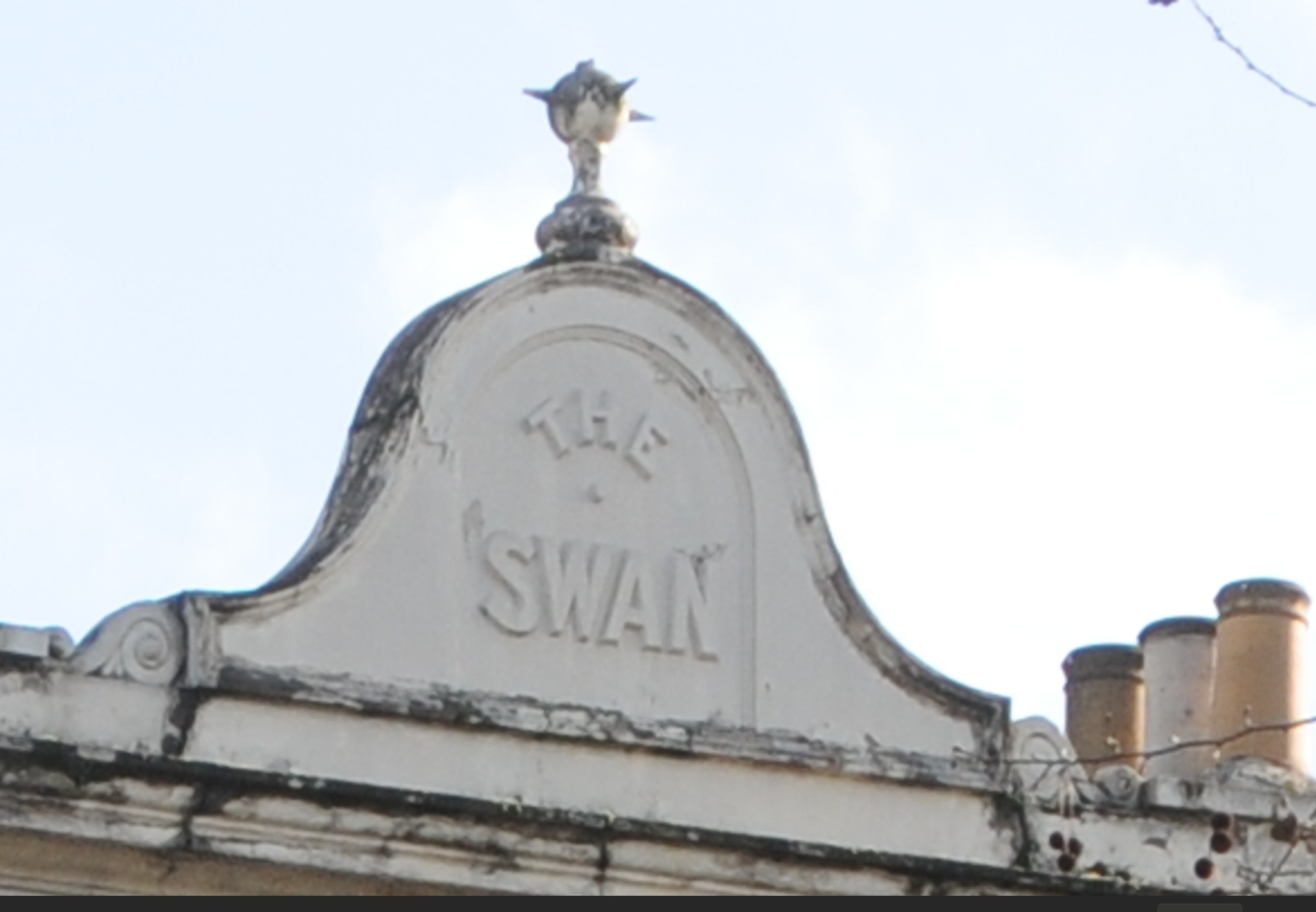
The current name of the pub dates from around 2009, and the original name of the pub was the Swan, as still displayed along the top of the building:
The Swan probably dates to the late 18th century. It was mentioned in an advert in the Morning Advertiser on the 15th of August 1807, an advert for the lease of a house, which gives a good impression of what this now densely built up area was like at the start of the 19th century:
“A neat, genteel brick-built detached dwelling house, with garden, and most pleasantly situated in the fields, near the Swan, Kingsland Road, an easy and pleasant walk from the Royal Exchange, and completely screened from the dust of the public road.”
It is good to know that back in 1807, advertisers of property used the same underestimates of distances in their adverts, as I am not sure the two and a third miles from the Swan to the Royal Exchange could be called and “easy and pleasant walk” for all.
The advert also demonstrates how pubs were used as a local reference points for many forms of public notice.
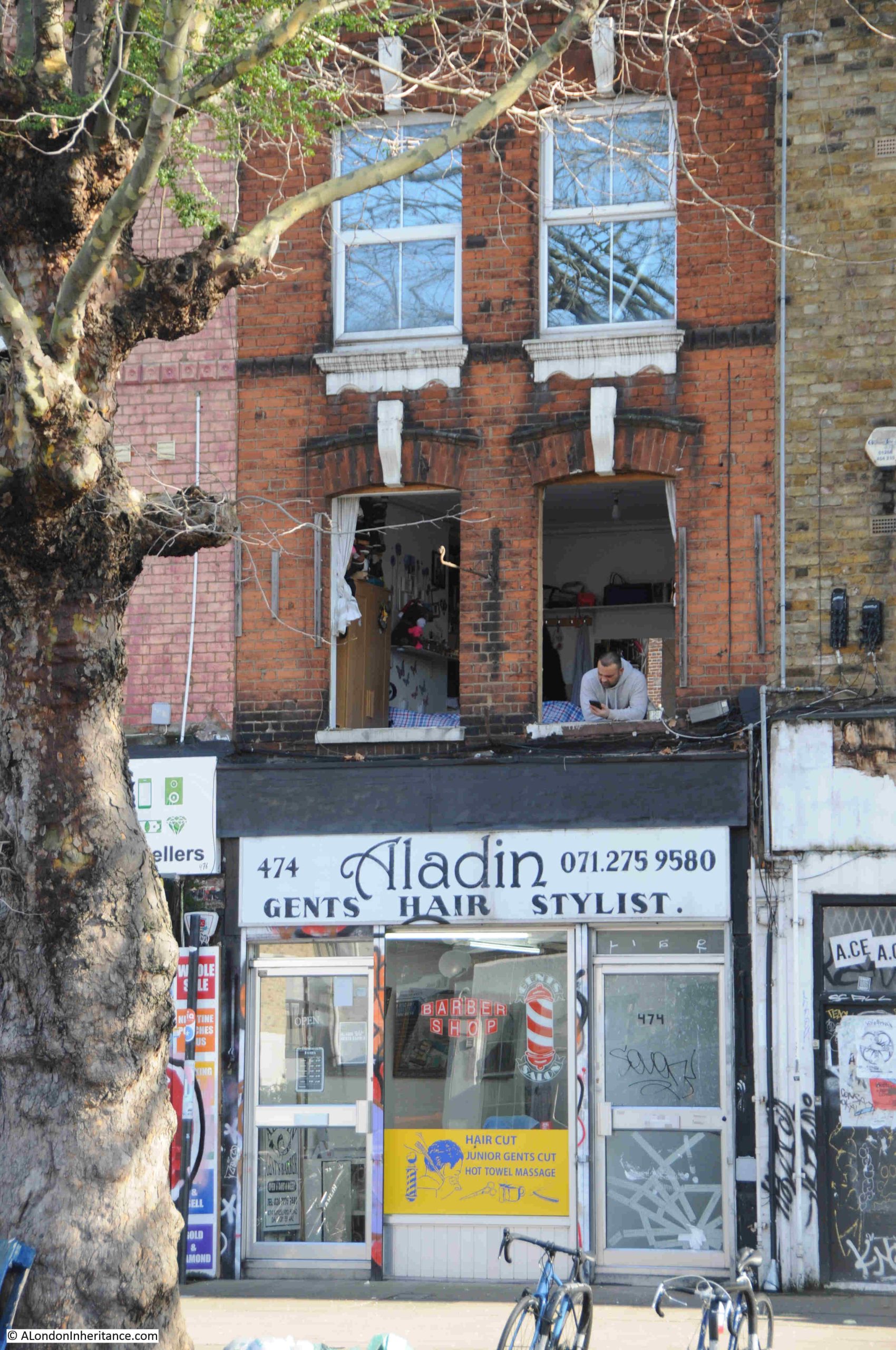
Further along Kingsland Road, and I am not sure what has happened to the windows on the first floor of this building:
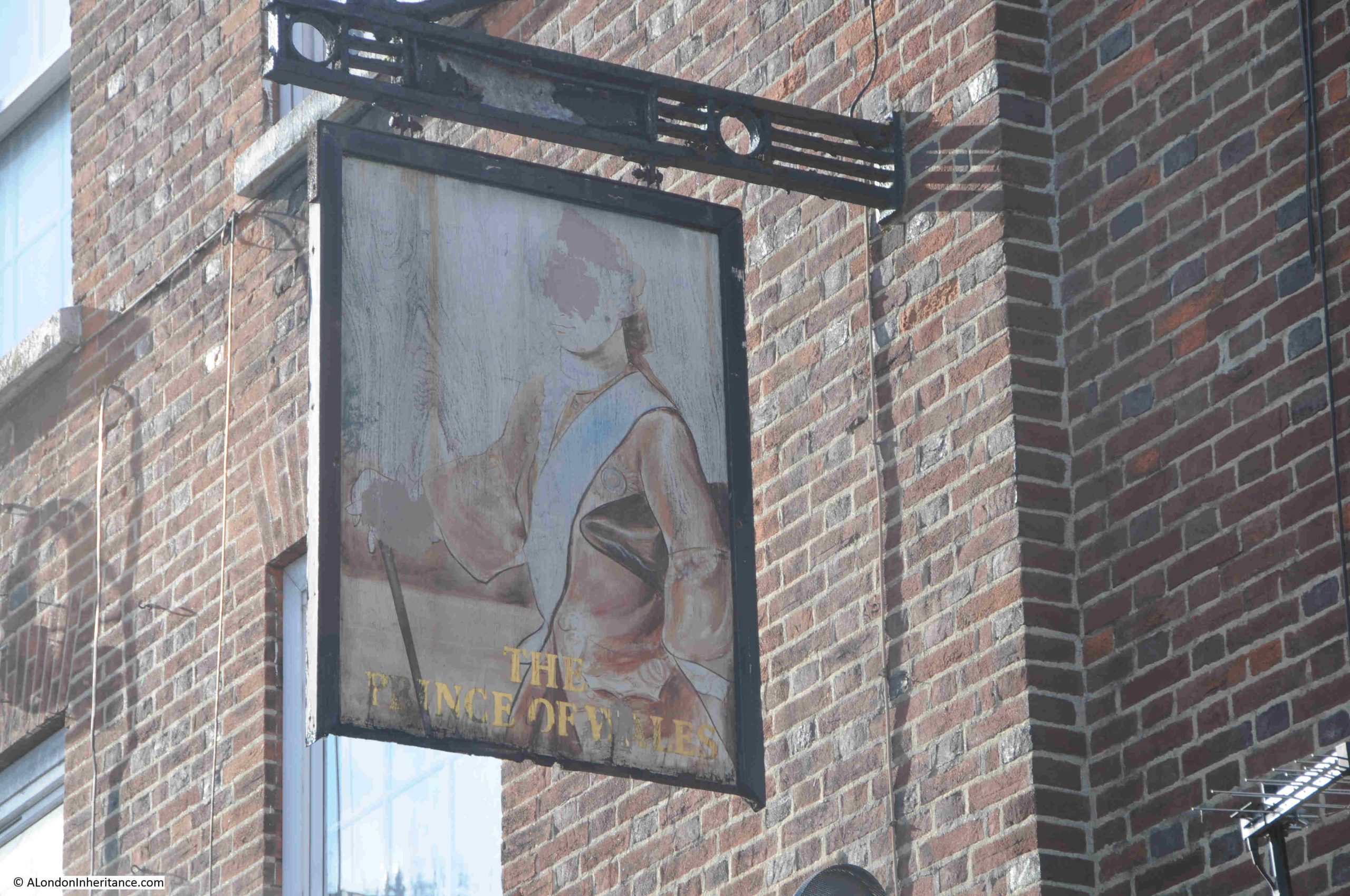
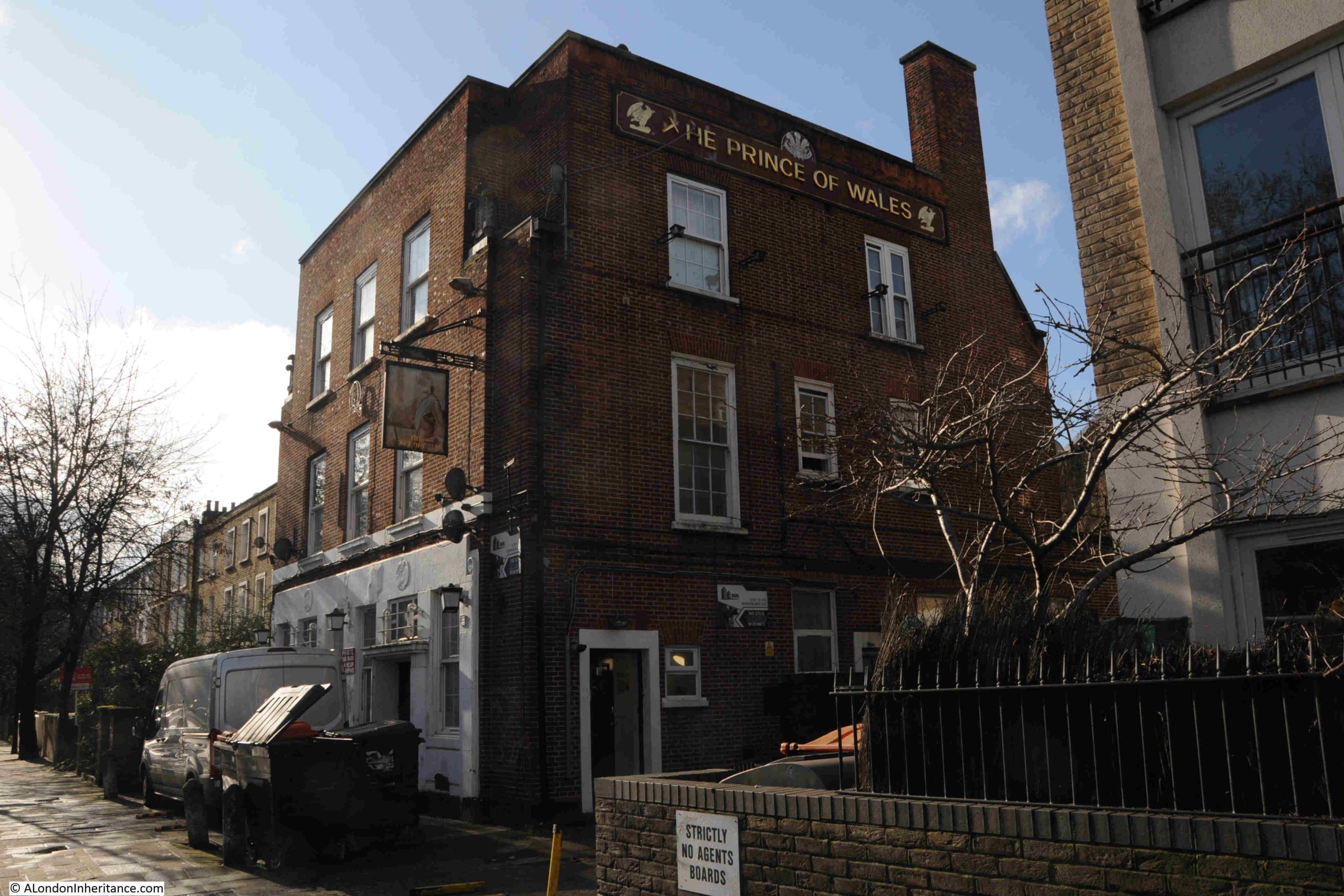
As with the mural on Mildmay Road, along Kingsland Road is the gradually fading sign of the Prince of Wales:
Despite closing around 26 years ago and converted to residential, the Prince of Wales name is still displayed at the tope of the building, a 1930 rebuild of the previous pub on the site:
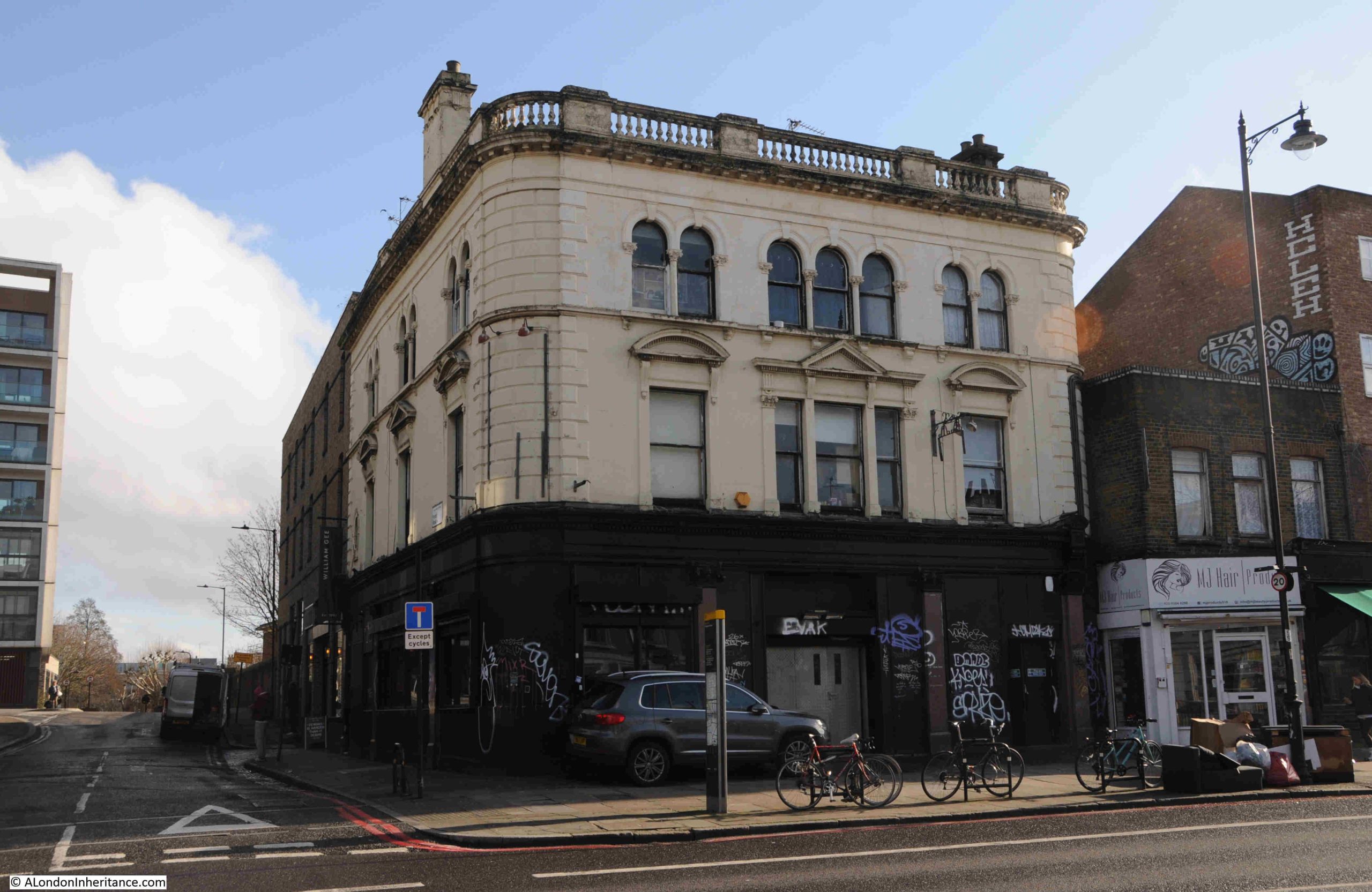
A short distance further along Kingsland Road is another closed pub, the Lamb, which dates from the early 19th century. The building is now a nightclub:
There were many pubs along Kingsland Road, reflecting both the importance of the road and density of the housing that was built in the fields to east and west of the road in the 19th century.
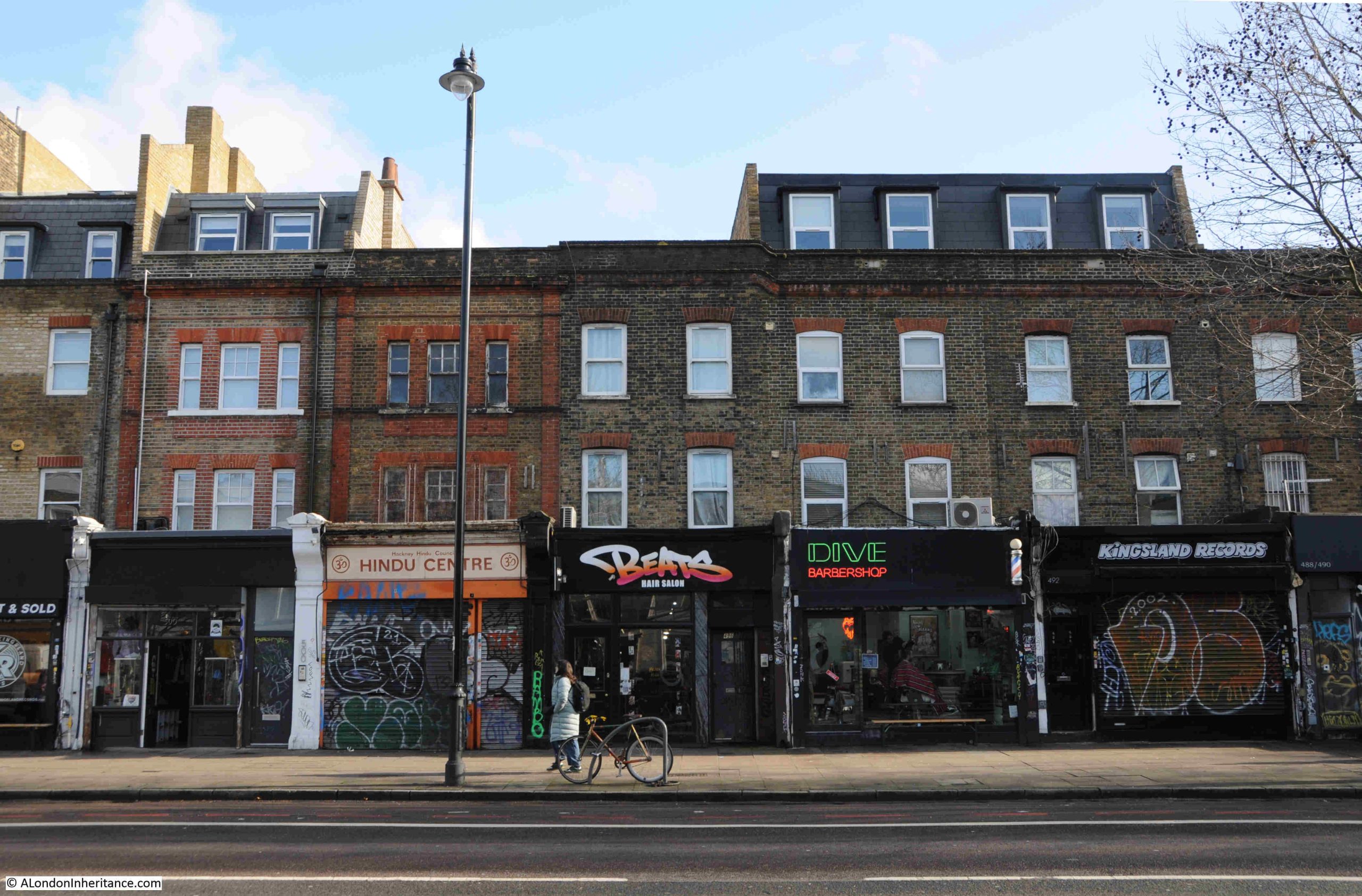
Kingsland Road is also home to terrace houses built during the late 18th and early 19th centuries. These were fine houses at the time, and frequently ground floor shops were added at a later date, built over the gardens that separated the house from the street:
The two semi-detached houses in the centre of the following photo are late 18th / early 19th century and are Grade II listed. At the time of the listing (1975), the building housed a factory, but now looks to ne residential, with shops taking up the space in front of the ground floor of the building:
The two larger buildings behind the shops in the following photo are also Grade II listed and date from the late 18th century. One can imagine how impressive these buildings appeared, before the shops and when the whole façade was visible from the street:
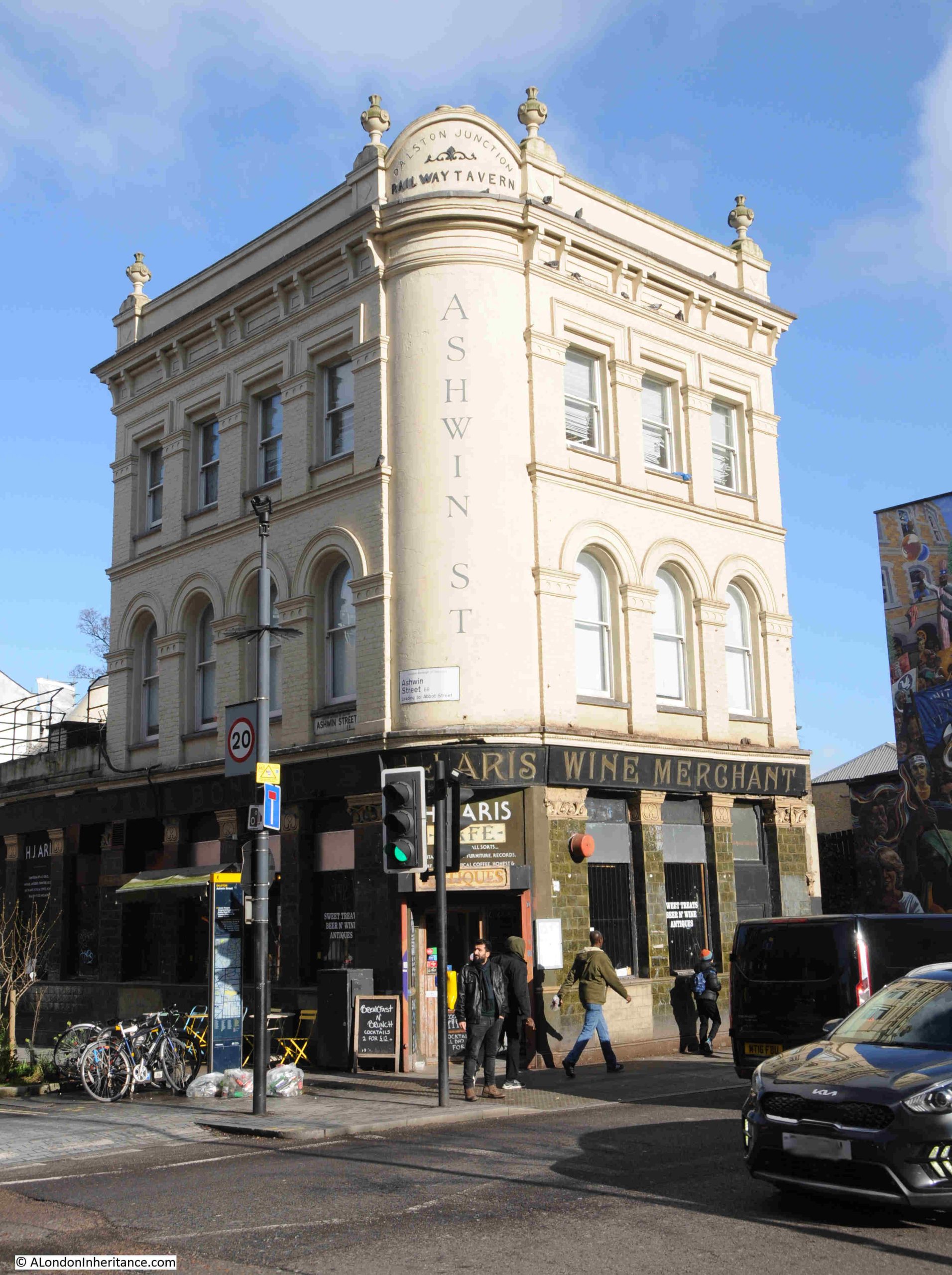
A slight detour down Dalston Lane from Kingsland Road is the old Railway Tavern, so named because it was almost opposite the original Dalston Junction station building, which has been rebuilt as part of a residential development.
The Railway Tavern is now a café / antique store:
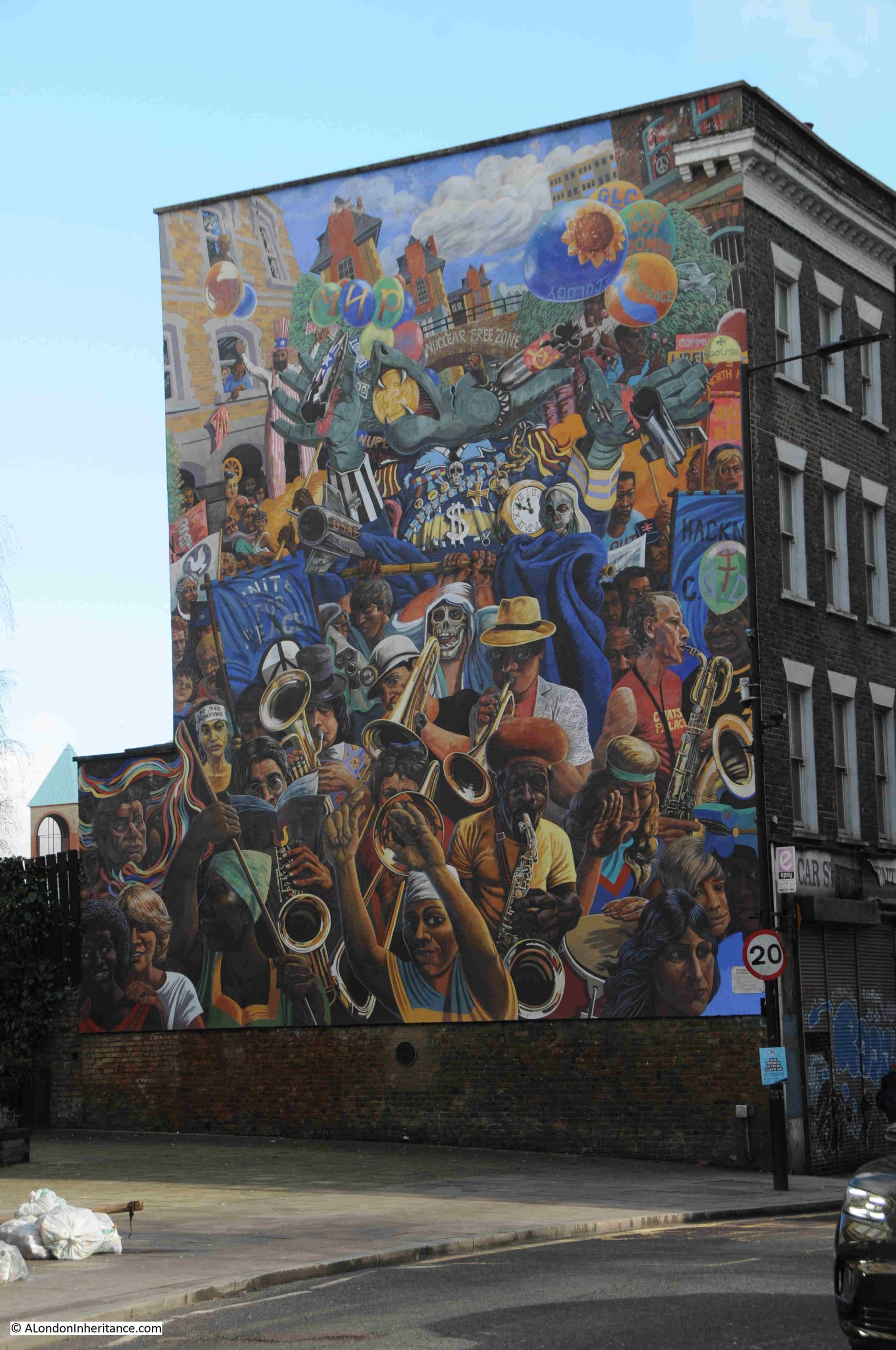
The reason for the slight detour down Dalston Lane is to find another 1980s mural, however unlike the mural in Mildmay Road, this one is in a far better condition:
This is the Hackney Peace Carnival mural. The design dates from 1983 when it was created by Ray Walker to celebrate the Greater London Council’s Peace Year, and it was completed in 1985 after being finished by Ray Walker’s wife Anna Walker along with Mike Jones, following the death of Ray Walker in 1984.
Ray Walker is shown in the mural to the lower left:
And Anna Walker is at lower right:
The excellent condition of the Dalston Lane mural compared to the Mildmay Road mural, when they are around the same age, is mainly down to the significant 2014 restoration of the Hackney Peace Carnival mural.
The 1980s seemed to be a prolific period for murals across the streets of London and GLC initiatives such as the 1983 Peace Year were responsible for a number of these, another of which was in Greenwich and was the Wind of Peace mural in Creek Road:
The Wind of Peace was commissioned by the London Muralists for Peace initiative, and painted by artists Stephen Lobb and Carol Kenna. It replaced an earlier mural showing the river and the land alongside the river in Greenwich.
From Dalston Lane, I then returned to Kingsland Road, and headed up to Mildmay Road via Boleyn Road, to find the mural at the start of today’s post.
A short post, with no maps, no deep dive into the area’s history, but I hope it demonstrates why walking the streets of London can be such as pleasure.
Along with streets and places such as Piccadilly, Leicester Square, and Oxford Street, Downing Street is probably one of the more recognisable London street names, not just in the United Kingdom, but across the world, given the number of tourists who peer through the gates that separate Downing Street from Whitehall.
Number 10 Downing Street has been home to the Prime Minister (or more correctly the First Lord of the Treasury) since 1735, when the house was given to Sir Robert Walpole.
There have been many gaps in occupancy by Prime Minsters, however a central London house was considered a benefit of the role. It was only in the early 20th century that it became a full time residence of Prime Ministers.
Security has long been an issue. It was not so long ago that the public could walk down the street, with the street finally being closed to the public in 1982, and in response to ever growing threats, security measures such as physical defences and armed police have been added and enhanced.
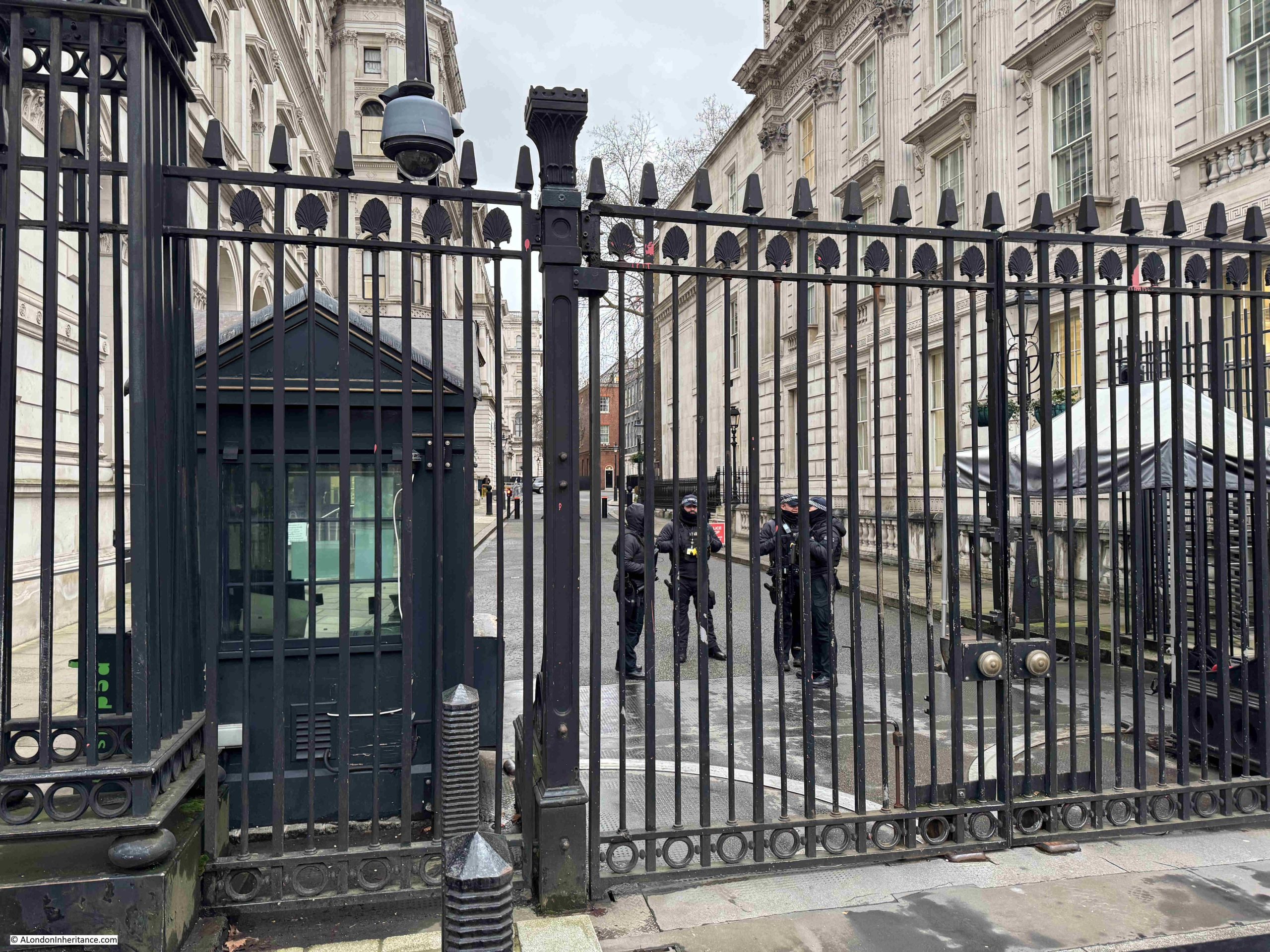
So today, this is the best view of the street for tourists and members of the public who do not have official business in any of the buildings and institutions that line Downing Street:
The street has seen so many Prime Ministers, newly elected, arrive in an atmosphere of enthusiasm and expectation, only to leave having been rejected either by the electorate, or through the actions of their former colleagues.
For a rejected Prime Minister, perhaps the most difficult way to leave is when you have been rejected by former colleagues. Those who once supported and worked with you, and with whom you had a shared vision of the future.
Whilst this must be incredibility frustrating, it is not as bad as the treachery of the person who was once the land owner and who gave his name to the street, who through his treachery, condemned former colleagues to the worst death penalty that the State could impose, convicted of being a traitor and being hung, drawn and quartered.
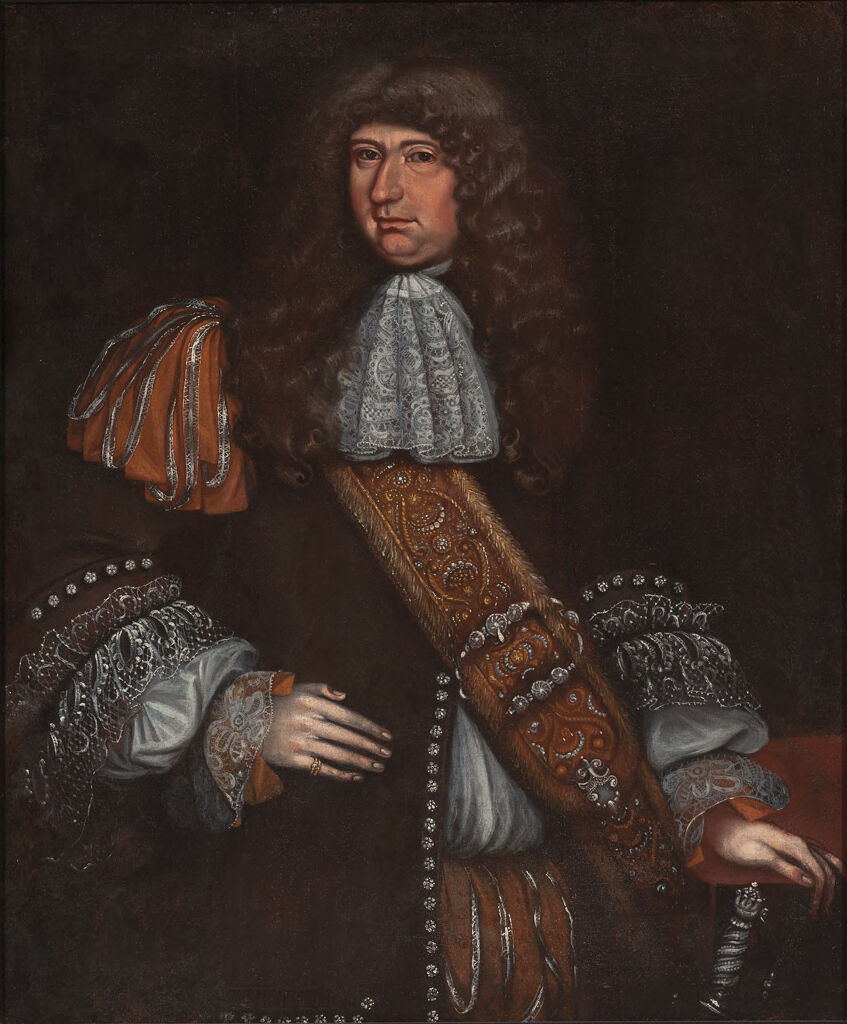
For this, we have to go back to the Civil War, Commonwealth and Restoration of the 1640s, 1650s and early 1660s to explore the work of Sir George Downing:
The source of the above paining is from the Harvard Art Museum, and the image title is “Portrait of a Man, probably Sir George Downing (1624-1684)”. It is often difficult to be absolutely certain of those depicted in paintings of some age (see my recent post on the Gresham’s).
The record for the painting states that on the stretcher is written “Sir George Downing Bart./ born August 1623–Embassador [sic]/ to the States General 1659-Son of/ Emmanuel Downing & Lucy Winthrop/ 4th daughter of Adam Winthrop-/ The nephew of John Winthrop/ Governor of Massachusetts–His/ diplomatic services…[illegible]… are well known to history.”, which does add some confidence that this is Sir George Downing.
George Downing was born in Dublin around 1623 or 1624, His father was Emanual Downing, a Barrister and Puritan, and his mother was Lucy Winthrop, the sister of John Winthrope who was the Governor of the Massachusetts Bay Colony, an English settlement on the east coast of America which had been founded in 1628.
This family relationship with Massachusetts resulted in the family moving to the colony in 1638, where they settled in Salem.
Harvard College had been founded by the Massachusetts Bay Colony on the 18th of October 1636, and was the first college set-up in the American colonies.
The name Harvard comes from John Harvard who was an English Puritan minister and benefactor of the college, which included leaving his library of 400 books and half of his estate to the new college.
George Downing attended Harvard College, and was one of the first group of nine who graduated from the college in 1642.
After Harvard, Downing moved to the West Indies where he became a preacher, and in the early 1640s he returned to England, where he found the country in the middle of a Civil War, and he quickly aligned with the forces opposing King Charles I, joining the regiment of Colonel John Okey as a chaplain.
Downing was fully supportive of the actions of Cromwell and the New Model Army in the defeat of the Royalist cause, and he was recognised and promoted quickly to become Cromwell’s Scoutmaster General in Scotland, a role that was basically the head of a spying and intelligence operation, attempts to infiltrate Royalist plots and to turn Royalist supporters to the Republican cause.
During the years of the Commonwealth in the 1650’s, Downing’s skills became valuable in the diplomatic service, and he became the Commonwealth’s ambassador to the Netherlands, where he also developed a network of spies, and passed information on Royalist plots back to John Thurloe, who was Cromwell’s main spymaster.
The later part of the 1650s were a difficult time for the Commonwealth, the main issue being what would happen to the Commonwealth after the death of Oliver Cromwell. Who would succeed Cromwell, how would such a decision be made, could Cromwell take on the role of a monarch and make the head of the Commonwealth a hereditary title?
Downing supported and urged Cromwell to take on the role of a monarch along the lines of the old constitution that had existed before the execution of King Charles I.
To those holding senior positions in the army and the Commonwealth, it must have seemed that the Commonwealth was in a strong position, the country would remain a Republic. Monarchist plots and uprisings had been supressed, and the future King Charles II seemed to be in a weak position in exile on the Continent.
It was then surprising how quickly after Cromwell’s death, that the whole structure of the Commonwealth collapsed so rapidly, and King Charles II was restored as the monarch of the United Kingdom in 1661, just three years after the death of Oliver Cromwell.
George Downing had been watching how sentiments towards the monarchy were changing and started to plan how he would survive and prosper after the restoration.
This involved actions such as ingratiating himself within the court of the future Charles II, passing information on to the Royalists and claiming that he had been drawn in to the Republican cause rather than being an active initiator of the Civil War and the execution of King Charles I.
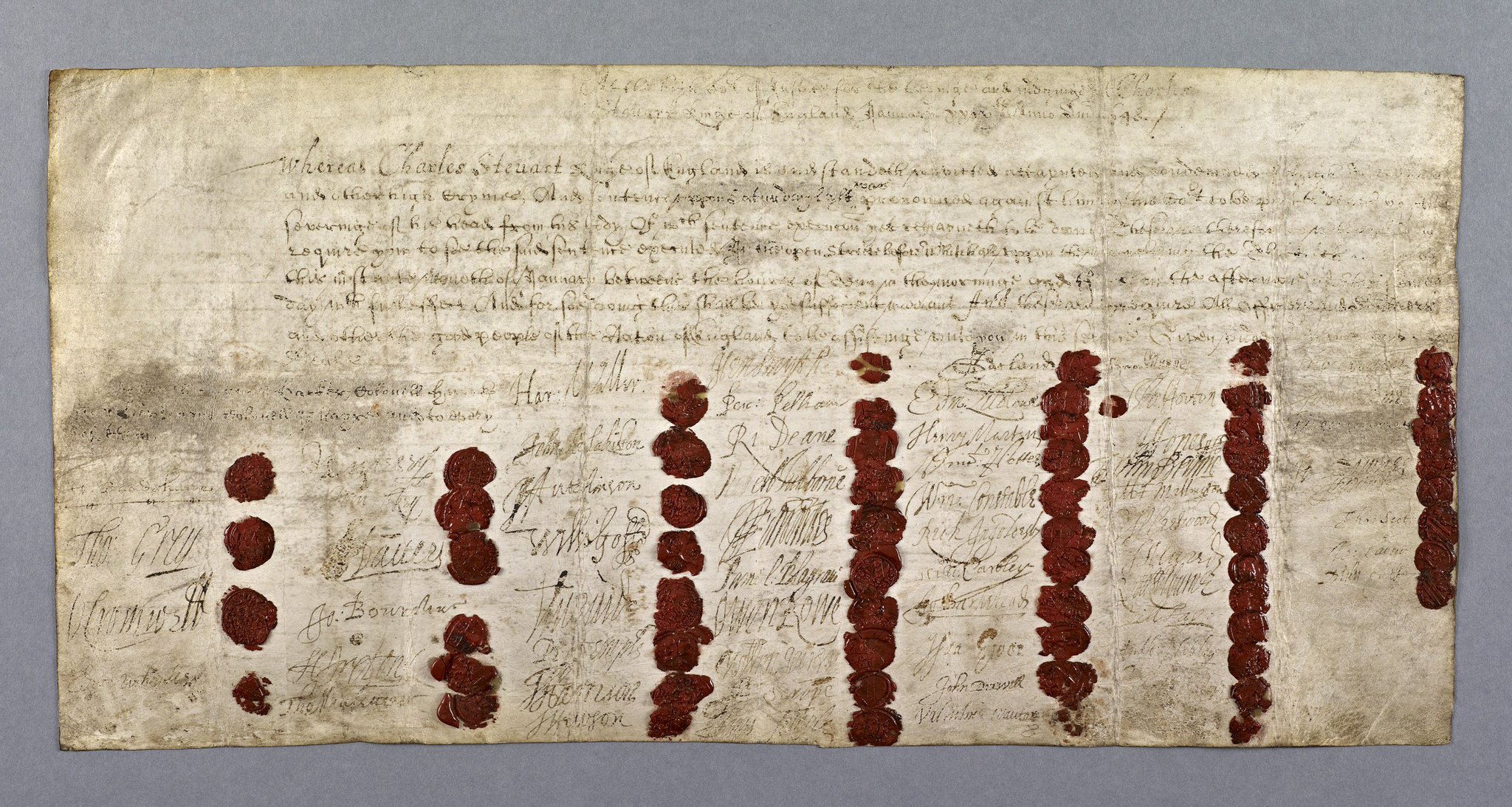
Whilst Downing had supported the trial and execution of the former king, he was not a judge or participant in the trial, and did not sign the execution warrant of the king:
Which is an important lesson if you are involved in any plotting or support of a controversial cause – never leave anything in writing.
Despite his involvement and support of the Republican cause, Downing’s efforts to show support for the monarchy were such that after the restoration of the monarchy, he was knighted, and continued in his role as the ambassador to the Netherlands, and it was in the following couple of years that he was to really show his ruthless streak and what he would do to further his own power, position and wealth.
Regicides
After the restoration, the monarchy turned their anger on those who had been involved in the trial of King Charles I, who had signed his execution warrant, or who had had a significant role in his execution.
Known as the Regicides, those who had been responsible in some way for the execution of the King were exempted from the Indemnity and Oblivion Act of 1660, an act that gave a general pardon for all those who had committed a crime during the Civil War and the Commonwealth (other than crimes such as murder, unless covered by a licence from the king, witchcraft and piracy were also not covered by the general pardon).
A number of the Regicides had already died, including Oliver Cromwell and Henry Ireton. Others gave themselves up in the hope of a fair trial and avoidance of a traitors death, whilst others fled abroad in fear of their lives.
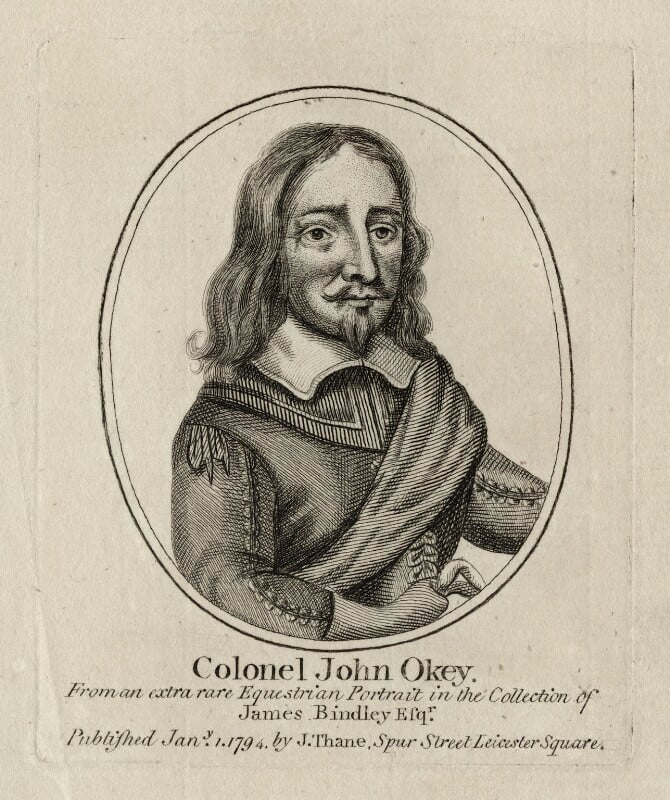
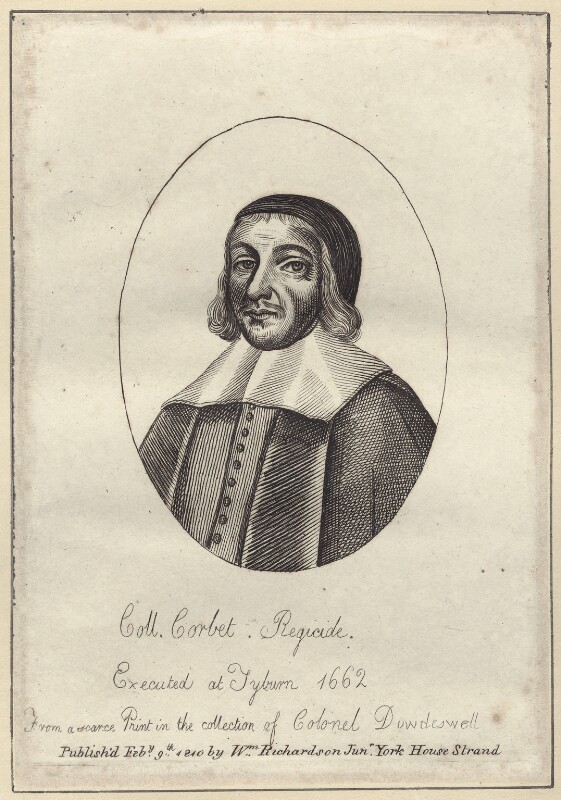
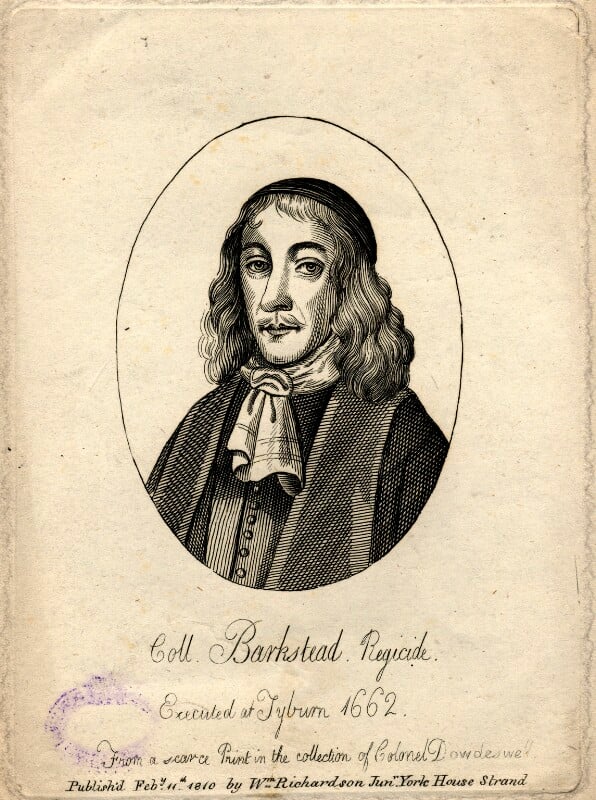
Three of those who fled, and who would meet their deaths through the actions of George Downing, were:
John Okey had been born in St. Giles, and like many others who were part of the Parliamentary / Republican / New Model Army forces opposing the king during the Civil war, Okey had enlisted in the army, rising through the ranks to become a major, then a colonel, of a regiment of dragoons (mounted infantry).
George Downing had joined Okey’s regiment as a chaplain, and was well known to Okey.
When Charles I was brought to trial, Okey was one of the 80 who were actively involved in the trial, and attended on most days, and the action that would infuriate the restored monarchy was that he was one of the 59 who had signed the warrant for the execution of the king.
Miles Cobet was the MP for Yarmouth and also a Lawyer.
The print of Corbet shown above has the abbreviation Coll. in front of his last name. This may have been an honorary titles, as he did not serve during any military actions during the Civil War. He was though one of the founders of the Eastern Association, which was a military alliance formed to defend East Anglia on behalf of the Parliamentary forces, and he also served as an army commissioner in Ireland, responsible for overseeing the affairs of the army, and with allocation of land within Ireland to soldiers as reward for their service, and often in lieu of wages.
His role in the trial of Charles I was as part of the High Court of Justice, and as one of those who signed the execution warrant.
John Barkstead was originally a goldsmith in the Strand, but who joined the Parliamentary forces, becoming a captain of a foot company in the regiment of Colonel Venn. He was Governor of Reading for a short time, commanded a regiment at the siege of Colchester, and was appointed as one of the judges at the trial of Charles I.
He also signed the Warrant for the Execution of Charles I.
He was appointed Lieutenant of the Tower of London, but used this position to further his own wealth by extorting money from prisoners and generally running a cruel regime.
He was rumoured to have hidden a large sum of money in the Tower of London, and in 1662, Samuel Pepys wrote in his diary that he was busy in a discovery for Lord Sandwich and Sir H. Bennett of the cellars of the Tower for this hidden money.
By signing the warrant for the execution of the King, Okey, Corbet and Barkstead had also signed their own death warrants, as this would be their fate – a public traitors death in London.
Escape and Capture
In fear of their lives, with the restoration of the monarchy, Okey, Corbet and Barkstead fled to Europe, with Okey and Barkstead making their way to Hanau in Germany, where they were accepted by the town and given a level of protection. Corbet had made his way to the Netherlands where he was in hiding.
For Barkstead, Hanau seemed a natural, long term home, as the town was well known for the manufacture of jewellery, and Barkstead’s background as a goldsmith in the Strand would come in use.
As Hanau seemed to be a long term home for Okey and Barkstead, they wanted their wives to join them, and a plan was put together for them to meet their wives in the Netherlands, from where they would all travel back to Hanau.
They believed that they would be safe in the Netherlands and had assurances that Downing had not been given any instructions to hunt for them. The Netherlands was also known for tolerance and for putting commerce before any other concern.
They travelled to Delft, and met up with Corbet, who was keen to meet with some friends after his time in hiding.
Downing meanwhile had been putting together plans for how he would find and capture any regicides that were living or passing through the Netherlands. He was worried about the repercussions of capturing any regicides and transporting them back to London without the approval of the Dutch, and he had problems with getting an arrest warrant from the Dutch authorities.
After much persuasion, Downing received a blank arrest warrant, which he would be able to use against any of the regicides that he could discover in the Netherlands, and it would soon be put into use.
Through Downing’s network of spies, he discovered that Okey, Corbet and Barkstead were all in Delft, and just as they were about to split up, Downing and his men pounced on the house, and found the three sitting around a fire, smoking pipes. and they quickly rounded up the three regicides. They had their hands and feet manacled and were thrown in a damp prison cell, whilst Downing finalised their transport back to England.
Whilst they were in captivity, the three were visited by Dutch politicians who assured the three that they would be freed, however Downing used his skills to threaten and bully the Dutch on the possible consequences of such actions, and the Dutch conceded, and let Downing continue to hold the three and arrange their transport.
Another challenge was the Bailiff of Delft who was not cooperative and threatened to derail Downing’s plans. Downing’s response to this was another indication that he would do anything to have his way. He made inquiries about the bailiff and learnt that “he was one who would do nothing without money”, so Downing offered him a bribe – a reward if he would keep the prisoners safe until they were finally in Downing’s hands.
There were other problems. The magistrates of Amsterdam sent a message to the authorities in Delft that they should “let the Gates of the prison be opened and so let them escape “.
The bailiff warned Downing that the “common people might go about to force the prison and let them out”, and the authorities in Delft made efforts to provide counsel for the regicides.
Downing finally received an order from the Dutch authorities addressed to the bailiff in Delft to release the prisoners to Downing. The bailiff was concerned that there would be a rising “if there were but the least notice of an intention to carry them away”.
Downing had already arranged for an English frigate to be available, and with the aid of some sailors from the frigate, and a small boat, he:
“resolved in the dead of the night to get a boate into a litle channell which came neare behinde the prison, and at the very first dawning of the day without so much as giving any notice to the seamen I had pro vided . . . forthwith to slip them downe the backstaires . . . and so accordingly we did, and there was not the least notice in the Towne thereof, and before 5 in the morning the boate was without the Porto of Delft, where I delivered them to Mr. Armerer . . . giving him direction not to put them a shoare in any place, but to go the whole way by water to the Blackamore Frigat at Helverdsluice.”
The Frigate Blackamore carried the three prisoners back to England, where they were imprisoned in the Tower awaiting a trial, which was not really a trial as in the view of Parliament and the Monarchy, they had demonstrated their guilt by fleeing the country. The trial was a formality to confirm they had the right people.
Having been found guilty of treason, on the 19th of April 1662, the three men were transported from the Tower to Tyburn, each tied to a separate sledge as they were drawn through the crowds, with much mocking abuse from Royalists. Barkstead left the Tower first, a place where he had once been the Lieutenant, and raised his hat to his wife who was waving from a window.
On arriving at Tyburn, each man gave a speech to the crowd, and were then put on a cart under the gallows. When they were ready, the cart was pulled away, and they hung for 15 minutes, before being taken down, and were then drawn and quartered, all in front of a large crowd.
Barkstead’s head was placed on a spike overlooking the Tower of London, mocking his former role at the Tower.
Before his death, Okey had sent a message of obedience to the restored monarchy, and as a reward for this, his family were allowed to bury his mutilated body in a vault in Stepney, however a large crowd gathered around Newgate where his body was being held, and fearing that this was a show of support for a traitor, the King swiftly changed his mind, and Okey’s body was hastily buried in the grounds of the Tower of London.
After the Regicides
Downing appears to have shown very little if any remorse or regret for his actions in the capture and execution of his three former colleagues, especially Okey, in whose regiment Downing had once served during the Civil War.
He acquired large estates and properties across the country and in London. He was one of the four Tellers of the Receipts of the Exchequer. He inspired the Navigation Act: “the foundation of our mercantile marine, and consequently of our navy, and consequently of our colonies and spheres of influence. He was also the direct cause of the Appropriation Act, an Act indispensable in every session, for government at home and one which has been appointed by all our self-governing colonies,” and he was instrumental in persuading the Dutch to exchange New Amsterdam, their colony on Long Island, for the British colony of Surinam in South America. New Amsterdam was then renamed as New York.
George Downing owned land near Westminster, and when the leaseholder died in 1682, Downing developed a cul-de-sac of more than twenty plain, brick built, three storey terrace houses, and he petitioned Charles II for permission to name this new street Downing Street.
Royal approval was granted, but he did not live to see the completion of the street as he died in July 1684 when he was 60, two years prior to work was finished.
The general view of Sir George Downing was that whilst clever, quick to action, ambitious and a very hard worker, he was also self serving, would shift his allegiance depending on changes in political and royal power, and as demonstrated with Okey, Corbet and Barkstead, this would also include the betrayal of his former friends and colleagues.
After the restoration, there were many who recognised Downing’s true character. After the capture of the regicides, Samuel Pepys’s wrote in his diary:
“This morning we had news from Mr. Coventry, that Sir G. Downing (like a perfidious rogue, though the action is good and of service to the King, yet he cannot with any good conscience do it) hath taken Okey, Corbet, and Barkestead at Delfe, in Holland, and sent them home in the Blackmore.”
Downing – a name associated with self perseveration to the extent that former colleagues and the cause for which they all worked, were betrayed, and now recorded in the name of the street where the Prime Minister resides.
Sources: I have been reading a number of books about the Civil War recently which I will list in a future post. My main source for the actions of Downing in the Netherlands and the capture of Okey, Corbet and Barkstead is from “Sir George Downing and the Regicides by Ralph C. H. Catterall in The American Historical Review, Vol. 17, No. 2 (Jan., 1912), and published by the Oxford University Press“.
Resources – The World Turned Upside Down
As today’s post is the first of a new month, it is a post where I cover some of the resources available if you are interested in discovering more about the history of London.
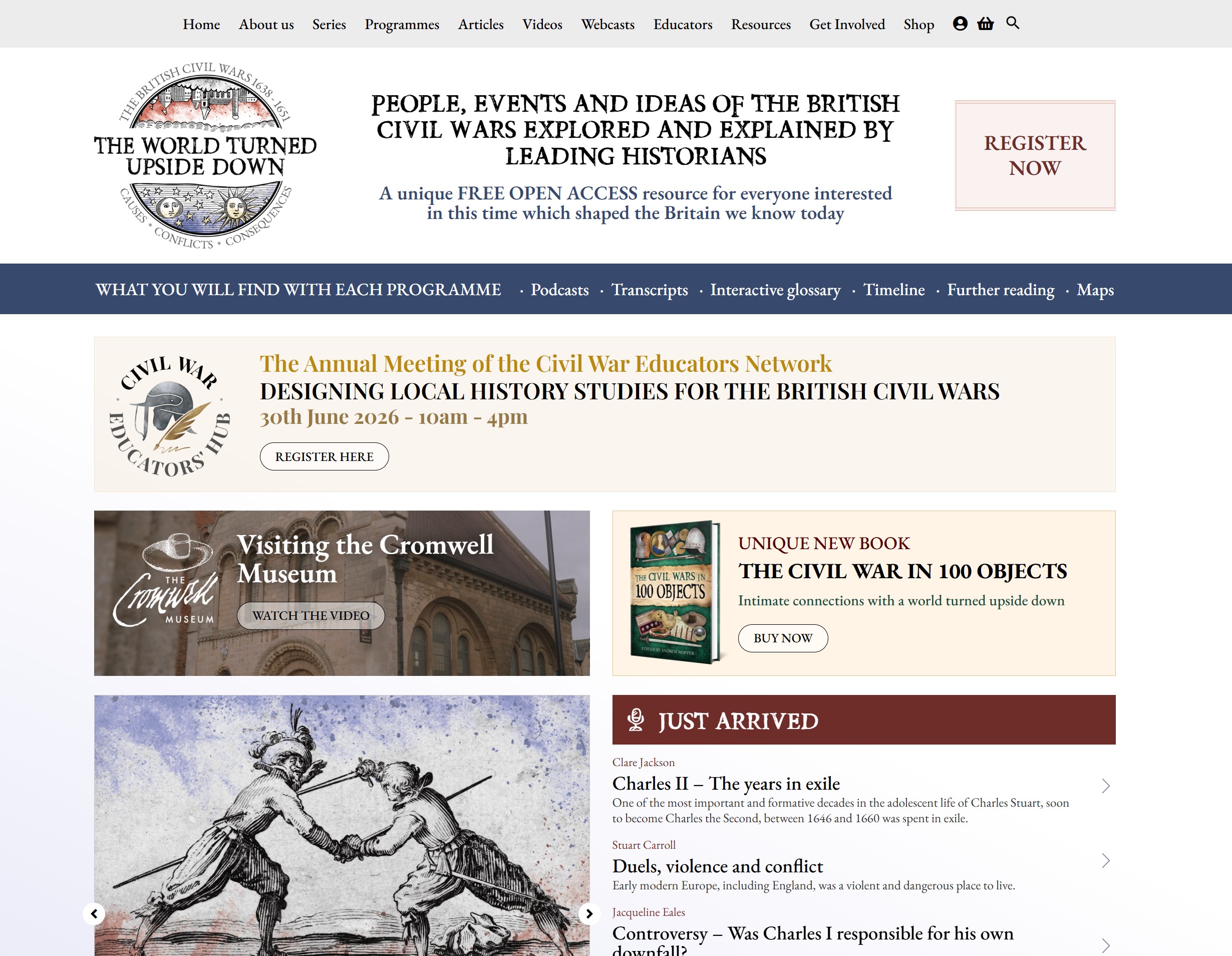
As today’s post has been about the fate of three of the regicides involved with the trial and execution of King Charles I, and George Downing, who supported both the Parliamentary cause and then swiftly converted to support the monarchy, today’s resource is a brilliant website full of resources covering everything Civil War, and events in London played a very significant role, not just during the Civil War, but the lead up to, the causes of the war, the Commonwealth and Protectorate, the people, politics and religion, the restoration and later impact.
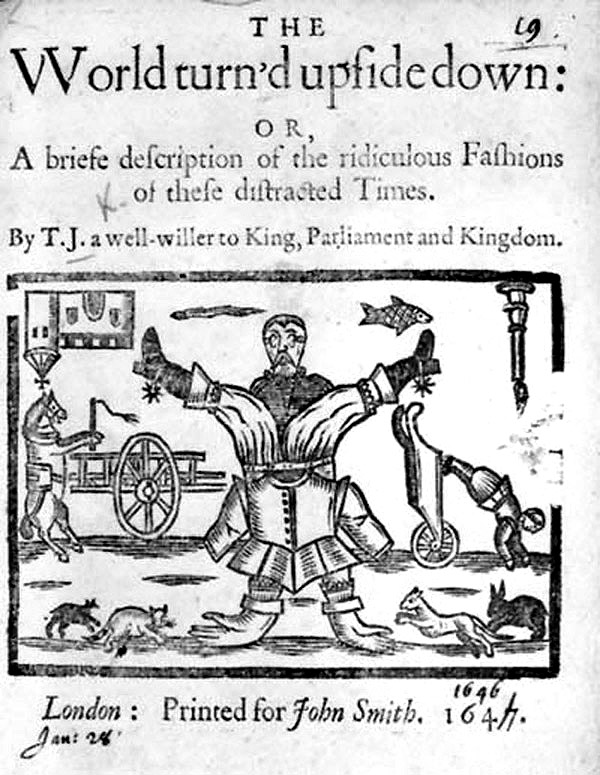
The name of the website comes from the title of an English ballad published in the mid 1640s, when Parliament was implementing policies that tried to ban the more traditional celebrations of Christmas that the more Puritan and to an extent Baptist members of Parliament believed were associated with the Catholic religion, and that Christmas should be a more solemn event, without the drinking, feasting and joyous elements of the traditional Christmas:
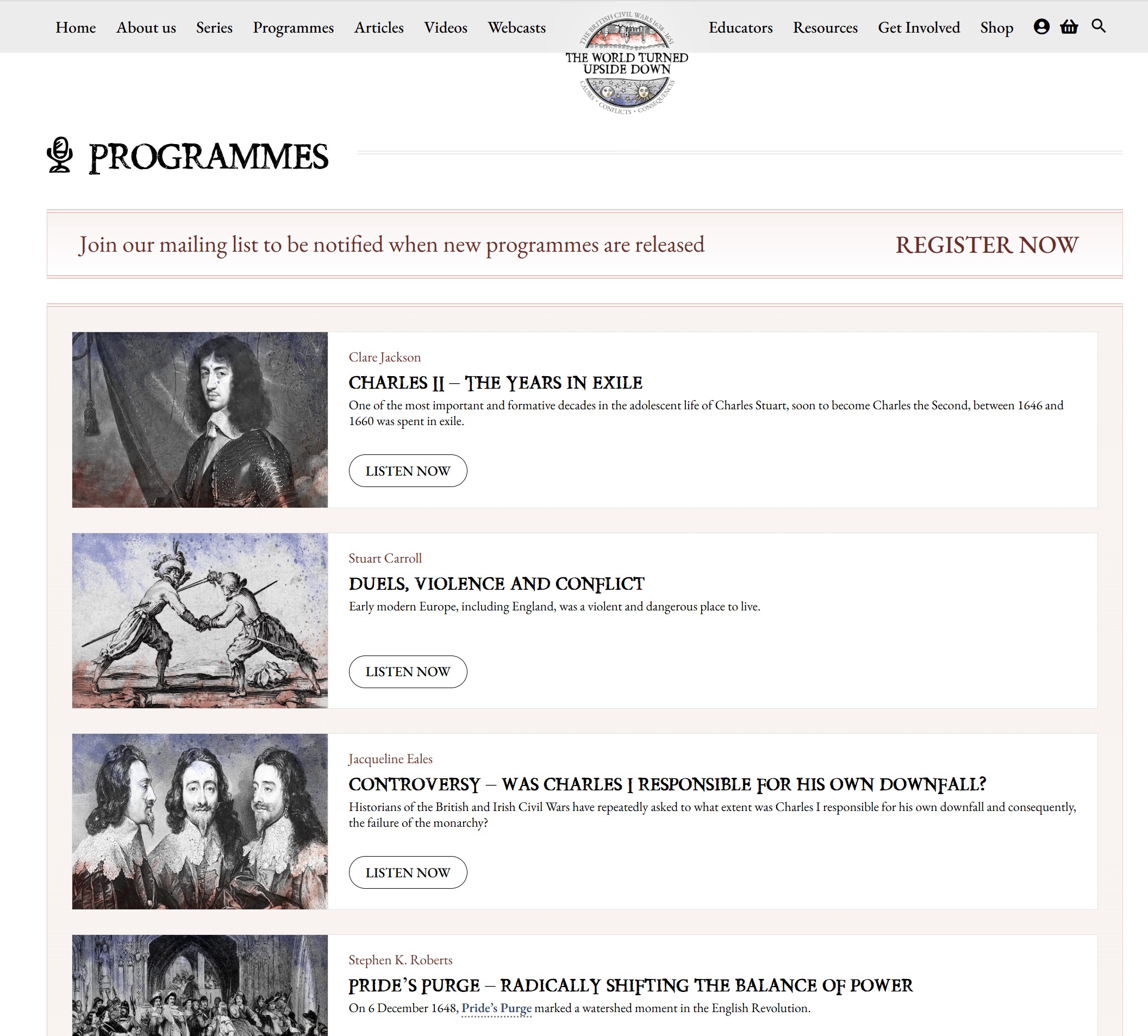
The standout feature of the website are the podcasts. There are currently 112 on the site with more being gradually added (you can sign up for alerts). Each podcast explores a different aspect of the Civil War and is by an expert in the subject.
For each podcast there is also a transcript, glossary, timeline, maps and further reading.
The first four podcasts in the list are shown in the screenshot below:
There is so much in the news about the destructive elements of social media, AI and the Internet, but the World Turned Upside Down is one of those sites that restores your faith in what the Internet can deliver when a community of real experts put together such a resource – which is freely available.
Even if you have only a passing interest in the mid 17th century and the Civil War, the site and podcasts are well worth a visit, and again, the link to click for the site is: The World Turned Upside Down