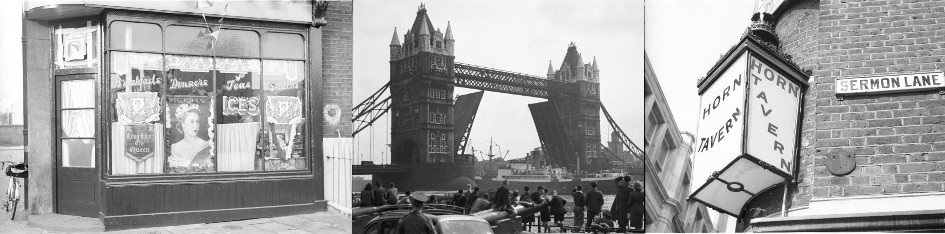
London has been filmed and photographed for as long as these technologies have existed, and today. social media is awash with images and videos, which are often only a few minutes long, such is the direction of the modern attention span.
Move away from social media, and the Internet is an enormous archive of old London films, many produced by local authorities such as the GLC or Corporation of the City of London, also television companies, media agencies, and amateurs.
These films provide a form of time travel, where we can revisit earlier decades, learn more about London, how the city has developed, and see just how much the city has changed, physically, socially, the way the city is governed, transport etc.
Two years ago, in the Christmas / New Year period, I wrote a post about 1980s music videos shot in London (which you can see here), and last year I looked at a number of London films, films that were produced as publicity for developments, for educational purposes, to document aspects of London Life, etc.
There are so many of these that look at different aspects of London’s life and development that for today’s post, I have another selection.
So, if there is nothing on TV to watch, in that strange period between Christmas and New Year, here is another sample of the many films produced about London, starting with:
Thamesmead, 1970
Thamesmead, 1970 is a film by the Greater London Council on the reasons for, the design and development of Thamesmead, and new community for the growing population of Greater London between the Boroughs of Greenwich and Bexley.
The film starts with some wonderful colour views of the River Thames, as the film travels from Westminster down to the site of Thamesmead.
The film is a wonderful insight into 1960’s GLC planning for housing, communities, transport etc.
Living at Thamesmead, 1974
Living at Thamesmead is another Greater London Council film from 1974, using both fictional and real families, to take a look at what it was like to live in Thamesmead. A rather idyllic view of the new development in light of the troubles that would later plaque the area due to poor transport links, lack of amenities, crime, poverty and design issues.
Thamesmead probably highlights the problems that can arise from a well intentioned approach to the provision of housing, without a design that takes in every aspect of what a community needs, the money to implement and build, provision of employment as well as housing, long term management etc.
Thamesmead is a study in the challenges of a new town, compared to very long standing communities, which develop and adapt, are well connected and have a mix of council, community and privately provided amenities.
The Woolwich Free Ferry
This is a wonderful 7 minutes of colour film showing the Woolwich Free Ferry as it was in 1961:
(My Woolwich and Royal Docks walk includes a trip across the river on the Woolwich Ferry. More dates when the weather improves later in the spring. Follow here on Eventbrite for dates).
London 1942
London 1942 is from the British Film Institute collection, and shows London in the middle of the last war. The film was probably meant to portray a very positive view of the city in the middle of war, and may well have been for American audiences as well as British:
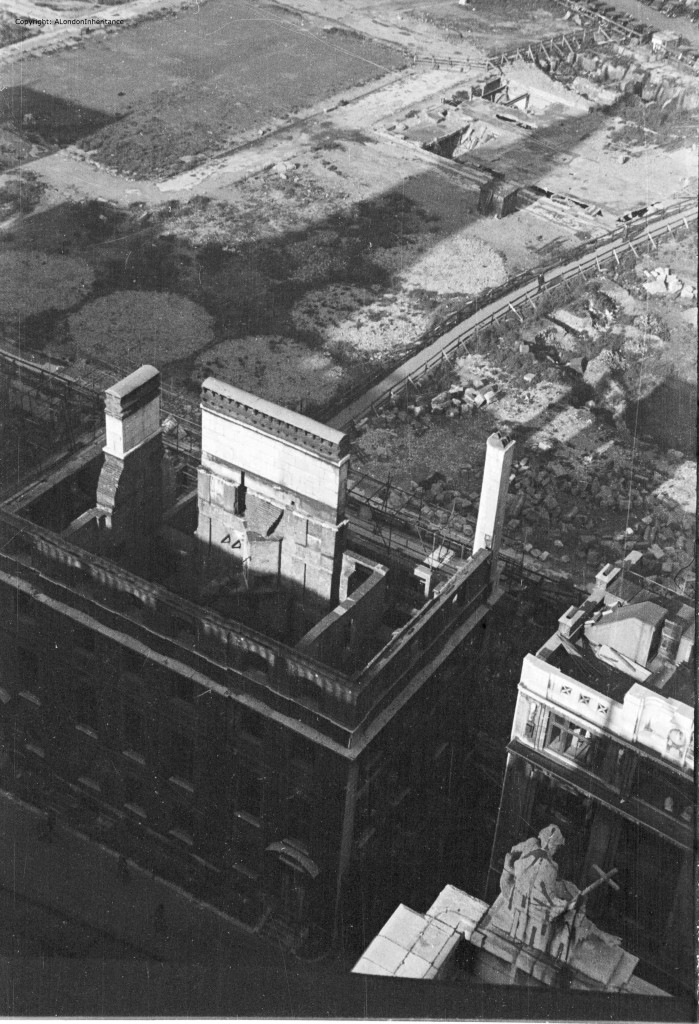
At 2 minutes, 56 seconds, there is a view from St. Paul’s Cathedral of the temporary water tanks at what is now Paternoster Square. Just after the war, my father took photos of the view from the Stone Gallery of St. Paul’s Cathedral (see this post) and the outlines of these water tanks could still be seen:
Covent Garden Market in 1960
Covent Garden Market is a 1960 film in the Rank Organisation’s series Look at Life that shows the market in operation, in colour. The film highlights that planners have been wanting to move the market for years, and also looks at other markets such as Billingsgate and that there are plans to demolish the Victorian Coal Exchange for a much wider road (which would become the southern ring road, now Lower Thames Street).
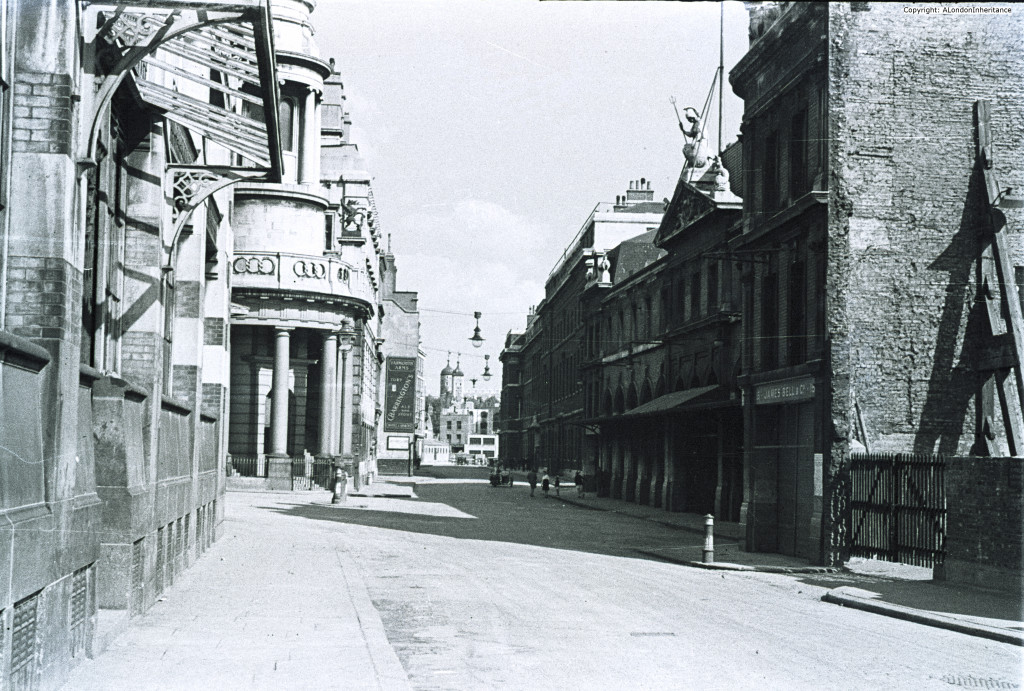
At 5 minutes, 31 seconds there is a view of the street outside Billingsgate with the Coal Exchange, and “lovers of Victorian architecture oppose the idea” of demolition.
I included one of my father’s photos showing Lower Thames Street and the Coal Exchange in one of my first posts back in 2014 (the building on the left with the colonnades):
Covent Garden Closes
The Covent Garden market did eventually close, and this film looks at the closure and the new Nine Elms site:
The Weekend Millionaires – An Oral History of the Thames
These days, it is hard to appreciate just how much the River Thames played in the life of Londoners, and how central the river was to employment, trade, the communities that developed alongside the river, and how London as a city has developed.
The Weekend Millionaires is a fascinating oral history that tells the story of the working river, from those who lived and worked by and on the river. Again, a film that shows just how much the city has changed.
Banging Out – Fleet Street Remembered
Banging Out – Fleet Street Remembered, is another oral history looking at another aspect of working London which has completely disappeared, the newspaper and print industry which once occupied much of Fleet Street and the surrounding area:
1964 WOOLWICH – The significance, history, character, decline, markets, ferry, theatres, landmarks
Woolwich is an area that is currently undergoing significant change, with the area alongside the river, north of Beresford Street and Plumstead Road, developing in a very different way to the south of the streets.
This film looks at Woolwich in the early 1960s, people, streets, buildings, the Royal Arsenal, challenges of housing, the military etc.
WW1 1918 Royal Arsenal Woolwich Workers Part 1 and 2
Another look at Woolwich, from 1918, at a time when the Royal Arsenal was in full production for the armaments that were needed for the First World War:
BBC How They Dug the Victoria Line
Large infrastructure projects, such as Crossrail / the Elizabeth Line are still documented with programmes on national TV, however today, these films tend to be constructed around “will they get it finished in time” or “something has happened to impact a critical timescale”. Showing a major bit of construction work taking place in a short time has always been good TV, however in the past it seems to have been more documenting the project rather than creating tension.
The title of “How They Dug the Victoria Line” is self explanatory, and covers the construction of this new underground route, with all the technical challenges and construction methods that went with the project:
The Port of London (1921)
The Port of London is a 1921 Port of London Authority film, again with a self explanatory title, and again shows how central the River Thames was in the life of the city.
Today. the Thames is very quiet, and is mainly a scenic backdrop for those who live along the river, walk the sides of the river, or across the bridges. For centuries, the river was the heart of London:
London’s Lost Transport
London’s Lost Transport is a collection of archive images and films showing the various methods of transport in use across London between the years 1905 and 1962:
Sunshine in Soho (1956)
Sunshine in Soho is a very brief film from 1956 showing a selective few parts of Soho:
The Changing Face of Camberwell (1963)
Whilst the City of London and the River Thames feature widely in many archive films, there are plenty of films showing other parts of London, one of which is the 1963 film the Changing Face of Camberwell, which shows how Camberwell was being redeveloped to create far better living conditions for residents.
It is interesting to compare the positive expectations when these developments were planned, with the challenges which many areas of redeveloped London would later experience.
Waters of Time – A Port of London Authority Film produced for the 1951 Festival of Britain
There were many films produced by national and local authorities, institutions and companies , to tie in with the 1951 Festival of Britain.
One of these films was a lengthy (one hour fifty minute) film by the Port of London Authority titled the Waters of Time.
The film is a comprehensive exploration of the history and the working operations of what was the worlds largest port. The film again shows how in a relatively short period of time, the river has gone from being central to life in London to a feature which today has little consequence in the life of the majority of Londoners.
These films show just how dramatic the change has been over the last several decades, and it is always interesting to speculate what London will look like in decades to come, as any point in time is just a snapshot of continuous change.
If you would like some more views of London:
- My post on London – Captured in Music Videos, where videos were filmed in London, mainly features the 1980s, as well as videos from a few years before and also in the following decades, and:
- This post looks a many more films on London, including such classics as The London Nobody Knows with James Mason, and Bob Hoskins claiming that London is being “Sterilised by greed”
And that is my last post for 2025, can I wish you a happy New Year, and for another view of how London has changed, you may be interested in my post on when we celebrated New Years Eve in Trafalgar Square in 1981 – a more chaotic celebration than the managed, ticketed event of today.
…and a very happy new year to you too
The Port of London film and the quantity of ivory being imported into the London Docjs at any one time explains a lot about the demise of the elephant and rhino
Thank you for these suggestions to watch. This is exactly my type of viewing for this time of year, and I think I may have seen a couple of these already (but good to watch again!) Indeed YT and other platforms host a huge number of really interesting channels that feature some really excellent film footage and historical detail. Wishing you a Happy New Year too!
Wow ! An amazing post, thank you. You have put so much work into each blog post and it is very much appreciated. Every Londoner should read your blog. My husband and I have Watermen in our families so that part was particularly interesting to us. Thank you for years of entertainment.
Judy and Bob
Thanks for all your hard work in putting together so much fascinating information.
I look forward to watching them during the next few days, probably better than what will be on TV!
Def MUCH better than the TV offerings !
Interesting that the still image that appears in the starting frame of ‘Covent Garden Market in 1960’ shows prices using $ and cents – it’s not clear where that actually was (and the cars did not look particularly British either…)
Hi Charlie, That is really strange. That starting frame is not part of the film, and does not appear when watching directly on YouTube.
Yep, very strange indeed! I wondered if it was unique to my setup here…
Nice. FYI The Comic Strip used a lot of empty Southbank buildings – check out Slags (!) where French and Saunders are gang bosses and Bankside was used as a prison – it includes good footage of the Butlers Wharf streets. Also The Bullsh*tters where Bonehead and Foyle run round London in their pants!
Nice. FYI The Comic Strip used a lot of empty Southbank buildings – check out Slags (!) where French and Saunders are gang bosses and Bankside was used as a prison – it includes good footage of the Butlers Wharf streets. Also The Bullsh*tters where Bonehead and Foyle run round London in their pants!
Simply fantastic!
What a. Collection of films!
The video of Camberwell was very interesting as I am researching my husband’s family tree and they lived there. I followed the video on google maps and 190 Ivydale Road (2012 maps) had not changed the windows or front door since 1963. The three houses that had to be rebuilt inbetween the Victorian houses still remain and all have a porch with a front door in front of the original front door. the two either side of 190 have had new doors and windows.
Thank you for providing such an intereting selection as Christmas TV is mind numbingly stupid.
What a great post thank you very much for your hard work n producing this.