Tag Archives: London Films

From Thamesmead to Covent Garden – London in Film

London has been filmed and photographed for as long as these technologies have existed, and today. social media is awash with images and videos, which are often only a few minutes long, such is the direction of the modern attention span.

Move away from social media, and the Internet is an enormous archive of old London films, many produced by local authorities such as the GLC or Corporation of the City of London, also television companies, media agencies, and amateurs.

These films provide a form of time travel, where we can revisit earlier decades, learn more about London, how the city has developed, and see just how much the city has changed, physically, socially, the way the city is governed, transport etc.

Two years ago, in the Christmas / New Year period, I wrote a post about 1980s music videos shot in London (which you can see here), and last year I looked at a number of London films, films that were produced as publicity for developments, for educational purposes, to document aspects of London Life, etc.

There are so many of these that look at different aspects of London’s life and development that for today’s post, I have another selection.

So, if there is nothing on TV to watch, in that strange period between Christmas and New Year, here is another sample of the many films produced about London, starting with:

Thamesmead, 1970

Thamesmead, 1970 is a film by the Greater London Council on the reasons for, the design and development of Thamesmead, and new community for the growing population of Greater London between the Boroughs of Greenwich and Bexley.

The film starts with some wonderful colour views of the River Thames, as the film travels from Westminster down to the site of Thamesmead.

The film is a wonderful insight into 1960’s GLC planning for housing, communities, transport etc.

Living at Thamesmead, 1974

Living at Thamesmead is another Greater London Council film from 1974, using both fictional and real families, to take a look at what it was like to live in Thamesmead. A rather idyllic view of the new development in light of the troubles that would later plaque the area due to poor transport links, lack of amenities, crime, poverty and design issues.

Thamesmead probably highlights the problems that can arise from a well intentioned approach to the provision of housing, without a design that takes in every aspect of what a community needs, the money to implement and build, provision of employment as well as housing, long term management etc.

Thamesmead is a study in the challenges of a new town, compared to very long standing communities, which develop and adapt, are well connected and have a mix of council, community and privately provided amenities.

The Woolwich Free Ferry

This is a wonderful 7 minutes of colour film showing the Woolwich Free Ferry as it was in 1961:

(My Woolwich and Royal Docks walk includes a trip across the river on the Woolwich Ferry. More dates when the weather improves later in the spring. Follow here on Eventbrite for dates).

London 1942

London 1942 is from the British Film Institute collection, and shows London in the middle of the last war. The film was probably meant to portray a very positive view of the city in the middle of war, and may well have been for American audiences as well as British:

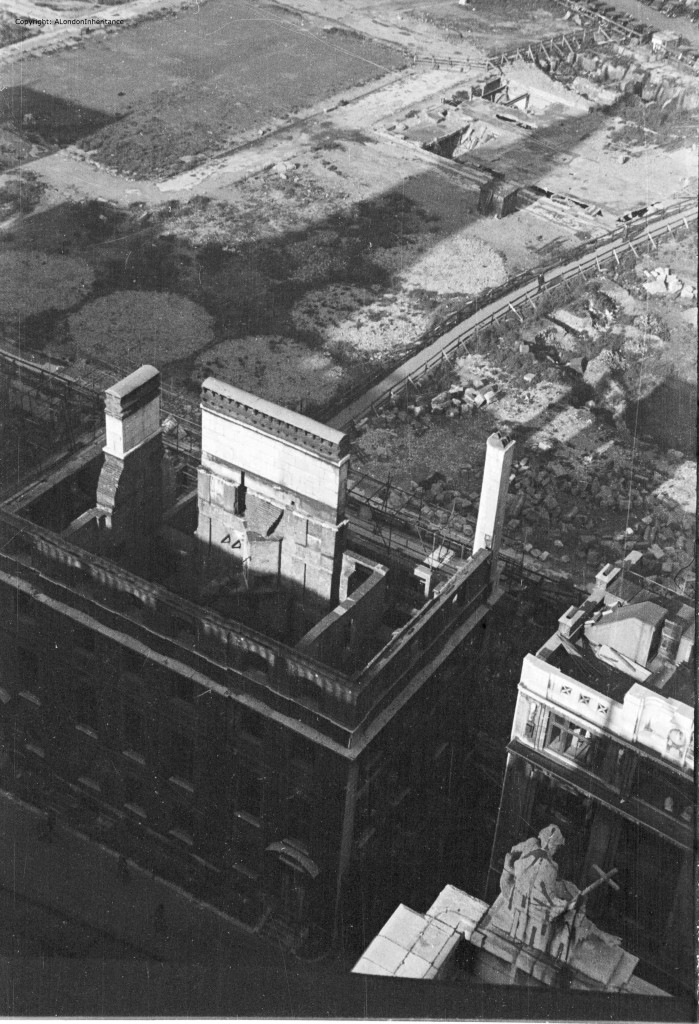
At 2 minutes, 56 seconds, there is a view from St. Paul’s Cathedral of the temporary water tanks at what is now Paternoster Square. Just after the war, my father took photos of the view from the Stone Gallery of St. Paul’s Cathedral (see this post) and the outlines of these water tanks could still be seen:
Covent Garden Market in 1960

Covent Garden Market is a 1960 film in the Rank Organisation’s series Look at Life that shows the market in operation, in colour. The film highlights that planners have been wanting to move the market for years, and also looks at other markets such as Billingsgate and that there are plans to demolish the Victorian Coal Exchange for a much wider road (which would become the southern ring road, now Lower Thames Street).

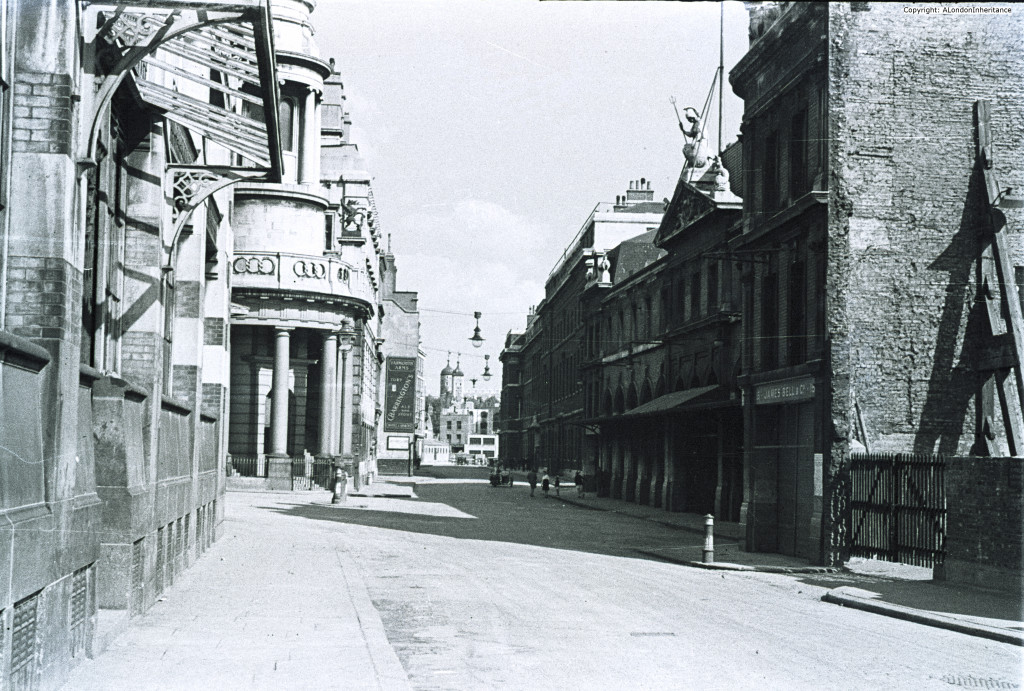
At 5 minutes, 31 seconds there is a view of the street outside Billingsgate with the Coal Exchange, and “lovers of Victorian architecture oppose the idea” of demolition.

I included one of my father’s photos showing Lower Thames Street and the Coal Exchange in one of my first posts back in 2014 (the building on the left with the colonnades):
Covent Garden Closes

The Covent Garden market did eventually close, and this film looks at the closure and the new Nine Elms site:

The Weekend Millionaires – An Oral History of the Thames

These days, it is hard to appreciate just how much the River Thames played in the life of Londoners, and how central the river was to employment, trade, the communities that developed alongside the river, and how London as a city has developed.

The Weekend Millionaires is a fascinating oral history that tells the story of the working river, from those who lived and worked by and on the river. Again, a film that shows just how much the city has changed.

Banging Out – Fleet Street Remembered

Banging Out – Fleet Street Remembered, is another oral history looking at another aspect of working London which has completely disappeared, the newspaper and print industry which once occupied much of Fleet Street and the surrounding area:

1964 WOOLWICH – The significance, history, character, decline, markets, ferry, theatres, landmarks

Woolwich is an area that is currently undergoing significant change, with the area alongside the river, north of Beresford Street and Plumstead Road, developing in a very different way to the south of the streets.

This film looks at Woolwich in the early 1960s, people, streets, buildings, the Royal Arsenal, challenges of housing, the military etc.


WW1 1918 Royal Arsenal Woolwich Workers Part 1 and 2

Another look at Woolwich, from 1918, at a time when the Royal Arsenal was in full production for the armaments that were needed for the First World War:

BBC How They Dug the Victoria Line

Large infrastructure projects, such as Crossrail / the Elizabeth Line are still documented with programmes on national TV, however today, these films tend to be constructed around “will they get it finished in time” or “something has happened to impact a critical timescale”. Showing a major bit of construction work taking place in a short time has always been good TV, however in the past it seems to have been more documenting the project rather than creating tension.

The title of “How They Dug the Victoria Line” is self explanatory, and covers the construction of this new underground route, with all the technical challenges and construction methods that went with the project:

The Port of London (1921)

The Port of London is a 1921 Port of London Authority film, again with a self explanatory title, and again shows how central the River Thames was in the life of the city.

Today. the Thames is very quiet, and is mainly a scenic backdrop for those who live along the river, walk the sides of the river, or across the bridges. For centuries, the river was the heart of London:

London’s Lost Transport

London’s Lost Transport is a collection of archive images and films showing the various methods of transport in use across London between the years 1905 and 1962:

Sunshine in Soho (1956)

Sunshine in Soho is a very brief film from 1956 showing a selective few parts of Soho:

The Changing Face of Camberwell (1963)

Whilst the City of London and the River Thames feature widely in many archive films, there are plenty of films showing other parts of London, one of which is the 1963 film the Changing Face of Camberwell, which shows how Camberwell was being redeveloped to create far better living conditions for residents.

It is interesting to compare the positive expectations when these developments were planned, with the challenges which many areas of redeveloped London would later experience.

Waters of Time – A Port of London Authority Film produced for the 1951 Festival of Britain

There were many films produced by national and local authorities, institutions and companies , to tie in with the 1951 Festival of Britain.

One of these films was a lengthy (one hour fifty minute) film by the Port of London Authority titled the Waters of Time.

The film is a comprehensive exploration of the history and the working operations of what was the worlds largest port. The film again shows how in a relatively short period of time, the river has gone from being central to life in London to a feature which today has little consequence in the life of the majority of Londoners.

These films show just how dramatic the change has been over the last several decades, and it is always interesting to speculate what London will look like in decades to come, as any point in time is just a snapshot of continuous change.

If you would like some more views of London:

And that is my last post for 2025, can I wish you a happy New Year, and for another view of how London has changed, you may be interested in my post on when we celebrated New Years Eve in Trafalgar Square in 1981 – a more chaotic celebration than the managed, ticketed event of today.

London Films – Capturing 100 Years of Change

This time last year, in that strange period, between Christmas and New Year, I wrote a post about London – Captured in Music Videos, as they are fascinating, not just for the excellent music, but to see London in the background, in these videos from the last few decades.

For this year, I thought I would have a post about London films. Not films where London appears in the background, but films which are dedicated to telling a story about a particular aspect of the city.

They are fascinating to watch, not just to see how the city has changed physically, and how life in the city has also changed, but also to make us think.

The people we see in these films working or living in London could probably not have foreseen the dramatic changes that would transform their city, and likewise our experience of the city today is just a snapshot, and in years to come many aspects of the city will be radically different, and it will be someone else’s city, who will probably look back at film of London in the 2020’s with a mix of nostalgia and amusement.

So for the long, dark evenings, here is London from the past 100 years.

If the WordPress YouTube Block works there should be several videos embedded in this post. I am not sure if they will show in the emailed version of this post. If not, go to the home page by clicking here to view the post.

The London Nobody Knows

The film “The London Nobody Knows” is a fascinating glimpse of London at a time of great change. By the release of the film at the end of 1968, there had already been considerable reconstruction after the bombing of the 1940s, and gleaming glass and steel office blocks were springing up across the city.

There were though still a considerable number of bomb sites and damaged buildings, and the London Docks were still busy, although there were signs of the changes that would effect trade on the river and the docks in the future.

The film was written by the writer Brian Comport and the artist and author Geoffrey Fletcher, and the film takes its name from the book the London Nobody Knows by Geoffrey Fletcher. His books mixed Fletcher’s drawings of buildings, street infrastructure, people etc. across the city with descriptive text.

The film uses the actor James Mason as a focal point for the film, as he visits and talks about the changing face of London, armed with his flat cap and umbrella:

The London Nobody Knows is perhaps the classic London film.

Capital County

Capital County is a 1951 London County Council film and starts with some history of the development of London, then going on to show the very extensive range of services for which the LCC were responsible, and how these services touched much of the life of all Londoners. The film demonstrates this through Albert Brown, a typical Londoner:

Capital County shows that it is not just physical change that has transformed London over the last 70 plus years, but also the way London is administered and governed.

Bermondsey Wall

Bermondsey Wall is a 1932 film which has some wonderful views of the working river and backstreets of Bermondsey, and focuses on the work of the Time and Talents Association, who by the time of the film were based in Dockhead House, Abbey Street. Time and Talents was started in 1887 to help young girls use their “Time and Talents” in the service of others, to provide education, practical skills and also provide hostels for girls’ accommodation. The organisation has evolved into a community organisation which is still running today across Rotherhithe and Bermondsey.

The Proud City – A Plan for London

The Proud City is a film produced for the Ministry of Information, to explain the 1943 County of London Plan. The film includes the main authors of the plan, JH Forshaw (Architect to the London County Council) and Sir Patrick Abercrombie (Professor of town planning, University of London), who explain why a plan is needed, the thinking behind the plan, how it will transform London, and the resulting benefits for all those who live and work in the city, along with some wonderful film of the city.

The plan was wide ranging, and covered almost every aspect of life in London, and the plan identified many of the issues with the haphazard way in which London had developed over the centuries, resulting in poor housing, housing and industry together existing in a mixed street plan, traffic congestion, the way the old village London had merged into a far larger and more complex greater London.

We can see today how some of the ideas from the plan have been implemented. The plan makes a comparison between the north and south banks of the river in central London, with well designed offices, government buildings and a fine Embankment with trees and gardens on the north, whilst on the south bank there was a confusion of warehouses, slums and derelict streets, which had been made worse since the Blitz. The plan identified the south bank of the river as an ideal opportunity to develop a new river frontage, worthy of London.

The intention with bombed, industrialised areas such as Stepney, was to transform them into new “social units” or neighbourhoods, each with a population of between 6,000 and 10,000, and having a school, local shopping centre, medical facilities and with housing provided by a mix of terrace housing, each with a garden, and blocks of flats built within landscaped grounds.

Industry and commerce would be moved to the boundaries of neighbourhoods, rather than being mixed in with housing, and main roads would also be at the edge to avoid through traffic.

An early example of the concept that today seems to have attracted the name of the 15 minute city.

The film has some wonderful quotes, for example the following from Patrick Abercrombie:

“There must be change, always change, as one season, or one generation, follows another”.

This quote sums up London’s history. A city that has always changed, adapted and evolved, but the problem with change is that it raises questions about what we keep and what we get rid of to continue that change.

You can see these issues play out every day, with a few current examples being the M&S building in Oxford Street, proposed redevelopment of Liverpool Street Station, the new buildings on the site of the London Weekend Television building on the Southbank, and the potential demolition of Bastion House on London Wall, along with the adjacent, old Museum of London site (both by the architects Philip Powell and Hidalgo Moya, who also worked on the 1951 Festival of Britain and designed the magnificent Skylon).

The Port of London

A film by British Pathe and British Instructional Films Ltd and headlines as a Classroom film. The film shows the workings of the London Docks. It starts off slowly, whilst working through a map showing the location of all the docks from Tilbury to St. Katherine, and then shows the docks in operation:

British Instructional Films Ltd were primarily a documentary film maker, founded in 1919 by Harry Bruce Woolfe. The subject of these films ranged from the re-enactment of military engagements through to a long running Secrets of Nature series, which included painstaking studio and laboratory work, as well as filming out in the field.

A common thread running through the films produced by the company was patriotism and Empire.

The company suffered financially during the late 1920s and early 1930s and became part of the Pathe company, who continued to use the brand name of British Instructional Films for their educational films, as with the film Port of London.

The City of London – Reel 1

Part one of a film from 1951 showing the City of London in operation – the Stock Exchange, Baltic Exchange, Lloyds of London etc.

The City of London – Reel 2

The second part of the film, which focuses on the ceremonial and crafts aspects of the City of London.

Both films show a very different City of London to the City of today, including a City where men are in all of the roles of any consequence in the City:

Barbican, 1969: The development of the Barbican Estate following World War II

This is a wonderful film in “Technicolour” that covers not just the development of the Barbican Estate, but includes many other aspects of London. The views of the estate being built, alongside views of what was there before help illustrate what a transformational housing project the Barbican was for the City of London:

The film includes a brilliant few minutes of people looking round one of the show flats which have been furnished in a very modern, late 1960s style, with emphasis on the kitchens, bathrooms, and how the flats have been designed to maximise views through the windows, sunlight, sound proofing etc.

The Living City

The film The Living City was made in 1970 for the City of London Corporation. The film starts with views of the fires started by incendiary bombing on the night of the 29th December 1940, and then goes on to tell of the reconstruction of the City, the institutions and businesses that make the City the main centre for global trade, finance and insurance, and how the City is being rebuilt, including some film of the Pedways:

It is interesting to compare the City of London in 1970 with the City of today. The film talks about Cheapside being the main shopping street of the City and a “seething confluence of seven major thoroughfares” between the Bank junction and St. Paul’s. The film shows the amount of traffic along streets such as Cheapside and across the Bank junction, and this is one of the things about the City that I struggle with today.

Despite the air being much cleaner and healthier, the City just seems to have lost a sense of human activity, of being an exceptionally busy, exciting place, and across the whole film we can see the sheer diversity of activities that went on within the City of London.

There is film of the markets at Billingsgate, Spitalfields and Smithfield, and somewhat ironically given the City of London Corporation’s plan to close the Smithfield meat market, the film talks about the “City’s determination to keep the wholesale markets”.

There have though been some positive changes in the 74 years since the film, the fur market in Beaver House of the Hudson Bay Company no longer operates, and ivory is not stored and traded in the Port of London Authority warehouse in Cutler Street.

The danger with changes such as the closure of Smithfield is that the City of London gradually looses all the things that have made the City such an important place for many hundreds of years, and the square mile looses its identity and ends up much like many other places in central London where expensive apartments, hotels and places to attract visitors and tourists become the primary drivers of redevelopment.

The Changing Face of London

The Changing Face of London from 1960 is also about change, starting with scenes of demolition and the ruined buildings across the city, then focussing on redevelopment and potential plans for the city.

The models shown for large site redevelopment and also for individual buildings are fascinating, but thankfully some of these schemes did not get built.

If you have been on my Barbican walk, at 17 minutes and 19 seconds into the film, there is a view of the new section of London Wall that had been opened in the previous year (1959), and to the left you can see the church of St. Alphage, which was later demolished to just the medieval remains we can see next to London Wall today, and to the left there is Roman House, the white office block that was the first post war building constructed in the area, and about the only one of the buildings in the scene that remains to this day.

The Pedway: Elevating London

The Pedway was one of the ideas coming from wartime plans for post-war redevelopment of the City of London, where pedestrians would be separated from road traffic on raised pedestrian ways, and the redevelopment of London Wall resulted in one of the areas where Pedways were extensively used across a wide area.

The concept was not only to separate pedestrians from traffic, but also to provide on the Pedway, the shops, pubs, restaurants and other services that would have normally be found at street level.

This 2013 documentary tells the story of the Pedway, along with the associated redevelopment of much of the City of London:

The original Pedways have all but disappeared in the development of the last few decades, however elevated walkways are still the main method of walking through the Barbican estate, and there has been a reconstruction of a Pedway (but without shops, pubs etc.) in the area to the north of London Wall, around the remains of St. Alphage.

This Is London – 1981

This film is more a tourist overview of London, but is interesting as it shows the city at the start of the 1980s, when London was still a very low rise city.

At 55 seconds into the film, there is a wonderful bit of film of a hovercraft on the Thames and passing under Tower Bridge:

Bob Hoskins: London is being “Sterilised by greed” 

This is another absolute classic, with the actor Bob Hoskins showing Barry Norman around parts of the south London riverside from Coin Street on the Southbank down to Shad Thames, and whilst some of the developments he talks about did not get carried out, many did, and his core argument is the same today as it was in 1982:

The future’s up for grabs – GLC Docklands

Where the Bob Hoskins film talks about the derelict buildings along the river, and the preference of developers for offices over houses, the following film explores the impact on those who lived around the large expanses of old docks that were “up for grabs”.

There are lots of interviews with those who live in the area. Young people who complain about the lack of facilities and how far they have to travel for school, older people who talk about what the docks were like when working, talk about some of the new developments and the physical separation of council and private housing etc.

Many of these issues are still just as relevant, and the area around the Royal Docks shown in parts of the film are still being developed today, and from my walks around the area, there still seems to be very few facilities for those living in the new apartment blocks.

River Cruise Down The Thames

This is a GLC film, aimed mainly at visitors to the City, but the film also highlights the benefits that the GLC has brought to the city (the film ends with the slogan “keep GLC working for London” as the film was made when the Conservative government was arguing for the abolition of the GLC).

The film runs from Hampton Court, Twickenham and Kew, down to Greenwich and the recently completed Thames Barrier:

Film 87 – How Docklands became Vietnam

The closure of the London docks offered producers of film and TV programmes so many opportunities with large areas of derelict land and buildings available.

Much of Bob Hoskin’s film The Long Good Friday was filmed in and around docklands, and this extract from Film 87 shows how Beckton Gas Works were transformed into Vietnam for Stanley Kubrick’s film Full Metal Jacket:

It is worth watching just for Barry Norman’s description of yuppies at the beginning of the film.

The following links are to films held by the British Film Institute. Unfortunately, unlike YouTube, the BFI does not appear to have a player that can be embedded in a WordPress site, so the links take you to the BFI website.

Barbican Regained

The film covers the area that would become the Barbican, but also takes a look at the rest of the City:

https://player.bfi.org.uk/free/film/watch-barbican-regained-1963-online

Many of the views of the area that would become the Barbican are in colour, and in one section of the film, when the camera is panning across the Barbican, at 10 minutes 52 seconds, there is a view that is almost identical to that taken by my father around 16 years earlier. See the post on the Cripplegate Institute and Jewin Crescent, and photo at this link to compare, and the comparison shows how little had changed during the whole of the 1950s.

A Day in London

This film from 1920 starts from Victoria Station and then travels across London, visiting the main landmarks that a visitor to the city would have been expected to visit:

https://player.bfi.org.uk/free/film/watch-a-day-in-london-1920-online

The majority of the landmarks are much the same today as they were in 1920. What has changed are the people, cars and buses, and the fact that in 1920 Downing Street was just a normal London street that happened to have the official home of the Prime Minister. A reminder that one of the many factors to have changed London over recent years has been terrorism with Downing Street now looking like a fortified street, London’s bridges having barriers between road and footpaths etc.

Barbican Phoenix

Barbican Phoenix is yet another film on the redevelopment of the area around London Wall and the Barbican:

https://player.bfi.org.uk/free/film/watch-barbican-phoenix-1961-online

What interests me about these films is that they include scenes that are very similar to the photos taken by my father, and at 1 minutes, 36 seconds into Barbican Phoenix there is a view of the Red Cross Street fire station and church of St. Giles Cripplegate that are also featured in my father’s photo in the post at this link.

A small selection of films that show how London has changed over the past 100 years, and how London has continued to evolve to meet challenges and opportunities.

One of many themes from these films is the sheer diversity of activities there were in London, and my concern is that in many ways it is becoming a less diverse city, and risks ending up as a tourist attraction rather than a living and working city.

I think sometimes we focus too much on the physical aspects of the city, preservation of buildings etc. Whilst it is important that we preserve key buildings and significant architecture, that we build more homes etc. my personal view is that the far more important question is what do we want the city to become – probably a question that is impossible to answer.

alondoninheritance.com