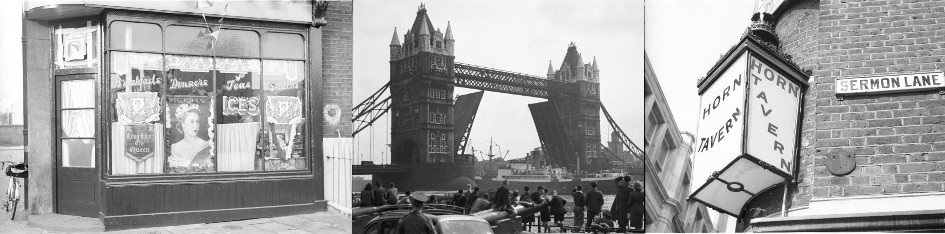
London has been filmed and photographed for as long as these technologies have existed, and today. social media is awash with images and videos, which are often only a few minutes long, such is the direction of the modern attention span.
Move away from social media, and the Internet is an enormous archive of old London films, many produced by local authorities such as the GLC or Corporation of the City of London, also television companies, media agencies, and amateurs.
These films provide a form of time travel, where we can revisit earlier decades, learn more about London, how the city has developed, and see just how much the city has changed, physically, socially, the way the city is governed, transport etc.
Two years ago, in the Christmas / New Year period, I wrote a post about 1980s music videos shot in London (which you can see here), and last year I looked at a number of London films, films that were produced as publicity for developments, for educational purposes, to document aspects of London Life, etc.
There are so many of these that look at different aspects of London’s life and development that for today’s post, I have another selection.
So, if there is nothing on TV to watch, in that strange period between Christmas and New Year, here is another sample of the many films produced about London, starting with:
Thamesmead, 1970
Thamesmead, 1970 is a film by the Greater London Council on the reasons for, the design and development of Thamesmead, and new community for the growing population of Greater London between the Boroughs of Greenwich and Bexley.
The film starts with some wonderful colour views of the River Thames, as the film travels from Westminster down to the site of Thamesmead.
The film is a wonderful insight into 1960’s GLC planning for housing, communities, transport etc.
Living at Thamesmead, 1974
Living at Thamesmead is another Greater London Council film from 1974, using both fictional and real families, to take a look at what it was like to live in Thamesmead. A rather idyllic view of the new development in light of the troubles that would later plaque the area due to poor transport links, lack of amenities, crime, poverty and design issues.
Thamesmead probably highlights the problems that can arise from a well intentioned approach to the provision of housing, without a design that takes in every aspect of what a community needs, the money to implement and build, provision of employment as well as housing, long term management etc.
Thamesmead is a study in the challenges of a new town, compared to very long standing communities, which develop and adapt, are well connected and have a mix of council, community and privately provided amenities.
The Woolwich Free Ferry
This is a wonderful 7 minutes of colour film showing the Woolwich Free Ferry as it was in 1961:
(My Woolwich and Royal Docks walk includes a trip across the river on the Woolwich Ferry. More dates when the weather improves later in the spring. Follow here on Eventbrite for dates).
London 1942
London 1942 is from the British Film Institute collection, and shows London in the middle of the last war. The film was probably meant to portray a very positive view of the city in the middle of war, and may well have been for American audiences as well as British:
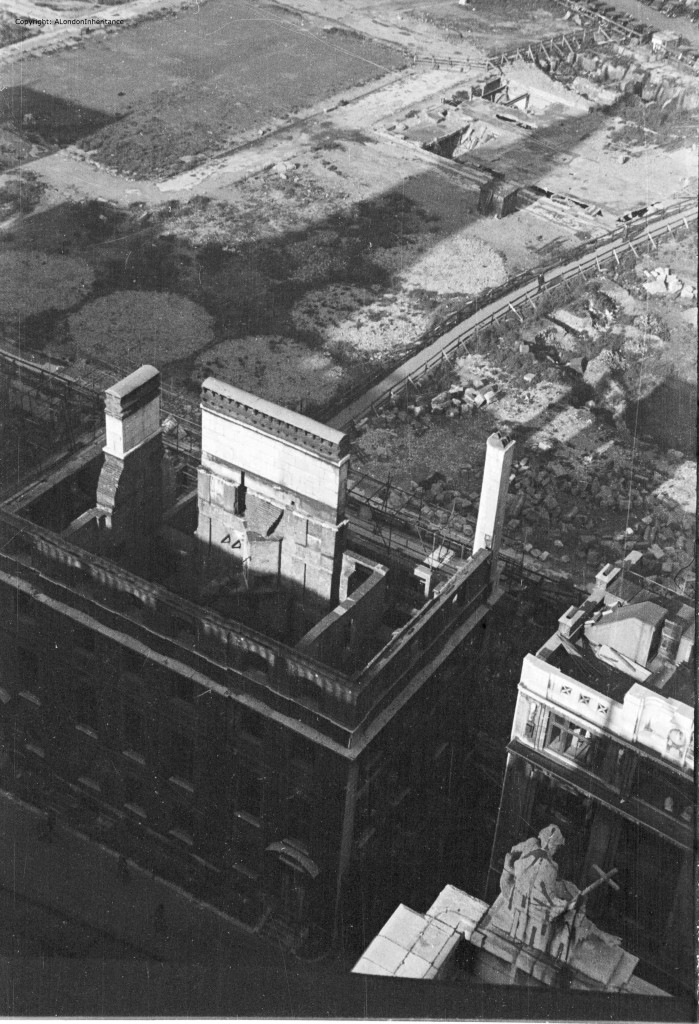
At 2 minutes, 56 seconds, there is a view from St. Paul’s Cathedral of the temporary water tanks at what is now Paternoster Square. Just after the war, my father took photos of the view from the Stone Gallery of St. Paul’s Cathedral (see this post) and the outlines of these water tanks could still be seen:
Covent Garden Market in 1960
Covent Garden Market is a 1960 film in the Rank Organisation’s series Look at Life that shows the market in operation, in colour. The film highlights that planners have been wanting to move the market for years, and also looks at other markets such as Billingsgate and that there are plans to demolish the Victorian Coal Exchange for a much wider road (which would become the southern ring road, now Lower Thames Street).
At 5 minutes, 31 seconds there is a view of the street outside Billingsgate with the Coal Exchange, and “lovers of Victorian architecture oppose the idea” of demolition.
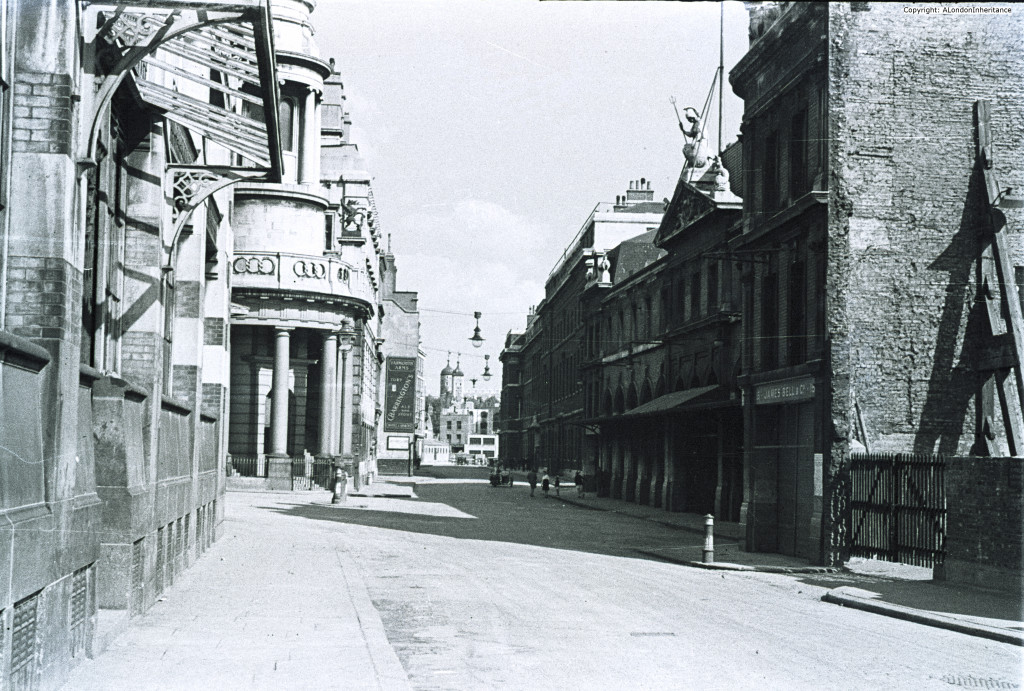
I included one of my father’s photos showing Lower Thames Street and the Coal Exchange in one of my first posts back in 2014 (the building on the left with the colonnades):
Covent Garden Closes
The Covent Garden market did eventually close, and this film looks at the closure and the new Nine Elms site:
The Weekend Millionaires – An Oral History of the Thames
These days, it is hard to appreciate just how much the River Thames played in the life of Londoners, and how central the river was to employment, trade, the communities that developed alongside the river, and how London as a city has developed.
The Weekend Millionaires is a fascinating oral history that tells the story of the working river, from those who lived and worked by and on the river. Again, a film that shows just how much the city has changed.
Banging Out – Fleet Street Remembered
Banging Out – Fleet Street Remembered, is another oral history looking at another aspect of working London which has completely disappeared, the newspaper and print industry which once occupied much of Fleet Street and the surrounding area:
Woolwich is an area that is currently undergoing significant change, with the area alongside the river, north of Beresford Street and Plumstead Road, developing in a very different way to the south of the streets.
This film looks at Woolwich in the early 1960s, people, streets, buildings, the Royal Arsenal, challenges of housing, the military etc.
WW1 1918 Royal Arsenal Woolwich Workers Part 1 and 2
Another look at Woolwich, from 1918, at a time when the Royal Arsenal was in full production for the armaments that were needed for the First World War:
BBC How They Dug the Victoria Line
Large infrastructure projects, such as Crossrail / the Elizabeth Line are still documented with programmes on national TV, however today, these films tend to be constructed around “will they get it finished in time” or “something has happened to impact a critical timescale”. Showing a major bit of construction work taking place in a short time has always been good TV, however in the past it seems to have been more documenting the project rather than creating tension.
The title of “How They Dug the Victoria Line” is self explanatory, and covers the construction of this new underground route, with all the technical challenges and construction methods that went with the project:
The Port of London (1921)
The Port of London is a 1921 Port of London Authority film, again with a self explanatory title, and again shows how central the River Thames was in the life of the city.
Today. the Thames is very quiet, and is mainly a scenic backdrop for those who live along the river, walk the sides of the river, or across the bridges. For centuries, the river was the heart of London:
London’s Lost Transport
London’s Lost Transport is a collection of archive images and films showing the various methods of transport in use across London between the years 1905 and 1962:
Sunshine in Soho (1956)
Sunshine in Soho is a very brief film from 1956 showing a selective few parts of Soho:
The Changing Face of Camberwell (1963)
Whilst the City of London and the River Thames feature widely in many archive films, there are plenty of films showing other parts of London, one of which is the 1963 film the Changing Face of Camberwell, which shows how Camberwell was being redeveloped to create far better living conditions for residents.
It is interesting to compare the positive expectations when these developments were planned, with the challenges which many areas of redeveloped London would later experience.
Waters of Time – A Port of London Authority Film produced for the 1951 Festival of Britain
There were many films produced by national and local authorities, institutions and companies , to tie in with the 1951 Festival of Britain.
One of these films was a lengthy (one hour fifty minute) film by the Port of London Authority titled the Waters of Time.
The film is a comprehensive exploration of the history and the working operations of what was the worlds largest port. The film again shows how in a relatively short period of time, the river has gone from being central to life in London to a feature which today has little consequence in the life of the majority of Londoners.
These films show just how dramatic the change has been over the last several decades, and it is always interesting to speculate what London will look like in decades to come, as any point in time is just a snapshot of continuous change.
As long term readers of the blog will know, as well as London photos, my father also took many photos from around the country, as after National Service, he along with some friends went on very long cycle rides, staying overnight in Youth Hostels. A popular post-war means of exploring the country,
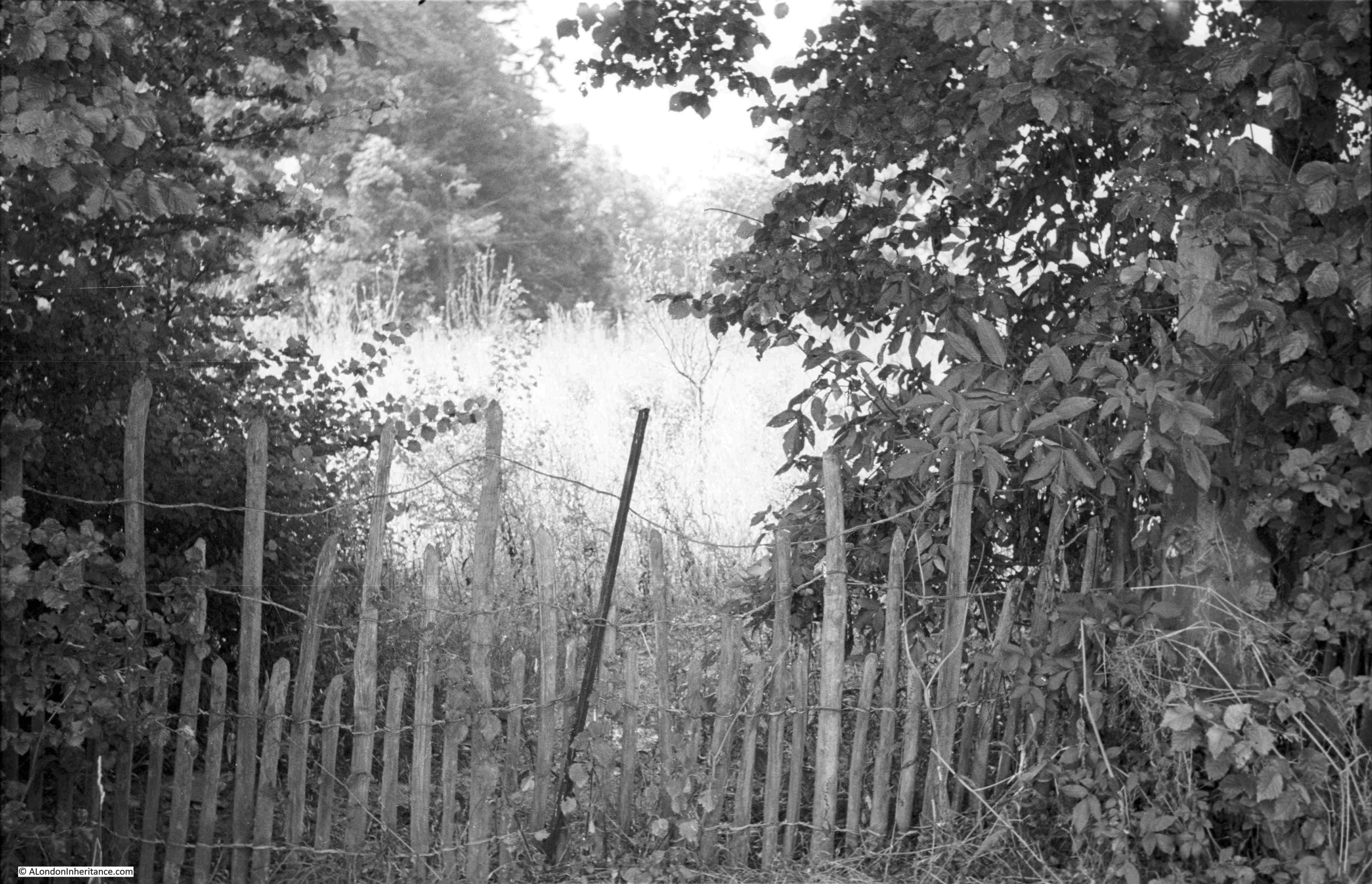
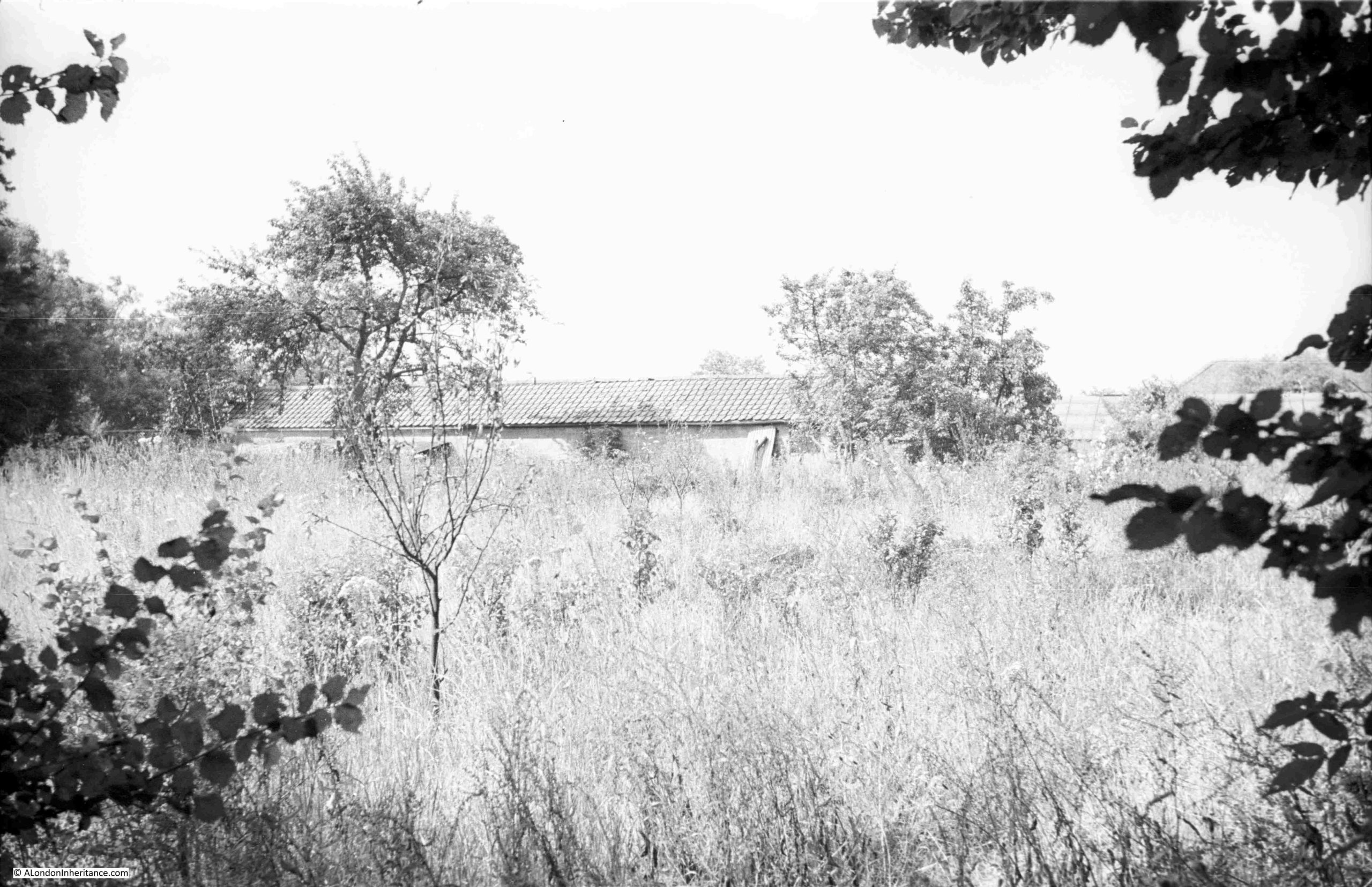
There are two photos which I would not have had any chance of identifying, if he had not left notes for these two:
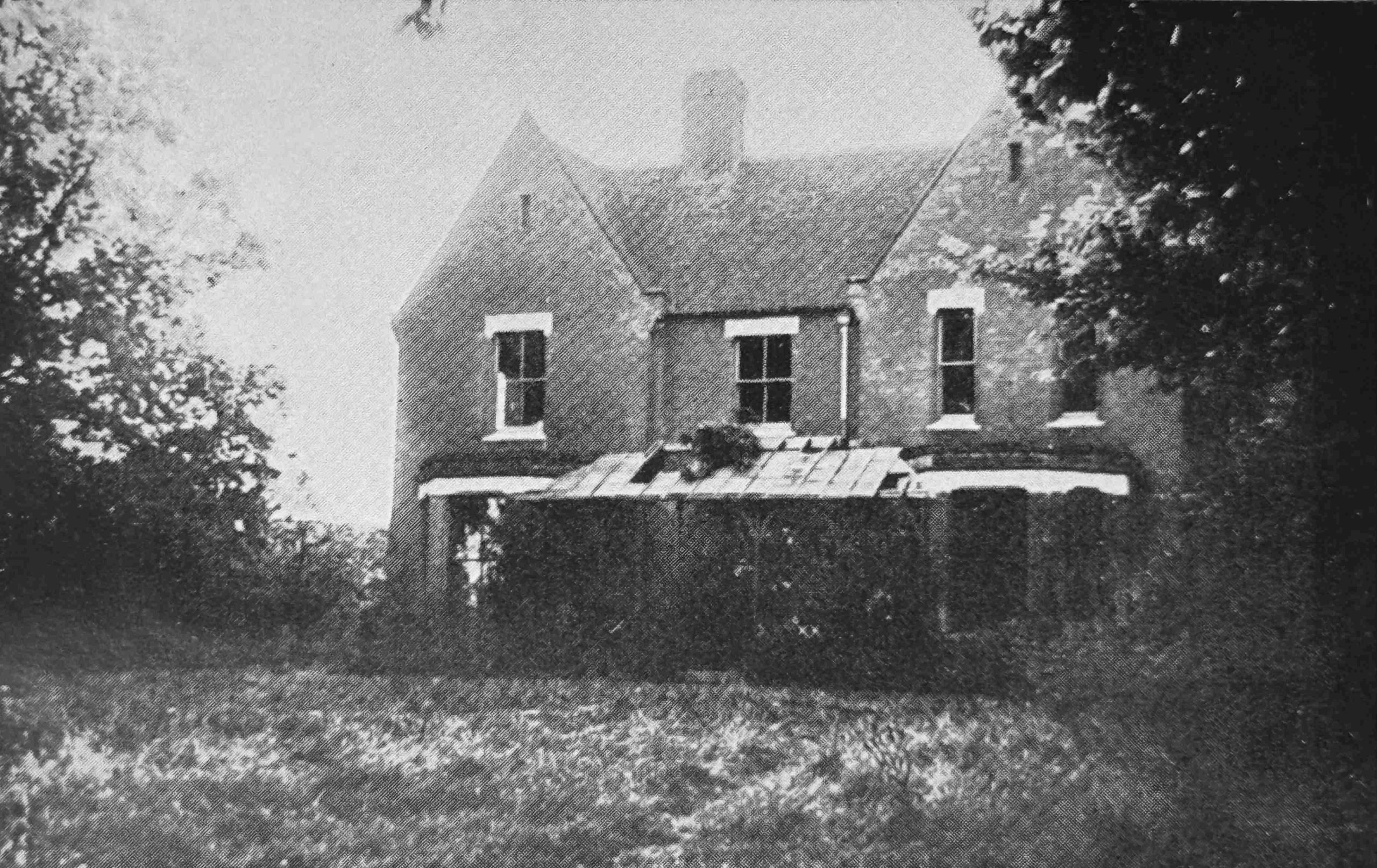
The note with the photos read “Borley Rectory, 21st July 1952”:
The two photos show what looks like an overgrown field, with no sign of any rectory. The reasons for this will become clear later in the post.
First coming to national attention in 1929, the rectory would soon become know as the most haunted house in England,
Borley is a very small village in north Essex, to the north-west of Colchester, and the rectory was built in 1863 by the Rev. Henry Bull. It seems to have been known for low level ghostly phenomena for some time, for example on the 28th of July 1900, four sisters of the Rev. Bull saw the figure of a nun on the rectory lawn.
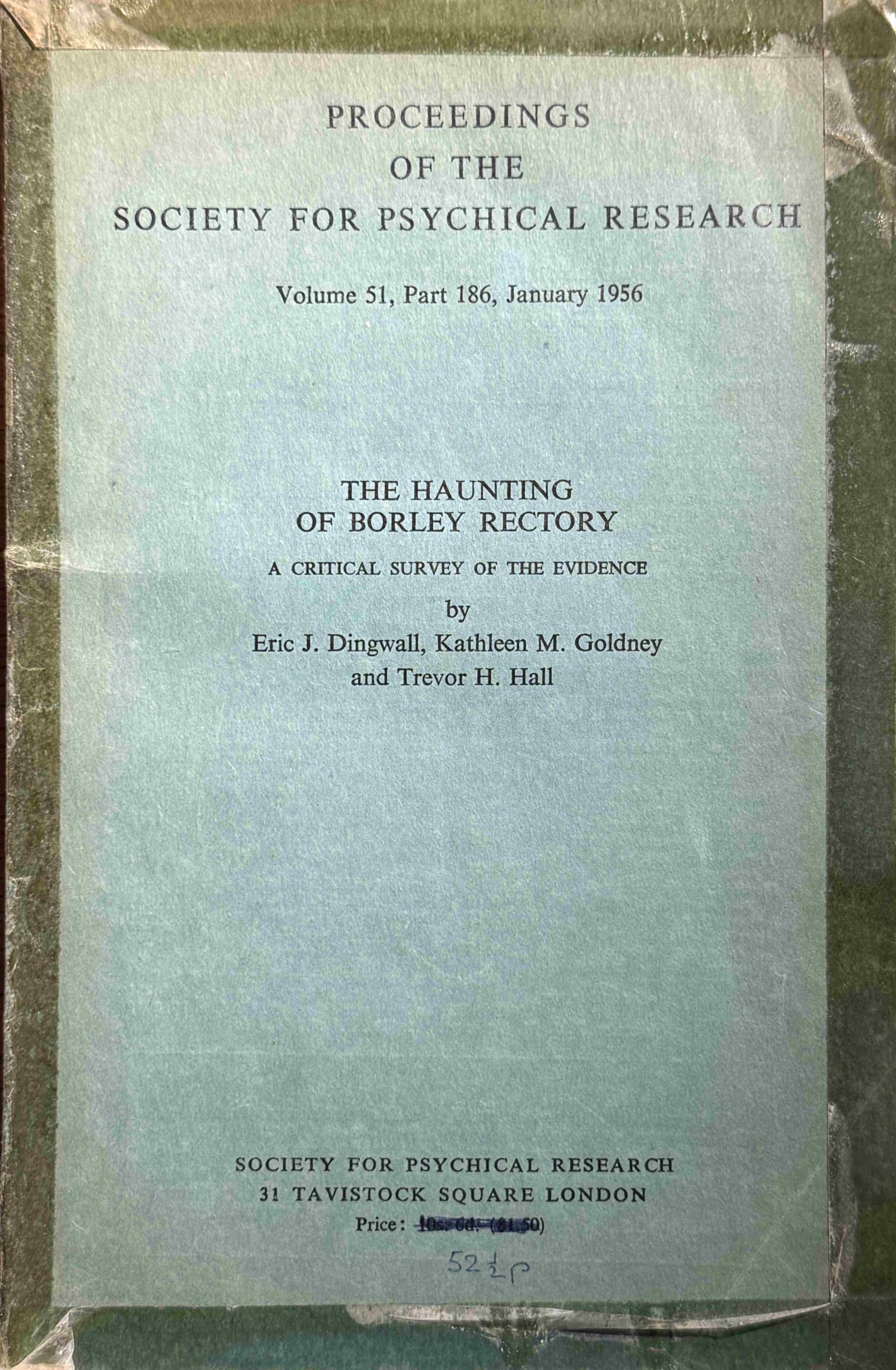
The site on which the rectory was built appears to have been the subject of local legends for many years. In a 1956 report on the Borley hauntings by the Society for Psychical Research, it was noted that:
“According to legend, discredited in 1938, Borley Rectory was built on the site of a 13th century monastery, with a nunnery nearby at Bures. The legend told how an eloping monk and nun were caught and put to death. Apparitions of the nun, the coach in which they fled, and a headless coachman figure in stories current in the late 19th century.”
It is always a headless coachman, and there are numerous examples of this type of apparition from across the country. The legend that the rectory was built on the site of a 13th century monastery seems to have just been a local story, with no foundation in fact.
The Rev. Henry Bull was succeeded by his son Harry, who also became the rector of Borley and whilst he moved to another house in the villages, his father’s sisters still lived in the rectory.
The Rev. Harry Bull died in 1927, and two years later, the Rev. G. Eric Smith took over the living of Borley and moved to the rectory.
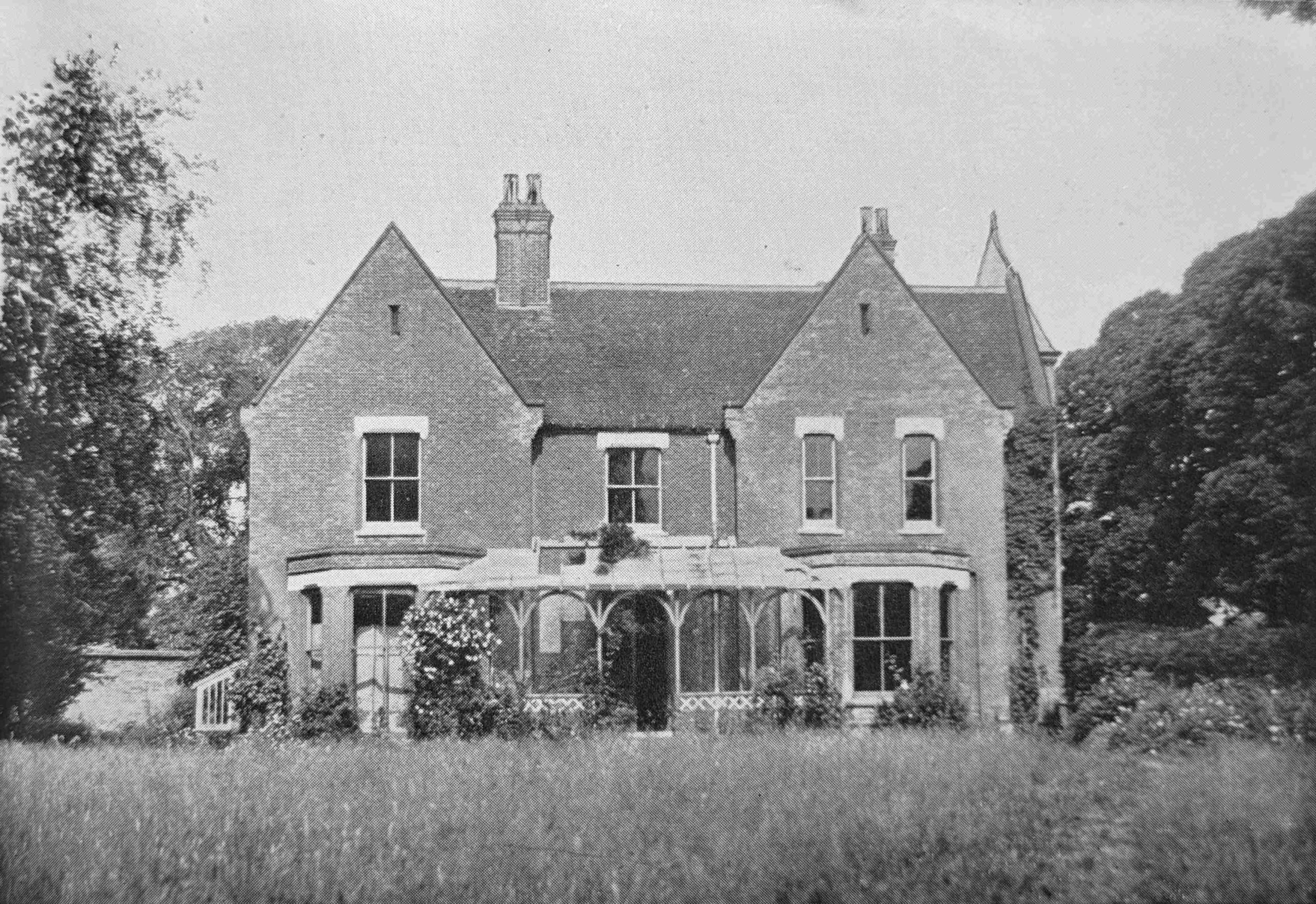
The Reverend and his wife were so concerned by the rumours that the rectory was haunted, that they got in touch with the Editor of the Daily Mirror for help with contacting a psychical researcher.
Borley Rectory:
Image source: The End of Borley Rectory by Harry Price, 1946.
Following the Rev. Smith’s request to the Daily Mirror, the newspaper arranged for Harry Price to visit the rectory. In the 1920s Price was one of the best known and most prolific physic journalists of his generation, and he did expose the fraudulent activities of many mediums, so he had some credibility in the research of ghostly phenomena.
The Daily Mirror published an article on the 12th of June 1929 announcing that Harry Price was being sent to investigate, and also published details from a witness who had experienced the phenomena that apparently plagued the rectory:
“HAUNTED ROOM IN A RECTORY. OLD SERVANT’S STORY OF A MIDNIGHT VISITOR. LAYING THE ‘GHOST’. Psychic Expert to Investigate Suffolk Mystery.
One of the leading British psychological experts is to investigate the mystery of the ‘ghost’ of Borley Rectory, Suffolk, described in the Daily Mirror.
In an effort to lay the ghost by the heels, and either prove or disprove its existence, Mr. Harry Price, honorary director of the National Laboratory of Psychic Research, is to conduct the investigation. Mr. Price is famous in this country for his research work and his exposures of psychic phenomena.
Striking confirmation of the weird experiences of the present and past occupants of the rectory is forthcoming from Mrs. E. Myford of Newport, Essex. In a letter to the Daily Mirror Mrs. Myford reveals that forty-three years ago, when she was a maid at the rectory, similar phenomena were quite openly discussed in the rectory and neighbourhood.
Much of my youth was spent in Borley and district, with my grandparents, writes Mrs. Myford, and it was common talk that the rectory was haunted. Many people declared that they had seen figures walking at the bottom of the garden. I once worked at the rectory, forty-three years ago, as an under-nursemaid, but I only stayed there a month, because the place was so weird.
The other servants told me my bedroom was haunted, but I took little notice of them because I knew two of the ladies of the house had been sleeping there before me. But when I had been there a fortnight something awakened me in the dead of night. Someone was walking down the passage towards the door of my room, and the sound they made suggested that they were wearing slippers.
As the head nurse always called me a six o’clock, I thought it must be she, but nobody entered the room, and I suddenly thought of the ‘ghost’. The next morning I asked the other four maids if they had come to my room, and they all said that they had not and tried to laugh me out of it.
But I was convinced that somebody or something in slippers had been along the corridor, and finally I became so nervous that I left. My grandparents would never let me pass the building after dark, and I would never venture into the garden or the wood at dusk.”
Then on the 14th of June 1929, the Mirror published an update, covering the first visit of Harry Price to the rectory:
“WEIRD NIGHT IN ‘HAUNTED HOUSE’ SHAPE THAT MOVED ON LAWN OF BORLEY RECTORY. STRANGE RAPPINGS. ARTICLES FLYING THROUGH THE AIR SEEN BY WATCHERS.
There can no longer be any doubt that Borley Rectory, is the scene of some remarkable incidents.
Last night Mr. Harry Price, director of the National Laboratory for Psychical Research, his secretary, Miss Lucy Kaye, the Rev. G.E. Smith, Rector of Borley, Mrs. Smith and myself were witnesses to a series of remarkable happenings.
All these things occurred without the assistance of any medium or any kind of apparatus, and Mr. Price, who is a research expert only and not a spiritualist, expressed himself puzzled and astonished at the results. To give the phenomena a thorough test, however, he is arranging for a séance to be held in the rectory with the aid of a prominent London medium.
The first remarkable happening was the dark figure I saw in the garden. We were standing in the summer house at dusk watching the lawn when I saw the apparition which so many claim to have seen, but owing to the deep shadows it was impossible for one to discern any definite shape or attire. But something certainly moved along the path along the other side of the lawn, and although I immediately ran across to investigate, it had vanished when I reached the spot.
Then as we strolled toward the rectory discussing the figure, there came a terrific crash and a pane of glass from the roof of a porch hurtled to the ground. We ran inside and upstairs to inspect the rooms over the porch, but found nobody. A few seconds later we were descending the stairs, Miss. Kaye leading and Mr. Price behind me, when something flew past my head, hit an iron stove in the hall, and shattered.
With our flashlamps we inspected the broken pieces and found them to be sections of a red vase which, with its companion, had been standing on the mantlepiece of what is known as the blue room and which we had just searched.
We sat on the stairs in darkness for a few minutes and just as I turned to Mr. Price to ask him whether we had waited long enough something hit my hand.
This turned out to be a common mothball, and had dropped from apparently the same place as the vase. I laughed at the idea of a sprit throwing mothballs about, but Mr. Price said that such methods of attracting attention were not unfamiliar to investigators. Finally came the most astonishing event of the night.
From one o’clock until nearly four in the morning all of us, including the rector and his wife, actually questioned the spirit or whatever it was and received the most emphatic answers.
A cake of soap on the washstand was lifted and thrown heavily on to a China jug standing on the floor with such force that the soap was deeply marked. All of us were at the other side of the room when this happened. Our questions which we asked out loud, were answered by raps apparently made on the back of a mirror in the room, and it must be remembered that no medium or spiritualist was present.”
The reference in the above articles to the “National Laboratory for Psychical Research” implies the credibility of an independent research organisation, however the “National Laboratory” was the creation of Harry Price, and of which he was director.
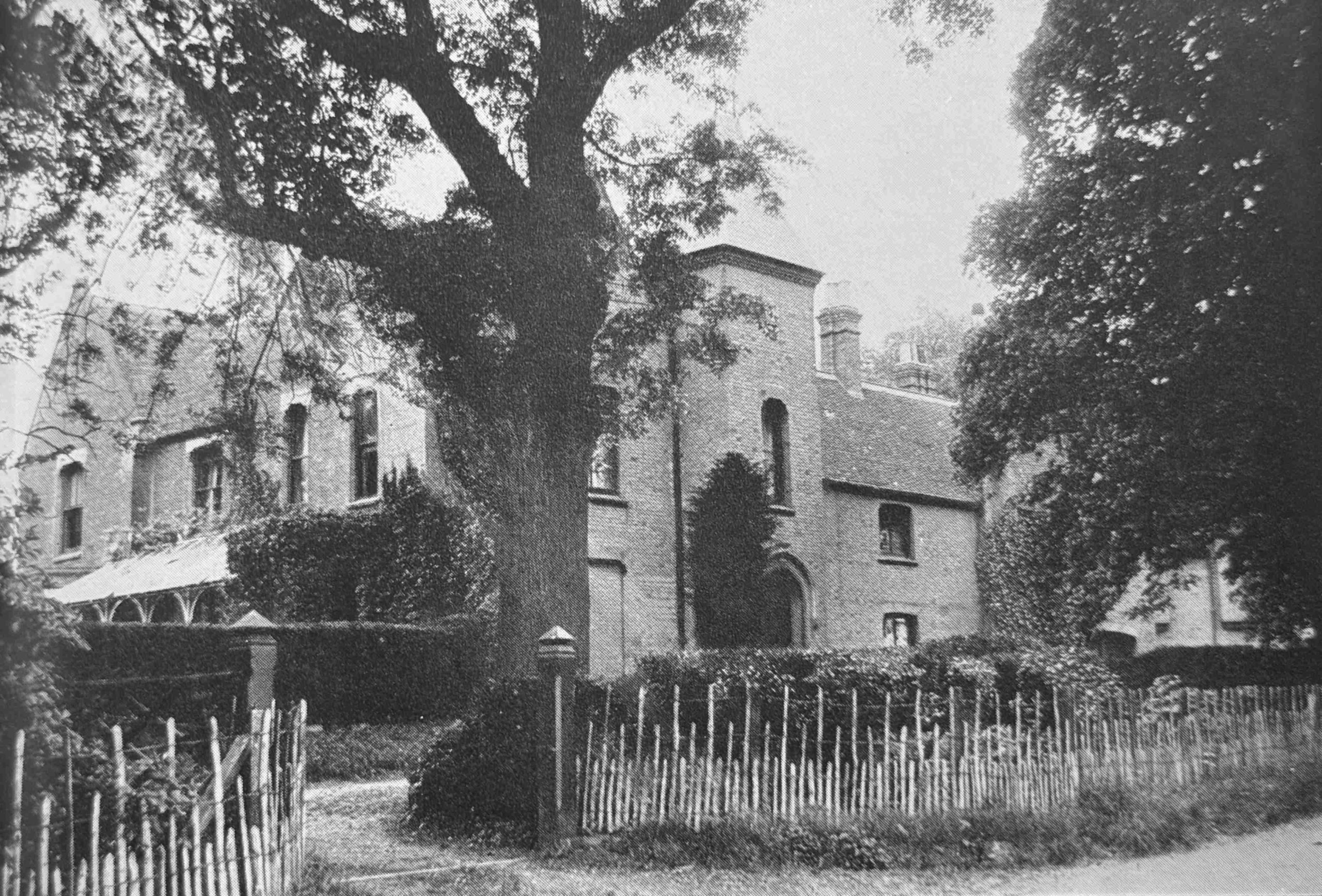
The entrance to the rectory from the road, showing that it was a more substantial building than appears from just a view from the front:
Image source: The End of Borley Rectory by Harry Price, 1946.
Perhaps it should not have been a surprise that as soon as a psychic researcher, sent by a national newspaper got involved, that the phenomena in the rectory became more intense.
The Rev. Smith and his family left the rectory and moved to Long Melford, not just because of the ghostly happenings, but also the “nuisance created by the publicity”.
All then went quiet. The Rev. Smith and his family moved to a new parish in Norfolk, and Borley remained without a rector until the 16th of October 1930 when the Rev. Lionel A. Foyster moves in with his family, and the ghostly phenomena start again, this time with increasing violence.
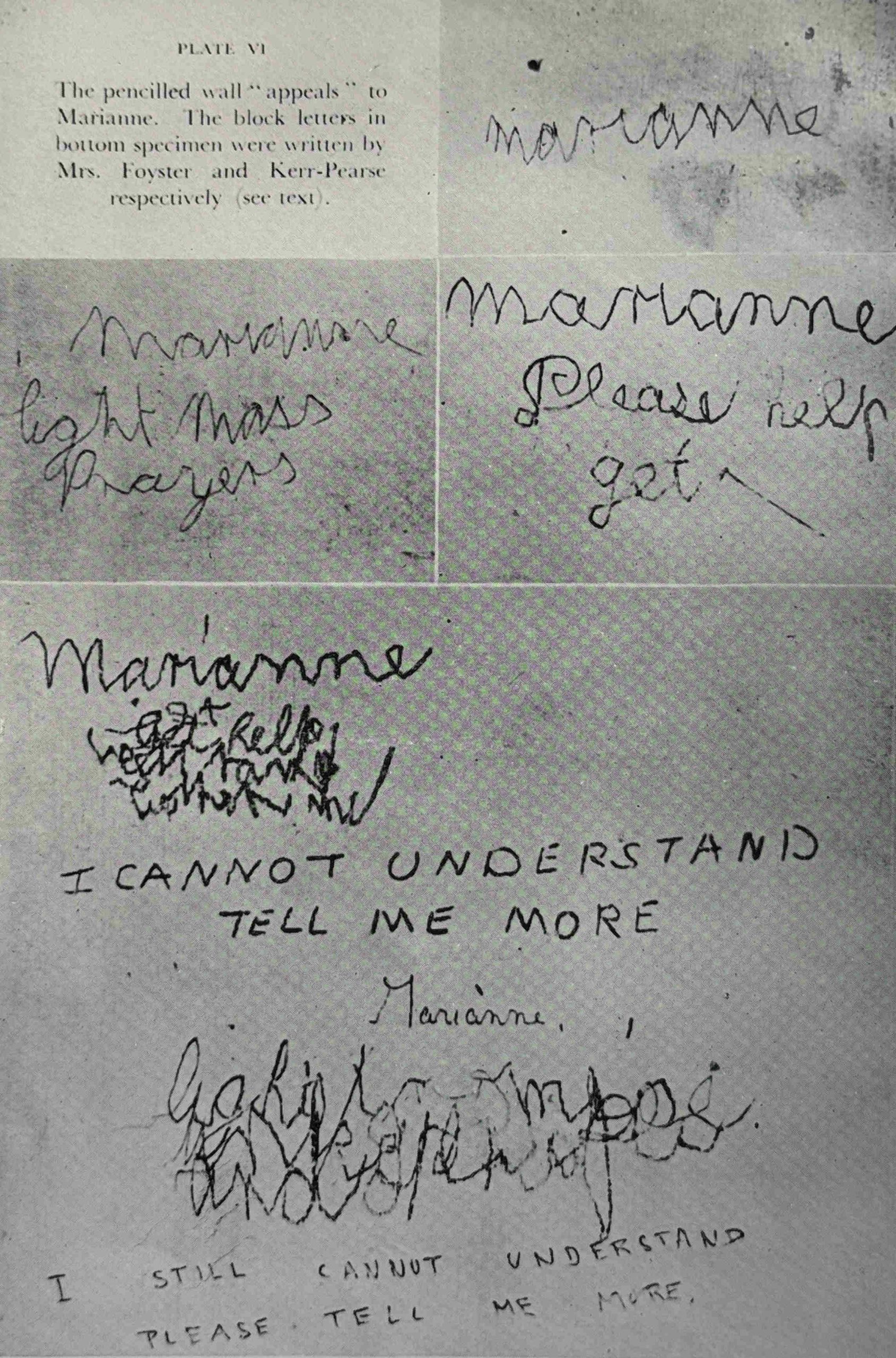
One of the phenomena witnessed during the Foyster’s time in the rectory was wall writing, where appeals were made to Marianne (the wife of Rev. Foyster):
Image source: The End of Borley Rectory by Harry Price, 1946.
Rev Foyster was a cousin to the Rev. Harry Bull, and the sisters were still living close by as they got in contact with Harry Price to ask him to make a return visit.
An exorcism was held, and the phenomena abruptly cease.
In October 1935, the Foyster family move out, and the rectory is left unoccupied. The next rector of Borley receives the Bishop’s permission to live elsewhere, then the livings of Borley and nearby Liston are combined, making the rectory at Borley redundant.
In May 1937 Harry Price again visited the rectory and decided to rent the building for a year. He advertised in The Times for people to join him in a comprehensive investigation, and 48 individuals are signed up, with a rota of visits to monitor the rectory.
One of those involved arranged for a planchette to be used. A planchette was a heart shaped piece of wood, mounted on wheels, and with a hole for a pencil. Those at the sitting where the planchette was used, would gently put their hands on the planchette, and it would move, guided by any spirits who wished to communicate. The pencil writing the results on paper below the planchette.
This method was used between October and November 1937, and the scripts generated by the planchette provided considerable details about the nun from the original legends. Her name was given as either Mary or Marie Lairre, and she had come from France. The scripts claim that she had been murdered, she was a novice and died at the age of 19 in 1667, and that her remains could be found at the end of the wall or in the well.
Later, in 1943, Price excavated the wells in the cellars of the rectory and found human bones at the bottom of the well. They were assumed to be those of the nun and in May 1945 they were buried in the churchyard at Liston.
Throughout Price’s tenancy of the rectory, strange phenomena continued to be observed and felt. There were cold spots, strange noises, taps, bangs, footsteps and whistles, horses hoofs, lights etc.
In May 1938, Price’s tenancy of the rectory ends, and the rectory is purchased by a Captain Gregson, who also reported minor phenomena, as did visitors to the old rectory.
During the night of the 27th of February 1939, Borley Rectory is destroyed by fire. During the fire, strange phenomena continue, including the sighting of strange figures walking in the flames, and strange happenings continue to be reported in the months after the fire, although the rectory is now a ruin:
Image source: The Haunting of Borley Rectory, Volume 51, Part 186 Society for Psychical Research
The saga at the rectory had received continuous national coverage during the 1930s, and in 1940 Price capitalised on the public’s interest in the story of the rectory with the book “The Most Haunted House in England”.
The book resulted in many more people getting in contact with Price, to report their strange experiences at the site.
The remains of the rectory were demolished in 1944, however interest in the story continued and many people still visited the site (including my father and his friends), and some people also held seances on the site.
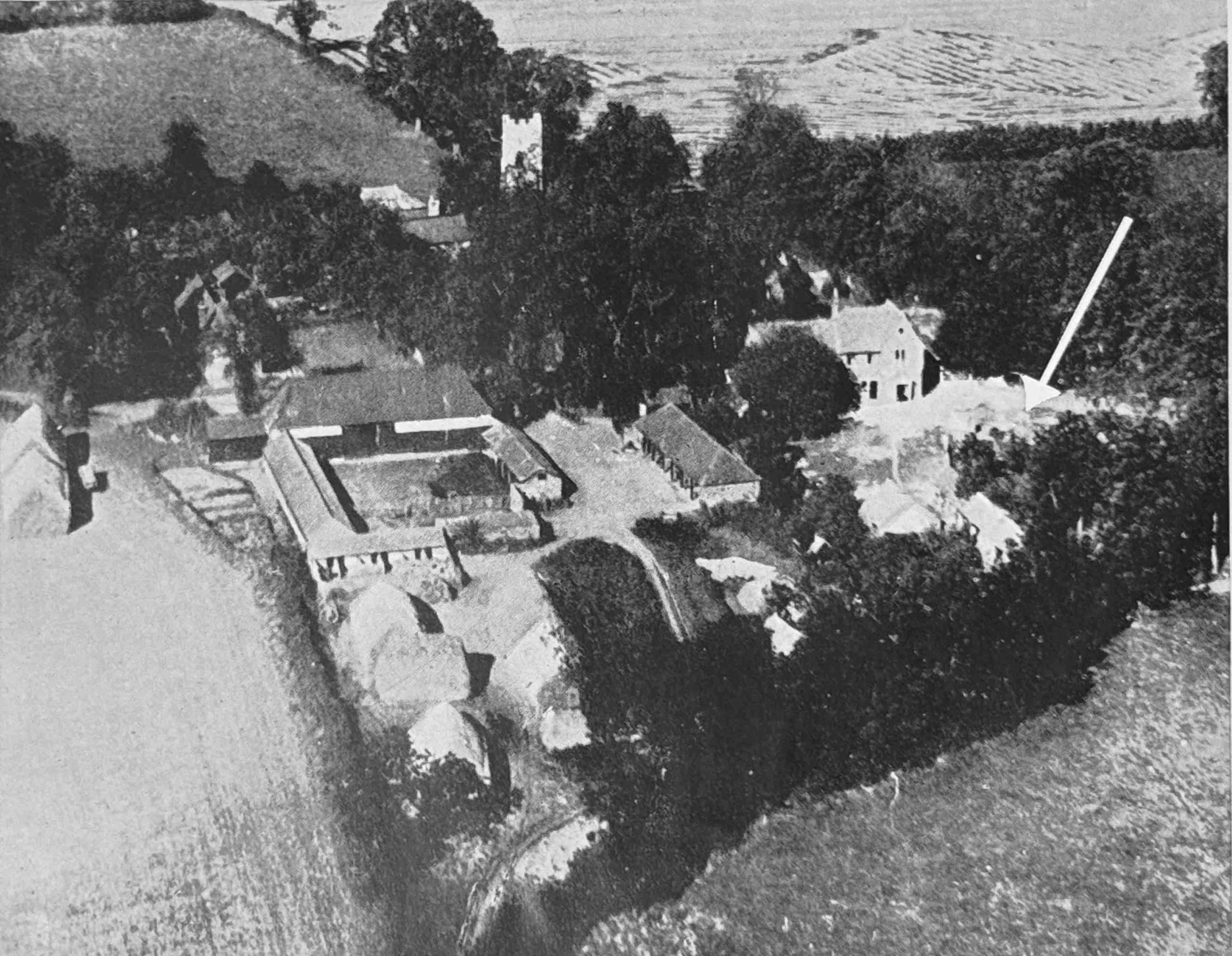
The following photo shows an aerial view of the site, with the location of the demolished rectory highlighted by the arrow. The photo helps locate my father’s photos as the second photo at the top of the post has some low rise buildings in the background, and these can be seen in the centre of the following photo:
Image source: The Haunting of Borley Rectory, Volume 51, Part 186 Society for Psychical Research
In 1946, Harry Price published his second book on the subject “The End of Borley Rectory”, repeating as the sub-title “The Most Haunted House in England”.
Two years later, on the 29th of March, 1948 Harry Price died of a heart attack in his home at Pulborough in West Sussex. His papers and archive were deposited with the University of London.
There had always been rumours about the phenomena observed at Borley Rectory, and after Price’s death, these rumours started to gain greater credibility.
In 1948, a Mr Charles Sutton who was on the staff of the Daily Mail accused Harry Price of fraudulently producing many of the phenomena observed when Sutton visited with Price in 1929, although quite why he had left it so long to make public these claims is unknown.
In 1949, Mrs Smith, the wife of the Rev. G. Eric Smith, who took over the living of Borley and moved into the rectory in 1928, wrote to the Daily Mail asserting her disbelief that the rectory was haunted.
The report is an in depth and comprehensive survey of the haunting, and looks at all the evidence available, although it does make the point that the evidence was not of the type that would stand in a court of law, as the evidence mainly consisted of the reports of all those who had witnessed phenomena, rather than tangible evidence of a supernatural cause.
The rectory was large and had acoustic properties that could have explained many of the strange noises.
The Rev. Harry Bull, as well as being the rector of Borley also had an interest in spiritualism, and this could have influenced both his view of the rectory, as well as how the phenomena were perceived by others.
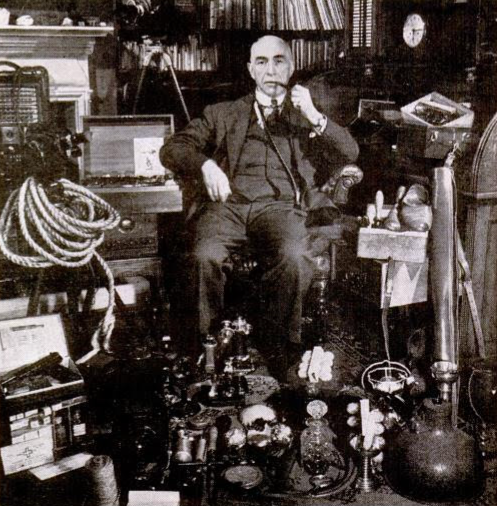
The report also looked at Harry Price, who was described as possessing a “complex personality whilst to others the motives which inspired him were simple and clear-cut. He was a man of abounding energy and had a wide range of interests and a practical acquaintance with a good many technical matters from numismatics to radio communication and conjuring. Trained as an engineer, he ran his own amateur workshop and some of his apparatus and gadgets were of first class workmanship”.
Whilst many of these skills could have been used to create the phenomena observed at the rectory, the report states that there is no firm evidence to suggest that Price did this, and with his death, and the distance of time, it was impossible to prove.
The report does refer to his career as a journalist on the subject, and that it was possible to regard Price as “a brilliant if cynical journalist who used the material gathered in his laboratory or in the field in such a way that its publicity value was highest. As we have seen, if the material lacked sensational elements it would seem that he was prepared at times to provide these himself. On the other hand, his motives may have been more complex; he may have thought that there was some genuine basis on which to build his stories, and that, by supplying what he thought to be the proper psychological milieu, the genuine elements could easily emerge”.
The report also focuses on the influence of suggestion, and how, “once the mind has been affected, belief can be strengthened and simple events misinterpreted in order to fit them into the desired pattern”.
Harry Price surrounded by items from his ghost hunting kit:
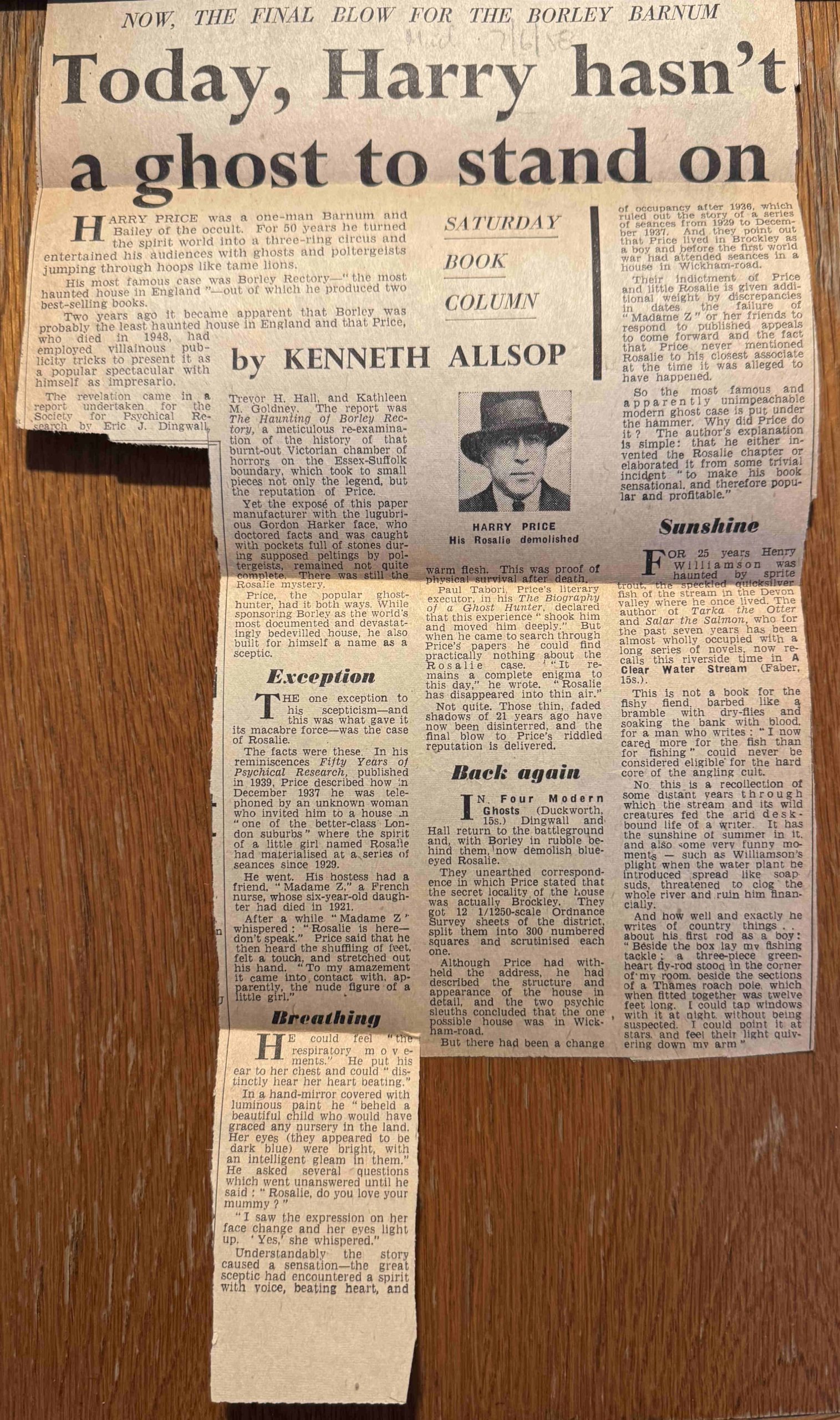
My father had a copy of the book “The End of Borley Rectory” by Harry Price, and inside there is a cutting from the Daily Mail from the 7th of June, 1958, with the headline “Today, Harry hasn’t a ghost to stand on”.
The article refers to the 1956 Society for Psychical Research report as demolishing the Borley haunting, and then looks at a new book which challenges one of Price’s other notable cases, that of a young girl named Rosalie who appeared during a séance after Price was invited to “one of the better class London suburbs“:
Despite all the challenges to the authenticity of the Borley hauntings, stories about the old rectory and the site continued for long after Price’s death. In 1954, two years after my father’s visit, there were still newspaper articles being published. One full page article ended with the following:
“Recently I stood in the long grass which has grown over the foundations of the Rectory and talked with a man who for the last three and a half years has lived in the coach-house which escaped the fire.
Mr. Williams is a retired engineer who keeps a chicken farm there. Quiet, matter of fact, and the least mystical person I have ever met, he is not normally at all forthcoming about the haunting. Publicity, he knows, will only bring more coach-loads of curious sightseers and more mediums who will fall into trances by the Nun’s Walk.
But he admits, frankly and quite unemotionally, that he has experienced things which have no normal explanations.
He told me of how he had sometimes woken in the night to find a light – a glow he called it – hovering in his bedroom and that once he heard quite distinctly footsteps following him across the courtyard at the back of his house. He turned round, but there was no one behind him. Suspecting a trick, he ran round the corner of the house. Still no one.
Had he seen the nun? Mr. Williams took his time before answering, and then said, slowly; ‘Well, I think perhaps I may have. I was in one of the chicken houses at the time. It was broad daylight and I saw a figure pass the window, – just a vague outline, really, you couldn’t say it was a man or woman – and then disappear.
When? Oh, last summer that was – just before the chicken-house was burnt down.”
And with that, can I wish you a very happy Christmas, and if you do get any strange noises, lights, or apparitions of nun’s at this dark time of year – I suggest you do not contact the national press and ask for the assistance of a psychical researcher.
Almost 12 years ago, the blog started as a means of recording then and now photos based on my father’s photos, but since 2014 it has also been a way for me to explore London and the city’s history (or rather take more interest in what I used to walk past, and I still have lots more of my father’s photos to post about).
As well as taking more notice whilst walking London, it is also fascinating to find connections between the city and the wider country, and one of these connections is the subject of this week’s post.
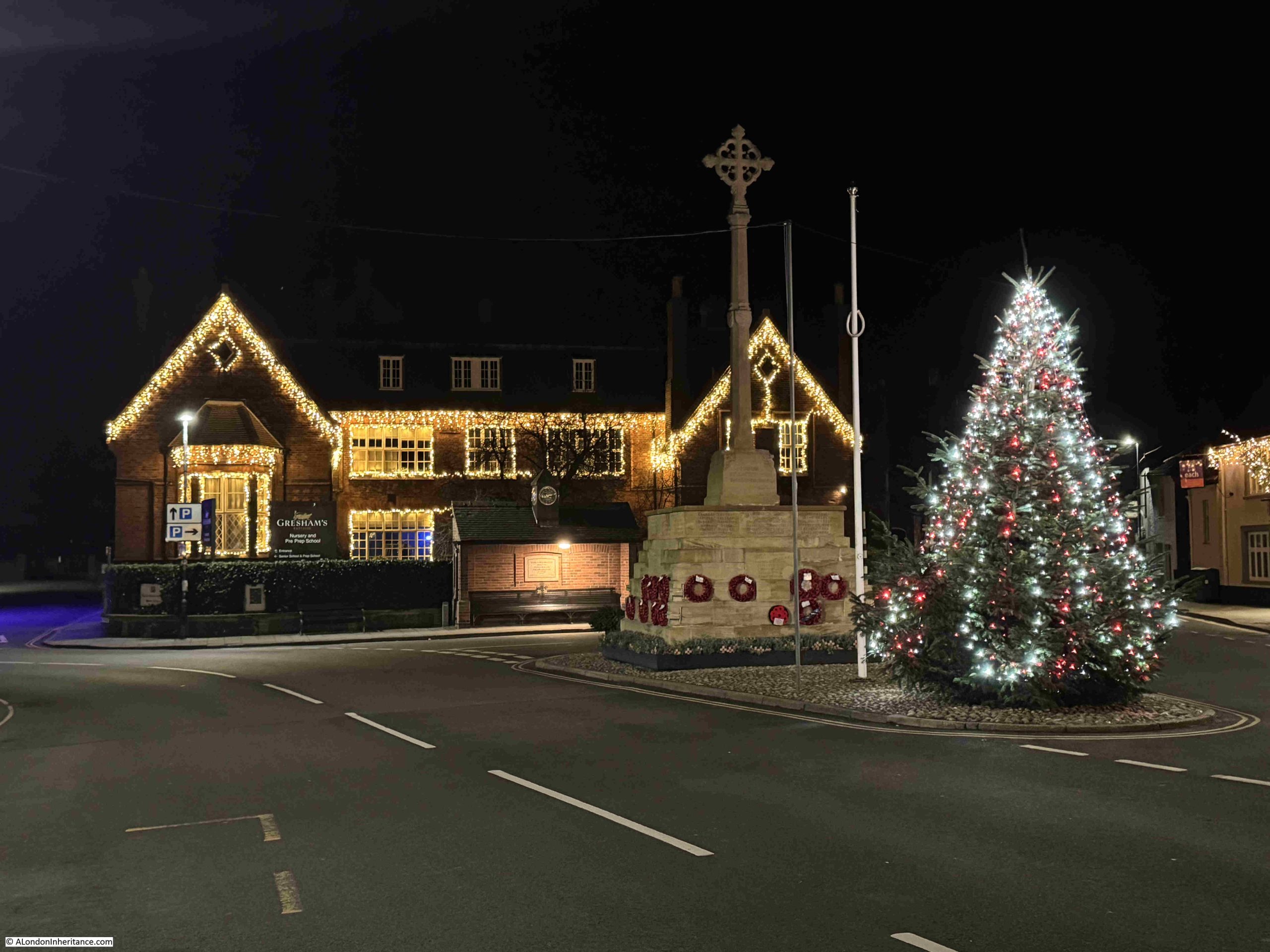
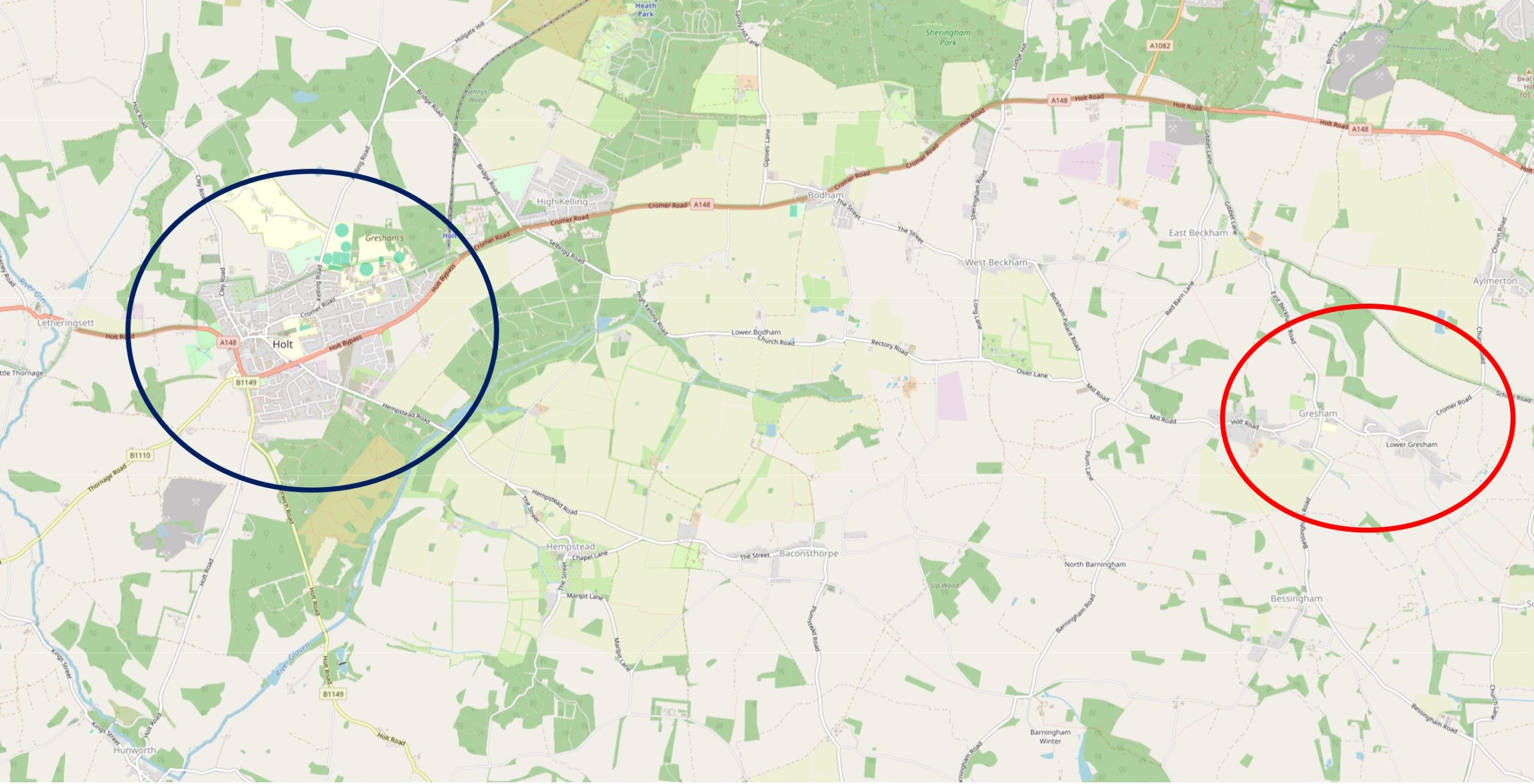
A couple of week’s ago, we were in the small town of Holt in north Norfolk (thanks to A & C for the suggestion and company). and at the western end of the Market Place, there was a building which had a very familiar symbol for the institution that occupies the building:
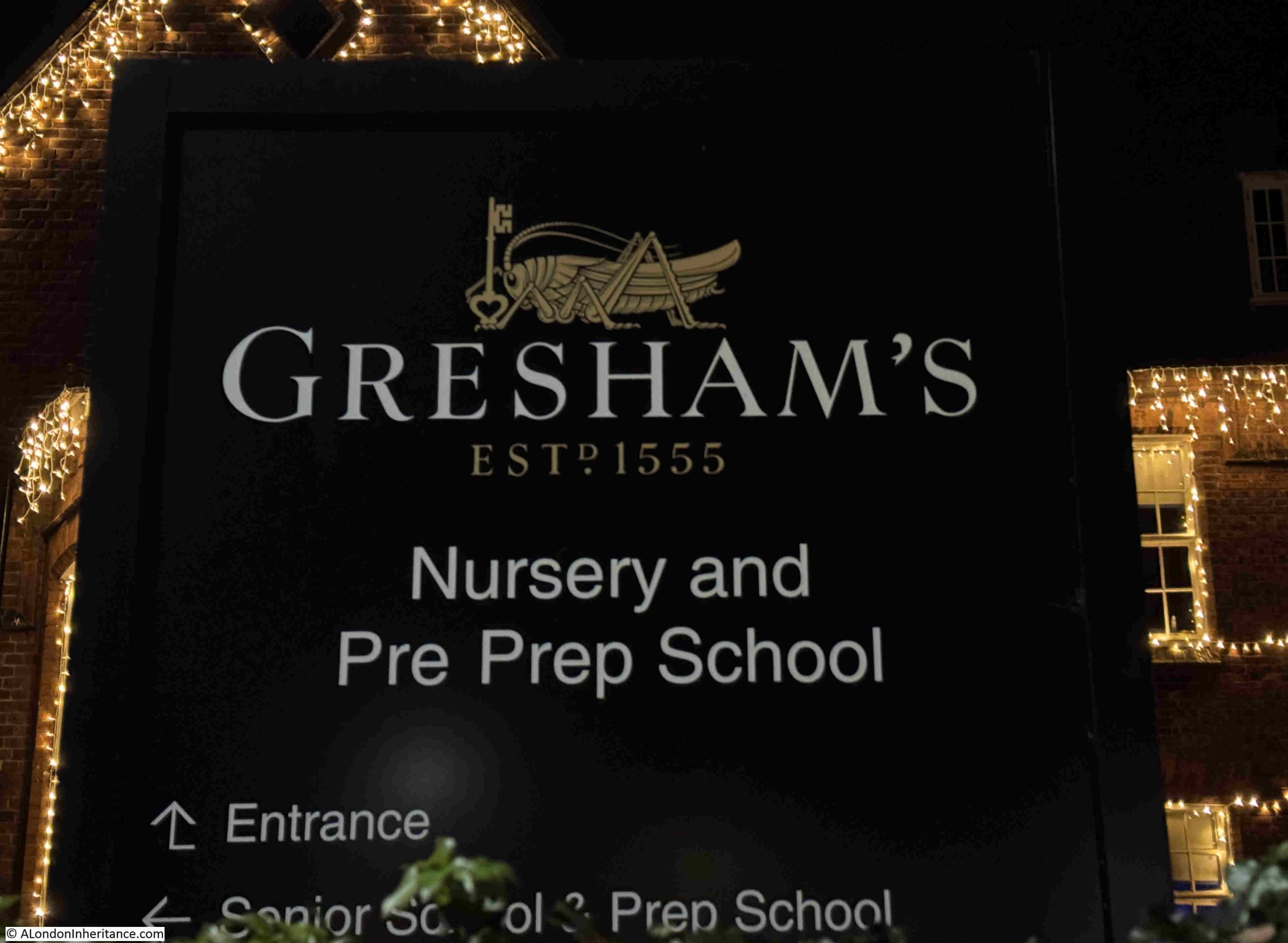
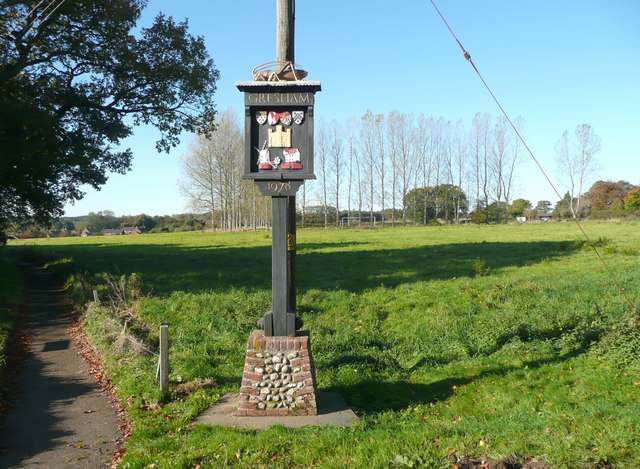
The building is the home of Gresham’s Nursery and Pre Prep School, and further west there is a much larger part of Gresham’s School, and what initially caught my attention was the image of the grasshopper, which is on the sign board and also on one of the school busses that went through the centre of the town:
The name Gresham is a key part of London history, and the grasshopper is the crest above the Gresham family coast of arms.
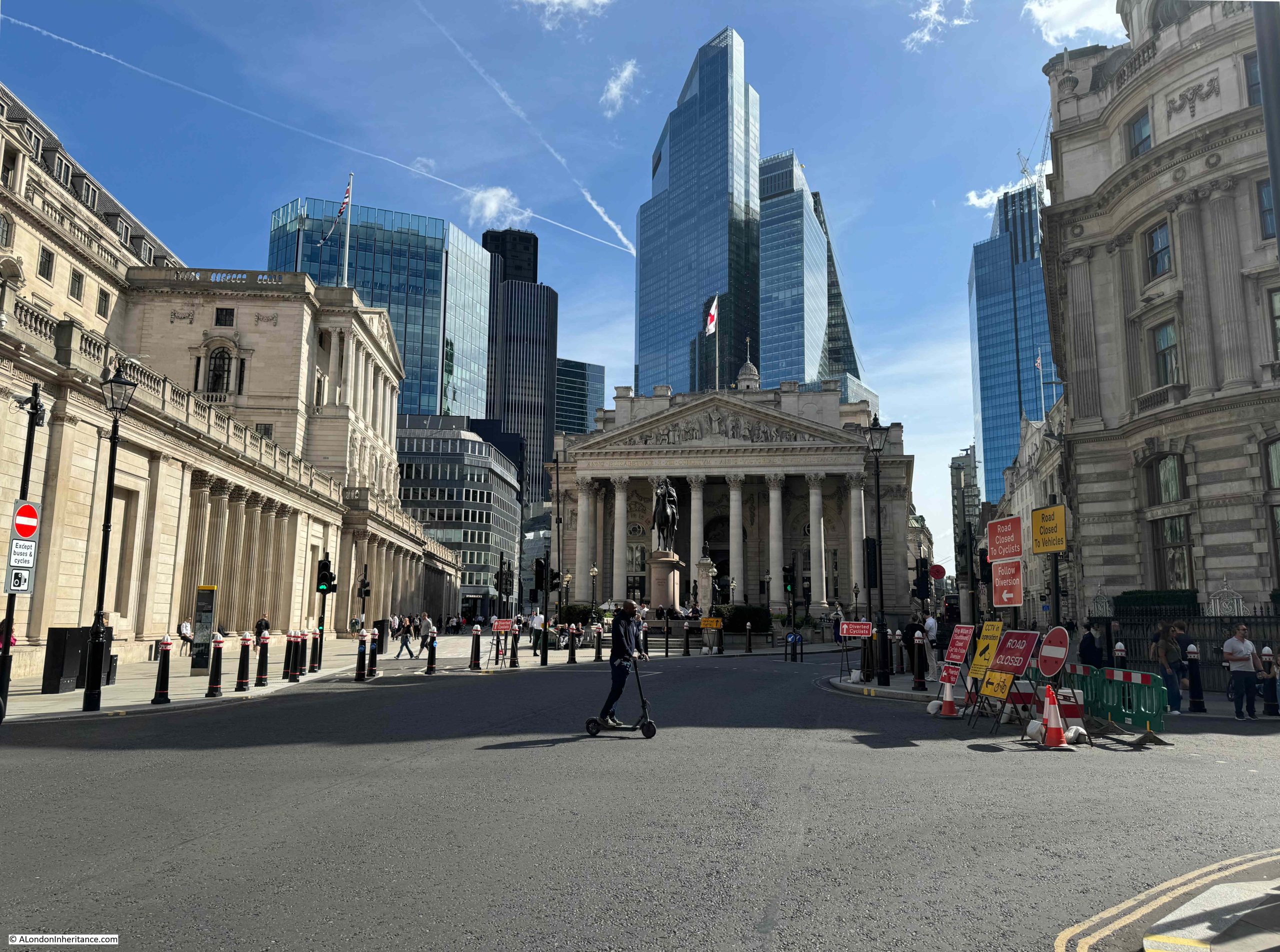
The Gresham grasshopper can also be found in a central part of the City of London. The following photo is of the Bank junction with the Royal Exchange in the centre of the photo:
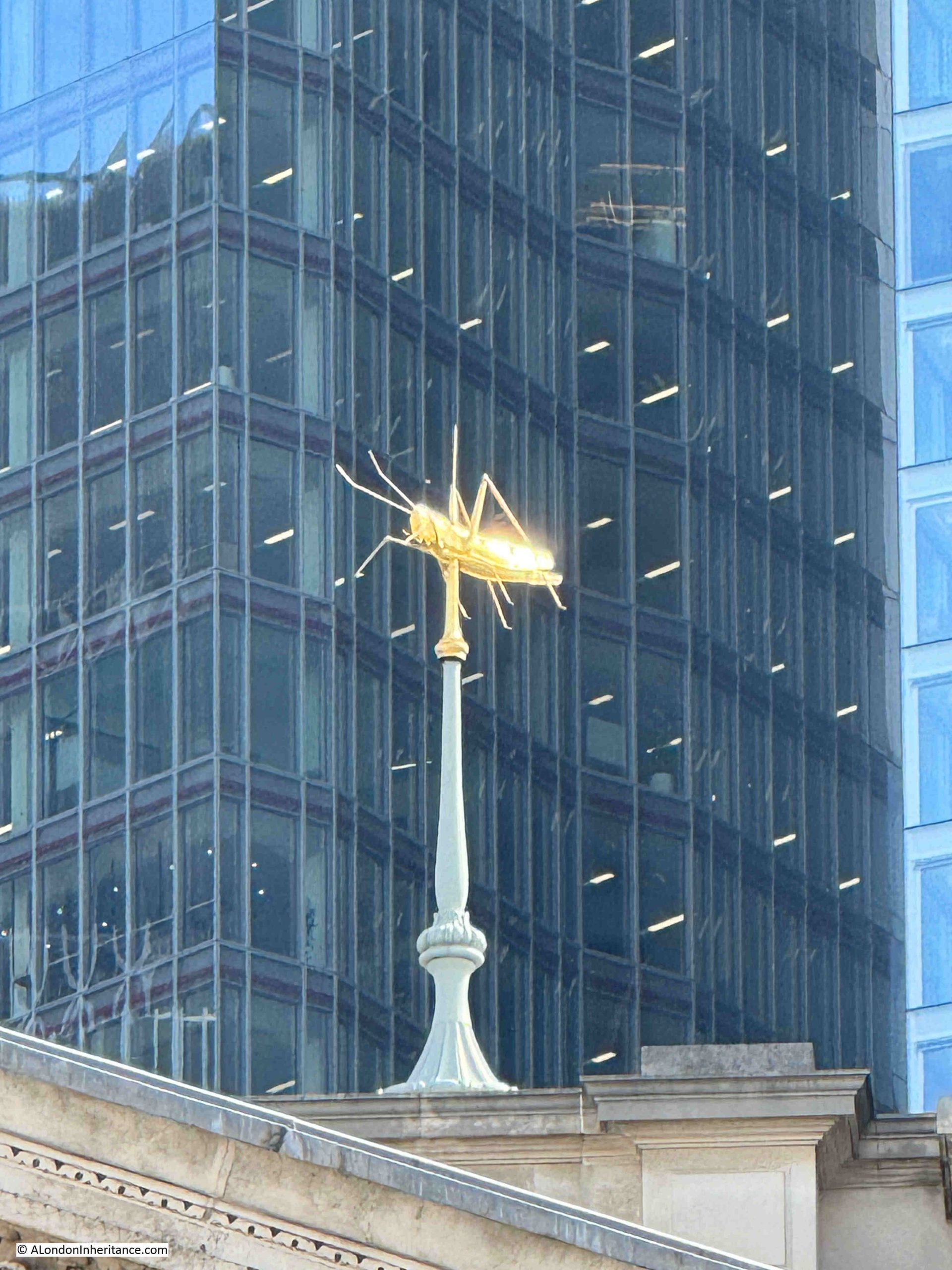
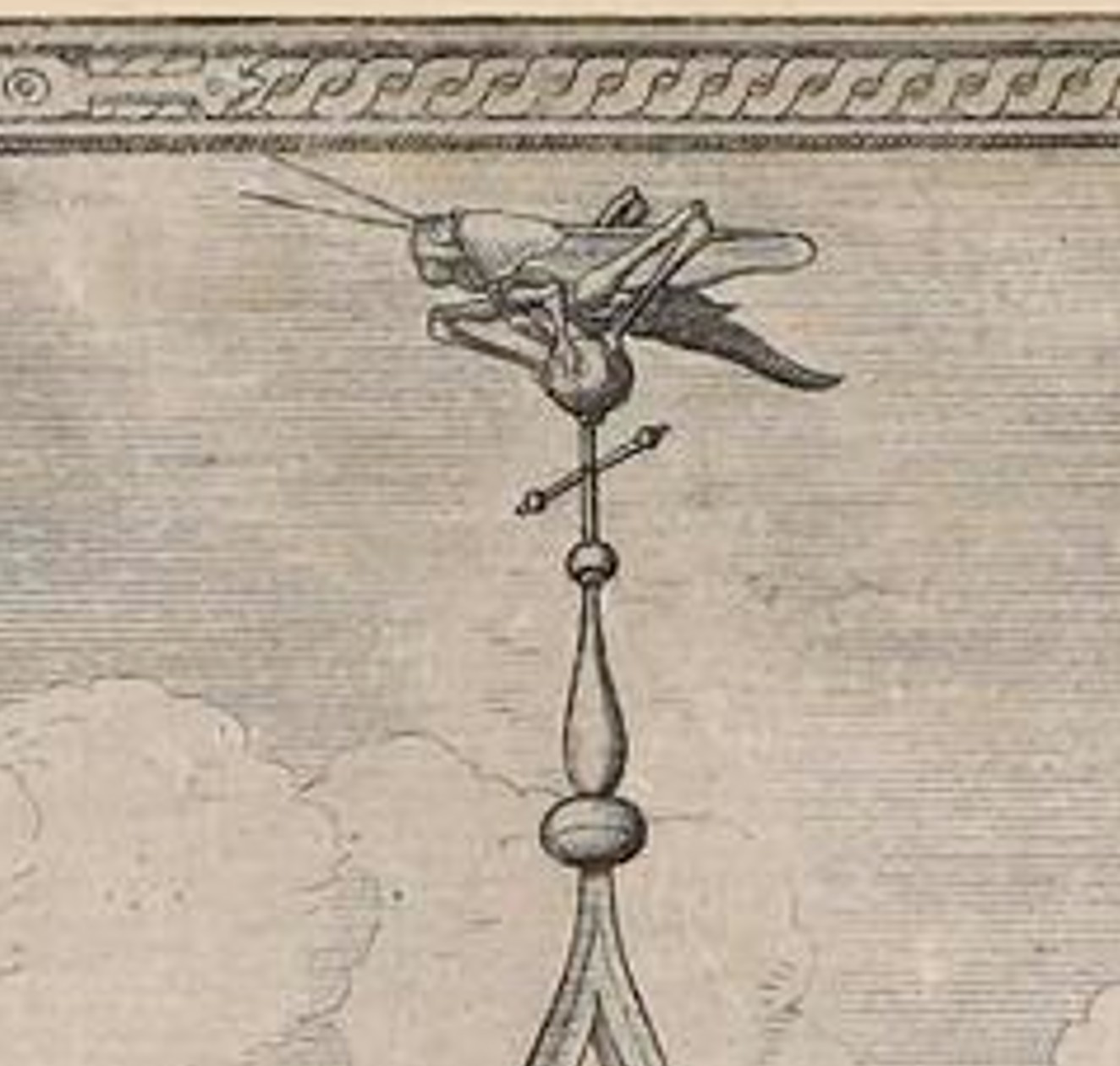
Not easily visible in the above photo, but on the weather vane of the small tower on the roof of the Royal Exchange is another Gresham grasshopper:
So why does the name Gresham, and the symbol of a grasshopper appear both in Holt and in the centre of the City of London?
The Gresham family had long held land in this part of Norfolk, having descended from Ralph de Braunche who fought with, and came over during William the Conqueror’s invasion of England in 1066.
He was granted land in Norfolk (as part of a great transfer of land ownership from the earlier pre-conquest Saxon land owners, to those who had supported William during and after 1066), and at some point in the following years, the family took the Gresham surname from the village in north Norfolk where the family were land owners, and near where they had settled in the 14th century.
In the early 15th century, members of the family had settled in Holt, and had built a Manor House at the eastern end of Market Place, on the site of the current Pre Prep School shown in the photo at the start of the post, and it was in this Manor House that Sir John Gresham was born, at some point around the year 1496.
His father was also a John Gresham, and as well as Holt, he was also involved with business in London, an involvement which would grow considerably in the following years.
Sir John Gresham had been apprenticed to John Middleton, a textile dealer in the City of London when he was 14, and when he was 21, he became a member of the Worshipful Company of Mercers.
He became heavily involved with the Tudor Court of Henry VIII and helped Thomas Wolsey and Thomas Cromwell with trade, and his provision of finance, arms and men in support of Henry VIII’s military ambitions helped build his popularity with the King.
He was also Lord Mayor of the City of London in 1547.
Returning to Holt, it was Sir John Gresham that founded the school which still exists to this day, and the need for a school appears to have been due to a gap in local education left by the Dissolution of the Monasteries in 1539.
In the early 16th century, much formal education was provided by religious establishments, and Sir John Gresham had attended the school at Beeston Regis Priory. This school was closed in 1539 during the Dissolution of the Monasteries, and there was no other option to replace the Priory.
The first school was in the family manor house which had been extended specifically for the purpose, and Letters Patent from Queen Mary in 1555 provided royal approval for the school.
He would not though live to see the formal opening of the school as he died in his London home on the 23rd of October 1556, a short time before the school opened.
He was buried in St. Michael’s Bassishaw, a parish church in Basinghall Street, however the grave, monument and church were destroyed during the Great Fire of London in 1666.
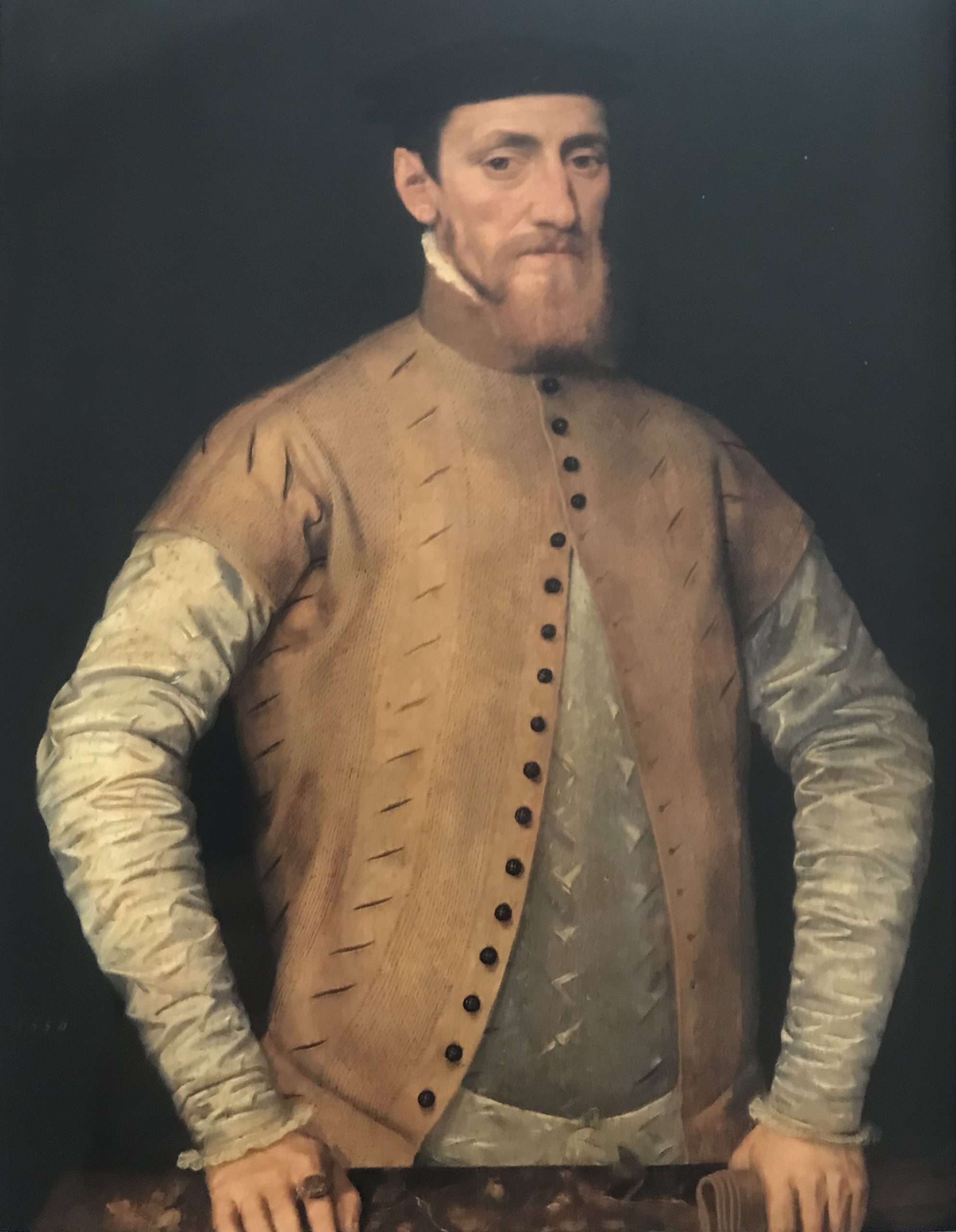
Sir John Gresham, founder of the school in Holt, member of the Mercer’s Company, Lord Mayor of the City of London:
Whilst Sir John Gresham is mainly remembered in the town of Holt as the founder of Gresham’s school, it is his nephew, Sir Thomas Gresham who left a mark on London that is still very much in evidence today.
Sir John Gresham’s brother was Sir Richard Gresham.
He seems to have followed a very similar career path to his brother John as he was a member of the Mercer’s Company, Lord Mayor of the City of London in 1537, involved in the Court of Henry VIII, and a significant trader in goods with the Low Countries, the area of Europe now mainly occupied by the Netherlands, Belgium and Luxembourg.
He also provided goods for the King, and Richard amassed a significant fortune as a result of his trading activities.
Richard had four children, one of whom was the future Sir Thomas Gresham, and is believed to have been born in 1519 in Richard’s house in Milk Street in the City of London.
Sir Thomas Gresham was also a Mercer and had been apprenticed to his uncle Sir John Gresham. He would go on to amass far more wealth than his father or uncle, engaged in trade throughout London and Europe, and in many ways he was one of the original driving forces in establishing the City of London as one of the major financial and trading centres in the world.
He would serve three different monarchs – Edward VI, Mary I and then Elizabeth I, and what is intriguing was the apparent ease of transition between different monarchs as he seamlessly went from the staunchly Catholic Mary I to the Protestant Elizabeth I.
As well as a house in the City of London, he also spent considerable periods of time over a period of around 30 years, living in the city of Antwerp, then the major trading hub of Europe, and a city which had a Bourse, a place where a trading and credit market would operate, and where traders in both goods and finance would meet to agree loans, make foreign exchange trades, trade goods etc. all the different types of trading activity that would soon make London the main trading hub of the world.
Gresham seems to have had a remarkable memory and ability to calculate trades, and would make money on the small differences between currencies, borrowing and lending rates etc. He also attempted to influence rates, for example by providing friendly merchants with amounts of money so that they could make a trade which would raise or lower the value of the currency being traded, just in advance of when Gresham had to make a trade.
The earlier trade changing the rate at which his later trade would take place in a way that was beneficial to Gresham, was indicative of how Gresham would try and manipulate markets to his own advantage.
He was apparently extremely self confident to the point of arrogance, and would do everything needed to get a good outcome from a trade, a loan or borrowings. An example of his approach to raising capital is through his marriage in 1544 to an apparently wealthy widow, Anne Ferneley, whose husband, a wealthy merchant had died at a young age.
His time in Antwerp was not all about trade. He became fluent in multiple European languages, experienced the impact and benefits of the renaissance, and saw the benefits that a formal education had to commercial trade. He built up an extensive network of informants across Europe, and he also understood the importance that having a Bourse would be to the trading life of a city. All themes that would later influence his plans for the City of London.
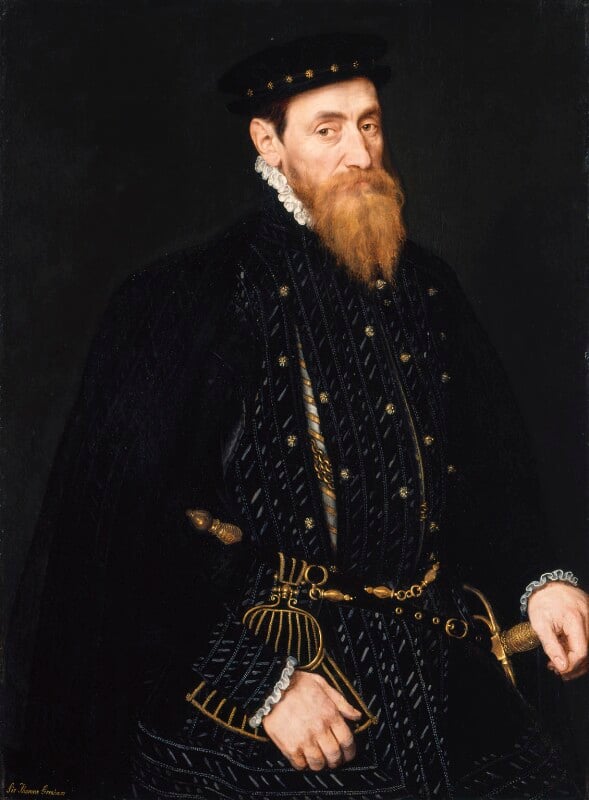
Sir Thomas Gresham, painted by an Unknown Netherlandish artist, circa 1565:
Gresham was involved in so many financial innovations, from ways to improve personal accounting through to how the country’s finances were managed and initiatives to improve the global standing of England’s currency.
One example of the later, was with the strength of Sterling.
Today, the value of the UK’s currency is more dependent on measures such as interest rates, trade deficits, GDP etc. however in the 16th century, the value of the currency was linked to the metal in which the coin was minted, and much of England’s coinage was viewed as “debased” – meaning that the face value of the coin was more than the value of the metal in which it was minted.
A common cause of debasing a coin was through clipping, where small pieces of a coin around the edge, were clipped off. Doing this to a sufficient number of coins provided a large amount of valuable metal, however the value of the metal of the clipped coins was now less than their face value.
When using coins for trade, such as to purchase goods for import, continental traders were not happy to accept English coins without weighing and testing their metal content, to ensure they were getting the value of payment expected. This took time, and reduced the value of English coinage to foreign traders.
Initiatives had been tried to recall all the coinage in circulation with little success, and during Elizabeth I’s reign, Gresham was the brains behind the plans for Secretary of State William Cecil to recall and remint the currency in circulation, as a way of restoring the correct value to the country’s coinage.
The concept of debased coinage replacing coinage that aligned with face value was later framed as Gresham’s Law – “Bad money drives out good”, although the issue around debased coinage, and its impact on coinage as a method of trade, store of value etc. had been known for many years before Gresham.
Thomas Gresham was also a champion of double-entry book keeping and he appears to have been one of the first to have used and introduced the technique into England.
Double-entry is where separate entries are written using two accounts for credits and debits, and was a method that Gresham encountered during his time in Antwerp. The technique was used considerably by European merchants, and appears to have originated with Italian merchants.
Gresham’s double entry journal covering the period from the 26th of April 1546 to the 10th of July 1552 has survived and shows how meticulous Gresham was in using this accounting method for his own, personal finances.
The period covers part of his time as a trader in Antwerp, when he was bringing in goods from England to trade and sell, as well as goods he purchased in Antwerp to sell in England.
Gresham called the profit and loss account in his ledger his account of “damage and gain”, which is a rather good way of describing losses and profits.
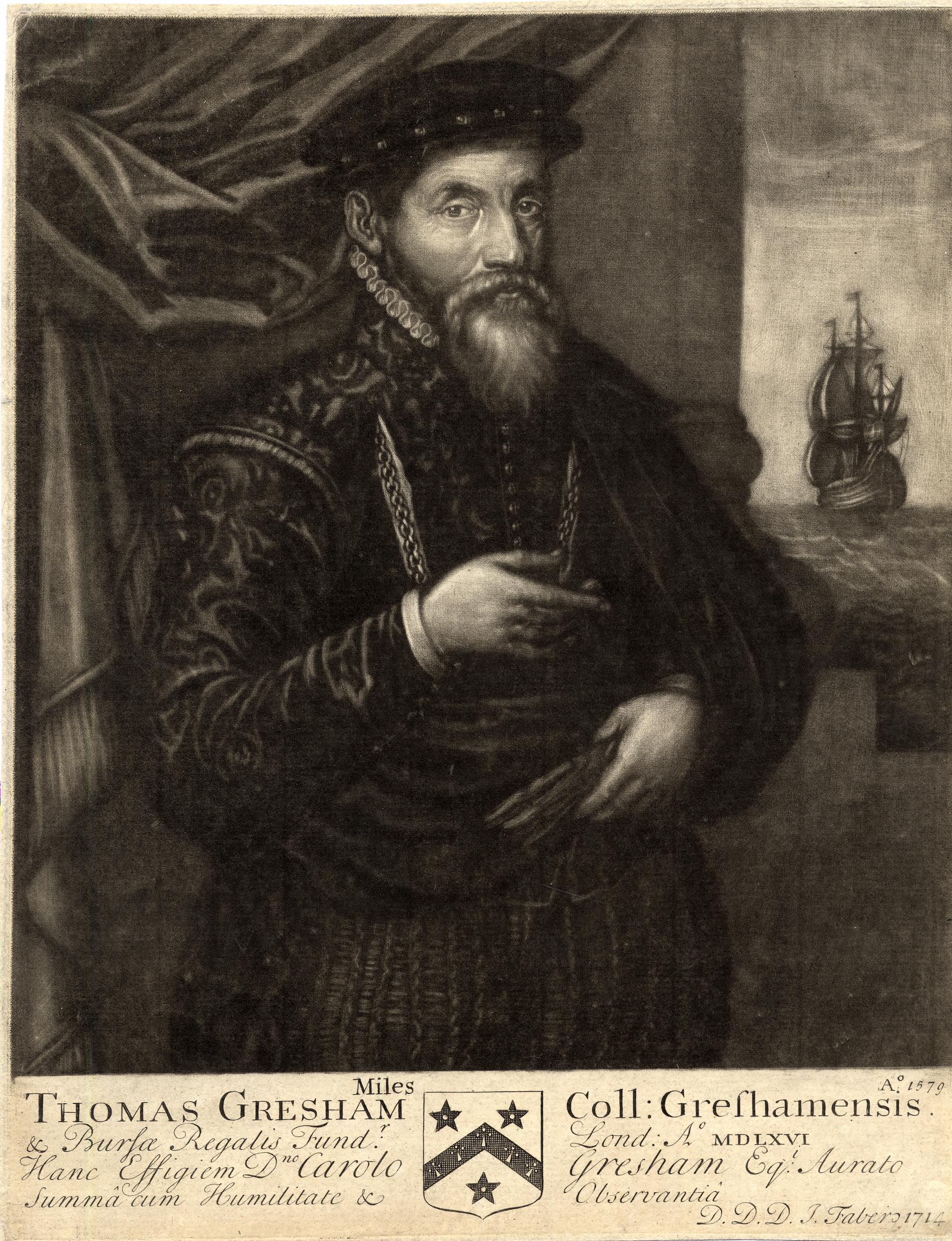
Another print of Thomas Gresham, and what I like about this print is the ship to his right. Paintings, prints etc. would often include things that were important of representative of the person portrayed. The print may be symbolic of Gresham’s interest and influence in global trade and commerce. The print also records his founding of Gresham College:
It is impossible to overstate Gresham’s importance to the financial health of the country, the rapidly growing importance of the City of London as a financial and trading centre, free trade, trading and accounting techniques etc. But there were many other ways in which Thomas Gresham had a considerable impact on the future of the City of London. One of which is still very active and follows its founding principles, the second is still physically here, but no longer has the purpose that Gresham intended. This is:
The Royal Exchange
In the 16th century, trading in the City of London was carried out on the street, or in the small houses and shops that lined streets such as Cornhill and Lombard Street, and there had been calls for a dedicated place where people could meet to trade, agree prices, and generally conduct business of all types.
Sir Richard Gresham first became aware of the opening of a Bourse, or trading centre in Antwerp, one of the major trading centres of Europe. Sir Richard pushed for such a building to be constructed in the City of London, however despite the project receiving royal support, there was no suitable space available.
The proposal was taken up by his son, Sir Thomas Gresham, who was also very well aware of the Bourse from his many years in Antwerp, where he worked on behalf of the Crown, as well as trading on his own account.
Gresham put his own money into the project, along with significant funding generated through public subscriptions, and which supported the purchase of a block of land in Cornhill Street, a short distance from what is now the Bank junction, and occupying the same site as the current Royal Exchange.
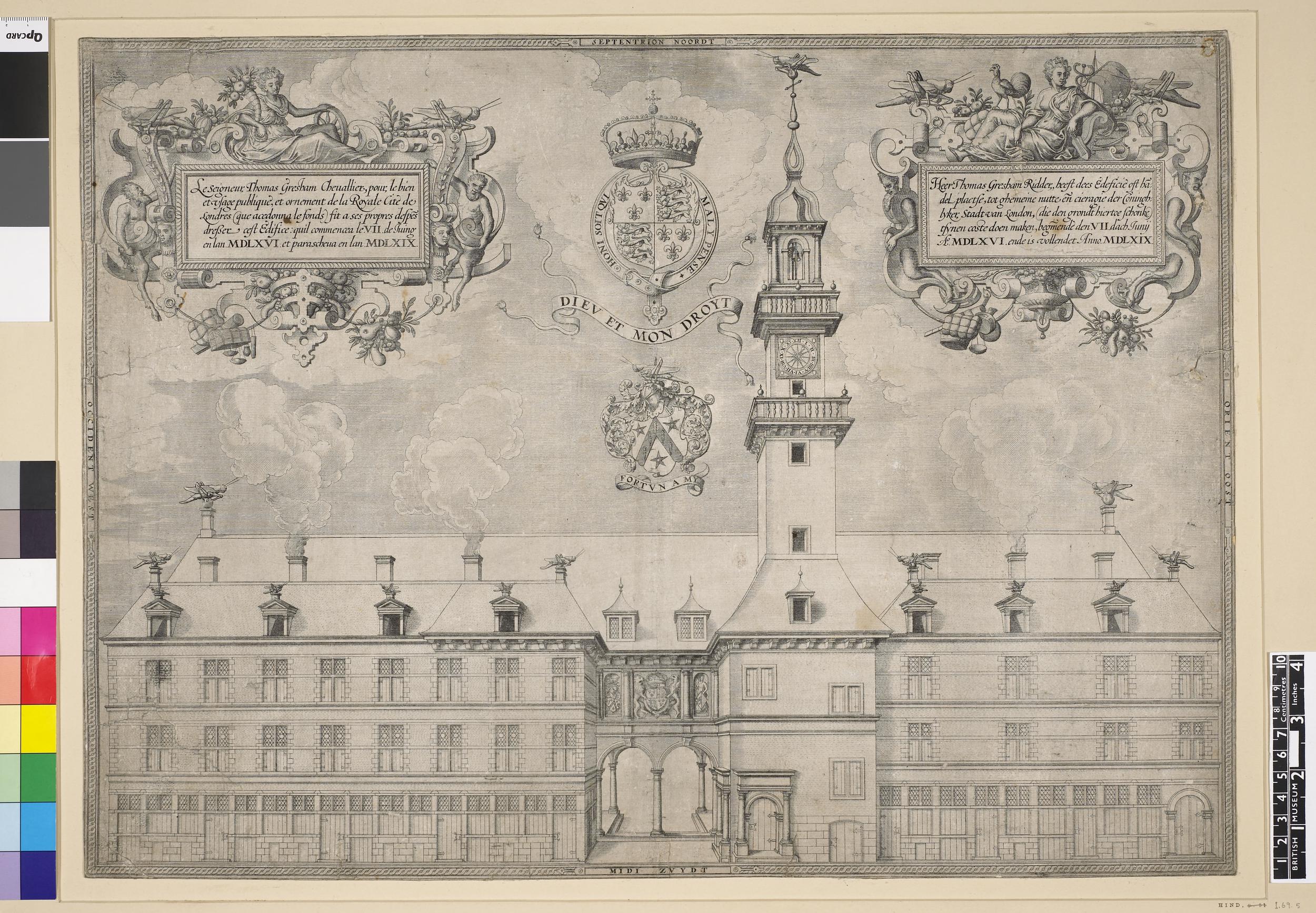
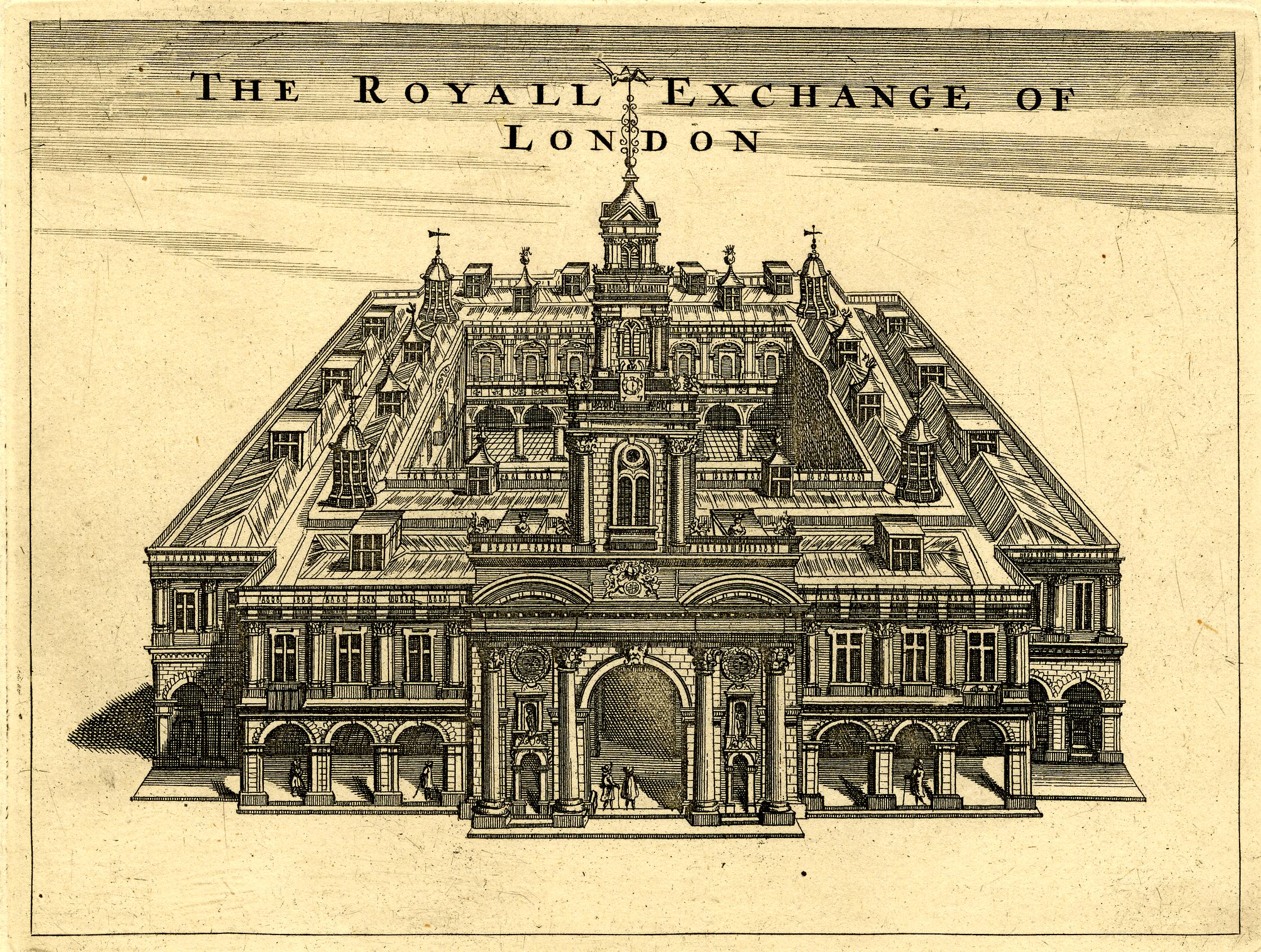
The building was opened by Queen Elizabeth I in January 1570, and it was the first, large, Renaissance style building in the City. Gresham had intended that the new Exchange was named after him, however at the opening, Elizabeth I gave it the name Royal Exchange, and Gresham obviously had to retain the Queen’s favour, so the Exchange retained the name Royal.
On top of the tower in the above print is a grasshopper, as still to be seen on the current Royal Exchange, and at Gresham’s School in Holt, Norfolk. The following is an enlargement of the grasshopper from the above print:
The purpose of the Royal Exchange was to provide a place where trades could be carried out, where people could meet, offices could be rented etc. and followed the approach Gresham had seen in the Antwerp Bourse.
Providing a central place for face to face trading was more efficient than being distributed across the city, and the opening of such an impressive Exchange greatly enhanced the City of London’s growing reputation for trade, commerce and finance.
This first Royal Exchange was destroyed during the 1666 Great Fire, and was soon rebuilt following a design by Edward Jarman.
The second Royal Exchange, from a print of the late 17th / early 18th centuries, again with a grasshopper on the top of the tower:
This second iteration of the Royal Exchange lasted until 1838, when, as with the first, it was also burnt down.
The Royal Exchange was soon rebuilt, following a competition to find a design. The competition was won by the architect William Tite, who seems to have also been one of the judges of the competition.
Tite’s design follows the layout of the original two Exchanges, with a central courtyard surrounded by four wings of offices and shops, however Tite’s design changed the main entrance from facing onto Cornhill, now to face onto the Bank junction.
The buildings that had once occupied the triangular space in front of the Exchange were demolished, and it was opened up so that the full Corinthian portico of the new building faced directly onto the Bank junction, and seems almost to mirror the Mansion House across the junction.
The new Royal Exchange was opened in 1844 by Queen Victoria, and this is the building that we still see today, and which retains the grasshopper shown in the photo earlier in the post.
The use of the Royal Exchange as a place for general, face to face trading and commerce faded in the late 19th century as specialist trading exchanges were set up to provide a place where trades could be made, meetings held, and news received in a specific and related set of commodities or services.
In 1939, the building became the offices of the Guardian Royal Exchange Assurance Company, and in the late 1980s, the company made substantial changes to the interior of the building, which included replacing the original roof, and an additional upper floor.
In 2001, the building was again refurbished, and reopened as a centre for luxury shops, restaurants and bars, and the Royal Exchange retains this function today.
Although Sir Thomas Gresham was instrumental in the founding and construction of the Royal Exchange. it never carried his name, just the Gresham family’s grasshopper symbol as a weathervane. His name though has been, and still is, recorded in a number of London places, including the 1845 Gresham Street, which was a rebuilding of earlier streets Lad Lane and Cateaton Street.
Gresham’s name is also still in use with a significant London educational institution, in which Gresham was again instrumental in founding. This is:
Gresham College
In Antwerp, Sir Thomas Gresham experienced the way that an education in trade, scientific and technical developments would benefit the commercial life of a country to such an extent that through his Will, in 1597, Gresham College was established, to be run and administered by the City of London Corporation and the Mercer’s Company.
Gresham College was an attempt by Gresham to provide an education to those of the City, traders, merchants and mariners, who had not had a formal education.
The college provided free lecturers that were delivered by Professors appointed by the City of London Corporation and the Mercer’s Company.
The Mercers appointed professors in Law, Physic and Rhetoric, whilst the City of London appointed professors in Divinity, Astronomy, Geometry and Music.
Until 1768, the College was based a Sir Thomas Gresham’s former home at Bishopsgate. When the site was redeveloped, it moved to the Royal Exchange, and then to a new, dedicated building on the corner of Gresham Street and Basinghall Street, the college later held lectures at a number of different locations, ending up at Mercers Hall, before finally moving to the current location of Barnard’s Inn Hall in 1991.
Remarkably, given that Gresham College is over 400 years old, the approach is basically the same as when the college first started.
Professors are appointed for a three year term and each professor, along with visiting professors, will provide free lectures during their term.
Lectures can be attended in person, or watched online. Many of the past lectures are also available to watch online.
Lectures cover an extremely varied range of subjects, ranging from “How It Ends: What We Know about the Fate of the Universe” by Professor Chris Lintott, who is Gresham Professor of Astronomy:
through to “Modern Pagan Witchcraft” by Professor Ronald Hutton, the Gresham Professor of Divinity:
A could be expected, there is also a very large archive of lectures on London’s history, as well as lectures on Sir Thomas Gresham.
The Watch Now option along the top of the page takes you to a page where a sample of lectures are listed, as well as a topic list along the top of the page.
If you have finished reading all the back issues of London Archaeology mentioned in last week’s post, then the lecture archive of Gresham College provides another wonderful source of learning on not just London, but so many other different aspects of the wider world.
It is a wonderful resource, all thanks to Sir Thomas Gresham.
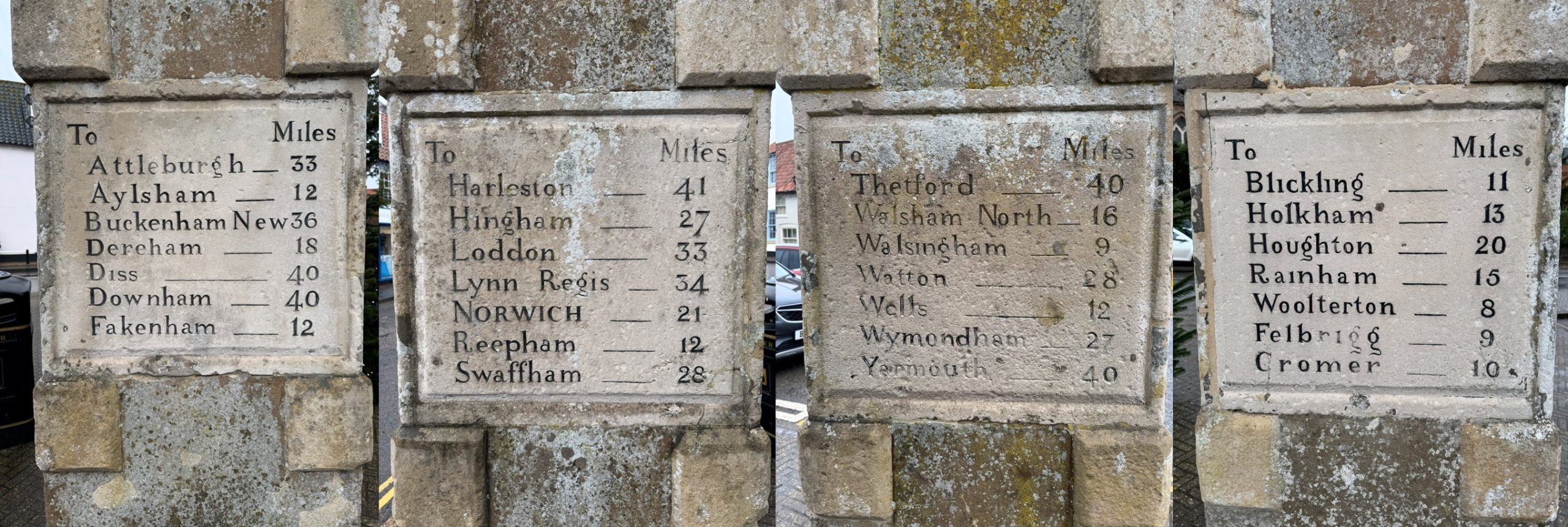
Returning to Holt, and as you walk back west along Market Place from the site of Gresham’s old manor house, and at the end of High Street, there is a wonderful Grade II listed, mid-18th century milestone:
I wondered if London was listed on the milestone, however all the miles and destinations were to local towns and villages, with the furthest being 41 miles away:
An indication of how relatively remote Holt was at the time, and a long way from any direct roads to London, with a trip to Norwich probably being required to pick up the main road to London.
The Gresham’s were a fascinating family. Whilst Sir John Gresham was active in London, and a Lord Mayor of the City of London, his lasting monument is Gresham School in Holt.
It was his nephew Sir Thomas Gresham who left a lasting reminder of his life in London, apparently one of the richest and most well connected men in England at the time.
If you would like to follow up on the story of Sir Thomas Gresham, there are some lectures on his life in the collection at Gresham College, and the book Gresham’s Law by John Guy (who also presents some of the lectures), is excellent:
In the game of who from history you would invite to a dinner party, Gresham would be high up on my list, although by the end he would probably have left with a large profit after selling me some wool and providing a loan – all at rates beneficial to Gresham.
The Exhibition of Industrial Power and London Archaeology – two completely unrelated topics in today’s post. The first, I will come to in a moment, whilst London Archaeology is the first post of the month “Resources” feature, where I look at some of the resources I use, and which you may also find helpful, to understand and explore London’s long history. London Archaeology resources will be at the end of the post.
But first, if you have been reading the blog for some years, you will know I have an interest in the 1951 Festival of Britain.
Just six years after the end of the Second World War, the Festival was a huge undertaking in terms of planning, resources, construction. etc. at a time when the country was very short of these resources along with the cash needed to pay for a festival.
There were many who argued, with some justification, that all the resources and money would be far better spent on the rebuilding that the country still urgently needed.
The Festival of Britain was though intended to help show the country both to the nation and to the rest of the world. The long history of the country and its people, the arts, design, creativity, science, industry and manufacturing capabilities of the country.
Designers, sculptors, authors, architects all contributed to show a very different post-war world, an optimistic view of the future after years of war and rationing.
Whilst the South Bank exhibition was the main festival site, and the place that is most commonly associated with the Festival of Britain (and where the Royal Festival Hall is today one of the few, physical survivors of the festival), the Festival covered the whole country.
There was a Festival Village, a touring exhibition on an old aircraft carrier, football matches organised with European teams, music and literary festivals etc. all branded with the Festival of Britain design.
There were seven main festival sites:
The main South Bank Exhibition
The Exhibition of Science in South Kensington
The Exhibition of Architecture in Poplar, East London
The Festival Ship Campania, which toured major ports around the country
The Travelling Land Exhibition which went to Birmingham, Leeds, Manchester and Nottingham
The Exhibition of Industrial Power in Glasgow
The Ulster Farm and Factory Exhibition in Belfast
In London, there was also the Festival Pleasure Gardens at Battersea, not one of the exhibition sites, but a major, and well visited part of the festival where there were gardens, rides, illuminations after dark, cafes and restaurants etc.
The main exhibitions each had their own guide book. These were detailed guides to the exhibition, and contained a wealth of information on the exhibits and wider context of each respective exhibition.
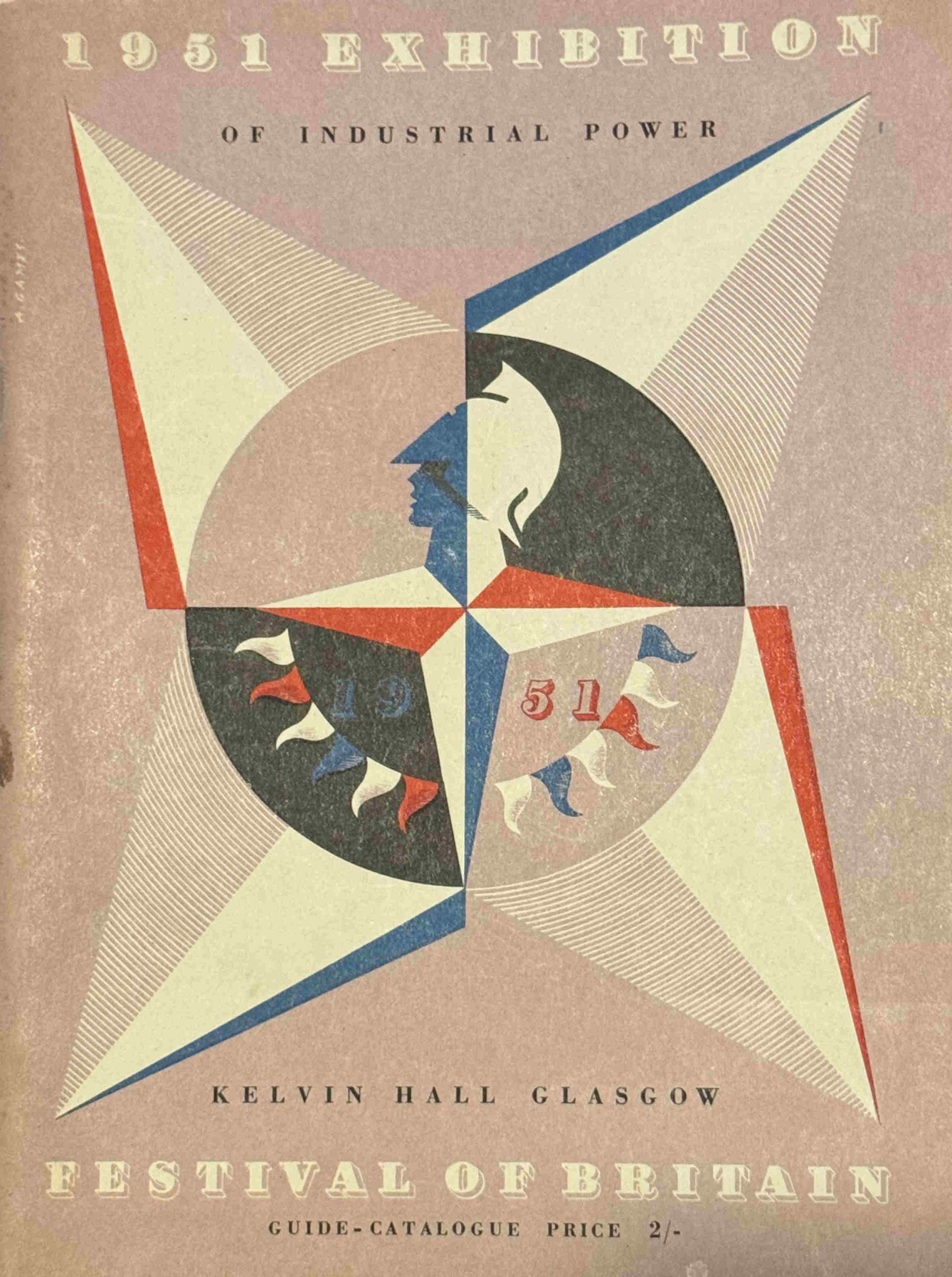
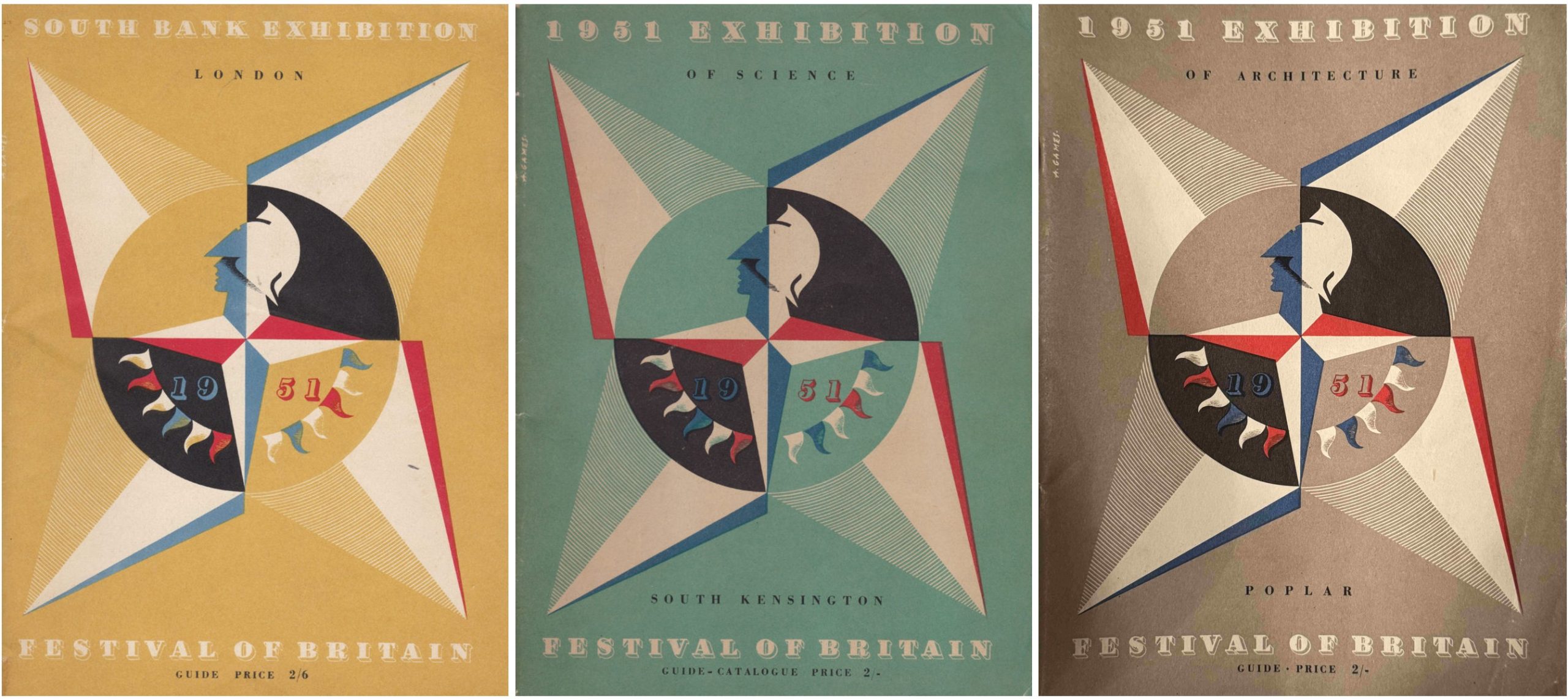
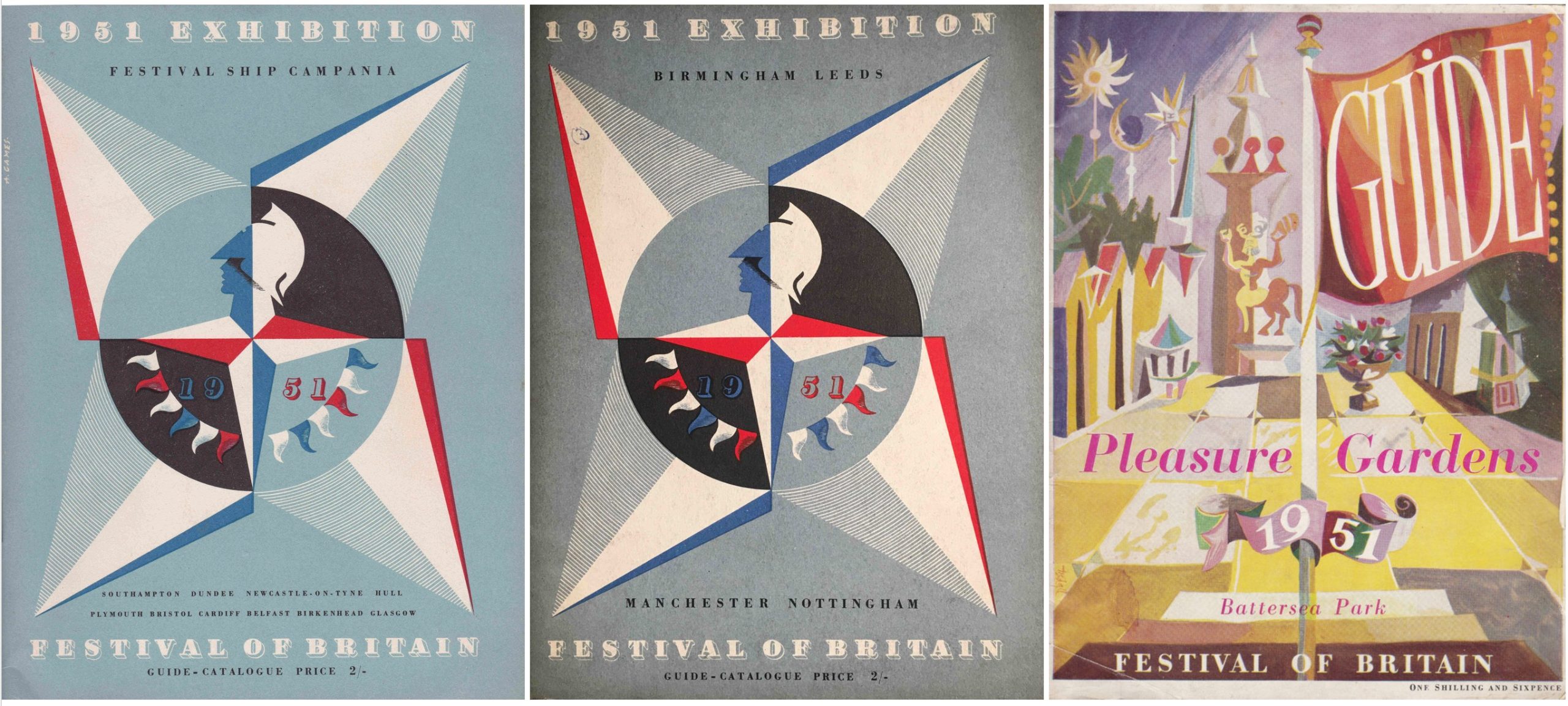
Each guide book had the Abram Games designed Festival of Britain emblem on the front cover, but with a different colour background for each exhibition, with the rest of the guide following the same style and approach to content.
The guide books provide a wealth of information on not just the Festival of Britain, but also the country in 1951, and I have been trying to collect one of the guide books for each festival site, and I recently found one of the two that I am missing.
The guide book cover for the 1951 Exhibition of Industrial Power at the Kelvin Hall, Glasgow:
My other guide books are shown in the following images, the first three are the South Bank, South Kensington Science Exhibition, then the Exhibition of Architecture at Poplar:
My final three are the Festival Ship Campania, the Touring Land Exhibition, and then the Pleasure Gardens at Battersea:
There is now only one of the main Festival of Britain guide books that I need to find, the Ulster Farm and Factory Exhibition held in Belfast. This guide book follows exactly the same format as the main guide books shown above. I have seen a couple in exhibitions, but have never found one for sale.
Next year is the 75th anniversary of the Festival of Britain, and it would be great to find the Belfast guide by the end of the year.
I have written about the other exhibition sites in previous posts over the years, and will now look at the Glasgow Exhibition of Industrial Power.
The guide book starts with some background to the exhibition:
“In common with the other Festival exhibitions, Industrial Power is not a trade fair. Nowhere in these halls will you find stands set aside for commercial exhibitors. The exhibition has been planned, from the turnstiles to the exit, to tell a story – the story of Britain’s tremendous contribution to heavy engineering. It is a story which concerns not only machines, but the men who made them. It sets out to show not only British inventiveness, but the effect it has had on the world. Against this background are shown the outstanding products of British heavy engineering in the present day.
The theme is simple. Heavy engineering is the conquest of power. There are two main sources of raw power used by heavy engineering today. They are coal and water. There is therefore a coal sequence and a water sequence which unite towards the end of the exhibition in the Hall of Railways and Shipbuilding.”
The exhibition was visited by Princess Elizabeth, the future queen, in June 1951, however in a reminder that although this was six years after the end of the Second World War, the country was still involved in the Korean war, as in the same report of the princess visiting the exhibition, she also “included at her own special request a visit to soldiers wounded in Korea who are now in Cowglen Military Hospital, where she had a rapturous reception”.
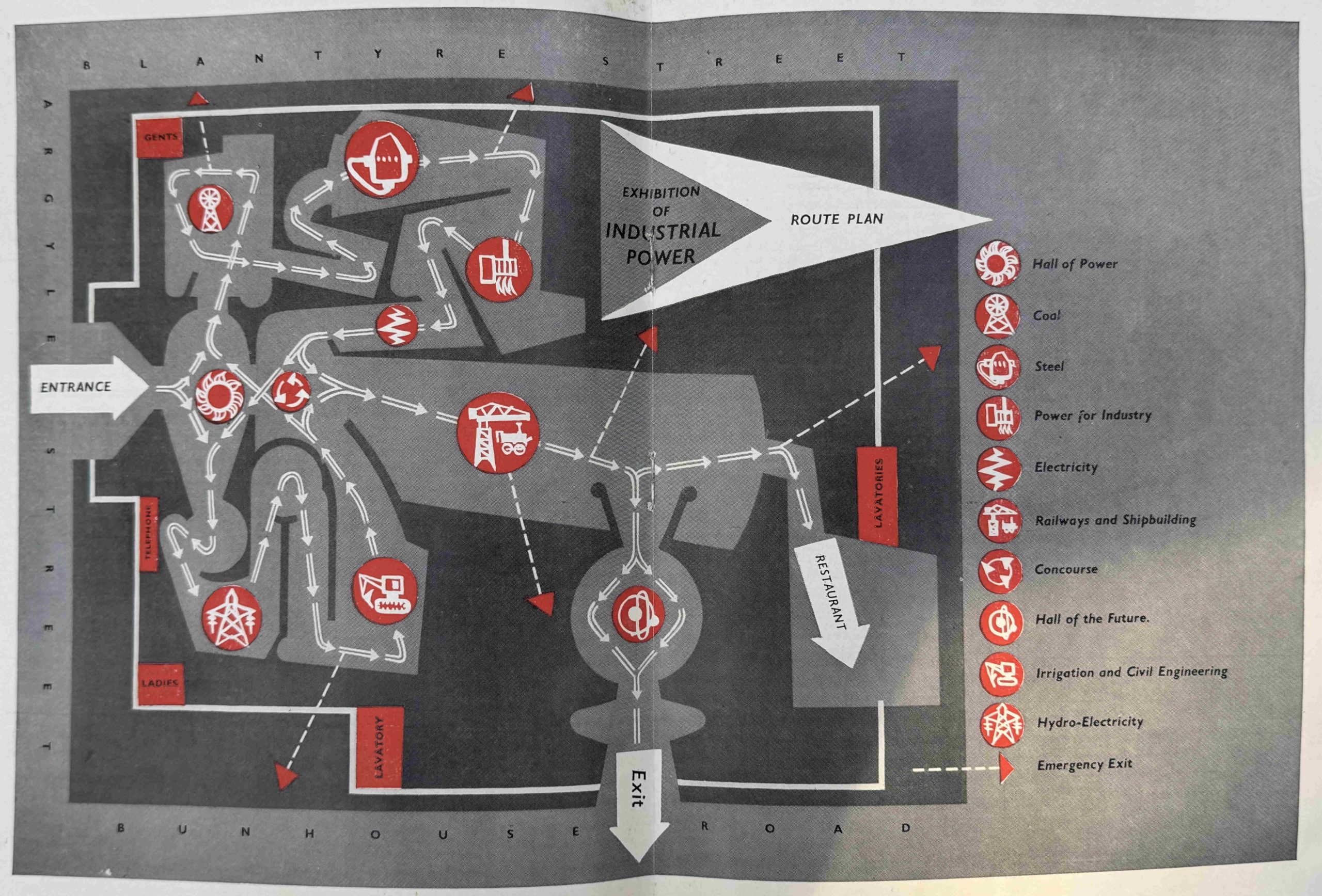
As with the other exhibition sites, at Glasgow, the story was presented to the visitor as they walked through a series of Halls which focused on individual aspects of the overall theme. Walking through the Glasgow exhibition, there was a Hall of Power, of Coal, Steel, Power for Industry, Electricity, Railways and Shipbuilding, Irrigation and Civil Engineering and Hydro-Electricity.
The final part of the exhibition was the Hall of the Future, which offered a vision of a source of power for the future.
The route through the exhibition and the individual halls is shown in the following plan from the guide:
A very vivid example of how the country has changed since 1951 was that coal was a central theme of the Exhibition of Industrial Power, as coal was the main energy source for almost all British industry, electricity generation and domestic energy use.
The Hall of Coal celebrated this fact, and the intention of the displays were to leave the visitor with evidence that:
Coal sets the wheels in motion and keeps Industry thriving
Coal is the basis of the Machine Age
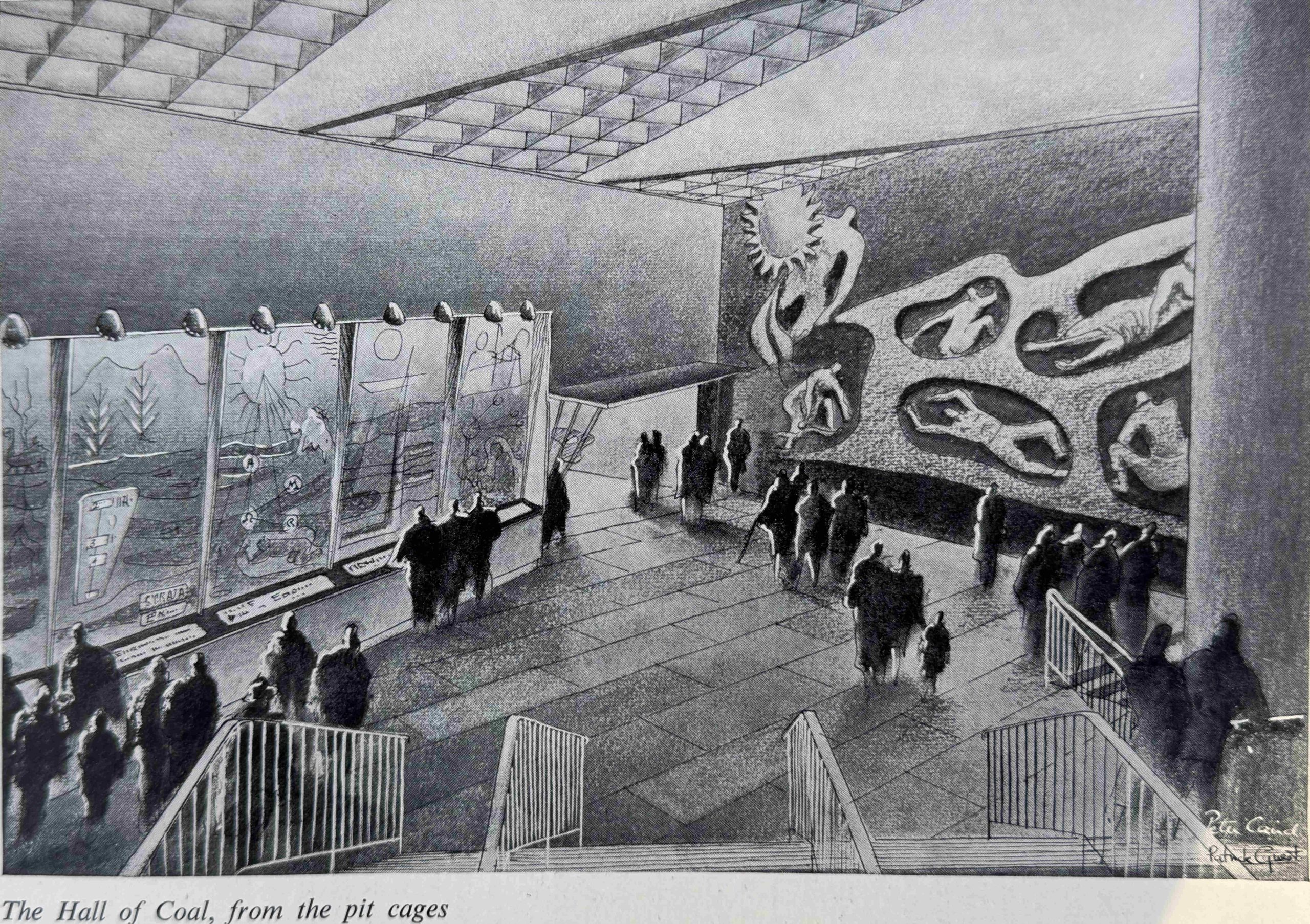
The displays took the visitor from the geological formation of coal, where plants took energy from the sun, through to the process of mining coal, and to help with providing the visitor with the experience of mining coal, there was an artificial mine as part of the exhibition.
To make the experience as real as possible, there were two National Coal Board cages which could take 30 visitors each. There was a descent of only 16 feet to the “mine”, however to make this as realistic as possible, the descent commenced with a jerky start to simulate a big drop, then a slow descent and a sudden stop at the bottom.
Having reached the artificial mine, visitors would see a full sized section of a modern, 1951 coal mine, complete with working machinery, manned by a team of Scottish miners.
As well as the modern mine, there were also historical displays showing how mining had evolved, including when children and women formed a significant part of the mining workforce, when miners had to descend to the coal face hanging on a chain rather than within a cage, the role of a 17th century fireman who would descend to the mine at the start of a shift, wrapped in wet rages, to set fire to the gas that had accumulated and clear the workings.
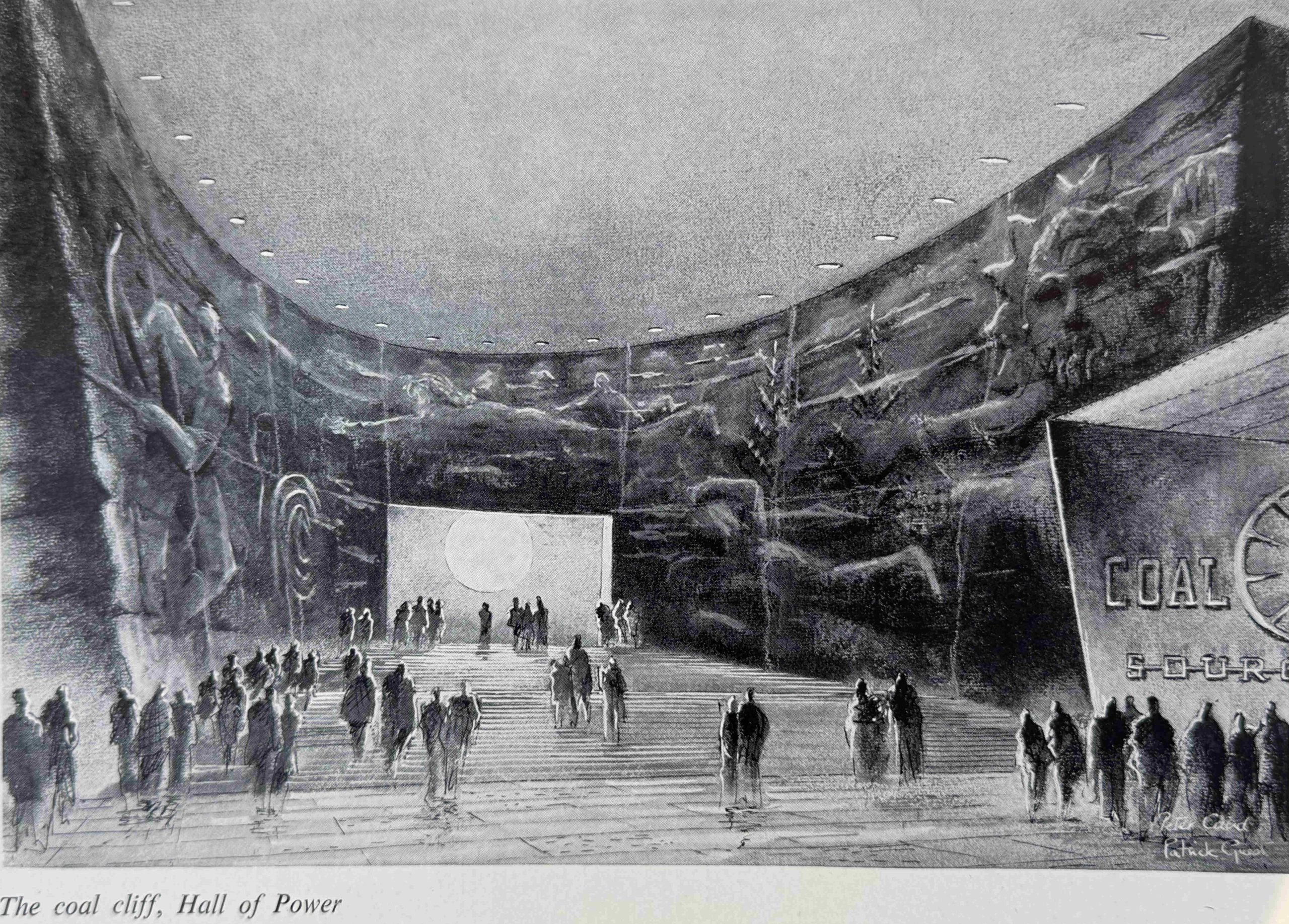
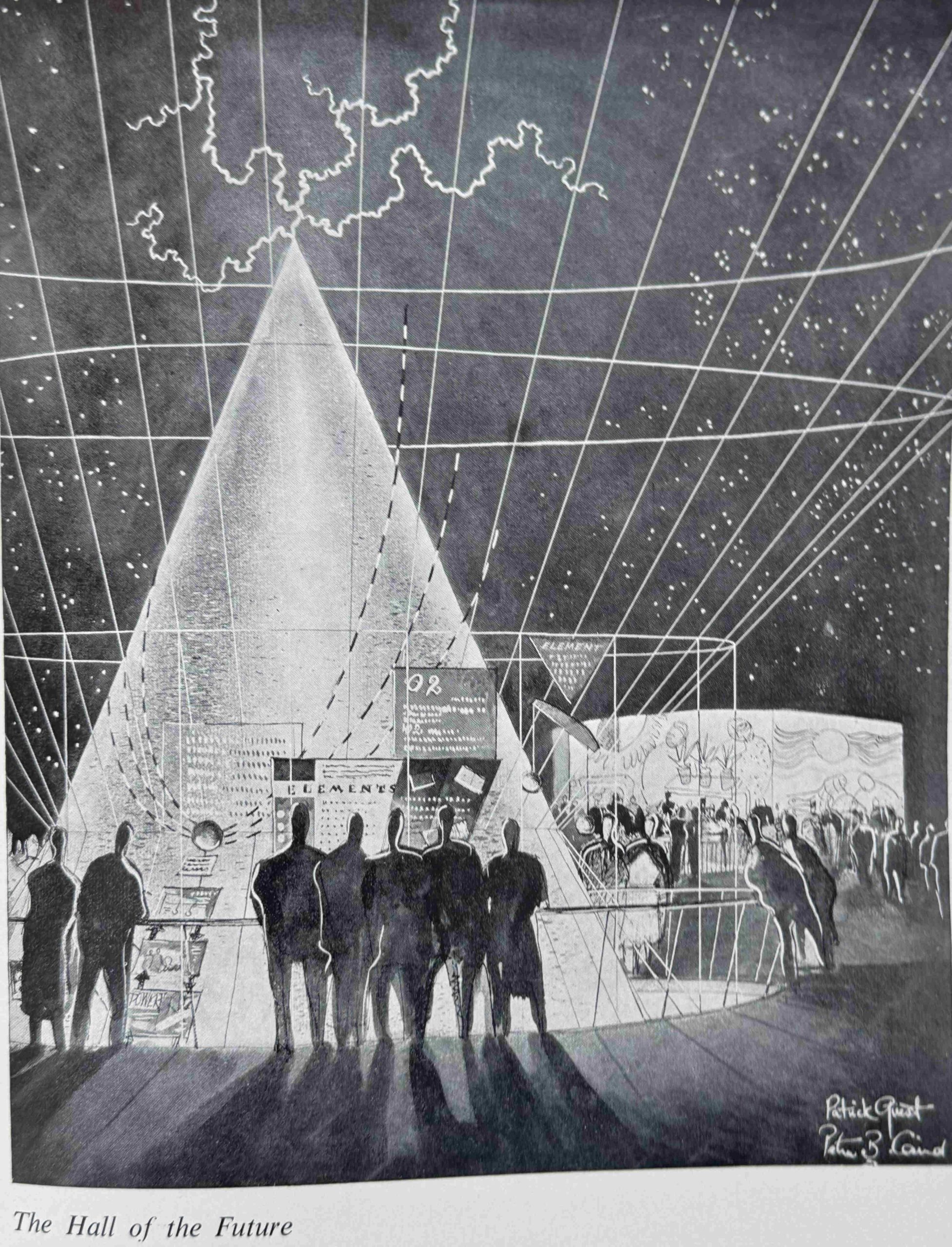
Unfortunately, there are no photos of the exhibitions in the guide as it was published in advance of opening, however it does contain drawings of the some of the halls and exhibits.
This is the Coal Cliff in the Hall of Power:
And the Hall of Coal from the pit cages:
The approach to how information was presented, the mix of physical objects, illustrations, sculpture, reliefs, lighting, written descriptions and the theme of taking the visitor on a journey was the same in Glasgow to all other Festival of Britain exhibitions, including that on the South Bank, although in Glasgow the exhibition was dedicated to power and heavy industry.
What these black and white illustrations do not convey is the use of colour throughout the exhibition. For example, as part of the display showing how coal is formed, there was a symbolic sun, created by bright, pulsing bulbs, to represent coal’s origin in heat.
The other halls followed a similar approach, with the Hall of Steel covering the historic development of the material from the work of Darby, Huntsman, Cort, Neilson, Bessemer, Siemens, Brearley and Hadfield, the “fathers of the steel industry” as the exhibition described them, through to the processes used to produce steel in 1951, the modern machinery and working practices.
The Hall of Electricity again starts with the discovery of electricity: “Electricity is invisible, and can be measured only by its effects. That is why it remained hidden for so long, a latent force in human history, its power unsuspected“, and then runs through how electricity is generated, the modern power station, and uses Sir Charles Parsons as a central figure in the development of large scale generating systems.
The Hall of Hydro-Electricity told the story of places throughout Scotland where the flow of water is used to generate electricity. The last section of the hall covered the Severn Barrage, a proposed project to make use of tides on the River Severn to generate large amounts of electricity.
Generating electricity from the large tidal range of the River Severn has been an on / off proposal for the last 75 years, since the Festival of Britain, and the Severn Estuary Commission reported in March 2025, their recommendations that such a tidal project was feasible.
I suspect that there will still be discussions on such a project in 75 years time.
The Hall of Shipbuilding and Railways included “a great ship-like structure that runs the length of the hall”.
As with all the halls, the story of the development of shipbuilding and the railways was told, starting from first developments through to the latest technology, and the displays included “a magnificent locomotive which will be exported to the Government of Victoria when the exhibition closes”.
Rather ironically, given the exhibitions focus on industrial power, Scotland was suffering power cuts in 1951, and on the 15th of June, 1951, many Scottish newspapers reported that “Exhibition Plunged In Darkness. The £400,000 Exhibition of Industrial Power at the Kelvin Hall, Glasgow, was plunged into darkness for almost an hour today by an unexpected power cut. Visitors who had just entered the hall to tour the exhibition were left standing in total darkness where a few seconds before they had been gazing at vivid artificial lightning flashes”.
Power cuts appear to have been common throughout Scotland in 1951, later in June the Paisley Daily Express was also reporting that Paisley, along with most parts of the country were suffering power cuts for more than an hour, that there was a ten percent voltage reduction, and that the exhibition in Glasgow again suffered power cuts.
The final hall before visitors left the exhibition was the Hall of the Future.
In this hall the visitor looked down into five pits, each of which covered one of five men who influenced heavy industry in the past, or may do so in the future. These were Watt, Trevithick, Faraday, Parsons and Rutherford, and above the pits a shining cone flashes lightning and represents the limitless future through the promise of nuclear power.
The Hall of the Future:
The design of the guidebook for the Exhibition of Industrial Power was identical to the other Festival exhibitions, whether on the Southbank, Poplar, or the Festival Ship.
The text was intended to educate, and did not (to use a modern phrase), “dumb down” or patronise the reader, but it was also of its time.
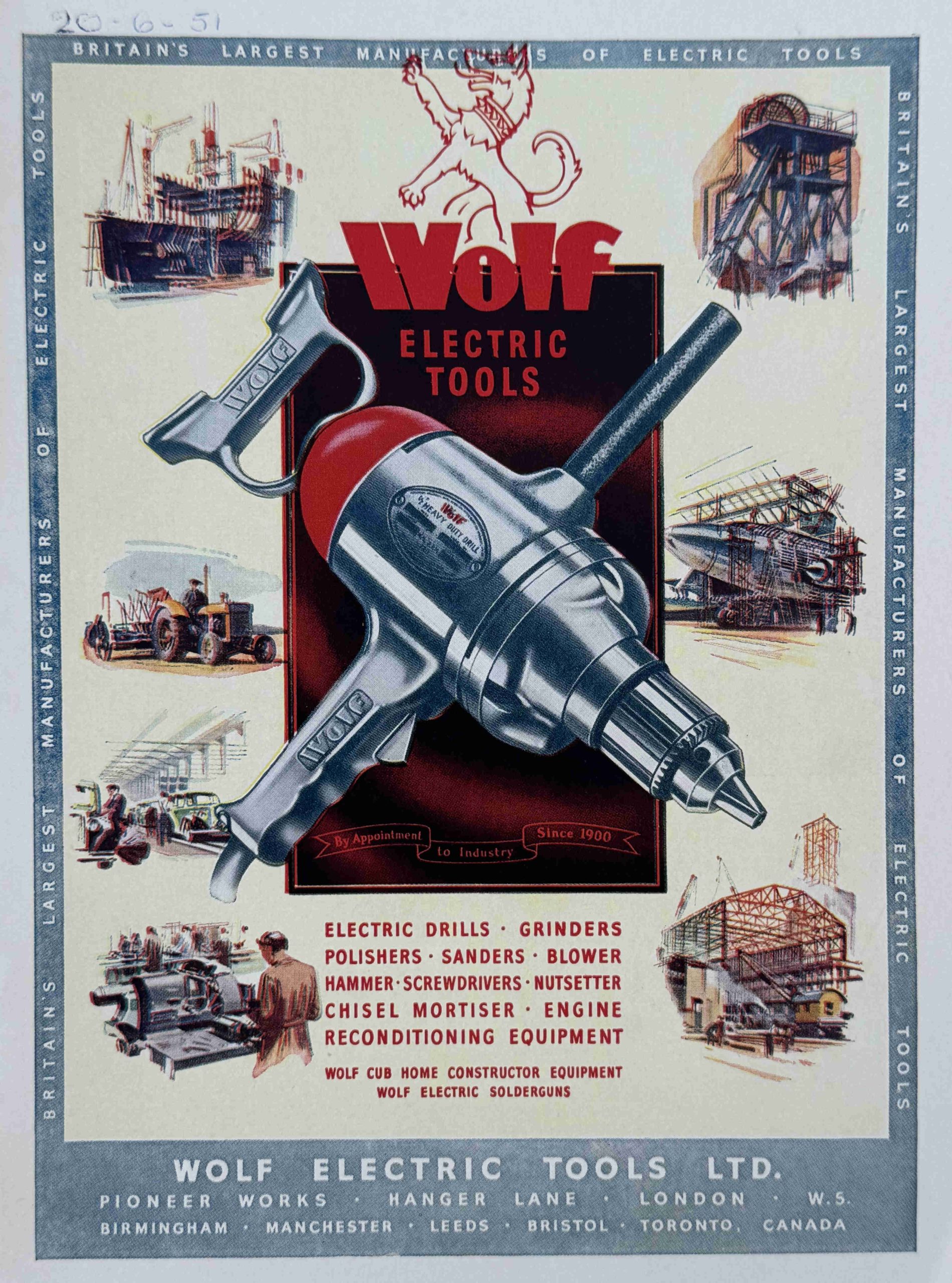
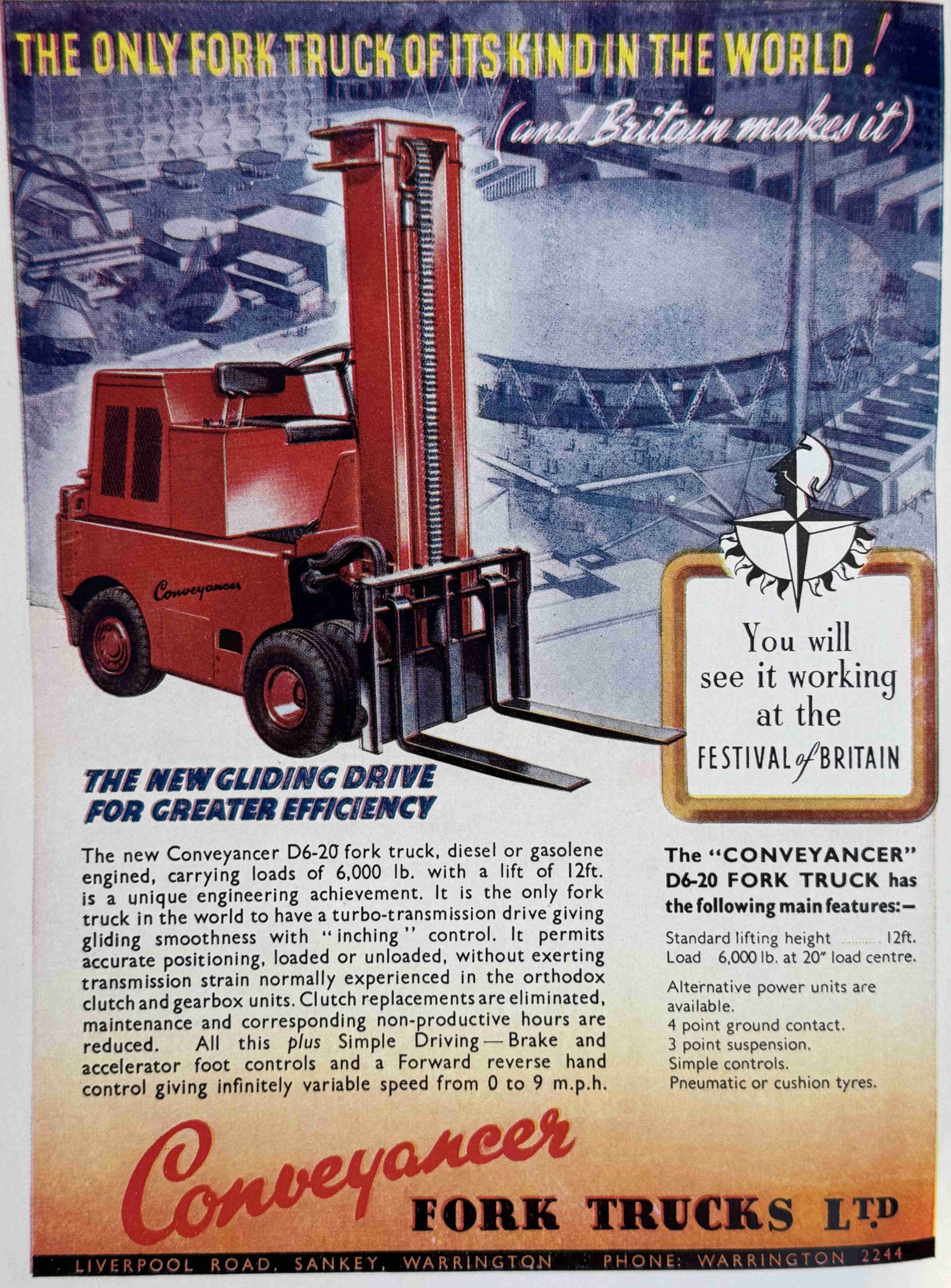
As with all the other exhibition guidebooks, the one for Glasgow included a range of colour adverts for companies who had provided their products for exhibition, or who were involved in the theme of the exhibition, so we have Wolf Electric Tools:
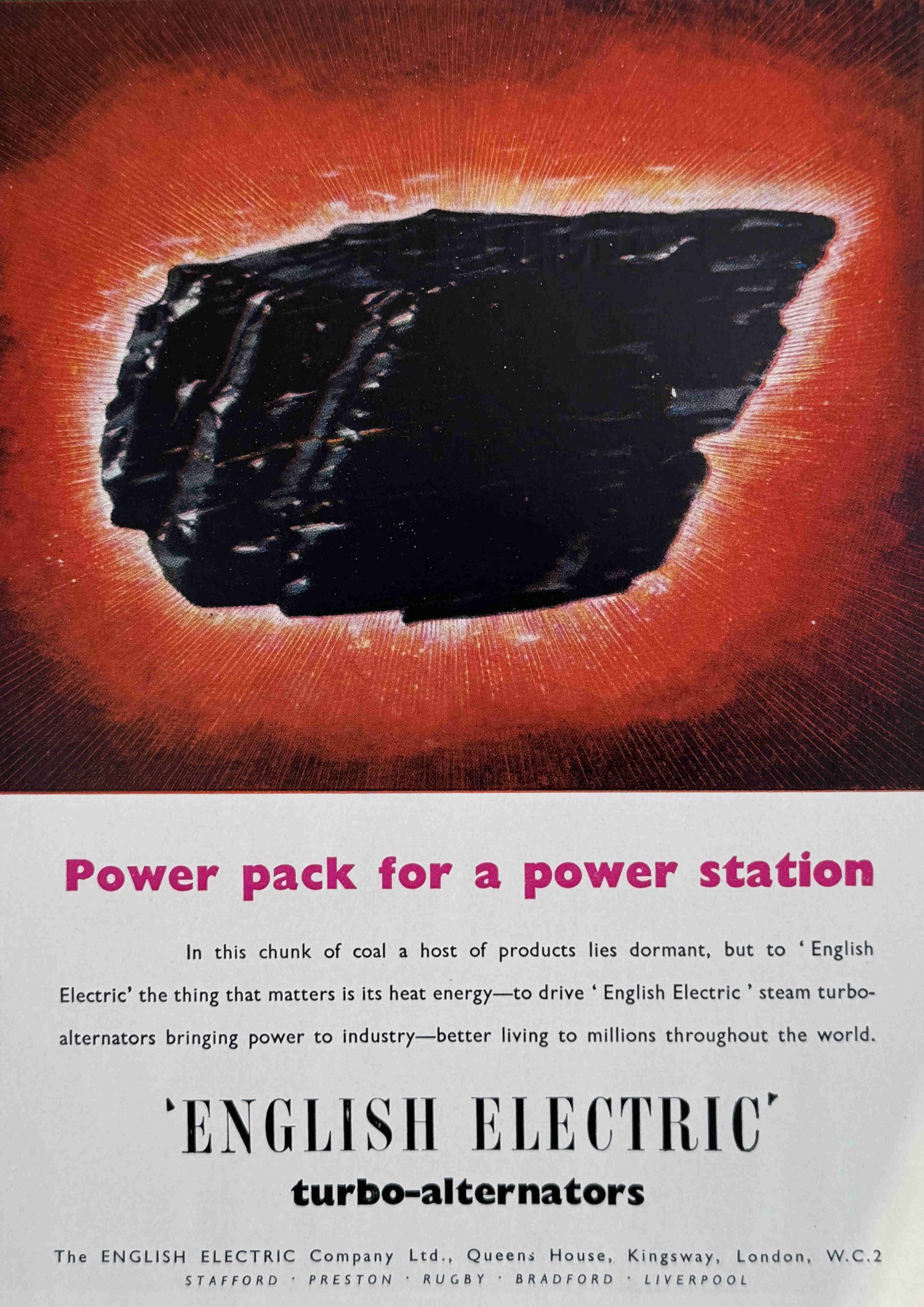
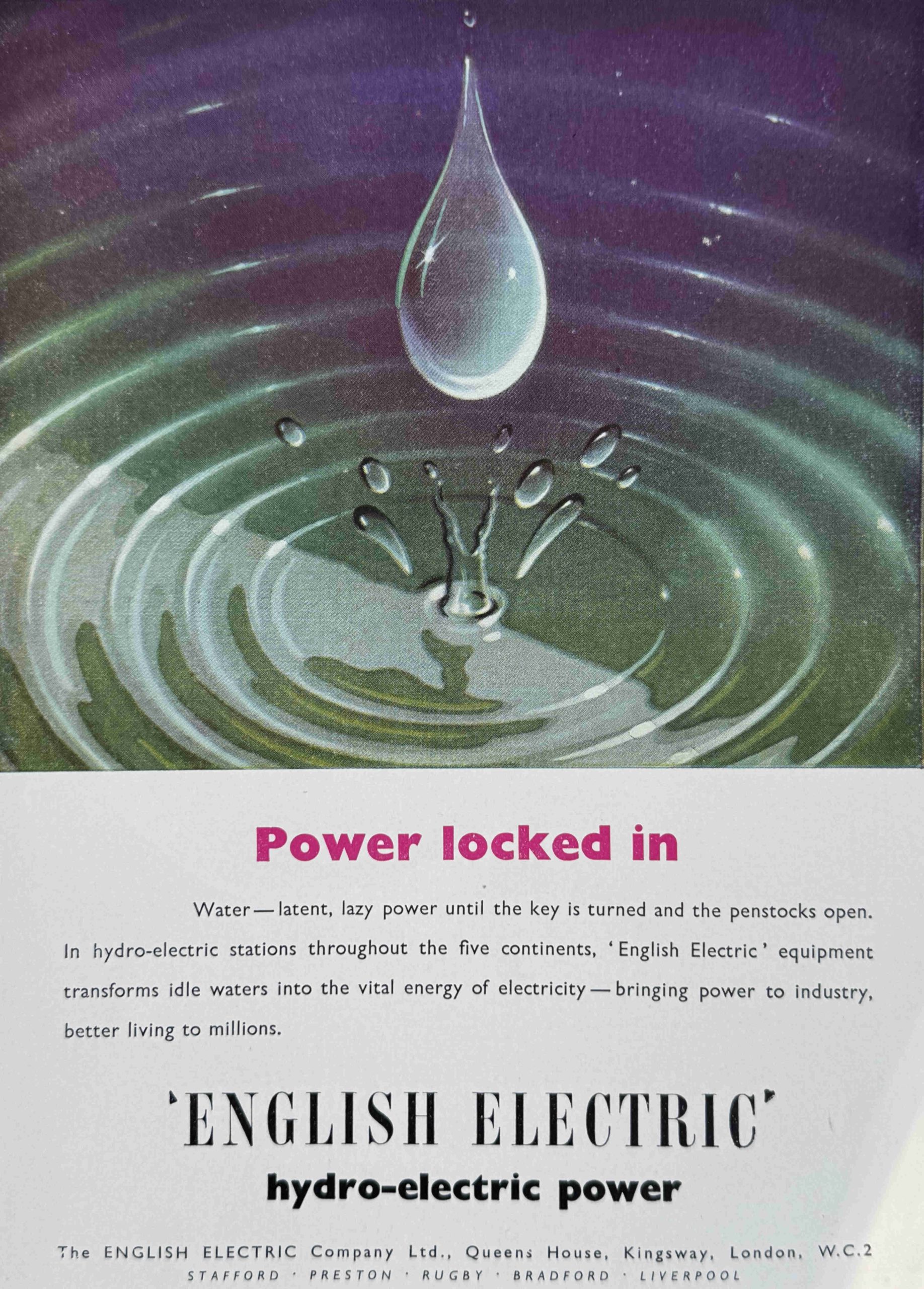
English-Electric (with the advert also emphasising the use of coal as a source of energy):
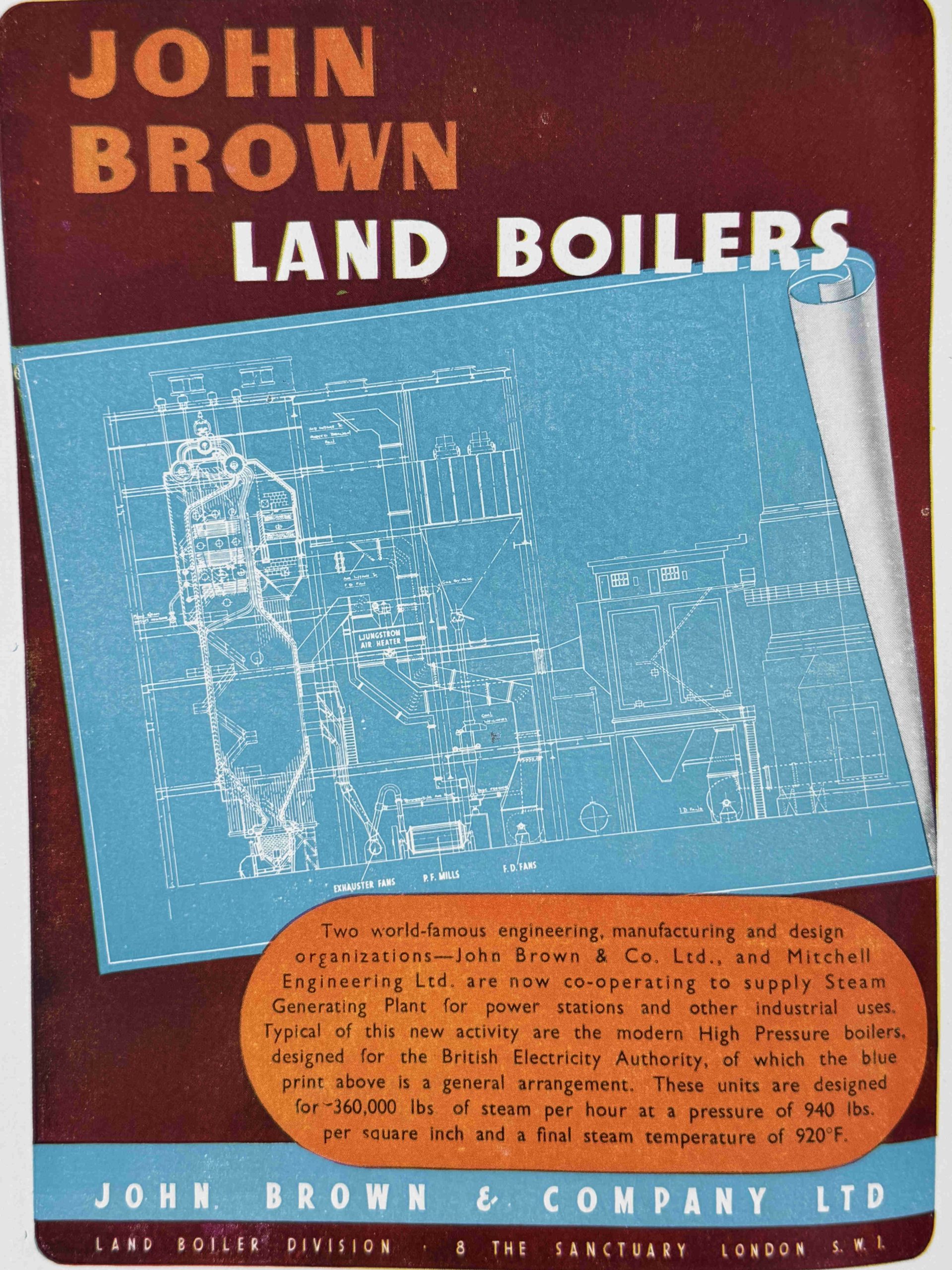
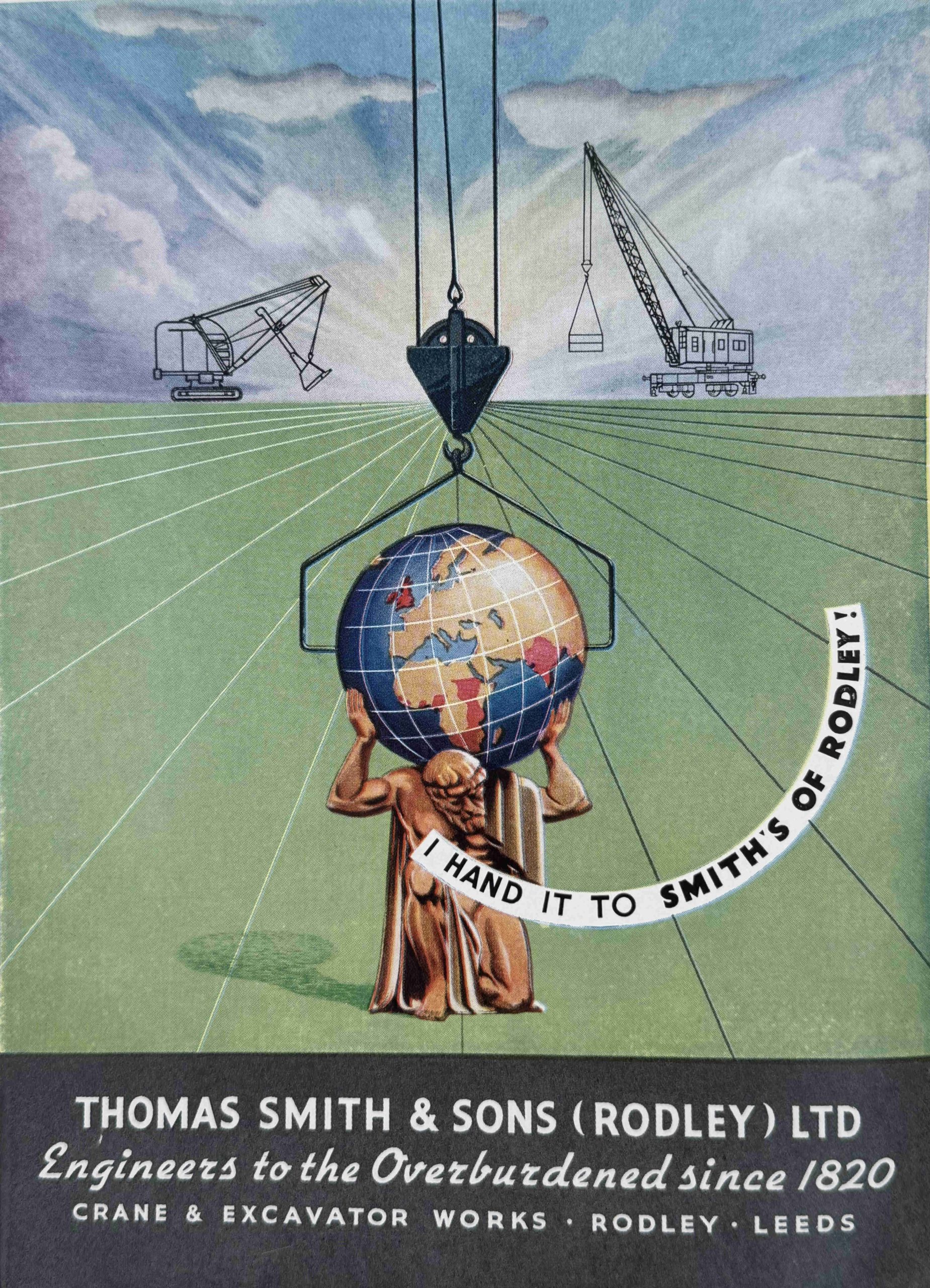
Another common theme of all the exhibition guide books is that the majority of the companies advertising in the books have long since either closed or been take over by foreign competitors, and the adverts from the Exhibition of Industrial Power show just how much the decline of heavy engineering and manufacturing industry in general has been in the last 75 years.
Conveyancer Fork Lift Trucks:
Another advert for English-Electric, this time about their expertise in hydro-electric power:
John Brown shown in the following advert was a major Scottish industrial company, which included a significant presence in marine engineering and ship building. The company built multiple war ships and the liners Queen Elizabeth and Queen Elizabeth 2.
After a series of mergers, the engineering part of the company was taken over by Kvaerner in 1996, who closed the engineering works in 2000, and the Clydebank shipyard ended up as part of the French Bouygues Group in 1980, who closed the business in 2001.
Thomas Smith & Sons – one of the major industrial crane manufacturers of the country and with a significant export business. Their cranes were also used on docks throughout the country, so were probably to be found in the London Docks.
Again, after a series of mergers and take overs, the company has all but disappeared, but there is a very small part of the business surviving within another group, but not at all recognisable to a visitor to Glasgow in 1951:
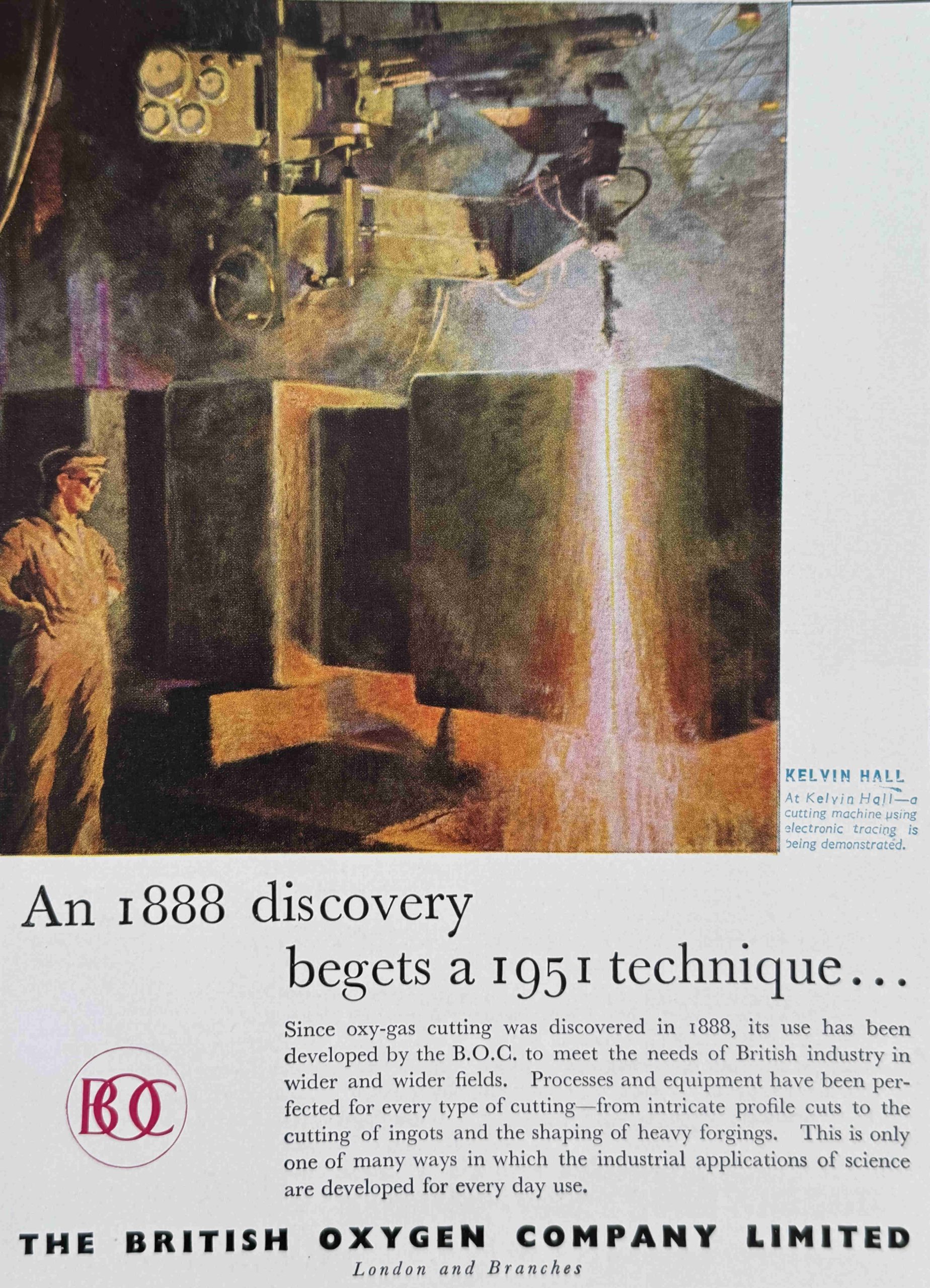
The British Oxygen Company:
The British Oxygen Company started off in 1886 as Brin’s Oxygen Company after the two French brothers who founded the company – Arthur and Leon Quentin Brin. The company was renamed the British Oxygen Company (BOC) in 1906.
In the early 2000’s BOC was one of the largest industrial gas suppliers in the world, however a few years later, the company was purchased by the Linde Group of Germany.
Interestingly, BOC’s former head office in Windlesham, Surrey was apparently designed in the form of an Oxygen molecule.
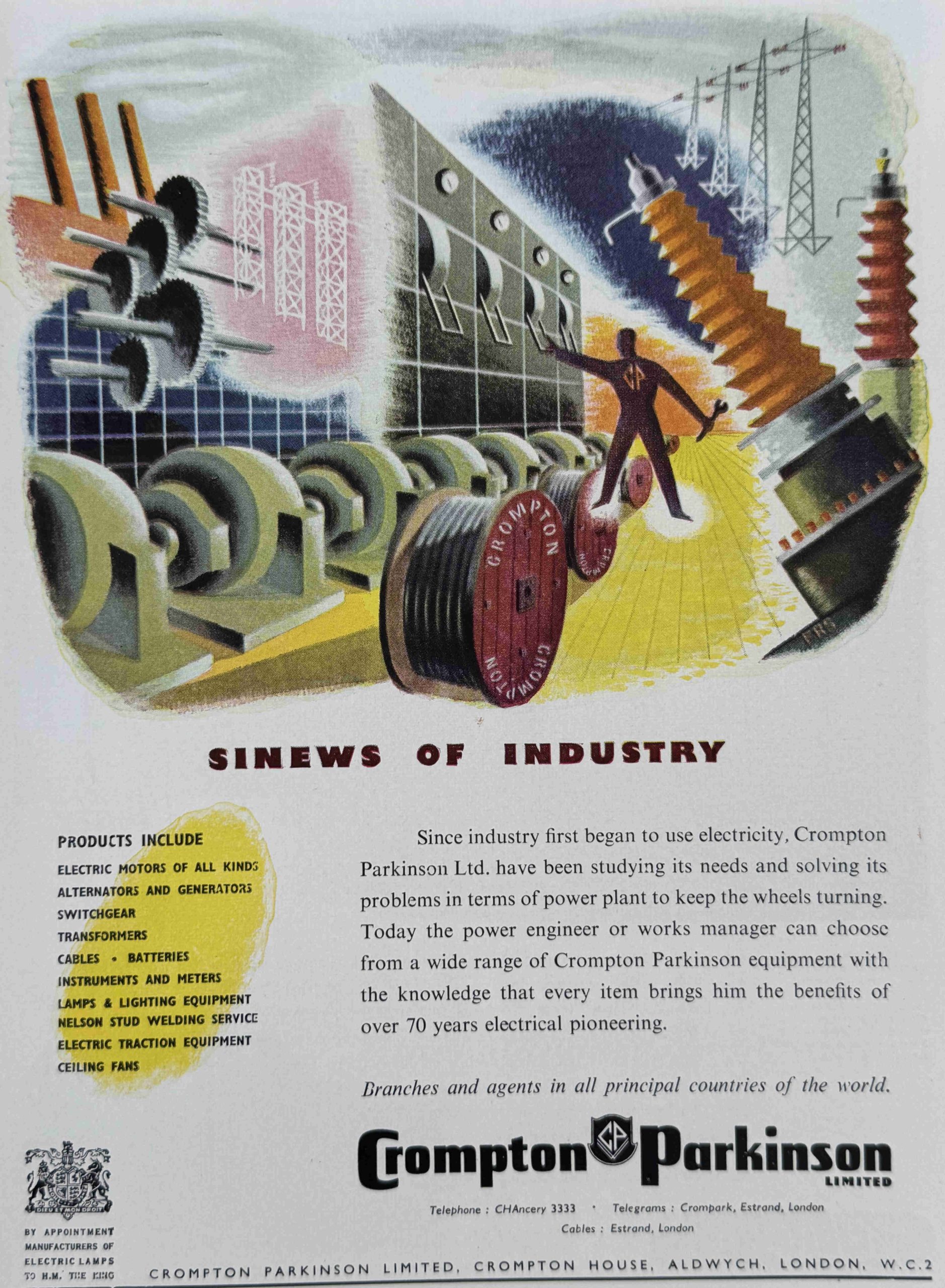
Crompton Parkinson, a major manufacturer of electrical power equipment:
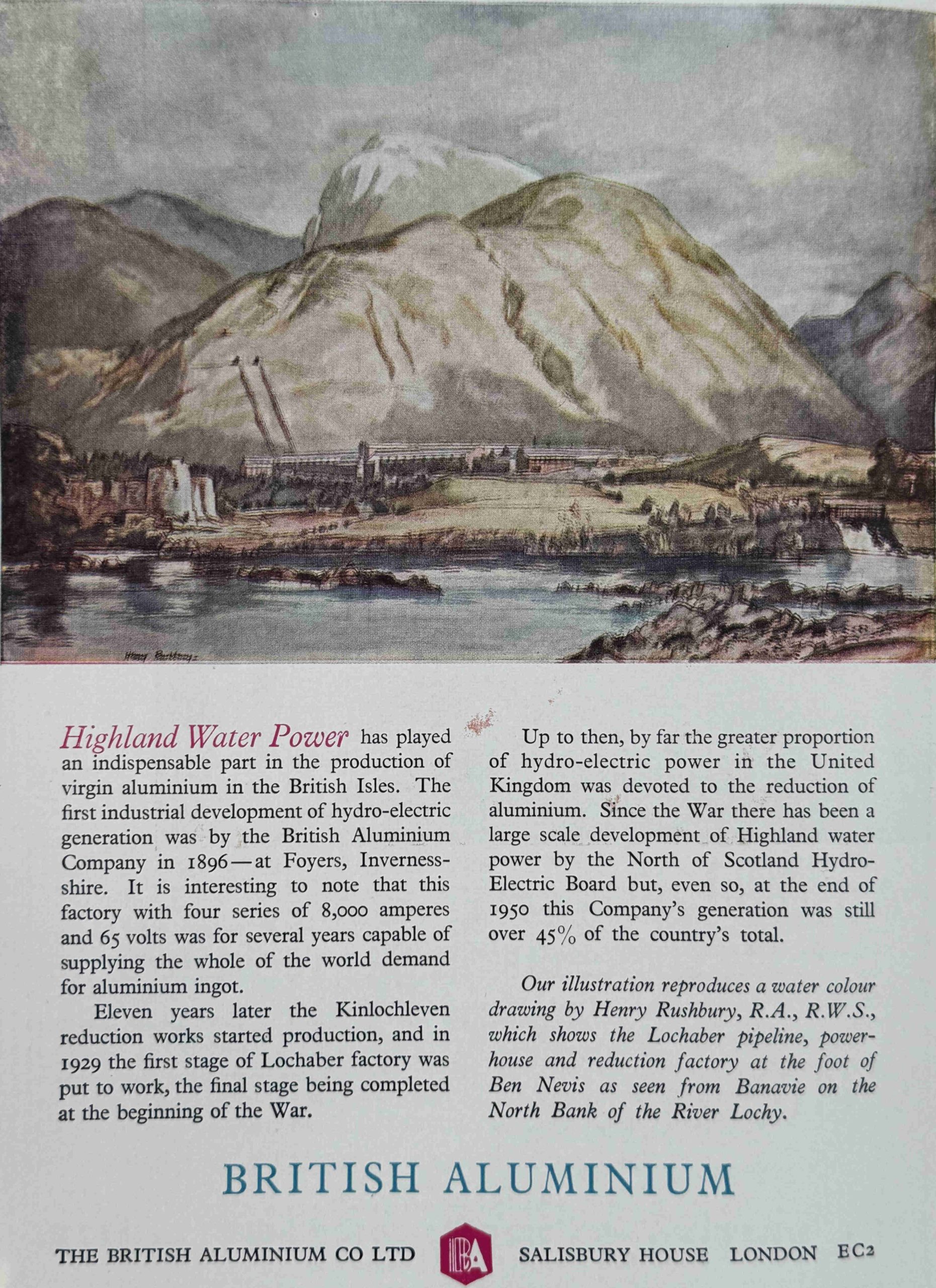
British Aluminium – another company that has disappeared, however the Lochaber hydro-electric plant and pipelines shown in the illustration in the advert are still in use, generating electricity for an aluminium smelter owned by Alvance British Aluminium, the one remaining aluminium smelter in the UK:
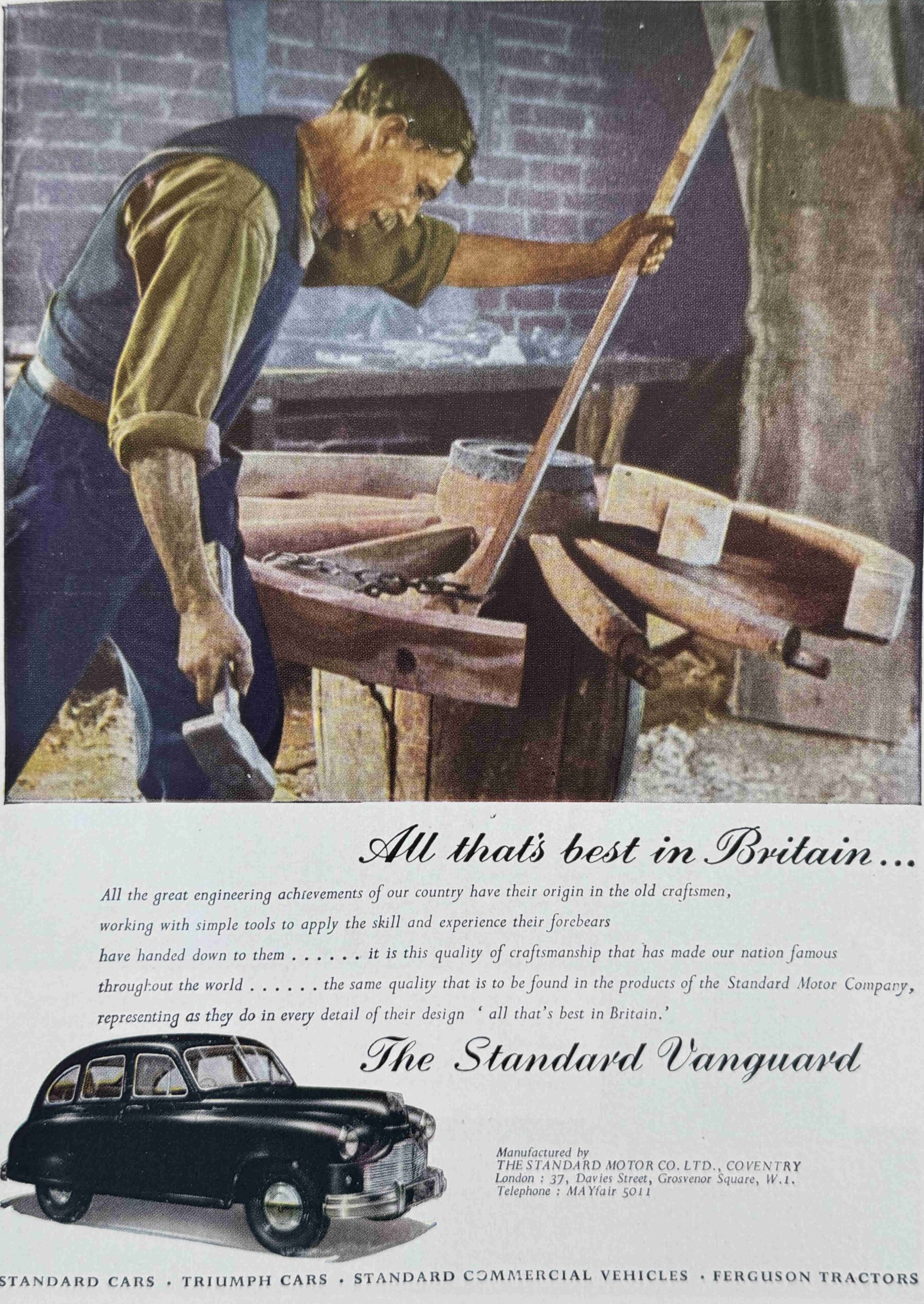
The Standard Vanguard:
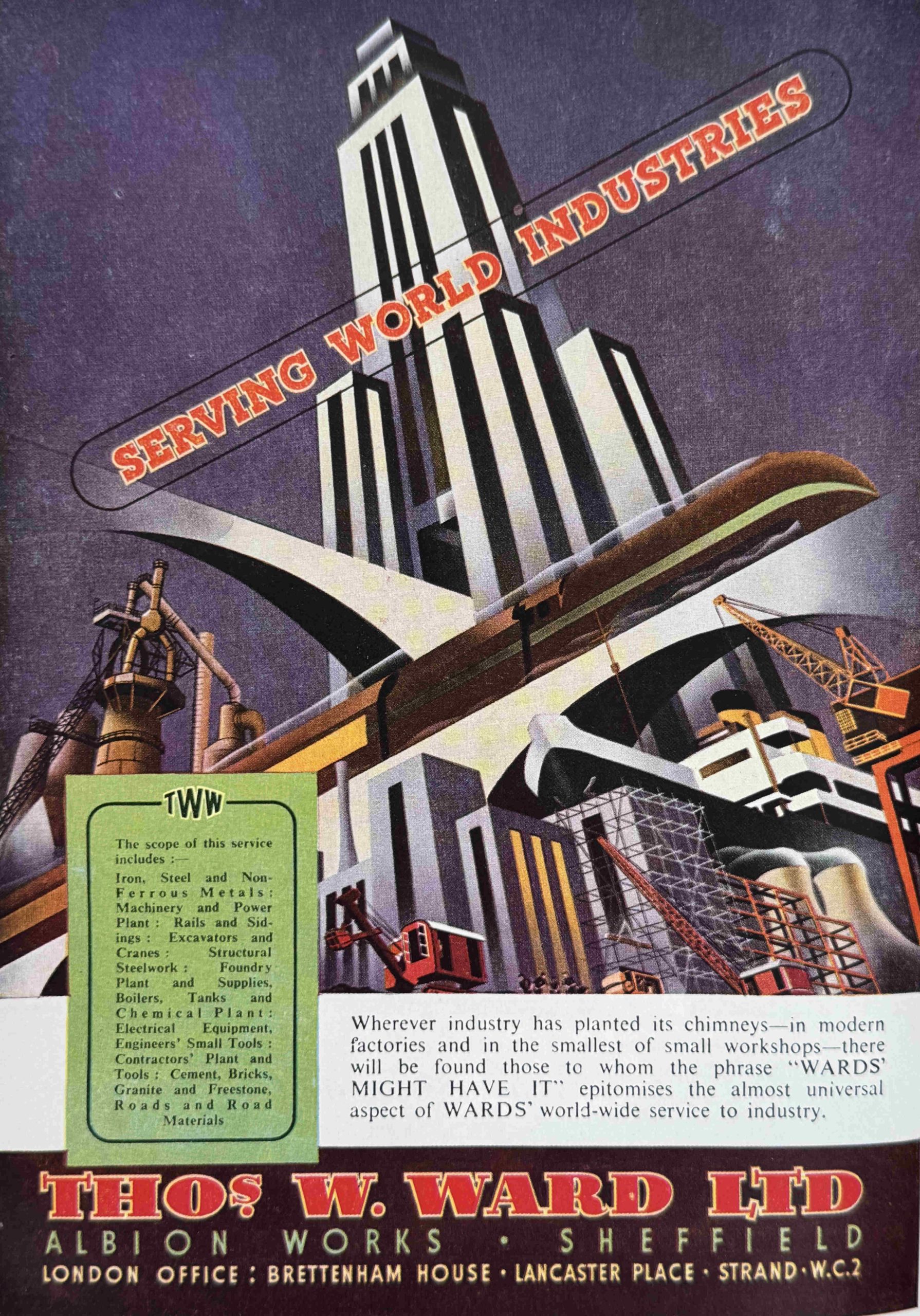
Thomas W. Ward Ltd – a steel working and construction company, who also had a major business in ship breaking:
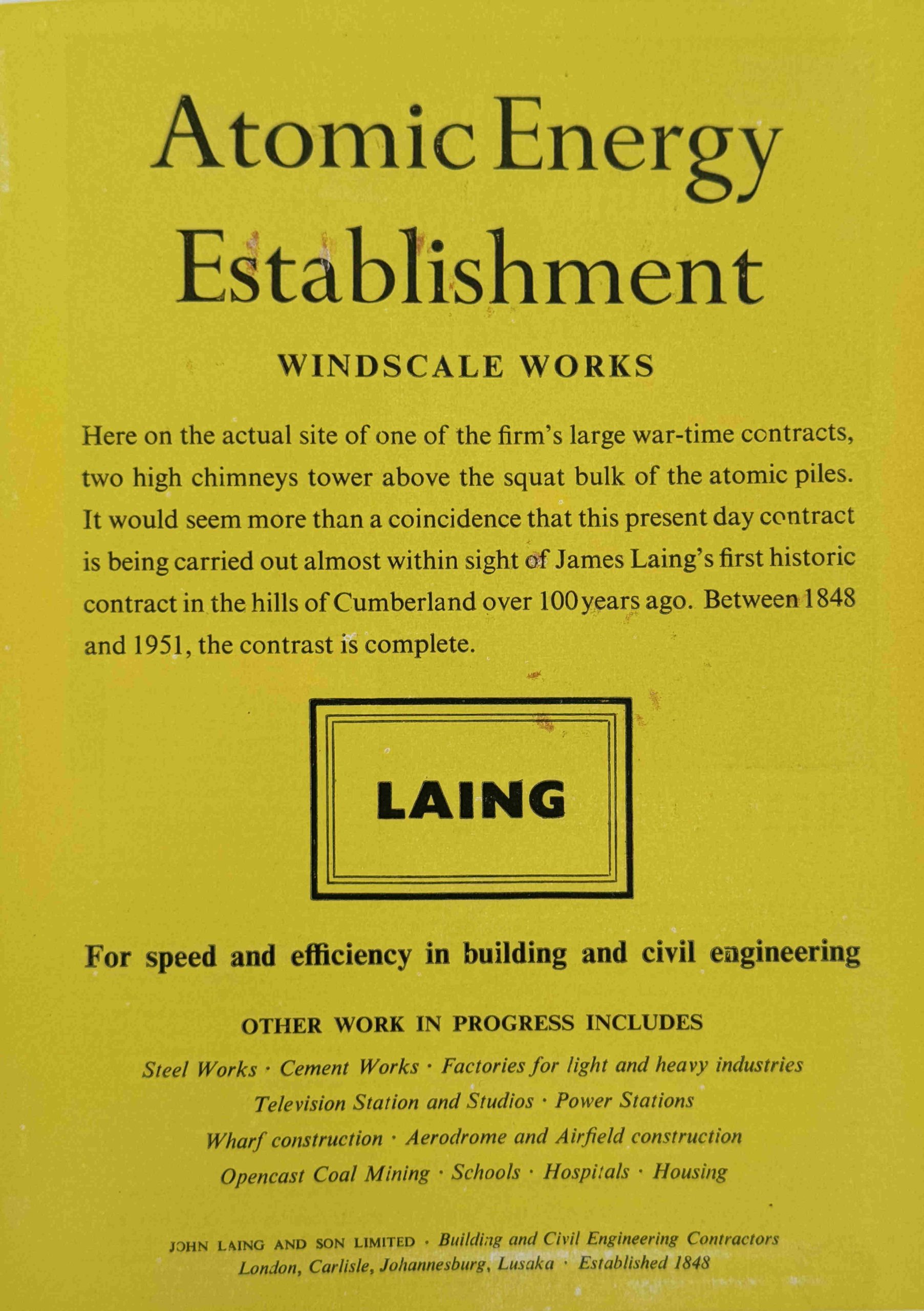
In the Hall of the Future, the future of power was through the potential of atomic power and the splitting of the atom. John Laing advertised their work in building and civil engineering with the construction of the Atomic Energy Establishment’s Windscale Works, today known as Sellafield. Today, John Laing are more of an infrastructure investor, rather than a construction firm.
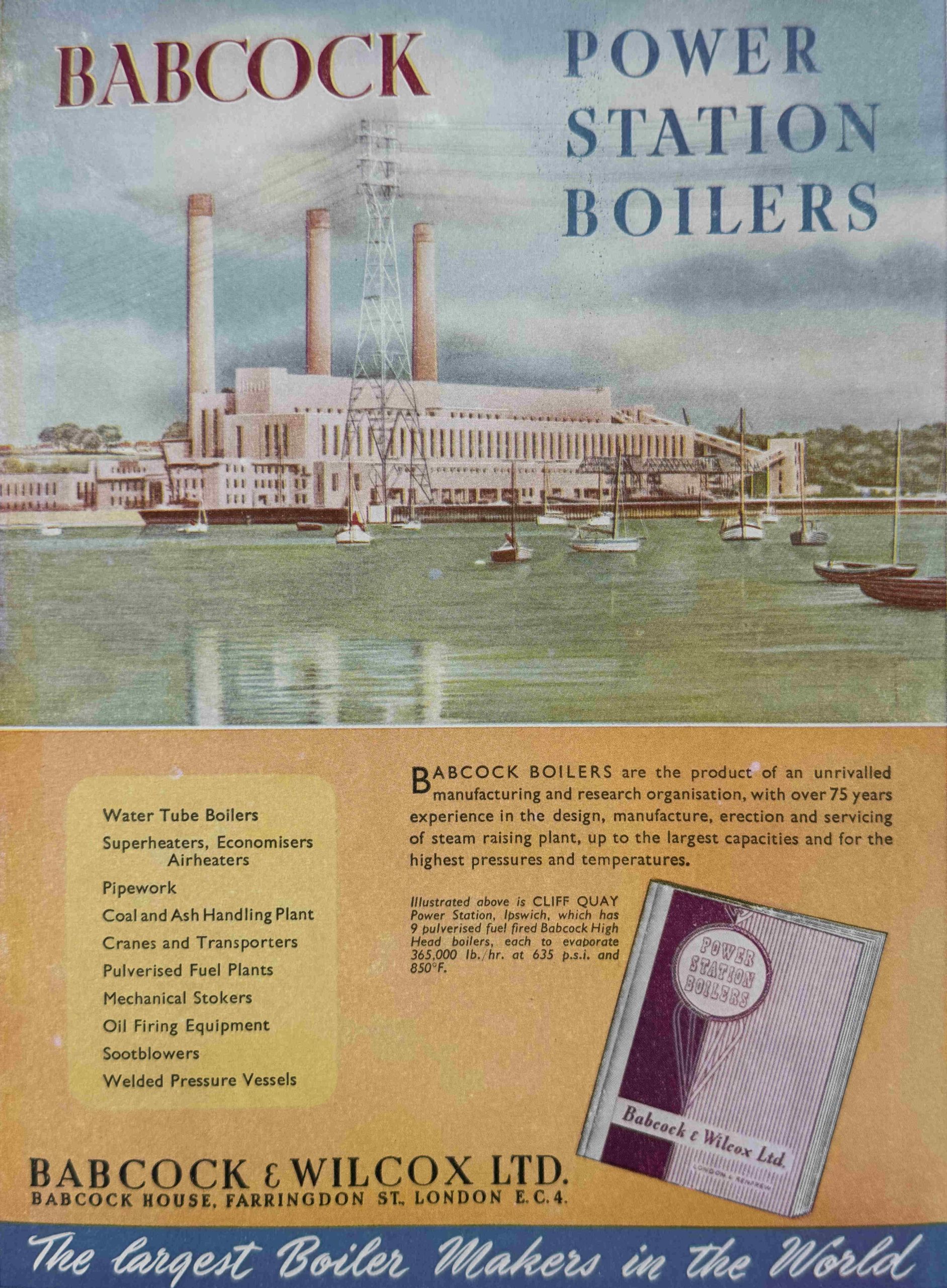
Babcock – once a major manufacturer of power station equipment. industrial and marine boilers, and many other heavy industrial products, today they are more a defence equipment supplier, including naval ships, ground vehicles, equipment support etc:
The Exhibition of Industrial Power was not as popular as the organisers expected, with attendances averaging between 1,500 and 3,500 a day.
The following is typical of the news reports of the time:
“MOST DISCUSSED EXHIBITION IN SCOTLAND – In three weeks the Exhibition of Industrial Power in Glasgow’s Kelvin Hall comes to an end. If nothing else, it has been the most discussed exhibition ever held in Scotland. And perhaps even more remarkable is the fact that many of those who have joined in the discussion have never visited it to see what all the talk is about.
Why haven’t the crowds flocked in? That is not merely a puzzle to the organisers – it has perplexed all manner of people. ‘Too technical’ say some. ‘Not technical enough’ declare others. ‘ A designers dream’, ‘A designers nightmare’.
So the conflict of opinion has swayed back and forth – in speeches, conversation and correspondence. Many have averred that it is not a woman’s show, yet many women who have visited the Hall have been full of praise for what they have seen.
Flattering too have been comments of overseas visitors, many of whom had already toured London’s South Bank. ‘Better laid out’, ‘More compact’. ‘a wonderful achievement story’ – comments such as these have been made.
The great mystery of 1951 still remains unsolved. Soon the Exhibition will be only a memory but it seems not unlikely that it will live on as a debating point for a long time to come. And even yet the missing thousands may materialise in a final rush to see for themselves the cause of all the commotion.”
There were incentives to visit the exhibition, for example, specific tickets winning a prize of a paid trip to the South Bank exhibition in London, so on the 10th of July, Mr John Campbell of Glasgow won a free air trip to London to visit the South Bank as the 150,000 visitor to Glasgow.
There were also organised trips to the exhibition from across Scotland. These included school trips, as well a trips organised by local Labour party organisations, for example the Arbroath Labour Party organised a visit for 300 in June, which included the provision of a special train to take visitors to Glasgow.
Overall, the Exhibition of Industrial Power was considered a success. There seems to have been a good number of international visitors as one of the apparent achievements listed was the amount of foreign currency brought in during the exhibition.
After closure in October 1951, many of the items were taken back by their manufacturer, some were auctioned off, others were scrapped.
I have not found any photos of the interior of the exhibition, however the following film does show the exhibition being opened by Princess Elizabeth, and a brief walk around some of the exhibits:
The Festival of Britain guide books help to illustrate just how much the country has changed in the last 75 years.
The Glasgow Exhibition of Industrial Power shows just how significant has been the decline and loss of heavy engineering and manufacturing. A loss that did not just impact businesses, but has also had a significant social impact in multiple old industrial areas of the country – a social impact which is still very present.
Now I just need to find the Ulster Farm and Factory exhibition guide book to complete the set.
Resources – London Archaeologist and the Archaeology Data Service
Archaeology is the way we understand so much of London’s physical past, along with the lives of people who once lived in the city. Despite how much the city has been redeveloped over the past few decades, and indeed has been through very many developments over the centuries, there are always new finds that help to tell the story of London’s long history.
Whilst major discoveries make the local and national news, that is plenty more that does not, but which deserves a bit more publicity.
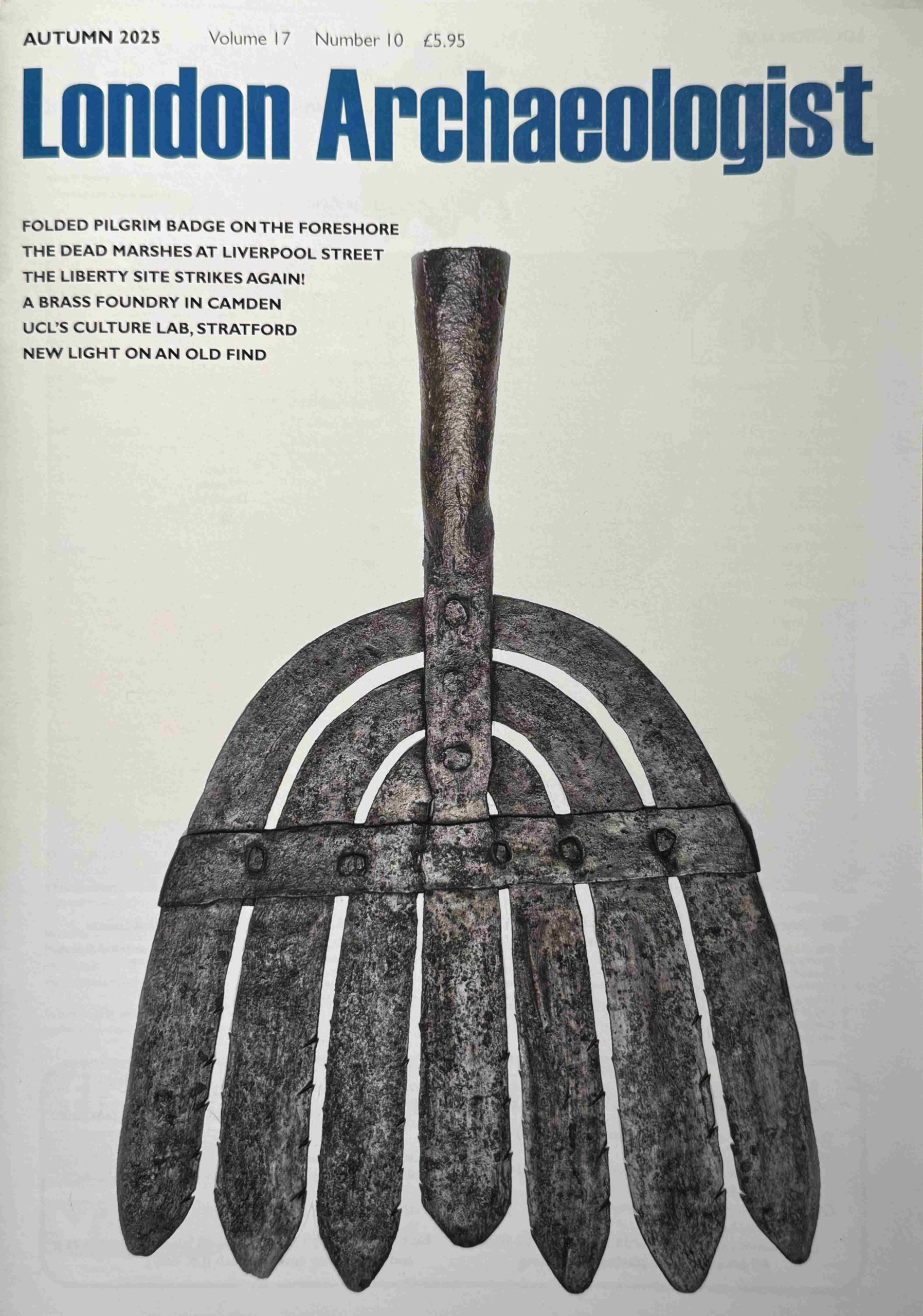
One of the ways of following the work of archaeologists in London, and the latest discoveries is through the publication London Archaeologist, of which the following image is of the latest issue of the four times a year publication:
The cover image is of an iron eel spear, and to give an idea of the type of contents, the autumn edition features excavations at 14-19 Tottenham Mews in Camden as well as excavations at 1 Liverpool Street which has the title “The Dead Marshes” to highlight the historic location of the place.
These two articles are detailed, for example the Liverpool Street report runs to seven pages of text, maps, site plans and photos.
There are also articles about previous finds such as a Roman cremation found on the Old Kent Road, along with the results of new research on the large quantity of Roman painted wall plaster found at the Liberty excavation in Southwark.
A subscription to London Archaeologist is a great way to keep up to date with excavations and general archaeology across the city. The current price of an annual subscription is £22, and details can be found at the following website:
A brilliant thing about the publication is that if you want plenty of reading to explore archaeology across London, then back issues of the publication from issue 1 in 1968, through to the end of 2023 are all available for free, and to download at the Archaeology Data Service, and as an example of the early content available, there is a fascinating article in issue 1 in 1968 on the Roman House and Bath at Billingsgate by Peter Marsden.
The archive provides more than enough fascinating reading for the dark winter evenings, but there is far more to the:
Archaeology Data Service
Firstly, the link to the archive of London Archaeologist at the Archaeology Data Service is here:
The Archaeology Data Service (ADS) is the “leading accredited digital repository for archaeology and heritage data generated by UK-based fieldwork and research”, and it is apparently the oldest repository for archaeology and heritage data in the world, having been established in 1996.
The search methods to explore the database takes some practice, and getting some experience with how to frame queries, but if you are interested in the huge amount of archaeology and heritage across London (and the rest of the country), it is well worth the effort.
and at the top of the page there are a number of menu options, but to provide an idea of the breadth and depth of contents, I will click on the Search option, where you can then search the Data Catalogue or the Library.
The Library is a database of archaeological investigations and consists of either a summary of a record held in another archive, or a downloadable report (click on “Available from ADS” on Access Type on the left column of options to select records where the reports are available).
As an example, searching the Library for “Wapping”, there are a number of records, many are a brief abstract, but there are a number with a full, downloadable report.
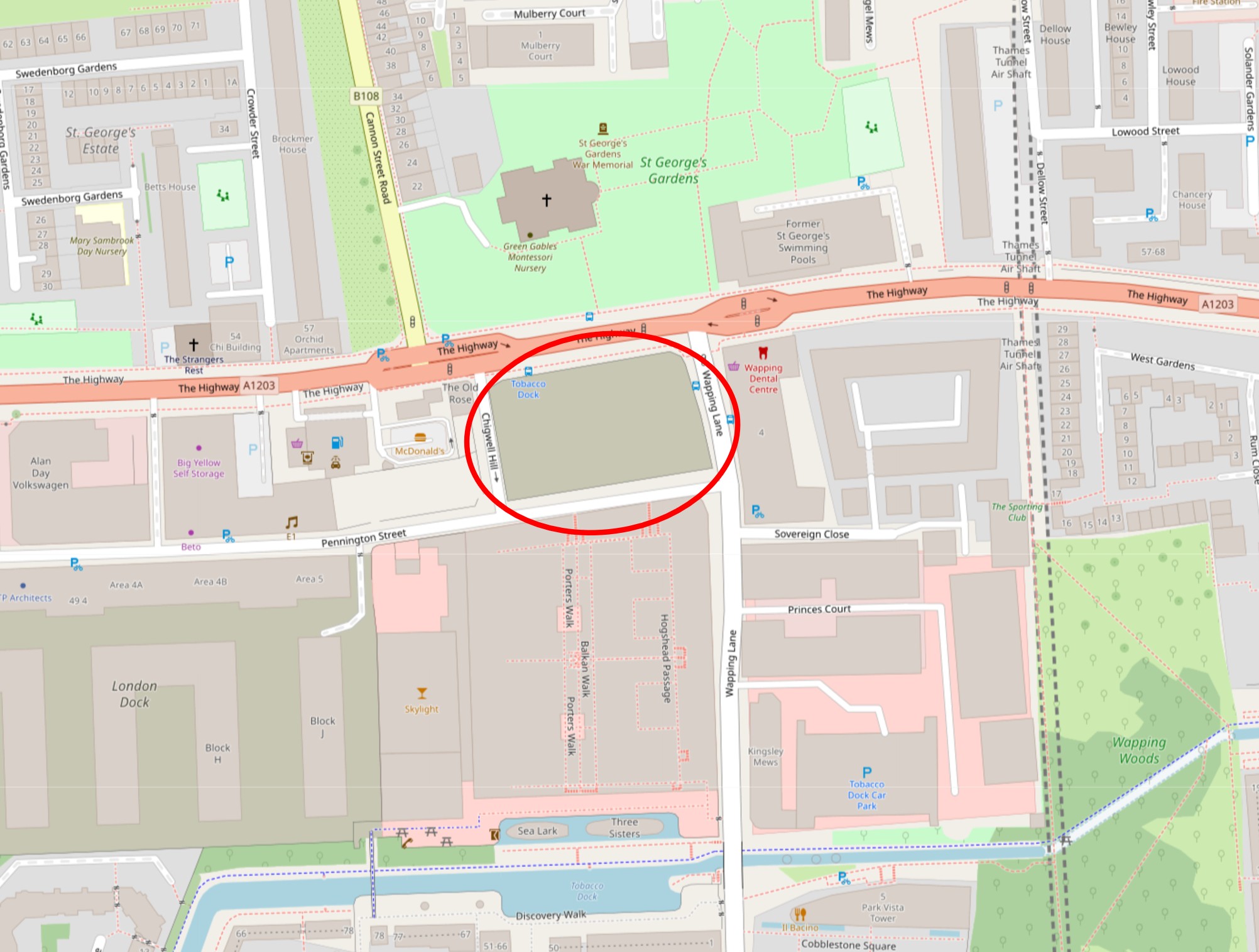
One of the records is titled, and includes a PDF download of the full report “LAND AT THE HIGHWAY, WAPPING LANE, PENNINGTON STREET AND CHIGWELL HILL, (PARCEL 4) LONDON E1 AN ARCHAEOLOGICAL ASSESSMENT”.
This plot of land is unusual in Wapping in that it is still empty and surrounded by hoardings. It is between Tobacco Dock and The Highway, and is adjacent to the derelict Rose public house (if you have been on my Wapping walk, we walked past the site towards the end of the walk, heading up from Tobacco Dock to The Highway).
The document is a detailed, 524 page report on excavations at the site, including full background detail such as the geology and topography through to a large listing of all the finds.
Back at the Search Data page, clicking on Data Catalogue brings up another screen, and at top left you will see “Filters” with below this a search box.
Searches can be detailed and specific, but just enter “Wapping” and on the right a whole range of search results are listed, 188 in total (although be careful as there are a number of other Wappings around the country, hence the need to explore how to make specific searches).
The first record covers: “An English cargo vessel which stranded near Flamborough Head in 1891 in fog”, nothing to do with London you might think, but clicking on the Resource Landing Page provides more details from the source, and the “Wapping” was a steam collier that carried coal to London and was known as an “up-river” or “flatiron” due to her low superstructure and with masts that could be lowered allowing the ship to pass under the many bridges of the Thames.
Interesting that a ship that carried coal along the east coast was also able to travel far up the Thames to deliver its cargo, including passing under bridges.
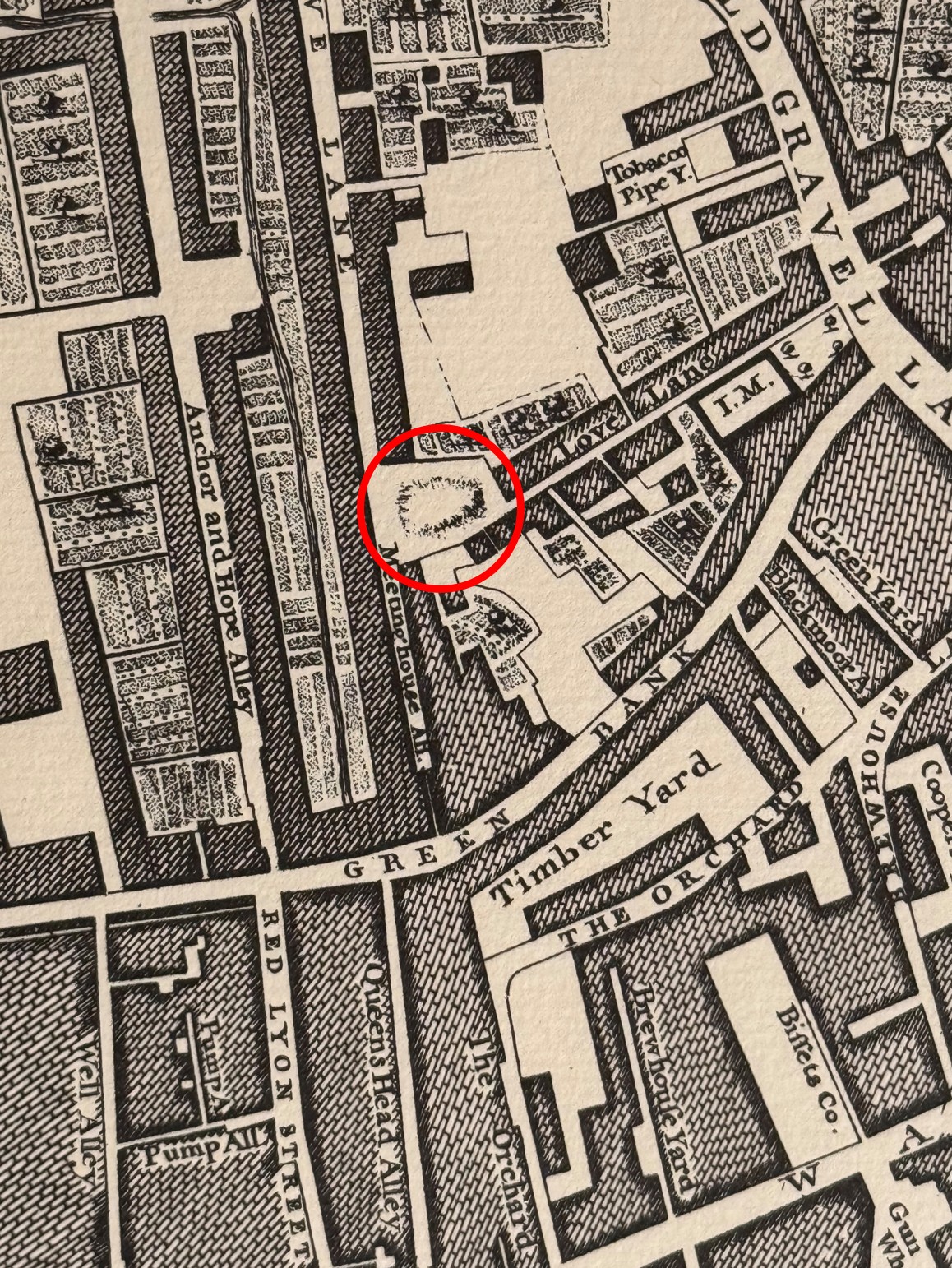
I have been tracing the remains of Civil War defences in Wapping, and a quick search for “Wapping Fort” found the following:
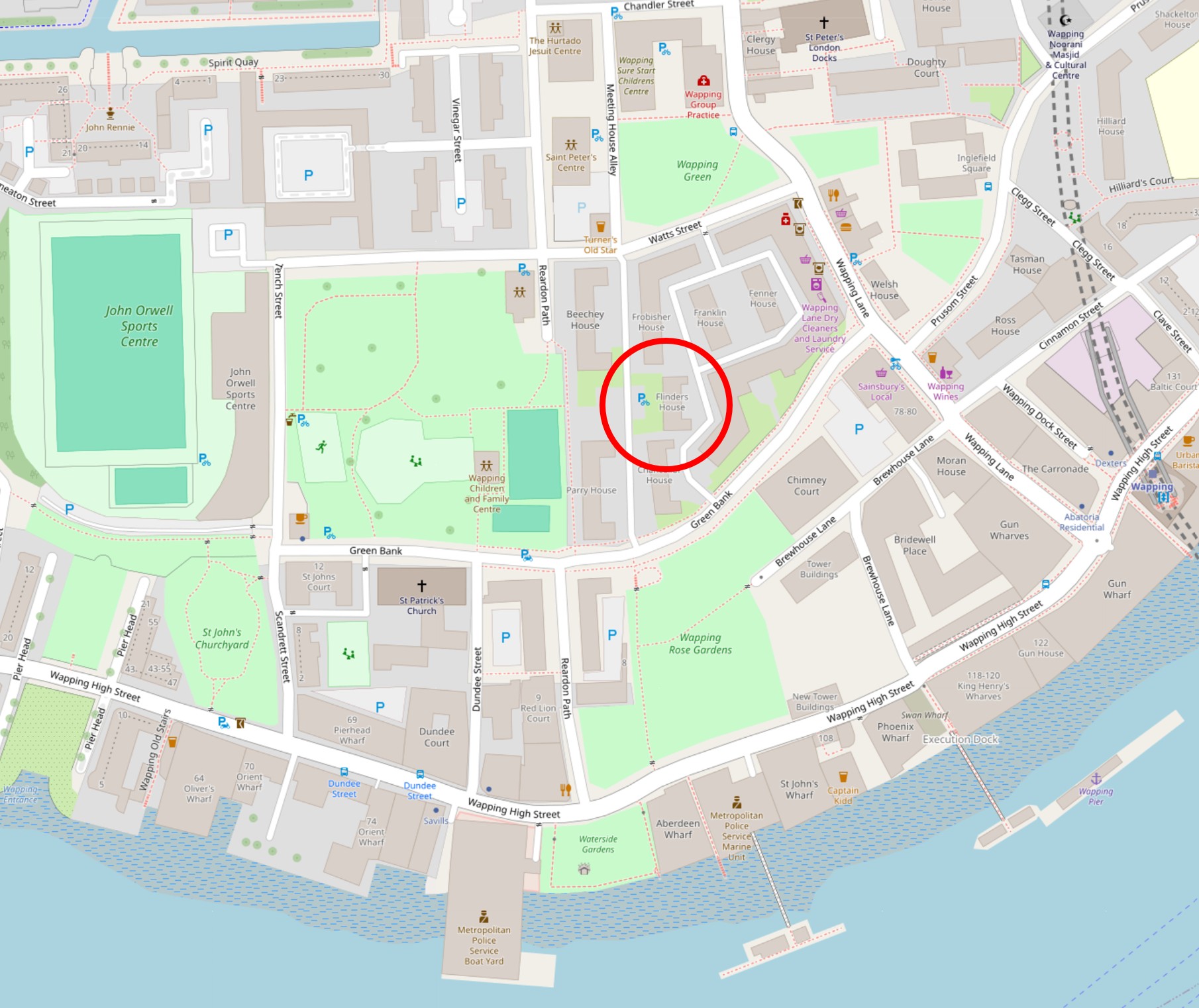
“Fort Number 1 of London’s Civil War defences was in Wapping, south of the Church of St Georges-in-the-East. The common Council resolution called for a bulwark and a half, with a battery at the north end of Gravel Lane, which is where Vertue showed it. Lithgow however refers to it as a seven-angled fort close by the houses and the River Thames Rocque’s map shows a mound on the generally accepted line of the ramparts at the junction of the present Watts Street and Reardon Streets, which would accord more with Lithgow’s location. Lithgow’s description is of a palisaded earth fort having 9 portholes with guns for each.”
If we look at Rocque’s map, then we can see the mound quoted in the above reference to the Civil War fort in Wapping:
Many of the records returned after a search do not contain details about the site, but can be a brief abstract and / or records of where the information can be found, however there is still plenty to be discovered, and the availability of the London Archaeologist archive at the ADS is a wonderful resource in its own right.
Where there is information in the ADS, such as the detailed reports on excavations, the potential location of a Civil War fort in Wapping, or the collier of the same name that had been designed to carry coals down the east coast, then through to central London, it all helps provide a greater understanding of the city.