Category Archives: The Thames

Pageant Stairs, Pageant’s Wharf, a Fire Station, Obelisk, and Bus Stop, Rotherhithe

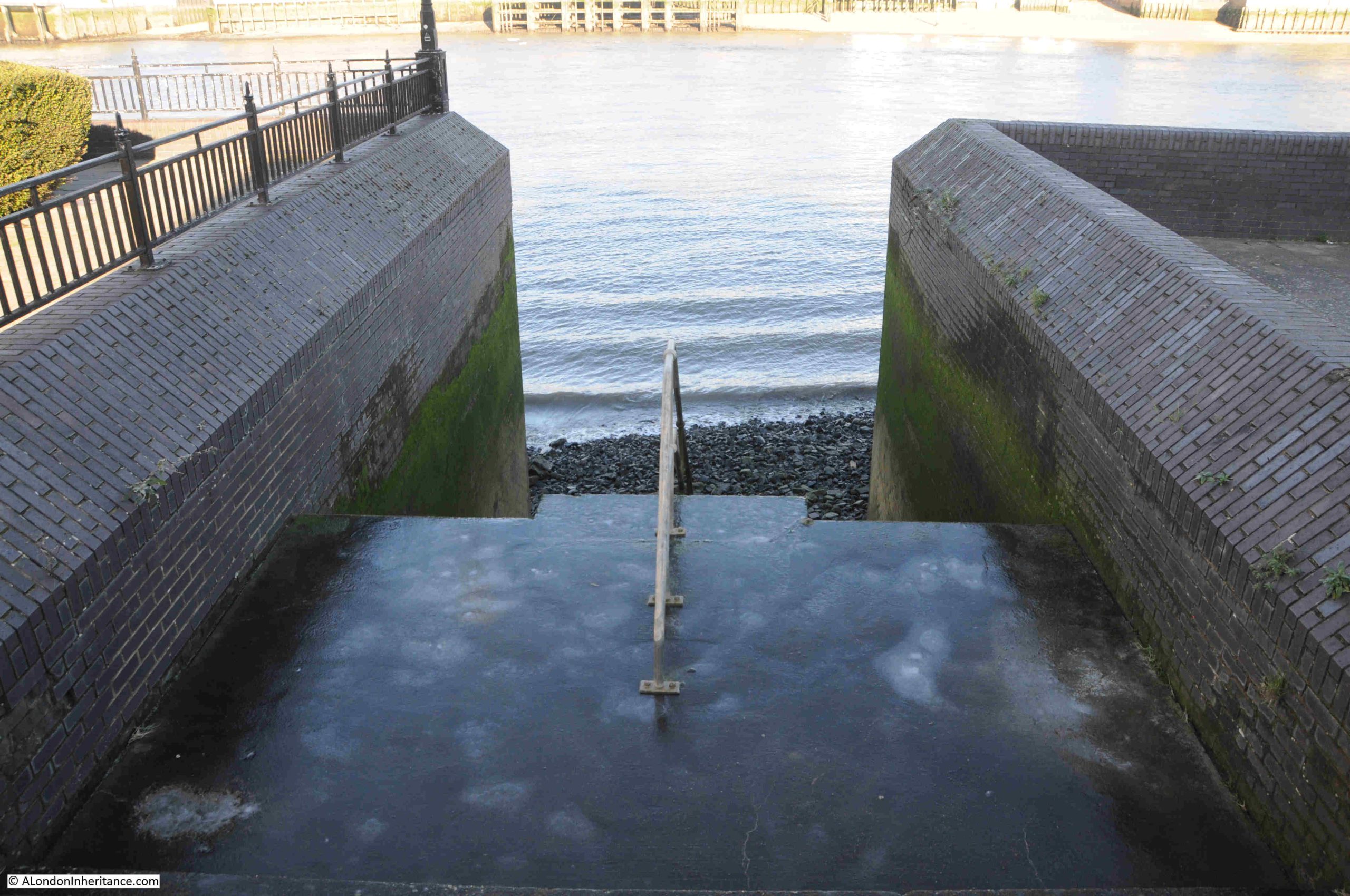
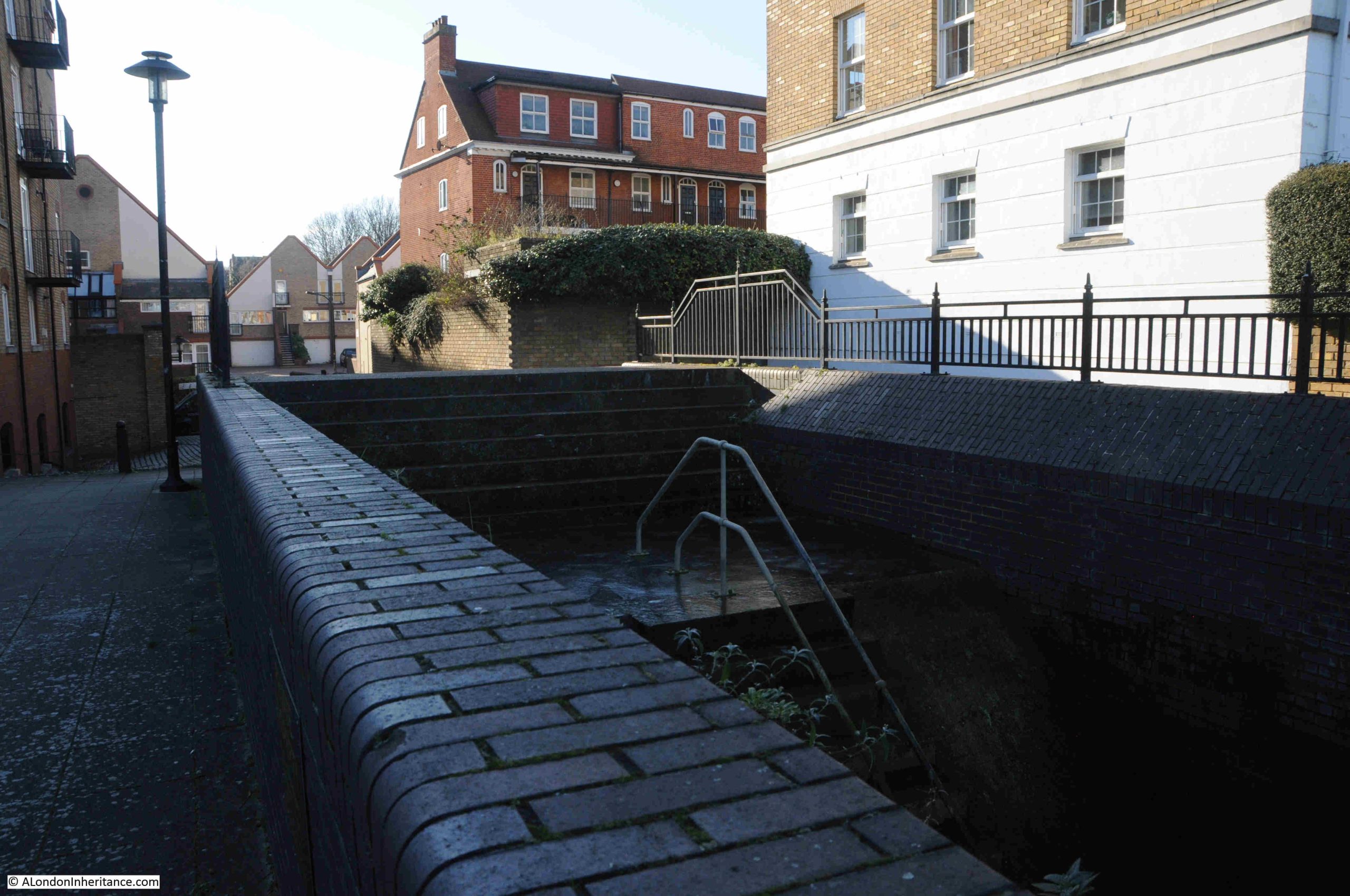
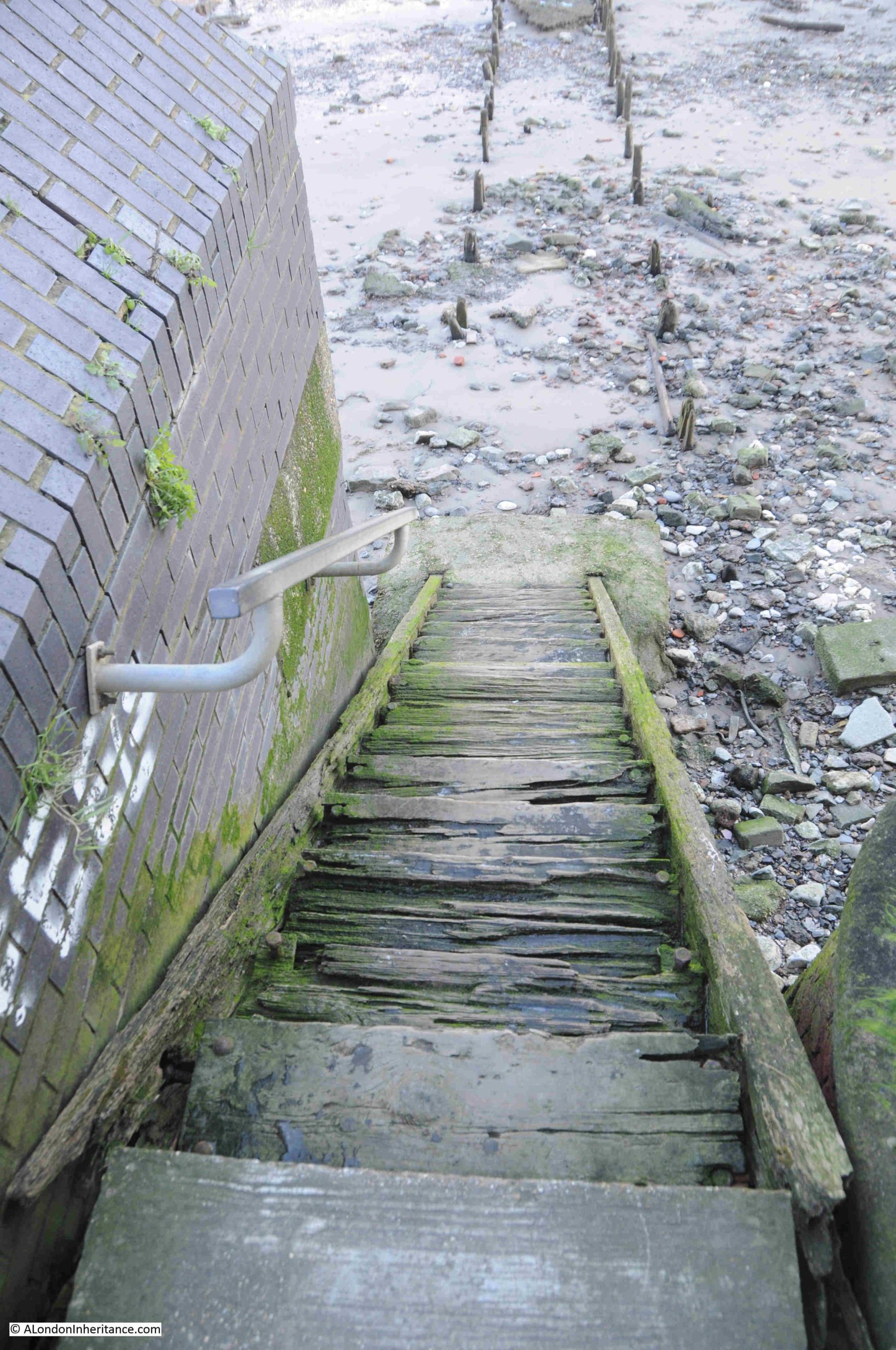
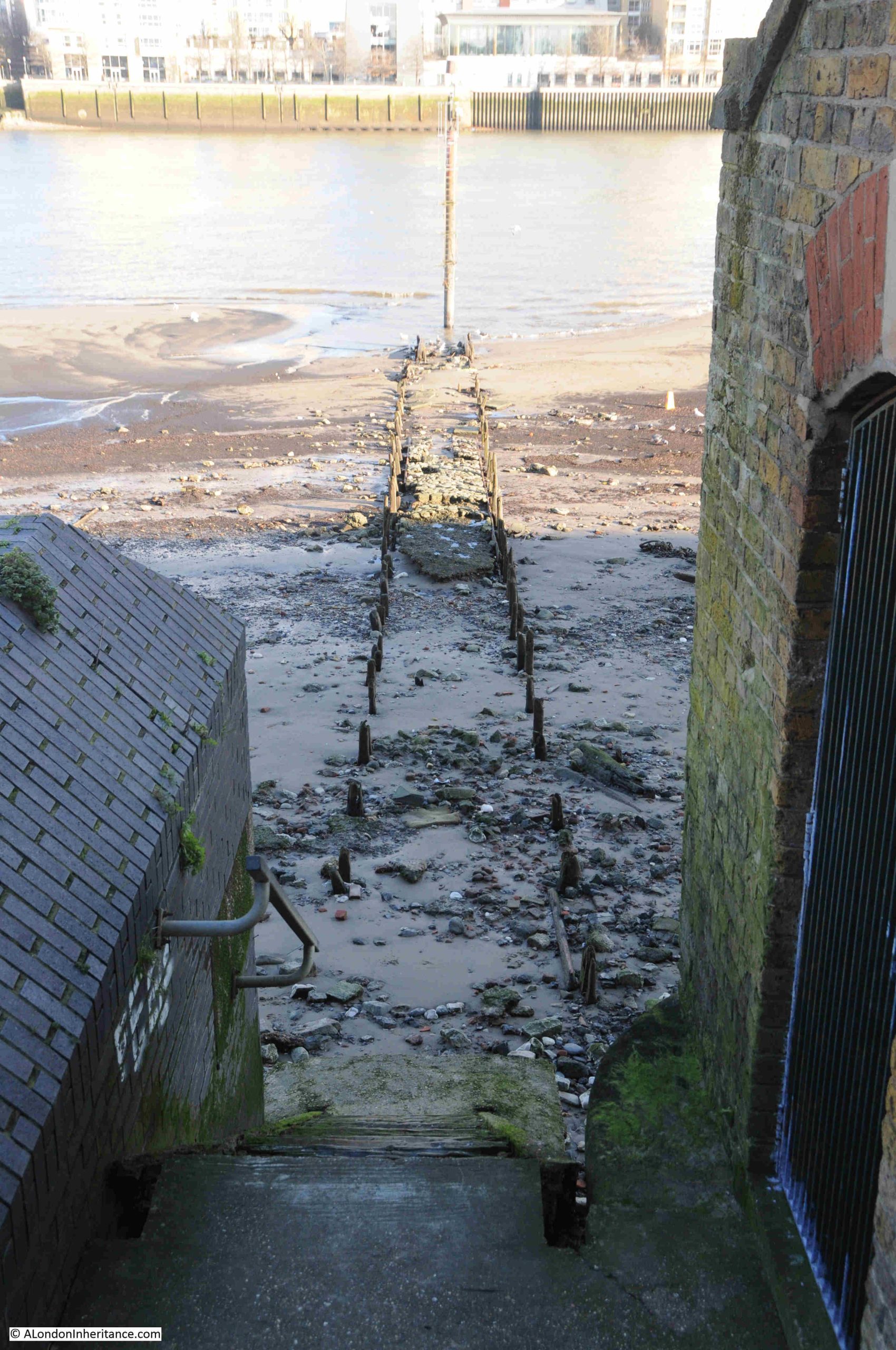
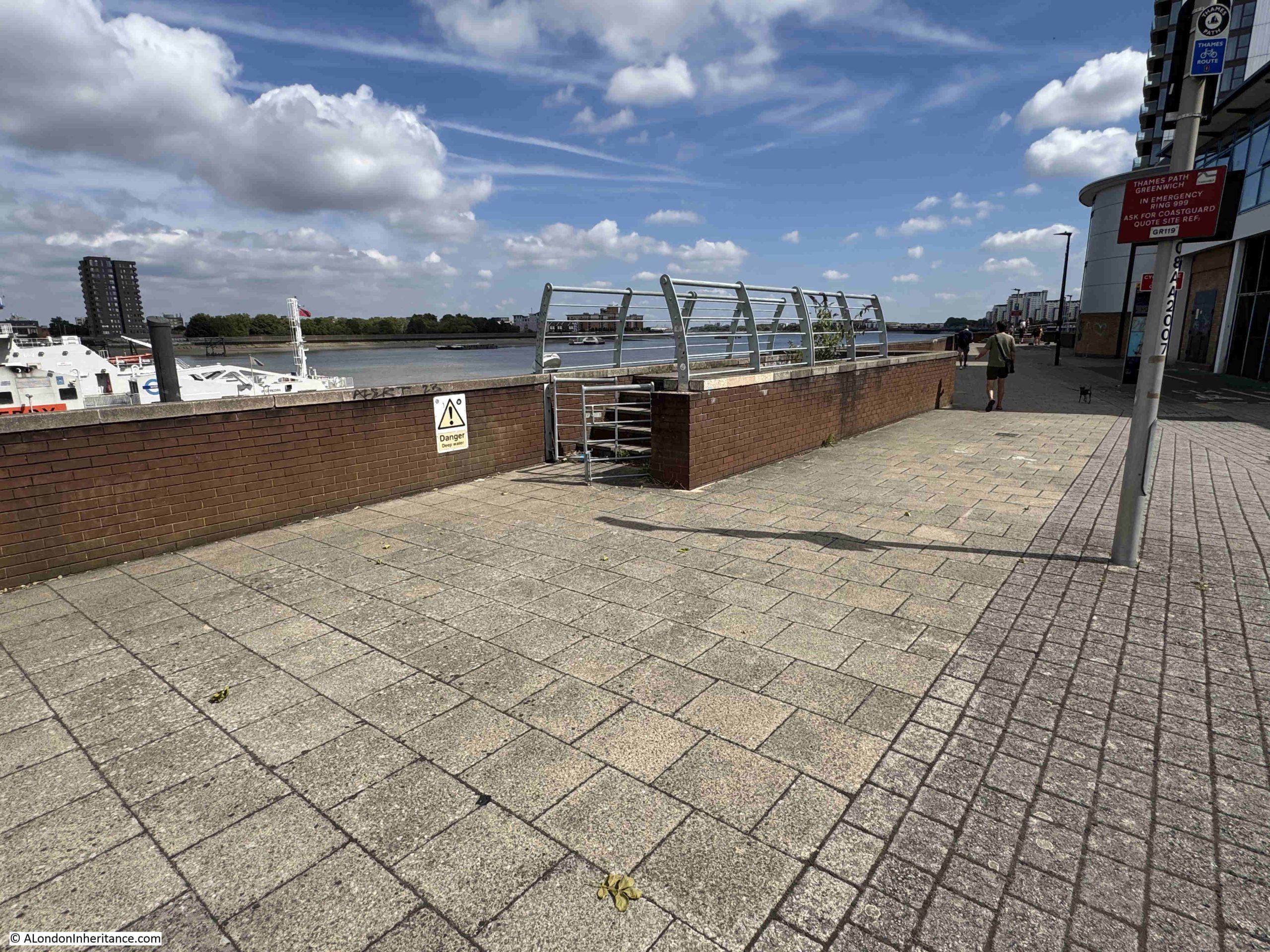
I am in Rotherhithe this week, to visit another of the Thames Stairs that have lined the river for centuries, and to explore the history of the stair’s surroundings. This is Pageant or Pageant’s Stairs, back in January 2024, when the concrete floor at the top of the stairs, as well as the stairs leading down to the foreshore, were all covered in a layer of ice:

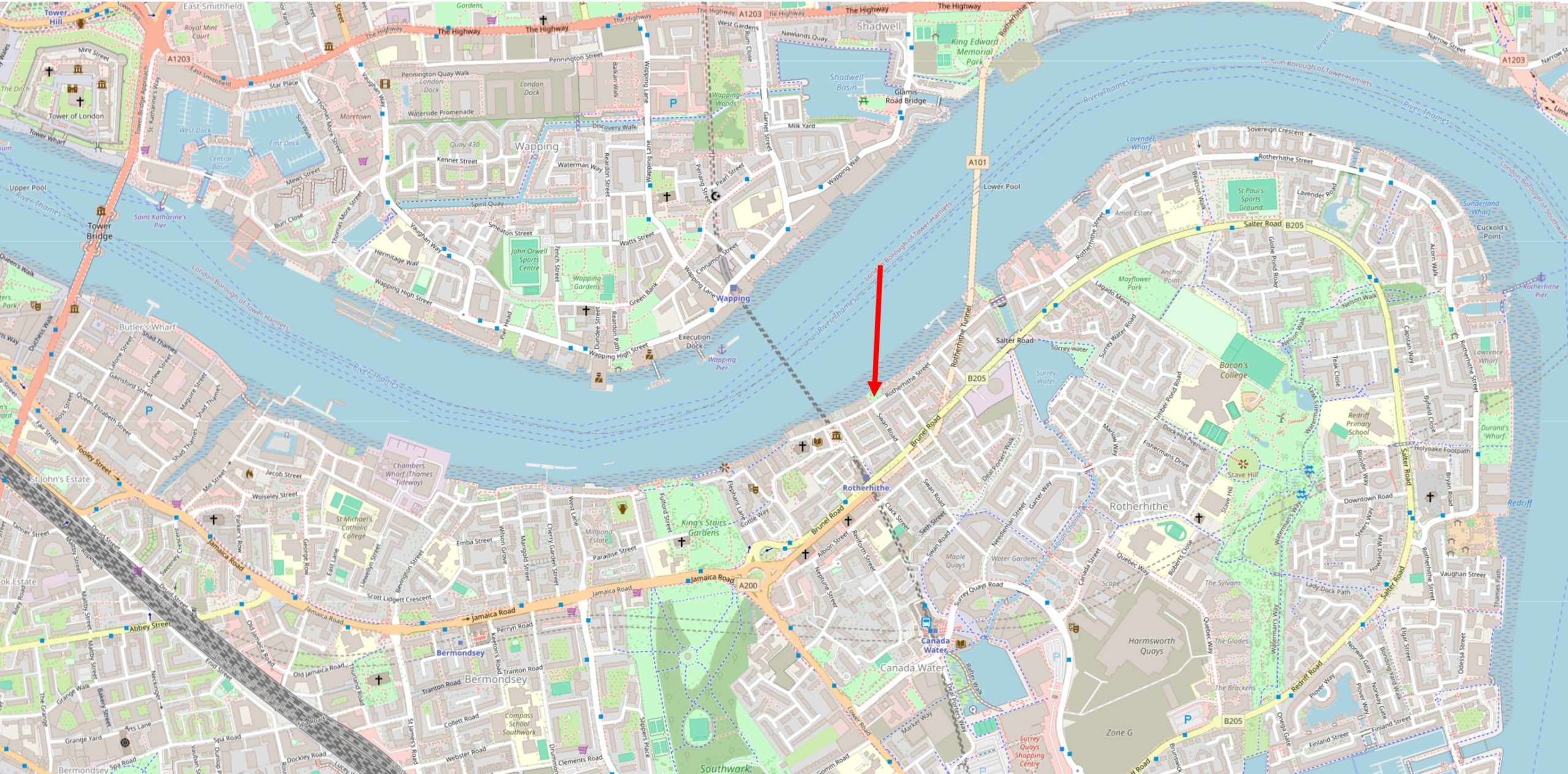
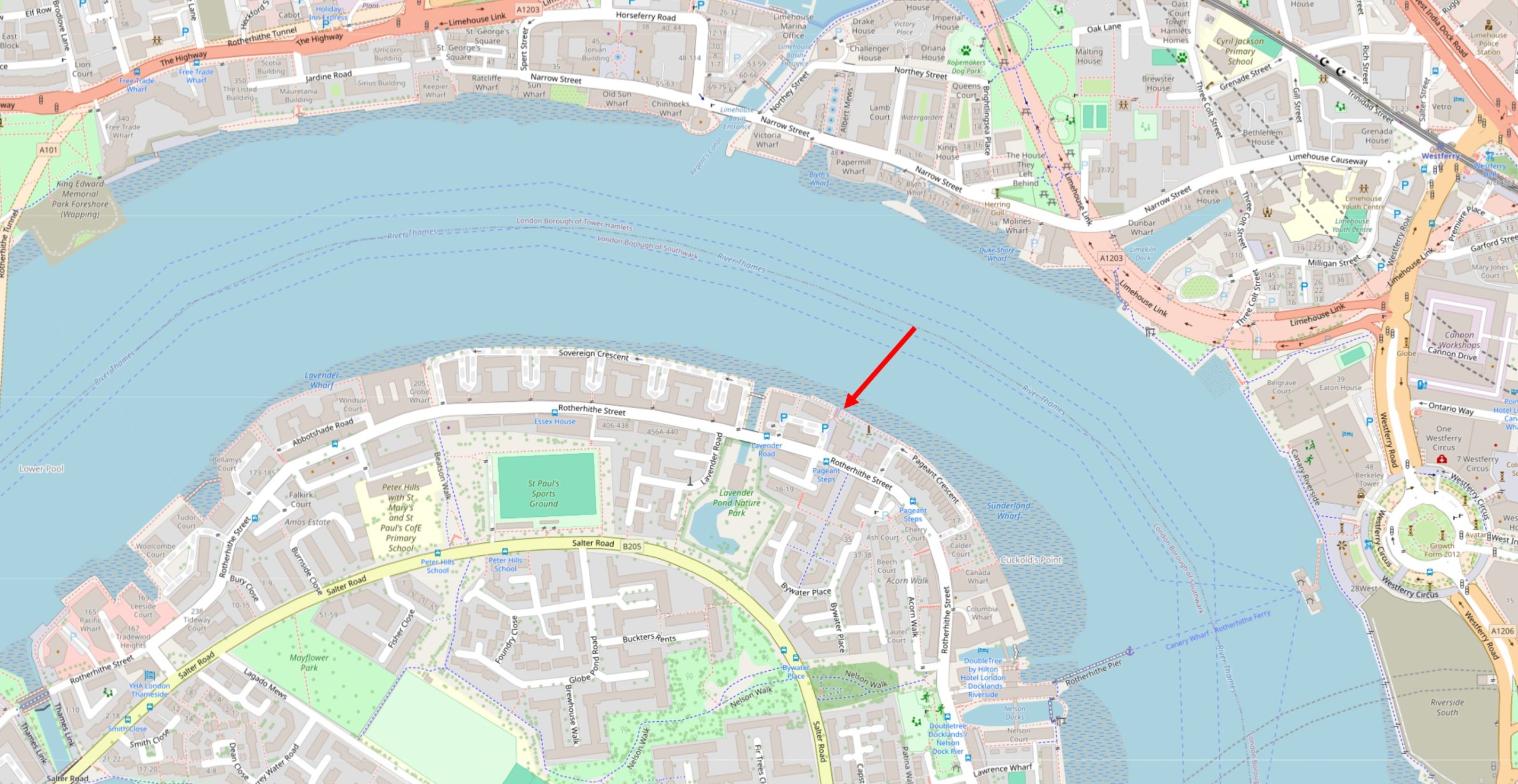
I have marked the location of the stairs with a red arrow in the following map, on the southern side of the river, opposite Limehouse  (© OpenStreetMap contributors):

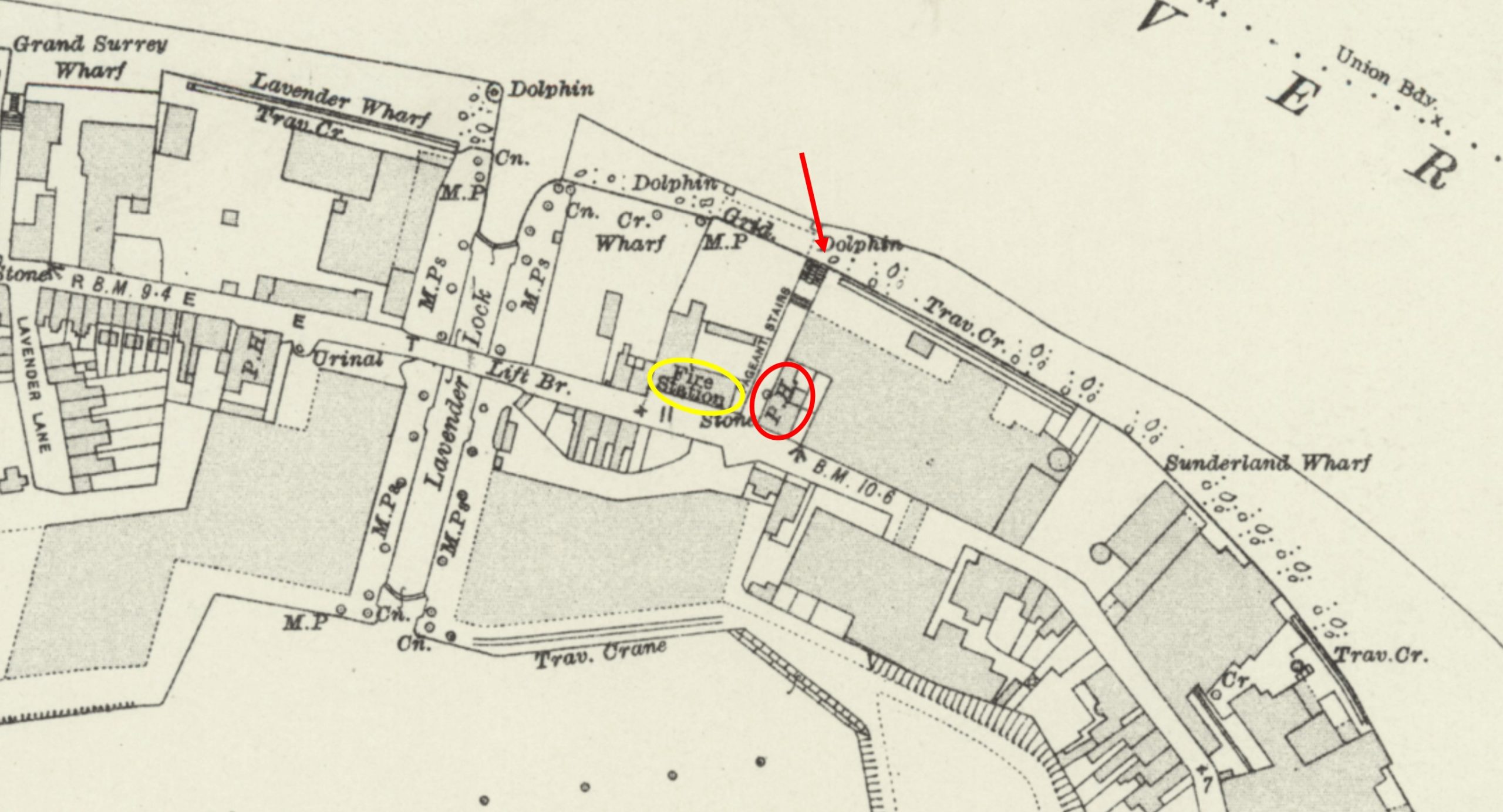
Pageant Stairs are shown in the 1914 revision of the Ordnance Survey map, at the end of an alley that leads between a fire station (yellow oval), and a public house (red arrow) from Rotherhithe Street (‘Reproduced with the permission of the National Library of Scotland“):
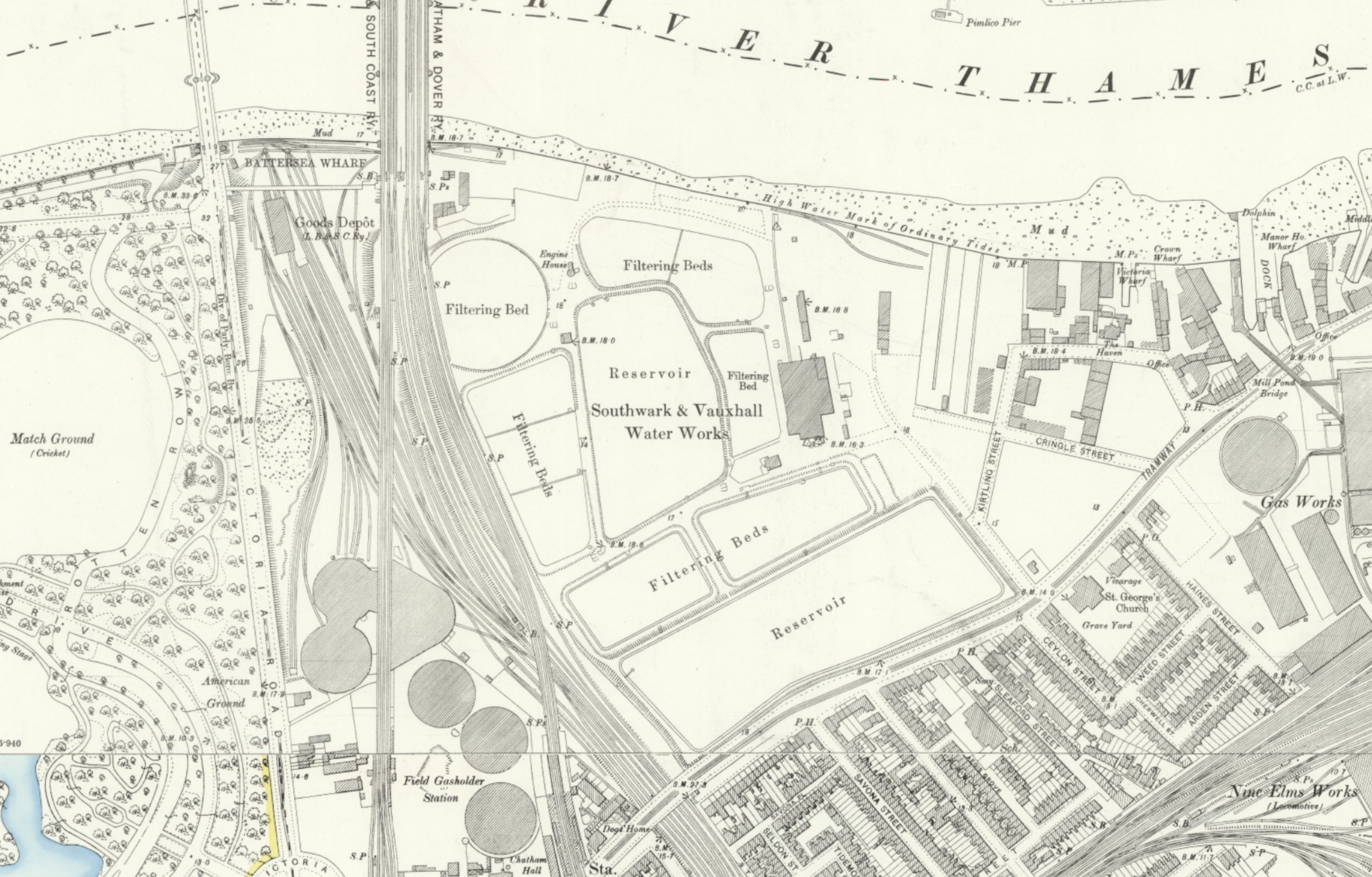
I was pleased to find there was a public house at the entry to the alley, as this confirms my theory that almost every Thame’s stairs, east of the City, had an associated pub, most alongside the stairs, others directly opposite or adjacent. I will come onto the pub and the fire station later in the post.

Pageant Stairs are listed in the Port of London Authority list of Steps, Stairs and Landing Places on the Tidal Thames, where they are described as “Concrete steps then wood steps, concrete apron”, and the listing states that they were in use as a landing place in 1708 (although the list does not identify the source of the 1708 reference, which is a standard date throughout the list for all stairs).

The earliest written reference I can find to the stairs is from the Oracle and Daily Advertiser on the 23rd of September, 1802, where business premises at or adjacent to the stairs are for sale and listed in the following advert:

“EXTENSIVE PREMISES, NEARLY OPPOSITE THE WEST-INDIA DOCKS, ROTHERHITHE, By Mr. SMITH.

At Garraway’s, tomorrow at twelve o-clock, in one Lot. THE CAPITAL and DESIRABLE LEASEHOLD PREMISES, conveniently situate for stores, in front of the Thames, at Pageant’s Stairs, Rotherhithe, late in the occupation of Messrs. Giorgi and Co. Chemists and Refiners; comprising a substantial dwelling house, garden, and small paddock, wharf and extensive warehouses for trade and merchandise; coach-house and stabling for three horses, well planned laboratory, drug, camphor and saltpetre-room; also a large warehouse, adjoining, in front of the Thames.”

So at the very start of the 19th century, the area around Pageant’s Stairs was already industrialised, with one of the many companies working in the chemicals industry that occupied the banks of the river, east of the City.

The 1802 advert mentions that the extensive premises included a substantial dwelling house, garden and small paddock. This is indicative of the semi-rural and small scale nature of the businesses along this stretch of the river as they developed during the late 18th century. Throughout the 19th century, the scale of industrial development would increase considerably.

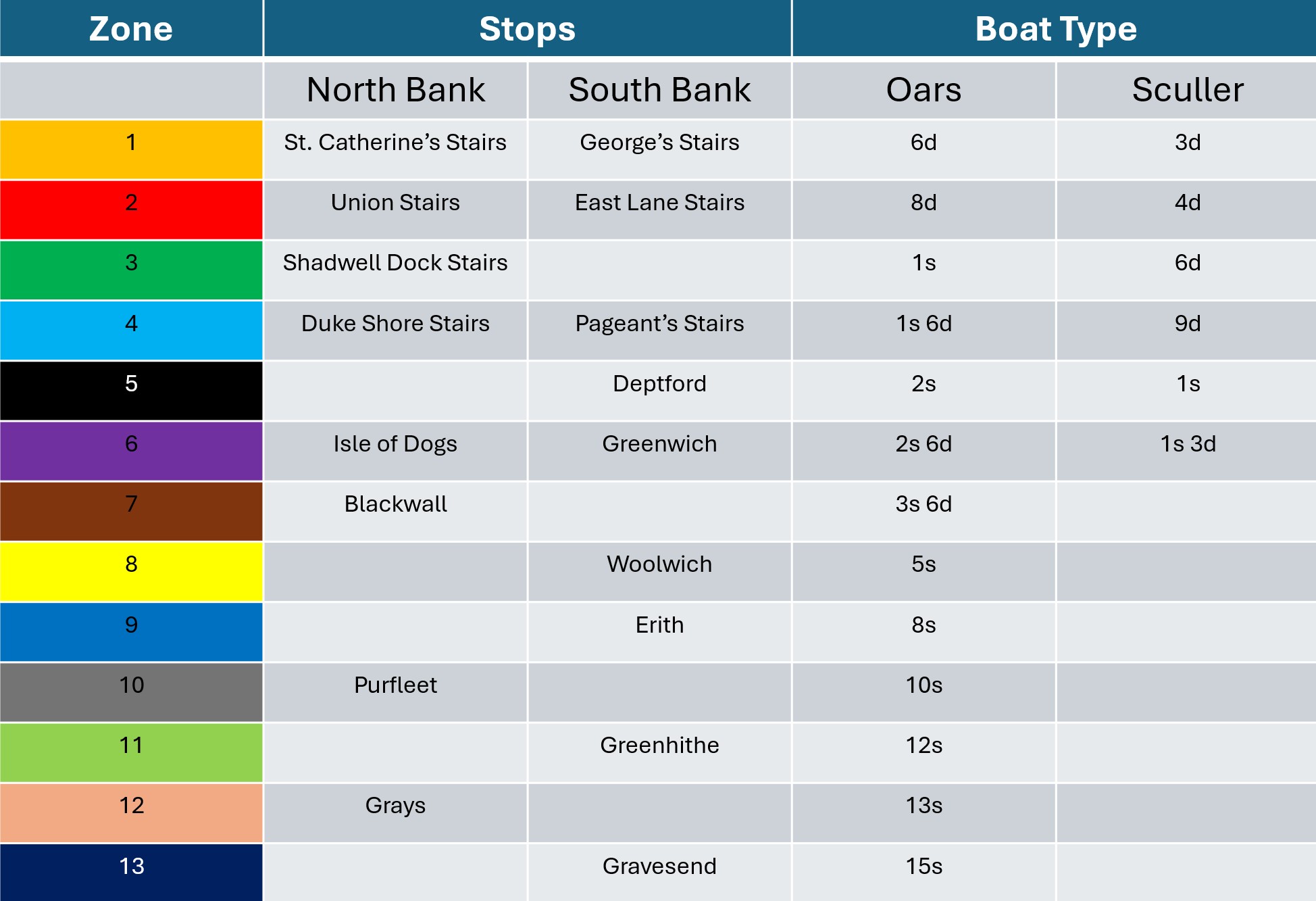
A year later, Pageant’s Stairs are mentioned in the Evening Mail on the 18th of May, 1803 where the stairs are included in a listing of “Table of the New Rates of the Fares of Watermen”, with a rate “from Iron Gate to Duke-Shore stairs or Pageants, Oars 1s, Sculler 6d”.

Iron Gate Stairs were where Tower Bridge is today, and the stairs were rebuilt under the bridge (see this post). Duke Shore Stairs were on the northern side of the river, almost directly opposite Pageant Stairs.

Pageant’s Stairs were also frequently mentioned when recording events on the river, such as an 1870 report on the discovery of a body in the river by four young men who were rowing a boat. The location was given as being near Pagent’s Stairs, Rotherhithe.

In this article, the name was spelt Pagent, rather than Pageant, and this different spelling also seems to have been in use, but not as much as the far more frequent Pageant, sometimes with an ‘s.

The current build of the stairs, is, I assume, from the late 1980s / early 1990s redevelopment of the area when the residential buildings that now line this stretch of the river were built.

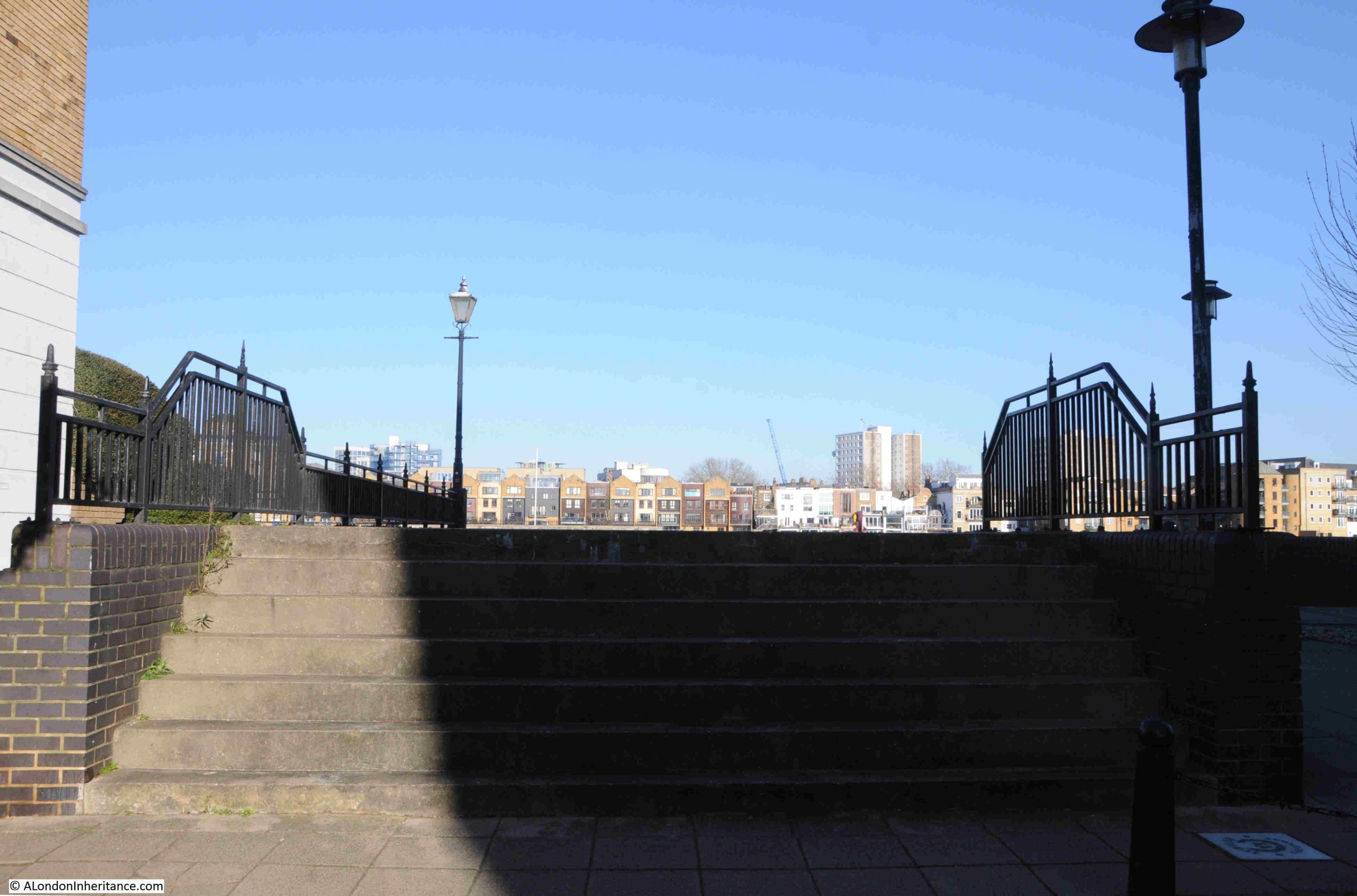
The approach to Pageant Stairs is up a series of steps, which form part of the river wall, and give an indication of the potential for high tides along this stretch of the river:

Alongside the stairs, we can see how they have been built within a walled surround, a way of continuing the river wall around the stairs:

It is not clear where the name Pageant originates. There was a wharf to the side of the stairs called Pageant’s Wharf, so the name may have come from the wharf, or the wharf took the name of the stairs.

The earliest written references I can find to the wharf date to around the same few years as the first written references to the stairs. This first reference to the wharf comes from the Morning Chronicle on the 17th of December 1804, and includes a possible alternative name of George’s Wharf:

“Twenty New Gun Carriages and Beds, nearly completed, to carry 18-pounders, Stock of Wrought Iron, Oak ad Elm Timber, Fire Wood, &c. Pageant’s Wharf, Rotherhithe. By Mr. Hindle, on the premises known by Pagent’s or George’s Wharf near the Board of Ordnance, Rotherhithe, tomorrow at 11.”

The stairs, wharf and name are almost certainly older than the above newspaper references, and it is probable that there was a wharf here in the late 1600s.

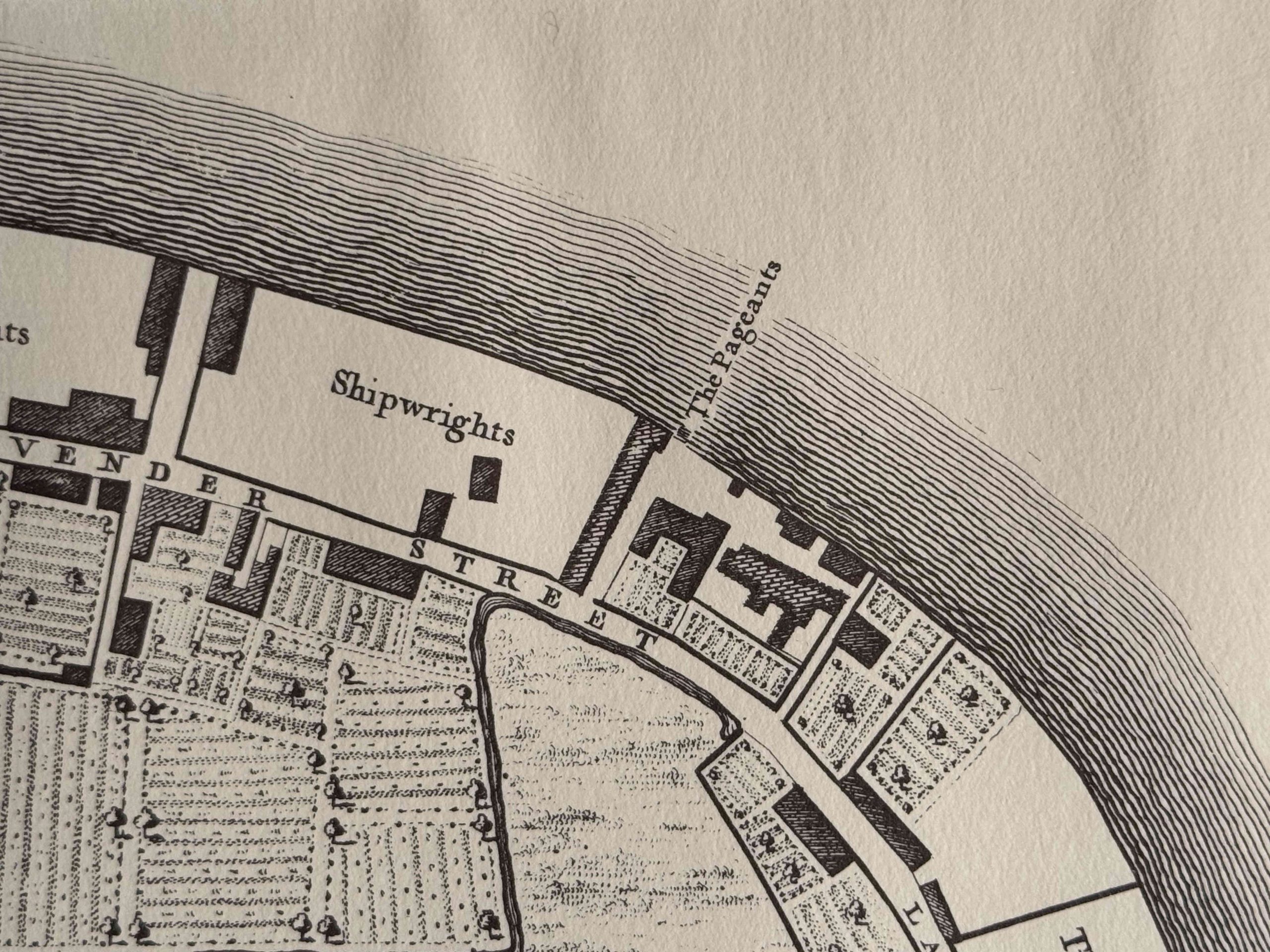
Rocque’s map from 1746 shows some short lines indicating stairs, leading down onto the foreshore, along with the name, The Pageants (in the centre of the following extract):

It is interesting that in the above map, to the east of the Pageants, we can see a plot of land almost as described in the 1802 advert, where there are buildings and open space that almost exactly correspond to the description as “comprising a substantial dwelling house, garden, and small paddock, wharf and extensive warehouses for trade and merchandise; coach-house and stabling for three horses, well planned laboratory, drug, camphor and saltpetre-room; also a large warehouse, adjoining, in front of the Thames“.

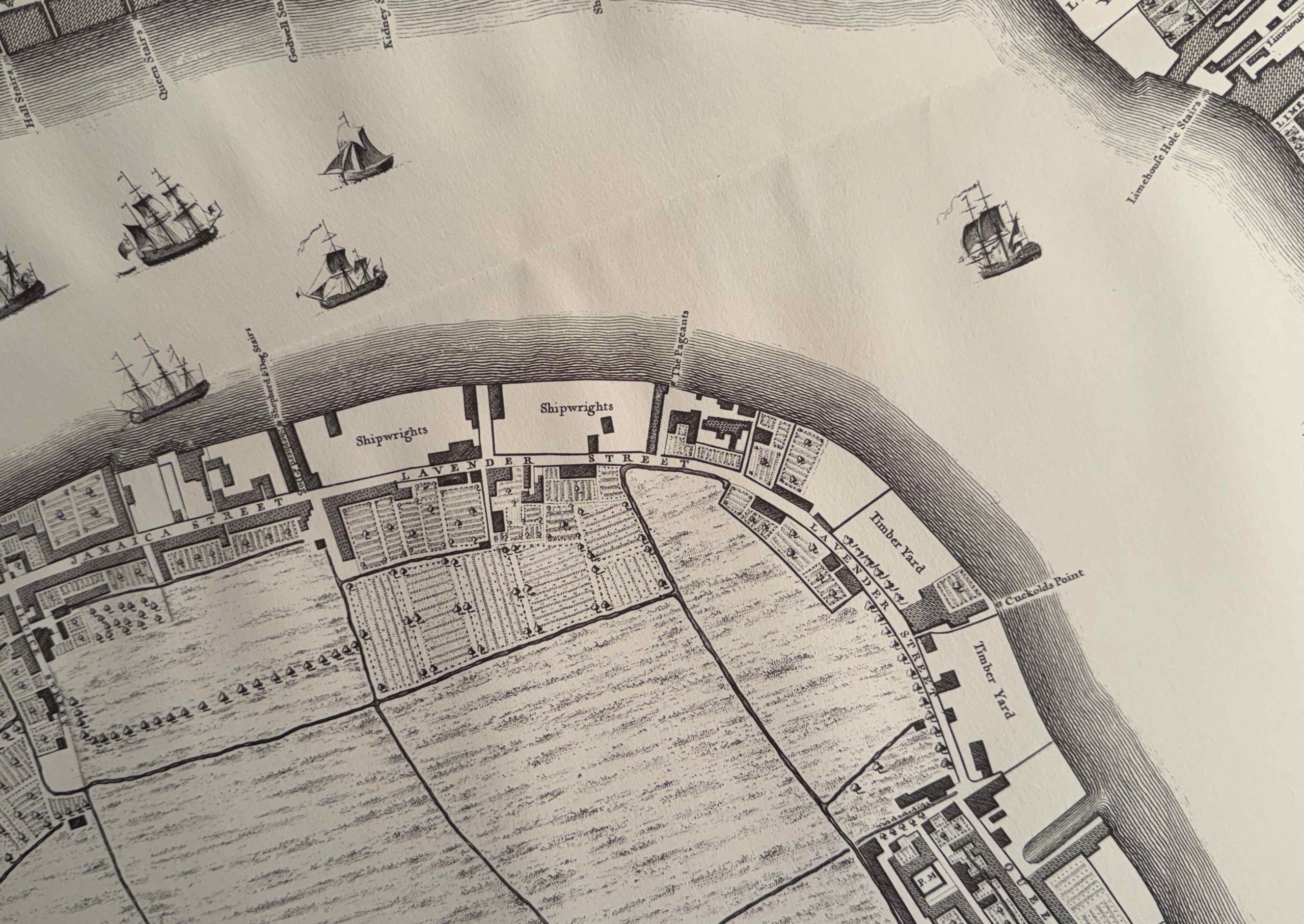
The plural – the Pageants – in Rocque’s map is the same form as used in the 1803 table of Watermen’s rates so it is probable that this was the version of the name used during the 18th and into the early 19th century.

Whether the name refers to a person, perhaps the owner of the wharf or land at some point, it is impossible to say, but it must have been in use for at least 300 years.

I also found one reference where the name used was Little Pageant’s Wharf.

The main industry along this stretch of the river was ship building, and a wider view of the Rocque map shows that in 1746, the area between what is now Rotherhithe Street (then Lavender Street) was full of shipwrights and timber yards, whilst inland of Rotherhithe / Lavender Street, it was all agricultural. It was proximity to the river which drove the early development of Rotherhithe:

There is a brilliant little booklet by Stuart Rankin published in 1996 as the Rotherhithe Local History Paper No. 1 which has a single comment about the Pageants, that they were at one time occupied by the business of Punnett & Sindrey, who were ship breakers.

In the early 20th century, the site was occupied by a firm of timber merchants, however the site would soon been transformed, as detailed in the following extract from the Southwark and Bermondsey Recorder on the 2nd of April 1926:

“BERMONDSEY BOROUGH COUNCIL – NEW DUST DESTRUCTOR TO BE PROVIDED IN BERMONDSEY AT A COST OF £19,327.

In the connection with the decision of the Bermondsey Borough Council to purchase Pageant’s Wharf, Rotherhithe Street, for the purpose of erecting a dust destructor, a specially convened meeting of the Council was held at the Town Hall on Monday evening.

The meeting was called as a matter of urgency in order to expedite the work, and it was decided that, subject to the submission of the necessary estimate by the Finance Committee, the tender of Meldrum’s Ltd of Timperley, near Manchester, should be accepted for the construction of the top-feed destructor, furnaces, boilers etc. in accordance with their specification, as modified by the amended drawings as approved by the Borough Surveyor, at a sum of £11,241, and that the tender of the Building Works Manager be accepted for the erection at Pageants Wharf of a steel framed, brick filled building and a brick chimney shaft, 120 feet high, at a sum of £8,086.”

The dust destructor, or incinerator, was needed as a result of the significant growth in Bermondsey’s population, and the waste they created.

It was opened in January 1927, and was capable of handling 100 tons of household waste a day.

Waste was collected from vehicles at the entrance and carried by an overhead railway, to where the waste was dropped into steel-lined hoppers, it was then delivered to three top-feed furnaces. Steam was generated in boilers from the heat generated by burning the waste, and the steam was used to generate a “steam blast”, which created a draught through the furnaces to get the fire to the high temperatures need to burn the waste.

The dust destructor was a major construction, and included concrete piles, 28feet in length, driven down into the hard ballast below the river bed. Fascinating to think that these piles are probably still there, beneath the river bed.

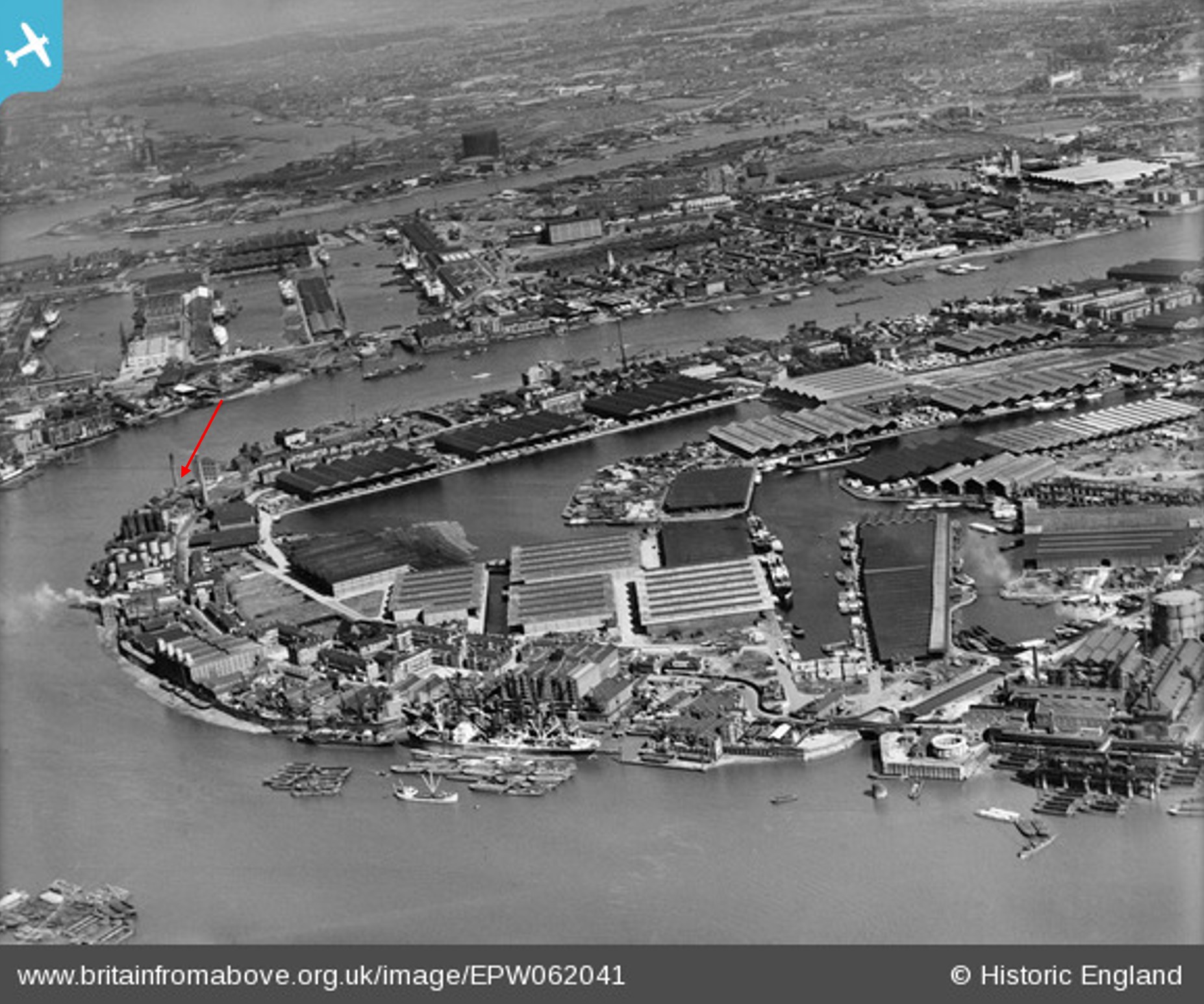
In the following 1939 image from the Britain from Above archive, I have marked the location of the chimney of the dust destructor. The image also shows how the agricultural land in Rocque’s map had been transformed into a large dock complex:

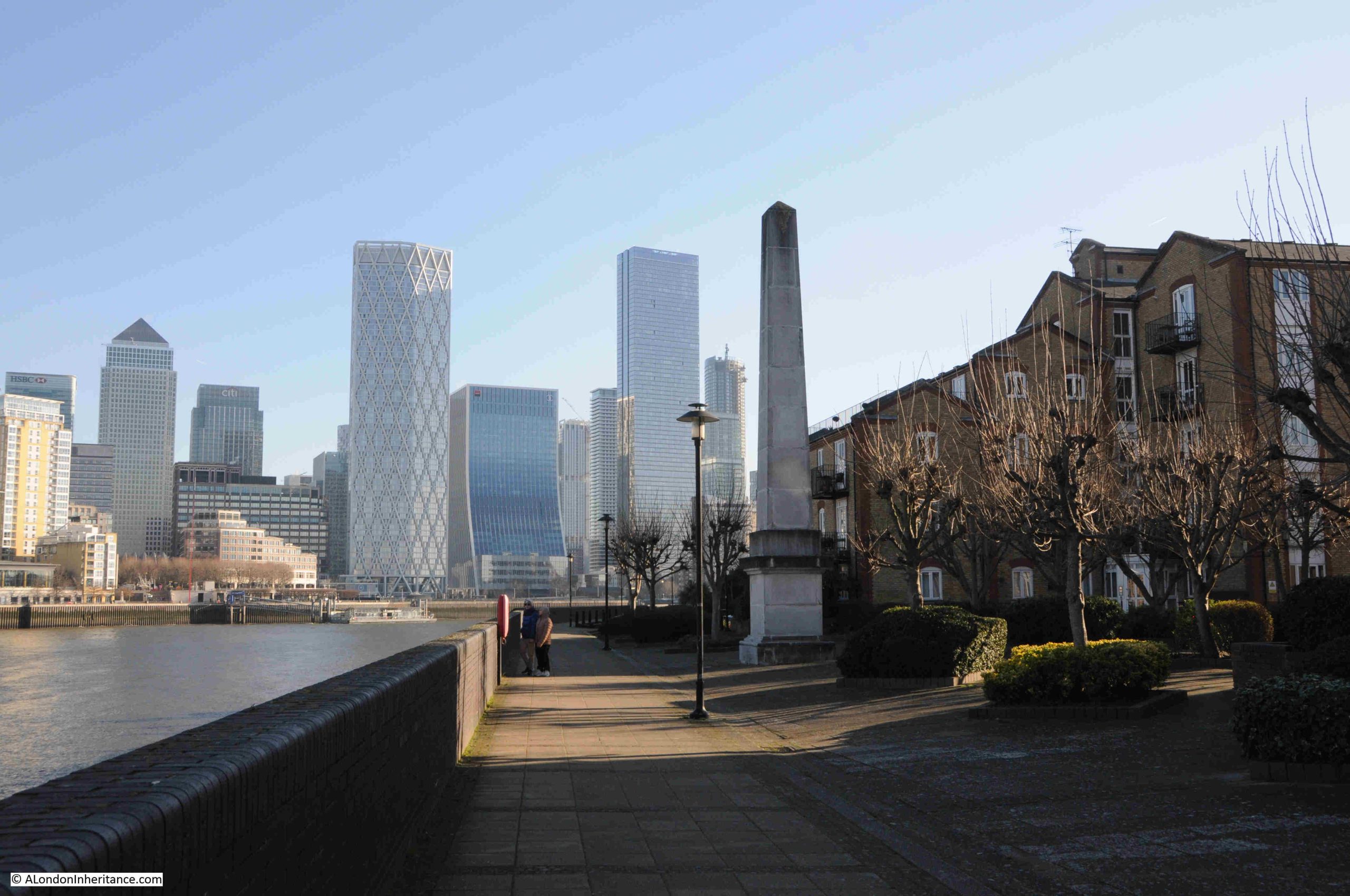
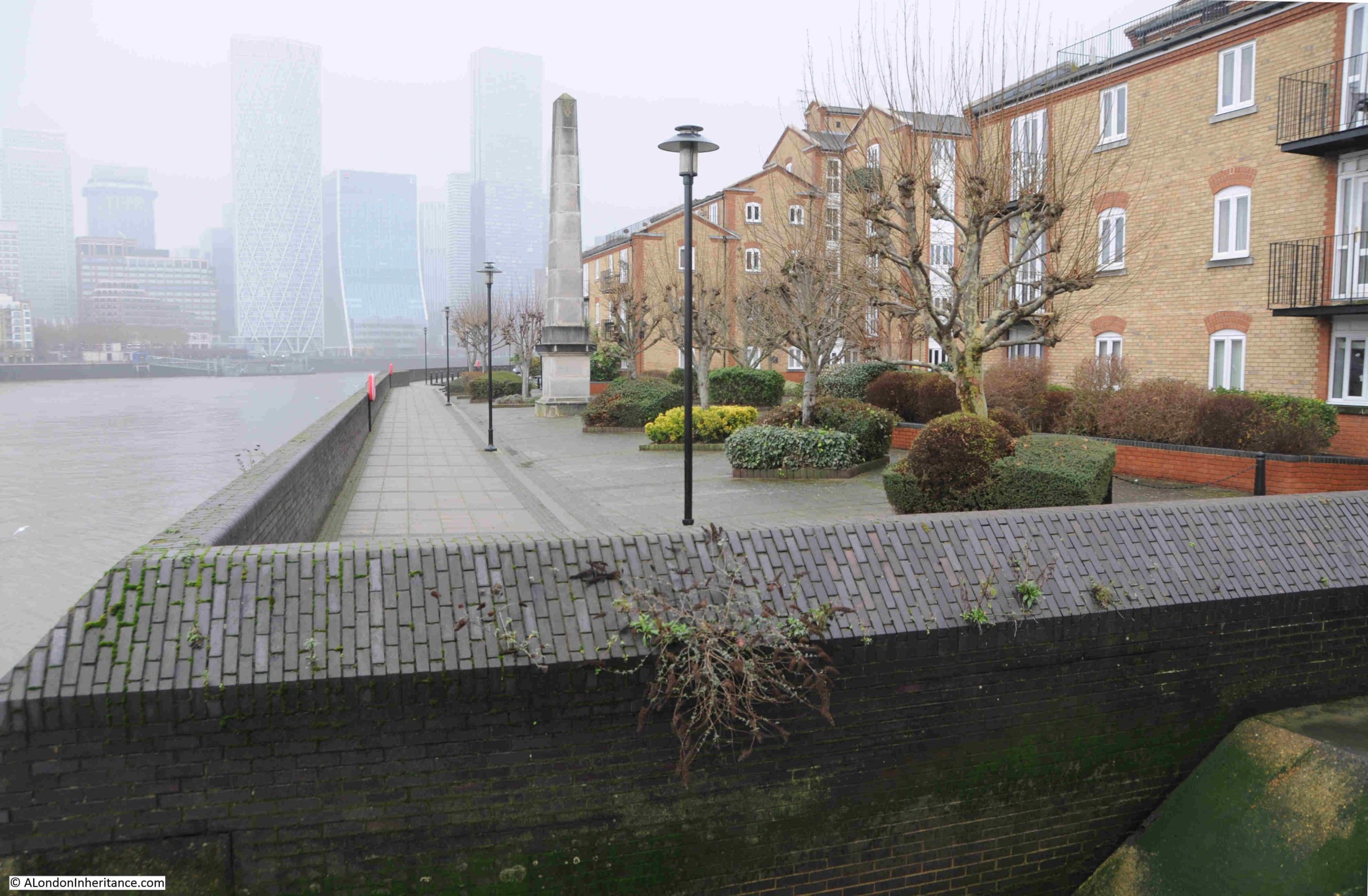
The dust destructor was to the east of Pageant Stairs , and occupied the space in the following 2024 photo:

In the above photo, there is a stone obelisk, and as far as I can tell, it serves absolutely no purpose, apart from decorative.

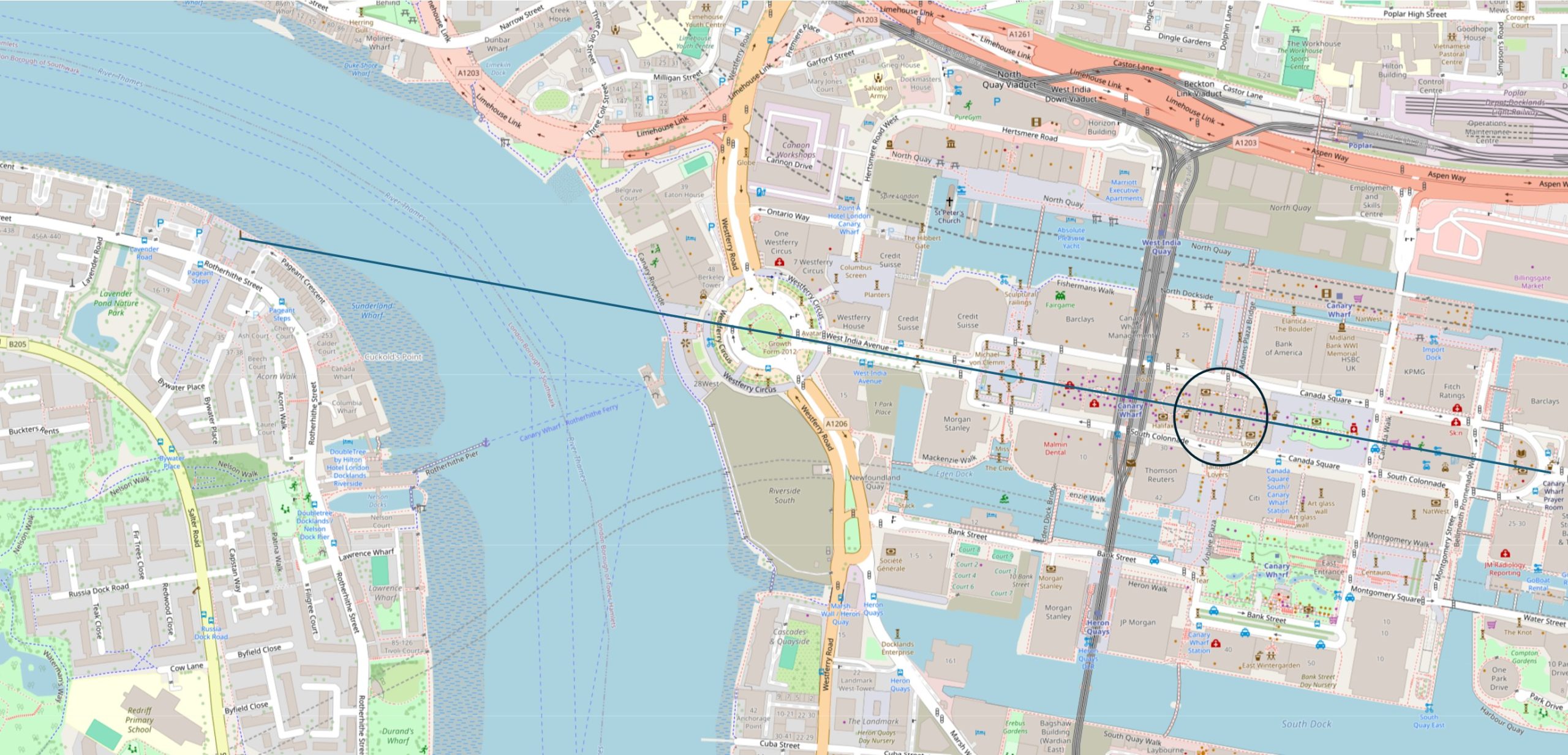
I have read stories about an alignment with Canary Wharf, and that the obelisk is on an alignment through the centre of the original development and the One Canada Square office tower.

I tried this on a map, and the obelisk is indeed on a perfect alignment (obelisk at the left hand end of the blue line, which then passes through the centre of Westferry Circus, then between North and South Colonnade, and passing through the centre of One Canada Square, which I have circled in blue) (© OpenStreetMap contributors:

This is almost getting into Ley Lines, or something from the excellent Rivers of London series of books, but I extended the line to the west, and it passes very close to the Bank Junction, and touches the northern edge of St. Paul’s Cathedral – two historic parts of the City of London.

No idea why the colonnade was built on an alignment with Canary Wharf, or whether it was intentional. Both developments were under the overall control of the London Docklands Development Corporation, so perhaps it was their idea to add some integration between the north and south of the river.

The view during my recent January 2026 visit, to take a look at Horn Stairs which are a short distance away:

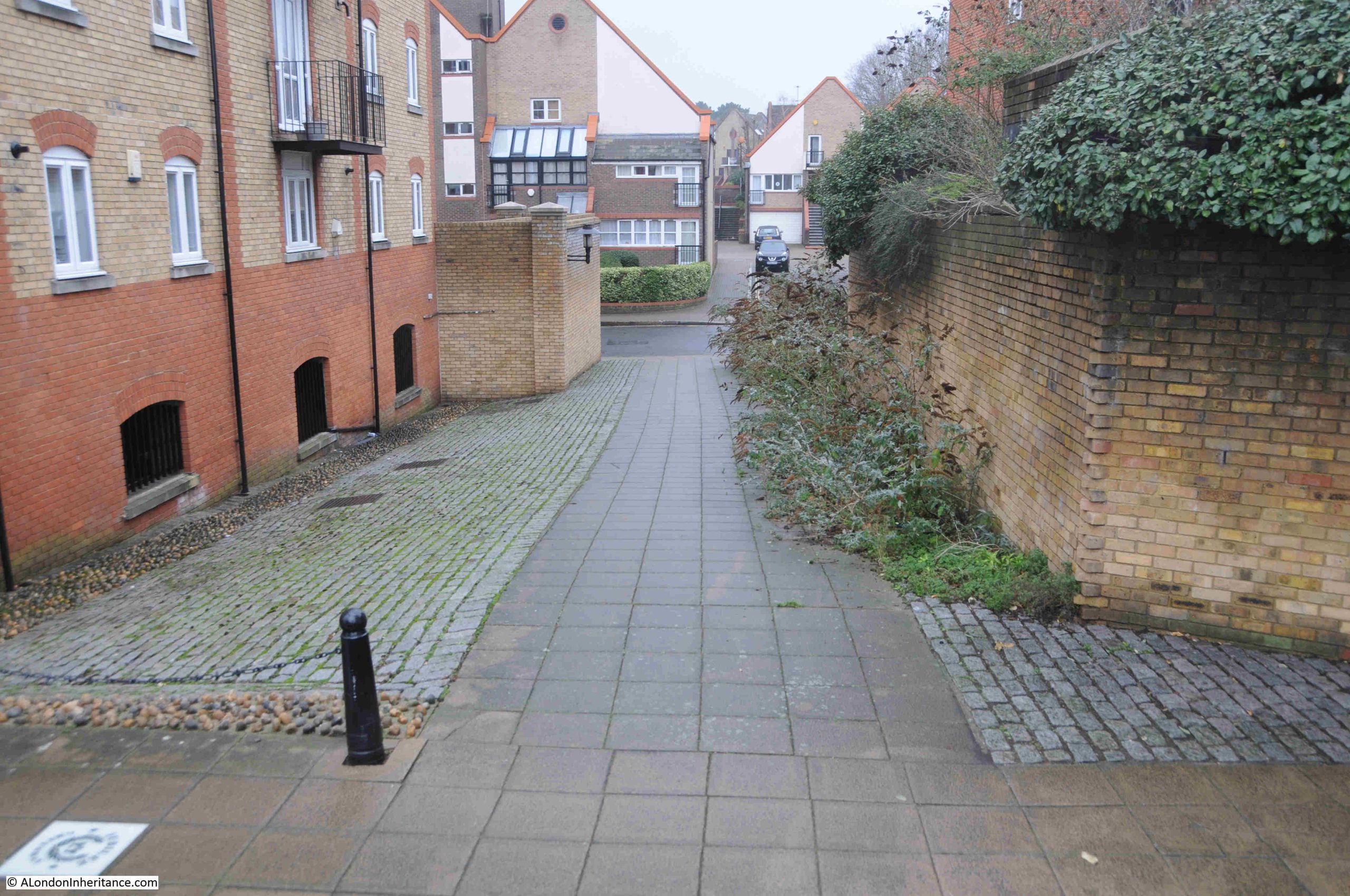
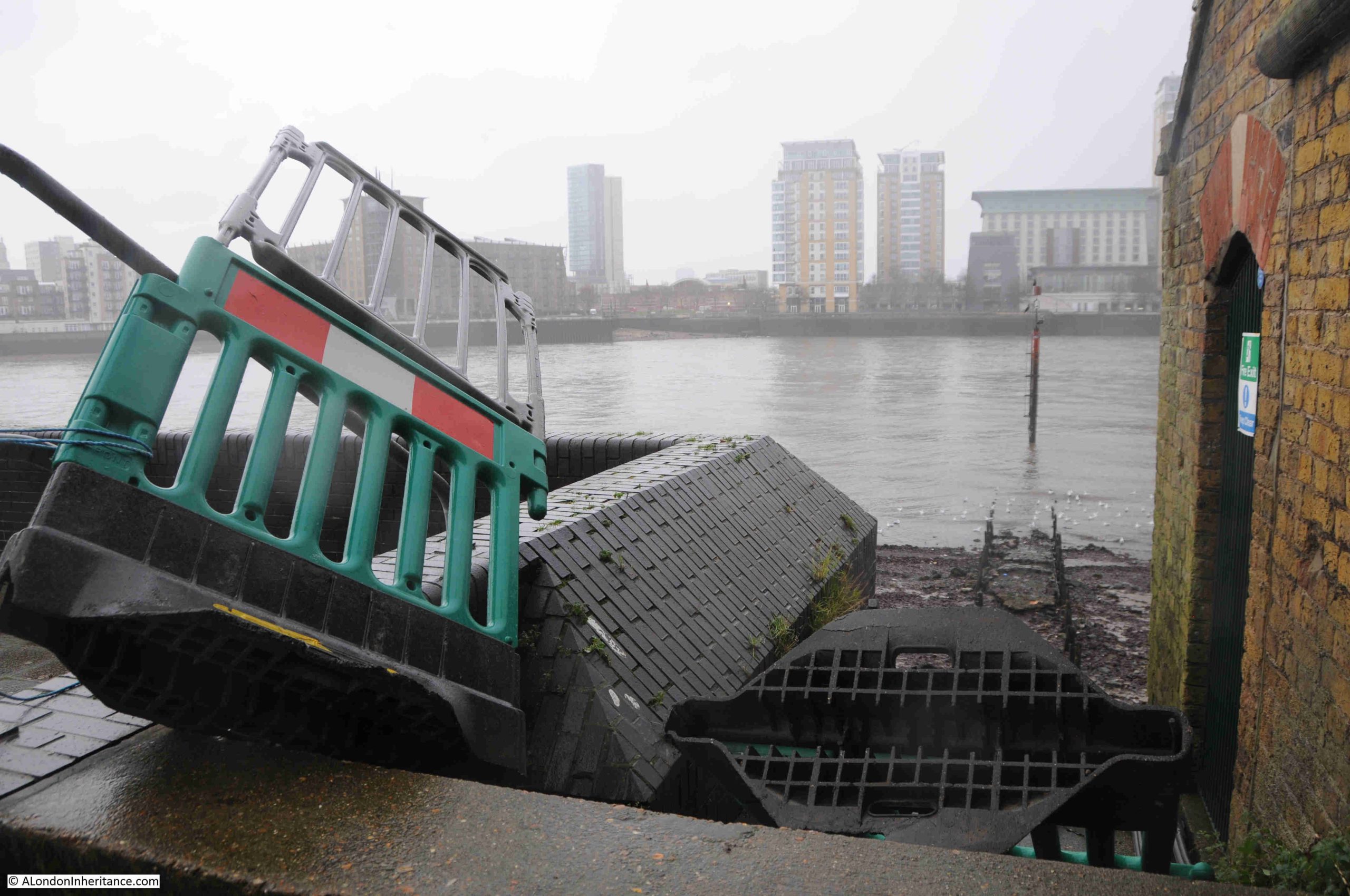
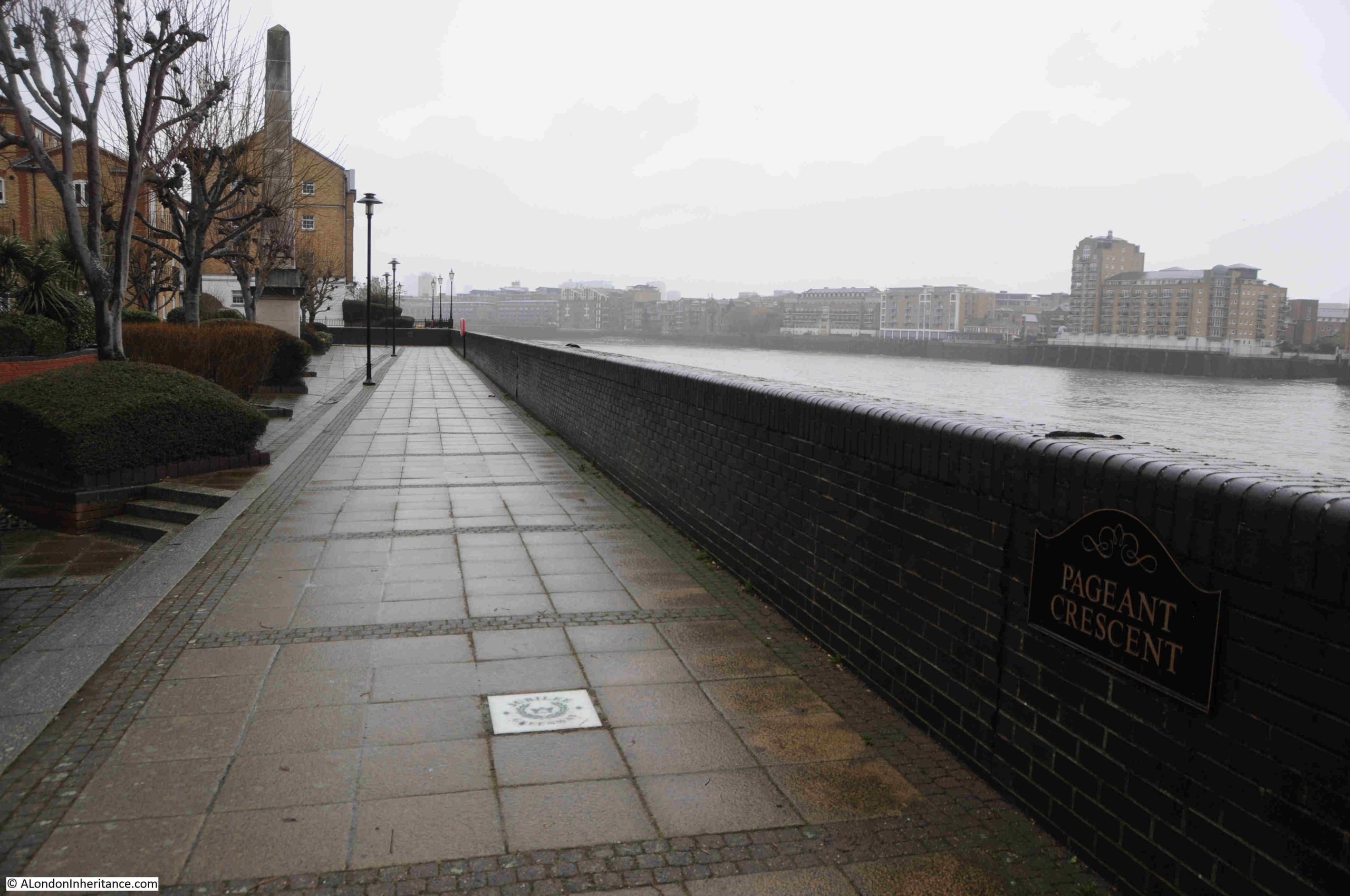
The walkway in the above photo runs between Pageant Stairs and Horn Stairs. This was the view looking back from close to Horn Stairs. Note the name of the walk on the right given as Pageant Crescent (a bit hard to see in the gloom of a January day). Good that the name of the stairs and the wharf is still recorded here (although there is no name at the actual stairs):

During my visit in January 2024, the sky was clear, bright sunshine and very cold, with ice on the steps of Pageant Stairs. In January 2026, it was very wet, but above freezing, although a strong breeze along the river made it feel cold.

The weather has always had an impact on life on the Thames. We are familiar with the stories of ice fairs on the Thames in central London, but the river also froze, with ice and snow accumulating along many parts of the river.

In searching for stories about Pageant Stairs, I found a reference in the Morning Herald on the 20th of January 1838, which reported that “The state of the river is getting worse, and yesterday there was a continued freezing of the waters, in fact the accumulation of ice on the banks and in the stream itself, might be seen to hourly increase”.

The report went on to talk about the problems a ship’s captain had reaching his boat from Globe Stairs in Rotherhithe, due to the amount of snow and “enormous icebergs” on the river. He had to be rescued by a Thames police waterman, who cleared the snow overlaying the ice on the river and laid planks, so the captain could reach his ship.

Pageant Stairs was mentioned in the article as being the only place on the river, from Pageant’s Stairs, Rotherhithe, to Limehouse Hole on the opposite shore, which was pretty clear.

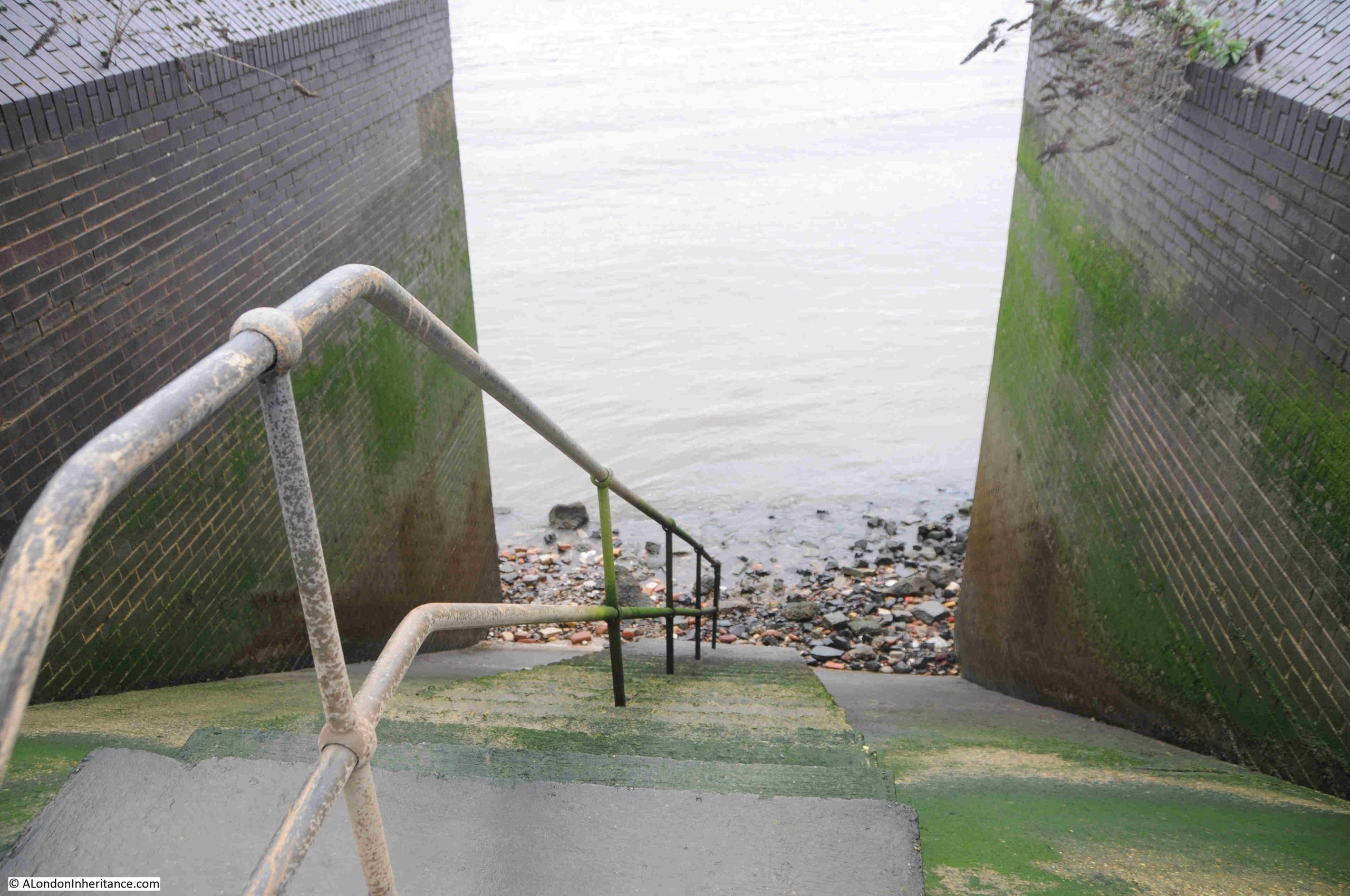
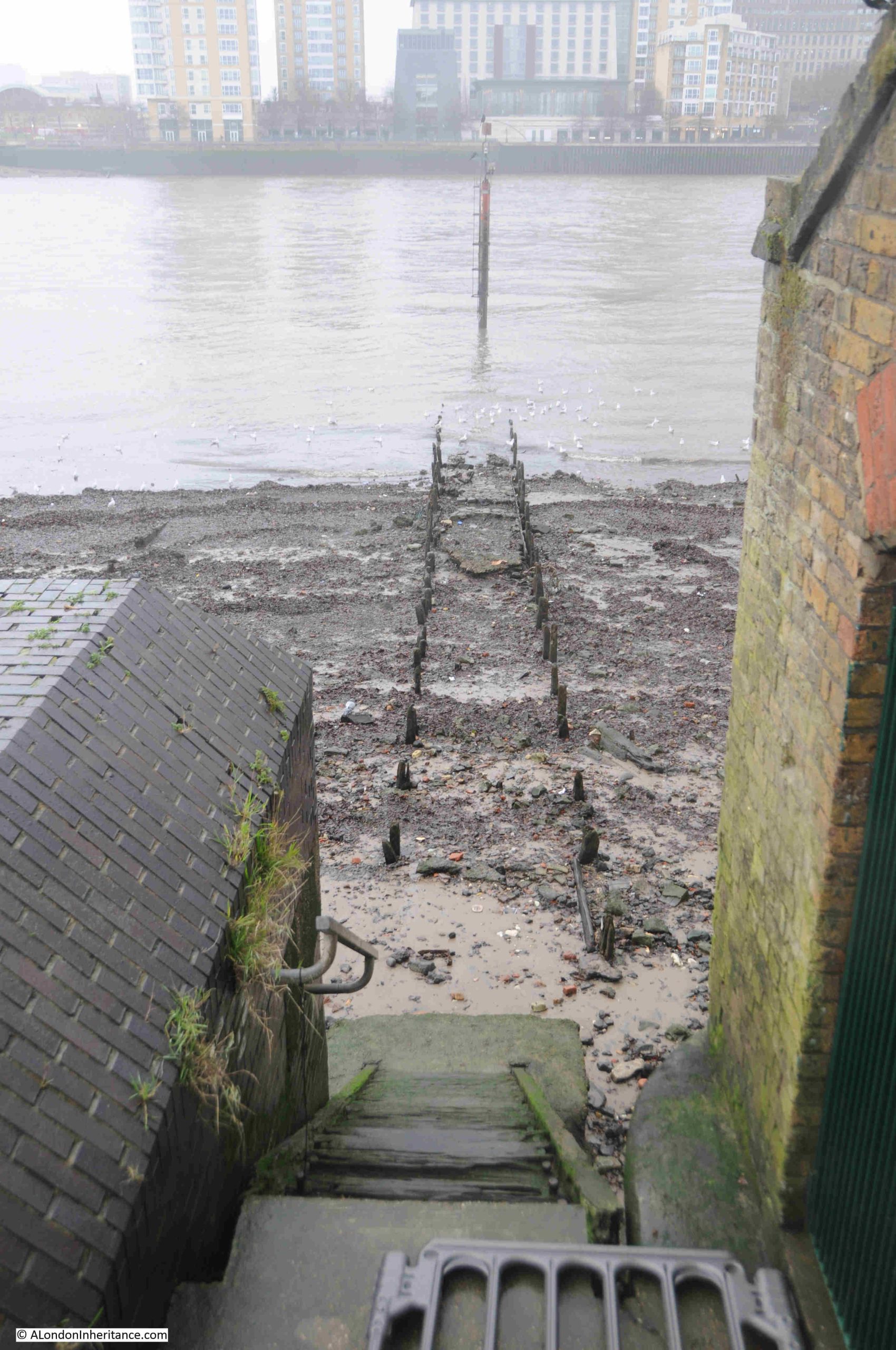
Looking down the stairs in January 2026, with only a small part of the foreshore visible:

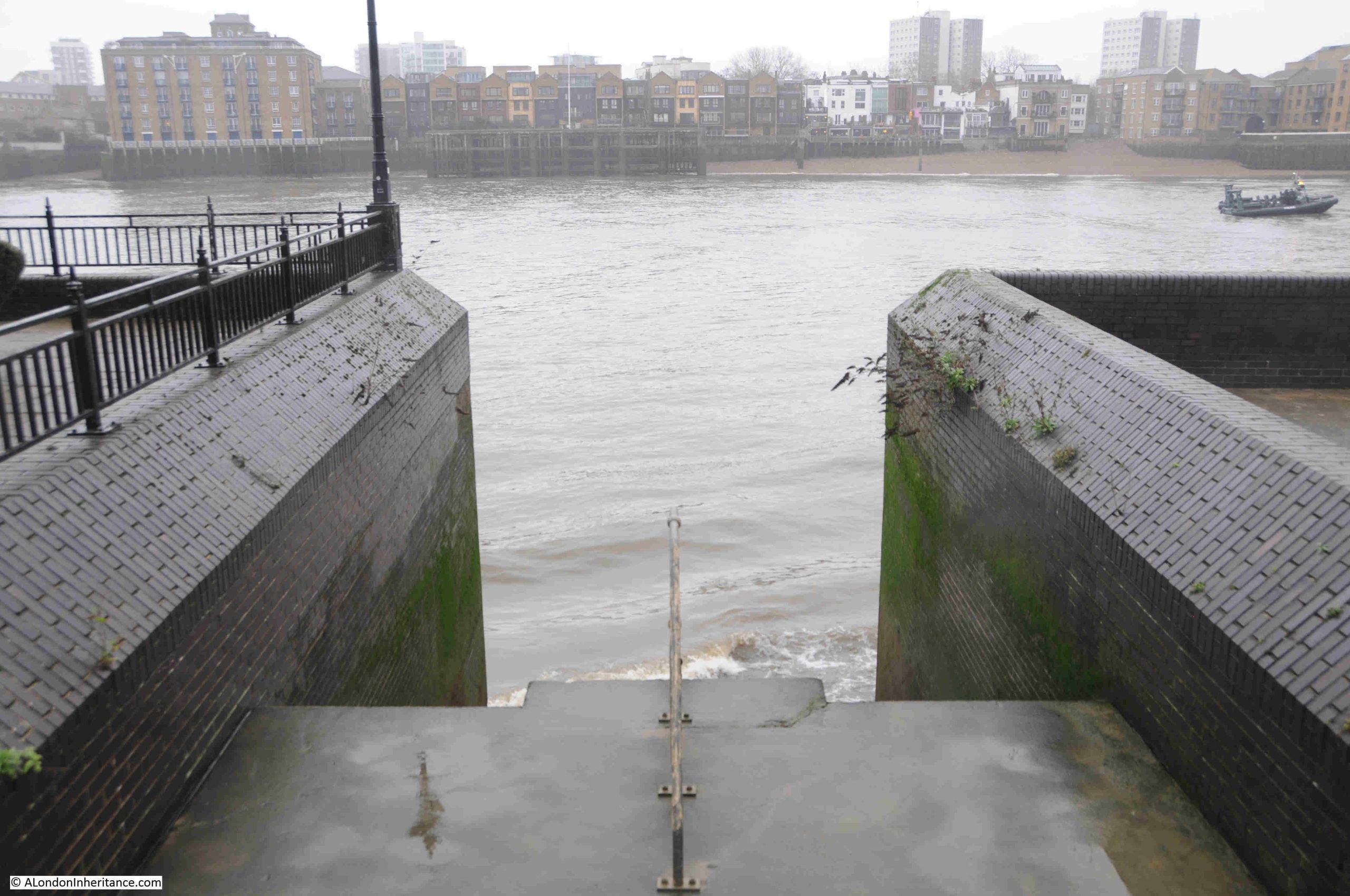
The newspaper report about ice and snow on the river mentioned Limehouse Hole, and Pageant’s Stairs are directly opposite Limehouse, with the following photo looking across the houses in the far bank which face onto Narrow Street in Limehouse. Limehouse Hole is continuing round to the right:

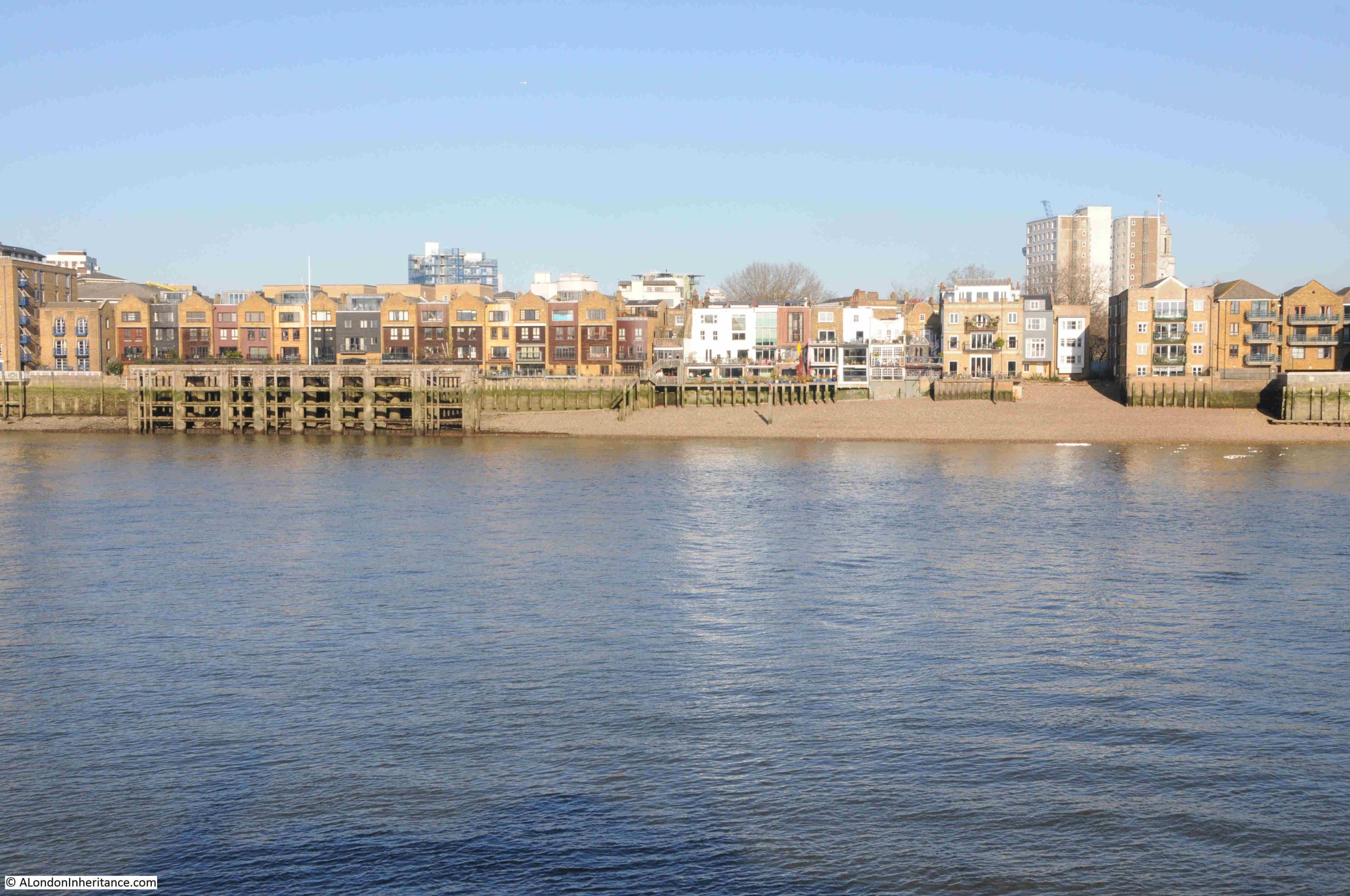
The view was far better during my 2024 visit (the Grapes pub is roughly in the centre):

The following photo is of the view looking from Pageant Stairs down to Rotherhithe Street. The Public House marked by the PH in the Ordinance Survey map shown earlier in the post was at the end of the walkway, on the left and facing onto the walkway and Rotherhithe Street:

The pub was the Queen’s Head, one of two pubs with the same name in Rotherhithe, the other being in Paradise Street.

The Queen’s Head closed in 1928, shortly after the dust destructor, or incinerator was completed. This dirty, noisy industrial plant would have been to the rear and side of the pub, which was left in a small south-west corner of the plot of land with the rest being occupied by the dust destructor.

Not the best place to run a business such as a pub, although the river stairs were still in use.

Finding the Queen’s Head continues to confirm my theory that to the east of London, whether north or south of the river, there seems to have been a pub next to almost all the Thames stairs.

The Queen’s Head seems to have been a typical London pub, with all the appearances in local newspapers that you would expect, for example, from the Southwark and Bermondsey Recorder on the 22nd of October 1926: “DRINKS DURING PROOHIBITED HOURS. At Tower Bridge Court, before Mr. Pope, Alexander Glencross, licensee of the Queen’s Head, 243 Rotherhithe Street, was summoned for selling by his agent, Emily Newman, intoxicating liquors during prohibited hours to Jas. Quillan and Abraham Hill”.

Inquests were held in the pub, which also provide a view of the dangers of being on the river, and the complacent way in which deaths on the river seem to have been treated,. On the 18th of July 1835 “An inquest was held on Monday night at the Queen’s Head, Rotherhithe, on the body of Edward Evan Jones, aged 27, who was drowned on Friday evening by the boat which he was in being run down by a steamer. Mr. Cumberland, warehouseman of Cheapside, who was in the boat with the deceased and three others stated that as they were coming up the river they saw the Red Rover steamer about 60 yards behind them; the people on board called to them to get out of the way; they endeavoured to do so, but the off-set of the tide forced them into the middle of the stream. The Red Rover continued her course, and her bow struck the boat nearly midship, and sunk her. Witness was thrown out of the boat, and seeing the paddle-wheel coming against him, he dived under it and escaped injury. He believed that the collision might have been avoided had not the steamer been going so fast, although the off-set of the tide appeared to be the cause of the accident. The Jury returned a verdict of Accidental Death.”

On the 23rd of July 1898, William Cummings of Francis Street, Canning Town and Hugh Lane of Alphic Street Canning Tower were in court charged with stealing from the Queen’s Head a bottle of gin, a bottle of brandy, a box of cigars, quantity of cigarettes, gold brooch, silver scarfpin. money and other articles to the value of £3.

All normal for a pub by a set of Thames Stairs.

Pageant Stairs are unusual in that there is a bus stop with almost their correct name.

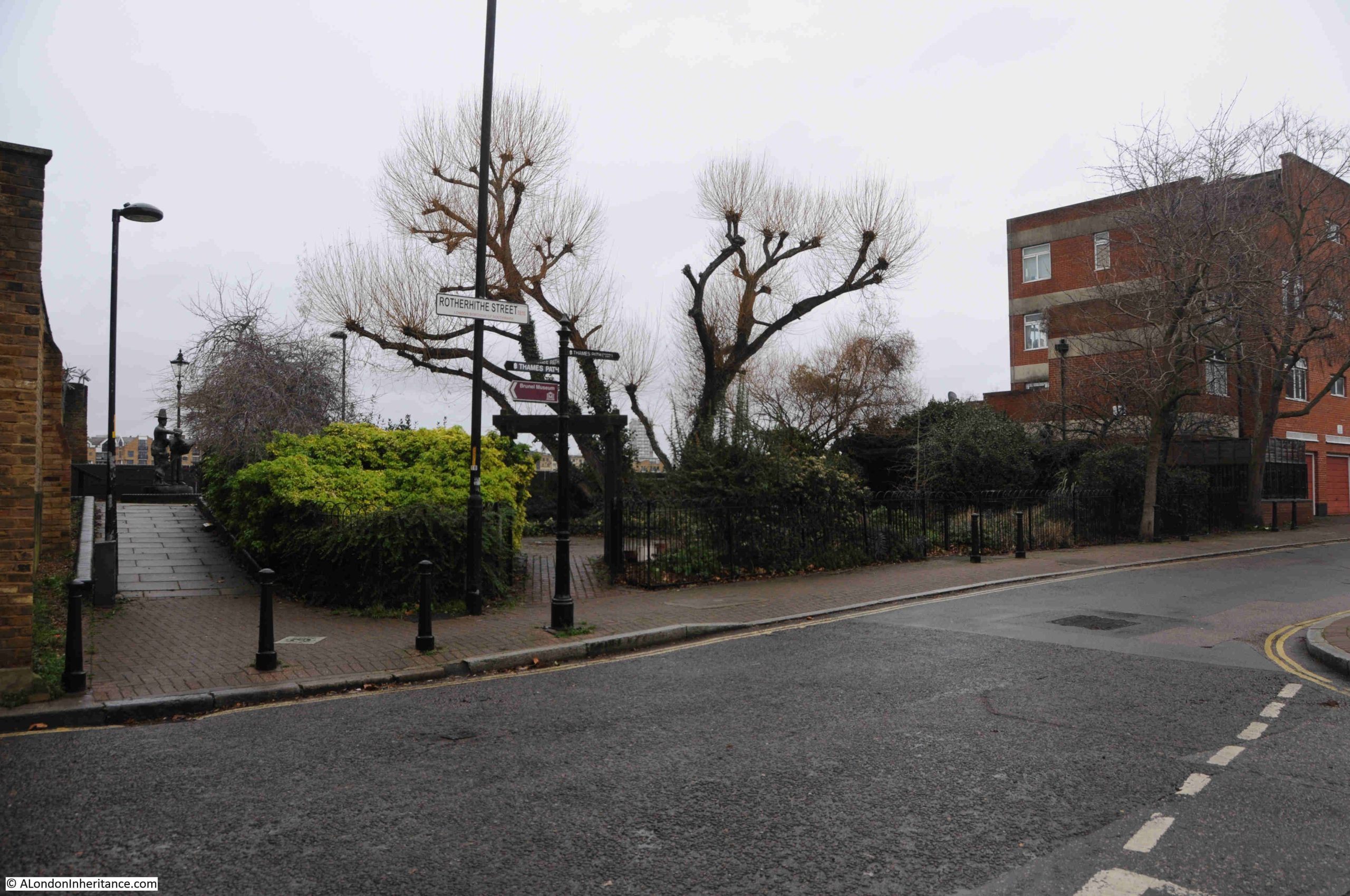
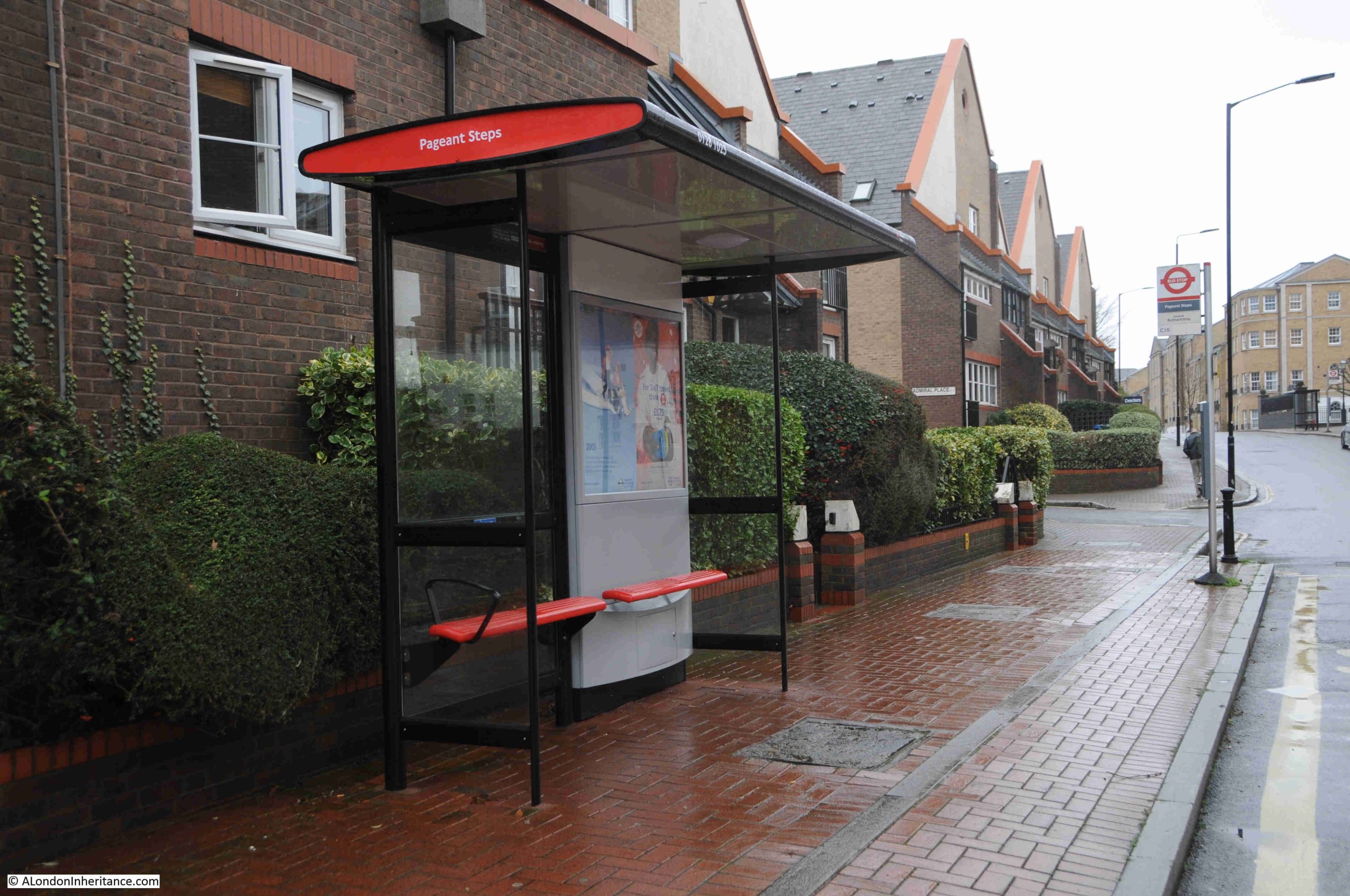
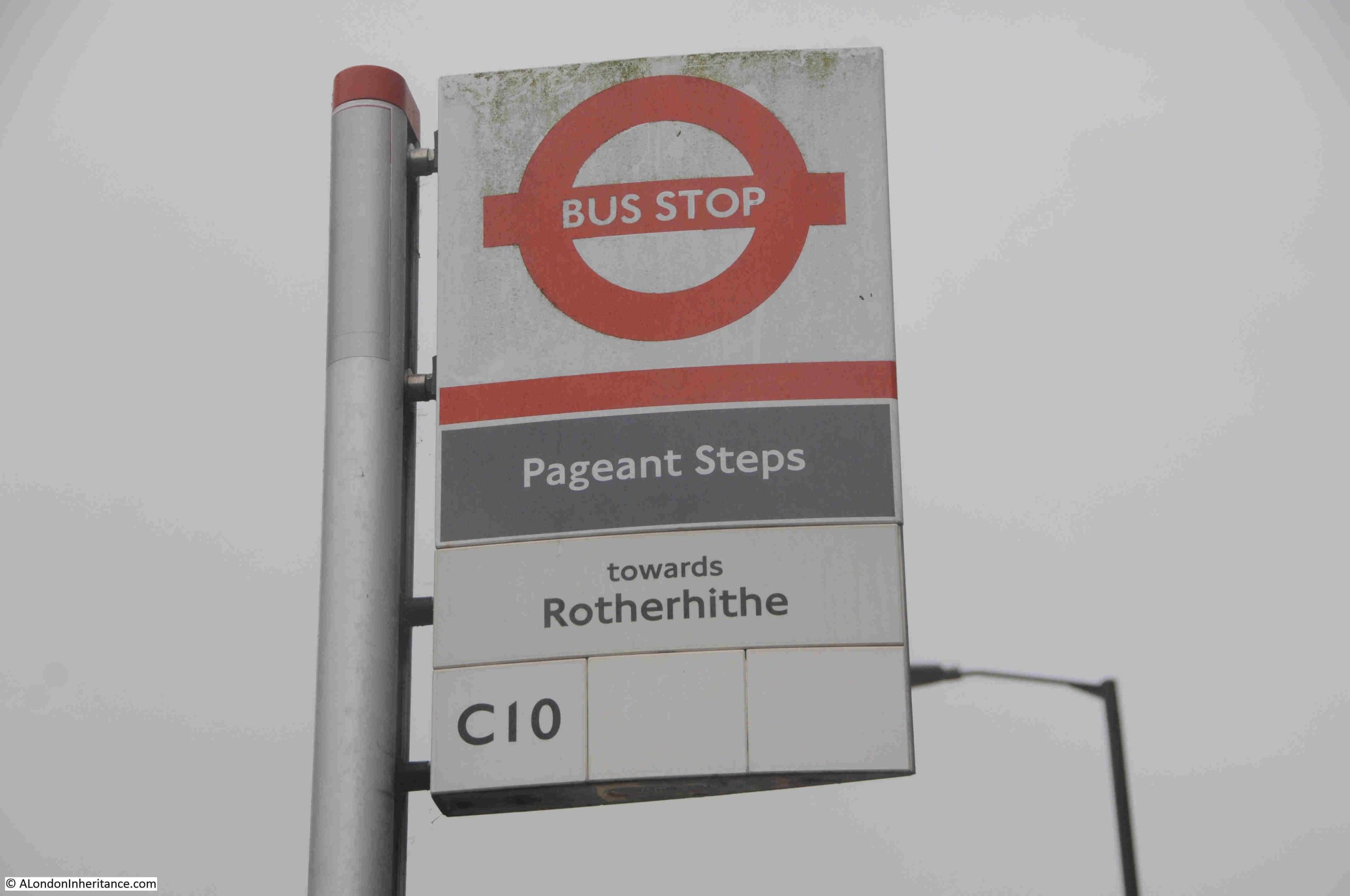
On Rotherhithe Street, just opposite the walkway up to the stairs is a bus stop that goes by the name of Pageant Steps:

Although in reality, I suspect the bus stop is named after the stone steps that are part of the early 1990s residential development around Pageant Stairs and Wharf. These new stone steps lead up from Rotherhithe Street between the flats, up to the obelisk.

A real shame, as whilst Pageant is in use to name this part of the walkway along the river, the stairs from street to walkway, and the obelisk seems to be called Pageant’s Obelisk, there is no plaque at the stairs naming them. Changing the Steps to Stairs for the bus stop name would also be a fitting reminder of a place where people once took a boat to travel, and now take a bus (although the use of either Steps and Stairs seems to have been relatively common) .

Whilst the majority of buildings and landscape around Pageant’s Stairs are the result of late 1980s / early 1990s development, there is a significant building that remains from the time before the dust destructor, and is there because of Rotherhithe’s industrial past.

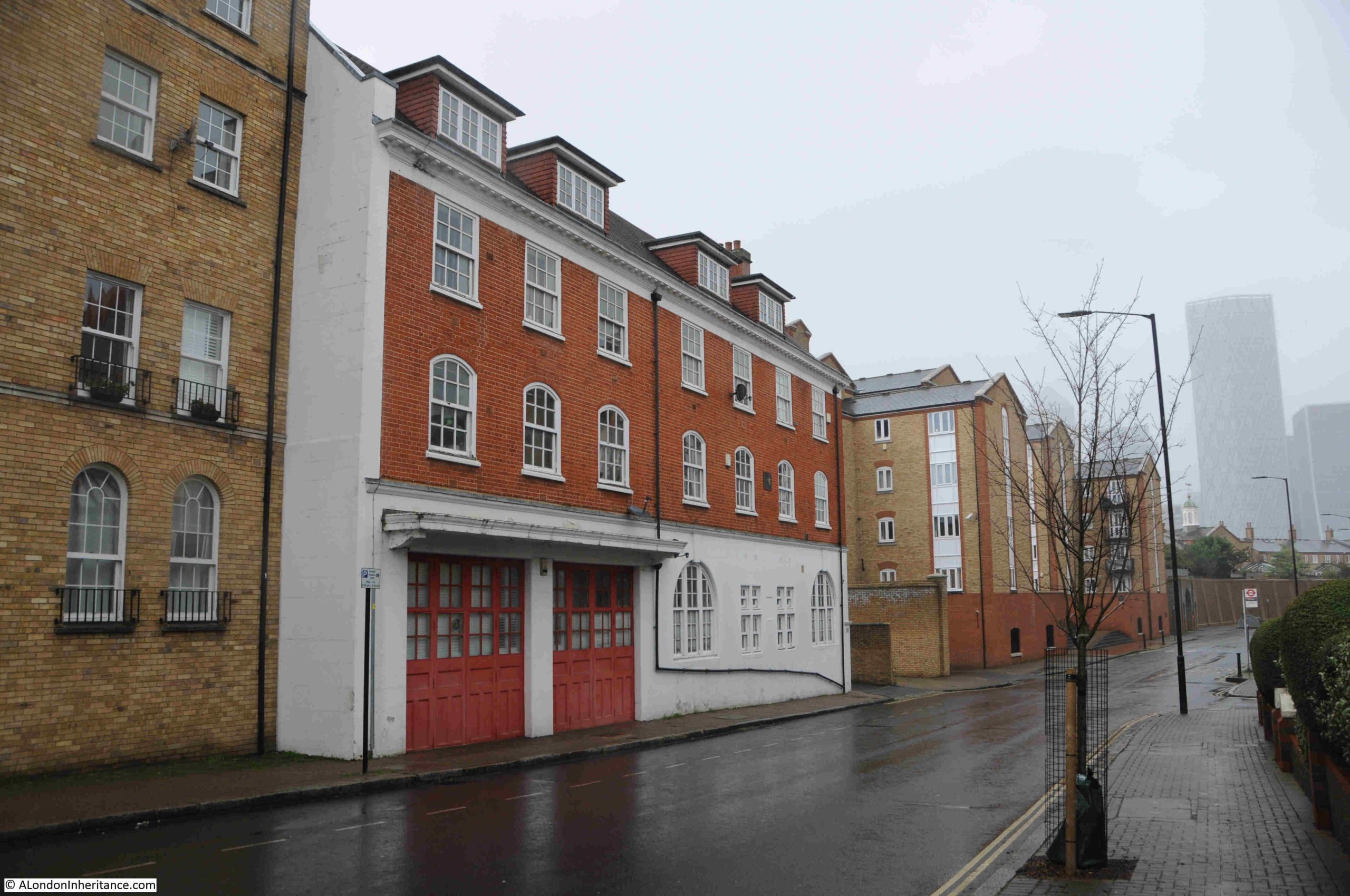
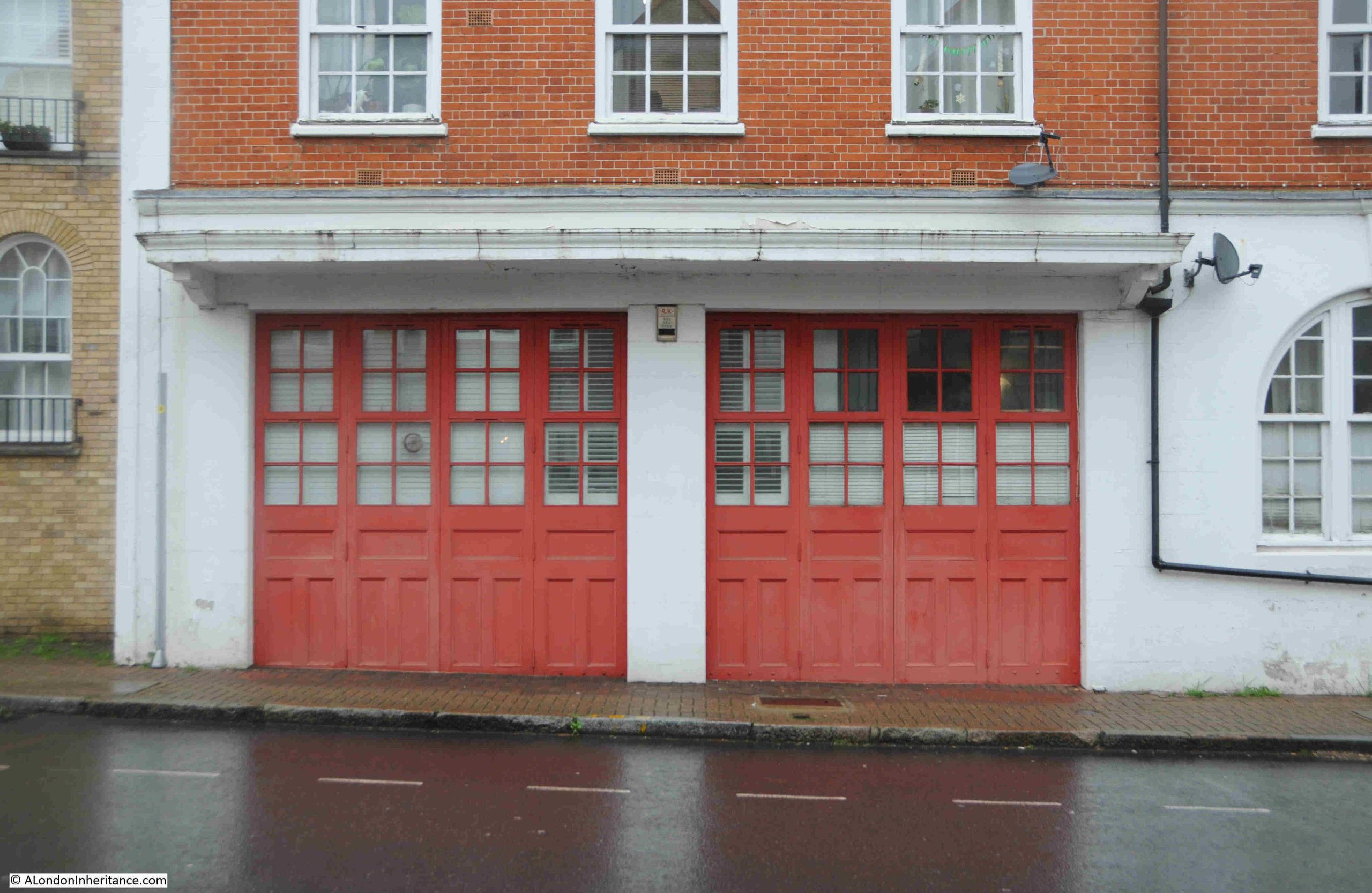
This is the Pageant’s Wharf Fire Station, which can still be seen to the left of the walkway leading up to the stairs, still with the large distinctive doors leading to the space where fire appliances would be stored:

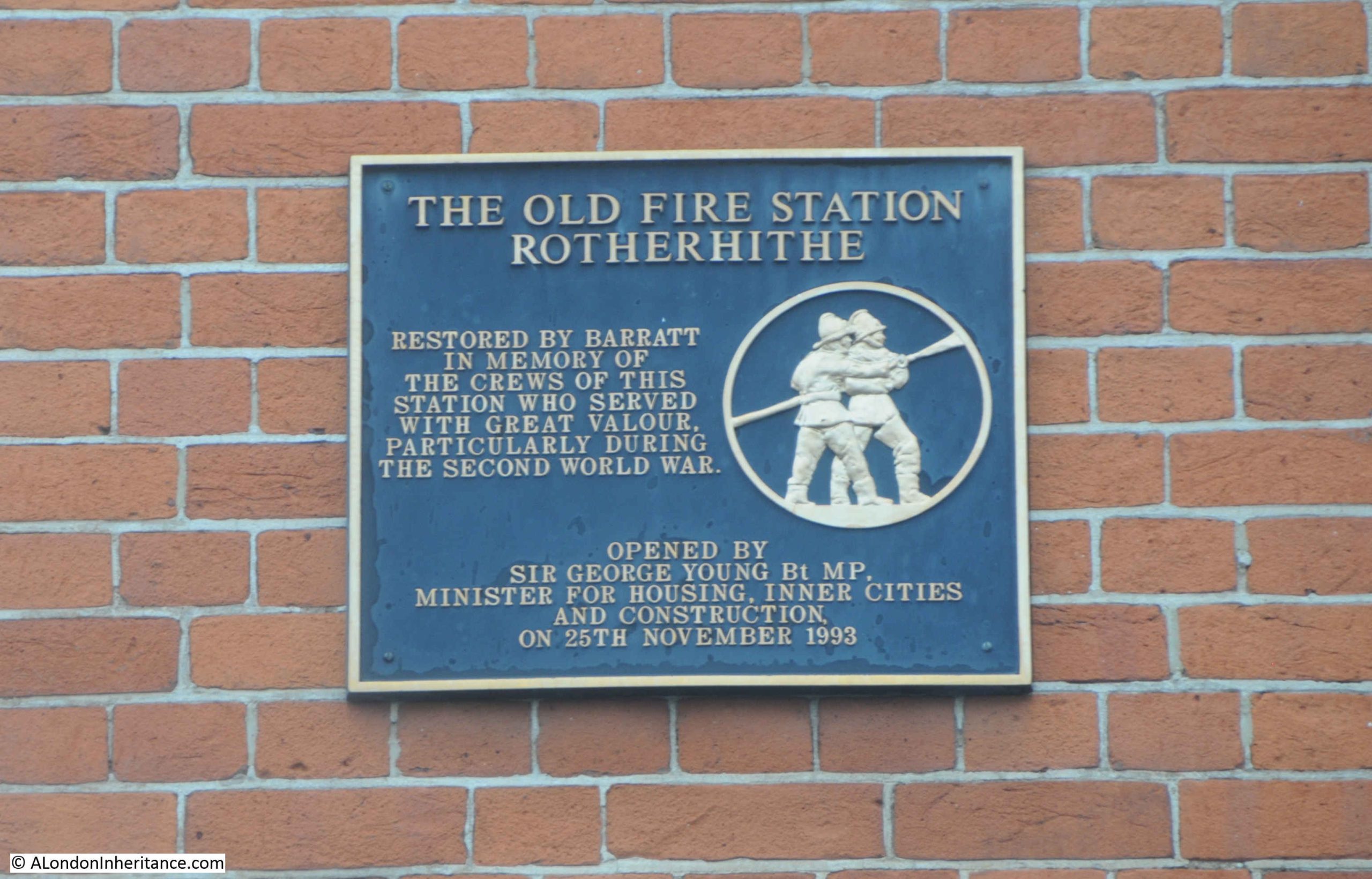
There is a plaque on the wall of the fire station, which for some reason is on the first floor, just visible in the above photo between the second and third windows on the right.

The height of the plaque and size of the lettering makes the plaque rather difficult to read, but a close up view shows that the building was restored by Barratt (the developers of the new residential buildings around Pageant’s Wharf), in memory of the crews who served at the fire station. The building, also now residential, was opened on the 25th of November, 1993:

The plaque refers to the station as “The Old Fire Station Rotherhithe”, which is a shame, as all the reports I have read about the station, from the time when it was in operation, call it either Pageant’s Wharf Fire Station, or the fire station at Pageant’s Wharf.

The foundation stone for the fire station was laid in March 1903, and news report stated that the new fire station was the result of the lack of fire stations in this part of Rotherhithe, and a recent large fire in the docks which expedited the funding and construction of the new station.

It opened in October 1903, and reports of the opening again mentioned the docks, “and the large numbers of wharves, where valuable property is frequently stored in large quantities and necessitating such protection”.

The fire station was equipped with a steam fire engine, owing to the fact that the water supply in the neighbourhood was poor. This was down to the area being mainly docks and industrial and “the amount of water required for domestic purposes is small, and consequently the pipe laid down Rotherhithe Street is of small diameter”.

The staff of the station consisted of an officer, six firemen and one coachman.

The coachman was part of the staff as fire appliances were still drawn by horses, and the fire station also had a two stall stable along with a fodder store. The first and second floors of the building consisted of living rooms for some of the staff (the earlier report when the foundation stone was laid also stated that the Coachman had married quarters at the fire station – presumably because the horses needed someone on site for their care at all times of the day).

An incident in the run up to the opening ceremony illustrates one of the problems of travelling in Rotherhithe.

Captain Hamilton, Chief of the Fire Brigade, with Mr Gamble, his second officer, along with a number of representatives and officials of the London County Council were travelling in carriages to the opening, but were delayed when they reached the Surrey Dock Bridge, as this had opened to allow a dredger to pass through.

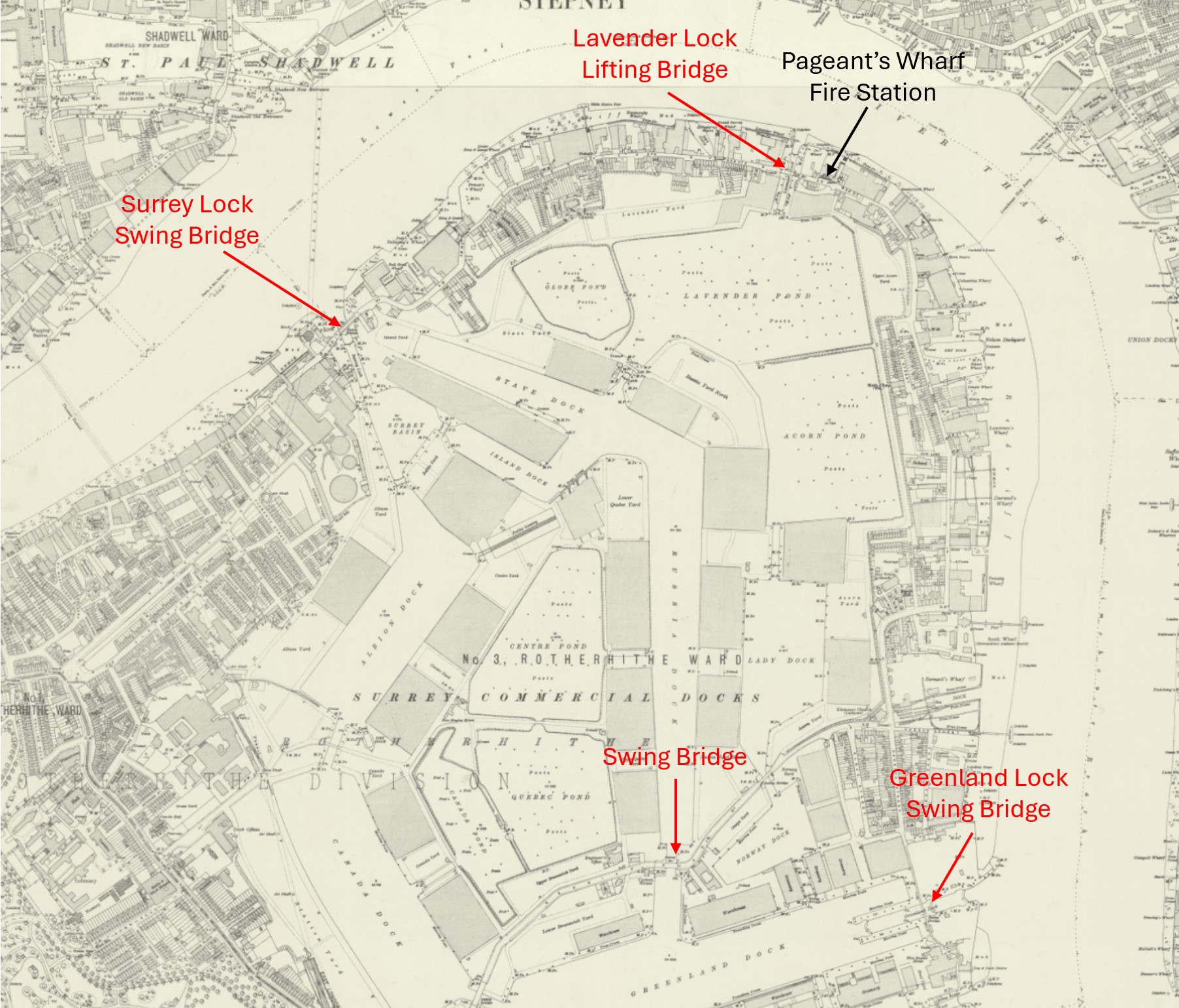
This highlighted why a fire station was needed in the area around Pageant’s Wharf, as there were a number of lifting and swing bridges across Rotherhithe that could turn parts of the area into an island when they were lifted, thereby causing a delay to a fire engine trying to reach a fire.

I have marked the location of the lifting and swing bridges in the following map (in red) and the Pageant’s Wharf fire station (in black) in the following map (‘Reproduced with the permission of the National Library of Scotland“:

A report by Captain Hamilton, chief of the London Fire Brigade on fires in London during the year 1905, implies that the Pageant’s Wharf fire station was not that busy:

“The principal cause of fires where lives were lost was ‘children playing with fire’. Other causes are smouldering matches and other lights which are thrown down by people leaving buildings. Carelessly fitted electric circuits, temporary and inefficient fitting to gas cooking stoves and gas rings for heating glue etc. are grave sources of danger, as are also swinging gas brackets, particularly in warehouses and stables.

The busiest force station as regards calls in 1905 was the Euston Station, being turned out no fewer than 323 times. The smallest number of calls, viz. nine, was received at Sydenham, the same number being also received at Pageant’s Wharf, Rotherhithe.”
The report also stated that in 1905, across London, there had been 3,511 fires reported to the London fire brigade, and that 100 people had lost their lives in fires.

Despite the low number of calls, the station was doing important work, as in 1911 Pageant’s Wharf fire station won the Wells Cup, which was awarded to the London Fire Brigade Station which performs the “smartest job of the year”, won for the prompt way in which the station dealt with a fire which broke out in a big granary in their local district.

Another example of their work was in 1931 when firemen from the station rescued a thirteen year old boy who fell into the river and was at risk of being carried away by the tide. Firemen from Pageant’s Wharf got out on the river in a skiff and recovered the boy, who was taken to hospital.

The number of call outs at Pageant’s Wharf fire station seems to have continued to be relatively small compared to other stations across London, and there were occasional attempts to close the station, but these were successfully resisted.

The fire station was busy during the Second World War as the docks around Rotherhithe took heavy damage during bombing raids, but after the war there was a gradual reduction in call outs as both industry and the docks declined.

Closure of the Pageant’s Wharf fire station came at the end of the 1960s, although there were still attempts to keep the station open, with the swing bridges still given as a key justification, as in the following from the London Evening News on the 12th of September 1967:

“DOCKS BID TO SAVE FIRE STATION – Trade unionists in dockland are calling on the aid of their MP, Mr. Bob Melish, in a fight against a GLC plan to close a fire station in Rotherhithe. They are also writing to Home Secretary Mr. Roy Jenkins asking him to halt the closure when the council submits it for his approval. The GLC say the area can be adequately covered by existing stations and the one at Pageant’s Wharf is unnecessary.

The union men are worried that the area – a virtual island linked to the rest of Bermondsey by a swing bridge – could become cut off in an emergency. ‘If fire engines could not get to a blaze or flood quickly there could be serious damage or loss of life’, said a Bermondsey Trades Council spokesman. The unionists want the Home Secretary to order test runs of fire engines from neighbouring stations in peak traffic.”
No idea if the test runs were carried but, but Pageant’s Wharf fire station closed at the end of the 1960s, and the building is now residential, but thanks to the retention of the large doors on the ground floor clearly was once was a fire station.

It always amazes me how much there is to find in one small part of London, and the location of some Thames stairs always adds an additional layer of history.

The name Pageant remains in use, now covering the walkway along the river, the concrete steps from Rotherhithe Street to walkway as part of the recent redevelopment and a bus stop as well as the stairs, and the obelisk that has a strange alignment with Canary Wharf.

It is a quiet residential area, so different from the centuries of ship building, ship breaking, timber trading, an active fire station, and a place where the area’s household waste was incinerated.

New Smithfield and Billingsgate Markets, Horn Stairs and a Confusion of Greshams

One of the challenges with the blog is that there are many updates I would like to add to previous posts. If I update the original post, then the update will be part of a post that could be from several years ago, so not very visible, therefore for this week’s post, I thought I would cover three very different updates to past posts.

The last two are based on feedback from readers, which is always greatly appreciated. The first is following a recent decision by the City of London Corporation, regarding:

The future of Smithfield and Billingsgate Markets

The City of London Corporation has been looking at relocating the Smithfield and Billingsgate markets for some years.

Smithfield Market is set to become a new cultural and commercial centre, with the new Museum of London already under construction in the old General and Poultry market buildings.

Billingsgate Market moved out of Billingsgate in 1982, when the fish and seafood market moved to a new location by the North Dock, between the northern edge of the Isle of Dogs, and the A1261 Aspen Way.

Originally, the City of London Corporation were planning to relocate both markets to Dagenham Dock, a location that was not popular with the market traders, and in November 2024, the City of London Corporation abandoned this move, and appeared to take an approach where traders would be helped to move to other locations, without having a single location available.

At the start of December 2025, the City of London Corporation announced a new policy, that the two markets would be consolidated and moved to a new location at Albert Island at the eastern end of the Royal Docks.

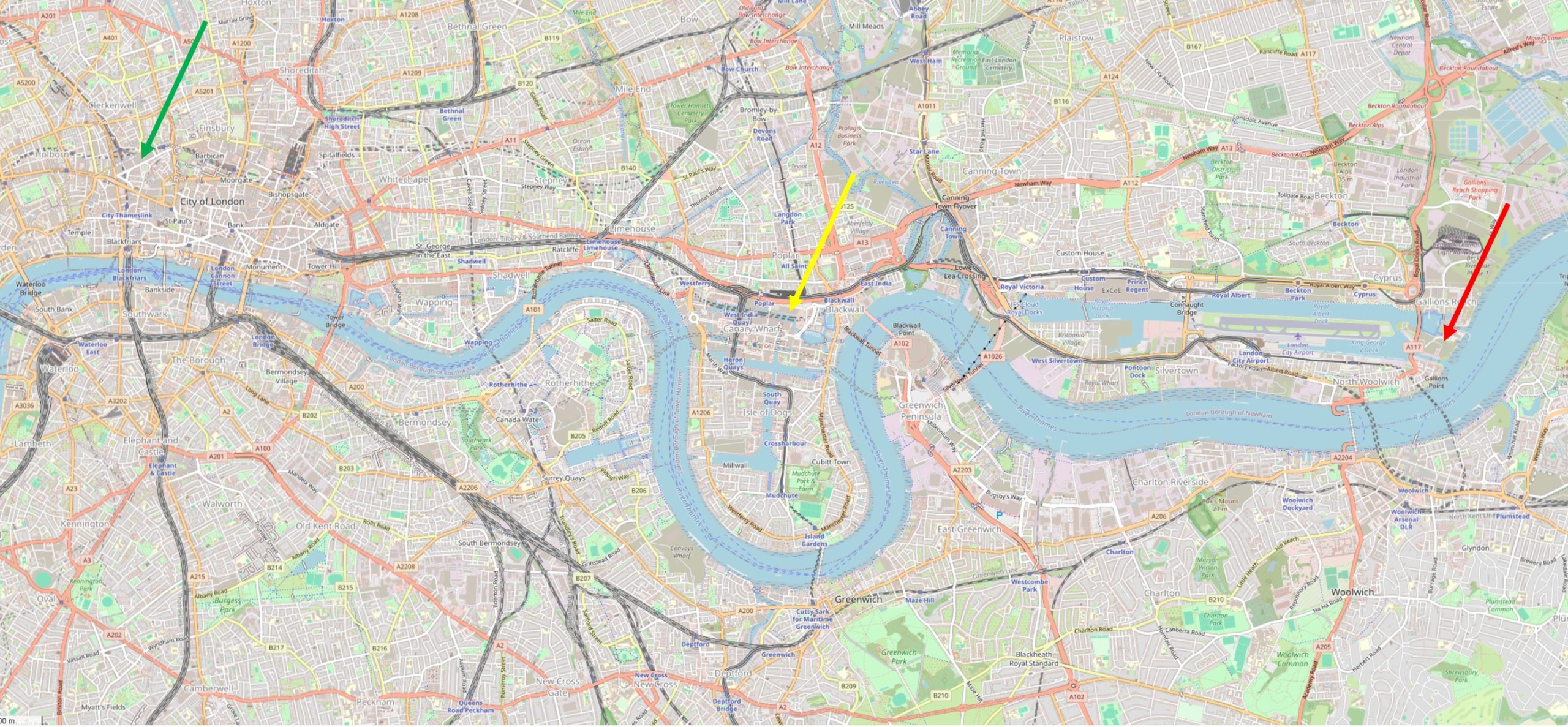
In the following map, the green arrow on the left shows the location of Smithfield market, the centre yellow arrow shows where Billingsgate Market is located today, and the red arrow on the right shows the future consolidated location of both markets, between the eastern end of the Royal Docks and the River Thames (© OpenStreetMap contributors):

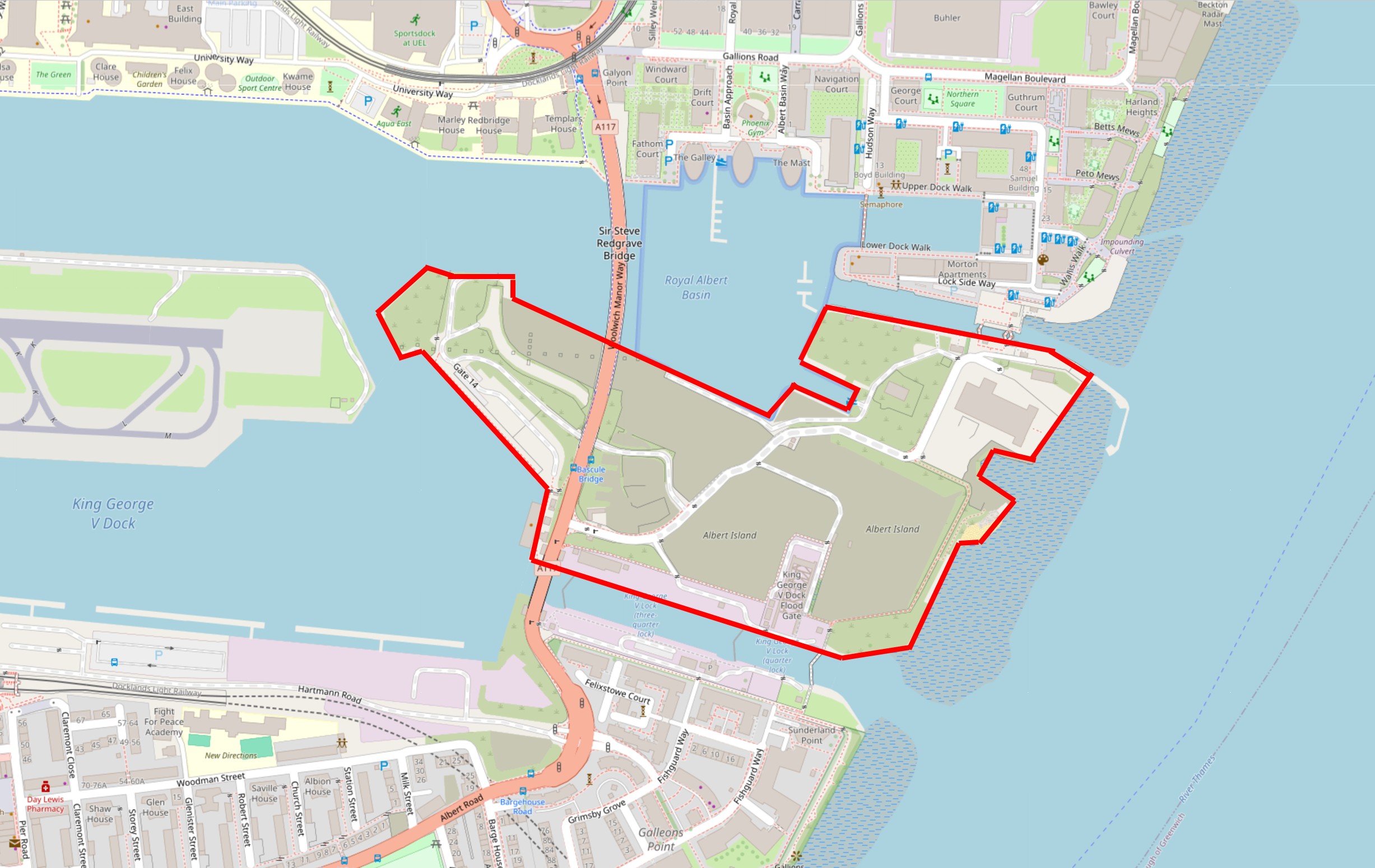
In the following map, I have put a red line around Albert Island, the land which is planned to be used for the new markets (© OpenStreetMap contributors):

The land is currently derelict, with the majority of the buildings that once occupied the site having already been demolished.

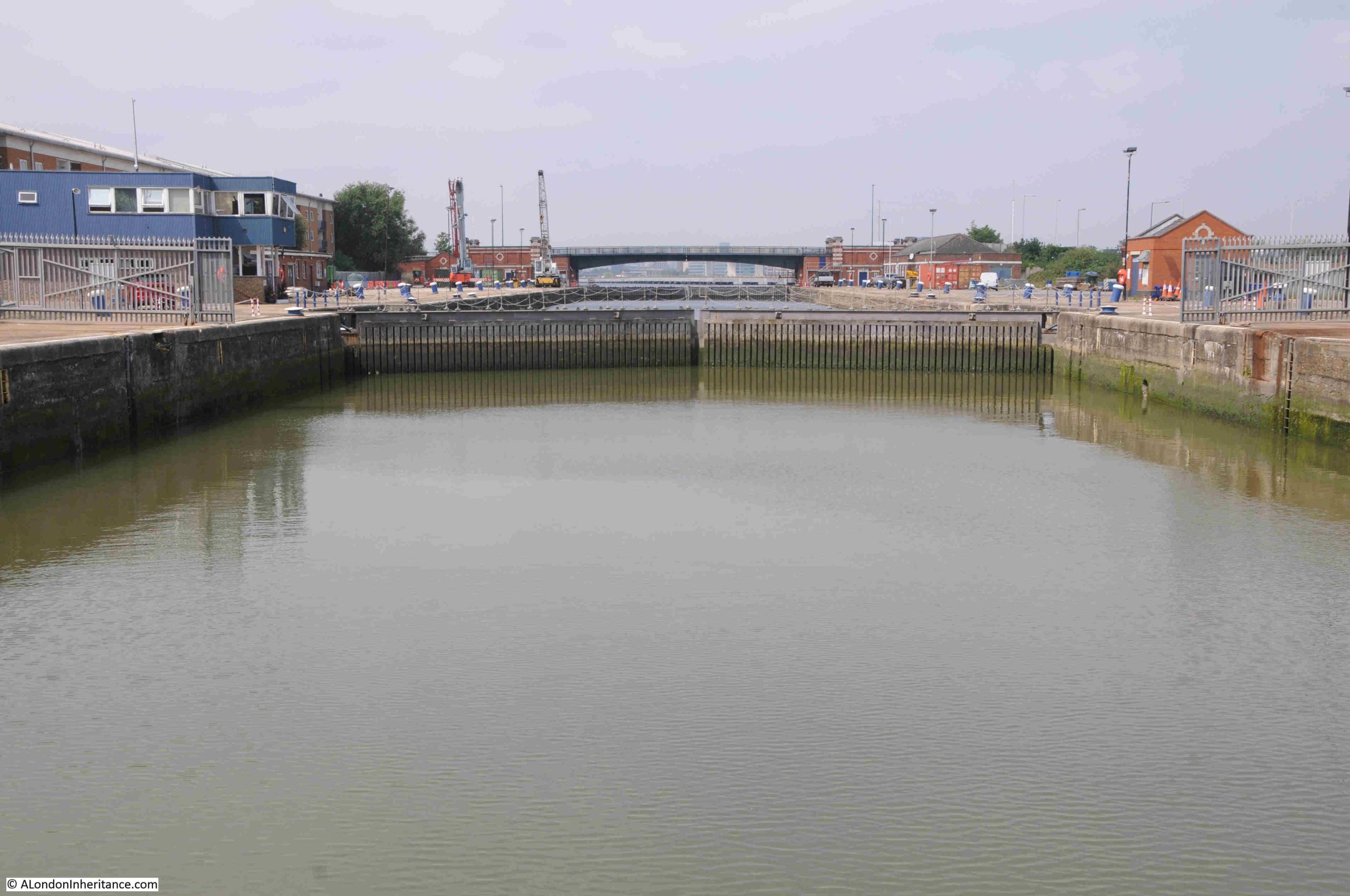
At northern and southern ends, the land is bounded by two of the old locked entrances between the Royal Docks (a small part of which can be seen to the left), and the River Thames, on the right.

On the left centre of the map is the eastern end of the runway of London City Airport.

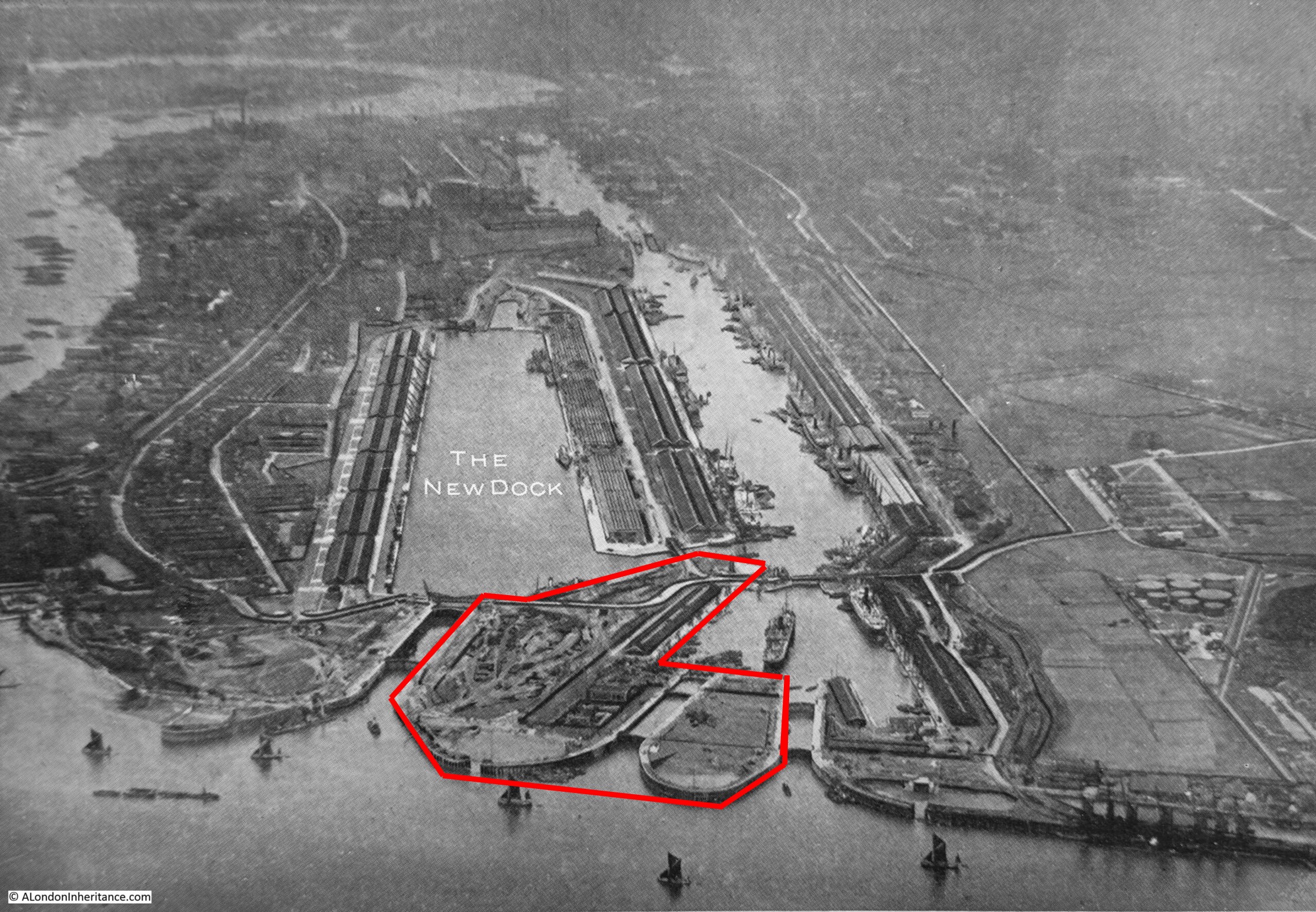
The following image is taken from the book that was issued to commemorate the opening of the King George V Dock in 1921. This new dock had not yet been officially opened by the King, so could only use his name once he had declared the dock open, which is why it is labelled as the New Dock in the image.

I have outlined in red the area of Albert Island as it was, following completion of the King George V Dock, the final dock of the three “Royals”:

As the plot of land is bounded on all sides by water, and the Royal Albert Dock is to the west, the plot of land goes by the name of Albert Island.

This location for the consolidated markets is a rather inspired choice.

It is a challenging location. Being at the end of the runway for London City Airport means that you could not build residential buildings. Even if these were built, they would have to be low rise, and would have the sound of planes either landing or taking off a short distance overhead.

The location is well connected from a transport perspective. In the above map, there is a road crossing towards the left of the plot. Follow this road north, and it connects to the A13, and south to the Woolwich Ferry, and further west to the new Silvertown tunnel.

The land has been derelict for some years, whilst the land around the rest of the Royal Docks has been gradually redeveloped.

Relocating the market here, will also bring a different activity to this part of east London, and will break up the rows of residential towers which have and continue to be built here, particularly along the land to the south, between the Royal Docks and the Thames.

I explored the area back in 2024 in a number of posts on the Royal Docks and surrounding areas. If you have been on my walk “In the Steps of a Woolwich Docker – From the Woolwich Ferry to the Royals”, you will also recognise Albert Island.

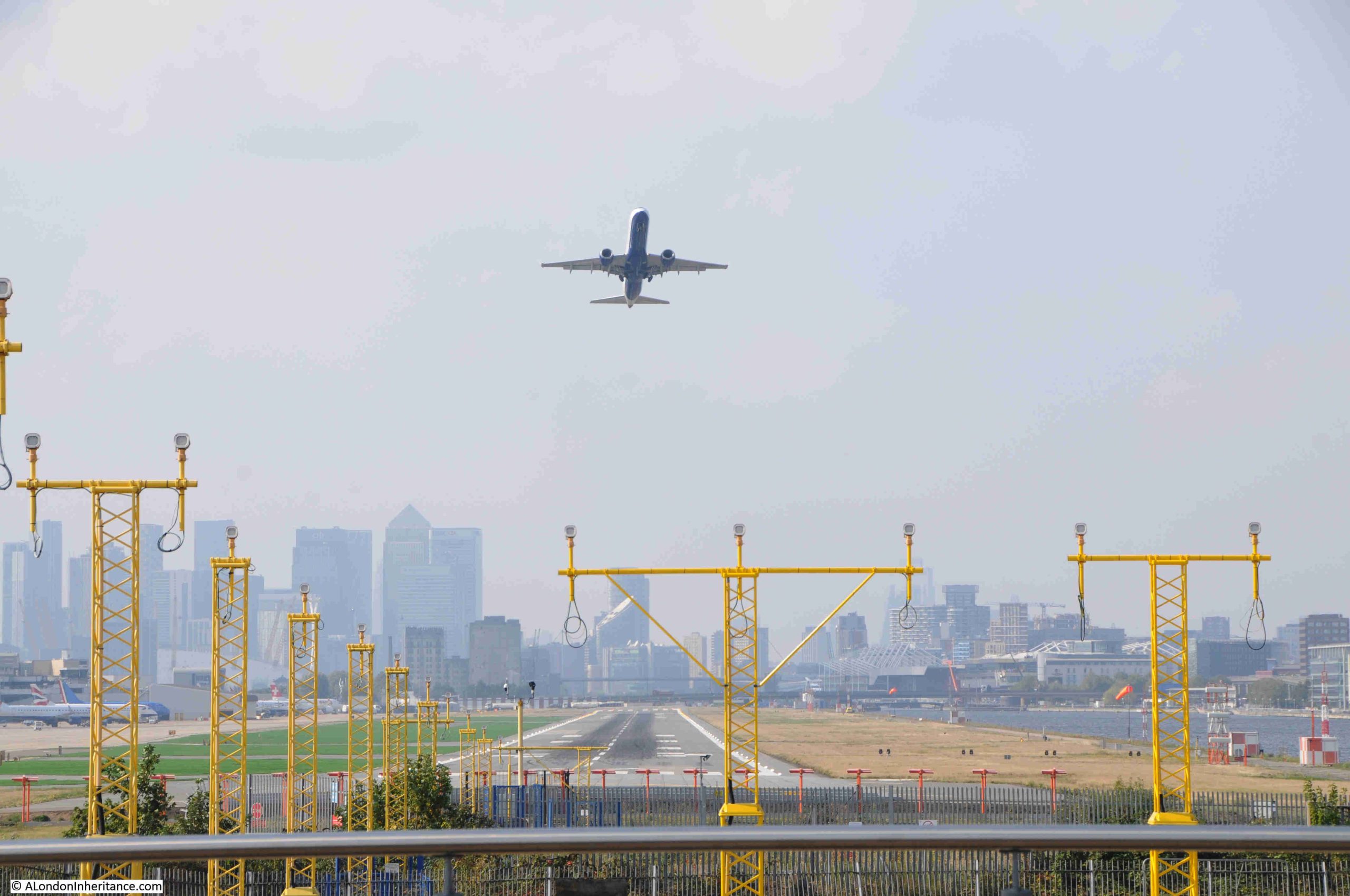
Firstly, this is why the site would not be suitable for residential. This photo was taken from the road that runs over Albert Island and shows that the land is at the eastern end of the London City Airport runway:

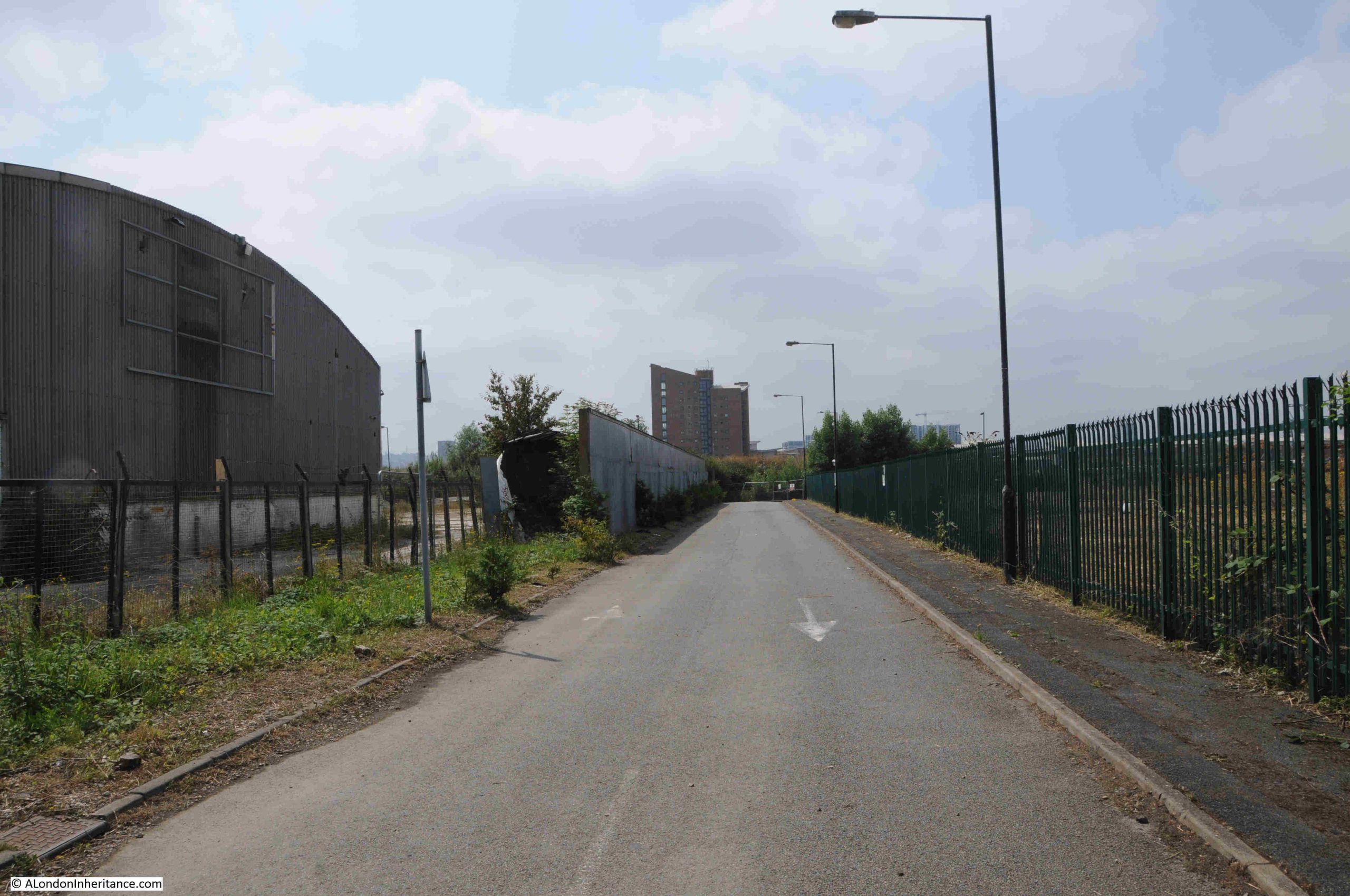
Starting from the north, this is a walk along the road over Albert Island showing how the area looks today. In the following photo, the end of residential development to the north can be seen, as well as the old locked entrances between the dock and the river. The start of Albert Island is the undeveloped land to the right of the residential:

The original eastern entrances between the Thames and the Royal Albert Dock:

Heading south and this is the central part of Albert Island. The majority of buildings associated with the docks were demolished some years ago, leaving the outline of walls, paths, streets and the concrete floors of long lost warehouses and industrial buildings:

There are still a few old streets that thread across the site, generally bounded by large growths of vegetation:

The main entrance from the road that crosses the site to Albert Island:

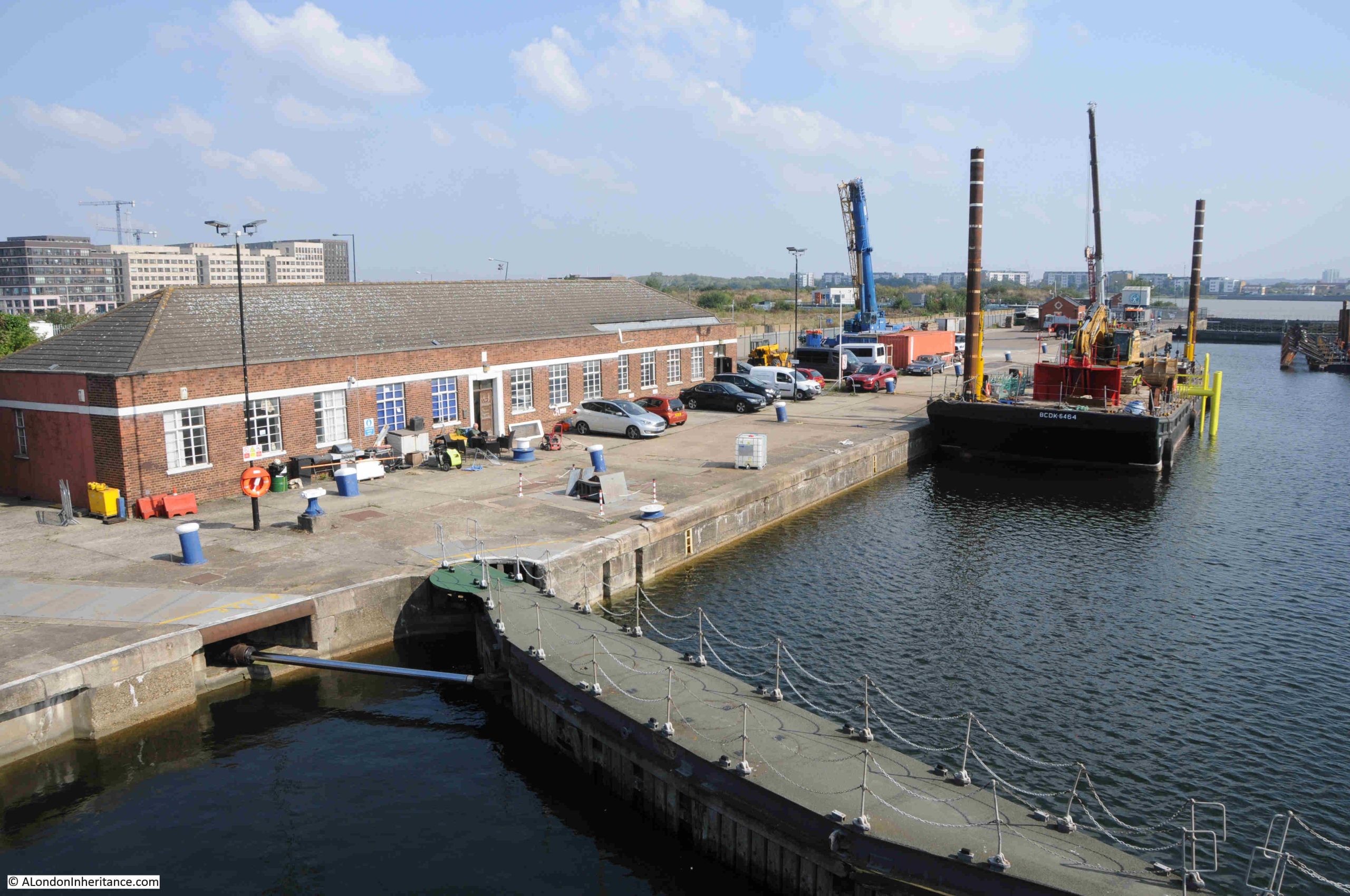
At the southern end of Albert Island is the locked entrance between the Thames and the King George V dock. This photo is looking at the northern side of the lock channel, which will become part of the new market site:

Also back in 2024, I had a walk around Albert Island. This is one of the old streets that thread the site, along with the one remaining warehouse building on the left:

Some of the few roads across the site were fenced off:

The only route across the island back in 2024 was a footpath that ran alongside the Thames, at the eastern edge of Albert Island. This is the footpath heading towards the Thames:

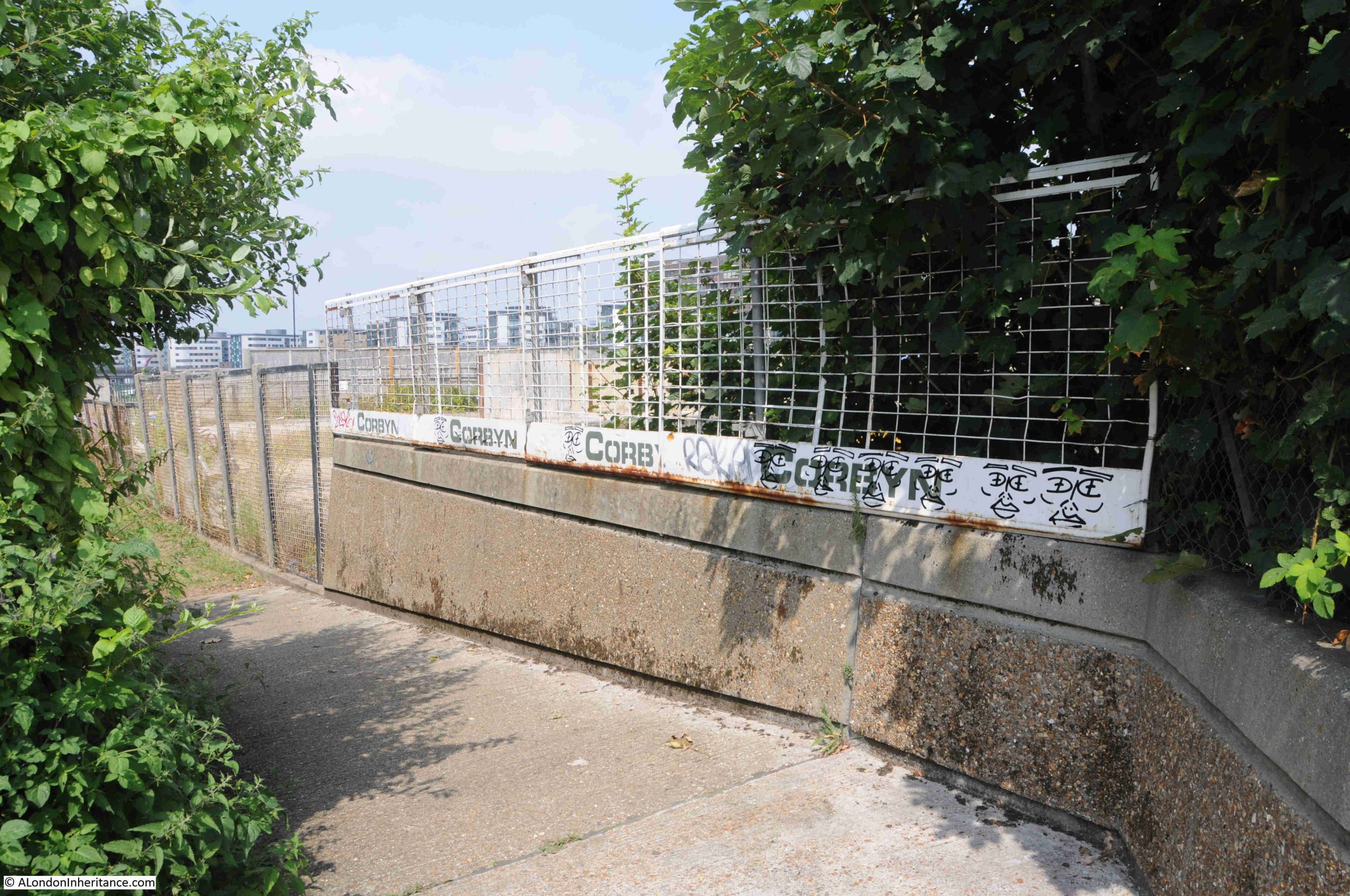
At the corner:

In the following photo, on the left is the Thames, on the right is Albert Island. It was a hot day when I went for this walk, and my main memory of this stretch is the hundreds of butterflies that were in the bushes on the right. As you walked along the footpath, they would rise out of the bushes, before settling back after I had passed – it was a rather magical place, also with the Thames on the left:

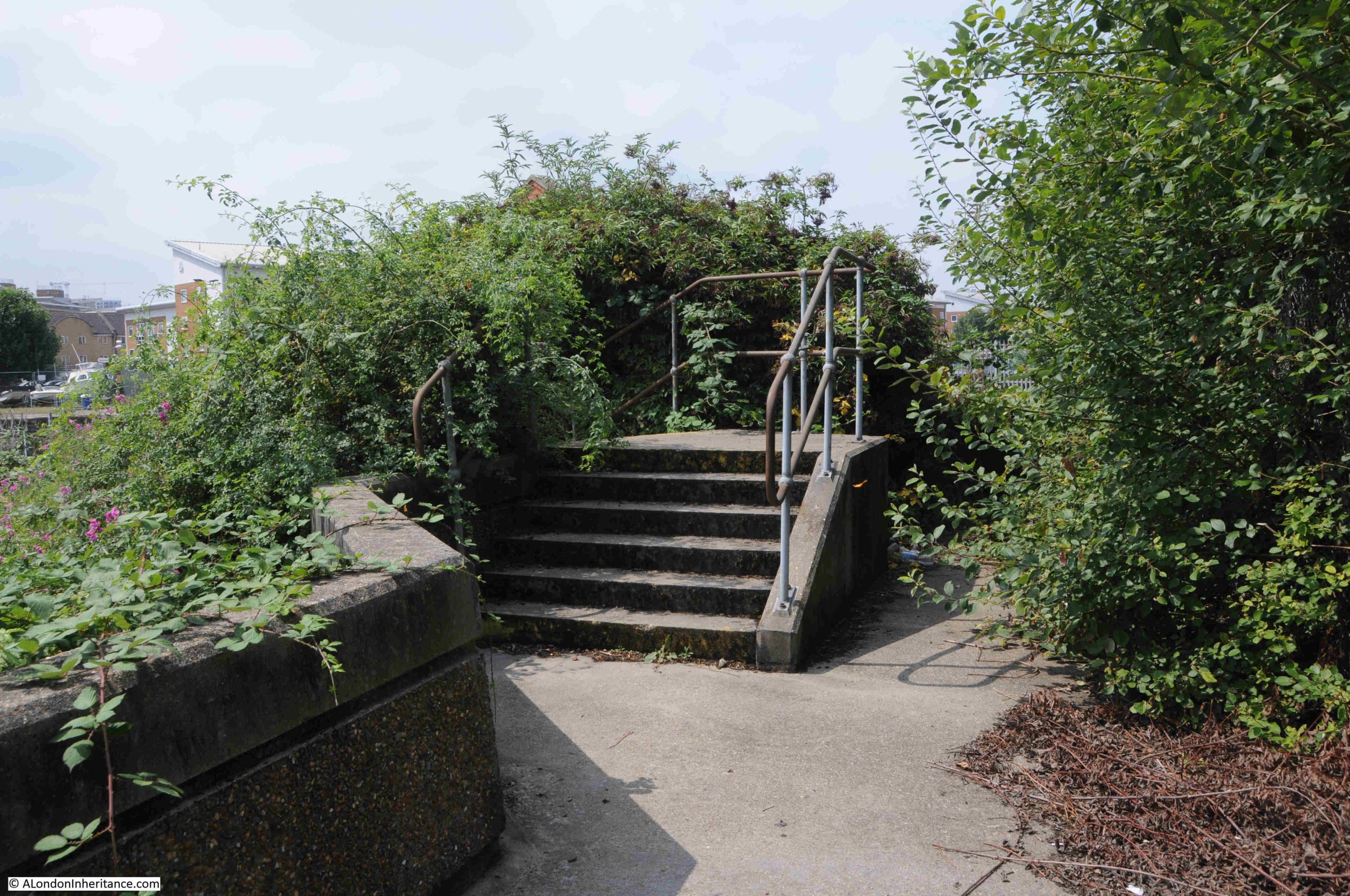
At the end of the footpath, steps up to a short path that went up to the locked entrance to the King George V dock:

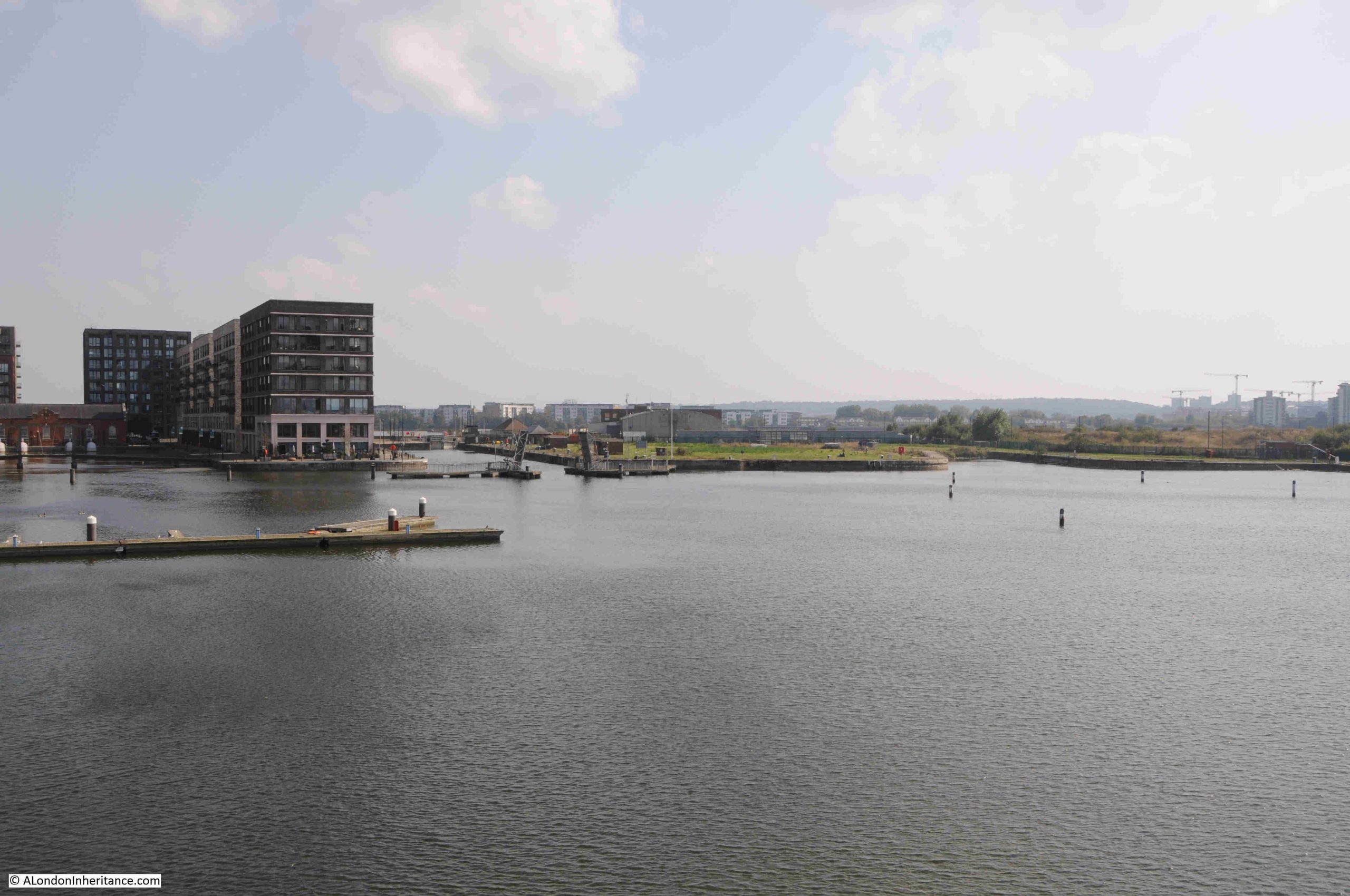
Crossing the lock, and looking back towards the King George V dock. This channel marks the southern boundary of Albert Island, and the new market area which will be on the right:

The above photos were taken back in 2024, last year, 2025, I went on another walk through the area whilst I was planning my Woolwich to Royal Docks walk. I had intended to walk through Albert Island, however this proved impossible, as the crossing over the locked entrance between the Thames and King George V dock was then closed, and there was no clear route through.

I did try some options, but every route ended in fencing, or some other obstruction.

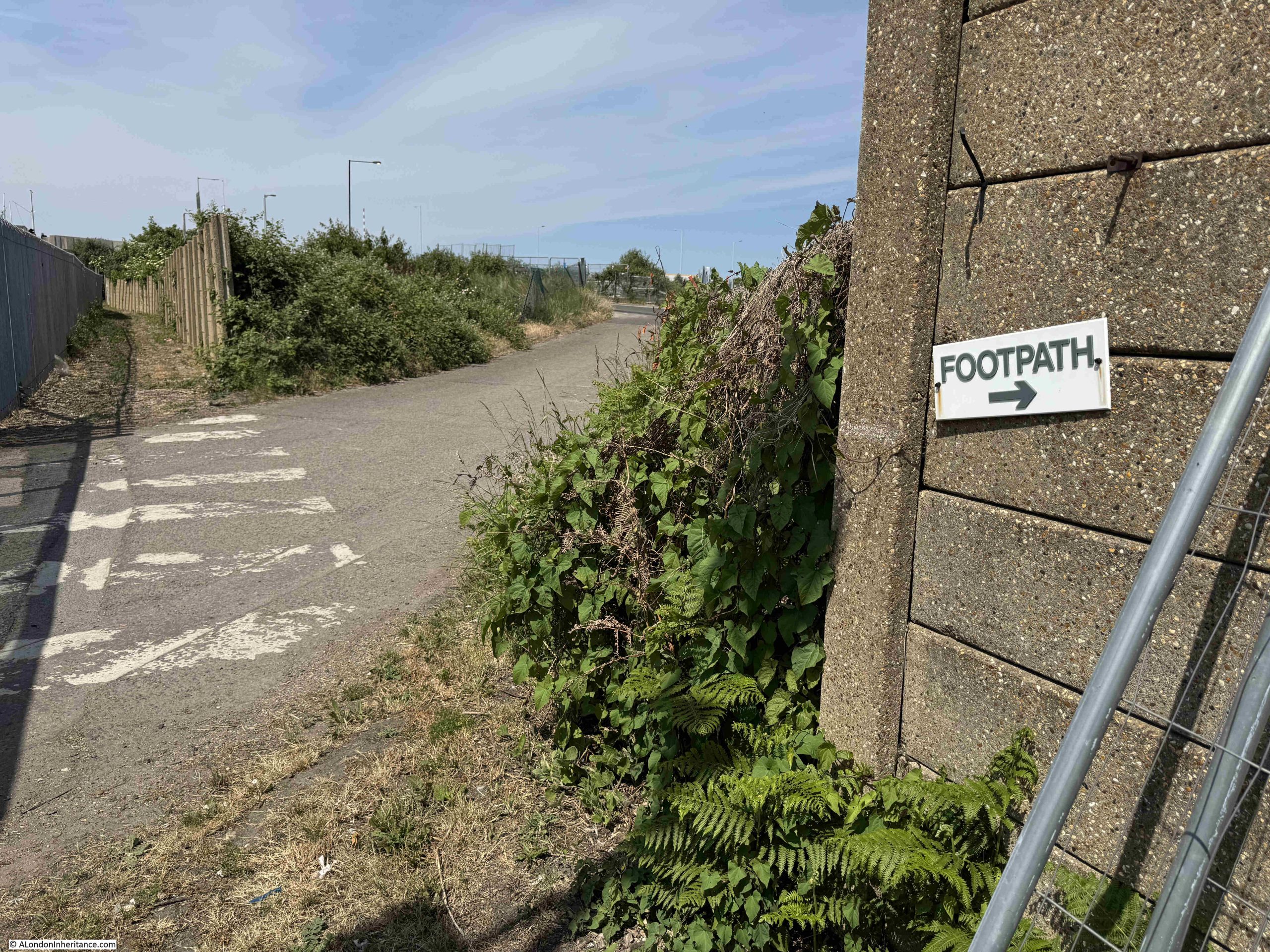
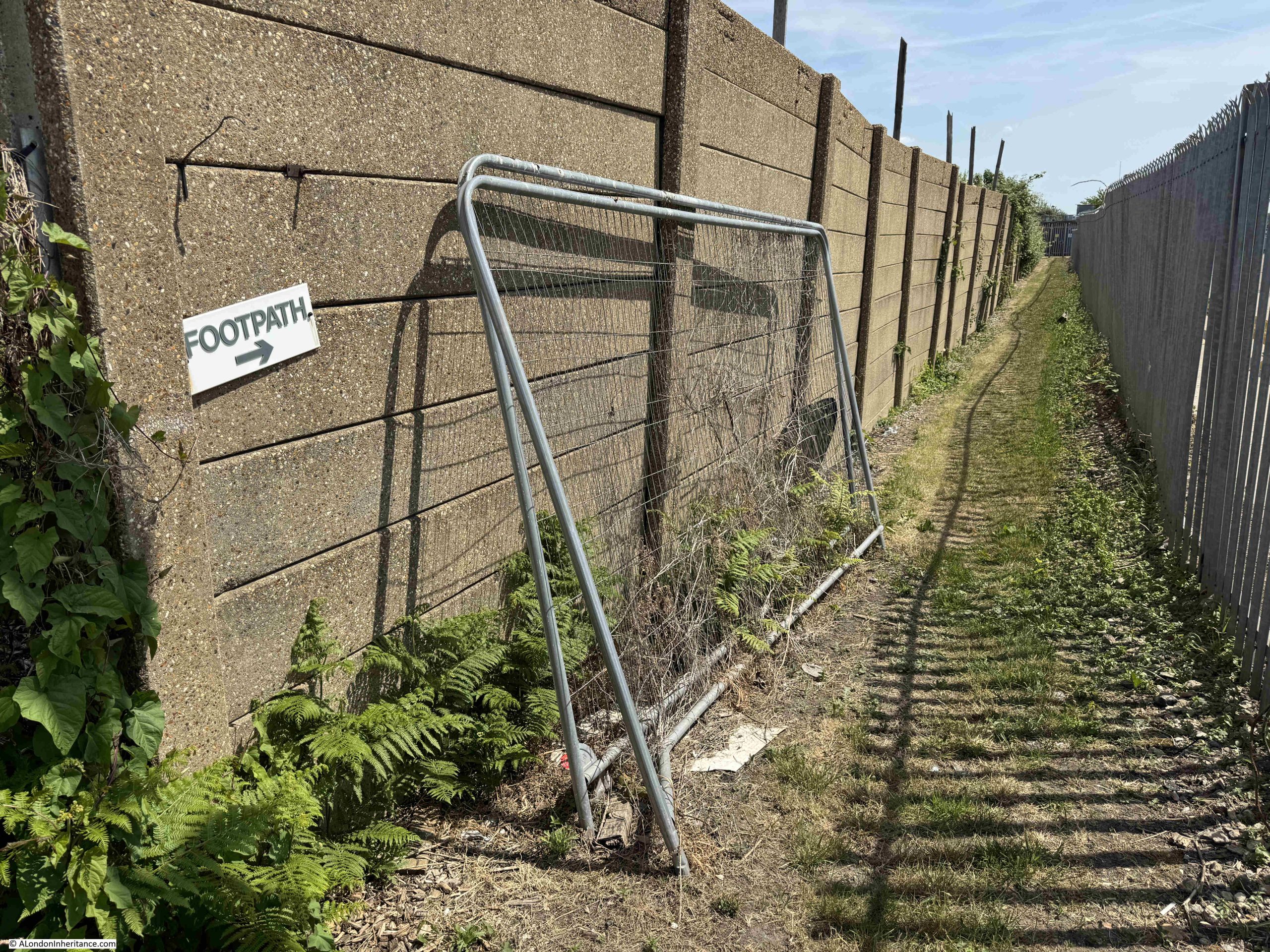
In the following photo, I had just walked along the footpath shown to the left of the photo, and optimistically found this sign for a footpath:

I followed this apparent footpath, and it ended in a waterlogged channel with no way through:

The relocation of the two markets is subject to the passing of a Parliamentary Bill to allow the old markets to be closed at their current sites, along with planning permission from Newham Borough Council for the Albert Island site, and I suspect neither of these will be a problem.

The 3rd of December press release stated that the markets “will continue at Smithfield and Billingsgate until at least 2028”, and I suspect that clearing the current site, any remedial work that needs to be done on what was an industrial location, followed by the new build, will take more than a couple of years, so the “at least 2028” suggests the possible timescale.
When the two markets have moved to Albert Island, they will be called “New Billingsgate and New Smithfield”, although for Billingsgate this is the second move after the original 1982 move from the original Billingsgate in the City.

Regarding the existing market locations, an updated press release on the 2nd of January 2026 states that “at Smithfield, the Grade II* listed buildings will become an exciting international cultural and commercial destination to complement the London Museum, which is moving next door”, and that “Plans for Billingsgate will deliver up to 4,000 much-needed homes in an inner-London Borough, alongside a new bridge across Aspen Way to help address the social, economic and environmental disparities between Poplar and Canary Wharf.”

It is a shame that Smithfield is moving from its City location as it was the last City market in its original location, and ends an activity that has taken place in the City for hundreds of years.

Having said that, the new location is good. It makes use of an otherwise difficult to use plot of land, it brings diversity of function and employment to the area around the Royal Docks, and in many ways it continues the tradition of the Royal Docks, as a place where products were stored, traded and moved on to their eventual location.

Albert Island has a website, which does not yet mention the move of the Smithfield and Billingsgate markets, and still covers the original proposals for a commercial shipyard, marina, university hub, and with easy public access to the Thames river path. Hopefully some of these will be part of the overall development. Bringing a shipyard back to the docks would be good, and access to the Thames river path would be essential. The Albert Island website can be found here.

The City of London Corporation announcement on the move of the markets to Albert Island is here.

If you would like more photos of the area, and the construction and opening of the King George V Dock, my post “King George V Dock – The Last of the Royals” covering this can be found here.

It will be an interesting development to follow.

Horn Stairs

Horn Stairs are one of my favourite Thames stairs, as they lead down to a lovely part of the Thames foreshore. At low tide, a wide expanse of gently slopping foreshore, with superb view across to Limehouse and the northern part of the Isle of Dogs.

My last visit to Horn Stairs was in mid January 2024, and almost two years later, I walked to the stairs again following an update on the state of the stairs sent in by a reader.

The reader commented that the stairs had been closed as they had lost a couple of their top steps, had come away from the wall, and moved back and forth significantly with the tide.

They were in a poor condition when I visited two years ago, with rotting wooden steps, and their fixing to the wall not looking very robust, so I am surprised they have lasted for almost another two years.

When I went in January 2024, it was a bright, sunny day. My return visit in January 2026 was wet, overcast and raining.

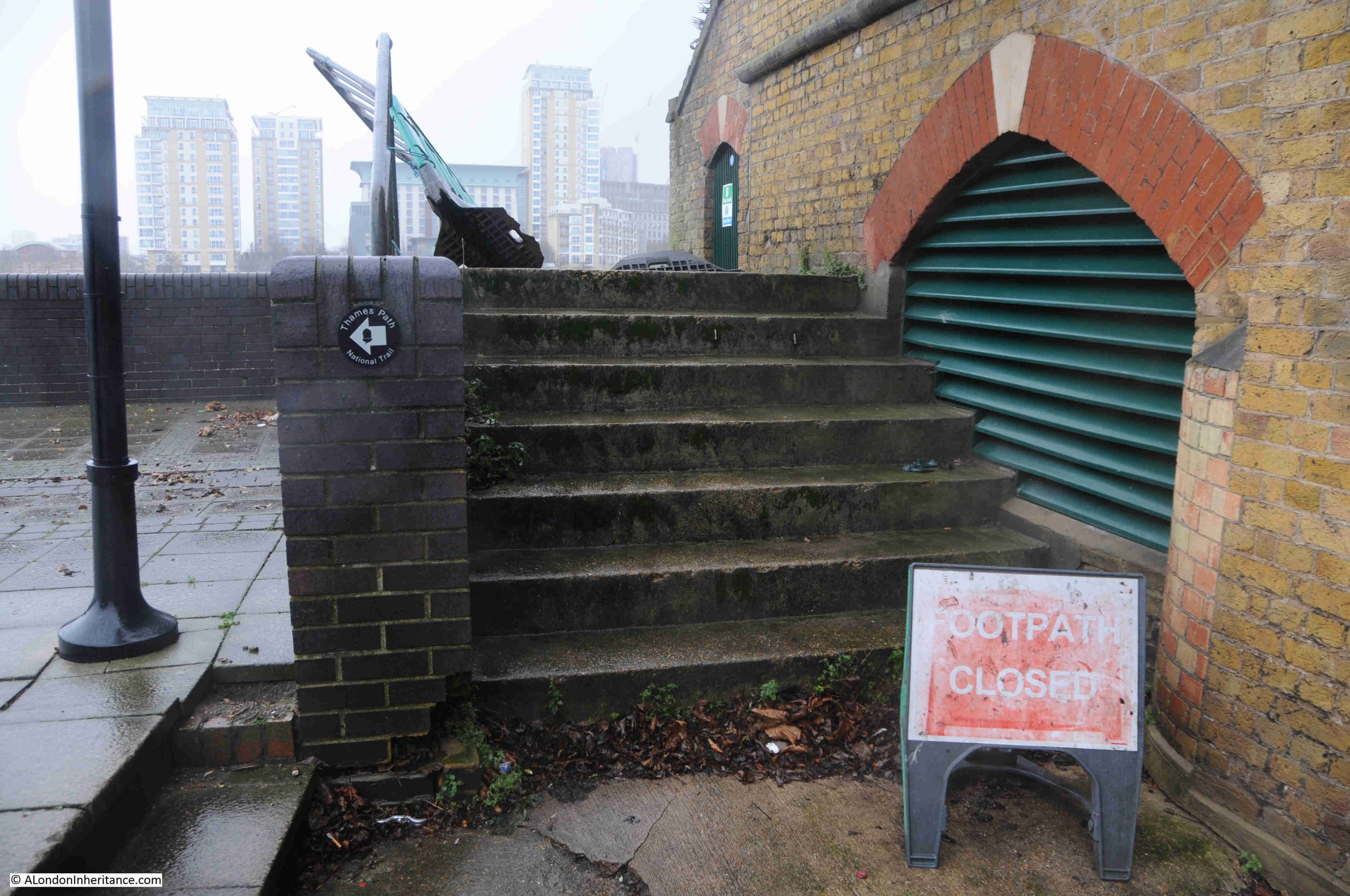
On arriving at Horn Stairs, there was a footpath closed sign, and temporary fencing at the top of the access steps, which looked like it had been moved, or blown aside:

Very temporary fencing off of the stairs:

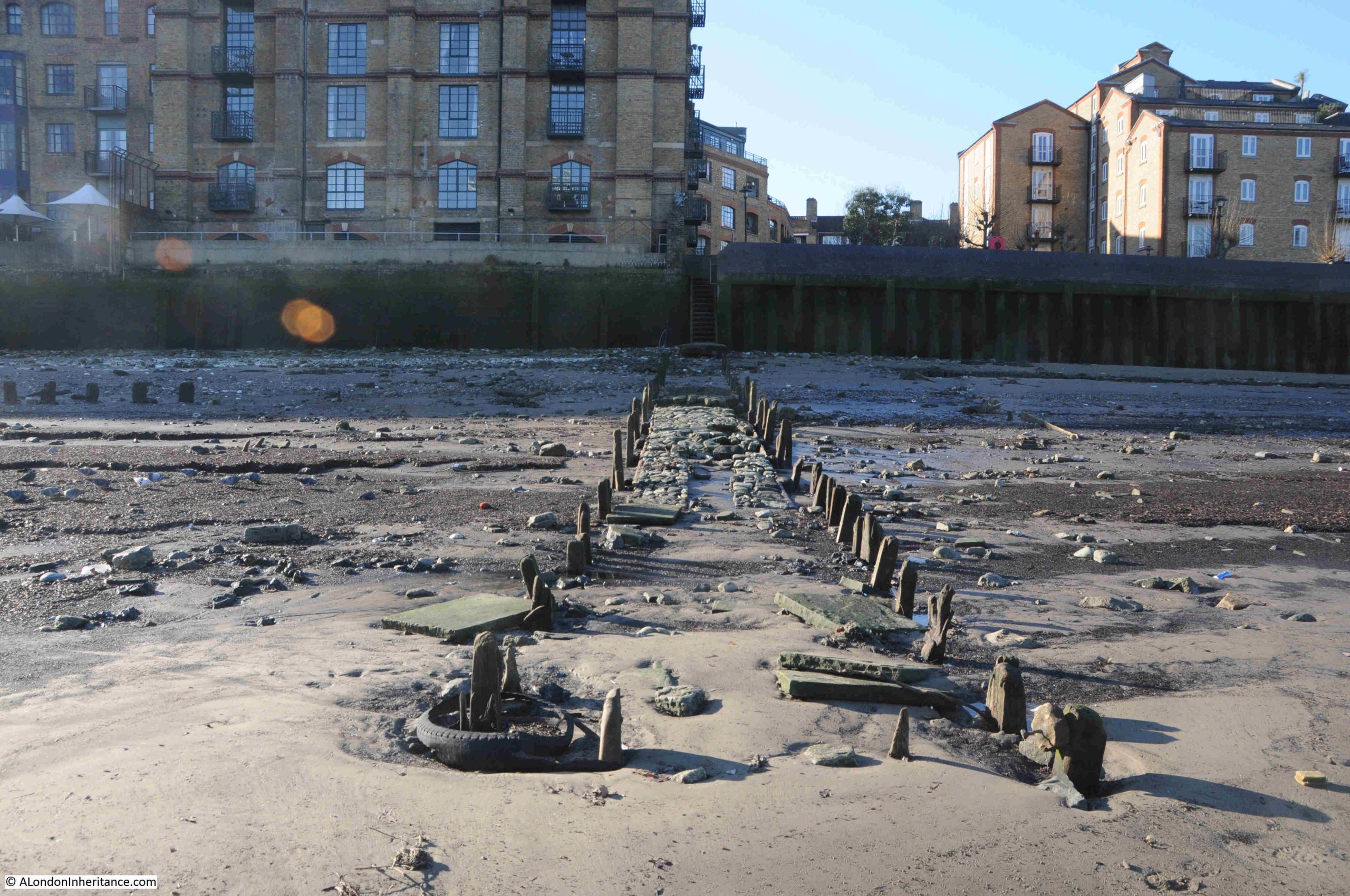
I walked through a gap and looked at the stairs and the remains of the causeway leading across the foreshore:

It was clear to see that the top steps are missing, the top section of steps do not look in great condition, and the fixings at the side have come away:

This was the stairs back in 2024, looking very dodgy, but not fenced off and it was possible to walk down:

Horn Stairs, and the area of foreshore to which they lead, has a fascinating history, which I explored in the post “Horn Stairs, Cuckold’s Point and Horn Fair”.

Some photos from my previous visit, when the weather was much better than January 2026. Firstly looking along the causeway across the foreshore:

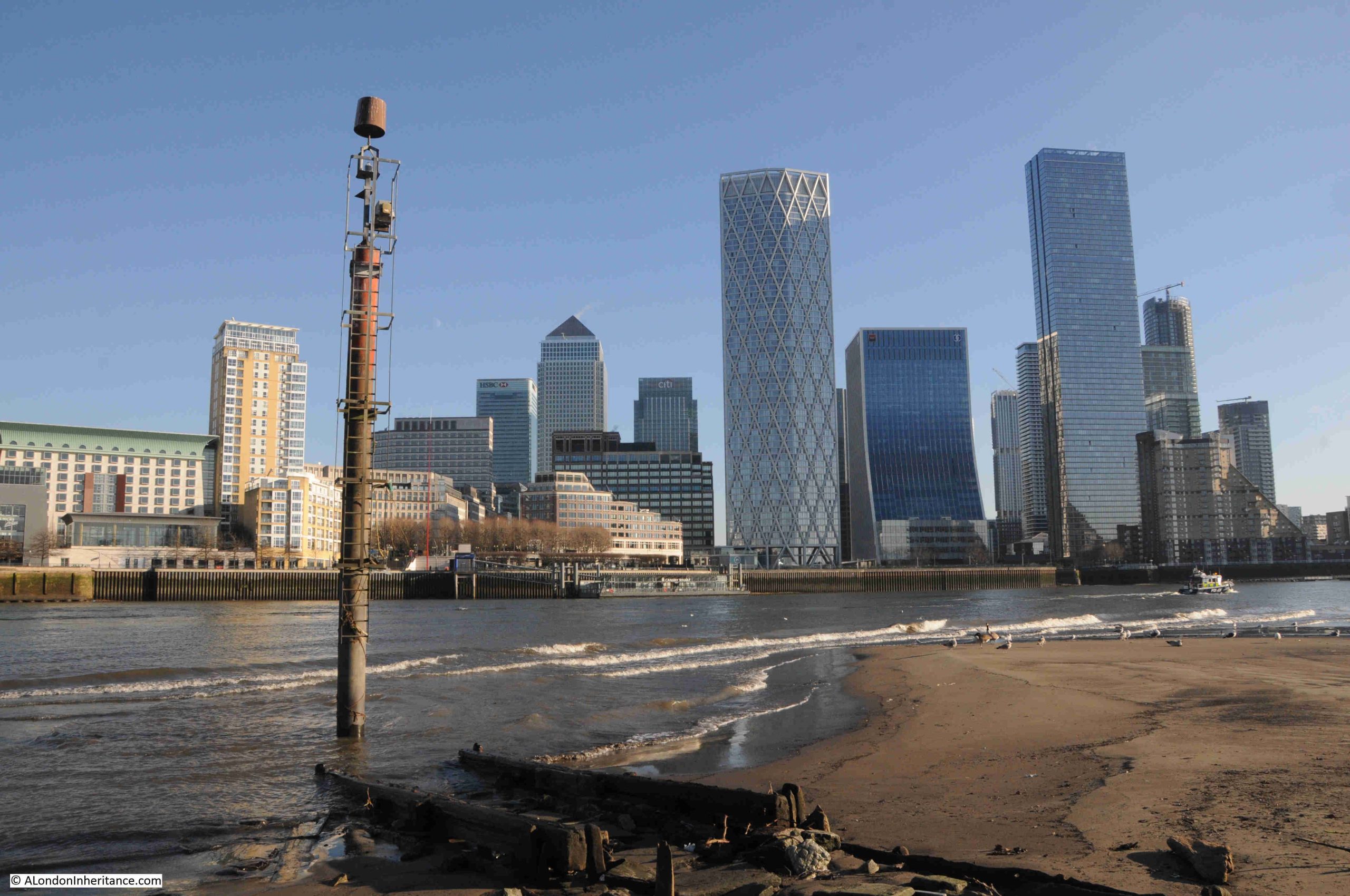
At the end of the causeway is a navigation marker, shown on the PLA chart for this section of the river, with a wonderful view across to the towers that occupy the Isle of Dogs:

Looking back along the causeway, showing that during a low tide, there is a large expanse of dry foreshore:

Wooden stairs do not last as long as concrete or stone stairs, and there are a number of examples along the river where wooden stairs have not been replaced after they gradually fell apart (see this post on King Henry’s Stairs for an example). I am also not sure why some are concrete / stone whilst other are of wood. Whether the frequency of use, their importance or location along the river deemed some to be of a more permanent structure, or whether it just came to costs at the time.

I have emailed both the Port of London Authority and Southwark Council to see if there is any information on who would be responsible, are there any plans to replace the stairs etc.

It would be a great shame if the stairs at Horn Stairs were not replaced.

Sir John or Sir Thomas Gresham – The Trouble with Identifications

A couple of week’s ago, I wrote a post about the Greshams of Norfolk and London.

The post told the story of Sir John Gresham, the founder of a school in the town of Holt in Norfolk, a member of the Mercer’s Company and a Lord Mayor of the City of London, along with his nephew Sir Thomas Gresham who was also a Mercer and through his Will, in 1597, Gresham College was established, to be run and administered by the City of London Corporation and the Mercer’s Company.

I included images of both Sir John and Sir Thomas Gresham in the post.

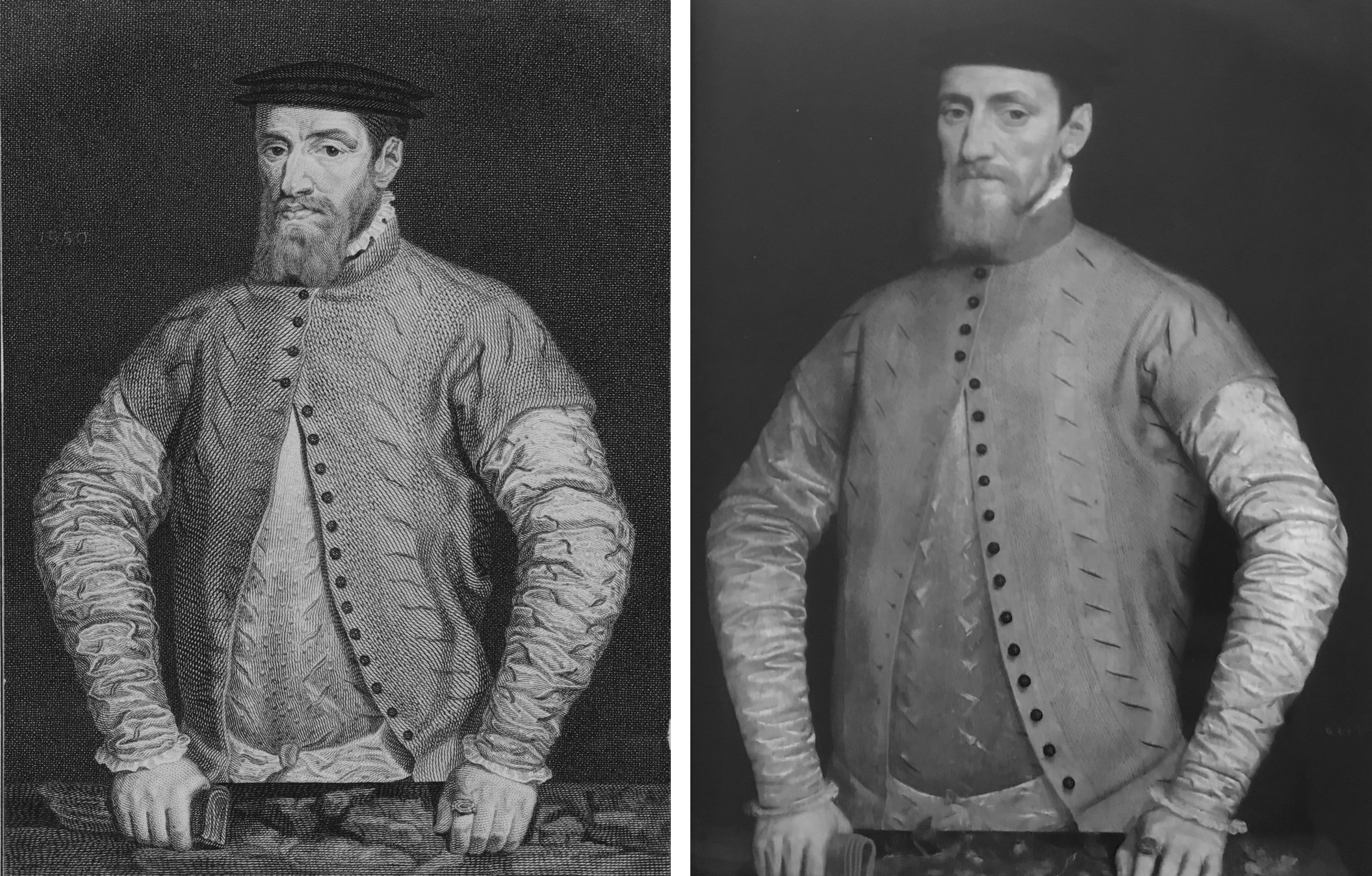
One reader commented “A very interesting post. The picture of ‘Sir John Gresham’ and the engraving of ‘Sir Thomas Gresham’ are identical: the engraving is laterally reversed because of the engraving technique, but otherwise the images are the same, even down to the number of done-up buttons and the hand holding the gloves. It’s the same man! Either the attribution of the painting is wrong or that of the engraving – probably the latter, I think.”

So I went back to the images and yes, they do look as if they are of the same person.

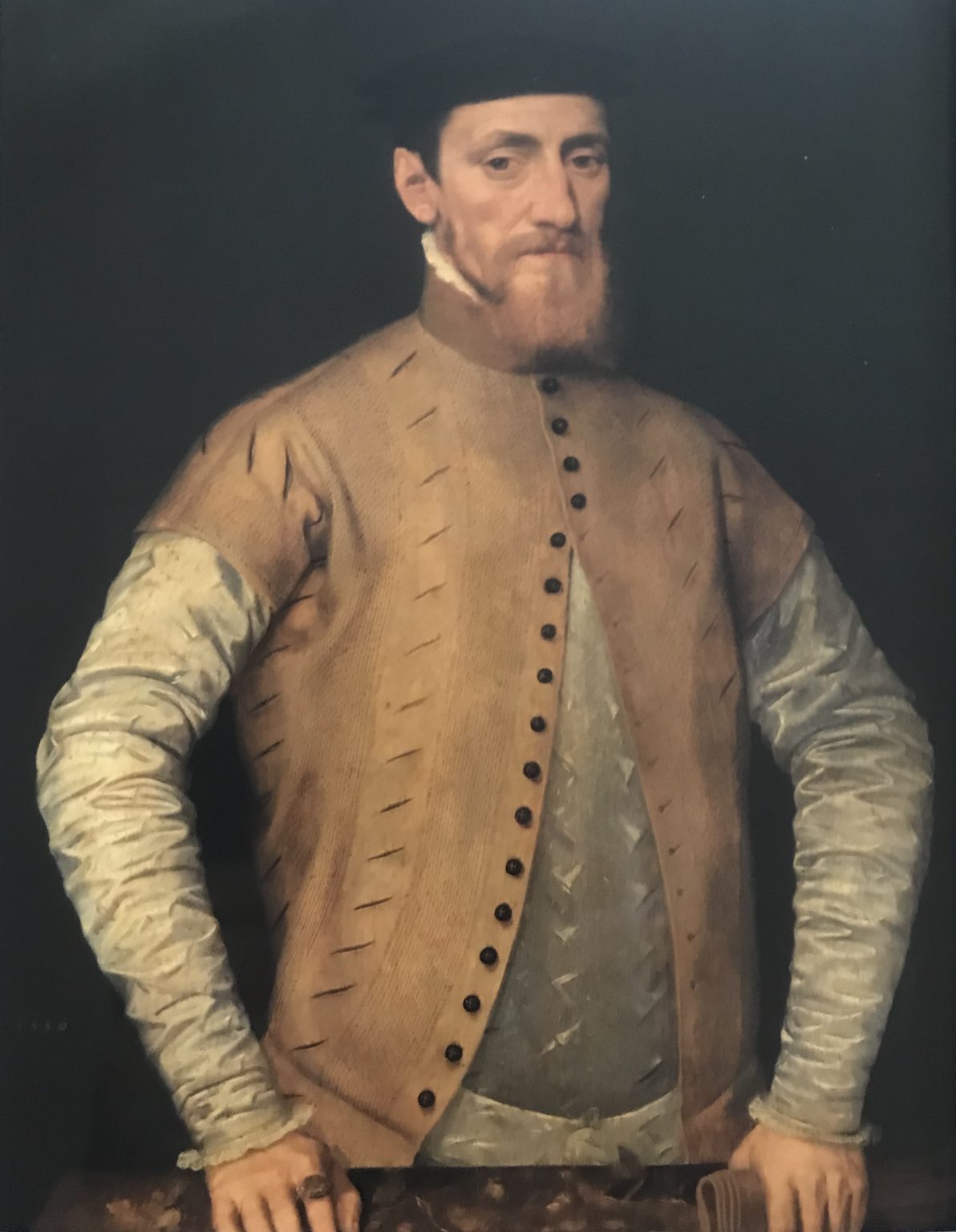
This is the image of Sir John Gresham:

I found the above image on Wikimedia, with the description “Portrait of Sir John Gresham (1495–1556)”.

As a general rule, I never take anything on Wikipedia / Wikimedia (or the Internet in general) as absolute fact, without finding supporting evidence, and in the search for evidence to support the Wikimedia description, I found the same image in the National Trust Collections website, where it is attributed as “Portrait of a Man, possibly Sir John Gresham the elder” I also found the same image at the Alamy website, (a stock image service company, where images are made available for a price, for use in other forms of media) where the image is described as “Sir John Gresham (1495 – 1556) English merchant, courtier and financier”.

So the image I found on Wikimedia was also described by the National Trust and Alamy as Sir John Gresham (in fairness to the National Trust they also included “possibly”), so I was happy to use the image from Wikimedia.

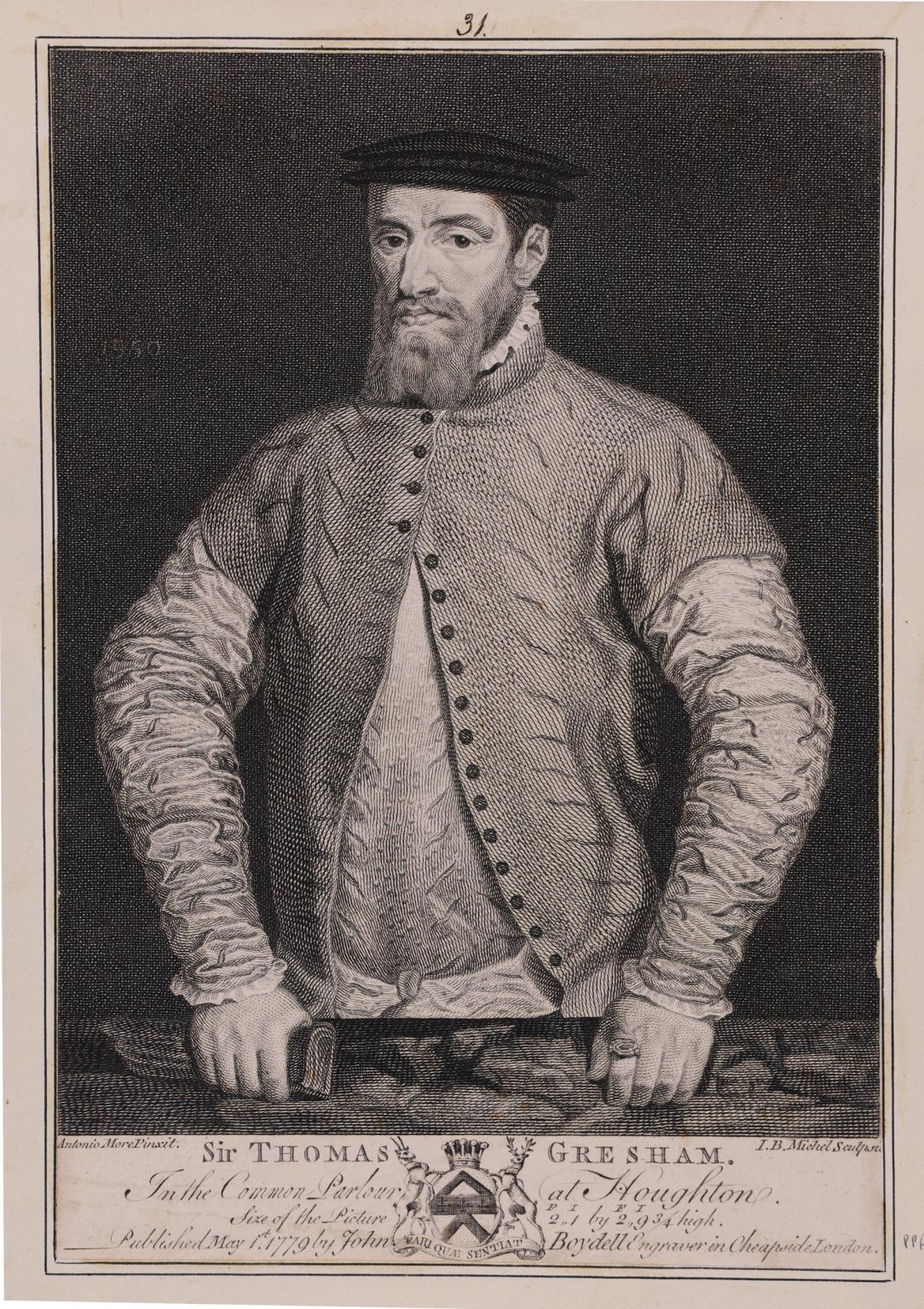
The following image of his nephew, Sir Thomas Gresham, is from the British Museum collection, and was an engraving by John Boydell of Cheapside, London and published on the 1st of May, 1779, and is described as being taken from “In the Common Parlour at Houghton”, which is presumably Houghton Hall in Norfolk, a county where the Gresham’s had property, hence the link with the town of Holt in my post:

To provide a good comparison between the two images, I converted the image of Sir John Gresham to black and white, and reversed the image (the reader commented that the image could have been originally reversed due to the engraving technique, therefore reversing again would get the image back to the original).

Now putting the two images side by side, we get the following (Thomas Gresham on the left and John Gresham on the right):

They look almost identical, down to the creases on the clothing, the number of buttons, the pose, the clothes, etc.

There are minor differences, however I suspect that these are down to the engraving (on the left) being made from the portrait (on the right).

I assume the process to create prints such as these, which were in wide circulation in London in the 18th century, was that an artist would visit Houghton Hall and make a copy of the original painting. As this was a copy, there would be minor differences to the original painting.

This copy was then used to create the engraving which John Boydell then published from his premises in Cheapside.

So is the image of Sir John or Sir Thomas Gresham?

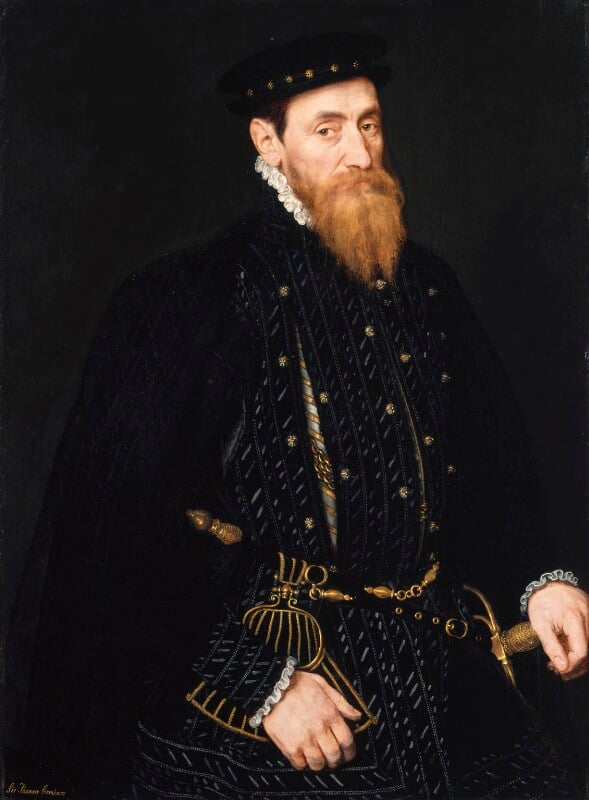
I suspect it is of Sir Thomas Gresham, as the following image is from the National Portrait Gallery collection, and has the following reference: “Sir Thomas Gresham by Unknown Netherlandish artist
oil on panel, circa 1565″
:

Attribution: Attribution-NonCommercial-NoDerivs 3.0 UnportedSource National Portrait Gallery, London

Although the clothes are very different, the likeness, facial expression, the beard all look very similar to the painting and print.

This would mean that the National Trust is incorrect to state that their painting is Sir John Gresham, although again, they do state “possibly”.

To add a bit more confusion, in the print of Sir Thomas Gresham from the British Museum, the “size of the picture” is stated as 2ft, 1inch by 2ft 9 3/4 inches. whilst the National Trust give the dimensions of the painting of Sir John Gresham as 36 x 26 in, and that the painting is located at Dunham Massey in Cheshire.

So the painting is larger than that given in the print, and today is in a different location.

This confusion of Gresham’s shows just how hard it is to be certain of the facts when identifying anything painted, engraved or printed from some centuries ago. If I had the time, I would want to track down more original artwork of both the Greshams and see if this could come to a consensus of appearance of these two, whose contributions to the City of London can still be seen today.

I always try and make sure that the images used, and the detail in my posts is as accurate as possible. I use visits to the sites I am writing about, books and maps (of an age as close to the time I am writing about the better), newspapers from the period, and where I use the Internet, it is from reputable sources such as the British Museum Collection, and anything else is cross checked with other sources.

As the Gresham images show, it is hard enough to be sure of the facts of what we see, whether an image is of who we are told it is, but AI, which always seems to be in the news these days, is going to make this much, much worse.

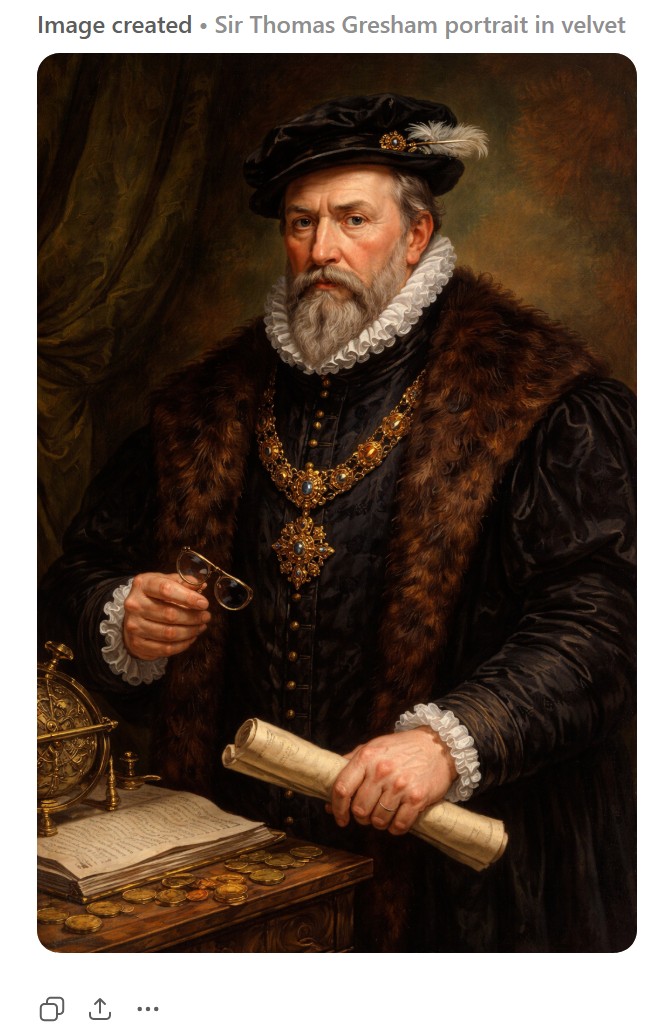
I will never use any AI generated content in my posts, whether text or image, and to demonstrate why, I asked ChatGPT to generate an image of Sir Thomas Gresham, and this was the result (ChatGPT made the decision to produce a portrait “in velvet” for some reason):

The above image shows the dangers of where we are heading with AI image creation. Without any context, this could easily be taken as a painting of Sir Thomas Gresham. It took less than a minute to create, and is why we are moving into a dangerous period where we have no idea whether what we see or read is real or not.

And for all the comments that my posts receive, two of which were used for today’s post, thank you. I learn much, and they add considerably extra context and information to the post, which is what it should be, rather than machine generated content.

Nile Street Stairs, Woolwich

One ticket has just become available for my walk “The South Bank – Marsh, Industry, Culture and the Festival of Britain” on the 8th of November. Click here for details and booking.

The Port of London Authority book “Access to the River Thames – Steps, Stairs and Landing Places on the Tidal Thames” lists 240 of these places between Teddington and Southend, and as you may have noticed from a number of blog posts, I am trying to visit all of them.

The 240 ranges from a causeway at Two Tree Island, near Southend, the last of the sites listed, via multiple sites as the Thames winds through London, out to Teddington, the end of the tidal river.

Back in May, I featured Bell Watergate Stairs in Woolwich, and today I am returning to visit another set of stairs in Woolwich – Nile Street Stairs.

This is the entry point to Nile Street Stairs from the embankment walkway:

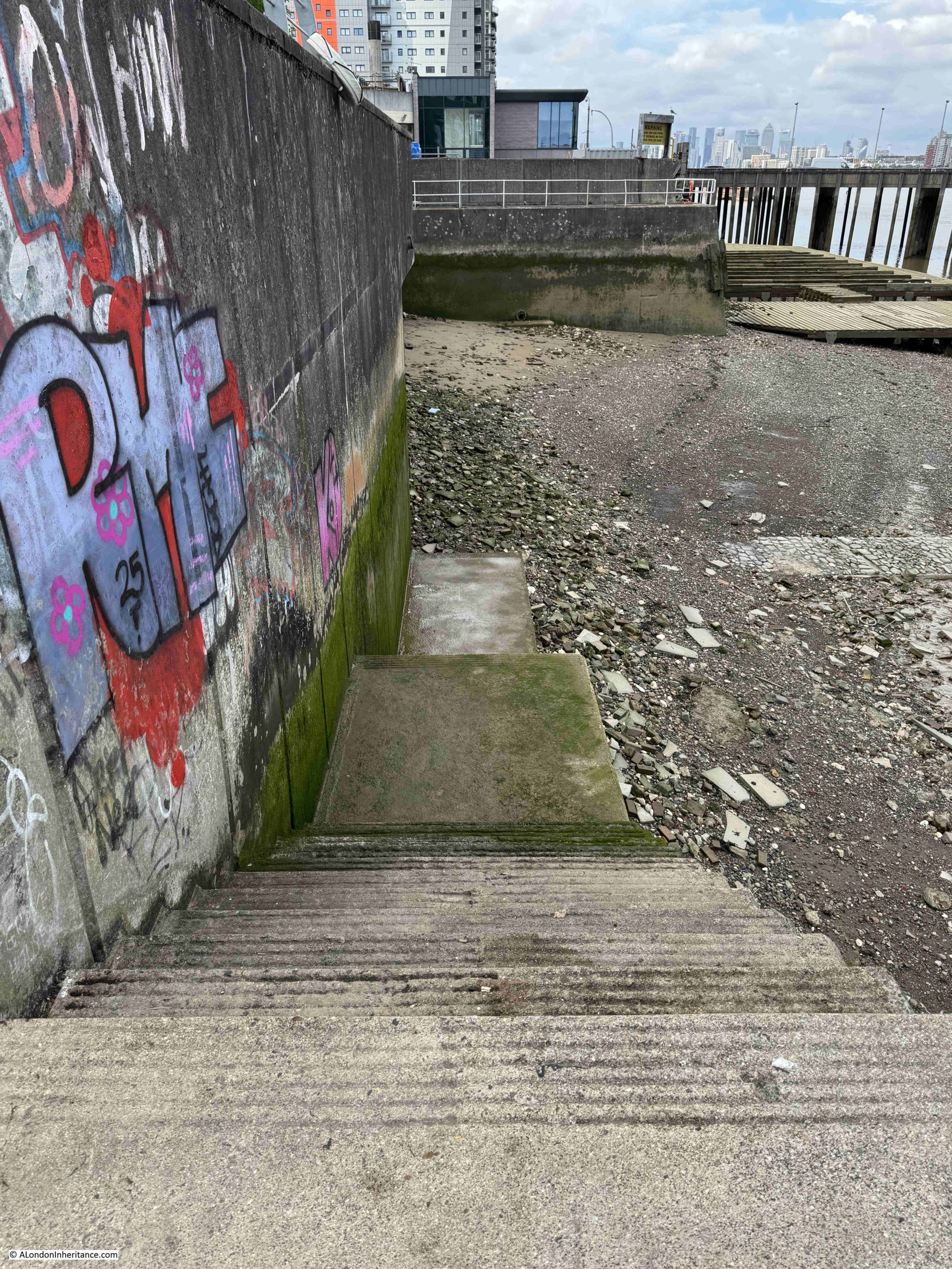
The location of the stairs down to the foreshore has changed slightly, as concrete stairs now run parallel to the river wall, down to where the causeway that led from the original stairs can be seen to the right:

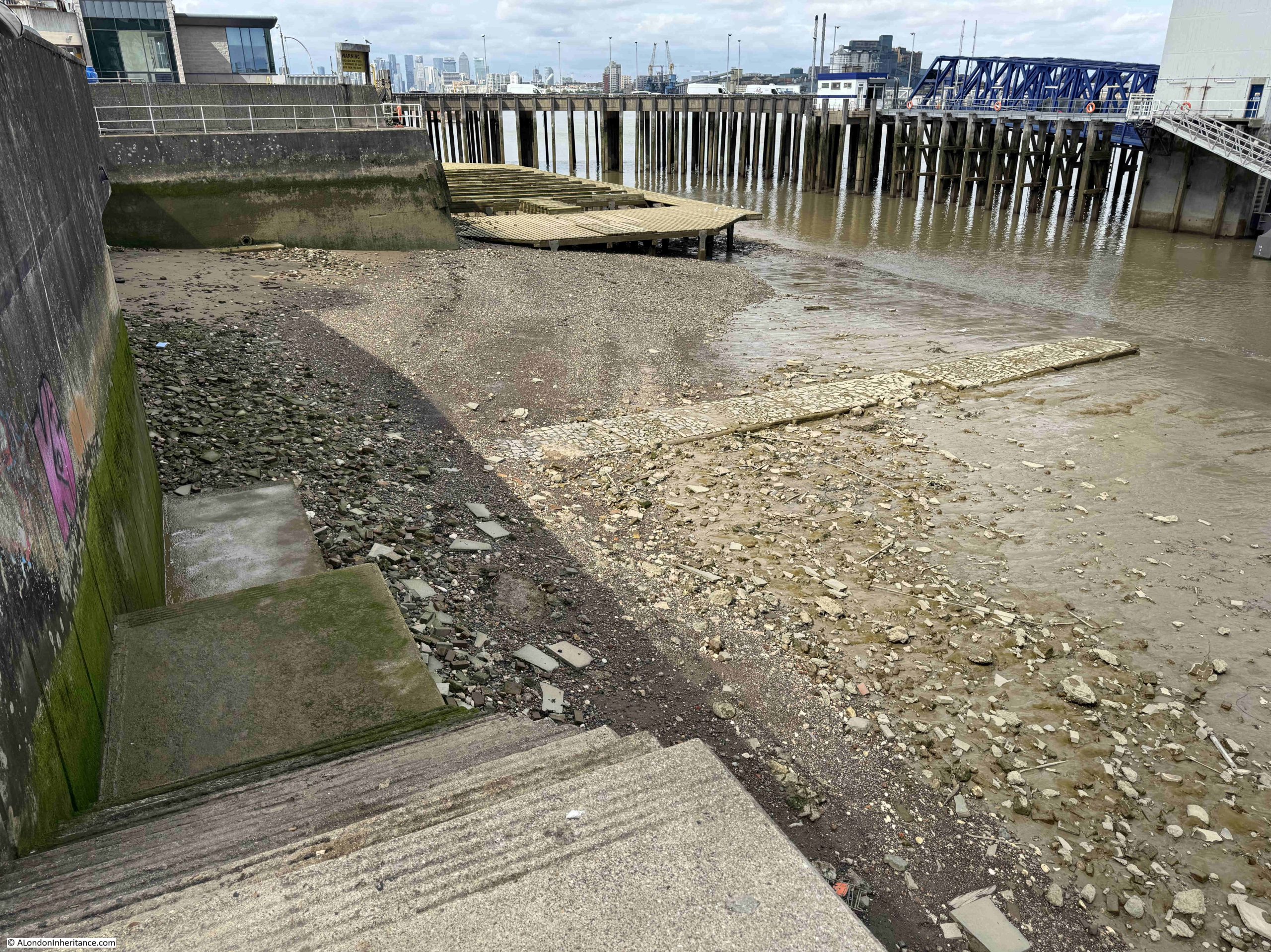
Looking to the right, we can see the full length of the causeway that ran from the stairs, with the access jetty to the Woolwich Free Ferry visible at top right:

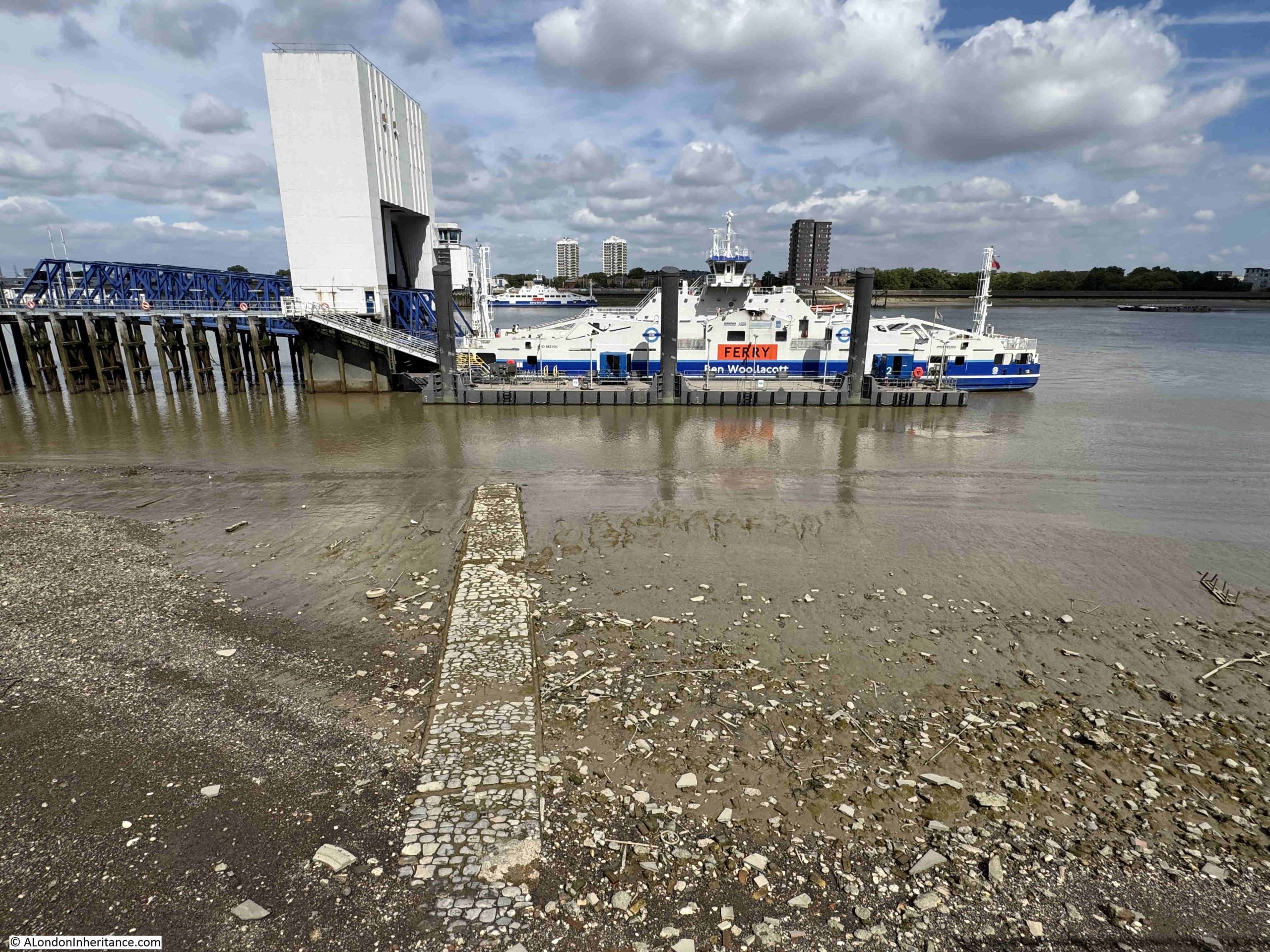
Nile Street Stairs and Causeway, with the Woolwich Free Ferry:

The causeway runs for some length across the foreshore, and provided a reasonably dry, mud free route between the base of the stairs and your boat which would have been alongside the causeway.

It is in a remarkably good condition. I do not know when it was last repaired, but it is a remarkable survivor given that the original pier to the Woolwich Free Ferry was built immediately to the right of the causeway. The pier and docking point for the ferry we see today is a mid 20th century change from its first location.

As with many other Thames stairs, they have been very many events related directly to the stairs, and a strange headline concerning the stairs in the Kentish Independent on the 3rd of May 1957 read – “The Affair Of The Wet Footprints”, and the article goes on to state “After police boats had been alerted to scour the Thames near the Woolwich Free Ferry on Friday night to look for a youth who was reported to have fallen feet first into the water, P.C. Booth found wet footprints leading from the ferry stairs. He followed them as far as the Odeon cinema where they petered out.

The pier master told police that he had seen an 18 year old youth in Edwardian clothes stagger down the Nile Street stairs alongside the ferry. He then hit the rails, straightened up and slipped feet first into the river.

Later another youth said he had seen a man come up the stairs soaked to the skin.”

A rather mysterious story, with the wet footprints and the youth in Edwardian clothes in 1957.

What is remarkable about Nile Street Stairs and the causeway leading across the foreshore is their survival, as it was here where the original access to the Woolwich Free Ferry was built.

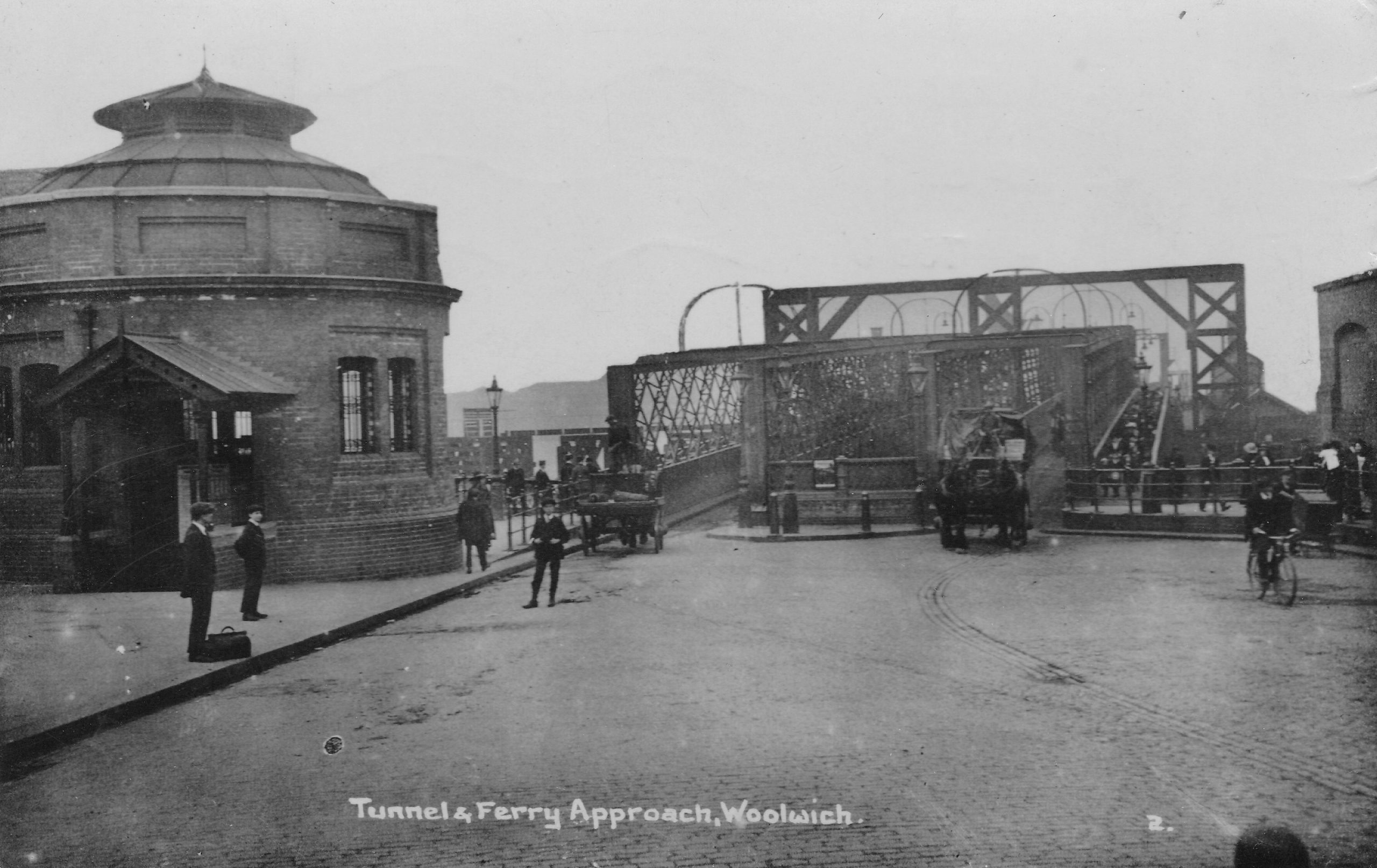
The following photo shows the entry to the foot tunnel to the left, and the pier providing access to the ferry straight ahead.

The stairs and causeway were immediately to the left of the ferry pier:

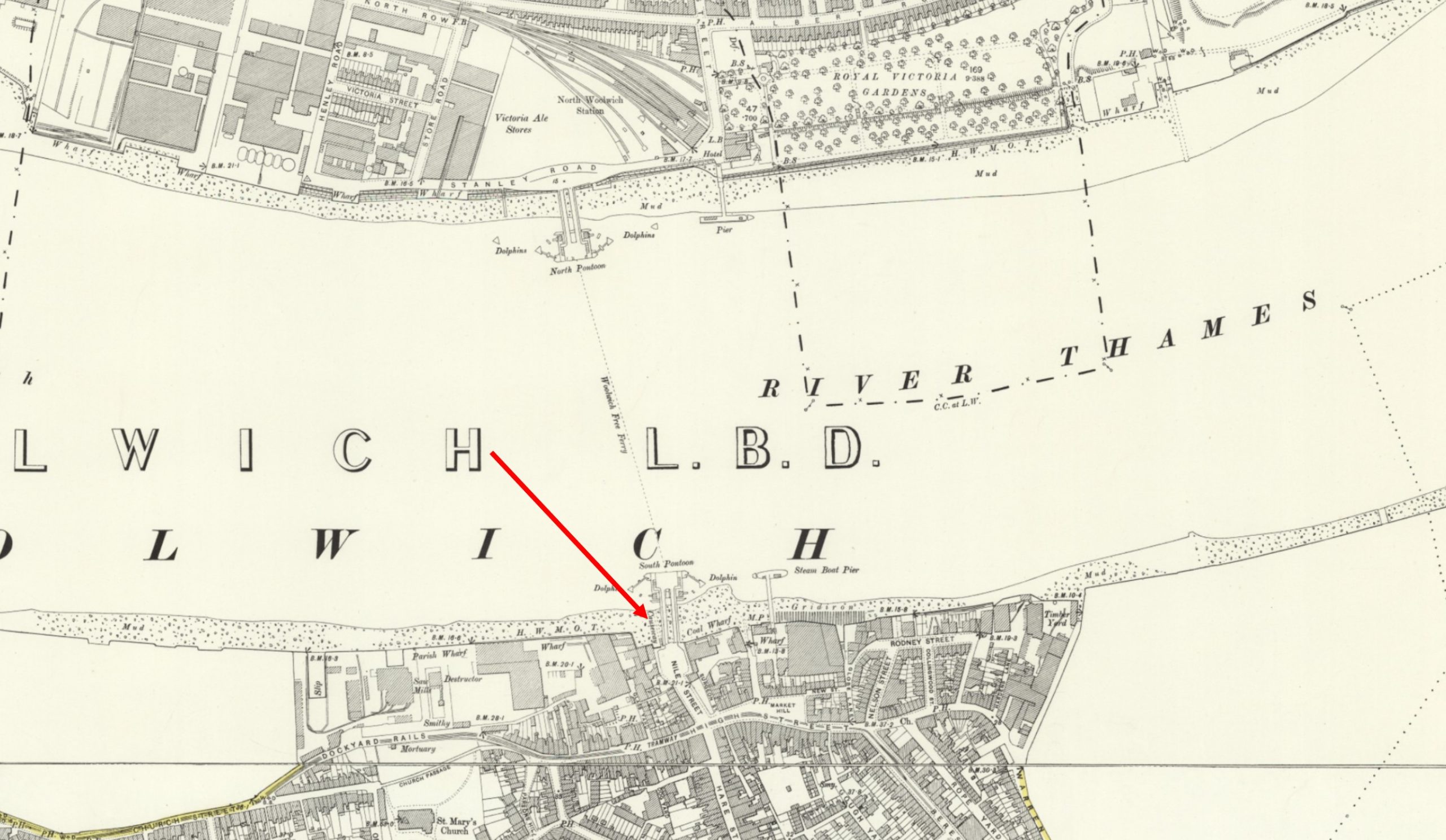
We can see how close they were in the following extract from the 1897 edition of the OS map, where I have arrowed the causeway (Map ‘Reproduced with the permission of the National Library of Scotland):

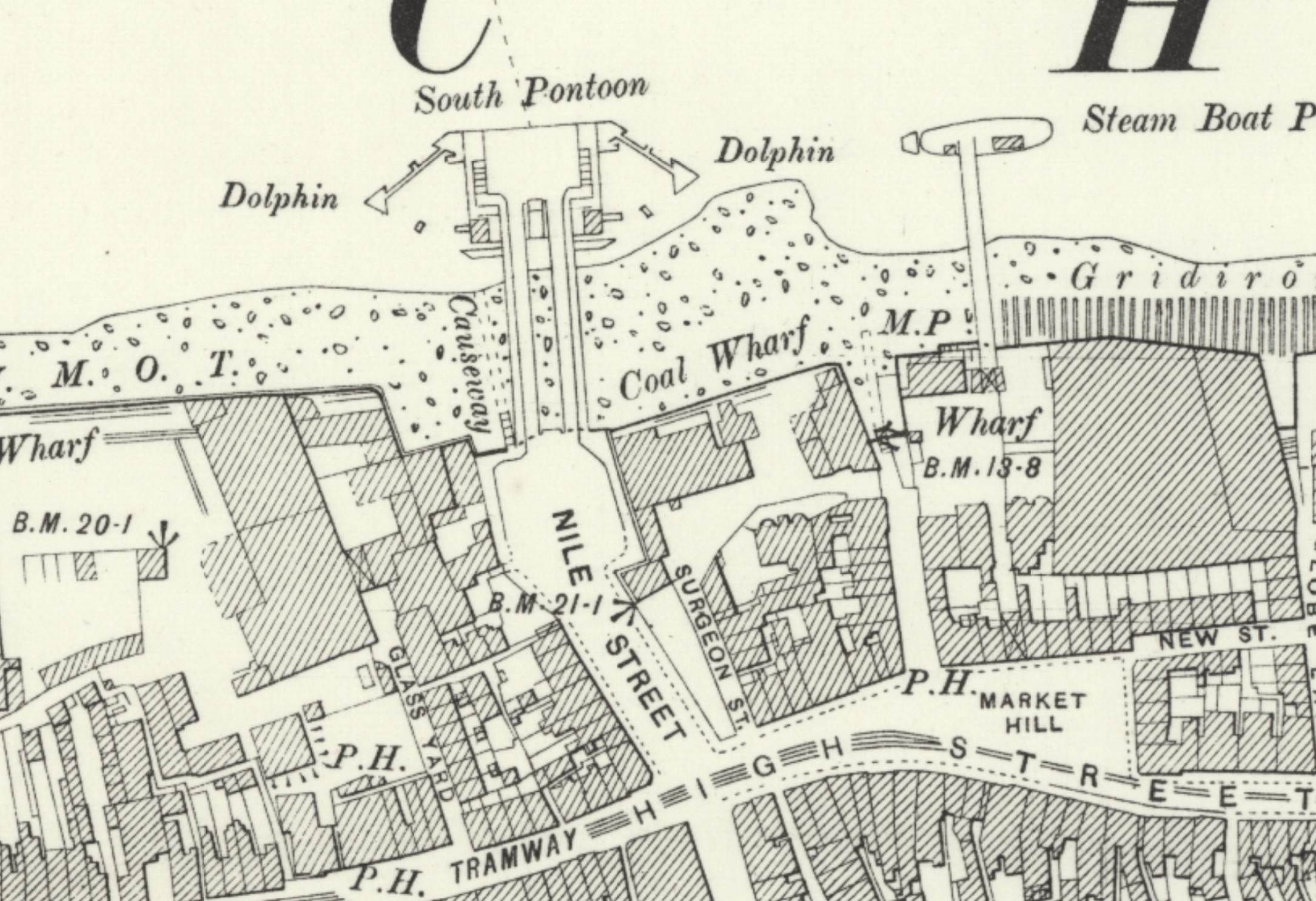
Which is much clearer in the following extract from the above map, where we can see Nile Street Stairs leading down, immediately to the left of the pier, and the causeway running out along the foreshore:

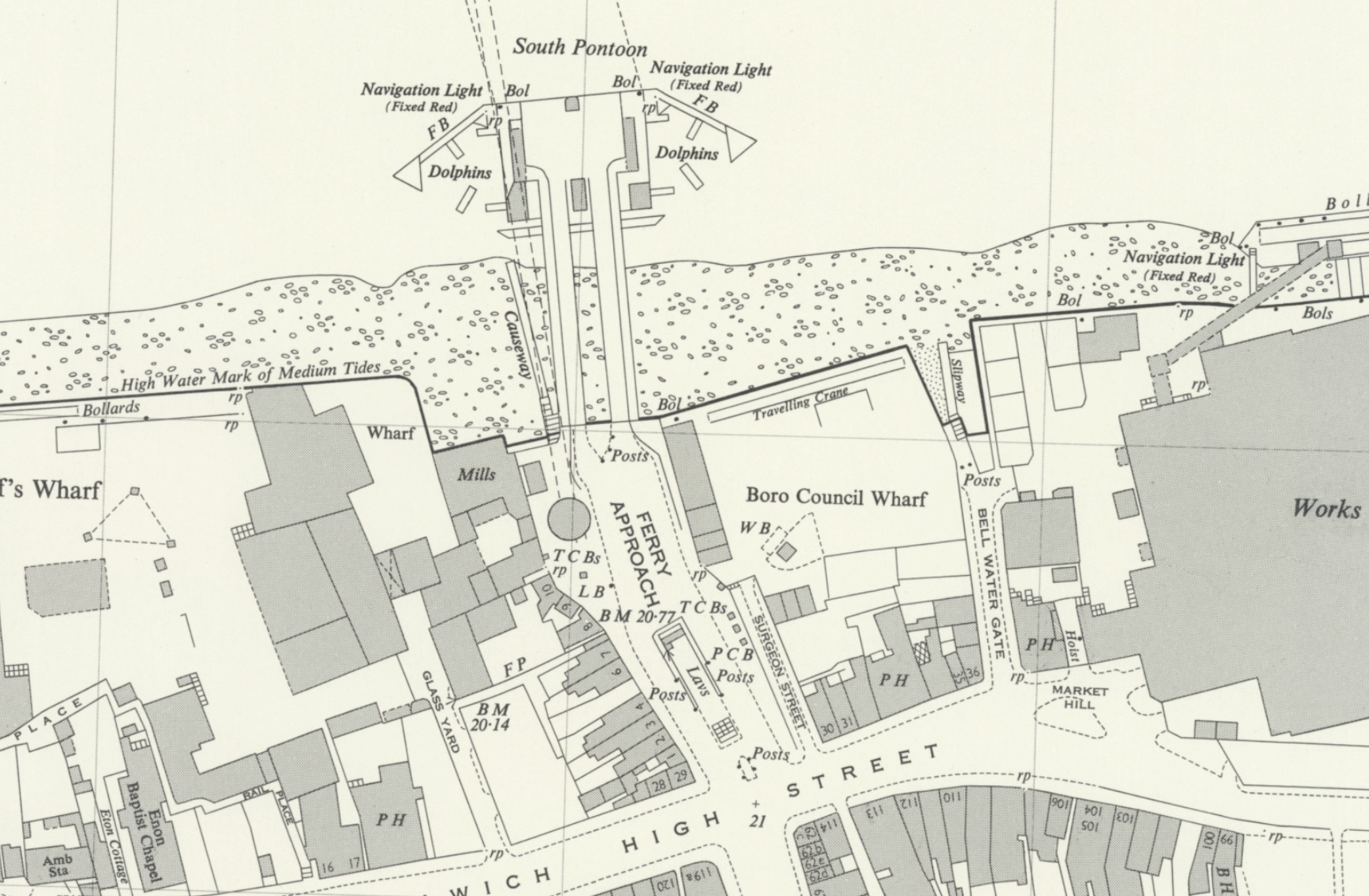
In the above map, the round entrance to the foot tunnel cannot be seen, as this had not yet been built. It was completed and opened in 1912, and in the following 1956 revision of the map, we can now see the round entry building to the foot tunnel, slightly inland from the pier and to the left of what was Nile Street, now named Ferry Approach, with the stairs and causeway still in place (Map ‘Reproduced with the permission of the National Library of Scotland):

The Woolwich foot tunnel had been built after the opening of the Free Ferry as an alternative method of crossing the river, when the ferry was not operational due to weather conditions such as fog and ice, maintenance problems etc.

Both OS maps only use the name “causeway”, rather than give the name Nile Street Stairs. It is named on earlier maps, one of which I will show later in the post. I suspect that the construction and use of the pier for the ferry diminished the importance and use of the stairs and causeway, which may have contributed to the failure to provide a name in these maps.

The above map also shows some brilliant street planning, as you have both the ferry and foot tunnel entrances side by side, so if you were in a hurry to get to your job at the Royal Docks across the river, and when you arrived, the ferry was not working, you could just detour to the tunnel entrance, and walk under the river rather than sail across.

You can also see in the middle of Ferry Approach, a space with the word “Lavs” – some public toilets, also possibly essential in what must have been a place with a very high footfall, as thousands of workers once used either the ferry or tunnel to get to their place of work, either at Woolwich Arsenal, the Royal Docks, or the very many industrial premises that lined the river on northern and southern sides.

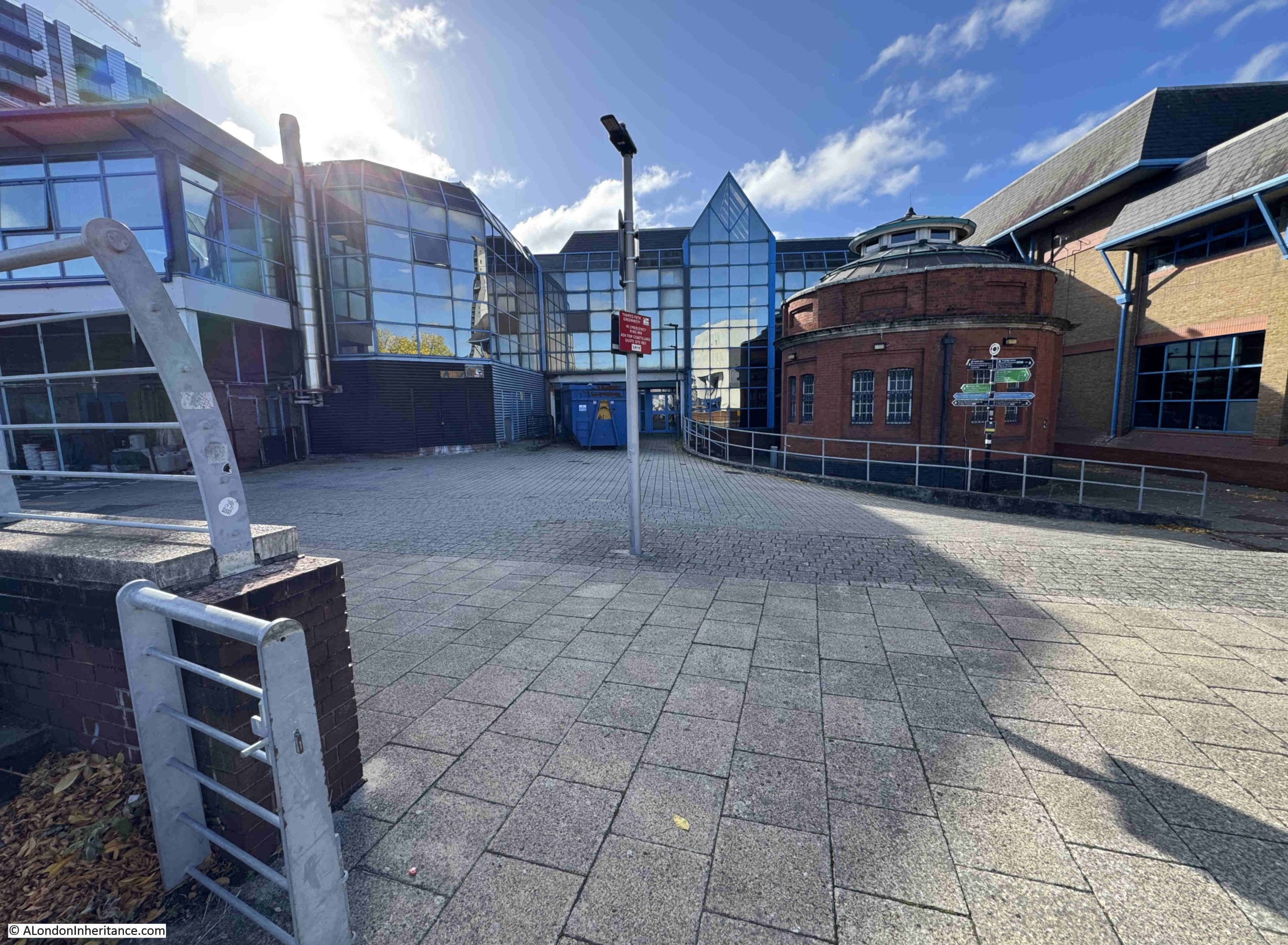
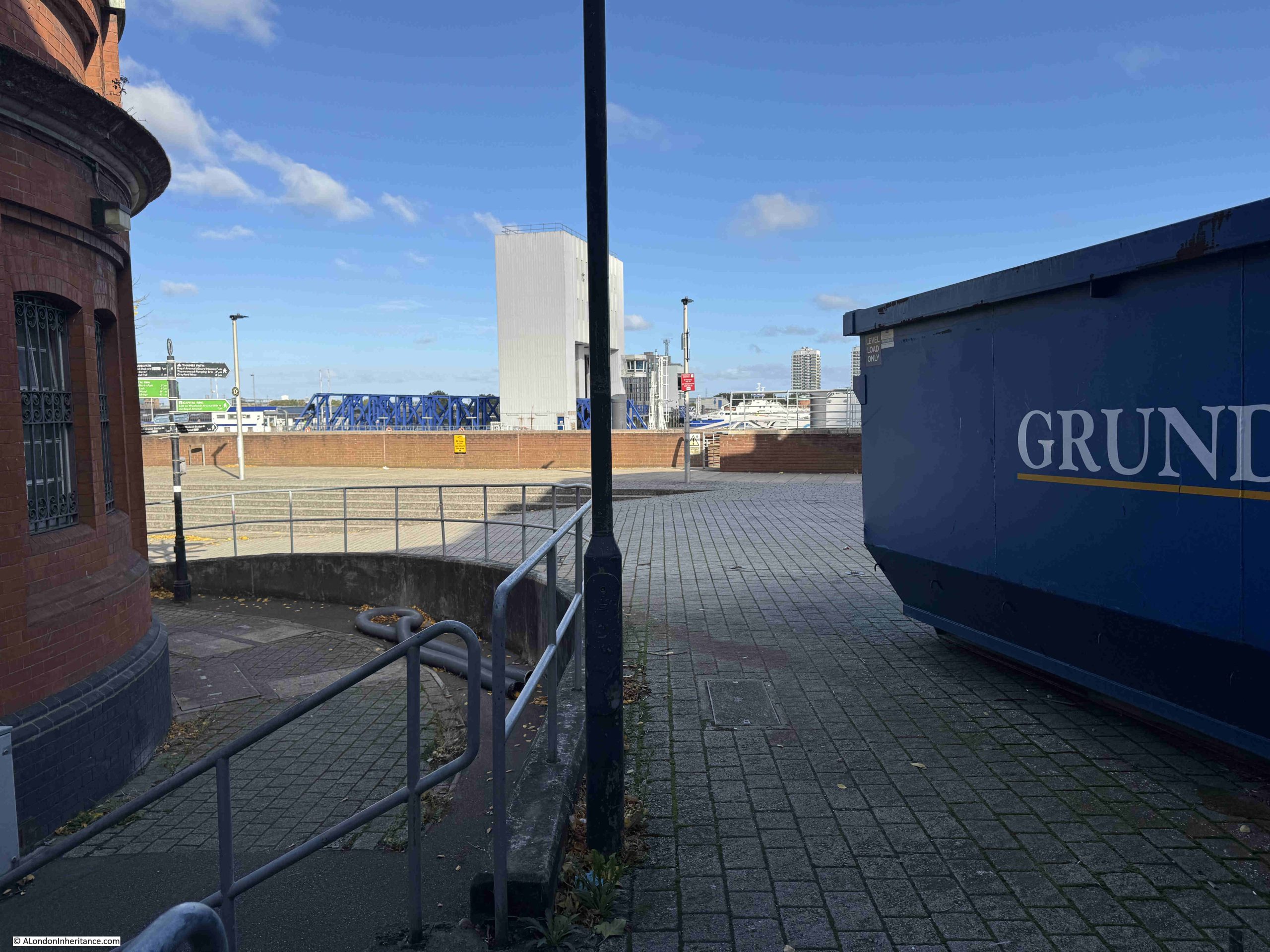
In the following photo from the current top of the stairs, I am looking back along what was Nile Street. The round brick access building to the Woolwich foot tunnel is to the right, and the Woolwich Waterside Leisure Centre is the building to the rear of, and surrounding the foot tunnel entrance. The Leisure Centre was also built over Nile Street:

The following photo was taken from the edge of the leisure centre, as far back as I could get, to try and recreate the old photo earlier in the post. I should have been much further back, but the leisure centre now sits above Nile Street:

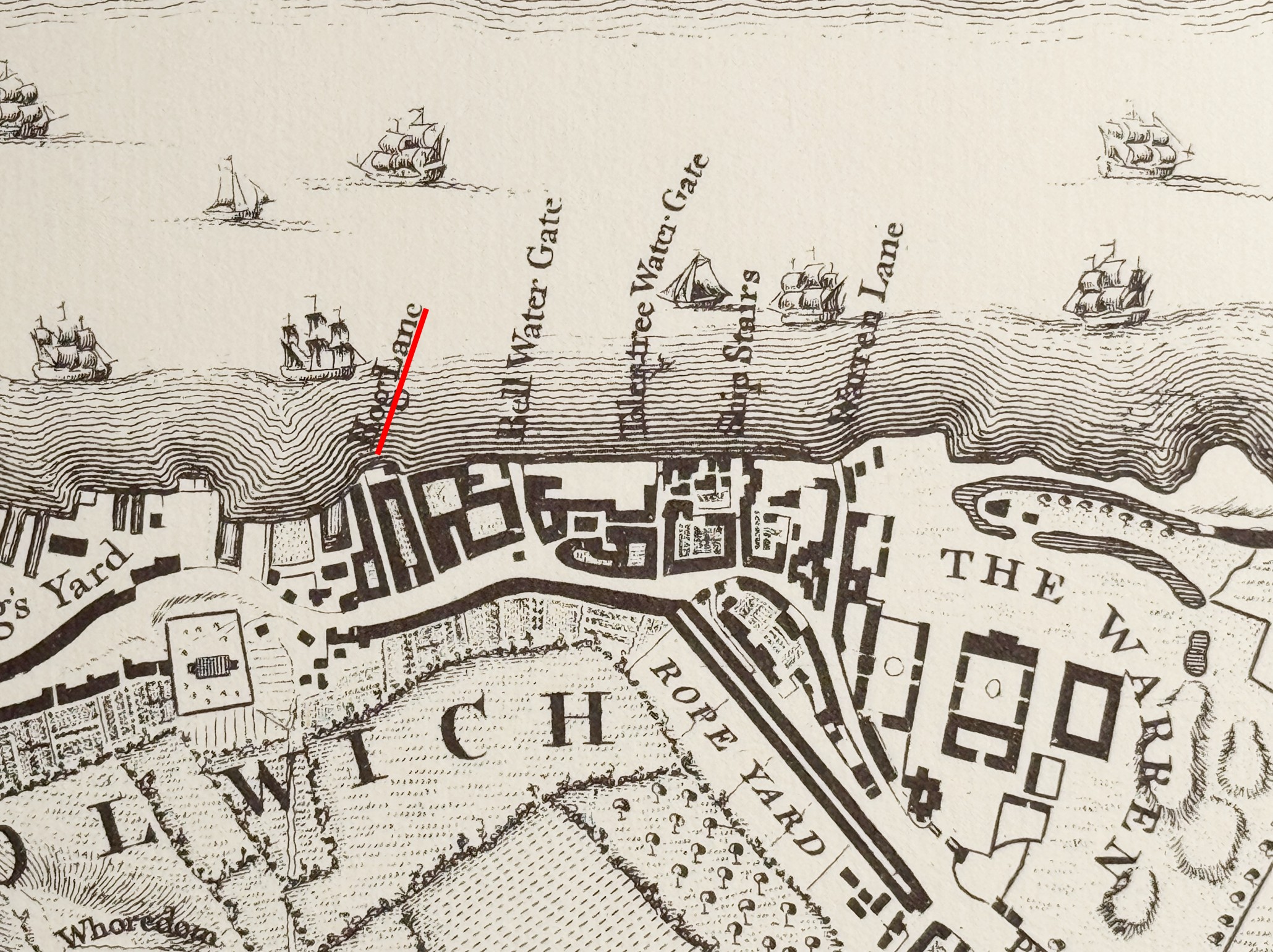
The area around Nile Street, the old ferry pier, and north towards Woolwich High Street has been considered as the original nucleus of the town of Woolwich, and many of the old street names recall rural surroundings. Streets in the area had names such as Hog Lane, Dog Yard, Hare Street and Cock Yard, and Hog Lane was the original name of Nile Street, as we can see from Rocque’s 1746 map of London, where I have underlined the name in red, as it was also used to name the stairs:

Rocque’s map shows the origins of Woolwich as a number of streets and buildings clustered along the river, with a total of five stairs providing access to the river. Hog Lane was both the name of the stairs and the street running back from the stairs, both of which would later change to Nile Street.

To the right of Hog Lane stairs in the above map is Bell Water Gate, which I wrote about in this post.

I cannot find out when the name changed, but I did wonder, given the ship building, naval and military aspect of Woolwich, with the Royal Arsenal (part seen to the right of the above map by the name of “The Warren”, whether the name changed in the late 18th / early 19th century following the 1798 Battle of the Nile where a fleet led by Nelson defeated a French fleet at Aboukir Bay, at the mouth of the River Nile where it flows into the Mediterranean.

This theory falls apart though as Hog Lane still appears in use for much of the 19th century, so in 1861 there is a newspaper report of a drunken man being robbed in Hog Lane, after he had gone to Hog Lane Stairs to wait for a boat, fell asleep, and on waking found that he had been robbed of his hat, handkerchief, boots and money.

Also in 1861 there was a report of a woman’s suicide at Hog Lane Stairs. She was wandering the foreshore and was asked by two boatmen whether she wanted a boat, but replied that a boat was coming for her. After going up the stairs, and returning sometime later, they found the same woman face down in the river.

The use of Hog Lane seems to die out after the 1860s, and in 1882 there is a report of the theft of timber from a wharf . It had been stolen from the pond adjacent to the owners wharf, and was re-landed at Nile Street Stairs, where the timber was sold for chopping into fire wood.

In 1915, Police Constable Taylor received the Royal Humane Society’s certificate for rescuing a boy from drowning at Nile Street Stairs.

The above news reports show why I find Thames stairs so fascinating. It is not just their physical nature, it is the very many stories of London life that can be pinpointed to their specific location. Looking over the river wall at the causeway and thinking about the thousands of Londoners who have used the steps and causeway, their stories, mostly just using the stairs to travel across or along the river, but also what drove some of them to suicide, crime, and the heroism of a rescue of a child from the dangerous waters of the Thames.

I have a theory that the majority of Thames stairs had a pub alongside. This seems true for nearly all stairs in Wapping, Shadwell, Limehouse, Rotherhithe etc. but also seems to be true for Woolwich.

There was a pub called the Nile Tavern adjacent to the stairs. In 1848 this pub was to be Let or Sold, and the following details were in the Morning Advertiser on the 15th of June 1848:

“Woolwich, Kent – Most excellent FREE WATER-SIDE PUBLIC HOUSE and TAVERN – to be LET or SOLD, with immediate possession, the Nile Tavern, Hog-Lane, Woolwich, situated adjoining the stairs next the Royal Dockyard, close to the Steam-boat Piers, and directly opposite the Eastern Counties Railway. The house is at present doing upwards of 20 puncheons of porter per month, with spirits , &c. in proportion, but which may be considerably increased.”

In other adverts for the pub it is described as “river facing”, so must have been at the river end of Hog Lane / Nile Street and facing onto the river.

I wonder if the pub was named after the Battle of the Nile, and the street changed name to reflect the name of the pub.

The Eastern Counties Railway refers to the railway and station that had just arrived in North Woolwich, and the steam boat piers refer to piers for boats travelling along the river, as well as the ferry set up by the Eastern Counties Railway to transfer rail passengers between their station of the north bank, and Woolwich on the southern bank of the river.

And if you fancy trying to order a “puncheon of porter” for Christmas from your local off licence, a puncheon is a third of a tun, which was a large barrel that held 252 gallons of wine.

In another advert, the Nile Tavern was described as “fronting the Thames and conveniently arranged for doing an extensive Public house and Tavern Trade, which its situation is always sure to command, being the nearest house to the shipping lying off the Royal Dockyard, and the place for embarkation for all persons connected therewith, and others employed on the river, the waterside premises” – a description which perfectly summarises why there was nearly always a pub next to a set of Thames Stairs, when the river was the working heart of the city.

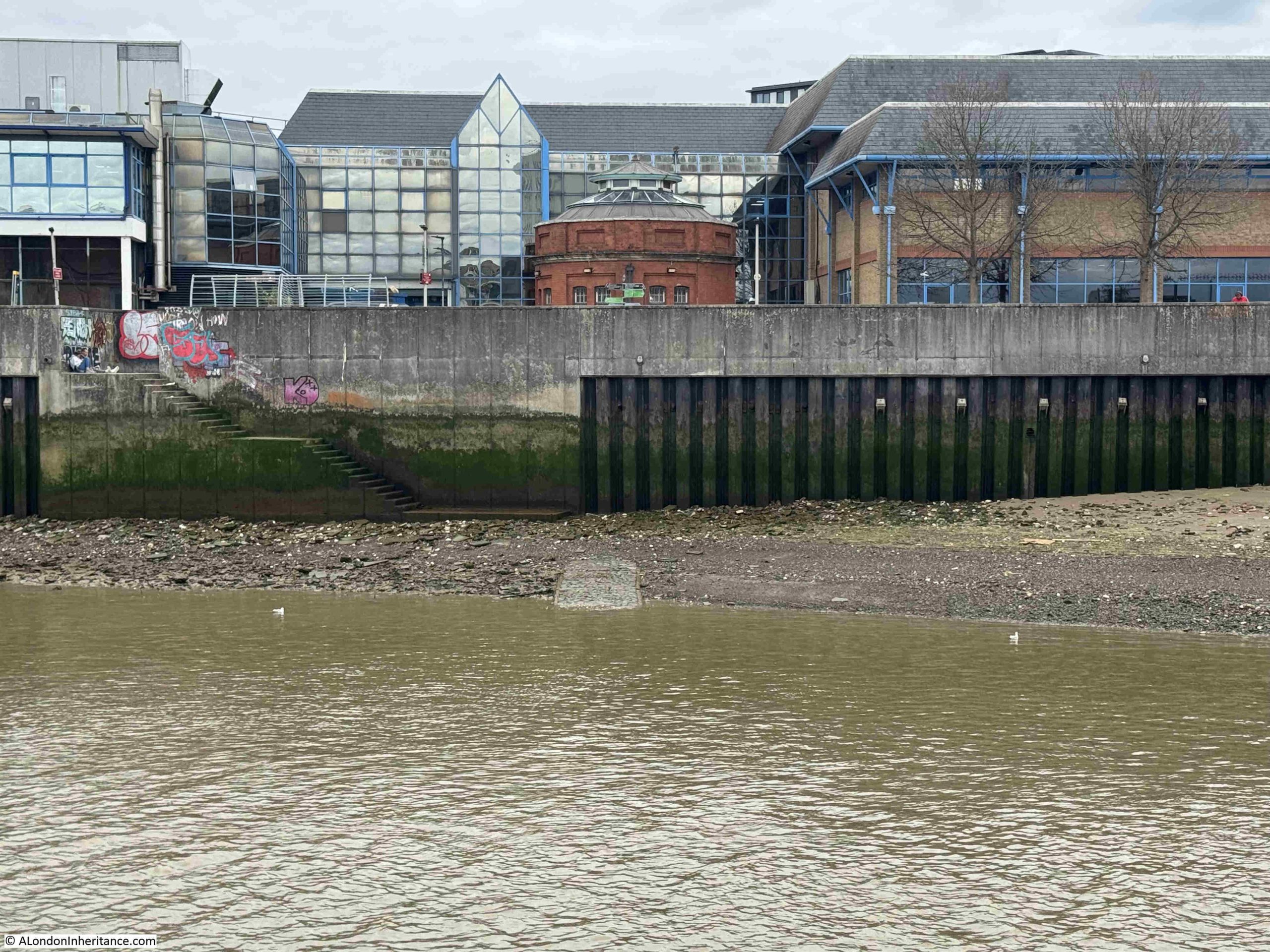
In the following photo from the Woolwich ferry, part of the causeway is just visible emerging from the receding tide. The stairs are now on the left, but originally followed the causeway back and up to the land. The Nile Tavern must have been to left or right of the stairs, and Nile Street / Hog lane headed back to the left of the round foot tunnel entrance, under what is now a sports centre, and up to Woolwich High Street:

Woolwich is protected from the river by high concrete walls, as is the opposite shore along North Woolwich. The above photo provides a view of these defences.

They are needed as Woolwich is downstream of the Thames Barrier, and is therefore not protected by the barrier. When the barrier is closed, the height of the water is a remarkable spectacle.

Whilst the Thames has for centuries been the source of London’s economic growth, prosperity, work, trade and travel, it has also been a source of danger to the low laying land along the sides of the river.

Nile Street and the Nile Tavern were mentioned in reports of a major storm during the first week of January 1887 when the “weather had been rough and stormy during the greater part of the week. Heavy rain had fallen every day and the temperature has continued unseasonably high”.

In Woolwich, several houses in Nile Street were flooded, as was the cellar of the Nile Tavern, and along the length of the Thames there was flooding from the lower portions of Chiswick and Hammersmith, where barriers were erected. Parts of Kew and Richmond were flooded, and in central London, Nine Elms, Wandsworth, Lambeth, Blackfriars, Deptford and Rotherhithe were all reported as suffering from flooding.

In Shadwell there was an “inundation”, and the “sailors and waterside characters turned out en masse, and beguiled the small hours of the night with songs in praise of the ocean and the river. The poorer of the people who worked in the docks were great sufferers of the inundation, which at one time threatened to wash away their wretched houses.”

In a similar way to the storm and floods of 1953, the 1877 storm also caused flooding along parts of the east coast, and in Lincolnshire and Cambridgeshire.

Nile Street / Hog Lane Stairs – that is another of the 240 river access points on the tidal Thames.

Each has been a part of the development of their local area, both on the river and on land. For many thousands of people over the centuries, they were an important place for so many reasons.

We have lost that connection with the river, but it would be good if the name of these stairs was on display, along with a brief bit of their long story and how important they once were to the people of Woolwich.

Narrow Street – The Story of a Riverside Community

Back in January I published the following photo, taken by my father in August 1948, which shows the rear of the buildings along Narrow Street in Limehouse. It was in a post about William Adams – The Adventures of a Limehouse Apprentice, and was used to illustrate how so much of Limehouse had a working relationship with the Thames, and I wrote that I would return to the photo to tell the story of some of the buildings.

The photo shows the rear of the buildings along Narrow Street. There are barges and lighters on the foreshore, and the majority of the buildings have structures on, or alongside the foreshore, showing that each building had some form of relationship with the river.

It is a place where for many of the occupants of the buildings, the river was either a place of work, or their onshore work was dependent on the river, the trade that the river brought to London and the wealth created by the river (although for the majority of the residents of Limehouse, very little of that wealth trickled down to them).

The same terrace of houses along Narrow Street today (my photo is looking straight at the terrace from the opposite embankment, where my father’s photo shows the terrace from an angle, and lower down as he was on a ship on the river):

The following extract from father’s photo shows the buildings to the left of the photo. I will be going into some detail as to the occupants of the buildings later in the post, but compare the following photo with the one above, as it shows the change that has happened across the Thames, from a working river, where many of the buildings along the river’s edge were involved in someway with the river, an industrial scene, barges and lighters on the foreshore, where the photo of the terrace today shows a clean foreshore, with the houses looking out on to a quiet river, mainly populated with Thames Clipper passenger boats, Ribs taking people on high speed trips along the river, containers of London’s rubbish being taken further down the Thames for incineration, and the occasional cruise ship heading for a berth along side HMS Belfast:

The following 19th century print shows the same terrace of houses. The tower of St. Anne’s Limehouse is in the background to the above print and the 1948 photo:

Image: © The Trustees of the British Museum. Shared under a Creative Commons Attribution-NonCommercial-ShareAlike 4.0 International (CC BY-NC-SA 4.0) licence.

Buildings have occupied the river’s edge in Limehouse for centuries, with Narrow Street providing a road alongside the inland façade of these buildings.

In the following extract from Rocque’s 1746 map, I have marked the terrace in my father’s photo with a yellow line. The red arrow is pointing to Duke Shore, which I will come back to later in the post:

The following extract is from “A New and Correct Plan of the Cities of London and Westminster”, published by Haines and Son in 1796, and again I have marked the terrace in the 1948 photo with a yellow line:

Image: © The Trustees of the British Museum. Shared under a Creative Commons Attribution-NonCommercial-ShareAlike 4.0 International (CC BY-NC-SA 4.0) licence.

This map shows the clustering of building in Limehouse in the 18th century, with much of the area to the north and east still rural, with fields and marsh. The feature marked as Lea River in the above map is the Limehouse Cut, that had recently been completed from the River Lea to the Thames, west of the Isle of Dogs, thereby allowing boats on the River Lea heading towards the City to take a short cut, rather than having to travel around the bulge of the Isle of Dogs.

The maps above show the area alongside Narrow Street has been occupied since the mid 18th century, however it has been occupied for very much longer as my post on William Adam’s demonstrated, when Adam’s became an apprentice to a boat builder in Limehouse in the 1570s.

The transformation of the area as we see it today, is therefore a very short period in Narrow Street’s long history as for centuries it was intimately connected with industry and trade on the river.

I can only illustrate a very small part of this long history in a single blog post, so I will start with a look at the terrace of buildings in the left side of the 1948 photo, explore who lived in the houses, the businesses that operated alongside the Thames, and compare with the area today, starting with the following then and now comparison, with the coloured arrows referencing the same places in both photos and also used as references in the rest of the post:

Working from left to right, the red arrow points to a gap, with a house on the site today. I will return to this location later in the post.

The yellow arrow points to the Grapes pub, a pub that claims to have stood on the site for nearly 500 years, and I have no reason to doubt that age, as what is now Narrow Street has been a street alongside the river for centuries, and whilst in land was still rural, light industries such as boat building occupied the river front.

There are many newspaper references to the pub, starting in the 1800s, when it was written about as “Mrs. Horsley’s Bunch of Grapes”. For example, in an 1805 advert Mrs. Horseley was advertising for staff for the pub, and in the same year, an auction in the pub of “free hold houses” in Limehouse was being advertised.

The 1911 census records that in the Grapes lived William George Higgins, aged 32 and listed as the Licensed Victualler. He lived in the pub with his wide Charlotte aged 35, and 7 children ranging in age from 5 months to 14.

Charlotte had been married before as one of the 7 children was listed as a stepson to William Higgins. He was also the oldest, at 14. Charlotte was recorded as “helping in the business”. She had had 8 children, one of which had died, with 7 surviving.

The members of the Higgins family had not moved far, as they were all listed as having been born in either Mile End, Stepney or Poplar.

The following photo shows the Grapes from Narrow Street, and it was typical of the times that such a narrow house would be home to a business as well as nine people – two adults and seven children:

Numbering of houses in Narrow Street seems to have stayed the same since the 1911 census, and the following extract from Open Street Map shows the stretch of buildings. The Grapes is shown towards the left, this is number 76. Not all the houses had a return in the 1911 census, but we can trace many of the occupants of the houses from the census (map © OpenStreetMap contributors):

At number 82 Narrow Street was William Ritchie aged 66 with his wife Mary 64. He was listed as a store keeper. They were recorded as having 7 children, all surviving but none living at home. Also living in the house was their nephew David aged 30 who was a general labourer.

At 84 Narrow Street was Charles Brammall, a 55 year old Lighterman who lived in the house with his wife Elizabeth aged 56, daughter Jessie aged 24 and son Sydney aged 14.

As an indication of the birth rate and the frequently high death rate for young children, Elizabeth had had a total of 9 children, 4 had died and 5 were still living. Jessie was recorded as “Help at Home”, whilst Sydney was still at school, although at 14 this would not be for much longer.

In my father’s 1948 photo, the rear of number 84 Narrow Street is the house in the following extract from the photo with the word “ETHEREDGE”. In 1948, the building was also occupied by Charles and Arthur Etheredge who were tug owners:

The Etheredge firm had operated from Narrow Street since the 1890s, so I suspect the residents in the 1911 census were either employees of the company, or were living in rented out upper floors.

Etheredge advertised their services as follows: “Vessels Towed to any part of the CHANNEL. Ships transported from Docks to Dry Docks”. As well as offices in the building at Narrow Street, they were also at the London Shipping Exchange, and if you wanted to send them a telegram to get a tug boat for your ship, they had the Telegram address of “TUGBOAT LONDON”.

At 86 Narrow Street was John Barnett aged 77, recorded as being a General Dealer with his 45 year old wife Caroline (quite an age gap) and 3 daughters aged 10, 8 and 6.

At 88 Narrow Street was George Costino aged 60, a Lighterman, and his 60 year old wife Clara. They were the only people in the house, and under children, it was recorded as “none”.

There is no number 90 in the census returns. This is probably down to it being part of the W.N. Sparks business. I will come to this business shortly, but for now, the following is a brief description of number 90 from 1955: “No. 90 is indisputably the oldest. I doubt it was once the home and workshop of an Elizabethan mast and spar maker, as local gossip claims, but one of the firm’s employees did in fact find a spade guinea and a doubloon there”.

Whilst the majority of Narrow Street residents seem to have been born in east London, some had moved to Limehouse, often from a considerable distance.

At number 92 was Robert Gilmore, age 26, who was listed as being single and having a job as a house painter. He was living in the house with Sydney Gilmore, his 2 year old son. Also in the house was Mary Stephenson, a 37 year old House Keeper.

Robert and Sydney had come from Scotland, with Sydney being born in Aberdeen. Robert was listed as being single rather than a widower, so it is interesting to speculate why he had moved from Aberdeen to Limehouse with his very young son.

The housekeeper Mary, had also moved some distance, coming from Cumberland.

Number 92 was also home to Caroline Thorn, 68 and a widow. She lived in the house with her son William, 31 and a General Labourer in the shipping trade, daughters Rosetta (25) a Dining Rooms Waitress and Amy (23) a Restaurant Cook.

All three children were single, and it is interesting when reading census date from over one hundred years ago, that many children were still single and listed as living at home, well into their late 20s and early 30s. Often this seems to be written about as a more recent trend, however it could have been something seen more in major industrial cities in the past.

Number 94 is the building highlighted by the orange arrow in the above then and now photo combination. The following is an enlargement from the original photo, and shows number 94. There are a large number of barges on the foreshore between the building and river, and we can see the name W.N. SPAR, with the rest of the name obscured by the mast and sale:

This was the barge building business of W.N. Sparks, and in 1911, the census records that the building was the home of Reuben James Sparks (30), a Barge Builder and Surveyor, his wife Georgina Sparks (35), daughter Ruby aged 6 and son William, who was 3 months old.

Reuben Sparks had taken over the business from his father, William Nathanial Sparks (hence W.N. Sparks on the building in 1948) who was born in 1848, and in the 1891 census, he was listed as being a Marine Surveyor and was also living at 94 Narrow Street, with his wife Sarah and their 8 children, ranging in age from Mary (19) recorded as being an Organist, down to Lily aged 3. Sarah’s sister Elizabeth was also recorded as living in number 94. She was aged 22 and a machinist, so there were 11 people living in the building, as well as the barge building business..

Reuben was their fifth child, but took over the business as he was the oldest son, the older three children were all daughters.

By the time of the 1911 census, William Nathaniel Sparks had moved from Limehouse to Ilford, where he was living at 38 Mansfield Road. The house is still there, and although now the exterior has been rendered and the house appears to be of multiple occupancy, it was a substantial brick house of the late 19th / early 20 century, so William’s barge building business in Limehouse had obviously been profitable.

In 1911, William was 64, but was still recorded as being a Marine Surveyor Barge Business, but I suspect by then he was mainly retired, leaving the barge business to his son Reuben.

William still had three of his children at home, who were all single. Grace (34), a professional vocalist, Edith (29), Ernest (27), a clerk, and Lily (24) also a professional vocalist.

In the house was also Ann, a servant and Elizabeth, a nurse, so one of the Sparks family probably needed extra medical care.

William and Reuben Sparks were just one in a line of barge building at the same site in Narrow Street.

The following print from 1876 shows the view along the same terrace of buildings as in my father’s photo, and on the right of the print is number 94, and rather than the name W.N. Sparks, the sign reads “Surridge and Hartnoll Barge Builders”:

The only reference I can find to Surridge and Hartnoll is their inclusion in a list or partnerships dissolved in May 1879, when they were listed as being barge builders, shipwrights, mast and sail makers. The record also detailed that as well as 94 Narrow Street, they also operated at Fisher’s Wharf in Millwall.

Number 94 had some history. In an article in the Sphere on the 23rd of April, 1955 about Limehouse, there is the following about the building: “Local gossip maintains that the bricked in ovens on the ground floor are relics of a sugar bakery which formerly occupied the premises. But there is circumstantial evidence that the famous blue and white Limehouse chinaware began to appear in the middle of the eighteenth century. Like the other premises of Messrs. Sparks, this house is full of noble old beams and is a maze of rooms, stairways and trapdoors. Contrasting with the now abandoned kiln where the timbers for wooden barges were once steamed into shape are modern welding plant and electric machinery.”

The front of number 94, facing onto Narrow Street. As with the majority of this terrace of buildings, number 94 is Grade II listed:

It seems a long way back in the post, but if you go to the then and now photo. the green arrow is pointing to an area of open space on the foreshore known as Duke Shore.

This was long an open space, and is shown in Rocque’s 1746 map as an open space as it still is today, although there are two modern, narrow houses that block off Duke Shore from Narrow Street, and the adjacent stairs between street and foreshore have also been blocked off.

Also returning to the 1948 photo, and to the left of the Grapes was an open space. Unlike Duke Shore, this was normally a built space, and in the following photo, the building in the centre with the bay upper floor is the building that stood in the space:

The Grapes can be seen just to the right with the brewery name Taylor Walker & Co on the sign at the top or th3 pub.

The building shown in the above photo was once the Harbour Masters office, but in the 1911 census, it was occupied by James Smith aged 59 who was listed as an Inspector. He lived here with his wife Annie Caroline aged 37, and 9 children including what must have been children from his first marriage as ages ranged from 0 to 24. The eldest two sons were a Mechanical Engineer and a Lighterman. Also living in the house was Katheryn Helvin aged 16 from Poplar and listed as a General Domestic Servant.

The following photo is the right side of the 1948 photo, and continues to show the industrial theme of the buildings along the foreshore, however what I want to focus on with this extract is the chimney and two large buildings in the background:

The building on the right should give a clue as to their function, as we can see the words Taylor Walker. This was the Barley Mow Brewery of Taylor, Walker & Co,

Brewing started on the site in 1730 with the firm of Hare & Salmon. Edward Taylor became one of the partners in the brewing company in 1796 and John Taylor joined in 1816, and the firm eventually became known as Taylor, Walker & Co.

The Barley Mow Brewery buildings that we can just see in my father’s 1948 photo were from the 1889 rebuild and expansion of the brewery.

Ind Coope purchased the brewery in 1959, and with the consolidation and closure of many London breweries, brewing ceased at the Barley Mow in 1960.

After demolition of the brewery, the Barley Mow housing estate was built on the site. A couple of the tower blocks of the housing estate can be seen in my comparison photo earlier in the post.

One of the tower blocks of the estate suffered a strange fate, as when the Limehouse Link Tunnel was built through the area, the tower nearest the construction site was demolished as there was concern that vibration from construction and ground movement would damage the tower.

The article I quoted earlier from the Sphere on the 23rd of April, 1955 was focused on the change then taking place in Limehouse with a focus on Narrow Street, what was being lost, and what may come. The last few paragraphs from the article are below, the text includes a phrase which I suspect, always has, and always will apply to London “the illusion of permanency“:

“Possibly the most disturbing feature of the post-war world is the speed of change. Traditional methods, standards, customs and scenes are swiftly dissolving; and notwithstanding the advantages of streamlined substitutes, those of us who have known the illusion of permanency cannot help feeling that our world has suddenly become unstable.

Nowhere is this feature of to-day more in evidence than along the commercial Thames-side, where long stretches of the tideway banks, in many cases unchanged for a century or more, have been almost completely transformed within the short space of the post-war period. And now the rambling Limehouse waterfront of Messrs. W.N. Sparks and Sons, barge builders and repairers, almost the last of the river scene as Dickens knew it, is for sale.

If you do not know the Limehouse riverside, you are to imagine a line of tall, venerable buildings of varying age, their lower walls washed twice daily by the tides. The centre piece is a dark and cavernous barge-repair loft, usually lit for passing watermen by a dramatic spray of blue welding sparks. The frontages abut on Narrow Street between the Bunch of Grapes and Duke Shore Wharf – a street famous in our island history, for it re-echoes the steps of Sir Walter Raleigh, Sir Humphrey Gilbert, William Burrough, Phineas Pett, Duncan Dunbar, Captain Cook and Jerome K. Jerome.”

In 1955, there was still an expectation that the area around Limehouse, as well as much of the river all the way to the City, would continue to be a place of physical trade and industry in the coming decades. I doubt they could have imagined just how much of this would be lost over the coming 30 years. The articles final paragraph:

“It is too much to expect that this rambling old water-front will be left intact; the modern tideway cannot afford to permit the picturesque to stand in the way of progress. But whatever streamlined industry supplants the old barge establishment, whatever new trade it attracts to the Port of London, some of us think the Thames will be poorer.”

There is obviously much more to be written about Narrow Street (for example see this post about Daniel Farson, a one time resident of one of the houses in the Narrow Street terrace), however the constraints of a weekly post limit what can be explored.

Tower Hamlets council had a plan to demolish parts of the terrace in the early 1970s to replace with a green space along the river. Fortunately this did not take place. The Grapes pub was saved by new leaseholders which included Evgeny Lebedev, and Sir Ian McKellen. The terrace is listed, which should help preserve this historic and fascinating range of buildings, that for so long was part of the working river.

However, as the 1955 article stated, there is always the “illusion of permanency”.

alondoninheritance.com

Essex Street Water Gate and Stairs

I have written about the area between the Strand and the Embankment in a number of previous posts. It is a fascinating place of alleys, steep streets to the river, and a place where we can still find features that are reminders of long lost landscapes.

One such feature can be found at the southern end of Essex Street, where the street appears to come to an end, with a large gap in the building at the end of the street framing the view towards the Embankment:

The archway through the building at the end of Essex Street leads to a set of stairs down to what would have been the level of the Thames. The archway in the 1920s from the book Wonderful London:

I love the details in these photos. There appears to be a child at lower left of the arch, who looks like they are holding a small dog or cat.

At first glance, the arch and surrounding building looks the same as the photo from 100 years ago, however looking closer and there are differences. The brickwork in the semi-circular area below the two round windows and above the entrance appears far more recessed in the 1920s than it does today, and along the wall between first and second floors there appears to be a white decorative band protruding from the brickwork which is not there today, so I suspect there has been some rebuilding / restoration of the building and arch.

A look at the London County Council Bomb Damage Map shows that there has indeed been some considerable post-war rebuilding, as the building surrounding the arch at the end of Essex Street is coloured deep purple, indicating serious damage.

A look through the arch in 2025:

The following photo from the the book “The Romance of London” by Alan Ivimy (1940), where the scene is described as “Water Gate, at Essex Street, Strand. This opening at the bottom of the street, which gives a view of green trees, is the old Water Gate, built into the surrounding houses, of Essex House, and the only survival of that great mansion”:

Essex House was one of the large houses that once lined the Strand, each with gardens leading down to the banks of the Thames. These houses would typically have their own access to the river as the river was frequently the fastest and safest method of travelling through London.

The caption in Alan Ivimey’s book is rather ambiguous as it states that the opening is the old water gate. It does not specifically state that the surrounding structure is the original water gate.

The houses lining the Strand often did have a feature where their private access to the river was located, as the view of these from the river would have acted as a location marker as well as a symbol of status, where a large, decorated structure acting as their gate to the river would have impressed visitors and those travelling along the Thames.

Another example is the Water Gate to York House, which was the subject of this post.

The arch was described as a Water Gate in the many illustrations of the feature that have appeared over the last couple of hundred years, including this print from 1848, where the Water Gate is described as the “stately portal with large columns to either side”:

Image: © The Trustees of the British Museum. Shared under a Creative Commons Attribution-NonCommercial-ShareAlike 4.0 International (CC BY-NC-SA 4.0) licence.

So is the arch a survivor from the time of Essex House? Any thoughts that this may be a historic survival are quickly dashed when looking through the Historic England listing.

The arch is Grade II listed, however the listing text states that it is a “Triumphal” gateway built in 1676 by Nicholas Barbon to terminate his Essex Street development, and to screen his development of a commercial wharf below. The listing also confirms that there was bomb damage, and the surrounding buildings date from 1953.

Looking through the arch, we can see the steps leading down to Milford Lane:

Through the arch and down the stairs, we can look back at the rear of the 1953 building, the stairs and the arch. The view shows how the height difference between the streets leading down from the Strand, and what was the foreshore of the Thames have been managed, where the ground floor from this angle is the basement from Essex Street:

Although the building was bombed in the 1940s, and rebuilt in the 1950s, this view still looked very similar to the 1920s:

So, although the arch has frequently been called the Essex Street, or Essex House Water Gate, it appears that the feature dates from Nicholas Barbon’s development of what had been the Essex House gardens, into Essex Street. It was bombed in the last war, restored and rebuilt, and the building surrounding the arch dates from the 1950s.

I mentioned at the start of the post how features such as the arch can act as reminders of a long lost landscape, and to see how this works, we need to follow a series of maps.

Starting with the area today, and I have marked the location of the arch / water gate with the red arrow in the map below (map © OpenStreetMap contributors):

In the above map, we can see Essex Street running slightly north west from the water gate (red arrow), up to the Strand. In the area between the arch / water gate, we can see part of the Victoria Embankment gardens to lower left, and on the right are Temple Gardens.

Going back to William Morgan’s 1682 map of London, and we can see the area soon after Nicholas Barbon’s development, with the red arrow marking the water gate:

There are 343 years between Morgan’s map, and the area today, and the street layout is almost identical, with Essex Street running to the north west, up to the Strand. The same two streets running east and west about two thirds up the street, and Milford Lane (blue arrow) running from the west to the south of the stairs in almost exactly the same alignment as today.

Morgan’s map shows a gap between the buildings at the end of Essex Street, where the arch is today. The map appears to show an open gap, with no arch, or floors above the arch. Whether this was an error in the map, whether the arch had not yet been built, or whether Barbon initially only put pillars on the building to the side of the gap as decoration, without an arch, would require much more research, but the key point is that the gap leading from Essex Street was there in 1682.

The 1682 map shows the stairs to the river, Essex Stairs (yellow arrow). These were not the stairs that lead down through the arch, but stairs at the end of what must have been a flat space between the water gate and the river, probably Barbon’s wharf development that the building and arch at the end of Essex Street was intended to screen.

To see how rapidly this area had changed, we can go back just five years from the above map, and the 1677 Ogilby and Morgan’s map of London.

In the extract below, we can see that Essex House, along with ornate gardens between the house and the Thames were still to be found. The red arrow marks the location of the water gate / arch we see today:

Image: © The Trustees of the British Museum. Shared under a Creative Commons Attribution-NonCommercial-ShareAlike 4.0 International (CC BY-NC-SA 4.0) licence.

Essex House can be seen close to the Strand, opposite the church of St. Clements.

Essex House was originally Exeter House as it was the London residence of the Bishop of Exeter who had been granted the site in the reign of Edward III.

The house and grounds were taken during the Reformation, after which it was purchased by Thomas Howard, the fourth Duke of Norfolk, who was arrested in the house and in 1572 he was beheaded for his part in the conspiracy of Mary Queen of Scots. The house was then owned by the Earl of Leicester, and became Leicester House. After his death, the property passed to his son-in-law, the Earl of Essex during the reign of Elizabeth I, and the house became Essex House.

Originally facing directly onto the Strand, by the time of the above map, we can see that houses and shops had been built between the house and the Strand, reflecting the slow decline in the importance of the large houses built along the Strand.

The house was pulled down around 1682, the same year as the map of William Morgan, however it is always difficult to be sure of exact publication dates, when the streets were surveyed for the map etc.

This may also answer why the gap of the water gate is shown without an arch as the William Morgan map may have used the plans for the area, rather than as finally built.

The 1677 map shows some interesting comparisons and features:

  • comparing the shoreline between the Thames and the land in the 1677 and 1682 maps, and after Bourbon’s development, an area of the foreshore appears to have been recovered – Barbon’s wharf development as mentioned in the Historic England listing
  • this would then put the current arch / water gate at the location of the original stairs at the end of the gardens, to the river
  • the slight north west angle of the gardens is roughly the same as the alignment of Essex Street today, so as we walk along Essex Street, we are walking along what must have been the central pathway through the gardens of Essex House
  • although not named in the map, Milford Lane is running to the east of Essex House, in the same alignment as the lane today (although in 1677 it did not have the bend round the base of the stairs. Milford Lane once formed the boundary between Essex House and Arundel House to the west

An extract from the 1677 map is shown below, covering the boundary with the Thames:

There are two boats moored at the end of the stairs down to the river at the end of the gardens of Essex House, where the water gate stairs are today.

There are two other sets of stairs shown on the map. On the left, there is a cluster of boats around Milford Stairs – named after the lane on the east of Essex House, and a lane we can still find today.

On the right there is a large cluster of boats around Temple Stairs.

Three stairs in a short distance shows just how many stairs there once were between the land and the river. Many still survive, but stairs such as Milford, Essex and Temple have disappeared beneath the land reclamation for the Embankment.

Temple Stairs appear to have been of a rather ornate stone design. The following print shows the Great Frost of the winter of 1683 / 4:

Image: © The Trustees of the British Museum. Shared under a Creative Commons Attribution-NonCommercial-ShareAlike 4.0 International (CC BY-NC-SA 4.0) licence.

Temple Stairs are on the left edge of the print, and they appear to be a stone, bridge like structure, probably over the most muddy part of the foreshore, with a set of steps then leading down to the river, where a passenger would take a boat to be rowed across or along the river.

The print has a pencil note “Taken from the Temple Stairs”, but other British Museum notes to the print state that the print is from near the Temple Stairs.

The following photo was taken from the southern end of Milford Lane, where it joins Temple Place:

The above photo is looking across what was Nicholas Barbon’s wharf development, which the houses at the end of Essex Street were meant to screen, and before Barbon’s work, this would have been the Thames foreshore, with the stairs leading down from the gardens of Essex House to the river, where the gap of the water gate can be seen.

In the following photo, the entrance to Milford Lane is on the right, behind the red phone box. The building on the left is Two Temple Place:

Two Temple Place gives the impression of being of some considerable age, however it is built on what was the Thames foreshore, and dates from the early 1890s, when William Waldorf Astor commissioned the gothic revivalist architect  John Loughborough Pearson to create the building.

One of the stand out features is the gilded weather vane, made by J. Starkie Gardner, a representation of Christopher Columbus’ ship, the Santa Maria:

The water gate is today an interesting architectural feature at the end of Essex Street. Perhaps more importantly, it is reminder of a long lost landscape, which dates from Essex House and the gardens which led down to stairs to the Thames. After the demolition of Essex House, Essex Street was built on the same alignment as the gardens, and the stairs then led down to Barbon’s commercial wharf on what had been the Thames foreshore.

Today, the 19th century Embankment has further separated Essex Street and the stairs from the river, and Two Thames Place is a symbol of late 19th century building on the recently reclaimed land of the Embankment.

The stairs are also a reminder of a time when there were very many stairs along this part of the river, important places in the daily lives of many Londoners.

Very much, a lost landscape.

alondoninheritance.com

Bell Watergate Stairs – Woolwich

It has been some months since I last wrote about a set of Thames Stairs, so for today’s post, I am visiting another of these historic places that for many years connected the river with the land, and were once an essential part of life in London for very many people.

This is Bell Watergate Stairs, Woolwich:

Bell Watergate Stairs are listed in the Port of London Authority’s guide to Steps, Stairs and Landing Places on the Tidal Thames, although there is not much information provided, just the name, that they consist of stairs and a causeway, and that the concrete stairs and handrail are in poor condition. They are also confirmed as being in use.

Bell Watergate Stairs look in pretty good condition today, still with concrete stairs leading down to a causeway, with a handrail to the side. The causeway runs across a wider open space, and on the right is a sloping approach to the foreshore lined with stones, and along the upper part, there are wooden bars bolted to the stone surface to provide grip.

It was a very low tide on the day of my visit, leaving the causeway fully exposed, with green algae on the stairs, and along the side walls showing how far the water reaches:

The stairs are shown within the red oval in the following map, just north of Woolwich High Street, with a small street – Bell Water Gate – linking Woolwich High Street and the stairs. The jetty for the Woolwich Ferry is the feature on the left of the map  (© OpenStreetMap contributors):

The stairs are shown on the 1897 revision of the OS map, where the feature looked then, much as it does today, with the stairs and causeway within a wider entry into the river. The South Pontoon of the Woolwich Ferry is on the left and on the right is a Steam Boat Pier, originally used by the two steam ferries of the Eastern Counties Railway, the “Kent” and the “Essex”, to link Woolwich with the new railway station across the river at North Woolwich:

(Map ‘Reproduced with the permission of the National Library of Scotland)

If we then look at the same area, almost 60 years later, the following 1956 revision of the OS map shows Bell Watergate Stairs in the centre of the map. The old steam boat pier has been removed (there was a charge to use this cross river ferry, and it could not compete with the Woolwich Free Ferry).

If you look to the right of the above map, I have used a blue arrow to point out a similar feature to Bell Watergate Stairs, where there is an inlet to the Thames, with stairs leading up to land. Sixty years later, this feature had disappeared, with the expansion of the industrial premises along the river.

(Map ‘Reproduced with the permission of the National Library of Scotland)

The street leading up to the stairs was not named on the 1897 map, but in the 1956 revision, it is named as Bell Water Gate (I have used the single word Watergate in the title of the post, as this aligns with the Port of London listing – not that this means that it is correct and most references use Bell Water Gate).

As I have mentioned when writing about other Thames stairs in previous posts, whilst the physical feature of a set of stairs is fascinating, they are also important as they provide small snapshots of history and individual events which can be tied to a specific place.

They can illuminate different aspects of life in London over the centuries.

In the past, the river was a far more a part of many Londoner’s lives than it is today. Whether for work, travel, or just for play and entertainment. On the day of my visit, the stairs were quiet, however this has not always been the case, as “E.T.” was complaining about to the Woolwich Gazette on the 9th of August, 1901, when the hot summer weather was causing problems at the stairs:

“RIVERSIDE BATHING. Sir, – Surely measures can be taken to prevent this disgusting practice which takes place daily during the summer months at Bell Water Gate, Woolwich. The place in question is situated in close proximity to factories where young girls are employed. The language used by the lads is of the vilest description, and should not for one moment be tolerated. I sincerely hope that the authorities this should apply to will see these few lines, and in the name of decency stop once and for all the nuisance complained of.”

All along the river, Thames Stairs were places where children would play. The following is an extract from one of my father’s photos of Wapping Old Stairs, taken in 1948, and shows some children at the bottom of the stairs, alongside the water:

For children, the river could be a very dangerous place, and there were numerous reports of drownings, as well as many rescues. The following is from the Daily Mirror on the 9th of August, 1933:

“BOY OF 12 RESCUES A CHILD – A heroic rescue was made by a boy of twelve, Terence McNulty of Woolwich High-street, at Bell Water Gate, Woolwich, last night.

While playing on the steps leading down to the Thames, Peggy Ramsey, aged six, of Borgard-road, Woolwich Dockyard, fell into the river. Seeing the girl in difficulties, Terence plunged in and brought her to the bank. The girl was taken to hospital.”

Another example was in September, 1916, when: “A gallant rescue from drowning was effected yesterday morning at Woolwich by the Rev. C.W. Hutchinson, priest in charge of St. Saviour’s Mission, Woolwich. It appears that Arthur South, 12, Paradise Place, Woolwich, was playing on the steps leading to the river at Bell Water Gate when, on reaching for a box which was floating by, he overbalanced and fell into the river, being carried away by the tide.

Attracted by the screams of his companions, Mr. Hutchinson, whose mission house is close to the spot, ran out, and seeing the boy about 50 yards away, dived into the water, fully dressed, and succeeded in rescuing him. The boy was little the worse for his immersion, and after being treated at the Mission House, was able to go home.”

The Mission House was one of the establishments that was in Bell Water Gate, the street running up to Woolwich High Street.

The source of the name of Bell Water Gate Stairs is difficult to confirm, but the street leading from the stairs was also called Bell Water Gate, and in the street there was a Bell Public House, which dated from at least 1655, so the name of the stairs may come from the pub, along with the existence of a parish gate at the stairs. Bell being a common name for a pub, I think it is safe to assume that the stars were named after the pub, rather than the pub being named after the stairs.

The following 1907 report is typical of some of the mentions of the Bell public house: “At the Woolwich Police Court on Friday, William John Leonard, of the Bell public house, Bell Water Gate, Woolwich, appeared on an adjourned summons which charged him with permitting his premises to be the habitual resort of prostitutes for a longer time than necessary to obtain reasonable refreshment.

For the defence it was urged that the licensee was totally unaware of the character of the women who used the house, and maintained that it would have only been fair had the police notified him and given him warning first.

In giving evidence, John William Leonard, brother of the defendant, swore that he did not know that women pointed out by the police were prostitutes.”

I suspect that William Leonard, the landlord of the Bell, did know who was in his pub.

Bell Watergate Stairs could well have also existed when in the 17th century, and the stairs were once the main landing point for traffic between the river and the town of Woolwich, and they are the last of this type of stairs to survive in Woolwich.

A very early form of the Uber Thames Clippers operated from Bell Watergate Stairs, as in 1845, adverts in the Kentish Independent were informing the people of Woolwich that “Fast and Splendid Boats of the Waterman’s Company leave at the Waterman’s Pier, Bell Water Gate, Woolwich, every hour and half hour”, running to and from Westminster.

The boats offered an extensive number of stops, to, and as they returned from Westminster, calling at the Adelphi, Temple, Blackfriars’s and City Pier, and at the Thames Tunnel and Limehouse.

The following print dates from 1922 and is by Edward Arthur Evacustes Phipson. The view is looking down the street Bell Water Gate, towards the stairs at the end of the street, with the river and North Woolwich in the distance:

Attribution and source: Edward Arthur Evacustes Phipson, Public domain, via Wikimedia Commons

The above view has been replaced today by a very short street from the stairs up to Woolwich High Street with the Waterfront Leisure Centre on the western side, and new blocks of flats on the eastern side.

The stairs from the river showing the new flats on the left and leisure centre to the right. The buildings behind the stairs are in Woolwich High Street:

One of the reasons for the reduction in use of the stairs, as well as the redundant steam boat pier, is the Woolwich Free Ferry, which can be seen from the end of the causeway leading from Bell Water Gate Stairs into the river:

Although the area is rapidly developing with new apartment buildings, and the leisure centre has been here for a number of years, the location of the stairs was for many years surrounded by industry.

As an example, in 1893, the wharf next to the stairs was to be sold at auction, and was described as “This old-established concern, comprising a most valuable Wharf on the Thames at Bell Water Gate, Woolwich, with frontage of 180 feet, steam crane, large hopper, overhead tramway, large stores holding 2,000 tons, offices stabling for 20 horses, workshops, spacious yard with two entrances, capital residence etc. horses, vans, carts, machines and all the suitable trade fittings as a going concern.” Everything you would have needed to continue the coal merchants business.

On the western side of the stairs, Woolwich Power Station was one of the major developments, and is the feature labelled as “Works” in the 1956 extract from the OS map earlier in the post.

The electricity infrastructure alongside the stairs was the subject of one of the strangest newspaper stories about Thames stairs, when in April 1949:

“EXPLOSION AND FIRE CAUSED BY CAT – A cat caused an explosion and slight fire when it short-circuited a 33,000 volt transformer in the London Electricity Board’s transformer station in Bell Water Gate, Woolwich, early today.

The cat, which was chasing a rat, was killed. The explosion set light to the transformer housing, but no one was injured and the fire was out within half-an-hour.”

Events at places such as Thames Stairs can reveal society’s approach to domestic abuse and how someone who had attempted suicide was treated as a criminal rather than someone in need of help. There are a number of examples of this at Bell Water Gate Stairs, with the following being typical:

“MARRIED MISERY AY PLUMSTEAD – WIFE’S ATTEMPTED SUICIDE. Alice White, 31, married, 14 Barnfield Road, Plumstead,, was again before Mr. Disney at Woolwich, on Monday, charged with attempted suicide in the Thames at Bell Water Gate, Woolwich. Police Constable Falla found her with her hat and coat off, about to jump into the water, and she said she would do it again when she got the chance, alleging that her husband was the cause of the trouble.

Frederick White, the husband, said that the prisoner did not drink much, but she was upset about her son, who was away in a sanatorium for tuberculosis. he had had no words with her on the day in question.

Prisoner: He threatened to pull everything off me if I went out. When I was out with my boy, his brother threatened to break every bone in my body. They have both beaten me.

Husband: When I have words with her it is over the beer.

Wife: It’s you who has the beer.

Magistrate: You must both keep away from the beer, and try to agree. I will bind you (the woman) over for twelve months, and your husband must be surety.”

The following photo is looking back towards the land from the end of the causeway. To the left can be seen a small part of the new apartment buildings. These are built on the site of a large council car park, which in turn occupied the site of Woolwich Power Station, which closed in 1978:

One of the more unusual feature of Bell Watergate Stairs, compared to other Thames stairs can be seen in the above photo, where to the left of the stairs, there is a slopping, paved area running between foreshore and land, and this sloping area has some horizontal wooden treads bolted into the ground.

These can be seen in detail in the following photo:

These were used as foot holds when pulling a boat out of, or lowering into the river.

They may also have been used to reduce the friction between the bottom of a boat and the surface, with the keel of the boat running across the wood, rather than the stone surface. The bolts holding the wood to the ground are recessed, so would not have damaged any craft being pulled across them.

The impact on wood of regular covering with water as the tide rises, followed by drying out as the tide recedes can be seen in the following photo, where the wooden treads end at roughly the tide mark, with the wooden treads below this level having rotted away, with only the metal bolts showing that they had continued down to the foreshore:

As with so many other Thames Stairs, they are rarely visited these days, and I doubt are used to get between the river and the land.

These are still dangerous places, the damp algae on the steps was extremely slippery on my visit, and the Thames tides would still easily pull someone out into the river.

They are though important places to act as a reminder of how much Londoners were once dependent on the river, and of the countless thousands who have come into contact with Bell Water Gate Stairs. I will leave the last words to Mary Ann Carney, who in 1898 was up before the Magistrate for being drunk and disorderly at Bell Water Gate, with this little exchange:

Prisoner: Whenever I begin talking Irish the police think I am drunk and lock me up

Magistrate: I think your accent rather pretty but you are fined 5s or five days

Prisoner: God bless your Worship and long life to you.

alondoninheritance.com

Patrick Colquhoun and the Thames River Police

In 1949, my father photographed the patrol boats of the Thames River Police, moored in the river next to the floating police station, which was located where the RNLI Lifeboat Station is today, next to Waterloo Bridge, which is the bridge seen in the background:

The boats of the river police, or to give them the correct name of today’s force, the Marine Policing Unit, have changed somewhat in the intervening 76 years:

The founding of the Thames River Police as a professional force goes back to the year 1800. The rapidly growing trade based along the river, the storage of valuable goods in warehouses and boats on the river and the resultant dramatic increase in theft resulted in an urgent need for a force that could protect commercial property.

Whilst a police force for the river had been formed in 1798, it lacked the supporting legislation, along with a more professional approach to policing, which the Port of London required.

One man, Patrick Colquhoun was instrumental in demonstrating the remarkable volume of theft, the commercial impact that this had, both on owners and the loss of tax revenue, and putting forward an argument for legislation to support a professional river police, and in 1800, he published a major work of some 676 pages with the title of “A Treatise on the Commerce and Police of the River Thames”:

It is a remarkable read, and before looking at the contents of the book, some back ground into the life of Patrick Colquhoun.

He was born in March 1745 and died at his house, 21 James Street, Buckingham Gate, in April 1820.

To try and find a detailed account of his life, I searched newspapers of the time to see if there was an obituary, however every paper published just a brief couple of lines, similar to the following from the New Times of London on the 3rd of May, 1820:

“On the 25th, at his house, No. 21 James-street, Buckingham-gate, Patrick Colquhoun, Esq. LL.D. aged 76. Author of the Treatises of the Police of the Metropolis and the River Thames, and of the Wealth, Power and Resources of the British Empire.”

I eventually found a very comprehensive story of his life in the Barbados Mercury and Bridgetown Gazette on the 26th of September, 1820:

“We lately intimated the death of our Countryman Patrick Colquhoun, and we should not have again referred to this painful subject had we not felt that his was no ordinary merit, and that it was in some measure our duty to bestow upon his memory our tribute of respect for the patriotism of his public life.

Mr Colquhoun was descended from an ancient family settled in Dumbartonshire for many centuries. A younger son, he proceeded to Virginia, and there, although in the wilds of America, having access to a valuable library, he, by his own industry, completed his education. Returning to Scotland, he established himself in Glasgow. For three successive years he was elected Lord Provost of that City.

He regulated and improved the Forth and Clyde Navigation, so beneficial to the internal commerce of the Island.

He removed to London, and was nominated a Police Magistrate, but his was not a disposition to confine itself to the routine of mere official studies; or, seeing evils and imperfections in a system, to object, find fault with them, and leave them as they were. He felt it his duty to suggest remedies, and, as far as the means were afforded him, practically to prove the utility of his suggestions; with this feeling, he published ‘The Police of the Metropolis’ and soon after his assistance was solicited by the Duke of Portland to systematise and superintend the marine police of the River Thames.

Mr. Secretary Dundas estimated the increase to the Revenue from the system established at £30,000 annually on sugar alone, by the prevention of depredations on that article, and so expressed it in his speech on introducing the Thames Police Bill into the House.”

Patrick Colquhoun in 1818:

Image: © The Trustees of the British Museum. Shared under a Creative Commons Attribution-NonCommercial-ShareAlike 4.0 International (CC BY-NC-SA 4.0) licence.

There is more to the obituary, which I will come onto later in the post, however the above couple of paragraphs bring us to Colquhoun’s book.

He had already written about the Police of the Metropolis, and his next book, Police of the Thames, focuses on the problem of theft across the Port of London, policing of the river, quays and warehouses, and the Acts of Parliament, laws and penalties needed to address what was a significant and growing problem at the end of the 18th century.

Patrick Colquhoun was into detail. The book is full of the history of the Port of London, how it had arrived as one of the major global trading centres by the end of the 18th century, how the port operated, trade through the port, those who work across the port etc. and Colquhoun used plenty of data and statistics to support his proposed approach.

His book really provides a very in depth understanding of the Port of London at the end of the 18th century, and for today’s post, I will look at the first couple of chapters which provide some background to the operation of the port, and the different methods of theft of goods whilst in boats on the rivers, whilst being transferred, and when stored in warehouses.

Indeed, at every part of the chain from when a ship arrived at the Port, to the time when goods where shipped to their final destination, there was a risk of theft.

At the end of the 18th century, the City of London had already long been a trading port, for as well as being a major crossing between the north and south banks of the Thames, the city’s role as a trading port was key to London’s existence, importance and growth.

It was not only English merchants though who were responsible foe trade. Some of the first records of trade through the city, show that in 1561, there were no Englishmen who had a sole occupation as an importer and exporter. The 327 people who were recorded as being merchants, consisted of:

In the 16th century, England was somewhat behind other European countries, such as the Netherlands, Spain and Portugal (for example, in my post a couple of weeks ago on William Adams, when he arrived in Japan in 1600, the Portuguese and Spanish had already established trading links, and the Dutch were also trading in the region).

Much of the early trading through the City was driven by trading companies, and merchant adventurers, who raised the funds needed to buy or build ships, raise crews and trade across the world, and the 16th century saw a growing number of these companies:

  • Hamburg Company – one of the earliest. Granted a charter by Henry IV in 1406, and renewed through to 1661
  • The Russia Company – Charter granted by Queen Mary in 1555
  • The Eastland, or North-Sea Company – Charter granted by Elizabeth I in 1579
  • The Turkey Company – Charter granted by Elizabeth I in 1581
  • The East-India Company – Charter granted by Elizabeth I in 1599
  • The American Company – Charter granted by Charles II in 1663
  • The Hudsons-Bay Company – Charter granted by Charles II in 1681

The impact on trade by companies such as the East-India and Hudson’s Bay can be seen in how trade through the Port of London was switching between Foreign and British owned ships. The following table shows the change between 1702 and 1751:

It was not just trade with foreign countries that was creating the rapid rise in the volume of trade through the Port of London, there was also a considerable amount of coastal trade, with ships trading between London and the various ports around the coast of the country.

The following table is one of very many from the book and shows the type of detailed information on the Port of London used by Colquhoun. The table shows the Coasting Trade between the Port of London and the ports across England and Wales in 1796:

The following table shows the increase in foreign trade throughout the 18th century, and the mix between British and Foreign ships. The table shows that foreign shipping expanded considerably during the later half of the century compared to the first half:

All these ships transported a vast array of valuable goods, and the book includes a large, fold out table detailing “Commerce and Shipping of the River Thames…..applicable to the year ending the 5th January 1798, with the true Valuation of the Merchandise Imported and Exported from and to Parts beyond Seas”. It was difficult to photograph this table due to the delicacy of this 225 year old book, and really not wanting to damage my copy. The following is my best attempt, click on the image for an enlarged version:

This was a colossal volume and variety of goods that at some point were on a ship in the Port of London, transferred between ship and quay, and stored in w warehouse.

I used the Bank of England inflation calculator to see what the equivalent value would be today, and the £30,957,421 of Imports would today be worth £3,375,071,706, with the £29,640,568 of exports being worth £3,231,504,408.

A number of caveats need to apply to these figures, for example the accuracy of inflation figures going back over 200 years, purchasing power, etc. but they do give an idea of value, and in today’s money, in 1798, £6,606,576,114 was being imported and exported through the Port of London

All these figures on trade in the Port of London were included in Colquhoun’s book to indicate the scale of the problem, as this vast array of valuable goods offered a considerable opportunity for theft, both by “professional” thieves, as well as organised and petty pilfering from those who worked across the Port of London.

Patrick Colquhoun believed that theft was endemic.

He believed that theft became a significant problem after the start of the 18th century, and attributes this to a decree of religious and moral decay, described in the following paragraphs:

“The progress of evil; propensities was slow, while a sense of Religion and Morality operated in a greater degree than at present; upon the minds of the lower orders of people. In the moral, as in the physical World. The change of habit is gradual, and often imperceptible. In contemplating the magnitude of the abuses which are to be developed in this Work, the mind is naturally led to an inquiry into the causes which have produced a system of matured delinquency; which is perhaps, unparalleled in the criminal history of any other country.

It is not unlikely, that the disposition to pillage Commercial Property while afloat, derived its origins in no considerable degree, from the habit of Smuggling, which has prevailed ever since Revenues were collected.”

Colquhoun treated the propensity for theft as a disease, which contaminated the minds of those working on the river. Those infected were seduced by motives of avarice, habits of pillage, and an impunity that came with the lack of appropriate laws, and the force to carry them out.

In describing how the disease spread, he states that: “New Converts to the System of Iniquity were rapidly made. The mass of Labourers on the River became gradually contaminated. A similar class upon the Quays, and in the Warehouses, caught the infection, and the evil expanded as Commerce increased.”

Colquhoun’s book provides very many detailed descriptions of daily life in the Port of London, and of those involved in the very many types of illegal activity in the port. These descriptions help us to understand what it was like in the Port, and the dangers faced by those transporting goods.

Colquhoun identified a number of “species of Depredation”, or “Classes” of those involved in theft across the Port of London, and I have summarised his descriptions of these as follows:

  • River Piracy – This was where organised gangs would attack a ship or lighter, and would take almost everything on board. Methods included cutting the anchor ropes or chains and letting the ship drift to a more suitable part of the river where it could be stripped, not just of cargo, but also of rigging, ropes, anchors, cables, anything that could be moved and had a value.
  • Night Plunderers – These were “chiefly composed of gangs of the most dissolute Watermen, who prefer idleness to labour”. Night plunders would look for, of be informed of, unattended lighters on the river, and would steal anything that was accessible and portable from the lighter. They would then take their plunder to a place agreed with a Receiver (another of the many criminal roles across the Port). Night plunders would often steal from the same place over a period of time, and Colquhoun gives an example of five boat loads of Hemp being stolen from a lighter over the course of a few weeks, and conveyed along the river, through London Bridge to Ranelaigh Creek where the stolen Hemp was sold.
  • Night Plunderers. denominated Light-Horsemen – Light-Horsemen were a type of Night Plunderer that focused on the West India Trade. Their pillage was “generally extensive and valuable”. They were organised, with Receivers on both sides of the river who were the chief leaders of individual gangs, The gangs of Light-Horsemen consisted of one or more Receivers, Coopers, Watermen and Lumpers, and they would board a boat fully prepared with Iron-crows, Adzes and the tools needed to open casks and shovels to take out Sugar. The Watermen procured as many boats as were needed, the Lumpers unstowed the casks in the hold and the Coopers took of the heads of the casks, and all hands assisted with filling bags and loading into their boats.
  • Heavy-Horsemen or Day Plunderer – These criminals would pilfer whatever they could from a ship or lighter, often while working on the transfer of cargo. They would often use an undergarment, called a “Jemmy, with pockets before and behind; also with long narrow bags or pouches, which, when filled were lashed to their legs and thighs, and concealed under wide trousers”. They would carry off vast amounts of Sugars, Coffee, Cocoa, Ginger, and Colquhoun quotes one instance where s single gang stole enough sugar, that, despite being sold for half of its actual value, made them £397.
  • Journeymen Coopers – These workers were employed to repair casks and packages, but in reality many used this work to thieve. For example, when leaving ships in the evening after a day of proper work, they would carry off Sugar, Coffee, and any other articles or goods that were easy to conceal and carry.
  • Watermen – For theft across the river, a boat would be needed, and unscrupulous Watermen would often provide the boats needed, and take those intent on stealing to their targets on the river. They would keep watch, and afterwards take the gangs and their stolen goods back to shore, and they would receive a payment for their services. Colquhoun provides an example of how a Waterman would work – “A Ship-Master who had been a stranger in the river, finding himself beset by a gang of audacious Lumpers, who insisted on carrying away Plunder in spite of all his exertions to prevent it, while he was engaged on deck in searching these miscreants, a barrel of Sugar which stood in his Cabin was in the course of a few minutes, emptied and removed in bags through the cabin windows, under which a Waterman with his boat lay to receive it, and got clear off without discovery, to the surprise of the Captain when he returned to his cabin.”
  • Mud-Larks – Where a vessel close to shore was being looted, the Mud-Lark would prowl about in the mud, under the Bow and would receive bags from those on board the vessel, and would carry the bags to shore. Mud-Larks would also prowl around Dock-Gates on the pretext of looking for nails, where their principal object was to receive sheets of Copper and bags of Nails which were thrown to them by dock labourers.
  • Rat-Catchers – Ships would often be infested with rats, so a Rat-Catcher would provide a valuable service, however many rat-catchers used their work to steal from ships. Rat-Catchers would often work at night to set traps, and at the same time take some of the cargo. They would also revisit the ship whenever they wanted on the pretext of checking and resetting the traps, but again used these opportunities to steal. Rat-catchers were also known to transfer live rats between ships in order to get more business, and to use the opportunity to steal from other ships.
  • Game-Lightermen – This class of criminal consisted of Lightermen who would steal from the lighters on which they worked. Lighters were used to transfer cargo between ship and land, and between ships, so for a period of time the cargo carried was under the control of one or more Lightermen, who would use the opportunity to take a proportion of the cargo being transferred. Much of this stolen cargo was transferred to a small boat, or skiff, and Colquhoun provides an example of a seizure of a Skiff loaded with a bag of Coffee and 109lb of Sugar whilst in the act of being stolen from a Lighter.
  • Scuffle-Hunters – These are described by Colquhoun as “literally the lowest class of the community, who are vulgarly denominated the Tag-Rag and Bobtail”. Scuffle-Hunters would hang around the places where goods are being landed on the Quays, and offer assistance as a porter. They would wear long aprons, which allowed them to conceal any goods that they could take, whilst apparently helping the loading or unloading of a ship.
  • The Warehouses – Whilst Colquhourn does not list a specific name for those who stole from warehouses, he does include warehouses in the list as a place from where individuals or gangs would steal. This included those who specifically entered a warehouse at anytime, day or night, with the intention to steal, as well as those who worked in a warehouse and used the opportunity to pilfer goods.

Based on the above descriptions, it seems amazing that any of the goods traded through the Port of London survived the process, and did not end up in the hands of a Receiver, however even if 5% of traded goods ended up as being stolen, this would still be a value of just over £3 Million in 1798 prices, being stolen every year.

The descriptions help us to understand what life was like on the river, and along the Quays where goods were being loaded and unloaded. It was a place where ship and cargo owners must have been forever on their guard, where boats with a gang of men passing along the river would have been viewed with suspicion by those on ships, and where many of the shops of London sold stolen goods.

As an example of how stolen goods were traded on, Colquhoun gives an example of Thames Street.

Today Thames Street (now Upper and Lower Thames Street) is a much widened street with dual carriageways taking traffic between the eastern and western sides of the City.

In the late 18th century, Thames Street ran along the back of the warehouses and quays that lined the river, and as with most of London at the time, there were many Pubs both along Thames Street and in the surrounding streets.

It was in these Pubs that stolen goods were sold. Journeymen Coopers would take their Boards of Sugar, and small Grocers would purchase this sugar with fictious Bills of Parcels used to cover the transfer of stolen property from the Pubs to their shops and houses.

Print from 1801, the year after Colquhoun’s book was published, showing the Thames, busy with shipping:

Image: © The Trustees of the British Museum. Shared under a Creative Commons Attribution-NonCommercial-ShareAlike 4.0 International (CC BY-NC-SA 4.0) licence.

There is too much in Colquhourn’s book to cover in a single post, so I will explore the Port of London and Policing the Port in more detail in the coming months, but for now I return to the obituary published a few months after his death, to provide a summary of his other achievements:

  • He established a society at Lloyd’s, with some of the most respectable merchants, to assist the poor and the needy by the distribution of soup, potatoes, herrings etc.
  • In 1806, he proposed the establishment of Savings Banks “to lead the poor by gentle and practicable means into the way of bettering themselves”
  • He was “so highly esteemed in the dominions of His Majesty, as on the Continent of Europe, that the colonies of St. Vincent, Nevis, Dominica and the Virgin Islands, as also the Free Hanseatic Republics of Lubec, Bremen and Hamburg, nominated him their Representative and Consul General”
  • As well as his two books on policing, he also published a book on the “Power, Wealth, and Resources, of the British Empire”, along with other publications on Criminal Justice, Political Economy, and on Commerce and Manufacture of Great Britain
  • He was one of the first five who met and formed the Royal Institution (this was the meeting on the 7 March 1799 at the Soho Square house of Joseph Banks. I can not immediately find any confirmation of this)
  • He was a Member of the Society for bettering the condition of the Poor
  • The University of Glasgow conferred the distinction of Doctor of Law, and he was granted the Freedom of the City of Edinburgh

The obituary ended with a summary that he had “a mind fertile in conception, kind and benevolent in disposition, and bold and persevering in execution; ever ready to give his advice and assistance when his means enabled him to do so, and that his long and laborious life was honourable to himself and useful to his Country”.

There were some criticisms of his approach, that he was too much on the side of Commerce and Capitalism. His view on the poor also seems to have followed the 19th century view of the “deserving poor”, as Colquhoun in some of his publications appears to divide the poor into those who deserve help, and the criminal poor, who only deserve the full force of the law, and this can be seen earlier in the post with his use of “species of Depredation”, or “Classes”.

His book on the Commerce and Police of the River Thames does provide us with a very comprehensive view of the Port of London, at the end of the 18th century, a time when the London Docks were about to enter a period of rapid expansion.

I will explore this brief period of London’s history in more detail, using Colquhoun’s book in future posts.

alondoninheritance.com

North Woolwich – A Station, Pier, Pleasure Gardens and Causeway

Towards the end of last year, I published a number of posts about the Royal Docks also crossing the river via the Woolwich Ferry and Foot Tunnel to North Woolwich.

This is a really interesting part of east London with plenty to discover (I hope to have the area as a new walk later this year), and there is one last part of North Woolwich that I want to cover, a short walk along the river, starting by the entrance to the Woolwich Ferry, marked by the “S” to the left of the following map, with the blue dashed line showing the route covered in today’s post (© OpenStreetMap contributors):

Starting by the approach to the ferry, if I look to the east, there is a walkway along the side of the river, with a pier running into the river at the end of the walkway:

The shed like building at the entrance to the pier (P in the above map):

A look inside confirms that the pier is derelict, although the metal framework to the pier looks substantial, the wooden flooring has decayed:

The pier is here because of the adjacent North Woolwich Station, which is just across the road from the pier.

When the station opened in 1847, there was nothing much on the north side of the river that needed a railway, but it was built to serve the town of Woolwich across the river, and the station did soon lead to developments on the north bank.

So that those living or working in Woolwich could reach the station, a ferry was needed, and two piers were built, one on the south and one on the north banks of the river. The pier on the southern side has long gone, but the north pier remains:

The shed at the end provided a rudimentary, covered waiting area and also included a small ticketing kiosk.

Initially two steam ferries of the Eastern Counties Railway, the “Kent” and the “Essex” crossed the river from this pier (when the service opened, North Woolwich was still part of the County of Kent, where it would remain for over another 100 years).

A third boat, the “Middlesex” arrived in 1879, followed by the “Woolwich” which replaced the original “Kent” and “Essex”.

Soon after the opening of the service, the South Eastern Railway had opened a rail service direct to Woolwich, and the Woolwich Free Ferry arrived in 1889.

Despite the challenges of the direct rail service to Woolwich and the Free Ferry, the ferry service operated by what was now the Great Eastern Railway, continued until 1908, when it was no longer financially viable, and closed.

The pier on the south of the river was soon demolished, however the pier at North Woolwich became a calling point for steam boats providing a service out to Southend and Margate.

The number of ferries using the pier tailed off significantly after the Second World War, and the last record I can find of the pier being used for ferry traffic was in August 1950, when children from the Hay Currie School in Poplar boarded a boat at the pier for a trip along the Thames.

Perhaps the strangest use for the pier was in April 1983 when a 112 pound bomb was dredged up from the Thames near Waterloo Bridge.

The bomb was defused at the scene, then taken by boat down to North Woolwich Pier, where it was transferred to a lorry, which took the bomb to Shoeburyness, where it was safely exploded.

The walkway along the river runs up to a raised platform next to the pier, and this is the opposite side of the shed at the land side end of the pier:

On the platform is this rather good information panel showing key places in North Woolwich, with a brief paragraph about their history:

The North Woolwich Pier was built to provide rail passengers with transport to and from Woolwich, and opposite the pier is the old station building:

As mentioned earlier, and in my posts about the Royal Docks, North Woolwich Station arrived before the construction of any of the Royal Docks. The line and original wooden station building opened in 1847 by Eastern Counties Railway, who in July 1847, “gave an excursion train on Monday last, from Ely to London, Woolwich, Greenwich and Gravesend, the company being taken by the new line to the North Woolwich Station, where steamers were in readiness to carry them whither their inclination led them. About 250 persons availed them of the trip. The train returned to Cambridge by 9 o’clock.”

I can imagine that if you lived in the Cambridgeshire city of Ely in 1847, London, as well as places such as Woolwich, Greenwich and Gravesend, along with all the river traffic and trade, would have been perhaps a once in a lifetime trip, certainly a trip to some of the rarely visited parts of a dynamic part of London (or Kent as it was then, however many newspaper reports referred to North Woolwich as being in Essex).

The station building that we see today was built in 1854, and by the end of the 19th century, we can see the station and rail tracks in the following extract from the OS map. (North Woolwich Pier is in the green circle, a hotel (see next in the post) is in the red oval, and causeway (see later in post) is in the blue oval. The station is to the left of the red oval) (Map ‘Reproduced with the permission of the National Library of Scotland“):

The following extract from the 1927 edition of the Railway Clearing House Official Railway Map of London and its Environs shows the railways around the full Royal Docks complex, with the North Woolwich branch heading down, between the Victoria and Albert Docks, to the station which terminated the branch:

And in the following enlargement, we can see the two, competing, ferries across the river, the Free Ferry and the London and North Eastern Ferry (the former Eastern Counties Railway):

The 1854 station building was taken out of use in 1979 during a period of major maintenance to the North Woolwich branch line, and a new station building was constructed to the south of the station, alongside what is now Pier Road:

Attribution: Alexandra Lanes, Copyrighted free use, via Wikimedia Commons

The old station remained empty until 1984 when it was opened as a railway museum by the Passmore Edwards Trust.

The North Woolwich branch line closed in December 2006, and the museum closed two years later.

I checked the Historic England map of listings, and the 1854 station building is Grade II listed.

The building is now occupied by the New Covenant Church.

Going back to the extract from the OS map. within the red oval is a building marked as a hotel. The hotel was the Royal Pavilion Hotel, and at the rear and to the north of the hotel were the Royal Pavilion Pleasure Gardens – gardens that would lead to the Royal Victoria Gardens, the open space with trees shown to the right of the hotel.

The hotel and pleasure gardens were there because of North Woolwich Station (shown to the left of the red oval in the above map), and the pier.

When the line was completed, and the station opened in 1847, much of this part of North Woolwich was empty and undeveloped. The Royal Victoria Dock to the north would not open until 1855.

In the 19th century, as the railways expanded across the country, the opening of a new station was often associated with the opening of a hotel, and even in what must have been the empty and windswept shores of the Thames at North Woolwich, the Royal Pavilion was built facing the station, and adjacent to the pier.

Pleasure Gardens were often found across London by the river, and to attract customers, the hotel opened the Royal Pavilion Pleasure Gardens, with an aim of attracting customers from Woolwich via the ferry, or from the rest of London via the railway.

An advert in the Kentish Independent on the 24th of July, 1852 reads:

Royal Pavilion Pleasure Gardens – North Woolwich – Admission Sixpence

THE ABOVE GARDENS will be opened to the Public THIS DAY (SATURDAY)

A talented Quadrille and Brass Band will be in attendance, Conductor, MR. GRATTAN COOKE. Refreshments, White Bait, Wines &c., of the best quality will be served in the gardens, and the Royal Pavilion Hotel.

Trains leave the East Counties Railway, Bishopsgate Station, calling at Mile End, Stratford Bridge, and Barking Road, at a Quarter before and a Quarter after the Hour (One o-Clock excepted) throughout the day.

Steam Packets leave Hungerford Bridge, and London Bridge and the intermediate Piers, every Twenty Minutes. The Eastern Counties Railway Company’s Steam Packets ply between the Pavilion Pier and the Town of Woolwich, constantly throughout the day.

In August, 1952, the Pleasure Gardens were advertising “SPLENDID ILLUMINATIONS, Fireworks by Cotton of Vauxhall”, with “Gala Nights, Monday, Tuesday, and Friday. Fireworks at Half-past Ten.”

It must have seemed rather a strange place to have a Pleasure Gardens, however given the location next to the river, and the lack of development, I can imagine that this was a rather good place to spend a summer’s evening in the 1850s, however this isolation would not last long, as the Royal Victoria Dock opened in 1855, and around the same time, plots of land were being advertised for sale for building, and adverts of these mentioned the proximity to the Royal Pavilion Pleasure Gardens.

The following 1956 revision of the OS map shows the hotel was then a Public House. The space is now occupied by a new block of flats. The map also shows how the tracks at North Woolwich station had expanded to the west of the station building, with space for goods traffic as well as holding trains (Map ‘Reproduced with the permission of the National Library of Scotland“):

Looking around the back of the station building, we can still see the cast iron supports for the canopy that was once at the rear of the station:

And a sign along the fence shows the use to which the area to the rear of the station was put in the recent past:

Leaving the old station and pier, I am continuing east along the river walkway, which runs along the southern edge of the Royal Victoria Gardens:

The Royal Victoria Gardens occupy much of the space of the old Royal Pavilion Pleasure Gardens.

The Pleasure Gardens continued in use until the late 1880s. They were very popular, and there are newspaper reports of the crowds that would head to the gardens in the summer, however by the end of the 1880s the pleasure gardens were in financial trouble, and the gardens were taken over by the London County Council, and renamed as the Royal Victoria Gardens.

The gardens suffered much bomb damage during the last war, resulting in the loss of many of the original features of the gardens, which included features such as an Italian garden, a maze, flower beds and a rifle range, however the gardens remain a really good area of green space, with the added benefit of being alongside the River Thames.

The walk along the river is part of the North Woolwich Trail organised by the “Ports of Call” initiative, with “Works of art at the Royal Docks”.

I was unaware of this, until I saw one of their plaques on the wall along the river, by the Royal Victoria Gardens. Click here for the Ports of Call website.

There is an interesting example of industrial machinery in the Royal Victoria Gardens:

This is a steam hammer, dating from 1888, and was from the blacksmith’s shop of R.H. Green and Silley Wier Ltd, at the Royal Albert Docks, on the site of what are today, the buildings of London City Airport. The steam hammer was installed in the gardens in 1994.

Looking back along the walkway between the Thames and the Royal Victoria Gardens, with the pier of the Woolwich Free Ferry in the distance:

Continuing along the walkway along the river, the gardens are replaced by blocks of flats, and I have come to the first of two small docks, where there is a sloping causeway into the river, which the walkway bends around:

This first one is not named. It is shown on the OS maps earlier in the post, so it was here in the late 19th century, when it was at the end of what is now Woolwich Manor Way. I also checked the Port of London Authority listing of all the “Steps, Stairs and Landing Places on the Tidal Thames”, and whilst it is clearly a well built and useable landing place, the PLA listing makes no reference to the dock.

Continuing along the river walkway:

And I come to the dock which is shown on the maps, and is in the PLA listing. This is Bargehouse Causeway:

In the PLA listing, it is called “Old Barge House Drawdock”, and the listing states that there were “Stone setts on wooden piles”. The OS maps do not name the causeway, but show that a causeway extended out from the dock, however if this still exists, it was not visible due to the state of the tide during my visit.

The word Drawdock refers to a place where a boat could be drawn out from the river.

The sign on the pole states that there is no mooring and the causeway is not in use for personal water craft. The location of the pole probably makes the causeway difficult to use as it is placed in the middle of the approach to the landing place.

Although it is just Bargehouse Causeway today, the use of the name Old Barge House Drawdock in the PLA listing provides a better indication of its age.

The causeway is the site of one of the first ferries between what is now North Woolwich, and the town of Woolwich, between what was Essex and Kent, and was first mentioned in 1308.

There are very few mentions of the ferry up until the end of the 18th century, and in the following decades the ferry at Old Barge House Drawdock seems to have been a very active place.

It was in use for foot passengers crossing the Thames, as well as farmers taking their produce to market, with a frequent route being Kent farmers taking cattle to market in Romford.

The name of the draw dock seems to have come from the home of one of the early operators of the ferry, who had dragged up an old barge from the river, and lived in the barge above the shoreline.

In the OS maps shown earlier in the post, you can see a building with the PH for Public House, and the pub was on the site of the old barge, and took the name of the Old Barge Inn.

During much of the 19th century, the ferry was very busy, and the Army also introduced their own ferry between Woolwich and Old Barge House Drawdock.

Such was the popularity of the crossing, one of the operators of the ferry embarked on the following works, reported in the Kentish Mercury on the 9th of May, 1840:

“WOOLWICH FERRY – Mr. Thomas Howe, proprietor of the Old Barge House, Woolwich Ferry, has nearly completed the embankment of the Thames, which he commenced during the latter end of last summer. The esplanade now formed is about one thousand feet in length, with a depth of one hundred and fifty, and is raised to the height of twenty feet above high-water mark.

The whole level has been laid down with grass turf, and surrounded by a neat railing, and when completed will form one of the most pleasing promenades on the banks of the Thames, commanding, as it does a perfect view of Woolwich, with its Dock-yard and Arsenal, together with Plumstead, Shooter’s Hill, and the delightful scenery of Kent.

Upwards of one thousand barge-loads of rubbish have been employed in forming this embankment. The traffic between the two counties has increased about one hundred per cent since the improvement on this ferry commenced. The thousands who pass the ‘Old Barge House’ will scarcely observe that this favourite spot in in the county of Kent, notwithstanding it is situated on the Essex shore.”

Strange to think whilst standing at the dock, that this was once described as one of the most pleasing promenades on the banks of the Thames, however it was rare for a large area of space, with good transport connections, and green space, to be found along the river. The Victoria Embankment had yet to be built, and much of the river, on both north and south banks was industrialised, so I can imagine that this place in North Woolwich was a very pleasant place to visit.

What killed off the ferry from the Old Barge House Drawdock, was the opening in 1889 of the Woolwich Free Ferry. A ferry where you had to pay to cross the river could not compete with a free ferry which was a very short distance away.

The view towards the east, along the Thames from the concrete ramp at Old Barge House Causeway:

Walking up from the Barge House Causeway / Drawdock, requires walking up a ramp, and then steps or a longer ramp to get down to Barge House Road, which leads up to Albert Road.

The road is obviously named after the pub (which stood to the left of the following photo), and the old drawdock, and the barge used at some point as a home by an operator of the ferry:

This was such an interesting, short walk.

Royal Victoria Gardens is a lovely open space along the river, which owes its existence to the Royal Pavilion Pleasure Gardens and the associated hotel, once at the western end of the gardens, and the promenade built by the owner of the Barge House pub at the eastern end of the gardens.

These were both places that were built due to the availability of adjacent transport routes, and seem to have been places that attracted thousands of visitors to North Woolwich in the decades around the middle of the 19th century.

The need for the ramp and river walkway walls to built up, can be seen from the above photo, where the low lying area of North Woolwich is today still protected from high tides by large concrete walls and ramps.

It would be interesting to find out if any of the “one thousand barge-loads of rubbish” that were used to formed the embankment in 1840 is still there, as I suspect it would offer an interesting look into mid-19th century life.

I hope to be offering some walks around North Woolwich and the Royal Docks later in the year – if I can get organised in time, as this is a really interesting part of east London to explore.

alondoninheritance.com

York Buildings Stairs and the Watergate

The following photo is from the 1890s book, “The Queen’s London”, and shows the Water Gate between Buckingham Street and the Embankment Gardens:

The caption underneath the photo reads: “In a corner of the public gardens on the Victoria Embankment, at the foot of Buckingham Street, is the ancient Water Gate to York House, a mansion begun by Inigo Jones for the first Duke of Buckingham. It is a beautiful monument of the famous architect’s skill, and can challenge comparison with similar work by any of the Italian masters. The old Water Gate is the earliest ornamental archway in London. It is interesting, moreover, as showing the former level of the Thames. This part of town was a very different place once, when the nobles fancied it for their mansions, or even prior to the making of the Embankment, when it was regularly lapped by the tide.”

The above description, written around 130 years ago applies equally today, and the Water Gate has been a regular feature in books that covered the key features of the city at the time of publication, and the Water Gate made another appearance in the 1920s volumes of “Wonderful London”:

Apart from the architecture, the really fascinating thing about the Water Gate is that it shows how much of the Thames was taken up by the construction of the Embankment, and with a walk up Buckingham Street, it demonstrates the topography of the area, and how we can still see the relatively steep descent from the Strand down to the foreshore of the river.

Rocque’s 1746 map shows the Water Gate and surrounding streets as they were in the middle of the 18th century. They are shown in the following extract, in the middle of the map, where the Water Gate is part of York Buildings Stairs:

The map shows that the Water Gate faced directly onto the Thames foreshore, and whilst the Water Gate was an unusual feature for Thames Stairs, York Buildings Stairs were just another of the Thames Stairs that lined the river, and looking along the river in 1746, we can see other stairs. Salisbury Stairs, Ivy Bridge, Black Lyon Stairs and Hungerford Stairs, all lost with the construction of the Embankment.

The Embankment was built between the mid 1860s and the early 1870s (there are various dates either side of these dates, dependent on exactly what start and completion meant), and around 15 years before the start of construction, John Wykeham Archer created the following water colour of the Water Gate:

Image: © The Trustees of the British Museum. Shared under a Creative Commons Attribution-NonCommercial-ShareAlike 4.0 International (CC BY-NC-SA 4.0) licence.

The Thames was much wider before the construction of the Embankment, and the foreshore would have been a much shallower slope down to the centre of the river.

The above image shows grass growing across part of the foreshore, and a sunken boat to the right.

The sunken boat must have been just one of thousands of old wooden boats that were abandoned on the river and gradually decayed, sank, and became part of the river’s story. This has been happening from at least the Roman period, and on the southern side of the river, a Roman boat was discovered when excavating the ground ready for the build of County Hall.

I wrote about the County Hall Roman boat in this post, and it again illustrates how much wider the river once was, on both northern and southern sides of the Thames.

Also in the above image, there is a brick wall along the back of the Water Gate. Whilst this may have been to keep back very high tides on the river, its primary purpose seems to have been to create a terrace along the side of the river, as the street was called Terrace Walk.

In the 1746 map, the stairs are called York Buildings Stairs, and this name tells of the building that the Water Gate was once part of, and that once occupied the streets behind the Water Gate in the 1746 map.

The building was York House, shown in the following print, with the Water Gate shown with steps down to the river:

Image: © The Trustees of the British Museum. Shared under a Creative Commons Attribution-NonCommercial-ShareAlike 4.0 International (CC BY-NC-SA 4.0) licence.

The building that would eventually become known as York House was built around 1237 for the Bishops of Norwich, and was then known as Norwich Place. This was the time when Bishops from around the country had a London town house as a London base, to be near the Royal Court, in which to entertain etc. (for another example, see my post on Winchester Palace).

The Bishops of Norwich maintained ownership of the house until Henry VIII gave the house to the Duke of Suffolk in 1536, granting the Bishop a smaller house in Cannon Row, Westminster.

Mary I then took the house and gave it to the Arch Bishop of York, and this is when the house took the name of York House. From then on, the house went through a series of owners who seem to have gained or lost possession of the house at the whim of Royal favour.

The Water Gate dates from George Villiers, the Duke of Buckingham’s ownership of the house, when he carried out extensive repairs and had the Water Gate built in around 1626.

The caption to the photo from the Queen’s London at the top of the post, attributes the repairs and the Water Gate to Inigo Jones, however there is doubt about this and the Historic England listing for the Water Gate (Grade I) states that it was “executed by Nicholas Stone but the design also attributed to Sir Balthazar Gerbier”, and that the alterations to York House carried out at the same time were also by Gerbier, rather than Jones.

The Water Gate and stairs down to the river would have provided a private landing place, enabling the occupants of York House to take a boat along the river, or to return home, without having to use the streets, or a public landing place. The Water Gate would also have stood out along the north bank of the river, and would have been a statement, and an impressive place for visitors to arrive.

York House was demolished in the 1670s, with only the Water Gate surviving. The land behind was developed by Nicholas Barbon into the network of streets we see today.

George Villiers, the 2nd Duke of Buckingham imposed a rather unusual condition on the redevelopment, in that the streets that were to be built spelled out his full title, so if we go back to Rocque’s 1746 map, we can see his full title, including the “of” with Of Alley. I have numbered the street in the order in which they appear in his full title:

Only part of the Duke’s title remains today. Duke Street is now John Adam Street, George Street is now York Buildings, and part of Of Alley has been lost under the development of the land between John Adam Street and the Strand with only half remaining now as York Place. All as shown in the following map (© OpenStreetMap contributors):

The Water Gate today:

The Water Gate lost its connection with the River Thames with the construction of the Embankment between the mid 1860s and the early 1870s. This created the roadway, the Victoria Embankment, walkway along the river, with large retaining walls along the river.

Between the Victoria Embankment and the Water Gate are Embankment Gardens, and part of the gardens and Victoria Embankment are built over what is now the Circle and District Line, along with the sewage system designed by Sir Joseph Bazalgette, which was much needed to avoid sewage being discharged directly into the Thames.

The Water Gate is now a considerable distance from the river, and if the distance measure feature on Google maps is accurate, the Water Gate is now 129 metres from the river – a distance which shows the considerable size of the construction work that formed the gardens and Victoria Embankment.

After the construction of the Victoria Embankment, and the gardens, there was concern about the future of the Water Gate, which by the end of the 1870s was in a very poor state, and in urgent need of restoration.

There were also proposals that the Water Gate should also be moved to sit on the new Embankment wall, facing onto the river. Whilst this would have continued the gate’s original purpose, it would have been completely out of context, and there was no need for such a water gate onto the river as using a waterman to row you along the river was by the late 19th century a redundant mode of travel.

Building News of November 1879 covered the issues with, and proposals for the Water Gate:

“The Metropolitan Board of Works have at last turned their attention to the deplorable condition of York Stairs, or Buckingham Gate, as it is sometimes called, now half buried in the newly made slopes of the Embankment-gardens.

Designed to face with its best aspect the fashionable highway of the day – the river, the building became almost forgotten when that time passed away, until the Embankment again brought the public to its proper front. It is undoubtably a relic worth preserving on account of its artistic merits, independent of the historic interest attached to it.

We wait with interest to learn of the Metropolitan Board of Works with regard to its ‘restoration’. It is hoped that better judgement will be exercised by that practical body than has been in some similar instances.

There can be little question that to allow it to retain its original site must be the best plan. Under some circumstances it might be desirable that such a structure should follow the retreated river margin; but the lines of the modern Embankment, however beautiful in themselves, would be utterly discordant with the old-style water gate. And again, the river is no longer the highway from which the majority of people view our public buildings.

We are glad to see that something is to be done. As we pointed out in a former number, it is quite time the neglected ornament was reinstated to a position of the dignity it deserves.”

One of the proposals for the water gate, to reunite it with the river whilst maintain it in its original position, was to run a pipe from the river, under the Embankment, over the rail tracks of the new cut and cover railway, and to a large pond around the water gate.

This would bring river water to fill the pond, and the construction of the sewer under the new Embankment was expected to ensure that the river water would now be clean. This proposal did not get carried out.

Rather the water gate was restored, and the surroundings of the water gate landscaped, to bring it to a similar state that we see today. The work was carried out by the London County Council (who took over the responsibilities of the Metropolitan Board of Works), and completed in the early 1890s.

A look behind the water gate, and we can start to see the difference in land levels, with steps up to the southern end of Buckingham Street:

In the above photo the railings and steps are all Grade II listed, and are described as “Mid C.18. Cast iron and Portland stone”.

What was Terrace Walk in 1746 is now Watergate Walk, here looking to the west, and steps up to Villiers Street:

And to the east towards York Buildings:

The rear of the Water Gate:

The rear of the Water Gate in 1862, as painted by John Wykeham Archer in 1862, just before the construction of the Victoria Embankment and gardens:

Image: © The Trustees of the British Museum. Shared under a Creative Commons Attribution-NonCommercial-ShareAlike 4.0 International (CC BY-NC-SA 4.0) licence.

Buckingham Street is one of those London streets where the majority of the buildings that line the street have listed status.

In the photo below, the end of terrace building is a 1679-80 town house, built as part of Barbon’s development of the area. It was somewhat rebuilt later in the 17th, and again in the 18th centuries:

A plaque on the building states that Samuel Pepys lived in a house on the site, which must have been the original Barbon development:

Next to the houses in the photo above, is the house shown in the photo below, Grade I listed, with the listing dating it as “c.1676-77 with early C.19 and later alterations”, and as being again part of Barbon’s development of the land formerly occupied by York House:

This house also has a plaque claiming Samuel Pepys as a resident, and it appears he lived in the house between 1679 and 1688, when he stayed with William Hewer and that the house was partly in use as the Admiralty Office:

Looking up the full length of Buckingham Street, we can see the way the land gradually rises in height, up to the rear of the building at the very far end, which has a frontage onto the Strand:

One of the very few buildings on Buckingham Street which is not listed, is this building on the south east corner of the street:

The building that was originally on the site was once the home of William Smith – the father of English Geology:

The rear of the water gate from the southern end of Buckingham Street, which again shows the height difference between the street and the gate:

Another house from Barbon’s development of the area. Grade II* listed as a terraced town house, and dating from between 1675 and 1676:

As we approach the northern end of Buckingham Street, where John Adam Street crosses, we can better see the height difference with the rear of the building at the far end, which has a frontage on the Strand. Steps run up from John Adam Street, and the remaining section of the now renamed Of Alley is at the top of the stairs:

One of the interesting aspects of walking the streets between the Strand and the Embankment is the wide variety of architectural styles we can find. The result of the redevelopment of small plots of land over the centuries.

On the corner of Buckingham Street and John Adams Street is the following Grade II listed corner house and office, built around 1860 by R. P. Pullan:

Walking back to the Embankment Gardens, and this is the view towards the west. The Water Gate can be seen lurking low down on the right:

The above view shows just how much the area in front of the Water Gate has changed.

For roughly the first 240 years of the water gate’s existence, it was looking out directly onto the River Thames, and was used as a placed where people could catch a boat to travel across or along the river.

For the last 155 years, the Water Gate has lost contact with the river, now 129 metres to the south, and it looks out across a very different view.

The York Buildings Stairs / Water Gate are also another example of how we have significantly reduced the width of the River Thames over the centuries, and how the river now runs in a channel, rather than a river with a gradually descending and wider foreshore.

For more on this area, you may also be interested in my post on the Embankment Gardens Art Exhibition and the Adelphi.

alondoninheritance.com

Crossing the Thames at Woolwich

Woolwich has the distinction of having two unique ways of the crossing the River Thames. There is one of two, dedicated foot tunnels under the river (the other is at Greenwich), and it is the only place on the river where there is a combined vehicle and foot passenger ferry across the river, which has the added bonus of being free.

I have not used either of these crossings for around 20 years, so when I was walking around the Royal Docks for my previous posts, it seemed the idea opportunity to use the tunnel and ferry again, and I could also use London’s latest bit of transport infrastructure, the Elizabeth Line which runs to Woolwich, to get there.

The river is a short walk from the Elizabeth Line station, and a short distance away, there is a sign offering the two choices to cross the river:

The location of the entrance to the foot tunnel is not immediately clear. There is a small street (Glass Yard) heading off Woolwich High Street, where the above sign is located, you need to walk to the end of this street, turn right, and the tunnel entrance is hidden behind the Waterfront Leisure Centre:

The entrance on the north bank of the river is far more obvious as it stands alone, as can be seen in the following photo from across the river:

Although the entrance to the foot tunnel is hidden behind the leisure centre, it is the crossing point of a number of walking and cycling routes as illustrated by the rather comprehensive sign outside the entrance:

The Thames Path – where to the east it is 8.75 miles to Crayford Ness. The Capital Ring, where it is 35 miles to Richmond Bridge, The Thames Cycle Path with Greenwich to the west (6 miles) and Erith to the east (6.5 miles),

The bottom left sign informs that North Woolwich Station is a quarter of a mile away via the foot tunnel, which is rather out of date as North Woolwich Station closed in 2006.

The brick entrances to the Woolwich foot tunnel are Grade 2 listed, and the Historic England listing describes these structures in a far better way than I can:

“II Rotunda. 1910-12, by Sir Maurice Fitzmaurice. Red brick with blue brick plinth; roof mostly of lead. One storey. Canopied entrance with decorative bargeboards and foliate capitals to cast-iron columns. Segmental arches over paired fifteen-pane sash windows with wrought-iron grilles set in square recessed panels; stone cornice beneath panelled stone-coped parapet. Conical roof with circular lantern.”

Despite the fact of the Grade II listing, the unique status as being one of only two foot tunnels under the Thames in London, and that the tunnel is still in use, the Leisure Centre has been built up against the structure, as closely as it possibly could be, as illustrated by the following photo:

The Woolwich Foot Tunnel opened in 1912, when Woolwich already had a free ferry across the river, so you may well ask, if there was a ferry, why go to all the expense of building a tunnel under the river?

The local newspapers covered the opening of the tunnel, and the first paragraph in their accounts provides the justification for the tunnel:

“In spite of the County Council’s efforts to provide a frequent and regular service between North and South Woolwich, two causes have mitigated against the continuous working of the ferry – fog, and, in exceptionally severe winters, ice. The stoppages, especially those from fog, usually occurred during the early morning when workpeople had to cross the river to their labours, and serious hardship was thus inflicted on a large number of people. With these facts before it, the County Council recognised that the service would have to be supplemented, and in November 1908, they submitted to Parliament a scheme for the construction of a tunnel for foot passengers between the north and south districts.

It was pointed out that if such a tunnel were constructed it would no longer be necessary to provide a continuous service of ferry boats. The necessary sanction having been obtained tenders were invited and that of Messrs. Walter Scott and Middleton Ltd., amounting to £78,860 was accepted.”

My last few posts on the Royal Docks has hopefully highlighted the size of these docks, and therefore the amount of people needed to work across them. Add to that, the industry that occupied the land between the docks and the river, all contributed to a significant demand for workers, many of whom would have lived on the south of the river in Woolwich, and for whom, the ferry would have been essential to their employment on the north of the river.

The following postcard was issued to mark the opening of the tunnel on the 26th of October, 1912 by Lord Cheylesmore, who was Chairman of the London County Council:

The photo for postcard was by a Woolwich photographer, although I cannot be sure whether the photo is off the Woolwich or the North Woolwich tunnel entrance. The opening ceremony was held at the southern entrance, however I cannot place the features seen around the entrance in maps of the area around the time of the tunnel opening.

When the tunnel was opened, the entrance was in Nile Street, a short, wide street that led to the South Pontoon, from where the Woolwich Ferry could also be taken, so unlike today, the foot tunnel entrance was collocated with the ferry approach, so if the ferry was not running, the passengers could simply divert down the tunnel.

Today, the tunnel entrance is separate to the tunnel approach.

Early photos and postcards often had crowds looking at the photographer, possibly the novelty of seeing a photographer. In the above photo there is a baby or young child in white, in the centre of the crowd. It would be fascinating to know the stories of these young Woolwich residents:

Walking into the entrance to the tunnel, and there is a large No Cycling sign above a spiral stairway that leads down to the tunnel:

The view along the tunnel from the base of the southern entrance:

Lift at the base of the southern entrance:

The newspaper article covering the opening of the tunnel provides some background to its design and construction:

“The new tunnel, which was begun in May, 1910, was designed by, and carried out under the supervision of the Chief Engineer of the London County Council, Sir Maurice Fitzmaurice. It closely resembles the Greenwich Tunnel, which was opened in 1902. It consists of a cast iron tube, of 12ft. 6in. outside diameter, connecting two vertical shafts of 25ft. inside diameter, and about 60 ft. deep.

The length between the shafts is 1,635 ft., or nearly one third of a mile. The thickness of the river bed between the top of the tunnel and the river is about 10 ft. at the deepest place. Electric lifts have been provided to accommodate forty passengers each. A fair day’s progress in tunnelling was 8ft. 6in. The ground passed through was almost entirely chalk, with numerous fissures, which were in free communication with the river. The cost has been about £85,000.”

The Greenwich foot tunnel referred to above was opened in 1902, and both tunnels used a very similar construction technique. I wrote a detailed post about the construction of the Greenwich Foot Tunnel, here.

Sir Maurice Fitzmaurice, who designed and supervised the construction of the Woolwich foot tunnel was also responsible for the Rotherhithe tunnel, where construction started in 1904 and the tunnel opened in 1908.

As you walk through the tunnel, it is good to know that there is 10 feet between the top of the tunnel and the bed of the River Thames:

There are plenty of very obvious signs that state there is to be no cycling through the tunnel. During my walk through there were two cyclists. One was wearing a high-vis jacket, obviously going either to or from work, and was cycling very slowly – which was fine given how empty the tunnel was of walkers (only me and one other), however half way along I heard a whooshing sound behind me, and one cyclist, on a racing bike, wearing a helmet, sped past, looking like he was doing a time trial through the tunnel. In the time between passing me, and me lifting my camera, he was the distance from me as shown in the following photo:

The problem of cycling through the tunnel has been around since the tunnel opened. In June 1913 the Woolwich Gazette and Plumstead News reported the following:

“FOOT TUNNEL CYCLING – Hebert F. Clarke of 1. Chertsey Road, Leytonstone was summoned for riding a bicycle through Woolwich Foot Tunnel. George Hunter of 28 The Parade, Grove Green Road, Leytonstone, was also summoned. Each fined 2s.”

It is remarkable how many tunnels under the Thames opened in a very short period of time, and much was made of the cost of the Woolwich tunnel compared with the others:

  • 1897 – The Blackwall Tunnel. Cost £1,300,000
  • 1902 – Greenwich Foot Tunnel. Cost £180,000
  • 1908 – The Rotherhithe Tunnel. Cost £1,000,000
  • 1912 – The Woolwich Foot Tunnel. Cost £87,000

Infrastructure getting cheaper is something we can only dream of today.

Approaching the southern end of the tunnel:

The decision to build a foot tunnel at Woolwich, highlights the challenges of planning for the future.

At the opening ceremony, it was stated that the need for a subway had been emphaised by recent fogs, which had interfered with the working of the ferry.

Lord Cheylesmore stated during his speech at the opening ceremony that (referencing the decision to open the ferry. twenty-one years earlier) “If future requirements had then been realised it was possible that a vehicular tunnel would have been constructed in the first place.”

It is always a problem when constructing any large transport / infrastructure project, to know whether an alternative design would better serve future requirements. The problem is that waiting for those future requirements to become clear, results in nothing being built. Building now risks it being outdated in the future.

The opening ceremony was held in Nile Street, the access road to the ferry, with the tunnel entrance alongside. Nile Street is now under the Waterfront Leisure Centre, and the ferry pier has moved slightly to the west.

At the southern end of the tunnel, the lift was not working, so it was up the stairs for the 60 ft. of the access shaft:

Back up to the surface on the north of the river, and here the access building is identical to that on the south of the river, although here it is in open space, with no surrounding buildings:

Outside there are direction signs for the Capital Ring and on a separate post, direction signs for local buses and a DLR station. Fortunately no sign for North Woolwich Station on this side of the river:

One of the new Superloop branded buses stops outside the tunnel entrance:

New building close to the entrance to the tunnel which is alongside the approach road to the Woolwich Ferry:

The new tunnel had an impact on one of the oldest professions on the river. In the year after the tunnel was opened, the London County Council paid out £15 to each of the sixteen remaining Woolwich ferrymen, who once rowed people across the river.

One of the ferrymen was a 60 years old who had been on the river “since he was six weeks old”, and knew “every mudbank and creek from Kingston to Dover and Yarmouth”, and as well as a ferryman had worked on lighters, as well as being a sailor.

He complained that “I’ve worked hard and straight, I’ve helped the police and I’ve helped my passengers. I have saved lives and property. I have been proud to be a freeman of the river, and now, when I am old, they go and dig a hole below it and rob me of my trade. It isn’t fair.”

Following the opening of the tunnel, there were ongoing challenges with the costs of running and maintaining both the ferry and the tunnel, with some attempts to reduce the hours that the lifts down to the tunnel operated (which were soon restored), and the number of ferry crossings, which were reduced slightly, however the ever increasing volumes of motor traffic meant that any reduction in ferry crossings was short lived.

The northern tunnel entrance:

From close to the tunnel entrance, we can see the current terminal of the Woolwich Free Ferry:

The northern tunnel access which is in a very different environment from the hidden and enclosed location of the southern. Hopefully with all the new building planned for this part of North Woolwich, it will stay in the open:

The opening ceremony for the tunnel was held in Woolwich on the southern side of the river. After the speeches and formal parts of the ceremony, Lord Cheylesmore along with the other dignitaries who had attended the ceremony descended down to the tunnel and walked to North Woolwich.

After emerging from the tunnel entrance shown in the above photo, they took the Woolwich Free Ferry back to Woolwich, and that it what I will now do.

Walking to the pier that leads to the ferry – the access road bends to the left at the end of the end of the orange cones:

As you walk onto the road leading up to where the ferry boards, we can see the old walkway that was to the immediate west of the approach to the ferry. In the following photo, there is a large anchor in the gap between the bushes:

Looking along the approach to where the ferry boards:

As you walk up to the ferry, there are some brilliant views along the river. In the following photo, the Thames Barrier stretches across the river, and on the right is where the ships carrying sugar cane dock for unloading into the Tate & Lyle factory:

Where vehicles and foot passengers board the ferry:

The Woolwich Ferry is currently a two ferry service, with a departure every 15 minutes from five in the morning until nine in the evening. Whilst waiting for the ferry to arrive, you can watch the two ferries perform their synchronised crossing of the Thames:

Facilities are basic, but then with a 15 minute service there is no need for anything more sophisticated. The footpath on the western side of the approach road takes you up to the boarding point, where a bus shelter provides some limited protection from the elements:

The earliest references to a ferry at Woolwich date back to 1308, when it was included in the sale of a house by a waterman named William de Wicton.

The ferry in the 14th century, and the following centuries would have been similar to services provided by watermen along the length of the Thames, where for a fee they would row you across the river.

These services were generally provided from a defined point, usually a set of Thames Stairs or a named place where a street reached the river. This was the case for the ferry at Woolwich, where it ran from Warren Lane at Woolwich (circled red in following 1746 map extract):

To and from the end of the lane in the following map. This point was covered by two separate pages in my copy of Rocque’s map so I have had to show two different map extracts. Where the tip of the red arrow is located was where the lane met the Thames:

The ferry service run by a waterman must have been a very ad-hoc serviuce and he probably spent more of his time rowing people up and down the river. During the 18th century there was very little where North Woolwich is now located. It was all fields, marsh and streams as the above extract demonstrates.

The early years of the 19th century saw the start of more formal ferry services, with the military setting up a ferry for their own use, from Woolwich Arsenal in 1810, and in 1811 a ferry was established by an Act of Parliament, and was run by a company that was called “The Woolwich Ferry Company”, however this service only lasted until 1844.

The demand for a regular, high volume service would come with the development of the area to the north of the river with the Royal Docks and associated industry in the 19th century.

On the 16th of October, 1880, the Kentish Independent reported that “A meeting is advertised for Monday next at the Town Hall to consider the proposed establishment of better communications between South and North Woolwich, embraced in the scheme of the Thames Screw Ferry Company. From the company’s prospectus we learn that they contemplate building two large twin screw boats, with turn-tables on deck and other conveniences for transporting horses and vehicles, together with a saloon for passengers, and that they propose to have landing stages at various positions below London Bridge. As we are chiefly interested in the Woolwich section of the river, where facilities of communication are perhaps more needed than anywhere else, we hope that the promoters will give us their earliest attention. At a moderate calculation it is computed that some 200 carriages will cross the river daily, and with a charge of 6d to 2s according to the number of horses, it is estimated that the speculation will be a profitable one.”

On the same page as the above report, there was a fascinating article on the impact of the electric lights at the Royal Albert Dock, which had only just opened, and was the first London dock to be lit by electric lighting.

Consider that the following was written when London must have been very dark at night, very limited electric lighting, some gas lighting, and not much else after dark:

“THE ALBERT DOCKS – The appearance of the electric lights at the new docks, seen from any eminence where a full view of the whole sweep can be obtained, is on a clear night very striking and beautiful, especially if a position is chosen from which any of the brilliant sparks are seen reflected in the river. In another sense beyond pleasure to the eye, they are beacons of satisfaction to the people of Woolwich, for they typify better days in store, increase in trade, and reduction of local burdens.”

It must have been quite something to stand in Woolwich and look across the river to see the light from the new electric lights along the new dock, and the article also highlights the positive impact that the docks were hoped to have on Woolwich – and for which a ferry was really important, so the residents of Woolwich could benefit from the opportunities opening up on the north of the river.

One of the two Woolwich ferries arriving at the northern pier:

The two new ferries entered service in early 2019, after being delivered from where they were built in Poland.

The ferry in the above photo is named the Ben Wollacott, after the 19 year old deck hand who died in the river in 2011, after being pulled from the ferry while mooring ropes were being untied.

Serco, the company then in charge, was found guilty of failing to ensure the health and safety of its crew, and fined, with costs, a sum of £220,000.

The second of the two new ferries was named the Dame Vera Lynn.

The above photo shows a packed ferry, with a mix of lorries, vans and cars making the free crossing across the river.

And whilst I was waiting for the ferry to arrive, there was a queue of vehicles building to cross from north to south:

There is no ceremony for foot passengers boarding the ferry, the barrier across the walkway lifts and you walk onboard, whilst vehicles are still leaving the ferry:

Which provides a perfect opportunity to see the deck of the ferry before any vehicles have boarded:

The ferries before the current pair had a passenger area below the vehicle deck. With the two new ferries, there is a passenger area at deck level, on one side of the ship, where a corridor is lined with blue plastic seating:

The meeting in Woolwich Town Hall in October 1880 was strongly in support of a new ferry, with the “rapid growth of townships on the north of the river” being a key driver of the need for Woolwich residents to be able to cross the river via regular and reliable services.

In the October 1880 meeting, we also see the demands that the ferry should be free. Many of the bridges over the Thames in west London had recently had the fee dropped for a crossing, so west London bridges were now free to cross, and the Woolwich argument was that the three million people east of London Bridge were paying their rates, which went towards the Metropolitan Board of Works ability to drop the charges for west London bridges, east Londoners should have the same facilities.

Plans then moved quickly, and in 1884, the Metropolitan Board of Works agreed to deliver a free ferry across the river, and in 1887, the construction company Mowlem (who were also responsible for much construction work across the whole of the London docks right up to their closure), was awarded a contract to build the approach to the ferry, pontoons and boarding infrastructure.

The Woolwich Free Ferry opened on the 23rd of March, 1889, and such was the importance of the event that reports of the opening also mentioned that it was made “the occasion of a public holiday in the neighbourhood of Woolwich”.

The service was opened by Lord Rosebery, the chairman of the London County Council, who had just taken over the responsibilities of the Metropolitan Board of Works (and after whom Rosebery Avenue was named).

Two steam ferries had been built for the opening of the service, the Gordon and the Duncan, and they were reported as being “capable of carrying a thousand people and at least a dozen vehicles upon the upper deck”.

The ability to take a thousand people and only twelve vehicles highlights the original need for the ferries, being able to transport large numbers of residents from Woolwich and surrounding areas, to the new employment opportunities that were opening up across the Royal Docks, and the industry along the river.

Local business soon took advantage of the new free ferry in their advertising, with, for example T. Gordon, a maker of hand-sewn boots in 9 Hare Street, Woolwich, heading his adverts with the opening of the Woolwich Free Ferry, and that residents of South and North Woolwich, Silvertown, Canning Town, Plumstead, Charlton and the Surrounding Vicinity could all now “Come and judge for yourselves”, the quality of his boots.

The new service was not without its problems. The ferries were built of pitch-pine “a wood chosen for its self preservative qualities, but unfortunately very inflammable”, and there were occasional fires on the ferry as a result.

There was also a case where the steering on a ferry jammed mid river, with the Captain stopping power so it would not ram the jetty, however the ferry then started drifting in a busy river. On checking the steering gear it was found that a bolt had dropped and jammed the gear, and on removal, the ability to steer was restored.

The bolt was found to be unlike any used in the ferry, so it was assumed to be sabotage.

The ferry crossing in the 1970s:

The following photo shows two of the three ferries built in 1963, and which were replaced by the ferries that we see on the river today. The photo dates from the 1980s, as behind the ferry, on the left edge of the photo, some of the dishes of the BT Docklands Satellite Ground Station, can be seen:

I took the following photo on a Sunday in 2015, I know it was a Sunday as two of the three ferries are moored in the river just to the right of the pier on the left, where there is a single ferry docks:

The following photo shows the Duncan – one of the first boats built for the opening of the ferry service:

The deck is crowded with passengers with what appears to be a mix, including children along with men in military uniforms. The upper deck is crowded with vehicles.

The following photo shows the Gordon, the second of the three ships built for the opening of the ferry. It was named after General Gordon of Khartoum:

Although it does not look that much different from the above ferry, the photo below is of the Will Crooks, built in 1930 as one of the replacements for the original fleet of ferries:

The following photo from the 1920s books “Wonderful London” shows the ferry crossing the river, with a man at one of the Thames stairs in the foreground. There is a rowing boat tied up, so perhaps he is one of the old waterman still hopeful of some business:

The text with the above photo claims that the ferry “conveys about half a million vehicles a year free of charge”, and that the cost to run the ferry was about £25,000 a year.

My view from the ferry of the landing place on the north of the river, from where the ferry had just departed. The round brick building of the tunnel entrance can be seen to the right:

The Tate & Lyle factory:

As I arrive at the southern pier, the Dame Vera Lynn is arriving at the north:

The crossing between Woolwich and north Woolwich is brief, however it does provide the opportunity for some wonderful views across the river. Another view of the Thames Barrier, with the towers of the Isle of Dogs in the background:

Arriving at Woolwich:

The ramp descending:

As with boarding the ferry, when leaving, the barrier lifts and you walk off. A quick look back at the ferry:

The Woolwich ferry approach road:

As I was leaving, a queue was building up ready for the following ferry, and at Woolwich, there is a separate queuing area where vehicles queue before be let on to the approach to the ferry.

The route from south to north seemed much busier than that from north to south. That may just be a time of day thing. I tried to find any detailed statistics of ferry usage on the Greater London Authority and the Transport for London websites, but after a quick search, nothing seemed to be available.

The headline statistics seems to be that the Woolwich ferry carries around two million passengers a year. The vast majority of these will be the occupants of vehicles rather than foot passengers.

The following photo shows the entrance to the ferry at Woolwich:

I did not notice one on the north of the river, but at Woolwich on the south, the ferry has a “River” TfL roundel:

The combination of the two methods of crossing the river at Woolwich are unique. Whilst there is another foot tunnel at Greenwich, there is no other large passenger / vehicle ferry.

The fact that the Woolwich ferry continues to be free is remarkable in today’s financial environment, where so much starts to be attracting a price.

When the new Silvertown tunnel opens, there will be a fee for using the tunnel, and to stop people continuing to use the currently free Blackwall tunnel, a new fee will be introduced for using this old tunnel, the first time in 130 years.

It will be interesting to see if the Silvertown tunnel has an impact on traffic levels on the Woolwich ferry. Theoretically not, as the Silvertown Tunnel follows a similar route to that of the Blackwall tunnel. It could be that traffic on the Woolwich ferry increases to avoid the fees at the Blackwall and Silvertown tunnels, such are the unintended consequences of change.

To introduce a fee for the Woolwich ferry would require an Act of Parliament to amend the act originally brought forward by the Metropolitan Board of Works to introduce the ferry, which specified that the ferry should be free to use.

Today, foot passengers wanting to travel between the north and south sides of the river at Woolwich also have the choice of the DLR which runs from Woolwich Arsenal to the north, as well as the Elizabeth Line which runs from Abbey Wood, to Woolwich, before heading north of the river.

The loss of the docks in the 1980s significantly reduced the number of jobs for residents of the south to commute to on the north. The DLR and Elizabeth Lines have added alternative options, however for a quick, free crossing of the river, the Woolwich Ferry is a wonderful way of seeing the river and getting between north and south Woolwich, and the foot tunnel provides an historic alternative using one of only two surviving foot tunnels under the Thames.

alondoninheritance.com