Yearly Archives: 2017

Sir Polydore de Keyser – Hotelier And Lord Mayor

There are names that keep coming up whilst exploring London’s history, and this week’s post is about one of those names, Sir Polydore de Keyser.

I first came across him whilst writing about the area directly to the north of Blackfriars Bridge. Then a few months ago, my blog started to get a number of redirects from the Guardian website from an article about the Supreme Court judgement on Brexit – a judgement in which de Keyser’s hotel was referred to several times. I also recently found Polydore de Keyser again during a walk through Smithfield.

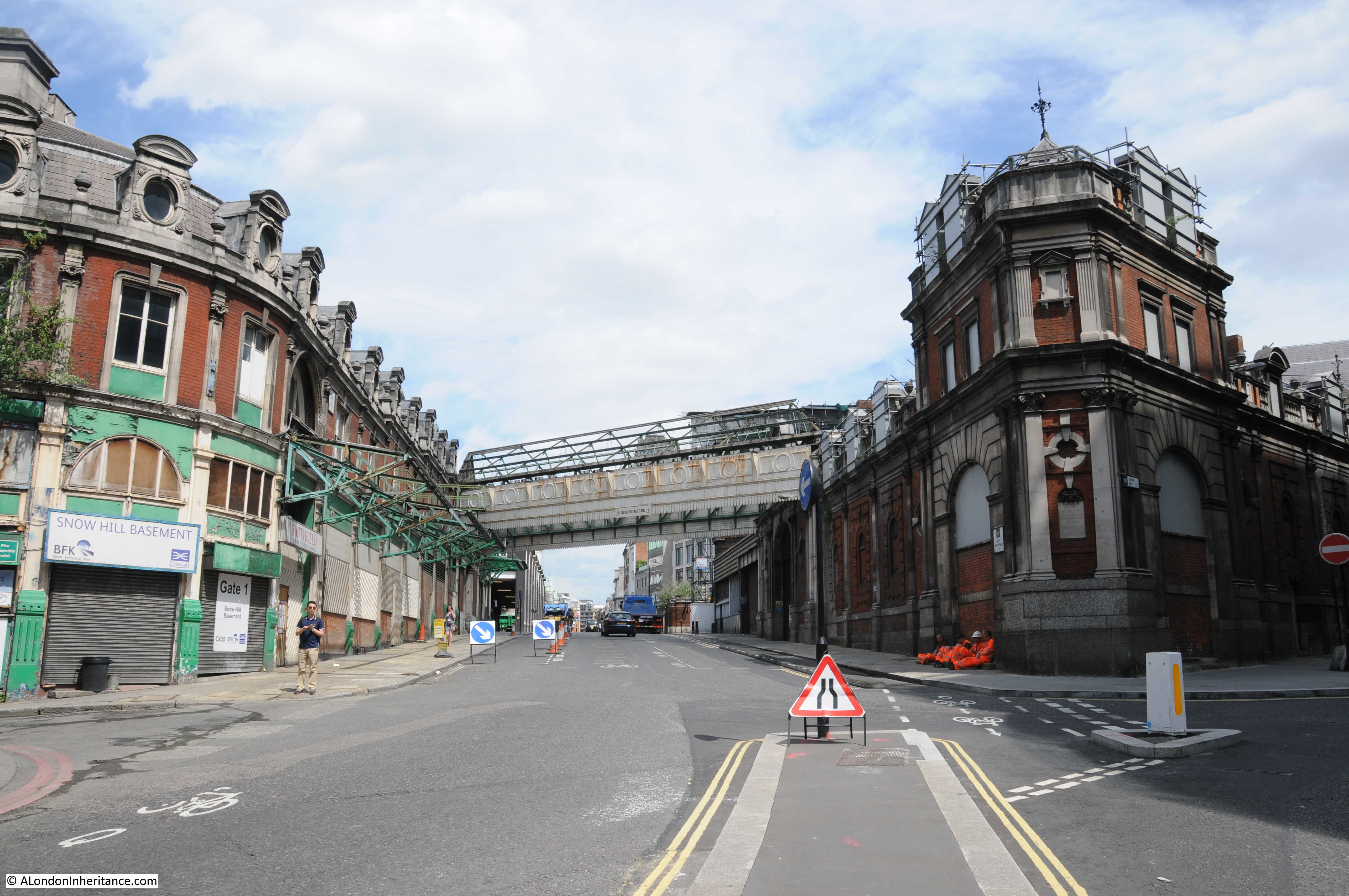
I was taking photos of the market buildings as the area will undergo considerable change in the years to come, when I saw a plaque I had not noticed before on the corner of a building at the junction of West Smithfield and Snow Hill (the corner of the building facing the camera on the right of the following photo, the plaque is just below the round window)
de Keyser

The plaque records that the market was opened by Sir Polydore de Keyser on the 7th November 1888:

de Keyser

So who was Polydore de Keyser? There does not seem to be much written about him, so I thought a read through some old newspaper archives might shed some light on this interesting character with the foreign sounding name, and from the above plaque was Lord Mayor in 1888.

I found the fascinating story of an immigrant from the Continent who reached the highest of offices in the City of London, but who also faced continual criticism because of his origins.

Polydore de Keyser was born in 1832 in the Belgium town of Termonde (the French name or Dendermonde in Flemish) in the north west of Belgium between Brussels, Antwerp and Ghent.

He moved to London in 1842 with his father, Constantin de Keyser and mother, Catharina Rosalia Troch. His father had been a teacher in Belgium, but on arrival in London he purchased a hotel which he renamed de Keyser’s Royal Hotel. A strange career change and I have been unable to find any references as to why the de keyser’s moved to London and took up the hotel business.

One of the first references to Polydor de Keyser are in newspaper adverts across the country from 1856. He was an importer of the German drink “Maitrank” and his advert in the Newcastle Journal on the 19th July 1856 reads:

“THE LIQUID HEAVEN of the Germans – Who that has tasted the delicious ‘Maitrank’ or May drink of Germany, can ever forget it. Poetic in name, and inspiring in its essence, it is the wine of wines. the exquisite flavour of that lovely mountain flower – the Waldschloschen appears to be heightened by its being wedded to the juice of the grape, and may well the refined connoisseur hang upon the memory of its tempting fragrance. The worshippers of this nectar have become almost frantic with delight by the announcement that a Herr Polydore de Keyser has succeeded at length in imparting to it the additional charm of effervescence, a right sparkling attribute, which it alone required to bring it to perfection”.

Orders were requested to be sent without delay to either Polydore de Keyser of 24 Cannon Street, London, or to his agents across the country. Maitrank could be purchased for 72 shillings per dozen.

Also in 1856, Constantin left the running of the hotel to his son Polydor.

He does not seem to have been involved in any activities that justified a newspaper article for a number of years, he was running his hotel and probably getting involved in societies and good causes in his local area and that justified an interest due to his background.

In 1866, at a meeting in St. Ann, Blackfriars, Polydore de Keyser subscribed £2, 2s to a testimonial to acknowledge the service of Mr. R.E. Warwick who had “for many years past has endeavored to obtain a better distribution of the charges for the relief of the poor in Unions”. At the meeting, other subscribers included the Mayor and Alderman so de Keyser was moving amongst those who managed the running of the City.

A year later, de Keyser was perhaps using his European contacts as he was acting as a steward for an anniversary celebration for the German Hospital in Dalston, held in the London Tavern on Bishopsgate Street.

Polydore de Keyser already had a hotel in Blackfriars, the hotel that his father became the proprietor of when he arrived in London. This was the Royal Hotel, in Chatham Place, New Bridge Street, Blackfriars.

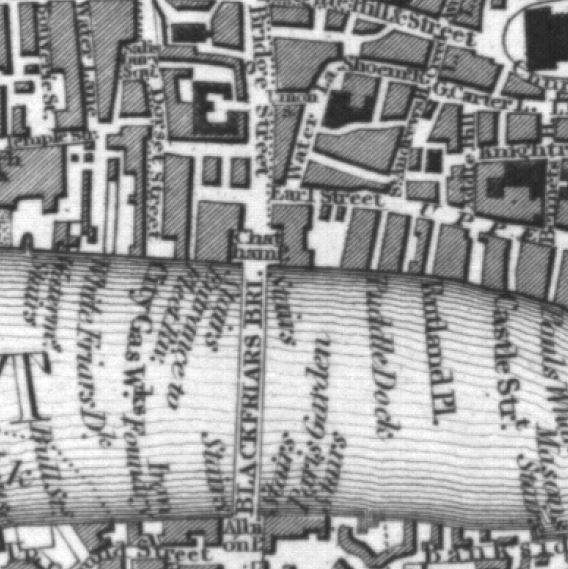
Chatham Place was the space at the northern end of Blackfriars Bridge, between the bridge and New Bridge Street. The following map shows the location in 1832:
de Keyser

I cannot find the exact location of his original hotel, however I suspect it was part of the block on the left of Chatham Place as this is where his new hotel would be built.

Newspaper reports help provide an idea of the way local commissioners and wards worked, and how complaints could be resolved. In the London City Press on the 26th March 1870 there is a report that he was summoned before the Commissioners of Sewers.

He had been summoned to explain why he had not carried out a number of works to his hotel to make it safe. There was a crack in the hotel but it had been filled in years before and had not changed since. The charge was thrown out on the grounds that Alderman Stone found the building was not dangerous and that the complaint by a Mr Power was malicious as de Keyser had apparently made an earlier complaint against him to the Commissioners of Sewers.

By 1872, de Keyser was ready to make his mark on Blackfriars and an article in the Morning Post of the 6th May 1872 announced the plans for his new hotel:

“IMPROVEMENTS AT BLACKFRIARS – In the background of the Victoria Embankment there are many ugly spots, which can only be beautified by the enterprise of private individuals, the Metropolitan Board of Works having no authority over the unsightly  looking places alluded to. One of the chief eyesores is the ungainly group of gasometers at Blackfriars Bridge, and it would certainly be a pity if such monsters should remain in their current position. It is gratifying to know that they will cumber the ground where they are reared but a short time longer, as a very enterprising and highly respected Belgian, Mr. Polydore de Keyser, of the Royal Hotel at Blackfriars, now a citizen of London, has matured a vast plan by which a hostelry such as can only be paralleled by that called ‘grand’ at Paris will be shortly added to the few handsome buildings to be seen along the river front. This hotel, when completed, will extend from the corner of William Street, along a curved frontage of 380 feet, on to the entrance of the ground at the back of the embankment, sweeping away the gasholders now there. 

The hotel, the design for which is in the modern French style, will have an entrance from the embankment into a spacious courtyard, into which carriages can drive, whilst the ground floor and basement will contain a series of elegant shops. The hotel is to be fitted up on the Continental system, with a spacious and handsome dining room as well as another room facing the embankment. Mr Gruning is the architect, and Messrs. Trollope and Sons the builders. it is anticipated that it will be completed and opened within a period of 21 months. On Saturday the foundation-stone was laid, in the presence of a large company of ladies and gentlemen by Miss Wich, daughter of the Belgian Consul, and at the dinner which followed, Sir Benjamin Phillips who was in the chair, wished every prosperity to Mr. de Keyser, a sentiment in which his numerous friends most cordially joined.”

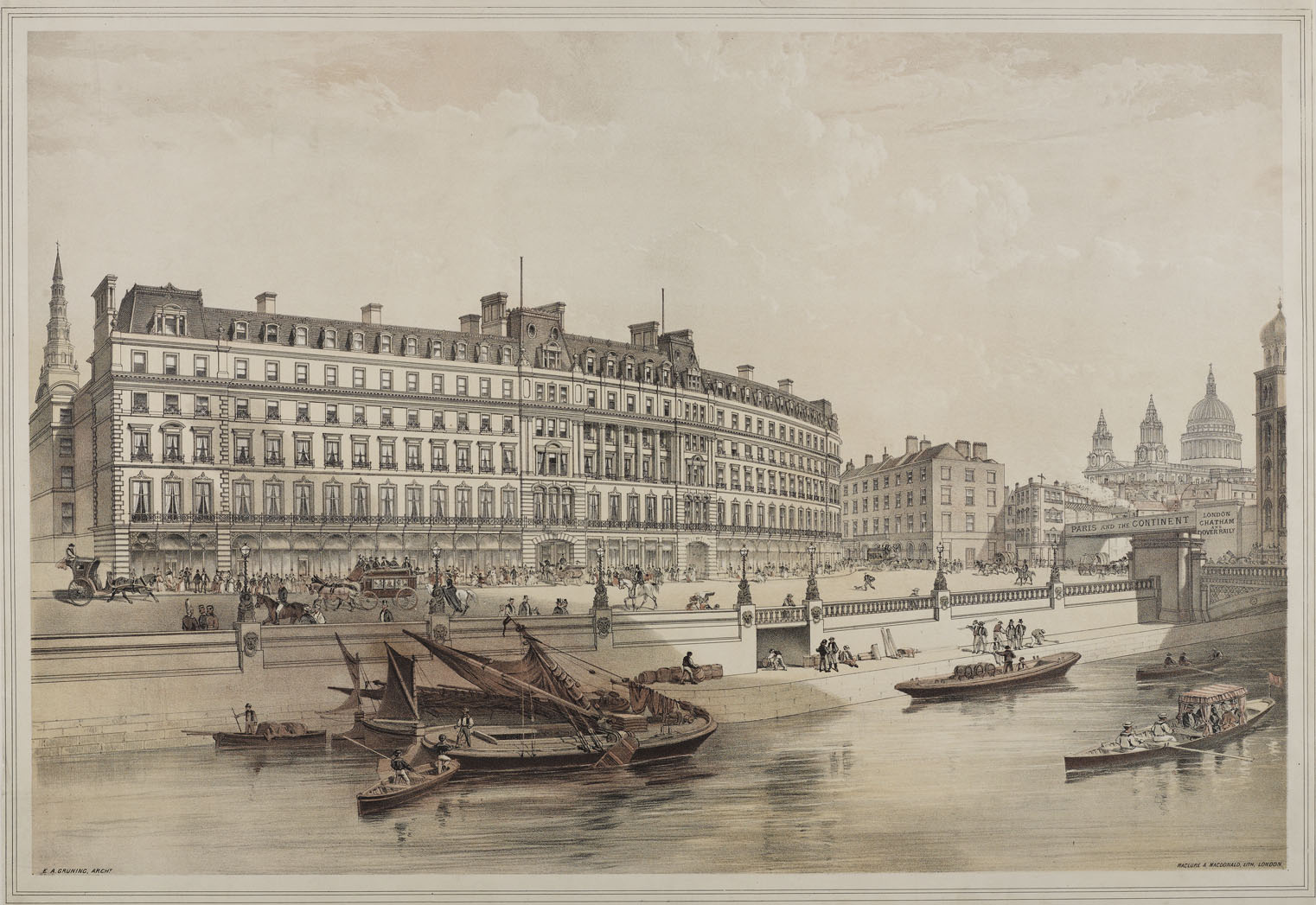
The hotel opened in 1874 and the following print shows the hotel in that year.
de Keyser

An interesting feature appears to be a tunnel from the edge of the river allowing deliveries to be made by river, then transported into the hotel underneath the road. If you click on the photo to enlarge, you will see there is a man rolling a barrel into the tunnel.

This later photo from the southern end of the bridge also shows the hotel curving round from the Embankment.
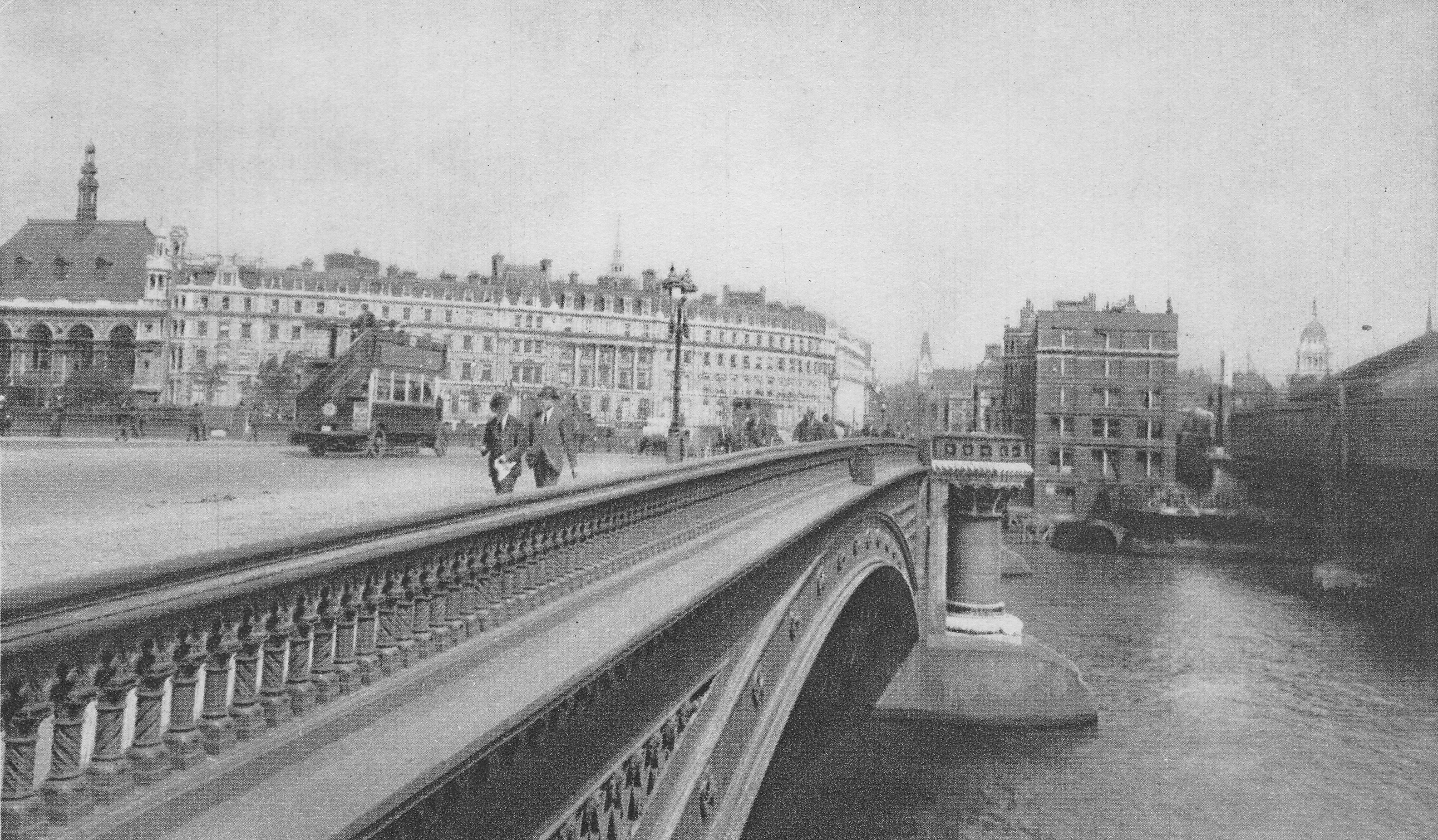
de Keyser

The Morning Post on the 7th September 1874 carried the following report of the opening of the hotel:

“THE NEW ROYAL HOTEL – The latest addition to the palatial hotels with which London is now adorned is to be found in the new Royal Hotel, at the City end of the Victoria Embankment, which is to take the place of the Royal Hotel in Bridge Street, so long kept by Mr. Polydore de Keyser, representative in the Common Council of the Ward of Farringdon Without. This hotel, now completed, was open to the friends of Mr and Mrs de Keyser on Saturday, and after a pretty thorough inspection of this magnificent building, it may be safely said that in many respects it is altogether unequaled in London or in any of the great Continental cities, not excepting the famous caravanserai in Geneva, Interlaken, and other places to which tourists resort in such numbers. As Mr de Keyser has had ample experience in providing for his numerous foreign and English visitors, and as the internal arrangements have been carried out after his own designs, it may be safely said that nothing is wanting to make a stay in the new hotel agreeable. The view from the front windows over Blackfriars Bridge and the Embankment and over the busy Thames extending to London Bridge on the one hand and Westminster on the other, is most remarkable, and will give anyone a just idea of the immense traffic constantly going on in the metropolis.

The restaurant is capable of seating 400 visitors, and on the five floors there is a vast number of rooms either for bed chambers or sitting rooms. Those on the lower floors, which may be presumed to be state apartments, are fitted with exquisite taste and with every comfort; while in the upper apartments are equally calculated to make a stay in every way agreeable. All the adjuncts of a first class hotel, such as billiard, smoking, reading and drawing rooms for ladies, are provided, and the lifts and arrangements for ventilation are on the most approved principles. On Saturday Mr. and Mrs De Keyser welcomed at a dinner and subsequent concert some 400 of their friends, who heartily wished them success in their great undertaking. The new building, large as it is, is but half of that which is intended, the other portion being destined to occupy, with some slight deviations, the site of the buildings in which business has hitherto been carried on.”

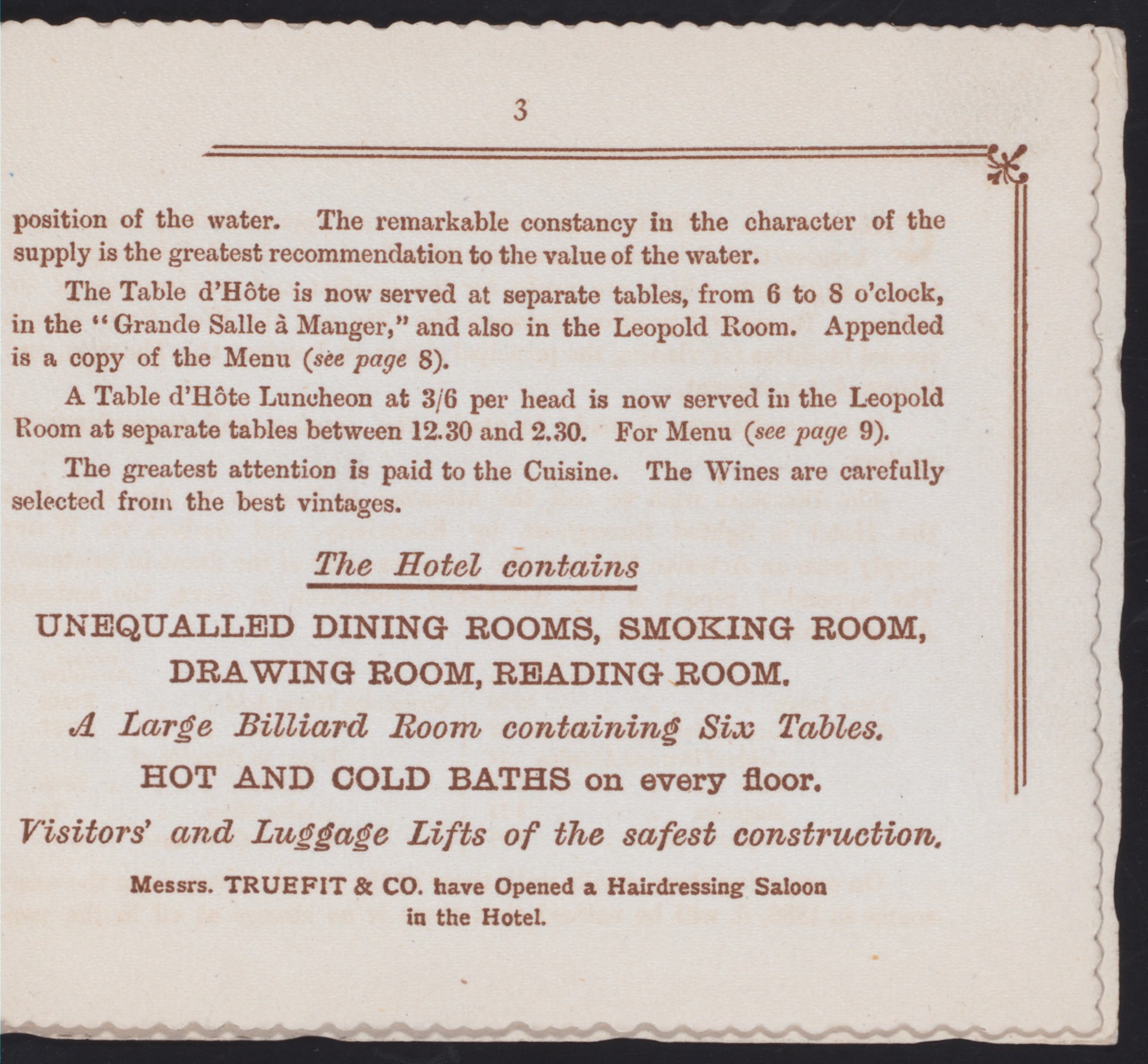
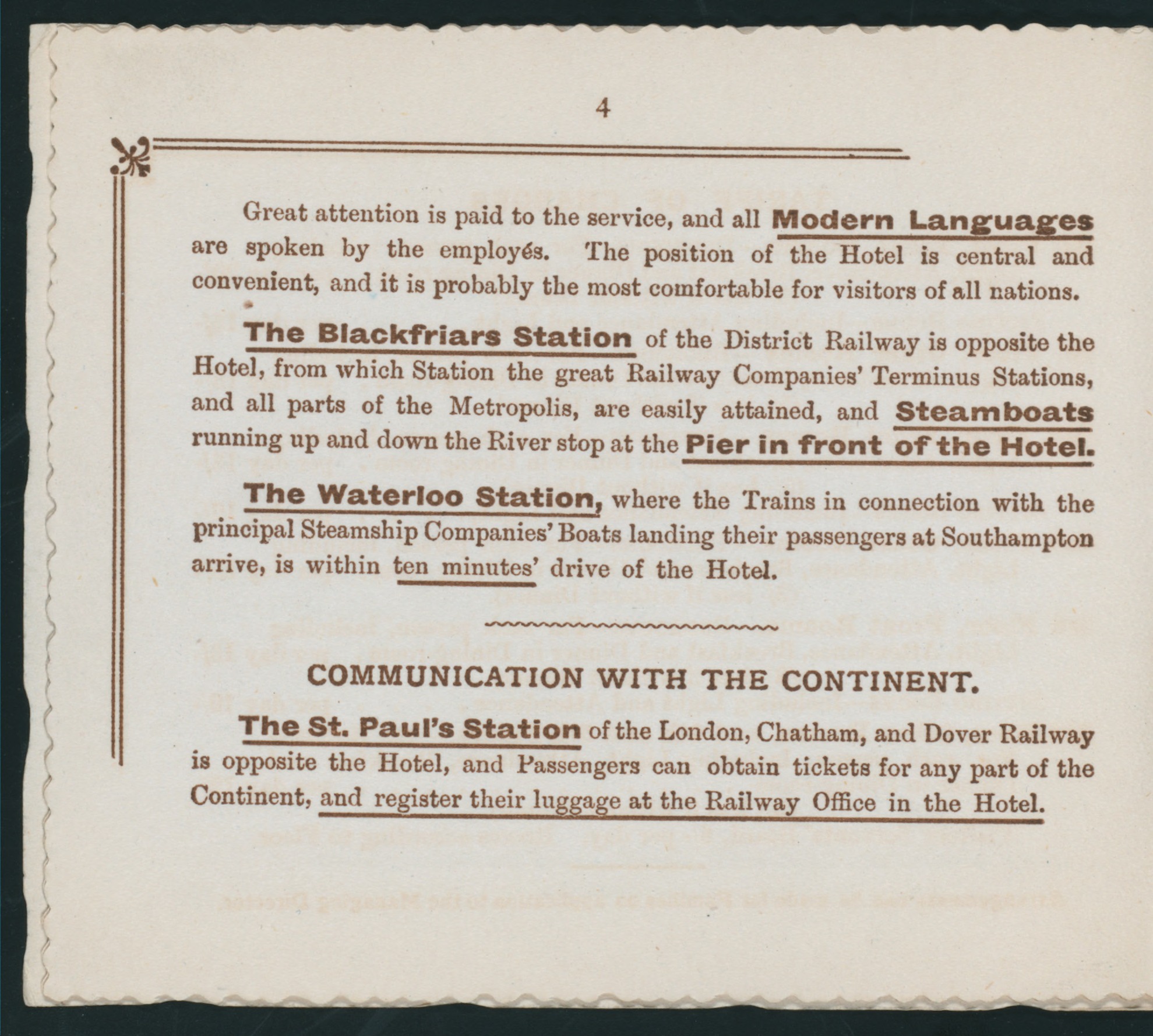
The following pages from an 1891 brochure for De Keyser’s Royal Hotel provide an idea of what would await a guest during their stay at the hotel. (From New York Public Library Digital Collections – free to use without restrictions)
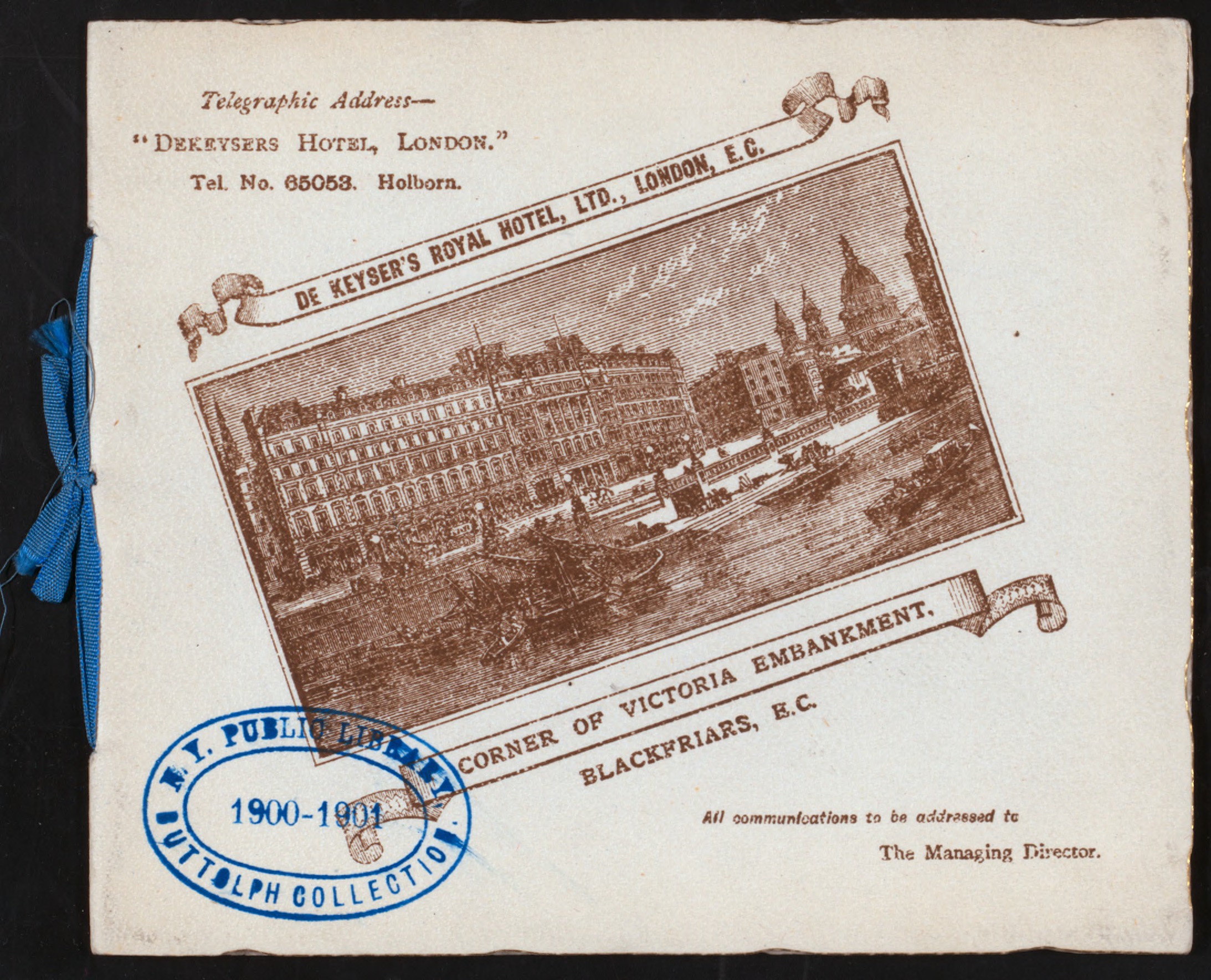
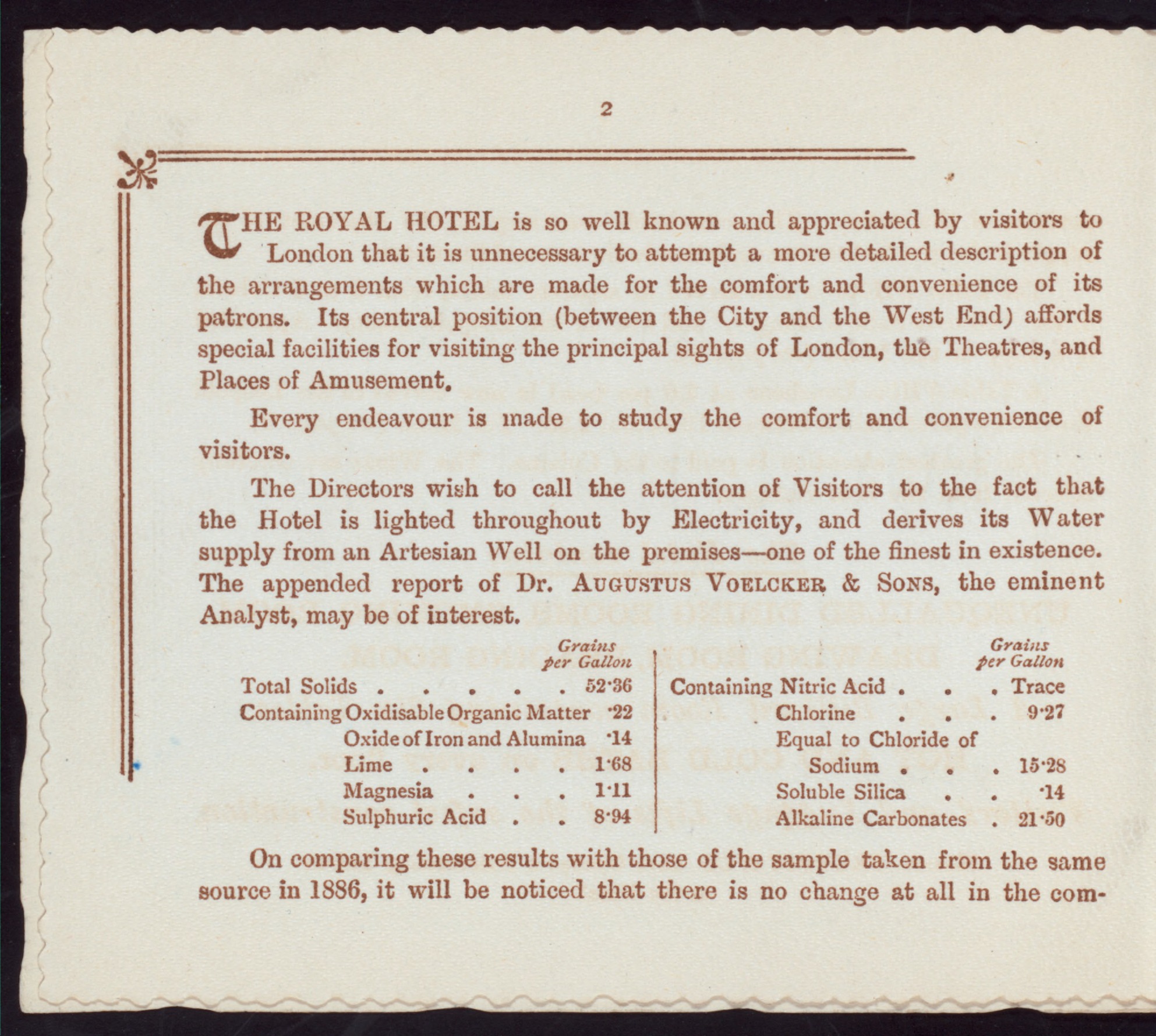
de Keyserde Keyser

de Keyser

de Keyser

de Keyser

De Keyser seems to have been involved in numerous other activities as well as running his hotel. In 1875 he was elected to the Committee of the Hotel Keepers’ Association and in 1876 he was on the London Executive Committee for the organisation of the British exhibits at the Brussels Exhibition. It was at this exhibition that he would meet the Prince of Wales who declared himself “well pleased with the British section in all respects”.

I get the impression that de Keyser was a master of the art of networking.

In 1877, de Keyser was elected as a Common Councilman of the Ward of Farringdon Without and in 1882 he was elected as an Alderman of the same ward, although this was not an appointment to which everyone agreed. There were two protests against de Keysers appointment, one by Mr. ex- Sheriff Waterlow who was the unsuccessful candidate and one by Mr. john Hill and other electors of the ward, on the grounds that de Keyser was an alien born, and that he was the holder of an innkeepers licence.

To address these protests, a special meeting of the Court of Aldermen was held at the Guildhall on Tuesday 20th June 1882. He had won the election by over 300 votes so he had won the election fairly and clearly. The final decision was delayed until the first week of July when the protests that he could not be an Alderman as being alien born and holding an innkeepers licence were overruled and de Keyser took his seat as an Alderman of the Ward of Farringdon Without.

An example of the activities that de Keyser took part in through his role as an Alderman is a report of a meeting of the inhabitants of the Precinct of St. Brides, held in St. Bride’s Church on Thursday May 22nd 1884 when de Keyser was in the chair. The meeting was held to discuss the impact of the London Government Bill, part of the Municipal Corporations Act of 1882 that was continuing the consolidation of powers from the various Vestries and Wards that had been the traditional holders of local power across London.

The meeting resolved that “In the opinion of this meeting the Municipal Bill for London, if it becomes law, would be prejudicial to the interests of local self-government, and would create a vast system of centralization involving increase of rates, with no compensatory increase of efficiency.”

Despite the meeting’s resolution it was powerless to prevent the gradual centralization of powers across London.

In 1887 de Keyser reached the pinnacle of City of London governance when he was elected Lord Mayor, however the election was somewhat contentious and newspaper reports highlight the fact that he was an “alien” he was “born in Belgium” and that he was “the first Roman Catholic who has been elected to the civic chair since the Reformation”.

One newspaper report stated that “The gentleman who took his seat on Tuesday in the civic chair of the City of London has before him a somewhat difficult task. The difficulty arises from the fact, principally, that Mr. Polydore de Keyser is a foreign born subject of her Majesty. The spirit of freedom and tolerance, of which Englishmen are prone to boast upon every available occasion, has made it possible that a naturalized alien should occupy the high position of Chief Magistrate of the greatest city in the world. Unfortunately, however, there is just now rife a feeling of resentment against anything foreign among the masses, which Mr. Polydore de Keyser will, we hope, do nothing to aggravate. he has hitherto demeaned himself under inquisitiveness of a peculiarly active kind so wisely and so well that we may safely give him credit for sufficient tacticianly discretion to sail the civic ship safely and unimpaired through the troubled waters into which, we fear, she is destined to pass before the expiry of his term of office at the helm.”

A rather amazing article which seems to be saying that although we are tolerant, just keep quiet and see out your term as quickly as possible.

As a Catholic immigrant from Belgium, Polydire de Keyser who started selling Maitrank through newspapers was now the owner of the Royal Hotel, Blackfriars and the Lord Mayor of the City of London – quite an achievement.

The following portrait of de Keyser (© National Portrait Gallery, London) shows him in November 1887 at the start of his year as Lord Mayor.

de Keyser

And a photo of him during his term as Lord Mayor:
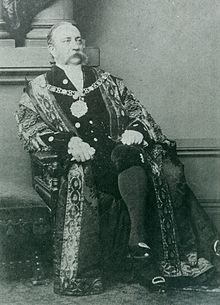
de Keyser

During his term of office, de Keyser took part in all the activities expected of a Mayor. There were preparations for an exhibition in Paris, he attended fund raising events (for example a “Smoking Concert” in aid of Police Charities), there was plenty of entertaining at the Mansion House, concerts at the Guildhall School of Music, fairs and bazaars to be opened.

In May, probably due to his heritage, there was a reception and dance at the Mansion House for the “burgomasters and aldermen from Belgium” at which there were “over 500 ladies and gentlemen present to meet the representatives of Belgian municipalities, and the guests on arriving were received in the saloon by the Lord Mayor and the Lady Mayoress” – one of the very few references to de Keysers wife, Louise Piéron who he had married in 1862.

During his term of office, there were continuing critical, often abusive, articles written about de Keyser, for example:

“The worthy Polydore de Keyser must be either an exceptionally guileless or an abnormally conceited person. Last week he inspected the boys of the training ship Warspite, and, of course, favoured them with the usual florid oration. In the course of his speech he announced that the Lady Mayoress had great pleasure in giving each boy a Jubilee shilling, which he hoped they would keep throughout their future lives as a souvenir of the present occasion!’ The notion of a British tar treasuring up Herr de Keyser’s shilling for years, and studiously refraining from spending it on grog is really sublime.”

In August, de Keyser returned to the town of his birth, Termonde in Belgium where the “streets and houses were gaily decorated with the mingled colours of Belgium and England, and the arms of the City of London”.

The following painting (By Jan Verhas (kunstschilder) [Public domain], via Wikimedia Commons) shows the celebrations put on by Termonde for de Keyser’s return:

de Keyser

In September, there was the prospect of a new Lord Mayor with thoughts turning to who would follow de Keyser. Newspaper reports continued to focus on de Keyser’s foreign birth as in the following from the London Letter section of the South Wales Daily News:

“Next Saturday the Livery of the City of London will meet to elect a successor to Alderman Polydore de Keyser as Lord Mayor. After this strange foreign name it will be a relief to get a thoroughly English patronymic as Whitehead. There is little doubt but that Mr Whitehead, who is the senior Alderman not having passed the chair, will be selected.”

The “Jack the Ripper” murders took place during de Keyser’s time as Lord Mayor. Although Whitechapel was outside of his jurisdiction, on the 2nd October 1888 it was reported that “the Lord Mayor, Mr Polydore de Keyser, after consulting Sir James Fraser, Chief Commissioner of the Police of the City of London, announced that a reward of £500 would be given by the Corporation for the detection of the miscreant.”

At the end of his term as Lord Mayor, de keyser became Sir Polydore de Keyser and performed his last public duty as Lord Mayor, the opening of the new Fish Market which is where I found the plaque featured at the start of this post. The London Evening Standard report of the official opening published on the 8th November 1888 reads:

“THE NEW FISH MARKET – The Lord Mayor (Sir Polydore de Keyser) yesterday opened the new Fish Market in Farringdon Street which has been specially erected for the trade by the Corporation of the City of London. The building, which was designed by the late Sir Horace Jones, has been constructed by Mr. Mark Gentry, at a cost of about £26,000. It is situated at the southern roadway leading from Farringdon Road to Long Lane and fronting Snow Hill. The market, which covers an area of 14,000 square feet, has been erected over the joint lines of the Metropolitan and London, Chatham and Dover Railways.

The Lord Mayor, who went in semi-state, accompanied by the Sheriffs (Mr. Alderman Gray and Mr Newton) was received at the principal entrance of the building by the Chairman (Mr. James Perkins) members of the market committee and the Town Clerk.

A silver gilt key was handed by Mr. Perkins to the Lord Mayor, with which he unlocked the huge iron gates amidst the cheers of those assembled outside.

His Lordship having been conducted by the Town Clerk and the members of the Market Committee to a dais, covered with scarlet cloth, at the southern end of the building.

Mr. Perkins, Chairman of the Markets Committee, briefly explained the circumstances which had induced the Corporation to construct the present market. The old fish market on the other side of the roadway, which was originally intended for the sale of fruit and vegetables, had proved a loss to the Corporation of about £10,000 a year. Hence the erection of the present market, Billingsgate having proved insufficient for the supply of fish for the Metropolis. Nearly every shop in the new market was let, and the old market would be used in future for fruit and vegetable. the Corporation hoped that it would be successful, and prove advantageous to the salesman.

The Lord mayor, who was heartily cheered, in declaring the market open, said he was exceedingly pleased to think that his last public duty in his official capacity was to open a market which, he hoped, would result in great benefit to the community, to the Corporation, and to the ward of which he was Alderman (cheers). the Corporation had for years past shown the great interest it took in these matters, and how thoroughly alive it was to the great responsibility of making all our markets as complete and as commodious as possible (cheers). In addition to supplying the wants of London and the suburbs, which now numbered nearly 6,000,000 inhabitants, our markets supplied the wants of the people all over the country. Having complimented the architect and builder upon the magnificent market which they had succeeded in producing, his Lordship formally declared the market open,

Cheers having been given for the success of the market, the proceedings terminated.”

de Keyser ended his term as Lord Mayor at the end of the same week as opening the new market. Even then, newspapers continued to provide a negative portrait of de Keyser as a foreigner, for example, in reporting on the banquet for the new mayor, the Pall Mall Gazette on the 10th November 1888 reported:

“The faces of the distinguished guests afford a remarkable study in physiognomy. The new Lord Mayor has a handsome, clear-cut head and an expansive brow, offering a marked contrast to the florid and jolly hotel-keeping countenance of the late Belgian de Keyser. It was very amusing to hear the toastmaster pray for silence of the late Lord Mayor, as if poor Sir Polydore de keyser were dead and about to rise – say, from the Guildhall vaults.”

On the 4th December 1888, de Keyser was at Windsor Castle to receive his knighthood from Queen Victoria.

After ending his term as Lord Mayor, de Keyser continued organising British participation in overseas exhibitions. In 1889 he was the Executive President of the British Section at the Paris Exhibition.

He also continued his role as Alderman of the Ward of Farringdon Without and in October 1891 was presiding over a meeting of the inhabitants of the ward who were objecting to the letting of any portion of land on the Thames Embankment to the Salvation Army as it would be detrimental to the interests of the City including the concern that “there was no doubt that the processions &c, with drums, trumpets and cymbals, would lead to danger”.

In 1892 de Keyser resigned from the post of Alderman on the account of “bodily infirmity” – among other issues, he was going deaf.

In July 1893 a bust of Sir Polydore de Keyser was unveiled at the Mansion House. It was presented as a token of respect to de Keyser who had played an important part in the affairs of the City and the Ward of Farringdon Without.
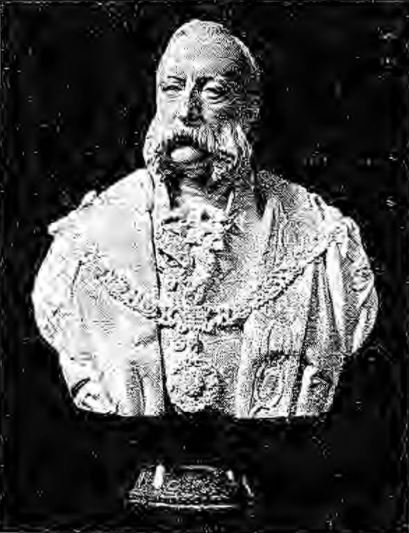
de Keyser

Sir Polydore de Keyser died on Friday 14th January 1898 after a “long battle with cancer”. His funeral was on the 19th January and on the 20th the London Evening Standard reported on the funeral:

“The remains of Sir Polydore de Keyser, formerly Lord Mayor of London, who died on Friday last, were interred yesterday in the family vault in Nunhead Cemetery. There was a large attendance of mourners, headed by Mr. Polydore W. de Keyser, his adopted son and nephew, and Messrs. C.M. and A. Fevez, other nephews. Among those present were Alderman Sir Joseph Savory M.P. who served as Sheriff with Sir Polydore in 1883; Mr Alderman Treloar, who succeeded him in the Court of Alderman; Mr. W.J. Soulsby, representing the Lord Mayor; Mr. Marshall Pontifex, Ward Clerk of Farringdon; the Rev. Henry Blunt, rector of St. Andrew’s Holborn, who was Sir Polydore’s Chaplain when Lord Mayor; Colonel Sewell, representing the Spectacle makers’ Company; Mr. H. deGrelle Rogier, the Belgian Consul; Mr. Wilhelm Ganz, Mr. E.A. Gruning, Mr. Walter Wood, Mr. C. Val Hunter and deputations from the Belgian and other Societies with which Sir Polydore was associated. The Service at the grave was read by the Rev. John Stevens, rector of the Roman Catholic Church of Our Immaculate Lady of Victories, in Clapham Park Road. Lady de Keyser who died in 1895, is buried in the same vault.”

de Keyser did not have any children of his own, but appears to have had a large extended family, including a number of nephews, one of which he appears to have adopted in some way. In the year before his death, his ownership of the hotel was transferred into a separate company, the Company of de Keysers Royal Hotel Limited. I assume he did this to make the distribution of his assets after his death easier as shares in the company were set aside to provide annuities to various members of his family. His adopted nephew Polydore Weichand de Keyser also inherited an annuity and the residue of his estate.

Sir Polydore de Keyser then fades into history. His nephew however continues to play a part both in the governance of the City and in London’s hotel business.

An article in The Sphere on the 9th May 1908 reports on the opening of a new hotel – The Piccadilly Hotel – of which the nephew Polydore de Keyser (he appears to have dropped the name Weichand) was the joint manager. He was described:

“as a man of great energy and ability. He is the nephew and adopted son of Sir Polydore de Keyser, who was Lord Mayor of London twenty years ago. Educated at Westminster School and on the Continent, de Keyser has devoted many years to the practical study of modern hotel-keeping. The great success of de Keyser’s hotel affords conclusive proof of his administrative ability. he is deputy lieutenant of the City of London and a member of several City companies.”

So as well as the hotel business, he was also following in his uncle’s footsteps in the City of London.

de Keysers Royal Hotel continued in operation until the First World War when it was requisitioned to house officers. I suspect that after the war it had lost much of its pre-war grandeur and the world was a very different place approaching the 1920s than it had been when the hotel was built in 1874. In 1921 it was leased to Lever Brothers who eventually purchased the building in 1930 in order to demolish it, and build their new office, which is still on the site today, and occupied by Unilever (formed by the merger of Lever Brothers and Margarine Unie in 1929).

Margerine Unie originated in the Netherlands in the 1890s when Jurgens Van den Bergh opened the first factory to produce margarine.  Given de Keyser’s continental European origins it is somewhat fitting that a part Dutch business occupies the same site as his hotel.

One final question – why did de Keyser feature so prominently in the Supreme Court judgement on Brexit? The Guardian article explains this better than I can, however in summary it appears that the de Keyser hotel company applied for compensation after the hotel at Blackfriars was requisitioned during the First World War. Government did not approve any compensation although Parliament had already set out terms for wartime compensation so it was whether the Government has the right to ignore a decision already made by Parliament, and de Keyser’s judgement of 1920 was one of the landmark cases as the de Keyser Hotel Company successfully sued for compensation.

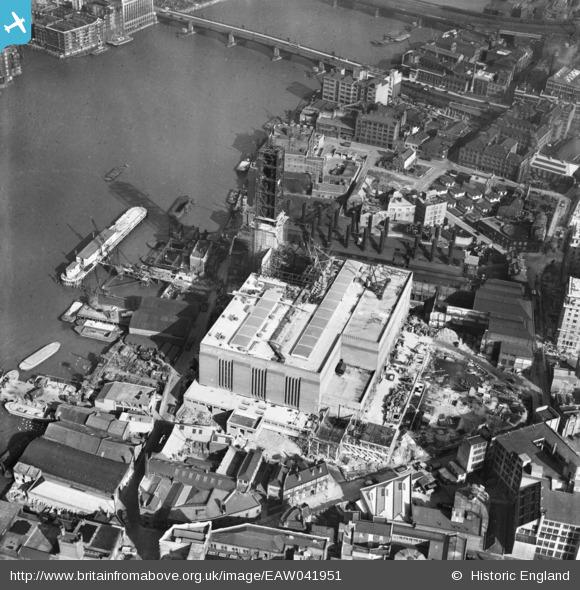
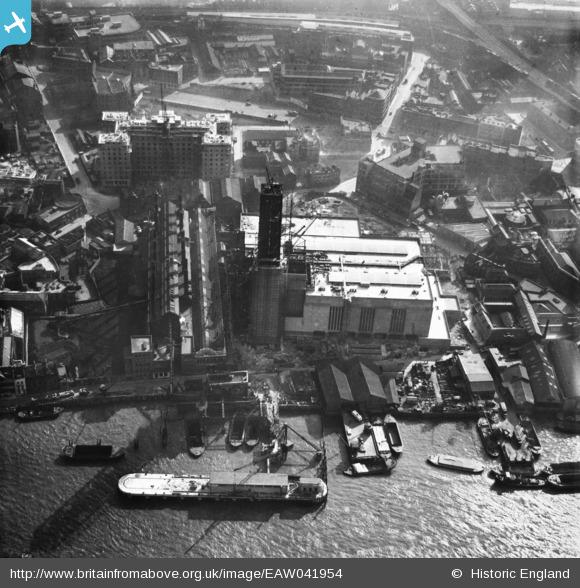
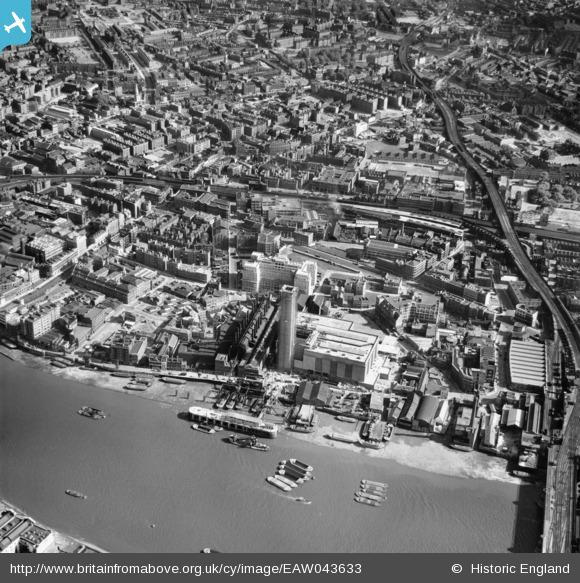
Unilever House is now on the site of de Keysers Royal Hotel at the northern end of Blackfriars Bridge. This is Unilever House under construction:
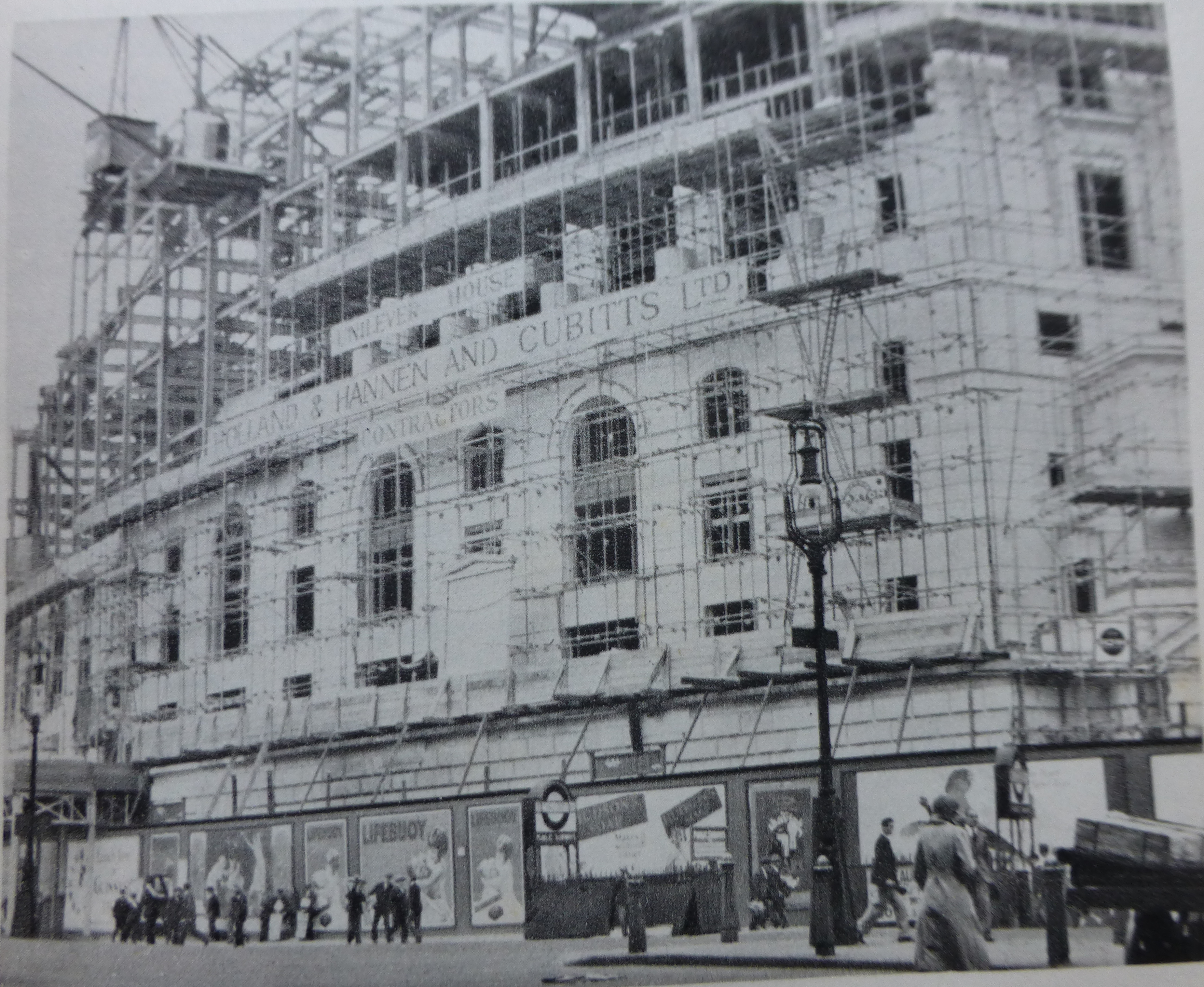
de Keyser

And this is Unilever House today. The curved facade follows the same curve as de Keyser’s Royal Hotel.
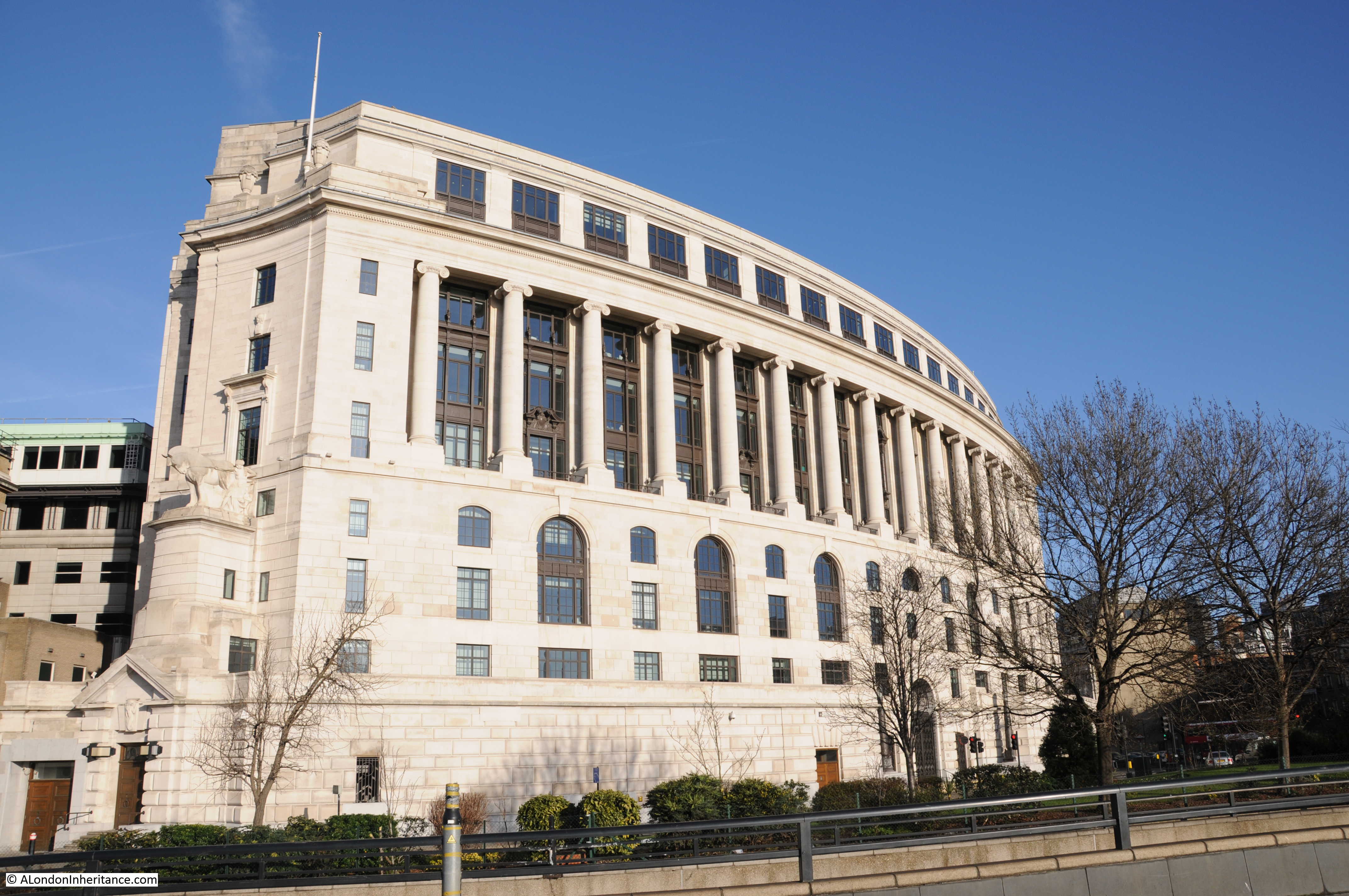
de Keyser

That is Polydore de Keyser, a fascinating Londoner. An immigrant from Belgium who became Lord Mayor of London and a leading London hotelier. As far as I have been able to check, there have not been any other Lord Mayor’s who came to London as an immigrant since de Keyser.

Newspapers only provide a glimpse of his life, but I suspect he must have been highly ambitious and driven to achieve what he did. I hope the plaque at Smithfield survives to keep his name associated with the market he opened in 1888.
alondoninheritance.com


Pear Tree Court And Clerkenwell Close Peabody Estate

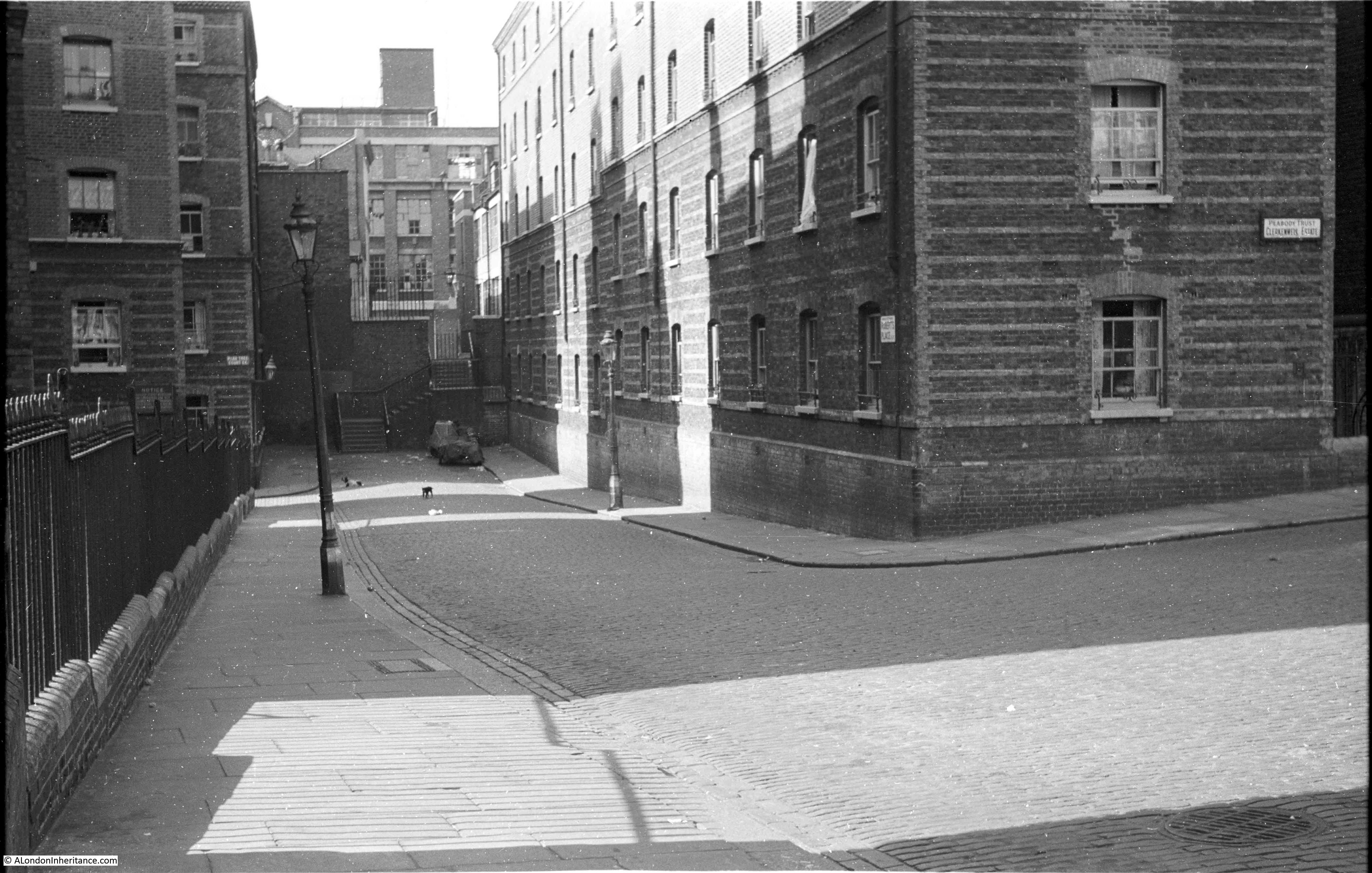
This is one of the scenes photographed by my father in 1947 that is to me, a fascinating photo being 70 years old, however I am not sure if there was a specific reason, point of interest etc. to take this particular photo. The scene is Clerkenwell Close with the steps leading up to Robert’s Place at the end of the close, adjacent to the Pear Tree Court and Clerkenwell Close Peabody Estate.

Pear Tree Court And Clerkenwell Close Peabody Estate

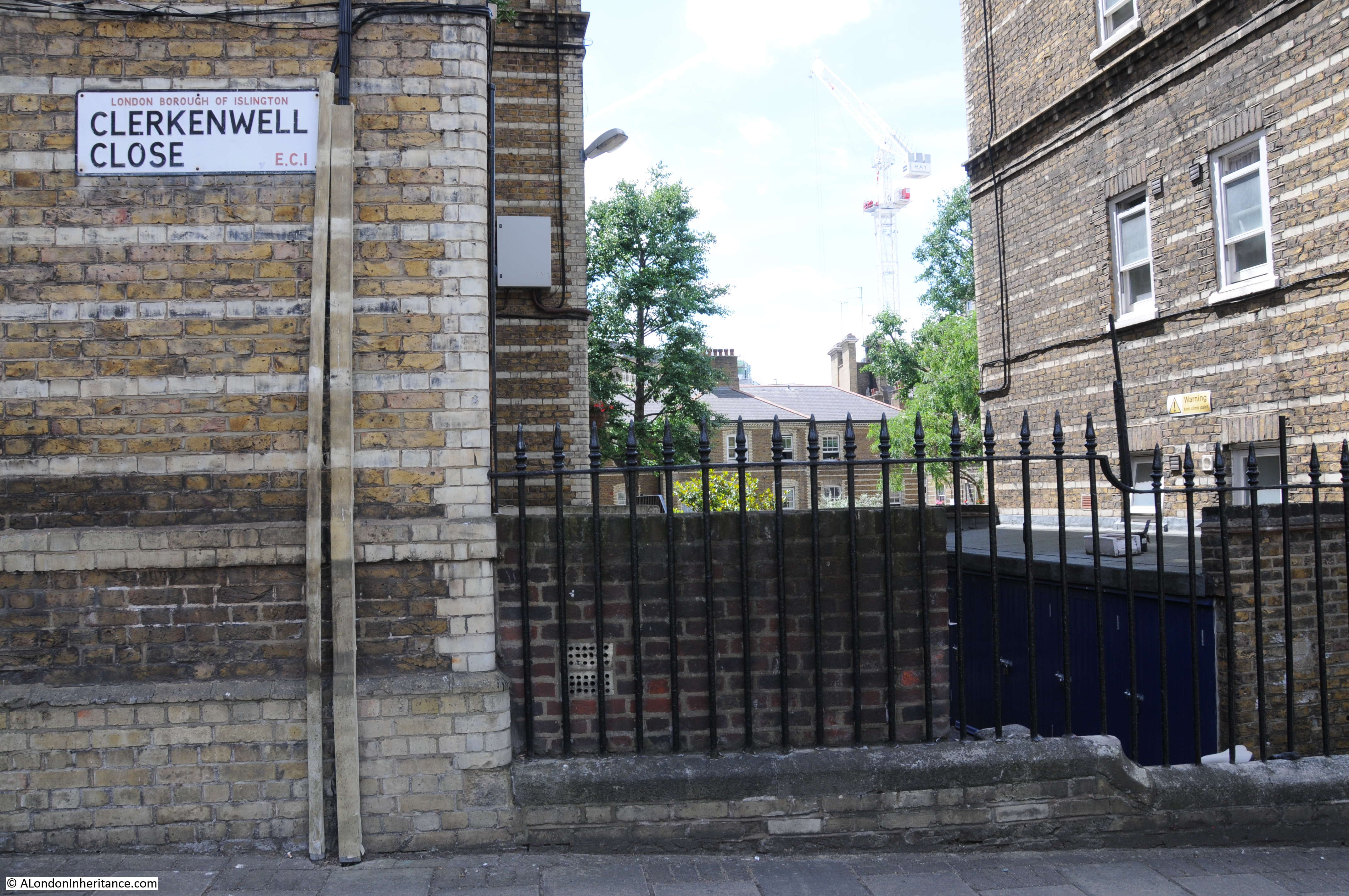
The same scene in 2017:

Pear Tree Court And Clerkenwell Close Peabody Estate

A view that has hardly changed apart from the two trees, cars and the buildings at the far end around and behind the steps.

To find this location, head north from Clerkenwell Road to Clerkenwell Green, then follow Clerkenwell Close around the edge of the church of St. James where you will find the site of the above photos. I have marked this with an orange circle in the 1940 map below (the streets here have hardly changed):

Pear Tree Court And Clerkenwell Close Peabody Estate

Going up from the orange circle, there is a road to the left, this is Pear Tree Court. Just above this junction are the steps at the far end of the photos which lead up to Robert’s Place and then into Bowling Green Lane.

This is one of the photos were I can work out exactly where the original was taken, leaning up against the wall underneath the Clerkenwell Close sign.

Pear Tree Court And Clerkenwell Close Peabody Estate

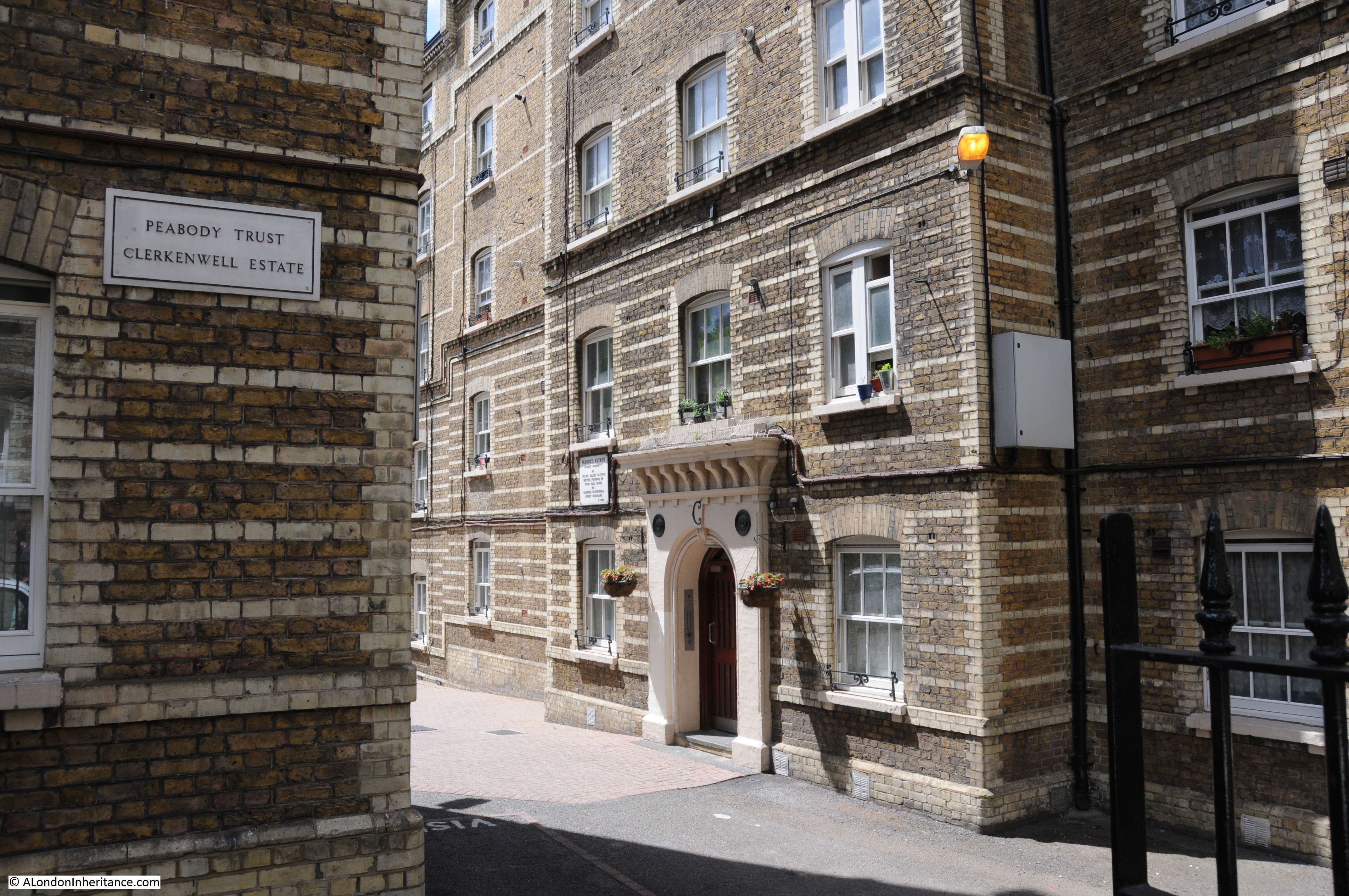
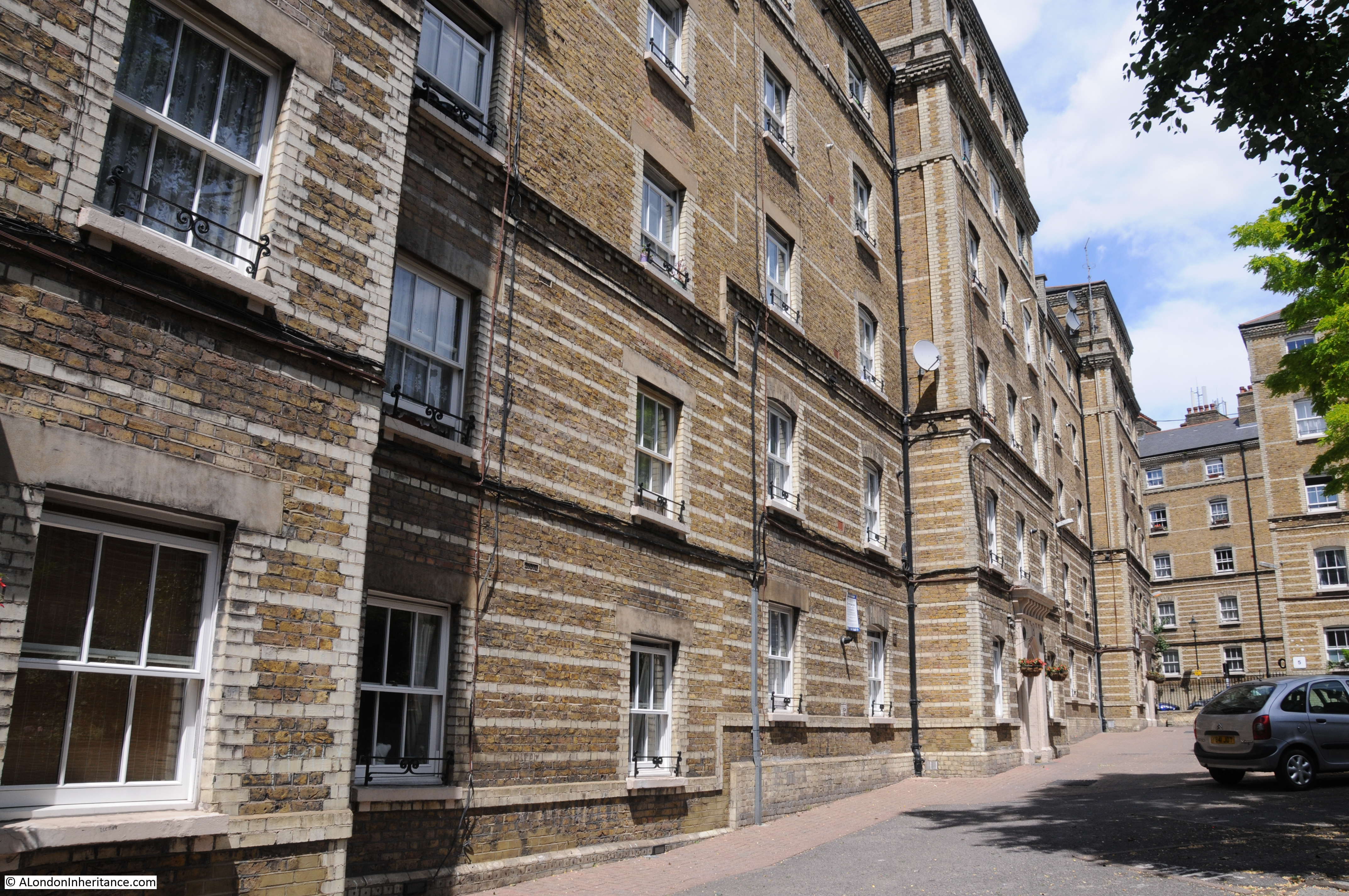
The buildings seen in the photo are part of the Clerkenwell Estate built by the Peabody Trust. The estate runs along Clerkenwell Close and Pear Tree Court, and consists of a number of Victorian five storey blocks clustered around a central courtyard. Each block given a letter rather than a number which, along with their appearance, does give the impression of blocks of barracks. The entrance to block C from Clerkenwell Close:

Pear Tree Court And Clerkenwell Close Peabody Estate

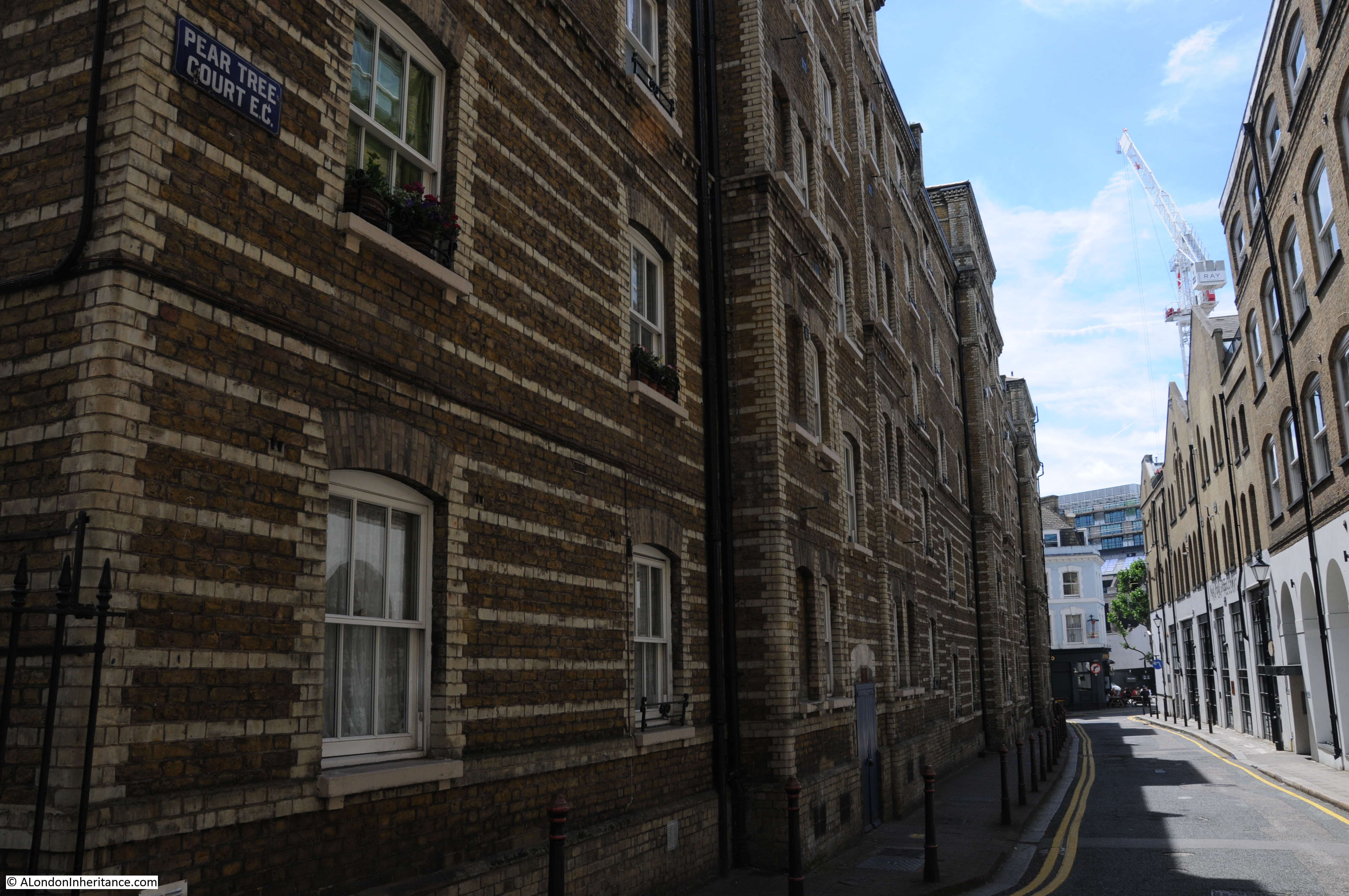
The view along Pear Tree Court:

Pear Tree Court And Clerkenwell Close Peabody Estate

The Clerkenwell Estate was one of six estates built by the Peabody Trust in the late 19th century. The Peabody Trust emerged from the The Peabody Donation Fund which was set up by the American, George Peabody in 1862. He was born in Massachusetts in 1795 but moved to London in 1837 where he remained for the rest of his life.

Peabody wanted to do something to help alleviate the poverty that he saw across London. It was suggested to him that people needed better living conditions with an affordable rent so he set up the Peabody Donation Fund with the first housing being built in 1864 at Commercial Street, Spitalfields.

The Clerkenwell Estate came about through the clearance of a number of slum sites under the Artisans and Labourers Dwellings Improvement Act of 1875 which allowed the Metropolitan Board of Works to buy up and clear six sites across London. The area around Pear Tree Court had already been condemned as unfit for human habitation.

The architect of the new estate was Henry Darbishire. The model used for each of the blocks consisted of units of five flats around a central staircase. In the late 19th century it was still standard practice for many facilities to be shared so each unit of five flats had shared lavatories and sculleries.

Entrance to Block C:

Pear Tree Court And Clerkenwell Close Peabody Estate

Block E – I do like the brick construction, however they do present a rather institutionalised appearance.

Pear Tree Court And Clerkenwell Close Peabody Estate

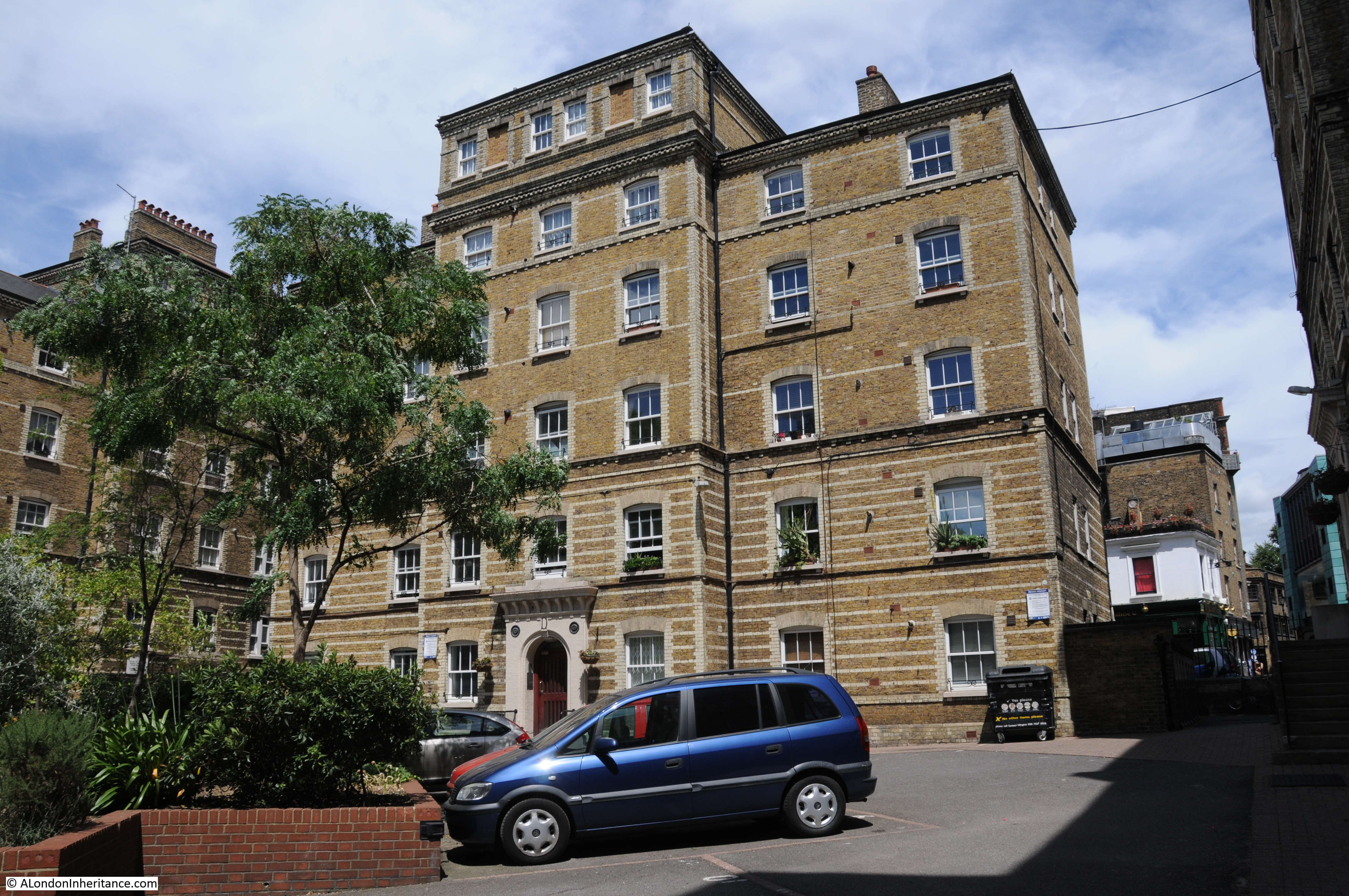
Block D:

Pear Tree Court And Clerkenwell Close Peabody Estate

On the side of the estate towards Farringdon Lane, there is an obvious change in construction where to the left a short terrace of two storey buildings run to the left. This terrace is the site of Block G which was badly damaged (along with Block H) by bombing in December 1940 with 12 people being killed in the attack.

Pear Tree Court And Clerkenwell Close Peabody Estate

Entrance to Block A – flowers and sunlight and I am startng to really appreciate these buildings.

Pear Tree Court And Clerkenwell Close Peabody Estate

The site is built on a considerable slope as can be seen in the photo below. The site slopes down towards Farringdon Road and the old route of the River Fleet.

Pear Tree Court And Clerkenwell Close Peabody Estate

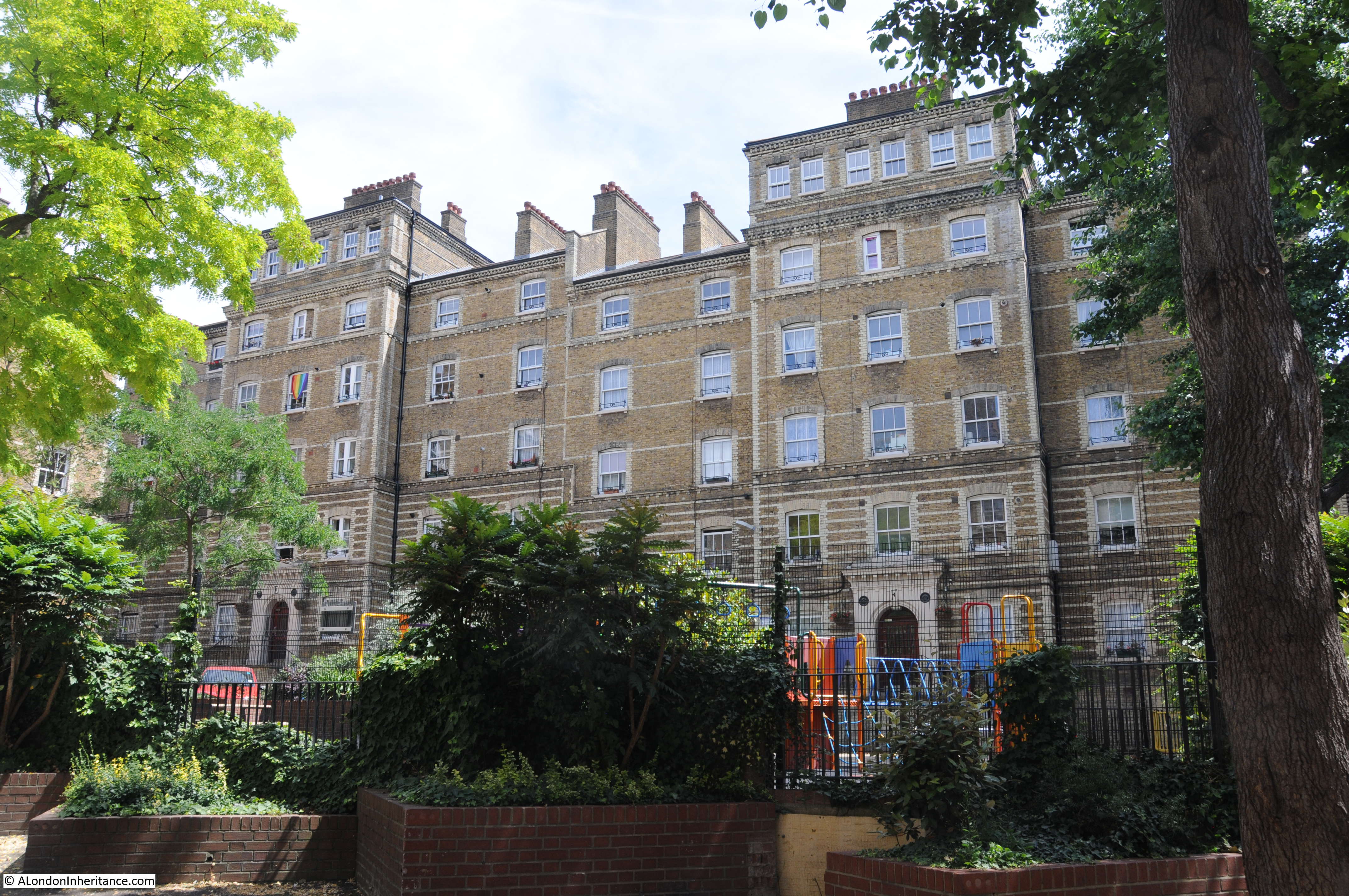
Looking across the courtyard towards Blocks E and F. An air-raid shelter could still be found in the courtyard until 1985. The area is now occupied by a children’s playground.

Pear Tree Court And Clerkenwell Close Peabody Estate

The steps at the end of Clerkenwell Close were not that old in 1947 having been built as part of the Peabody development. Clerkenwell Close was extended towards the current position of the steps and a wall that blocked the route onward towards Bowling Green Lane was demolished to allow a route through via Robert’s Place.

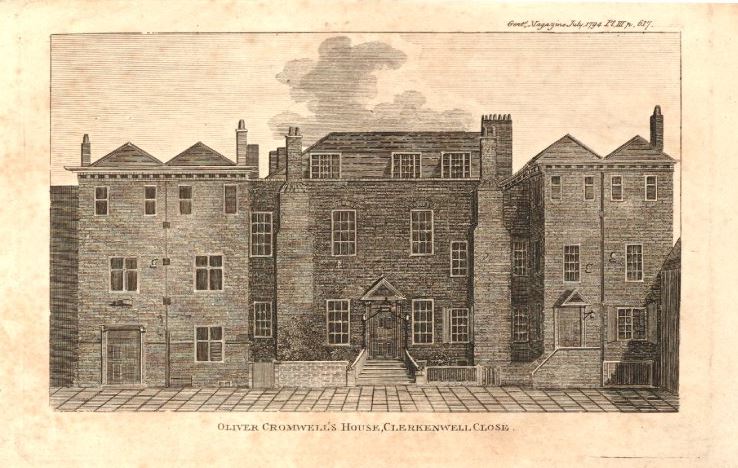
There is much to discover in both Clerkenwell Close and the surrounding area which I hope to write about in more detail in the future. For example, the street was originally known as St. Mary’s Close after the old Benedictine Nunnery of St. Mary, part of which was latter incorporated into the church of St. James on the corner of the close. Clerkenwell Close has also had a number of well known inhabitants including Oliver Cromwell and there is a story that the death warrant of Charles I was signed in his house on Clerkenwell Close.

Oliver Cromwell’s house:

Pear Tree Court And Clerkenwell Close Peabody Estate

I am still no wiser as to why my father took the original photo, what interested him in the scene, although I am pleased he did as it is ordinary street scenes that I find so fascinating and they always lead me into looking at an area in a bit more detail.

alondoninheritance.com

The Odeon, Shaftesbury Avenue

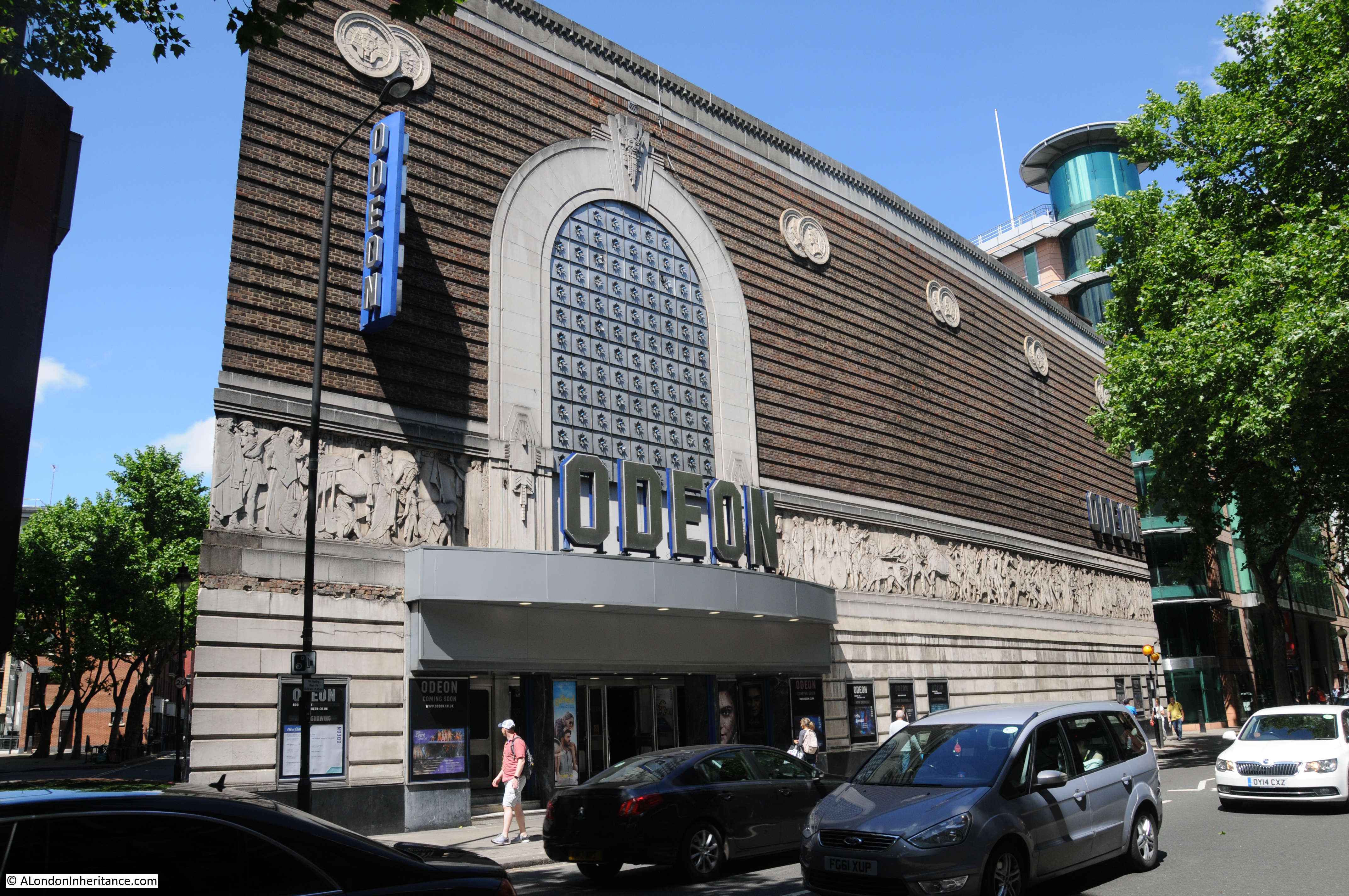
A couple of weeks ago, I wrote two posts covering a walk around the West End of London to find all the working theatres. There are also a number of buildings that were once theatres but have now taken on a different function. I had not intended to write about these yet, however there was one old theatre building where the light of an early afternoon in late May highlighted a wonderful architectural feature that runs along the facade of this building. This is the Odeon, Shaftesbury Avenue.

Odeon, Shaftesbury Avenue

The facade is not what you would typically associate with a cinema and gives away the building’s original function. This building was originally the Saville Theatre.

The Saville Theatre opened in 1931 and according to an introduction to the theatre in one of the early theatre programmes was “built by Messrs Gee, Walker and Slater of 32, St. James’s Street, SW1 from plans of the Architects, Messrs T.P. Bennett and Son, of 41 Bedford Row, WC1 who were also responsible for the whole colour scheme, lighting, furnishing etc.”

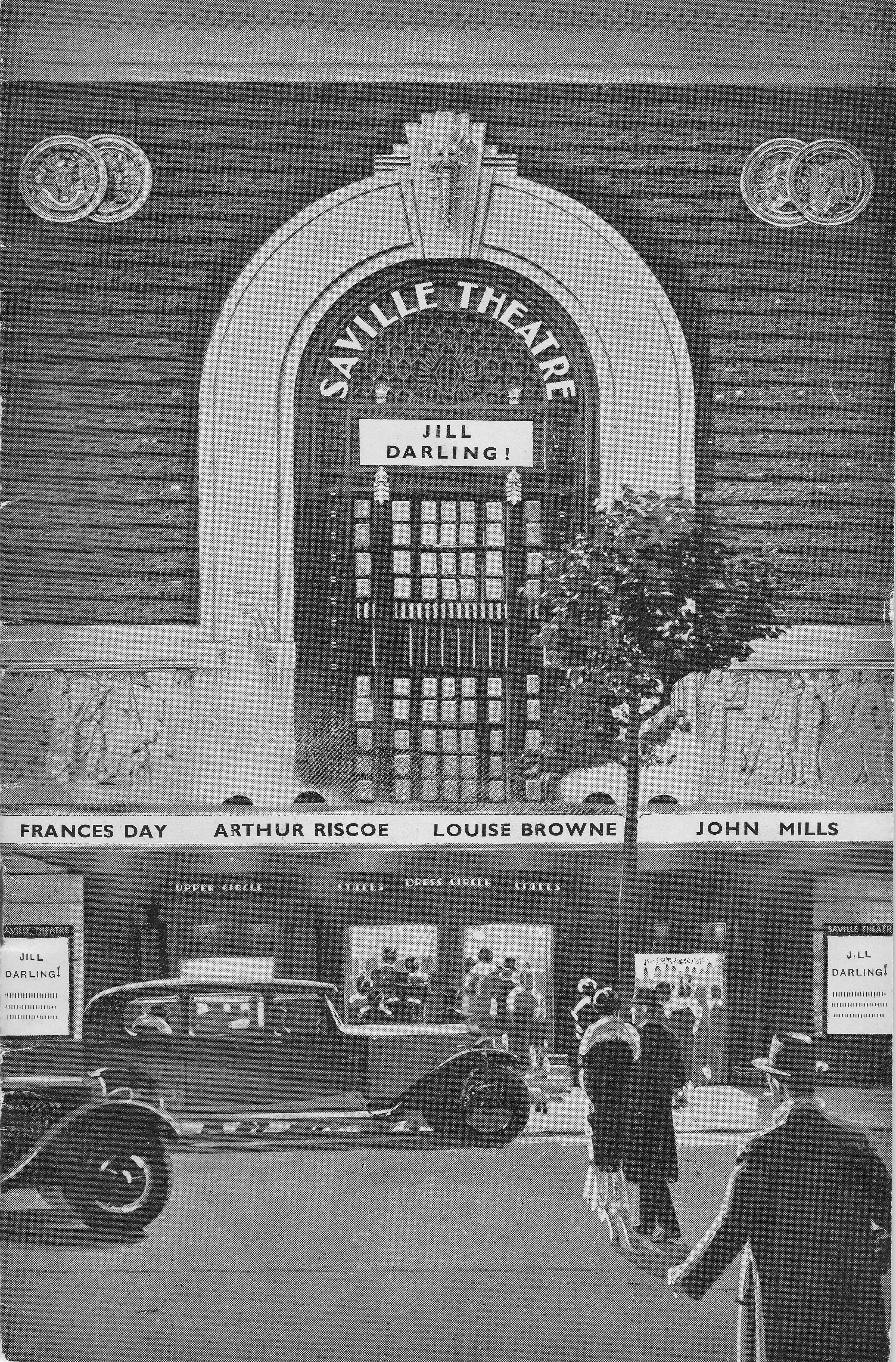
The exterior of the building looks much the same today as when it first opened as the Saville Theatre, apart from the canopy over the entrance and the glass blocks that now replace the wrought iron windows in the enclosed area above the canopy.

The cover from the 1934 programme for the production of Jill Darling shows the theatre entrance as built:

Odeon, Shaftesbury Avenue

The Saville Theatre operated as a theatre until the end of 1969, however during the 1960s, as well as plays the theatre would also put on concerts by The Beatles, The Who, Elton John among many other big names from the period, and for a while was owned by Brian Epstein, the manager of the Beatles.

In 1970 the theatre was purchased by EMI who converted the building into a cinema which opened as part of EMI’s ABC cinema chain at the end of the year. ABC cinemas went through a number of ownership changes, until the chain was owned by the same company that had brought Odeon cinemas from the Rank Group. The ABC cinemas were then gradually re-branded as Odeon Cinemas.

The interior of the theatre was a luxurious 1920s design that included an early example of how shopping could be integrated with other activities. The theatre featured the “Saville Theatre Salon”, described in the programme as “The Saville Theatre Salon is unique. Tea, Coffee and other Refreshments are served, whilst there is also a fine display of the latest costumes, coats and jewellery, by leading London West End Stores. It is, indeed, well worth a visit by our patrons in the Stalls and Dress Circle. There is no access to it from the Upper Circle.”

I assume the reference to having no access from the Upper Circle is to reserve access to those in the more expensive seats.

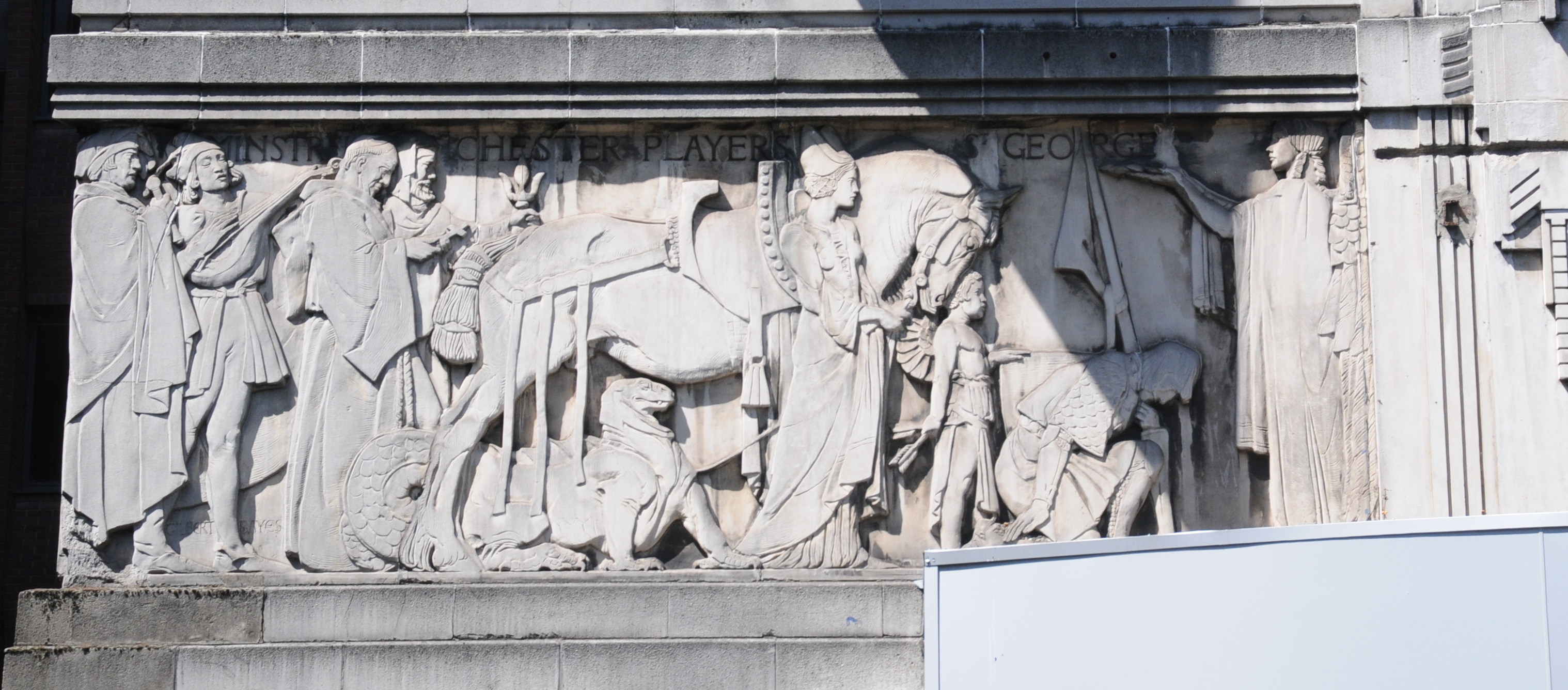
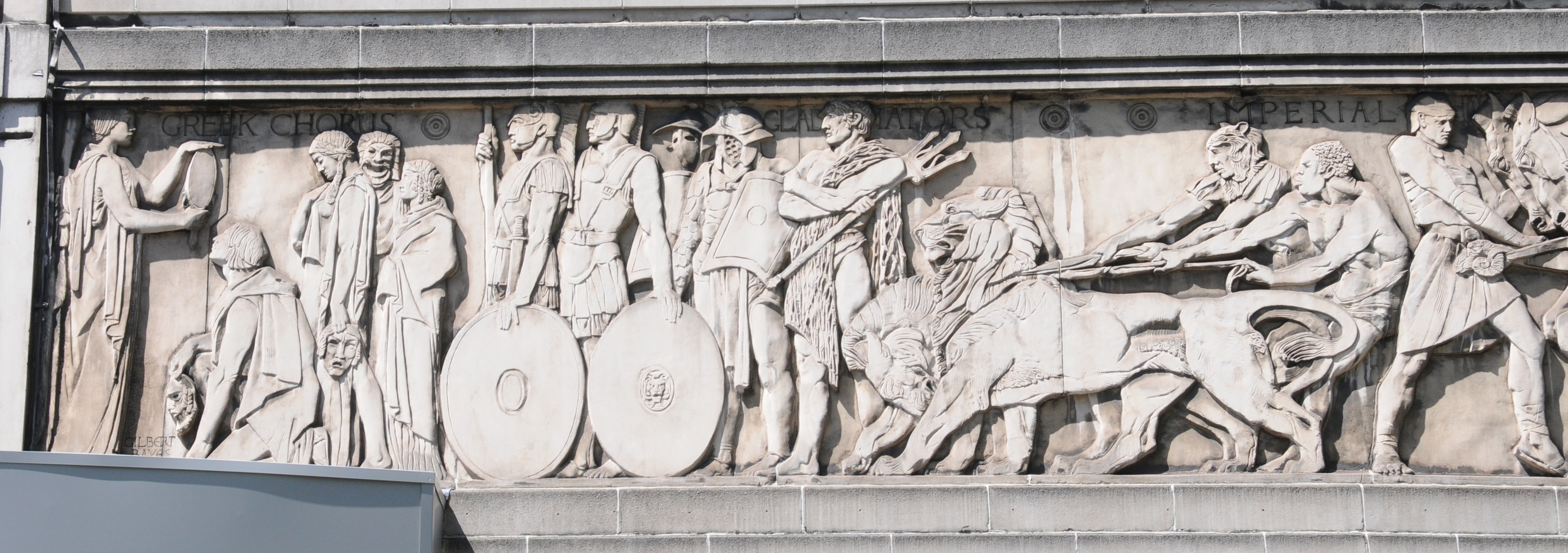
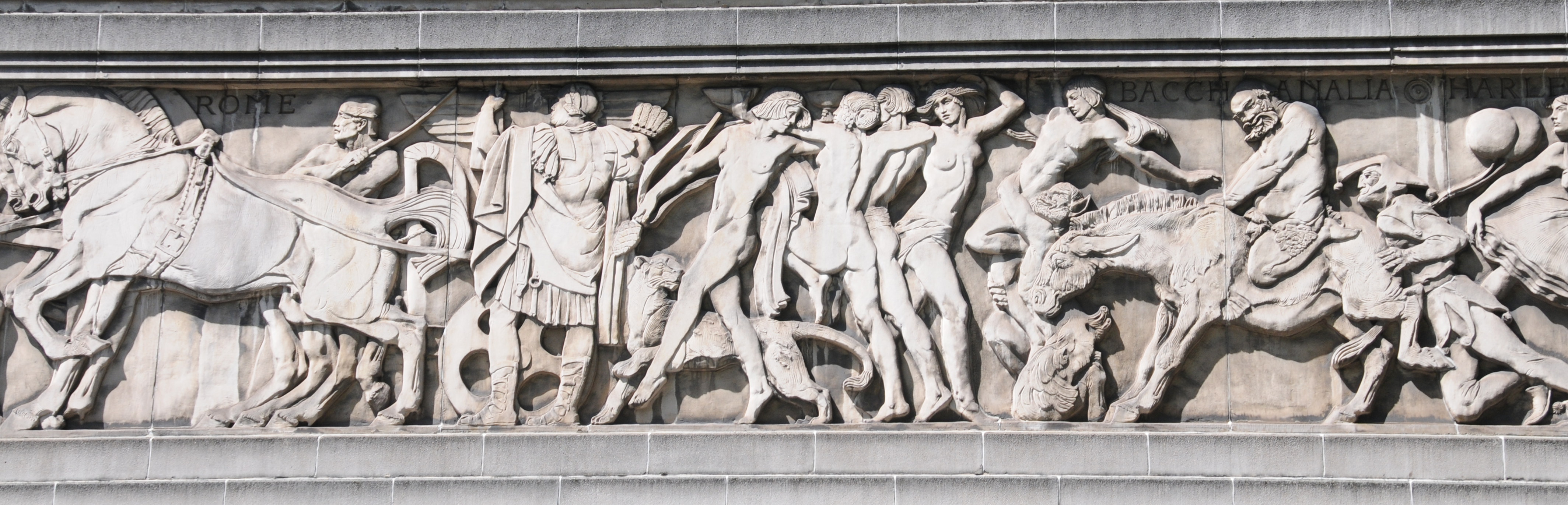
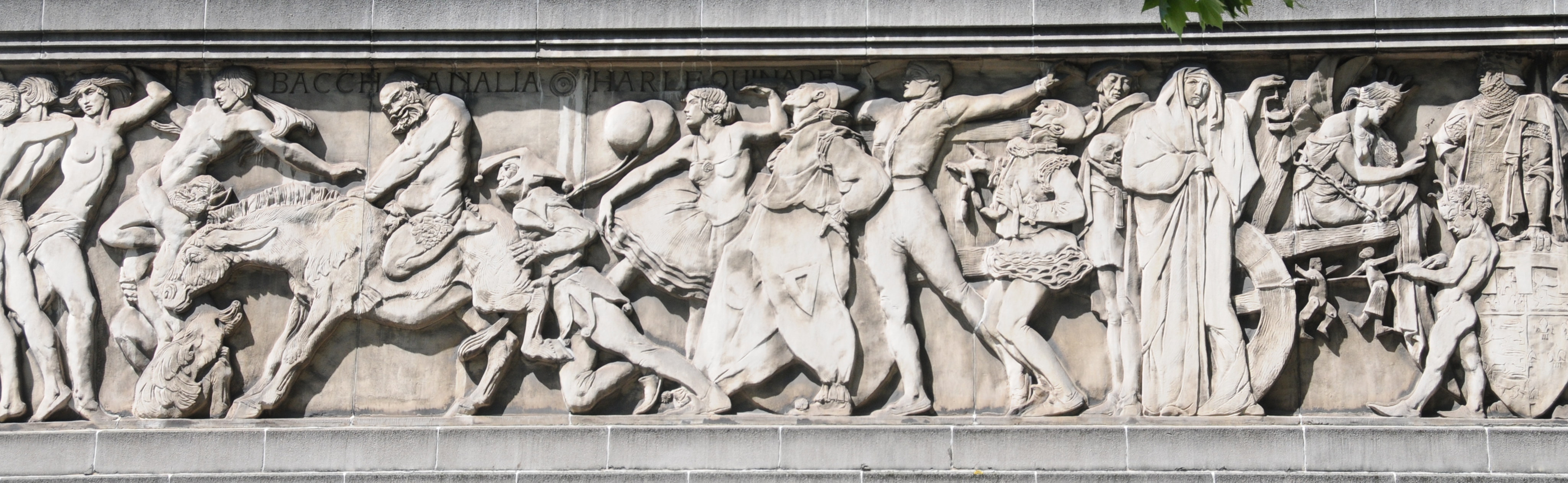
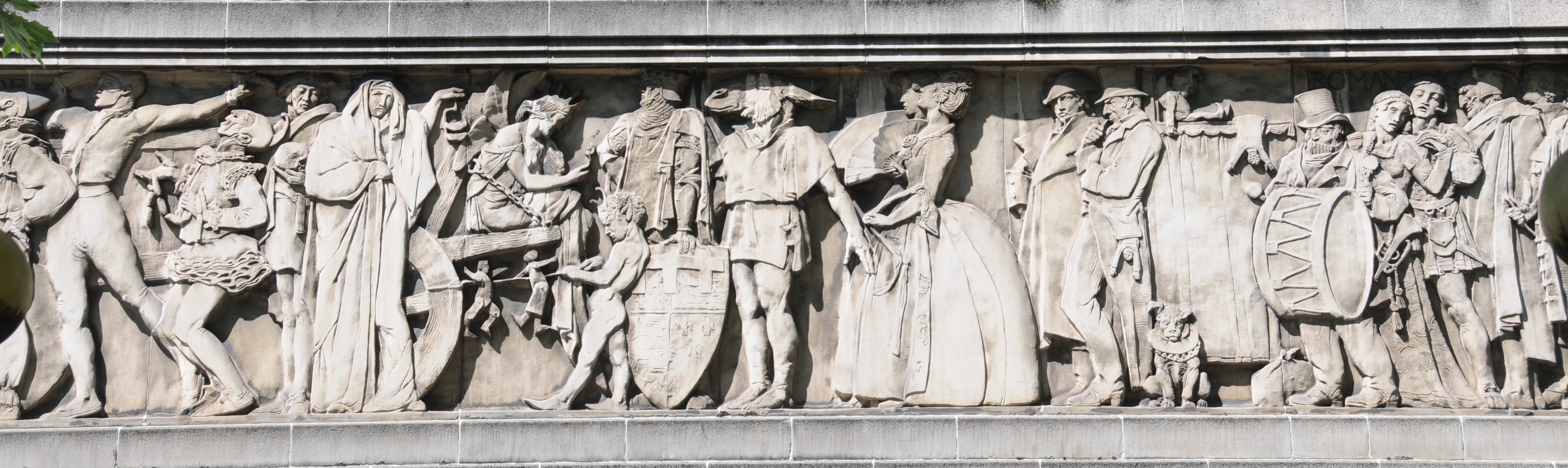
Whilst the interior decoration has been lost during the various cinema conversions, the facade of the building retains the magnificent frieze that runs the length of the facade along Shaftesbury Avenue, and it is this frieze that stood out so well as I walked past.

The frieze is titled “Drama through the Ages” and the sculptor was Gilbert Bayes.

Gilbert Bayes was a prolific artist and sculptor during the first half of the 20th Century. His works can still be found on buildings across the country and perhaps his most famous work is the large clock and statue combination “The Queen of Time” above the main entrance to Selfridges in Oxford Street.

The frieze is 129 feet in length and tells the story of drama across time and from left to right starts with Minstrels, Players and St. George:

Odeon, Shaftesbury Avenue

Greek Chorus and Gladiators:Odeon, Shaftesbury Avenue

Imperial Rome and Bacchanalia:

Odeon, Shaftesbury Avenue

Bacchanalia and Harlequinade:

Odeon, Shaftesbury Avenue

Harlequinade and Romantic:

Odeon, Shaftesbury Avenue

Romantic and Twentieth Century:

Odeon, Shaftesbury Avenue

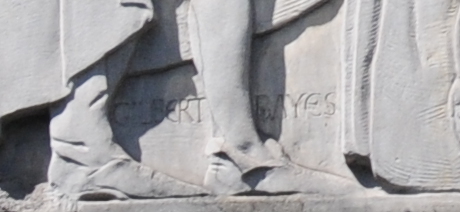
The frieze is very detailed and it takes some time to look along the frieze and pick out so many individual features. Here is Gilbert Bayes name recorded in the very lower left of the frieze:

Odeon, Shaftesbury Avenue

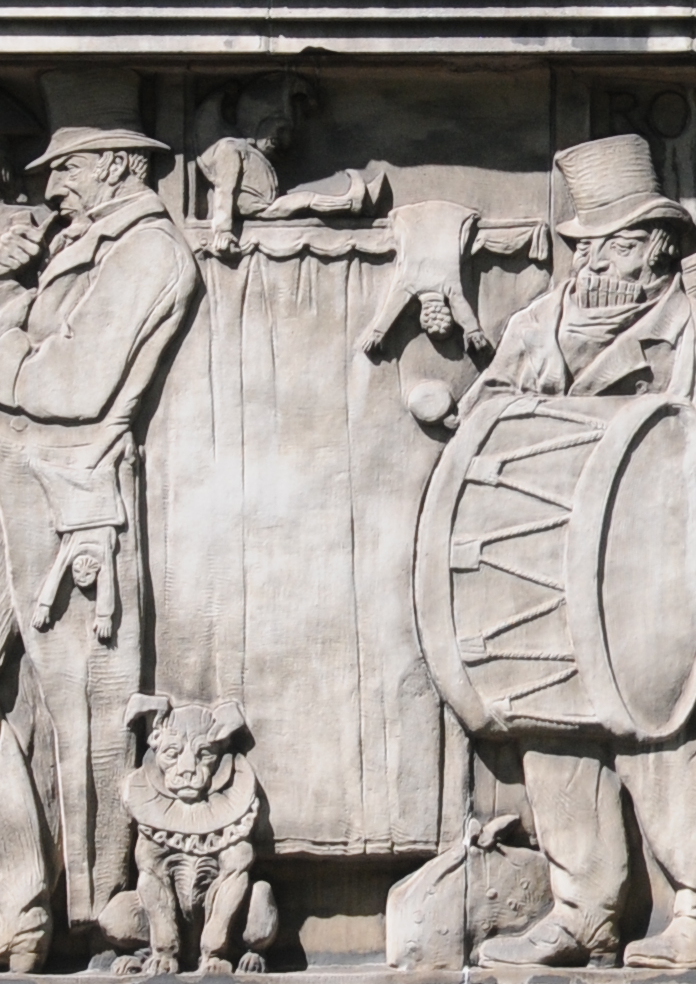
Punch and Judy:

Odeon, Shaftesbury Avenue

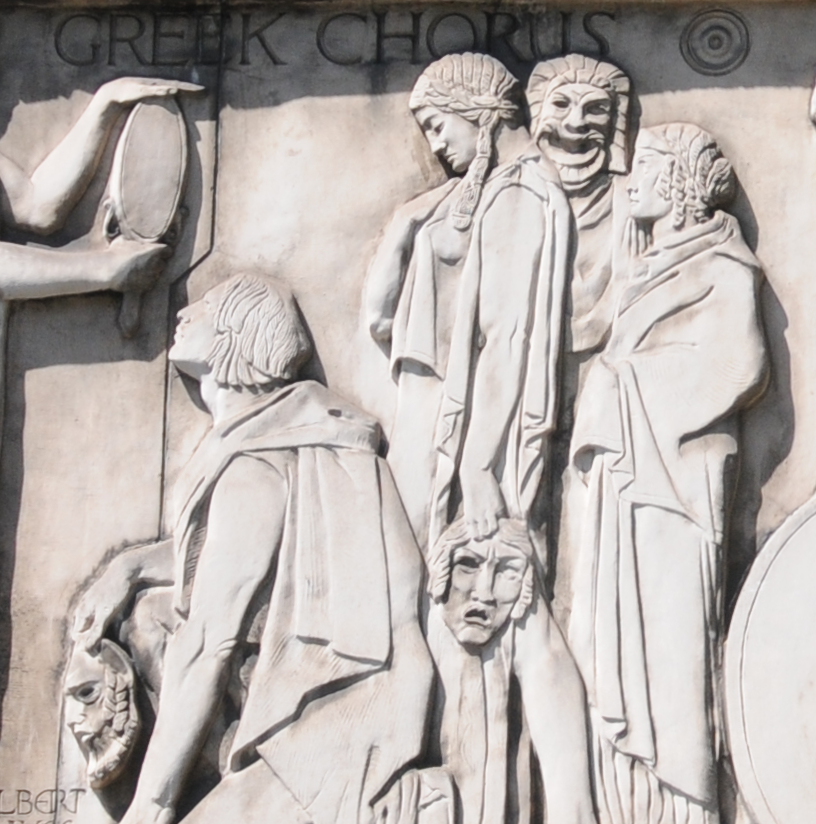
The masks of a Greek Chorus:

Odeon, Shaftesbury Avenue

Before being installed on the facade of the Saville Theatre, parts of the frieze were displayed at the Royal Academy during 1930 and 1931.

If you go back to the photo of the front of the theatre at the top of the post, there are also a series of round plaques. They are also the work of Gilbert Bayes and show Art through the Ages.

The theatre did suffer some limited bomb damage during the early 1940s, however the frieze survived this damage, along with the subsequent conversion of the Saville Theatre into the ABC then Odeon Cinemas.

Whatever forms of entertainment take place in the West End in the future, I hope that Gilbert Bayes magnificent frieze lasts for a very long time.

alondoninheritance.com

Salisbury – Poultry Cross, High Street Gate And Cathedral

As long term readers will known, as well as London, my father also took lots of photos outside of London during National Service and through the only realistic travel option to see the country in the post war period – cycling between Youth Hostels.

There are a limited number of photos from each place visited, film was expensive and there was not much storage space when you were cycling away from home for several weeks. As well as the London photos, I am also trying to identify and visit the locations of all these photos.

Therefore, for this week’s post I am travelling down to Salisbury.

Salisbury is a cathedral city in Wiltshire, located at the point where several rivers meet to join the River Avon. The cathedral is the focal point of the city, a beautiful medieval building with the highest spire in the country.

Although part of Salisbury has suffered from the mania of a few decades ago to rebuild city centres with pedestrianised shopping centres, much of Salisbury has survived and it does still retain the feel of a small country town.

My father cycled through Salisbury in 1949, whilst cycling from London to Cornwall and stopping at Youth Hostels along the way. The route has already passed through Winchester and Stonehenge and Salisbury was a short distance to cycle further south.

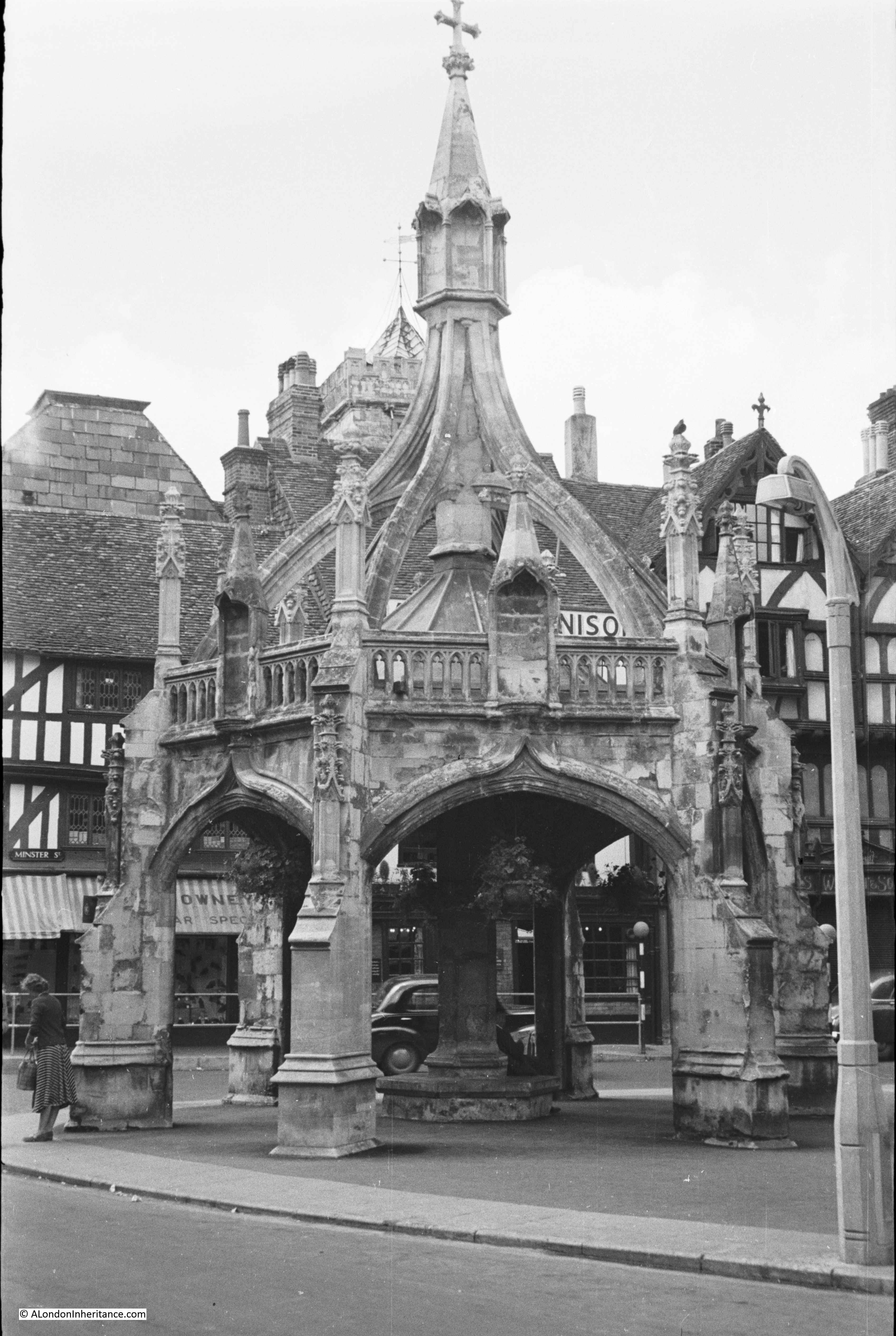
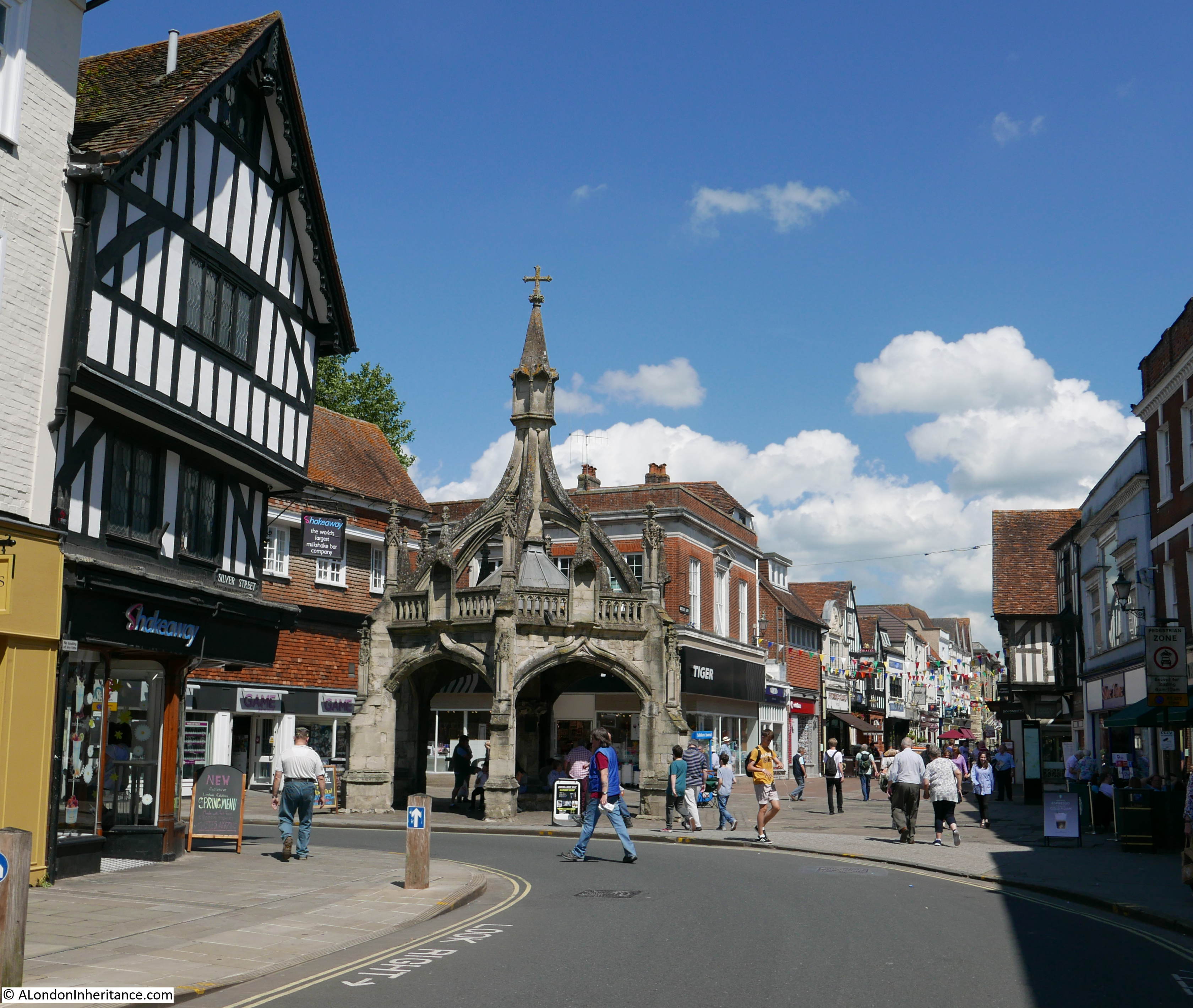
The first photo is of the Poultry Cross. Salisbury originally had four crosses, each marking the location where specific market produce was sold. As well as the Poultry Cross there was a Cheese Cross, a third cross marked the location for the sale of wool and a fourth cross, Barnwell Cross marked the location for the sale of livestock.

The Poultry Cross is the only surviving one of the four crosses. The first mention of a cross being here was in 1307 and the first written record of the name occurs in the following century.

The core of the cross is the original, the side wall, buttresses and canopy are later additions. There is a J.M.W. Turner painting of the cross from around 1800 which shows just the central cross and the side walls. The painting can be found here.

The Salisbury Poultry Cross in 1949:

Salisbury

And a view of the cross from the same location in 2017:

Salisbury

There have been minor changes to the surrounding buildings and the street in my father’s photo (Butcher Row that runs in the lower part of the photo from left to right) has now been pedestrianised.

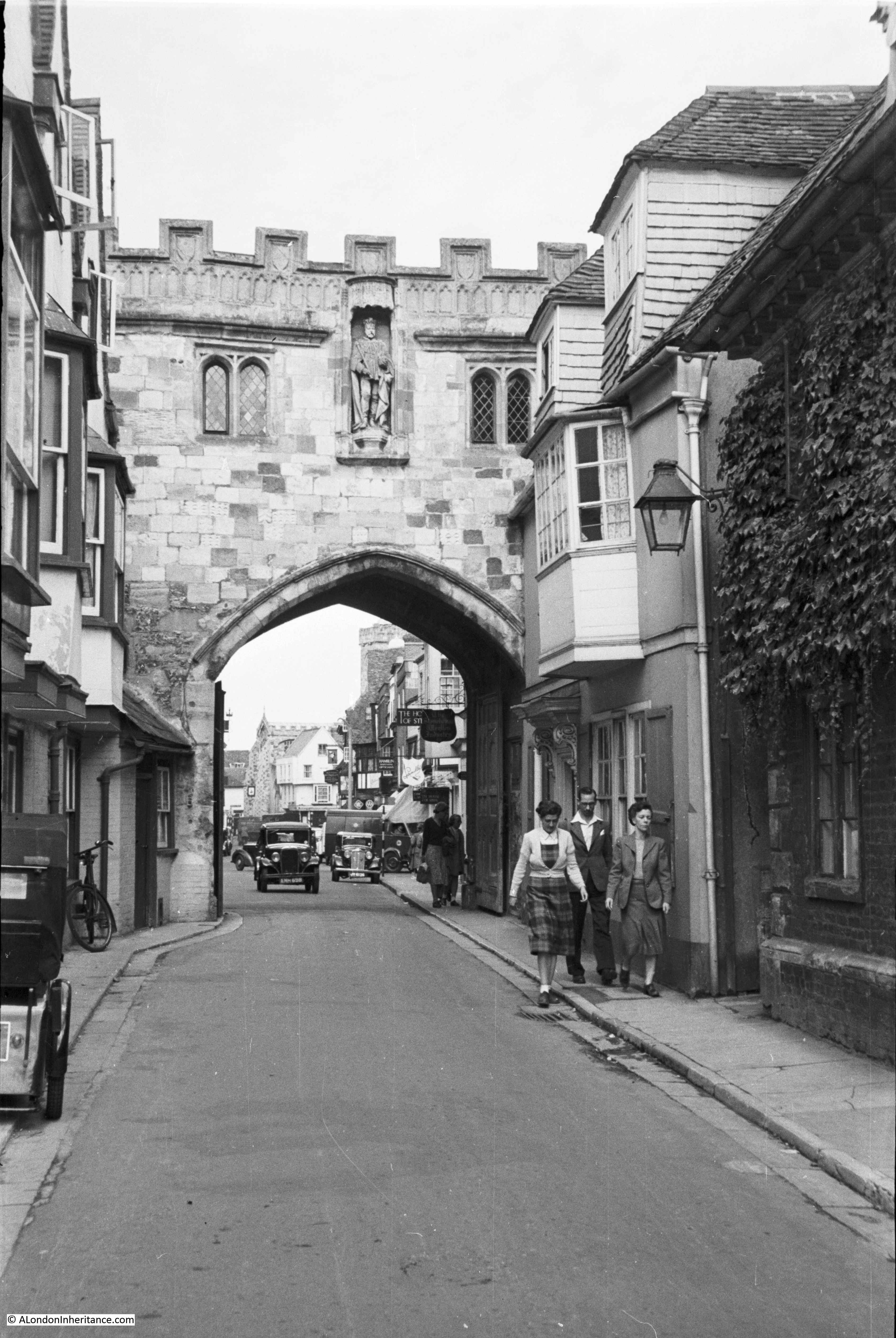
Salisbury Cathedral is enclosed within a large space, part of which is the Cathedral Close. The entrance to the Close from the High Street is through the High Street Gate. This was built between 1327 and 1342 and is still in use as a gate, being closed at 11pm and opened at 6am. As well as controlling access to the Cathedral Close, the gate also housed a small lock-up for those committing a crime in the cathedral grounds.

View of the High Street Gate in 1949 from the Cathedral Close looking back towards the High Street:

Salisbury

The same view 68 years later:

Salisbury

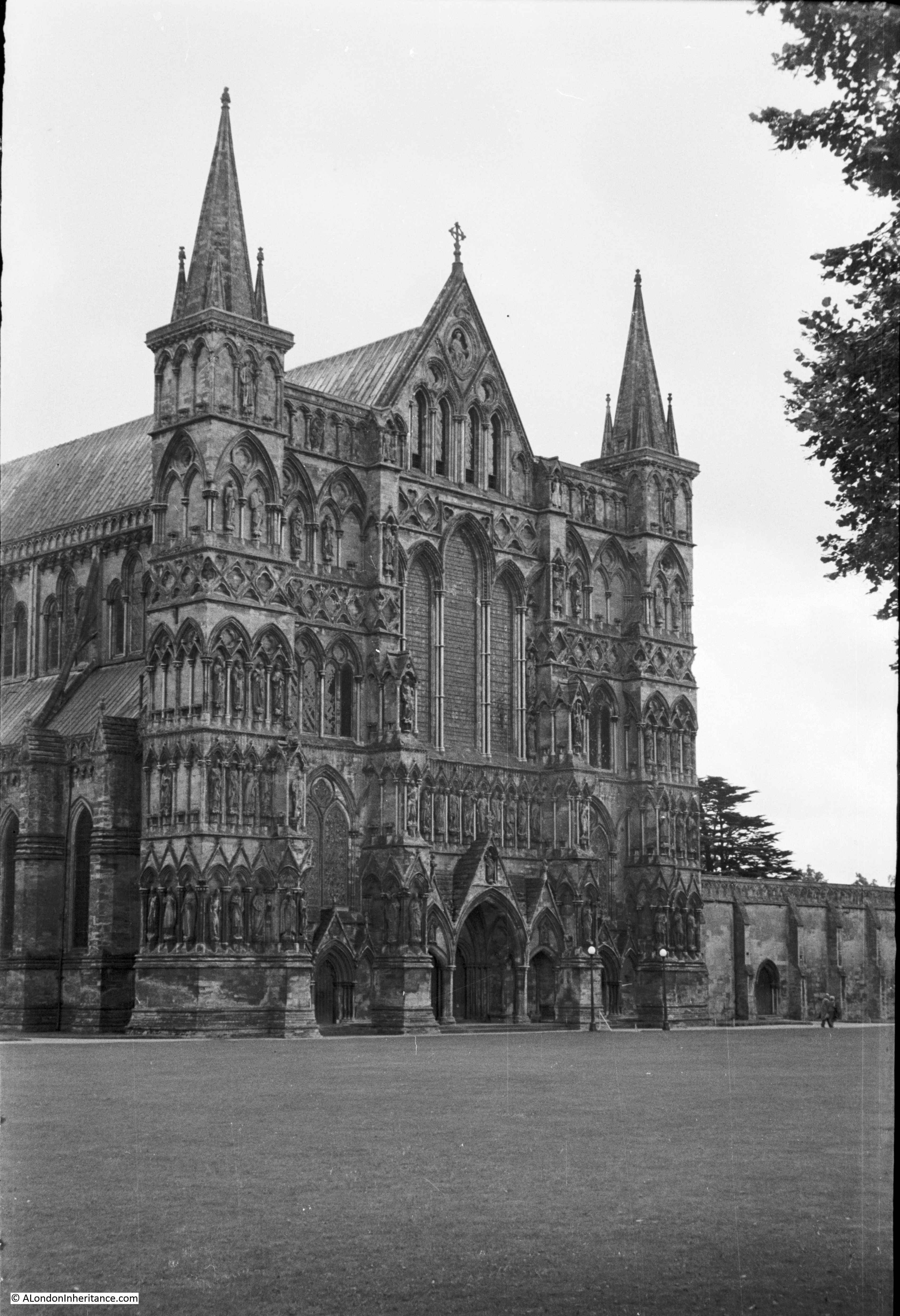
The Cathedral Close leads into the grounds surrounding the cathedral. The western front to Salisbury Cathedral in 1949:
Salisbury

And the same view on a summer’s day in 2017:

Salisbury

Construction of Salisbury Cathedral started in 1220 in order to build a new church to replace the one at Old Sarum that had been built just after the Normal invasion in the centre of an Iron Age hill fort just a few miles to the north. The cathedral was consecrated in 1258 and rest of the cathedral (with the exception of the spire) completed by 1266.

Given that Salisbury Cathedral has been here for almost 800 years, the 68 years between my father’s photo and my visit is a relatively very short period of time. Standing here it does make you think about all the generations who have also looked at the same view of the cathedral.

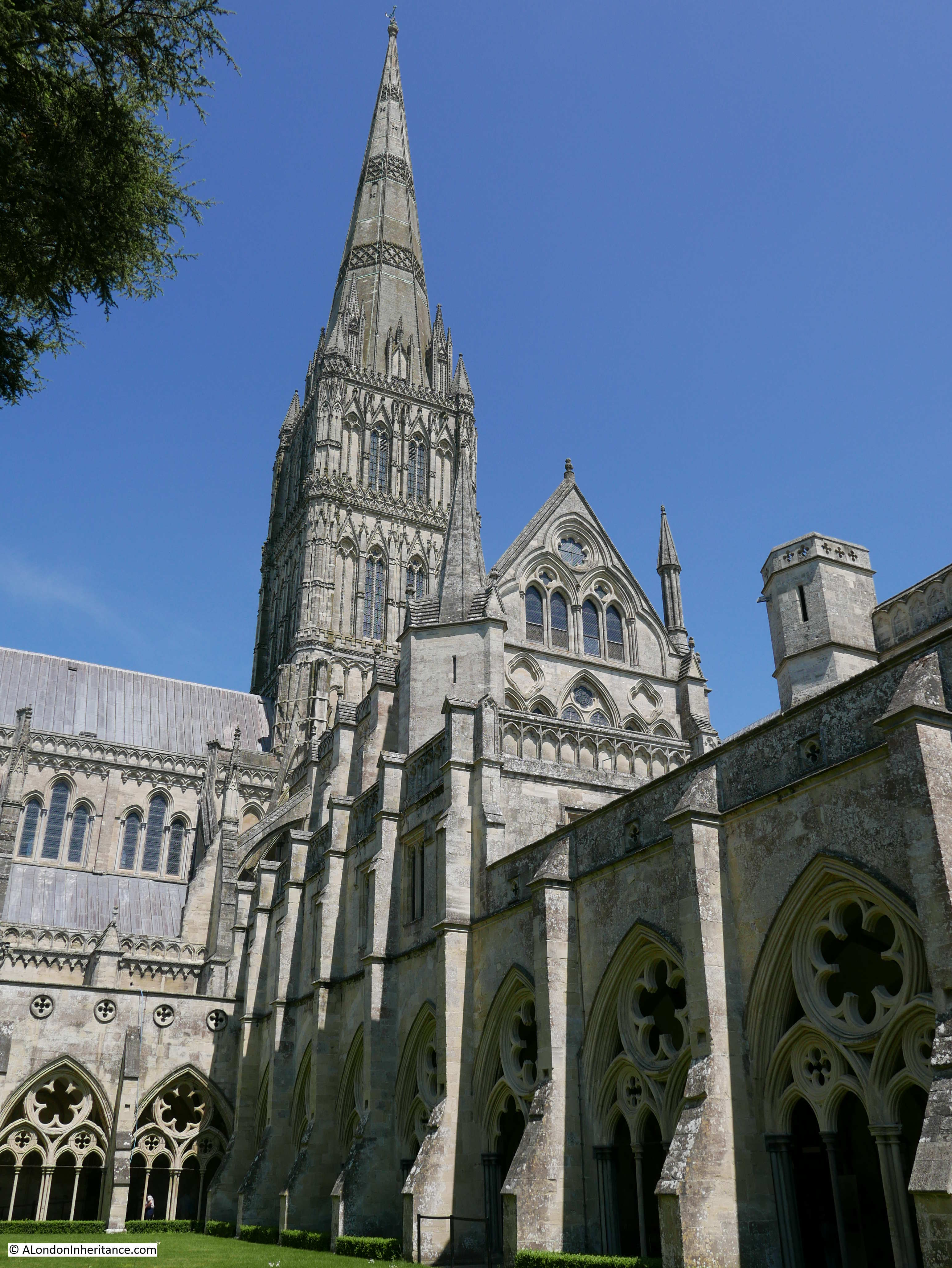
The tower and spire were built between 1300 and 1320, and the spire is the highest cathedral spire in England at 404 feet. The spires of Lincoln Cathedral and St. Paul’s Cathedral were originally higher, but as both these buildings have since lost their spires, Salisbury Cathedral now holds the record.

The tower and spire of Salisbury Cathedral:

Salisbury

Salisbury Cathedral is a wonderful example of a medieval church, historically and architecturally impressive both inside and out. After a walk around the church it was time to explore inside.

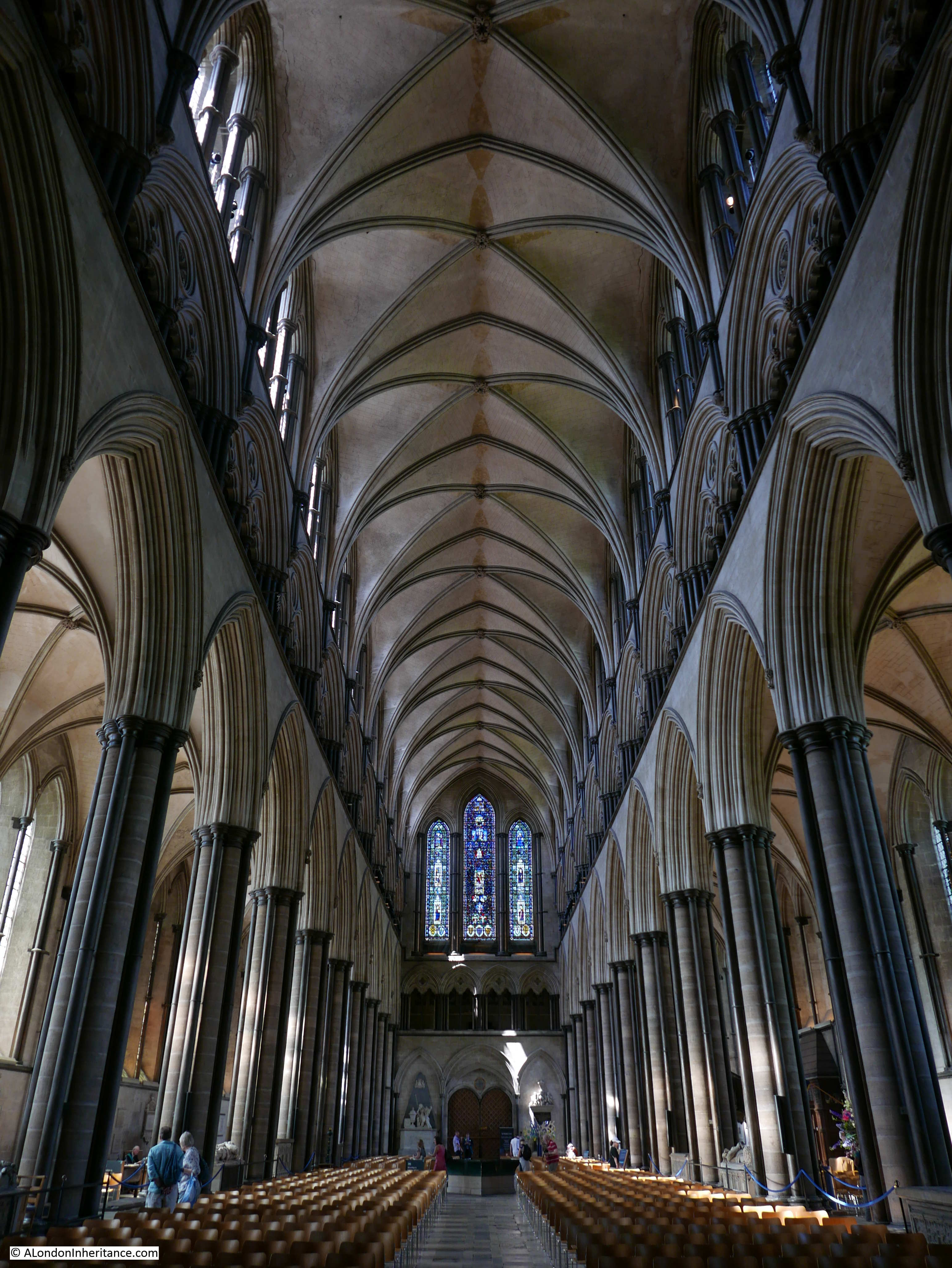
The view along the Nave towards the west frount of the cathedral:

Salisbury

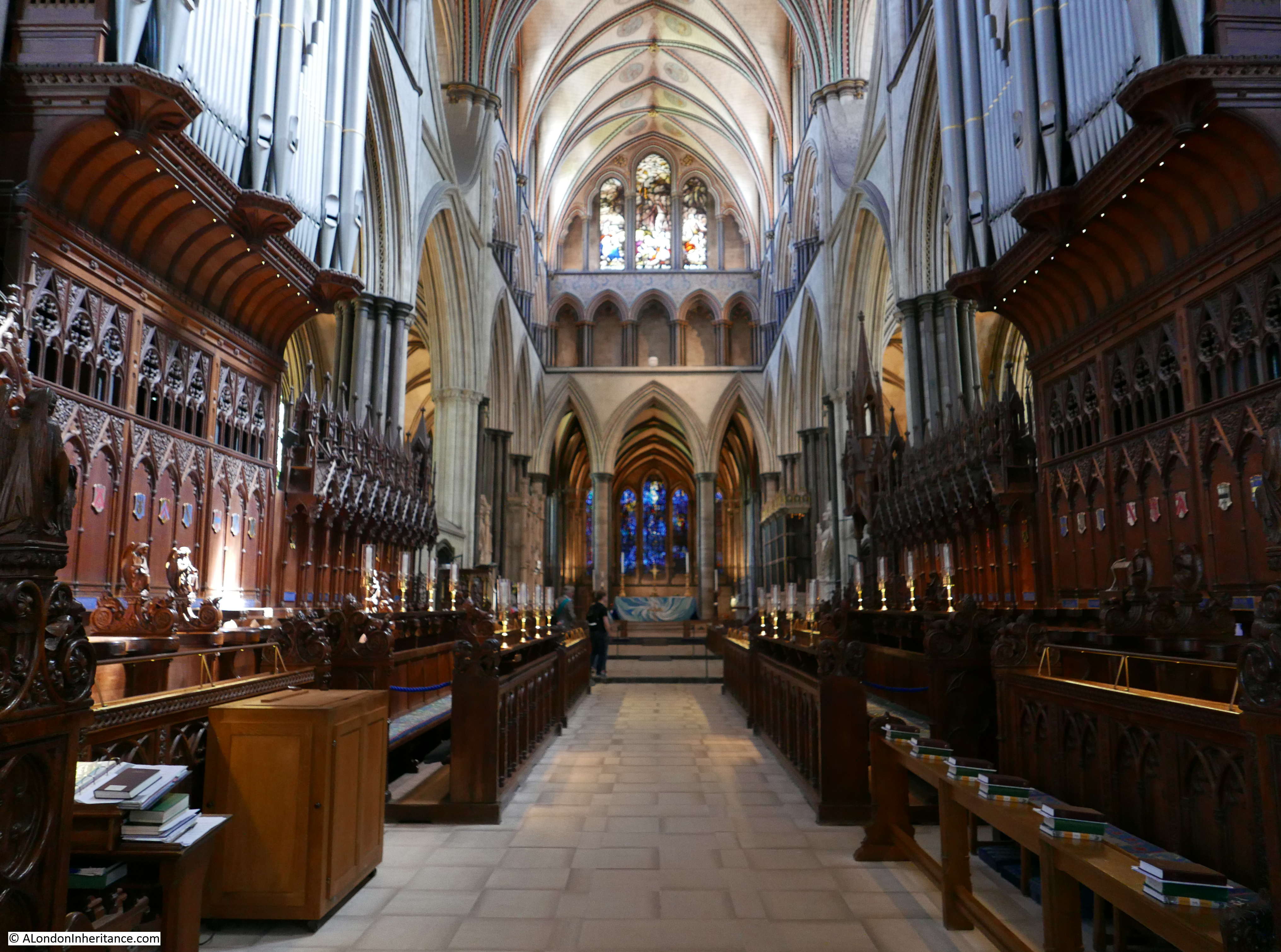
Turning round from the position of the above photo and this is the view of the Quire with the Altar at the far end:

Salisbury

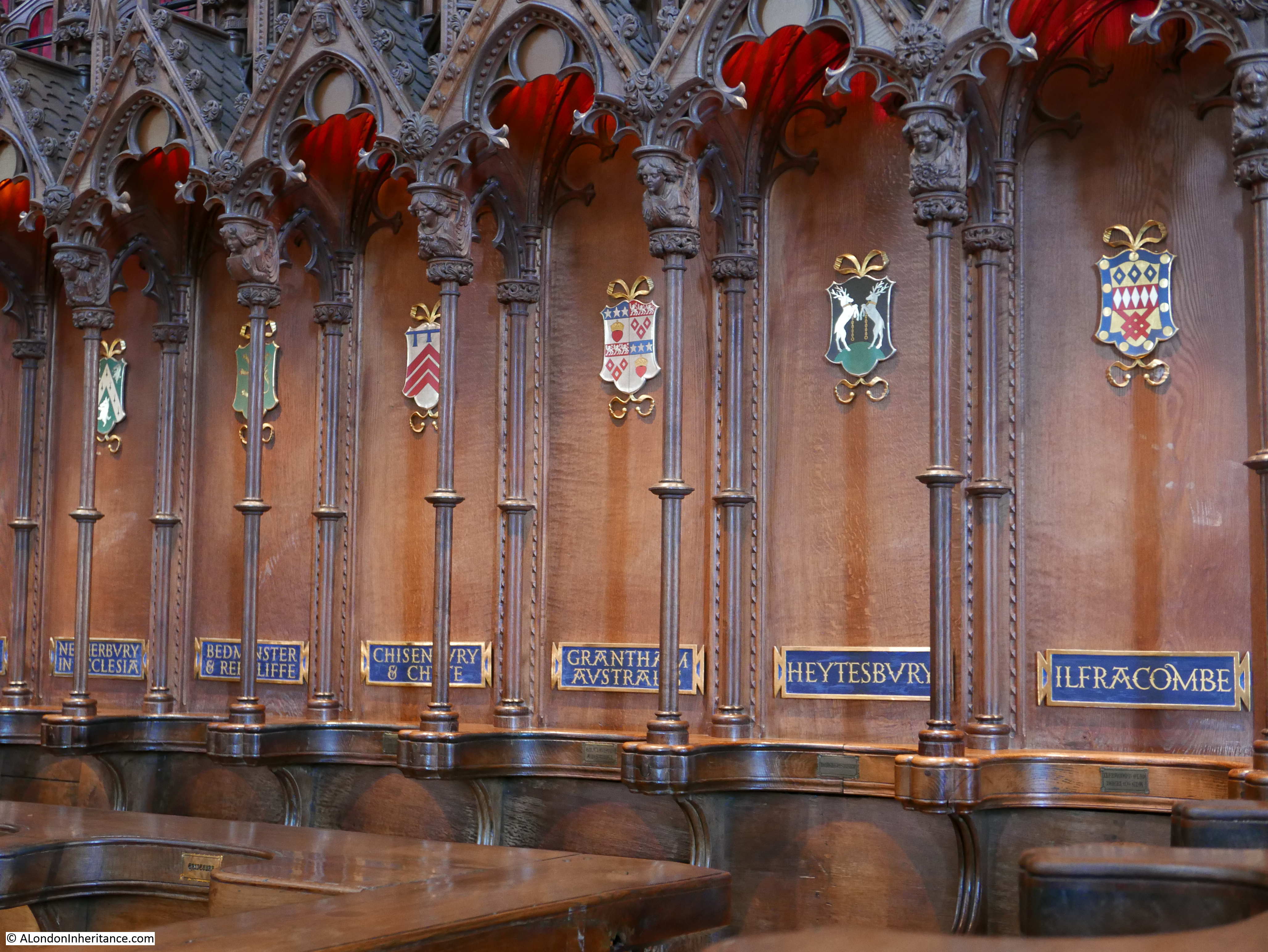
Named seating along the side of the Quire:

Salisbury

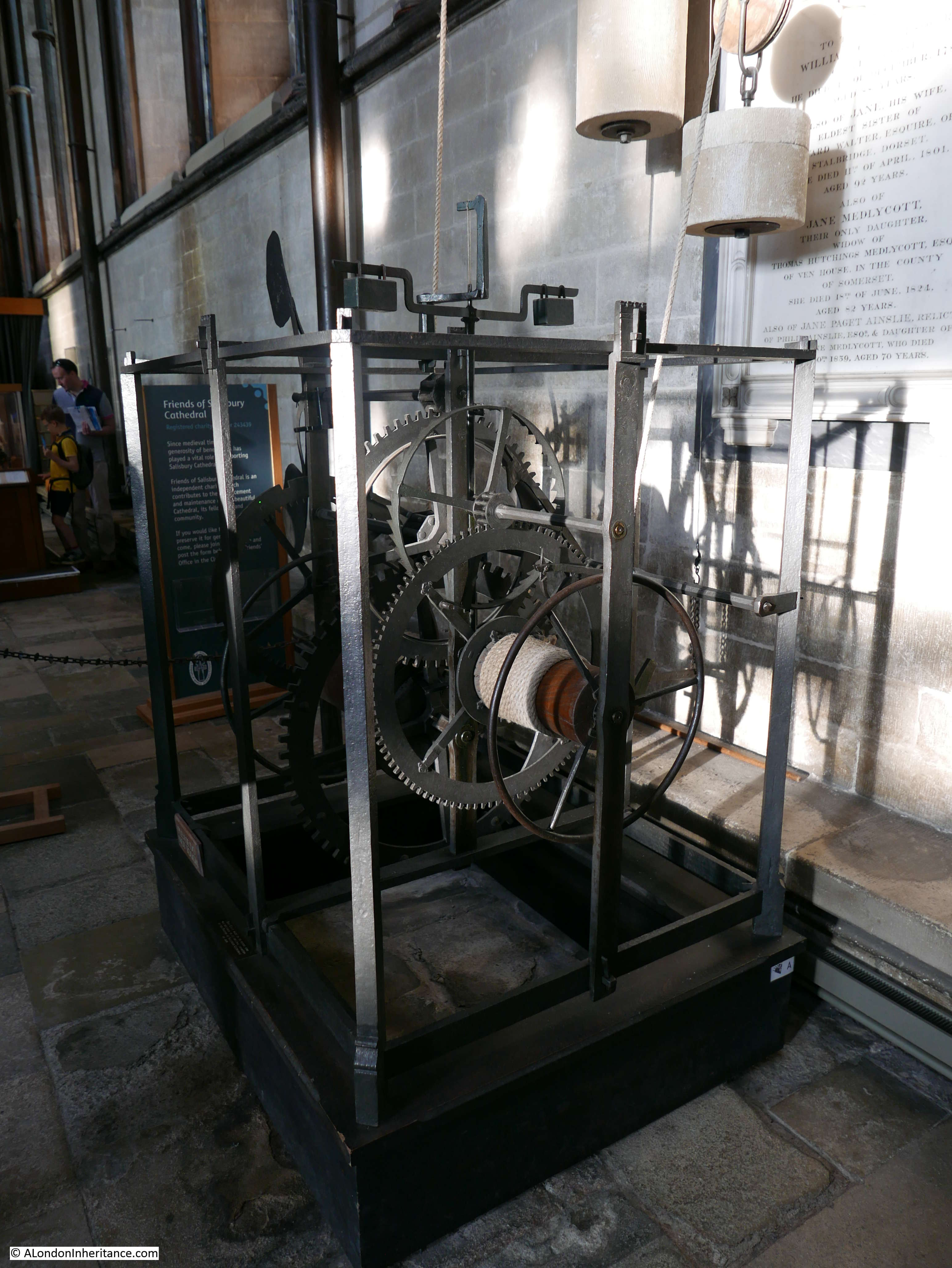
Salisbury Cathedral originally included a stand alone Bell Tower located between the Cathedral and the High Street Gate. The Bell Tower was demolished in 1792 and the original clock within the tower that dates from around 1386 was moved to the main cathedral building and worked in the cathedral tower until 1884. It was then stored, but rediscovered in 1929 when it was moved into the main body of the church. Repair work was needed in 1956 and following completion it was moved to its current position from where it has been in continuous operation.

The clock can still be seen in the cathedral, possibly the oldest working clock in existence:

Salisbury

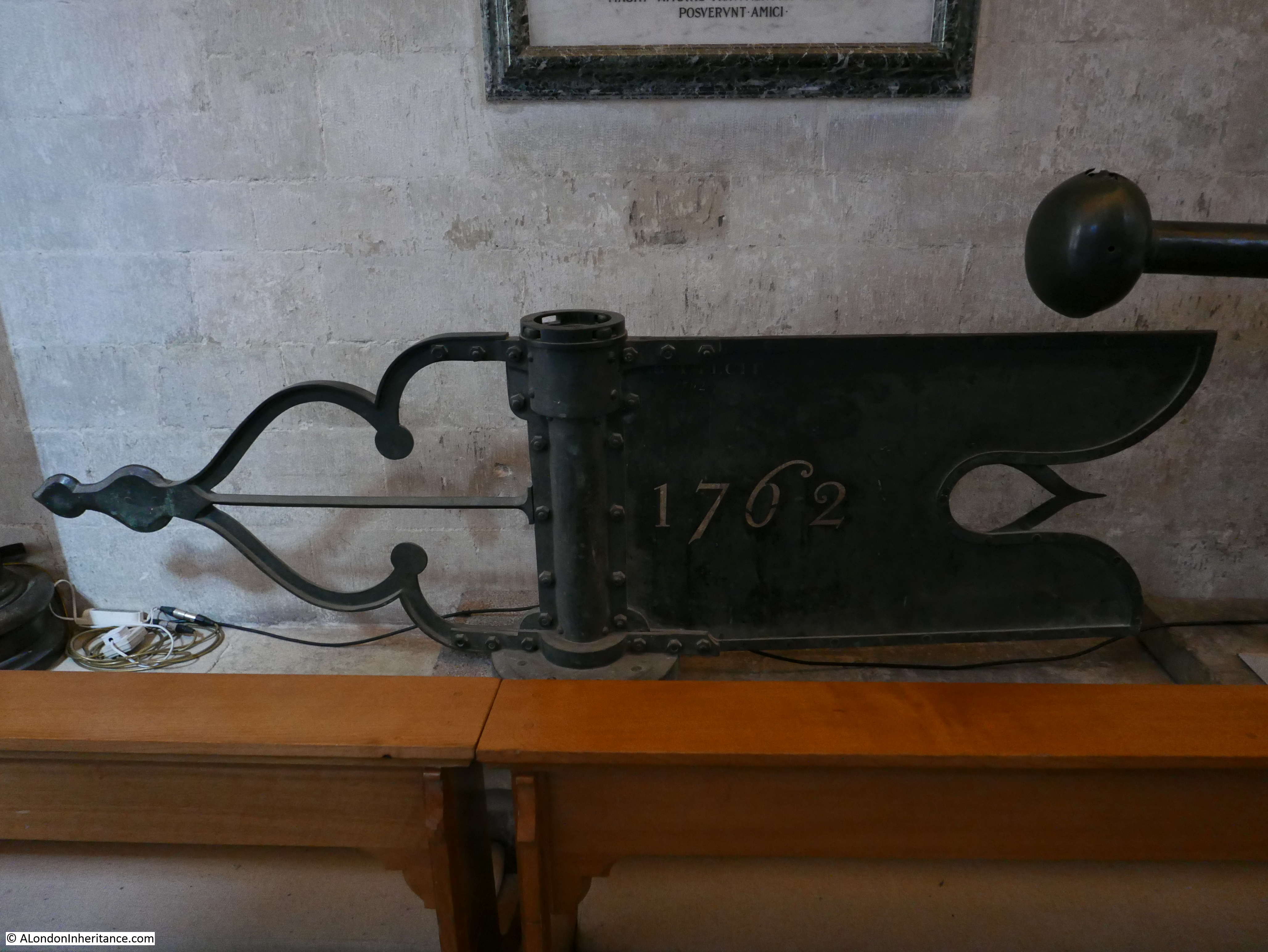
18th century weather vane:

Salisbury

The artist and illustrator Rex Whistler lived in the Cathedral Close until his untimely death at the age of 39 whilst leading his troop of tanks into action on the Normandy Beaches in 1944.

A memorial to Rex Whistler in the form of an engraved prism can be found within the cathedral. The prism was engraved by Rex’s brother Laurence who died in the year 2000.

Salisbury

There is so much about the cathedral that can be classed as the finest remaining medieval example of its kind. This includes the tomb of Giles de Bridport who was the Bishop at Salisbury at the time of the cathedral’s consecration in 1258. He died in 1262 and his 13th century tomb is still well preserved in the cathedral.

Salisbury

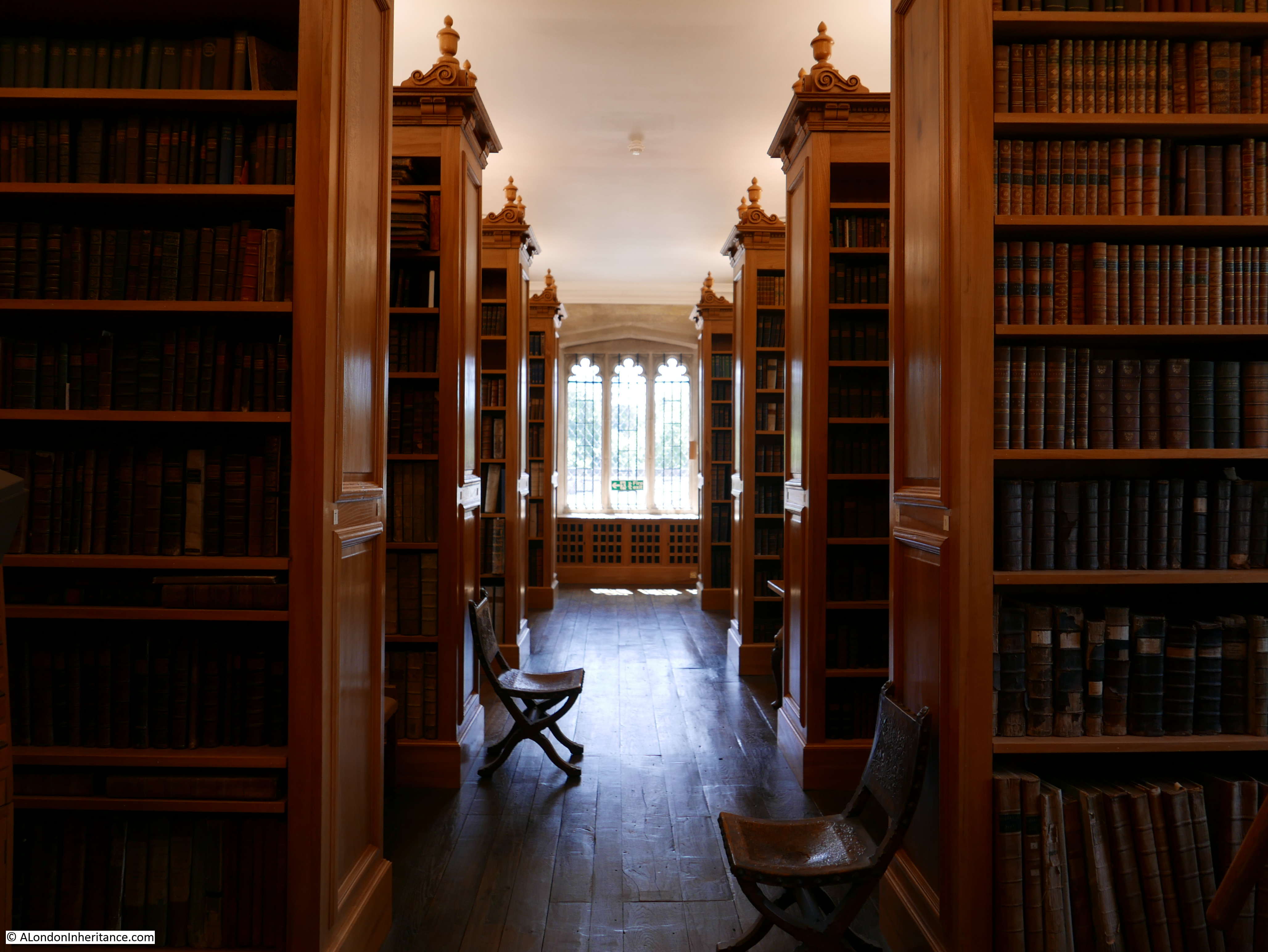
During my visit to Salisbury Cathedral, the cathedral library was open for a small art exhibition, which was good however I always love seeing old books. The oldest book held by the library dates from the 9th century.

Salisbury

Many of the books were originally chained. This method of securing books is not is use today, although the original chains are still stored in the library.

Salisbury

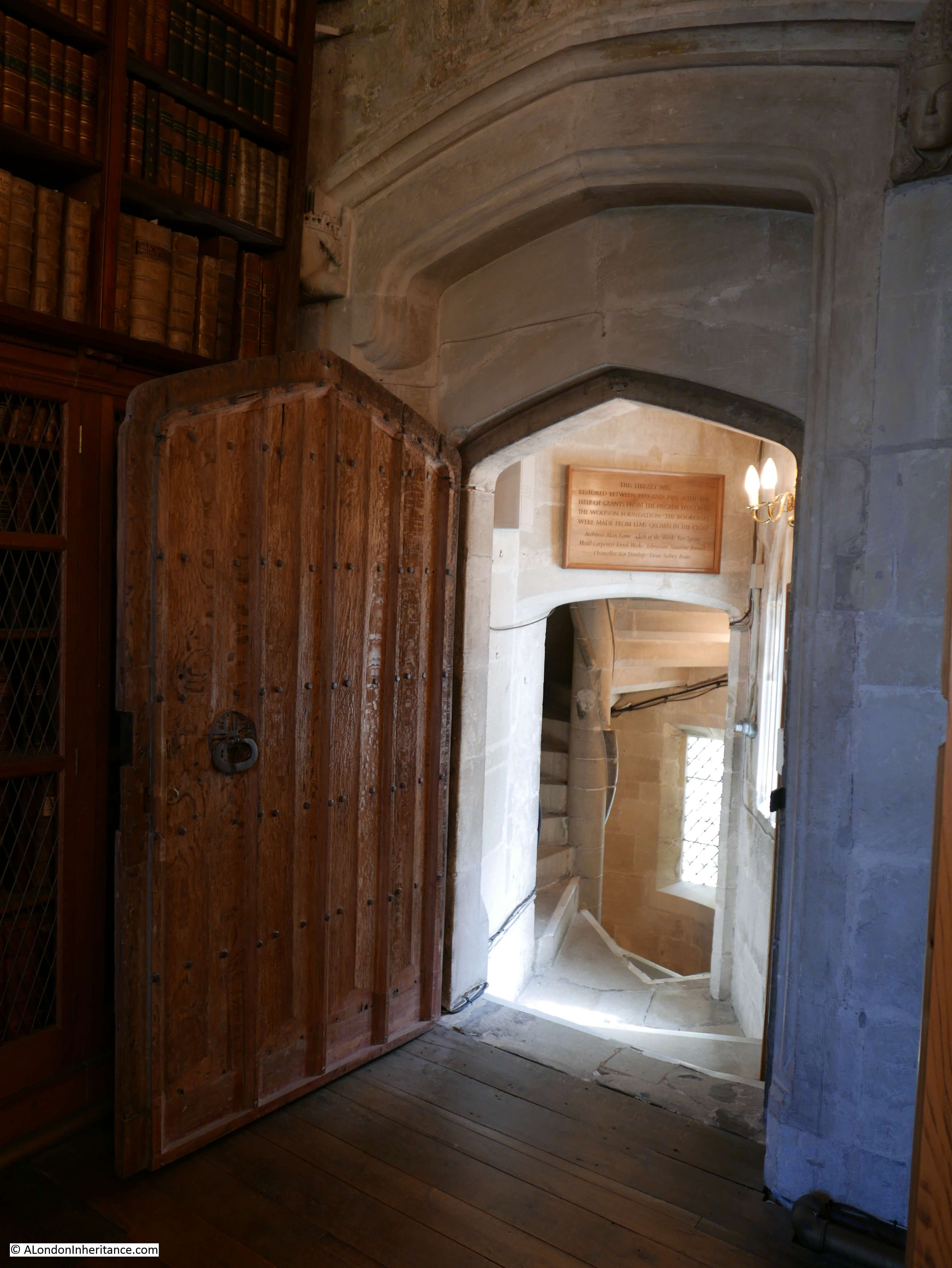
Entrance to the library through a small circular staircase from the ground floor.

Salisbury

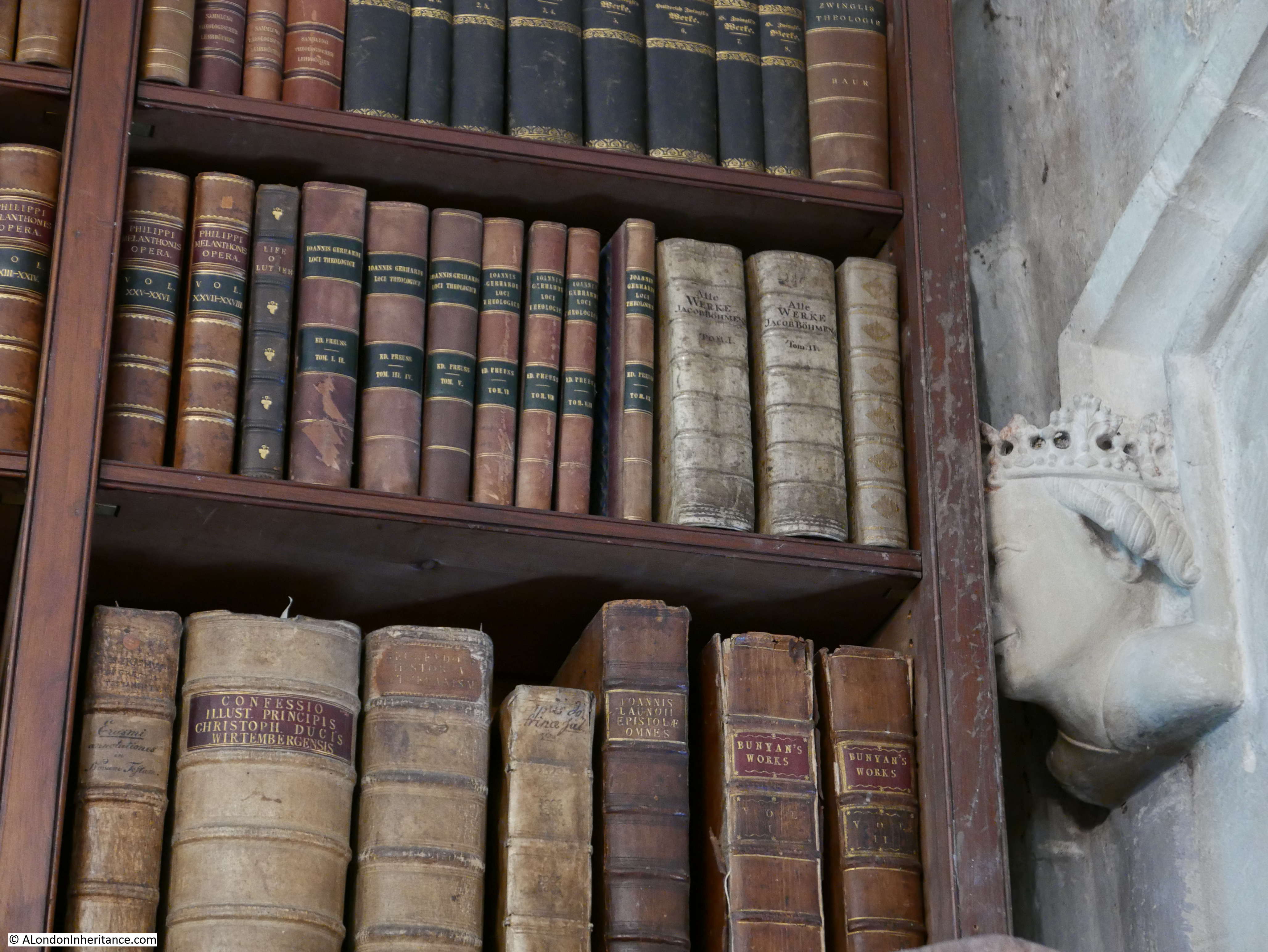
Wood to build the bookcases was donated by Henry VIII, although his bust at the top corner of the door in now obscured by the edge of one of these bookcases. I suspect he would not be pleased.

Salisbury

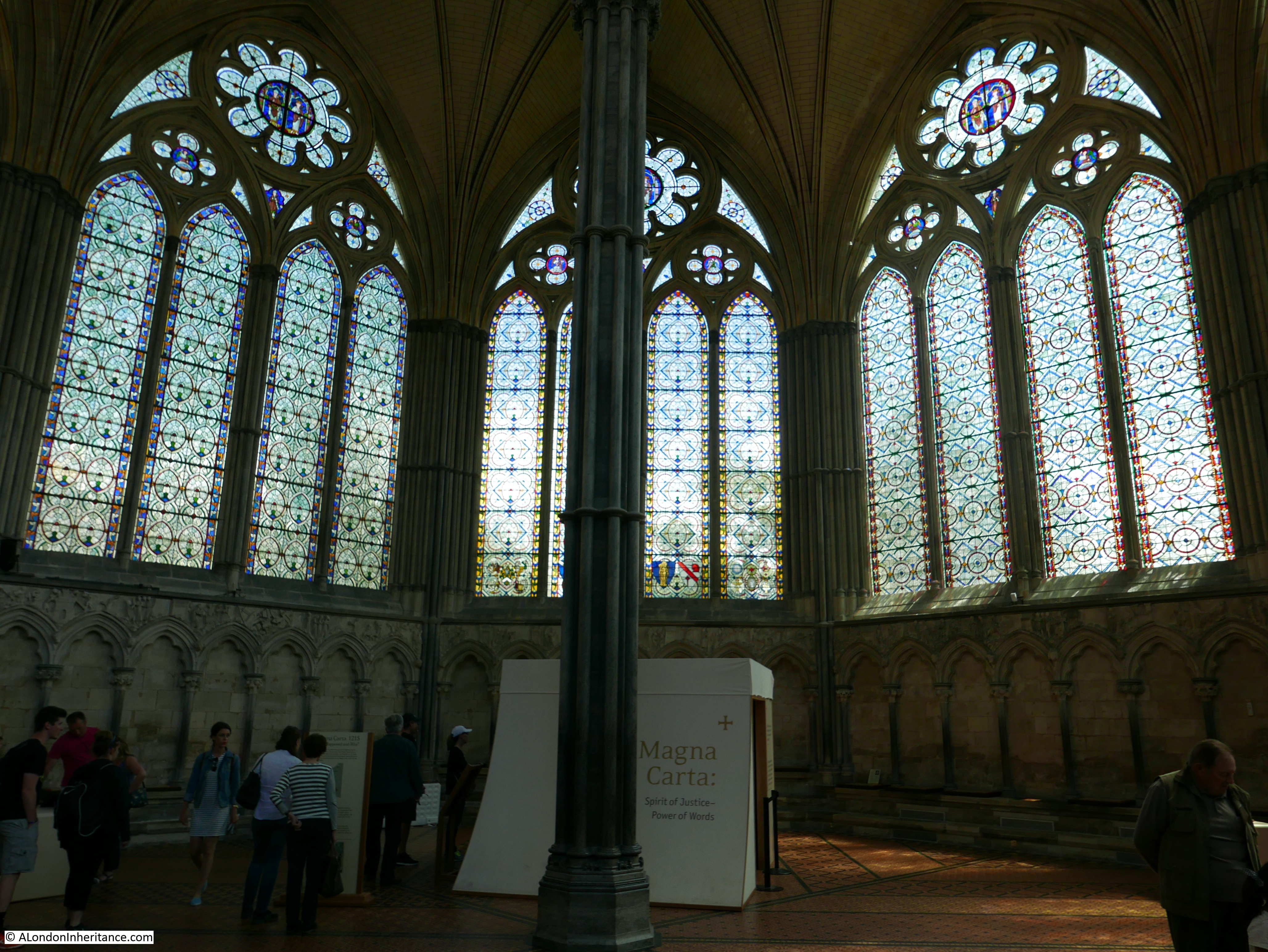
The Chapter House of the cathedral had on display Salisbury Cathedral’s copy of the original 1215 Magna Carta. This is apparently the best of the four remaining copies and is protected within a small viewing gallery in the centre of the Chapter House so that the copy is protected from light. I have not seen the other three copies, however the copy on display is very well preserved and fascinating to see a document of such age and importance.

Salisbury

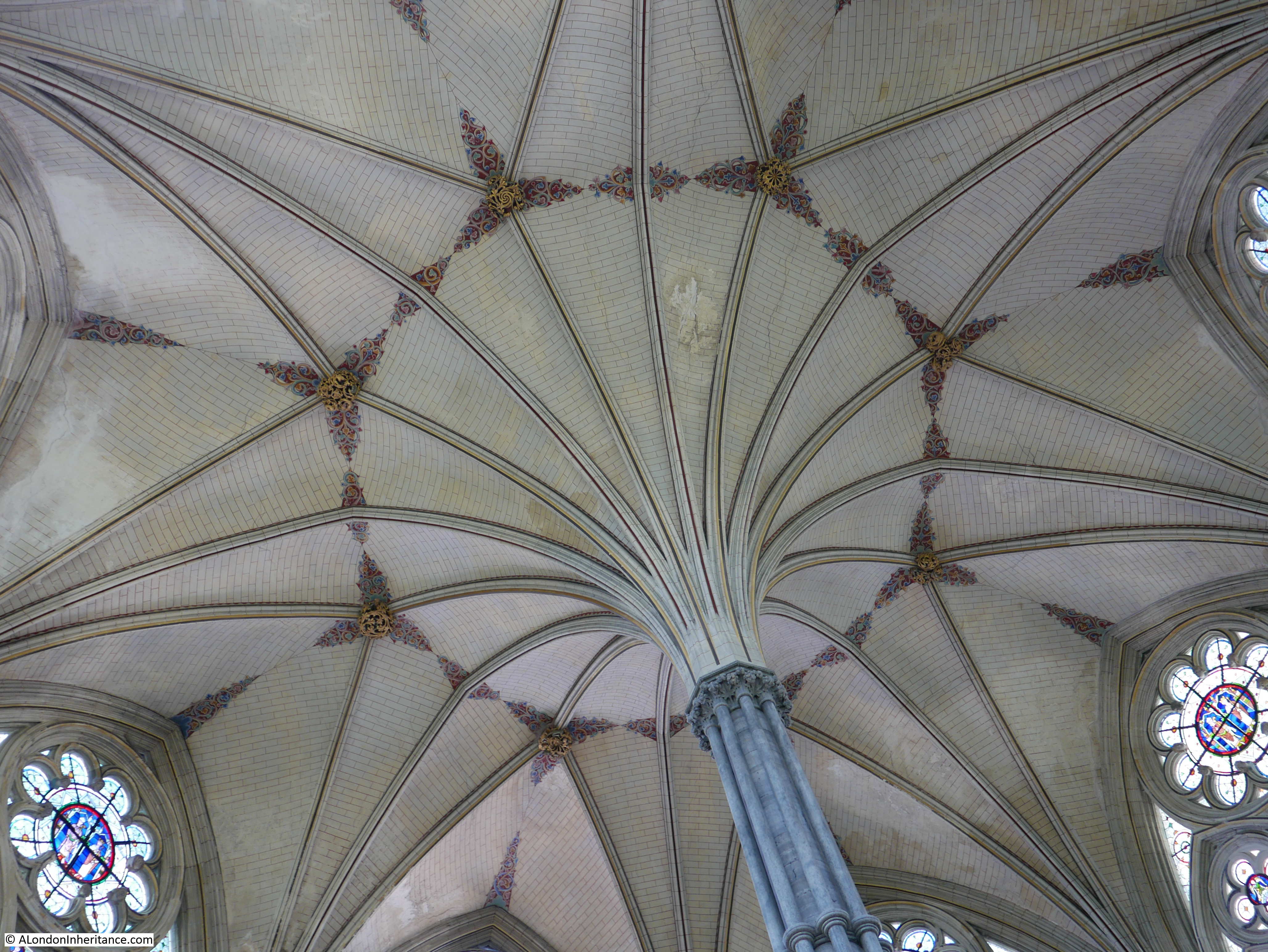
The roof of the Chapter House:

Salisbury

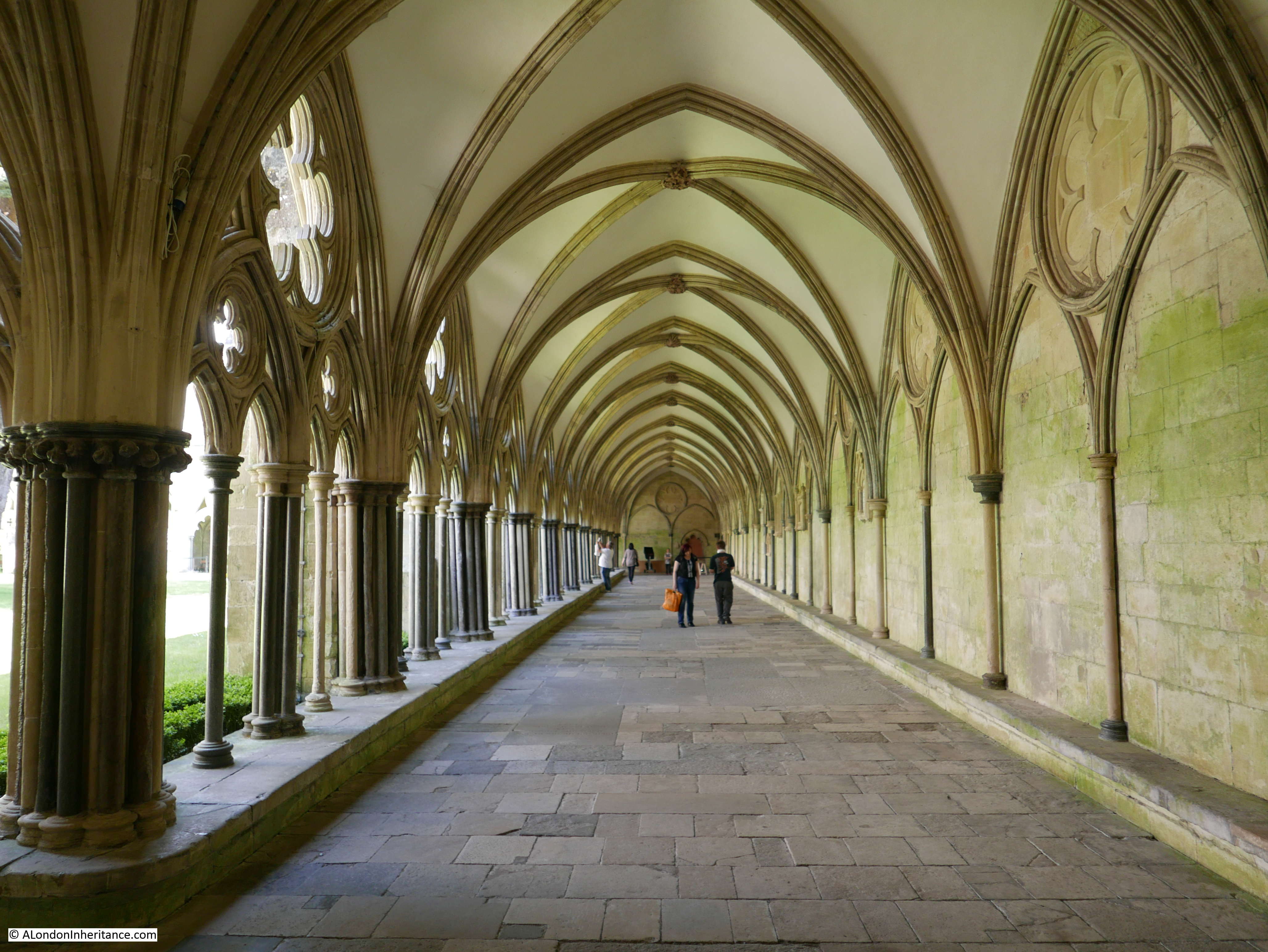
The Cloisters that run around an enclosed garden also add to Salisbury Cathedral’s list of records as they are apparently Britain’s largest Cloisters, and having walked along all sides I was in no position to argue.

Salisbury

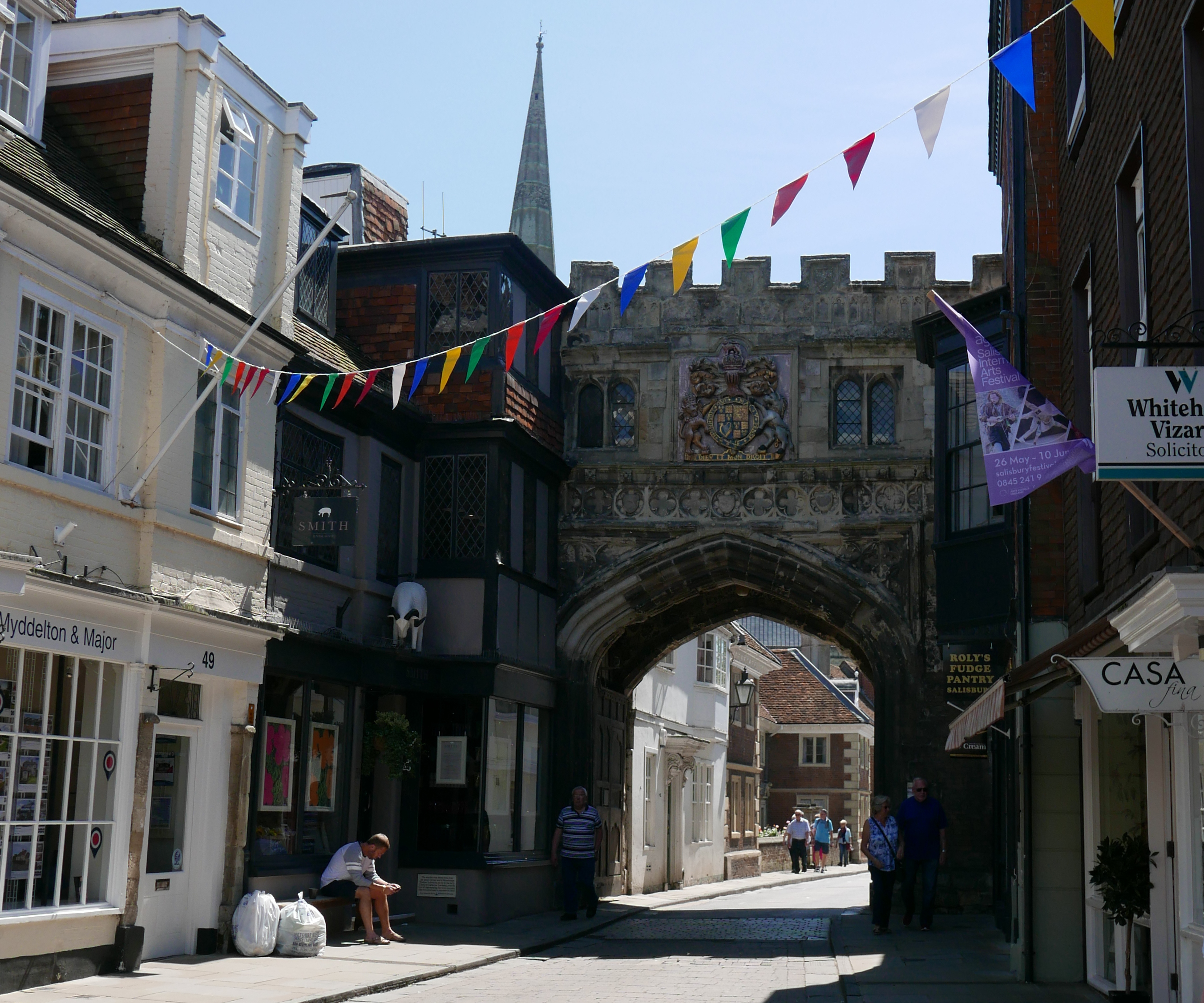
Leaving the cathedral, I walked back through the Cathedral Close to see the other side of the High Street Gate.

Salisbury

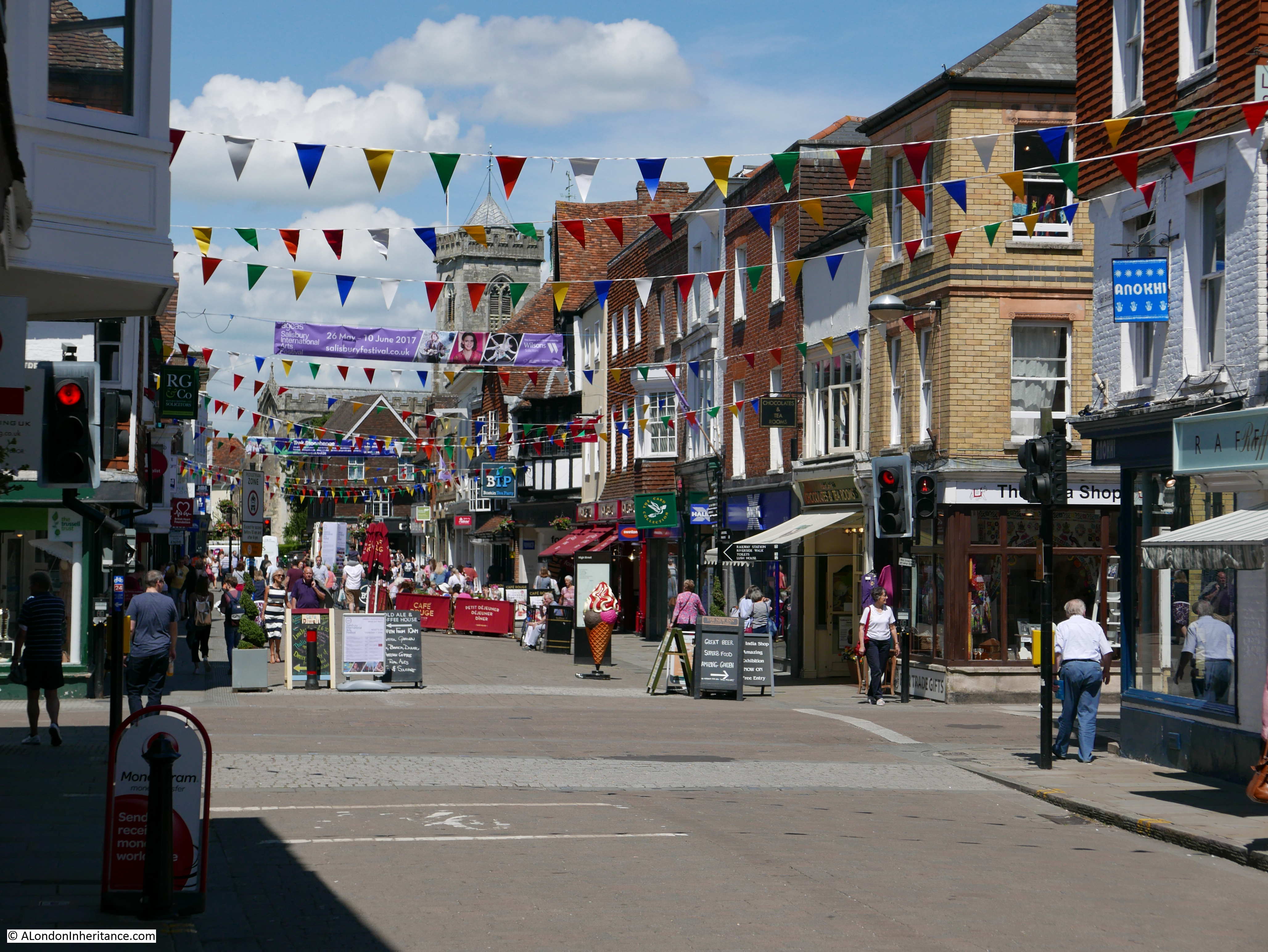
The view down the High Street provides the impression of a small town decked out for summer.

Salisbury

Salisbury today has an affluent feel, although this has not always been the case for the many visitors who have descended on the city. Writing in 1934. J.B. Priestley in English Journey describes his arrival in Salisbury:

“So we descended upon Salisbury. Once in the city, I could not see the cathedral, but I saw the Labour Exchange and, outside it, as pitiful a little crowd of unemployed as ever I have seen. No building cathedrals for them, poor devils: they would think themselves lucky if they were given a job helping to build rabbit-hutches. We ran into the big square, into which coaches like ours were coming from all quarters, and anchored off Oatmeal Row.”

At the end of the High Street, turning right into Silver Street takes me back to the Poultry Cross.

Salisbury

I walked past the cross, along the now pedestrianised Butcher Row, then into Fish Row (wonderful names that indicate the trades that once worked in these streets),

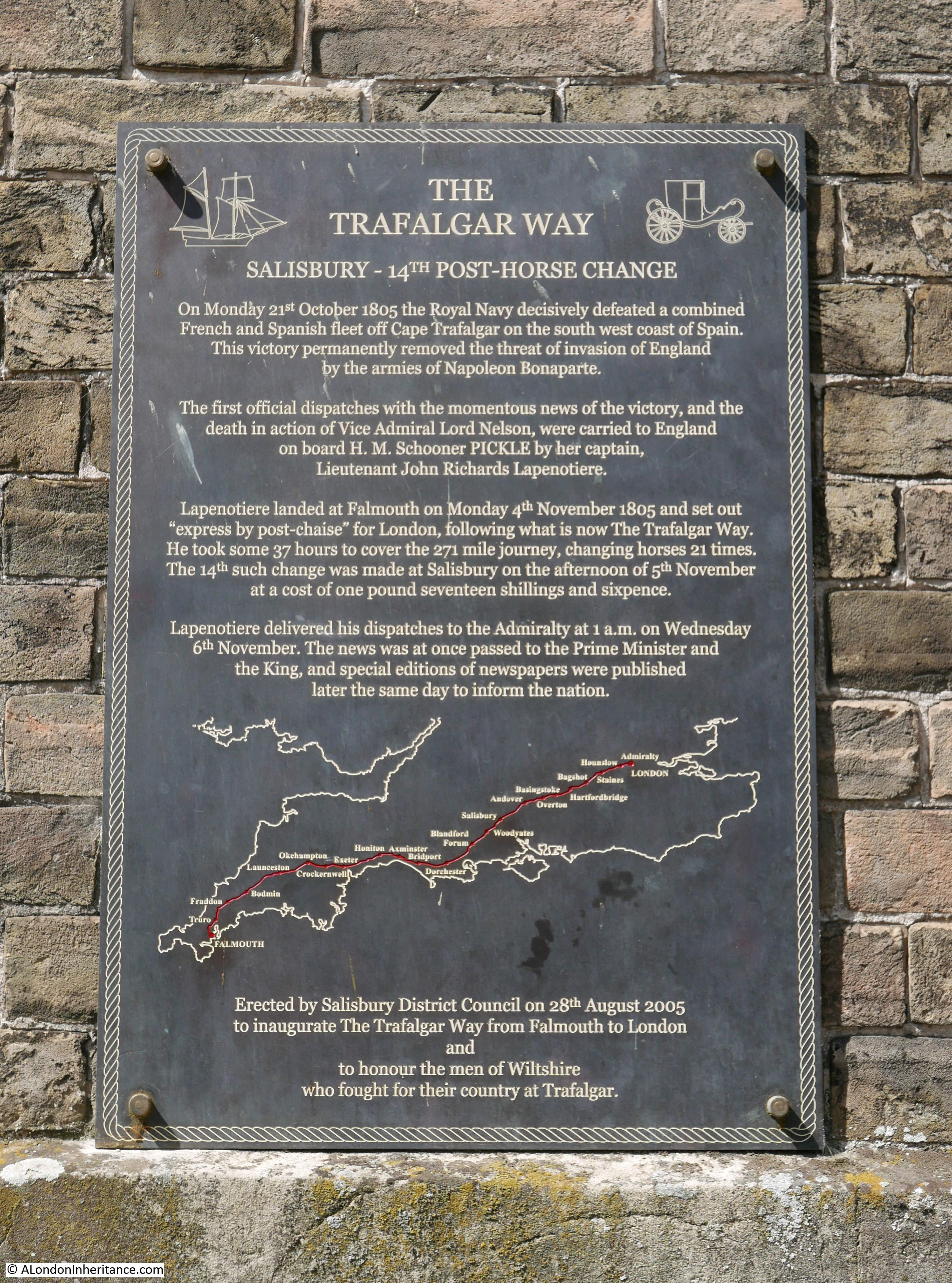
It was in Fish Row that I found a connection to London, a plaque commemorating the dash by Lieutenant John Richard Lapenotiere from Falmouth to London in November 1805 to inform the Admiralty of the victory at Trafalgar and the death of Lord Nelson.

The plaque records that it took 37 hours to cover the 271 miles between Falmouth and London with 21 changes of horse, Salisbury being the 14th change of horse on the afternoon of the 5th November 1805.

Salisbury

There are apparently many more plaques marking the route taken by Lieutenant Lapenotiere from Falmouth to London including a number of plaques in London which I have not noticed before, however the wonderful London Remembers site has found them.

My visit to Salisbury was all too brief, it is a fascinating city which deserves more time. I shall have to return, however I am pleased to have found three more of my father’s photos outside of London.

alondoninheritance.com

West End Theatres – Donmar to Palladium

A bit later than planned, however here is part two of my walk around the theatres of London’s West End on Saturday 27th May 2017. My earlier post covered the background and why I wanted to complete this walk and in part two I continue with my next theatre, the Donmar Warehouse, before walking to all the remaining theatres in the West End, finishing at the London Palladium.

The following interactive map shows all the theatres covered in my two posts:

Error: The map ID (2) does not exist


The Donmar Warehouse

After leaving the New London Theatre in Drury Lane, I then headed back to Seven Dials and in Earlham Street found the Donmar Warehouse:West End

The Donmar Warehouse occupies a building that, as the name suggests, was a former warehouse providing storage for the nearby Covent Garden market.

Donmar is derived from the first three letters of Donald Albery’s first name (the theatre producer who purchased the building in 1961) and the first three letters of his wife’s middle name of Margaret.

Donald Albery’s son Ian converted the building into a rehearsal space.

In 1977 the building was purchased by the Royal Shakespeare Company who converted the space into a small theatre for workshops and productions open to the public.

In 1990 Roger Wingate acquired the building and two years later it reopened as the Donmar Warehouse.

It continues to operate as a small, independent theatre, one of the West End’s smallest with a seating capacity of 251.

The Donmar Warehouse was presenting The Resistable Rise of Arturo Ui

Cambridge Theatre

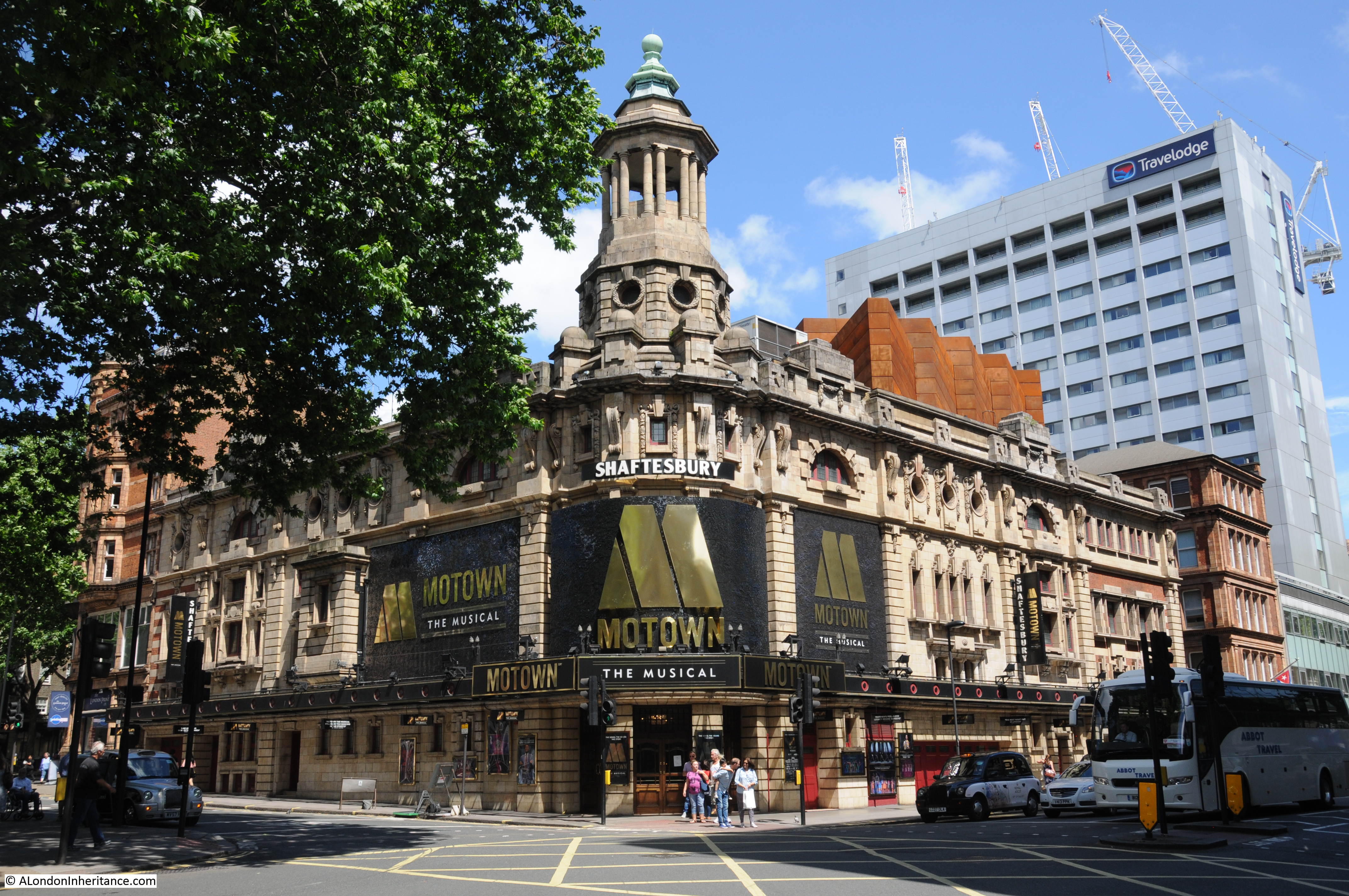
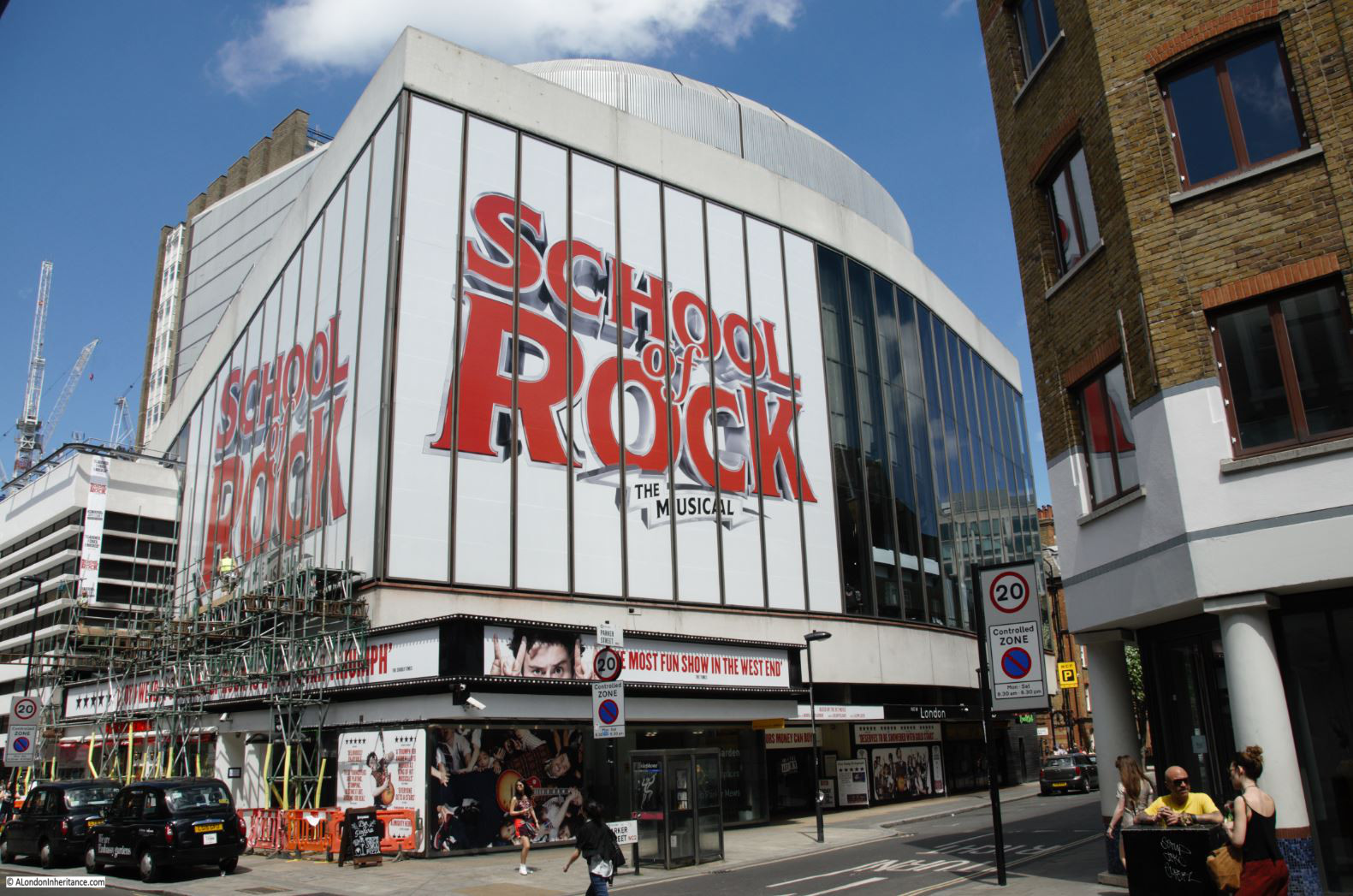
From the Donmar Warehouse it was a short walk along Earlham Street to find the Cambridge Theatre facing onto Seven Dials between Earlham Street and Mercer’s Walk:

West End

I am not sure what work is being carried out on the theatre building, but it was comprehensively covered scaffolding and sheeting.

The Cambridge Theatre is one of the relatively recent West End theatres having opened in 1930, since when it has hosted an almost continuous run of plays and musicals.

The Cambridge Theatre is currently showing Matilda by Roald Dahl

Tristan Bates Theatre

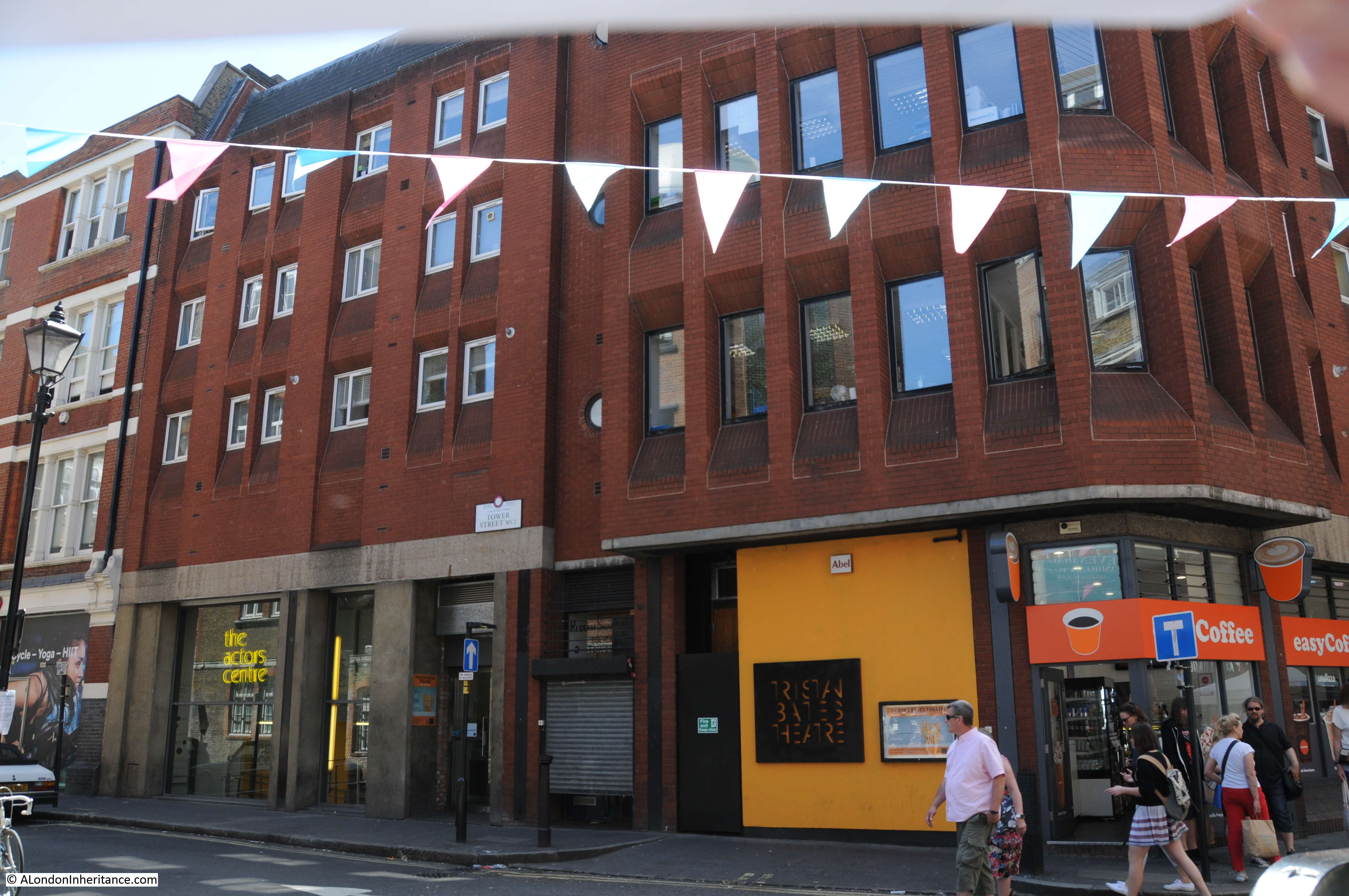
The Tristan Bates Theatre is very different to all the other theatres I have covered so far. The theatre is to be found in what appears to be an office block along Tower Street at the junction with Earlham Street:West End

The Tristan Bates Theatre is part of the Actors Centre, an organisation set up in 1978 to support actors throughout their careers. The Actors Centre moved to the current location in 1994. At this time the actor Sir Alan Bates became a Patron and the Tristan Bates Theatre was set-up as part of the new location. The theatre is named after his son Tristan who had died at the age of 19 in 1990.

The Ambassadors Theatre

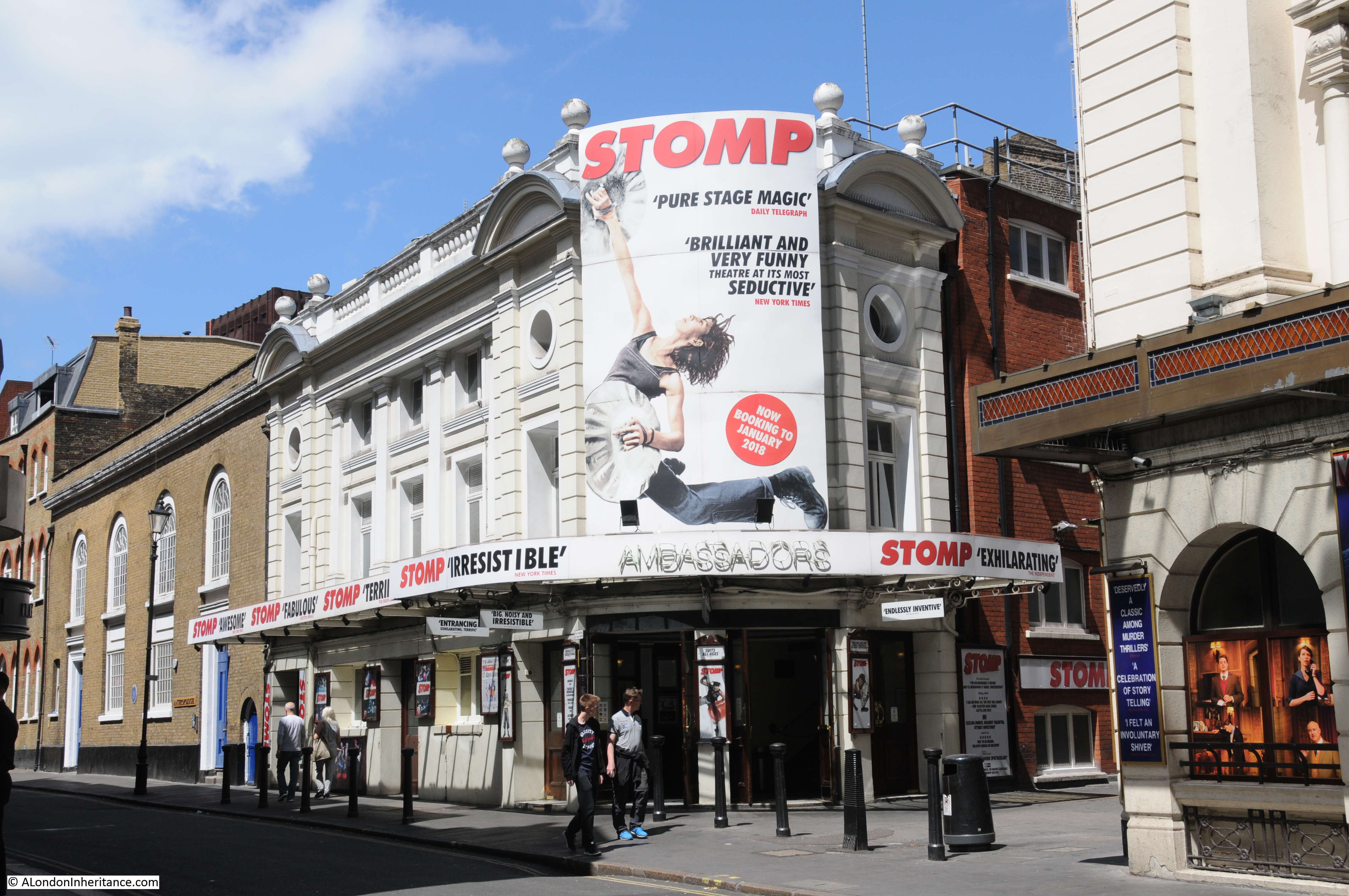
From the Tristan Bates Theatre I then walked along Shaftesbury Avenue and down West Street to find the Ambassadors Theatre:West End

The Ambassadors Theatre was opened in June 1913 and has been run as a theatre since this time. The only period of change was for a short time during the late 1990s when the theatre was converted into two performance spaces allowing the Royal Court Theatre to be resident for three years. After the conversion back to a single performance space the theatre was renamed the New Ambassadors Theatre, but reverted back to the original name by dropping the “new” in 2007.

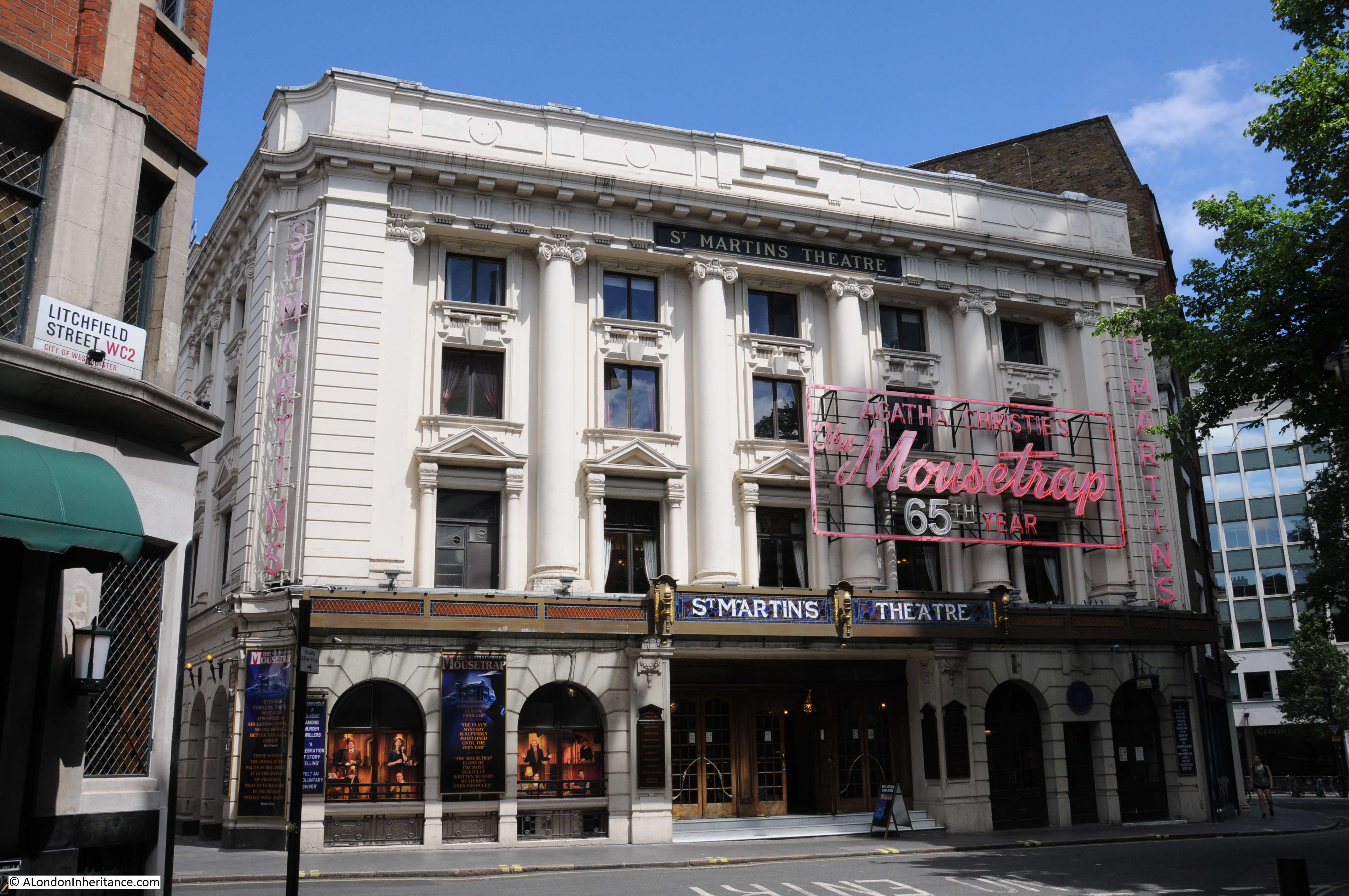
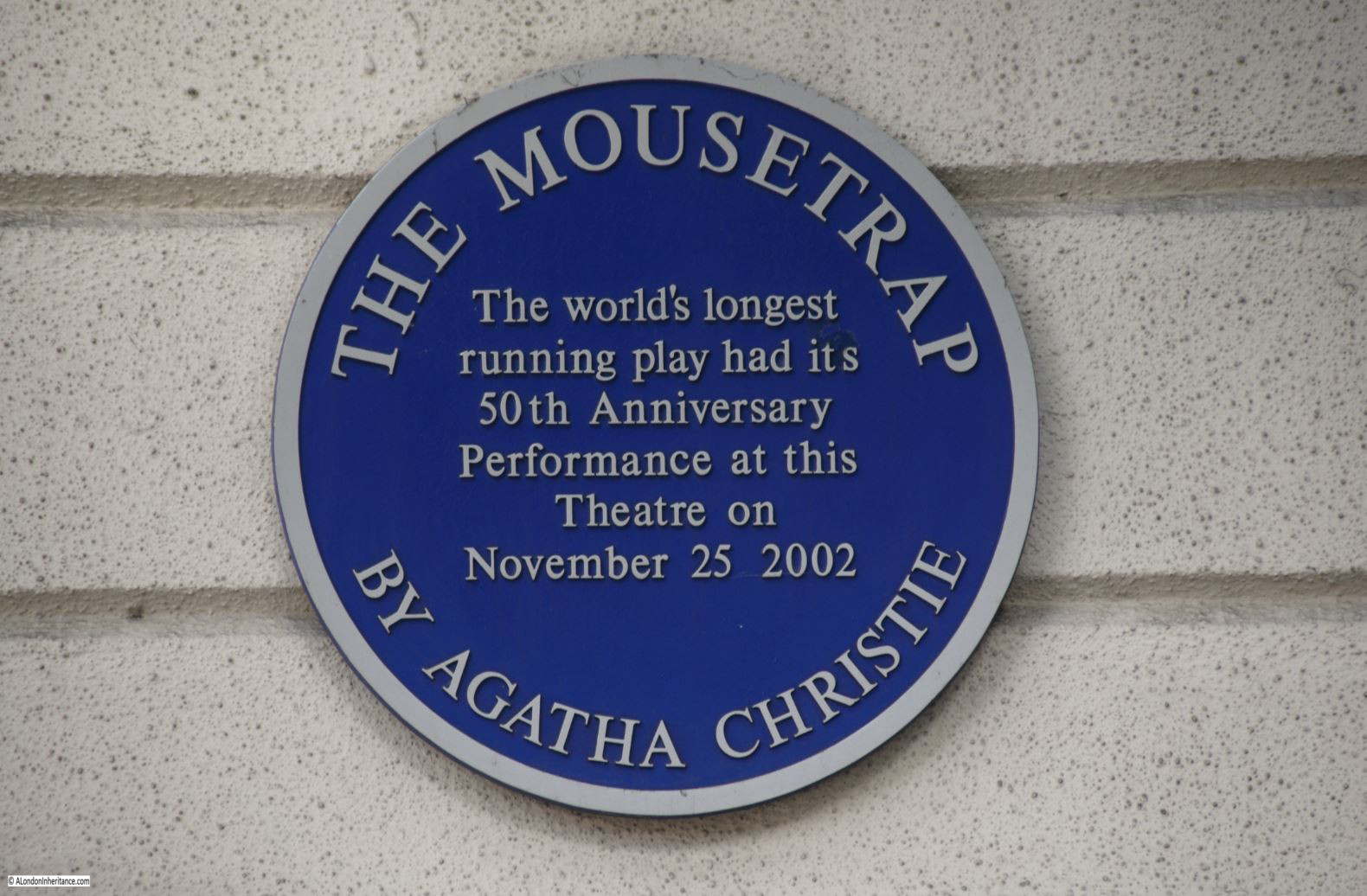
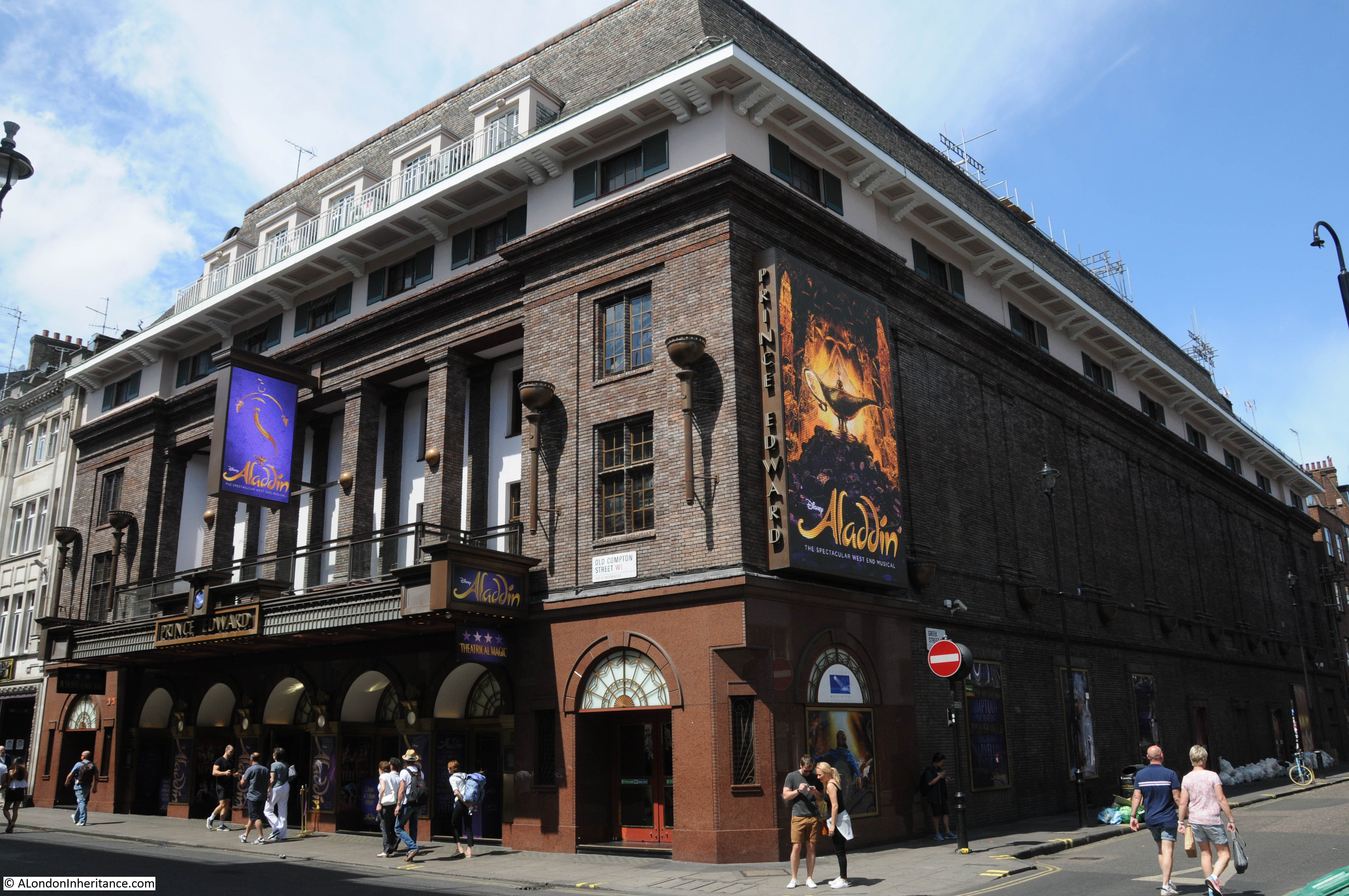
The St. Martin’s Theatre which is next door to the Ambassadors is best known for being the home of the long running play The Mousetrap, however The Mousetrap actually started its long run of performances at the Ambassadors Theatre, opening on the 25th November 1952 and continuing at the Ambassadors until 1973 when The Mousetrap moved to the theatre next door.

The Ambassadors Theatre is currently showing Stomp.

The St Martin’s Theatre

The St Martin’s Theatre is adjacent to the Ambassadors Theatre, separated by the alley way of Tower Court:West End

The St. Martin’s Theatre was designed by W.G.R. Sprague who was also responsible for the design of the Ambassadors, although St Martin’s opened three years later in 1916 with construction having been delayed by the start of the 1st World War.

The St. Martin’s Theatre is best known for the long running play by Agatha Christie, The Mousetrap and a plaque on the theatre commemorates the 50th anniversary performance in 2002, however the plaque is possibly not quite clear as for almost the first half of these 50 years The Mousetrap was playing at the adjacent theatre.West End

The Arts Theatre

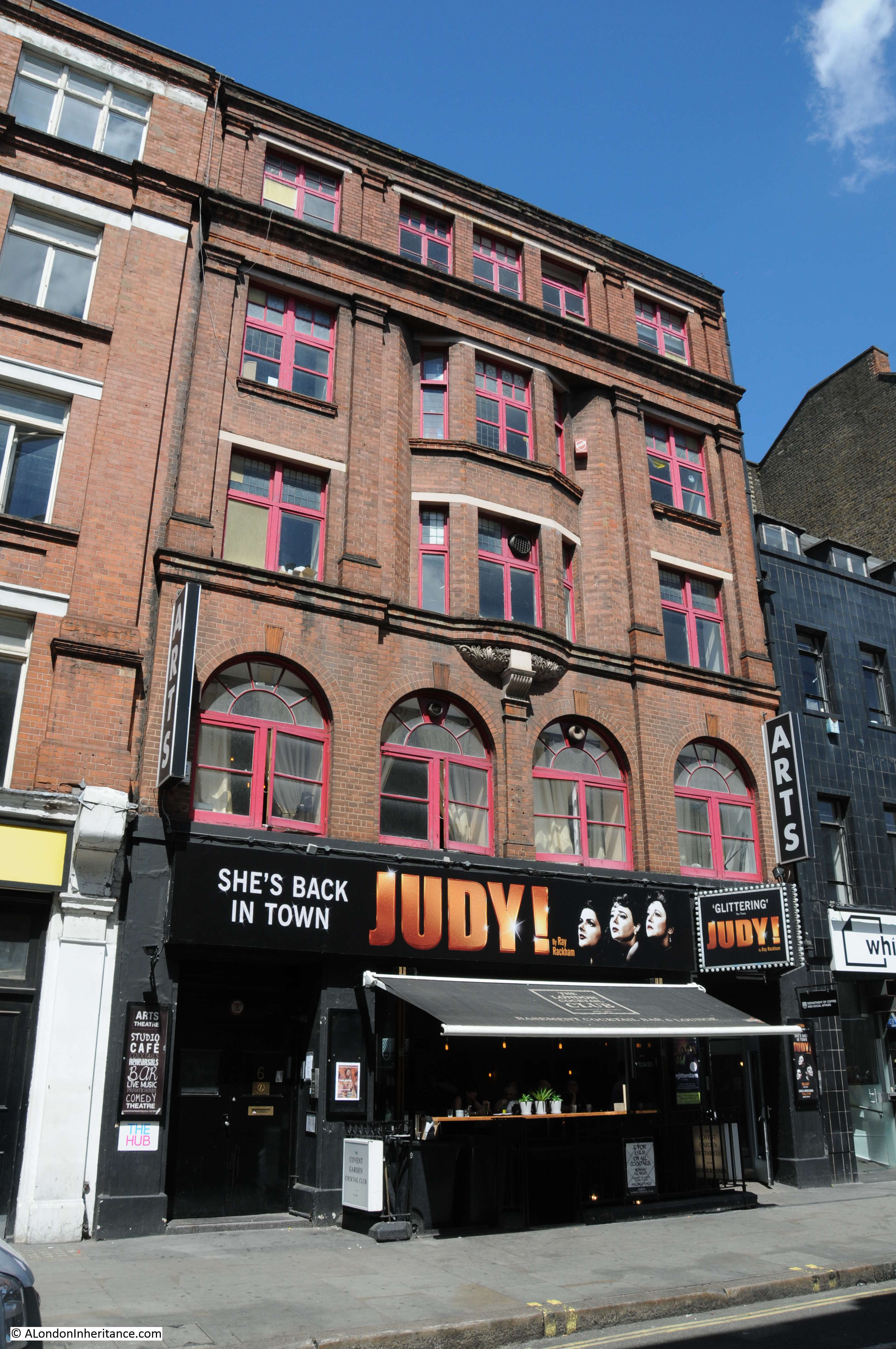
A walk down Upper St. Martin’s Lane took me to Great Newport Street and the Arts Theatre:West End

The Arts Theatre was opened in 1927 as a private members club. This enabled the theatre to bypass censorship by the Lord Chamberlain.

The Arts Theatre is one of the smaller West End theatres with a maximum capacity of 350.

The Arts Theatre is currently showing Judy!

Wyndham’s Theatre

From Great Newport Street then down Charing Cross Road to the Leicester Square Underground Station where I found Wyndham’s Theatre:West End

Wyndham’s Theatre opened in 1899 and is named after the original owner of the theatre, the actor – manager Charles Wyndham. It was designed by the prolific theatre designer W.G.R. Sprague, who as well as being responsible for St. Martin’s and the Ambassadors which I have covered above, also designed the Noel Coward Theatre, the Aldwych, Novello, Gielgud and Queen’s Theatres.

Although hard to see due to the large tree that is covering part of the theatre facade, it has a lovely symmetrical design. The original design for the theatre included a winter garden on the roof space, however council approval for this feature was not granted so what would have been a rather unique feature for a West End Theatre did not get built.

Wyndham’s Theatre is currently showing Don Juan in Soho

Leicester Square Theatre

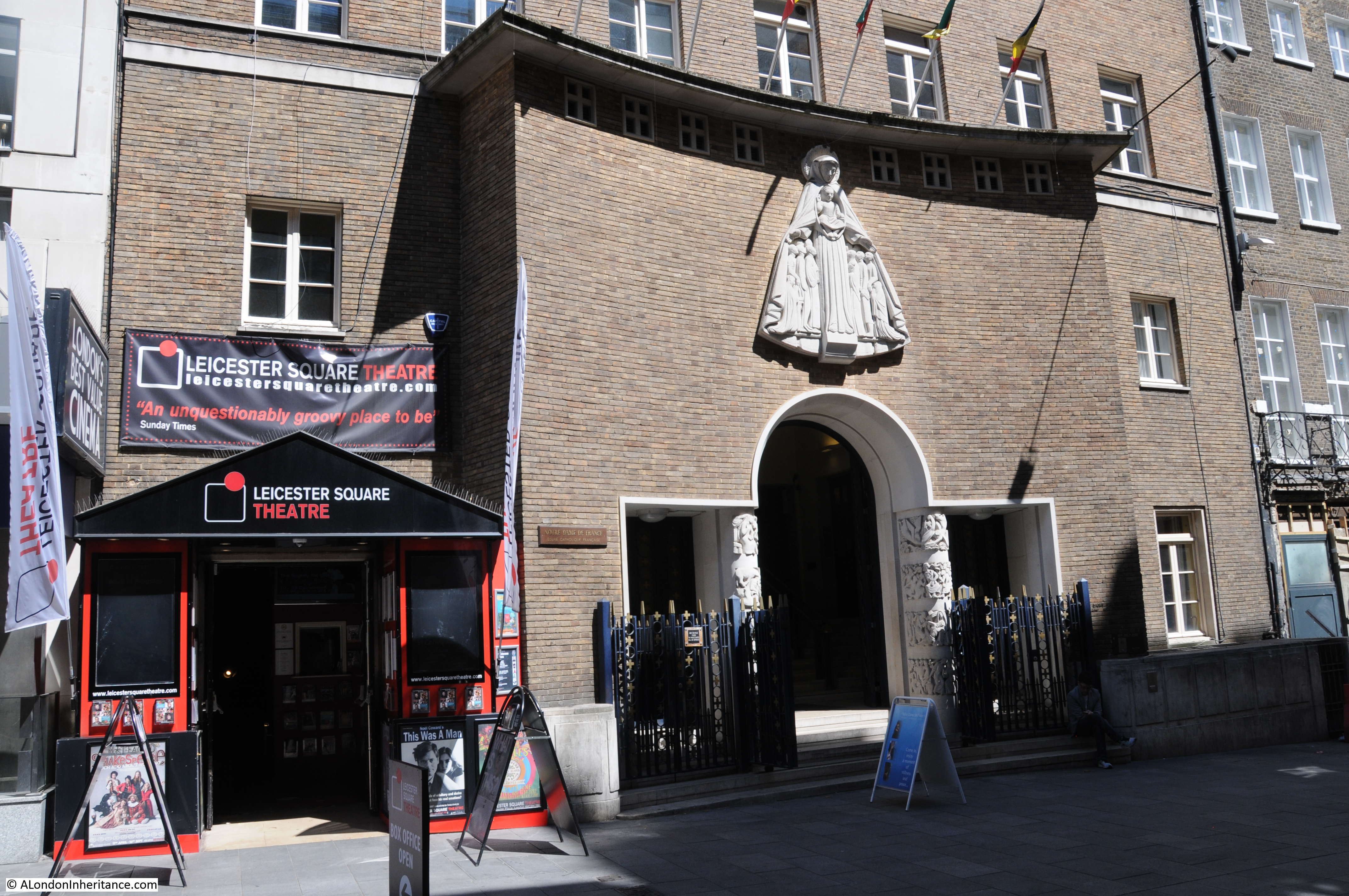
The Leicester Square Theatre is not in Leicester Square, but can be found up the side street of Leicester Place:West End

The Leicester Square Theatre is rather unusual as the theatre entrance is part of the church of Notre Dame de France.

The church is a French Catholic church consecrated in 1868 to serve the large French community of the area. The church was damaged badly during the war and went through a number of restorations and rebuilds with the main rebuilding being completed between 1953 and 1955.

The area occupied by the Leicester Square Theatre was used as a French cultural centre after the rebuild, but changed use in the 1960s to become a music venue hosting bands such as the Rolling Stones and the Who and in 1979 it was the location for the first performance of “London Calling” by the Clash – an album that seemed to perfectly sum up the final years of the 1970s.

It opened as the Leicester Square Theatre in 2008 and hosts a wide variety of performances including music and comedy.

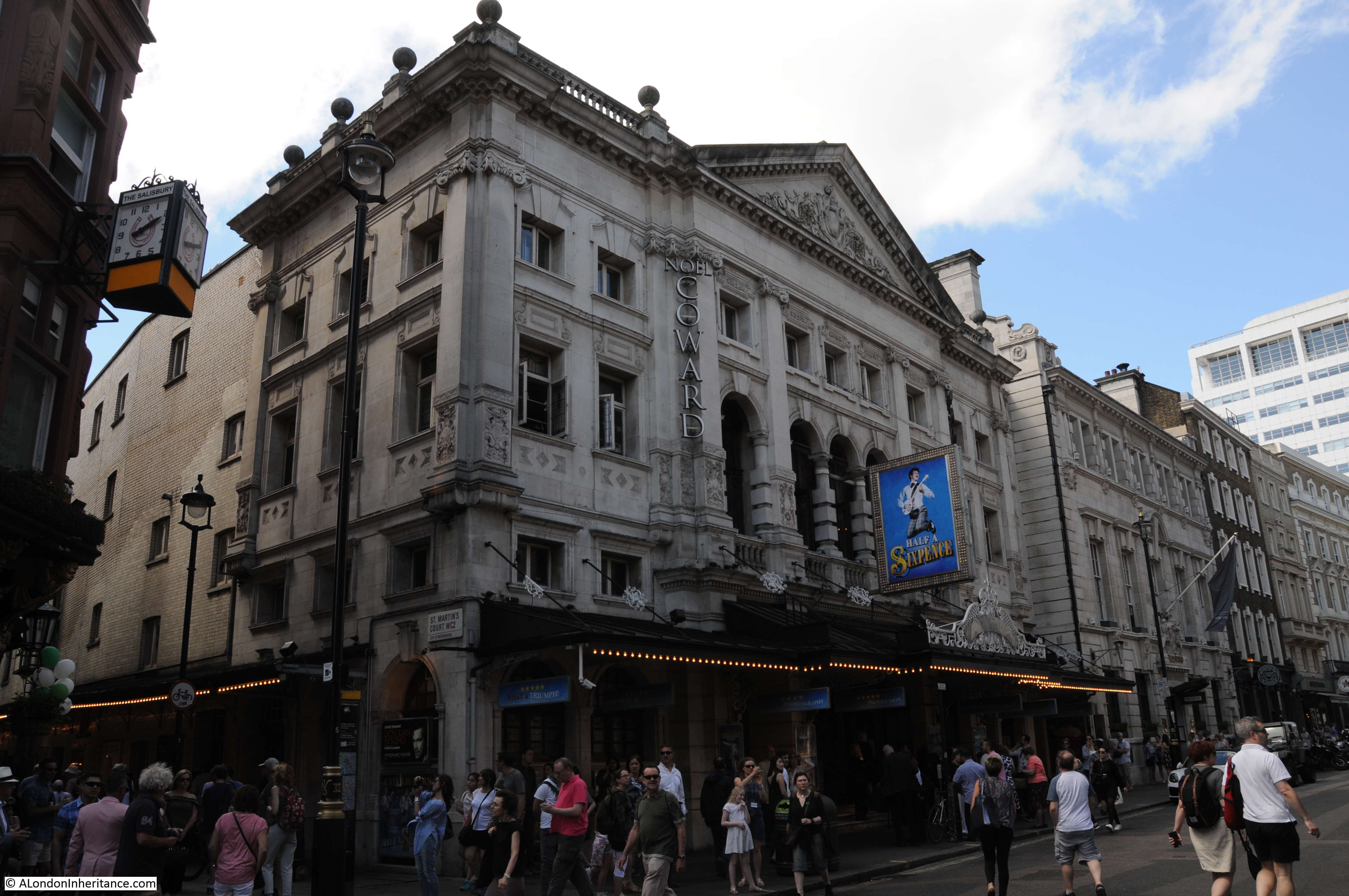
Noel Coward Theatre

Back to Charing Cross Road, cross over to walk along St. Martin’s Court to reach St. Martin’s Lane and the Noel Coward Theatre:West End

The Noel Coward Theatre has been through a couple of name changes since it opened in 1903 as the New Theatre. The first production at the New Theatre was “Rosemary” in which Charles Wyndham (the original owner of Wyndham’s Theatre) and his future wife Mary Moore starred.

in 1920 Noel Coward made his debut here, but it would be several decades before the theatre took his name. In 1973 the theatre changed name from the New to the Albery after the son of Mary Moore, Bronson Albery who was a long standing manager of the theatre. Bronson was born during Mary’s earlier marriage to the dramatist James Albery who had died in 1889.

West End theatre in the couple of decades before and after 1900 seems to have been a very close knit community with the same names coming up for theatre design, theatre owners, actors and managers.

The theatre finally changed name to the Noel Coward Theatre on the 1st June 2006, so it has only had this name for a relatively short 11 years in the 114 year history of the theatre.

The Noel Coward Theatre is currently showing Half A Sixpence.

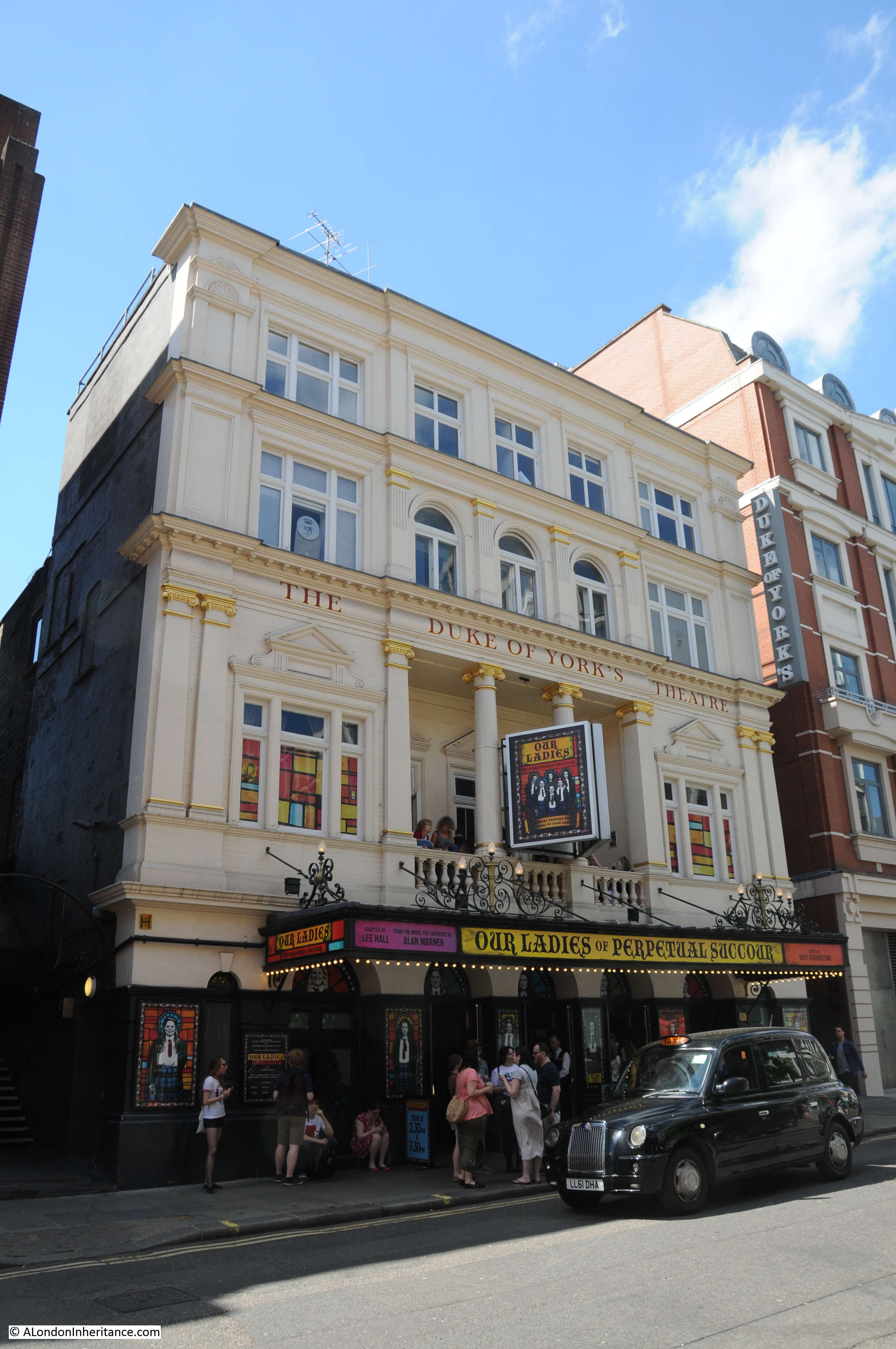
The Duke of York’s Theatre

Also in St Martin’s Lane is the Duke of York’s Theatre:West End

The theatre opened in 1892 and was known for a very short period as the Trafalgar Square Theatre, before changing name in 1895 to the Duke of York’s Theatre for the future king, George V.

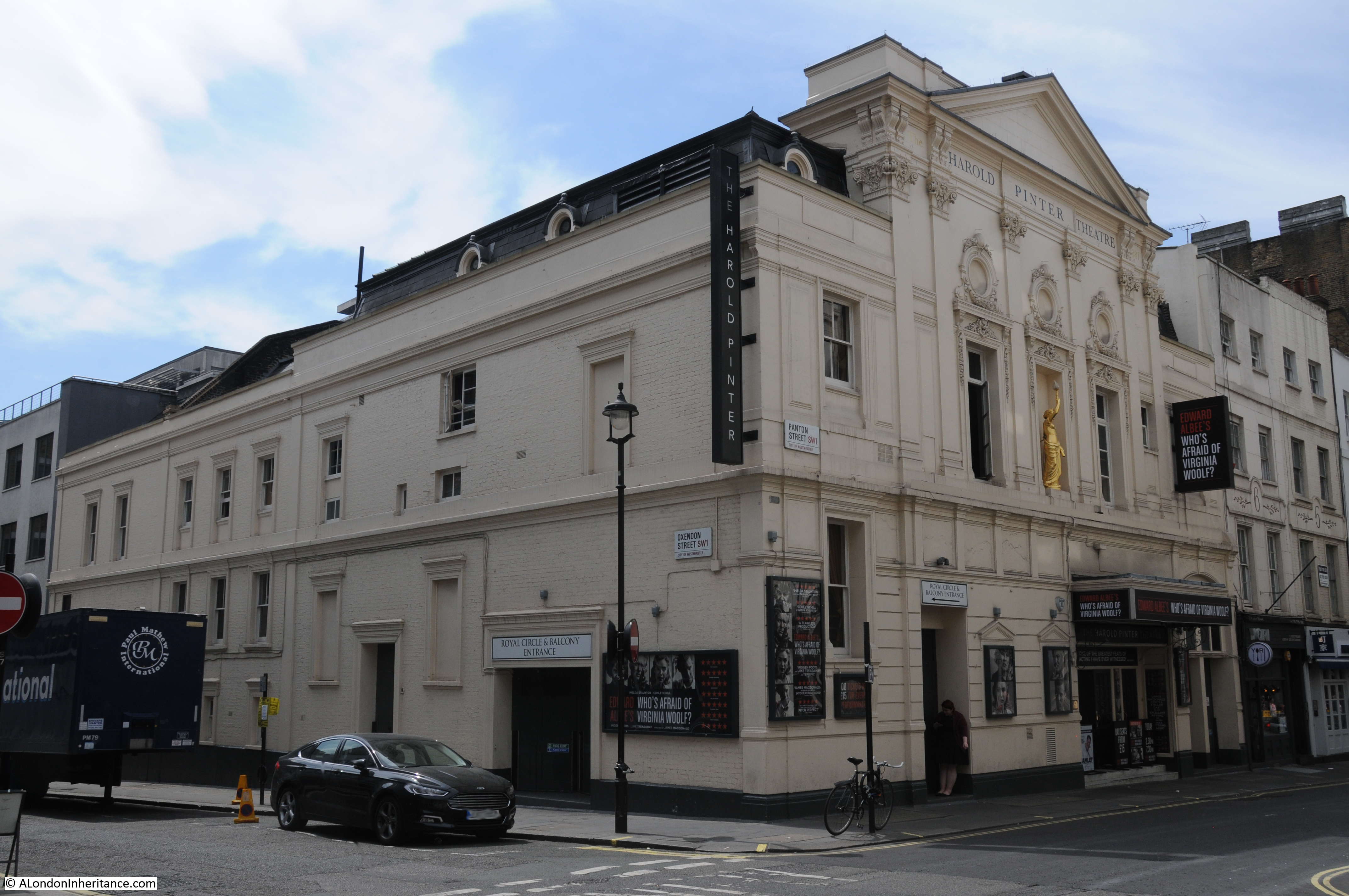
West End Theatres have been through many different types of ownership over the decades, with many theatres originally owned by individuals, often directly involved either as actors or managers. Today, the majority of theatres are owned by organisations, for example the Duke of York’s is today owned by the Ambassador Theatre Group who also own in London the Apollo Victoria, Duke of York’s, Fortune, Harold Pinter, Lyceum, Phoenix, Piccadilly, Playhouse, Savoy and Trafalgar Studios.

The Duke of York’s Theatre is unusual in that it is the only West End theatre I have found that was once owned by a radio station. From 1979 until 1992 the theatre was owned by Capital Radio.

Today, the Duke of York’s Theatre is showing Our Ladies of Perpetual Succour.

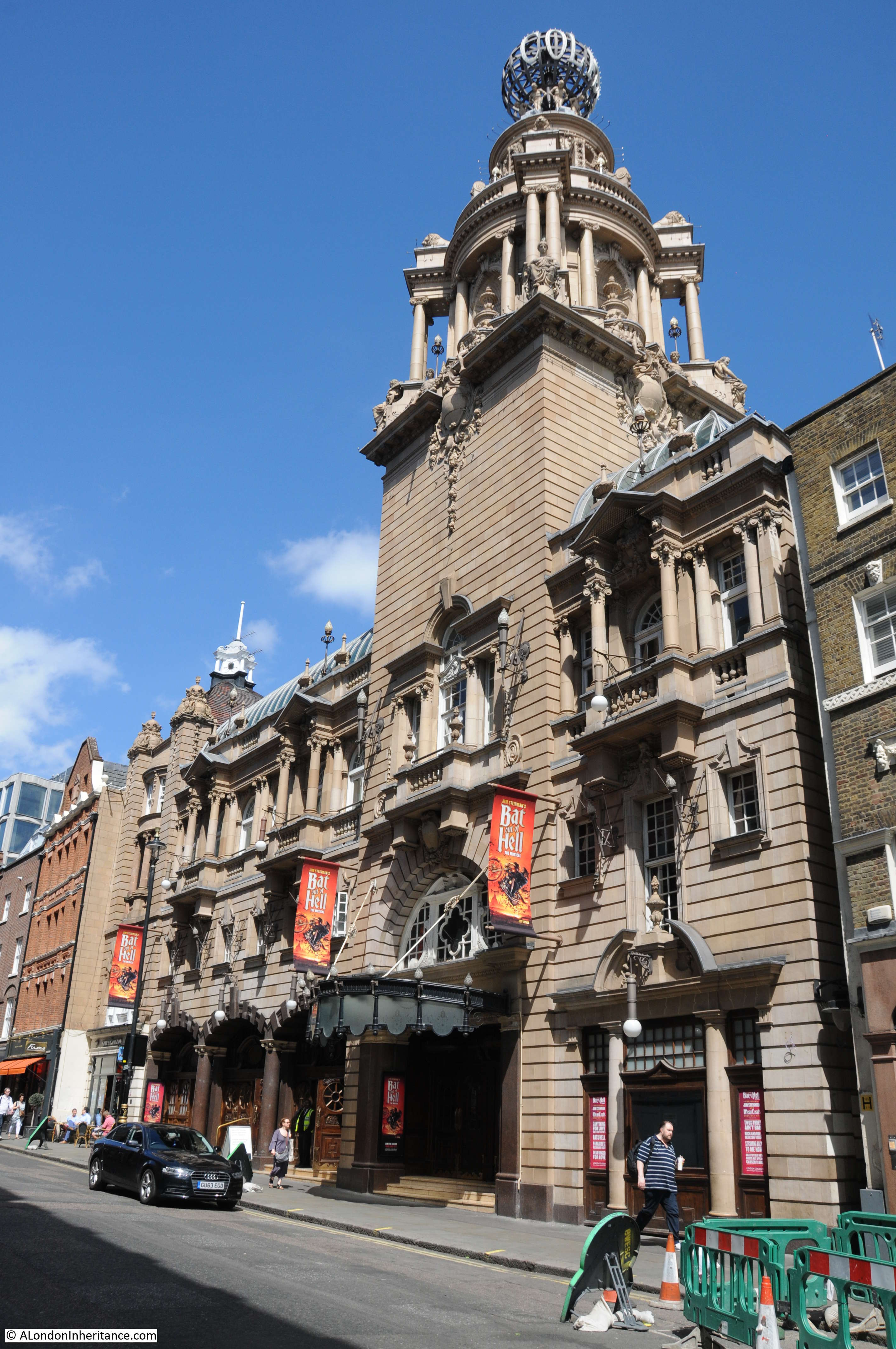
The London Coliseum

At the southern end of St Martin’s Lane is the London Coliseum:West End

The London Coliseum is perhaps better known as the home of the English National Opera and English National Ballet rather than as a traditional West End theatre, however this was not always so, and the London Coliseum has, and continues to be home to a broad range of productions.

Opened in 1904 as the London Coliseum Theatre of Varieties, the theatre was more in the tradition of music hall and variety acts and at the time held the record for the largest theatre in London with around 2,500 seats.

As with many other West End theatres, the London Coliseum has been through some changes since it opened. It has put on plays, musicals, comedies and pantomimes and for short periods has been used as a cinema.

The name has changed relatively little with “London” being dropped from the name between 1931 and 1968.

The theatre has been the West End home of the Sadler’s Wells Opera Company since 1968 when the company relocated to the London Coliseum, changing their name to the English National Opera in 1974.

The large tower above the theatre dominates the surrounding area. I assume the large globe with the name Coliseum on the top of the tower still rotates – one of those features you take for granted.

The advertising on the facade of the London Coliseum is for the June opening of the musical Bat Out Of Hell.

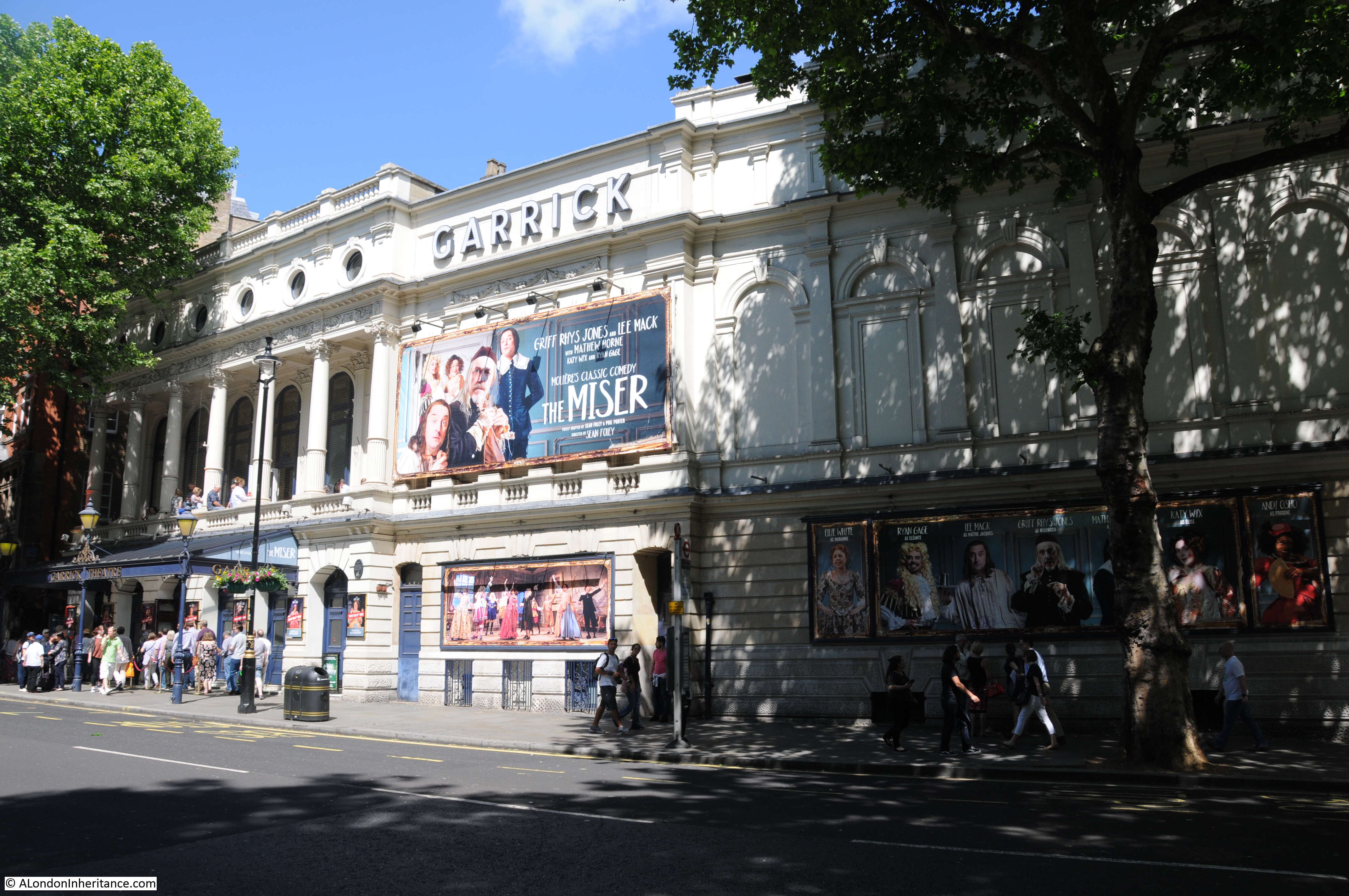
Garrick Theatre

From the London Coliseum I took a short walk back up Charing Cross Road to the Garrick Theatre:West End

The Garrick Theatre was opened in 1889 (it really is remarkable how many West End theatres were opened in the years around 1900 – the West End must have been a hive of theatrical activity around the turn of the century).

The theatre was named after the 18th century actor David Garrick and as far as I can tell, it has not changed name in the 128 years since the theatre opened. The Garrick Theatre has put on an almost continuous run of plays, musicals and comedies since opening.

The Garrick is currently showing The Miser.

The Adelphi

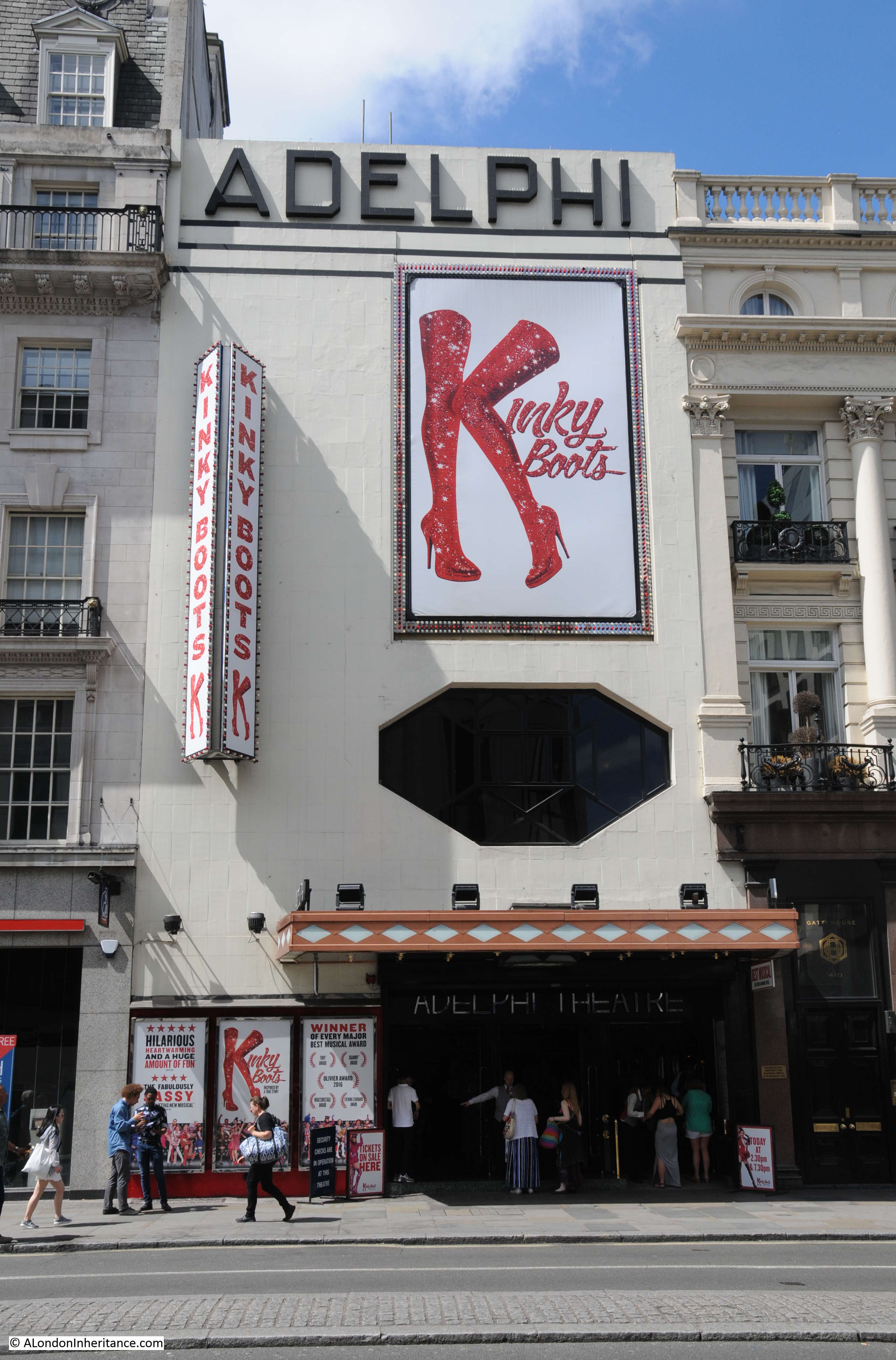
It was now time to leave the cluster of theatres around Charing Cross Road and St Martin’s Lane and head to the next cluster of theatres in Aldwych via the Strand. The first theatre in the Strand is the Adelphi:West End

There has been a theatre at the location of the Adephi since 1806. The original theatre was called the The Sans Pareil, and the name changed to the Adelphi in 1819, then the Theatre Royal, Adephi from 1829, Theatre Royal, New Adelphi to mark the construction of a new theatre building in 1858, then the Royal Adelphi Theatre.

The “Royal” was finally dropped in 1940 which is strange as I would have thought that at the peak of the last war, theatres would have wanted to maintain patriotic connections.

The current theatre building dates from 1930 and is the fourth theatre building at this location.

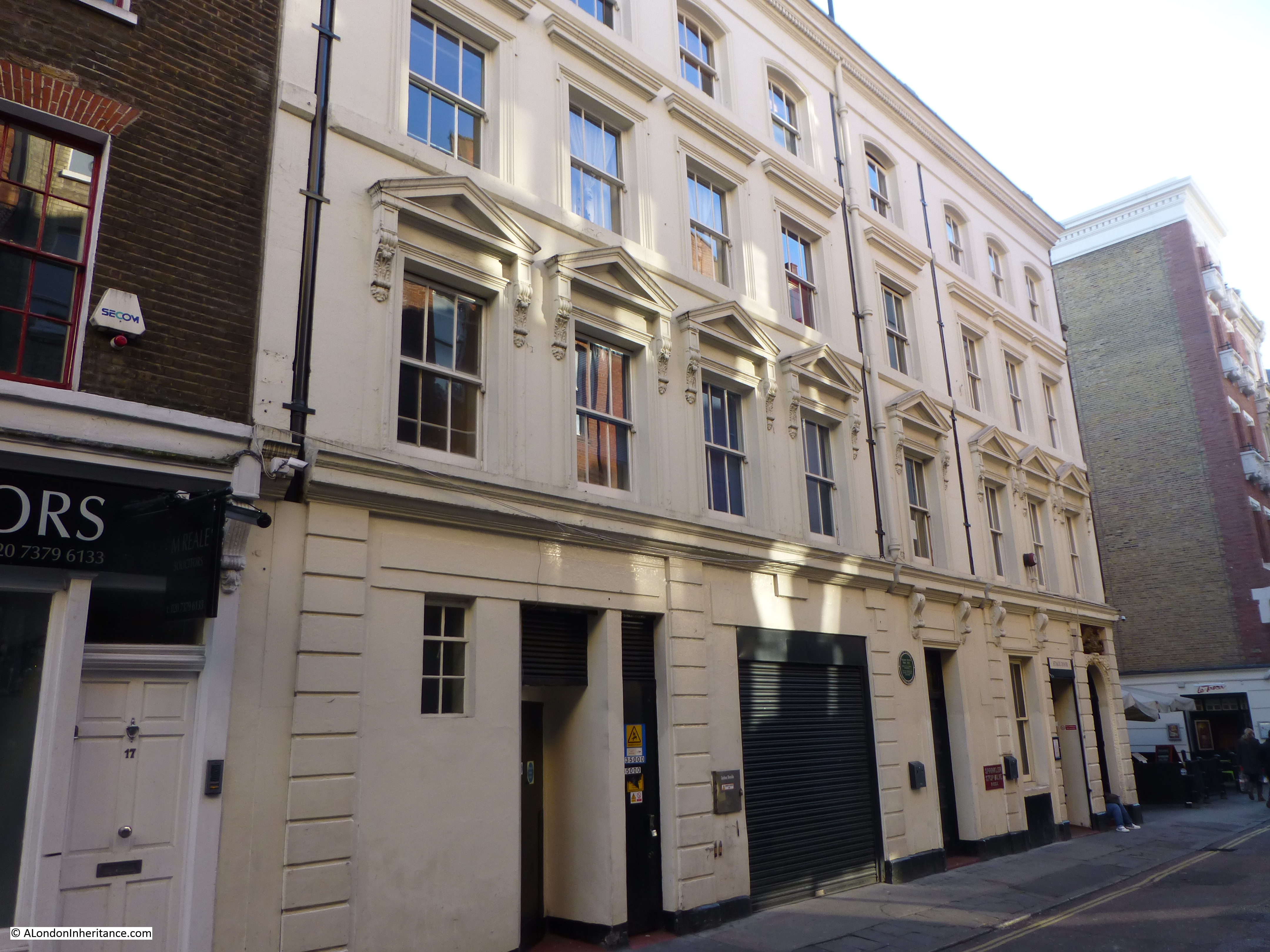
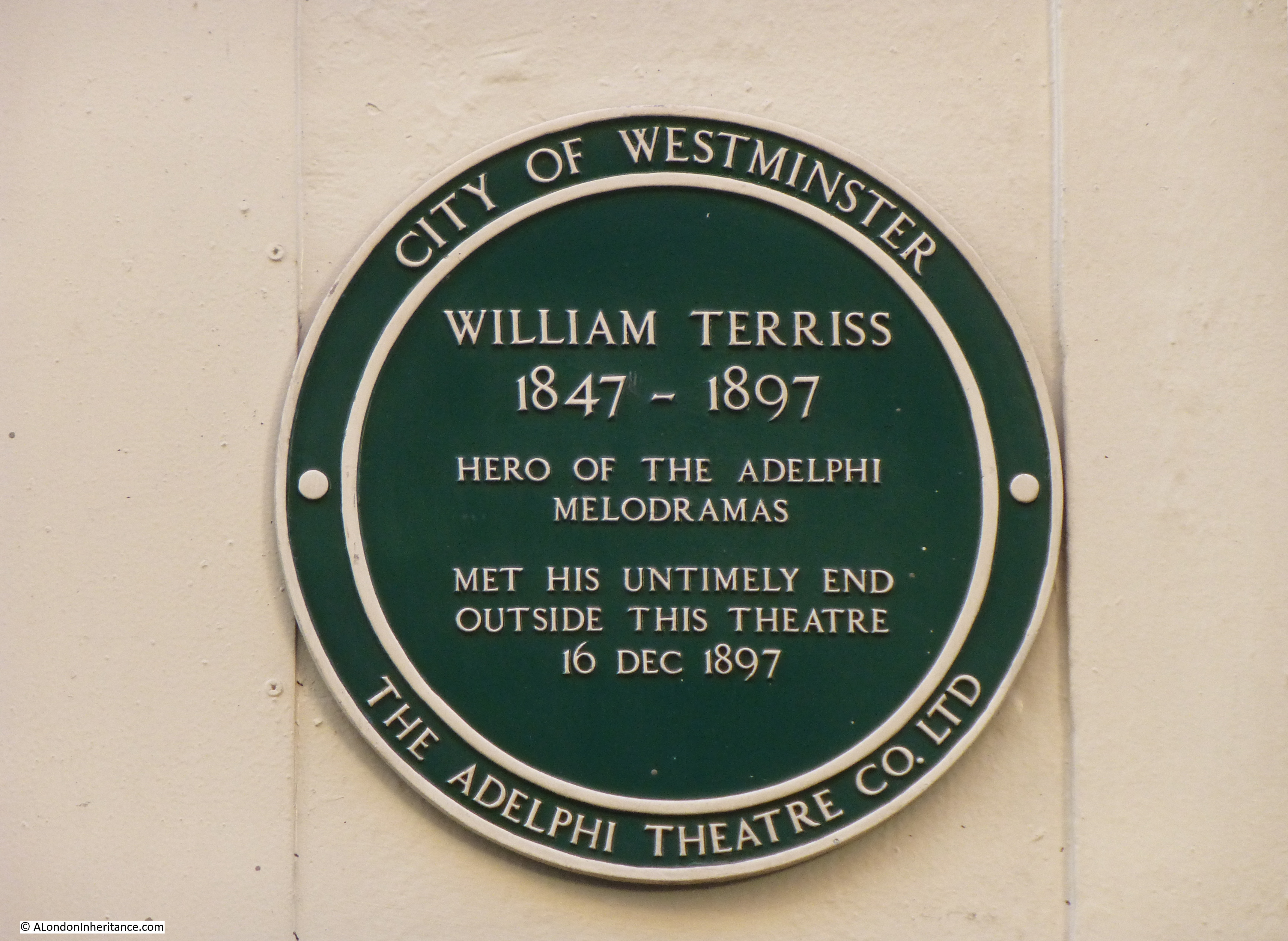
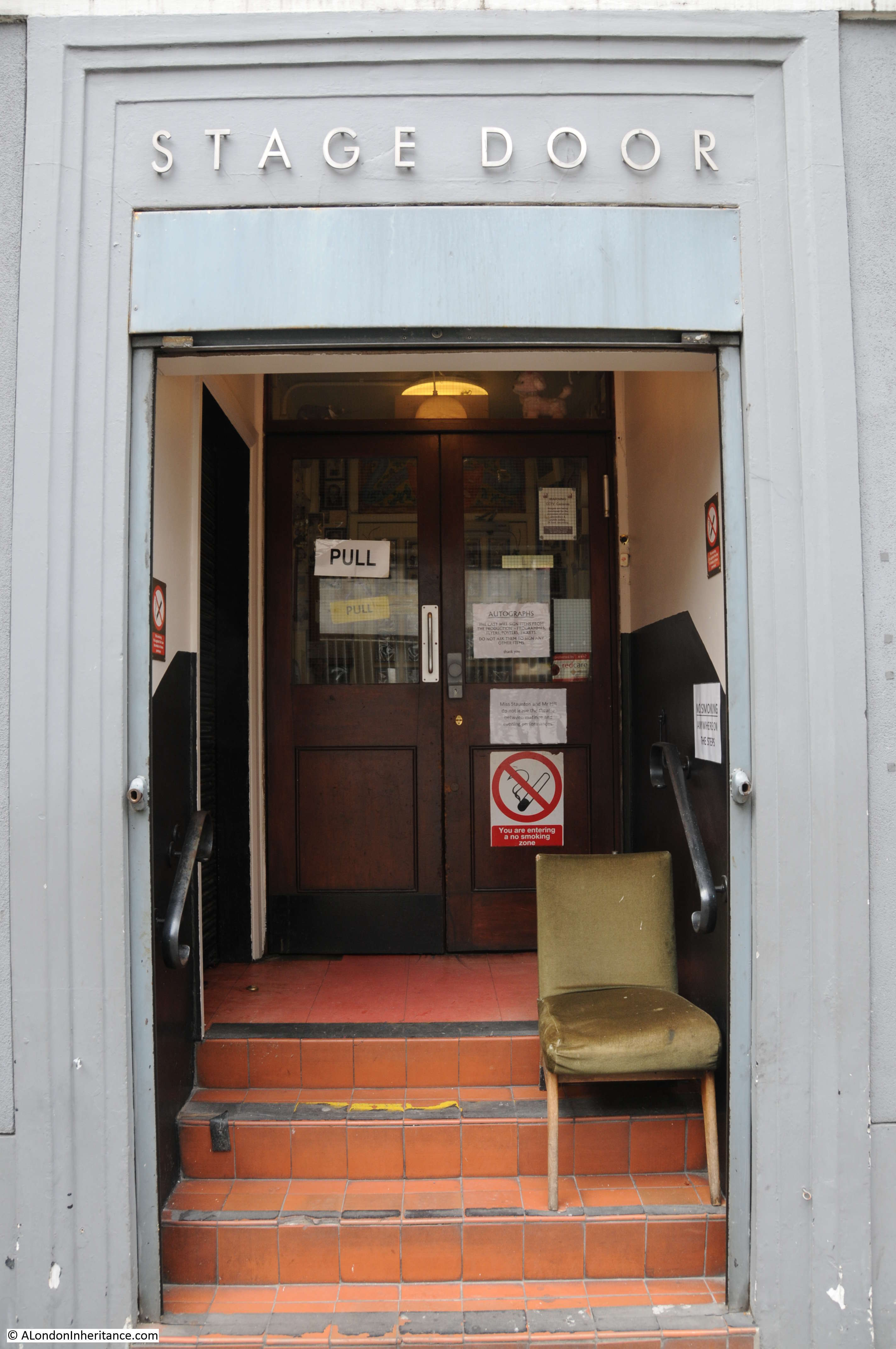
The Adelphi Theatre was the location of the murder of the actor William Terriss in 1897 who was stabbed by a fellow actor as he entered the stage door of the Adelphi Theatre at the rear of the theatre in Maiden Lane. The murderer, Richard Prince was jealous of the popularity of Terriss. Whilst he was found guilty, he was also diagnosed as insane and died in Broadmoor.West End

The Maiden Lane entrance in the photo above. The ghost of William Terris is alleged to haunt the Adelphi and the nearby Covent Garden underground station.

There is a plaque to William Terriss at the rear of the Adelphi in Maiden Lane.West End

The Adelphi Theatre is currently showing Kinky Boots.

Vaudeville Theatre

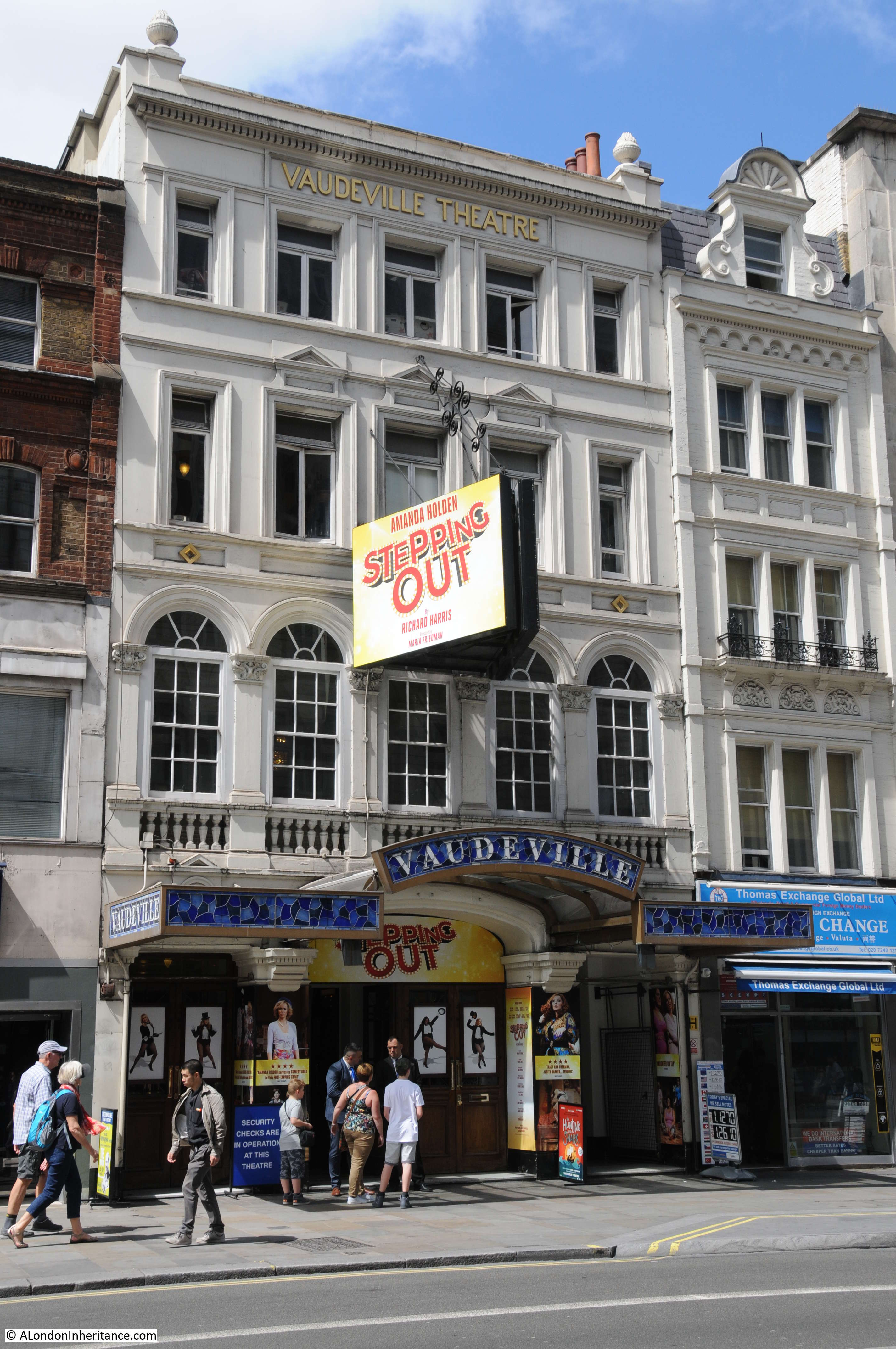
A short distance further along the Strand is the Vaudeville Theatre:West End

The Vaudeville Theatre was originally built in 1870 with a narrow entrance onto the Strand as there were originally two houses on the site facing onto the Strand. These two houses were demolished in 1889 and replaced by the facade of the theatre. The exterior view of the Vaudeville has only had minor changes since.

The theatre has hosted an almost continuous run of productions since opening, and as far as I can tell has retained the original name.

The Vaudeville Theatre is currently hosting Stepping Out.

The Savoy Theatre

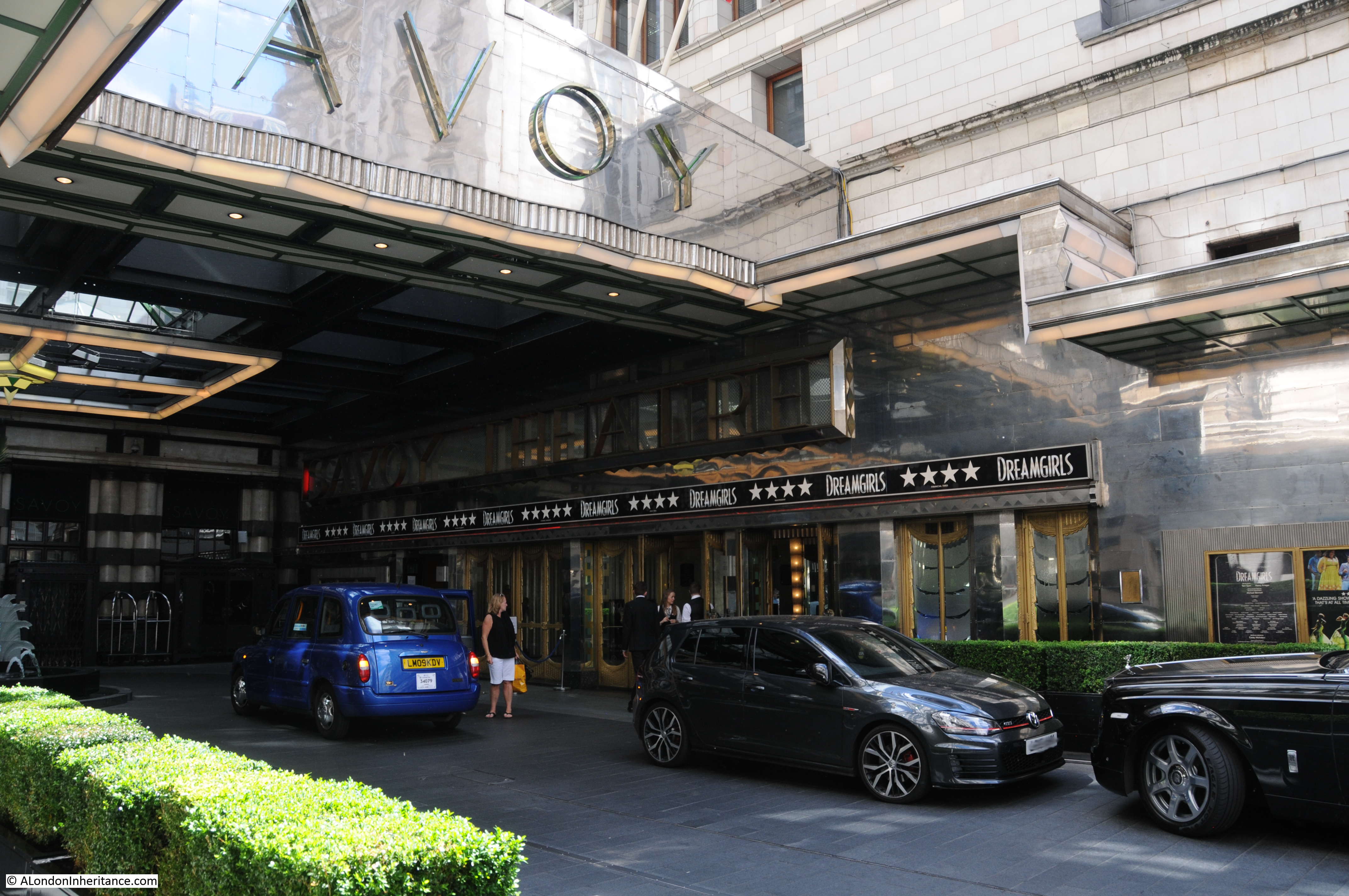
On the opposite side of the Strand can be found the Savoy Theatre, somewhat concealed alongside the entrance to the Savoy Hotel.West End

The Savoy Theatre was opened in 1881, eight years earlier than the adjacent, much larger, Savoy Hotel. Both the theatre and the hotel were built by Richard D’Oyly Carte.

The interior of the theatre has been through a number of major rebuilds and restorations including after a major fire in 1990 which resulted in the closure of the theatre for just over three years.

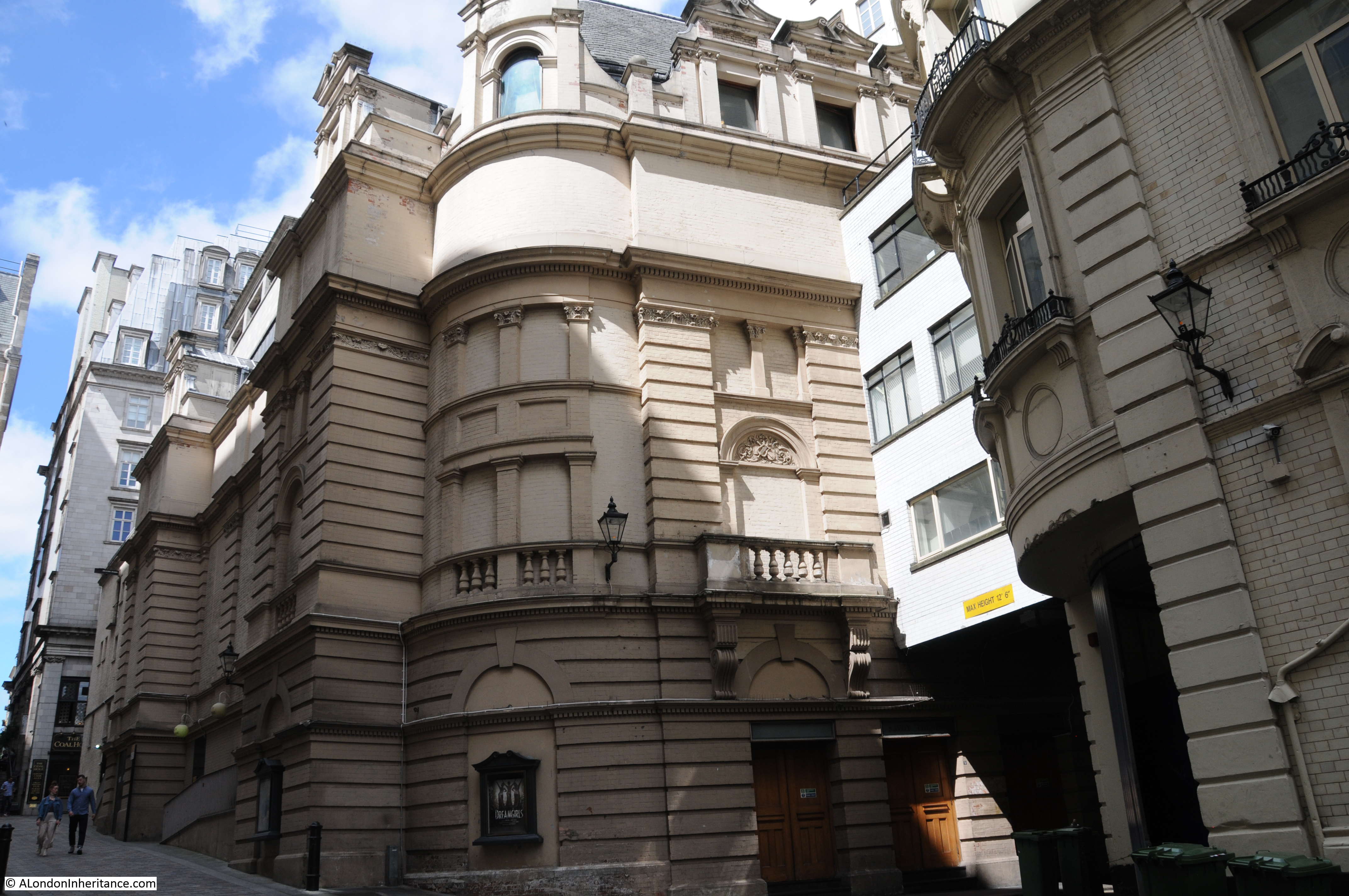
The best view of the size of the Savoy Theatre is through a short walk down Carting Lane where the large size of the theatre, which has a seating capacity of 1,158, can be appreciated.

West End

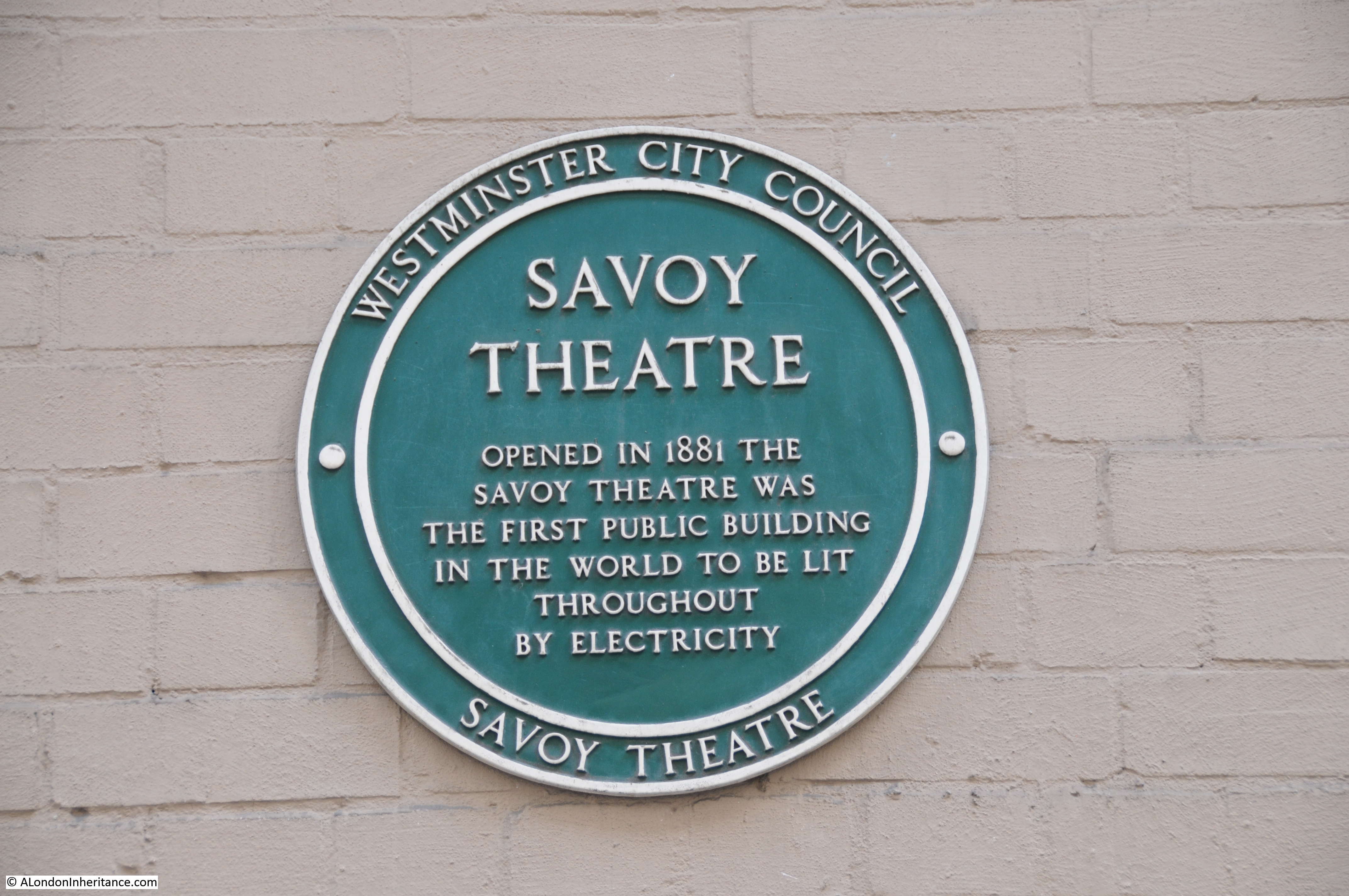
The Savoy Theatre was also the first public building to be lit by electricity, a fact recorded on a plaque on the side of the theatre in carting Lane.West End

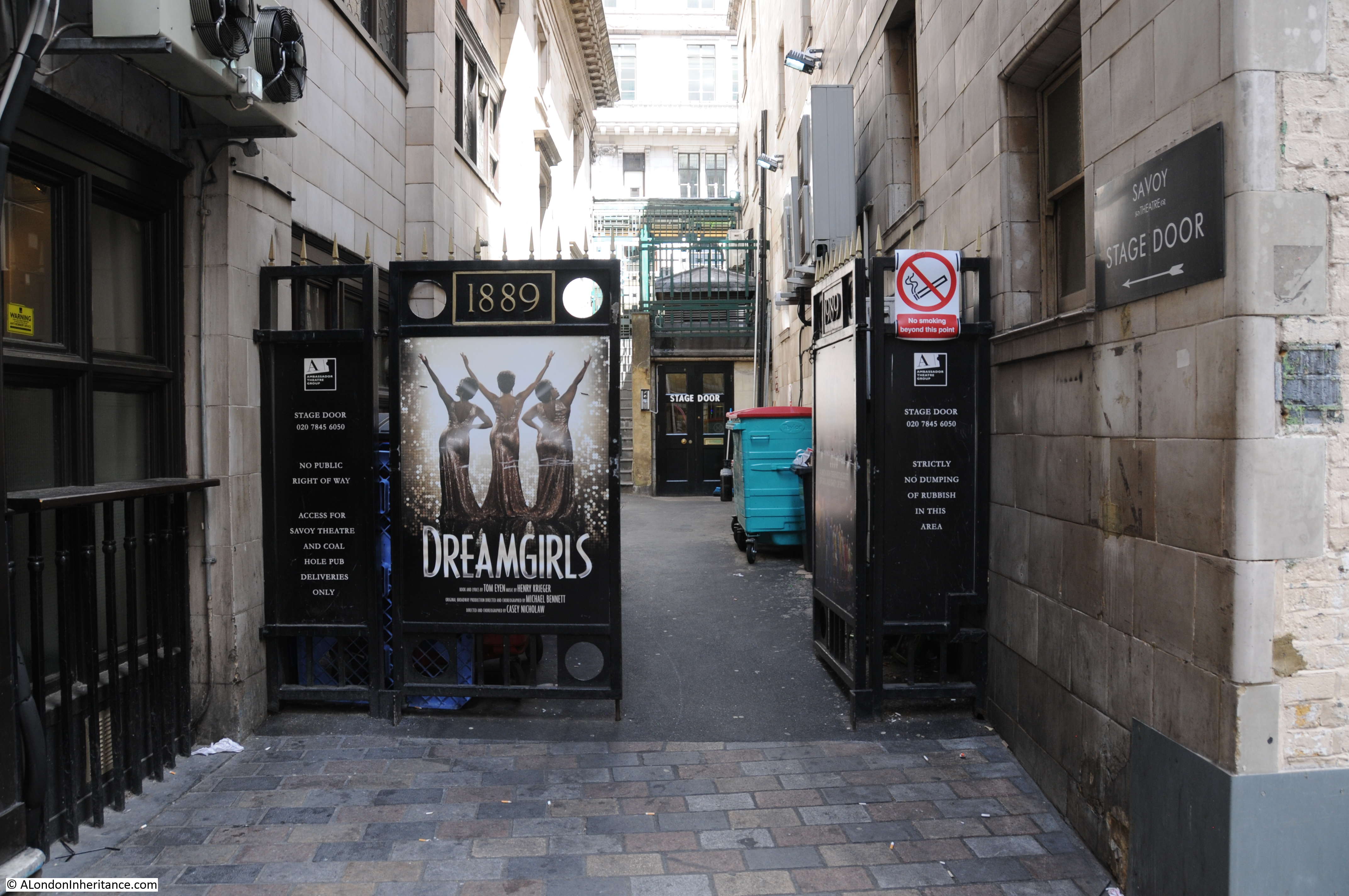
The stage door entrance to the Savoy Theatre in Carting Lane.West End

The Savoy Theatre is currently showing Dreamgirls.

The Lyceum Theatre

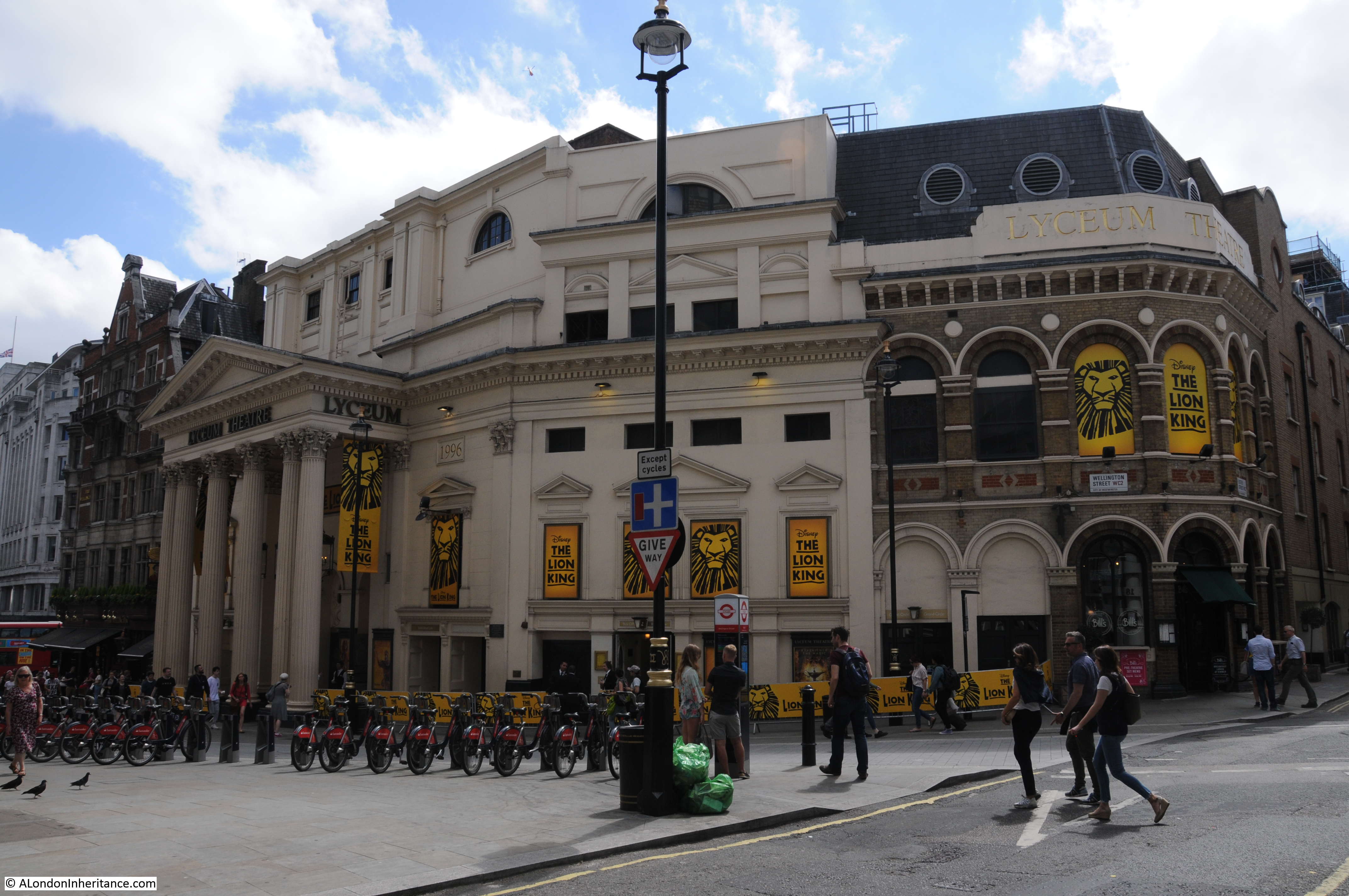
North of the junction of the Strand and the approach to Waterloo Bridge is Wellington Street and a short distance along is the Lyceum Theatre:West End

The Lyceum Theatre was opened in 1834 with the name Theatre Royal Lyceum and English Opera House. The main body of the theatre was rebuilt in 1904 retaining only the facade and the large portico and the theatre continued to run until 1939 when it was purchased by the London County Council who intended to demolish the theatre to make way for road improvements.

The timing of the purchase resulted in nothing happening to the building due to the outbreak of war and following the war the original plans were abandoned.

The theatre was empty until 1951 when it reopened as the Lyceum Ballroom having been converted into a large ballroom. The Lyceum Ballroom would go on to host pop concerts throughout the 1960s, 70s and early 1980s for bands such as The Who, Emerson, Lake and Palmer and Genesis.

Closing again in 1986, it did not reopen until 1996 following a significant restoration project to return the building to a theatre capable of staging large scale musicals, a function it has performed ever since.

View of the Lyceum Theatre from the junction of Wellington and Exeter Streets showing the large size of the theatre which has a seating capacity of 2,100.West End

The Lyceum Theatre is currently showing The Lyon King which has been playing at the theatre since 1999.

The Novello Theatre

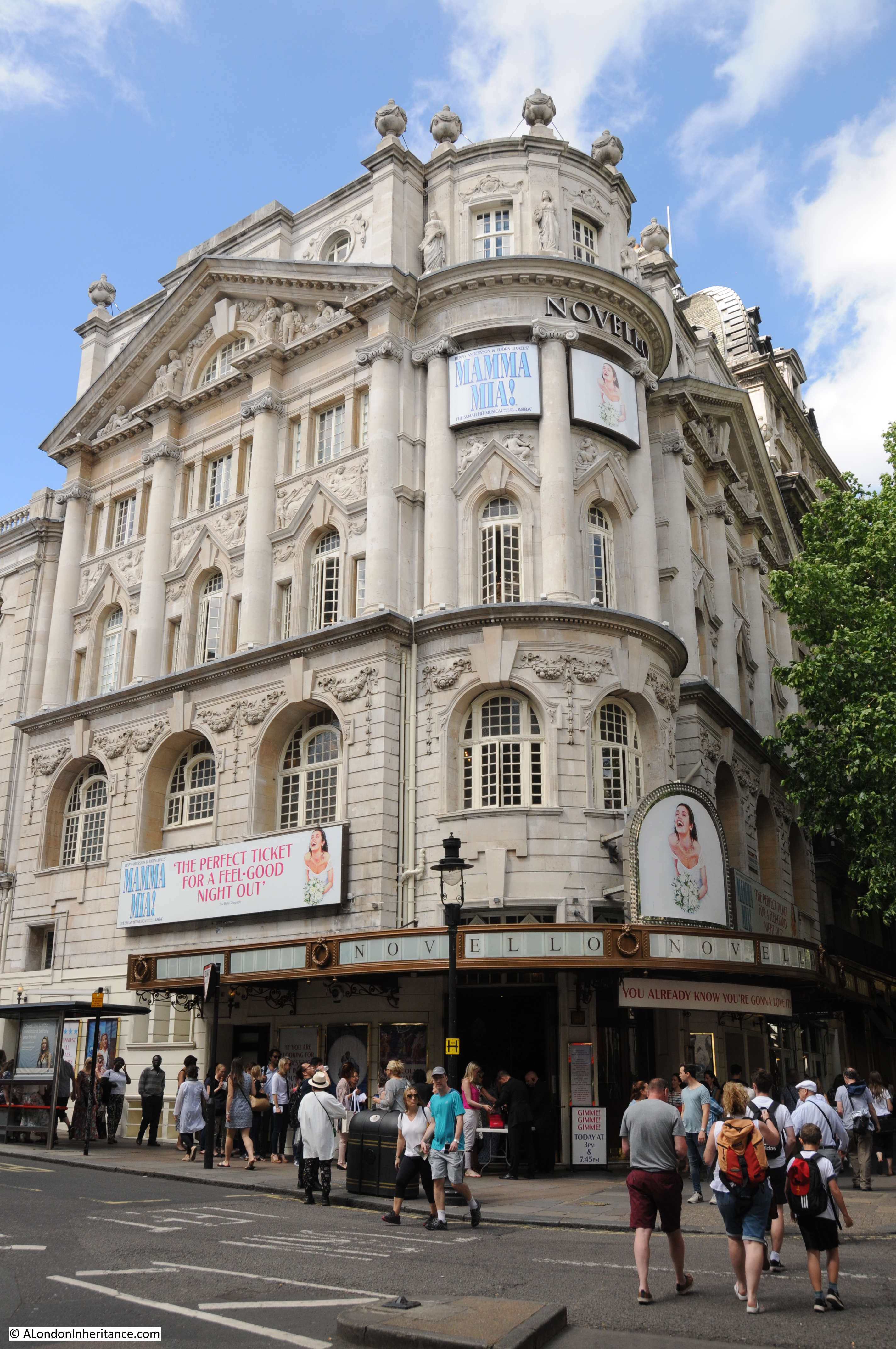
At the junction of Catherine Street and Aldwych is the Novello Theatre:West End

The Novello Theatre was originally opened in 1905 as the Waldorf Theatre, becoming the Strand Theatre in 1913.

The theatre was hit by bombs from a Zeppelin during a raid on London on the 13th October 1915 and although there was some damage to the theatre, it continued in operation with the production that night of the Scarlet Pimpernel. The theatre would also suffer some damage in 1940.

The theatre continued with the name of the Strand Theatre until 2005 when after a major refurbishment it reopened with the new name of the Novello Theatre in honour of the composer and actor Ivor Novello who lived in a flat above the theatre from 1913 until his death in 1951.

The Novello Theatre is currently hosting Mama Mia.

The Duchess Theatre

A short distance along Catherine Street from the Novello, is the Duchess Theatre:West End

The Duchess Theatre opened in 1929 and is one of the West End’s smaller theatres with seating for 494.

The theatre has seen an almost continuous run of productions and also appears to have retained the original name since the theatre opened.

The Duchess Theatre is the location of the shortest run for a West End production. On the 30th Match 1930 the first staging of “The Intimate Revue” was taking place, however as some scene changes were taking upwards of 20 minutes, a number of scenes were abandoned allowing the finale to be completed by midnight. The Intimate Revue did not have a second night and as several scenes were abandoned during the first night, technically it did not even complete a first night.

Perhaps appropriately, the Duchess Theatre is currently hosting The Play That Goes Wrong.

Theatre Royal, Drury Lane

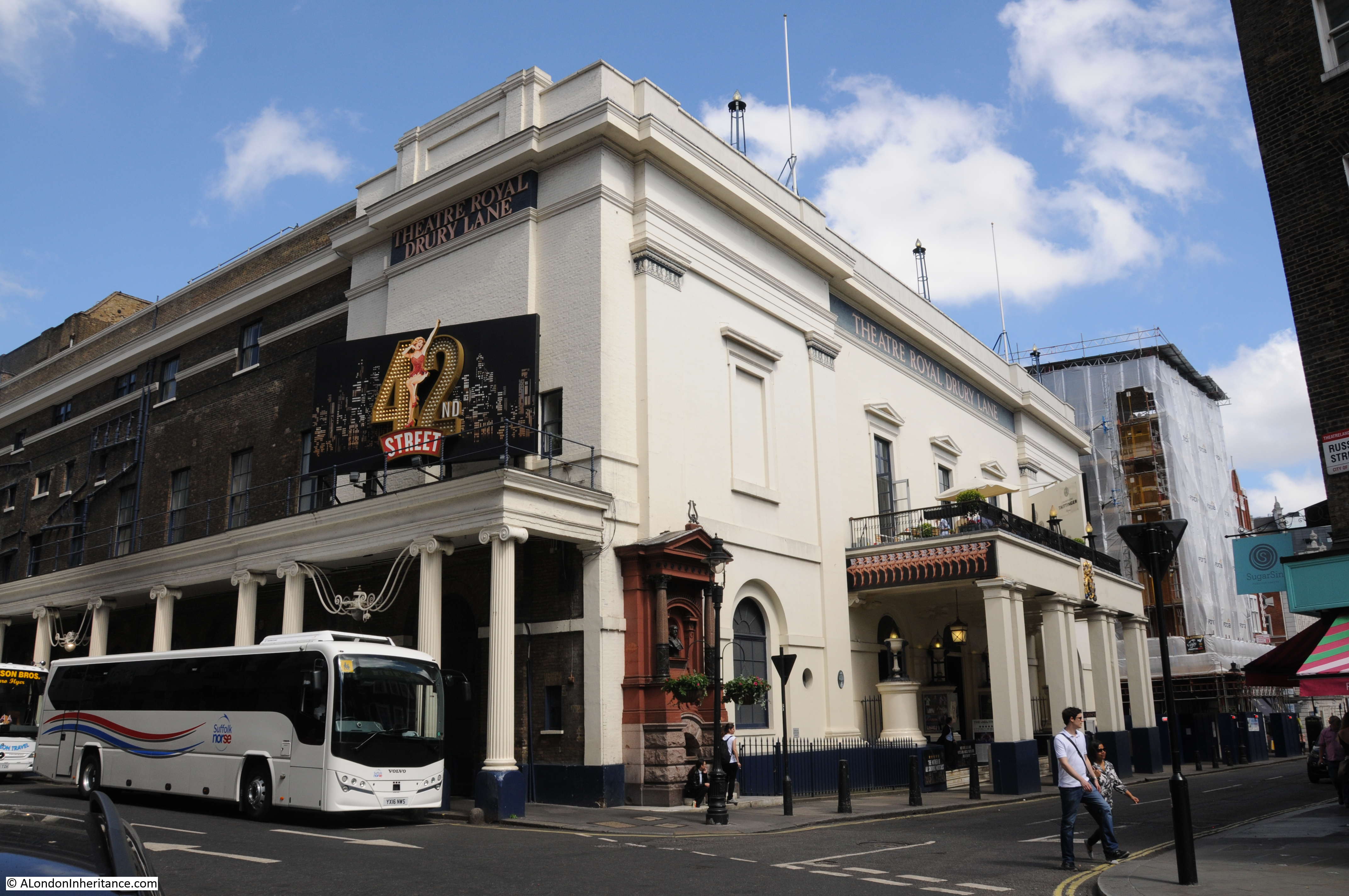
At the junction of Catherine Street and Russell Street is the Theatre Royal, Drury Lane:West End

There has been a theatre on the site of the Theatre Royal for centuries. The first theatre was built by Thomas Killigrew in 1663 who had received a Royal Charter from King Charles II.

Killigrew replaced the original theatre with a second to occupy the site in 1674 and this building lasted until the third theatre building to occupy the site was constructed in 1794, designed by Henry Holland and with a capacity for 3,600 people.

The third version of the theatre was destroyed by fire in 1809, following which the final version of the theatre which we see today was built and opened in 1812.

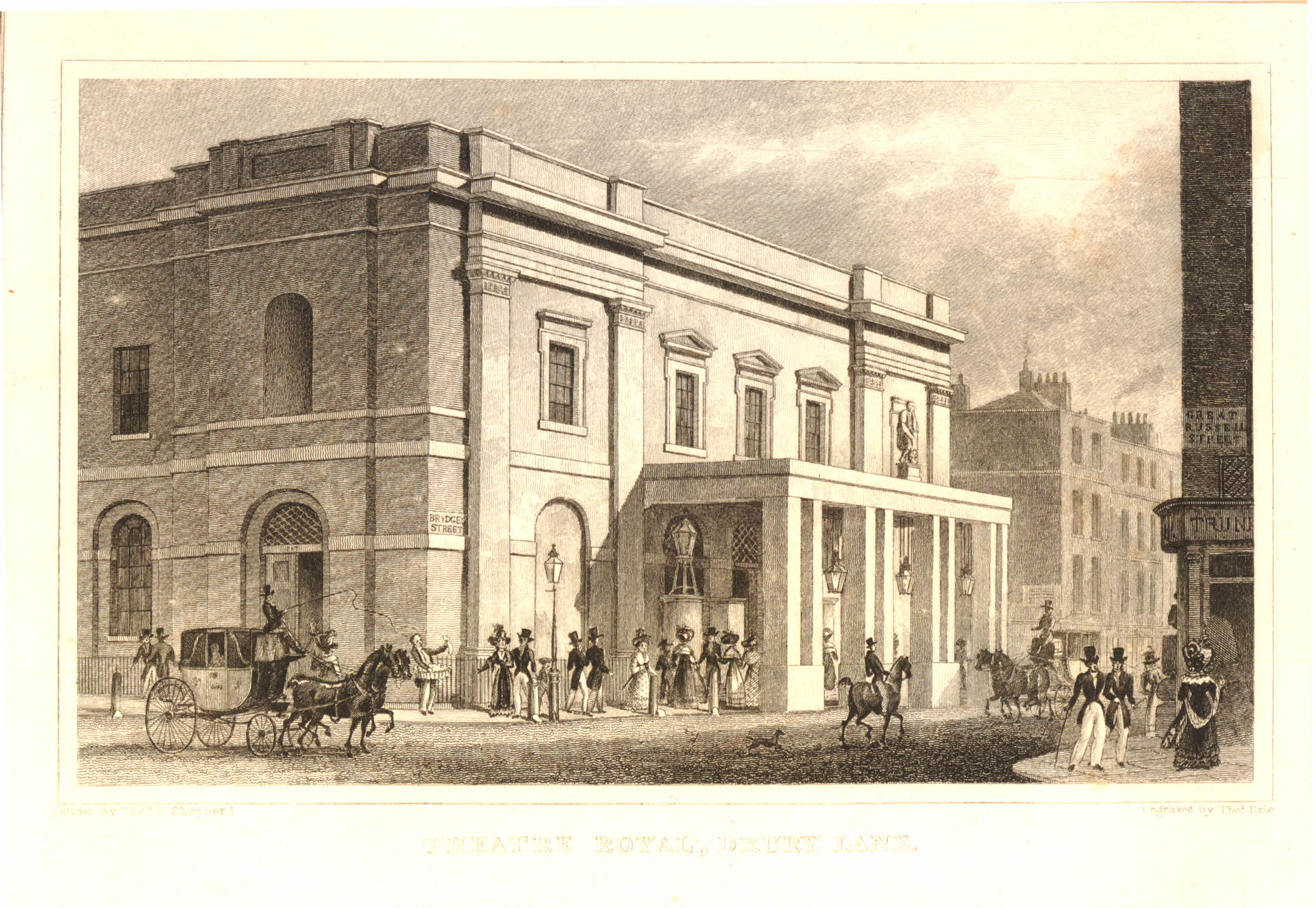
The portico on the front of the building was an addition in 1820, and the long side colonnade along Russell Street was an addition in 1831.

The following print of the Theatre Royal, Drury Lane is from 1828, three years before the side colonnade was added.West End

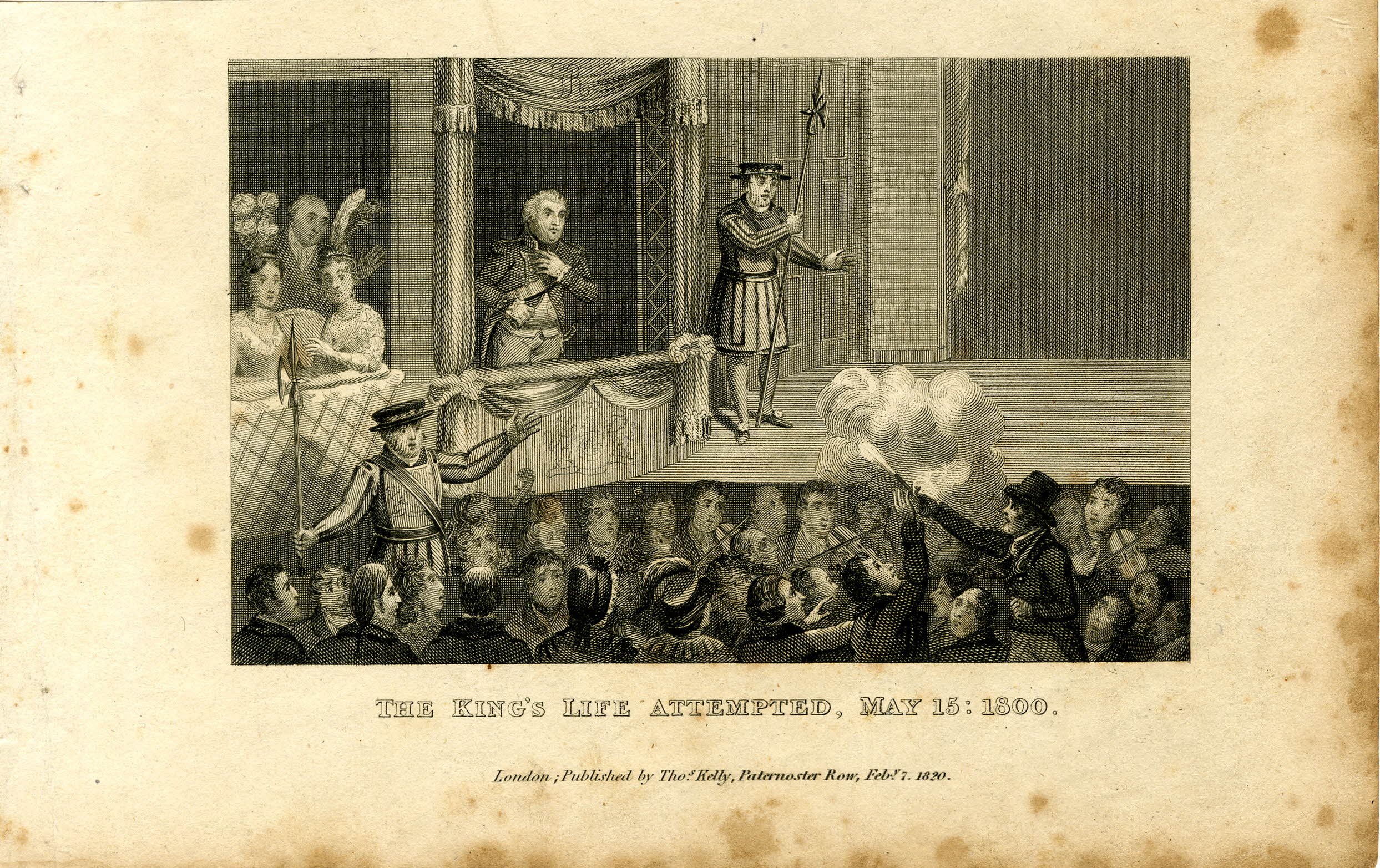
The Theatre Royal, Drury Lane was the location of an assassination attempt on King George III in 1800.

The King was in the royal box in the theatre on the evening of the 15th May 1800, when during the singing of the national anthem, James Hadfield who was in the stalls, fired a pistol at the King.

Fortunately for both the King and Hadfield he missed. He was tried for high treason, but pleaded insanity. He had suffered a number of previous war injuries to the head, and it was these that supported his plea of insanity. He was acquitted of the charge, but was detained indefinitely in the Bedlam Hospital after the Criminal Lunatics Act was swiftly passed by parliament in 1800 in reaction to Hadfield’s trial and acquittal. He did have a brief period of freedom following an escape, but was quickly recaptured and lived for 41 years following his attempt on the King’s life, dying of tuberculosis in 1841.

The Canterbury Journal reported from George’s Coffee House that:

“Hadfield is cleared, it being fully proved that he was insane at the time he committed the offence of firing at the King. The trial commenced at nine o’clock this morning and ended between three and four. the Attorney General not being prepared to annul the insanity of the prisoner the court recommended the Jury to acquit him”

Print of the assassination attempt:West End

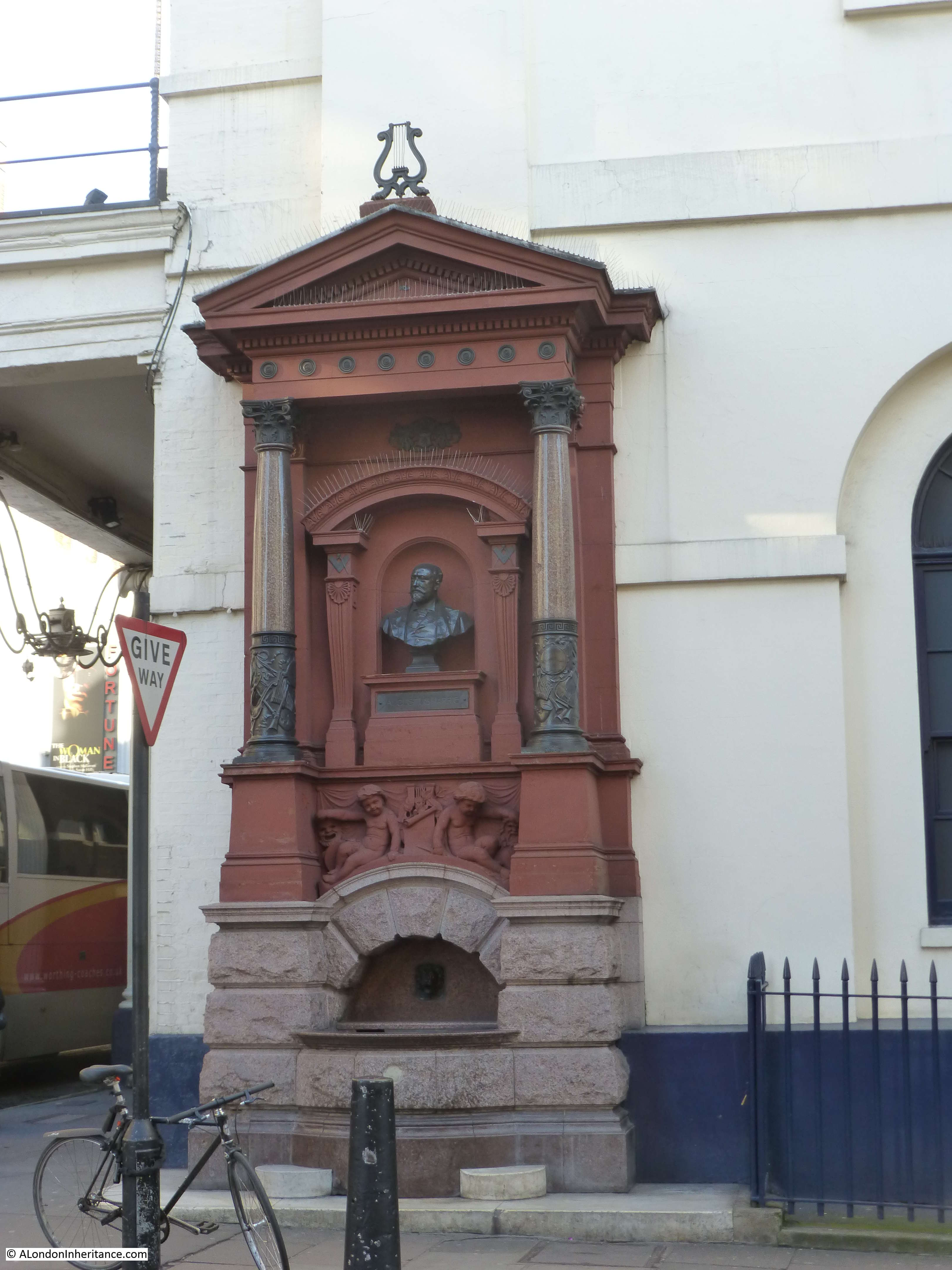
There is a memorial fountain to Augustus Harris on the front of the theatre. Harris was responsible for the theatre from 1879 to 1896, and during his tenure he put on a wide range of plays and pantomimes. The success of his pantomimes was considerable and they starred many of the musical hall stars of the day.

After his death, public subscriptions provided for the memorial fountain which was unveiled in 1897.West End

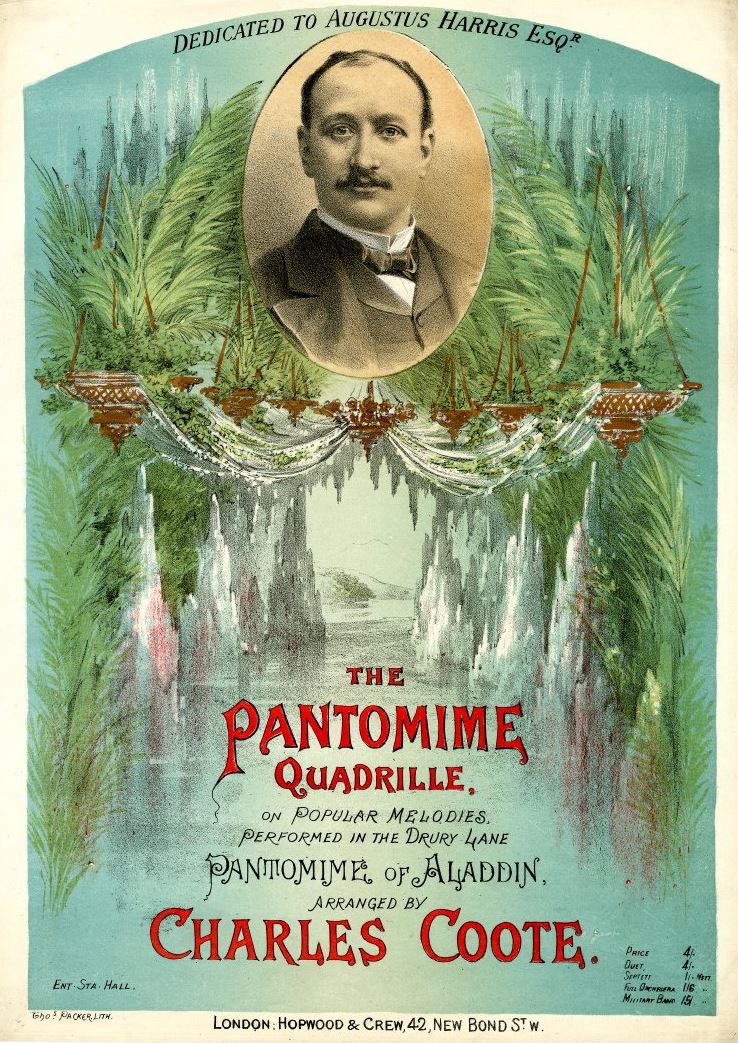
Music cover for the “The Pantomime Quadrille” dedicated to Augustus Harris with a photo of Harris who died at the relatively young age of 44.West End

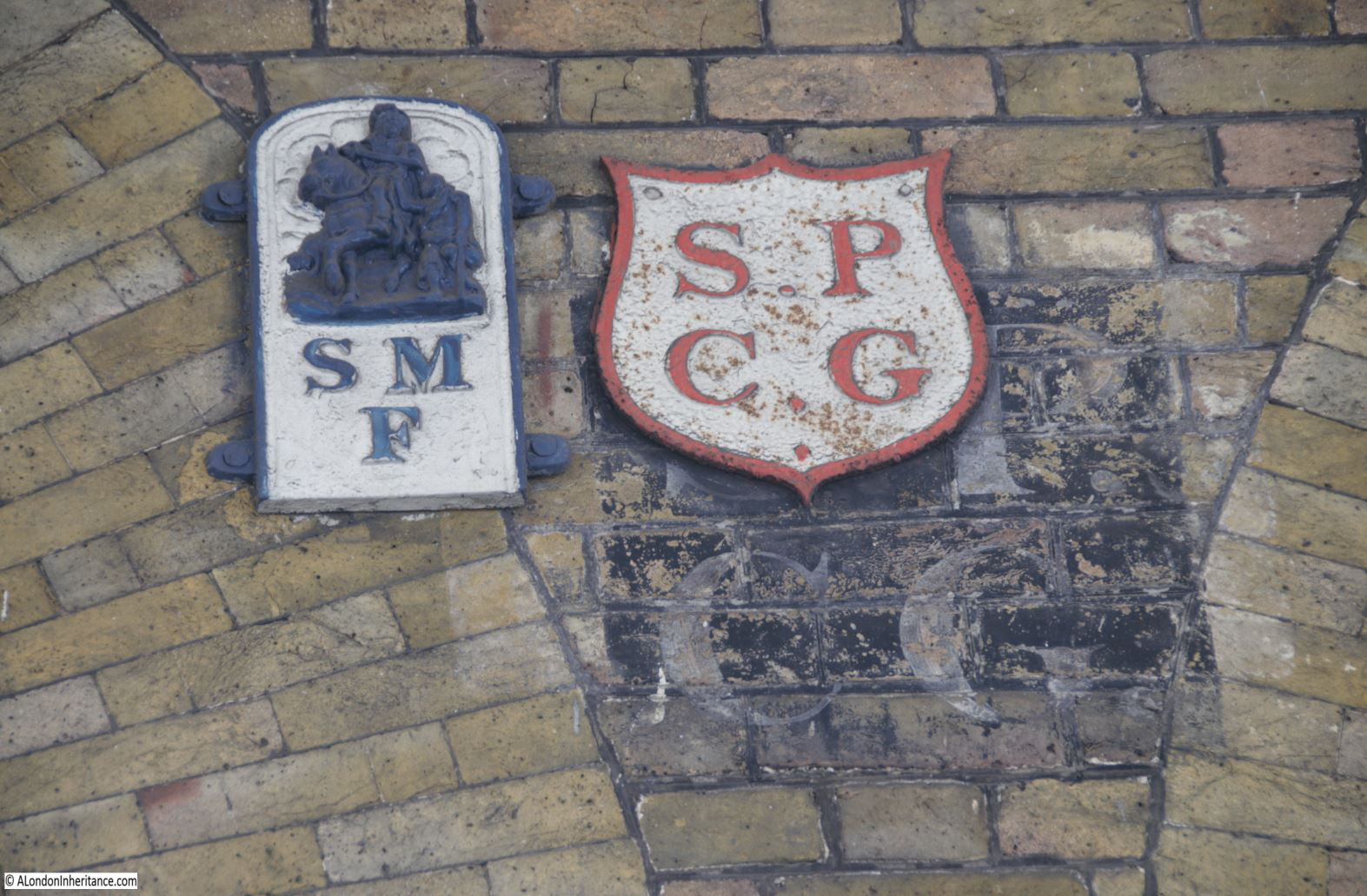
Walking along the Russell Street side of the Theatre Royal, I found a couple of parish boundary markers, the first I have seen on a theatre. The marker on the left is St. Martin in the Fields, and on the right is St. Paul Covent Garden. Note the original boundary marking painted on the brickwork for St. Paul.West End

Stage door for the Theatre Royal, Drury Lane:West End

The Theatre Royal, Drury Lane is currently showing 42nd Street.

Fortune Theatre

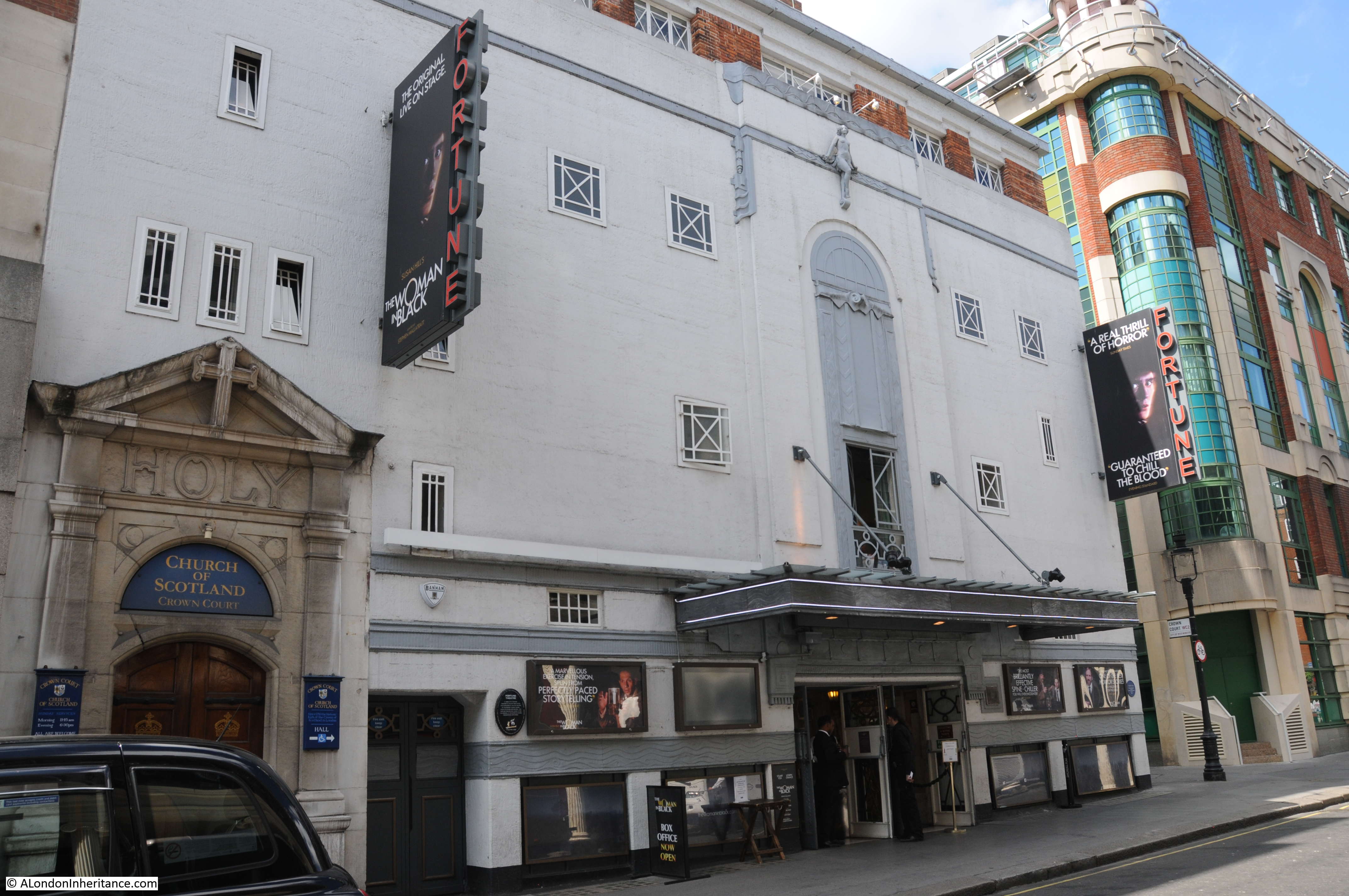
In Russell Street, opposite the side of the Theatre Royal, Drury Lane is the Fortune Theatre:West End

The Fortune Theatre opened in November 1924 and is one of the West End’s smaller theatres with a capacity of 432. As far as I can tell, the theatre has retained its original name and has had an almost continuous run of productions since opening.

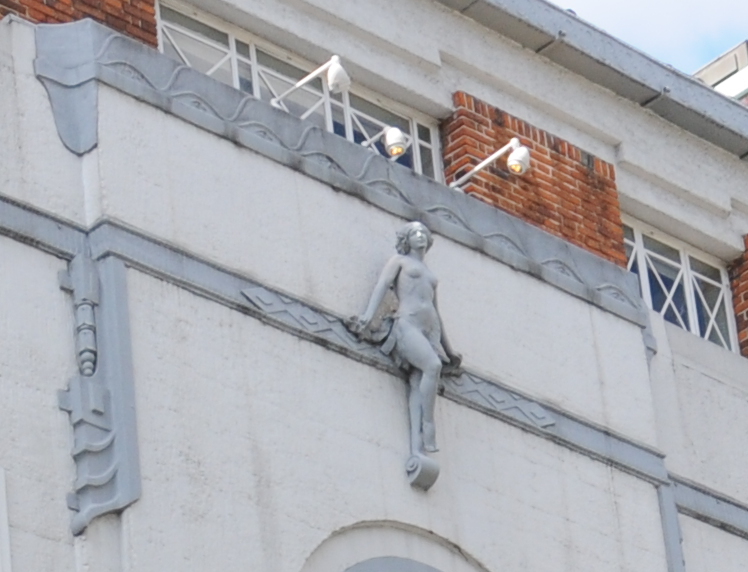
The facade of the theatre is mainly of concrete and high above the main entrance is a sculpture of Terpsichore (one of the nine muses in Greek mythology with an emphasis on dance). The sculpture was created by the arts and crafts artist M. H. Crichton.West End

The facade of the theatre is also shared by an entrance to a church which looks rather out of place in the lower left corner of the facade. The entrance is to the Crown Court Church of Scotland, a Presbyterian church that has been here since 1719. The original church was replaced in 1909 so the current church predates the Fortune Theatre which must have integrated the entrance to the church within the new facade of the theatre in 1924.

The Fortune Theatre is currently hosting The Woman In Black

Aldwych Theatre

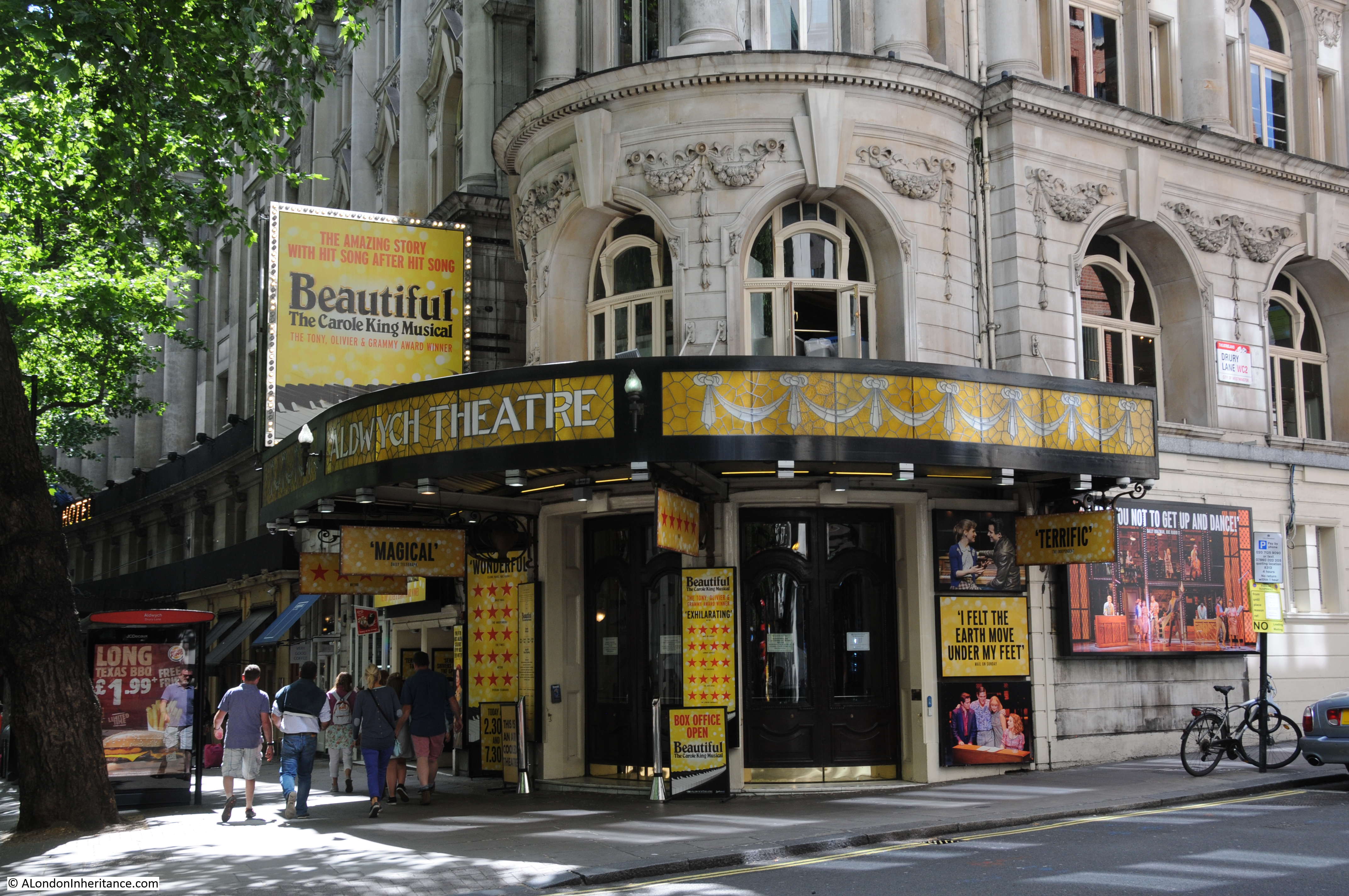
From Russell Street, turn right down Drury Lane to the junction with Aldwych where on the corner is to be found the Aldwych Theatre:West End

The Aldwych Theatre was built in 1905 at the same time and to the same design by the architect W. G. R. Sprague as the Novello Theatre which I visited earlier in this post.

Unlike the Novello, the Aldywych Theatre has retained the original name, and has seen an almost continuous run of productions, including a twenty one year period from 1960 when the Royal Shakespeare Company were in residence at the Aldwych.

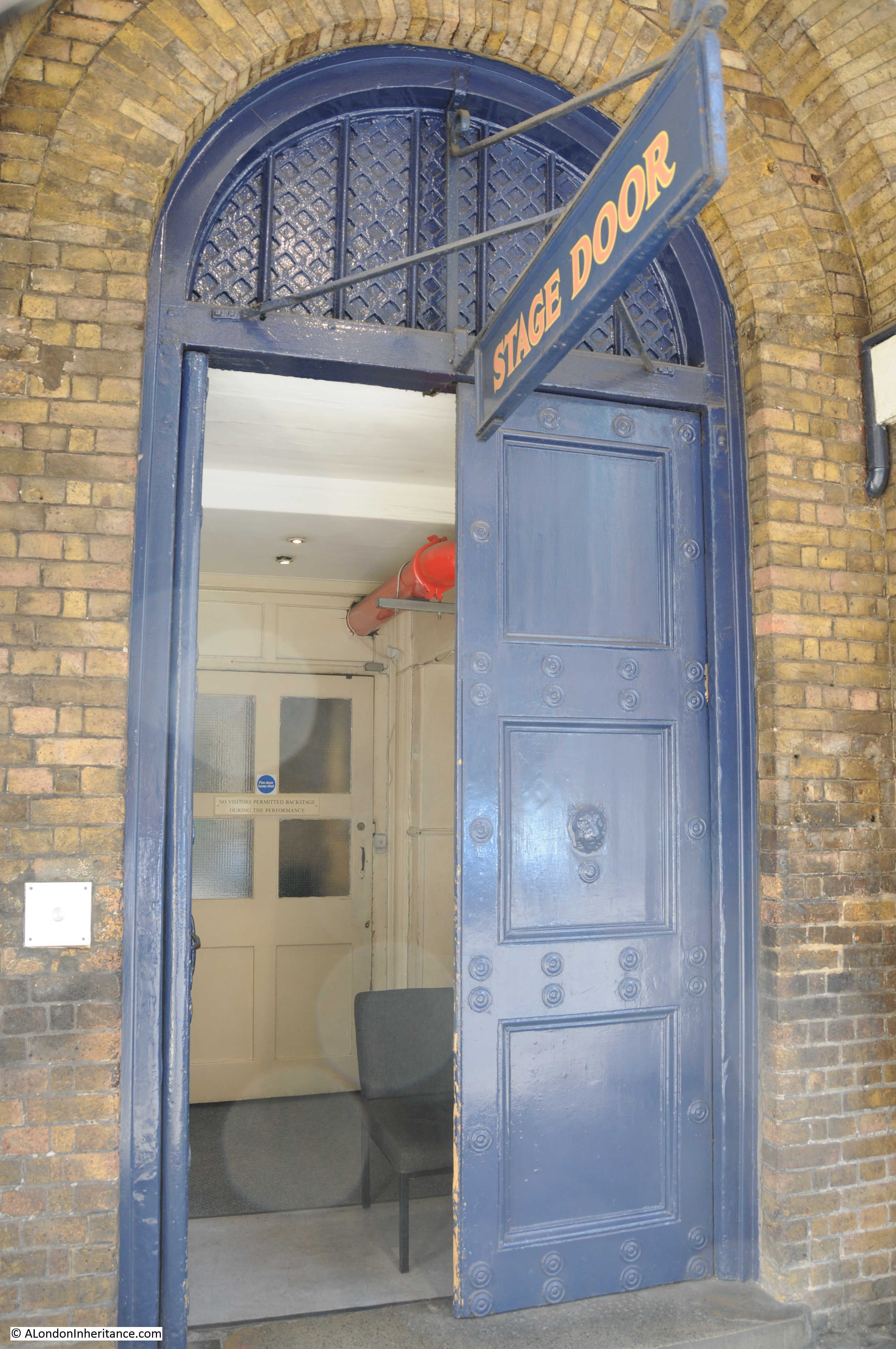
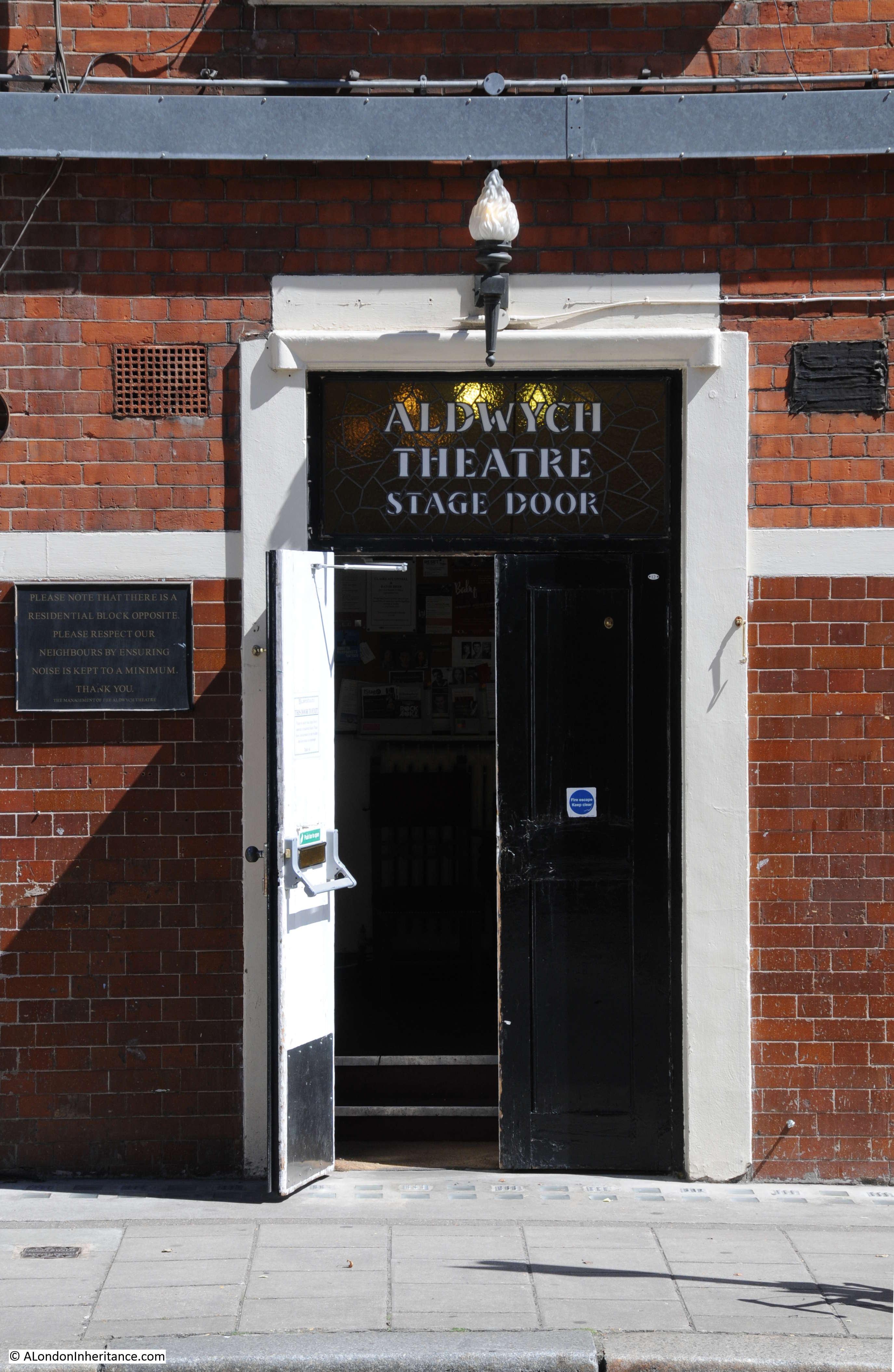
The stage door of the Aldwych Theatre. Whilst the main frontage of the theatre onto Aldwych is of stone, the side walls of the theatre in which the main body of the auditorium and stage are located were built of brick to save money.

West End

The Aldwych Theatre is currently showing Beautiful – The Carole King Musical

The London Palladium

For my final theatre visit, I walked back along the Strand to Charing Cross to catch a Bakerloo train up to Oxford Circus to visit the theatre at the north west corner of my boundary of West End theatres, the London Palladium in Argyll Street:

West End

The Palladium dates from the turn of the century expansion of West End theatres having opened in 1910 on the former site of Argyll House.

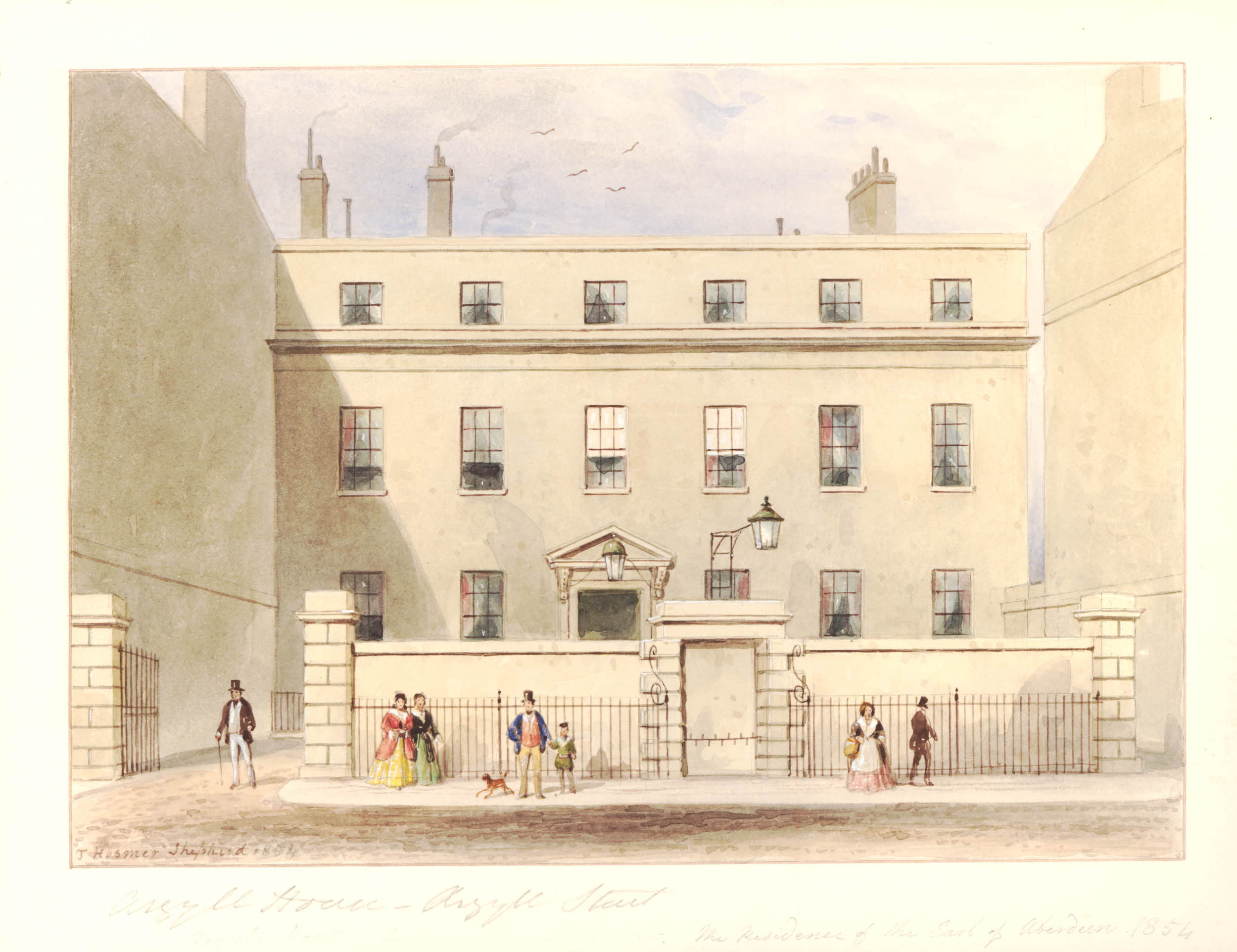
Argyll House was built on land owned by the Duke of Argyll by his younger brother Lord Ilay. Construction started in 1737 and continued with the addition of various rooms and extensions for the next couple of decades.

Lord Ilay became the Duke of Argyll following the death of his older brother and the house passed down the Argyll family until being sold in 1808 to the Earl of Aberdeen. The house was sold in 1862 by the Earl of Aberdeen’s son, the last nobleman’s town house to survive in the area around Oxford Circus and Regent’s Street.

Argyll House as it appeared in 1854 from a drawing by Thomas Hosmer Shepherd.

West End

It was demolished soon after and over much of the site was built the Corinthian Bazaar and Exhibition Rooms.

The majority of the Corinthian Bazaar was demolished to make way for the Palladium, however the facade onto Argyll Street, although modified, is from the original Bazaar building.

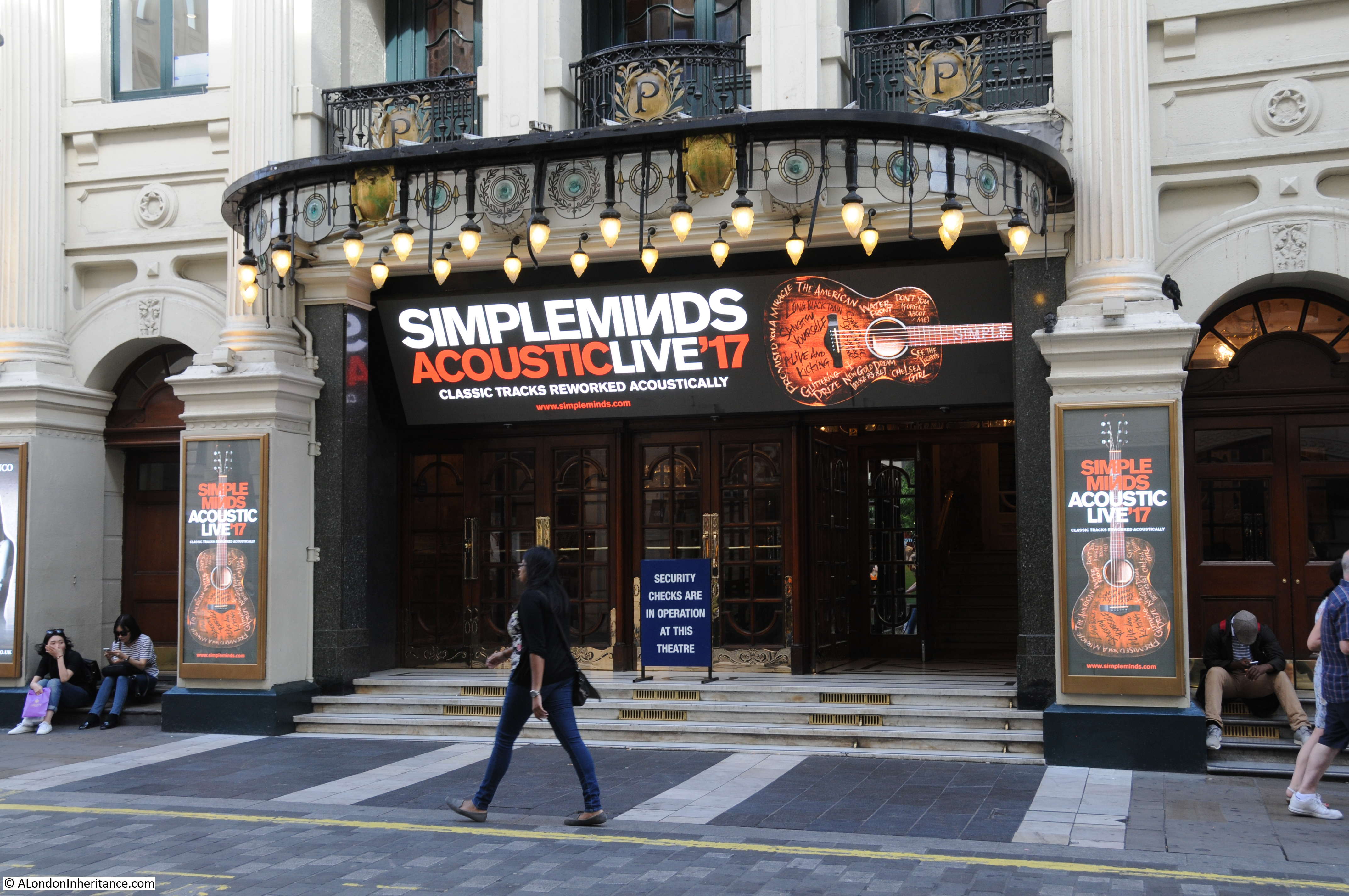
The facade looks as if the theatre is directly behind, however it is an L shaped theatre with the entrance providing access to the rear of the auditorium which then runs to the stage behind the buildings down Argyll Street to the right of the main entrance.

The Palladium has hosted a wide range of events over the years, including plays and musicals, but has also hosted TV programmes such as Sunday Night at the London Palladium, many of the Royal Variety Performances, variety from performers such as Ken Dodd and Bruce Forsyth and shows by stars such as Frank Sinatra, Judy Garland, Bob Hope Max Bygraves, Julie Andrews and Cilla Black.

On the day of my visit, the Saturday 27th May 2017, the London Palladium was hosting one night of Simple Minds Acoustic 2017 tour.

West End

And the London Palladium concludes my walk around the theatres of London’s West End for a snapshot of their history, appearance and productions on Saturday 27th May 2017.

In my two posts I have covered 41 theatres within my definition of the West End. I knew there were many theatres, but did not realise quite how many and I may have missed a couple of smaller theatres (please let me know if there are any I have missed).

I have only scratched the surface of their long and fascinating history and it is good to see buildings that are often over one hundred years old, with the earliest occupying theatrical sites that date back to the 17th century, still playing such an active part in the cultural and commercial life of the city.

They have survived threats from new forms of entertainment during their time, such as the cinema and television and still appear to be in fine health. The Society of London Theatre’s 2016 Box Office report stated that:

  • Gross revenue of £644,719,639
  • Attendances of 14,328,121
  • Weekly attendance set a new record during week commencing the 26th December 2016 at 439,103

The report also records that audiences have risen from 10,236,362 in 1986 to 14,328,121 in 2016 and that 44 was the average number of theatres open in 2016 (numbers have stayed reasonably static over the past 30 years). The number was slightly higher than my 41 theatres but may be due to slightly different geographic scope, or maybe I did indeed miss a couple.

It was a fascinating theme for a walk. The warm weather dictated a couple of stops at pubs along the way, which is perhaps a theme for a future walk around London, although I fear that the longevity of these will not be as good as the theatres of the West End.

alondoninheritance.com 

Old Swan Stairs

Following last Sunday’s post covering the first part of my walk around London’s West End theatres, I had been expecting to publish the second part a couple of days ago, however I must admit I have never really counted up how many theatres there are (over 40), so I am still working on the post. Therefore today, back to one of my father’s photos of London 70 years ago.

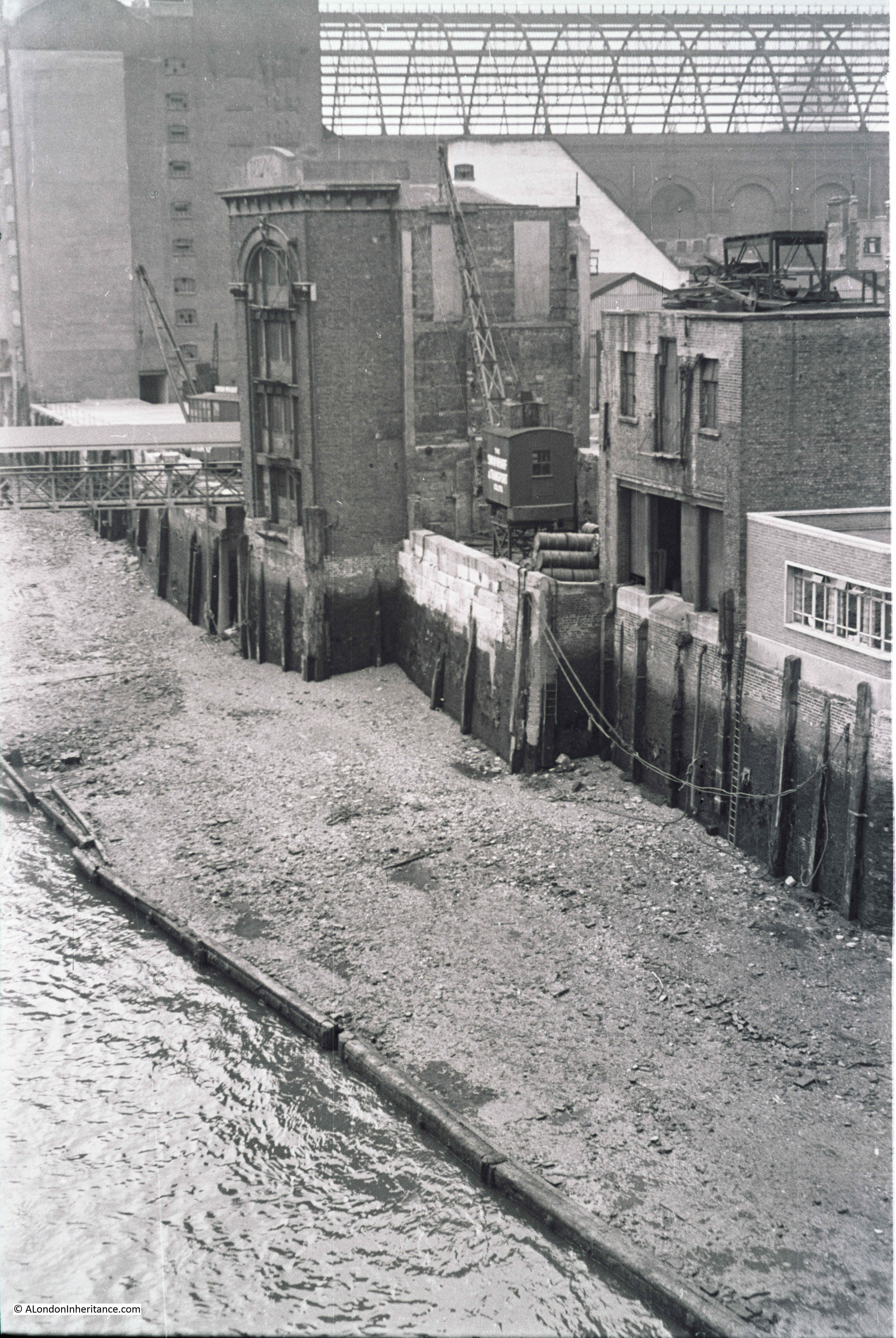
This is my father’s post war view of the stretch of the north bank of the River Thames between London Bridge and Cannon Street Station:

Old Swan Stairs

The magnificent framework of the original glass roof of Cannon Street Station is in the rear of the photo, the glass had previously been removed so this is just the metal framework.

My father was standing on London Bridge to take the photo and the river front consists of space cleared of buildings damaged by wartime bombing and some of the remaining warehouse and wharf buildings.

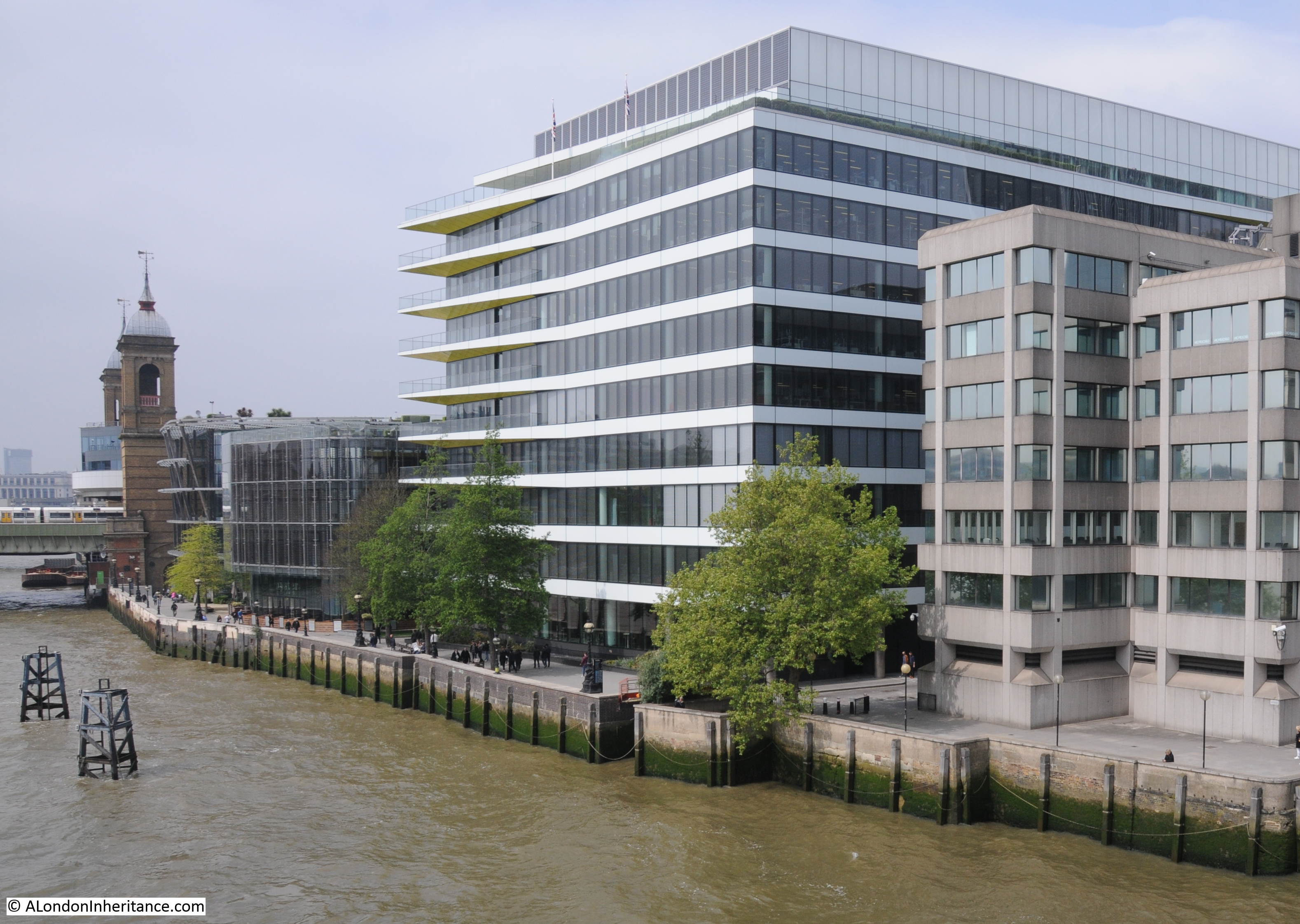
I took a wider photo of the scene today to set the context as the side walls of Cannon Street Station are now obscured and the station has long since lost the original roof.

Old Swan Stairs

The scene has completely changed, and the perspective of the two photos looks different due to very different lens and camera types, however there are some features remaining that allow the buildings in the original photo to be located.

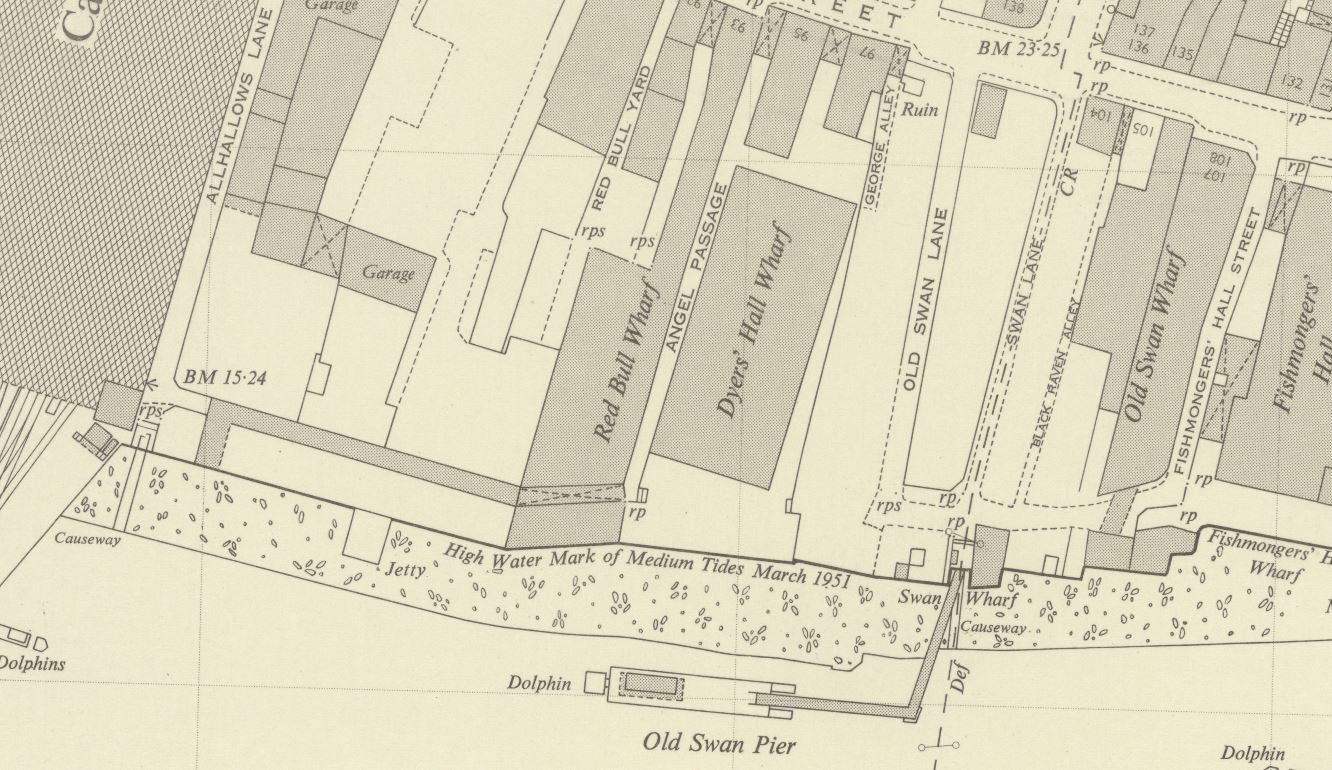
The following map extract is from the 1952 Ordnance Survey map of the area (published in 1952, surveyed the previous year).

Old Swan Stairs

In the map, Cannon Street Station is the large building, partly shown on the left of the map.

The first feature to identify on the photo is Old Swan Pier. In the map, this can be seen running from a small, rectangular indentation in the river wall. In the original photo, this is the metal walkway that can just be seen running out from the river wall, with the small indentation in the river wall also partly visible.

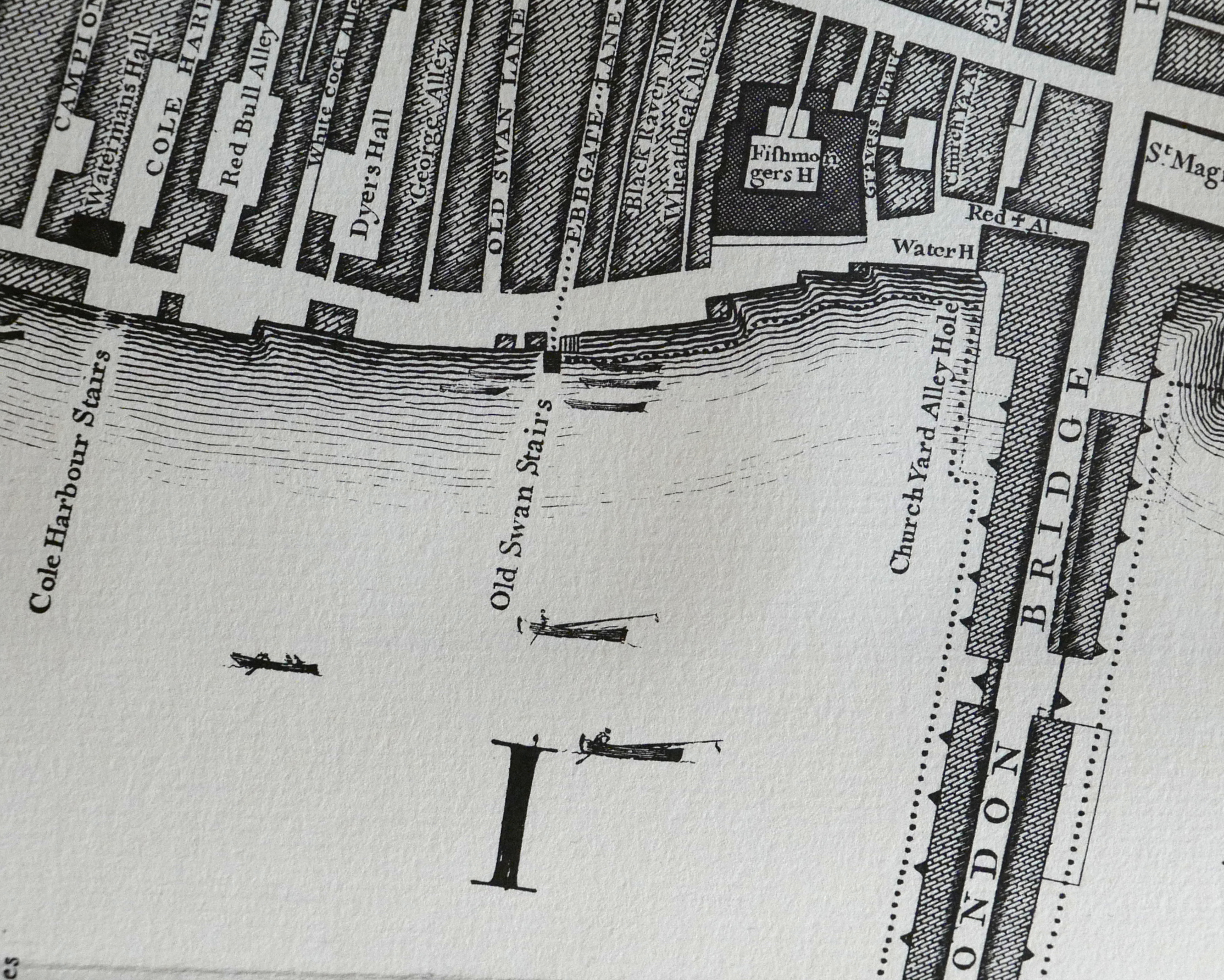
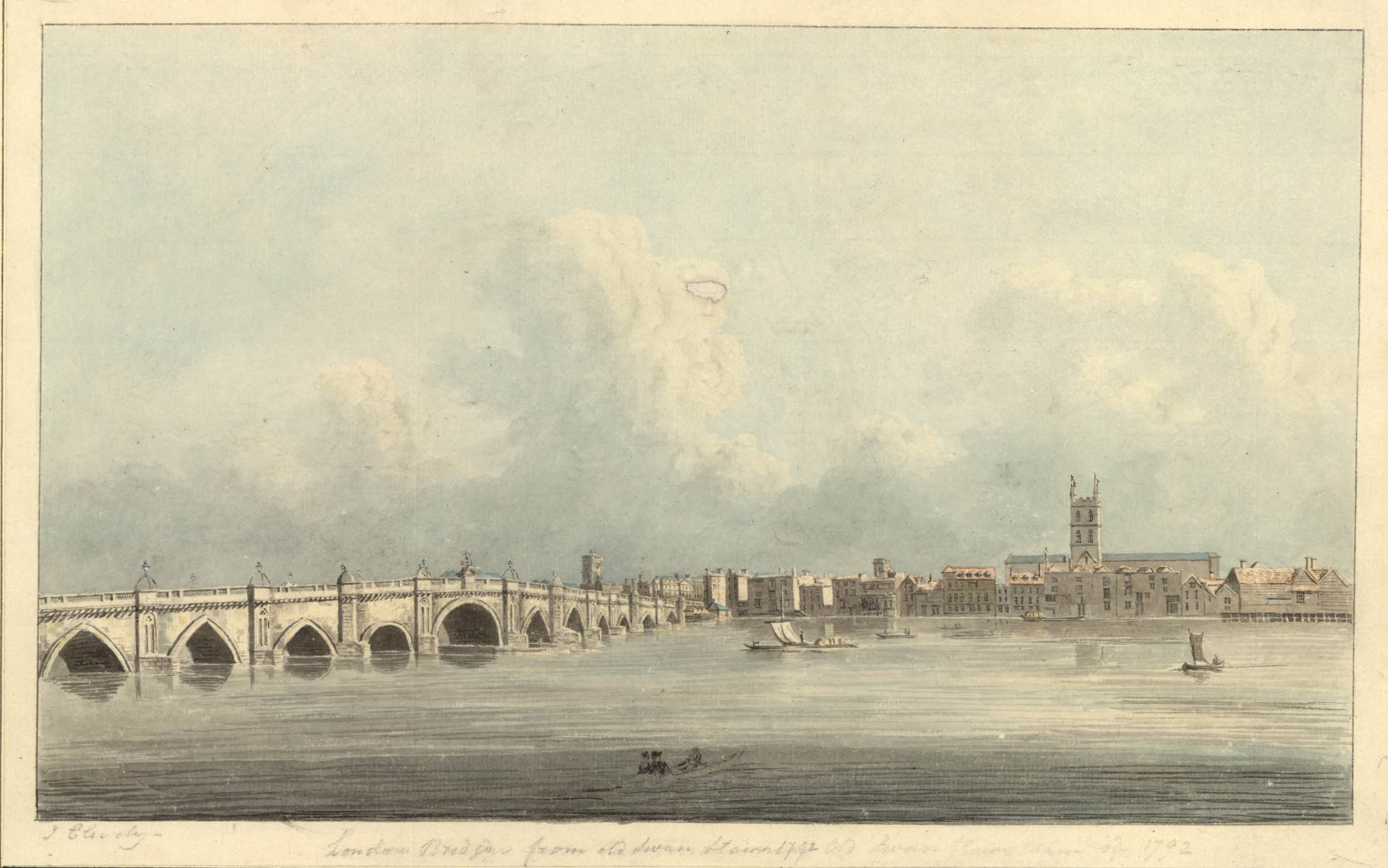
This allows the building to be identified adjacent to the pier, this is Swan Wharf, the building has a date on the very top which I can just make out as either 1896 or 1894.

Now follow the river wall from the pier and Swan Wharf back to the right hand edge of the photo and the river wall steps back twice, once alongside the edge of the Swan Wharf building, and the second slightly further along. These two steps backs in the river wall can also be seen in the 1952 map which identifies the building to the right of the crane as the building at the end of Old Swan Wharf in the map.

The definition of the original film is not sufficient to clearly read the white writing on the side of the crane, but it appears to read “The Swan Wharf & ———“. I cannot make out the last word.

Given the level of redevelopment in this area it would be surprising if any of these features (apart from the station) remain, however there are some that allow the location of the original buildings to be placed along the river’s edge today.

Firstly, look along the river wall in today’s photo and you will see an indention in the river wall. This is the same indentation as at the location of the pier in the original photo and was retained as this gap in the river wall is the location of Old Swan Stairs, one of the many historic stairs leading down to the river.

Two dolphin structures can also be seen in the river, these are a couple of the remaining supports from the Old Swan Pier.

To the right of the stairs in today’s photo is a large tree, this is the location of the Swan Wharf building in the original photo.

From the tree to the right of today’s photo there are two step backs in the river wall. These are the same as those in the post war photo, with the old building to the right of the crane being the building at the end of Old Swan Wharfe in the 1952 map.

Old Swan Stairs have been here for many centuries. The following extract from John Rocque’s map of 1746 shows Old Swan Stairs.

Old Swan Stairs

In the 1746 map, the stairs are at the end of Ebbgate Lane, in the 1952 map this lane was then Swan Lane with Old Swan Lane to the left in both maps.

Swan Stairs were mentioned in the diaries of Samuel Pepys and in Stow’s 1603 Survey of London there is a mention Old Swan: “This ward turneth into Thames streete westwarde, some ten houses on a side to the course of the Walbrooke, but East in Thames streets on both sides to Ebgate lane, or old Swan.” in his description of the boundaries of Downegate (Dowgate) Ward.

In Old and New London, Walter Thornbury writes about how Swan Stairs were used to avoid the dangers of passing under the old London Bridge by boat: “The Swan Stairs, a little ‘above bridge’ was the place where people coming by boat used to land to walk to the other side of Old London Bridge when the current was swift and narrow between the starlings, and ‘shooting the bridge’ was rather like going down the rapids. Citizens usually took boat again at Billingsgate, as we find Johnson and Boswell once doing, on their way to Greenwich in 1763.”

Old Swan Stairs were also the starting point for the Swan Upping ceremony when it started in central London. My father took some photos of Swan Upping starting around Old Swan Stairs and in the following photo is Mr Richard Turk who was the Vintners Swan Marker and Barge Master, with the Old Swan Pier in the background. The sign on the right of the piers indicates that boats to Greenwich could be boarded here. My full post on Swan Upping can be found here.

Old Swan Stairs

I am not sure exactly when Old Swan Pier opened, however the first adverts I can find for sailings from the pier are from 1838, when on the 21st May the Shipping and Mercantile Gazette carried an advert for “Steam – Cheap Fares from Old Swan Pier” . The sailings were:

  • To Gravesend – every morning at 9 o’clock, precisely. Cabin 1s: Saloon 1s 6d
  • To Richmond – Daily at half-past 9, calling at Hungerford at 10 o’clock, and to Twickenham every Monday, Wednesday and Friday. Week days 1s 6d; on Sundays 2s.
  • To Woolwich – Every Sunday at 10, 2 and 5, calling at West India Dock Pier, Blackwall, at 11, 3 and 6. To Woolwich 1s, to Blackwall 9d, from Blackwall to Woolwich, 6d

The earliest newspaper report I could find referring to Old Swan Stairs is from the 9th August 1729, when it was reported that:

“Last Monday a Waterman, naked all but his shirt, rowed in a Butcher’s Tray from the Old Swan Stairs, to Greenwich, for a Wager of four Guineas, and won the same”

There are frequent mentions of Old Swan Stairs in newspaper reports since the early 18th century, and they describe the life and tragedies that must have been day to day experiences along this stretch of the Thames.

From the London reports of the Ipswich Journal on the 12th February 1743:

“Sunday Morning a young Man, dressed in a Sailor’s Jacket with Trowsers and a speckled Shirt was found in the Mud near the Old Swan Stairs; his Buckles, which were supposed to be Silver, were taken out of his Shoes. He was carried into the Church-yard, near the Stairs, till own’d, or a Warrant granted for his Burial”.

The implications being that either he was murdered for the silver shoe buckles, or he had died accidentally and his shoe buckles had been stolen.

Standing at Old Swan Stairs would have provided a fascinating view across to what would later be Southwark Cathedral with London Bridge to the left. John Cleverly made the following drawing  (©Trustees of the British Museum) of the view from Old Swan Stairs in 1792. Old Swan Stairs

Despite the land along the river having changed so dramatically over the last 70 years, we can still find features that date back hundreds of years and allow us to accurately place events from centuries of London’s history.

alondoninheritance.com

West End Theatres – Playhouse to New London

West End Theatres, the subject of this week’s post, has come about for a number of reasons. Firstly whilst I love a random walk around London, I also like walking to find specific places or to follow a particular theme. Secondly, working with my father’s photos I often find myself wishing that he had taken more photos of other subjects and locations to those in his collection, it would have been interesting to see photos of so much else in the London of the time..

This week’s subject was also prompted when I scanned the following photo from 1981 from my own negatives showing the Adelphi Theatre in the Strand.

The West End of London has a large concentration of theatres. These have changed function over time, some have ceased to be theatres, some have spent periods of time as a cinema and occasionally new theatres have opened.

Theatres are also a snapshot of their time. The shows put on, the actors. the external advertising are all of their time. When I looked at the above photo appearing on the screen during scanning I recognised the names, but three of the four have since died and the theatres of the West End have since been populated by generations of new actors.

I therefore thought that an interesting theme for a walk would be to hunt down and photograph all the theatres of the West End and photograph them to provide a snapshot of West End theatres and their productions on a single day. This would have been an interesting series of photos I would have loved my father to have taken in the late 1940s and 1950s.

So last Saturday I worked out a route around the West End to try and hunt down as many theatres as I could find. I bounded the West End by the area enclosed by Oxford Circus, the southern end of Tottenham Court Road, Aldwych and Trafalgar Square – I hope this is a reasonable area to consider as the traditional West End Theatre Land.

There are many theatres to cover, so this will be in two posts, the first today and the second later in the week. There is only a brief history of each theatre, a single day’s view of the theatre and the production on the day was my main aim.

I have put together the following interactive map showing the theatre locations. In today’s post this has the first set of theatres covered and in the second post will have the complete set (for those receiving this post via e-mail, the map will appear as a picture, the interactive map can be found on the website).

Error: The map ID (2) does not exist


So on Saturday 27th May 2017, I set out to find all the West End Theatres. I started at one of the edges of my boundary of West End Theatre land, on the Embankment looking at the:

Playhouse Theatre

The Playhouse Theatre is on Northumberland Avenue, almost at the junction with the Embankment. The current building dates from 1905 which was a rebuild of an earlier theatre from 1882 called the Royal Avenue Theatre.


West End Theatres

From 1951 to 1976 the Playhouse Theatre was run by the BBC as a live performance location. After 1976 the theatre fell into disrepair. I cannot remember the year, but in the early 1980s when I was working on the opposite side of the river there was a significant fire in the building.

In 1986 the derelict theatre was the location for Queen’s video for A Kind Of Magic. It was restored in 1987 to form the building we see today

Today the Playhouse Theatre is showing My Family: Not the Sitcom by David Baddiel.

Trafalgar Studios

From the Playhouse Theatre, I walked up Northumberland Avenue to Trafalgar Square and a short distance along Whitehall is the Trafalgar Studios.

West End Theatres

This theatre was originally the Whitehall Theatre and opened in 1930. The Whitehall Theatre presented plays, revues and farces until the mid 1970s when it was then closed until 1986. From 1997 it was used for TV and radio productions for a couple of years. The theatre was refurbished and reopened in 2004 with the new name of Trafalgar Studios.

Externally, the building looks rather plan, however internally the building retains many superb art deco features from its original design.

Today the Trafalgar Studios is showing The Philanthropist by Christopher Hampton.

Theatre Royal Haymarket

Leaving Whitehall, up Cockspur Street to Haymarket to find the Theatre Royal Haymarket:

West End Theatres

A theatre has been on this side of Haymarket since 1720 when John Potter established the Hay Market, or later the Little Theatre in the Hay.

The current theatre dates from 1821. Designed by John Nash who also arranged for the new theatre to be built slightly to the south of the original 1720 theatre so that it stood directly opposite Charles II Street, and if you stand in St. James Square and look down Charles II Street the view is of the theatre at the far end.

A view from 1822 of the Theatre Royal Haymarket is shown in the following print (©Trustees of the British Museum), which demonstrates that the theatre today is little changed from the original Nash building.

Today, the Theatre Royal Haymarket is showing “The Goat, or Who Is Sylvia” by Edward Albee

Her Majesty’s Theatre

Opposite the Theatre Royal and at the junction with Charles II Street is Her Majesty’s Theatre:

West End Theatres

A theatre was opened on the site slightly earlier than the Theatre Royal as the first theatre was opened in 1705. Originally called The Queen’s after Queen Anne, the original theatre was used for the performance of opera rather than plays.

The theatre seemed to have changed name dependent on the sex of the monarch. After Queen Anne, the theatre changed name to The King’s Theatre for George I. It stayed the King’s Theatre until Queen Victoria’s accession when it changed name to Her Majesty’s Theatre, then in 1901 to His Majesty’s for King Edward VII, and the final change to Her Majesty’s Theatre in 1952 for Queen Elizabeth II, so I assume that at some point in the future it will change name again back to His Majesty’s Theatre.

Subscription tickets were used in the early 19th century to gain access to reserved seats and boxes in the theatre. The following photo (©Trustees of the British Museum) is of a subscription ticket for Her Majesty’s Theatre, or as it was known in 1824, the King’s Theatre.

There have been many different versions of the theatre building on the site since 1705. The current building dates from 1897.

West End Theatres

Her Majesty’s Theatre is currently showing “The Phantom of the Opera” which has been at the theatre since October 1986.

Harold Pinter Theatre

For the next theatre, I walked up Haymarket, turned down Panton Street to find the Harold Pinter Theatre at the junction with Oxendon Street:

West End Theatres

This theatre opened in October 1881 as the Royal Comedy Theatre, later abbreviated to the Comedy Theatre. It was renamed the Harold Pinter Theatre in 2011. Although there was significant reconstruction work carried out in the 1950s, much of the original 1881 theatre building remains.

The Stage Door of the Harold Pinter:

West End Theatres

The Harold Pinter Theatre is currently showing “Who’s Afraid Of Virginia Woolf” by Edward Albee.

Prince Of Wales

Continuing up Oxendon Street to the junction with Coventry Street to find the Prince of Wales Theatre:

West End Theatres

The current building is the second on the site bearing the name Prince of Wales. The first theatre was built in 1884 and called Prince’s Theatre before being renamed in 1886 as the Prince of Wales Theatre, after the Prince of Wales who would later become King Edward VII.

The current building dates from 1937 and the Prince of Wales Theatre is today showing “The Book of Mormon”.

The Criterion Theatre

From the Prince of Wales Theatre, I walked along Coventry Street to Piccadilly Circus to find the Criterion Theatre:

West End Theatres

The Criterion Theatre is part of a much larger complex that has been redeveloped a couple of times over the years.

The original theatre was opened in 1873 and as well as the theatre, the buildings included a restaurant, dining rooms, ballroom and concert hall. Apart from brief periods for development and restoration work, the Criterion has put on productions since opening apart from a break during the last war when the theatre was used by the BBC as a studio for live and recorded productions.

The theatre was at risk in the early 1970s when GLC development plans risked the loss of the theatre, however a high profile campaign ensured the theatre was retained, although renovation work between 1989 and 1992 resulted in significant changes to the substantial building that surrounds the Criterion. The auditorium is still substantially the original Victorian auditorium.

The Criterion Theatre is currently showing “The Comedy About A Bank Robbery” by the Mischief Theatre Company.

Piccadilly Theatre

The Piccadilly Theatre is not on Piccadilly, but is reached by walking from Piccadilly Circus up Glasshouse Street then Sherwood Street to reach the theatre in Denman Street

West End Theatres

The Piccadilly Theatre has rather a plain facade, but of the theatres I have visited so far has the most visible advertising – the large advert for Annie is a screen, not a poster so was continuously changing display.

The Piccadilly Theatre is also relatively recent having opened in 1928, and is also one of the largest theatres in central London capable of seating 1,232. Although rather plain from the outside, this hides an Art Deco interior.

The Piccadilly Theatre is currently showing Annie.

The Lyric Theatre

From the Piccadilly Theatre, I walked down Denman Street to perhaps the heart of West End Theatre land, Shaftsbury Avenue. There are a number of theatres along this street, the first of which is the Lyric Theatre:

West End Theatres

The Lyric Theatre is the oldest surviving theatre building on Shaftesbury Avenue having been built in 1888. The facade of the Lyric Theatre is different to the majority of other West End Theatres, being built of brick rather than stone.
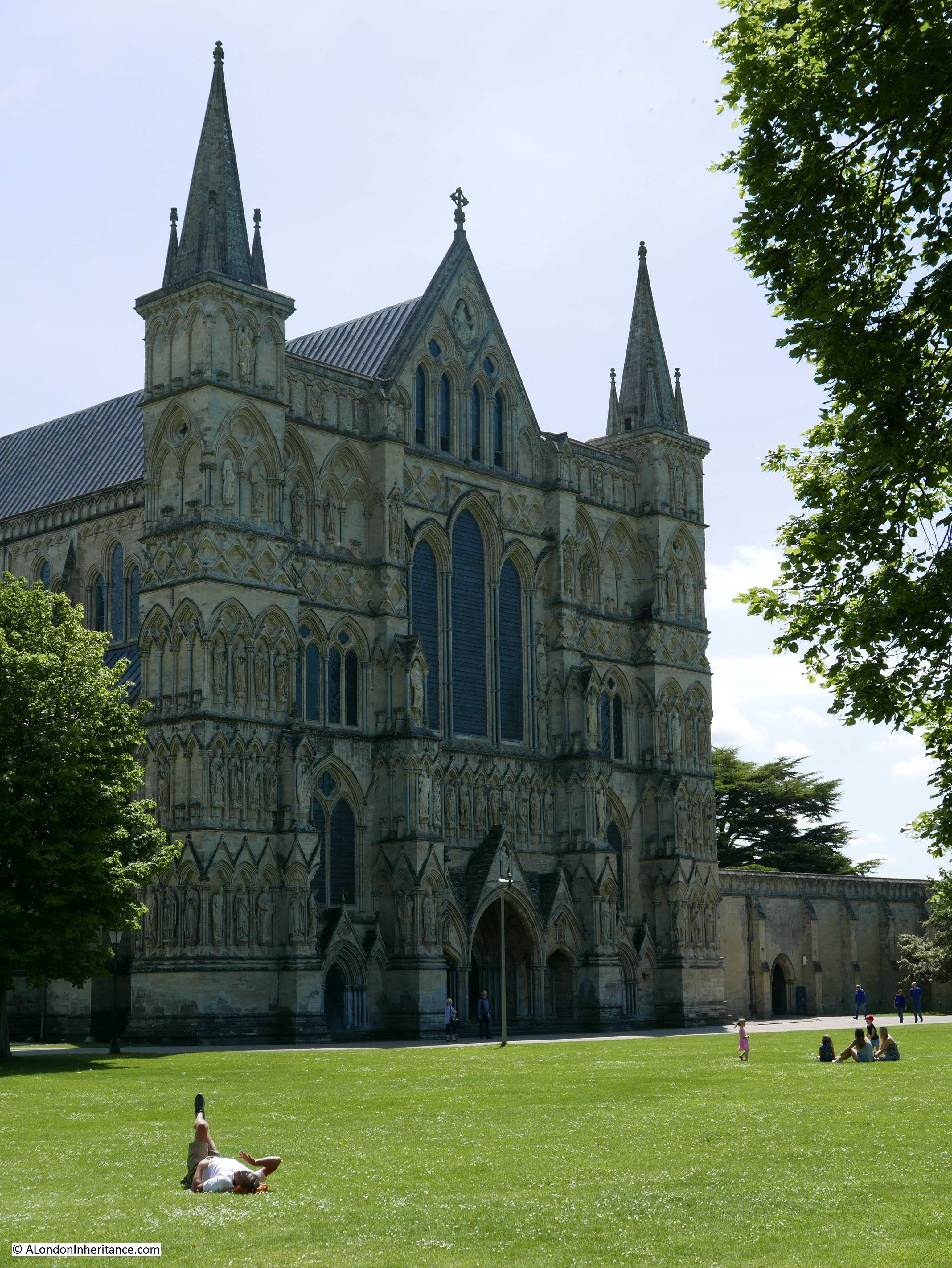
Apollo Theatre

Next door to the Lyric Theatre is the Apollo Theatre:

West End Theatres

The Apollo Theatre opened in 1901 and has been putting on an almost continuous series of productions.

The design, materials used for the facade and slightly greater height of the Apollo Theatre are very different to the original Lyric Theatre next door, probably to make the new theatre stand out more than its earlier neighbour. The gleaming white stone and ornate decoration around the circular windows on either side of the top of building make the facade of this building one of the more opulent on Shaftesbury Avenue.

One thing i did find puzzling about the design of the building is that the windows are not symmetrical on either side. The pairs of windows are of the same height and alignment on the right of the building, but the pairs of windows are offset on the left. I am sure there is a good architectural reason for this, probably to be found in the interior.

West End Theatres

The Apollo Theatre is currently showing “Love In Idleness” by Terence Rattigan.

Gielgud Theatre

At the junction of Shaftesbury Avenue and Rupert Street is the Gielgud Theatre:

West End Theatres

The Gielgud Theatre originally opened in 1906 as the Hicks Theatre, named after the author of the first play (The Beauty of Bath by Seymour Hicks) that was performed in the theatre.

Unfortunately for Seymour Hicks, his place in West End theatre history was hidden when the theatre was renamed the Globe in 1909. It retained this name until 1994 when it was renamed the Gielgud Theatre to avoid confusion with the newly opened Shakespeare’s Globe Theatre at Bankside. The name was chosen as a tribute to Sir John Gielgud who had performed at the theatre in 1928.
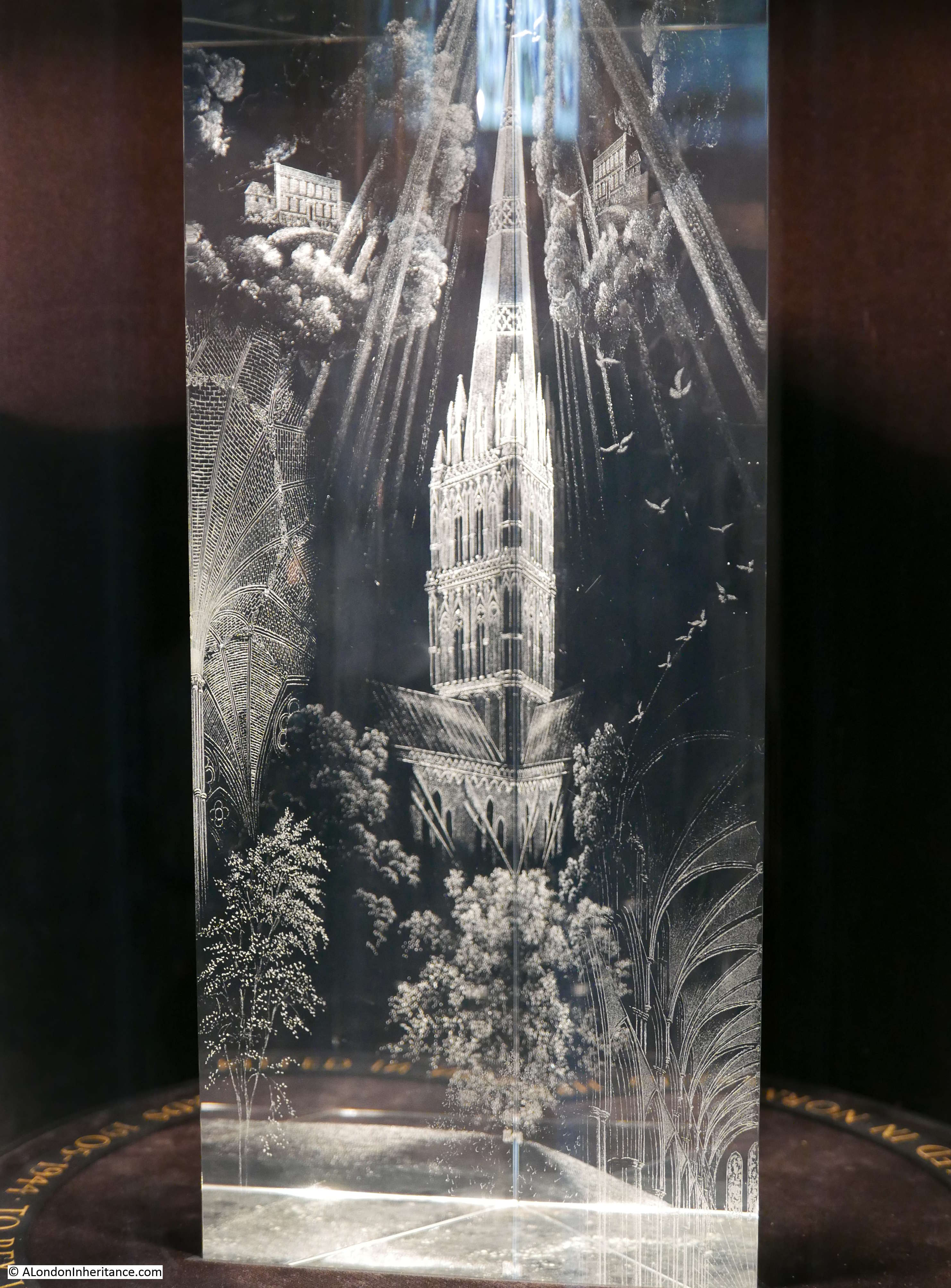
The Gieldgud Theatre is currently hosting “The Curious Incident of the Dog in the Night-Time”.

Queen’s Theatre

At the junction of Shaftesbury Avenue and Wardour Street is the Queen’s Theatre:

West End Theatres

A very different building to the other West End Theatres I have so far walked past. Originally opened in 1907 it was designed as a pair with the Gielgud Theatre, however the Queen’s Theatre was the first West End theatre to be put out of action by bombing on the 24th September 1940. This brought to an end the production of Rebecca with Owen Nares, Celia Johnson and Margaret Rutherford that was running at the time.
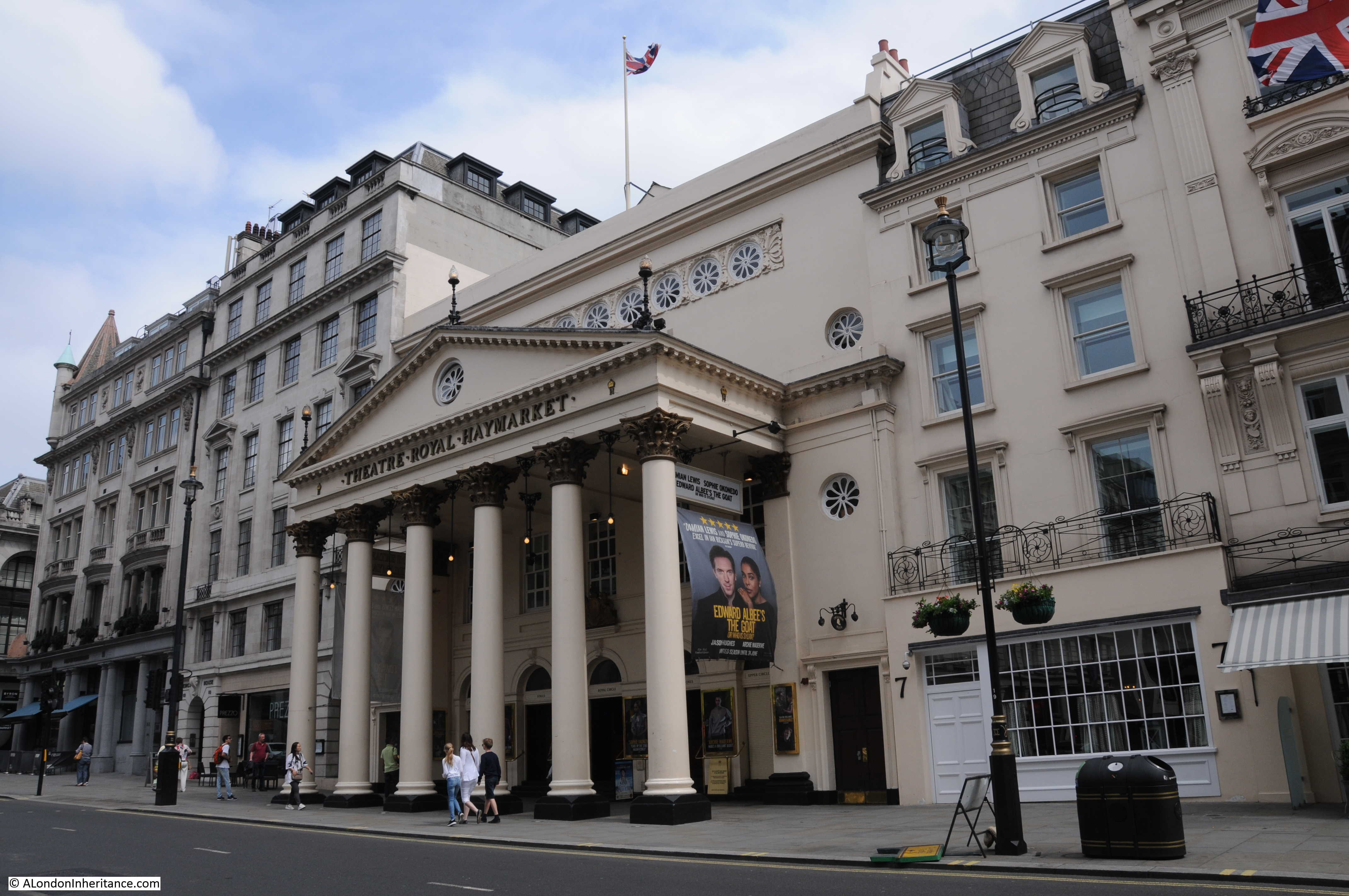
The Queen’s Theatre reopened in 1959 after a reconstruction project costing £250,000 and which explains the radically different appearance of the building to other theatres on Shaftesbury Avenue.

The Queen’s Theatre is currently showing “Les Miserables”.

Soho Theatre

To visit my next destination I turned off Shaftesbury Avenue to walk down Dean Street to find the Soho Theatre:

West End Theatres

The Soho Theatre is one of the West End’s newer theatres, it has been the home of the Soho Theatre Company since 2000. It is also one of the smallest with a 150 seat auditorium. The building also has a smaller 90 seat performance space and houses the Soho Theatre Bar.

West End Theatres

The Soho Theatre was hosting two productions, “Blush” by Charlotte Josephine and “Roller Diner” by Stephen Jackson.

Prince Edward Theatre

I then walked back down Dean Street then turned into Old Compton Street to find the Prince Edward Theatre:

West End Theatres

The Prince Edward Theatre was opened in 1930 and has had a number of different uses in the following years.

In 1936 the building opened as the London Casino, running as a cabaret restaurant. During the war the building housed the Queensbury All Services Club  broadcasting shows to British Forces across the world. It was during this time that almost every well known war time performer was at the Prince Edward for one of these broadcasts including Vera Lynn, Glenn Miller, Tommy Handley, George Formby and Flanagan and Allan.

After the war the Prince Edward returned to theatrical productions until 1954 when it was converted to a cinema, a role it continued to perform until 1978 when the Prince Edward was restored to a theatre, a role it has continued to perform to this day.

The Prince Edward is currently hosting the musical “Aladdin”.

The Palace Theatre

Back down to Shaftesbury Avenue and at the junction with Charing Cross Road is the Palace Theatre:

West End Theatres

The Palace Theatre is a large, red brick building with a capacity for 1,400 theatre goers.

The theatre was opened in 1891 for Richard D’Oyly Carte who intended the theatre to be the home of English opera and on opening the theatre was known as the Royal English Opera House. The first production was Arthur Sullivan’s Ivanhoe, however when this closed there was no follow up production and the Royal English Opera House closed.

D’Oyly sold the building and in 1911 it opened as the Palace Theatre of Varieties, commencing a theme of musical productions which have run for most of the theatre’s time. With the emphasis on musicals rather than variety productions, the theatre dropped the last part of the name to become the Palace Theatre.

Today, the Palace Theatre is hosting probably one of the biggest productions in the West End for some years, J.K. Rowling’s “Harry Potter and the Cursed Child”.

Phoenix Theatre

Walking up Charing Cross Road, I found my next theatre, the Phoenix Theatre:

West End Theatres

The Phoenix Theatre has two main entrances, one on Phoenix Street (above) and the other on the corner of Charing Cross Road and Flitcroft Street (below).

West End Theatres

The Phoenix Theatre was opened in 1930 to a design by Sir Giles Gilbert Scott, Bertie Crewe and Cecil Masey. Since opening it has held an almost continuous run of plays and musicals.

The Phoenix Theatre is currently hosting the musical “The Girls” by Gary Barlow and Tim Firth.

The Dominion Theatre

Continuing along Charing Cross Road to the junction with Tottenham Court Road where the Dominion Theatre is located.

West End Theatres

Built in 1939, the Dominion Theatre has operated as a theatre, cinema and live music venue.

It did not last long as a theatre as by 1933 it was owned by the Gaumont-British Picture Corporation as a cinema and with the occasional exception of a live performance, remained primarily as a cinema until the late 1970s. It then went through a period of hosting live music including David Bowie and Bon Jovi, before returning to a theatrical venue in the late 1980s.

My first visit to the Dominion Theatre was when it was a cinema. I cannot remember exactly how old I was, probably around 8 or 9, when my parents took me to the Dominion Theatre as a birthday treat to see the film The Battle of Britain (although it was also probably a rather clever ploy by my dad to get to see the film).

In 2014, the 12 year run of the musical We Will Rock You came to a close, ending the period when a giant gold statue of Freddy Mercury adorned the front of the theatre.

West End Theatres

The Dominion Theatre is now showing “An American In Paris”.

Shaftesbury Theatre

To reach my next theatre, I walked along New Oxford Street, and down Shaftesbury Avenue to find the Shaftesbury Theatre:

West End Theatres

The Shaftesbury Theatre occupies a prominent corner location. Opened in 1911 it was originally called The Princes Theatre. For over a century the Shaftesbury Theatre has hosted musicals, plays and comedies and in 1968 the run of the musical Hair commenced in September, made possible by the ending of theatre censorship laws on the 26th September 1968 when after 231 years of theatre censorship, the Lord Chamberlain had his powers to censor plays removed.

Hair ran for almost 2,000 performances before it was forced to close owing to structural problems in the building that required urgent restoration work. During closure, there were attempts to redevelop the building, however it was saved as a theatre and reopened in 1974.

The Shaftesbury Theatre is currently hosting “Motown The Musical”.

New London Theatre

Next on my route was the New London Theatre which I reached by walking along High Holborn then down Drury Lane:

West End Theatres

The New London Theatre opened in 1972 in a new building on the site of an earlier theatre.

The Middlesex Music Hall was on the site from 1851, and in 1911 this was replaced by a new theatre but with the similar name of the New Middlesex Theatre of Varieties. In 1919 it became The Winter Garden, a name which it retained until 1959 when the theatre closed.

The building stood empty for much of the 1960s until it was demolished and replaced with the building that is on the site today (although it is hard to get an idea of the building underneath the advertising).

The New London Theatre is currently showing “School of Rock, the Musical”.

And with the New London Theatre I complete my first post of West End Theatres. In my second post, later this coming week I will complete the set, having hopefully found all the theatres in London’s West End.

alondoninheritance.com

Flying Over London

One of my first posts, three years ago, was about flying over London in a vintage de Havilland Dragon Rapide. I took a number of these flights between 1979 and 1983 as I loved flying, I had started working so I could afford tickets and I had a reasonable camera.

I continue to scan my negatives and I recently found some more photos of flying over London from Biggin Hill, over east London and the City before returning to Biggin Hill. For today’s post, here are a selection of photos from the earliest (black and white) to the later years (colour) of flying over London in a de Havilland Dragon Rapide.

I will start with the earliest and you will see an improvement over the years in the cameras I was using.

Firstly, here is the de Havilland Dragon Rapide. A design from the 1930s with this plane being manufactured in 1946:

Flying over London

The flights from Biggin Hill changed the routes taken to get from the airfield to the City each year which provided the opportunity to see different parts of south London. The flying height was low enough so that detail on the ground was clear, and the lower speed compared to jet aircraft allowed sufficient time to pick out the locations along the route.

In the following photo, the large cemetery in the lower left of the photo is alongside Hither Green Crematorium, with Catford in the background of the photo.

Flying over London

Hither Green – the railway can be seen running from the bottom of the photo, just to the left of centre, with Hither Green station being roughly a quarter of the way up the railway line:

Flying over London

Bromley:

Flying over London

The distinctive loop of houses to the lower right of the following photo is the appropriately named Oval Road, just to the immediate north-east of East Croydon Station.

Flying over London

The next three photos are flying up to and over Rotherhithe and the land once occupied by the Surrey Commercial Docks. The Isle of Dogs can be seen across the river.

Flying over London

Flying over London

Flying over London

Moving on to a later year and I have changed to colour film and the flight from Biggin Hill has taken a slightly different route so we can see the Thames Barrier in the final stages of construction:

Flying over London

Flying over London

The northern end of the Isle of Dogs with from the top, the West India Dock (Import), the West India Dock (Export) and the South Dock. If you look just above the top dock, over to the right is the spire of a church, this is All Saints Church, Poplar. The Balfron Tower can be seen just behind the spire of  the church.

Hard to believe that this is now the Canary Wharf development and One Canada Square is now in the centre of these docks.

Flying over London

Looking back over the Isle of Dogs. Limehouse Basin is the area of water in the centre of the photo.

Flying over London

Looking back over Limehouse Basin. The Limehouse Cut can be seen running from the top corner of the basin. The Regent Canal is the line running from the lower left corner.

Flying over London

The church of St. Mary the Virgin, Rotherhithe is clearly visible in the lower part of the following photo. Shadwell Basin is across the river.

Flying over London

Approaching the City:

Flying over London

In the following photo, the railway line into Liverpool Street Station is running from lower right to top left of the photo. The grassed area in the centre of the photo is Weavers Fields, Bethnal Green.

Flying over London

Another view looking along the railway into Liverpool Street Station. Bethnal Green on the right, Stepney and Whitechapel on the left.

Flying over London

Approaching the City:

Flying over London

This was the view of the City when the NatWest Tower (now Tower 42) was the highest building in the City. It had just been completed when this photo was taken.

Flying over London

Flying over the river, looking west. This was before HMS Belfast was moored on the river and when warehouses still covered much of the south bank. Note the flying boat moored just north of Tower Bridge. This was a Shorts Sandringham – a remarkable sight to see on the river. The large white building on the north bank of the river is the old British Telecom Mondial House building.

Flying over London

Now for the final trip with a better camera and film, and a different route. The sports ground at Crystal Palace:

Flying over London

Slightly different angle on Crystal Palace. The tall Crystal Palace TV mast can be seen in the upper right of the photo:

Flying over London

Not sure where the next two photos are, somewhere over south London:

Flying over London

That may well be Croydon to the upper right:

Flying over London

The isle of Dogs again:

Flying over London

View looking over Bermondsey, Southwark and Lambeth with the railway running into London Bridge Station in the lower right quarter of the photo, long before the Shard.

Flying over London

View from over south London looking north. The River Thames is running across the middle of the photo from left to right. The green areas in the upper part of the photo are St. James’s Park, Green Park and Hyde Park.

Flying over London

Another photo looking from south London over towards the north west. Just to the left of centre is the old gas holder at Battersea. The chimneys of Battersea Power Station can be seen just to the right of the gas holder and Battersea Park behind.

Flying over London

View looking over the City:

Flying over London

The City of London, with still the Nat West Tower being the only really tall building. Note also how few cranes there are across the City. I counted about five in this photo. It would be very different now. The rate of construction has increased rapidly since the early 1980s.

Flying over London

Another view of the City.

Flying over London

HMS Belfast is now moored on the river.

Flying over London

A final view whilst crossing the river.

Flying over London

These flights let me pursue my early interests in flying, photography and London all at the same time. Unfortunately I have not taken any similar flights since the early 1980s. My aerial views of London now are when I have been working abroad and fly back into Heathrow. I always make sure I book a seat on the right of the plane in the hope that the landing will be from the east, and even after all these years, I am still the one with my camera pressed up against the window.

alondoninheritance.com

Building Bankside Power Station

In 1953, soon after it started operation, my father took the photo below of Bankside Power Station. The photo suffers from a problem I often have when taking a photo of the southern bank of the river from the north on a clear day as the sun is in the south and puts the power station into silhouette.

In the photo, Bankside Power Station also looks only half built, which indeed it was. There is a smaller building on the left with two rows of chimneys receding from the river’s edge. This is the original power station on the site.

Bankside Power Station

Roughly the same view today. The Millennium Bridge now crosses the river in front of the old Bankside Power Station building.

Bankside Power Station

A view from further along the river showing the full size of the former Bankside Power Station building.

Bankside Power Station

This area of Bankside has produced energy for many years before the current Bankside Power Station was built. The following extract from the 1892 Ordnance Survey map shows towards the right of the map an Electric Lighting Works and on the left the Phoenix Gas Works. Both of these industries were located adjacent to the river as they both used coal to generate either electricity or gas.

Bankside Power Station

The original power station was built by the City of London Electric Lighting Company in 1891 and over the years underwent a number of extensions and upgrades to form the building with the two rows of chimneys as seen in may father’s photo.

Each chimney was connected to an individual boiler and a separate building contained the generator that was driven by the steam from the boilers to produce electricity for distribution in the local area and by cables across the river to the City. Electricity generation was originally a local activity with no national grid to distribute across the country. There were power stations located across London, including the Regent’s Park Central Station where my grandfather was superintendent.

The design of the original power station and the equipment used was highly polluting with so many chimneys pouring smoke, ash and grit onto Bankside.

Planning during the war identified the need for a significant number of new power stations across the country with post war consumption of electricity expected to surge. London would be one of the areas where the old, polluting power stations urgently needed to be replaced with cleaner power stations with higher generation capacity.

The 1943 County of London Plan proposed the redevelopment of the south bank of the river to remove heavy industry and line the river with offices, flats and public gardens with commercial and light industrial buildings to the rear. Heavy industry such as power stations were to be relocated out of central London to places such as Poplar, Rotherhithe and east along the river. The following extract from the 1943 plans shows the proposals for the south bank:

Bankside Power Station

As always happens with long-term, strategic plans, events take over and problems such as power shortages during the very cold winter of 1947 forced different decisions to be made and the go ahead was given in 1947 for a new power station to be built at Bankside. In giving this approval there was one major change. Originally it was planned for the power station to continue using coal, however the level of pollution in the area, the space needed for coal storage and the need to diversify power production away from one signal source Influenced the Government to change plans for the new Bankside Power Station to switch from coal to oil. As well as being slightly less polluting, oil had the advantage that it could be stored in large underground tanks, thereby removing the need for large fuel storage areas above ground.

Although oil was slightly less polluting, the new Bankside Power Station would continue to have an impact on the local area and on the river. Flue gases were washed by water taken from the river. These waters would then be returned to the river with a higher particle content and acidic level.

When the go ahead was given for the new power station, as well as concerns about locating such an industry in central London, there were also complaints that the new building would dwarf St. Paul’s Cathedral. Sir Giles Gilbert Scott changed the design from dual chimneys to a single chimney and ensured that the overall height of the chimney was lower than the dome of the cathedral. This was helped with the land on which the cathedral is built being higher than the river side location of the power station, however the reduced height of the chimney did contribute to ongoing local pollution problems.

Construction of the first half of Bankside Power Station took place between 1947 and 1953. This saw the completion of the western half of the building and the central chimney with first power being generated in 1953, and this is the status of Bankside Power Station that my father photographed in the photo at the start of this post.

He had also walked around the area a number of years earlier when construction first started. He took the following two photos showing the demolition of the buildings that had been on the site, and the start of construction of the new power station.

In this first photo, he is standing in front of what would become the wall of the building facing to the river, at the western edge. Five chimneys on the rear of the original power station can be seen, and on the far left of the photo are the lower levels of the new chimney.

Bankside Power Station

I took the following photo further away from the power station than my father’s photo above. If I was much closer it would just be looking directly into the building, however it does give a view of the same scene as it is today with the base of the chimney on the left of both photos. In the above photo it is the central core of the chimney which is seen, the brick outer structure is yet to be added.

Bankside Power Station

The second photo is looking directly across the construction site towards the south.

Bankside Power Station

The Britain from Above website has a number of photos taken by Aerofilms which show the Bankside site under development. The first photo is from 1946 and shows the site prior to development of the new power station. The site can be located by the double row of black chimneys of the original power station which is located in the middle of the lower part of the photo.

Bankside Power Station

The next photo is from 1952 and shows the power station nearing completion. The core of the chimney is complete, but it lacks the outer brick facing. The metal framework around the upper part of the chimney is the same structure as shown on the lower part of the chimney in my father’s photo. The original power station can clearly be seen covering the land where the second half of the new Bankside Power Station would later be built.

Bankside Power Station

The next photo is also from 1952 and shows the power station looking from the north. This again shows the original power station to the left of the new Bankside power station.

Bankside Power Station

And the final photo in June 1952, a couple of months after the above photos now shows the main building and chimney almost complete. The photo also shows the structures on the river that allowed oil tankers to dock and unload their cargoes into the underground tanks of the power station.

Bankside Power Station

Both the old and new Bankside Power Stations continued in operation until 1959 when the old power station was finally decommissioned and demolished. The second half of the new power station was built between 1959 and 1963 by when the building we see today was finally in place. In all, around 4.2 million bricks were used on the external walls of the building and chimney.

The oil crisis during the 1970s had a considerable impact on the financial viability of oil fired power stations. The power station was also continuing to pollute the local area and the river. Power stations were also being built out of cities and there were now power stations further down the Thames. The continued operation of Bankside Power Station could no longer be justified and electricity generation finally ended at Bankside in 1981, almost 100 years from the first, small steps in electricity generation on the site.

The building remained unused for a number of years until plans were put in place to transform the building into Tate Modern. A competition was held for a new design which was won by the firm of Herzog & de Meuron. Their design made very few changes to the external structure of the building so the original design of Sir Giles Gilbert Scott is basically the building we see on Bankside today.

Bankside Power Station is a wonderful building. It is from an era when power stations were built as cathedrals of power, Battersea Power Station being another example of the style. The preservation of the external structure of the building and that now through Tate Modern it is fully open is to be appreciated.

alondoninheritance.com

Puddle Dock And a City Laystall

Puddle Dock is a location that today, is a short street between Queen Victoria Street and Upper Thames Street, but for centuries was one of the large inlets along the river in the City that provided a dock for shipping. The photo below was taken by my father in 1947. I was originally unsure of the location as there is very little in the photo to identify the location today. The Thames is an obvious clue, but what confirmed this to be the original Puddle Dock is the short part of a bridge, seen to the right of the photo on the opposite bank of the river, along with the alignment of the dock and the length of the buildings on either side. All this I will explain below.

Puddle Dock

Firstly, the bridge across the river. This is the railway bridge across the river into Blackfriars Station. It is almost impossible to take a photo from the exact location as my father, however in the photo below I am standing in the middle of Puddle Dock and the bridge can be seen on the right with the arch on the opposite bank of the river in roughly the right position.

Puddle Dock

My next step in confirming this to be Puddle Dock was to check the map in the 1940 edition of Bartholomew’s Reference Atlas of Greater London. The extract from the map is shown below with Puddle Dock in the centre of the map, just to the right of Blackfriars Station.

Puddle Dock

In the 1940 map, the dock is angled towards the bridge, and the building on the right of the dock angles inwards halfway down in such as way that it would appear to be a shorter building to that on the left. This is exactly as the buildings appear in the 1947 photo, although the key point is that the right and left are transposed in the photo as it was taken looking out from the dock.

I am confident therefore that the 1947 photo is of Puddle Dock. I did check the London Metropolitan Archive Collage collection, but could not find any photos of Puddle Dock so they may be few and far between. When finishing off this post, I did find one photo of Puddle Dock in volume one of Wonderful London published in 1926 / 1927. The photo is shown below on the left:

Puddle Dock

Compared to my father’s photo, the building on the left had lost its upper floors by 1947, probably as a result of wartime bomb damage. Even by 1926 Puddle Dock was viewed as a remnant from the past. In Wonderful London, the text below the two photos reads:

“Dramatic Contrast: Old Puddle Dock Lonely And Dirty And Modern Wharves Crowded And Clean – By comparing these two photographs we can appreciate the growth of London’s commerce. in other days we should have found Puddle Dock, which is seen in the left-hand photograph crowded with lighters from ketch and galliot unloading their cargoes laboriously by hand. Now it is frequented only by dingy barges; while it makes a useful rubbish-heap for the neighbourhood. Apart from its narrowness, Puddle Dock could not be visited by great steamers, since it is near Blackfriars Bridge, and only a few large ships, specially constructed, come farther up the Thames than London Bridge. In the photograph on the right we look down the river from London Bridge. The fruit wharves are in the foreground, where trim freighters are being unloaded by cranes.”

In the 1947 photo Puddle Dock is strewn with rubbish, although I doubt Londoners were still dumping their rubbish at the dock, probably rubbish washed in at high tide. In the immediate post war years there was still lots of debris along the river edge from the bombed buildings along the Thames.

Puddle Dock today is the name of the street that runs down from Queen Victoria Street to Upper Thames Street and there are plenty of name plaques to hint at the original use of this area of land running down to the River Thames.

Puddle Dock

Puddle Dock has a long history. John Rocque’s map of 1746 shows the dock (circled in the extract below) as a large dock with the same width onto the river as the Fleet Ditch on the left. The way the shading is drawn probably indicates a sloping dock from the river up to Thames Street, very much like the 1947 photo.

Puddle Dock

For the last 300 years, newspapers contain many references to Puddle Dock. One article can be directly linked to the map above. If you look at the end of the dock, on the right it is labelled “Dung Wharf”. An article in the Evening Mail on the 25th November 1836 covered a legal case “The King v. Gore” which goes some way to explaining the name and purpose of Dung Wharf:

“This defendant has been indicted for a nuisance in keeping a quantity of filth and dirt at Puddle-dock. He has moved the proceedings into this court, and then suffered judgement by default. He was now brought up to receive the judgement of the Court.

The affidavits of several persons residing near Puddle-dock were read, in which they stated that their health was impaired in consequence of the stench arising from the filth which was allowed to accumulate at this dock. 

The defendant then put in an affidavit, stating that he had become a tenant to the corporation of London of the laystall at Puddle-dock; that he was obliged, by the covenant in his lease, to allow all persons to place any filth they chose there; that he was not allowed by his lease to suffer more than five barge loads to remain there at any one time, and that he had never done so; and that this had been a laystall ever since the great fire of London. He admitted that it was a nuisance to the surrounding neighbourhood, but that it could not be avoided.

The Attorney-General, for the prosecutors, said their Lordships would see it was necessary that the prosecution should be adopted. The inquest of the ward had made a presentment, and the Court of Alderman had no choice. They did not indict him for keeping a laystall, because that was authorised by act of Parliament. There were three in the city, Puddle-dock, Dowgate, and Whitefriars. With respect to the latter there had never been any complaint; but thank God, he did not live near Puddle-dock, for if he did he should have reason to complain. All the deponents to the affidavits had sworn that they suffered great inconvenience. It was not for keeping a laystall, but for the manner of keeping it, that the defendant was indicted. Mr. Gore had brought the filth from Covent-garden Market, even on Sundays. He said he must mix some vegetables up with the other filth. All the City wanted was, that the Court would pronounce such a sentence as would prevent the repetition of this mischief.”

The court case does not seem to have made any progress, as at the end of the article it states that “After a good deal of discussion, it was directed that the judgement should be suspended with leave to file fresh affidavits.”

The term “laystall” referenced to in the article is a place where “waste and dung” are deposited. The five barges at Puddle Dock obviously taking away the city’s waste and dumping somewhere down river. It must have been a horrible place to be in the summer and it is easy to understand the impact that the laystall had on nearby residents.

William Maitland writing in The History of London in 1756 states: “On the Banks of the River Thames are the Wharfs of Puddle-dock, used for a Laystall for the Soil of the Streets, and much frequented by Barges and Lighters for taking the same away, as also for landing of Corn and other Goods.”

Most written references to poor Puddle Dock I have seen associate the location with rubbish and filth.

The earliest newspaper article referencing Puddle Dock was from the 5th July 1722 which highlights both the graphic reporting of the time and just how dangerous it was on London streets:

“Another Misfortune happened Yesterday at Puddle-Dock, where a little Boy was killed by a Cart loaded with coals. The Child was stooping down to take up some thing from the Ground when the Cart Wheel ran over his head, and crushed it to Pieces. The Carman is absconded”

The origin of the name Puddle Dock can be found in Stow’s Survey of London from the 1603 edition where he writes: “Then is there a great Brewhouse, and Puddle wharfe, a water gate into the Thames, where horses use to be watered and therefore filed with their trampeling, and made puddle, like as also of one Puddle dwelling there: it is called Puddle Wharfe.”

The name “Puddle” is therefore from at least the 16th century and pre-dates the Great Fire of London. I have not had the time to find how far further back the name was in use – one of the ever-expanding list of things to check.

Puddle Dock today is rather a sterile place, however reading what has happened here in 300 years of newspaper reports really does bring home that for centuries this was a place of work, where people lived and where life in general played out between the City and river.

Tangible evidence of those who have worked around Puddle Wharf can be found in the trade tokens issued by businesses in the area. The British Museum has a collection of these tokens and the following is one issued by Thomas Guy at Puddle Wharf in 1668 (©Trustees of the British Museum):

Puddle Dock

In the decades after my father took the photo of Puddle Dock, the area has changed dramatically. The old dock was filled in, the Mermaid Theatre was built on the eastern edge of the dock, the river embankment was extended into the river and Upper Thames Street was rerouted to pass under Blackfriars Station to provide a direct link with the Victoria Embankment. See my post about the lost road junction between Queen Victoria Street and Upper Thames Street for more photos and history of the area.

The photo below is looking up from the river’s edge into what was Puddle Dock:

Puddle Dock

It is easy to walk past Puddle Dock. There are few reasons to walk along the street today, it is mainly a convenient route for traffic between Queen Victoria and Upper Thames Streets, but at least the name remains. One positive point is that despite the pollution from traffic along the streets on either end of Puddle Dock, it probably does smell far better than it has done for many centuries, when Londoners would have piled up their waste and filth at the laystall ready for disposal along the river.

alondoninheritance.com