Category Archives: London History

Eleanor Crosses – The End of the Journey in London

The procession carrying Eleanor’s body now commenced the final part of the journey, which would take Eleanor’s coffin through the City of London, then west towards Westminster Abbey where she would be buried.

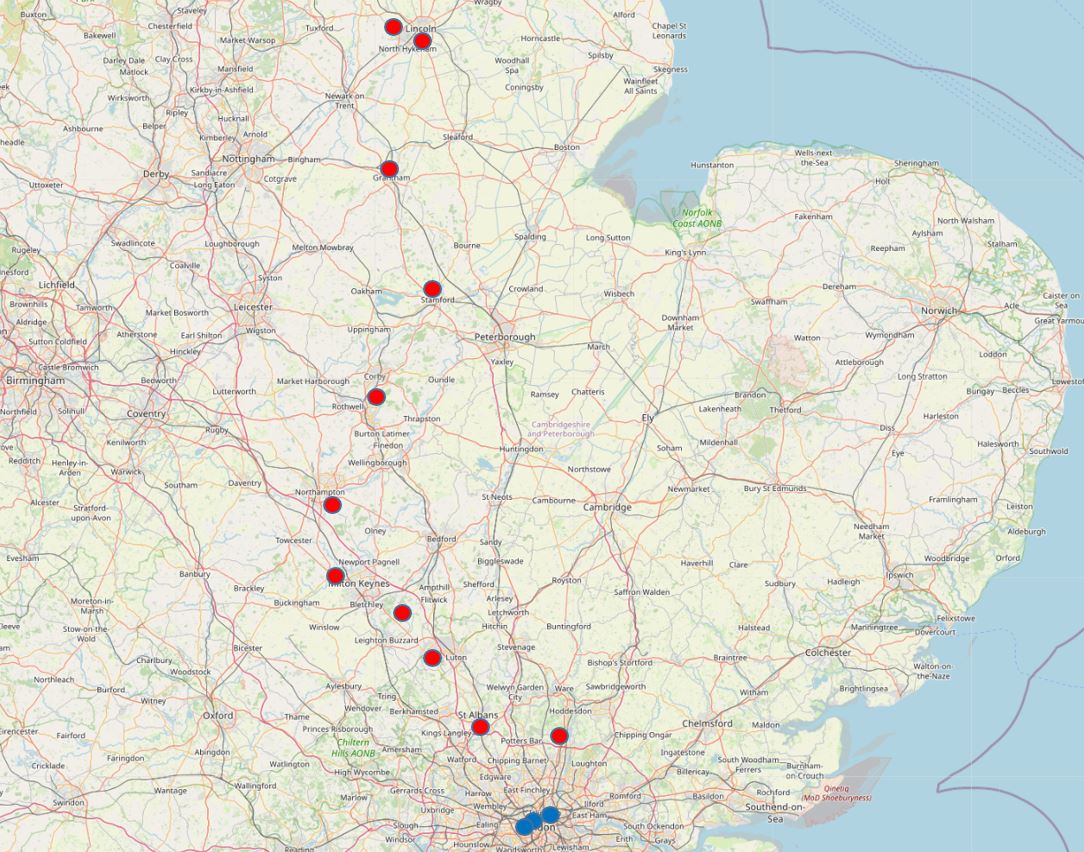
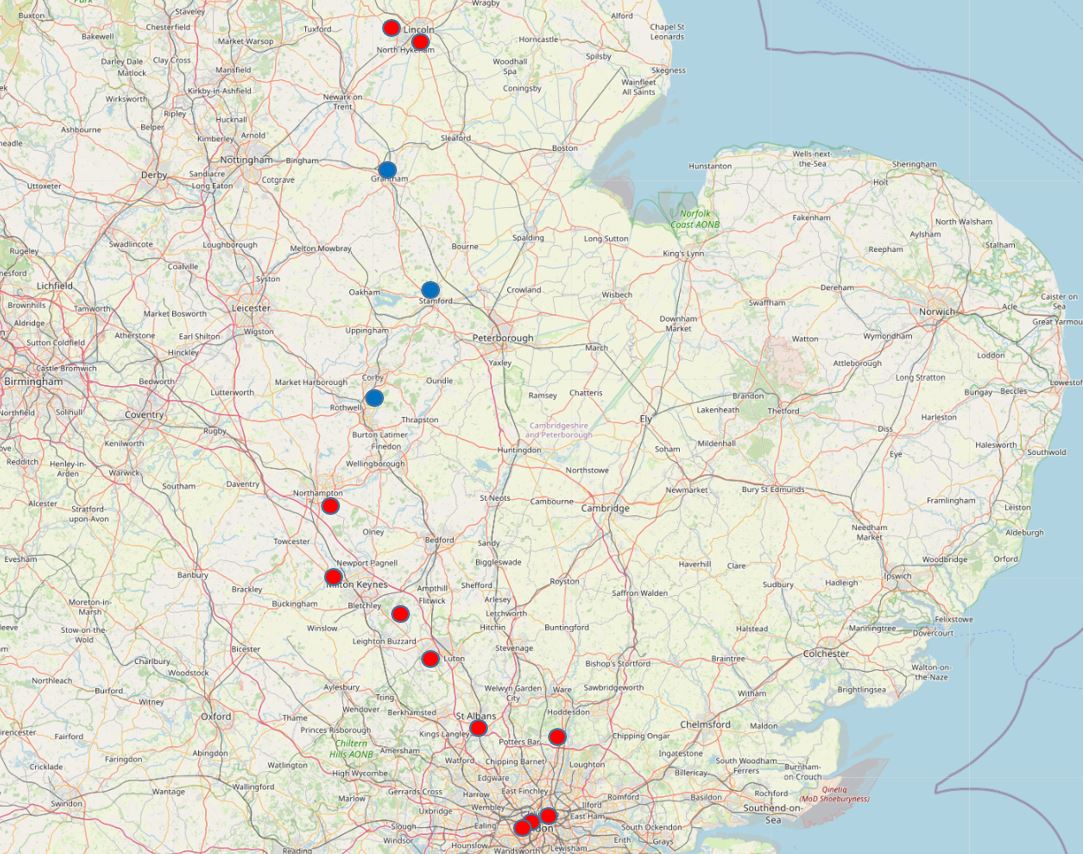
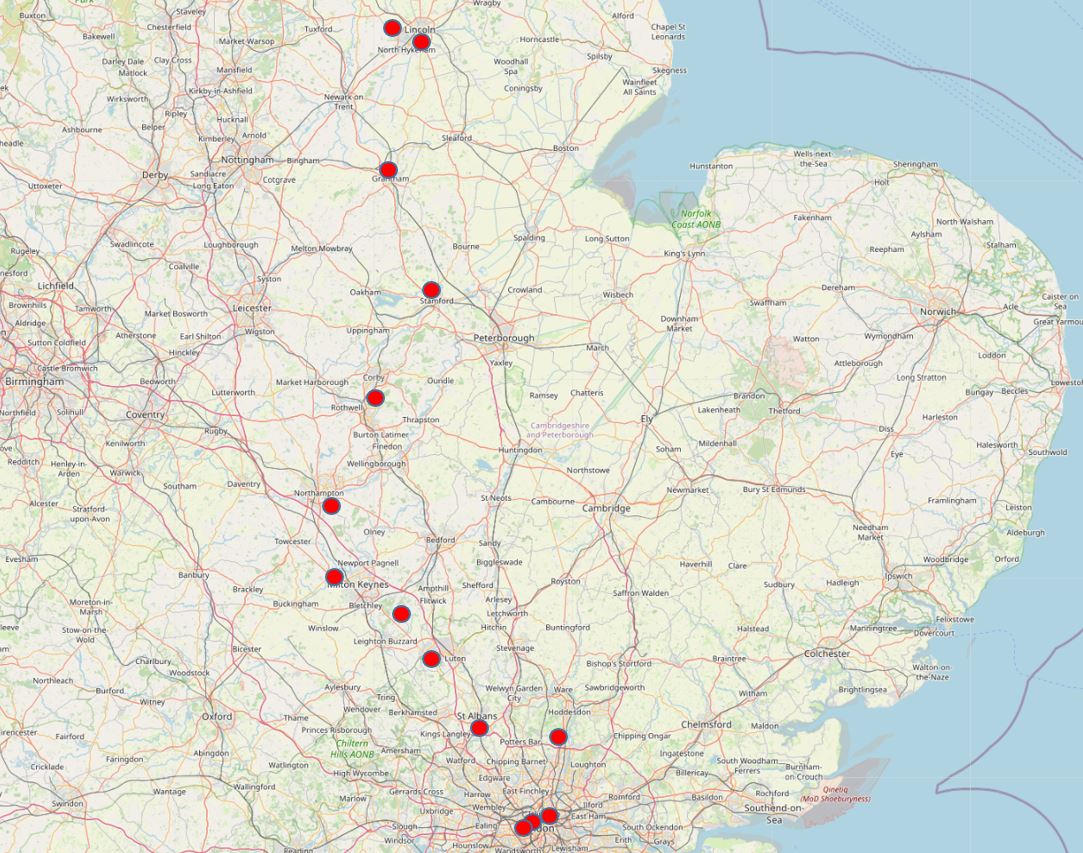
In the following map, three of the key places in London are highlighted with blue circles – Cheapside, Charing Cross and Westminster Abbey, however there were a number of other places which were involved with Eleanor’s funeral, which I will also cover (© OpenStreetMap contributors):

Journey of Eleanor of Castile from Harby to London

The map also shows the distance covered by the procession taking Eleanor’s body from the site of her death in the small village of Harby at the very top all the way to London. Each of the red circles indicates one of the overnight stopping points which I have covered in previous posts.

The procession left Waltham Abbey on Thursday the 14th of December 1290, headed to the location of the future Waltham Cross, where it turned south towards London.

The aim of the easterly diversion to Waltham Abbey may have been due to the importance of the Abbey, and it may also have been to allow an entry into the City from the east, as the procession entered the City of London through the gate at Bishopsgate.

Once in the City of London, the procession stayed in the east of the City, and headed to Holy Trinity Priory in the Minories, which I wrote about in an earlier post here and here.

Eleanor’s coffin rested in Holy Trinity Priory overnight, and the procession set off again the following day to head west. Passing along Cheapside, one of the main streets of the City, the procession headed to the Franciscan friary of Grey Friars, which I have touched on in this post.

After Grey Friars, Eleanor’s coffin was taken to the old St Paul’s Cathedral, where it probably stayed overnight as it would not head to Westminster until the following day.

An Eleanor Cross was built in Cheapside, possibly confirming that Eleanor stayed overnight in St Paul’s, also because the procession had passed along Cheapside, and also because Cheapside was a major City street, and it has been clear from finding the sites of the previous crosses that they were placed in prominent positions. Edward I wanted Eleanor remembered, so putting a cross in a prominent place would ensure that Eleanor was kept in the public memory for centuries to come.

There are no remains of the Cheapside cross today, however we do have a record of its location.

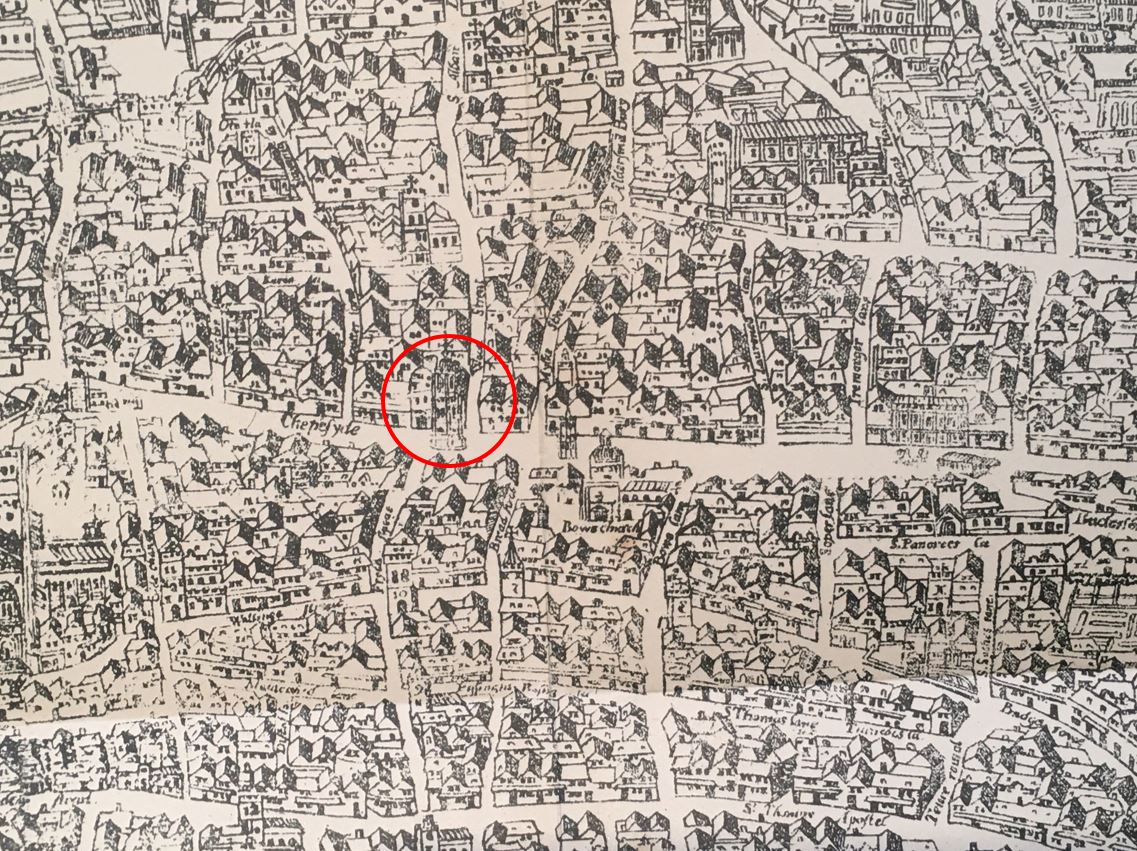
The so called Agas map of around 1561 (probably wrongly attributed to the surveyor Ralph Agas), shows the cross in Cheapside, circled in the following extract:

Eleanor Cross Cheapside

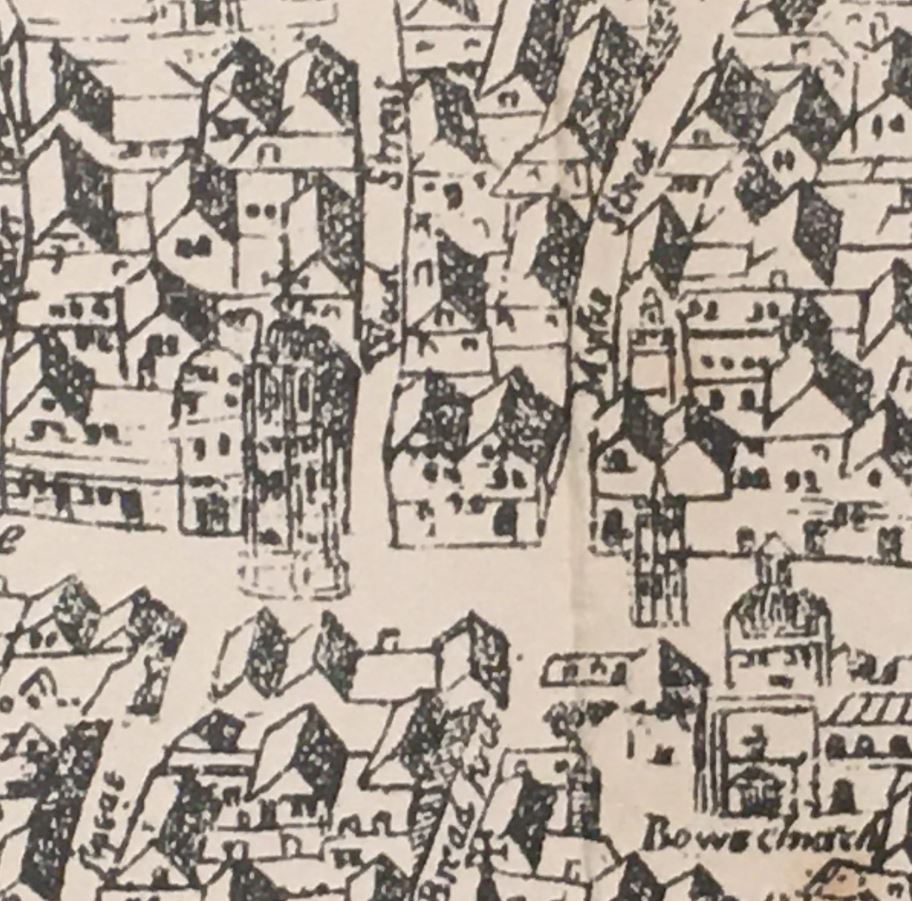
The cross was located just to the west of where Wood Street joins Cheapside, as can be seen in the followed detailed extract from the Agas map:

Eleanor Cross Cheapside

The Eleanor Cross is to the left, and Wood Street can be seen heading north from Cheapside. There appears to be another, much smaller cross just to the east, and Bow Church can be seen in the lower right of the map.

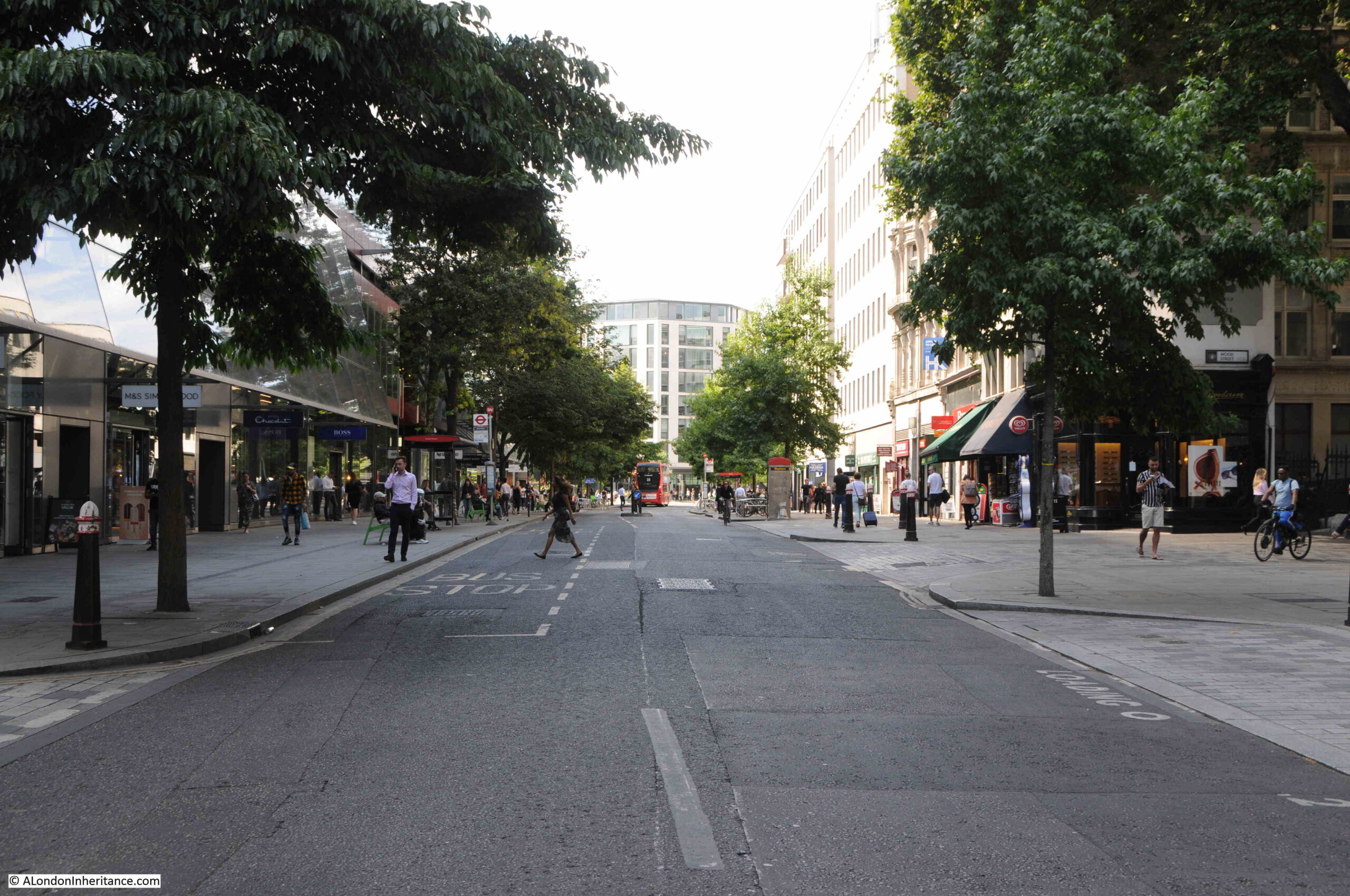
In the following photo, I am standing in the middle of Cheapside, looking west. The tree on the right is in Wood Street, so the Eleanor Cross would have stood in the middle of the road, just behind and to the right of where the person is crossing the road.

Eleanor Cross Cheapside

Just in Wood Street, and to the right of where the tree is located, was the church of St Peter, West Chepe, and in the book “London Churches Before The Great Fire” by Wilberforce Jenkins (1917), the old church was described:

“The ‘Church of St Peter, West Chepe, stood on the corner of Wood Street, Cheapside, and was not rebuilt after the Fire. The well-known tree in Cheapside marks the spot, and a small piece of the churchyard remains. It was sometimes called St Peter-at-Cross, being opposite the famous Cross which stood in the middle of the street, and was at one time an object of pride and veneration, and at a later period the object of execration and many riots, until pulled down and burnt by the mob. The date of the ancient church is uncertain, but there would appear to be a reference to it in 1231. In the ‘Liber Albus’, one Geoffrey Russel is mentioned as having been present when a certain Ralph Wryvefuntaines was stabbed in the churchyard of St Paul’s and being afraid of being accused, fled for sanctuary to the Church of St Peter.

Thomas Wood, goldsmith and sheriff, is credited with having, in 1491, restored or rebuilt the roof of the middle aisle, the structure being supported by figures of woodmen. Hence, so tradition says, came the name of the street, Wood Street.”

The “famous Cross” mentioned in the above extract in bold text, was the Cheapside Eleanor Cross.

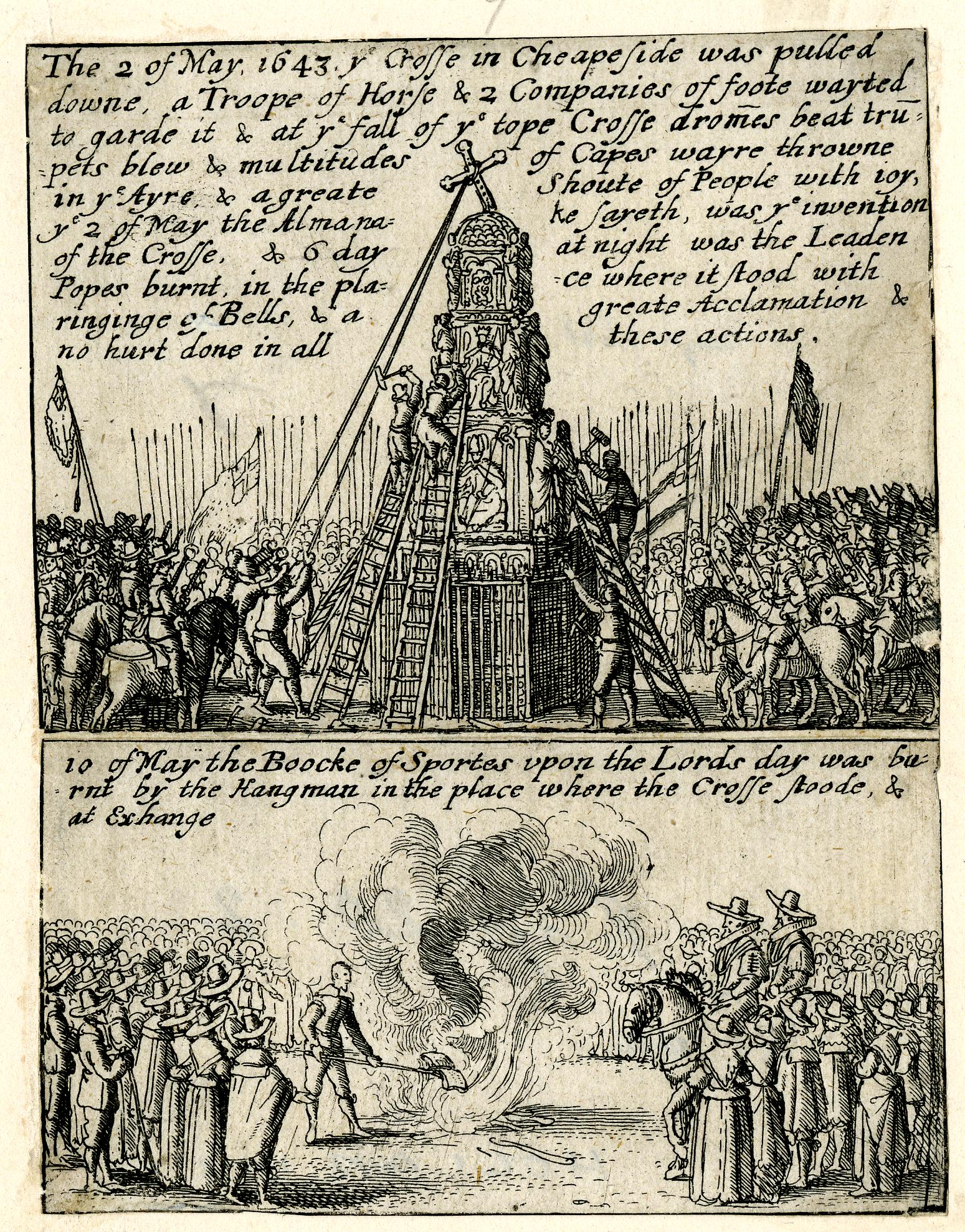
The cross was a large structure and had been rebuilt in the late 15th century when it was decorated with religious iconography including images of the Pope and the Virgin. From the mid 16th century onwards, the cross was the subject of attack by puritans who objected to the religious symbols on the cross.

On the 2nd of May, 1643, the cross was demolished, an act which was illustrated in the following print produced by Wenceslaus Hollar in the same year  (© The Trustees of the British Museum):
Eleanor Cross Cheapside

1643 was one of the early years of the English Civil War, and was a time when many of the Eleanor Crosses were destroyed. They were seen as being religiously symbolic and it was also the royal references which led to damage and destruction of the crosses.

The Cheapside Cross had been rebuilt and by the end of the 15th century appears to have been more a religious monument than the original design dedicated to Eleanor, The text that goes with the above print states that “Leaden Popes burnt in the place where it stood”, which must have been lead statues of the Pope which had been placed on the cross.

The lower part of the print shows the “Boocke of Sportes” being burnt where the cross stood on the 10th of May.

The Book of Sports was a controversial book originally published by James I in 1618. This was in response to the growing Puritan influence on the church, which tried to ban sports and pastimes on Sundays. Not a popular action given that Sunday was the only day off for much of the population. The Book of Sports was a declaration confirming the right of all persons to engage in ‘lawful recreation’ on Sundays after they had attended a church service.

The book was reissued by Charles I in 1633, and he ordered the document to be read in churches to make clear that people could continue with their normal recreations after service.

The growing Puritan influence brought about by the Civil War enabled the restrictions on Sunday recreations to be imposed, and the Book of Sports was often burnt as shown in the print.

On the assumption that Eleanor’s coffin stayed in St Paul’s Cathedral overnight, if not, it must have been a nearby religious establishment, the procession left on Saturday the 16th of December 1290, and headed to the Dominican Priory at Blackfriars, where a mass was held.

If you remember back to the first post in this series, Eleanor’s heart had been one of her organs removed in Lincoln, and the box containing the heart had travelled separately to London, where it was held at Blackfriars. We shall return here at the very end of the post.

Leaving Blackfriars, the procession then continued west to Westminster Abbey, passing through the village of Charing, the name of which appears to have come from the old English word for a bend in a river.

Charing was the site for the last of the Eleanor Crosses, built by the King’s Mason Richard Crundale between 1291 and 1293. Richard was helped by his son, and here is another example of how difficult it is to be sure of names and facts. The English Heritage references to the cross refer to his son Robert, however The London Encyclopedia by Ben Weinreb and Christopher Hibbert, refers to his son as Roger. A minor detail, but I do find that unless you can find an original, primary resource, it is very difficult to be absolutely sure of facts.

The Charing Cross was apparently the most impressive of all the crosses, which would have made sense given the location of the cross.

It was taken down on the orders of Parliament in 1647, and the stones were allegedly used in various building works in Whitehall.

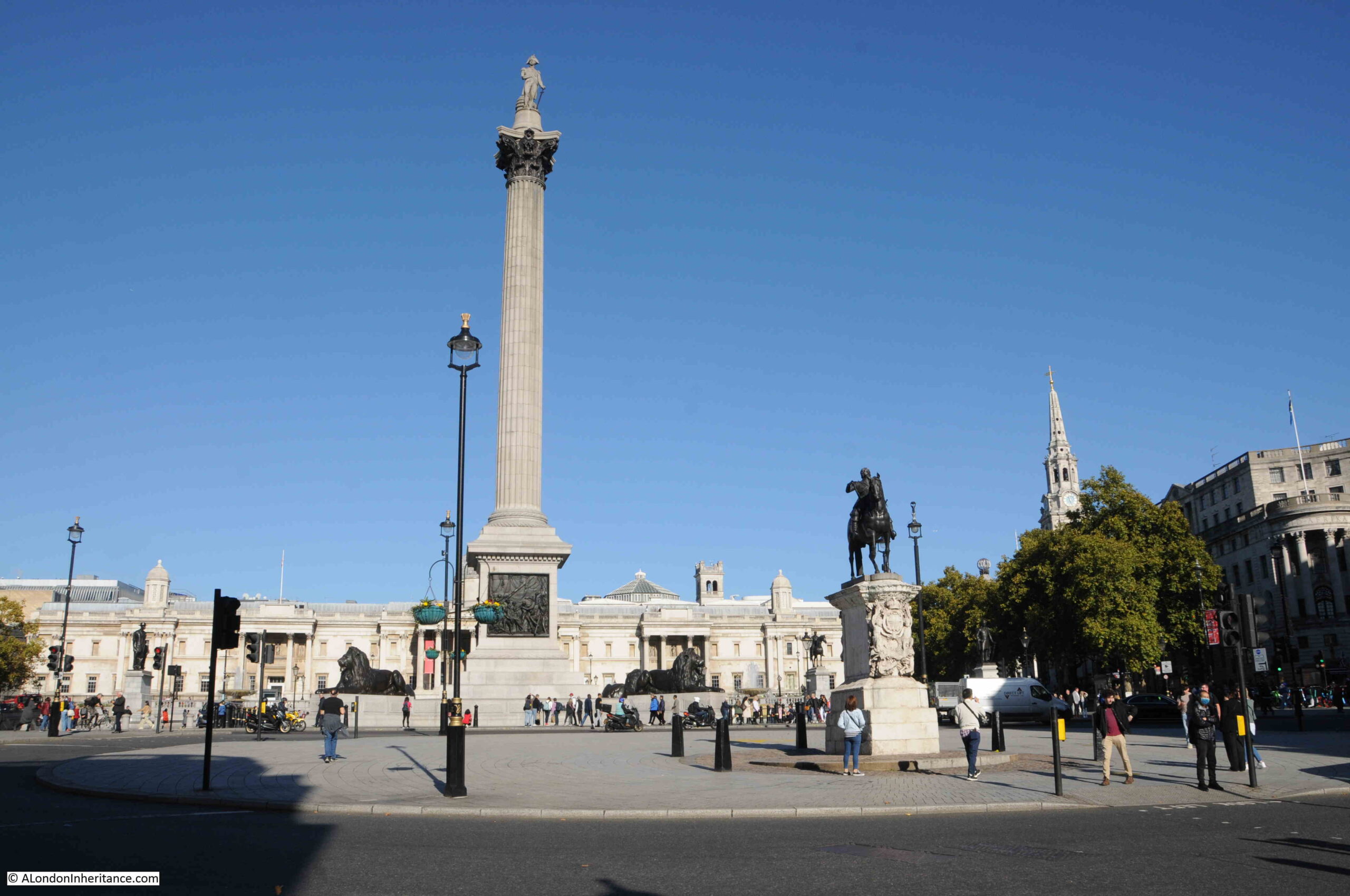
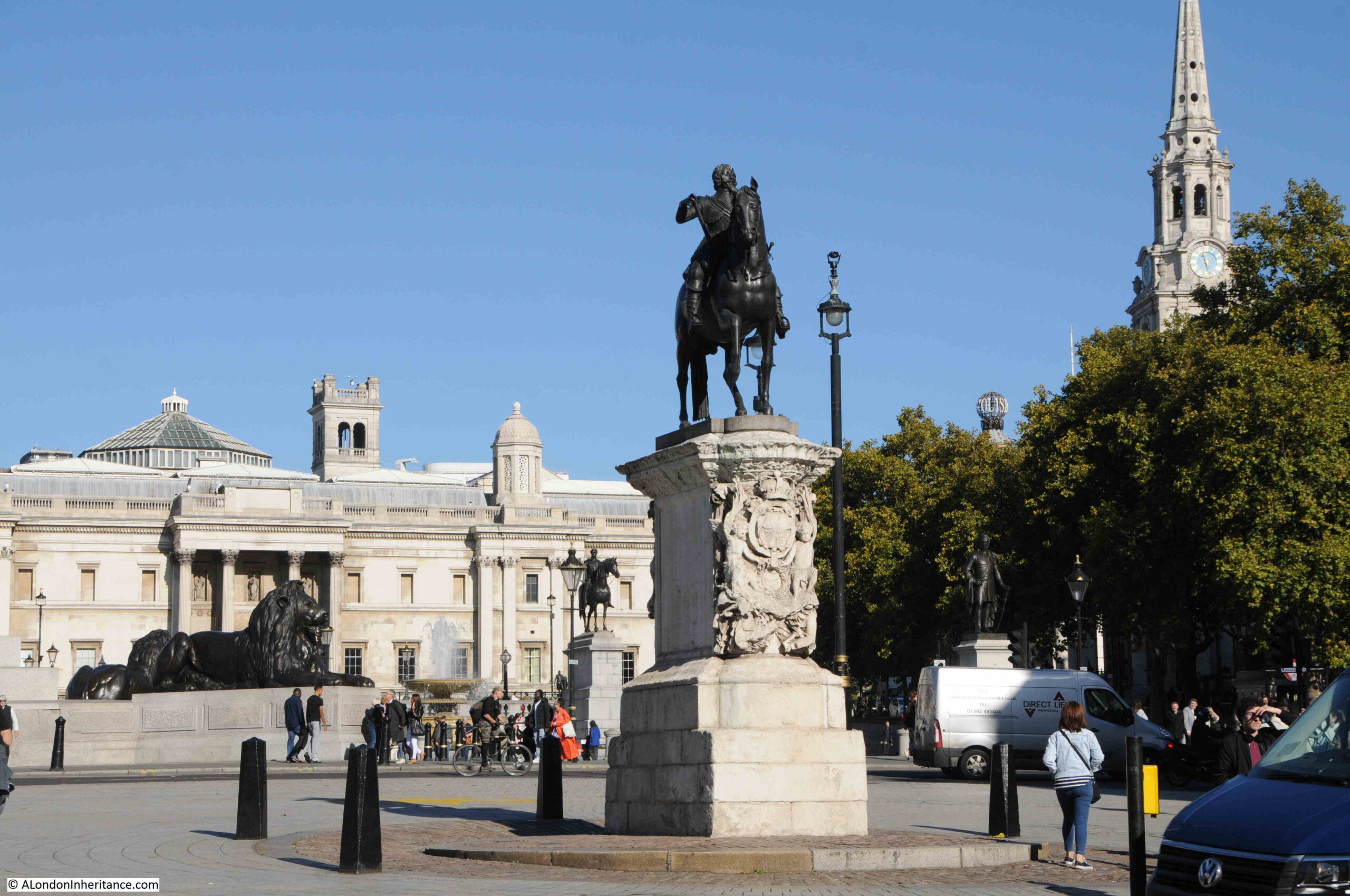
The site of the cross was where the statue of King Charles I stands today, on the edge of Trafalgar Square, seen slightly to the right of the following photo:

Eleanor Cross Charing Cross

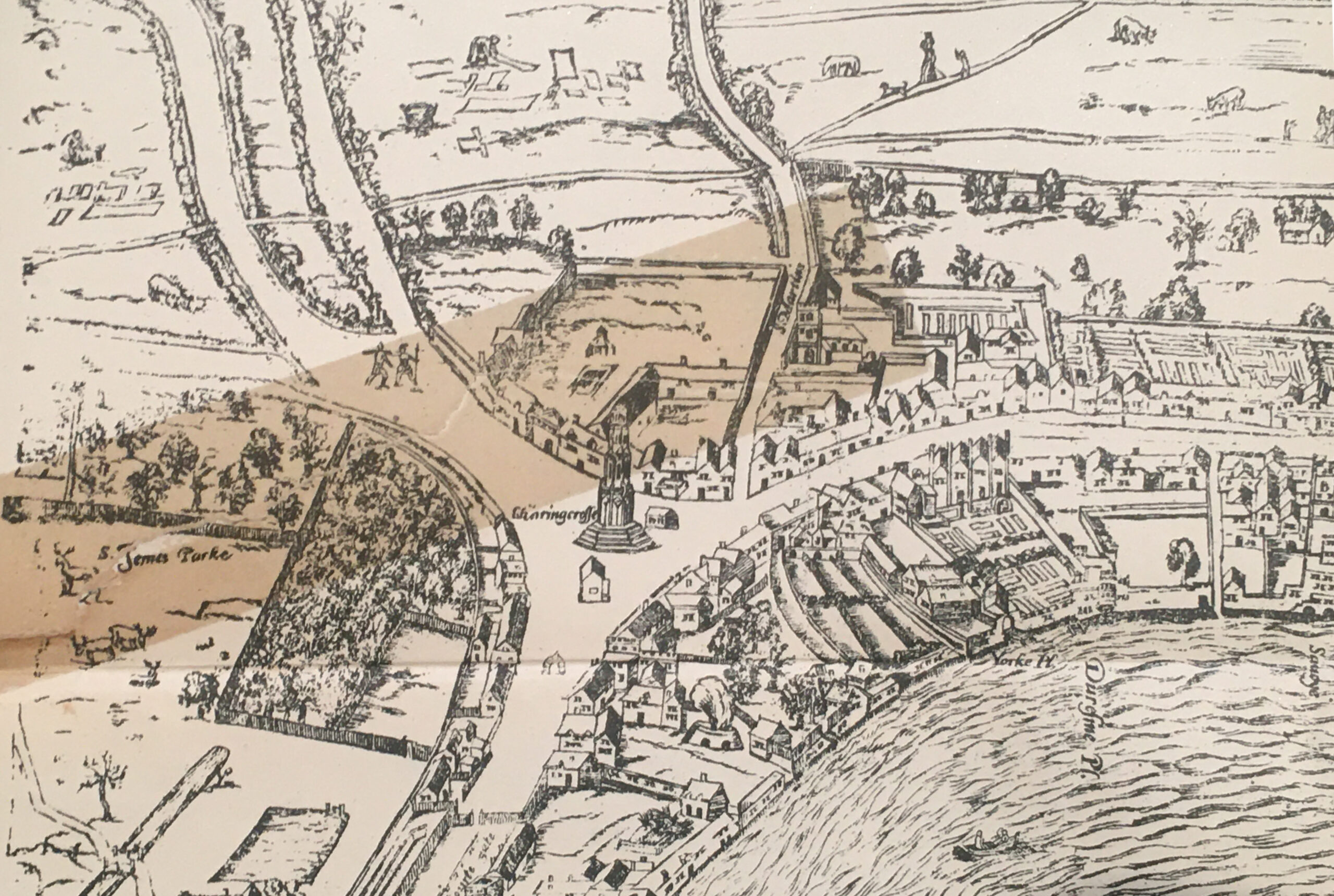
The Agas map also shows the Charing Cross, and as can be seen in the following extract, it stood in a very prominent position. Much of the area was still undeveloped, however it stood in the centre of the junction of a major road to the north, east to the City and west to Westminster. Again so that Eleanor’s memory would be kept in the public memory for many centuries to come.

Eleanor Cross Charing Cross

Following the restoration of Charles II, one of the Regicides (those who had signed the death warrant of Charles I), was executed on the site of the Eleanor Cross. This was Colonel Thomas Harrison who was hung, drawn and quartered on the site of the cross.

A closer view of the statue of Charles I where the Eleanor Cross once stood:

Eleanor Cross Charing Cross

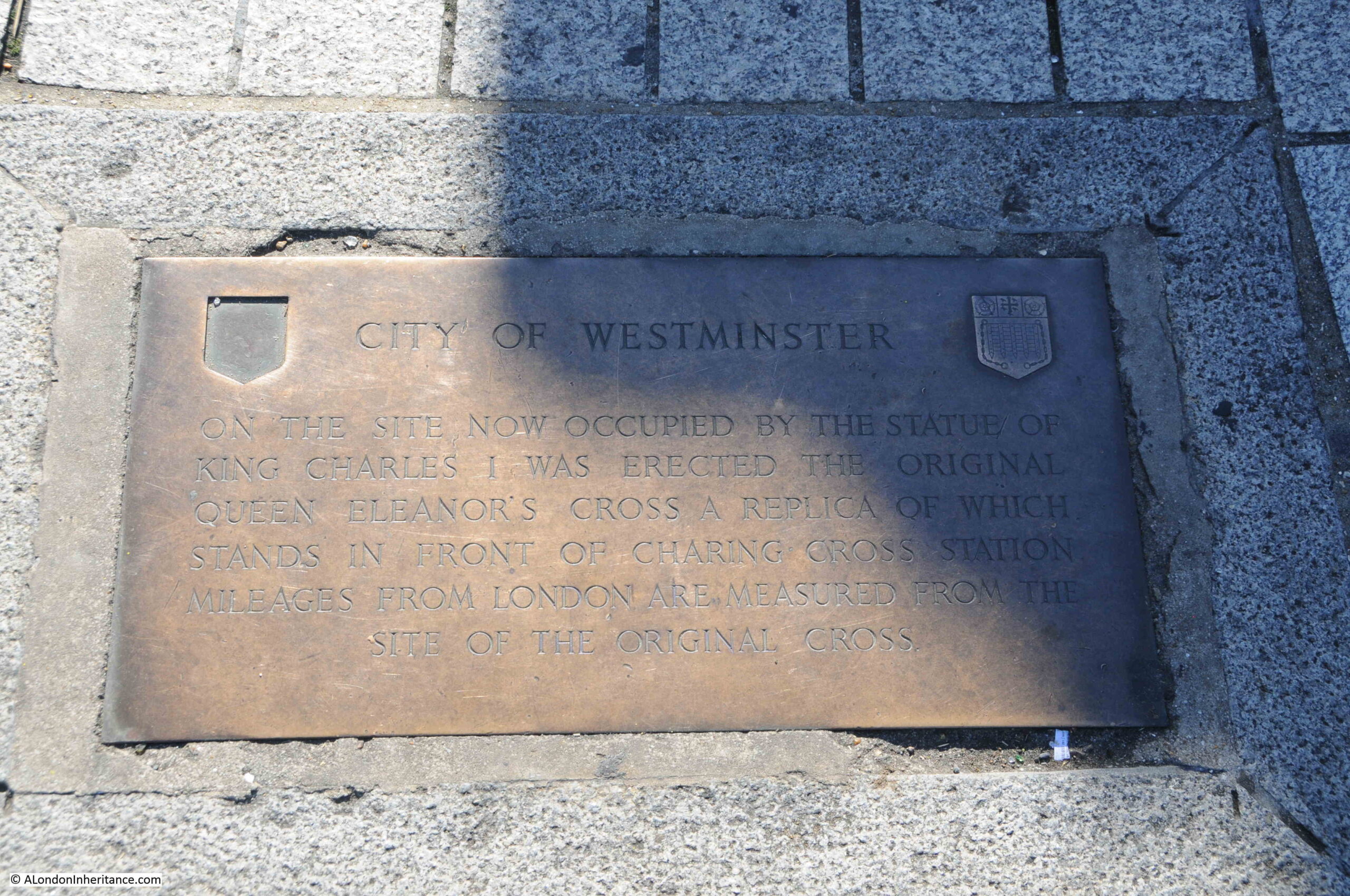
Just behind the statue is a plaque set into the ground which records that the site of the statue was the site of the Eleanor Cross.

Eleanor Cross Charing Cross

The plaque also states that mileages from London are traditionally measured from the site of the original Eleanor Cross, so another example of how the influence of Eleanor’s death can be found today.

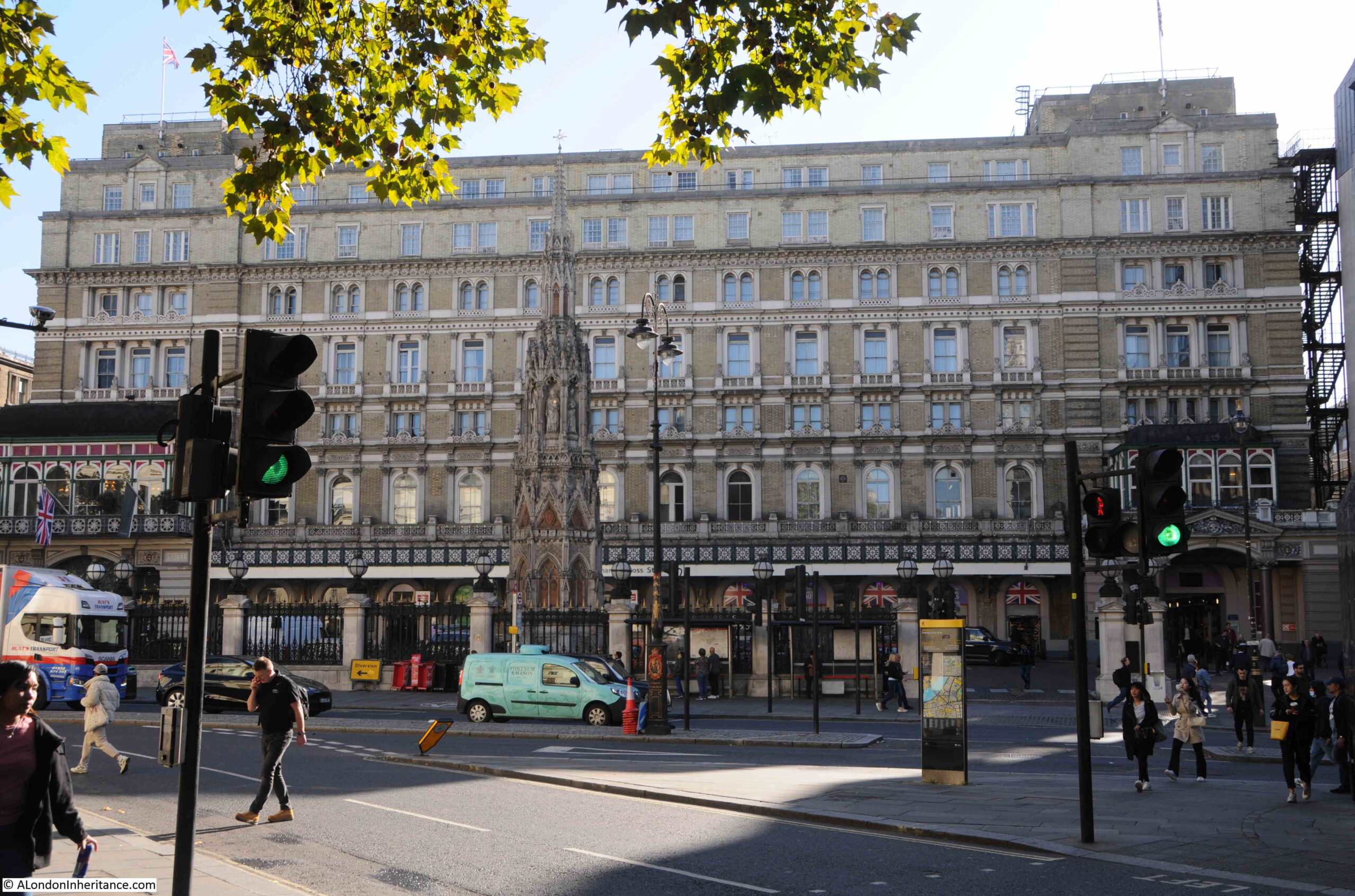
As well as adding the word “Cross” to the original village name of “Charing”, Eleanor’s influence can also be seen outside the station of Charing Cross where a Victorian reproduction cross stands in front of the old station hotel:

Charing Cross

This reproduction Eleanor Cross was designed by Edward Barry and finished in 1865.

Edward Barry was building on a mid 19th century trend for crosses based on the surviving Eleanor Crosses. This trend was started by the architect George Gilbert Scott. He was working in Northampton in the 1830s and therefore may well have seen the Hardingstone cross.

He would go on to design a number of similar crosses, including the Martyrs Memorial in Oxford, which looks very much like an Eleanor Cross.

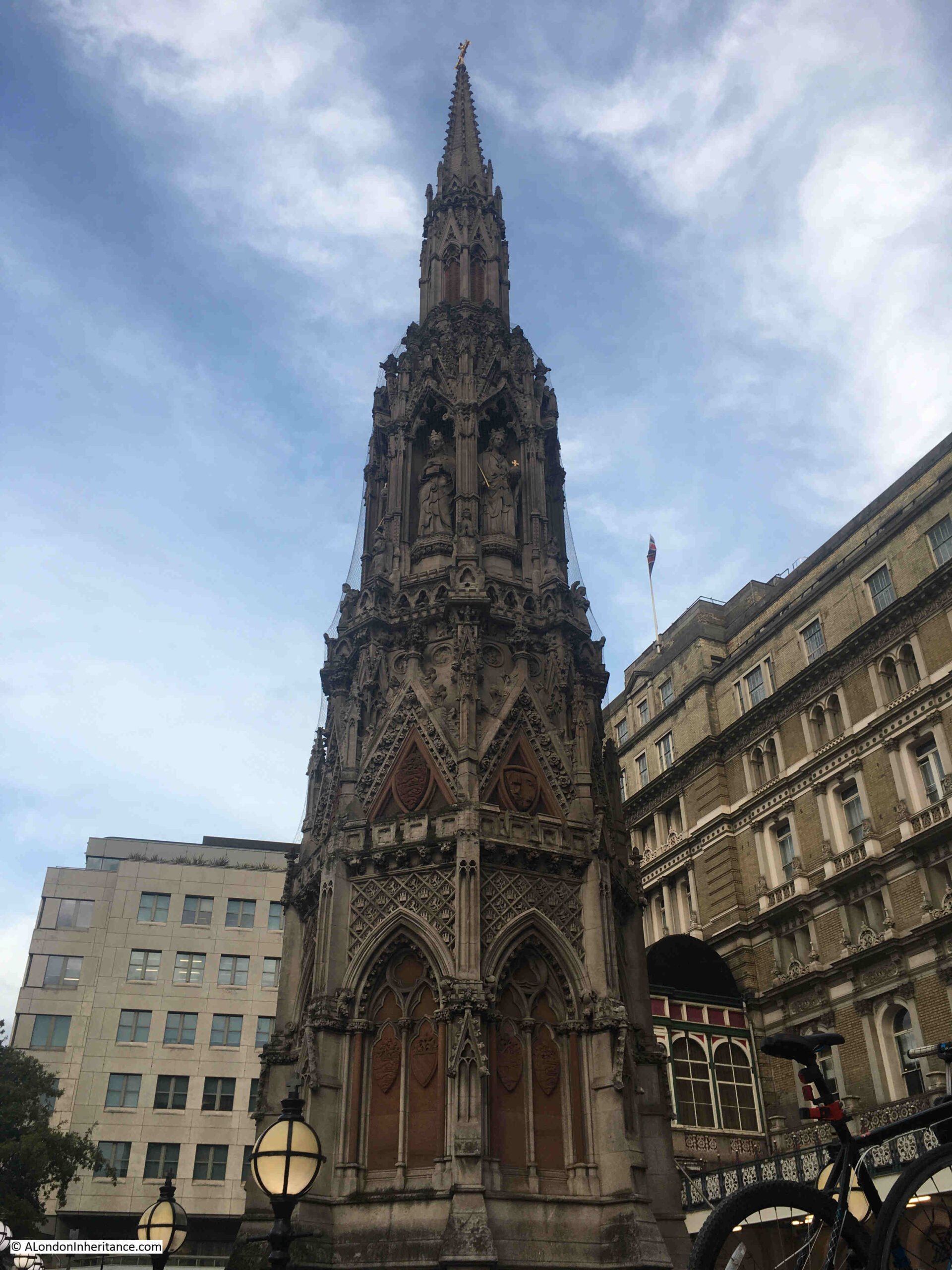
Charing Cross:

Charing Cross

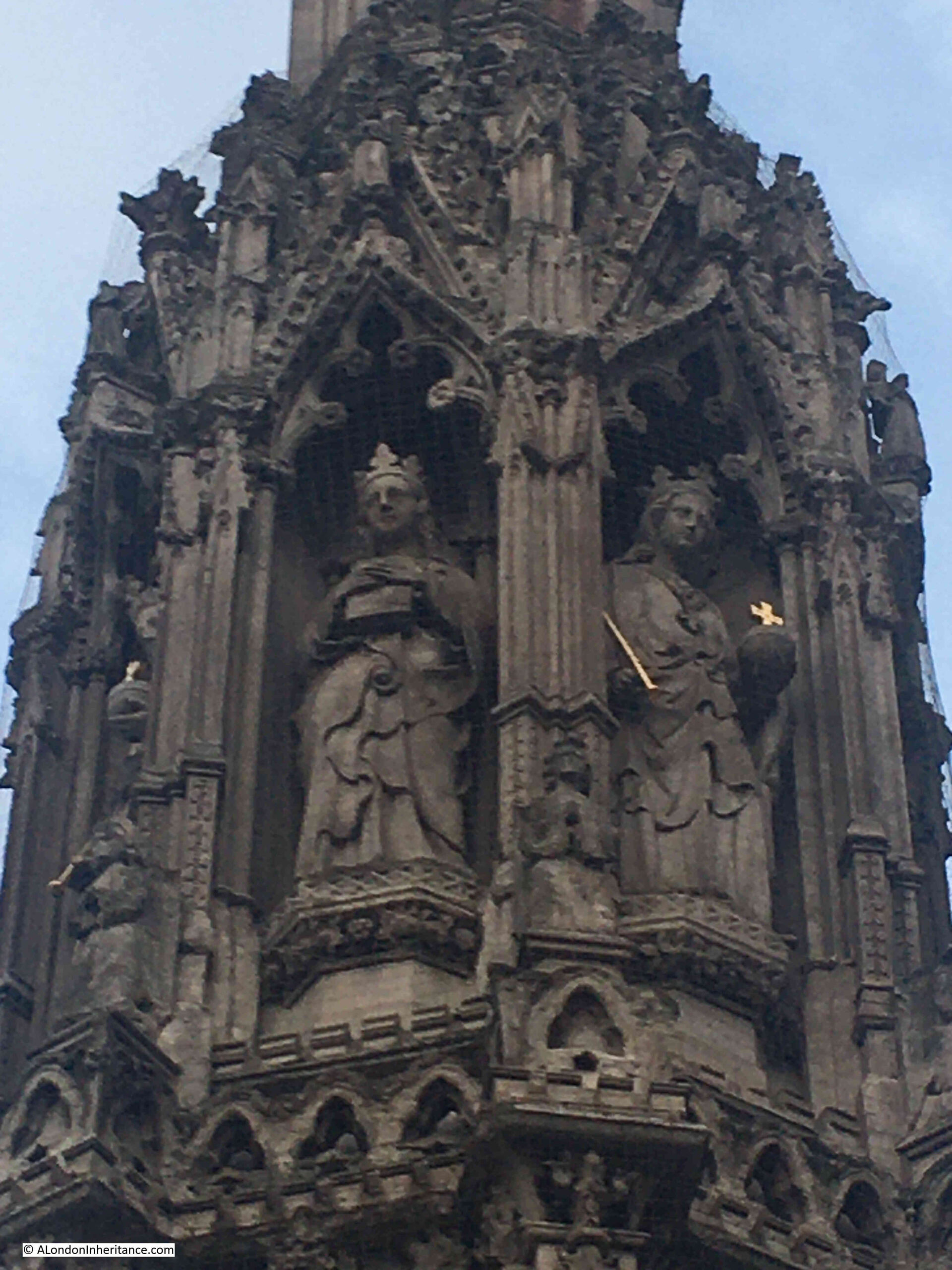
The lower part of the cross displays the arms of England, Ponthieu and of Eleanor of Castile. Above are statues of Eleanor looking out from the cross:

Charing Cross

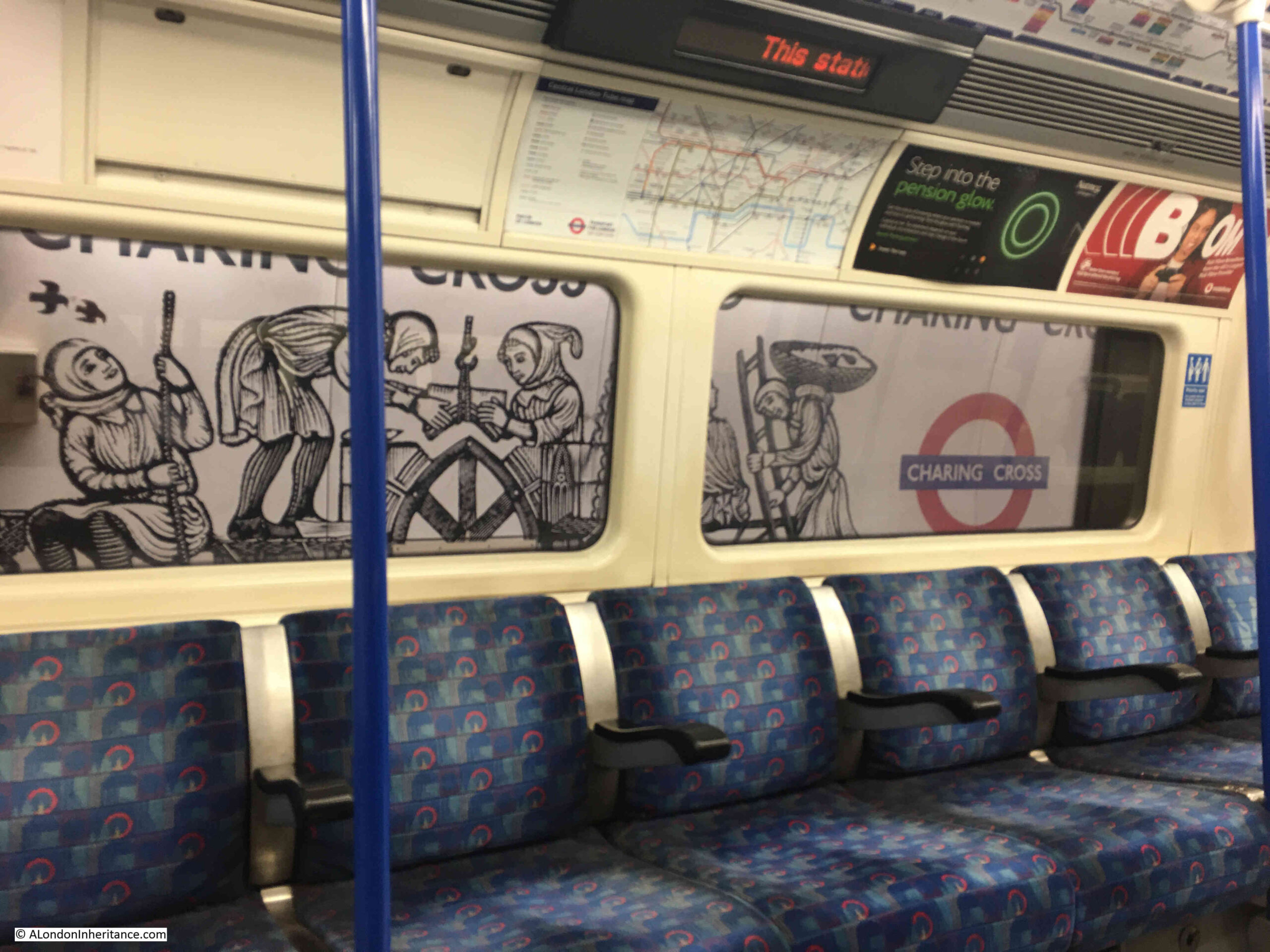
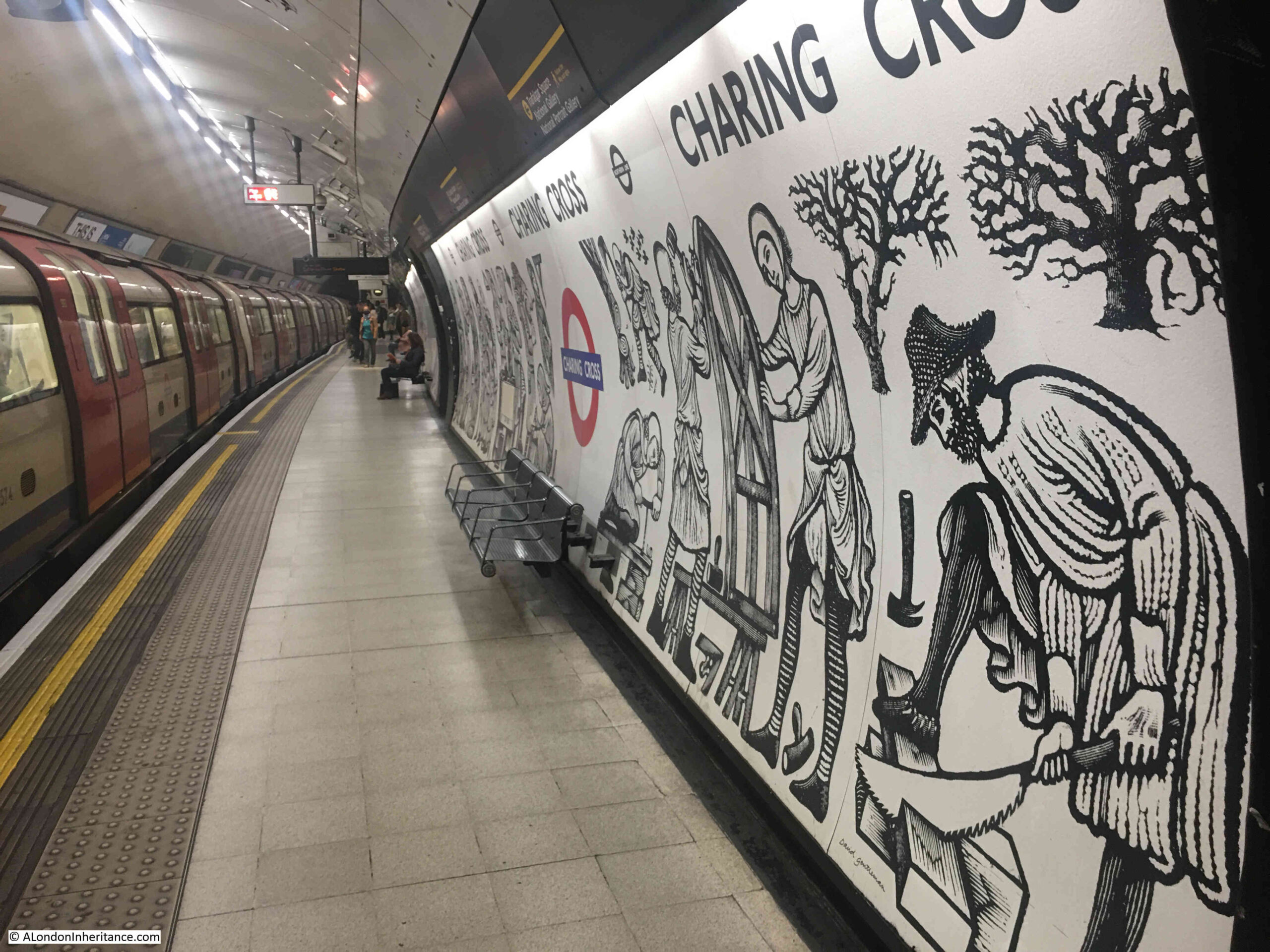
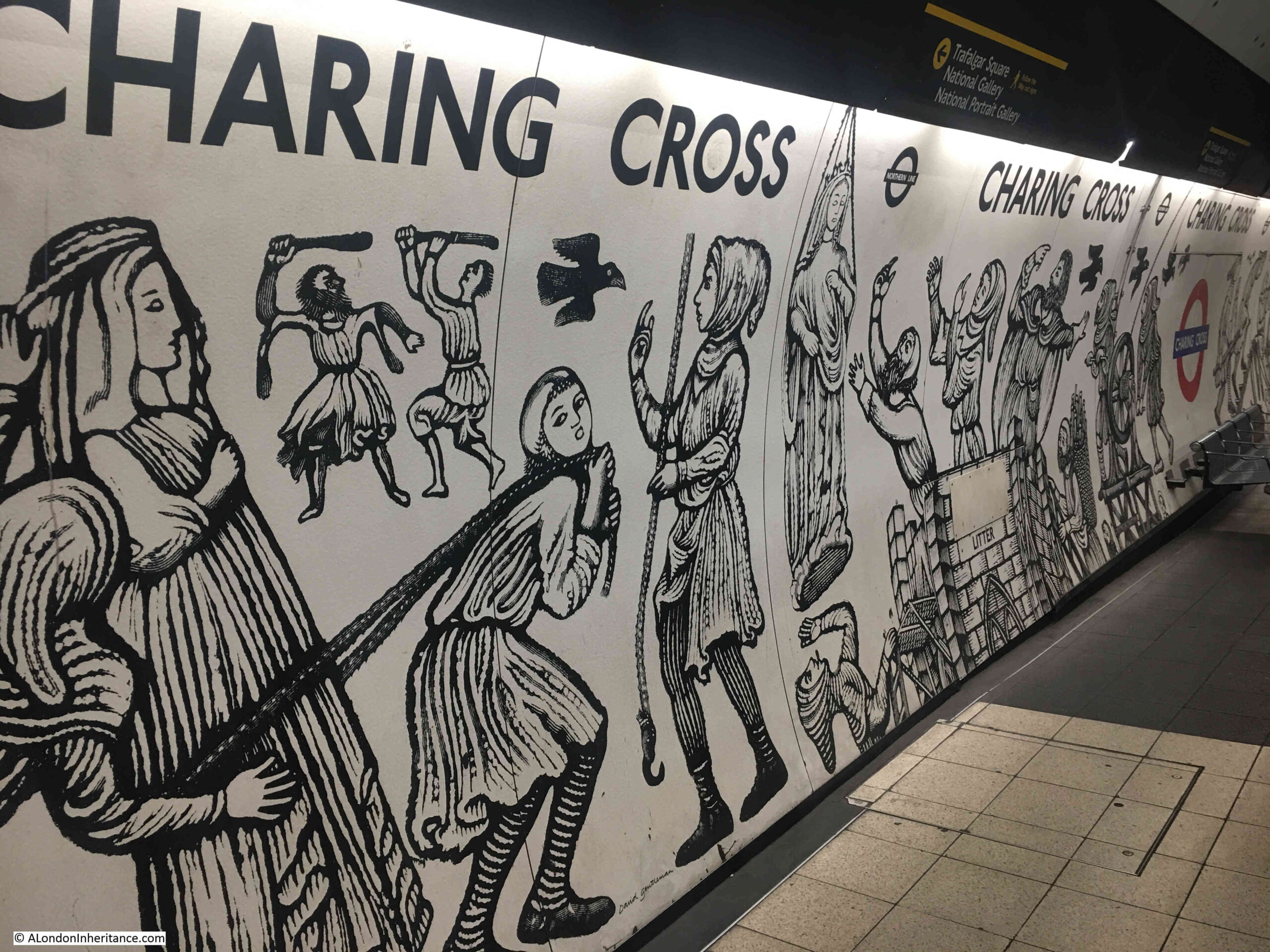
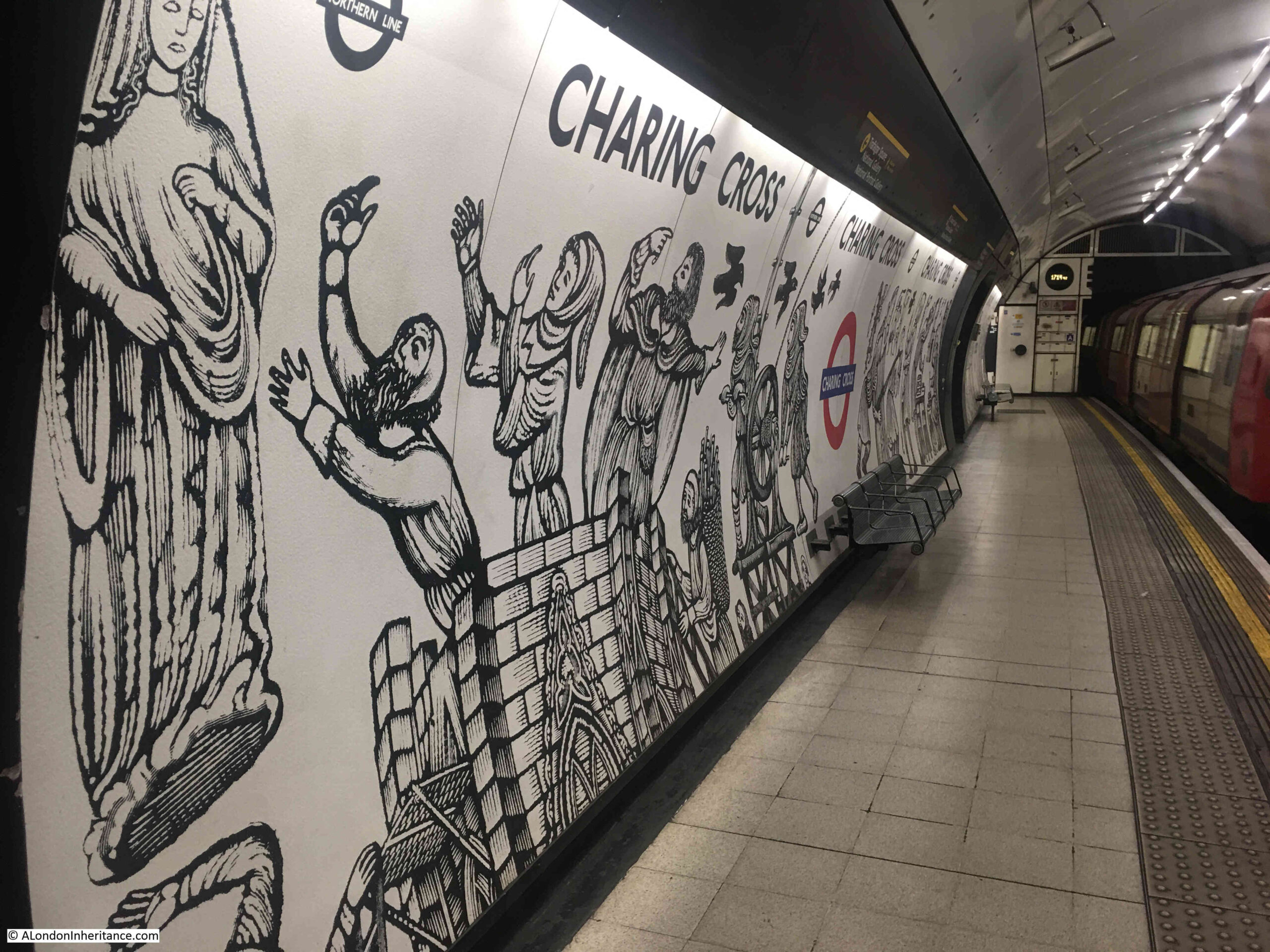
Reminders of the Eleanor Cross extend below as well as above ground at Charing Cross. If you use the Northern Line at the station, you will be greeted by murals running the length of the station platform:

Charing Cross Northern Line

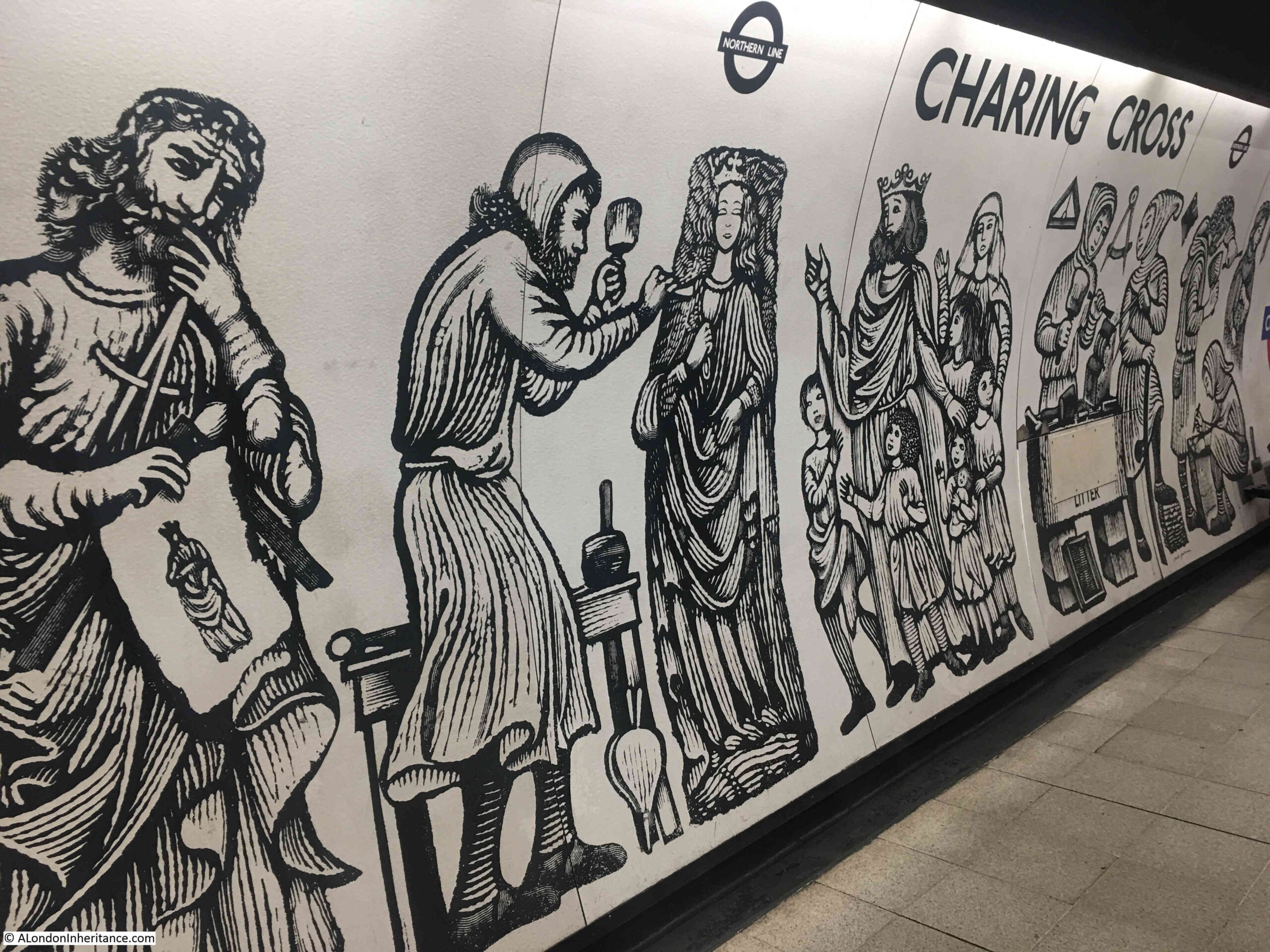
These were created in 1979 by David Gentleman. He researched in detail how a mason would have built the crosses, and the murals run the length of the platform telling the story of the crosses from quarrying the stone, through to completion:

Charing Cross Northern Line

The man on the left is holding a pair of dividers which were used for measurement. In the middle, a stone mason is working on a statue of Eleanor:

Charing Cross Northern Line

Pulling a statue of Eleanor towards a cross, not sure what the two people are doing who appear to be fighting:

Charing Cross Northern Line

A statue of Eleanor arrives at the cross, ready to be installed:

Charing Cross Northern Line

Passing the future location of the cross at Charing, the procession with Eleanor’s body continued on to Westminster Abbey where it stayed overnight.

The funeral was held on Sunday the 17th of December 1290. The service was conducted by the Benedictine monks of the abbey, and Eleanor was buried in a temporary coffin in the abbey as with the suddenness and early age of her death, a fitting tomb for a Queen of England had not yet been prepared.

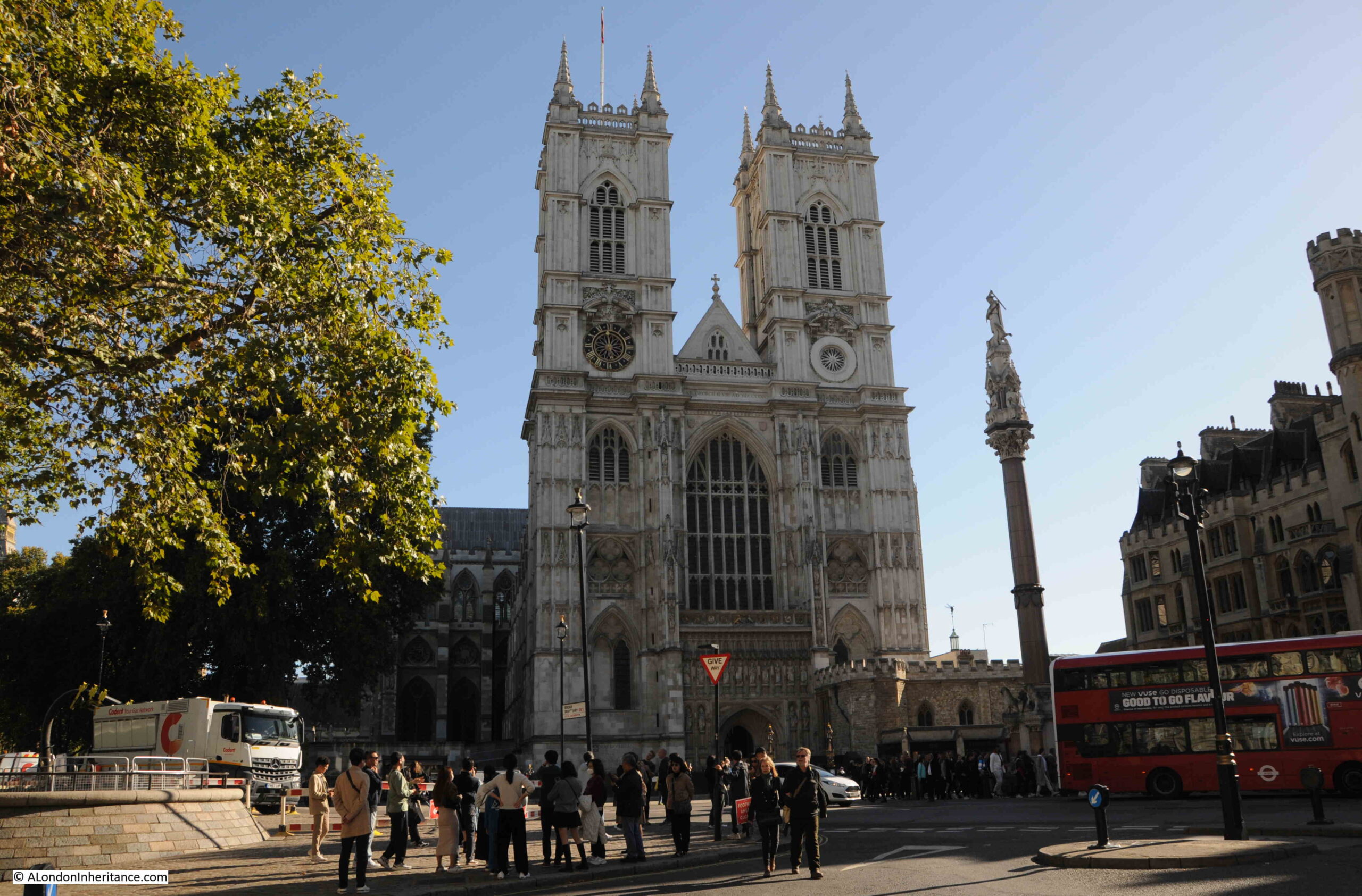
Westminster Abbey, much modified since Eleanor’s funeral in 1290:

Westminster Abbey

The history of Westminster Abbey deserves several blogs, so for today’s post, the main aim of my visit is to find Eleanor’s tomb rather than explore the history of the abbey.

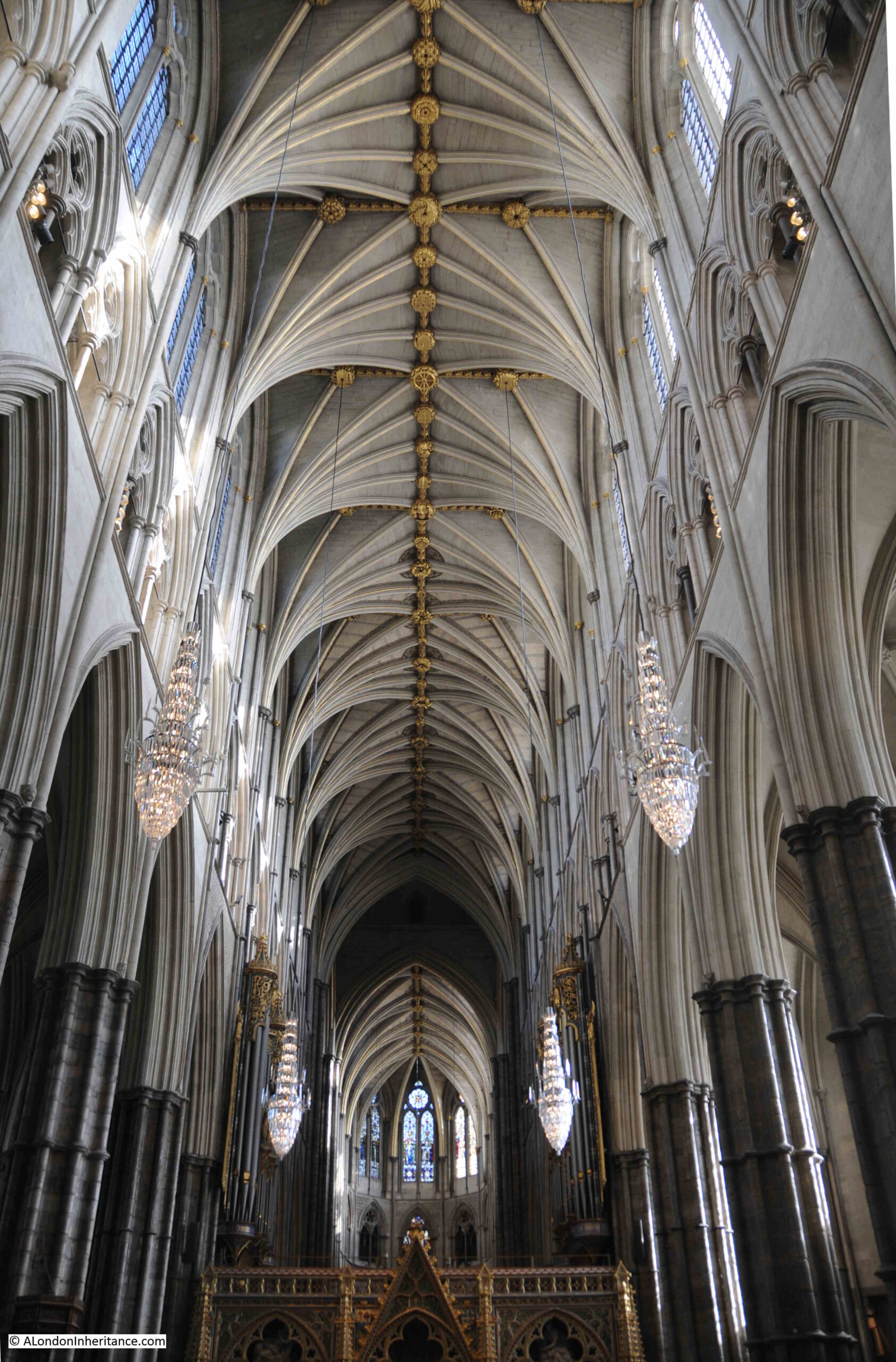
The interior of the abbey:

Westminster Abbey

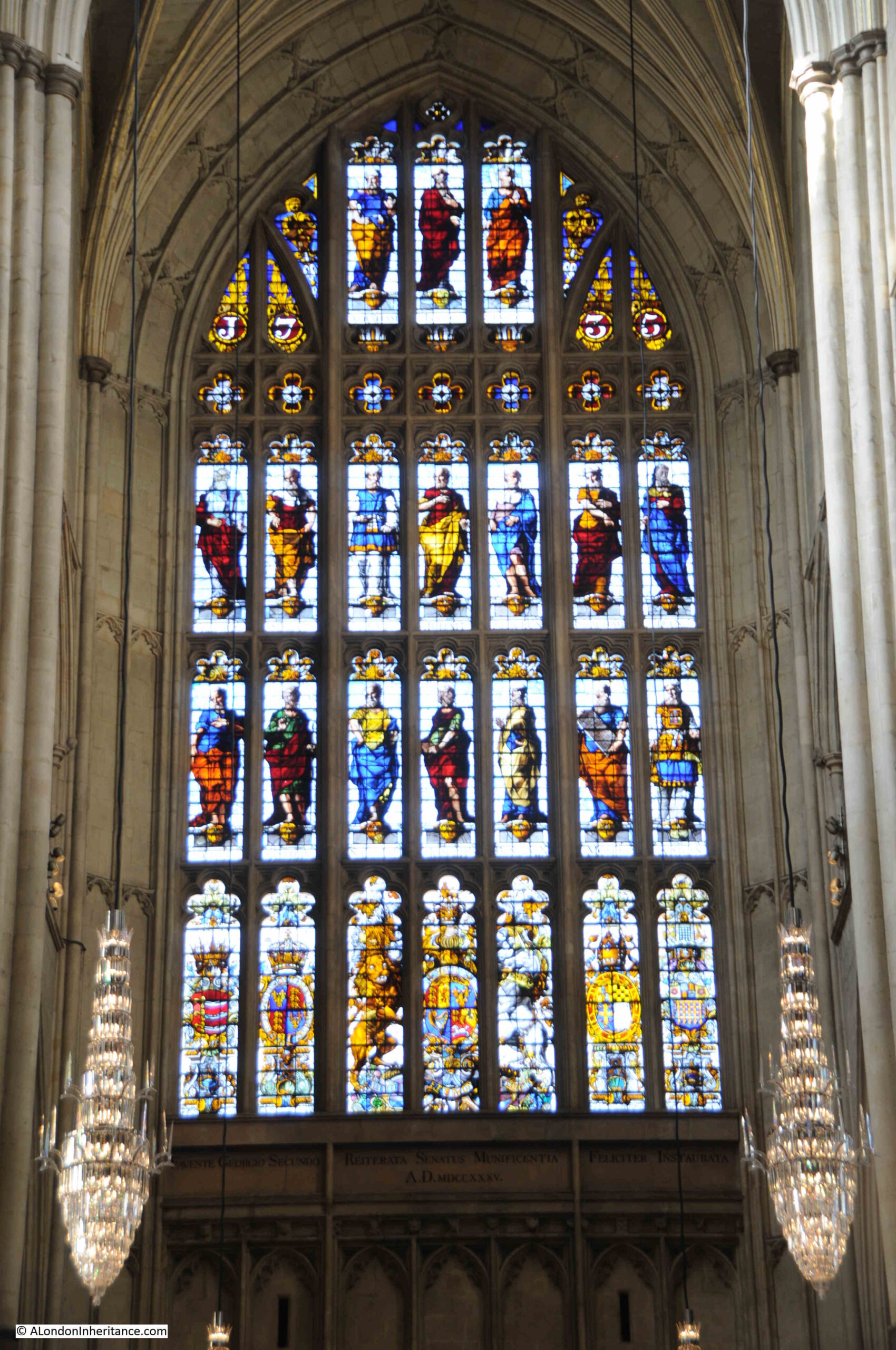
Stained glass:

Westminster Abbey

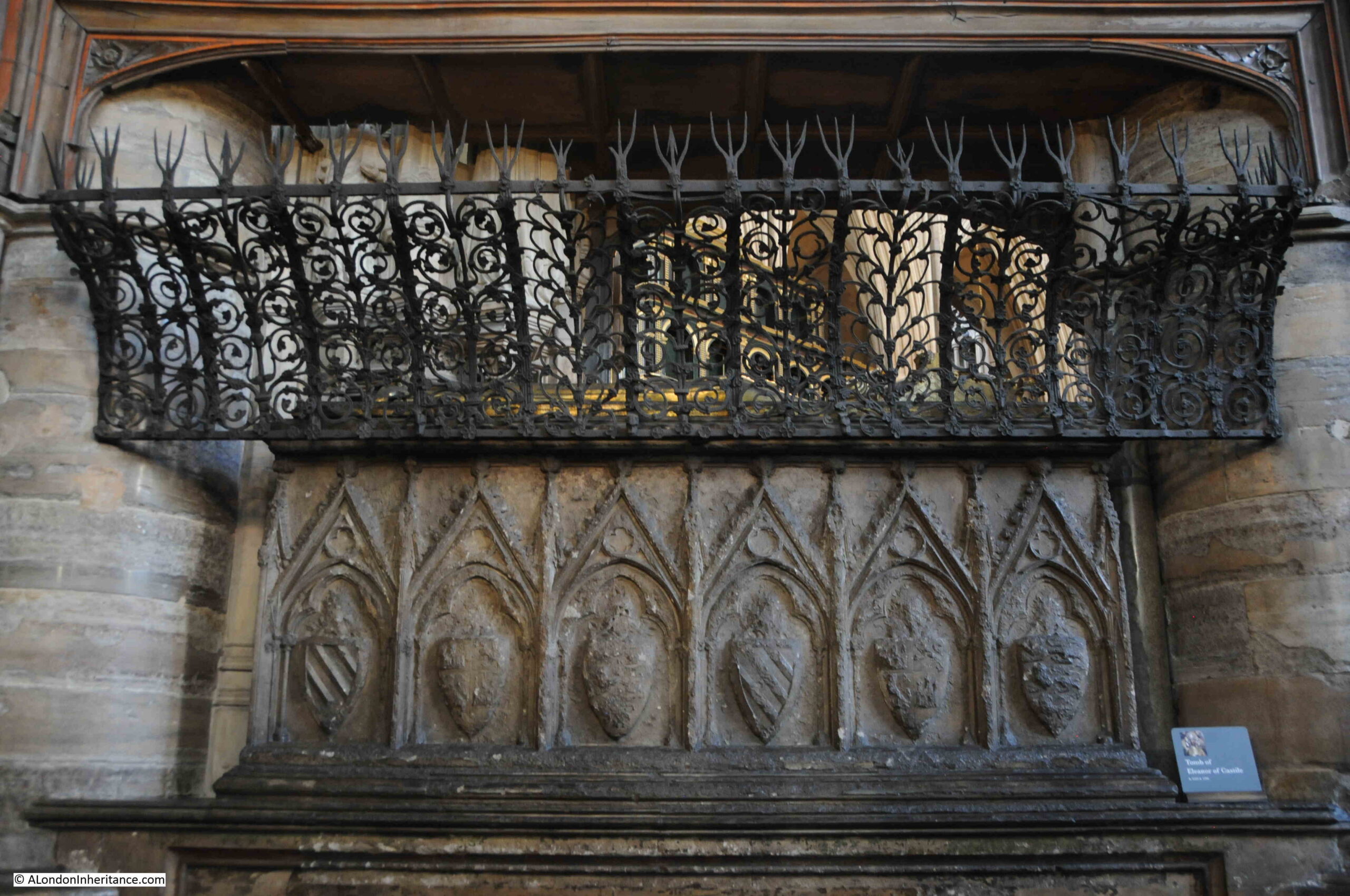
Eleanor’s tomb was built in the chapel of St Edward the Confessor at Westminster Abbey. I contacted the abbey to see if it was possible to take a photo of the tomb with the bronze effigy of Eleanor, however they do not allow photography within the chapel as it is the spiritual heart of the abbey.

You can see the tomb from outside the chapel, as the tombs in the chapel are arranged around the edge, so after following the route of Eleanor’s body from the small village of Harby where she died, through all the towns and villages where Edward I ordered a cross to be built in memory of Eleanor, I finally stood alongside the tomb where her body was placed:

Eleanor of Castile's tomb in Westminster Abbey

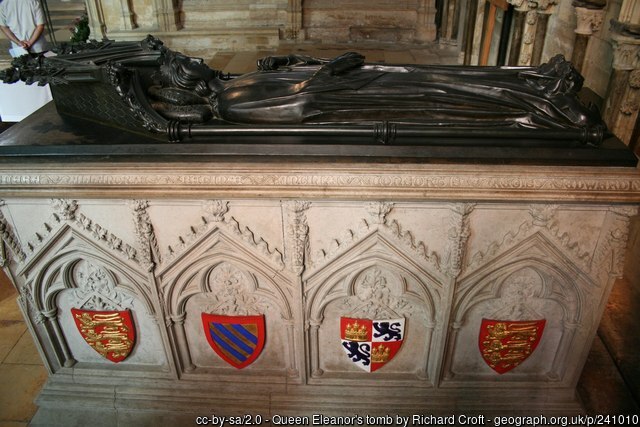
The tomb was built by Richard Crundale, who was also responsible for the Eleanor Cross at Charing. On the top of the tomb, the gilt bronze effigy of Eleanor, cast by goldsmith William Torel in 1291, is just visible.

On the side of the tomb are the arms which have also been found all along the journey from Harby. The arms of England, of Ponthieu (Eleanor’s mother and which Eleanor also inherited) and of Eleanor of Castile.

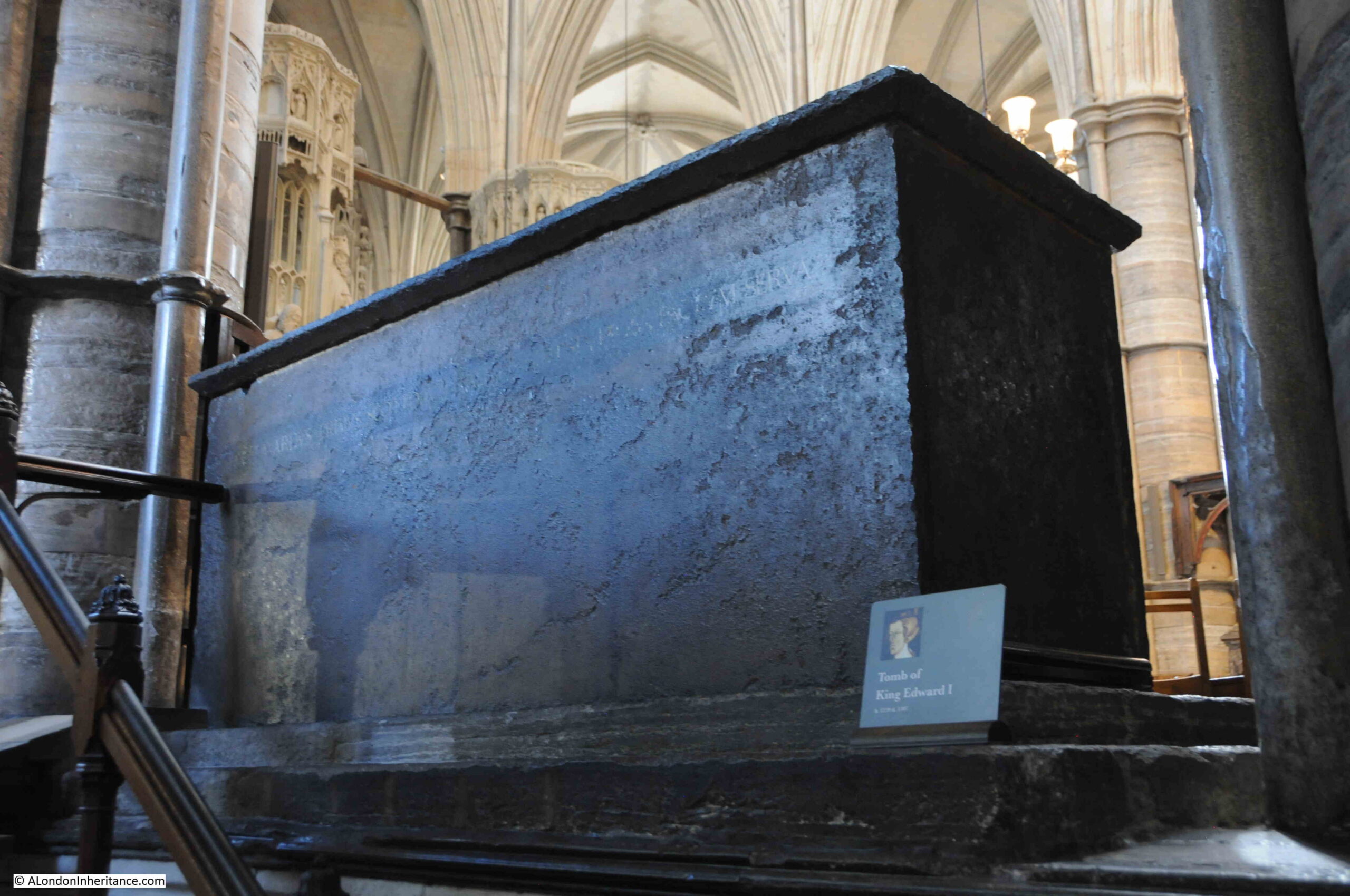
Nearby is the tomb of Eleanor’s husband, Edward I, who died almost 17 years later in July 1307:

Edward I tomb in Westminster Abbey

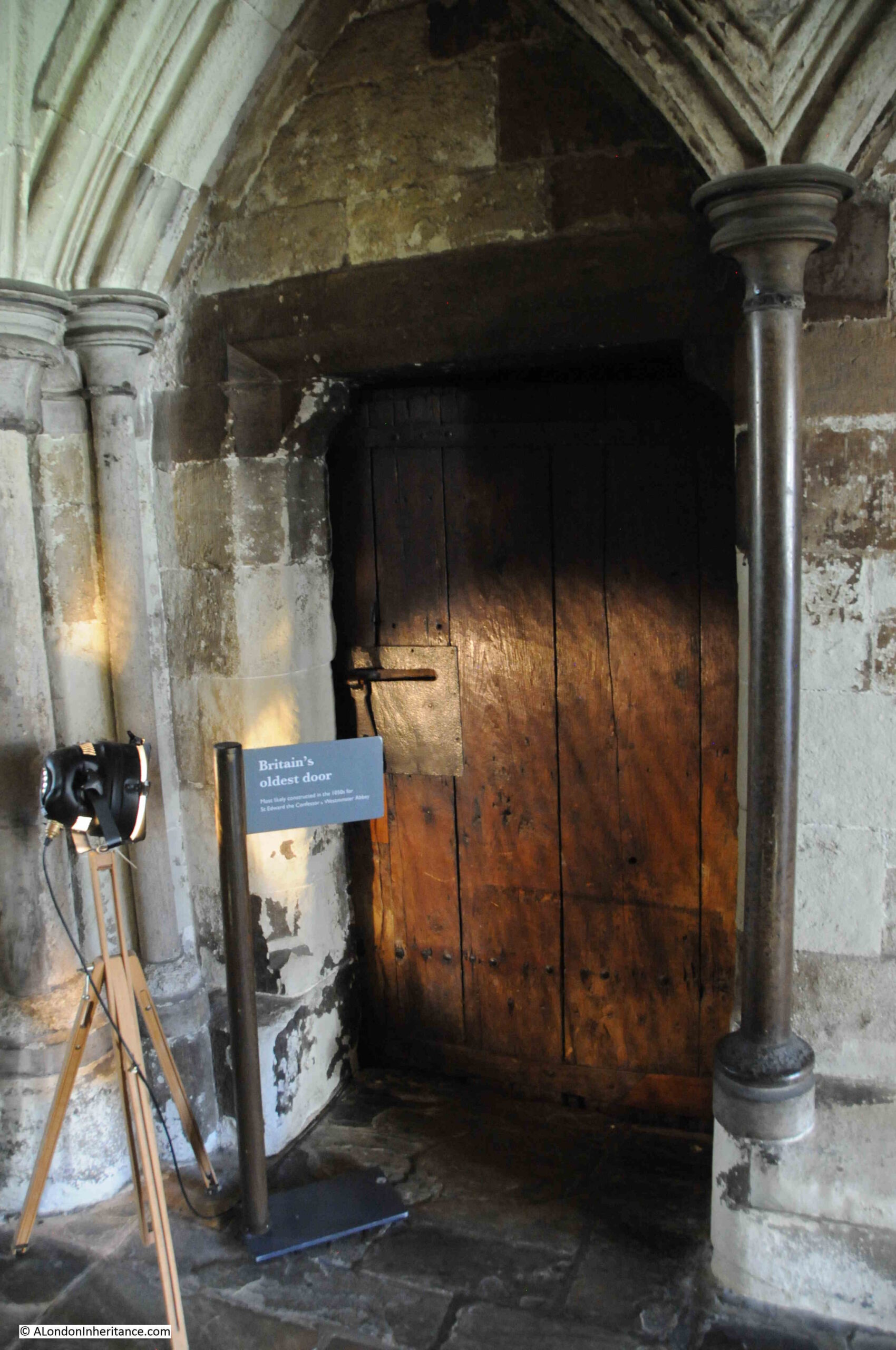
There is so much to discover at Westminster Abbey, but for now, a couple of highlights, including a door that is believed to date from 1050, so would have been from the time of Edward the Confessor:

The oldest door in England Westminster Abbey

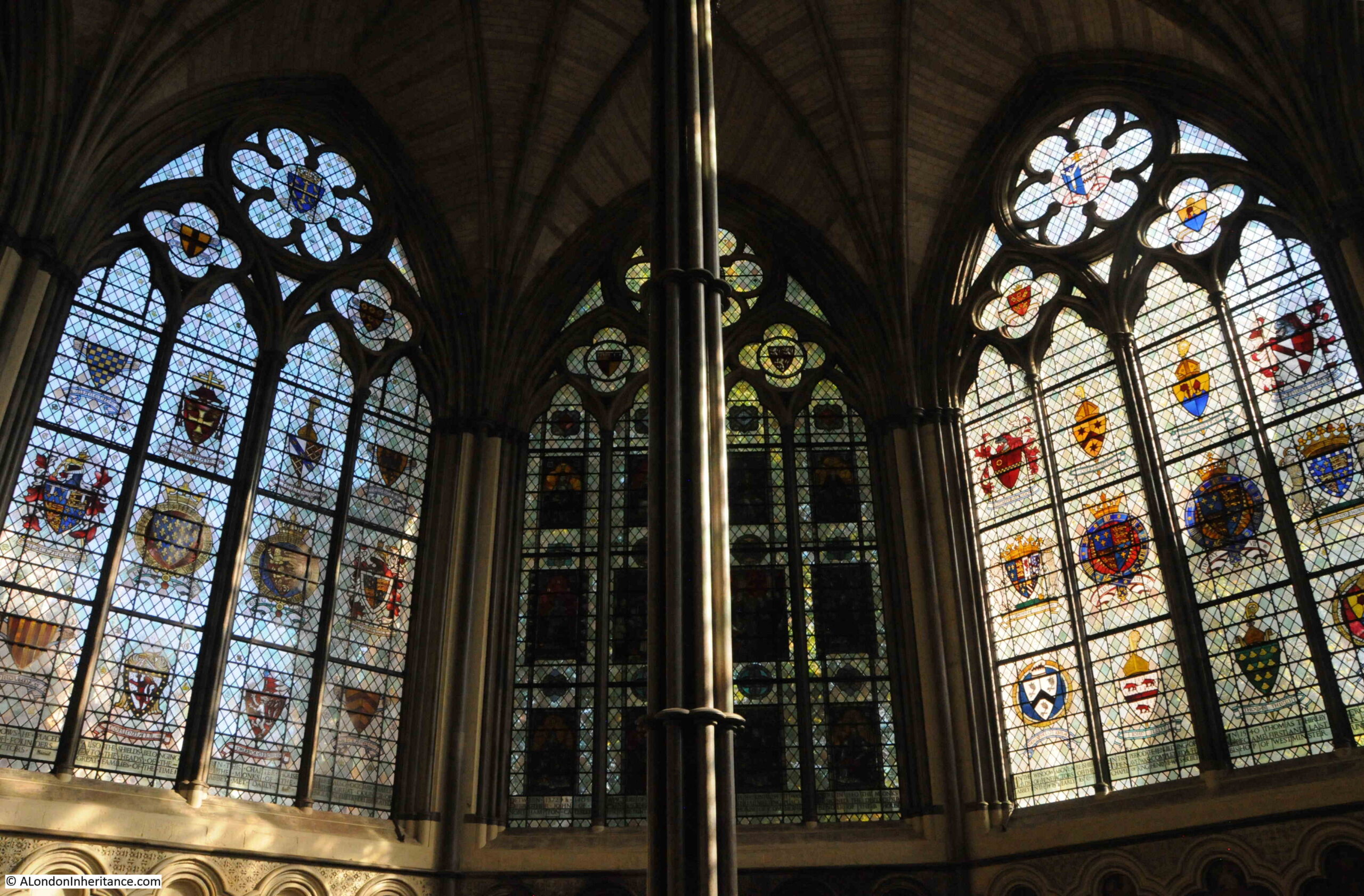
The interior of the Chapter House, believed to have been built by Edward’s father, Henry III:

Westminster Abbey

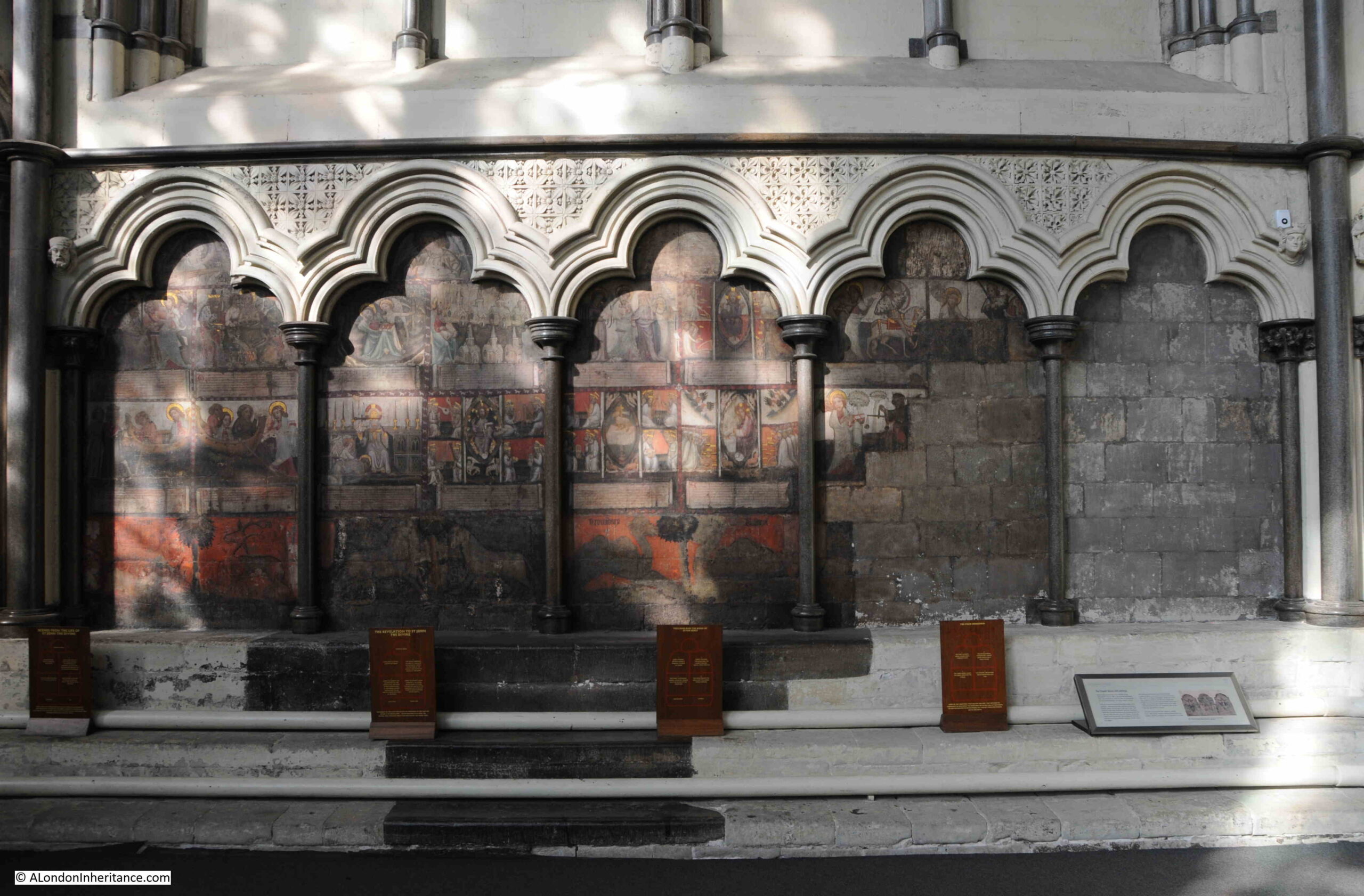
Decorated seating for the monks around the outer wall of the Chapter House:

Westminster Abbey

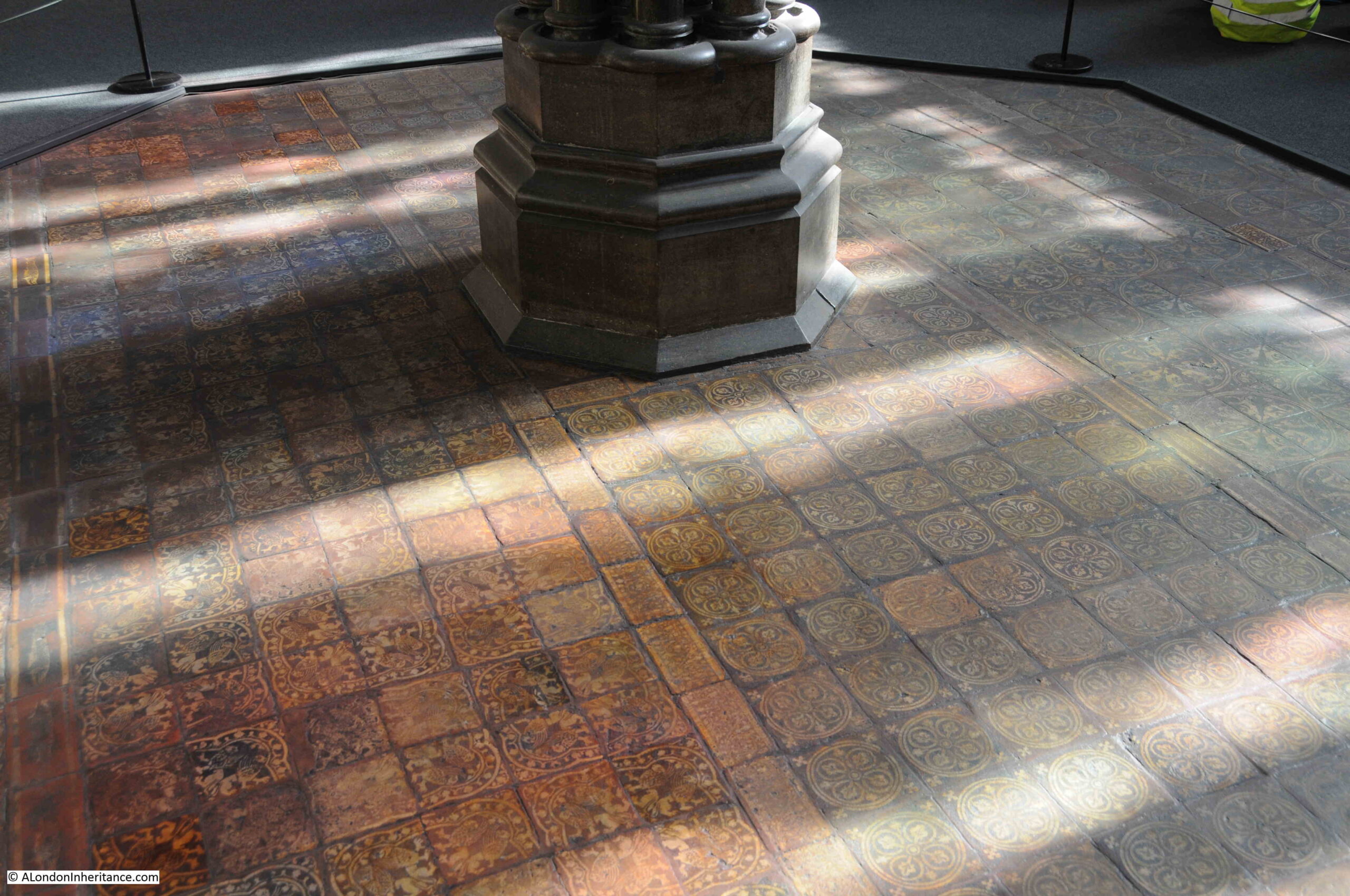
The floor of the Chapter House is one of the finest medieval tile pavements in England, and contains the arms of Edward’s father, Henry III:

Westminster Abbey

Eleanor and Edward could well have walked on this tiled floor.

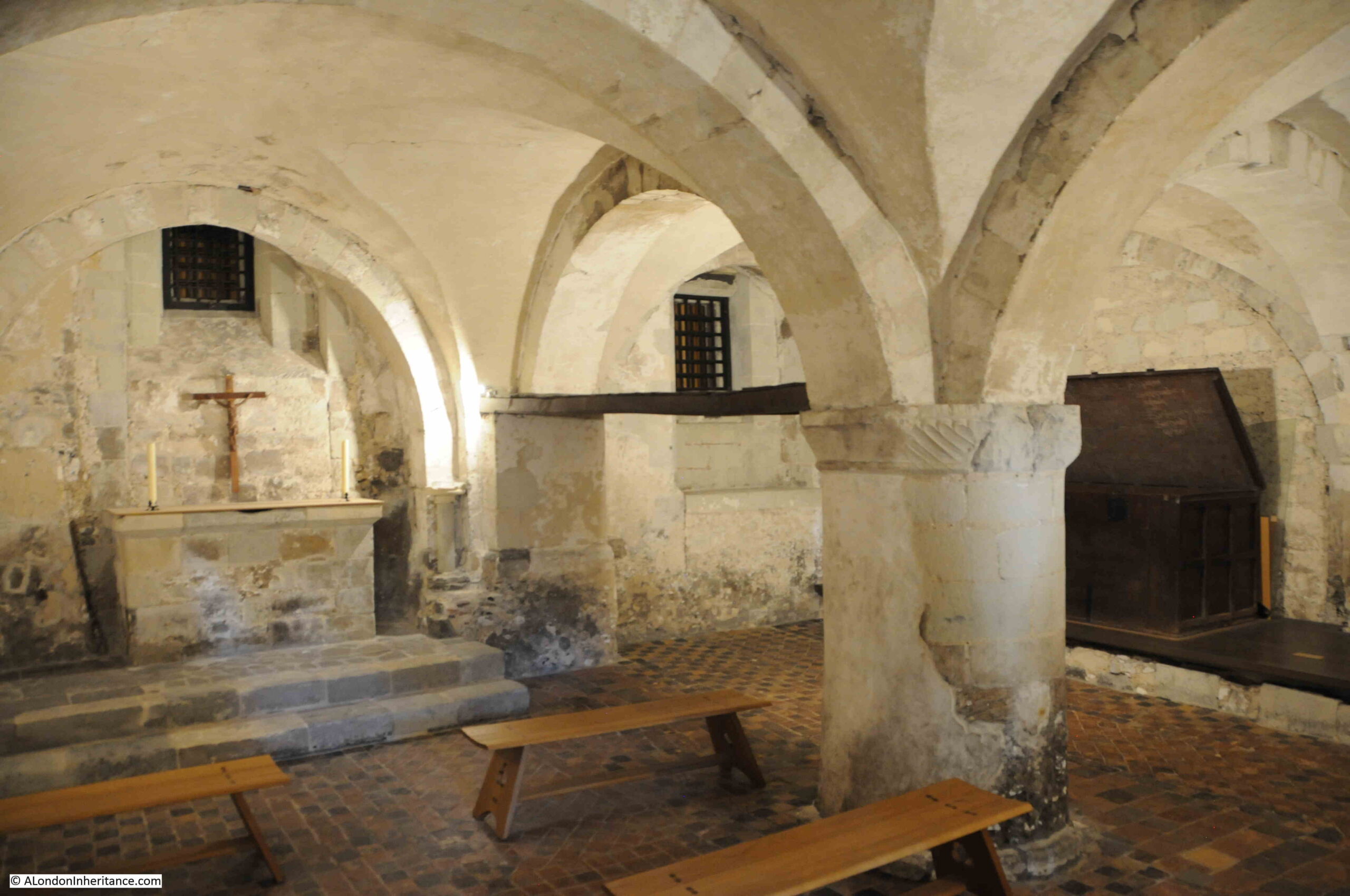
Nearby is the Pyx Chamber, one of the oldest parts of the abbey, dating from around 1070:

Westminster Abbey

The funeral of Eleanor at Westminster Abbey was not however the final act in the long funeral of Eleanor of Castile, there was one last act for Edward I to attend to, and that was the burial of Eleanor’s heart at the Dominican Priory at Blackfriars on Tuesday the 19th of December, 1290.

The priory at Blackfriars was well known to Edward and Eleanor as they had refounded the friary in the 1270s. The heart of their son Alfonso who had died in 1284 at the age of 10 had already been buried at Blackfriars, so Eleanor probably had been planning for her heart to be buried with that of her son.

Apart from the name, there is not much left of Blackfriars today. I did visit a place where the ceremony during the burial of her heart may have taken place, in a previous post on Carter Lane.

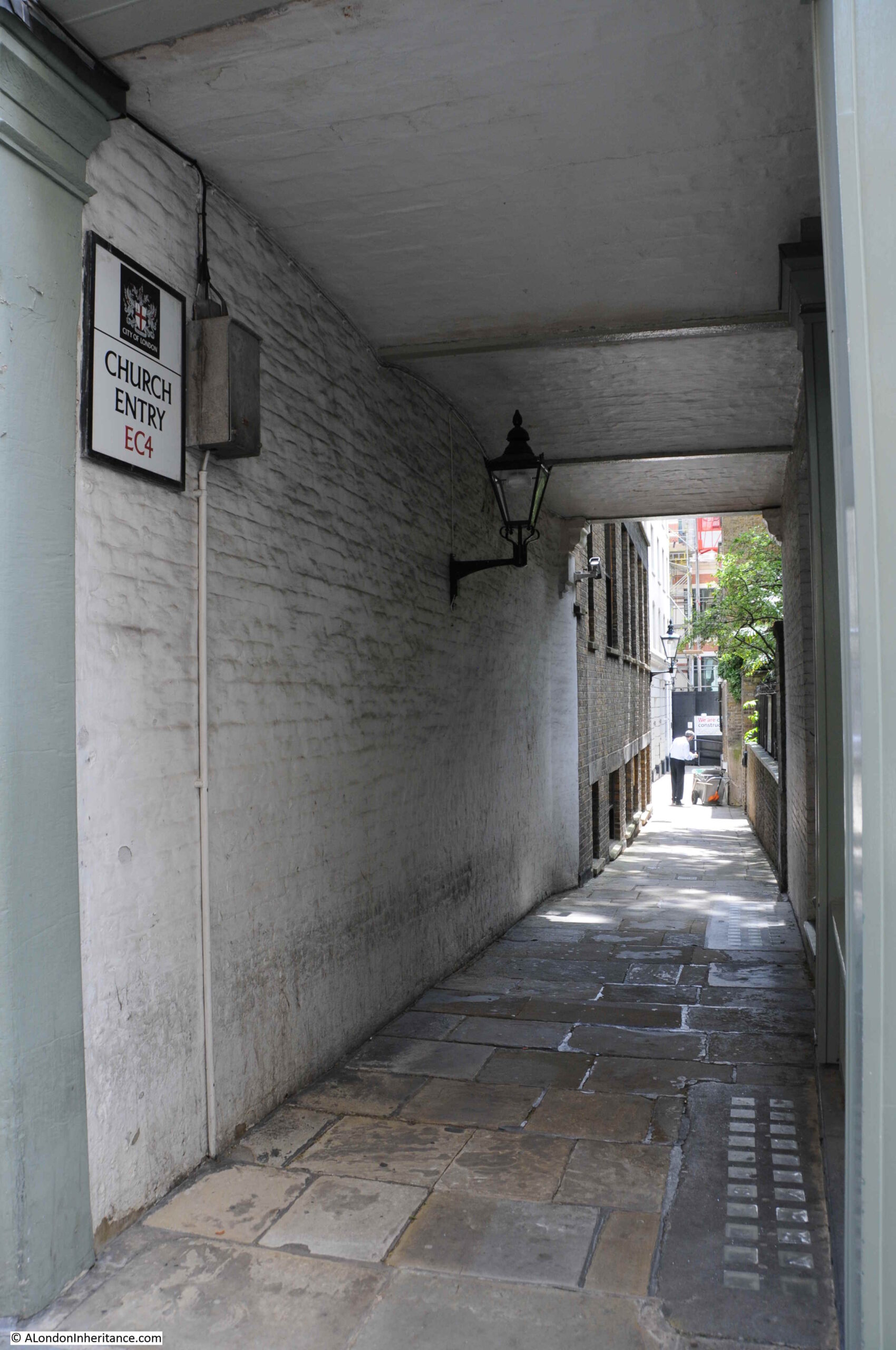
An alley by the name of Church Entry turns off from Carter Lane:

Blackfriars

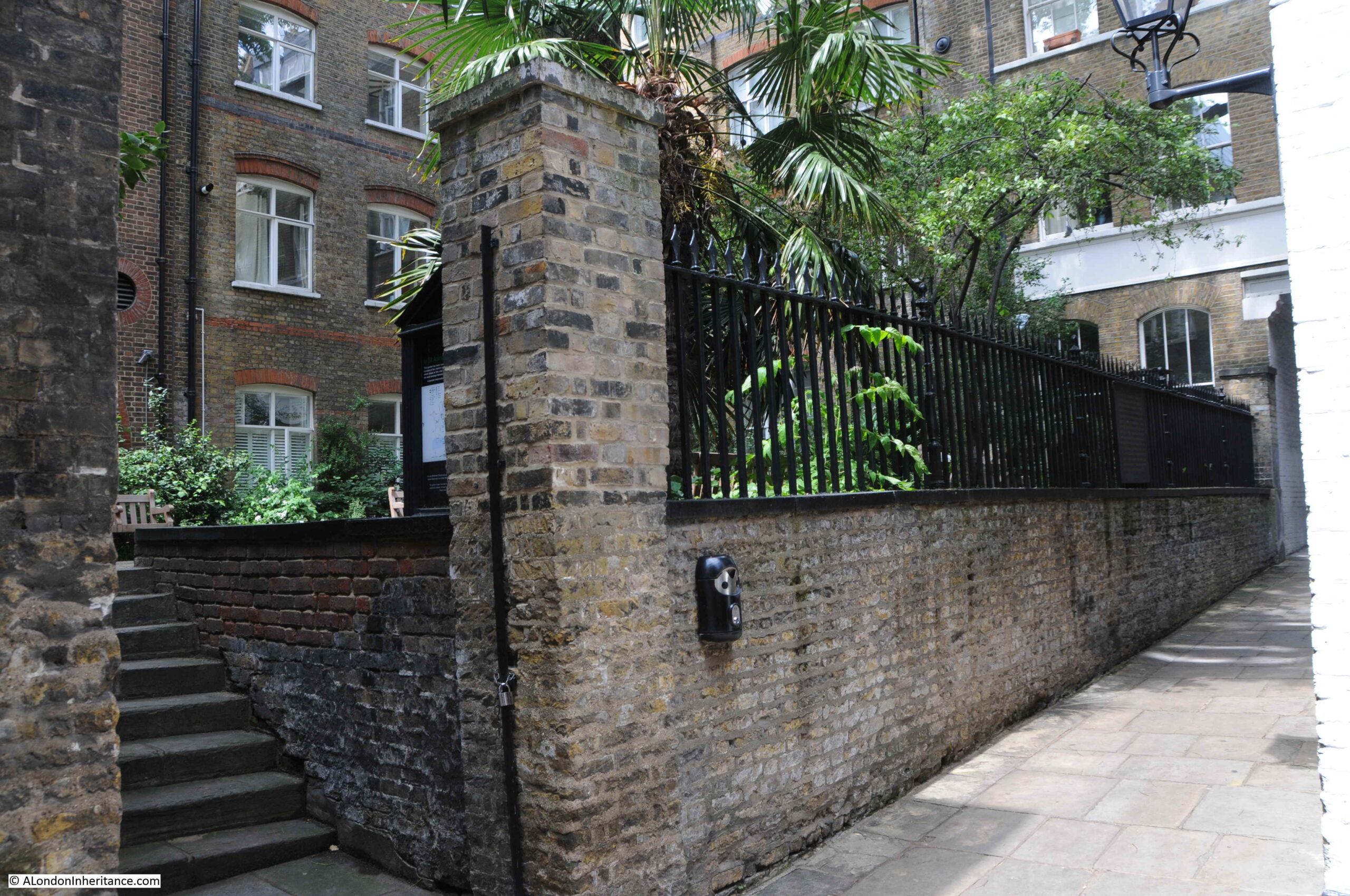
There is a small garden on the western side of the alley:

Blackfriars

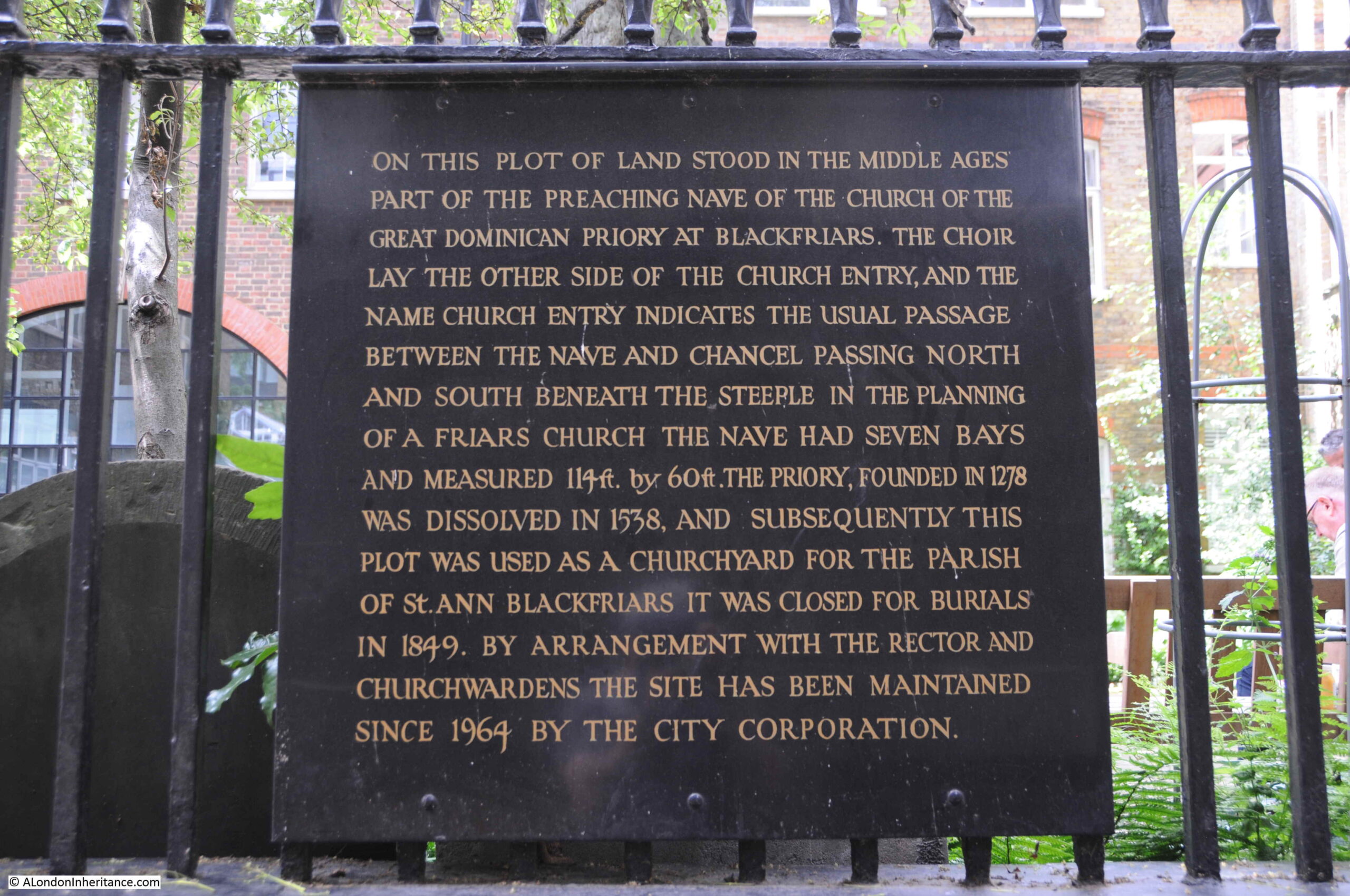
With a plaque that states that this plot of land is where the preaching nave of the church of the Great Dominican Priory of Blackfriars once stood, so standing in the garden you are in the general area of where the last acts in the funeral of Eleanor of Castile played out in 1290.

Blackfriars

Standing at Blackfriars marked the end of my journey from the village of Harby, all the way to London. A fascinating story of a fascinating woman.

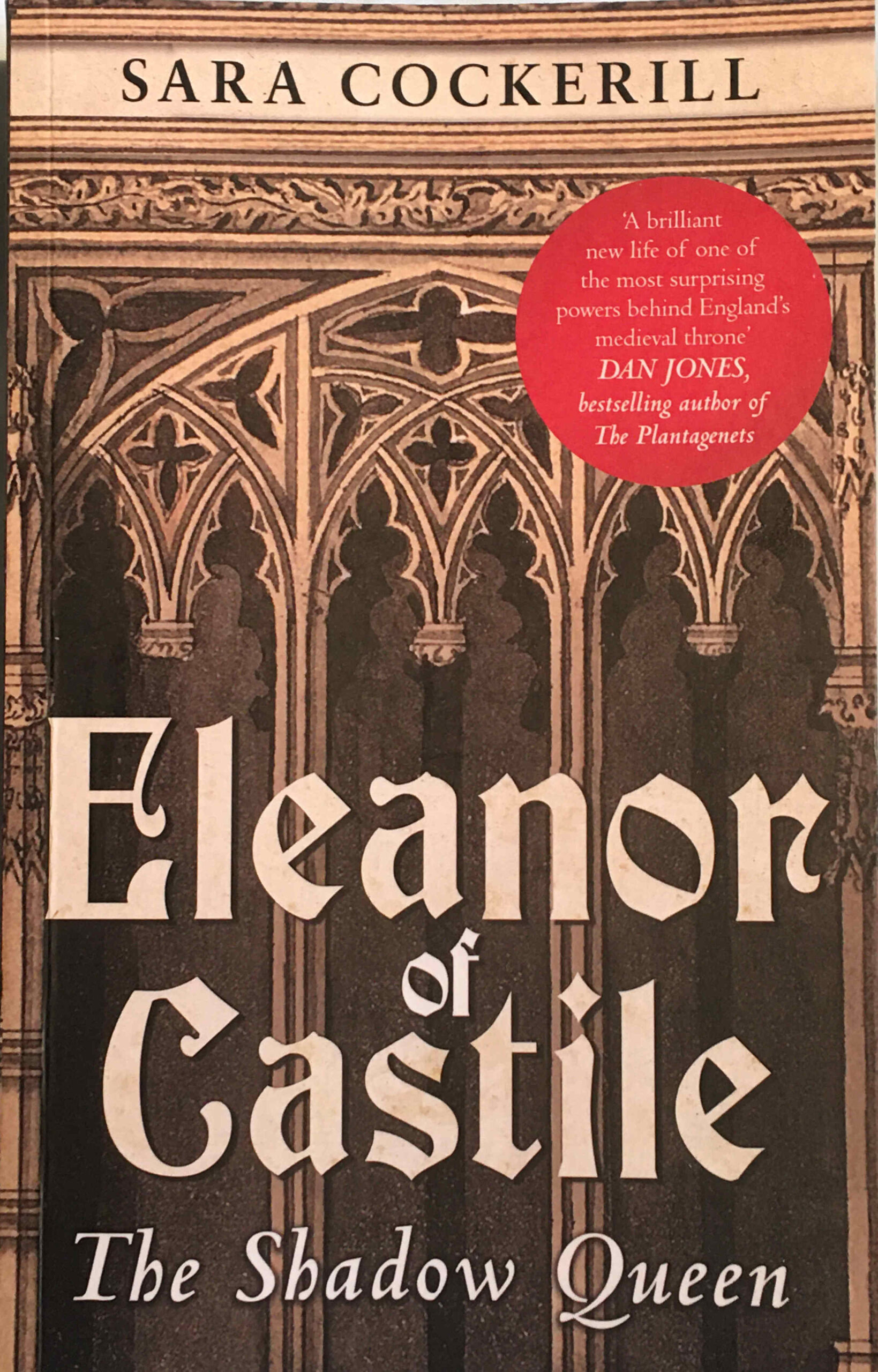
There are two main books I have read to research the life of Eleanor of Castile. The first is Eleanor of Castile – The Shadow Queen by Sara Cockerill:

Sara Cockerill Eleanor of Castile The Shadow Queen

Eleanor of Castile – the Shadow Queen is a thoroughly researched and comprehensive book on the life of Eleanor, highly recommended.

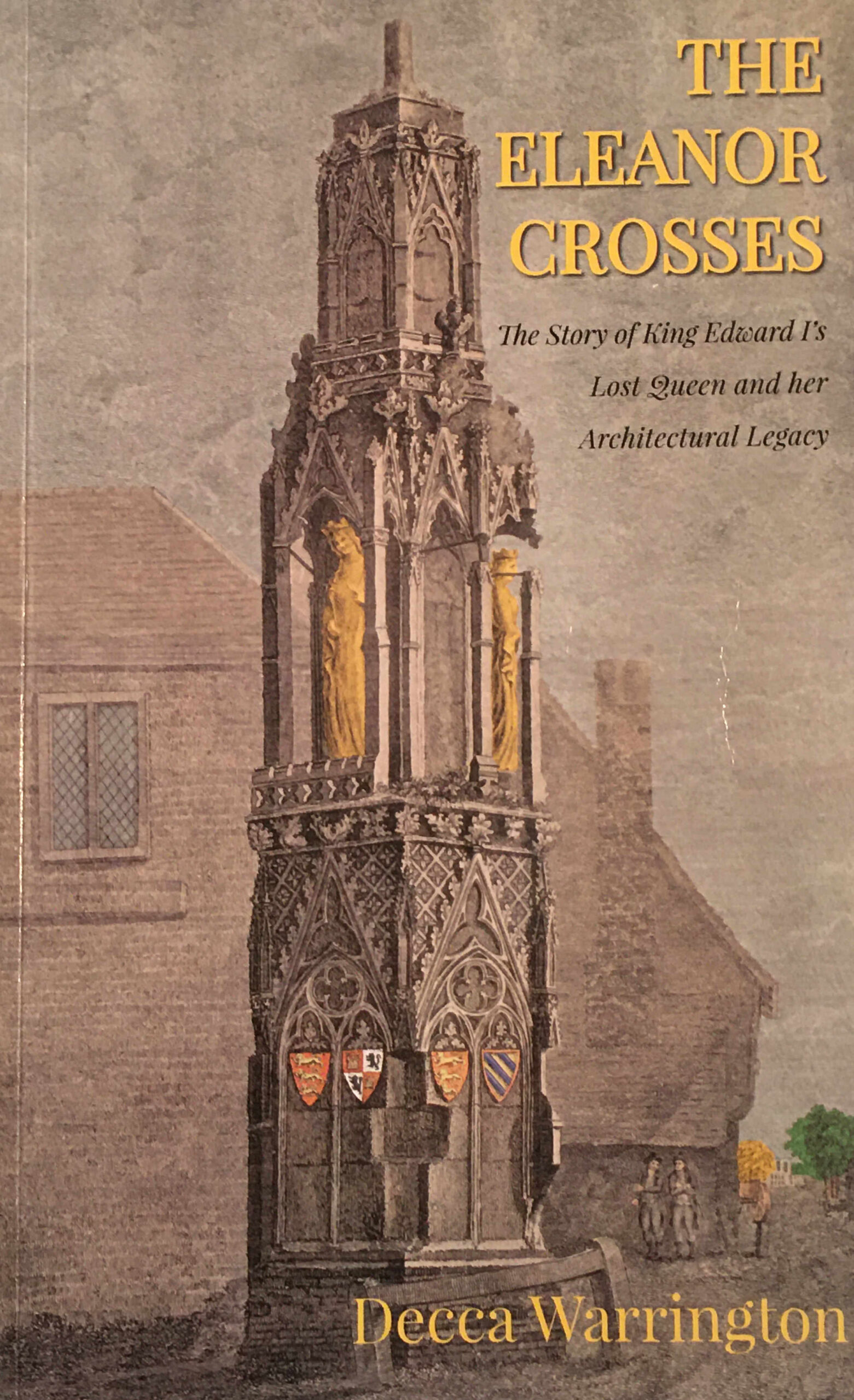
Another book is The Eleanor Crosses by Decca Warrington:

Decca Warrington

This book is more focused on the life of the crosses, but also contains sections on the life of Eleanor. Recommended as a shorter introduction to Eleanor and the story of the crosses.

For Edward I, the book “A Great and Terrible King: Edward I and the Forging of Britain” by Marc Morris is an excellent read, and for a more academic study of Edward I, the book “Edward I” by Michael Prestwich and published by Yale University Press is an in depth read.

To research the journey and the posts, I also used some of the Victoria County History volumes for the appropriate counties (these can be found online), as well as various publications on the churches and abbeys on the route.

Edward I did remarry after Eleanor’s death. Nine years later in 1299 he married the 20 year old Margaret of France. Edward was 60.

Margaret and Edward had three children (Edward therefore had 19 children in total). The first two were boys. The third was a daughter born on the 4th of May 1306. This daughter was named Eleanor, and whilst this was a common name for women in royal families at the time, she must have been named Eleanor after Edward’s first wife who had died almost 16 years before.

Unfortunately, Eleanor did not live for too long, dying in 1311.

Edward I died in 1307 at the age of 68. Margaret of France was 26 when widowed, but never remarried. Edward I was followed by Eleanor’s eldest son, Edward II, who had a troubled reign, was forced to abdicate, and had a mysterious death in 1327.

Eleanor of Castile was a fascinating woman – one of those from history who would have been brilliant to meet.

Born into a Spanish royal family, highly educated, and with older brothers who were involved in military campaigns when Eleanor was growing up, and whilst her father was reclaiming much of Spain.

Edward was educated, although the English court did not tend to educate their children to the same level as Castile. Much of Edward’s childhood was also spent in Windsor Castle, and he was not so involved with military activity, beyond the basic training needed by a future king.

Edward was though successful when it came to military campaigns. His conquest of Wales led to the building of the string of Welsh castles such as Caernarfon and Harlech castles.

Edward was also brutal in his campaigns in Scotland, focusing brutally on those he thought were disloyal, to such an extent that he acquired the nickname of Hammer of the Scots.

How much of Edward’s success was due to Eleanor would be interesting to discover.

As usual, there is so much I have had to leave out from the format of a blog post (the books mentioned above are well worth a read), but thank you for accompanying me on this journey, alongside Eleanor of Castile.

alondoninheritance.com

Eleanor Crosses – St Albans and Waltham Cross

We are getting closer to London in our journey following the route of the funeral procession of Eleanor of Castile. There are just two overnight stops remaining before the procession heads to the City of London and then Westminster Abbey. These stops are at St Albans and Waltham Cross, shown as blue dots in the following map (© OpenStreetMap contributors):

Route of Eleanor of Castile

Before stopping at St Albans, there is more to discover about the life of Eleanor of Castile.

The marriage of Eleanor and Edward was based on rival claims for the Duchy of Gascony, part of Aquitaine in southern France, which was part of the Angevin Empire and ruled over by English kings through the House of Plantagenet. The marriage settled these rival claims by uniting the English throne with that of Castile through the marriage.

Medieval royal marriages also had another key purpose – to produce an heir to the throne.

Having a son to take over the throne was a key concern for medieval kings. If there were no children from a royal marriage then on the death of a king there would be many competing claims from rival factions within the extended family. This would often result in conflict and confusion in the country until a new monarch was finally agreed.

Edward, being the eldest son of Henry III, therefore had an undisputed claim to the throne. The fact that he had also distinguished himself in many of the conflicts that his father had with the Barons and also on campaigns in Wales, along with Edward’s time on Crusade in the Middle East, also helped support his claim to the English Crown.

The fact that it was just under two years from Henry III’s death, to Edward’s return to England and his coronation shows that there was no competition for the crown.

In carrying out this expectation of a Queen, Eleanor had 16 children, the first, a stillborn girl, when she was at the ridiculously young age of 14.

Thankfully there then appears to have been a gap of 9 years before the first of her remaining 15 children would be born.

Her children are listed in the following table:

Eleanor of Castile's children

The table shows that from 1263 to 1284, Eleanor was in an almost permanent state of pregnancy. This was in addition to travelling with Edward on his various campaigns and royal visits, including his time on Crusade, when Eleanor was still giving birth as they travelled across Europe and the Middle East.

The table shows the very high early death rate among her children. Her last child, Edward, born in April 1284 would be the surviving son, who would become Edward II. All Eleanor’s other sons died at a relatively young age. The only other son that lived to any age was Alfonso who died at the age of 11. If he had of lived, England would have had a King Alfonso I rather than an Edward II.

Her children are part of one of the two main criticisms of Eleanor. She was said to be rather detached from her children, and would not hurry to be by their side, even when one was close to death.

The other criticism is in how she acquired an extensive holding of properties across the country. One of the methods used was that if a property owner was in debt, and could not pay, she would cancel the debt, and take the property.

It is obviously impossible to know the true character of someone from the 13th century, however, from my reading (sources in the final post), Eleanor comes across as an educated, strong woman, finding her own way to survive in the challenging environment surrounding a medieval queen.

Regarding her children, the fact that she was pregnant almost continuously for twenty years must have been a considerable burden, both mentally and physically. During this period, she was travelling with Edward at a time when travel was not that easy.

Children would not always have accompanied a King and Queen. Boys would have been kept at safer locations until they were of fighting age, girls would have been prepared for the royal marriage market of alliances between families and countries. Boys and girls would both have been given experience of life at Court when they were at an appropriate age.

Eleanor’s approach to her children may also have been a defence mechanism given the number that died so young.

Regarding her property holdings, which were extensive, these were encouraged by Edward. Usually a Queen would have outlived a King, and it appears that Edward encouraged Eleanor to have sufficient properties so that after his death, she would have been financially independent.

Again, it is impossible to really know a person at a distance of over 700 years, and who lived in a period of the country’s history that is so very different to today.

Back to the route that the procession followed, and after leaving Dunstable, the next overnight stop was at:

St Albans

St Albans would have been a logical destination for the procession carrying Eleanor’s body to London, due to the important religious monastery that was at the heart of the town.

This had been founded in around 793 by King Offa as a Benedictine monastery. The reason for the monastery goes back to the Roman period, and Britain’s first saint who would give his name to the town.

Alban was apparently a resident of the Roman city of Verulamium in the 3rd century. Verulamium was located not far from the centre of the current town. Alban gave shelter to a Christian priest who was fleeing from Roman persecution. Alban learned more about the Christian faith from the priest and decided to swap clothes, let the priest escape and to take his place.

The priest was later caught, however Alban would not renounce his new found faith, so he was given the same death sentence as the priest, taken outside the Roman city and beheaded.

The monastery and church was rebuilt after the Norman conquest, and is unusual in that it made use of the bricks from the old Roman city, for a large part of its construction, and this is still very evident today.

An Eleanor cross was built to mark Eleanor’s overnight stop at St Alban’s, however this was destroyed, parts remaining until 1703 when these were replaced by a new market cross, which has also since been taken down.

To find the site of the cross, we had to find the site of the clock tower, which was easy to find to the south of the town:

St Albans Clock Tower

There are two plaques on the tower. The first records that the tower is near the site of the Eleanor Cross:

St Albans Eleanor Cross

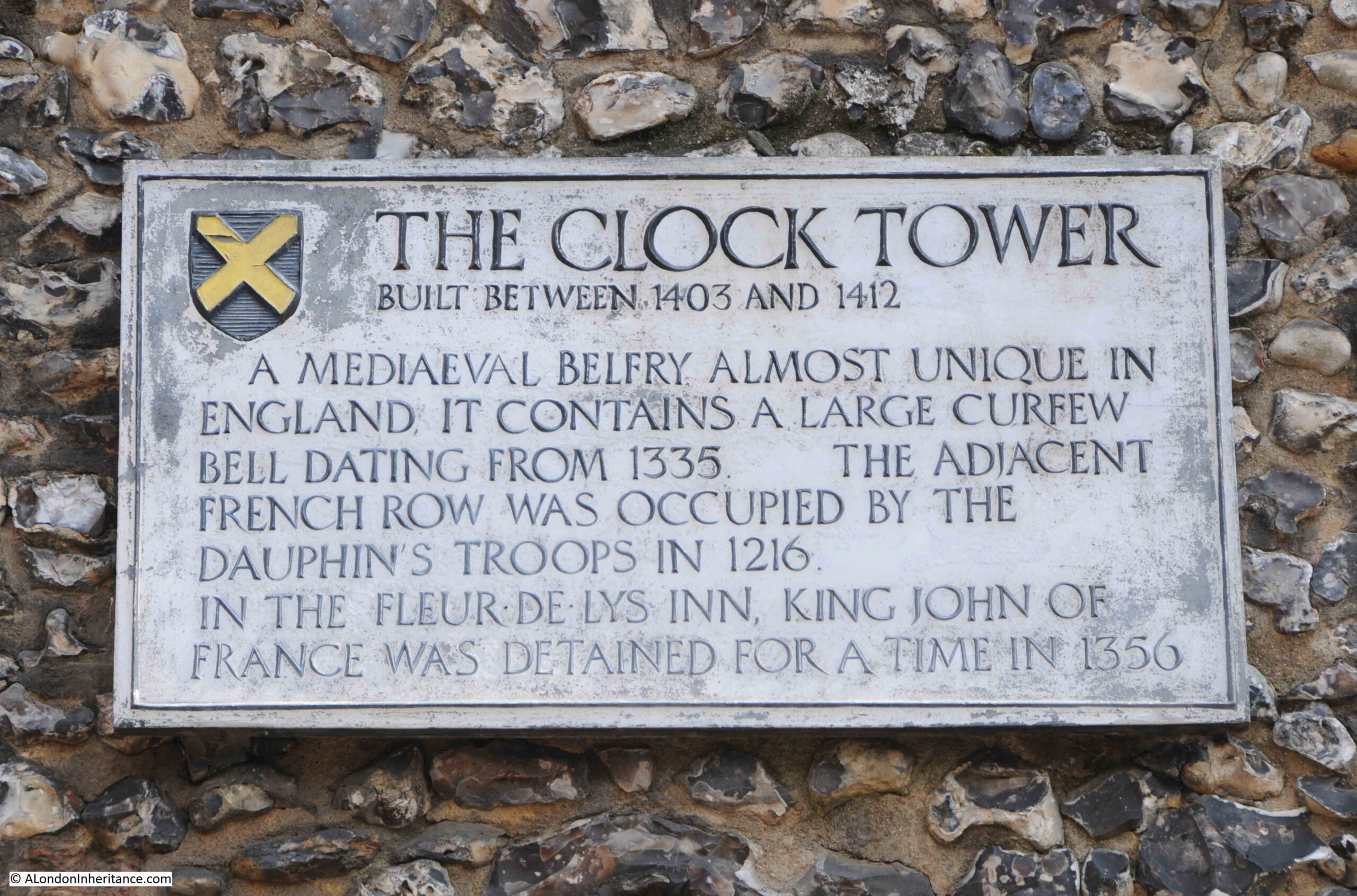
The second provides some detail on the clock tower:

St Albans Clock Tower

The clock tower is a scheduled ancient monument and is Grade I listed.

The clock tower appears to have been built due to a conflict between the abbot of St. Albans and the rest of the town. The clock tower allowed the town to sound their own hours, and the time of a curfew, independently of the abbot and the church.

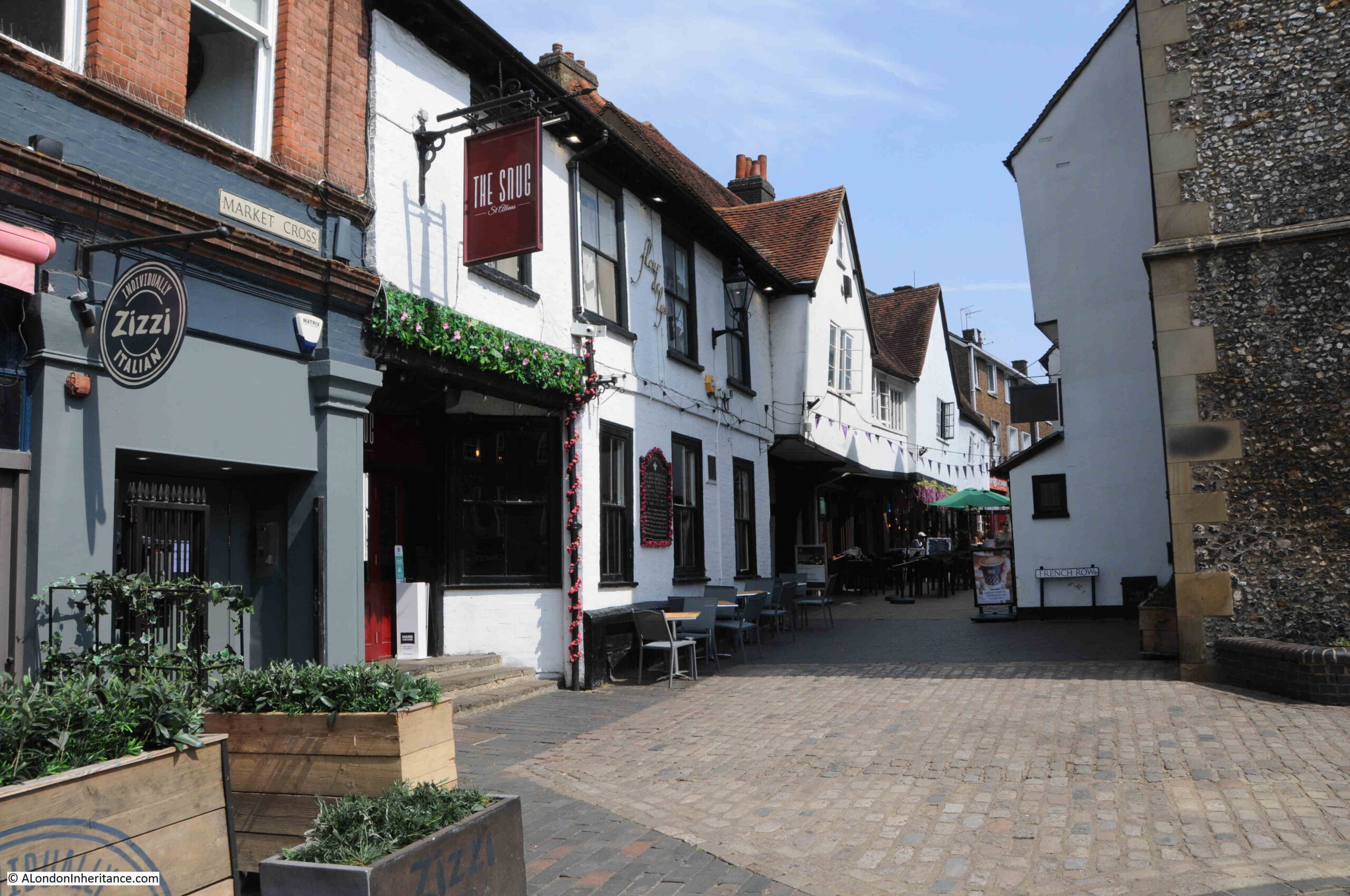
The plaque makes two claims regarding French Row and the Fleur de Lys Inn. French Row is adjacent to the clock tower:

French Row

The plaque makes the claim that French troops (the Dauphin was the heir to the French throne) occupied French Row in 1216. This may be true, although I cannot find any firm confirmation. French troops did land in England in support of the Barons during their conflict with King John, and there was a French claim to the English crown at the time.

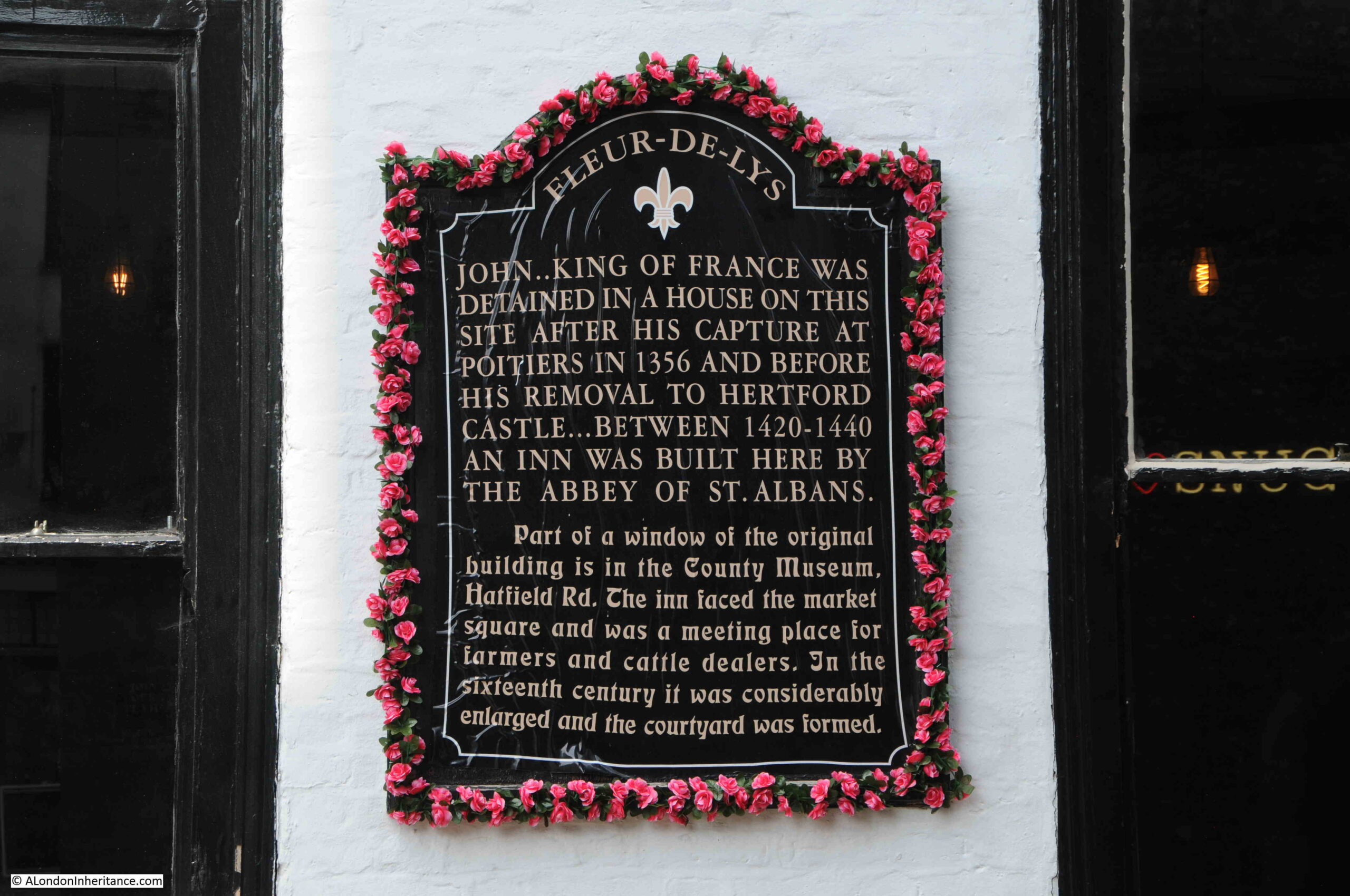
The second claim, that John, King of France was detained in the Fleur-de-Lys pub is repeated on a large sign on the front of the pub:

Fleur de Lys pub St Albans

The St Albans Architectural and Archaeological Society has researched this claim and can “find no primary evidence for the French king’s staying in or on the site of the Fleur”.

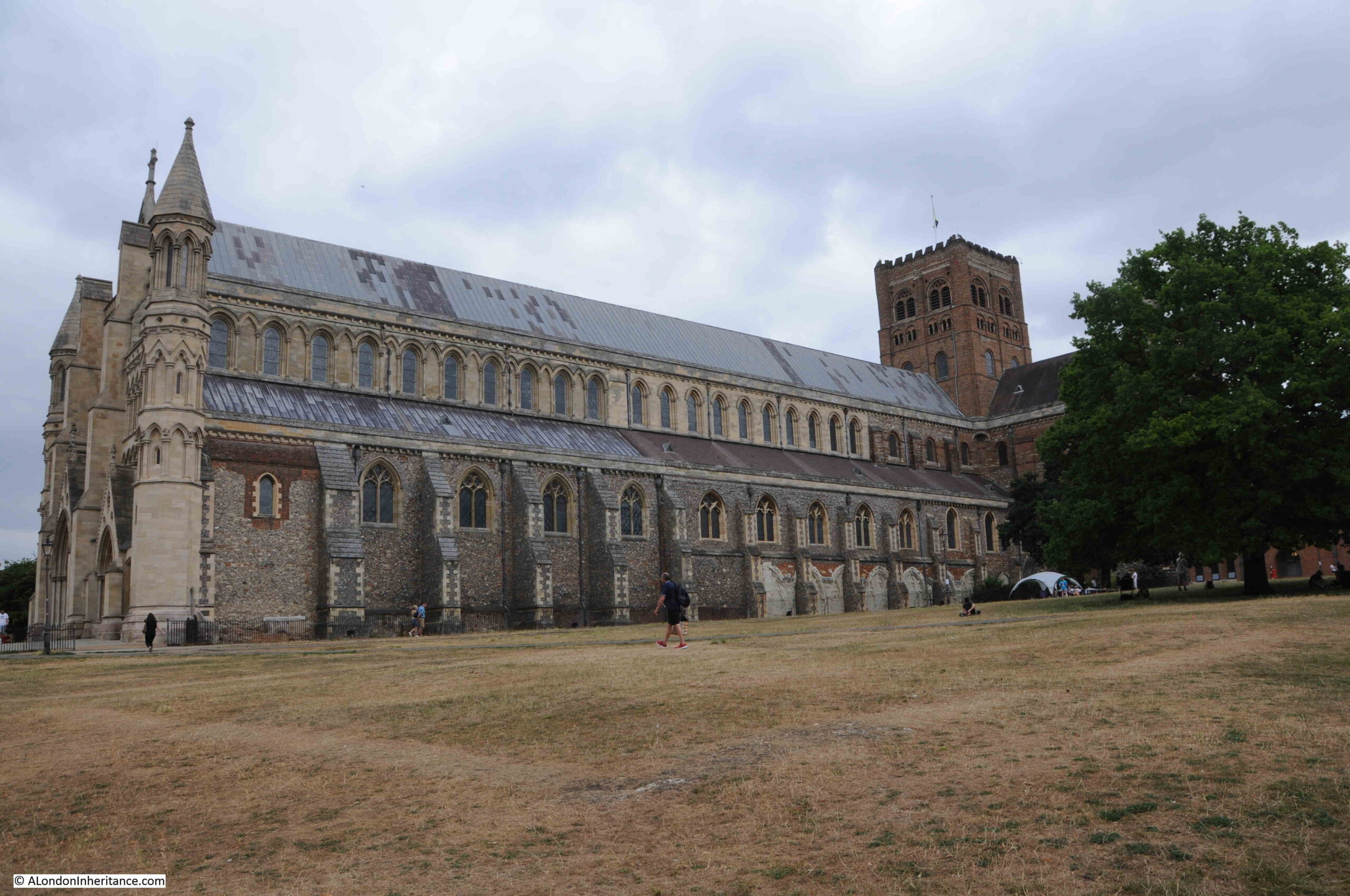
St Albans Cathedral is a very large building that hints at the importance of the site in past centuries.

St Albans Cathedral

The original monastery buildings occupied the land surrounding the church. The church, and one other building which we will find later, are all that have survived, and there is a large open space south of the church that runs down to the River Ver.

As with many of the other religious buildings we have met on this journey, the monastery was surrendered to Henry VIII in 1539 during the dissolution, and the monastery and church buildings were plundered for valuables and building materials.

The church was at risk, but was brought by the town of St Albans in 1551 to become a parish church, although it appears that the church was not maintained and rather neglected. Too large a church for a small market town to support.

The church became an Abbey in 1877, and then went through a period of expensive and insensitive Victorian restoration.

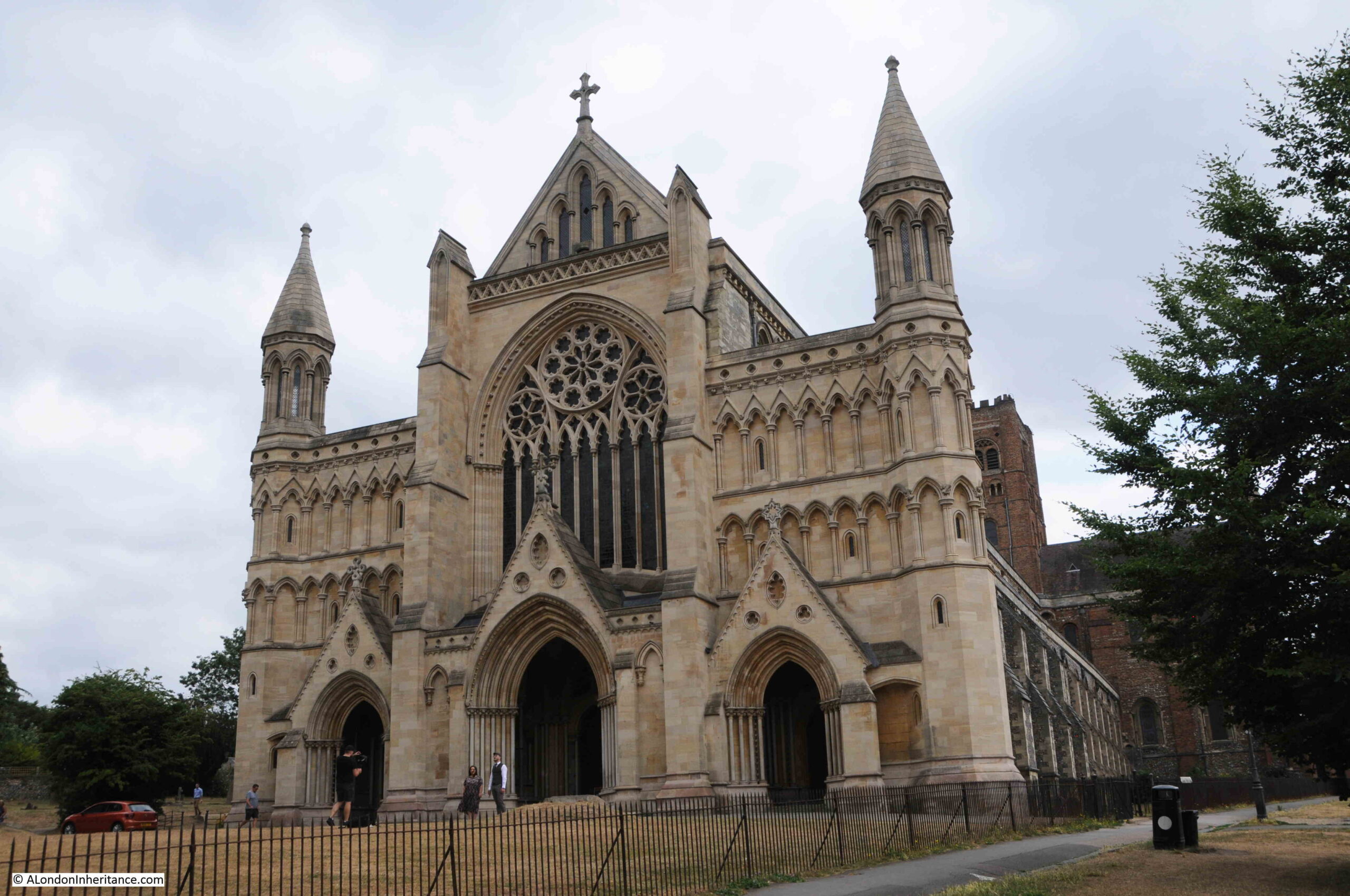
The west front of the Abbey today:

St Albans Cathedral

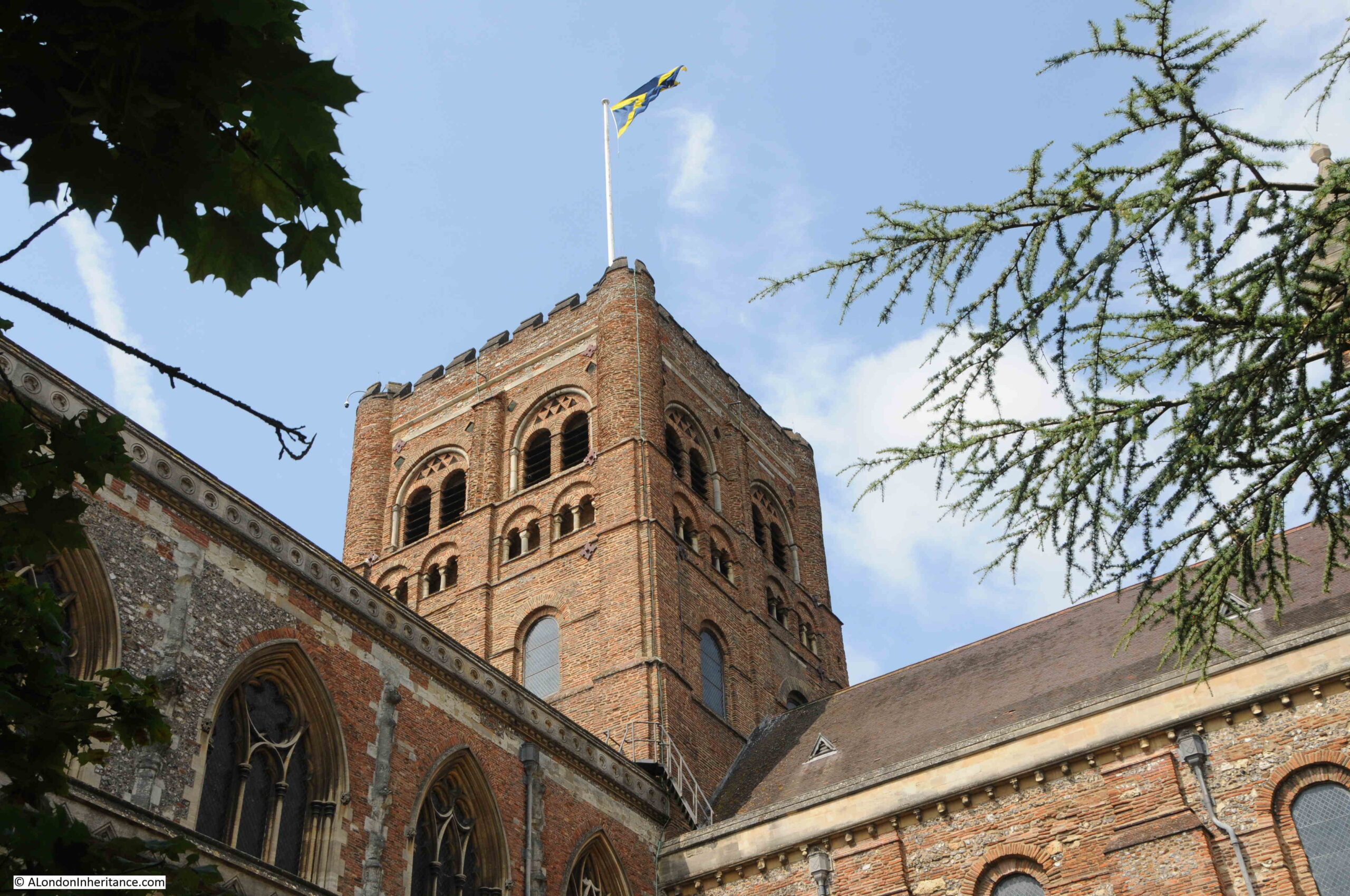
A view of the tower and upper part of some of the walls shows the use of brick in the construction of the abbey, much from the Roman town of Verulamium.

St Albans Cathedral

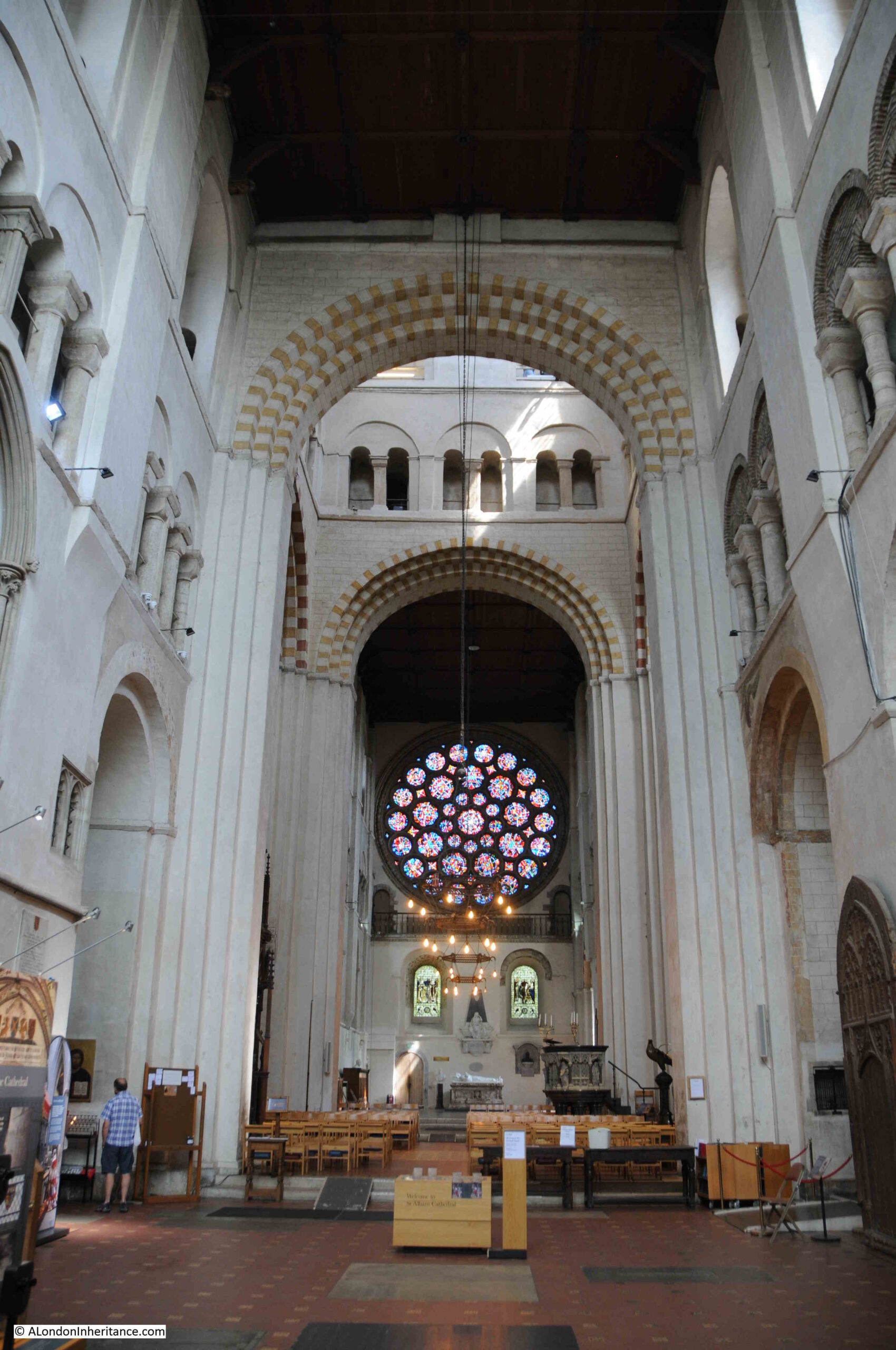
The interior of the abbey is much as you would expect of a medieval building, but has some unique decorative features:

St Albans Cathedral

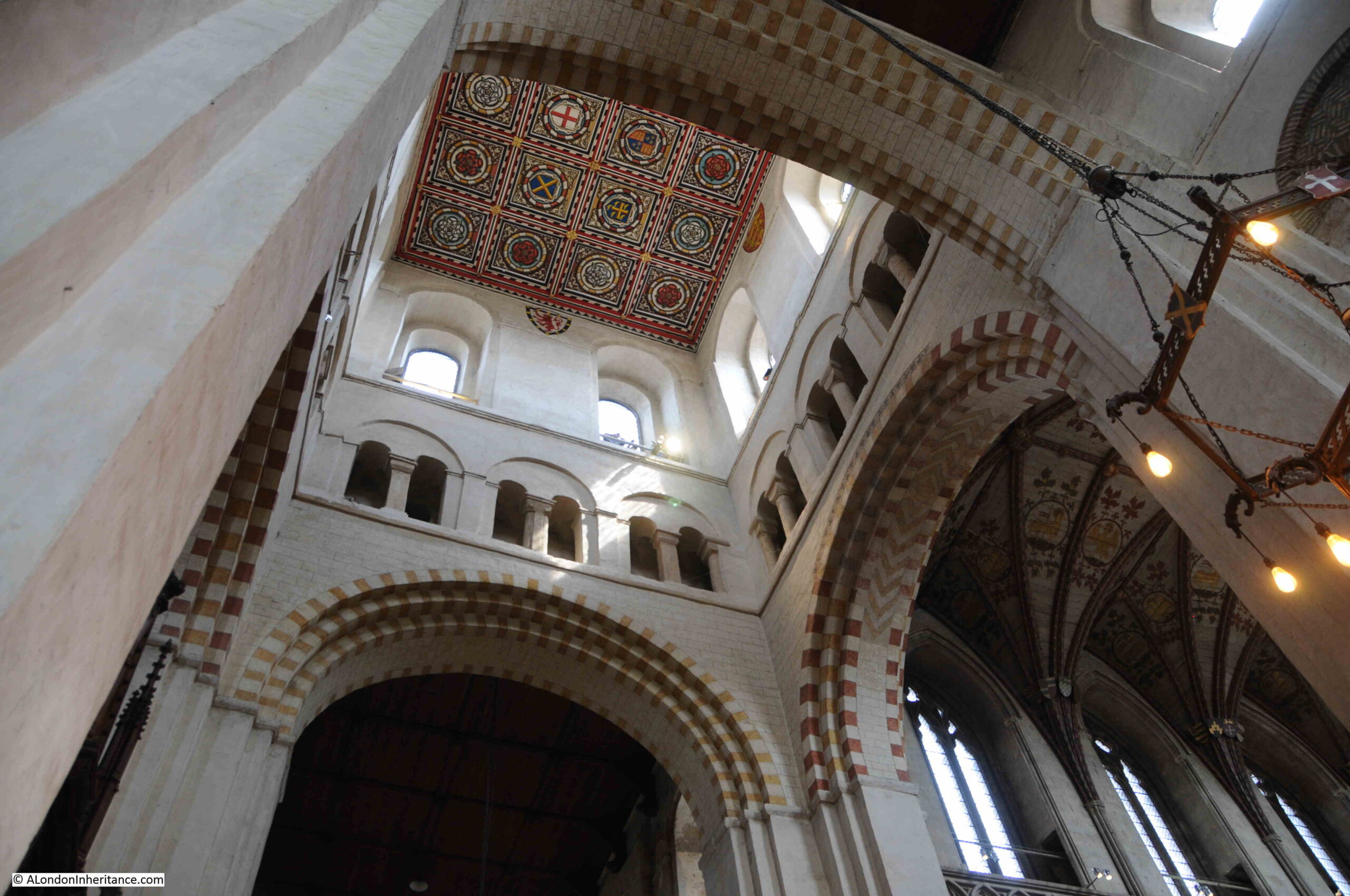
Looking up towards the base of the tower:

St Albans Cathedral

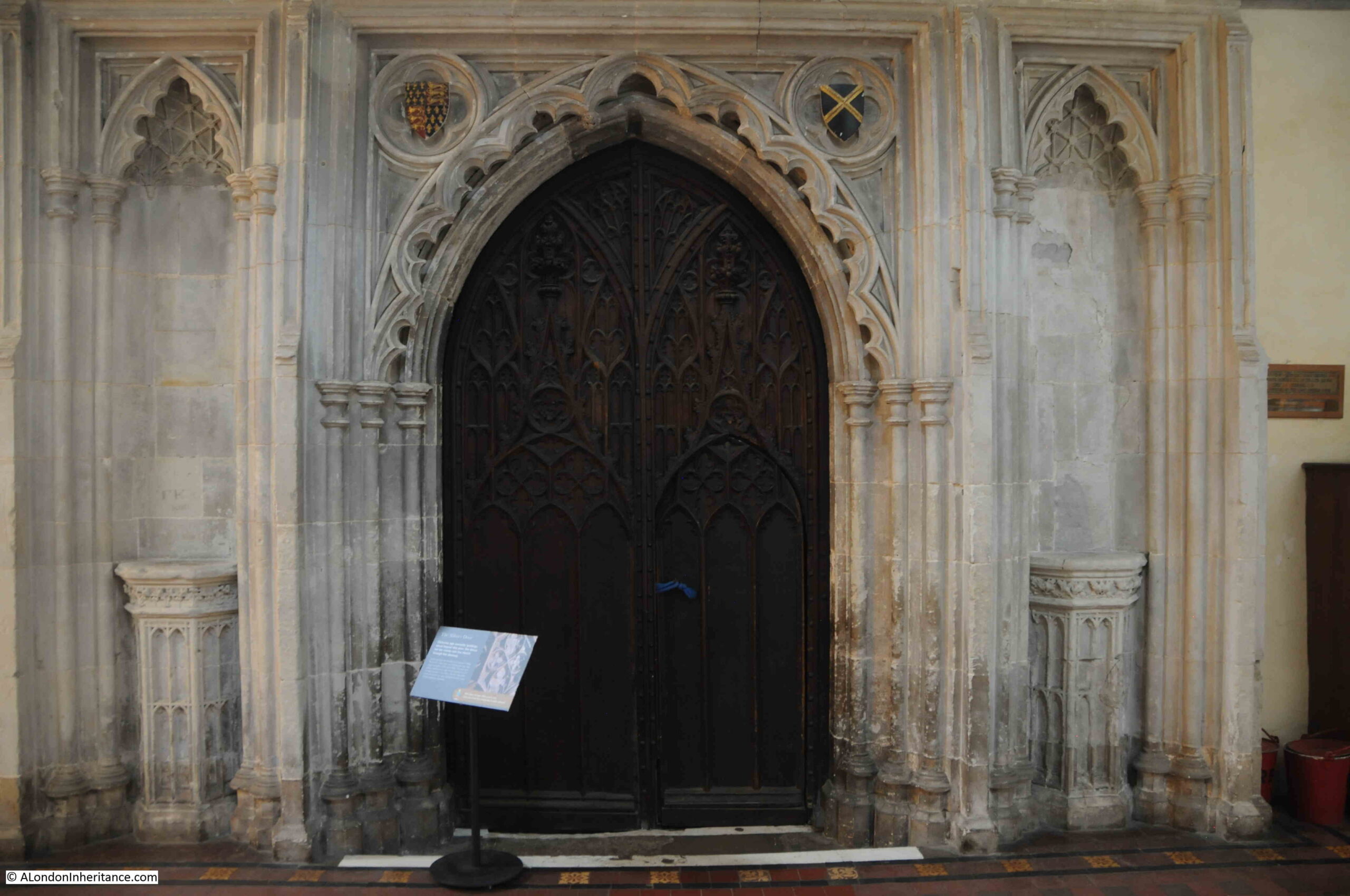
There are features within the abbey that hint at the former size of the monastery. The following door once led to external monastic buildings and the Abbot would lead monks into the church through the doorway:

St Albans Cathedral

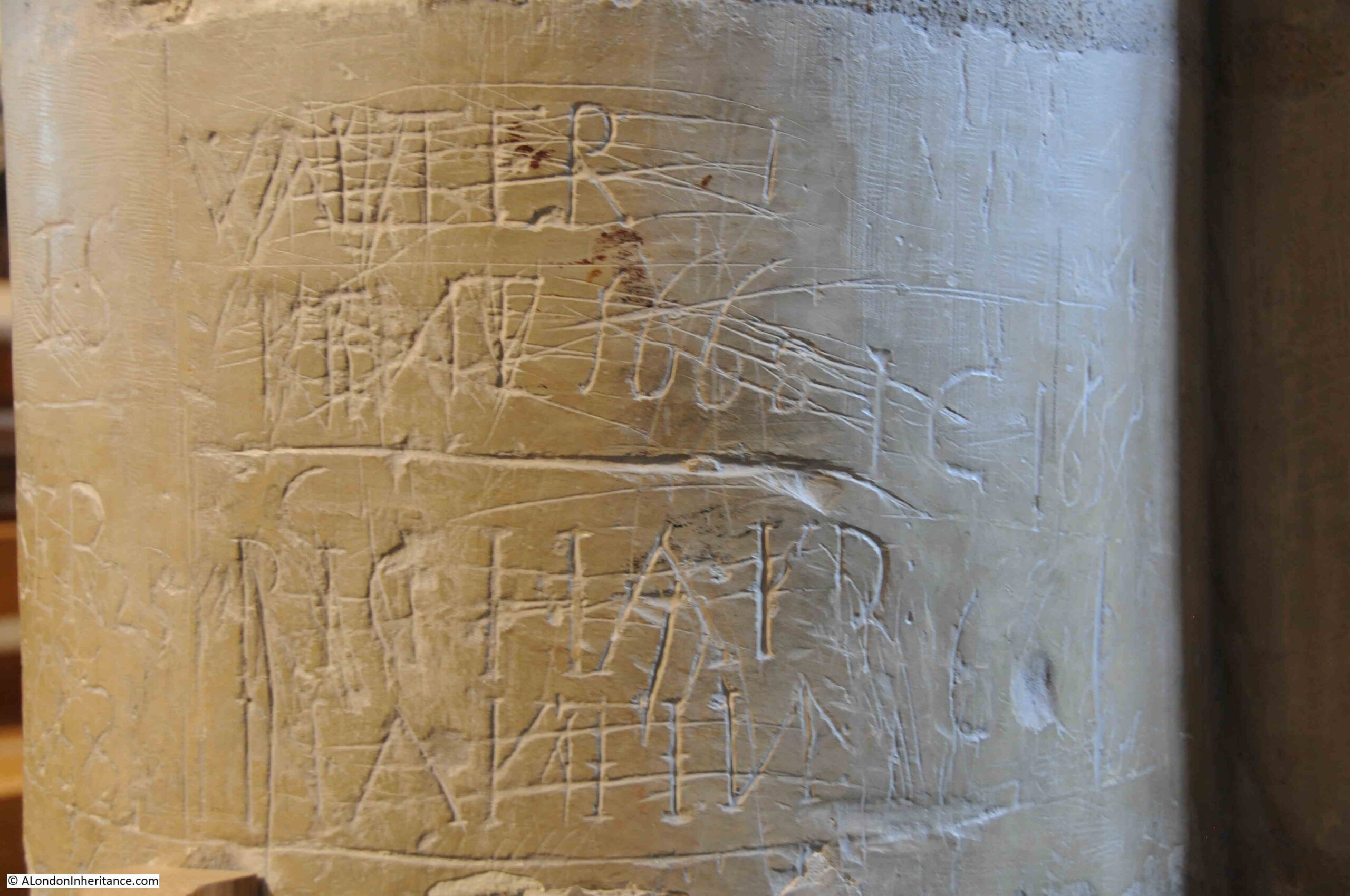
Graffiti which appears to date from 1668:

St Albans Cathedral

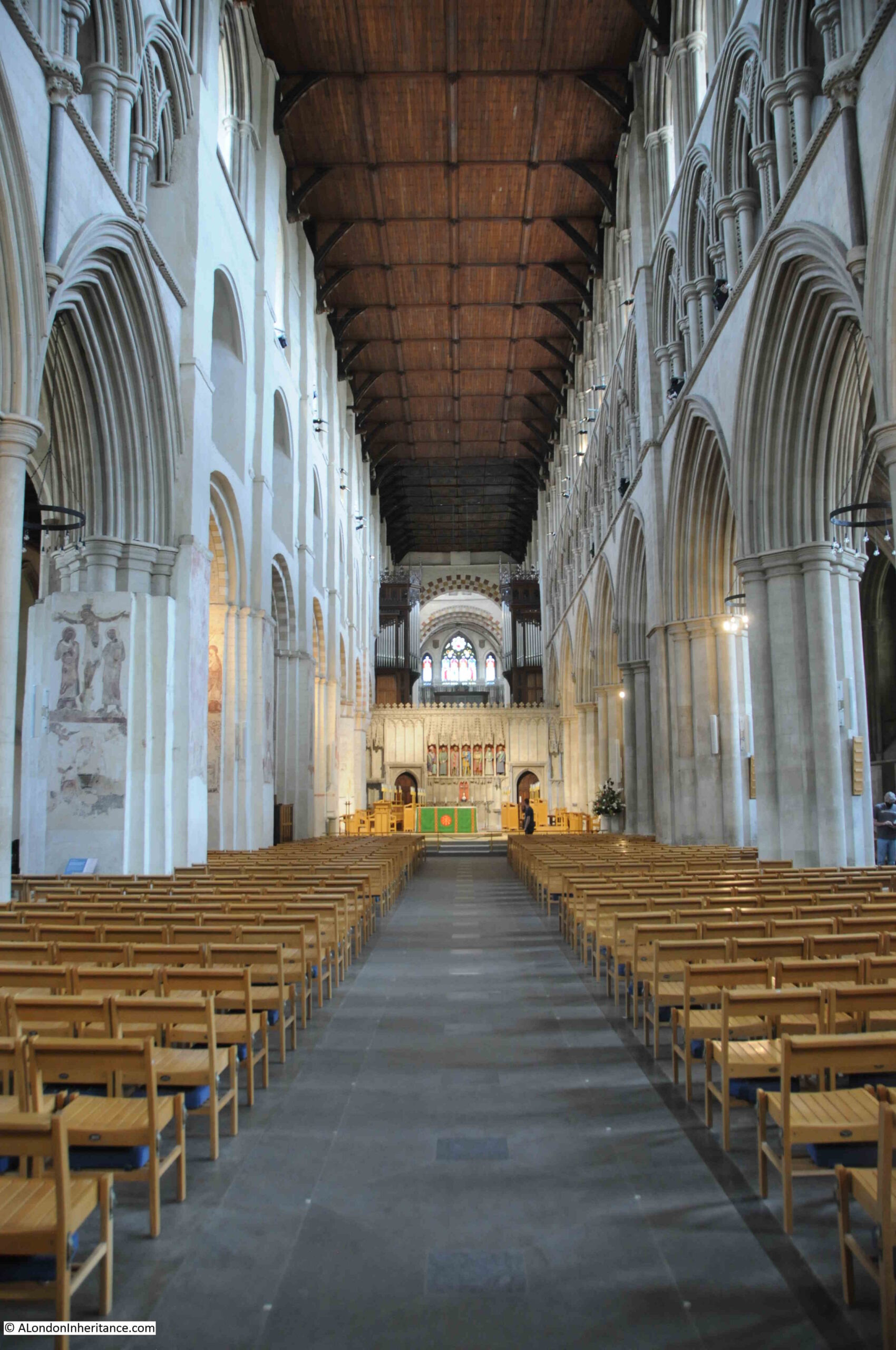
The nave of St. Albans Cathedral is the longest in the country at 85 metres:

St Albans Cathedral

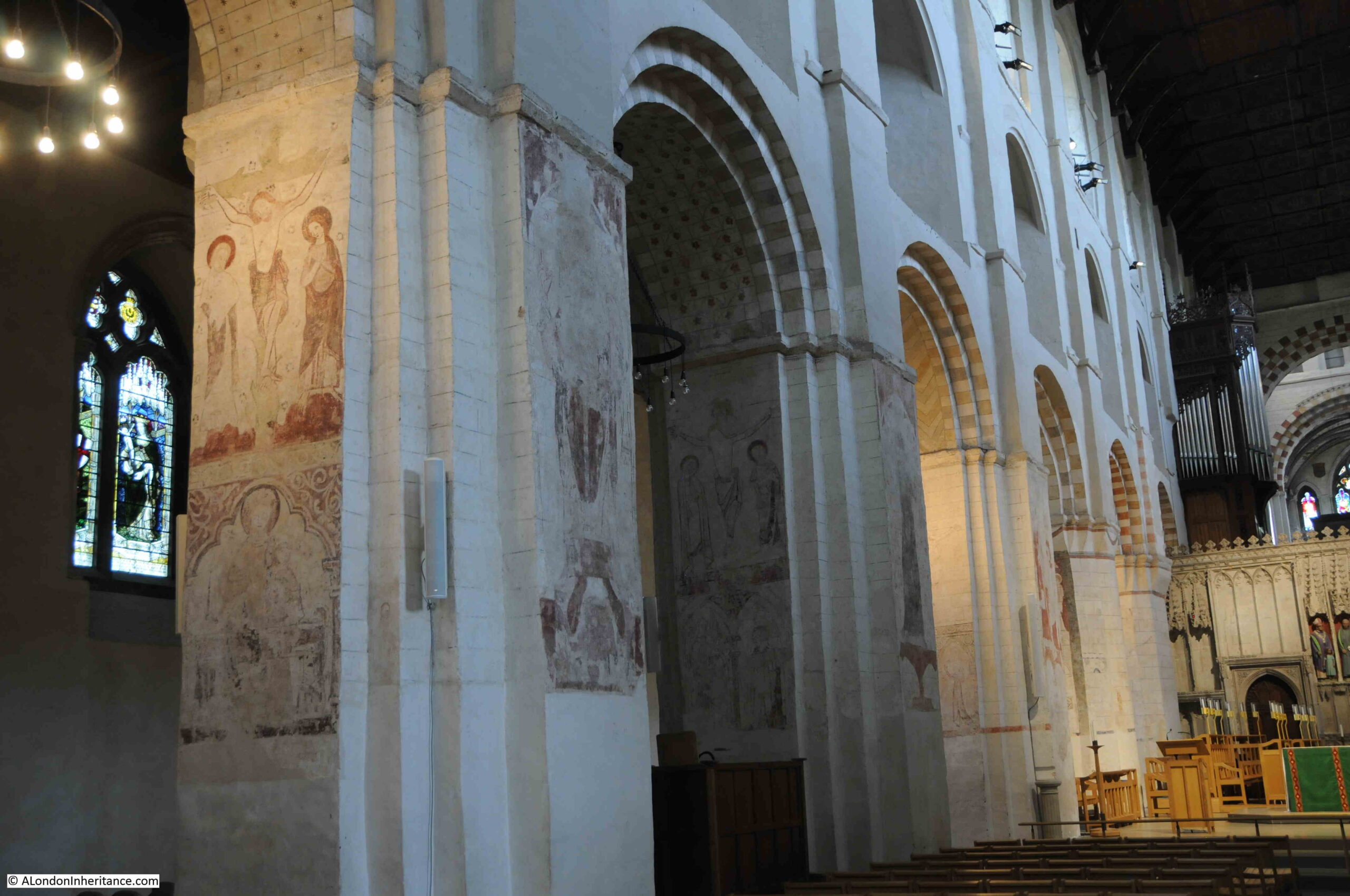
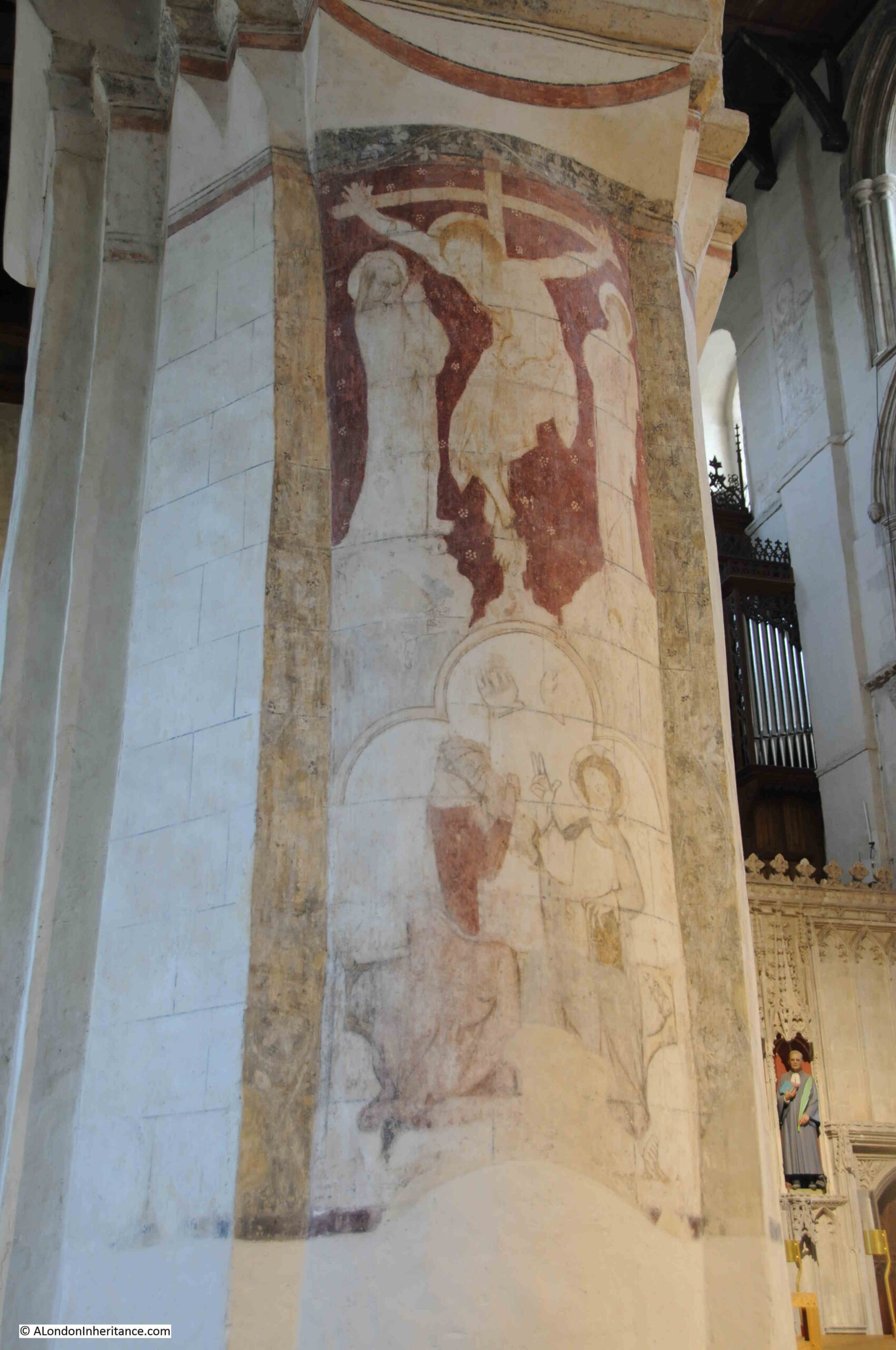
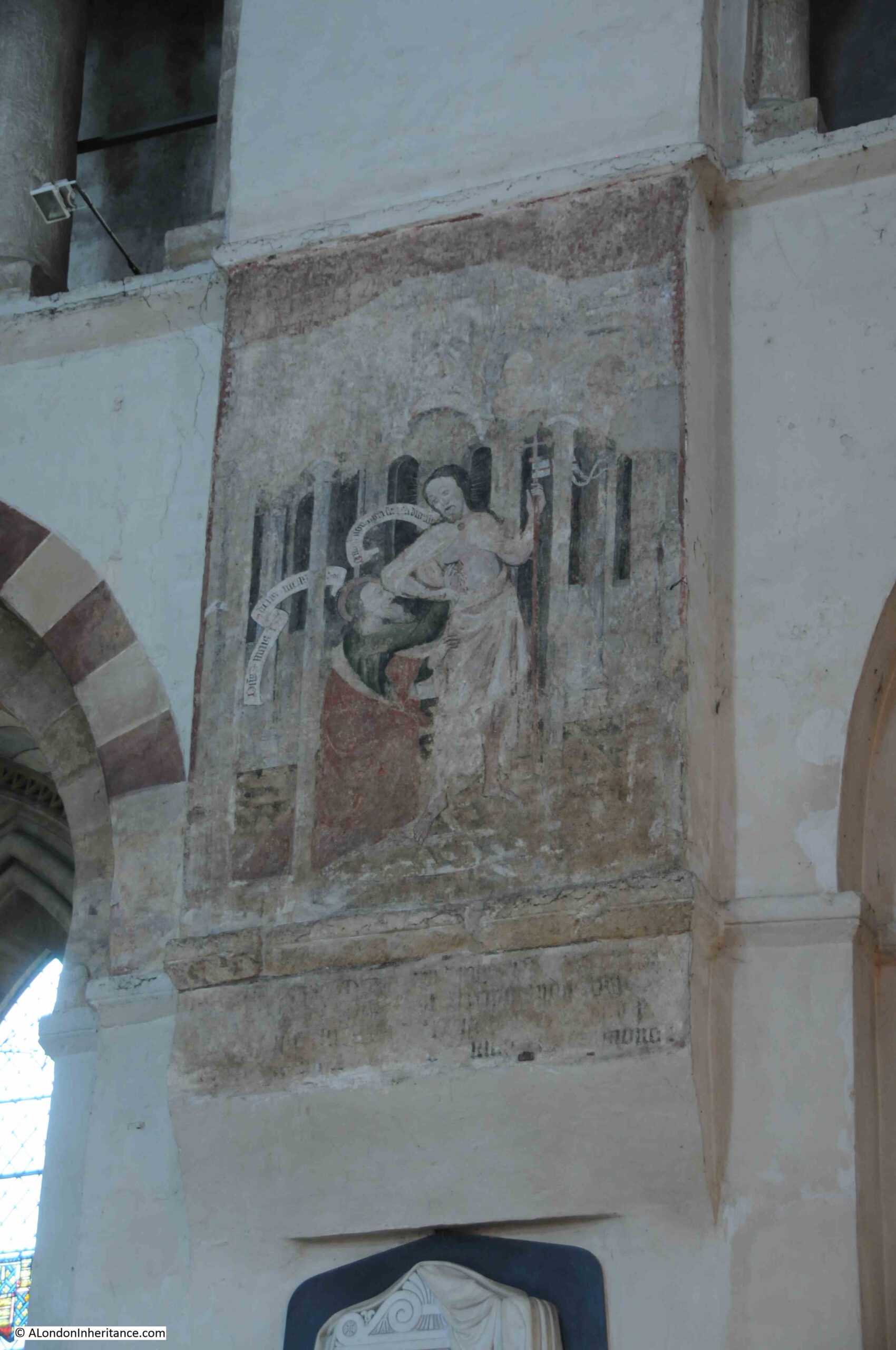
On many of the columns along the side of the nave are medieval wall paintings, many of which date from the early 13th century:

St Albans Cathedral

So it is possible that many of these paintings were there when Eleanor’s coffin rested overnight in the cathedral.

St Albans Cathedral

Luckily these paintings survived the 19th century “restoration”, and serve to illustrate how decorated and colourful abbeys and churches were before the dissolution.

These highly decorated interiors suffered during the dissolution, then during the English Civil War, and again during 19th century, Victorian restoration. All these periods of change resulted in rather plain church interiors, often white washed walls, and very simple decoration at best.

St Albans Cathedral

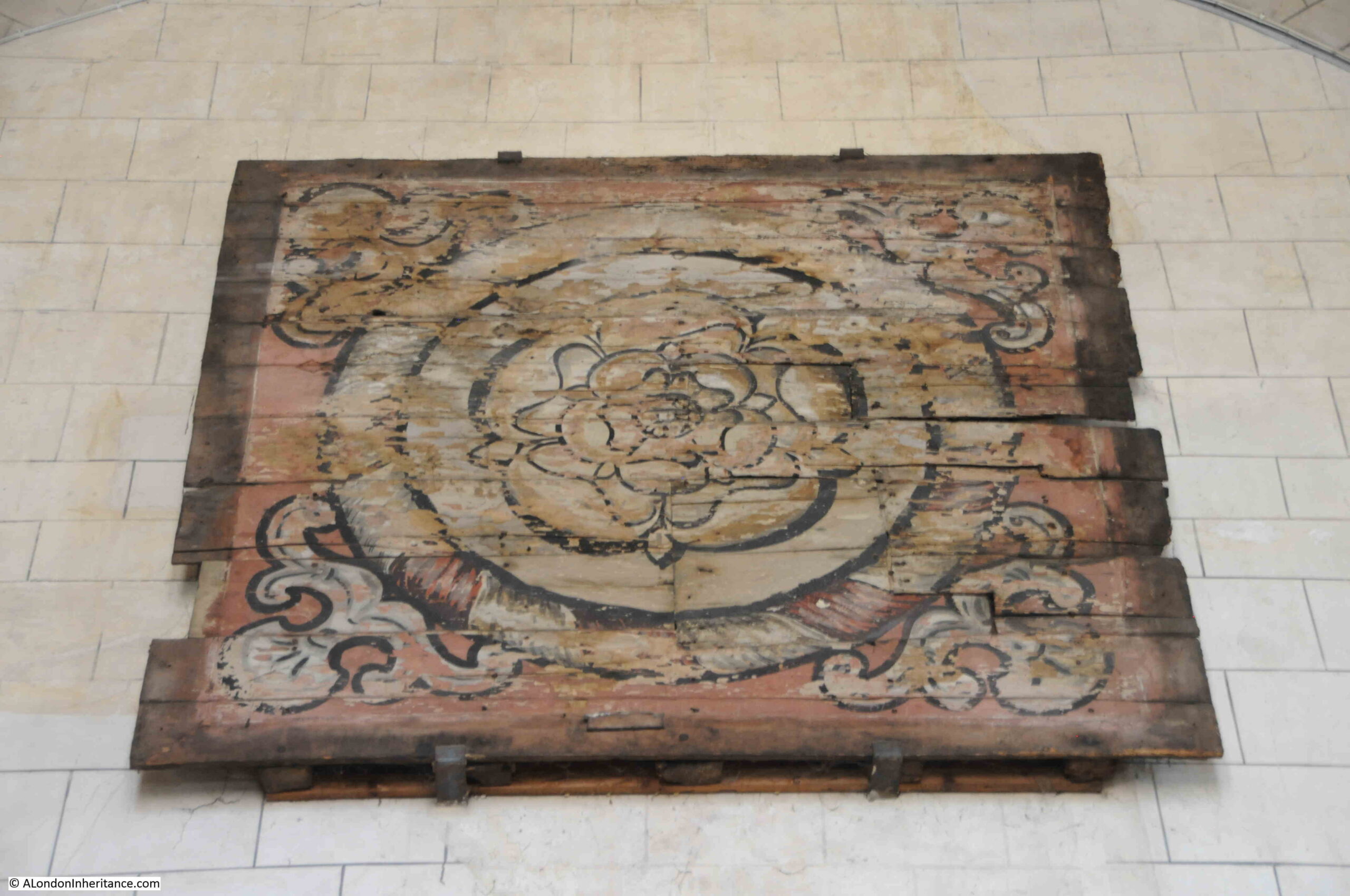
The interior of the roof of the church was also decorated, and on the wall is a panel taken from the roof of the tower, that was decorated in the fifteenth century:

St Albans Cathedral

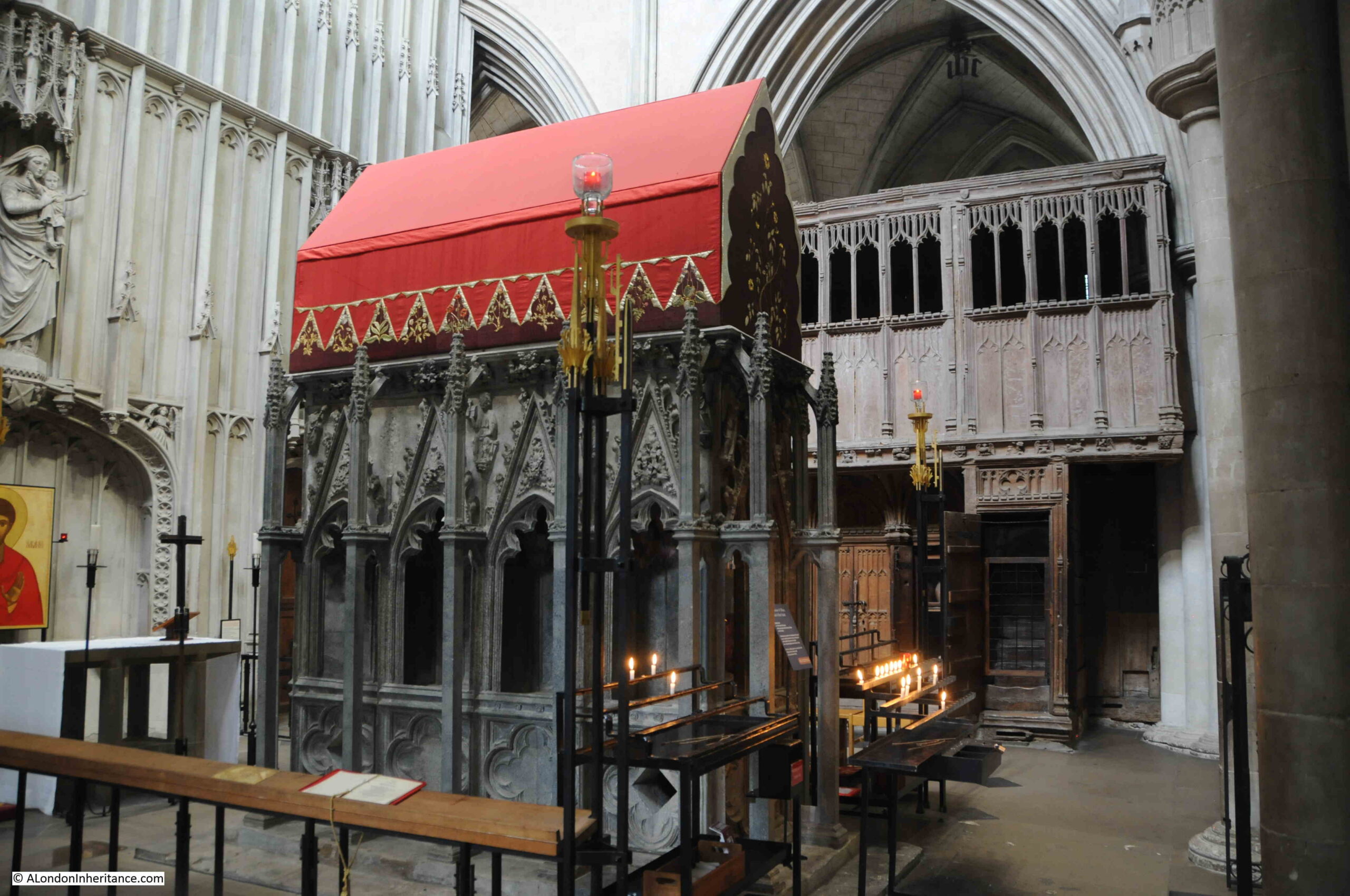
The Shrine of Saint Alban:

St Albans Cathedral

St Alban was buried on the site of the church, and a shrine was built in 1308, however this shrine was destroyed during the dissolution. Parts from the original shrine were used to build the new shrine in 1872 with additional work in 1993.

Relics of St Alban were lost during the dissolution.

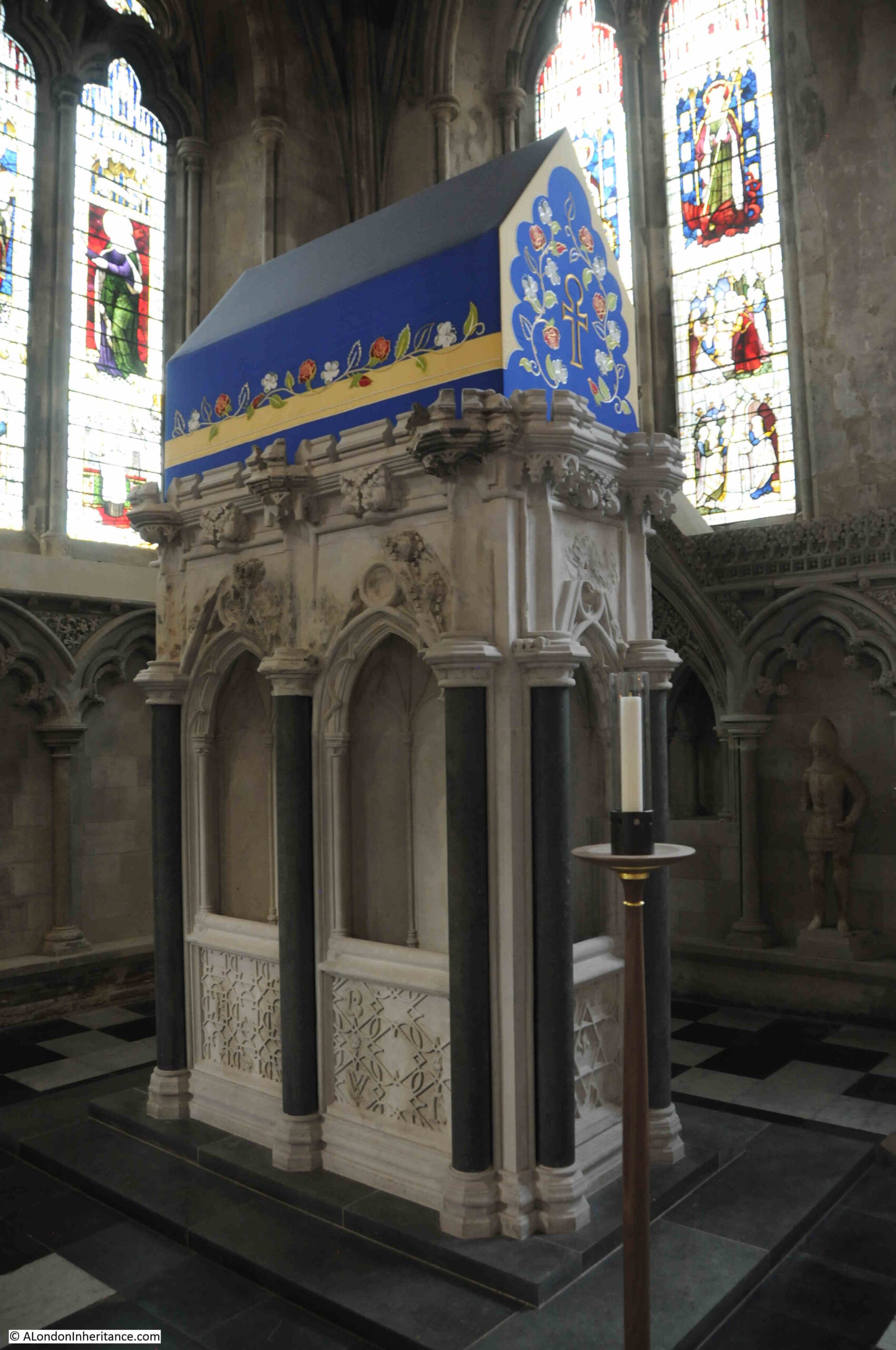
The Abbey has a second shrine, this to St Amphibalus who was the Christian priest protected by St Alban. Again this is an 1872 rebuild of an earlier mediaeval shrine:

St Albans Cathedral

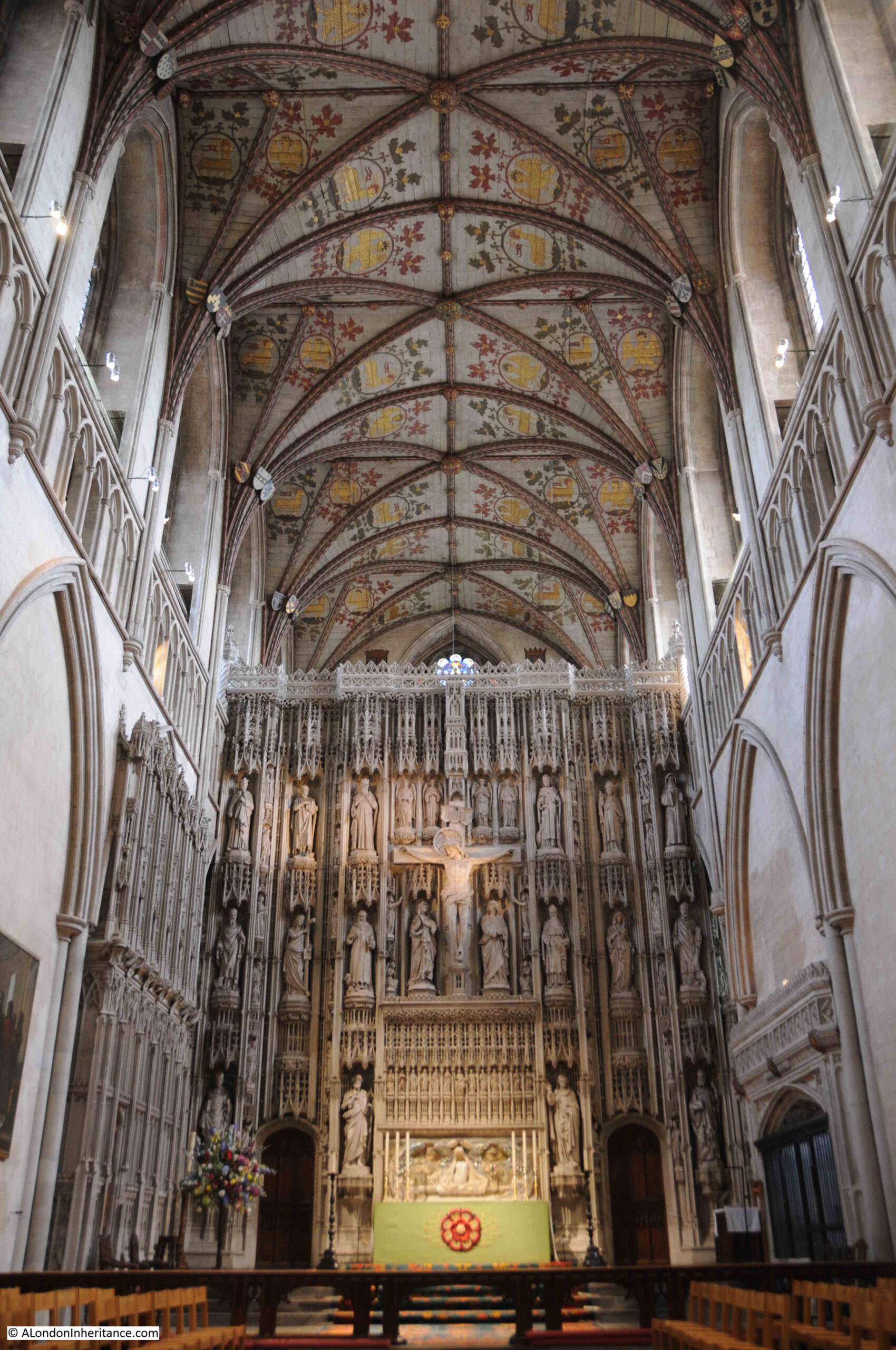
The High Altar:

St Albans Cathedral

The High Altar was considerably restored during the 19th century, including replacement of the statues that had originally stood in the niches across the Altar Screen.

Eleanor’s body would have spent the night in front of the High Altar, with a watch being kept over her coffin and prayers being said during the night.

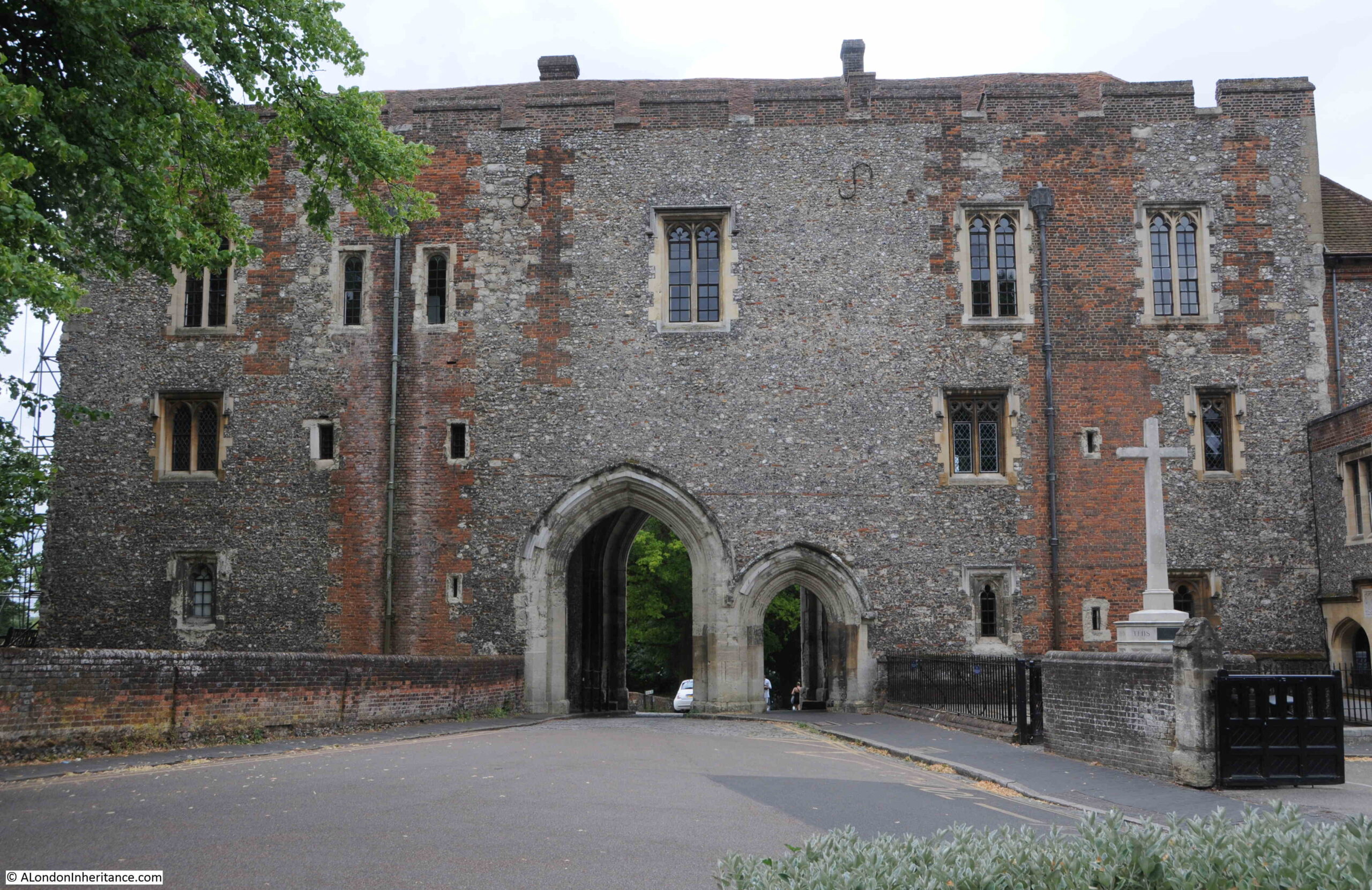
Apart from the Abbey, the only other building that survived from the original monastery is the Great Gateway:

St Albans Gatehouse

The size of the Great Gateway, as well as the Abbey, helps us understand the overall size and construction of the original monastery, as it was when Eleanor stayed there in December 1290.

Leaving St. Albans, the procession headed to the last town prior to entering the City of London. This town would modify its name due to Eleanor’s visit and became:

Waltham Cross

The destination of the procession was Waltham Abbey, a short distance to the east of Waltham Cross. The church at Waltham Abbey was an important religious centre and was reputed to be the place where King Harold Godwinson, the last Anglo-Saxon king of England was alleged to have been buried after his body was brought back to the church after the Battle of Hastings.

Waltham Abbey is to the east of St Albans, and the route south from St Albans would have been a shorter route into London, however by heading east, the procession would have been able to enter the City from the north east and therefore head through the City on the route to Westminster.

Edward I also had to leave the procession at St Albans and head directly to London, presumably to arrange the final details of the procession through the City, and the funeral at Westminster Abbey.

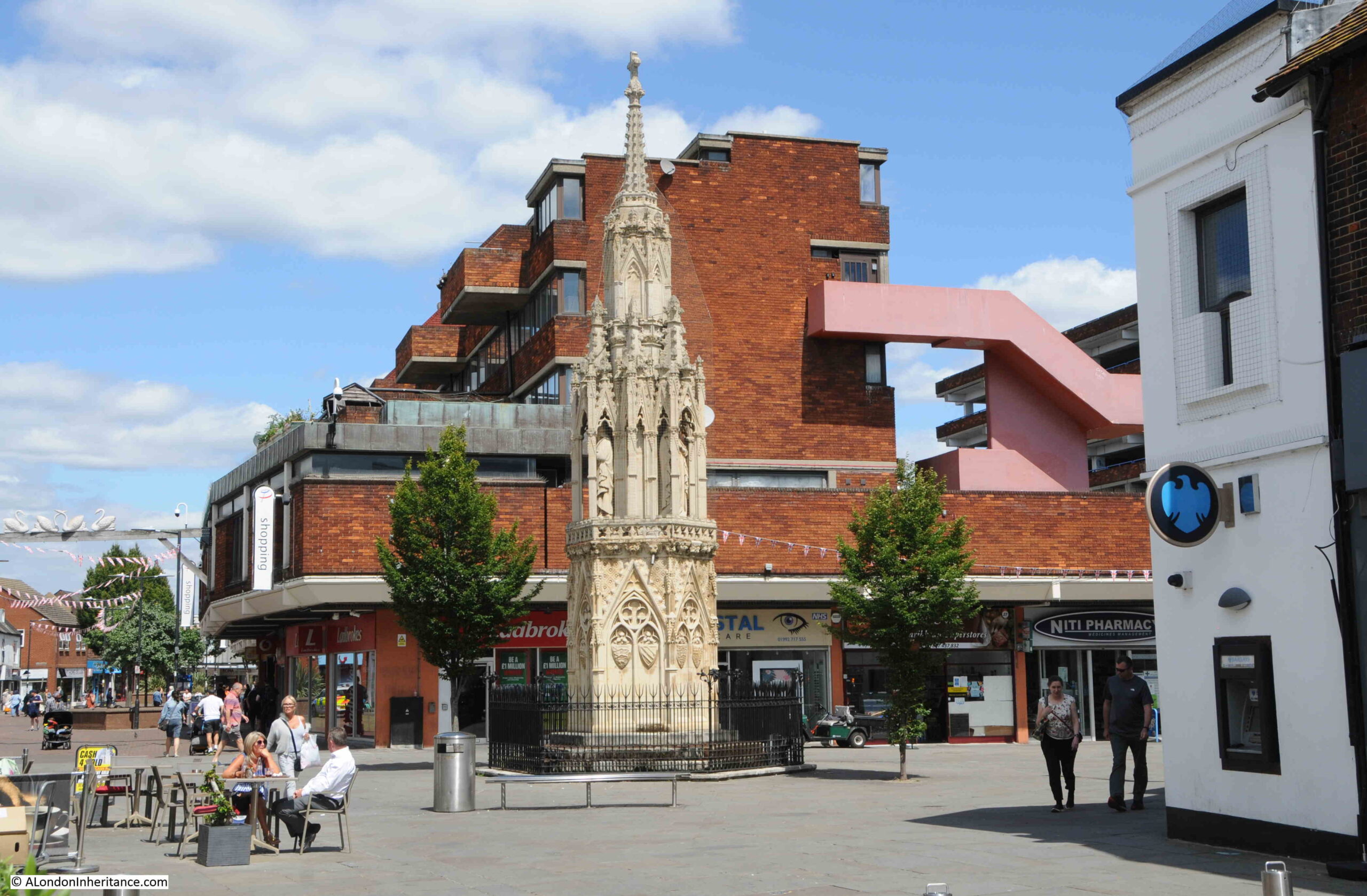
Waltham Cross is the site of one of the few remaining crosses, and it was built at a key cross roads where the procession would have passed from St Albans to Waltham Abbey, and then from Waltham Abbey back to pick up the road to the City

Today, the crossroads have disappeared, and the cross stands in the middle of a pedestrianised area:

Waltham Cross

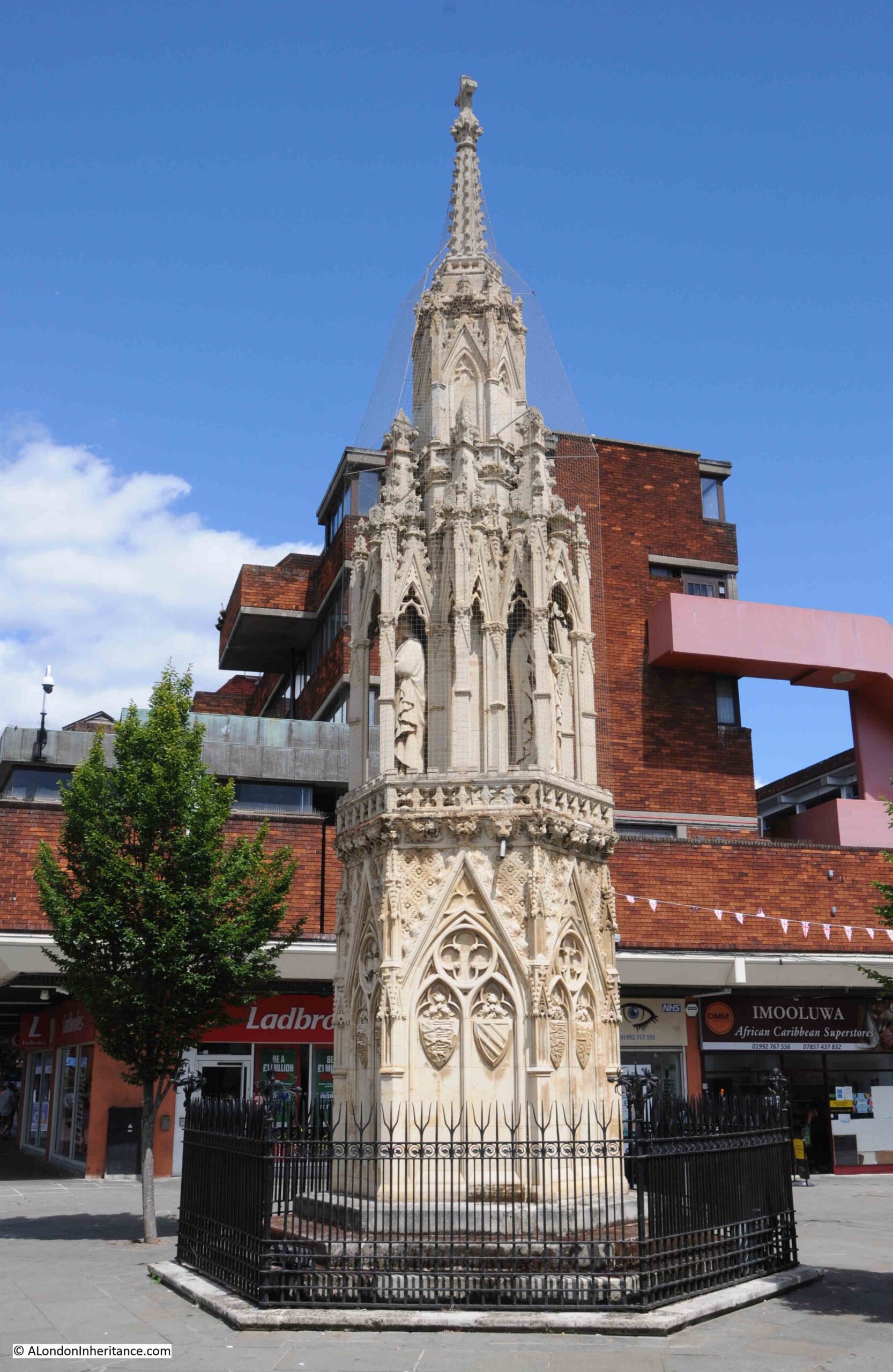
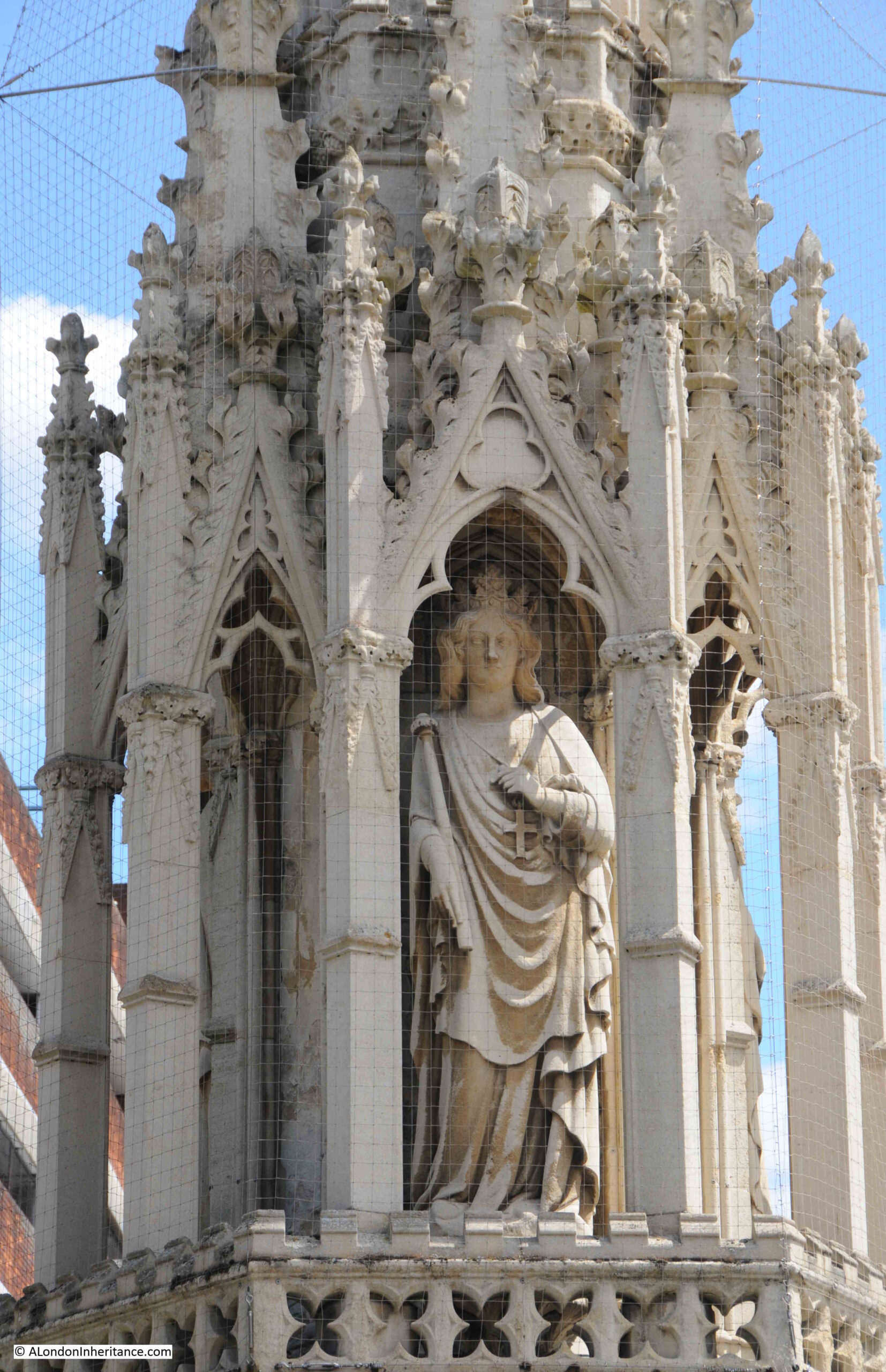
The cross has the same standard design as the other surviving crosses, with the lower tier consisting of decoration and coats of arms, above are statues of Eleanor, and above a decorated section leading to a cross.

Waltham Cross

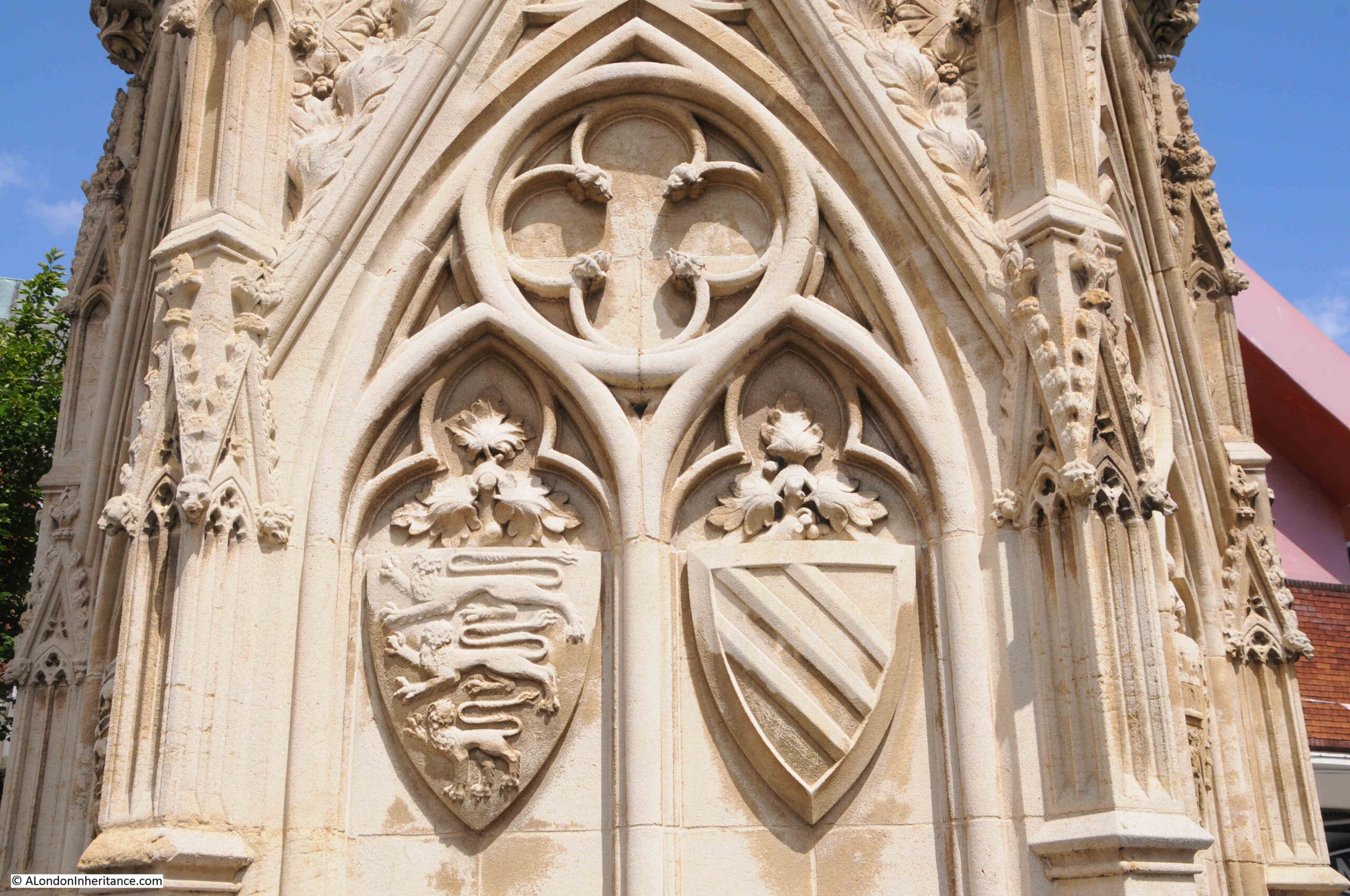
The arms of England and Ponthieu:

Waltham Cross

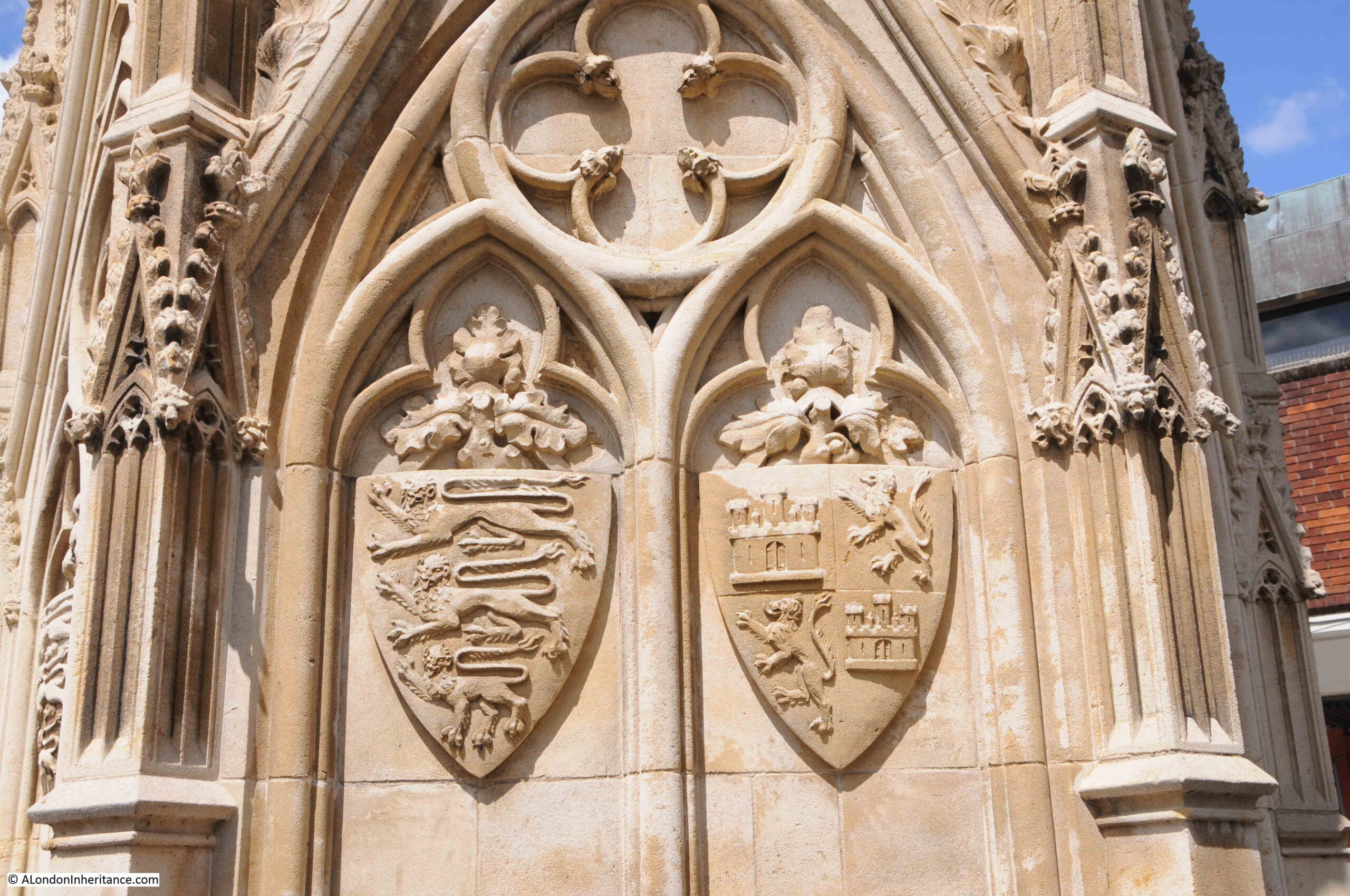
The cross looks to have been significantly restored. The stone of the lower section looks to be a slightly different colour to the upper sections, and is very clean. The arms and surrounding carvings show no sign of the type of erosion which would have occurred to stone over centuries.

The arms of England and Eleanor of Castile:

Waltham Cross

Eleanor looks out from the mid tier of the cross:

Waltham Cross

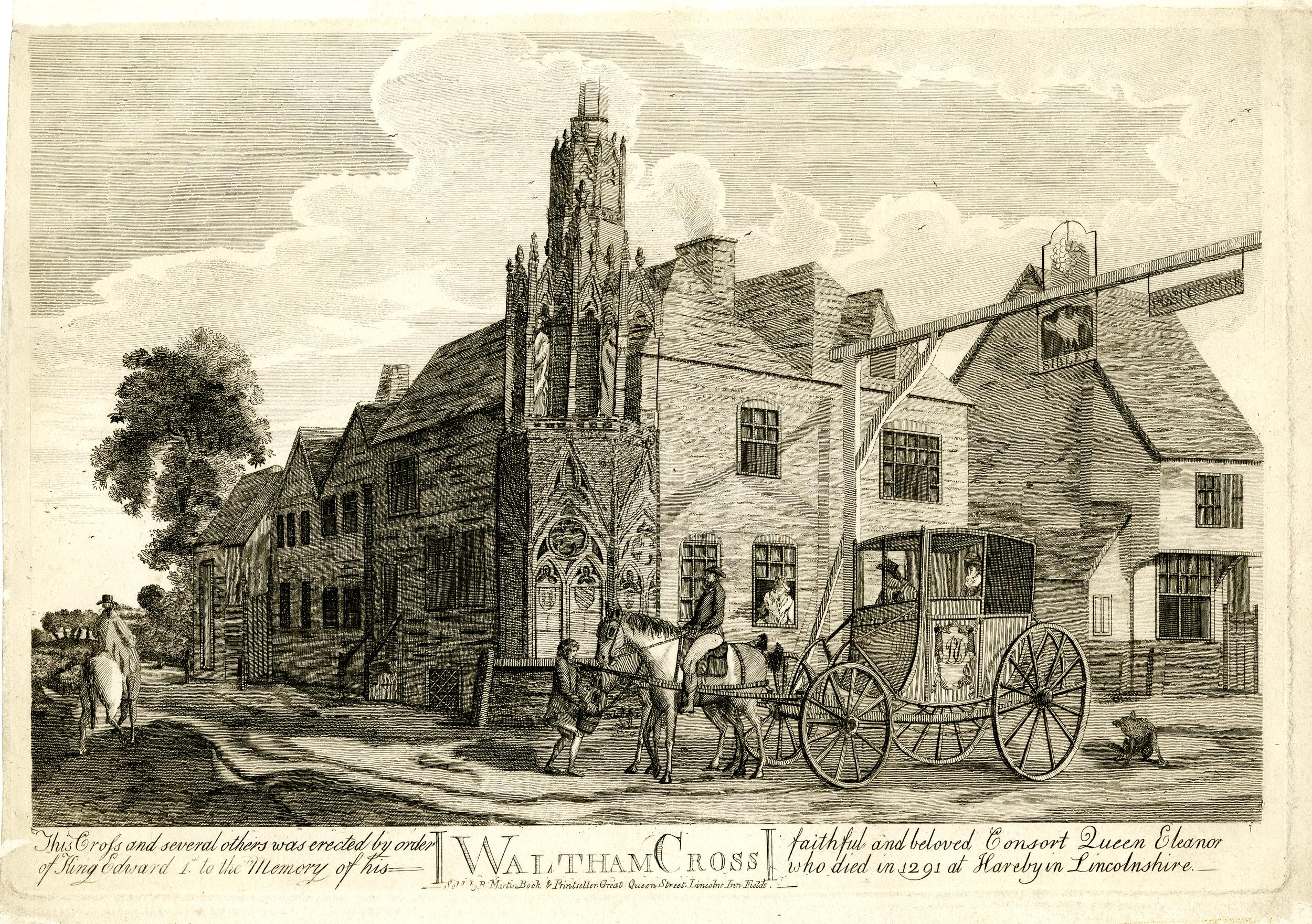
That the cross has been considerably restored, and how the area around the cross has changed, can be seen in early prints of the cross, for example the heavy state of decay in the following 18th century print  (© The Trustees of the British Museum):

Waltham Cross

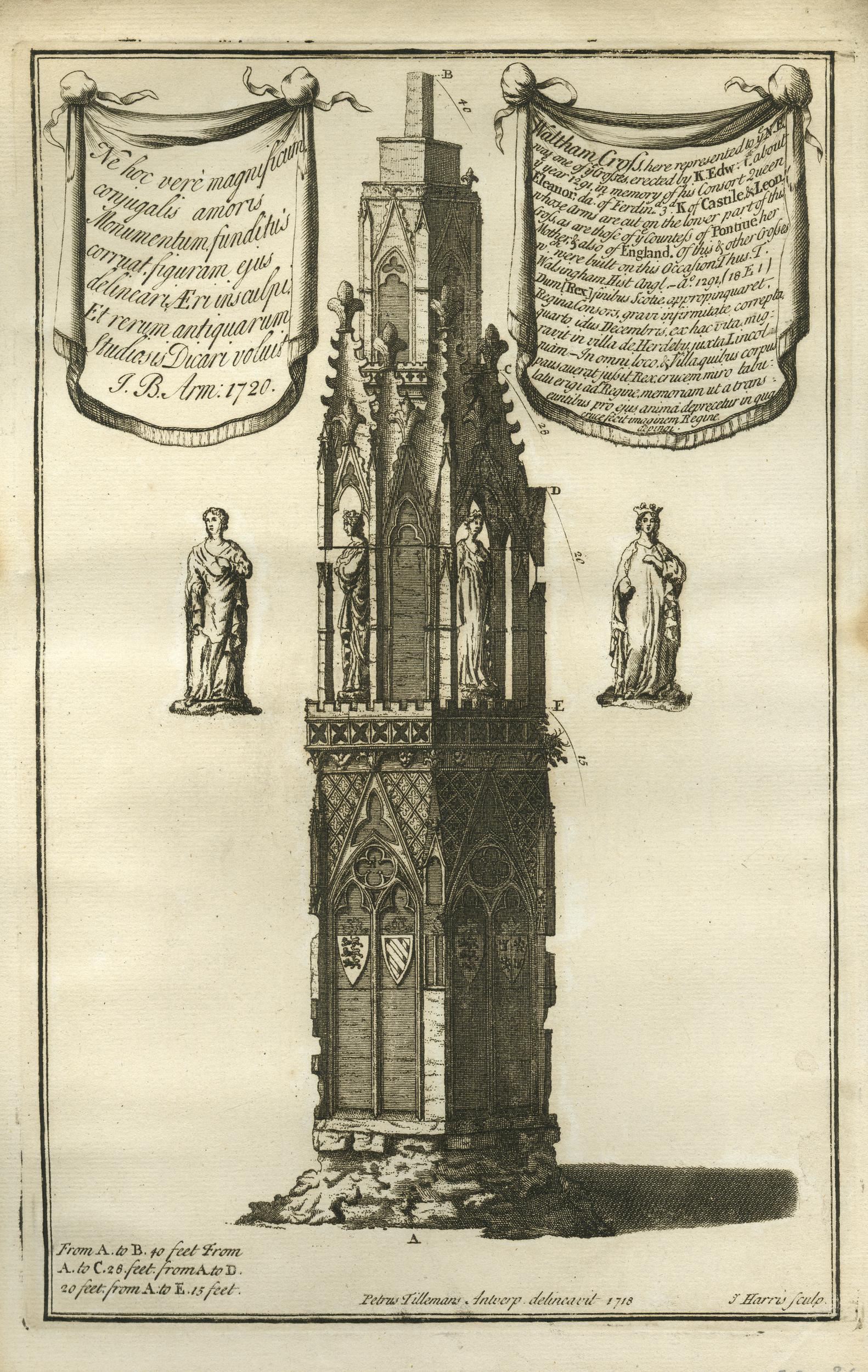
The cross in 1720  (© The Trustees of the British Museum):
Waltham Cross

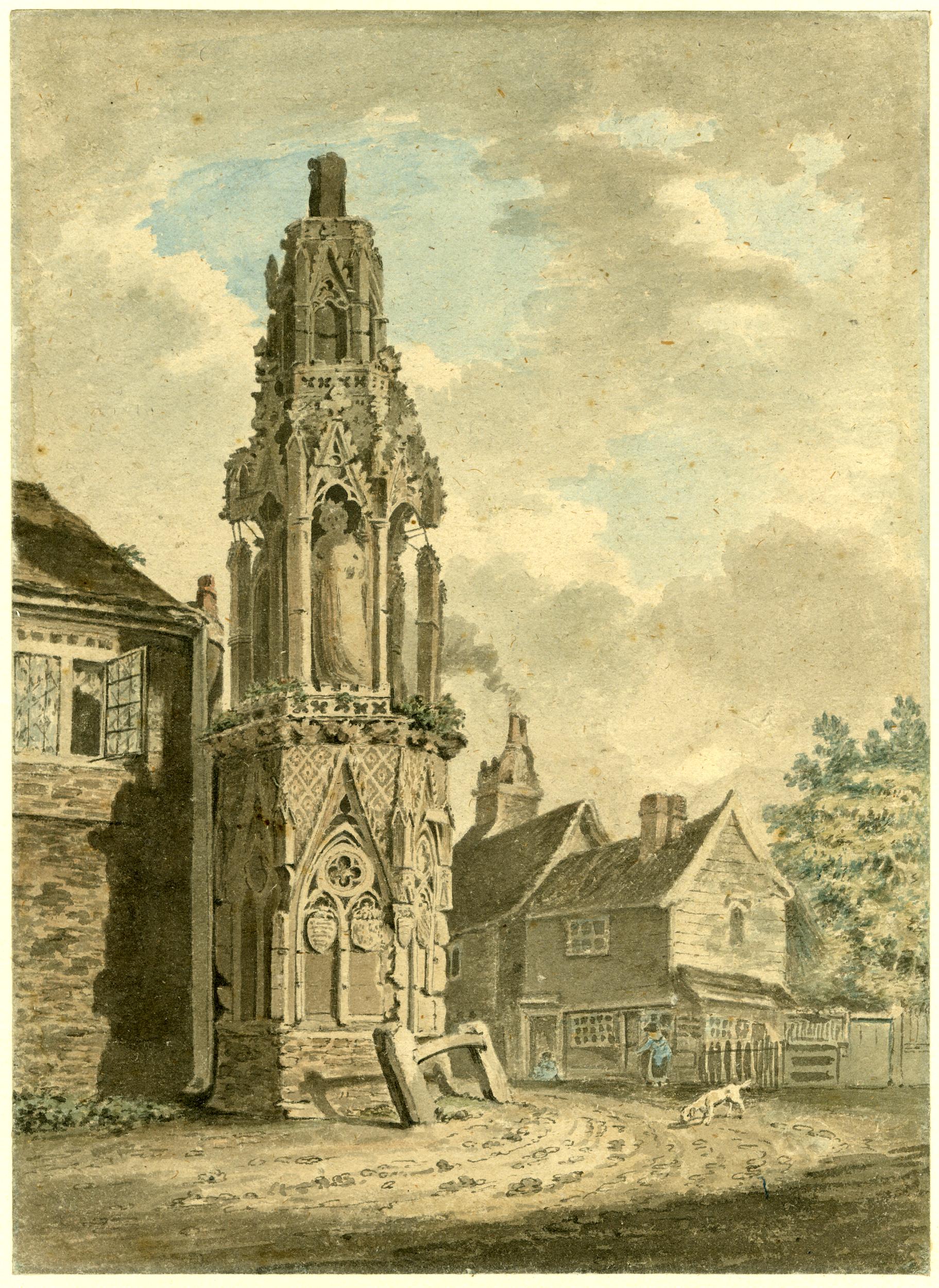
The cross in the early 19th century is shown in the following print. This illustrates that, as with the other surviving crosses, and probably with all the crosses that have been lost, they were placed in prominent positions where they could be seen by both locals, and those traveling along the roads of the country (© The Trustees of the British Museum).

Waltham Cross

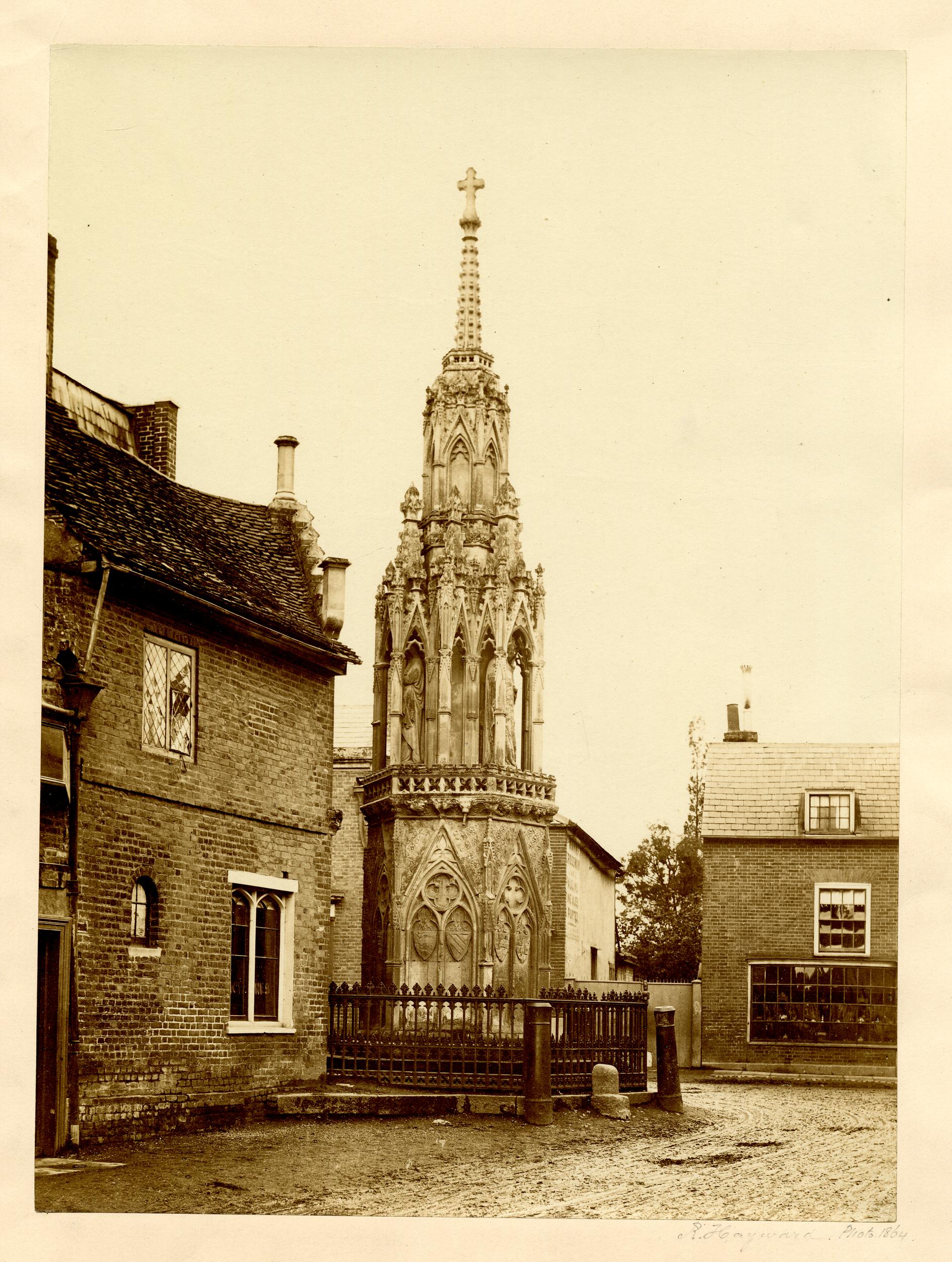
A photo of the cross from 1864  (© The Trustees of the British Museum):
Waltham Cross

Comparing the photo of the cross in 1864, and the previous prints of the cross, it would appear that significant restoration took place during the first half of the 19th century. The cross in 1864 (with a clean up) looks much the same as the cross we see today, although without the houses and the road.

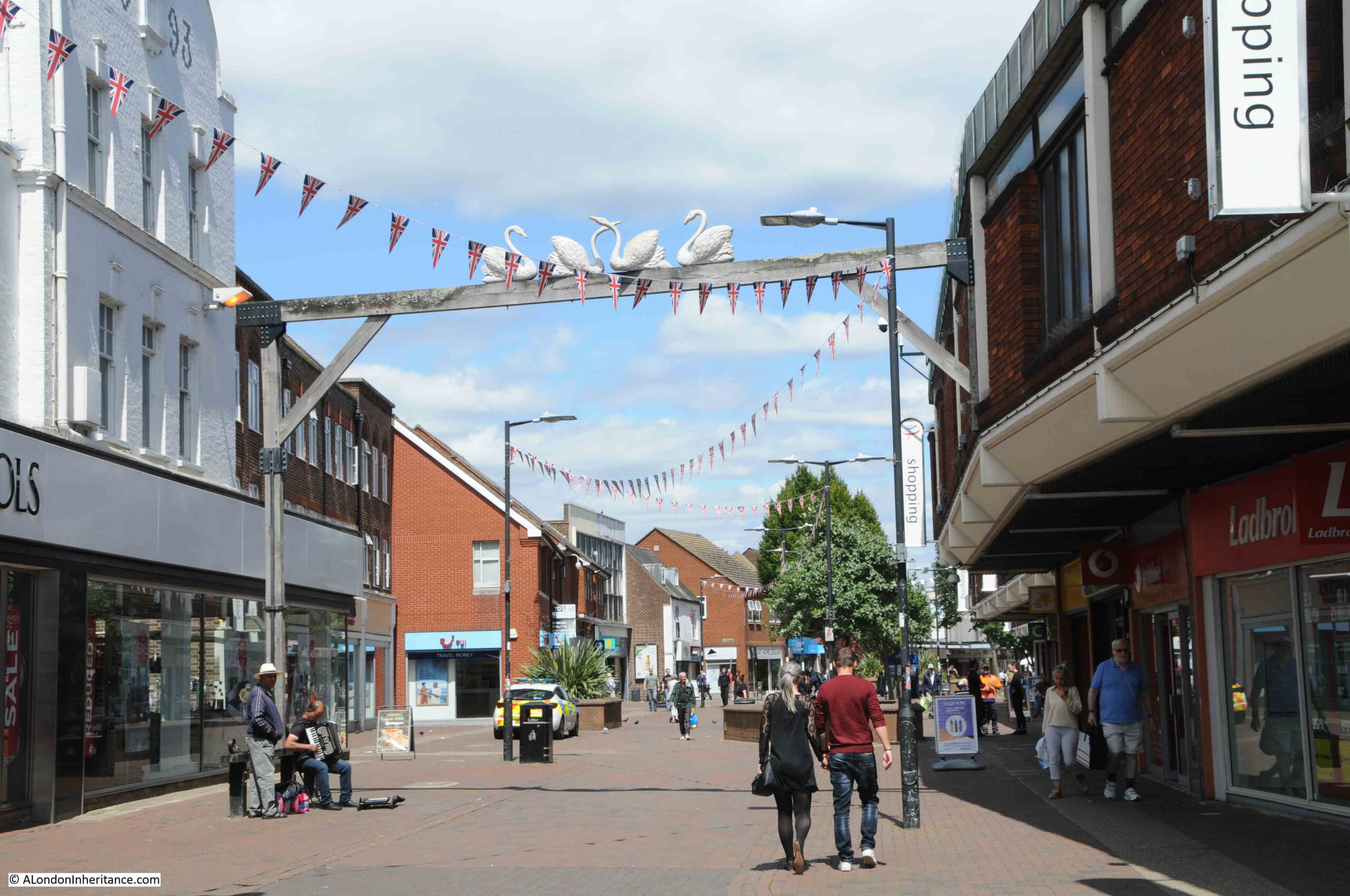
As with Stamford, Waltham Cross retains an inn sign across what was the road:

Waltham Cross

This was for the Four Swans Hostelry, which was a coaching inn on the road through Waltham Cross. There was an inn sign hanging below the length of timber across the street, and on the sign was a claim that the inn dated from 1260, so if this claim was true, it would have been there when the procession carrying Eleanor’s body passed by on the way to Waltham Abbey.

Comparing the prints and 1864 photo of the cross shows a remarkable change in the area surrounding the cross. Once a cross roads, with an inn and houses, the cross now standards in the middle of a pedestrianised shopping centre:

Waltham Cross

On Thursday the 14th of December 1290, the procession left Waltham Abbey, passed through the crossroads that would later become Waltham Cross (the area in the above photo), and headed towards London, which will be the subject of the final post of this series.

alondoninheritance.com

Eleanor Crosses – Hardingstone, Stony Stratford, Woburn and Dunstable

Having left Geddington in the last post, today’s post will visit the next four sites where the procession taking Eleanor of Castile’s body to Westminster Abbey stopped overnight. The stops are shown as blue dots in the following map and are at Hardingstone, Stony Stratford, Woburn and Dunstable (© OpenStreetMap contributors):

Hardingstone Eleanor Cross

Leaving Geddington, the procession headed towards:

Hardingstone

Just south of Northampton, Google maps shows this as a distance of 22 miles, however they probably went through Kettering rather than taking the bypass, so the distance was around 20 miles.

Hardingstone has now been swallowed up in the suburbs of Northamption, but in 1290 it was a very small village, and the destination of the procession was Delapre Abbey, to the south of Northampton, and north-west of Hardingstone.

Delapre Abbey was founded around the year 1145. It was a Cluniac nunnery, which followed the Benedictine Cluny Abbey in France.

In 1290, the abbess was Margery de Wolaston, and she would have looked after Eleanor’s coffin and arranged for prayers to be said throughout the night. Being a nunnery, Edward would have been unable to stay, so he retired to Northampton Castle for the night.

A cross was built, not in the grounds of the nunnery, but on a high point alongside a road that ran along the western perimeter of the nunnery’s grounds.

That road today is the A508, with the name of London Road, implying that it was the main road leading out of Northampton in the direction of London.

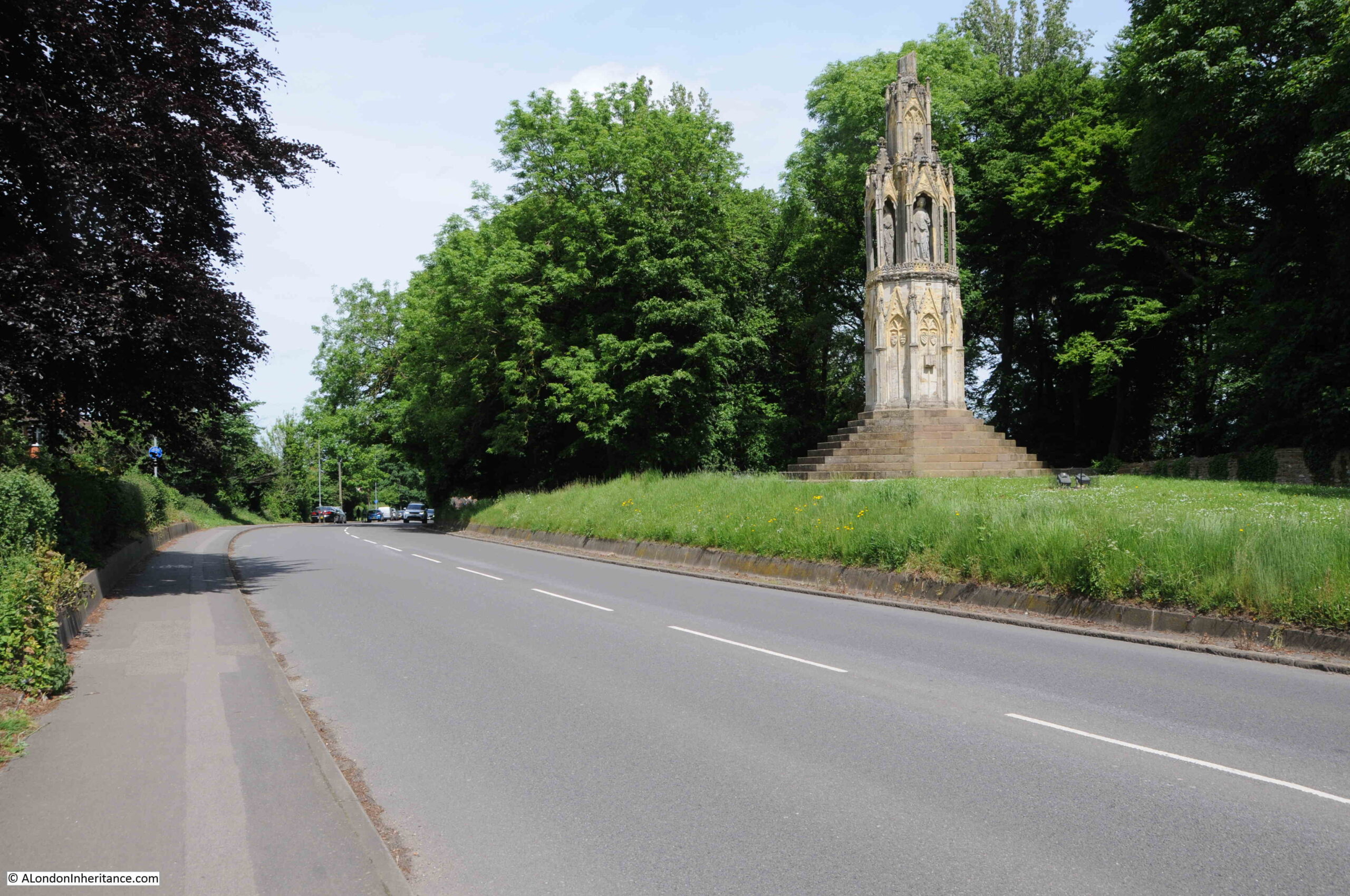
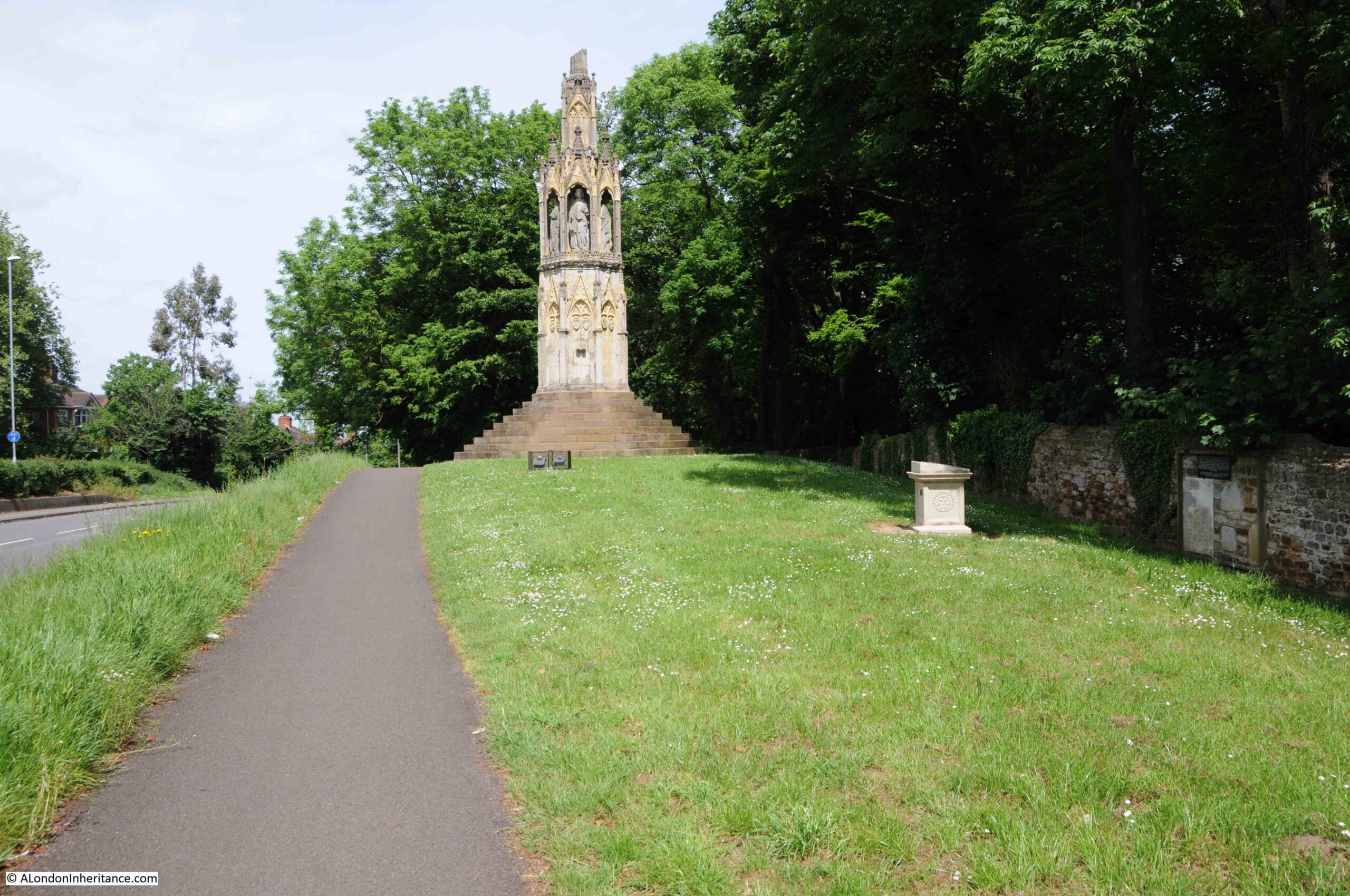
Travelling along the A508, it was easy to spot the Eleanor Cross:

Hardingstone Eleanor Cross

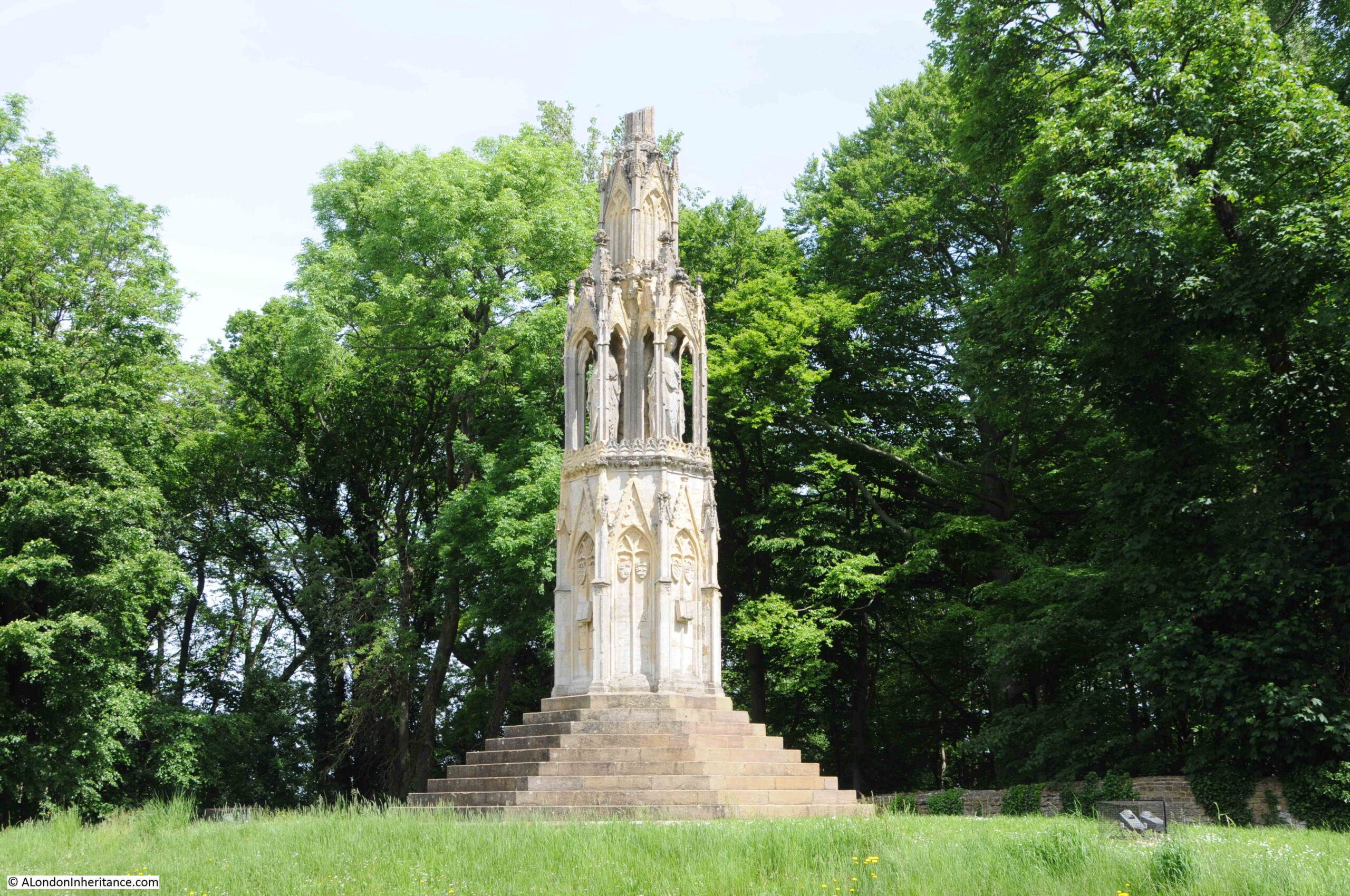
The Hardingstone cross is one of the few survivors, and although it has lost the very top of the cross, it is still an incredibly impressive monument, and is more substantial than the Geddington cross.

Hardingstone Eleanor Cross

Possibly because of their care of Eleanor’s body, Edward I gave the abbess a grant of royal protection in 1294, although by 1300 the abbey’s standards seemed to have slipped as according to the Victoria County History edition for Northampton, “The bishop in 1300 issued a mandate to the archdeacon of Northampton to denounce Isabel de Clouville, Maud Rychemers, and Ermentrude de Newark, professed nuns of Delapré, who had discarded the habit of religion and notoriously lived a secular life, as apostate nuns, also to inquire as to who had aided them in their apostasy.”

The abbey was surrendered to the Crown in 1538 during the dissolution of the monasteries, and a few years later it was in private ownership where it would remain for the next few centuries.

Northampton Corporation purchased the building in 1946, and the building soon housed the County Records Office. It is now owned by the Friends of Delapré Abbey, and is open to visit.

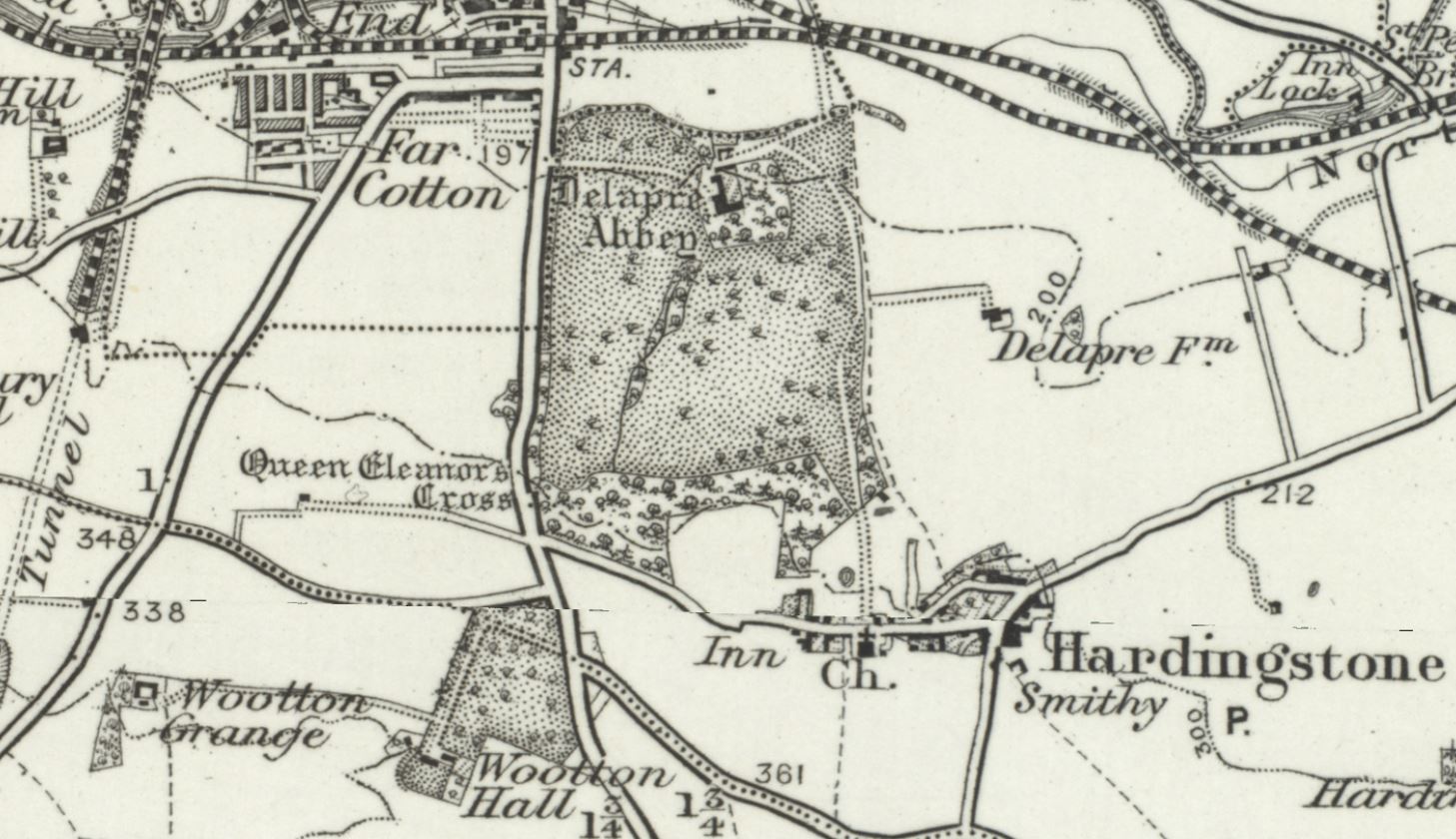
In the 1897 revision of the Ordnance Survey, Delapre Abbey is shown, with Queen Eleanor’s Cross marked towards the lower left of the abbey grounds. The village of Hardingstone is lower right. Apart from the abbey grounds, today, much of this area of the map has been built over (‘Reproduced with the permission of the National Library of Scotland“).

Hardingstone Eleanor Cross

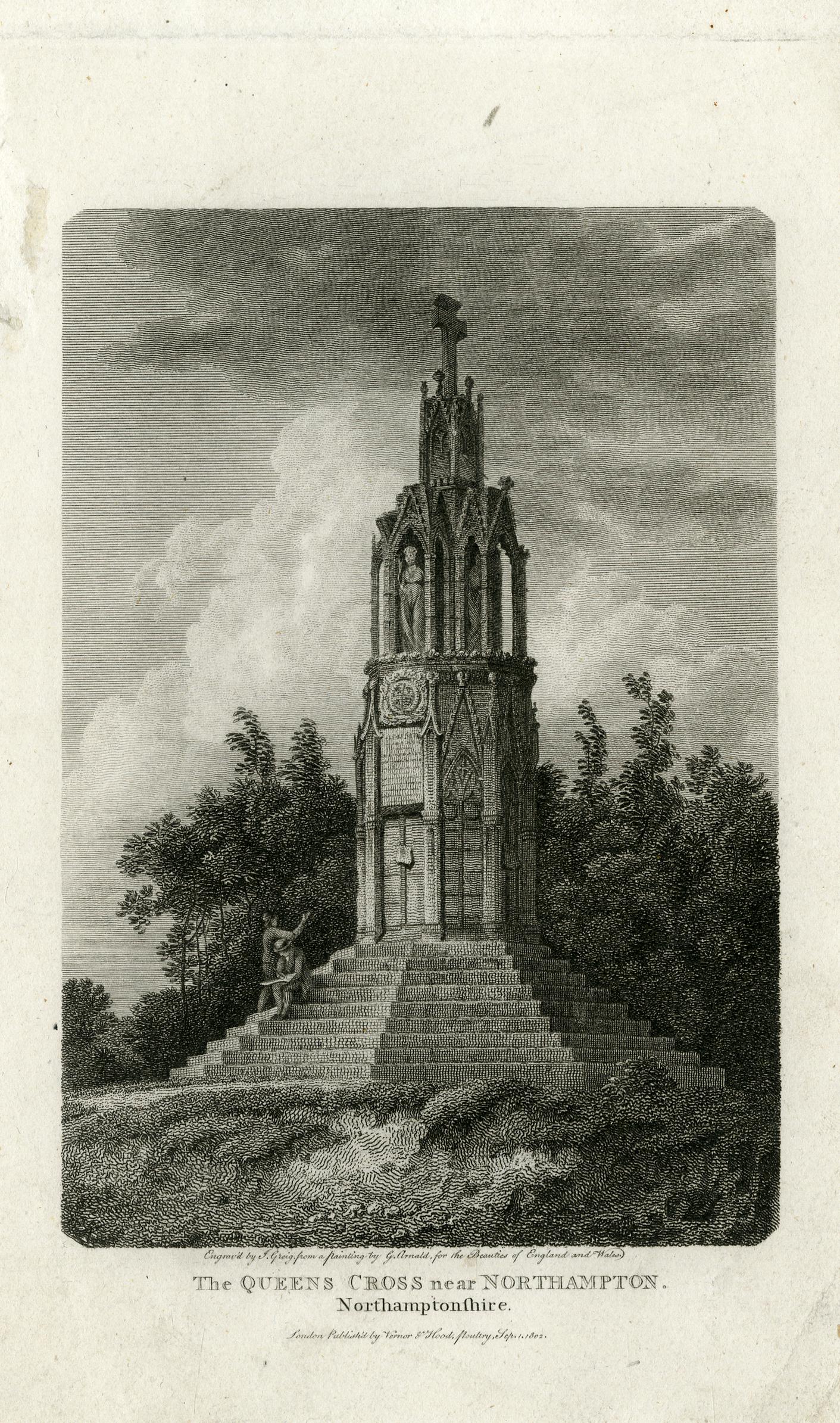
The following print shows the Eleanor Cross, when there was still a cross at the very top. The print is dated 1802 (© The Trustees of the British Museum).

Hardingstone Eleanor Cross

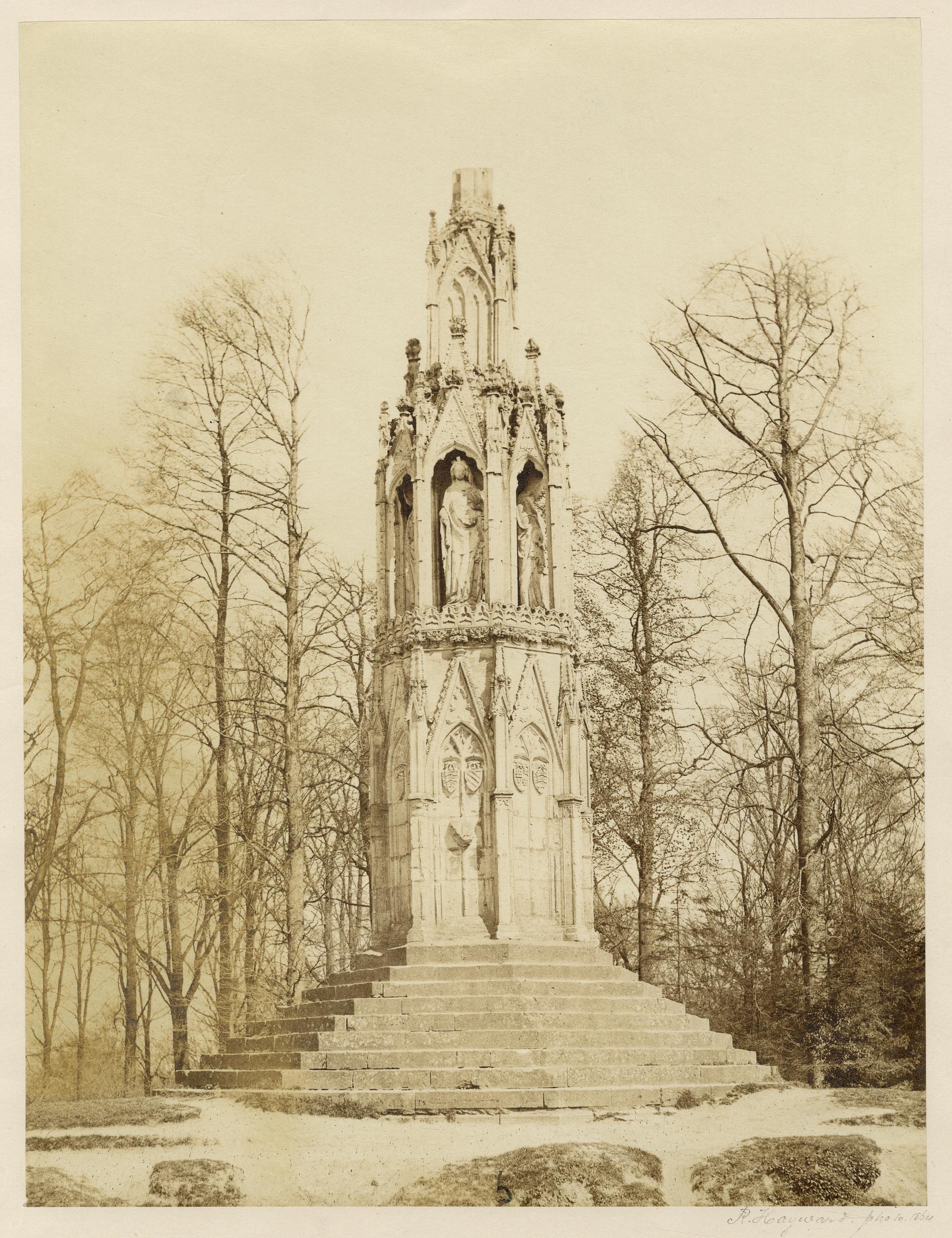
The cross is missing in this photo from later in the 19th century (© The Trustees of the British Museum):

Hardingstone Eleanor Cross

I crossed over the London Road to take a closer look.

Hardingstone Eleanor Cross

There is a plinth on the grass which adds some confusion to the top of the cross as it states that “The design of the original top is unknown. the present broken shaft having been placed in position in 1840”. I am not sure how that works with the earlier print, and whether there was a cross on the top when the print was made, or whether this was some artistic license being used.

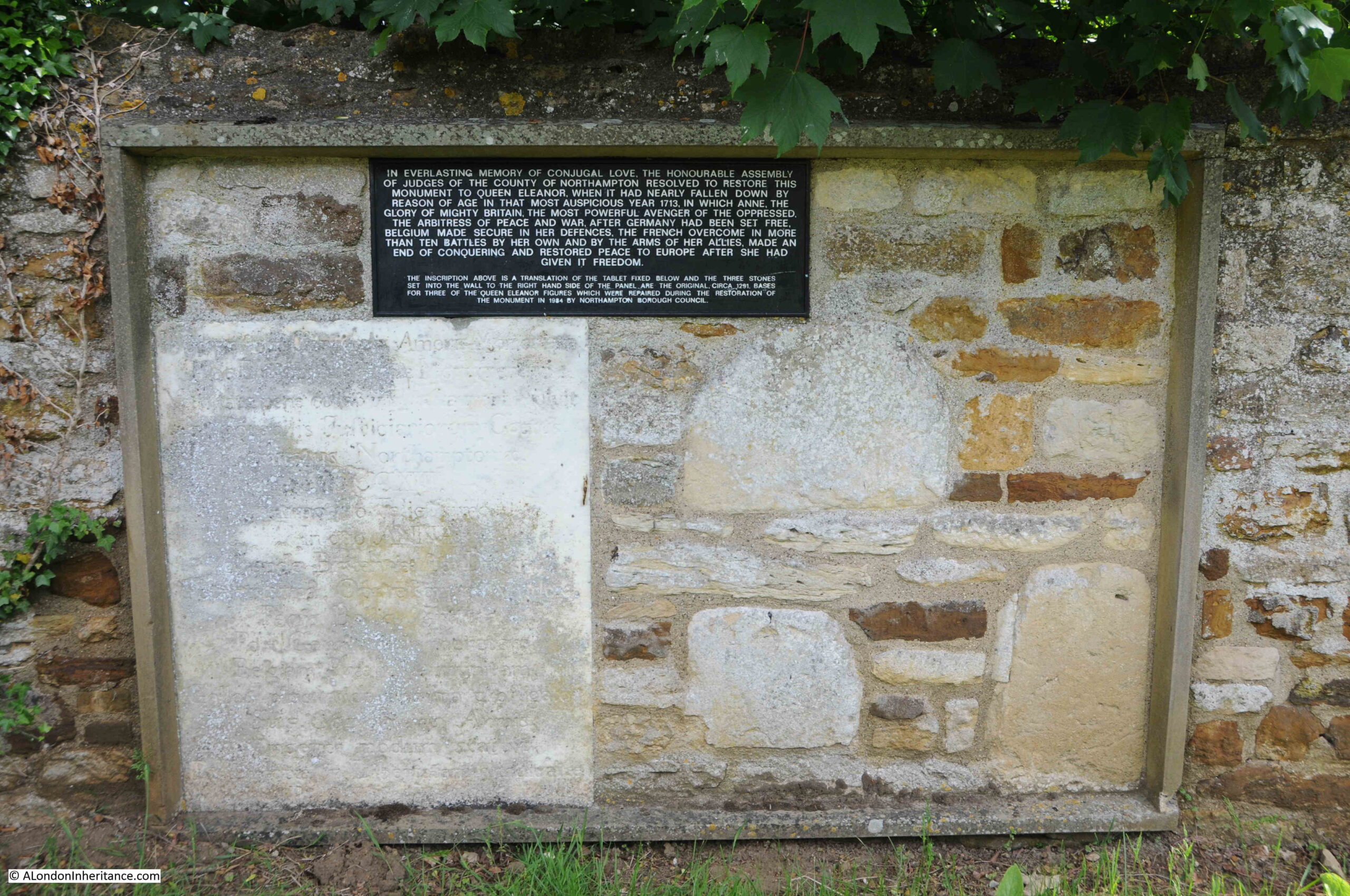
On the wall to the side of the cross, along the edge of the old grounds of Delapre Abbey, there is a set of stones:

Hardingstone Eleanor Cross

The large stone on the left of the panel has some very faded text. Fortunently, the panel at the top has a copy of the text:

“In everlasting memory of conjugal love, the honourable assembly of judges of the County of Northampton resolved to restore this monument to Queen Eleanor when it had nearly fallen down by reason of age in that most auspicious year 1713 in which Anne, the Glory of Mighty Britain, the most powerful avenger of the oppressed, the arbitress of peace and war, after Germany had been set free, Belgium made more secure in her defences, the French overcome in more than ten battles by her own and by the arms of her allies, made an end of conquering and restored peace to Europe after she had given it freedom.”

Well that confirms that the cross was significantly repaired in 1713, followed by some major crawling to Queen Anne.

The panel also states that the three stones to the right are the original stones from around 1291 when the cross was built, removed from the cross during restoration in 1984. The stones were the bases for three of the statues of Eleanor.

The text from 1713 starts with “In everlasting memory of conjugal love“, and it is the love between Eleanor and Edward that has really defined their story.

Royal marriages were almost always marriages aimed at establishing relationships between different royal families, to cement alliances, to prevent war etc. They were very rarely for love, and although Eleanor and Edward’s marriage was arranged for them, and they were incredibly young at the time, they do appear to have been devoted to each other.

Very unusually for medieval Kings, Edward I appears to have been faithful to Eleanor. He did not have any mistresses which was considered normal practice at the time.

Eleanor travelled widely with Edward, including when in 1270 Edward left the country to join the French King Louis IX on Crusade.

The French King died of the plaque before Edward could join him, so Edward continued to Acre (in what is now Israel) to free the city from Islamic control.

Edward’s force was relatively small, so had very little success, and he had to agree a truce with the Baibars or Baybers – Egyptian rulers of much of the eastern Mediterranean.

During his time in the middle east, he narrowly survived a murder attempt, when he was stabbed by a dagger which was believed to be poisoned. The person who attempted to murder Edward was an Assassin, from an order or sect of Shia Islam that existed middle ages, and from where the term used to describe a hired or professional murderer has come from.

Edward and Eleanor left Acre for Sicily, and it was here that news finally reached them that Edward’s father, Henry III had died on the 16th of November 1272.

On the death of a king, what would frequently happen was a rush back to one of the main centers of Royal power, such as London or Winchester to claim the throne. This was a time when there were often many competing claimants for the throne, however Edward as the eldest son of Henry III, and because of the way he had supported his father during many previous rebellions, and his exploits on Crusade, was proclaimed King in his absence, and it would be just under two years before he finally arrived back in London and where he was crowned at Westminster Abbey in August 1274.

Eleanor has been with Edward during all this time away on Crusade, whilst in Sicily, and on the journey back

Returning to the Hardingstone Cross, and it has the same recurring features that are found on many other original or later monuments to Eleanor.

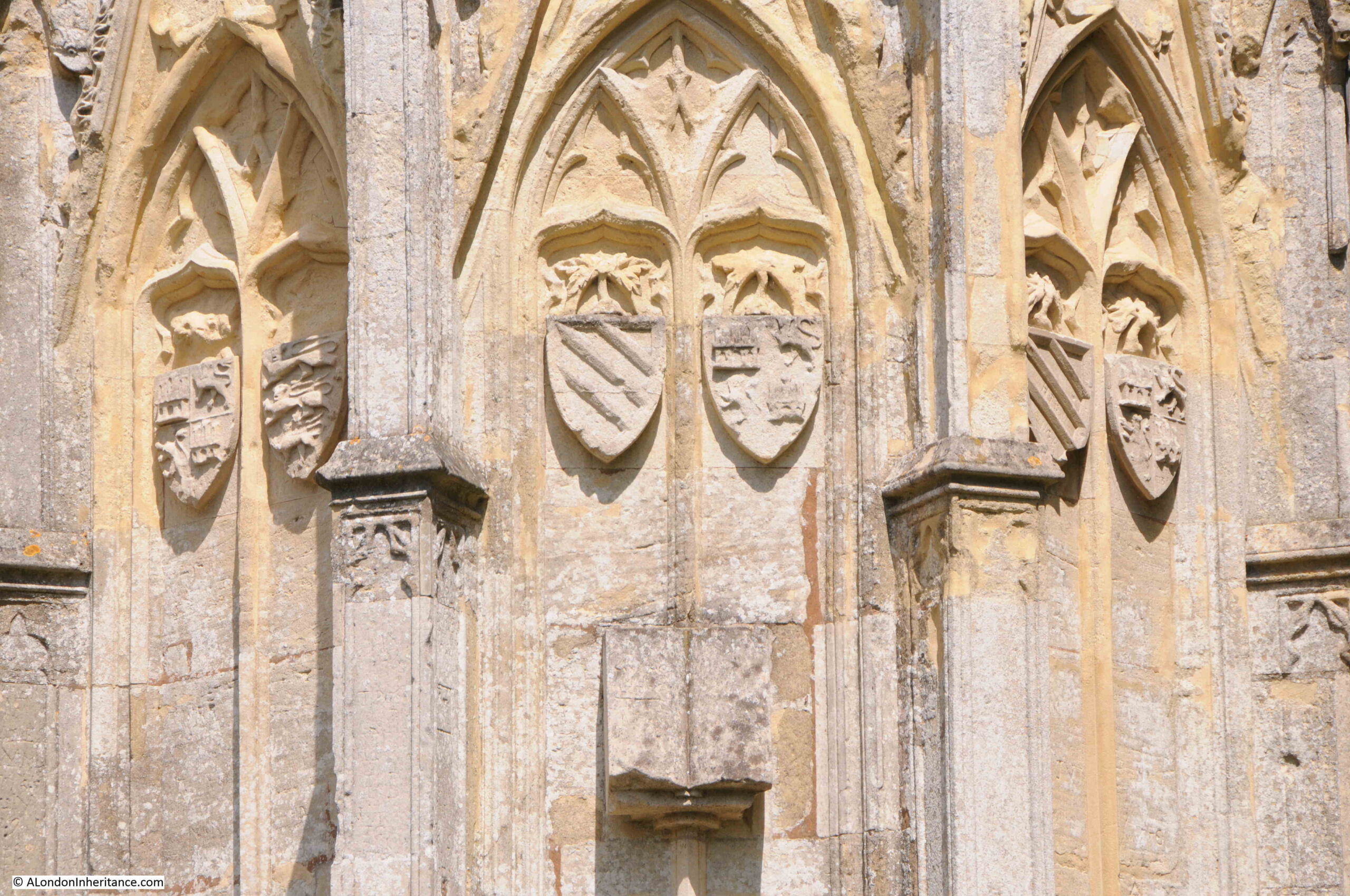
The arms of England, Eleanor of Castile and the arms of Ponthieu:

Hardingstone Eleanor Cross

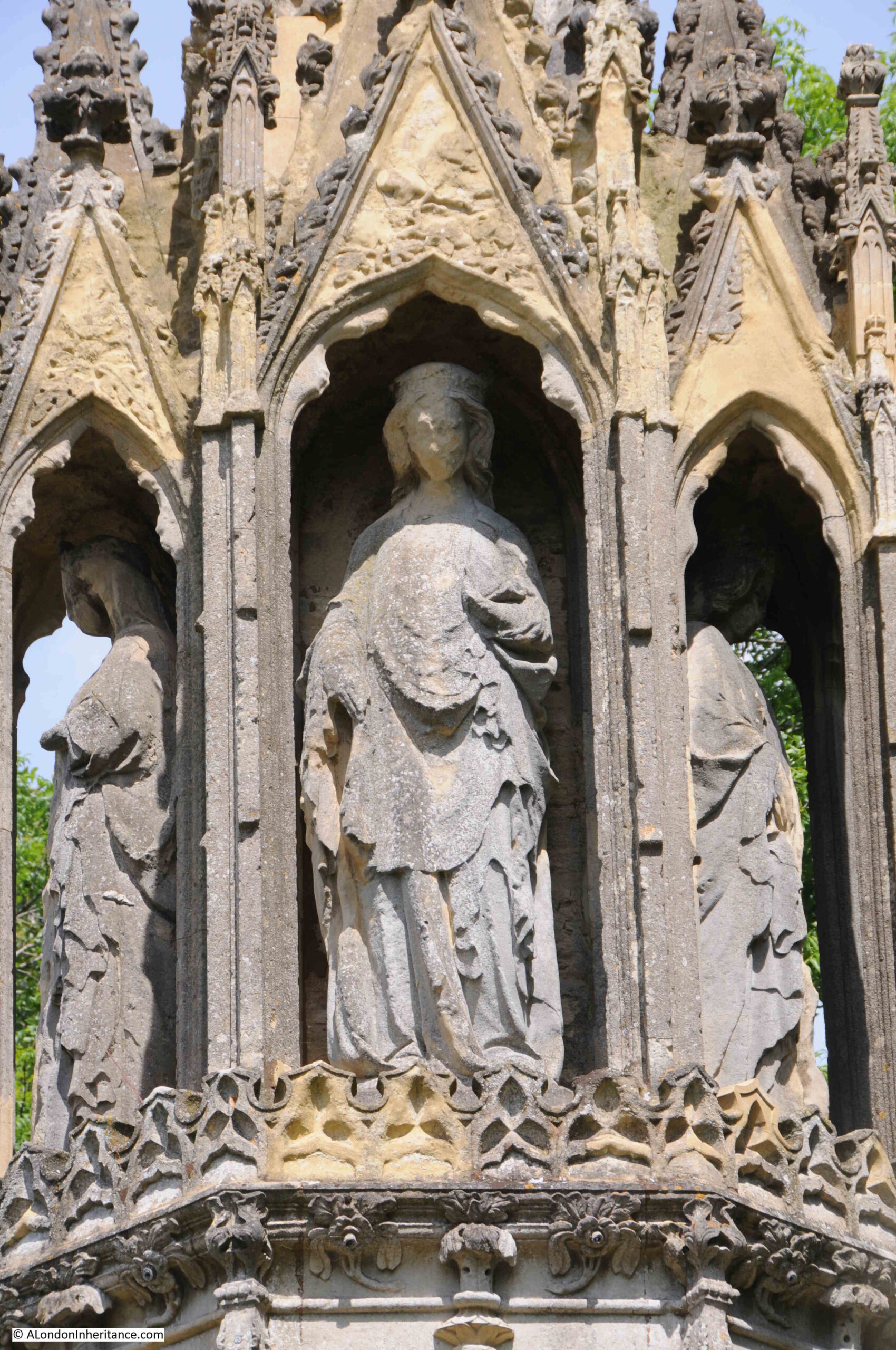
Whilst the Hardingstone cross is more substantial than the cross at Geddington, it follows the standard design of having a lower section with coats of arms, with above a section with statues of Eleanor. I assume due to the wearing of the stone, these statues are original, and they have been looking out from the cross for around 730 years:

Hardingstone Eleanor Cross

The Hardingstone cross is a remarkable survivor and an unusual sight for those travelling along the A508. A reminder of the area’s medieval history.

Leaving Hardingstone, the next stop is:

Stony Stratford

I have read some accounts that state that the stop at Stony Stratford was not the intended destination for the night, and that the procession had planned to continue on to Woburn. Stony Stratford is a short journey of around 14 miles from Hardingstone, much shorter than the typical 20 miles a day that the procession had been achieving.

As with some of the other places on the journey, Stony Stratford is the location of a crossing point over a river, the River Great Ouse, so it may be the crossing that dictated the route via the town, as well as the road that runs through the town.

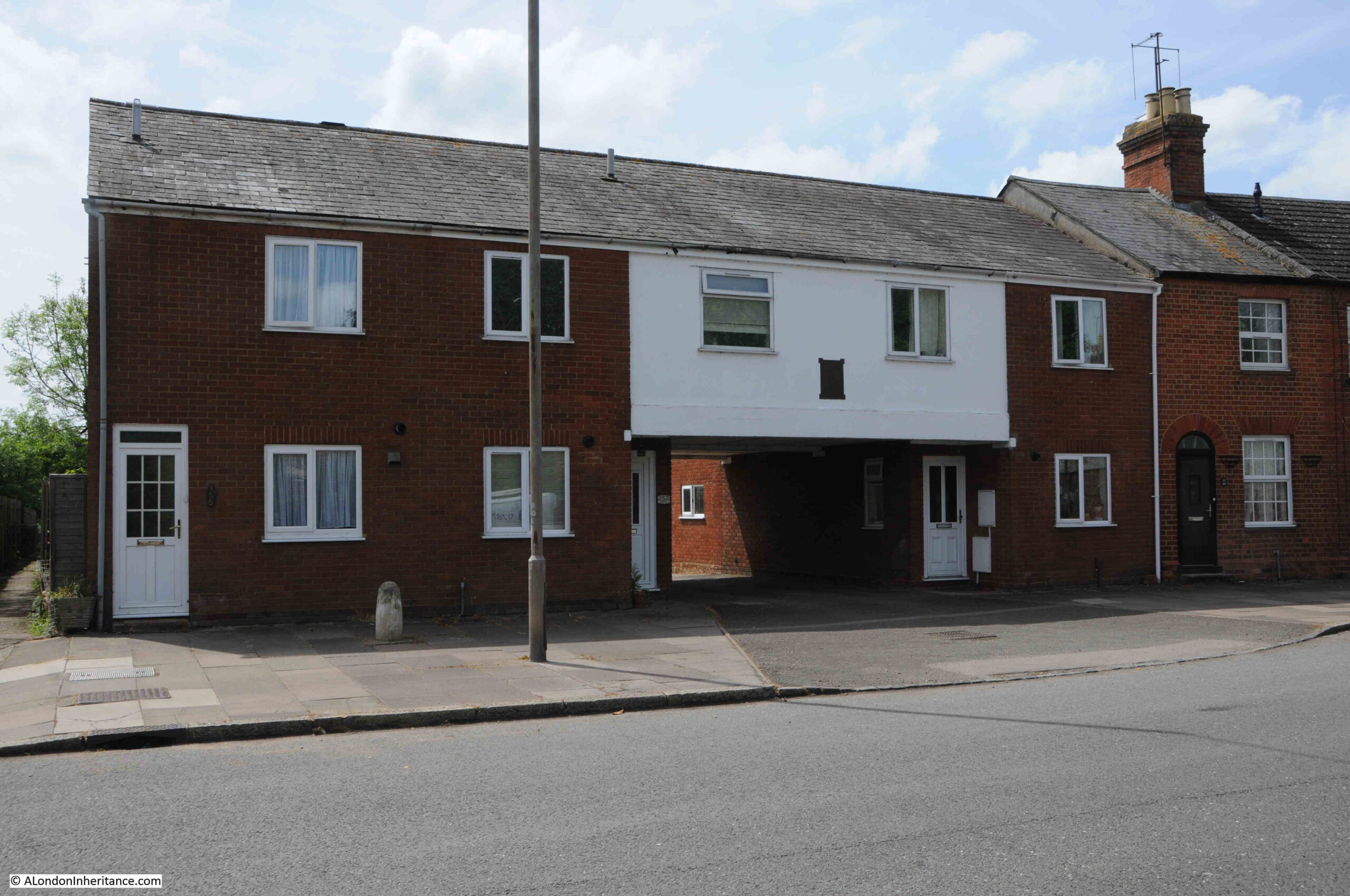
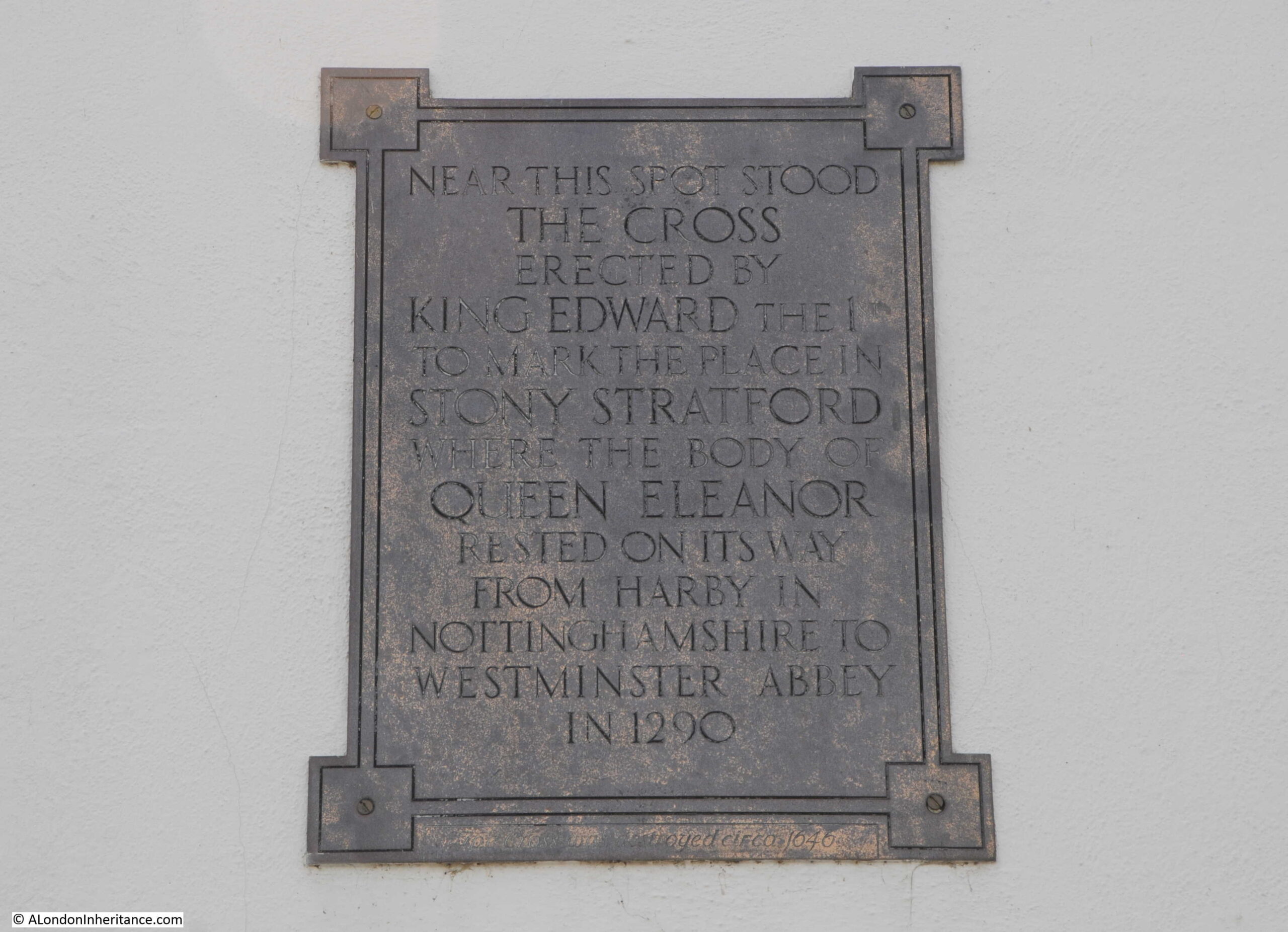
There is no record as to where either Edward or Eleanor’s body stayed during the stop in Stony Stratford. A cross was built here between 1291 and 1293 by John of Battle, however it was destroyed during the English Civil War and there is nothing left of the cross today. There is a plaque on a building marking roughly where the cross was located, towards the northern end of the main street, so stopping in Stony Stratford, the plaque was my first destination, seen in the following photo on the white wall:

Eleanor Cross Stony Stratford

Details of the plaque:

Eleanor Cross Stony Stratford

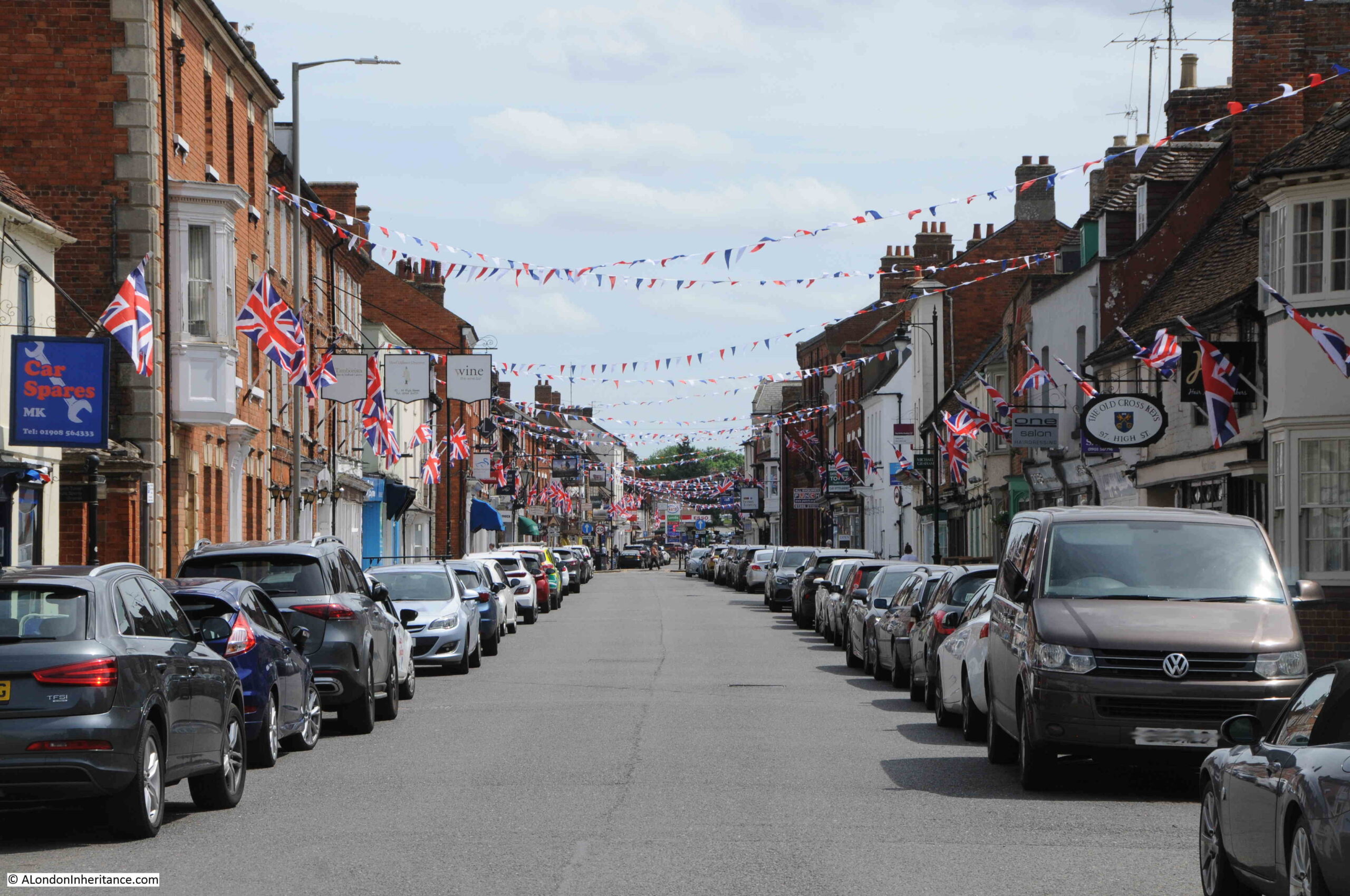
Stony Stratford is a wonderful town, with a very long high street. I have not been here since the late 1970s when as a BT apprentice I was training at nearby Bletchley and the pubs of Stony Stratford were an attraction.

The view along Stony Stratford High Street:

Eleanor Cross Stony Stratford

Stony Stratford is one of those towns, like Grantham in the previous post, that is on a major, long distance road. Before being bypassed, the A5 ran through Stony Stratford.

The A5 runs from Marble Arch, through Shrewsbury, and on to the Holyhead ferry terminal in Anglesey. This latter part was an extension of the road in the early 19th century by Thomas Telford.

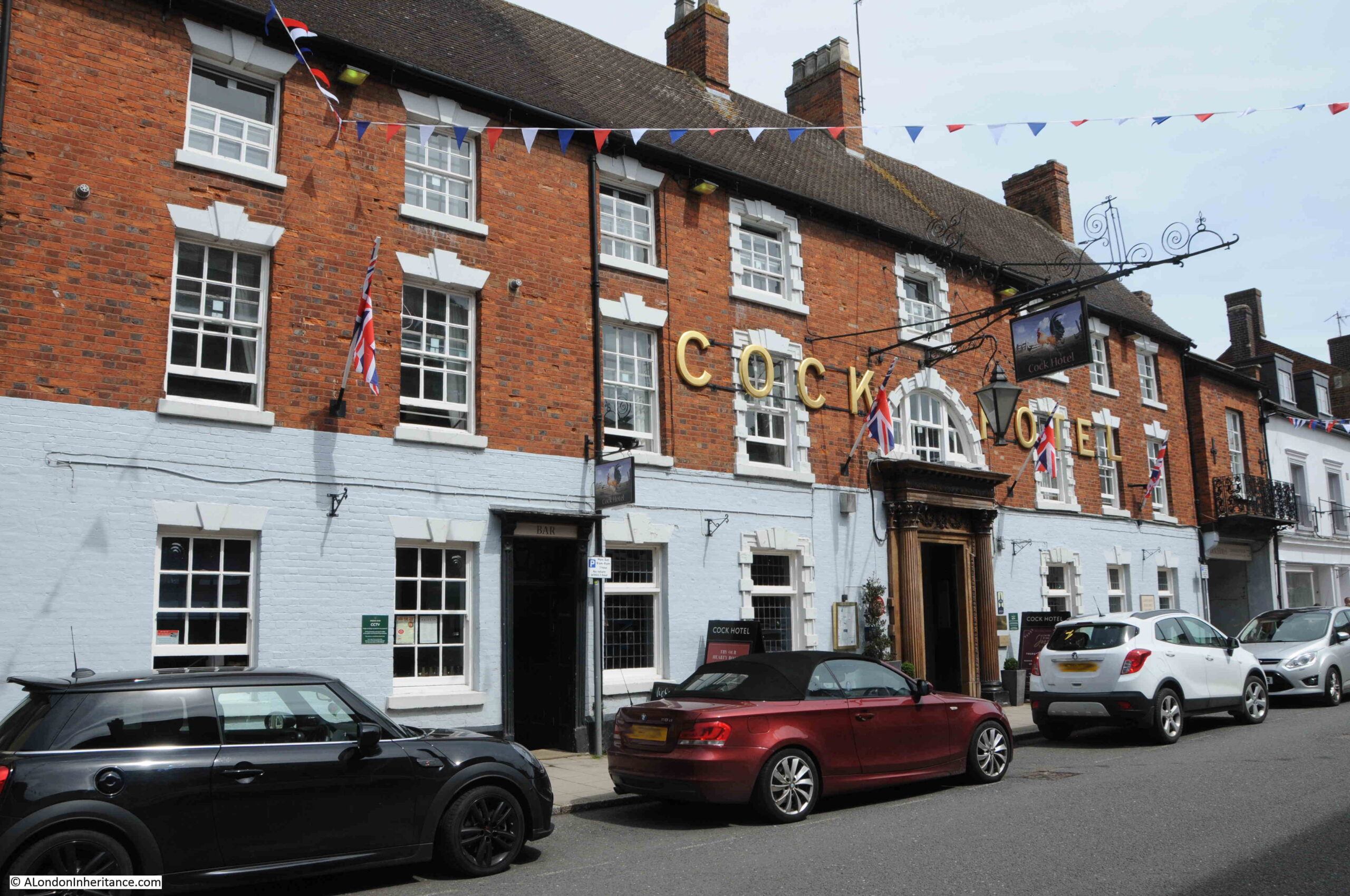
For this reason, Stony Stratford has a number of large hotels and inns which would have been coaching inns when stagecoaches passed through the town. One of these is the Cock Hotel:

Cock Hotel Stony Stratford

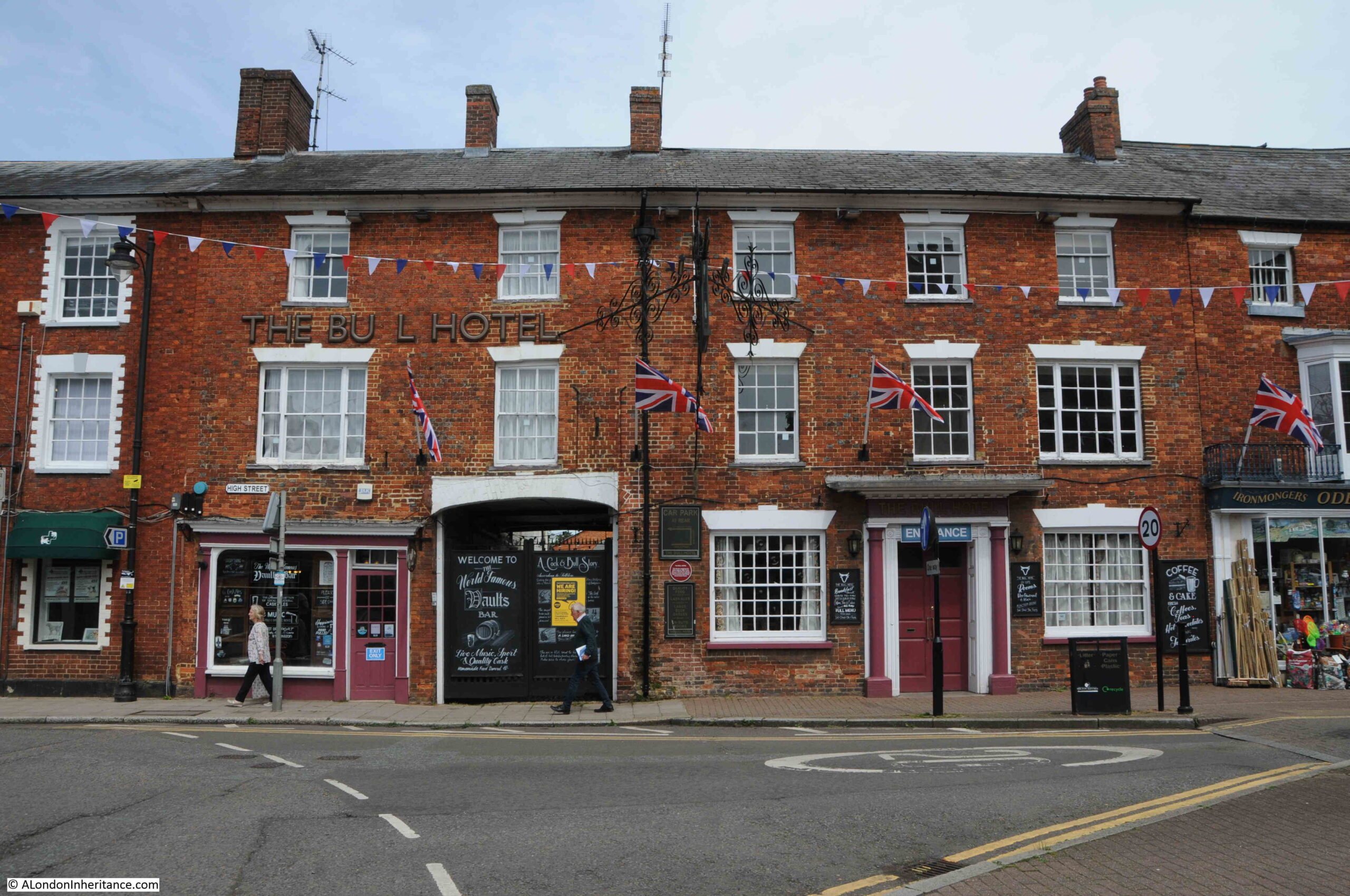
Another is the Bull Hotel:

The Bull Hotel Stony Stratford

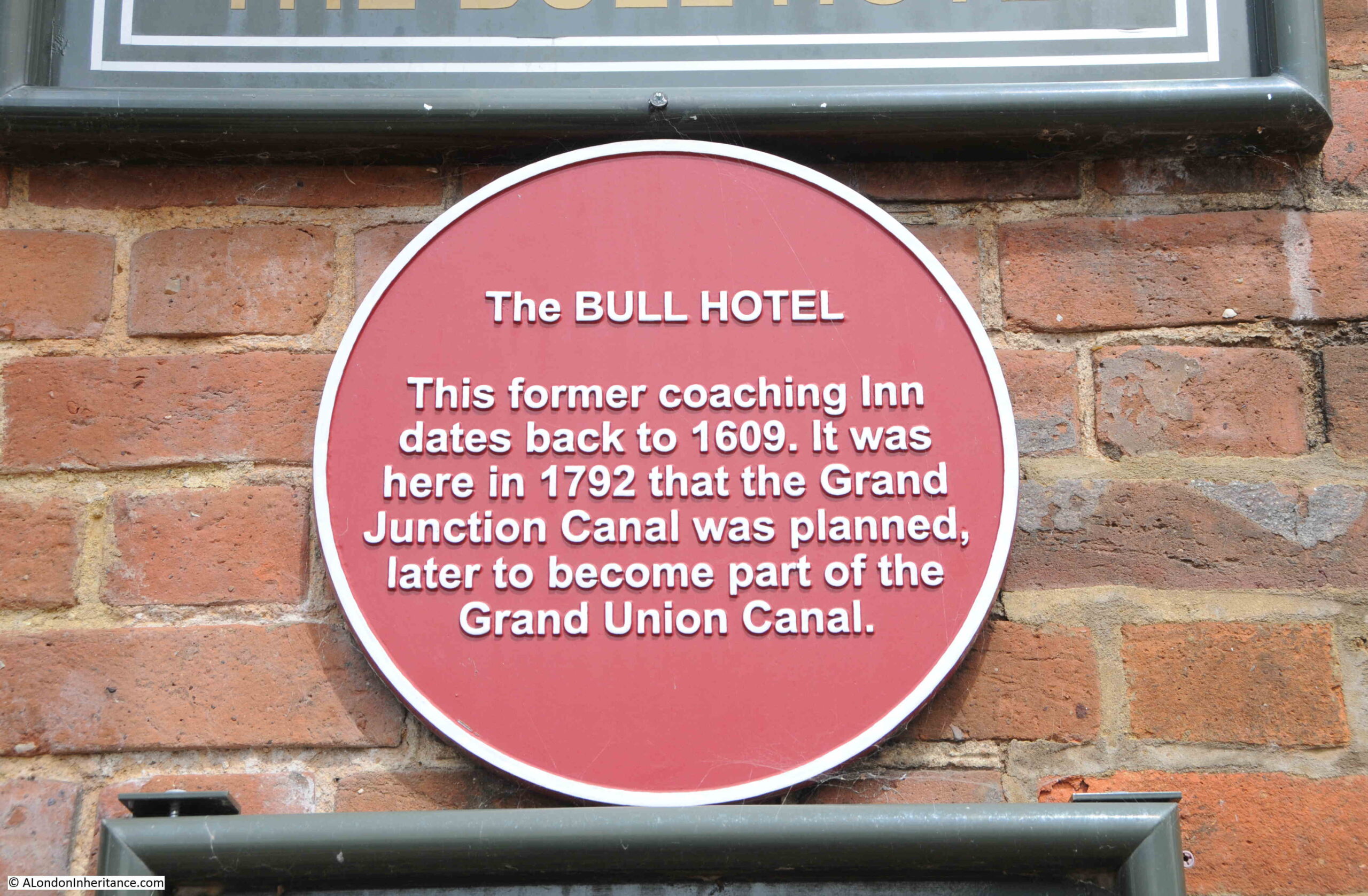
Which has a plaque on the wall recording the age of the hotel and a link with the Grand Union Canal:

Grand Union Canal Stony Stratford

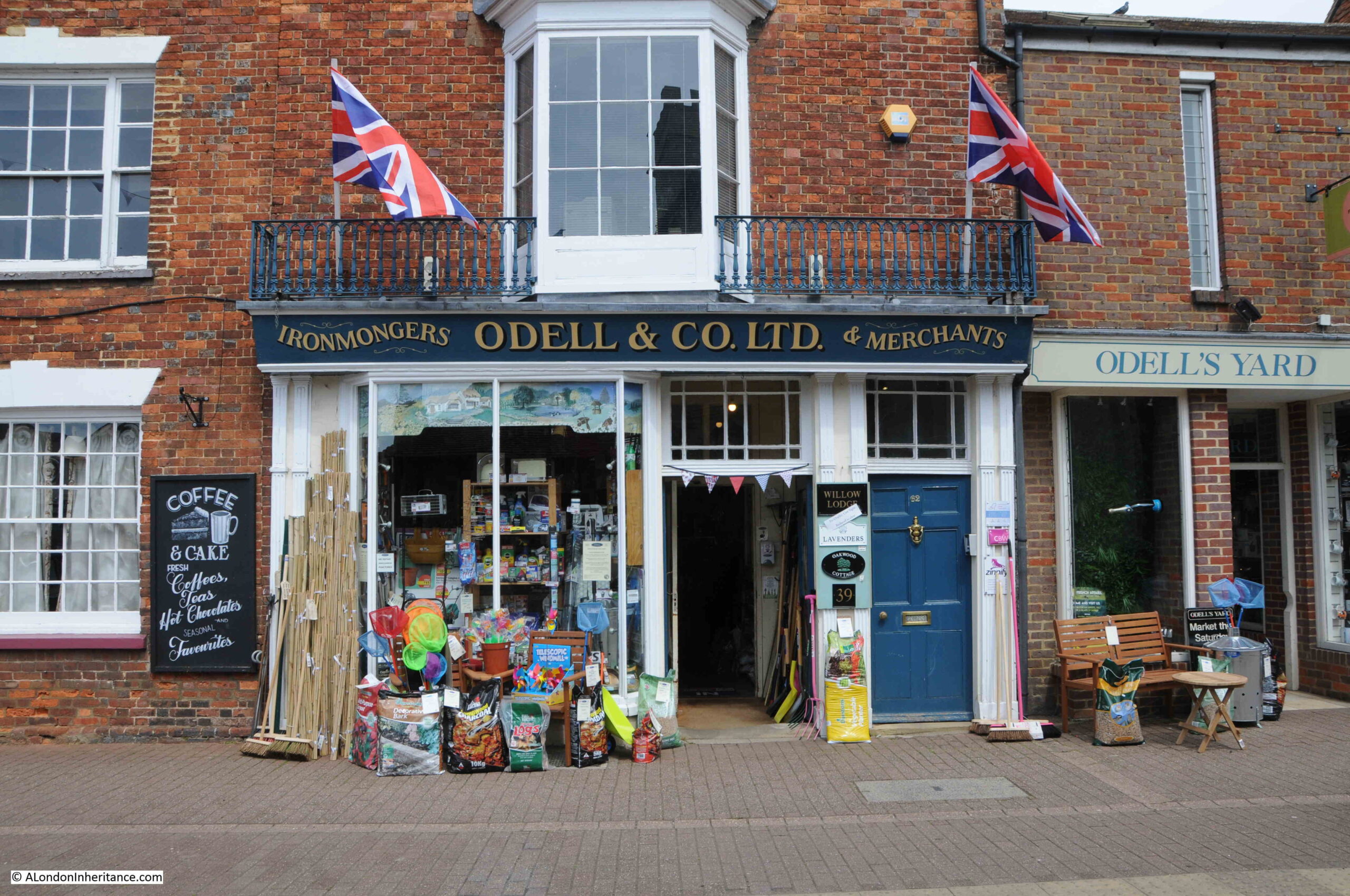
Stony Stratford also has some wonderful shops, including Odell & Co, the type of hardware store that has many of their products on view on the pavement outside:

Stony Stratford

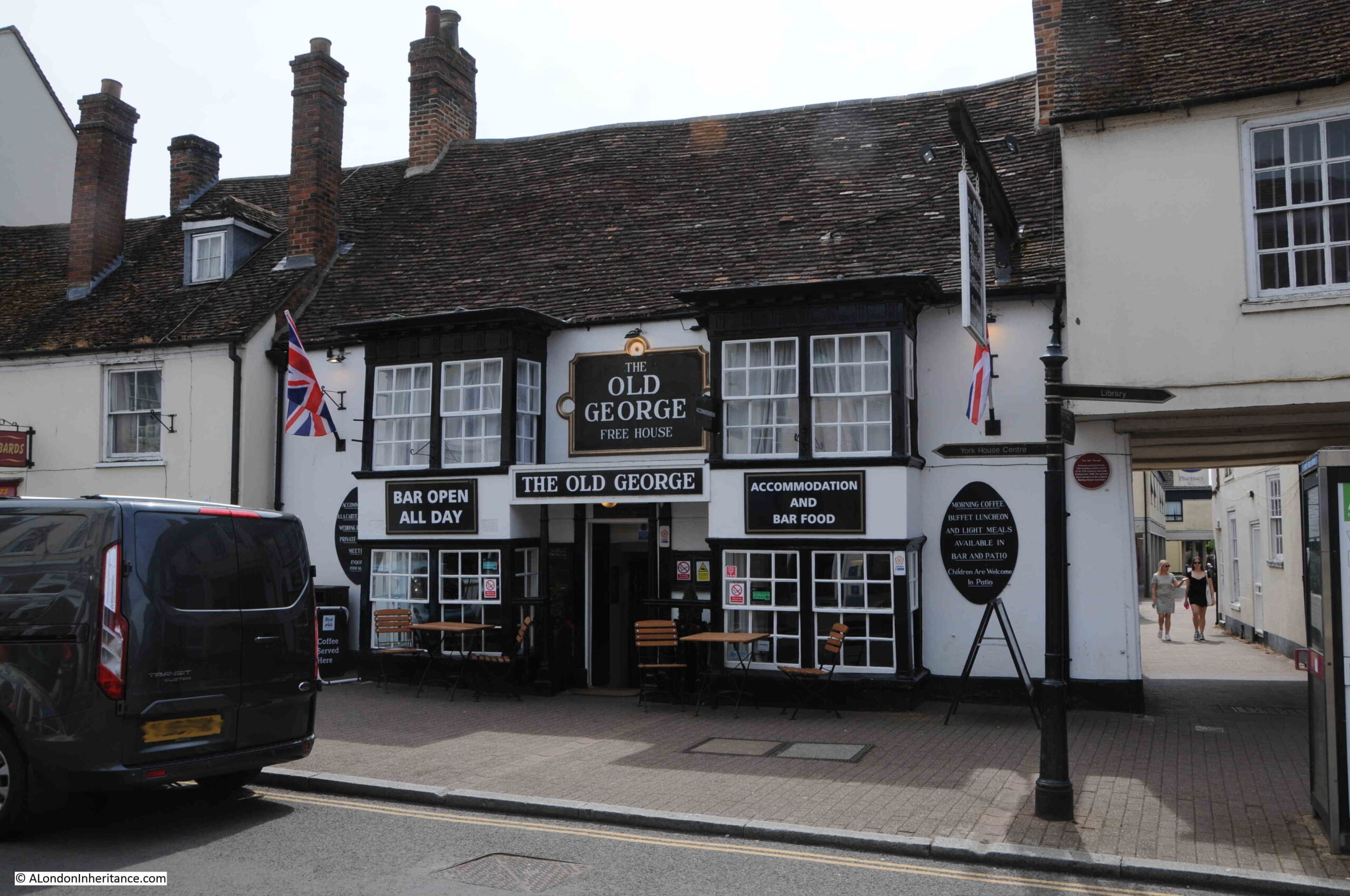
The Old George, an old pub which has a secret that explains why the A5 runs through Stony Stratford:

The Old George Stony Stratford

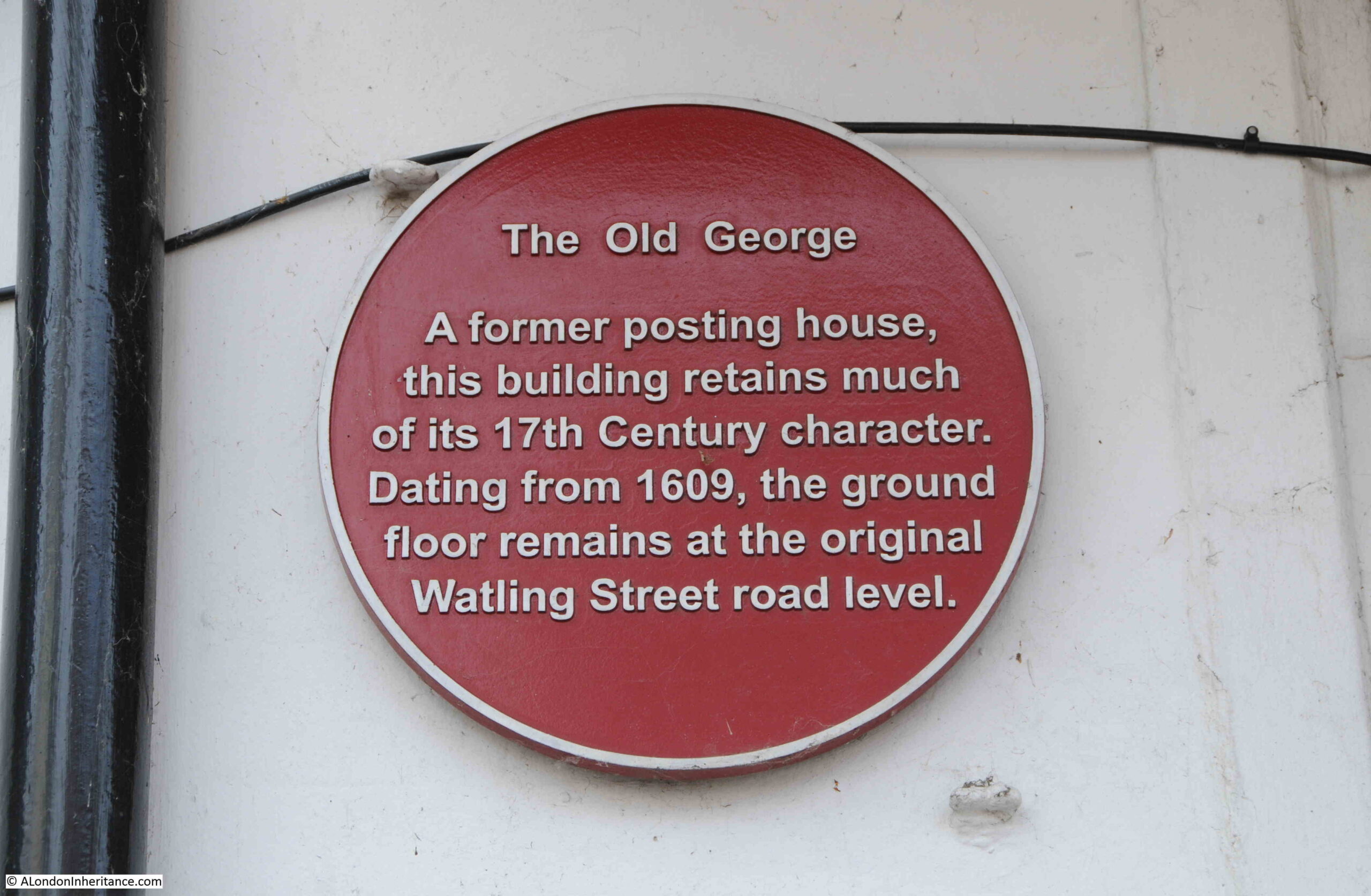
A plaque on the side of the pub explains that the ground floor dates from 1609 and remains at the original Watling Street road level:

The Old George Stony Stratford

Watling Street is an incredibly old road, parts of which may predate the Roman period, but it was the Roman’s that established the road as a paved route from Dover, passing by Reculver, crossing the Thames in London, then heading up to Wroxeter. (I wrote about Reculver here, and Wroxeter here).

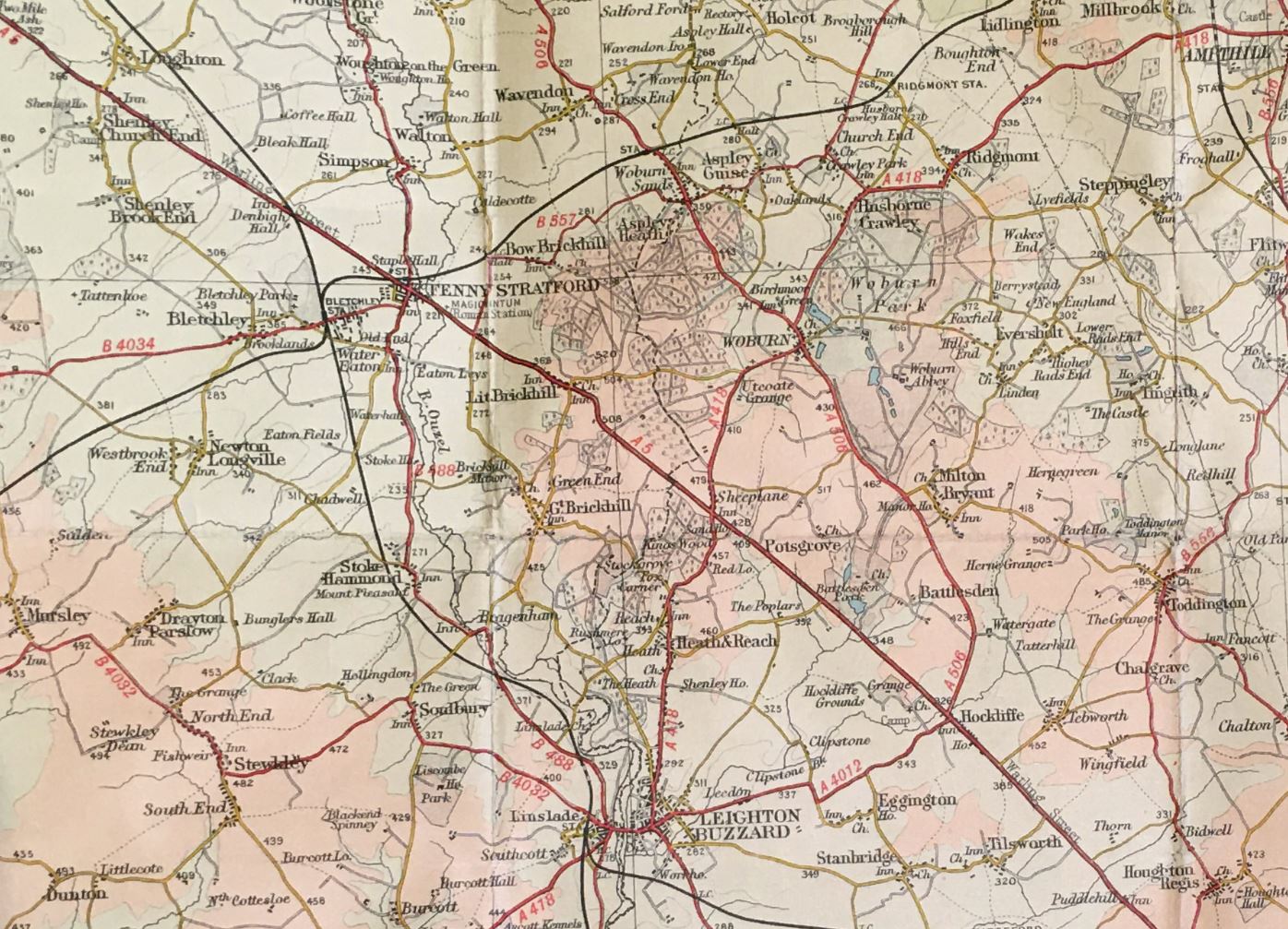
The area to the south west of Stony Stratford is now extremely built up, as this was the site where the new town of Milton Keynes was built. The street that was Watling Street, and then the A5 is now partly buried within the Milton Keynes development, however if we look at one of the old Bartholomew Contour maps of the country, we can see Watling Street as one of the easily identifiable, very straight, Roman roads.

In the following extract, Stony Stratford is just off the top left corner (it was just on the edge of a different map), and Watling Street can be seen running diagonally across the map from top left to bottom right:

Watling Street

The A5 / Watling Street was an important road for centuries, and is why Stony Stratford High Street is long and straight and is why the town has so many large inns and hotels.

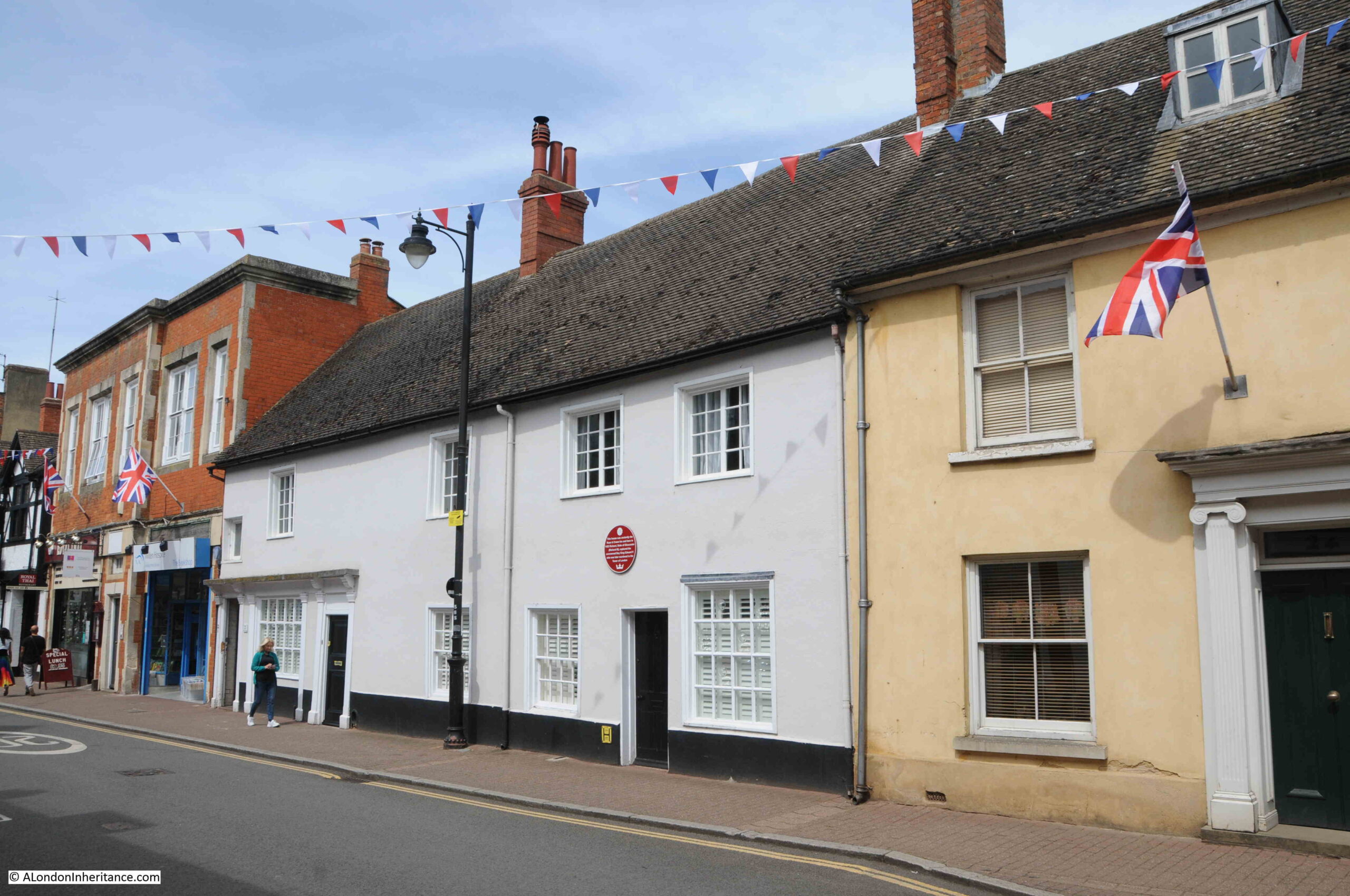
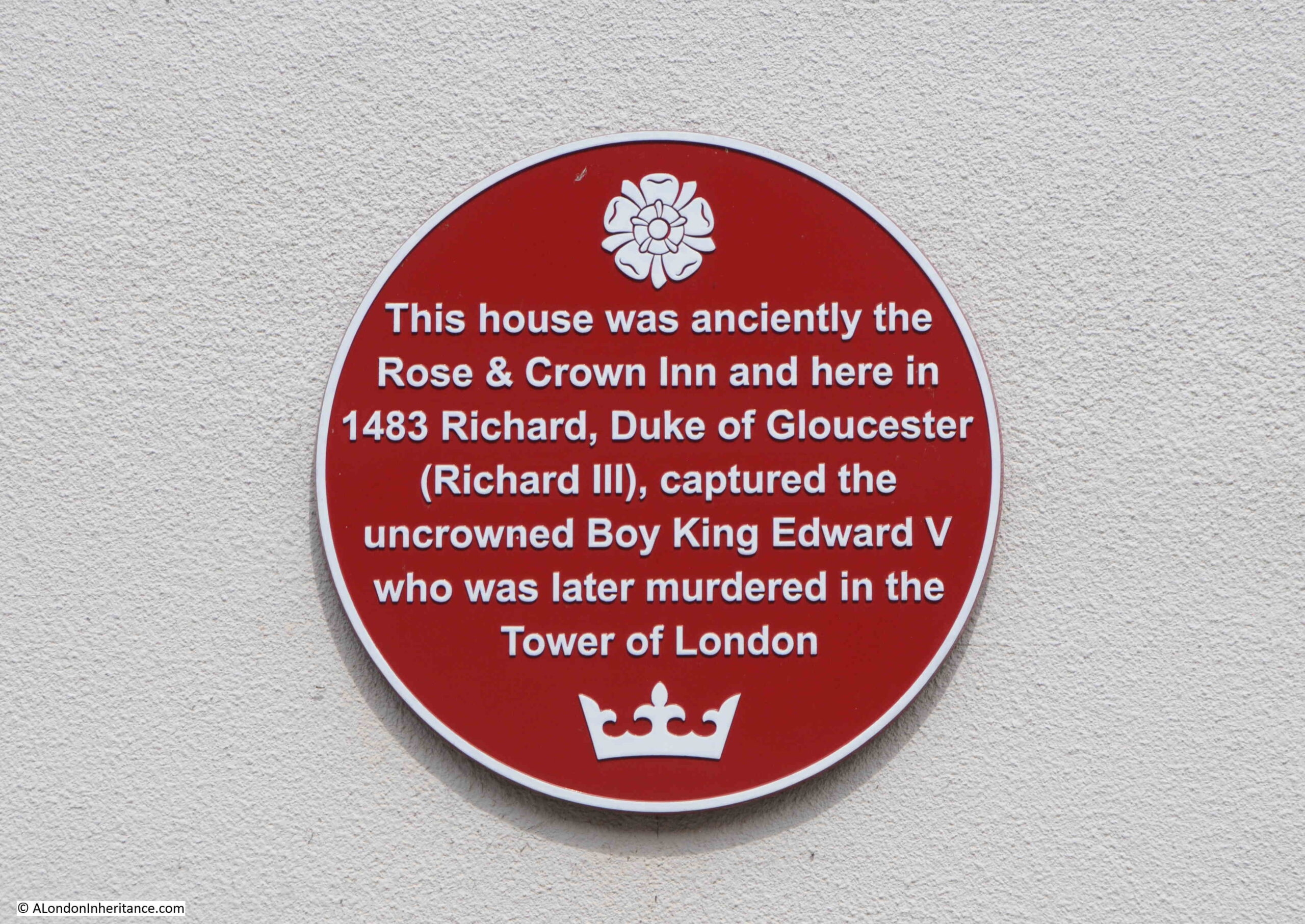
There is another plaque on a building that was once a pub:

Rose and Crown Inn Stony Stratford

Where the plaque tells another Royal story that has touched Stony Stratford:

Rose and Crown Inn Stony Stratford

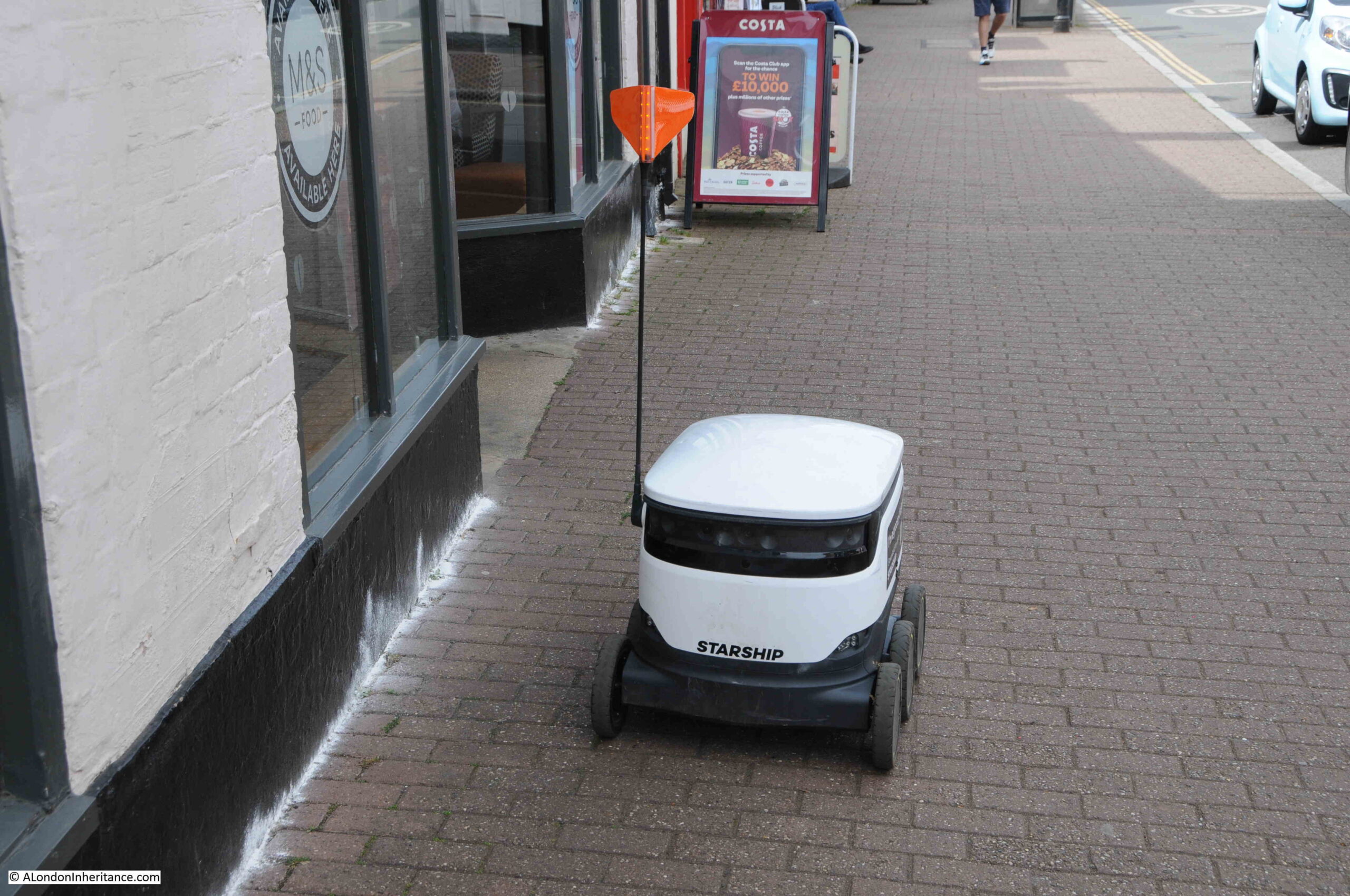
Stony Stratford is a wonderful, historic town, however the 21st century does roam the streets, in the form of Starship delivery robots, following their 2020 launch in Northampton, and expansion across towns in the area.

Starship Stony Stratford

Leaving Stony Stratford, the procession with Eleanor’s body continued south on the A5 / Watling Street, and then made a small detour to head to:

Woburn

The destination was Woburn Abbey, a Cistercian monastic establishment founded in 1145. The Eleanor Cross marking the overnight stay in Woburn has disappeared, and there is no record of its appearance or a confirmed location.

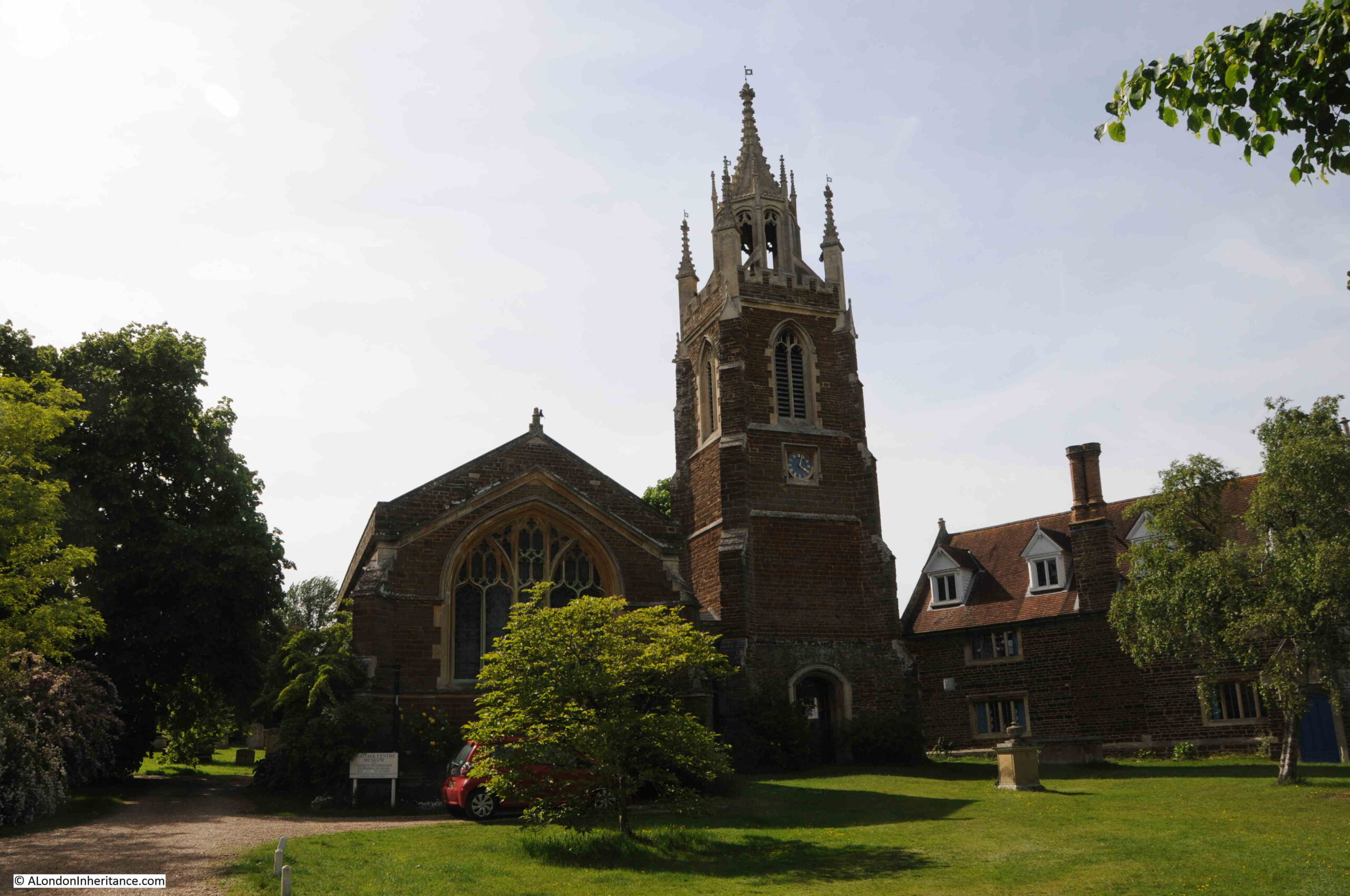
One place to visit in the town to find a reference to the cross is the old St. Mary’s church which is now run by the Woburn Heritage Centre Trust:

Woburn Eleanor Cross

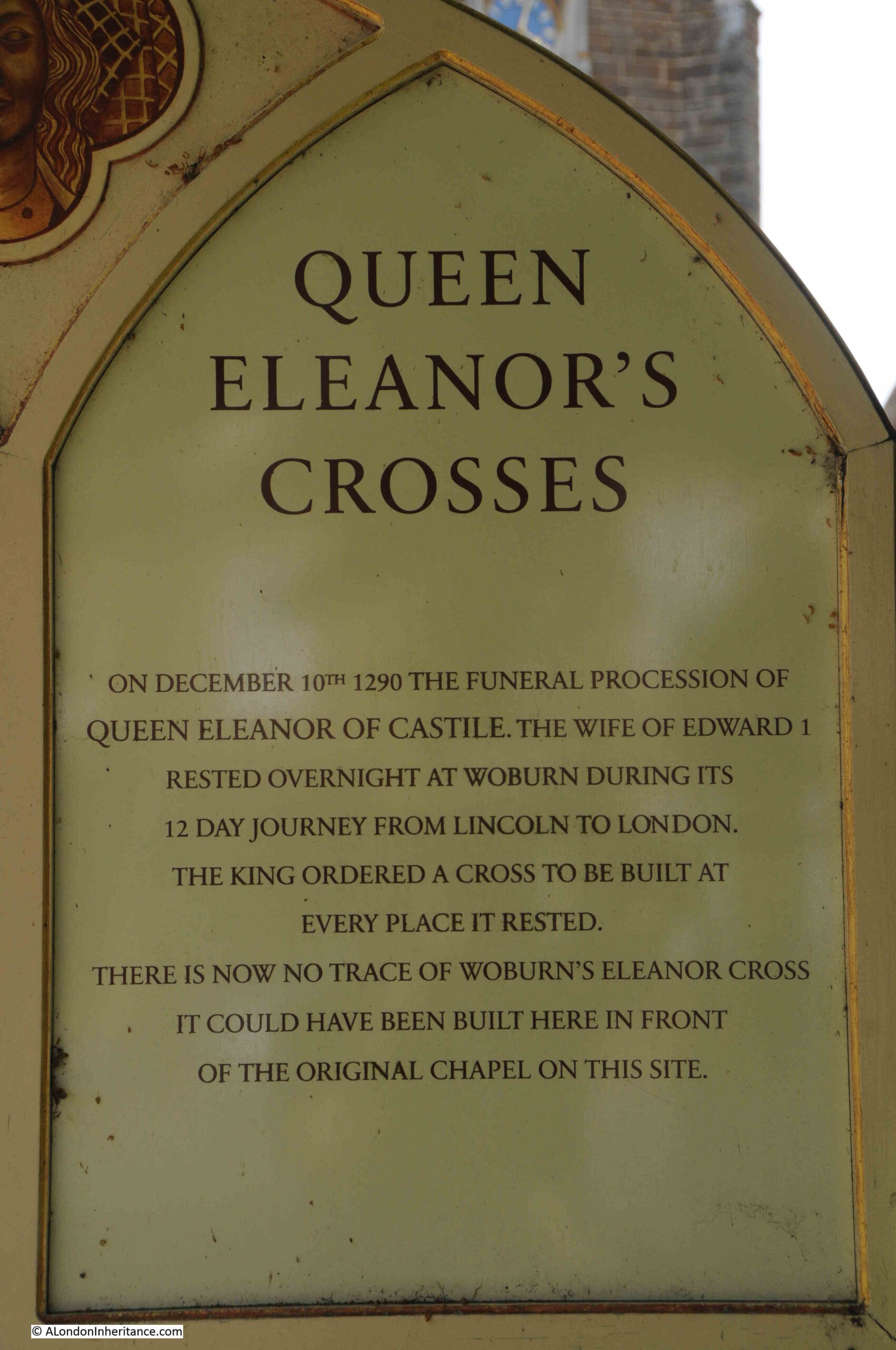
Where there is a sign by the entrance that records Eleanor’s stop in Woburn, and that the cross could have been built in frount of the chapel that was originally on the site of the current church building:

Woburn Eleanor Cross

Woburn Abbey, where the body is believed to have stayed overnight, and which is the obvious location being a religious establishment, lasted until the mid-16th century, when it was taken by Henry VIII during the dissolution of the monasteries.

In 1290, Woburn Abbey was a Cistercian monastic establishment and had been founded in 1145.

Henry VIII gave the property and the surrounding lands to John Russell, the 1st Earl of Bedford, and the lands and house that was built following the demolition of the original abbey buildings, is still in the possession of the Russell family. A prime example of how many large land owners today, owe their holdings to being in favour with the monarch in previous centuries.

The Russell family have very many London connections, for example with the development of parts of Bloomsbury, and with locations such as Russell Square, named after the Russell family, which I wrote about here.

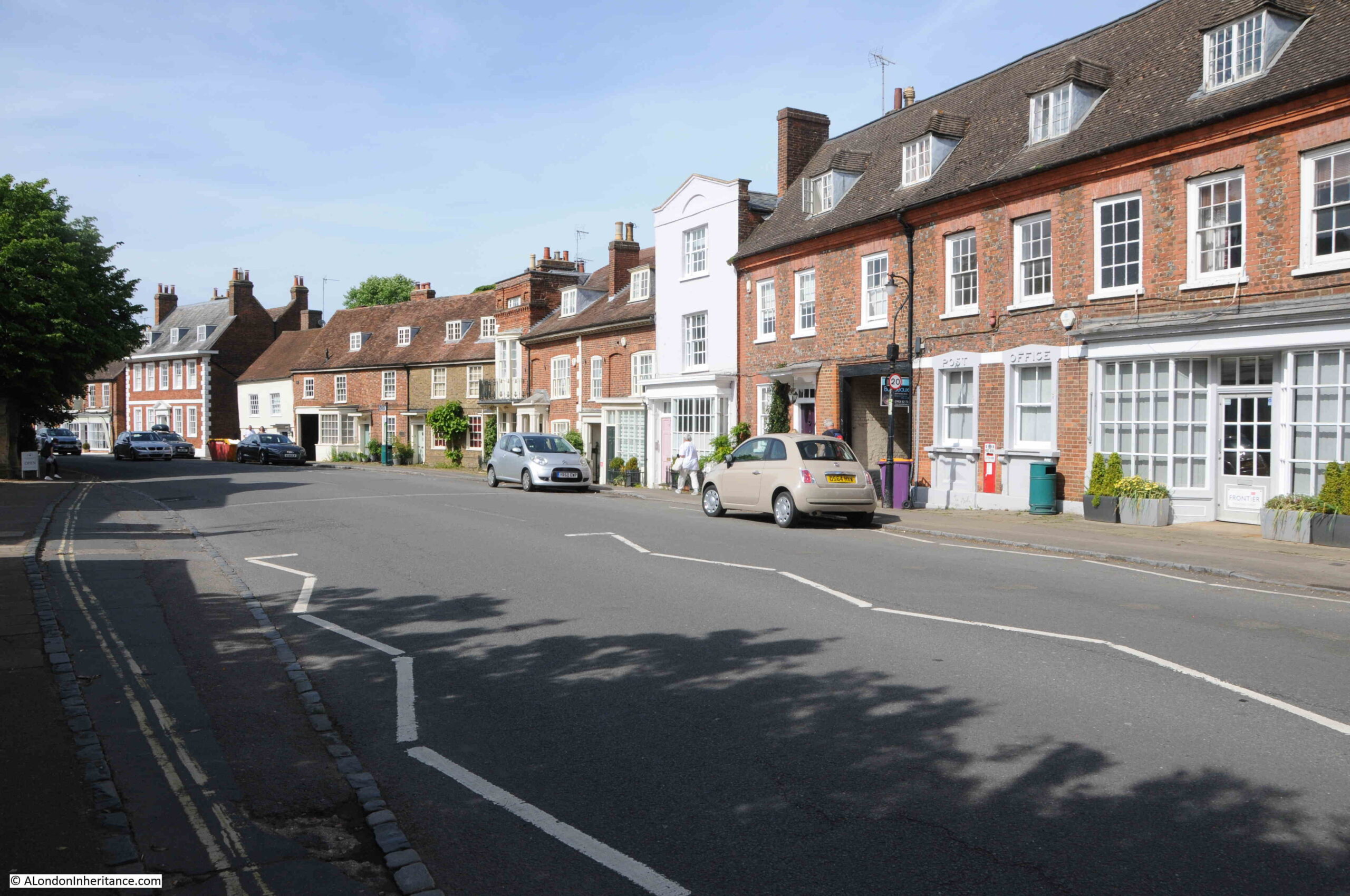
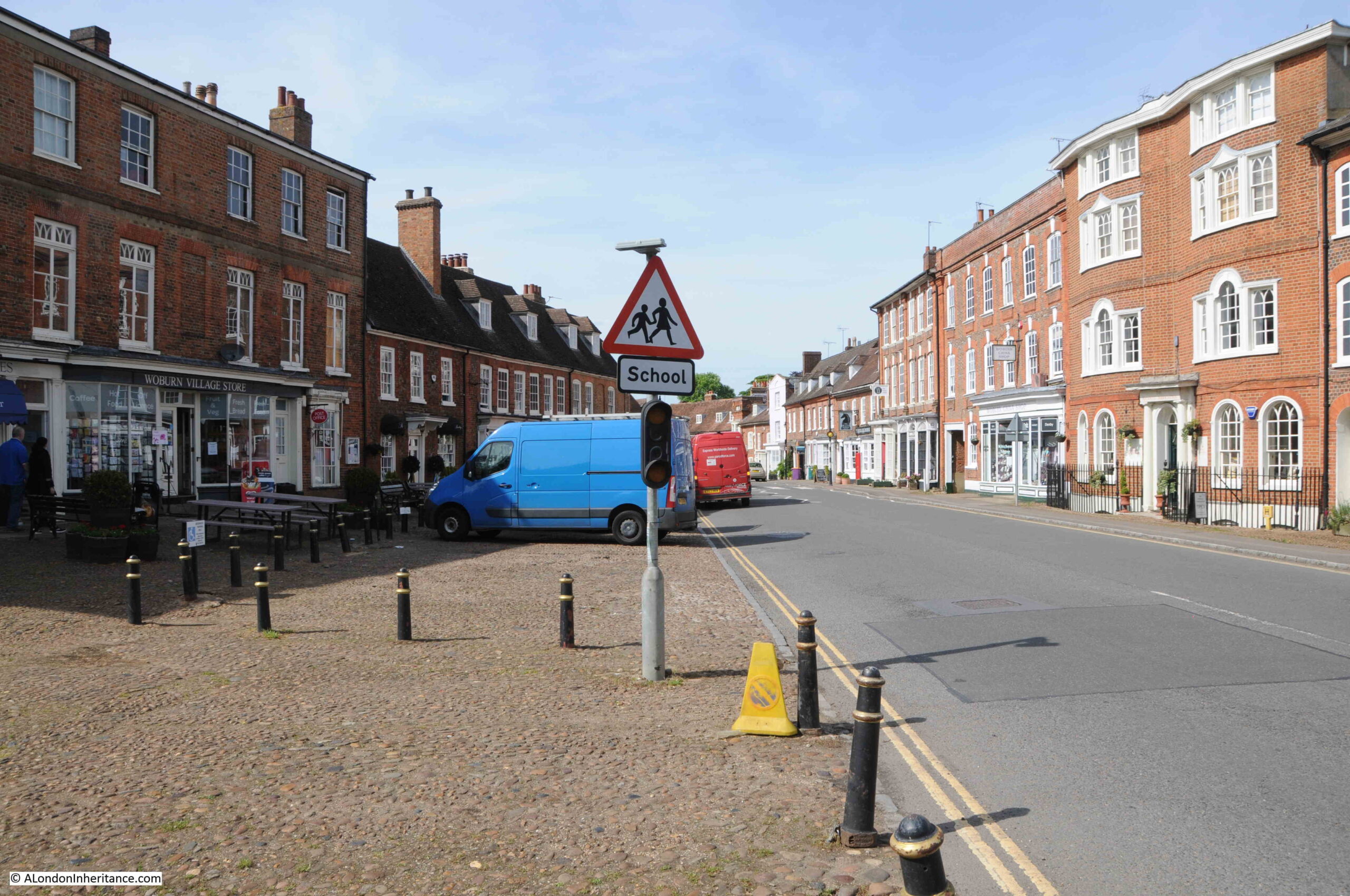
Woburn has a wonderful high street, mainly built of brick:

Woburn High Street

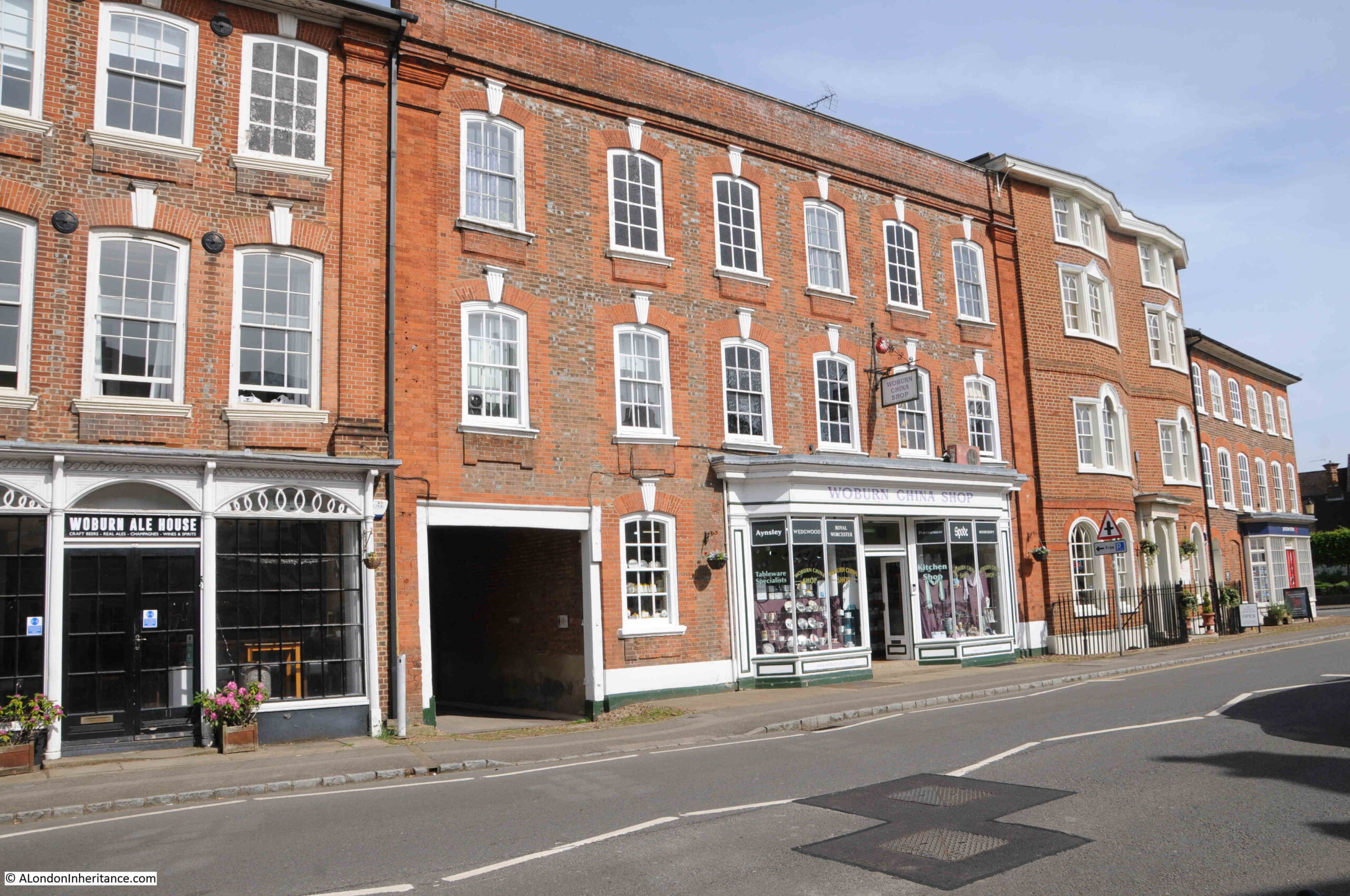
Many of the buildings in Woburn have a listing, and the building in the centre of the following photo with the Woburn China Shop is Grade II listed:

Woburn High Street

The majority of buildings to left and right of the following photo are also Grade II listed:

Woburn High Street

After leaving Woburn Abbey, the procession must have returned to the A5 / Watling Street and continued on the route to London for the next overnight stop at:

Dunstable

As with Stony Stratford, the original A5 / Watling Street ran through the town of Dunstable, and although now partly by-passed by the M1, the main street through Dunstable remains very busy.

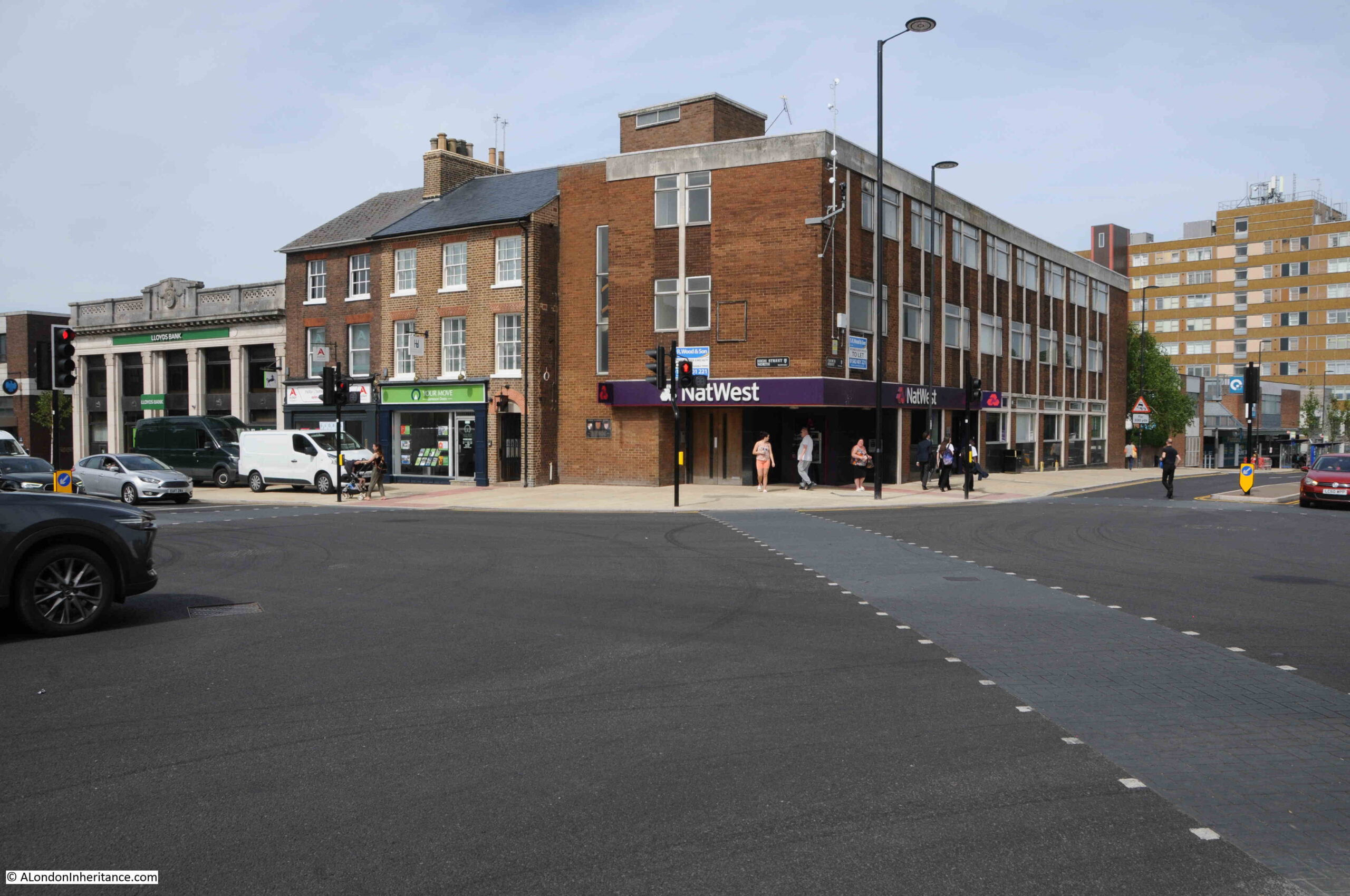
There are no remains of the Eleanor Cross built in the town, however there is a plaque recording the approximate location. There is a large cross roads to the south of the town, and the following photo was taken from the south west corner of the cross roads, looking at the NatWest Bank on the opposite corner.

Dunstable Eleanor Cross

A plaque can just be seen in the above photo, to the left of the NatWest Building.

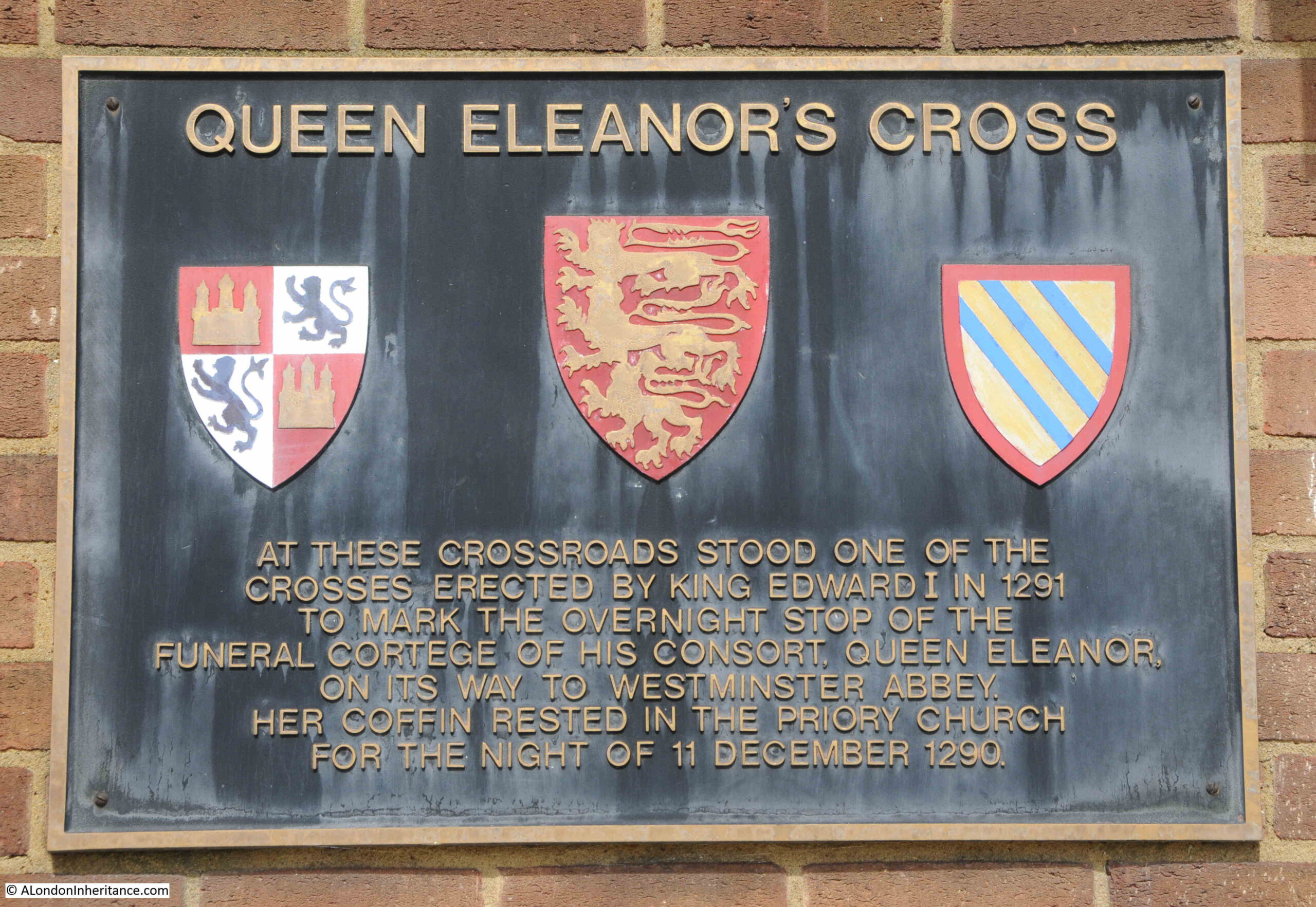
This plaque records that the cross roads was the site of an Eleanor Cross, built between 1291 and 1291 by John of Battle.

Dunstable Eleanor Cross

William Camden, the 16th / 17th century antiquarian, recorded the cross as being engraved with heraldic arms and statues of Eleanor, so as the cross was built by the same stone mason as earlier crosses, and based on William Camden’s description, it must have been very similar to the cross at Hardingstone.

The cross was destroyed during the Civil War by soldiers of Sir Thomas Fairfax, who was Lord General of the New Model Army.

The plaque records that Eleanor’s body rested in the Priory Church for the night of the 11th of December 1290.

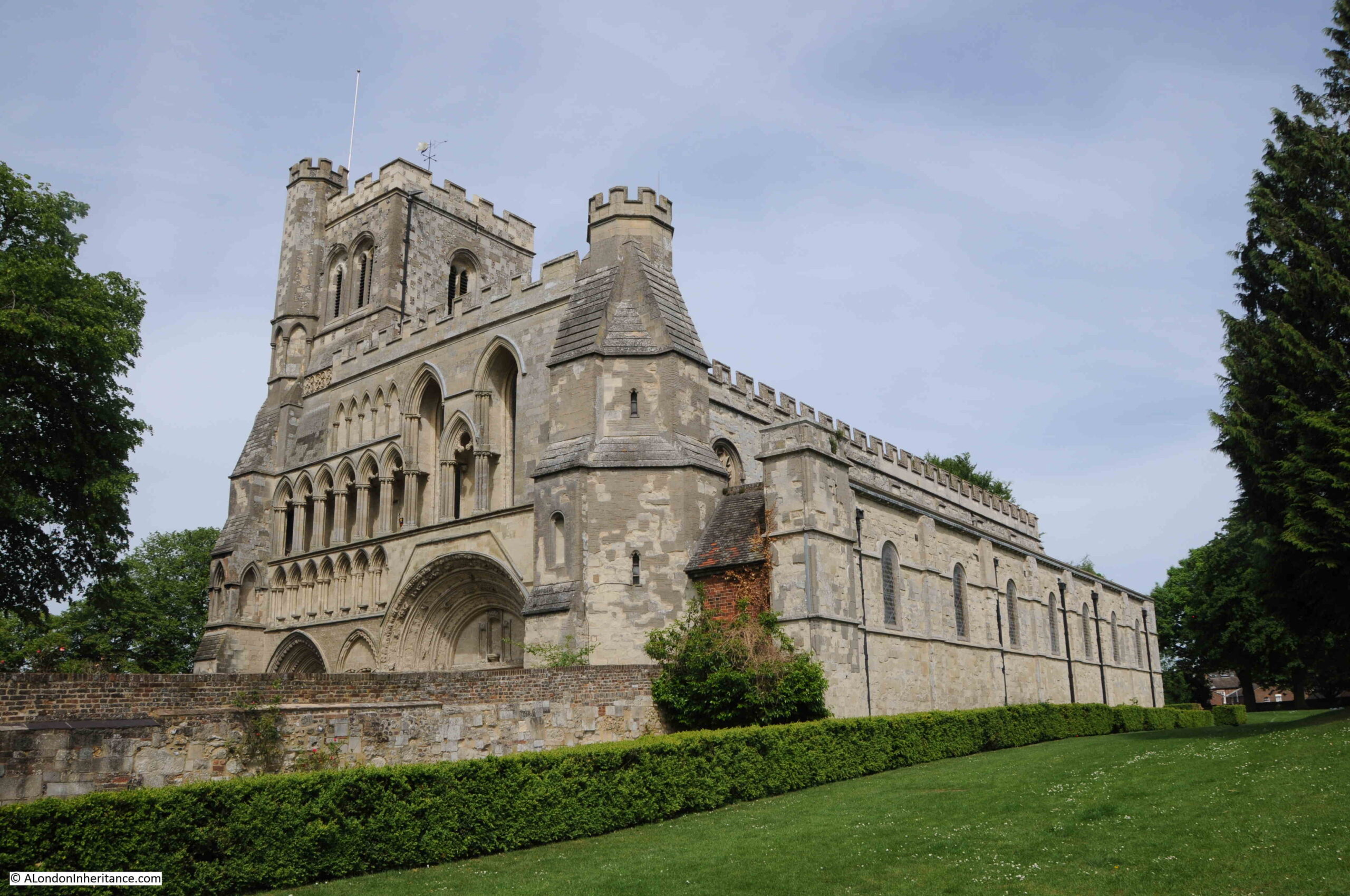
Part of the Priory Church of Dunstable Priory still remains and it would have been in the following church where Eleanor’s body rested:

Dunstable Priory Church

The Priory Church looks incredibly impressive today, but it is only part of the original church (the nave), which in turn was part of the overall priory buildings and grounds.

Dunstable Priory had been founded in 1132 as an Augustinian monastic establishment. It really is remarkable how many religious properties there were across the country in the medieval period, however as with so many others, Dunstable Priory was taken by the Crown in the mid 16th century.

The priory then fell into decay, stones of the buildings were taken for other construction projects, and the remains of the Priory Church became a parish church.

Apart from the church, not much else of the Priory remains. One of the few examples being what is left of the Priory Gatehouse:

Dunstable Priory Church

The size, detail and quality of carving of what remains of the Priory Church gives an impression of what the overall Priory site must have looked like when Eleanor’s body was rested here overnight in frount of the high altar.

Dunstable Priory Church

The rear of the Priory Church is bricked up. This is where the church would have continued, and there are carved remains that show how the church was decorated. This figure could well have looked on as Eleanor was in the church:

Dunstable Priory Church

From Dunstable, there were only two more stops before reaching the City of London, and these stops will be covered in the next post, before an exploration of the London crosses, and Eleanor’s final resting place, in the final post of the series.

alondoninheritance.com

Eleanor Crosses – Grantham, Stamford and Geddington

Having left Lincoln, following the route that the procession taking the body of Eleanor of Castile to Westminster Abbey, in today’s post, I am visiting Grantham, Stamford and Geddington, marked with blue circles in the following map, which shows the overall route:

Eleanor Cross route

In two of these places, the original cross was destroyed many years ago, however I also find the most complete example of an original Eleanor Cross.

I also find three interesting places, the site of some of my father’s photos, and what is believed to be the only living pub sign in the country.

The first stop is at:

Grantham

Grantham, roughly 25 miles to the south of Lincoln, was the first of the overnight stopping places on the journey to London.

There is no exact location of the cross that was built to mark the overnight stop, or where Eleanor’s body rested for the night. English Heritage states that the cross was in the widest part of the High Street, by St Peter’s Hill.

Eleanor’s body may have rested at the parish church of St Wulfram, or in the Grey Friars property where the Franciscans had recently settled. The Victoria County History of Lincoln, published in 1906 records that Edward I “gave these friars 12s. 8d. for two days’ pittance and 21s. for three days’ pittance”, so they must have been in favour and therefore they could have looked after the body.

The Eleanor Cross was destroyed during the Civil War in the 1640s, and there are no confirmed remains of the cross to be seen, however English Heritage state that some of the stones from the Eleanor Cross may have been used to repair / rebuild Grantham’s market cross, so this was the first destination on arriving in Grantham.

Grantham’s market cross seen from the main street running through the town:

Market Cross Grantham

My father visited Grantham on the 25th of July 1952, almost 70 years to the day of our visit. Grantham has been on the list for a visit so I can track down the location of his photos, and the project to follow the route of the 1290 procession also provided the opportunity for some then and now photos.

At the road junction from where I had photographed the market cross shown above, is the Angel Inn. A plaque on the wall by the Grantham Civic Society states that the gatehouse inn dates from the 15th century and that King Richard III received the Great Seal here in 1483, and that over the years other monarchs have also stayed in the inn.

A1 Grantham

Seventy years ago, my father took a photo of the same view:

A1 Grantham

The road that runs through Grantham, and is the road in front of the Angel Inn in the above two photos is now the B1124, however if you take a look at the direction sign in the photo, this was originally the A1, or the Great North Road – the main road to the north from London.

If I look at a London street atlas of the time, the A1 is shown starting at the junction of St Martin’s Le Grande and Cheapside, and Aldersgate Street is still marked as the A1. Detail of the 1952 direction sign:

A1 Grantham

Walking down to the market cross, and it is located in a large open space, which at one time held the town’s local market.

The cross is Grade II listed, and along with the surrounding space are classified as a scheduled ancient monument, and intriguingly the listing states that this does not cover the surrounding paving stones, but does cover the ground below due to the lack of development probably preserving ancient remains from the construction of the cross.

The cross is believed to be medieval in origin, but with later repairs and restorations, when some of the stone from the Eleanor Cross may have been used.

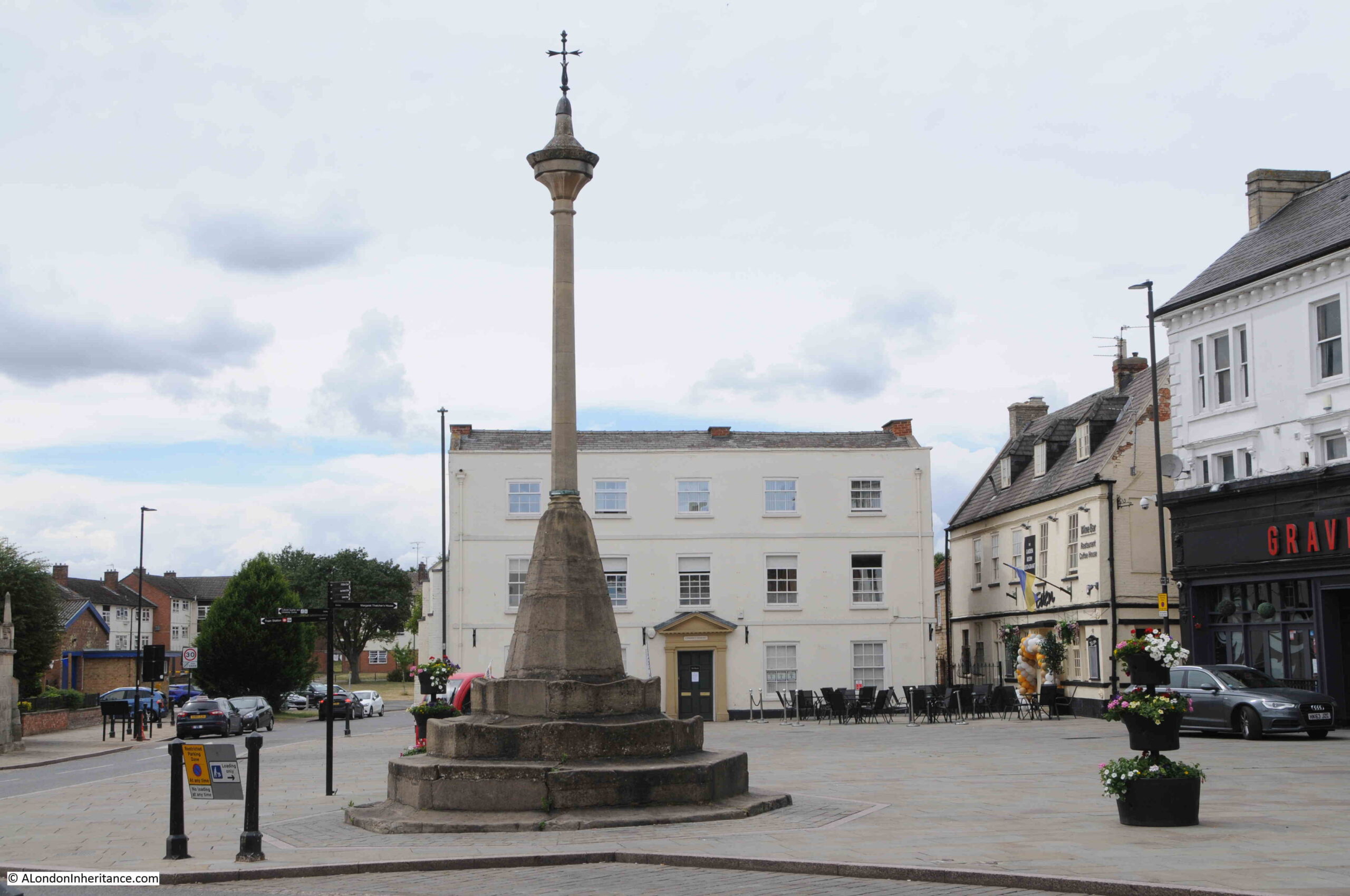
View of Grantham’s market cross:

Market Cross Grantham

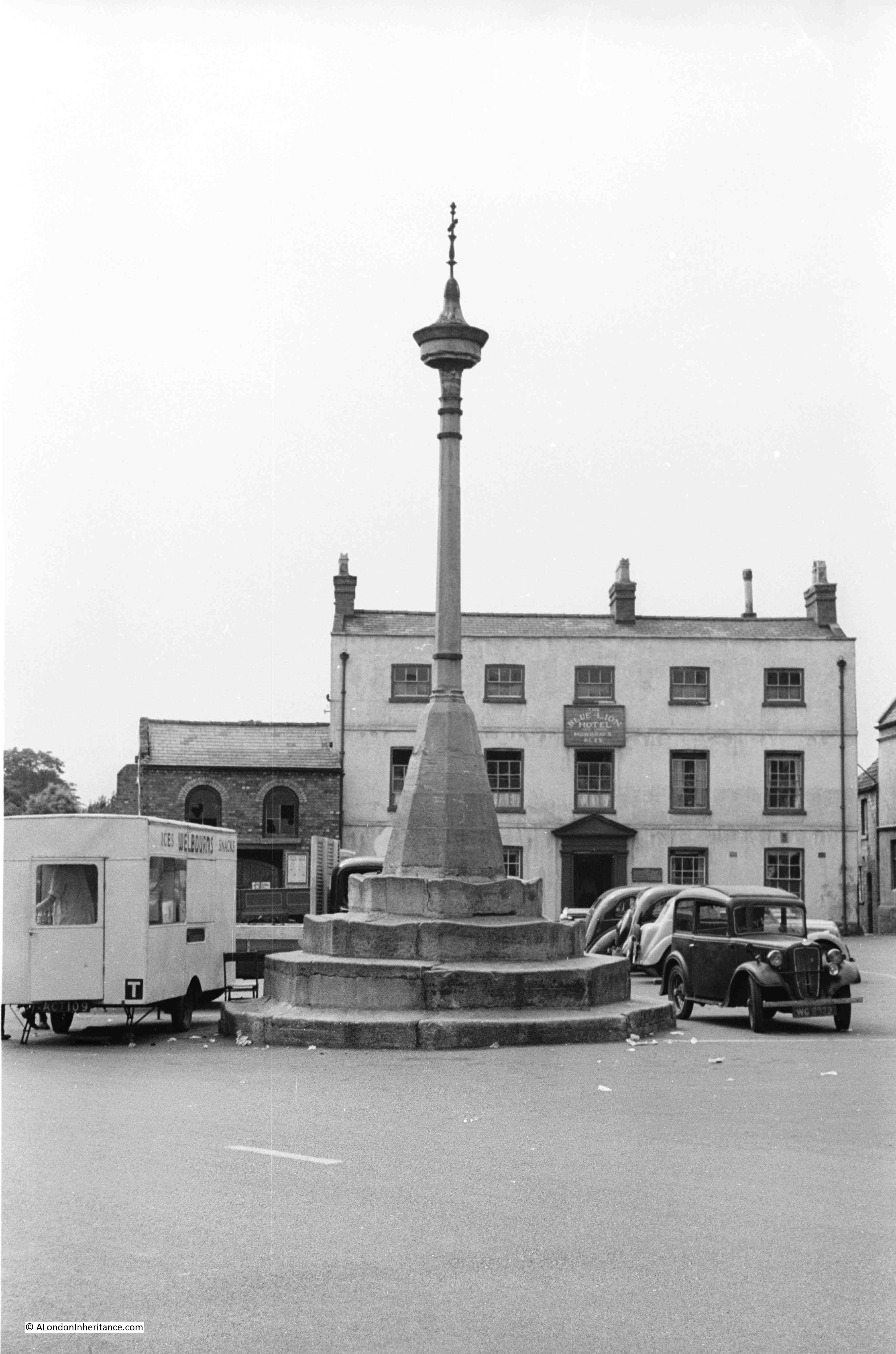
On his 1952 visit to Grantham, my father also photographed the market cross, and the photo below shows roughly the same view as my 2022 photo above.

Market Cross Grantham

In 1952, the large building behind the cross was the Blue Lion Hotel. Today, the building appears to be a private house. The van to the left of the cross was Welbourns Ices and Snacks.

A minor detail of how things change, the cross on the top of the market cross appears to have turned by 90 degrees at some point over the last 70 years.

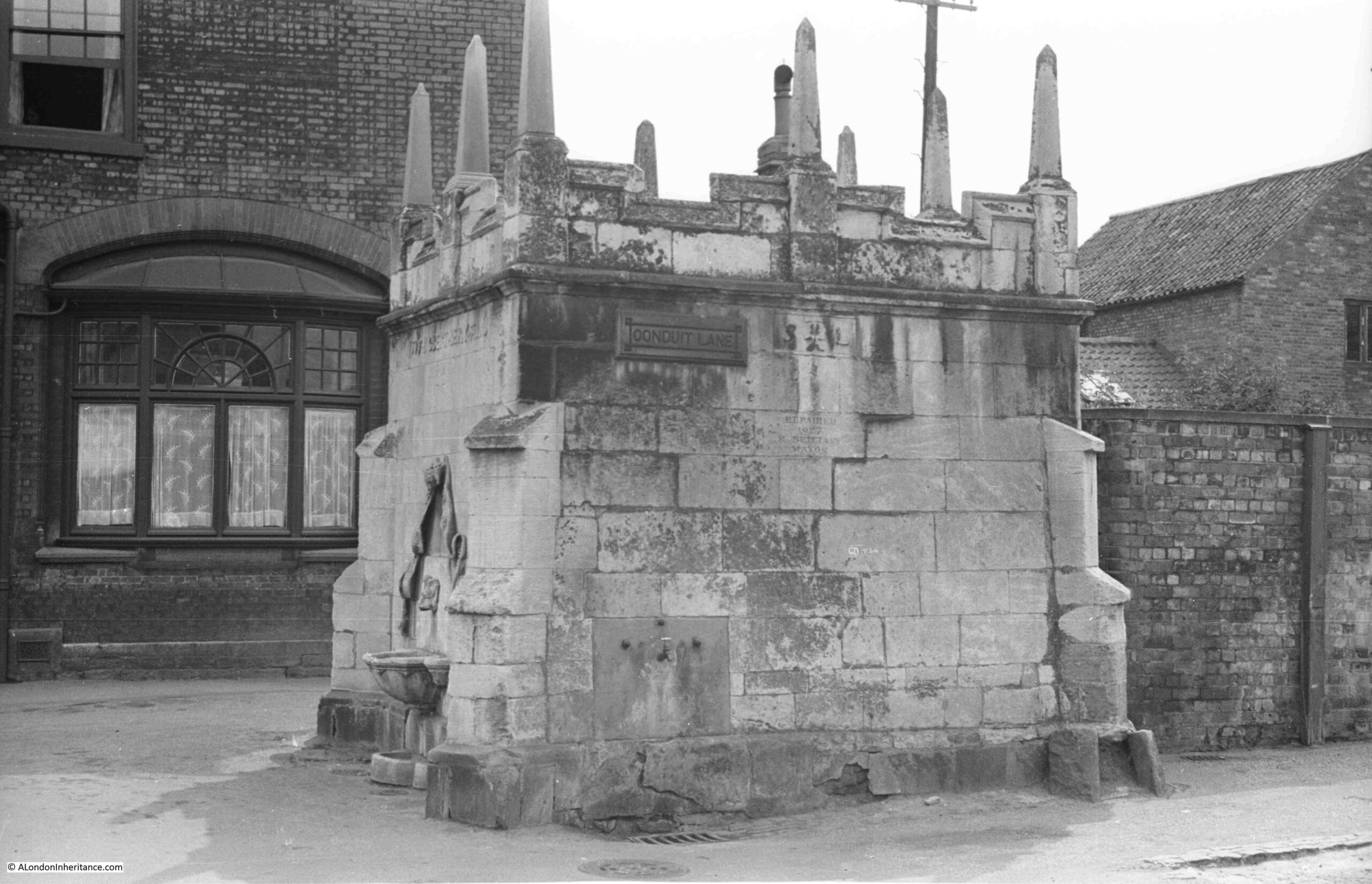
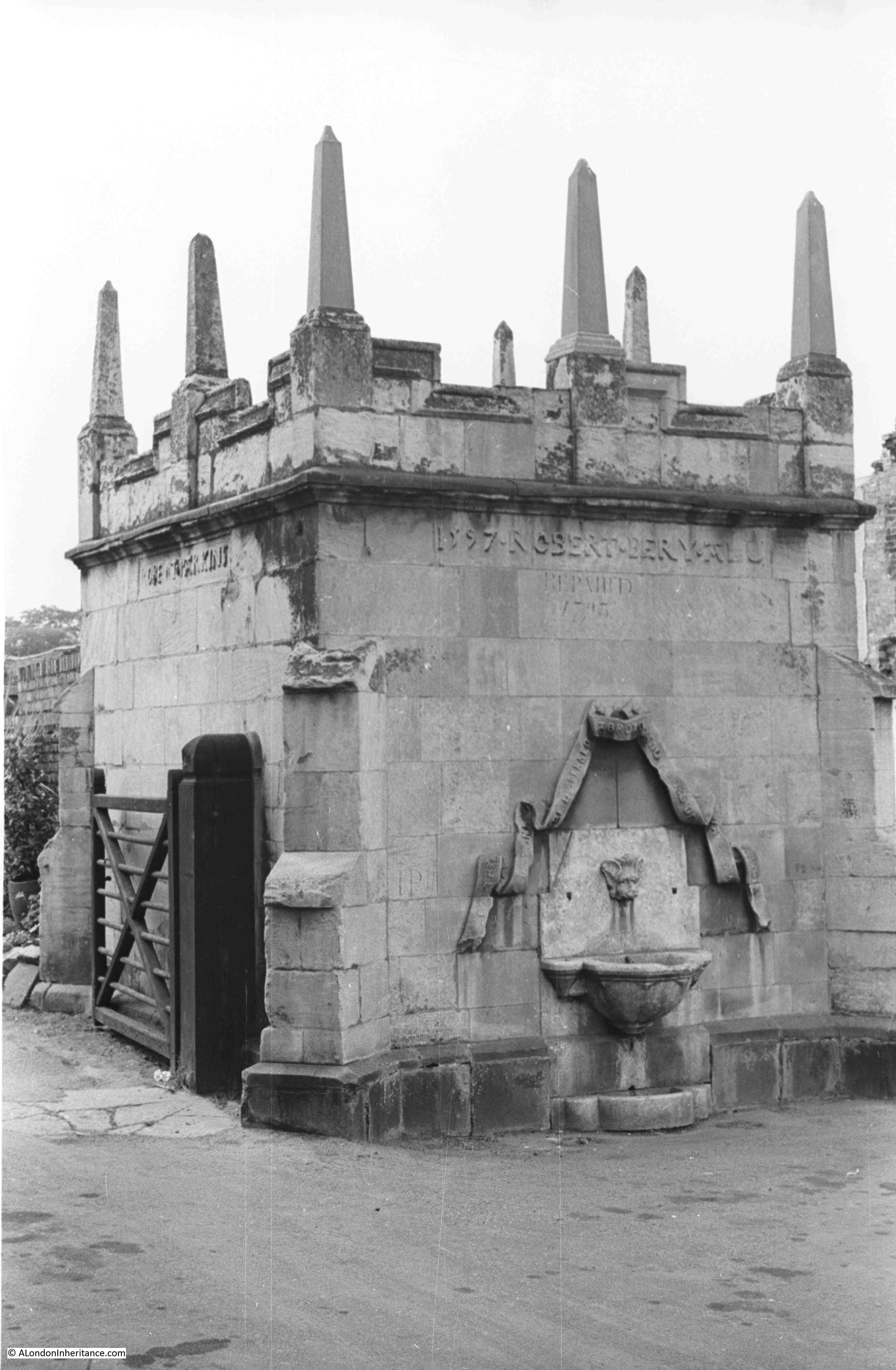
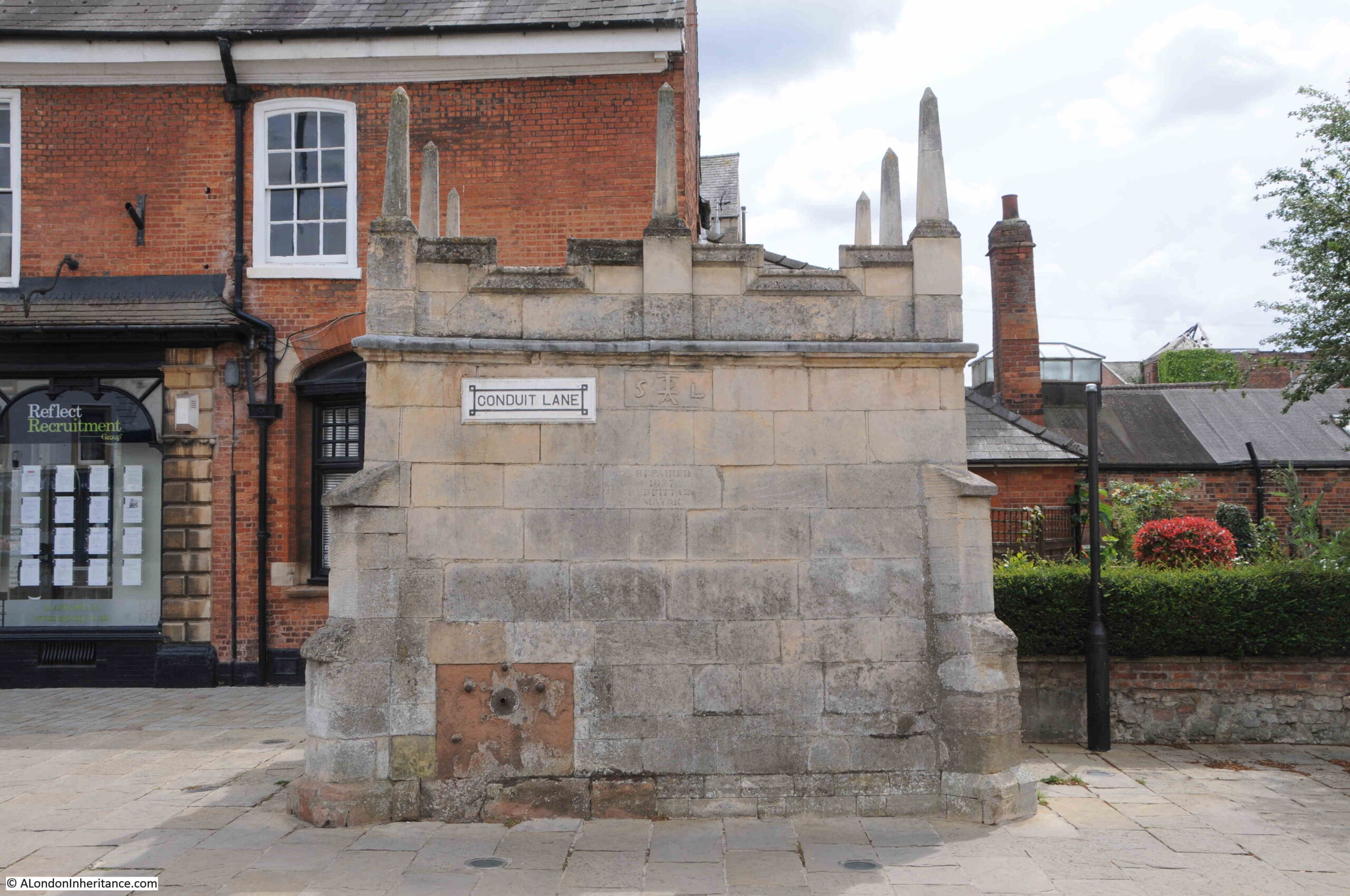
Another feature that my father photographed near the cross was a water conduit:

Conduit Grantham

A conduit is a building that contained a cistern, or holding tank for water, and allowed water to be taken via a form of tap on the building by the local population.

The conduit has its origins with the Grey Friars who purchased the land around a spring outside of Grantham and piped the water to their property.

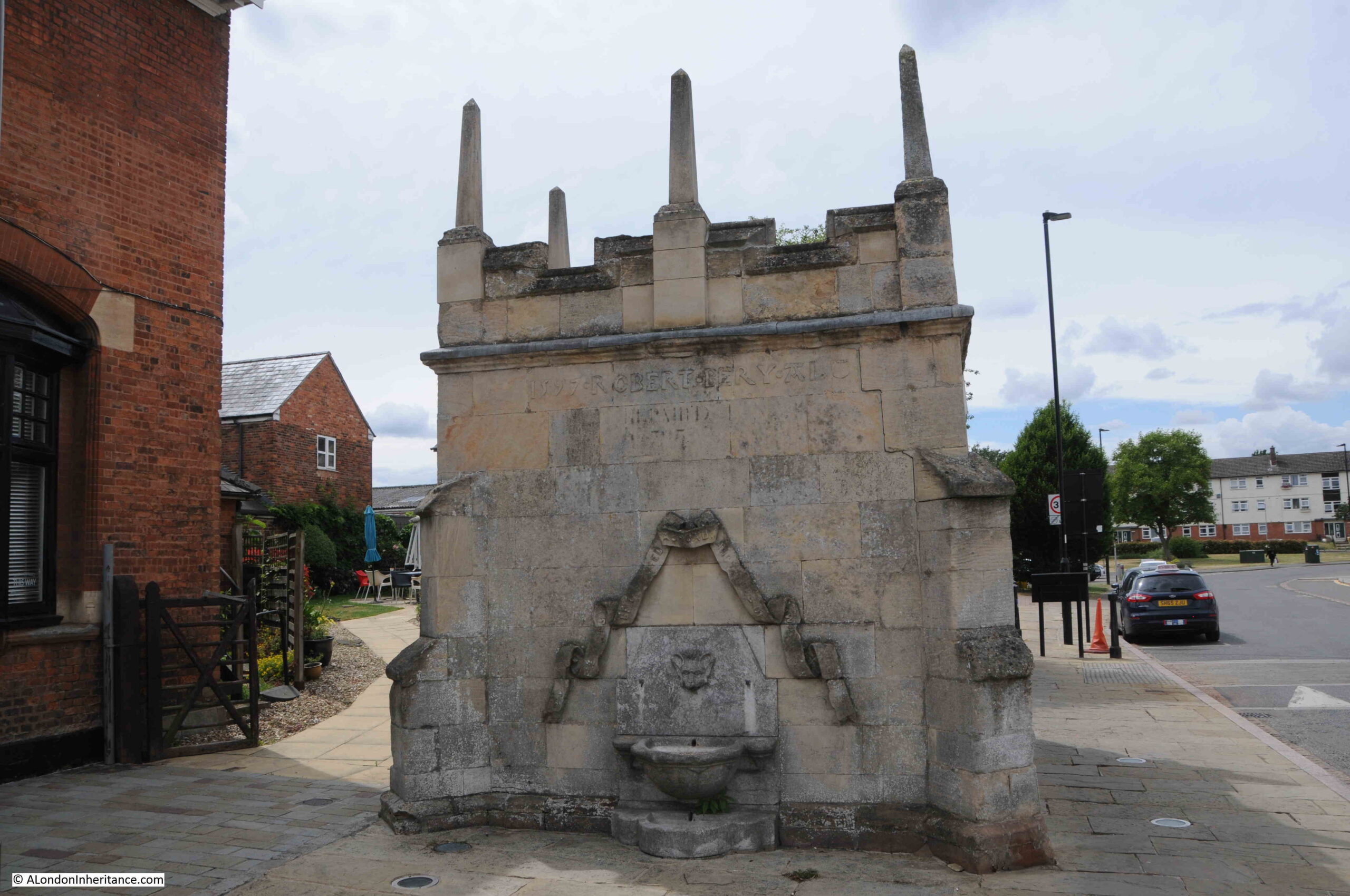
In 1597 the water supply was extended by pipe to the conduit in the market place. The conduit and pipeline was constructed by the Corporation of Grantham.

The conduit has seen many repairs since it was built, in 1927 the roof was replaced, along with three of the distinctive pinnacles.

Conduit Grantham

The conduit today:

Conduit Grantham

View from the front of the conduit, with the date near the top, and the bowl below where water was drawn off from the conduit:

Conduit Grantham

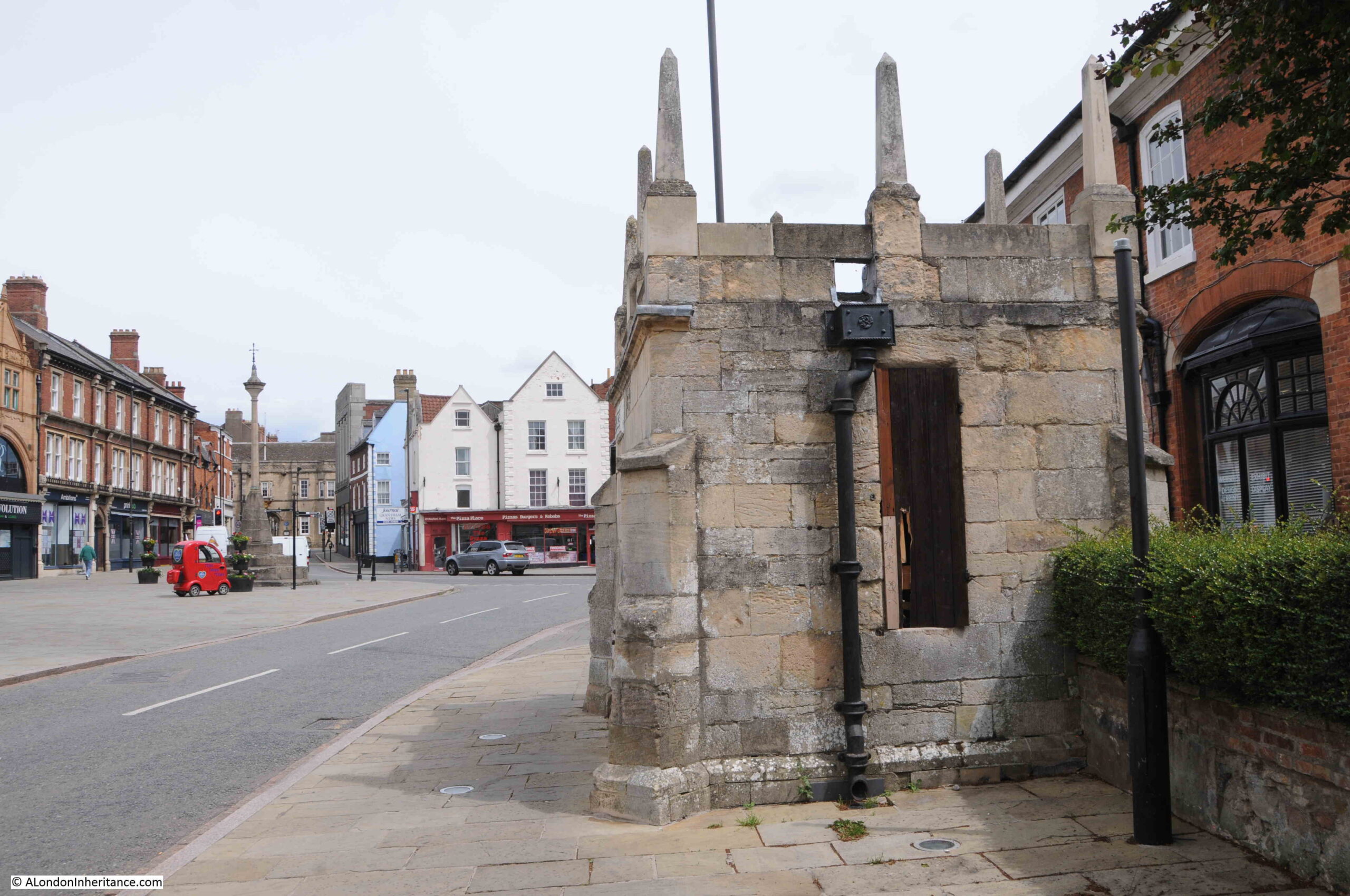
Rear of the conduit in the corner of the market place with the cross in the background:

Conduit Grantham

Grantham has a number of interesting historical features, and there was a pub I wanted to find, so we went for a walk.

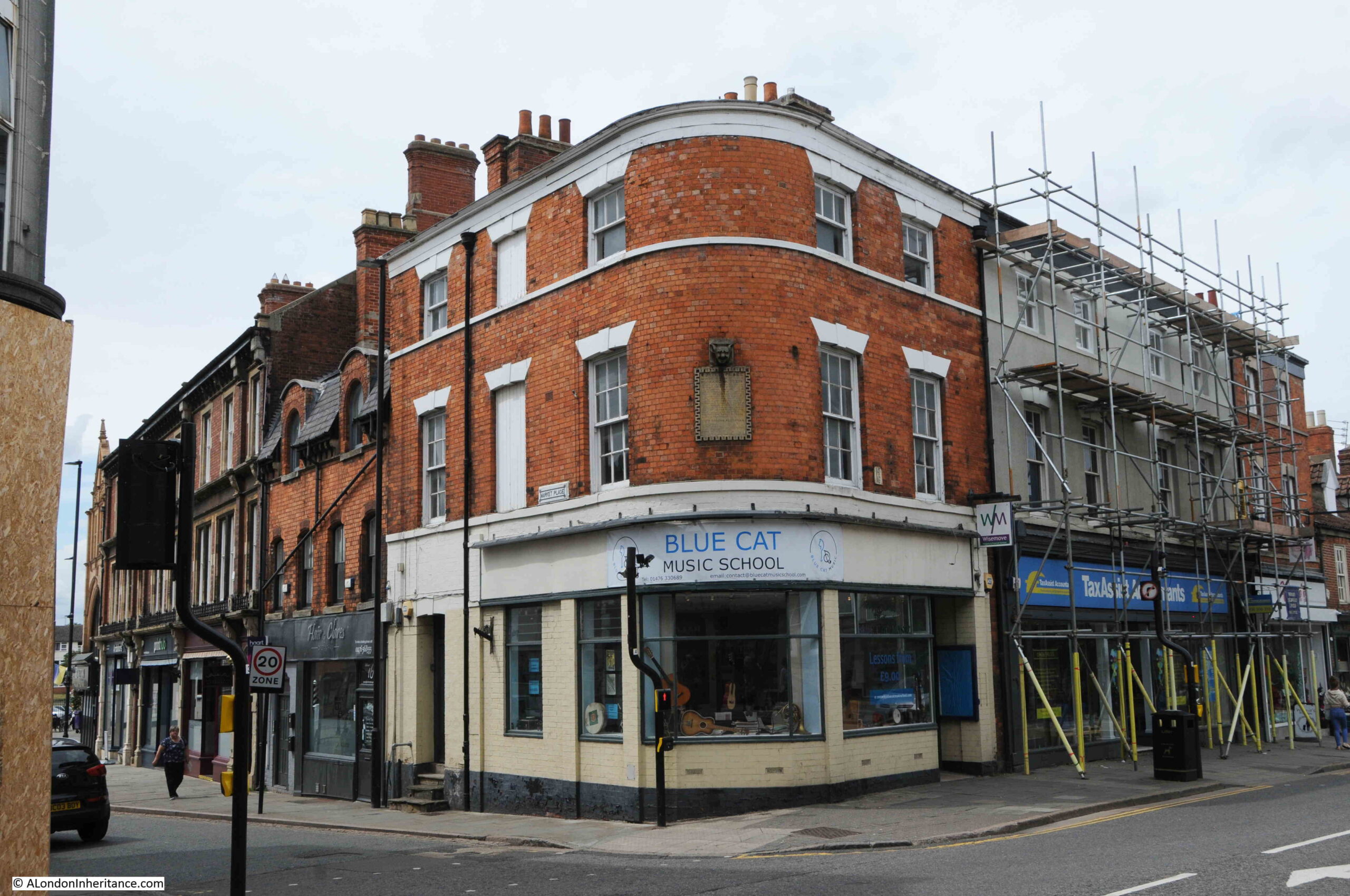
A brick building on the corner of the street down to the market cross has a plaque:

Grantham

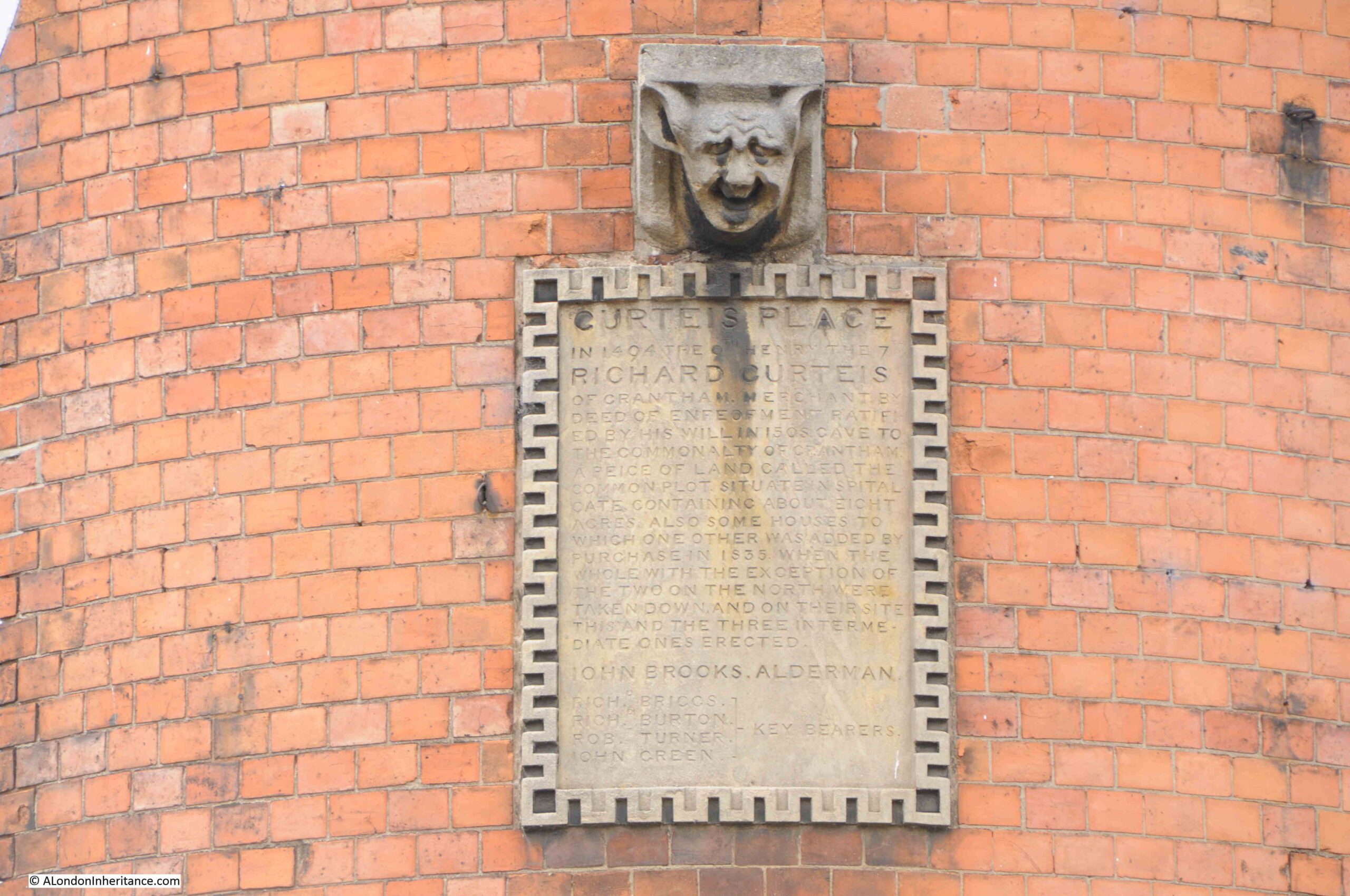
The plaque records that a parcel of land was given to the “Commonality of Grantham” by Richard Curtis in 1494:

Grantham

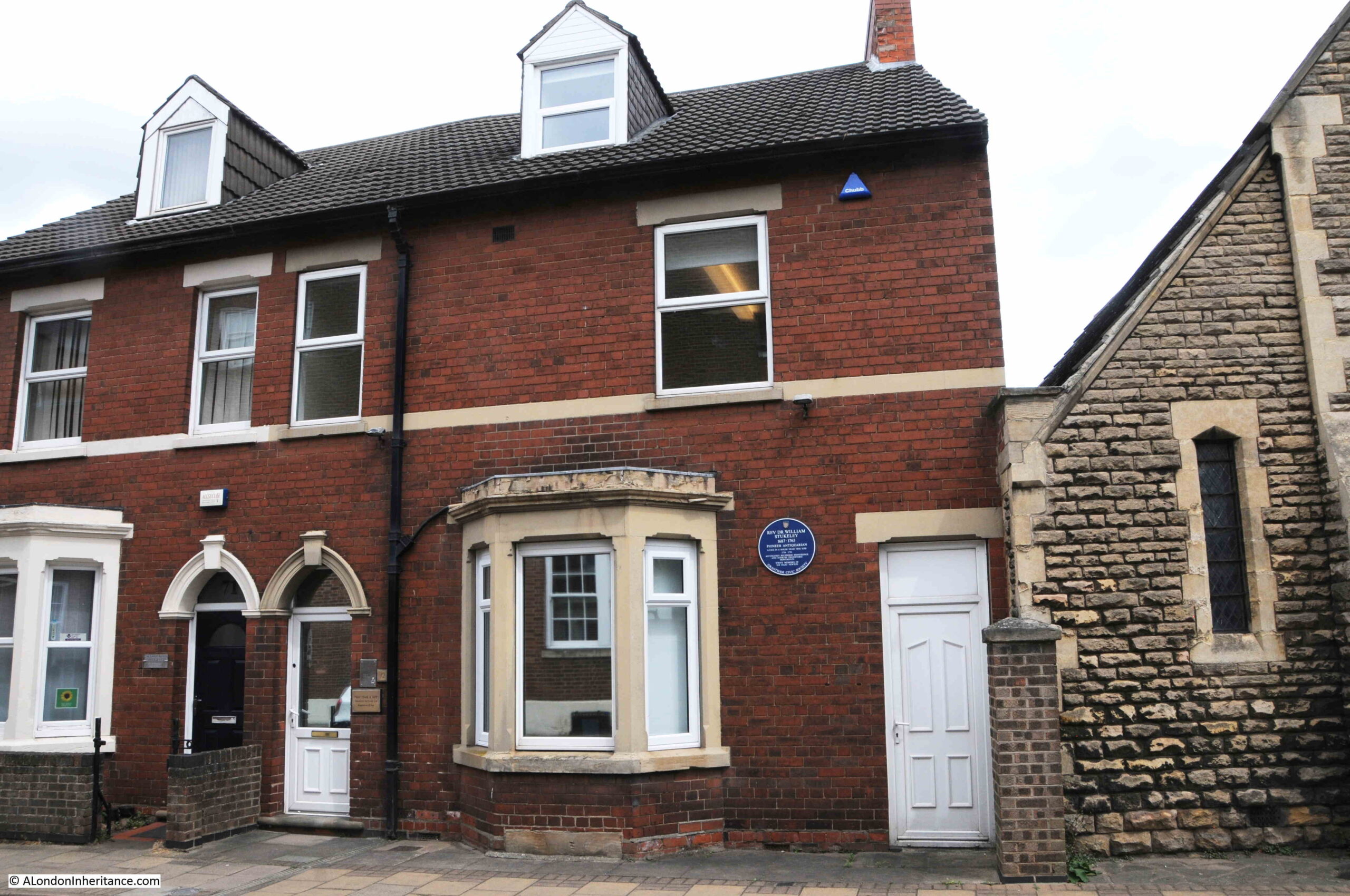
An end of terrace house has a blue plaque that records that the early antiquarian Rev. Dr. William Stukeley lived in a house near the site of the plaque between 1726 and 1730:

William Stukeley Grantham

William Stukeley was the first to accurately record Stonehenge, and the stones at Avebury, and he also wrote a memoir of Grantham resident Isaac Newton.

Another of my father’s photos in Grantham was of a pub which was, and I believe still is, known as the only pub in the country with a living pub sign.

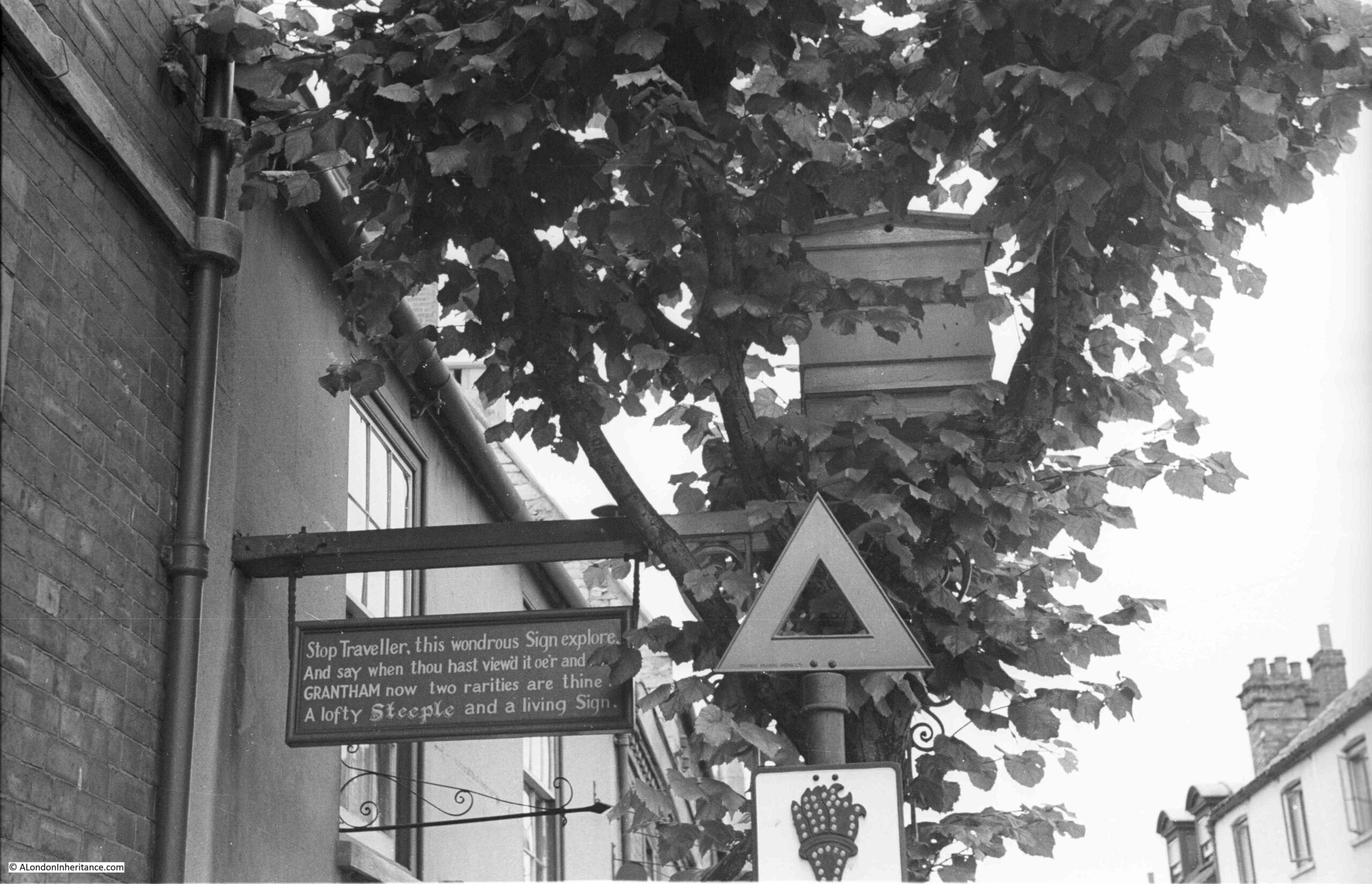
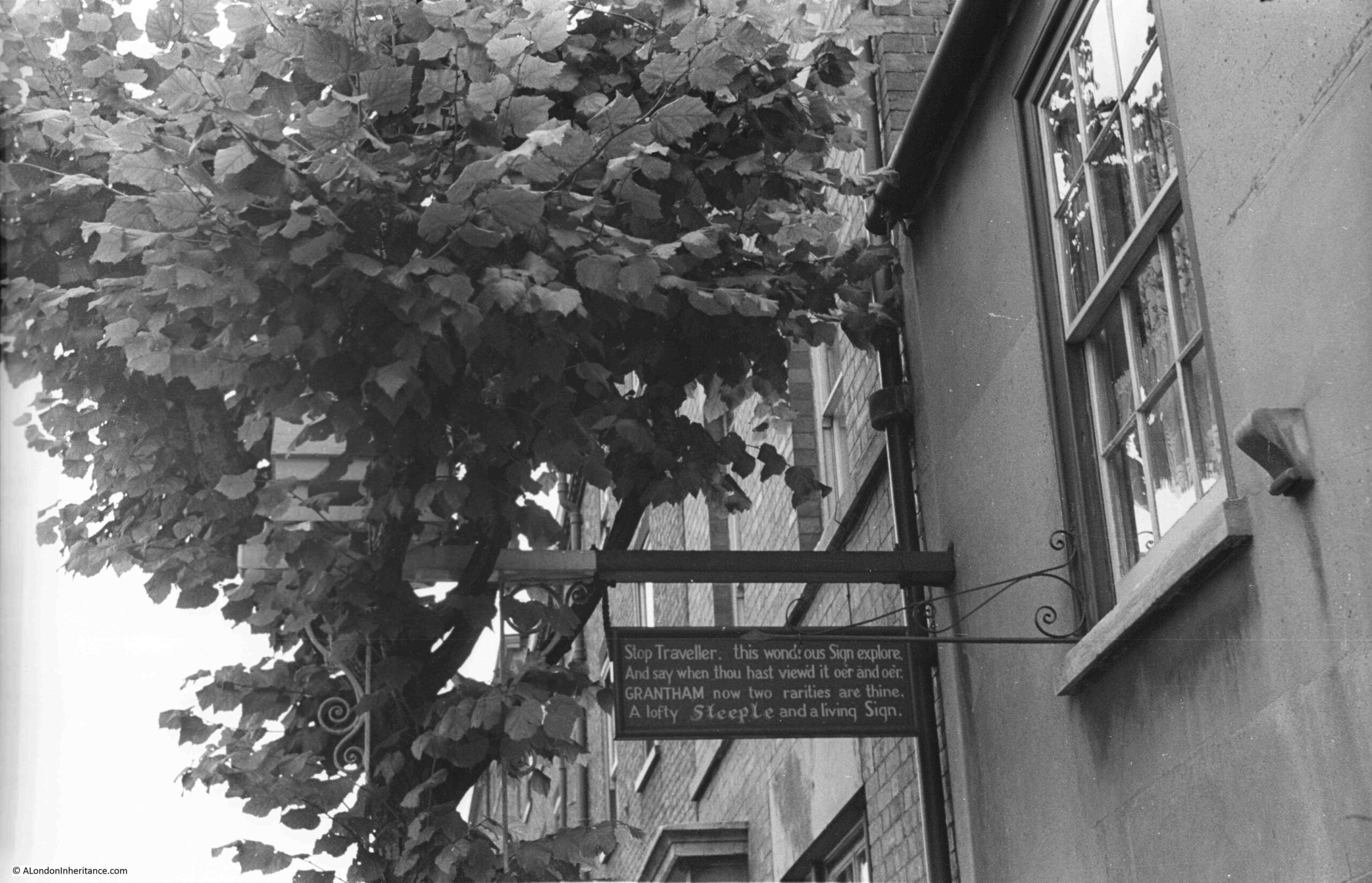
This is the Beehive in 1952:

Beehive pub Grantham

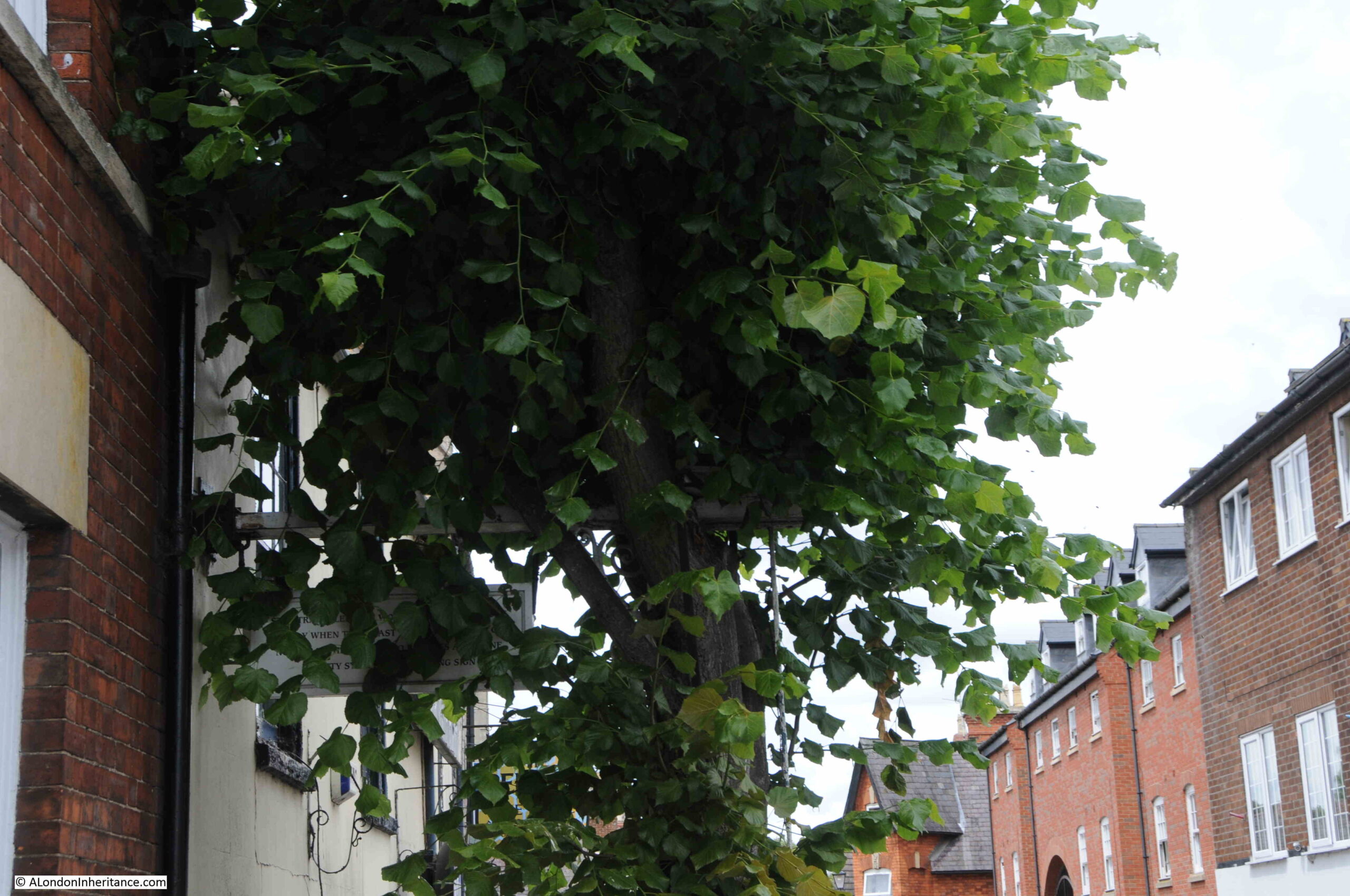
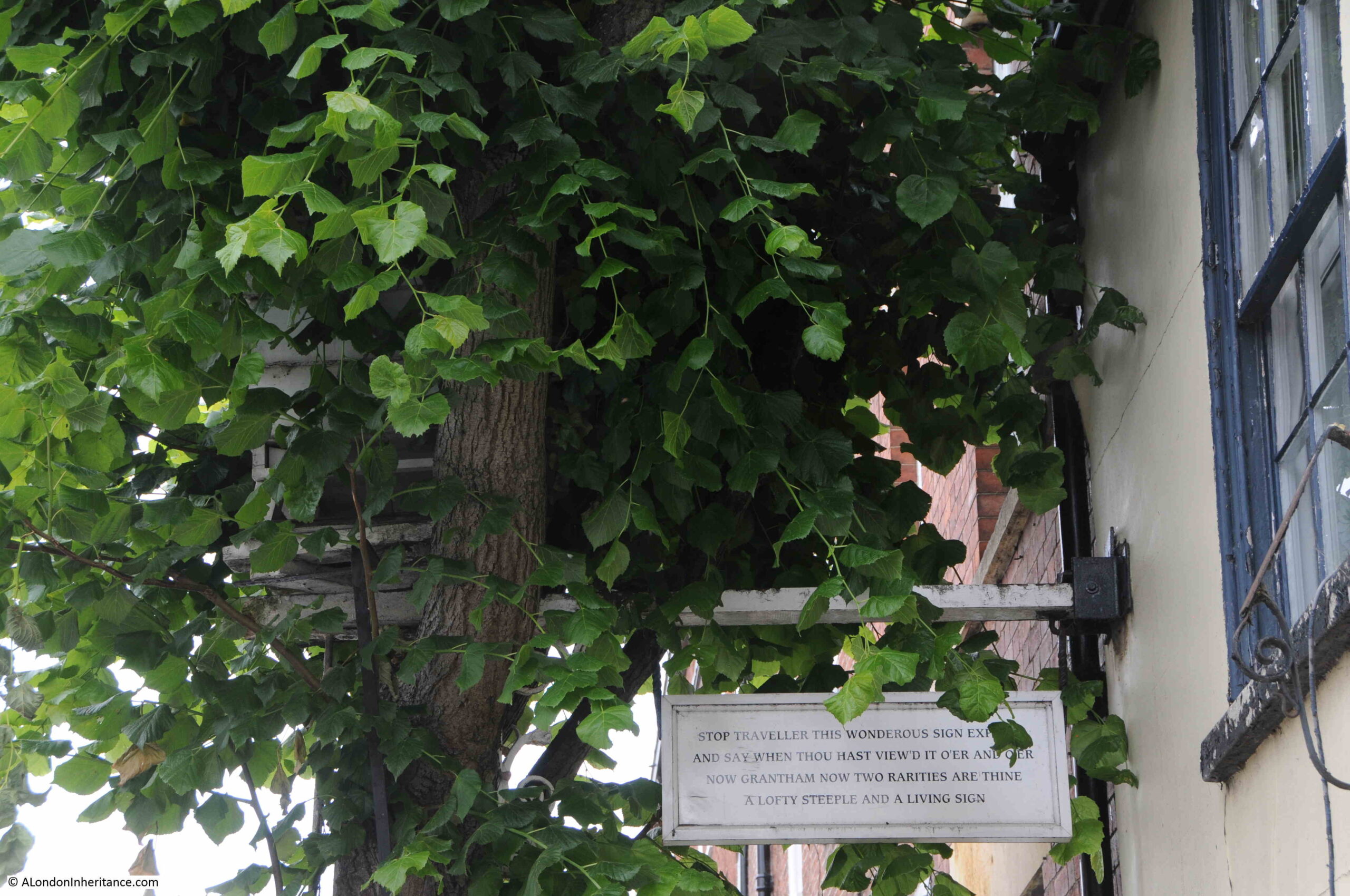
The Beehive has a beehive in the tree directly outside the front of the building. It was visible in my father’s photo above, however in my 2022 photo from the same side of the tree, it was covered with leaves:

Beehive pub Grantham

View from the other side of the tree:

Beehive pub Grantham

Not really visible in my 2022 photos, but there were bees flying within the branches of the tree.

The same view in 2022, where the beehive is just visible to the left of the tree:

Beehive pub Grantham

The sign was restored in 2017, and reads: “Stop traveler this wonderous sign explore and say when thou hast view’d it o’er and o’er now Grantham now has two rarities are thine a lofty steeple and a living sign”.

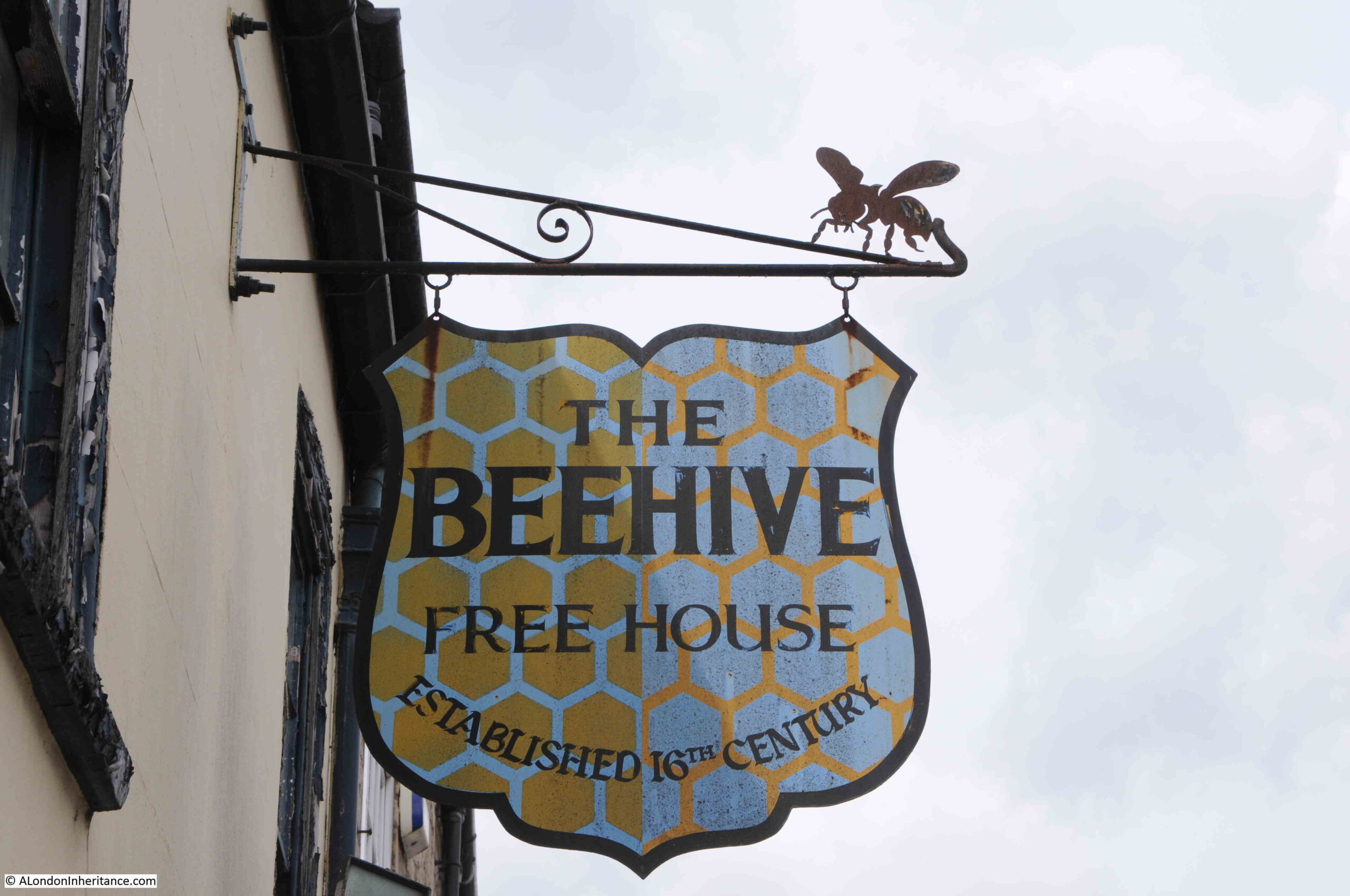
The Beehive pub sign:

Beehive pub Grantham

I have found various dates for the age of the pub. The restoration of the sign was by the Grantham Civic Society, and a newspaper article in the Grantham Journal states that the pub dates back to at least 1783 when the pub was drawn by John Claude Nattes, with the beehive being in existence at that time.

My father took the following photo of the pub in 1952:

Beehive pub Grantham

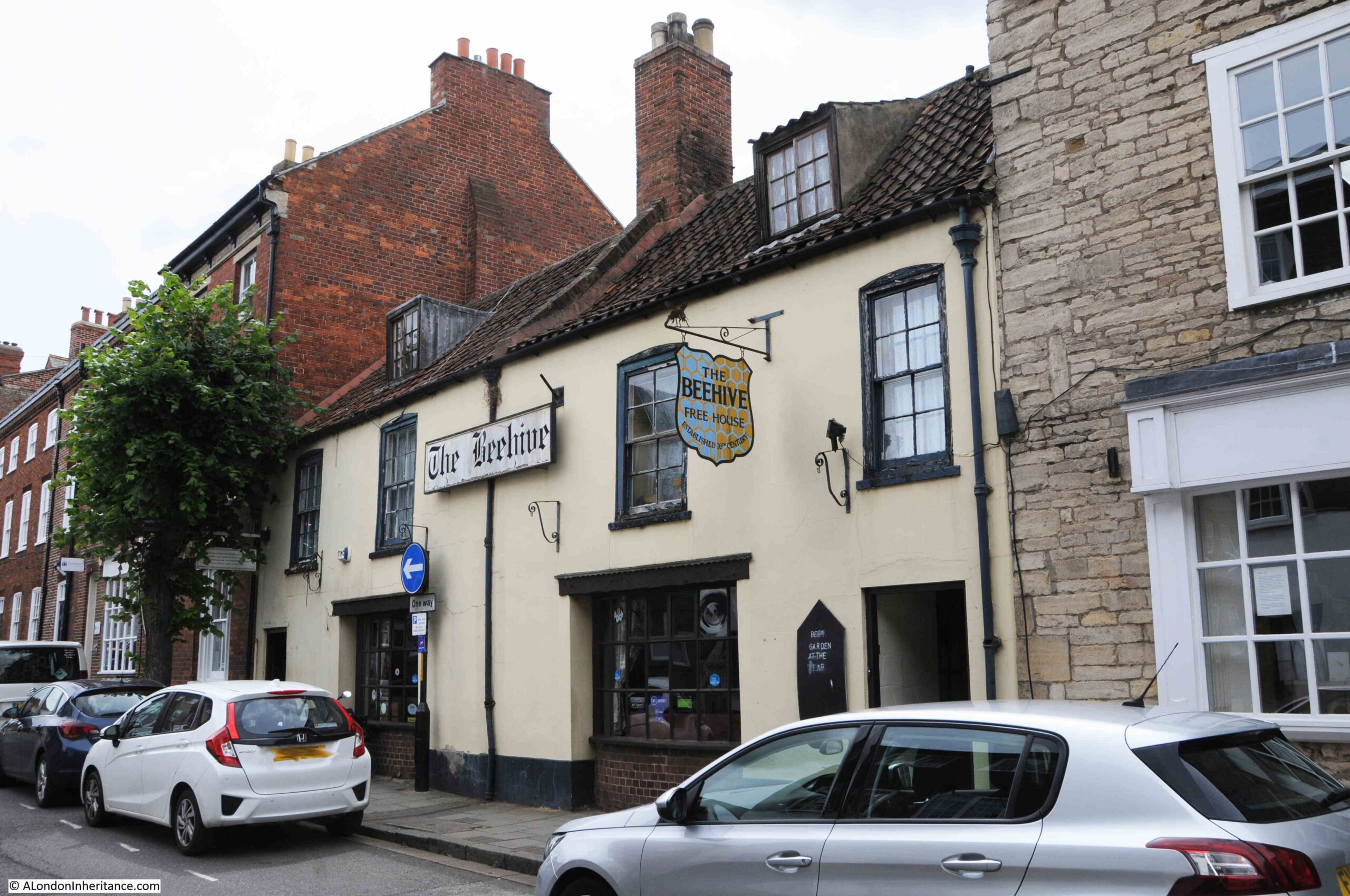
Visiting the sites photographed by my father has taught me that you cannot always believe what you see. The following photo shows the Beehive pub in 2022. in the above 1952 photo is appears to be only the smaller part on the left of the pub in 2022. In 1952 there was a building with a very different frontage to the right of the first ground floor window.

Beehive pub Grantham

I do not know if the building on the right of my father’s photo was part of the pub, but it appears to have been a very different building to the right half of the pub today.

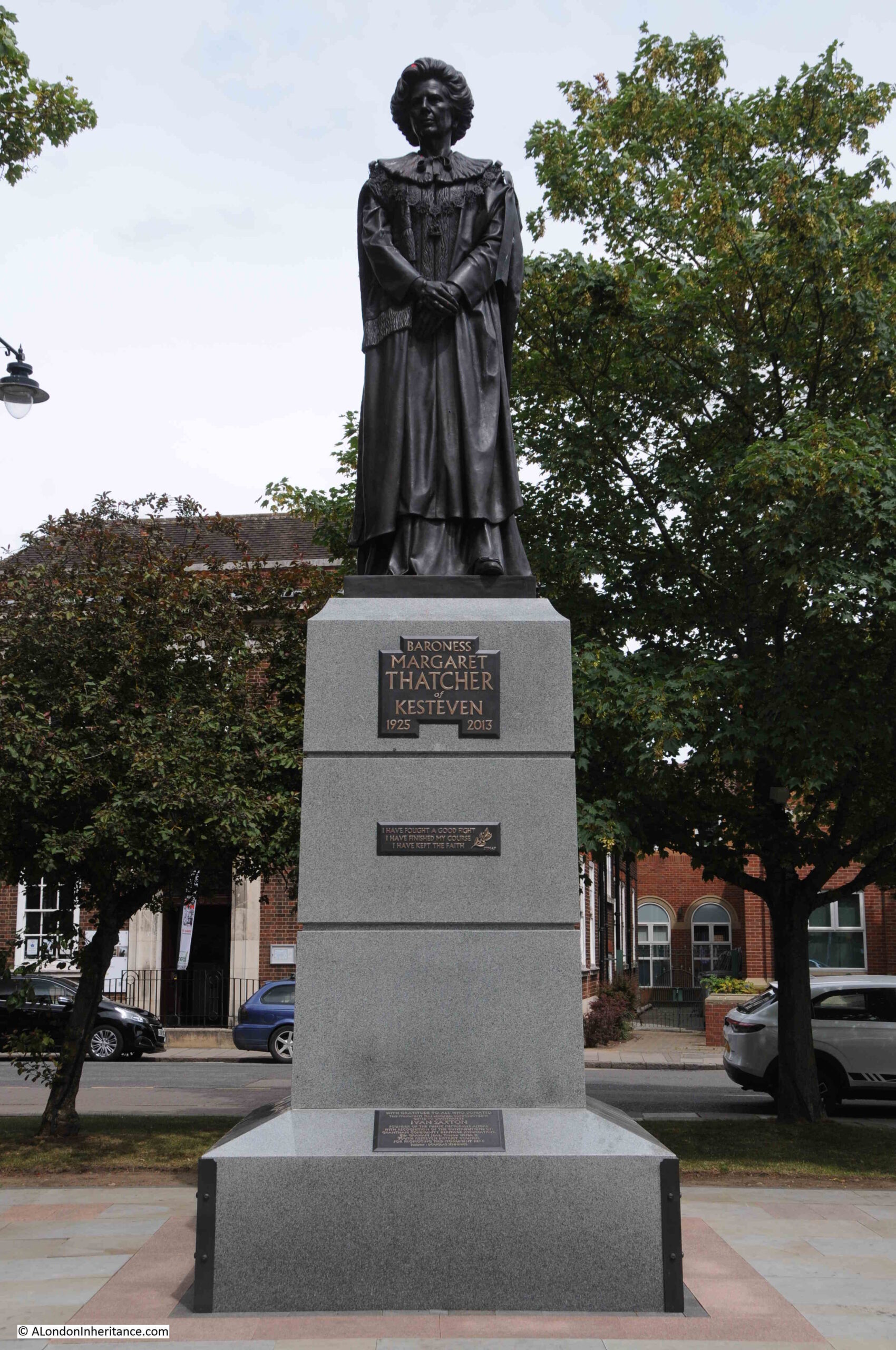
A recent statue in Grantham has resulted in some rather mixed feelings – the statue of Margaret Thatcher, who was born in Grantham in 1925:

Margaret Thatcher Grantham

Soon after being unveiled, people started throwing eggs at it, and an enterprising individual started selling eggs in front of the statue. CCTV was installed and there was a prosecution. The statue was very egg free on the day of our visit.

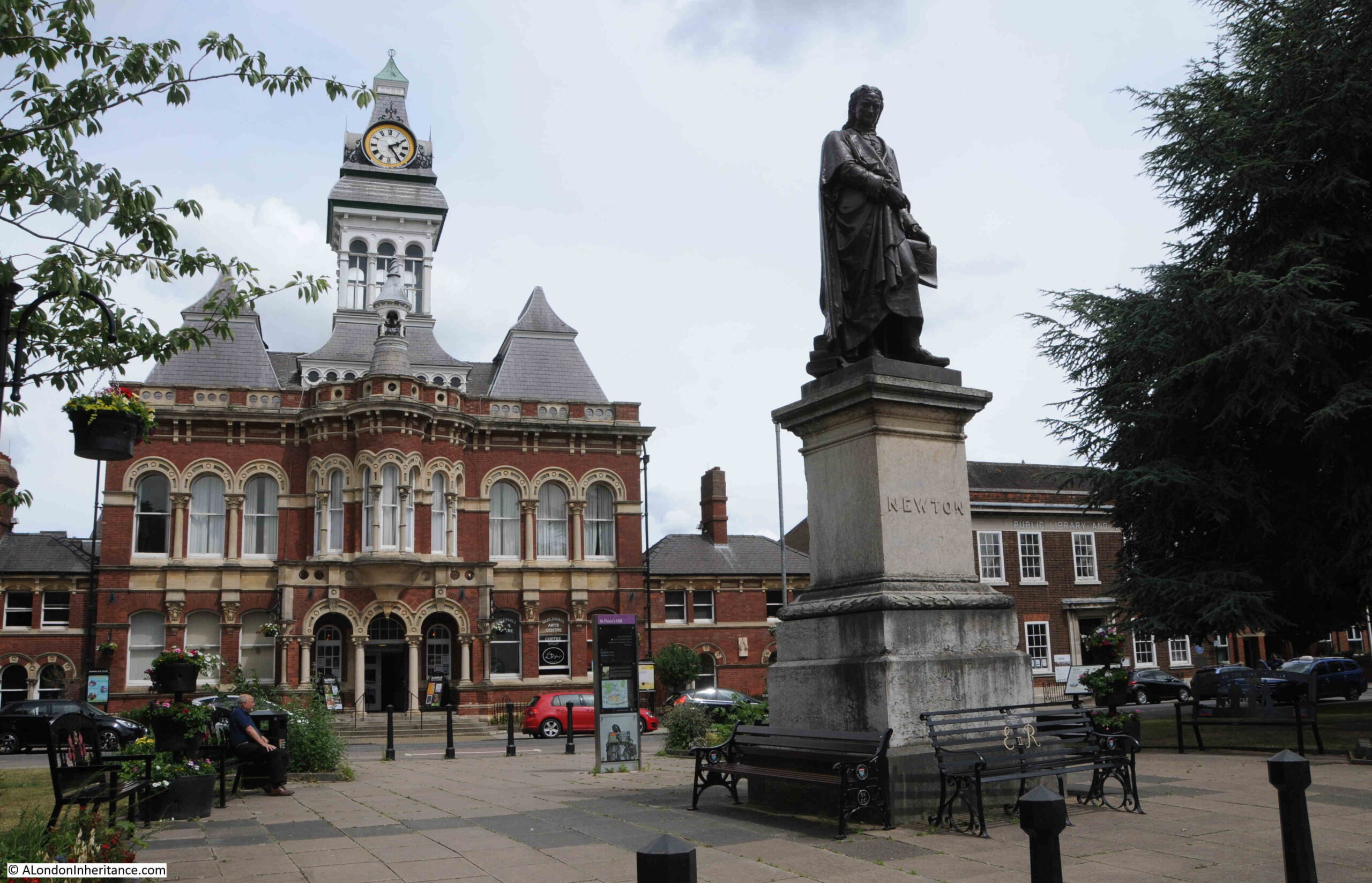
Another statue is that of Isaac Newton:

Isaac newton Grantham

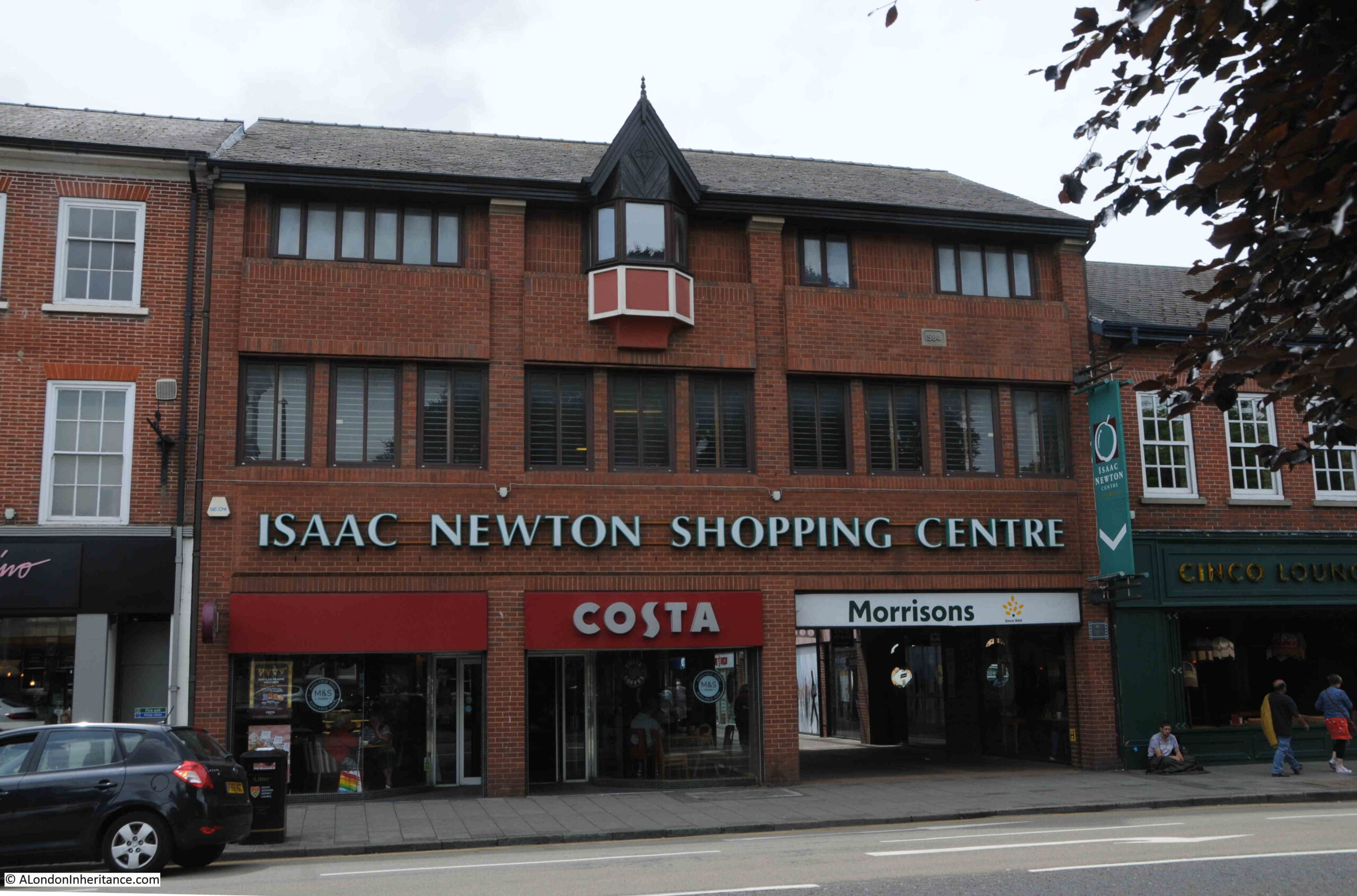
Newton was educated at the King’s School in Grantham, and today, as well as the statue, he has a shopping centre named after him:

Issac Newton Grantham

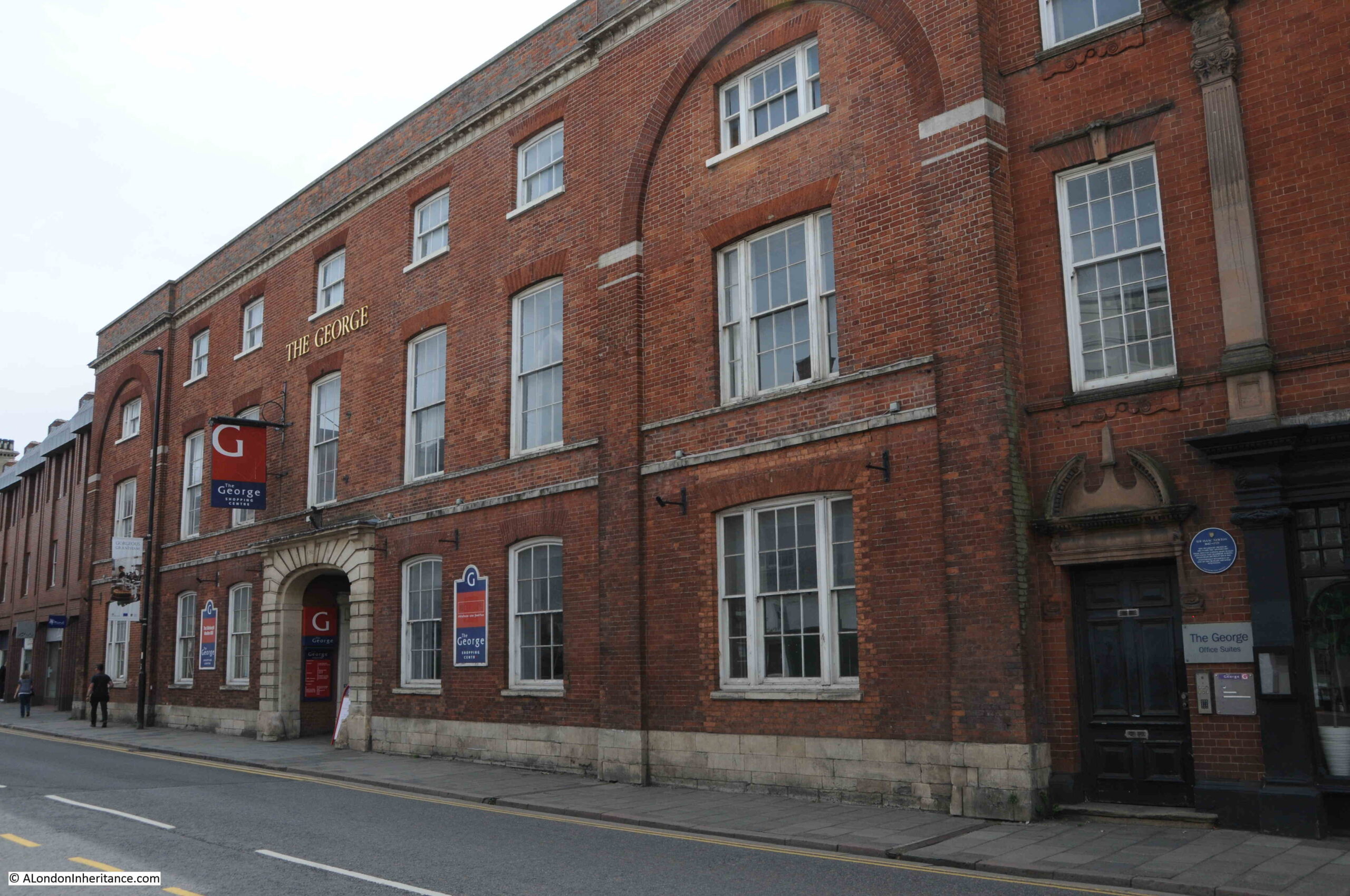
A blue plaque can be seen to the right of The George in the following photo. The plaque states that it is on the site of a house owned by Mr Clarke, the Apothacary, and that Isaac Newton lodged in the house whilst he was attending school in Grantham between 1655 and 1660.

The George Grantham

The George was built in 1789 as a coaching inn, servicing the considerable traffic that would have run through the town when the Great North Road / A1 ran through the town. It is now a shopping centre.

The next stop as the body of Eleanor was carried towards London would be further south along the old Great North Road, at:

Stamford

The Stamford Eleanor Cross was another of the those probably destroyed during the English Civil War, it seems to be the period most commonly referenced in a number of the books I have consulted.

The English Heritage page on the cross states that it is not known exactly when the cross was destroyed, although it was before the mid 18th century. The page also refers to William Stukeley recording the hexagonal steps of the cross, which is all that survived in 1745.

We have already seen a plaque to Stukeley in Grantham, which was his destination after he moved out of London. Whilst in Grantham he married, and found that his income was insufficient to support a family, and when he saw that the living of All Saints in Stamford was vacant and provided an income of £589 per annum, he used his contacts to secure the role, and moved the Stamford.

There is no confirmed location for either the original cross, or where Eleanor’s body was rested overnight whilst in Stamford.

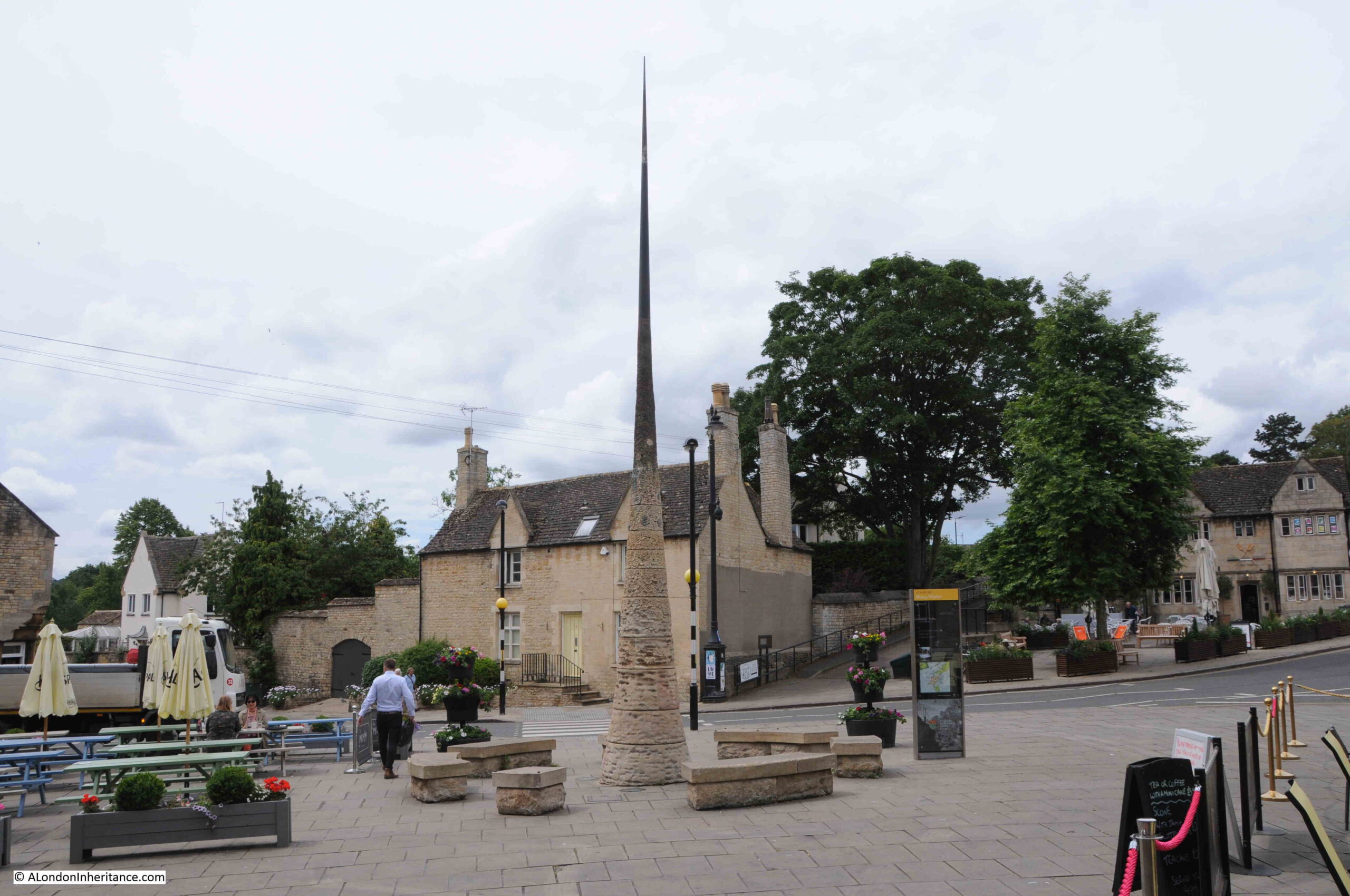
In 2008. to commemorate the original Eleanor Cross, a representative spire was installed in Stamford’s Sheep Market:

Eleanor Cross Stamford

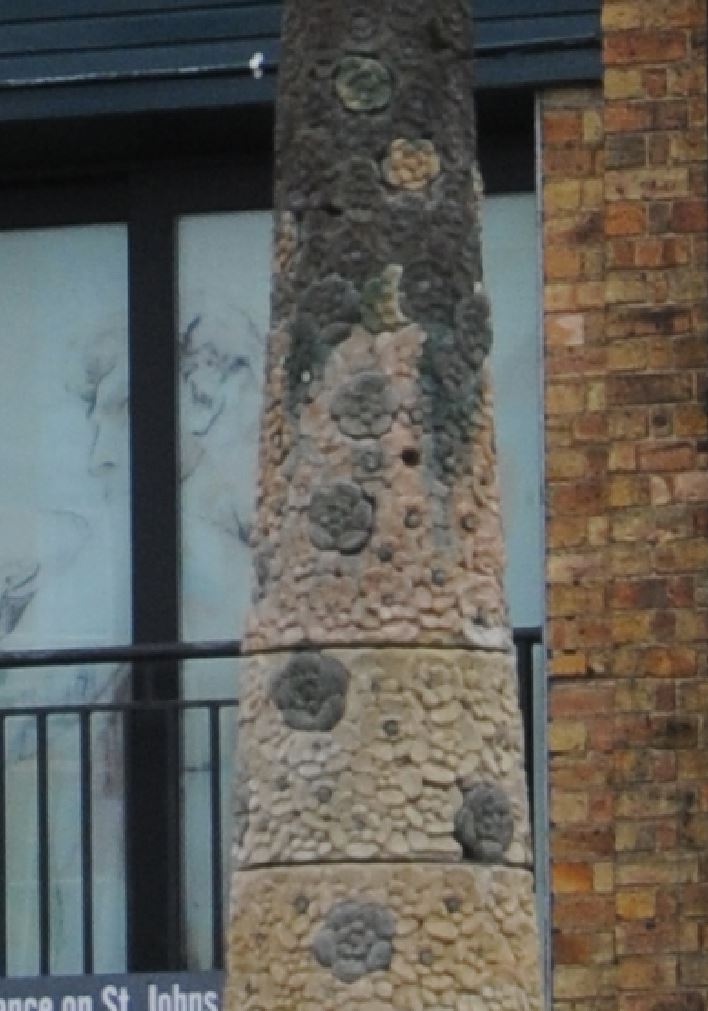
Part of the spire has a spiral of roses. These were the personal badge of Edward 1st.

Eleanor Cross Stamford

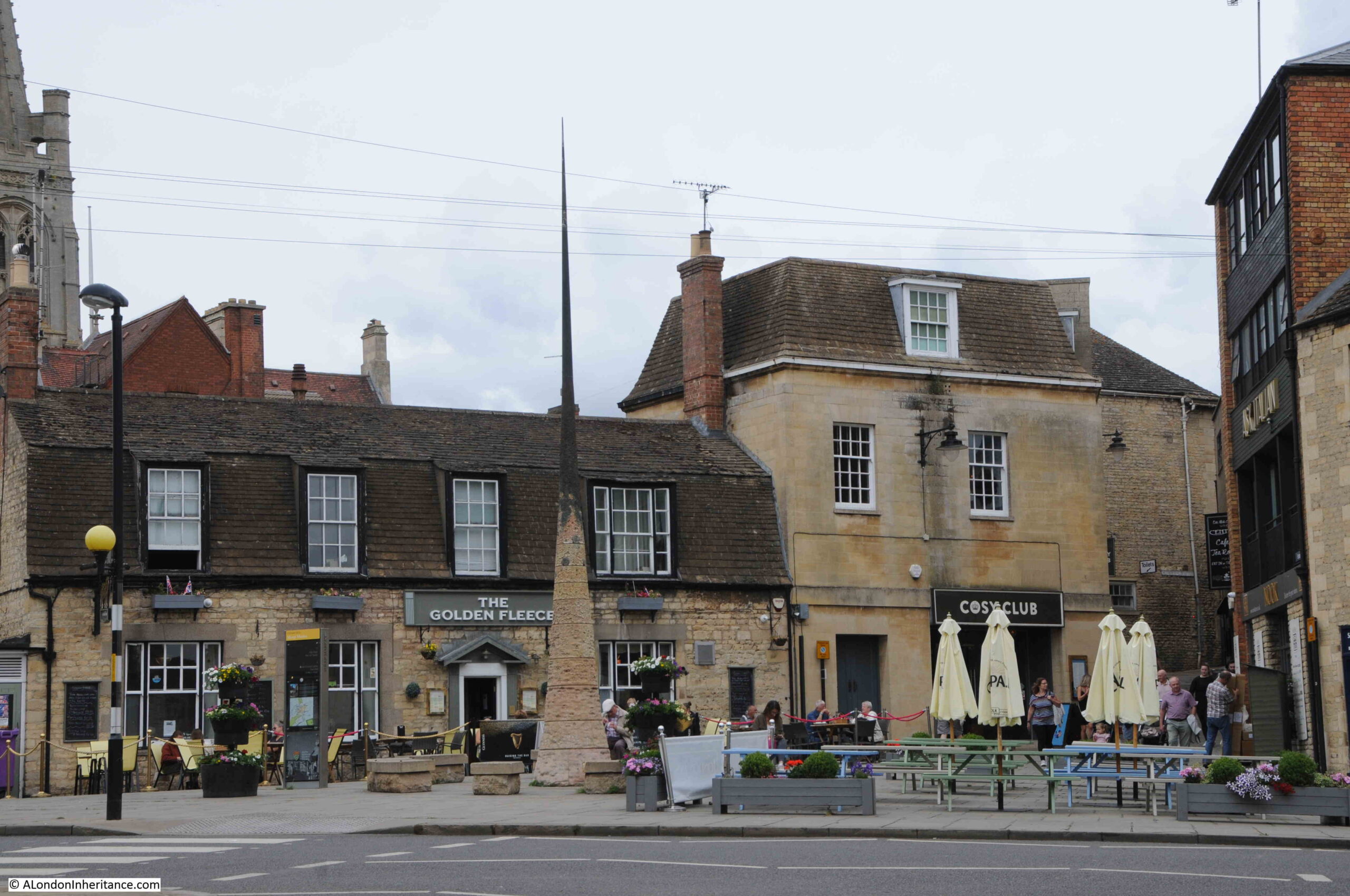
Another view of the spire in Stamford’s Sheep Market:

Eleanor Cross Stamford

Stamford is another very old town, and like Grantham, it was on the old Great North Road / A1, which now bypasses the town, and the high street is now pedestrianised which makes for a very pleasant environment:

Stamford

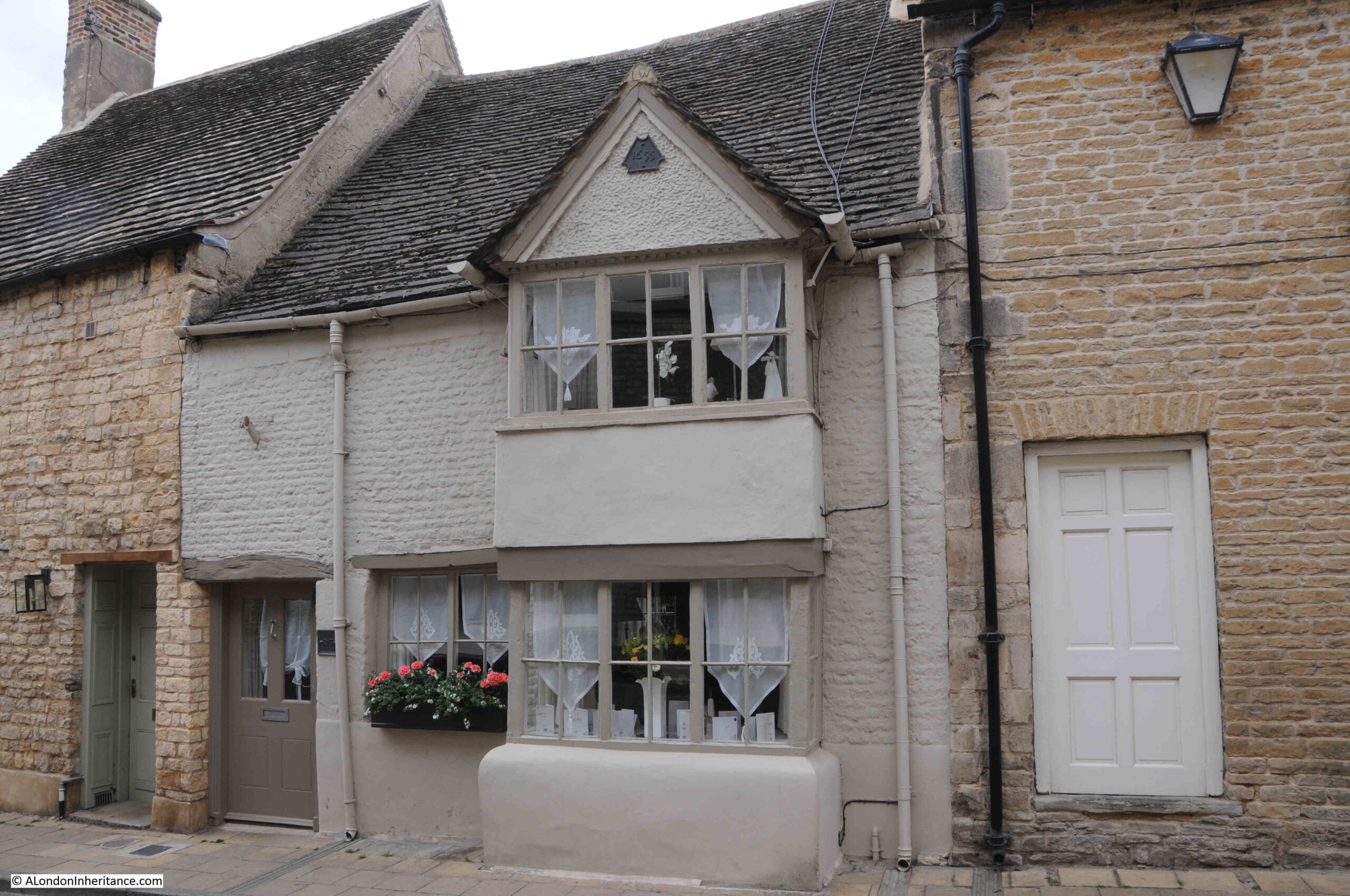
Stamford shows its age through the buildings that line the streets of the town. Many built of local stone, with the following house dating from 1655 according to the small plaque above the upper window:

Stamford

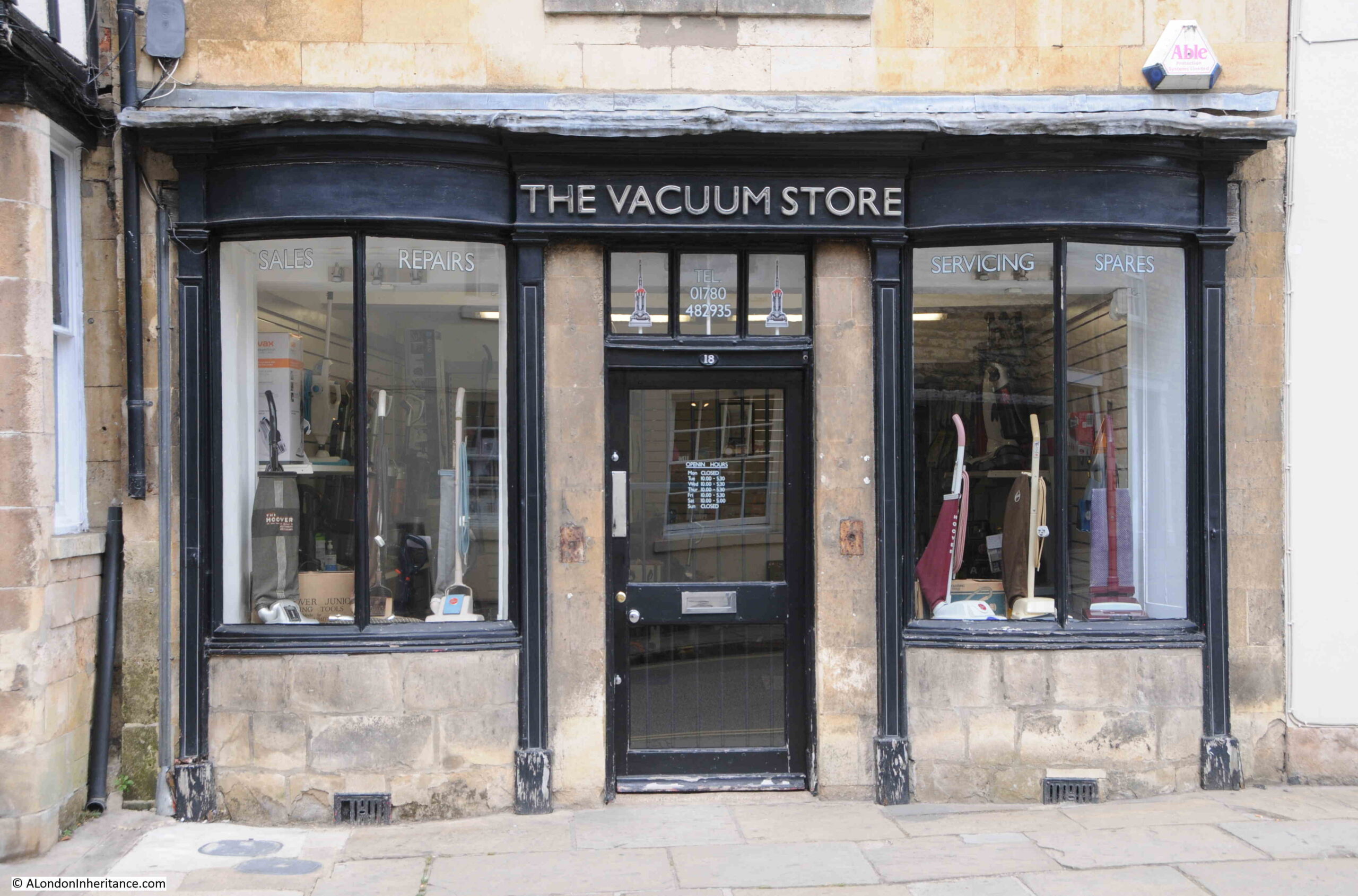
The vacuum store:

Stamford

Stamford is roughly 22 miles from Grantham, and this seems to be about the average distance travelled by the procession carrying Eleanor’s body in a day.

Eleanor died at the end of November, so the procession to London took place during the first weeks of December. These were weeks of short days and long nights. possibly cold and wet with poor road conditions so this must have been a difficult journey.

Nightly stops needed to be at a place where Eleanor’s body could be rested in a suitable place, and that there were appropriate lodgings for Edward I, and those who accompanied him on the journey to London.

The route also needed to avoid major obstacles such as rivers, and this is one of the reasons why Stamford was on the route, as in Stamford, the Great North Road crossed the River Welland, and still today, with the exception of the A1 by-pass of the town, the route over the Welland is the only crossing for some distance.

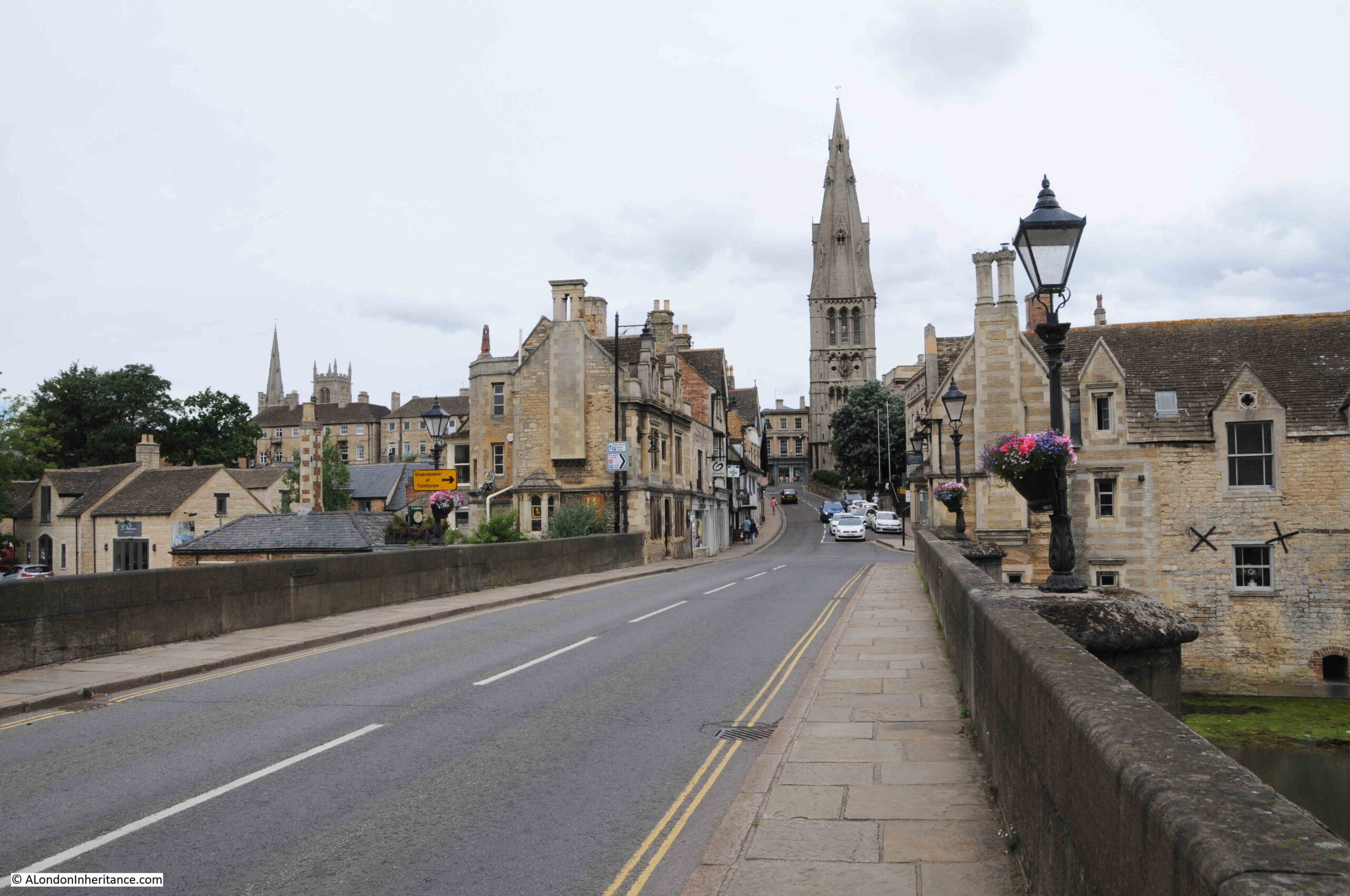
The following photo shows the bridge over the Welland on the approach into Stamford:

Stamford

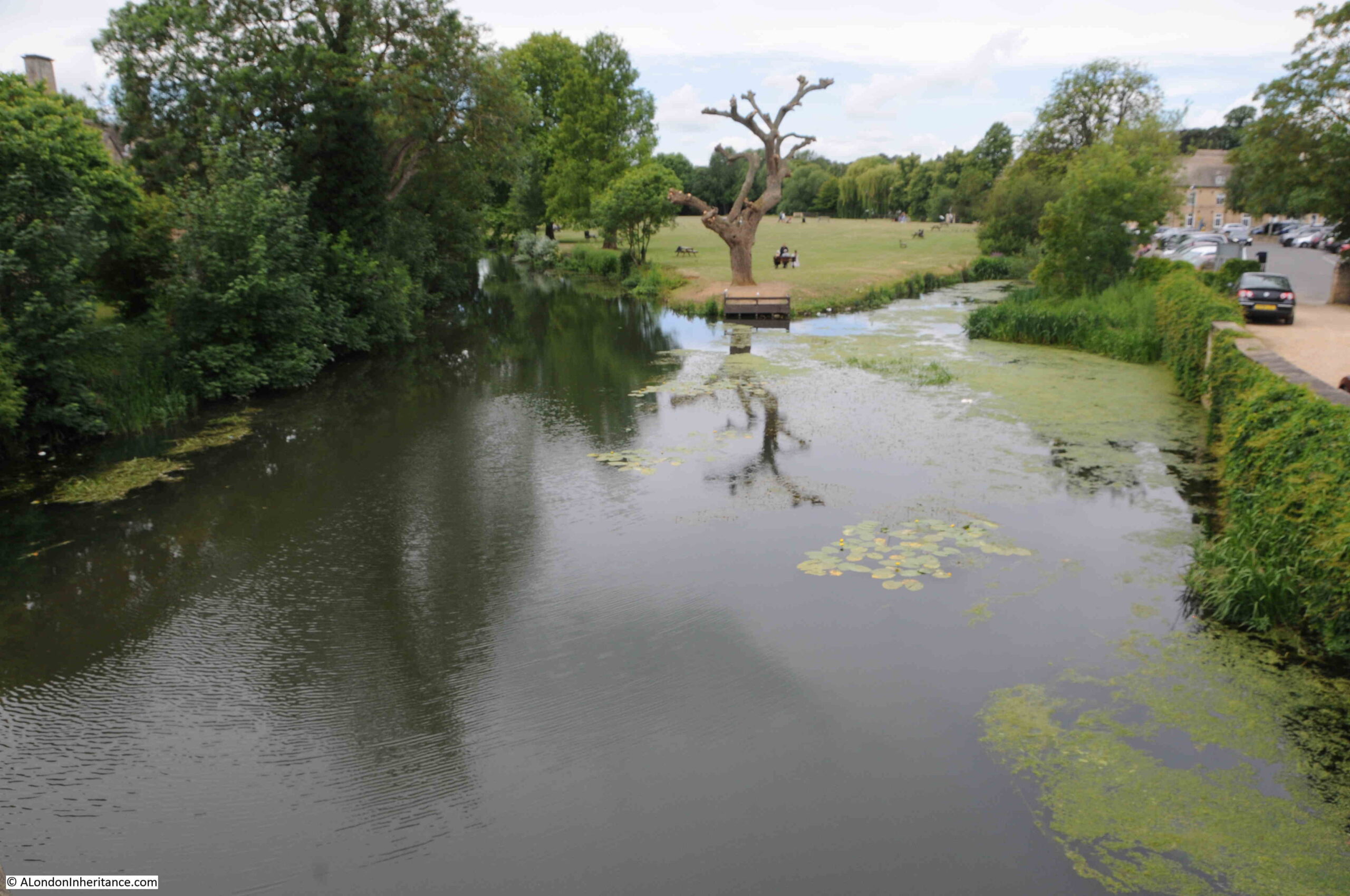
View from the bridge to the west, where the River Welland splits into two before joining again in a couple of miles:

Stamford

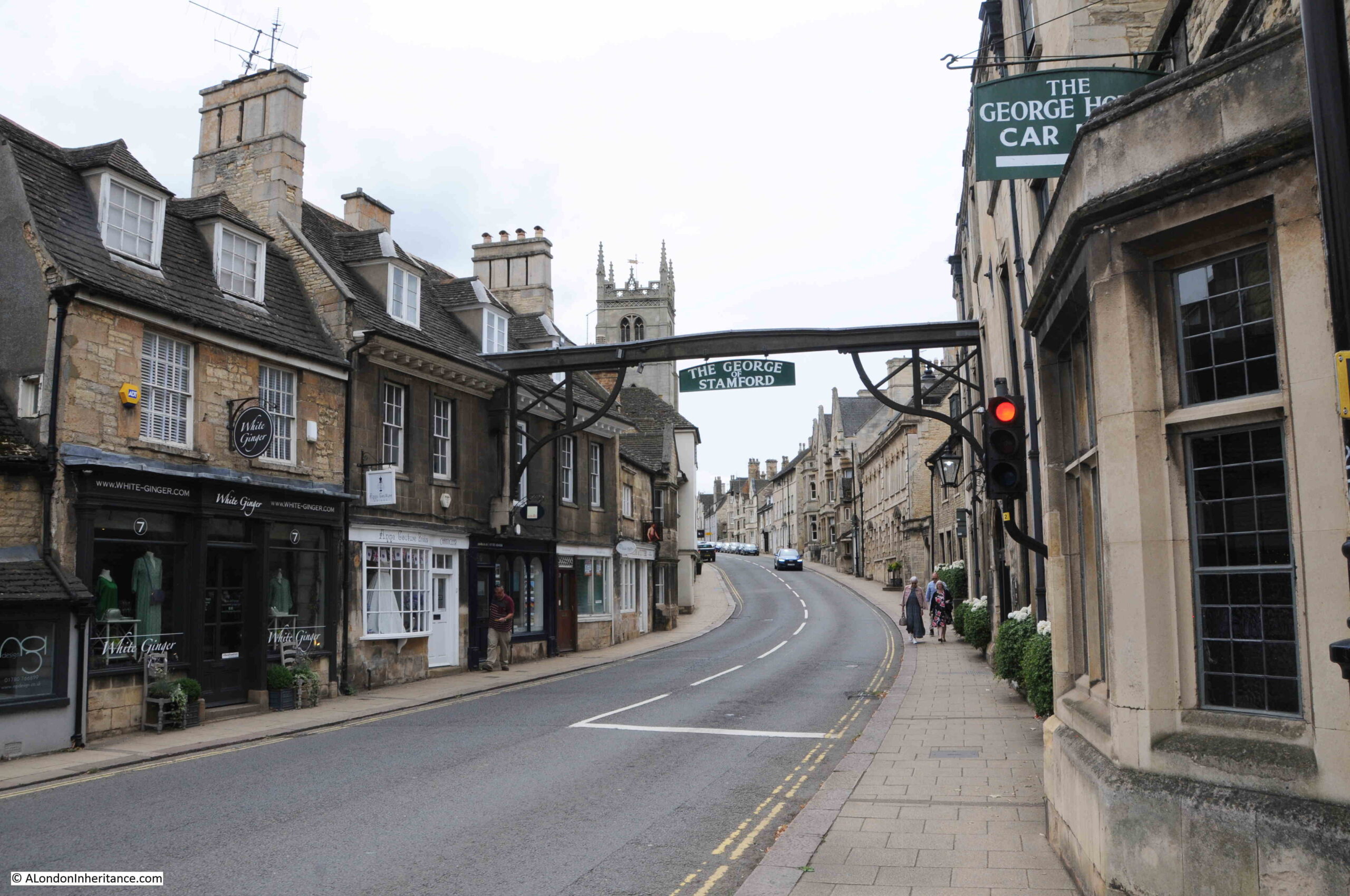
Looking in the opposite direction, away from the town, along the old Great north Road:

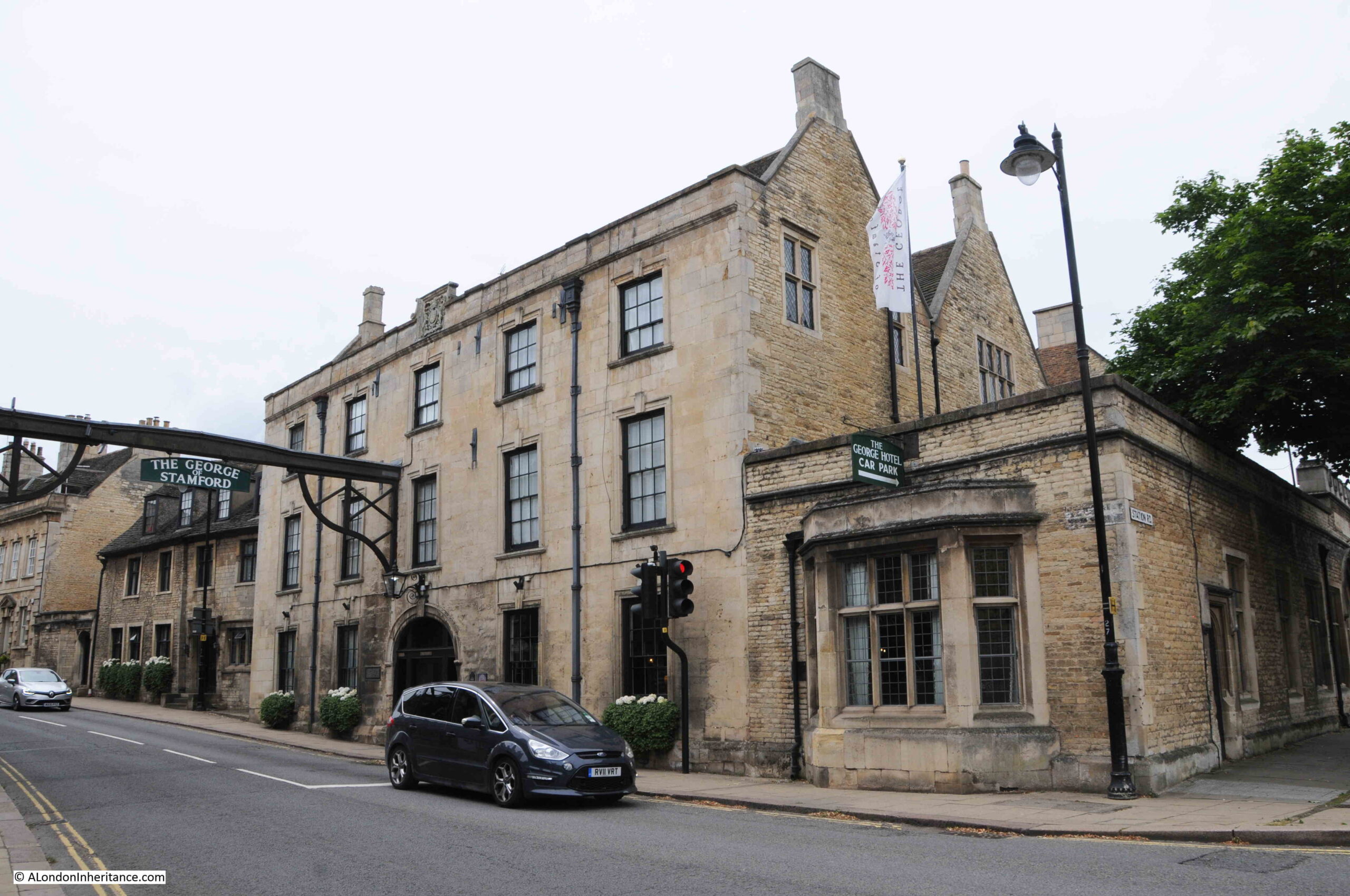
The George Stamford

This stretch of the road is unique in retaining a wooden inn sign that stretches across the road. This is for the George Hotel which is on the right in the above photo.

The George is an old inn, again one of many coaching inns that were on the old Great North Road. The sign across the road, as well as the current view of the George dates from the 18th century.

The George Stamford

The George is certainly on the site of a centuries old inn, however the George’s claim that an ancient hostelry existed on the site in 947 is difficult to confirm. A hostelry could well have been next to a key river crossing on the main road from London to the north for many centuries.

A plaque on the hotel states “In medieval times when the house of the Holy Sepulcher stood on this site knights of Saint John of Jerusalem were entertained here. In the garden at the rear Crusaders in their black robes with white cross walked and talked. The gnarled mulberry tree dates from the time of James I. The main block of the hotel was erected in 1597 by Lord Burghley, Lord High Treasurer to Queen Elizabeth I. At least three kings and many other famous travelers have stayed here”.

Next to the George are a row of almshouses that have their origins back in the 12th century, when they formed part of the medieval hospital of St John the Baptist and St Thomas:

Stamford

For the next stop on the route to London, the procession left the Great North Road and headed across country to a small village, where I finally find a surviving Eleanor cross, at:

Geddington

The procession arrived at Geddington on the 6th of December 1290. Geddington is a small village, and the reason for choosing the village as a stop is that a royal hunting lodge was close by, just north of the church. The lodge had been built in 1129 and was used by royal hunting parties in the local forests, indeed Edward and Eleanor had stayed at the lodge in September of 1290.

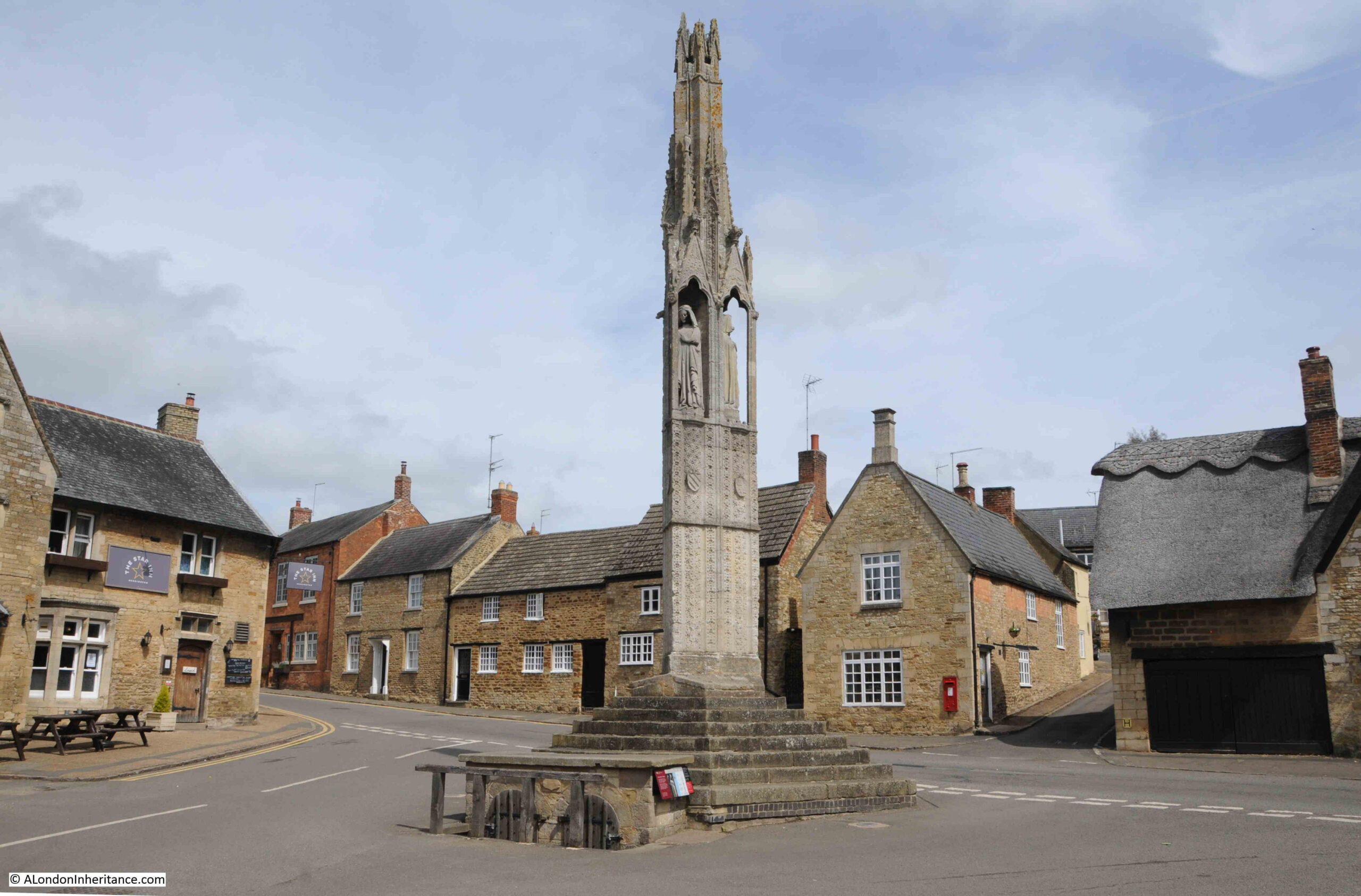
Geddington has the best preserved of all the remaining Eleanor crosses, which is located in an open space at the centre of the village:

Geddington Eleanor cross

The cross has been repaired a number of times, and has been used for a rather gruesome, local custom. The book Old Crosses and Lynchgates by Aymer Vallance, published in 1933 reports that:

“Tradition says that a favourite sport of the place used to be squirrel-baiting. A sufficient number of wild squirrels having been caught for the purpose, would be turned loose in the village, where the crowds, surrounding them in a ring, with shouts and all manner of hideous noises, proceeded to hunt and beat the helpless victims to death. Sometimes the terrified little creatures would vainly seek refuge by running up the cross and trying to hide behind the pinnacles and tabernacle work. but their cruel tormentors ruthlessly dislodged them thence, pelting them with stones until they were driven forth and killed. The only marvel, in the circumstances, is that any part of the original stonework of the cross should have survived such reckless violence.”

Rather hard to believe that such a cruel activity took place in this quiet village space, however the past was a very different place.

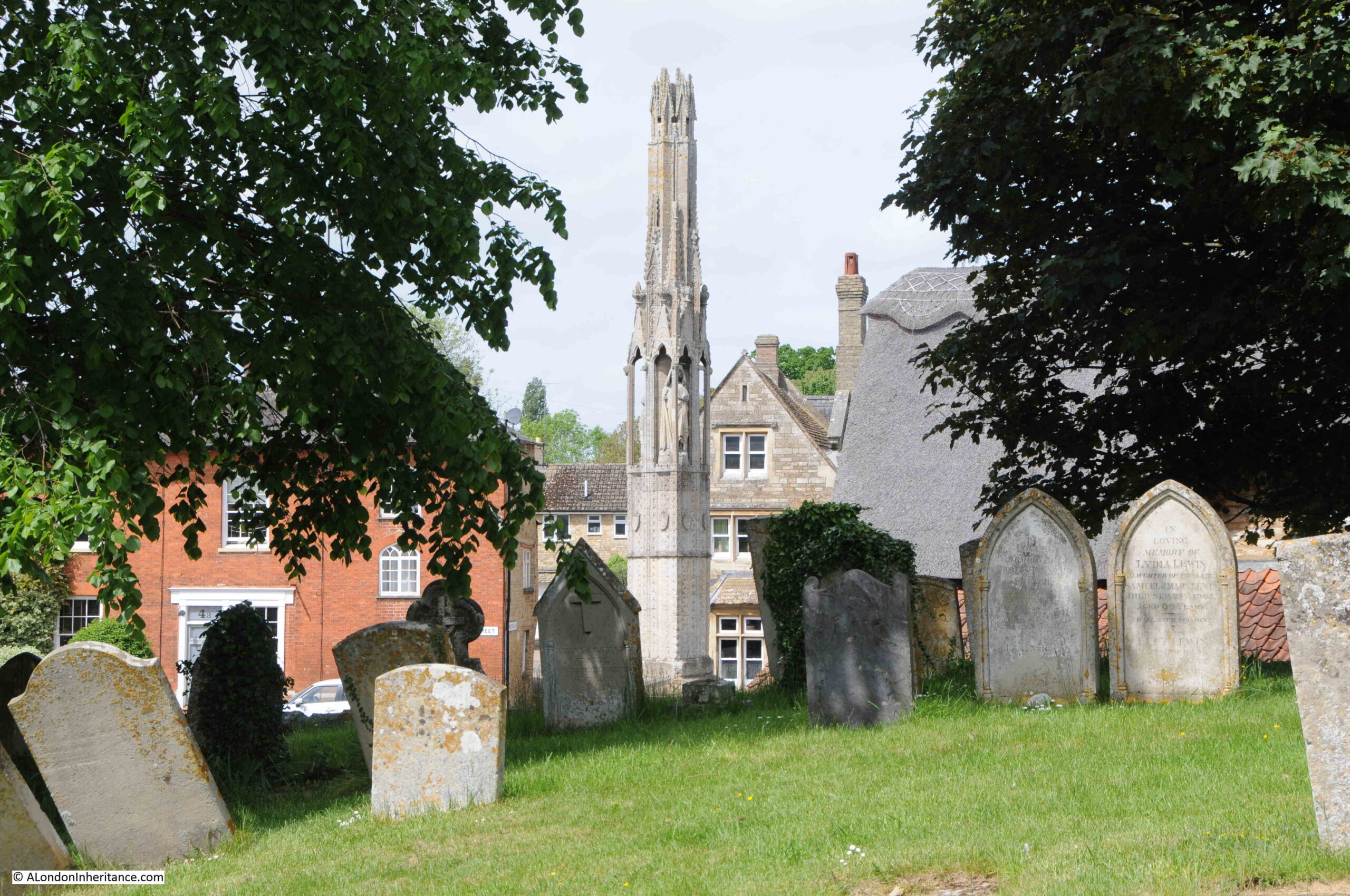
The cross dominates the centre of the village. It is roughly 42 feet in height and can be seen from surrounding side streets, and from the raised graveyard of the nearby church:

Geddington Eleanor cross

English Heritage state that whilst Edward I stayed overnight in the hunting lodge, Eleanor’s body rested in the parish church of St Mary Magdalene:

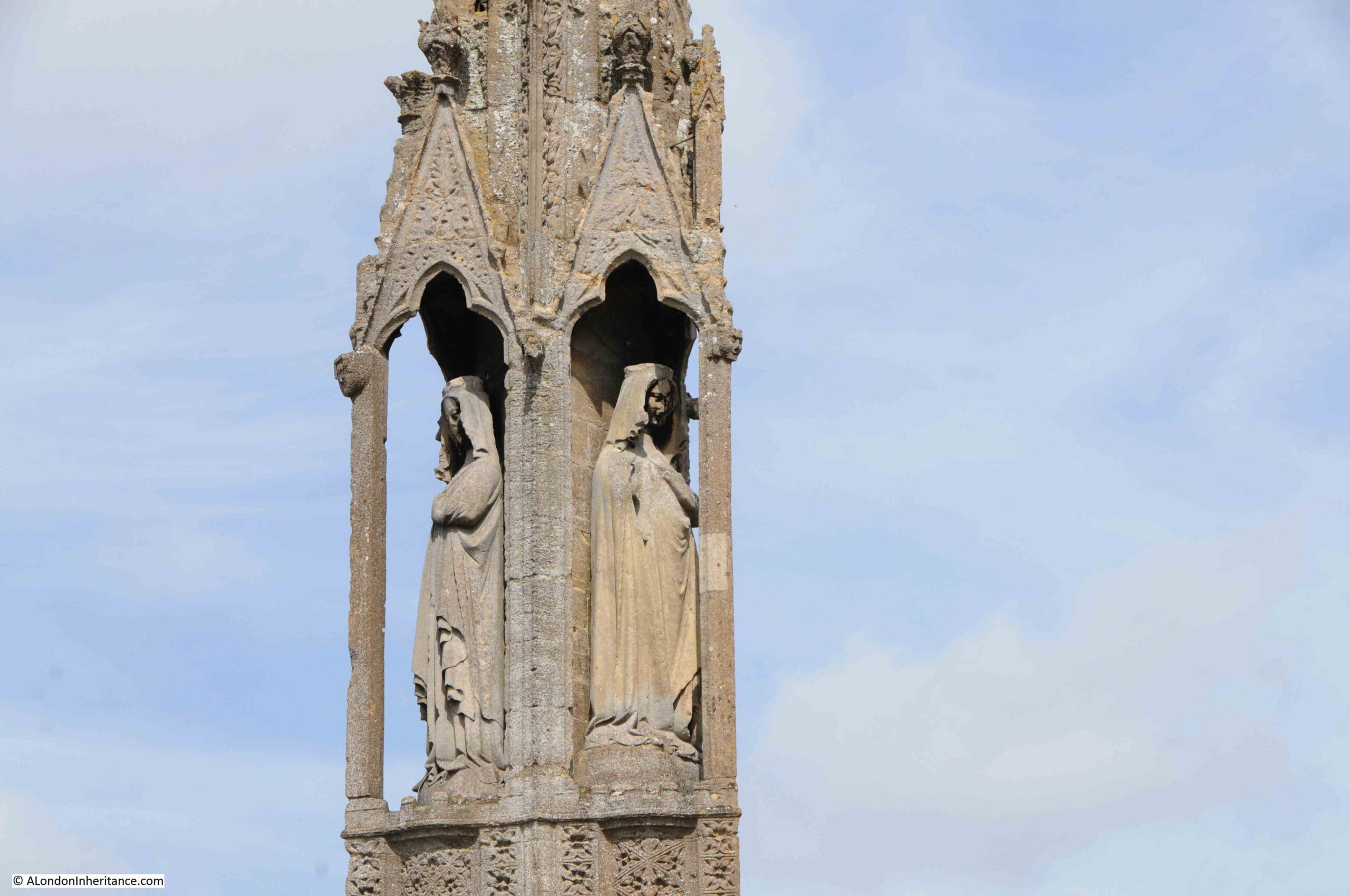
Statues of Eleanor look out from half way up the cross:

Geddington Eleanor cross

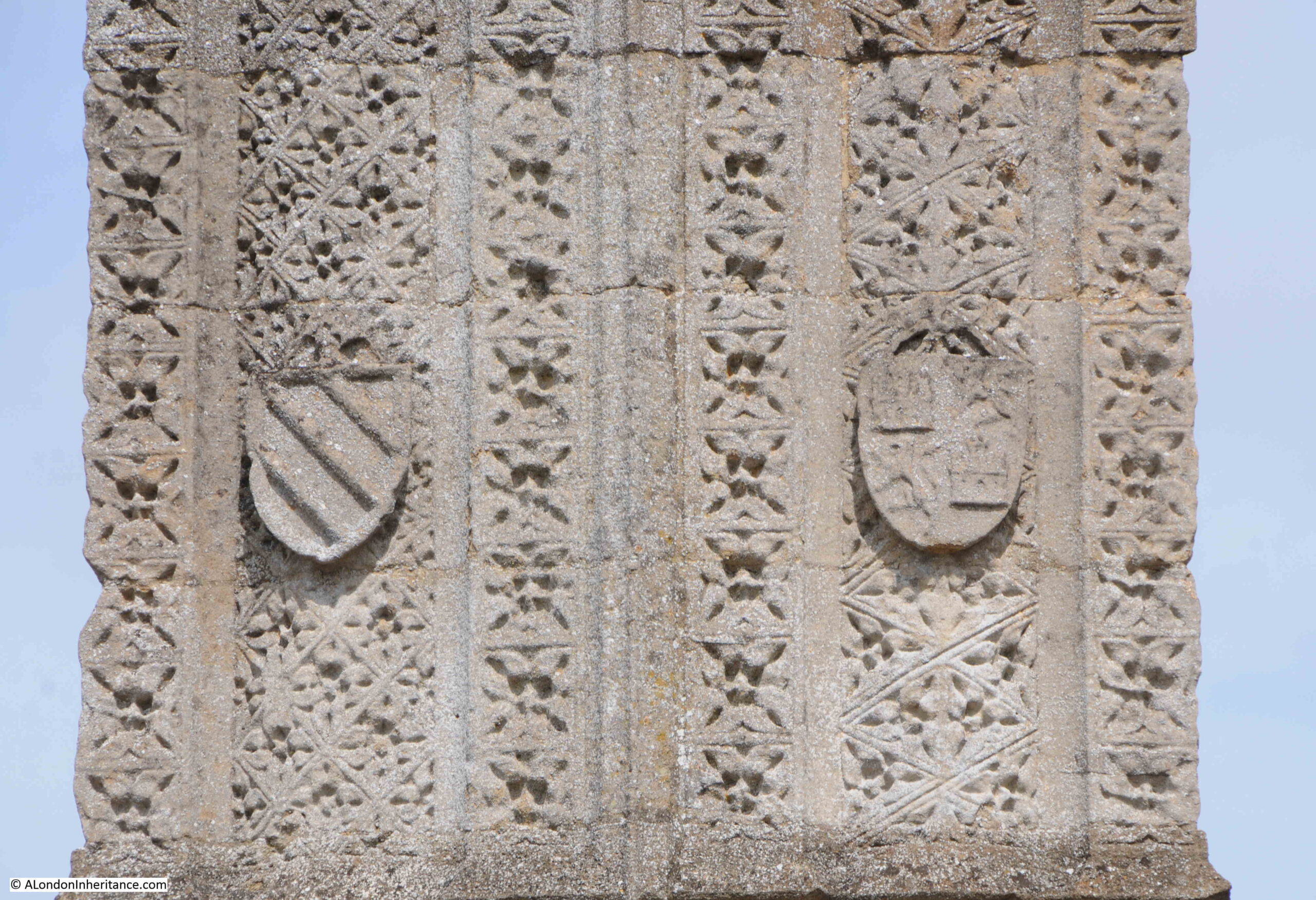
On the body of the cross, we can see again the arms of Ponthieu and of Eleanor of Castile, along with the level of decoration on the cross:

Geddington Eleanor cross

Geddington has another treasure to find, a bridge that dates from around 1250, 40 years before the procession carrying Eleanor’s body passed through the village:

Geddington bridge

The Geddington bridge is over the River Ise and is a Scheduled Ancient Monument with a Grade II* listing. The Historic England listing states the bridge is “Circa 1250, with later repairs”, and some of those later repairs date from 1784 as there is a key stone in the middle arch with the date.

There was a wonderful little series of books published in 1932 by the Architectural Press titled Ancient Bridges, with each of the three books covering a different region. There is an entry covering the bridge in the volume for Mid and Eastern England:

“Three of its four arches are pointed in shape; but at least one of these appears to have been rebuilt, and the southern arch has been repaired with blue bricks. The cut-waters are immense, with correspondingly large recesses for foot-passengers, but these were neccessary as the parapets are less then 11 feet apart. The total span is 29 yards. A by-pass bridge has recently been built a short distance upstream of this ancient bridge.”

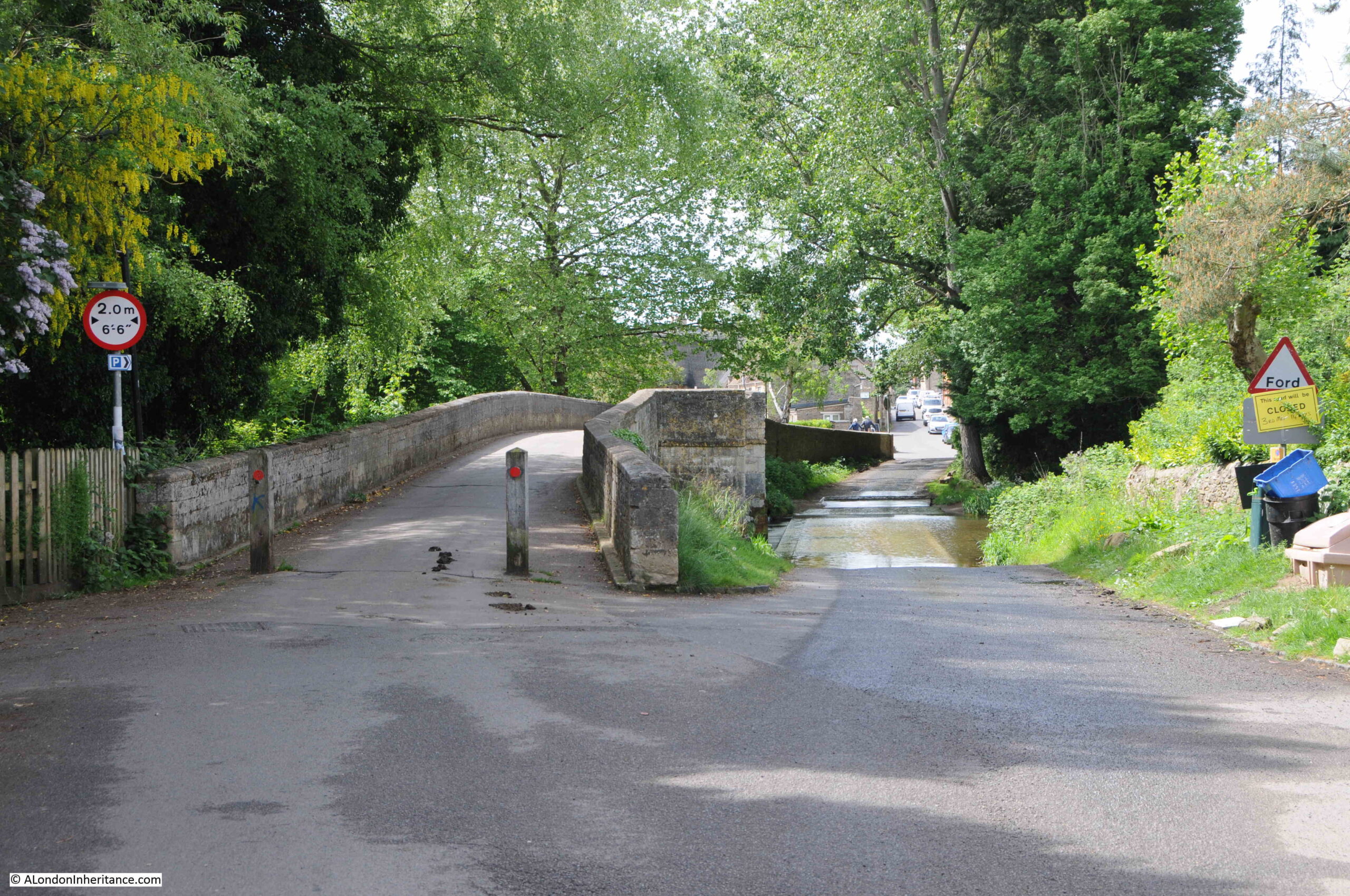
The bridge is too narrow for vehicles, and a ford is in the river alongside the bridge, where the water of the River Ise flows over a concrete base, allowing vehicles to cross. The large features projecting from the bridge are what were described as cut-waters in the above description.

Geddington bridge

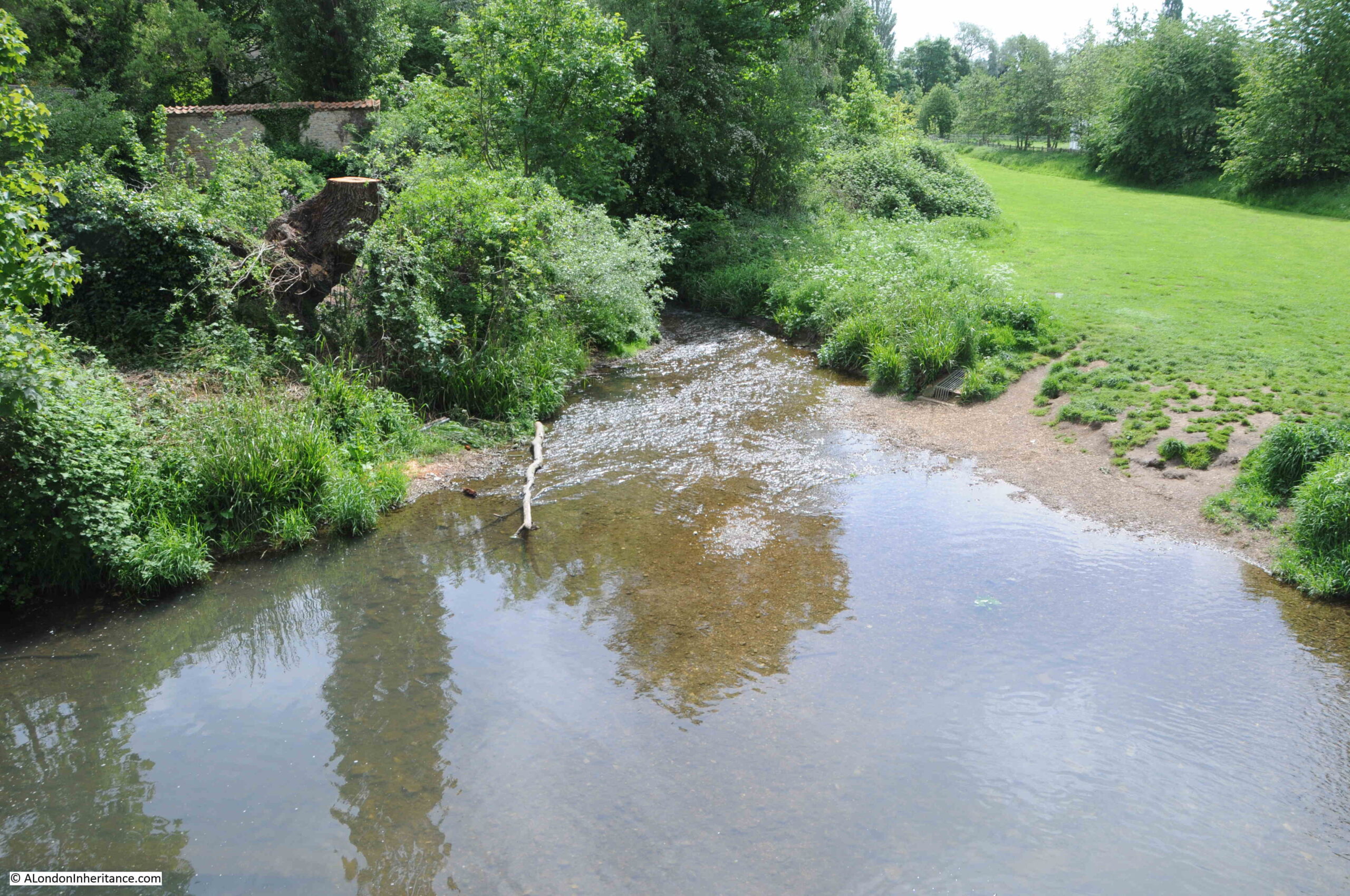
The River Ise flowing away from the bridge on a summer’s day:

Geddington bridge

There is no way of knowing whether the procession carrying Eleanor’s body crossed the bridge. Geddington is today bypassed by the A4300, which crosses the River Ise over what must be the by-pass bridge mentioned in the 1932 book.

If the A4300 is not there, the bridge at Geddington is the only bridge over the river for a reasonable distance, so it is probably safe to assume that the procession did cross the bridge in 1290.

It would be interesting to know what the villagers of Geddington thought of the arrival of the procession with King Edward I, the body of Eleanor of Castile and the supporting party. Being December, they probably arrived after dark.

It must have been with a mix of fear and fascination that the villagers watched such a solemn procession arrive in their village, with the King of England, and the body of his dead Queen.

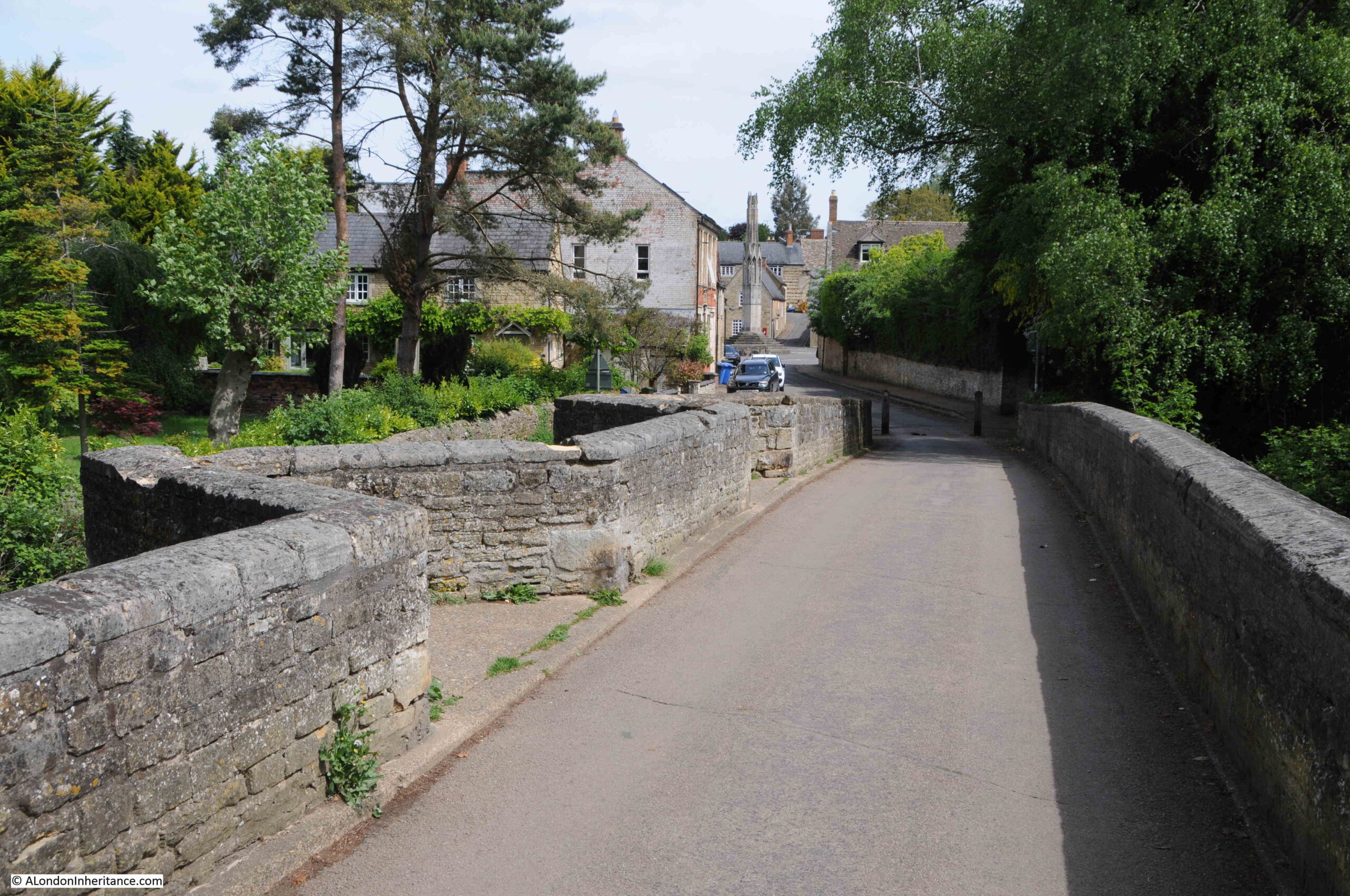
View from the bridge looking back to the cross in the centre of Geddington:

Geddington bridge

Geddington is a very different place to the location of the rest of the Eleanor crosses, and it has the Royal Hunting Lodge to thank for putting the village on the map with the superb 13th century cross.

The next post will continue the journey to Eleanor of Castile’s resting place at Westminster Cathedral.

alondoninheritance.com

Eleanor of Castile – A 13th Century Journey to London

I have always been fascinated by London’s place in the wider country. One aspect of this has been London as a destination for journeys over the centuries, which in the past has been driven by London’s role as a centre of royal, political, judicial, religious and commercial power. One such journey was in the 13th century, when the body of Queen Eleanor of Castile was brought from the place of her death near Lincoln, for burial in Westminster Abbey.

This was a long journey, and where the procession with Eleanor’s body stopped for the night, a cross would later be built to commemorate the journey, the Queen and provide a focal point for prayers for the Queen.

I have long wanted to follow the route, to find the remaining crosses, and the sites where they are missing, so this summer, we traveled the route, starting at Harby, the location of Eleanor’s death, through to Westminster Abbey.

Starting today, and with some additional posts during the coming week, join me on a trip across the country, from a small village in Nottinghamshire to a tomb in St Edward the Confessor’s chapel at Westminster Abbey, with the stopping points identified in the following map (© OpenStreetMap contributors):

Eleanor of Castile route of Eleanor crosses

The first red dot is at Harby, Nottinghamshire, then Lincoln, Grantham, Stamford, Geddington, Hardingstone, Stony Stratford, Woburn, Dunstable, St. Albans, Waltham and then into Central London at Cheapside, Charing Cross and finally Westminster Abbey.

Today’s post covers the first two red dots, Harby and Lincoln.

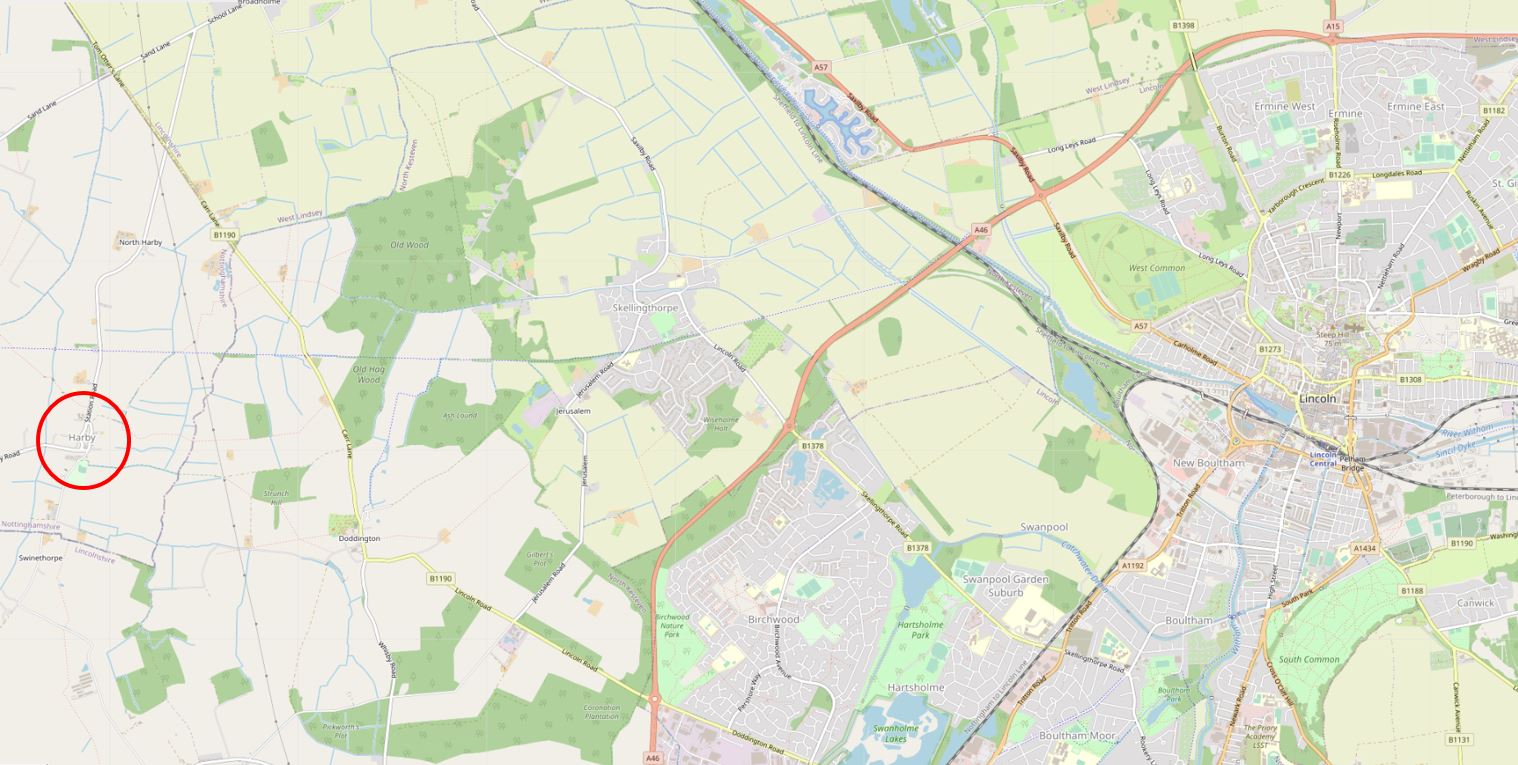
Harby is a very small village, which although being very close to Lincoln, is on the edge of the county of Nottinghamshire. Harby is ringed on the left of the following map, showing a small village in a very rural location. Lincoln is the city on the right:

Eleanor of Castile

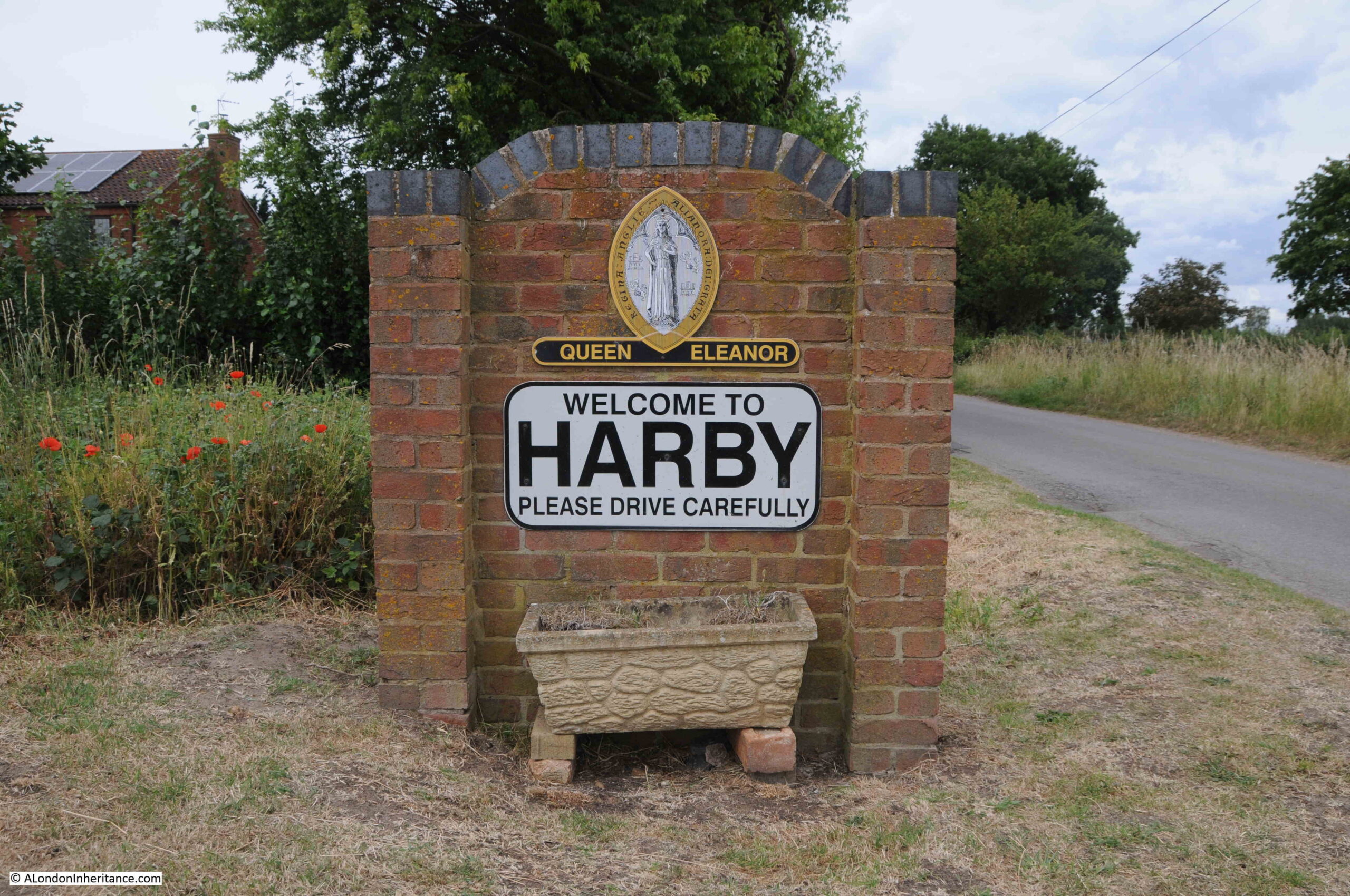
Arriving at the village of Harby, and the name sign at the entrance to the village includes a plaque to Queen Eleanor:

Eleanor of Castile

So who was Queen Eleanor of Castile, and how did she end up in the small village of Harby?

Eleanor of Castile was a remarkable woman.

Born in 1241 in Burgos, Spain, Eleanor was the daughter of Ferdinand III of Castile and Joan, Countess of Ponthieu.

Ferdinand III was responsible for the considerable expansion of Castile as he took back much of the south of what is now Spain that had been taken by the Almohad Caliphate, who had originally come from north Africa where they ruled extensive lands.

Ferdinand III took back the area then known as Al-Andalus, and the current name Andalusia is derived from the earlier Arabic name.

During Eleanor’s early life, her father Ferdinand was away for considerable periods of time, however he was responsible for ensuring his children’s education, and unusually for a royal daughter of the time, Eleanor was highly educated.

When not on military campaigns, Ferdinand and Joan would travel across Castile and Andalusia, and their children would often come with them along with the royal court. It is from her upbringing that Eleanor probably saw the role of a Queen as being expected to accompany the King and royal court on their travels, and she did travel with Edward I on his campaigns and journeys across his British kingdom, and abroad.

Ferdinand III died in Seville in 1252, and Eleanor’s half-brother, Alfonso X took over the Castilian crown.

As was standard in medieval royal families, children were often seen as important in establishing relationships through marriage with other royal families, with the settling and prevention of disputes, and to bring key European areas of land under the control of a royal family looking to expand their power.

This is what Eleanor would have been brought up to expect, and what did indeed end up happening, although unlike many royal marriages, Eleanor’s appeared to have been a very happy one, with Edward and Eleanor being devoted to each other.

The marriage that Alfonso arranged for Eleanor was based on rival claims for the Duchy of Gascony, part of Aquitaine in southern France, which was part of the Angevin Empire and ruled over by English kings through the House of Plantagenet. Europe at the time was a complex web of kingdoms and families, most of which also were part of a complex web of family relationships.

The marriage arranged by Alfonso X of Castile and Henry III of England resulted in the marriage of thirteen year old Eleanor with Henry’s son Edward, then aged fifteen and put together a relationship between the two royal families that would avoid a potential Castellan attack on Gascony.

They were married in the Abbey of Santa María la Real de Las Huelgas in the city of Burgos, after which they spent a year in Gascony, with Eleanor then travelling to England, followed soon after by Edward. One wonders what a fourteen year old must have felt travelling to a new country, on her own, and without any supporting family members, although she must have had some members of Edward’s court with her.

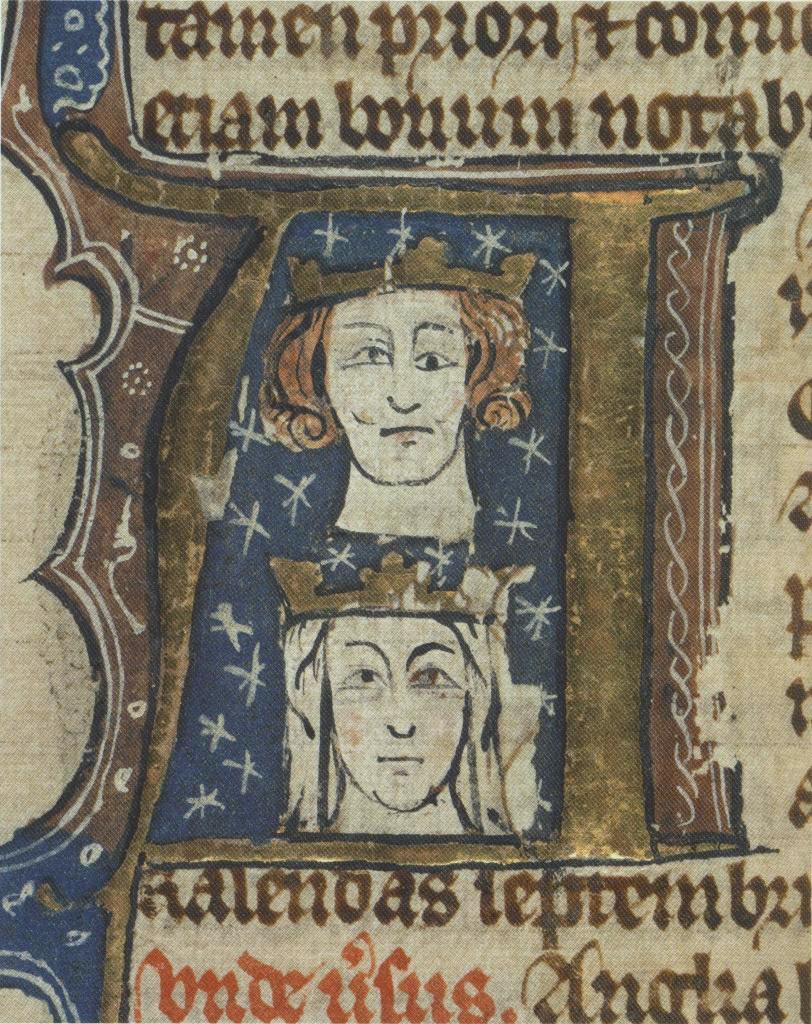
The following image from an early fourteenth-century manuscript shows Edward and Eleanor, Source: https://commons.wikimedia.org/wiki/File:Edward_I_and_Eleanor.jpg Attribution: Unknown author, Public domain, via Wikimedia Commons

Eleanor of Castile

I will cover more about Eleanor’s life as queen in the coming posts, but for now I will jump forward to the time of her death.

Prior to her death she had been in Gascony, and it seems she may have contracted a form of malaria whilst there. Following her return to England, along with Edward, she started a tour of the north with the intention of visiting many of the properties that Eleanor owned.

She was heading towards Lincoln, but became too unwell to continue travelling, and stopped at the house of Richard de Weston in the village of Harby, and it was here that she died on the 28th of November 1290.

Although an Eleanor Cross was not erected in Harby, as the place of her death, the village seemed the appropriate place to start if I was to follow her route back to Westminster Abbey.

Harby is a small village in the flat, agricultural lands to the west of Lincoln. Although very close to Lincoln, it is in the county of Nottinghamshire, not far from the border.

in the 2011 census, the village had a population of 336, and the village dates back to at least 1086, when Harby was mentioned in the Doomsday book. The Primary School in Harby is named after Queen Eleanor.

Very little has happened in Harby. Apart from the death of Eleanor of Castile, and more recently, the crash of an RAF Meteor jet into the centre of the village, killing the pilot, one person on the ground, injuring a number of others, and destroying some houses.

The site of the house of Richard de Weston is close to Harby church. The current church is not that old, having been built between 1874 and 1877. It has a rather impressive side tower and spire for a relatively small village church.

Eleanor of Castile Harby Church

Eleanor of Castile features prominently at the base of the tower:

Eleanor of Castile on Harby Church

The arms on the left are the three lions of the Royal Arms of England. It is interesting that the origins are these arms date back to the Plantagenet’s, a royal family who had their origins in Anjou, France.

The arms on either side of the statue are those of Eleanor of Castile (the arms of Leon and Castile). To the right are the arms of Ponthieu (Eleanor’s mother was Joan, Countess of Ponthieu and Eleanor became Countess of Ponthieu in her own right in 1279 following her mother’s death). We will see these arms many times on the journey to London.

Path and lamppost in Harby churchyard heading to the rear of the church:

Eleanor of Castile Harby Church

The moated house of Richard de Weston where Eleanor of Castile died is just to the west of Harby church, and the following view is to the west from the edge of the churchyard. An outline of the site is apparently still visible, believed to be the area surrounded by the small trees / bushes:

Eleanor of Castile Harby

In the hours following Eleanor’s death, Edward must have been at a complete loss. She had died at the age of 49, and should have expected a longer life despite the early mortality of the age. Her mother was still alive and Edward was probably expecting to spend more years with his wife. They had been married for 36 years.

Edward finally agreed to leave Harby, and a procession headed towards Lincoln, where the start of Eleanor’s last journey to London would begin, so Lincoln was my next stop.

The procession headed to St Katherine’s Priory which was to the south of Lincoln, just outside the City walls.

The priory was part of the Gilbertine Order, founded in the 12th century by a local Lincolnshire saint, St. Gilbert. On the arrival of the body of Eleanor, the monks had the task of removing many of the internal organs and then embalming the body of Eleanor, ready for the long journey to London. Her heart was placed in a box, and remaining internal organs in another box.

Eleanor’s coffin was then carried in procession up the steep hills through the centre of Lincoln that lead to Lincoln Cathedral.

We had stayed in Lincoln overnight, and getting up early had the benefit of walking the quiet streets of Lincoln up to the cathedral, before the shops and cafes opened, and lots of other people followed the same route.

The route from lower Lincoln up to the cathedral is via the High Street, the Strait, and then along the appropriately named Steep Hill.

Glimpses of the cathedral in the distance:

Steep Hill

Eleanor’s body was taken along these streets twice. Firstly from priory to the cathedral, then leaving the cathedral on the start of the journey to London.

Eleanor of Castile

Remarkably there is a house still standing that would have seen Eleanor’s body pass by. This is Jews House on the Strait:

Jews House

Jews House is believed to have been built between 1150 and 1160, so was already over 100 years old by the time of Eleanor’s death. Lincoln had a thriving Jewish community in the 11th and 12th centuries, and as Christians were not allowed to be moneylenders, Jews were known, and resented for holding this occupation.

1290, the same year as Eleanor’s death, was the year that the Jews were expelled from England, as Edward I had issued the Edict of Expulsion on the 18th of July 1290 requiring all Jews to be expelled from the country by All Saints Day (1st November).

This was the culmination of years of anti-Semitic attacks and persecution by both the population and the state.

Houses owned by the Jews were seized by the Crown at the time of expulsion, so Edward I may have been the owner of Jews House at the time of Eleanor’s death.

Continuing up Steep Hill, with Well Lane (and water pump) to the right:

Eleanor of Castile

Almost at the top:

Eleanor of Castile

There are two 12th century buildings on the streets leading up to Lincoln Cathedral. The first is Jews House, and the second is Norman House:

Norman House Lincoln

This house would also have seen Eleanor’s body pass. as it was built between 1170 and 1180, however the plaque on the wall to the right reveals some confusion between the two 12th century houses:

Norman House Lincoln

The plaque explains that Norman House is mistakenly known as “Aaron the Jew’s House”, and this confusion appears to extend to English Heritage, who have a photo of the building, but with the following text (see this link):

“This is probably the best known Norman house in England. It had a first-floor hall with shops below. It was built in 1170-80. It is particularly important as an example of 12th century domestic architecture. The house is also known as The Jew’s house. 900 years ago the Jews were able to work as money lenders and Christians were not. This led to discrimination and persecution. A period known as the Jewish Expulsion in 1290 resulted in violence against and murder of Jewish people including the female owner of the Jews House who was executed.”

Wikipedia’s entry on Aaron the Jew also states that Norman House “is sometimes associated with Aaron of Lincoln”.

I am going with the plaque on the house, as the other house I photographed earlier does have the name Jew’s House on a large name sign on the wall.

Further along the street is a much later house with another plaque:

T.E. Lawrence

The plaque records that the soldier and author T.E. Lawrence (Lawrence of Arabia) lived in the house in 1925. It is now Browns Restaurant and Pie Shop.

At the top of Steep Hill, and at the highest point in Lincoln is an open space, and at either side of this space are the two symbols of medieval power. The cathedral:

Lincoln Cathedral

And Lincoln Castle:

Lincoln Castle

Lincoln Castle was my first destination. An Eleanor cross had been built by Richard of Stowe in the vicinity of St Katherine’s Priory, however it had been destroyed during the dissolution of the monasteries in the mid 16th century. The land and buildings of the priory were taken by the crown, and the site would later become the location of a Wesleyan chapel and then a parish church. The church closed in the 1970s and the building is now used as an events space.

Although what was the first Eleanor cross on the route to London had been destroyed in the 16th century, a small part has survived and can be seen in the grounds of Lincoln castle, and finding this was my aim in visiting the castle.

The surviving part of the Lincoln Eleanor cross, which has the folds of Eleanor’s dress visible:

Eleanor of Castile

A plaque on the ground confirms that this is part of the cross, and also confirms that her entrails, which were removed at St Katherine’s Priory, were entombed in Lincoln Cathedral:

Eleanor of Castile

The cathedral would be my next stop, however time for a look around the magnificent Lincoln Castle.

The castle dates back to 1068, when the Normans constructed a motte and bailey castle (earthen mound topped with wooden defensive walls). This would soon be replaced by a larger stone built castle.

This was an important location, on high ground, commanding the town of Lincoln, and with impressive views over the surrounding countryside. It was meant to be a statement that the Normans were now in charge, and to also act as a base from which to subdue the rebellious northern parts of the country.

The castle has been involved in many military actions during the medieval period, and came under siege a number of times. The last was during the English Civil War, when in 1644 the occupying Royalist force was under siege from Parliamentary forces, who eventually captured the castle.

The castle occupies a large space. Much of the central space is now open and covered in grass. There are a fine set of walls around the perimeter with a walkway along the top. There are a number of interesting artifacts scattered around.

One of these artifacts has a London connection.

The heathland to the south of Lincoln was considered a treacherous and dangerous place to be after dark, in the days before decent roads and street lighting.

In 1751 Sir Francis Dashwood commisioned what was a land based lighthouse to be built to provide some reassurance to travellers. Standing 92 feet tall, the lighthouse had a lantern at the top, which would be lit after dark.

The lantern was destroyed by a storm in 1808, and was replaced by a statue of King George III. The bust was made by the Coade stone company, run by Eleanor Coade, who was based in London.

As far as I know, Coade stone was only made in London, with the main factory being on the Southbank, just to the west of the Royal Festival Hall.

The lighthouse was reduced in size by about 40 feet during the early years of the Second World War. The flat land of Lincolnshire was the site for a number of RAF bases, and the height of the lighthouse was considered a risk to aircraft.

The bust of King George III was saved, and this Coade stone bust, probably made on the Southbank of the Thames in London, is now on display in Lincoln Castle:

Within Lincoln castle is a brick built, Victorian Prison. The view of the front of the prison:

Lincoln Castle Victorian Prison

And the more austere rear view of the prison:

Lincoln Castle Victorian Prison

The prison was in use between 1848 and 1878, and you could have been imprisioned here for all manner of crimes, from the most trivial all the way up to murder. The prison housed men, women and children and employed a seperation system which the Victorians believed would prevent prisoners becoming corrupted and further criminalised by contact with fellow prisoners.

The most remarkable example of this system which we can see today is in the chapel. Each seat for a prisoner was screened from the prisoners who would have sat either side, and from prisoners in the seats above and below. The system ensured that prisoners could attend a service with other prisoners, but without coming into contact with any of them.

Visiting the prison chapel, you can stand in the pulpit and survey the prisoners in their individual place:

Lincoln Castle Victorian Prison

It was rather weird walking into the chapel. You enter from the door at the top of the steps in the above photo, then walk down the steps. You can just see the tops of the heads of the prisoners – for one unsettling moment you are not sure whether or not they are real.

The walk along the top of the walls provides good views over the surrounding town and countryside, including across to the cathedral:

Eleanor of Castile

And down into the centre of the castle with the prison on the left and the Lincoln Crown Court building in the centre of the view:

Lincoln Castle

View along the walls:

Lincoln Castle

Courts have been held in the castle ever since it was first built. A castle was the seat of Royal power and was therefore the place where Royal justice would be dispensed.

The current building was completed in 1823 to a design by Sir Robert Smirke. Remarkably, this building in the centre of a castle is still a Crown Court. There have been a number of attempts to move the court out of the castle grounds, however the latest attempt was abandoned in 2020 when Her Majesty’s Courts Service claimed that a moved to new premises would not offer value for money, or any benefits to the public or court users.

Lincoln Crown Court, providing some hundreds of years of continuity of use within the castle grounds:

Lincoln Castle Crown Court

The Observatory Tower offers fine views over the surrounding countryside:

Lincoln Castle Observatory Tower

Including views down into the centre of Lincoln, which is why the Normans originally built the castle on this high point.

View from Lincoln Castle

After a visit to the castle, my next stop was the cathedral, to find Eleanor’s tomb:

West front of Lincoln Cathedral

The above photo is of the western front of the cathedral. Remarkably the two towers once had wooden spires adding considerable height, and from the 14th century, for two hundred years, Lincoln cathedral was the tallest building in the world. The top of the spires were about 10 feet taller than old St Paul’s Cathedral in London.

The author A. F. Kendrick, who wrote a comprehensive description of the architecture and fabric of the cathedral in 1898 did not think much of this view of the cathedral:

“The West Front is massive and imposing, and possesses some features of considerable interest; beyond this, little can be said for it, as it is architecturally somewhat of a sham.

His view was that the west front was basically a large screen wall, that obscured the view of the rest of the cathedral, and whilst impressive, once you view it as a screen, you realise what the original architects could have achieved. I suspect this is looking at the building with a 19th century view, many hundreds of years after construction.

The origins of Lincoln Cathedral, as with the castle, date back to the Norman Conquest, after which William the Conqueror gave the land to a Benedictine monk by the name of Remegius. He had been a supporter of William during the conquest, and this was his reward, although he then had the task of constructing the cathedral.

Work started in 1071, and twenty years later the cathedral was consecrated.

Lincoln Cathedral

The cathedral suffered a fire and an earthquake in the 12th century, and then Hugh of Avalon (his birthplace in France) was appointed as Bishop of Lincoln in 1186.

He commenced a rebuilding project in 1192, and it is substantially this cathedral that we see today.

Eleanor of Castile

Lincoln cathedral is a magnificent building, but I wanted to see Eleanor’s tomb. Not where her body was laid to rest, rather where her entrails that had been removed at St Katherine’s Priory were buried. The monks at the priory also served in an adjacent hospital, and it is probably because of this that they had the skills needed to prepare and embalm Eleanor’s body.

And it was here that I had a problem with my camera. I dropped it a while ago, and dented the lens. Since then the anti-vibration and focus functions sometimes play up, particuarly in low light, and this happened when I photographed the tomb, resulting in a couple of unusable photos, one of which was Eleanor’s tomb.

A lesson in checking photos after taking, but thankfully I found a good photo on the Geograph site which allows reproduction under a Creative Commons License, so here, thanks to Richard Croft is a photo of Queen Eleanor’s tomb in Lincoln Cathedral:

Tomb of Eleanor of Castile

Queen Eleanor’s tomb cc-by-sa/2.0 – © Richard Croft – geograph.org.uk/p/241010

The tomb is rather impressive given that it contained only some of her organs. As with the church in Harby, the side of the tomb has the Royal arms of England on either side, the arms of Ponthieu and those of Queen Eleanor of Castile in the middle.

Following the interment of her organs, which presumably was accompanied by a religious service, Eleanor’s body was then taken out of the cathedral, and the long journey to London began.

The architecture and scale of Lincoln Cathedral is a fitting place for the first of her tombs.

Eleanor of Castile

The exterior of the cathedral is impressive enough, however internally the cathedral is magnificent, with some wonderful carved stone decoration:

Lincoln Cathedral

The cathedral treasury contains a collection of valuable objects. The majority of these have been assembled over the last few hundred years as many of the cathedral’s valuable artifacts including gold, silver and books were taken by the Crown during the dissolution of the monasteries by Henry VIII. View through the entrance to the treasury:

Treasury

A number of the objects in the treasury have been found during archeological excavations in the cathedral, including a couple of silver chalice, one of each were recovered from two tombs of 13th century bishops of Lincoln who were buried in the cathedral.

View of the Choir, looking to the west:

Lincoln Cathedral

The following photo is looking towards the Father Willis Organ which stands proud above the choir screen

Lincoln Cathedral

The Chapter House at Lincoln Cathedral is one of the earliest of the polygonal chapter-houses in England. Construction was started in 1219, and employed a large central pillar as at the time architectural and building methods had not yet devised a method to support the whole roof from the side walls.

Chapter House

Surrounding the Chapter House are alcoves built into the lower part of the side wall, each one being a seat for use when meetings and other ceremonies were held in the room. One of which was the Parliament of 1301 which met in Lincoln.

Petitions were heard at the Lincoln Parliament for restoration of the city’s liberties which had been taken away in 1290 by Edward I due to issues with corruption and poor management within the city, that had caused a violent response within the city.

The internal roof of the Chapter House, which has been restored since being built in the early 13th century.

Chapter House

There was much more to see in both the Castle, the Cathedral and throughout Lincoln, however we had eleven more places to find where a cross had been erected to commemorate one of the places where the procession carrying Eleanor’s body stopped for the night, on their way to Westminster Abbey.

We left the cathedral and headed back down Steep Hill, following the assumed route of the procession as it left the cathedral back in 1290, although we had an early stop off at a Steep Hill cafe.

I will continue the journey in posts during the coming week, and also learn more about Eleanor of Castile, Edward I and England during the reign of Edward I.

alondoninheritance.com

The Changing Face of Leicester Square

Leicester Square, along with Piccadilly Circus, are probably the best known locations in London’s west end. A hub of entertainment, hotels and the shops of global brands. Both major destinations for tourists, they are busy places during the day, and late into the night, however Leicester Square started off as a very different place. Part of London’s westward expansion, large houses, terrace houses and ornamental squares.

In the 16th century, this part of west London was all fields. Development of the square, and the source of its name, would come between 1632 and 1636 with the construction of Leicester House, on the northern side of where the square is located today, but at the time the house was built, it was surrounded by fields.

The house was built by Robert Sidney, Earl of Leicester, so as with so many parts of London’s expansion over the last centuries, the square has taken its name from the original aristocratic owner of part of the land, and initial developer.

Formation of the square, and building of houses along the sides of the square came in the late 17th and early 18th centuries, and by 1755 the square was developed as shown in the following map, where the square was then known as Leicester Fields, a name from when Leicester House was the only building in the area.

Leicester Fields

In the above map, Leicester House can be seen on the northern side of the square, with a large courtyard to the front of the house, and gardens to the rear. The fields surrounding Leicester House have been buried under the building of the early 18th century.
The following print from around 1720 shows the appearance of Leicester Square (© The Trustees of the British Museum):

Leicester Square

Leicester House can be seen set back from the street on the northern side of the square, and the sides of the square have been developed with the standard terrace housing of early 18th century London.

The central square has been laid out with formal gardens of grass and trees, with paths, and a tree in the centre of the square. This would be replaced with a statue of George I in 1747.

A close-up look at Leicester House shows a horse and coach at the front of the house, along with small groups of people who appear to be holding poles of some type, or perhaps rifles. Large gates protect the house from the street, and there are gardens, stables and outbuildings to the rear:

Leicester House

Leicester House went through a number of different residents, and perhaps the most important was the Prince of Wales who would later become George ll. He had been thrown out of the royal apartments at St. James’s Palace following an argument with his father, King George I, and moved in at the end of 1717.

George I died on the 11th of June, 1727. The Prince of Wales was away from London, but returned quickly to his home at Leicester House, and he was proclaimed King at the gates to his house – the only time that a new King or Queen has been proclaimed in what is now Leicester Square.

The King stayed in Leicester House until the end of 1727, whilst St. James Palace was being prepared for him.

Leicester Square’s first experience as a place of exhibitions and entertainment seems to have been in 1774, when the naturalist Ashton Lever took over Leicester House and turned it into a museum, to house and display his large collection of natural history objects.

The collection remained at Leicester House until Lever’s death in 1788, when it was then moved to the Rotunda in Blackfriars Road.

Thomas Waring, who had worked for Ashton Lever remained at the house until 1791, and it is Waring that offers a clue as to what the people were doing in the early print of the house, where there are people holding what appear to be poles in the courtyard.

Waring was a founder member of the Toxophilite (Archery) Society, and meetings were held at Leicester House, so perhaps those standing in the courtyard were archers with their bows.

Leicester House was demolished around 1791 and 1792.

Following the demolition of Leicester House, the square would rapidly become a destination for entertainments. One major building specifically for this purpose was Wyld’s Great Globe, open between 1851 and 1862.

Constructed in the square by the mapmaker and former Member of Parliament. James Wyld, the purpose of the Great Globe was to show visitors the wonders that could be found across the world, with models, maps and lectures.

A view of the Great Globe, before galleries were constructed at ground level, linking the main entrances, is shown in the following print (© The Trustees of the British Museum):

Wyld's Great Globe

Wyld’s Great Globe was very popular and had very many paying customers. An impression of the educational approach of the Great Globe can be had from the following article in the London Sun on the 6th of June, 1854:

“WYLD’S GREAT GLOBE – Throughout the whole of yesterday, Mr. Wyld’s intelligent lecturer was unceasingly engaged in enlightening such of the public as sought here rather instruction than amusement, upon geographical features of the ‘Great Globe’, devoting, of course, as everybody now does, his chief attention to those parts which are rendered peculiarly interesting by the war with Russia. A brief summary of the Ottoman empire was very appropriately introduced, and served to place in a very clear light the momentous question which is now at issue,

The late discoveries in the Artic Regions likewise came in for a good share of notice; and the dry study of the globe itself, and of the various maps on the subject, was relieved by an inspection of a small, but valuable, collection of dresses, boats, and implements of war, of inhabitants of those unhospitable climes, and of birds and beasts which are found there. These articles are contained in a small anteroom which by clever illusion, is made to resemble a tent with the faint light which is only seen at the North Pole. The juvenile part of the visitors seemed to take an especial delight in examining the different objects in this little chamber.”

Although initially very successful, Wyld’s Great Globe suffered from local competition, and had to look at other forms of entertainment, and started to put on variety shows alongside the educational exhibitions and lectures.

One of the local competitors of Wyld’s was Burford’s Panorama which was located just north of the square, between Leicester Square and Lisle Street.

An idea of the panoramas available can be had from the following advert in the Illustrated London News on the 7th of June, 1851:

“BURFORD’S HOLY CITY of JERUSALEM and FALLS of NIAGARA – Now open at BURFORD’S PANORAMA ROYAL. Leicester Square. the above astounding and interesting views, admission 1s to both views, in order to meet the present unprecedented season. The views of the LAKES of KILLARNEY and of LUCERNE are also now open. Admission, 1s to each circle, or 2s 6d to the three circles. Schools half price. Open from 10 till dusk.”

The following section view shows the interior of Burford’s Panorama, with the views being exhibited on the walls of the circular building (© The Trustees of the British Museum).

Burford's Panorama

Remarkably, the outline of Burford’s Panorama can still be seen today. On the 25th of March 1865, Father Charles Faure puchased the building that housed Burford’s Panorama. and the French architect, Louis Auguste Boileau transformed the building into a new church within an iron structure.

The new church opened in 1868 as Notre Dame de France, a French speaking church in London. The church has an entrance on Leicester Place, but it is only from above that we can see the circular form of the church, on the site of Burford’s Panorama.

Click this link to go to an aerial Google view where the outline of the Panorama can clearly be seen.

Another competitor to the Wylde’s Great Globe and Burford’s Panorama was the Royal Panopticon of Science and Art, also built in Leicester Square (© The Trustees of the British Museum):

Royal Panoptican of Science and Art

The Royal Panopticon of Science and Art opened on the 17th of March 1854, and held scientific and artistic displays and lectures. The Royal Panopticon was popular, often attracting up to 1,000 vistors a day, but did have problems from the day of opening. In their report after the opening, the owners wrote that:

“Since the opening of the institution, everything that had taken place out of doors militated against its success. First of all there was the war; next, the attractive novelty of Crystal Palace, and finally the cholera – all tending to keep the public from visiting the Panopticon, which, under all such disadvantages had nevertheless been successful to a degree greater than could have been anticipated by the council.”

I suspect the owners were being a bit optimistic in their report, as the Royal Panopticon only lasted two years, closing in 1856, when the building became the Alhambra Theatre of Variety, which can be seen in the following photo from 1896 as the large building with domes on the roof. This version of the Alhambra was of a slightly more simple design, having been a rebuild of the original building which was destroyed by fire in 1882.The brick building to the right is Archbishop Tenison’s Grammar School, highlighting the different types of institution that have made Leicester Square their home.

Leicester Square

The Alhambra Theatre of Variety seems to have offered a wide variety of entertainments. The following rather cryptic advert from the Westminster Gazette provides details of what was on offer during the evening of the 3rd of October, 1893:

“Alhambra Theatre of Varieties – Open 7:30 – At 8:40 the Grand Ballet, FIDELIA. And at 10.30 CHICAGO, Grais’s Marvelous Baboon and Donkey (first appearance in England), Thora, the Poluskis, R.H. Douglas, The Three Castles, the Agoust Family, and the TILLEY SISTERS &c.”

The Poluskis were the Poluski Brothers, Will and Sam who were born in Limehouse and Shadwell. There is a recording of their act in 1911 online here.

The Agoust family were a family of jugglers and there is a video of their act here.

The type of variety acts that the Alhambra specialised in started to decline in popularity after the First World War. During the 1920s, the cinema began to capture the imagination of those looking for a night out in London, and in 1936 the Alhambra was demolished, to be replaced with the Odeon Cinema, which can still be found on Leicester Square.
Another current cinema which followed a similar path is the Empire Cinema on the northern side of Leicester Square. Originally built as a variety theatre in 1884, the theatre started showing film in 1896, and over the following years started to offer a mix of live performance along with short films.

As with the Alhambra, variety theatre dropped in popularity during the 1920s, and in 1927 the majority of the Empire Theatre was demolished, and rebuilt as the Empire Cinema. The cinema has had a number of major upgrades over the years and it is still open as a cinema today.

The following photo from the 1920s shows the Empire on the left, on a damp night in Leicester Square.

Leicester Square at night

A view across the central square to the northern side of Leicester Square in the early years of the 20th century:

Leicester Square

That was a very quick run through of the history of Leicester Square. From the site of an aristicratic house surrounded by fields, to a typical London 18th century square surrounded by fine houses, which then became the site of 19th century entertainments, which have continued into the 20th and 21st centuries, with only really technology changes that have resulted in film replacing panoramas and variety theatre as the popular source of entertainment.

Time for a walk around the square. The view from the north-east corner:

Leicester Square

On the north-east corner of Leicester Square is Burger King, housed in a rather impressive building.

Burger King

The building was originally the Samuel Whitbread pub, opened in December 1958, and was Whitbread’s attempt at reviving London’s post war pub trade. Designed by architects TP Bennett & Son, with four distinct interior spaces by designers Richard Lonsdale-Hands Associates.

The pub was very much a 1950s design, and during the 1960s it started to seem dated, and did not have the benefit of being a traditional London pub to help.

Whitbread sold it to Forte in 1970, who renamed it as the Inncenta, however by the late 1970s, the pub, along with much of Leicester Square was becoming rather squalid, and suffered from lack of investment.

The building may change again, as the owners, Soho Estates are looking to redevelop the building to make it more of a “destination” site in Leicester Square.

View of the north-east corner of Leicester Square:

Leicester Square

The Empire Cinema on the north side of the square, showing how buildings on the square have continued to adapt, as the site now has an IMAX cinema as well as a casino.

Empire Leicester Square

The above photo was taken within the central square, and the following photo is looking towards the central statue.

Leicester Square

The gardens of Leicester Square are today rather basic. Surrounding trees with grass on the outer sides of the square. The square has been used for a number of commercial activities that take over the square. for example, in pre-Covid days, there was a Christmas Market across the square in the weeks before Christmas.

The square though does have a secret, as below the square is a key part of the West Ends electricity distribution infrastructure.

Leicester Square

Below the square is a large, multiple level, electricity substation. The substation basically takes high voltage feeds from the main distribution network, and “transforms” this high voltage down to the 240 volts that ends up in the sockets of local homes, businesses and shops.

Large devices called transformers perform this function, and earlier this year the third of three new transformers arrived at Leicester Square as part of an upgrade of the substation in order to support the increasing demand for electricity in the West End. The southern part of the square is still fenced off as part of this upgrade.

In the centre of square today, is a statue of William Shakespeare, with below an inscription that records that the square was purchased, laid out and decorated as a garden by Albert Grant, and conveyed by him to the Metropolitan Board of Works in 1874:

Shakespear statue Leicester Square

The Graphic on the 4th of July 1874 provides some more details on how and why this happened, after the demolition of Wyld’s Great Globe:

“Bit by bit the rusty iron railings were filched away, while the statue of King George II on horseback became a butt of practical jokers. On one occasion (and at considerable expense) some systematic wags bedaubed it with whitewash, and finally the horse and rider parted company, the latter lying prone in the mud. The old proverb that when matters come to their worst they must perforce mend. Leicester Square had attained its nadir when Sir George Jessel decreed that the freeholders were bound to restore the Square to its original state of respectability.

The freeholders were preparing to appeal this decision, the Board of Works were about to apply to Parliament for powers to purchase the site, when Mr. Albert Grant, MP for Kidderminster, appeared on the scene, and has since acquired the freeholder property. Mr. Grant resolved to make a most generous and patriotic use of his purchase, by laying out this hitherto desolate area as an open ornamental place, provided with walks, lawns and parterres of flowers. The whole of the works have been designed and completed under the superintendence of Mr. Knowles, the well-known architect; and on Thursday last Mr. Grant handed over this munificent present to the Metropolitan Board of Works, as trustees for the people of London.”
The statue of William Shakespeare dates from the 1874 restoration of the square by Albert Grant. It was sculpted in marble by Giovanni Fontana, and is modeled on Peter Scheemaker’s monument in Poets Corner at Westminster Abbey.

Shakespeare is pointing to the phrase, “there is no darkness but ignorance” which comes from the play “Twelfth Night” 

View from the square towards the Odeon Cinema:

Odeon Leicester Square

Leicester Square today is a major tourist destination, and therefore attracts major international brands. One such being Lego, who have a queuing system outside their store. This helps manage the numbers inside, but also enhances the image if you can show large queues wanting to get inside your store.

Lego Leicester Square

The view towards Piccadilly, with the Swiss glockenspiel, which was originally on the Swiss Centre, which was demolished in 2008. I have some photos of that which I still need to find and scan.

Swiss Centre

A hotel, and large store for M&Ms was built on the site of the Swiss Centre:

M&Ms Leicester Square

A recent addition to Leicester Square is a Greggs. Not a global brand, and I do find the thought of a Greggs in Leicester Square, alongside the flagship stores of Lego and M&Ms, rather amusing.

Greegs Leicester Square

Around the square are various works of art that represent characters from films, including Gene Kelly in a scene from Singing in the Rain:

Leicester Square

The west side of the square with an All-Bar-One and a McDonalds. Just visible is a plaque between the two buildings.

Sir Joshua Reynolds

Which records that the portrait painter Sir Joshua Reynolds lived and died in a house on the site, as well as where numerous members of the aristocracy and society sat for Reynolds to have their portrait painted.

Sir Joshua Reynolds

Reynolds was not the only artist who lived in Leicester Square. William Hogarth had his main home in the south-eastern corner of the square. This was his central London base, and his house in Chiswick was his country retreat.

The southern side of Leicester Square:

Odeon cinema

For many years there has been a theatre ticket centre on the southern side of the square, selling tickets for shows that evening, or the coming days.

Leicester Square ticket office

The hoardings on the right in the above photo are screening off the work site where upgrades are being made to the electricity substation below the square.

The eastern side of the square:

Capital Radio

The building on the right is the offices of Global Radio, the company that owns radio stations such as Capital Radio and LBC – the two original London commercial stations that have since morphed into national brands.

The TGI Fridays on the ground floor was once the Capital Radio Cafe, which, and speaking from experience, was a perfect venue for early teenage children’s birthday parties.

Between TGI Fridays and the Odeon cinema, is Leicester Square’s only pub, Wetherspoons The Moon Under Water:

Moon under Water pub

The pub dates from around 1992. Number 28 was one of the original Leicester Square houses that was demolished towards the end of the 19th century, and, following the mid 19th century approach to have exhibitions for entertainment, housed the Museum National of Mechanical Arts.

In the 1930s, number 28 was the site of the “400 Club” which was known as the club for the upper classes and aristocracy, with Princess Margaret becoming a regular client of the club in the 1950s. The Tatler would often have reports of who was to be seen at the 400 Club, and would include photos of men in Dinner Jackets and women in expensive jewelry.

That was a very quick tour of the history of Leicester Square. A square that started off as one of London’s typical residential squares, with fine houses and a central square, although with the unusual feature of Leicester House to the north.

A square that has quickly evolved into one of London’s centres of entertainment, starting with panoramas and scientific displays and lectures, which then became a home for variety theatre and then London’s hub for cinema, and which is where the majority of major films have their UK premier.

In the coming week, The Last Heist premiers at the Vue cinema in Leicester Square on Wednesday the 2nd of November, followed by Black Panther: Wakanda Forever at Cineworld on Thursday the 3rd.

However popular entertainment evolves in the future, I am sure that Leicester Square will play some part in being London’s West End hub.

alondoninheritance.com

The Great Fire in Cripplegate

Fires have been a risk within London for centuries. Streets full of houses, side by side with warehouses full of inflammable goods, industrial premises, and until recently, a lack of comprehensive measures to prevent fire. The 1666 Great Fire of London is the most famous, however there were many others. I have written about the 1861 Great Fire at London Bridge, and today I want to feature another fire, the 1897 Great Fire in Cripplegate.

I have touched on the fire in previous blogs in an area I have covered a number of times as my father took many post-war photos of the area where the Barbican and Golden Lane estates are located, and it is fascinating being able to peel back the many layers of history of a specific area.

For today’s post, I am really grateful to a reader, who came on one of my walks and then sent me a number of newspapers and special editions, printed at the time of the fire to provide a record.

The cover of the City Press “Record of the Great Fire in Cripplegate”:

Great Fire in Cripplegate

The cover of the booklet includes a map of the area affected, showing the buildings damaged by the fire in black. The map shows an area of busy streets with lots of housing, warehouses and industrial premises. This is so very different to the area today, which is now covered by the Barbican estate.

I have marked out the area of the Great Fire in Cripplegate within the dark blue lines in the following map. The church of St Giles Cripplegate (also shown in the above map) is within the red rectangle  (© OpenStreetMap contributors).

Map of the Great Fire in Cripplegate

The fire started in the premises of Waller and Brown at numbers 30 and 31 Hamsell Street, just before one in the afternoon. They were described as mantle manufactures, so presumably manufactured parts of, if not all of the components used in a gas lamp.

The report of the start of the fire states that most of the factory hands were out in the streets as it was lunch time, so perhaps someone had left a naked flame near some inflammable material as they went for lunch.

The fire spread quickly, with the buildings on either side of Waller and Brown’s building, soon being alight.

The report of the Great Fire in Cripplegate, and the photos which follow, mention lots of streets affected by the fire. Streets that had stood for centuries, but were lost under the Barbican development. I have plotted these streets in the following map, and marked the location of Waller and Brown’s building, the start of the fire, with a dark blue circle  (© OpenStreetMap contributors):

Map of the Great Fire in Cripplegate

The fire brigade were quickly onsite, with the nearest station being in Whitecross Street (which was just to the right of Redcross Street in the above map).

The fire spread very quickly as most of the buildings were warehouses full of highly inflammable goods, and the account of the fire describes warehouses being burnt to the ground very quickly.

The following photo shows the view from the top of the ruins in Jewin Crescent, looking towards the tower of St Giles Cripplegate:

Great Fire in Cripplegate

The following two photos are part of a two page spread which shows the devastated area between Hamsell Street and Well Street, looking south. Well Street to the left:

Great Fire in Cripplegate

And Hamsell Street to the right:

Great Fire in Cripplegate

Redcross Street seems to have formed a natural fire break. This was a major street in the area and one of the wider streets in Cripplegate unlike the rest of the streets that would be devastated by the fire.

The following photo was taken from the walkway underneath Gilbert House in the Barbican. Redcross Street ran left to right, from the corner of the building on the left (City of London School for Girls), across the water feature, and continuing underneath the buildings on the right. The fire started a short distance along the City of London School for Girls.

View of the Barbican from Gilbert House

The following two photos show the destruction along Jewin Crescent.

Great Fire in Cripplegate

Jewin Crescent started at where the City of London School for Girls in now located, ran along what is now the Thomas Moore Residents Garden, and rejoined Jewin Street under what is now Thomas Moore House (see map earlier in the post).

The following photo is looking across the residents garden, where Jewin Crescent occupied much of the space.

View of Thomas Moore Residents Gardens

As the fire occurred during the early afternoon of a working day, there were very many people in the area and large crowds soon gathered which were a problem for the firemen attempting to get to the streets on fire and at risk.

Police and firemen tried to keep the crowd in order, but with difficulties. The report states that this was much easier in Redcross Street due to the large number of showers of burning embers that would blow across the streets. There were several cases of people in the crowd being badly burned by these, and that “many had damaged headgear”.

By the end of the day, police were being brought in from all across the City, and by the evening there were estimated to be a combined force of 500 firemen and police officers both fighting the fire and managing the crowds.

There were complaints about delays in getting sufficient fire appliances to the scene, however the first two appliances arrived just after one in the afternoon, only minutes after the alarm had been raised, four more arrived eight minutes later and within 30 minutes there were 19 steamers (steam driven pumps) at the scene of the fire.

The following photo on the left is looking down Well Street from Jewin Street . A bit hard to see, but on the left edge of the photo there is a sign for “Cup of Tea 2d”. This was the site of the Cripplegate Restaurant at number 12 Well Street. The building on the right of the left hand photo is that of the Bespoke Tailoring Company.

Great Fire in Cripplegate

The above photo on the right shows the corner of Well Street and was occupied by London Hanover Stationers, as well as the Bespoke Tailoring Company – again, all buildings which would have had large quantities of inflammable materials.

The photo on the left in the following pair was taken from the western end of Jewin Crescent looking east. This was the edge of the devastated area. The building on the right of the left hand photo was that of Mr. M. Jacob, importer of straw goods. the building suffered considerable damage and again highlights that the area was one in which a small fire could spread very quickly due to the large amount of flammable materials.

Great Fire in Cripplegate

The photo on the right was taken on the Sunday after the fire and shows firemen continuing to damp down the ruins, with clouds of smoke and steam still rising.

The report into the fire mentions that the astonishing rate at which the fire spread was due to “the nature of the buildings, the stock they contained, the distribution of enclosed courts, numerous communications in party walls and the narrowness and relative positions of the thoroughfares”.

So although many of the buildings appear separate, with a wall between the neighbouring building, many walls between buildings had been knocked through, allowing the fire to spread without the firebreak of brick walls between buildings. There were also holes in the floors between floors, these were called well holes, and allowed the movement of materials between floors,

The following two photos are looking along Jewin Street. The photo on the left looking towards Aldersgate Street, and on the right, looking east from Aldersgate Street.

Great Fire in Cripplegate

In the photo on the left, the ruins of the Grapes Tavern can be seen on the left, and on the right of the left-hand photo are the premises of A. Bromet & Co, wholesale jewelers and C.W. Faulkner & Co. Publishers and Colour Printers.

The buildings in the right-hand photo were occupied by agents, who specialised in the import and export of goods, provision of raw materials to the businesses in the area, along with the sale of finished goods.

The following photo is the view across Well Street to Jewin Street, and looks similar to many of the photos of wartime damage in the same area. The photo was taken shortly after the fire, when many of the buildings had been demolished due to the dangerous state in which the fire left them.

Great Fire in Cripplegate

The following photo is looking west from near the tower of St Giles church. Jewin Street ran from the left, then under Thomas Moore House which is the building on the left. Well Street ran right to left, from Jewin Street, roughly at the end of the paved floor in the lower part of the photo:

View of the Barbican

The following photo shows the corner of Hamsell and Jewin Streets and shows a closer view of the Grapes Tavern on the ground floor of the corner building.

Great Fire in Cripplegate

The Grapes Tavern seems to have dated from the early 19th century. The first mention of the pub I can find dates from 1818 when it was called the Bunch of Grapes. It appears to have been rebuilt after the fire, and was finally lost when the area was bombed at the end of 1940.

The following photo from the report was titled “The Ruins of Hamsell Street”, and mentions that the remains of the lamp-post on the right was opposite the warehouse of Beardsworth and Cryer, manufacturers, which was totally burnt out, again a photo that looks as if it was of the bombed City.

Great Fire in Cripplegate

In the right hand photo of the following pair, the name Soley refers to Mr. George Soley who was a fancy box manufacturer:

Great Fire in Cripplegate

The photo on the left of the above pair was taken from St Giles Churchyard and is looking west. on the left is the medieval bastion that can still be seen today.

In the following photo, the bastion can be seen on the left. St Giles Church is on the right, and the old churchyard once surrounded the church, went beyond the bastion then ran onwards to the left.

View of Barbican bastion

The following two photos make up a two page spread, showing the area of Hamsell and Well Streets, with St Giles in the centre of the photo (split across the two pages).

In the first photo, Hamsell Street is the street in the foreground. On the right of the photo is a lower building compared to the ruins of the others in the view. This was the rectory of St Giles Cripplegate, and stood on what is today the paved area to the west of the church tower (see photo of that view today, above).

Great Fire in Cripplegate

The second part of the two page spread looking to the right of the church:

Great Fire in Cripplegate

Remarkably, there were few casualties and no deaths from the Great Fire in Cripplegate.

Some workers had narrow escapes, including having to scramble over roofs to reach buildings that were not yet on fire. A few firemen were injured, included a burn from falling cinders, and being cut by glass.

The Times newspaper started an appeal for funds to help workers who had lost their jobs as a result of the fire. The paper commented that “the most grievous feature of the calamity will depend upon the numbers of industrious people who will be deprived of work at the commencement of the winter season, and many of whom, as being skilled in a special industry which for a time will be almost entirely suspended, will find it difficult or impossible to find work elsewhere.”

The “Star’s” reporting on Saturday 20th November 1897 was very typical of newspaper reports of the fire – The Greatest Fire of Modern Times, Damage Estimated By Millions:

The Great Fire in the City

The fire was of such significance that an inquest was held in the following weeks. The inquest was opened on the morning of Monday the 6th of December 1897 in the Old Council Chamber of the Guildhall.

A jury was assembled from the wards of Aldersgate, Farringdon Within and Cripplegate. The following photo shows the assembled jury, looking very much a late 19th century jury that you would expect.

Great Fire in Cripplegate Jury

The jury was asked to provide their view on 11 specific questions relating to the fire, and in order to help them make their decisions, a large number of people were called to provide evidence. This included the owner of the business in which the fire started, a number of members of staff working within the building, the architects of the building, the District Surveyor of the northern district of the City, Professor Boverton Redwood, an analytical and consulting chemist to the Corporation of London, and members of the Fire brigade and of the New River Company.

I have written about the New River Company in a number of previous posts, and it was their water supply through the streets of Cripplegate that was essential in being able to fight the fire. It was estimated that 15 million gallons of water was drawn from the mains of the New River Company by the Fire Brigade during the battle to control the fire.

The questions asked of the jury, and their verdicts are as follows:

  1. Where did the fire originate? – The fire originated on the first floor of No. 13 Well Street E.C. in the occupation of Messrs. Waller and Brown.
  2. At what time? – At from a quarter to one to ten minutes to one on Friday November 19th
  3. What was the cause of the fire? – The ignition of a stack of goods near the well-hole on the first floor (a well hole was a hole in the structure of the building between floors)
  4. Was it from spontaneous combustion? – No
  5. Was it from a gas explosion? – No
  6. Was it accidently fire? – No
  7. Was it wilfully fired, and if so, by whom? – Yes, by some person or persons unknown (This was decided by sixteen to six of the Jurymen)
  8. Was there any delay on the part of the Brigade in arriving at the scene of the disaster? – There was no delay after reception of the call
  9. Were the appliances and steamers and the coal and water supply sufficient? – With regard to the appliances at the fire, yes; as regards steamers at the fire, yes; as regards the coal, no; as regards the water, yes
  10. What was the cause of the rapid spread and development of the fire? – The style and construction of the buildings, the narrowness of the streets, the late call and the further delay of fourteen minutes from the time of receiving the call to the first steamer to work
  11. Have you any general suggestion or recommendation to make as to the reconstruction of the buildings destroyed? – We recommend that this area should be so reconstructed as to have greater regard to the safety of the adjacent property, and that all new buildings of the warehouse class, match-board lining should be prohibited for walls and ceilings and that all ceilings should be plastered and covered with fire-resisting materials

So the jury found that the fire had been started on purpose, but could not identify who had started the fire, although this was not the unanimous conclusion of the jury.

The report included a number of recommendations for how the area should be rebuilt after the devastation of the fire:

Rebuilding Cripplegate

Recommendations included widening existing streets and building wider new streets. One recommendation included widening and extending Jewin Street all the way to Smithfield.

Rebuilding Cripplegate

However in late 19th century London, the commercial imperative was key, and the area was rebuilt to the existing street plan, and again lined with warehouses and other commercial premises.

In a similar commercial vein, the City Press publication included several pages of adverts where advertisers made use of the fire to show the benefits of their products and services.

Dawney’s Fireproof Floors apparently withstood the tremendous fire and proved to be absolutely indestructible in a six storied druggist’s warehouse:

Advert

John Tann’s “Anchor-Reliance” Safes were again triumphant during the fire, and their advert included a couple of photos with their safes shown in the ruins of the buildings in which they were once housed.

Advert

If they are related, the Tann family seem to have had two seperate companies selling safes, with Robert Tann’s “Defiance” safes collecting some testimonials from the Great Fire.

Advert

The advert on the right in the above pair, and the following advert show the growing use of steel and expanded metal in the construction of buildings. There were no claims as to their products use in Clerkenwell, so these adverts were showing how buildings could be built to have prevent the spread of fire. The following Expanded metal Company also advertised the use of expanded metal as a tension bond in concrete.

Steel would become the dominant structural material in buildings over the coming decades and is used in all new City buildings today.

Advert

Another two companies looking to capitalise on the fire were the National Safe Deposit Company, who included a letter from Frederick Newton & Co who had lost their building in the fire, but were relieved that all their key documents were held by the National Safe Deposit Company, along with the Union Assurance Society who provided insurance for Fire and Life:

Advert

Another safe company – Ratner Safe Co. Ltd, who included a letter from Holyman & Co who had two Ratner Safes, which preserved all their papers during the fire. Mason & Co who had their “Steam Joinery Works” in Myddleton Street, Clerkenwell, were advertising “High-class joinery for the trade” and were ready for “every description of repair”.

Advert

More successful safes, a bucket fire-extinquisher, office fitters and a Fire Surveyor and Assessor Claims:

Advert

Another advert for the use of metal in construction, with fireproof flooring, the use of steel joists and “metal lathing” which was advertised for use in floors, ceiling and partitions:

Advert

The area of the Great Fire in Cripplegate was rebuilt quickly, with the new buildings continuing the commercial and industrial use at the time of the fire.

A new fire station was built soon after the Great Fire, in Redcross Street.

The justification for the new fire station in Redcross Street can be seen in this article from Lloyds Weekly Newspaper on the 4th of December 1898, which shows that the warehouses were full of the same type of materials as during the 1897 fire:

“Hitherto Watling-street has been the chief City fire station, and the proposed change would be of great advantage, as the warehouses in the vicinity of Wood-street are filled, as a rule, with the most combustible materials. On the northern side the station would be of very great utility to the over-crowded districts of St. Luke’s and Shoreditch, where most houses are old and the danger of fire considerable.”

In a little over 40 years after the Great Fire in Cripplegate, the area would be devastated again during one of the most damaging raids of the Second World War, when on the night of the 29th December 1940, fires created by incendiary bombs caused fires that would again lay waste to the warehouses and commercial buildings of Cripplegate.

The Barbican would be the post-war answer to “executive” housing in the City of London, and would erase the streets and street names of centuries.

I have written a number of posts, which include my father’s post war photos, covering the streets mentioned in this post, and the land occupied by the Barbican Estate. A selection of these posts:

alondoninheritance.com

The First East Ham Fire Station and Fire Brigade

It is a long post this week, however I hope you find it interesting as it tells some of my family history, the story of the first East Ham fire station and the local fire brigade. But first, some advertising. After all my walks sold out this summer, I have added a final few for the year.
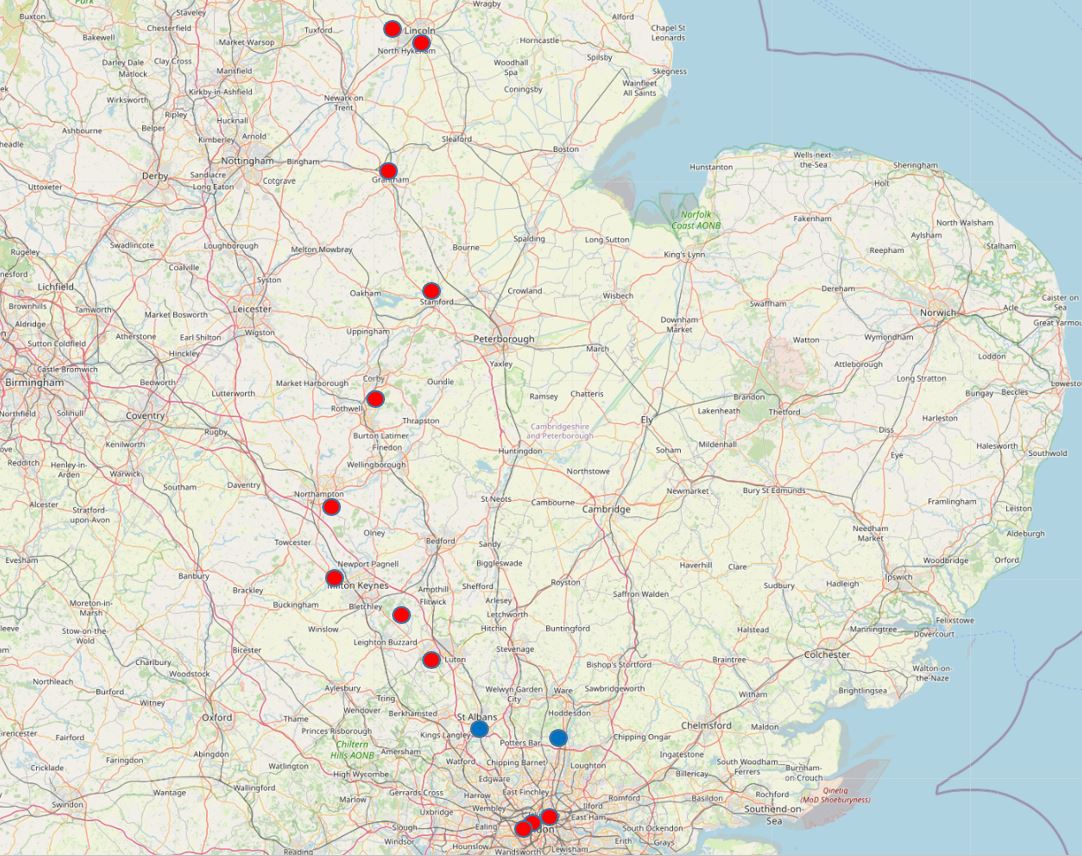
The dates and links for booking are as follows:

Wapping – A Seething Mass of Misery: Sunday, 25th September; Saturday,1st October; Sunday, 23rd October; Saturday, 29th October

The Lost Streets of the Barbican: Sunday, 2nd October

The South Bank – Marsh, Industry, Culture and the Festival of Britain: Sunday, 30th October

Bankside to Pickle Herring Street – History between the Bridges: Sunday, 9th October

I hope to see you on a walk. Now, to East Ham:

My Great Grandfather was born in 1854, and as a young man, he went to sea and travelled the world.

He became a fireman in 1881, joining the Metropolitan Fire Brigade (MFB) at Rotherhithe, south east London, later moving to West Ham in 1886 as a Fire Escape man, where he remained for ten and a half years. At the time the MFB recruited only ex seamen and naval personnel as the Brigade was run on Naval discipline with a requirement for familiarity of climbing rigging and working at heights.

In 1896 he became the Superintendent of the new East Ham Fire Station, and I recently completed one of the many tasks on my to-do list by visiting the site of the Fire Station in Wakefield Street, East Ham:

East Ham Fire Station

I cannot find the exact year when the fire station was demolished, it was at some point after 1917, and the location is now occupied by the flats shown in the above photo.

I have circled the location in the following map. East Ham station (District and Hammersmith & City lines) is at the top of the map (© OpenStreetMap contributors).

East Ham Fire Station

When the fire station was built, East Ham was growing over the fields that once covered this part of east London (although at the time it was part of Essex). In the following extract from the 1897 edition of the Ordnance Survey map, I have circled the fire station in a developing Wakefield Street. The upper part of the map showing that the whole area would soon be covered by terrace housing (‘Reproduced with the permission of the National Library of Scotland“).

East Ham Fire Station

Growth of East Ham, and Pressure for a Fire Brigade

In 1861, the number of houses in East Ham had risen to 497 and the population to 2,858. Fire protection for the village would have been provided by a Fire Insurance Brigade, and there is some evidence that the Hand-in-Hand Insurance Company operated in the area. This was the time when insurance companies operated their own private fire fighting services.

The first meeting of the Board for the East Ham Local Government District was held on the 4th February 1879, at the Parochial Building, Wakefield Street.

The provision of fire fighting cover was exercising the minds of the Members of the Board at a very early stage. A letter was received from a Mr. Rowley asking the Board to pay for the attendance of two engines of the North West Fire Brigade from Walthamstow at a fire at Plashet. The sum of £6 was subsequently paid for this service.

Later on in the year a letter was sent to West Ham Local Board relative to the attendance of their Brigade at fires in East Ham. West Ham replied in the affirmative and it is recorded that they attended a fire at Beckton on the 13th January, 1880.

A letter was received from Mr. Angel of West Ham, regarding a fire in the East Ham Match Factory on the 10th February, 1880, and an account enclosed for the attendance of the Brigade. The Clerk to the Board was instructed to write to the insurance company for the payment of the amount paid to West Ham.

In December, 1880, the Board wrote to the famous Captain Sir Eyre Massey Shaw, KCB, Chief Fire Officer of the Metropolitan Fire Brigade, asking for fire cover in the North Woolwich area. (See my post on the historic fire boat named after Massey Shaw). The Metropolitan Brigade had a small fire station in North Woolwich to protect the London County Council property in that area. Captain Shaw agreed to provide fire cover, and an agreement was signed the following month.

The population of East Ham had risen to 10,706 on 1881. it is interesting to note that the census was arrived at by counting the houses and estimating the number of people.

In 1882 the Clerk to the Board wrote to the Commissioners of Police asking for the establishment of a Police Station within the district. This was refused.

The first petroleum licence was issued to a Mr. Harding on the 14th of February, 1882.

The provision of fire hydrants exercised the minds of the Board members in 1884. The East London Water Works Company was asked to install a number of hydrants in North Woolwich and other places at a cost of £3 and 10 shillings each. The lack of pressure in the mains was the subject of much correspondence between the Board and the Water Company over the next few years.

A letter was received from the National Fire Escape Institution on the 12th of May, 1885, asking whether the Board would be prepared to accept a fire escape at a cost of £10 per annum. The Board refused to pay the price. The same year, North Metropolitan Tramway Company gave notice of their intention to commence the tramway in Romford Road. Reference is made to a Ratepayers Association who seemed determined to veto any proposal for improved fire cover, if the project was going to cost money.

An interesting entry appears on the 9th of February, 1886, from a Mr. Palmer, enclosing a list of fires attended by Mr. Clamp of the Royal Standard Hostelry in North Woolwich and claiming payment for these. The sum of £95 was paid for this service. In view of the agreement with the Metropolitan Fire Brigade to attend fires in North Woolwich, it is remarkable that payment should have been made to an individual in this case.

The Board turned down a request by the Liberal Club, Manor Park, for a fire engine to cover the district. The Board replied “No, not necessary”.

On the 21st of July 1891, a letter was received from a Mr. Drury enquiring whether the Board had anything to do with the South West Essex Fire Brigade. The Clerk replied that the Board had an arrangement with the West Ham Corporation to attend all fires in the district but have nothing to do with the private brigade mentioned. About this time many private brigades were in operation in the London area. One enterprising man, a Mr. Cook, wrote to the Board from Lewisham about this time offering to provide a fire engine and two men at a cost of £250 per annum. His offer was turned down.

By the end of 1892 the Ratepayers Association excelled themselves; they decided that a Fire Brigade was required for East Ham and asked the board to receive a deputation “to urge the necessity”.

The following year the Board purchased fire appliances from the Lewisham Fire Brigade at a cost of £140 and appointed Mr. Tom Willard as Superintendent. The Fire Station was located in Wakefield Street, opposite the Hartley Avenue School. The Brigade was what is today called a part-time retained unit with a total establishment of twenty firemen. The men who formed the Brigade consisted mainly of Council employees, such as the Town Hall Porter, the Parks’ Superintendent, the Foreman of Dustmen, and the Roads Foreman who lived in Bernards Avenue and drove the Council’s steam roller.

To call the firemen to attend a fire a man ran around the streets and lanes of the Borough shouting for members of the Brigade. Then it was touch and go whether the old horse drawn, manually operated pump reached the scene of the fire without mishap.

The names of only a few of these Auxiliary firemen are known, Ted Lukas, Parks’ Superintendent, Mr. Flowers, the Turncock, Charlie Hare, Jimmy Ward, Mr. Richards, Mr. Redmond, Edwin Roberts and George Cook who both joined the regular brigade and served for many years. The firemen received a payment of two shillings and six pence for each fire attended.

About this time, the Board were considering the installation of a fire alarm system to cover the district. This shows that electricity was becoming a commercial proposition.

One Sunday morning the Brigade were called to a fire at No. 2, High Street South. Owing to an oversight the regular coachman was not called, so one of the firemen drove the two horses to the fire. Unfortunately, the fireman was unused to such restive horses and, as he threw down the reins before getting out the hose to fight the fire, the horses bolted. They made their way to their home in North Woolwich and reached Manor Way when they capsized the engine into a ditch at a sharp bend by Beckton School. The Board reprimanded the Superintendent for not “properly calling the firemen”.

The poor Superintendent continued to be in hot water over many small incidents, so that on the 20th of October 1896, the Board resolved “Having regards to constant complaints, the Brigade Town Committee recommend that steps be taken at once putting an end to the present arrangements of the Fire Brigade pending the establishment of a permanent brigade”.

The following painting titled “Top Speed” by Savile Lumley shows horses pulling firefighters through the streets at speed:

East Ham Fire Station

A Full Time Fire Brigade for East Ham

The Committee wasted no time and immediately advertised for a Superintendent (Engineer Fireman) at £2 and 2 shillings a week, with free house, fire, light and uniform, and three firemen at £1 and 10 shillings a week.

Twenty one applications were received for the Superintendent’s post, and thirty one for the post of firemen. The interviews were held on the 17th of November 1896, and my Great Grandfather was appointed to be Superintendent. Three firemen were also appointed. A new Steam Fire Engine and Curricle (a two wheeled carriage drawn by two horses abreast) were purchased at a cost of £400.

My Great Grandfather’s First Annual report makes interesting reading:

“I have the honour to present my first Annual report of fires for the year commencing 1st January 1897 to 25th December 1897. Total number of calls received for fires during the year were 54, of these 14 were F.A. (false alarms), 3 chimney fires, 37 actual fires – 6 were serious in damage and 31 slight damage, 4 were beyond East Ham boundary, viz., West Ham.

In addition to ordinary fires, there have been 3 chimney fires requiring the attendance of firemen with hand pumps.

Of 37 fires, 17 were extinguished by means of steamers, hydrants and standpipes and firemen; 6 were by hand pumps and firemen; and 14 were by buckets and firemen.

The strength of the brigade is as follows: 1 Station; 1 Steamer; 1 Manual; 1 Curricle Fire Escape; 1 Telephone (2 more to be provided); 7 F.A. Points; 4 Bells leading to Firemen’s Houses; 1,800 feet of Canvas Hose – all in good condition; 4 Firemen (including Superintendent; 1 Coachman; 2 Horses.

The number of firemen employed on watch are 1 by day and 2 by night. The members of the brigade keep in a smart and proper condition. The men have been regularly drilled in their various duties and their conduct has been very satisfactory. Summary of how fires were reported to the F.B. for 1897:

Fire Alarm 17; Telephone 7; Police 1; Strangers 10

During the year there have been only 10 mischievous false alarms by fire alarms and 4 have been caused by wires in contact.

The brigade have pumped out 1 cellar (after a storm) with the steamer during the year.
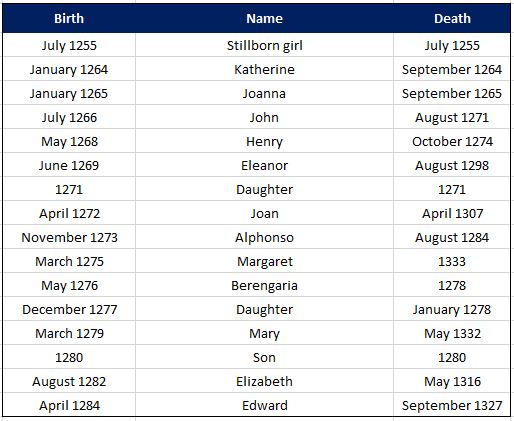
Details of lives endangered:

  1. In this case which occurred at an oil shop on the 12th of April 1897. David Hollingsworth, a member of the brigade, was cut on hand by broken glass and had to be attended to by a doctor.
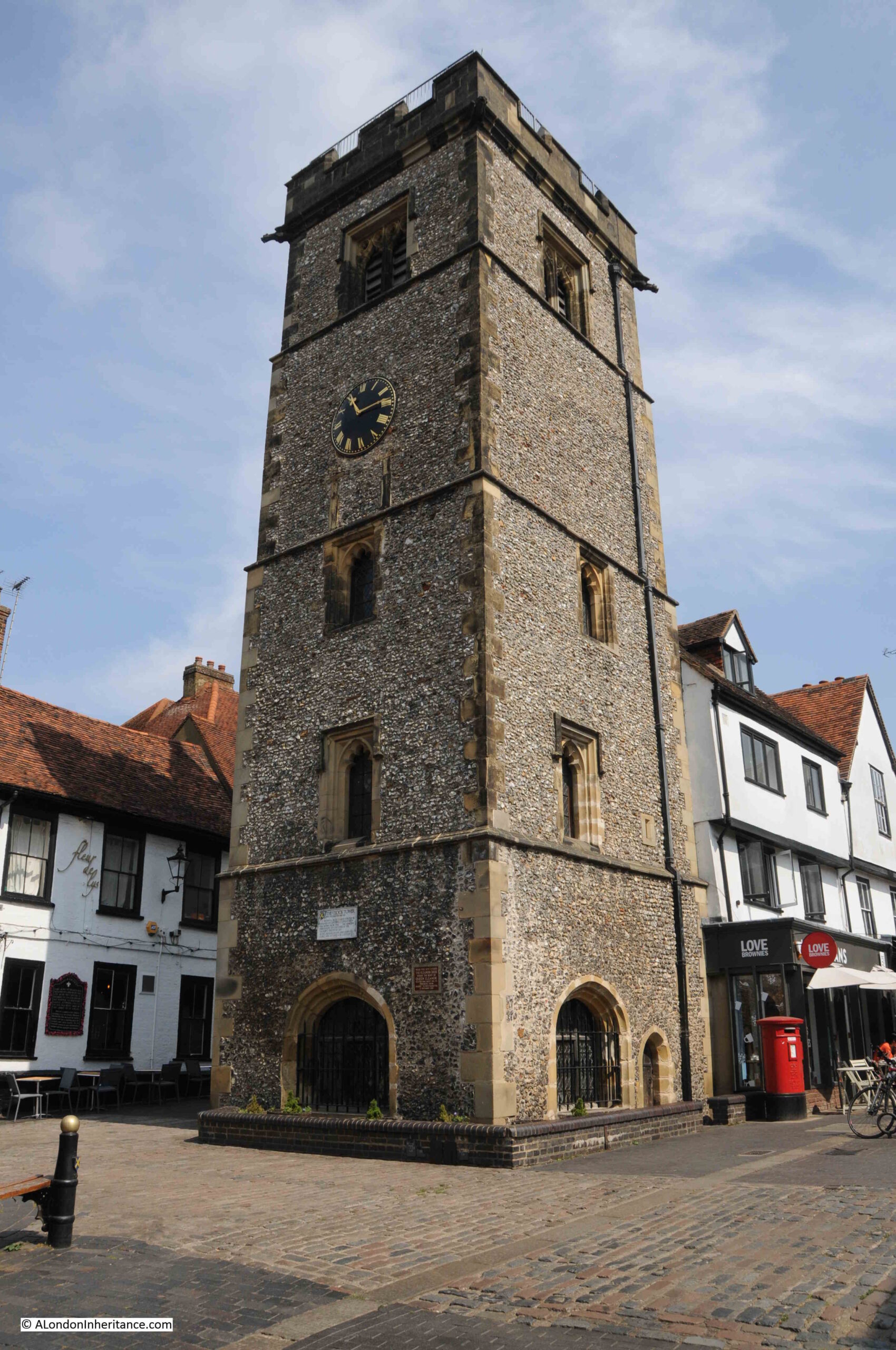
  2. In this case which occurred at a private house on the 13th of June 1897, Thomas West age 25 was burnt on left arm and hand and Mrs. L.N. West aged 18 years was severely burnt on face, neck, both arms and shoulder caused by the explosion of a mineral oil stove. Both have since recovered.
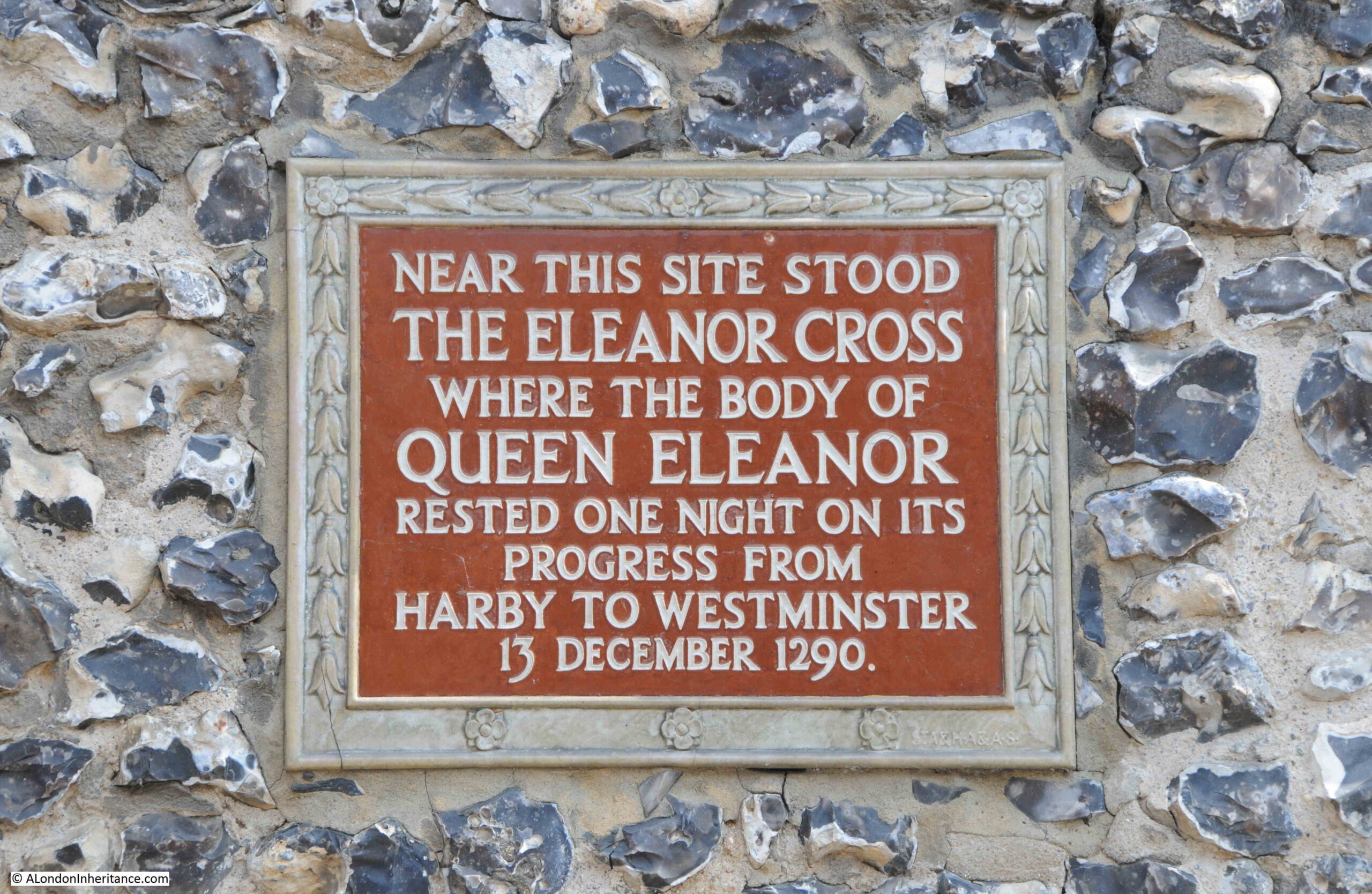
  3. In this case which occurred at a general shop on the 7th of December 1897, Mr. Robert Baker aged 54 was burnt on both hands caused by an explosion of a mineral oil lamp. He has since recovered.

In conclusion, I take this opportunity of thanking you for your valuable co-operation with me in all matters tending to the success of the brigade.”

The incident where David Hollingsworth was injured was reported in the Barking, East Ham & Ilford Advertiser:

“FIRE – At a few minutes before two o’clock on Monday afternoon a fire broke out at an oilshop, 101, Plashet-grove, occupied by Mr. C. Maitland Dods, and owned by Mr. W.A. Lee. Alarm was at once given at the East Ham Fire Station, and within a few minutes the Superintendent and his men were on the spot and vigorously combating the flames, which they managed to subdue after an-hour’s hard work. They were heartily congratulated by the crowd of bystanders who watched the operations. Fireman Hollingsworth was badly cut on the left hand. the shop was completely gutted, and the contents of nine rooms were severely damaged.

I found the following photo in a book published by West Ham County Borough Council in 1936 to celebrate fifty years as a Borough. It shows an early horse drawn steam engine.

Merryweather fire engine

Although it is from a book about West Ham, the sign on the side of the appliance shows the E of East Ham. I suspect it is a promotional photo by the Merryweather company who built fire engines in their factories in south London.

Unfortunately the firemen in the photo are not named, although they may be Merryweather staff rather than firemen from East Ham fire brigade, however it must have been a fire engine that my Great Grandfather would have used.

The main fire risk in the Borough was represented by the Royal Albert Dock, at the time the largest and finest dock in the world. The Beckton Gas Works was also one of, if not the largest in the world and represented another severe fire risk. Until closure both the Docks and the Gas Works continued to form the main fire risk covered by the brigade.

There was an agreement in 1897 between East and West Ham that border fires be attended without charge. A few years later a similar arrangement was agreed between East Ham and Barking.

On the 7th of June, 1898, it was reported to the Board that two firemen attended the launching of H.M. Battleship “Albion” (in company with four members of the late volunteer brigade) at Blackwall to form a guard of honour to the Duchess of York and a sad incident occurred by the collapse of a jetty which caused several deaths. The firemen were praised for their work of rescue. This really deserves a dedicated post. The following is a still from the launch of the Albion which you can watch on the BFI Player here.

HMS Albion

A serious fire on the 6th of July, 1898 on the S.S. Manitoba at shed 22, Royal Albert Dock, caused an explosion amongst cartridges which killed 5 persons and injured 6 others.

The cost of fodder for Fire Brigade horses is recorded as being 11 shillings per week. The animals must have been well fed because a fireman had to keep his wife and usually large family on 30 shillings a week.

The leave enjoyed by professional firemen in these early days was just 24 hours a month – if he could be spared.

In December 1898, the Council purchased the horses and contents of the stable of the Hand in Hand Insurance Company for £250.

Fireman Atkinson was appointed as Assistant Officer “to take charge in his (Superintendent’s) absence”, at a weekly rate of 35 shillings.

A severe fire occurred on the S.S. Magnetic involving heavy damage to engine room, store and cabins.

Fire alarms were being installed throughout the Borough by 1898 and many references are made to Malicious False Alarms.

Christmas Day, 1898 saw “Firemen acting disorderly at Wakefield Arms – Superintendent was there and found Fireman Dunn intoxicated. Told Dunn to go home whereupon assaulted; got him to station, assaulted once more. Dunn dismissed – approved by Committee.” Two other firemen were given a week’s notice.

On the 25th September 1899 there was a false alarm call. A small boy aged 12 years was detected pulling the alarm bell at the corner of St Stephen’s Road. The father was told that the next time he would be prosecuted. In September 1958, another small boy, the grandson of the original boy was found pulling the alarm bell again.

On the 11th of July 1900, a new sub-station was opened at Manor Park. The station was situated at the corner of Manor Park Road and Station Road and cost £118 to build. It contained a 50ft Bayley Escape – and was manned by two firemen, who had to drag it to the fires on its two wheeled cart. The cost of telephones to Wakefield Street from one fire alarm point and from the sub-station at Manor Park was £16, 5 shillings per annum.

The Waiting Room and Porters Room at East Ham Railway Station was severely damaged by fire on the 25th of April 1901.

An unusual accident occurred on the 16th of July 1901, whilst proceeding to a fire, when the wheel of the old manual engine caught in the tram lines and was wrenched off. The North Metropolitan Tramway paid £5 compensation. The fire engines and the trams seem to have been in conflict from time to time because it is reported that the new motor engine was in collision with a tram at Savage Gardens whilst returning from a fire at the docks. The lovely new machine finished up in a rhubarb field belonging to a Mr. Northfield the Farmer. It was ignominiously chained to the tram and towed home to the station.

The Superintendent asked for the authority to summon the assistance of the Metropolitan Fire Brigade in case of an emergency at big Dock fires, but the Committee refused to recommend the Council to incur liability for charges for this purpose.

The annual report for 1900 shows the following equipment held by the Brigade – 1 Station; 1 Sub-Station; 1 Steamer; 1 Manual; 1 Hose Tender and 50ft Escape with sliding carriage. 1 Curricle Escape, 40ft; 6 scaling ladders; 2,500 feet of canvas hose; 5 leather branches, 5 metal branches’ 44ft of rubber suction hose; 3 jumping sheets; 4 horses.

The establishment now had – 1 Superintendent; 1 assistant Superintendent; 7 Firemen and 2 Coachmen.

It was also reported that Fireman J. Mandell fell from the first floor to ground at a fire and was subsequently retired due to his injuries. Fireman E.L. Roberts was badly injured when part of a roof fell in and smashed his helmet. Fireman H. Gear sustained a severely cut wrist from a falling slate and H. Chittock, Turncock, received a broken leg when he was thrown off the steamer.

East Ham Fire Station had increased by 1904 with the addition of two firemen. My Great Grandfather, the Superintendent, had his salary increased to £597 per annum. The salaries of other officials at this time make an interesting comparison:

Town Clerk £300; Assistant Town Clerk £200; Librarian £150; Medical Officer £200; General Clerk £120. A council steamroller driver was paid £2 a week and a foreman Bricklayer was paid £2 5 shillings a week. The Superintendent’s role appears to have been very well paid.

On the 20th of June, 1905, a surprise trial call was given to the fire brigade. The Committee members expressed their satisfaction that the time taken for the firemen to arrive at the Town Hall was only 3 minutes 20 seconds from the time of the call. Perhaps the firemen were not so surprised by the call as the Committee imagined.

In 1905 the brigade had 1 Steam Fire Engine; 1 Manual Fire Engine; 1 Hose Tender and 50 feet sliding carriage escape and two 40 feet Curricule Escapes.

An incident occurred on the 28th of February, 1906 involving 50 feet of electrical cable which fused under the pavement. Six persons were removed to hospital suffering from partial suffocation.

In July 1906, the Superintendent reported that the clothing contractor who supplied uniforms, had failed to carry out his work satisfactorily, and the contractor would go on to loose the brigade contract. In 1906, a new smoke helmet cost £2, 5 shillings.

About this time, Council Minutes appear relating to the totally inadequate surroundings and arrangements of the present fire station in Wakefield Street. The Committee were in favour of building a new station and instructed the Surveyor to prepare plans to incorporate the building into the area surrounding the new Town Hall.

A Mr. Kennersly made application to the Council to be allowed to explain his “patent for facilitating the life saving capacity of the Council’s fire escapes”. The apparatus consisted of a canvas chute attached to the head of the escape and down which persons were passed after rescue from upper floors. these chutes were in common use in the Metropolitan area from about 1850 onwards. There is no record that this method was adopted in East Ham.

In 1908 the Council looked into the question of hiring horses instead of keeping their own. An advertisement was placed in the Daily Telegraph inviting tenders from firms willing to hire horses. The offer from Messrs. C. Webster Ltd was accepted at a cost of £65 per horse, per annum and £150 for purchase of the brigade’s live stock.

Throughout the years of the development of the fire brigade, East Ham was also expanding, and Wakefield Street, the street with the fire station had been fully developed as a street lined with terrace houses. There were some exceptions. A large school almost opposite the fire station, and also a Salvation Army Hall:

Wakefield Street

The plaque on the hall dates the opening to 1908:

Salvation Army

Wakefield Street’s eastern end was at a junction with High Street North, however Ron Leighton Way (named after the MP for Newham North East. he won the seat in 1979) now slices through Wakefield Street as it nears High Street north. Where Wakefield Street now ends is this row of shops – essential additions to any London development of rows of terrace streets.

East Ham Fire Station

In earlier years, there would have been a number of pubs along the streets of developing East Ham. There were, and are, very few in the vicinity of Wakefield Street, and I suspect it was the late Victorian approach to alcohol for the masses, and that so many of the people who lived in the area, worked in the docks, where employers would not have wanted their employees under the influence of alcohol.

Back to the East Ham fire brigade, and there were some remarkable turn out times achieved by firemen in the days of horses. The record held by a London station being 11 seconds during a test turnout, but it is likely that much of the work for the callout had already been anticipated.

Under normal conditions, times of 30 seconds for a turn out were quiet common and this included attaching the horses to the shafts and securing the necessary harness.

Permission was given at regular intervals for the fire brigade to attend Carnivals in neighbouring Boroughs. The attendances of the brigade at such functions appeared to be an essential feature of the carnival. no doubt the fire engine with its brass work gleaming, drawn by proud horses and carrying its load of brass helmeted firemen would make a brave sight as it galloped round the park. From past records it is evident that the engines were “got to work” and demonstrated the skill of the men and the efficiencies of the pumps.

The Second East Ham Fire Station

Plans and estimates were submitted to the Council on the 21st of November 1911, for the building of a new fire station in High Street South. the cost of the project amounted to £8,628 including quarters for the Superintendent and 11 men. This was approved, along with approval to borrow the amount for a period of 30 years.

The new station was urgently required as the original in Wakefield Street was designed and built to accommodate horses, with the result that the doorways were only 8 ft., 10 inches wide. The appliance room was not deep enough to house the turntable ladders which were soon to be made available for the fire services.

On the 28th of May 1914, the new Fire Station was opened by Mayor, Alderman O.R. Anstead, and at the opening he said that “Great praise is due to the Borough Engineer and his Deputy for the way in which they have constructed the building which is one of the best anywhere around London”.

Little did he know that within three months the appliance room of the new fire station would be considered out of date for the latest fire fighting equipment. Little foresight was shown by the designers of the Station because many Fire Brigades in different parts of the country were at that time purchasing motor fire appliances and it should have been obvious that the day of the horse was numbered.

The opening of the new fire station, the transition from horse to motorised equipment was followed within three years by the death of my Great Grandfather. The West Ham and South Essex Mail included this obituary in April 1917, which included that:

“In early life he had been a petty officer in the mercantile marine. On leaving the sea he joined the Metropolitan Fire Brigade in 1861, and saw service in Norwood, Battersea, Rotherhithe and other districts, coming to West Ham in 1886 as fireman and steam man. He was for eleven years in West Ham where his good work was recognised by all grades of the service.

On leaving that centre when he received the appointment of the East Ham Fire Brigade he was presented by his colleagues with a clock, ornaments, tea service and a purse of gold. The excellence of his work in East Ham was also recognised both by the authorities and those who served under him. He had had a wide and varied experience and had attended some of the biggest fires in the London district.

Unfortunately, about two years ago he was in the somewhat serious motor accident which resulted in one of two members of the Brigade receiving injuries. Deceased himself was so badly shaken that he was never again quite the same, and had to relinquish his more arduous duties on a small pension, though he filled up his spare time as consulting engineer and inspector of hydrants. He had been ailing for some time before his death, and his illness took a turn for the worse about a week ago, He leaves a widow and three children.”

The fire station that took over from the one in Wakefield Street is still there, however now converted into flats. What is, as far as I know, the third version of East Ham Fire Station is at 210 High Street South, towards the Newham Way – equipped with fire fighting equipment that would have amazed my Great Grandfather.

alondoninheritance.com

Elizabeth Fry, Charles Brooking, a Church and a Hall

Continuing my series of posts, tracking down all the City of London’s blue plaques, here are another selection of the wide range of people and places commemorated across the City, starting with:

Mrs. Elizabeth Fry – Prison Reformer

Where Poultry meets the Bank junction, there is a plaque on a side wall recording that Mrs. Elizabeth Fry, Prison Reformer, lived here between 1800 and 1809:

Elizabeth Gurney, as she was before marriage, was born in Norwich in 1780. Her parents were Quaker’s, which probably influenced her future work.

She came to London in 1800, the same year that she had married Joseph Fry, so the plaque commemorates her first London home.

Her prison reform campaigning started around 1813 following a visit to Newgate prison. This visit was described in the book Prison Discipline by Sir Thomas Powell Buxton, and it really must have been a shocking sight:

“She found the female side in a situation which no language can describe – nearly three hundred women, sent there for every graduation of crime, some untried, and some under sentence of death, were crowded together in the two yards and the two cells.

Here they saw their friends and kept their multitude of children, and they had no other place for cooking, washing, eating and sleeping. They slept on the floor, at times one hundred and twenty on one ward, without so much as a mat for bedding, and many of them were nearly naked.

She saw them openly drinking spirits, and her ears were offended by the most terrible imprecations. Every thing was filthy to excess, and the smell was quite disgusting. Every one, even the Governor was reluctant to go amongst them. He persuaded her to leave her watch in the office, telling her that his presence would not prevent its being torn from her.

She saw enough to convince her that everything bad was going on. In giving me this account, she repeatedly said ‘all I tell thee is a faint picture of the reality; the filth, the closeness of the rooms, the ferocious manners and expressions of the women towards each other, and the abandoned wickedness which everything bespoke, are quite indescribable’. Two women were observed in the act of stripping a dead child, for the purpose of clothing a living one.”

As a result of this visit, Elizabeth Fry started to campaign for improved conditions for women prisoners. She started bible lessons in Newgate and in 1817 formed the Association for Improving the Condition of Female Prisoners in Newgate”. It was initially assumed that the association was doomed to failure and that prisoners in Newgate could not be reformed, however the association pushed forward. As well as the women, their concern was the condition of the children who were imprisoned with their mothers. The Association opened a school dedicated to children within the prison.

The Association’s work gradually brought about change:

“The efforts of the committee to induce order soon began to produce visible effects. It even excited surprise to watch their rapid progress to an almost total change of scene. The demeanour of the prisoners is now quiet and orderly, their habits industrious, their persons clean, their very countenances changed and softened. The governesses of the schools for children, and for adults, are themselves prisoners, whose steadiness and good conduct procured their selection, and have justified the preference.”

As well as work within Newgate, Elizabeth Fry campaigned for change in how prisoners were managed and in 1823 prison reform legislation was introduced in Parliament.

Her work expanded. She would sit with those who were condemned for execution, she visited convicts in prison ships prior to their being transported to Australia, and provided items such as blankets to provide some comfort during the voyage. She visited many other prisons to inspect their conditions and campaign for change. This included prisons across England and Scotland as well as France.

She corresponded with those in power across Europe, including the King of Prussia and the Dowager Empress of Russia.

Many people went to visit Newgate to see the improved conditions, and watch the work of Elizabeth Fry. Prince Albert and the Duke of Wellington met with her.

She was also interested in causes outside of prison reform, for example she also sent bibles and reading material to isolated coastguard stations across the country. She also campaigned for improved conditions for working women, improved housing for the poor, and she established a number of soup kitchens.

From 1809 to 1829 Elizabeth Fry lived in East Ham at Plashet House, then moved to a house in West Ham, where she lived until 1844. She then possibly moved to Kent as a year later she died at Upton, Ramsgate in Kent.

She was buried in the Friends burying ground in Barking.

Portrait of Elizabeth Fry  (© The Trustees of the British Museum):

Elizabeth Fry apparently lived in St Mildred’s Court. I cannot find an exact location, however another blue plaque, a very short distance away indicates where the name of the court would have come from.

St. Mildred’s Church

Facing onto Poultry is another blue plaque:

Recalling the site of St Mildred’s church, demolished in 1872:

St Mildred’s church was one of the many City churches demolished during the second half of the 19th century. The City had been rapidly developing as a commercial centre. This reduced the number of residents and the size of church congregations. Space was also needed for road widening, additional office and commercial space, so many City churches, such as St Mildred’s were demolished.

An article in the Morning Post on the 18th of May 1872 provides some background to the church:

“The church of St. Mildred, Poultry, built by Sir Christopher Wren, is about to be sacrificed to the widening of the thoroughfare. It was erected in 1676 in the place of a decayed fabric which had dated from 1420, and which had superseded another of great antiquity that had fallen into dilapidation.

Previous to the first erection of the church, Thomas Morstead, surgeon to King Henry IV, V and VI, gave a piece of land adjoining the church, 45ft long and 35ft wide, for a burial ground.

Among persons of interest buried in the old church was Thomas Tusser, born in 1515, who wrote a book called ‘Points of Husbandrie’ which passed through 12 editions in 50 years. He is said to have led a wandering and unsettled life, being at one time a chorister, then a farmer, and afterwards a singing master. A quaint epitaph in verse commemorated his name and services. Previous to suppression of religious houses St Mildred’s belonged to the priory and canons of St. Mary Overy.

The length of the fabric now about to be taken down is 56ft, the width 42ft and the height 36ft. the tower is 75ft in height and is surmounted by a gilt ship in full sail.”

St. Mildred’s was shown on a 1754 map of Cheape Ward. I have circled the church in red in the following extract from the map:

In the above map, number 9 refers to St. Mildred’s church, and number 10 to Scalding Alley. I cannot find St Mildred’s Court on a map, so wonder if this was the alley by the side of the church.

When the church was demolished, the dead were relocated to the City of London cemetery at Ilford, Poultry was widened and new commercial buildings constructed on the site.

A short walk from Poultry, we find Tokenhouse Yard, a turnoff from Lothbury, where there is a plaque to:

Charles Brooking – Marine Painter

At the entrance to Tokenhouse Yard is a plaque to Charles Brooking who lived near the site of the plaque.

Not that much is known of the life of Charles Brooking. It is believed that he was born in Greenwich and he died at the relatively young age of 36. The plaque gives the years of his (assumed) birth (1723) and death (1759), not the years that he lived near the site of the plaque, and I cannot find when he did live near the site, or for how long.

The Illustrated London News provided some additional background on Charles Brooking at the time of an exhibition of his work at the Paul Mellon Foundation for British Art in 1966:

“A meticulous knowledge of shipping and a poetic lyricism in his observation of natural phenomena combine to make Charles Brooking the greatest of all marine painters. Born as he was in the 18th century his talents were perfectly fitted to satisfy the chauvinism engendered by Britain’s naval supremacy. What is remarkable is that Brooking’s painting avoids all forms of brashness and conceit which one almost expect. His high proficiency in technical detail and his emotional restraint are even alien to much of modern taste, which is a possible reason why Brooking has become a classic example of the great painter overlooked.

Brooking’s extraordinary technical ability in painting all kinds of naval gear make it reasonable to accept the inconclusive literary evidence that he came from Deptford and was trained in the dockyard there as the son of a master-craftsman at Greenwich Hospital. Seventeen twenty-three is an acceptable date for his birth, as he is known to have died in 1759 and was very probably 36 at the time.”

Most references to Charles Brooking put the brilliance of his work down to his early years being spent in and around Greenwich where he would have seen so much of the multitude of different types of ships in use during the early decades of the 18th century.

The following image shows one of Brooking’s works, dated from around 1755 and titled “Shipping in the English Channel”:

Source: Charles Brooking, Public domain, via Wikimedia Commons

Tokenhouse Yard is an interesting little street. Built during the reign of Charles I on the site of a house and garden owned by the Earl of Arundel. The name comes from a building in the vicinity where the tokens issued by small traders as a replacement for small value coins, could be exchanged for legal tender

At the far end of Tokenhouse Yard, a small alley leads through the buildings at the end of the street through to Telegraph Street / Copthall Buildings:

Tokenhouse Yard, and the surrounding streets deserve a dedicated post, however the plaque to Charles Brooking at the entrance to the street does provide a reminder of a brilliant marine artist, who captured naval scenes during a couple of decades at the first half of the 18th century.

Also in Lothbury, is the site of the next plaque, to:

Founder’s Hall

Where Founders Court joins Lothbury there is a plaque recording that Founder’s Hall stood in the Court between 1531 and 1845:

Founder’s Hall was the hall of the Worshipful Company of Founders, one of the old Company’s of the City of London, dating back to 1365, when “In 1365 the men of the mistery of founders presented a petition to the mayor and aldermen stating that some of the mistery made ‘works of false metal and false solder’ and requesting that ordinances be approved to regulate the trade”.

The company may have been in existence prior to 1365, but it is this date which seems to be the accepted date for when the company came into existence, as a company that had powers to regulate aspects of their members trade.

Founders worked in brass, alloys of brass and tin, and produced articles such as candle sticks, stirrups for horses, pots etc. The basic materials of everyday life.

Their hall was built in 1531 when members of the Company purchased a number of houses and a garden in Lothbury, and constructed their hall.

Lothbury seems to have been the location of many who worked in the founders trade. Stow goes so far as to say that the name Lothbury comes from the number of founders who worked along the street, with their noise being found loathsome to those walking on the street, with the street attracting the name of Lothberie.

A Dictionary of London does not place much faith in Stow’s explanation, and suggests that the name comes from “lode” (a cut or drain leading into a large stream), with Lothbury leading over the Walbrook, or more probable the name coming from a personal name of Lod, or Loda.

The area around Lothbury has long been part of London’s populated history, as a Roman tessellated pavement was found opposite Founder’s Court at a depth of 12ft, along with a Roman pavement. Copper bowls were also found nearby at a depth of 10 ft. in wet, boggy soil.

I cannot find much about why the Founder’s vacated Founders Court. I did find a couple of newspaper articles from 1847 which hint at why they moved “TELEGRAPHIC CENTRAL STATION – The whole of the extensive buildings, including Founders Hall and Chapel in Founders Court, Lothbury, fronting the Bank of England, are being demolished, the Electric Telegraph Company having purchased the property for the formation of their central metropolitan station”.

The Electric Telegraph Company had been founded in the previous year, 1846, and was the world’s first public telegraph company.

Prior to the founding of the Electric Telegraph Company, the telegraph as a technology had mainly been used by the railways with wires being strung along railway lines in order to send messages between stations.

The Electric Telegraph Company was formed to offer the technology to potential users across business and the public. The Electric Telegraph Company could be compared with the earliest Internet service providers such as Compuserve, AOL, DELPHI and Earthlink, who took a technology that was used by a limited research and scientific community and opened it up to the wider public.

Some of the earliest users of the Electric Telegraph Company were the newspapers who suddenly had a means of receiving news at almost the instant it was happening. Initial use of this service was reported with some care, for example in a report in 1848, newspapers were detailing news of rebellions in Ireland, and included:

“The Electric Telegraph Company vouched for its arrival in Liverpool. On the whole, therefore, we did not feel justified in refusing to publish it. we inserted it just as it reached us, giving the authority, and at the same time stating that we have received nothing of the sort from our own correspondents”.

This statement from the papers of 1848 is a fascinating foretaste of what was to come, when new technology would continue to grow exponentially, the ability for news to flow in, before any trusted authority had been able to verify the source and factual basis of the news.

The Electric Telegraph Company grew during the following years, and merged with similar companies, eventually becoming part of the Post Office, and today, British Telecom.

The Founder’s then seem to have moved around a bit. Their next hall was in St Swithin’s Lane, and the current hall, dating from 1987, is located in Cloth Fair, opposite the Hand and Shears pub.

The following print, dating from 1855 shows the new Founder’s Hall in St Swithin’s Lane  (© The Trustees of the British Museum):

Above the door is the coat of arms of the Founder’s, which consists of two taper candlesticks on either side of a laverpot (a container for filling a washing bowl) – both being examples of the Founder’s art.

Four more plaques which commemorate some of the people that have lived in the City and the buildings that have often been on the streets for centuries, but are now just recorded by a plaque on a wall.

alondoninheritance.com

Campden Hill Water Tower, an Observatory and Sir James South

Before heading to Campden Hill, a quick reminder that if you are interested in discovering the history of the New River, New River Head, the Oak Room and Devil’s Conduit, there are a few tickets remaining for a walk by Islington Guides starting this coming week. I will be guiding on a couple of these walks and they can be booked at this link.

For this week’s post, I am in the area between Kensington Gardens and Holland Park, in Campden Hill Road, looking up the street towards the now demolished water tower as seen in this photo by my father, and dating from 1951:

Campden Hill Water Tower

The same view in August 2022:

Campden Hill Water Tower

The view nearest the camera has hardly changed. The buildings on either side of Campden Hill Road are the same. What has changed is the view in the distance where the water tower once stood is now a development of flats.

The Campden Hill water tower was built as part of the 19th century roll out of water supplies across an expanding London.

The Grand Junction Water Works Company purchased the land at the top of the road in 1843, and built a reservoir. This was followed by a pumping station and the water tower. (I have also read reports that the water works opened in the 1820s on land purchased from the Dowager Marchioness of Lansdowne, and that the water tower was built in 1847).

The water tower is unusual in that it did not hold a water tank. Instead, large pipes ran up the tower, and these would hold water, with the height of the pipes adding to the pressure of water supplied from the location.

I have shown the location of the water tower, and the associated water supply infrastructure, within the red rectangle in the following map:

Campden Hill

The map shows that the water tower was just over half way up Campden Hill Road, but we need to look at another type of map to understand why it was located at this point in Campden Hill Road.

The following map (from the excellent topographic-map.com) shows land height as different colours, with blue as the lowest height, up through green, orange, red and pink as the highest. I have placed a black star symbol at the location of the water tower, and as can be seen by the surrounding colours, this is the highest point in the area, and the natural height of the land would have given a pressure advantage to water from the site, to which the water tower would have added.

Campden Hill

The name of the road – Campden Hill Road – also highlights that the road runs both up and down a hill. Next to the original location of the water tower, we can see the road descending in both directions. Looking north:

Campden Hill Water Tower

And looking south:

Campden Hill Water Tower

There was a local myth that involved the height of the land where the water tower was located. Almost opposite the location of the water tower is a pub called the Windsor Castle, and the myth was that before the water tower was built, a keen eyed observer could see the real Windsor Castle from this high point, hence the name of the local pub.

This myth was certainly still going into the 1950s when a letter in the Kensington Post disputed that you could have seen the castle from this point, and it was even doubtful that you could see the castle from the top of the tower.

This source of the name is not mentioned on the pub’s website, which does though claim the 1820s as the age of the pub, so it does pre-date the water tower.

Windsor Castle pub

The water tower and associated infrastructure became part of the Metropolitan Water Board in 1904 when the MWB took over the assets of the many water companies operating in London, and brought these under the control of a single, London wide, water supplier.

The water tower was last used for the storage of water within it’s pipe in 1943, and was then redundant for a number of years. Plans to demolish the tower started in the early 1050s and in the 28th of March 1952 edition of the Kensington News and West London Times, there was an article with the headline “Goodbye to the Great Grey Tower”. The newspaper had asked local residents how they felt about the loss of the tower and reported that their general reply was that they would “Miss it dreadfully”.

The tower would though remain for many years, and during the 1960s it was leased to Associated Rediffusion who had equipment to relay television signals mounted on the tower.

There were a number of proposals for what would replace the tower throughout the 1960s, many reported in the Kensington Post, who also sent a photographer to take some photos of the view from the top of the tower.

It would finally be demolished in the first months of 1970, and the site of the water tower and associated works is now occupied by the housing seen in the following photo:

Campden Hill Water Tower

As well as being part of London’s water supply, and a local landmark, the Campden Hill water tower is also unique as it is (as far as I know) the only water tower to feature in, and on the cover of a work of literature:

G K Chesterton

The Napoleon of Notting Hill by G.K. Chesteron is a rather unusual book. Published in 1904, it tells of the story an alternative reality, where the country is ruled over by a randomly selected head of state, one Auberon Quinn who had been a clerk. Quinn decides to turn London into a form of medieval city. One man, Adam Wayne, takes this very seriously, and uses it as a means to support local pride. Wayne even went to the length of setting up a Notting Hill army to fight invaders from other neighbourhoods – hence the title of the Napoleon of Notting Hill.

Theoretically set in a London of the future, the book describes technology and the city as it was when the book was written.

The water tower features many times in the book, including in Chapter Three —The Great Army of South Kensington, where the various forces of different streets and local areas assemble and where battle takes place, for example:

“Morning winked a little wearily at me over the curt edge of Campden Hill and its houses with their sharp shadows. Under the abrupt black cardboard of the outline, it took some little time to detect colours; but at length I saw a brownish yellow shifting in the obscurity, and I knew that it was the guard of Swindon’s West Kensington army. They are being held as a reserve, and lining the whole ridge above the Bayswater Road. Their camp and their main force is under the great Waterworks Tower on Campden Hill.”

and:

“In the event of your surrendering your arms and dispersing under the superintendence of our forces, these local rights of yours shall be carefully observed. In the event of your not doing so, the Lord High Provost of Notting Hill desires to announce that he has just captured the Waterworks Tower, just above you, on Campden Hill, and that within ten minutes from now, that is, on the reception through me of your refusal, he will open the great reservoir and flood the whole valley where you stand in thirty feet of water. God save King Auberon!”

The reason why Chesterton set his book in the area, and uses the water tower as a key feature must be that he was born in Campden Hill on the 29th of May, 1874, so he knew the area very well, and the water tower would have been a very familiar feature.

The Napoleon of Notting Hill is a really strange book, but good to have the Campden Hill water tower recorded in a work of literature.

Walking south, down the hill from the location of the water tower is this terrace of large residential buildings:

Bill Brandt

One of which has a blue plaque recording that the photographer Bill Brandt lived here:

Bill Brandt

I felt rather guilty taking the photo of Bill Brandt’s plaque on a modern digital camera, when I should have been using my father’s old Leica film camera.

Brandt was a master of film photography. Born in Germany in 1904, he moved to London in 1933, and would spend the rest of his life in the city until his death in 1983.

I have no idea when, and for how long he lived in Campden Hill Road, however a number of his photographs were taken inside the building, many of which date around the 1940s, so he was there for some of that decade.

Brandt took a series of photos of London during the war, and his photos of the Underground being used as air raid shelters have become representative of that period in London’s history. Many of his wartime photos of London are in the collection of the Imperial War Museum:

Bill Brandt
AIR RAID DAMAGE (HU 672) Elephant & Castle Tube Station, 11 November 1940. Copyright: © IWM. Original Source: http://www.iwm.org.uk/collections/item/object/205059368

Christ Church, Spitalfields: Man sleeping in a stone sarcophagus in Christ Church:

Bill Brandt
SHELTER PHOTOGRAPHS TAKEN IN LONDON BY BILL BRANDT, NOVEMBER 1940 (D 1511) Christ Church, Spitalfields: Man sleeping in a stone sarcophagus in Christ Church. Copyright: © IWM. Original Source: http://www.iwm.org.uk/collections/item/object/205194621

Continuing on down Campden Hill Road, and the area around the road is full of interesting architecture and plenty of history and interesting characters. I cannot cover everything I would like to in the space of a weekly post, so I will pick one small street which has plenty of interesting stories to tell.

In the map below, I have put a blue oval around Observatory Gardens, a small street that leads from Campden Hill Road to Hornton Street:

Observatory Gardens

I will come on to the origin of the name Observatory Gardens, however lets have a look at the buildings first.

Along the northern side of Observatory Gardens is a continuous terrace of brick houses with white painted detailing.

Observatory Gardens

By 1870, the land now occupied by Observatory Gardens had been purchased by Thomas Cawley, a local south Kensington builder. He subcontracted the construction of the street, however his subcontractors went bankrupt, so Cawley completed the work himself, and the street was finished in 1883.

The street suffered some severe damage during the last war when a German bomber crashed into Campden Hill Road, having taken off a large roof in Observatory Gardens, and the crater in the street causing additional damage. A report in the West London Observer on Friday the 18th of April 1941 tells the story:

“London experienced one of the heaviest raids of the War during Wednesday night and early Thursday morning and numerous heavy, high-explosive missiles as well as thousands of incendiary bombs were dropped. Damage was on a large scale and many people were killed.

The German radio yesterday (Thursday) declared that the raid was the heaviest ever on London and the biggest raid of the War, and that 100,000 fire bombs were showered down.

On Thursday morning thousand of Londoners made their way to work over hose-pipes and broken glass, while firemen, begrimed and exhausted, still dealt with the smoldering ruins. Many had to make extensive detours to reach their place of business and thousands found their offices and shops bombed out when they got there.

Altogether five Nazi planes were brought down, one of which crashed in Campden Hill Road, a turning off Kensington High street. Actually the plane hit the roof of a large house in Observatory Gardens before crashing into the roadway about 50-feet away. Bombs from the plane must have crashed into the road in front of this house as there is a very large crater.

The German plane finally came to rest by the side of a large Hostel, part of the University of London.

At the controls was a dead pilot. No traces of other members of the crew could be found, so it is assumed that they had jumped. Later the bodies of two Nazi airmen were discovered in the locality, badly mutilated.

Residents at Campden Hill Road heard the whistle of the approaching aircraft before it crashed. There was no engine noise. Wardens say that it was not on fire.

The bomber touched chimney pots and then disintegrated in small pieces. Its heavier parts, one of the engines and two propellers, landed on the top of a block of flats where some Maltese evacuees were billeted.

An oil tank burst at the same time, and two rooms of the top floors of the flats, which were being used for bedding and linen, caught fire.

During the day, thousands of people passed the spot to see the scattered remains of the bomber. By the afternoon there was little to see as army lorries had conveyed the debris to one of the various scrap bases set aside for this purpose.”

Observatory Gardens was left badly damaged by the crash of the bomber, and as with so many streets across London, the street would not recover for a couple of decades.

In the years after the war, Observatory Gardens became very run down, and it was not until the 1990s that the street we see today emerged. Whilst the exterior of the buildings were restored, much of the interior of the buildings appears to have been considerably rebuilt.

Before Thomas Cawley purchased the land and developed Observatory Gardens, the land was owned by Sir James South, a fascinating character who made astronomical discoveries and also appears to have spent a fair amount of time in the courts.

Sir James South purchased a house and land in 1827 from the Phillimore family, and set about building an astronomical observatory in the grounds.

He started a career as a surgeon in Southwark, and there established an observatory in Blackman Street. He worked with the astronomer John Herschel on the observation of double stars, but he was often difficult to work with, and was frequently drunk.

Despite this, he became President of the Astronomical Society in 1829, but after arguments with a number of Fellows, his involvement with what would become the Royal Astronomical Society faded.

He continued his observations from his house on the land that is now Observatory Gardens, and got involved in a number of disputes with the council who were proposing to extend Camden Hill Road. He believed that the vibrations from traffic on the extended road would impact his telescopes and his observations.

His legal disputes were not just about issues that threatened his observations, he would take legal action on many issues that he daily encountered. One was in 1855 when he took a conductor of a Paddington omnibus to court for deceiving him.

South had apparently hailed the omnibus near King’s Cross and had asked the conductor if it was the Royal Oak omnibus. The conductor confirmed that it was, so South boarded.

The bus continued to Chapel Street by when all the passengers had left the bus, with the exception of South. The conductor stated that the bus would not be going any further than the next stop, and South got into an argument with the conductor regarding the destination of the bus, and that the conductor had informed South that it would go to Royal Oak.

At court, the conductor denied that he had told South the omnibus was going to Royal Oak, stated that South had got on the bus without speaking. Despite this, the court sided with Sir James South and convicted the conductor with a penalty of 20 shillings plus costs.

Whatever the truth of the matter, the case of Sir James South and the conductor of an Omnibus shows that South would take an issue to court no matter how trivial it was, and with the unequal resources and reputation of an omnibus conductor and Sir James South.

Sir James South:

Sir James South

The Illustrated Times published an obituary for Sir James South on the 26th October, 1867:

“We have to announce the death of Sir James South, F.R.S. at an advanced age. He was the son of a dispensing druggist, who towards the close of the last century carried on in business in Blackman-street, Borough; but James South entered upon a higher branch of the medical profession, and became a member of the Royal College of Surgeons. For some years he practiced his profession in Southwark, and in the intervals in business pursued the study of astronomy, in connection with which he made some extremely valuable observations. In 1822 and 1823, in conjunction with Sir John Herschel, he compiled a catalogue of 380 double stars.

After this he removed to Campden-hill, Kensington, where he constructed an observatory, to which he devoted the closest attention during the remainder of his life, and which has achieved European fame. He was one of the founders of the Royal Astronomical Society, and was for a time its president. In 1830, on the recommendation of the Duke of Wellington, who was then prime Minister, he received the honour of knighthood, and for several years past he has enjoyed a pension of £300 a year on the Civil List for his contributions to astronomical science.

The account of Sir James South’s astronomical observations during his residence in Southwark is published in the Philosophical Transactions for 1825, and is accompanied by a description of the 5 foot and 7 foot equatorials with which they were made. one of these instruments is still mounted and in excellent condition at the Campden-hill Observatory. There are also in the observatory a 7 foot transit instrument, and a 4 foot transit circle. Sir James South was born in 1785.”

The street name Observatory Gardens is therefore named after Sir James South’s observatory that once occupied the land. The following photos shows the end of Observatory Gardens, where the street meets Hornton Street:

Observatory Gardens

One of the newspaper reports I read about the water tower is that the arrival of the Grand Junction Water Works Company, and the resulting reliable supply of water, was one of the reasons why the area developed rapidly during the first half of the 19th century, and that much of that development was of large, ornate, houses.

At the eastern end of Observatory Gardens is Hornton Street, and this is the view looking north – of many of those large, ornate, houses:

Camden Hill

And the view looking south, as the hill which gave the area its name continues to descend towards Kensington High Street. Lots more red brick and white decoration:

Campden Hill

One thing I realised as I get towards the end of the post is that I have not explained the origin of the name Campden Hill. The Hill element obviously comes from the hill on which the area is built, and that resulted in the water tower being built here. Campden came from Campden House, a large house that was built here by Baptist Hicks, 1st Viscount Campden in the 17th century. The Camden in his title came from Chipping Campden in the County of Gloucester.

In the 19th century and much of the 20th century, there was a considerable amount of infrastructure supporting the provision of water, gas and electricity across London. As with the Campden Hill water tower, so much of this has disappeared, as the technologies used to distribute these services has changed.

Campden Hill is a fascinating area to explore, and I hope this post has provided an indication of what can be discovered across some of the streets.

alondoninheritance.com