Category Archives: London Streets

Fleet Street in 32 Exposures

Before taking a walk along Fleet Street, a quick update on last week’s post.

Thanks for all the feedback via comments, e-mail and Twitter, which demonstrated that you cannot believe everything that you read in the papers, even back in 1915. Readers identified the following statues as earlier than that of Florence Nightingale, so my list of the first statues of women (not royalty) in London is now as follows:

  1. Sarah Siddons, unveiled at Paddington Green in 1897. Sarah was an actor, also known as the most “famous tragedienne of the 18th century”
  2. Boudicca, unveiled at the western end of Westminster Bridge in 1902. Some discussion about Boudicca as she could be classed as “royal” which the 1915 papers excluded, however I will keep her on the list
  3. Margaret MacDonald,  unveiled at Lincoln’s Inn Fields in 1914. Margaret was a social reformer, feminist and member of organisations such as the National Union of Women’s Suffrage Societies
  4. Florence Nightingale, unveiled at Waterloo Place in 1915

So that would put Florence Nightingale’s statue as the 4th public statue of a women unveiled in London (excluding royalty, or perhaps 3rd if Boudicca is classed as royalty).

Leave a comment if you know of any others.

The other point of discussion was the initials on the 1861 lamp post next to the Guards’ memorial. The combination of letters appeared to be SGFCG. Possibilities included the names of Guards Regiments, or a royal link with Saxe-Coburg Gotha (the Prince Consort as Colonel of the Guards was at the unveiling).

I e-mailed the Guards’ Museum and their feedback was that they had not seen the initials of the three Foot Guards Regiments combined in such a way elsewhere, however the initials do appear to fit the Regiments as they were known in 1861 – Grenadier, Coldstream and Scots Fusilier Guards.

Thanks again for all the feedback – there is always so much to learn about the city’s history.

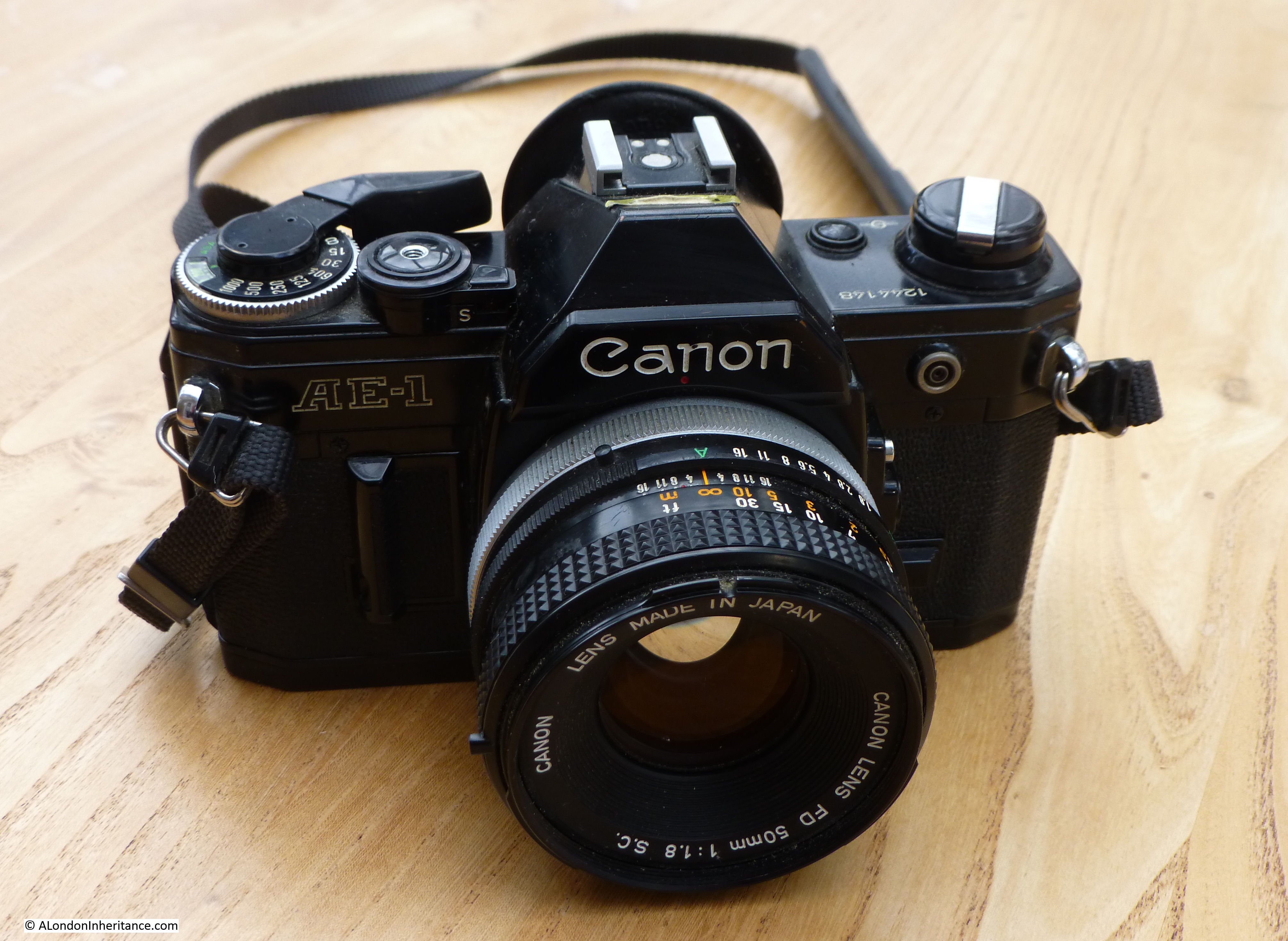
On to todays post. Last summer I took my father’s old Leica camera out for walk. The first time this 70 year old camera had been used in 40 years. To test the camera I had purchased a pack of Ilford black and white film, and as there were some spare, I decided to take my old film camera out, a Canon AE-1 which was my main camera for around 25 years, but last used in 2003.

The Canon AE-1 was a significant camera when it came out in 1976. I purchased mine in 1977 from a discount shop in Houndsditch in the City on Hire Purchase, spreading the cost over a year. It replaced a cheap Russian made Zenit camera which had a randomly sticking shutter as a feature.

The Canon AE-1 was a revolution at the time. The first camera to include a microprocessor, it included a light meter and once the desired speed had been set on the ring on the top of the camera, the aperture (how much light is let in through the lens) would be set automatically. It was also possible to set both speed and aperture manually.

Focus was still manual, via a focusing ring on the front of the included 50mm lens.

My Canon AE-1:

Fleet Street

The camera was powered by a battery in the compartment to the left of the lens in the above photo. Having not used the camera for almost twenty years, my main concern was that on opening the compartment, I would be met by a corroded mess, however the battery, although flat, was in good condition, and after replacing with a new battery, the camera came back to life.

Inserting a new film was much easier than the Leica as the film did not need to be trimmed, simply pushing the end of the film into the take up spool and winding on until the rewind knob moved.

I took the camera for a walk along Fleet Street, hence the title of the post – Fleet Street in 32 Exposures. I was using a 36 exposure film, so lost some in initial testing to make sure the film was winding on correctly.

Fleet Street seemed a good choice, as the street is lined with fascinating buildings. Substantial buildings from when newspapers occupied much of the street, to tall, thin buildings which are evidence of the narrow plots of land that were once typical along this important street. Many of the buildings are also ornately decorated.

This will be a photographic look at the buildings rather than a historical walk. Fleet Street has so much history that it would take a few posts to cover.

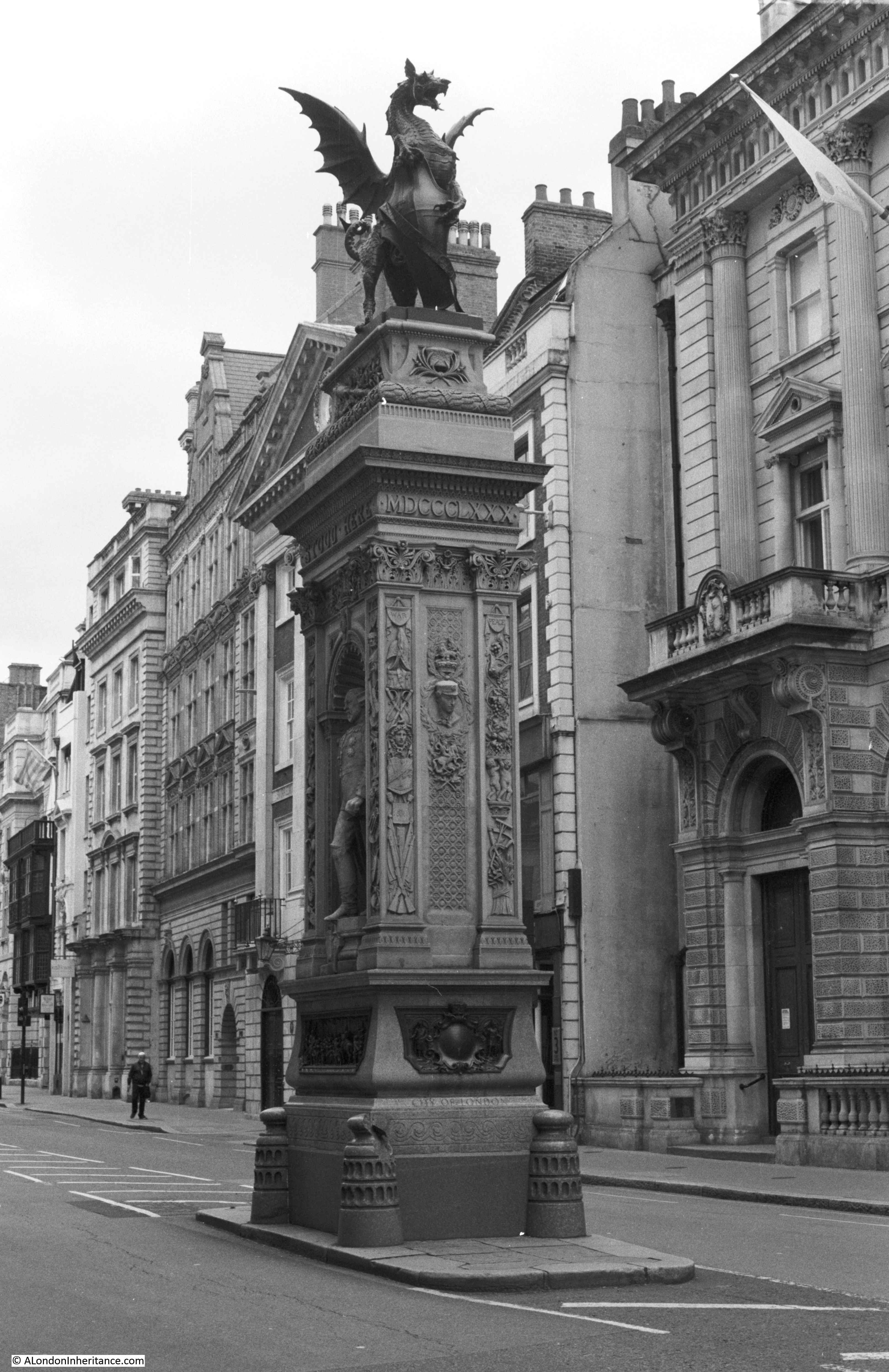
So to start a black and white walk along Fleet Street. I started at the point where the Strand becomes Fleet Street and the Temple Bar memorial:

Fleet Street

The Temple Bar memorial dates from 1880 and was designed by Sir Horace Jones. It marks the location of Wren’s Temple Bar which marked the ceremonial entrance to the City of London. The original Temple Bar now stands at the entrance to Paternoster Square from St Paul’s Churchyard.

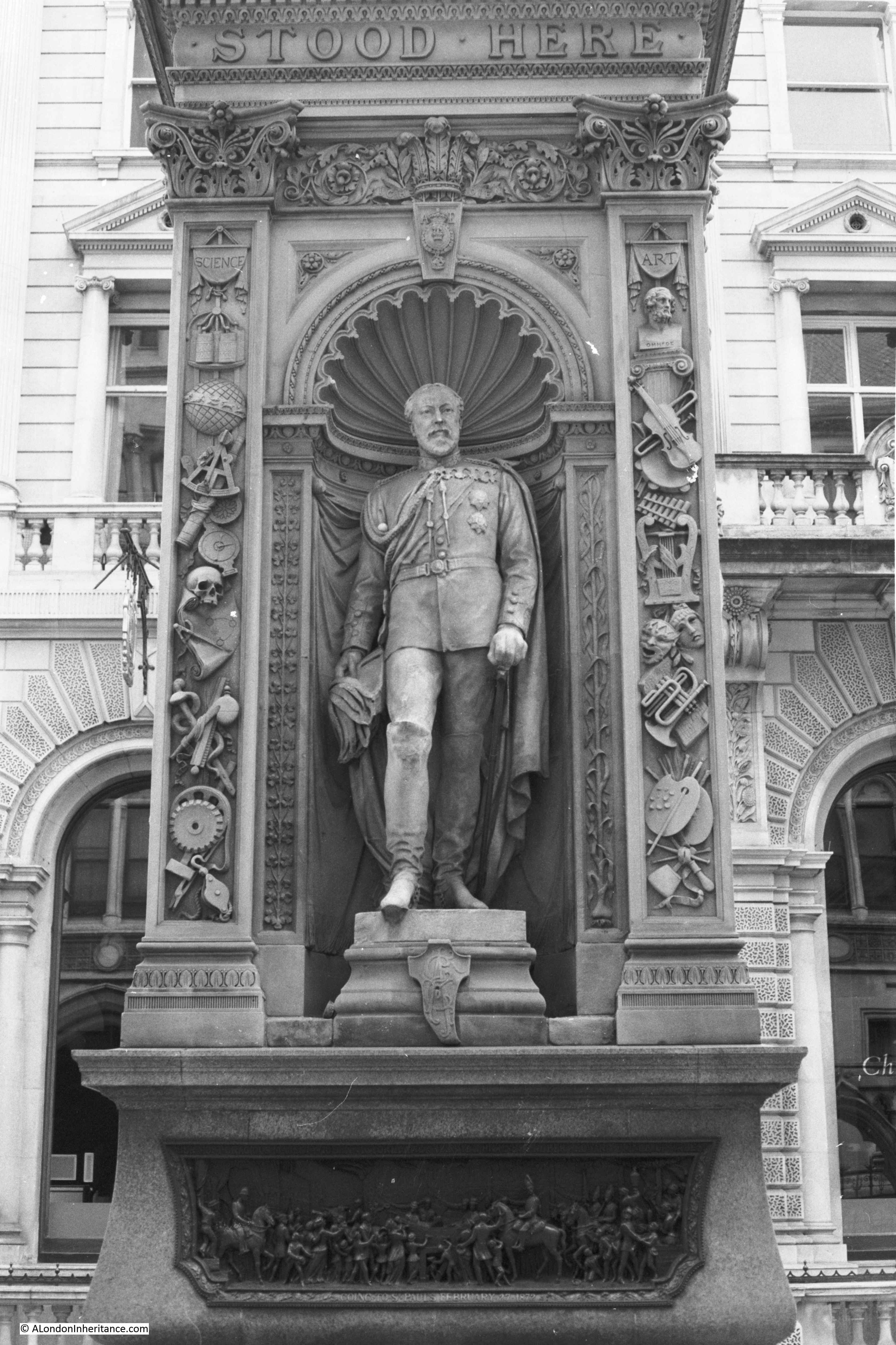
Statues of Queen Victoria and the Prince of Wales are on either side of the monument, which is also heavily decorated and shows the Victorian fascination with the arts and sciences, with representations of these lining either side of the alcoves with the statues.

Fleet Street

The Grade I listed Middle Temple Gatehouse which leads from Fleet Street into Middle Temple Lane. The building originally dates from 1684:

Fleet Street

The Grade II* listed Inner Temple Gatehouse between Fleet Street and the Inner Temple location of Temple Church:

Fleet Street

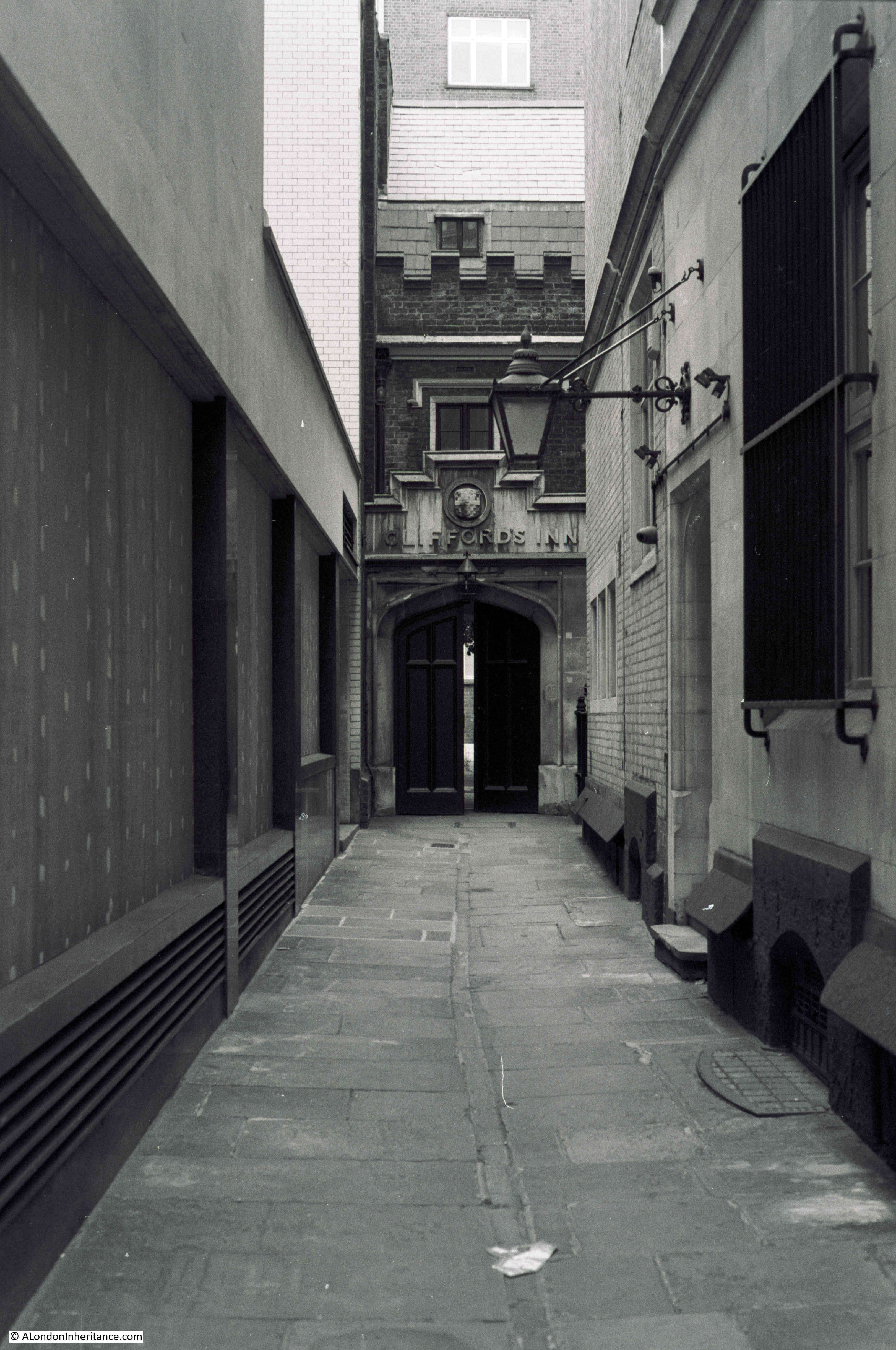
Cliffords Inn Passage and the entrance gate to Cliffords Inn:

Fleet Street

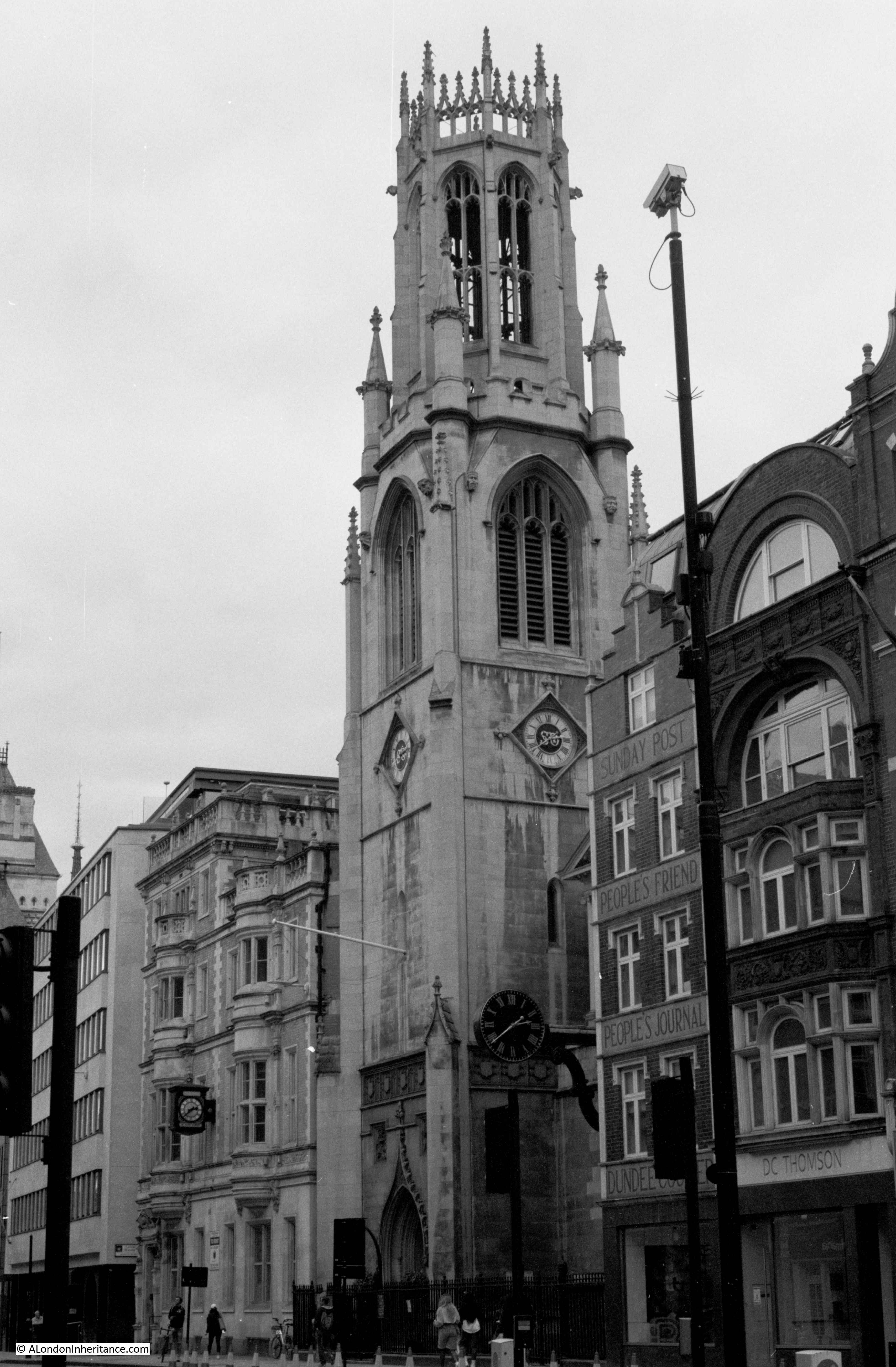
The church of St Dunstan in the West:

Fleet Street

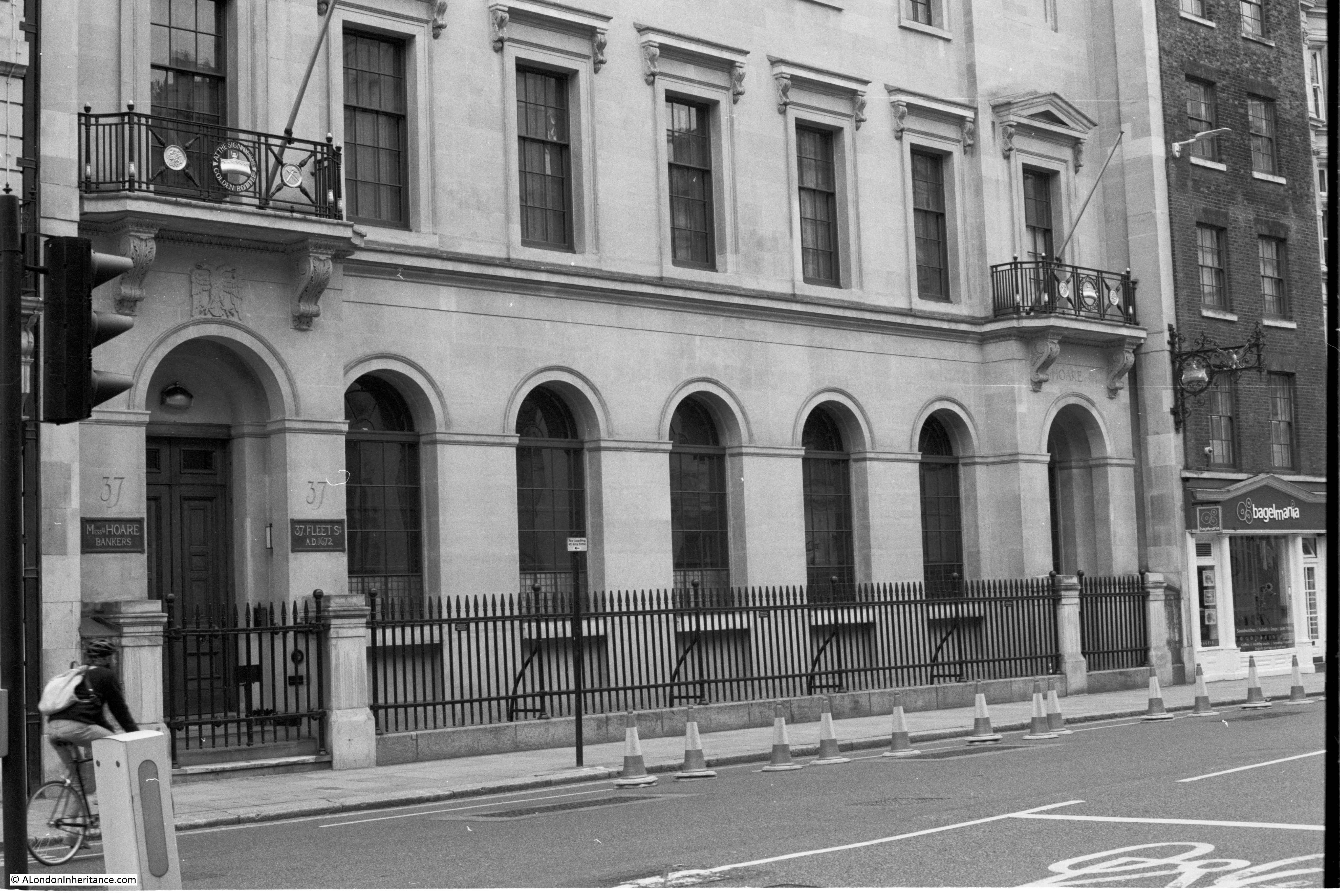
The head office building of the private bank of C. Hoare & Co. Founded by Richard Hoare in 1672, the bank has been based here in Fleet Street since 1690:

Fleet Street

Offices of publishing company DC Thomson, who still publish the Sunday Post and People’s Friend as well as the Beano. This is their London office, with their head offices being in Dundee (hence the Dundee Courier):

Fleet Street

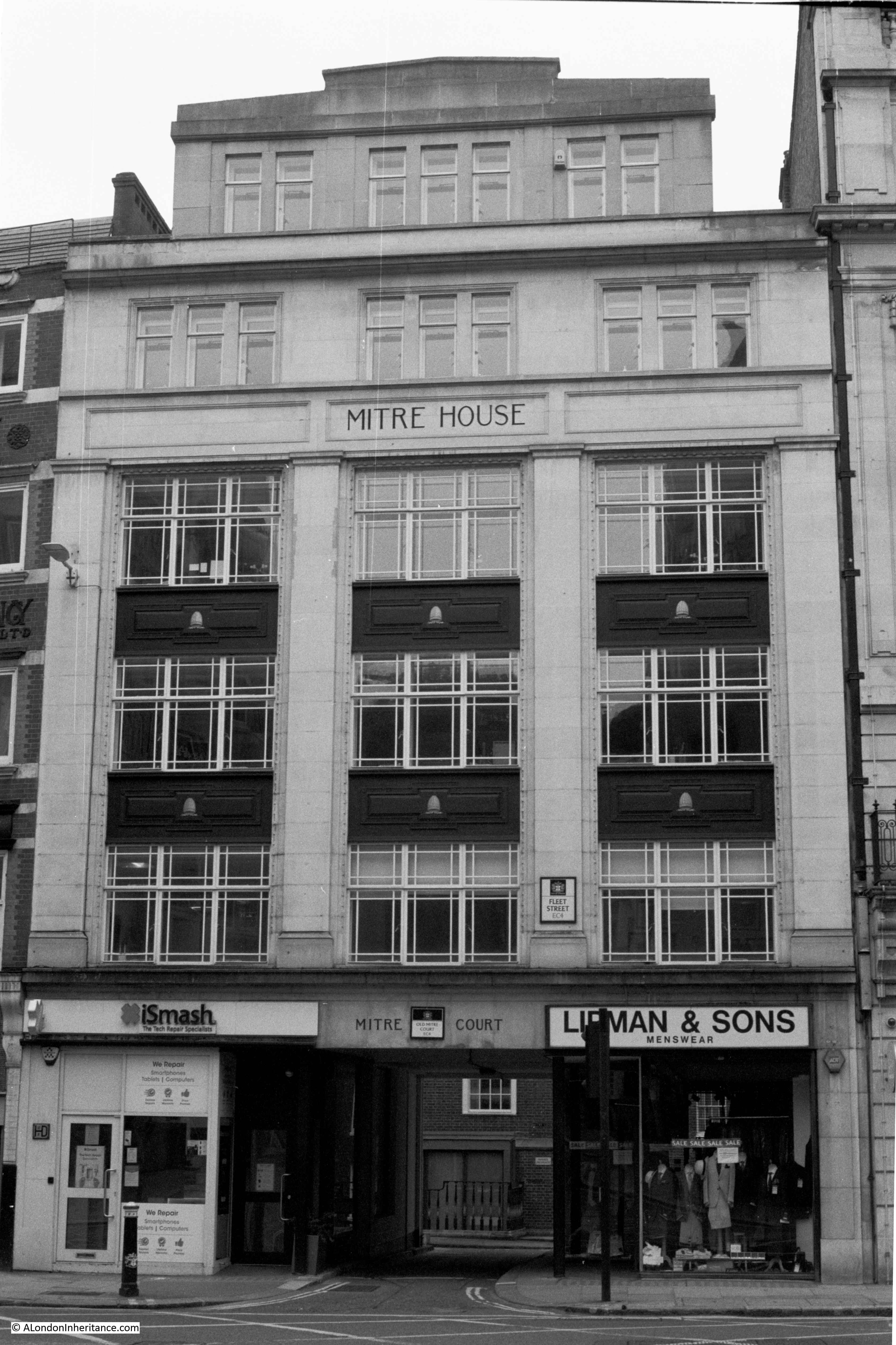
Mitre House, with the entrance to Mitre Court:

Fleet Street

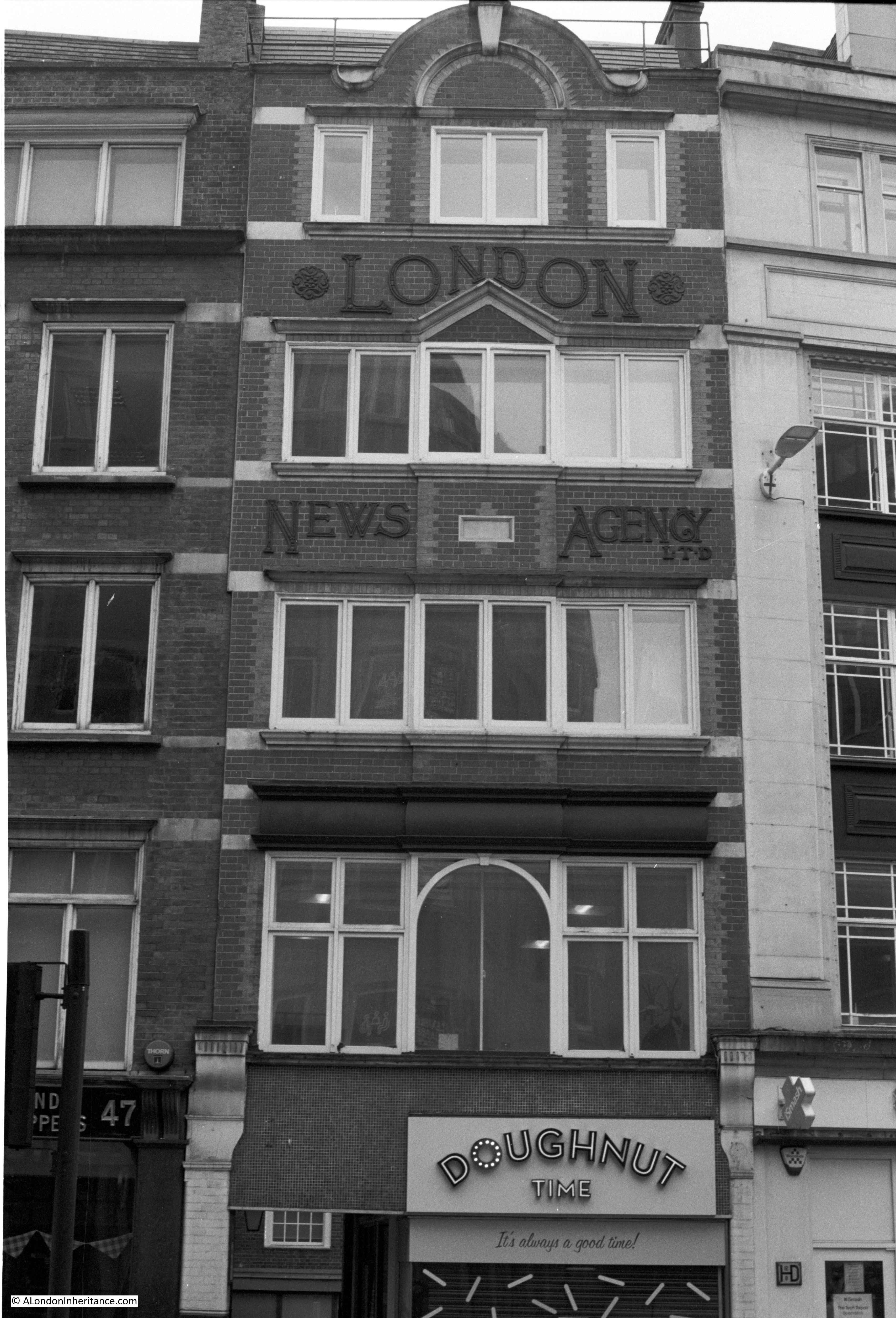
The original home of the London News Agency, also known as the Fleet Street News Agency. The business was here in Fleet Street from 1893 until 1972 when the business moved to Clerkenwell, where it was based until the agency closed in 1996.

Fleet Street

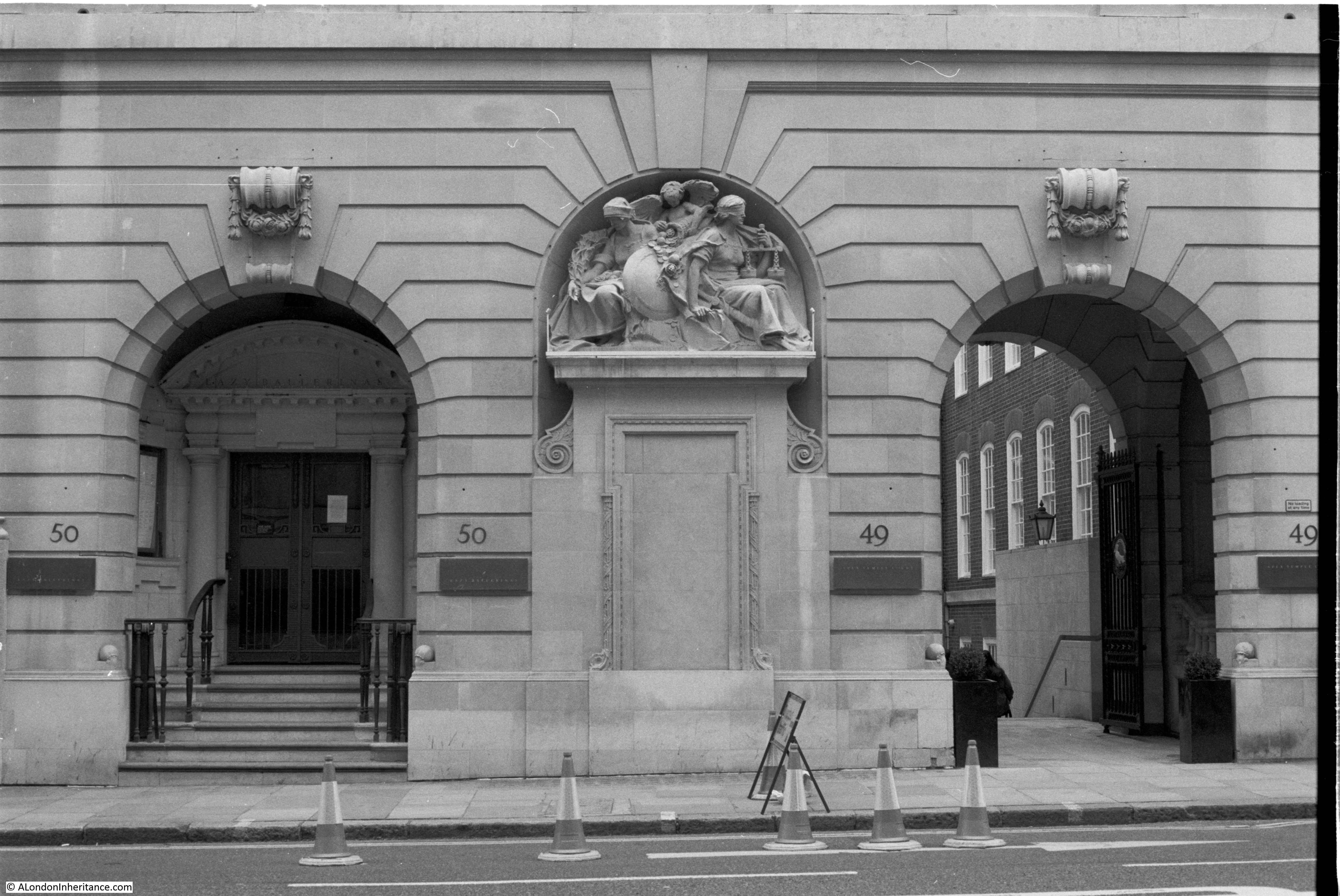
The entrance to 49 and 50 Fleet Street, a Grade II listed building that dates from 1911. Originally Barristers’ Chambers, in 2018 the building was converted into an extension to the Apex Temple Court Hotel.

Fleet Street

The following photo is of 53 Fleet Street and is a good example of where black and white is the wrong film to capture the features of a building. The upper floors are decorated with dark red bricks with green bricks forming diamond patterns, which can just be seen in the photo. It looks much better in colour.

Fleet Street

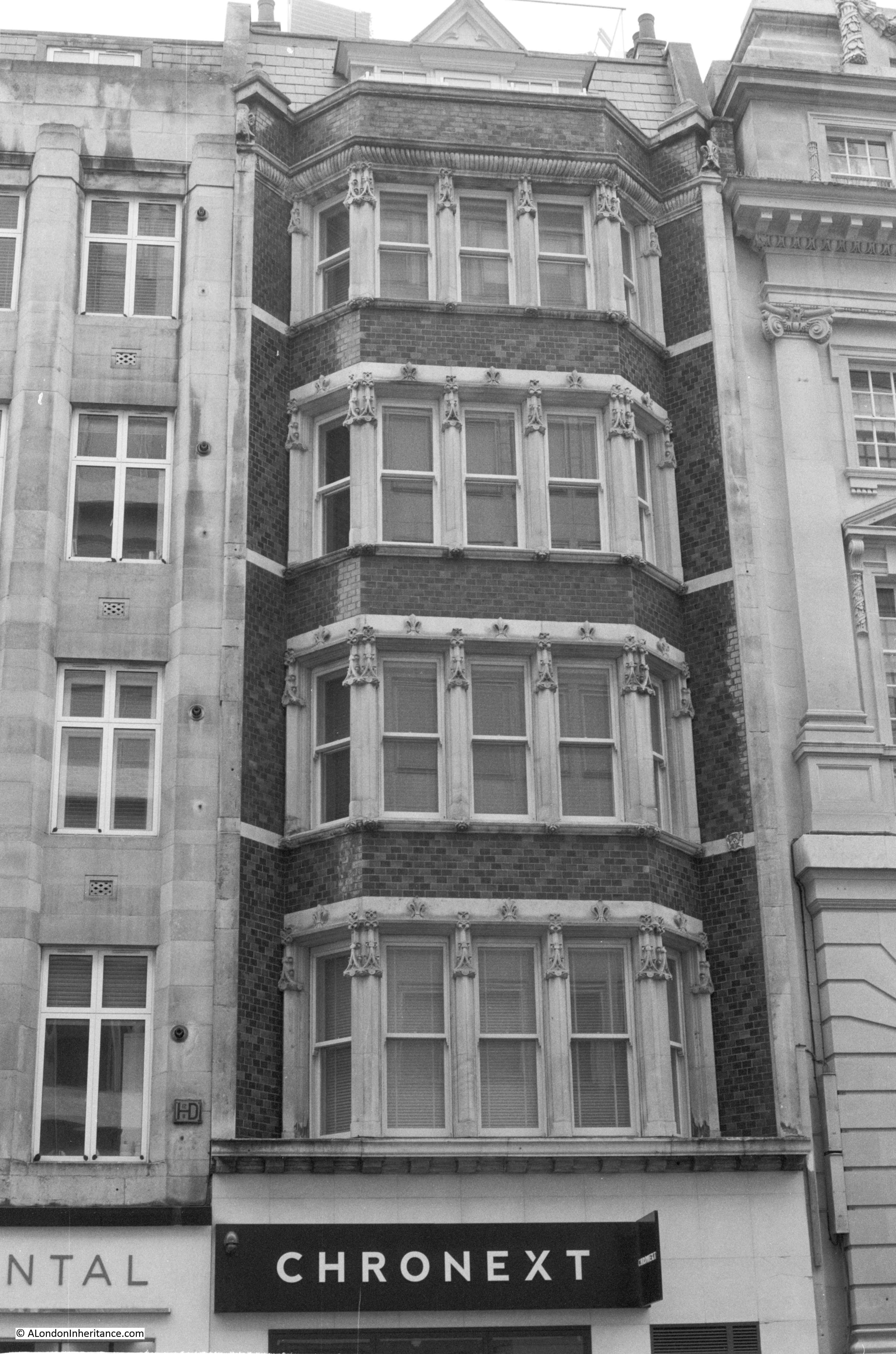
The following building is the Grade II listed former office of the Glasgow Herald built in 1927. The building is relatively thin and tall and the challenges with photographing the building using a fixed 50mm lens are apparent as I could not get in the top of the building without the front being at too oblique an angle.

Fleet Street

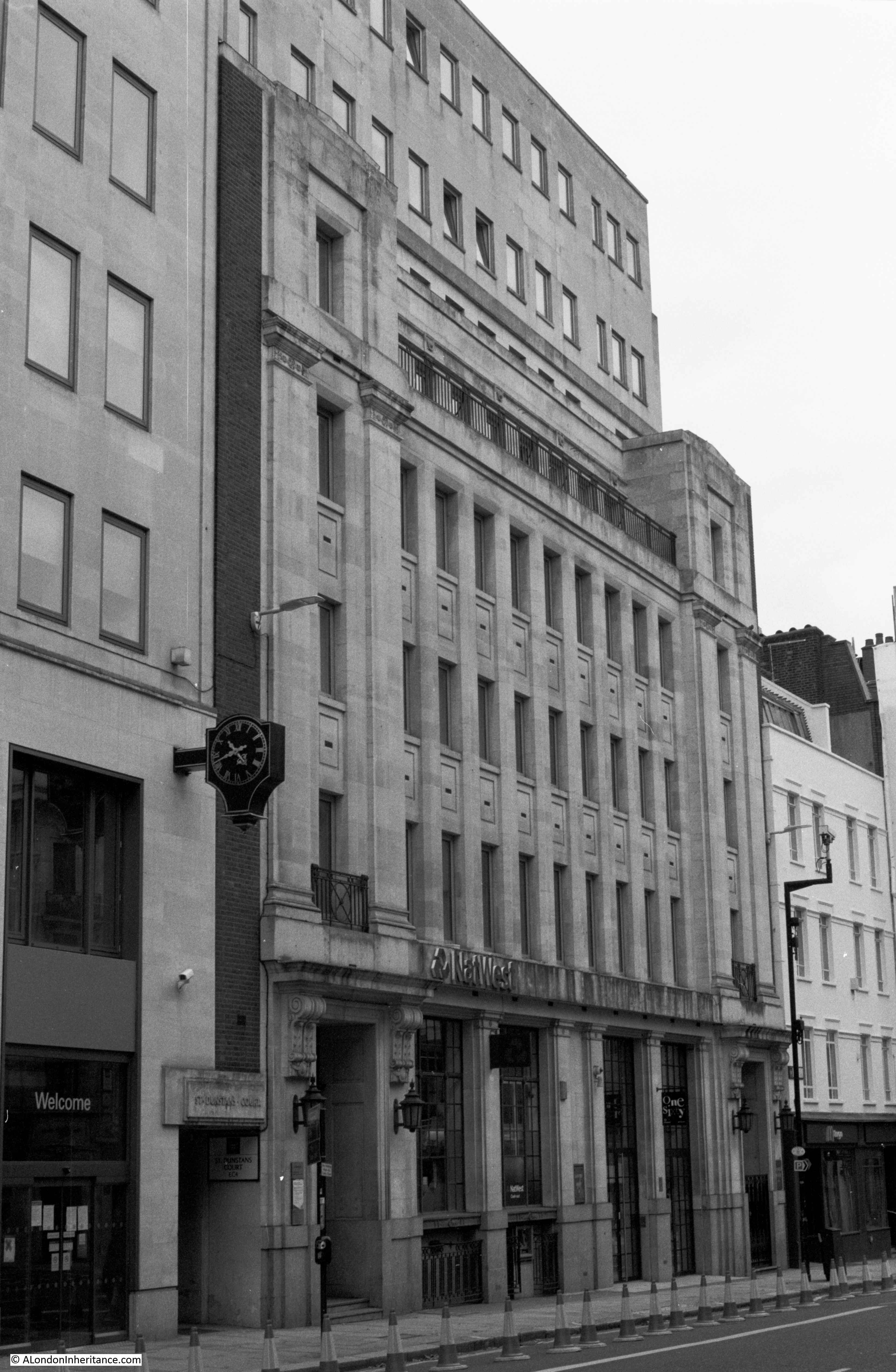
The 1920’s Bouverie House, with entrance to St Dunstans Court at lower left:

Fleet Street

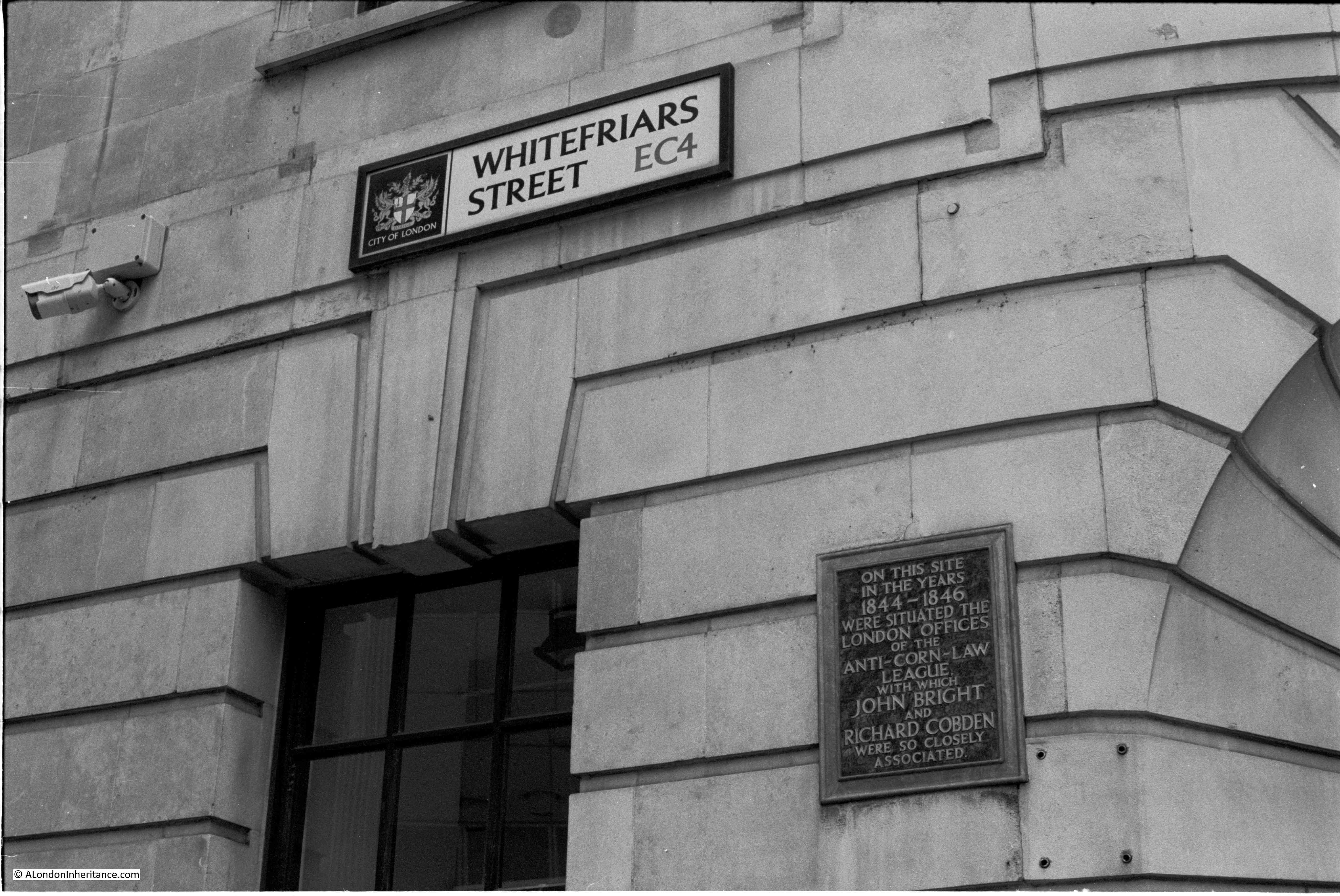
Almost opposite Bouverie House, Whitefriars Street leads off from Fleet Street. A plaque on the wall records that this was the location of the office of the Anti-Corn-Law League between 1844 and 1846.

Fleet Street

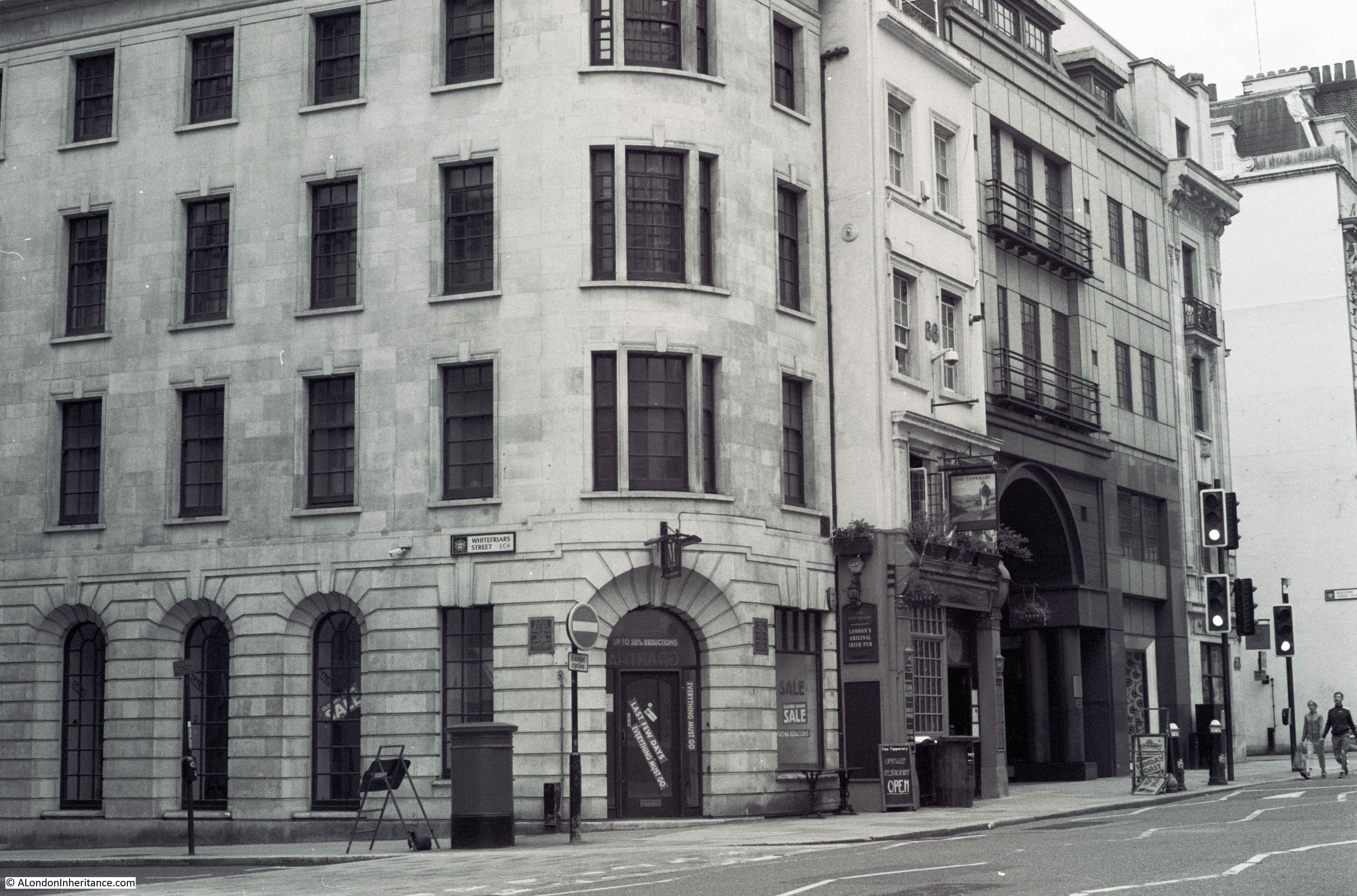
A wider view of the building on the corner of Whitefriars Street and Fleet Street. The above plaque can be seen on the wall to the left of the corner entrance. The pub just to the right of the corner building is the Tipperary at 66 Fleet Street.

Fleet Street

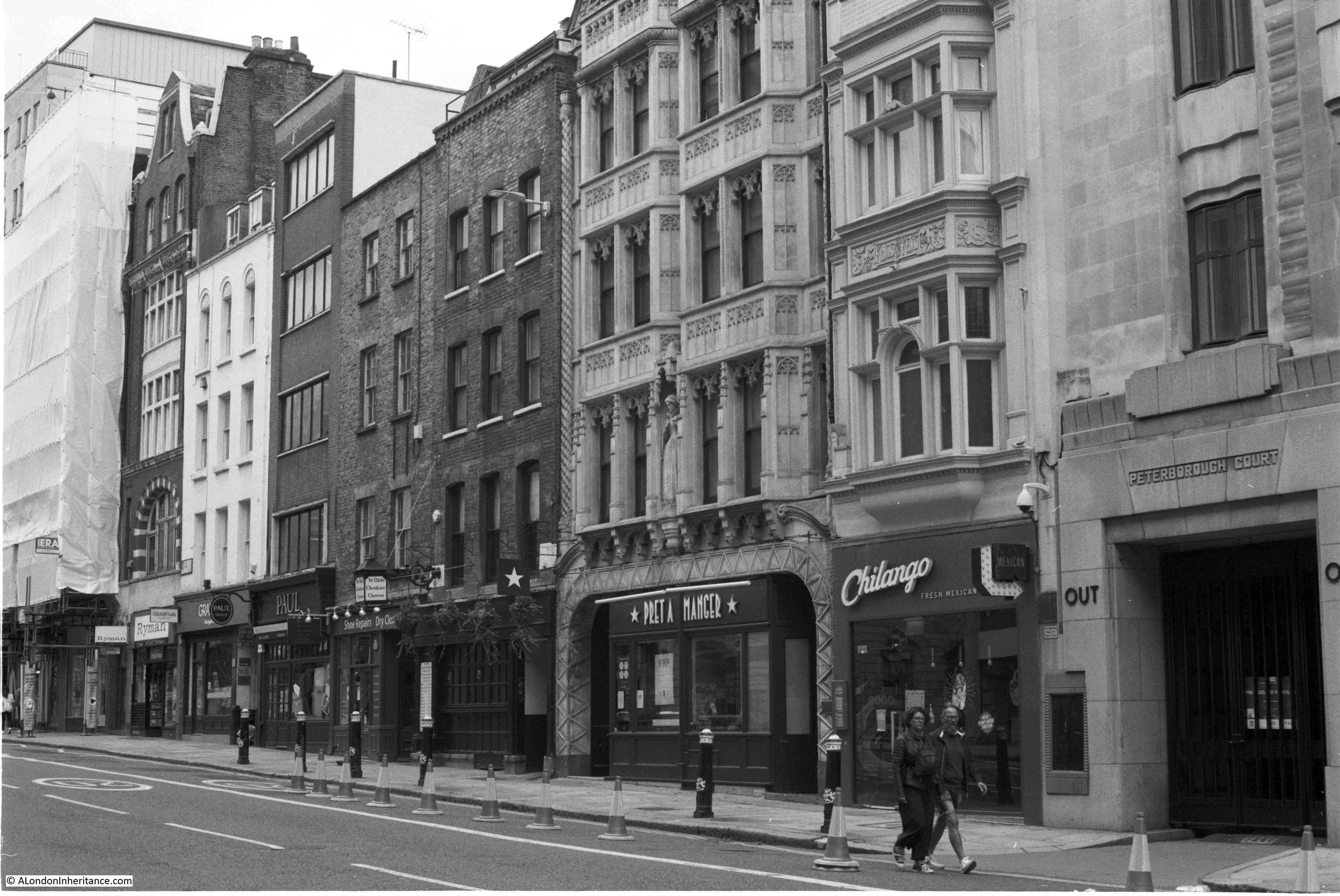
The following photo shows a view along the northern side of Fleet Street and highlights the mix of different building ages, materials and architectural styles that make this street so interesting. One of the oldest building on the street is in the centre of the view. The Cheshire Cheese pub dates from 1538 with the current building dating to 1667.

Fleet Street

Next to the Cheshire Cheese is this rather ornate building which is currently home to a Pret on the ground floor. This is the Grade II listed, 143 and 144 Fleet Street. The statue in the centre of the first floor is of Mary, Queen of Scots.

Fleet Street

The building in the above photo was constructed in 1905 for Sir John Tollemache Sinclair, a Scottish MP, and designed by the architect  R.M. Roe.  Whilst researching for the reason why the statue is on the building (Sinclair was a fan of Mary Queen of Scots), I found the following newspaper report from The Sphere on the 17th August 1946 which provides a description of the use of the building:

“Although at first glance, this life-size statue of Mary, Queen of Scots appears to be in an ecclesiastical setting, it is, in fact, situated above a chemist’s shop and a restaurant in one of the older and grimier buildings of Fleet Street. No. 143-144 Fleet Street, known as Mary, Queen of Scots House, contains a typical selection of Fleet Street tenants – newspaper offices, advertising agents and artists agents”

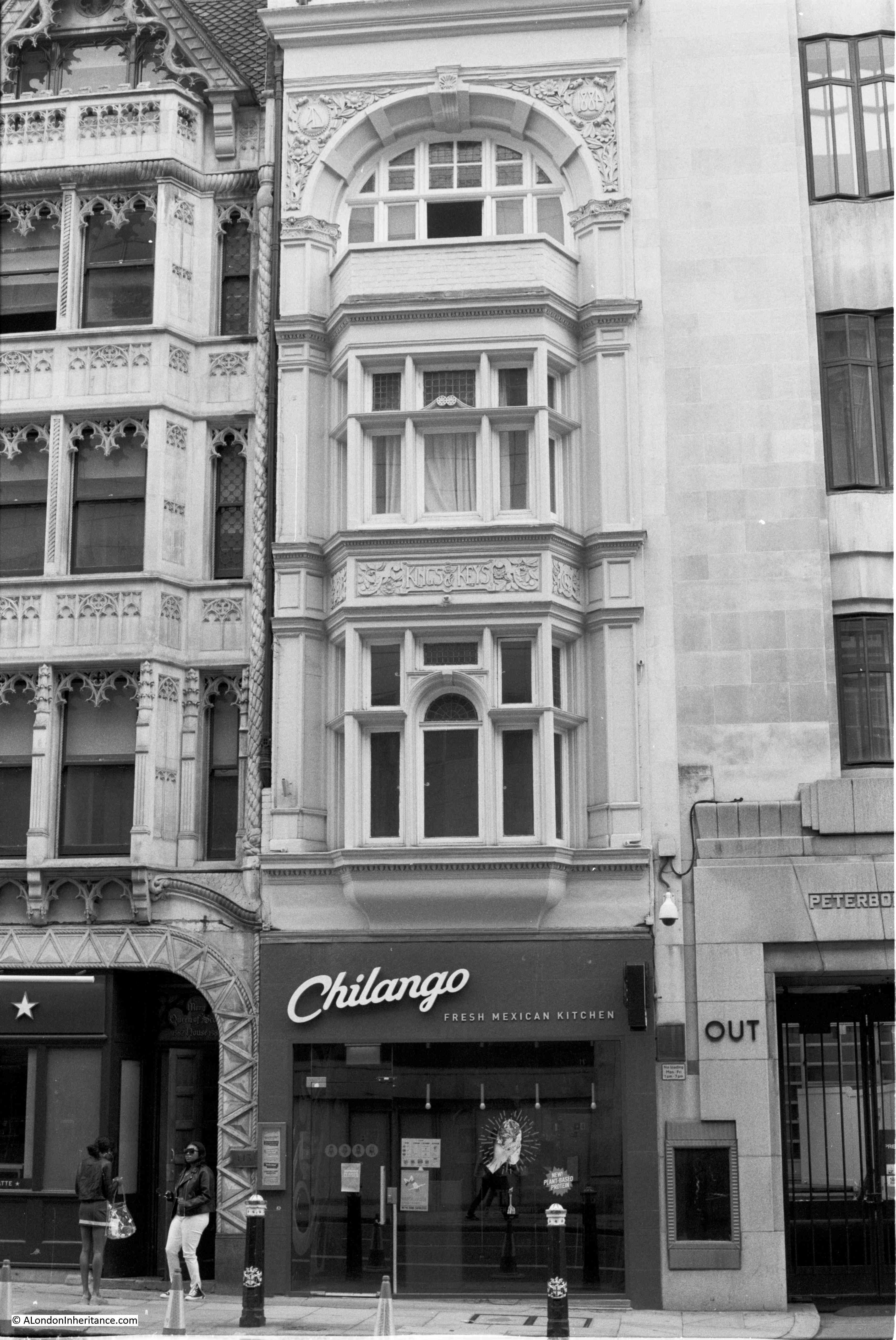
Next to the above building is a lost pub, the building in the following photo was once the Kings and Keys pub.

Fleet Street

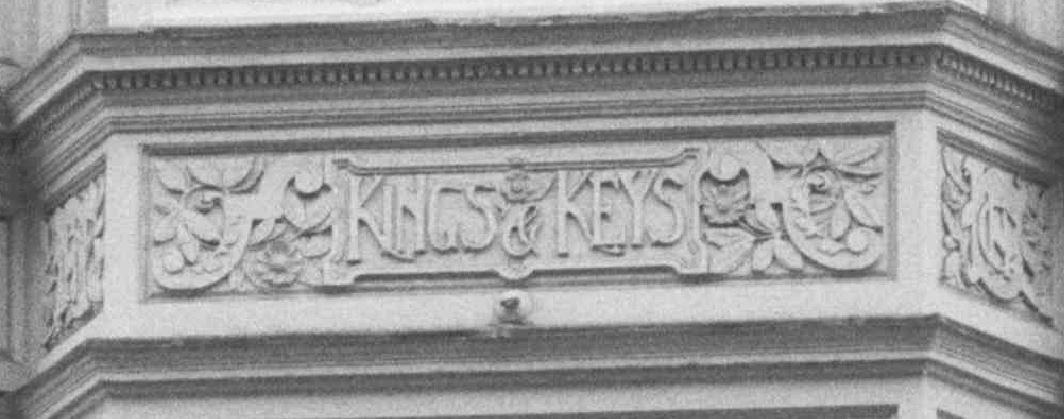
The name of the pub can still be seen carved in the decoration between the first and second floors.

Fleet Street

The Kings and Keys closed in 2007, and in the days when Fleet Street newspapers had their local pub, this was the pub for the Daily Telegraph. Although the building dates from the late 19th century, a pub with the name Kings and Keys had long been on the site. A newspaper report from 1804 highlights the dangers for those travelling through London and stopping at a pub:

“Last week a young midshipman, from Dover, going to Oxford on a visit to his relations, stopped at the King and Keys, in Fleet-street, for refreshment, when a fellow-traveler, whom he had supported on the road, attempted to rob him of his box, containing his money and clothes, which was prevented by the waiter; the ungrateful villain unfortunately made his escape”.

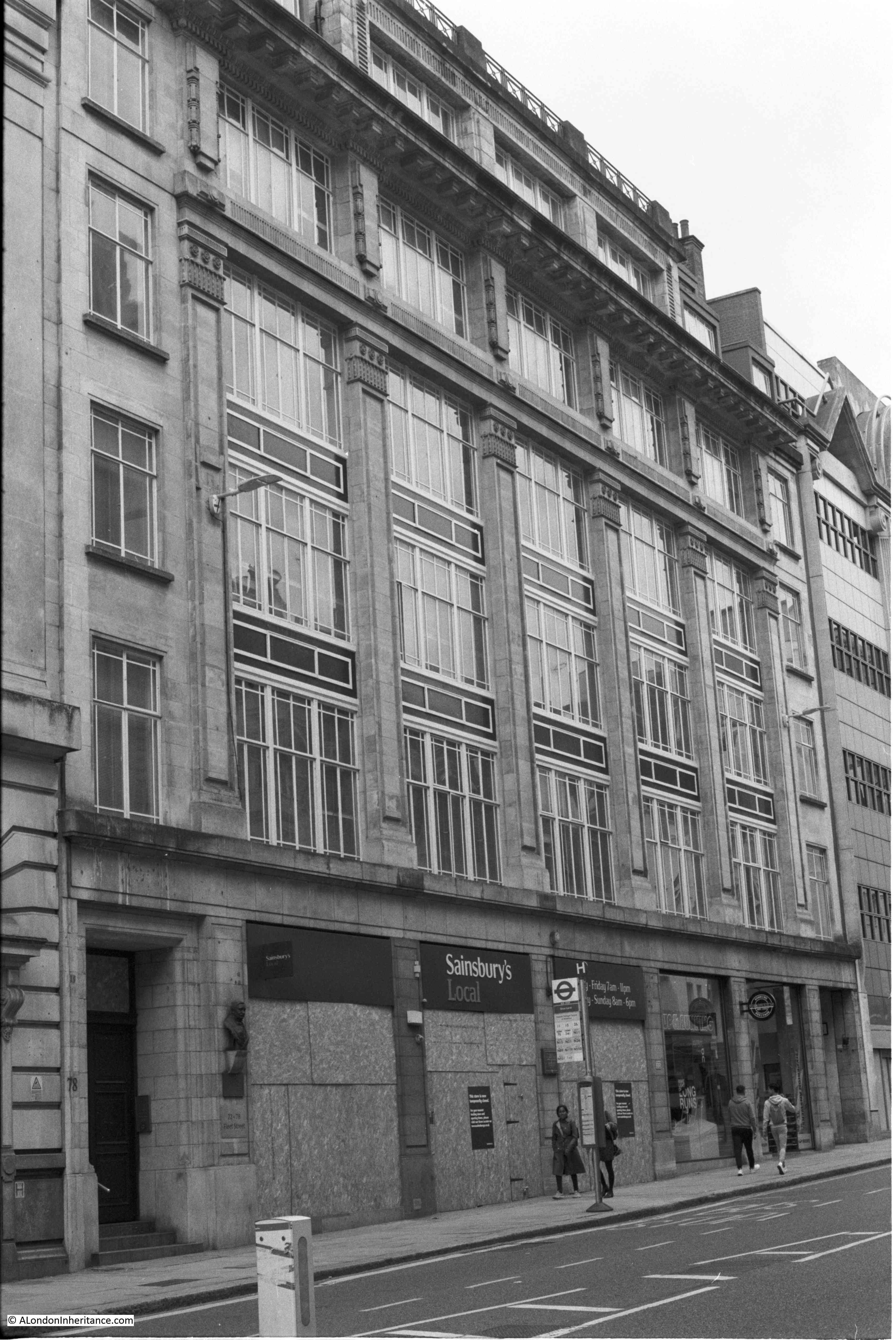
Across the road is a closed and boarded Sainsbury’s Local. One of the casualties of the lack of people travelling to work in Fleet Street during the lock-downs.

Fleet Street

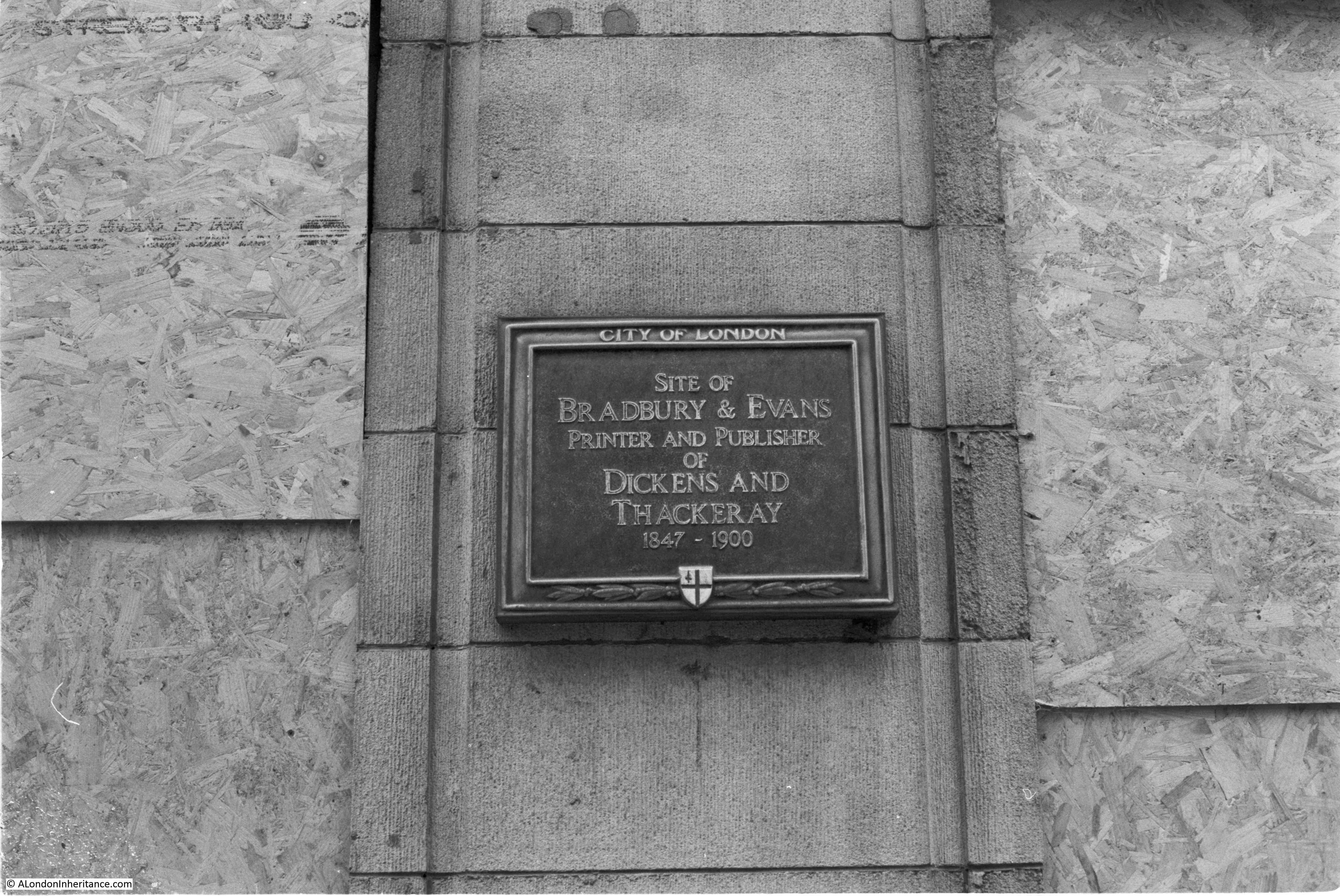
On the front of the above building is a plaque recording that it was the site of Bradbury and Evans, Printer and Publisher of Dickens and Thackeray between 1847 and 1900.

Fleet Street

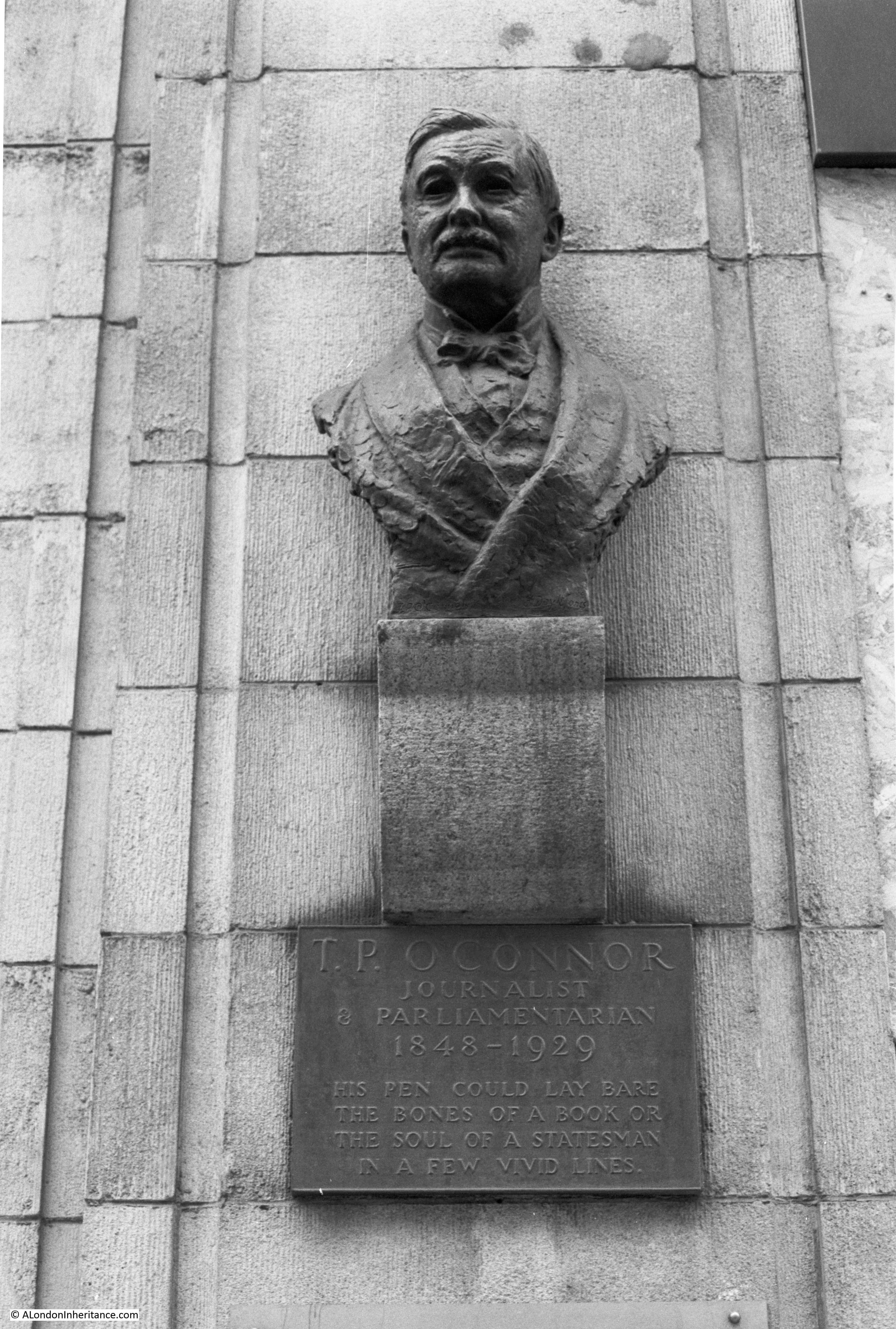
And to the left of the building is a memorial to T.P. O’Connor, Journalist and Parliamentarian 1848 to 1929 – “His pen could lay bare the bones of a book or the soul of a statesman in a few vivid lines”.

Fleet Street

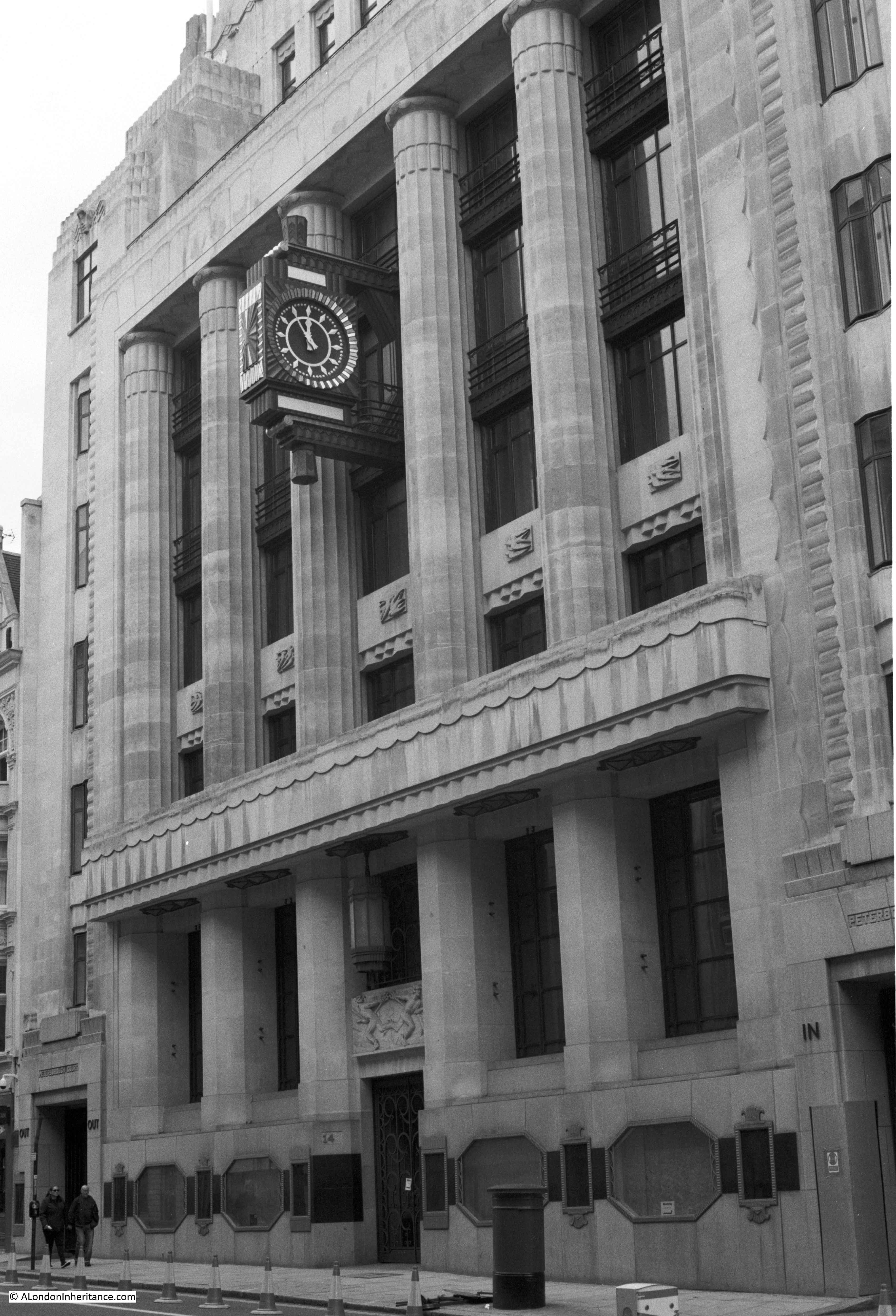
Next to the old Kings and Keys building is the old offices of the Daily Telegraph newspaper. Built for the newspaper in 1928 and now Grade II listed.

Fleet Street

The building is a good example of the power and authority that the newspapers wanted to project when they were still the main source of news, before radio and television had become a mass market source of news.

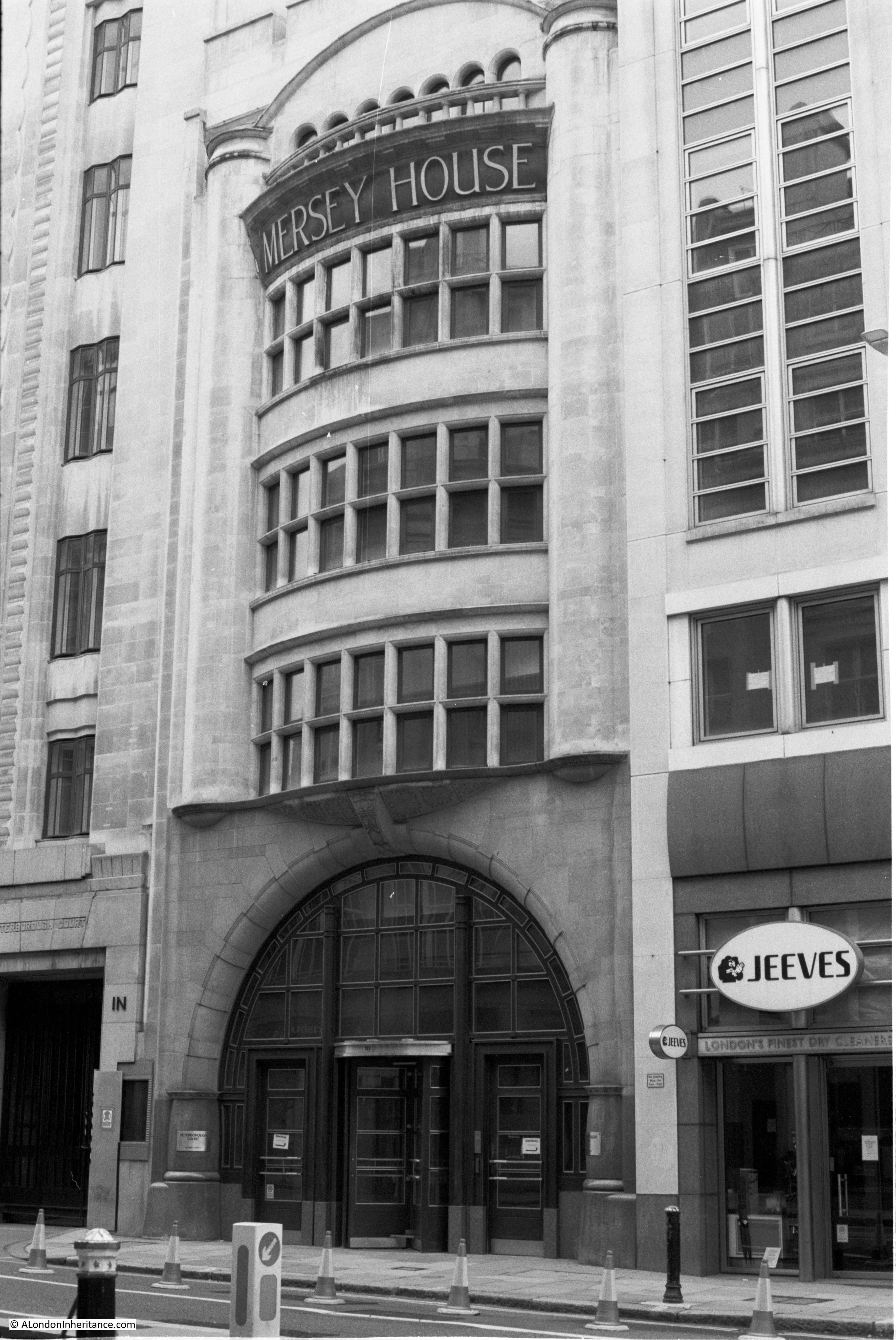
Next to the Telegraph building is Mersey House, built between 1904 and 1906:

Fleet Street

Mersey House is yet another Grade II listed building, and was the London home of the Liverpool Daily Post (which is probably the source of the Mersey name after the River Mersey). The newspaper cannot have been using all the space in the building as in 1941 they were advertising:

“Do you want a London Office with a Central and Appropriate Address? Accommodation can be had in Mersey House, Fleet Street, E.C. 4 – Apply the Daily Post and Echo, Victoria Street, Liverpool”.

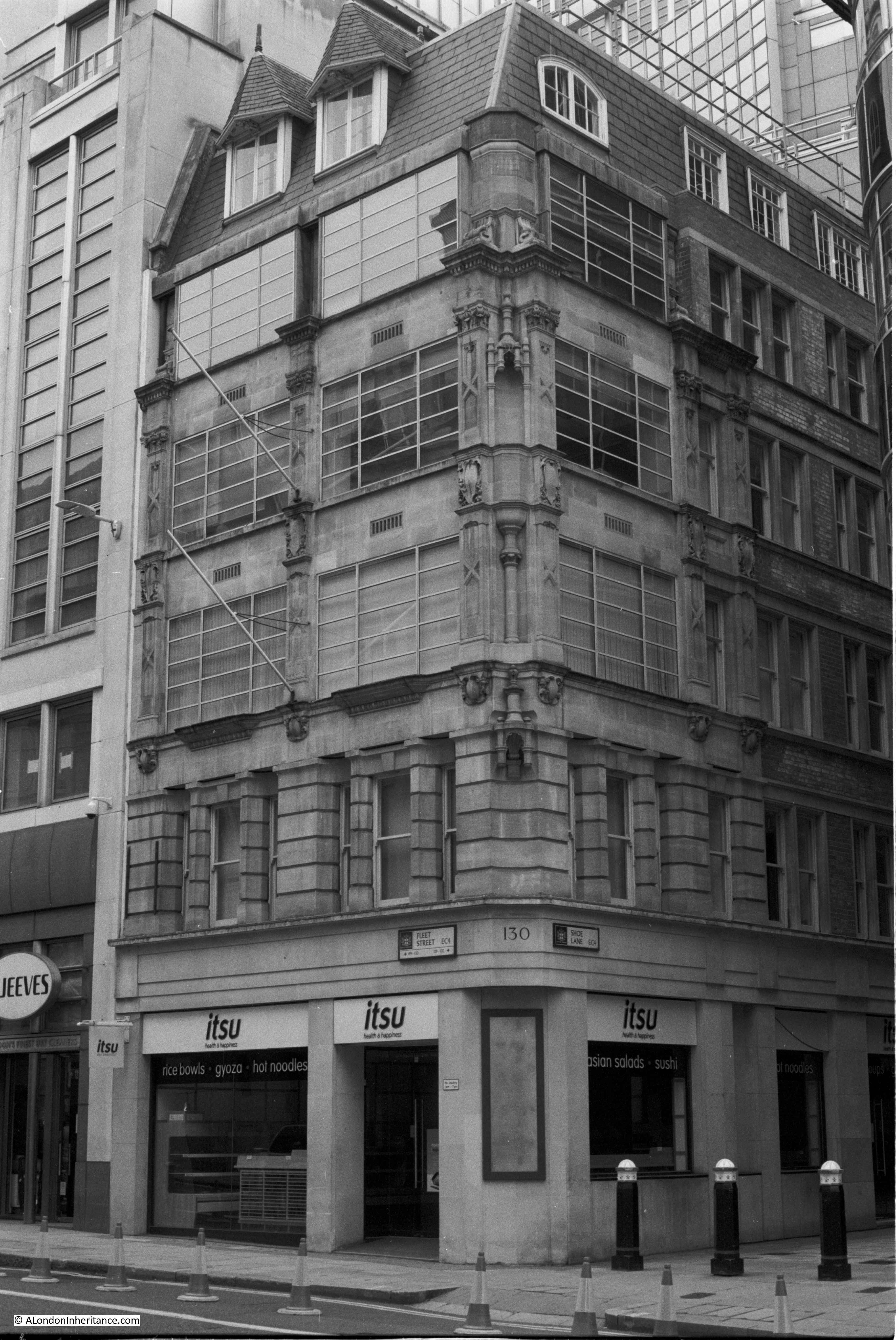
There are substantial stone clad buildings on many of the corners of Fleet Street. This is 130 Fleet Street on the corner with Shoe Lane:

Fleet Street

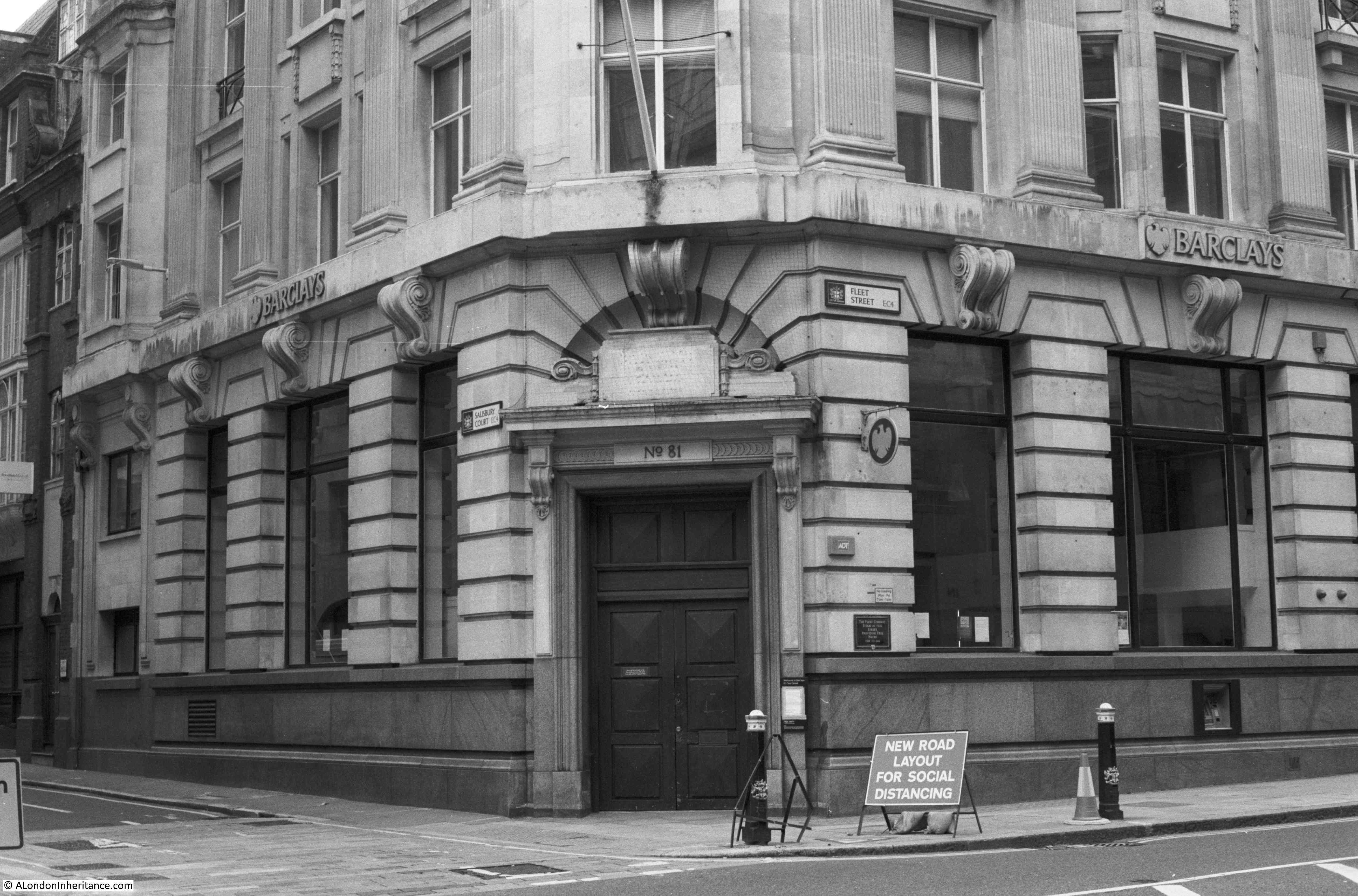
And a typical bank building on the corner with Salisbury Court. The plaque to the right of the door records that “The Fleet Conduit Stood In This Street Providing Free Water 1388 to 1666”.

Fleet Street

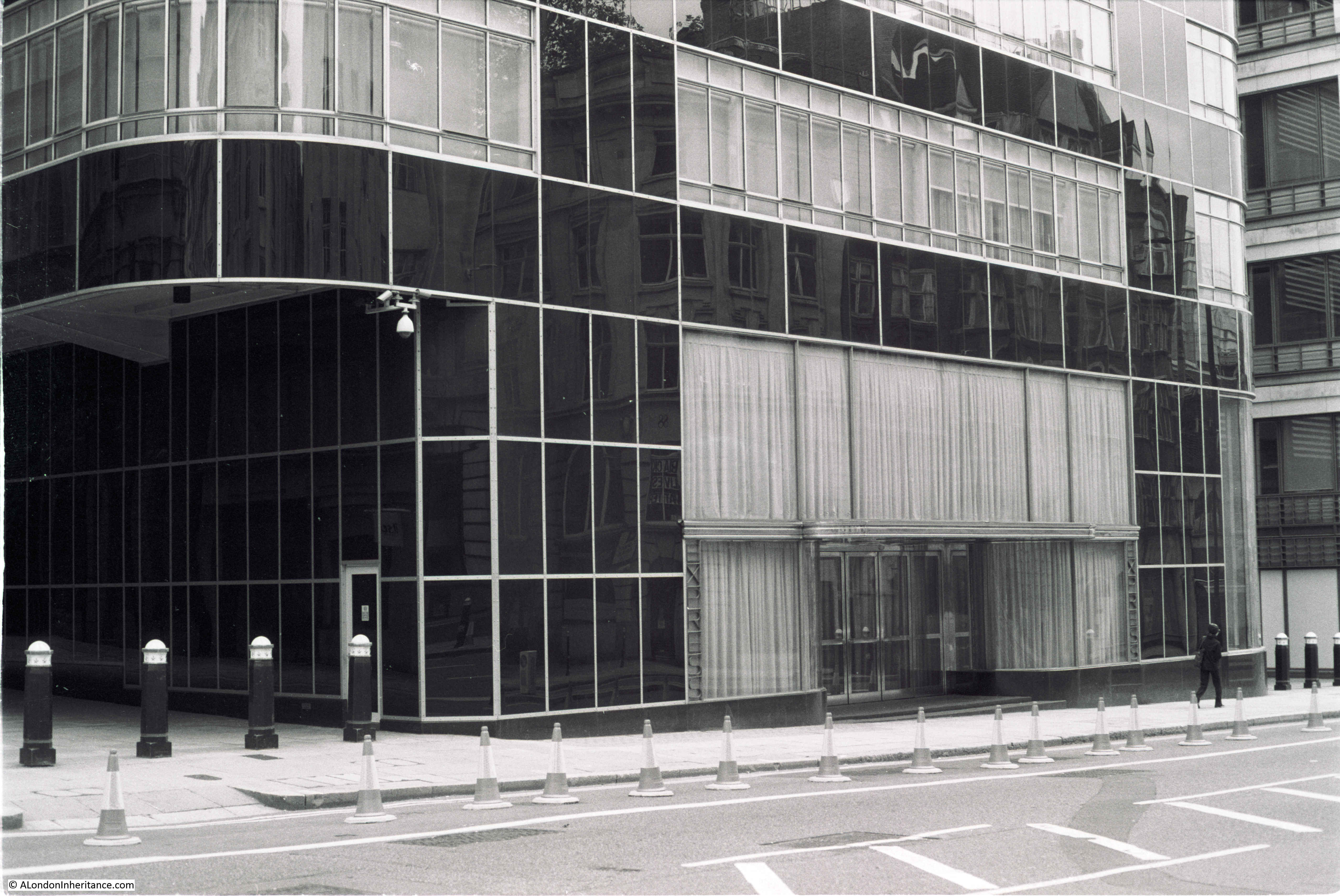
The majority of buildings that line Fleet Street are of stone, however there is one spectacular building of a very different design and using very different materials. The following photo shows the lower floors of the Grade II* listed Daily Express building dating from 1932.

Fleet Street

The above photo shows the limitations of using a fixed lens. impossible to get the whole building in a single photo. These are the upper floors:

Fleet Street

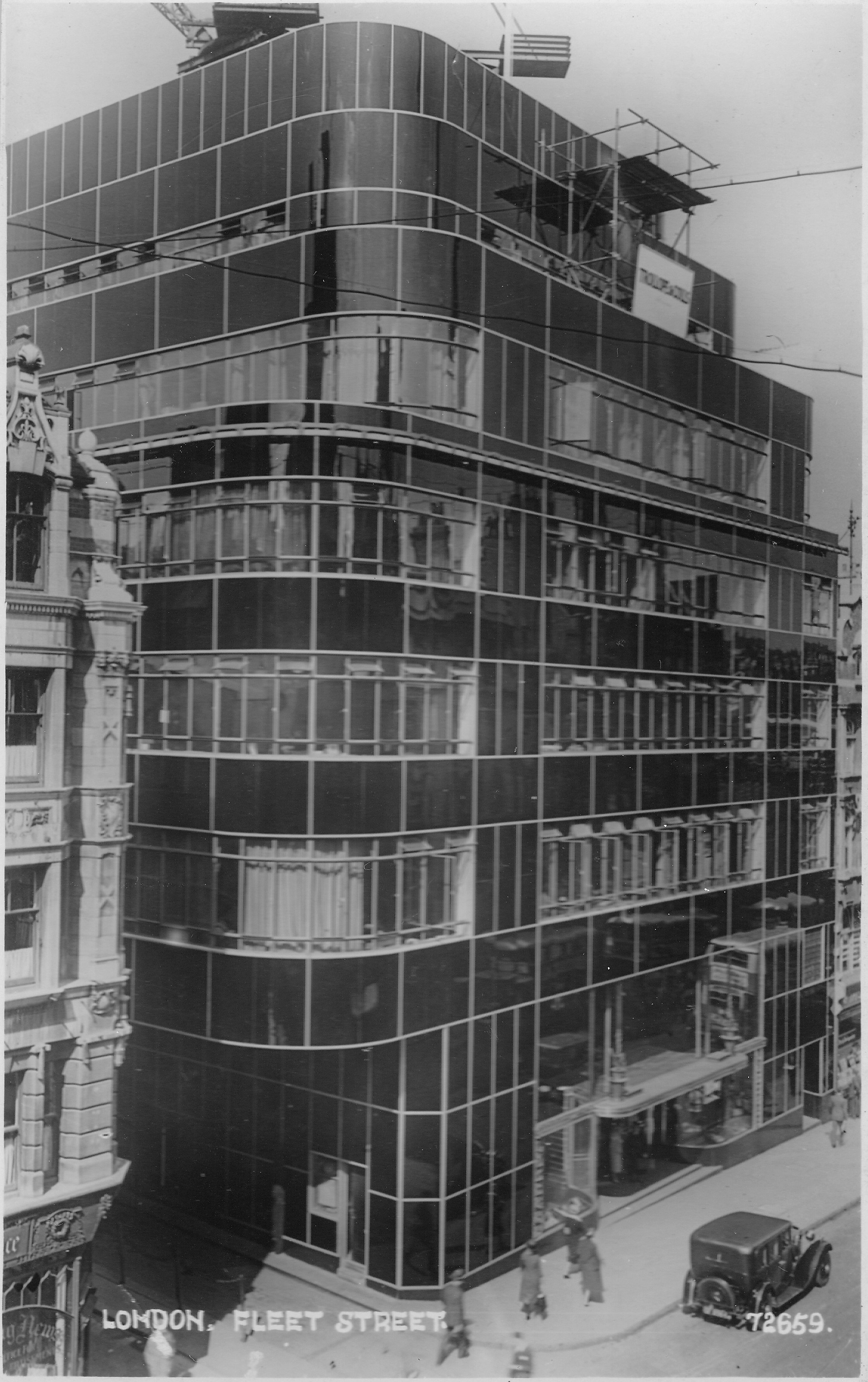
The art deco building was designed by architects H. O. Ellis & Clarke with engineer Sir Owen Williams. The materials used for the building could not be more different than the rest of Fleet Street.

Vitrolite (pigmented, structural glass) along with glass and chromium strips formed the façade of the building, to give the building a very modern, clean and functional appearance at the start of the 1930s.

Four years after completion, the building was used as an example in an article on “Architecture – the way we are going” in Reynolds’s Newspaper to demonstrate the battle of architectural ideas, and the type of design and materials that will be the future of office and industrial buildings

The building can really be appreciated when seen as a complete building, and the following postcard issued as construction was finishing, shows the building in all its glory:

Fleet Street

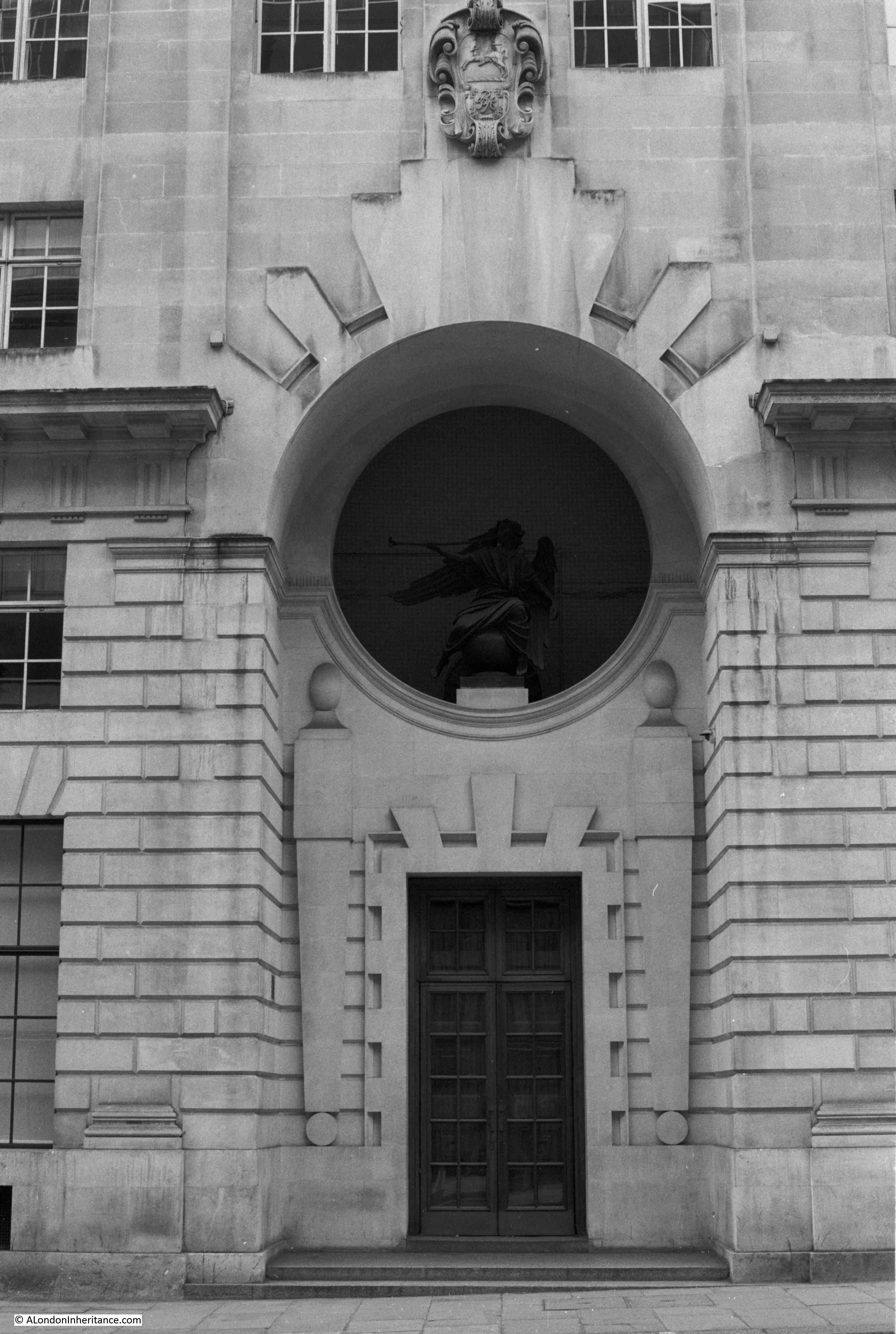
On the opposite side of the street is the old building of the Reuters news agency, one of the last of the news agencies to leave Fleet Street in 2005. The following photo shows the main entrance to the building and according to Pevsner is recognisable as the work of the architect Sir Edward Lutyens by “the wide, deep entrance niche on the narrower Fleet Street front”. Above the door, in the round window is the bronze figure of Fame.

Fleet Street

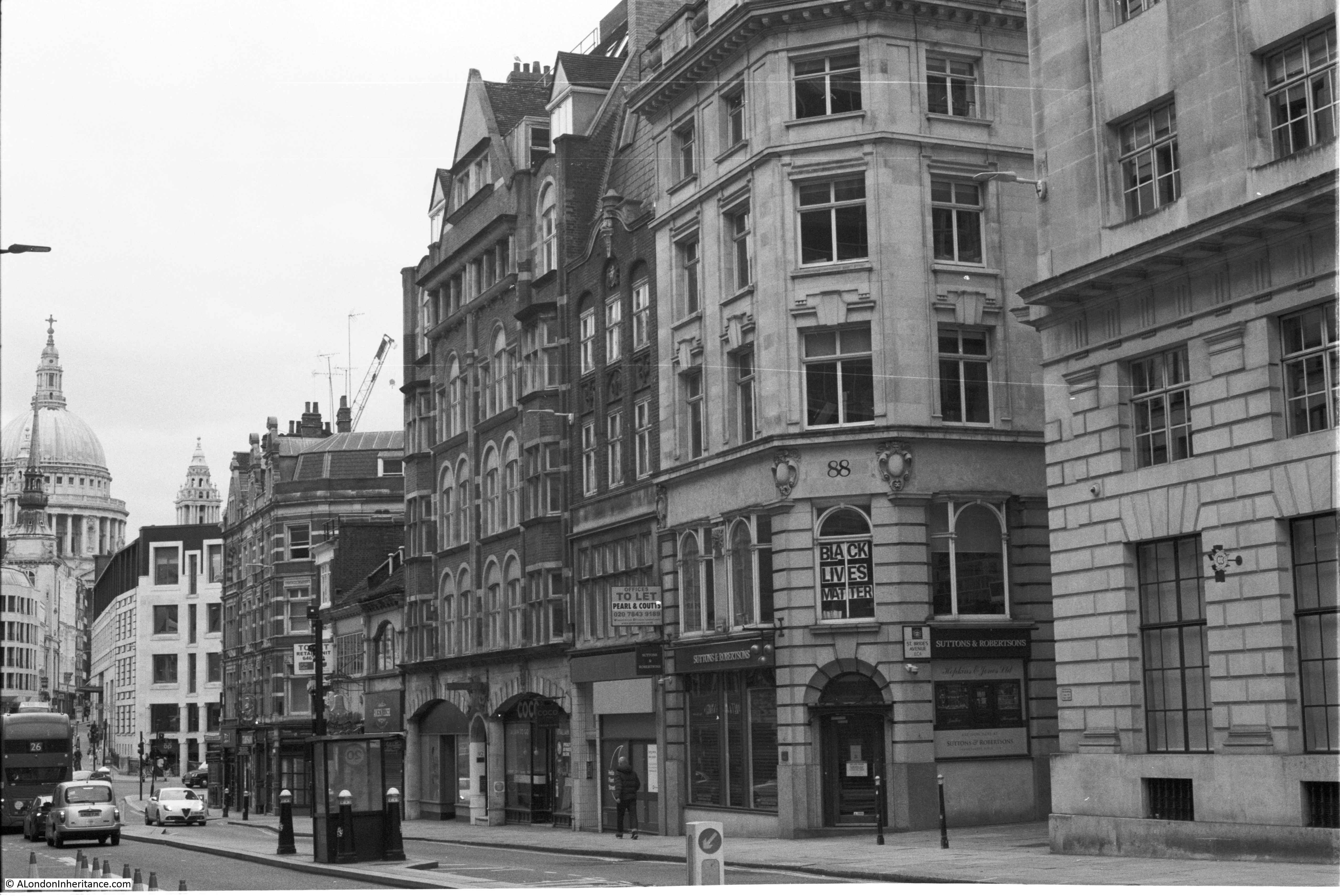
View looking down Fleet Street, with the dome of St Paul’s Cathedral in the distance:

Fleet Street

The following photo is looking back up Fleet Street. in the centre of the road is one of the old police sentry boxes introduced during the early 1990s in response to the IRA bombing campaign in the City of London.

Fleet Street

I have now come to Ludgate Circus, where Fleet Street meets Farringdon Street, and where the old river that gave the street its name once ran.

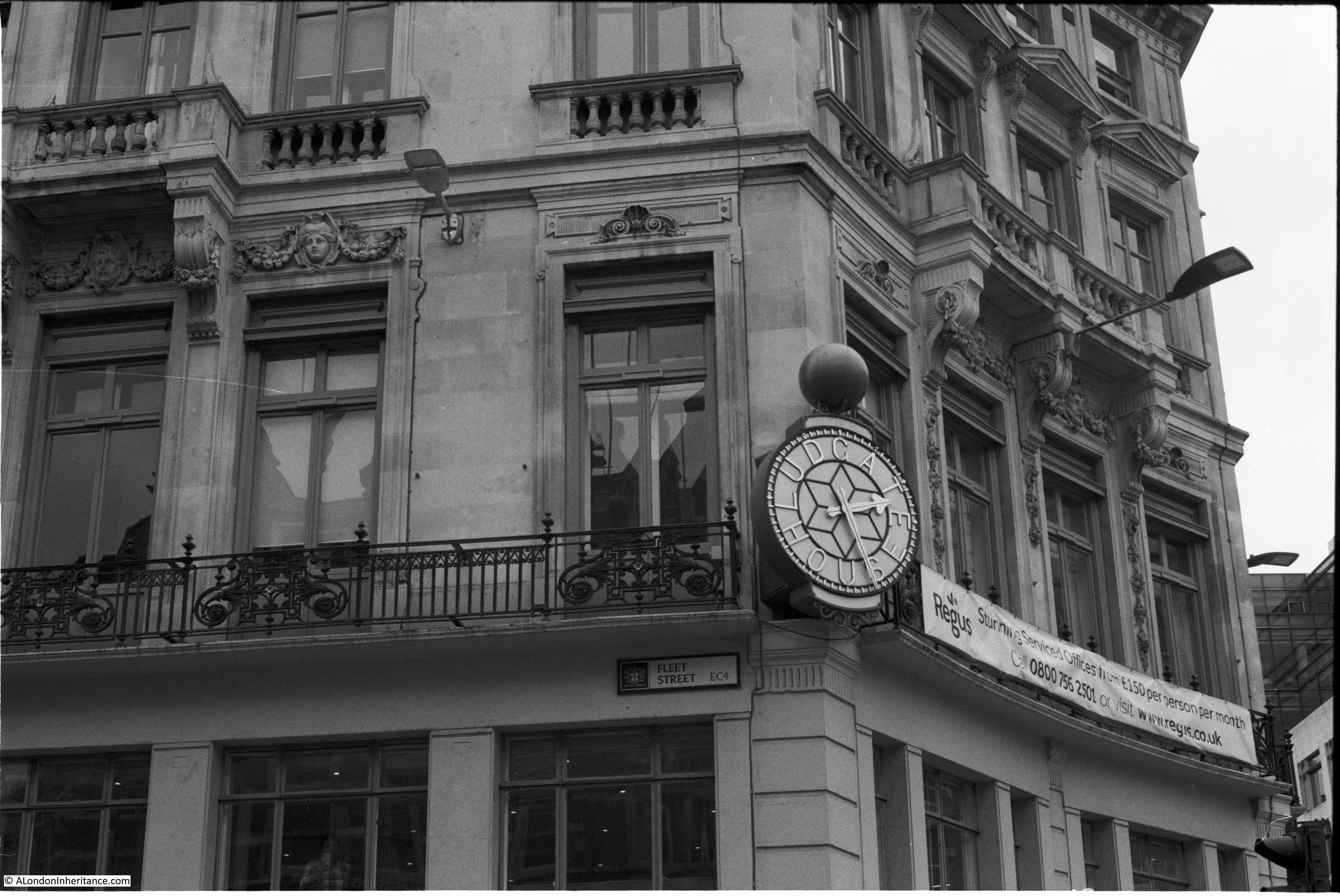
The clock on Ludgate House:

Fleet Street

That is Fleet Street in 32 exposures, and it proved that my 44 year old camera is still working.

The Canon AE-1 was a joy to use. Taking photographs with a film camera does feel very satisfying. After each photo, the act of pulling the lever to wind the film feels like you have done something a bit more substantial than just the shutter click of a digital camera.

There is a story that Apple used the sound of the shutter on the Canon AE-1 as the sound when taking a photo on an iPhone – it does sound very similar, but I am not convinced.

Black and White photography is good for certain types of photo. It does bring out the texture in building materials, but I still have much to learn to use this type of film for the right type of photo (when using the Canon I mainly used colour film).

The fixed 50mm lens was also a problem with trying to photograph larger buildings in a confined space. In my early years of using the camera I could not afford any additional Canon lens, but did buy compatible Vivitar 28mm and 135mm lens which I need to find.

Fleet Street has such a rich collection of architectural styles, and the legacy that the newspapers have left on the street is still very clear. It is a fascinating street to walk.

alondoninheritance.com

Essex Road, Islington

One of the pleasures of London is a random walk through the city’s streets. I have found very few streets where there is not something of interest. Unusual buildings, hidden bits of history, the new and the old showing how the city’s long expansion and development has taken place, and continues. One such street is Essex Road, Islington, and for today’s post, join me for a walk along part of this busy north London street.

Essex Road starts at Islington Green, where it runs from the north east corner of the green up to Balls Pond Road. To keep the post a manageable size, I will only cover the southern section from Islington Green up to the New North Road.

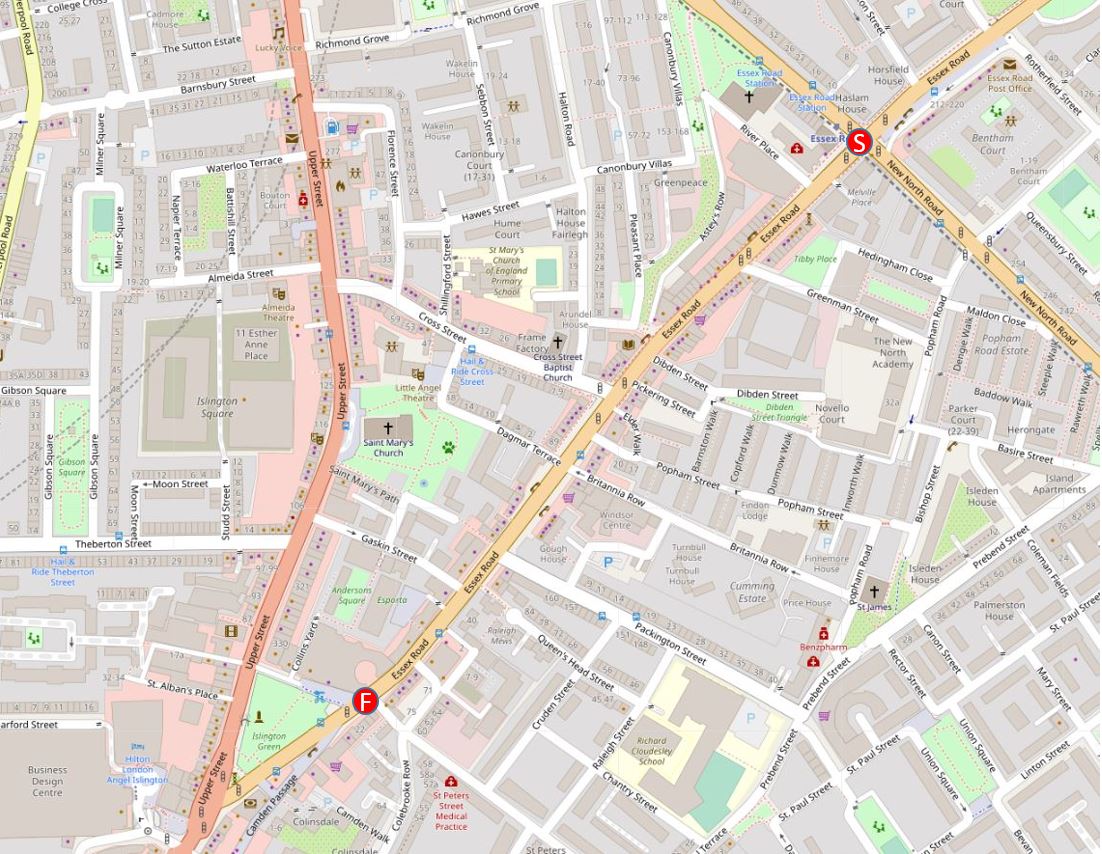
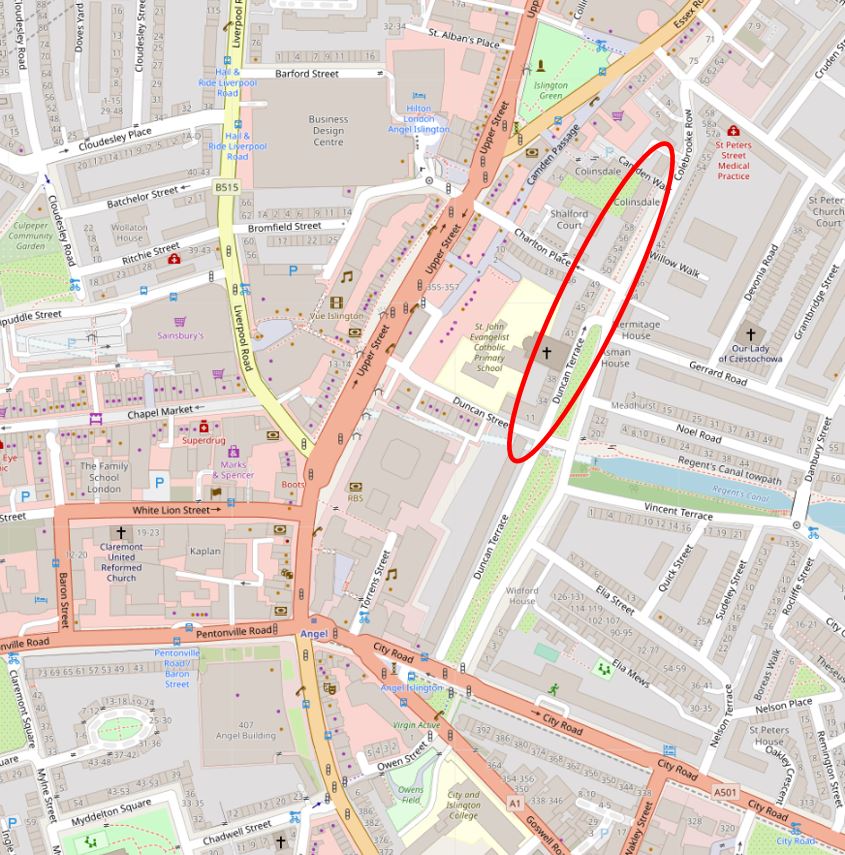
This stretch of the road is shown in the following map, starting at the Start (S) at upper right, and finishing at the Finish (F) at lower left (Map © OpenStreetMap contributors).

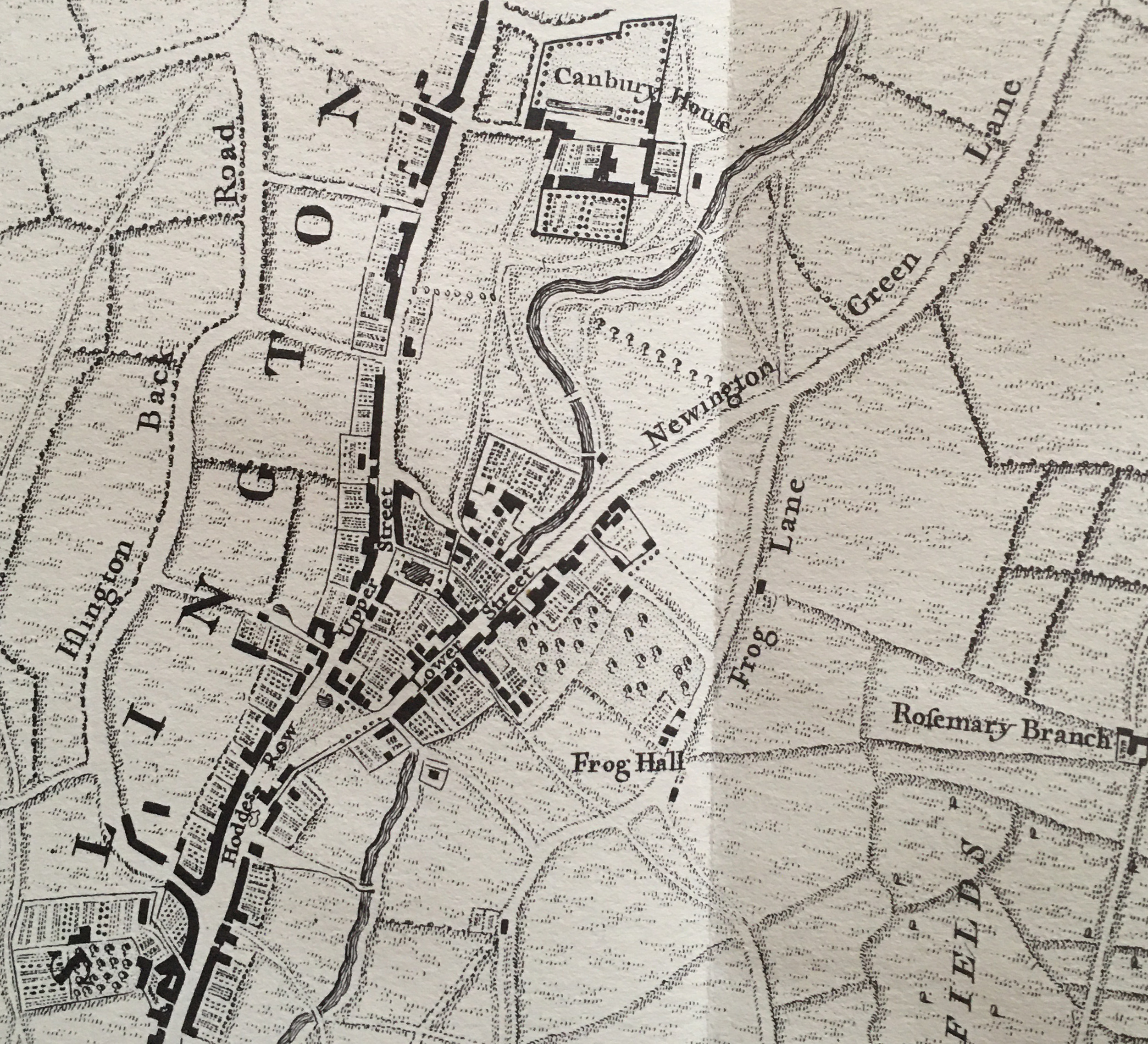
Essex Road is an old street, going back very many centuries. In 1746, the upper part of the street was called Newington Green Lane – because that is to where the street led, with the lower section called Lower Street, which continued on along the eastern edge of Islington Green. The Lower part of the name was because of the drop in height across Islington Green from Upper Street on the west, down to Lower Street on the east.

In 1746, the area was still rural. Fields surrounding the upper part of the street, with a number of large houses and inns lining the lower section. The New River crossed and ran under the street in a tunnel which continued further south to where the river emerged as it headed to New River Head.

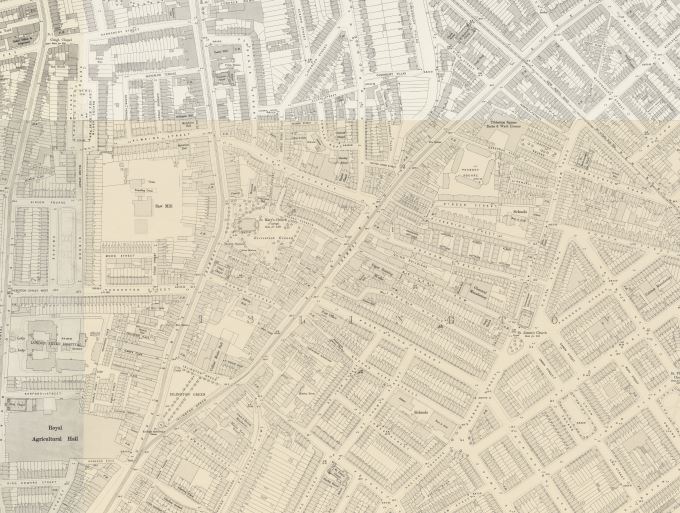
London was fast approaching these Islington fields, and whilst Essex Road would continue as a main route from Islington Green, the large houses and fields would soon disappear under a dense network of new building that would leave the area unrecognisable by the end of the 19th century. The following map shows the area in 1894. Islington Green is the triangle of land at lower left, and Essex Road as it was now called, follows the same route, up from the north east corner of the green (‘Reproduced with the permission of the National Library of Scotland’).

I am starting at the junction of Essex Road and the New North Road (S) in the map at the start of the post, and walking south to Islington Green.

The New North Road is, as the name suggests, a new road, although new is relative. It was not on the map in 1746, but was constructed in the first couple of decades of the 19th century as a more direct route from Shoreditch to what is now Highbury Corner.

On the southwest corner of the junction is Essex Road station, opened in February 1904 by the Great Northern and City Railway, and is now part of the Great Northern rail network, with trains running to and from Moorgate in the City of London.

Essex Road

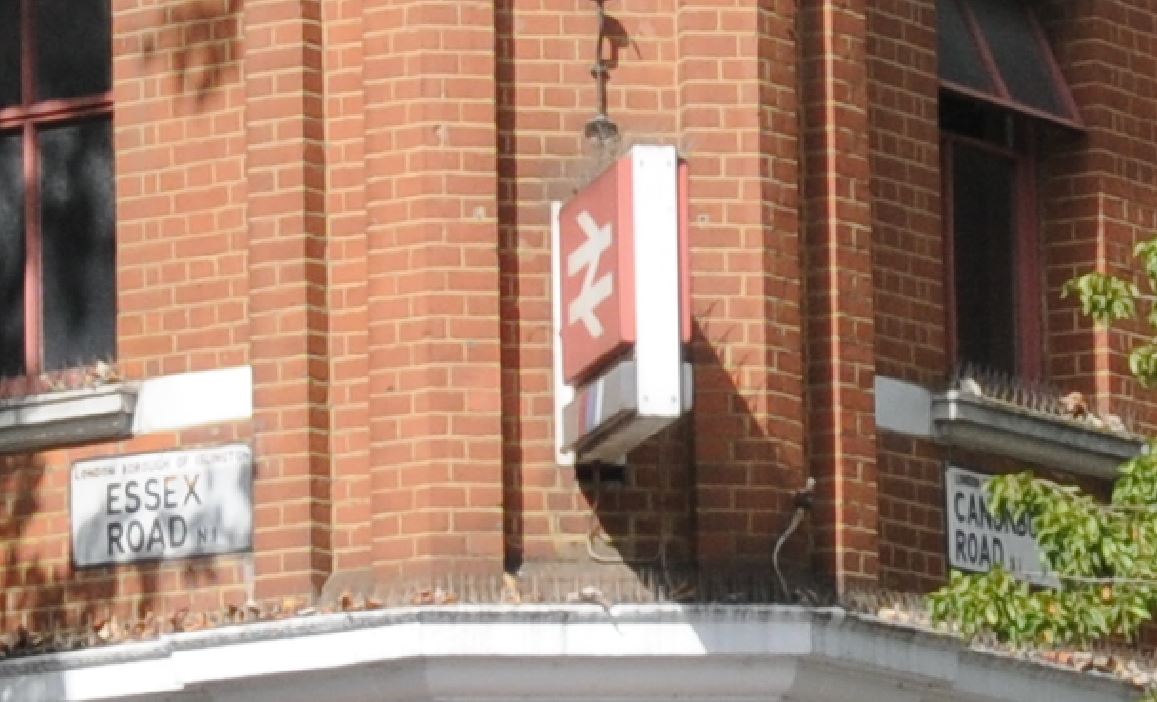
The station is unusual as it is the only underground station in London operated by a rail company. The original British Rail symbol can still be seen on the corner of the building:

Essex Road

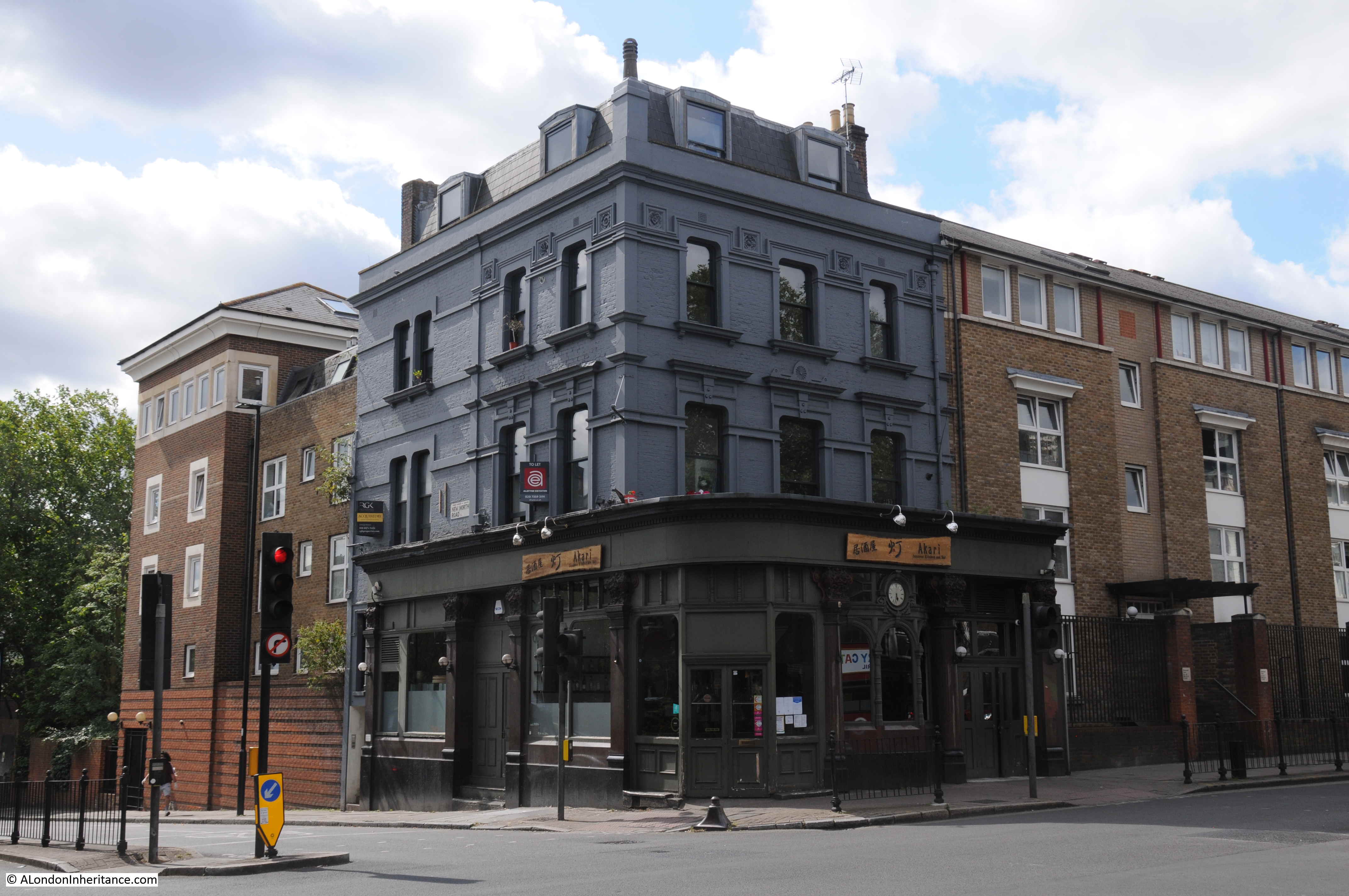
On the opposite corner to the station is the old Three Brewers pub, now the Akari Japanese restaurant.

Essex Road

Most sources seem to date the pub to around 1830, however this may be the current building. The earliest reference I can find is to December 1808 when the Morning Advertiser carried an advert for a sale of general household furniture at a location near the Three Brewers, Islington. Pubs were often used as landmarks when describing a local location.

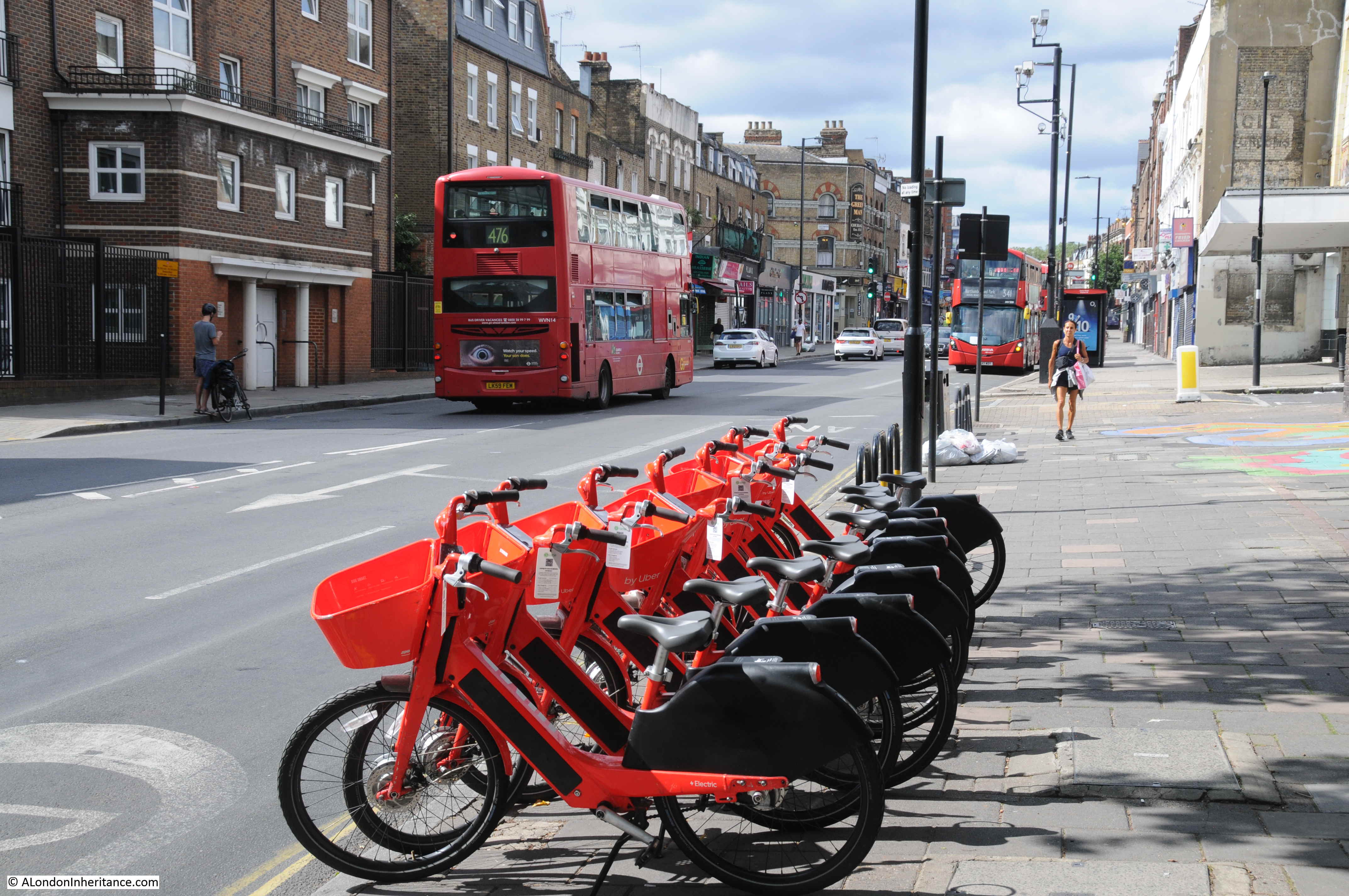
The view south along Essex Road near the station – a wide, busy street.

Essex Road

Heading south, we come to a rather ornate old cinema building. This is the old Carlton Cinema which opened on the 1st September, 1930.

Essex Road

The cinema really stands out due to its Egyptian façade which was the creation of Architect George Coles. The Egyptian theme was probably due to the discovery in 1922 of the tomb of Tutankhamun.

The Carlton offered not just film, but also stage shows, and in February 1931 the residents of Islington could be entertained by Al Davison and his band.

The Carlton became the ABC in 1962, but closed as a cinema ten years later in August 1972, when it was then converted into a Mecca Bingo Club, which would run to 2007. It was then purchased by Resurrection Manifestations, who use the old building as a place of worship.

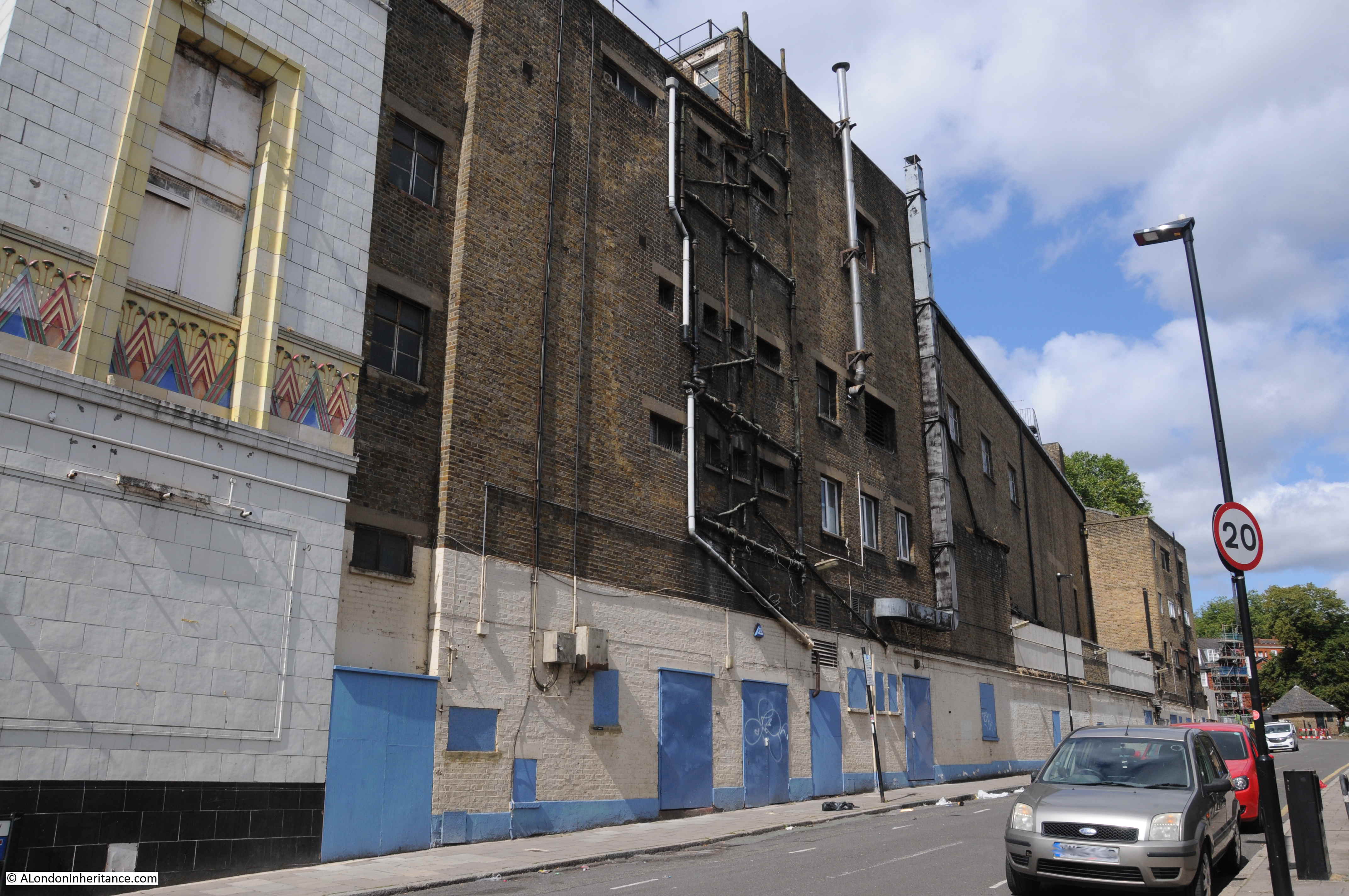
The view along the side road (River Place, which runs up to the old route of the New River), shows typical cinema construction of a very ornate front façade, with a simple and functional rear of the building.

Essex Road

The old Carlton Cinema is Grade II listed.

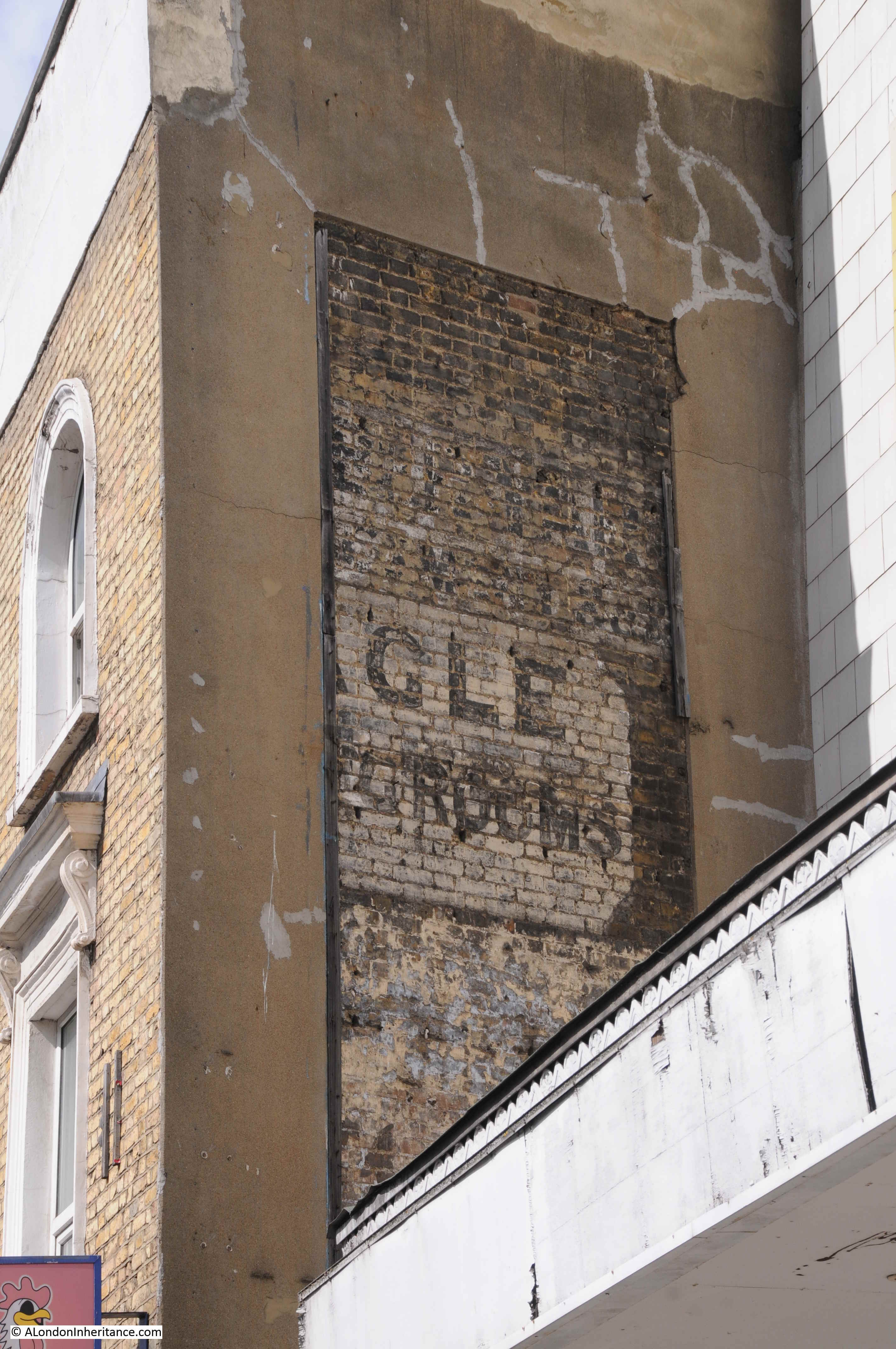
To the left of the cinema, an end of terrace building extends into the street, and on the side of the building is a part exposed sign.

Essex Road

The sign refers to the Eagle Dining Rooms. I found a couple of references to the dining rooms to confirm the full name in the Islington Gazette. On the 1st July 1902, there was an advert for:

“Wanted, a young girl for Stove Work; one used to the business. The Eagle Dining-rooms, 159 Essex Road, Islington”, and on the 13th June, 1910, under the advertisement section of the Islington Gazette, which had the remarkable title of “Servants and Girls Wanted”, there was;

“Respectable Girl Wanted, about 18, to Assist House and Kitchen; sleep out; closed Sunday. Eagle Dining Rooms, 159 Essex Road”.

Adverts mentioning the Eagle Dining Rooms in the Islington Gazette appear limited to between 1902 and 1910, so perhaps this gives an indication of the period of time that the establishment was in operation.

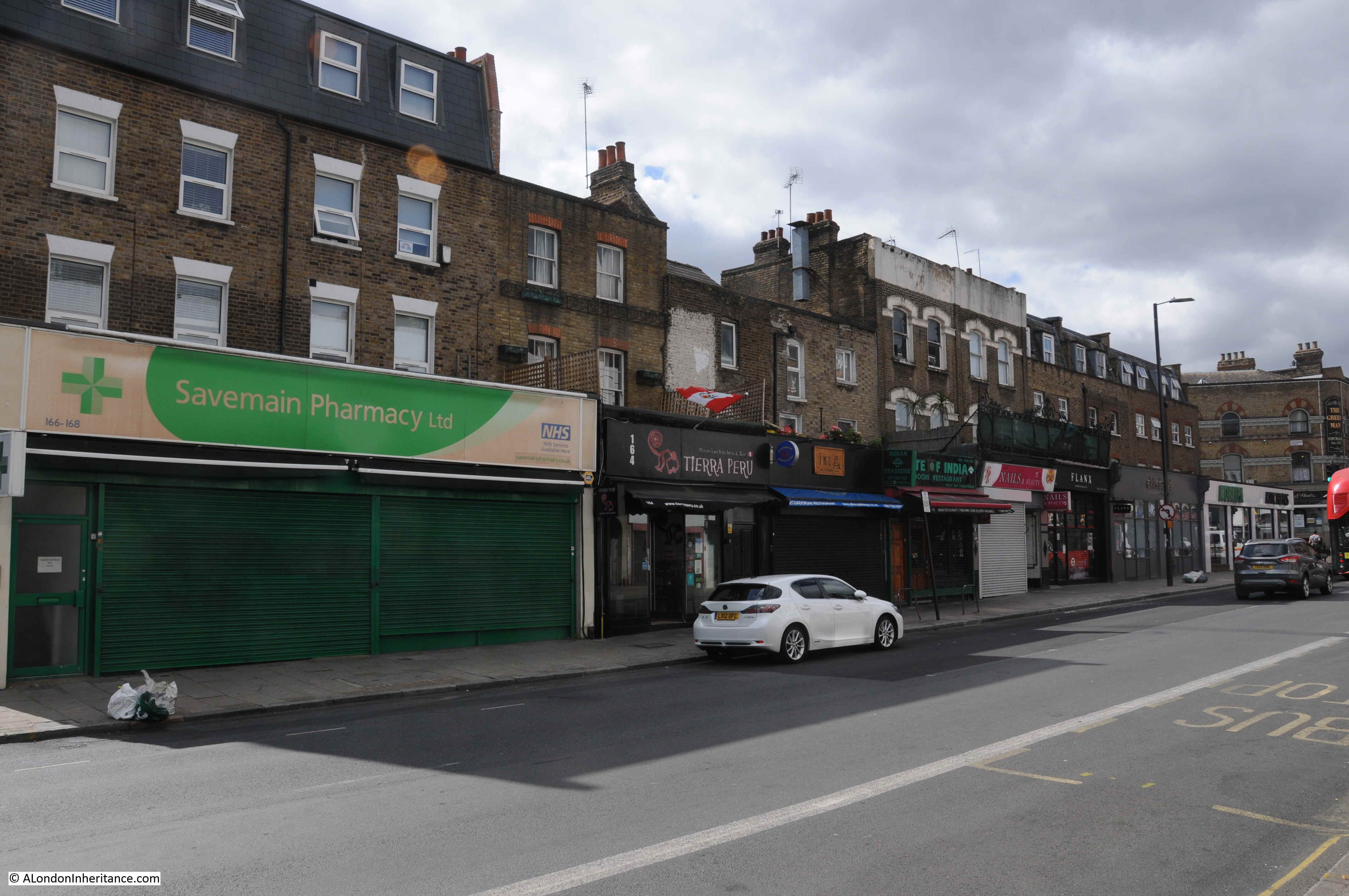
The following photo shows the opposite side of the street. Essex Road has a mix of architectural styles and building age. The photo shows some buildings (the smaller central terrace) that probably date back to the early years of the development of Essex Road, and where their original front gardens have been replaced with shops as the street developed and there was a growing population to serve.

Essex Road

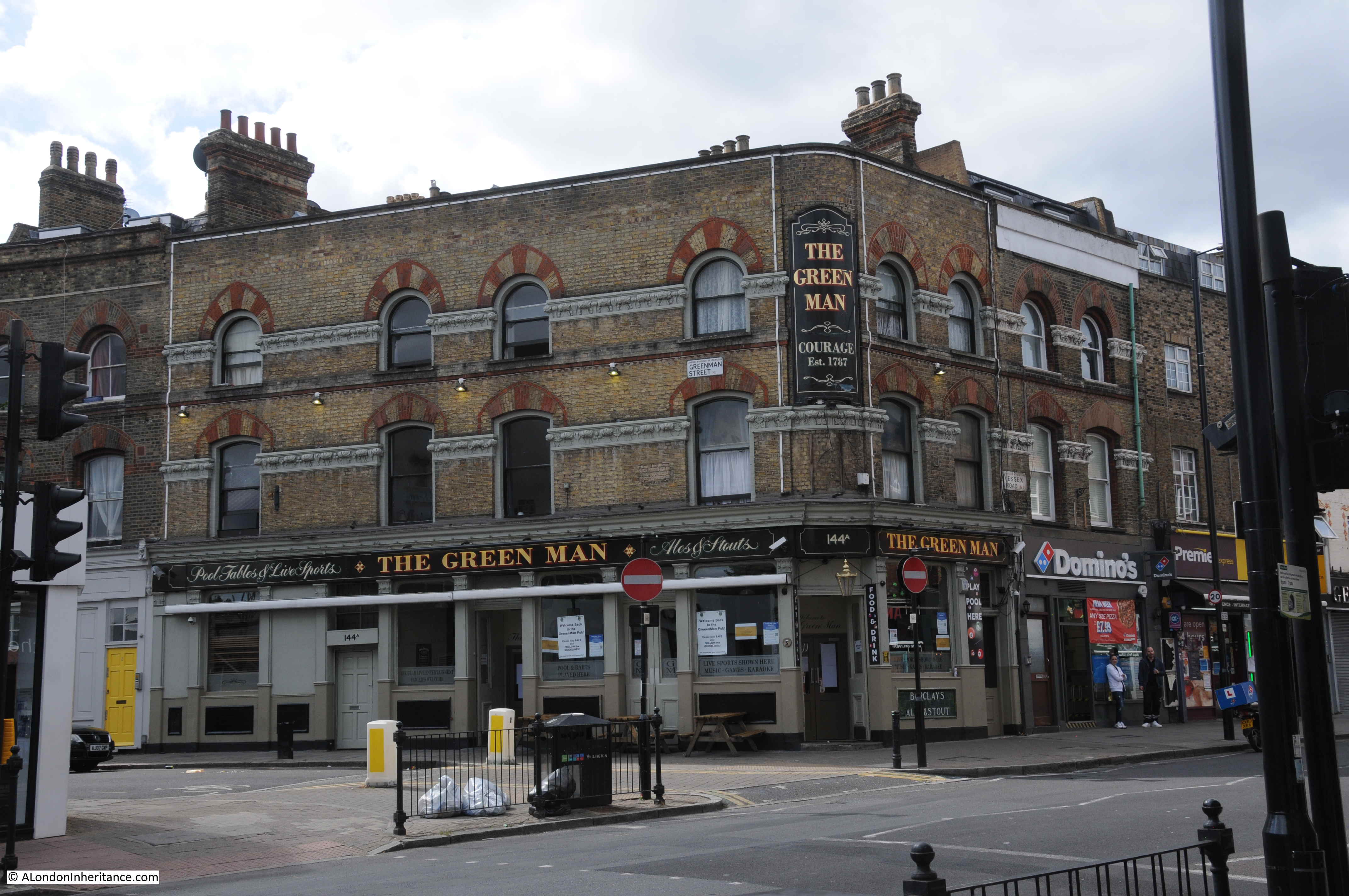
The Green Man pub on the corner of Essex Road and Greenman Street.

Essex Road

Greenman Street was named Greenmans Lane in the 1828 C&J Greenwood map, so is probably an old lane.

The site of the Green Man pub was apparently the site of the first Congregationalist Chapel in Islington. The chapel was built in 1744, and grew during the following decades as the congregation expanded. The lease on the building expired in 1865 and the chapel moved to a new location in River Street.

In March 1866, there was a license application by a George E. Muddyman, and a Mr Sleigh opposed the application as there were already many licensed houses in the district. The license was granted as the Peabody Buildings just behind the pub (which are still there) had recently been completed and were now occupied by “700 or 800 persons” and the Superintendent of the Peabody buildings stated that “all the tenants had signed the petition in support”.

So the Green Man pub probably dates from 1866, the occupants of the Peabody buildings behind the pub must have made up the majority of the pubs initial customers, and it was built on the site of the first Congregationalist Chapel in Islington. The pub must have originally been larger, as if you look at the photo, the Domino’s take-away occupies the ground floor of a building with exactly the same architectural features as the pub.

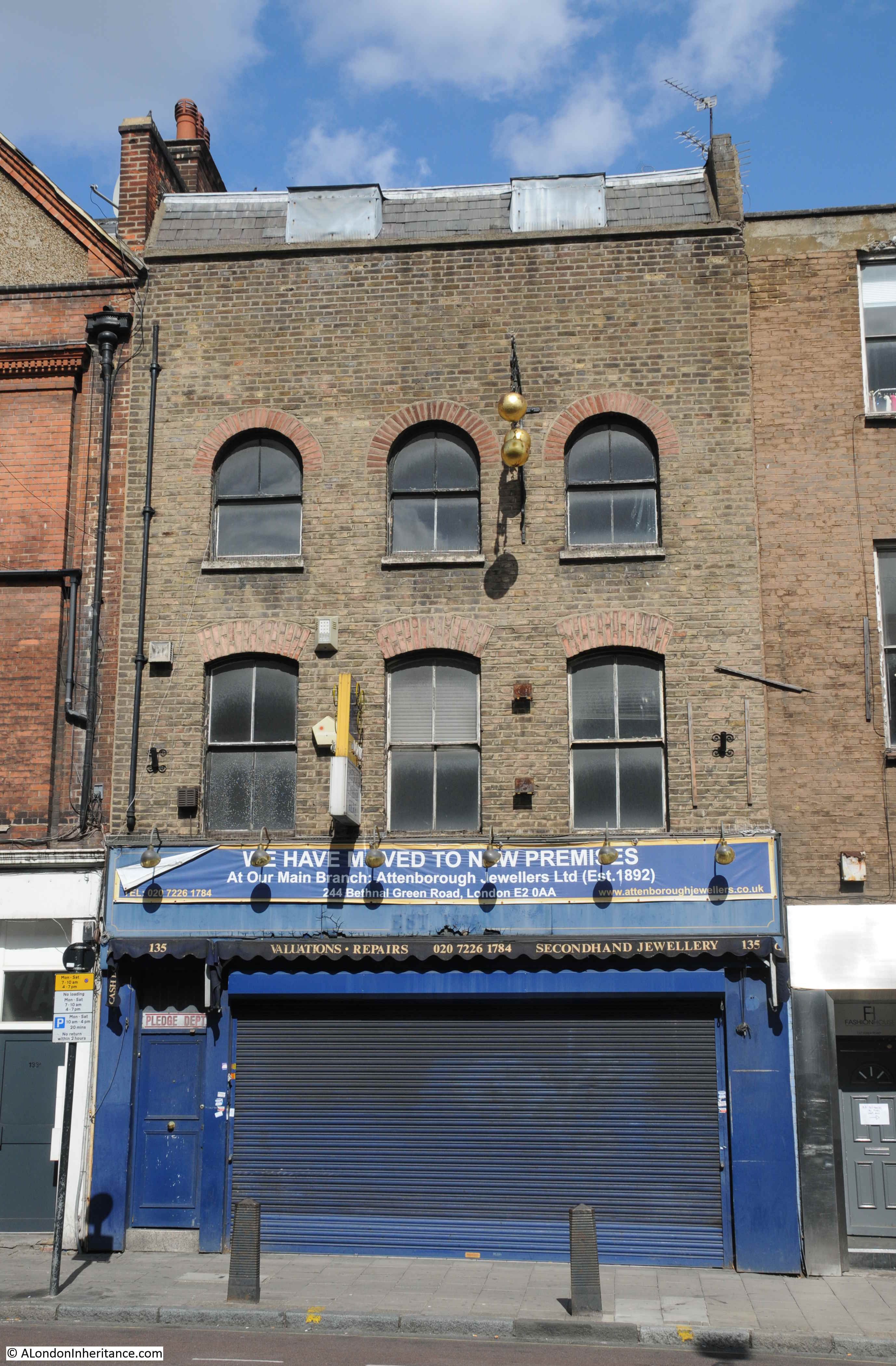
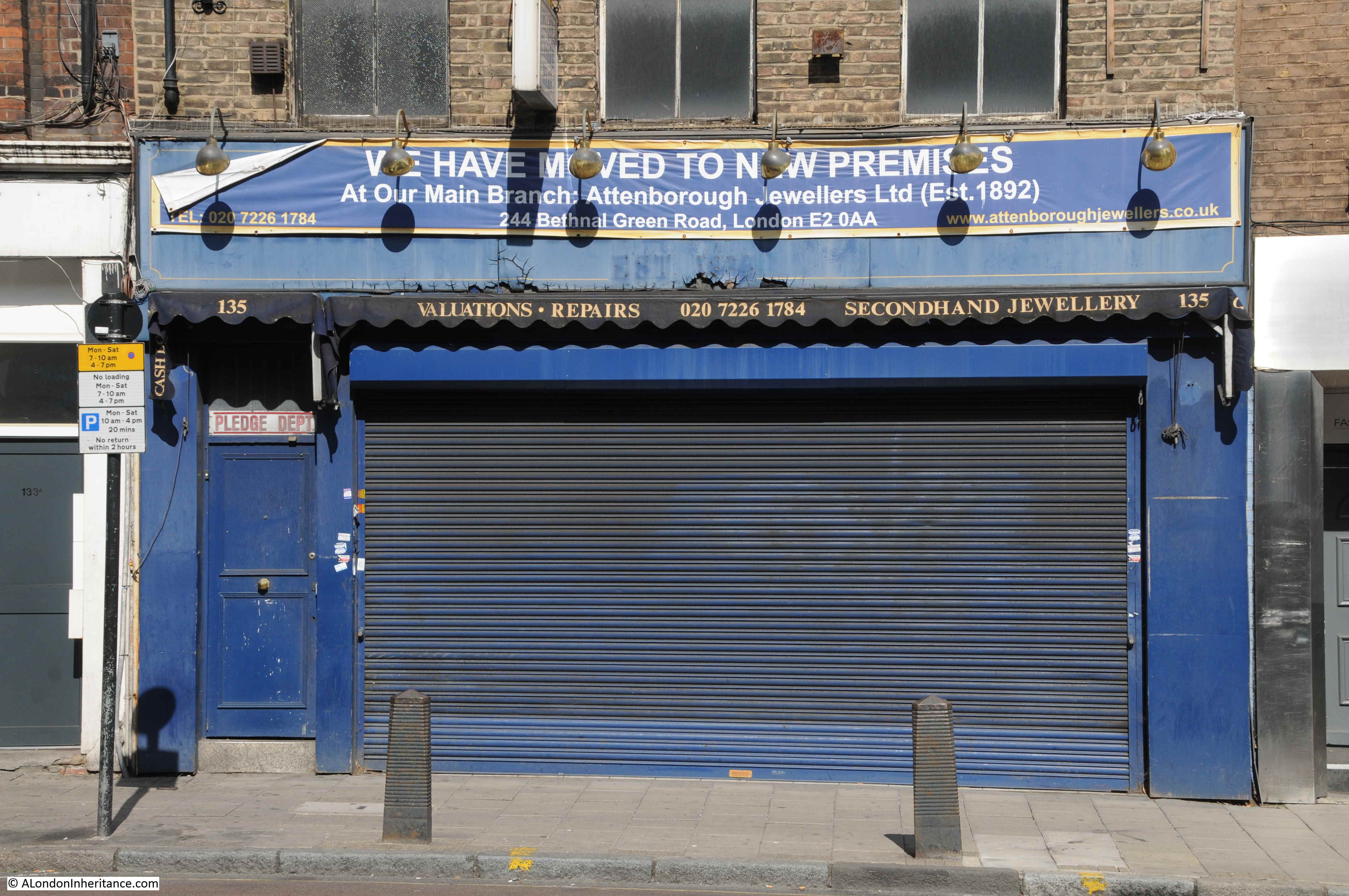
Opposite the Green Man is the closed shop of Attenborough Jewellers, who have now moved to their original main branch in Bethnal Green Road (I have some 1980s photos of the Bethnal Green branch to re-visit).

Essex Road

The shop also operated as a pawnbroker. Note the door marked as the entrance to the Pledge Dept on the left.

Essex Road

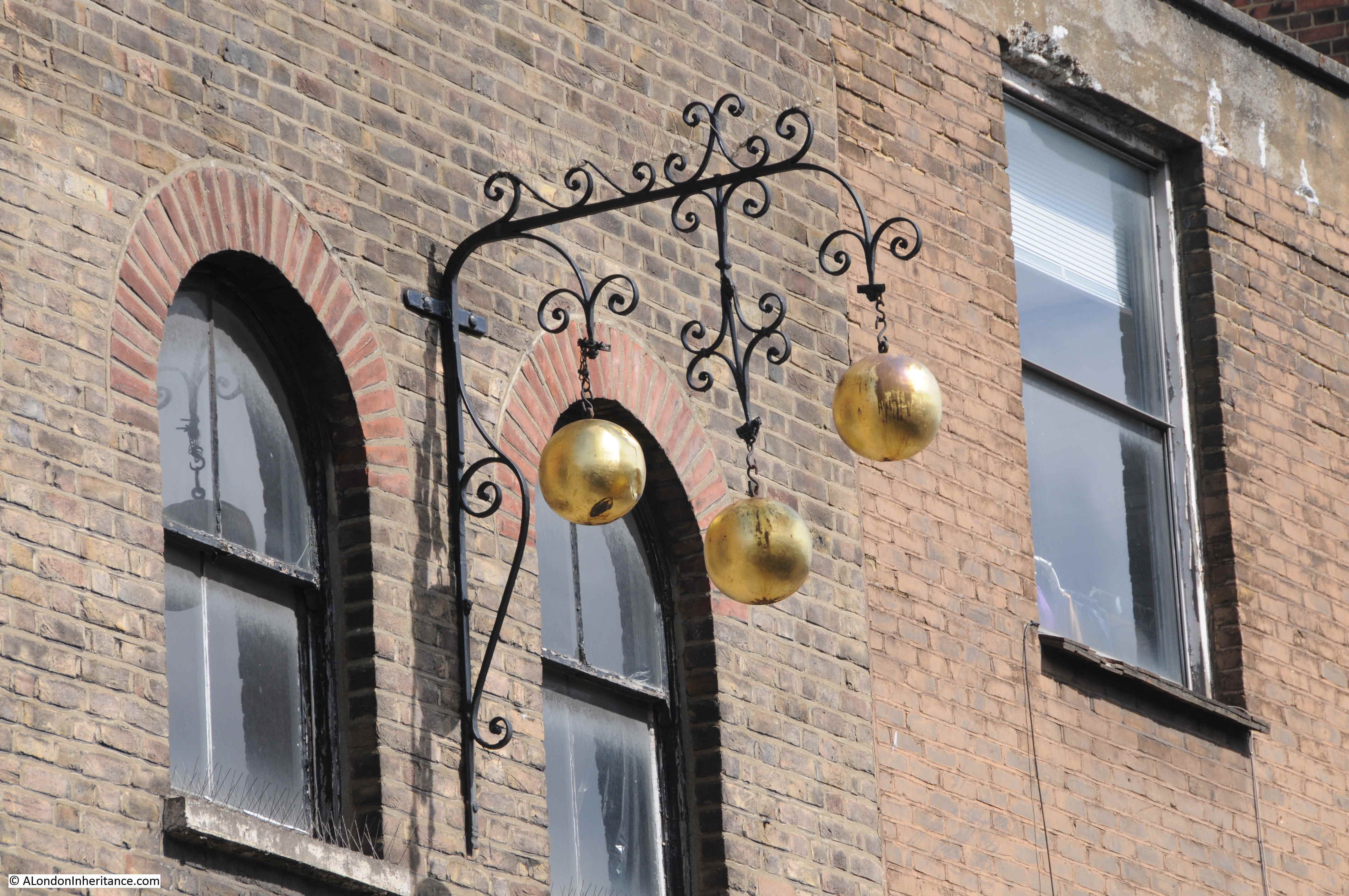
And the traditional sign of a pawnbroker on the front of the building:

Essex Road

Continuing along Essex Road and we come to the South Library:

Essex Road

The foundation stone was laid in 1915 and the library opened in December 1916. A plaque inside the library states that it was presented by Andrew Carnegie, so it must have been one of the many libraries that Andrew Carnegie, the wealthy Scottish-American industrialist funded.

Essex Road

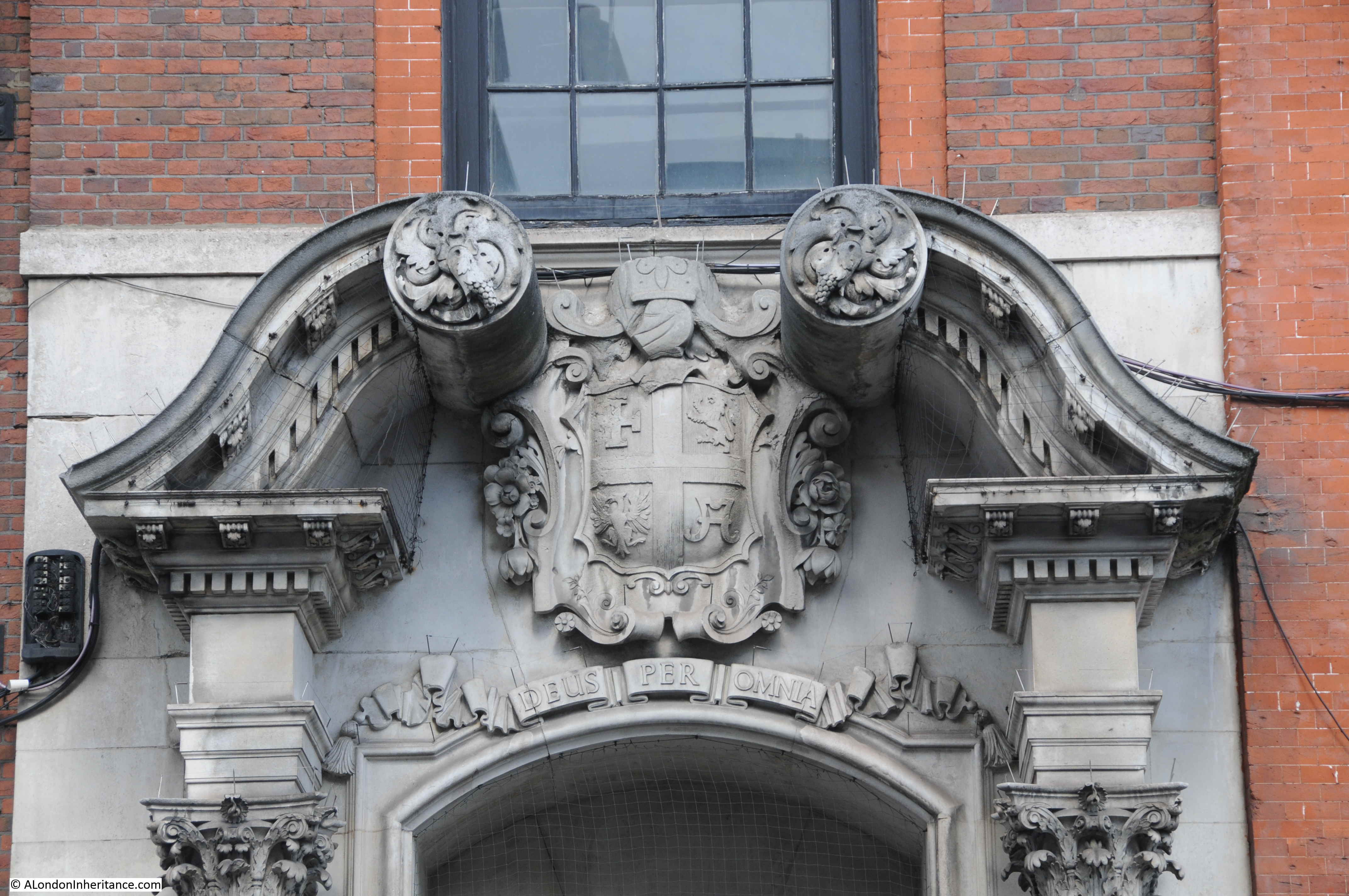
The coat of arms above the door of the library provides a quick history lesson on original land ownership in Islington. This version of the coat of arms was granted in 1901, and the four quarters of the shield are each part of the coat of arms of significant Islington landowners.

The Order of St John is at top left. George Colebrooke who owned the Manor of Highbury is at top right. Below that the arms of the landowners the Berners family and at bottom left is part of the coat of arms of Sir John Spencer who owned the Manor of Canonbury.

These arms were replaced in 1966 when the larger borough of Islington was formed, and the council probably thought that historical landowners did not reflect modern Islington, but it is good to see that the earlier coat of arms can still be found.

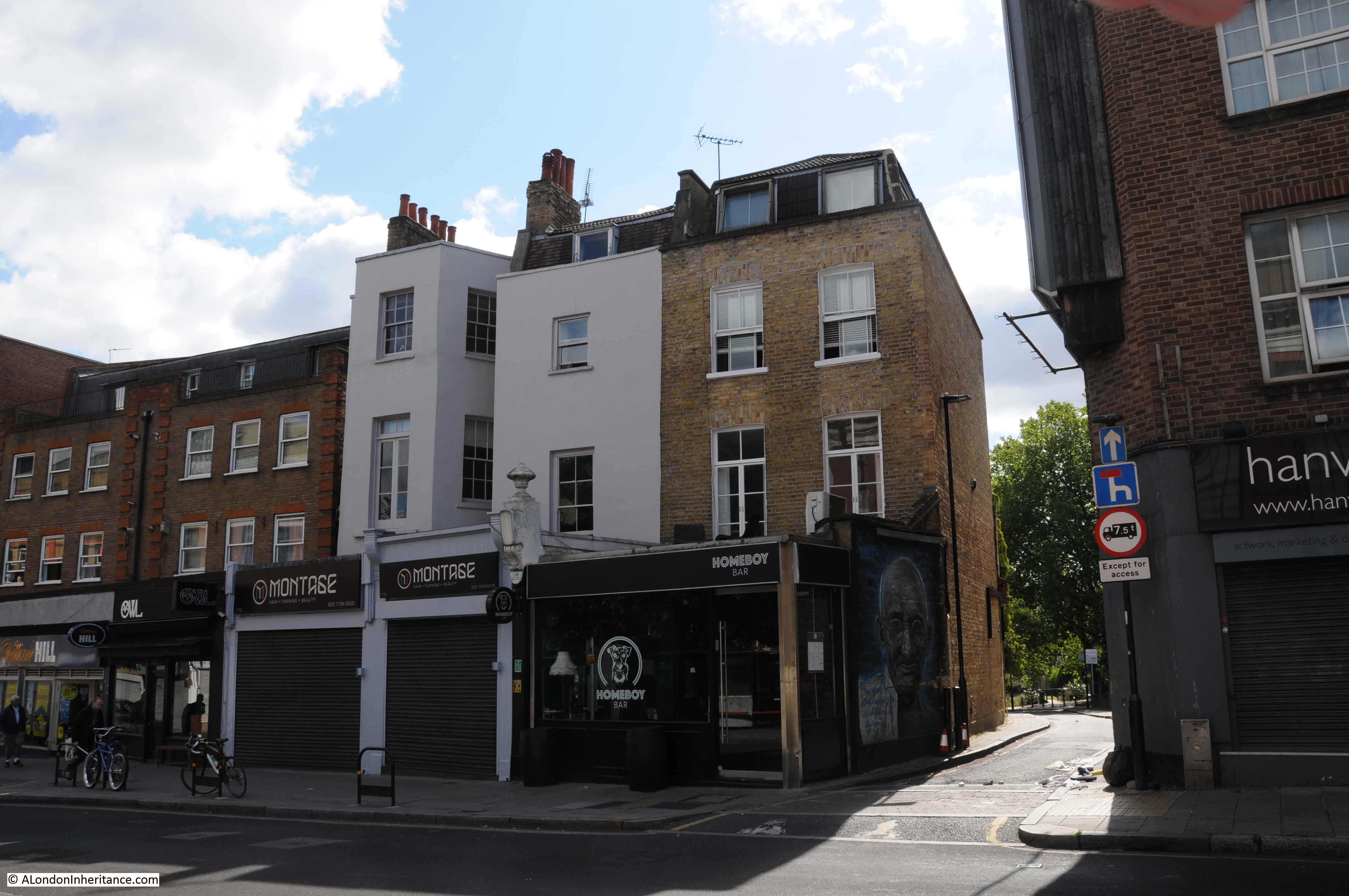
Opposite the library is this terrace of houses, which again reflect the diverse range of architectural styles, and the haphazard way that the buildings lining Essex Road have developed over the years.

Essex Road

The third building to the left is strange, The upper floors jut out without being in line with the adjacent building of the terrace. It would be interesting to understand the reasons behind this unusual design.

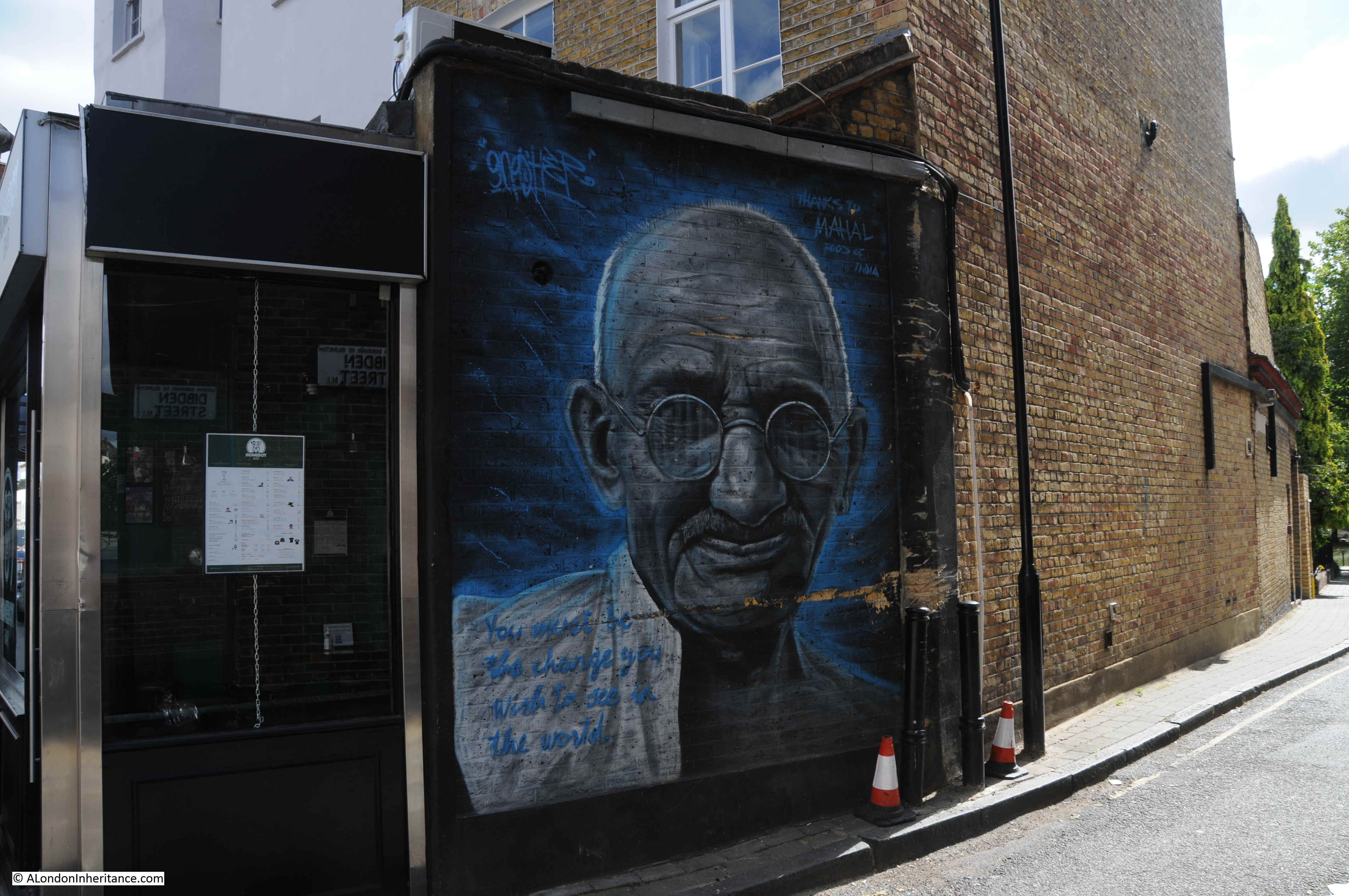
The small road to the right of the above terrace is Dibden Street, and in the entrance is a mural of Gandhi by graffiti artist Gnasher.

Essex Road

The text reads: “You must be the change you wish to see in the world”.

Further south at the junction with Cross Street is this collection of small shops with some interesting, concrete, architectural detail running along the top.

Essex Road

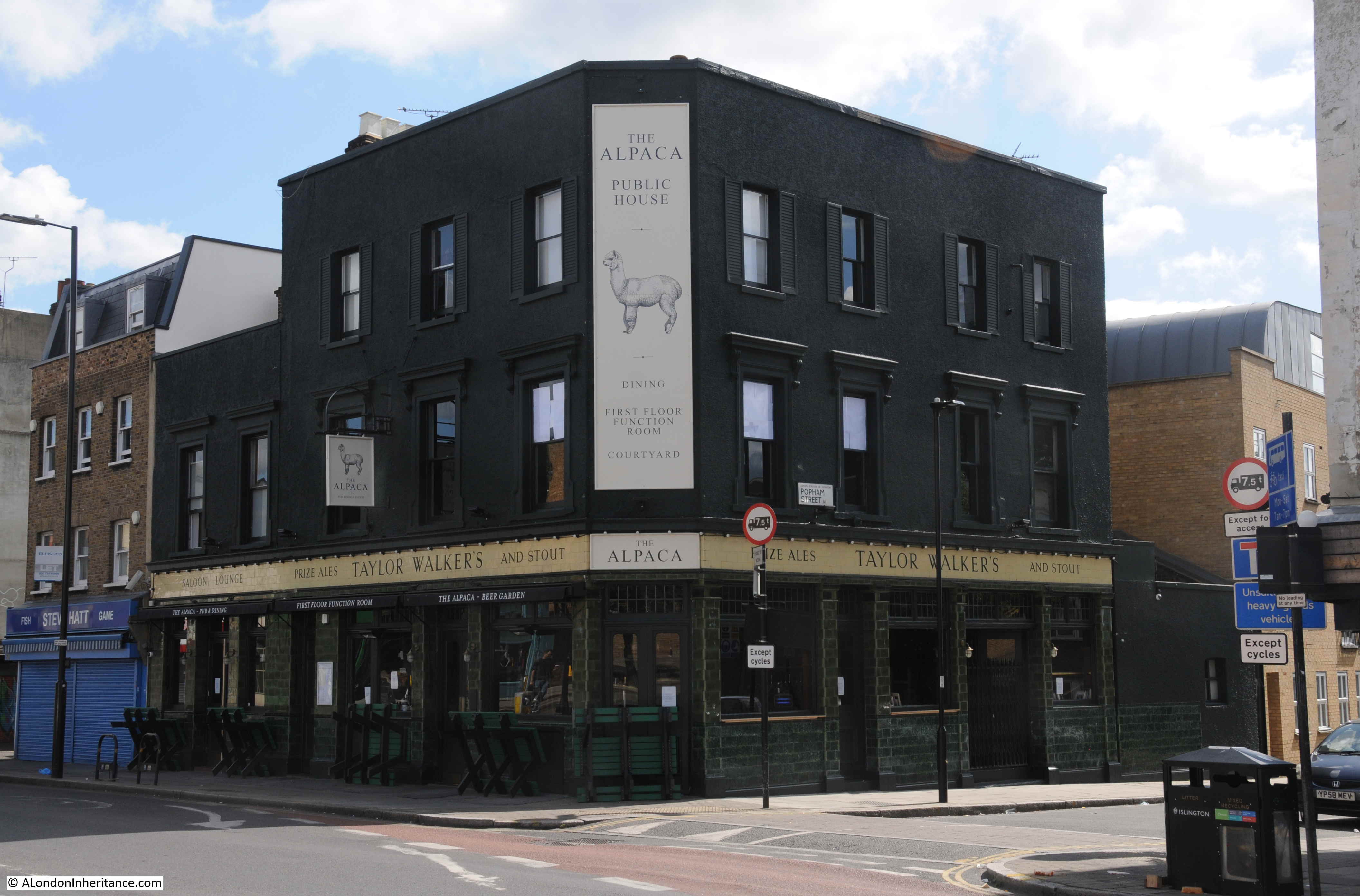
A short distance further along is the Alpaca pub:

Essex Road

The Alpaca is a very new name, dating from when the pub reopened in March 2020 – unfortunately probably the worst time for a new pub to open in recent years.

It was the New Rose, and originally the Half Moon.

The Half Moon dates from the early 19th century, and the first written record I can find of the pub dates from the 15th July 1824, when the London Sun recorded an inquest being held in the pub “on the body of Thomas Smith, aged 23, a Kentish town stage-coachman, whose death was occasioned in a pitched battle with a person of the name of Harry Bastie”. The inquest records how Thomas Smith’s brother described the battle, when he found him at:

“Copenhagen-house; he spoke to him, endeavouring to persuade him from fighting, saying that he was too fat, and had not an equal chance with the person he was going to fight, who was a good man, and had two ways of fighting: the deceased replied that unless he was to fight now that it had come to such a pitch, he would not be able to stand by his coach and get a single passenger.

A ring was formed, and his brother entered the ring first, and threw up his hat. The deceased was knocked down several times by his antagonist, who had the knack of tripping him up: witness was informed that the fight lasted two hours and fifteen minutes. During the fight the witness entered the ring and saw his brother lying on his back and was desirous of ending the fight, but the seconds interfered and turned him out of the ring.

He did not go to his brother until the fight was over, when his brother said ‘I’ll fight no more’. The deceased requested to sit down on witness’s knee, and he died soon after”.

The inquest was adjourned so the seconds could be found and interviewed. What the report does not record is the reason for the fight and why Thomas Smith would not be able to get a single passenger in his coach without going ahead with the fight.

The scene of the fight, Copenhagen-house is also in Islington, and I have written about the site in a previous post.

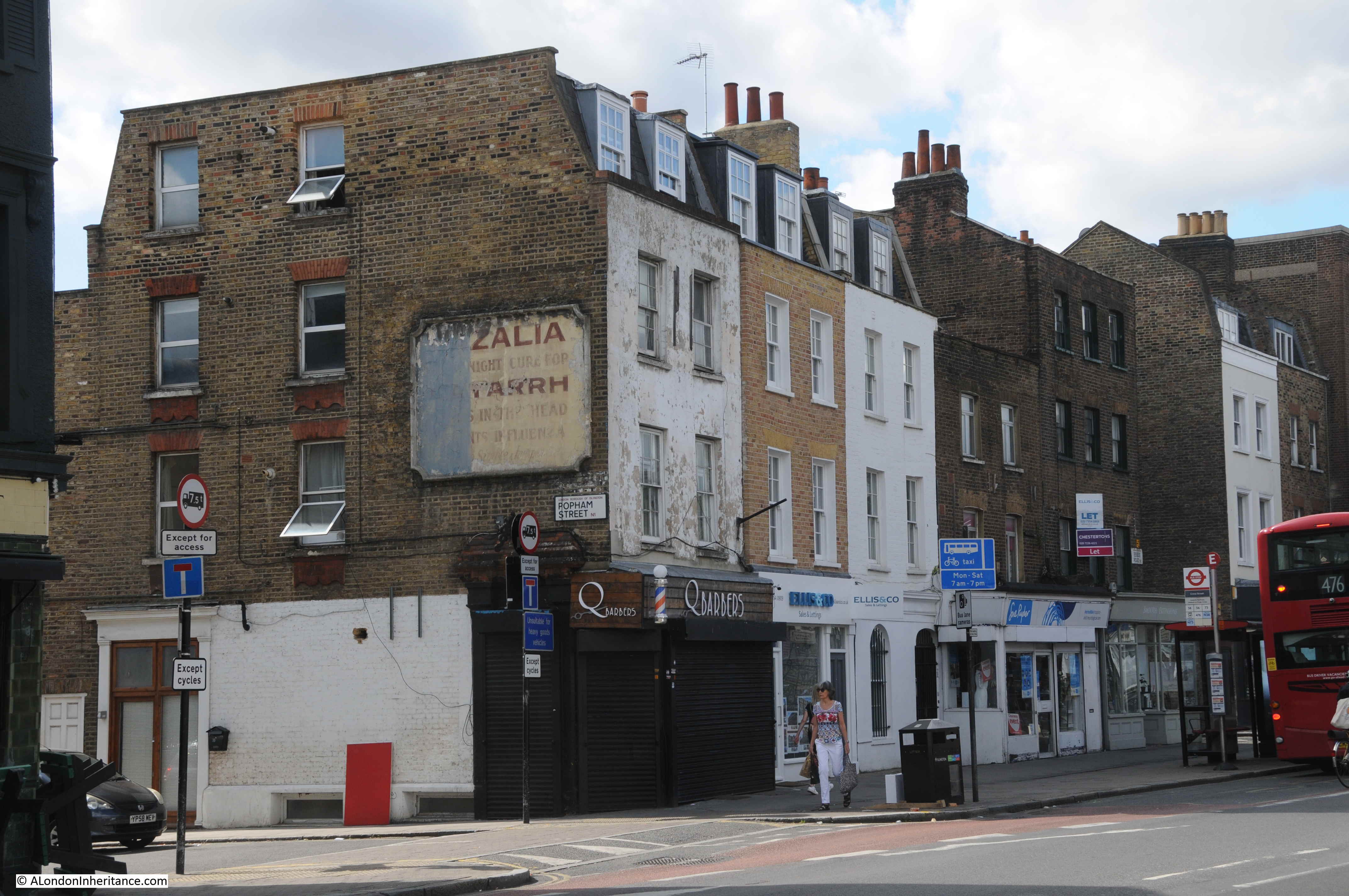
Opposite the Alpaca is another early terrace with on the side of the terrace facing Popham Street, another faded advertising sign.

Essex Road

The sign is advertising an American treatment which was advertised as a night cure of problems such as Catarrh and Influenza. The product went by the rather unusual name of X-Zalia, which probably sounded scientific during the first decades of the 20th century when it was sold.

Essex Road

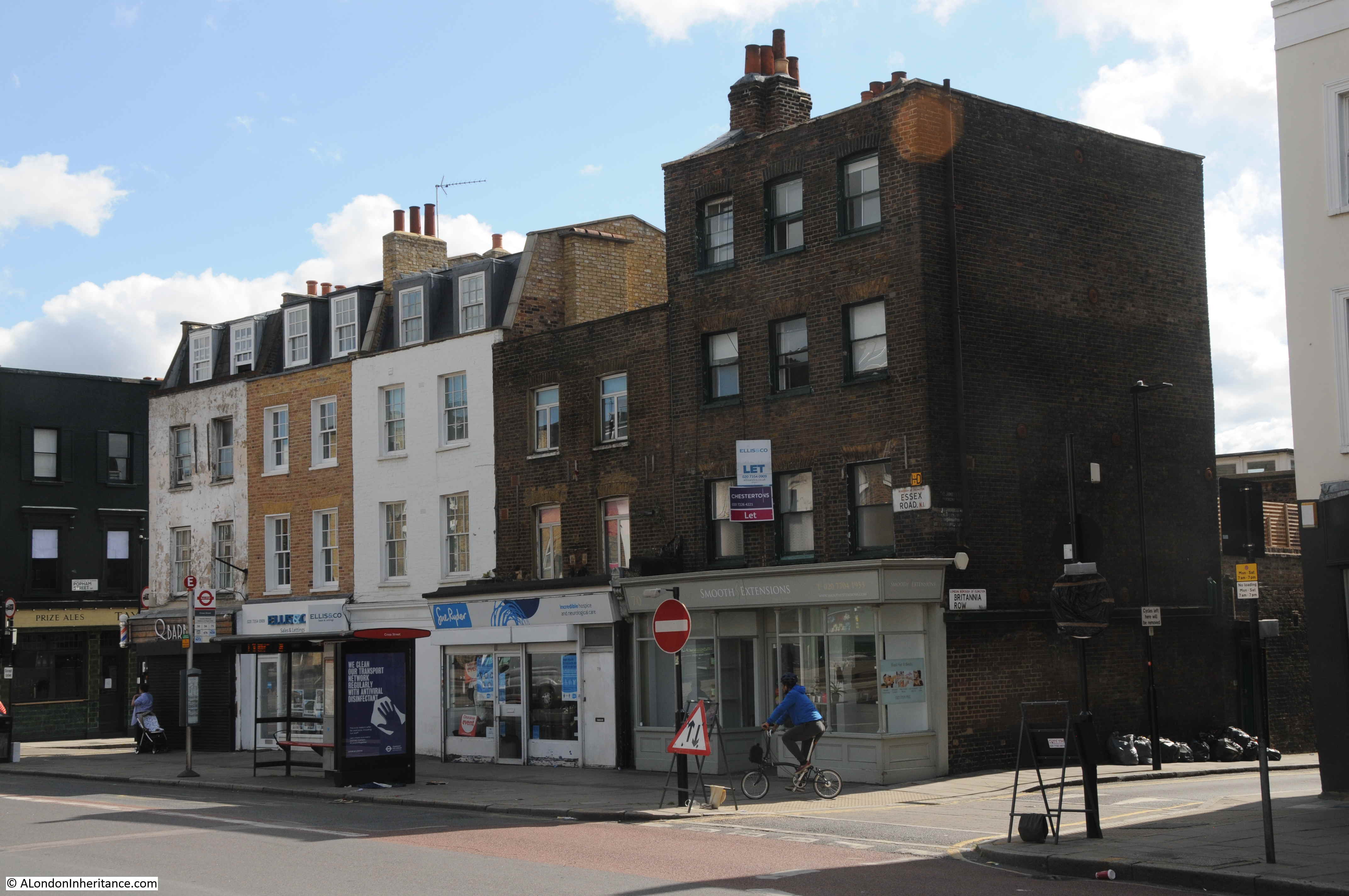
A view of the same terrace from the opposite end, another good example of the mix of architectural styles of the early houses along Essex Road.

Essex Road

The tallest building on the right is Grade II listed as it dates from the early 18th century and was one of the buildings on the 1746 map. The building was once the home of John C. Aston & Sons, Wholesale Ironmongers and Builders Merchants and behind the house, running along the lane we can see in the photo was a long, two-storey range of warehouses. The shop facing onto the street was the shop for John C. Aston’s business. Today it is a very different shop providing hair extensions.

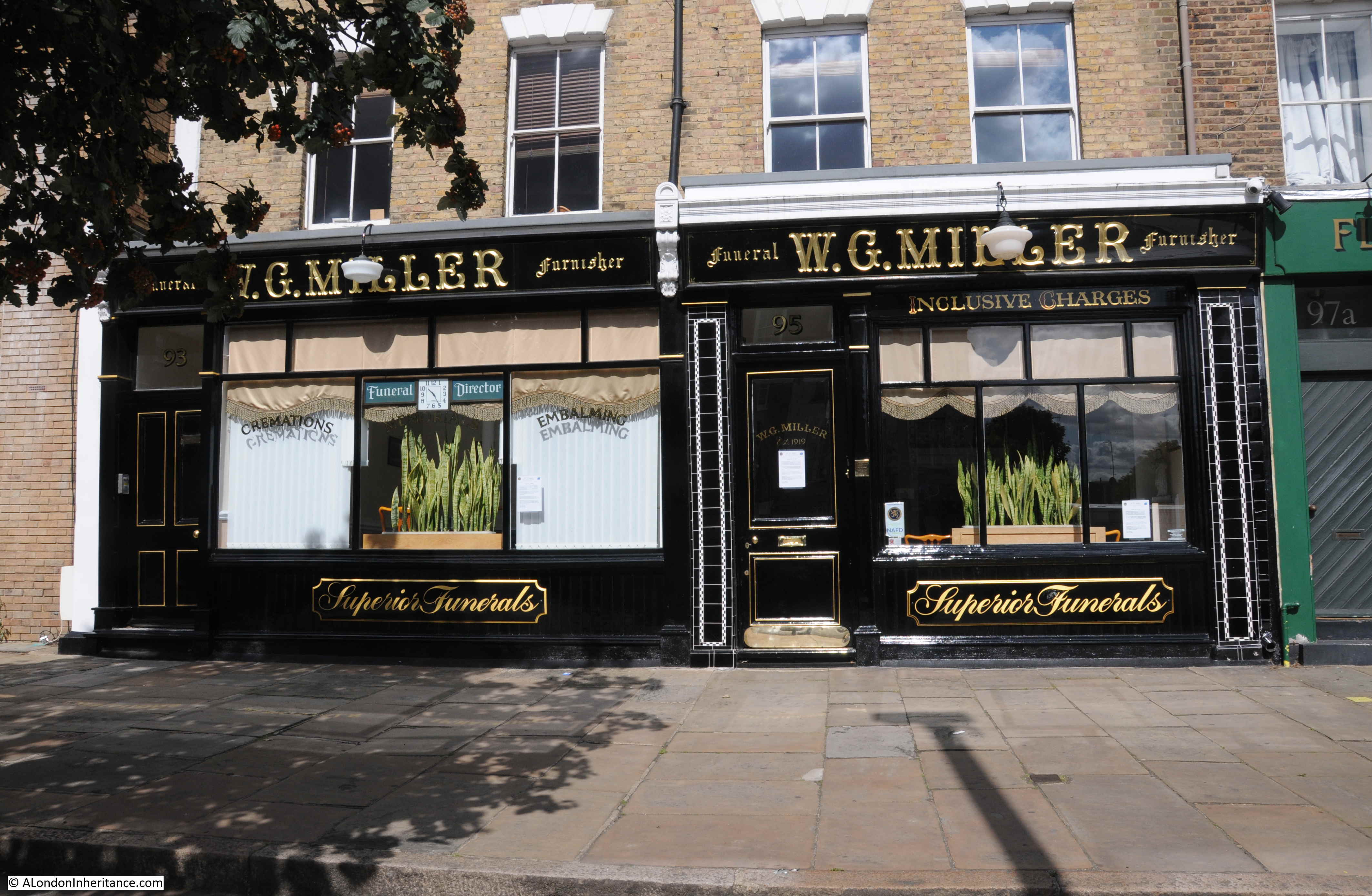
Across the road is a business that has been in operation for over 100 years. Established in  1918, W.G. Miller is the oldest family run funeral directors in Islington.

Essex Road

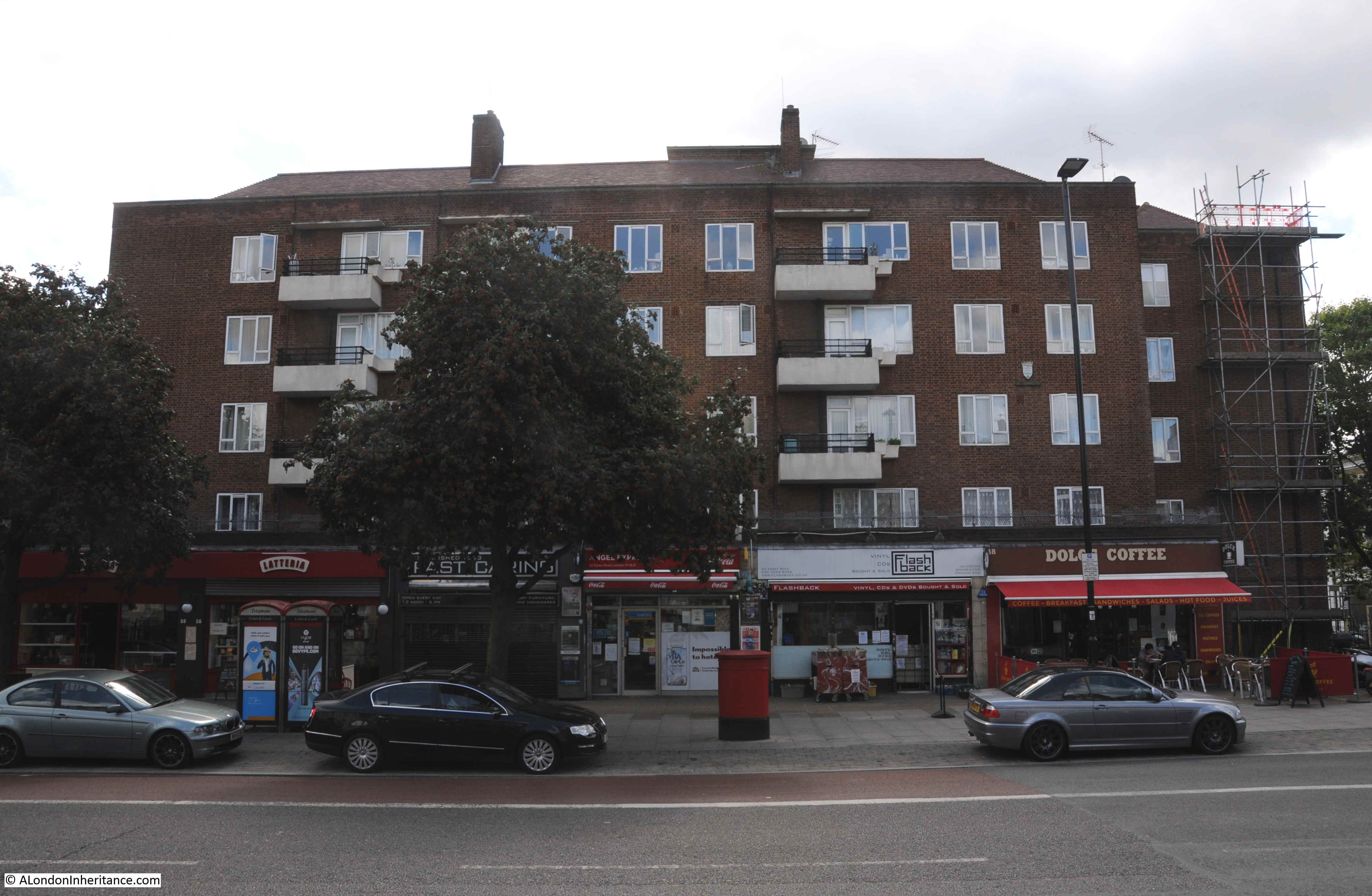
Further on is the Cumming Estate:

Essex Road

A rather functional block of flats, however they are named after two brothers who were responsible for much development around Islington and Pentonville. The brothers were John and Alexander Cumming who were one of the main developers of the Penton Estate in the late 18th century.

The brothers were Scottish and had built a reputation as watchmakers and businessmen. Alexander appears to have had royal and aristocratic patronage which probably explains their ability to fund their developments along Pentonville Road, centered around Cumming Street.

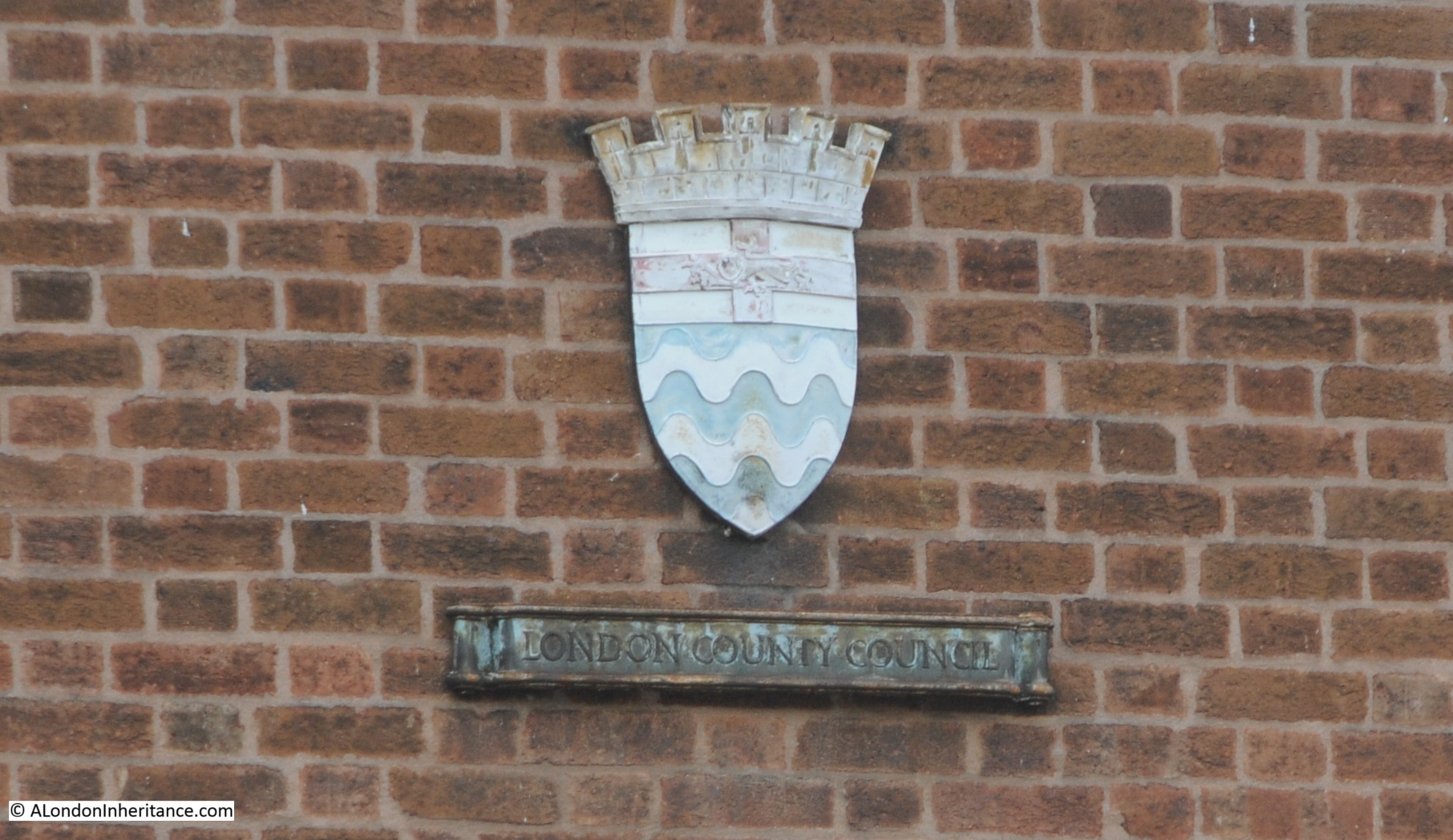
The housing block in Essex Road was developed by the London County Council and bears the typical coat of arms of the LCC, which can be found on many of their developments, although the one in Essex Road looks to be in a rather poor condition.

Essex Road

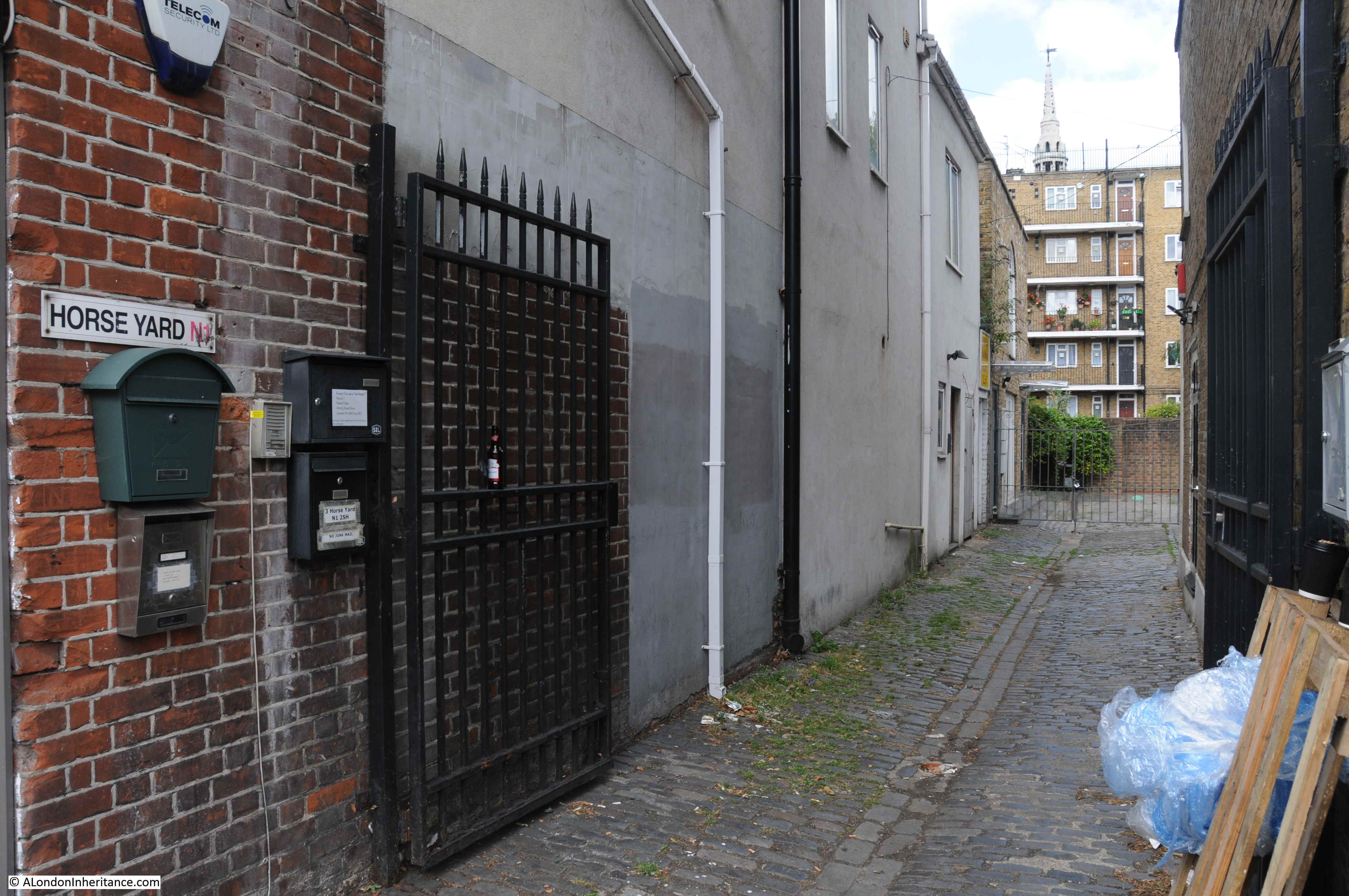
On the opposite side of Essex Road is Horse Yard. A narrow, cobbled alley that leads up to a yard, and which almost certainly was once the site of stables.

Essex Road

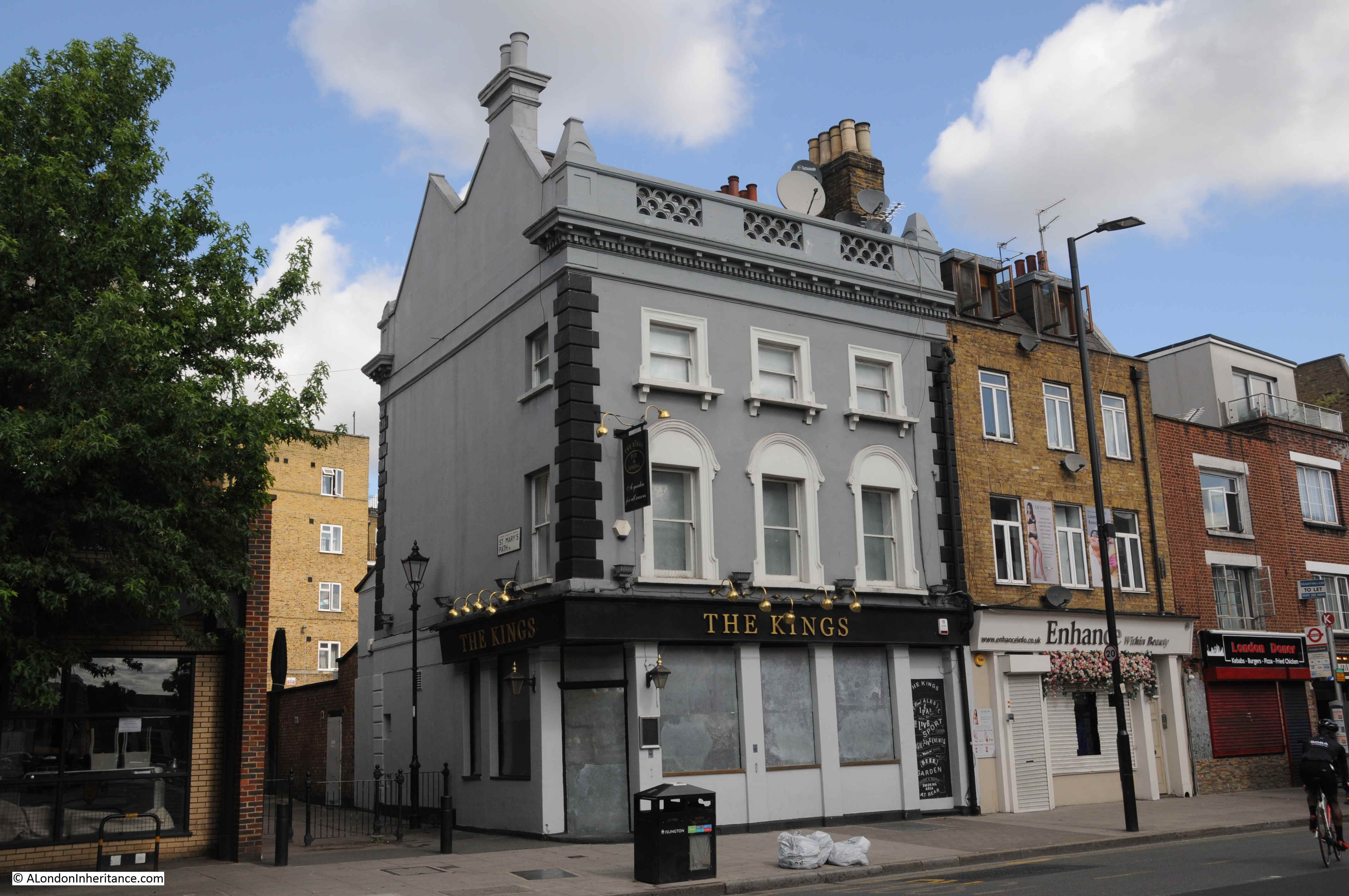
We now come to another pub, the Kings. When I was walking Essex Road, the pub was boarded up, which is always a very worrying sign with London pubs, however it was only for a change in ownership and the pub reopened at the end of 2020 – again not a good time to open a pub.

Essex Road

The pub was until recently called the King’s Head, and although the current building dates from the 19th century, this is an old pub and was probably one of the cluster of buildings on Lower Street in the 1746 map, as this stretch of Essex Road was then named.

The earliest reference I can find to the pub dates to the 22nd July 1758 when an article in the Oxford Journal reads:

“Sunday Morning early died Mr Cupit, master of the King’s Head in the Lower-Street, Islington. He went to bed on Saturday Night seemingly in good Health, and ordered his Wedding Sheets to be put on his Bed, saying, as they were his Wedding Sheets, perhaps they might be his Dying Sheets”.

An article that raises more questions than it answers.

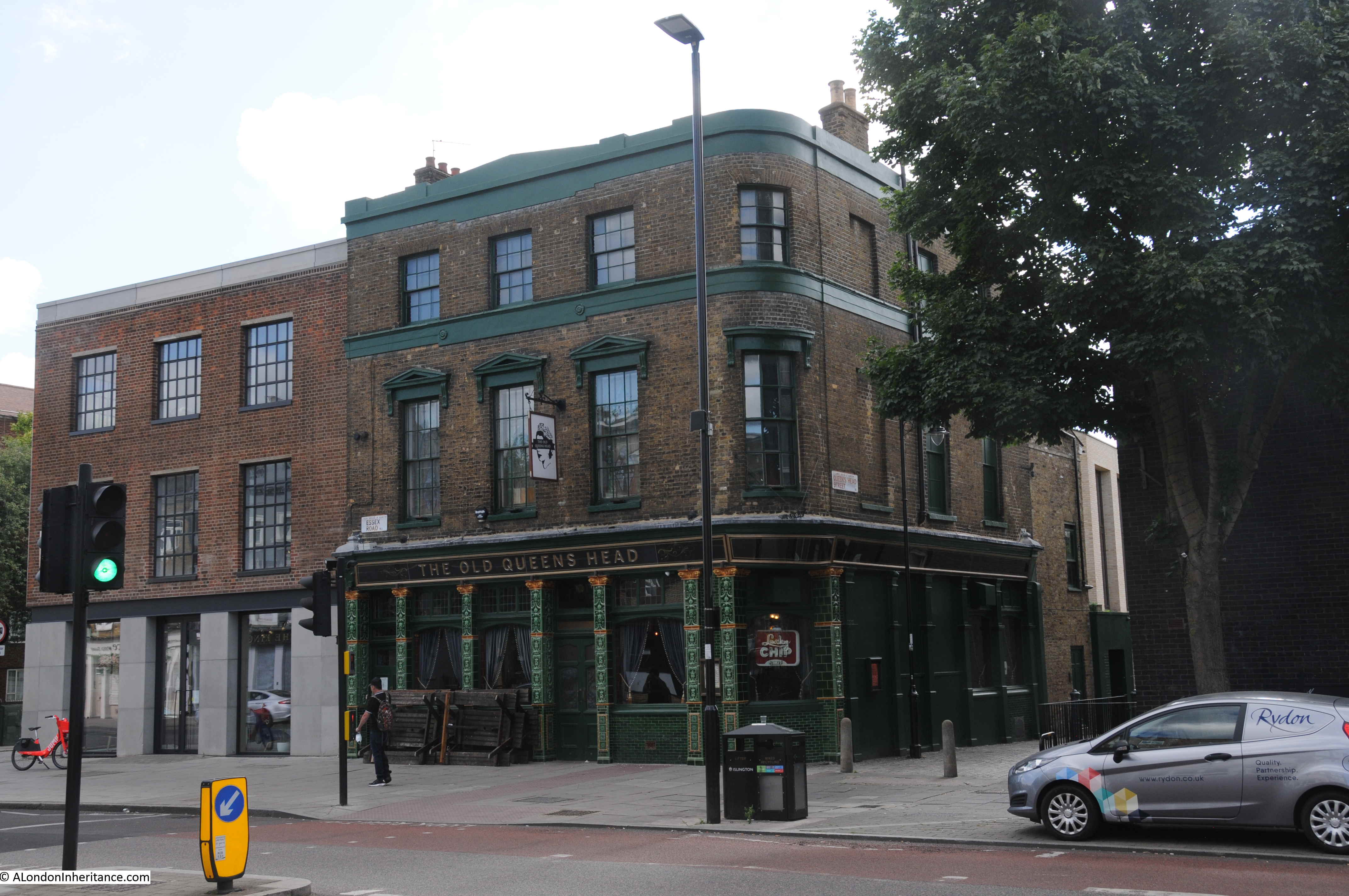
And almost opposite the King’s Head is rather appropriately the Old Queen’s Heads (Essex Road really does have a lot of pubs).

Essex Road

The Old Queen’s Head is a lovely tiled 19th century pub, but like the King’s Head, a pub has been here for a long time. and the earliest reference I can find dates to the 24th February 1748, when the following incident was reported:

“On Sunday Evening, about Seven o’Clock, three Persons returning to Town, were attacked in that part of Frog Field that leads to the Queen’s Head in the Lower Street, Islington, by three Fellows, but Mr John Scott, Foreman to Mr Gregory, a Taylor, Old Broad-street, thinking to save what he had, ran from them, when immediately one of the Roques followed him with a drawn Hanger, and cut him down on the back Part of his Head, so as to let out his Brain; they then made their Escapes, leaving his two Companions, whom they had robbed, to take care of him”.

18th century newspapers were always graphic in their descriptions of violence. A Hanger is a small sword.

The Frog Field does not exist anymore, however the 1746 map at the top of the post shows Frog Lane and Frog Hall to the east of Lower Street. At the time the area was still rural and after dark, it was a dangerous place to be.

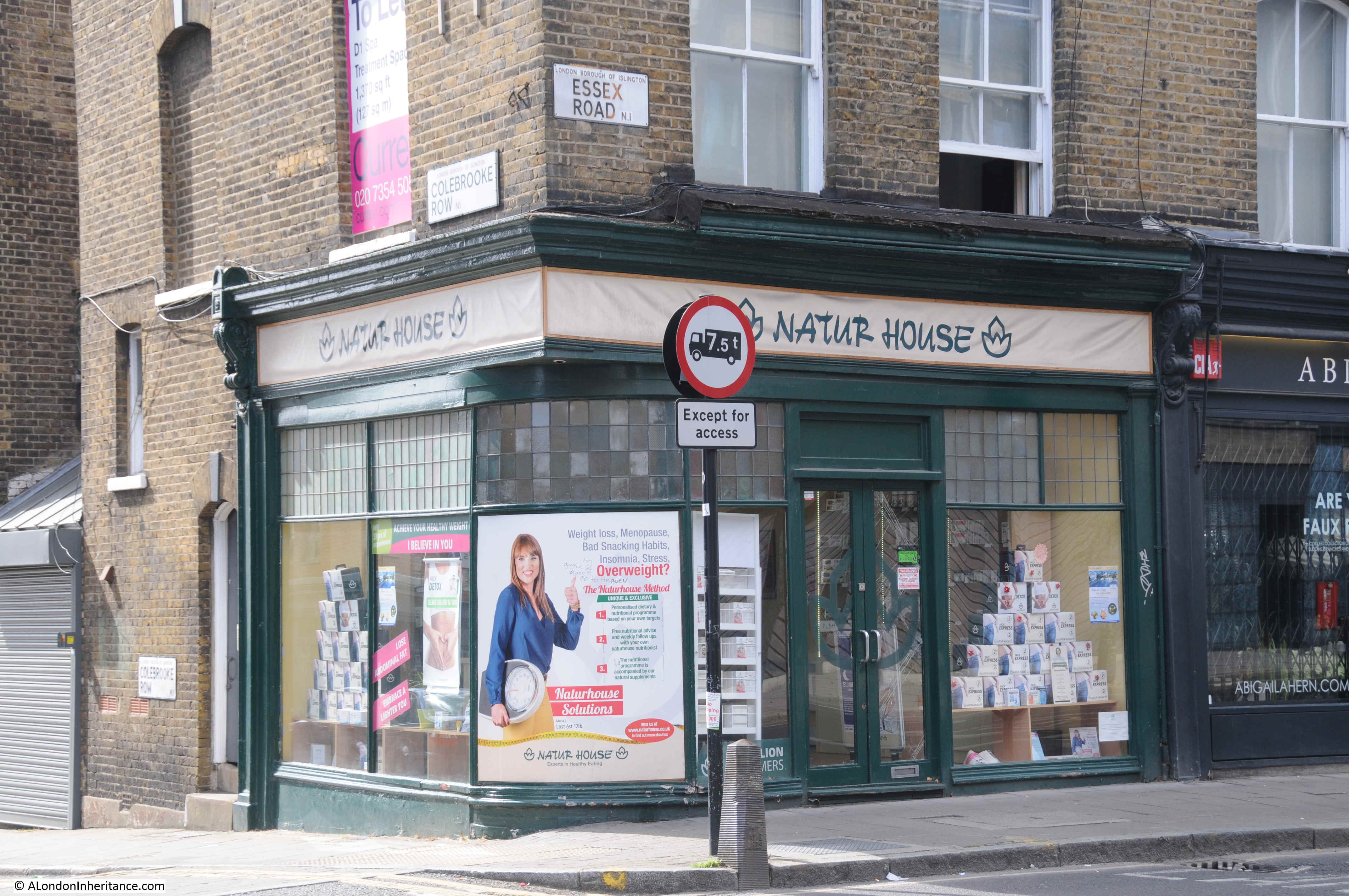
I like photographing shops and this is Natur House on the corner of Essex Road and Colebrooke Row.

Essex Road

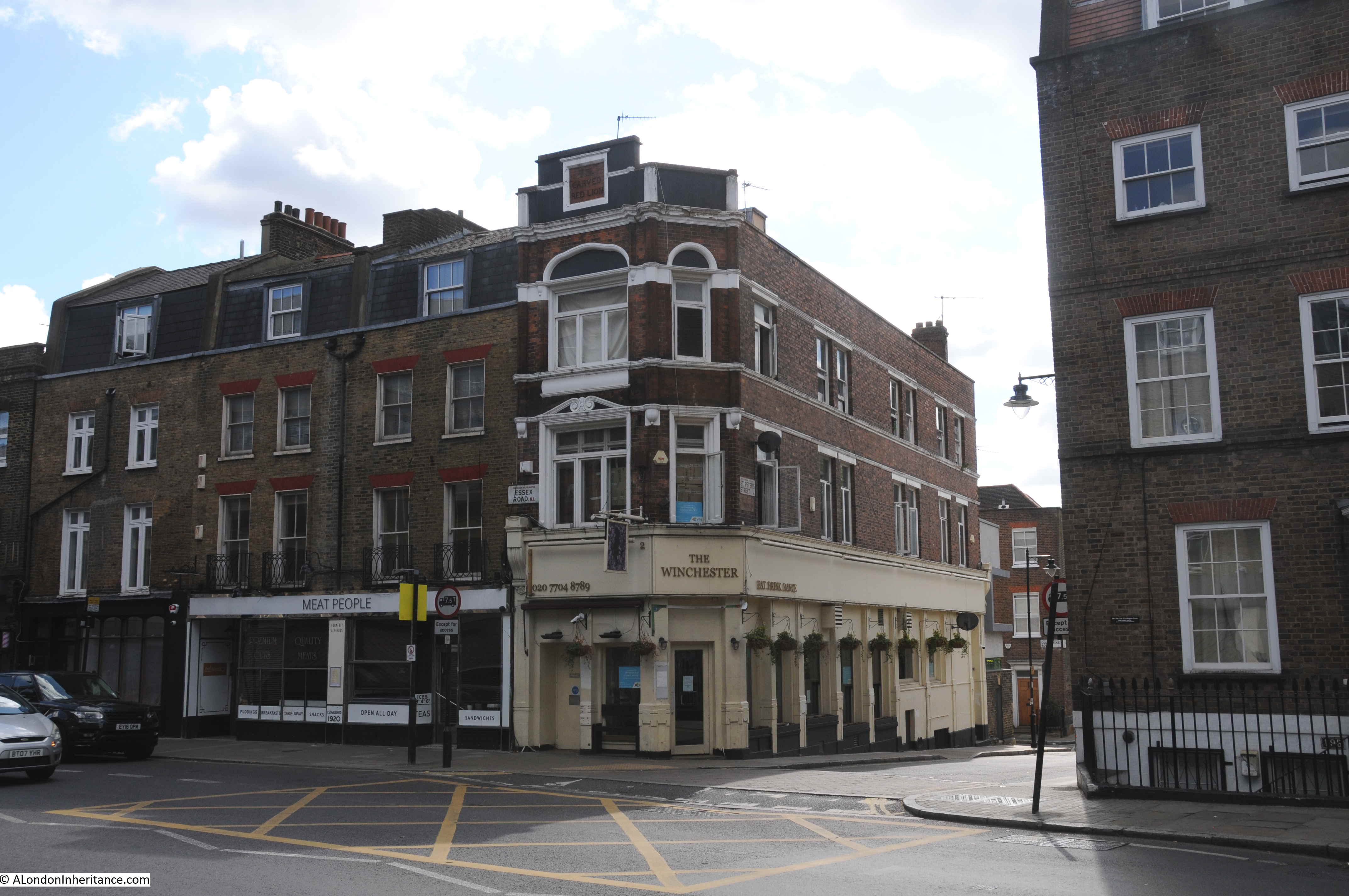
And a final pub before we reach Islington Green – the Winchester on the corner of Essex Road and St Peter’s Street.

Essex Road

Originally the Market Tavern and the Carved Red Lion, this is the first of the many pubs on Essex Road that travelers heading north along the street would meet.

And we now reach Islington Green after a short walk along part of Essex Road. To keep the post a manageable size, I have missed out a number of buildings and have tried to show a sample of what can be found in just one London street.

Digging a bit deeper into the streets and buildings around us is what makes walking London so interesting.

alondoninheritance.com

Sans Walk, a Fenian Outrage and the Edge of London

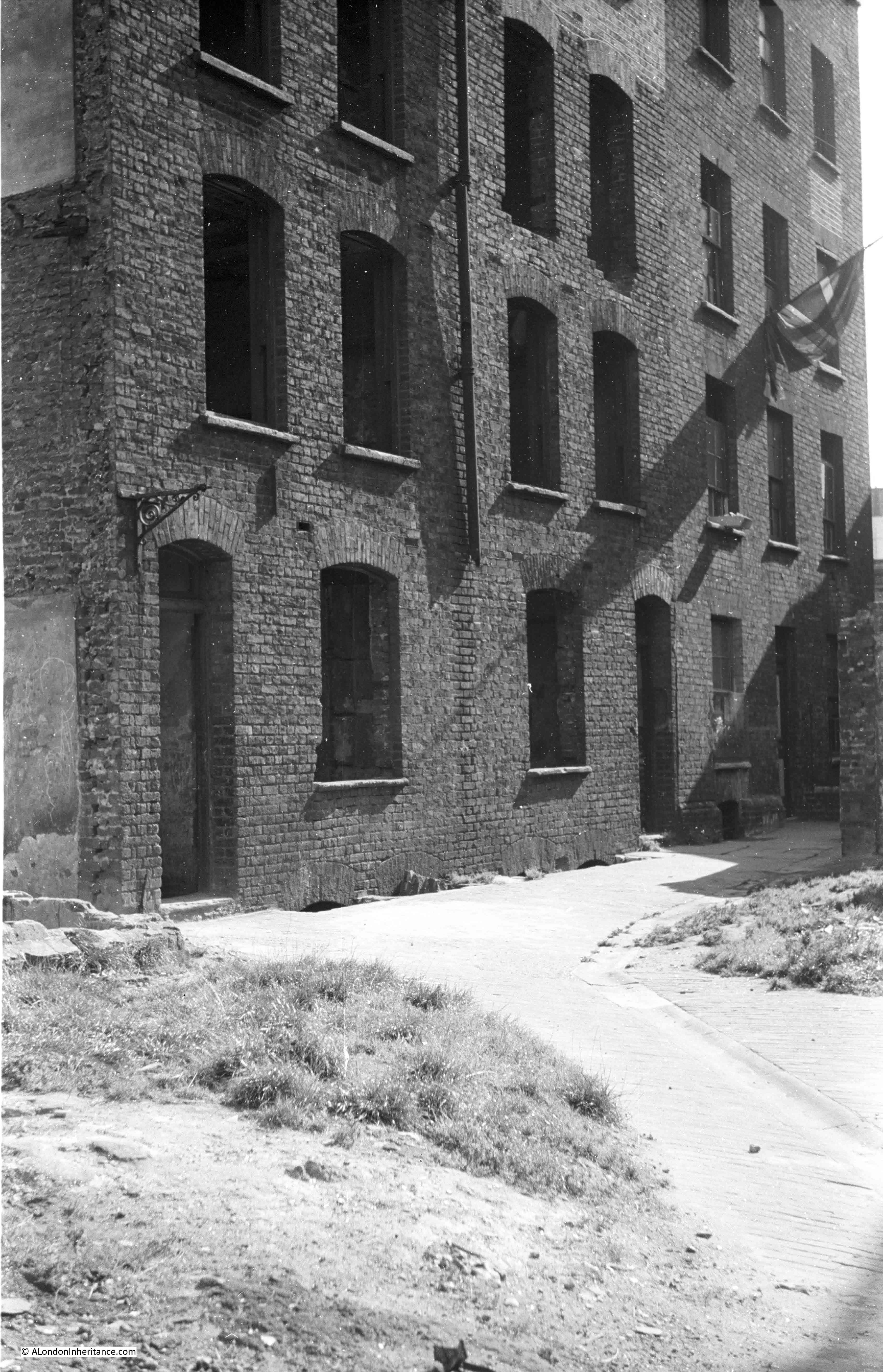
There are three photos in my father’s collection that I have not been able to identify. They were labelled “Sans Walk area”. Sans Walk is in Clerkenwell, and the first photo shows what appears to be an empty shell of a building, probably damaged during the war.

Sans Walk

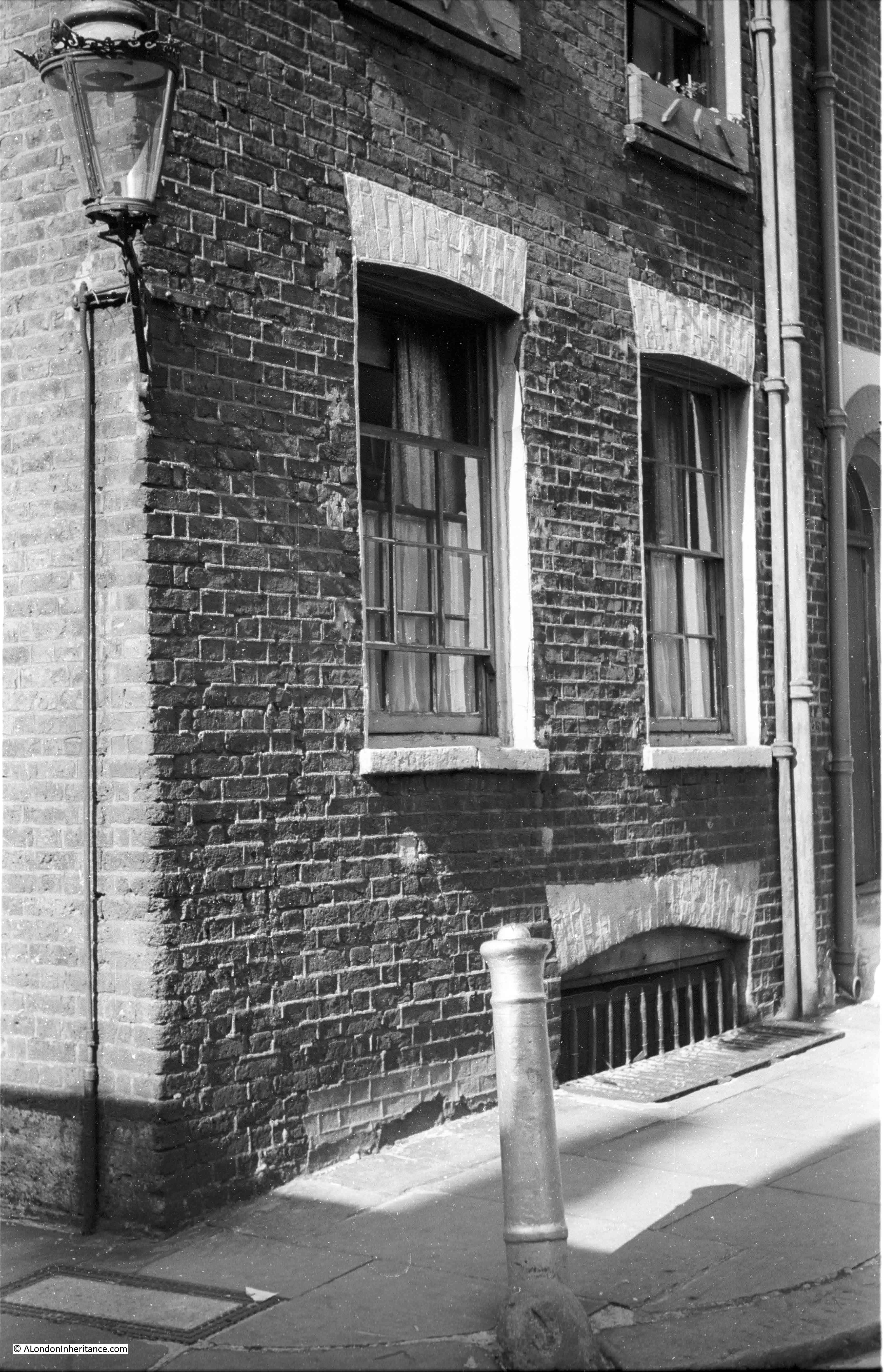
The second photo shows a corner house, in good condition and still occupied, with a lovely street lamp on the corner of the building:

Sans Walk

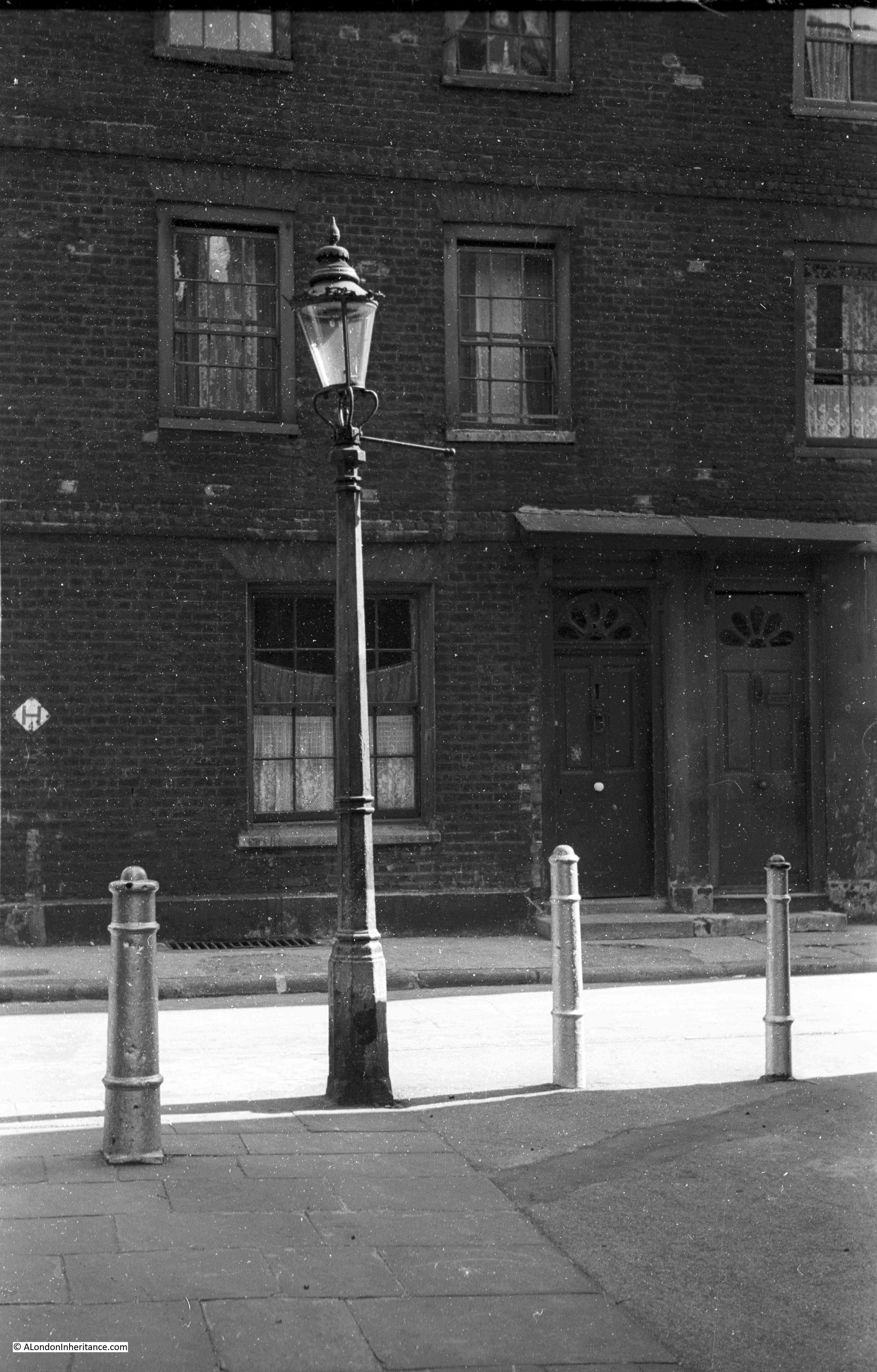
The third and final photo shows part of a terrace of houses, with a streetlamp and bollards in the foreground.

Sans Walk

No street names, or any other identifiable features to help locate the photos.

I thought if I walked the area around Sans Walk, I should be able to identify some of the locations. I had no idea whether the houses in the photos had been restored or demolished, but armed with printed copies of the photos I set off to walk the area on an early Autumn day.

Although I could not find the locations of the photos, what I did discover was an area packed full of history, and that once formed the edge of London as the city gradually expanded to the north.

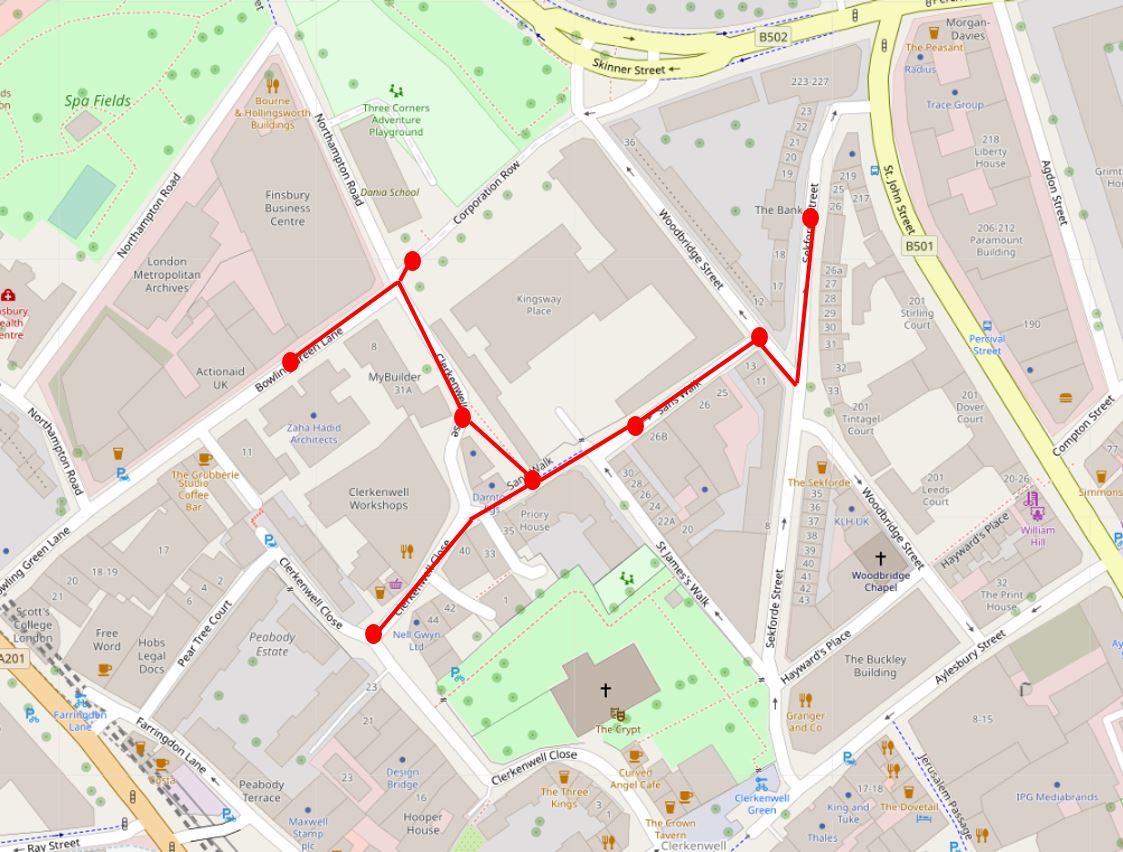
The following map shows the places covered in the rest of the post (Map © OpenStreetMap contributors):

Sans Walk

Sans Walk is the nearly horizontal street in the centre of the map. I did walk the rest of the streets around Sans Walk, but this post was getting rather long with just the stops shown.

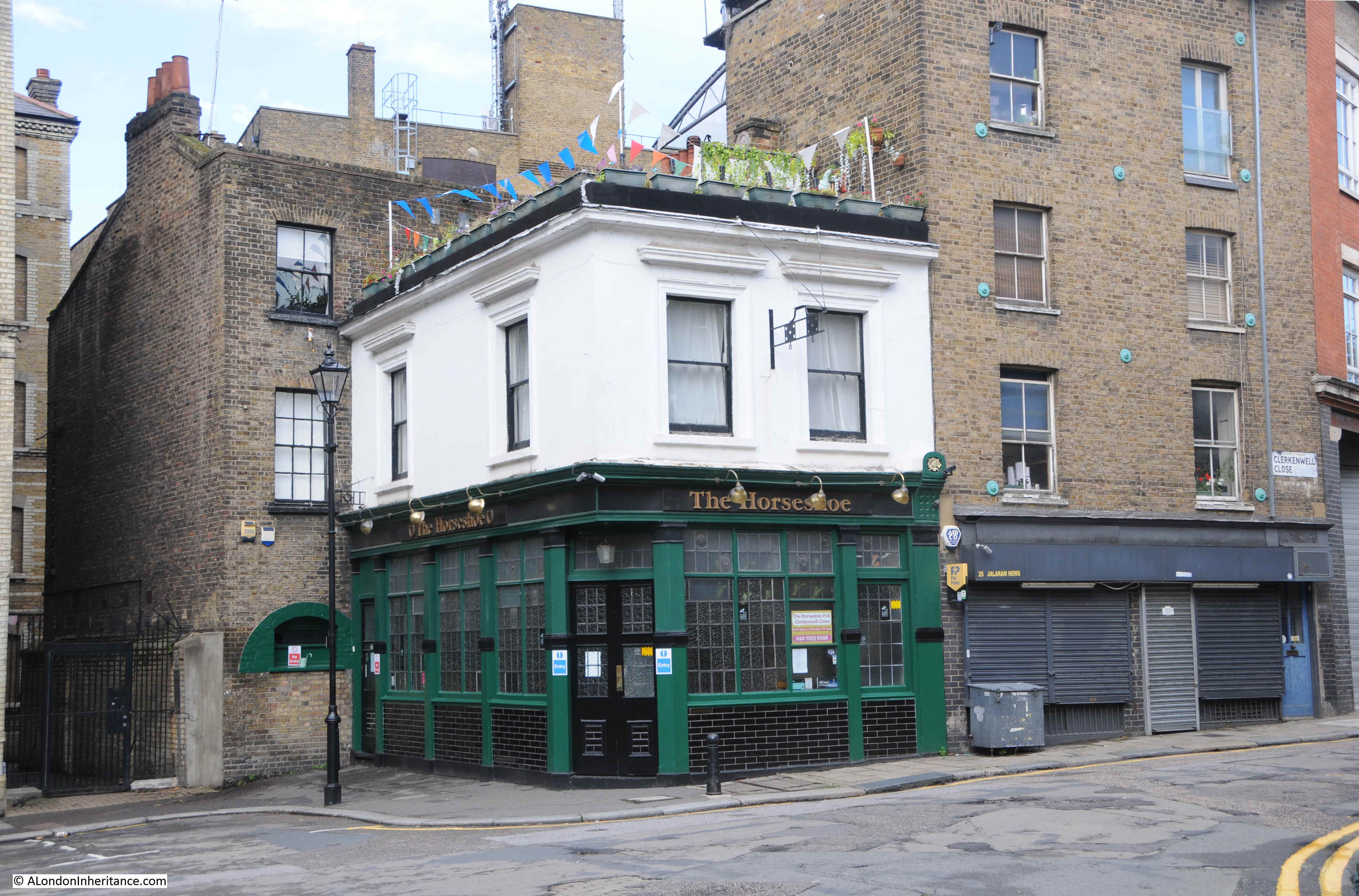
I started in Clerkenwell Close, opposite the Horse Shoe pub, a very traditional pub that probably dates back to the 18th century. The earliest written records I could find date to 1824 when a newspaper report referred to an inquest into a suicide which was held in the Horse Shoe.

Sans Walk

This area of Clerkenwell is full of narrow streets. Some new buildings intrude, but many 18th and 19th century buildings survive, along with warehouses and factories from the 19th and early 20th centuries.

Looking east along Clerkenwell Close:

Sans Walk

Clerkenwell Close is a strange street as it consists of a number of branches. Starting at Clerkenwell Green, it runs north-west, up to Pear Tree Court and the Clerkenwell Close Peabody Estate, with the branch I am walking along turning off and running up to Bowling Green Lane and Corporation Row. At one point the street runs parallel to a pedestrian alley, both called Clerkenwell Close, and indicative of how the area has developed as large warehouses replaced earlier streets, alley and buildings.

Sans Walk

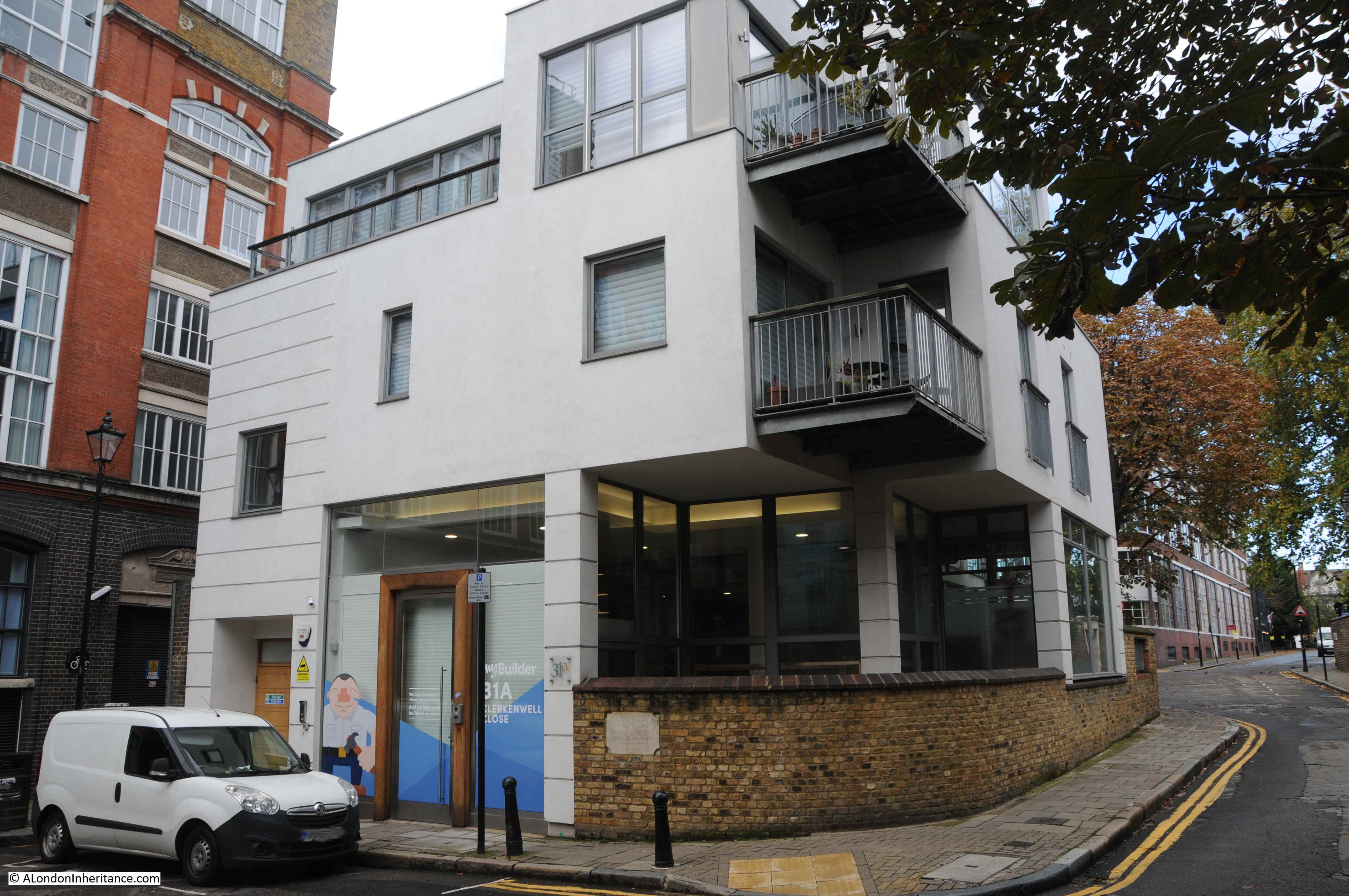
New buildings had been added, but they are generally at the same height as the existing buildings, so despite the architectural and material changes, they blend in. Providing they are in keeping with the scale of the area, and there is a justification to replace rather than restore the  original building, it is good to have new buildings. The streets in the area have buildings from the last few centuries and 21st century additions are part of the continuous development of London.

Sans Walk

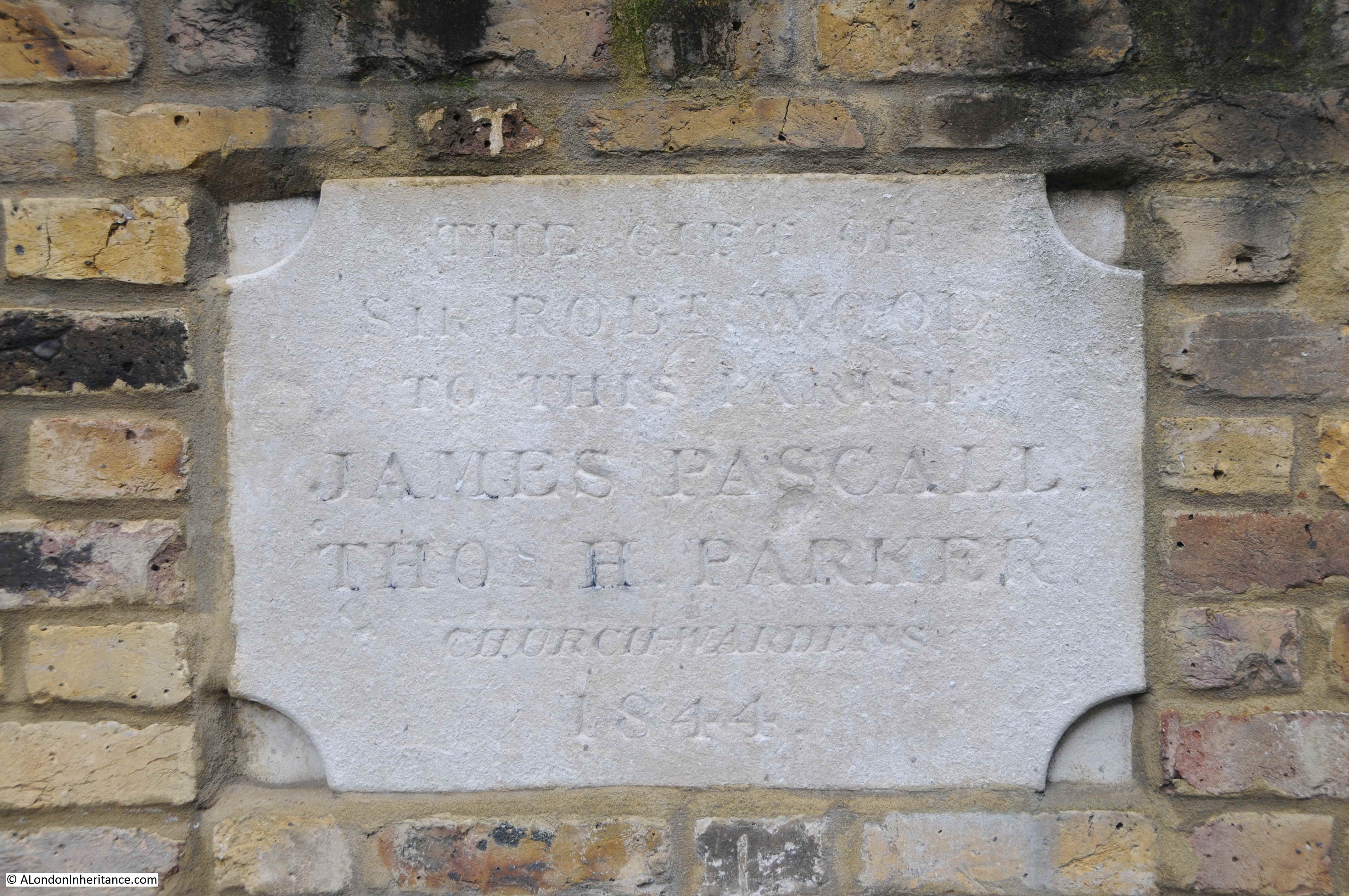
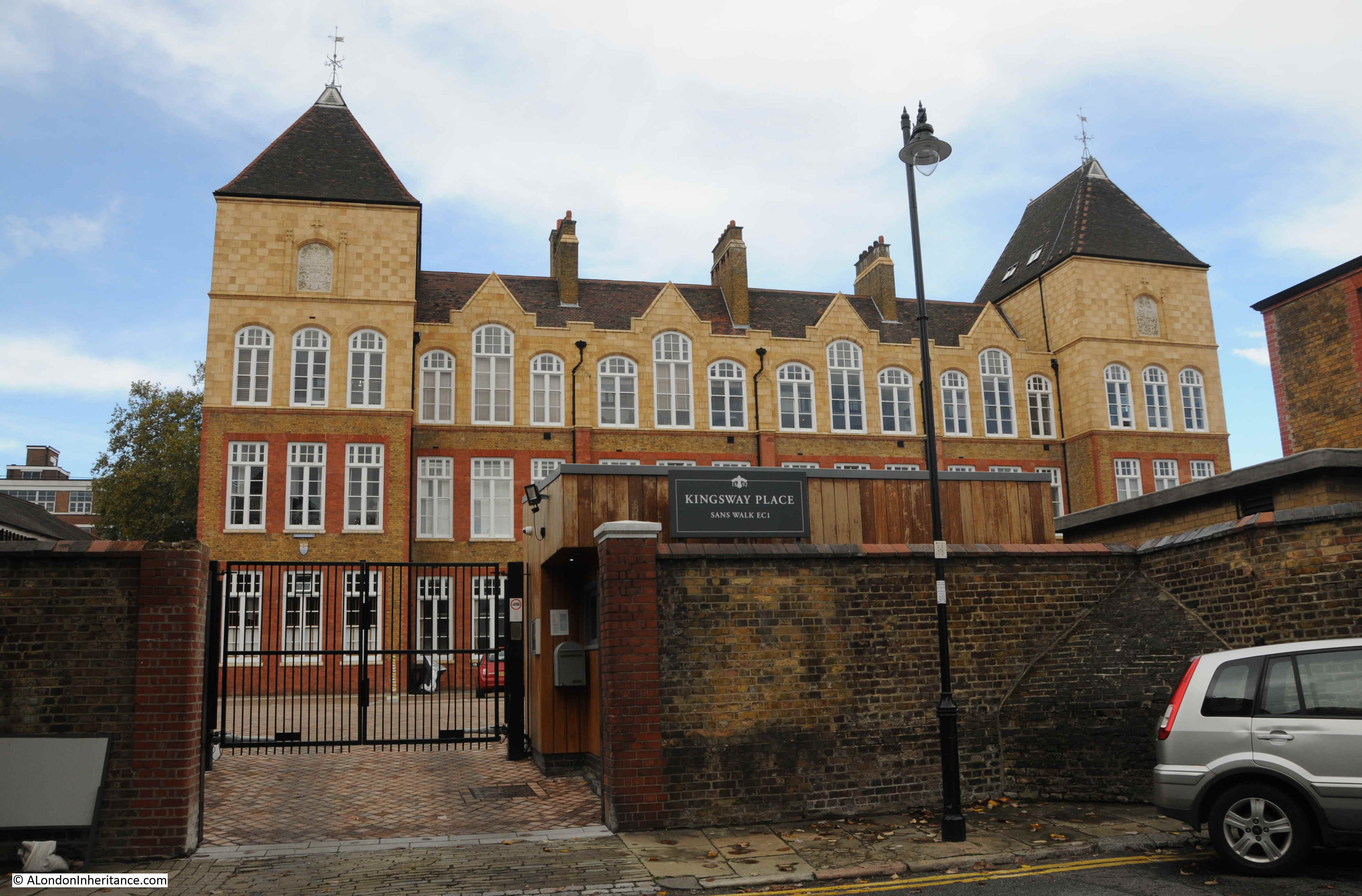
The above building was built on the corner of the playground of a Victorian school. The curving wall at street level retains a plaque recording the gift of Sir Robert Wood to the parish in 1844. I suspect this refers to the land:

Sans Walk

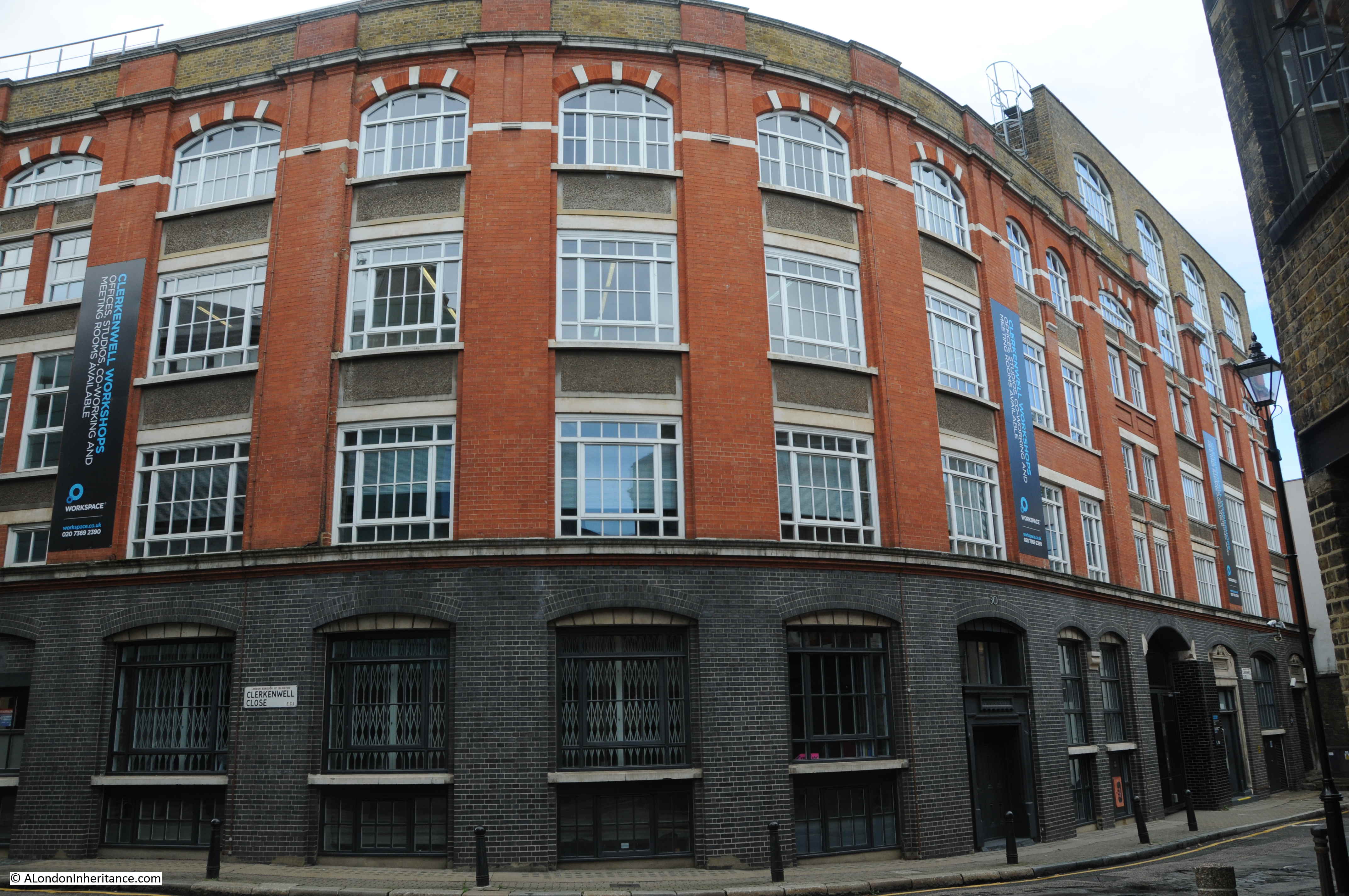
We are still in Clerkenwell Close, and the following building tells of the late 19th century expansion of London schools and the London School Board.

Sans Walk

The London School Board was responsible for the development of many of the large, brick, late 19th century schools that can still be found across London. As well as their construction, the London School Board was also responsible for their operation, and the supply of all the goods and materials needed to fit out, and keep a school running.

The Board consolidated the process of standardisation and supply, and one of the methods used was large central warehouses. The buildings in Clerkenwell Close were built between 1895 and 1897 as warehouses for school furniture, stationery and needlework supplies.

The growth in the volume of space needed grew in the early 20th century, and in 1920 an extra floor was added to the top of the Stationery and Needlework warehouse on the right of the above photo, and this addition is still visible in the change of brick colour from red/orange to  a brown brick for the 20th century addition of the top floor.

In the above photo, the furniture store was on the left, and the Stationery and Needlework departments were on the right, and these functions are still recorded in stone, above the doors.

Sans Walk

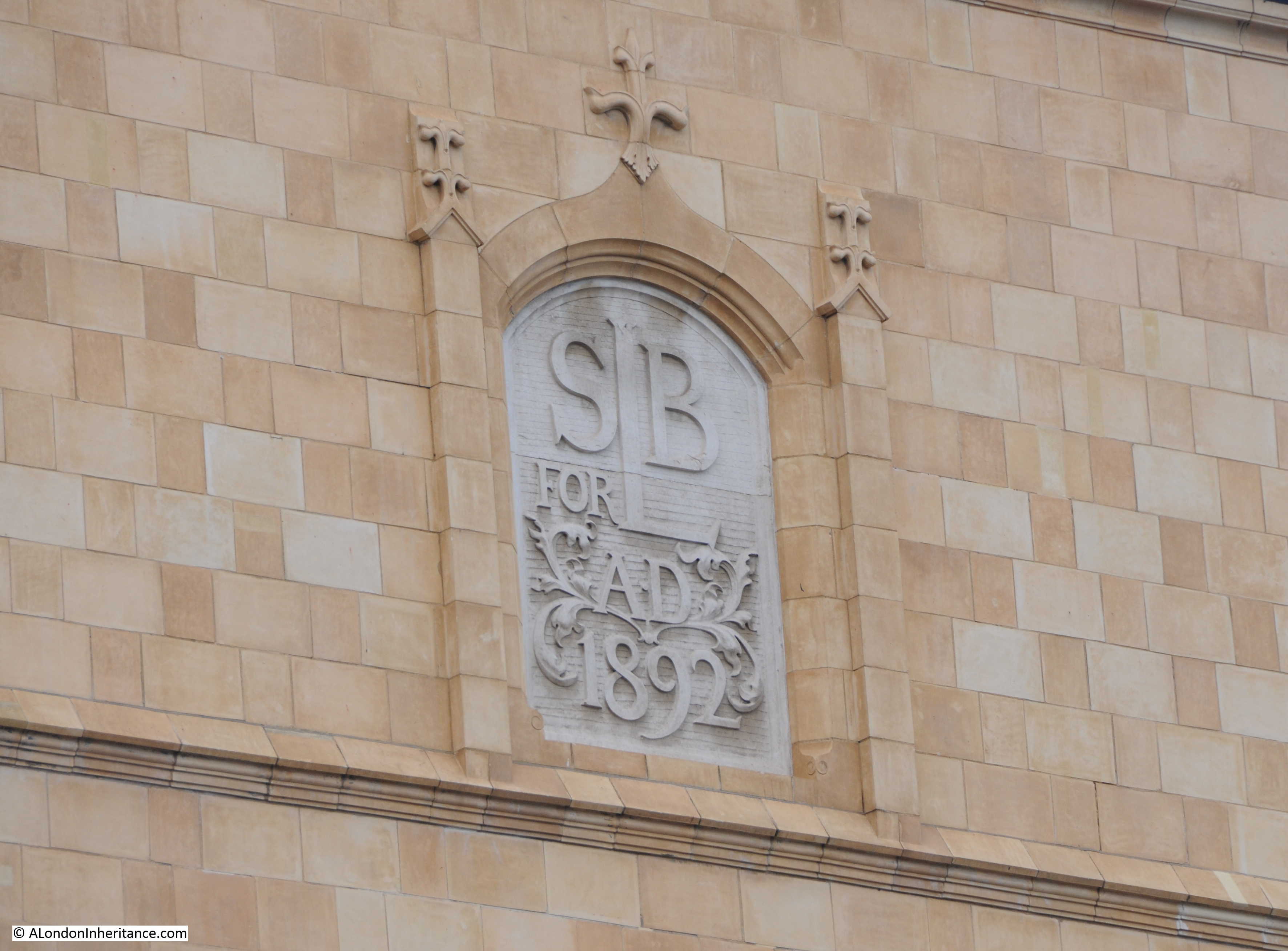
The initials at the top are those of the London School Board.

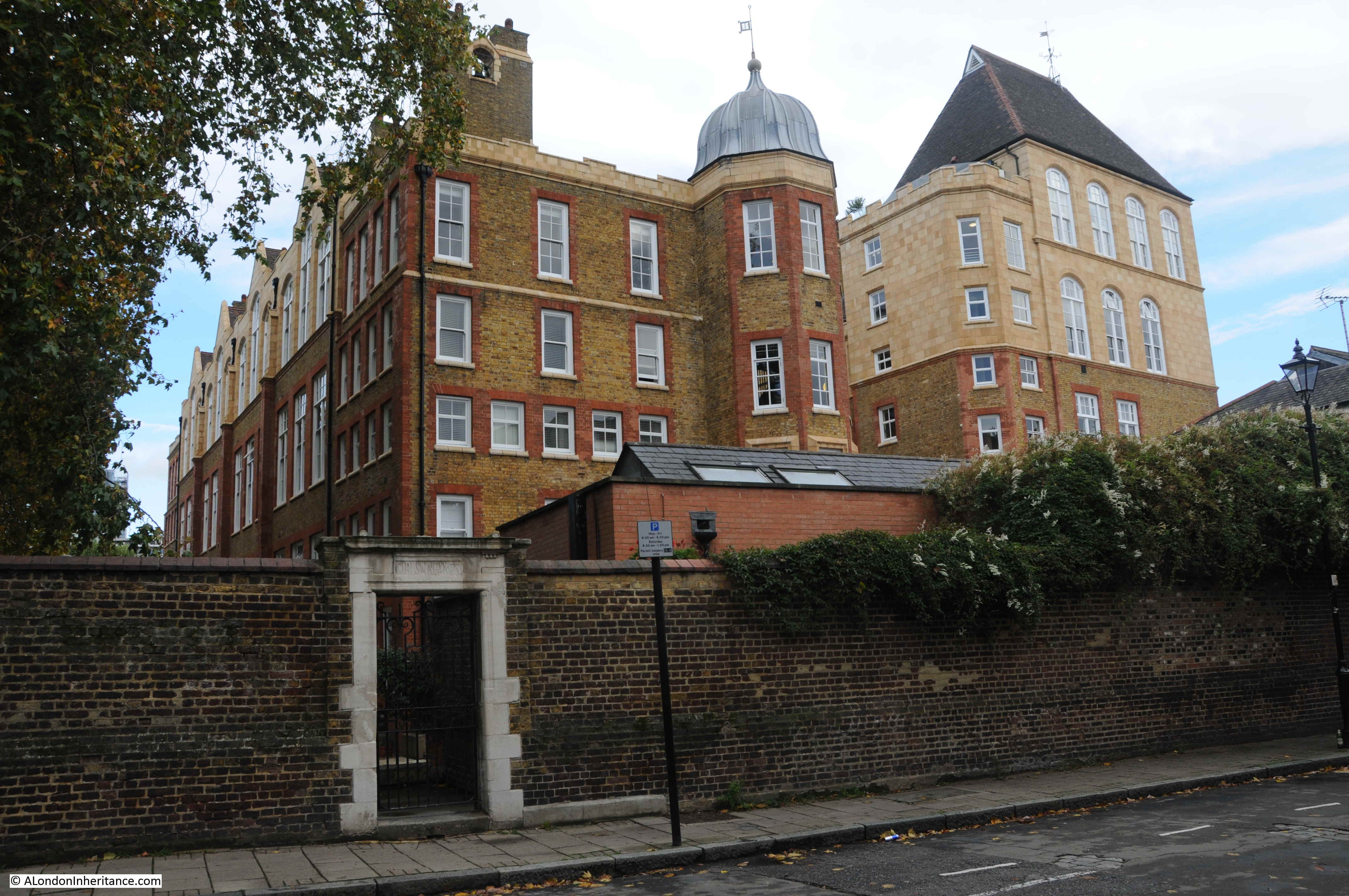
One of the schools that the warehouse would have supplied is directly opposite:

Sans Walk

The school was the Hugh Myddelton School, built by the London School Board in 1893 and with the distinction of being the only London School Board school opened by a member of the Royal family after it was opened by the Prince of Wales in December 1893.

Such was the importance of the visit of the Prince of Wales that the London School Board allocated £100 towards preparations for the visit, which caused some consternation as the money was thought better spent on education.

In his opening speech, the Prince of Wales said that the London School Board had contributed to a “marked advance in education, diminution in crime and an undoubted increase in general intelligence”.

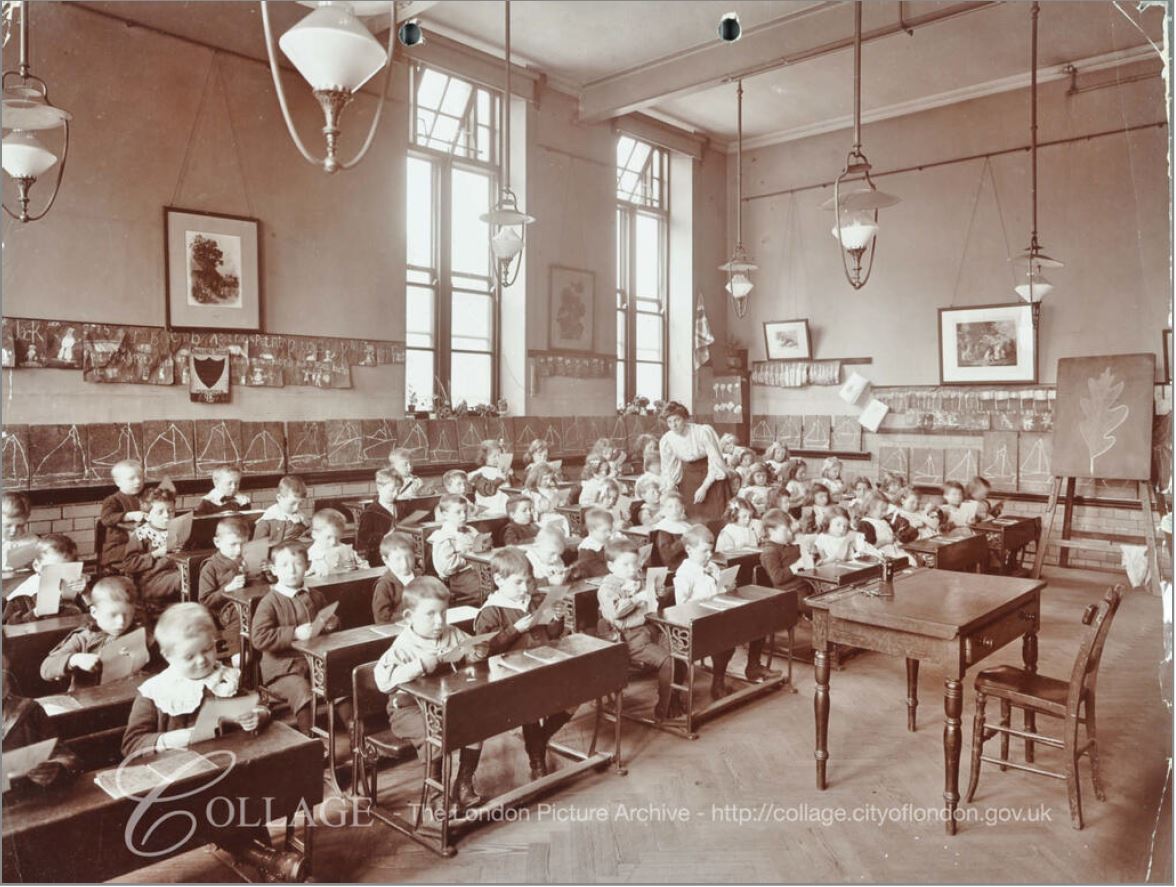
Lesson in the Hugh Myddleton School in 1906:


Image credit: London Metropolitan Archives, City of London: catalogue ref: SC_PHL_02_0208_3943

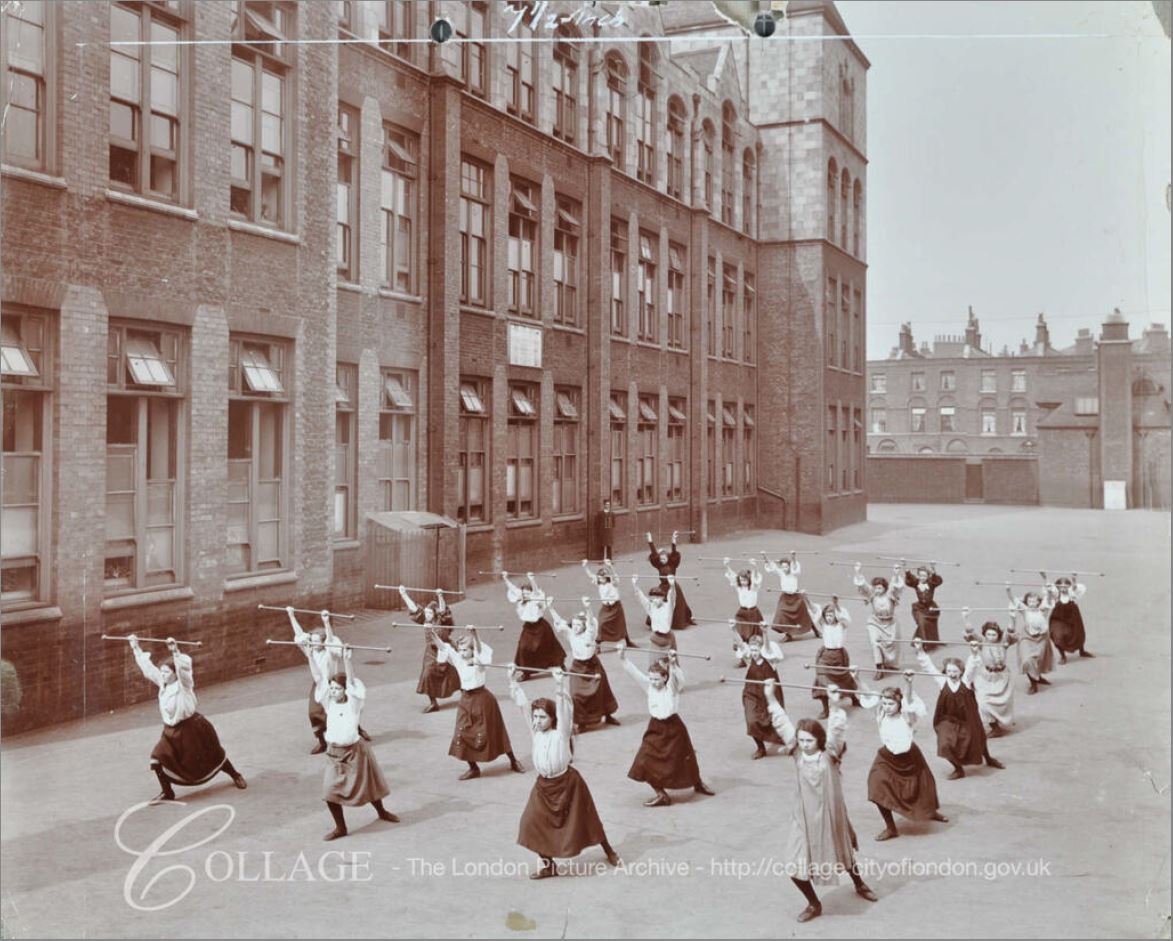
Drill in the open area outside the school, also 1906:

Sans Walk

Image credit: London Metropolitan Archives, City of London: catalogue ref: SC_PHL_02_0208_68_4984

When opened, the school was the largest and most expensive built by the London School Board. The school had a number of special departments, including the Hugh Myddleton School for the Deaf. The site on which the school stands has an unusual history.

From 1845, the space occupied by the school had been the site of the Middlesex House of Detention, built as a short stay prison due to overcrowding in other prisons, the Middlesex House of Detention was demolished in 1886.

Some of the reception cells of the prison were in the basement, and these survived the demolition of the main building and were incorporated in the basement of the Hugh Myddelton School, and are presumably still there.

The school closed in 1971, was a Further Education College for the next couple of decades before being sold for development into flats and offices in 1999.

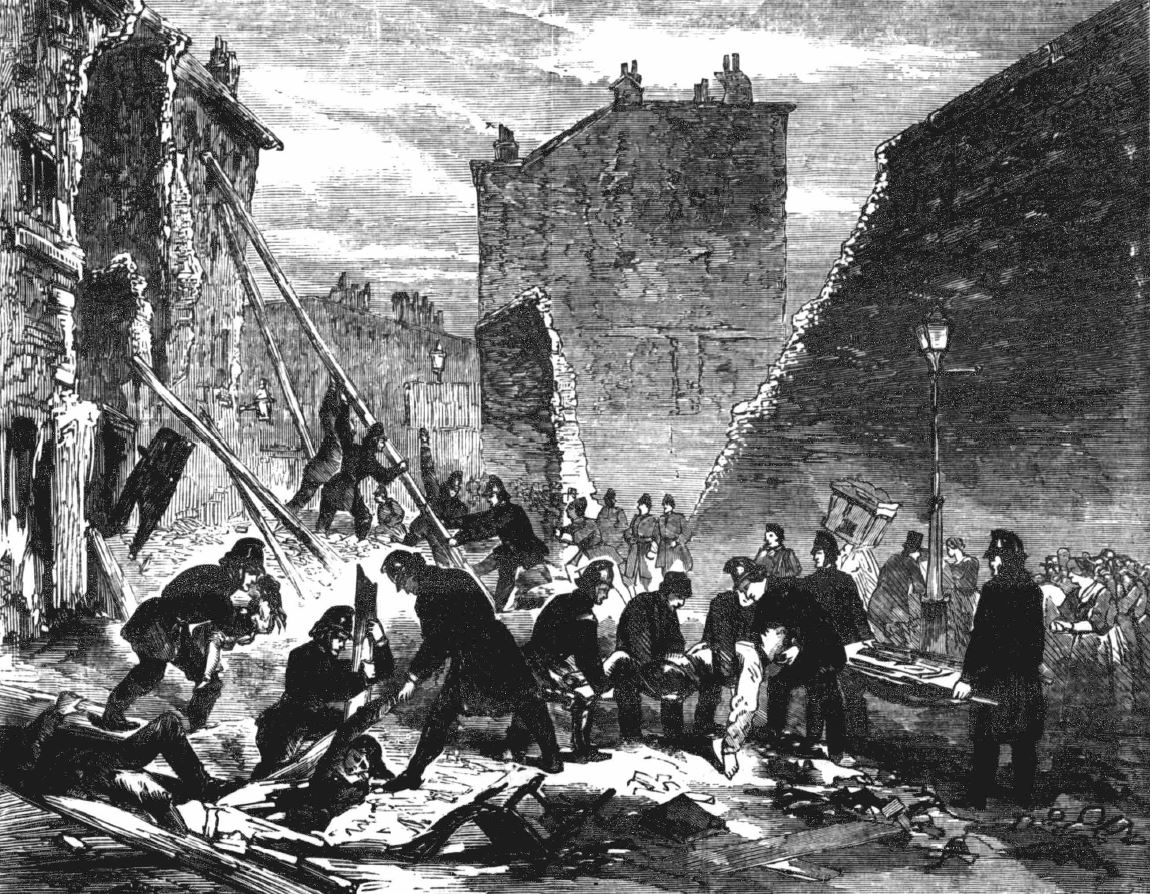
The site of the school, when occupied by the Middlesex House of Detention was the site of a bomb explosion in December 1867 reported extensively as the Fenian Outrage in the newspapers of the time.

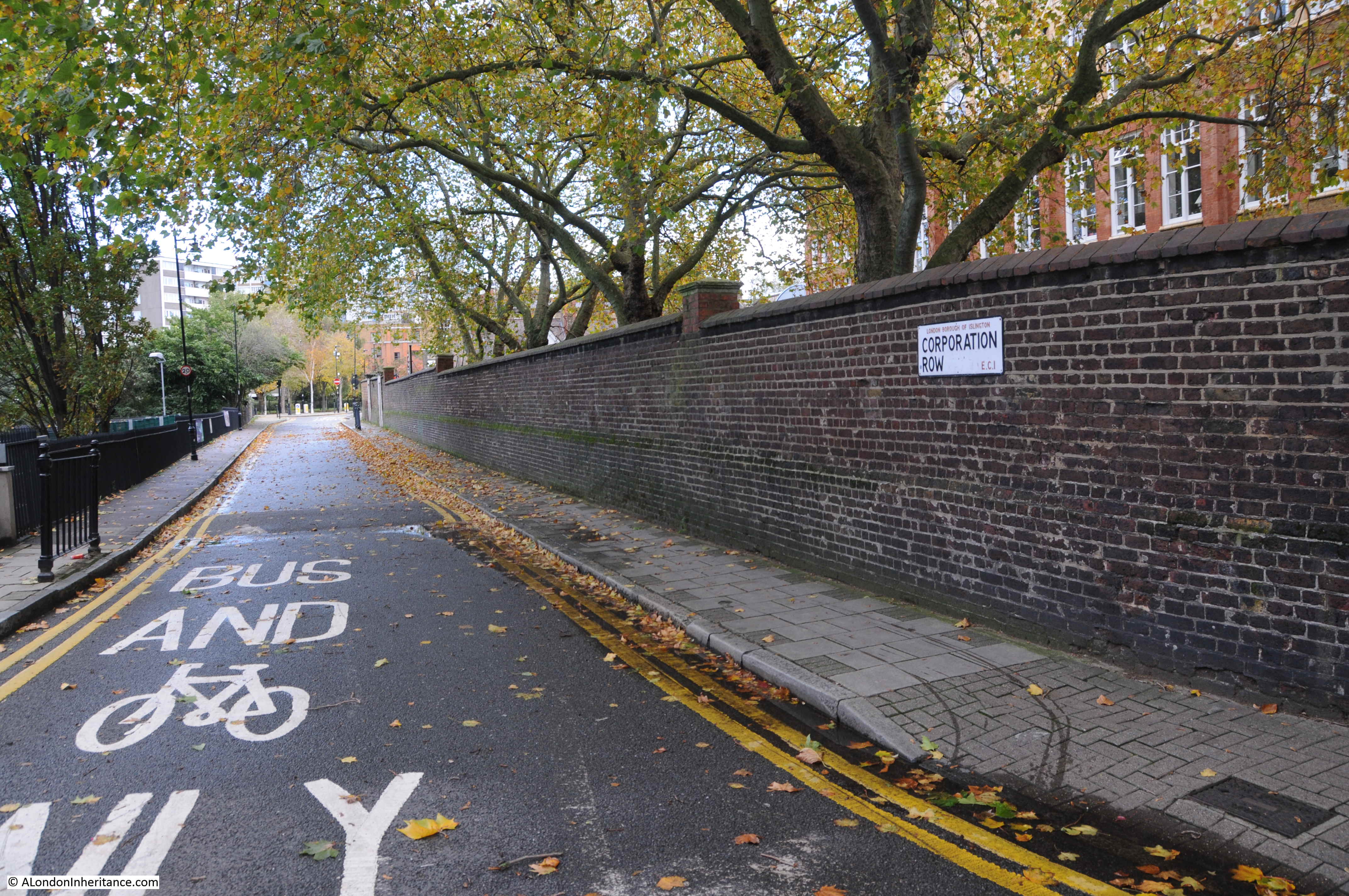
This took place at the perimeter wall of the prison which ran along the northern edge of the site, in Corporation Street:

Sans Walk

The Fenians was another name for the Irish Republican Brotherhood, an organisation formed in the 1850s to fight for an independent, democratic Ireland.

The bomb was an attempt to free Ricard O’Sullivan Burke and Joseph Casey who had been arrested earlier regarding Burke’s attempts to purchase arms and ammunition in Birmingham, and a previous attempt to free a prisoner in transit, when a guard had been killed.

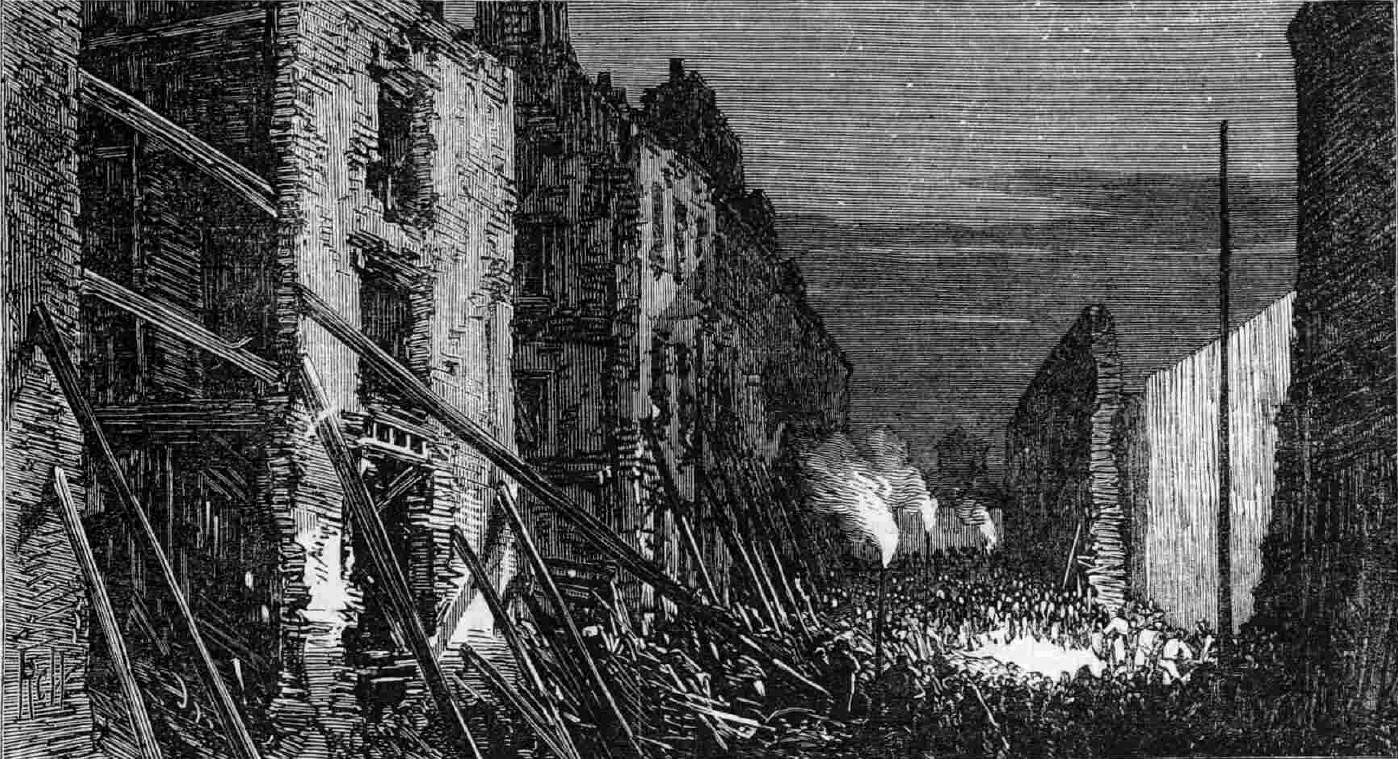
The view along Corporation Row in the immediate aftermath of the explosion:

Sans Walk

The Illustrated London News carried the following report of the explosion:

“The whole neighbourhood of Clerkenwell was startled at a quarter to four on Friday afternoon by an explosion, which resembled an earthquake. The houses were shaken violently, the windows in many cases were broken, and in some instances persons were thrown to the ground by the violence of the concussion. The scene of the explosion proved to be the wall of the House of Detention, opposite Corporation-row, some sixty feet of which were knocked down, and it was not long before the discovery was made that numerous persons were seriously, and some fatally injured, and that the calamity had been wilfully caused. It was at once attributed to the Fenians, the motive alleged being a desire to rescue Burke and Casey, who are confined in the prison, and facts which have since come to light show that this theory is the correct one.

The clearest account of what actually took place is given by a boy about thirteen years of age, named John Abbott, who is now in St Batholomew’s Hospital, happily not very much hurt.

This youth who lived in Corporation-row, says that at about a quarter to four o’clock he was standing at Mr Young’s door, No 5, when he saw a large barrel close to the wall of the prison, and a man leave the barrel and cross the road. 

Shortly afterwards the man returned with a long squib in each hand. One of these he gave to some boys who were playing in the street, and the other he thrust into the barrel. One of the boys was smoking and he handed the man a light, which the man applied to the squib. The man stayed a short time until he saw the squib began to burn, and then he ran away. A policeman ran after him, and when the policeman arrived opposite No 5, the thing went off.

The boy saw no more after that, as he himself was covered in bricks and mortar. The man, he says, was dressed something like a gentleman. He had on a brown overcoat and black hat, and had light hair and whiskers. He should know him again if he saw him. 

There was a white cloth over the barrel, which was black, and when the man returned with the squib he partly uncovered the barrel, but did not wholly remove the cloth. There were several men and women in the street at the time, and children playing. Three little boys were standing near the barrel at the time. Some of the people ran after the man who lighted the squib.

The effects of the explosion were soon visible in all directions. The windows of the prison itself, of coarse glass more than a quarter of an inch thick, were to a large extent broken, and the side of the building immediately facing the outer wall in which the breach was made, and about 150 feet from it, bears the marks of the bricks which were hurled against it by the explosion. The wall surrounding the prison is about 25 feet high, 2 feet 3 inches thick at the bottom, and about 14 inches thick at the top.

As to the number of persons injured it was impossible for some hours to learn anything satisfactory. It was found, however, that something like fifty at least had been hurt, and that two or three were killed. Thirty six of the sufferers were removed to St Bartholomew’s Hospital, where three died in the course of the evening, and six to the Royal Free Hospital in Gray’s Inn Road. Of the wounded some were mere infants, and the husband of a women, who has since died of injuries she sustained, lies in St Bartholomew’s; shockingly bruised and prostrated. Others are missing”.

In the following days, 12 were confirmed to have died in the explosion, with very many injuries.

A number of Fenian sympathisers were arrested, but after trial only one, Michael Barrett, was found guilty, and was sentenced to death. Barrett was the last person to be publically hung outside Newgate Prison.

The scene in Corporation Row after the explosion. A temporary wall has been erected to plug the gap caused by the explosion, and the walls of the opposite houses are being held up with timber supports.

Sans Walk

On a quiet autumn day in 2020 it is hard to imagine the explosion and devastation in Corporation Row.

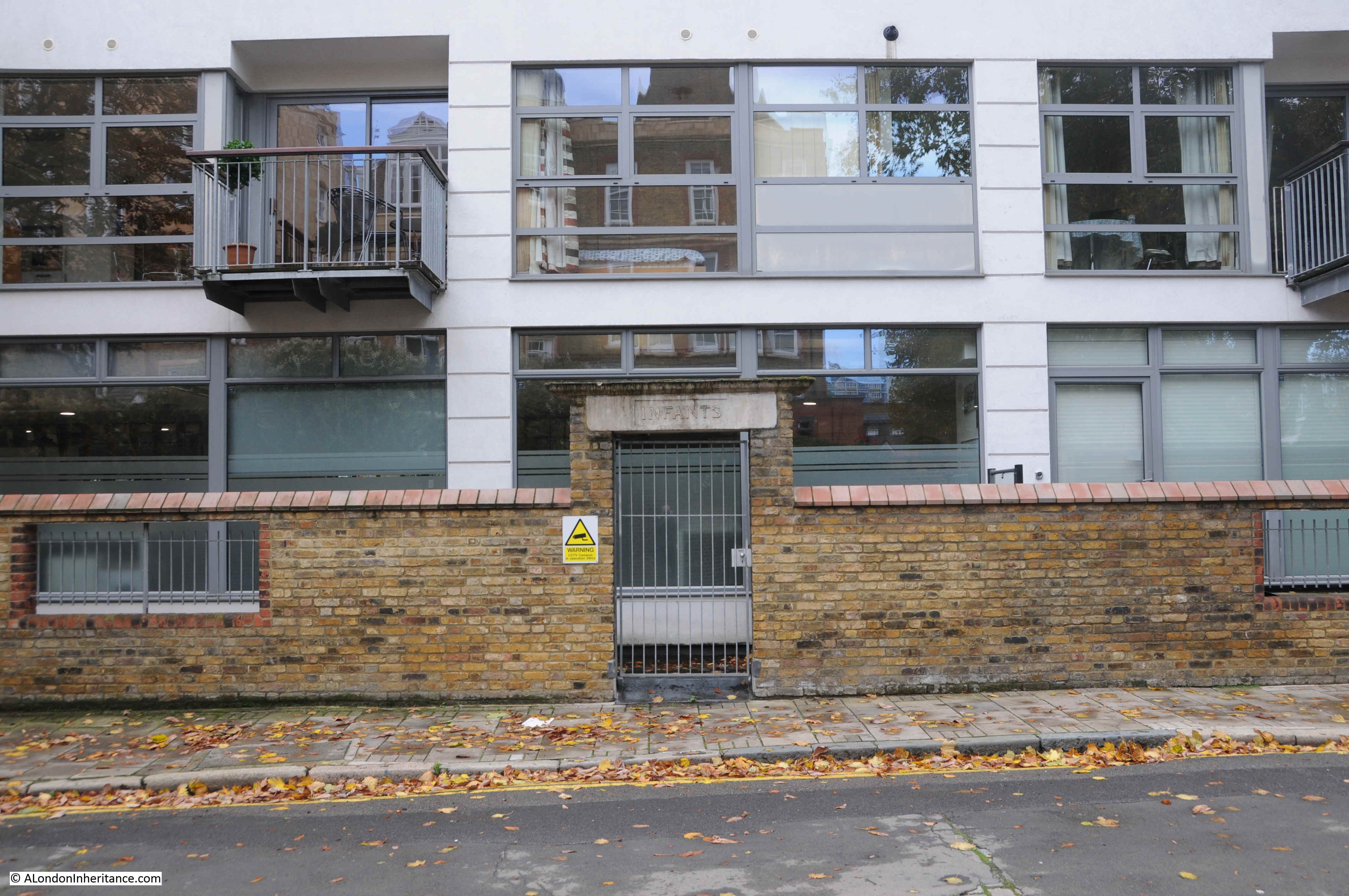
As well as the Hugh Myddleton School built on the site of the prison, there is another closed school near by. Parts of the wall surrounding the playground and one of the entrances for infants can be seen in front of the recent building that now occupies part of the playground space.

Sans Walk

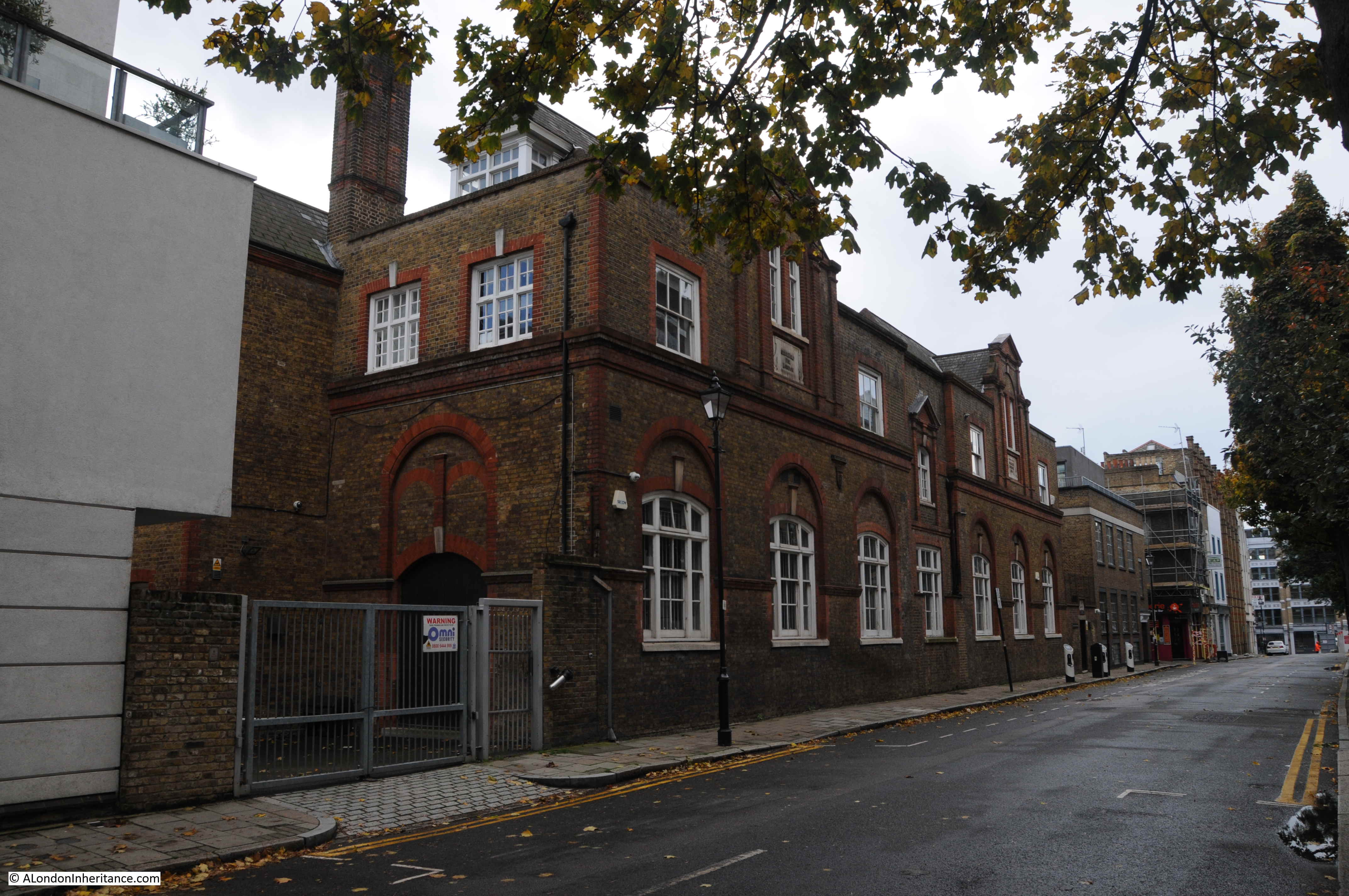
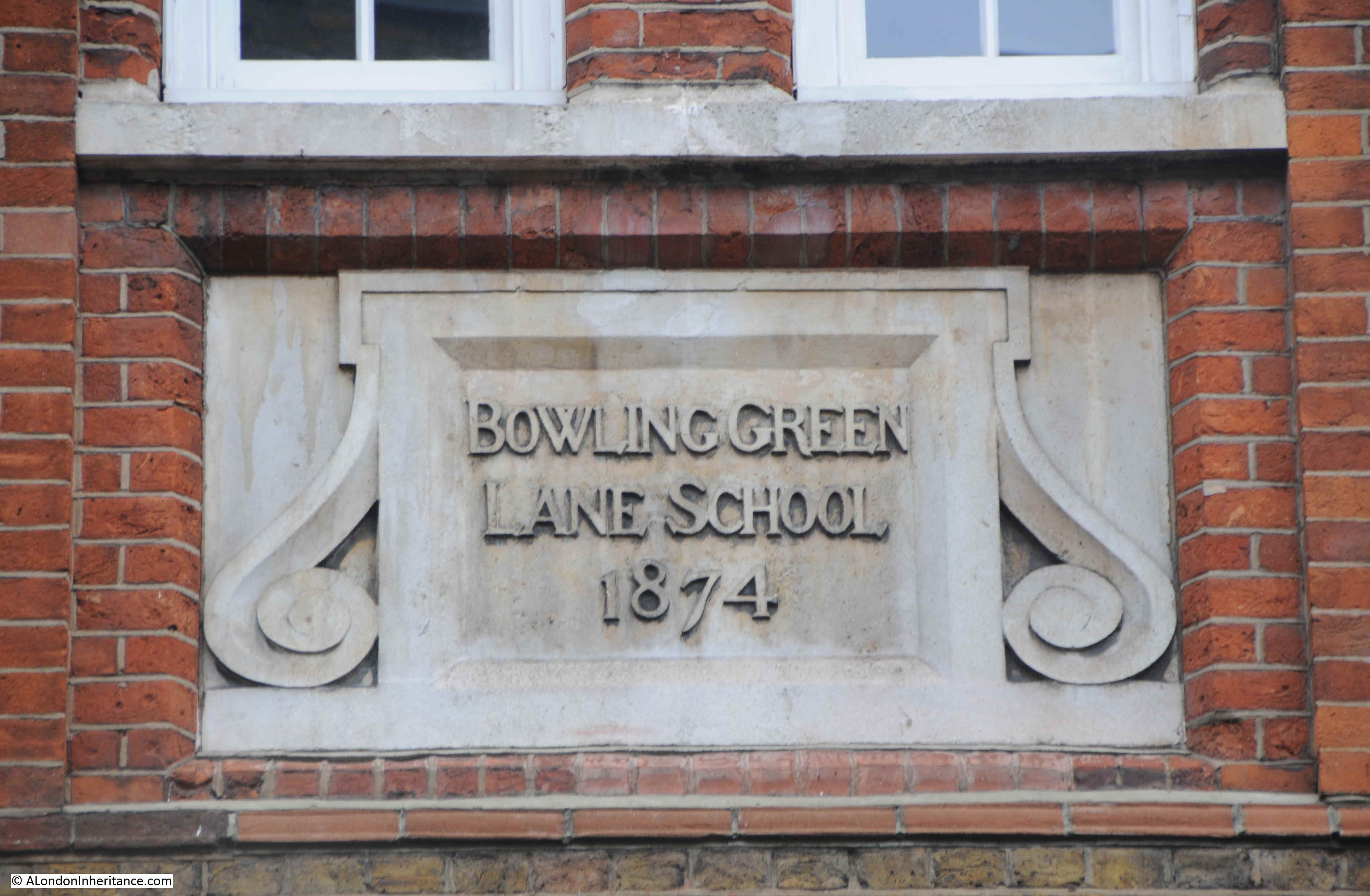
This is Bowling Green Lane School, built in 1874:

Sans Walk

Another London Board School, part of the site was originally a parish cemetery, along with housing and a tavern.

When the Hugh Myddleton School opened, Bowling Green Lane School became the junior school for the Hugh Myddleton.

Sans Walk

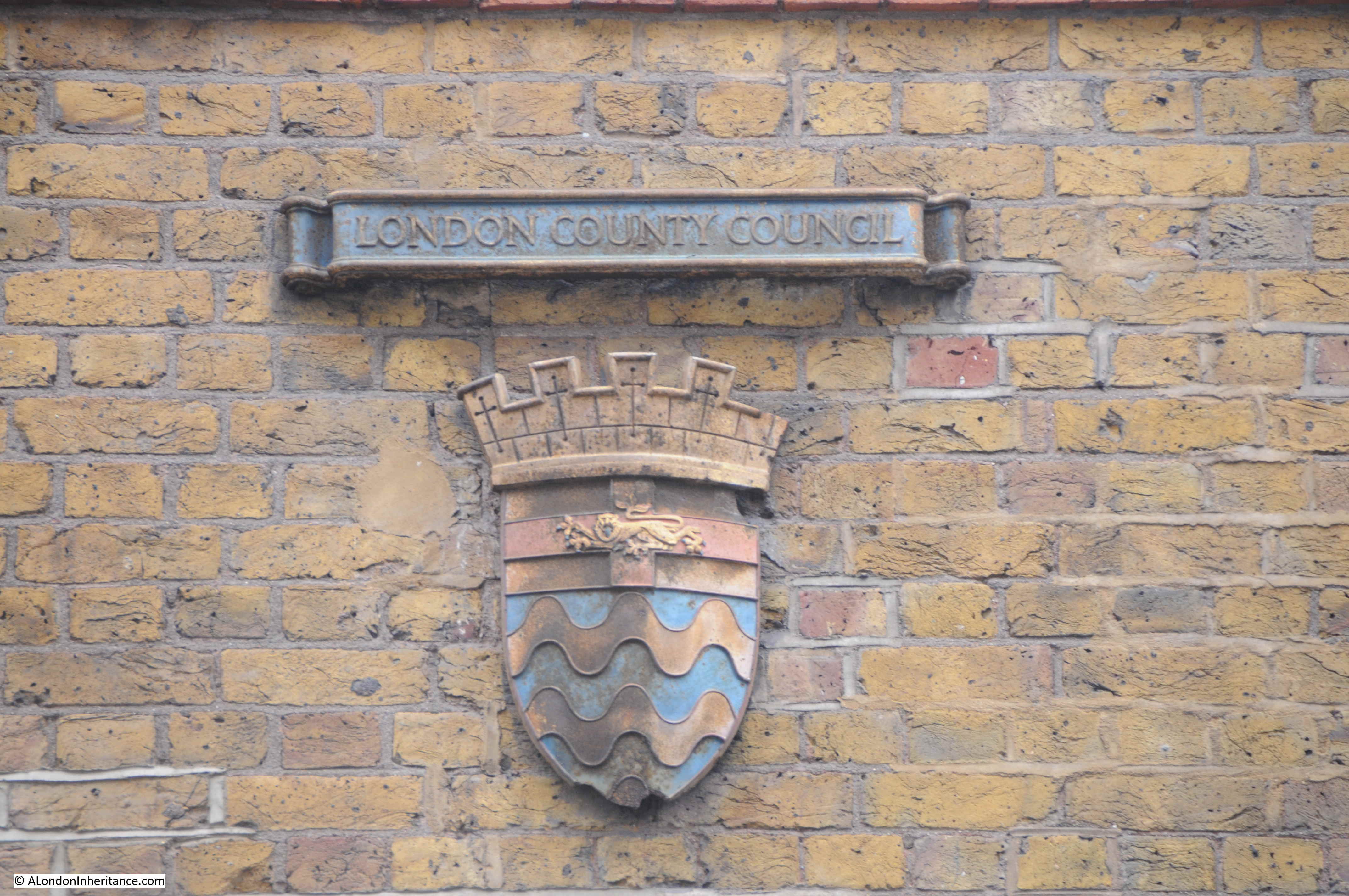
Having built and run many schools in the later part of the 19th century, the London School Board would become part of the London County Council when the authority took over responsibilities for education across London.

A rather nice London County Council coat of arms can still be seen on the side of the school facing the street.

Sans Walk

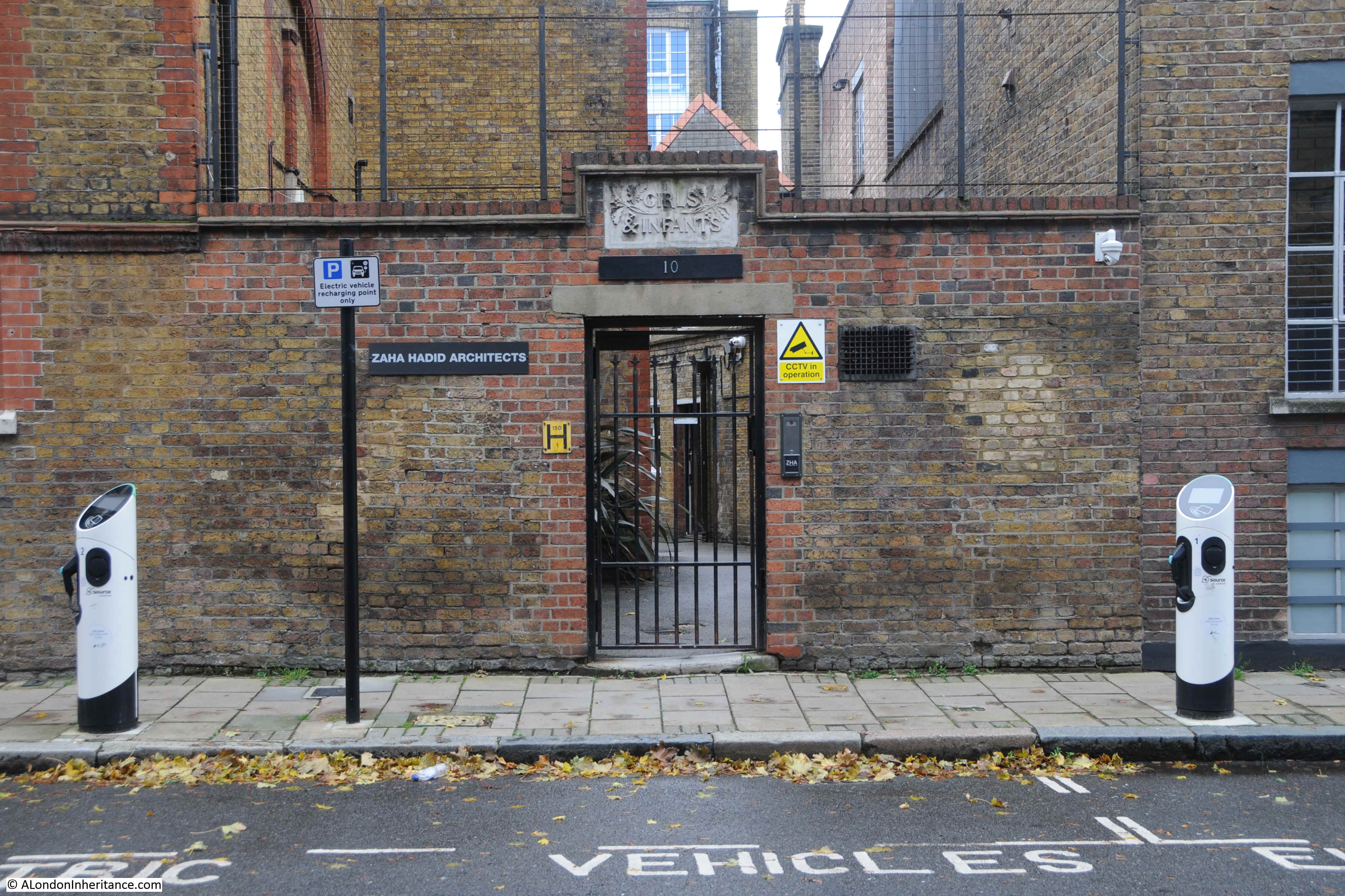
Bowling Green Lane school closed in 1970, but continued to provide additional space for Islington Green Secondary School until 1982 when it was converted into a range of business spaces, and today, a sign adjacent to the Girls and Infants entrance confirms that Zaha Hadid Architects now occupy the old school.

Sans Walk

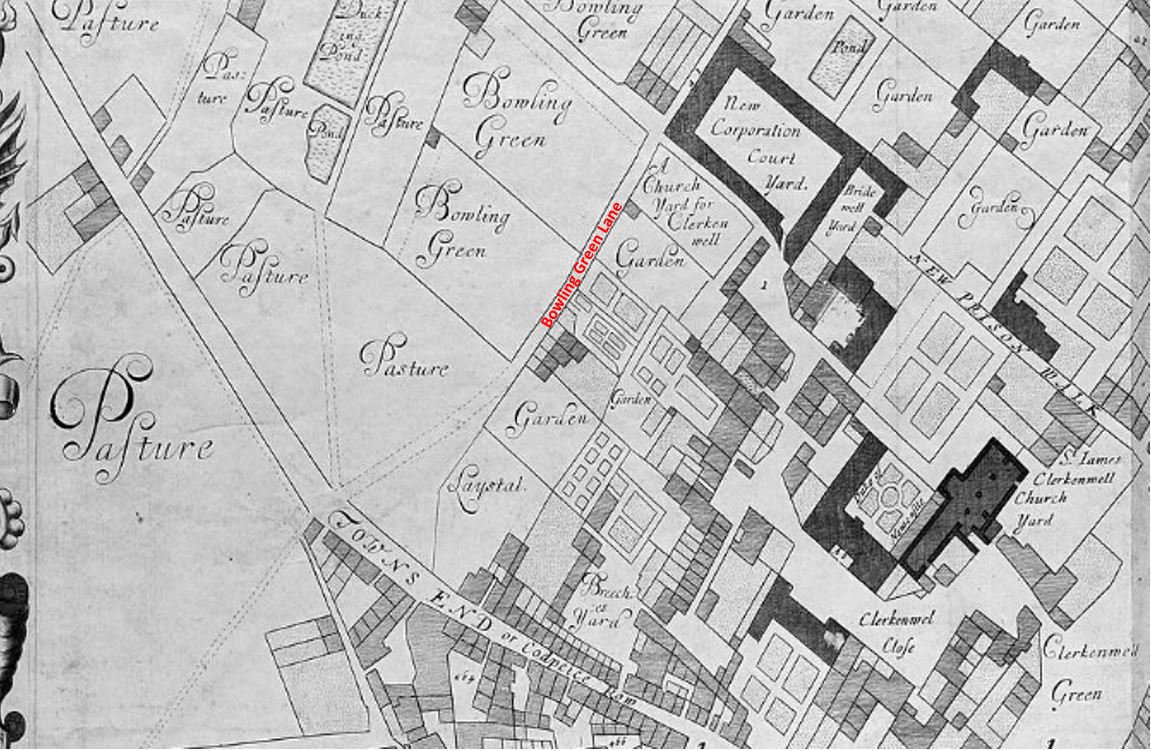
The name of the school is after Bowling Green Lane, the street that runs in front of the school. This is both an old street and name and is named after the Bowling Greens that once occupied the land to the north of the street as shown in this extract from Ogilby and Morgan’s map of London published in 1677:

Sans Walk

For many years, Bowling Green Lane and Corporation Row were the northern edge of this part of London, with open space on the northern side of the streets.

The following map extract is from a map produced in 1755 for Stowe’s survey of London. The orientation is rather strange as north is to the left, east is at the top of the map.

Sans Walk

The built areas of Clerkenwell are to the right (south) and open space to the left (north) until we come to the New River Head.

Hugh Myddleton was the driving force behind the construction of the New River and round pond at New River Head, and the large new London School Board school was named after him.

Sadler’s Wells were just north of New River Head and the open space between Sadler’s Wells and Clerkenwell was often a dangerous place for those returning in the dark from entertainments – see my post on Sadler’s Wells.

I now reached Sans Walk, the street that was apparently the centre for the three photos.

Sans Walk appears to have been in existence at the time of the Middlesex House of Detention, but seems to have gone by the name of Short’s Buildings – the name of a terrace of buildings on the southern edge of the street.

The name Sans Walk seems to have come into use by 1893 and the name comes from Edward Sans, the oldest member of the parish vestry at the time.

In the western side of Sans Walk, there are new buildings on the southern edge and the old Hugh Myddleton School on the northern edge of the street:

Sans Walk

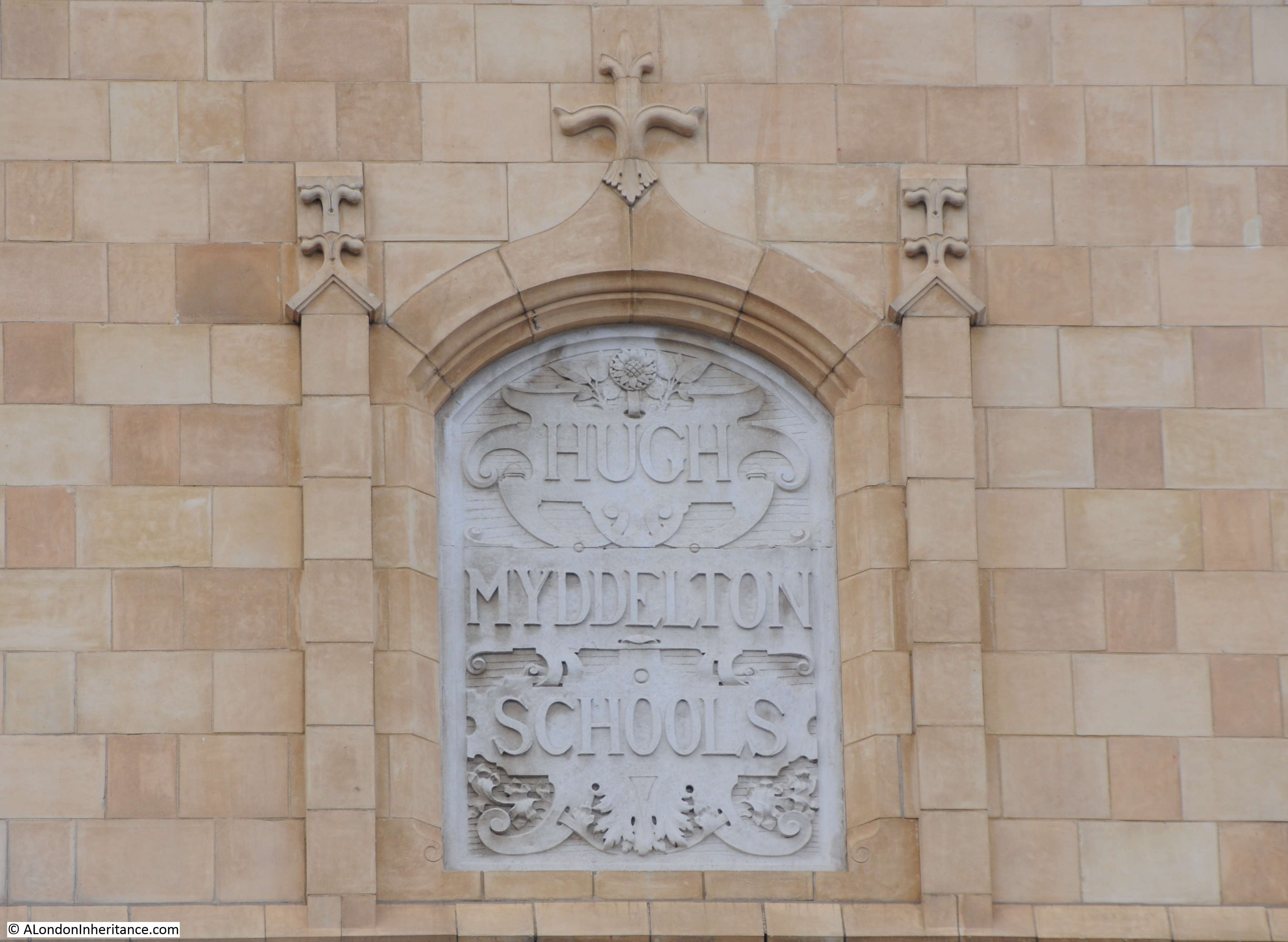
Ornate, carved name of the school, high up on the wall to the left of the building.

Sans Walk

The initials of the London School Board are also prominently displayed on the right of the school building:

Sans Walk

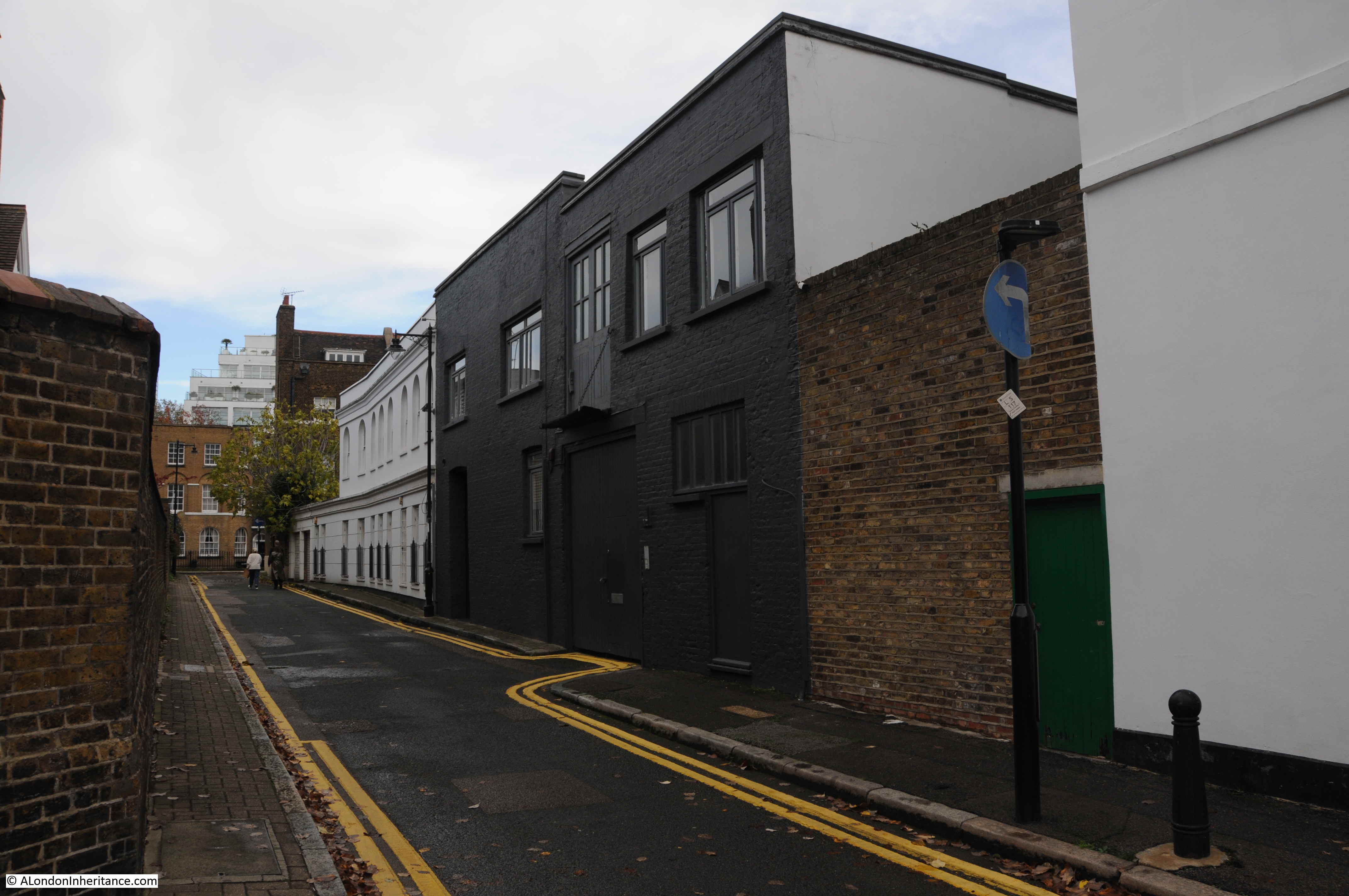
The eastern stretch of Sans Walk – I could not match any of the buildings in the street with those shown in my father’s photos.

Sans Walk

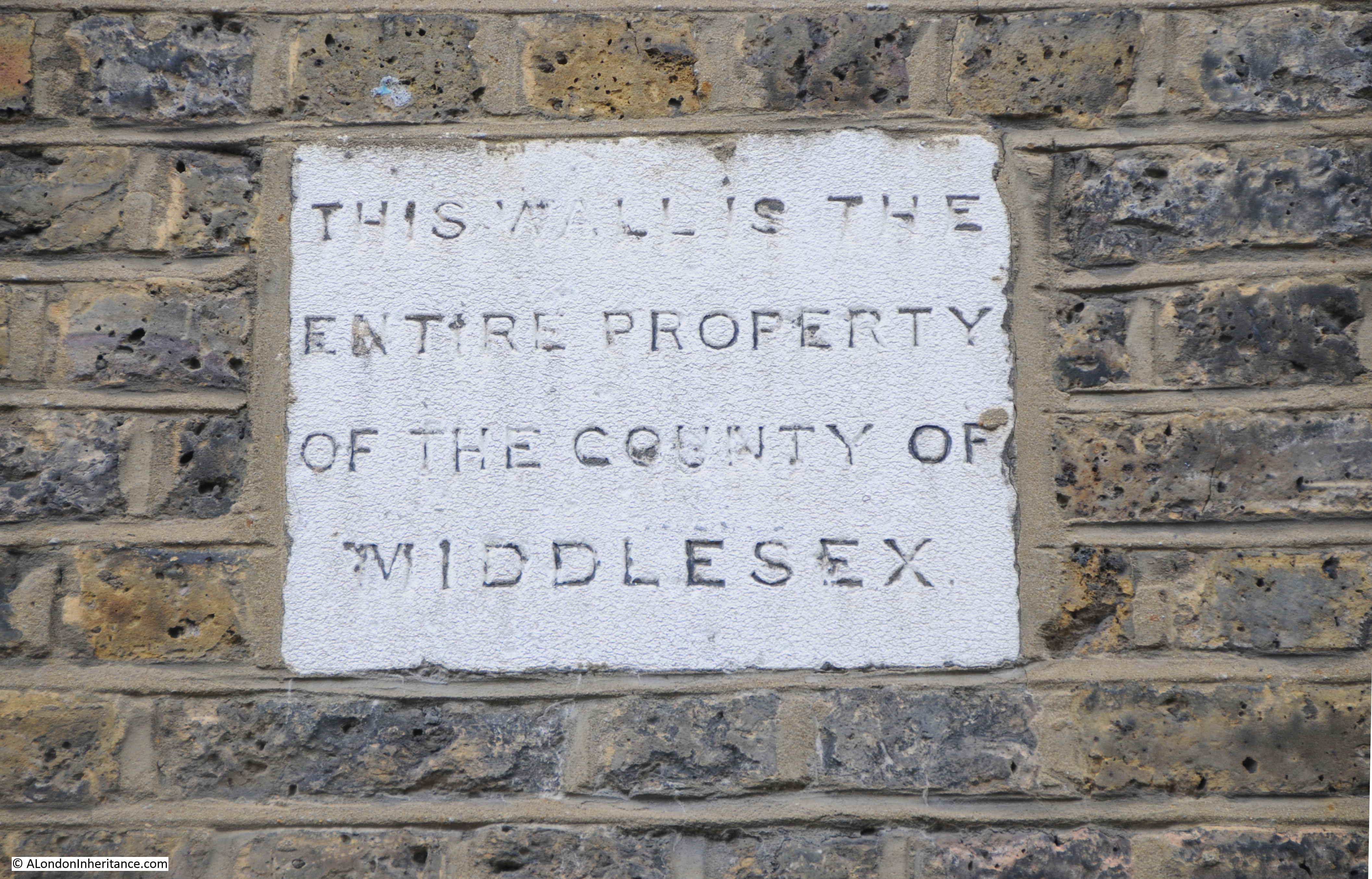
On the side wall of the house at the eastern end of Sans Walk is this plaque making clear that the entire wall is the property of the County of Middlesex. No idea if that applies to the rest of the house behind the wall, or just the wall.

Sans Walk

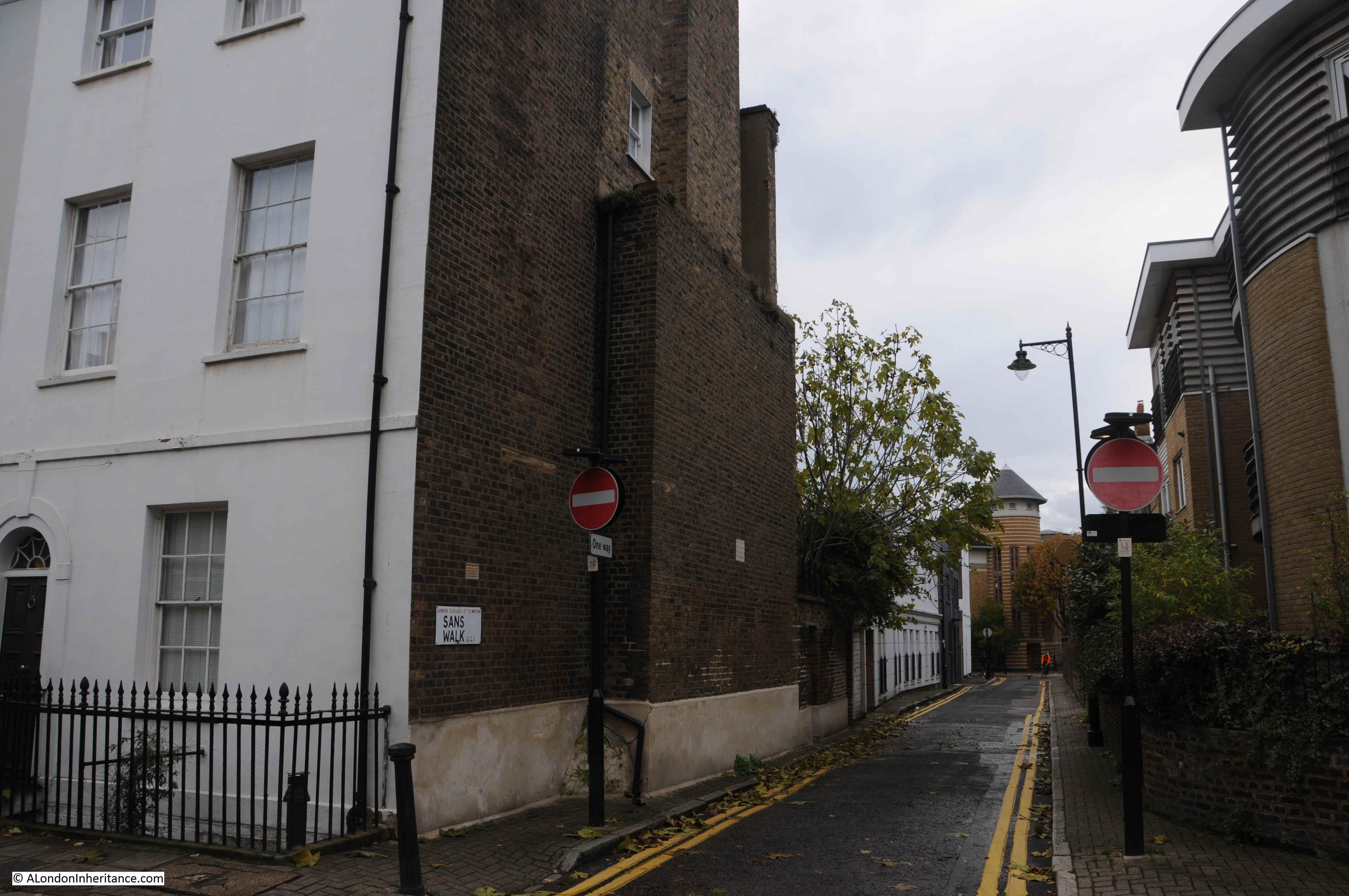
Looking down Sans Walk from the east.

Sans Walk

The building on the left does look like a restored version of one of the terrace of houses in the first photo, however the location is completely wrong. the house above is only a single house on the end of a very different terrace, and there is a road passing immediately in front of the house, with Sans Walk on the right.

At the end of Sans Walk is Woodbridge Street. I could not find any houses that matched the photos.

Sans Walk

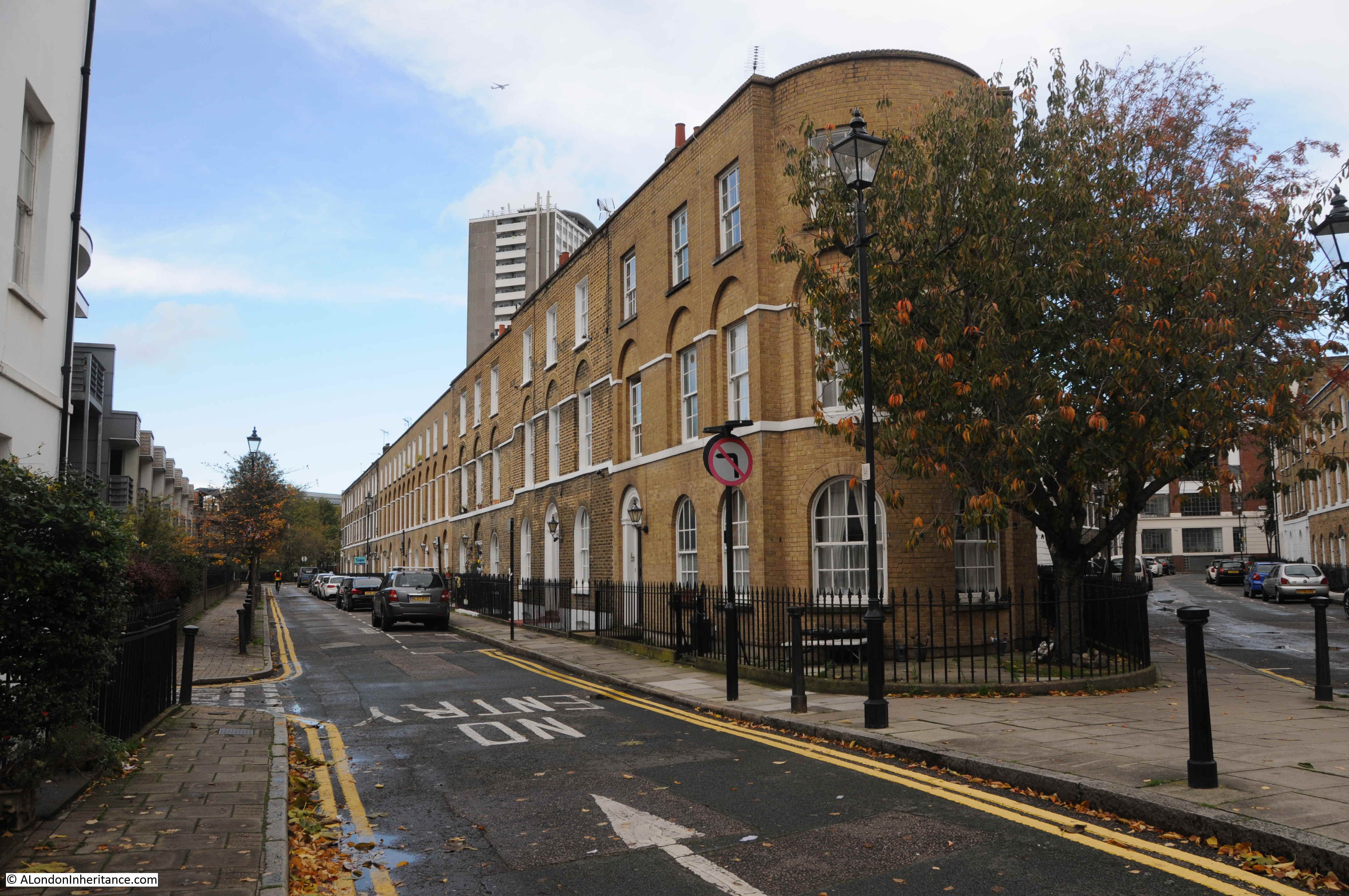
Running along the opposite side of the houses to Woodbridge Street is Sekforde Street, lined with early terrace houses, but again nothing that matched my father’s photos.

Sans Walk

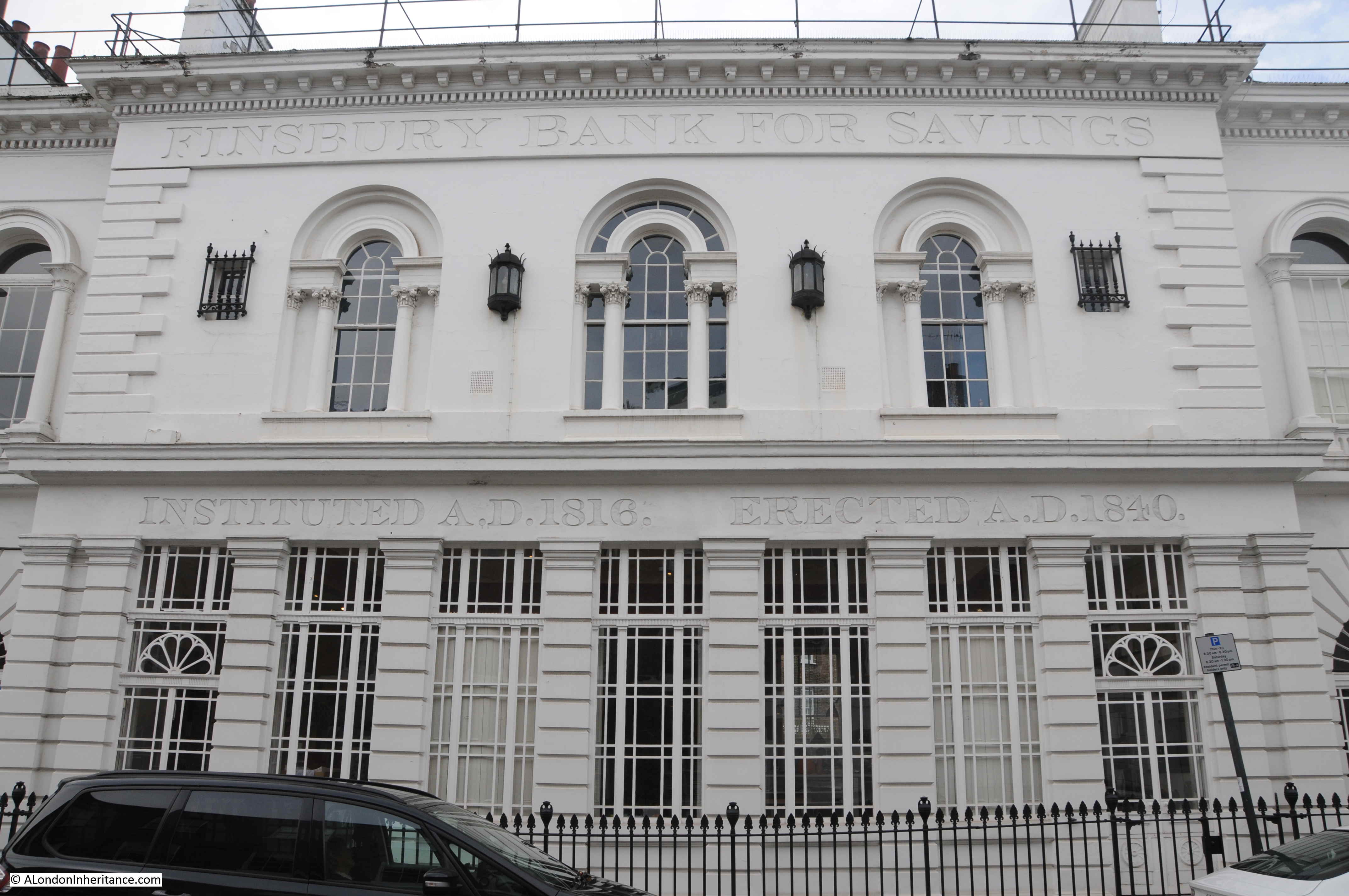
Half way along the street is an interesting building. painted white, that stands out from the terrace of houses on either side.

This is the former head office of the Finsbury Bank for Savings.

Sans Walk

The Finsbury Bank for Savings opened in August 1816 at St. John’s Square, Clerkenwell Green. Formed to provide a service for small traders, labourers etc.

The bank moved premises to the building in Sekforde Street shown in the photo above in April 1841 after being built for the bank during the previous year.

Although the bank was intended for customers with limited savings, it was used by many more affluent customers, including the author Charles Dickens.

The Finsbury Bank for Savings went through a series of mergers, eventually becoming part of TSB, which in turn was taken over by Lloyds Bank.

I failed in the aim of the walk, to find the locations of my father’s photos around Sans Walk, although one of the aims of searching for these locations is to explore the surrounding area, and there was plenty to be found around Sans Walk.

The schools and warehouses of the London School Board, a 19th century bomb planted by the Fenians, the northward limit of Clerkenwell in the 18th century and streets that record lost bowling greens and one of London’s early saving banks – all within a short walk.

London is always best explored on foot and almost every street tells a story.

alondoninheritance.com

Seven Dials and Monmouth Street

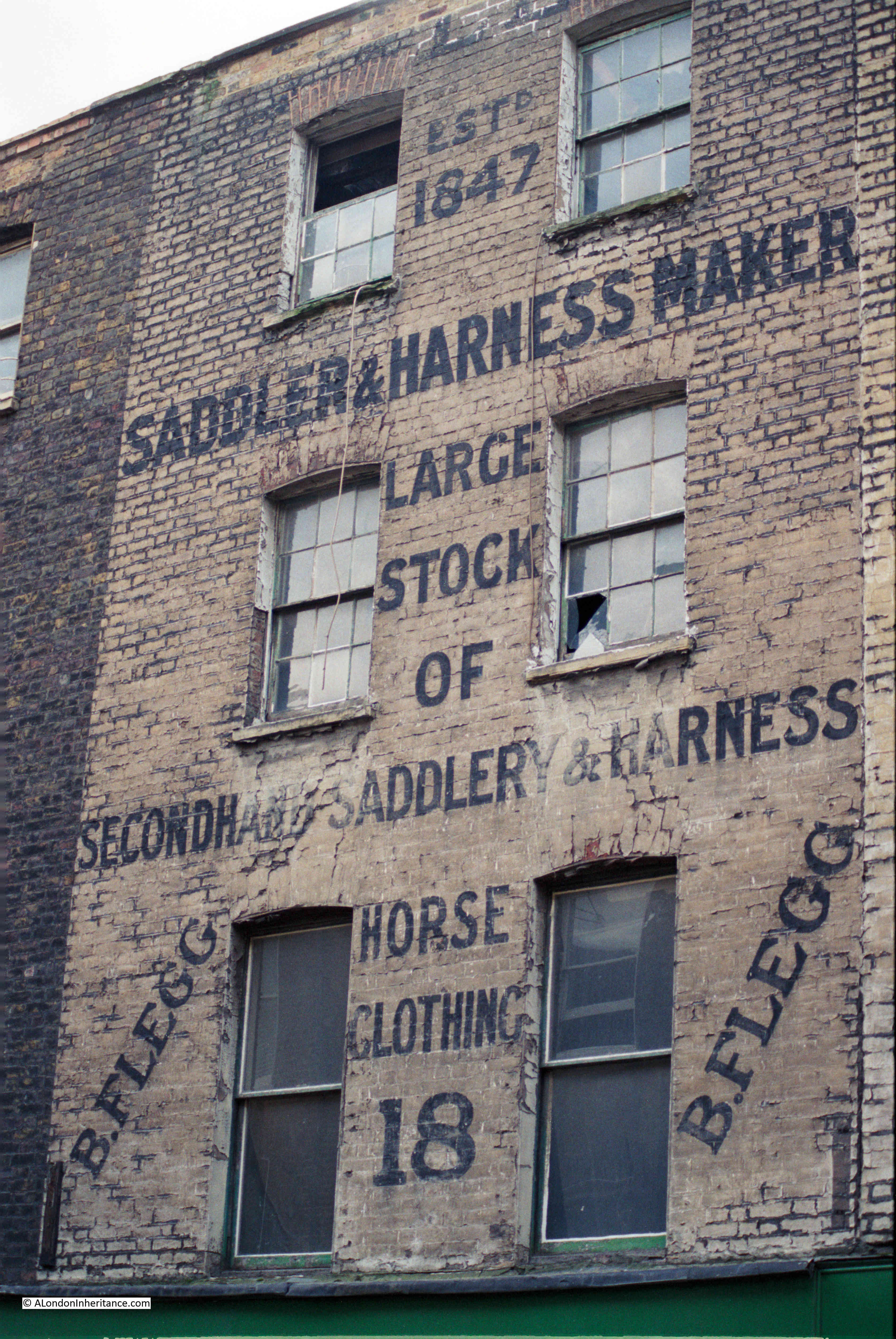
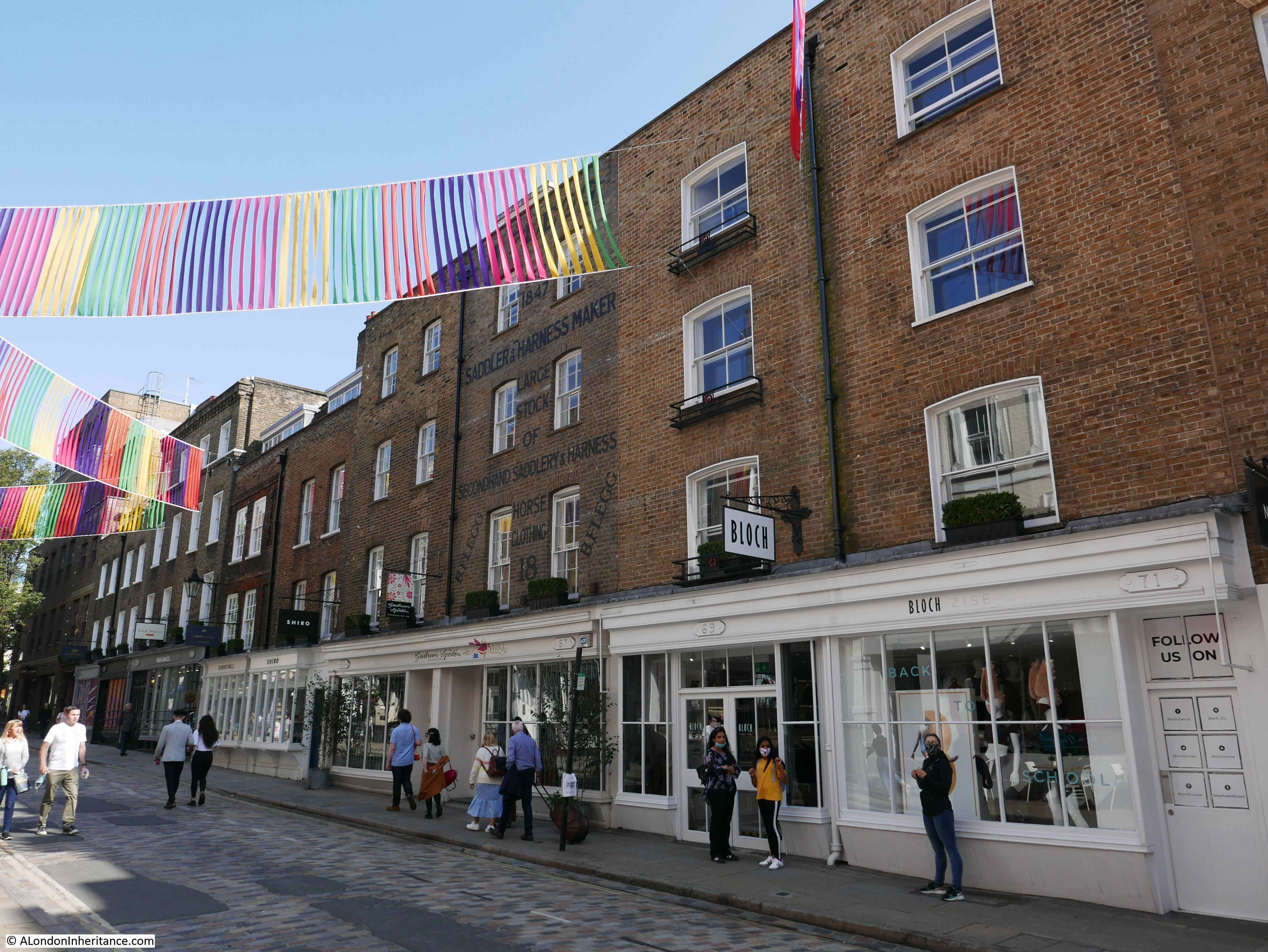
The following photo shows a brick terrace house, advertising a saddler and harness maker, but in a rather poor condition. We are in Monmouth Street in Seven Dials and the photo was taken by my father in 1984.

Seven Dials

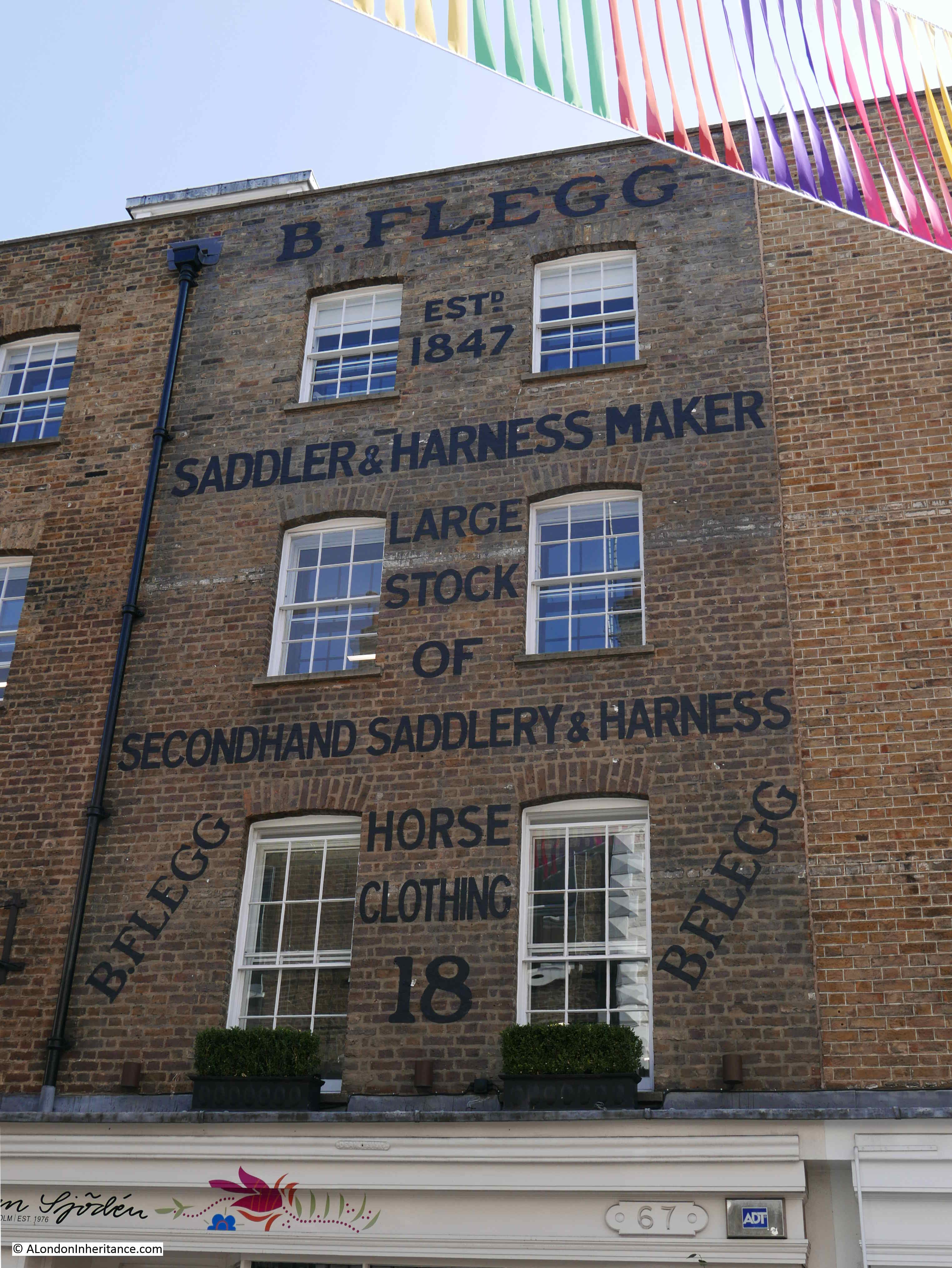
Thirty six years later and the building is in a far better condition, with the advertising signage restored.

Seven Dials

I was going to try and be clever and title the post “Seven things about Seven Dials”, but as I dug into the history of the area there are far more than just seven things of interest.

The sign is advertising the business of B. Flegg, a Saddler and Harness Maker, established in 1847.

B. Flegg was a William Flegg and the building in Monmouth Street was not his only premises. I suspect this may have been his central London sales room, where he would sell everything needed for the thousands of horses that kept London moving in the 19th century.

William Flegg’s main location seems to have been on the Old Kent Road in south London where he occupied numbers 585, 586 and 592. Adverts in the South London Chronicle stated that he had “Stable utensils of every description. Whips and all kinds of horse clothing always on hand. A waggonette to let, to hold four or six persons”.

It could be that saddler and harness maker was a family trade and that the family were from south London. As well as William Flegg there was an H. Flegg, also a saddler and harness maker, who had premises at 7 Deptford Bridge, but had to move to 2 Church Street, Deptford in 1880 due to rebuilding of the bridge over the Deptford Creek.

Flegg is not that common a name so I suspect that H. and William Flegg were related.

The final references to the name Flegg as a saddler are in 1905, when a George Flegg, aged 40 and a saddler of 654 Woolwich Road, Charlton was found drunk in Woolwich Road and fined two shilling and six pence, or three days if he did not pay the fine.

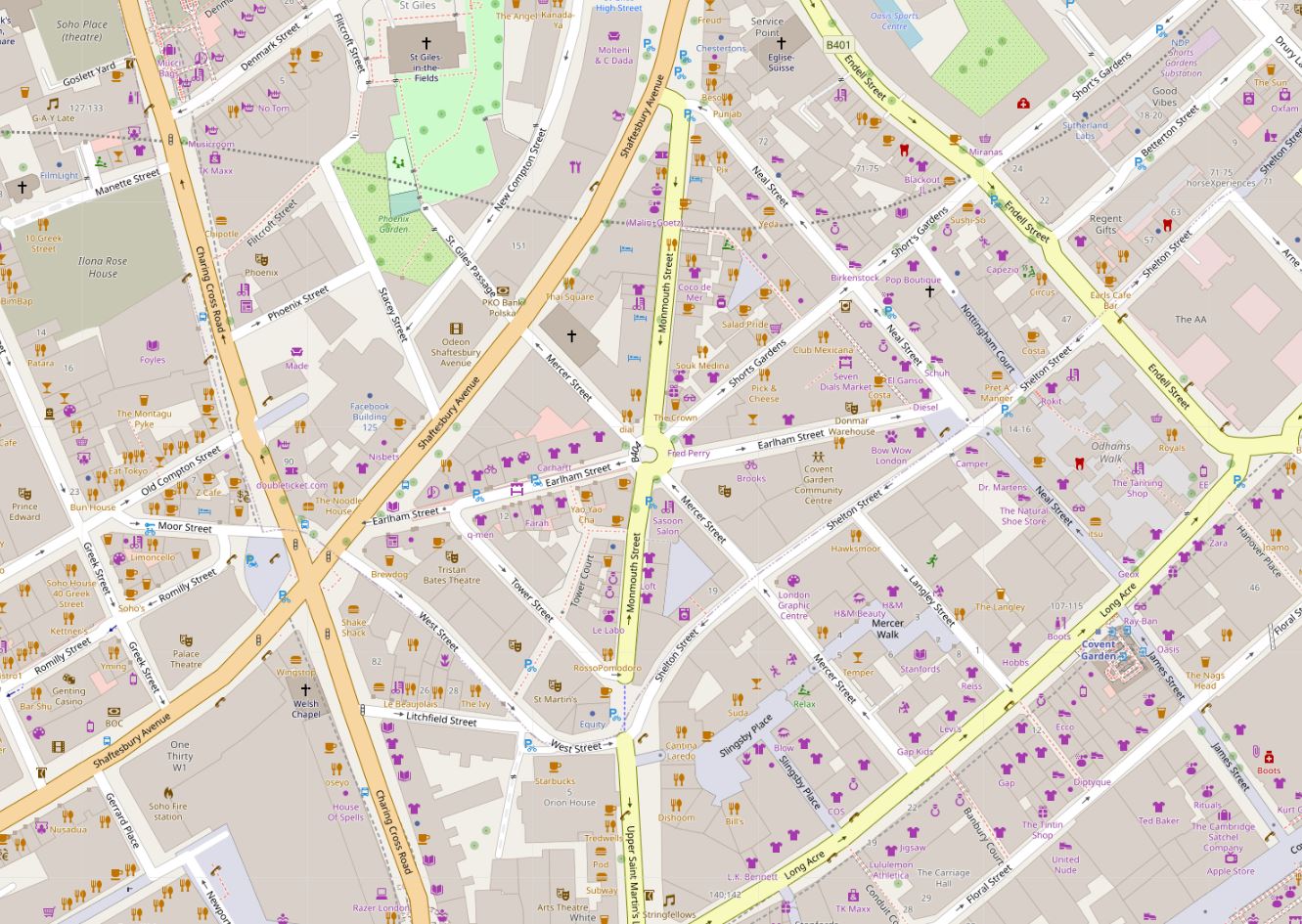
Monmouth Street is the street leading off to the south from the central Seven Dials junction, just to the east of Charing Cross Road and south of Shaftesbury Avenue. The seven streets radiating out from the central junction form a distinctive pattern on the map (Map © OpenStreetMap contributors):

Seven Dials

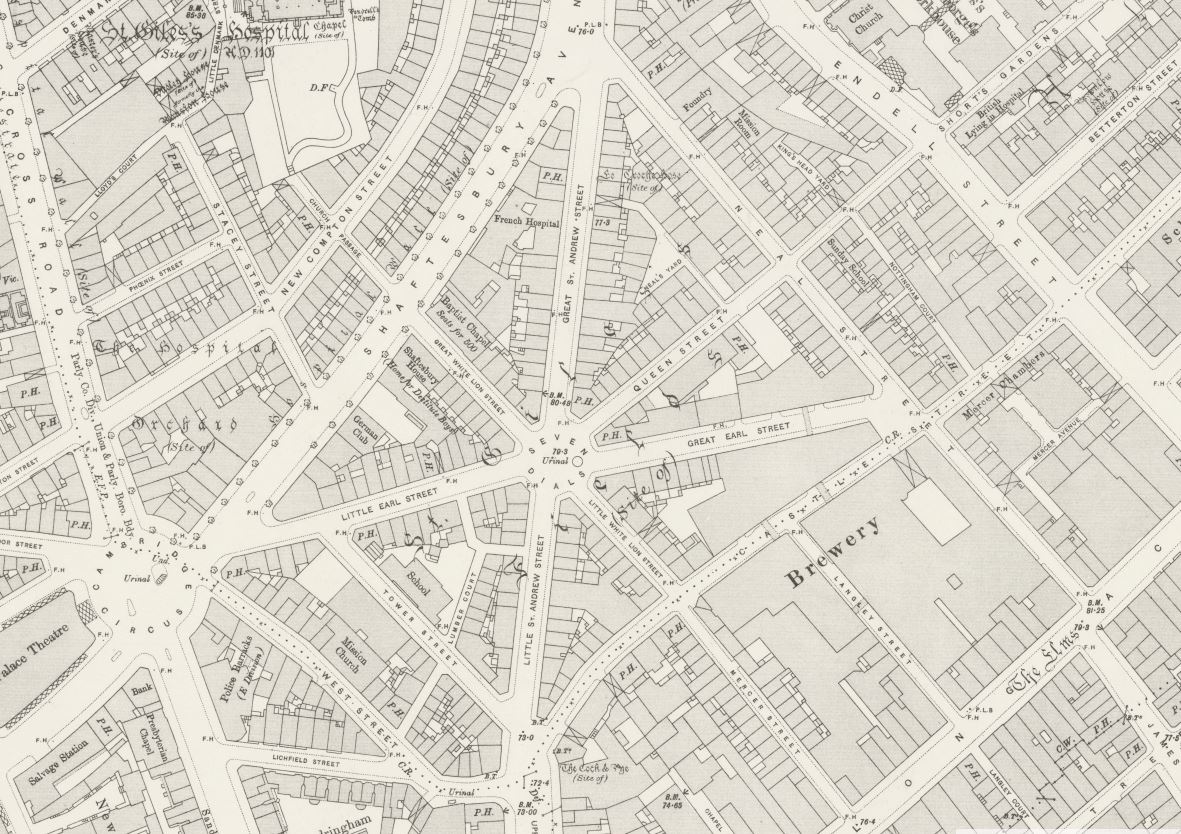
The layout of the streets around Seven Dials has not changed for a very long time. The 1895 Ordnance Survey map shows the same distinctive layout (‘Reproduced with the permission of the National Library of Scotland’):

Seven Dials

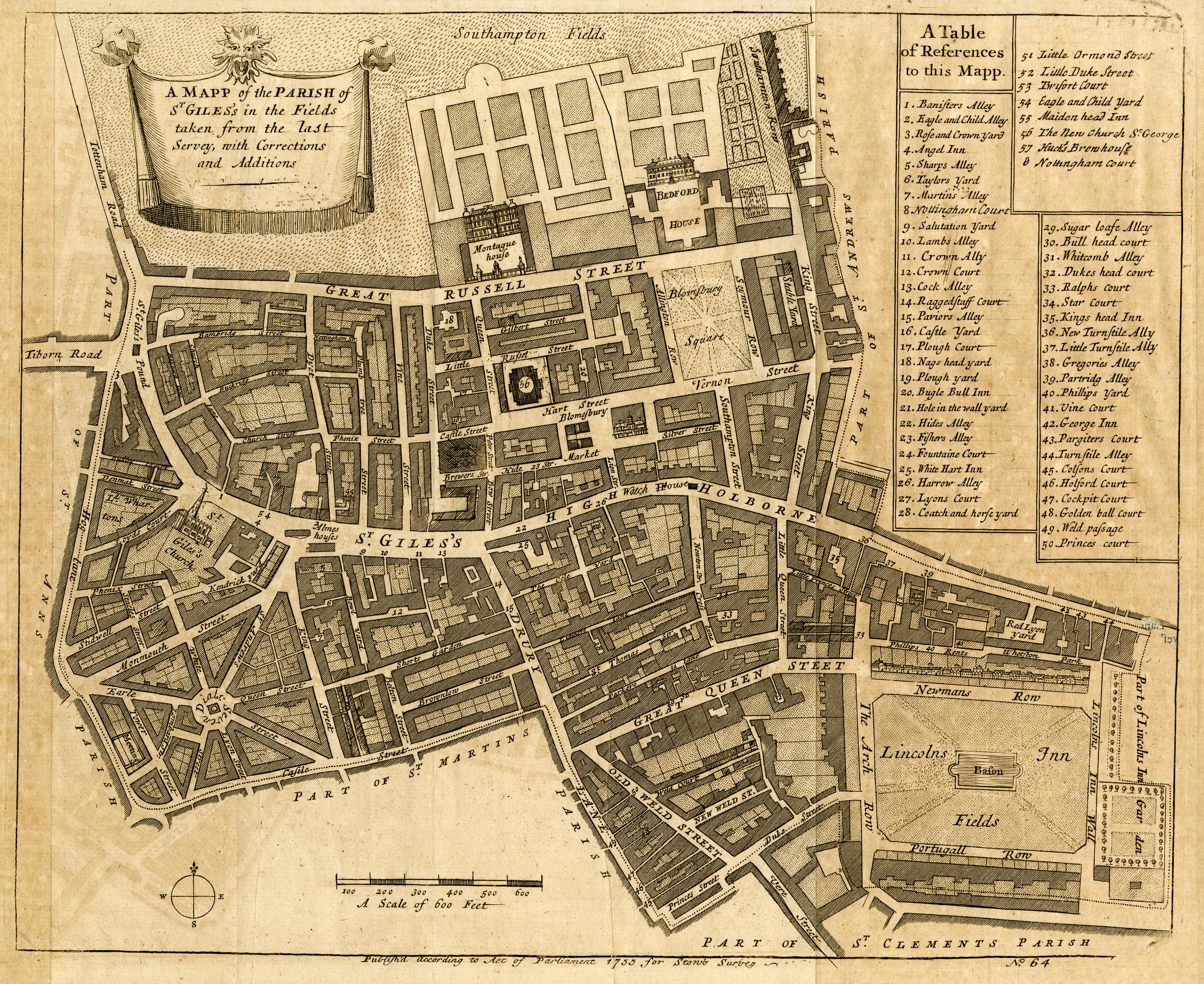
Going back to a 1755 map of the Parish of St Giles’s in the Fields, and the same distinctive layout is in the lower left corner:

Seven Dials

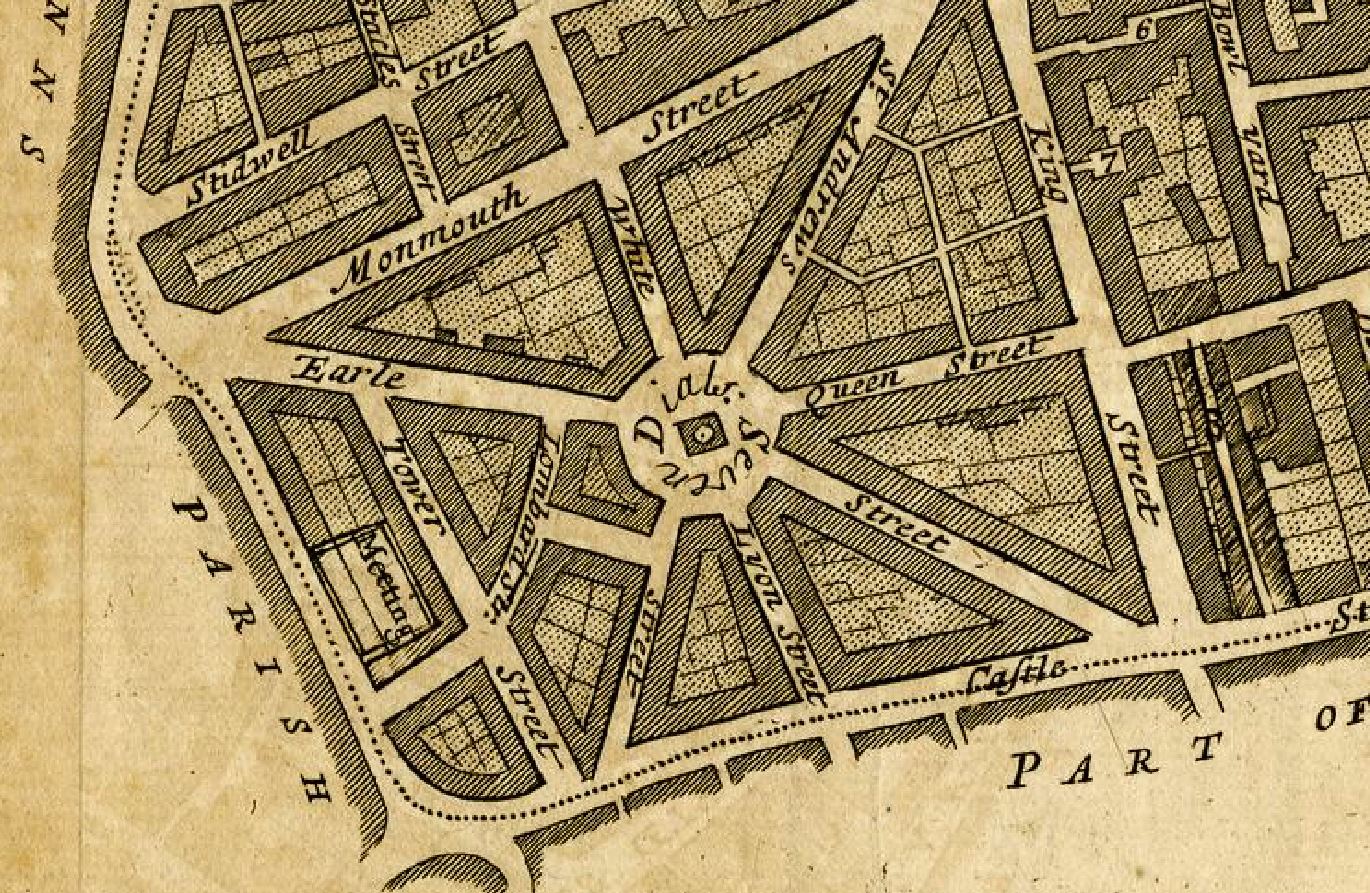
Detail of Seven Dials from the above map:

Seven Dials

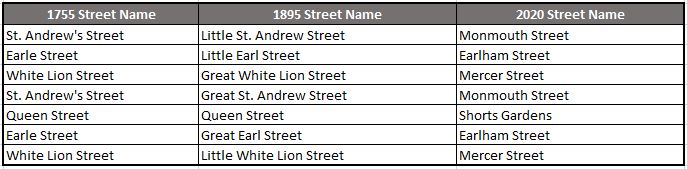
Comparison of the maps tells us a number of things about Seven Dials. Firstly the streets radiating out from the central junction have changed names over the years:

Seven Dials

In 1755 the street name stayed the same as the street crossed the central junction, however by 1895 the names had been changed slightly to give each branch a distinctive name, so St. Andrew’s Street became Little and Great St. Andrew Street.

By 2020, the 1755 approach of extending the same street name across the junction had been put back in place, and a new set of names given.

When William Flegg was in Monmouth Street, he would have known the street as Little St. Andrew Street.

The maps also tell us something about the pillar in the centre of the junction. The 1755 map shows the pillar, however by 1895 the pillar had gone, and there was a Urinal in the junction. By 2020 the pillar was back in place.

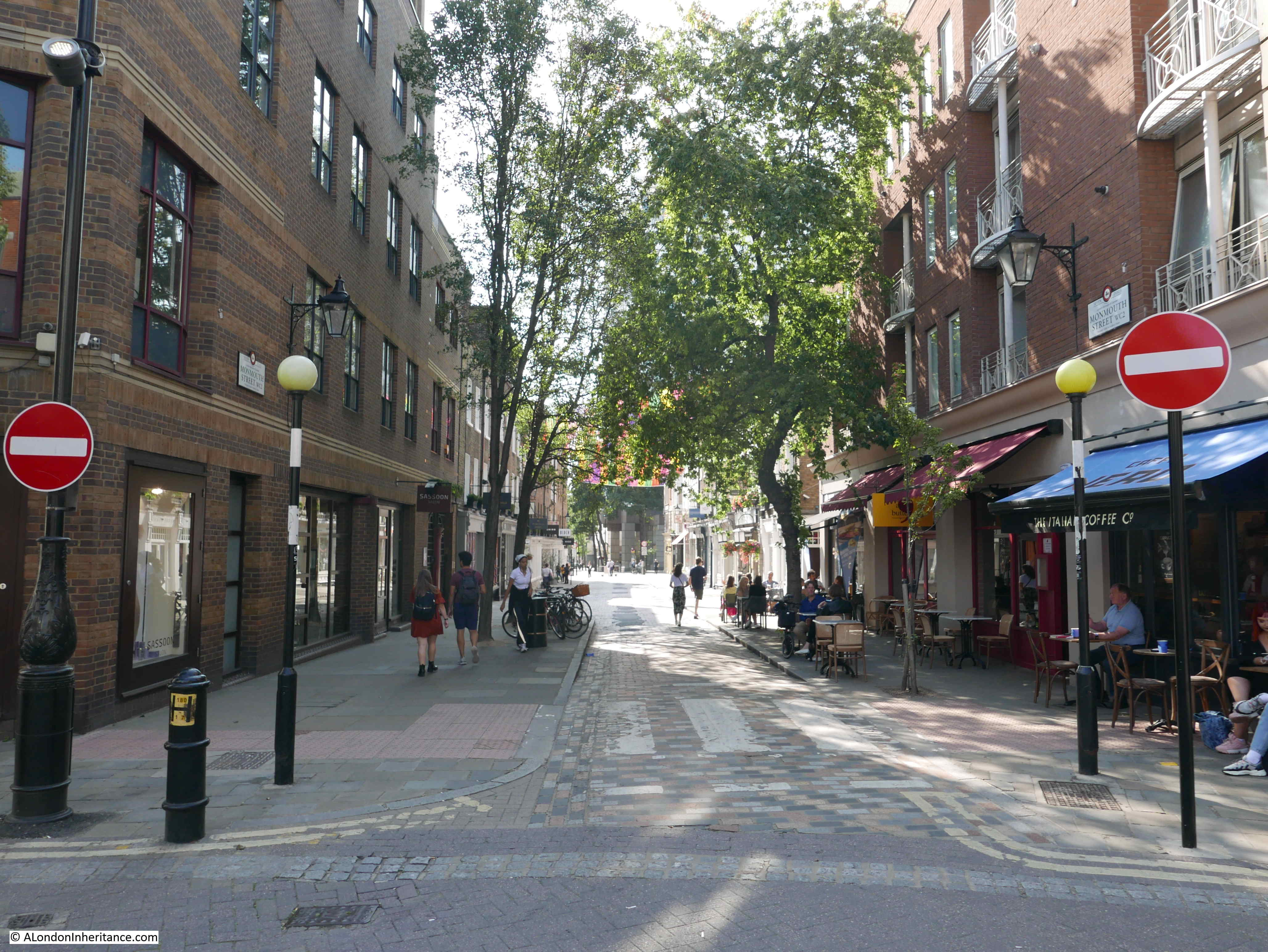
I will come on to this later, however for now, lets take a walk along the southern section of Monmouth Street.

The terrace of houses with William Flegg’s premises in the centre:

Seven Dials

Looking up Monmouth Street from the southern end of the street:

Seven Dials

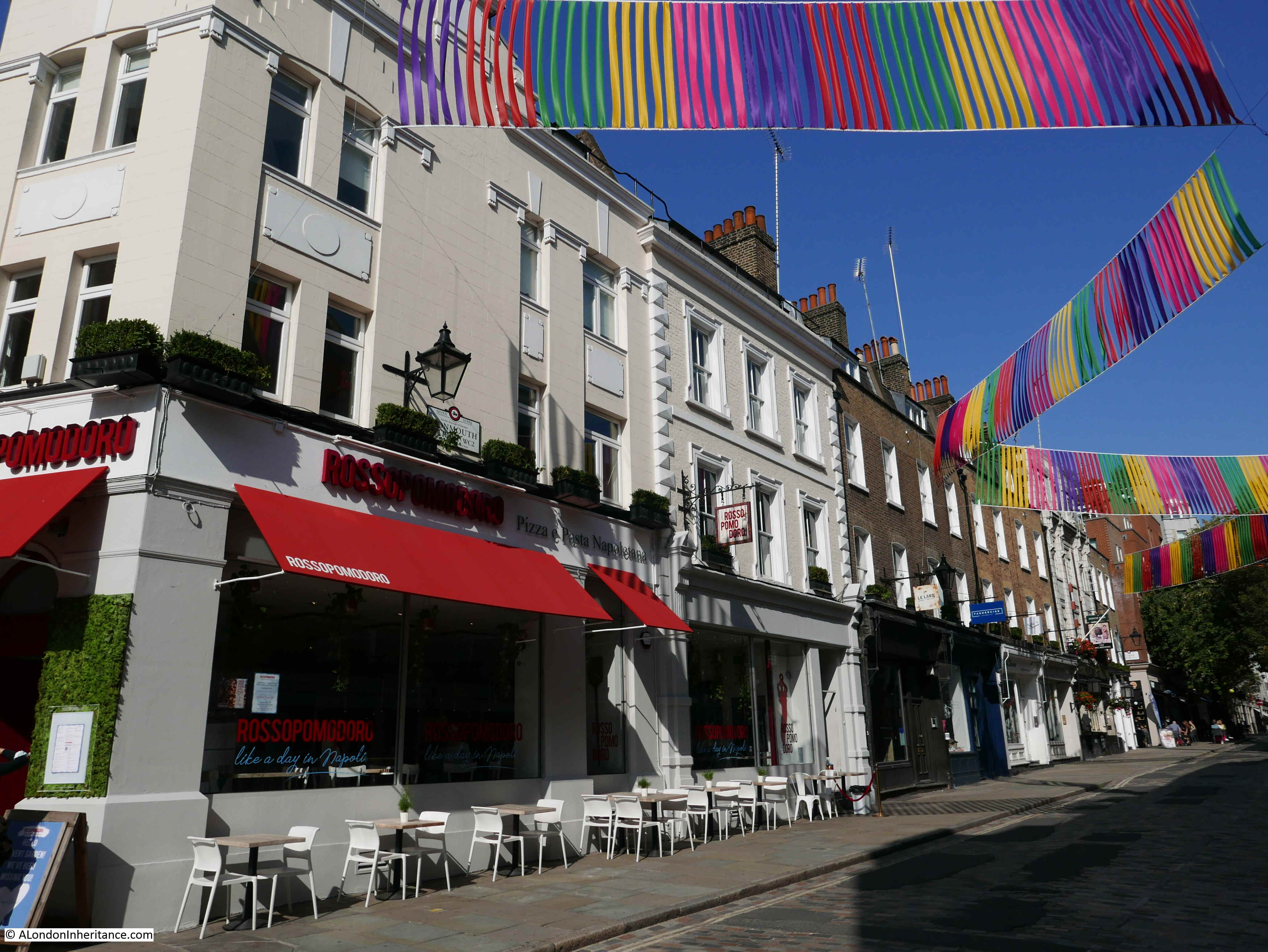
Buildings along the western side of Monmouth Street:

Seven Dials

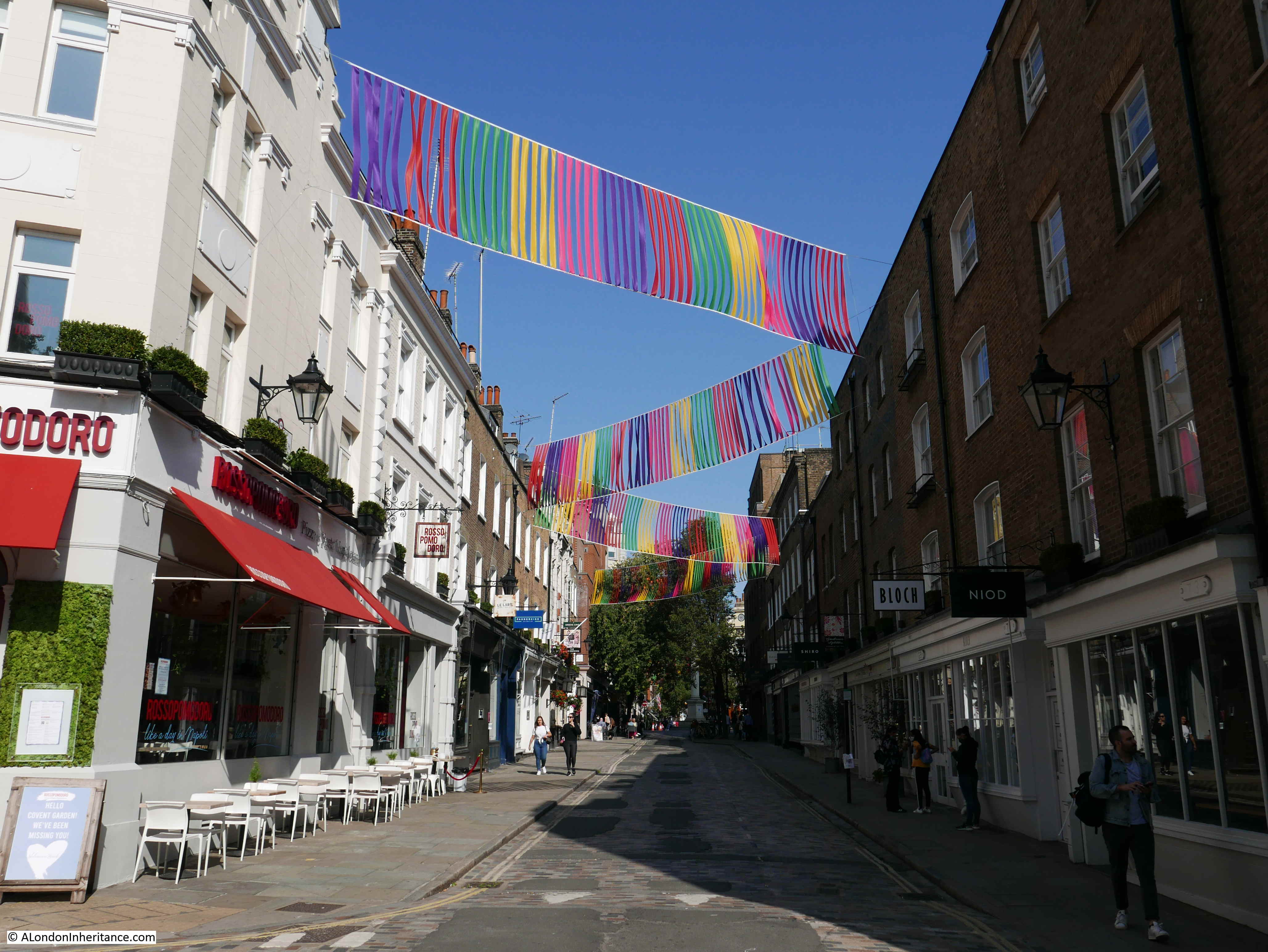
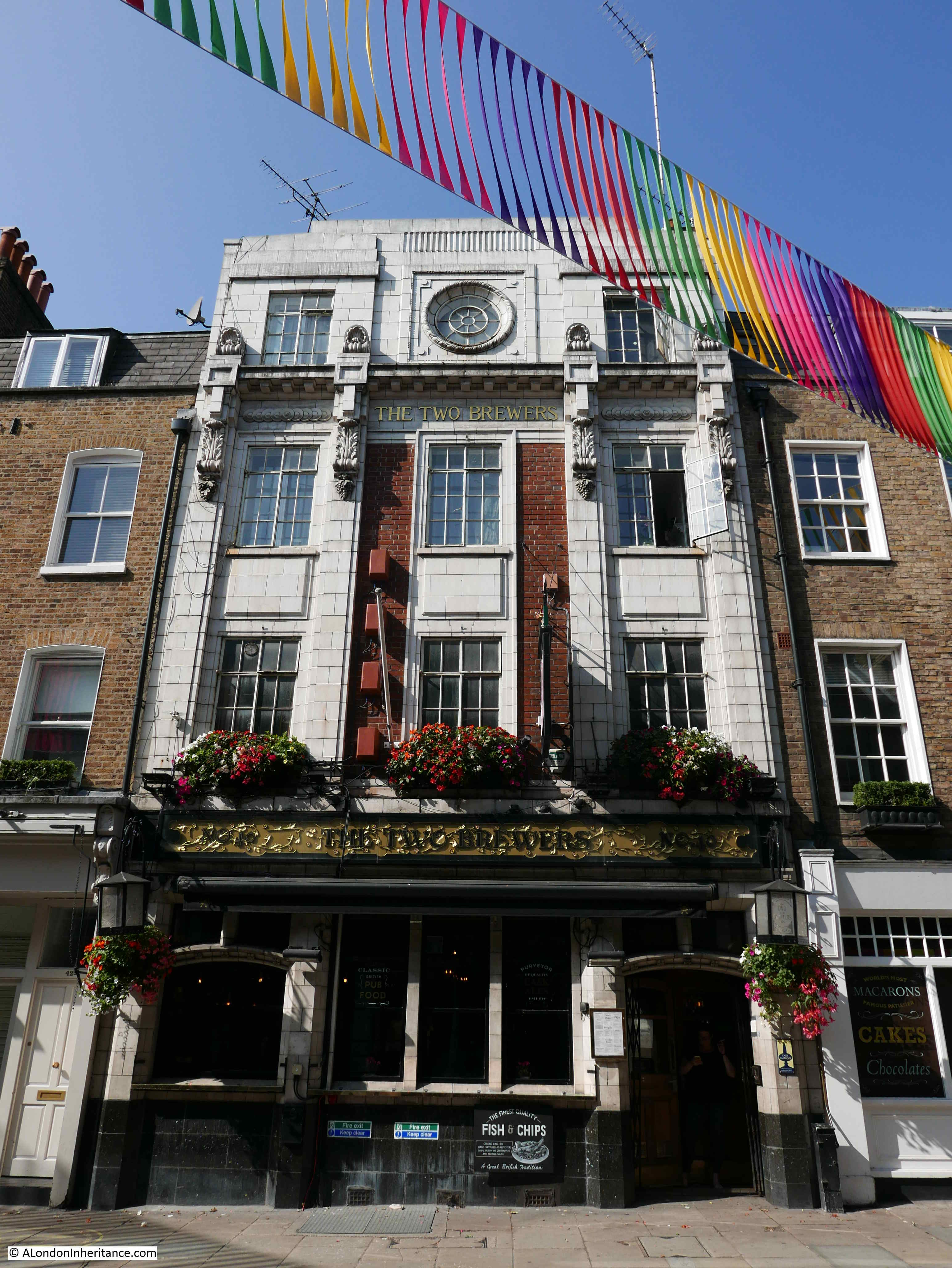
The rather magnificent Two Brewers pub, Monmouth Street:

Seven Dials

The streets around Seven Dials are now full of clothing and jewelry shops, restaurants and cafes. Mainly small, one off shops rather than the large chain shops that can be found across much of London.

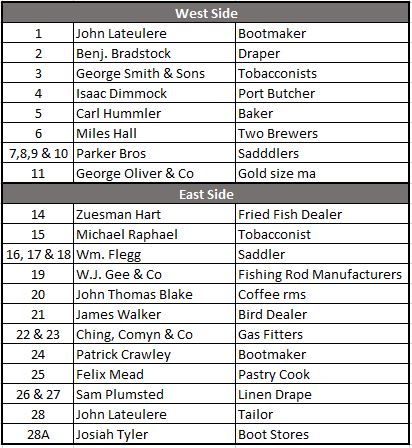
We can also walk through the street in 1895 and look at the businesses that occupied the houses by using the 1895 Post Office Directory.

Seven Dials

We can see William Flegg occupying numbers 16, 17 and 18, so not just the single house with the sign on the wall. The numbers are different to today’s numbering as this was when this branch of Monmouth Street was Little St. Andrew Street.

The directory has a few abbreviations of which I have not yet found the meaning such as the “size ma” for George Oliver at number 11 and “rms” for John Thomas Blake at number 20.

This was a street of small manufacturers and traders, trading in everything from bread and meat to birds and fishing rods.

At the top of the southern branch of Monmouth Street is the Seven Dials junction, where the seven streets come together:

Seven Dials

The streets running around the central Seven Dials junction were built during the later part of the 17th and early 18th centuries. Thomas Neale obtained the lease for the land in 1693. Prior to this, the area was already built-up, but with Cock and Pye Fields occupying the space where part of Earlham and Monmouth Streets now run.

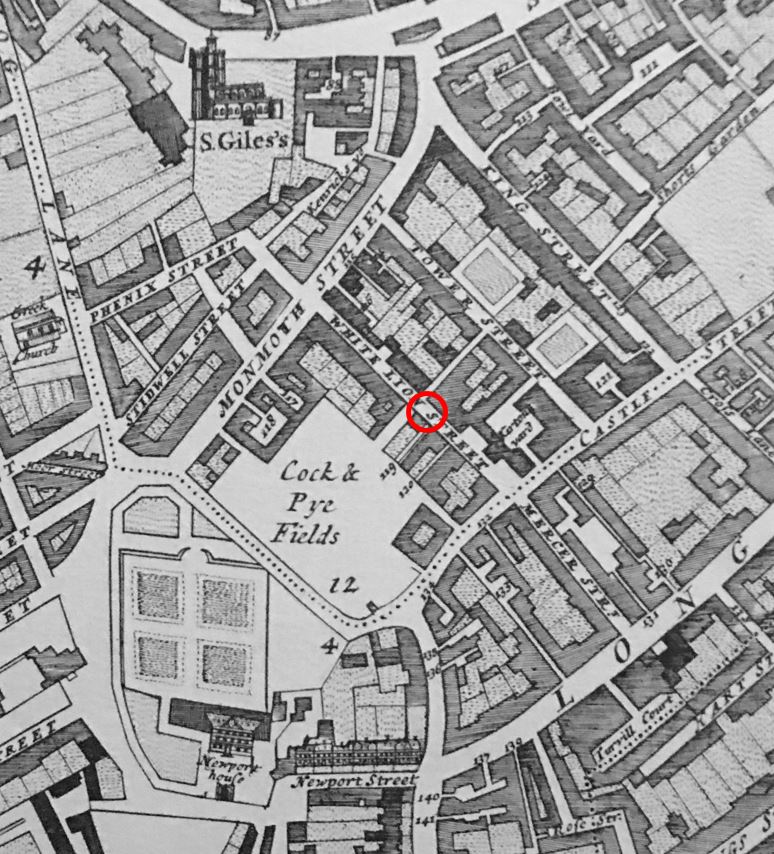
In the following extract from William Morgan’s 1682 map of the city of London, I have marked the location of the central Seven Dials junction with a red circle.

Seven Dials

There is only a single street that remains to this day. White Lion Street can be seen running through the red circle. This would stay White Lion Street when the central junction and seven streets where completed. Today White Lion Street is Mercer Street.

Note also that the street that would become Shaftesbury Avenue was Monmoth Street in 1682.

The central feature of the junction of the seven streets in Thomas Neale ‘s plans was a pillar.

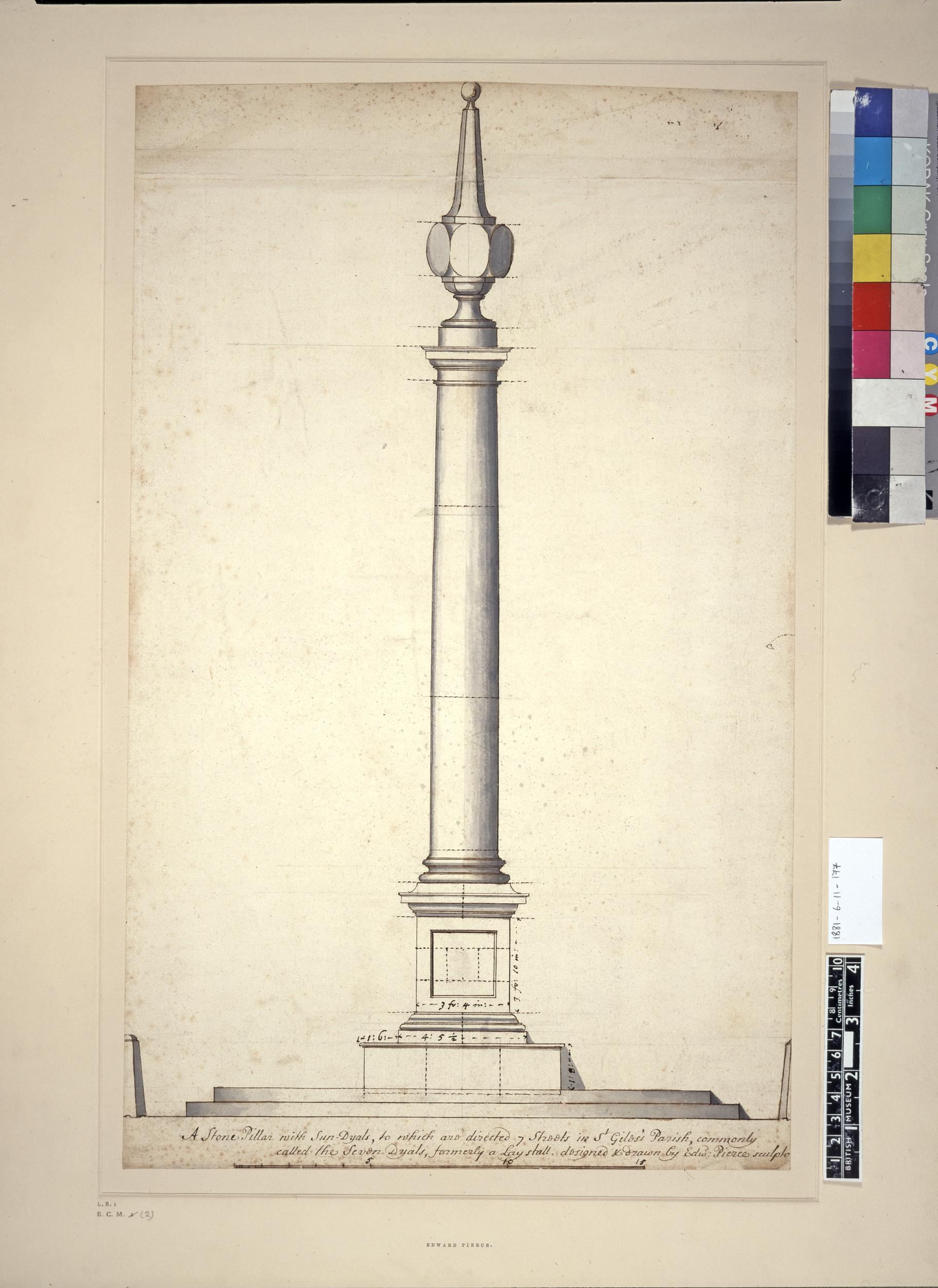
The British Museum has a copy of the original drawing of the pillar designed by Edward Pierce (©Trustees of the British Museum):

Seven Dials

The text at the bottom of the drawing states “A Stone Pillar with Sun Dyals to which are directed 7 streets in St Giles’s Parish commonly called the Seven Dyals, formerly a Laystall”.

The word Laystall can refer to a place where rubbish or dung is deposited. It can also refer to a place where cattle are kept. This might be related to the location of the sun dial being at the entrance to Cock and Pye Fields in the 1682 Morgan map.

The 1895 Ordnanace Survey map shows the central junction without the pillar. It had been removed over 100 years earlier as it had become the focal point for so called undesirables and in 1773 the Paving Commissioners ordered the removal to prevent this nuisance.

The pillar eventually turned up in Weybridge, where the pillar, without sun dials, can be seen today at the junction of Monument Hill and Monument Green.

By the 1980s, the majority of Seven Dials was derelict, and there were plans for the demolition of the majority of buildings in the area. Restoration plans were proposed by the Seven Dials Monument Charity and fortunately this approach was supported, otherwise we would see a very different Seven Dials today.

There were efforts to bring the original pillar back from Weybridge, however the local council refused.

Architect A.D.Mason designed a new pillar based on the original design by Edward Pierce, which included making measurements of the original pillar in Weybridge. The new pillar and sun dials were unveiled on the 29th of June, 1989.

The new pillar would become the focal point for the restoration work of the streets surrounding the pillar, and the work has been a considerable success with the area packed with people in more normal times.

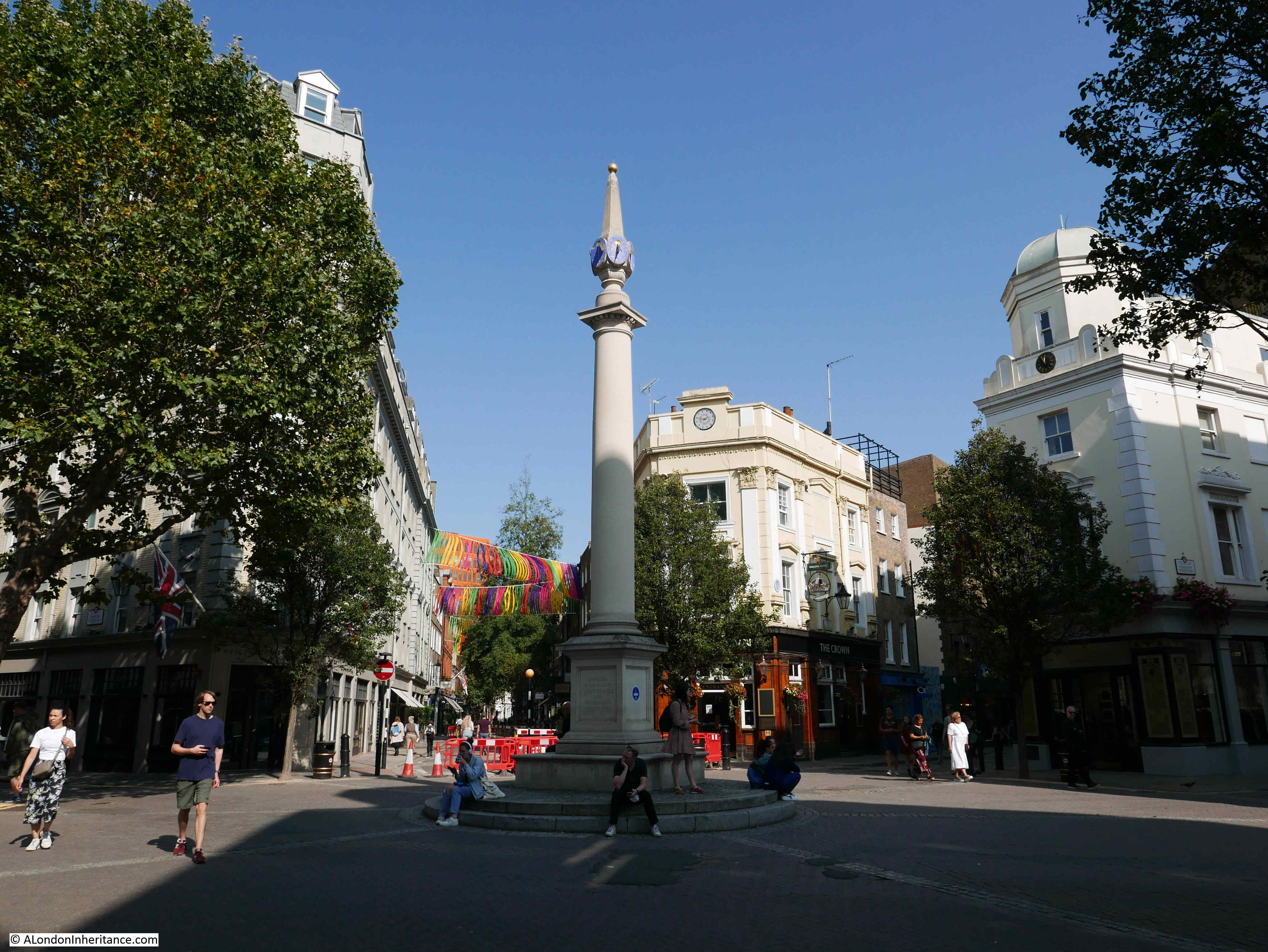
Looking down the southern branch of Monmouth Street from the central junction:

Seven Dials

The Crown pub facing the central junction, between the northern branch of Monmouth Street and Short’s Gardens.

Seven Dials

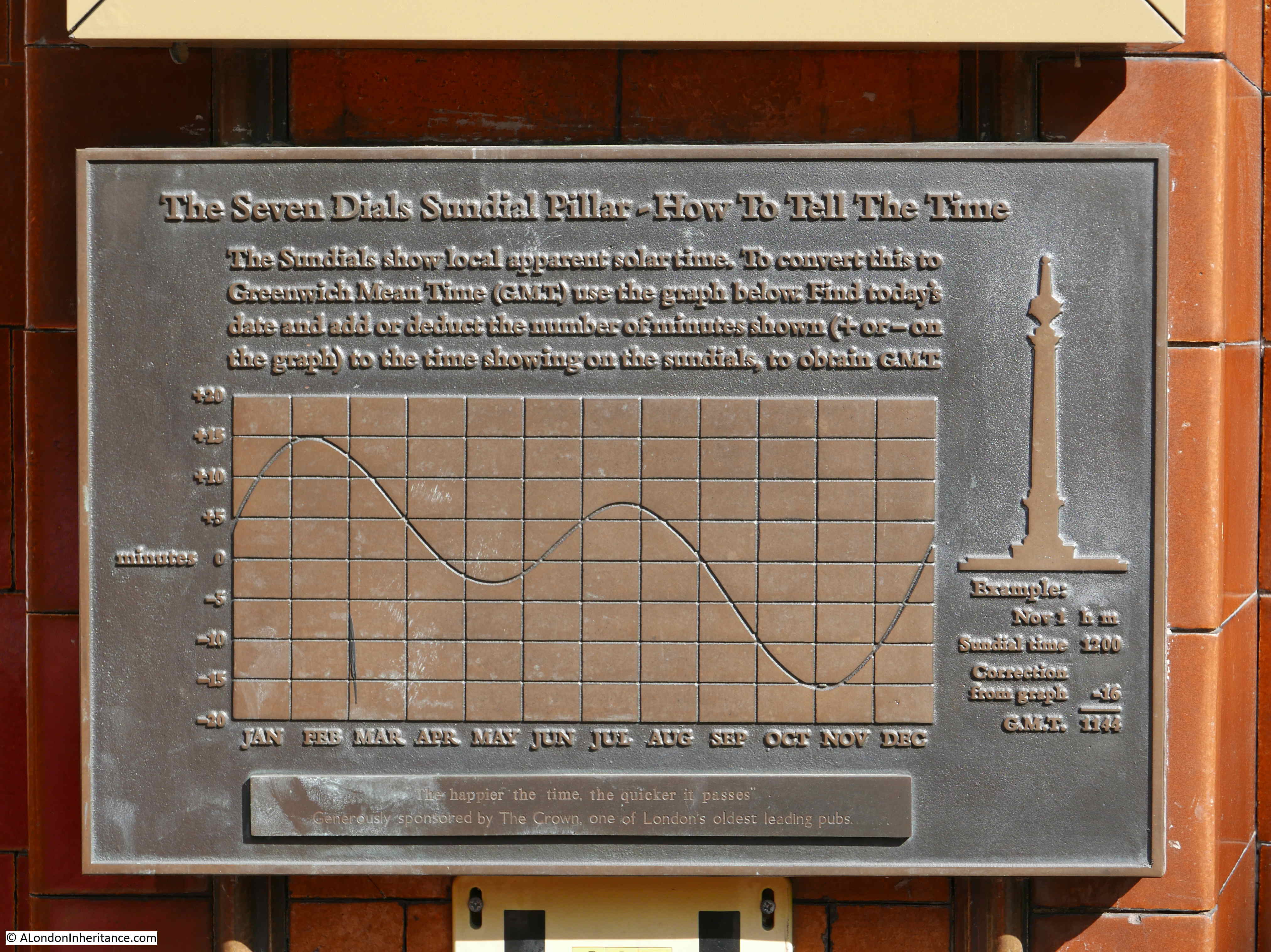
A plaque on the pub shows how the solar time shown by the pillar can be converted to Greenwich Mean Time:

Seven Dials

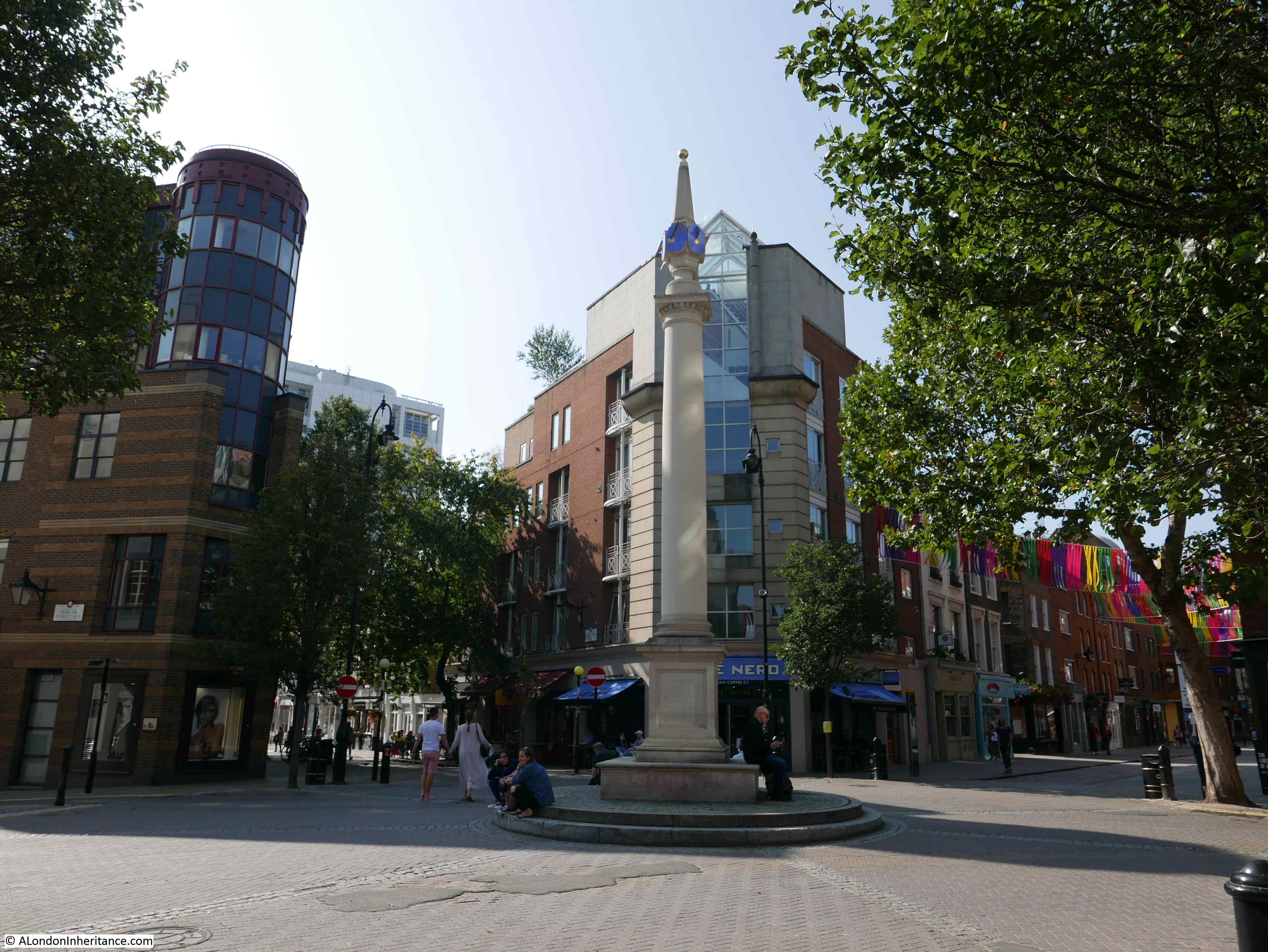
The new central pillar:

Seven Dials

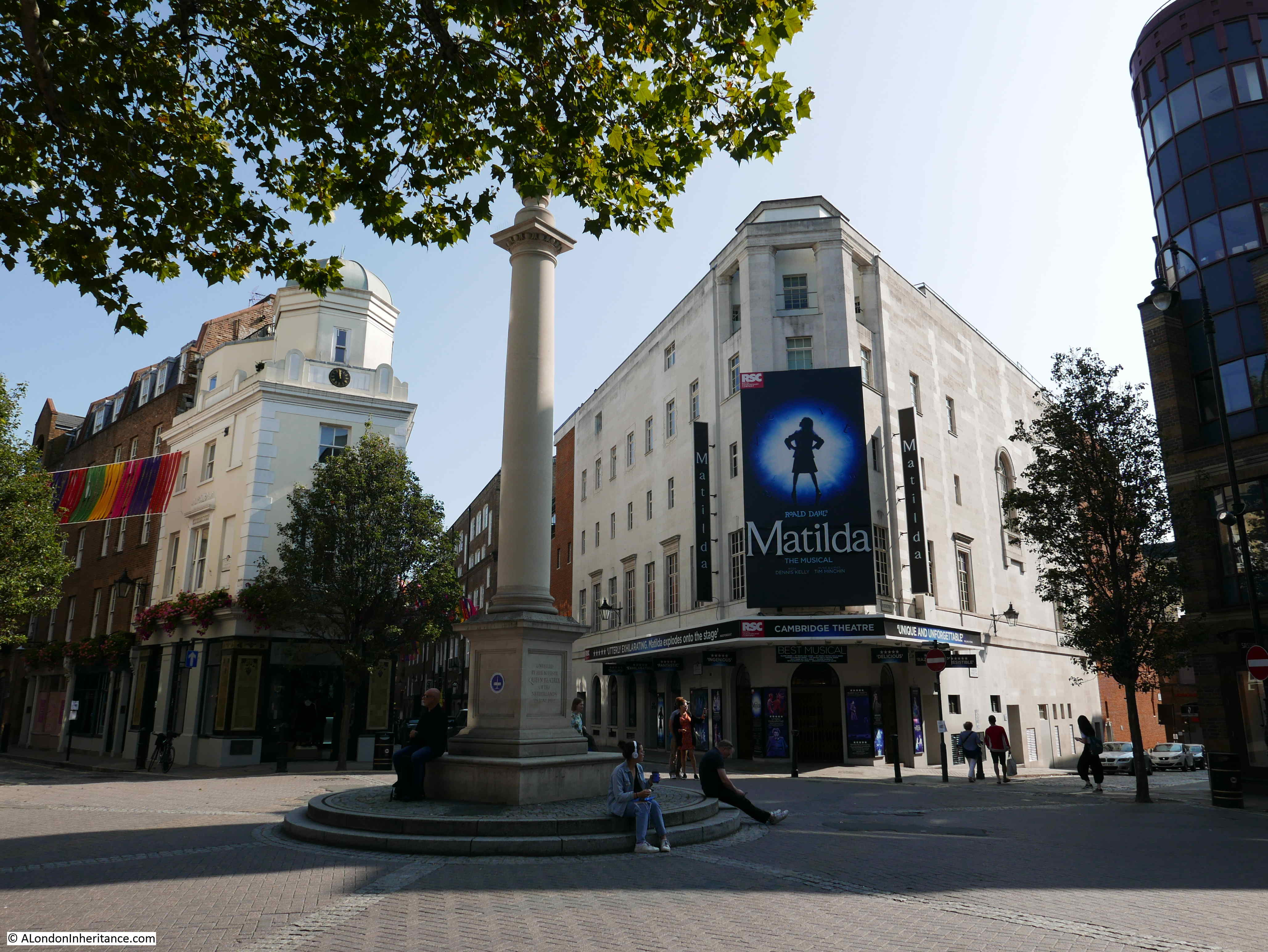
The Cambridge Theatre (opened on the 4th September 1930), between Earlham and Mercer Streets:

Seven Dials

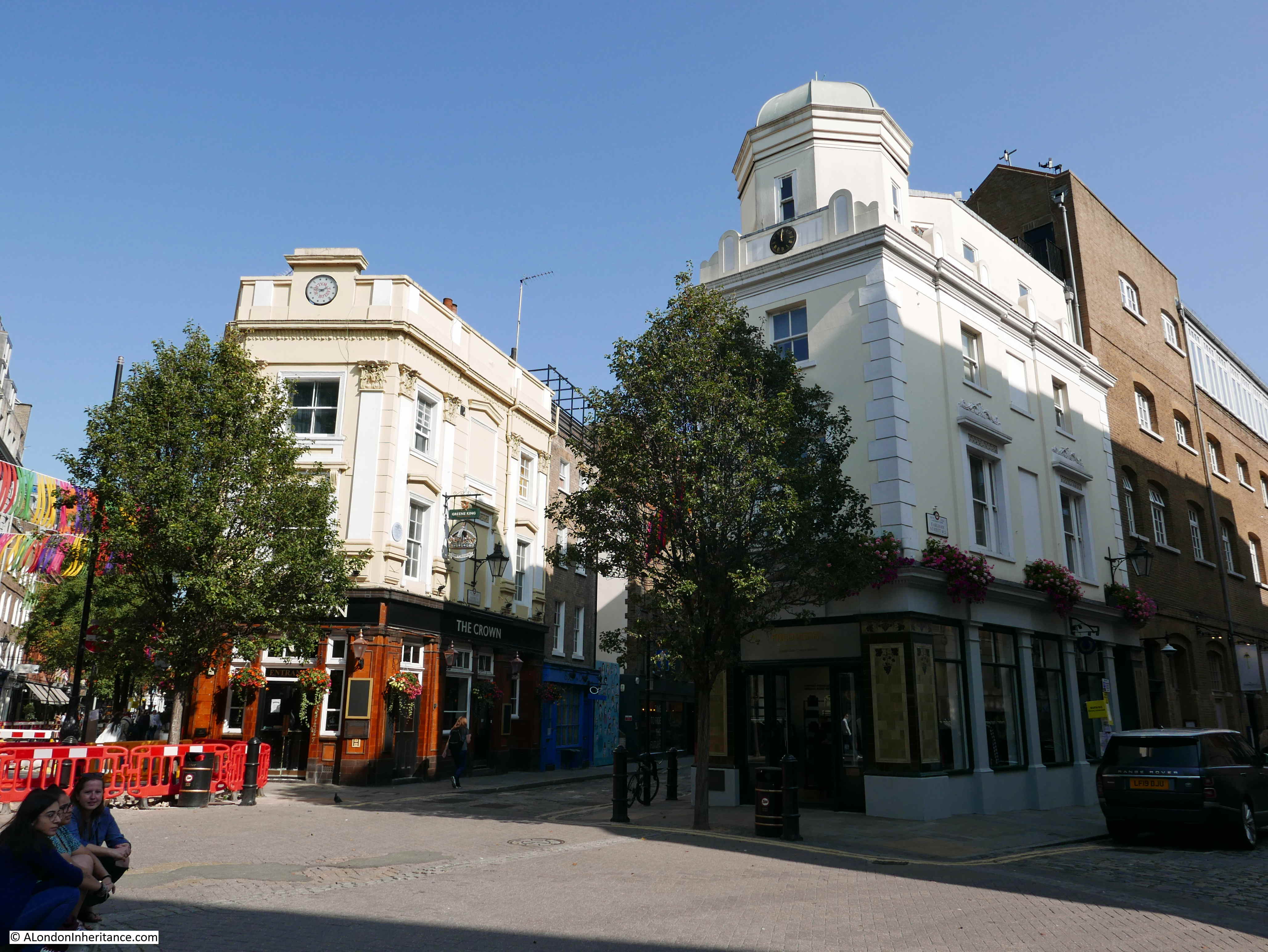
The Crown pub, then Short’s Gardens, then Earlham Street:

Seven Dials

During the first decades of the 1700s, the new area of Seven Dials quickly become a reference point for news reports and a sample of reports between the years 1723 and 1749 tells us much about life in these brand new streets:

21st March 1723: There is just finished by Mr John Noble, living near Seven Dials, an Organ, which by using bellows only, without the help of an Organist, sounds several Tunes to Perfection.

6th February 1725: One Murphy, a Centinel in the 2nd Regiment of Guards, was on Saturday last seized near the Seven Dials, on Suspicion of being concerned in the robbing of the Chester Mail. One of the Chester Bags (out of which letters were stolen) having been found near a hedge, was brought to the General Post-Office yesterday morning.

1st November 1729: Late last night one Welch, who buys and sells old Cloths, was set upon by two Street-Robbers at the Corner of St Andrew’s-Street, near the Seven Dials, who took from him in Cloths and Money to the value of seven pounds and upwards.

There was a pillory at the Seven Dials in the early decades of the 18th century, and the risks of being sentenced to the Pillory can be seen from the following newspaper report:

22nd June 1732: Last night, the Coroner’s Inquest upon the body of John Waller, who stood in the Pillory at the Seven Dials in the Parish of St. Giles’s in the Fields last Tuesday, and brought in the Verdict wilful murder with unlawful weapons.

Later in 1732, the person who had killed John Waller was included in a list of those sentenced to death, but the report does not provide any background as to why he was murdered:

14th September 1732: Richard Griffith, for being concerned in the Death of Waller who was killed in the Pillory at Seven Dials.

24th November 1733: Last Saturday Mr Rambert, a Coal Merchant in Tower Street, near the Seven Dials, received an Incendiary Letter threatening to set his House on Fire, and kill him, if he did not leave twelve Guinieas in a certain place mentioned in the letter, which was written in French. That night Mr Rambert left twelve Half-pence in the Place, and at about One in the morning, some Neighbours who watched to see the consequence, observed four fellows pass by, when one of them took up the half pence and walked off with the imaginary prize. We hear nothing however of their being pursued.

Strangely, 16 years later, there is a report of someone being arrested for writing incendiary letters:

24th November 1749: On Saturday night, one Franks, a shoemaker, was taken at a house near Seven Dials, on the Oaths of his Accomplices, for writing Incendiary Letters to several persons, in order to extort Money thereby.

People living in the streets leading off from the Seven Dials pillar could be very wealthy:

15th October 1741: On Saturday last died at his House in Earl-street, near the Seven Dials, Mr. Philips, a Distiller, said to have died worth 30,000 pounds, and on Thursday Morning his Corpse was carried out of Town, in order to be interred near his deceased relations, about three miles from Nottingham.

29th November 1744: The same day, Hannah Moses, otherwise Samuel, the Widow of one of the three Jews who were hanged about three sessions ago, was committed by the same Gentleman to New-prison, and her accomplice, Benjamin David Woolf, to Newgate, for stealing out of the shop of Mr John Barber, a Silversmith, at the Seven Dials, an Ingot of Silver.

19th May 1749: A few days since a Sailor went into a Chandler’s Shop in Earl-street, near the Seven Dials, to ask for a Lodging; but the man telling him there was none to let, he asked for a Halfpenny-worth of Tobacco, which as the Shop-keeper was serving, he drew his Hanger, cut him down behind the Counter, and made off; and yesterday the unfortunate man died of the wounds he received.

25th August 1749: Two Sawyers belonging to Mr Neale’s Yard in King’s-Street, Seven Dials, quarreled and fought, and one of them, by a fall, fractured his skull and died immediately, and the other being carried before a Magistrate, was by him committed o New-prison, Clerkenwell.

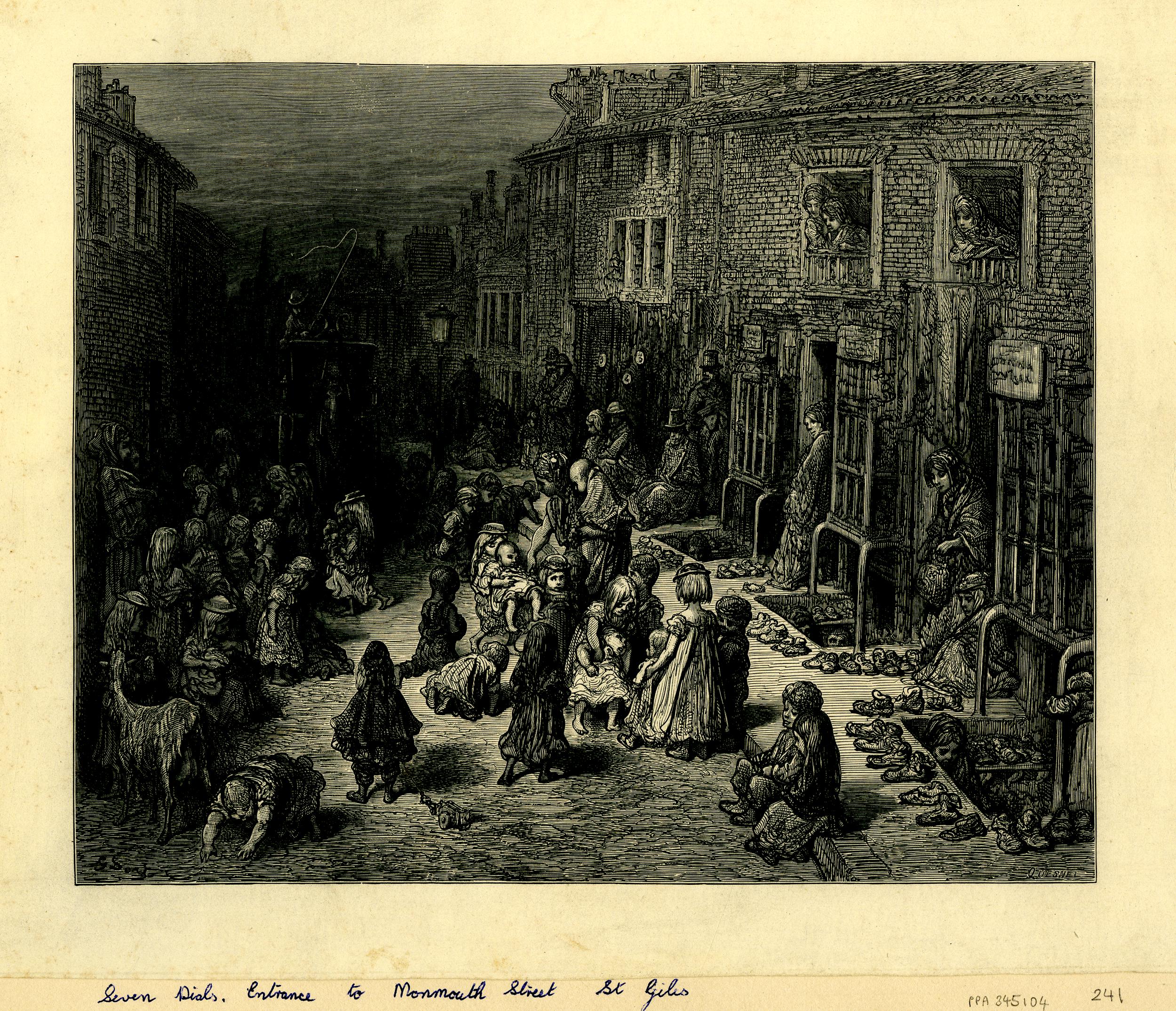
By the late 19th century, many of the streets around Seven Dials were crowded, with many poor occupants. Gustave Dore drew the entrance to Monmouth Street from Seven Dials. People crowd the street, shops and basements with shoes for sale line the side of the street and children play in street, blocking the path of a carriage (©Trustees of the British Museum).

Seven Dials

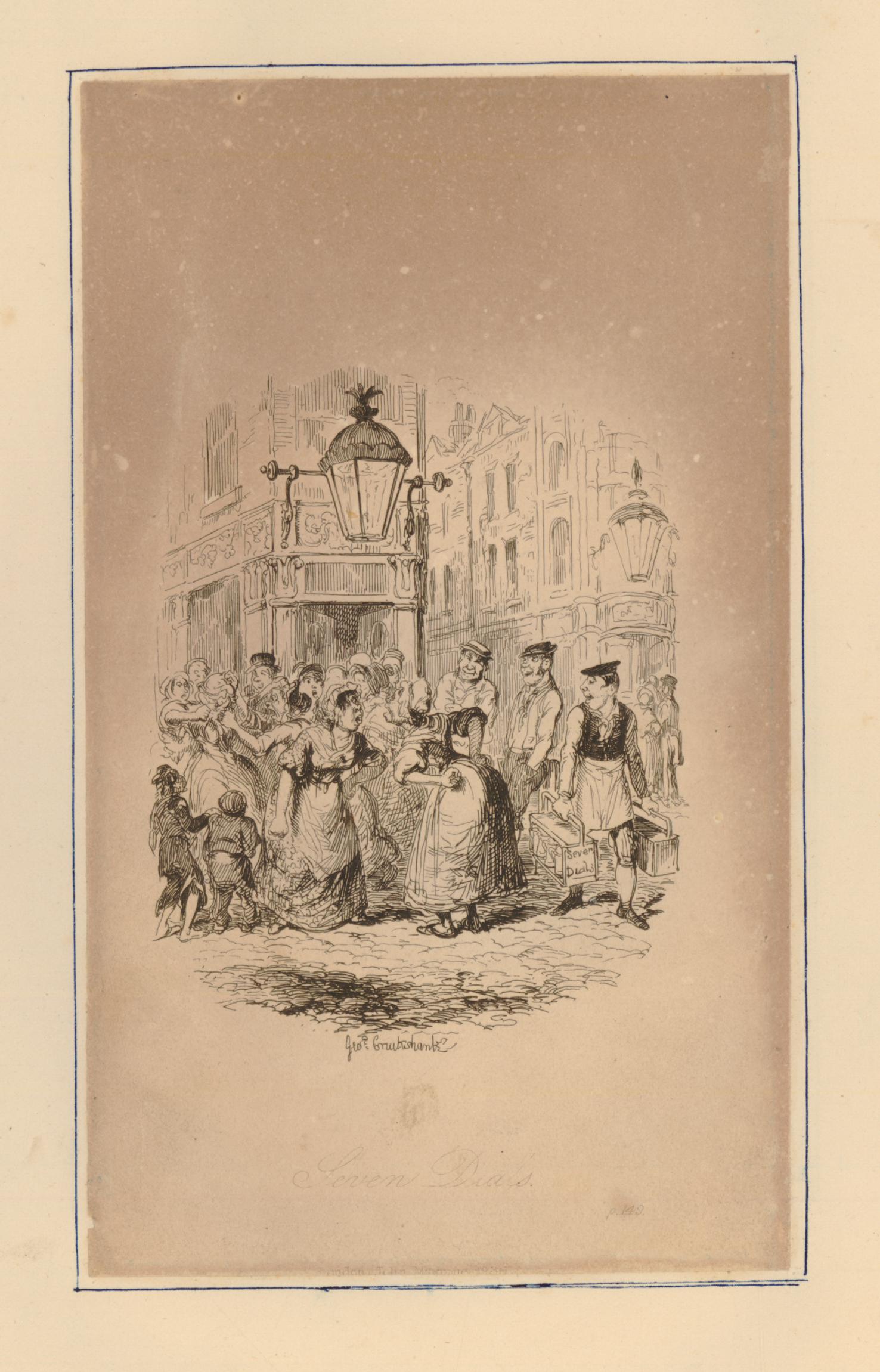
George Cruikshank had earlier produced a drawing around 1836 as an illustration to Charles Dickens’s Sketches by Boz. The drawing shows two women being urged to fight in front of a gin palace in Seven Dials (©Trustees of the British Museum):

Seven Dials

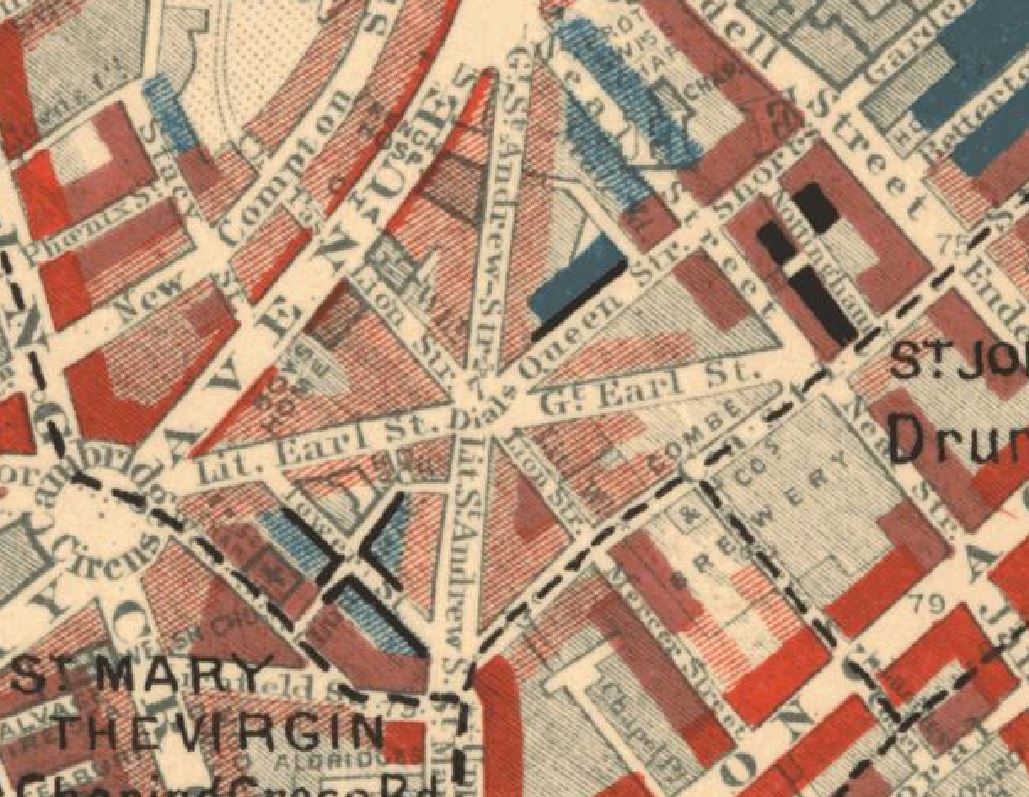
Despite the impression created by Gustave Dore, Charles Booth’s poverty map of London, between 1898 and 1899 shows most of the streets around Seven Dials as “Fairly comfortable. Good ordinary earnings”, although the dark blue along Queen Street is classed as “Very poor, casual. Chronic want”.

Seven Dials

The following photo from the 1897 publication “The Queen’s London” shows a street leading up to the Seven Dials junction. The photo gives a different impression of the area to that of Gustave Dore’s drawing.

Seven Dials

By the 1970s, the area was very much in decline. The streets were all open to traffic, there was no central pillar and cars would pass across the central junction between streets. Some of the space in the streets was used for purposes that seem very strange when looking at the area today.

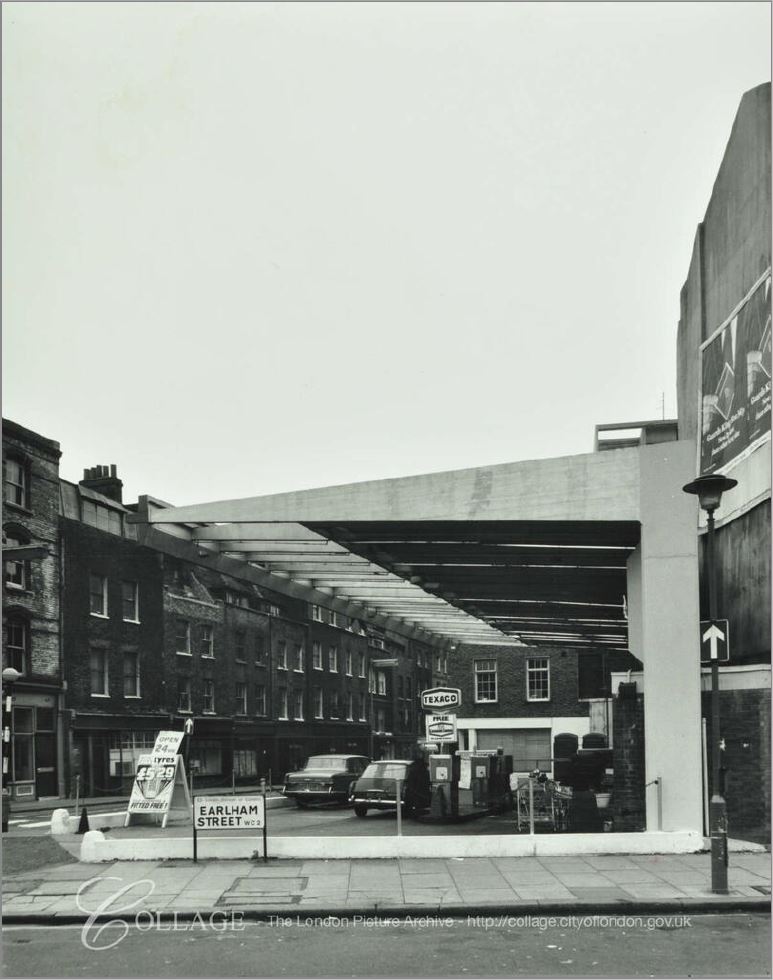
In 1974, a Texaco petrol station occupied the space between Earlham and Monmouth Streets. This is the space to the right of my earlier photo looking down the southern branch of Monmouth Street from the central junction,

Seven Dials

Image credit: London Metropolitan Archives, City of London: catalogue ref: SC_PHL_01_152_74_21025

There is much to discover in the streets that lead off from the central junction of Seven Dials. I have only covered the southern branch of Monmouth Street and a general history of area. It would take a very much longer post to cover the whole area.

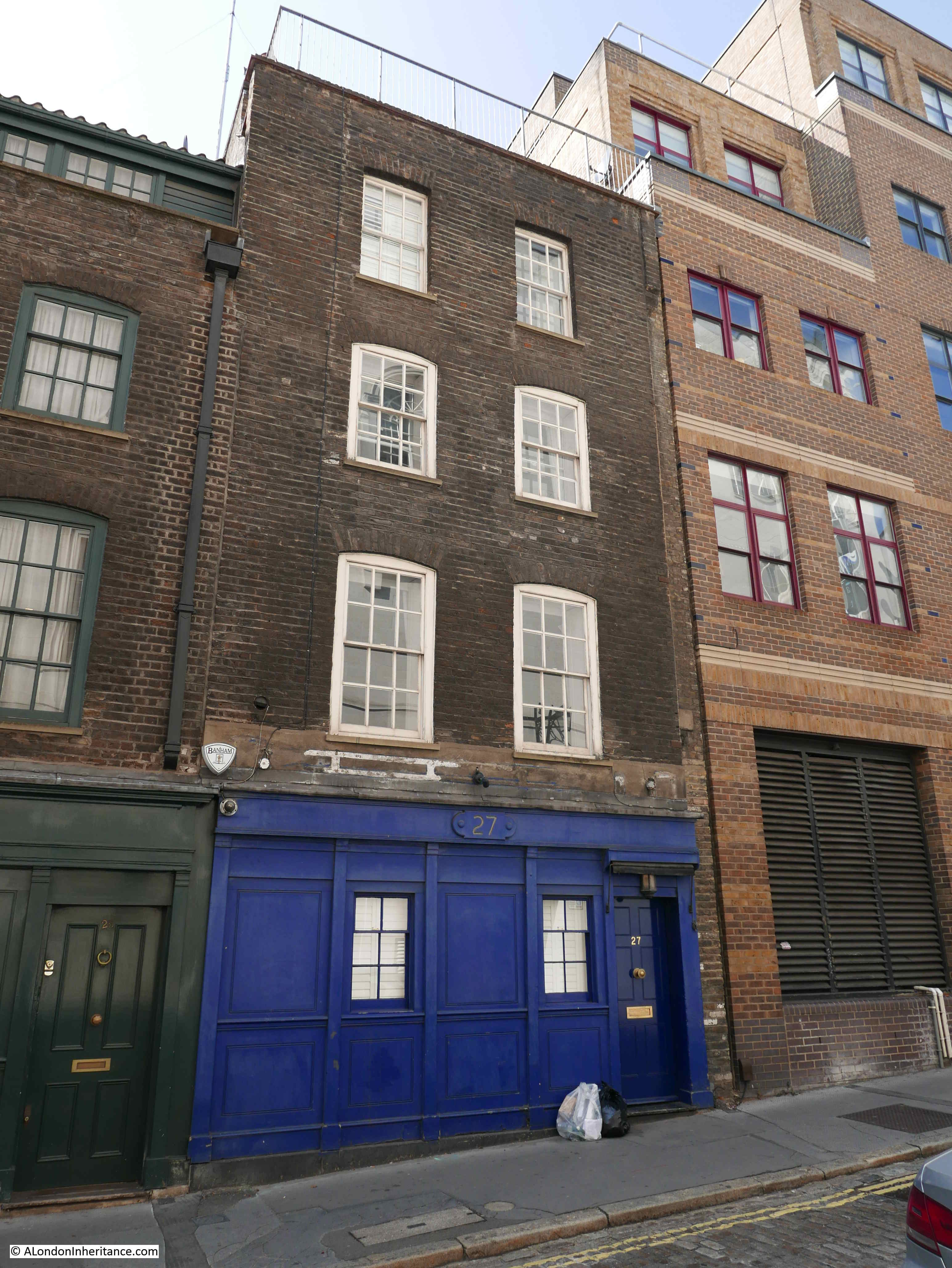
There are a couple of houses in the southern section of Mercer Street that I want to show. They are a pair of late 17th century terrace houses that date from the original construction of Seven Dials. This is number 27 Mercer Street:

Seven Dials

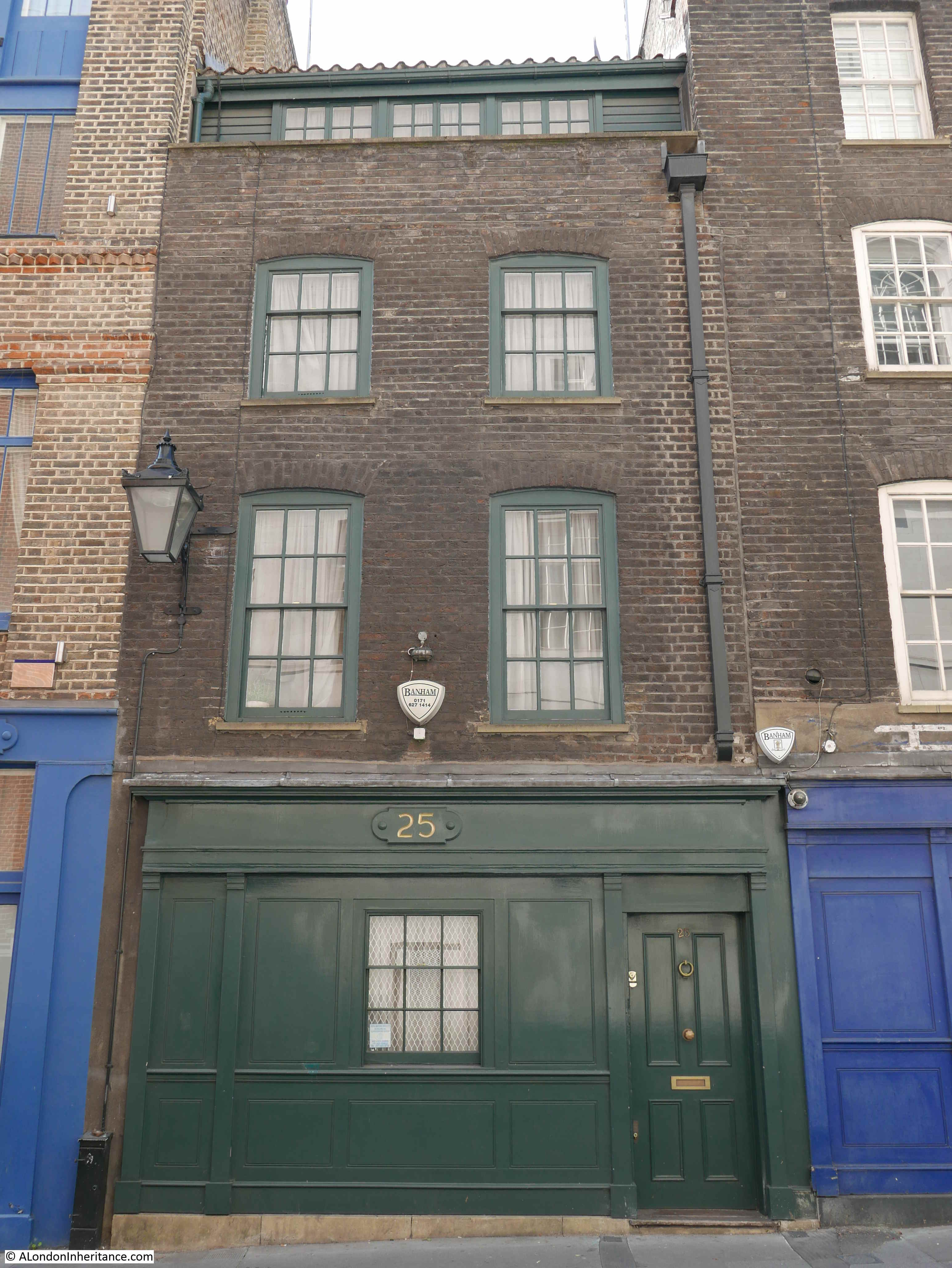
And number 25. Both are Grade II listed.

Seven Dials

The view looking up Mercer Street towards the pillar from the junction with Shelton Street:

Seven Dials

During the summer and autumn period, many of the streets have been closed, providing more space for pedestrians and the cafes in the area.

Seven Dials is usually very busy. Tourists, visitors to London, those visiting the theatres and restaurants of the West End add to those who live and work in the area.

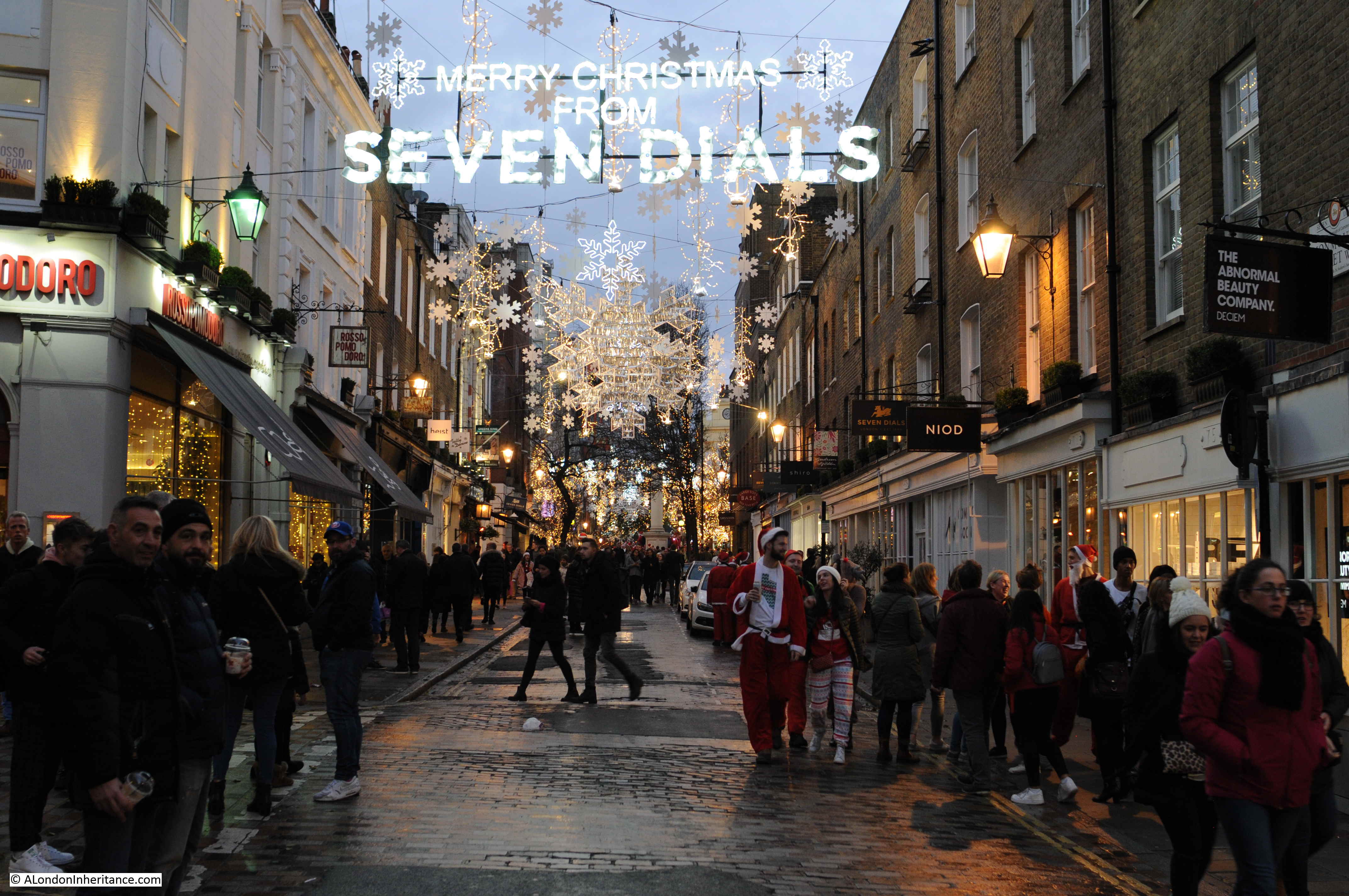
in the run-up to Christmas, the streets around Seven Dials are crowded, and a couple of years ago I photographed a Saturday evening around Seven Dials. Here are three examples.

Looking up Monmouth Street towards the central junction:

Seven Dials

Around the central pillar:

Seven Dials

Crowds and the Cambridge Theatre:

Seven Dials

Many of the buildings of Seven Dials have been redeveloped, and the original pillar is now to be found in Weybridge, but the general layout is still the same, and some of the original buildings survive.

I suspect that Thomas Neale would be rather pleased that his Seven Dials development is still here 300 years later.

alondoninheritance.com

Albion Place, Clerkenwell – A Lost Terrace

Walk up St John Street, north of Smithfield, and turn up St John’s Lane towards St John’s Gate, and on the left you will find Albion Place. My father’s 1947 photo of the street shows a pedestrianised street with a row of terrace houses. In the distance the street descends rapidly towards Farringdon Station, the descent of the street indicating that this was once down to the valley of the River Fleet.

Albion Place

Albion Place in 2020:

Albion Place

The name Albion Place was in my father’s notes to the strip of negatives which included this photo. I was concerned whether this was indeed the right location. Apart from the way the street descends, there are no other visual clues. All the buildings in the 1947 photo have since been demolished. Albion Place is no longer pedestrianised, and the street today looks wider than it appeared in 1947.

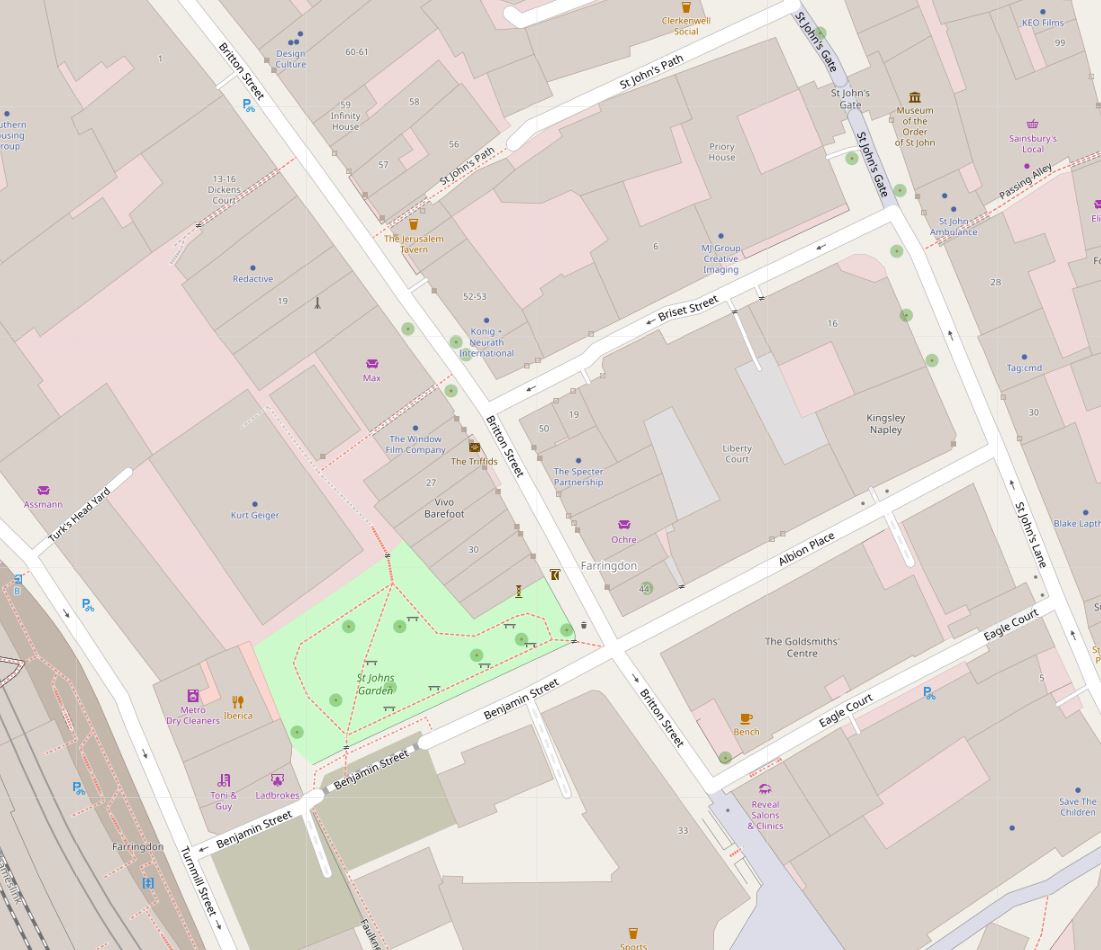
Albion Place is shown in the lower right of the following map, between St John’s Lane and Britton Street. Benjamin Street then continues on towards Turnmill Street and the tracks of the railway into Farringdon Station (Map © OpenStreetMap contributors).

Albion Place

The main cause of my doubt about the location was the junction with Britton Street. This is on the right, at the end of Albion Place, just before Benjamin Street descends towards Farringdon.

The junction with Britton Street cannot be seen in my father’s photo – indeed the street appears to be a continuous row of buildings.

I have been able to confirm this is Albion Place through a single visual clue, as well as a couple of other pointers.

Firstly, towards the end of Benjamin Street, there is a building that juts out and narrows Benjamin Street towards the junction with Turnmill Street.

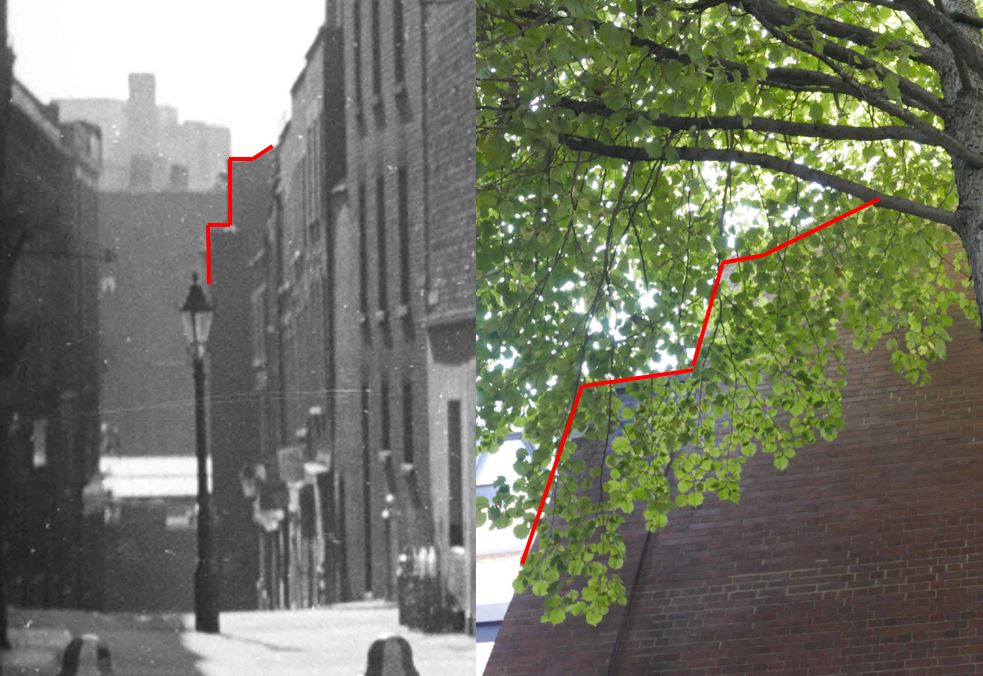
The building has a unique outline. Today, a tree has grown up against the building and hides the edge of the wall and roof:

Albion Place

However I can demonstrate this is the same building as one seen at the very end of the 1947 photo.

In the photo below, on the left, is an enlargement from my father’s photo showing the very end of the street. There is a building jutting out and I have outlined in red the shape of the upper wall, up towards the roof.

In the photo on the right, I have marked the same outline of upper wall and roof.

Albion Place

The two buildings both edge out into Benjamin Street, and both appear to have the same upper wall and roof shape. Would be clearer without the tree, but they appear to be the same.

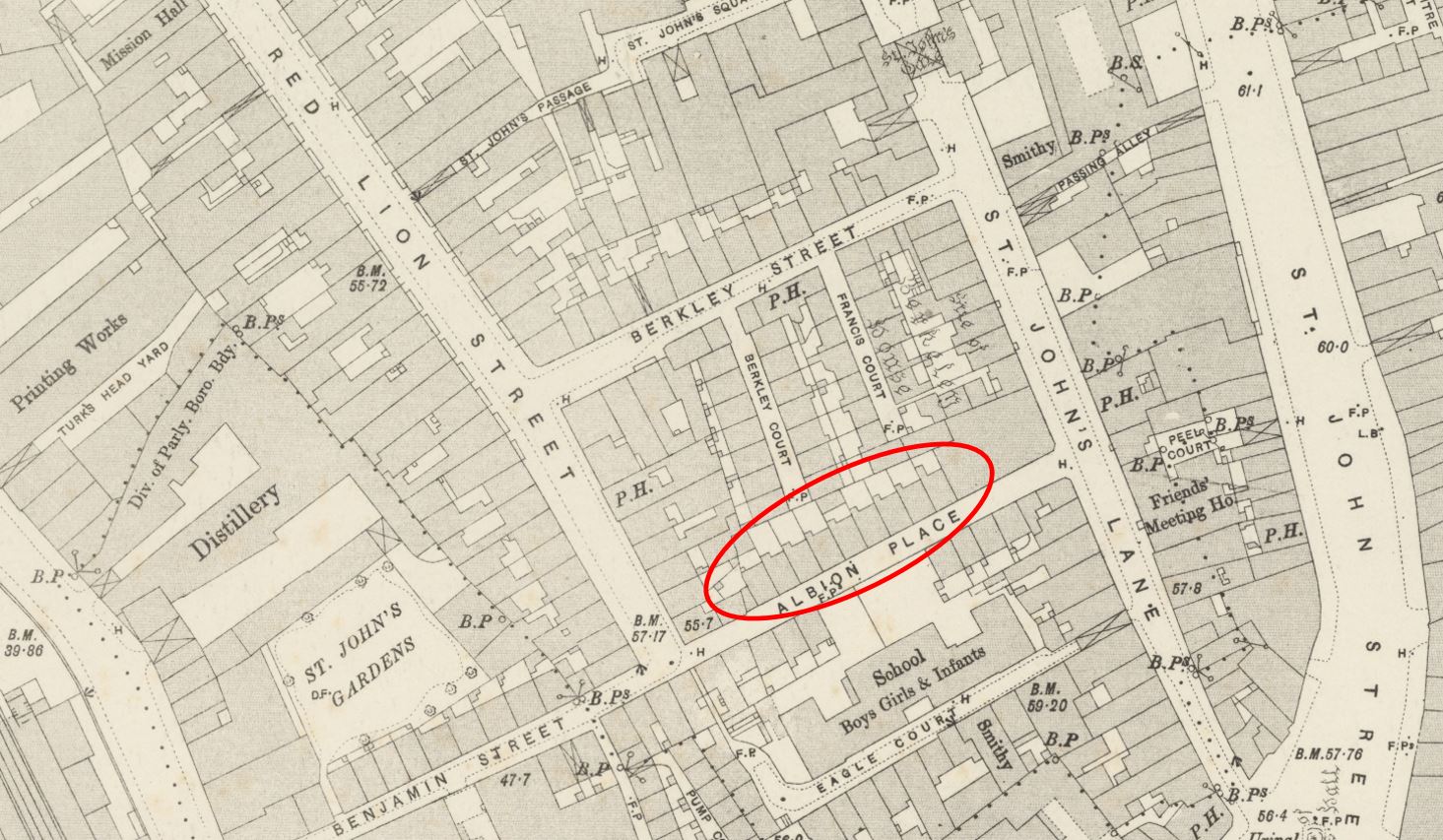
I also checked the 1894 Ordinance Survey map, and in Albion Place, there is a row of terrace houses in exactly the right place (‘Reproduced with the permission of the National Library of Scotland’):

Albion Place

The OS map also shows Britton Street (then Red Lion Street) and the junction with Albion Place. I have no idea why this does not appear in my father’s 1947 photo, I assume the junction is there – just the perspective of the photo, and the way the buildings line the route of Albion Place and continue straight down to Benjamin Street.

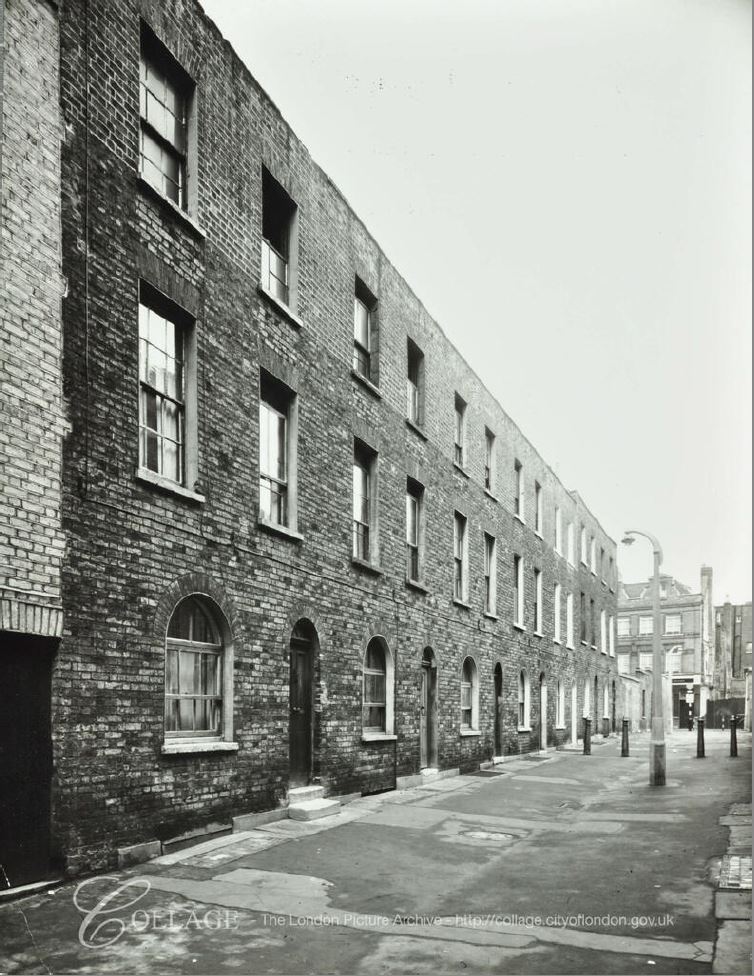
I found one final confirmation of the location. The London Metropolitan Archives, Collage Collection has a single photo of Albion Place, dated 1956 which although photographed in the opposite direction towards St John’s Lane, includes a view of the same terrace.

Albion Place

Image credit: London Metropolitan Archives, City of London: catalogue ref: SC_PHL_01 080 56 4132

The houses look the same, even the house on the left having the two steps to the door, with single steps serving the rest of the houses – exactly the same as in my father’s photo.

In the 9 years between the two photos, Albion Place has lost the rather nice lamp posts. In 1956 a new concrete lamp post is in place.

The following photo is looking up Albion Place from the junction with Britton Street, and shows the same building at the end of the street, on St John’s Lane, as in the Collage photo above.

Albion Place

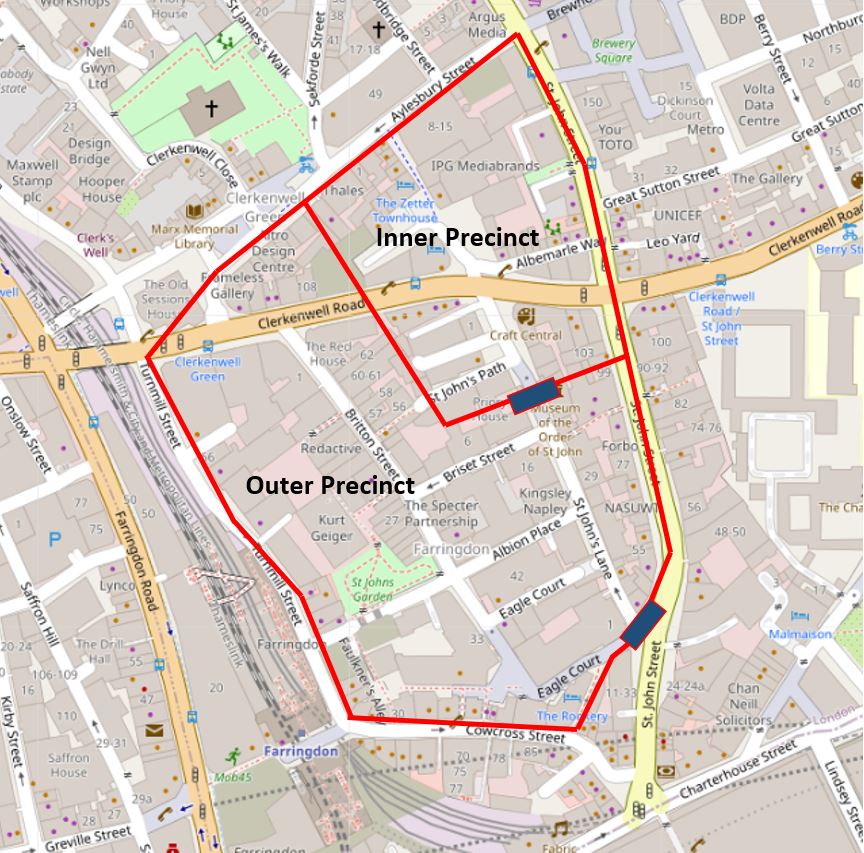
Albion Place has a long history. The land was originally part of the outer precinct of the Hospitallers’ Priory of St John of Jerusalem, which extended down to Cowcross Street by Smithfield Market, Turnmill Street to the west and St John (‘s) Street to the east.

The street seems to have been built in the late 17th century, and was probably part of the gradual growth of the City northwards, as housing and industrial premises were built over what had been the lands of St John’s Priory.

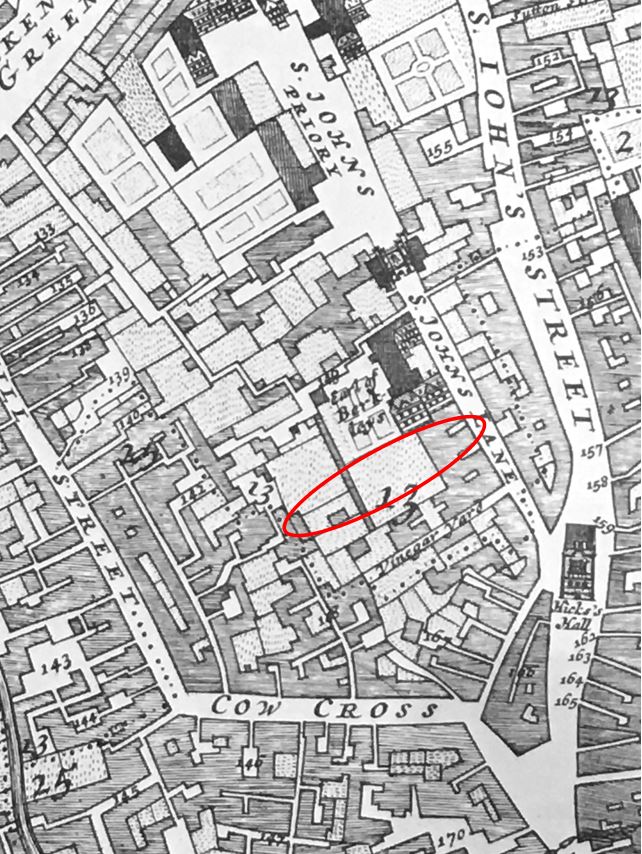
The following map extract from William Morgan’s 1682 map of London shows the area as it was with the location of Albion Place marked by the red oval, on space then occupied by what appears to be the Earl of Berkleys property.

Albion Place

When built, the street was originally called George’s Court, and had changed name to Albion Place by 1822 when the court had been rebuilt to the form seen in my father’s photo, and is presumably from when the terrace of houses date.

The growth of Clerkenwell was linked to industries such as watch and clock making and Albion Place was home to the inventor of an alloy which would reduce the price of ornate 18th century clocks.

Gold was originally sold as 18 carat standard, and was therefore expensive when used as the casing for a clock or watch. Christopher Pinchbeck, who lived in Albion Place invented an alloy of copper and zinc which very nearly resembled gold. Pinchbeck moved from Albion Place to Fleet Street in 1721.
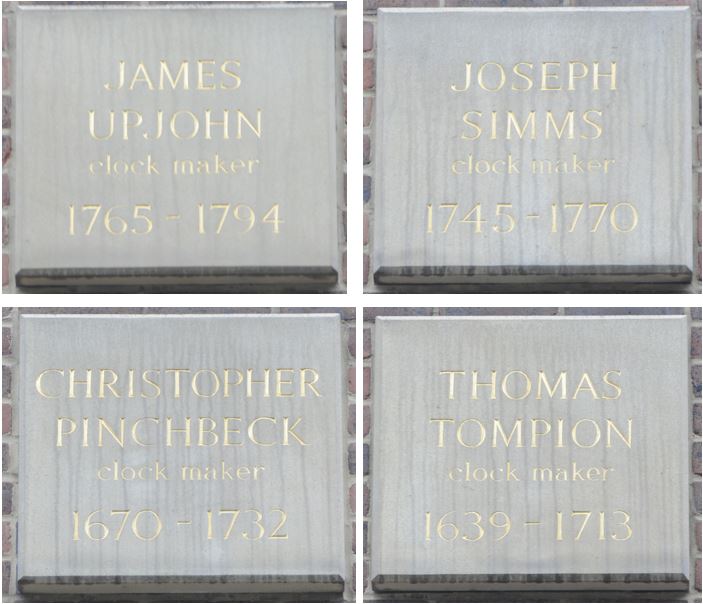
The name “Pinchbeck” was given to this new alloy, which was widely used for the cases of clocks and watches up until the mid 19th century when the sale of lower carat gold was legalised.

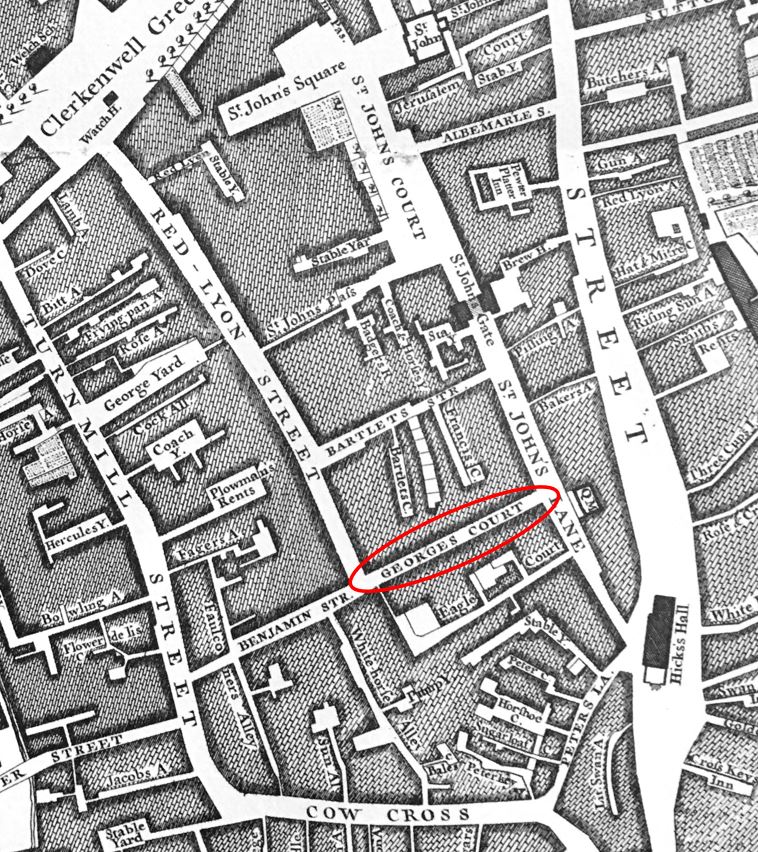
By the time of Rocque’s 1746 map of London, the street that would become Albion Place was now shown on the map as George’s Court. Benjamin Street had also been built down to Turnmill Street.

Albion Place

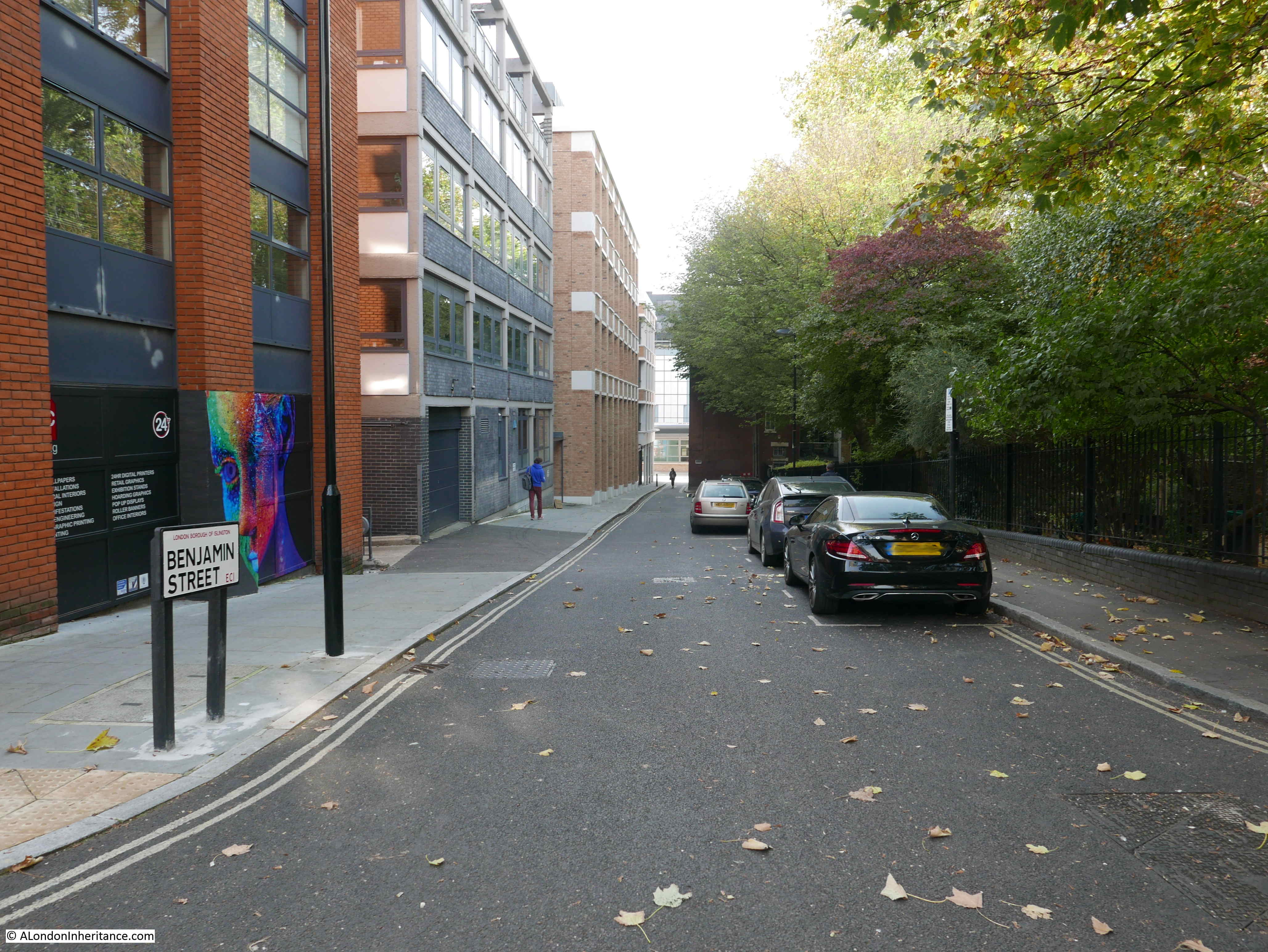
The following photo shows Benjamin Street. Albion Place has a shallow reduction in height, which is far greater in Benjamin Street, as the land descends to what was the Fleet valley which ran just across the railway tracks into Farringdon Station, roughly along the route of Farringdon Road.

Albion Place

The following photo shows the view along Britton Street – the street originally named Red Lion Street. This is the junction that caused me to doubt whether the photo was of Albion Place as it could not be seen in my father’s photo.

Albion Place

View back up Benjamin Street and Albion Place. To the north of Benjamin Street (to the left in the following photo) is a small green space – St John’s Gardens.

Albion Place

St John’s Gardens was originally the burial ground of St John’s Church – the parish church that was in St John’s Square, and following wartime bombing, now rebuilt as the Priory Church of the Order of St John.

The area was taken on by the parish in 1754 and used until 1853 when it was closed under the Burials Act. The burial ground originally did not face directly onto Benjamin Street. As shown in the 1894 OS map earlier in this post, a line of buildings ran along Benjamin Street with St John’s Gardens being an enclosed square. This can also be seen in the 1947 photo where buildings line the far end of the street.

Today, the gardens form a valuable bit of green space.

Albion Place

Albion Place

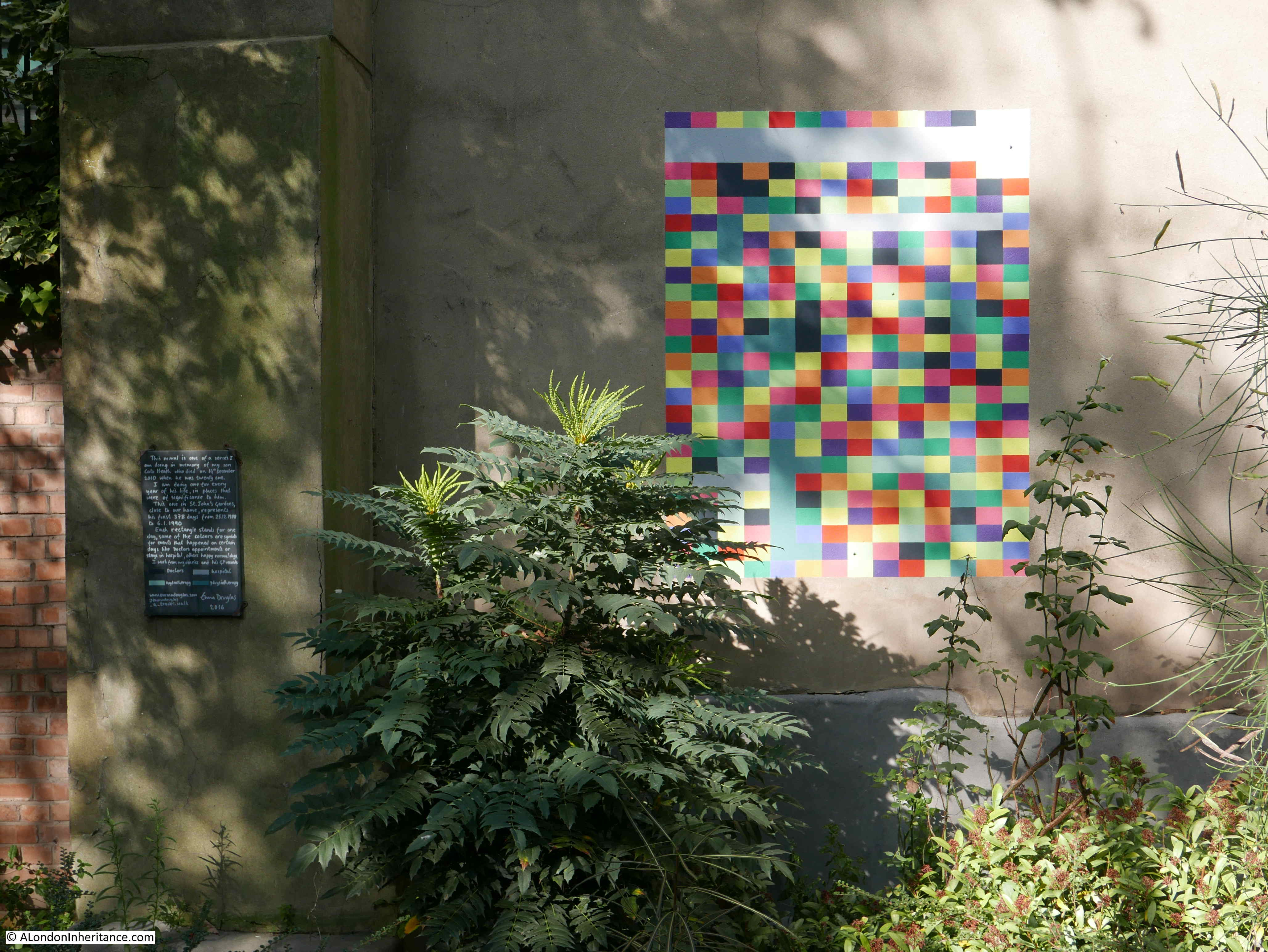
There is a rather poignant mural in the gardens.

Albion Place

It was created by Emma Douglas in memory of her son Cato Heath who died aged twenty one in 2010. Each coloured rectangle represents a day in the life of her son, with the colour of the rectangles representing an event, for example a black rectangle for a doctor’s appointment.

The mural created by Emma in St John’s Gardens is one of a number to be found.

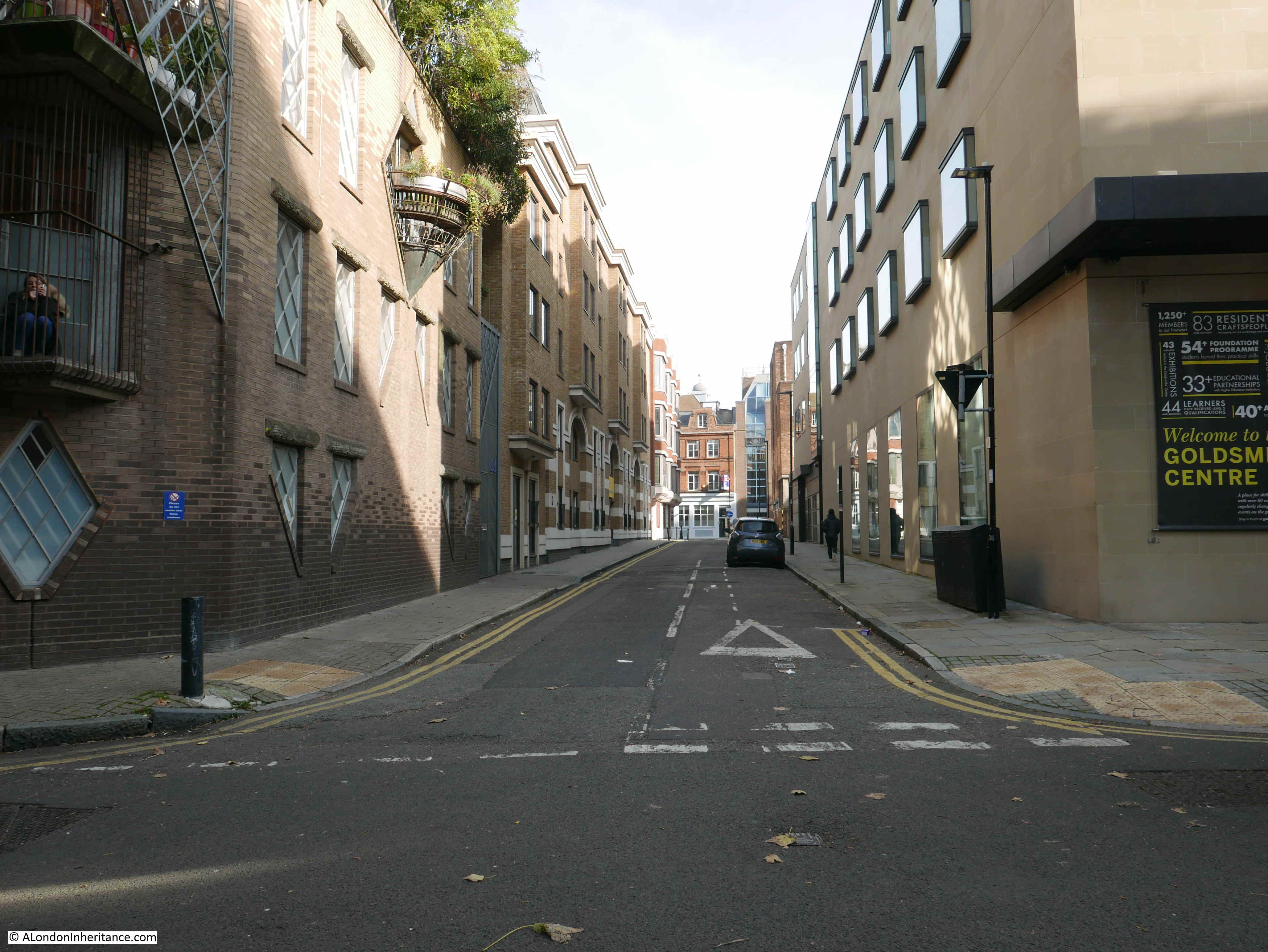
On the corner of Albion Place and Britton Street is a rather interesting building:

Albion Place

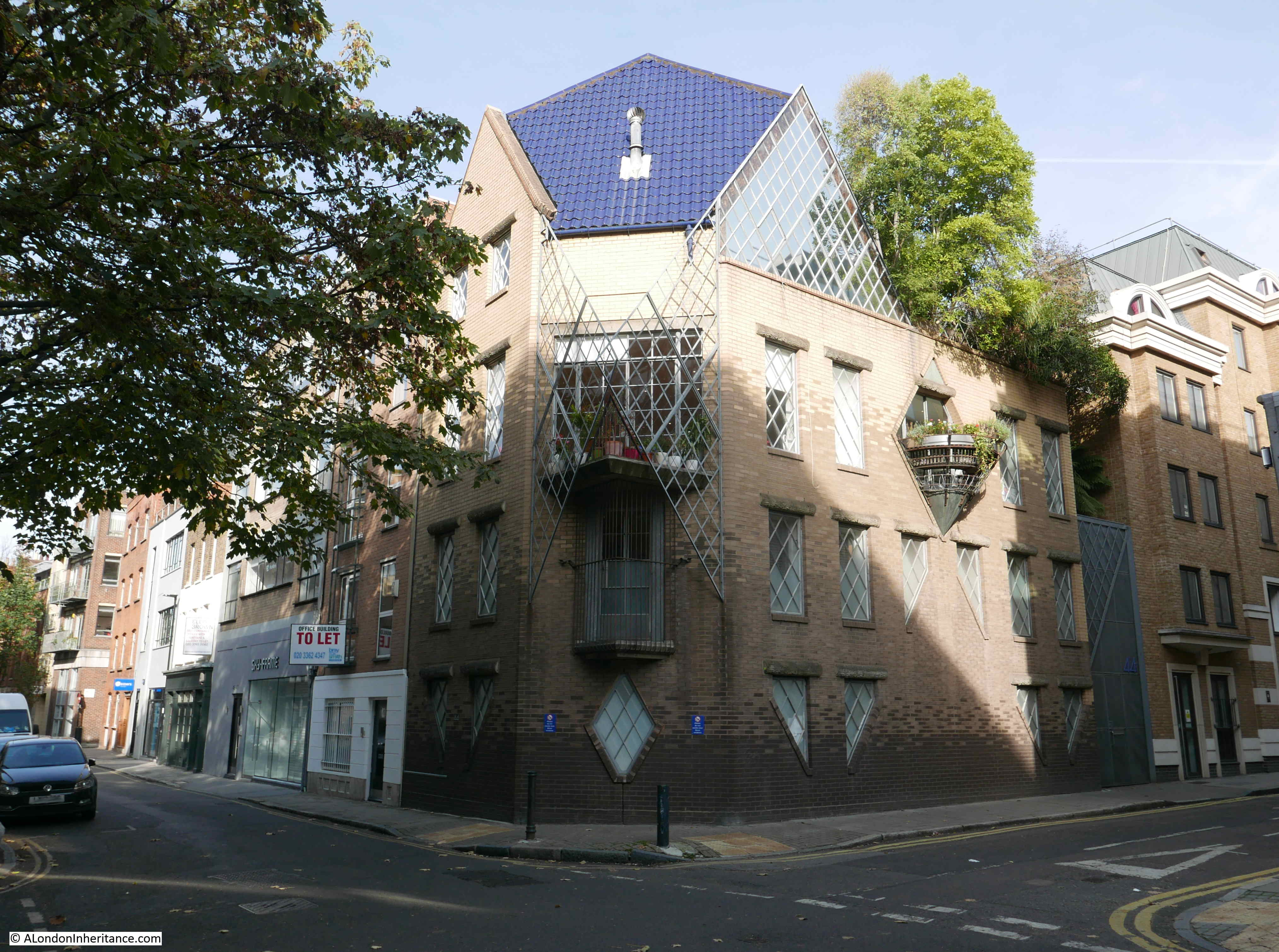
This is the Grade II listed 44 Britton Street originally built for Janet Street-Porter and designed by Piers Gough.

Before her career in the media, Janet Street-Porter trained at the Architects Association where she met Piers Gough. She wanted a house that did not follow the old English tradition with rooms being in well defined places. She also wanted a house that did not look too friendly and looked a bit hostile, so there is no outward facing door to the building. The entrance is tucked away at the rear of the building in a courtyard.

The bricks used in the construction are shaded, starting with dark bricks at the base, getting gradually lighter towards the top of the walls. This was to give the impression that the base of the building is in shade, with the top of the building in perpetual sunlight.

The external lintels above the windows are in the shape of concrete logs.

Janet Street-Porter lived in the house from 1988 to 2001. There is an episode of the BBC programme Building Sights dating from 1991 with Janet Street-Porter talking about, and showing the interior of the building. The programme can be found on the BBC iPlayer here – it is worth a watch.

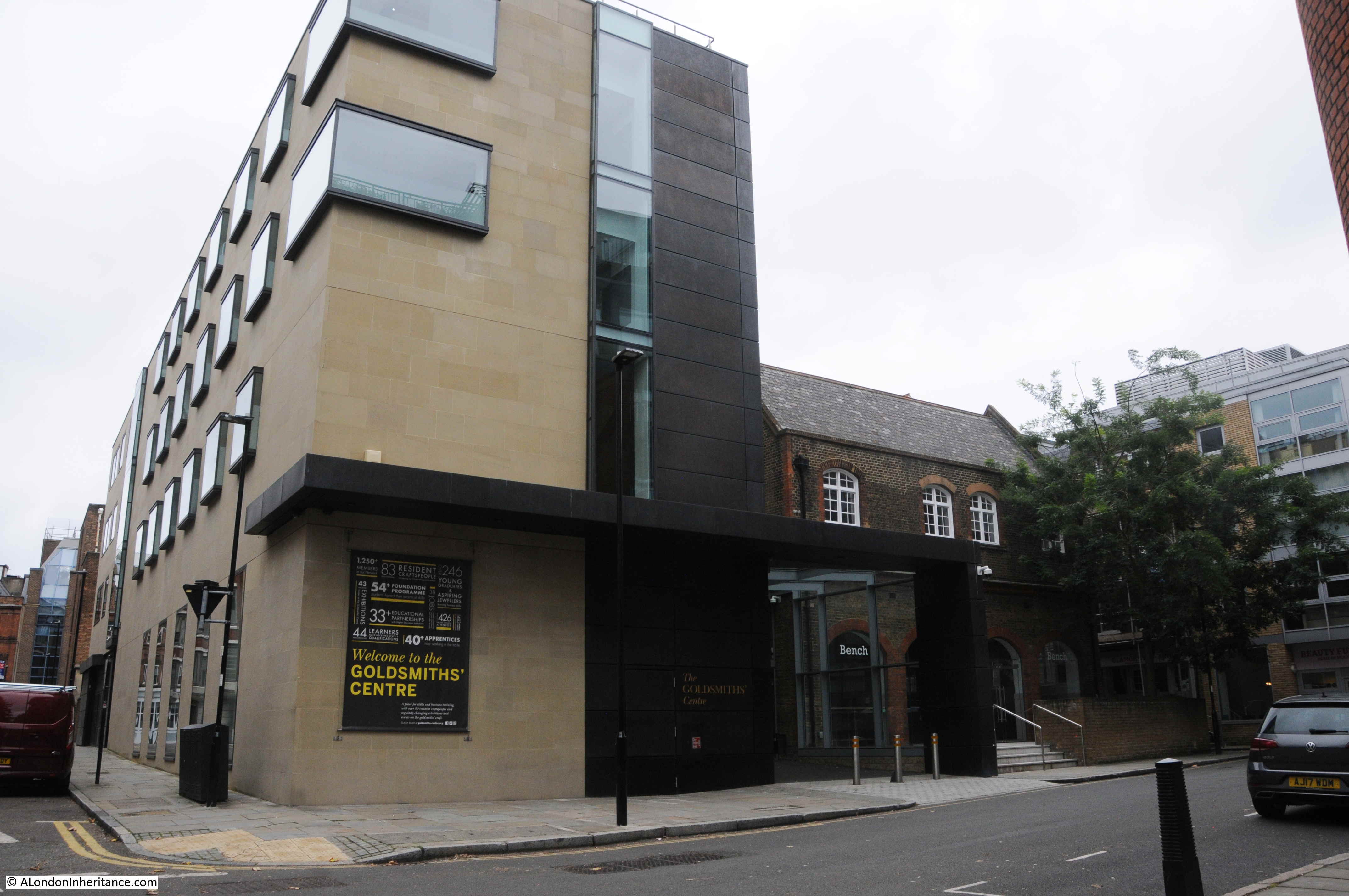
On the opposite corner of Albion Place and Britton Street there is another interesting building. This is the Goldsmiths Centre:

Albion Place

The Goldsmiths Centre was founded by the Goldsmiths Company, one of the twelve great livery companies of the City of London, as a charity for the professional training of goldsmiths.

The centre provides a location where the technical skills of gold and silversmithing and jewelry working can be taught and developed. The building also provides support for developing business, with shared studio space in which to work.

The Goldsmiths Centre is in a rather appropriate location given the history of Clerkenwell with the trades associated with metal working.

The Goldsmiths Centre was opened in 2012. The building on the Albion Place corner is a modern addition to a Grade II Listed 1872 Victorian London Board School, which together form the Goldsmiths Centre.

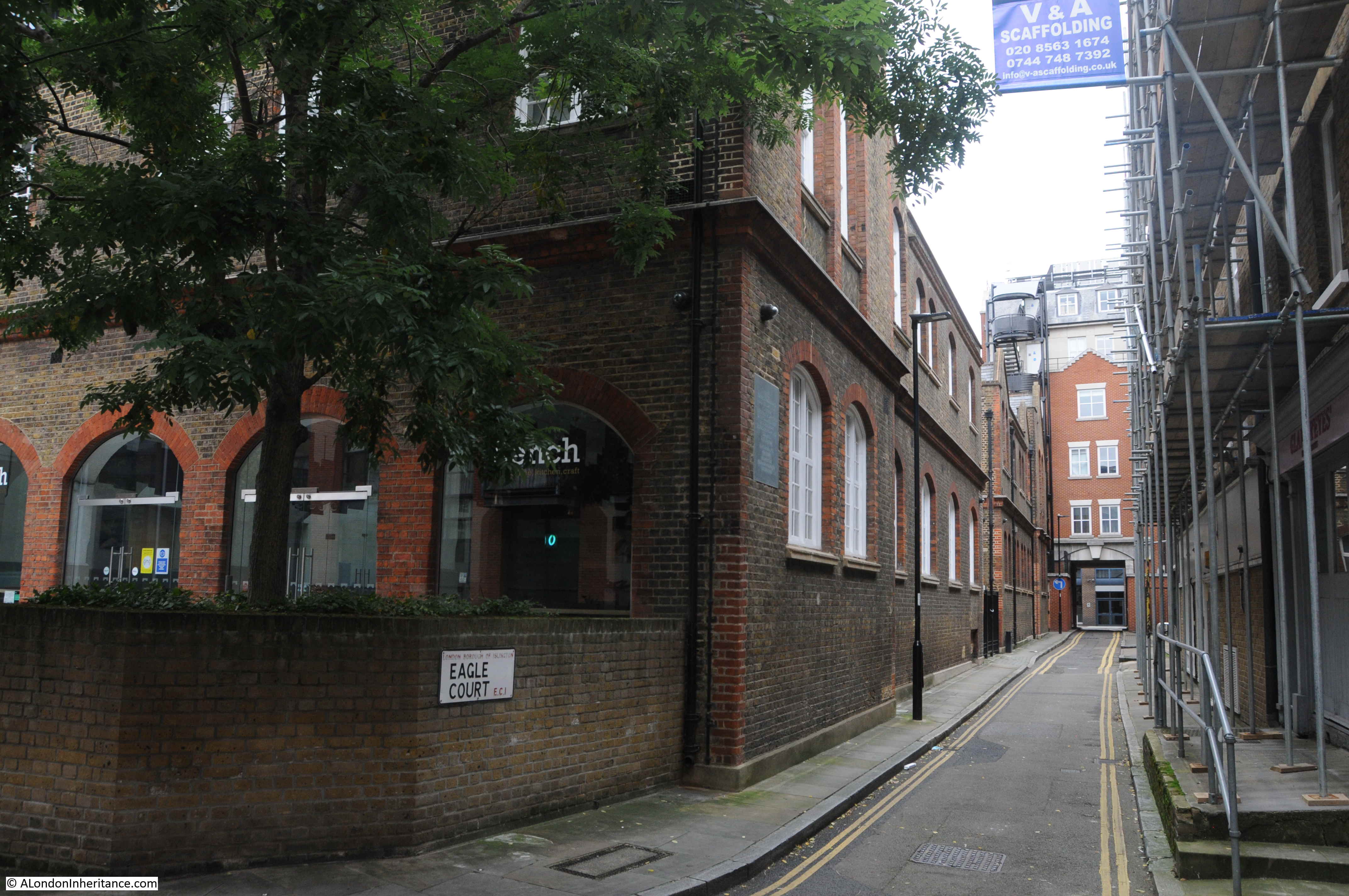
The main entrance to, and the main school building is in Eagle Court which runs from Britton Street back up to St John’s Lane.

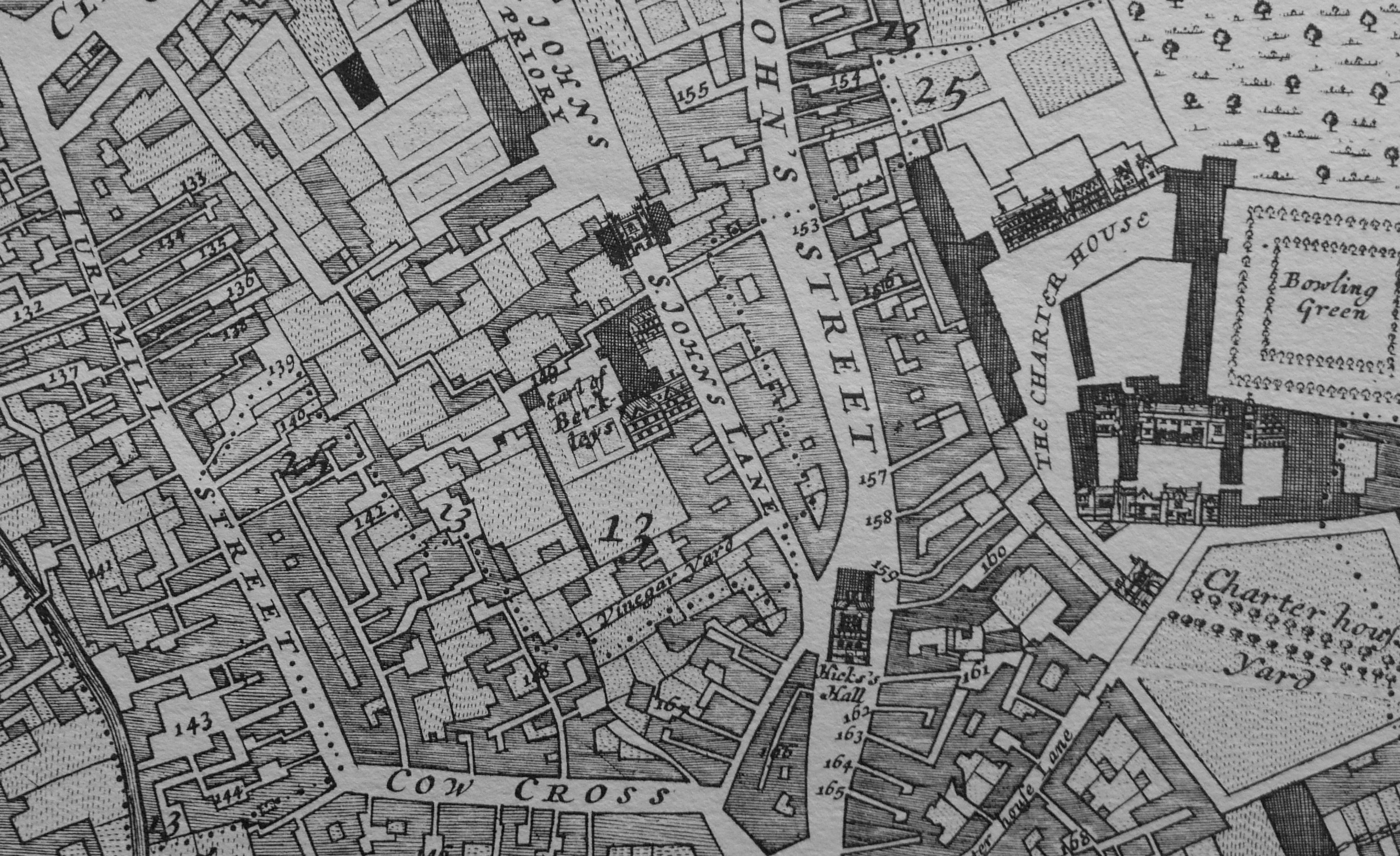
Eagle Court is shown in Rocque’s map, and in the earlier 1682 map by Morgan appears to be shown as Vinegar Yard, so Eagle Court is older than Albion Place.

The name Eagle Court comes from Eagle’s House which appears to have been a mid 14th century mansion built along the western edge of St John’s Lane. The house was named after the Templar preceptory of Eagle in Lincolnshire and acted as the Clerkenwell residence of the bailiff as the senior official of this preceptory.

The view up Eagle Court towards St John’s Lane:

Albion Place

Before the school was built, Eagle Court had long been a dense court of workshops and houses. Industrial processes being performed next to living space.

Work was dangerous and accidents were frequent. for example on December 5th, 1738 “A fire broke out in the workshop of Mr Tabery, a Japanner in Eagle Court, St John’s Lane, occasioned by the Varnish Pot boiling over. Two men were so miserably burnt that their lives are despaired of”.

The area around Albion Place and Eagle Court was densely populated and criminality was rife. The location for the school was chosen by the London School Board for this very reason, as introducing a formal education was seen as one of the means to improve the future prospects of the residents.

When the school was being built in 1873 and 1874, the workmen and the location needed a police guard to protect them and the building materials for the school from the lawless elements of the local population.

The school backs onto Albion Place, and is often referred to as being in Albion Place. The following article from April 1906 provides another example of the crime in the area which was probably heightened by the precious metals which could be found in the workshops:

“DESPERATE BURGLARS – SCHOOL CARETAKER ATTACKED WITH JEMMY. The caretaker of the London County Council School at Albion Place, Clerkenwell, was found lying in a pool of blood with his head severely cut on Saturday night under mysterious circumstances.

When the premises next door were opened the ground floor window was found to have been forced and the entire premises ransacked. The second floor was occupied by a gold refiner. Several hundred pounds worth of gold and silver were on this floor, and the men removed a considerable quantity.

It was when the burglars were leaving via the schoolyard that they were surprised by the caretaker. He was rendered unconscious by blows from a jemmy, which the men dropped.

The caretaker has not yet been able to give any account of the affair. The burglars worked leisurely, and cleaned the window before leaving to remove all traces of incriminating finger prints”.

The increasing level of workshops and industry in the area resulted in the reduction of family homes and the number of children resulting in the closure of the school in 1918.

For the rest of the 20th century, the old school buildings hosted a wide range of educational functions including Cordwainers’ Technical College, the LCC Smithfield Institute and Smithfield College of Food Technology, the College of Distributive Trades, and following a merger with the London College of Printing, the old school buildings became the London Institute.

The current use of the building as the Goldsmiths Centre therefore continues a long educational tradition, including a century of use as a technical educational centre.

Unlike many buildings created by the London School Board, the building consists of only two floors. This was intentional so as not to cast the buildings opposite in this narrow street, in permanent shadow,

Albion Place

I have walked just a few short streets, down Albion Place, along Benjamin Street, then back up to St John’s Lane via Eagle Court, but these few streets reveal their part in the long history of Clerkenwell. From the Priory of St John of Jerusalem, through the industrialisation of the 18th and 19th centuries when the area was home to watch, clock and metal working, an area of dense population with high levels of crime.

The terrace shown in my father’s photo survived until the late 1960s. If the terrace had been renovated, and if Albion Place had stayed a pedestrianised street, with bollards and cast iron lamps, this could have been a lovely street. Although, we always need to be careful when looking back at the past, and remember the lessons of Christopher Pinchbeck’s alloy that all that glitters is not gold.

alondoninheritance.com

Where the Victoria Line breaks through an Islington Square

Islington is full of wonderful squares. Created during the first half of the 19th century as London expanded over the agricultural fields that once characterised so much of Islington. Individual developers built terrace streets and often included squares where the houses benefited from a central garden.

These squares offered a peaceful place to live. Away from the traffic and noise of Upper Street and Essex Road, but still with easy travel into the heart of the city. One such square is Gibson Square, however the tranquility of Gibson Square was lost in 1970 when the Victoria Line burst through the surface of the gardens with a rather ornately designed ventilation shaft that now emits the noise of fans across the square.

Construction of the Victoria Line commenced in 1962 following completion of an earlier test tunnel. The line was opened in stages, with the Walthamstow Central to Highbury and Islington section opening in September 1968, with Highbury and Islington extending to Warren Street in December of the same year.

It was this second section to Warren Street that went underneath Gibson Square. The overall line included roughly 50 ventilation shafts, with a shaft being built at the half way point between stations. Gibson Square is roughly half way between Highbury and Islington and King’s Cross St Pancras Stations, so it was here that London Transport decided to build a ventilation shaft.

These were usually of a purely functional design, a concrete block of up to 50 feet high. The residents of Gibson Square were understandably not happy.

Many Islington Squares in the 1960s were run down, and the terrace houses were owned by landlords, only interested in maximising profit, rather than spending on the upkeep and improvement of their buildings. London Transport probably expected minimal opposition to their plans, however a determined group of local residents led a campaign against the ventilation shaft during the 1960s.

They took their protest to London Transport and the Ministry of Transport. They also had the surprising support of the architect Sir Basil Spence. Surprising as he was responsible for a number of buildings in the Modernist and Brutalist style, including the former Home Office building at 50 Queen Anne’s Gate and tower block of Hyde Park Barracks.

After many design iterations, a much smaller ventilation shaft was designed by the architects Raymond Erith and Quinlan Terry. Completed in 1970, the ventilation shaft looks like a small temple, with three niches facing into the park with a pediment above.

Gibson Square

Whilst the architectural style of the ventilation shaft blends in well, the sound emitted by the shaft probably does not. Walk into Gibson Square and the background hum of fans permeates the whole of the square. The following video clip gives an impression:

The Victoria Line cuts diagonally across Gibson Square. The line was constructed in the days before lasers would be mounted on buildings along the route to check for any impact from tunneling. and tunneling did cause some settlement to some of the houses.

The following map shows the route of the Victoria Line between King’s Cross St Pancras and Highbury and Islington stations. The line is shown by a light grey, dashed double line. I have marked Gibson Square by a red oval (Map © OpenStreetMap contributors).

Gibson Square

The gardens were taken over as a construction site for several years, but were restored by London Transport following completion of work on the ventilation shaft. This included the provision of new iron railings around the gardens to replace the chicken wire which had been there since the original railings were removed during the war.

View of the gardens looking south from the ventilation shaft:

Gibson Square

The land on which the square was built was held by the Milner-Gibson family who came from Theberton in Suffolk, hence the name of the street, Theberton Street which was the first to be built to the south of the square.

The majority of Gibson Square was completed by 1839 and by the mid 1840s the square had been finished in much the same way as we can see today.

The view looking north along the western side of Gibson Square from Theberton Street:

Gibson Square

The architect for much of the street was Francis Edwards, and it was his use of pavilion blocks at the end of each long terrace that give Gibson Square a distinctive appearance when compared to other Islington squares. An example of one of these pavilion style buildings is shown below:

Gibson Square

As with so many streets and squares, they were developed in stages, and by different builders and architects. Although Francis Edwards was responsible for much of the square, other designs were used, and this can be seen in the sudden change in style along a terrace:

Gibson Square

The following photo shows the view looking south from the north of the square. The building at the end in Theberton Street also makes use of the triangular pediment at the top of the facade with supporting dual pillars on either side.

Gibson Square

The feature is offset when looking down the centre of the street. I could not work out why. I did wonder if the street had been widened. It could be that the feature at the end is more central when walking on the pavement rather than in the road, or it could be just that Theberton Street was built first before Gibson Square was laid out.

The following photo shows one of the Pavilion style buildings at the northern end of Gibson Square. This block comprises three houses with architectural features on the facade to give the impression that this is a single house. The houses either side of the centre house have the same size windows as the rest of the terrace, however the central house has been given larger windows to help the illusion of a single house.

Gibson Square

The separate doors give the game away. The entrance door to the house on the right is on the side of the house facing the street at the top of Gibson Square.

The fields that Gibson Square was built on was part of a parcel of land that stretched further north, although the shape was rather elongated. Bounded to the east by a large saw mill that would later become the Post Office complex and current apartment, resturant and shopping space of Islington Square, and on the west by Liverpool Road.

The Milner-Gibson family built a second square on this land to the north of Gibson Square, and perhaps unsurprisingly called this second square, Milner Square.

To reach Milner Square there is a short stretch of road named Milner Place. The view from Milner Place looking south along Gibson Square:

Gibson Square

And looking north to Milner Square which is slightly offset to Gibson Square, with the central garden being visible from the eastern road from Gibson Square. The offset was down to the shape of the land available for building.

Gibson Square

Milner Place and Milner Square – preserving along with Gibson Square, the name of the Gibson-Milner family.

Gibson Square

Milner Square is very different to Gibson Square. Completed by the early 1850s by the architects Alexander Dick Gough and Robert Lewis Roumieu, the street presents a continuous terrace of houses with no features to break up the terrace. Even the chimney stacks are hidden from view.

Gibson Square

Unlike Gibson Square, Milner Square was completed to a single plan by the same architects. The terrace also wraps around the corners of Milner Square into Milner Place.

There were plans for a church to be built where part of the above terrace stands. To cater for the spiritual needs of the growing population of Islington, squares often had a church built at the same time. Local examples include Cloudesley Square and Thornhill Square, however for some reason, the Milner Square church was not built.

There are some features in the square which are not that obvious. If you look at the photo below, there is a silver car on the left of the photo, parked side on in the view. Behind the car there appears to be one of the many entrance doors that run at equal intervals along the terrace.

Gibson Square

However, this single door is not a door, rather is an entrance to a passage through to Almeida Street.

Gibson Square

Walking through the passage takes you into a very different place, compared to the regimented rows of terraces along Milner Square. Plants flow over the garden walls at the back of the houses on Milner Square.

Gibson Square

Looking back to Milner Square – one of those London passageways that will always look good at night, with a single lantern providing light to the 19th century passage.

Gibson Square

From the end of the passage, we can see the difference between the front and rear of the houses in Milner Square. The front facade was the expensive part, decorated with stonework, whereas at the rear of the houses, plain brick and no decoration.

Gibson Square

Both Gibson and Milner Squares went into decline after the last war, as did much of Islington. Reading through newspaper reports that mention the squares during the 1950s, 60s and 70s, they tell stories of those living in the squares being involved with thefts and prostitution. Even those who lived in the squares in full time jobs were involved in crimes, for example a porter who worked at Marylebone Station stealing from post bags.

The 1980s onward saw a gradual change in Gibson and Milner Squares as houses were renovated. Milner Square was one of Islington Council’s street renewal projects in 2008.

In May of this year, one of the houses in Gibson Square sold for £2,375,000.

Both squares tell the history of the northward expansion of London through Islington.

Gibson Square also has visible and audible evidence of the Victoria Line that passes below the square.

Gibson Square has one final link with London’s transport system. It is the destination of run number one in the “knowledge” qualification used by London’s taxi drivers. Run number one covers the route from Manor House Station to Gibson Square.

alondoninheritance.com

The Pilot and Ceylon Place, Greenwich

Thirty five years ago, my father was outside the Pilot in Greenwich. Located on the peninsular which now has the O2 Dome at the northern tip, the Pilot is one of the very few original buildings left after the recent and ongoing development of the Greenwich peninsula.

The Pilot pub in 1985:

Pilot

Last week I returned to the Pilot to take a comparison photo and for a beer. Although redecorated, and no longer a free house, the pub looks very much the same.

Pilot

The Pilot is at the end of a short terrace of houses, originally going by the name of Ceylon Place.

Pilot

The location of the Pilot, and the terrace is shown in the following map, marked by the red oval. The O2 Dome is at the top of the peninsula (Map © OpenStreetMap contributors).

Pilot

From the above map, it is hard to appreciate the level of development on the peninsula. The O2 Dome, or Millennium Dome as it was, kick started development of the area, and after a use was finally found for the dome as a major London concert venue, development on the peninsula has been a permanent activity, with apartment towers, offices and hotels of strange design rising from this once industrial landscape.

The Pilot and the terrace at Ceylon Place have are remarkable history, dating back to the early development of this part of Greenwich. The level, and type of change over the last couple of hundred years has been such that the pub and terrace have been surrounded by incredibly different landscapes.

We can explore these by looking at maps. The above map extract shows the area now dominated by the O2 Dome, and the associated developments, however, going back to 1951, and this was a very industrialised place. The Pilot and terrace is highlighted by the red oval in the following map extract (Following maps: ‘Reproduced with the permission of the National Library of Scotland’:

Pilot

There are a few other terraces, in addition to Ceylon Place, however the majority of the land is occupied by Gas Works, Tar Works, Electricity Generation, a Steel Works, and many other smaller industrial sites. The following map extract is an enlargement of the area around the Pilot and Ceylon Place, which are in the centre of the map.

Pilot

The pub and terrace face onto River Way which leads down to the Thames. A cooling pond occupies much of the space directly opposite. A railway runs to the west, Behind the terrace is a steel works.

Much of the development of the peninsular was during the later part of the 19th and early 20th century. If we go back to 1893, we can see the start of the industrialisation of the peninsular.

The Pilot pub and Ceylon Place can be seen, with a longer terrace that stretched to the east. Much of the immediate surroundings are open space, and the railway has not yet arrived. The area to the south are the Greenwich Marshes.

Pilot

Looking at an extract from the above map, we can see the terrace in 1893, with the Pilot (labelled P.H.) at the western end of the terrace as it still is today.

Pilot

At the eastern end of the terrace, there is a large building called East Lodge with open space leading down to the river and bays on either side – presumably bay windows to provide a good view of the Thames.

The majority of the terrace, and East Lodge would disappear in the coming years. By the 1913 Ordnance Survey map, East Lodge had gone. and by 1939 much of the terrace had also been lost, leaving only Ceylon Place we see today, and the Pilot pub.

In all this time, the Pilot has looked out over a very different landscape. Once surrounded by open space and marsh land, the Pilot was then surrounded by some of the most polluting industries to be found in London, then as industry in the area closed, the pub looked out on a derelict landscape.

Today, the Pilot looks out on yet another very different landscape. A ten minute walk from the O2 Dome, in the middle of a green space, and in the process of being surrounded by tower blocks of ever more outlandish design.

The Pilot and the terrace date from 1801. A plaque on the front of the pub to the upper left of the main entrance confirms the date, the name Ceylon Place and New East Greenwich which was the name given to the development, as it was expected to form the basis of a larger development.

The main body of the pub is original, however, as will be seen when comparing my father’s photo, and my photo below, a smaller extension to the right has been added. This now provides accommodation, so if you want to stay on the Greenwich Peninsular, there is an option with a pub attached.

Pilot

The London Metropolitan Archives Collage collection has a photo of the Pilot and terrace dating from 1979. The Pilot looks the same as in my father’s photo, with the same pub sign, however look closely at the terrace of houses and you will see three of these have their window and door bricked up. The 1970s and 80s were the time when industry in the area was in significant decline, and it is surprising that the terrace has survived to this day.

Pilot

Image credit: London Metropolitan Archives, City of London: catalogue ref: SC_PHL_02_0976_79_5000

The street in front of the pub and terrace now ends in a dead end, rather than running down to the causeway that ran into the Thames. Today, blocks of apartments now separate the Pilot and terrace from the river that for much of their time, must have been a significant influence on the lives of those who lived in the houses and drank in the pub.

Pilot

We can get a good idea of life in the terrace and pub by looking at old newspaper reports. When first built, the rear of the terrace looked out onto the Greenwich Marshes and a maze of ditches draining into the Thames, however in July 1857, the Kentish Mercury reported that:

“The inhabitants of Ceylon-place, East Greenwich complain of the very offensive state of the ditch at the back of their houses. They inform me that this ditch, like all other ditches on the Marshes, was formerly flushed out at every tide, but since Mr Wheatley has lately stopped up a sluice at the entrance to the ditch. The water is, therefore, become stagnant, and is certainly in an offensive state, and thereby causing the nuisance complained of”.

There were the day to day events that would have had significant personal impact, to those who lived in the terrace. On the 30th May 1840:

“POOR MAN’S LOSS – On Saturday evening last, as a poor labouring man was going home, after work, he lost the whole of his wages, amounting to 30s, besides some papers which, to the owner, are of consequence. The finder of the documents would be doing an act of great kindness by forwarding the same to No. 3, Ceylon Place, Greenwich”.

There was the type of crime common when drink was involved. In March 1903 the Woolwich Gazette reported that:

“Frederick Boos, a foreign seaman, of s.s. Hendon, was charged on Thursday at Greenwich  with assaulting a waterman, named Russell Lewis, of 6, Ceylon Place, East Greenwich. The victims head was bandaged and he said he was suffering from several bad cuts, said the prisoner hit him several times without any provocation. Boos alleged that the prosecutor had been making false statements about him and that he (Boos) was drunk at the time – Two months hard labour”.

The victim, Russell Lewis is recorded as being a waterman of Ceylon Place. Checking the census data reveals that this was a common occupation for those living in the terrace in the 19th century. In the 1871 census, there were several watermen, and watermen’s apprentices among the occupants of several of the houses.

Another mention of a Waterman living at Ceylon Place is from the Kentish Mercury on the 3rd April 1885: “A PUGILISTIC WATERMAN – Charles Watkins, waterman, of 8 Ceylon-place, East Greenwich, was charged on summons of assaulting another waterman named Richard Preddy. The complainant said he was sitting on a seat at the Anchor and Hope Wharf, waiting for a ship to come up the river. He heard footsteps and saw Mr Watkins, who pulled off his coat and wanted him to fight; he told him to put on his coat, when the defendant struck him in the face, and then they both fell over the seat”.

Charles Watkins was fined 20 shillings with 2 shillings costs for the attack.

The majority of the other inhabitants were recorded as being labourers. One, a Mrs Elizabeth Elliott, widow, aged 74 was on the Parish Poor Relief. This was a very working class terrace.

There were other professions, perhaps unexpected in such an industrial area. In 1901, a resident of Ceylon Place was up before the Lord Mayor:

“THE SERIOUS CHARGE AGAINST A GREENWICH MAN – At the Mansion House on Thursday last week, Charles Rayner, aged 23, described as a music-hall artiste of Ceylon-place, Greenwich was again before the Lord Mayor on the charge of being concerned with another man in stealing £10 from the Falstaff Restaurant, Eastcheap”.

Publican’s were in danger of prosecution if they continued to sell alcohol to those already drunk, and in July 1908, in an article entitled The Peril of the Publican, it was reported that:

“Mary Ann Millington of the Pilot public-house, Ceylon-place, East Greenwich, was summoned for selling intoxicating liquor to a drunken person, and for permitting drunkenness”.

Mary Ann Millington was fined 40 shillings.

When they were living in the terrace, Charles Watkins and Charles Rayner, would have looked out on a rapidly industrialising area, but they would have still been very familiar with the last of the fields and marshes on the peninsular, and the causeway down to the river at the end of the longer terrace would have probably been used by many of the watermen of Ceylon Place.

Looking north from the terrace, the view would have been of cooling ponds and gas works. Today the view is of a park.

Pilot

And replacing the electricity generating station, and steel works are now rows of apartment buildings, which also block off the direct access to the river that the watermen of Ceylon Place formerly enjoyed.

Pilot

At the eastern end of the terrace. an old, painted sign provides a faded view of the original name of the terrace.

Pilot

The view of the terrace hidden behind trees on the walk down from the northern tip of the peninsula:

Pilot

The park is now established, but all along the eastern edge of the peninsula, building is continuing and the park is fenced off from numerous building sites. The following photo is the view looking north from the same position as the above photo. Tall buildings can be seen in the distance, to the east of the O2 Dome, and the building sites to the right are fenced off, so many more tall apartment buildings will soon overlook Ceylon Place and the Pilot pub.

Pilot

The Pilot is a really lovely pub, with an open terrace at the rear which was perfect on a warm August afternoon.

The Pilot and Ceylon Place have been here for over 200 years. They were:

  • Built when much of the Greenwich Peninsula was still field and marsh
  • They saw the building off, and were surrounded by some of the most polluting industries in London
  • They saw the decline of these industries and the derelict state of the much of the peninsula
  • The Millennium Dome came to the end of the peninsula
  • They are now being surrounded by towers of apartment buildings, but with an open space providing a view to the north

I suspect one of the watermen, or a worker in the industries on the peninsula would never have guessed what the place would look like today, and likewise, we probably have no idea what the peninsula will be like in one or two hundred years time, but I hope the Pilot and the Ceylon Place terrace will still be there to see how this part of London develops.

alondoninheritance.com

New Terrace, Duncan Terrace, Colebrooke Row and Charles Lamb

The following photo is from the early 1980s and shows part of a terrace of houses. The house on the left with the pediment has a plaque stating “New Terrace – 1791”.  The location is in Islington, a short distance south east of Islington Green. New Terrace, now Duncan Terrace is separated from Colebrooke Row by a strip of grass which has an interesting history.

Colebrooke Row

This is the same view almost 40 years later. The perspective is not exactly the same as the trees in front of the house with the pediment have grown significantly and obscure the pediment and plaque when looking from the original viewpoint.

Colebrooke Row

Many of the terraces in this part of Islington were in a poor state in the early 1980s, but the decade would bring a transformation to the area. New Terrace at the time seemed to have escaped the problems suffered by many other terraces and was in good condition as the terrace approached the age of 200 years.

The location of New Terrace is shown in the following map extract. To the south east of Islington Green, the terrace is the upper row of houses in the red oval, north of Charlton Place (Map © OpenStreetMap contributors).

Colebrooke Row

The houses in this area have a complex history, with piecemeal construction starting in the 18th century. Originally, the land was comprised of agricultural fields, clay pits and nursery gardens.

In 1613, the New River was constructed, and the route can still be traced today by the grass strip that runs from New Terrace all the way down to City Road. In the above map, the green strip shows the grass and public park between Duncan Terrace and Colebrooke Row, the grass strip running further north in front of New Terrace is not shown on the map, but is indicated by the gap between the terrace and Colebrooke Row.

Duncan Terrace is named after Admiral Duncan the commander of the Naval Fleet at the Battle of Camperdown against the Dutch in 1797.

Colebrooke Row is named after Sir George Colebrooke who developed the Colebrooke Row side of the street.

New Terrace was built in 1791 by James Taylor, a young surveyor and builder. The terrace has gone through a number of name changes from New Terrace to Colebrooke Terrace, to Duncan Terrace, the name which remains to this day.

The grass strip running in front of the terrace was the route of the New River. The river was enclosed in a pipe in 1861 which was covered and planted. The pipe was out of use by 1950 and was then removed leaving the grass strip as a reminder of the early history of London’s water supply.

Colebrooke Row

Looking north along the original route of the New River:

Colebrooke Row

The view to the south showing how the terrace was built at a raised level to the river:

Colebrooke Row

As the terrace could not face directly onto the New River, a raised pavement was built in front of the terrace, and this remains today to give access to the front doors of each house:

Colebrooke Row

In 1793, Taylor continued the southern extension of the terrace and built what are now numbers 46 to 49 Duncan Terrace on the opposite side of the junction with Charlton Crescent. This area was originally known as Clay Pit Field as it had been occupied by clay pits, extracting clay for the manufacture of bricks, but as the clay was exhausted, the land was more valuable as a site for houses.

This southern terrace followed a similar design to the northern New Terrace with a raised pavement between the houses and the New River:

Colebrooke Row

Further south along Duncan Terrace is the rather magnificent church of St John the Evangelist, built as a result of the Catholic Emancipation Act of 1829 which released Catholics from the restrictions that had been imposed on them since the Reformation.

Colebrooke Row

The land was purchased for the church in 1839, and the design completed by the Catholic architect Joseph John Scoles. It took a number of decades for the church to be completed with work on the towers commencing in 1873.

The terraces either side of the church are today in lovely condition, but as with much of Islington this is a result of restoration work over the last few decades and the considerable increase in value of properties in the area.

In 1953, the route of the New River had not yet been landscaped, or turned into a park, as shown in the following photo from 1953, and there was a gap in the terrace where one of the houses had suffered bomb damage.

Colebrooke Row

Image credit: London Metropolitan Archives, City of London: catalogue ref: SC_PHL_01_182_53_19

Crossing the route of the New River and into Colebrook Row and the street is lined with similar terraces:

Colebrooke Row

And this is where the Regents Canal enters the Islington Tunnel – this is the view looking along the canal on approach to the tunnel:

Colebrooke Row

The entrance to the Islington Tunnel, under Colebrooke Row. The tunnel runs to Caledonian Road and is 878 meters long.

Colebrooke Row

Walking back along Colebrooke Row, and the park follows the route of the New River and separates Colebrooke Row and Duncan Terrace. They are now landscaped, planted with trees, with a central path running the length of the park:

Colebrooke Row

Although today there is a one way system running through the parks, with the appropriate warning signs about social distancing:

Colebrooke Row

The following photo shows the eastern side of Colebrook Row, with the street, then the New River route on the left, then Duncan / New Terrace (on the left but not visible in the photo). As can be seen from the slight differences in architectural styles, the terrace has changed over time. as different builders added to, demolished parts of, and changed the style of the buildings.

Colebrooke Row

I have walked from New Terrace at the top of the oval in the map, to the Regents Canal at the lower end of the oval, and back again along Colebrooke Row, as there is one house to find that is earlier than all the other houses, and was once the home of a rather interesting character.

The white painted house at the end of the terrace in the following photograph is Colebrooke Cottage, number 64 Duncan Terrace, dating from around 1760.

Colebrooke Row

Colebrooke Cottage was originally a single house, standing alone in the fields that covered the area, and faced onto the New River. It remained a single house until the construction of New / Duncan Terrace on the left. The following photo shows Colebrooke Cottage, New / Duncan Terrace to the left and the route of the New River running between terrace and road.

Colebrooke Row

The following print shows Colebrooke Cottage as it was before the construction of New Terrace. It is rather idyllic view. The cottage is surrounded by trees, the New River runs along the front and a boy is fishing in the river  © The Trustees of the British Museum.

Colebrooke Row

Comparing the two prints shows a number of differences mainly down to 19th century changes, including a reduction in the number of windows. Restoration work in the 1970s uncovered evidence of the side windows that would have had to have been bricked up when New Terrace was built.

The print is titled Charles Lamb’s House At Islington.

Charles Lamb was a poet and essayist. Born in Office Row in the Temple in 1775 where his father worked in the legal profession. On the death of his father’s employer, the family consisting of Charles, his sister Mary and their mother and father had to leave the house tied with his father’s job and move into cramped lodgings nearby.

After a short spell at the South Sea Company, he moved to the East India Company in 1792, where he would spend the rest of his working life. He was employed as a clerk, a job he did not enjoy.

His first published work was a small collection of sonnets that he provided for a book of poems published by Coleridge in 1796.

But it was not until the 1820s that he achieved a degree of fame when he published a series of essays in the London Magazine under the name of Elia (a name he adopted, allegedly the last name of an Italian man that had also worked at the South Sea Company)

However in many ways he had quite a tragic life which probably influenced his writing.

After the death of his father’s employer, the family were forced to move to cramped lodgings, and Charles and his sister Mary seem to have been responsible for supporting the family, and it was the resulting pressure which probably led to his sister Mary, in a fit of insanity to kill their mother and badly wound their father.

Charles took Mary to an asylum, and to avoid her imprisonment, he agreed to look after her at home, which he did for the rest of his life.

Mary did suffer mental health problems for the rest of her life, but she also published works with Charles, including a retelling of Shakespeare for children, a book which is still published today.

He did not marry. His first proposal of marriage to one Ann Simmons was rejected which led to a short period of what at the time was called insanity, probably what we would now call depression.

His second attempt at marriage, with a proposal to an actress Fanny Kelly was rejected, probably because she could not contemplate a life which involved looking after Mary.

He moved to Colebrooke Cottage in 1823 and stayed there for only 4 years, but it was here that he was the happiest he had ever been. He retired from work at the East India Company, and lived here with Mary, surrounded by books and the Islington countryside, and entertained literary friends. He described leaving his job as “33 years’ slavery…a freed man, with £441 a year for the remainder of my life”.

He described the house as a cottage, “for it is detached, with six good rooms. The New River runs close to the foot of the house and a spacious garden is behind. I feel like a great lord, never having had a house before”.

However the writer Thomas Hood called it a “cottage of ungentility for it had neither double coach house nor wings, and like its tenant, it stood alone”. Some author snobbery or competition perhaps.

The New River caused occasional problems for his guests as the myopic writer George Dyer fell into the river after leaving the house.

In 1827 he left Islington and moved to Enfield, followed by a move to Edmonton in 1833, where he died the following year after a fall.

A print of Charles Lamb dating from 1828  © The Trustees of the British Museum:

Colebrooke Row

A London County Council plaque is on the front of Colebrooke Cottage to commemorate Charles Lamb’s time on Colebrooke Row, Islington.

Colebrooke Row

Walking along Colebrooke Row, there is not really anything that would stand out – it’s a street of rather nice late 18th / early 19th century terrace houses as can be found across much of Islington. I went there to find the location of one of our 1980s photos. However, what makes this street so special is a single house that remains from the time when this was all agricultural land and clay pits. Finding one of the few places where the route of the New River can still be clearly seen, and how houses were built to face on to the New River.

And finding a literary character who was in the shadows of the major literary characters of the time, who should have had a happier life, but who seems to have enjoyed a few years surrounded by the Islington countryside.

alondoninheritance.com

London Wall – A Location Shifting Historic Street

For this week’s post, I am back to tracing the locations of my father’s photos, and this photo dates from 1947. Locating the photo is helped by the street name, London Wall being displayed on one of the low walls built to separate street from bomb damaged buildings. Much of London Wall today is a very different place, not only with the buildings that line the street, but also the location of the street.

London Wall

This is roughly the same scene today, in 2020:

London Wall

There are a couple of features in the 1947 photo which help to confirm the location. I have ringed the first of these features in extracts from the 1947 and 2020 photos below:

London Wall

This feature can be found on top of the magnificent number 84 Moorgate, or Electra House, built in 1903 for the Eastern Telegraph and Allied Companies, one of the early telecommunications companies that built cable networks across the world.

London Wall

The two storey entrance to the building, with the dome at the top, and the feature that can be seen in my father’s 1947 photo.

London Wall

Above the main entrance is this magnificent coloured glass. A figure sits on top of the world, with a glowing orb above her head which sends rays across the seas, where a sailing ship and lighthouse can be seen. Eastern Telegraph was responsible for the installation and operation of a number of sub-sea communications cables that gradually connected the continents, so I suspect the glass mural in some way represented sub-sea cables shedding light across the world by providing the means for instant communications.

London Wall

The feature at the very top of Electra House, and visible from London Wall is in the photo below. For a company that was involved with technologies leading the global communications revolution, I was surprised to see the signs of the zodiac surrounding the world.

London Wall

The second feature that helped to identify the location is this two storey building seen at the end of the section of London Wall shown in the 1947 photo.

London Wall

Although only visible when you are near the building today, as new developments along London Wall have hidden the building from view along much of the street, the building still exists today.

It is the Armourers’ Hall of the Armourers and Brasiers’ Company, a rather nice Georgian building in the neo-Palladian style.  Due to new buildings, I could not photograph the Armourers’ Hall from the same direction as in my father’s photo, so this is the view looking across London Wall.

London Wall

The Armourers and Brasiers Company was formed in 1322 by a number of craftsman looking to maintain standards in the manufacturer or craft of armour.

London Wall

London Wall is two very different streets. The section of London Wall west of Moorgate is a wide dual carriageway, leading from the roundabout with the Museum of London at the centre at the junction with Aldersgate Street. East of the Moorgate junction, London Wall is a narrower street with many pre-war buildings still lining the street.

The following map shows the location of London Wall today, running left to right along the centre of the map, with the roundabout that forms the junction with Aldersgate Street on the left  (Map © OpenStreetMap contributors).

London Wall

The area between Moorgate and Aldersgate Street suffered terrible damage during the war. A large part would be redeveloped as the Barbican Estate, and a major change was made to London Wall. From just west of Moorgate, the road was diverted to a new southerly routing to a large new roundabout.

in the following map extract, the original route of London Wall can be seen coming from the right then moving diagonally up along the map. I have marked the first third with red lines.

London Wall

A third of the distance along, the new London Wall then takes a completely new direction, carving the new dual carriageway through a series of old streets and buildings, many of which had been badly damaged by wartime bombing.

The location of Armourers’ Hall is the green circle on the right. To the left, the red circle is the new roundabout that forms the junction with Aldersgate Street and is the location of the Museum of London. In the centre, there is another landmark that helps confirm the location. This is Brewers’ Hall, set back a short distance from London Wall, with the original, smaller hall shown as the blue oval in the above map.

London Wall

This new section of London Wall between Aldersgate Street and Moorgate Street was opened on the 7th July 1959. As the plaque shown in the following photo indicates, this was intended to be the first part of a major new traffic route through the City of London. A due carriageway providing a northern, east to west route, with the planned Upper and Lower Thames Street providing the southern, east to west route.

London Wall

The new dual carriageway would be lined with new office tower blocks, and the planned Barbican to the north would be the future of City residential living. This was how post war City planning was based on the assumption that car travel would be the future and City streets were needed that provided easier traffic flow, with pedestrian walkways above the streets separating pedestrians from traffic.

Fortunately, the full east and west extensions of the new London Wall did not get built, although part of the eastern stretch of the street was extended to dual carriageway, but not as drastically as the western section.

The differences between the two sections of London Wall can best be seen by taking a walk along the complete length of the street. This is the start, looking at the roundabout junction with Aldersgate Street, with part of the Museum of London in the centre of the street.

London Wall

From the junction with Aldersgate Street, we can look east along London Wall, a view which clearly shows a wide dual carriageway, designed to carry large amounts of traffic, quickly through the City.

London Wall

The buildings that line London Wall, and occupy space over the street are the second incarnation of office blocks along this street, having largely replaced the 1950s / 1960s office blocks that originally lined either side of London Wall.

London Wall was designed specifically for the car, and this can be seen both above and below ground.

Underneath London Wall is a large underground car park operated by the City of London. The car park runs for a large part of the new section of London Wall. The photo below was taken roughly underneath the lamp-post in the above photo.

London Wall

There is a section of the original London wall in the car park – a subject for another post.

The majority of the space either side of London Wall is occupied by gleaming new glass and steel office blocks. One exception are the ruins of the tower of the church belonging to the medieval hospital of Saint Elsyng Spital.

London Wall

The new office blocks that line London Wall are not just tall, they occupy large areas of land, and dwarf older building such as Brewers’ Hall which can be seen in the lower right of the following photo.

London Wall

The building in the following photo is the one that obscures the view of Armourers’ Hall, which is located just behind the building, where Coleman Street meets London Wall (although traffic access between the two streets is now blocked by a pedestrian route along London Wall).

London Wall

Nearing the junction of London Wall and Moorgate, where London Wall continues into the heart of the City as indicated by the gleaming towers in the background.

London Wall

From London Wall, we can look across to Moorgate, and set back from the road is this row of buildings, with a large pedestrian area and small green space between the buildings and London Wall, which help show how the area has changed.

London Wall

The building on the right of the terrace is a pub, the Globe, and this pub, and the other two buildings that make up this terrace can be seen in the map extract below.

London Wall

Credit: ‘Reproduced with the permission of the National Library of Scotland’ 

These buildings were originally on Fore Street, a street that once ran all the way up to St Giles Cripplegate. Fore Street has been shortened and blocked of by one of the new buildings alongside London Wall.

Fore Street ran just north of the original alignment of London Wall, and we can still walk part of the original route.

I have ringed a section of the original route of London Wall in the following map extract. Just above the word London, is a small space with the words London Wall.

London Wall

This is the section of Roman Wall in St Alphage Gardens, shown in the following photo:

London Wall

This section of wall helps explain why the street is called London Wall, as the street originally ran along the wall, just inside the City.

The following photo is looking west along what was the street London Wall, the section of wall at St Alphage Gardens can just be seen to the right.

London Wall

The following photo is looking along St Alphage Gardens, what was London Wall, from the junction with Wood Street.

London Wall

The above photo highlights one of the things I find fascinating about the city. Despite the amount of change, you can still trace out many lost streets, and although London Wall has been widened and moved to the south, we can still find the original junction with Wood Street and the original route down to Moorgate.

Returning now to the junction of London Wall and Moorgate, and the three houses on the left that once faced onto Fore Street, this is the old Fox umbrella shop.

London Wall

Now Grade II listed. Thomas Fox first opened an umbrella shop in Fore Street in 1868 and umbrellas were both made and sold on the premises for many years.

The wording below the FOX sign give an indication of the business at the site today, however Fox Umbrellas are still being made and sold from the company’s new location in Shirley, Croydon.

Now lets continue along the street, east of the Moorgate Junction, and this is the original London Wall with a much narrower street and still with many pre-war buildings. Thankfully the original scheme to extend the dual carriageway of the moved length of London Wall was never carried out in full.

London Wall

We have already seen the halls of the Armourers and Brasiers’ Company and the Brewers’ Company, and there is a third hall along London Wall. In the photo below, on the right, the building with the Corinthian Pillars is the hall of the Carpenters’ Company.

London Wall

The Carpenters’ have had their hall on this site in London Wall since 1429. The hall today is the third hall, as the previous hall had been badly damaged during the war.

On the opposite side of the street, old and new buildings sit on opposite corners.

London Wall

The building on the left in the above photo still has original London Wall street signs. Not sure of the exact age of these, but they must be pre-war.

London Wall

Just east of the Carpenters’ Hall, London Wall widens again from a single carriageway to a dual carriageway, as part of the scheme to create a major through route, however along this part of the street, the widening has not been as dramatic as on the section from Moorgate to Aldersgate Street,

Almost at the eastern end of London Wall is the church of All Hallows on the Wall, the name referencing the fact that the church is located up against the Roman wall, with the original church on the site being built on a bastion of the wall.

London Wall

The present church was built in 1767 to replace the earlier church which had become derelict. The church did suffer damage during the war, but was restored in the 1960s, and is now the Guild church of the Worshipful Company of Carpenters.

A short distance further east from the church, just by the green van and traffic lights in the above photo, London Wall comes to an end, where the road continues as Wormwood Street.

That completes a walk along London Wall. A historic street that originally followed the path of the Roman Wall, but now only does this for the eastern section up to Moorgate. Passing Moorgate, London Wall diverts to the south and becomes a large dual carriageway, reflecting the post-war view that city design had to accommodate the car.

However the magic of London is that we can still find the line of the original London Wall, and that these old routes and boundaries have been retained.

alondoninheritance.com

Euston Station and HS2 – A 2020 Update

HS2 has been in the news during the week with the announcement that the scheme will go ahead. I have been following the development of the Euston end of the line since 2017 when I photographed St James Gardens before the area was closed allowing the archaeological excavations of the original cemetery to start.

I wanted to follow the development of the area as this will be the largest above ground transport project in central London for at least the next ten years, so I planned to revisit the site in February of each year to see how the site and the new terminus for HS2 develops.

My posts so far are:

An exploration of the St James Gardens in 2017

The Streets Under The HS2 Platforms And Concourse in 2018

Euston Station and HS2 – A 2019 Update

Why am I interested in following the progress of the HS2 station at Euston? I have always tried to visit and photograph sites before, during and after development, an interest that probably came from first seeing some of my father’s photos. For example, the construction of the Royal Festival Hall, and Bankside Power Station. When the new station is complete, the area will look very different, and it will be fascinating to look back and watch how the development progressed.

The weather was sunny and calm last Saturday, Storm Ciara would arrive the following day, so I used the opportunity for a walk around Euston to see how the site has changed and what progress has been made since February 2019.

The following photos are a record of the area in February 2020.

Euston Station HS2

The Government’s announcement of the go-ahead for HS2 implied that initially trains will terminate at Old Oak Common, with Euston following later, and that HS2 had lost responsibility for the development of Euston Station.

The map below shows the area to the west of Euston Station that will be occupied by the platforms for HS2 when the scheme is complete. The numbers are the locations from where the photos in today’s post were taken.

Euston Station HS2

This is the view from location number one, looking north along Melton Street. Euston Station is to the right of the photo.

Euston Station HS2

It is still possible to exit the station, walk along the pavement of Melton Street (the wooden panels on the left of the photo below separate the pavement from the street which is fully closed). There is a crossing point to cross over Melton Street and get to Drummond Street. This is the view looking back along the closed Melton Street towards the Euston Road from location two on the map.

Euston Station HS2

Although the majority of the surrounding buildings have been demolished, the disused underground station entrance on the corner of Melton and Drummond Streets is still there. The station housed an air conditioning system for the tunnels below and also has access to the tunnels, so I suspect it is a more complex structure to demolish.

Euston Station HS2

When I took the London Transport Museum, Hidden London tour of Euston Station, the entrance to the tunnels was through the building shown in the above photo. The tours are still being run so the entrance is possibly still in use, or an alternative route is being used.

The following view, also from location two on the map, is looking north along Cardington Street, fully closed to pedestrians and traffic.

Euston Station HS2

The following photo shows the view looking slight further to the left. In both the above and below photos, the old St James Gardens over the original cemetery was on the left, and on the immediate left was an Ibis Hotel.

Euston Station HS2

The following photo from 2017 soon after the cemetery was closed is from roughly the same place as the above photo and shows the same view before demolition commenced.

Euston Station HS2

The stretch of Drummond Street leading up to the junction with Coburg Street is closed to traffic, however again, it is possible to walk along the pavement which is fenced off by wooden panels.

The following photo is from location three and is looking back towards Euston Station. The underground station entrance is the remaining building on the right.

Euston Station HS2

Walking south along Coburg Street, I get to location four on the map. The length of Euston Street up to Melton Street is closed off, but this was the view looking through the wire fencing from location four.

Euston Station HS2

The following photo shows the same view prior to demolition of the Bree Louise pub, and the houses running along Coburg and Euston Streets.

Euston Station HS2

Looking through the wire fencing, the view towards Euston Road.

Euston Station HS2

The view also from location four, looking back along Coburg Street. The terrace houses to the left of the Bree Louise once ran along where these hoardings now run.

Euston Station HS2

Back to the junction of Drummond and Coburg Streets and this is looking along the northern leg of Coburg Street. The rear of the Ibis Hotel was behind the hoardings on the right.

Euston Station HS2

Looking down the closed section of Drummond Street.

Euston Station HS2

In the above photo, the gap on the right was originally the Calumet photography store, shown in the following photo.

Euston Station HS2

At the end of Coburg Street (location 5 on the map) is the Exnouth Arms, on the edge of the HS2 demolition area and still open.

Euston Station HS2

The view in the following photo is again at location five, and is looking through the gate to the right of the Exmouth Arms.

Euston Station HS2

In the above photo, and the photo below where I put the camera lens between the wire mesh of the gate, the area shown is the location of the St James Gardens and the original cemetery. When I was here last, the archaeological excavation of the cemetery was still in progress and there was a very large marquee covering the whole area.

Euston Station HS2

The following photo is an extract from the photo above. The trees are those that originally lined Cardington Street, opposite St James Gardens. The photo illustrates the depth of the excavation of the cemetery. An earth bank can be seen descending down to the level excavated, and the depth of this can be gauged by the roof of a digger which can just be seen. Clearance of the old graveyard was a major exercise.

Euston Station HS2

The above photos show the area once occupied by St James Gardens. The photo below shows the gardens in 2017, just before closure – hard to realise looking at the area now that these photos occupy the same space.

Euston Station HS2

Looking back across Coburg Street towards Euston Station. The Ibis Hotel once blocked the view.

Euston Station HS2

The area being demolished for HS2 also runs along the Hampstead Road, the location of the next set of stops, and the following photo was taken from location six. The photo is looking back towards Euston Station, again across the space once occupied by St James Gardens. The old underground station is at the base of the left most crane.

Euston Station HS2

Location seven, and this shows a better view of the depth of the excavated St James Gardens/ cemetery.

Euston Station HS2

Last year, HS2 had built a small community space which included a number of artifacts from the cemetery, and the London Temperance Hospital, which once occupied the site. This was in the area to the left in the photo below, but now appears to have been cleared, apart from some of the information panels, one of which can be seen on the left.

Euston Station HS2

The temporary buildings at the end of the pathway are HS2 site offices, however the ground floor door provides an entrance to an “HS2 in Camden” information centre. Unfortunately not open at the weekends, so I could not visit. The community space had on display one of the foundation stones from the London Temperance Hospital, so not sure where this has moved to (see last years post).

The following photo is from location eight.

Euston Station HS2

This is where Cardington Street joined the Hampstead Road, however as Cardington Street alongside the old gardens has all but disappeared, the short stub of road is closed off and only provides access to the HS2 site.

The following photo shows the one remaining building along this eastern side of the Hampstead Road, the former Saint Pancras Female Orphanage building.

Euston Station HS2

After the orphanage moved, the building was an annex of the London Temperance Hospital and is now an NHS facility.

That completed my 2020 view of the area being demolished for the future HS2 platforms and station extension at Euston, following much the same route as in the two previous years.

Euston Station will also be transformed, so I have been taking photos of the station as can currently be seen. The following photo is off the main entrance for traffic to the station from the Euston Road.

Euston Station HS2

Since February 2019, most of the buildings that occupied the area that will become the HS2 station at Euston have been demolished.

Excavation of the cemetery that was under St James Gardens has been completed, so I assume the site is now ready for the build phase to start, however this is such a large area and there is a considerable amount of construction work to take place so I expect it will take many years.

Up to the announcement of the go-ahead there seemed to be some genuine doubt as to whether the new Government would support the project, which raised the question of what would be done with such a large area of prime London space. My fear was that it would have been sold off to property developers to recover some of the costs, which would have created another bland area of towers.

Whatever your views on HS2 (in many ways the name is wrong, whilst it is high-speed, this hides the real benefit of a significant addition of capacity and freeing up the existing lines for more local services), it now seems certain that London will be getting the first major new rail route and station extension since the rail link to the channel tunnel was built.

I will be returning in February next year, and it will be interesting to see if work has changed from demolition to construction.

alondoninheritance.com