The Festival of Britain and the Atomic Bomb

The Festival of Britain and the Atomic Bomb – two very different subjects, but with a connection, and which also both show different expectations of the future in the early 1950s. The Festival of Britain put forward a vision of hope for the future, a country with strong industrial and cultural traditions, based on the history of the British people and the land they inhabited. The atomic bomb put forward a terrifying vision of destruction as the world descended into the Cold War.

I hope all will become clear by the end of the post.

Festival Ship Campania

I have written a number of posts about the Festival of Britain (there is a list of links at the end of the post). The festival presented a view of the country based on the people and the land. History, industry, science and creativity all featured, as well as what the organisors portrayed as Britain’s contribution to civilisation and the rest of the world.

The main Festival of Britain exhibition site was in London, on the South Bank, and this, along with the Pleasure Gardens at Battersea are probably the most well known festival locations, however the intention with the festival was to get as many people across the country involved as possible. There were fixed exhibitions in Glasgow and Belfast, a travelling land exhibition, and also an exhibition within a ship that sailed around the coast of the country, and brought the festival to several major port cities.

The exhibition was in the Festival Ship Campania:

Festival of Britain ship Campania and the Atomic Bomb

The Campania had been a “ferry carrier” during the war. The role of a ferry carrier was to transport aircraft between locations. Whilst aircraft could land and take off from the ferry carrier, this was more for delivery of aircraft than for combat, although planes from the ship were involved in a number of combat operations.

The Campania had been used on artic convoys, delivering aircraft to Russia to support the eastern front and the Russian campaign against the Nazi’s..

As with all other Festival of Britain exhibitions, there was an official guide book published for the Festival Ship Campania, and the following from the guide book provides more detail about the ship:

“This is the first time that an exhibition of this size has been presented in a ship. Clearly the primary requirement in an Exhibition Ship is adequate display space, and for this reason Campania was chosen; for she has a hanger deck 300 feet long, and high enough for galleries to be built to increase the Exhibition area.

H.M.S. Campania was laid down as a merchant vessel at the yard of Messrs. Harland & Wolff. She was taken over during the last war by the Admiralty while still on the stocks, and converted into a ferry carrier. In this role she had a distinguished career. She has been lent by the Admiralty as a Naval contribution to the Festival of Britain. Her conversion to a Festival Ship has been planned by the Director of Naval Construction, Sir Charles Lillicrap, in conjunction with Mr. James Holland, the Exhibitions Chief Designer. It was carried our by Messrs. Cammell Laird of Birkenhead.

During her time as a Festival Ship, Campania is flying the Red Ensign. She is manned by a Merchant Navy crew and managed on behalf of the Festival of Britain by Messrs. Furness, Withy & Co.

F.S. Campania is a motor ship with two diesel engines, 13,000 h.p. and has a speed of 18 knots. Her principal dimensions are: overall length 540 feet, beam 70 feet, draught 23 feet, gross tonnage 16,408.”

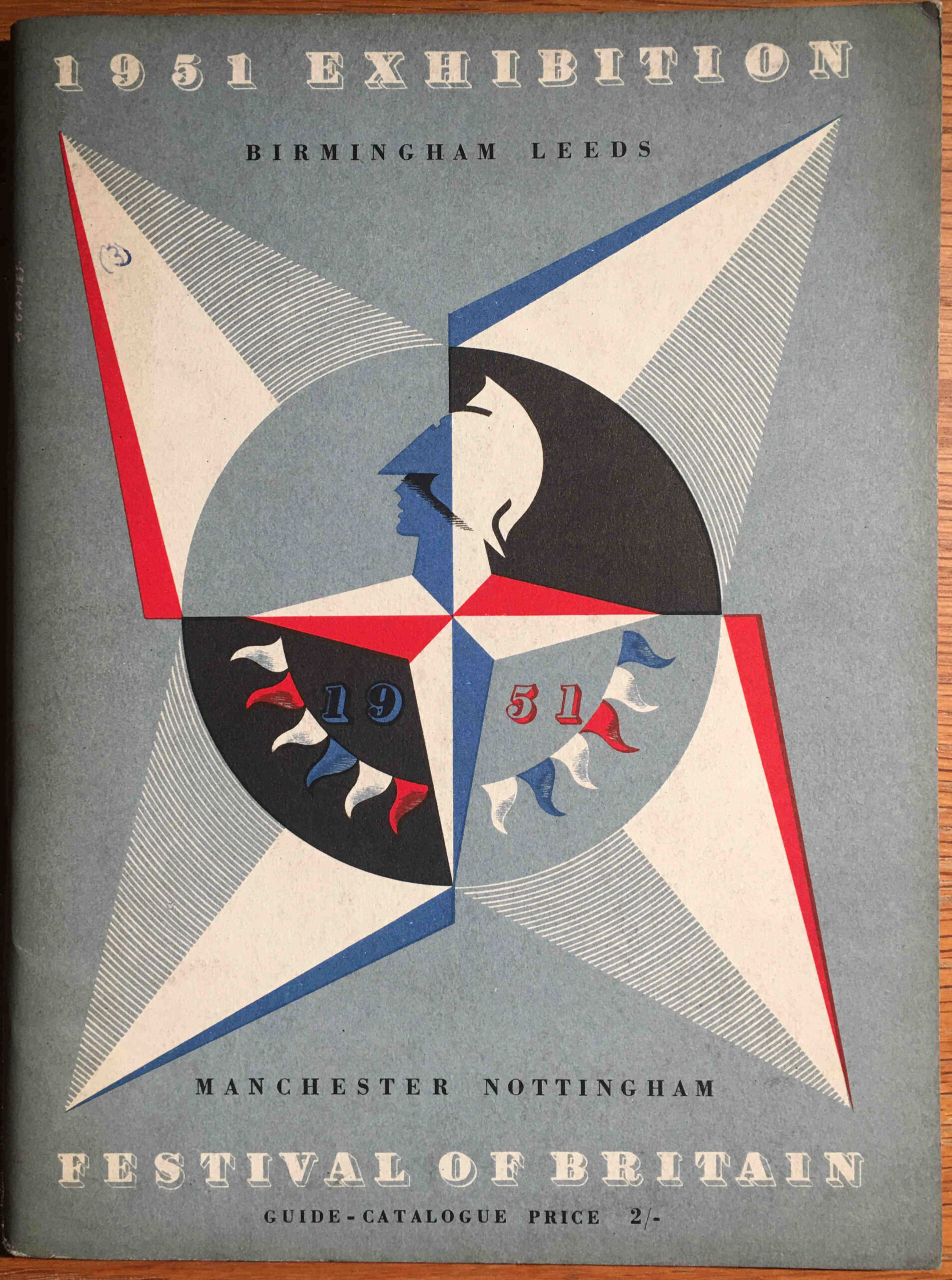
The guide book for the Festival Ship Campania has the same design features of all the festival guides, with the front covering featuring the symbol of the festival, designed by Abram Games. As with all other guides, the book is “A Guide To The Story It Tells”, and was written by Ian Cox, the Festival’s Director of Science and Technology, who was from the Ministry of Information:

Festival of Britain ship Campania and the Atomic Bomb

The displays on the Campania were a mini version of the South Bank site, with main exhibition themes of The Land of Britain, Discovery and The People at Home.

The exhibits and displays were spread over three decks of the ship, and the benefit of the Campania was that it had a large hanger deck and flight deck which were used for displays.

The guide book included a diagram of the ship showing the three decks, the subjects of each display area, and a recommended way around the exhibition:

Festival Ship Campania

As with the other exhibition locations, the Campania was fitted out with a restaurant, bar and café to enhance the overall visitor experience.

The side of the ship was decorated with the Abram Games festival sumbol and the words Festival of Britain. Coloured flags decorated the flight deck, as shown in this illustration from the guide book:

Festival Ship Campania and the Atomic Bomb

The Campania toured the coast of the country for the same period of time as the main festival on the South Bank, starting at Southampton in early May and ending at Glasgow in the first week of October, soon after the South Bank site closed. The following table from the guide shows the ports of call, and the duration of each visit:

Festival Ship Campania itinerary

There were very many school trips to the ship, some of which included the organisation of special trains, as for example, from the New Milton Advertiser on the 19th of May 1951:

“Between 600 and 700 Brockenhurst County High School pupils went to Southampton by special train on Friday in last week to visit the Festival Ship Campania. A section of the party also cruised round Southampton Docks in a specially chartered vessel.”

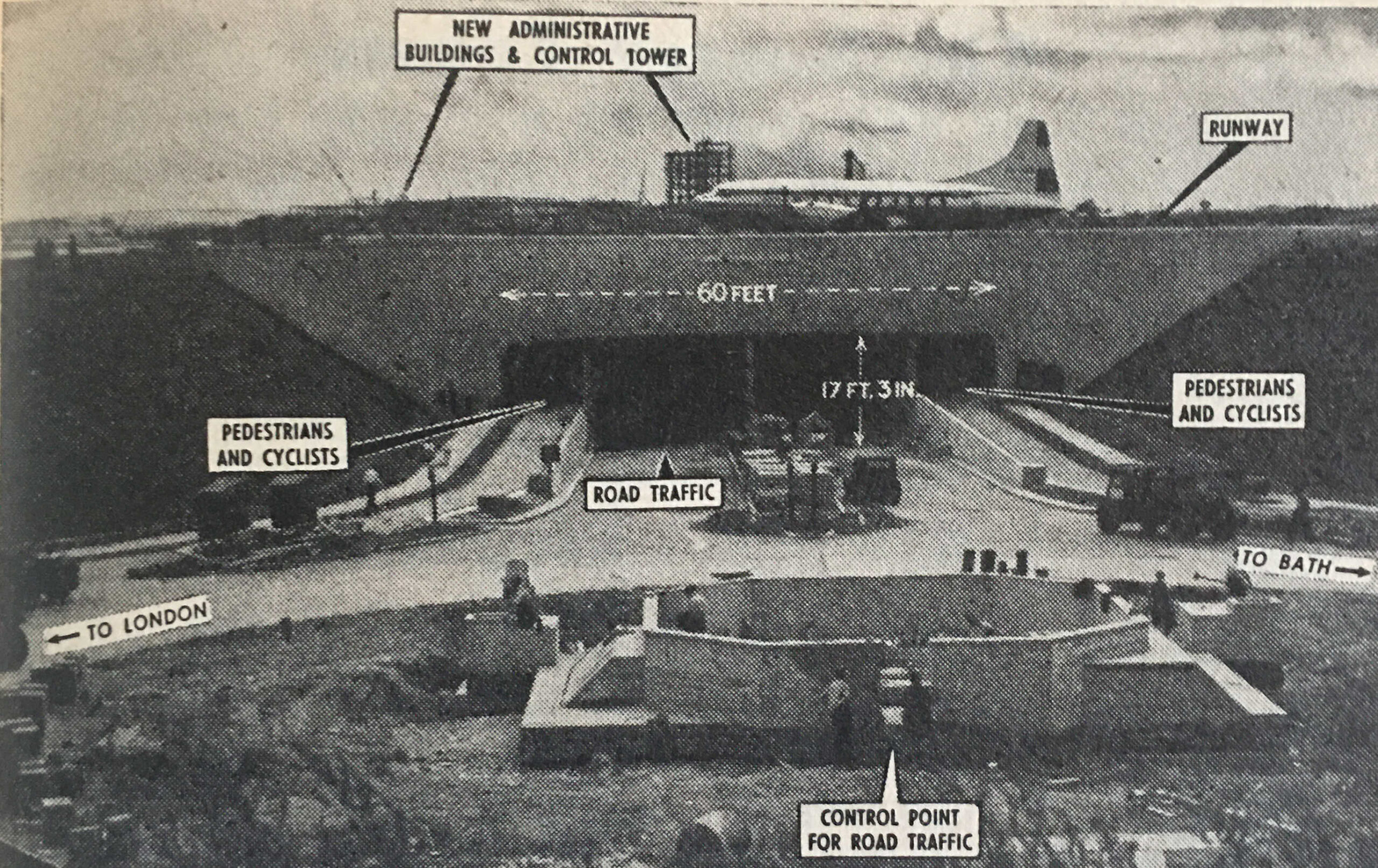
The Liverpool Echo reported on the visit of the ship to the city, and included some highlights of what could be seen onboard, including models of an “Underground railway junction and London Airport as it will be when completed, a jet engine and a seaside pub, several full-size boats and working models of busy shipping ports”.

The article ended by stating that “This is Birkenhead’s Great Festival Show – the one you mustn’t miss”.

During the visit of the Campania to Belfast, the officers and many of the organisors and administrative staff on the ship were treated to a reception by the Northern Ireland Government, and the Belfast Newsletter reported that on the day of the reception there had been a total of 4,909 visitors to the Campania.

The popularity of the exhibition on the Campania seems to have had an impact on the experience for those on board. A visit to the ship by children of the Holy Trinity Secondary Modern School in Bradford-on-Avon, was reported in the Wiltshire Times as “The visit was somewhat marred by the terribly overcrowded conditions on the ship”.

The visit of the Campania seems to have been a great success at all the ports of call, with newspapers reporting high numbers of visitors to the exhibition, although I suspect that as well as the Festival of Britain exhibition, the opportunity to look around a large ship that had seen service in the war just six years before, must have been a major incentive.

As with all the Festival of Britain Guide Books, the book for the Festival Ship Campania had a number of adverts, many colour, and for the Campania, many of these adverts had a maritime theme, such as the advert of the Marconi company:

Marconi

One of the key themes for the festival was Britain’s industrial and scientific strengths, and how these would contribute to the future of the country.

I doubt anyone in 1951 could foresee the industrial decline of the country over the next 50 years when almost every company featured in the adverts across all the festival guides would disappear, with the majority being taken over by foreign competitors.

The Marconi company featured in the above advert went through several changes of ownership, and became part of GEC, which sold some of the business to BAE. GEC renamed itself as Marconi during the so-called dot com bubble, buying a number of US networking companies at very high prices.

Losses became significant, parts of the firm were sold, shares were suspended and Marconi as a business folded in 2006. A small part of the once sprawling empire remains as Telent.

British Thomson-Houston was part of the gradual consolidation of British industry, eventually being owned by GEC:

Atomic Bomb

The South American Saint Line was a Cardiff base shipping company that operated cargo routes between Dover and European ports, and Cardiff and South American ports, for example taking coal to Argentina and returning with a cargo of grain. The business was closed in the early 1960s, with routes and ships being sold to other shipping companies.

South American Saint Line

Even if a company had no maritime connections, they tried to include an appropriate reference in their advert:

Atomic Bomb

British Aluminum was taken over by US and Canadian companies, and all UK based operations seem to have closed in the early 2000’s:

British Aluminium

The discovery referenced in the following advert for the British Oxygen Company was made by two French brothers, Arthur and Leon Brin who founded Brin’s Oxygen Company, soon after renamed as the British Oxygen Company, which was taken over by the German company Linde in 2006:

British Oxygen

And finally, I doubt that the companies behind the Shipbuilding Conference who issued the following advert, could have expected the British ship building industry to be at such as reduced state some 70 years later:

British Shipbuilding

The Festival of Britain tried to mix industrial strength, leading edge science and design, with a rather romantic view of the country’s culture, history and relationship between the people and the land.

One of the Theme Conveners for the exhibitions on the Campania was Jacquetta Hawkes, a British archeologist and writer. who in the same year as the festival, published probably her best known book “A Land”. A really difficult book to classify, it has been described as a deep time dream of the country’s archaeology. There is a good review of the book here. It is a fascinating read, and although we cannot visit the Festival of Britain today, it is a sort of published form of the “Land” parts of the festival.

Back to the Campania, and during the Second World War, the ship was used to ferry aircraft and many other supplies and equipment to Russia, who were fighting the German’s in the east. Aircraft on the ship were also used to defend the convoys, with a U-Boat being sunk in 1944.

View of the Campania at sea:

HMS Campania
BRITISH CONVOY TO RUSSIA. 1945, ON BOARD THE BRITISH ESCORT CARRIER HMS CAMPANIA DURING A CONVOY TO RUSSIA WHEN BITTER ARCTIC WEATHER WAS EXPERIENCED. (A 28222) Air view of the CAMPANIA. Copyright: © IWM. Original Source: http://www.iwm.org.uk/collections/item/object/205016175

The route taken by these convoys was around the northern edge of Norway and Finland to reach Arkhangelsk in Russia. Conditions were appalling. There was the constant threat of attack from German aircraft, ships and submarines as well as dreadful weather conditions, as shown in the following two photos of the Campania during a convoy:

HMS Campania Artic Convoy
BRITISH CONVOY TO RUSSIA. 1945, ON BOARD THE BRITISH ESCORT CARRIER HMS CAMPANIA DURING A CONVOY TO RUSSIA WHEN BITTER ARCTIC WEATHER WAS EXPERIENCED. (A 28225) A Wildcat being ranged on CAMPANIA’s flight deck in Arctic conditions. Copyright: © IWM. Original Source: http://www.iwm.org.uk/collections/item/object/205159605

When decks would be covered in thick snow and ice – very different to the open air café on the deck during the festival:

HMS Campania Artic Convoy
BRITISH CONVOY TO RUSSIA. 1945, ON BOARD THE BRITISH ESCORT CARRIER HMS CAMPANIA DURING A CONVOY TO RUSSIA WHEN BITTER ARCTIC WEATHER WAS EXPERIENCED. (A 28228) Keeping the CAMPANIA’s flight deck clear of snow. Copyright: © IWM. Original Source: http://www.iwm.org.uk/collections/item/object/205159608

After the end of the Second World War, the Campania was decommissioned. Many ships which had served a temporary purpose during the war were sold or scrapped, however the Campania was put on the reserve list, and was therefore available for the Festival of Britain.

After the festival, the ship returned to the navy, which brings us to the second part of the title of the post:

Operation Hurricane and the Atomic Bomb

During the Second World War, Britain had a nuclear weapons project underway, as did the Americans. The cost, complexity and need for a rapid solution in the development of such a weapon resulted in the US, UK and Canada working together on what became known as the Manhattan Project, with the partnership being formalised by the Quebec agreement of 1943.

Under this agreement, British scientists worked with the Americans in the development of the atomic bomb, and shared the UK’s work up to that point.

After the war, the US ceased all cooperation with the British, and did not share any of the development work that led to the bomb produced by the Manhattan Project.

This was mainly down to the perceived risk of sharing such knowledge, and that the Quebec agreement gave the British a veto in the use of atomic weapons.

In 1949 the Russians tested their first atomic bomb, and in 1950 the German physicist Klaus Fuchs, who had fled from the Nazi’s, and was part of Britain’s early research into the atomic bomb, and then the Manhattan project, was found to have shared secrets with the Russians.

He was sentenced in a British court and imprisoned, however the US viewed this as a further risk of working with the British and ended any remaining cooperation, including the use of US test sites.

So the US and Russia had the atomic bomb, and in the late 1940s, the UK still believed that it had a “Great Power” status, and having atomic weapons was essential in maintaining that status.

In 1947, the Labour Prime Minister, Clement Attlee, approved the creation of the High Explosive Research Project, which would be responsible for the development of a British designed and built atomic bomb.

As well as developing the bomb, a site was needed to test. The US had refused access to their testing grounds, so a search was underway for a suitable site, which finally settled on the remote Montebello Islands off the west cost of Australia. The location of the islands is shown by the red circle in the following map ( © OpenStreetMap contributors):

Atomic Bomb Montebello Islands

Operation Hurricane was the name given to the first test of Britain’s atomic bomb, and when it had been built, a fleet was assembled with Campania given the role of Flag Ship, sailing from Portsmouth where the ship had been equipped for the role, to the western Australian test site..

The 25 kiloton bomb was to be exploded on board a redundant British frigate called HMS Plym. It was placed in the hold, below the water line as one of the intentions was not just to test the performance of the bomb, but also the impact of an atomic bomb being smuggled onboard a ship into a British harbour.

The location of the Plym, and the bomb’s detonation within the Montebello Islands group is shown by the red dot in the following map ( © OpenStreetMap contributors):

Atomic Bomb Montebello Islands

The bomb was exploded just before eight in the morning (local time), on the 3rd of October, 1952. Exactly a year before, the Campania was moored at Glasgow in the last few days of its role as the Festival Ship.

There is far too much on the story of Operation Hurricane than I can include in a weekly post. For lots more detail, the Ministry of Supply produced a film showing the full story from the development of the bomb, through to the test and explosion. This film is on the Imperial Museum website, and is in three parts.

The first part covers the development of the bomb, and also includes the departure of the Campania from Portsmouth. The second part covers preparations, and the third and final part covers the final preparation of the bomb, the explosion and the testing carried out after the explosion.

All three parts to the film can be found at this link.

The film shows not just the devastating impact of an atomic bomb, but also the very rudimentary safety precautions – if you could call them that – for those who participated in the test.

HMS Plym, the ship on which the bomb had exploded had been vapourised, with only a few small fragments of radioactive metal to be found. A large crater was left on the seabed below where the ship had been located.

A wide range of samples were taken from sea water and the land of the islands. Structures had been built on the islands to see how these would have withstood the blast from an atomic bomb, and the impact on these was measured and photographed.

Churchill, who by the time of the test had been re-elected, declared in the House of Commons that the test had been a success and lived up to expectations.

Those who had been involved in the test and witnessed the explosion were sworn to secrecy, as this newspaper report from the 16th of December 1952, when the Campania returned back to Portsmouth explains:

Atom sailors home with censored story – Five hundred and seventy officers and men of Britain’s atom ship, H.M.S. Campania, back in Portsmouth yesterday from the Pacific, have been put on their honour. And it means that for once Jack Tar cannot talk about his sea travels.

For he knows what happened when Britain’s atom bomb exploded off the Monte Bello Islands; he knows what effect it had on vegetation and test shelters, and some of his colleagues from the vaporised ship, H.M.S. Plym, know what it looks like. He must not say a word.

Before the first of the Campania’s crew went ashore last night they were reminded: ‘Tell them your impressions of the explosion and nothing more. keep to what Dr. Penney said on the B.B.C. and Mr. Churchill in the House. Your are on your honour’.

To make sure these security instructions were fully understood the ship’s company were lectured on board by Rear Admiral A.D. Torlesse, in charge of Operation Hurricane, officials of the Supply Ministry and Dr. William Penny.

Copies of the Admiral’s Speech and Mr. Churchill’s statement in Parliament, were posted on the ship’s notice boards and each man was given a copy.”

In the final part of the Ministry of Supply film on the IWM website, there are some scenes showing a helicopter taking samples of water, and dropping them into a box on the ship.

This was also reported in the press with the rather dramatic headline of “They Got Half Pint Of Death Water“:

“The two men with the most dangerous job of the atom test – they flew a helicopter over the danger spot to get a sample of deadly radioactive water – were Lt. Comdr. Denis Stanley of Thruxton, Hampshire, and Commissioned Observer H.J. Lambert of Carnoustie.

To them it was ‘just another flight’ but that routine flight meant going to within 30 feet of radio-active water only two hours after the explosion.

While Stanley piloted the plane, Lambert was checking the Geiger counter and other instruments. He was watching for a danger point when the flickering dials would indicate that they would have to turn back.

Beneath the aircraft was a canister, like a half-pint milk bottle, said Lambert, suspended 20 feet below by a piece of string. We flew slowly, said Stanley, so as not to spill any of the water. The canister was supposed to be unspillable, but we took no chances.

Said Lambert: We had practised for six weeks lowering a small canister into a box. What happened to the water? we never saw it again. The boffins took it, I suppose.”

After the success of the test, the bomb was developed into the Blue Danube bomb that was Britain’s first operational atomic weapon and for which the V-bomber aircraft were designed and built.

The bomb tested in 1951 had a yield slightly higher than the bombs dropped on Japan at the end of the Second World War.

Not long after the British tests, the US tested a Hydrogen bomb, which had a yield of some hundreds of time greater than the British design, so in many ways, the British bomb was redundant soon after the test.

The wider impact on those who participated in Operation Hurricane are outside the scope of today’s post, however there is a really good summary in a Daily Mirror investigation, which you can find here.

The Montebello Islands are now part of a Marine Conservation Reserve, and radiation levels have reduced to a point where the islands are now open to visitors.

So that is the connection between the Festival of Britain, and the test of Britain’s first atomic bomb. The Festival Ship Campania, carried an exhibition around the ports of the country, showing the history of the country, British contribution to science and technology, British industry, design and culture.

A year later, the same ship was a witness to the atomic bomb, a threat that would come to define much of the final half of the 20th century during the Cold War, and which rather frighteningly seems to have returned with current world politics and wars.

HMS Campania was decommissioned in December 1952 after returning from Australia. Three years later in 1955 the ship was sold and scrapped.

You may also wish to read:

And my posts on the Festival of Britain:

alondoninheritance.com

Bethlehem Hospital, Life Assurance, a Botanist, Church and City Inn

This Sunday, I am continuing with my search for all the plaques commemorating events, people and places in the City of London. The plaques that have been the subject of previous posts can be found on the map at this link.

A mix of very different subjects this week, starting with:

Bethlehem Hospital

On the wall of the old Great Eastern Hotel on Liverpool Street, where the station is also located, is the following plaque marking the site of the first Bethlehem Hospital:

The Bethlehem Hospital (also know as Bethlem or Bedlam) was founded in 1247 when a Sheriff of London, Simon FitzMary donated a parcel of land to the Bishop of Bethlehem.

On this land was founded the Priory of St Mary of Bethlehem. As well as being a religious establishment, the priory also cared for the poor who were sick.

The hospital occupied a space of around 2 acres where Liverpool Street Station now stands. The Historic England record for the hospital states that it was “centred around a courtyard with a chapel in the middle, it had approximately 12 ‘cells’ for patients, a kitchen, staff accommodation and an exercise yard.”

The hospital was taken over by the City of London in 1346, and later in the 14th century and early 15th century, it seems to have gradually changed from being a hospital for the poor, to a hospital that treated “lunatics” – not that any realistic treatment was available.

The term lunatic was a catchall for anyone who had any form of mental illness, and the term would continue to be in use for centuries to come. As an example, in a previous post where I looked at 18th century Bills of Mortality, there were frequent deaths due to “lunatic”, and you were automatically assumed to have this condition if you committed suicide, for example with the following record from January 1716 “Hanged himself (being Lunatick) at St. Olaves Southwark”.

Conditions were harsh at Bethlehem Hospital, and it seems to have been more a place to keep people off the streets rather then to provide treatment, with those in the hospital frequently being restrained and chained.

By the middle of the 17th century, the site was considered too small, run down, and in a very crowded area, so in 1676 the Bethlehem Hospital moved to Moorfields.

The following image uses embedded code, not sure if it will display in the emails. If not, go to the home page of the website.

The image shows “Construction work in the extension to Liverpool Street Station by the Great Eastern Railway, 1894 on the foundations of the first Bethlem Hospital. © Historic England BL12561B”:

The following photo shows the plaque on the side of the building with the street Liverpool Street on the left:

The plaque is a reminder of the harsh treatment of people with conditions of which there was no understanding at the time.

Parsonage of St. Nicholas Acons

In Nicholas Lane in the City of London is a plaque recording that Scientific Life Assurance began at the site in 1762.

Assurance is cover for something that will happen, whilst insurance is for something that may happen, and with life assurance, a payout is inevitable, as along with taxes, the only other certainty in life is death.

However the problem with life assurance is being able to calculate the profile of death in the population being covered. Basically, for how long will people be paying their premiums and when will payout be expected after their death.

Unless this could be fully understood, those offering life assurance ran the risk of making it so expensive that no one would buy the cover, or too cheap and the business running at a loss.

The first company to use a statistical approach to calculating life assurance premiums and payouts was the Society for Equitable Assurances on Lives and Survivorships, which was established in the parsonage of St. Nicholas Acons in 1762.

Work on a statistical approach to mortality had been underway before 1762, with Edmund Halley (after whom the comet is named), having created mortality tables in 1693. A mortality table is basically a table of ages, and for each age a probability is given of death before the next birthday, so for someone aged 45, it would show the probability that they would die before their 46th birthday.

The mathematician James Dodson took Halley’s work further, and although he had died before the founding of the Society for Equitable Assurances on Lives and Survivorships, the society took his work as the basis for their calculations of premiums and payments.

Edward Rowe Mores was instrumental in the use of Dodson’s work, and he was one of the group that founded the company. Mores was a typical 18th century scholar, as his interests ranged from mathematics, typography, history and statistics.

In establishing the company it was Mores who first used the term “actuary” for the person responsible for making the calculations of mortality, premiums and payouts.

The plaque can be seen on the wall in Nicholas Lane, near to Nicholas Passage:

The Society for Equitable Assurances on Lives and Survivorships was known for trying to be fair to its customers, and allocated some of their financial surplus back to their policy holders. The following from the London Evening Standard on the 6th of December, 1851 illustrates their approach:

“Society for Equitable Assurances on Lives and Survivorships, New Bridge-Street, Blackfriars. Instituted 1762.

At the end of every ten years two-thirds of the Surplus Funds of the Society are appropriated to the oldest 5000 Policies, and one-third is reserved as an accumulating fund.

At the last investigation – on the 31st December, 1849 – the Capital of the Society exceeded Eight Millions Sterling, invested in Three per Cents and on Mortgages.

The surplus amounted to £3,215,000, of which £2,113,000 were appropriated to the oldest 5000 Policies, and the remaining £1,102,000 were added to the reserves.”

The Society for Equitable Assurances on Lives and Survivorships eventually became Equitable Life, and the plaque records where the use of statistics were used in financial services, and where the profession of actuary was formalised.

I wrote about Bills of Mortality, and an earlier work by John Gaunt, published in 1676, who took an earlier statistical approach to mortality in my post Bills of Mortality – Death in early 18th Century London.

William Curtis, Botanist. Gracechurch Street

In Gracechurch Street there is a plaque recording that the botanist William Curtis lived in a house at the site of the plaque:

It is low down on the wall of a building at the southern end of Gracechurch Street, as can be seen at the bottom left of the following photo:

William Curtis was a Quaker, who was born in the town of Alton in Hampshire in 1746. He appears to have had an interest in the study of plants and insects from an early age, and after arriving in London he had a position as a Demonstrator of Botany at the Chelsea Physic Garden (see this post for my visit to the Chelsea garden).

Such was his success that he opened his own garden, the London Botanic Garden in Lambeth, where he is reported to have grown and exhibited in the order of 6,000 plants.

The 18th century was a time when plant collectors were bringing back specimens from across the world. Collectors such as Joseph Banks, who would become President of the Royal Society encouraged the activity.

This influx of foreign specimens did concern William Curtis though, who was worried that they would take over from indigenous species. This led him to publish a set of books that would make his name.

The six volume set was called Flora Londinensis, which had the following full title:

“Flora Londinensis, or, Plates and descriptions of such plants as grow wild in the environs of London : with their places of growth, and times of flowering, their several names according to Linnæus and other authors : with a particular description of each plant in Latin and English : to which are added, their several uses in medicine, agriculture, rural œconomy and other arts.”

The six volumes, published during the last quarter of the 18th century aimed to record all the plants to found within an area of roughly ten miles around London. Each plant was described and illustrated, such as the following example:

The above image is from the Biodiversity heritage Library, where the books are available for download and marked as “not in copyright”.

After publishing Flora Londinensis, William Curtis went on to publish The Botanical Magazine, which contained illustrations and descriptions of various plant species along with other botanical articles.

The magazine continued after his death in 1799 and is still published today by the Royal Botanic Gardens in Kew, as Curtis’s Botanical Magazine, and it is believed to be the oldest botanical magazine in the world, still in publication.

William Curtis:

His magazine made him very financially successful, and along with Flora Londinensis, and his work in London’s gardens, his place was secured in 18th century botanical history, and he is now remembered by the plaque in Gracechurch Street.

St. Dionis Backchurch

In Lime Street, there is a plaque recording the site of St. Dionis Backchurch:

St Dionis was Dionysus the Areopagite, who was a judge in Athens during the first century AD. He converted to Christianity and was said to have been a follower of St. Paul.

He is the patron saint of France, where he is also known as St. Denis, as a result of having converted the French to Christianity.

In the 1870s there were proposals for the demolition of a number of City churches. The local population was insufficient to justify so many churches, and the aim was to consolidate parishes and congregations.

Newspapers had lengthy articles about some of the churches, and the City Press on Saturday the 16th of September, 1871 had a full column on the history of St. Dionis Backchurch. The following is from the beginning of the article and provides an overview of its history:

“This parish is first mentioned in the records of the Corporation, Letter-book H, folio 105. John Fromond, in 1379, being charged before John Philpot, Lord Mayor, for stealing the dagger or knife called a ‘baselard’ from his girdle, for which charge, it being proven, he, the said John Fromond was adjudged the punishment of the pillory, and then to be banished from the City.

The foundation of the church is of great antiquity; Reginald de Standen was rector in 1283; he was succeeded by Richard Grimston in 1350. The church was newly built early in the reign of Henry VI., 1427-30, John Derby, Alderman, added a fair isle or chapel on the north side, in which he was buried in 1466. Lady Wych, widow of Sir Hugh Wych, who was Mayor of London in 1461, gave some other benefactions; John Bugg also contributed to the new work of restoration. The structure falling into decay, it was partially rebuilt in 1628 – 32, the middle isle of the same being laid in 1628 and a new turret and steeple were added in 1630, and in 1632 new frames were made for the bells. The church was destroyed in the Great Fire of 1666.

It was rebuilt, all but the tower, from the designs of Sir Chistopher Wren, and was finished in 1674; and about ten years afterwards it was found necessary to rebuild the tower, which was done under the direction of the great architect. The building consists of a nave and two aisles formed by Ionic columns, which support the entablature; and arched ceiling in which, under groined openings, small circular lights are introduced on either side. the length of the church is 66 feet, and the breadth about 70 feet; the tower is 90 feet high. At the west end is situated the organ gallery.”

The later half of the 19th century was a time of great change in the City of London. The City was growing rapidly in terms of global influence, trade and finance. Victorian architects wanted to build a City that reflected this, and in 1877 the Society for the Protection of Ancient Buildings was founded by William Morris to try and preserve many of the buildings at risk, including the church of St. Dionis Backchurch, however in their second annual meeting in 1878, they reported that:

“Amongst the objects the Committee had taken in hand was the preservation of the City churches, and in this respect they were able, to a certain extent, to report favourably, for, although St, Dionis Backchurch had been demolished, the interesting church of St. Mary-at-Hill, Eastcheap, has been saved, in spite of strenuous opposition.”

I wrote about the church of St. Mary-at-Hill in this post. Incredible to think that the church could have been demolished.

The following print of the church, dating from 1813, provides some detail as to the origin of “Backchurch” in the name as “given to distinguish this church as standing behind a row of houses from that of St. Gabriel’s, which previous to the fire of London, stood in the middle of Fenchurch Street” ( © The Trustees of the British Museum):

I wrote about the church of St. Gabriel Fenchurch, in this post. The description of the origins of the name again illustrates how many City churches they were, and how close together.

The plaque can be seen on the wall on the left, in Lime Street, a short distance north of the junction with Fenchurch Street:

As well as the plaque, in the above photo you can see one of the Lime hire bikes across the walkway. This was not how the bike was originally left, and it is interesting how much anger these seem to generate.

I have seen them left in some ridiculous places, blocking pavements, in the middle of the road etc. however whilst I was photographing the plaque, a cyclist arrived at the cycle stand. Saw the Lime bike in the rack, threw it angrily (along with some choice language) out onto the pavement (narrowly missing a pedestrian), putting his own bike in its place, and walking off.

All rather strange.

Crosskey’s Inn

In Gracechurch Street, at the entrance to Bell Inn Yard, is a plaque recording the location of the Crosskeys Inn:

In the 16th century City of London, there were four main locations where plays were performed. These were the Bell Savage off Ludgate Hill, the Bell at Bell Inn Yard (the location of the above plaque), the Bull off Bishopsgate Street, and the Crosskeys Inn.

Inn’s were perfect locations for the performance of plays. They frequently had a large yard which was normally used for the arrival and departure of coaches and wagons, but could also provide the space for actors and an audience.

They were places were people could congregate, and the Inns benefited from the sale of food and drink before, during and after a performance.

There has been some research that suggests that the Crosskeys were one of the few locations that put on plays inside rather than in the yard, however this is difficult to confirm.

Actors of the time were frequently grouped in a company that was financed by a wealthy sponsor, and the company took on the name of sponsor.

At the Crosskeys Inn, Lord Strange’s Men performed in 1589, when William Shakespeare may have been with the company. Lord Strange was Ferdinando Stanley, the 5th Earl of Derby, and after Stanley’s father died, and he became the Earl of Derby, they became known as the Earl of Derby’s Men.

The Lord Chamberlain’s Men are also believed to have played at the Crosskeys Inn in 1594.

The use of these inns for performances seems to have ended around 1593 and 1594, when they were banned following an appeal by the Lord Mayor to the Privy Council. This is believed to have been due to an increase in the plaque, and they moved out of the City to the Theatre in Shoreditch and the Globe on the south bank of the river. 

It may also have been due to the rowdy behaviour that sometimes accompanied a play, which the City may well not have appreciated within their boundaries.

The Crosskeys Inn continued in use during the 17th century, until it was destroyed during the Great Fire of 1666.

What is confusing is why the plaque to the Crosskeys Inn is at the entrance to Bell Inn Yard.

Morgan’s map of London from 1682 shows the location of the inn (the inn was rebuilt after the fire).

In the following map, the red circle is around the location of the Crosskeys Inn and the yellow circle around Bell Yard:

The key to Morgan’s map includes the number and location:

I have checked a number of maps, and tried to accurately align them along Gracechurch Street, and as far as I can tell, the Crosskeys Inn was located along the current Bell Inn Yard, and Bell Yard was just a bit further north and has been lost under the larger buildings that now line the west of the street.

The Crosskeys Inn was rebuilt after the Great Fire, and continued as one of the City’s busy coaching Inns. The name appears on Rocque’s map of 1746, and there are numerous newspaper reports referencing the inn.

It appears to have closed in 1850 and been demolished soon after. There is a newspaper report in the Illustrated London news on the 24th of May 1851, which referring to Gracechurch Street states:

“On the west side of that thoroughfare, and on the site of the old Cross Keys, an Inn from which the licence was withdrawn some twelve months ago”.

The newspaper report was about the collapse of a building which was under construction and covered a wide area along Gracechurch Street, including the site of the Crosskeys Inn.

The building using a frame of iron girders, collapsed when one of the girders snapped. There were around 80 workmen on the building, with many injured and 3 deaths.

So the plaque refers to the version of the Crosskeys that was part used for putting on plays in the later part of the 16th century. The inn was rebuilt and continued in use as a coaching inn to the mid 19th century.

The name Crosskeys comes from the arms of the papacy, where the crossed keys are St. Peter’s keys, and the keys to heaven.

Attribution: Coat of arms of the Holy See, Public domain, via Wikimedia Commons

And there is now a Wetherspoons on this part of Gracechurch Street called the Crosse Keys. It is in the former premises of the Hong Kong & Shanghai Banking Corporation, which was designed by W. Campbell Jones and dates from 1913.

It has a rather splendid interior and is well worth a look.

That is about 25 of the roughly 170 plaques within the City of London covered, so still a number to go.

alondoninheritance.com

Redchurch Street and the Dolphin Pub

If you would like to come on my Limehouse walk, I have just had a couple of tickets come available. Two tickets on Saturday 19th of August, and one ticket on Sunday 20th of August. All other walks are fully booked.

I was unsure about using this 1980s photo as the subject of a blog post, as there did not seem anything of specific interest in the view. The photo was taken at the junction of Bethnal Green Road (not visible, but to the left) and Redchurch Street, the street on the right:

Redchurch Street

I assume the two old columns were the reason my father took the photos. Rather than lighting columns, I believe these are ventilation columns for the toilets below ground:

Redchurch Street

The following photo is looking over to the location of the toilets, some forty years later in 2023. The toilets have gone, one of the columns remains, and a rather strange building now stands over the site of the toilets.

Redchurch Street

The column appears to be the one that was at the rear of the original photos, and has been relocated to the corner of the junction.

Bethnal Green Road is to the left and Redchurch Street is to the right.

Taking a look inside the building over the site of the toilets, and if you look at the far end to the right, it is hard to see, but there is a descent down to below ground level, a handrail on the left and a sloping ceiling. This was presumably the stairs down to the toilet area below.

Redchurch Street

And to the side of the building are the glass tiles which cover much of the area in the 1980s photos, and originally provided light to the space below, which I assume they still do.

Redchurch Street

The toilets in the 1980s photo were typical of the underground toilets found at many locations across London. They were built around the end of the 19th and start of the 20th centuries and were part of the late Victorian drive to improve the city.

They have now nearly all closed. The demands on local authority budgets have meant that facilities such as these, which are not part of their legal responsibilities to provide, were among the first to go.

The one exception is the City of London, and although they have closed their old toilets, they have at least installed new facilities, or included them as a requirement of planning permission for new developments.

Many of these you have to pay to use, however the City does have a number of free to use toilets tucked away in places such as their car parks under London Wall, or at the Minories.

I have been photographing the above ground remnants of these rather enlightened improvements to the City, so perhaps a subject for a future post.

And that was as far as I thought I could go with the two 1980s photos, but as usual with any London scene, there is always something else to discover and learn, and so it is with these photos.

If you look along the street on the right in the first photo at the top of the post, there is a pub sign, with the ground floor of the pub just visible. This was the Dolphin pub, and I have enlarged the section showing the pub sign below:

Dolphin Pub

The Dolphin closed in 2002, and the ground floor is now occupied by a Labour And Wait store, with the floors above presumably being used as residential.

The old pub as it appears in 2023:

Dolphin Pub

There is not that much to discover about the Dolphin. It did not feature in many news reports, or place any adverts as to the excellence of their beers which was typical practice for most London pubs.

The one newsworthy event seems to have been a robbery in 1929, when a Henry Bently, 39, of Scalater Street in Bethnal Green, leant over the bar to take four £1 notes from the till. He was pursued by the landlord, he escaped, but later came forward as he appears to have been a regular at the pub, and therefore well known.

The interesting thing about the 1929 article was that the address was given as Church Street, rather than Redchurch Street as the street is now know, so I started to look at some maps.

Firstly, the map of the area today, and in the following extract, the dark blue circle is around the space where the toilets were located, and you can see the main road of Bethnal Green Road heading south west, at this junction, with Redchurch Street turning off from Bethnal Green Road. The old Dolphin pub is marked by the red circle ( © OpenStreetMap contributors).

Redchurch Street

Looking at some older maps, starting with Smith’s New Plan of London from 1816, and I have again marked the location of the toilets with a blue circle, and Redchurch Street, then called Church Street is surrounded by the red oval:

Church Street

Look to the north of Church Street and you will see a dense area of streets and buildings, which looks different to the streets in the wider area.

Some of the street names should provide a clue as to the name and reputation of the area as this was the Old Nichol, a notorious area of densely populated streets and courts which was inhabited by some of the poorest people in east london.

The streets and buildings of the old Nichol were demolished in the 1890s and the Boundary Estate, which was built on the site, was opened in 1900. Newspaper reports of the opening described the old and new estates as follows:

“One most interesting feature of the Boundary Street Estate is that it has been built on the site of one of the most notorious slum districts in London. This was known as the ‘Old Nichol’, and is described minutely under the title of ‘The Jago’ by Mr. Arthur Morrison’s story ‘A Child of the Jago’.

A population of 6,004 persons were displaced under the Council’s scheme, and the slum clearance revealed a pitiful state of things. In two common lodging houses, 163 people were found to be living. 2,118 people were living in 752 single rooms, and 2,265 in 506 two-roomed tenements. The inhabitants consisted of the poorest classes of unskilled labourers, and in addition to large numbers of button makers, box-makers, charwomen, worker-women and so-called ‘dealers’, included some of the vilest characters in London.

In one small street alone there lived no fewer than twenty ticket-of-leave men. (see below for explanation) These people were transferred to other districts. Of the inhabitants of the ‘Old Nichol’, those who are new tenants on the Boundary Street Estate can be numbered on the fingers of one hand. The present occupants of the dwellings are mainly of the better classes, policemen, postmen, commissionaires, together with a few clergymen, schoolmasters, and Church workers”.

A ticket-of-leave man was a person who had been released from prison on parole, and the ticket-of-leave was the document handed to the person, documenting their status on parole.

The Boundary Estate was opened by the Prince of Wales in March 1900, and we can jump forward to the 1948 revision of the OS map to see the new estate, with the central circular feature of Arnold Circus, with new streets radiating out from the circus (‘Reproduced with the permission of the National Library of Scotland“).

Boundary Estate

In the above map, I have again marked the location of the toilets by the blue circle, and the Dolphin pub by the red circle.

So far, so good, I then went to the 1898 revision of the OS map, which resulted in a bit of a mystery (‘Reproduced with the permission of the National Library of Scotland“).

Old Nichol

In the above map, I have marked the location of the toilets with the blue circle, however to the left, the entire area north of Redchurch Street is shown as blank space, presumably the area demolished ready for the construction of the Boundary Estate.

The strange thing is that the Boundary Estate does not reach all the way down to Redchurch Street, and the Dolphin on the north side of the street had been built a few decades before the above map, and was still in use during the 1890s.

I checked the 1895 edition of the Post Office Directory, and it lists the Dolphin at number 85, along with a full range of businesses along the northern side of the street, including James Julier Fried Fish Shop at number 19, William Padley’s Dining Rooms at number 29, Nathan Bloom, Cabinet Maker at number 53 and Joseph Barker, Undertaker at number 71.

So the northern side of Church Street in 1895 had a full range of businesses, however in the OS map of three years later, the northern side of the street has disappeared, and is the lower boundary of the Old Nichol, that was in the process of being rebuilt as the Boundary Estate.

There were three years between the Post Office Directory and the OS map, and the streets on the northern side could have been demolished in those three years, however the Dolphin demonstrates this probably did not happen, and looking at the 1948 revision of the map shown above, the northern side of Church Street has the same layout of buildings as could be expected from the 1895 directory. It is very clearly not part of the Boundary Estate.

There is another PH for public house on the 1898 map on the north side of Church Street. This was the Black Dog pub, which although long closed, the original building can still be seen.

Whether the OS map shows a more extended area originally planned for rebuild, which was reduced during the development stage, or whether it was simply an error of mapping, it is unusual to find such a significant error in OS maps.

Redchurch Street / Church Street is a very old street. It is the core of the Redchurch Street Conservation Area as defined by the London Borough of Tower Hamlets. Their conservation area document also helps confirm that the northern side of the street was not demolished as part of the Boundary Street Estate.

To illustrate the age of the street, the following is an extract from Rocque’s 1746 map of London:

Bethnal Green Road

The future Bethnal Green Road is to the right. Church Street is within the red oval, however this part of the street is now part of Bethnal Green Road, which today turns a little south, below New Cock Lane and Cock Lane (within the yellow oval), which today is Redchurch Street.

When the extension to Bethnal Green was built, New Cock Lane seems to have changed name to Church Street, and the junction in the 1980s photo is where Bethnal Green Road and the old New Cock Lane diverged.

The change of name from Church Street to Redchurch Street took place at some point in the first half of the 20th century.

It was still Church Street in 1911, where in the census, James Cooper is listed as the Licensed Victuallier of the Dolphin pub, along with his wife Mary, and his sister-in-law Emma Bass who was listed as a General Help.

In the 1921 census, the street is still Church Street, and Cornelia John Alfred was the landlord, living in the Dolphin with his wife Leah.

So the name change seems to have taken place between 1921 and the 1948 OS map.

According to the Tower Hamlets Conservation Statement, the name Redchurch Street comes from the church of St. James the Great which is strange as the church is a reasonable distance east along Bethnal Green Road. The church was the first red brick church in the area when built around 1840, and seems to have given the description of the church to the name of the street. the church closed in the 1980s and is now housing.

The story of the Old Nichol and the Boundary Estate to the north of Redchurch Street is fascinating, and has been on my very long list of subjects for a blog post, however if you would like to read more about the Old Nichol, I can thoroughly recommend “The Blackest Streets: The Life and Death of a Victorian Slum” by Sarah Wise.

alondoninheritance.com

Ratcliffe Cross Stairs

For this week’s post, I am returning to my exploration of the ancient stairs that line the River Thames. In the 1920s books Wonderful London there is the following photo of Ratcliffe Cross Stairs, described as “an ancient and much used landing place and point of departure of a ferry. There is a tradition that Sir Martin Frobisher took boat here for his ship when starting on his voyage to find the North-West Passage. Ratcliffe Cross is the old name for the thoroughfare leading to this landing stage, whence Butchers’ Row meets Broad Street, Shadwell, and Narrow Street, Limehouse”:

Ratcliffe Cross Stairs

I do not know if that is the ferry mentioned in the Wonderful London text, but it does illustrate perfectly how these stairs, and the causeway that ran from the bottom of the stairs, was used to take a boat either along the river to another set of stairs, or to a ship on the river.

The following map shows the location of Ratcliffe Cross Stairs, with the red arrow pointing to where the stairs meet the river  ( © OpenStreetMap contributors):

Ratcliffe Cross Stairs

Limehouse Basin is the area of water to the right of the map, and the dark pink road above is the Highway leading into the Limehouse Link Tunnel, with the dark pink line of Butcher Row running north.

Ratcliffe Cross Stairs leads from Narrow Street at the point where it does a sharp bend to head north to a dead end at the Highway.

In the following photo, the dark blue gates are the entrance to Ratcliffe Cross Stairs:

Ratcliffe Cross Stairs

Ratcliffe Cross Stairs are in what was the old hamlet of Ratcliffe. The name came from Redcliff as the high ground along the route of the main street that ran from the City to the east of London, parallel to the river had red sandstone exposed in the slight cliff that descended down to the marshy land along the river.

The road that ran along this higher land became known at the Ratcliffe Highway (now just the Highway), as it followed the river from the City to the hamlet.

Although now not as well known as the stairs in Wapping, Ratcliffe Cross Stairs were important and well used river stairs, and to understand why, we need to look at maps that show the area at a time when development was limited, and much of east London was still fields.

The following extract is from “A New and Correct Plan of the Cities of London and Westminster”, published by Haines and Son in 1796. Firstly, a close-up of the location of Ratcliffe Cross Stairs (underlined in red), shows the stairs were at the end of a road (Butcher Street) which led directly down to the stairs  (© The Trustees of the British Museum):

Ratcliffe Cross Stairs

Now using the same map, we can zoom out, and we can see the wider context of the location of the stairs (red oval):

Ratcliffe Cross Stairs

If we follow the route of the road that runs down to the stairs, then after running through some fields, and limited development along the road, we reach Stepney. Follow the main road through Stepney as it turns to the left, and we reach Mile End Old Town, so the road that runs directly to the stairs is the direct route from Stepney and Mile End.

Also, if we look to the left, we can see two main roads that run from the east of the City of London, which also run to Butcher Street, then down to Ratcliffe Cross Stairs.

So whilst today, the stairs are at a quiet location, where Narrow Street turns to a dead end, it was once at a key location, at the end of the main road that would have made the stairs the most direct route to the river from a wide area of east London.

Rocque’s 1746 map of London does not name the stairs, but the street leading back from the stairs is called Ratcliff Cross (centre of the map, along the Thames):

Ratcliffe Cross Stairs

The above map also shows Butcher Row leading down into Ratcliff Cross, and there is a Watch House shown at the junction between Butcher Row and where the road to Stepney is off to the right, and the road to the City on the left.

A Watch House also confirms that this was an important route between Mile End, the City and the river.

The stairs appear to have been in use in the 16th century, and were probably much older. Although I cannot find an early, verified reference to this, Ratcliffe Cross Stairs were alleged to have been used by explorers and adventurers of the later half of the 16th century, such as Sir Hugh Willoughby and Sir Martin Frobisher.

Sir Hugh Willoughby was a soldier, who took command of an expedition funded by the Muscovy Company, to find a north east passage along the northern coast of Russia, to the Far East. Willoughby, along with his crew would die in the attempt.

Sir Martin Frobisher was a sailor who made three attempts to find the north west passage to China. He survived all three expeditions, but failed to find a way through from the Atlantic to the Pacific.

I have found references to Ratcliffe Cross being used by 16th century adventurers such as Willoughby and Frobisher in a number of books on London and in a series of newspaper articles on the history of east London in the East London Observer in 1912.

There is also a plaque in the King Edward VII Memorial Park in Shadwell, next to the air vent / old pedestrian access to the Rotherhithe Tunnel:

Sir Hugh Willoughby

Just a note on spelling – the hamlet and the stairs seem to be referred to by both Ratcliff and Ratcliffe. I am using the version with an “e” at the end as this was the spelling used for the Wonderful London photo.

There are a couple of points here regarding the reference to famous adventurers leaving the stairs. They were just the boarding point where they would have got onto a smaller boat to be rowed to their ship which was either moored on the Thames, or at Deptford.

Locations along the Thames were also not the last place in the country that they would have set foot, as these expeditions frequently stopped at places such as Plymouth to take on any final provisions and to pick up and leave final messages.

There is also a question as to whether any reference to Ratcliffe Cross refers to the stairs, or to a cross.

There are multiple references to there being some form of cross near the stairs which was used as a place to receive a blessing before departing, to make proclamations, and as a place from where news could be spread.

The cross appears to have been just north of the stairs, and at some point along Butcher Row.

Again, referring back to the maps above, this would have been a good location for a cross given the convergence of roads, and the road running from Mile End, through Stepney and straight down to the stairs.

The following photo is looking north along the short stub of Narrow Street (that was Butcher Row) up to where the Highway joins the Limehouse Link Tunnel. Butcher Row continues north across the Highway.:

Narrow Street

The cross was in place in the 18th century as the poet and playwright John Dryden has one of his characters mention having heard a ballad about the Protector Somerset being sung at Ratcliffe Cross.

There are also references to the cross being lost or demolished in the 18th century, and in the early 20th century there were attempts at setting up some form of commemoration of the cross, for example from the Shoreditch Observer on the 26th of July, 1913:

“The Borough Council in January last resolved to request the London County Council to consider the question of the commemoration of the site of ‘Ratcliffe Cross’ on the ground that the spot witnessed the departure of mariners in the time of Elizabeth.”

And from the East London Observer:

“The Council are aware that the question of a suitable perpetuation of the historic ‘Ratcliffe Cross’ has been recently referred to, and in this connection we beg to report that we have under consideration a communication from Mr. C. McNaught, dated 7th, December 1912, urging that some sign, signification, or memorial thereof should be placed on the pillars of the Ratcliffe entrance to the Ratcliffe and Rotherhithe Tunnel. We think that the suggestion embodied in the forgoing communication is one which should be supported, and therefore, we recommend that the London County Council be requested to give effect to what Mr. McNaught suggests in this matter, and that Mr. McNaught be informed of the actions taken.

Councilor Maynard could not see why a memorial of Ratcliffe Cross should be put on the most modern structure of Rotherhithe Tunnel. He did not think the London County Council would agree to it.

Councilor Brennan was in favour of the memorial, pointing out that the tunnel was the nearest spot to the site of the Cross.”

The above text is interesting, as it shows the conflict between commemorating old London on the latest infrastructure, and it also implies that the cross was not right by the stairs, rather towards where the Highway junction with Butcher Row is now located, as this is close to the entrance to the Rotherhithe Tunnel.

The Mr. McNaught mentioned in the above article was Charles McNaught. He appears to have been a local historian, and wrote a series of articles in the East London Observer titled “Roundabout Old East London”.

He seems to have been rather cynical about some of the well known historians who had published books about London. In one article, he writes that “When Sir Walter Besant and his lieutenants came down to Ratcliffe a little more than a dozen years ago, they found at first that the hamlet offered little to interest or instruct.”

He also wrote that “When Sir Walter Besant ‘discovered’ this part of London”

He implies that authors such as Besant (who wrote a number of books about the history of London) came to places such as Ratcliffe, with his “lieutenants”, they did not put the effort in to discover the real history of the place, and eventually found out what the locals already knew, whilst claiming to “discover” the place.

So we have stairs that were at an important location, at the end of a direct route from Mile End, that had an important cross close by which had some symbolic meaning for departing sailors, and was used to make announcements (the East London Observer reported that the cross was used to make a proclamation about Queen Victoria becoming queen), dates from at least the 16th century, and was known as a departing point for 16th century adventurers.

Time to take a look at the stairs:

Ratcliffe Cross Stairs

The above photo is an earlier photo to my latest visit, just to show how far the water of the Thames comes in at high water. The above photo was taken when the tide had already been receding.

The photo below is when the tide was out, and shows a set of steps down to the foreshore:

Ratcliffe Cross Stairs

The foreshore nearest to the steps seems to be comprised of a very fine sand. There was a strong breeze during my visit, and walking through this section risked fine sand being blown in the eyes.

The following map is a 1914 revision and shows Ratcliffe Cross Stairs (just above the EY of Stepney) (‘Reproduced with the permission of the National Library of Scotland“):

Ratcliffe Cross Stairs

Just to the left of where the stairs meet Narrow Street, where the street heads north, there is the PH symbol for a Public House.

In researching Thames stairs, the majority appear to have had a pub located next to the stairs. This would have been a place to wait for your boat to arrive, a place for a first drink after you have arrive back, or just simply had some business next to the stairs.

The pub was the Ship Tavern, and in 1939 “East London’s oldest woman licensee, Mrs. Rose Hannah M. Jenkins (aged 69), who for 40 years was in charge of the Ship Tavern, Narrow Street, Stepney, has died. The Ship was formerly the resort of men from the sailing ships who used to land at Ratcliffe Cross Stairs.”

In the above map extract, the stairs do seem to have a causeway extending across the foreshore, and the 1920s photo shows this causeway. Ratcliffe Cross Stairs does have a Historic England listing, with the “Old stone slipway to River Thames” being Grade II listed.

The causeway has today completely disappeared. Whether it was demolished, gradually eroded, or perhaps is covered by the debris deposited on the foreshore by the river, I do not know. It would be good if it was the later.

The view from the foreshore looking towards the Isle of Dogs:

Thames forshore

View of the river frontage of the buildings that face onto Narrow Street:

Thames foreshore

Foreshore looking towards the east:

View towards King Edward VII Memorial Park

A short distance along the foreshore showing the construction site for the Thames Tideway Tunnel:

View towards King Edward VII Memorial Park

Looking back from the foreshore towards the stairs. The causeway would have run down from the stairs to where I am standing.

Ratcliffe Cross Stairs

The above photo shows a couple of things. Firstly the size of the tidal range on the Thames. I was standing close to the water to take the above photo and at high tide I would be completely underwater by several feet. The green algae on the walls shows the height of the tide.

Also, a bit hard to see, but the height of the foreshore drops off on either side of the stairs. The foreshore is covered in stones, the remains of bricks, bits of wood and concrete, and I do wonder if parts of the causeway remain below the surface.

I checked in my copy of the Port of London Authority book: “Access to the River Thames. A Port of London Authority Guide, Steps, Stairs and Landing Places on the Tidal Thames” (published around 1995), and the following table shows the entry for Ratcliffe Cross Stairs:

Ratcliffe Cross Stairs

Interesting that it referred to the stairs as a landing place in 1977 (so still in use), and that the paving had been renewed. The implication was that in 1995 the stairs and causeway were in good condition.

After the post on Wapping Dock Stairs a few weeks ago, I did email the Port of London Authority with a question as to who is responsible for the Thames stairs, however so far I have not received a reply.

There is also the remains of the industrial use of the Thames. In the photo below there is a large layer of concrete, which may have been a slipway of some sort. The scaffolding is there to support maintenance work on the building above.

Old pipes on the Thames foreshore

However behind the scaffolding is this large pipe which contains four smaller pipes. There were water draining from the two middle pipes, but I have no idea what they were used for, are they still used, and how far back they go.

Old pipes on the Thames foreshore

There is a cobbled slipway on the foreshore, close by the stairs, and I did wonder if this was the site of the Wonderful London photo, however the slipway uses different stones, and is wider than the one in the photo:

Old Thames slipway

The following extract is from the 1949 revision of the OS map. Ratcliffe Cross Stairs are in the centre of the map, and to the right I have highlighted a feature identified as a “jetty”:

Ratcliffe Cross Stairs

Parts of this jetty are still visible:

Remains of a Thames jetty

Wood and concrete on the foreshore:

Old wood on the Thames foreshore

And the remains of an old shoe:

old shoe on the Thames foreshore

I do have a PLA Thames Foreshore Permit, but very rarely get the time for any serious searching. I have always wanted to find a complete clay pipe, but no luck. This would be a wonderful connection with those who once lived and worked on the river.

What I did find at Ratcliffe Cross Stairs was this stone bird:

Mudlarking Find

It seems to have been made out of a lump of flint as the stone is exposed where part has broken off, however the overall shape of a bird and some of the decoration and colour can be clearly seen.

Mudlarking Find

I have reported and sent photos to the Portable Antiquities Scheme Finds Liaison Officer at the Museum of London, so await an update as to whether it has any age.

The River Police are still a very visible presence on the Thames, and in 1937, Police Constable Earnest Butters of the Thames Police received £5 “in recognition of his courage in rescuing a five year old boy who had fallen into the river at Ratcliffe Cross Stairs on July 2nd”.

Thames River Police

Ratcliffe Cross Stairs deserve more recognition, and more research. There are no plaques or information boards at the stairs to provide any information as to the historic importance of the location (as with all the Thames stairs).

The Ratcliffe Cross, after which the stairs are named is a fascinating bit of lost east London history, and has been added to my very long list of things to try and find out more about.

That is another set of Thames stairs explored, and all the stairs I have covered in previous blog posts can be found in the map at this link.

alondoninheritance.com

The Cyprus Street, Bethnal Green, War Memorial

One of my father’s 1980s photos was of the war memorial in Cyprus Street, Bethnal Green:

Cyprus Street War Memorial

Forty years later, I went back to take a 2023 photograph:

Cyprus Street War Memorial

There are a couple of interesting changes to the overall memorial. The small memorial below the main First World War memorial is for the Second World War, presumably also for those from the street who died during that war. In my 2023 photo, this plaque has had a name added since the 1980s.

Below that there is a new plaque which has been added:

Kohima memorial

And below the above plaque is one of the ceramic poppies from the 2014 display in the moat of the Tower of London to commemorate the start of the First World War.

The memorial in Cyprus Street:

Cyprus Street war memorial

The memorial is not in its original location. I have read a number of slightly different stories online about the fate of the original memorial, and move to the current location. I will use the following quote from the publication “Not forgotten, A review of London’s War Memorials”, published by the Planning and Housing Committee of the London Assembly in 2009:

“The memorial was originally on the wall between numbers 45 and 47
but in the 1960s, when one end of the street was redeveloped for a
new housing estate, the main memorial was broken while it was being
removed. The community rescued the plaques and for a while the
fragments lay around the local pub, the Duke of Wellington. After a
number of years the community took the opportunity to use the
refurbishment of their street to make a collection to pay for a replica
of the original memorial to be made at a local stonemasons and got
permission from the housing association to relocate it to where it now
stands.”

The London Assembly document states that the current memorial is a replica of the original. I have read other accounts that state it was repaired, however if that is true, then it must have been a very good repair.

The problem with determining which sources are correct is difficult as even in the London Assembly document there is an error. It states that “The original Cyprus Street memorial was erected at the end of 1918 to commemorate the residents of the street who died in the First World War”, however I have found a number of reports from newspapers of the time which state that the memorial was unveiled in 1920, perhaps there was a two year delay between erecting the memorial and unveiling, however I doubt it.

It is always difficult to be 100% confident in many statements that are recorded as facts.

What ever the truth of the memorial, nothing can detract from what it represents – the impact of war on one small London street.

The plaque was unveiled on Saturday the 5th of June, 1920, and the East London Observer had a report of the unveiling in the following Saturday’s issue:

“A BETHNAL GREEN WAR MEMORIAL – In Memory of Cyprus Street Men. A touching ceremony took place last Saturday afternoon at Cyprus Street, Bethnal Green, where there was unveiled and dedicated a War Memorial Tablet to the men of the street, which is in the parish of St. James-the-Less, Bethnal Green, who had fallen in the Great War. The memorial was raised by the members of the Duke of Wellington’s Discharged and Demobilised Solders’ Benefits Club, of which Mr. Keymer is the Chairman.

The St. James Brass Band opened the service and after hymns, prayers and lessons, the Rev. J.P.R. Rees-Jones, Vicar of the parish, unveiled and dedicated the memorial tablet.

The tablet is of white marble with imperishable lead lettering, with a beautiful scroll, the work being executed by Messrs. B. Levy and Sons, ltd. monumental masons, Brady Street, Whitechapel, a firm which has gained much notoriety by virtue of the excellence of workmanship and design, and the tablet was greatly admired by all who attended the interesting ceremony.

The Vicar gave a short but inspiring address, and after an anthem, “What are these arrayed in white robes”, given by the St. James’s choir, and the hymn “Lead Kindly Light”, the blessing was pronounced, followed by the “Last Post”, the “Dead March” and “Reveille”. There was a large assembly, and for once in a way Bethnal Greeners stopped to think of something else than their every day cares.”

The names on the memorial joined the names on thousands of other war memorial that were erected after the First World War, and the problem with war memorial is that the sheer number of names hides that fact that these were all individuals, and I have tried to find out about some of those listed.

In the 1911 census (the nearest I can get to the First World War for a full list of those living in Cyprus Street), there were 827 people recorded as living in the street.

Given that 26 people are listed as having died during the First World War, assuming roughly the same number of people were living in the street as in 1911, then 3% of the street’s residents would die in the war.

Whilst this may initially seem a relatively low number, many families at the time would have large numbers of children, so as a percentage of adults in the street, it was much higher than 3%.

When comparing the names on the memorial, I was surprised that a relatively high number were not listed in the 1911 census, implying that they were not then living in the street, I did wonder if those commemorated were from surrounding streets, however the memorial clearly states that they are the men of Cyprus Street.

I did find a number listed in 1911, and the census records provide a more rounded view of the names on the monument, for example:

  • A. Gadd – The Gadd family lived at number 51 Cyprus Street. There were two Alfred Gadd’s in the family. The father who was 45 in 1911 and the eldest son who was 18. The father was a Cabinet Maker, and the son was Linen Collar Sorter. I suspect that it was the son who died in the war, as the father would have been approaching 50 by 1914. As well as the father and oldest son, there was the wife Elizabeth (44), daughters Rosalie (20, a Brush Hair Sorter) and Elizabeth (16, a Dressmaker)
  • J. Goodwin – The Goodwin family lived at number 91 Cyprus Street. There were two John Goodwin’s in the family, however the eldest son John was only 6 in 1911, so it is the father, who was aged 27 and listed as a Butcher who died in the war. As well as the father and oldest son, there was the wife Elisa (26) and children Robert (5), Charles (4), daughter Grace (2) and youngest son Sidney (0, born in 1911)
  • T. Hamblin – The Hamblin family lived at number 59 Cyprus Street. T. Hamblin refers to Thomas Hamblin who was 32 in 1911 and listed as a Dock Labourer. He lived in the house with his wife Elizabeth (30 and a Tailoress). No children are recorded.
  • W. J. Gardner – There was no W. J. listed in the 1911 census, but there was a William Gardner at number 64, so I assume he may have left his middle name out of the census. William Gardner was 27 and a Builders Labourer. He lived in number 64 with his wife Florence (25 and a Skirt Machinist) and daughter Florence who was 4.

Just four out of the twenty-six who are listed on the memorial, but it reminds us that these were individuals with jobs and families, who would have impacted by their loss for very many years to come. The youngest child, Sydney Goodwin would hardly have known his father and Sydney could have lived to the end of the twentieth century.

It is also interesting to compare the number of names on the memorials for the First and the Second World Wars, with far less from the street who died in the Second World War.

This comparison shows the absolutely appalling death rates from the trench warfare of the First World War.

The reference on the memorial to the Duke of Wellington’s Discharged And Demobilised Soldiers And Sailors Benevolent Club refers to the Duke of Wellington pub in Cyprus Street. The pub was built around 1850 as part of the development of Cyprus Street and surrounding streets. The pub closed in 2005, but today still very clearly retains the features of a pub, including a pub sign:

Duke of Wellington pub

The Duke of Wellington, like many other pubs in the working class areas of London, had a tradition of hosting benefit and loan societies.

In 1911 there was a large advert for the Duke of Wellington in the Eastern Argus and Borough of Hackney Times headed “Important Notice”. It was one of the very many adverts that publicans would place in the local newspapers when they took over a pub. The advert would tell potential customers that all classes would receive a warm welcome, that only the very best beers and spirits would be served, and the advert of the Duke of Wellington also included that:

“The United Brothers Benefit Society meets here every alternate Tuesday evening and the Duke of Wellington Loan and Investment Society (which has been established for over 20 years) every Saturday evening. New members to both societies respectfully invited and heartily welcomed.”

It was hosting societies such as these, as well as the very many clubs and societies involved with sports and games that put these 19th century pubs at the heart of the communities that developed around them.

The pub, as well as much of the original Cyprus Street terrace houses are Grade II listed.

A chunk of the western part of Cyprus Street was badly damaged during the Second World War and the Cyprus Street Estate was built across the area that was damaged. This has effectively separated two parts of the original street.

In the following map, the red oval shows where Cyprus Street has been separated by the new estate, with a short stub of the street to the left, and the main section of the street to the right ( © OpenStreetMap contributors ):

Bethnal Green map

The new estate can be seen just to the west of the old pub:

Cyprus Street

Cyprus Street is fascinating, not just for the war memorial, and architecture of the terraces, but also the way they are decorated, with many of the houses having a brightly painted front door and window shutters:
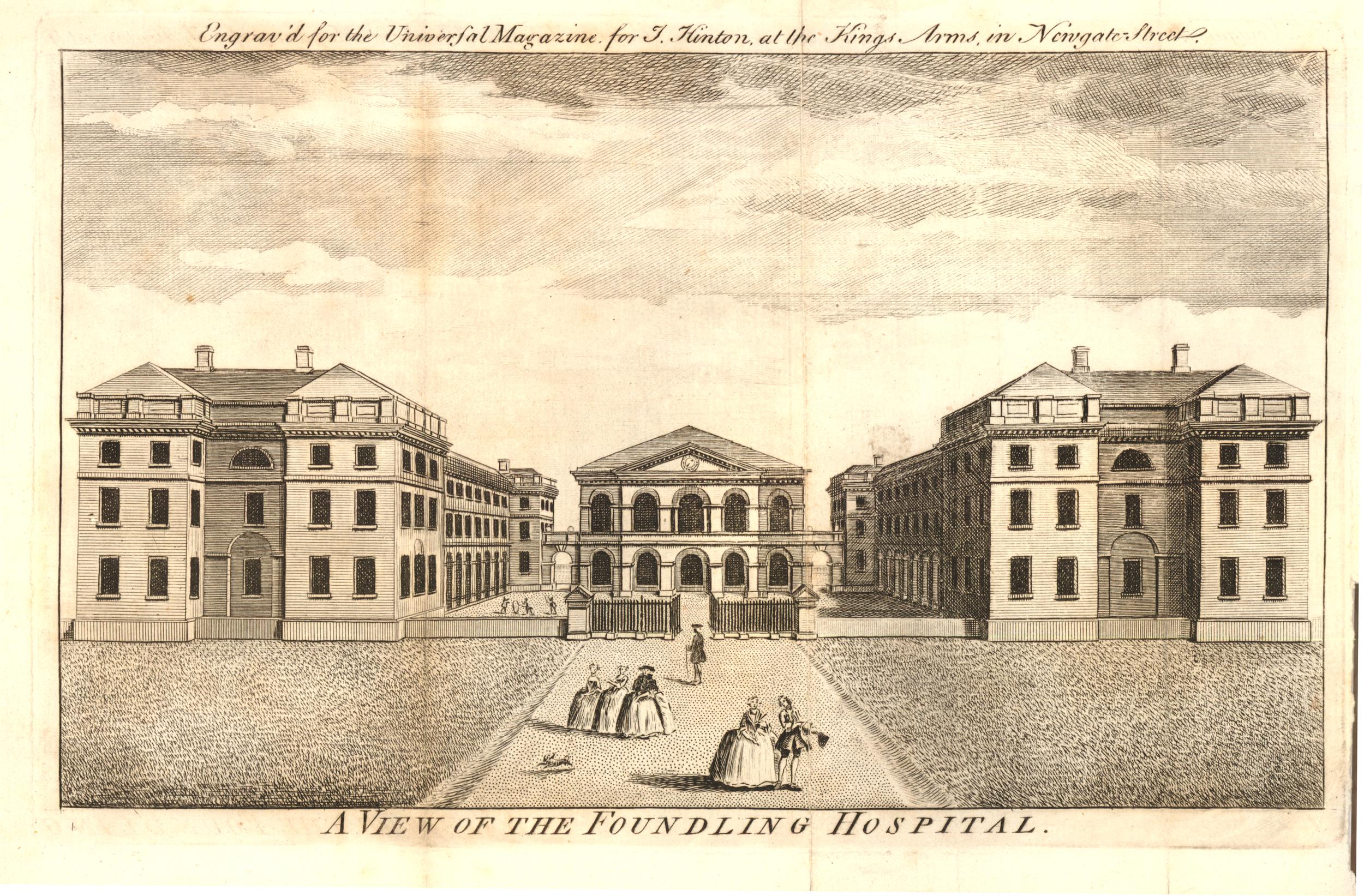
Cyprus Street

View along the main surviving section of the street:

Cyprus Street

Cyprus Street is identical to many other mid 19th century streets that appeared as Bethnal Green was developed, what has made it special is the war memorial and the retention of the majority of the original terrace houses.

As indicated by the Duke of Wellington’s Benevolent Club that erected the memorial, the pub must have played an important part in the community that lived along the street.

There were so many pubs in Bethnal Green (as there was across much of London), and in Bethnal Green the majority have closed, with many being demolished or converted into flats.

As I was walking to Cyprus Street, along Bonner Street, I saw another old pub just after the junction with Cyprus Street.

This is the Bishop Bonner, on the corner of Bonner Street and Royston Street:

Bishop Bonner, Bonner Street

Another 19th century pub, which finally closed in 1997. The first floor appears to be flats, however the ground floor looks rather derelict. It would be interesting to look in and see if any of the remaining bar furniture survives.

Name sign on the corner of the pub:

Bishop Bonner, Bonner Street

Always interesting to think of the thousands who have walked through these doors, when the pub was the hub of the local community for well over 100 years:

Bishop Bonner, Bonner Street

Whilst so many of London’s pubs disappear or are converted, the memorial in Cyprus Street remembers not just the residents of the street who died in the First and Second World Wars, but also remembers the community that was in the street at the time, that enabled the memorial to be created and maintained during the following decades.

alondoninheritance.com

St. Paul’s Covent Garden, the Actors Church

The tickets for all the walks of my new Limehouse walk sold out by Monday morning, so a very big thank you. The proceeds from these walks go towards the hosting, maintenance and research of the blog, so it is very much appreciated. I have had a number of requests for new dates, so have added two more, on the 31st of August and 10th September, which can be booked by clicking on the dates.

In 1951, my father took a couple of photos of the main entrance into St. Paul’s Church, Covent Garden:

St Paul's Covent Garden the Actors Church

He was far better at timing the position of the sun and weather conditions than I am, however the view is much the same today, some 72 years later:

St Paul's Covent Garden the Actors Church

A view of the main entrance to the church from the opposite side of the churchyard:

St Paul's Covent Garden the Actors Church

And the same view in 2023:

St Paul's Covent Garden the Actors Church

The church of St. Paul’s was one of the first buildings to be constructed as part of the development of the Covent Garden Piazza by Francis Russell, the 4th Earl of Bedford.

The Russell family were significant land owners, and within London this included the area around Covent Garden, along with significant holdings across Bloomsbury. The land at Covent Garden came into their position in 1552 when the first Earl was granted the land by the Crown.

Development of the Covent Garden Piazza and St. Paul’s Church commenced around 1630 when Inigo Jones designed the overall layout of the square. Construction of the church began in 1631 and it appears to have been completed and furnished by 1635, but was not consecrated until 1638 due to a dispute with the vicar of St. Martins-in-the Fields, mainly about the physical boundaries and the degree of independence of the new church. The Earl of Bedford had a family pew in St. Martin’s, but released this in 1635 when his new church in Covent Garden was ready.

The main entrance to the church is in Bedford Street, where the brick façade of the church can be seen between two pillars with ornate railings on either side, and providing a gate between the pillars:

St Paul's Covent Garden the Actors Church

Through the gates and we are into the churchyard:

St Paul's Covent Garden the Actors Church

The churchyard was closed to burials in 1853 and in the following couple of years all the tombstones were either removed or laid flat. The churchyard was renovated between 1878 and 1882, when the ground was also lowered and flattened.

Today, the churchyard has a wide path leading up to the entrance of the church, with seating along both sides of the path. To either side of the path are gardens and grassed spaces.

As can be seen in the above photo, the main body of the church and the churchyard are surrounded by tall terrace buildings along either side, and the church has long had a complex relationship with these buildings.

On both sides of the churchyard, there is a space between the wall of the churchyard and the adjacent buildings:

St Paul's Covent Garden the Actors Church

The plaque reads: “This lightwell is part of the burial ground of St. Paul’s Church. Written consent must be obtained before any use is made of this lightwell.”

Originally, the churchyard ran up to the walls of the buildings, and doors and windows in these buildings which provided access to the churchyard were long a cause of concern for the church, as there was an issue with people getting into the churchyard and causing a nuisance, as well as the general issue about security where all the surrounding buildings provided access.

In 1685, any door in these buildings onto the churchyard was ordered to be blocked up, unless it had been given permission by the church, who also then sold licences for the making of windows that looked out onto the churchyard.

During the later half of the 18th century, the churchwardens also had concerns regarding the rising levels of the churchyard due to the many people being buried, which seems to have included large numbers of non-parishioners as well as “with the remains of multitudes of Paupers”.

In the 1870s, the lightwell shown in the above photo was built, with lightwells on the north, west and south sides of the church. These lightwells served a number of purposes. They provided light into the lowest floors of the surrounding buildings, they provide a degree of security for the churchyard to prevent the churchyard being used for “various and improper purposes”, and as a benefit for the houses, they prevented “soakage” from the graves into the houses.

London churchyards must have been appalling places in the 18th and 19th centuries, and no wonder that burials were stopped in the mid 19th century. The vast majority seem to have been overflowing with the bodies of the dead, and the rising levels of churchyards gave an indication of the many thousands that had been buried in such a small space.

If we walk around the church into the old piazza and market area of Covent Garden, we get a very different view of the church:

St Paul's Covent Garden the Actors Church

This would have been the very visible side of the church on the new piazza that the Earl of Bedford was having built, and despite Bedford’s apparent request for a cheap church that would be “not much better than a barn”, Jones designed a grand Tuscan portico.

Whilst the portico is to the original designs, only the columns are probably original as the church was gutted by a fire in 1795, which required a significant rebuild.

The side of the church facing onto Covent Garden looks as if it should be the main entrance. When the church was built, Jones intended that it should have been the main entrance, with the altar being at the western end of the church.

This approach did not accord with the usual placement of the altar at the eastern end of Christian churches, so the entrance facing onto the Covent Garden Piazza was blocked up, and the altar is now behind this eastern wall.

The portico does though provide an excellent place to photograph the performers in Covent Garden and the large crowds that gather to watch:

St Paul's Covent Garden the Actors Church

The white building above the columns is the Punch and Judy pub, and Punch has an important link with Covent Garden as indicated by this plaque on the church:

Punch's Puppet Show Covent Garden

In the years after the restoration of Charles II, a number of Italian entertainers came to England, including the puppet showman Pietro Gimonde who came from the city of Bologna.

It was Gimonde who Pepys saw in Covent Garden. At the time a Punch puppet show used the form of a marionette, where strings tied to a figure were manipulated by rods above the figure’s head.

Pepys must have been impressed by the show as two weeks later he returned to show his wife, and Gimonde must have made an impression on London society as in October 1662, he was part of a Royal Command Performance for Charles II.

Punch and St. Paul’s, Covent Garden featured in the first book of the Rivers of London series by Ben Aaronovitch, when the main character, Peter Grant meets the ghost of murdered actor Henry Pyke, who also takes on the personae of Mr. Punch, in the churchyard.

Whilst the Rivers of London series is fictional, some strange, violent and sad events have happened in St. Paul’s churchyard.

The London Bills of Mortality for the week of the 22nd to the 29th of January 1716 recorded that a person was “killed by a sword at St Paul’s Covent Garden”. Bills of Mortality also recorded a number of people who were simply found dead in the churchyard – possibly those who were sick, too poor, unable to find housing or food, or perhaps just found the pressures of life in 18th century London too hard to bear.

Time to take a look inside the church, away from the crowds around Covent Garden, and this is the view when entering through the main door from the churchyard:

St Paul's Covent Garden the Actors Church

As with any building of such age, it has been through very many repairs and restorations that have changed the church from its original form.

In the years after completion, the roof seems to have been a recurring cause for concern, with repairs having to be frequently undertaken, with the gradual loss of the decoration and painting across the ceiling.

By the 1780s, the church was in such a state that extensive repairs were needed. The architect Thomas Hardwick was chosen from the three that put in bids for the work. The church was closed and then followed a major programme of works that expanded as more problems were found.

From an initial budget of £6,000, the final cost when the church reopened in 1789 was £11,723.

This could have been money very well spent, however just six years later in 1795, some plumbers were carrying out work in a bell turret. They left the church for a midday break and left an unguarded fire still burning.

The fire escaped to the surrounding fabric, and soon spread to rapidly to gut the majority of the church.

The church apparently looked like one of the City church’s after the bombing of the 1940s, with only the exterior walls standing, the roof collapsed and the interior gutted.

You can probably imagine the feelings of the churchwardens when they viewed the gutted church just a few years after the period of closure and expense of a major rebuild, and they were now faced with a much larger challenge, and the difficulty of trying to raise yet more large sums of money, not long after having sought funds for the 1780s restoration.

Thomas Hardwick was again appointed for the rebuild, and money to fund the project was raised by the levy of a rate of one shilling in the Pound, and by selling annuities based on the security of the local rates.

The church was rebuilt and reconsecrated in 1798.

The pulpit (on the left of the following photo) is possibly by Grinling Gibbons, or by one of his pupils. Above the altar, is a copy of the Madonna and Child by the artist Botticelli:

St Paul's Covent Garden the Actors Church

There seems to have been an almost continuous programme of repair work to the church, along with occasional significant restorations, including one in the early 1870s by William Butterfield, which focused on the interior of the church, with an aim of making the interior a brighter and more pleasant place to worship. Butterfield’s work included the removal of the majority of the monuments on the internal walls.

Henry Clutton, who was architect to the Duke of Bedford made a number of proposals for restoring and improving the church in the late 1870s. Clutton’s view was that Inigo Jones had almost gone along with the original Earl’s requirement for a barn-like church, with a simple brick body to the church and with only the stone portico embellishing a simple brick barn.

Some of Clutton’s proposals were taken on by the architect A. J. Pilkington in the late 1880s. The major change to the church at this time was the replacement of the ashlar exterior (square cut stones used as a facing on a wall), by the red bricks we see today.

Following Pilkington’s work, the church has stayed much the same apart from repair and decoration work. There was some bomb damage to buildings around the church, but St. Paul’s survived the war without any damage.

The font in St. Paul’s church:

St Paul's Covent Garden the Actors Church

St. Paul’s Church is known as the Actors Church. The area around Covent Garden has long had an association with the acting profession. The Theatre Royal Drury Lane which was built by Thomas Killigrew in 1663, just thirty years after the church is nearby. Killigrew had received a Royal Charter from King Charles II allowing the theatre to be built.

In 1723, the Covent Garden Theatre was built. This is now the Royal Opera House.

The association with the acting profession can be seen in a number of ways. Performances are put on within the church and in the churchyard, and St. Paul’s has the Iris Theatre, its own professional theatre company.

Walking around the interior of the church and there are very many memorials to actors and those associated with the profession, including Gracie Fields:

Gracie Fields memorial

Dame Anna Neagle-Wilcox. Usually better known as just Anna Neagle, but on the memorial including the surname of her husband, Herbert Wilcox, and below is Flora McKenzie Robson who had a long career in film, theatre and the stage:

Anna Neagle memorial

Dame Diana Rigg, again another actress with a long and wide ranging career, and who was still working right up to the year when she was “Called to rehearsal”:

Diana Rigg memorial

Nicholas Parsons, again another long career, and probably best known for Sale of the Century on TV in the 1970s and the BBC long running comedy show Just a Minute:

Nicholas Parsons memorial

Three “Sirs” of the theatrical and film world who all died within 4 years of each other, Sir Terence Rattigan, Sir Noel Coward and Sir Charles Chaplin:

Charles Chaplin memorial

Memorial for Dame Barbara Windsor, with her well known line from the BBC soap EastEnders:

Barbara Windsor memorial Get out of my pub

In what is a brilliant bit of placement, which cannot be a coincidence, the memorial for Barbara Windsor is located behind the small bar in the church:

Barbara Windsor memorial

Memorials to actors Roy Dotrice, Edward Woodward, Sir Ian Holm, Geoffrey Palmer and John Tydeman, a former BBC Head of Radio Drama:

Edward Woordward memorial

There are very few early plaques remaining in the church, as mentioned earlier in the post, William Butterfield’s work on the church in the 1870s removed many of the monuments that lined the walls of the church. A few remain including that of Thomas Arne, who wrote the music for a large number of stage works between the years 1733 and 1776, including works performed at Drury Lane and the Covent Garden Theatre.

Thomas Arne also put the words of a poem by James Thomson to music, to create the song Rule Britannia, as is recorded on his memorial, which also records that he was baptized in the church and buried in the churchyard:

Thomas Arne memorial Rule Britannia

There are very few memorials to those outside of the entertainment industries. One though records the dreadful death rate of children. On the right is recorded John Bellamy Plowman, the father who died aged 67, however on the left is what must have been his oldest son, also called John Bellamy Plowman who died aged 17 and was buried in the vault under the vestry, along with six other children who all died in their infancy:

John Bellamy Plowman

View of the rear of the church, with organ and gallery.

St Paul's Covent Garden the Actors Church

There were once galleries down either side of the church which provided additional seating at an upper level. These must have made the church seem very crowded when full, and they were removed during an early restoration.

St. Paul’s Covent Garden will soon be 400 years old. Although it was rebuilt significantly after the fire in 1795, and restored and repaired many times over the centuries, it still is an Inigo Jones church, and goes back to the time before the market, and when the Piazza was first established.

It is also a church that connects to the profession that is still so important in this part of London.

alondoninheritance.com

Limehouse – A Sink of Iniquity and Degradation. A New Walk.

(Dates for my new walk at the end of the post) The following photo was taken by my father from the eastern end of the King Edward VII Memorial Park in Shadwell. It is looking east along the Thames towards Limehouse:

Limehouse

The photo shows this stretch of the river as it was in the late 1940s. A busy place with docks, wharves and cranes, with barges and ships along the river.

The tall chimney is that of Limehouse (also called Stepney) power station. An electricity generating station that ran on coal transported along the river. The power station was built in 1907, however the tall chimney was added 20 years later in 1927 due to complaints about the amount of pollution that was being spread around Limehouse by the much smaller original chimneys. At the time of building, it was the tallest chimney in London at a height of 351 feet.

The power station was closed in 1972 and demolished soon after.

Just in front, and to the right of the power station chimney is the entrance to the Regent’s Canal Dock (now Limehouse Basin). Although the entrance is hard to see, the warehouses with the name of the dock, on the east side of the entrance to the dock from the river can be seen in this extract from the above photo:

Limehouse Regent's Canal Dock

The title for the walk “Limehouse – A Sink of Iniquity and Degradation” came from the book “Limehouse through Five Centuries” written in 1930 by the Reverend J.G. Birch of St. Anne’s, Limehouse. He used the phrase in his introduction to the book, and also added that he hoped that the book would help dispel this myth.

Limehouse has always had an air of mystery and intrigue, an exotic and dangerous place to those who did not live or work along the river.

The 1916 book Limehouse Nights by Thomas Burke featured a number of short stories centred on Limehouse, the opium dens and the Chinese community, which were also the background to the stories of Dr. Fu-Manchu by Sax Rohmer. The works by Burke and Rohmer featured appalling stereotypical views of the Asian community then living in Limehouse.

Stories about Limehouse exploited themes of violence, crime, sex and drugs and how the import of opium resulted in the exploitation of English women, often to sell opium in the fashionable West End.

The image of Limehouse as a place of intrigue and mystery continues to this day, with the 1994 book Dan Leno and the Limehouse Golem by Peter Ackroyd, on which the 2016 film The Limehouse Golem was based.

Whilst there were opium dens, crime and violence, Limehouse was a hard working place, based around the trade and industry that grew along the Thames. The Chinese population were frequently sailors who had settled in Limehouse and married local women, along with a temporary increase in numbers when ships with Chinese crew docked. Their numbers though were relatively low, not as large as popular literature of the time might suggest.

Limehouse was an early site of ship building. From Limehouse, sailors and traders set out along the Thames to cross the oceans of the world. Industry, warehouses and docks lined the river, with cramped housing alongside polluting factories.

Limehouse provided access to the Thames for the inland waterways, with the Limehouse Cut and the Regent’s Canal providing access to the river from the rest of the country. In the Regent’s Canal Dock (now the Limehouse Basin), ships unloaded all manner of cargo, including coal, timber, fruit and ice.

There was technical innovation, hydraulic power and an electricity generating station running on coal delivered via the river. The London & Blackwall Railway cut through Limehouse on a brick viaduct, paving the way for the Docklands Light Railway.

The decades after the 2nd World War were not kind to Limehouse as trade along the river slowly declined and industry closed or moved away.

From the late 1980s onwards, Limehouse was transformed, with some major projects being driven by the developments on the Isle of Dogs just to the east.

I have long been fascinated by Limehouse, a place that for centuries was shaped by the relationship between the land and the river. Whilst today that contact is maintained by Limehouse Basin, the rest of Limehouse is now just a spectator to the activity on the river.

This walk will explore the history and development of Limehouse from the 15th century to the present day. The people, those who settled in Limehouse, the relationship with the River Thames, trade, waterways, tunnels, streets, pubs and church, along with some of the reality of the opium dens.

As with the Reverend J.G. Birch, my aim with the walk is to dispel some of the myths about Limehouse and focus on the real history of this fascinating part of east London.

The walk will start at Limehouse DLR station and end at Westferry DLR station. It will take around 2 hours 30 minutes and is a walk of slightly over 2 miles.

The schedule of walks is listed below. Click on each date to get to the Eventbrite booking page:

Just added a couple of new dates as the original set sold out:

Or for an overview of all the walks on Eventbrite, then click here.

I look forward to showing you around this fascinating part of east London.

alondoninheritance.com

Two Pubs and the Jesus Hospital Estate

Following last week’s post, I am staying in Bethnal Green, and after finding Ron’s Gents Hairdressers, I walked to find the location of the Queen Victoria pub and the Jesus Hospital Estate. The decorative features at the top of the Queen Victoria was the subject of one of my father’s 1980s photos:

Queen Victoria, Jesus Hospital Estate

When I found the pub, it was covered in scaffolding, and whilst the royal coat of arms at the top of the pub are still there, they had been painted white:

Queen Victoria, Jesus Hospital Estate

Unfortunately, my father did not take a photo of the whole pub building. I suspect due to the limited number of photos available when using a film camera. The pub today:

Queen Victoria pub, Barnet Grove

The Queen Victoria is on the corner of Barnet Grove and Wellington Row, a short walk north from Bethnal Green Road towards Columbia Road.

The pub has suffered the fate of so many pubs across London in that it has been converted to residential. The Queen Victoria closed as a pub in 1993.

I have mentioned a number of times in my posts about just how many pubs there were in London prior to the closures that started slowly after the 1940s, and accelerated quickly from the late 1980s onwards, and the location of the Queen Victoria is a prime example, as directly opposite, there was another pub:

Prince of Wales and Queen Victoria pubs, Barnet Grove

In the above photo, the Queen Victoria is on the right and the Prince of Wales is on the left, with Barnet Grove passing between them.

The Prince of Wales closed in 1995, and as with the Queen Victoria, it was converted to residential. Whilst the Prince of Wales has the pub’s name at the top of the corner of the building, there are no coat of arms:

Prince of Wales, Jesus Hospital Estate

The pub did once have the impressive arms of the Prince of Wales, as can be seen in the photo at this link from the alamy stock image site.

The building today is a shadow of its former self. I suspect the arms at the top of the pub were missing in the 1980s as I am sure my father would have taken a photo of them, as well as the Queen Victoria.

Both pubs seem to have opened in the late 1860s, and in the Hackney and Kingsland Gazette on the 28th of May, 1870, the new owner of the Prince of Wales was advertising:

“THE NEW Wine and Spirit Establishment, Conducted by the old caterer for public favour, C.H. Davies, of the ‘Prince of Wales, Barnet-Grove’, who begs to call attention of his friends and the public to his new premises replete with every comfort for the gentleman and mechanic, also to families who can be supplied with every article of the finest description including MALT LIQUOR, from the eminent Brewers of the day; SPIRITS (both foreign and British) of the highest strength and excellence, and WINES of the rarest vintage. Special arrangements have been entered into with the celebrated firm of Messrs. REID & Co. for a constant supply of their Splendid STOUT and PORTER.

Extensive and Commodious Rooms for large or small parties.

An Harmonic Meeting every Tuesday Evening at eight o’clock for gentlemen. An early visit is respectfully solicited.”

By 1907 a W. Tozer was the owner of the Prince of Wales, as in the Eastern Argus and Hackney Times he was thanking “the residents of the district and the public generally for the patronage they have accorded him since he took the proprietorship off this well known and old-established tavern 3 years ago.”

In the same article, it was mentioned that “The United Order of Druids, Baroness Burdett-Coutts Lodge (No. 948) meets at the house on the 1st and 3rd Tuesday in the month.”

The United Order of Druids was more of a fraternal and benefit society, and was open to all classes. I doubt there was much wandering around the streets of Bethnal Green in white gowns.

The branch that met in the Prince of Wales was the Burdett-Coutts Lodge. The lodge was named after Angela Burdett-Coutts, a remarkable women who was known as the wealthiest woman in the country after she inherited a fortune from her maternal grandfather Thomas Coutts, of Coutts Bank.

Angela Burdett-Coutts was a philanthropist who supported a diverse range of projects and causes. The link between the lodge that met in the Prince of Wales and Burdett-Coutts may have come from her charitable activities in the area with social housing and her founding of Columbia Market in 1869.

There are very few newspaper references to the Queen Victoria. Mostly licence changes, and in one report about an “Exciting Quoits Match”, the pub is named as the Queen Victoria Hotel, when a Mr Sayer, who appears to have been their champion Quoits player, was being challenged by Copeman and Wilstead, for £5.

The challenge was to take place on neutral territory at the May Pole in Chigwell. (Quoits is the game where a ring of iron or rope is thrown in an attempt to land it around a peg).

That there were two pubs directly opposite each other (as well as other pubs in the local area), shows the population density in this part of Bethnal Green. One of the reports mentioning the Prince of Wales covered above, may hint at the diverse range of people who lived here where the pub was advertised as having “every comfort for the gentleman and mechanic“.

In the following map, I have marked the locations of the Queen Victoria (red circle) and Prince of Wales (blue circle), and the surrounding streets show a dense network of terrace houses  ( © OpenStreetMap contributors:

Jesus Hospital Estate

Walking north along Barnet Grove, and continuing after the Prince of Wales pub is a short terrace which still retains the shop fronts, when as well as local pubs, this street also had local shops to serve those who lived in the surrounding streets:

Jesus Hospital Estate

The title of this post is “Two Pubs and the Jesus Hospital Estate”, and I have covered the two pubs, but what about the Jesus Hospital Estate?

As a starter, the two pubs are on the southern edge of the “Jesus Hospital Conservation Area”, and I have marked the approximate boundary of the conservation area in the following map  ( © OpenStreetMap contributors:

Jesus Hospital Estate

The area covered by the current conservation area has changed slightly over the years, however it started as an estate in the 17th century when the land was owned by James Ravenscroft in 1670. At that time, this was, as much of Bethnal Green still was, fields and farm land.

In 1679, James Ravenscroft founded the Jesus Hospital Charity in Barnet, Hertfordshire, and he bestowed the land in Bethnal Green to the charity.

The aims of the Jesus Hospital Charity were to provide for the support and maintenance of lady residents living in Ravenscroft Cottages in Wood Street, Barnet.

The charity is still in operation and has expanded the number of properties it owns in Barnet, and now “provides 63 unfurnished dwellings for ladies aged 50 plus, who reside alone and are fit and able to care for themselves”.

James Ravencroft’s son, George, made his name in the manufacture of lead crystal glass. He was primarily a merchant and came into contact with the glass trade after living for a couple of years in Venice.
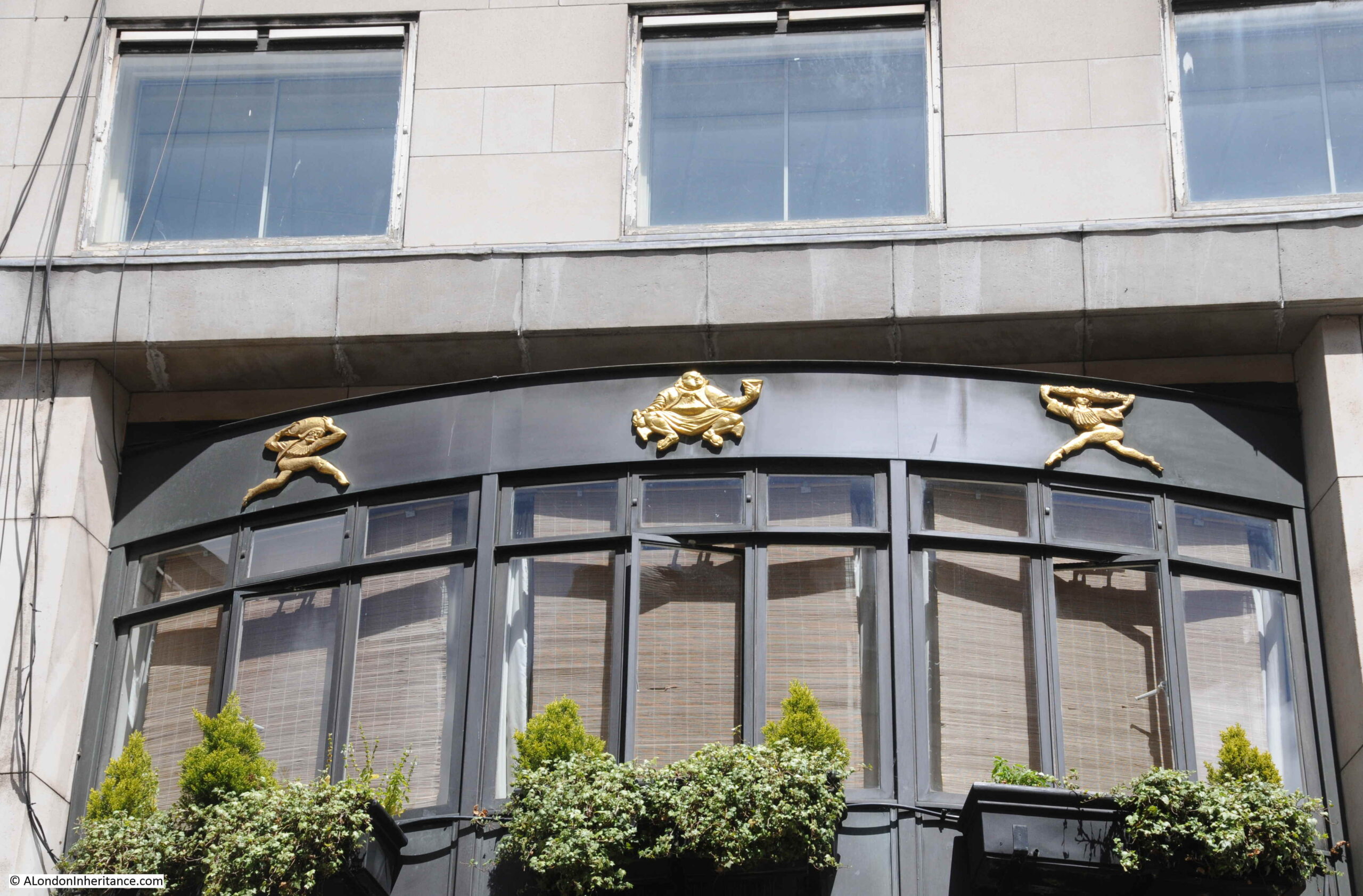
On his return to London, he set up a glass works in the area of the Savoy, however he left the glass business in 1679, the same year as his father set-up the Jesus Hospital Charity. His father died the following year in 1680 and George died in 1683.

They were both Roman Catholics which, in the final decades of the 17th century, may not have made the family very popular.

In the early 19th century, the land was still being leased from the charity by farmers, and there had been very little change for the past 150 years, however limited building work did commence in the 1820s and 1830s.

One of the problems with the land in Bethnal Green was that it was some distance (given travel options at the time), from the trustees of the charity in Barnett. The trustees rarely visited. I assume they were happy as long as the money from leasing the land continued to flow to fund the charity’s responsibilities.

During a visit, the trustees found that the land had been developed with very poorly constructed, single storey houses, and that many were in a very dilapated condition. The streets in the area were also in a poor state, as were the sewers.

In 1862, a London surveyor based in Bishopsgate, by the name of George Clarkson was appointed to manage the redevelopment of the charity’s land.

The whole area of the Jesus Hospital Estate was cleared of the original buildings, new sewers were built along with new streets, and a total of 372 houses were built, as well as a number of pubs, including the Queen Victoria and the Prince of Wales.

It is these houses that we see when we walk the streets today.

Another old corner shop on the corner of Barnet Grove and Elwin Street:

Barnet Grove

View along Elwin Street, showing a continuous line of almost identical terrace houses:

Elwin Street

With an almost mirror image along Quilter Street, although along this street there is a slight descent in the height of the land, which is accommodated for along the terrace by a step change in height as the terrace progresses, which can be best seen by the white bar that runs along the terrace just below the first floor windows:

Quilter Street

Along the street there are a couple of houses which have pipes set into the wall, with LCC which I assume is for London County Council:

LCC

An example of which rises several feet above street level to a vent:

LCC

The London County Council never owned the houses along the street, but they would have taken responsibility for the sewers, so I wonder if they were installed as part of upgrades to the sewage system, or the Jesus Hospital Charity paid the LCC for drainage work to the houses.

In 1970, the Greater London Council served a compulsory purchase order on the land owned by the Jesus Hospital Charity. The GLC intended to demolish the estate, and there were plans to construct a large road through the area to link Victoria Park with the City.

There were ten years of legal negotiations between the GLC and the charity, and the estate was finally sold to the GLC in 1980 for a sum of £1.2 million.

Proposals for demolition were abandoned as there were many objections, including from the Jesus Hospital Estate Residents Associations which was formed in 1979 to fight against the GLC’s plans.

The Jesus Hospital Estate is today described by Estate Agents as a highly desirable place to live, and to show the incredible rise in house prices in this part of east London, in 1980 the charity sold the whole estate to the GLC for £1.2 million. Today, there is a single terrace house in Barnet Grove for sale, also for £1.2 million, so the sum you could have purchased the whole estate for in 1980 now buys you a single terrace house.

One of the reasons for the Estate Agents description of the area is that there is a large triangular green almost at the centre of the estate:

Jesus Green

This is Jesus Green, but it was not part of the original 1860s development, when the 19th century approach was to pack as many terrace houses into the area as possible.

In the 1949 revision of the OS map, the area covered by Jesus Green today, is shown as a dense area of terrace houses, with an archway under one the houses in Barnet Grove leading into a central courtyard which housed a number of workshops (‘Reproduced with the permission of the National Library of Scotland“):

Jesus Hospital Estate

I cannot find an exact date, or reason for the demolition, however I believe the houses in this central triangle, outlined in red in the above map, were demolished in the 1970s. The LCC Bomb Damage maps show that this central area was almost untouched, so whether demolition was part of the GLC’s rebuilding plans, or for some other reason, I do not know.

I assume that after plans for demolition, road building and redevelopment were abandoned, the central area was turned into the green space it is today.

We can get an idea of what the streets surrounding the central gardens looked like before the houses in the centre were demolished.

The photo below is the view looking east along Quilter Street from Barnet Grove. There are terrace houses along both sides of the street. Quilter Street continued behind where I was standing to take the photo, but today, the central gardens are on one side and terrace houses on the other.

Quilter Street

The name of the open space, Jesus Gardens is a reminder of the charity that owned the land for around 300 years. There are also a number of other reminders in the street names, for example;

Barnet Grove is obviously a reference to Barnet in Hertfordshire, where the charity was based, and where money generated by leasing the land in Bethnal Green was used to fund the homes for women. Barnet Grove predates the 1860s redevelopment so is one of the oldest streets, and street names in the estate.

Quilter Street is named after James Quilter, a solicitor, who was one of the charity trustees, during the 1860s redevelopment of the estate.

Elwin Street was named after the Reverend T.H Elwin, who was the Chairman of the charity at the time of the redevelopment.

The earlier pub advert referred to “the gentleman and mechanic”, so I had a look in the 1921 census to see who was living in Quilter Street, one of the streets of the Jesus Hospital Estate. A very brief sample:

  • At number 34 was Philip Samuel Hurman, aged 45 and listed as a French Polisher for Bradstad Brothers Pianoforte Manufacturer, along with his wife Esther (45), his son Philip Samuel (21) a Carman for Saunders & Nephew Provision Merchants, a daughter Jane (19) who was a Trousers Machinist for Lockwood & Bradley Wholesale Tailors, and a daughter Ivy Lilian (15) who was a Card Board Box Maker for Wright Brothers, Box Manufacturers
  • At number 47 was Frederick Tayor, aged 66, a retired Brewers Cellarman, along with his three daughters, Emily (34), Ellen (32) and Amy (28) who were all Tie Makers, working for J. Paterson.
  • At number 64 was Charles Moore, aged 40, an out of work cabinet maker. He was living in the house with his wife Emily (45), daughters Emily (20) and Rhoda (15) who were both listed as a Tailoress for Rego Clothing Company, and his son James (18) who was a Labourer for a Mr. Loveday, Glass Silverer
  • At number 90 was Wallace Henry Norris (32) who was a Carman for J.E. Read, Carman & Contractor, along with his wife Elizabeth (28) listed as having Home Duties, and their one year old daughter Ada May. There were also three sons aged 14 and below. the 14 year old son was listed as just having left school.

A very small sample of the thousands who lived in the streets of the estate, but they are typical of all I looked at. Manual workers, employed from a young age and the majority working in one of the very many manufacturing industries that were to be found around Bethnal Green in the 19th and early 20th centuries.

The Jesus Hospital Estate is a fascinating area, away from the bustle of Bethnal Green Road and Columbia Road, an estate which owes its existence to a charity in Barnet, Hertfordshire, and an estate that narrowly avoided full demolition by the GLC in the 1970s.

alondoninheritance.com

Ron’s Gents Hairdresser, Three Colts Lane, Bethnal Green

In 1986, my father photographed Ron’s Gents Hairdresser’s in Three Colts Lane, Bethnal Green:

Rons Gents Hairdresser, Three Colts Lane, Bethnal Green

I have walked past the same place over the last few months, hoping that the business which occupies the site today would be open, but gave up last week, so here is a photo of what was Ron’s shop today, JML Unisex Hairdressers, which has not been open when I have been in Three Colts Lane over recent months.

Rons Gents Hairdresser, Three Colts Lane, Bethnal Green

The last review on Google was three months ago, so hopefully this is a temporary closure. It is interesting how businesses such as hairdressers do seem to occupy the same sites for very many years, often through several different owners.

They tend to be local businesses, do not need much space, and are not being replaced by an online service.

Covid probably led to an increase in home haircuts, but I suspect after lockdowns ended there was a rush to get a professional haircut.

It would be good if the shop front behind the shutters is much the same as in the 1986 photo.

I hope I have the name of the business right in the 1986 photo. The large S at the end of Ron threw me a bit, and there is no apostrophe between the end of Ron and the S, but Ron’s would make sense.

Looking above the door, the business is called Ron Salon Gents, Hairstylist:

Rons Gents Hairdresser, Three Colts Lane, Bethnal Green

The displays in shop windows from the past often cast a light on life at the time, and the large display on the right of Ron’s main windows shows that the hairdressers were very much of the “something for the weekend” type:

Rons Gents Hairdresser, Three Colts Lane, Bethnal Green

The shop is in the corner of a long block of flats that runs from Three Colts Lane up along Corfield Street. The following photo shows the shop, and in the first window down Corfield Street is one of the red and white striped signs that have long been the symbol for a barbers.

Three Colts Lane

Three Colts Lane runs from Cambridge Heath Road in the east to Brady Street in the west. For a large part the route, the street has the brick viaduct carrying the railway through Bethnal Green towards Liverpool Street Station, along the southern edge.

Within this brick viaduct, there are rows of arches, many of which have been occupied by various businesses, the majority being in the motor trade.

Next to the 1986 photograph of Ron’s Hairdressers on the strip of negatives, there were two photos of signs advertising typical businesses for the area. The first features the Volkswagon Beetle, Herbie, made famous in the 1968 film The Love Bug:

Three Colts Lane

The second was a large mural showing a BMW in one of the arches:

Three Colts Lane

I wondered if there was any relevance to the registration number of the car, and a quick Google found that it was a BMW E30 Alpina C2 2.7 3-Series, and the car was subject to a road test which was published in the 19th of April 1986 issue of Motor magazine, which reports that the car would have cost you just over £19,000.

The road test article is available here. It was obviously the car to aspire to in 1986.

Although these photos were taken 37 years ago, I took a walk along Three Colts Lane and surrounding streets to see if any trace of them remained. I could not find anything, but the area is still a hub of car and taxi repair businesses, and some rather impressive graffiti and murals, as the following example of the A1 Car Care Centre on the corner of Three Colts Lane and Coventry Road illustrates:

Three Colts Lane

Detail of the mural on the side of the building in Three Colts Lane:

Three Colts Lane

The arches along Three Colts Lane have many businesses which support the taxi trade, and spend a short time in the street and you will see a number of taxis arriving and departing from these arches:

Three Colts Lane

Entrances into these arches show dimly lit interiors where vehicles are serviced and repaired, as at Frame Right Eng. Ltd.’s Body Shop:

Garage in the railway viaduct

The size of these arches can be seen where roads pass through the viaduct. The differing heights of the arches also show how the viaduct into Liverpool Street Station has expanded over time:

Tunnel under the railway viaduct

At the end of Three Colts Lane, it turns into Brady Street which heads under the viaduct, and Dunbridge Street which continues along the northern side of the viaduct.

At this road junction, there is a derelict patch of land on the left, with another repair business in the arches on the right:

Dunbridge Street

The derelict land on the left of the above photo was once the site of a pub, the Yorkshire Grey, which closed in 1998, and was then in residential use for a while, until the building was demolished around 2014. Surprising that the land has not been developed in the past nine years.

Continuing along Dunbridge Street, and there are a couple of very different businesses operating within the arches, including Urban Baristas:

Dunbridge Street

And Breid Bakers:

Dunbridge Street

I can never resist looking at old maps when I visit a place, and the outline of the street that would become Three Colts Lane seems to date from the end of the 18th century.

The following extract is from Smith’s 1816 New Plan of London. I have marked what would become Three Colts Lane, and the circle is around the area where Ron would open his hairdressing business:

Bethnal Green in 1816

The one constant in the map is Wilmot Street, shown within the yellow oval. The street has kept its original name, and still leads off from Three Colts Lane today, although the houses lining the street are today very different to the terrace houses that were built at the start of the 19th century.

Bethnal Green Road was then New Road, and Cambridge Heath Road was Dog Row and Kings Row.

In the early 19th century, there was still a fair amount of open space in this part of Bethnal Green. Over the next few decades, this would all be built over.

I cannot find a source for the name of the street. In 1818 it was Three Colt Lane, by the end of the 19th century it was Three Colt’s Lane, and today, the street sign has the name Three Colts Lane, so it has been Colt, Colt’s and Colts.

A colt is a young male horse, and as there was open space to the south of the early incarnation of the street, I wonder if there were three colts in this field, and the use of Lane rather than Street or Road may imply a route through what was a semi-rural area? It is this sort of visual imagery that was often used to name a location before streets were formally named, and when literacy levels were low.

There is also a Three Colt Street in Limehouse, but again I cannot find a firm reference as to the source of the name.

Ron’s was very much a barbers of its time, and I doubt that today you would find a barbers where a third of their window is taken up with advertising for contraceptives.

alondoninheritance.com

Samaritans, Physicians, Cutlers, the YMCA and Freemasons

Firstly, a quick apology for an error in last week’s post. I had confused the size of the floors in the Swan pub, at Wapping Dock Stairs. The newspaper article I referred to stated they were 30 feet square on each floor, which I stated would have been just over 5 feet on each side (30 square foot, rather than 30 feet on each side of a floor), so a much larger room, and a reminder to me to read through my posts a couple of times before sending.

Thanks to those who let me know about the error.

For this Sunday’s post (and after reading through three times), a return to discover some of the fascinating stories told by the plaques that can be seen whilst walking around the City of London, starting with;

The Samaritans – St Stephen Walbrook

There is a blue City of London plaque on the side of St Stephen Walbrook, where St. Stephen’s Row heads along the rear of the Mansion House, arrowed in the following photo:

Samaritans

The plaque records that the Samaritans were founded in the church in 1953 by the rector, Chad Varah:

Samaritans

Edward Chad Varah. to give him his full name, was born on the 12th of November 1911 in the Lincolnshire village of Barton-on-Humber. He was the eldest of nine children and the name he would be known by came from St Chad, founder of the parish.

He did not intend to follow his father into the church, however he was persuaded by his godfather, Archbishop Hine.

In the early 1950s, he was based at Clapham Junction, carrying out house visits, and working as the chaplain of St John’s hospital, Battersea, however despite these activities, his stipend was very low, with hardly any money available for his work, and just enough to pay for a secretary. To help generate additional income, he took on a second career as a scriptwriter for children’s comics.

Varah had very liberal views for the time, particularly for a person of the church. He was a strong believe in sex education, and believed this was key for poorly educated young people.

His believe in the importance of sex education, and willingness to listen to people, to provide advice, and eventually to start the Samaritans may have come from an event in 1935 when Varah was an assistant curate in Lincoln. He had to conduct his first funeral which was for a 13 year old girl who had taken her own life. The girl had started her period, however without knowing what was really happening she feared she had a sexually transmitted disease which would result in a slow, painful and shameful death.

His lack of money whilst working in Clapham Junction, along with the responsibility of a parish, prevented any formal development of a system of help for those at risk of suicide, of which there was an average of three a day in London in the early 1950s.

Help came when he was offered the living of St Stephen Walbrook by the Grocers’ Livery Company. This was a City church without any parishioners when compared to Clapham Junction, and this provided Varah with the time to set up the service which would become the Samaritans.

Varah started with a single telephone on the 2nd of November 1953.

His connections in the publishing industry through his work on comics immediately led to some publicity for his new service, such as the following from the Daily Mirror on the 7th of December 1953:

“DIAL 9000 FOR WORDS OF COMFORT – A telephone emergency service, run on the same lines as the police 999 calls, will soon be available to people in distress who need spiritual aid.

All Londoners need do is dial Mansion House 9000, the number of the Telephone Good Samaritans, and advice will be given immediately.

The scheme has been thought up by the Rev. Chad Varah, 42, Vicar of St. Stephen’s in the City, and will be in operation within the next few months.

If a case is sufficiently urgent, a Good Samaritan will dash to the caller and try to comfort and help him or her, said Mr. Varah yesterday.

The Vicar hopes to enroll Samaritans – volunteer workers for his service – from all parts of London.

I want to spread the organisation so that there are at least two Samaritans for every four square miles of Greater London and the suburbs, he said.

I first got the idea from the many letters I received from people in mental and spiritual distress. And I have found that a chat, a kind word and some good advice from an outsider can often save a person’s life.

He said that he intended to deal with personal spiritual problems concerning everything from quarrels between married couples to would be suicides.

The qualifications Samaritans need are tact, patience and the ability to keep other people’s confidences, he said. Religion is a secondary requirement.”

The Daily Herald had a similar report, but ended with the following paragraph, which provides an indication of how many calls Chad Varah was receiving:

“Mr. Varah is now missing meals to keep up with the phone calls he is getting. The former vicar of St. Paul’s Clapham Junction, he has just taken over St. Stephen’s.”

He soon collected a group of volunteers together to take calls, and in February 1954 he handed over the responsibility to take calls to the volunteers leading to the organisation of the Samaritans.

Chad Varah was involved with the Samaritans for the rest of his life. He retired from St Stephen, Walbrook in 2003 after being rector of the church for 50 years. He died in 2007, just a few days before his 96th birthday.

A remarkable man, who started an organisation that must have saved countless lives since starting seventy years ago in St. Stephen Walbrook in 1953.

The City of London plaque to the founding of the Samaritans is next to a small alley, St. Stephens Row which runs alongside the church, and the rear of the Mansion House.

On the wall of the Mansion House close, to the plaque is a stone block, which I think warns that anyone sticking bills or damaging the walls will be prosecuted. There is no date, but from the faded script, and style, it is of some age:

St. Stephen Row Samaritans

St. Stephen’s Row leads between the church and Mansion House:

St. Stephen Row Samaritans

I suspect St. Stephen’s Row dates from the construction of the Mansion House.

The first stone of Mansion House was laid in 1739 and the home of the Mayors of the City of London was completed in 1758.

Although it was still under construction, by the time of Rocque’s 1746 map of London, it is shown on the map, and there is an alley between the Mansion House and St Stephen’s, which continues to the right of the Mansion House. Although it is not named on the map, it is the route of St. Stephen’s Row today:

St. Stephen Row Samaritans

Going back to William Morgan’s 1682 map of London, and the space for the future Mansion House was then occupied by the Woolchurch Market. There looks to be buildings between the market and church, but there is no sign of the alley:
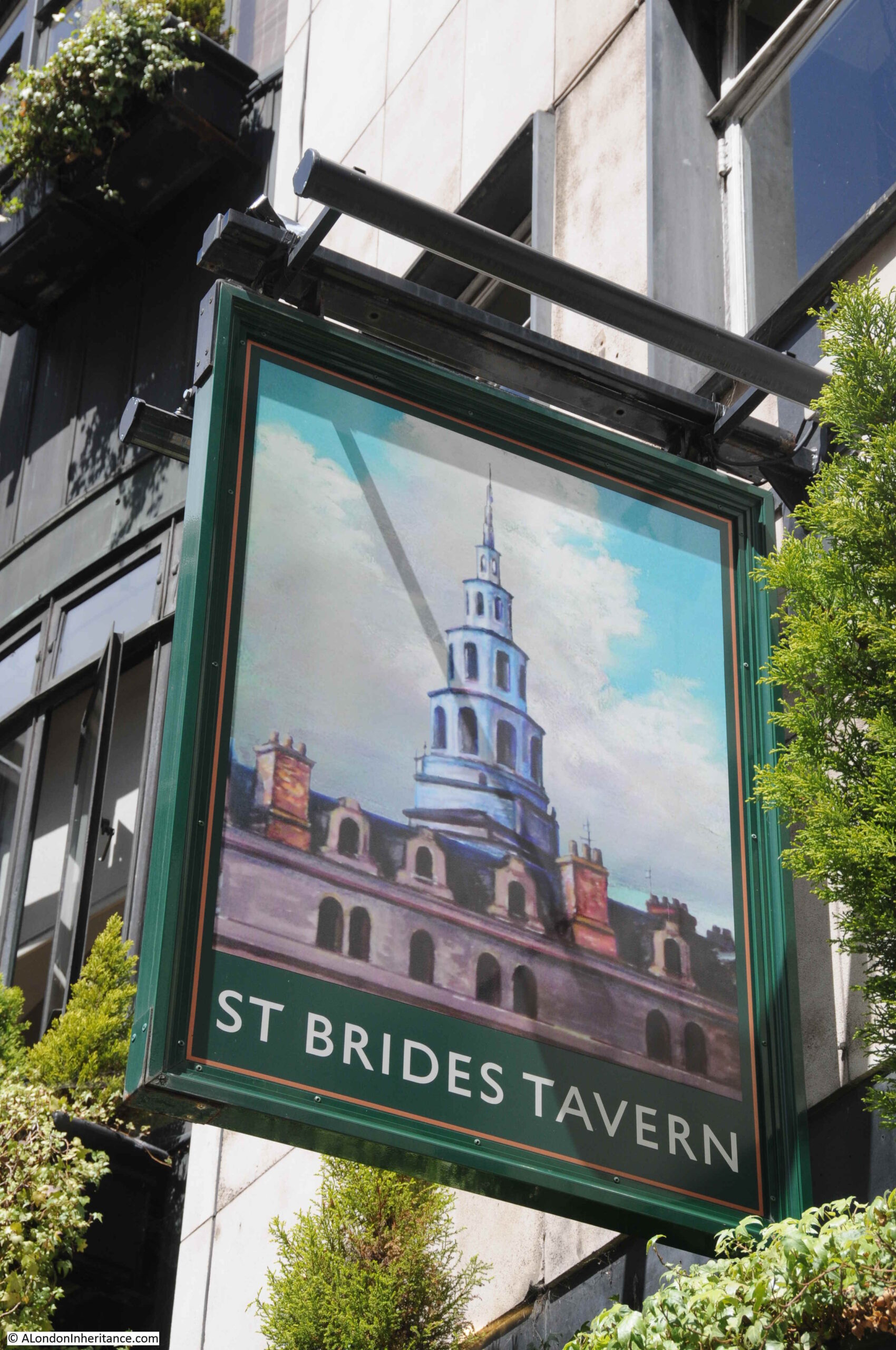
St. Stephen Row Samaritans

There was a church which stood where the Mansion House now stands called St Mary Woolchurch Haw. The church was lost during the Great Fire of 1666 and not rebuilt, and the market took the name of the church.

I have written about the church and the market towards the end of the post at this link.

The view along St. Stephen’s Row, with the church on the left and Mansion House on the right:

St. Stephen Row Samaritans

The entrance to the churchyard at the rear of St. Stephen Walbrook from St. Stephen’s Row:

St. Stephen Walbrook Samaritans

Now to a very different location:

The Royal College of Physicians

In Warwick Lane, which runs between Newgate Street and Ave Marie Lane, to the west of St. Paul’s Cathedral, there is a plaque shown arrowed in the following photo:

Royal College of Physicians

Recording that this was the site of the Royal College of Physicians between 1674 and 1825:

Royal College of Physicians

The origins of the Royal College of Physicians dates back to the early 16th century when a number of leading medical men, including Thomas Linacre, the physician to King Henry VIII became concerned about the state of medical practice in the country, the lack of any regulation, and the impact that untrained physicians were having on their patients.

Thomas Linacre, along with five other leading physicians, persuaded the kIng to allow the founding of a College of Physicians.

A Royal Charter was received and the College of Physicians was founded in London on the 23rd of September, 1518, and an Act of Parliament in 1523 extended the authority of the College from London to the whole of the country.

The “Royal” was added to the name after the restoration of the monarchy with Charles II in the later part of the 17th century.

The Royal College of Physicians original home in the City of London was destroyed in the 1666 Great Fire, and nine years later, following some successful fundraising, the Royal College purchased land and property in Warwick Lane.

The new building was designed by Robert Hooke, and had a large central courtyard with wings either side. There was a public gallery, an anatomy theatre which was topped by an octagonal dome, and a large library which was designed by Christopher Wren.

The view of the Royal College of Physicians in Warwick Lane  © The Trustees of the British Museum):

Royal College of Physicians

The large courtyard at the rear of the block facing onto Warwick Lane  © The Trustees of the British Museum):

Royal College of Physicians

By the early 19th century, the City was becoming a crowded, busy and dirty place, and the building in Warwick Lane had deteriorated so was sold in 1825, and finally demolished in 1890.

Following the exit from Warwick Lane in 1825, the College moved to Pall Mall, before moving in 1964 to Regents Park, where they remain to this day.

Although not marked by a plaque as it is still in use, there is an interesting building next to the plaque:

Cutlers Hall

This is Cutlers Hall:

Cutlers Hall

My go to book on the City’s Companies (The Armorial Bearings of the Guilds of London by John Bromley, 1960) records the following about the Cutlers:

The cutlery trade of the Middle Ages included the making of swords, daggers and knives of all kinds. originally it was a highly specialised industry, comprising the separate trades of hafters who made handles or hafrts, bladesmiths and sheathers, with the cutlers acting as assemblers and salesmen. Both hafters and sheathers were ultimately merged into the Cutlers Company while the bladesmiths were first united with the Company of Armourers, and then allowed by a decision of the Court of Aldermen of 1528 to depart unto the fellowship of Cutlers at will.”

Given their trade, you would expect the Cutlers to be one of the old Company’s of the City, and they are indeed, with the first mention of an organised craft of Cutlers in 1328 when seven cutlers were elected to govern the craft and search for false work.

The Cutlers moved to the hall we see today in Warwick Lane in the 1880s, when their original hall in Cloak Lane was demolished to make way for the construction of the Inner Circle Line by the Metropolitan and District Railway Company (now the route of the Circle and District lines between Mansion House and Cannon Street stations).

I wrote a post about the original hall, and the construction of the railway in this post: Cloak Lane, St John the Baptist, the Walbrook and the Circle Line

The arms of the Cutlers can be seen above the entrance to the hall, and the following image shows the arms:

Cutlers Company

The swords are an obvious reference to one of the products of the Cutlers. The use of elephants in the arms is old, and was recorded in 1445 where members of the Cutlers wore elephants as decorations on their coats or shields when the City welcomed Queen Margaret on her marriage to Henry VI in 1445.

The use of the elephant may be down to the use of ivory in the hafts (handle of a knife) made by members of the Company.

The elephant is featured in the sign hanging from the side of Cutlers Hall:

Cutlers Hall

One remarkable feature of Cutlers Hall is the frieze along the façade of the building. The frieze is a detailed view of the work of cutlers, and was created by the sculptor Benjamin Creswick.
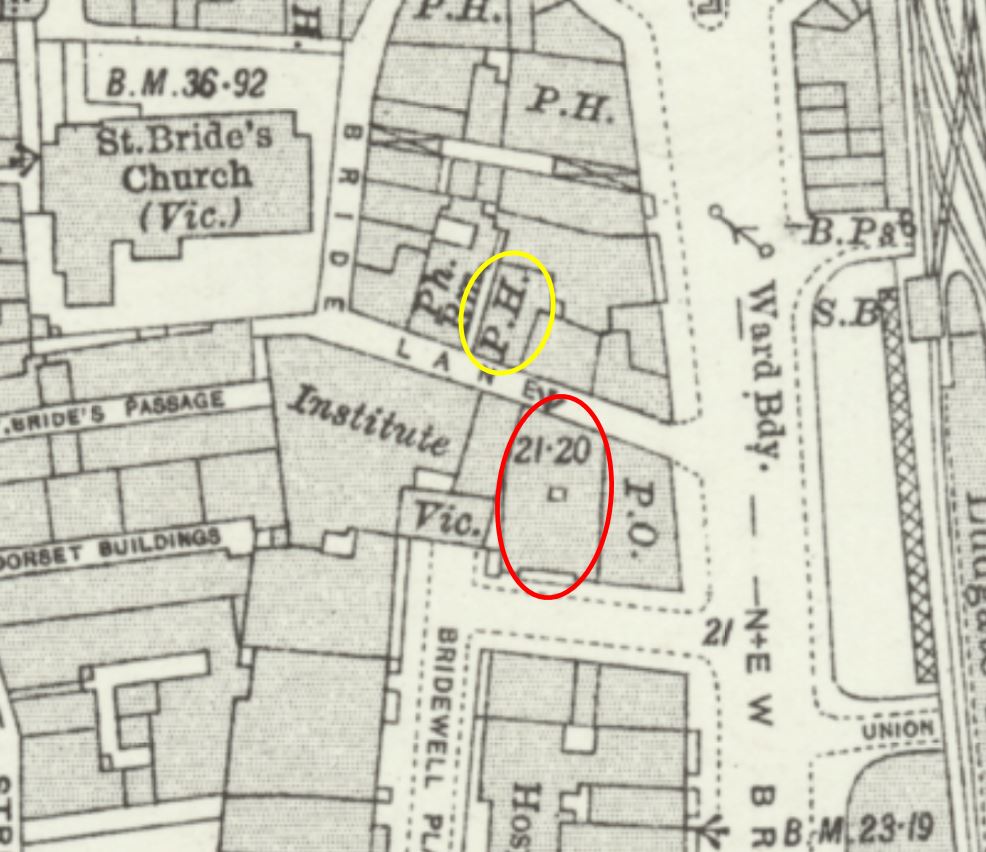
The following image shows the frieze, with the left most panel at the top:

Cutlers Hall

The red terracotta frieze is a wonderful record of the work of the trades that formed the Cutlers Company.

Now to St. Paul’s Churchyard to find two very different organisations, starting with the:

Young Men’s Christian Association

In front of the cathedral, there is an office block with shops on ground level running along the line of St. Paul’s Churchyard. There is a covered walkway in front of the shops, and at the western end of this walkway, next to the old gate of Temple Bar are two plaques, the first arrowed in the following photo:
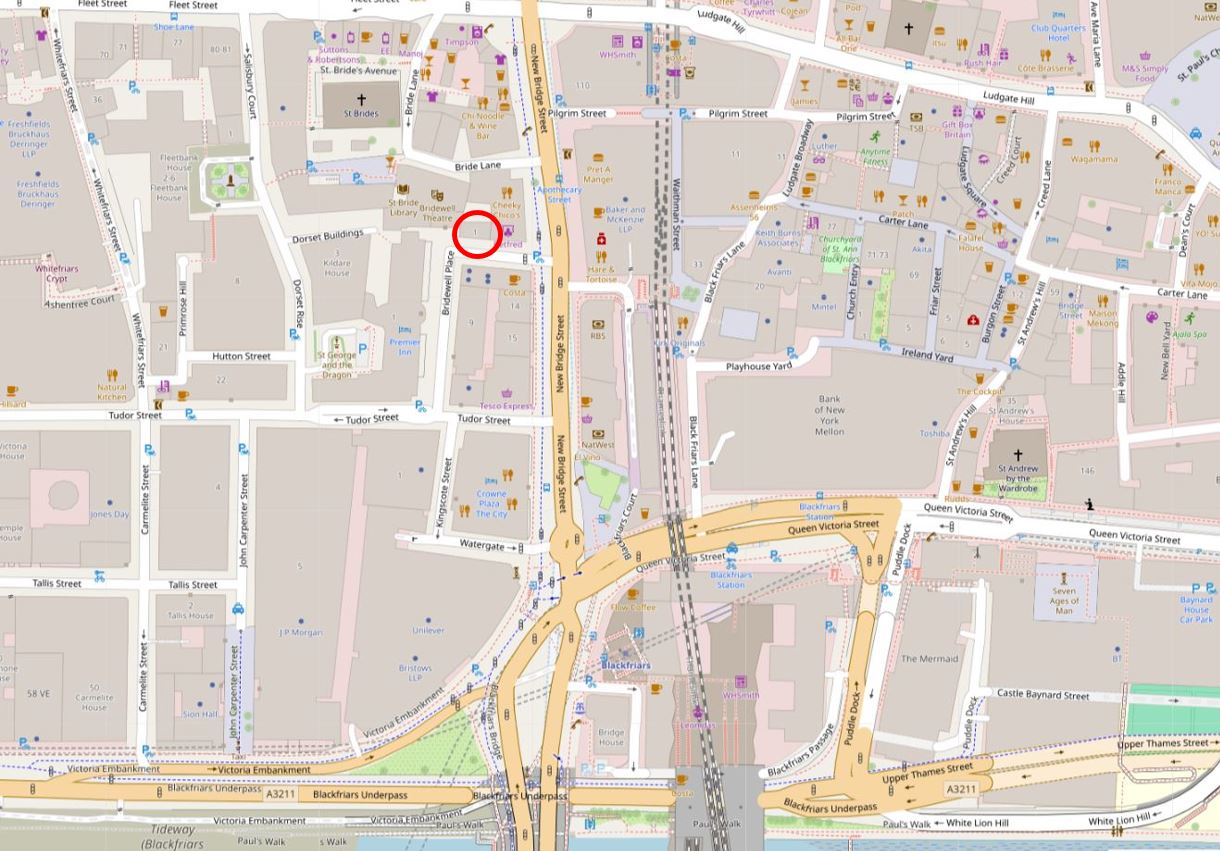
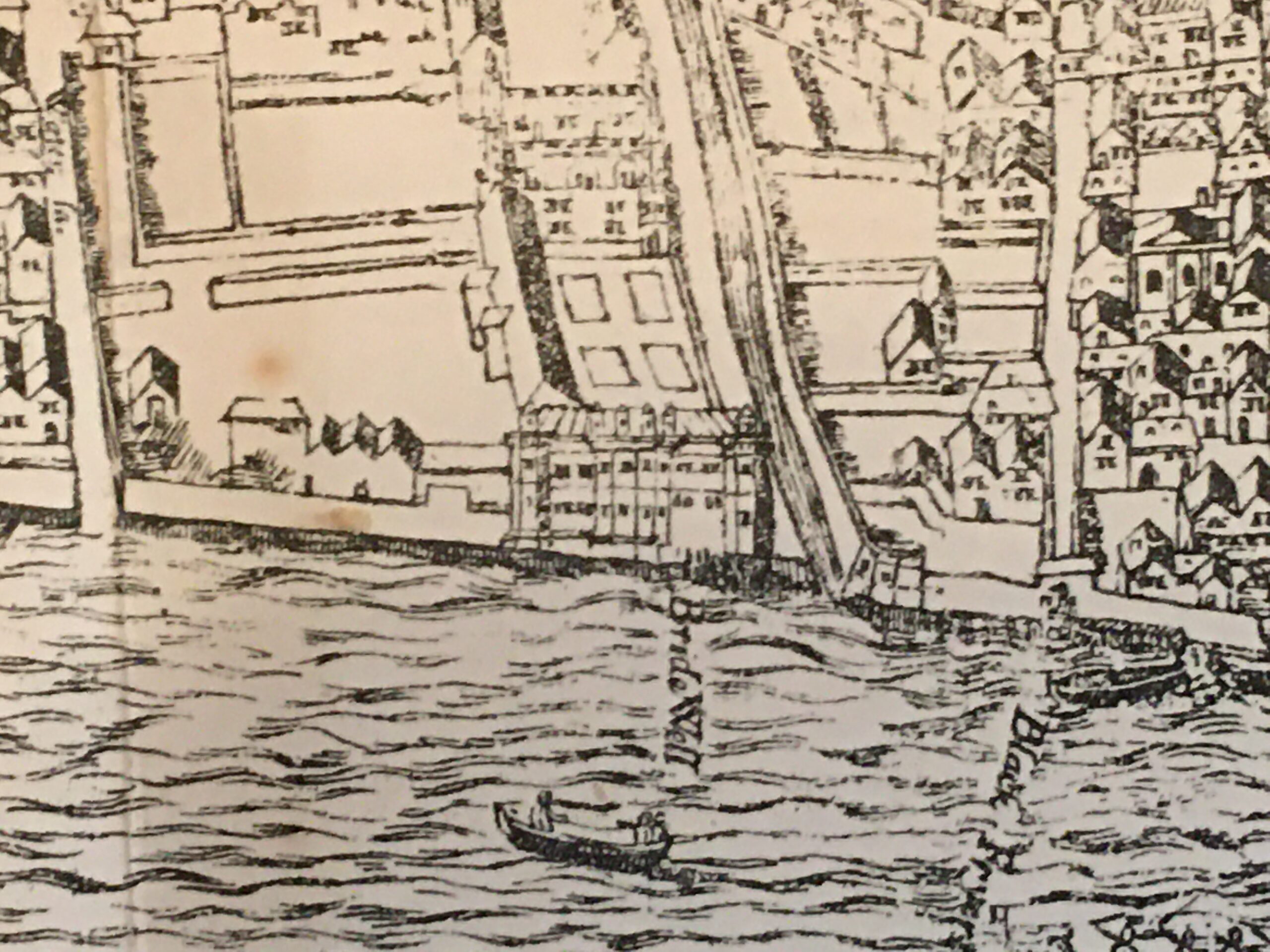
YMCA

The arrow is pointing to a plaque on the wall recording the founding of the Young Men’s Christian Association:

YMCA

The plaque states that in 1844, George Williams with eleven other young men employed in the City of London…….Founded the Young Men’s Christian Association. But why here?

The Drapery House mentioned in the plaque was the offices, factory and warehouses of Hitchcock, Williams & Co.

The firm was established in 1835 by George Hitchcock and a Mr. Rogers, who would leave in 1843.  George Williams (mentioned in the above plaque) who originally joined the company as an apprentice, became a Director with Hitchcock in 1853 when the partnership Hitchcock, Williams & Co was formed. Always based in St. Paul’s Churchyard, firstly at number 1, then at number 72, with the firm expanding to take in many of the surrounding buildings.

George Williams, as well as becoming a partner with Hitchcock, received a knighthood from Queen Victoria for services, which included the inauguration of the Young Men’s Christian Association (YMCA)  which was founded in a room of the company’s premises in St. Paul’s Churchyard.

The history of the YMCA states that the group founded the YMCA as “a refuge of Bible study and prayer for young men seeking escape from the hazards of life on the streets of London”.

The buildings of Hitchcock, Williams & Co. were destroyed during the raids of the 29th December 1940. A paragraph in the newspaper reports of the raid included a mention of the company and the YMCA:

“The historic room in which the Young Men’s Christian Association was started was among the places destroyed on Sunday night. With seven other buildings, the George Williams Room – named after the founder, the late Sir George Williams – was burned to ashes. It was situated in the premises of Messrs. Hitchcock, Williams and Co, manufacturers, warehousemen and shippers, of St. Paul’s Churchyard, and was originally one of the bedrooms used by the 140 assistants employed in the Hitchcock drapery business.”

As stated in the plaque, “from its beginning in this place inspired of God the association grew to encompass the world” and all because George Williams started as an apprentice here, in one of the many businesses that once lined St. Paul’s Churchyard.

I wrote a post dedicated to the company’s experience in the 1940s in this post: Operation Textiles – A City Warehouse In Wartime.

The Grand Lodge of English Freemasons

There is another plaque in the same place as the plaque recording the YMCA. Directly opposite, in the entrance to the covered walkway shown in the photo of the location of the YMCA plaque is the following:

Freemasons

The significance of the plaque and the site is the reference to the Grand Lodge, as prior to 1717 there had been four London lodges, and on the 24th of June 1717, they met at the Goose and Gridiron Tavern in St Paul’s Churchyard, and elected Anthony Sayer as the first Grand Master.

This was the first Grand Lodge not only in the country, but also across the world of Freemasons.

The four original lodges had all met in pubs; the Goose and Gridiron in St. Paul’s Churchyard, the Crown in Parkers Lane, the Apple Tree in Covent Garden, and the Rummer and Grapes (no location given).

Pubs continued to be used for meetings, but in 1767, the Grand Master, the Duke of Beaufort had the idea for a Central Hall, and a committee was formed to purchase land for a new hall, and a “plot of ground and premises consisting of two large, commodious dwelling houses, and a large garden situated in Great Queen Street” were purchased.

The hall built on the site was opened in 1776, and the Freemasons still occupy the same site, with the current hall being built between 1927 and 1933.

The plaques featured in today’s post show the wide range of organisations that have made the City of London their home over the centuries, or have been founded in the City.

From organisations such as the Samaritans, who must have been responsible for saving and helping so many people since 1953, to global organisations such as the YMCA, City Livery Companies, Medical Institutions and the Freemasons.

And they all continue to make their mark today.

alondoninheritance.com