Fred Cleary and the Flowering City

The City of London has always been a busy and congested place. For centuries, gardens and green space were only to be found around the halls of the Livery Companies and the gardens of some of the larger houses owned by rich City merchants and well connected residents.

As trade, manufacturing and finance expanded within the City during the 19th century, open space was not treated with the some level of priority as buildings that served the commercial purposes of the City.

Significant destruction of buildings and damage to large areas of land during the war resulted in new thinking as to how reconstruction should take place. I have written about a couple of plans for the City such as the 1944 report on Post War Reconstruction of the City, and the 1951 publication, The City of London – A Record Of Destruction And Survival.

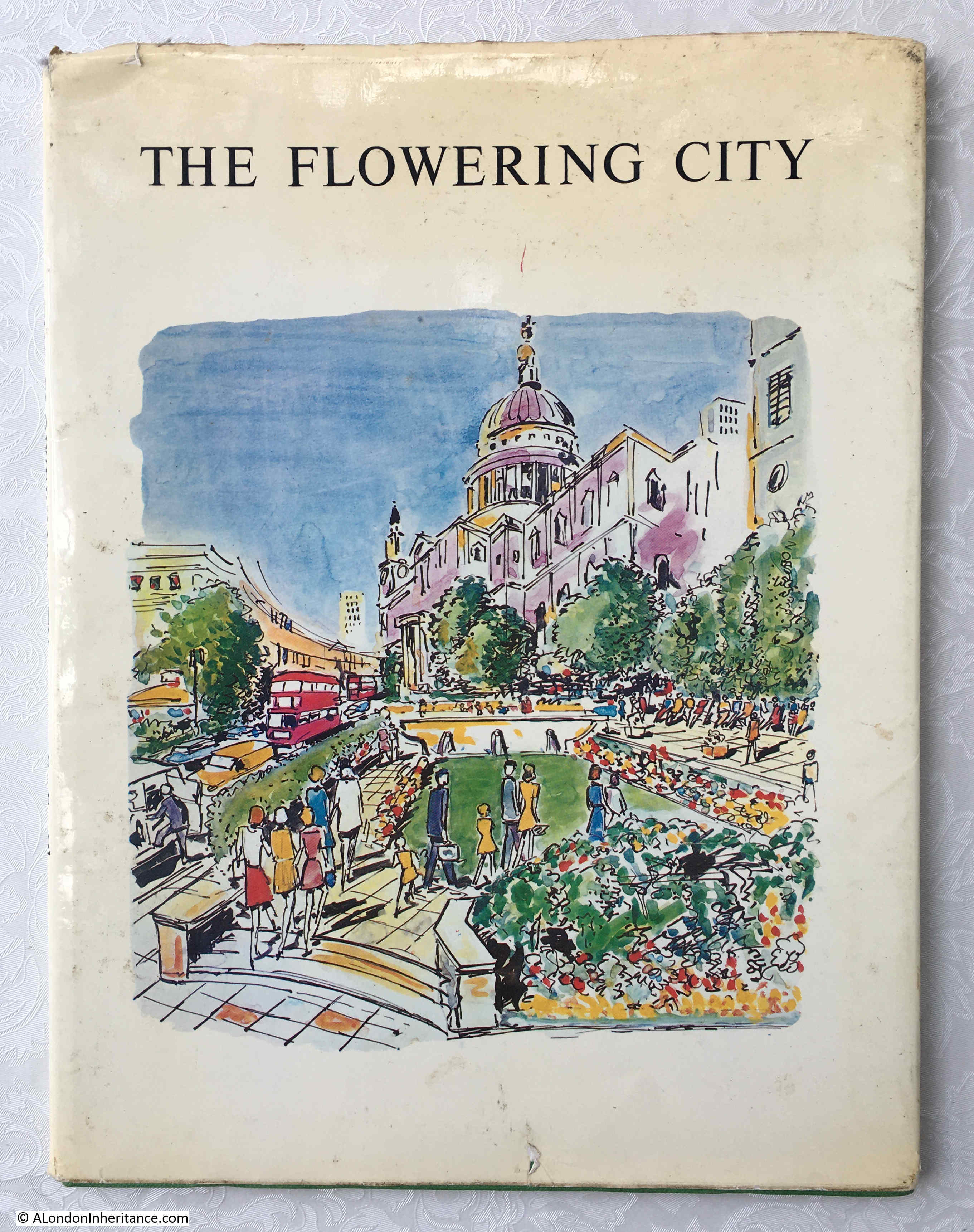
More green space, places for people to sit, and the planting of flowers was one of the initiatives pushed forward by Fred Cleary, and in 1969 he published a book about the new gardens in the City titled “The Flowering City”:
Fred Cleary

Fred Cleary was a Chartered Surveyor who worked for a City mortgage and investment company. He was also a longtime member of the City’s Court of Common Council, and according to the author information in the book was Chairman of the Trees, Gardens, and City Open Space Committee, and the Chairman of the Metropolitan Public Gardens Association.

The aim of the book was to “record something of the considerable efforts made by the City Corporation who, supported by many business interests and voluntary bodies, have endeavoured to make the City of London one of the most colourful and attractive business centres in the world.”

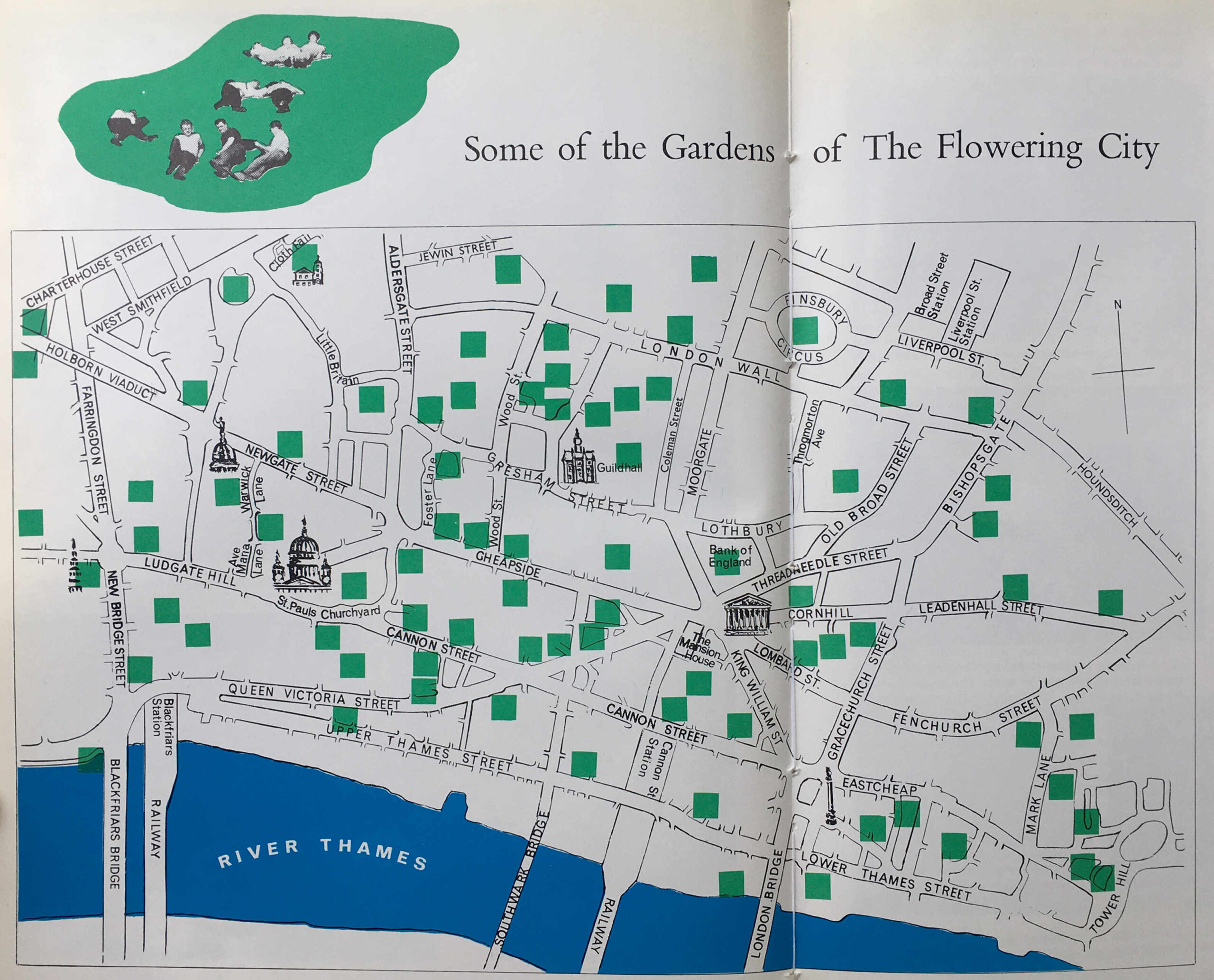
Through his interests and his membership of a number of key City committees, Fred Cleary had a leading role in the post war development of many of the gardens across the City, and the book includes a map of some of these gardens, many of which feature in the book:
Fred Cleary

The book is full of photos of the first gardens to be created as the City reconstructed after the war. Many of these gardens still remain, although they have changed significantly over the years.

Originally, they had a rather formal layout with basic planting. Today, many City gardens are far more natural with lots of planting and almost a wild feel to some of the best.

What I think is the very latest City garden almost looks straight from the Chelsea flower show and has an incredible central water feature. I will come to this garden later in the post, but the first garden on a brief walk to some of the City gardens, was the one named after Fred Cleary.

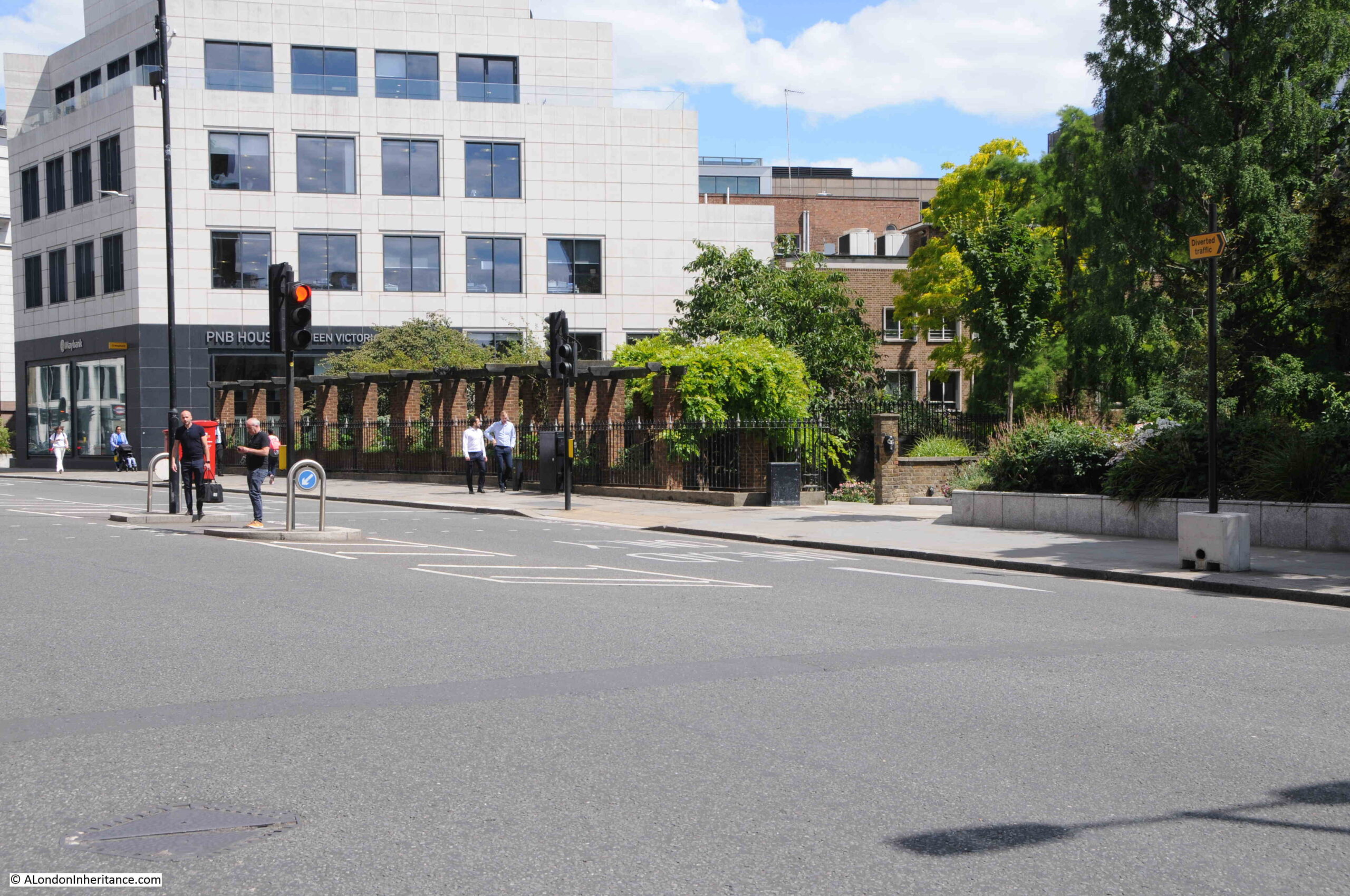
Looking south, across Queen Victoria Street, and we can see the start of Cleary Gardens:
Fred Cleary

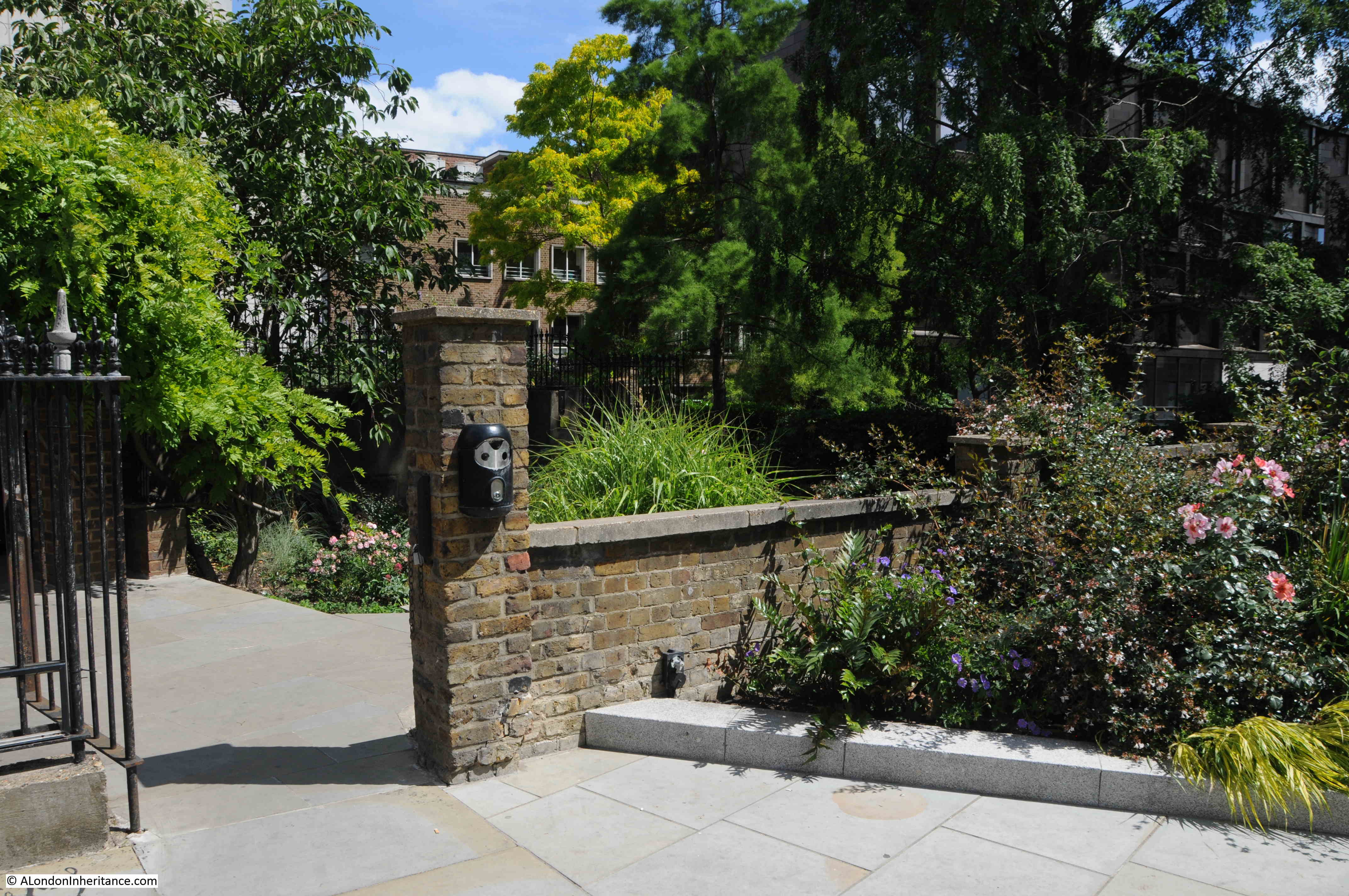
One of the entrances to Cleary Gardens from Queen Victoria Street:
Fred Cleary

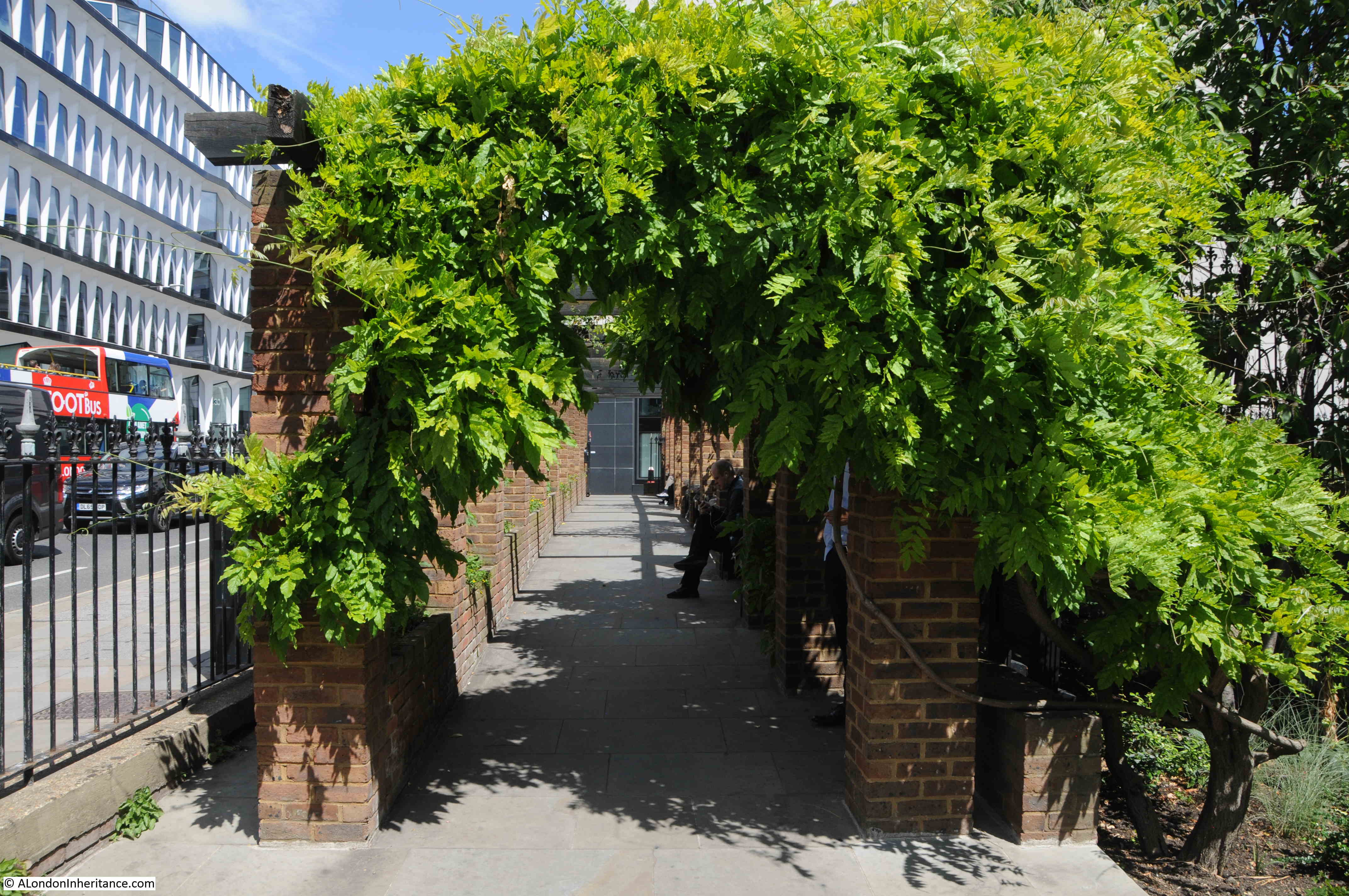
A long brick pergola facing onto Queen Victoria Street with seating between each of the brick columns:
Fred Cleary

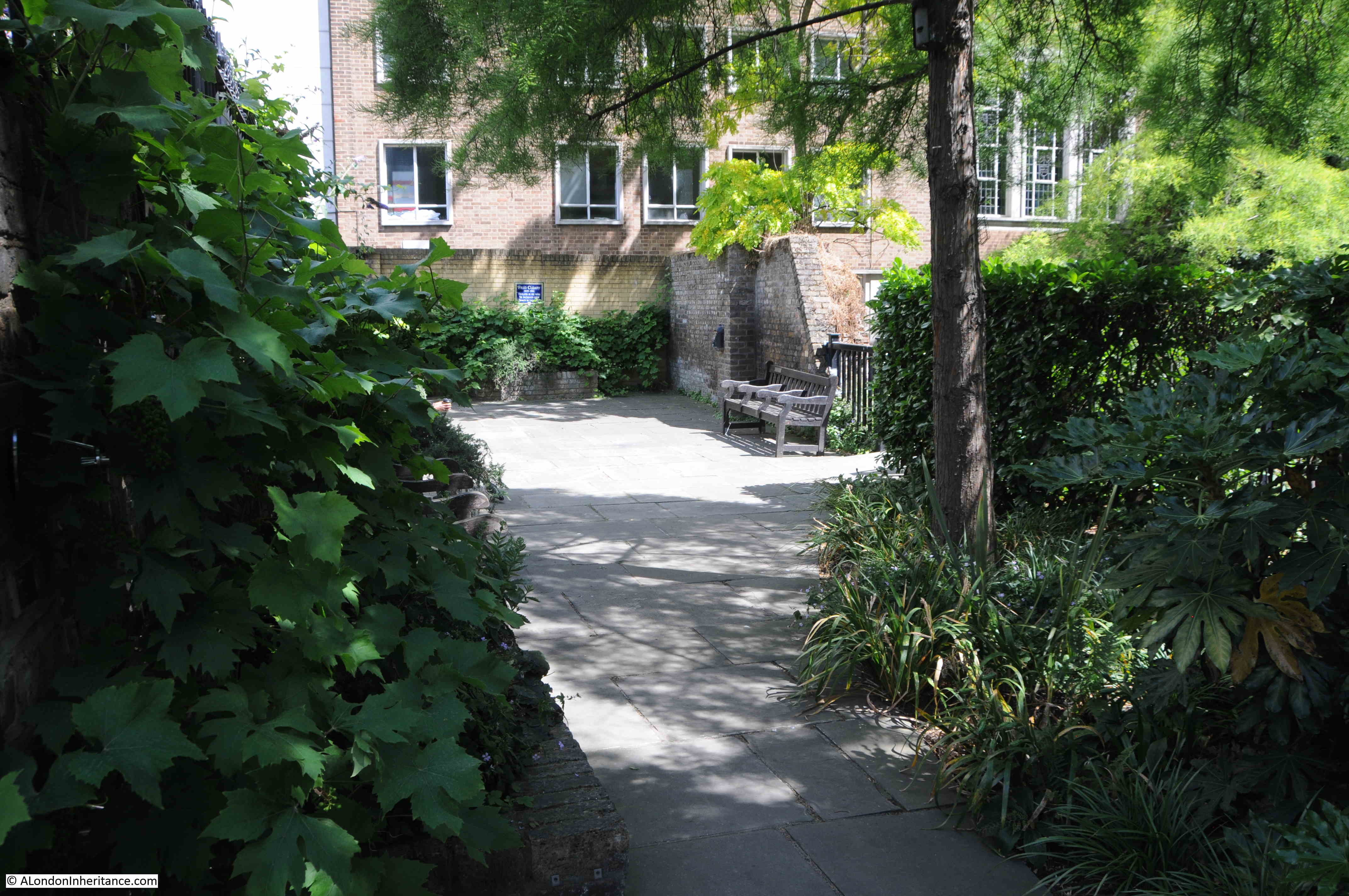
Many of the new post-war gardens were built on bomb sites, and Cleary Gardens occupies such a site. The land drops away to the south of Queen Victoria Street towards the Thames, so the gardens are tiered. Walk down to the middle tier and there is a small enclosed space:
Fred Cleary

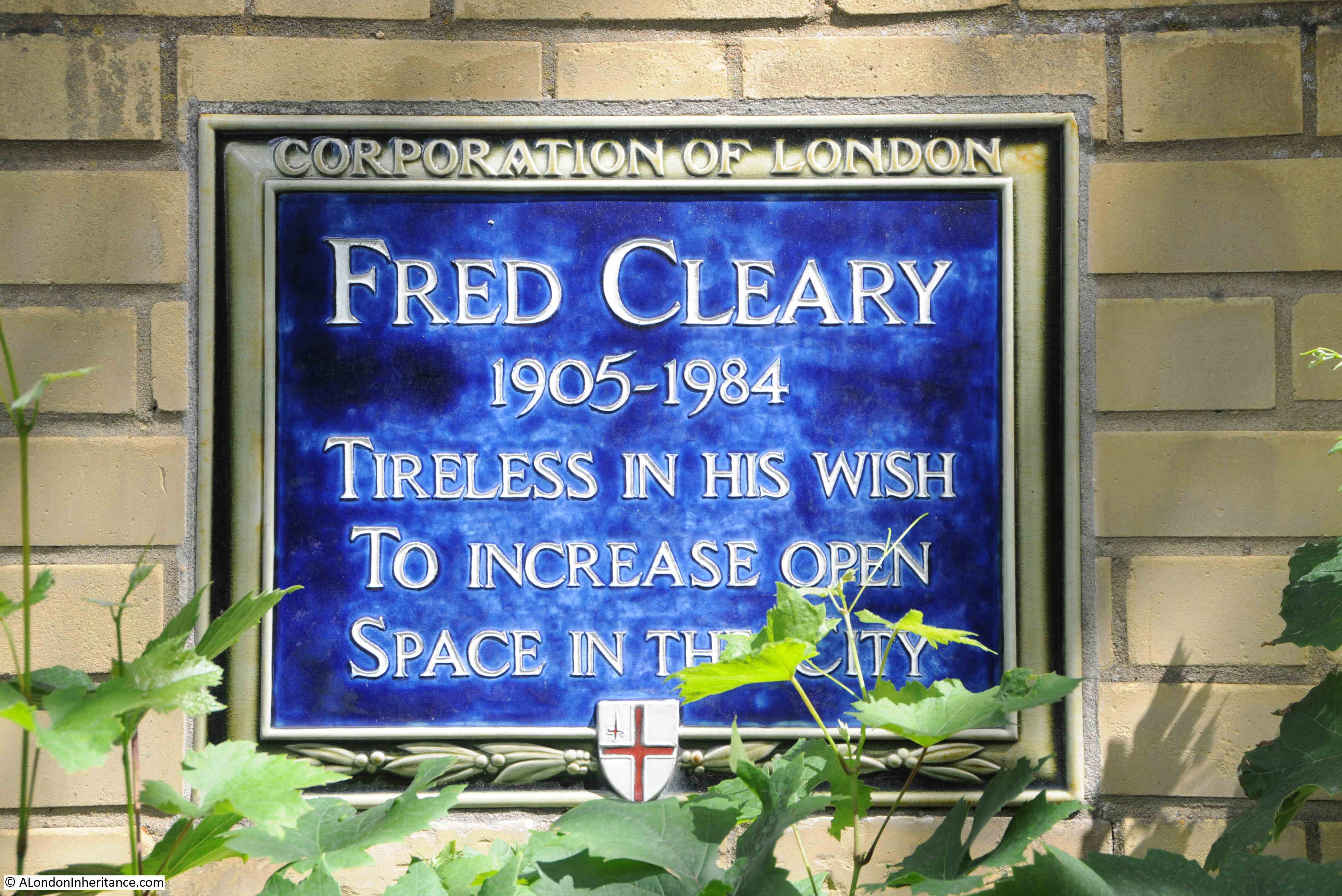
At the end of the above space, there is a blue City plaque on the wall, commemorating Fred Cleary who was “Tireless in his wish to increase open space in the City”.
Fred Cleary

The remaining walls from the buildings that once occupied the site have been included in the structure and tiers of the gardens:
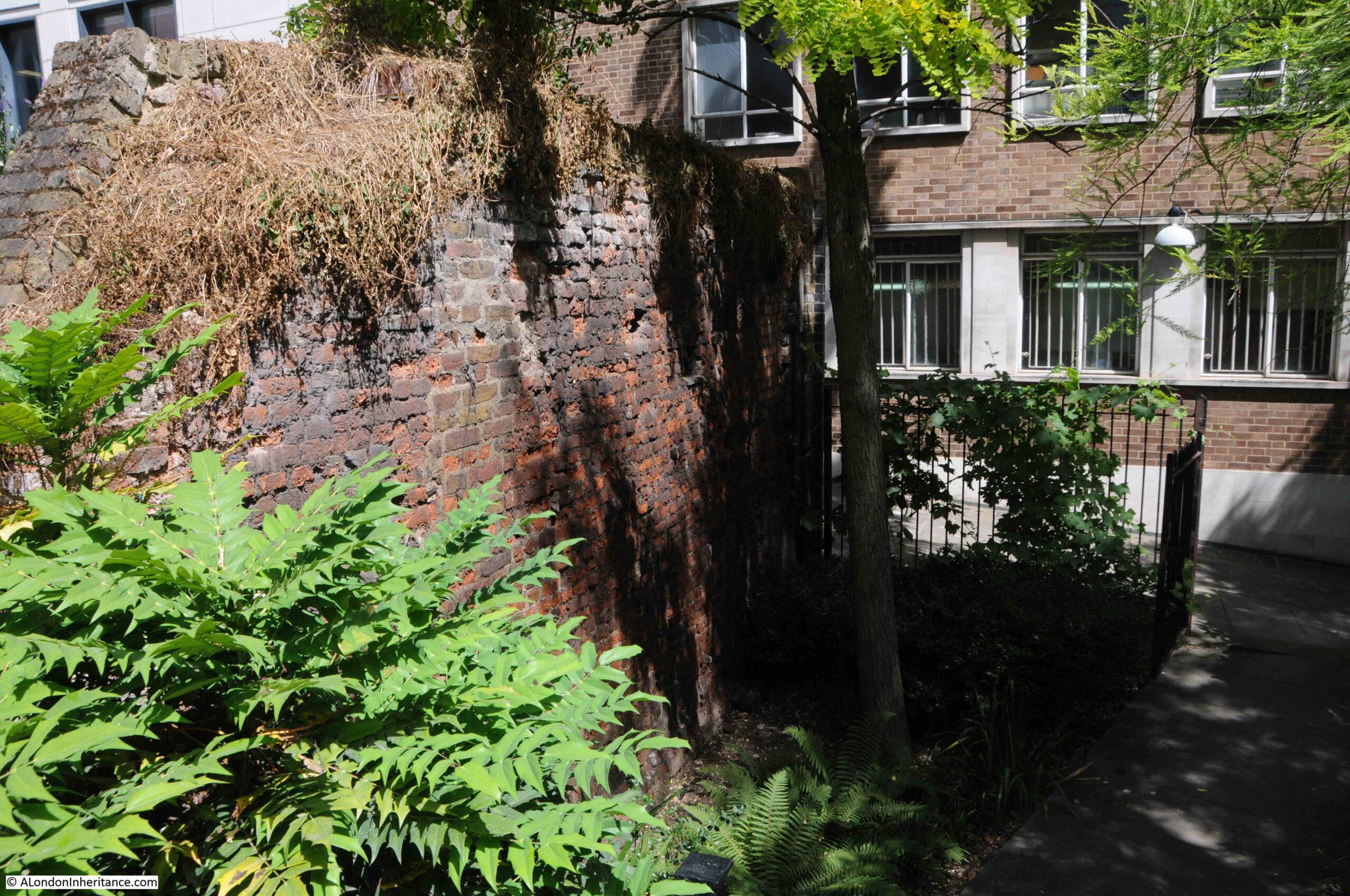
Fred Cleary

Cleary Garden was initially planted by a City worker in the 1940s and on the evening of the 26th July 1949, the garden was visited by the Queen (mother of the current Queen) who was on a tour of City and East London gardens.

The gardens were significantly remodeled in the 1980s and it was following this work that they were named after Fred Cleary who had died in 1984.

The lower tier of the gardens:
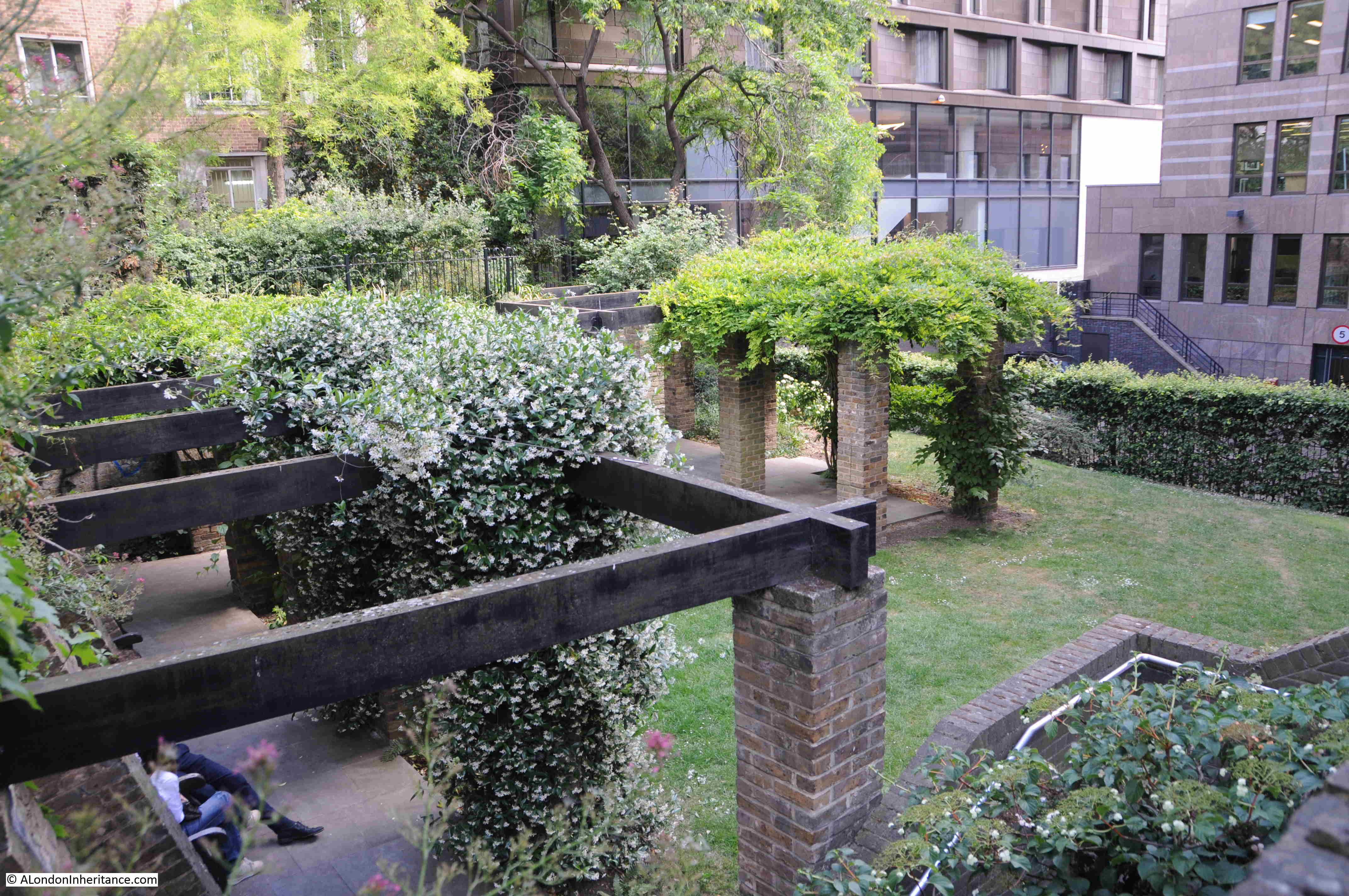
Fred Cleary

Huggin Hill forms the eastern border of the gardens. Excavations at the gardens, under Huggin Hill and under the building on the left have found the remains of a Roman bathhouse.
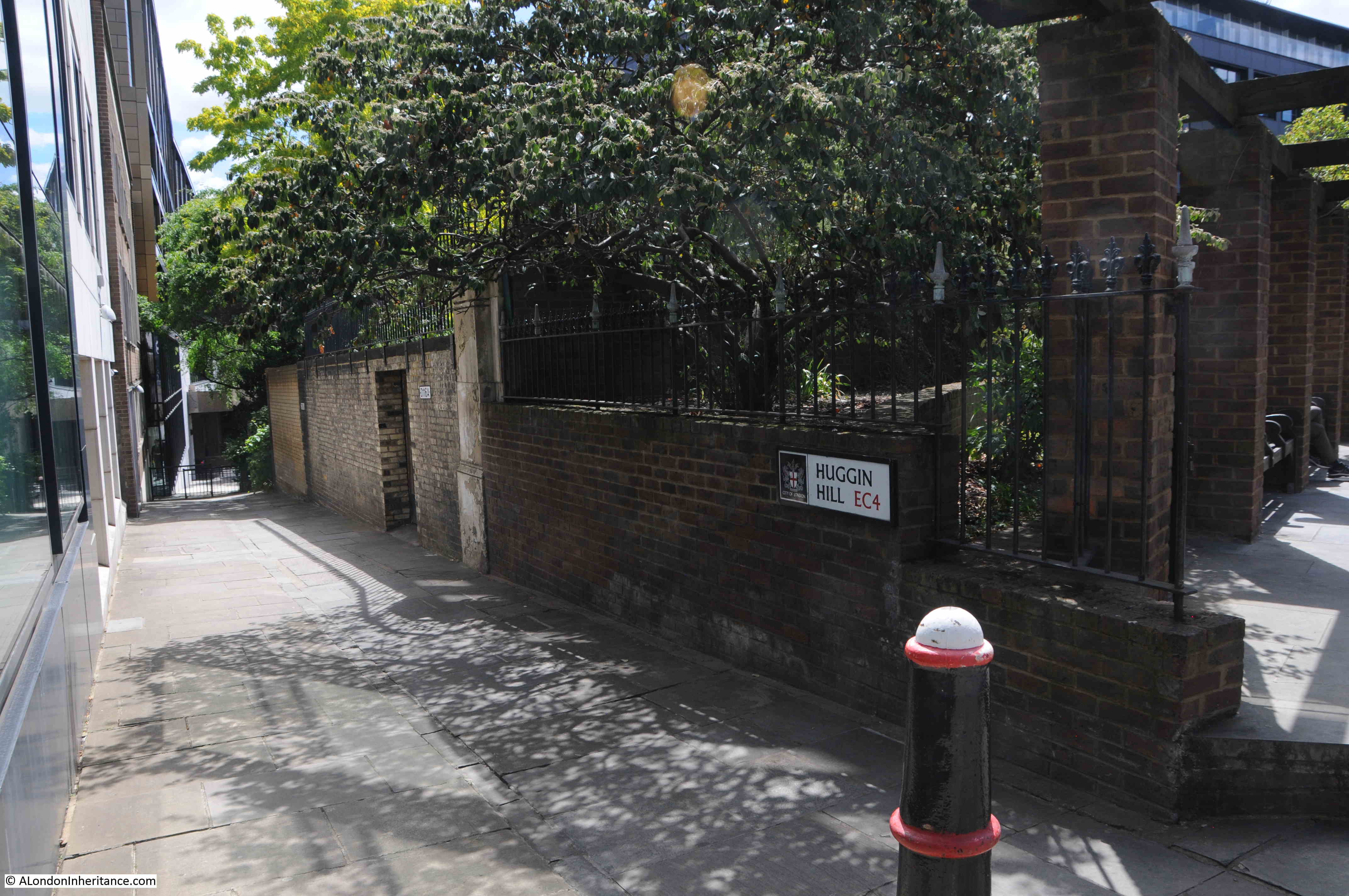
Fred Cleary

Fred Cleary argued not just for open gardens and green space, but also for more planting of flowers across the City, and an example of what he would have appreciated can also be found in Queen Victoria Street, outside Senator House, where the office block is set back from the street, and raised beds full of flowers have been built between building and street:
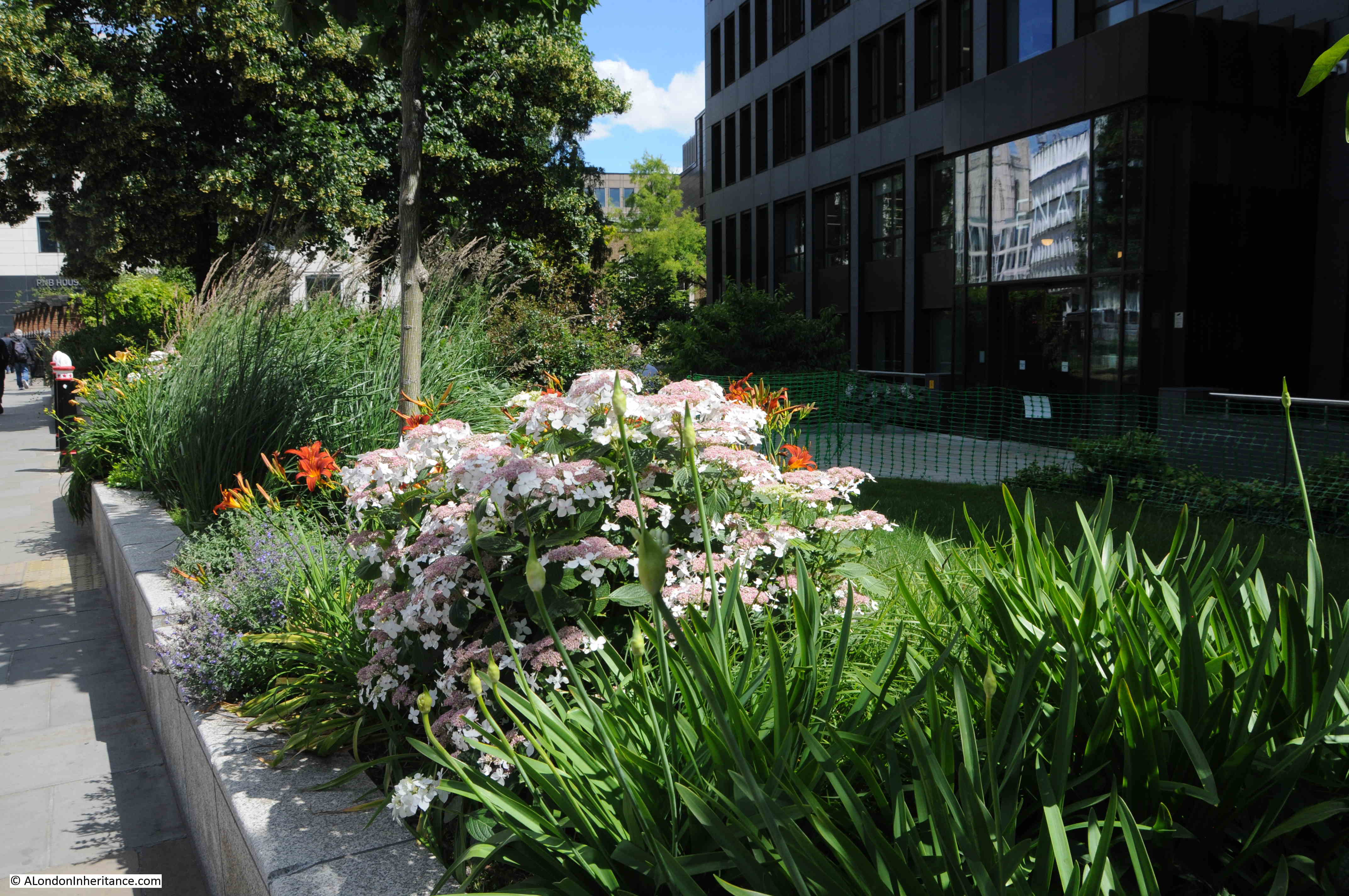
Fred Cleary

Almost all of the City gardens featured in Cleary’s book have been remodeled several times since their original construction, and those in the book look very different to the gardens we see today.

Hard to keep track with change in the City, but I think the very latest example of how gardens change are the recently reopened gardens on the corner of Cannon Street and New Change.

There have been gardens on the corner of these two City streets for many years. The gardens were last redesigned in 2000 based on a design by Elizabeth Banks Associates, however they recently reopened following another major redesign.

These gardens are in front of 25 Cannon Street, and Pembroke, the developers of the building included a transformation of the gardens by the landscape and garden design practice of Tom Stuart-Smith.

I must admit to being rather cynical of many new developments which are aligned to an office project. Too often they are a low cost bolt on, designed to make the planning process easier, however these new gardens are really rather good.

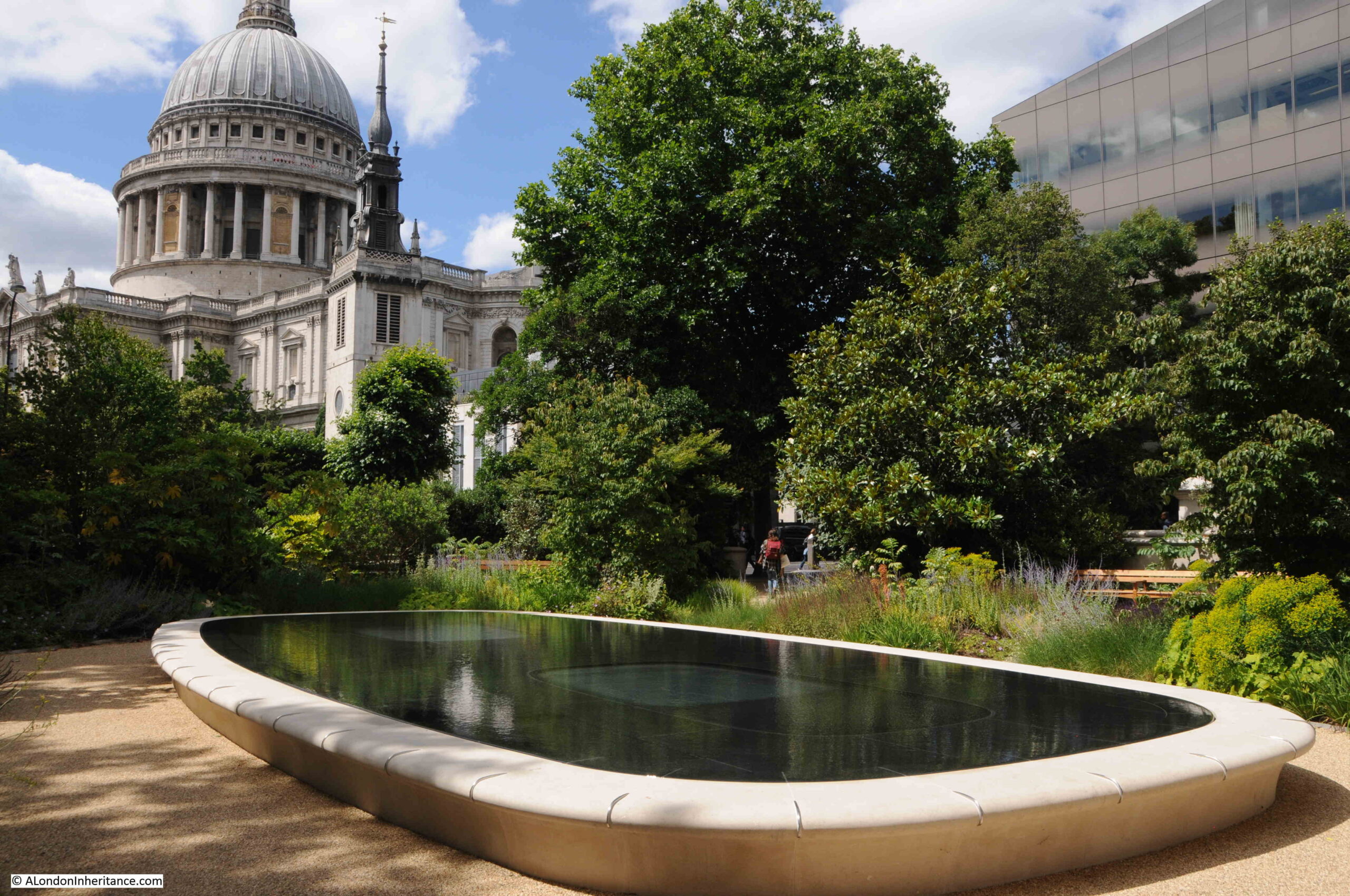
The key new feature at the centre of the gardens is a large reflection pool:
Fred Cleary

The pool was the work of water feature specialist Andrew Ewing. The water in this pool is very still (although it does appear to be flowing over the internal edge), and is positioned to provide some brilliant reflections of St Paul’s Cathedral:
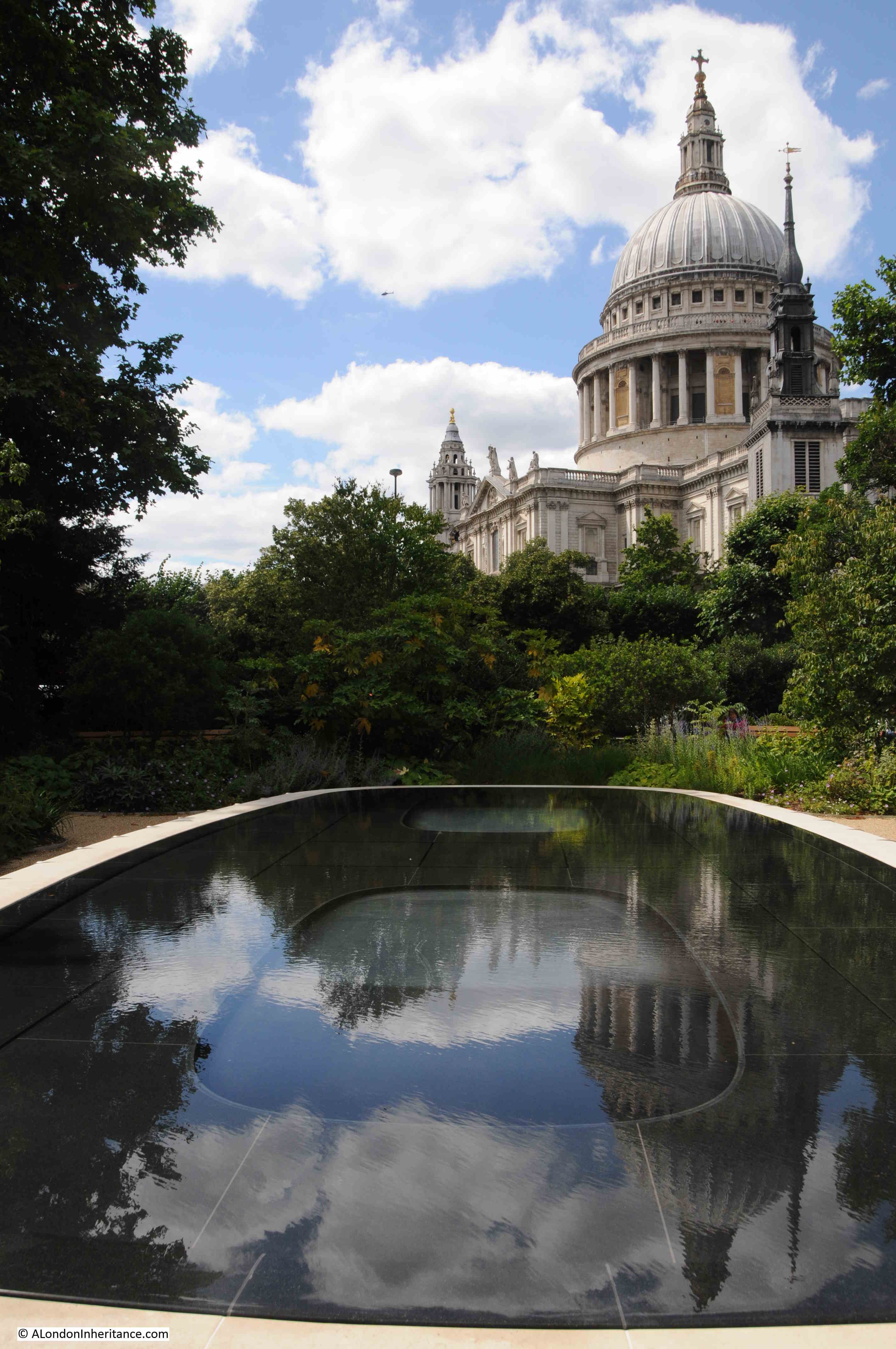
Fred Cleary

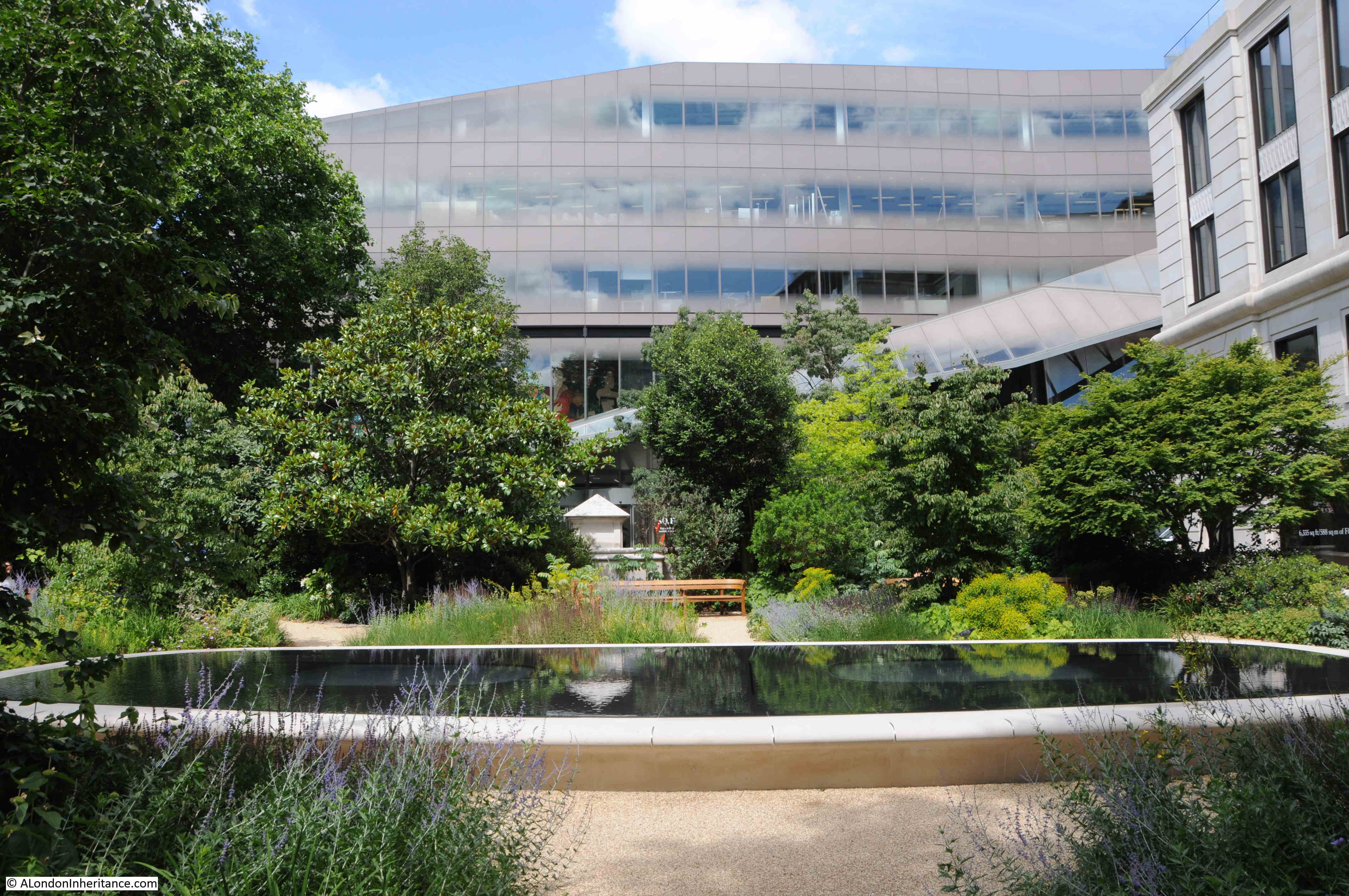
The outer wall of the pool provides seating, and the surrounding gardens are planted to such an extent that the traffic on the surrounding streets is effectively hidden.

Although good for taking photos, I was surprised that on a warm and sunny June day, very few people walked through the garden or used the seating. Not easy to see the central pool from outside the garden, but it is very much worth a visit.

View across the central pool to the buildings of One New Change – the mature trees from the previous development have been retained, and the central layout and smaller planting is new:
Fred Cleary

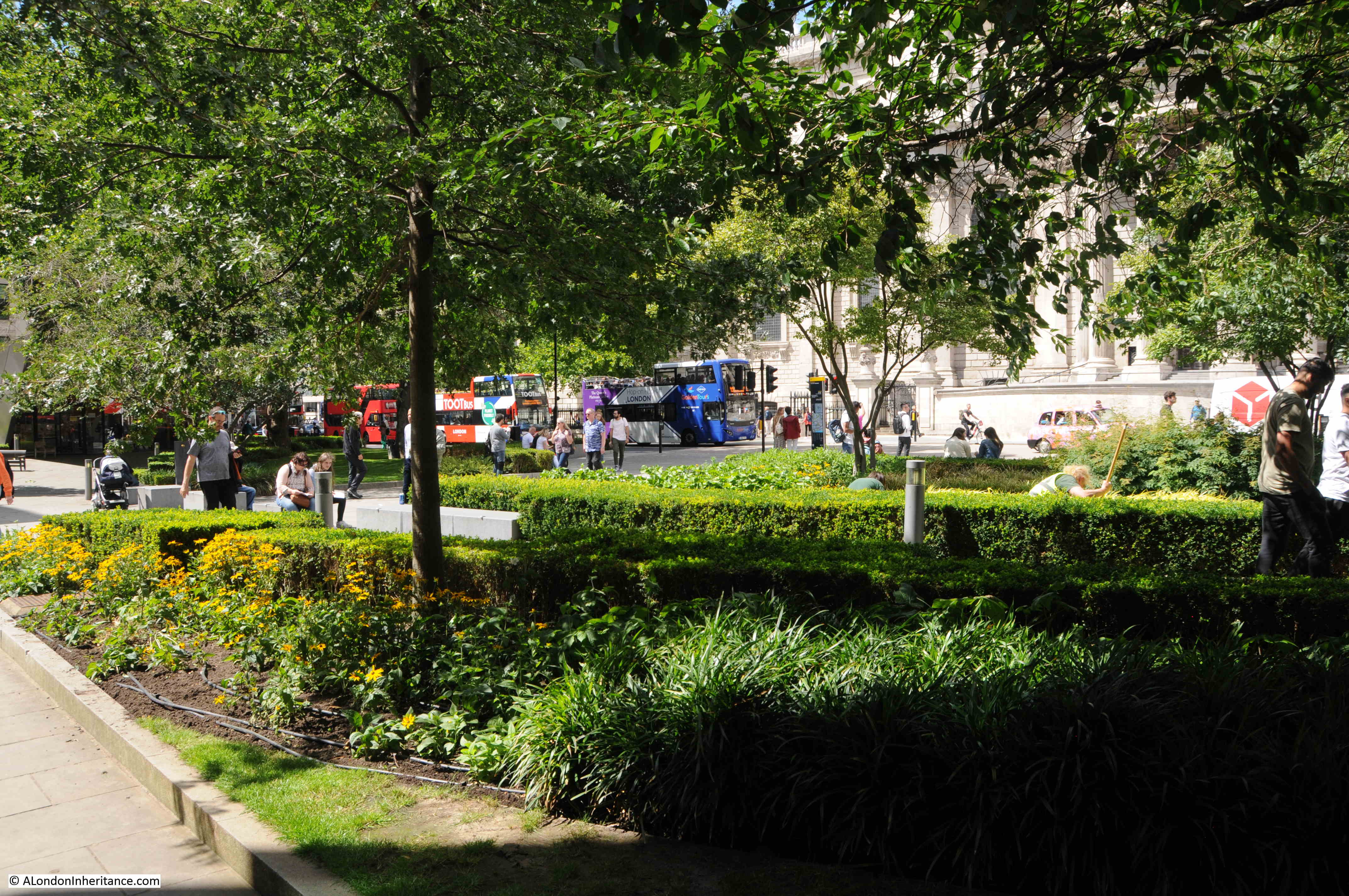
Possibly one of the reasons why the above gardens were so quiet is the large amount of open space and gardens across the road around the south side of St Paul’s Cathedral.

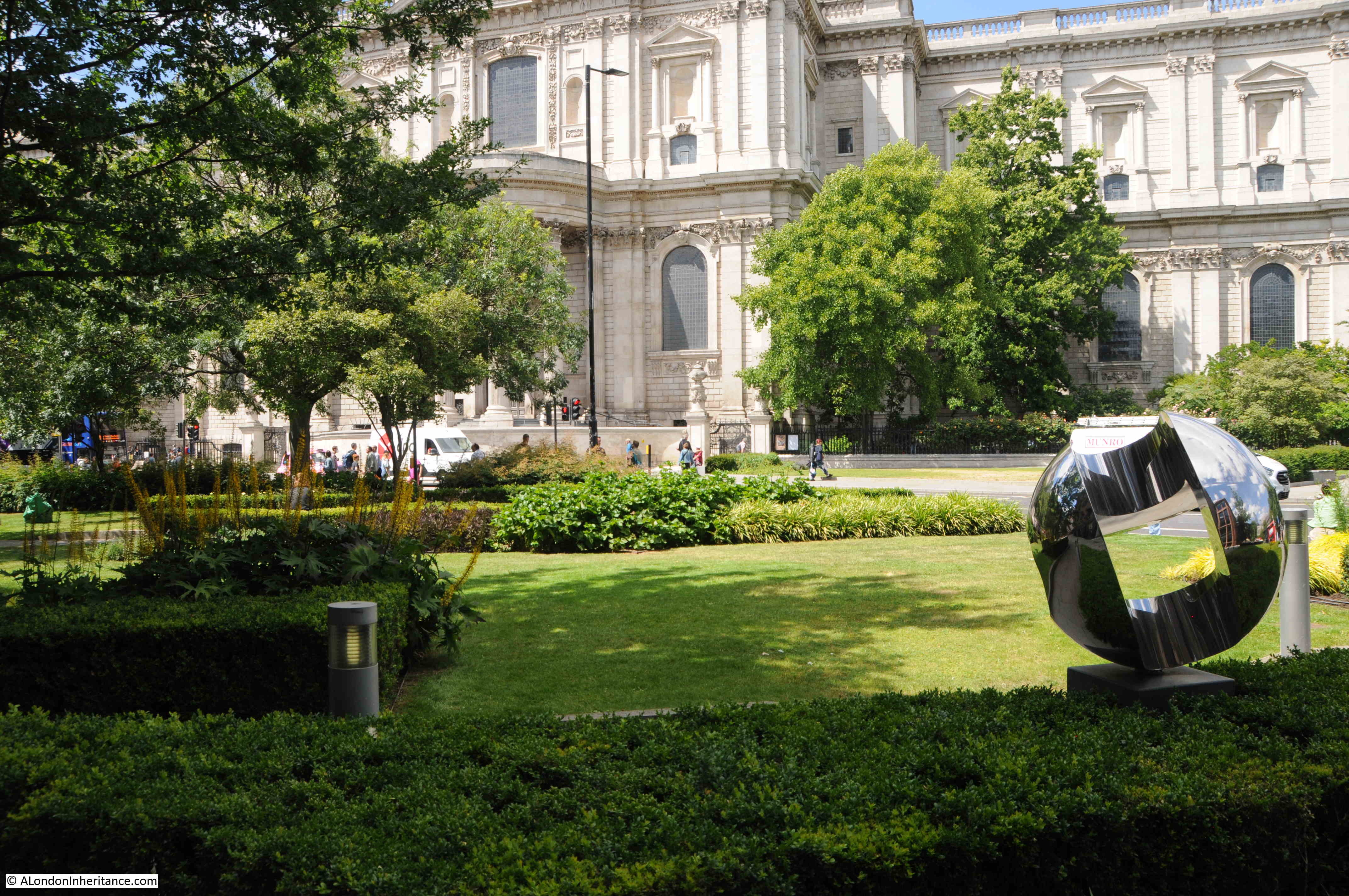
These gardens were all part of the late 1940s / early 1950s development of new green / garden space, but have become more planted since.

The garden’s in the 1960s were rather basic green space, as shown in the following photo from The Flowering City:

Fred Cleary

The office blocks in the above photo have long been replaced, and the only recognisable feature in the photo is the church of St Nicholas Cole Abbey in the background.

The garden consisted of mainly grass with some planting in the centre and around the edge.

Today. the gardens are very different with plenty of planting and some works of art:
Fred Cleary

Plants, hedges and walkways:

Fred Cleary

Looking towards the City of London Information Centre:
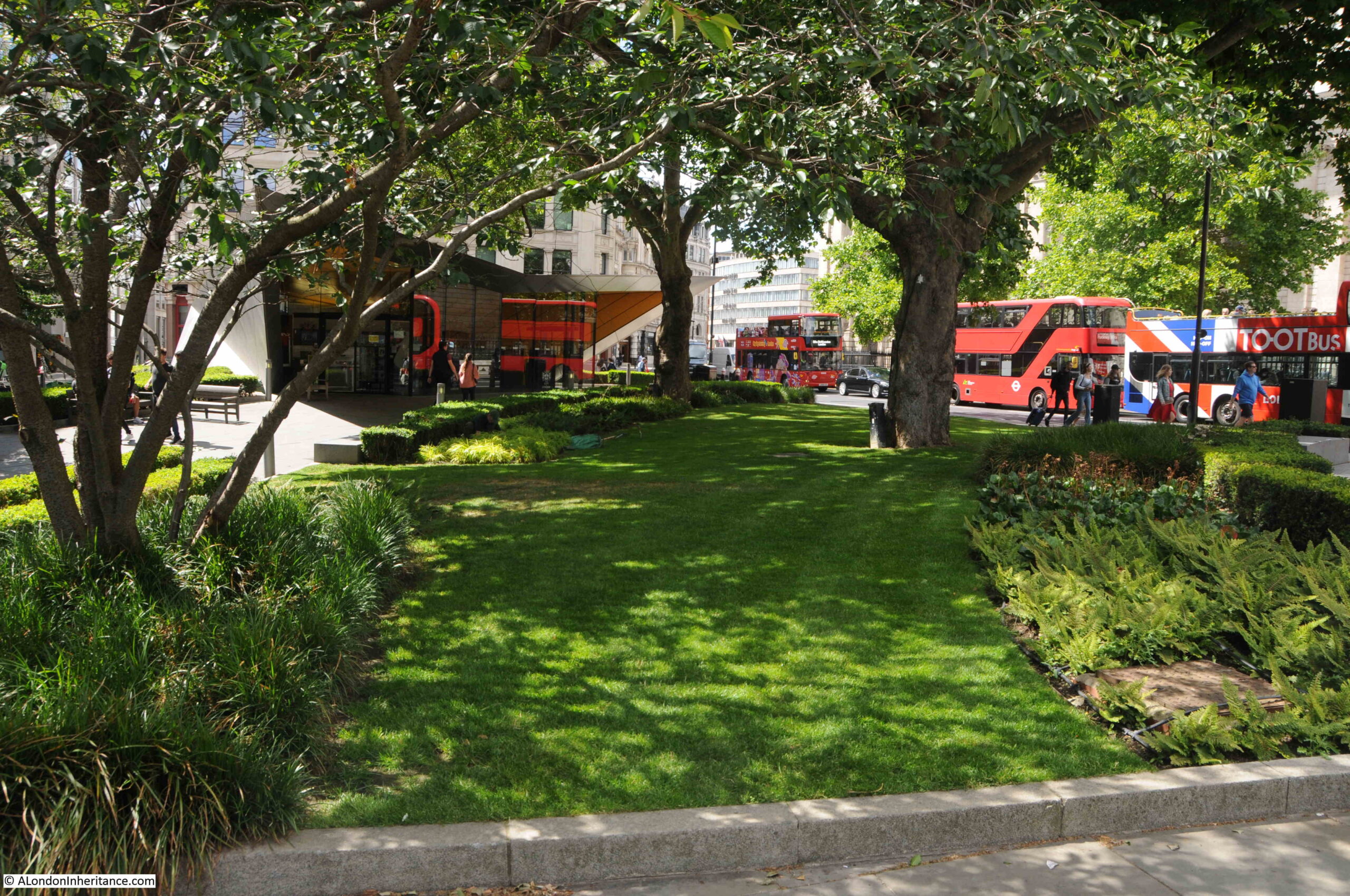
Fred Cleary

City gardens tend to be very well maintained and the gardens to the south of St Paul’s were being worked on during my visit:
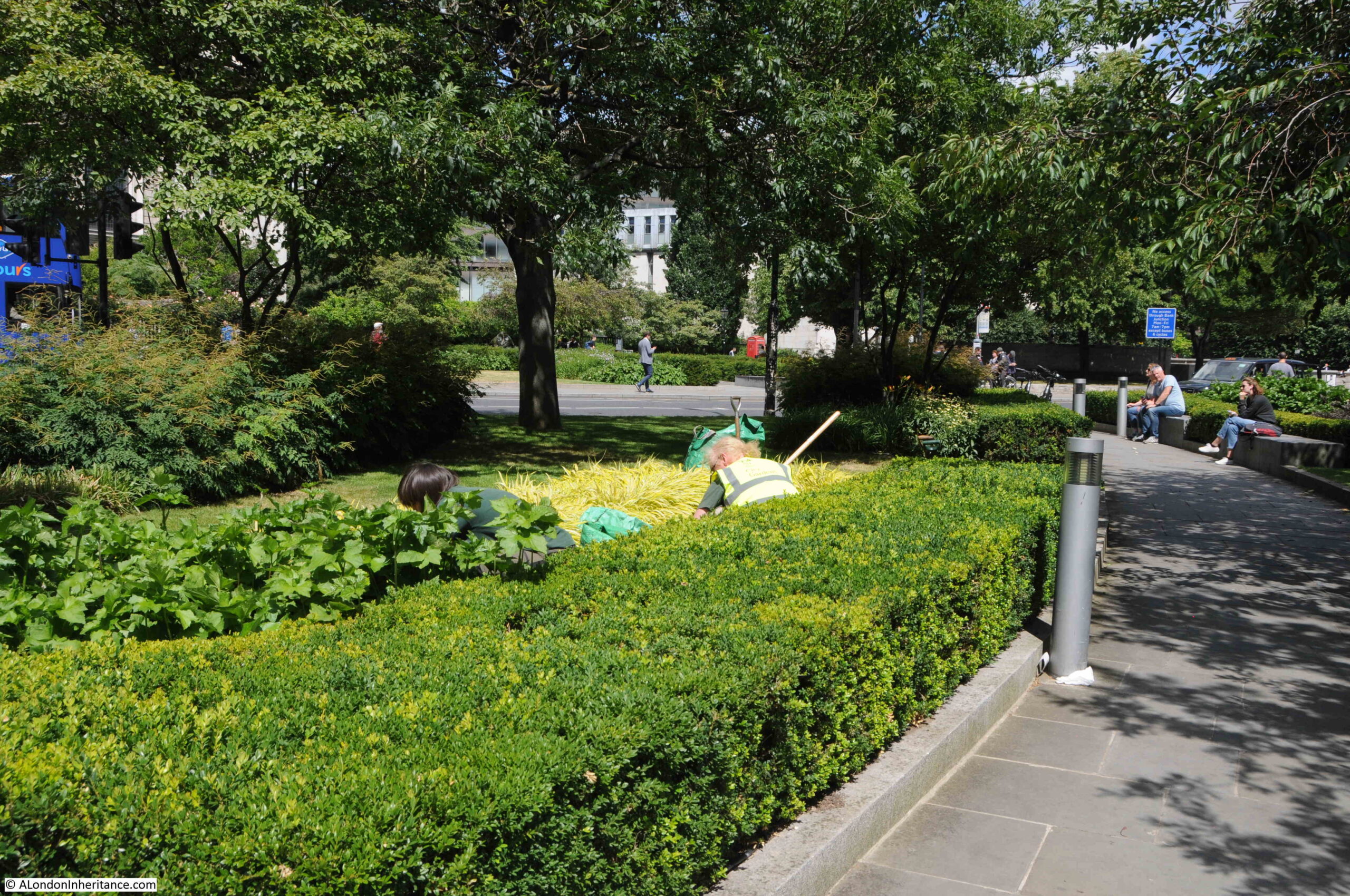
Fred Cleary

Across the road from the above photos to the immediate south east of St Paul’s Cathedral, there is another large area of green space:
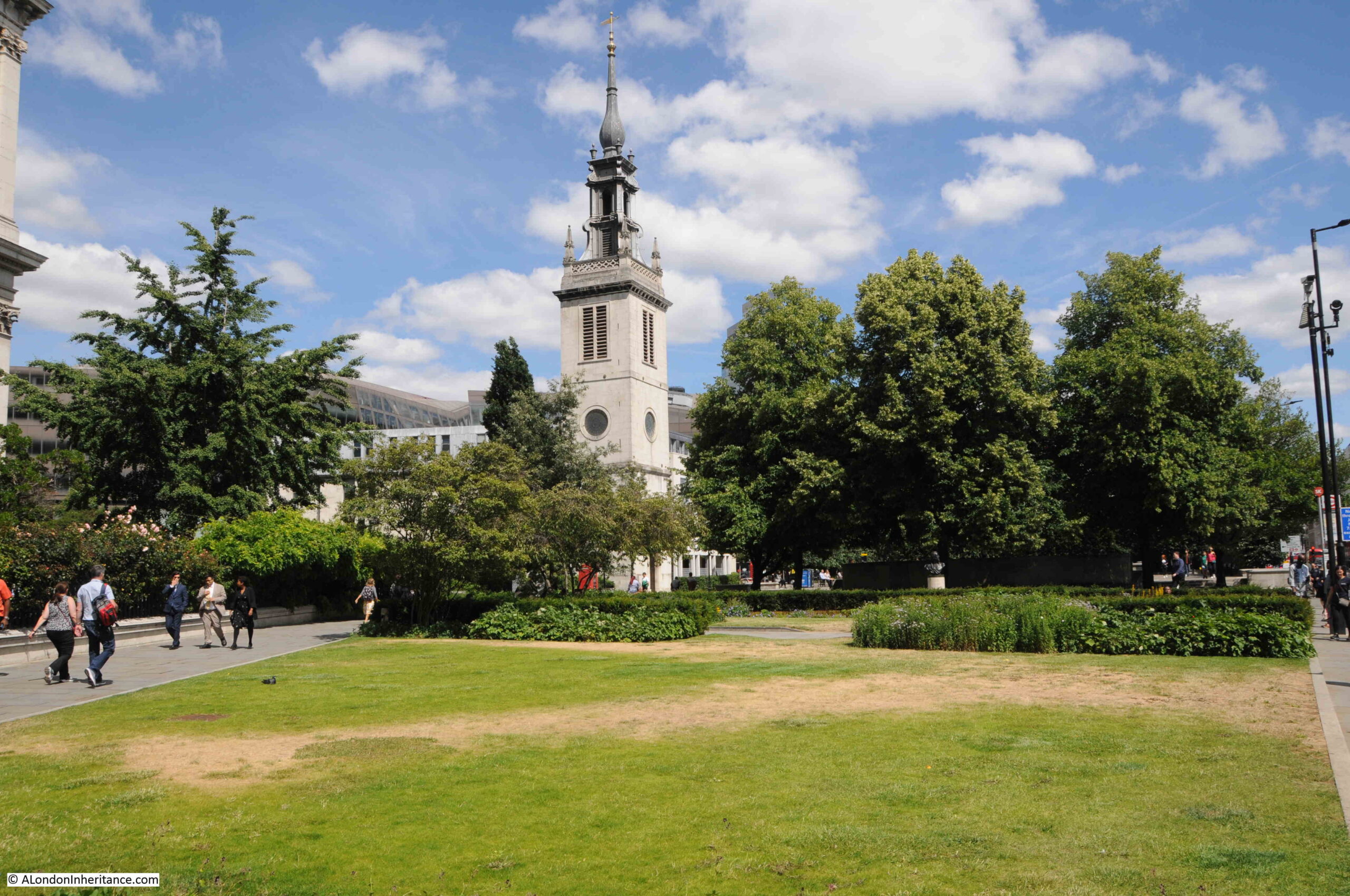
Festival Gardens

These gardens have changed the area considerably, and have been through a series of post war development.

The following photo is one of my father’s photos from the Stone Gallery of the cathedral. The church in the photo (minus the spire), is the same church as seen in the above photo.
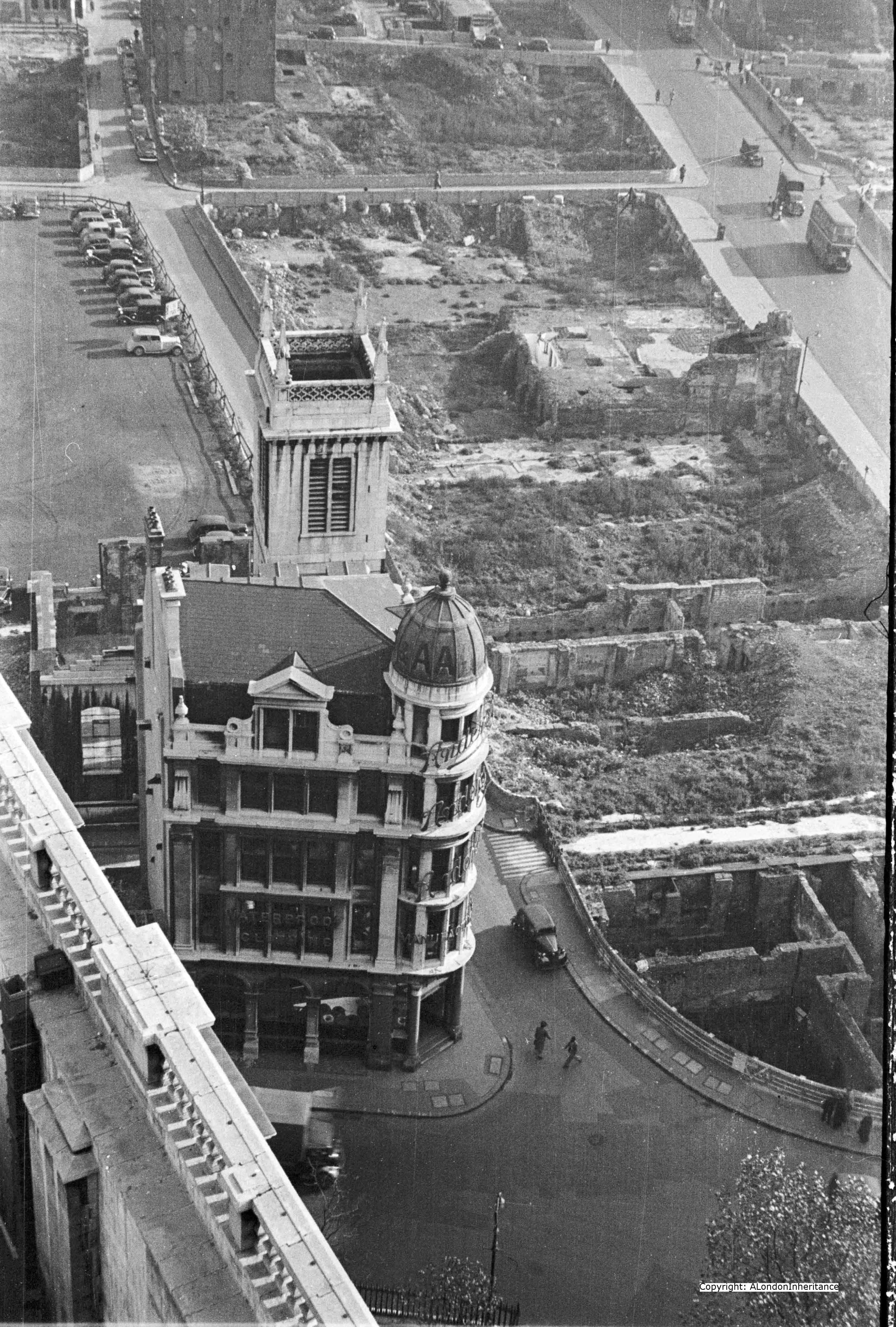
Festival Gardens

The space occupied by the gardens to the south east of the cathedral were once a dense network of streets and buildings as can be seen by their remains in the above photo.

My comparison photo to my father’s is shown below – a very different view:
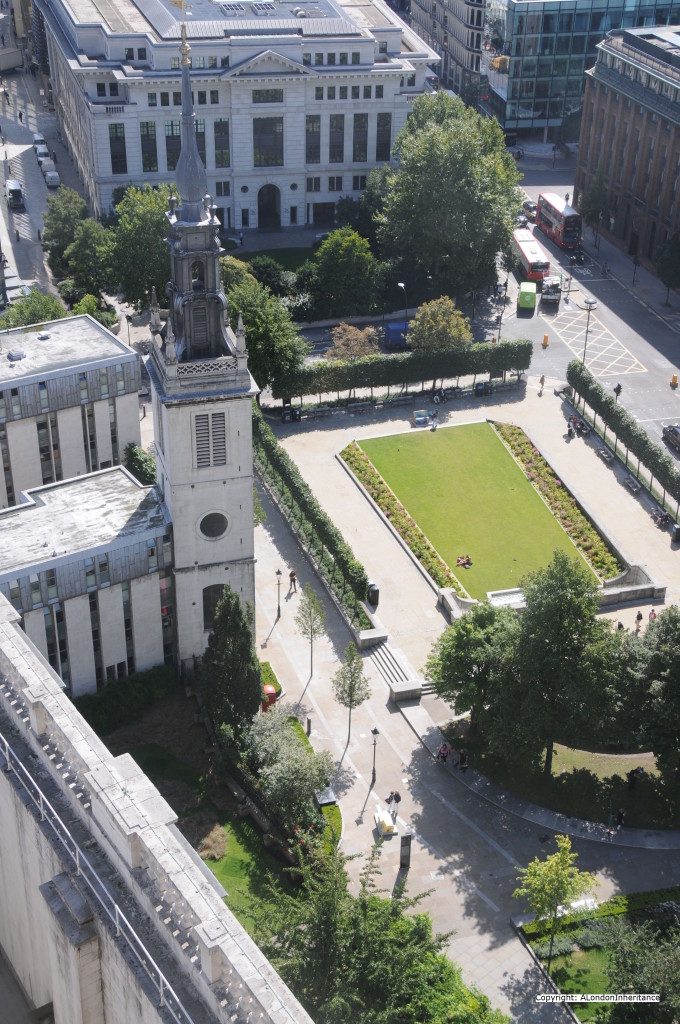
Festival Gardens

The gardens in the above photo were the first to be constructed in 1951 to tie in with the Festival of Britain, and go by the name of Festival Gardens. The book Flowering City shows the gardens as they were originally built:
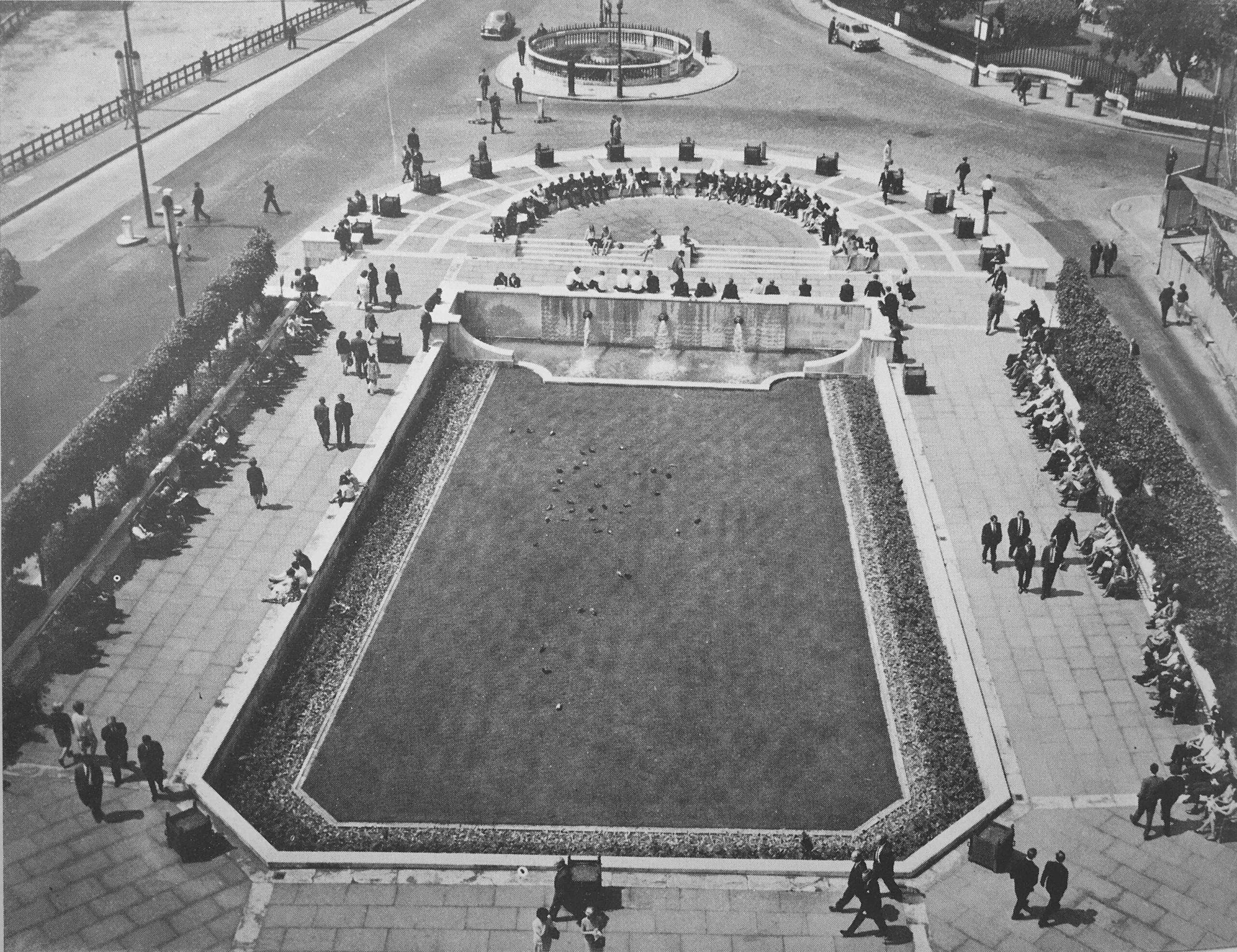
Festival Gardens

The gardens seen in the above photo remain, however the gardens have been extended all the way back to cover the road and circular feature at the top of the photo and the road to the right.

These original gardens and the three fountains are very much the same today, as can be seen in the following photo:
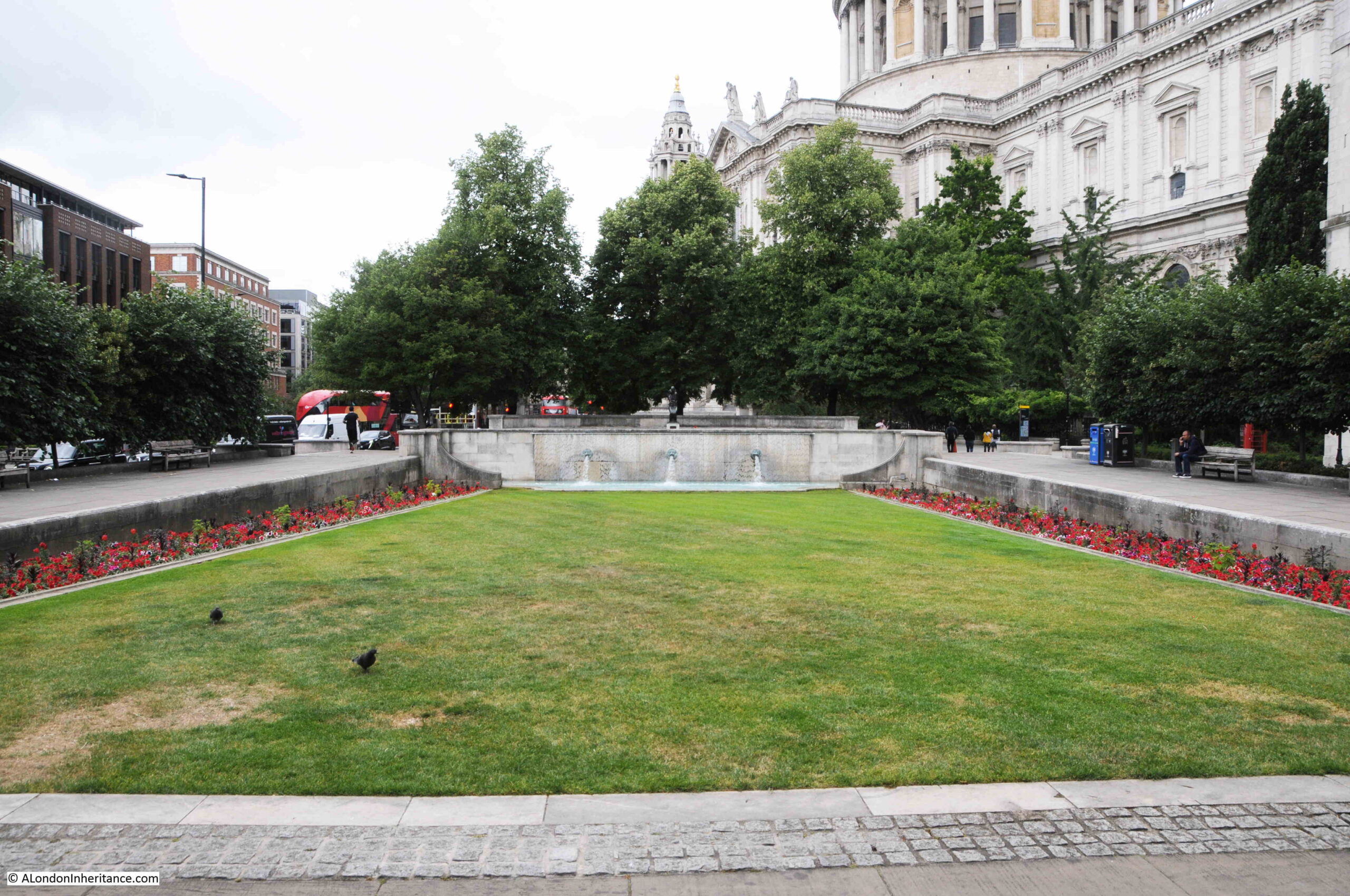
Festival Gardens

View back from the top of walkway behind the fountains:
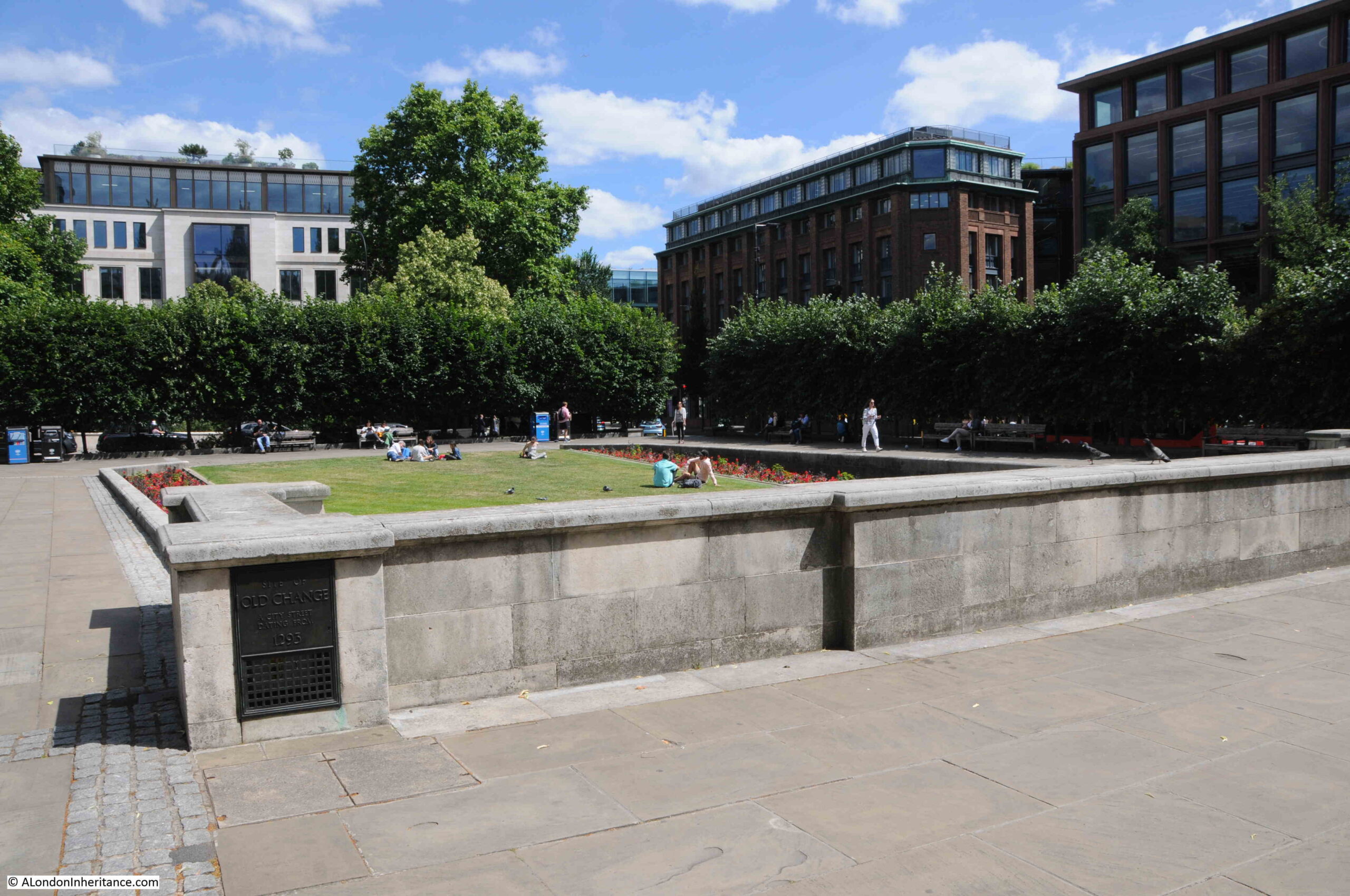
Festival Gardens

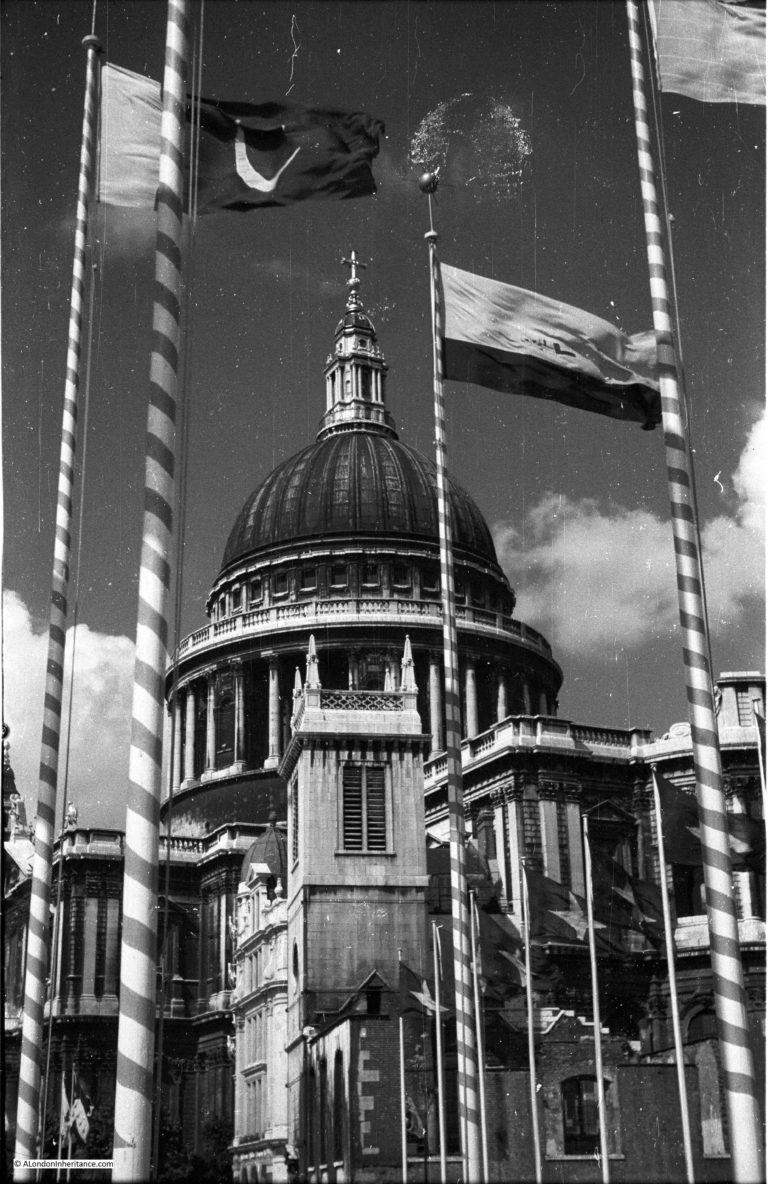
This original part of the gardens were timed to open for the Festival of Britain (hence their name), and were decorated with flags during the festival as shown by my father’s photo below:
Festival Gardens

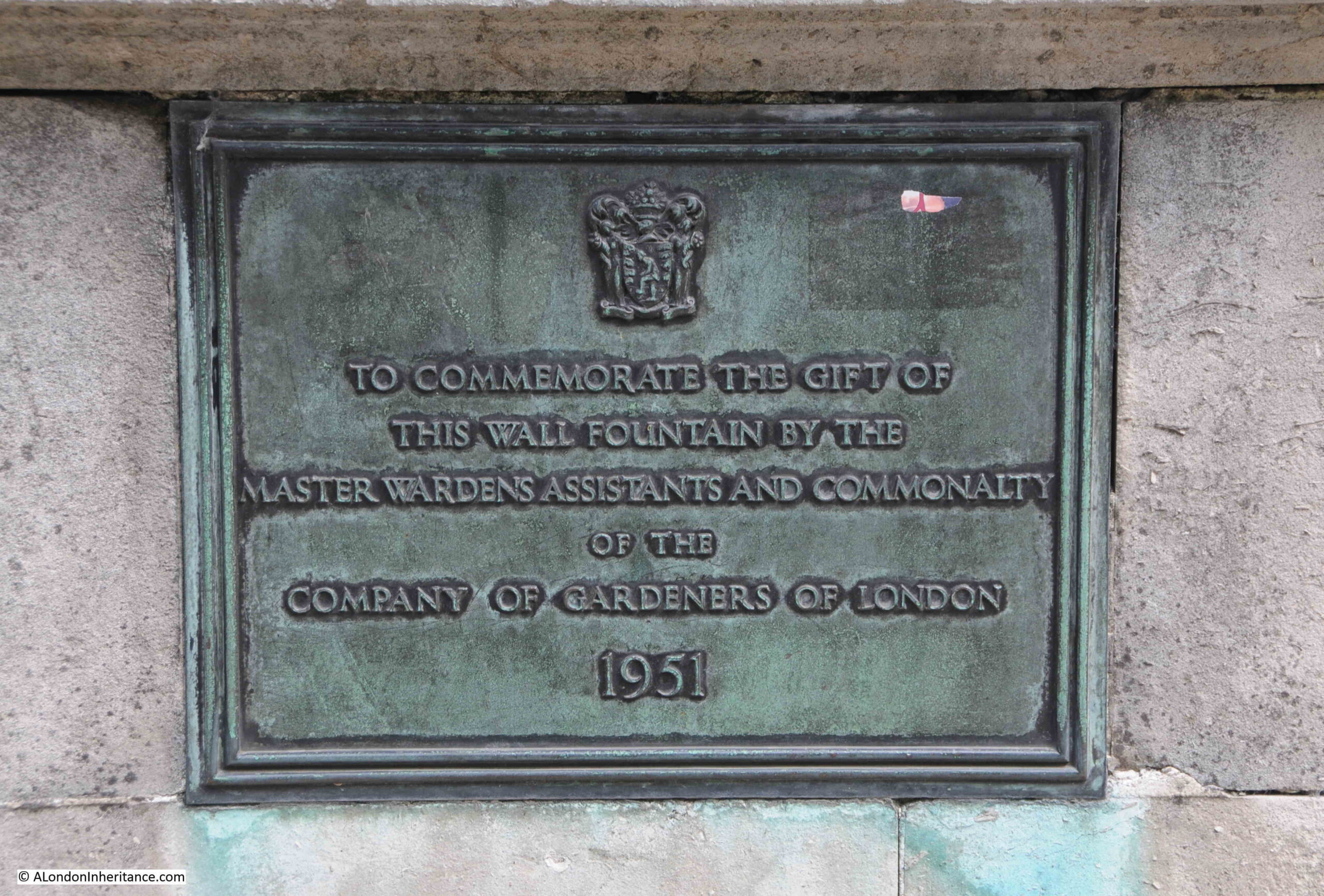
Plaque on the wall commemorates the year of opening:
Festival Gardens

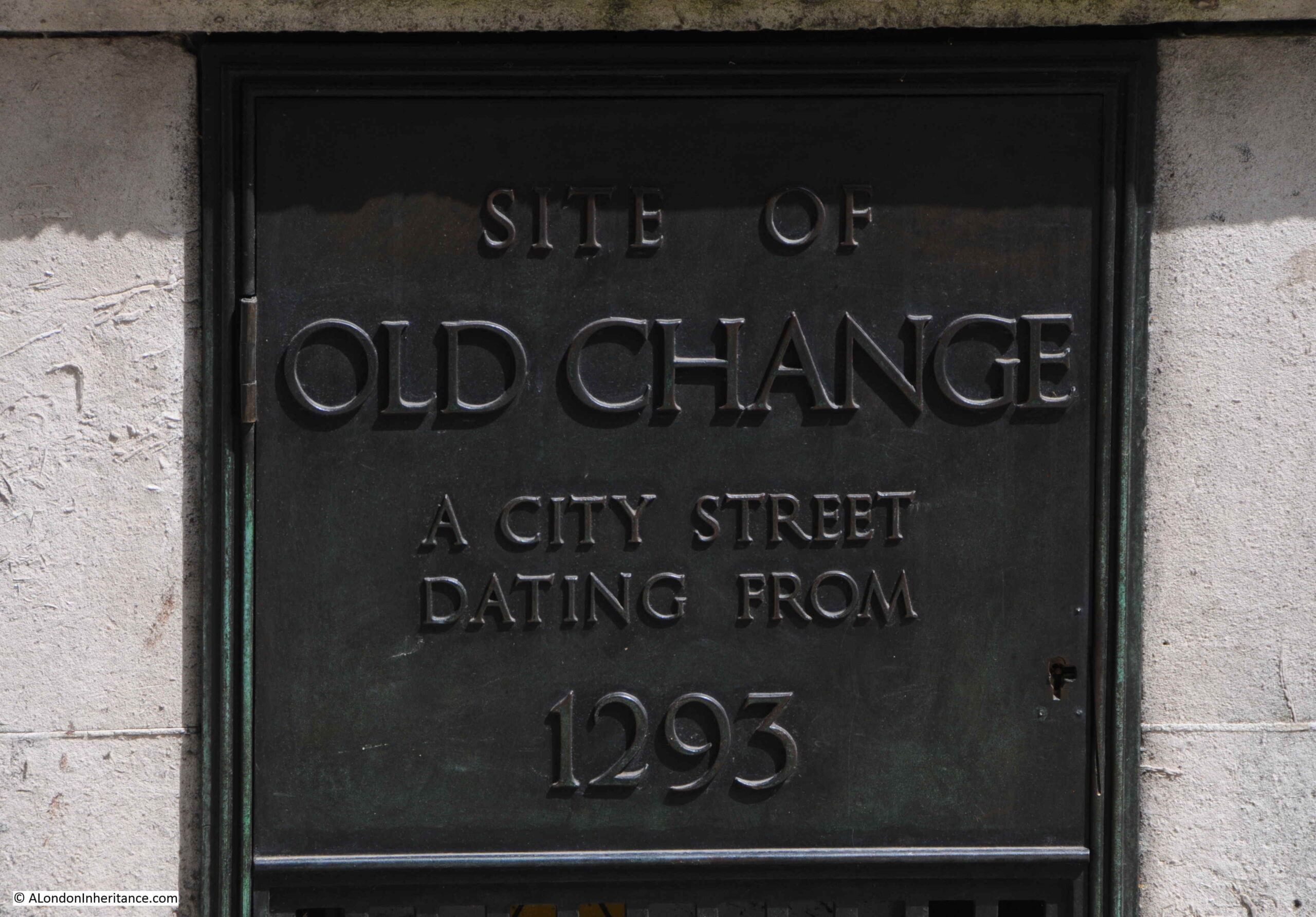
And another plaque on the wall behind the fountains records one of the ancient streets that were lost during the construction of the gardens:
Old Change

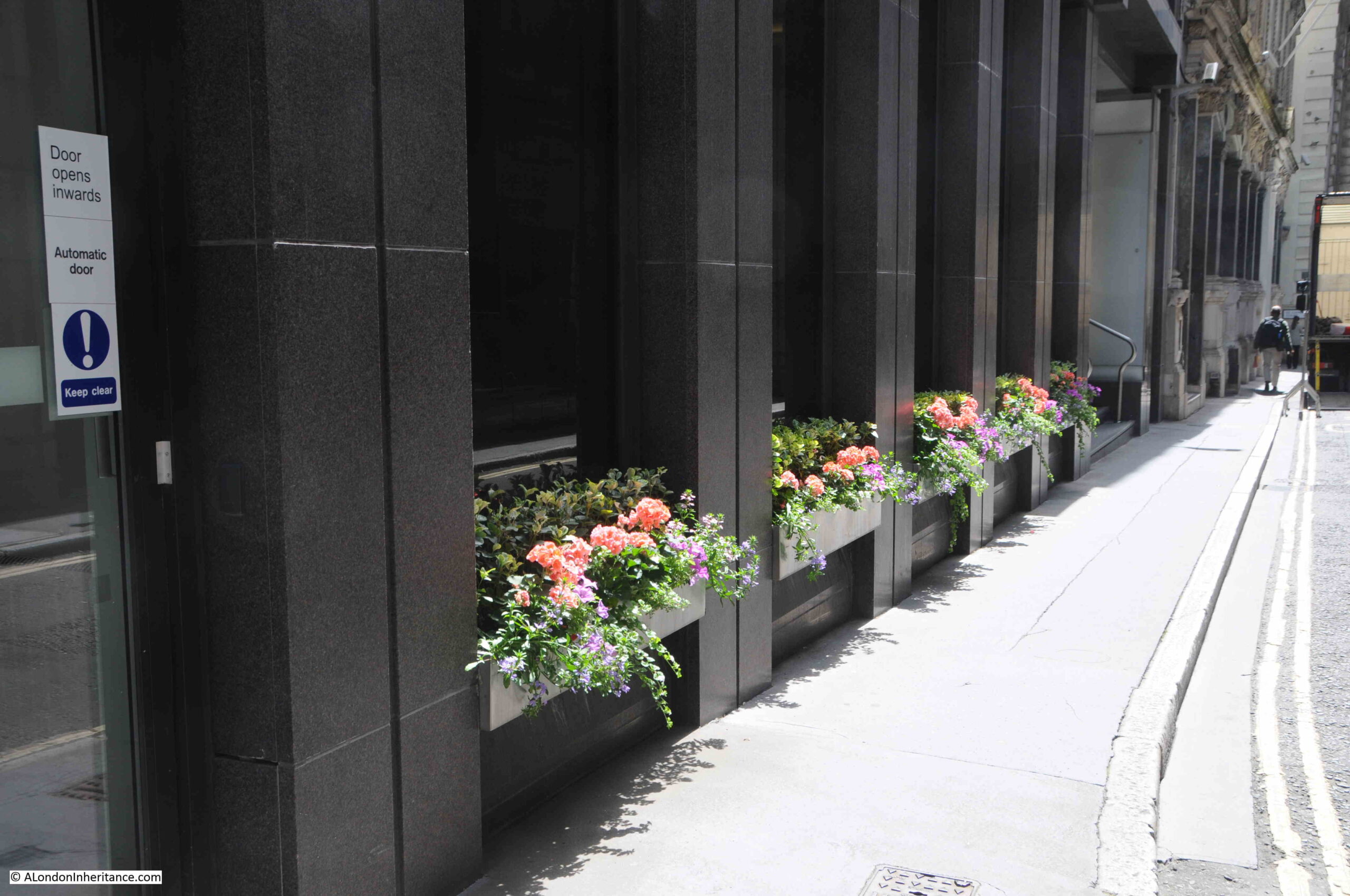
As well as large, formal gardens, Fred Cleary was keen to encourage the use of flowers in as many settings as possible, and devoted four pages to photos of City buildings with window boxes.

I found a number of these adding colour to City streets:
window boxes

Many of the window boxes across the City in the 1960s were the result of a campaign, as described in the book:

“In 1963 the Worshipful Company of Gardeners in conjunction with the Metropolitan Public Gardens Association and supported financially by the City Corporation launched a ‘Flowers in the City’ campaign under the patronage of the Rt. Hon. The Lord Mayor and in recent years there has been considerable response from the business houses and firms by providing more and more flowers giving a very colourful effect to many parts of the City.”

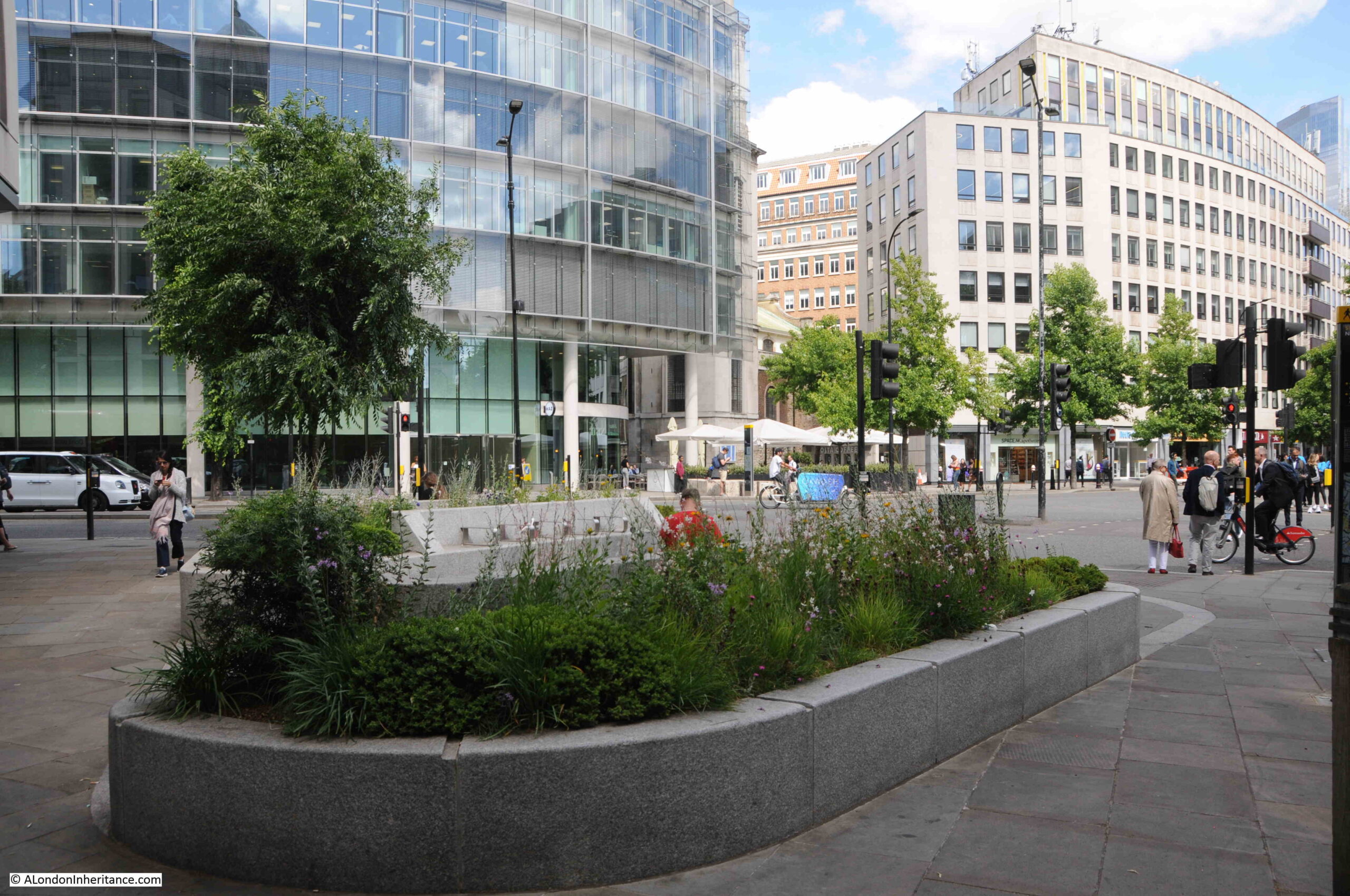
As well as windows boxes, the book encourages the planting of flowers across the streets and includes a section titled “Pavement Treatment” which shows how plants can be distributed across the streets in pots, wooden boxes and within raised concrete walled beds. The aim was to add flowers and colour to as many points across the City as possible.

An example of the type of planting featured in the section on “Pavement Treatment”, can be seen today at the junction of Cheapside and New Change:
Pavement flowers

At the start of the book, it mentions that originally gardens in the City were mainly part of Livery Company sites, or surrounding some of the more expensive houses in the City.

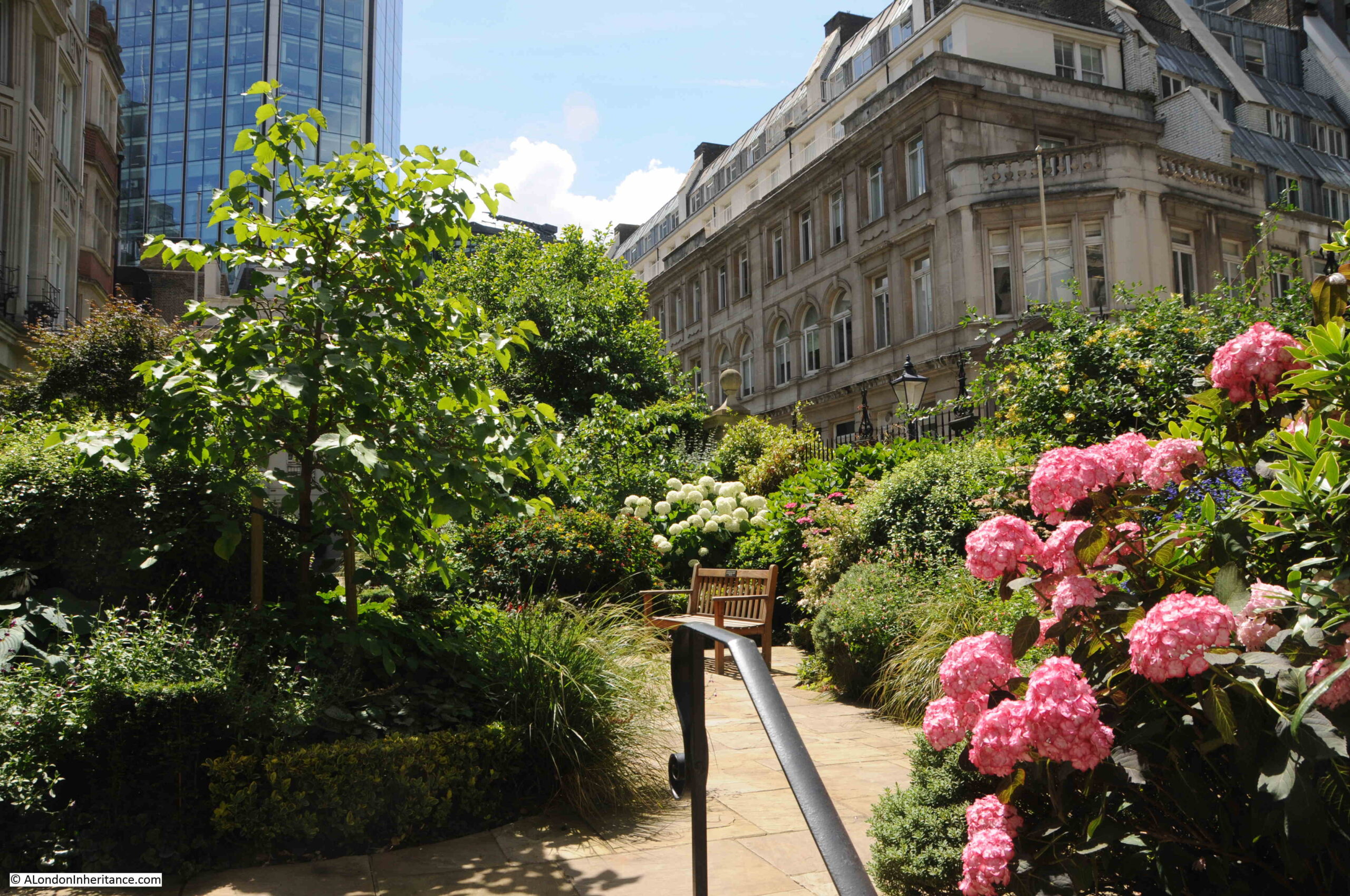
There are still a number of gardens on land owned by Livery Companies. One of these is at the junction of Copthall Avenue and Throgmorton Avenue and is on land owned by the Drapers Company who have their hall in Throgmorton Avenue.

The gates to the garden are locked, however peering through the gates delivers this colourful view:
Drapers Gardens

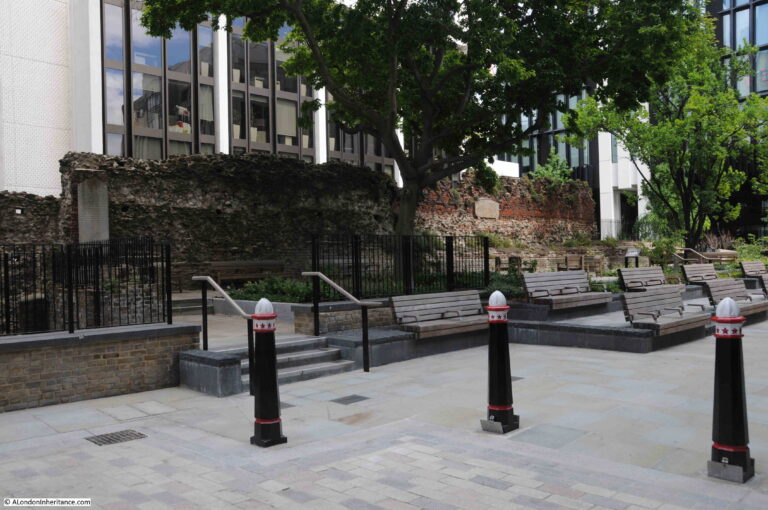
The book also shows just how much areas of the City have changed. In the following photo, the wall to the left is the medieval wall that sits on top of the original Roman wall, just to the north of London Wall, close to the Barbican development:
London Wall

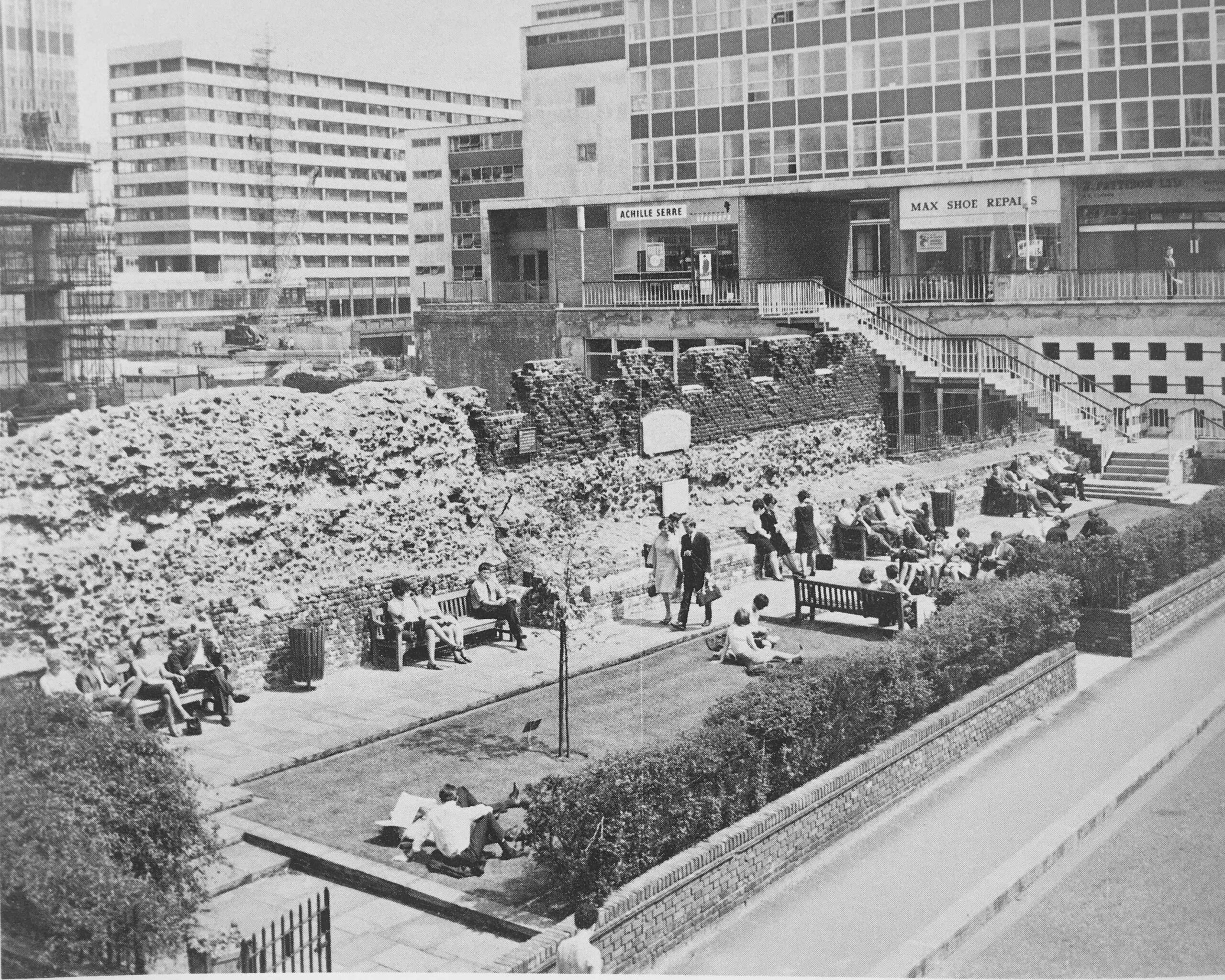
When the area around the wall went through its first post-war phase of development, it was surrounded by new office blocks and the high level pedestrian ways that followed the wartime proposals for City redevelopment which included below ground car parking, wide streets for car, and raised walkways to move pedestrians away from traffic.

The photo below shows the wall surrounded by the first phase of post-war development. Note the shops and pedestrian ways to the right.
London Wall

What looks like the original route of London Wall is in the lower right corner of the photo. This is now a walkway with the route for traffic moved slightly south as the dual carriageway routing of London Wall.

A small section of gardens is between the wall and street.

The medieval wall is the only feature that remains today from the above photo.

The area today is landscaped with gardens where the steps and building in the background of the above photo were located, and the medieval walls of St Mary Elsing have been fully exposed:
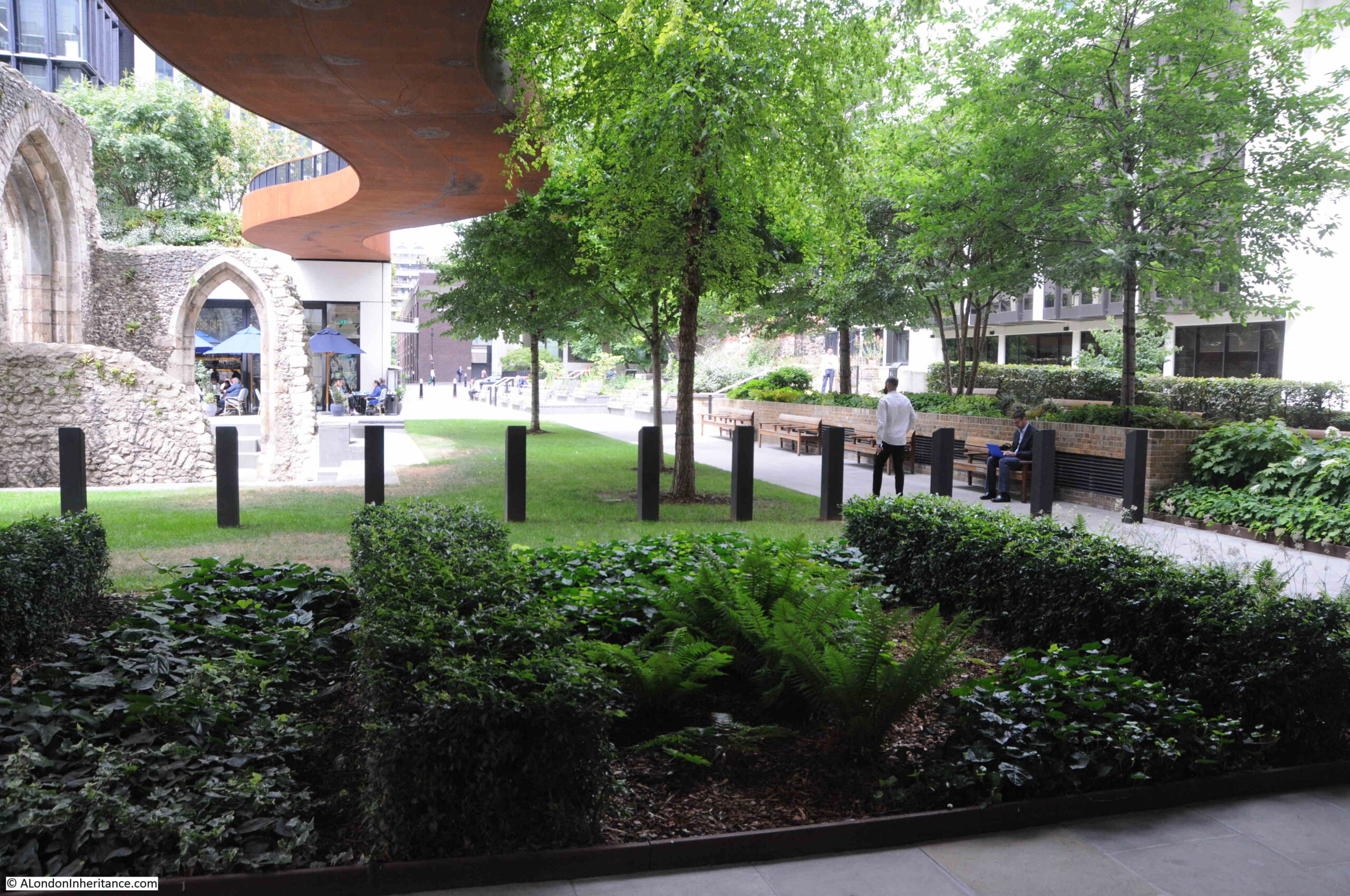
St Mary Elsing

The City of London has benefited considerably from the work of Fred Cleary, and the book shows just how much was achieved to green the City during immediate post-war redevelopment, and the very many photos in the book shows how much the City has changed since it was published.

Fred Cleary was awarded an MBE in 1951 and a CBE in 1979 for his environmental and philanthropic work. He was also active in building conservation.

The Cleary Foundation was a charity established in his name, and today continues to provide grants to fund projects in the areas of Education, the Arts, Conservation, and the Natural Environment.

The majority of the gardens in The Flowering City remain, and many have developed from a formal simplistic style, to more heavily planted, and attempt to isolate the garden experience from the surrounding streets.

Fred Cleary dedicated the book “To all who live and work in the City of London”, and there can be no doubt that the gardens across the City enhance the experience of living and working in this historic place.
alondoninheritance.com

Pleasure Boats on the Thames

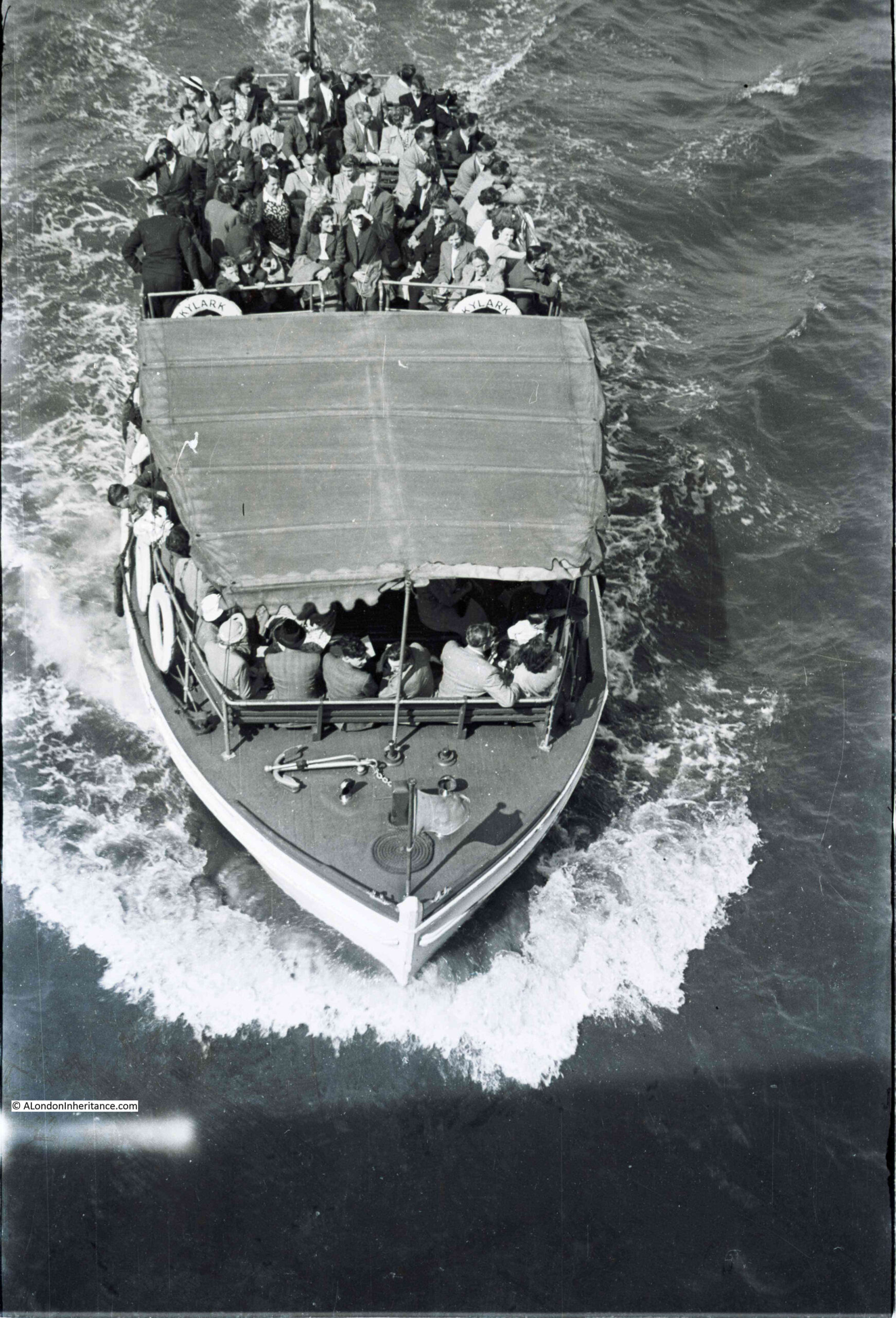
This photo was taken by my father in 1951, from one of the bridges over the Thames (no idea which one), and shows one of the pleasure boats that have been a feature of London’s river for many years.

Pleasure boats on the Thames

It was the only photo featuring the Thames on the strip of negatives, so I suspect he was walking over the bridge, saw the boat about to pass under the bridge, and quickly took the photo.

It is one of those photos that probably seemed of not much importance at the time. A scene that was, and continues to be, very common on the river, but 71 years later it is a snapshot of a group of people travelling along the River Thames.

The boat was called the Skylark. I cannot find any details about the boat, however the year was 1951 and I vaguely remember reading somewhere that the Skylark was one of the boats that served the Festival of Britain site on the Southbank, taking people to and from the pleasure gardens at Battersea. I have checked the indexes in my books on the Festival, but cannot find a reference to the Skylark so it may be my memory playing tricks – a lesson to keep better notes.

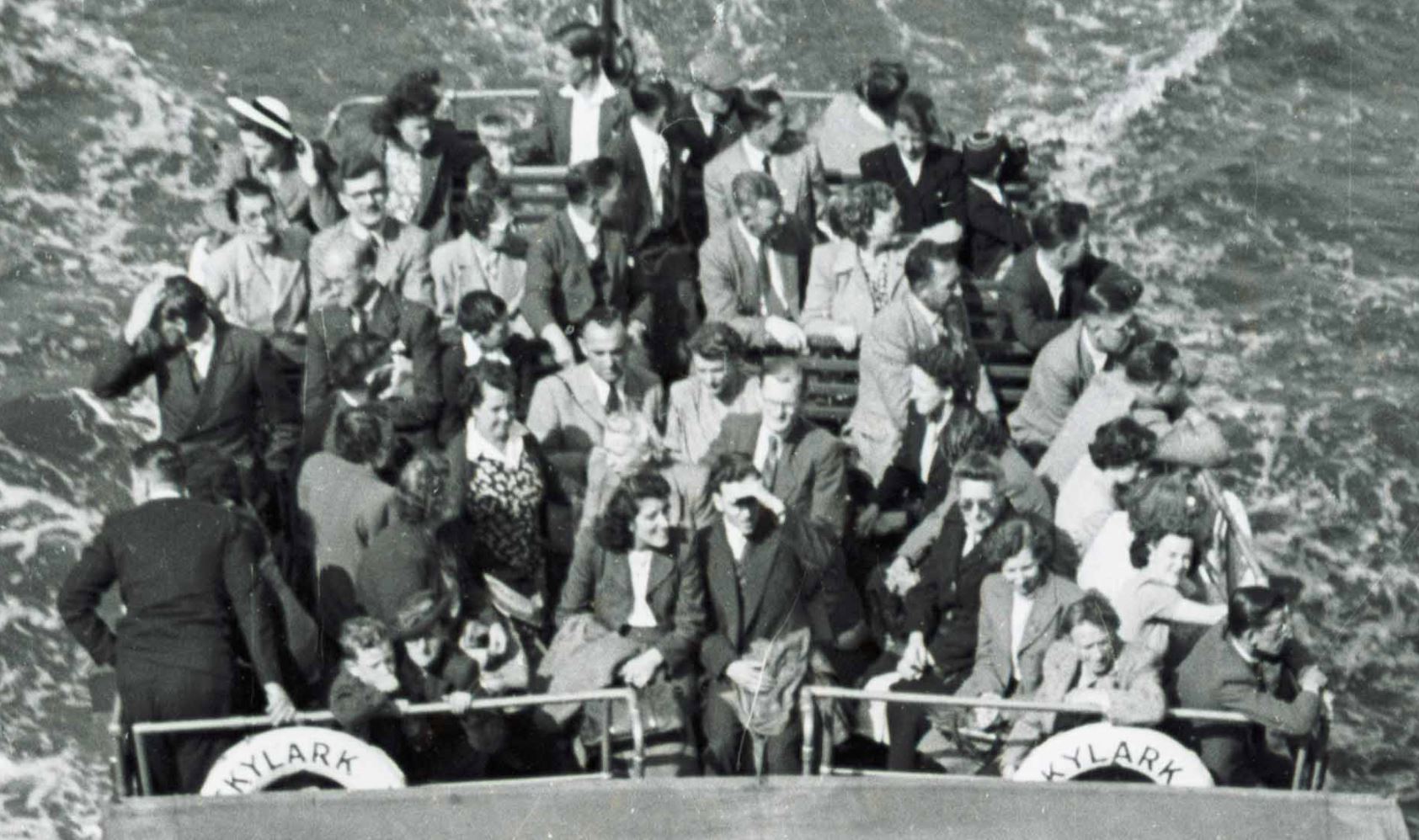
The following extract from the photo shows the people on the rear deck. Mainly adults, a couple of children, and all rather formerly dressed for a trip on the river:

Pleasure boats on the Thames

Pleasure boats have been a feature of the Thames since the 19th century, when newspapers were full of adverts for pleasure trips on the river. The majority of these seemed to be a trip to somewhere, rather than a trip along the river with no stopping point, apart from a final return to the point of departure.

For example, in 1899, a return trip in the “magnificent new steamers Boadicea or Cleopatra” from Westminster to Gravesend to see the gardens could be had for one shilling and six pence.

The number of ships on the river did cause passengers some concern. A letter writer to the London Evening Standard complained of two steamers appearing to race each other on the river, and one almost crashing into his boat in attempt to overtake. He finishes off his letter with “I for one, will never again take a pleasure trip on the Thames”.

The river is much quieter today, but with the return of tourism to London, the pleasure boats are again filling up and can be seen taking passengers on tours up and down the river.

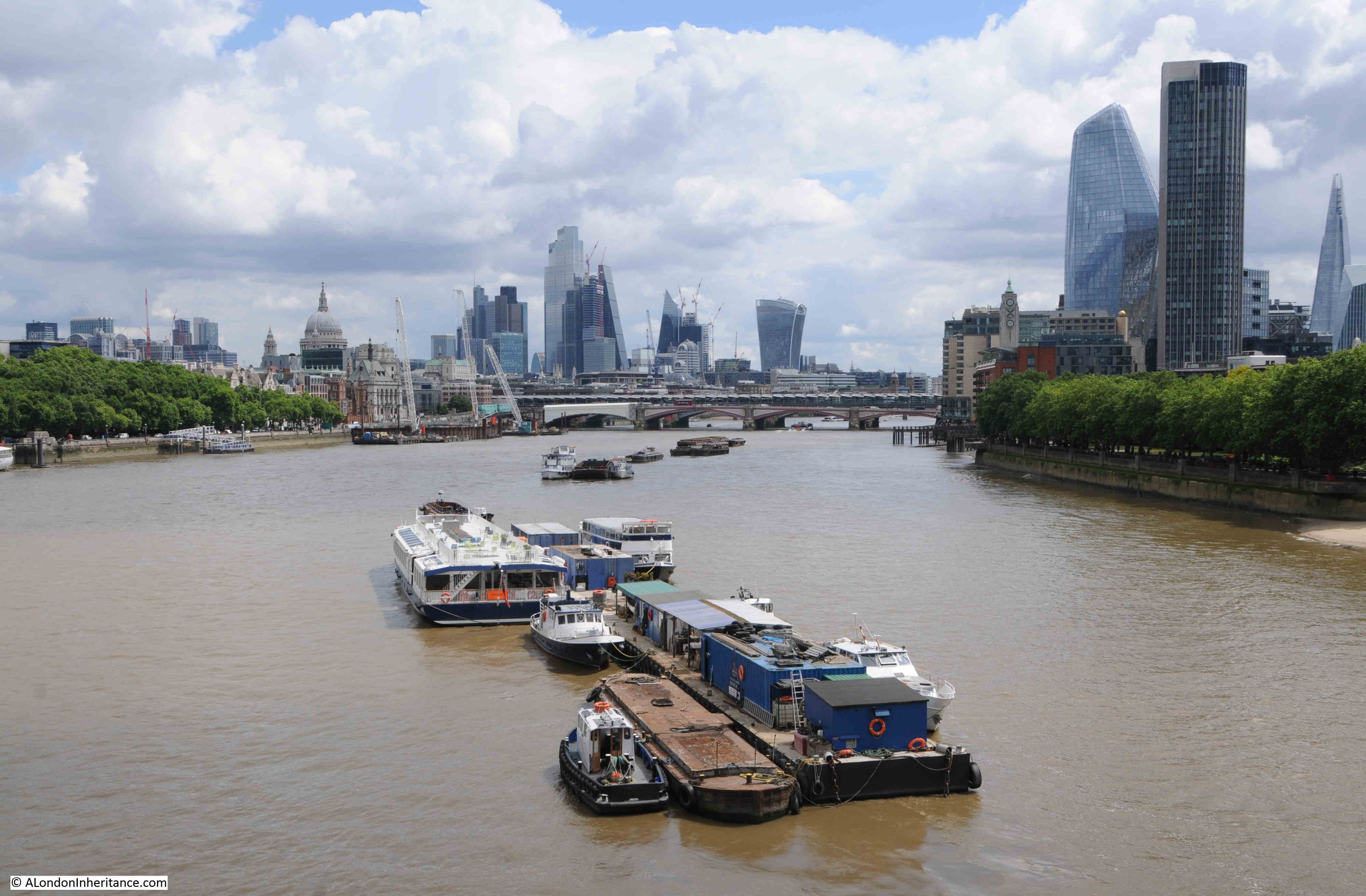
This was my attempt to emulate my father’s photo:

Pleasure boats on the Thames

This is the view from Waterloo Bridge showing one of the mooring places for pleasure boats:

Pleasure boats on the Thames

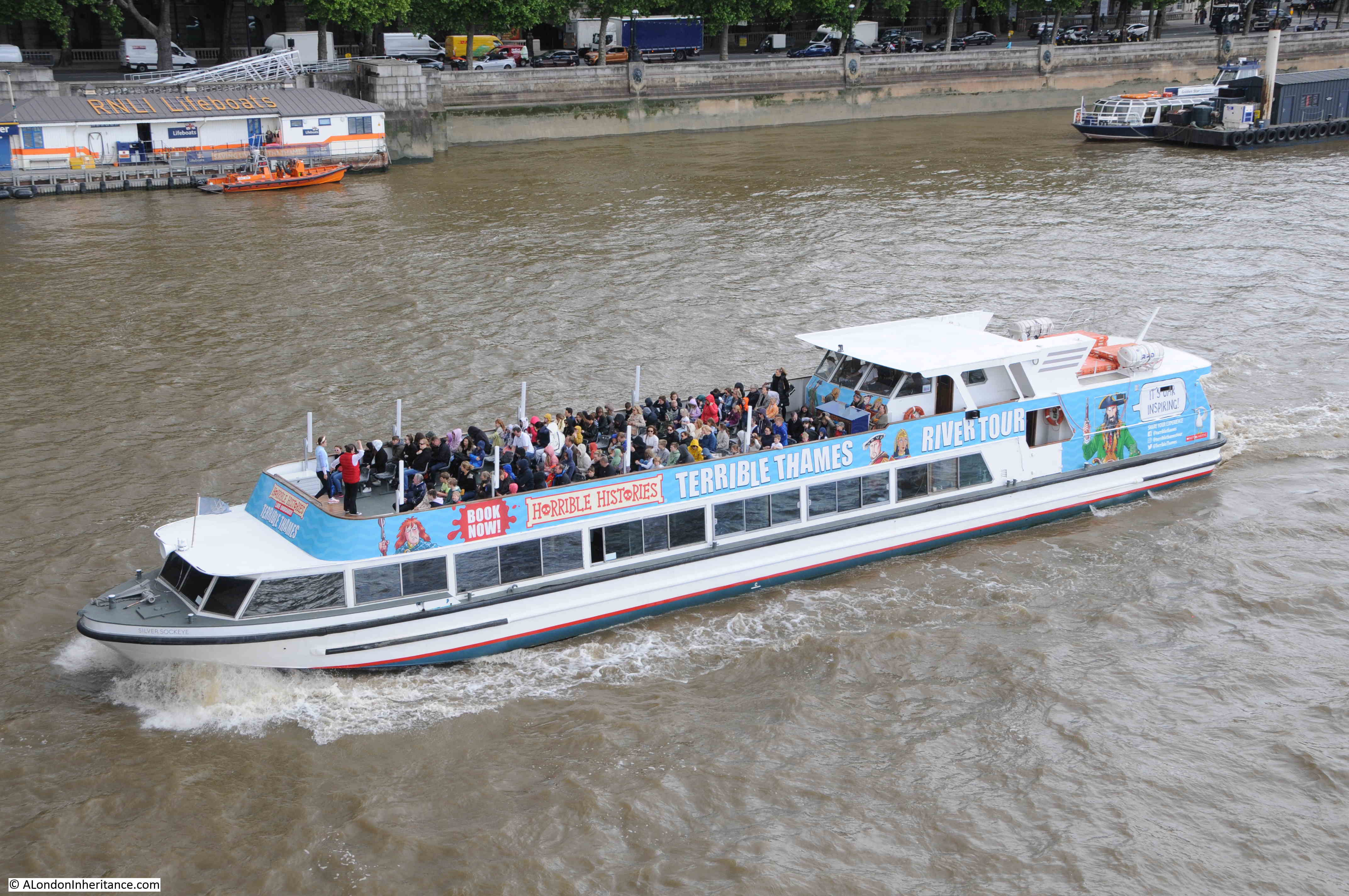
As well as general tours, you can take a Horrible Histories themed tour telling the story of the Terrible Thames:

Pleasure boats on the Thames

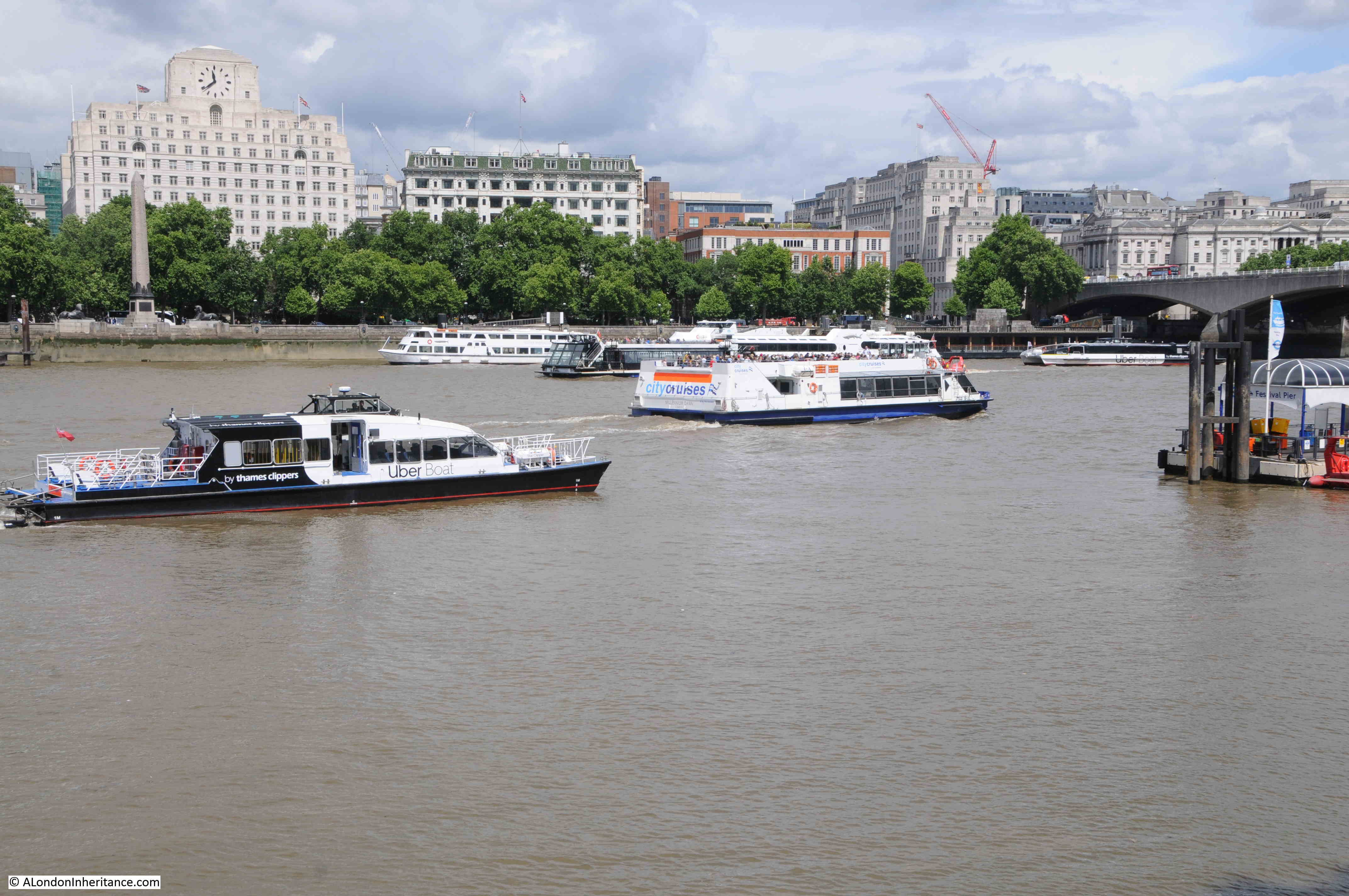
A full City Cruises boat with one of the smaller Thames Clippers on the left:

Pleasure boats on the Thames

The small Thames Clipper boat seems to have a specialised role to shuttle passengers from the cruise ships that moor alongside HMS Belfast, across the river to Tower Stairs.

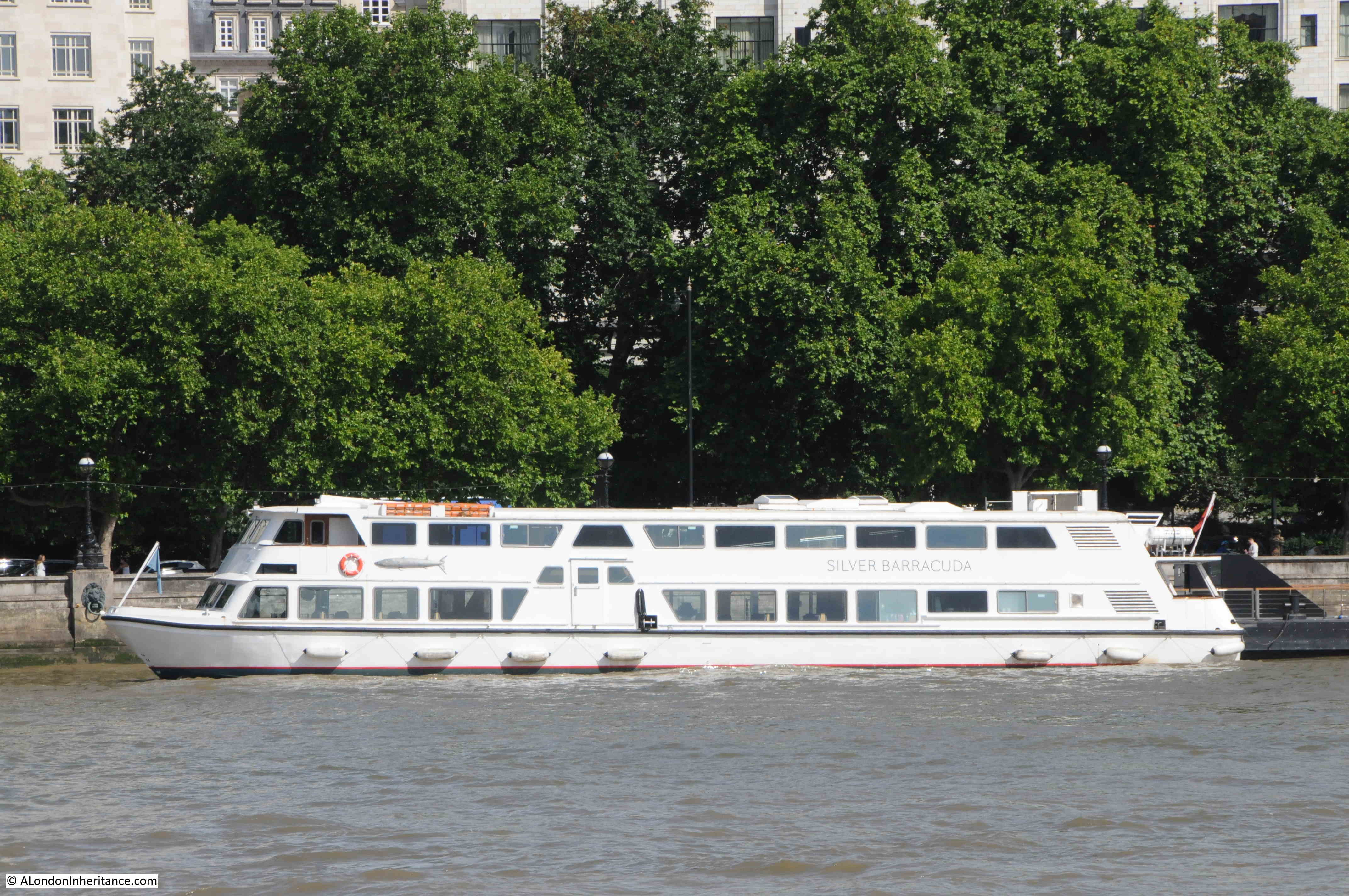
The Silver Barracuda, one of the Woods Silver Fleet, owned by a family who have been Thames Watermen for over 150 years:

Pleasure boats on the Thames

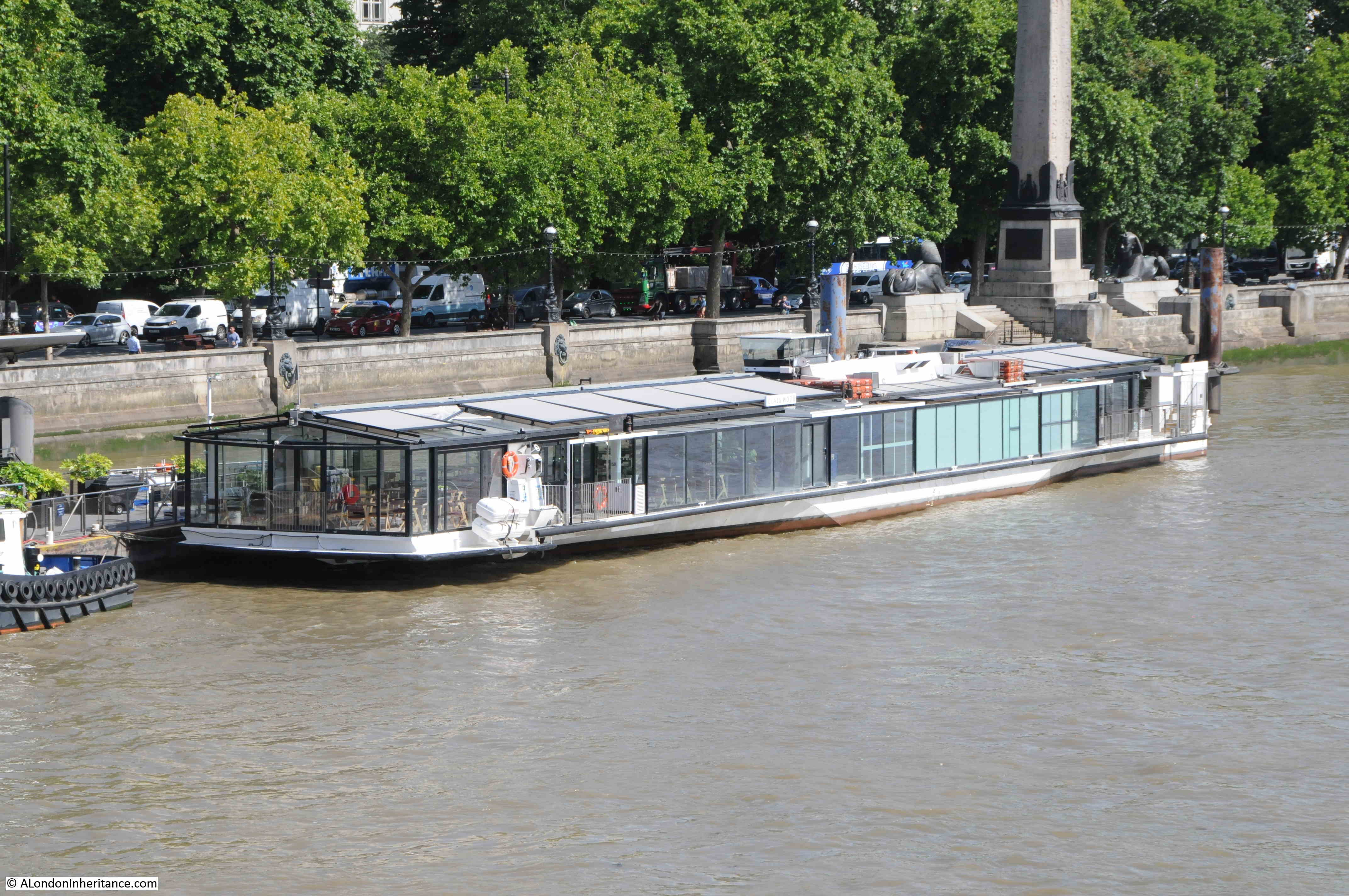
One of the dining boats that cruise up and down the river:

Pleasure boats on the Thames

With the closure of the London docks, traffic on the river significantly declined with the late 1970s and early 1980s being a period where it was so sad to see the quiet river.

The river has though, long been a way to travel across London – a liquid Central Line.

Going back centuries, it was often the fastest and safest method of travel, with watermen being the taxis of the day, rowing passengers between the numerous Thames stairs. Although they did have frequent accidents, and negotiating a fixed price was often a challenge until the gradual regulation of watermen services on the river helped to clamp down on poor practices.

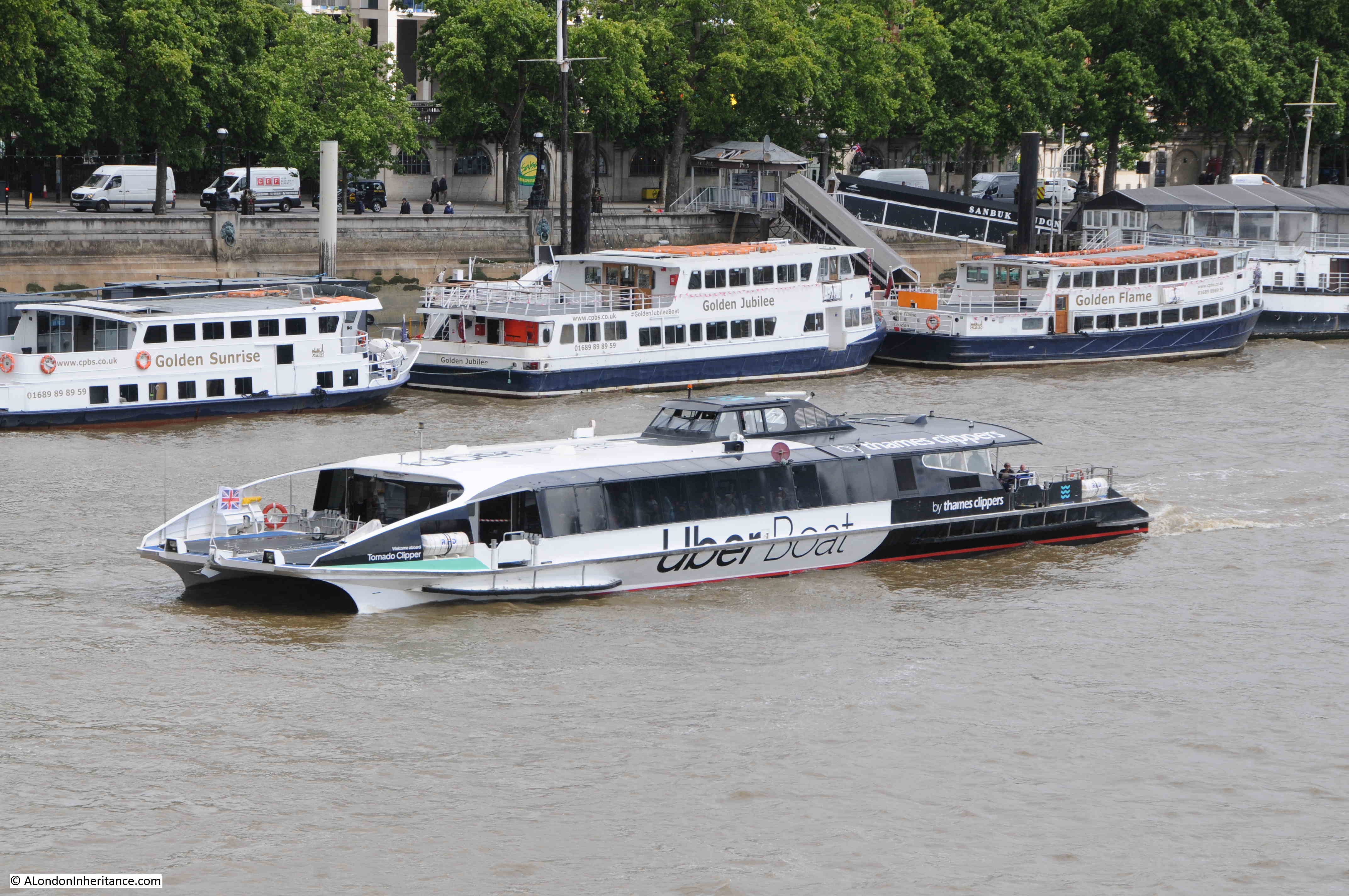
Today, the ferry services once provided by a waterman rowing you along the Thames has been replaced by the Uber Boats run by Thames Clippers:

Uber Boat

The Thames Clippers have been a 21st Century success story along the Thames. Since starting with a single boat in 1999, the company now has around 20 boats serving passengers on the Thames. The majority were made in Australia, however three, Jupiter, Mercury and Venus, were built on the Isle of Wight.

Each of the boats has their own unique flash of colour on the side of the bow (front) of the boat. In the above photo, the colour is (I think), mint, which identifies the boat as the Tornado Clipper (helpfully the name is also above the flash of colour, however the colour helps with identification at a distance).

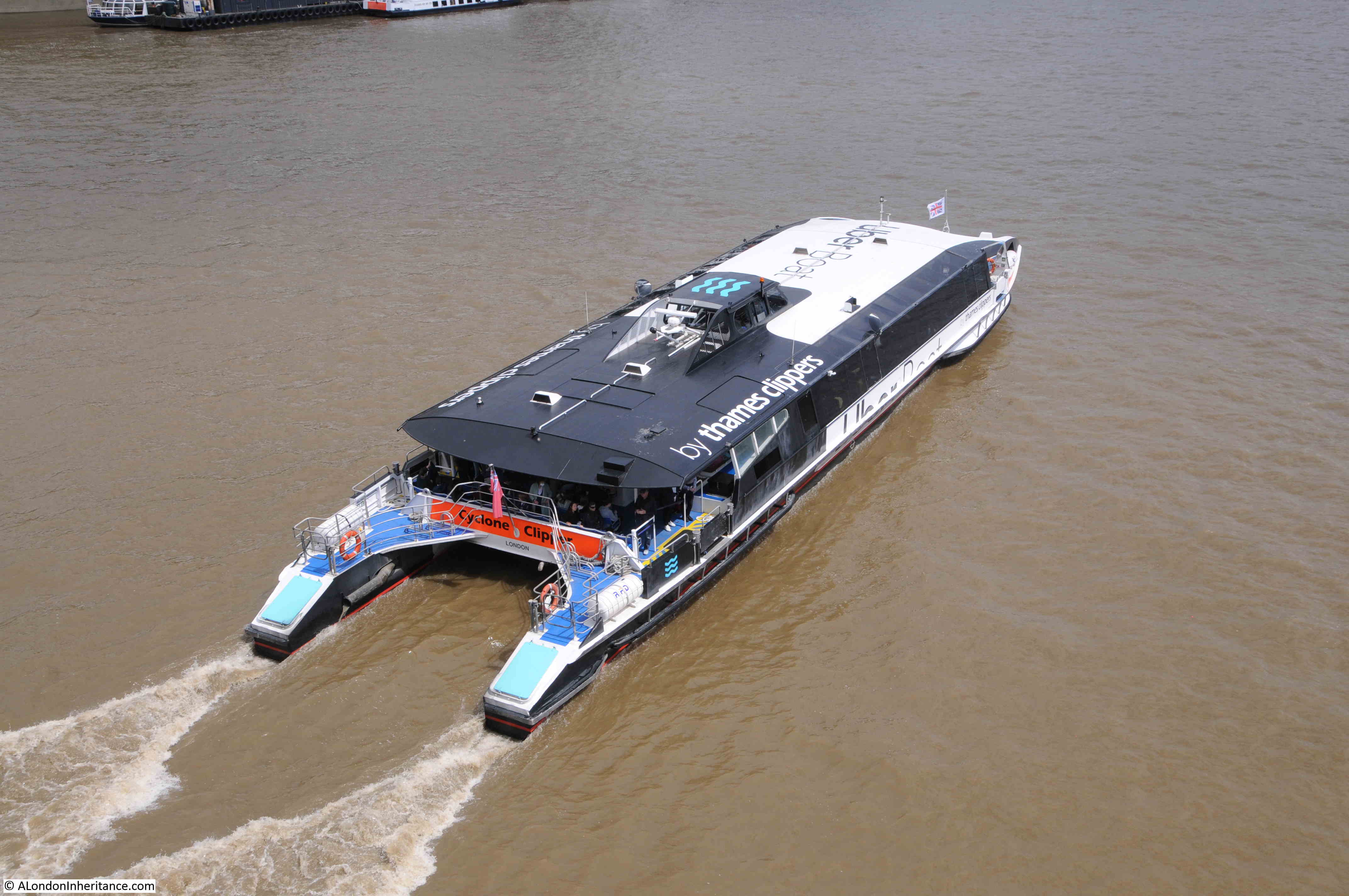
Cyclone Clipper:

Thames Clippers

The Thames Clippers are the latest in a series of post-war attempts at running passenger services on the river. Some more successful than others.

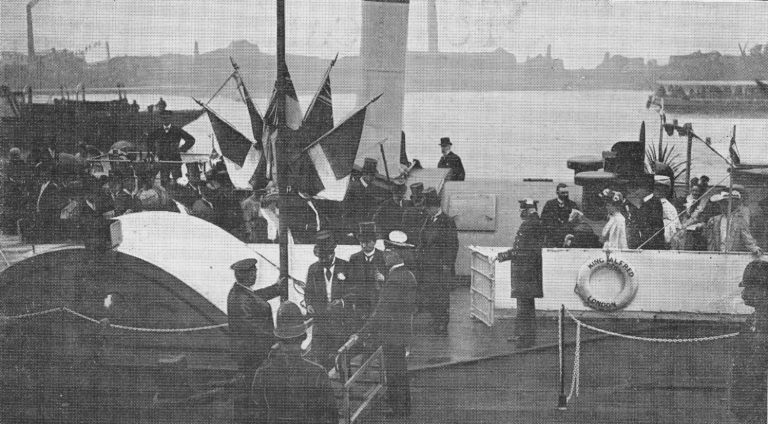
Starting in 1905, the London County Council launched a number of steam-boat ferries along the Thames, with 30 boats at the peak of services. The following photo shows the “Opening of the L.C.C Steamboat Service by H.R.H The Prince of Wales”.

Thames ferries

The post-war reduction in the population of east London, along with the closure of industry and docks along the river reduced the need for a ferry service, however there were a number of attempts at launching ferry services.

1968 saw a Hovercraft service along the river. The first hydrofoil, Shearwater 5 started passenger services in 1969. In 1988 Thamesline offered a service between the developing docklands and the City and a limited River Bus service was launched in 1989.

The launch of the Thames Clippers in 1999 came at a time when the redevelopment of the docklands resulted in increasing populations of residents and office workers, as well as significant increases in tourist numbers. investment by the company that owned the O2 also helped with the growth of the Thames Clipper services that we see today.

In 2019, the last year before Covid, Thames Clippers carried a total of 4.3 million passengers.

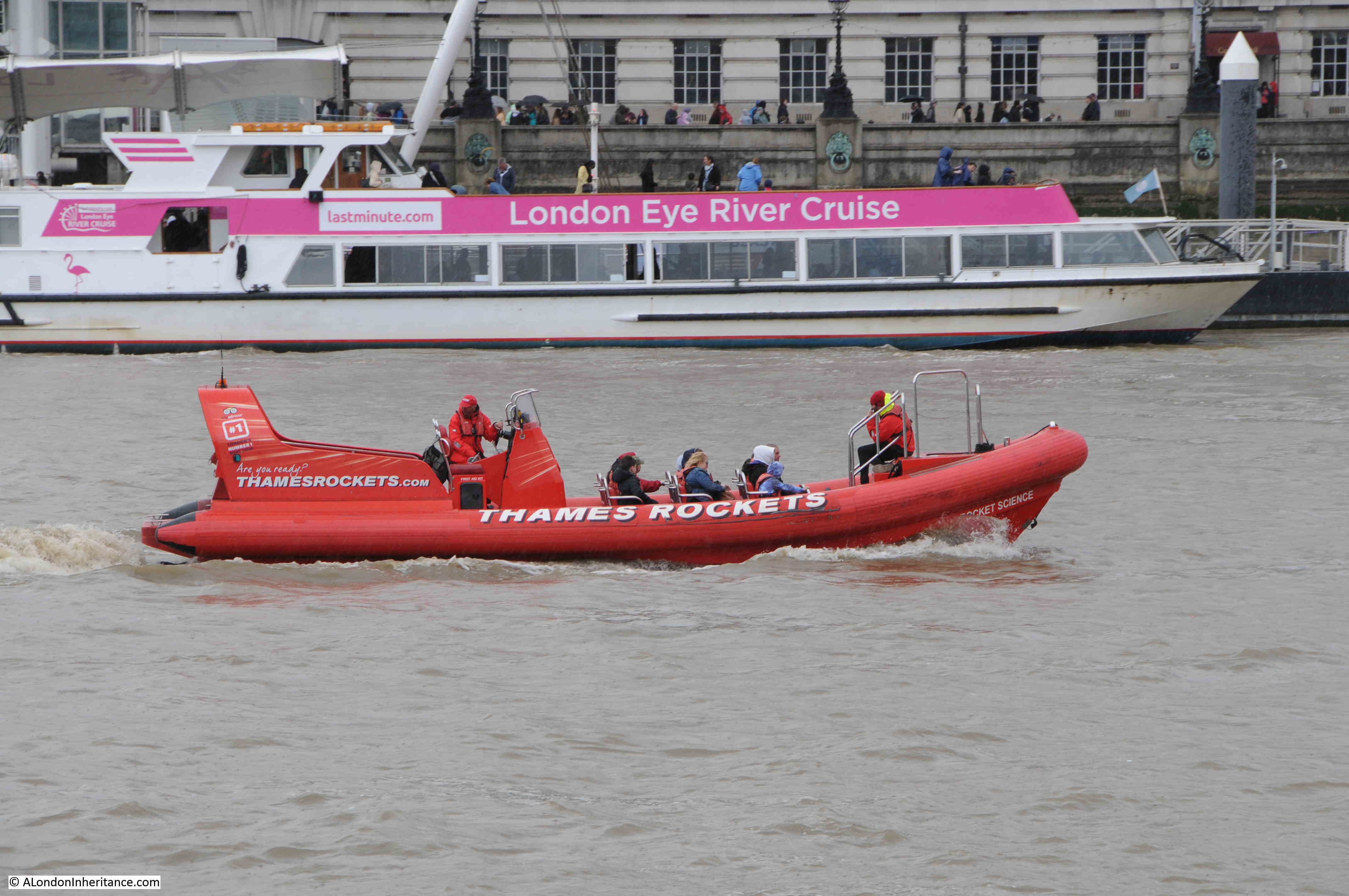
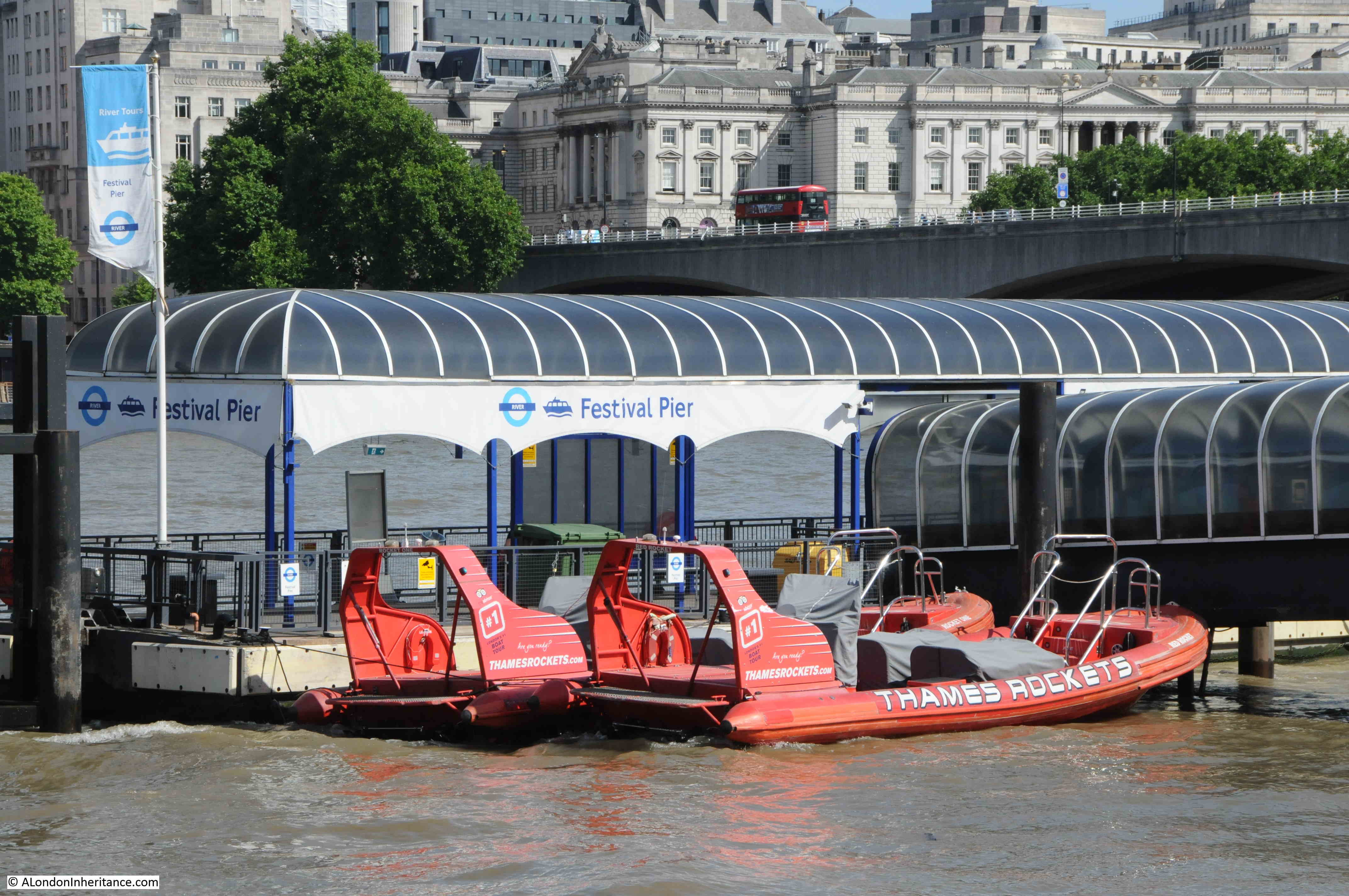
An addition to the Thames over recent years has been the ribs that offer visitors a high speed trip down the river to the east of Tower Bridge. Yellow ribs:

Thames Rib Experience

And red ribs, with a London Eye River cruise moored at the London Eye pier in the background:

Thames Rockets

Ribs moored up at the Festival Pier on the Southbank:

Thames Rockets

As well as tourist and passenger traffic, there are many other users of the Thames.

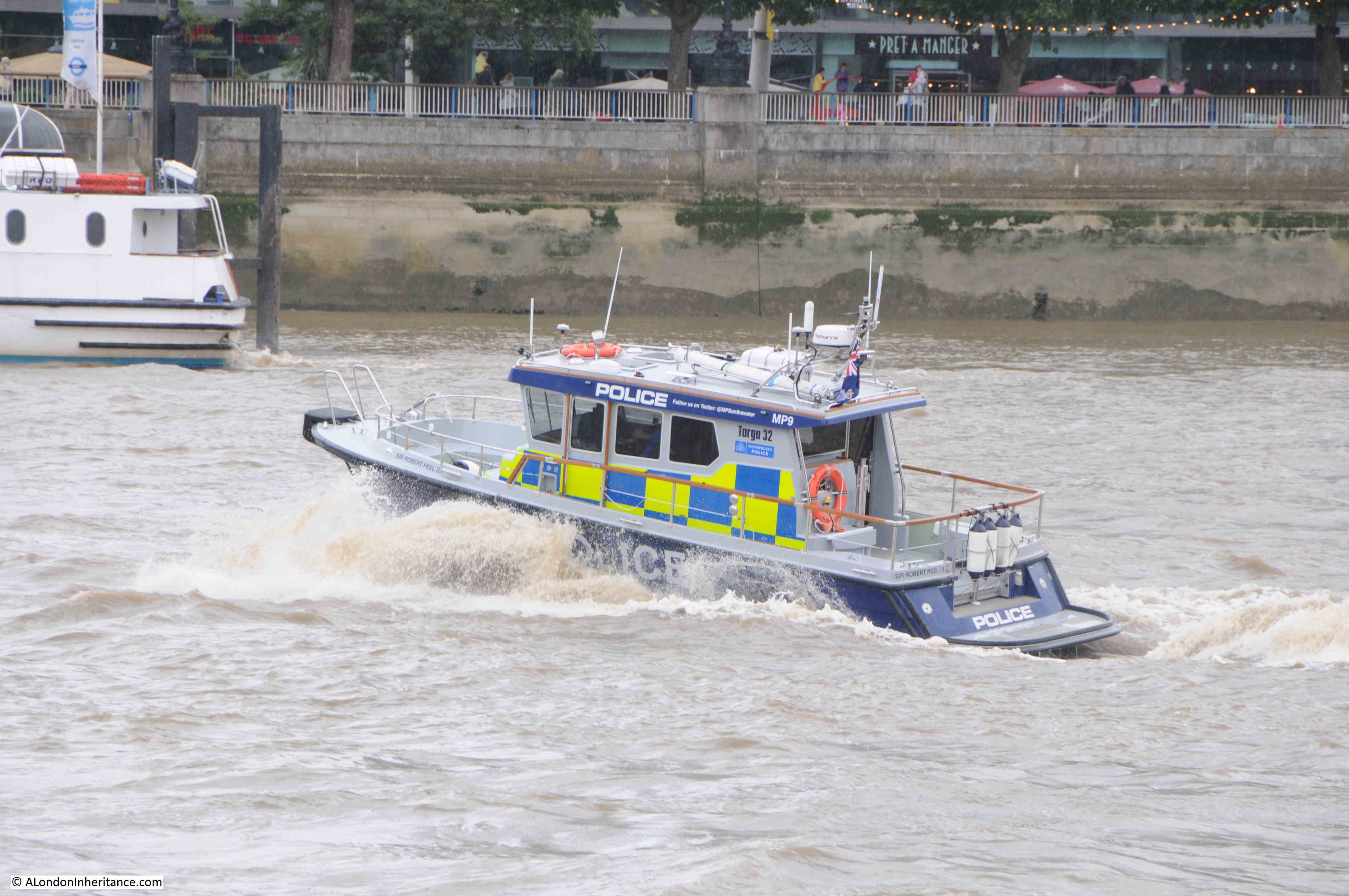
The Thames River Police can frequently be seen speeding along the river:

Thames River Police

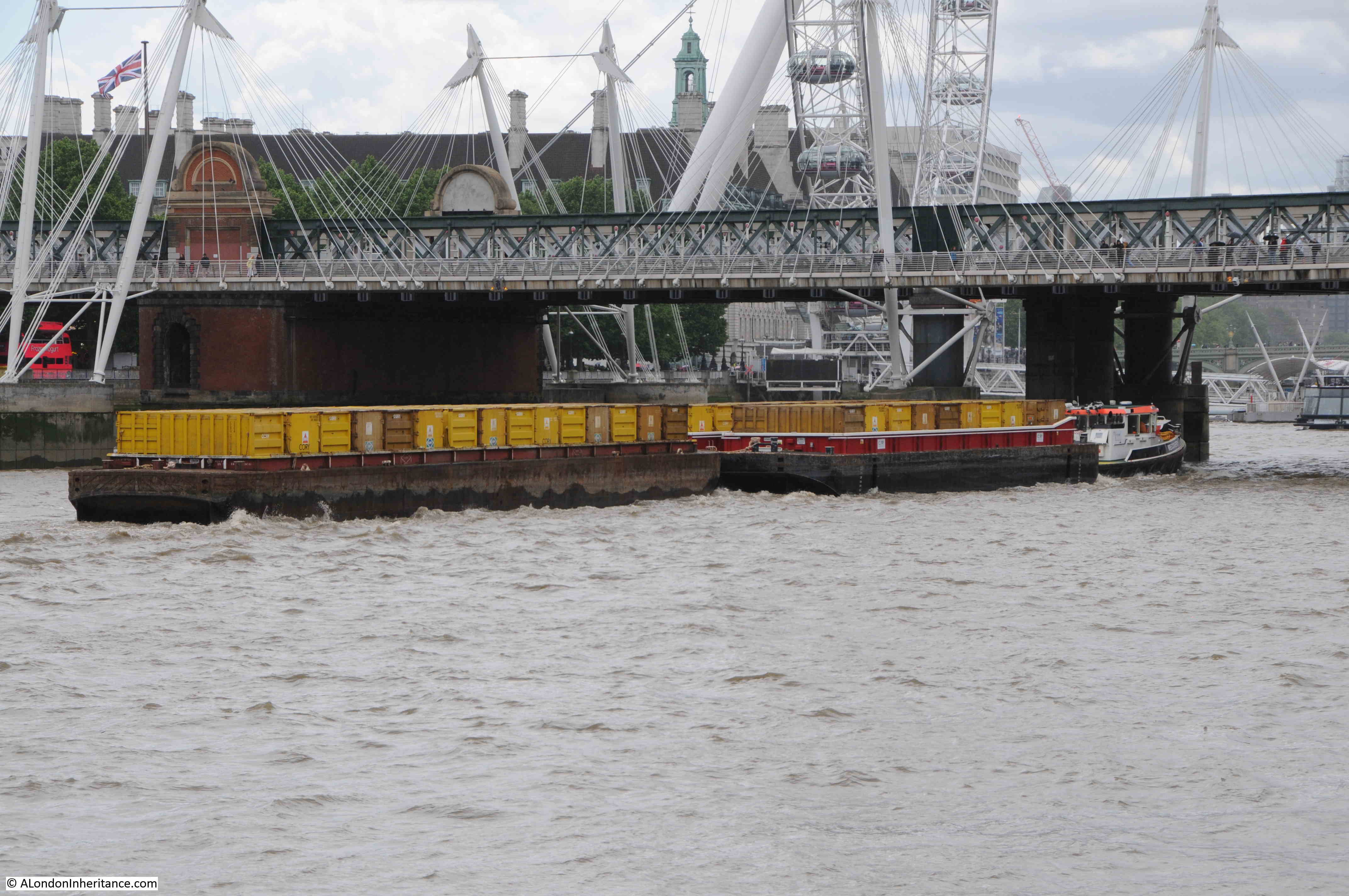
And much of London’s waste is compacted into containers at depots along the river, from where it is then transferred by barge to an incinerator in Belvedere, where it is burnt to generate electricity.

Waste transport on the Thames

Although the central Thames alongside the City will not see the cargo shipping that was a feature of this part of the river for centuries, it is good to see that the river is busier than it was in the late 1970s.

Tourist boats, work boats, and the Thames Clippers, ensure that there is much to see along the river.

One of the best Twitter accounts and blogs for monitoring the range of traffic on the Thames, is the Tidal_Thames95 Twitter account and the Tidal Thames blog, both by Patricia Stoughton.

Hopefully there will be pleasure, ferry and work boats on the River Thames for many years to come.

alondoninheritance.com

Lovells Wharf and Enderby House, Greenwich Peninsula

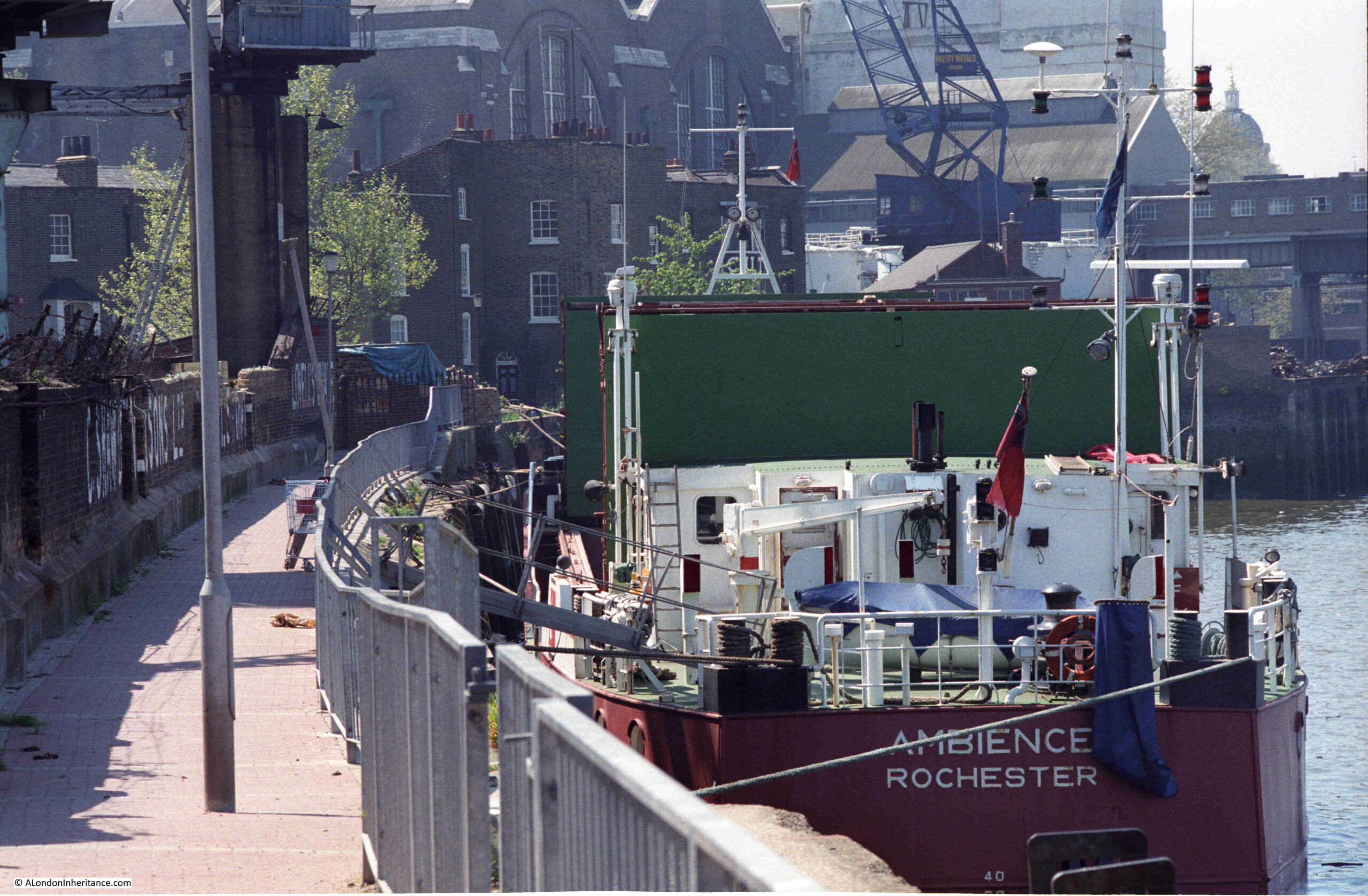
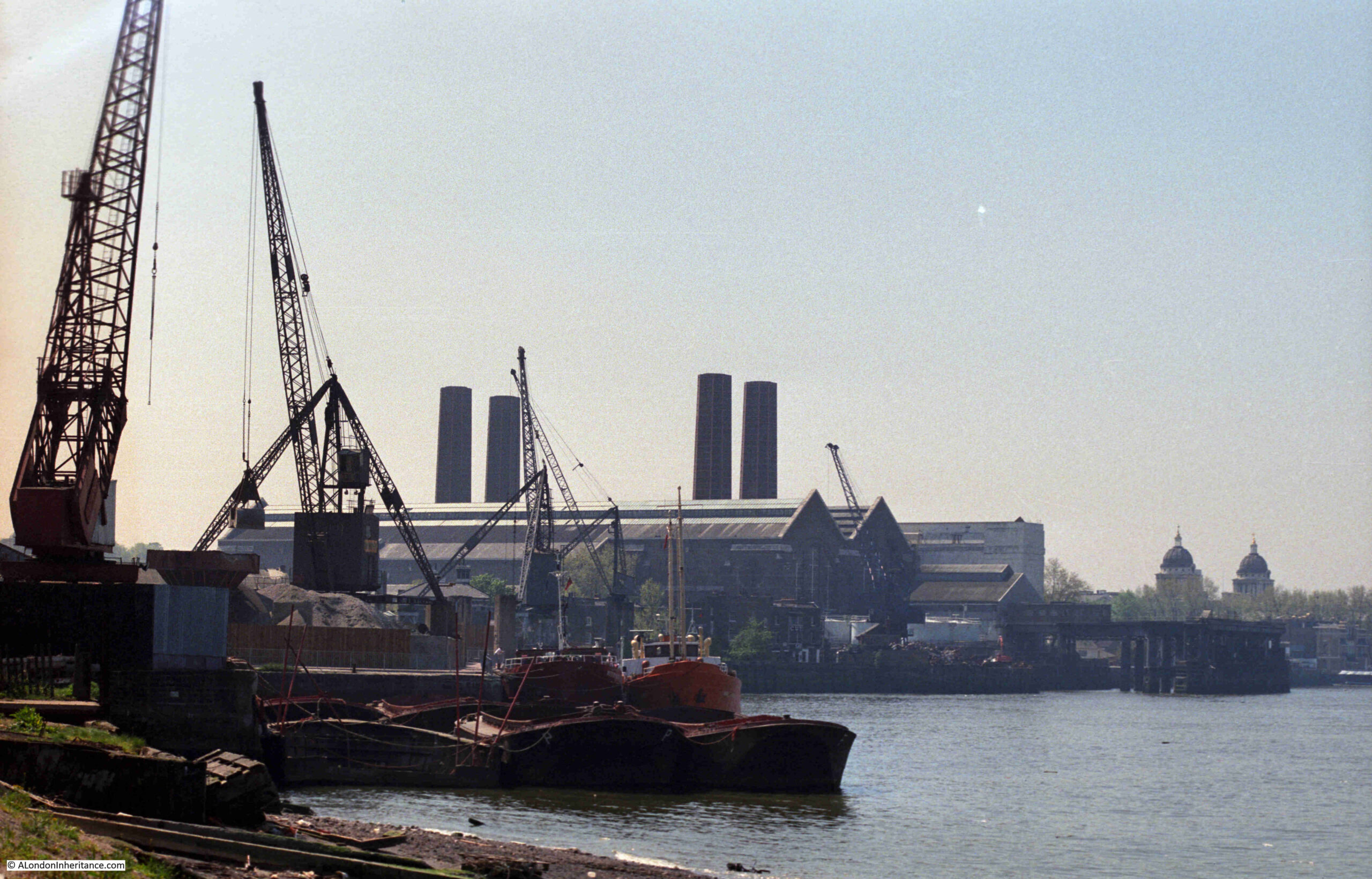
I recently scanned some negatives from 1986, and came across three photos taken in Greenwich, where the walk along the river heads past the power station and the Cutty Sark pub, and joins the Greenwich Peninsula. This is the first of the three:

Lovells Wharf

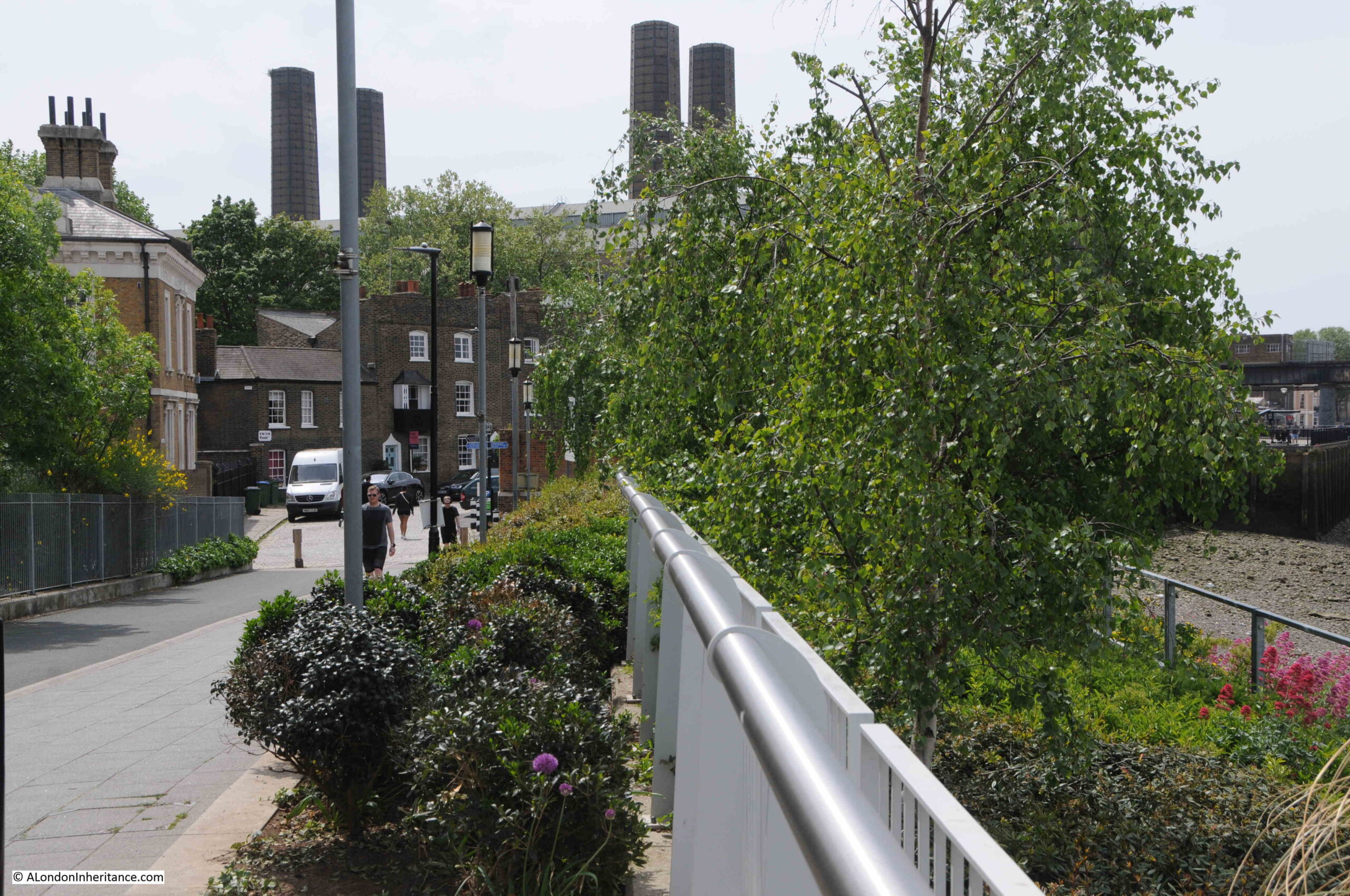
Very roughly the same view today – despite lots of walking around I could not get exactly the same view, as the area has been remodeled considerably since the mid-1980s.

Lovells Wharf

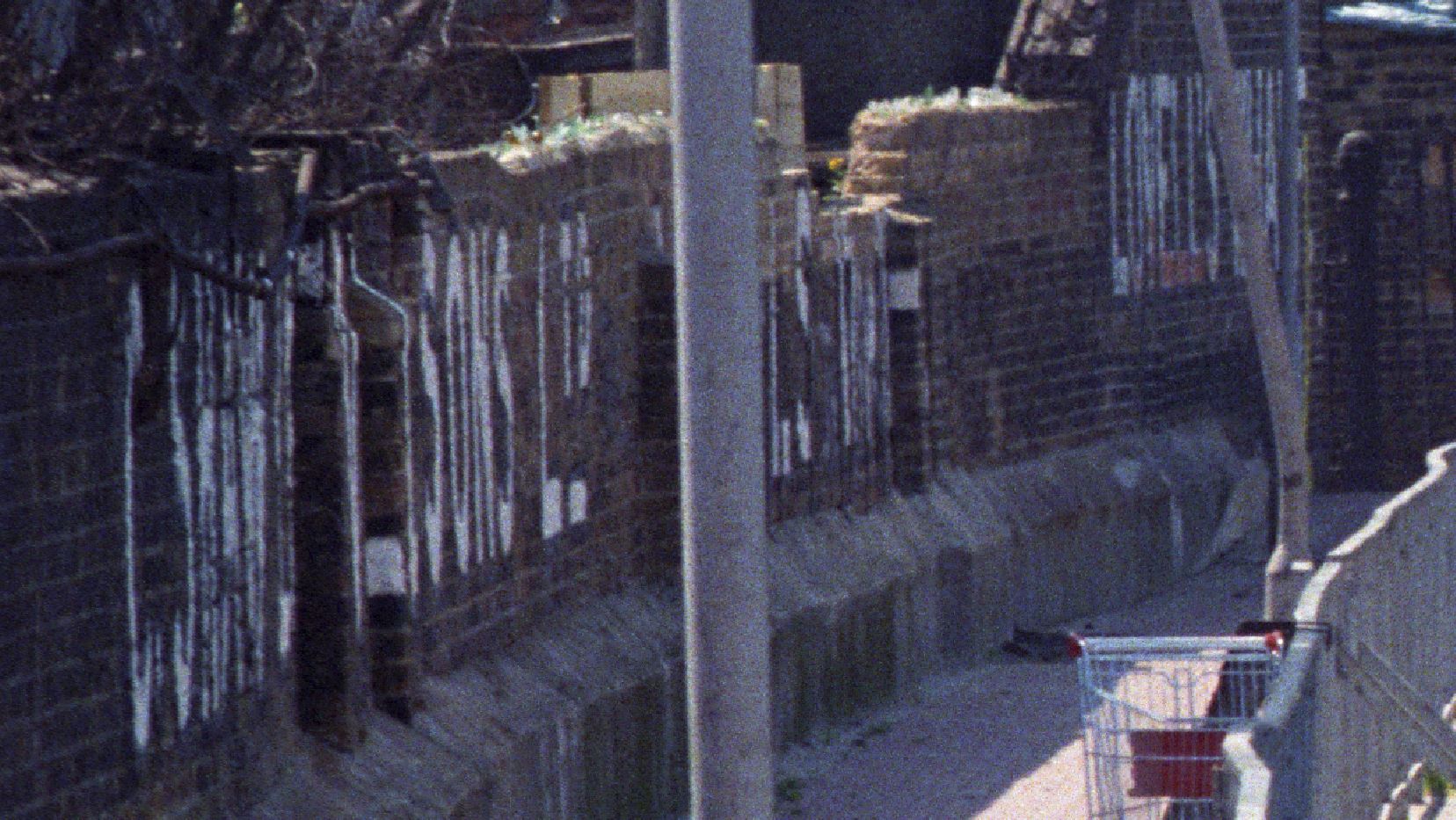
Along the wall in the 1986 photo there were painted white letters for C. Shaw & Sons Ltd and Lovell’s Wharf:

Lovells Wharf

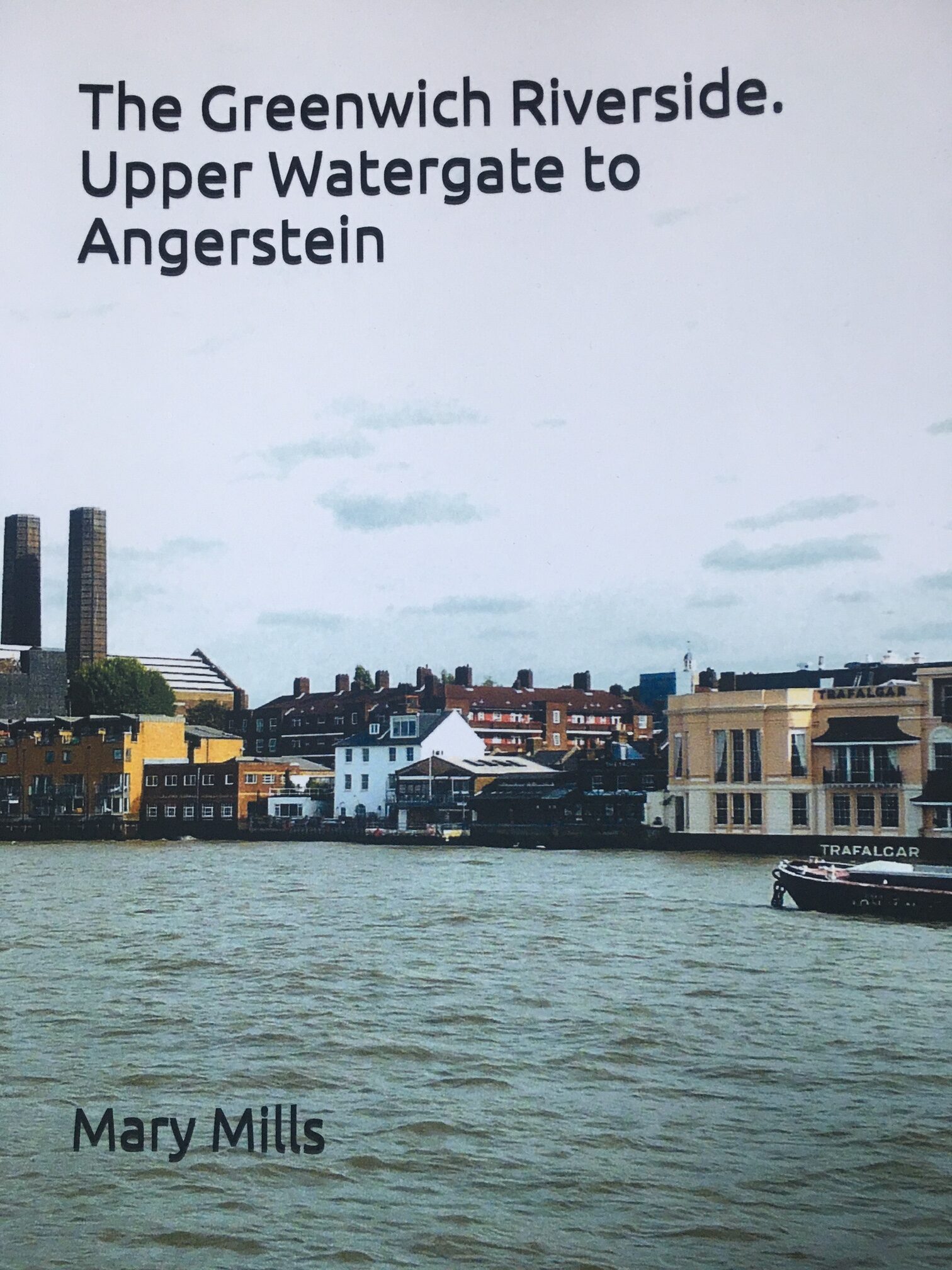
The books by Mary Mills are my go to source for anything about the Greenwich Peninsula, and Mary has recently published “The Greenwich Riverside. Upper Watergate to Angerstein”:

Greenwich Peninsula

For a detailed history of the peninsula and the considerable industrial heritage of the area, the book is invaluable.

The book states that the company Shaw Lovell leased the site in the 1920s. A company with a Bristol heritage, their business was as a “Shipping and Forwarding Agent”.

The company handled non-ferrous metals, including in the 1920s, scrap from the Great War battlefields.

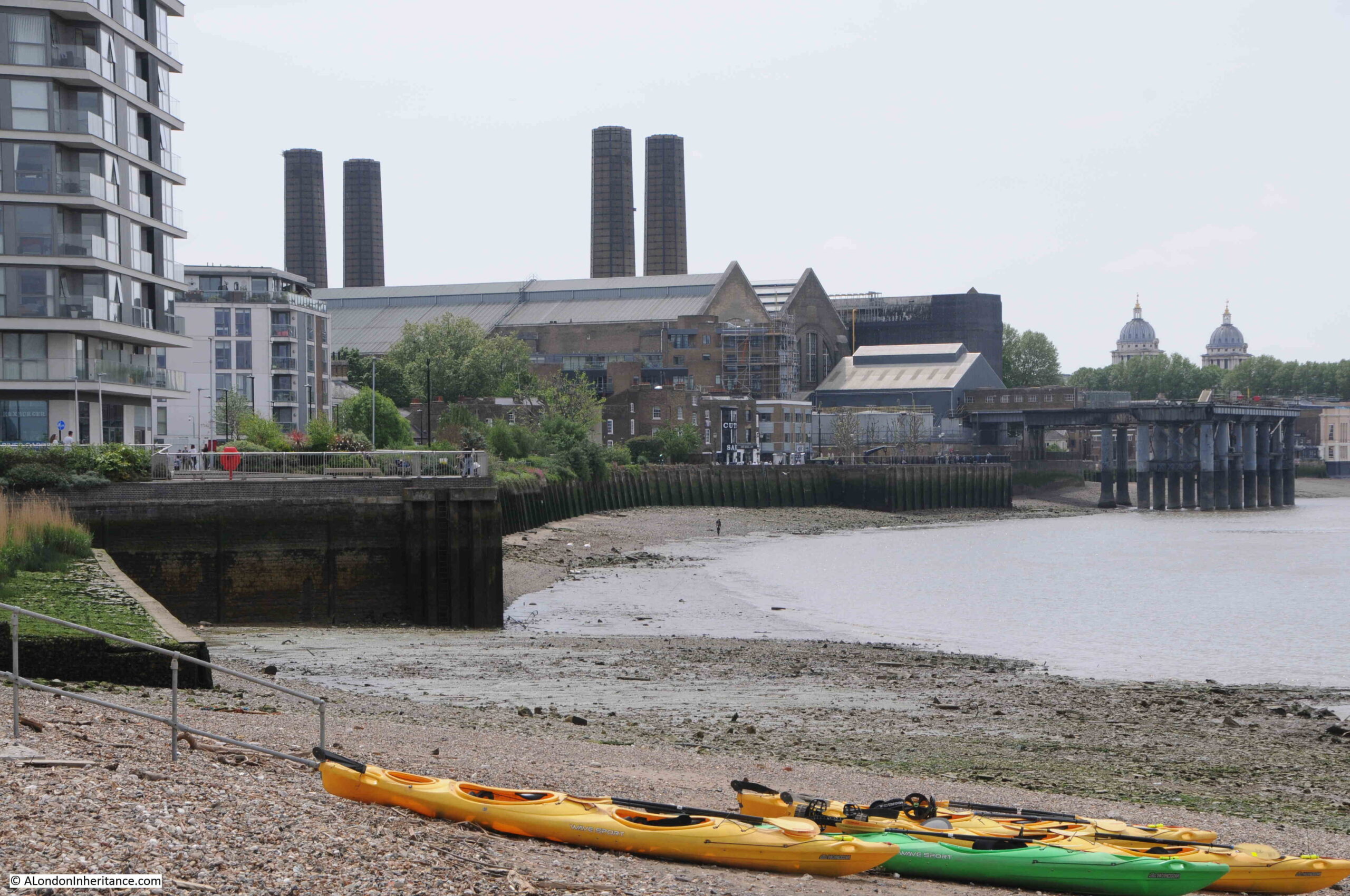
A view of the methods that the company used to transport material between shipping on the river and the land is shown in the following photo from a bit further along the Greenwich Peninsula:

Greenwich Peninsula

The same view today:

Greenwich Peninsula

I found the exact position for the above photo. The chimneys of the power station, and domes to the right help, but in the foreground there is the low concrete wall on the left, and behind the barges in the 1986 photo is where the shore wall extends out into the river. If I had timed my visit better, I could have got the tide in the same position.

The main differences between the two photos is the lack of shipping moored alongside the wharf, and the cranes being used to transport materials.

The cranes were significant local landmarks. They may have dated from around 1950 and were originally in use in Dublin. The cranes moved to Greenwich in the 1970s, and remained on site until 2000, when the owner of the land had them removed.

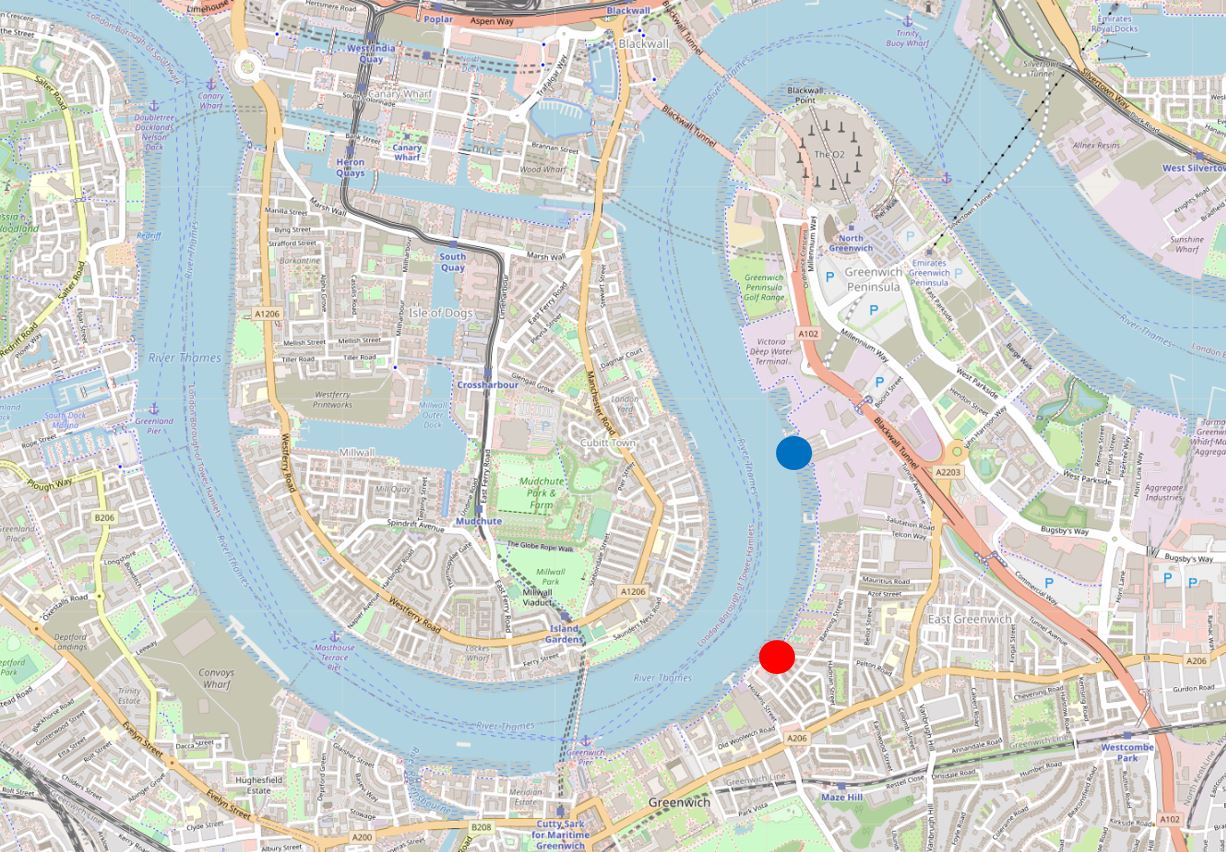
To put the locations of this week’s post in context, the following map shows where I will be covering. Starting at the red circle, with the above photos just north of this circle, and finishing at the end of the post at the blue circle  (© OpenStreetMap contributors).

Greenwich Peninsula

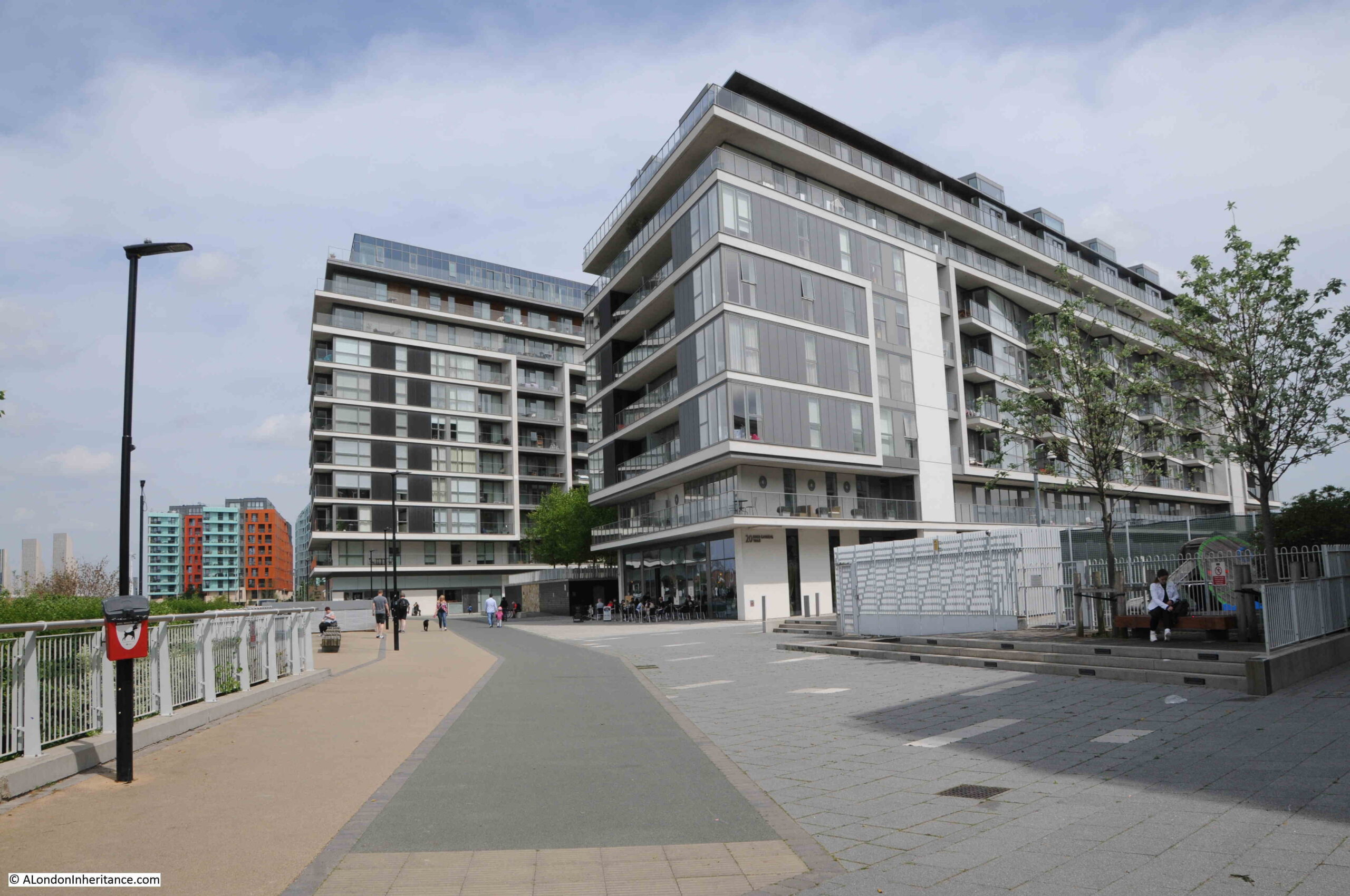
As can be seen by comparing the above then and now photos, the area has changed considerably. What was an area of considerable industry has been derelict for some years, and over recent years the northward expansion of apartment buildings has started along the western side of the peninsula, and will no doubt meet the southward run of buildings close to the O2 dome.

Greenwich Peninsula

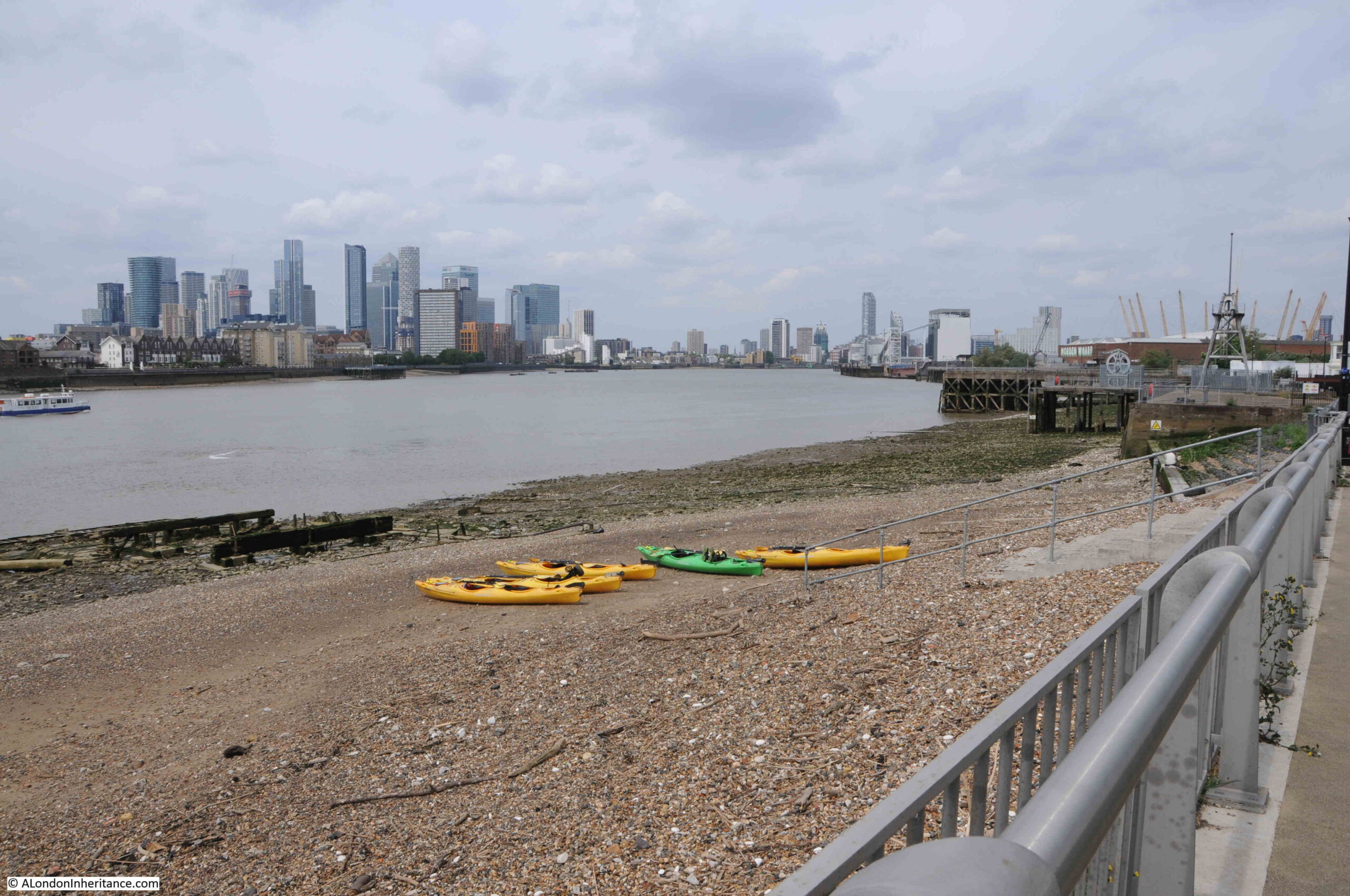
Looking along the foreshore towards the dome at the northern tip, with new apartment buildings replacing the industries that once occupied the area:

Greenwich Peninsula

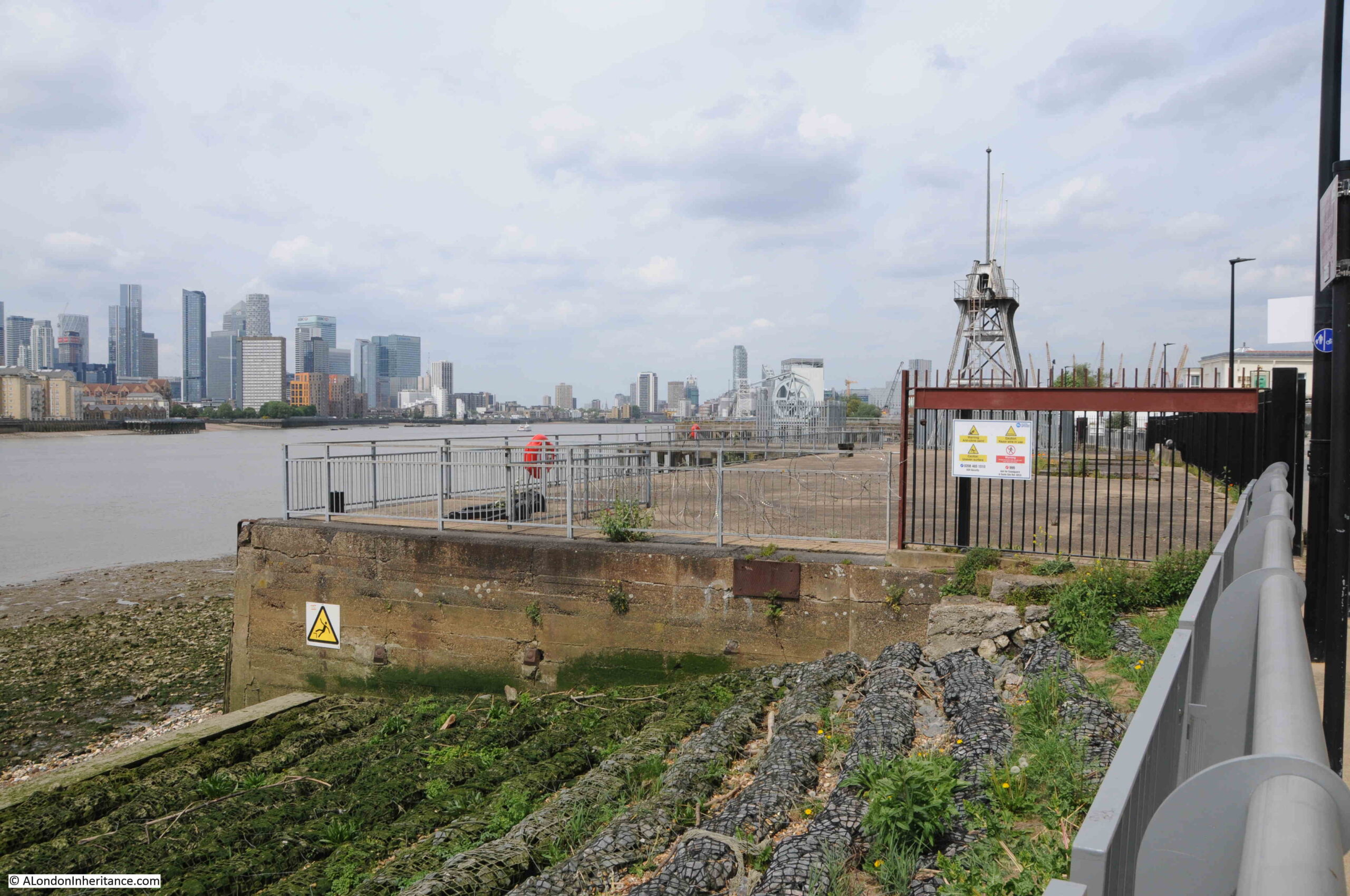
View across the river to the towers of the Isle of Dogs:

Greenwich Peninsula

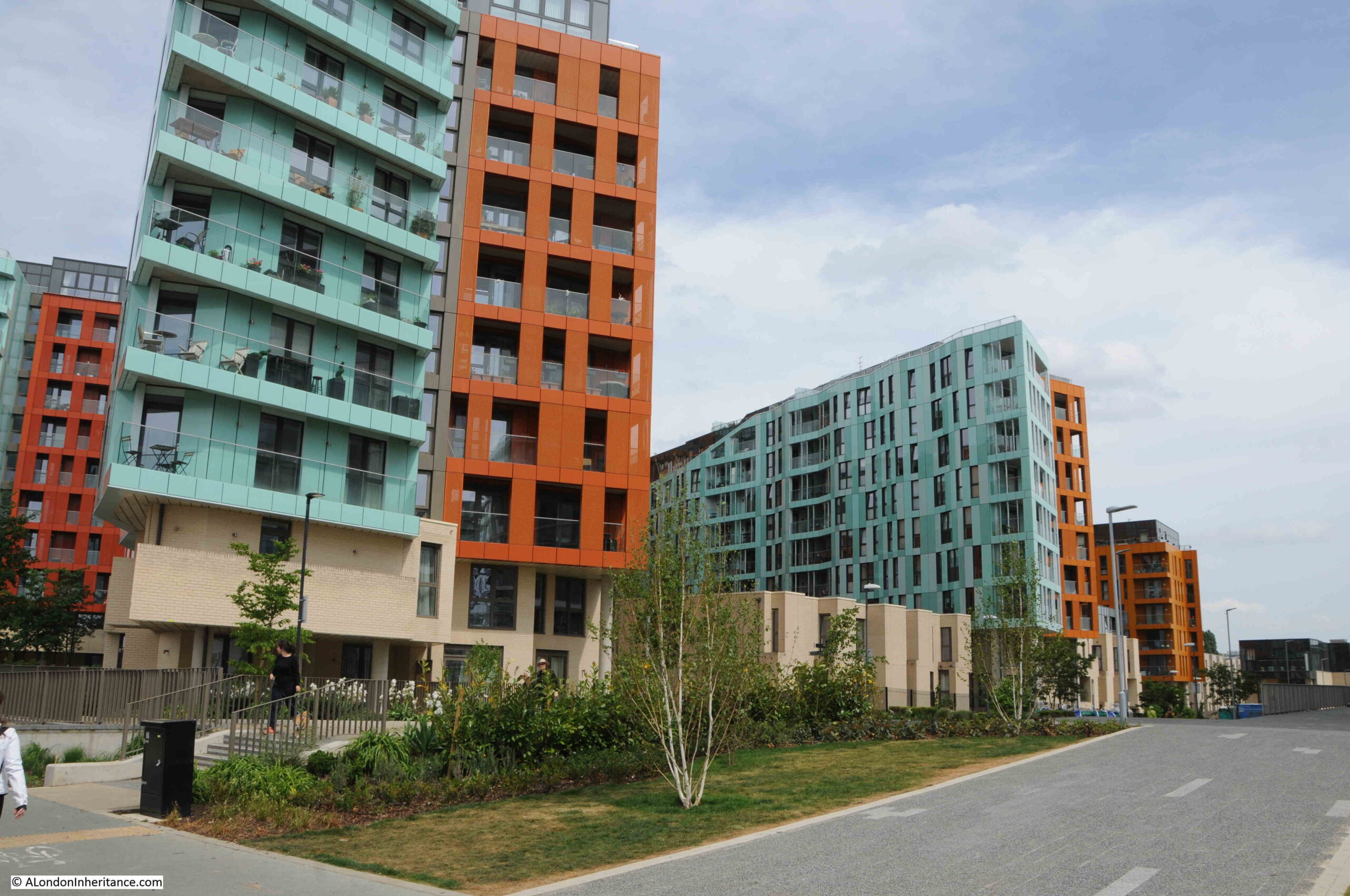
Two colour apartment blocks:

Greenwich Peninsula

Of the many industries along this stretch of the river, one was a company that was key in the provision of a technology that enabled communications across the world. This was the manufacture of submarine communication cables which took place at Enderby Wharf and it is here that we can see the remains of some of this activity.

Here was manufactured the first cable to cross the Atlantic and up until the mid 1970s much of the world’s subsea communication cables had been manufactured here. The web site covering the history of the Atlantic Cable and Undersea Communications has a detailed history of Enderby Wharf.

The tower structure that can still be seen is part of the mechanism, along with the smaller wheel on the left, used for transferring cable from the factory on the right to cable ships moored in the Thames on the left. Cable would be run across the walkway to the top of the tower then to the round hold-back mechanism on the left then onto the ship:

Enderby House

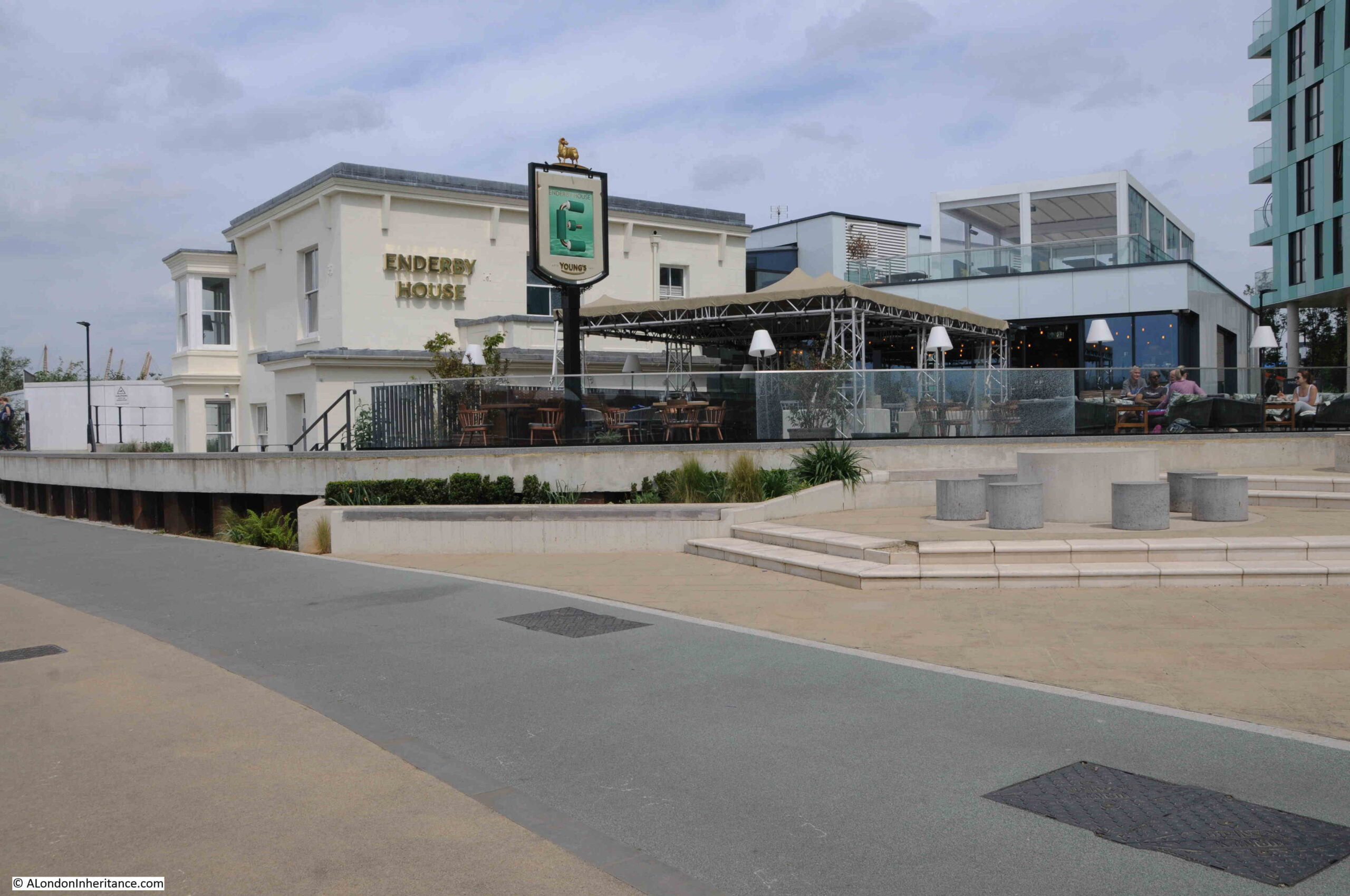
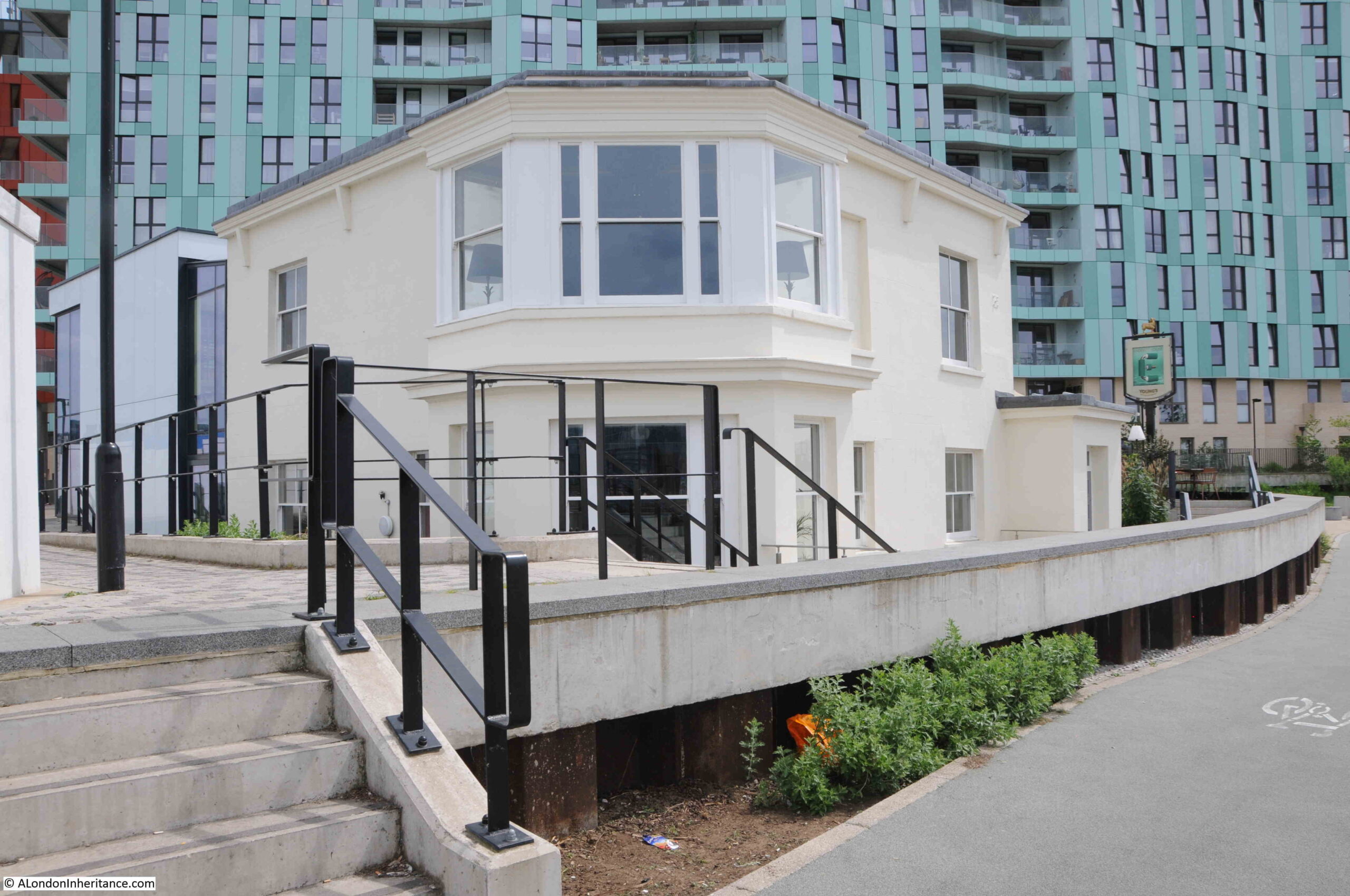
It was here that I was really surprised to see a new pub – Enderby House:

Enderby House

Enderby House is a historically important building. Grade II listed, the Historic England listing provides more details about the building:

Enderby House belonged to the firm of Samuel Enderby, the largest whalers and sealers in Britain, and pioneers of Antarctic exploration. Hermann Melville describes their flagship and crew in “Moby Dick”. The decline of British whaling led to the Enderbys ceasing to have an interest in Enderby’s Wharf in 1854.  It was then taken on by Glass, Elliott and Company, a contractor for the first transatlantic telegraph cable (lost while being laid in 1857) then the second in 1858 which operated for a few weeks.  The business was reconstituted in 1864 as the Telegraph Construction and Maintenance Company, who manufactured cable at Enderby’s Wharf to an improved design for another attempt in 1865, and a fourth in 1866, both times with the Great Eastern as the cable-laying ship, and by the end of 1866 had achieved the first successfully working transatlantic telecommunications cable connection. “

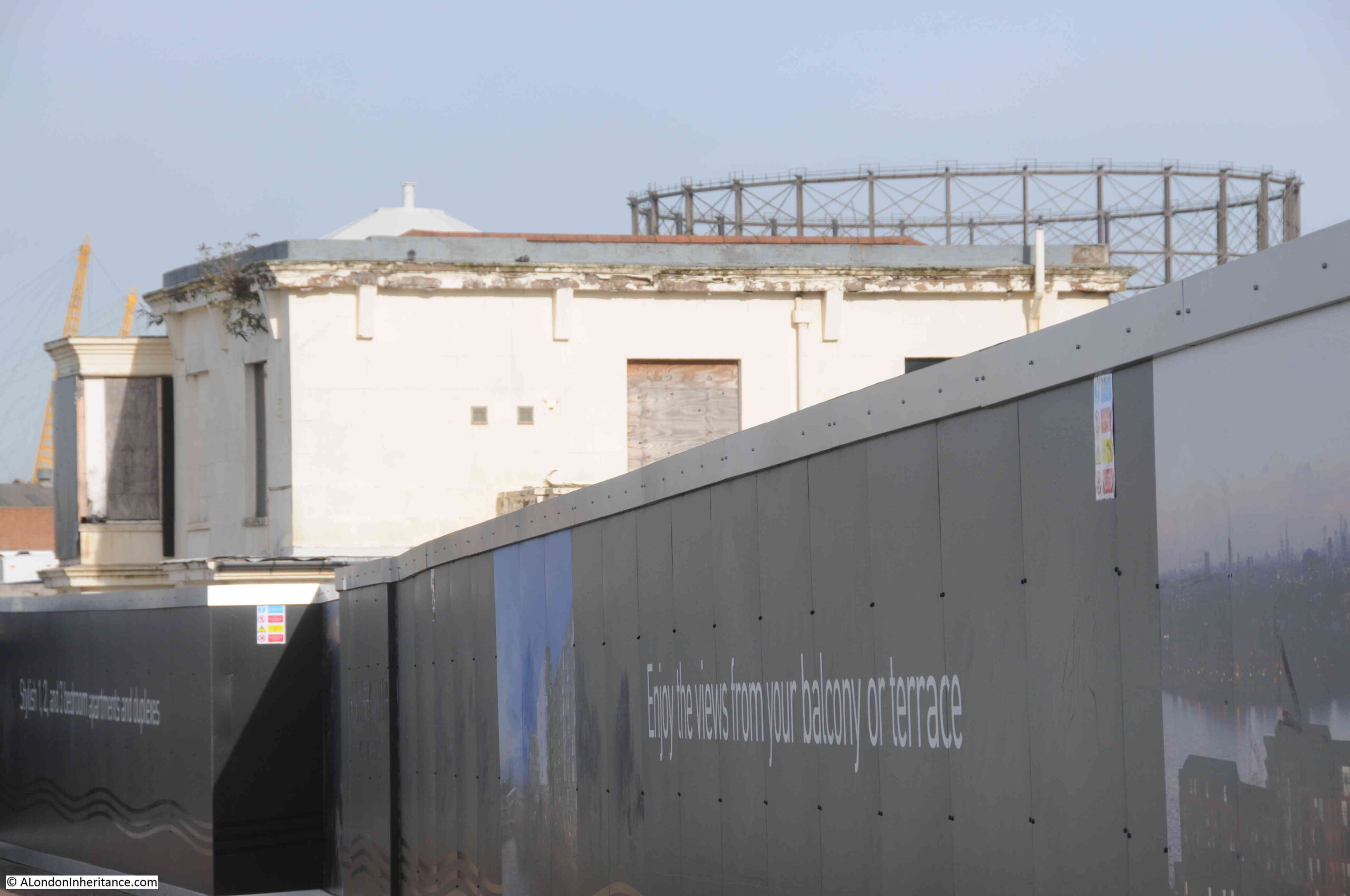
The last time I walked along this stretch of the peninsular in 2015, from Cutty Sark pub to O2 dome, Enderby House was looking in a very poor condition:

Enderby House

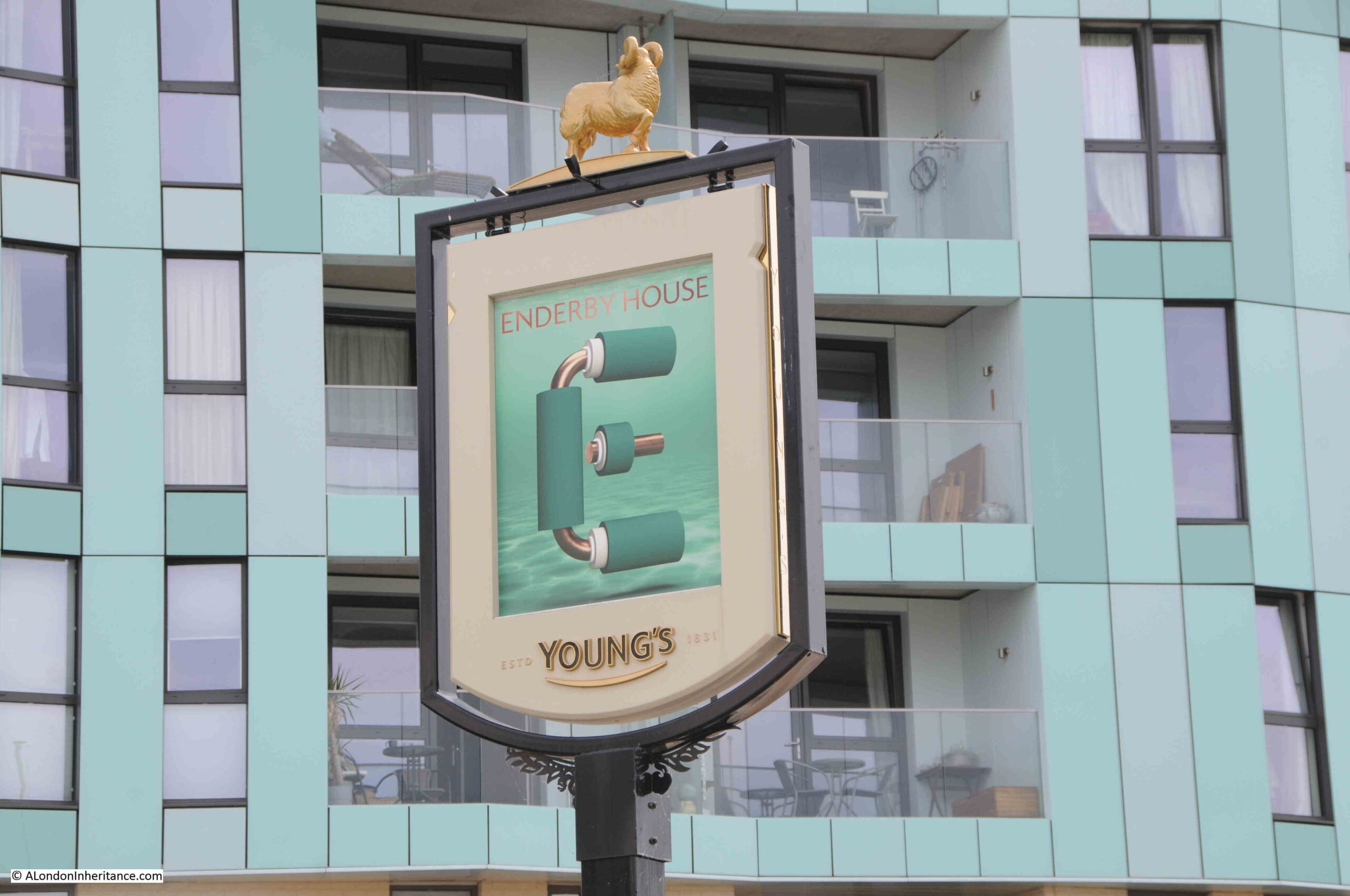
I walked around the outside of the pub, but could not see any references to the history of the site, or to the impact on communication technologies that the products manufactured here would bring, however the pub sign did appear to illustrate what I assume to be a representation of a telecommunications cable:

Enderby House

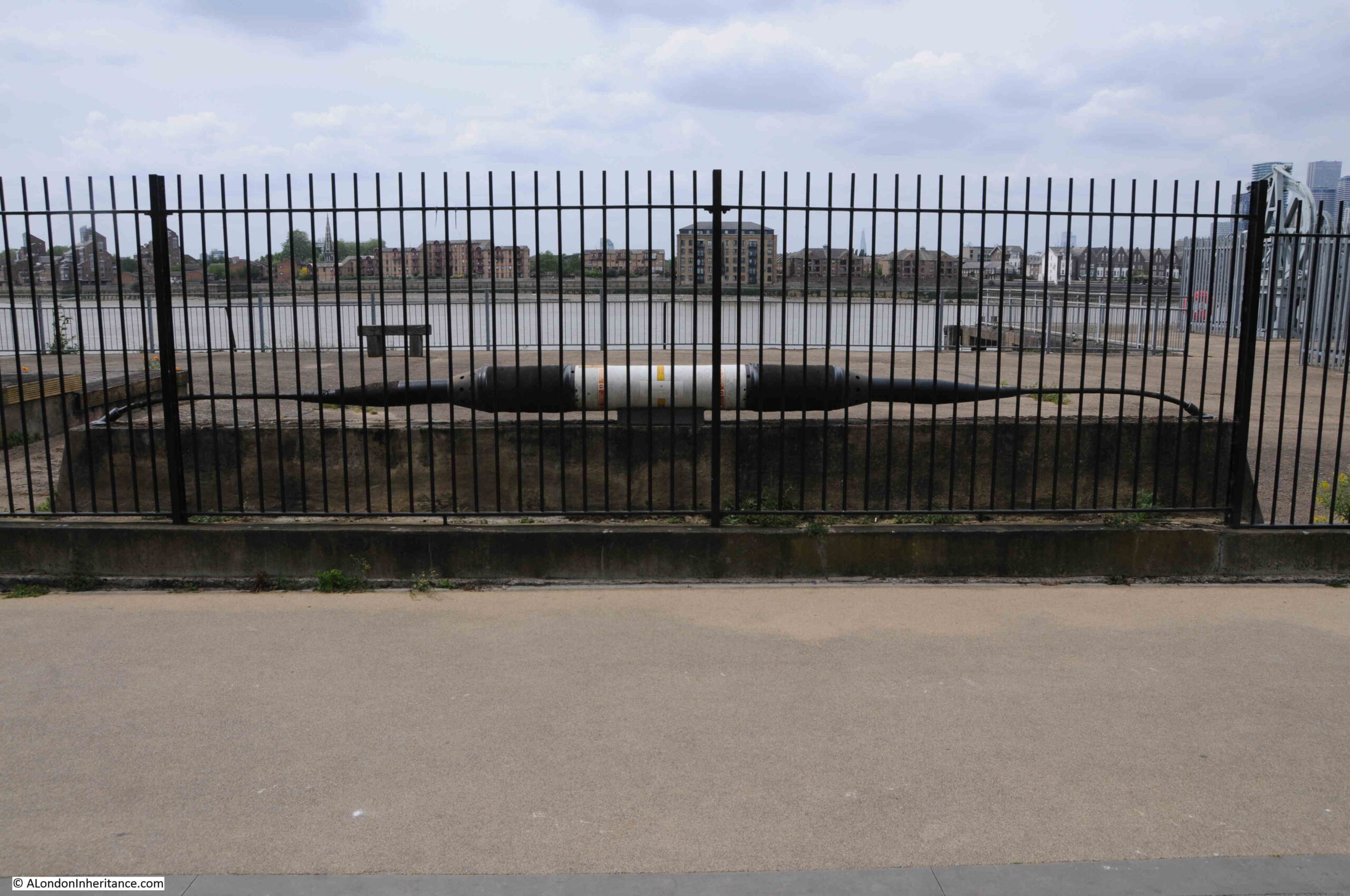
Opposite, within the fenced off wharf, was an example of a length of cable and the housing for the repeater equipment that would amplify the signal as it travelled for thousands of miles under the sea:

Enderby House

I get really conflicted when I see a building such as Enderby House. I am pleased that it is still there, and that it is a new pub (too many of these are closing), however it appears to be heavily altered, and does not appear to offer any information as to the importance of the site, apart from retaining the name and the pub sign.

Perhaps there is information inside and I am being unfair. I did not have time for a visit, having a meet arranged at the Cutty Sark pub on the walk back.

View of the northern side of Enderby House – if I was responsible for decorating the building I would have an artwork representing a trans-Atlantic cable running along the side of the building to break up the rather bland cream paintwork.

Enderby House

Fenced off access to the wharfs near Enderby House:

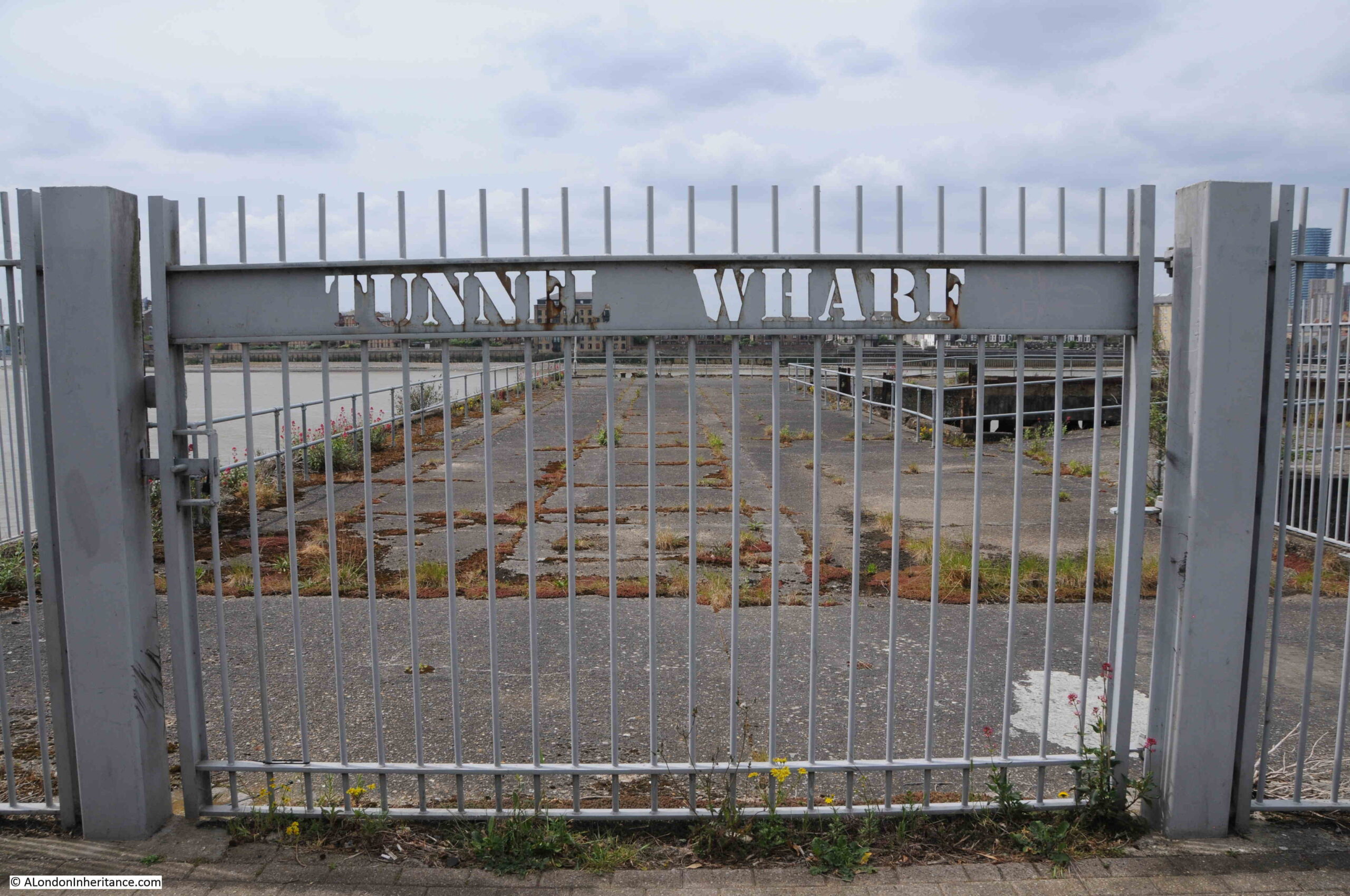
Tunnel Wharf

There is a flat wall of stone to be found among the apartment buildings and facing on to the walkway along the river:

Greenwich Peninsula

Rather than repeat what the information panel to the right of the wall states, I will summarise Mary Mills comments from her book.

There was a road that ran underneath the new apartment buildings between Lovell’s and Granite Wharf (which was to the north of Lovell’s).

Much of the boundary wall of Granite Wharf along this roadway was made up of an extraordinary range of what appeared to be random stone, and was thought to have been quarried in Dorset, shipped to Greenwich where it was stored until it was sold for use in a construction project. Some of this stone had been used to construct the wall.

This stone wall was important as it was a visual demonstration of the stone trade from along the English Channel.

When the wall, along with the rest of the site was being demolished, Mary Mills was instrumental in getting the importance of the stone recognised, however the wall created by the developer using the stone is very far from how it was originally used, and what had been rough stone had been tided up considerably and placed in what is now a smooth wall of stone. Again, good that it has been retained, but it could have been so much better.

Soon after walking past Enderby House, development has stopped and the river path changes from a new, wide path in front of apartment buildings, to a narrow path alongside the derelict sites that are probably scheduled for development:

Greenwich Peninsula

Where tour buses go to park:

Greenwich Peninsula

I really love this part of the walk along the peninsula. A narrow path along the river’s edge, quiet, and a chance to think about what was here:

Greenwich Peninsula

I still had my third 1986 photo to track down, and I suspect it was taken from the following pier:

Greenwich Peninsula

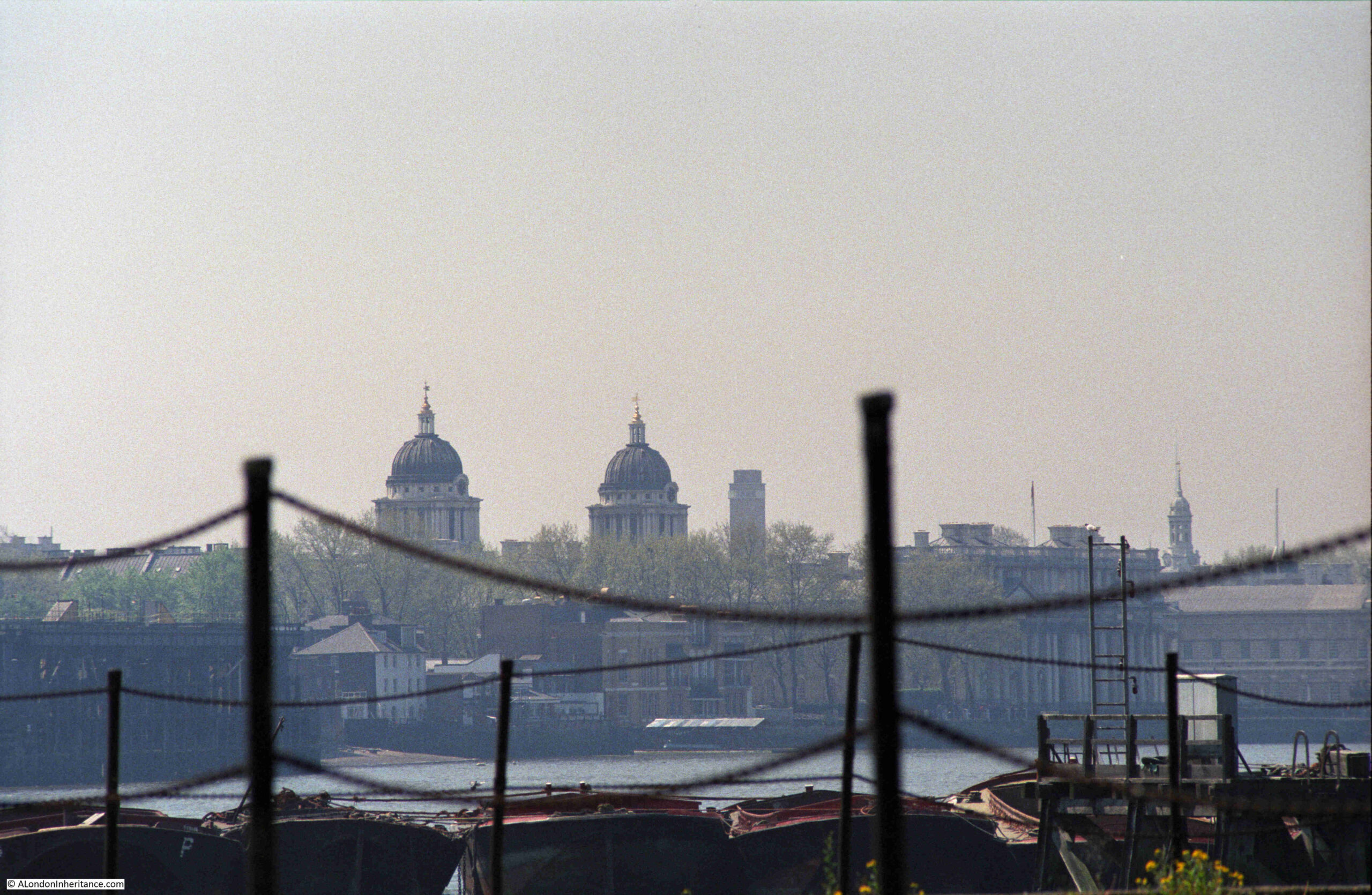
This was the view looking back towards central Greenwich in 1986:

Greenwich Peninsula

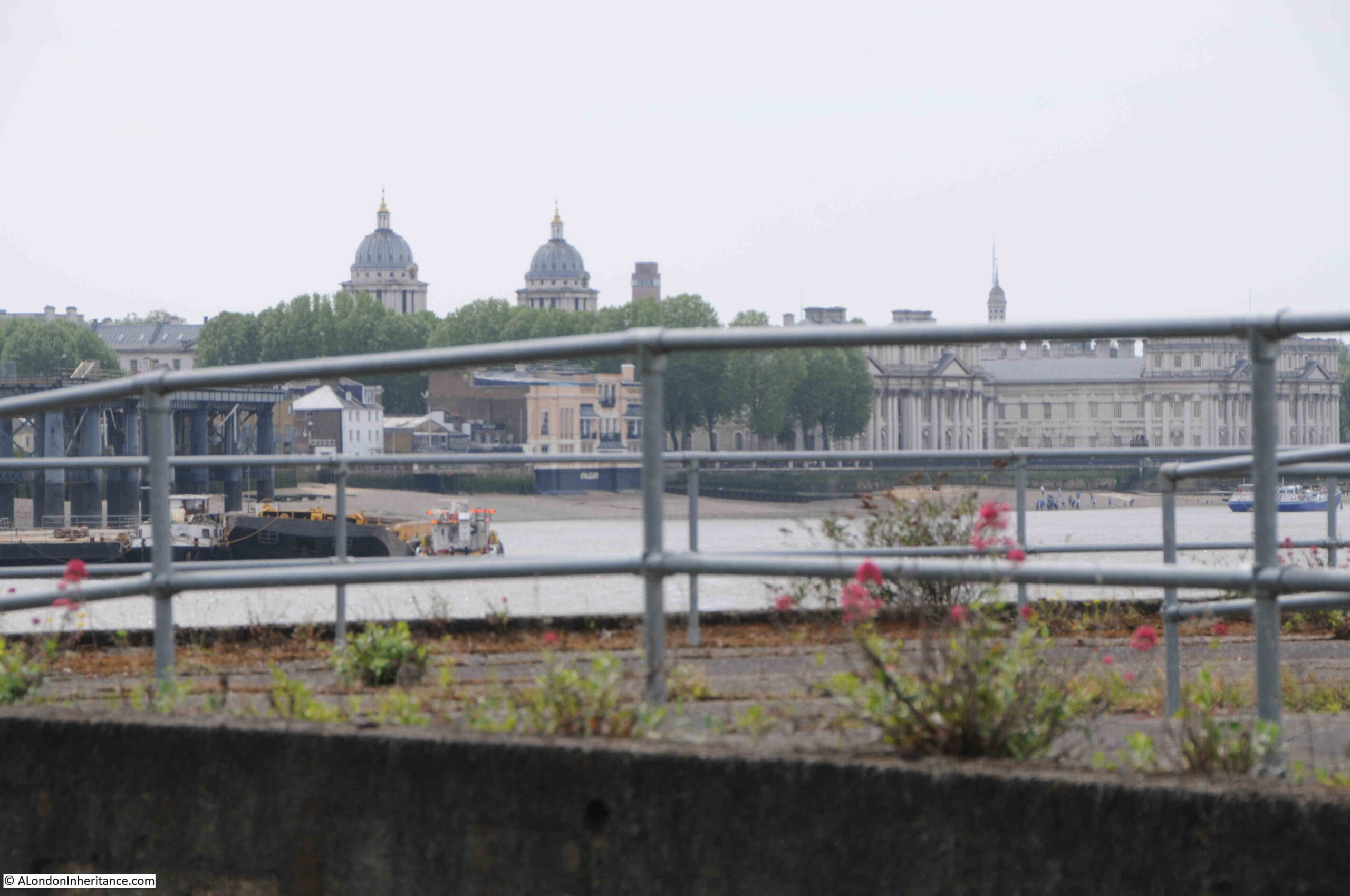
The following photo was the closest I could get to recreating the above. The landmarks of Greenwich all line up reasonably well. The barges moored alongside the pier in 1986 have all disappeared.

Greenwich Peninsula

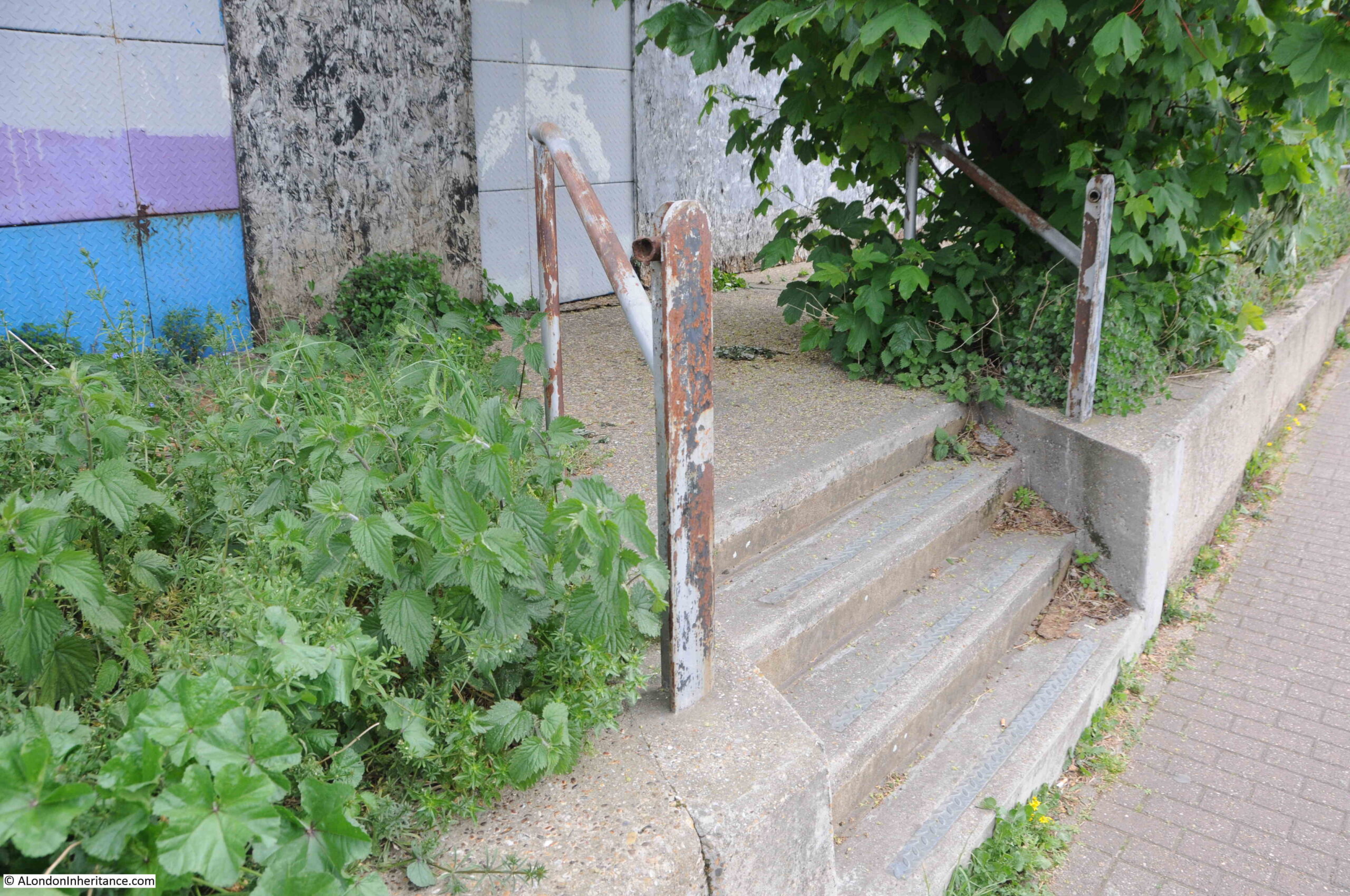
To the side of the footpath, there are the remains of structures that once provided access to the long gone industrial premises that lined the river:

Greenwich Peninsula

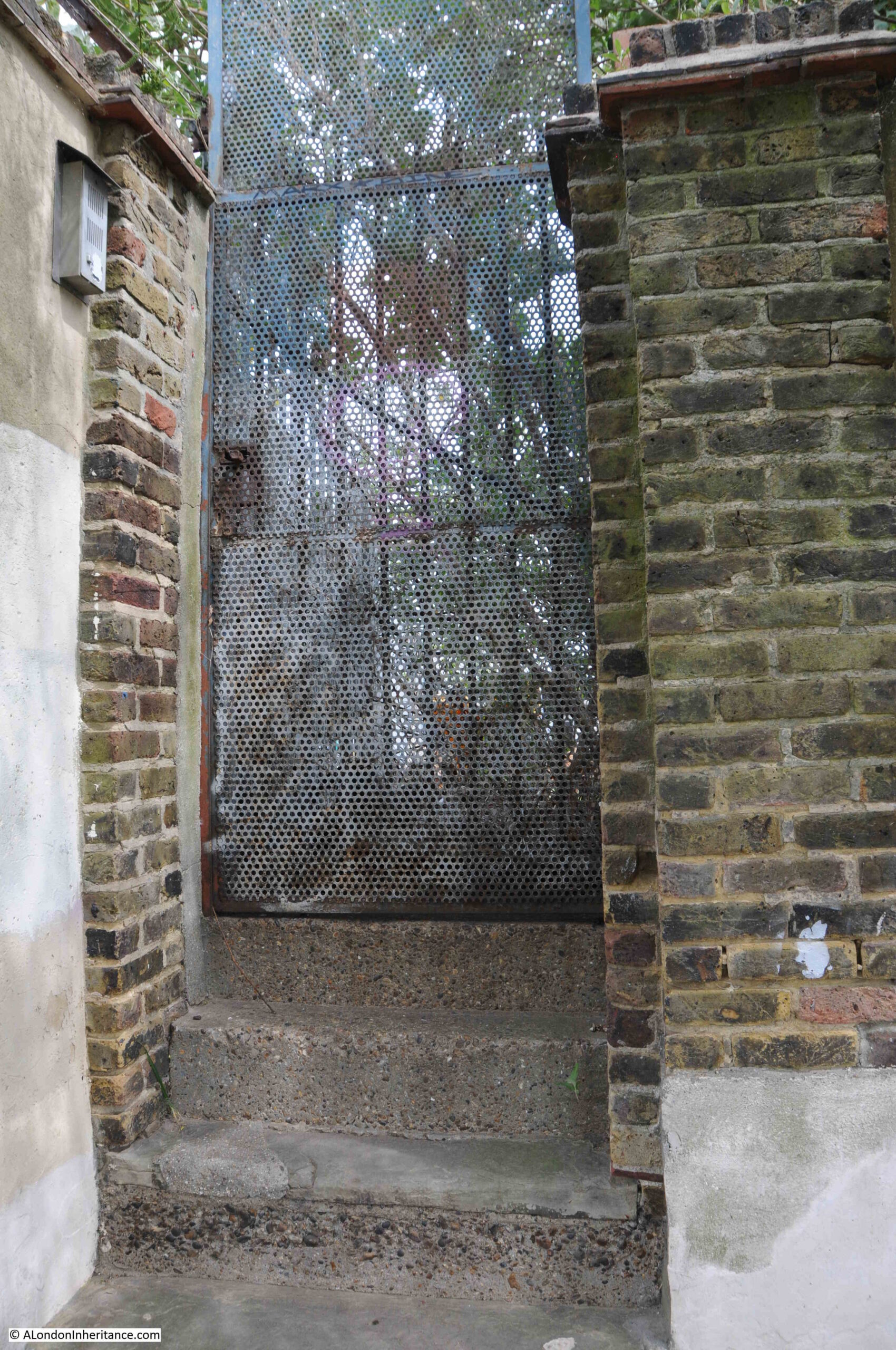
A long closed gateway:

Greenwich Peninsula

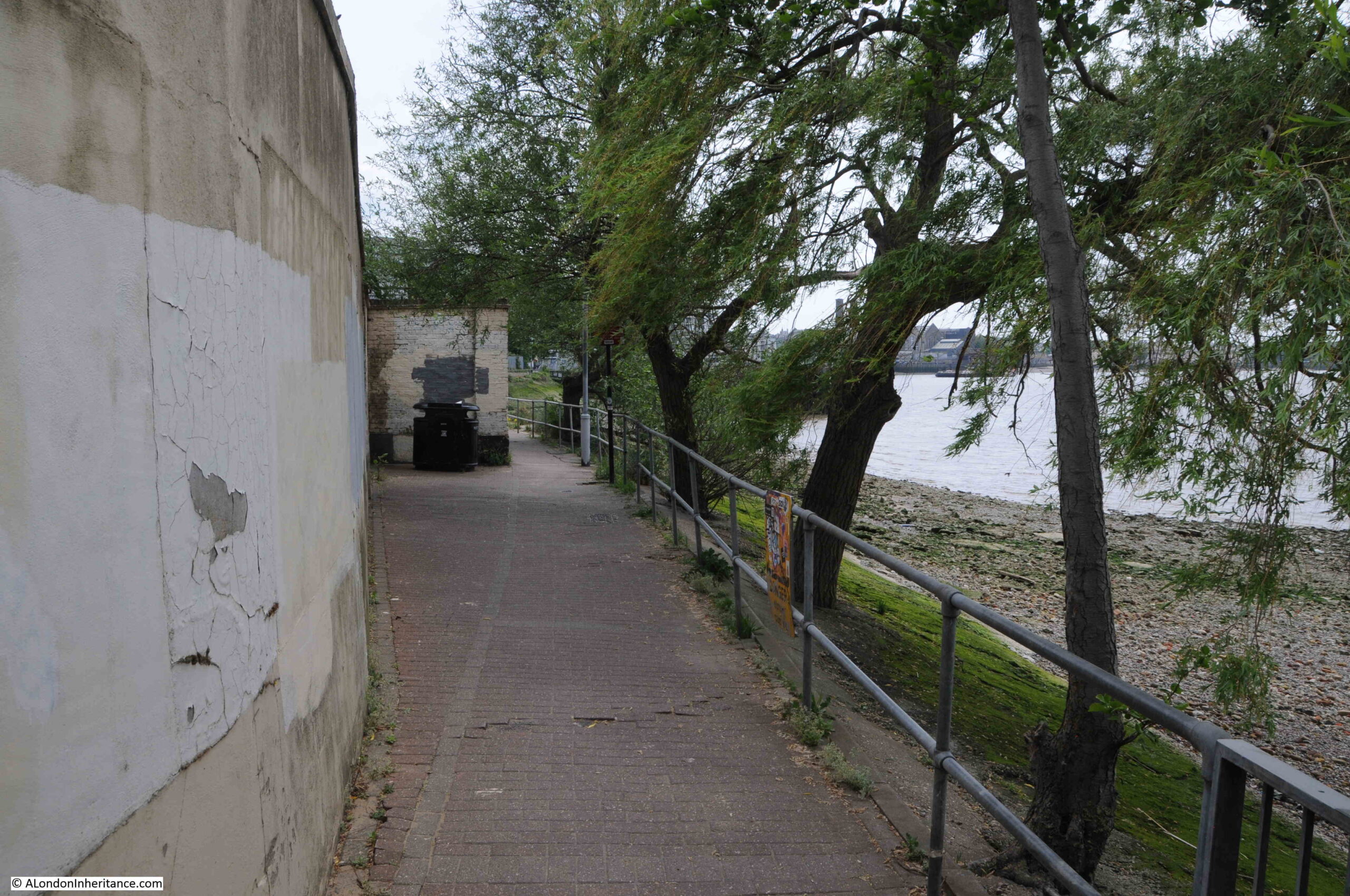
Looking back along the footpath – this stretch of the river is so very different to that which has already been developed, and I assume that at some point in the future, this footpath will become the same wide pedestrianised area next to new apartment buildings, as found at the start of the post:

Greenwich Peninsula

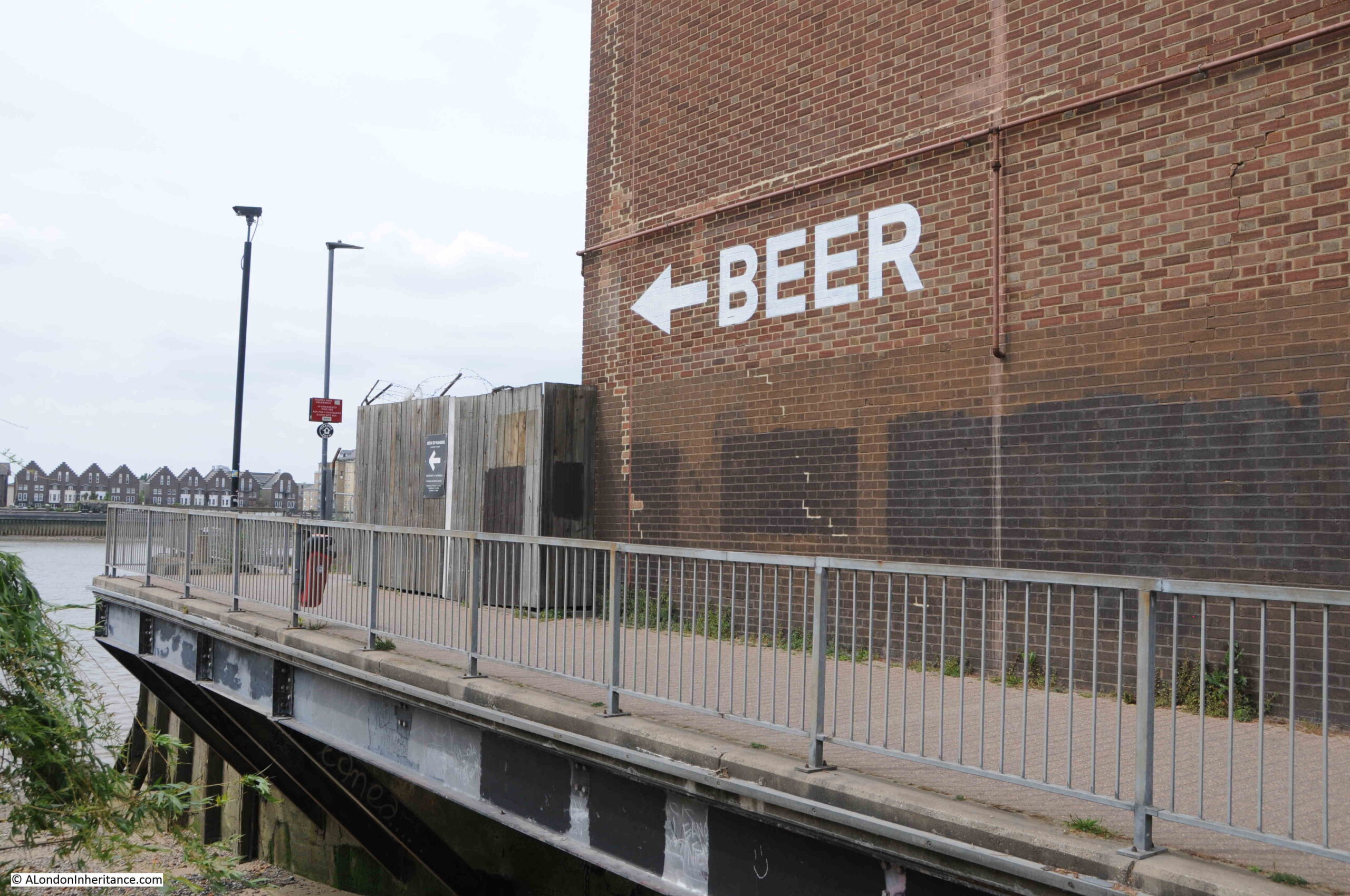
A welcome sign:

Morden Wharf

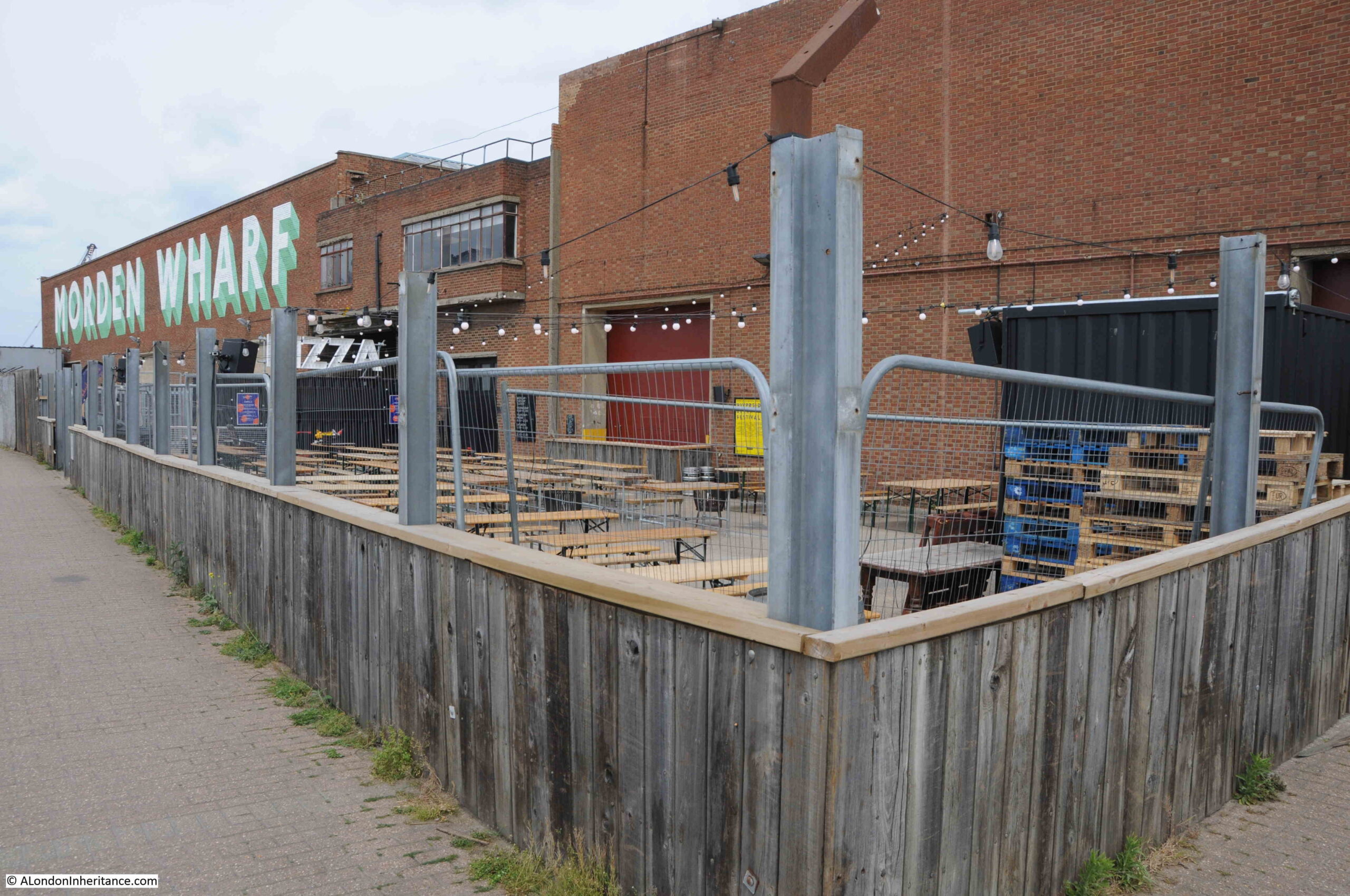
The sign points to what looks like a temporary bar / pizza area built in front of Morden Wharf:

Morden Wharf

Morden Wharf was named after Morden College, the freeholder of much of the land in the vicinity of the wharf.

The last time I walked along the peninsular, Morden Wharf was fenced off from the footpath with high, wooden panels, these have now been removed with only their vertical metal supports remaining.

Having reached Morden Wharf, I turned back towards Greenwich.

The area that I have walked which has not yet been developed, is planned to undergo a significant transformation. The footpath winding its way between the river and the derelict industrial sites will disappear and large new towers will be built.

The developed is called Morden Wharf, and the website describing the development can be found here.

Scroll to the bottom of the page, on the Morden Wharf website, and the area I have walked can be seen to the right of the old brick Morden Wharf building, and the bar and pizza area will apparently become “The reinstated Sea Witch pub”, a very different recreation of a pub that was once close to the river, and that was badly damaged by a V1 flying bomb on the 12th of July 1944.

The 1986 photos captured some of the last years of some of the industry along this side of the Greenwich Peninsula. It would then remain derelict for some years, and is now undergoing a significant transformation. It is a good time to walk the western side of the peninsula before this happens.

My 2015 walk along the peninsular to the O2 dome can be found here and shows how the area is changing, and the final part of the walk.

alondoninheritance.com

Westminster School Gateway

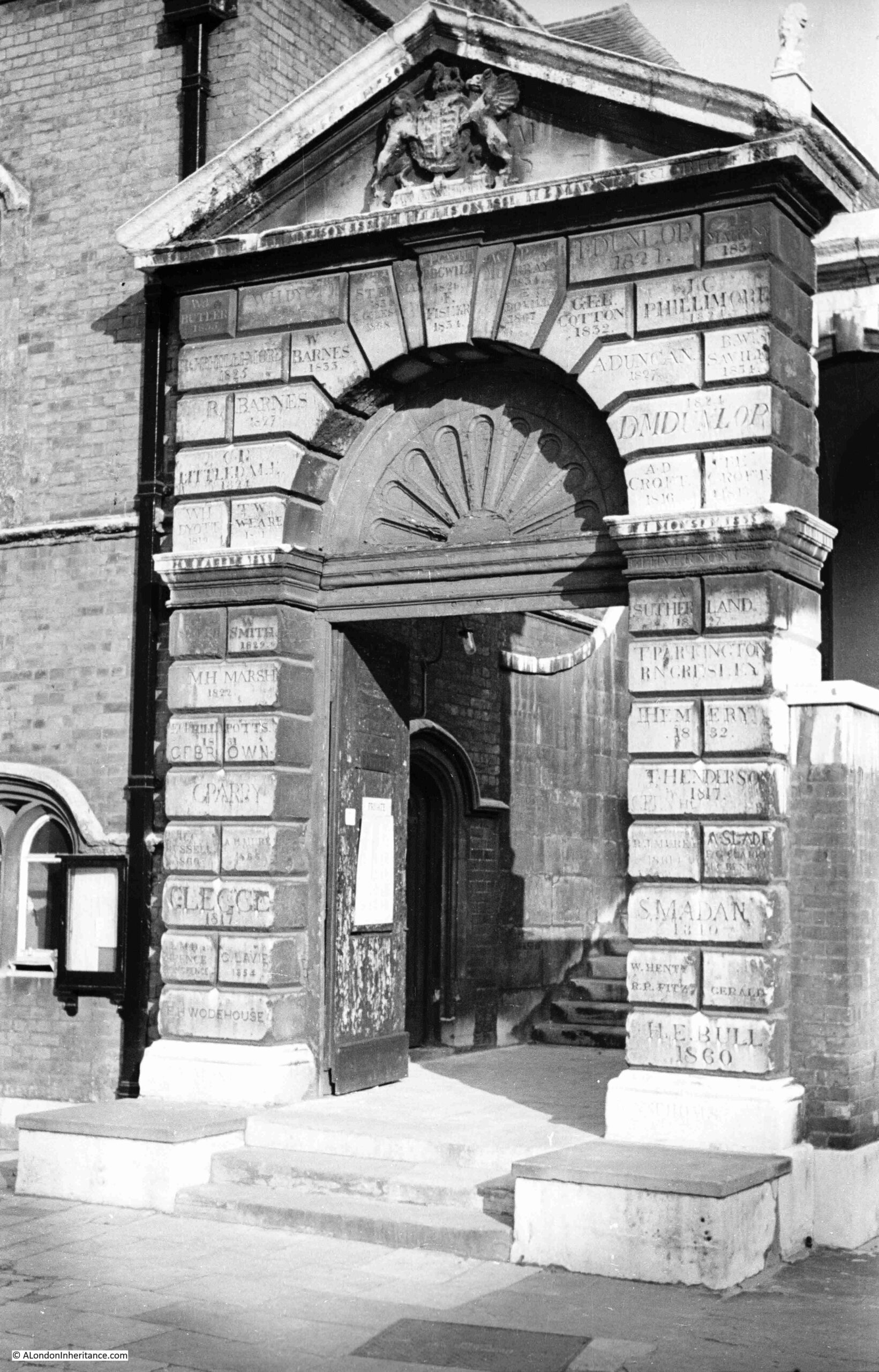
In 1949, my father photographed the Westminster School Gateway:

Westminster School Gateway

I am really grateful to the Archivist at Westminster School who provided access during the Spring half term, and told me about the history of the gateway and the surrounding area (although any errors are down to my memory).

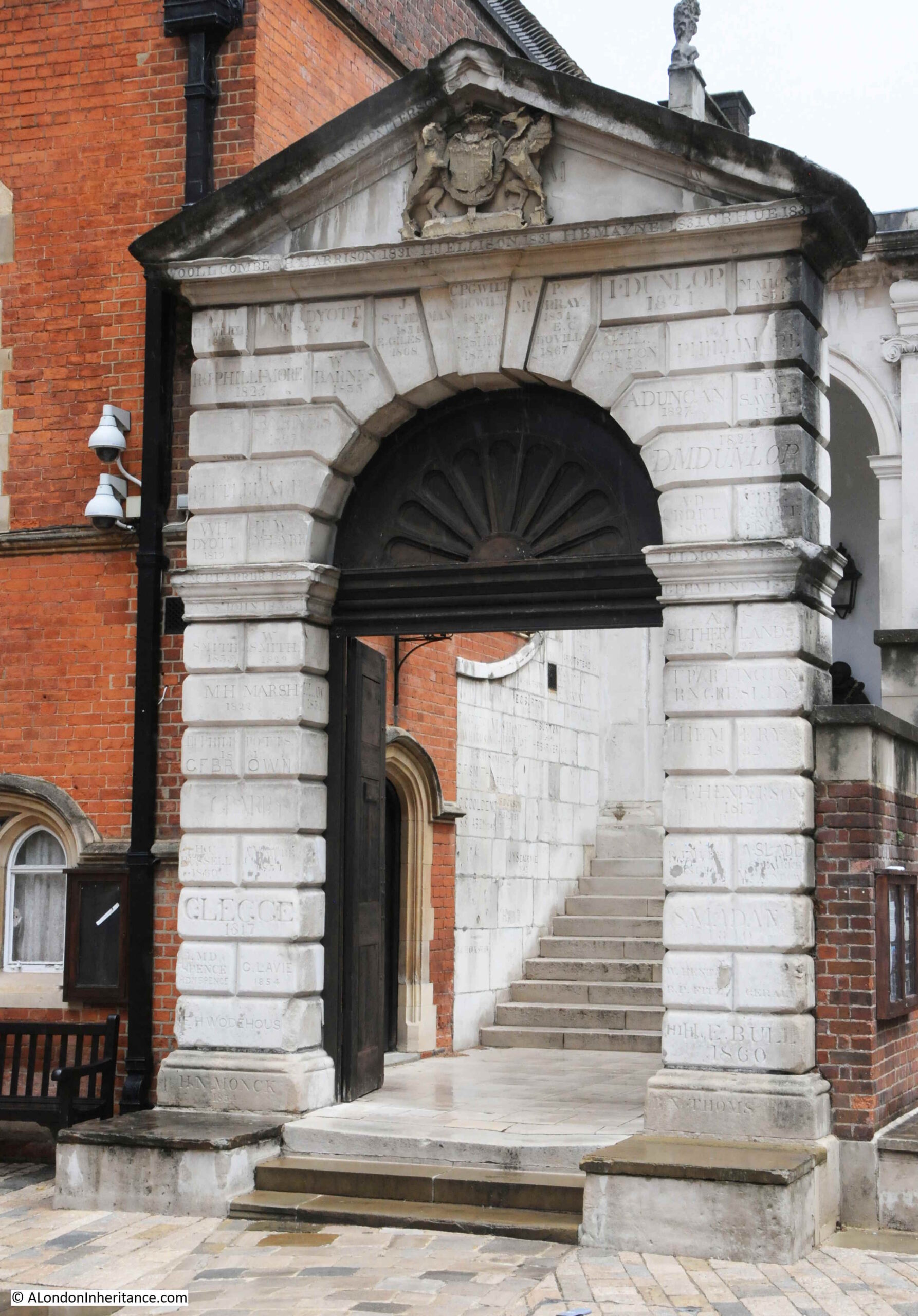
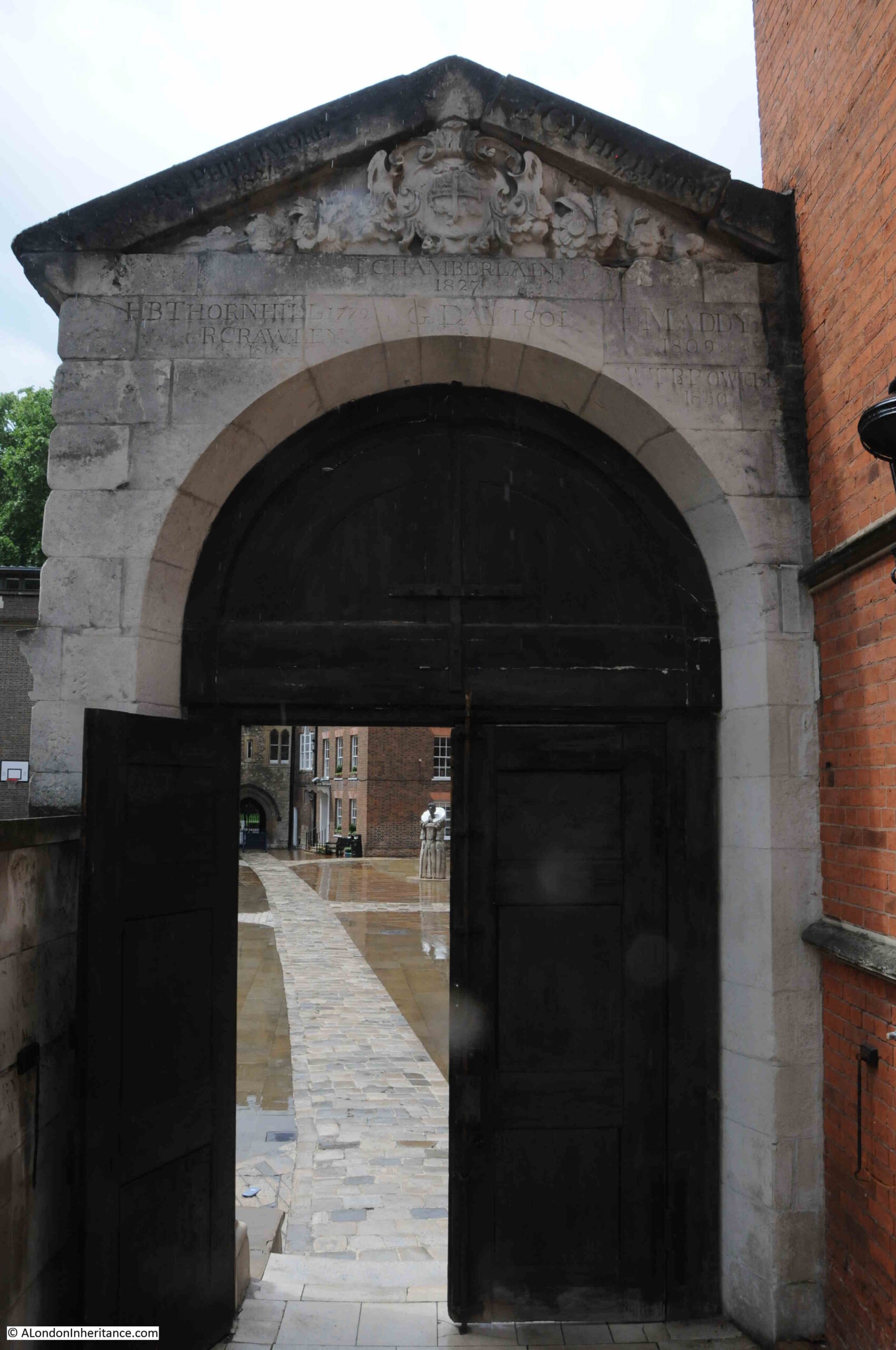
The same photo of the Westminster School Gateway at the end of May 2022:

Westminster School Gateway

There has been very little change in the 73 years between the two photos. The main change being a couple of CCTV cameras to the left of the gateway.

The Westminster School Gateway is a historic feature of the school for two main reasons. The age and purpose of the gateway, and the inscriptions that cover almost all the stones of which the gateway has been built.

The day of my visit was one of those days where London weather changes from sunshine to pouring rain in a matter of minutes, and that is exactly what happened when I arrived. The sky clouded and the rain fell, resulting in an overcast view of the gateway in my photo, compared to my father’s photo taken in bright sunshine.

Due to the different lighting conditions, the inscriptions are far more visible in my father’s photo than mine. In the 1949 photo, the stones are generally dirtier due to the amount of pollution from coal fires and other industrial sources across London. This blackened the inscriptions in the 1949 photo which helps them to stand out.

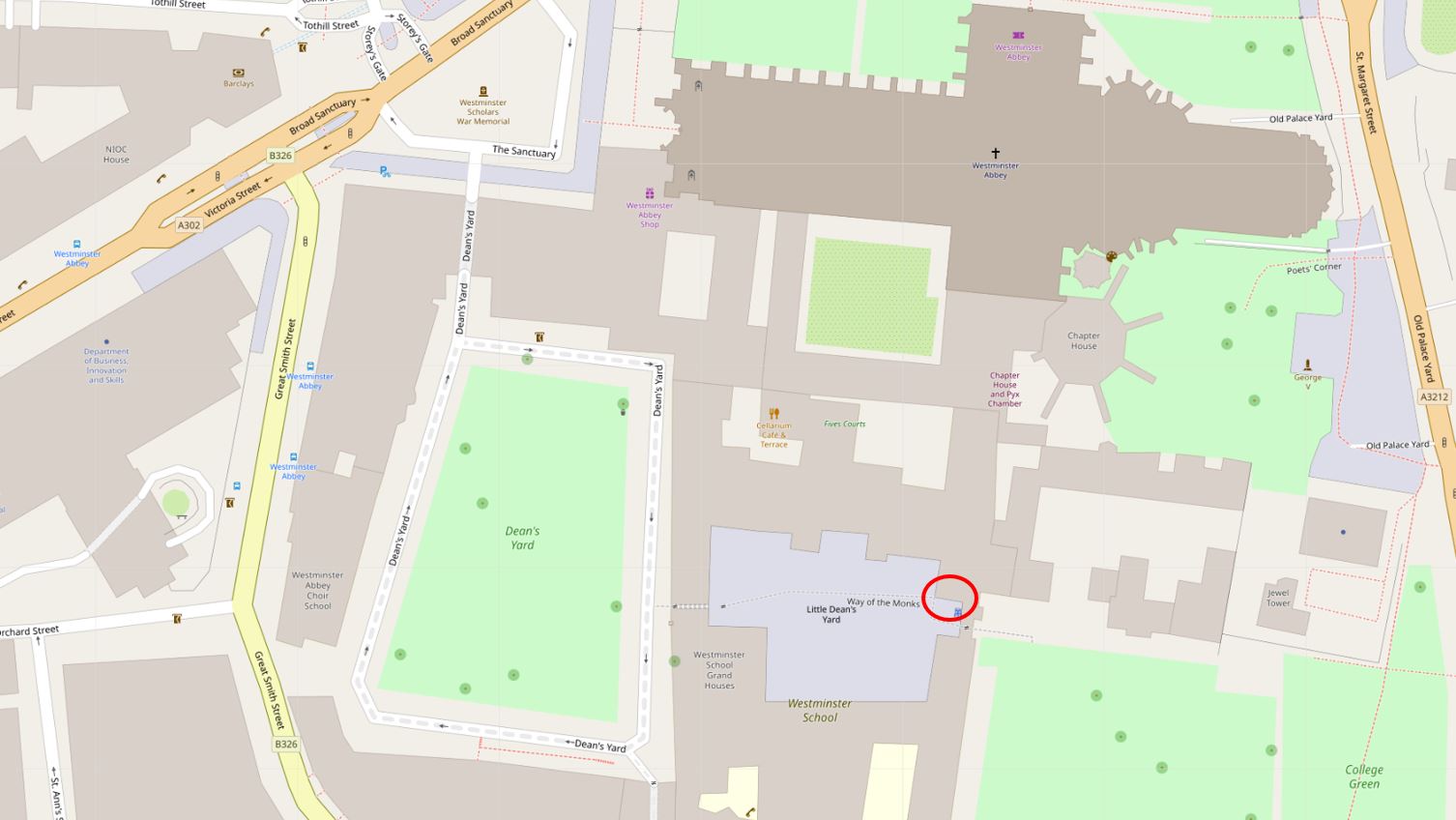
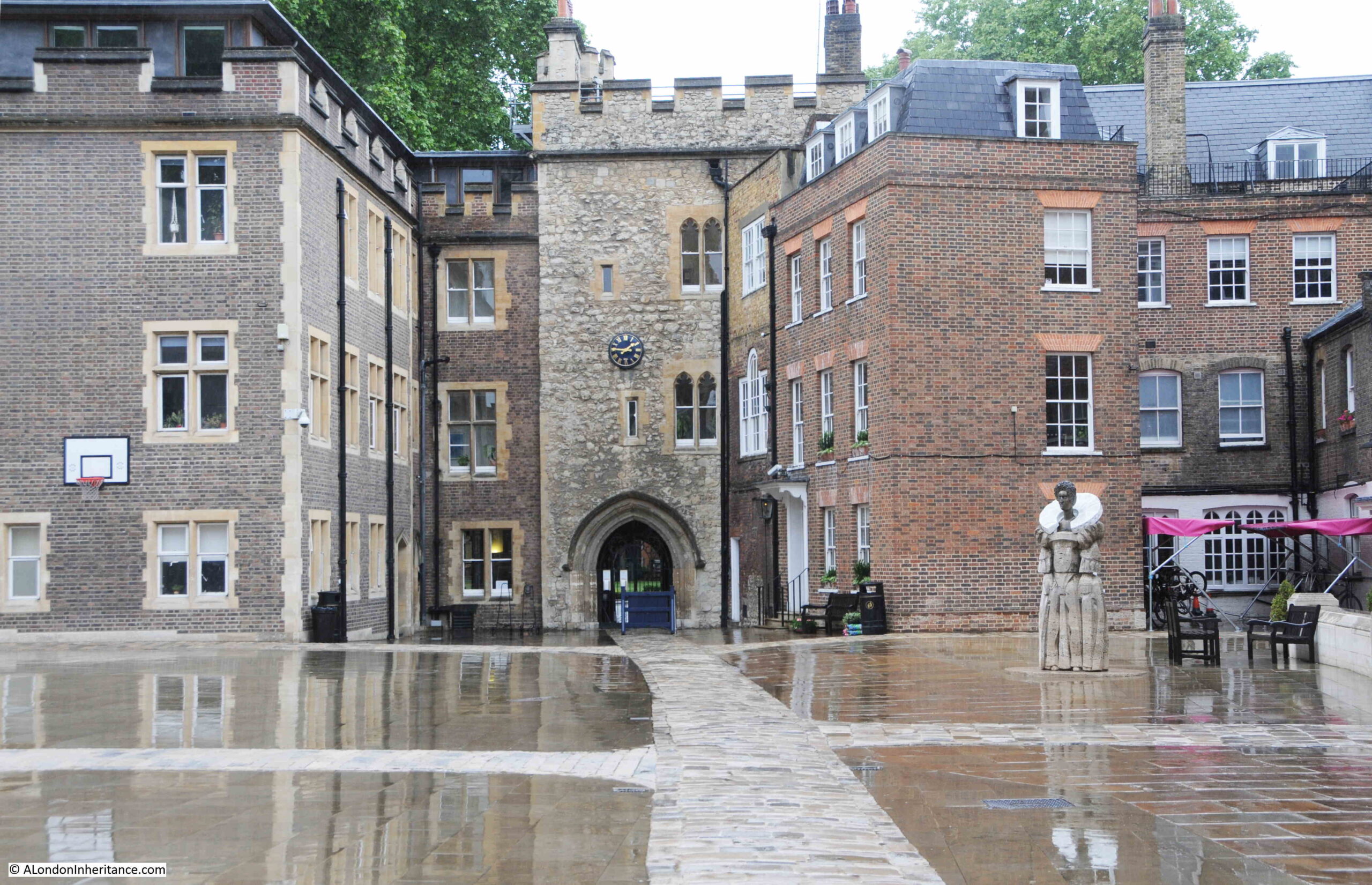
The Westminster School Gateway is in Little Dean’s Yard, which is accessed from Dean’s Yard. I have circled the location of the gateway in the following map  (© OpenStreetMap contributors):

Westminster School Gateway

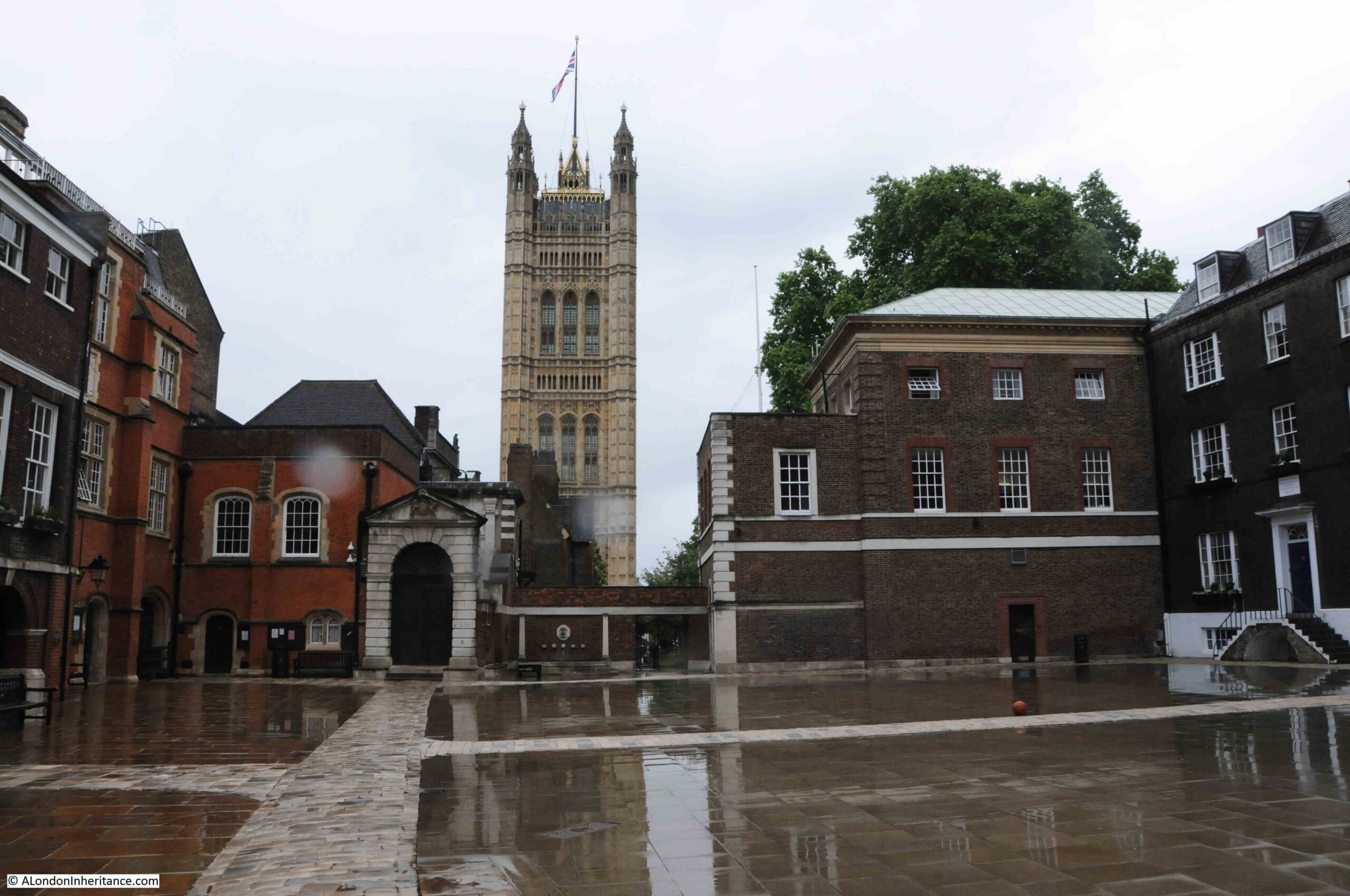
The view looking across Little Dean’s Yard towards the gateway, with the Victoria Tower of the Palace of Westminster in the background:

Westminster School Gateway

The School Gateway was built in 1734 and was the main entrance to the school. Little Dean’s Yard was originally occupied by buildings, and a passageway led from Dean’s Yard (via Liddell’s Arch) through these buildings to reach the school gateway.

The gateway is believed to have been built by Lord Burlington. This was Richard Boyle, the 3rd Earl of Burlington, who as well as the gateway, was responsible for the construction of a dormitory at the school between 1722 and 1730.

The school gateway is therefore also known as Burlington’s Arch.

The following print from 1880 shows the school gateway with the route of the passageway, although by the time of the print, the buildings surrounding the passageway had been demolished (© The Trustees of the British Museum).

Westminster School Gateway

The view looking back towards Liddell’s Arch from near the school gateway:

Liddell’s Arch

On the right of the above photo is a sculpture of Queen Elizabeth I, who became the royal patron of the school in 1560 and is celebrated as the founder of the school, although the foundations of the school are much earlier, the school having its origins in a charity school run by the Benedictine monks of Westminster Abbey.

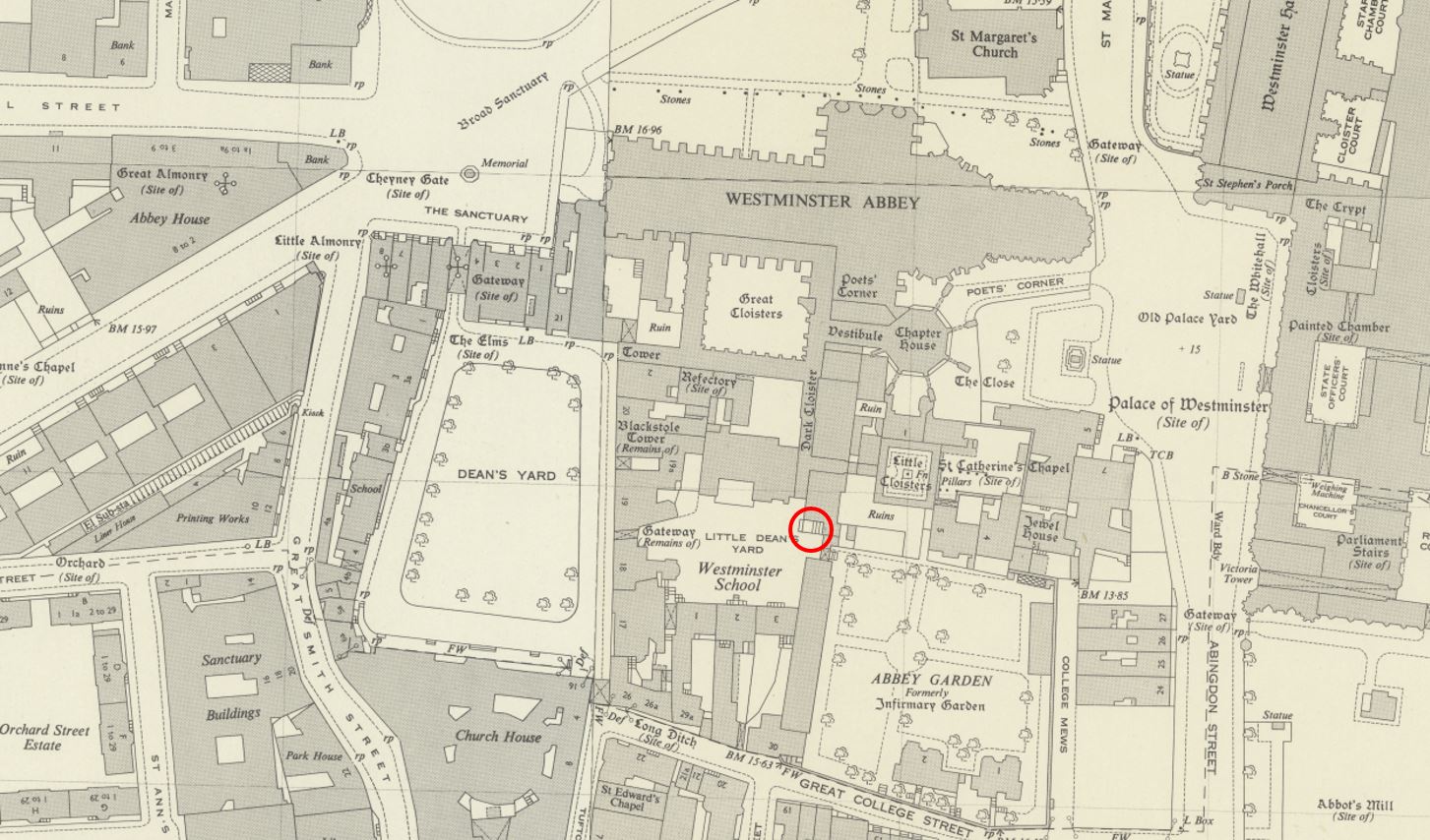
The following map is an extract from the 1950 edition of the Ordnance Survey (a year after my father’s photo). The school gateway is circled, and the map shows the area in detail as it was, and within the area of the school, as it is today (‘Reproduced with the permission of the National Library of Scotland“).

Little Dean's Yard

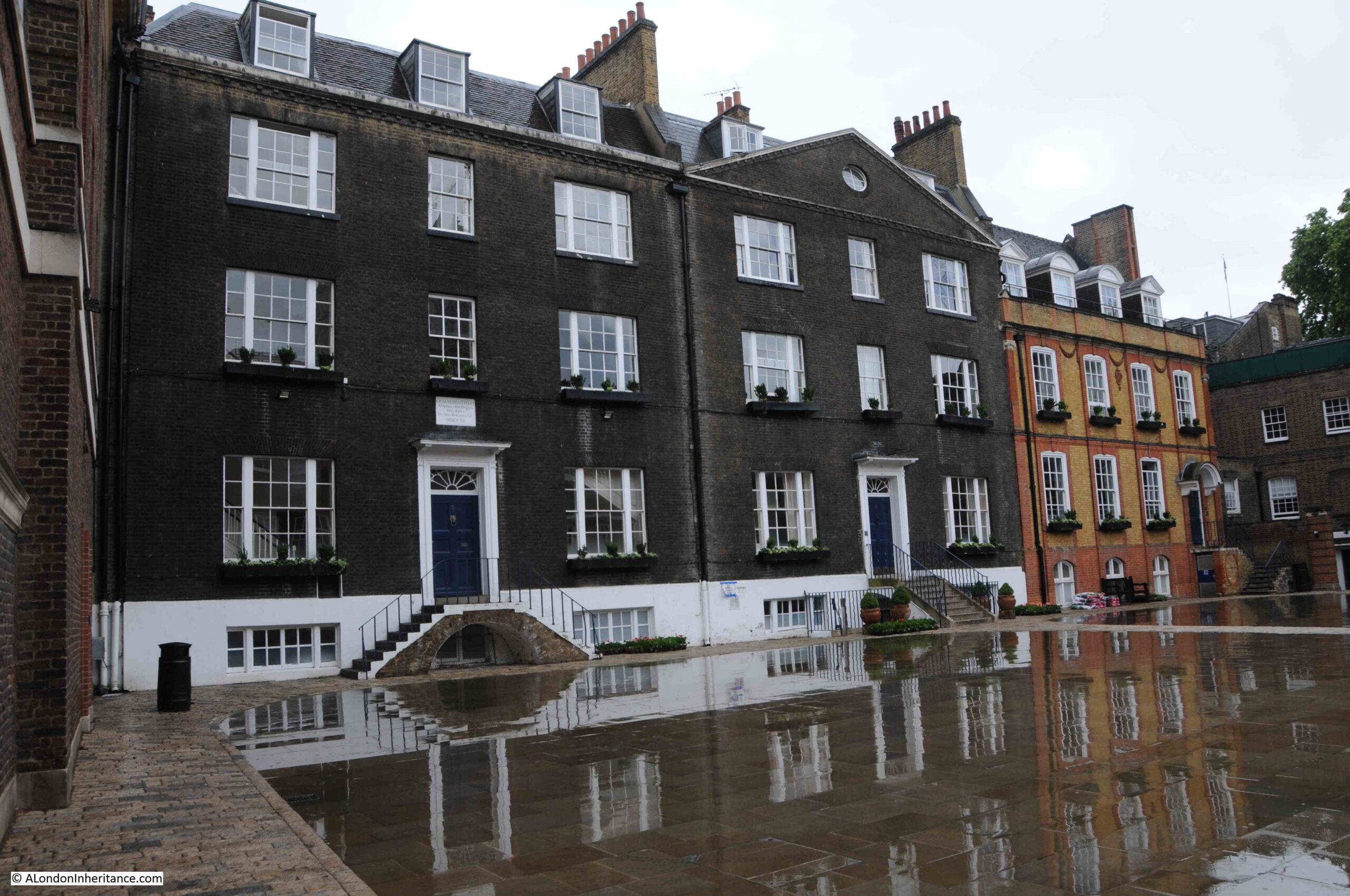
To the south of Little Dean’s Yard are the two remaining buildings of an 18th century terrace of three. This is the Grade I listed numbers 2 and 3 Little Dean’s Yard:

Little Dean's Yard

The building on the right of the above terrace, which has broken up the symmetry of the original terrace is a rebuild of 1896, and is Grade II listed number 1 Little Dean’s Yard.

Listed buildings continue on the northern side of the yard, with the Grade II listed Turle’s House, dating from 1884 on the right. This building was built over fragments of an 11th century reredorter (a communal latrine), and part of the original monastery’s cloisters.

Little Dean's Yard

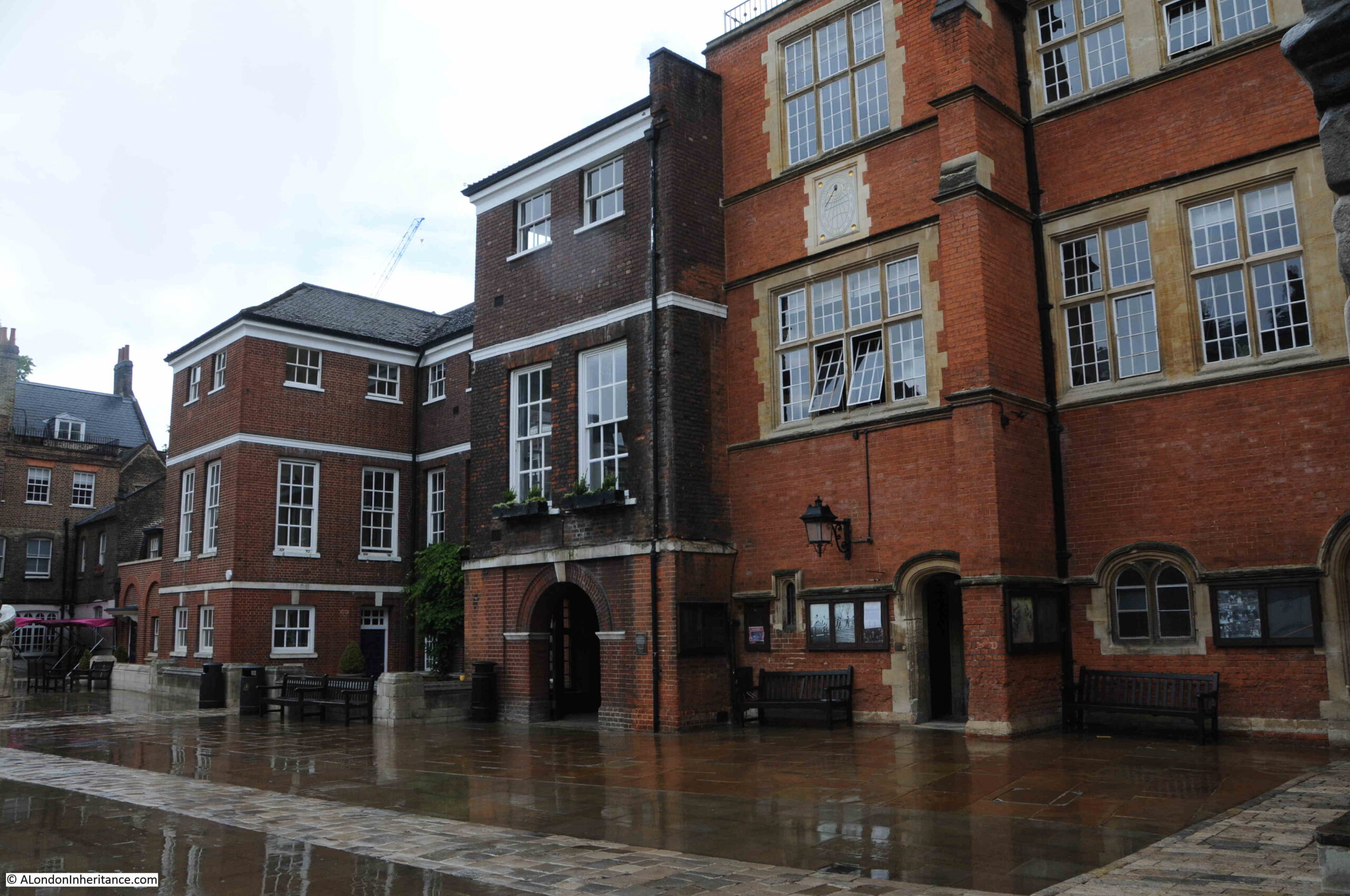
On the left of the above photo is the Grade I listed Ashburnham House, which includes parts of various structures that have occupied the site over the centuries.

The building includes the masonry structure and kitchen and hall walls from the 14th century Prior’s Lodging. The building became a substantial town house in the mid 17th century, when red brick was added to the 14th century rubble walls.

A west wing (furthest from the camera) was added in 1910, and this later wing can be seen in a slightly different colour brick, and the arched entrance on the ground floor of the earlier wing.

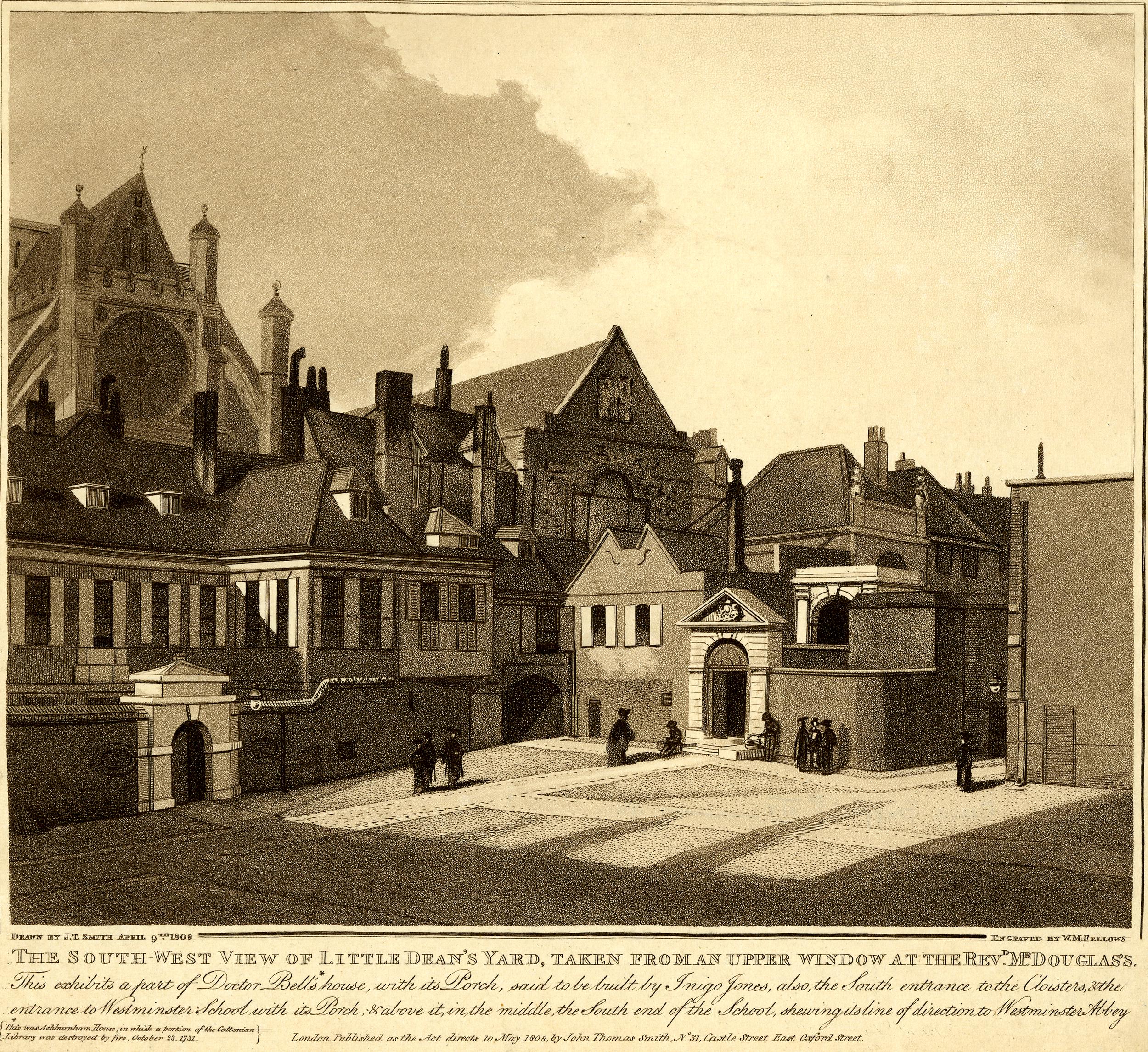
The following print shows the north east corner of Little Dean’s Yard in 1808, showing the school gateway, and to the left is what was described as Dr Bell’s House, along with an entrance to the cloisters. These buildings were replaced by Turle’s House in 1884 (© The Trustees of the British Museum).

Little Dean's Yard

The school gateway in 1808 (© The Trustees of the British Museum):

The entrance to Westminster School

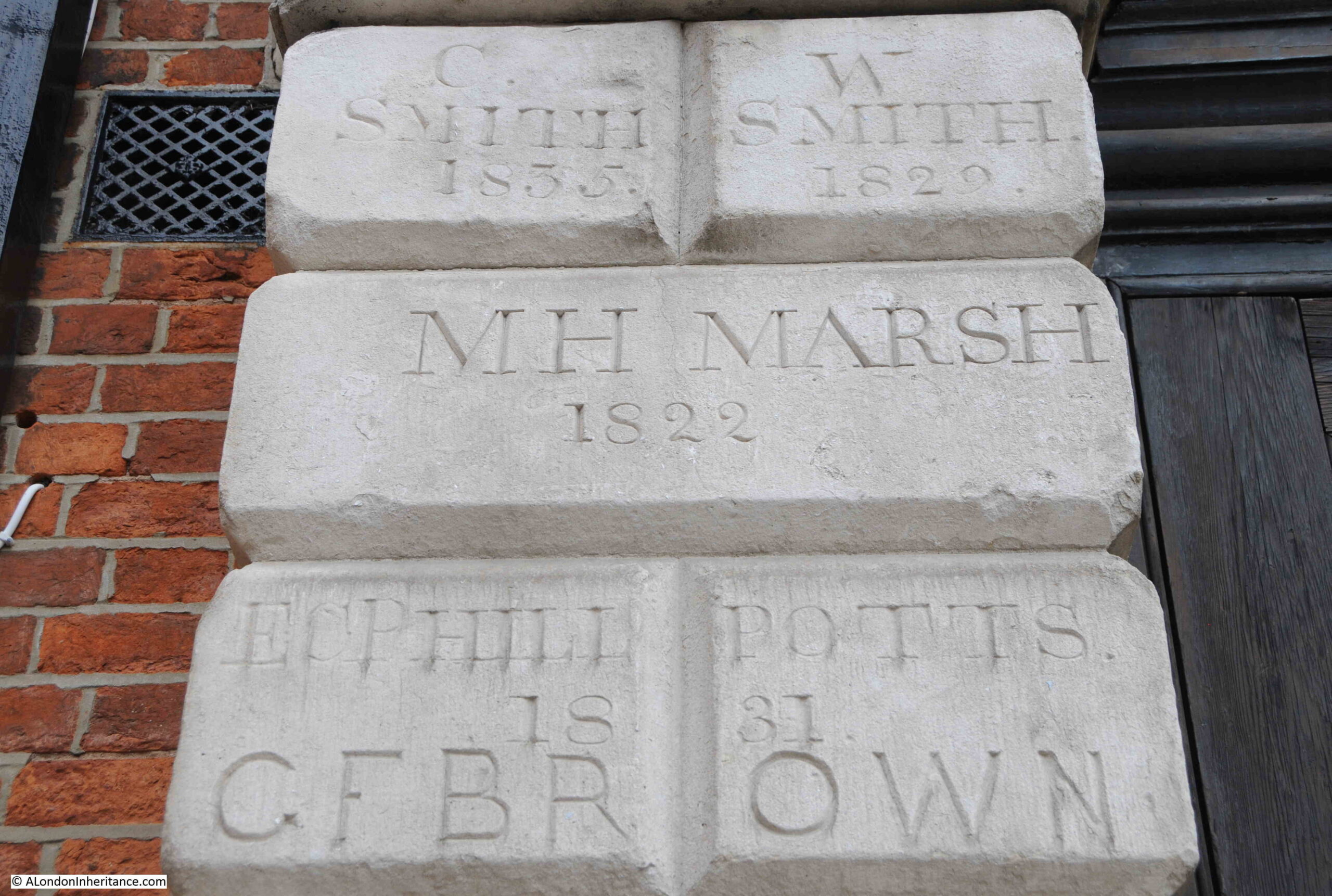
Westminster School Gateway is a fascinating historical structure simply as a gateway, but what adds further interest are the names and dates carved onto the gateway on almost every available space:

Westminster School Gateway

Westminster School has created a dedicated website to the gateway, which includes a remarkable degree of research to provide an inventory of the names carved on and around the gateway, with background details to the names.

The website can be found here.

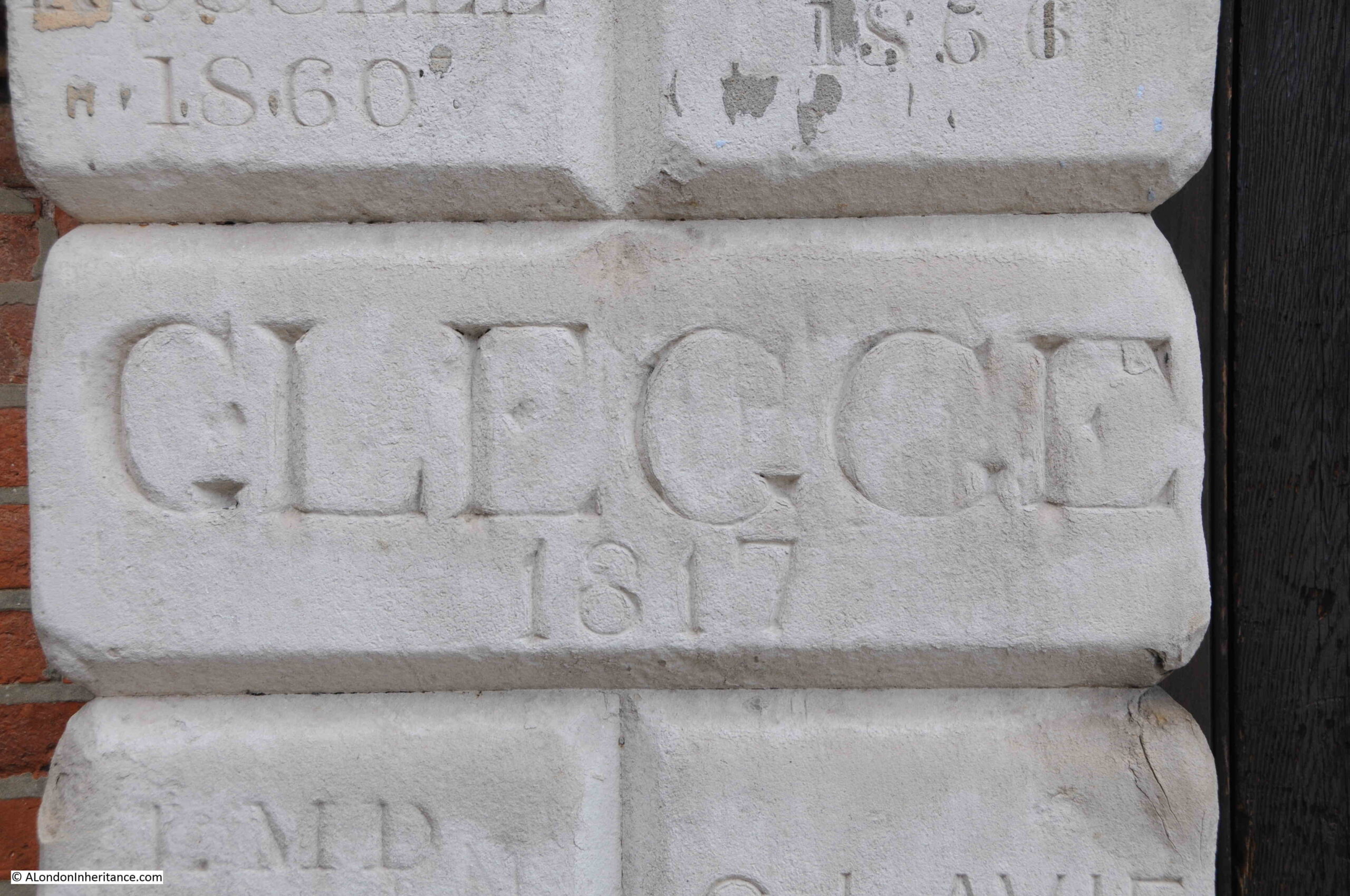
An example from the inventory, covering the name in the following photo:


LEGGE, GEORGE AUGUSTUS, eldest son of Hon. and Rev. Augustus George Legge FSA, Chancellor of Winchester, and Honora, eldest dau. of Walter Bagot 
Westminster School Gateway

The website also provides advice for those aspiring to leave their mark, and uses George August Legge’s carving as an example of why punctuation is important and that his name really needs a “.” between the initial and surname.

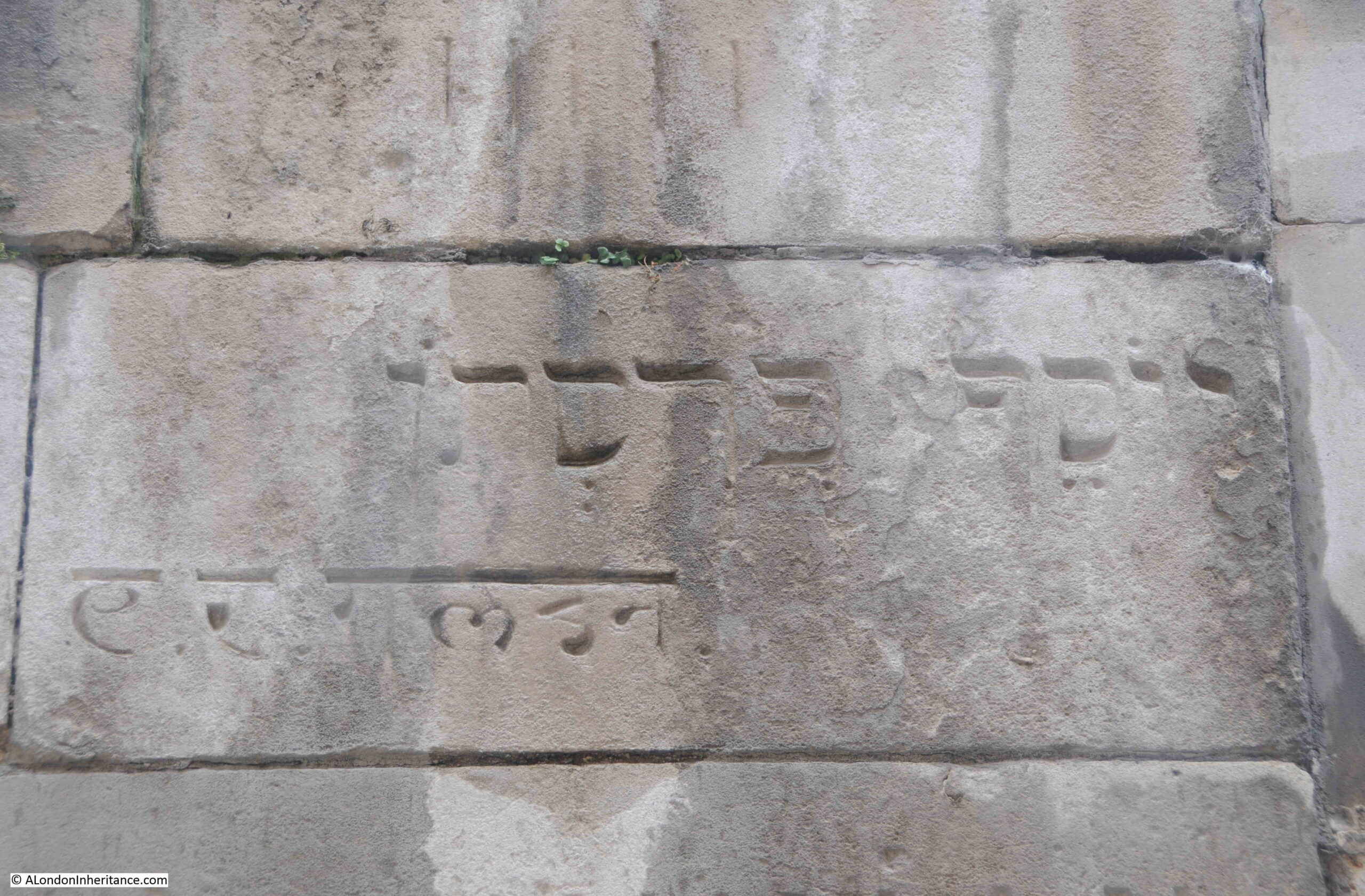
There are a couple of inscriptions in non English languages, as shown in the following photo with inscriptions in Hebrew and Devanagari (a North Indian script):

Westminster School Gateway

The Westminster School Gateway website has discovered the background to the above inscriptions, which can be found here.

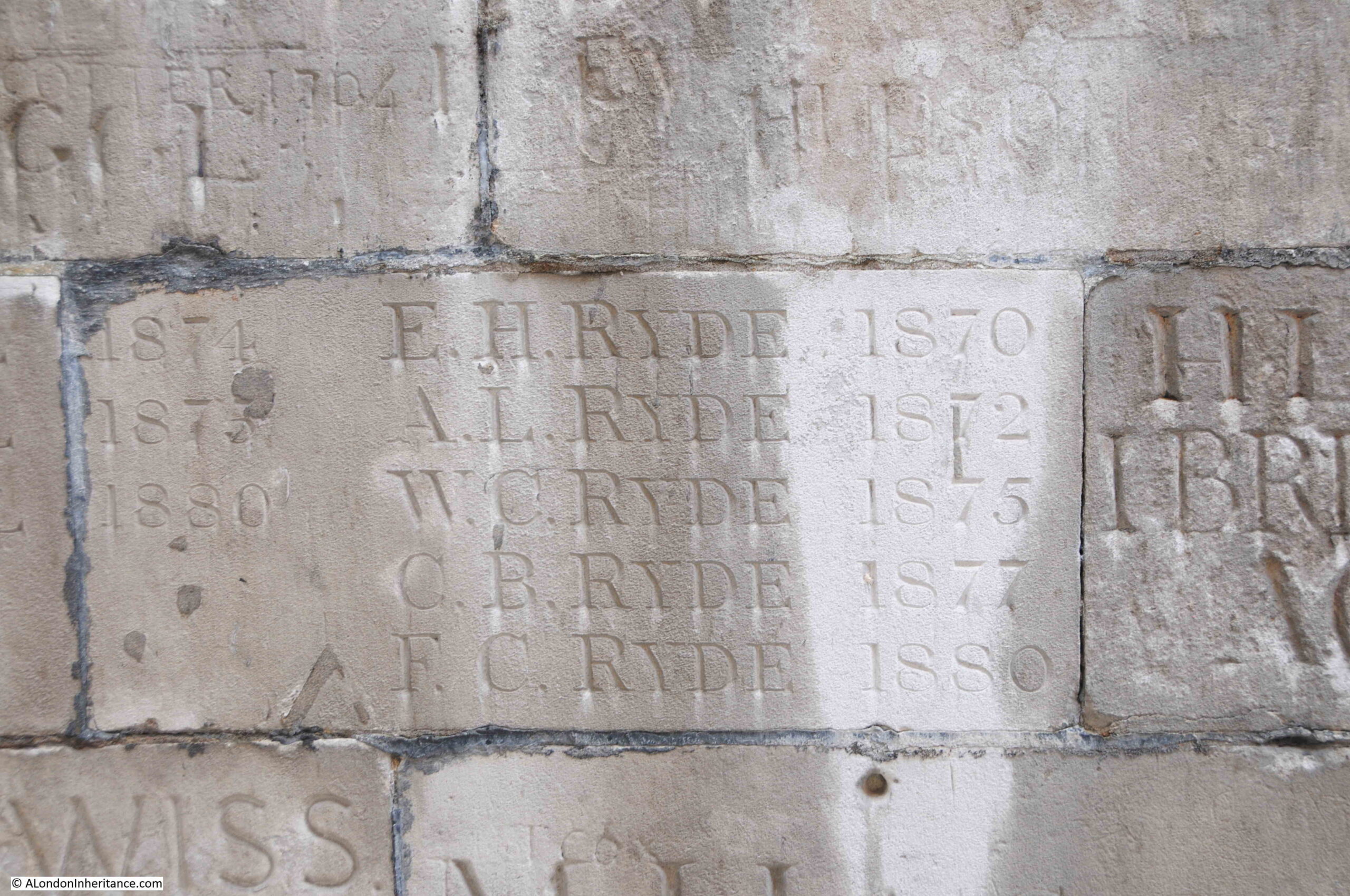
Five brothers:

Westminster School Gateway

The quality of the carving on the gate is excellent, the reason being is that the majority of the inscriptions were carved by stonemasons from Westminster Abbey, paid by the pupil to carve their name.

This is obvious when looking at the five Ryde brothers in the above photo as each instance of Ryde is identical to the other four.

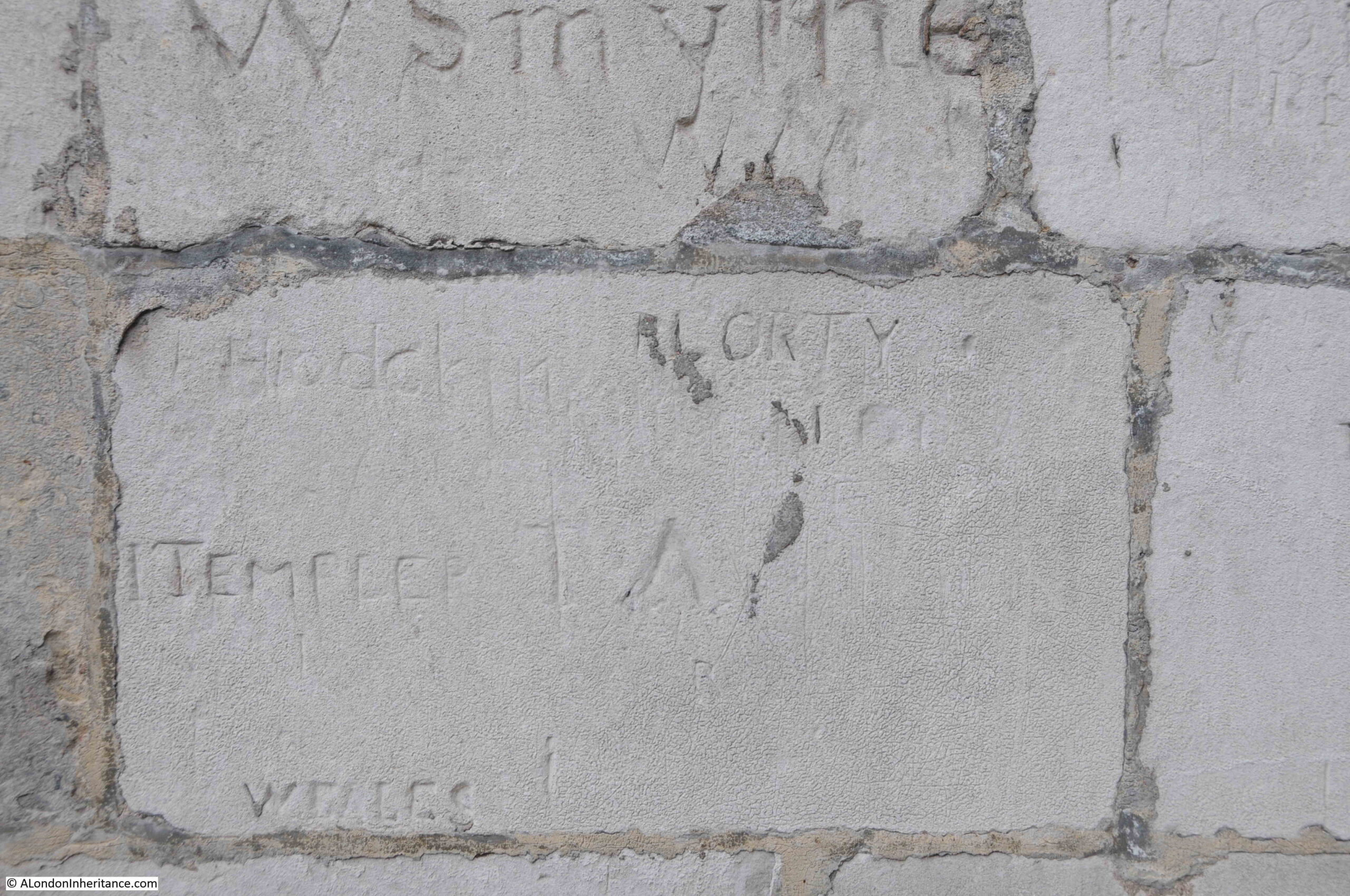
There are a number of names which have obviously been carved by the pupil, and the quality of these is very different from those by a trained stonemason as shown in the following photo:

Westminster School Gateway

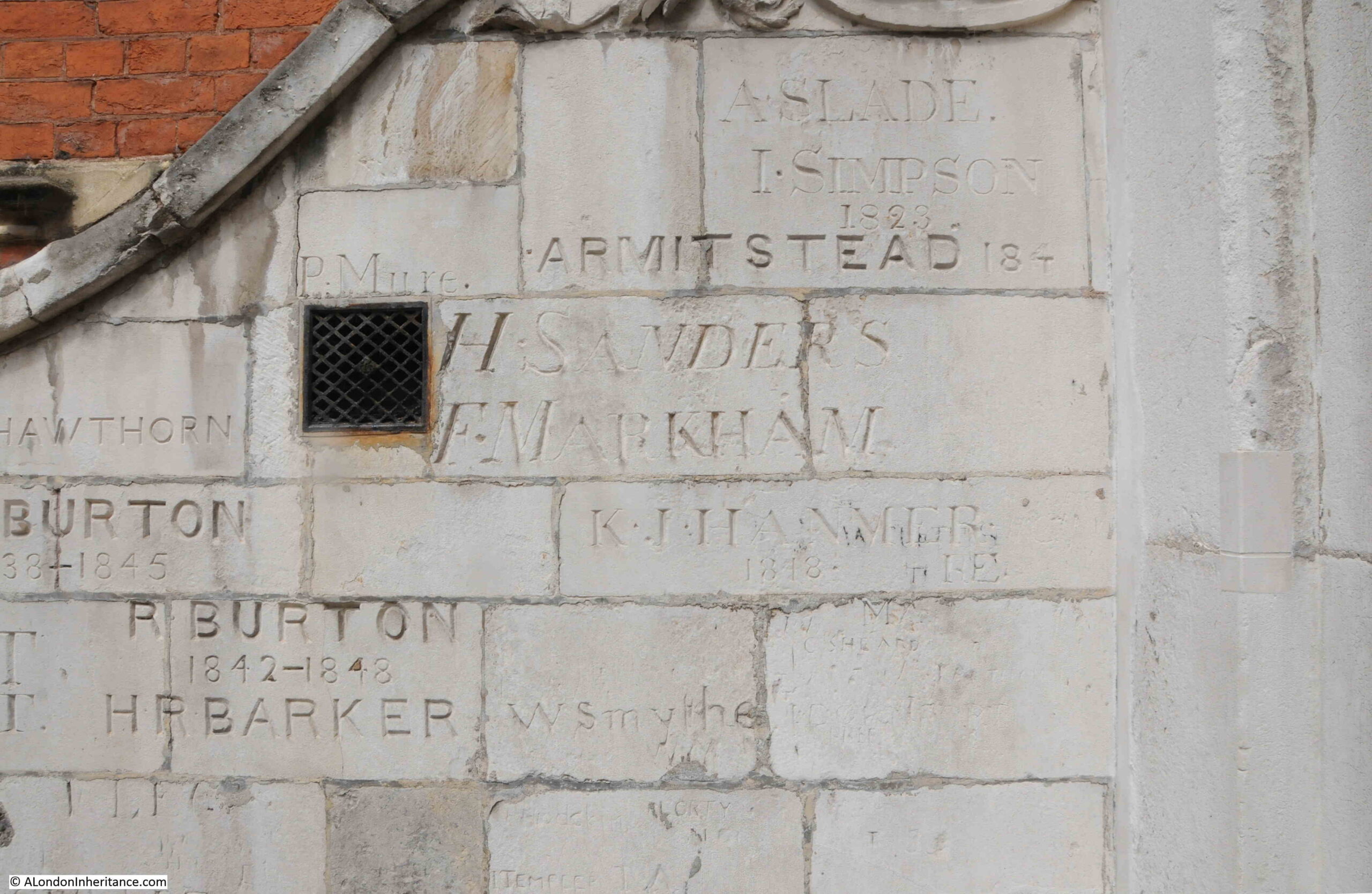
As well as the main body of the gateway, the side walls running up the stairs behind the gateway also have plenty of names:

Westminster School Gateway

And they are also on the rear of the gateway:

Westminster School Gateway

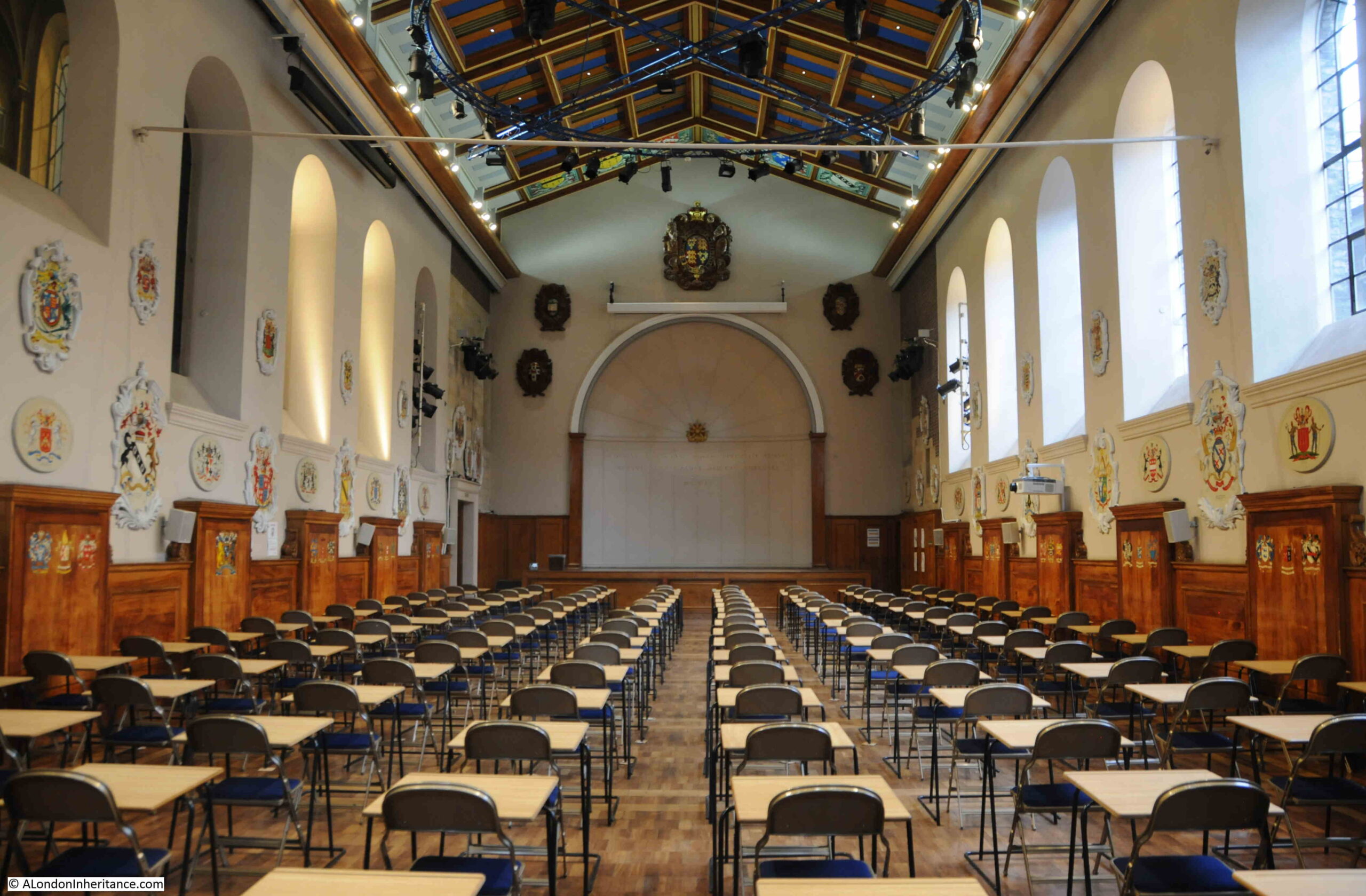
The school gateway leads to a small flight of stairs, a left turn which then opens out into the main school room, which on my visit was set-up for exams:

Westminster School room

This room was originally part of the monks dormitory in the time of the Benedictine monastery and it was first used as a schoolroom in 1599.

The LCC Bomb Damage maps show damage to some of the buildings on the eastern side of Little Dean’s Yard, including the schoolroom. This resulted in the refurbishment of the space, including the installation of a new roof which can be seen in the above photo.

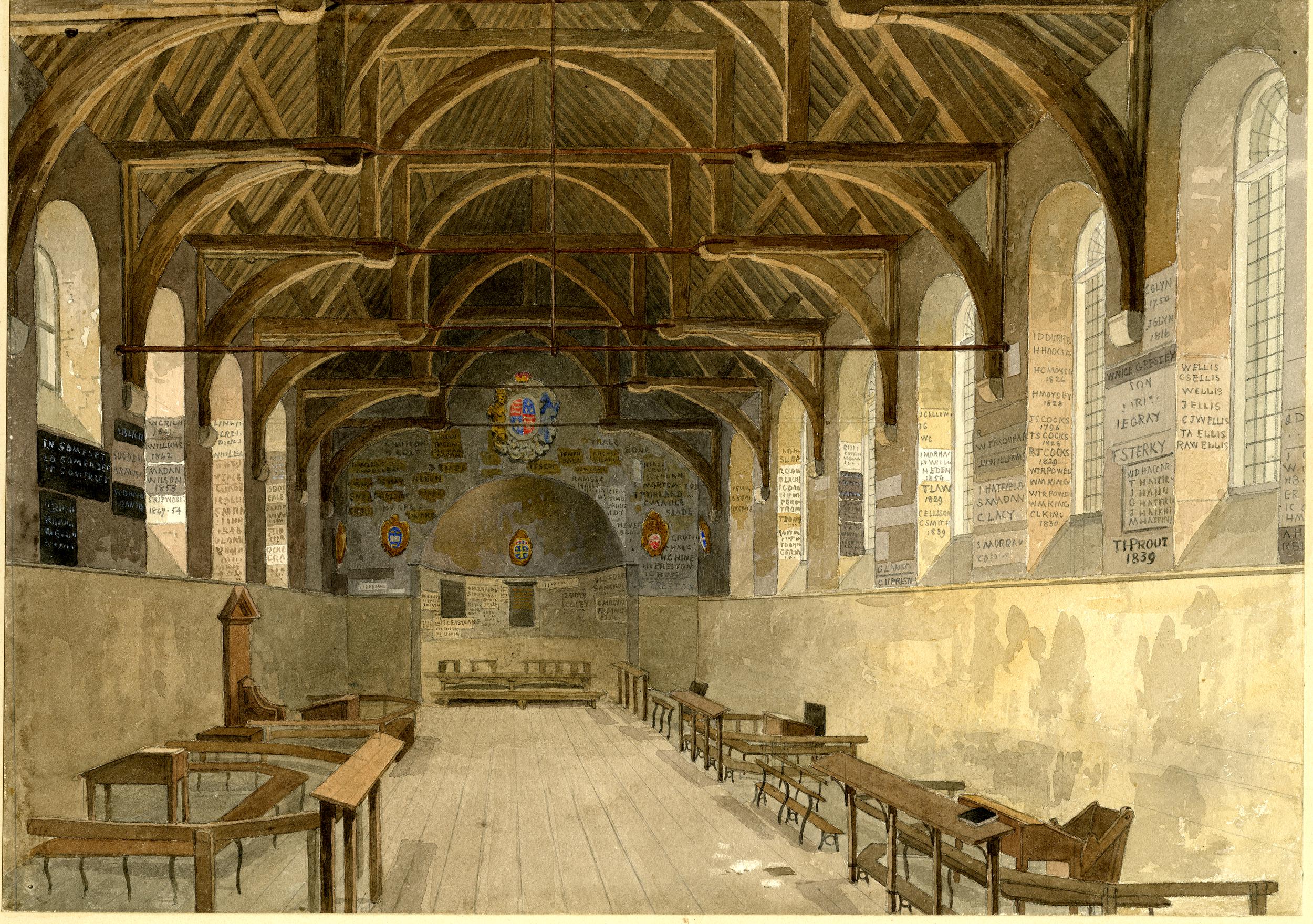
The following print shows the schoolroom in 1850. Desks and benches are set against the side walls (© The Trustees of the British Museum).

Westminster School room

On the walls between the windows there appear to be lots of inscriptions, so I assume the approach of carving inscriptions on the school gateway extended also into the schoolroom.

I could not see these inscriptions in the schoolroom today, so I suspect they were covered up during restoration work following the wartime bomb damage.

I was really pleased to recreate my father’s photo, one of those rare places in London where the view is almost exactly the same.

My thanks to the Archivist for providing access and information.

I have kept the post relatively high level as the school’s website dedicated to the gateway is comprehensive and fascinating.

I really recommend a read of the dedicated site to the gateway: “The School Gateway – The story behind Burlington’s Arch”

.alondoninheritance.com

A Coronation and a Wedding – Royal Events in London

In my second post of the Jubilee weekend, I am looking at a couple of royal events in London. The 1953 Coronation and 1981 Royal Wedding. Some of these photos have been in previous posts, some are new, and they show how in many ways royal events in London are much the same today as they were seventy years ago.

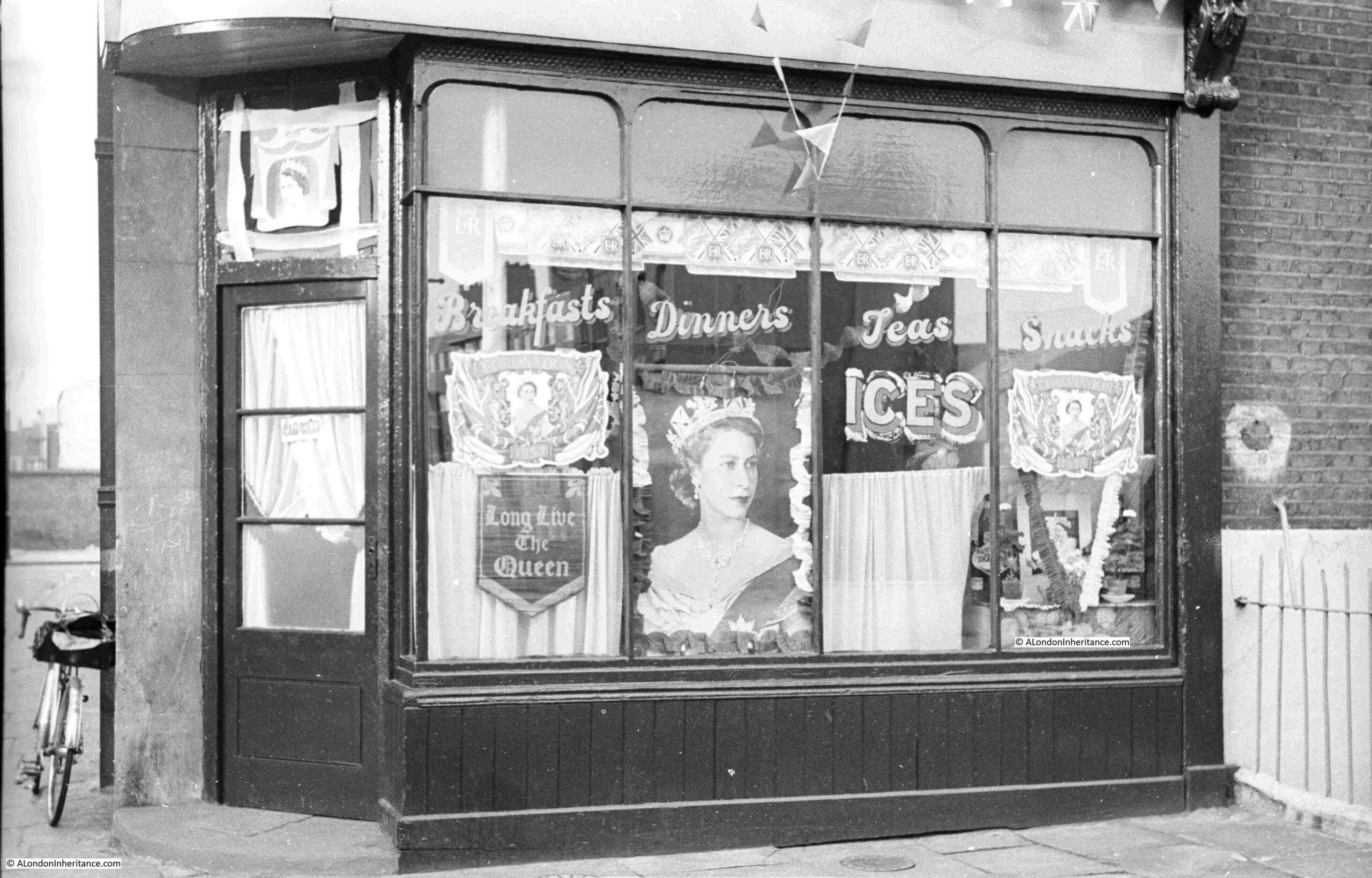
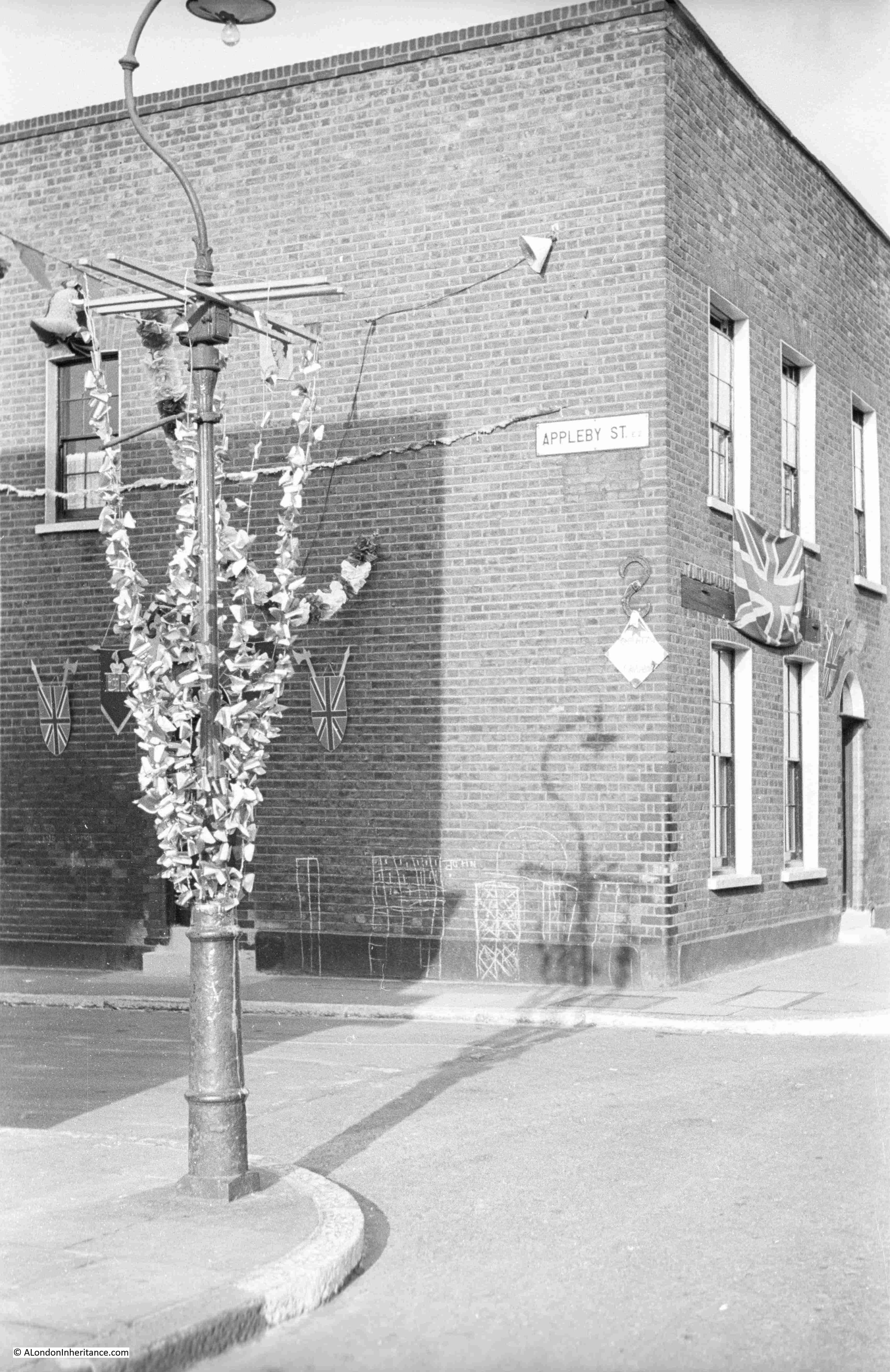
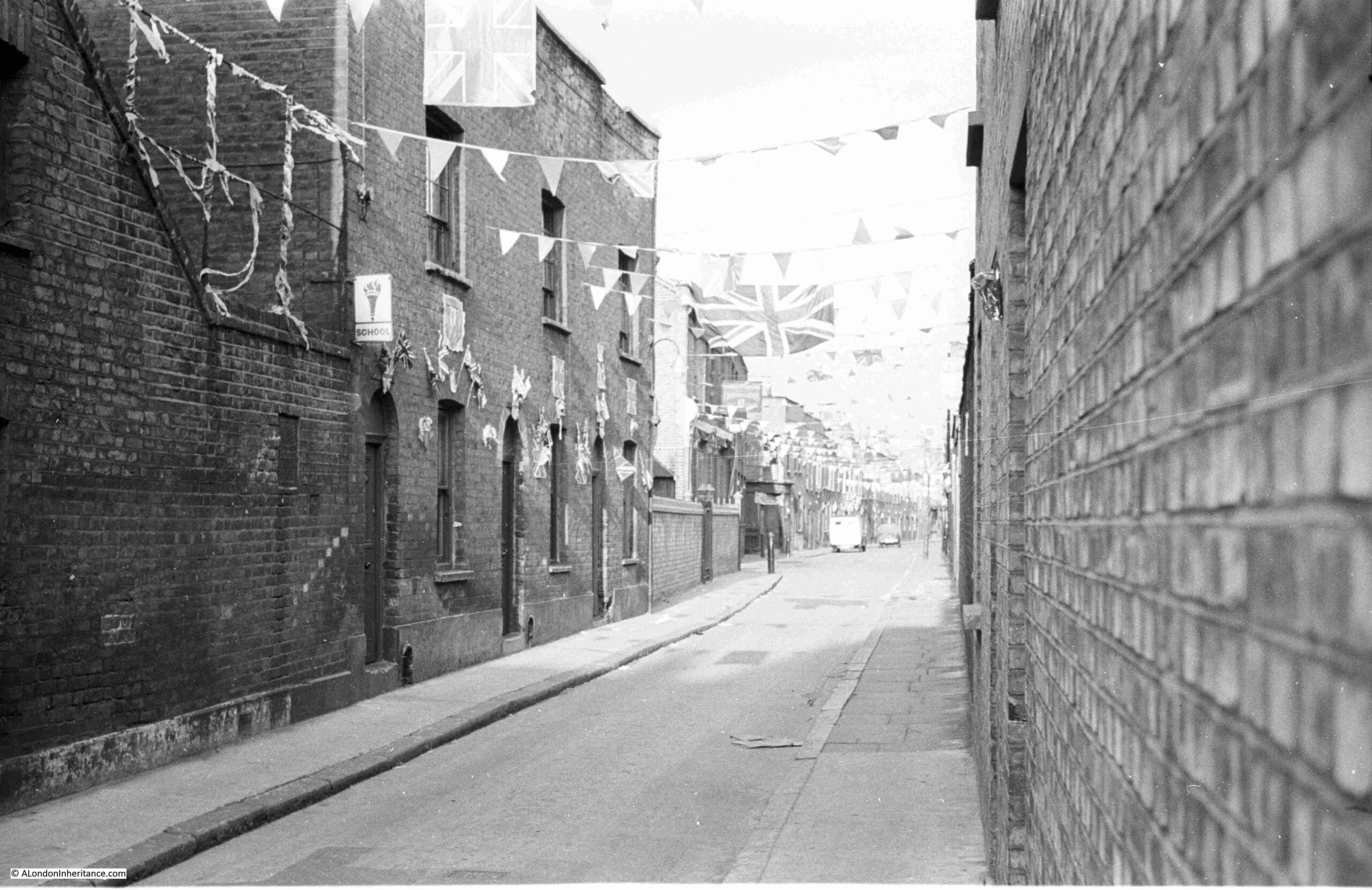
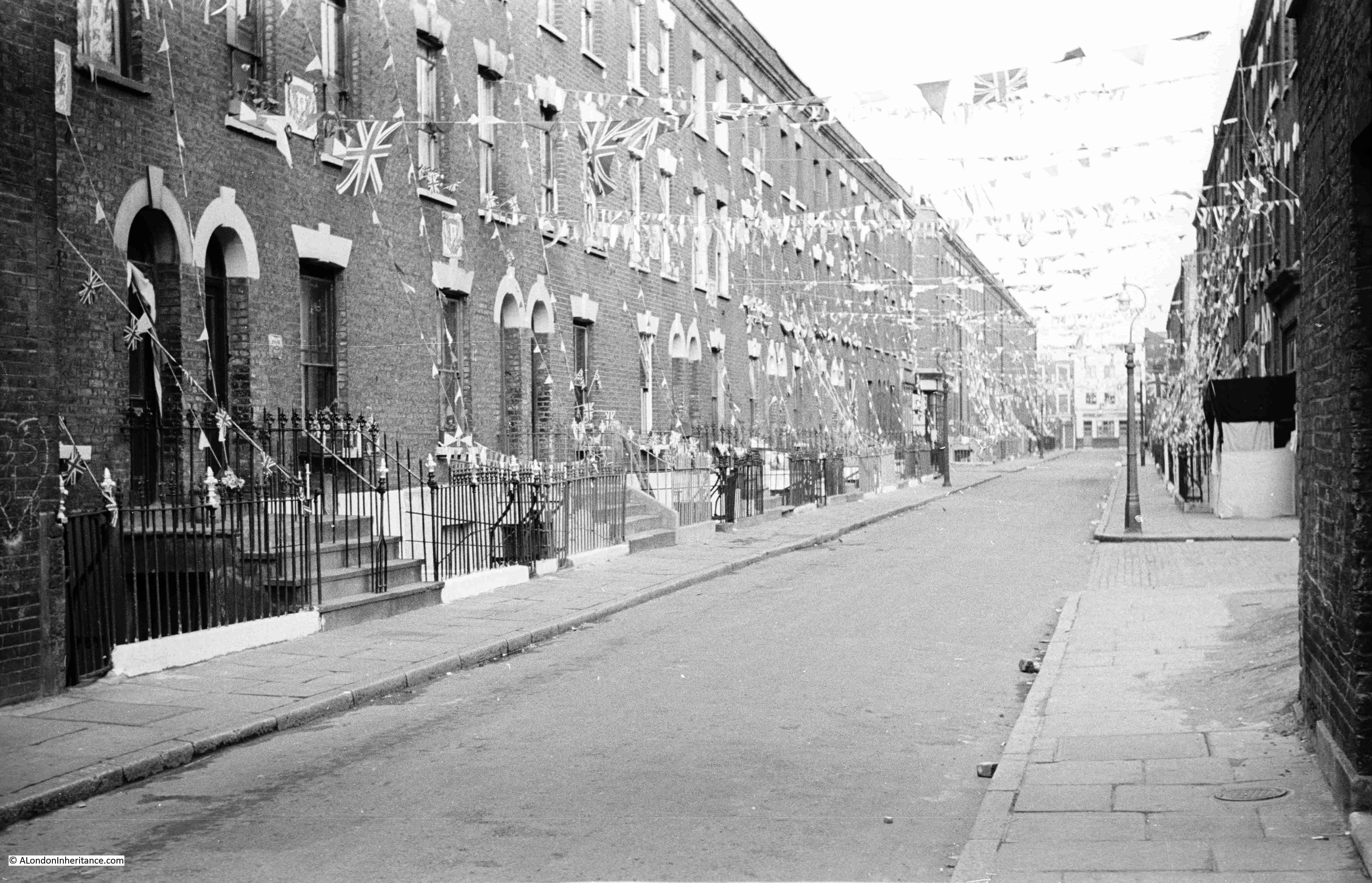
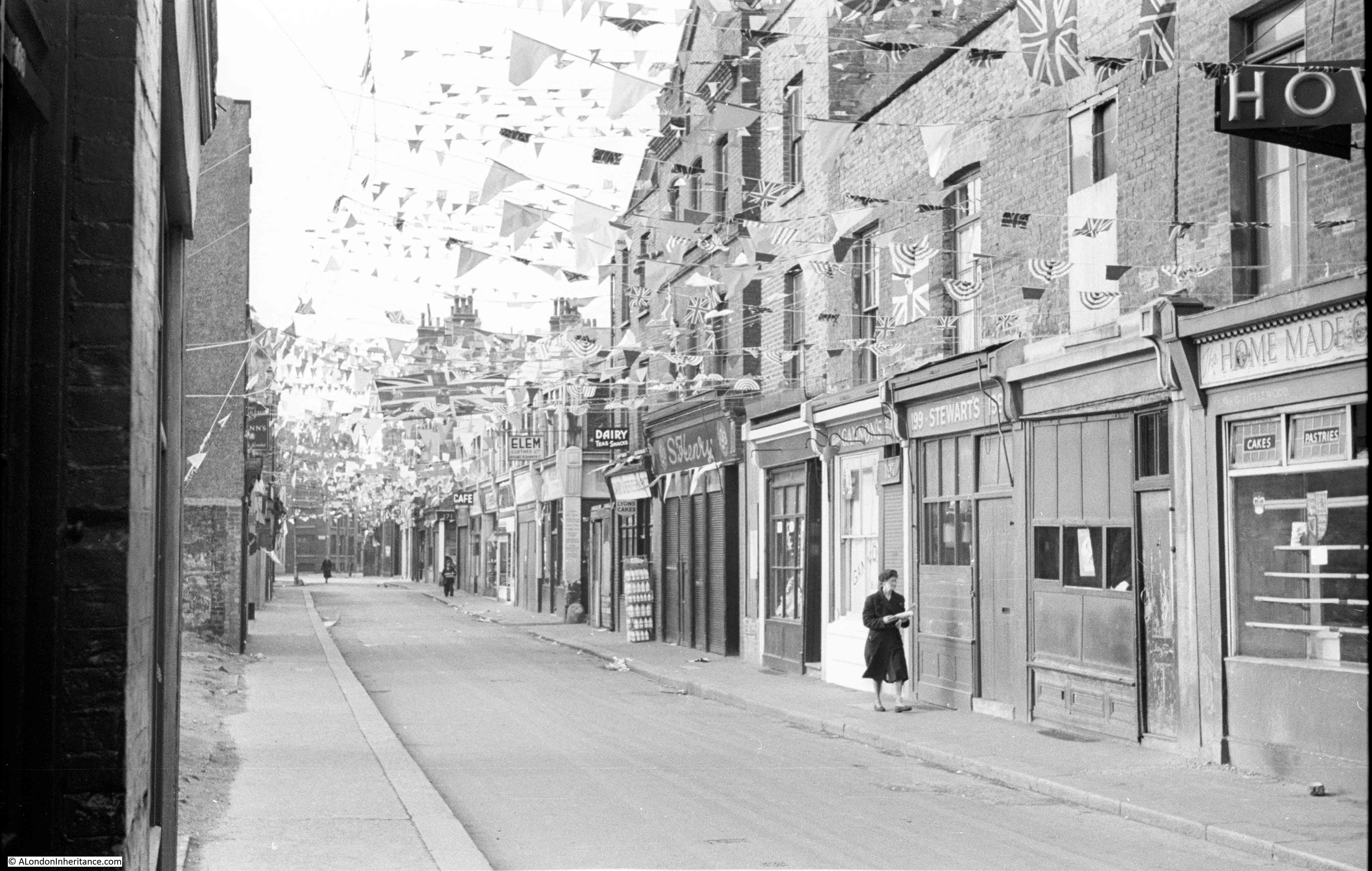
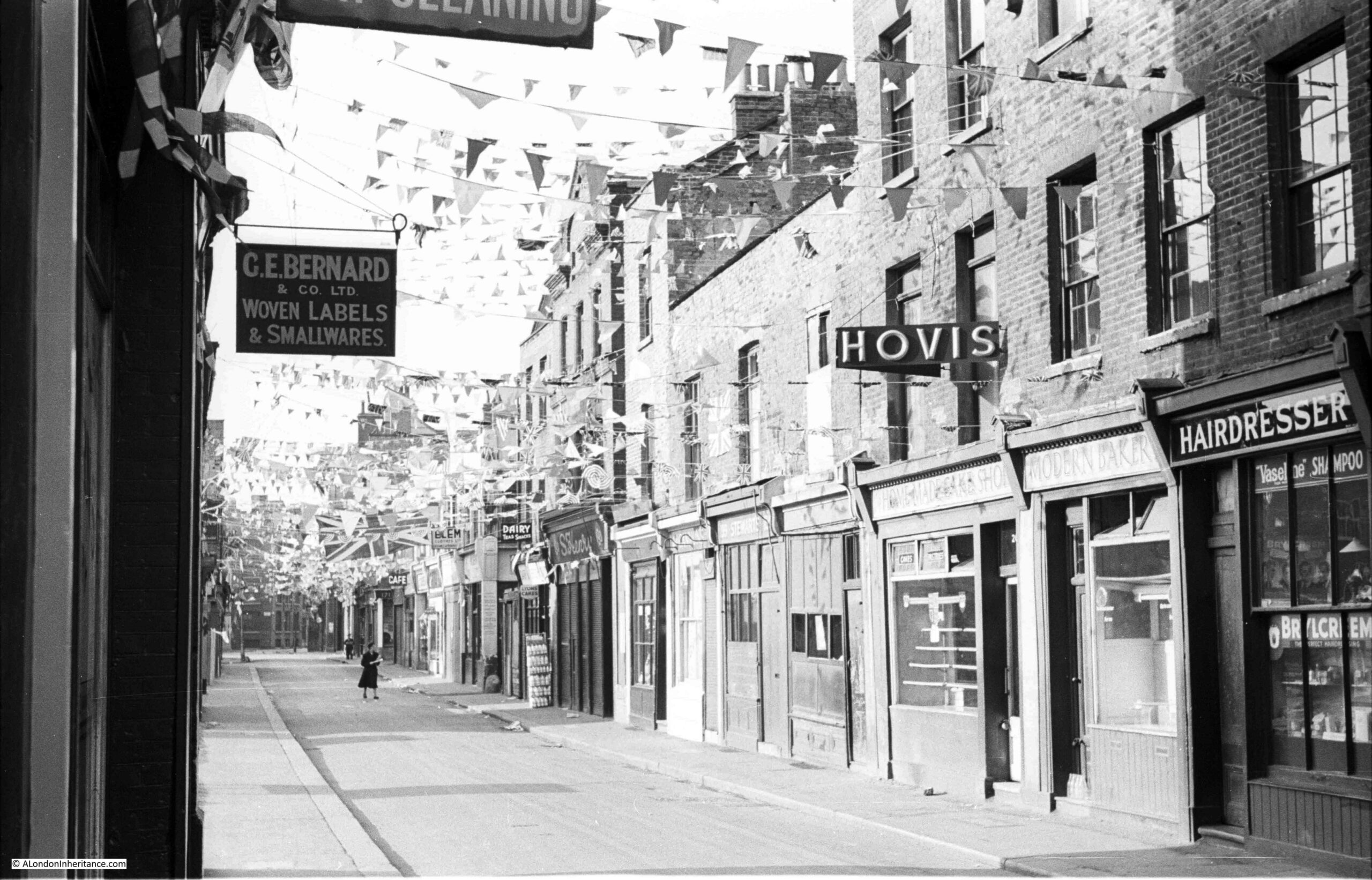
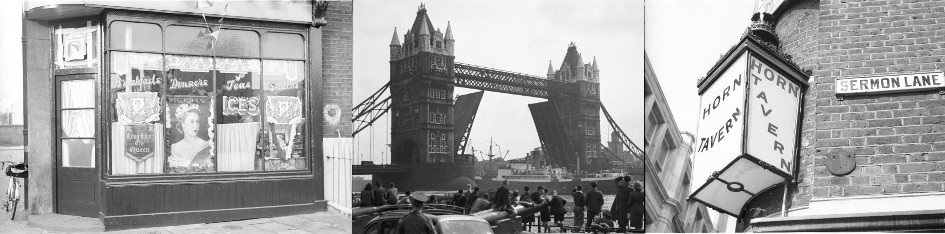
Many of my father’s photos were taken on bike rides around the city, early on a Saturday or Sunday. This worked due to periods away on National Service, work during the week, and other commitments. The following photos were taken early on Sunday, 31st May 1953, and look at some of the street decorations for the Coronation.

A decorated café in Hoxton, with my father’s bike leaning against the wall.

London cafe decorated for the Coronation

The above photo has been in the header to the blog since I started in 2014, however I have not yet found the location, apart from it being in Hoxton. The building has almost certainly been demolished.

Appleby Street, also in Hoxton:

Coronation at Appleby Street

Ivy Street, Hoxton, between Hoxton Street and Pitfield Street:

Coronation at Ivy Street

Shenfield Street, between Kingsland Road and Hoxton Street:

Coronation at Shenfield Street

The northern end of Whitecross Street, close to the Old Street junction:

Coronation at Whitecross Street

Another view of Whitecross Street:

Coronation at Whitecross Street

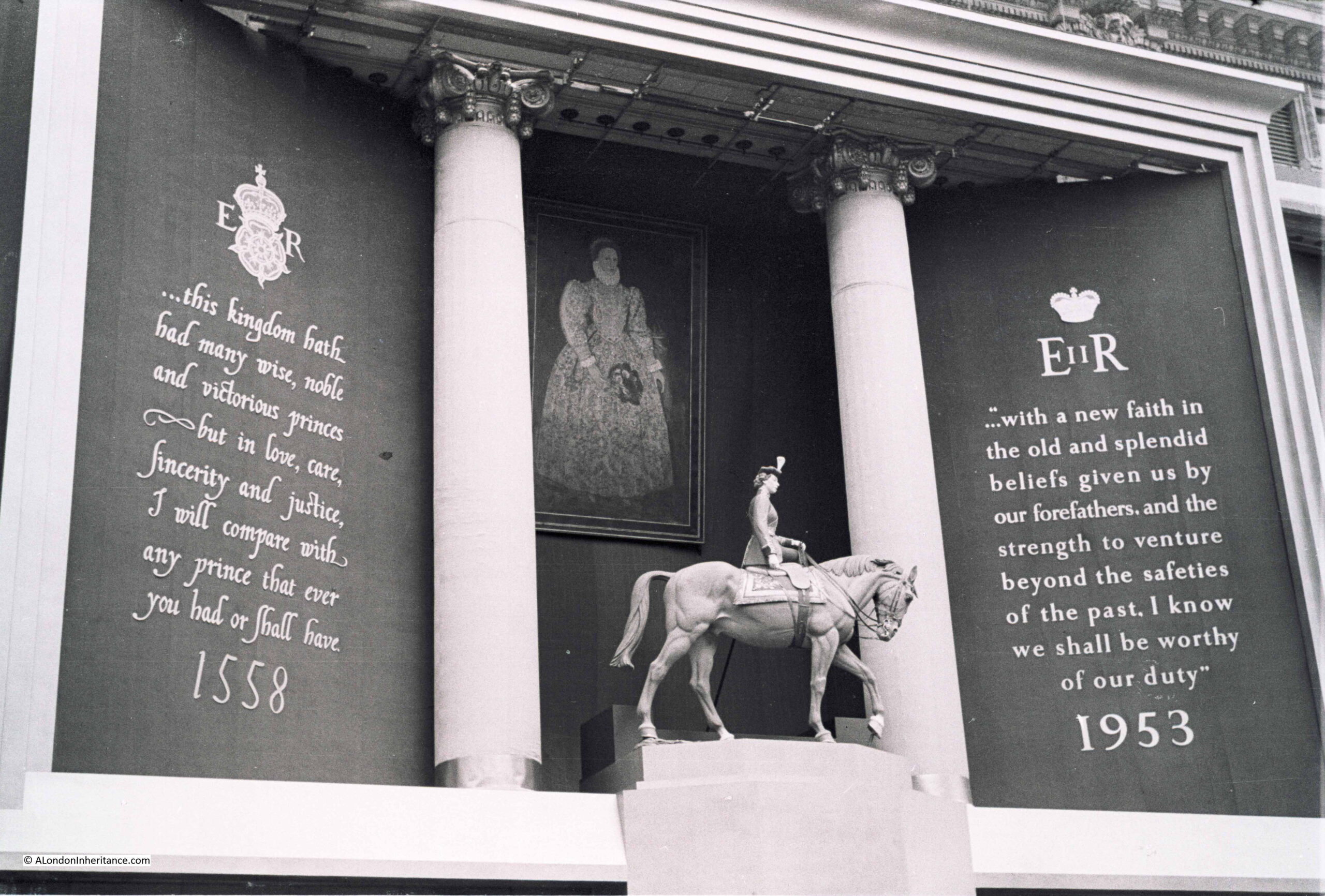
The expectation at the time was of a new Elizabethan era with comparisons back to Queen Elizabeth I as shown by the following tableau along the route of the procession. The text on the left is abbreviated from a speech given by Queen Elizabeth I to the Houses of Parliament on April 10th 1593 (1558 was the year that Elizabeth I became Queen) and that on the right from Queen Elizabeth II from her first Christmas broadcast in 1952.

Royal Events - the new Elizabethan age

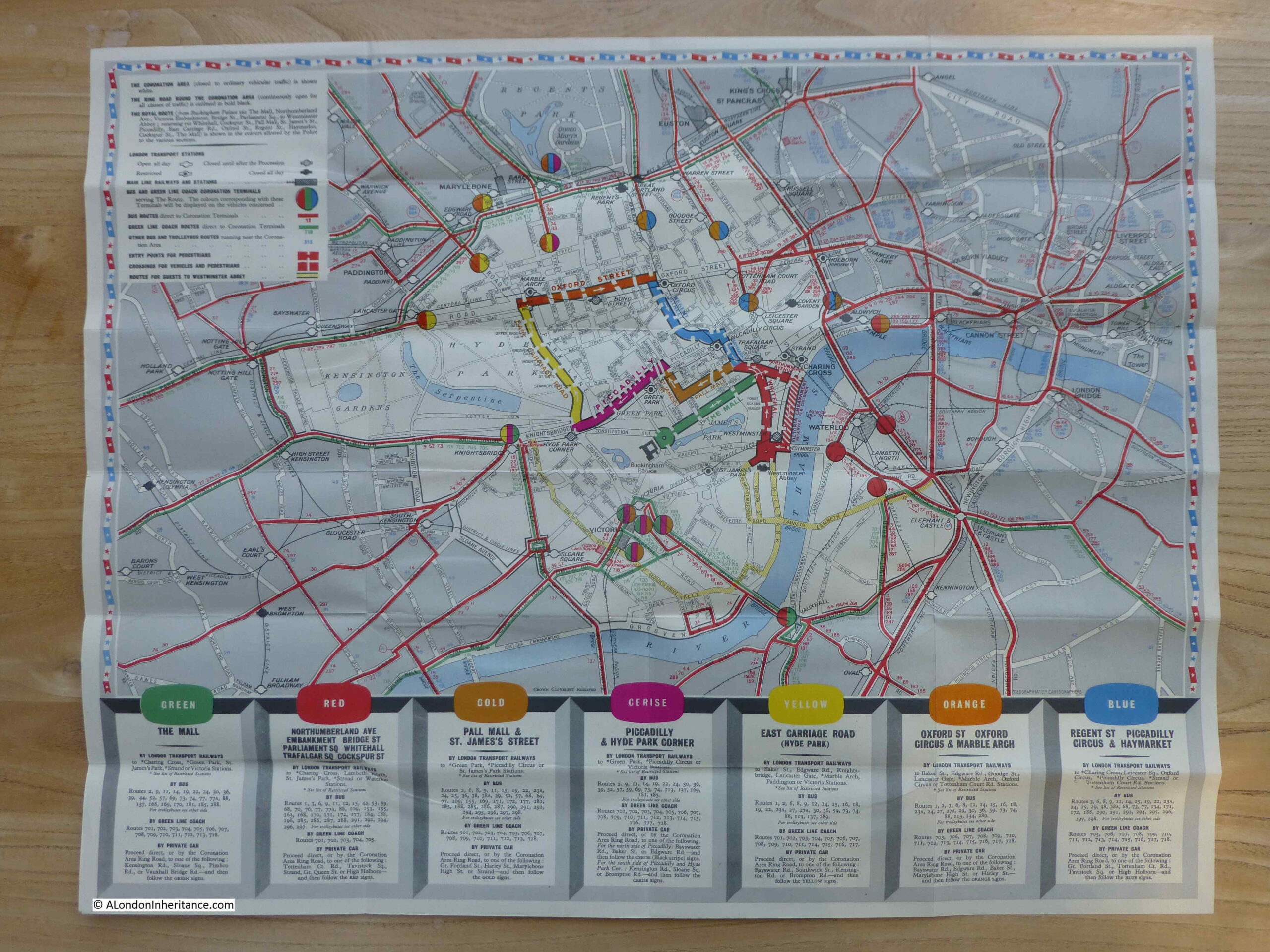
A map of the Coronation route was produced jointly by the London Transport Executive and the Commissioner of Police of the Metropolis for the Coronation of Elizabeth II on Tuesday 2nd June 1953:

1953 London Transport map of the Coronation route

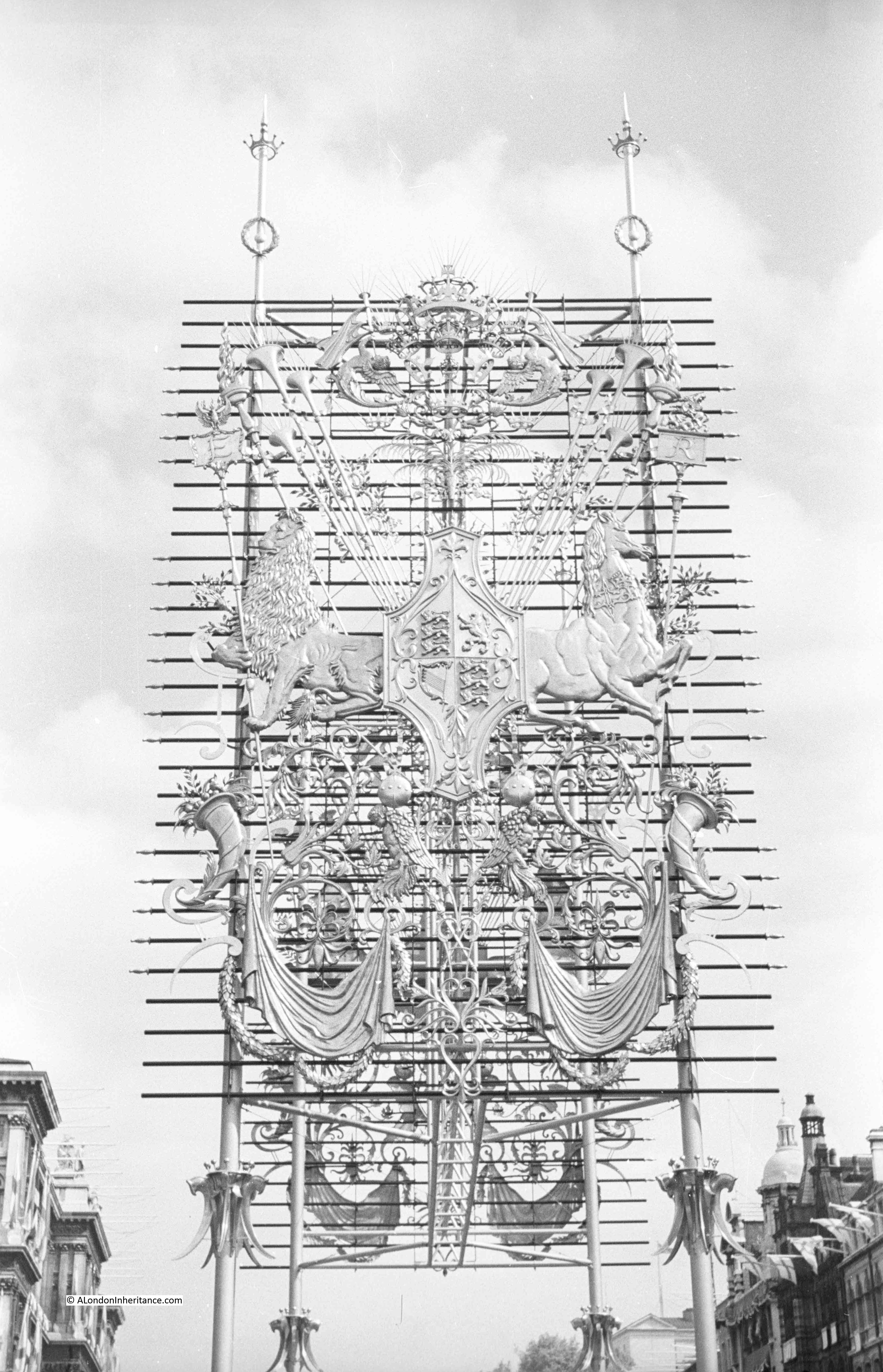
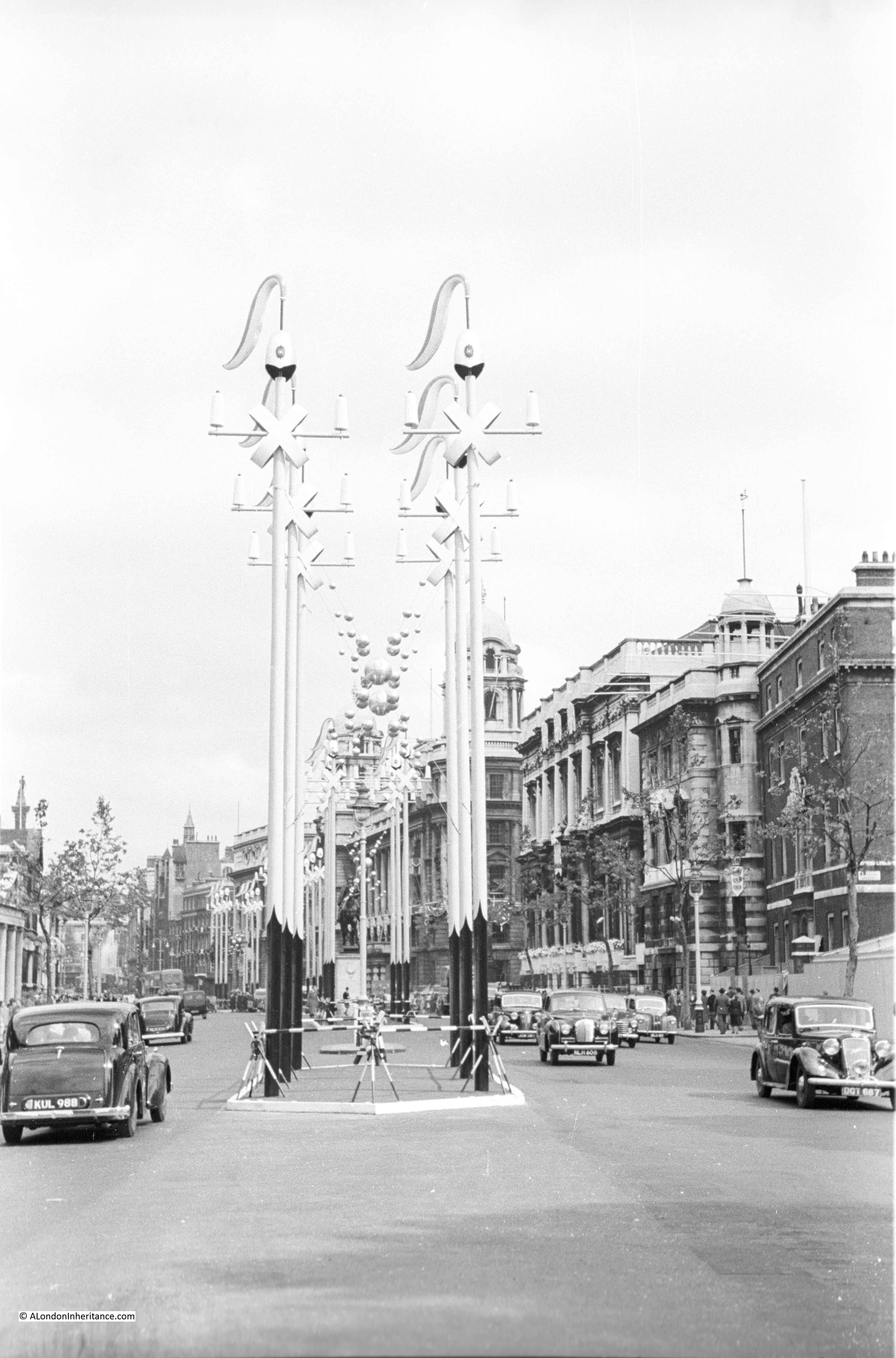
Some of the elaborate decorations that lined the Coronation route:

Coronation street decoration

Whitehall:

Coronation street decoration

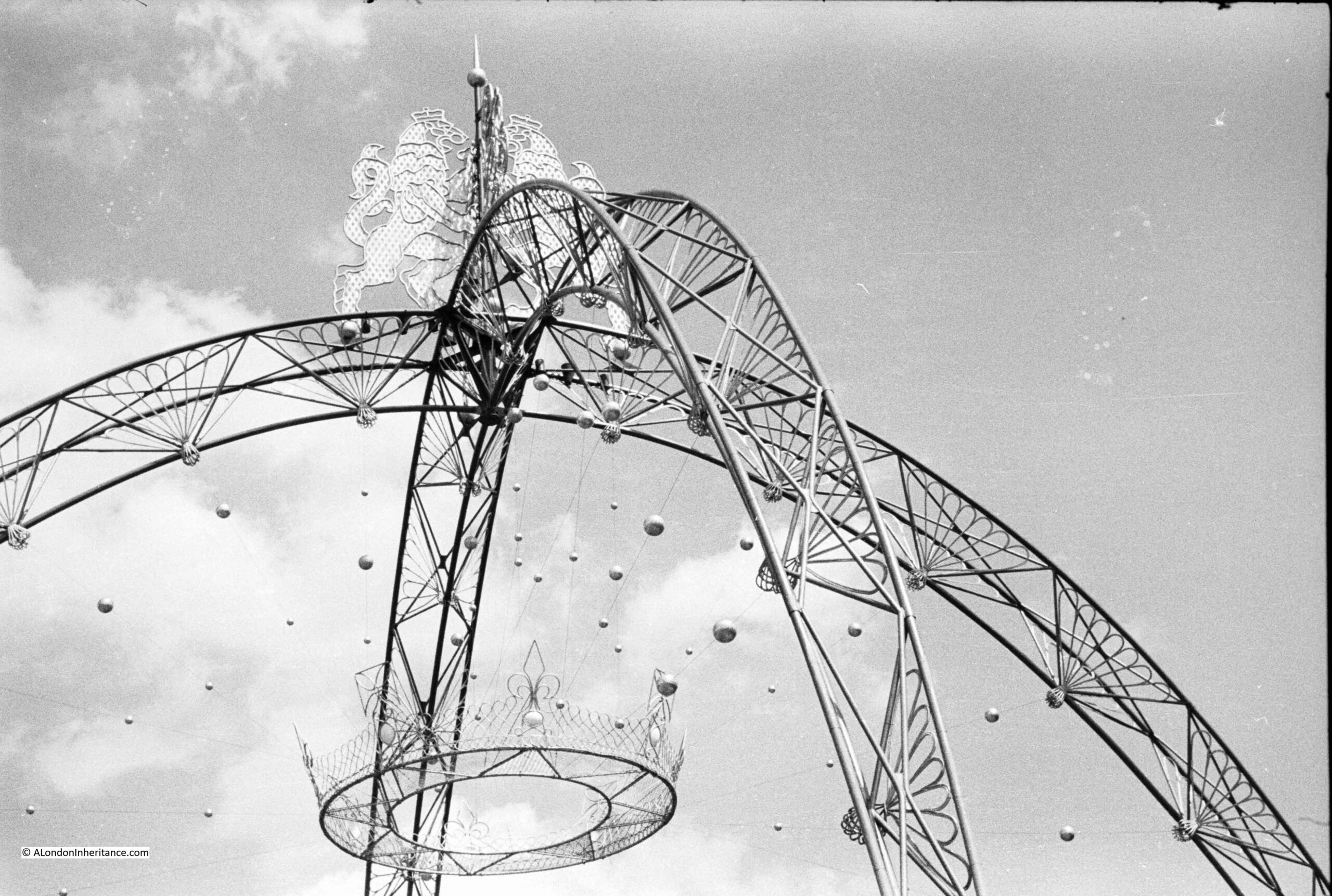
The ornate decorations that suspended a crown over the Mall:

Coronation street decoration

The 2nd of June 1953 was Coronation Day in London and a public holiday. As usual for such an event, people started lining the route between Buckingham Palace and Westminster Abbey well before the procession to ensure a good position to see the new Queen.

The weather during the previous May had been excellent with lots of warm, sunny weather broken only by the occasional thunderstorm. This weather broke by the end of May, for the last week of May and the rest of June the country was under many low pressure areas moving from the Atlantic bringing rain and cold temperatures for June. It was the coldest June for a century.

My father took a number of photos of people as they lined the route, along The Mall and round into Trafalgar Square and surrounding streets.

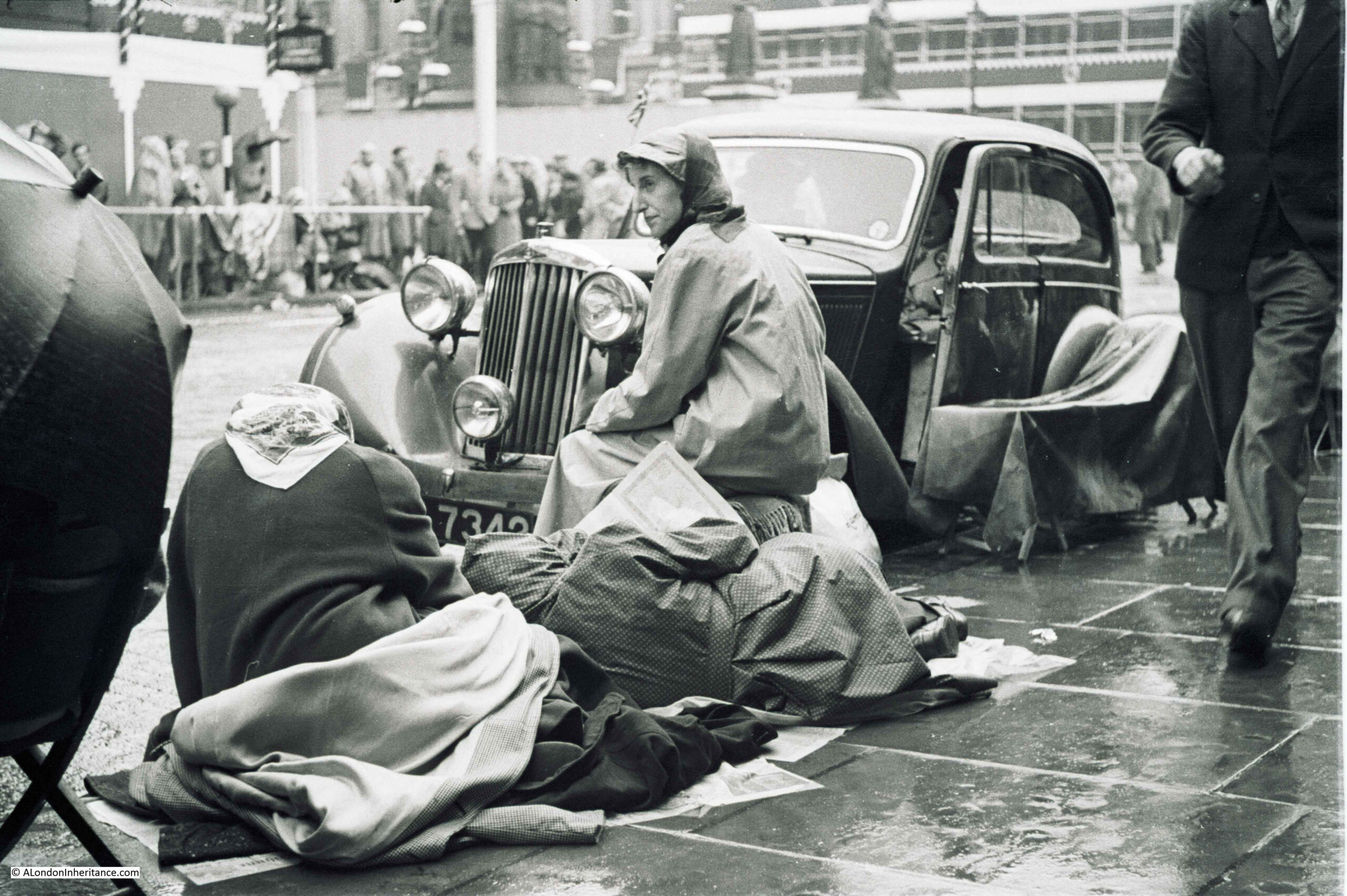
These show people wrapped up for the weather:

Waiting for the Coronation

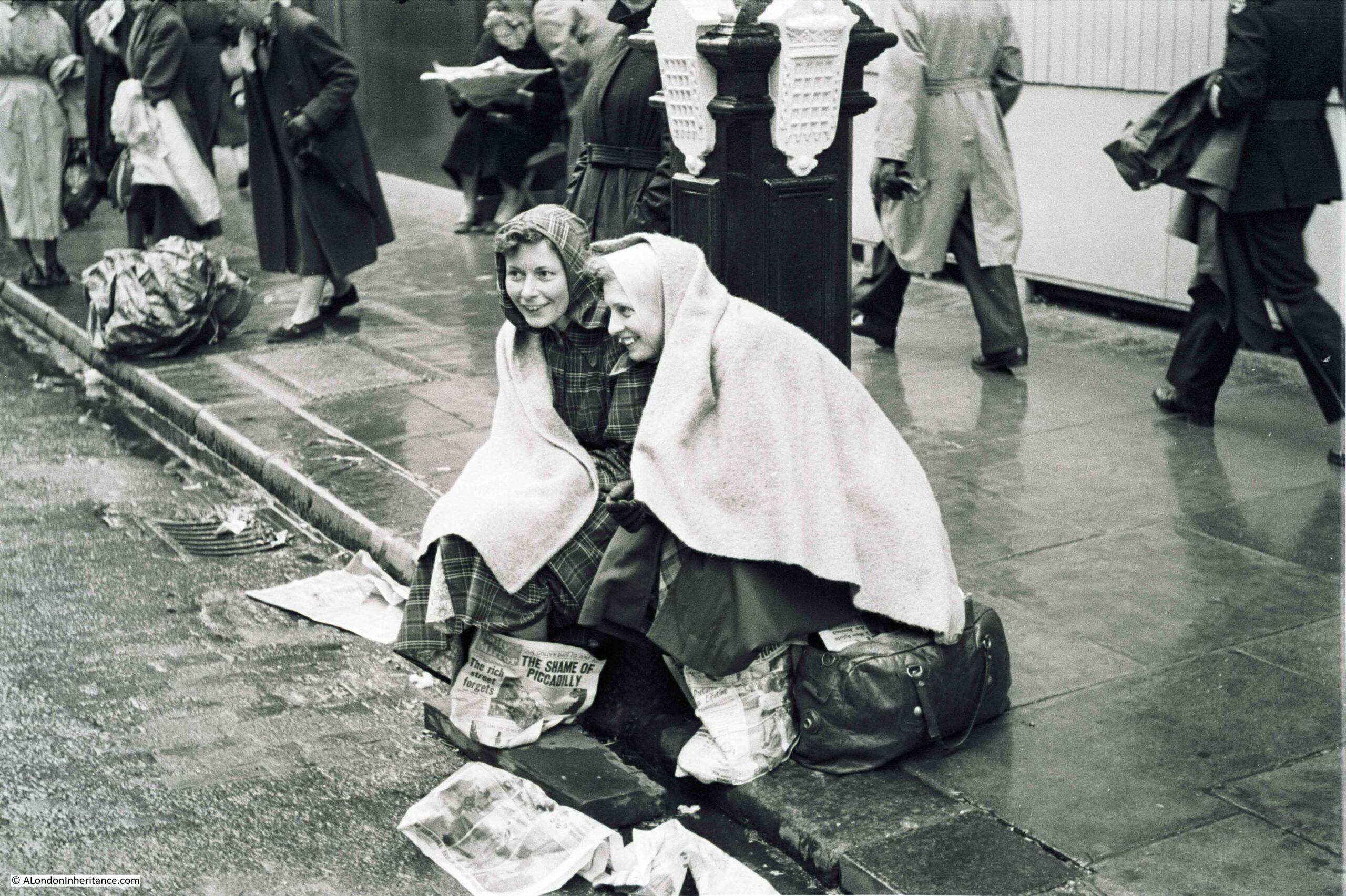
These two look cheerful despite the long wait and the weather:

Waiting for the Coronation

The newspaper between them was the Daily Mirror from the 29th May. The headline “The Shame Of Piccadilly” and “The rich street forgets” refers to the complete lack of decoration in Piccadilly for the Coronation. There are two photos on the page. The top photo shows Piccadilly without any decoration, the bottom photo shows, what is assumed to be an ordinary working class street decorated with flags and bunting and a Long Live The Queen banner stretched across the road:

The Shame of Piccadilly

The morning of the 2nd of June was more like an autumn day with rain showers and temperatures reaching only 12 degrees centigrade. Very low for early June.

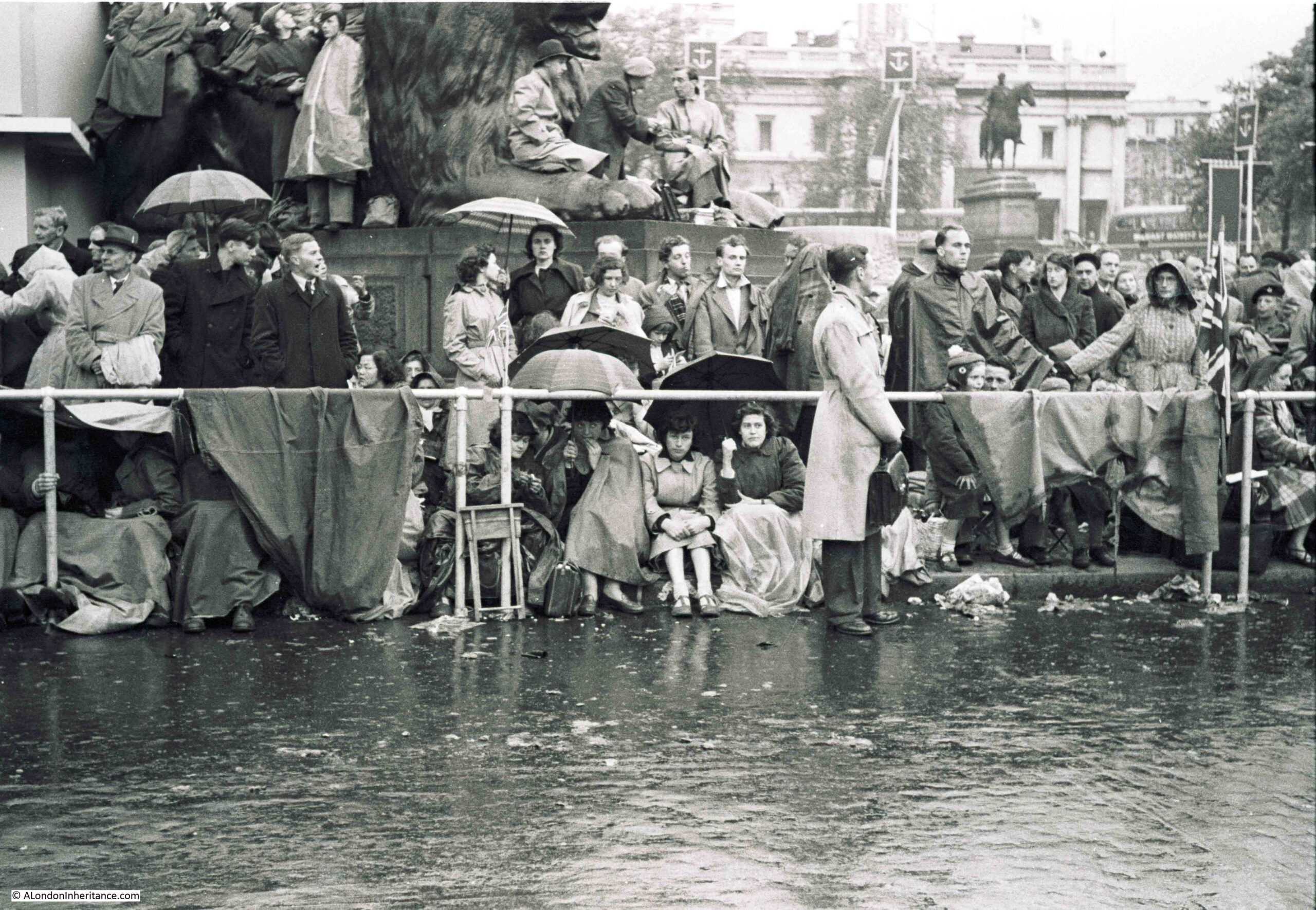
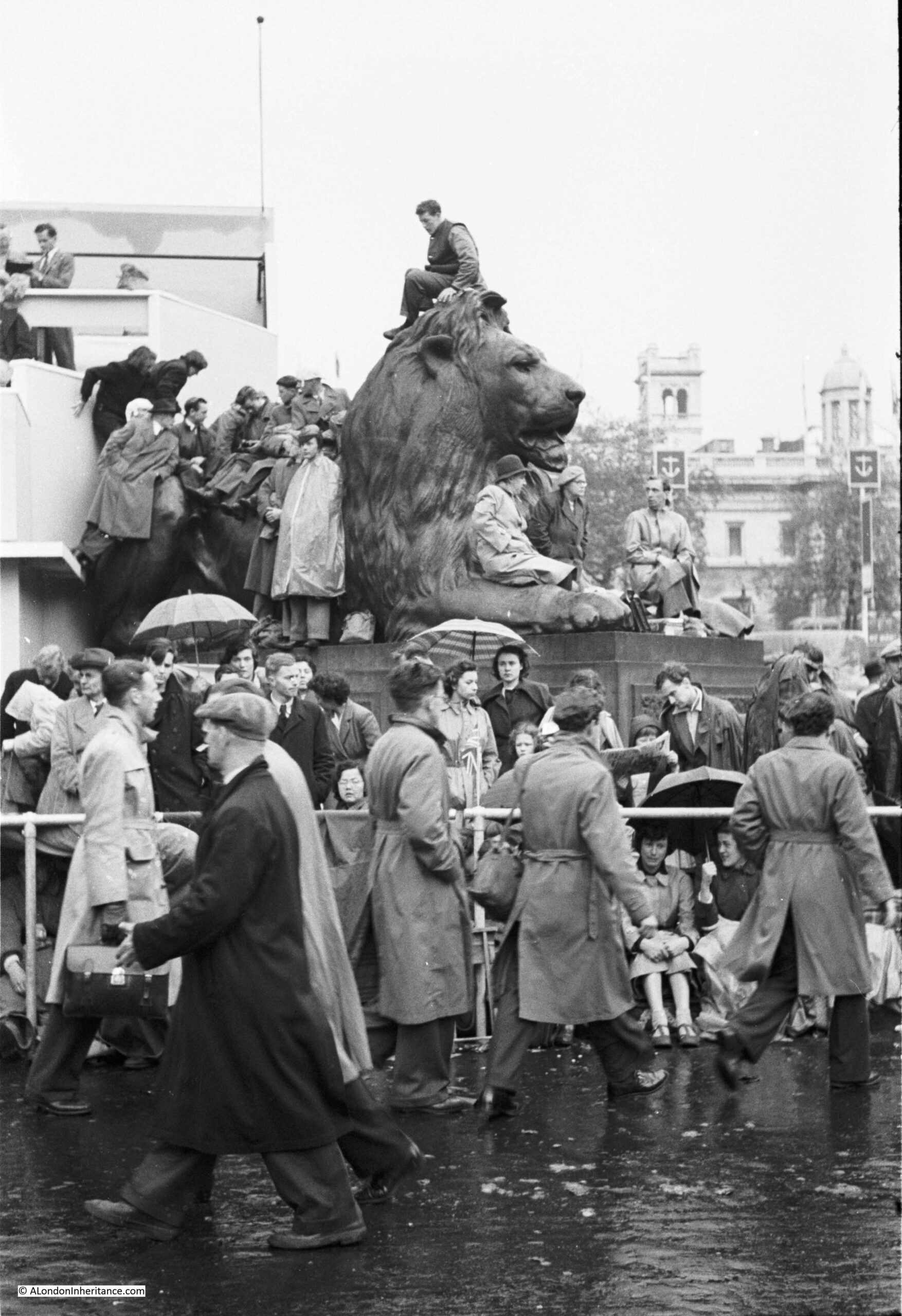
This is Trafalgar Square:

Coronation at Trafalgar Square

On the left is one of the commentary boxes set-up along the route. This was the first Coronation to be televised:

Coronation at Trafalgar Square

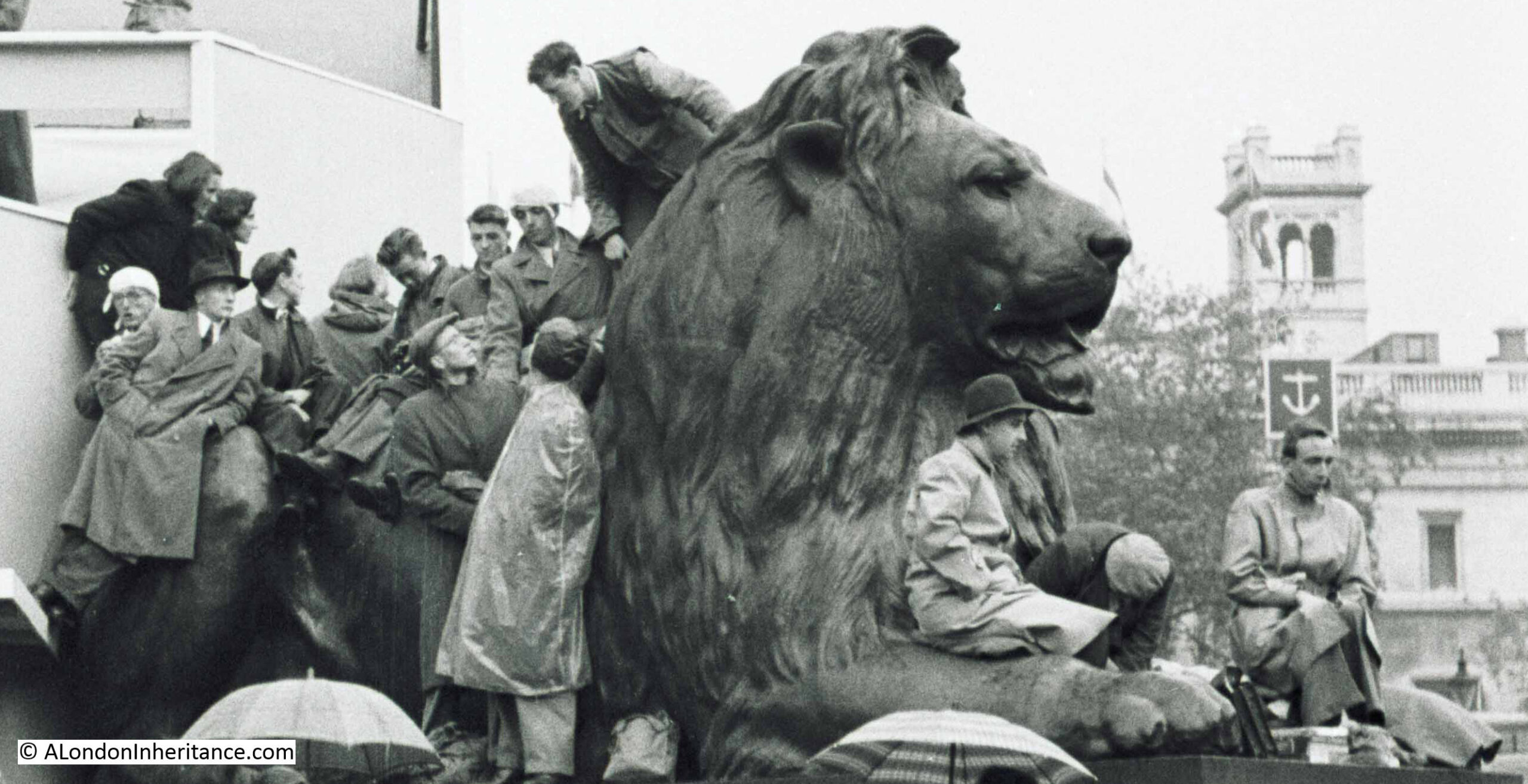
Photo of the small group of people on the lion. Not sure how long the man on the far left was going to balance in that precarious position:

Coronation at Trafalgar Square

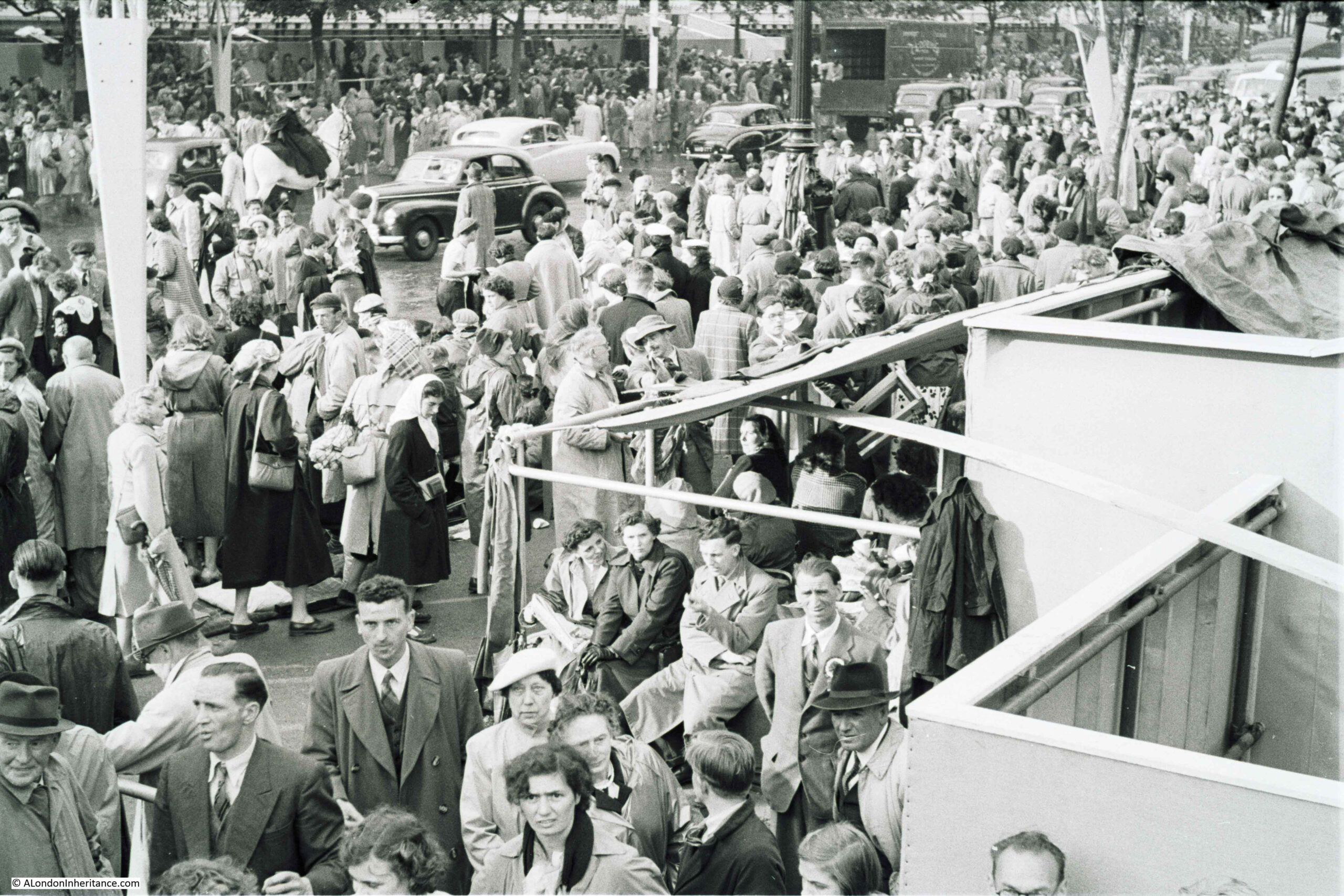
A wider view of a very busy Mall:

Royal Events in the Mall

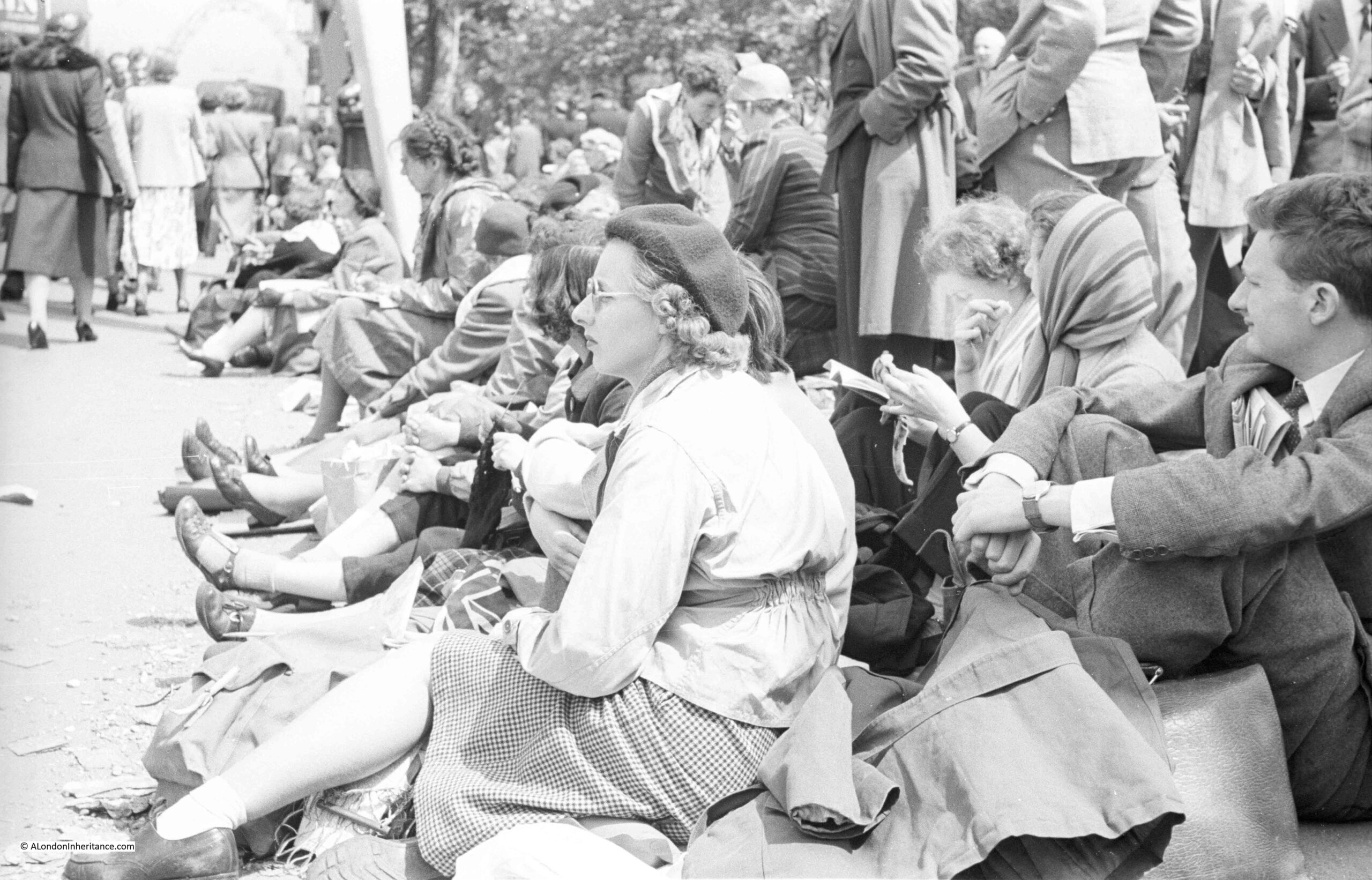
The weather did improve later in the day. Again in The Mall and the crowds are growing. In the top left is the faint outline of one of the arched decorations that spanned the Mall (see earlier photo for the suspended crown), and the legs of one of these decorations can be seen among the crowd sitting at the street edge:

Waiting for the Coronation

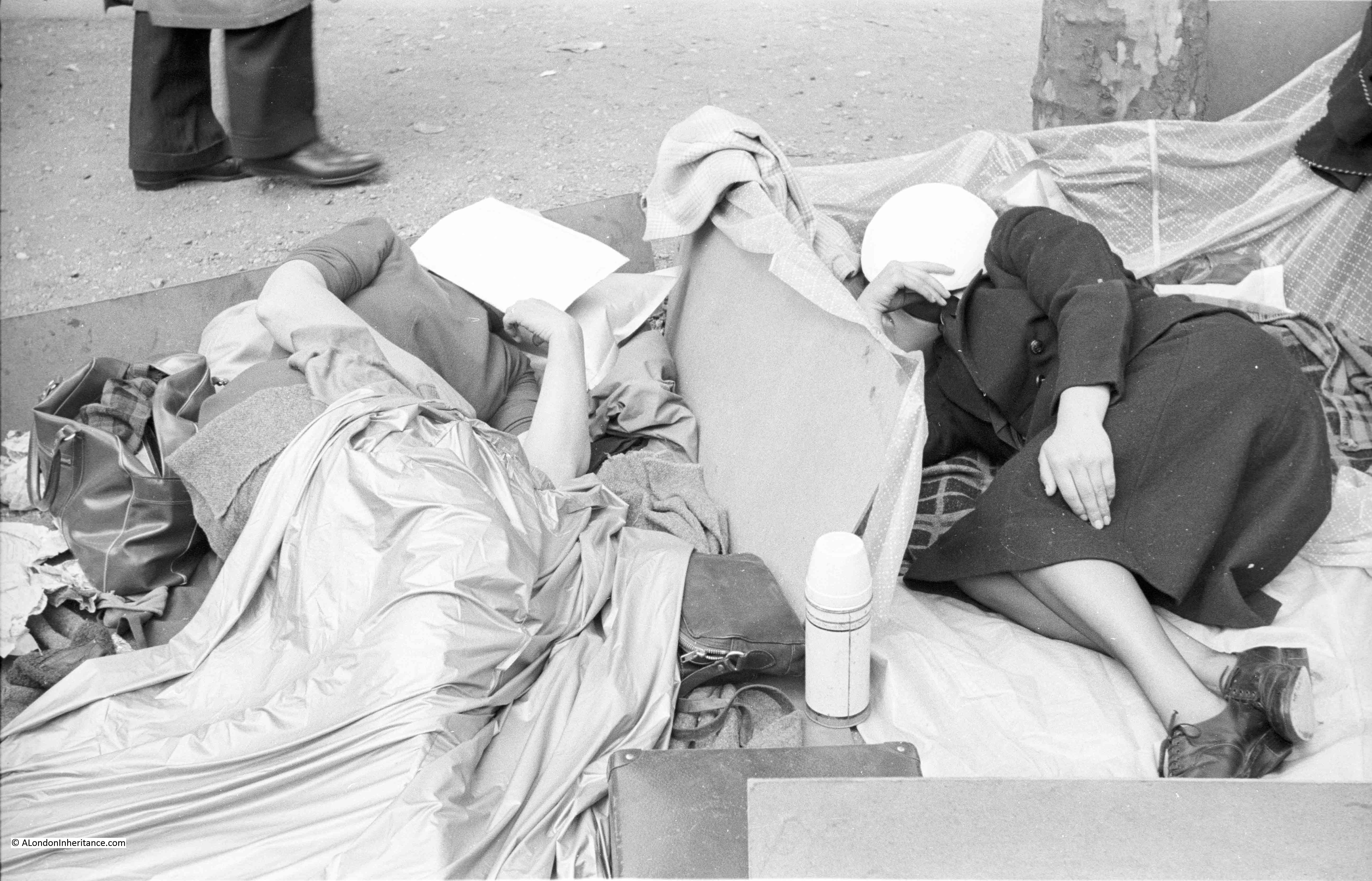
The following two photos were taken on the day before the Coronation as people found their place ready for the next day’s events. Sleeping in The Mall:

Waiting for the Coronation

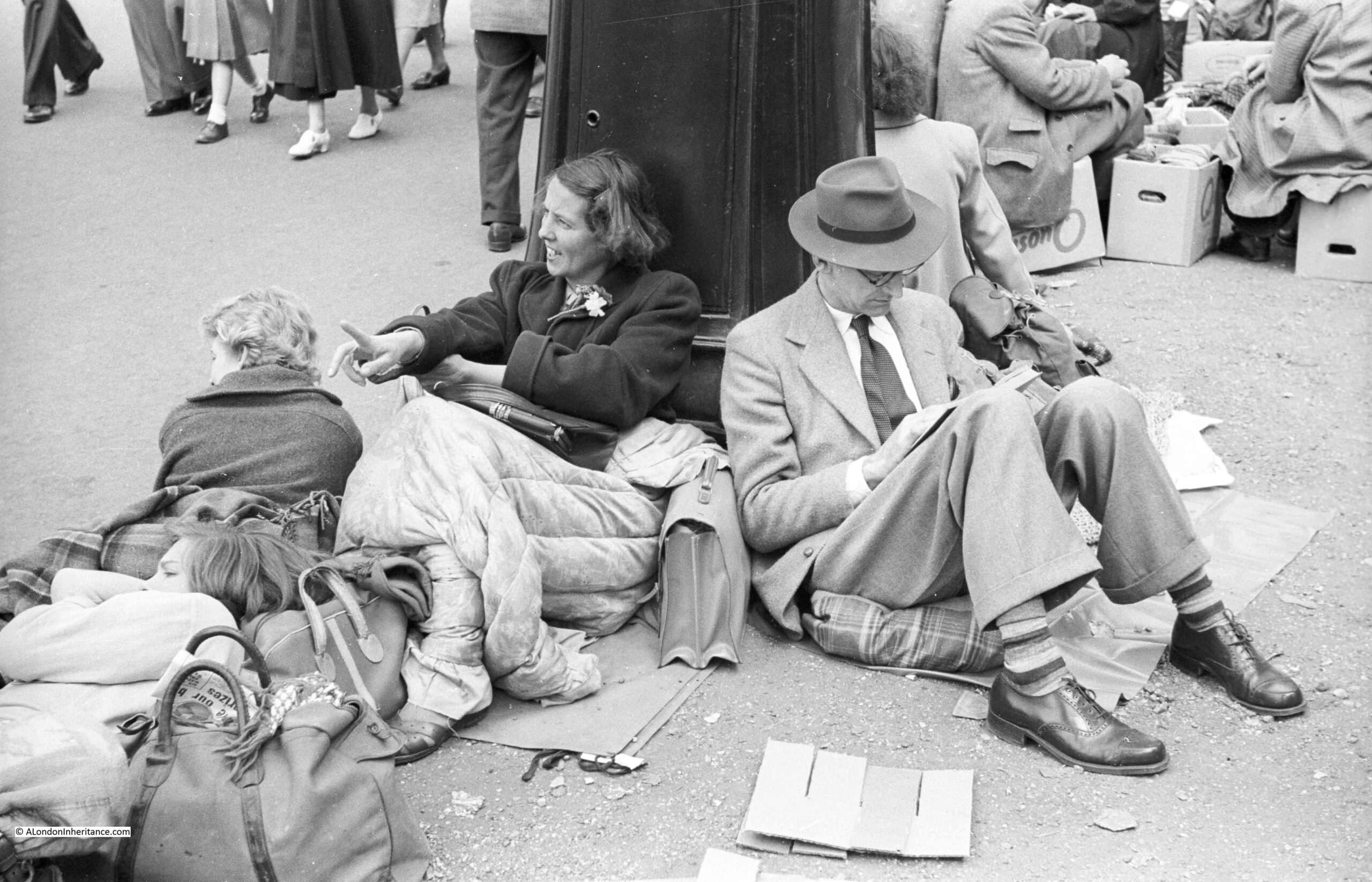
This photo was also taken in The Mall. They look well prepared for the wait. The man is obviously not interested in people watching, he looks engrossed in his book. The group in the background also seem very well prepared judging by the number of boxes they have around them.

Coronation

Royal events have always brought people out to the streets of London, and whilst fashions change and the clothes they are wearing look different, there is a common thread between all the street scenes at this events.

I did photograph the 1977 Jubilee, but cannot find these photos / negatives. Hopefully I have not lost them in the intervening 45 years.

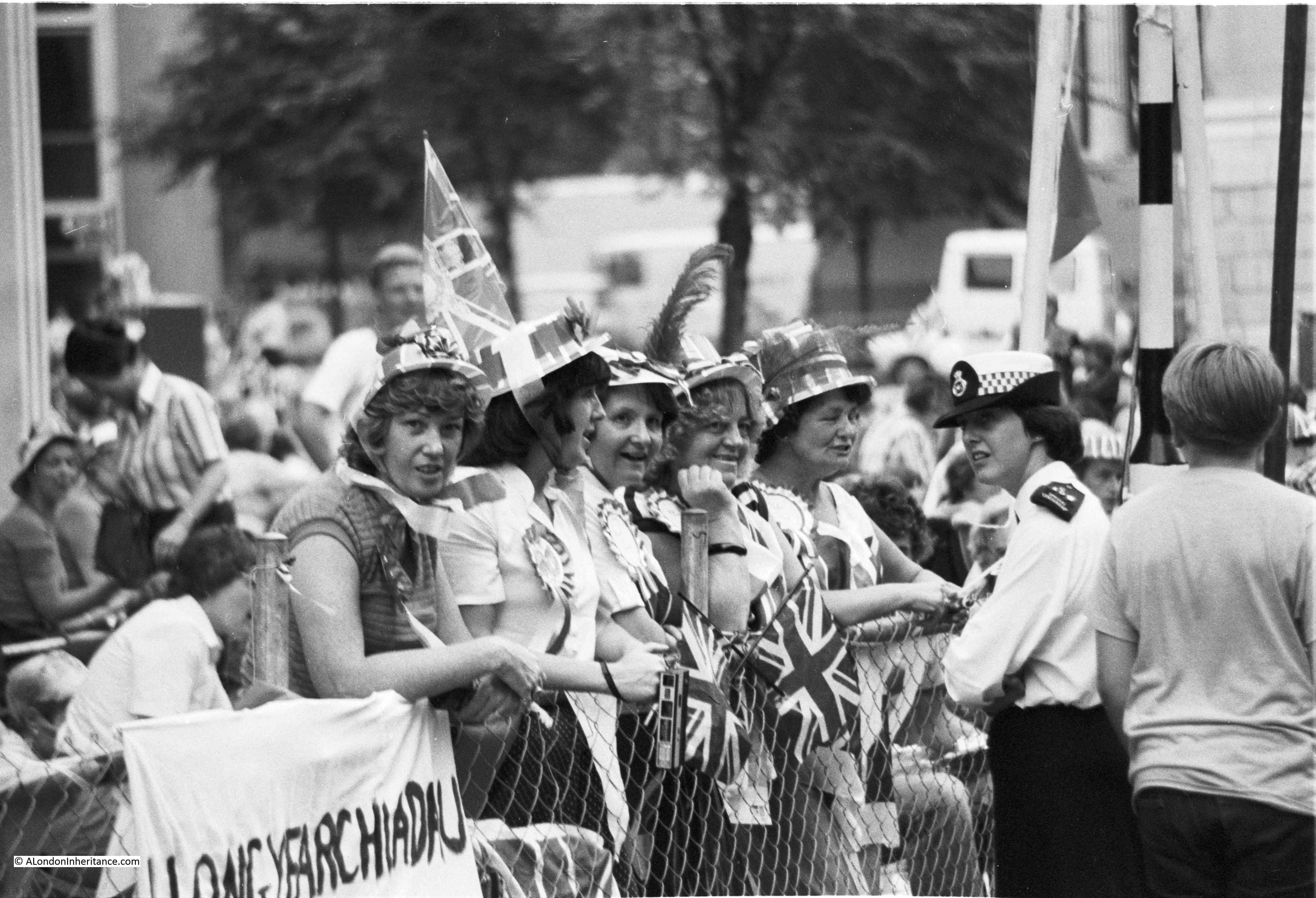
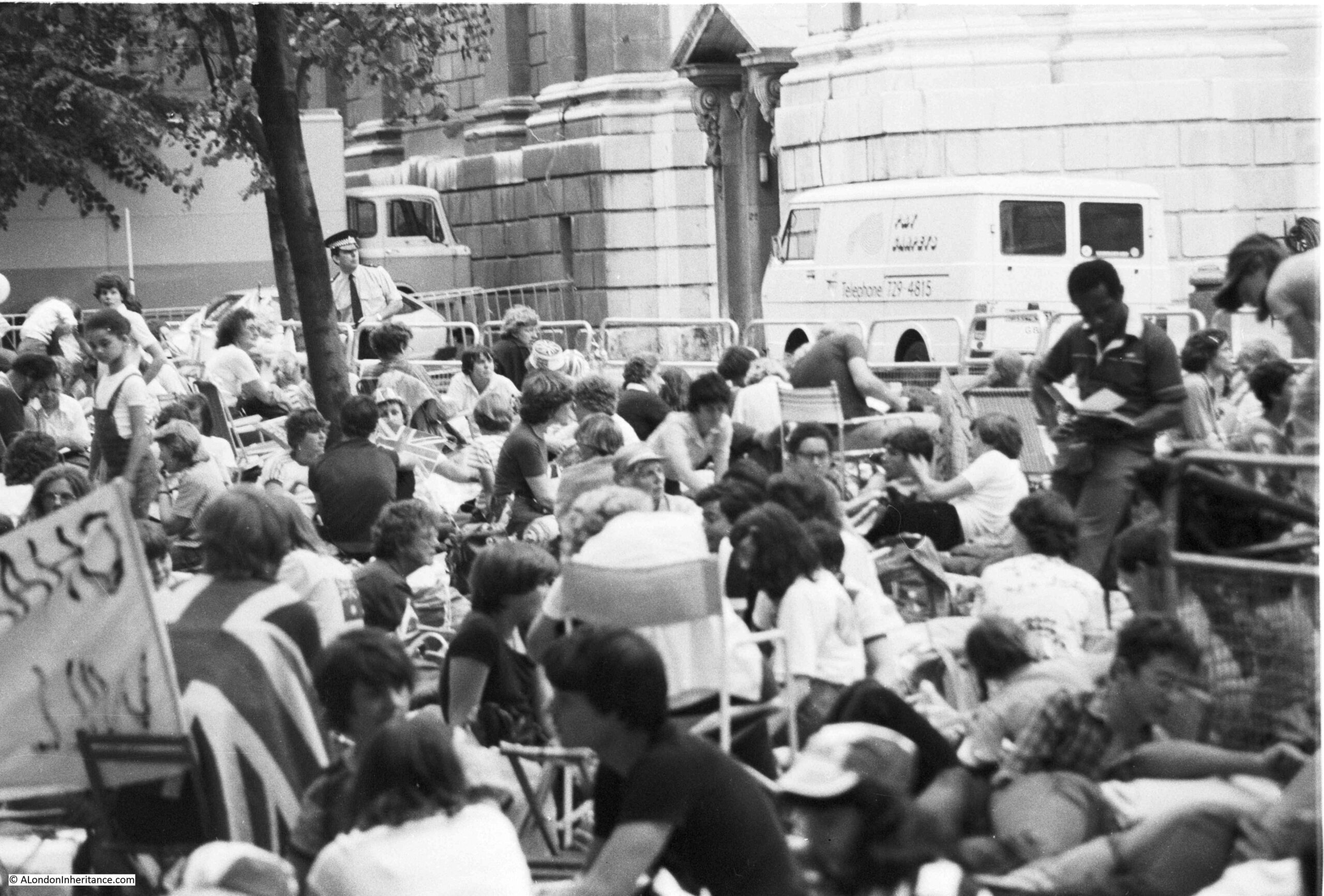
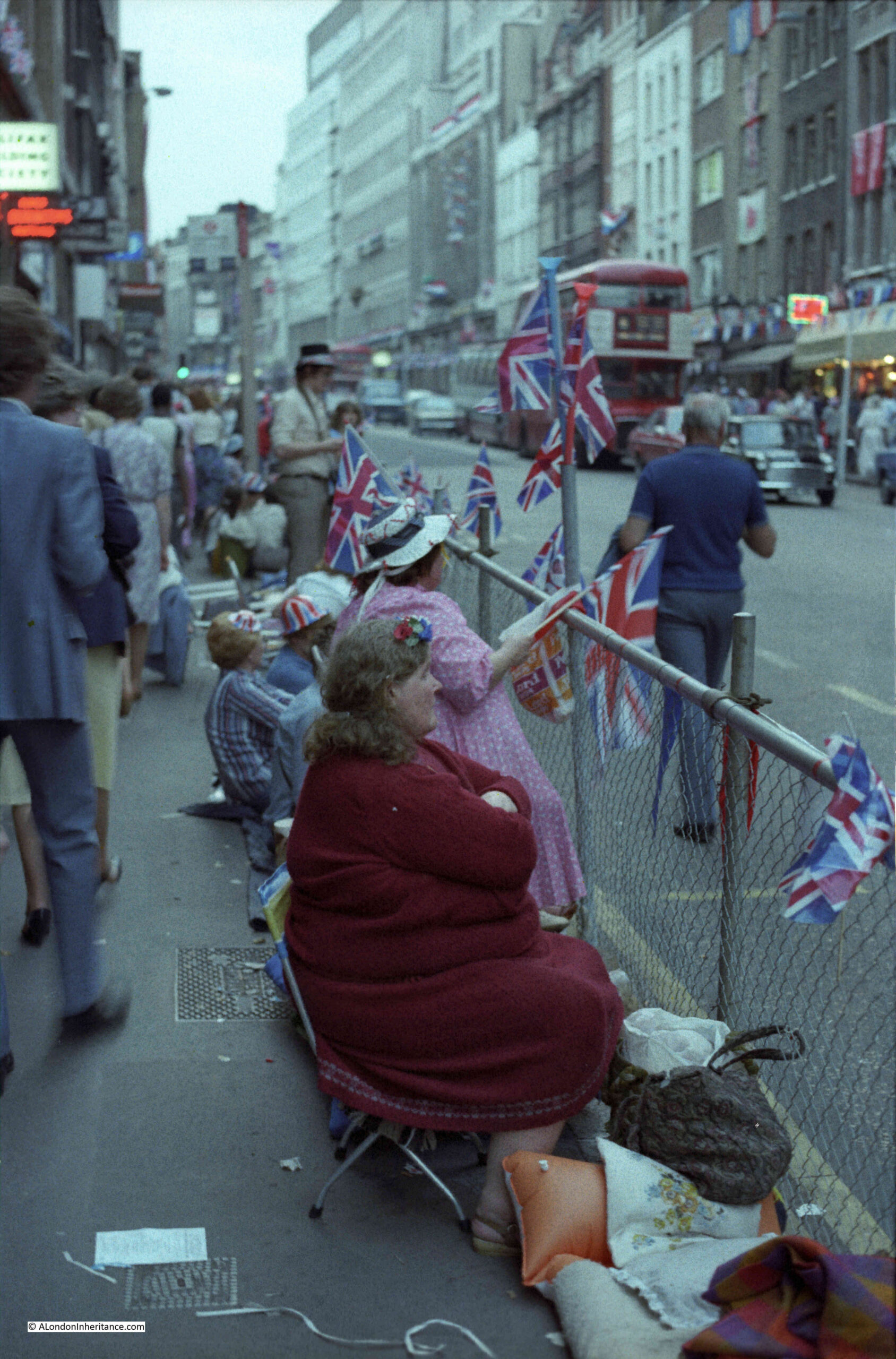
I have found photos of another of London’s Royal events, of crowds building for the wedding of Charles and Diana that took place on the 29th July 1981. On the evening of the 28th July I took a walk from St. Paul’s Cathedral and along Fleet Street and the Strand to take some photos.

Starting at St. Paul’s Cathedral, this is where the best positions were and large crowds had already found their place ready for an overnight stay.

I must have had a couple of photos left on some Black and White film before moving to colour.

Outside St. Paul’s Cathedral:

Royal Events outside St Paul's Cathedral

Crowds at this perfect position looking across at the steps leading into the Cathedral:

Royal Events outside St Paul's Cathedral

I must have then switched to a colour film:

Ludgate Hill

Ludgate Hill:

Ludgate Hill

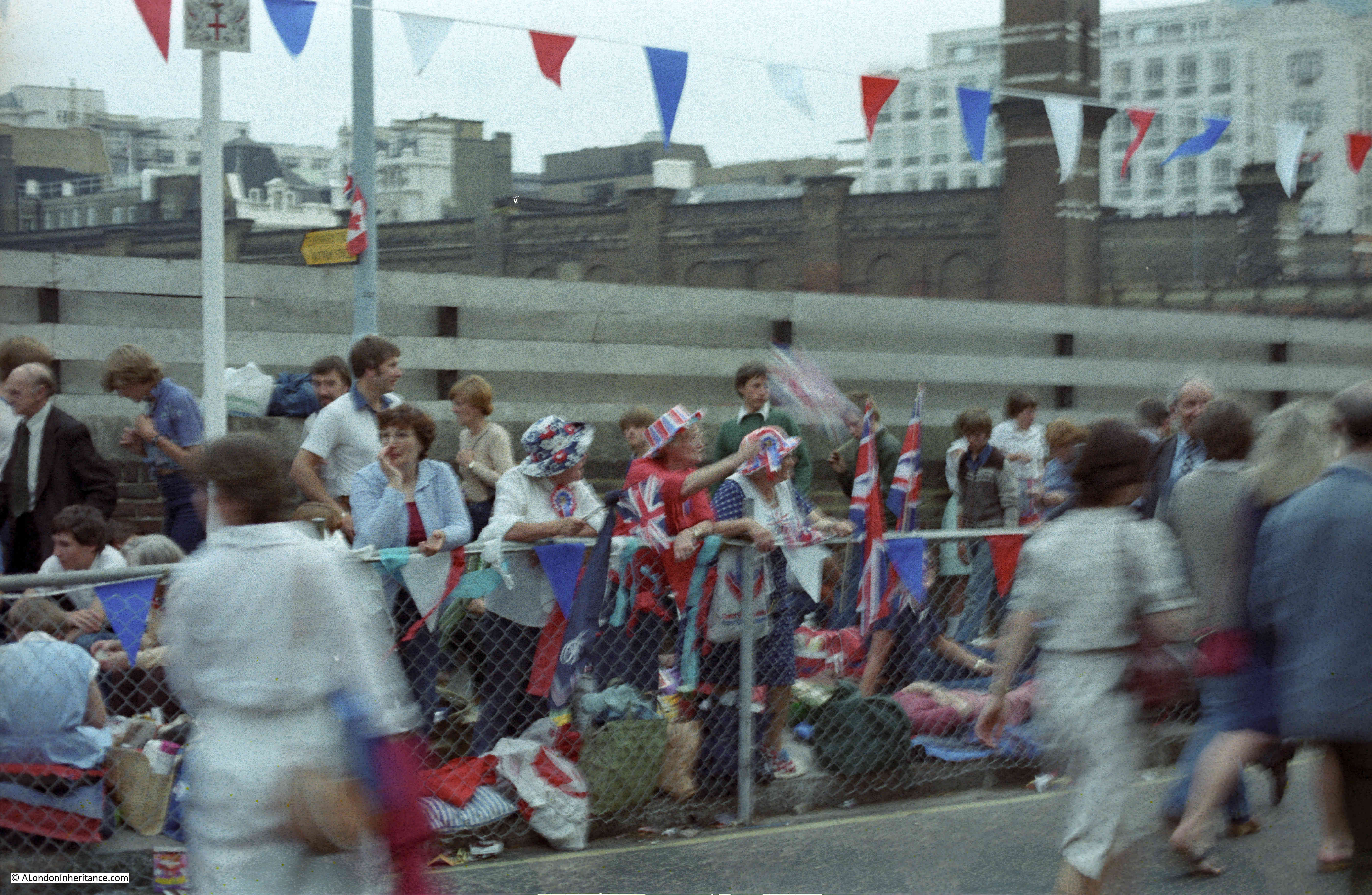
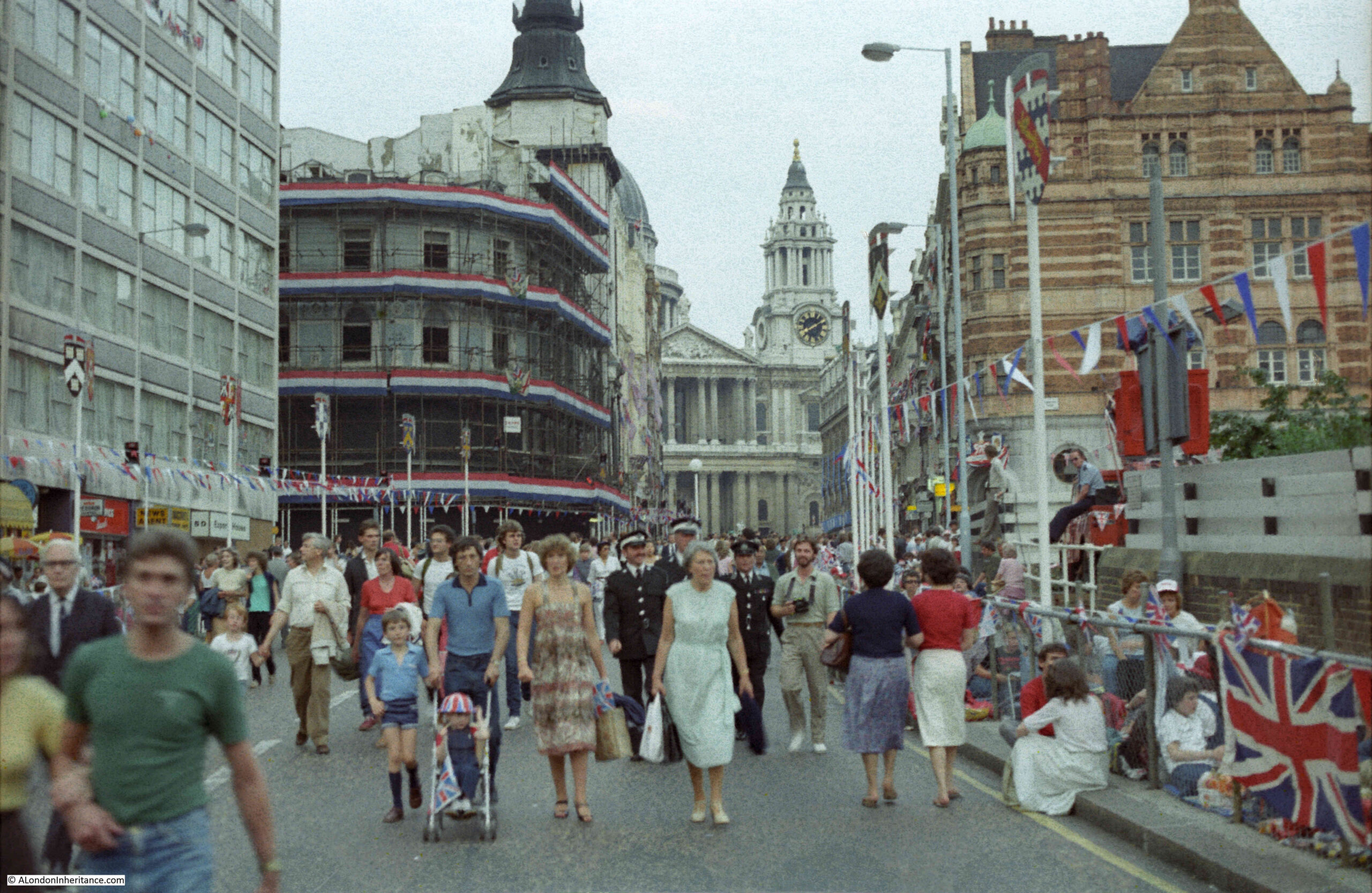
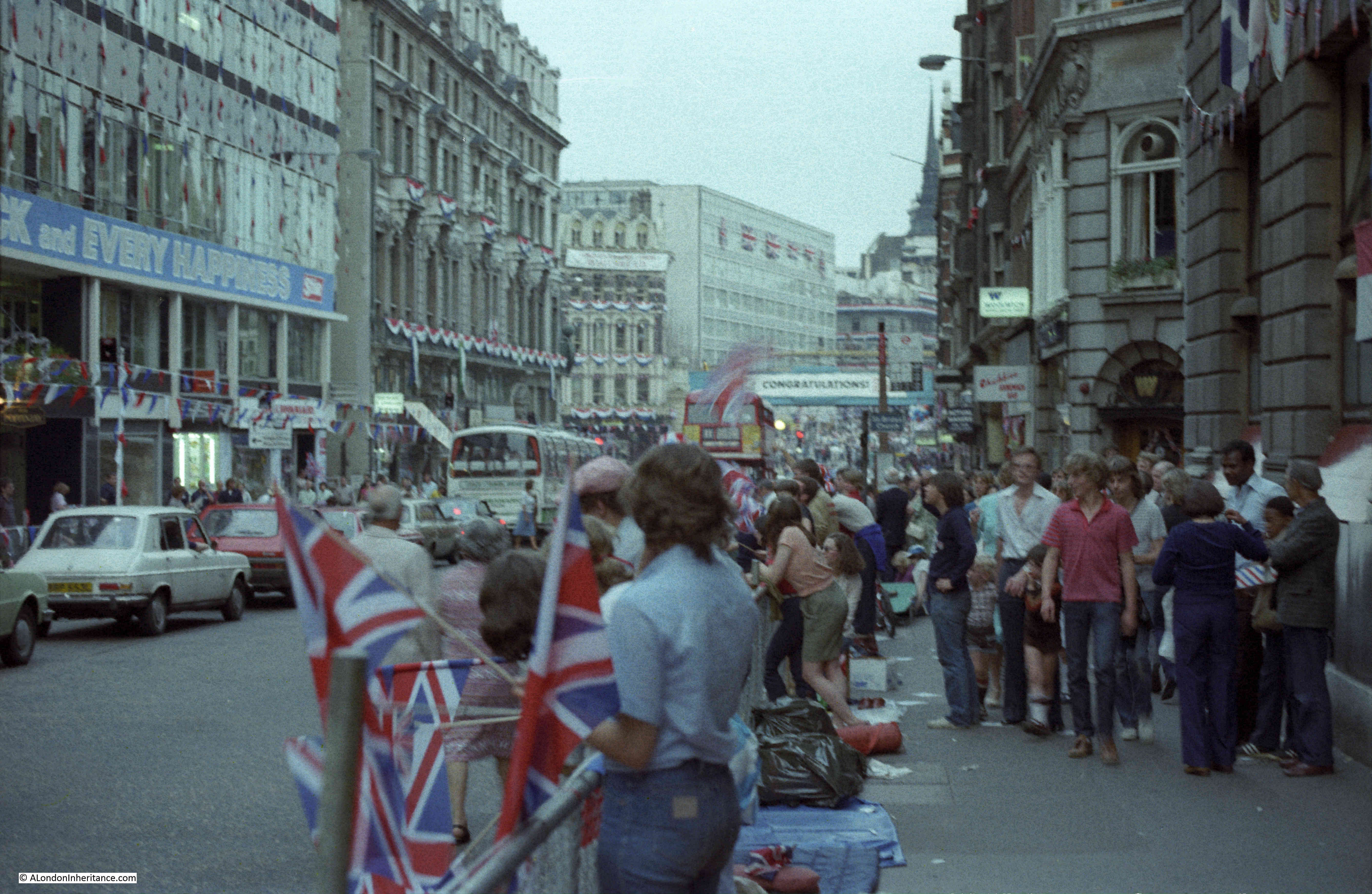
Looking back up Ludgate Hill. Although this was the evening before, the road had been closed and a large number of people were just walking the route, taking in the atmosphere and watching the people who were settling in for the night along the edge of the route. It was a warm evening and I remember there being a real sense of a big event taking place the following day.

Ludgate Hill

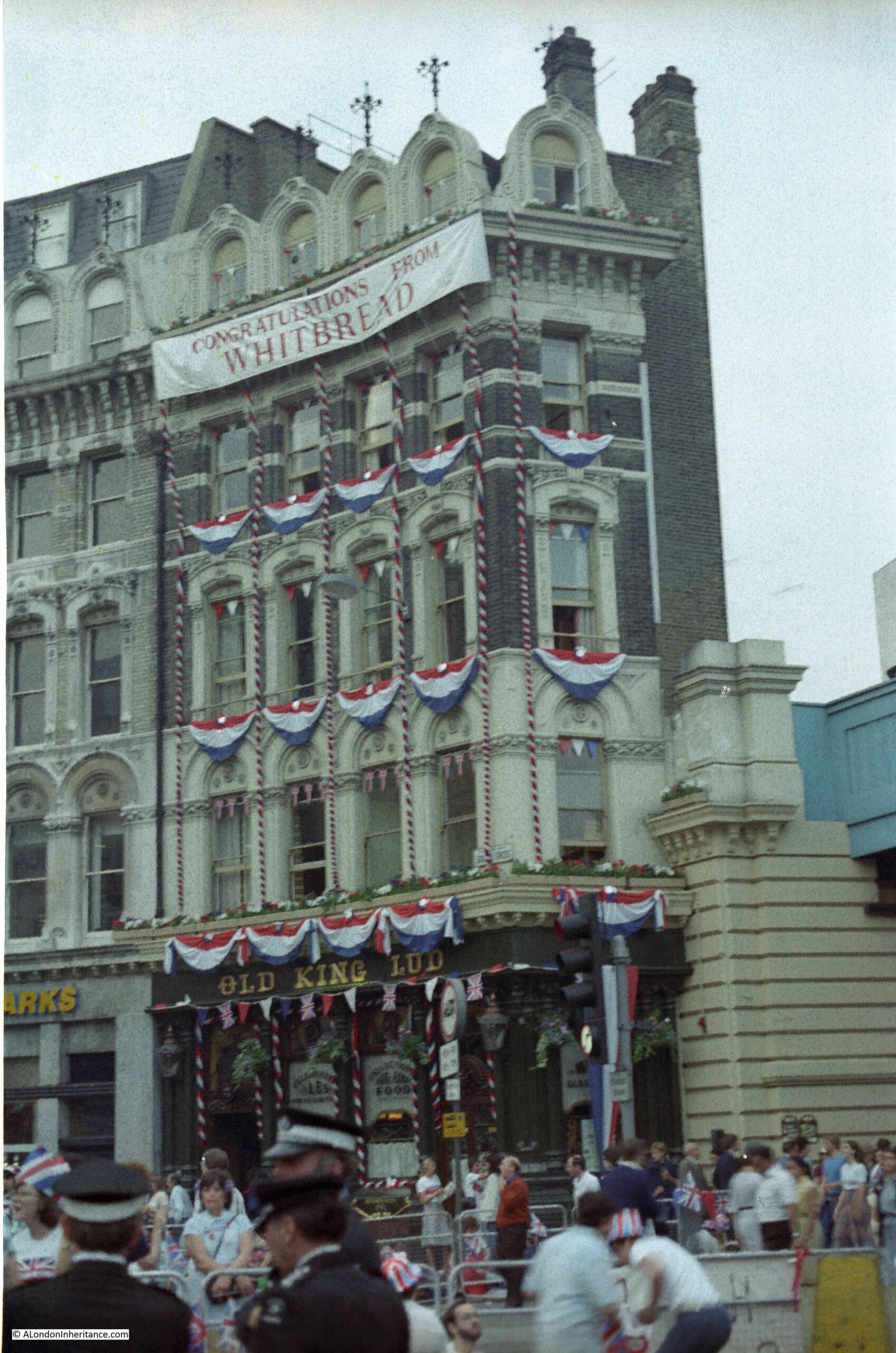
The Old King Lud pub, decorated for the event. This was a lovely Victorian pub, built-in 1870:

Old King Lud pub decorated for the Royal Wedding

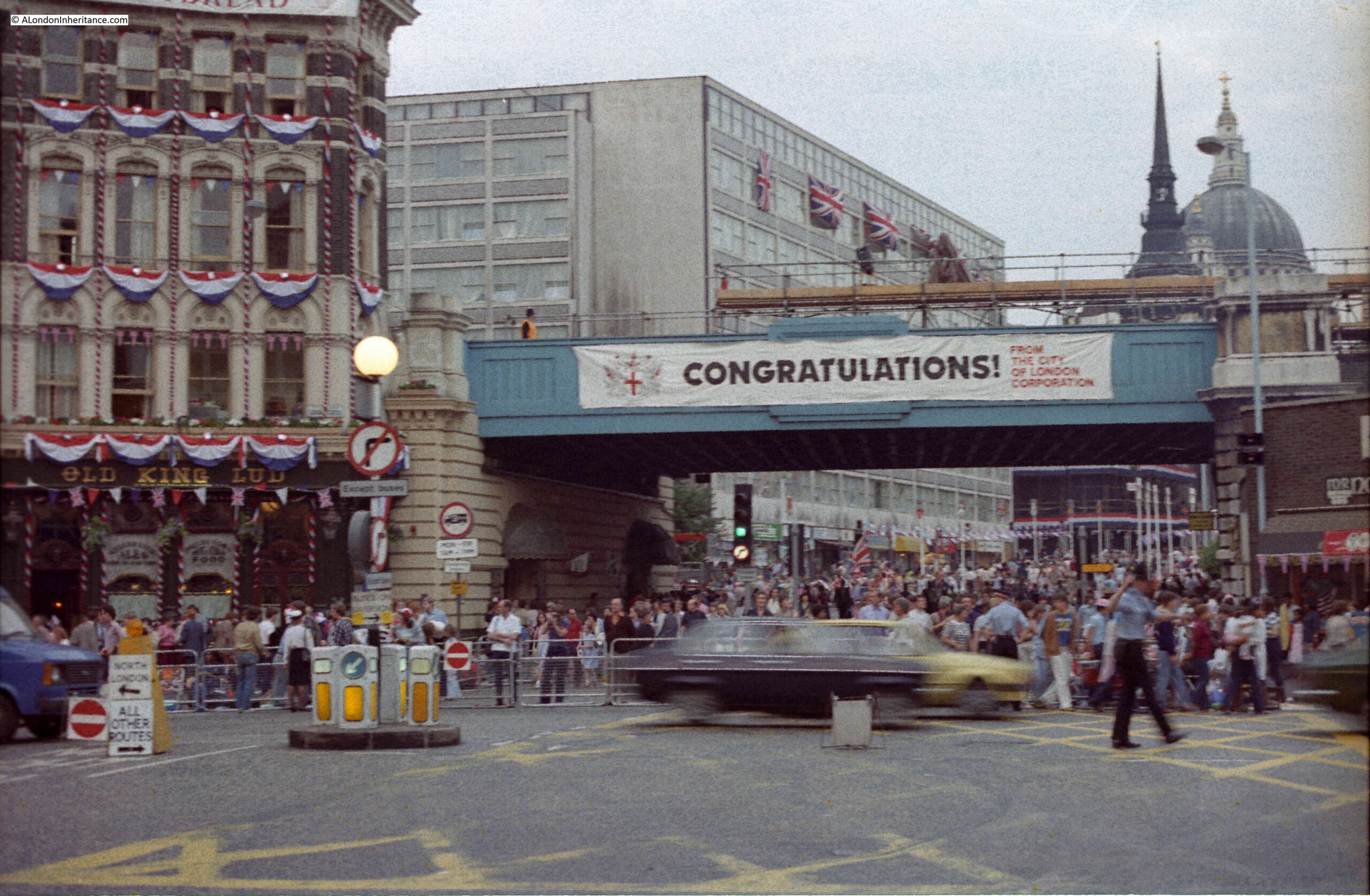
Now in Ludgate Circus. This was when the railway bridge still ran across the start of Ludgate Hill. The Old King Lud pub is on the left:

Royal Wedding at Ludgate Circus

Moving up into Fleet Street. This road was still open and the pavements were busy with those walking and those waiting:

Royal Wedding in Fleet Street

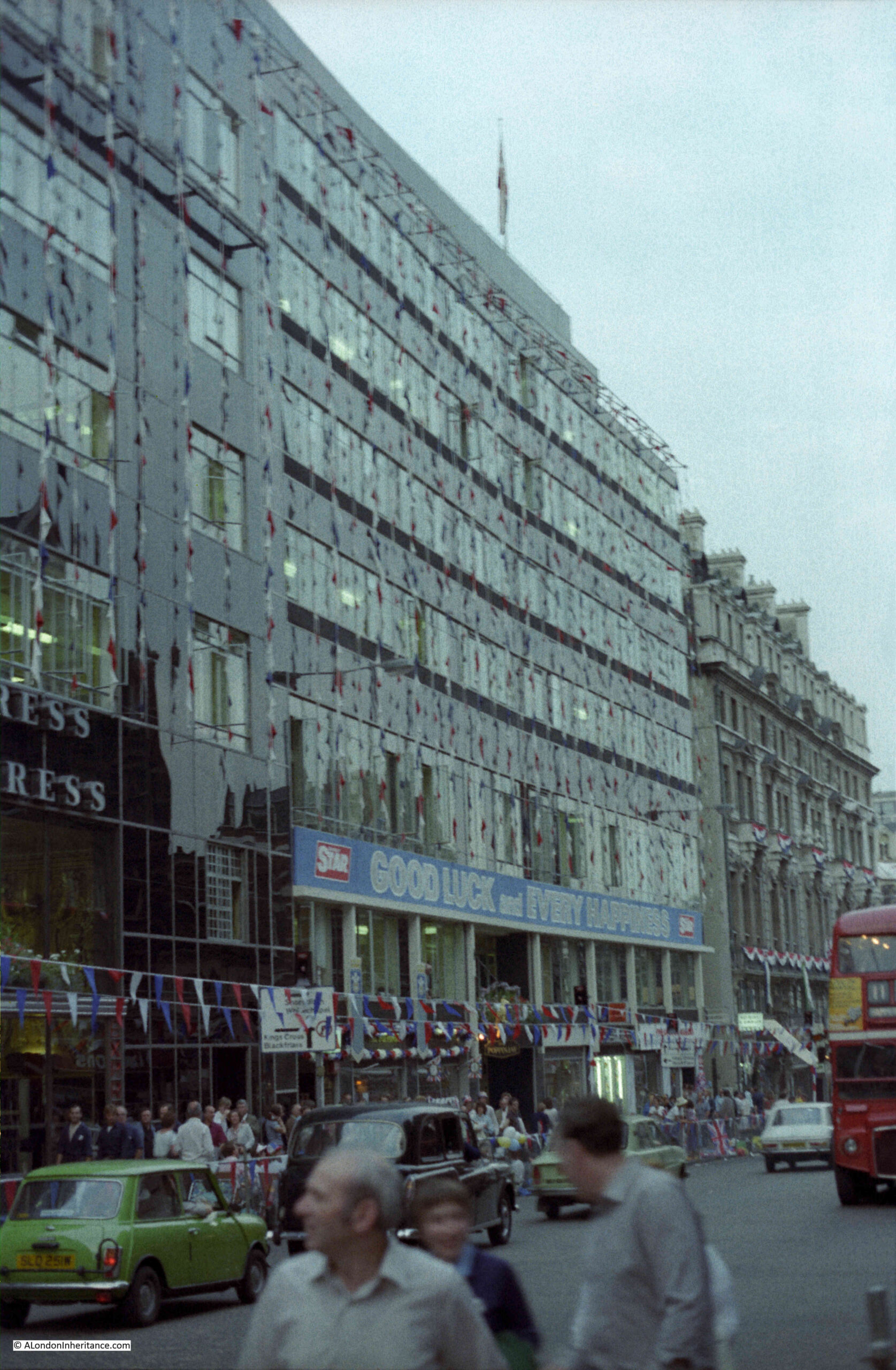
This was when Fleet Street was still occupied by newspaper publishers. The Express offices on the left and those of the Star on the right. I remember walking along Fleet Street and the side roads leading down to the Thames on a late Saturday afternoon / early evening and listening to the sound of the newspapers being printed and the amount of activity to get the next day’s edition distributed. All very exciting when you are young and exploring London.

Royal Wedding in Fleet Street

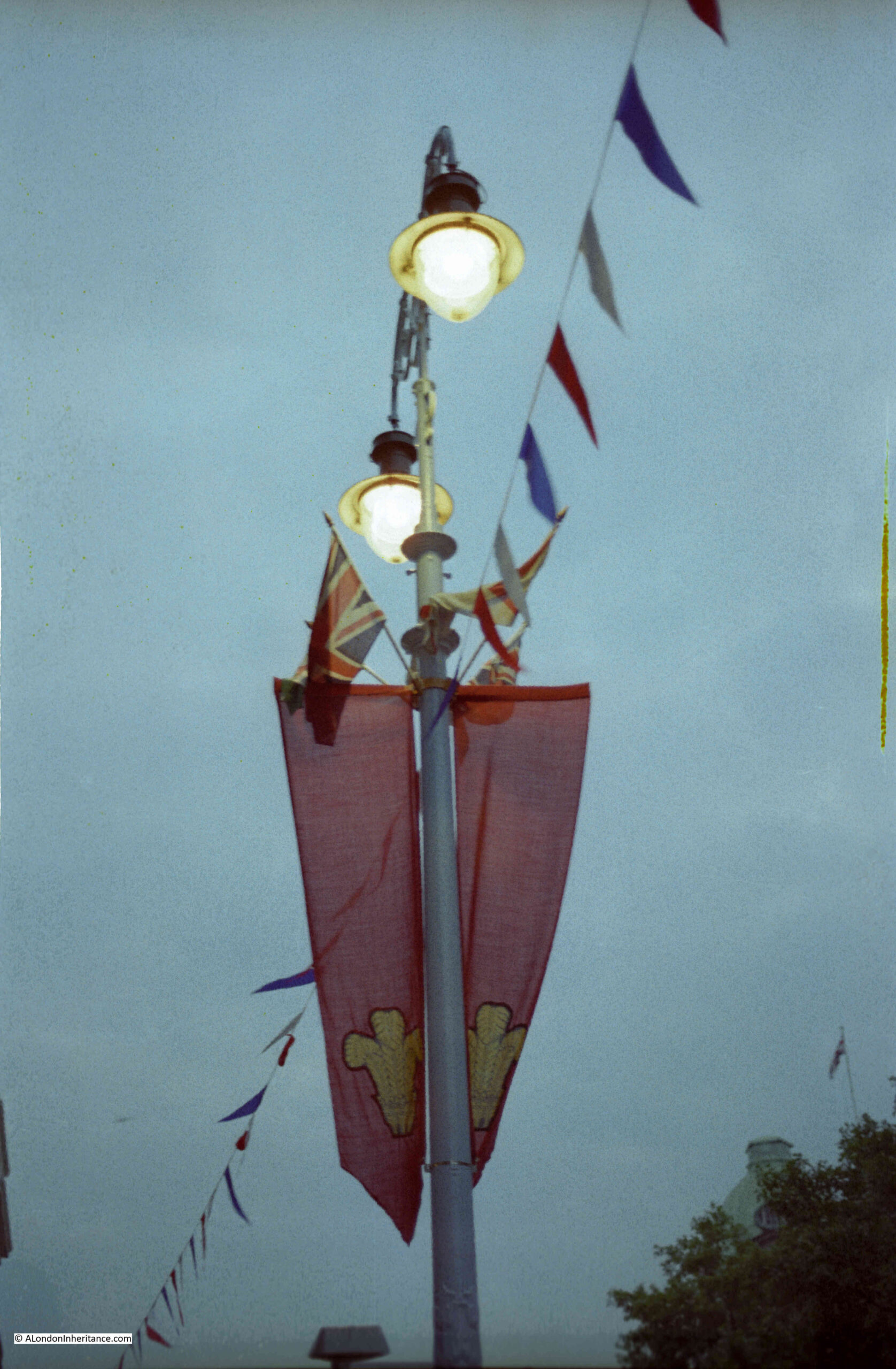
Most of the decorations were put up by the owners of the buildings along the route. “Official” street decoration was very limited, mainly these pennants hanging from lamp posts. Union Jacks along with red, white and blue bunting was out in abundance:

Royal Wedding

The George pub in the Strand which fortunately is still there:

Royal Wedding

Along the side of the Royal Court’s of Justice:

Royal Wedding

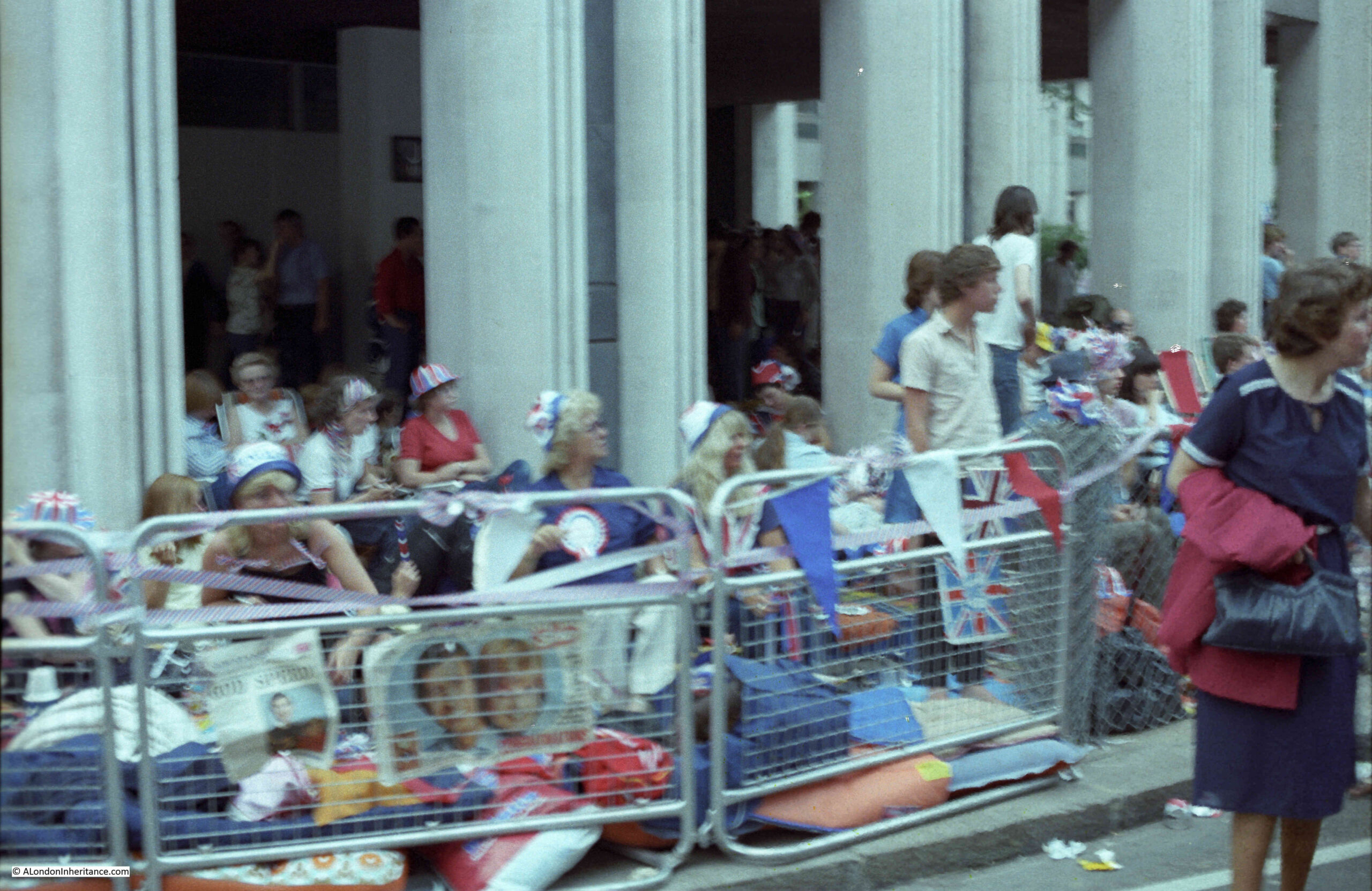
Prepared for a long night’s wait:

Waiting for the Royal Wedding

Royal events show a rather timeless side to London. Whilst so much in the city changes, the streets repeat previous appearances whenever one of these events take place.
They continue to attract people in their thousands to line decorated streets, many reserving their place on the preceding day, and braving whatever the weather brings down on London.

A shame though that Transport for London no longer issues any special maps for such events.

alondoninheritance.com

Jubilee Beers

As it is the Jubilee Weekend (or rather four days), I have a Jubilee related post on both Saturday and Sunday. Tomorrow’s post is one of my usual posts, with photos of previous events. For today’s post, I dug out my collection of 1977 Jubilee beers and 1981 Royal Wedding beers from the cobweb filled corner of the garage.

The late 1970s and early 1980s involved a lot of pubs. For some reason that I cannot really remember, in 1977 I collected any special Jubilee beer that I could find in pubs across London and Essex. Probably the novelty of finally being able to legally buy alcohol in a pub without any issues.

They have been boxed and stored away for the last 45 years, but I thought I would get them out for this weekend and see how many of the breweries, brewing Jubilee beer in 1977 still exist.

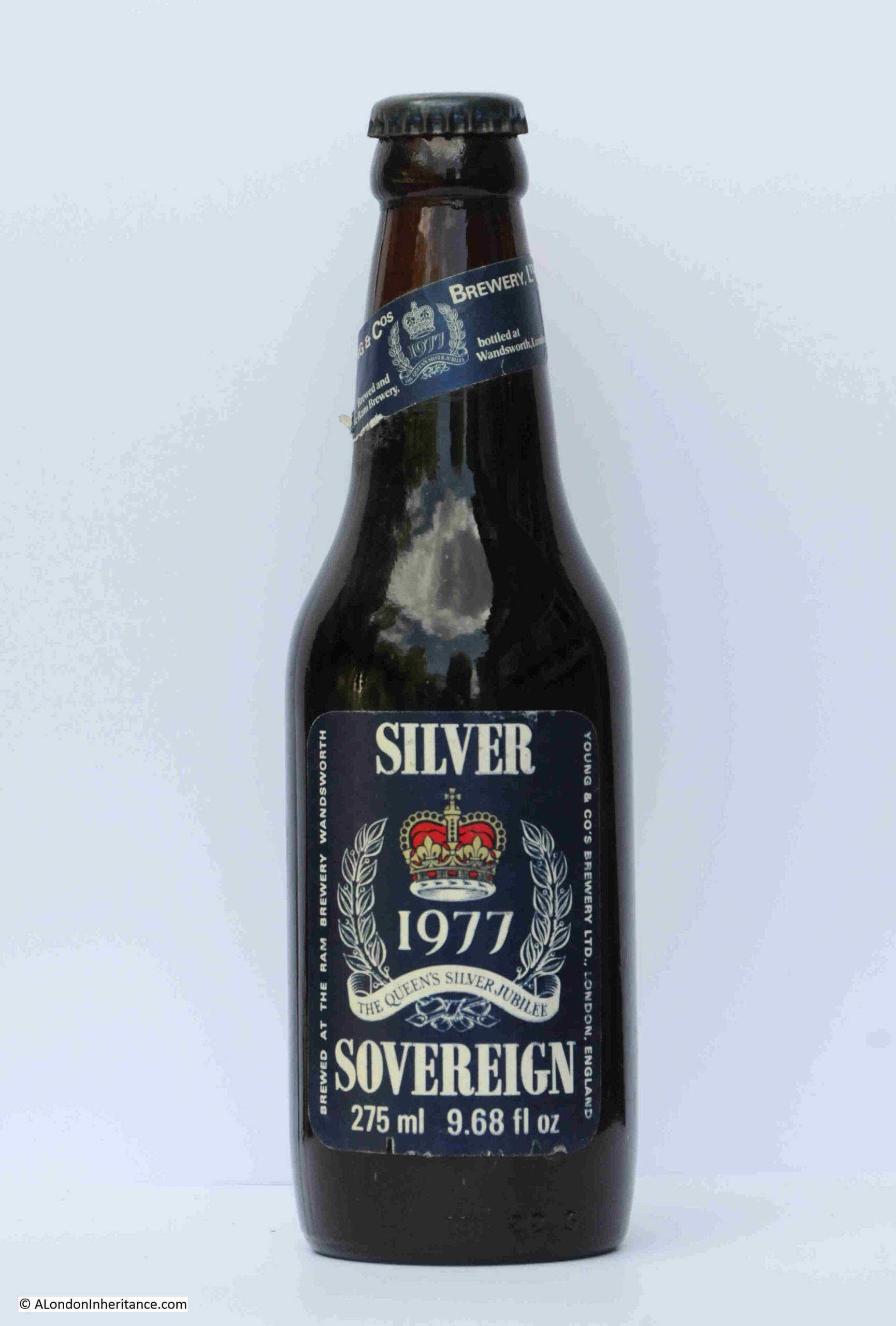
Young & Co – Silver Sovereign, brewed at the Ram Brewery in Wandsworth:

Silver Jubilee beer

Young’s closed the Ram brewery in 2006, and are now a pub company. Their beers were initially brewed by a joint venture with Charles Wells in Bedford, but they have since sold their share in the brewery venture.

They still have a head office in Wandsworth, close to the location of their original brewery.

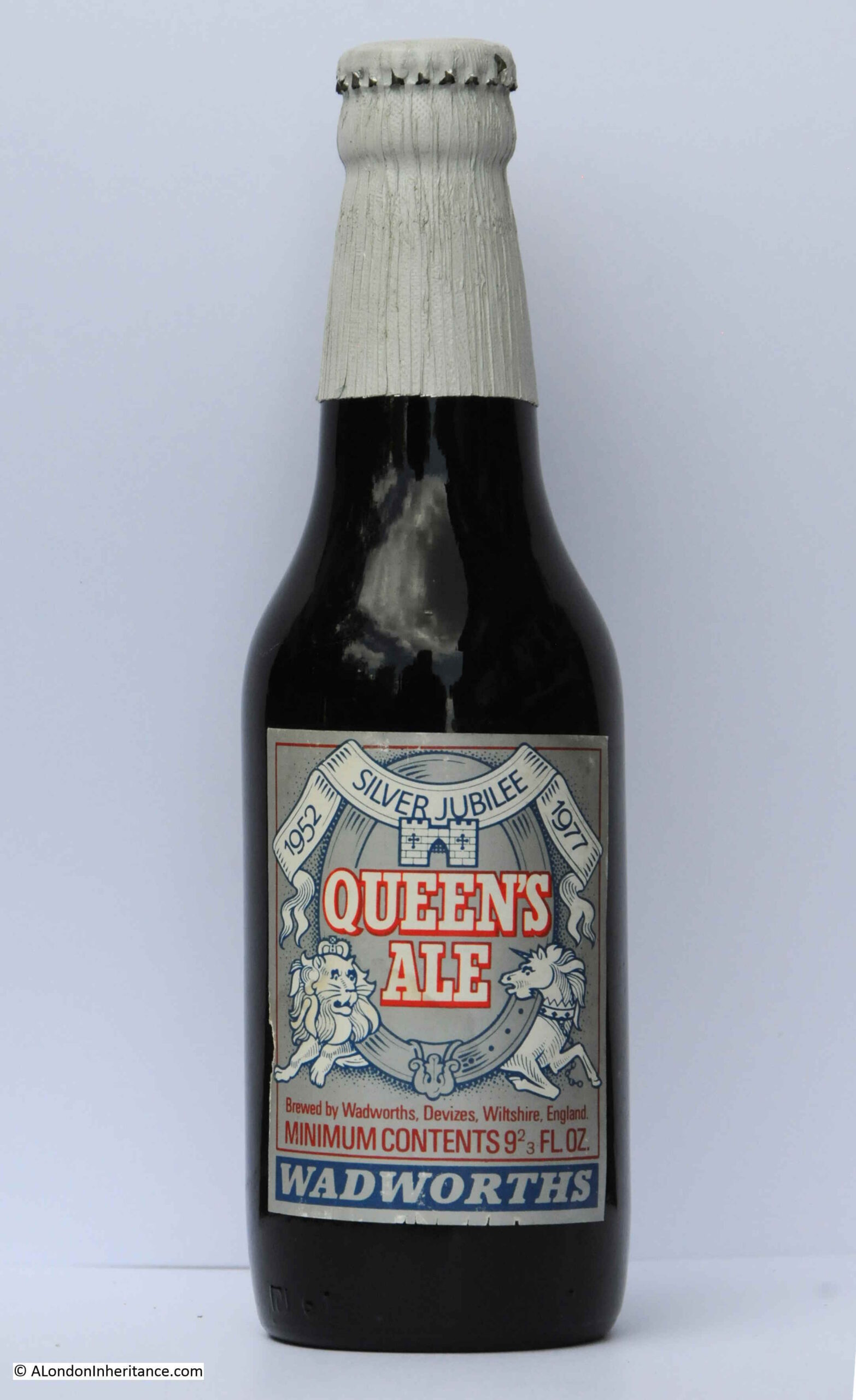
Wadworths – Queen’s Ale:

Silver Jubilee beer

Wadworths are still brewing beer at their brewery in Devizes, Wiltshire, but according to their website, they do not appear to have a Jubilee beer for 2022. They had an impressive beer label in 1977.

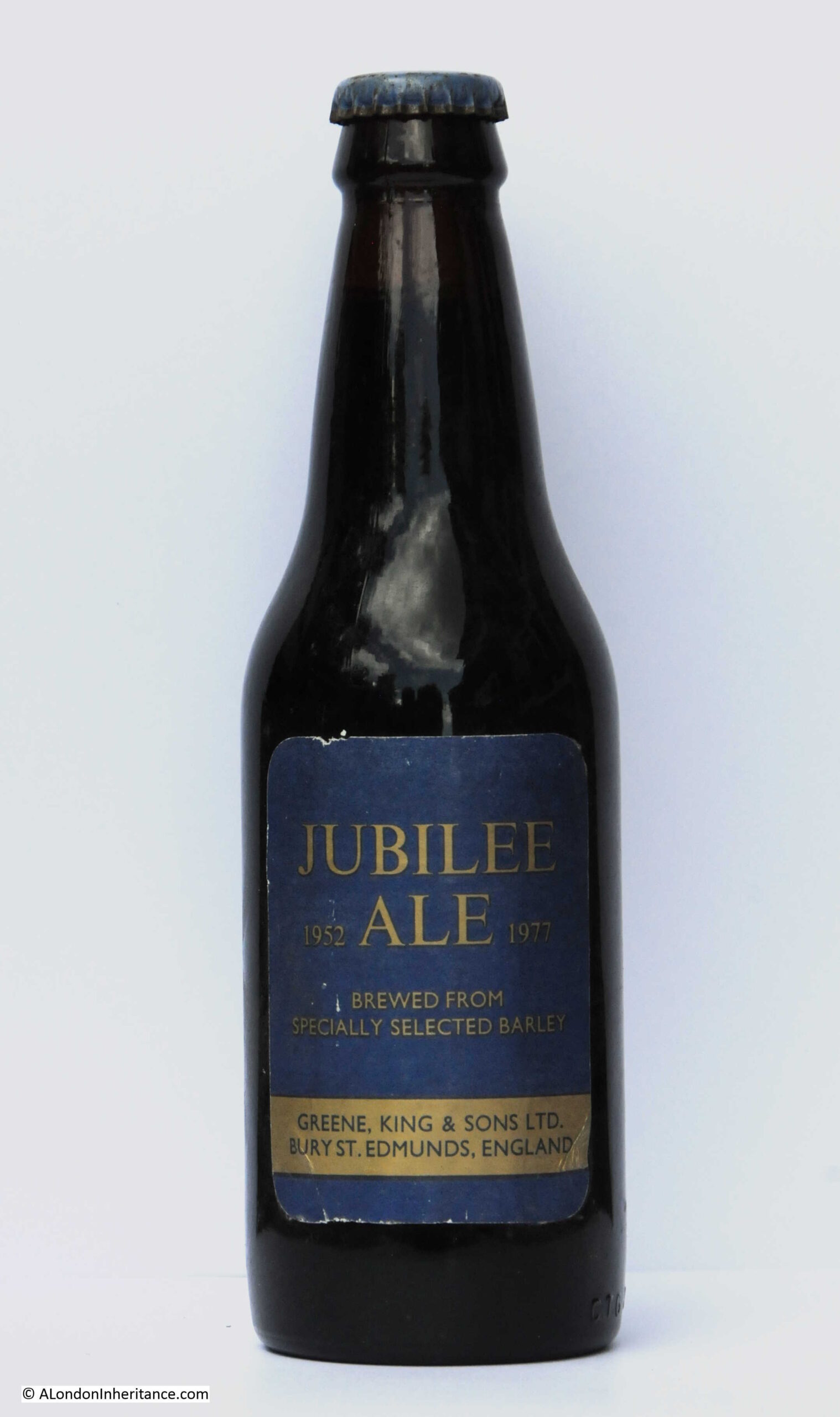
Greene, King & Sons – Jubilee Ale

Silver Jubilee beer

Greene, King & Sons are still brewing at their brewery in Bury St. Edmunds, however again according to their website they do not appear to have a Jubilee beer for 2022.

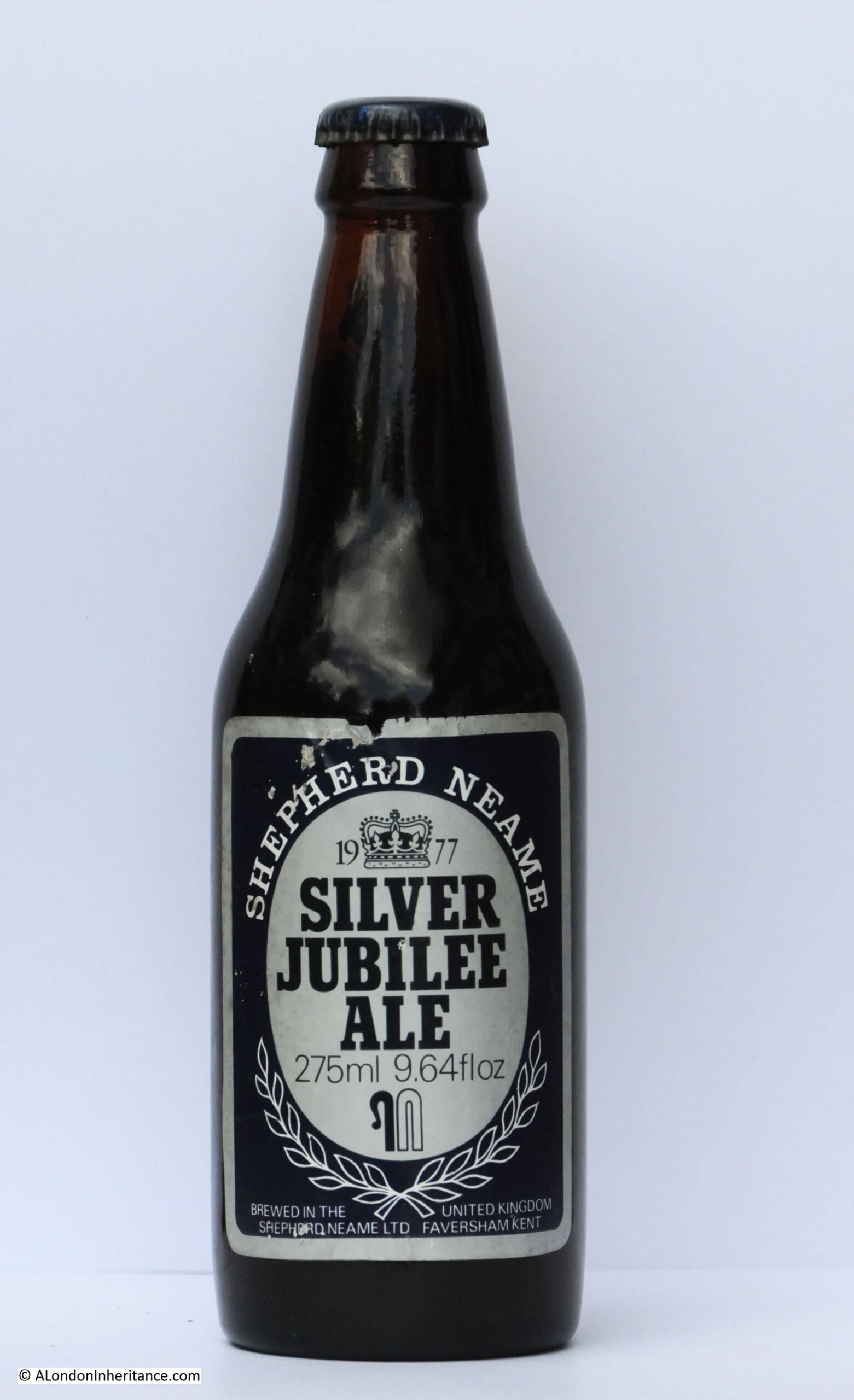
Shepherd Neame – Silver Jubilee Ale

Silver Jubilee beer

Shepheard Neame are also still brewing at Faversham, Kent, and have produced a “Celebration Ale” for the 2022 Jubilee, however this is only available in casks in pubs rather than bottled.

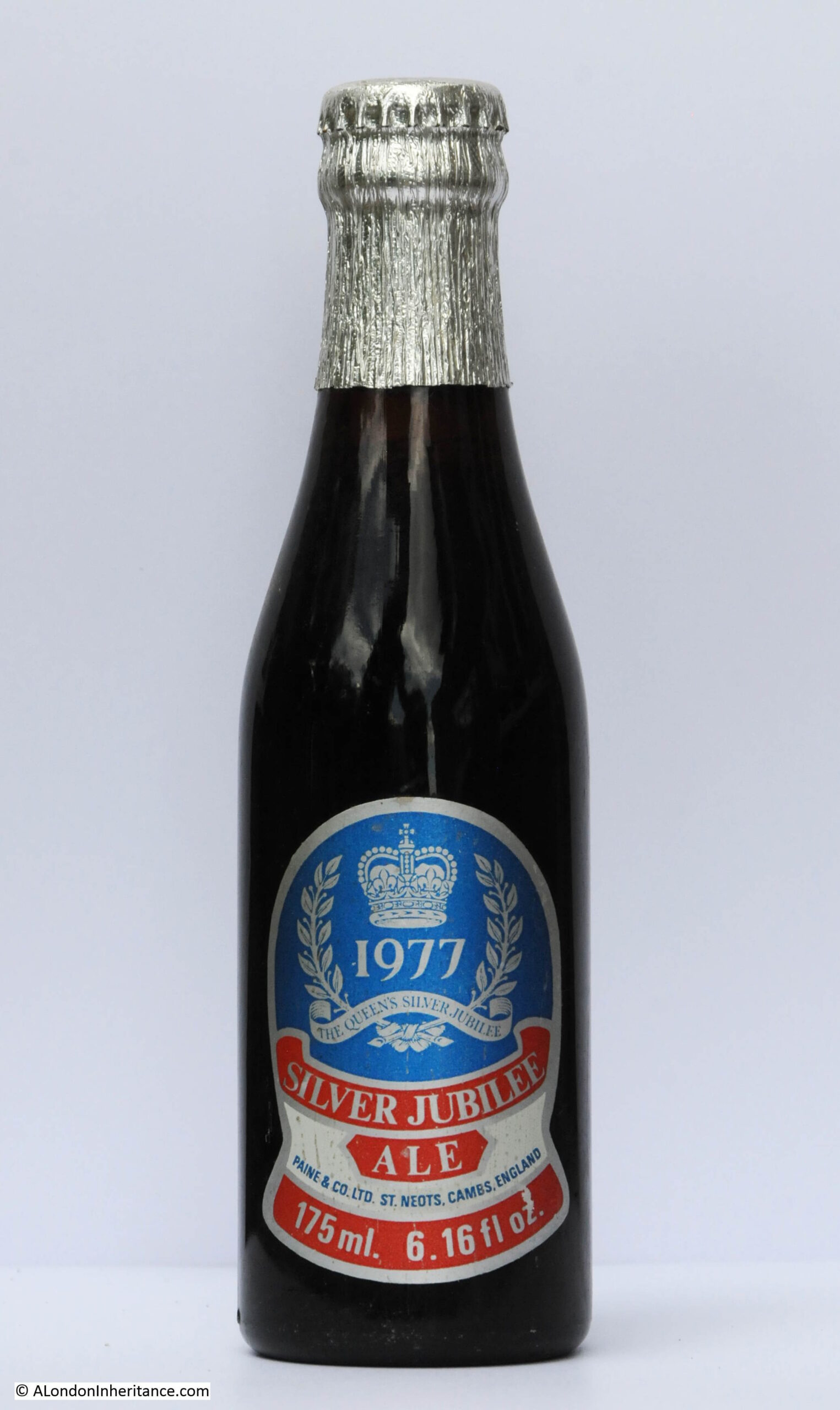
Paine & Co – Silver Jubilee Ale

Silver Jubilee beer

A company that appears to have sold their pubs and brewery to a rival brewers in the 1980s. The name disappeared and the brewery would later close.

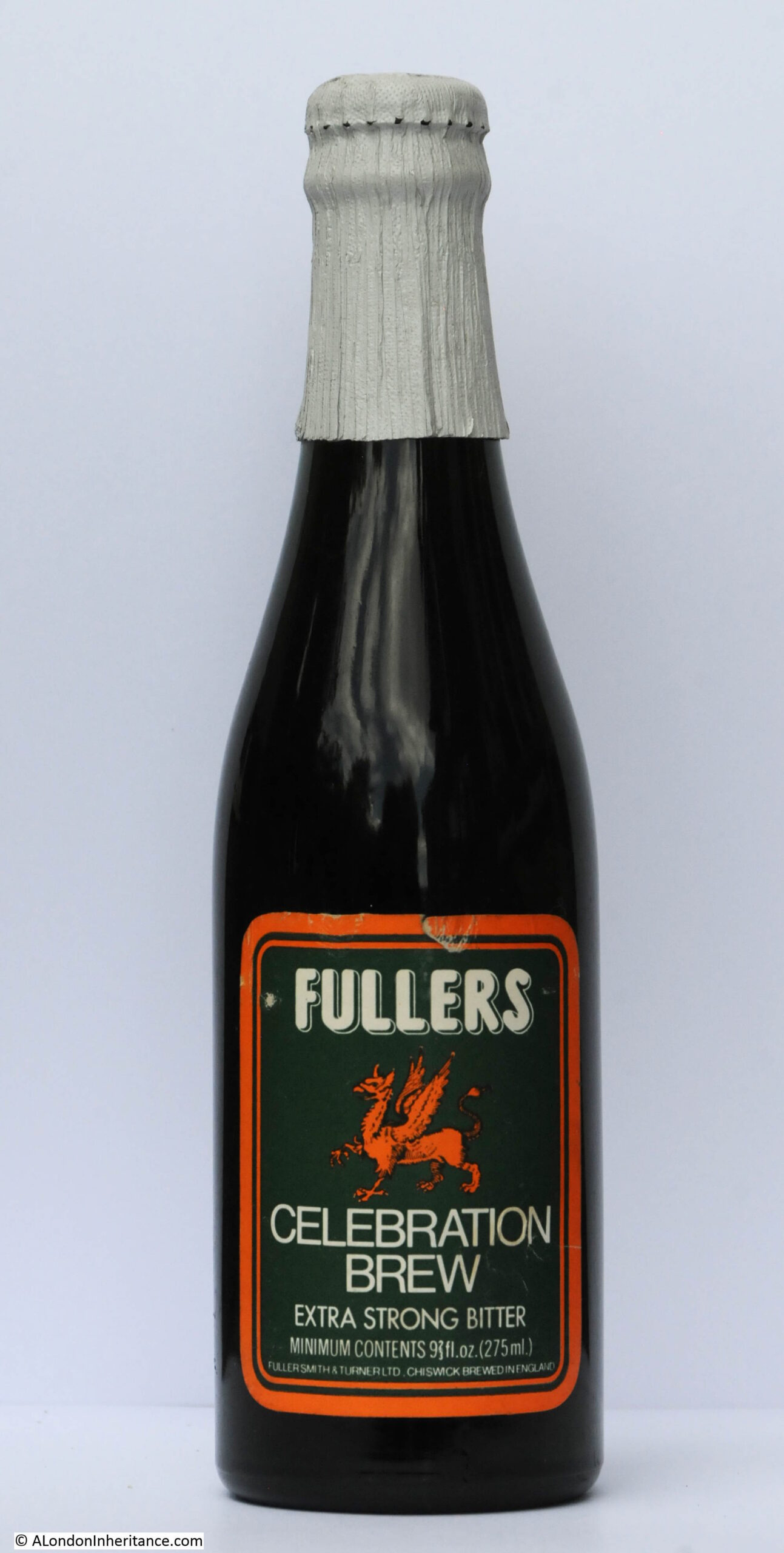
Fullers – Celebration Brew

Silver Jubilee beer

Fullers seem to have gone with a rather basic label for their Celebration Brew, although is does include a picture of a Griffin, from their Griffin brewery in Chiswick. They are still at the Chiswick brewery, however the Fullers company sold the brewery to Japanese international drinks company Asahi, and Fullers are now just a pub company with Asahi owning the brewery and producing beers under the Fullers name.

Fullers do not appear to be brewing a beer for the 2022 Jubilee.

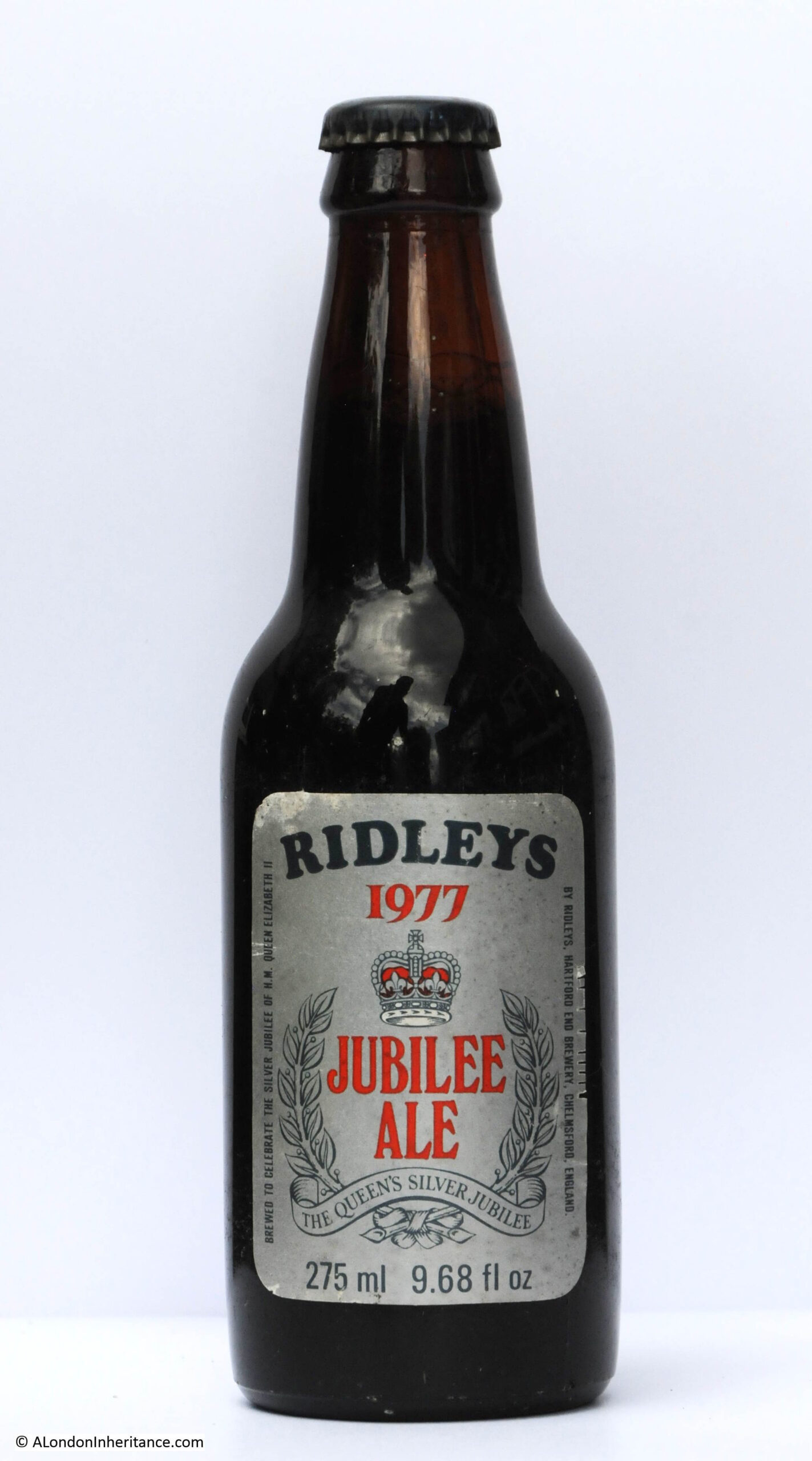
Ridleys – Jubilee Ale

Silver Jubilee beer

Ridleys were brought by Greene King, who then closed their brewery near Chelmsford, Essex, and stopped producing the majority of beers under the Ridleys name. A rather nice silver label for their Jubilee Ale.

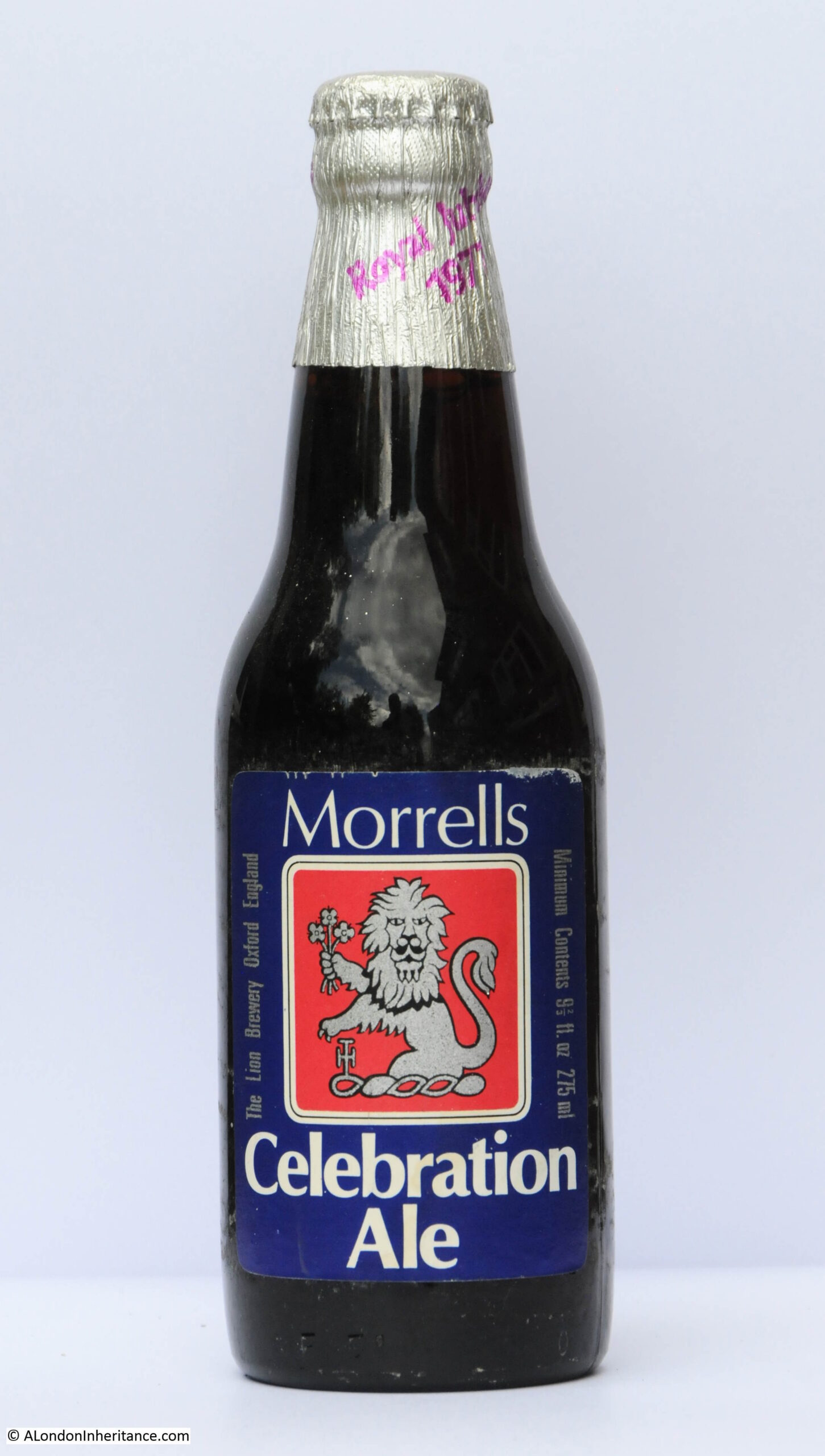
Morells – Celebration Ale

Silver Jubilee beer

The Morells company, along with their Oxford brewery closed in 1998.

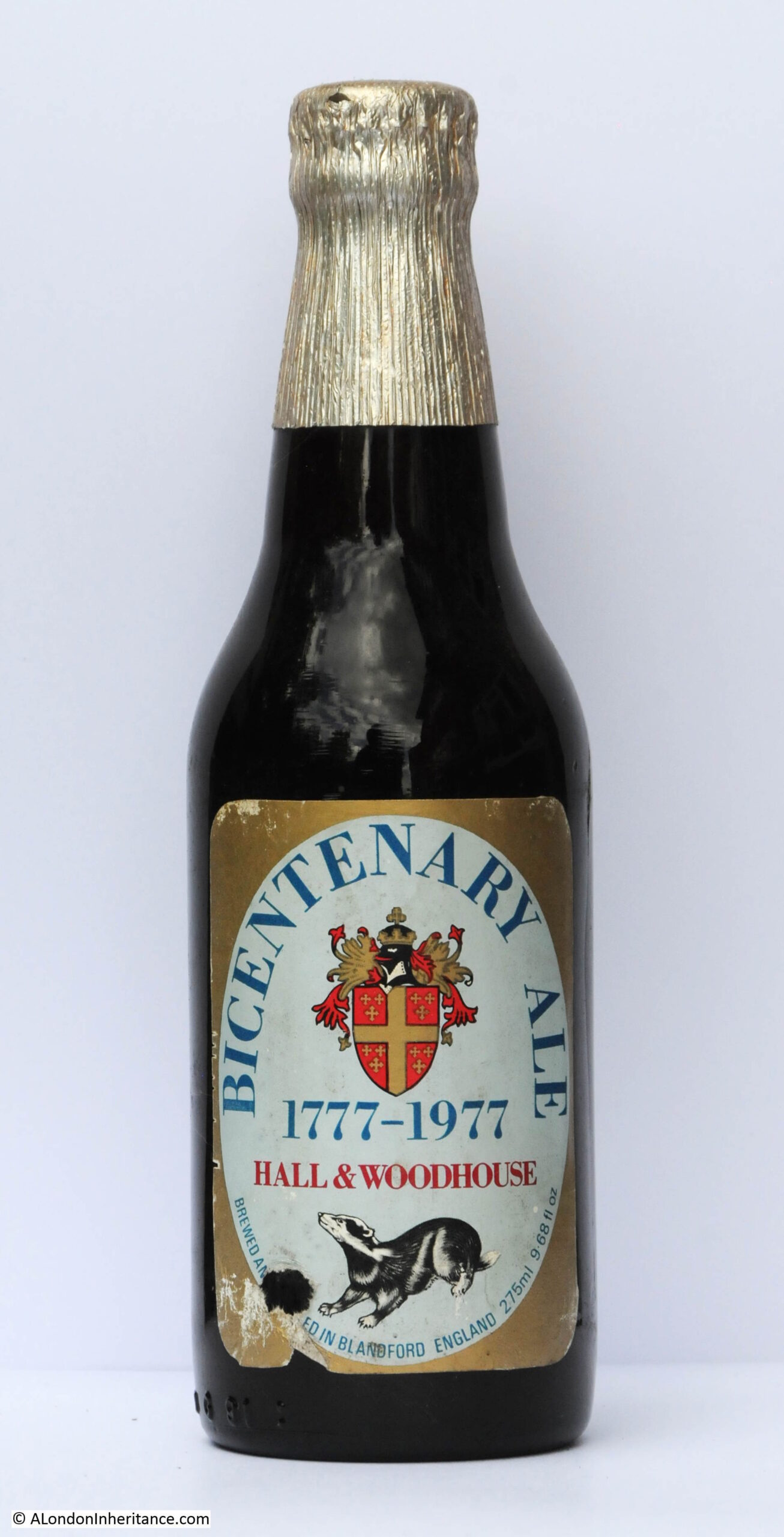
Hall & Woodhouse – Bicentenary Ale

Silver Jubilee beer

Hall & Woodhouse appear to have ignored the 1977 Jubilee, preferring to celebrate their 200 year anniversary.

They are still in business with pubs and the same brewery in Blandford, Dorset, however as with the 1977 Jubilee, they do not appear to have a Jubilee beer for 2022.

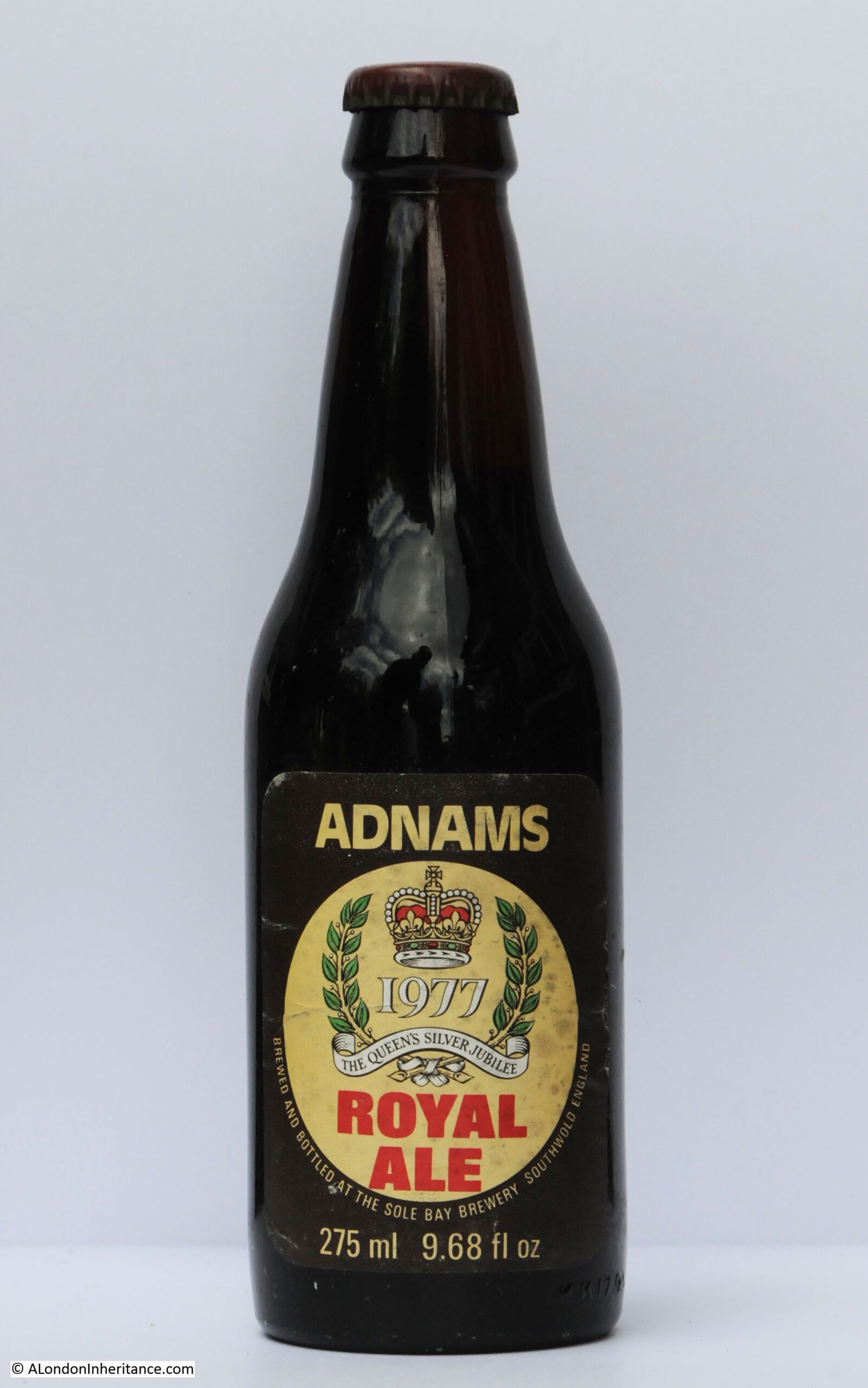
Adnams – Royal Ale

Silver Jubilee beer

Adnams based in Southwold, Suffolk are still in operation, and producing beers from their own brewery. Unfortunately there appears to be no Jubilee Ale for 2022, although Adnams have branched out to produce Gin and Vodka as well as beers.

Royal Wedding Beers – 1981

On the same theme, the Royal Wedding in 1981 between Charles and Diana also resulted in a number of breweries producing special beers to commemorate the event.

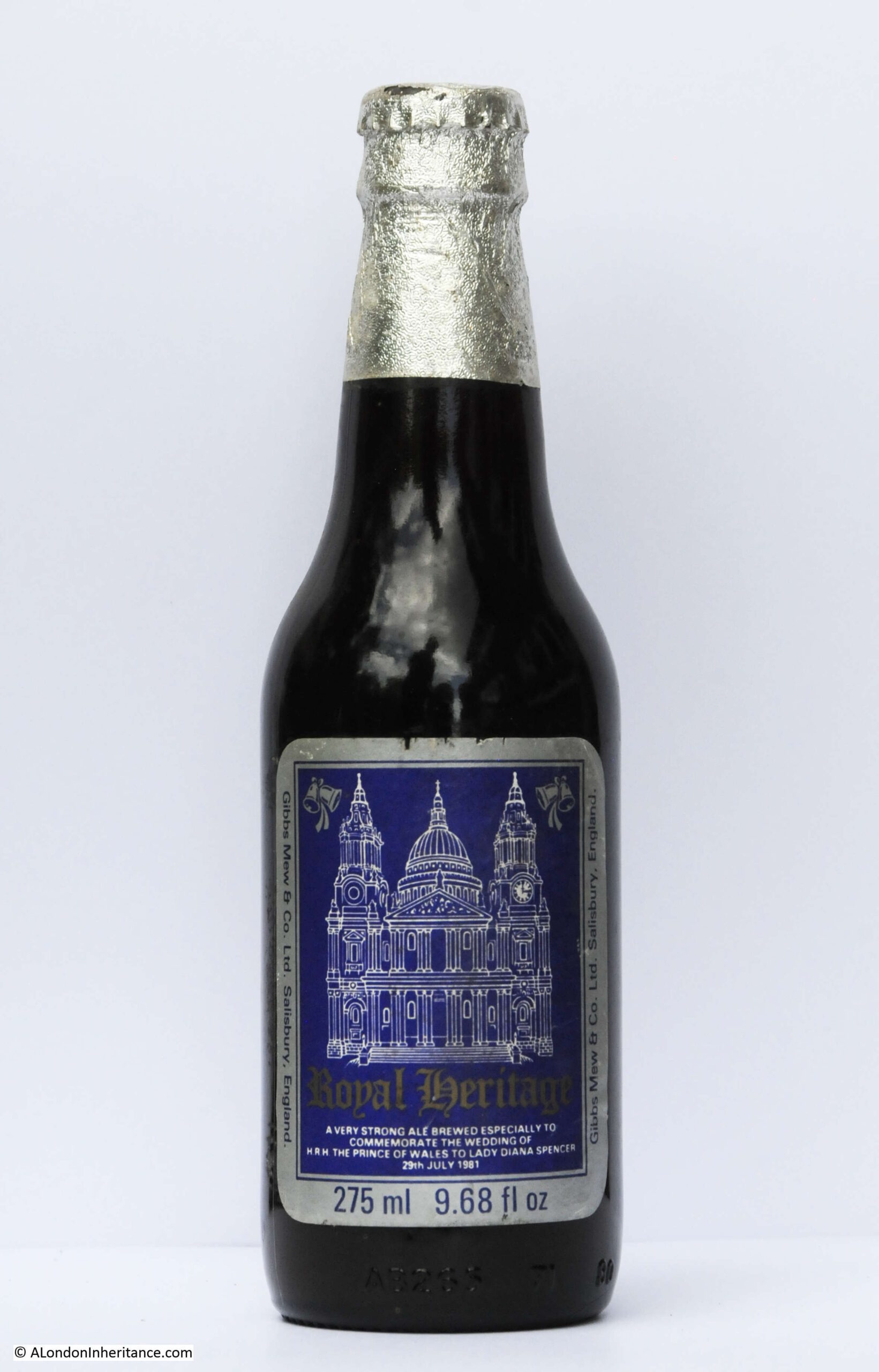
Gibbs Mew & Co – Royal Heritage

Royal Wedding beer

Gibbs Mew & Co of Salisbury brewed a Royal Heritage beer, and their bottle featured St Paul’s Cathedral.

The company closed their Salisbury brewery in 1997 and continued as a pub chain, however the pubs and the company were sold to Enterprise Inns in 2011.

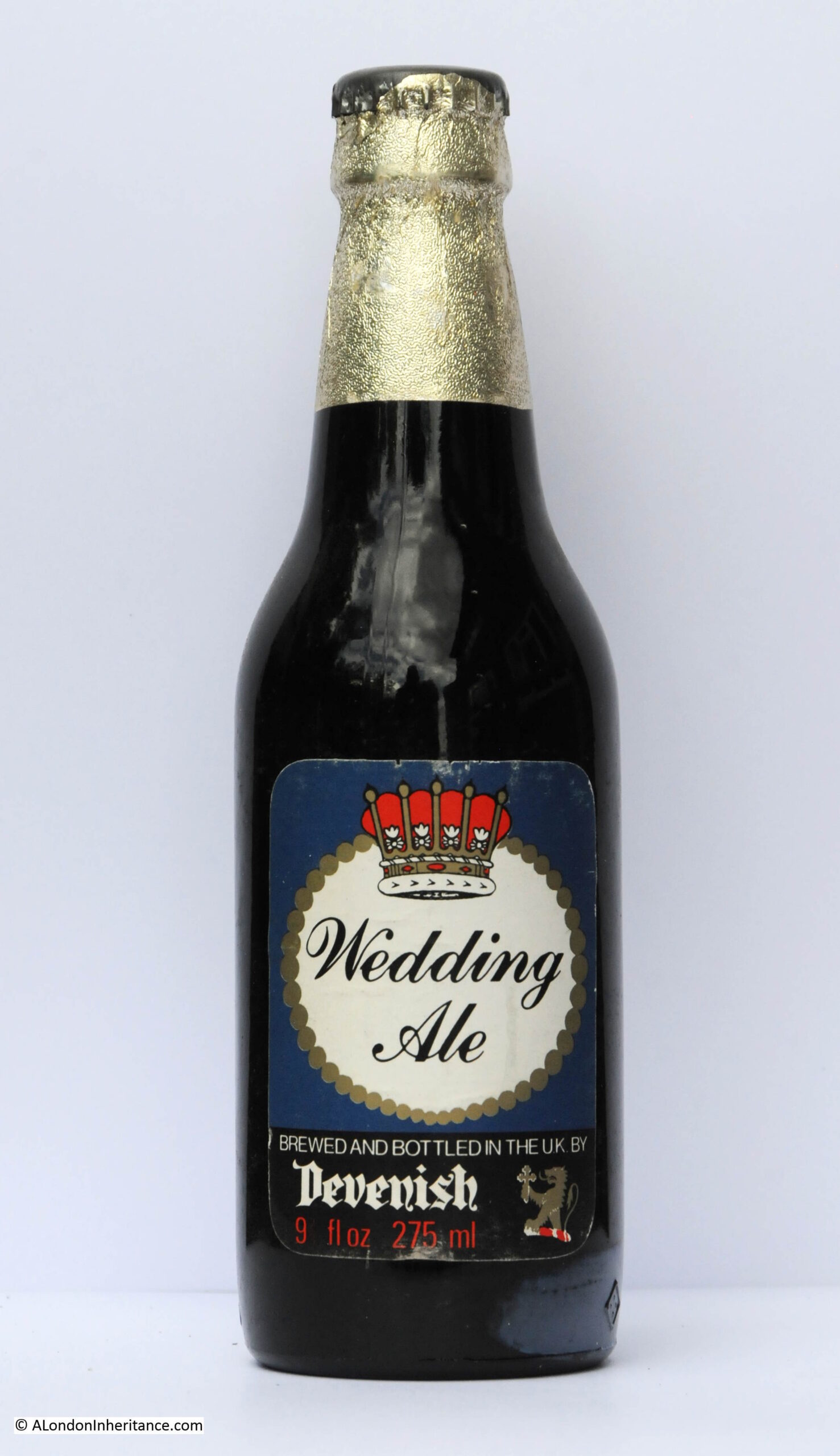
Devenish – Wedding Ale

Royal Wedding beer

Devenish was another Dorset brewery, and followed the same fate as Gibbs Mew.

Devenish closed their brewery in 1985, and continued as a pub operator until 1993 when the company was sold to Greenalls.

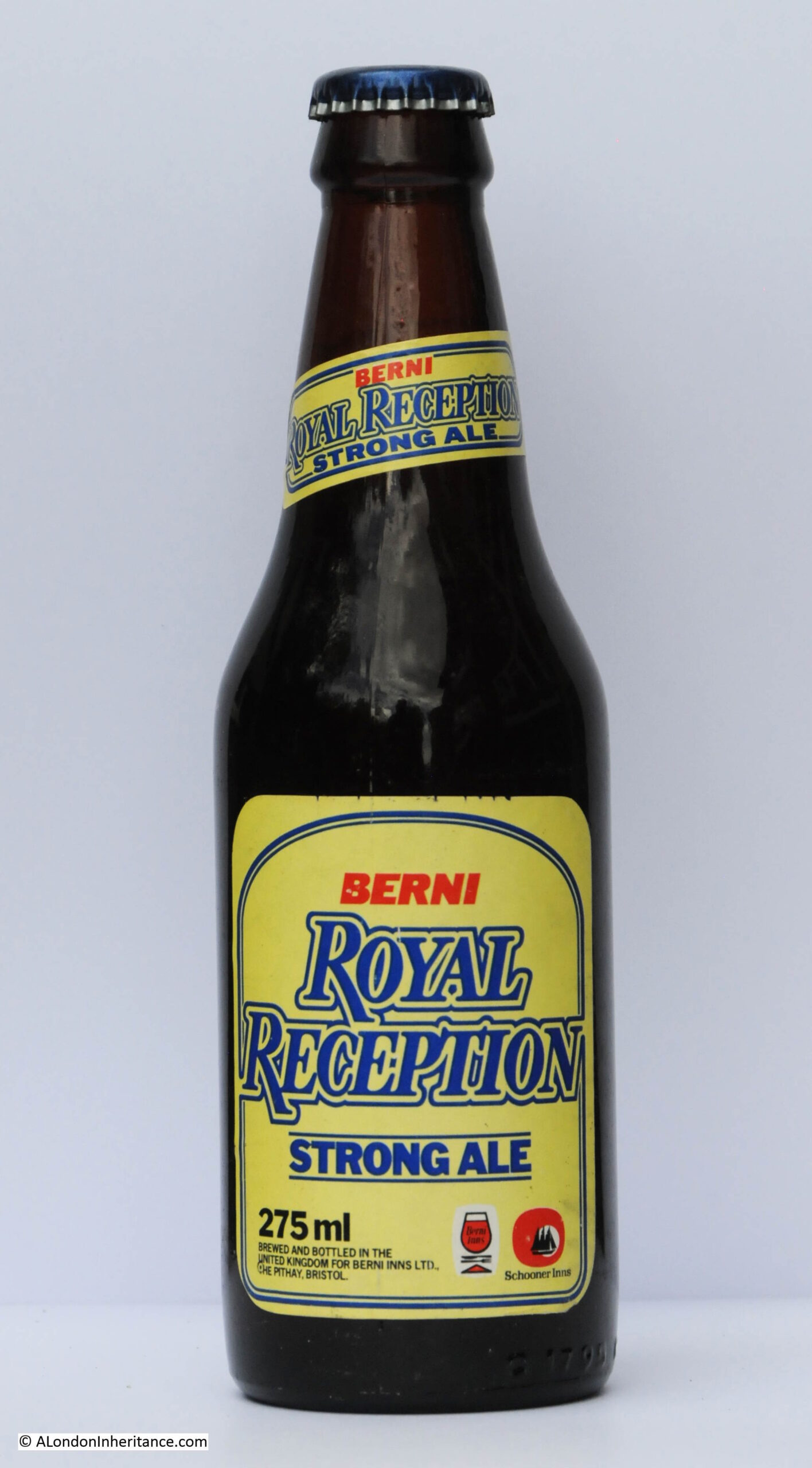
Berni – Royal Reception

Royal Wedding beer

If you fancied a beer in 1981 to go with your Berni Prawn Cocktail, Steak and Chips and Black Forest Gateau, then a bottle of their Royal Reception strong ale could be yours.

Berni was one of the pub / restaurant chains that would bring the experience of going out for a meal in the 1970s to the masses. Relatively cheap, good service and a simple, standard menu helped with the popularity of the chain, and the most brought meal of Prawn Cocktail, Steak and Chips and Black Forest Gateau becoming representative of eating out in the late 1970s.

Berni Inns was sold to Whitbread in 1995 who rebranded the chain to become part of the Beefeater resturants.

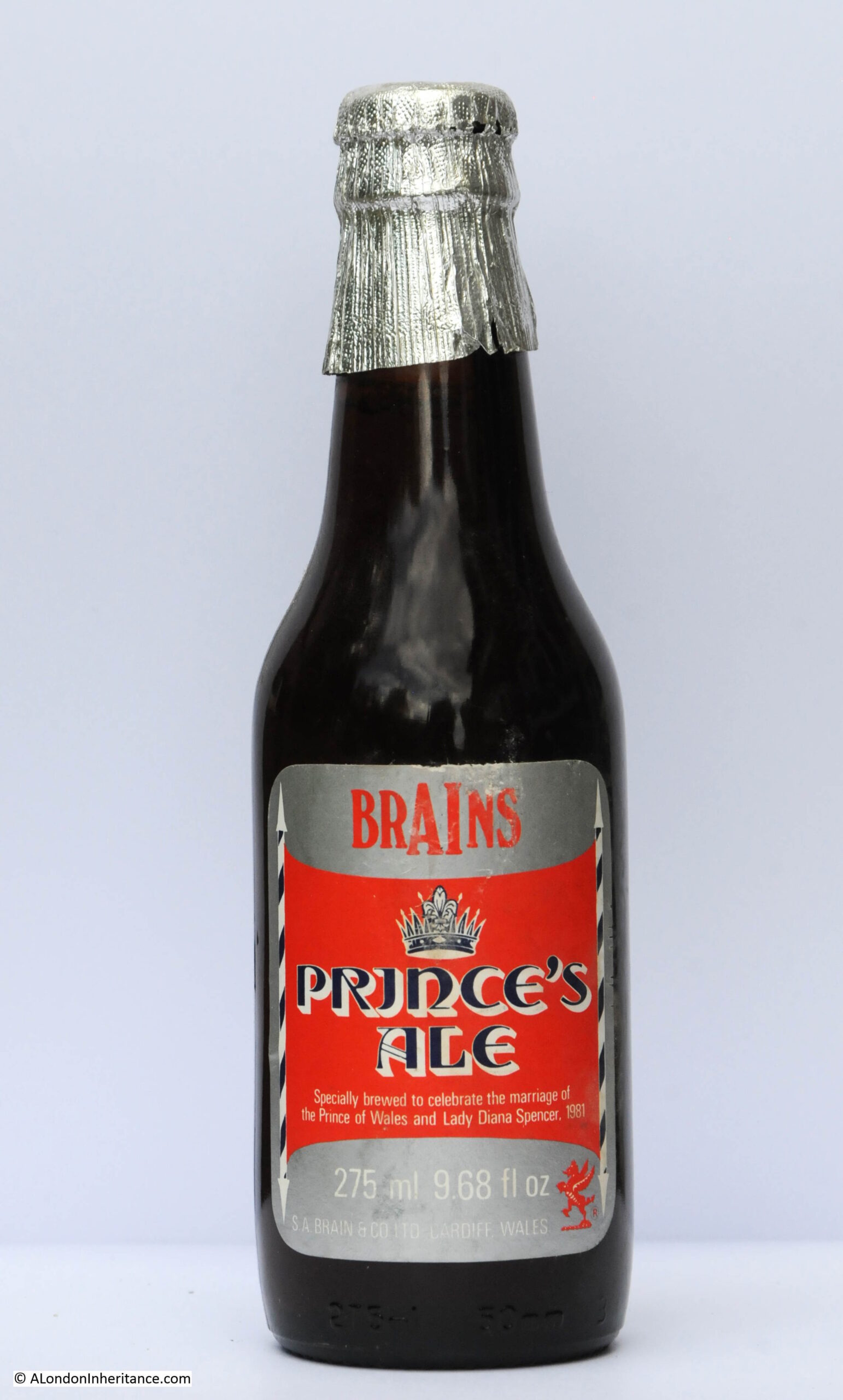
Brains – Prince’s Ale

Royal Wedding beer

Brains offered their Prince’s Ale in 1981. The brewery was based in Cardiff, where they are still brewing, but no special beers for the Jubilee that I can find on their website.

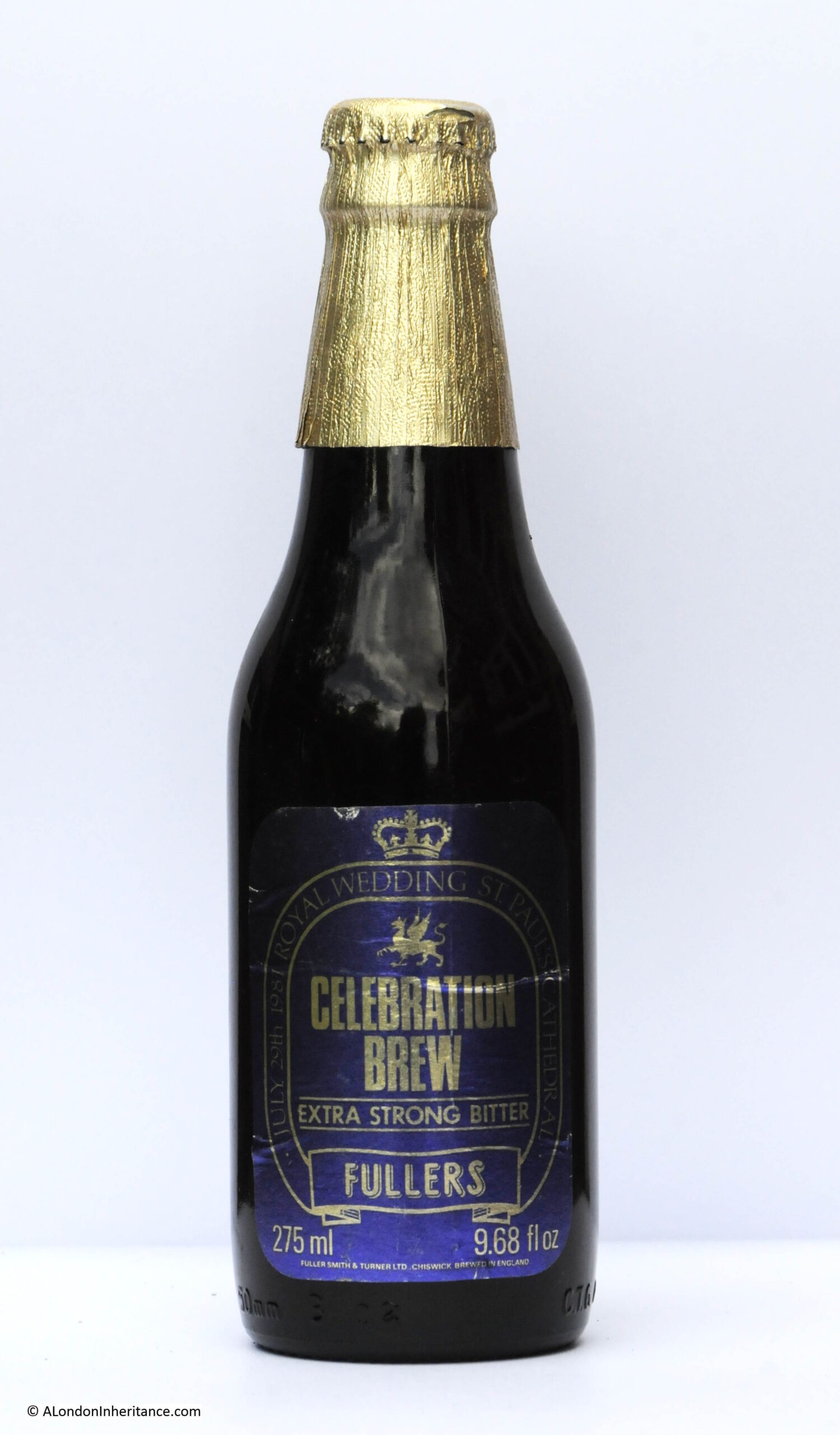
Fullers – Celebration Brew

Royal Wedding beer

Fullers Jubilee beer had a rather simple label, however they went with a more ornate label for their Celebration Brew to mark the 1981 Royal Wedding.

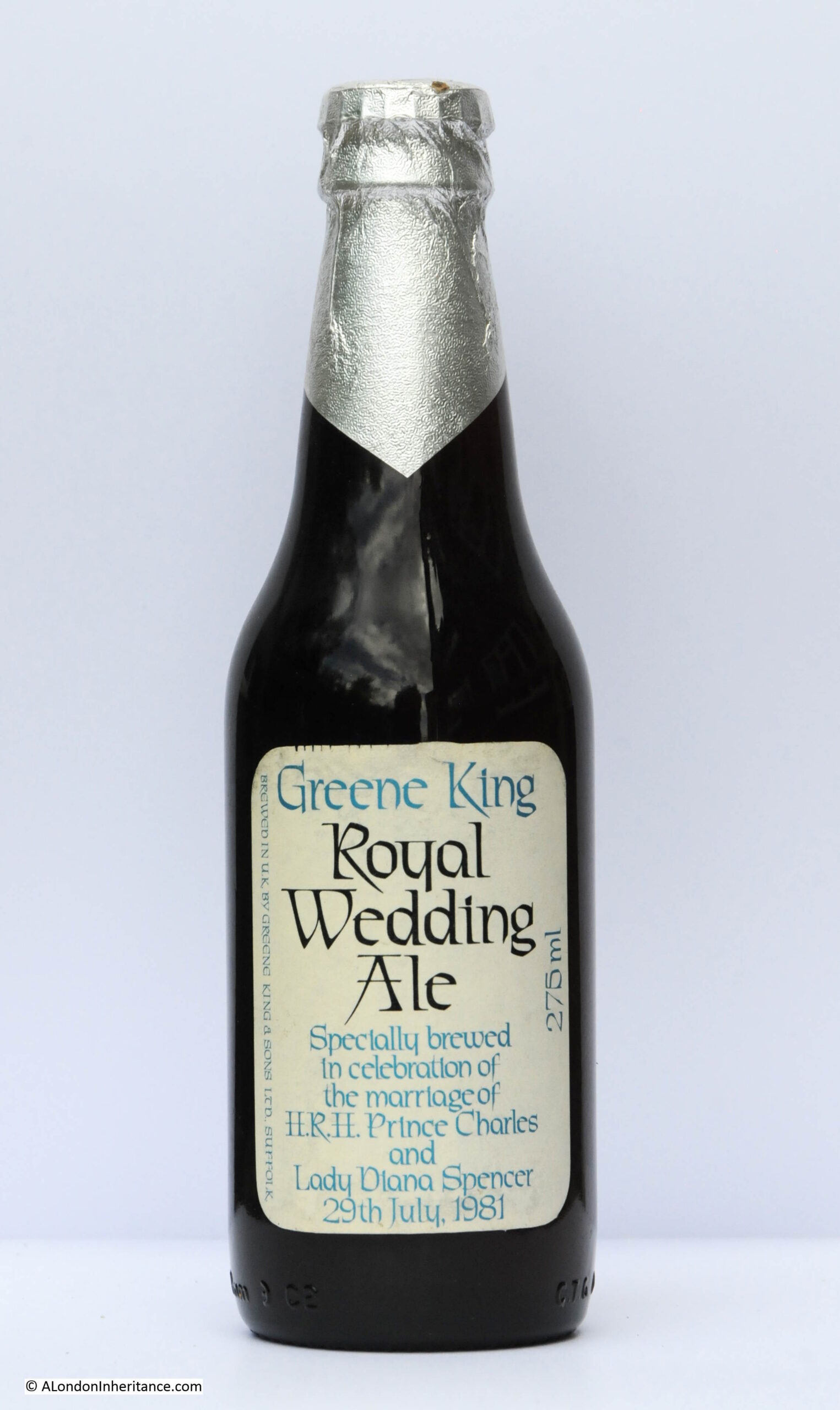
Greene King – Royal Wedding Ale

Royal Wedding beer

Greene King produced their Royal Wedding Ale. The label looks as if it was only designed at the last moment when it would have been too late to produce a more ornate label, so they went with a simple text based label.

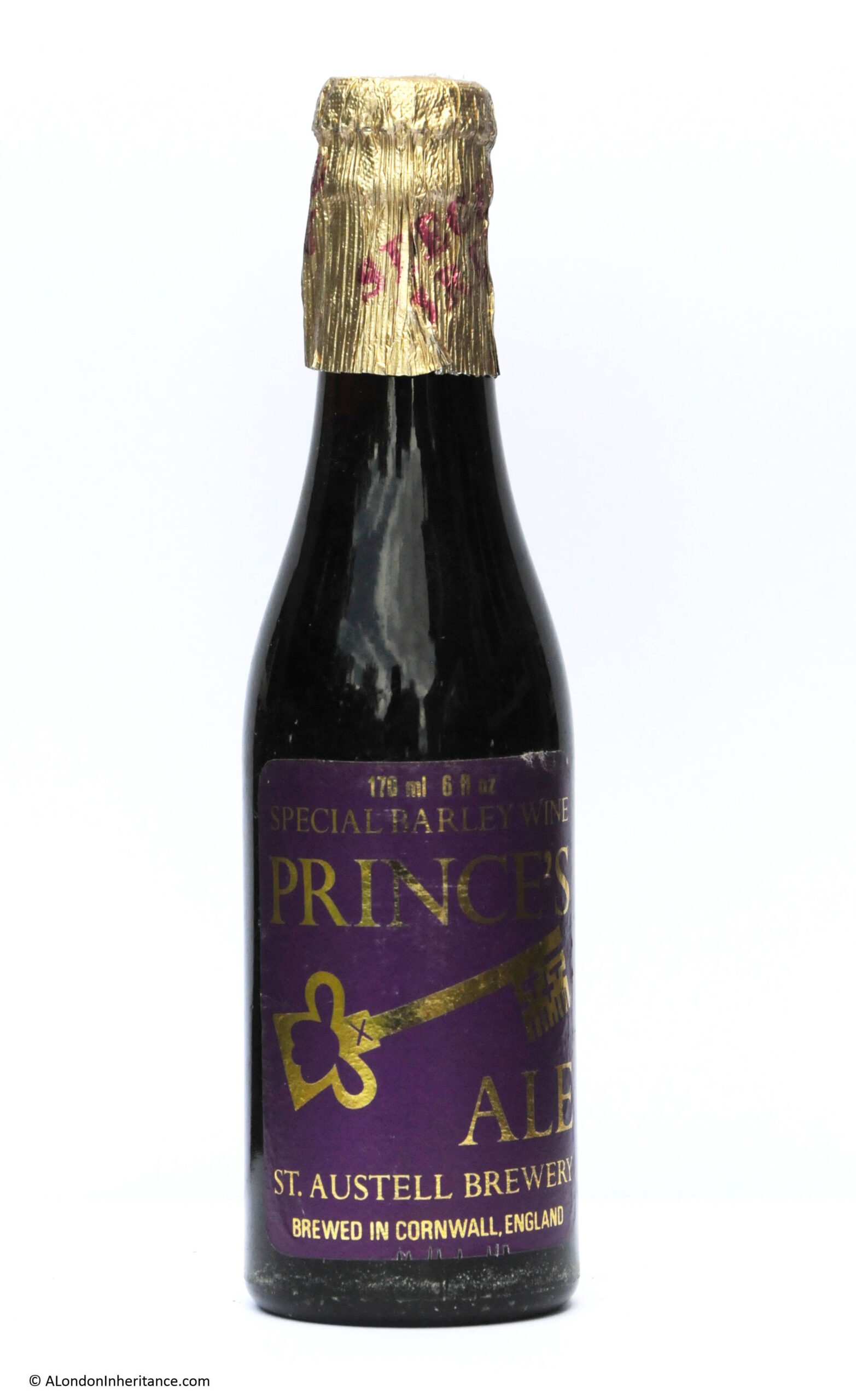
St Austell Brewery – Prince’s Ale

Royal Wedding beer

The St Austell Brewery’s Prince’s Ale was rather unusual in that it was a Barley Wine.

Barley Wine is a type of beer, but is generally much stronger than a normal beer, probably why their bottle was smaller than the typical bottle of the time.

The St Austell Brewery is located in St Austell, Cornwall and the brewery and company are still in operation. They do have a Jubilee Beer called “Thank Brew” which apparently is part of an initiative by breweries, pubs and communities to produce a special beer for the Jubilee, and they are selling a bottled Platinum Jubilee Ale, which has a rather nice label.

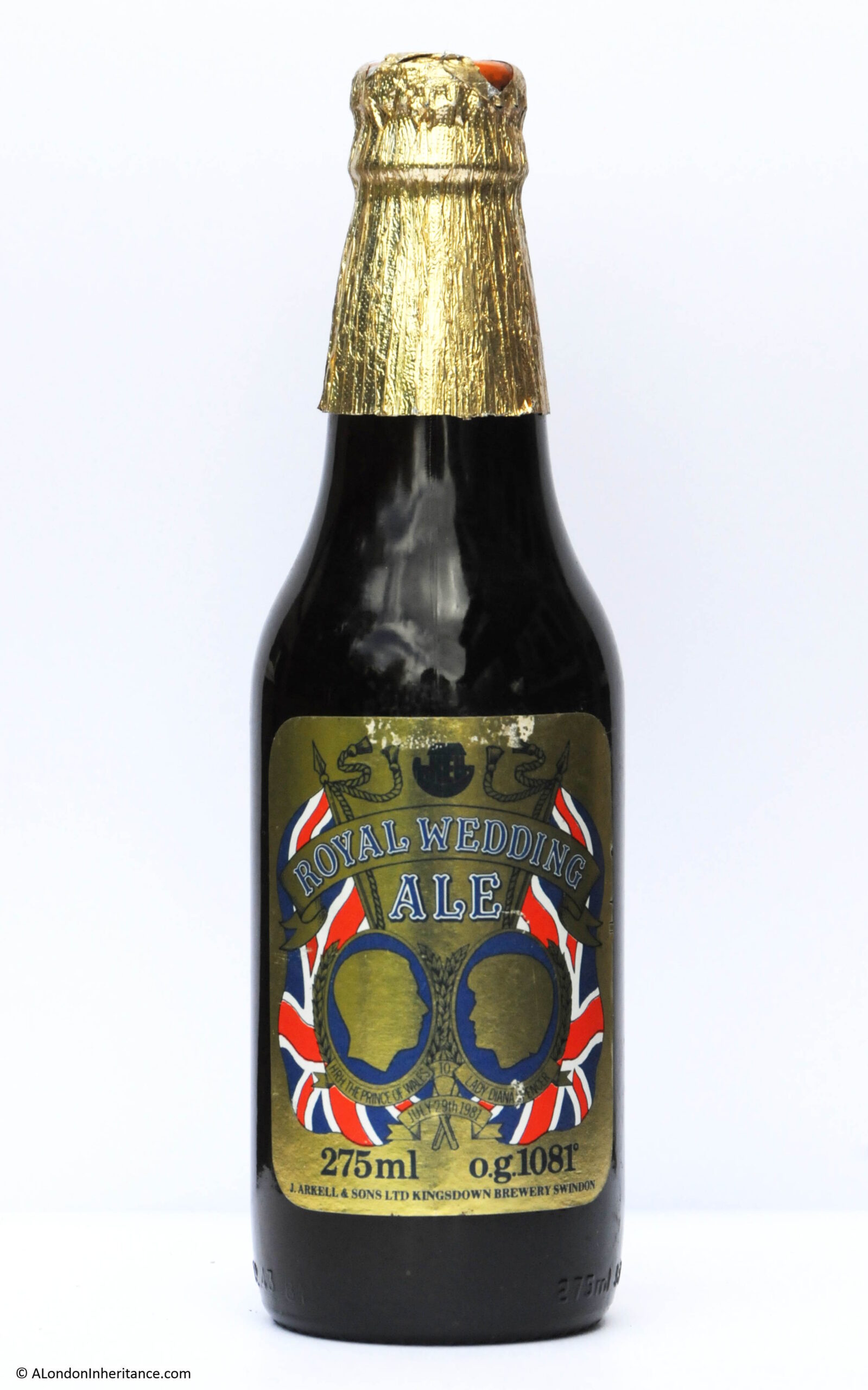
J. Arkell and Sons – Royal Wedding Ale

Royal Wedding beer

Arkell’s had a rather impressive, gold label to their Royal Wedding Ale.

The company, based in Swindon is still brewing beer, but does not appear to be brewing a Jubilee beer.

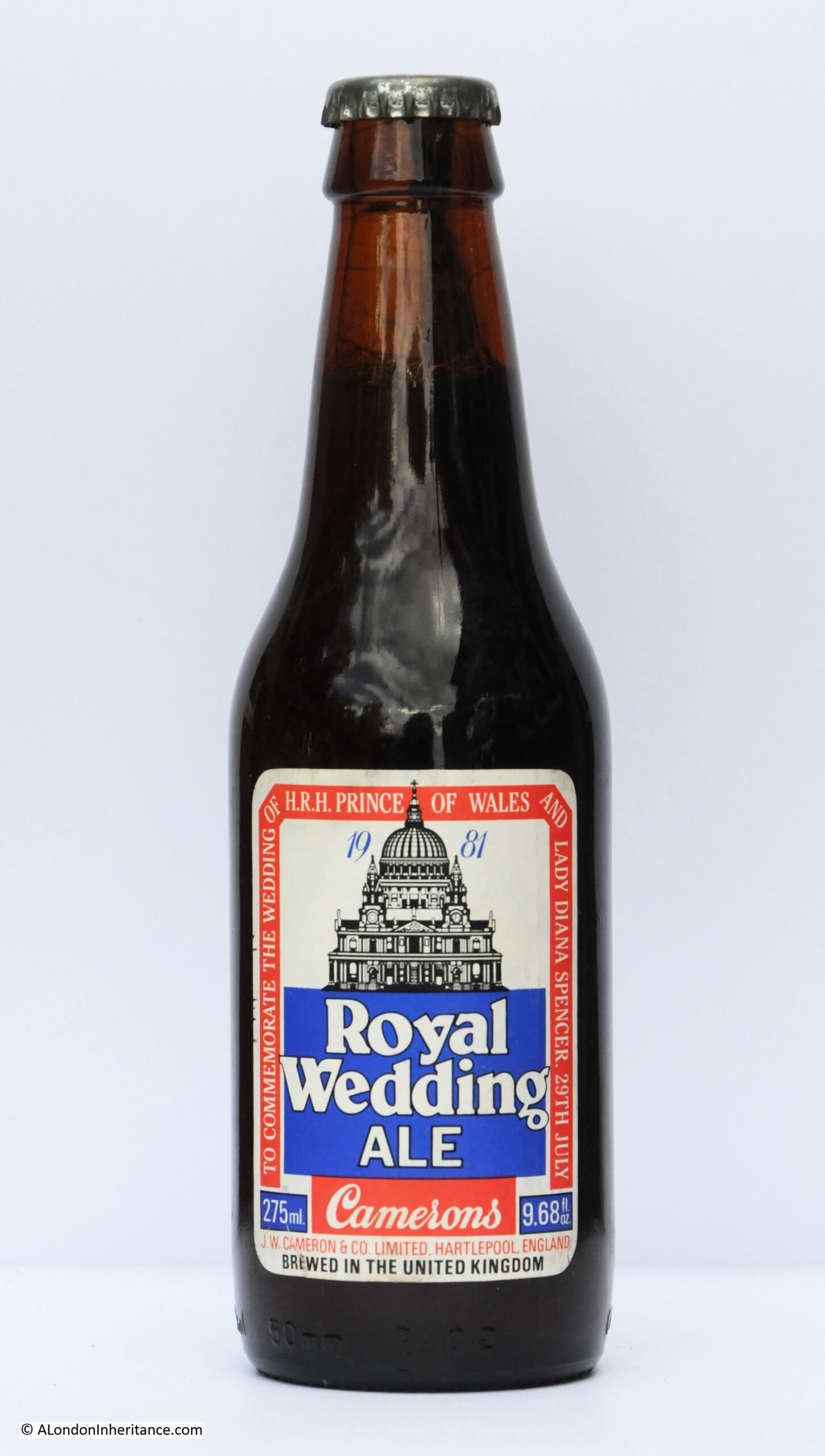
Camerons – Royal Wedding Ale

Royal Wedding beer

Camerons featured a drawing of St Paul’s Cathedral on the label of their Royal Wedding Ale.

Camerons are still brewing in Hartlepool, Teeside, and whilst they do not appear to have a Jubilee beer, they have teamed up with the band Motorhead and have a Road Crew beer available both in draft and bottles.

Based on that small survey it seems that there are a very small number of beers brewed for the 2022 Jubilee, and I have not seen any on recent pub visits.

Probably brewers have to be more commercially focused these days, and the costs of producing a one off product outweigh the potential benefits.

What I did notice when revisiting all these bottles was that the labels do not show the alcohol content / ABV. If you were drinking a bottle of Berni’s Royal Reception Strong Ale, then you had no idea what strong actually meant.

The excellent Boak & Bailey site has researched the introduction of this labelling and found that it was a result of the UK implementing an EEC (European Economic Community) directive, and that labeling beers with the alcohol content became law on the 17th July, 1989.

All these 1977 Jubilee beers and 1981 Royal Wedding beers are unopened, although I very much doubt their contents are drinkable. and probably very unwise to try.

They will now be returned to a very dusty corner of the garage.

Whatever you are drinking (or not), I hope you are having a very good Jubilee four days.

alondoninheritance.com

Christchurch Greyfriars

Before heading to Christchurch Greyfriars, if you are interested in a walk exploring the history of Bankside, I have had one ticket returned from someone who cannot now attend the walk on Sunday 5th of June, and a couple of tickets are available for the walks later in July. The walk can be booked here.

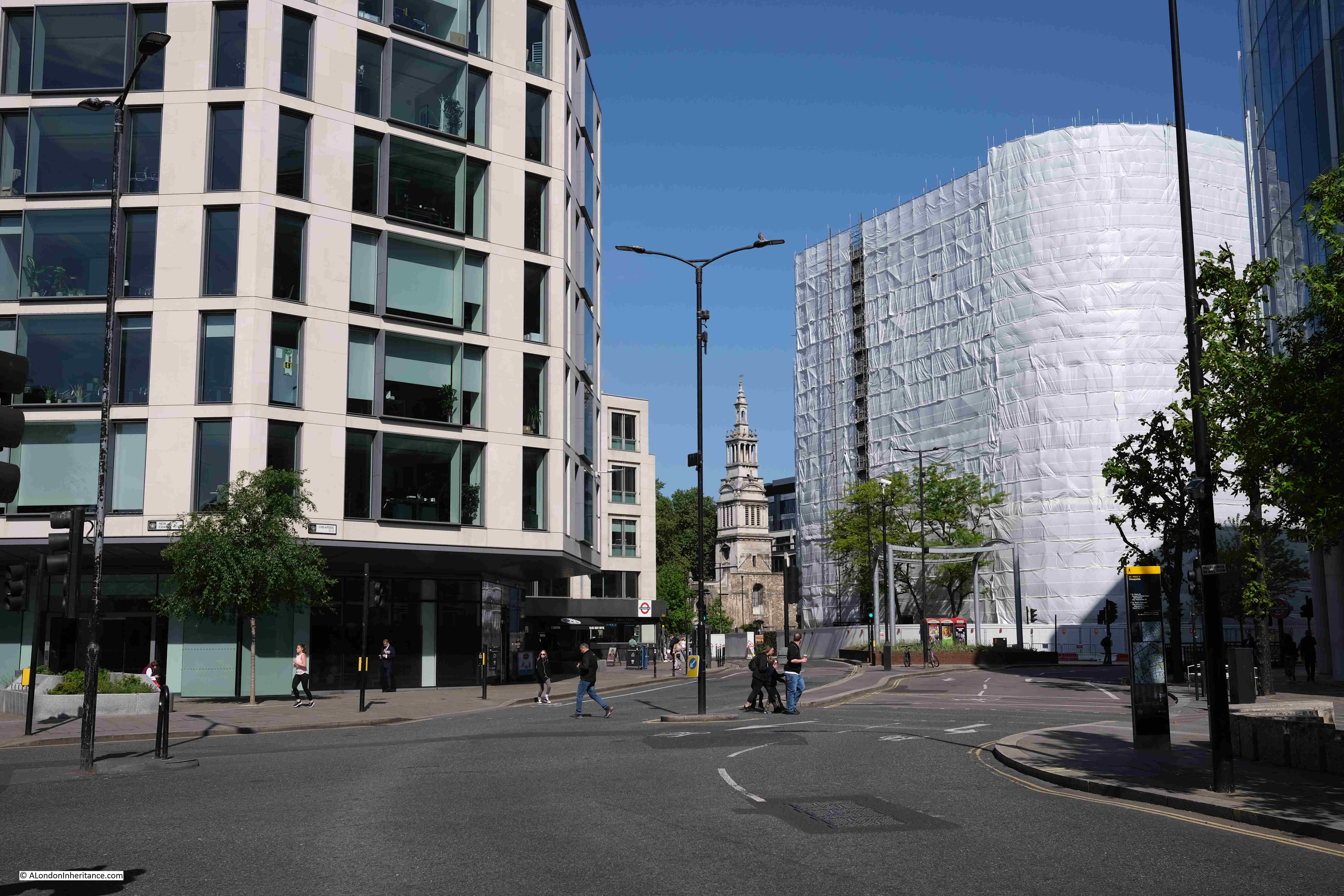
I took the following photo in 1973, taken from Cheapside, looking towards the church of Christchurch Greyfriars using my very first camera, a simple Kodak Instamatic:

Christchurch Greyfriars

Not a very good photo, the Kodak Instamatic was a very simple camera. All the film was contained within a large cartridge, which included the exposed film. Pre-set focus and the only setting for exposure and speed were a single switch which could be moved either to sunny or cloudy. A very child friendly camera.

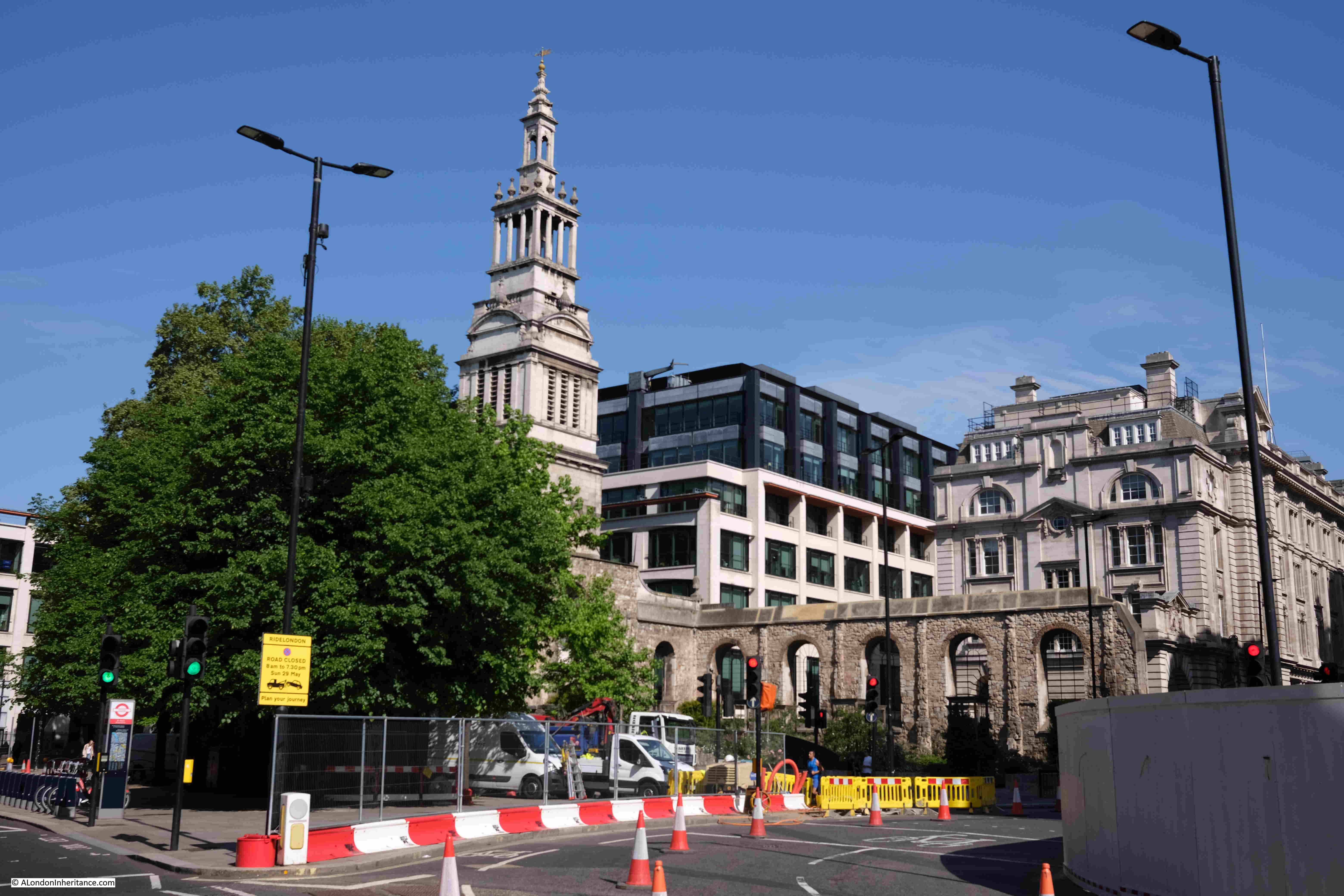
Roughly the same view, around 50 years later, in 2022:

Christchurch Greyfriars

Christchurch Greyfriars is an interesting, and distinctive church. A very different history to many other City churches.

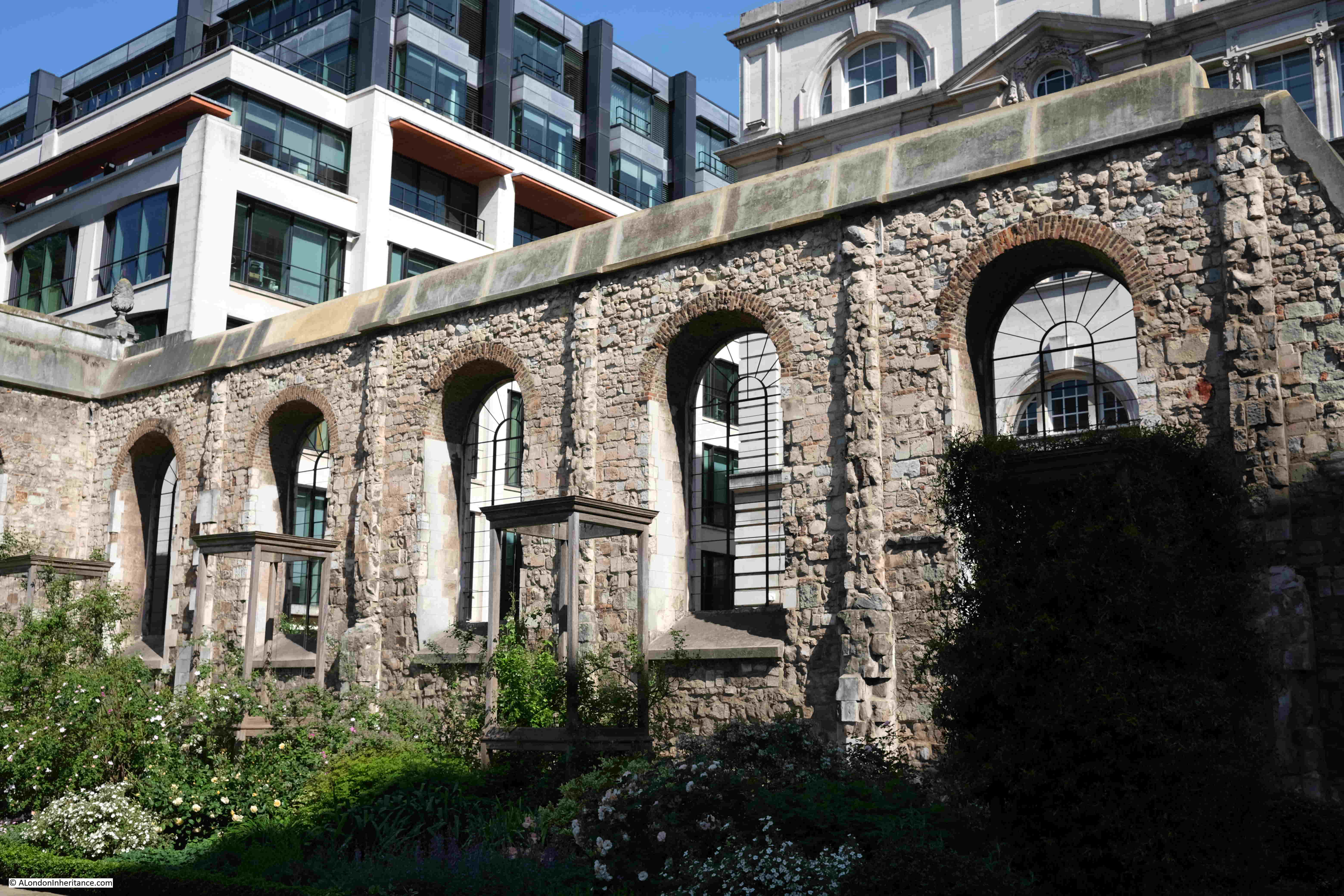
It is distinctive, as whilst the tower of the church is intact, the body of the church is now a garden, with only one main side wall standing, and a short stub of the other sidewall. The rear wall is completely missing.

Christchurch Greyfriars

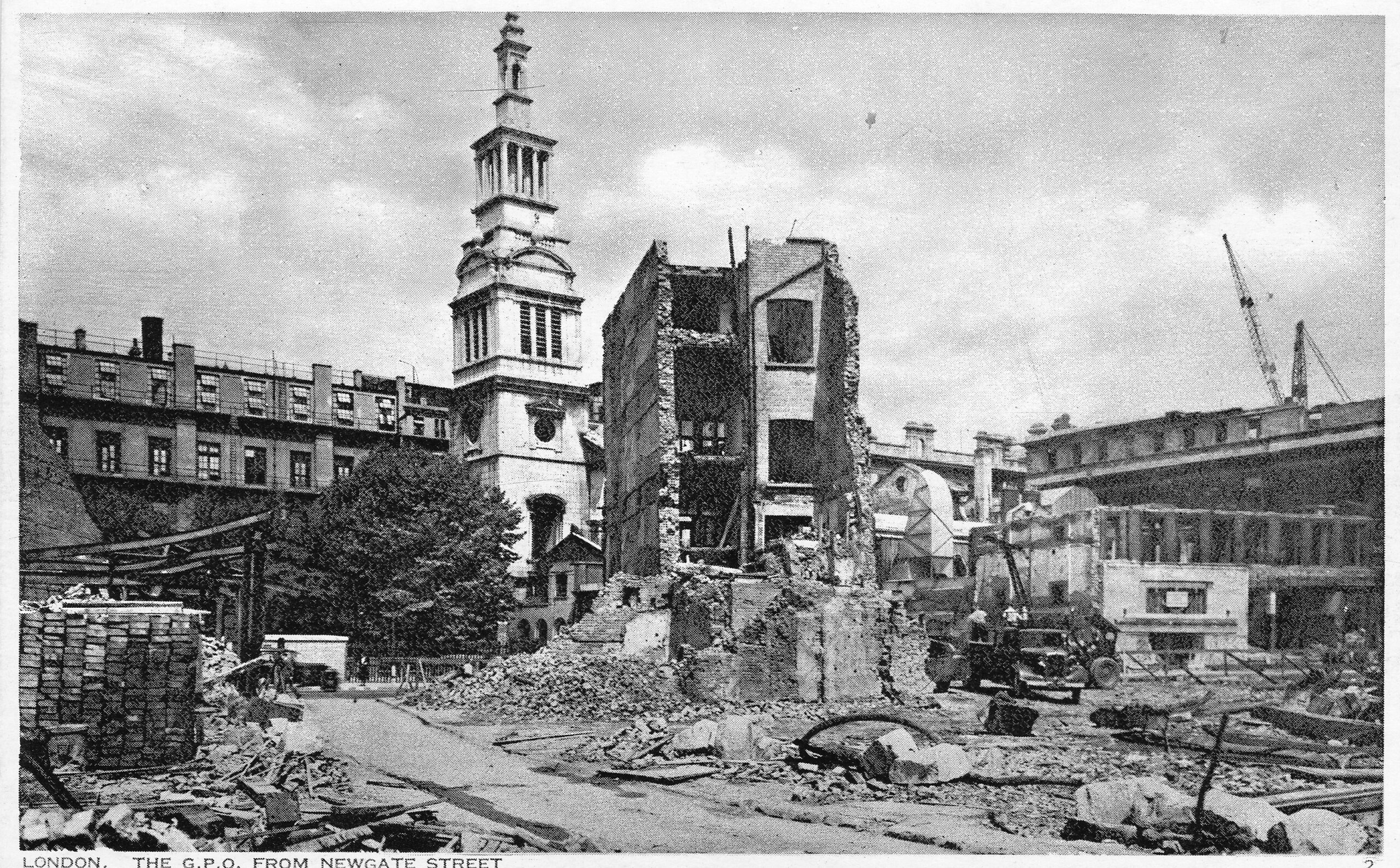
The church was destroyed during the night of the 29th December 1940, when much of the area surrounding, and to the north and south of St Paul’s Cathedral, was engulfed by the fires started by incendiary bombs. This was the raid that destroyed the area that would later be rebuilt as the Golden Lane and Barbican estates.

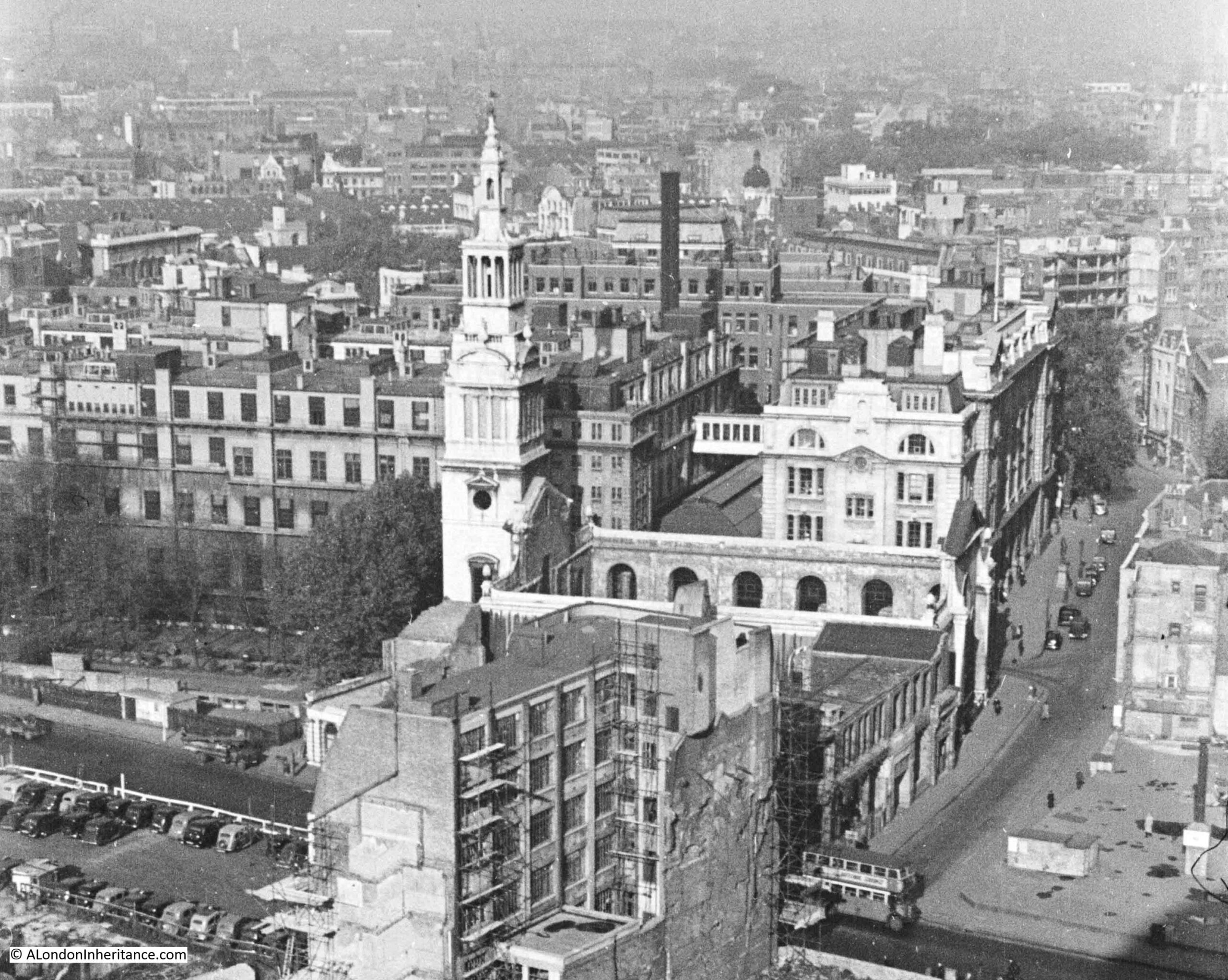
Christchurch Greyfriars was in one of my father’s photos taken from St Paul’s Cathedral just after the war, and can be seen in the following extract from one of the photos (the full series can be seen in this post, and this post):

Christchurch Greyfriars

As can be seen in the above photo, the church still retained its four walls. The church was destroyed by fire which burnt the contents of the church along with the roof, but left the walls standing.

In my 2022 photo you can count 5 windows in the remaining side wall. In the above photo, there are 6 windows (part of the 6th window on the right can just be seen to the left of the end wall of the church). There is also a two storey building which runs south from the end wall of the church.

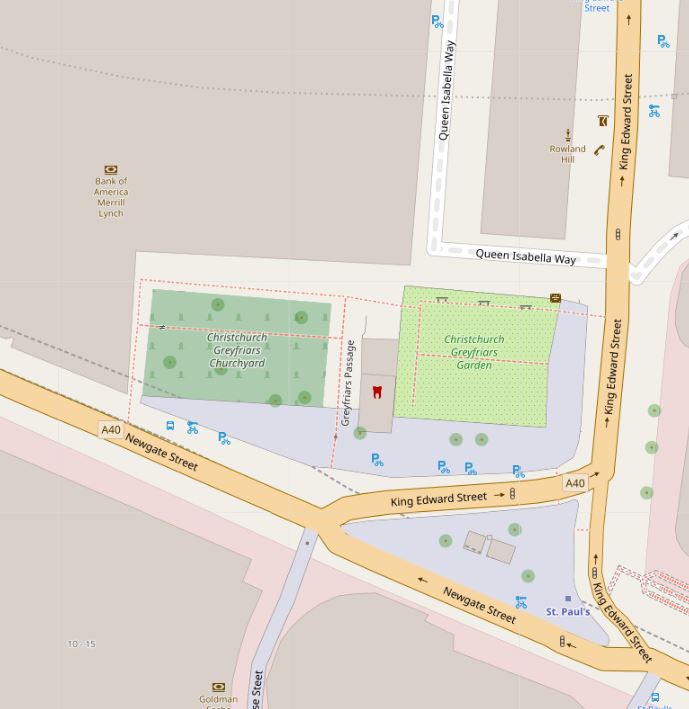
The reason for these differences, and for the loss of the rear and southern side wall were changes in 1973 to allow the widening of King Edward Street, and the construction of a spur from Newgate Street into King Edward Street.

Christchurch Greyfriars was Grade I listed in 1950, however this protection appears to have been insufficient to prevent the demolition of much of the surviving walls.

In the following map, Newgate Street runs from left to right, and the spur of King Edward Street can be seen cutting across where the two storey building was located. This, along with widening of King Edward Street, and the footpath along the street, resulted in the demolition of the end wall and shortening by one window of the north wall  (© OpenStreetMap contributors).

Christchurch Greyfriars

The church was included in the series of postcards “London under Fire”, issued during the war:

London Under Fire

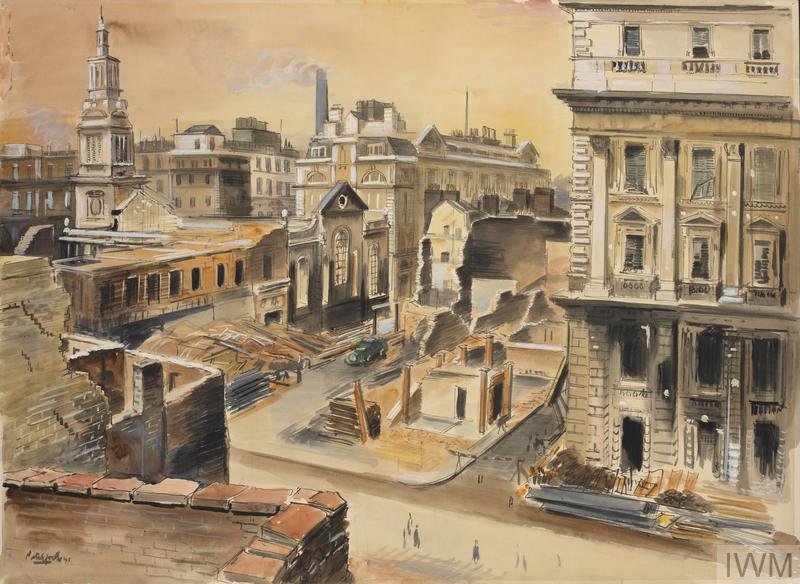
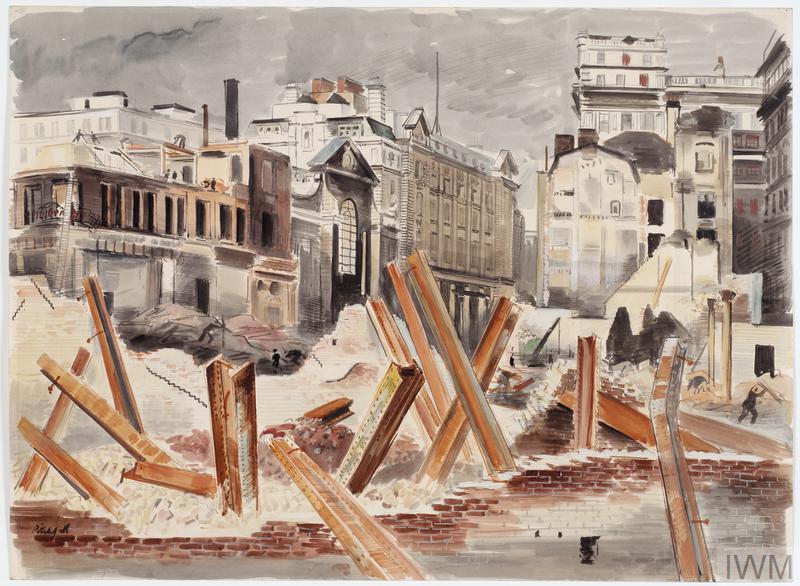
The church was also included in a couple of works by the artist Roland Vivian Pitchforth for the War Artists Advisory Committee. Both show the burnt out church with the surviving tower and walls:

War Artists Advisory Committee
Post Office Buildings : the Telephone Exchange (Art.IWM ART LD 938) image: a view looking down on a cleared bomb site in between other burnt-out buildings in the City. Copyright: © IWM. Original Source: http://www.iwm.org.uk/collections/item/object/21822

And both show the two storey building to the south of the church where the slip road from Newgate Street to King Edward Street now runs:

War Artists Advisory Committee
Post Office Buildings (Art.IWM ART LD 939) image: a bomb site in the foreground with steel girders sticking up out of the rubble. In the background buildings remain standing, however men can be seen at work securing the building on the right. Copyright: © IWM. Original Source: http://www.iwm.org.uk/collections/item/object/21823

Note that in the Imperial War Museum commentary for the above two prints, the focus in on the Post Office Buildings, one of which was the large building to the right of the church.

The Post Office, or British Telecom has had a long association with King Edward / Newgate Street, but has now moved away. In my 2022 photo there is a large building covered in white sheeting. This was the 1980s head office of British Telecom. It is now being converted into a mixed use development, and is unusual in the City in that the new building will retain the structural framework of the original rather than the usual full scale demolition and complete rebuild.

What has no doubt helped this approach is the height limitation around St Paul’s Cathedral so the usual high glass and steel tower was not an option.

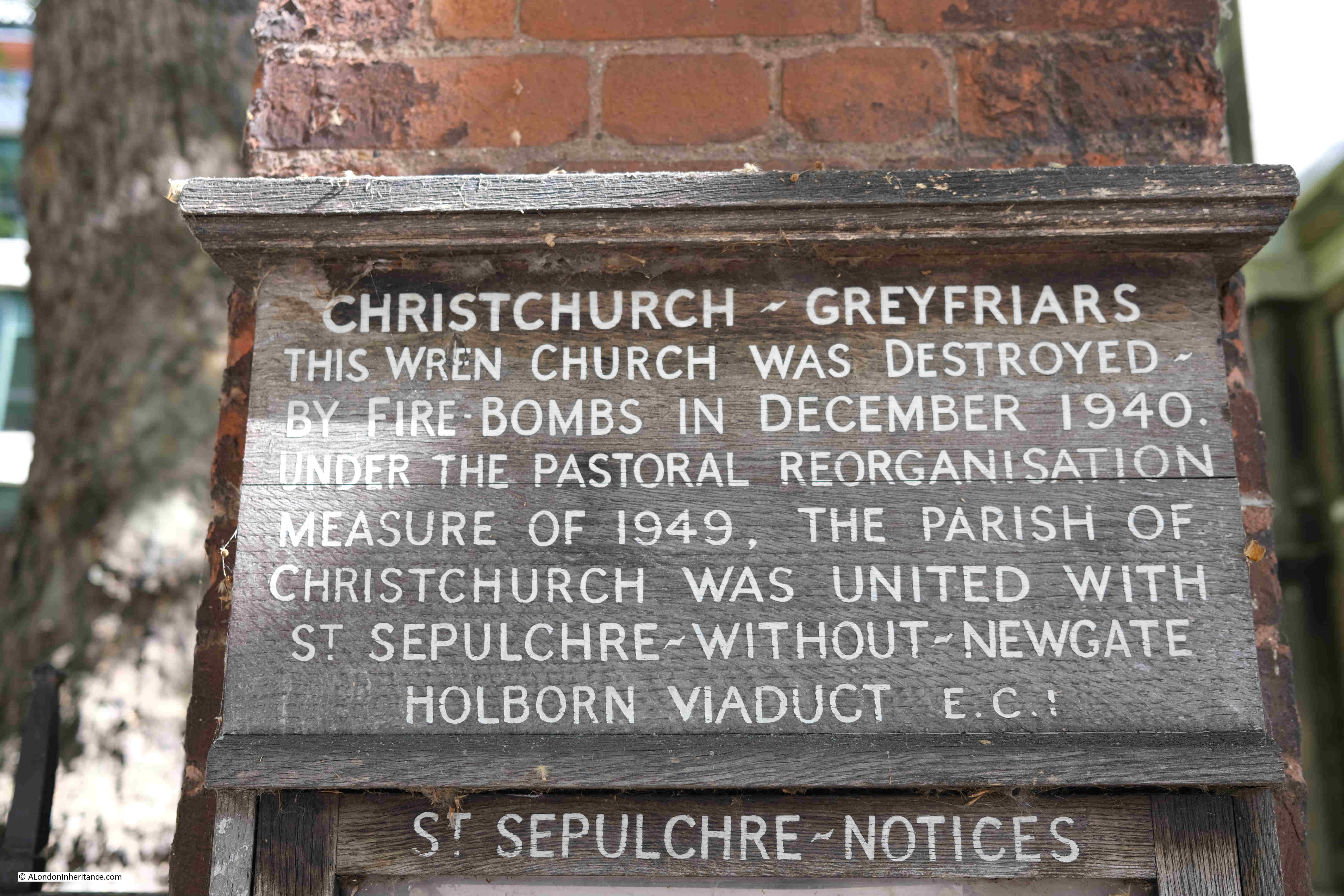
A sign close to the tower of the church confirms when and how Christchurch Greyfriars was destroyed (perhaps there should be a second plaque explaining how and why some of the walls disappeared).

Christchurch Greyfriars

The plaque also informs why there was no requirement to rebuild the church, as the old parish of the church was united with that of St Sepulchre-without-Newgate. The number of people living in the City had reached a point where there was an insufficient number of parishioners and regular church attendees to justify many of the old City churches.

A wooden font cover was rescued from the burning church on the 29th December 1940, and it can now be seen in the church of St Sepulchre.

To the west of the church is a small open space – the Christchurch Greyfriars churchyard:

Christchurch Greyfriars

This is not the traditional churchyard. William Morgan’s 1682 map of London provides a clue:

Christchurch Greyfriars

The church can be seen to the right of centre (although it is facing the wrong way), and to the left of the picture of the church, there is a rectangle labelled “Old Church”.

The original church was the church of a monastery established around 1228 on land to the north of the church by the Franciscan’s, or Greyfriars.

The first church on the site was built in the 13th century, demolished in 1306, and a new church built in 1325. This church was much larger than the church we see today, and as well as the space occupied by the current church ruins, also occupied the green space to the west of the church, hence the comment “Old Church” in the map extract.

The church attached to the monastery was of some size. According to “London Churches Before The Great Fire” (Wilberforce Jenkinson, 1917), the church was described as being “300 feet in length, in breadth 89 feet, and in height 64 feet”.

The book also states that “no other parish church contained the remains of so many of the great, there being there buried four queens, four duchesses, four countesses, one duke, two earls, eight barons, thirty-five knights, etc”.

The queens I can identify are:

  • Queen Margaret, the second wife of King Edward I
  • Queen Isabella, the wife of Edward II
  • Queen Eleanor of Provence (just her heart so not sure if this really counts)

Cannot find who the fourth queen was, some sources reference Queen Joan of Scotland, however most sources state that she was buried in Perth.

Whether it was two and a bit queens, three or four, the church appears to have been a large and important church, as was the Franciscan monastery, with only St Paul’s Cathedral being greater in size.

The monastery was taken by the Crown during the Dissolution when Henry VIII took the properties of religious establishments across the country in the mid 16th century, and after a short period when the building was used for storage, the church became a local, although rather impressive, parish church.

“London Churches Before The Great Fire” records that Sir Martin Bowes, mayor of the City, sold all the ornate alabaster and marble monuments from the church for £50 in 1545.

Ornate memorials did continue after the church became a parish church, and the same book also records a memorial to Venetia, the wife of Sir Kenelm Digby who was buried in the church:

“Her husband tried to preserve her beauty by cosmetics and after her death had her bust of copper-gilt set up in the church. The bust was injured in the fire and was afterwards seen in a broker’s stall. She was painted by Vandyke.”

Bit of a lesson there on fame and beauty, that no matter how good looking, or famous, eventually we may all end up on the equivalent of a broker’s stall.

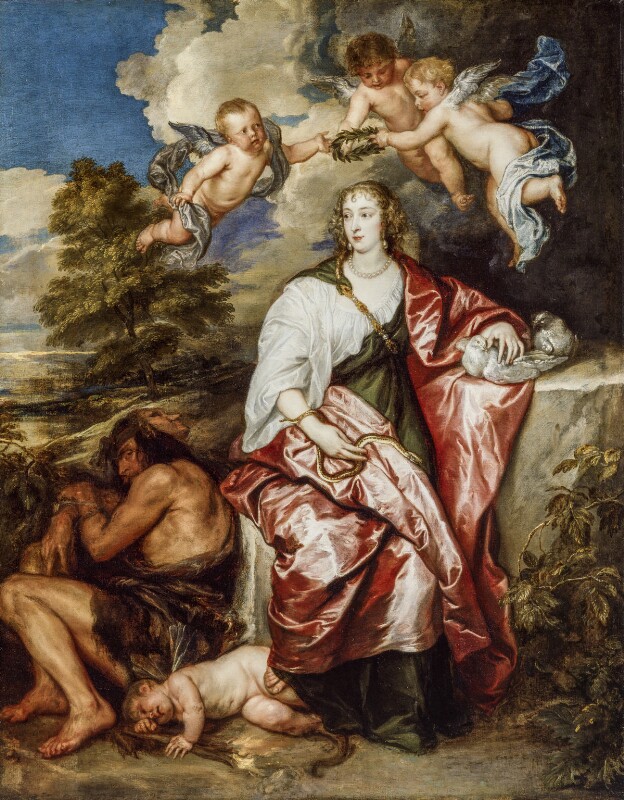
van Dyke’s portrait of Venetia, Lady Digby:

Venetia, Lady Digby
Venetia, Lady Digby
by Sir Anthony van Dyck
oil on canvas, circa 1633-1634
NPG 5727
© National Portrait Gallery, London. Creative Commons Reproduction

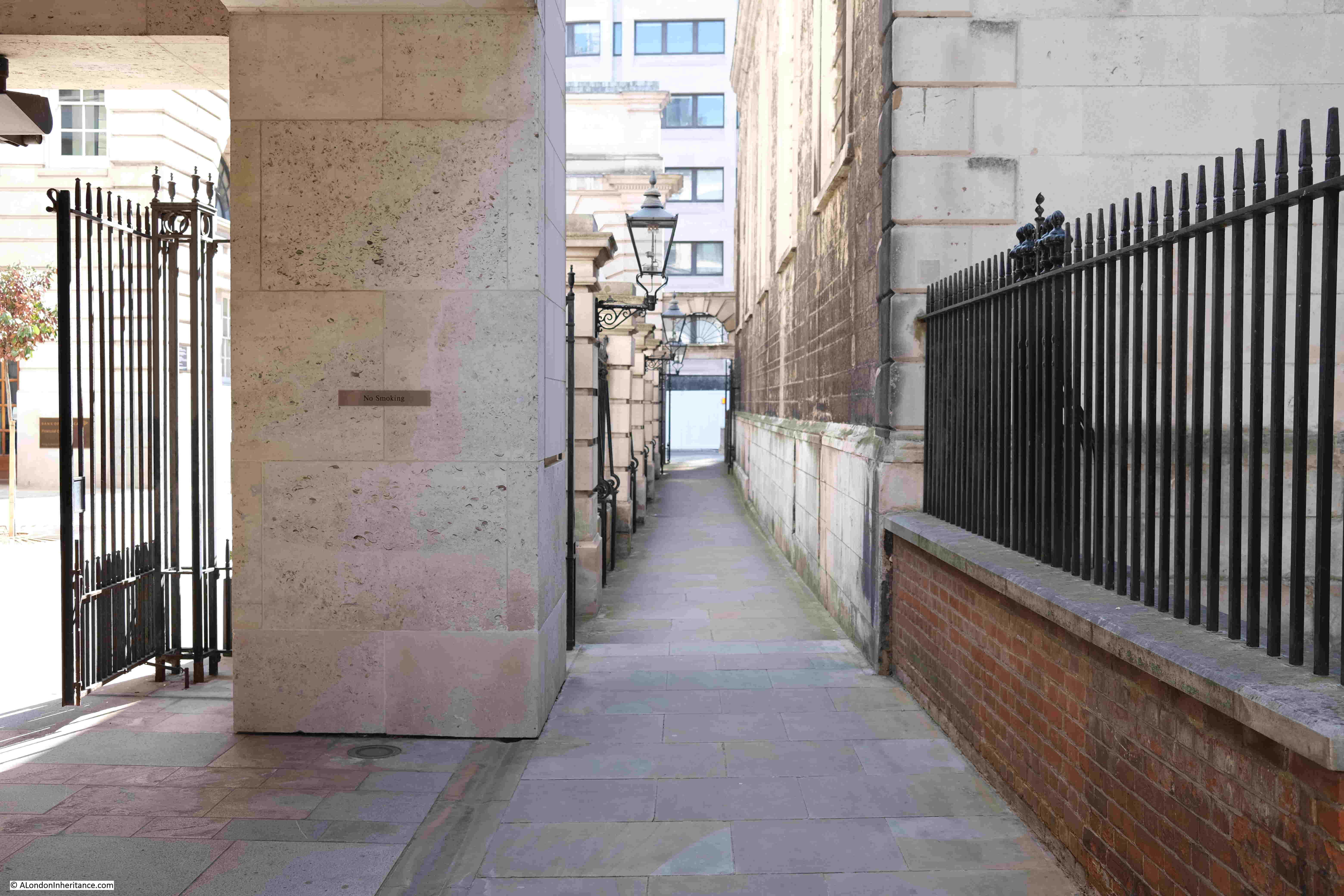
View down the alley between the remaining side wall to the north, and what were the old Post Office buildings:

Christchurch Greyfriars

The church was one of those lost during the Great Fire of London in 1666.

It was rebuilt by Wren between 1687 and 1704 on the foundations of the chancel of the original church. There was no need for a parish church to be the same size as the pre-fire church, and it was also expensive to rebuild with even the smaller church being one of Wren’s most expensive at a cost of over eleven thousand pounds.

It is remarkable just how many churches there were in the City of London. Today it seems as if you only need to walk a short distance to find another church but there were many more in previous centuries.

When Christchurch Greyfriars was rebuilt after the Great Fire, the church absorbed two smaller parishes, the parish of the wonderfully named St Nicholas in the Shambles, and that of St Ewin or Ewine. The churches for these two smaller, adjacent parishes were not rebuilt.

The base of the tower has a number of monuments which were rescued from the war damaged church:

Christchurch Greyfriars

After the church and the monastic buildings of the Franciscans were taken by the Crown, the buildings continued to have a close relationship.

There was always a need to provide help for London’s poor. There were many children throughout the city who did not have a father, or were part of a family that was struggling to feed them. In 1552 King Edward VI responded to this need by working with the mayor of the City to form a charitable organisation to provide for some of these children.

The result being that the old buildings of the Franciscans were taken over, donations were received, a Board of Governors set-up and in November 1552, Christ’s Hospital opened with an initial 380 pupils.

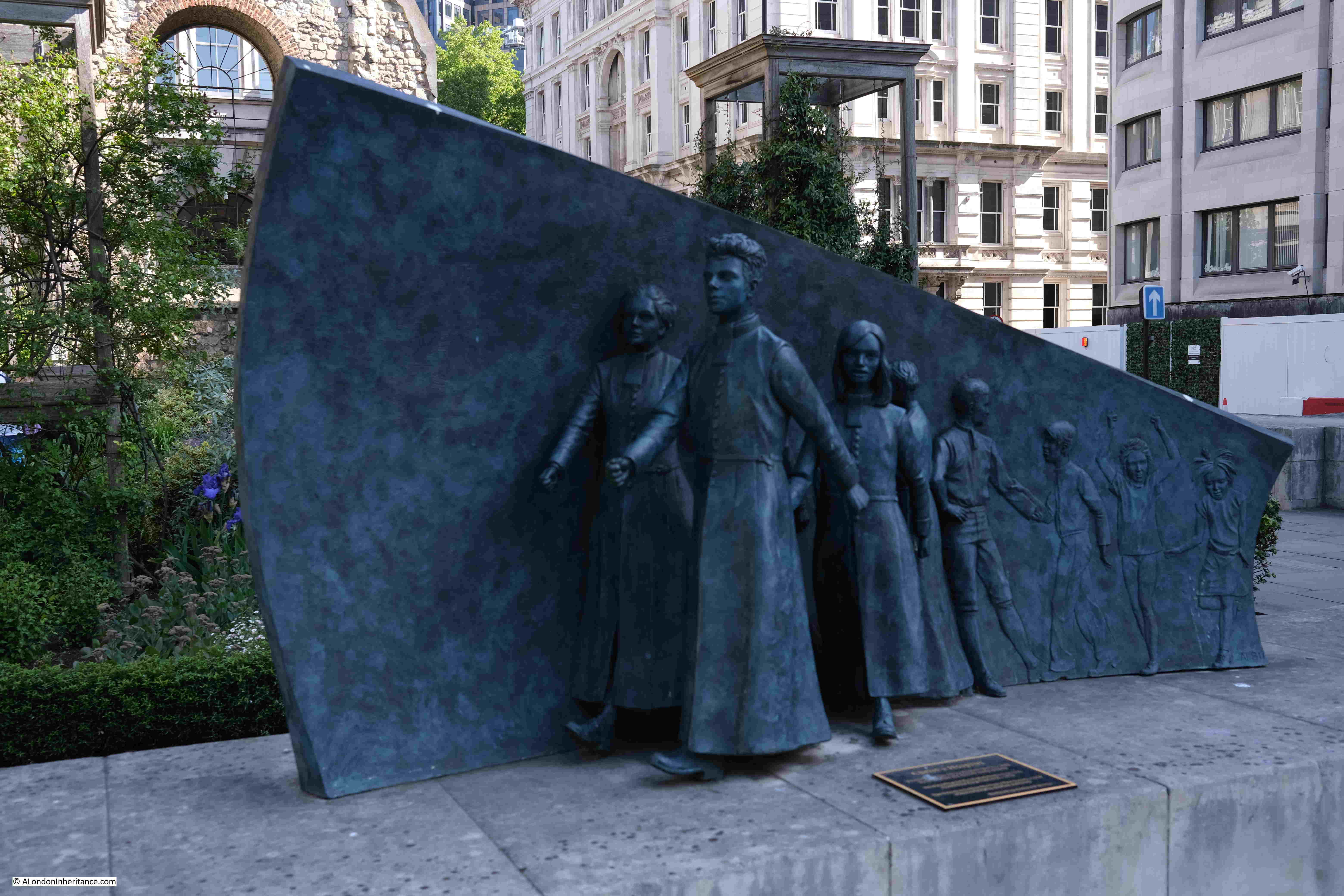
There is a sculpture on the southern side of the church of some of the children of Christ’s Hospital in their traditional school uniform:

Christ's Hospital

Christchurch Greyfriars became the church for Christ’s Hospital.

The buildings of Christ’s Hospital were damaged during the Great Fire, rebuilt after, with a frontage designed by Wren.

The following print from 1724 shows the church to the right, along with the impressive buildings of Christ’s Hospital  (© The Trustees of the British Museum):

Christ's Hospital

The text below the print provides some background on the school in the early 18th century:

“This Hospital, formerly a House of Grey Friars was first founded by that pious Prince Edward the 6th and has since received many donations from other persons by which Charities poor Children to the number of about 820 boys and 80 girls are not only provided with Lodging, Diet, Clothing and Learning, but when discharged of the House are bound out Apprentices and some of the Boys who have made large advances in Learning are sent to University. The House is divided into handsome Wards, where the Children lodge and a particular Ward where the sick are removed. For their instruction, here are a Grammar School, a Mathematick School a Writing School, a School where Girls learn to Read, Sew and Mark, and of late years, Boys have been taught to Draw. This Hospital is under the care and patronage of the City and by prudent care taken therefor it has produced many famous for Wealth, Learning and Servicableness to the public.”

Christ’s Hospital school left the site in 1902 and moved to Horsham in West Sussex where the school continues to this day.

View from next to the tower into the old body of the church:

Christchurch Greyfriars

View looking south towards St Paul’s where only one window and surrounding part of the southern wall remains:

Christchurch Greyfriars

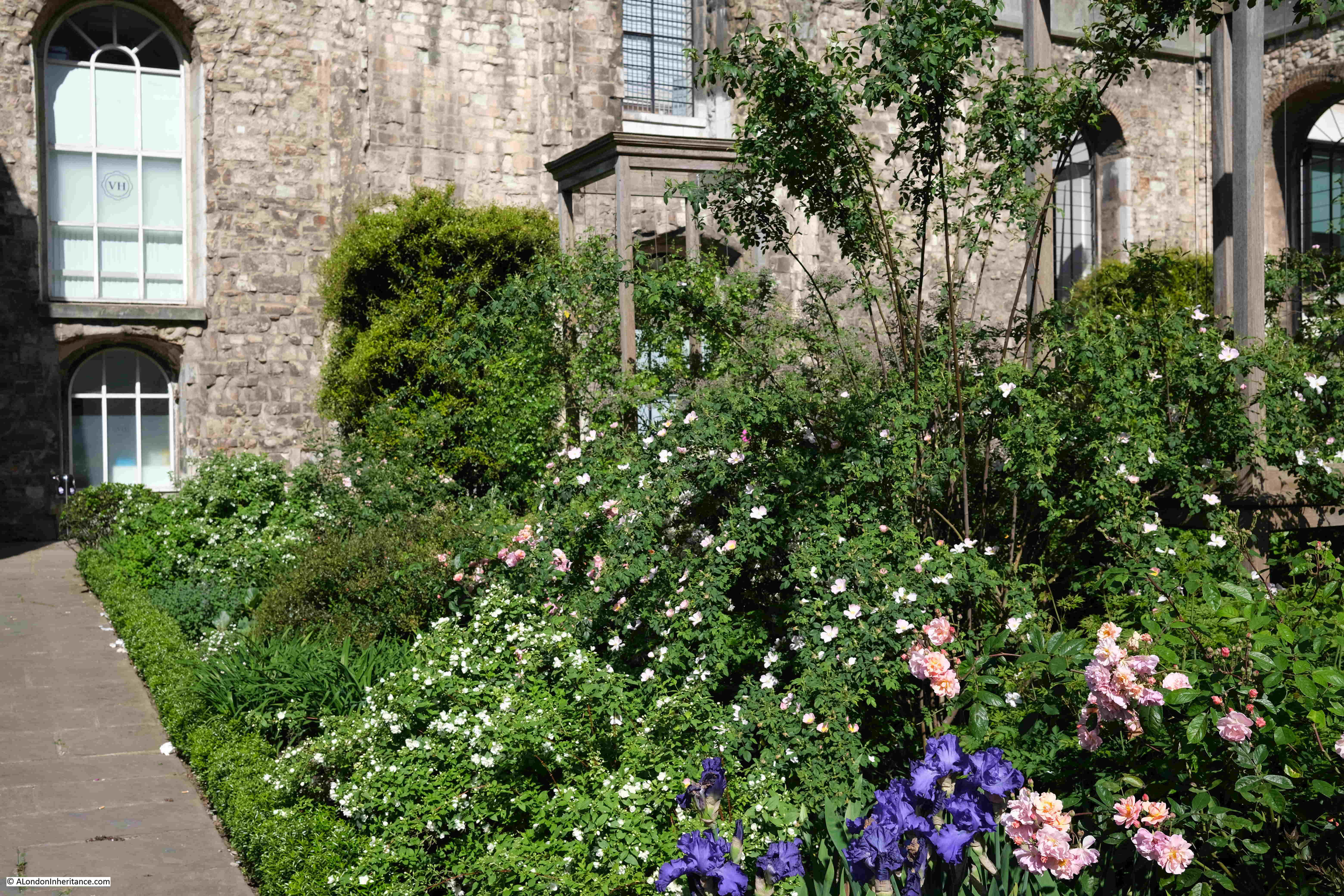
What was the interior of the church was laid out as a rose garden in 1989, with a major update to the gardens in 2011. The configuration of this garden is intended to reflect the Wren church with the position of pews marked by the box edges and wooden towers where the old stone columns were located:

Christchurch Greyfriars

The northern wall of the church from what was the interior of the church:

Christchurch Greyfriars

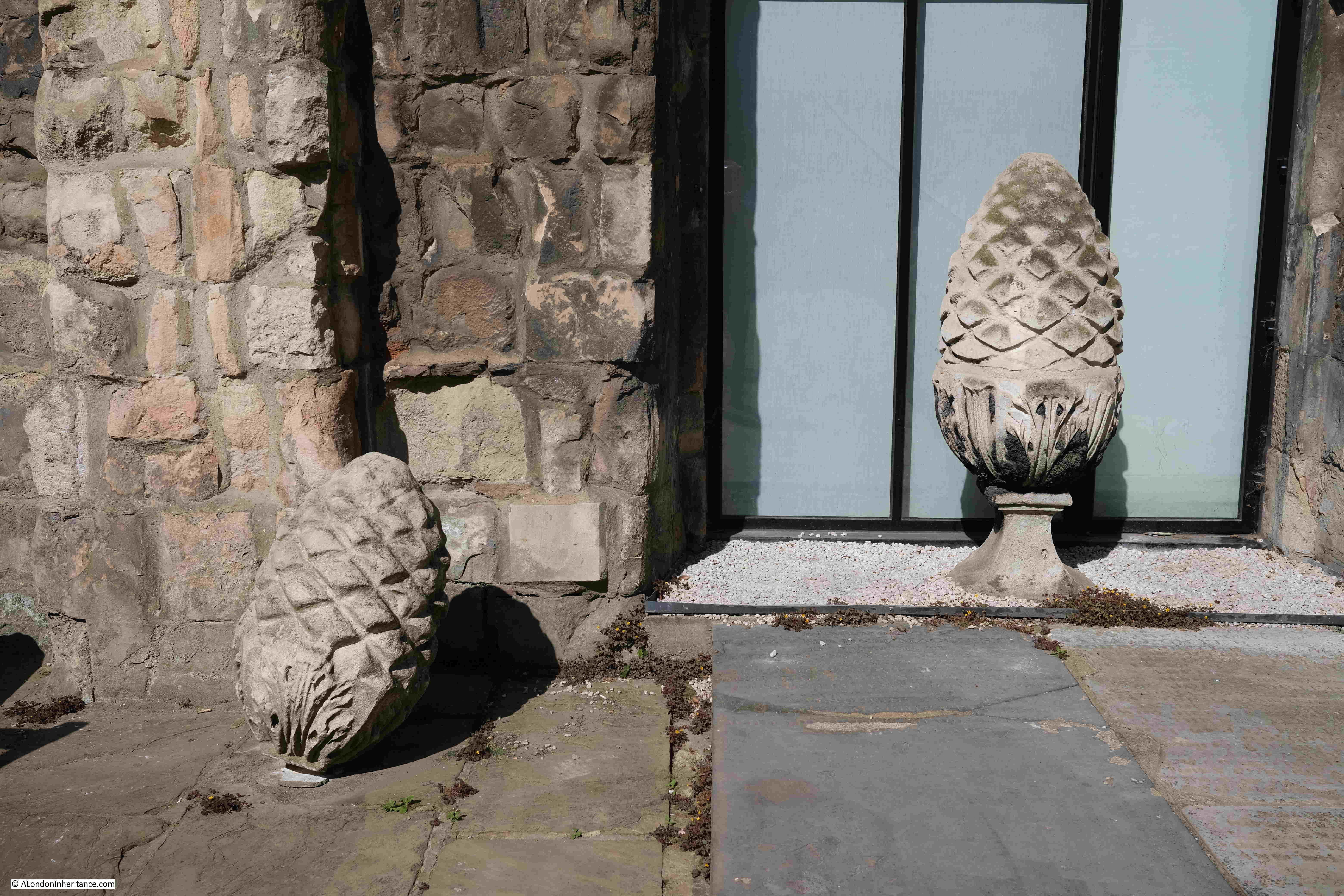
If you return to my father’s photo of the church, you can see at the top corners of the church walls, there were stone pineapples. The ones rescued from the demolished walls can be found on the ground in the garden, next to the tower:

Christchurch Greyfriars

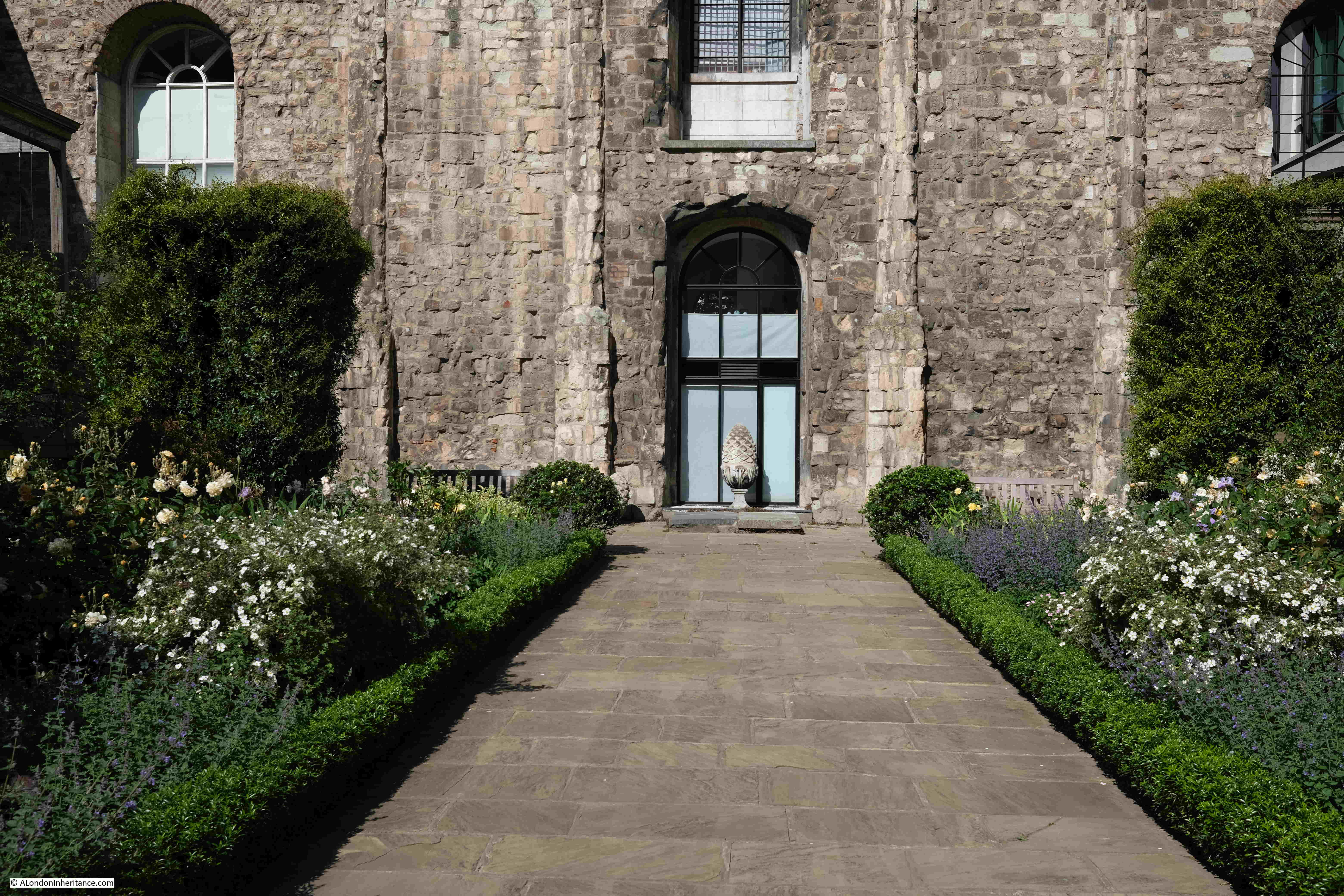
View along the centre of the church, pews would have been on either side with the small box hedges marking the edge of the pews:

Christchurch Greyfriars

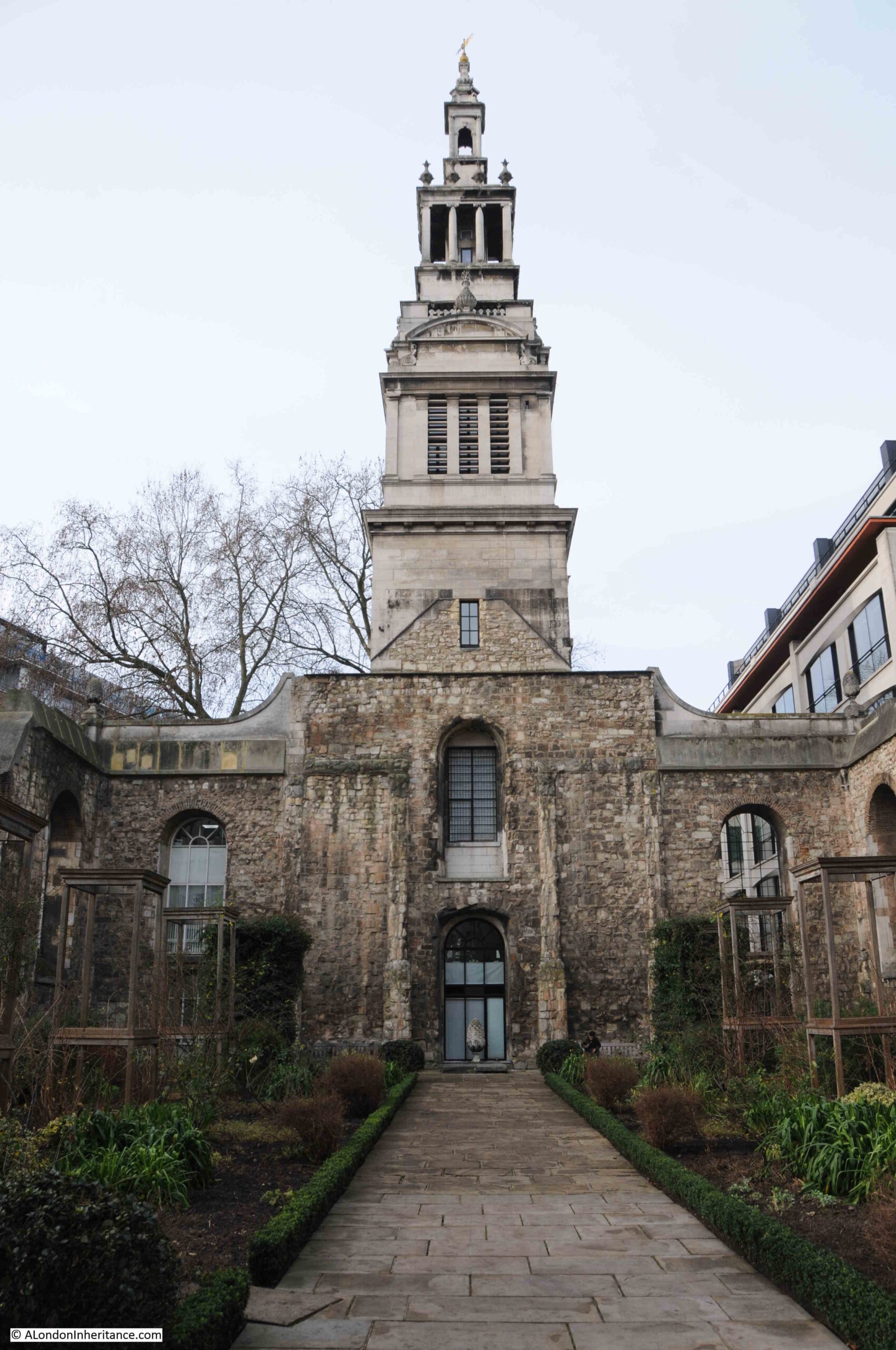
A view of the tower of the church and part of the garden earlier in the year:

Christchurch Greyfriars

Christchurch Greyfriars is a survivor. Originally dating from the 13th century, it has survived being part of a Franciscan monastery, a charitable hospital / school, the Great Fire, the London Blitz and post war road construction and extension.

During many of these events, the church has shrunk in size, leaving the view we see today.

There was a campaign a number of years ago to rebuild the missing walls of the church, and for the church to become a memorial “to honour all Londoners who have been the victims of bombings in wartime and peacetime during the modern era”, however nothing seems to have come of this.

On a sunny spring or summer’s day, the gardens are a wonderful place to sit and contemplate the history of the church, surrounded by plants, flowers and bees.

alondoninheritance.com

The Champion Pub and Oxford Market

All my walking tours have sold out, with the exception of a few tickets on the Bankside to Pickle Herring Street tour. Details and booking here.

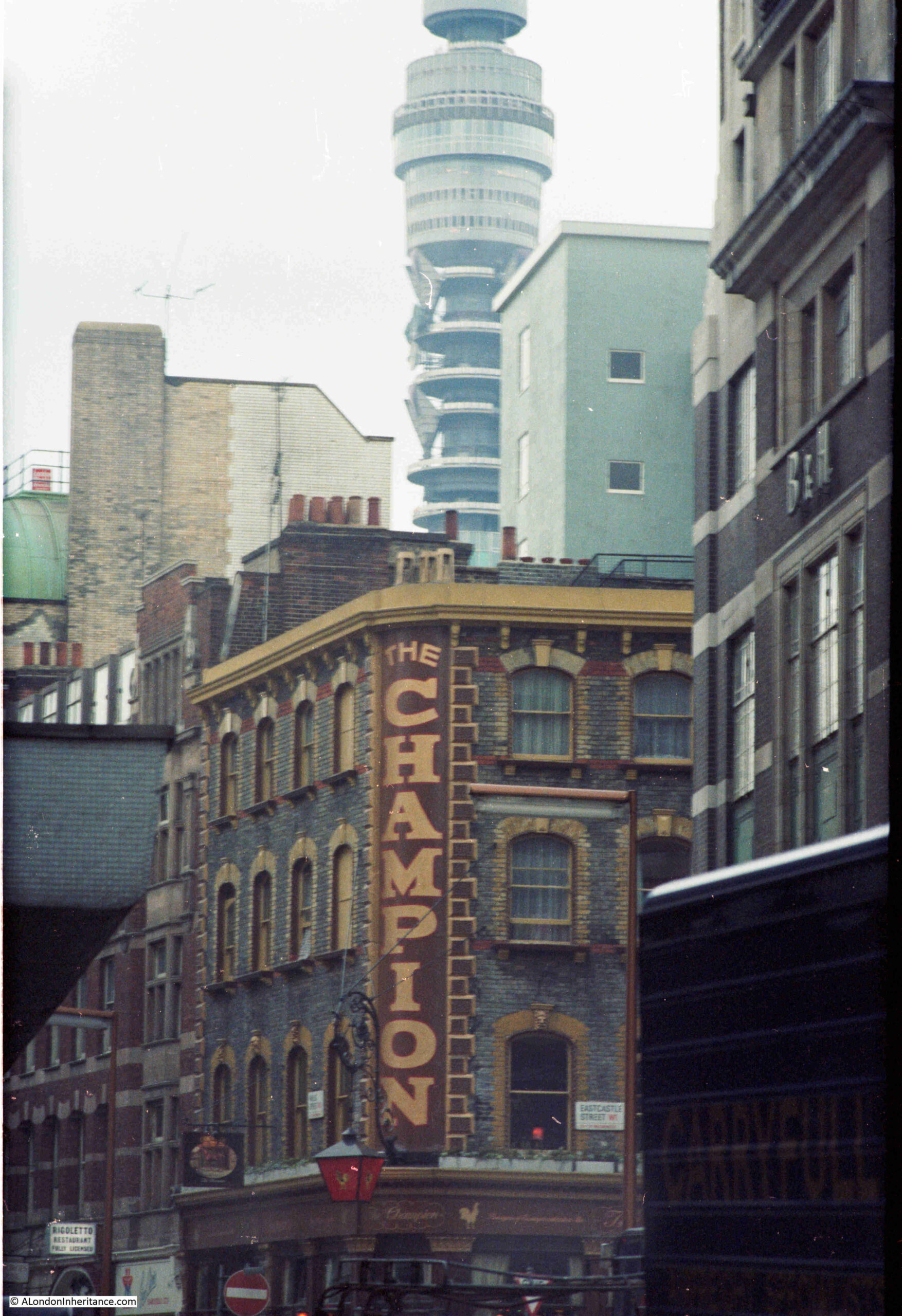
In 1980 I was wandering around London trying out a new zoom lens for my Canon AE-1 camera, taking some not very good photos. One of these was of the Champion Pub at the junction of Eastcastle Street and Wells Street, with the Post Office Tower in the background:

Champion pub

The photo was taken from the southern end of Wells Street towards Oxford Street, and a sign for Eastcastle Street can be seen on the right of the Champion pub. I think I was trying to contrast the old pub and the new telecoms tower.

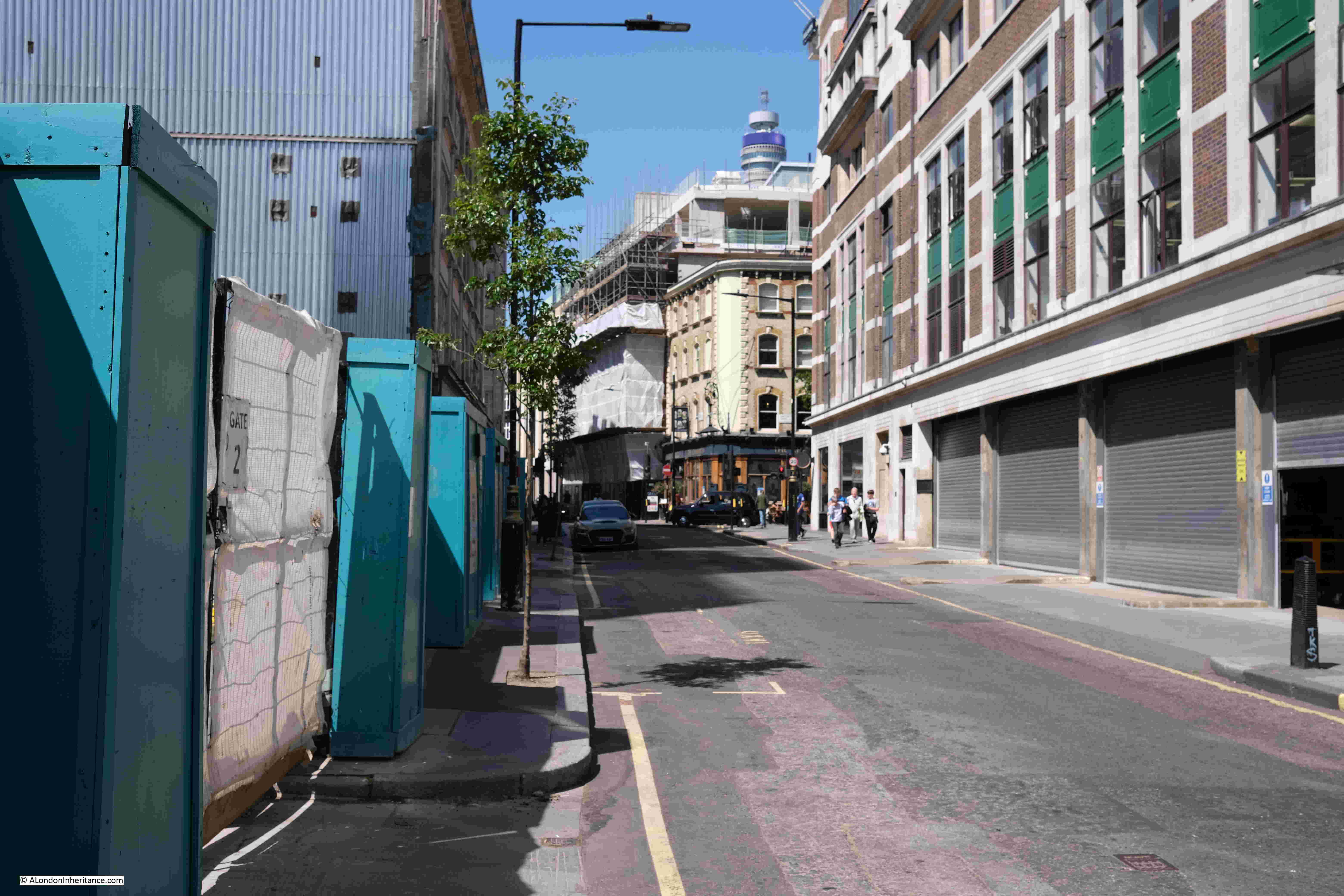
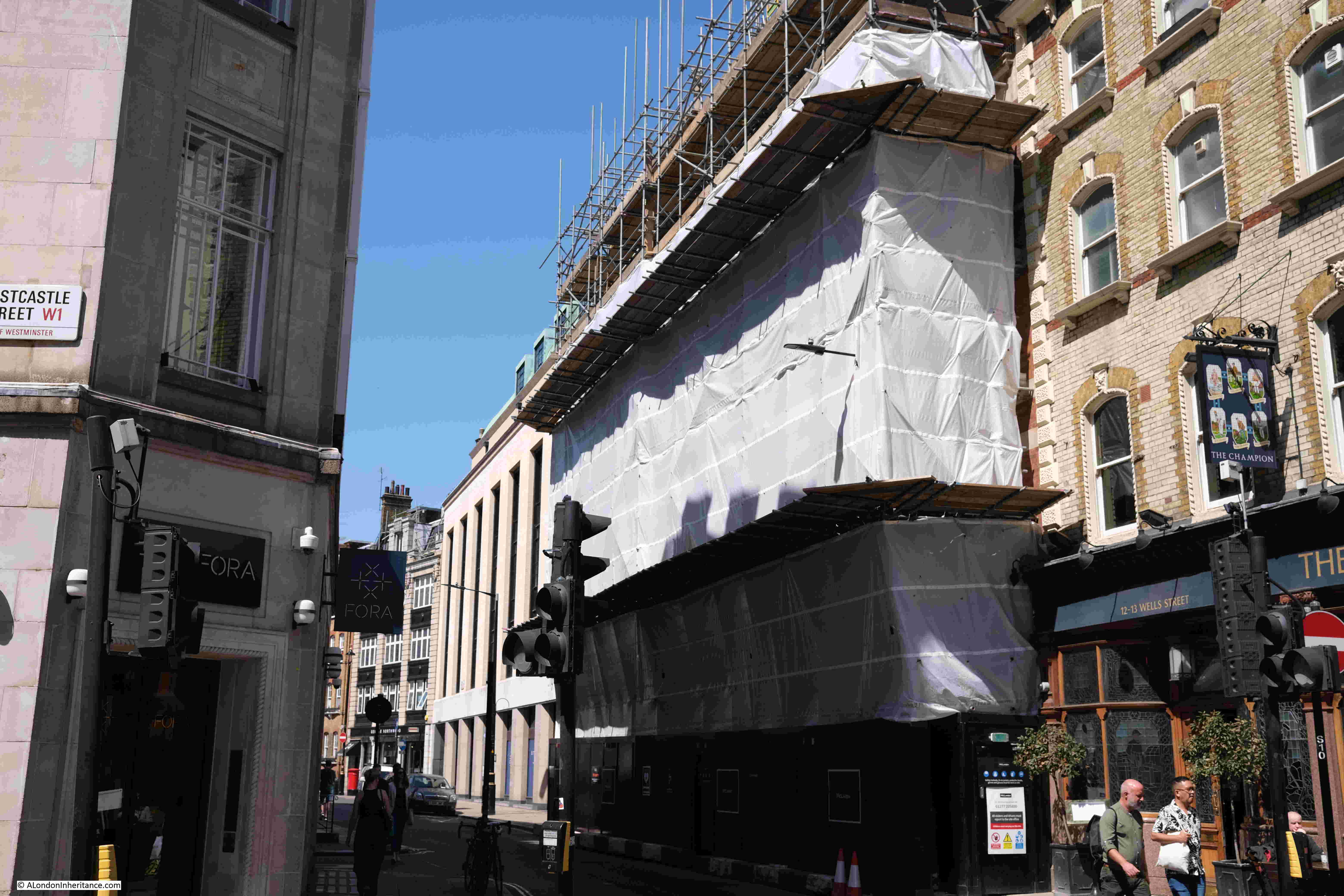
A wider view of the same scene today, with the BT Tower as it is now known, starting to disappear behind the new floors being added to the building behind the Champion:

Champion pub

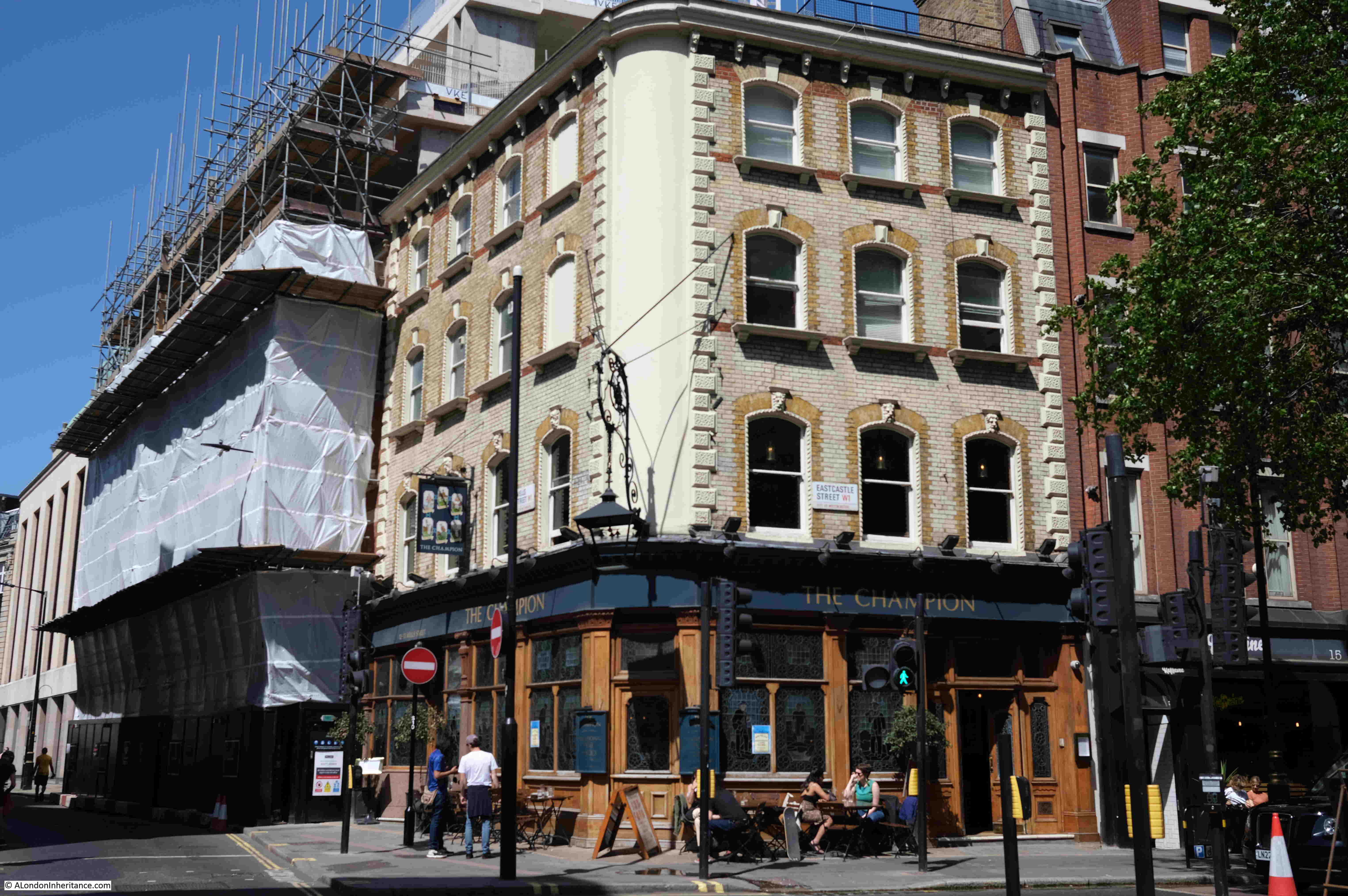
A closer view of the pub in 2022, 42 years after my original photo:

Champion pub

Given how many pubs have closed over the last few decades, it is really good that the Champion has survived, although it is a shame that the curved corner of the building has been painted, and it has lost the name which ran the full length of the corner of the pub.

The large ornamental cast iron lamp still decorates the corner of the building.

The curved corner to the upper floors was a key feature of many 19th century London pubs. They were meant to advertise the pub, the name could be seen from a distance on crowded streets, and the name would often give an identity to the junction of streets.

For an example of a pub which had a very colourful corner in the 1980s, and today displays the current name of the pub on the curved corner, see my post on the Perseverance or Sun Pub, Lamb’s Conduit Street.

The Champion is Grade II listed, and the Historic England listing details provide some background:

Corner public house. c.1860-70. Gault brick with stucco dressings, slate roof. Lively classical detailing. 4 storeys. 3 windows wide to each front and inset stuccoed quadrant corner. Ground floor has bar front with corner and side entrances and fronted bar windows framed by crude pilasters carrying entablature- fascia with richly decorated modillion cornice. Upper floors have segmental arched sash windows, those on 1st floor with keystones and marks. Heavy moulded crowning cornice and blocking stuccoed. Large ornamental cast iron lamp bracket to corner. Interior bar fittings original in part with screens etc, some renewal.

The “some renewal” statement refers to a few changes to the pub since it was built.

The first post-war renewal came in the 1950s. As with so many Victorian pubs across London, the Champion was in need of some refurbishment. Over 80 years of serving Wells Street, and open during the years of the second world war, resulted in the owners, the brewers  Barclay Perkins, engaging architect and designer John and Sylvia Reid.

The Reid’s were better known as interior, furniture and lighting designers rather than architecture, and their changes to the Champion were mainly of design.

The large Champion name down the curved corner of the pub was a result of their work. The lettering was in 30 inch Roman, and the letters were shaded to give the impression that they had been engraved rather than painted. The new name replaced a number of old wooden signs that were mounted on the corner. The corner of the pub was floodlit at night, which must have looked rather magnificent, and ensured the pub stood out if you looked down Wells Street when walking along Oxford Street.

The interior had been rather plain and was painted in what were described as drab colours.

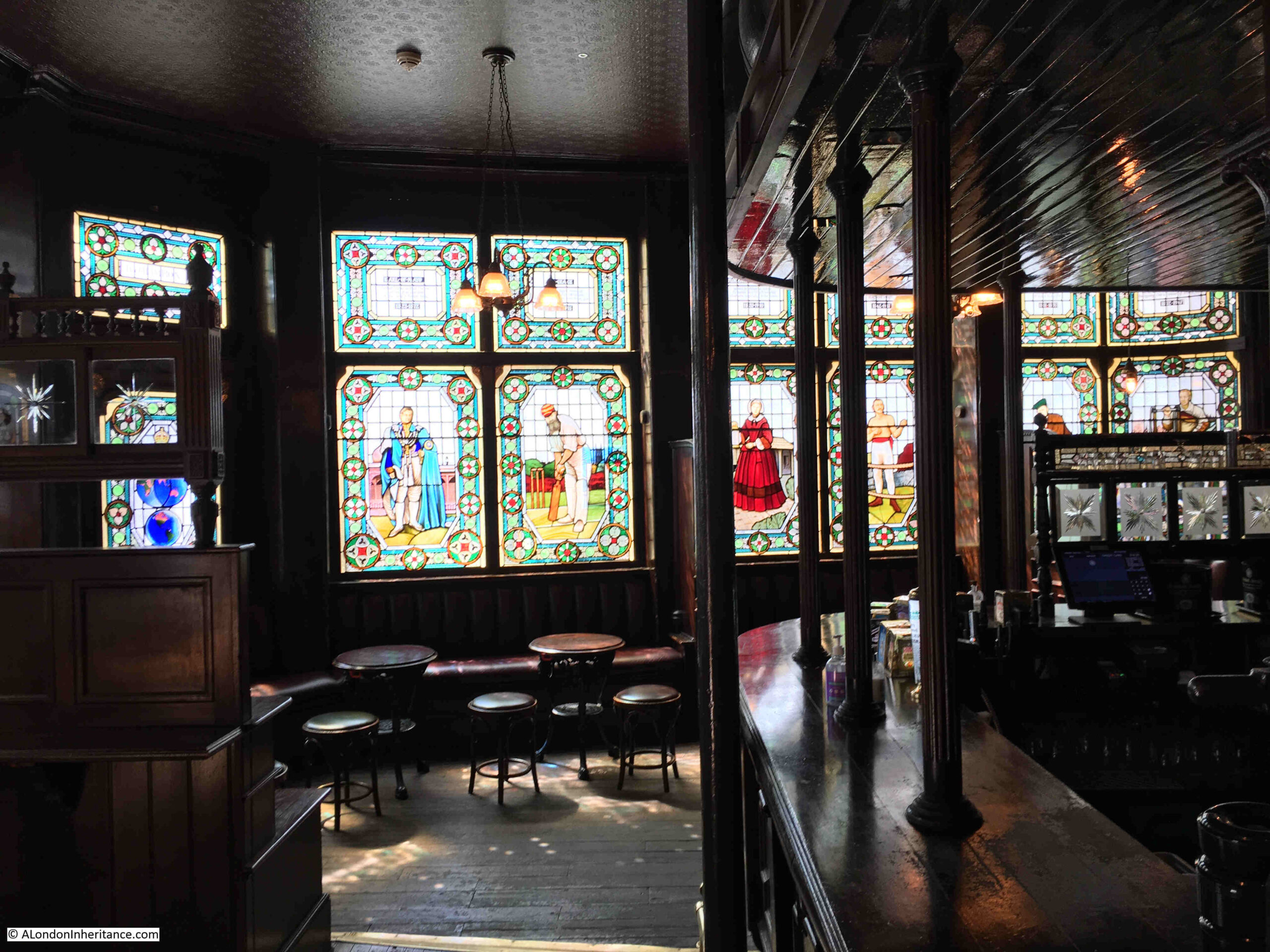
The Reid’s divided what had been two bars to form three, added button leather seating around the edge of the bars, restored the bar and some of the original iron tables, and they added new glass windows consisting of clear glass for the upper half and frosted, acid cut glass for the lower half.

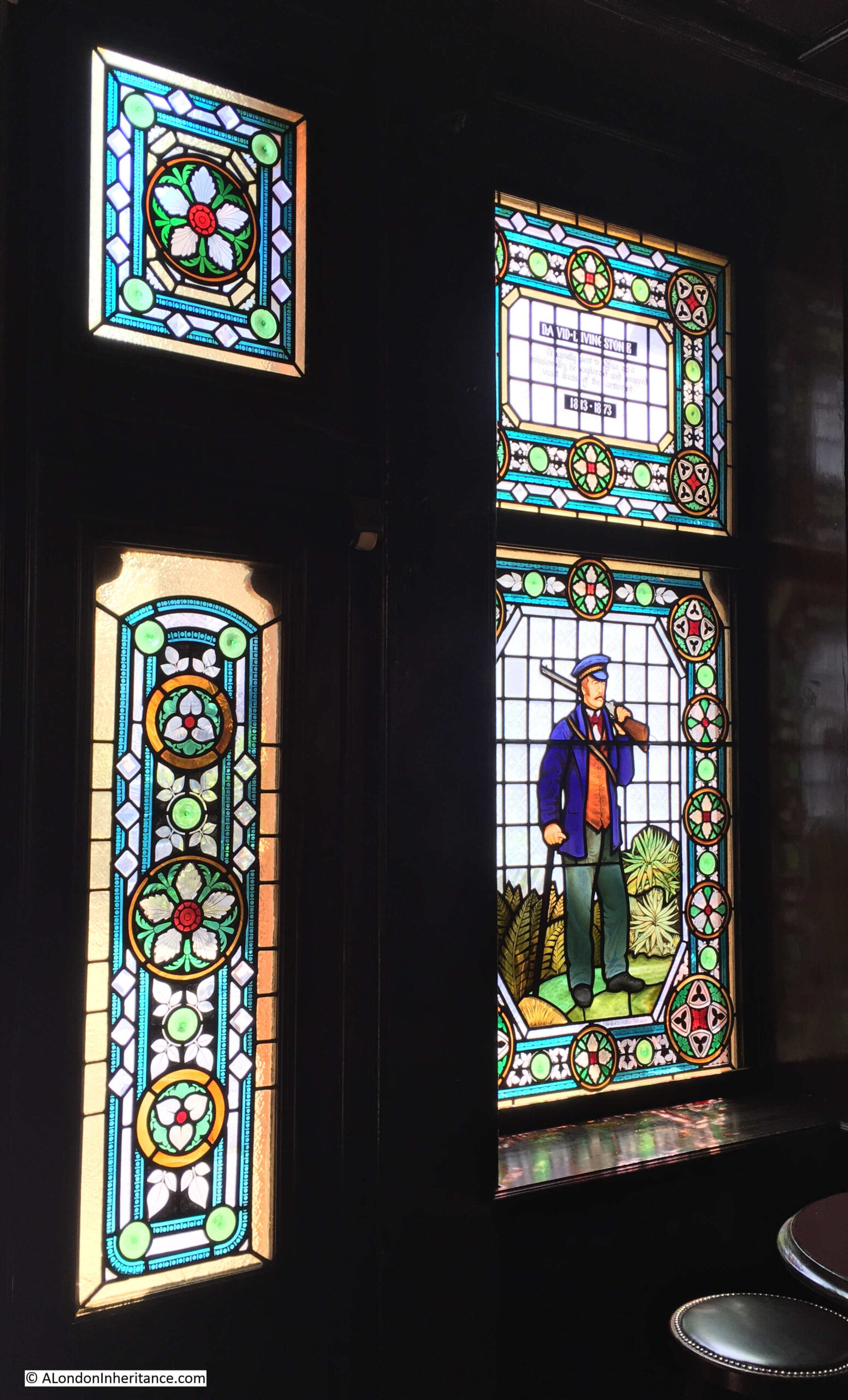
Features inside the pub included the use of mahogany panels, etched and decorated glass windows between bars, and textured paper on the ceiling. refurbishment also included the first floor dining room.

Their refresh of the Champion pub did get some criticism as there were views that it was returning to Victorian design themes. The early 1950s were a time when design and architecture were looking at more modern forms, typified in the themes and designs used for the 1951 Festival of Britain.

The early 1950s update to the pub included plain and frosted glass on the external windows, not the remarkable, stained glass windows that we see today. These are the work of Ann Sotheran, and were installed in 1989.

They feature a series of 19th century “champions”, with figures such as Florence Nightingale and the cricketer W.G. Grace.

On a sunny day, these windows are very impressive when seen from inside the bar:

Champion pub stained glass

The missionary and explorer David Livingstone:

Champion pub

Newspaper reports mentioning the Champion cover all the usual job adverts, reports of crime and theft etc., however I found one interesting article that hinted at what the inside of the pub may have been like in the 1870s.

In September 1874, the Patent Gas Economiser Company held their first annual general meeting, where they reported that they had installed 50 lights in the Champion. Seems a rather large number, but spread across three floors, entering the pub in the 1870s would have been entering a reasonably brightly lit pub, with the hiss of gas lamps and the associated smell of burning gas.

The same report also mentions that the company had installed 1000 lights at the Royal Polytechnic Institution in Regent Street, 600 lights in the German Gymnastic Society in St Pancras Road, and 50 lights in the Hotel Cavour in Leicester Square.

To the left of the Champion pub, along Wells Street, building work is transforming the building that was here, and is adding additional floors to the top, which partly obscures the view of the BT Tower from further south along the street:

Champion pub

There was one further site that I wanted to find, and this required a walk west, along Eastcastle Street.

Eastcastle Street was originally called Castle Street, a name taken from a pub that was in the street. The name change to Eastcastle Street happened in 1918. I cannot find the reason for the name change, but suspect it was one of the many name changes across London in the late 19th / early 20th centuries, to reduce the number of streets with the same name.

At 30 Eastcastle Street is this rather ornate building:

Eastcastle Street

Dating from 1889, this is the Grade II listed Welsh Baptist Chapel, the main church for Welsh Baptists in London.

Eastcastle Street is a mix of architectural styles. Narrow buildings that retain the original building plots, buildings with decoration that does not seem to make any sense, and rows of the type of businesses that frequent the streets north of Oxford Street.

Eastcastle Street

At the end of Eastcastle Street is the junction with Great Titchfield Street and Market Place:

Oxford Market

In the above photo, Great Titchfield Street runs left to right, and the larger open space opposite is part of Market Place.

The name comes from Oxford Market, a market that originally occupied much of the space around the above photo, with the market building on the site of the building to the left, and the open space in the photo being part of the open space around the market building.

in the following map, the Champion pub is circled to the upper right. On the left of the map, the blue square is where the market building of Oxford Market was located, the red rectangles show the open space around the market with the upper rectangle being where the open space can still be seen today (© OpenStreetMap contributors):

Oxford Market

Rocque’s map of 1746 shows Oxford Market, just north of Oxford Street:

Oxford Market

Oxford Market had been completed by 1724, however the opening was delayed as Lord Craven, who owned land to the south of Oxford Street feared what the competition would do to his Carnaby Market, however Oxford Market was finally granted a Royal Grant to open on Mondays, Wednesdays and Saturdays.

The market was built to encourage activity in the area, as the fields to the north of Oxford Street were gradually being transformed into streets and housing.

The market took its name, either from Oxford Street to the south, or more likely, Edward, Lord Harley, the Earl of Oxford who was the owner of the land on which the market was built as well as much of the surrounding land.

Harley had come into possession of the land through his wife, Lady Henrietta Cavendish Holles, who was the only child of John Holles, the Duke of Newcastle, the original owner of the farmland around Oxford Street.

The original market buildings were of wood, and the market was rebuilt in a more substantial form in 1815. The following view of the second version of Oxford Market comes from Edward Walford’s Old and New London:

Oxford Market

We can get a view of what was for sale at Oxford Market from newspaper reports:

  • February 8th, 1826 – john Wollaston & Co were selling their Gin in quantities of no less than 2 gallons at a price of 15 shillings per gallon
  • January 20th, 1824 – A “Great Room” of 45 feet square in the interior of the market was being advertised as being suitable for upholsterers, warehousemen and flower gardeners. The room was fitted with an ornamental stone basin and fountain and was suited for a flower garden
  • April 25th, 1841 – The Oxford Market Loan Office was advertising loans of Ten Guineas, Ten and Fifteen Pounds, which could be had from their office at the market
  • May 18th, 1833 – Rippon’s Old Established Furnishing Ironmongery Warehouse was advertising Fire Irons, Coal Scuttles, Knives and Forks, Metal Teapots and Tea Urns for sale from their warehouse at the market
  • December 15th 1827 – The lease of a Pork Butcher and Cheesemonger store at the market was being advertised. The store had been taking in £3,800 per year
  • June 27th, 1801 – Several lumps of butter, deficient in weight, were seized by the Clerks of the Oxford Market and distributed to the poor

So traders in the Oxford Market were selling a wide range of products, butter, pork, teapots and coal scuttles, flowers and gin, and you could also take out a loan at the market.

Nothing to do with Oxford Market, however on the same page as the 1801 report of butter being seized, there was another report which tells some of the terrible stories of life in London:

“Wednesday were executed in the Old Bailey, pursuant to their sentences, J. McIntoth and J. Wooldridge, for forgery, and W. Cross, R. Nutts, J, Riley and J. Roberts, for highway robbery. The unfortunate convicts were all men of decent appearance, and their conduct on the scaffold was such as became their awful situation.

Some of the above prisoners attempted on Monday to make their escape from Newgate through the common sewer – they explored as far as Milk-street, Cheapside, when the intolerable stench and filth overpowered their senses; with great difficulty they found their way to the iron-grating and intreated by their cries to be liberated. assistance was immediately procured, when they were released without much difficulty.”

These two paragraphs say so much: that you could be hung for forgery, the statement that their conduct on the scaffold was “such as became their awful situation”, and their desperation in seeking an escape via the sewer. Milk Street is roughly 568 metres from the site of the Old Bailey so they had travelled a considerable distance in an early 19th century sewer.

Back to Oxford Market, and the following view is looking down Market Place towards Oxford Street which can be seen through the alley at the end of the street:

Oxford Market

In the above photo, the market building was on the left, and open space in front of the market occupied the space where the building is on the right, the corner of which is shown in the following photo. The block was all part of the open space in front of Oxford Market.

Oxford Market

Oxford Market was never really a financial success. For a London market it was relatively small which may have limited the number of suppliers and the range of goods available.

By the late 1830s, part of the market had been converted into offices from where out-pensioners of Chelsea Hospital were paid.

The market buildings was sold in 1876, demolished in 1881, and a block of flats built on the site.

Although Oxford Market is long gone, the street surrounding three sides of the old market building is still called Market Place, and the footprint of the building, and the surrounding open space can still be seen in the surrounding streets, and the wider open space and restaurants along the northern stretch of Market Place.
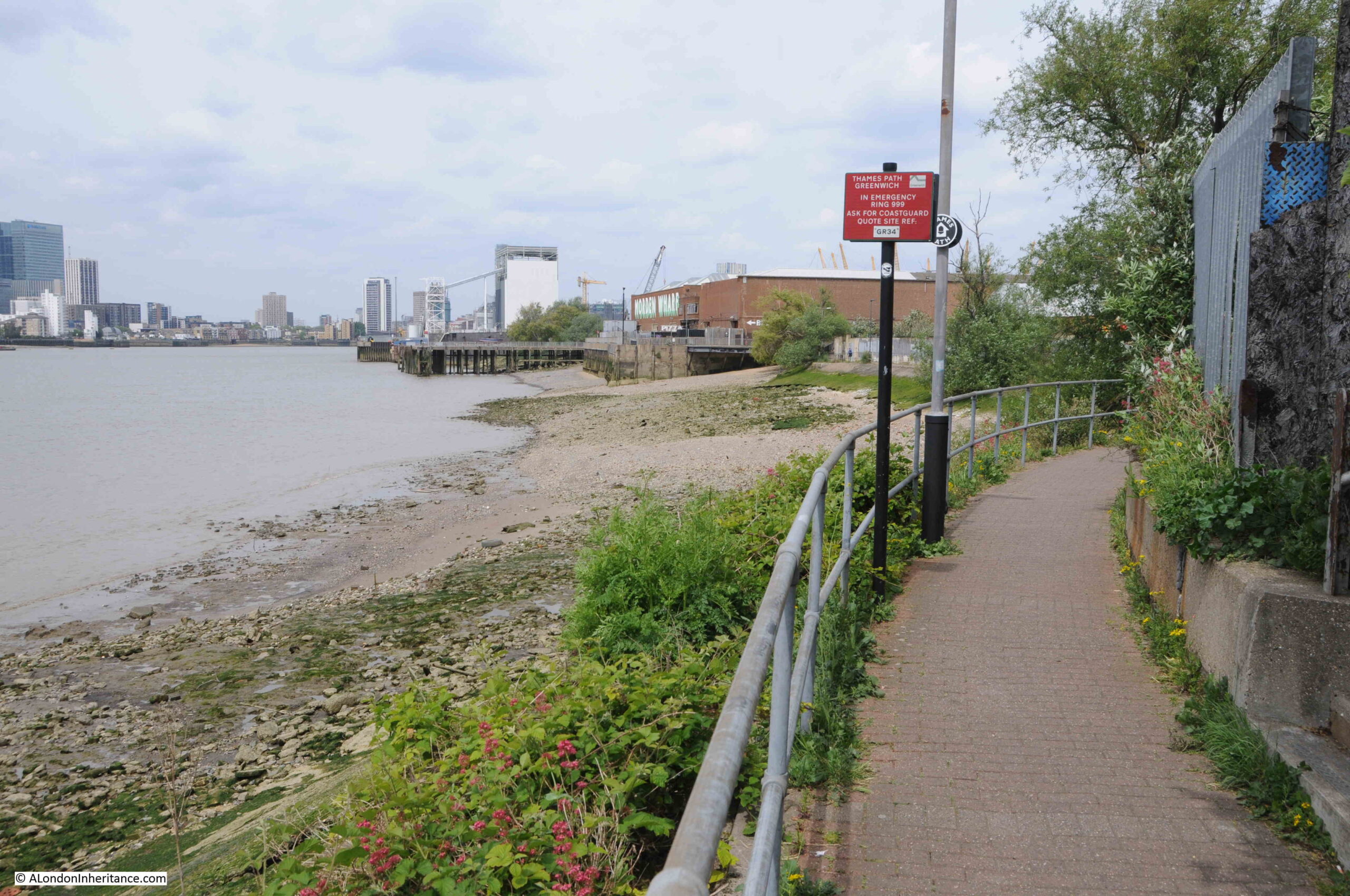
alondoninheritance.com

The Sad Fate of Two Greenwich Murals

The 1980s were a boom time for large, colourful murals across London, and for today’s post I am revisiting two of these, to find the sad fate of two Greenwich murals.

Walk east along Creek Road which leaves central Greenwich near the Cutty Sark DLR station, turn right down Horseferry Place, and in 1986 you would have seen the El Salvador mural in all its pristine colours, as photographed by my father:

El Salvador Mural

I recently visited the site, and found the mural in a very sad condition. Very faded and with Sky satellite dishes and a number of lights installed across the mural:

two Greenwich murals

The El Salvador mural, or as it was originally titled “Changing the Picture”, was created for the El Salvador Solidarity Campaign in 1985, the year before my father’s photo.

The El Salvador Solidarity Campaign was based in Islington Park Street and was formed to express support for the people of El Salvador.

El Salvador is a country in central America and during the 1980s was suffering from a violent Civil War that would not really end until 1993, and resulted in the deaths of tens of thousands of the country’s population.

The civil war was mainly a conflict between the left wing Farabundo Martí National Liberation Front (FMLN), supported by the neighbouring countries of Nicaragua and Cuba, and the Government of the country, supported by the United States.

The people of the country paid a terrible price during the civil war. There were atrocities committed by both sides, however the military of El Salvador along with “Death Squads” who operated outside the official knowledge of the military or government, would commit the majority.

As well as the internal issues within the country, it was also a proxy conflict between the US and the Soviet Union, with US concern about the potential growth of Communist supporting governments in central America, which could have been the outcome if the US supported government had fallen to the FMLN.

There were a number of international groups supporting the people of El Salvador and the FMLN, including in the US and the El Salvador Solidarity Campaign in London.

The aim of the mural is to show the ordinary people of El Salvador (on the right) taking back control of their country, lives and future by “rolling up the picture”.

The people on the right are depicted in bright colours, with more muted, grey colours for the military, and the military / industrial support that contributed large quantities of arms to the country.

I believe the following extract from the mural shows Ronald Regan and Margaret Thatcher to the left with a figure representing El Salvador’s military on the right, controlling a puppet soldier:

two Greenwich murals

Whilst the mural was commissioned by the El Salvador Solidarity Campaign, it was funded by the Greater London Council (GLC), and support of initiatives such as the mural was one of the many reasons why the Conservative government of the 1980s would abolish the GLC at the end of March 1986.

The mural was created by the artist Jane Gifford, along with Nick Cuttermole, Sergio Navarro and Rosie Skaife D’Ingerthorpe.

I could not get a photo of the mural at the same angle as my father’s. He was standing in the adjacent school playground, and today this is completely fenced.

The following view shows a wider view of the El Salvador mural, on the side of Macey House which is part of the Meridian Estate:

two Greenwich murals

Macey House is on Horseferry Place, a road that leads down towards the Thames. The name of the road records a ferry that once ran from near the southern end of the road across to the Isle of Dogs.

The following map shows the location of the two murals that feature in today’s post. The El Salvador mural is the red circle, number 1 (© OpenStreetMap contributors):

two Greenwich murals

A short distance from the El Salvador mural, heading back towards Greenwich, along Creek Road was the “Wind of Peace” mural, at point number 2 on the above map:

Wind of Change Mural

Although the El Salvador mural is very badly faded, the Wind of Peace has suffered an even worse fate – the mural, along with the building on which it was painted, have completely disappeared.

In the photo below, there is a large new building on the left, with a terrace of smaller buildings further back, heading along Creek Road back into the centre of Greenwich.

two Greenwich murals

The mural was on a building which stood where the large building with the clock is now located. The mural was on the side wall and would have been facing the camera.

The development on the left leading back into Greenwich was following the completion of the Cutty Sark DLR station, which is accessed through a pathway to the left of the van, at the junction of the large and smaller buildings.

The Wind of Peace mural was commissioned by the London Muralists for Peace initiative, as part of the 1983, Greater London Council’s Peace Year.

The mural was painted by artists Stephen Lobb and Carol Kenna, and replaced an earlier mural showing the river and the land alongside the river in Greenwich.

The mural has Greenwich in the centre of the mural, with the residents flying around the view of Greenwich, resisting and destroying missiles which symbolised the threat of nuclear war.

The GLC 1983 Peace Year comprised not just murals, but a whole series of events throughout London. A typical newspaper campaign advert covered:

“Peace is the most important issue facing us all. London could not survive a nuclear holocaust, irrespective of whether it is triggered by miscalculation in Washington or Moscow.

The GLC has declared 1983 Peace Year to give Londoners the opportunity of making a personal commitment to this highest of human ideals.

There can be no better way for people to express their desire for peace than through the Arts. That is why a major part of GLC Peace Year activities will involve supporting drama, film and the visual arts.

Come along and enjoy GLC Peace Year events and activities listed below. Support the cause of peace in London and give a peaceful lead to the world.

  • April 3 Easter Parade featuring specially commissioned Peace Float, Battersea Park at 3pm
  • May 1 May Day Festival, Victoria Park – at noon
  • May 5 Songwriters Competition for Peace – launch
  • June 4 Free Music Concert for Peace, crystal Palace Bowl at noon
  • July 16 Peace Concert of Classical Music, Kenwood Lakeside at 8pm
  • August 6 Hiroshima Day Peace Festival, Victoria Park at noon
  • August 7 Peace Concert of Classical Music, crystal Palace Bowl at 8pm”

There were many more events in addition to those listed above, including a Festival for Peace at Brockwell Park on May the 7th, which included the Damned, Madness and Hazel O’Conner.

As well as the Arts, Peace Year included other projects such as the construction of a number of “peace gardens” across London, such as the Noel-Baker Peace Garden in Islington.

The civil war in El Salvador ended almost thirty years ago, and the mural is gradually fading as are memories of the war (although the country still does suffer from some instability, including the recent bizarre decision to adopt Bitcoin as legal tender within the country).

The Wind of Peace mural disappeared as did the apparent threat of nuclear war, however with current unpredictable world events – perhaps it may be time for another mural.

alondoninheritance.com

New River Walk – Alexandra Palace to New River Head

I have finally completed the post covering the last stage of the New River Walk, which covers from Alexandra Palace to New River Head in north Clerkenwell.

At the end of the previous stage, we had reached Bowes Park, where the New River disappeared in a tunnel, and for today’s post, we rejoin the New River where it exits the tunnel, opposite Alexandra Palace station.

This stage of the walk will follow the New River from Alexandra Palace to the east and west reservoirs, just south of the Seven Sisters Road, where it ends as a river. Then, the walk follows a Heritage Walk that follows the original route of the river to New River Head before the river was truncated at the reservoirs.

The map of the final stage, with key locations covered in the post is shown below  (© OpenStreetMap contributors):

New River Walk Alexandra Palace to New River Head

Point S on the map: Alexandra Palace station is at the north west tip of a patch of open, green space, and at the south east corner of this space, the New River exits the tunnel through which it has flowed from Bowes Park:

Alexandra Palace

There is nothing to see of the actual river between Bowes Park and Alexandra Palace, however there are a number of these New River Company pipe markers:

NRC Pipe

Point 1 on the map: Here, a rather over exposed Alexandra Palace can be seen on the high ground in the distance. Hornsey Water Treatment Works are behind the green metal fencing and the New River runs under the footbridge between the fencing:
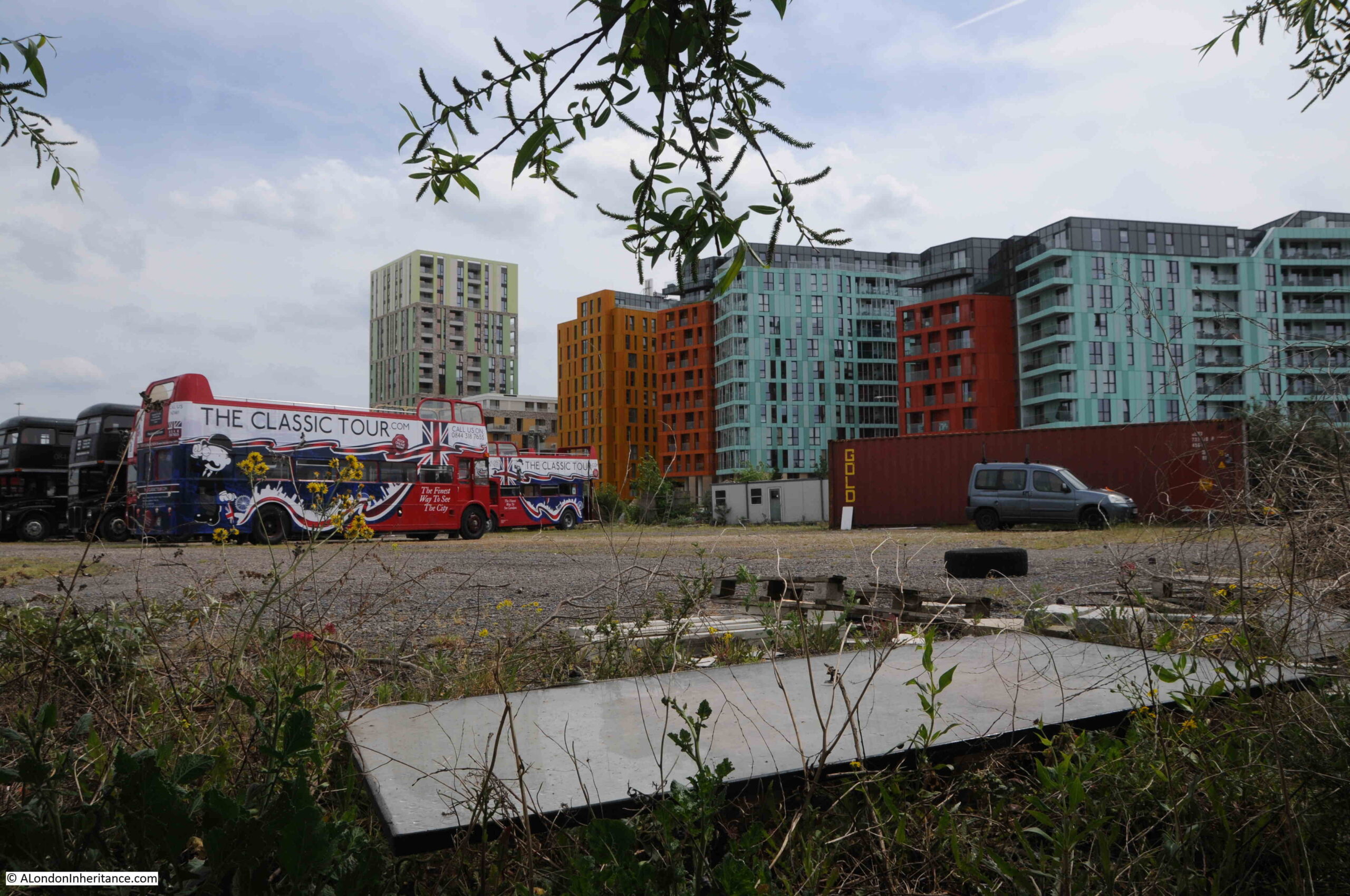
Hornsey

The route through Hornsey is an example of where the New River has been straightened and does not follow the original early 17th century route.
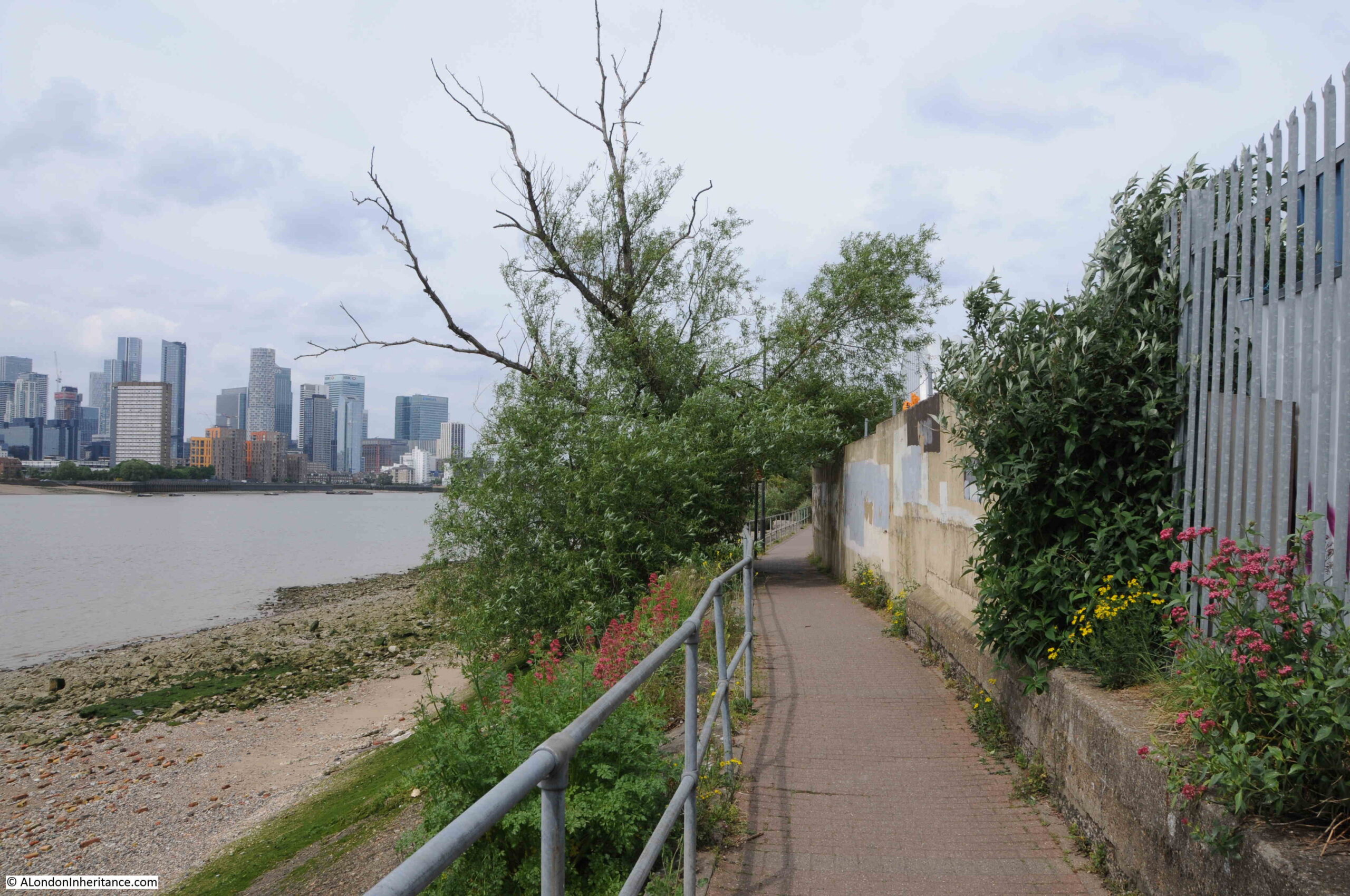
The following map from 1861 shows the original early 17th century route (dark blue), along with the proposed new straightened route (light blue):

Hornsey

Hornsey Water Treatment Works are to the left, and the New River runs at the bottom of these works, and heads to Hornsey High Street which it crosses, before turning and crossing Middle Lane. It then heads towards the church and crosses the High Street again, heading up to the junction with Tottenham Lane.
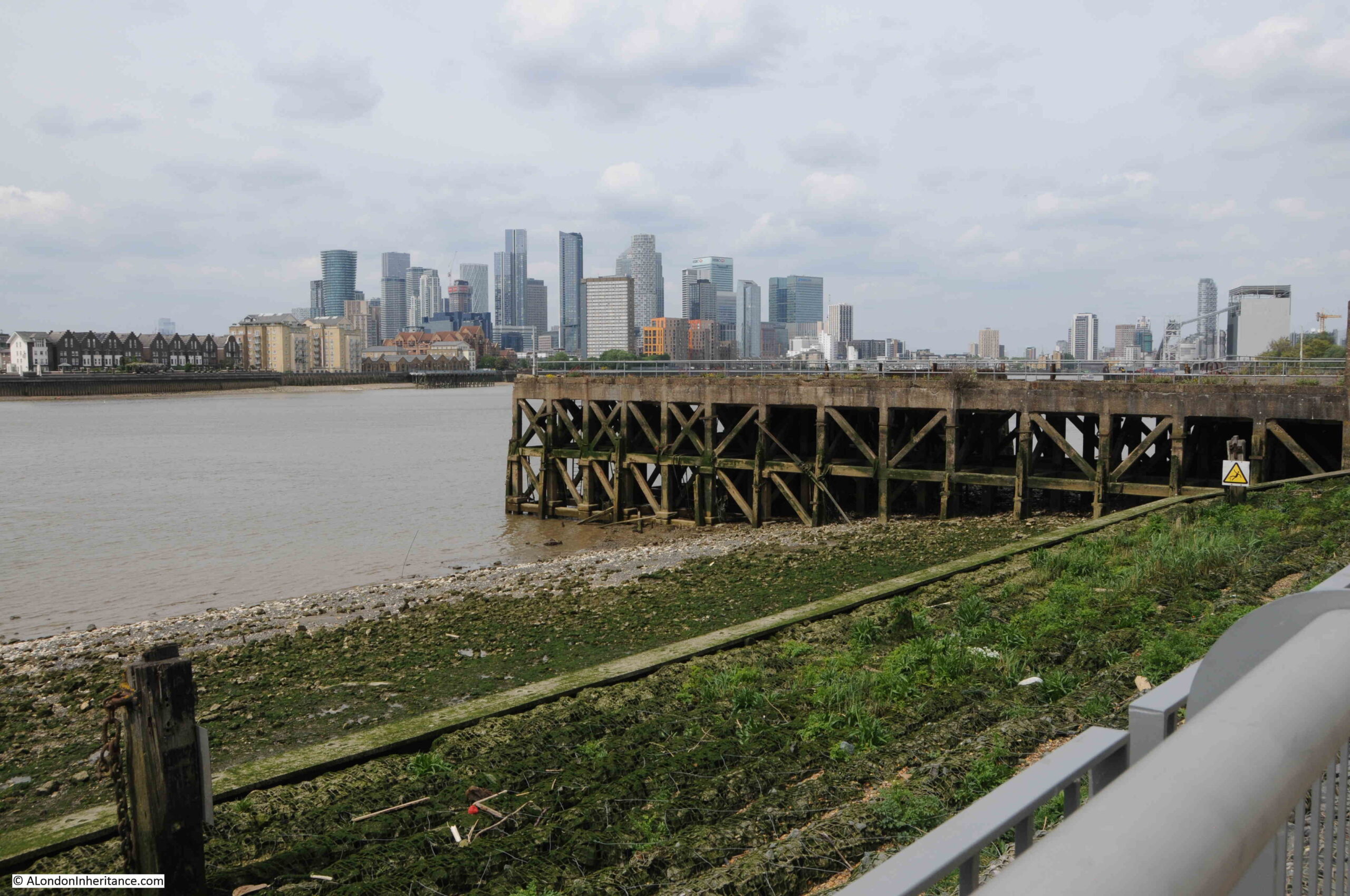
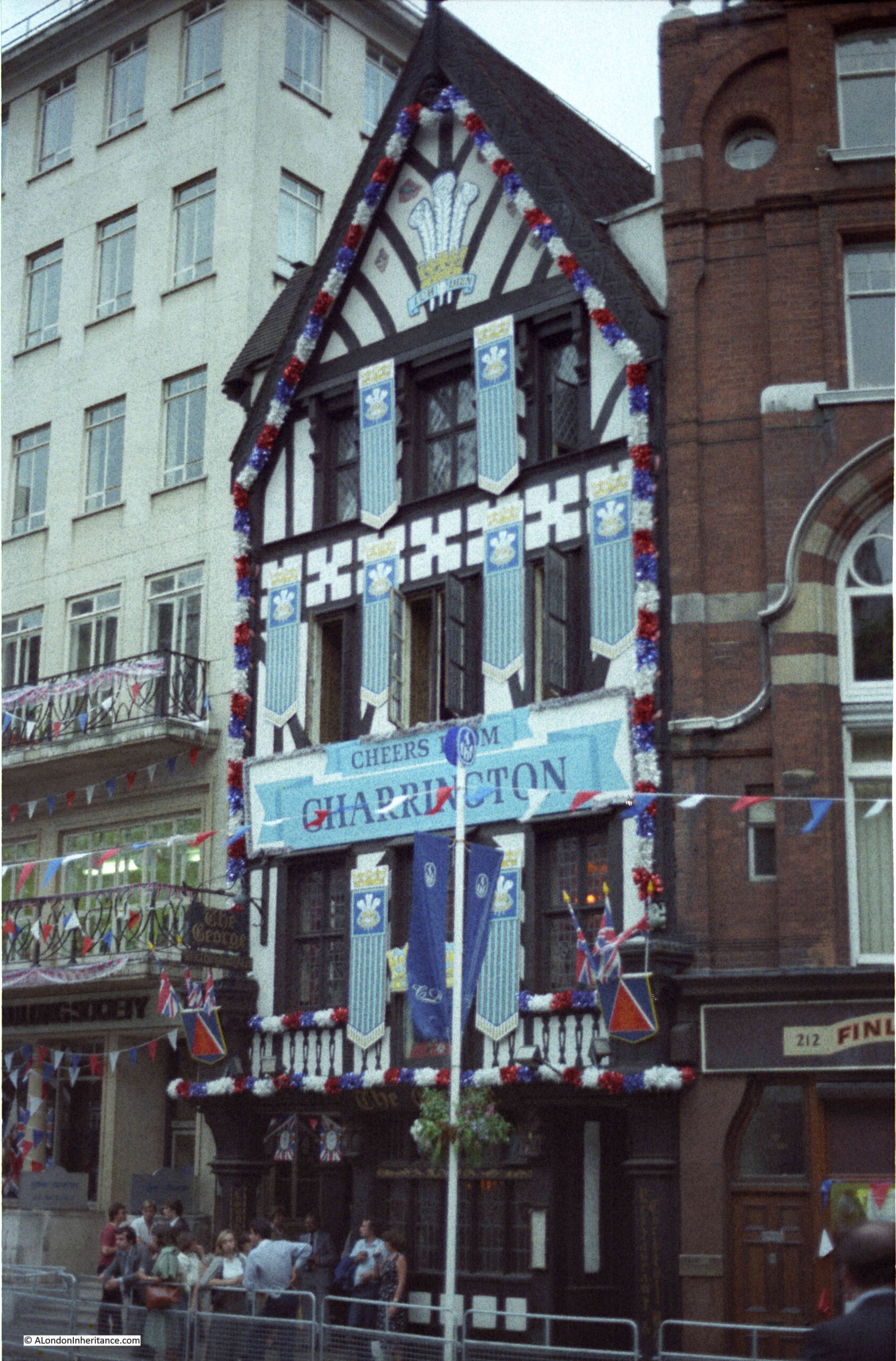
Towards the top of the map, the Great Northern Railway runs from left to right, and below the railway can be seen the proposed new route of the New River, which is straight, and cuts of the large loop around Hornsey.
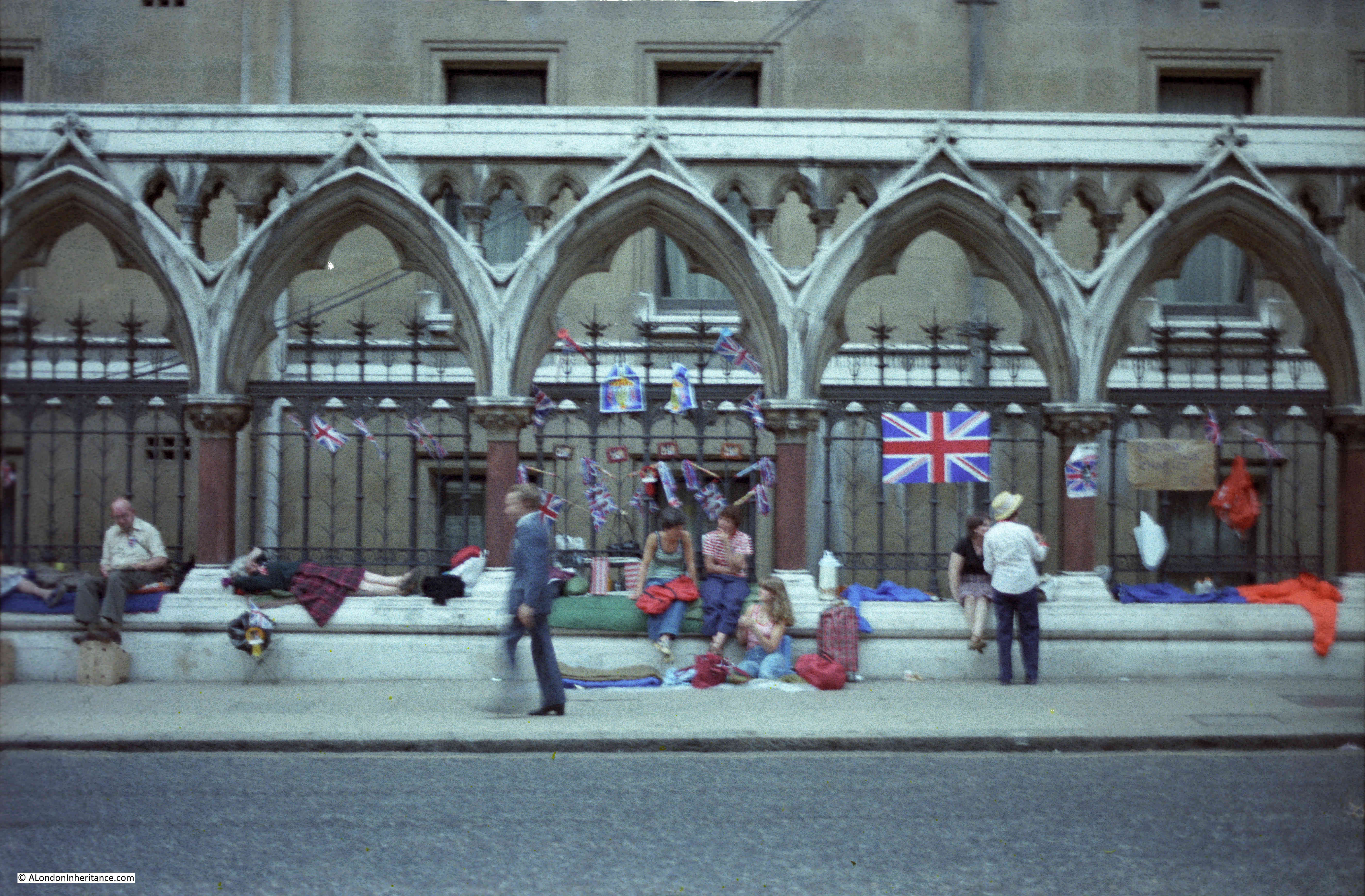
Roughly the same area as the above map, is shown in the following map of the area today, which includes the new route of the river just below the railway, and streets and buildings now covering the original route of the river around Hornsey  (© OpenStreetMap contributors):

Hornsey

There are a number of similar examples on the New River Walk where the route follows where the river has been straightened rather than the original route. It would be an interesting exercise to follow the early 17th century route, however I think I will put that walk on the long list of London walks.

Point 2 on the map: There were very few places on the entire route where it was not possible to follow the New River walk, however one place on this final stretch was also in Hornsey where the path had been closed off as Thames Water are carrying out some repair works on the river:

New River Walk

Following photo is looking along the closed section of the walk. This is another straightened section of the New River:

New River Walk

Point 3 on the map: The New River then runs through a housing estate which was built around the New River. The following map extract shows the river running between terrace housing and under streets. There is no path alongside this section of the river, and walking to where the river crosses each street, then back, would add a considerable distance to the walk, so the Thames Water New River path runs along Wightman Road to the left  (© OpenStreetMap contributors):

Wightman Road

The view looking down one of the streets from Wightman Road, the New River crosses the street half way down:

Wightman Road

In the above photo, the streets is dropping in height towards the point where the river crosses about half way down. This stretch of the New River demonstrates how the river follows the contours of the land, from the source in Ware to New River Head. A considerable distance which needed some careful planning, and is remarkable given the survey technologies available in the early 17th century.

The following map shows land height by colour, with blue being lower land, then increasing in height through green, yellow and red (from the excellent topographic-map.com):

New River height map

I have marked the route of the New River which is following the boundary between the higher land on the left (around Crouch Hill station), and the lower land on the right (south Tottenham and Seven Sisters station).

At one point in the map, an area of higher ground (yellow) juts out, and the New River has been tunneled under this, before emerging and running through the streets to the east of Wightman Road.

Point 4 on the map: After weaving through the streets of terrace housing, the New River emerges into the north east corner of Finsbury Park:

Finsbury Park

Where there is a plaque recording the origins and purpose of the river:

Finsbury Park

The New River stays in just the north east corner of Finsbury Park, before crossing under Green Lanes, and reaching:

Point 5 on the map: where the river runs along a narrow green space between an industrial area to the north, school and housing to the south:

New River

In the height map above, the New River is heading towards the reservoirs and is skirting around some higher land to the south, and this is visible as we walk alongside the river, with a downward slope from right to left requiring the river to be banked on the northern side:

New River

North of the M25, between Cheshunt and Ware, there were a number of points where water was being extracted from boreholes and pumped into the New River. There were no examples of this south of the M25, except for one point along this stretch of the walk where four pipes were pumping water into the river, although it was not clear from where this was being extracted.

New River

There is a brick building visible just to the left of where the water is pouring into the river. This is on Eade Road. It houses infrastructure of some sort, and has a 2003 plaque on the outside, but no indication of its function.

The British Geological Survey borehole map lists a borehole under this building, however it is marked as “Confidential” with no data available.

I assume the water running into the New River is from this borehole, however it is strange as to why the record is confidential.

This section of the walk was incredibly muddy, with some sections rather difficult to pass.

At the end, the path runs up to meet Seven Sisters Road, with an information panel covered in graffiti:

New River Walk

For a short distance, the New River Path has joined with another walking route, the Capital Ring:

Capital Ring

And one final loop through housing, with a rather muddy path:

New River Walk

Point 6 on the map: The New River now reaches the reservoirs, with what must have been a gauge house, some means of regulating or measuring the flow of the river, straddling the New River just before the reservoirs:

New River Walk

The New River was truncated at the reservoirs at Stoke Newington in 1946, and now feeds water into the reservoirs, as well as running to their north, through the Woodberry Wetlands, an area surrounding the reservoirs that is now managed as a wildlife haven:

New River Walk

Between the east and the west reservoirs is a building that was once part of the New River infrastructure and has now been refurbished as the Coal House Café. The area outside the café was full of families, so I will not include a photo online, however at the side of the building is a record of the creation of the reservoirs by the New River Company:

New River Company

Also on the side of the building is a wall tie with the initials of the Metropolitan Water Board, the organisation that took over the running of the New River Company’s assets:

New River Walk

View across the east reservoir:

New River Walk

View across the west reservoir:

New River Walk

And a short walk from the west reservoir, we reach the very end of the remaining route of the New River. The last point in the walk from Ware in Hertfordshire, where the river can be seen above ground. It ends in a rather sad dead end:

End of the New River

Just to the left of the above photo is the wonderful 19th century pumping station built by the New River Company:

Castle pumping station

The Metropolis Water Act of 1852 required that water companies supplying water to London, filter the water prior to distribution, and that any subsequent reservoirs after filtering be covered. The aim was to improve the quality of water and prevent much of the pollution from an industrial city from entering the water supply.

Prior to the act, the New River Company was supplying water directly from the reservoirs, however the act now required filter beds to be constructed, along with infrastructure such as a pumping station, and the building in the above photo was built between 1852 and 1856 by William Chadwell Mylne, the Surveyor for the New River Company.

The building housed steam engines and boilers until 1936 when these were replaced by diesel engines.

By 1971, the pumping station was rather dated and too small, and the design of the building did not support an upgrade, so the Metropolitan Water Board applied for permission to demolish the building.

There was considerable local support to retain the building as it was such a local landmark, resembling an industrial castle alongside Green Lanes.

This campaign resulted in the building being given a Grade II* listing in 1972, however it would continue to stay empty, and under threat.

The Historic England listing record provides a perfect description of the old pumping station, and why it is known as the Castle (Historic England source here):

Large building designed to resemble a mediaeval fortress with keep and bailey. 1854-6 by Chadwell Mylne. Stock brick with stone dressings. Battlements and large stepped buttresses all around. The “keep” is of 2 storeys with a tall basement plinth. 6 windows on main south-west front. At north-east and south-west corners round towers with square bartizans the former with a tall conical roof and both having battlements crow-stepped up towards them. Continuous quasi-entablature, with cable moulding, running right around towers. Taller octagonal chimney tower to east. 8 steps (the top one with bootscraper!) to entrance in forebuilding running along north wall and into “bailey” building, which is lower with segmental arcading and 2 slit windows in each bay. Important picturesque landmark.”

The building was empty until 1994 when it was converted into a climbing centre. The large internal spaces perfectly suited for such a use. If you walk past, it is worthwhile having a quick look inside, as the building is still the Castle Climbing Centre.

Leaving the pumping station, we are now following the heritage section of the New River Walk. This section of the route has not seen the New River as a stream of water for many years, as the river was buried in pipes during the 19th century, and since 1946, New River water has ended at the reservoirs.

Point 7 on the map: Here we turn off from Green Lanes and into Clissold Park.

The park retains a couple of stretches of the New River, however these are for decorative purposes only, and start and end within the park.

There is a bridge across one of these decorative runs of the river, which has the arms and motto of the New River Company on the side. “ET PLUI SUPER UNAM CIVITATEM” or “And I caused it to rain upon one city” indicated by the hand reaching down from a cloud, and showering rain drops on the city below.

Clissold Park

Part of the decorative New River feature running up to Clissold House:

Clissold House

Leaving Clissold Park, and walking along Stoke Newington Church Street, there is another reminder of the New River with the New River Café on the corner with Clissold Crescent:

New River cafe

Walk a short distance along Clissold Crescent, and there is a reminder of the New River:

Clissold Crescent

The plaque reads “The Park Lane bridge was demolished and the road widened June 1881”.

Park Lane was the original name of Clissold Crescent, and the bridge carried Park Lane over the New River.

A version of the Ordnance Survey map from the 1890s shows the Park Lane bridge and the New River, although by this time, the New River should have been carried underground in pipes, and as the plaque reads, the bridge was demolished in 1881 and the road widened, so I suspect the OS map was not updated at this point  (‘Reproduced with the permission of the National Library of Scotland“).

Clissold Crescent

In the above map, the New River heads south between houses, and the route has been preserved and now forms a series of allotments running along the old course of the river:

New River Walk

The path between the allotments ends at Green Lanes (again, almost a constant companion on the southern section of the walk). We cross over Green Lanes to reach;

Point 8 on the map: this is Petherton Road where the New River once ran down the centre of the street, and is now a walkway with trees and grass on either side:

Petherton Road

A rather nice ghost sign for Barnes Motors along Petherton Road:

Barnes Motors

At the end of Petherton Road, the green space gives way to a street which still follows the route of the New River, past Canonbury Station and cross over St Paul’s Road into another section of the New River route that has been transformed into a long green space, with a decorative water feature running the length of the space:

New River Walk

Towards the end of this green space is:

Point 9 on the map: where there is a round brick building alongside the original route of the New River:

New River Watch House

The building appears to be a late 18th century watch hut. To protect the New River, the New River Company had a watchman or linesman stationed at points along the route of the river to keep the river clear of debris and also to prevent fishing and swimming in the water, or anything that could pollute the supply.

The brick hut is an example of where such a person would have been stationed to keep watch over the river.

The final stretch of the ornamental water that follows the original route of the New River:

New River Walk

Where the above green space ends, we then walk south along Essex Road, and turn off just before reaching Islington Green, to find Colebrooke Row.

This is another street where the houses were built facing on to the New River, and the space occupied by the river is now a green space running the length of the street.

In the following photo, the houses on the right once looked onto the New River where the grass and trees now run, with the street being on the left:

Charles Lamb's House

The white house on the right in the above photo was occupied by the poet and essayist Charles Lamb in the 1820s. The following print shows the house as it was, with the New River running directly in front of the house:

Charles Lamb's House

I have written a detailed post about Colebrooke Row and Charles Lambs which can be found here.

Leaving Colebrooke Row, we cross over City Road and Goswell Road, and cut through to St John Street. Then down to Owen’s Row (which is on the alignment of the New River, I wrote about Owen’s Row within this post).

Crossing over St John Street into Rosebery Avenue, and this is the view along the old route of the New River, with Sadlers Wells on the right (a post on Sadlers Wells and the New River is here):

Sadlers Wells

At the end of Sadlers Wells, turn right into Arlington Way, then left into Myddelton Passage, where we come to the official end of the New River Walk, at the viewing platform looking over what was New River Head:

New River Head

The route is marked on the ground of the viewing platform:

New River Head

And that completed the New River Walk, over four days / two weekends, from Ware in Hertfordshire to New River Head, Clerkenwell.

It was a fascinating journey, and whilst the route has been straightened at a number of points and does not fully trace the original early 17th century route, it did leave me with considerable admiration for those in the early 17th century who surveyed and built the route, following the contours of the land so it would only fall by roughly 20 feet along the entire route ( 5.5m in total or 5 inches per mile). This enabled the water to flow naturally without the need for any pumping.

You can find my posts covering the first two stages of the walk at the following links:

I have also written about the history of New River Head and London’s Water Industry, which you can find at this link.

In the following panorama from the viewing platform at New River Head, I have labeled some of the key features. On the right are the engine and pump house which will soon become the new Quentin Blake Centre for Illustration, a wonderful new use for these historic buildings.

Panorama of New River Head

David Fletcher creates remarkable 3D photogrammetry captures of heritage sites and has one for the historic buildings at New River Head. Hopefully this will work as I have embedded the model in the post (if you do not see this in the e-mail, click here for the post on the website).

You can walk through the site, both inside and out to see this remarkable, historic site in detail:

And finally, if you have not had enough about the New River, I purchased the following book, the Mercenary River by Nick Higham a few weeks ago.

The Mercenary River

It really is a fascinating history of London’s water supply, including, off course, the New River, and is highly recommended.

alondoninheritance.com