Category Archives: London History

Walking the New River – Ware to Cheshunt

I have written about New River Head in a previous post, as well as a number of posts about how water has been key in the development of Clerkenwell and parts of Islington.

New River Head was the point where water delivered by the New River was collected and treated, then sent on through an extensive pipe network to London consumers from the east end to Soho and the west end.

The New River was built in the early 17th century, opening in 1613. A very innovative and complex bit of civil engineering for the time as it transported water from springs near Ware in Hertfordshire all the way to New River Head. Helping to transform London’s water supplies, that had depended on water from the Thames along with small local wells and springs, to a constant, high volume supply of clean water.

What is remarkable is that this 400 year old artificial river is still in use, and for the same purpose. Today, the New River provides around 8%, or 220 million litres a day, of London’s water, so if you live in London, there is a good chance that you have drank or showered in water that has reached you via the New River.

The New River no longer runs to New River Head. It terminates at the east and west reservoirs around Woodberry Wetlands, just south of the Seven Sisters Road.

Starting in 1992, Thames Water created a New River Walk that follows the 28 miles from the source to New River Head. 25 miles follow the river from source to the reservoirs, and a further 3 miles makes up a heritage walk that follows the original route of the New River through to New River Head.

I have long wanted to walk the route from the source of the New River, and a few weekends ago, had the opportunity to spend a weekend walking the New River with a small group from Clerkenwell and Islington Guides and the Quentin Blake Centre for Illustration, who will be moving into the historic buildings at New River Head.

My post on New River Head and London’s Water Industry covers the history of the New River, so I will not focus on this aspect in this post, however before starting the walk, a quick look at why a former army officer from Bath, Edmund Colthurst, who had served in Ireland, in 1602 proposed a scheme to bring in water from Hertfordshire springs to a site to the north of the city.

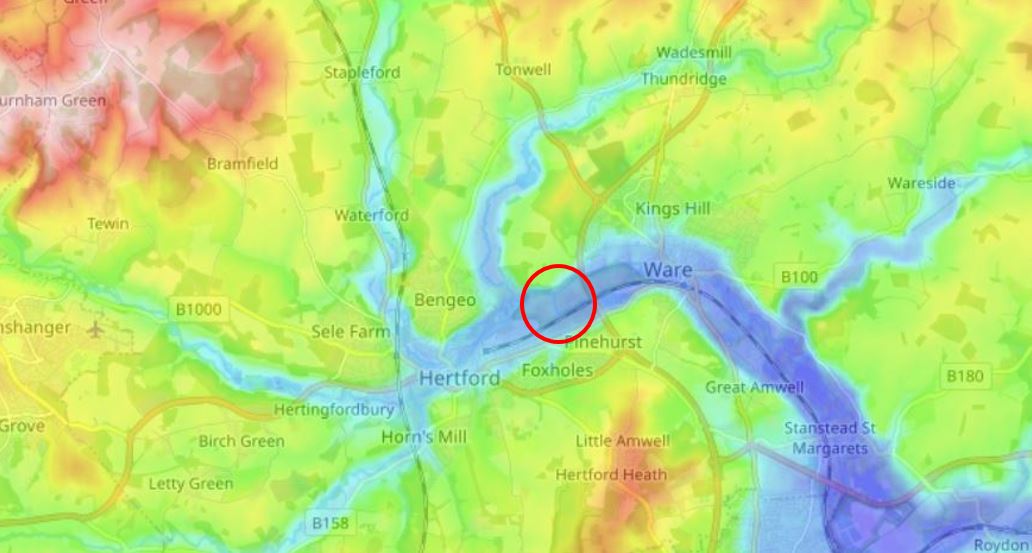
The following map is a heat map (from the excellent topographic-map.com) showing the height of the land around the town of Ware. Blue the lowest, through green, red and to the highest land shown as white:

Walking the New River

I have circled the source of the New River. It is here where the New River draws water from the River Lee, and where the Chadwell Springs rise and feed the river. The Chadwell Springs were the original source, with the link to the River Lee added later when more water was required to support London’s growing population.

As can be seen in the map, the source is in a low lying area, there are multiple streams running through the area as well as the River Lee which follows the low lying land to the lower right of the map.

The surrounding land rises, and water collects in the area, providing a significant source for the river.

The Chadwell Spring is the original source of water for the New River. The spring is a large pool of water which is filled with water rising from below ground.

The geology of the area is interesting. Some of the water that rises at the spring comes from the Mimmshall Brook, which, ten miles to the west near Hatfield, drains into a sink hole.

The sink hole forms part of a large underground drainage network called a Karsitic network – an area where the underlying chalk has been dissolved by water forming sink holes and sub-surface drainage networks, which around Hertford and east to the Chadwell Springs covers an area of 32 square kilometers.

The geology of the area means that it was a perfect choice for Edmund Colthurst to propose for the source of the river in 1602.

I refer to the River Lee a number of times in the post. The name can be found with spellings of Lee and Lea. The River Lea is frequently used for the natural river and Lee Navigation for parts of the river where it has been turned into a navigable canal. For simplicity I will use River Lee to refer to any part of the Lee / Lea water system.

Now to start walking the route:

Day 1, Ware to Rye House

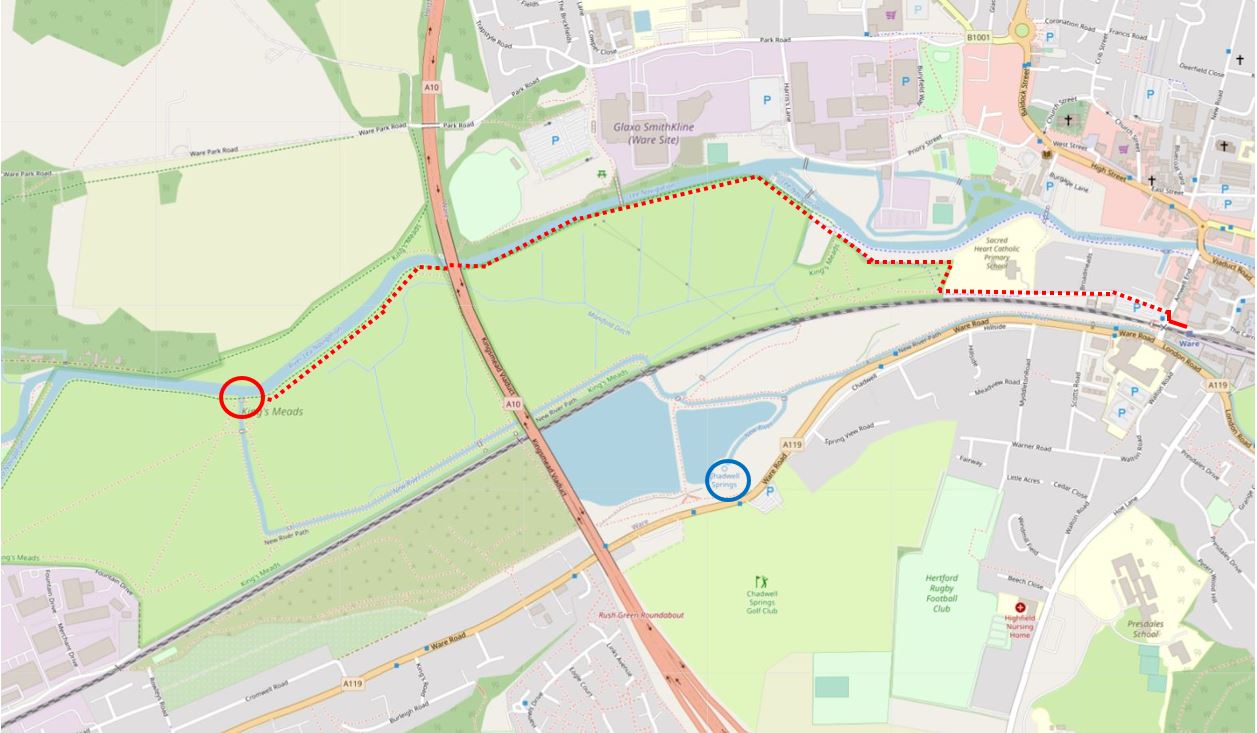
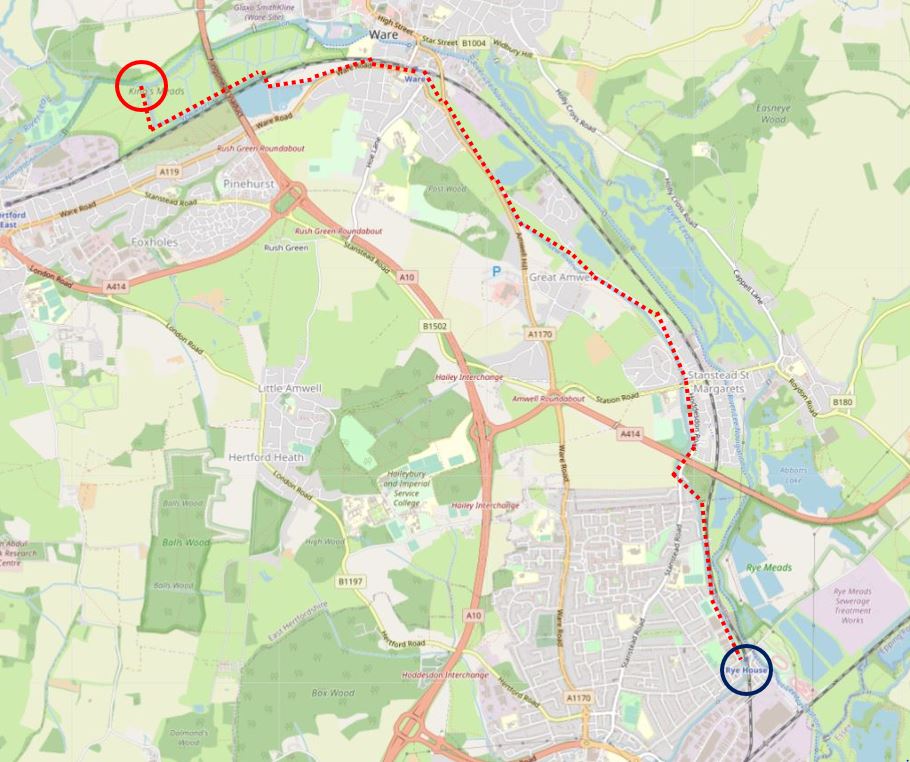
The first day’s walk was just under 8 miles in length, which included the walk to get to the source of the New River. The route is well served by the rail network, so starting from Ware station, it was a walk to the source following the dotted red line in the following map (Map © OpenStreetMap contributors):

Walking the New River

The blue circle in the above map marks the location of the Chadwell Spring.

The first day’s walk from the source to Rye House is shown by the red dotted line n the following map:

Walking the New River

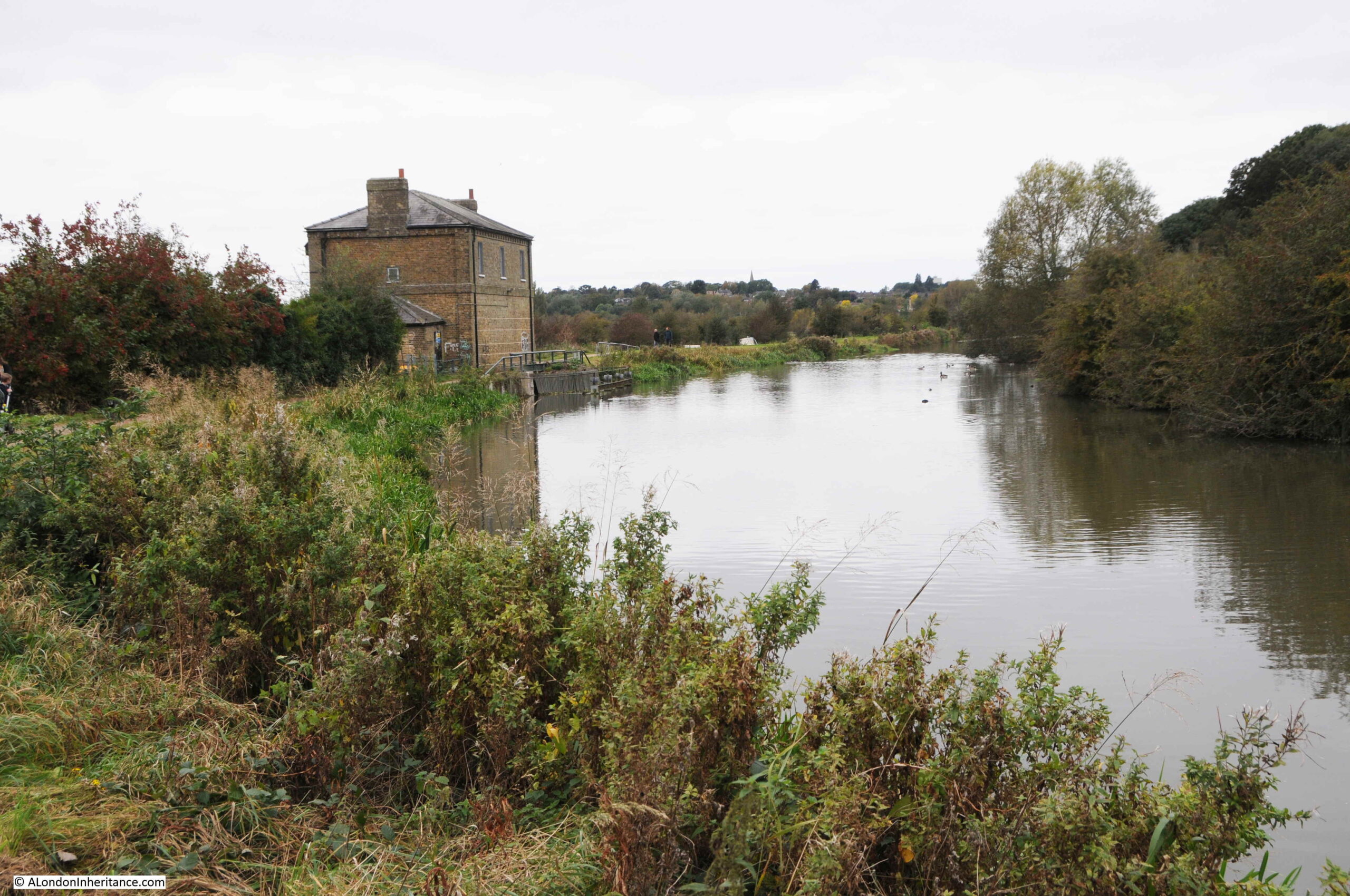
After walking from Ware station, along the River Lee, the first sign of the New River comes with New Gauge House on the banks of the River Lee:

Walking the New River

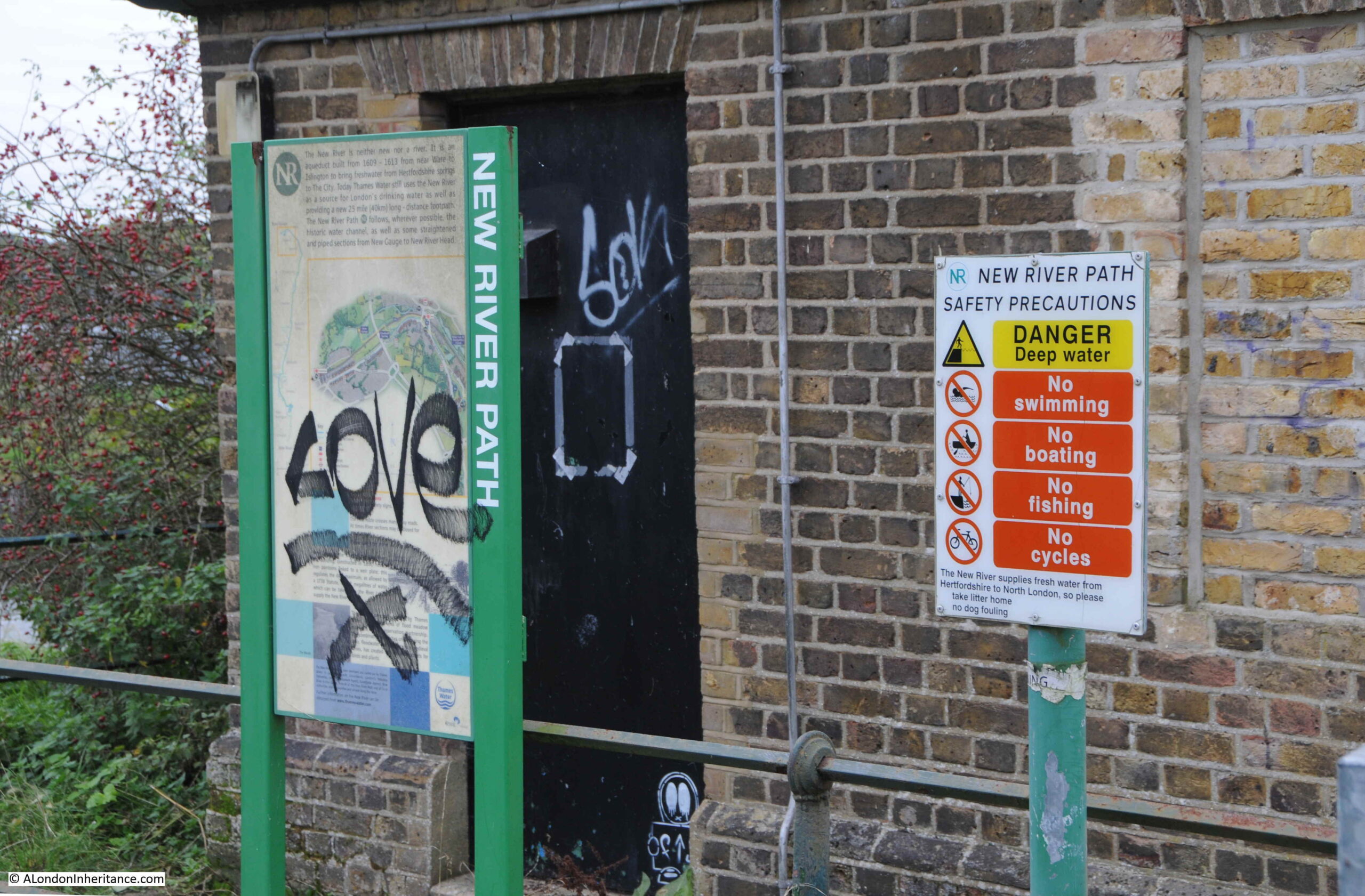
At the side of New Gauge House are two signs, the one on the left is part of the original signage covering the path alongside the river, the sign on the right shows that this is still a working bit of water supply infrastructure, with appropriate safety precautions.

New River Gauge House

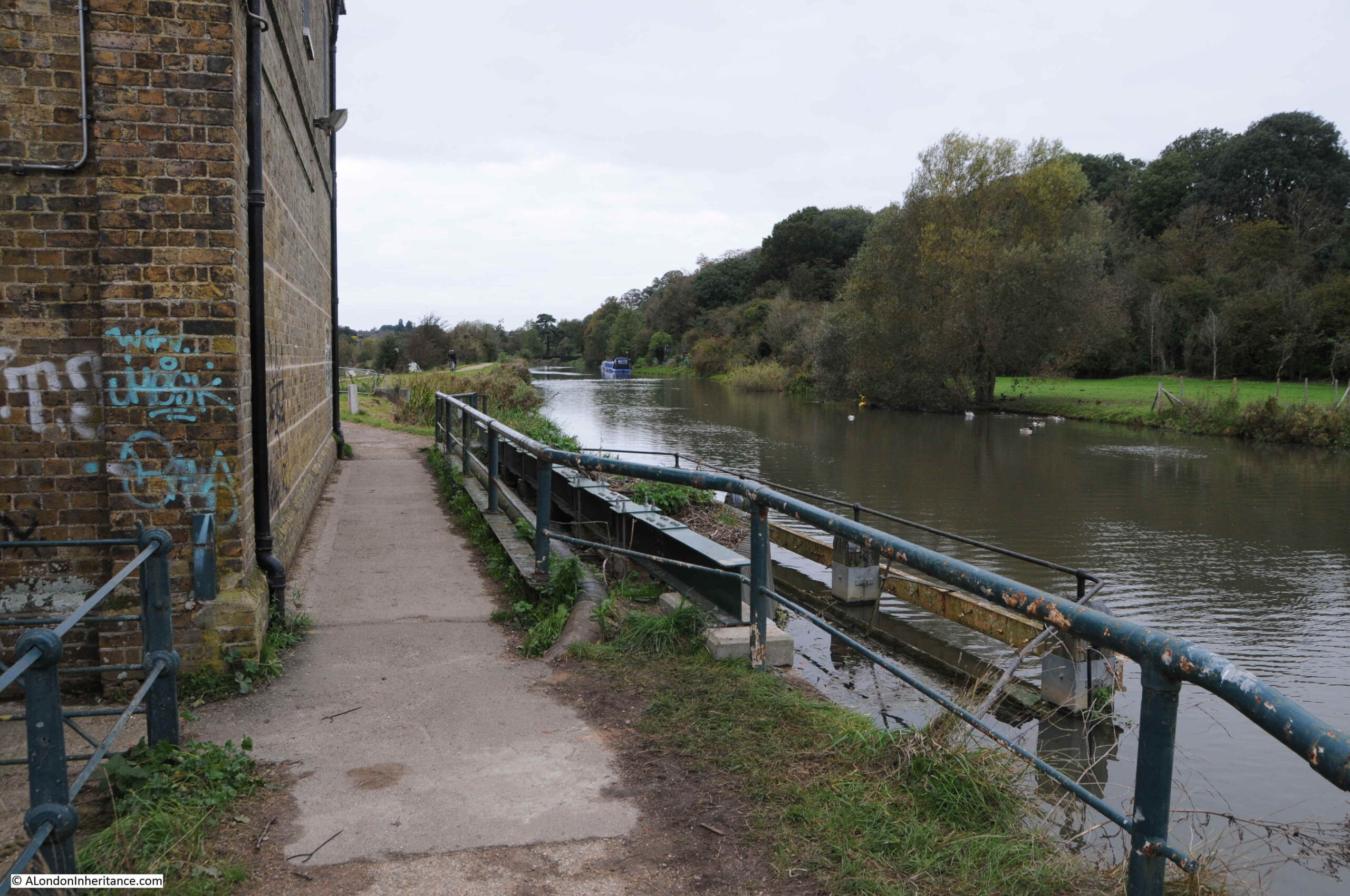
Looking west along the River Lee, with New Gauge House on the left, and on the right in the river is the infrastructure that allows water to be drawn off from the Lee into the New River.

River Lee

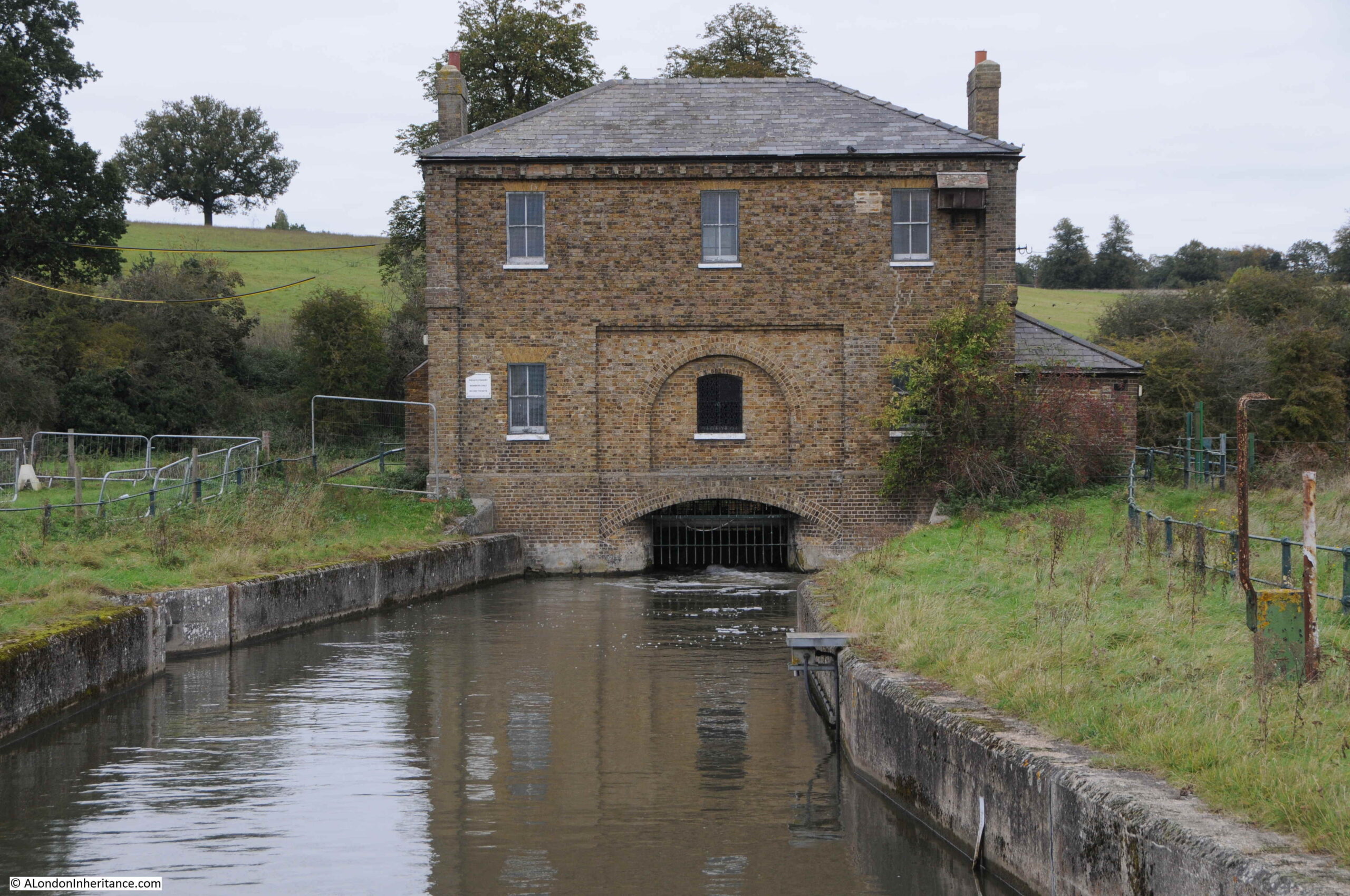
The following view shows New Gauge House, with the start of the New River coming from the arch below, where water from the River Lee starts its journey south to provide water for the population of London.

New River Gauge House

New Gauge House was built in 1856. The equipment that controls the flow from the Lee is in the ground floor of the building, and accommodation for a Gauge Keeper was in the floor above.

According to the Historic England listing, 22.5 million gallons is taken each day from the Lee into the New River.

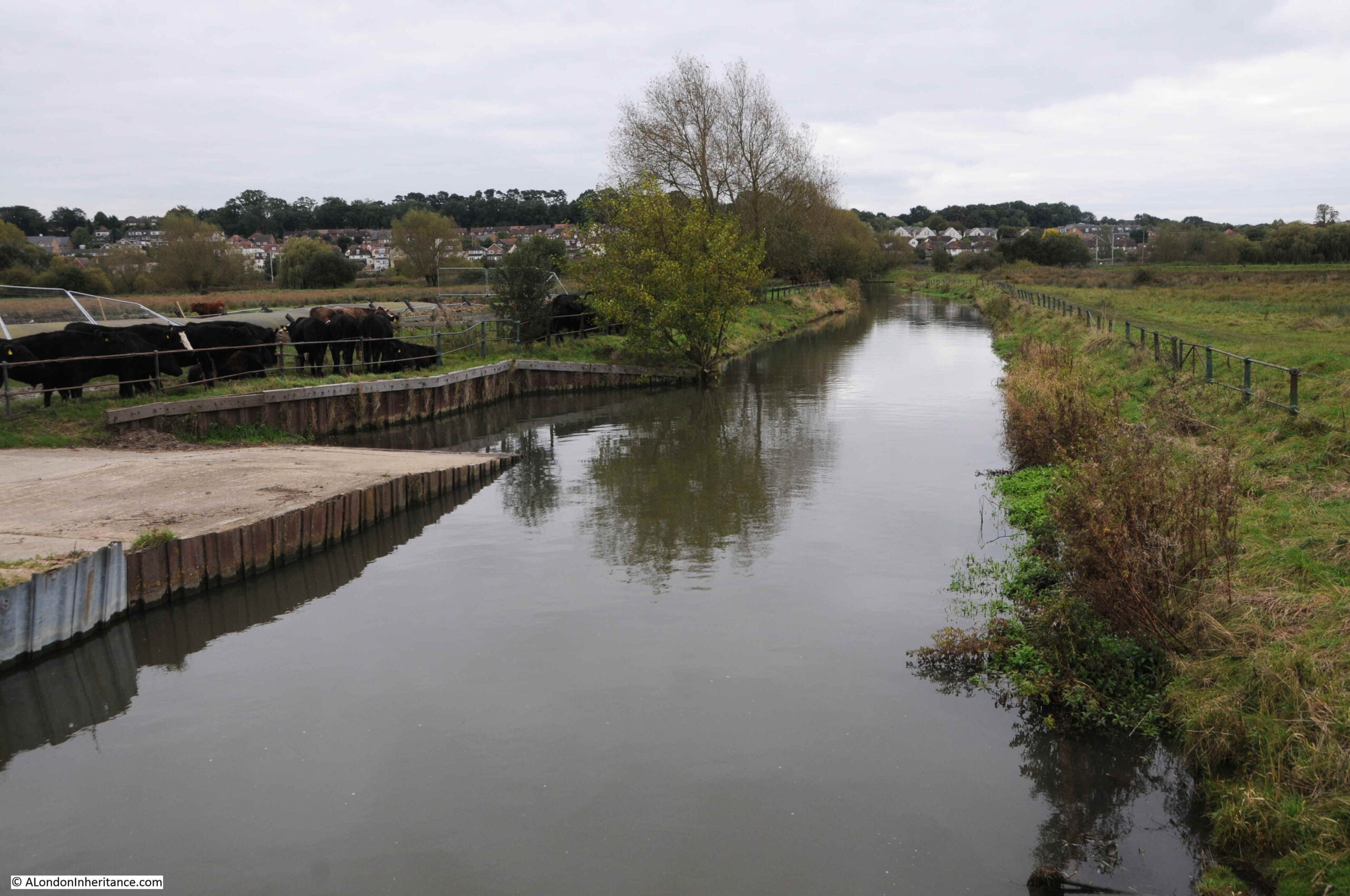
Looking south along the start of the walk:

Walking the New River

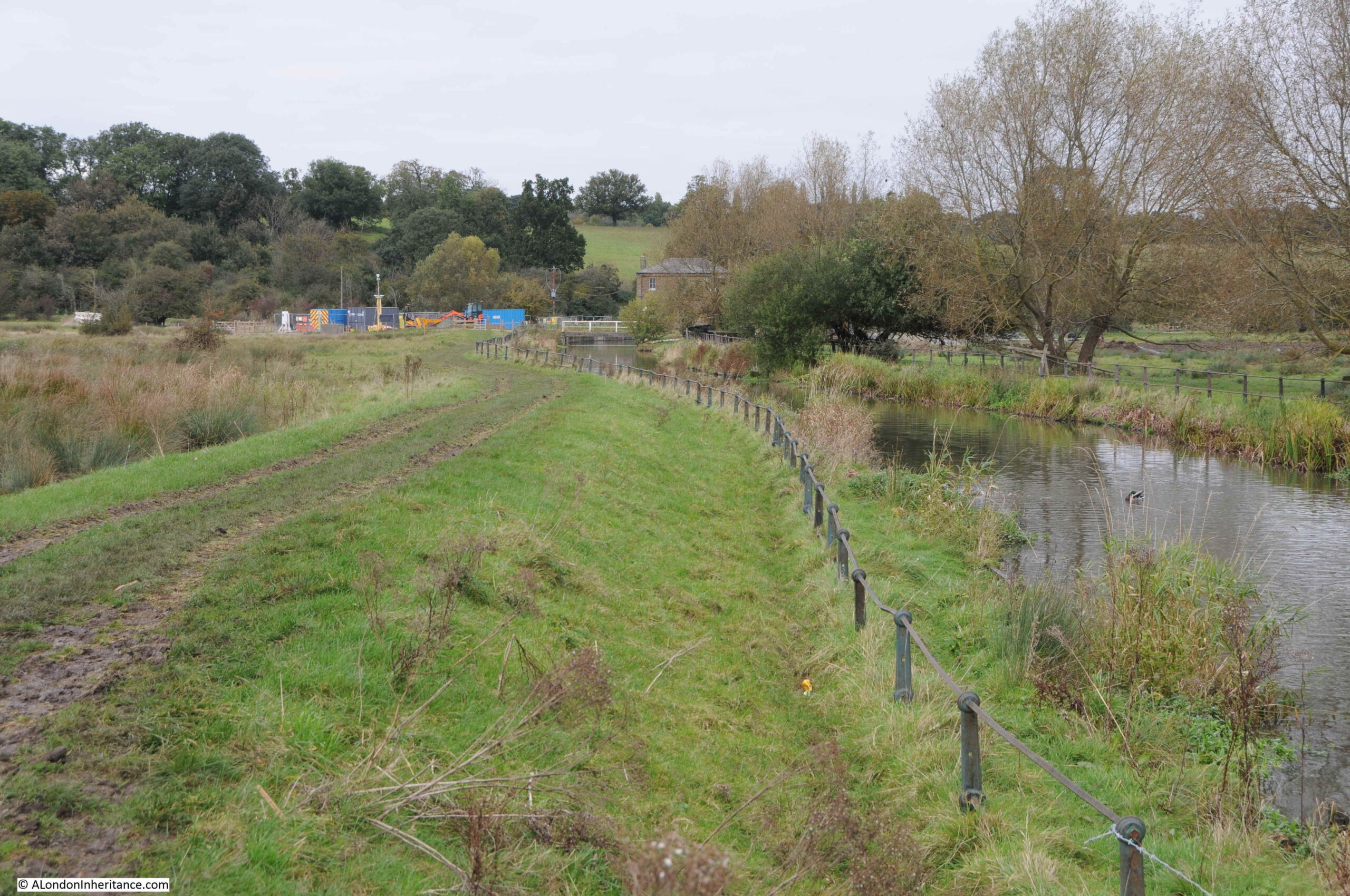
Looking back along the New River to New Gauge House, slightly hidden by trees, with the higher ground, part of the higher ground that surrounds the area, seen in the background.

Walking the New River

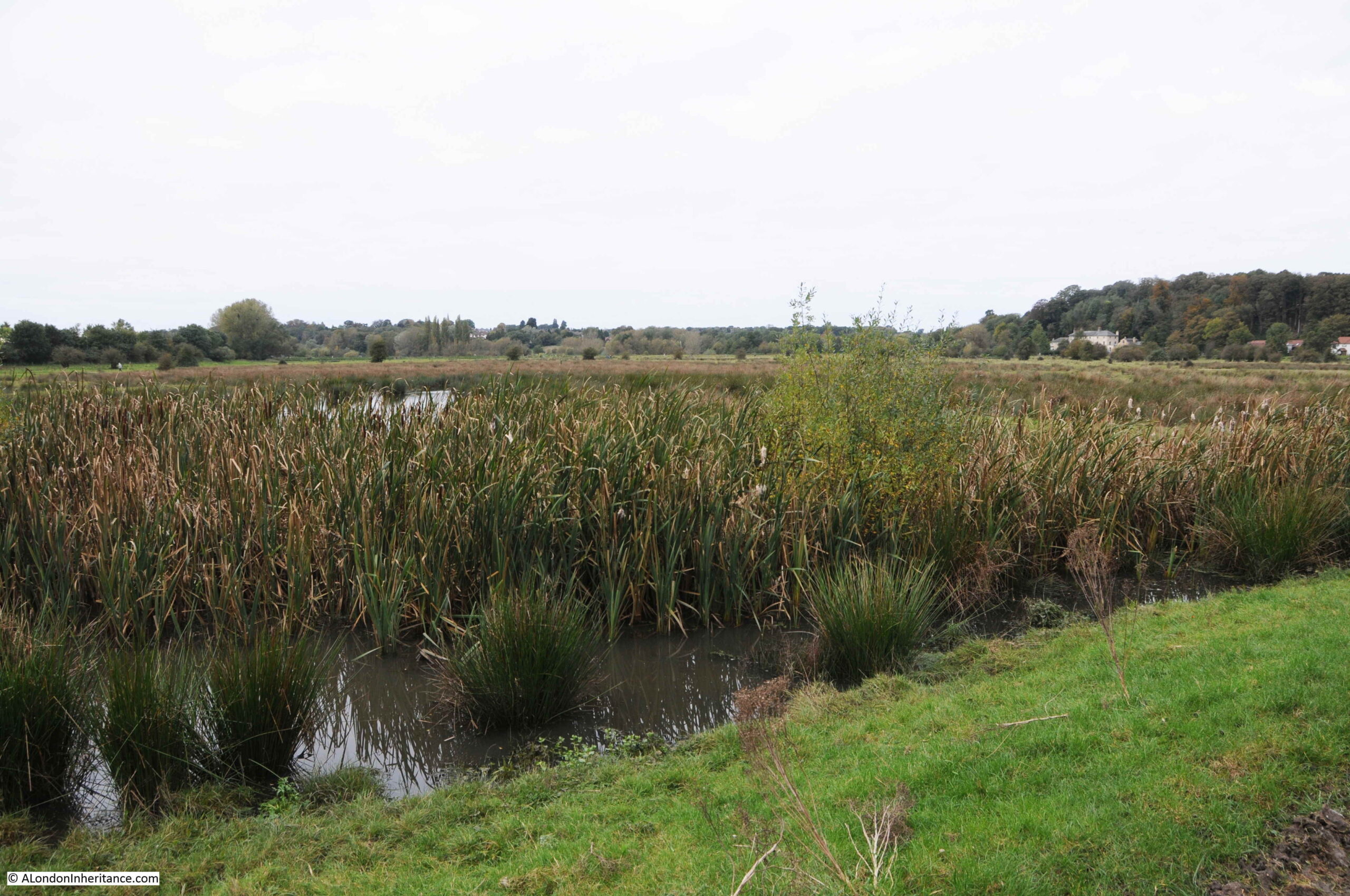
As shown in the heat map at the start of the post, this is a low lying area, with large amounts of water lying across the surface of the land:

Chadwell Spring

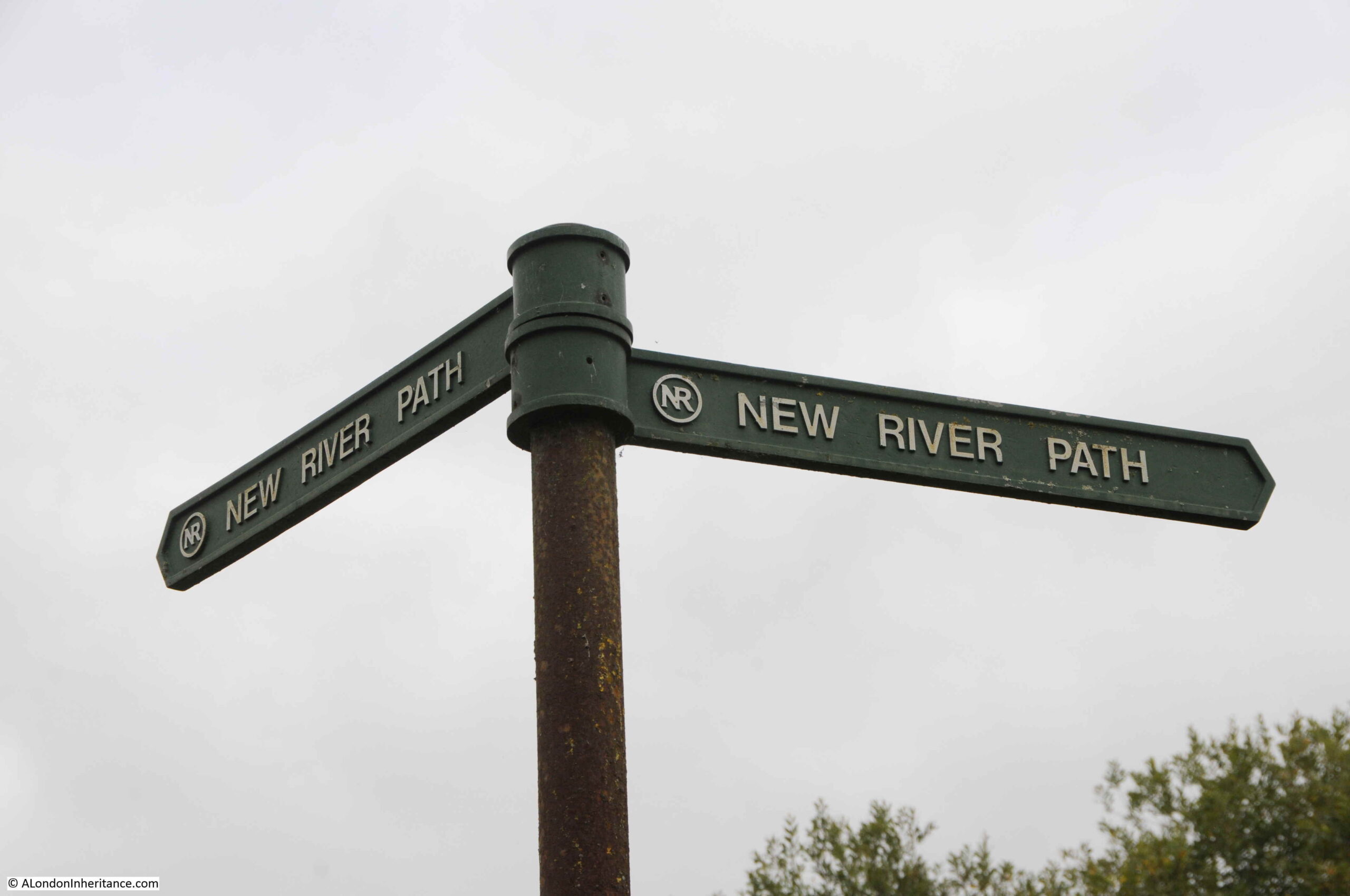
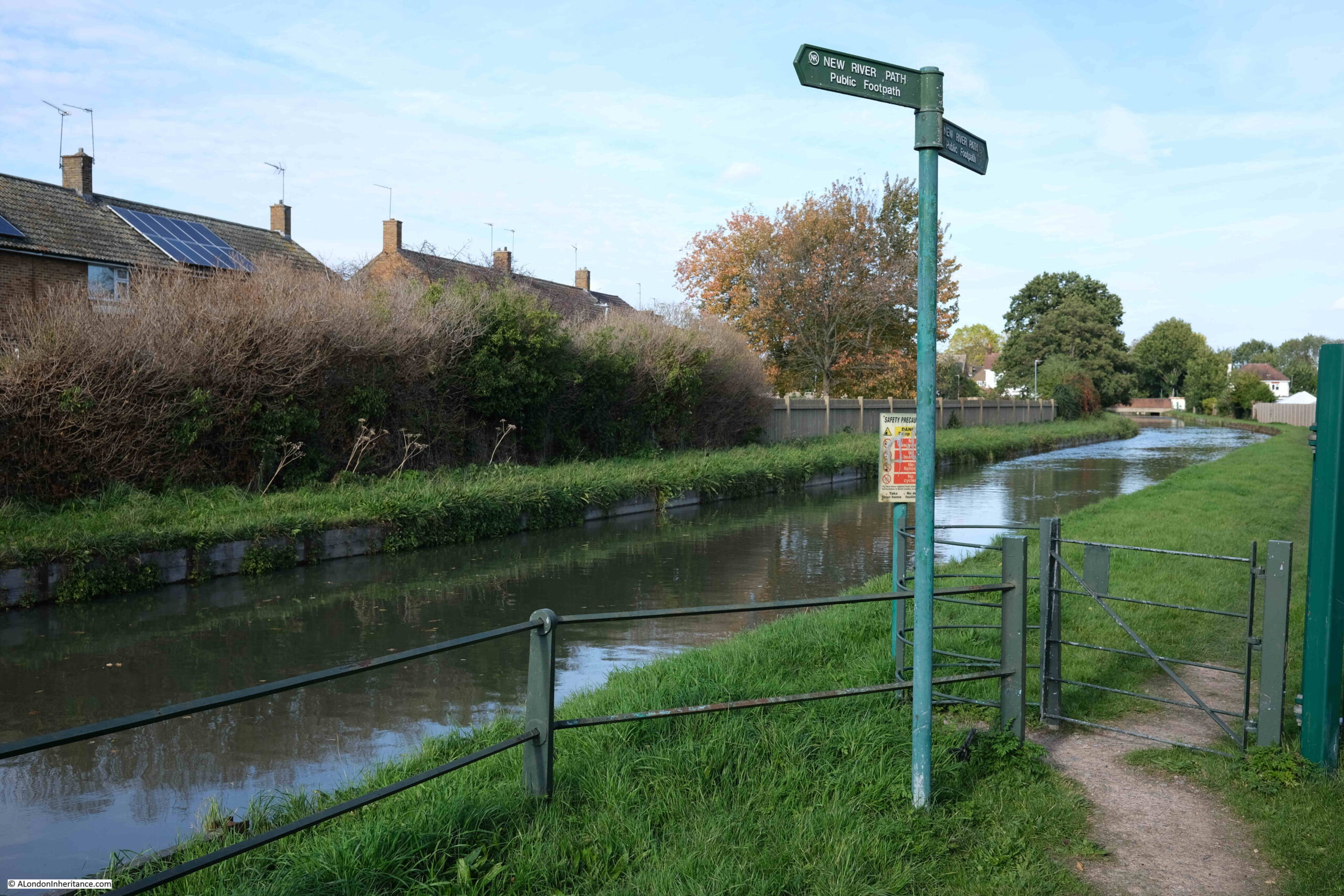
Signposting from the creation of the New River Path:

New River Path

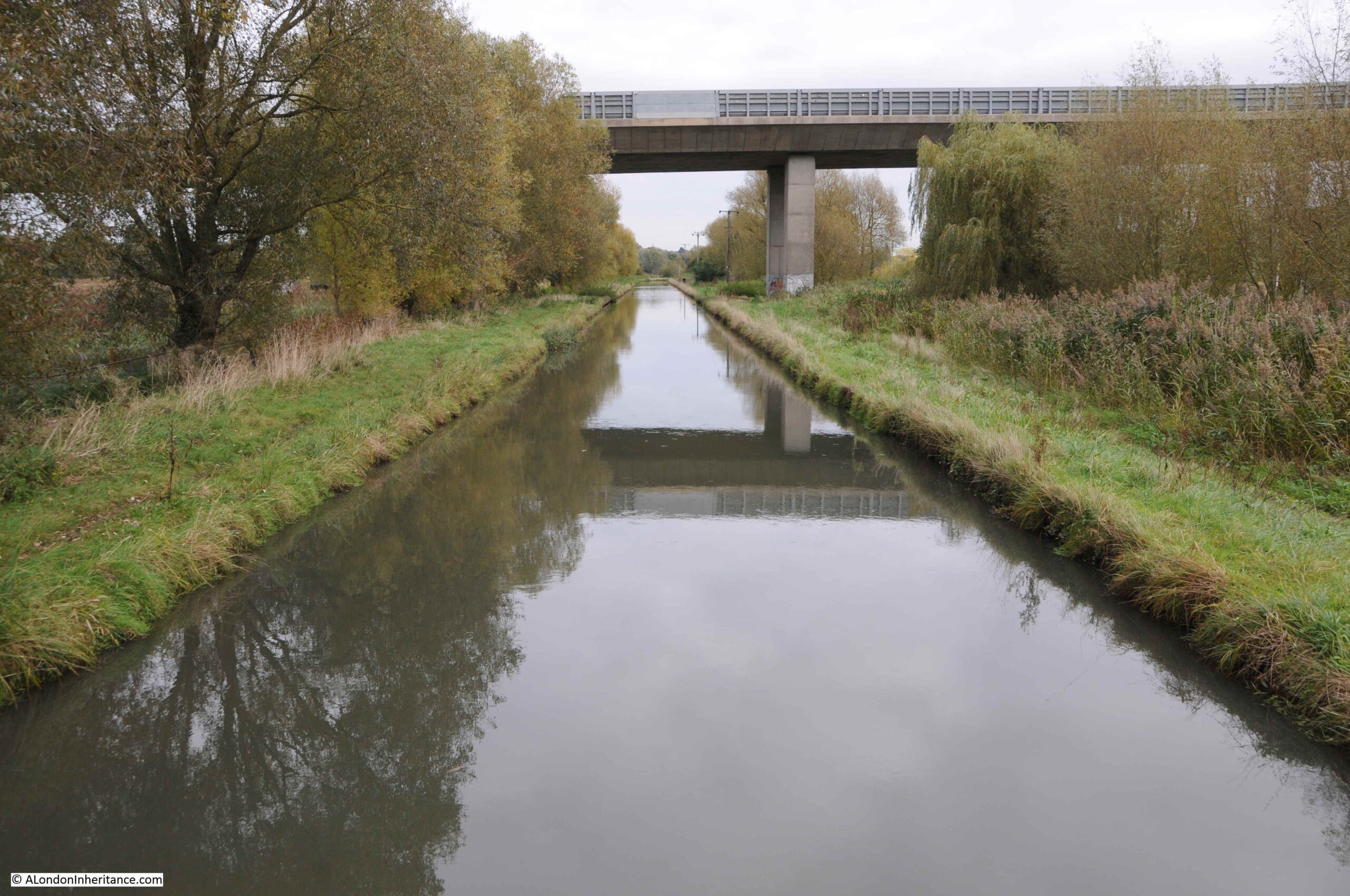
A straight stretch of the New River with the A10 road crossing:

Walking the New River

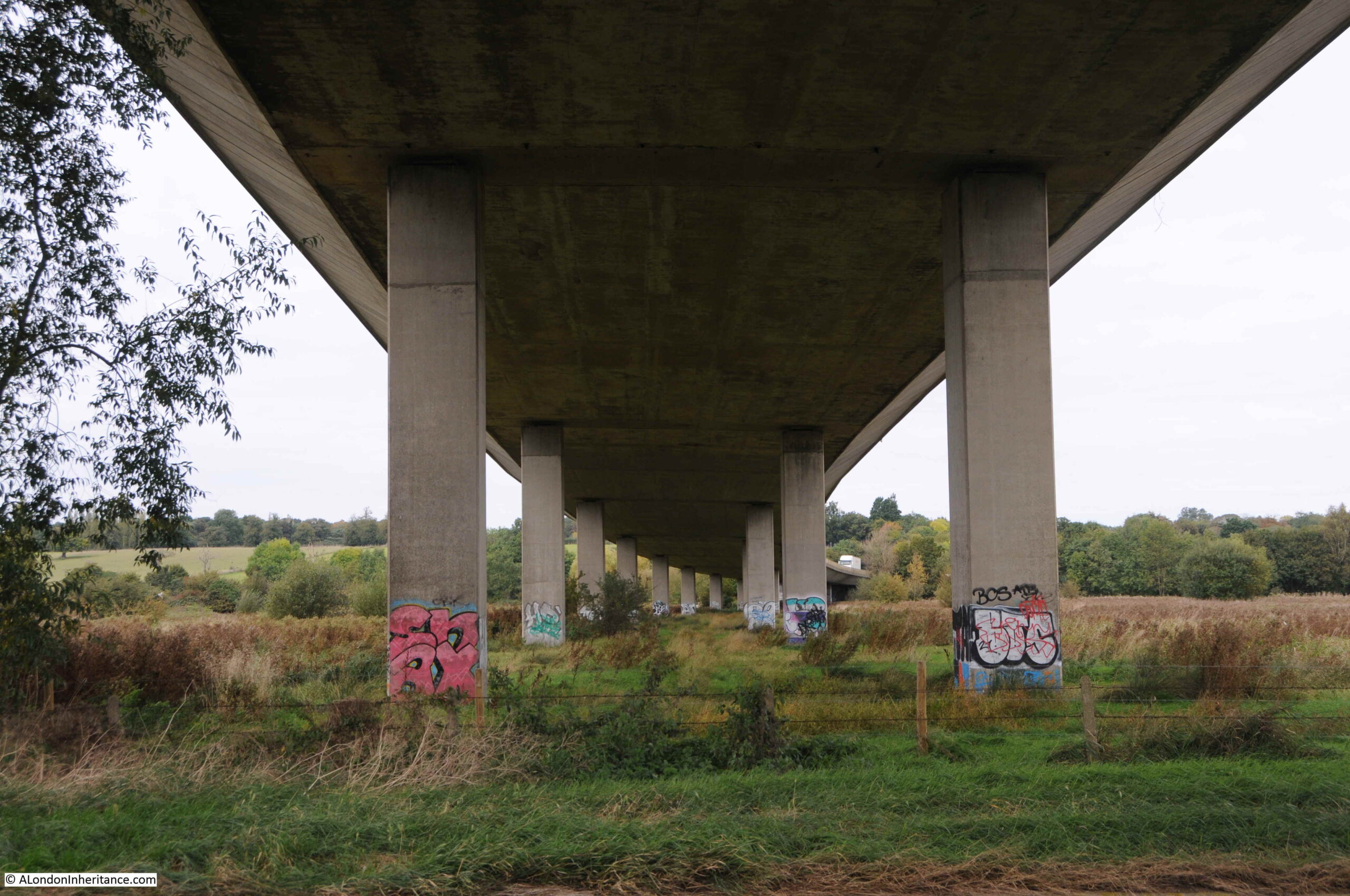
Underneath the A10:

Walking the New River

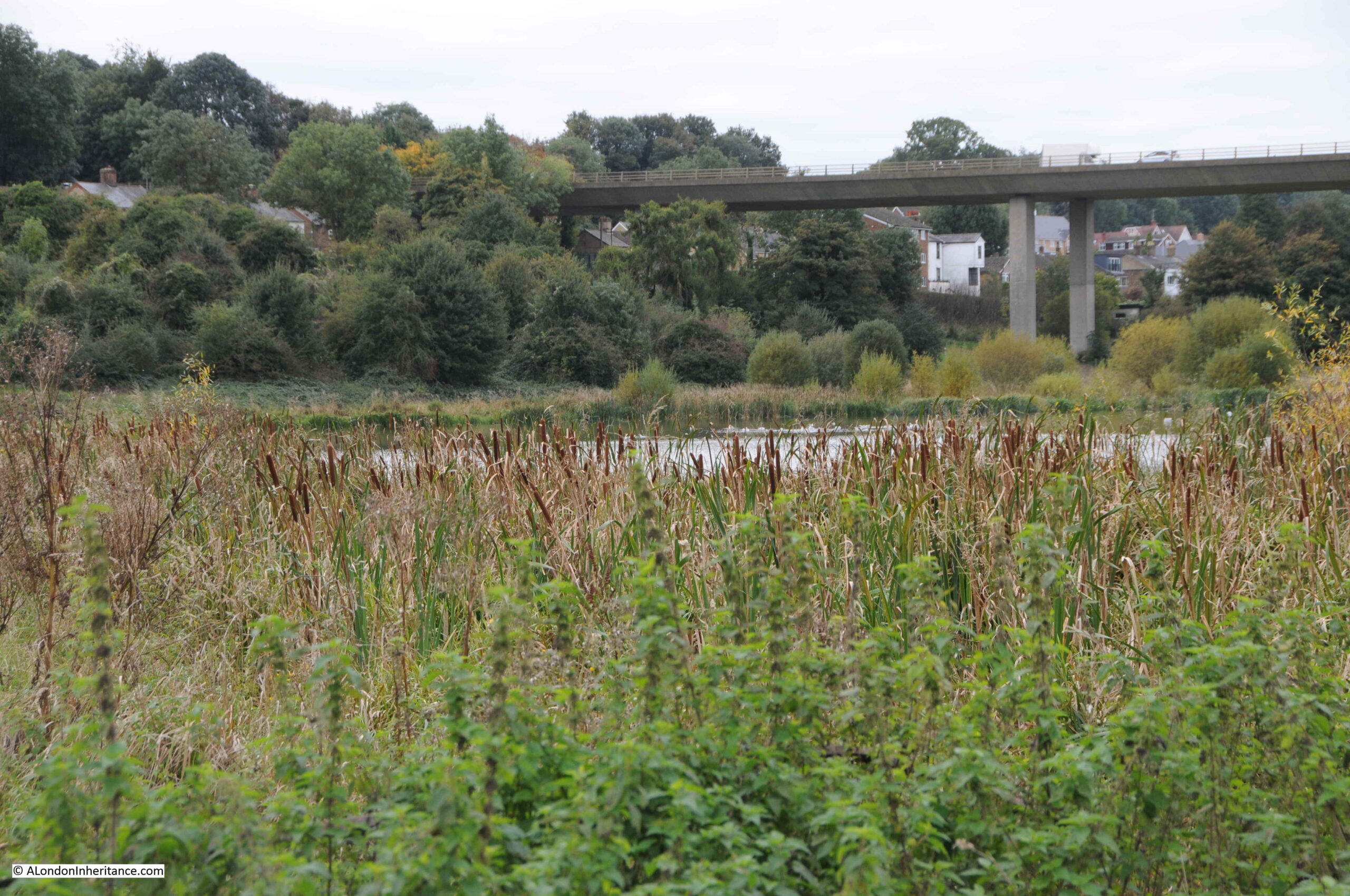
It is theoretically possible to get to the Chadwell Spring, however the area around the spring is very overgrown and wet, and required a detour from the main path. The Chadwell Spring rises into a circular pool.

This is the view looking in the direction of Chadwell Spring from the walk alongside the New River:

Chadwell Spring

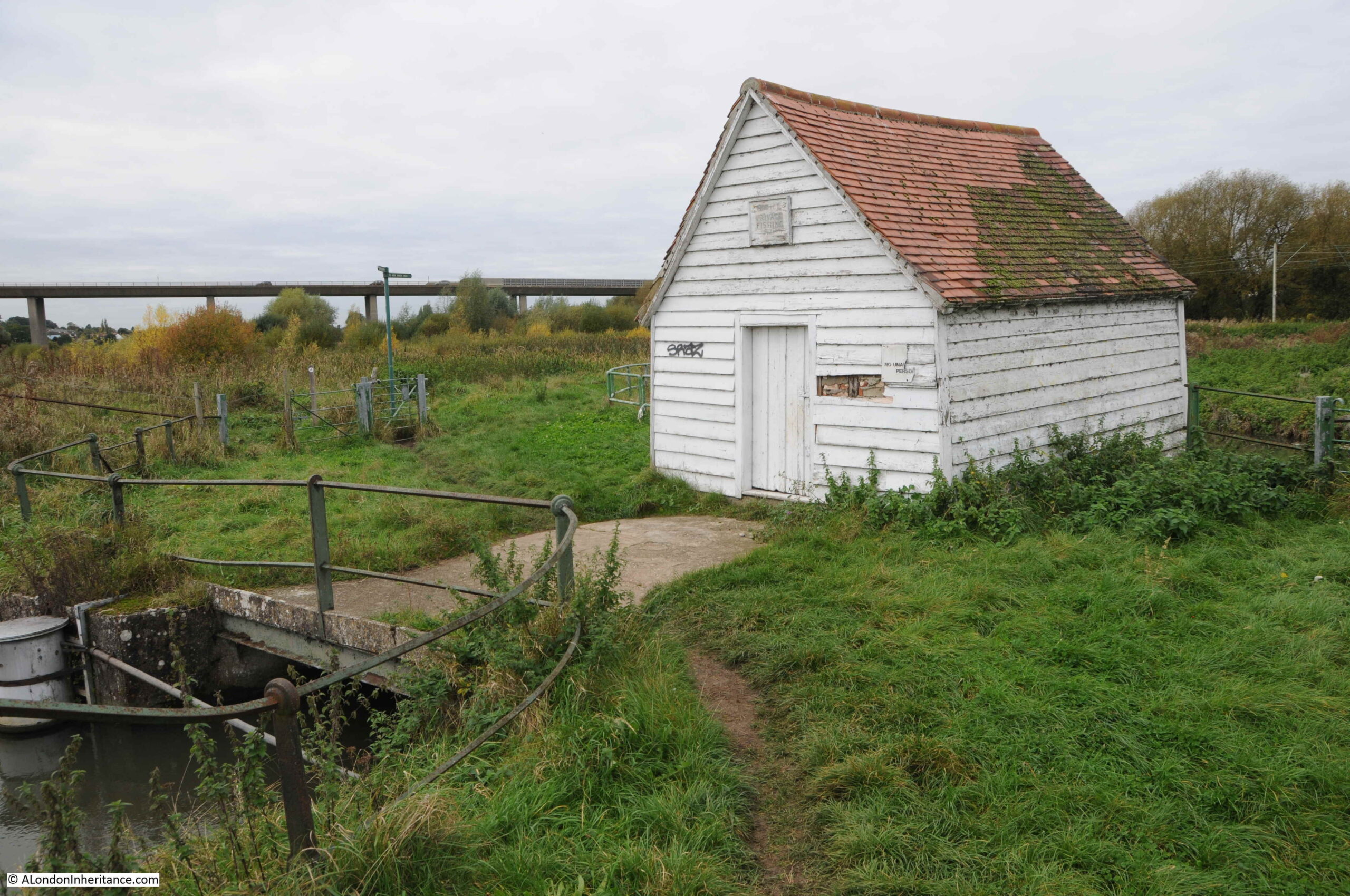
This is the White House Sluice. The building originally contained the equipment to control water levels on the river:

White House Sluice

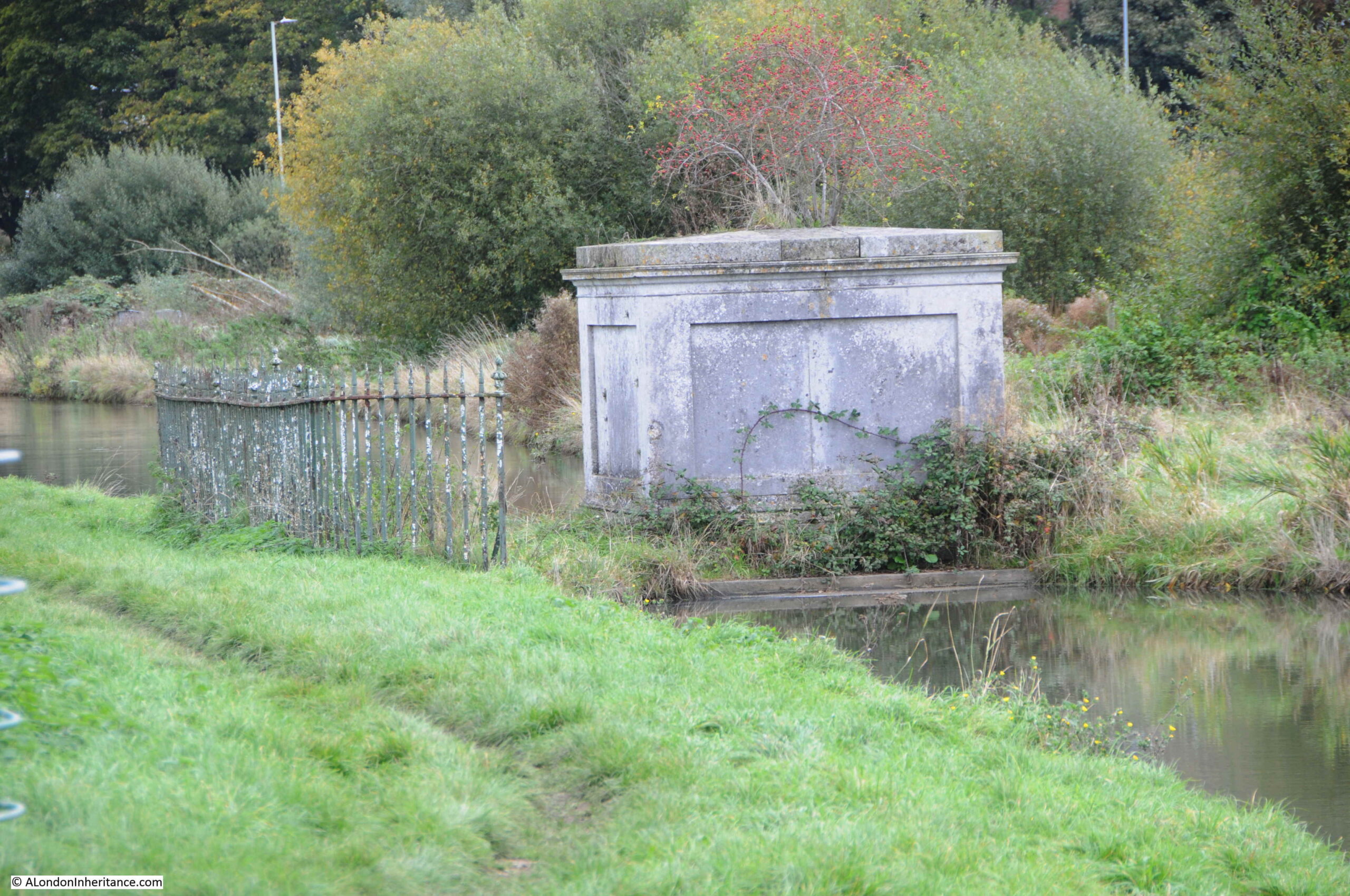
The most historic building here though is the Marble Gauge photographed below:

Marble Gauge

The Marble Gauge was built in 1770 to control the water taken from a former inlet to the River Lee. Today, the Marble Gauge does not have any function, and water flows through a couple of iron pipes to bypass the structure.

The Marble Gauge was designed by Robert Mylne, the architect and engineer to the New River Company. The structure, along with the railings shown to the left of the above photo are both Grade II listed.

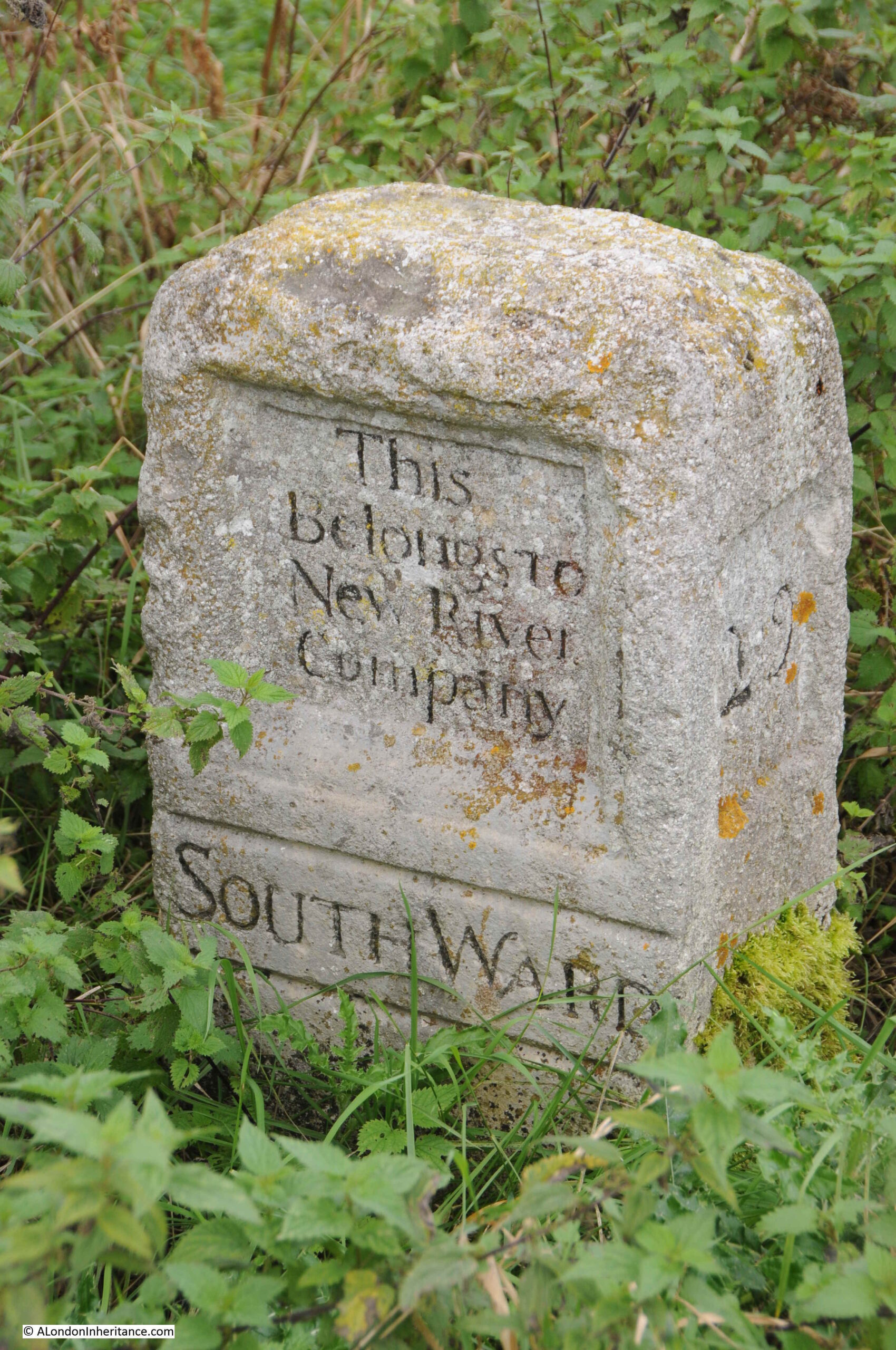
“This Belongs To New River Company” – stone in the undergrowth to the side of the river:

New River Company

When completed in 1613, the Chadwell Spring was the furthest north of the sources feeding the New River. The connection to the River Lee would not come until Parliament approved a 1738 Statute that allowed the company to take up to 102 megalitres a day from the River Lee (a significant additional source compared to the original 10 megalitres a day from the Chadwell and Amwell Springs).

Whilst the River Lee provided a considerable additional supply of water for London, it did not please barge and mill owners who were concerned about the impact that such a loss of water would have on their use of the Lee.

The photo below shows the channel from the Chadwell Spring where it joins the New River:

Chadwell Spring

A significant additional source of water was added to the New River during each of the river’s first three centuries.

During the 17th century, the springs at Chadwell and Amwell provided the water. In the 18th century, water from the River Lee was added, and in the 19th century a number of pumping stations were built along the northernmost stretch of the New River. These pumping stations extracted water from bore holes to add to the river.

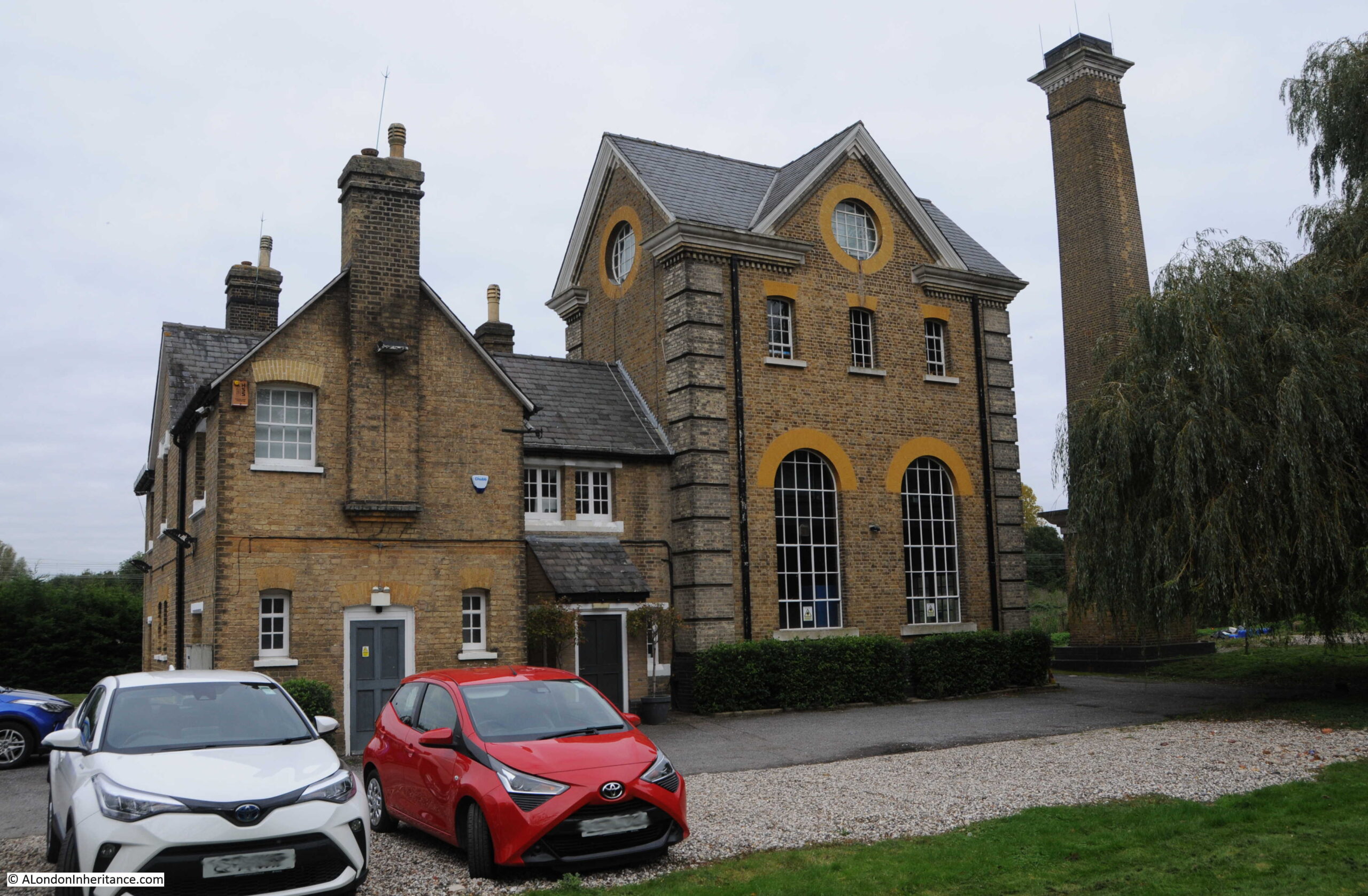
The first of these is the Broadmead Pumping Station, built in 1881:

Broadmead Pumping Station

Whilst many of the pumping stations are still in use, Broadmead seems to have been converted to offices, and is currently the offices of a car hire company. The building and adjacent chimney are Grade II listed.

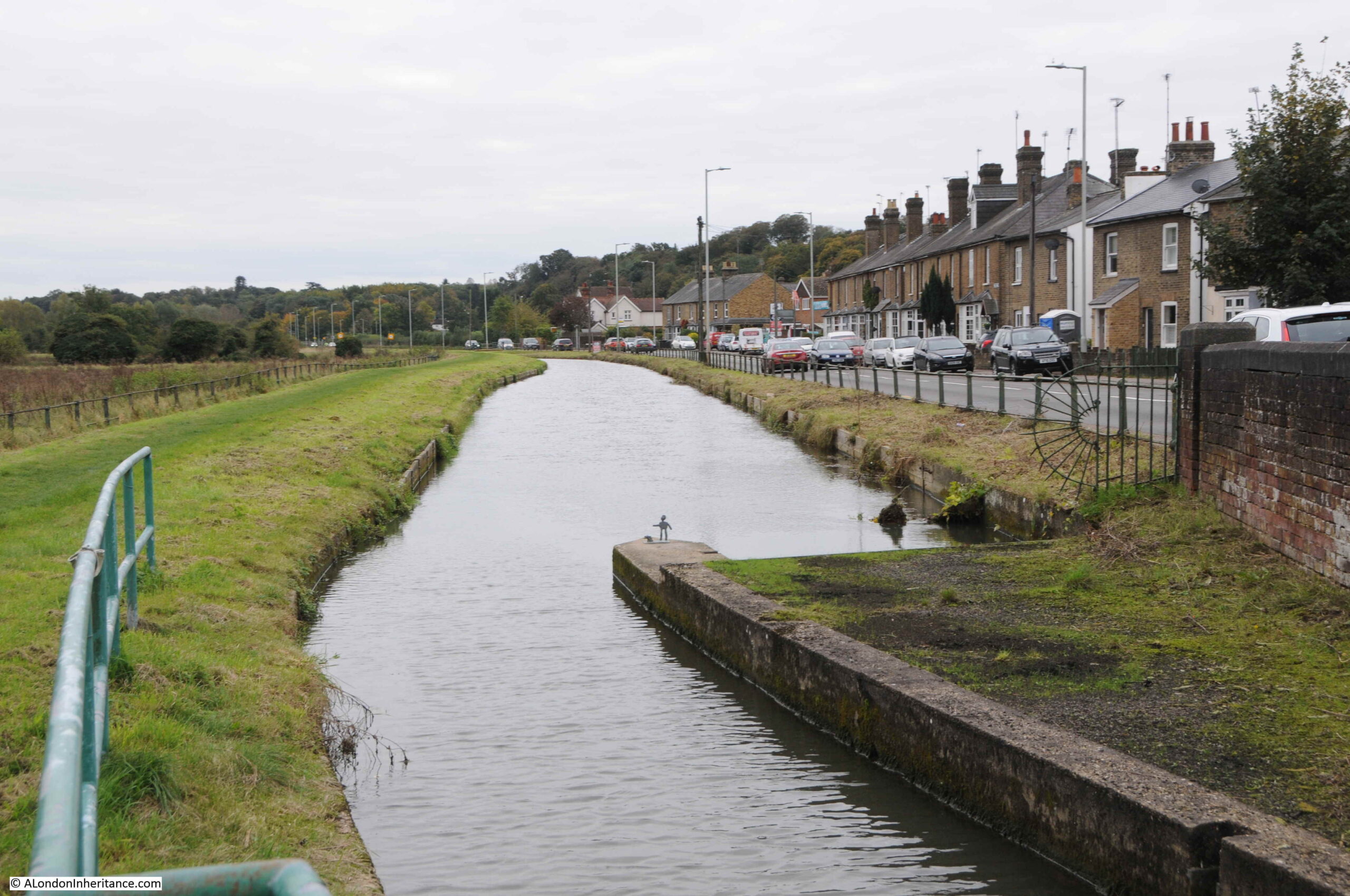
The New River then passes through Ware, just to the south of the station, and continues on parallel to the A1170 London Road:

Chadwell Way Sculpture Trail

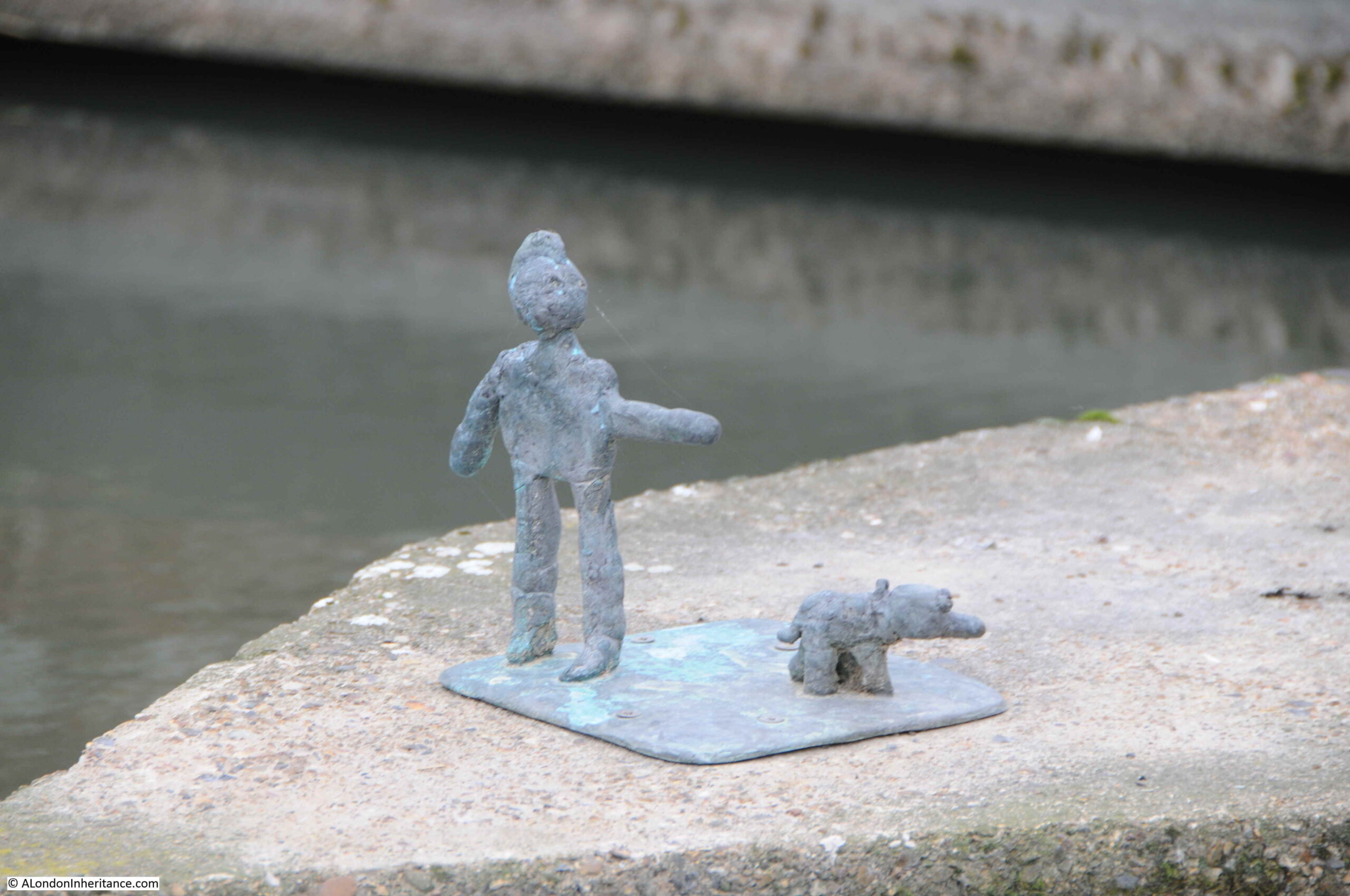
In the above photo, there is a concrete wall projecting out into the centre of the river. A small figure can be seen at the end of the wall:

Chadwell Way Sculpture Trail

The figure is part of the Chadwell Way Sculpture Trail, which consists of 31 small bronze sculptures made by a class of 7 and 8 year old children from St John the Baptist Primary School in Great Amwell.

The above sculpture is called “Murphy and his Dog”, by James. The leaflet detailing the trail can be found here.

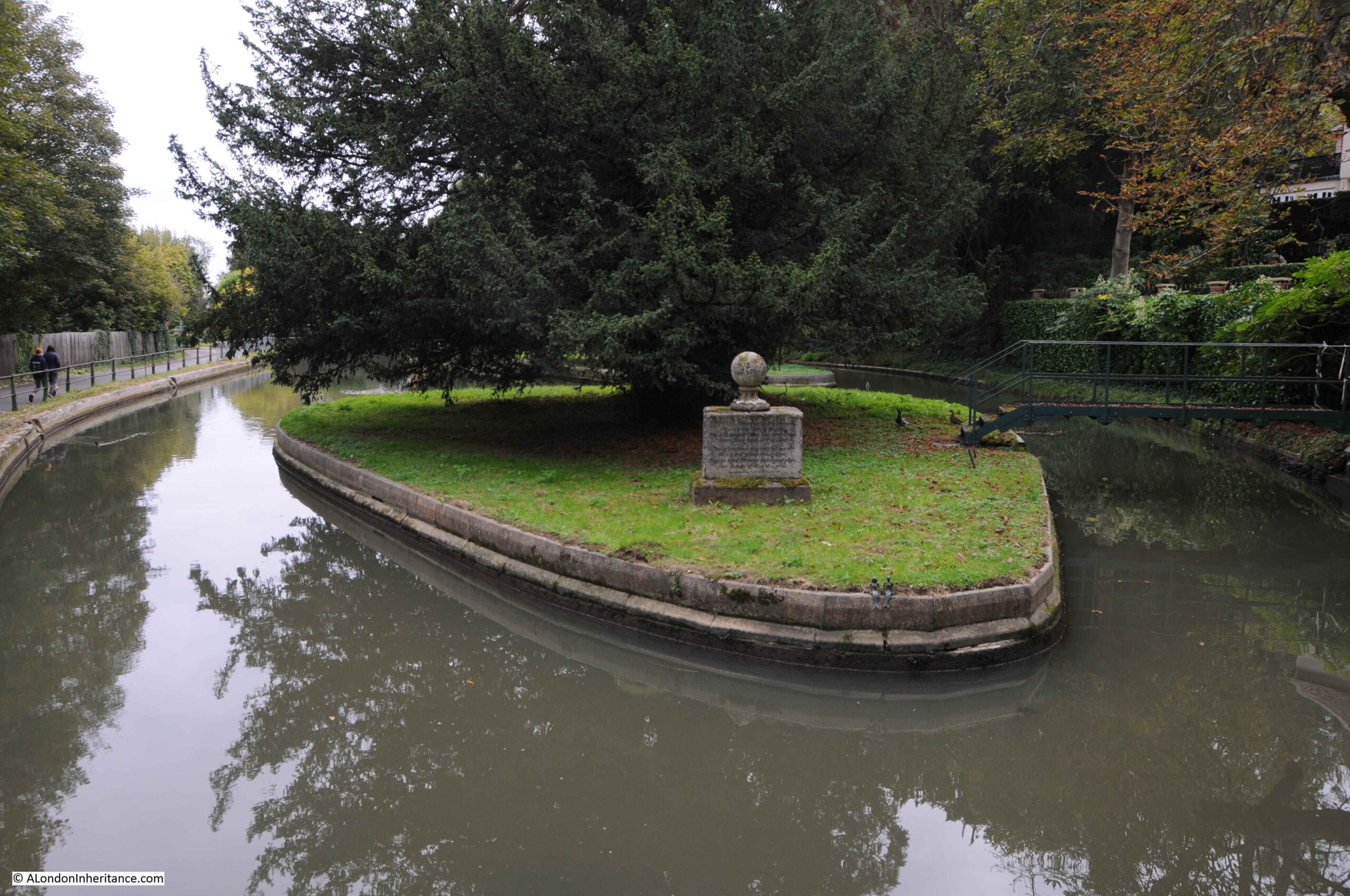
The river soon moves away from the London Road, and we reach the village of Amwell, where the Amwell Spring adds water to the river. To mark the location, there is a small island in the river:

Walking the New River

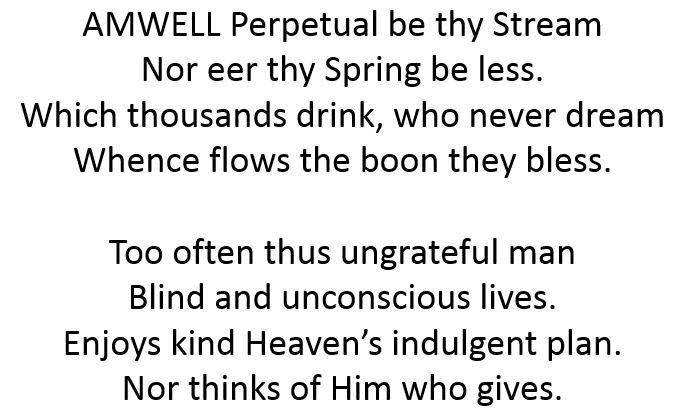
The monument in the above view has the following inscription:

Amwell Spring

An appropriate inscription to think about whenever we turn on the tap.

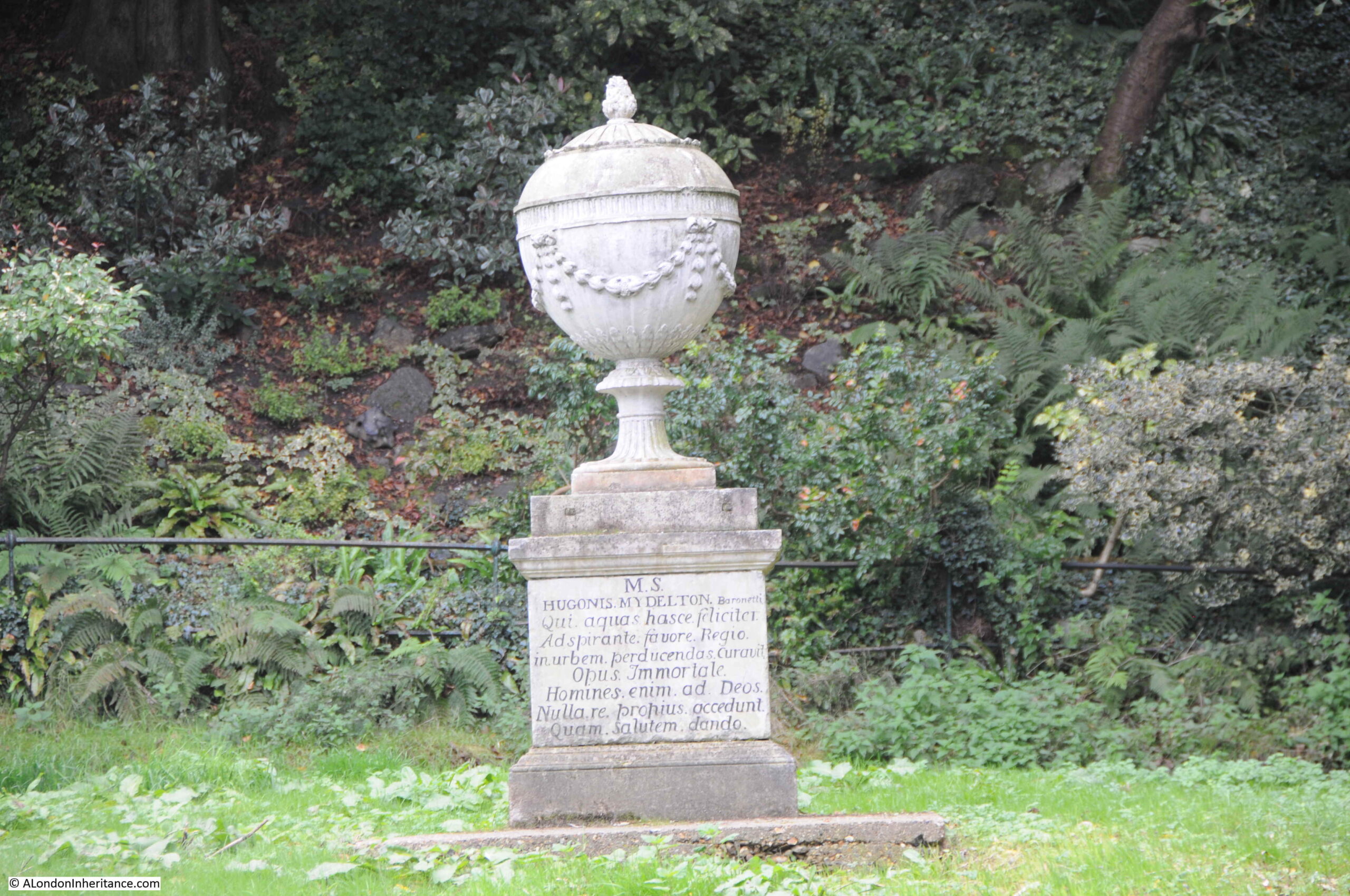
Walking past the island, and at the opposite end is another monument, with a Latin inscription facing the path:

Walking the New River

And the following inscription on the other side of the monument:

Robert Mylne

A short distance along the New River is Amwell Marsh Pumping Station, a Grade II listed building, completed in 1883:

Amwell Marsh Pumping Station

The British Geological Survey have the bore hole record for the boreholes under the pumping station. The record dates from 1899 and details two boreholes 5.25 feet diameter at the top, reducing to 4 feet diameter at the bottom of the boreholes, which are 109 feet deep.

The combined boreholes had a total pumping capacity of just over 7 million gallons in 24 hours, and that when pumping stopped, water rises quickly within the boreholes.

A note in the record shows that the water pumped from below ground is part of a much larger underground water system as the record states “Pumping here affects Amwell springs, Amwell Hill Well and Chadwell spring”, so whilst water can be pumped from the boreholes, the total impact on the water system needs to be considered.

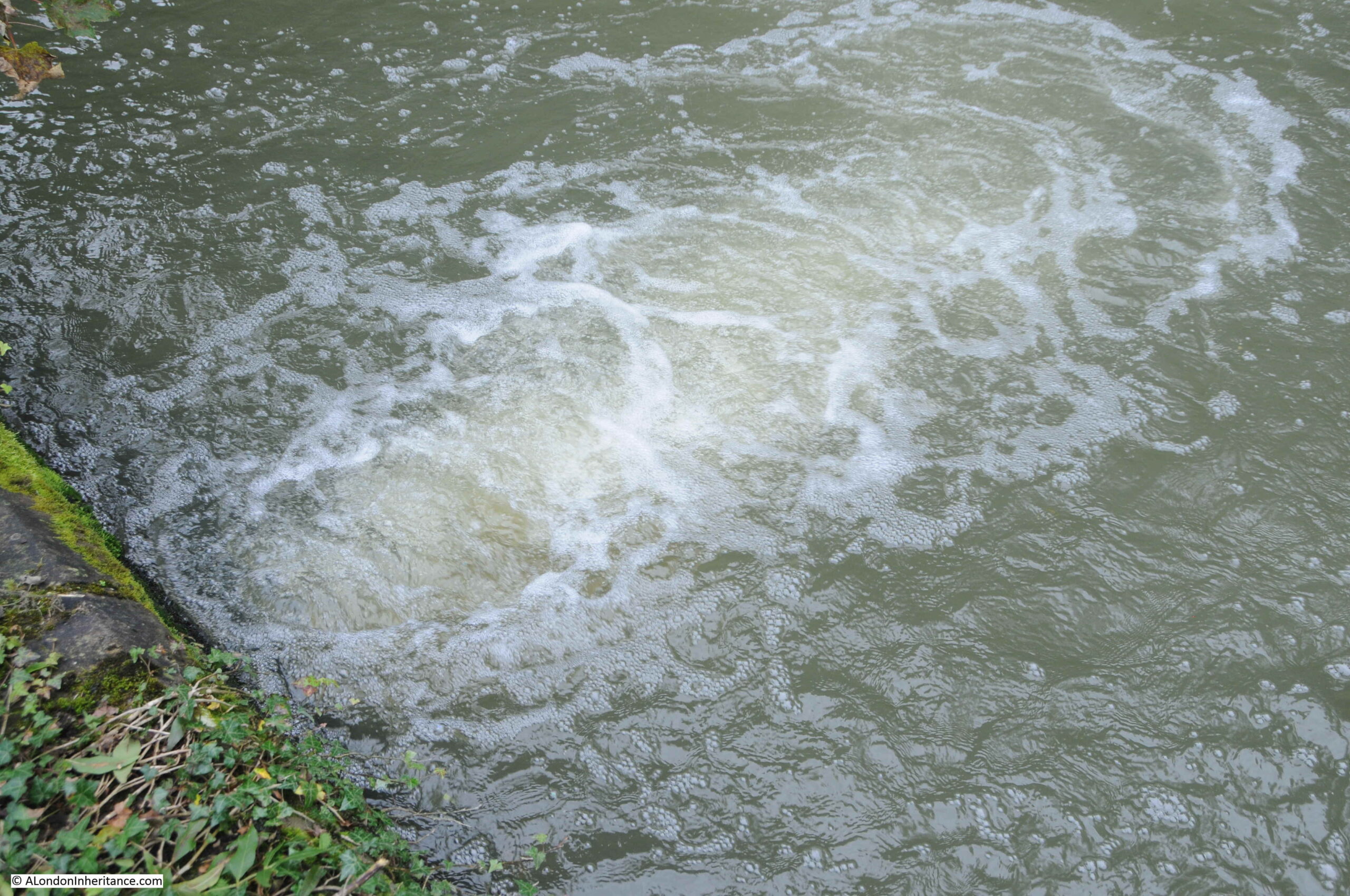
Amwell Marsh pumping station is still extracting water. The steam pumping engine has been replaced with electric, and looking into the New River we can see the turbulence created by water being pumped into the river:

Amwell Marsh Pumping Station

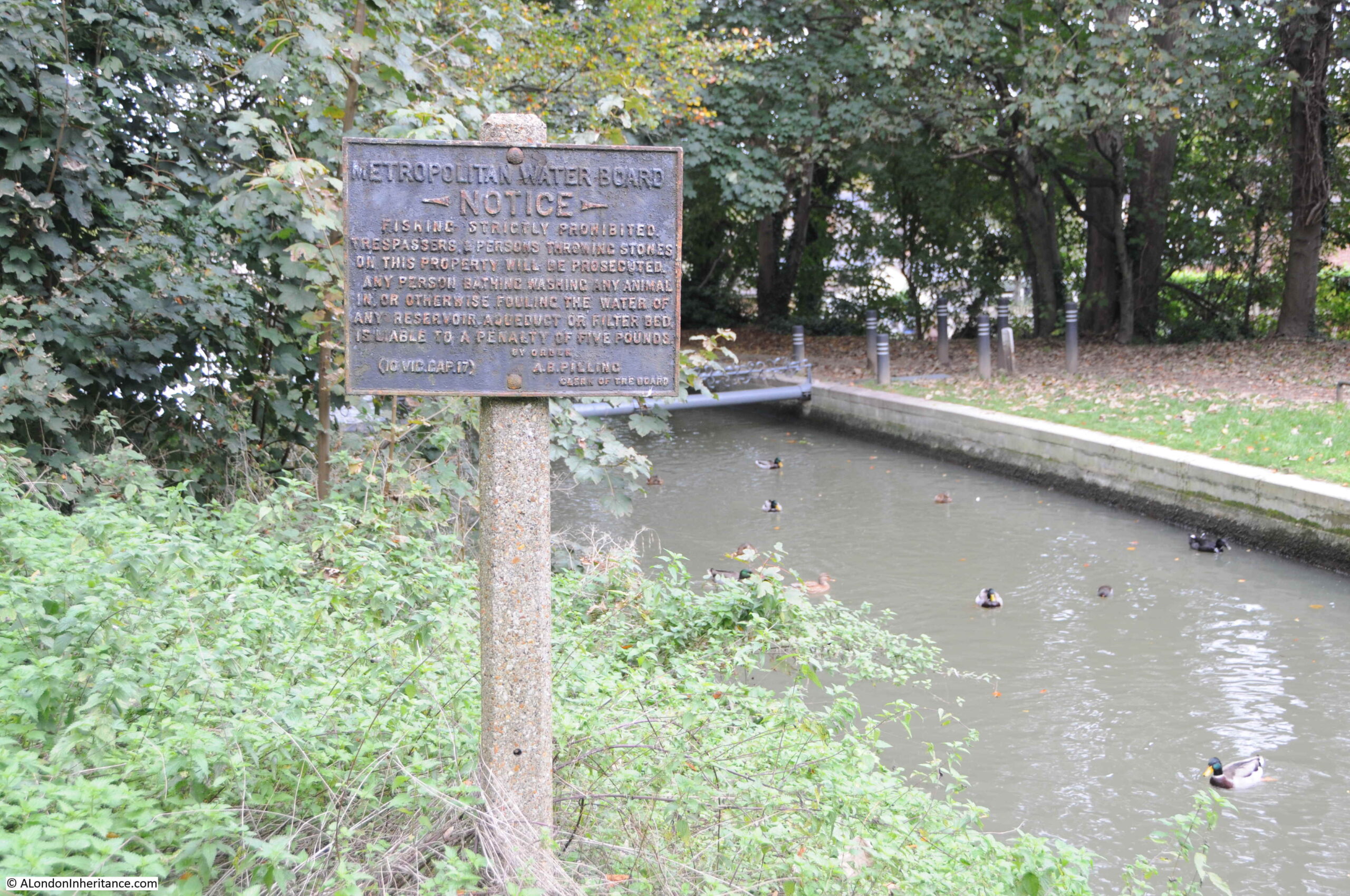
A Metropolitan Water Board sign warning that fishing is strictly prohibited, trespassers and persons throwing stones will be prosecuted, and that any person bathing, washing an animal, or otherwise fouling the water is liable to a penalty of five pounds:

Walking the New River

Not sure of the age of the sign. The Metropolitan Water Board was formed in 1903 when it took over the New River Company. The notice is signed by A.B. Pilling, Clerk of the Board. Pilling was authoring books about the new Chingford reservoir in 1913, so the sign must date from the early decades of the 20th century.

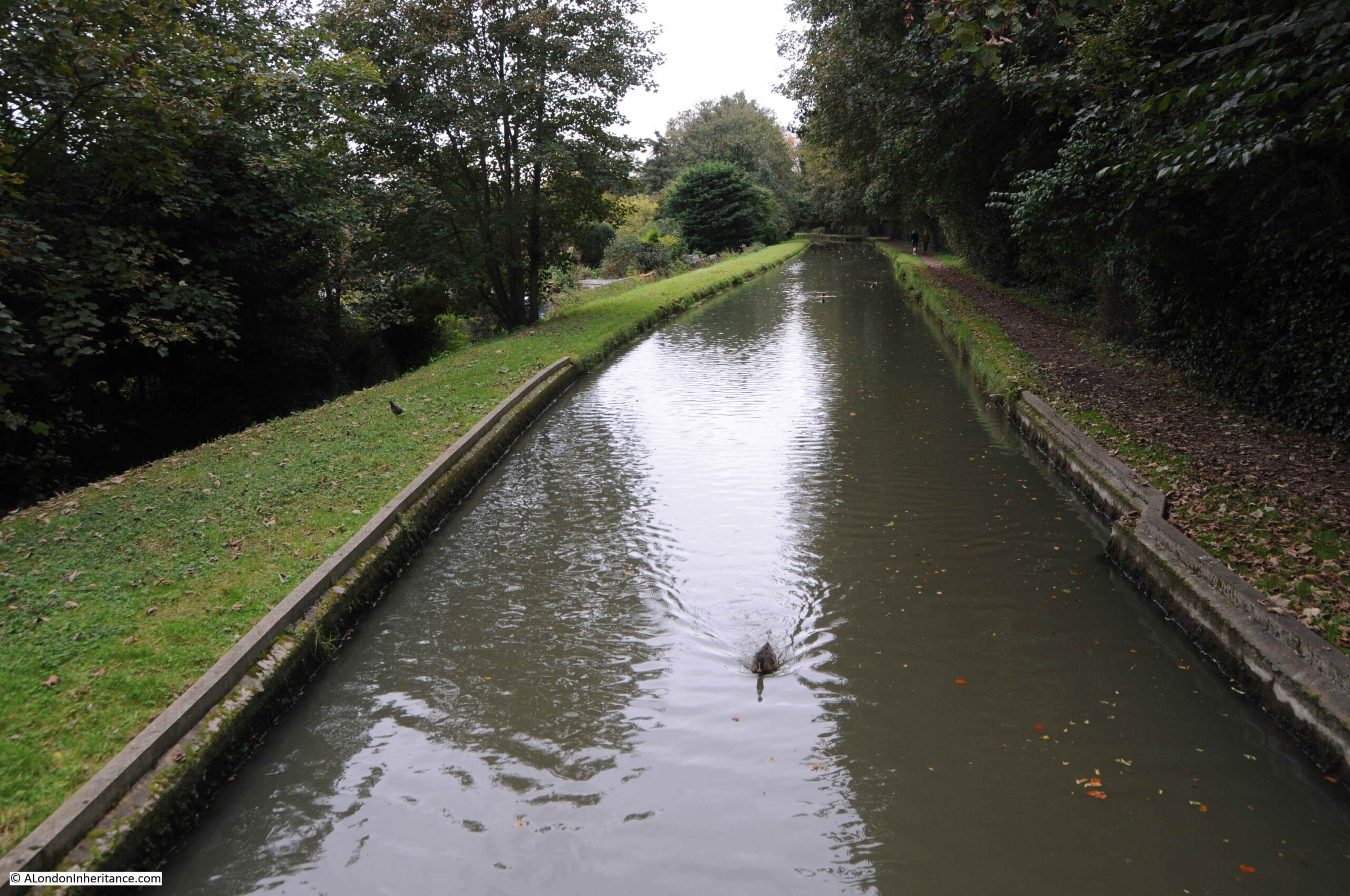
A quiet stretch of the New River:

Walking the New River

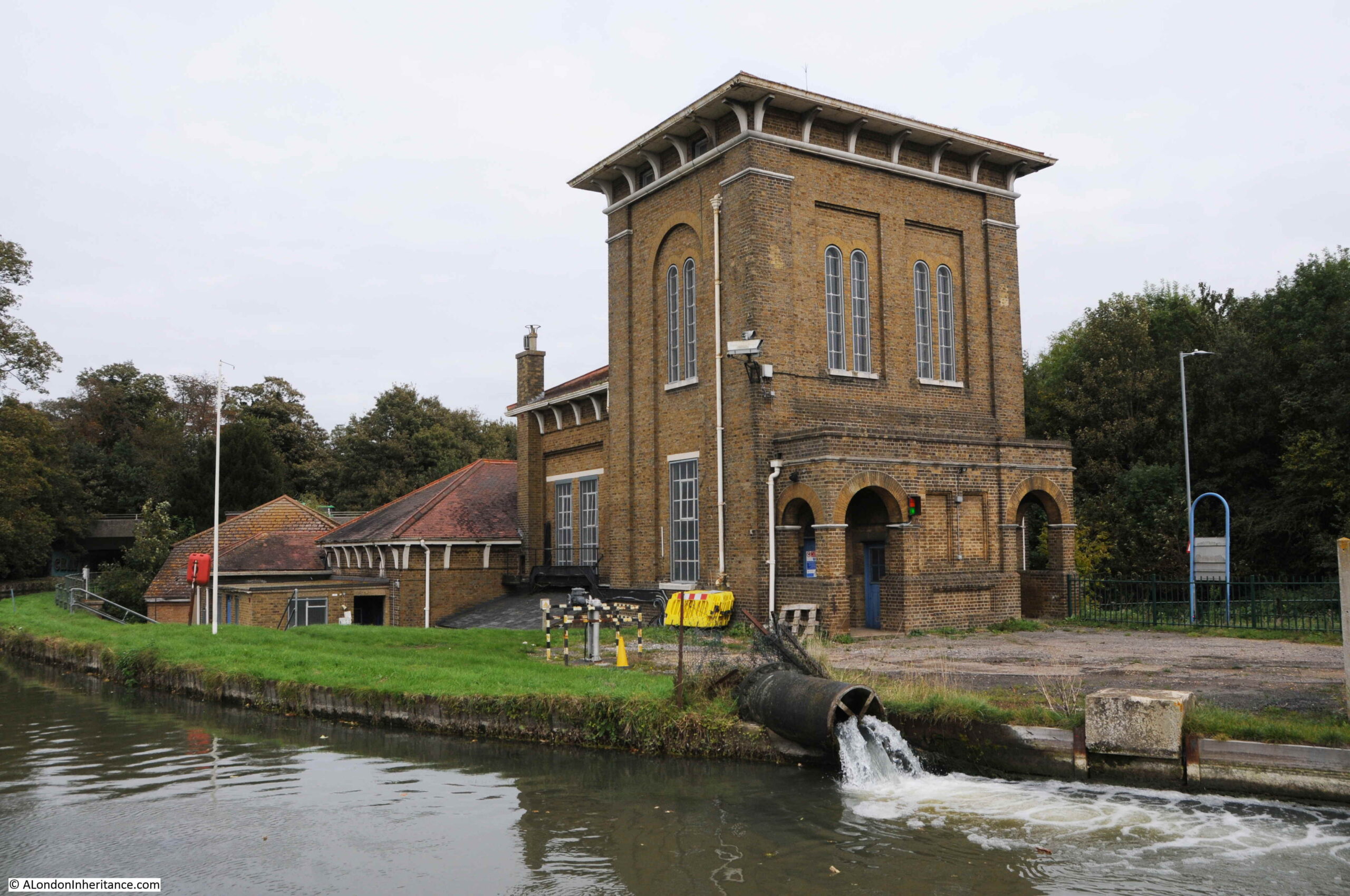
Rye Common Pumping Station, another Grade II listed building, constructed in 1882.

Rye Common Pumping Station

As with the other 19th century pumping station on the route, it was originally steam powered, but was converted to electricity in 1935. As can be seen from the water gushing from the pipe into the river, Rye Common is still contributing to the New River and London’s water supplies.

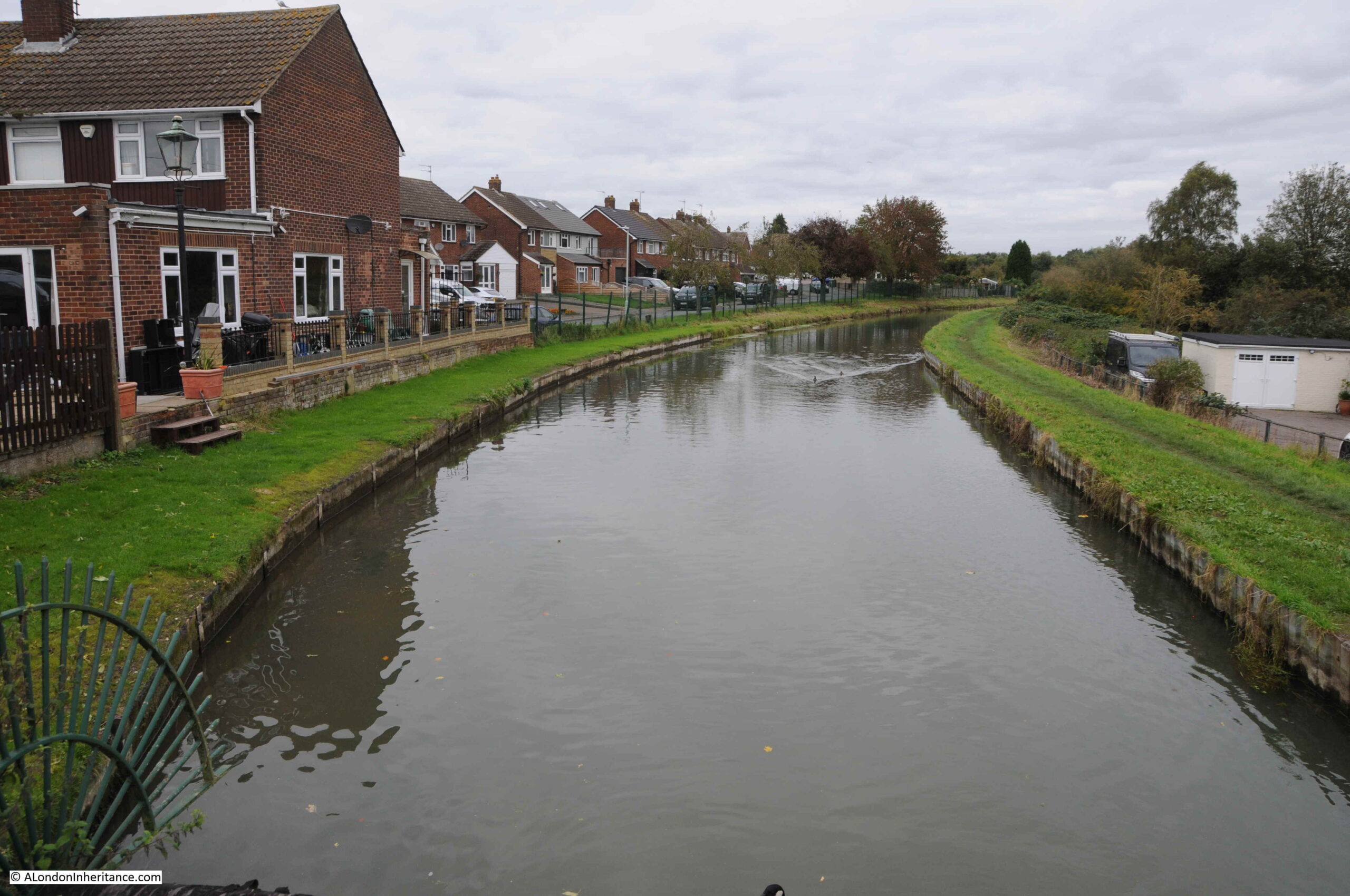
The New River, running alongside a housing estate:

Walking the New River

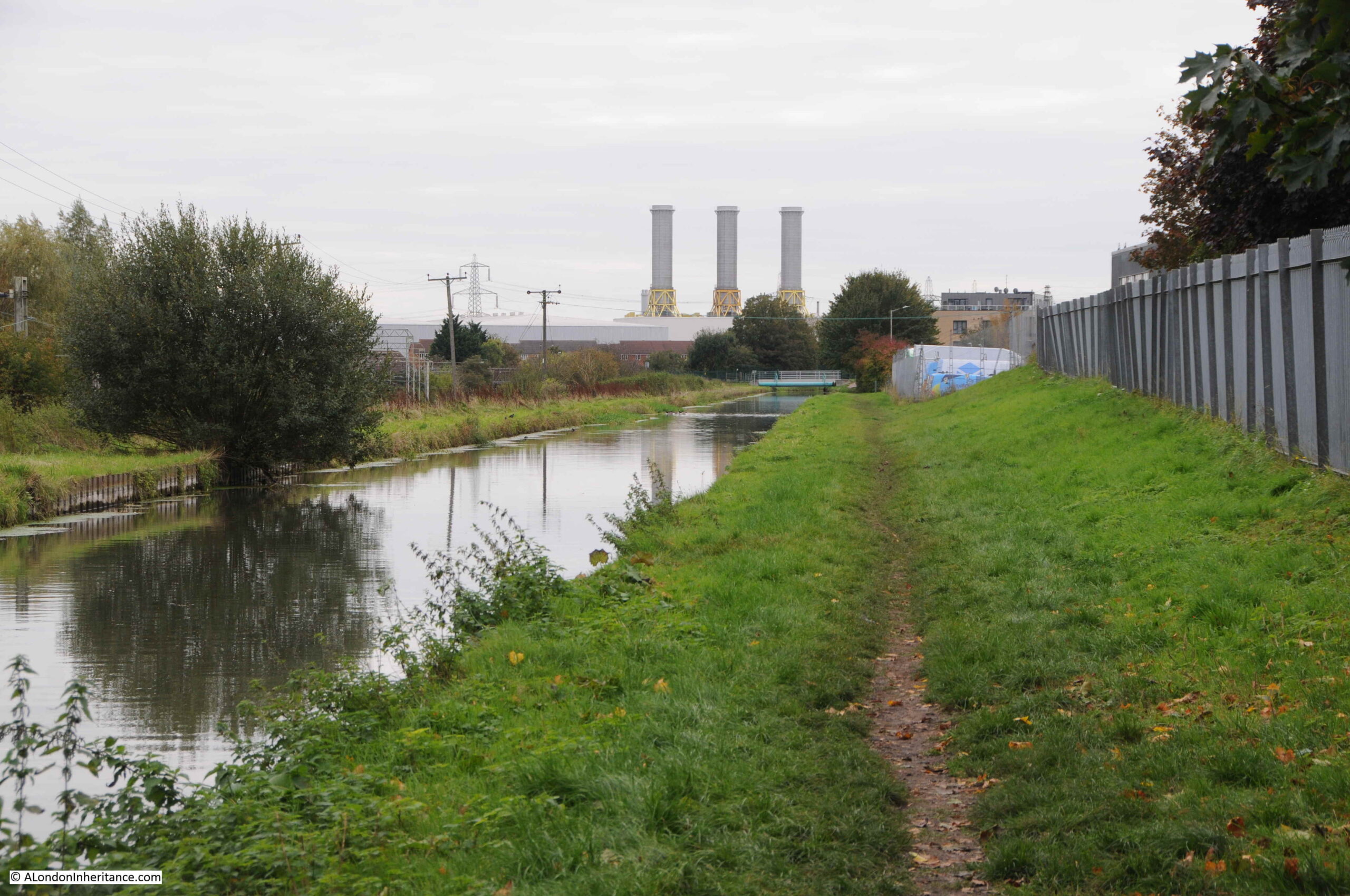
The New River is now approaching Rye House, with the three chimneys of Rye House Power Station in the distance.

Walking the New River

And at Rye House, the first day of walking the New River ended, with the conveniently located Rye House station a very short walk from the river.

Day 2, Rye House to Cheshunt

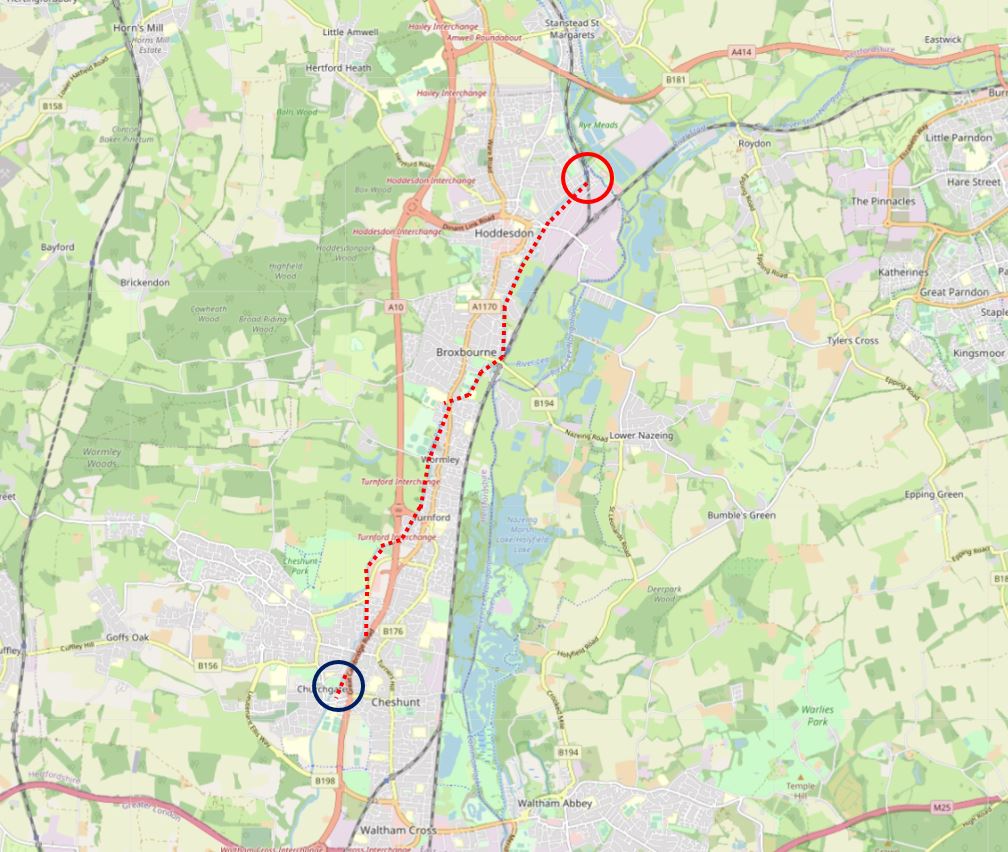
Day 2 of walking the New River, a stretch that will take us from where we finished yesterday at Rye House, along the route of the New River to Cheshunt – the route highlighted by red dashes in the following map (Map © OpenStreetMap contributors):

Walking the New River

An overcast and grey Saturday was followed by a sunny Sunday. Not long after leaving Rye House, the route reached Essex Road Pumping Station (difficult to photograph, just a very small part of the brick wall is on the right of the following photo), with new building on an old industrial site in the background.

Walking the New River

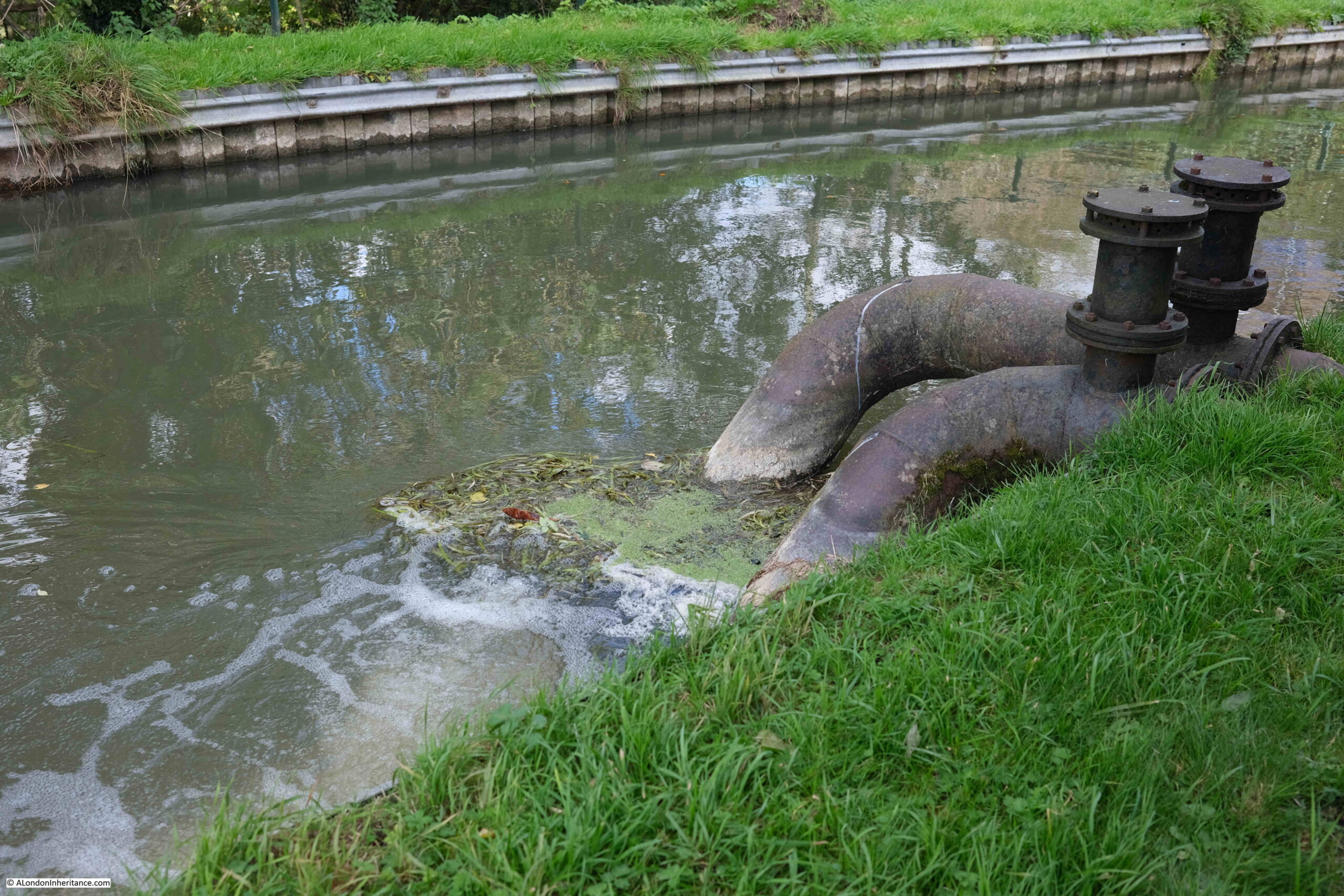
Two large pipes from Essex Road Pumping Station discharging water into the New River:

Essex Road Pumping Station

Essex Road Pumping Station draws water from a borehole beneath the building. The borehole consists of an upper shaft of depth 54 feet and average diameter of 7 feet, followed by a bore hole which extends to a depth of 403 feet below the surface.

The bore hole record demonstrates that there is a considerable volume of water not that far below ground. In 1920, water would rise to a level 2 feet below the surface, and without pumping, this standing water level does not vary.

The record stated that the bore hole would yield 2,160,000 gallons of water a day.

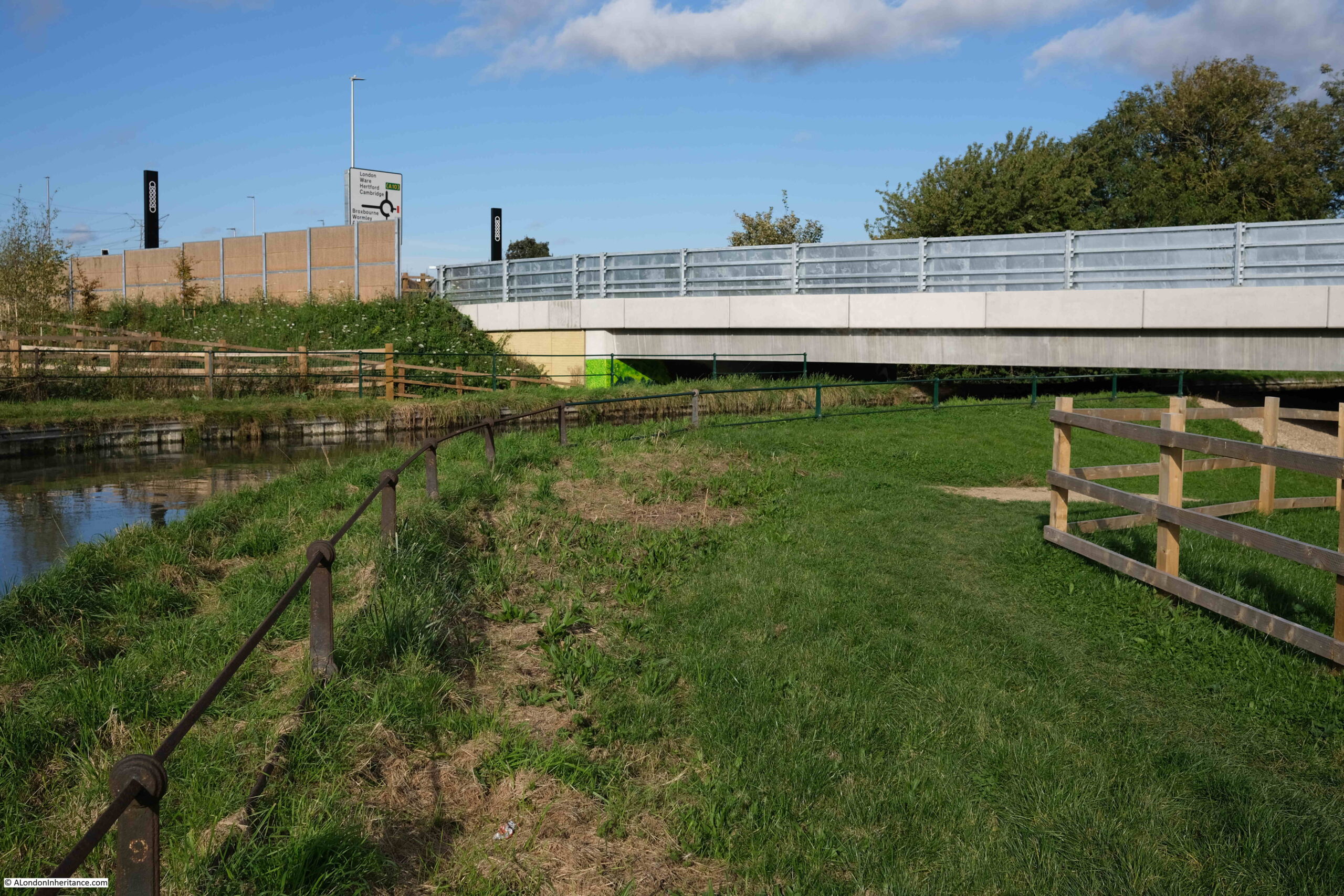
A short distance after Essex Road Pumping Station is a new road bridge that carries Essex Road over the New River:

Walking the New River

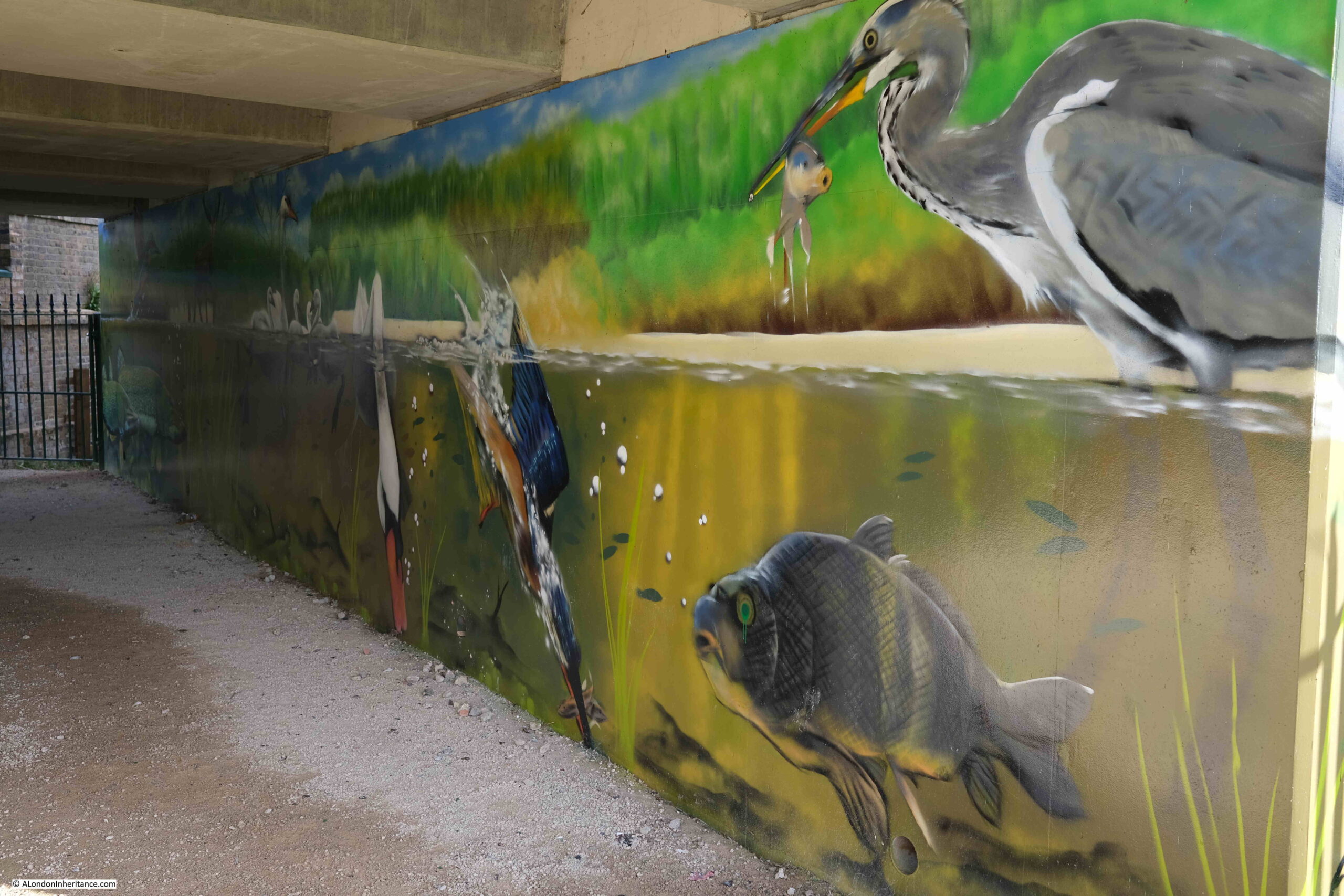
The walkway alongside the New River carries on under the bridge, with some appropriate artwork lining the under side of the bridge:

Walking the New River

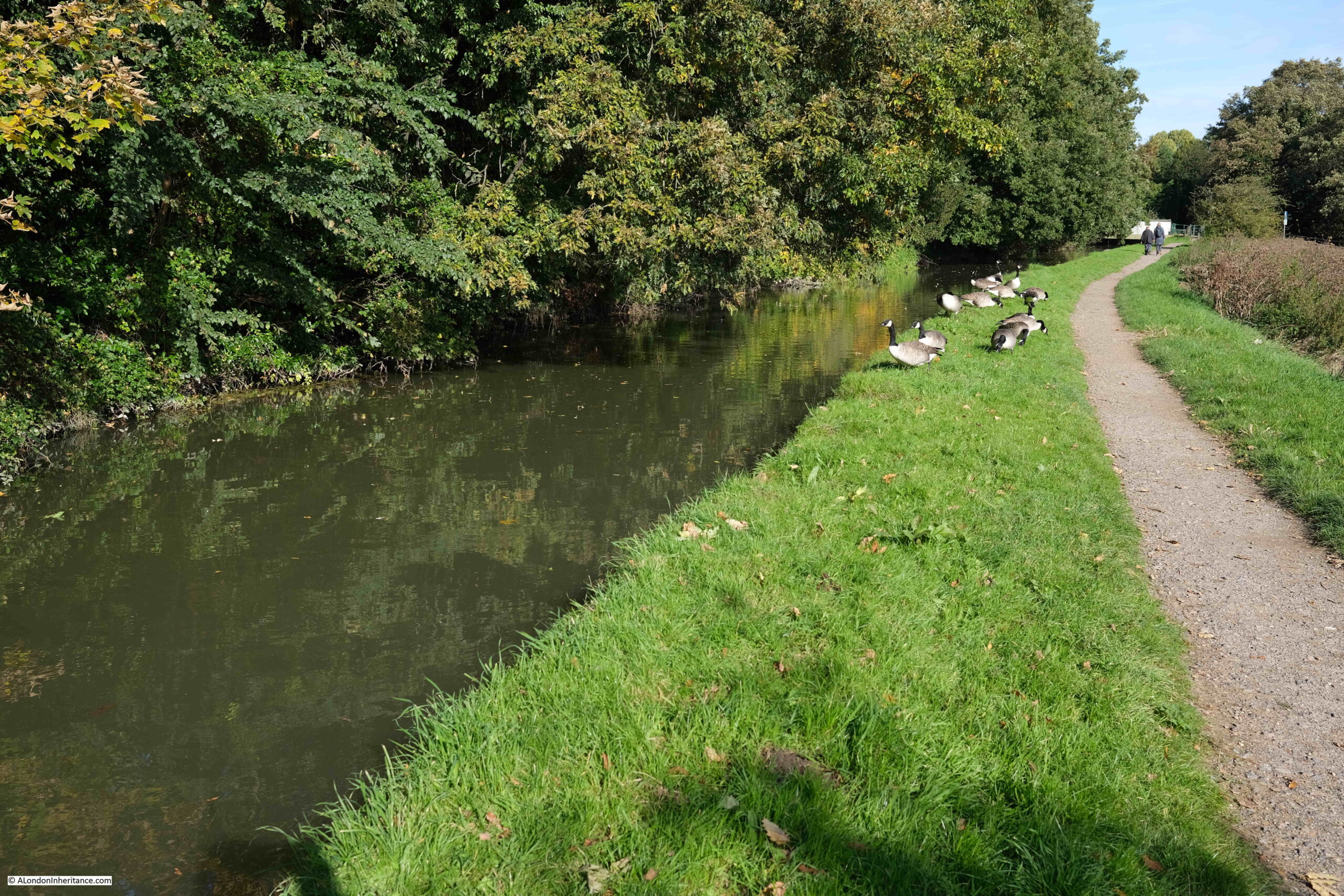
After passing through some housing and industry around Rye House, the New River regains its rural setting, with views helped by the sunny weather after the previous day’s rather grey walk:

Walking the New River

It is rather hypnotic watching the flow of the water in the river. Leafs and twigs are carried along at the equivalent of a fast walk. The only turbulence at the occasional sluice and where pumping stations add water to the flow.

To the west of this stretch of the New River are some rather nice houses that make the most of having the New River passing the end of their gardens:

Walking the New River

Before returning to a tree lined river:

Walking the New River

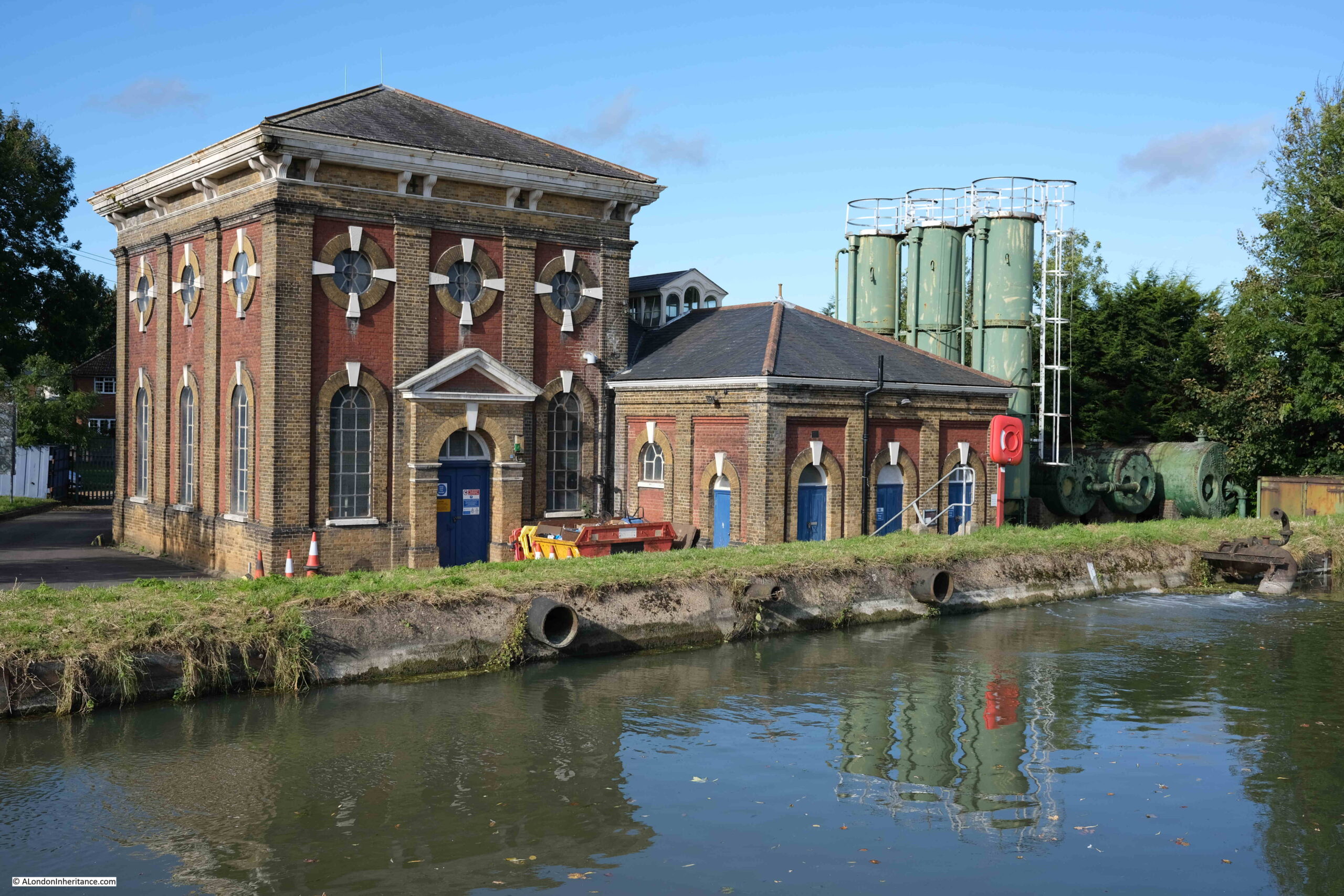
We then come to the 1887, Grade II listed, Broxbourne Pumping Station:

Broxbourne Pumping Station

This is a pumping station that is still in use, extracting water from deep below the surface and adding to the New River. Some turbulance can be seen at the right edge of the photo where water is pouring into the river. There are two other pipes pointing onto the river which must have been used in the past, as this was a pumping station that produced a considerable quantity of water.

The bore hole records for the Broxbourne Pumping Station state that there is a shaft below the building to a depth of 197 feet. It is a large shaft of 14 feet diameter at the top down to 10 feet diamter at the bottom. The bore hole record implies that there are additional bores heading out from the shaft.

The 1909 record states that the standing level of water is only 8 feet below the surface, again indicating how high the water table is along the route of the New River. The 1909 record stated: “Great quantity of water, the temporary pumps being drowned in sinking when 2 to 3 million gallons a day were got out. The yield has been returned as 4,500,000 gallons a day”.

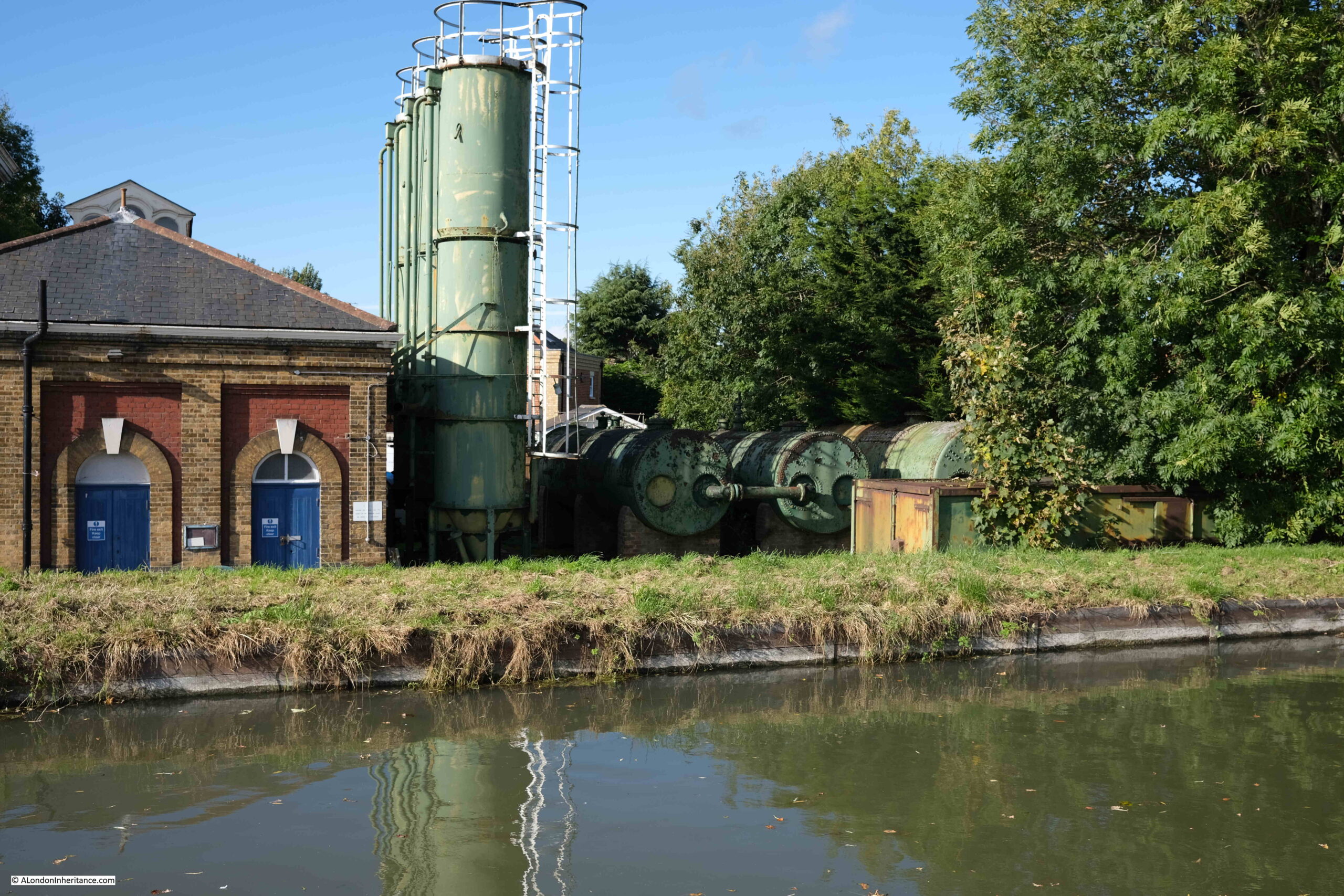
There was a chimney at the pumping station which has been demolished, as along with the other pumping stations along the New River, it was converted from steam to electric. There is though a considerable amount of infrastructure to the side of the building. No idea whether this is still in use, however (if you like that sort of thing, which I do), there are some wonderful green painted tanks to the side. The Historic England listing makes no mention of these, only referring to the building.

Broxbourne Pumping Station

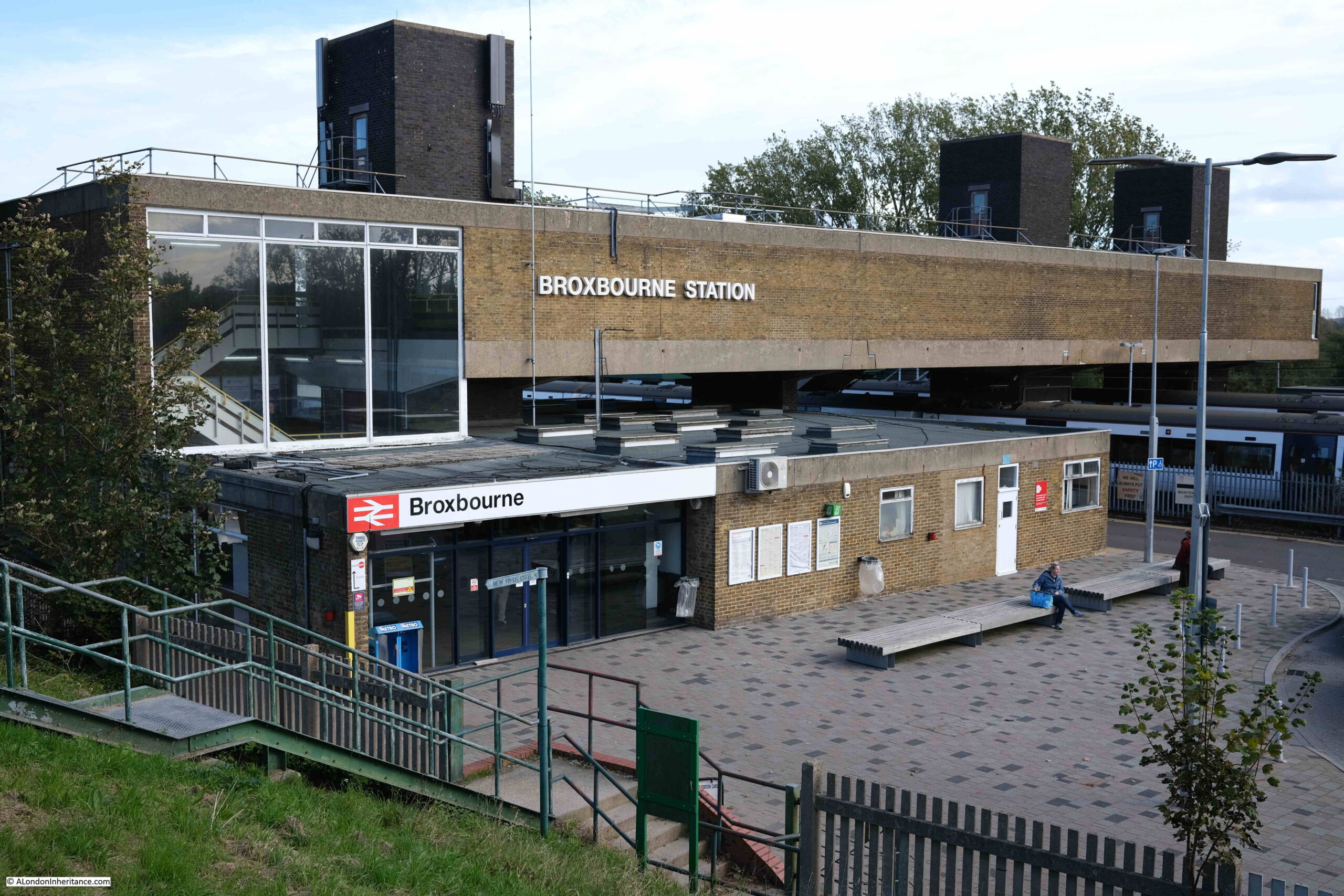
It is not just the pumping stations that are listed along the route of the New River, also one of the train stations. This is the rather wonderful Grade II listed Broxbourne Station, built between 1959 and 1961 by the British Railways Eastern Region Architect’s Department:

Broxbourne Station

Broxbourne Station is next to the New River. In the above photo, the New River embankment is the grass seen at the lower left corner.

Whilst this is the closest station to the New River, stations are not that far away for the majority of the walk, and the rail line is here for the same reason as the New River.

The New River needed to follow a route that was almost flat, with a very shallow drop in height from the springs to New River Head. This would ensure a smooth flow of water without any need for pumps.

The valley created by the River Lee and associated water systems had created a relatively low and flat wide channel of land between higher ground on either side.

This enabled the New River to follow the 100 foot contour (height above sea level) almost from source to destination, and the height of the river dropped by only around 20 feet along the entire route. Given the surveying methods and equipment of the early 17th century, it was a remarkable achievement.

This relatively flat land was also ideal for the rail network, which avoided the need to construct tunnels or large embanked routes for the railway, so the New River and railway ended almost parallel to each other.

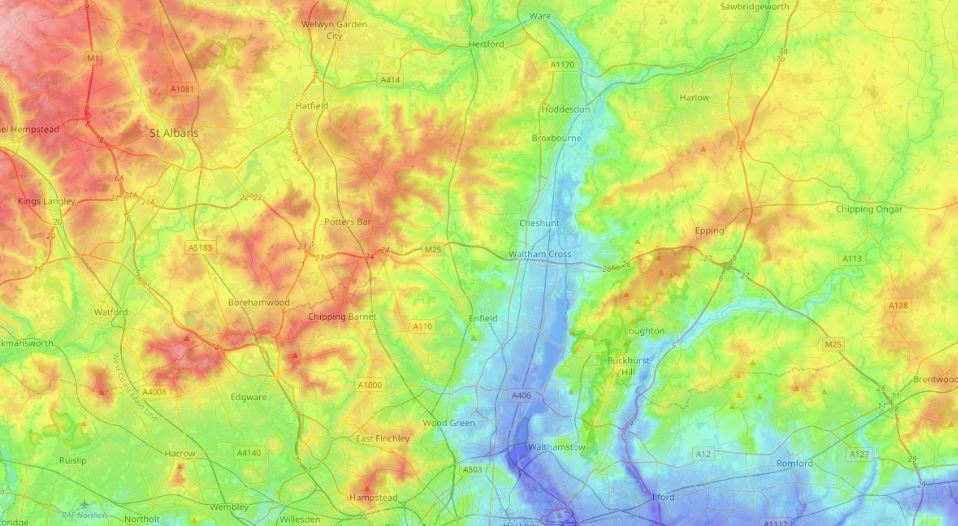
The following map from topographic-map.com shows the lower land as the blue in the centre, with Walthamstow towards the bottom of the map and Ware at the top. The New River follows the light blue along the left of the blue of the Lee Valley.

Walking the New River

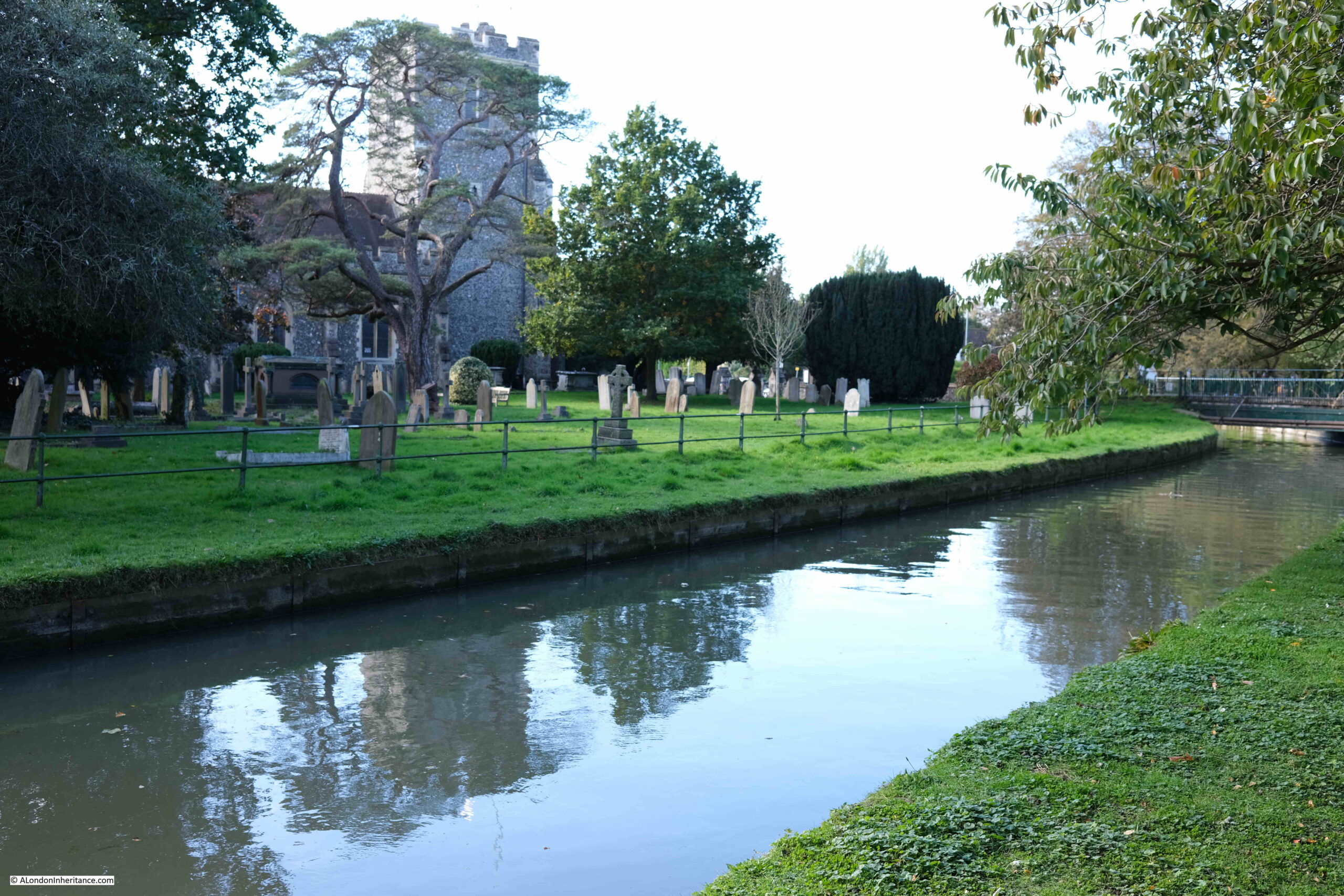
Continuing along the New River into Broxbourne, and the river runs around the church of St Augustine’s.

Broxbourne St Augustine's Church

As the New River Path gets into more built up areas, there are now sections where it is not possible to walk alongside the river. Fortunately these are for short lengths, and a quick diversion is needed to get back to the river.

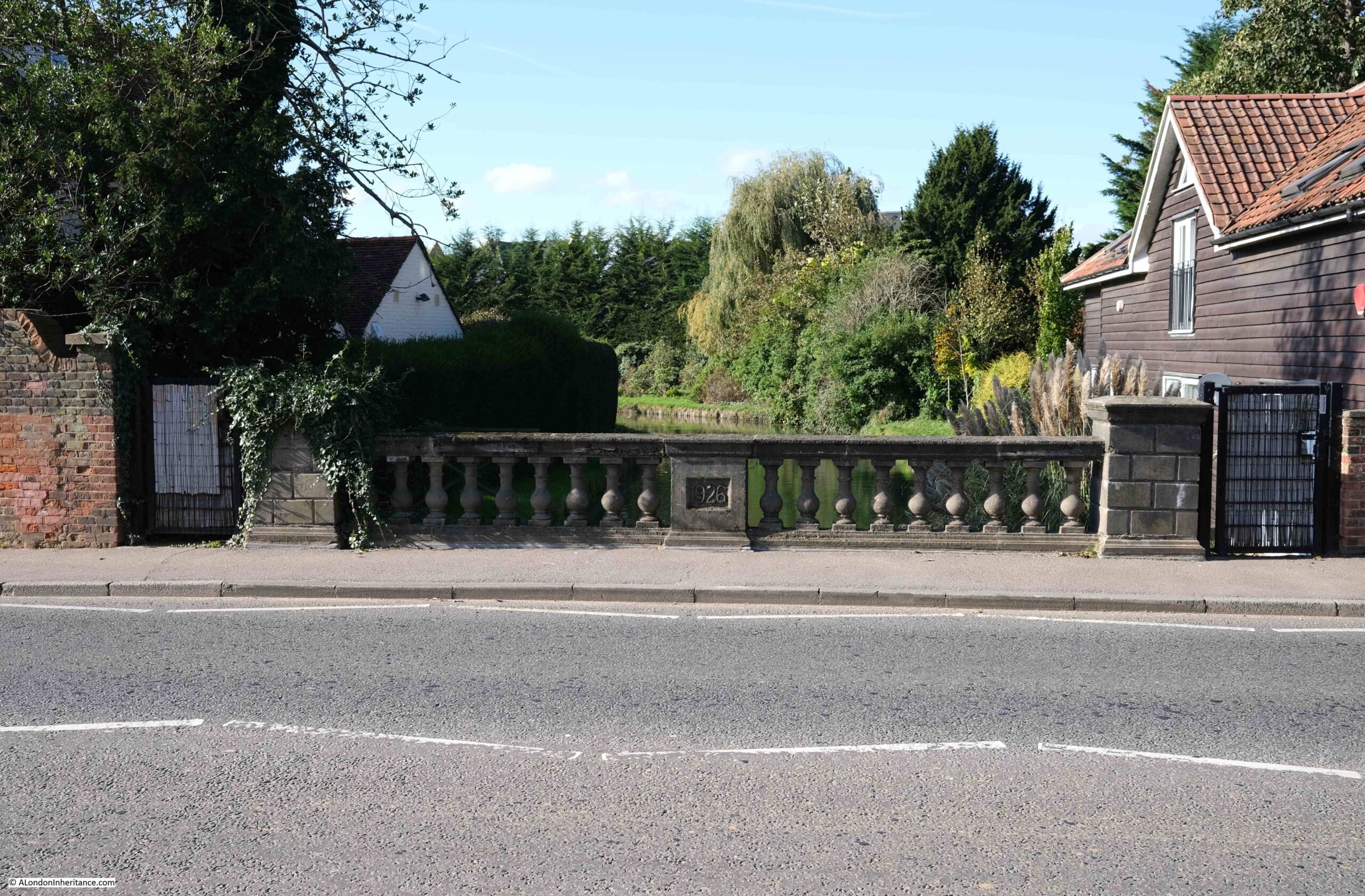
The following photo shows one such section where the river runs through private gardens, A 1926 road bridge crosses the river.

Walking the New River

In the following photo, the Mylne Viaduct (part of which is the low wall to the left) carries the New River over the Turnford Brook which runs below the New River, left to right.

Walking the New River

The New River has been straightened in places from the original early 17th century route. I have not yet had the time to compare the route today with the original, however I suspect the view in the above photo is of one of the later, straightened sections.

The river is carried on a high earth embankment, which may have been too difficult for the original entirely manual construction method, but easier with later mechanical earth moving.

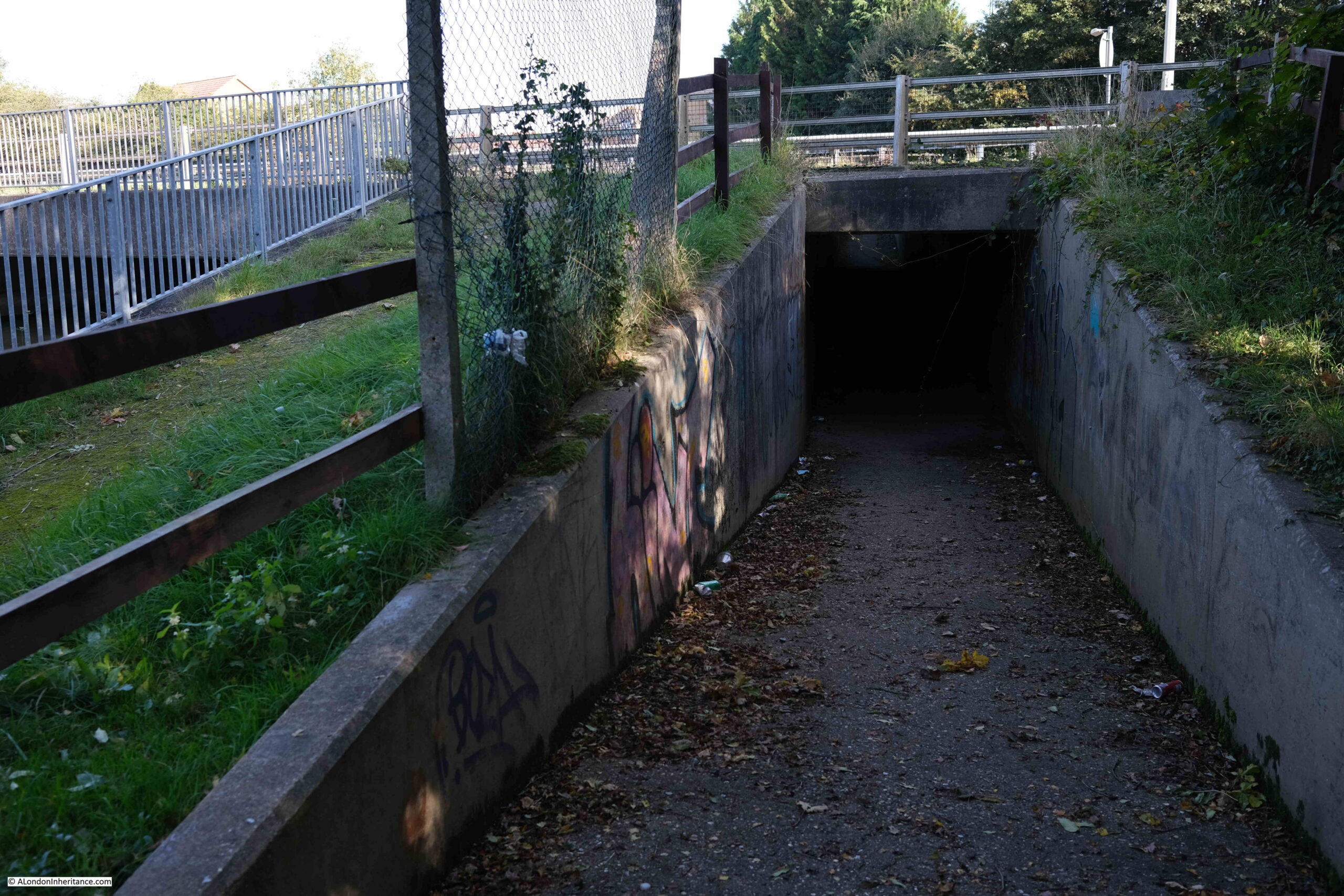
The New River then passes under the A10. The walkway has a slight diversion through a pedestrian tunnel under the road.

Walking the New River

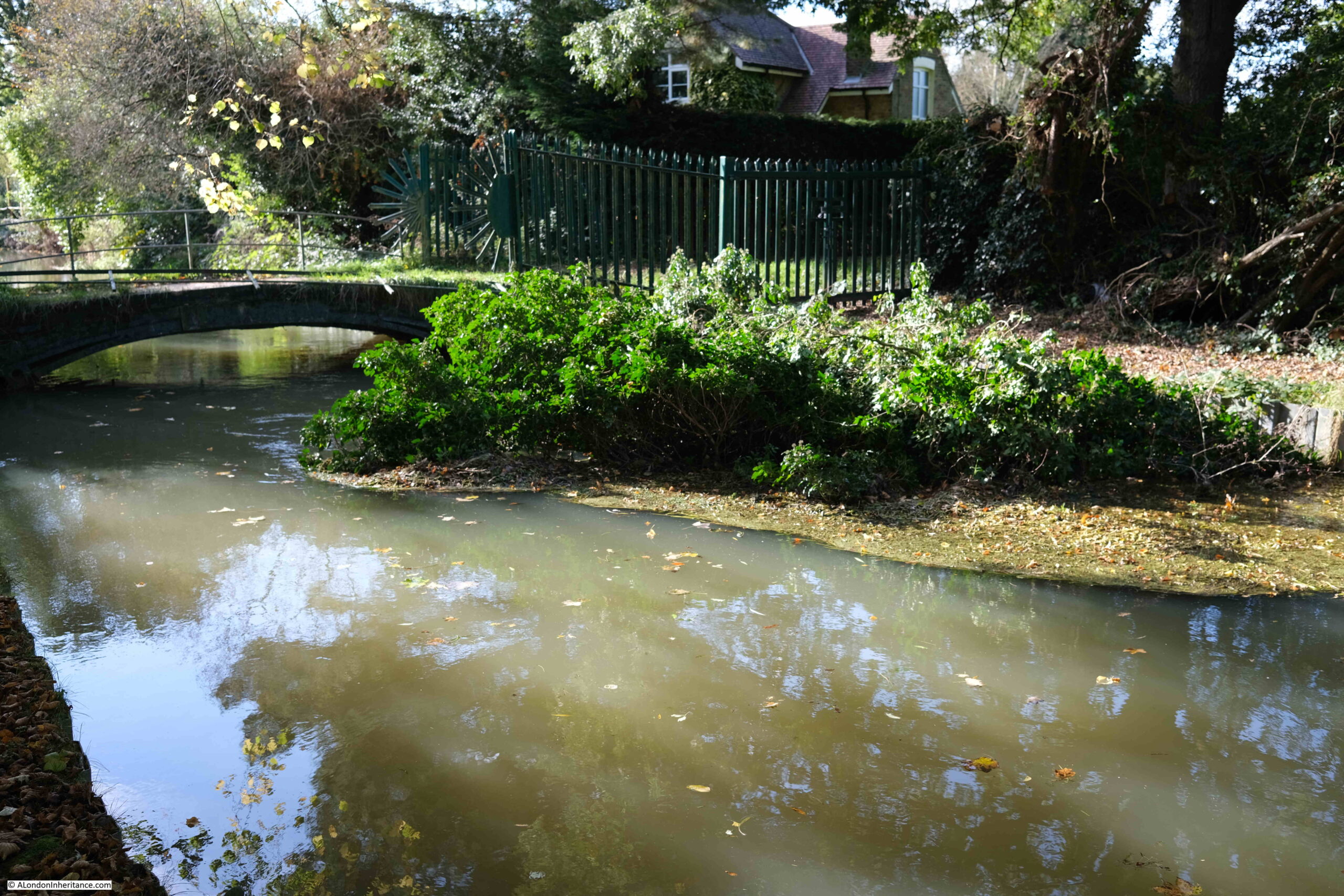
The New River then returns to a rather rural environment, with a large bush growing over half the river. Not sure how much maintenance of the New River is needed today, or is carried out by Thames Water to keep the course of the river open.

Walking the New River

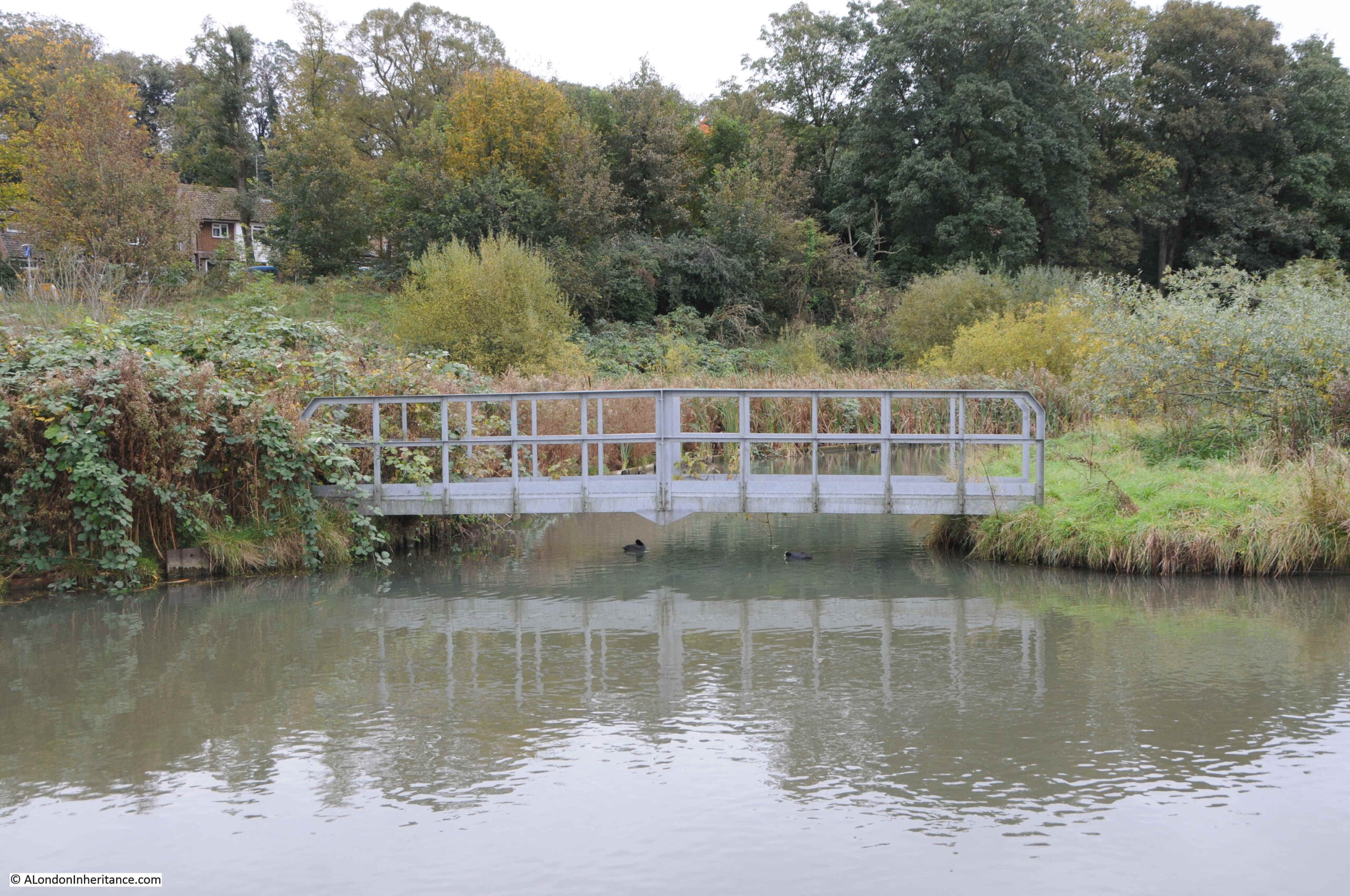
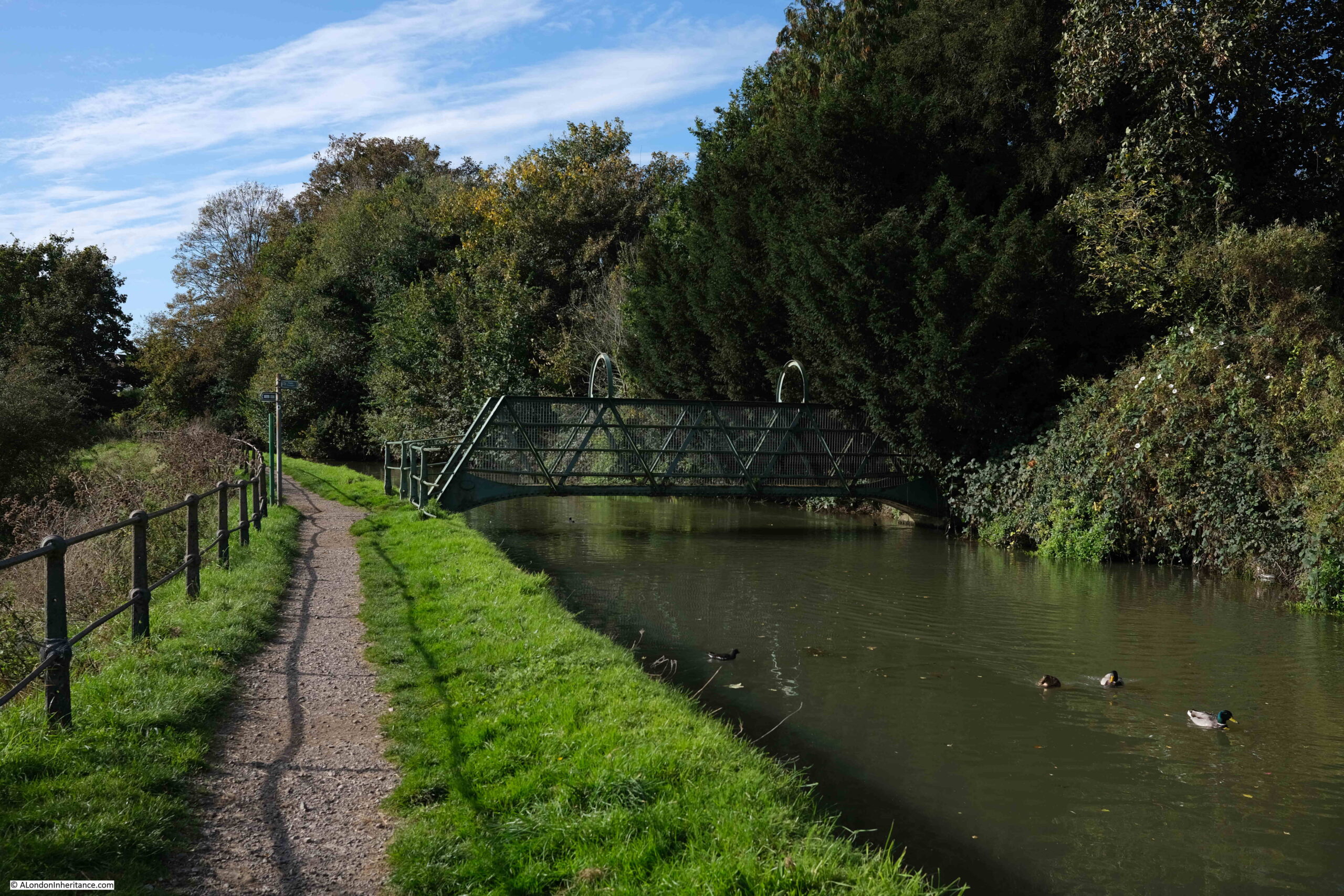
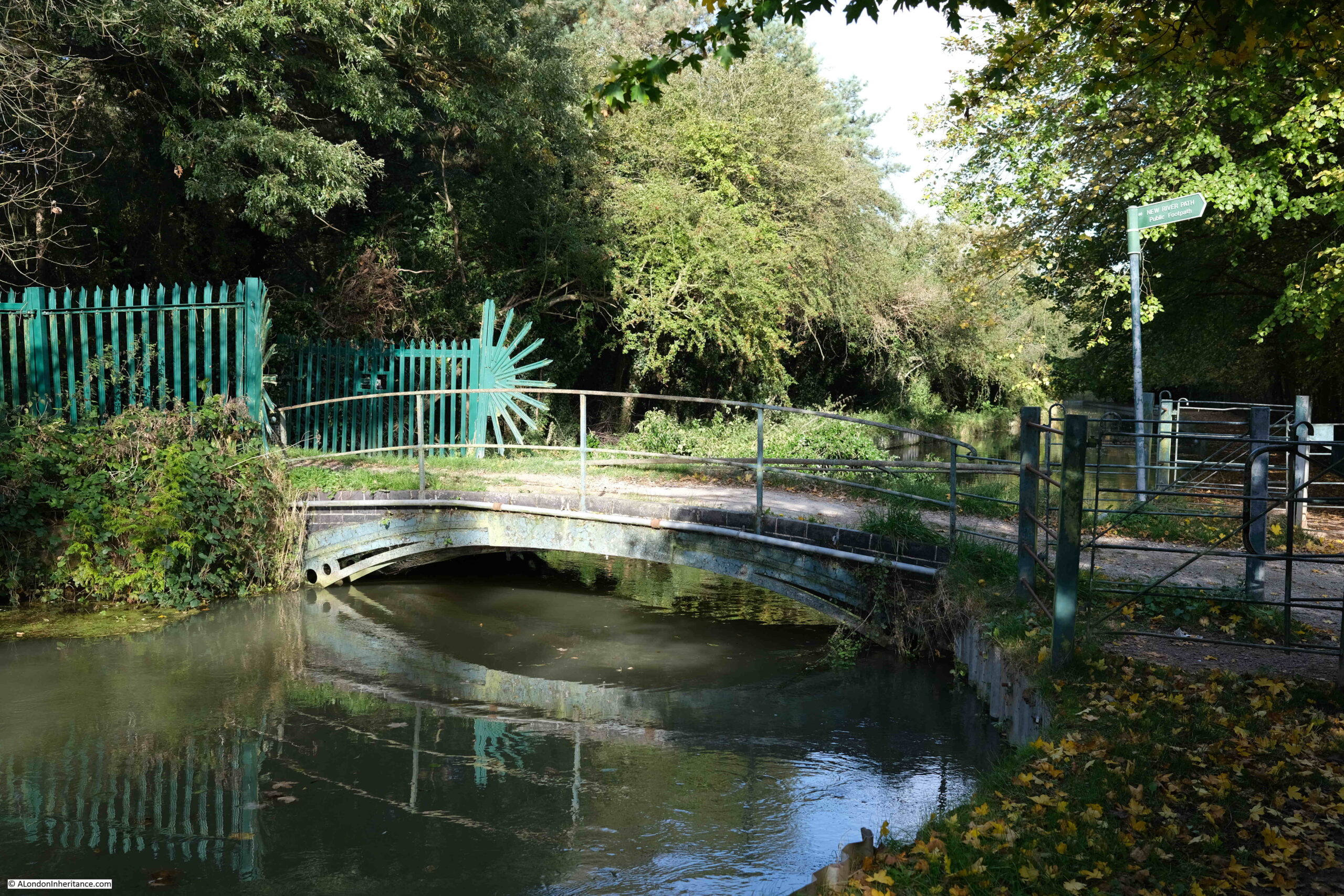
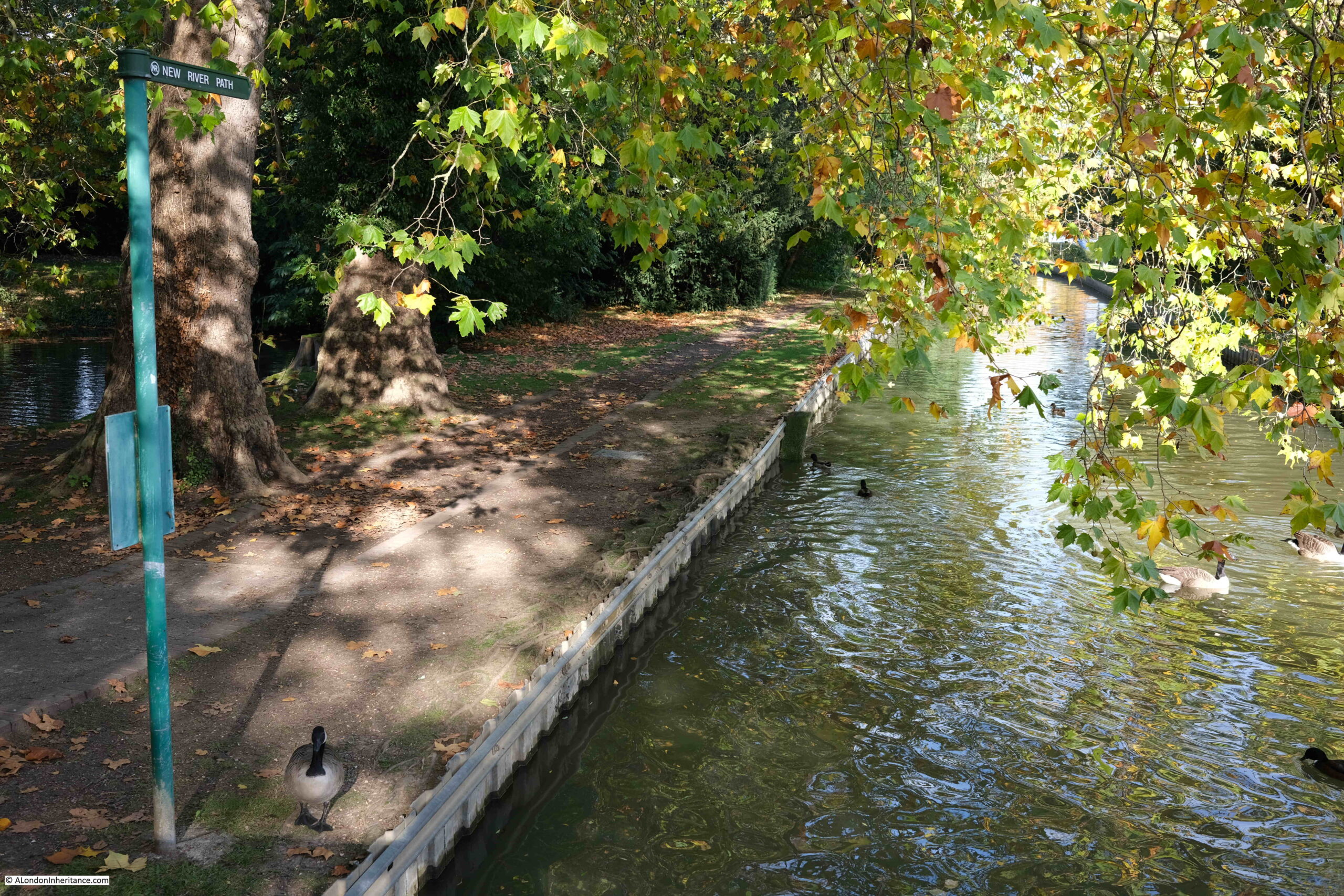
Although the New River passes through a number of built areas on the way to Cheshunt, it continues with a rather rural appearance with trees lining the banks. Small foot bridges ensure crossing points as the river winds through communities.

Walking the New River

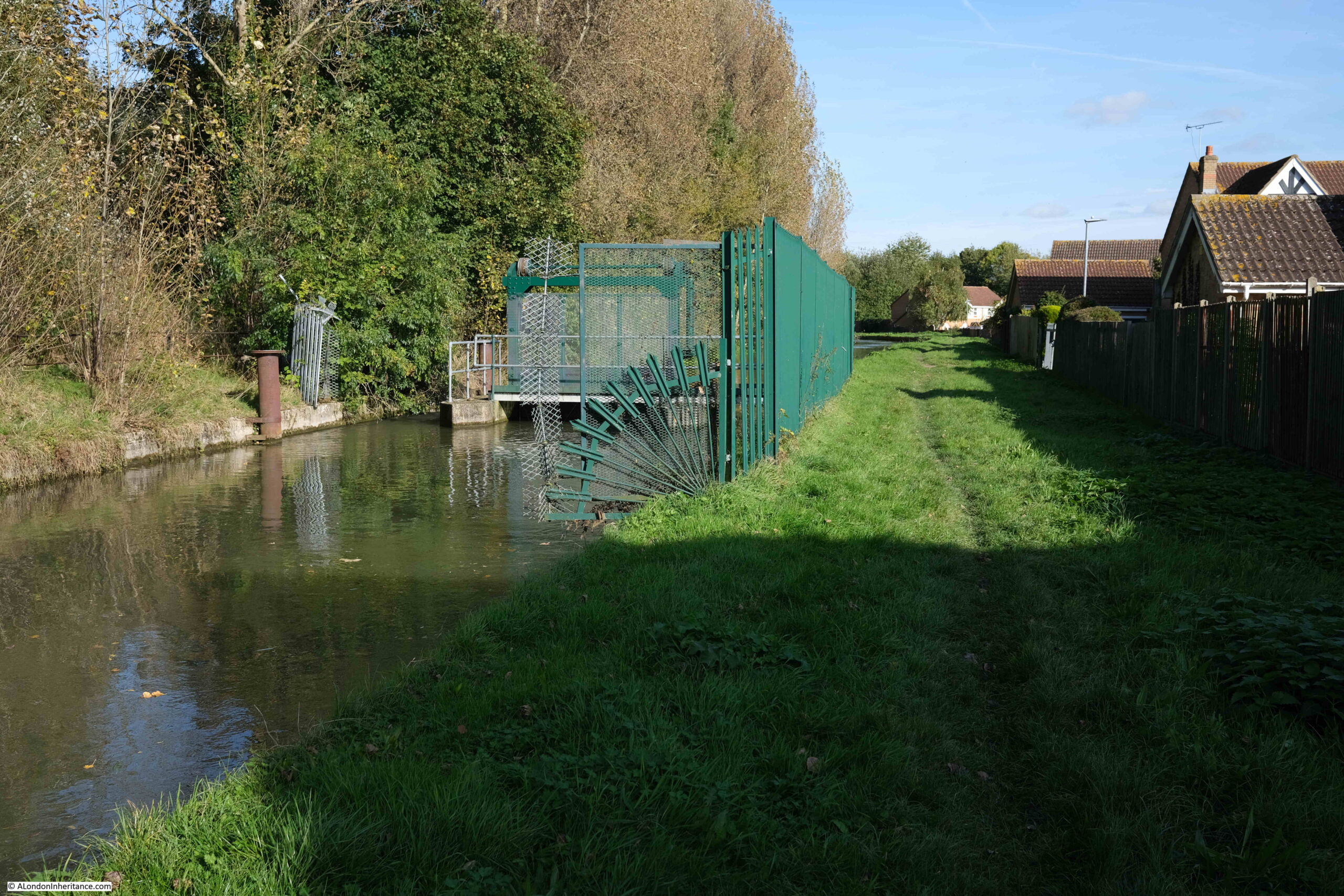
Sluice to manage water levels on the outskirts of Cheshunt:

Walking the New River

Passing alongside a new housing estate:

Walking the New River

The creation of the New River Path dates back to the early 1990s, and the path continues to be well sign posted with only a few places where some careful reference to the map is needed. This may well change as we get into the built areas of north London.

New River Path

At the end of Day 2 – an autumn scene in Cheshunt:

Walking the New River

From here it was a walk into Cheshunt to return home. The end of a brilliant weekend walking the New River.

Each day was just under 8 miles (which included getting to and from each day’s starting and end point). The early stages of the walk around Ware were wet and muddy in places, after Ware the path was mainly dry and easy to walk.

My thanks to those also on the walk for making it such an enjoyable weekend. We have a second weekend booked in a few weeks time, with an aim of walking from Cheshunt to where the New River currently terminates at the East and West Reservoirs, just south of the Seven Sisters Road.

The next stage will include the symbolic crossing of the M25, where rather surprisingly the New River crosses over, rather than under the M25.

alondoninheritance.com

Carter and Goldfinger explain the County of London Plan

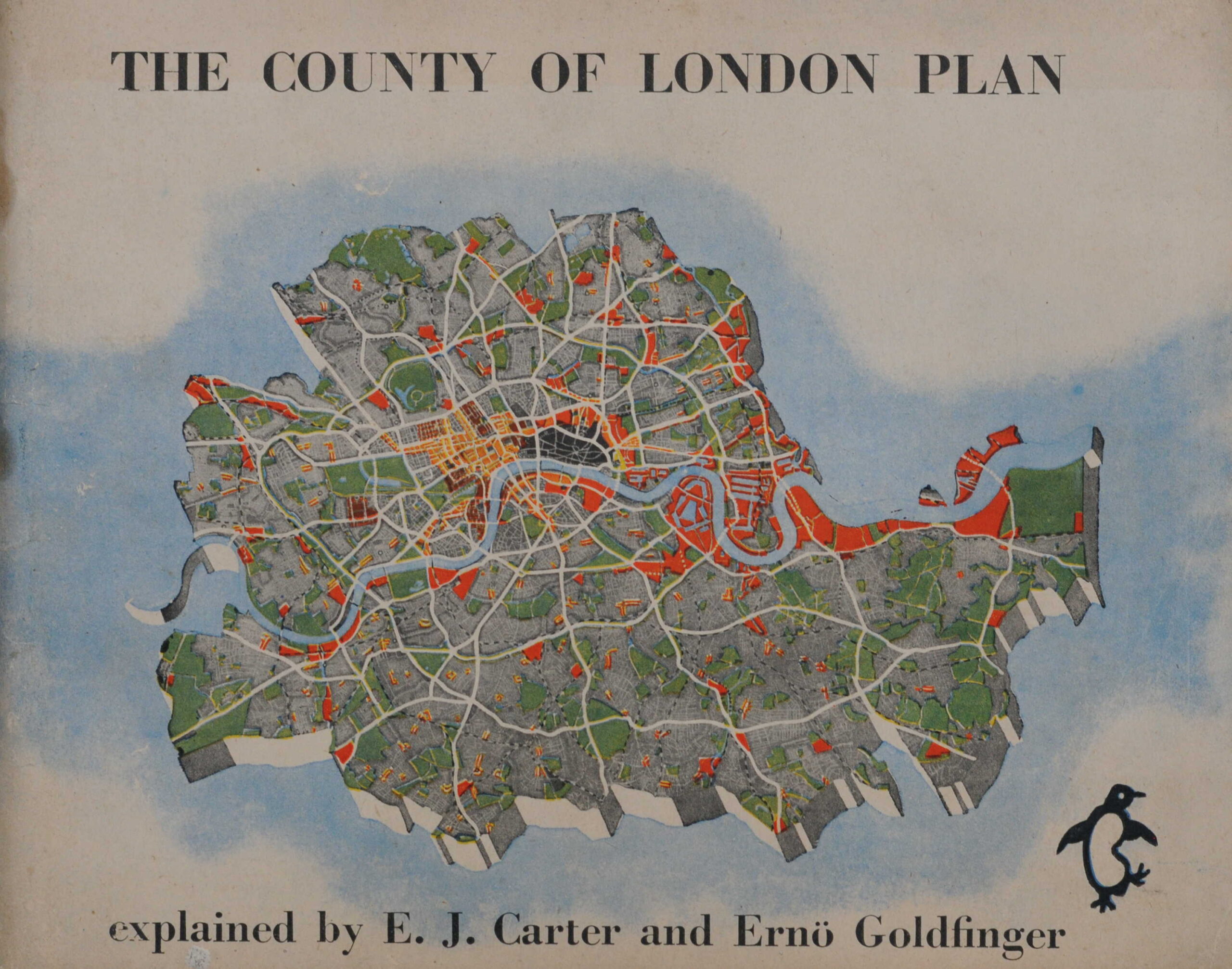
One of the strangest headings I have used for a post, however, this was the title of a wonderful booklet published in 1945, where Edward Julian Carter (Librarian of the Royal Institute of British Architects) and Erno Goldfinger, (the architect of buildings such as the Balfron Tower in Poplar), explained the London County Council, 1943 County of London Plan.

County of London Plan

The idea for a County of London Plan came from Lord Reith, the Minister of Works and Planning. In 1941 he asked the London County Council to prepare a plan “without paying overmuch respect to existing town planning law and all the other laws affecting building and industry but with a reasonable belief that if a good scheme was put forward it would provide reasons, the impulse and determination to bring about whatever changes in law are needed to carry the plan into effect”.

The County of London Plan was published in 1943, and provided a view of what the city could become after the devastation of wartime bombing.

As is always the way with long term plans, many of the recommendations were not implemented. Money was a considerable post war problem, many changes were long term, and in the decades following the 1940s, changes not foreseen by the plan, such as the exodus of industry from the city and the closure of the docks, would result in a new approach to city planning.

The impact of the County of London plan can though be seen across London today, with, for example, the South Bank being the combination of cultural (Royal Festival Hall, National Theatre etc.), gardens (Jubilee Gardens), office (IBM) and housing recommended by the plan.

The 1945 booklet by Carter and Goldfinger was an attempt to provide a concise view of the plan in a more readable format, and to get the buy in from Londoners to the future of their city as proposed by the plan.

Trying to get the support of Londoners for the plan did though display a bit of “central authority knows best”, as shown by the following two sentences from the introduction to the plan in the booklet:

“So when the L.C.C. plans for London it is not merely planning these things in an abstracted way for Londoners; it is London’s own people through their own democratic government planning themselves”, and;

“The Plan was generated by the people of London and created by architects and planners aware of what the people want. Now it is before the people for them to turn it into reality”.

There is no indication in the booklet how architects and planners were aware of what the people wanted, however the booklet does highlight many of the problems experienced by people living and working in the city.

The booklet was published by Penguin and cost 3 shillings and 6 pence. It would be interesting to know how many Londoners actually purchased and read the booklet.

As with the County of London Plan, the booklet makes some brilliant use of diagrams, what we would today call infographics, use of colour, and plenty of maps, including a wonderful fold out map at the end of the booklet.

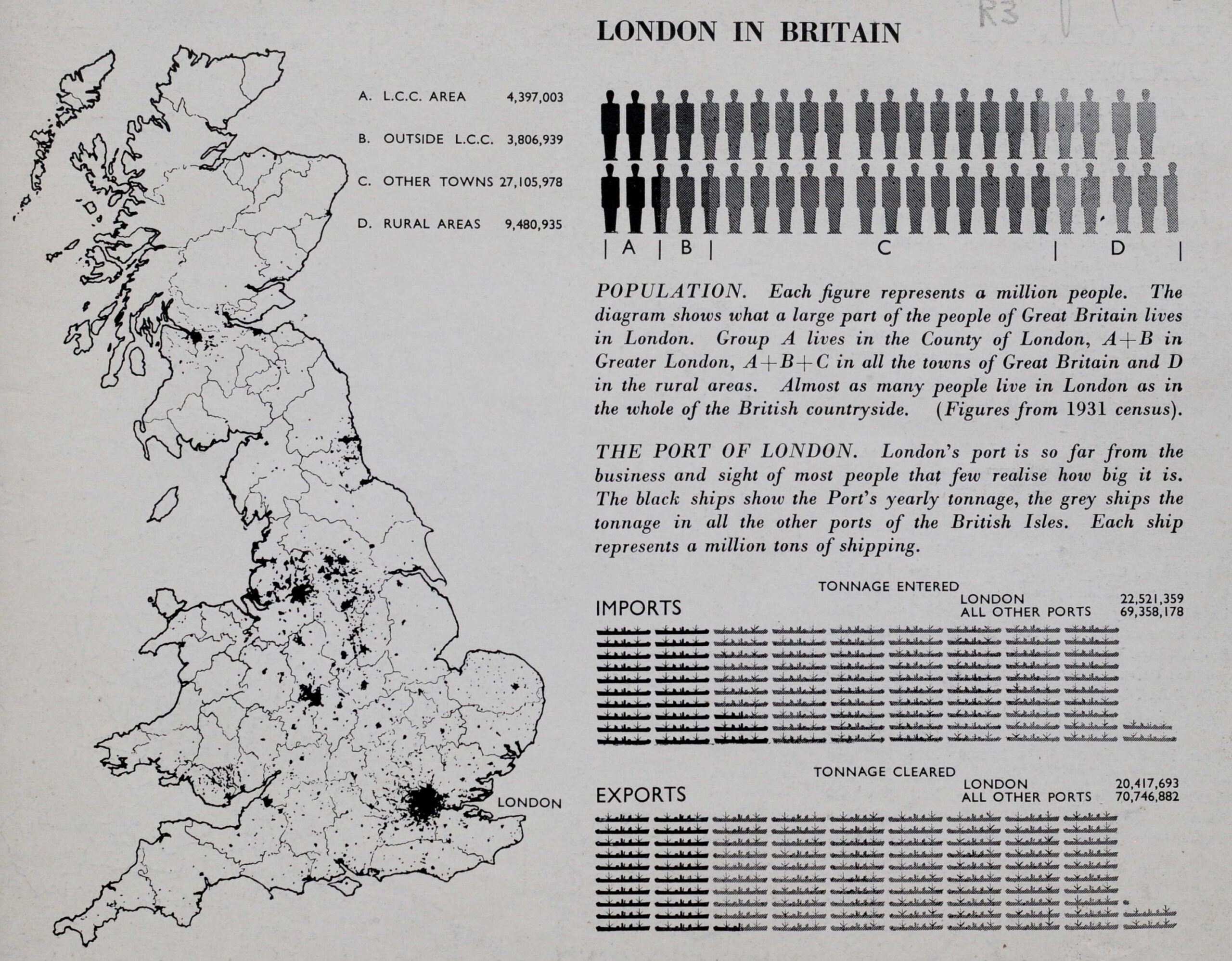
The booklet starts by positioning London in Britain, including that London’s population was almost equal to the number of people living in the whole of the British countryside, as well as the significant percentage of imports and exports that went through the city’s docks.

County of London Plan

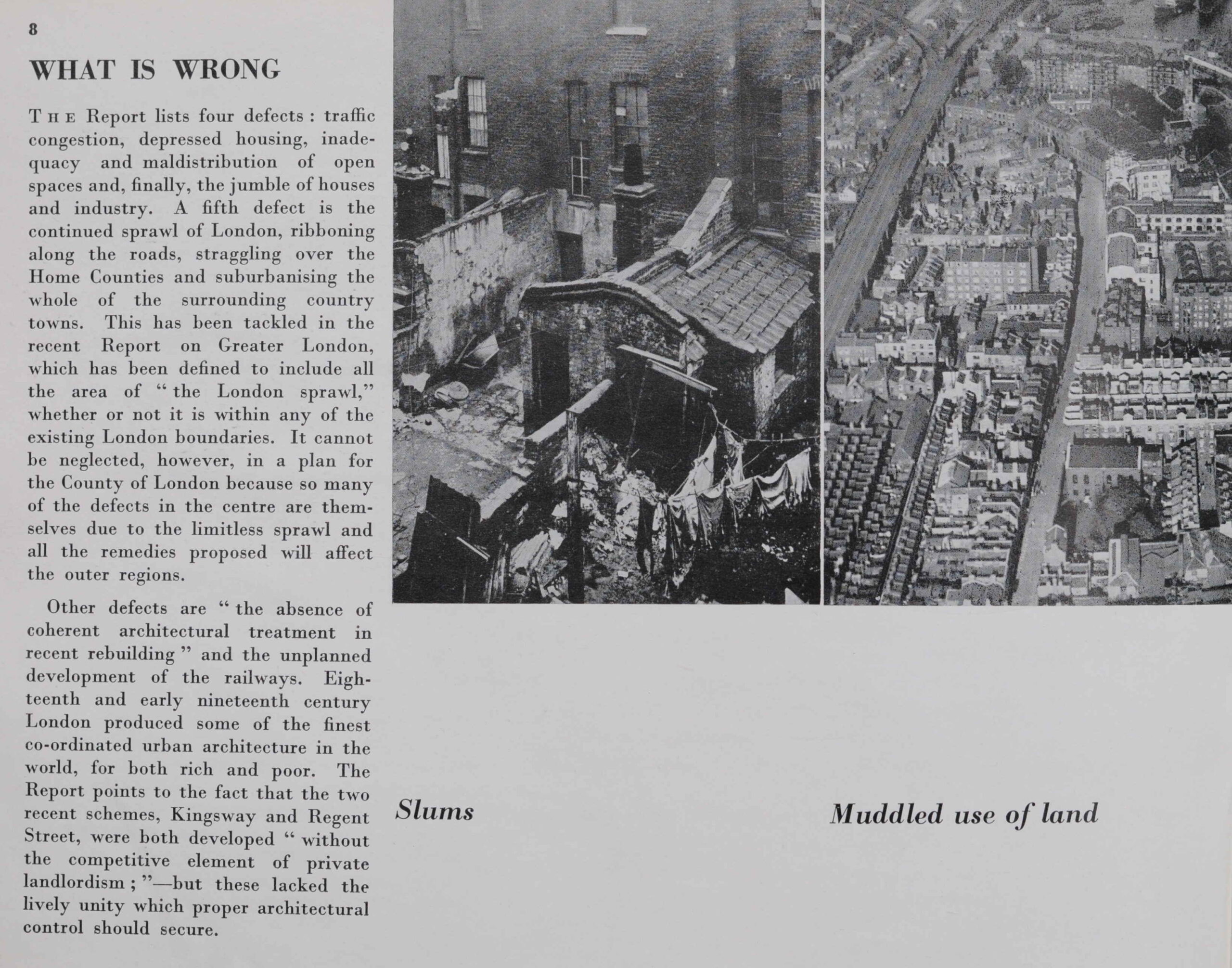
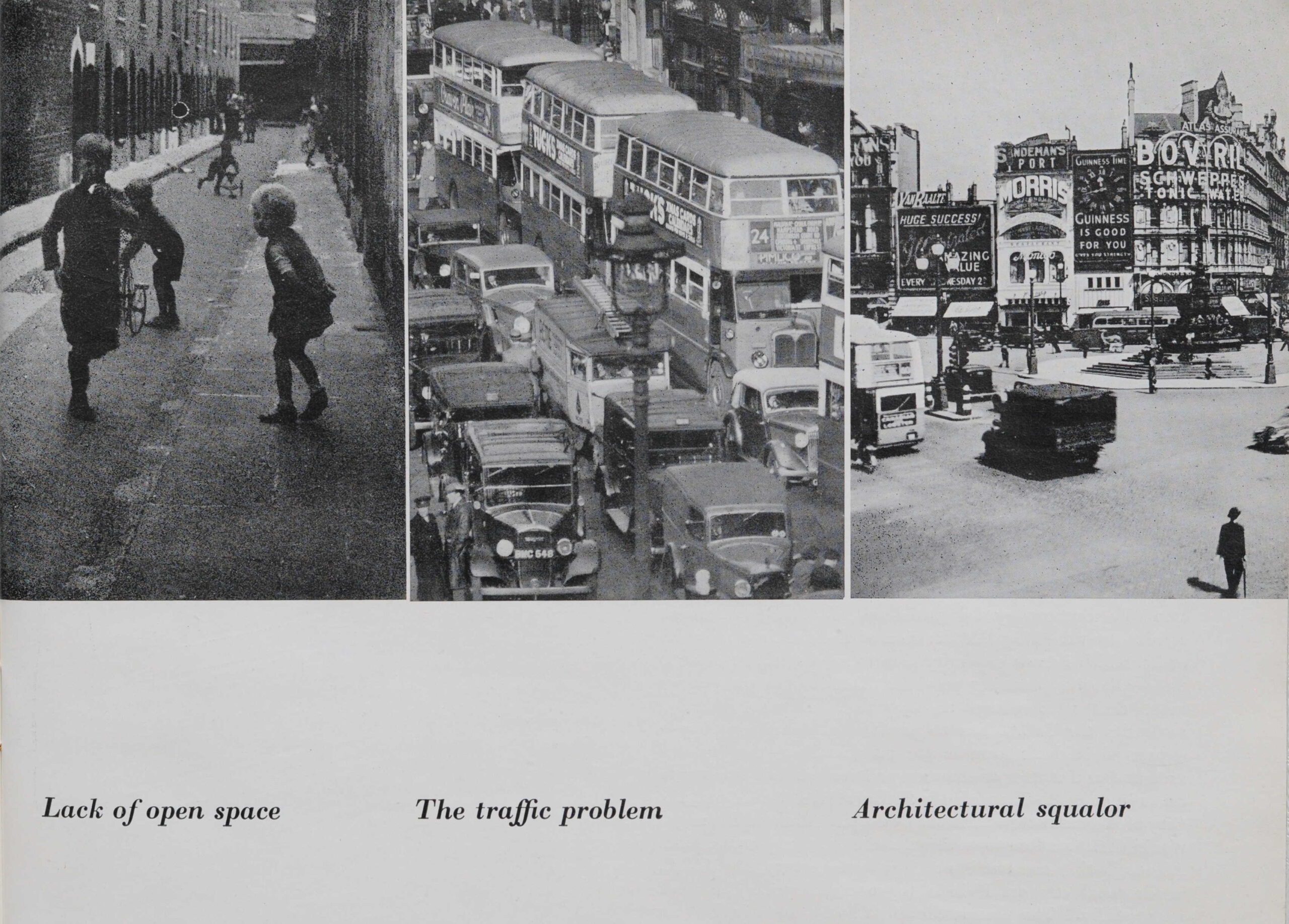
The booklet identifies a number of themes under “What is Wrong”, which includes traffic congestion, depressed housing, inadequacy and maldistribution of open space and a jumble of houses and industry. Another problem is the sprawl of London, with ribbon development along the roads leading to the counties surrounding London, an approach which would gradually leads to urbanising the countryside.

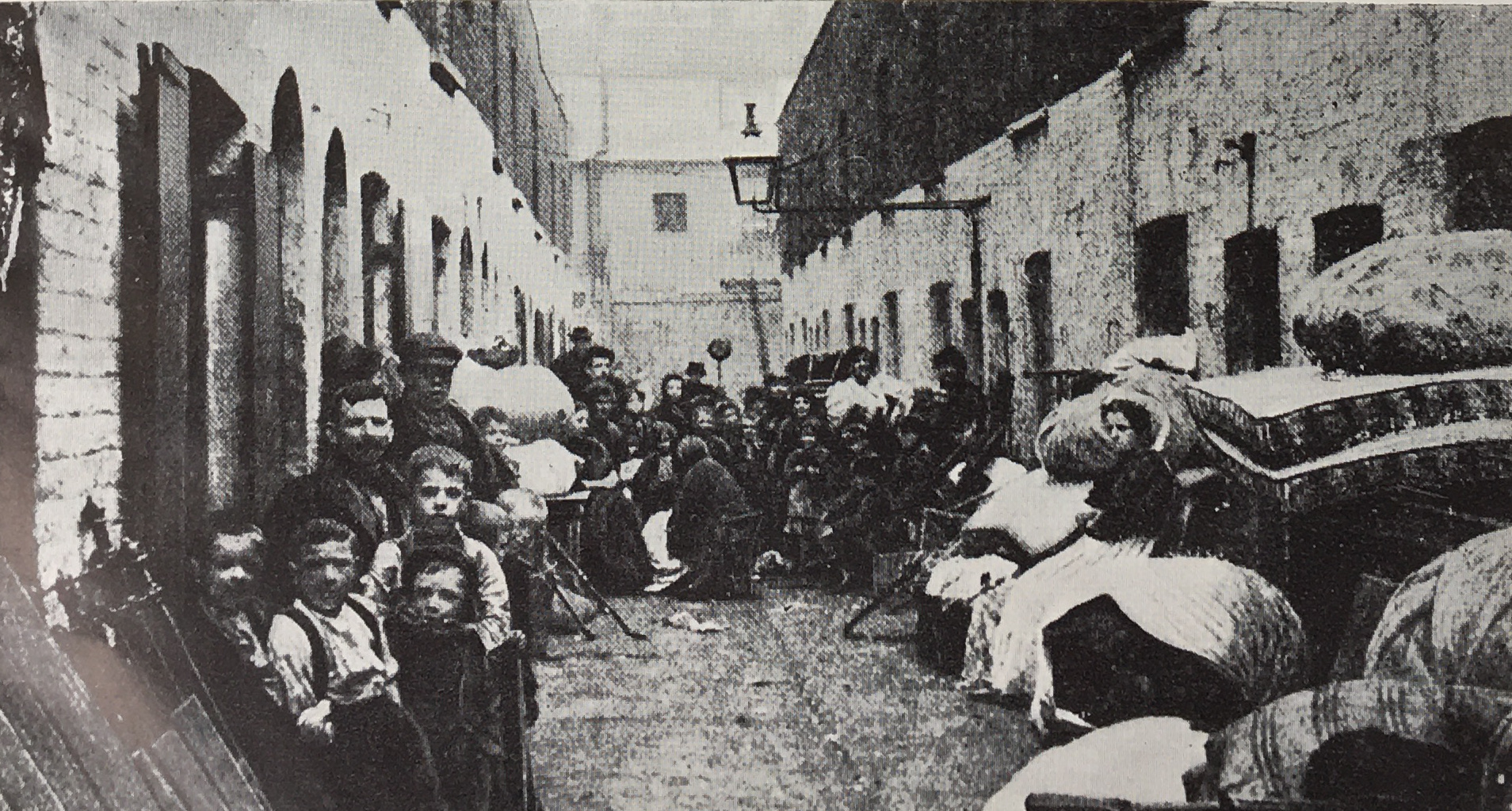
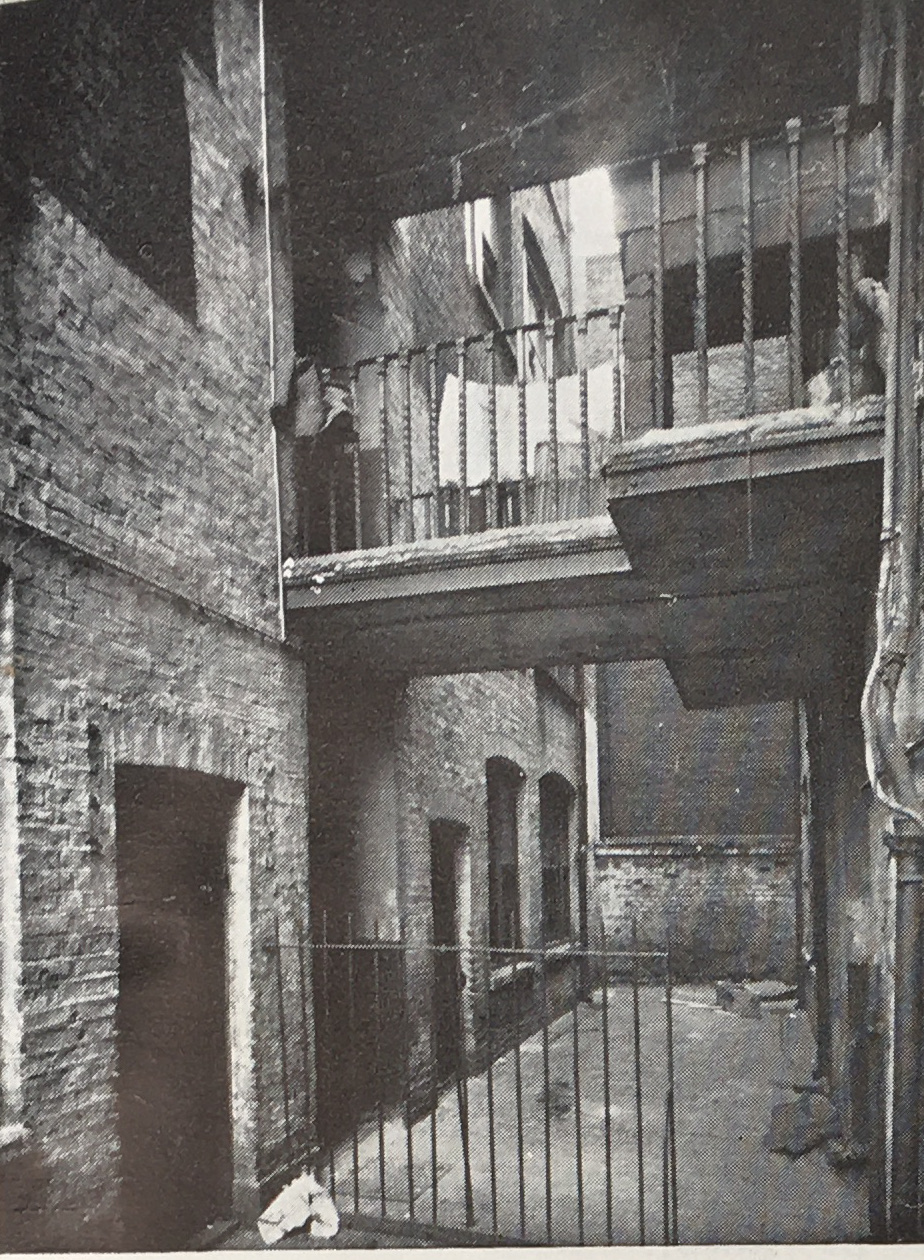
The report illustrates five of these problems. Slums and the Muddled use of land:

What is wrong with London

A lack of open space, traffic problems and architectural squalor:

What is wrong with London

Interesting that the book identifies the “absence of coherent architectural treatment in recent building”. A problem that still exists and demonstrated by the towers that are descending on Vauxhall at the moment.

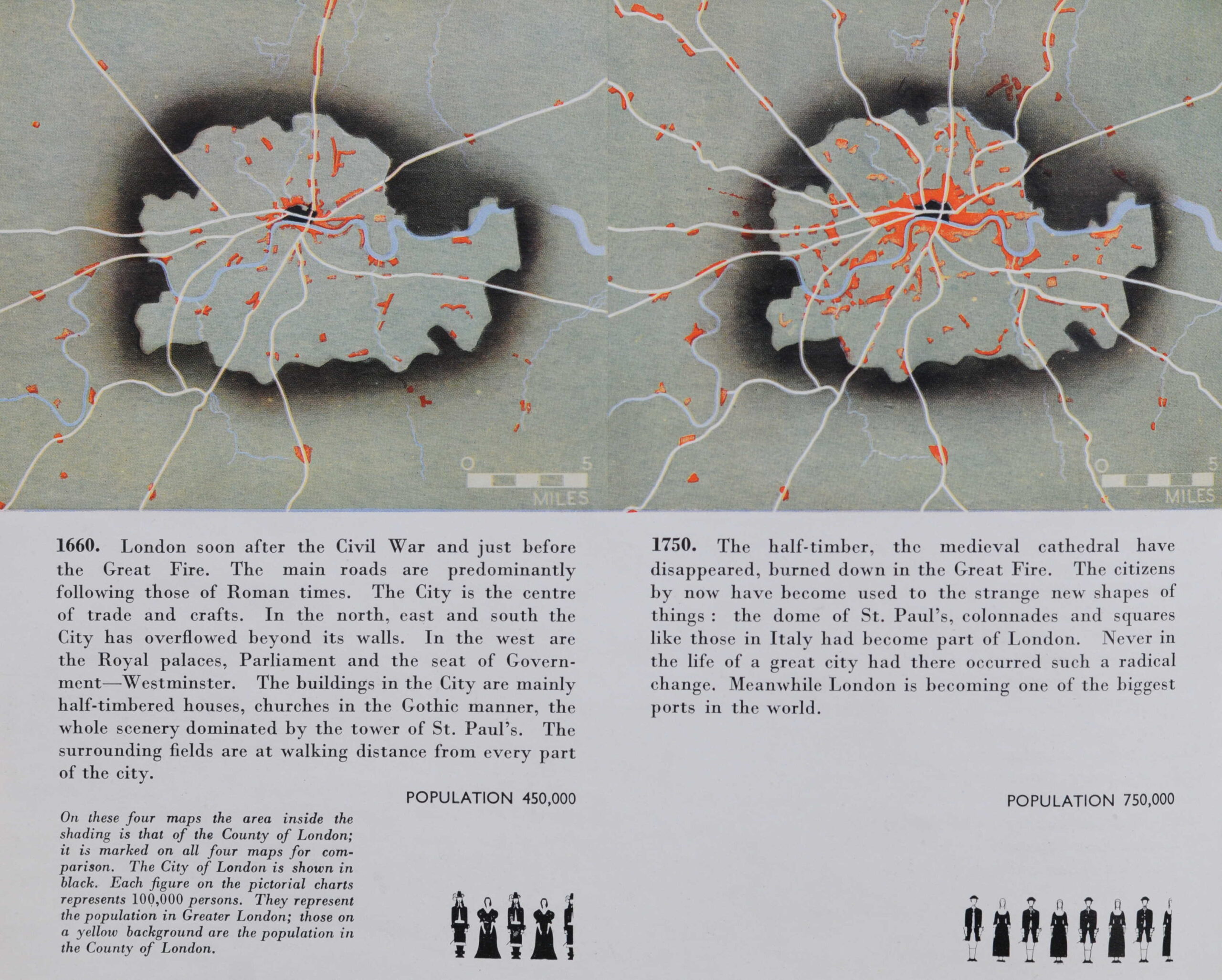
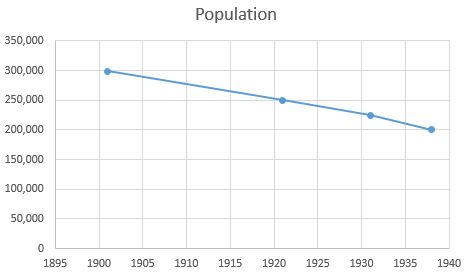
The booklet reviews the growth of London, from 1660 when the city had a population of 450,000:

Growth of London

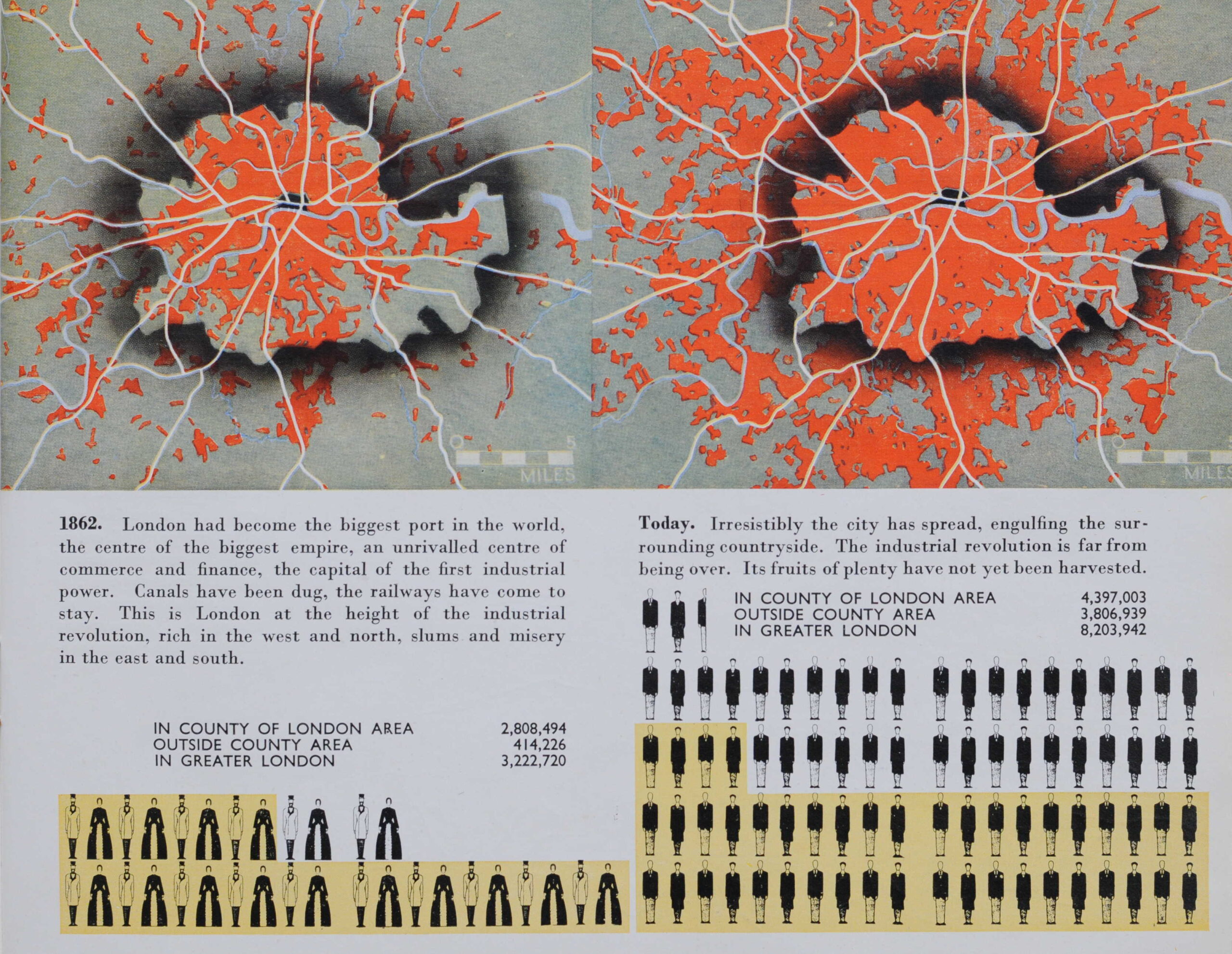
In 1862, population estimates now include the County of London area, as well as outside the County area to provide a view of the population of Greater London which was 3,222,720 in 1862 rising significantly to 8,203,942 by the time of the report:

Growth of London

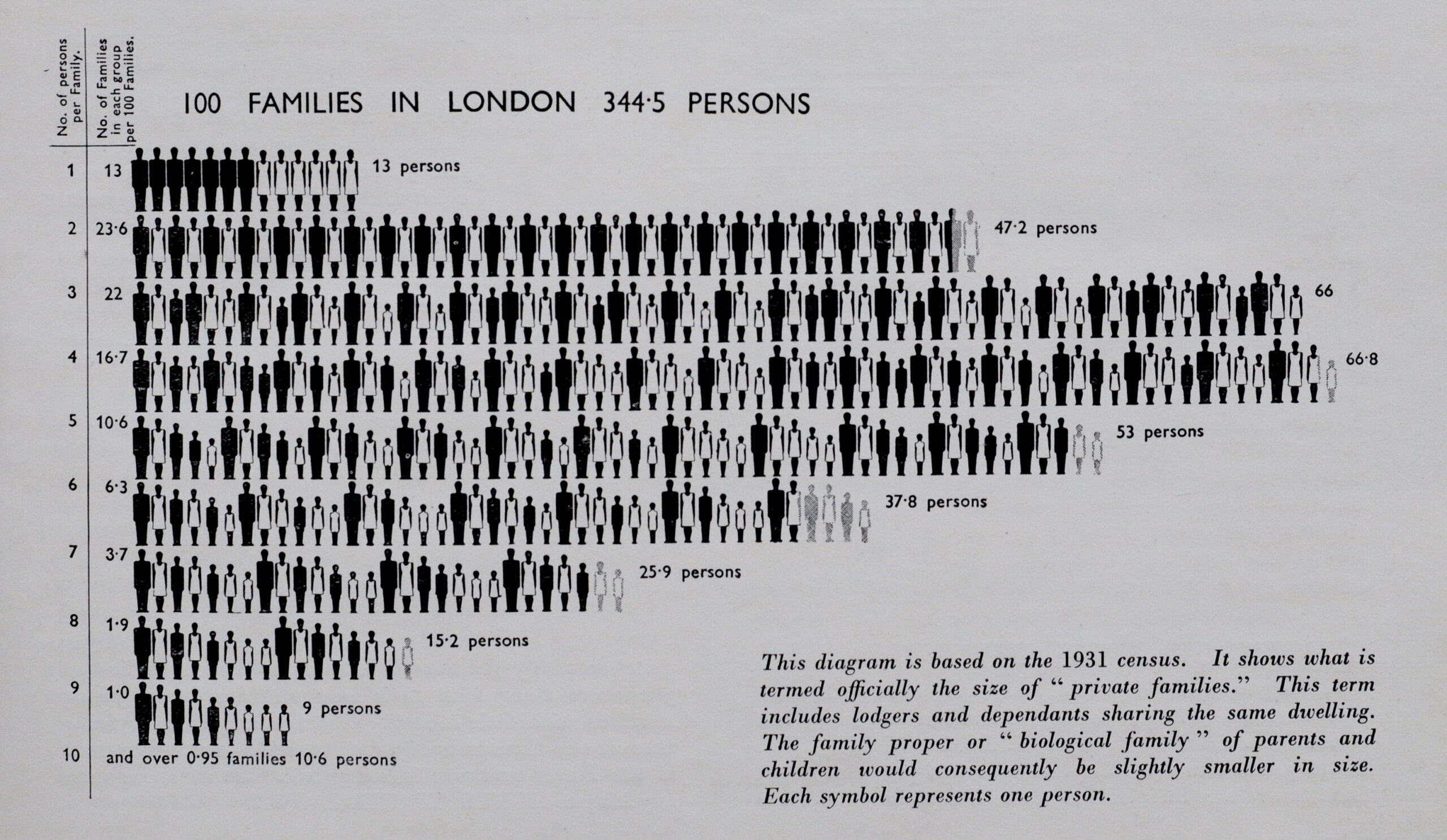
The booklet shows some of the data that was used in the County of London Plan to develop the plan’s proposals. The following diagram shows Family Grouping in London, with the number of people in family groups for a sample size of 100 families.

Family size in London

The above diagram was based on the 1931 census, and shows that the highest numbers of families were in the size of three to five persons per family (which also included lodgers and dependents).

This was not so different to the late 19th century. When I looked at the 1881 census data for Bache’s Street (see this post), the average number of members of a family was 3.15, however this figure hid the real problem of houses of multiple occupancy where more than one family would occupy a single house.

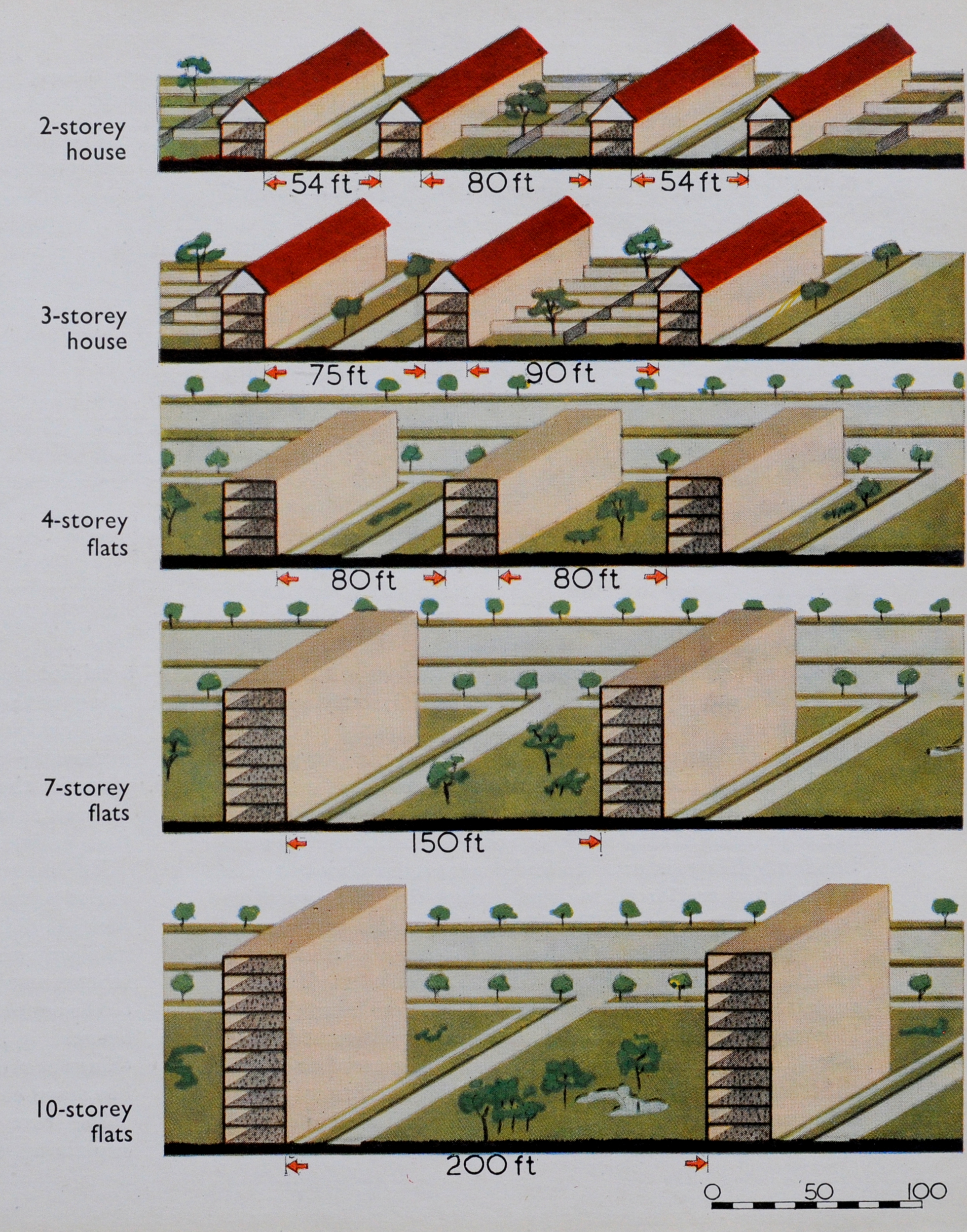
Blocks of flats would be a key feature of post war housing development, the booklet goes some way to explaining why this approach was taken.

In the following diagram, the heights of blocks are shown, the height is used to determine the spacing between the blocks.

Housing and flat density

Whilst smaller, 2-storey houses can have their own garden, this arrangement does not give any land over for public gardens, and will require longer roads.

The justification for larger blocks of flats was the large amount of public open space that could be provided, along with uses such as allotments, with very little space wasted for roads.

Whilst the booklet does recognise the lack of private gardens, it does not really appreciate the impact of high rise living, and that large areas of public open space can become a bit of a windswept wasteland if not carefully managed.

The problem with London was the limited amount of space available for everything that could be expected to be included within the city. Homes, schools, factories, shops, public buildings, offices, roads, railways and services for visitors.

The definition of the County of London for the 1943 plan resulted in an area of 74,248 acres available for every use London was expected to support.

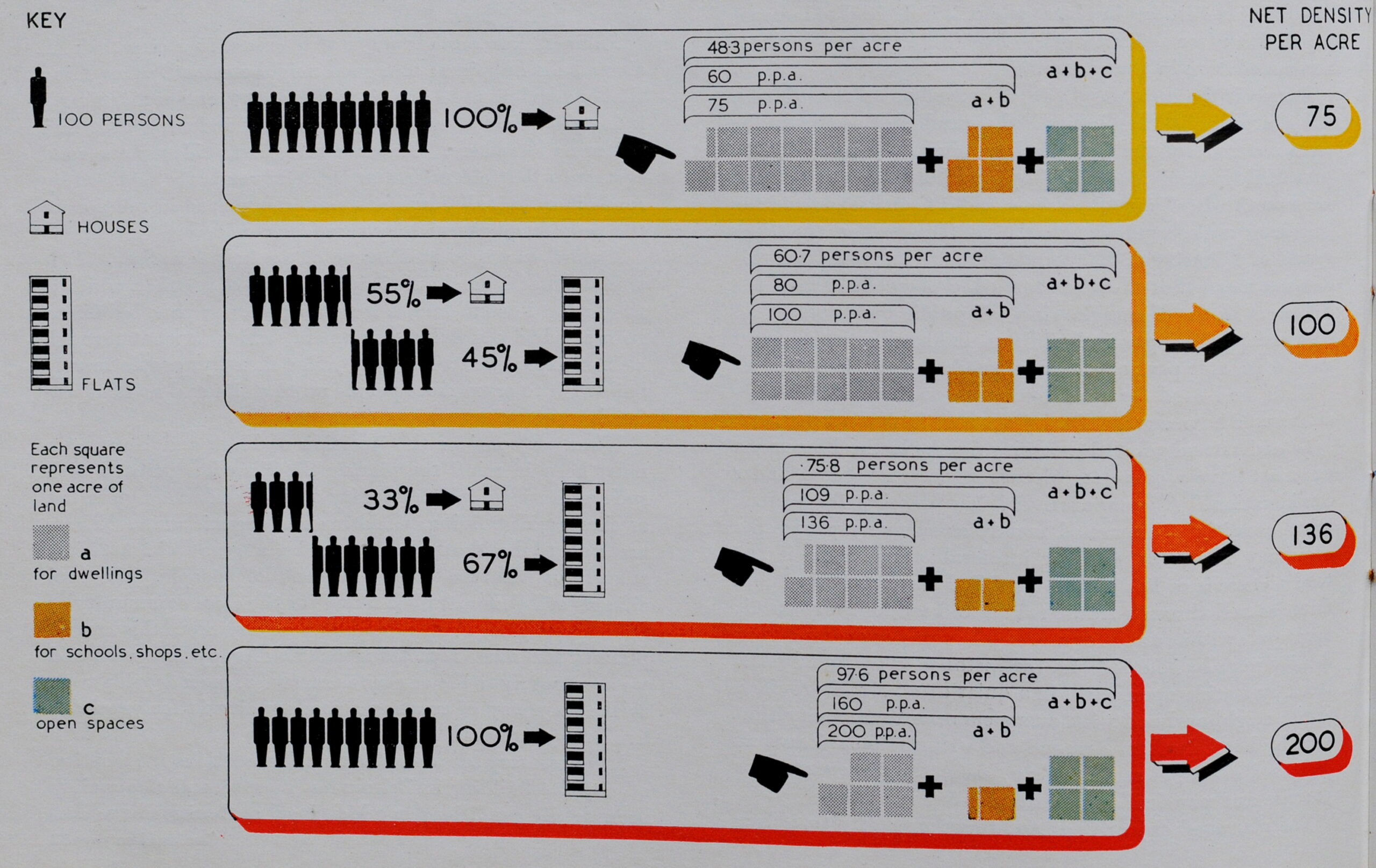
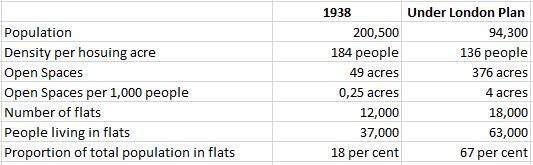
This resulted in some serious decisions on population densities, which again influenced the house / flats discussions.

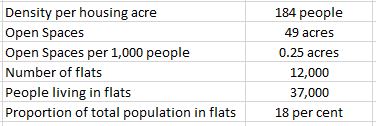
The following diagram shows the different combinations and their resulting density of people per acre:

County of London Plan

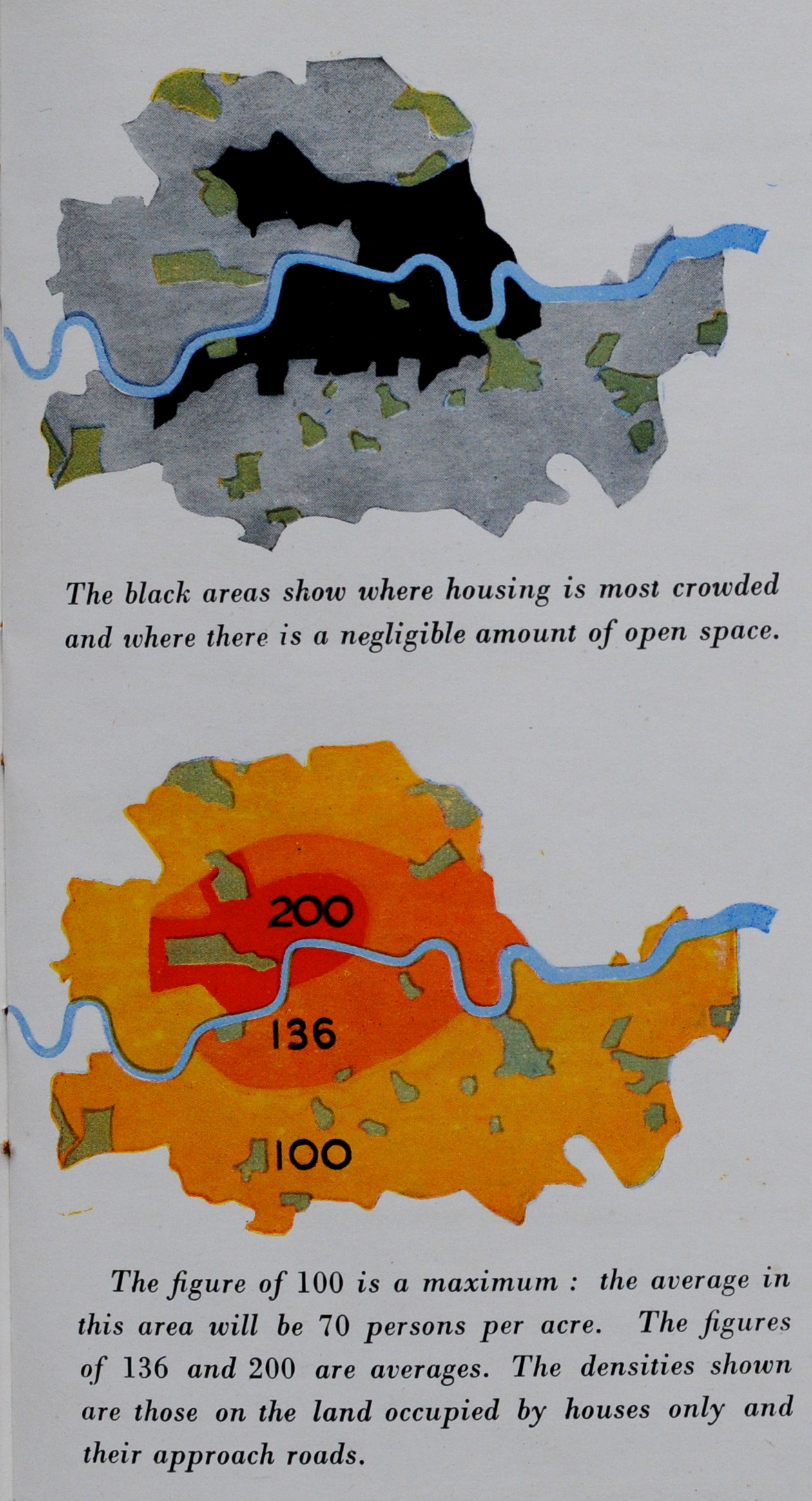
However, even achieving these population densities would cause rehousing problems. Open space was also a consideration as many areas of London had very little public open space. The upper map shows the areas of London where housing is most crowded and there is a negligible amount of open space:

County of London Plan

The lower map shows the target population densities defined by the County of London Plan.

The central area would have the highest population density of 200 people per acre, however this figure was much below many areas of London which had densities up to 360 people per acre. This would require the challenge of rehousing and averaging out population densities if a reduction was to be achieved.

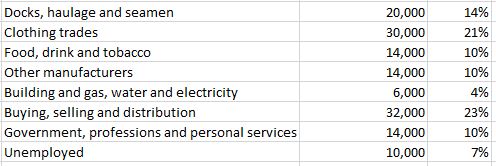
As well as housing, London at Work was a key consideration of the plan. At the time of the plan, an estimated 2,990,670 people was employed in Greater London.

The trade with the most people was the Distributive Trades with 563,540, followed by Engineering and Metal Trades at 443,380 and Building and Public Works Contracting at 280,440.

Interesting that the majority of people were involved in some form of manufacturing industry. We tend to think that the city had always been a centre for finance and the professional and service industries, however the report listed 55,360 people in Finance and Commerce, 71,080 in Professional Services and 184,170 in Hotels, Restaurants, Club Services etc. Today, I suspect the numbers for manufacturing and those for the finance, professional and hotel services have swapped.

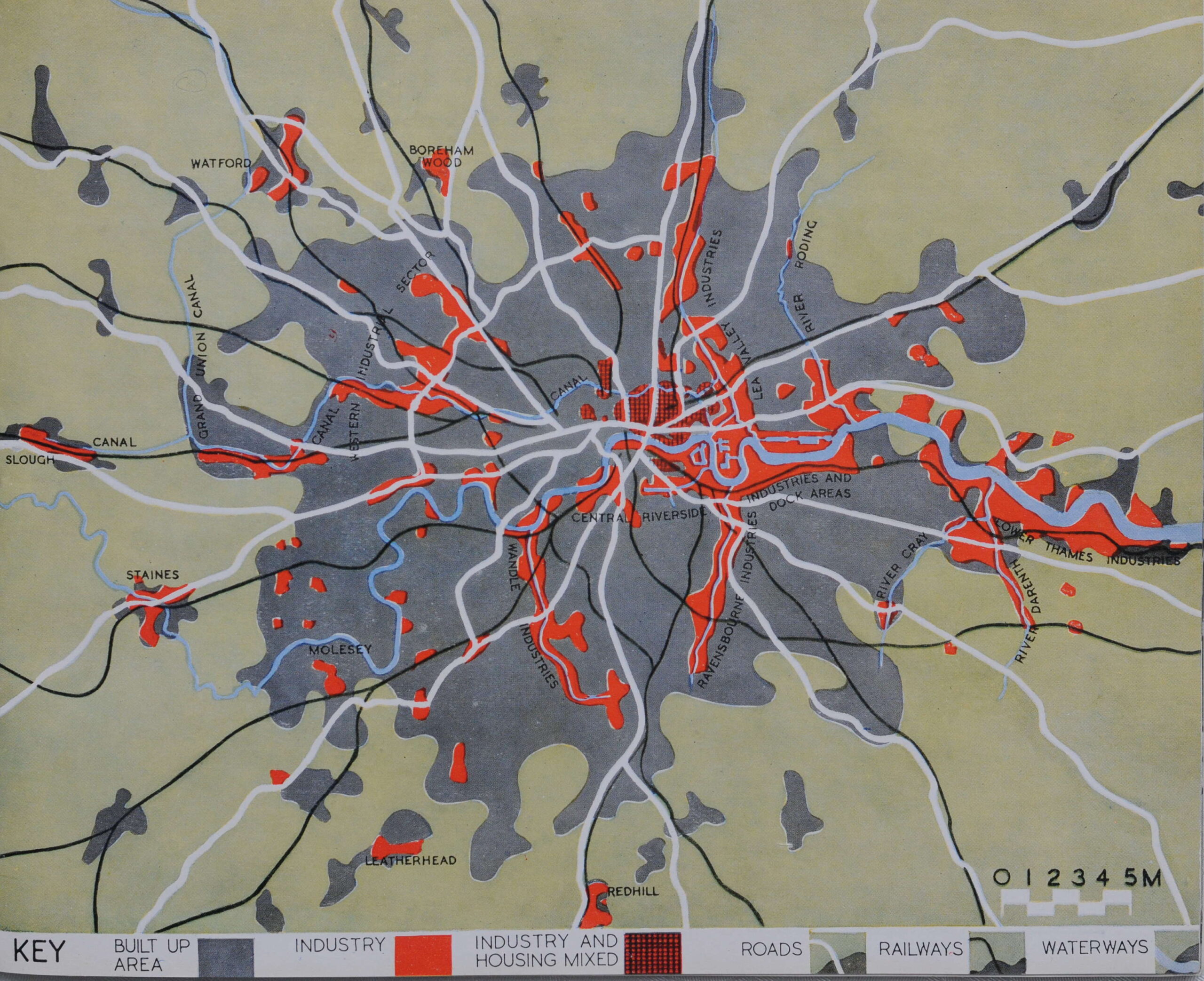
The booklet includes a map showing the built area of London, with the division of industrial and built areas:

County of London Plan

What is interesting is how the growth of industry has followed the rivers of London. Not just the Thames, but the Lea in east London, and if you look in south London, the string of industry along the Ravensbourne and Wandle.

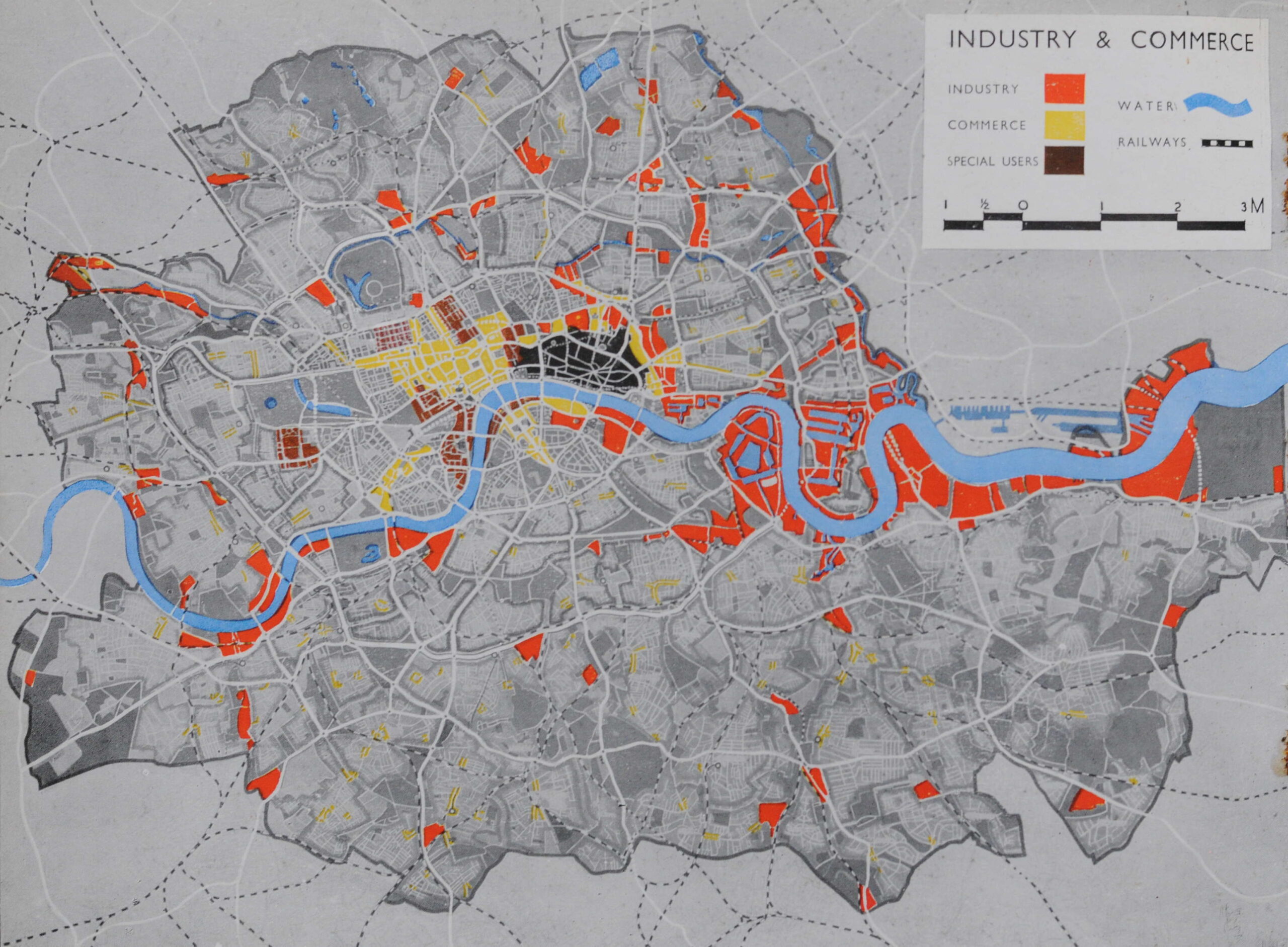
The following map shows the future locations of industry and commerce proposed by the plan. Red being industry and Yellow for Commerce.

County of London Plan

National Government focused on Westminster, Local Government on the South Bank (County Hall), Law to the west of the City, Bloomsbury being the centre for University education and Kensington being the location for museums.

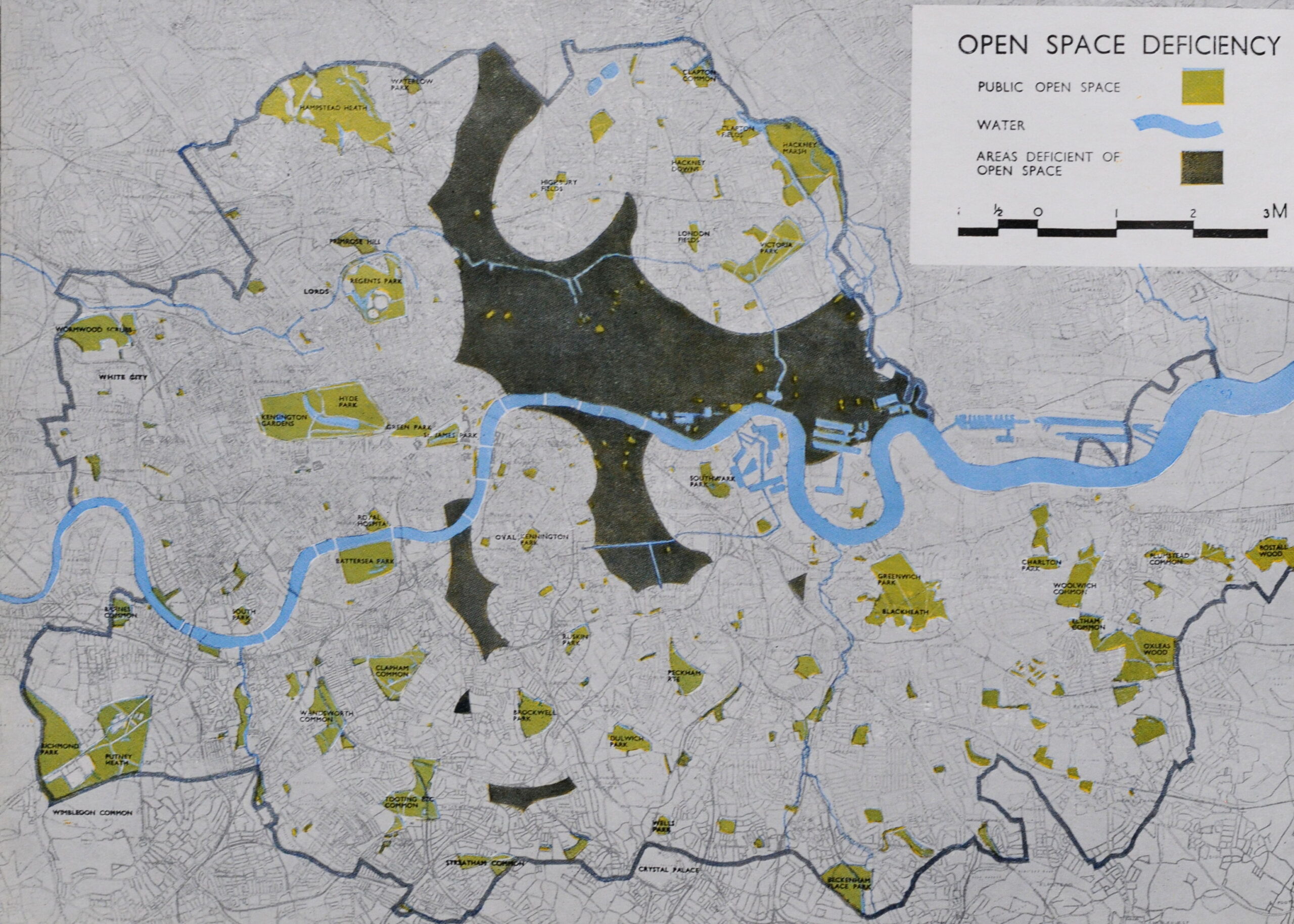
The County of London Plan was concerned with the lack of public open space. During the 19th century London had grown exponentially, with industry surrounded by dense housing estates and very little land available for those living in the city. Whilst to the west there were the Royal Parks, the east of the city was very poorly served as illustrated by the following map, where the dark area indicates areas deficient of open space:

County of London Plan

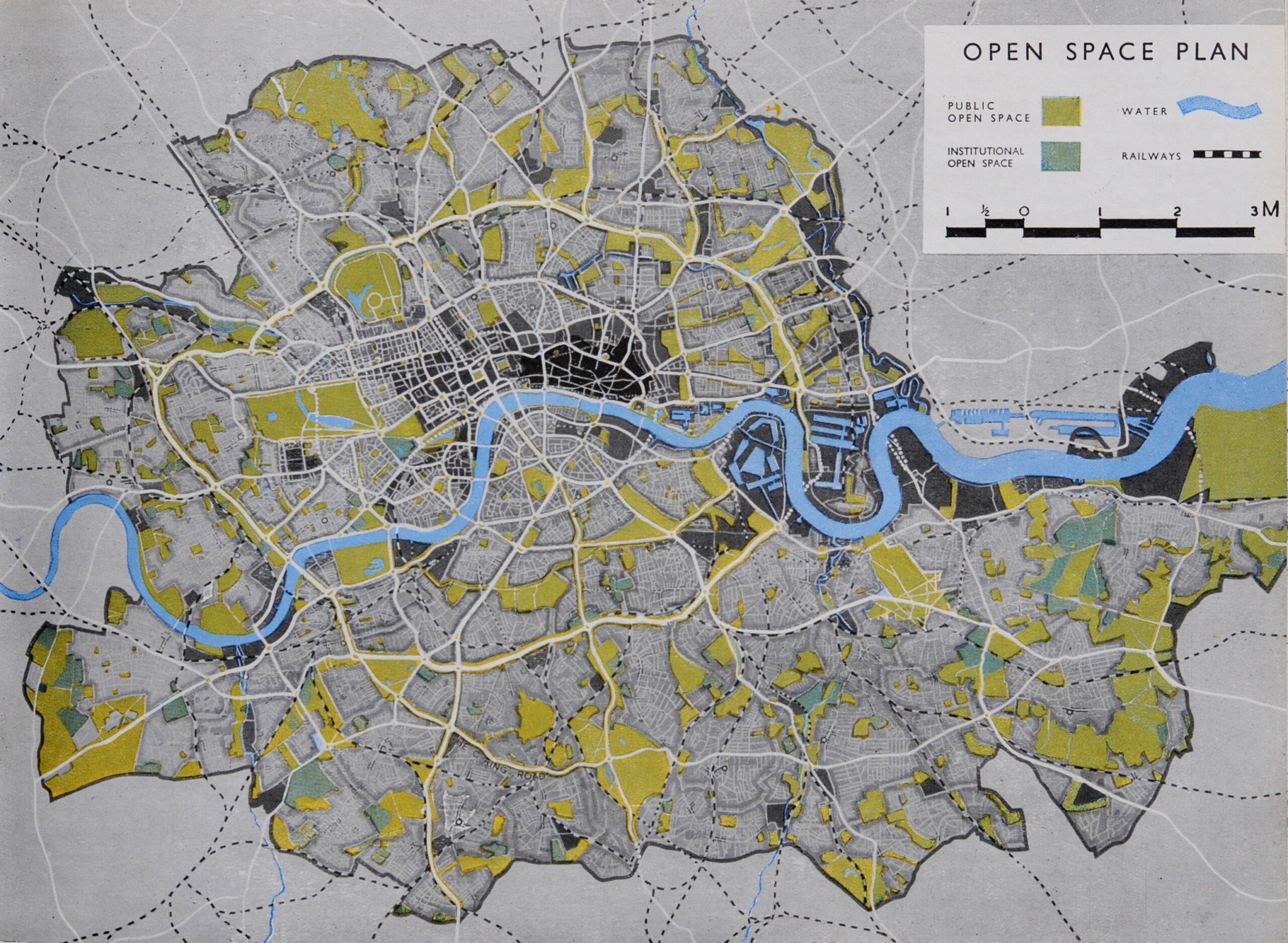
The County of London Plan proposed a system of new parks, mainly in the east and south of the city as shown in the following map:

Open Space Plan

It would be interesting to compare how many of the sites marked in the above map are open space today (adds projects to ever increasing list of things to write about).

The growth in traffic was a key consideration of the County of London Plan. The post war growth in car and lorry traffic was a theme of the majority of post war city development plans. The City of London’s plans proposed dual carriageways through the City (of which the section of London Wall between Aldersgate Street and Moorgate was one of the very few sections to be built, along with underground car parks and raised pedestrian ways.

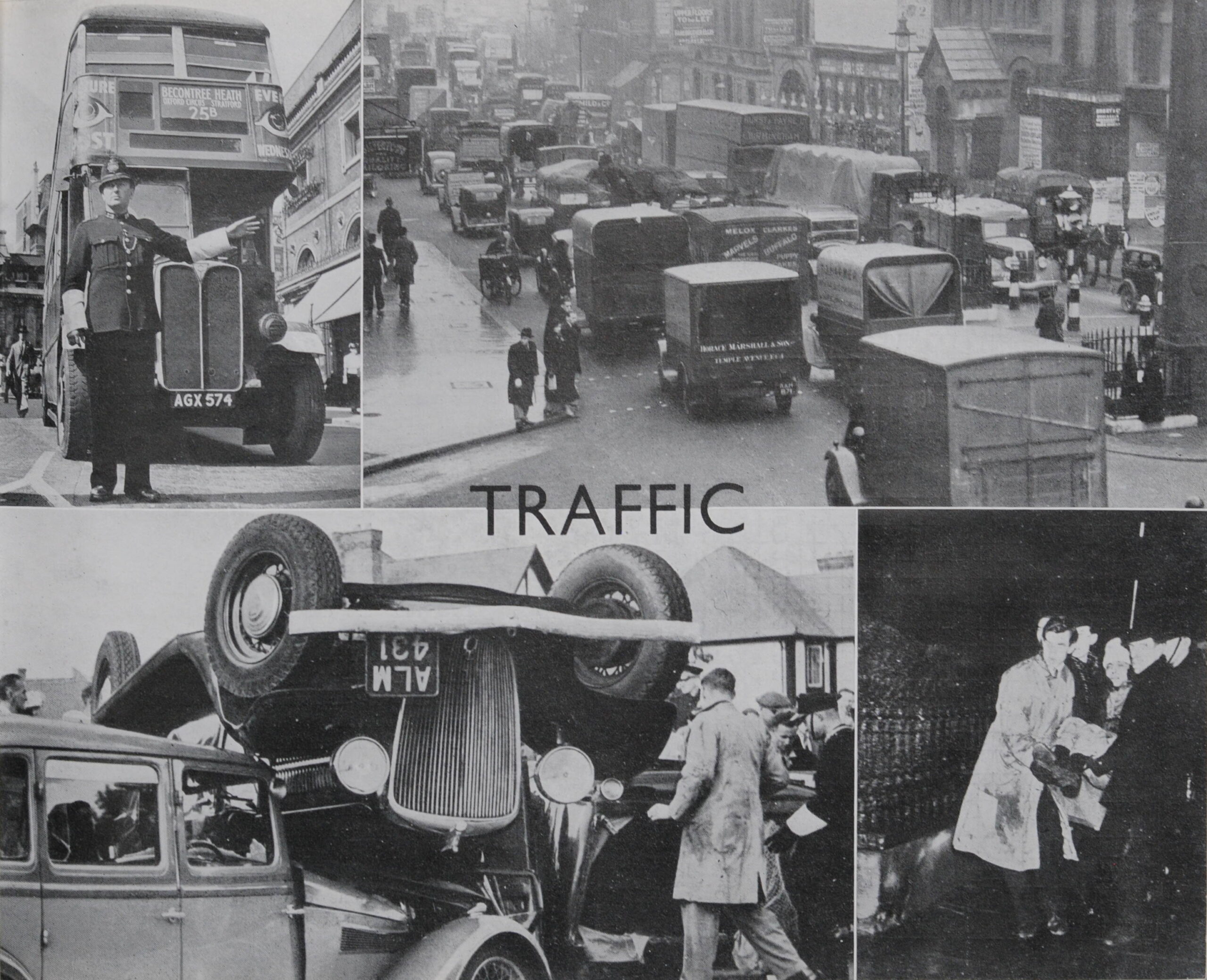
The County of London Plan offered a desperate view of what could become of the city if measures were not taken:

Traffic

Pre-war, many of the city’s streets were not designed to support the expected volumes of vehicle traffic, or the speed at which these vehicles were expected to travel – much faster than the horse drawn transport of previous centuries.

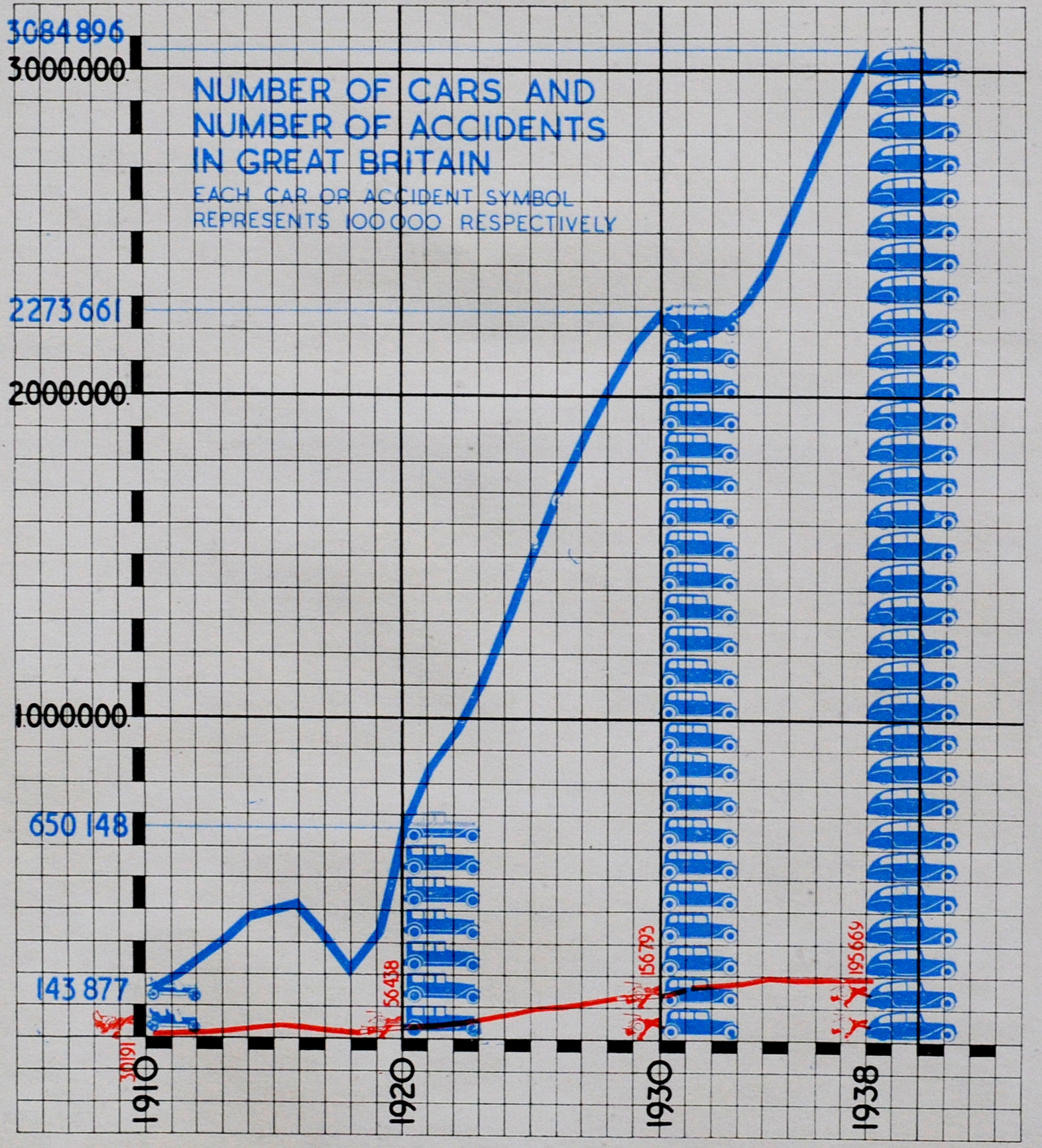
This was illustrated by the increasing numbers of cars in the country up to 1938 (blue) along with the increasing number of road traffic accidents (red):

cars and accidents

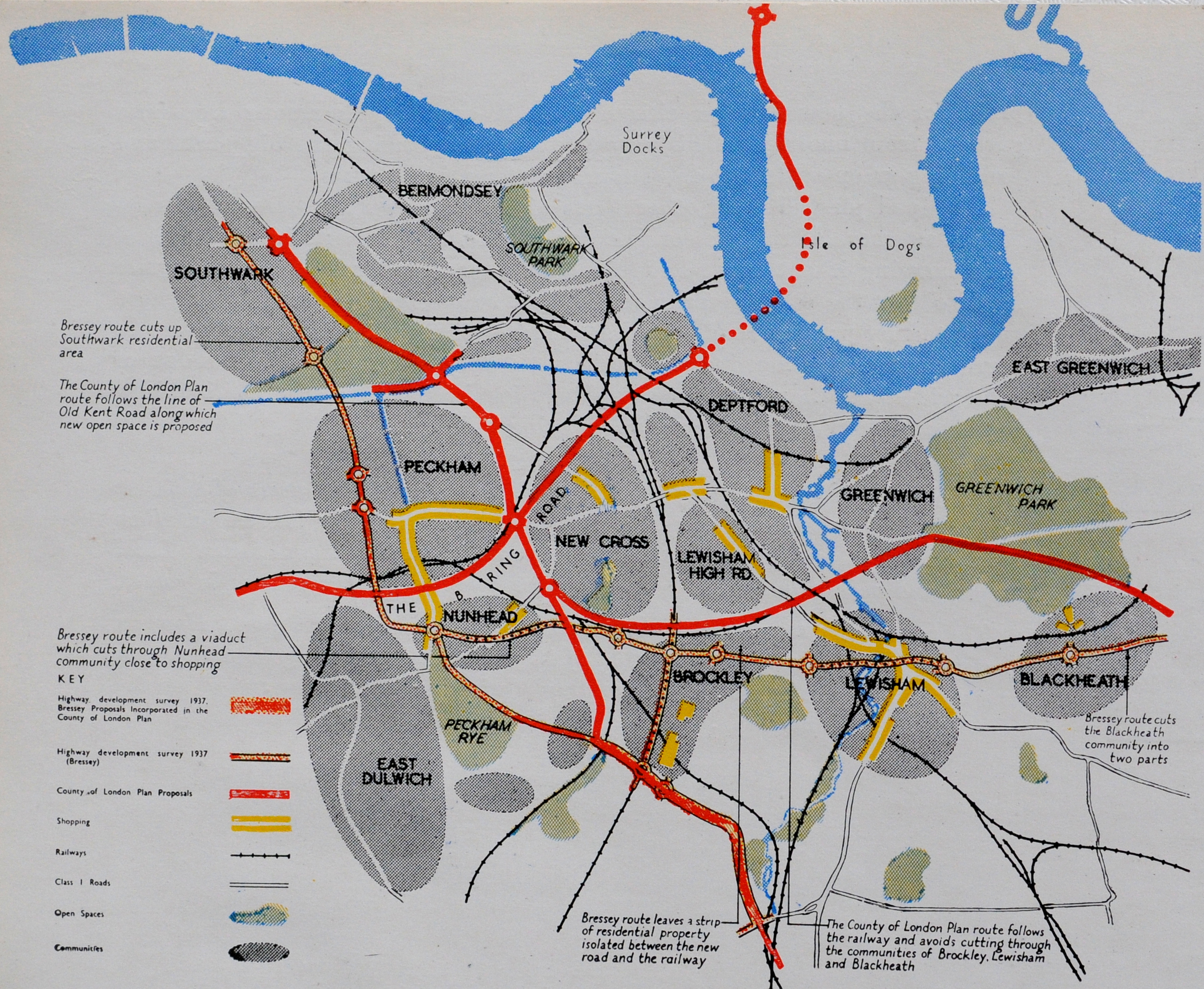
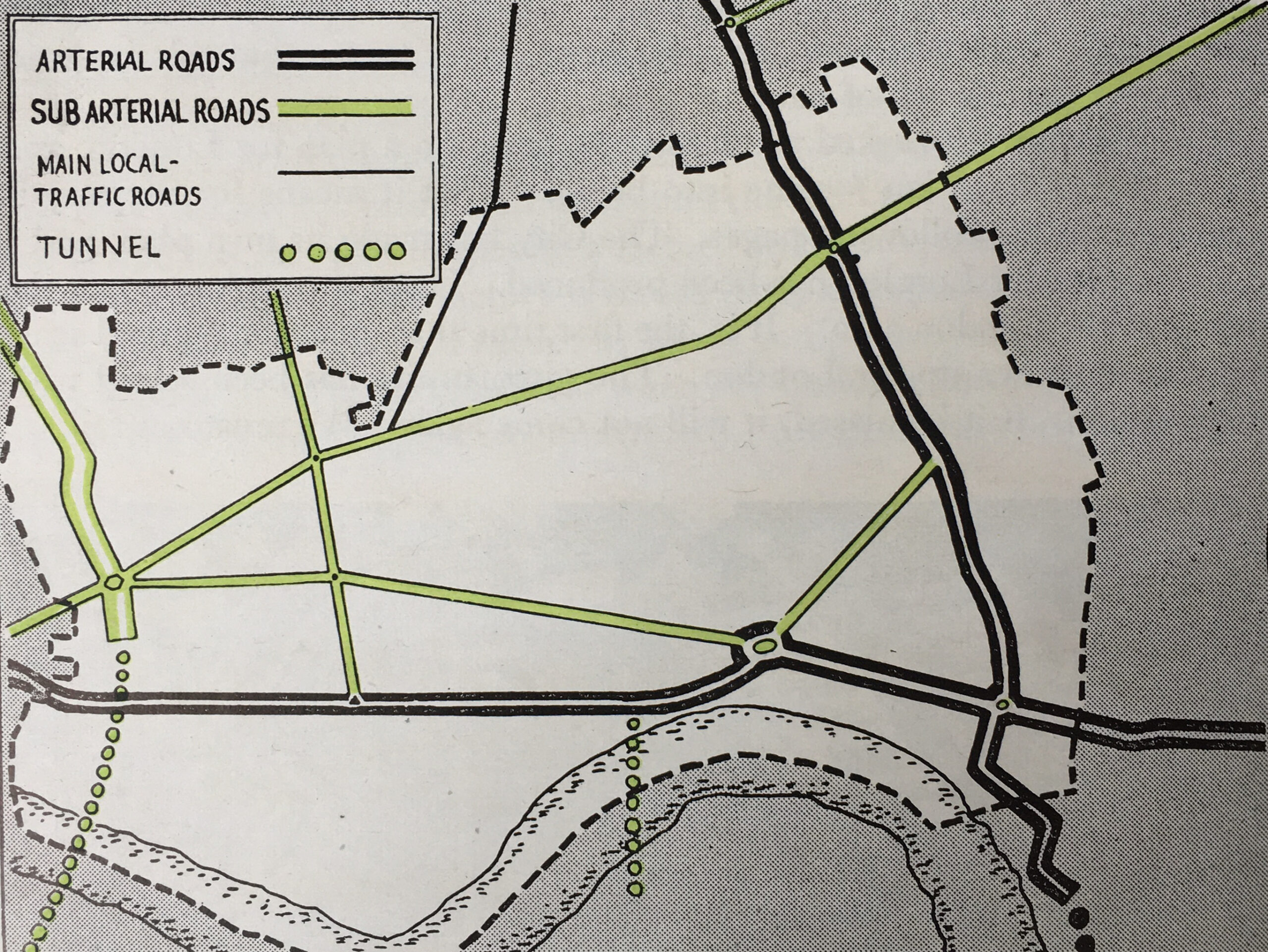
To address the problem, the County of London Plan proposed a series of arterial and ring roads that would help take traffic from the smaller surrounding roads, and speed this traffic to their destinations. The following map shows the proposed new roads on the south-east of London, marked in red:

County of London Plan

Note the intention for a new road to the west of the Isle of Dogs, that would cross under the river to the south of London. Many of these plans would not be built, or would be built along different routes.

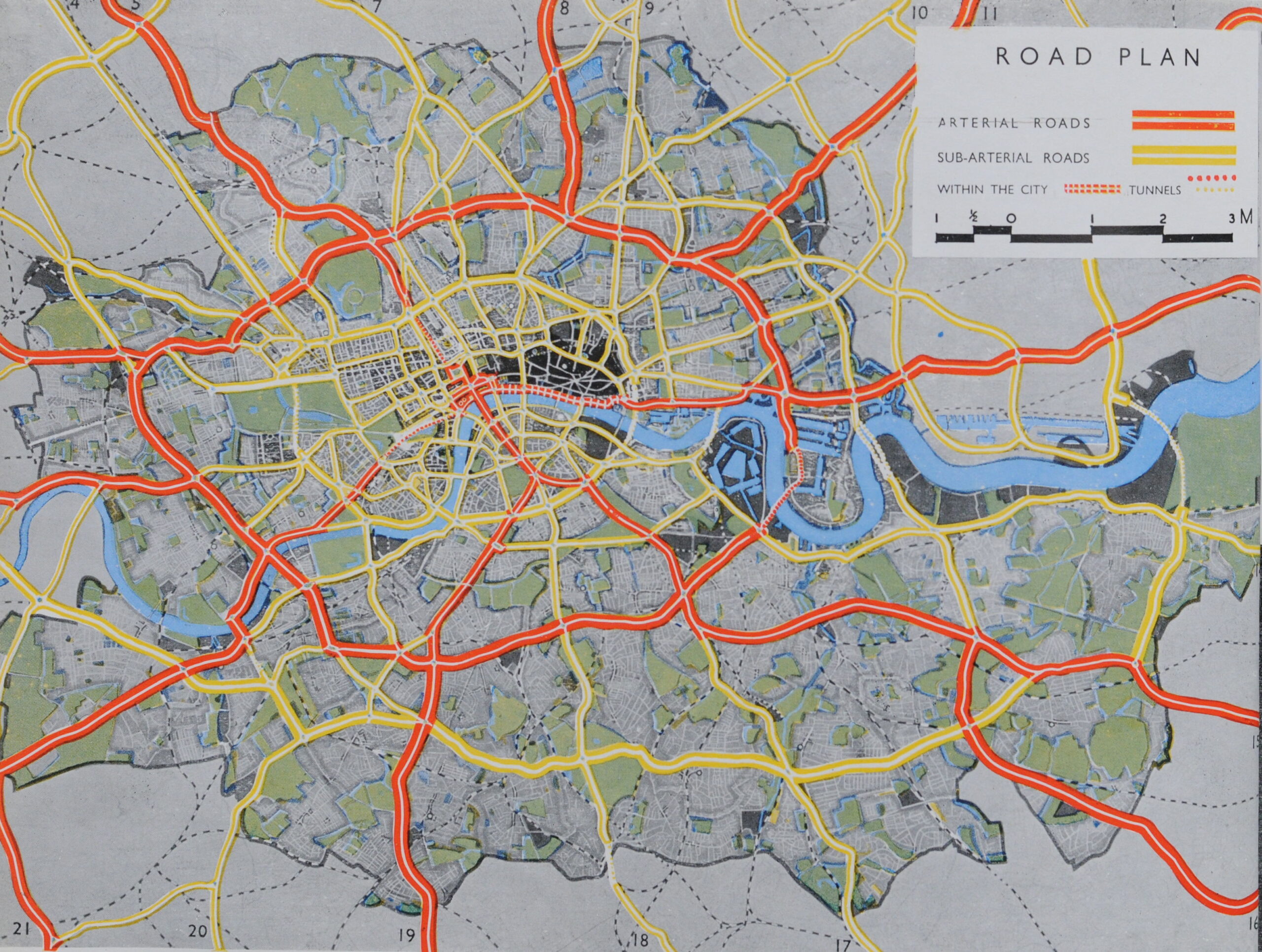
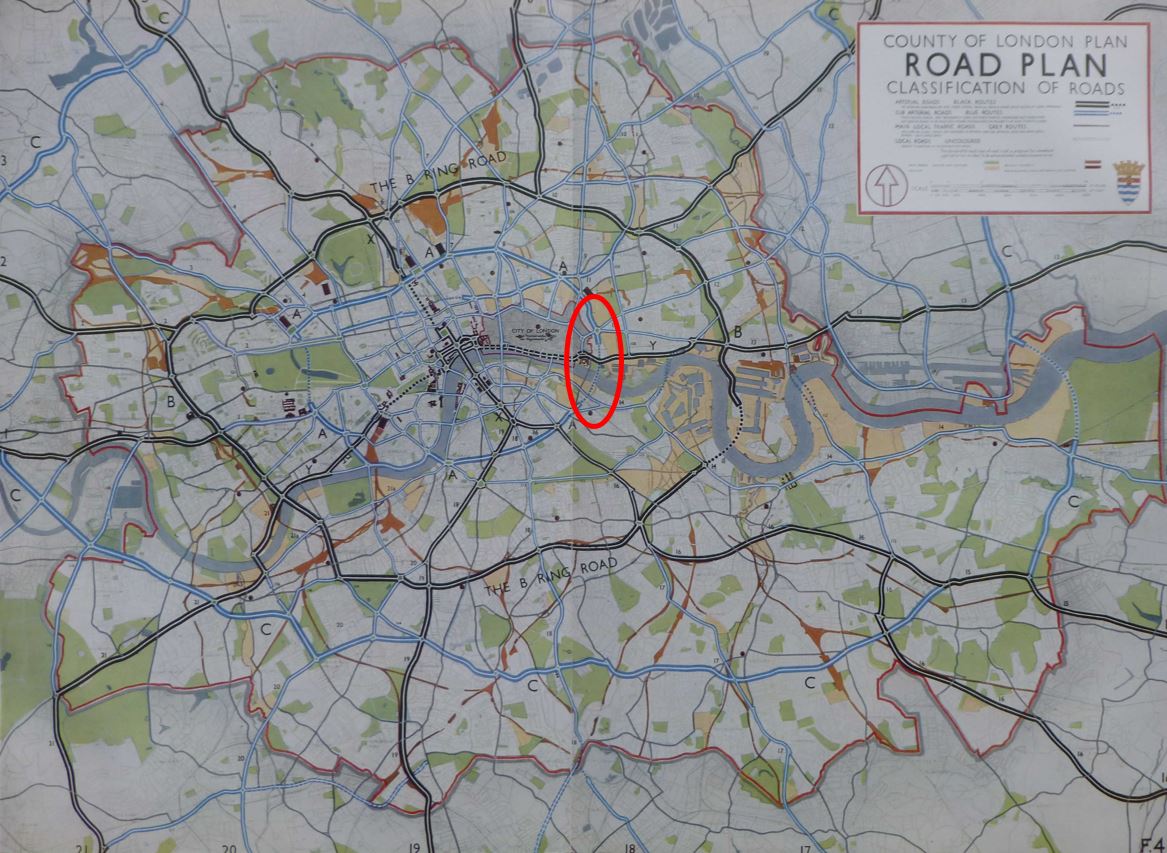
The route through the Isle of Dogs was part of an inner arterial road that would ring the city. The following map shows this road, along with the arterial roads that would connect this ring road out to the rest of the country.

Road Plan

The black area in the centre is the City of London. The red dashed lines between the City and river represent the arterial road that would be created with the construction of the dual carriage ways along what is now Upper and Lower Thames Street. This, as shown in the map, would create a the main east – west route through the City.

The arterial roads stretching out from the city are roads such as the A1, A2, A13, A3, A4 etc. all of which have been rebuilt as major routes into and out of the city to the wider country.

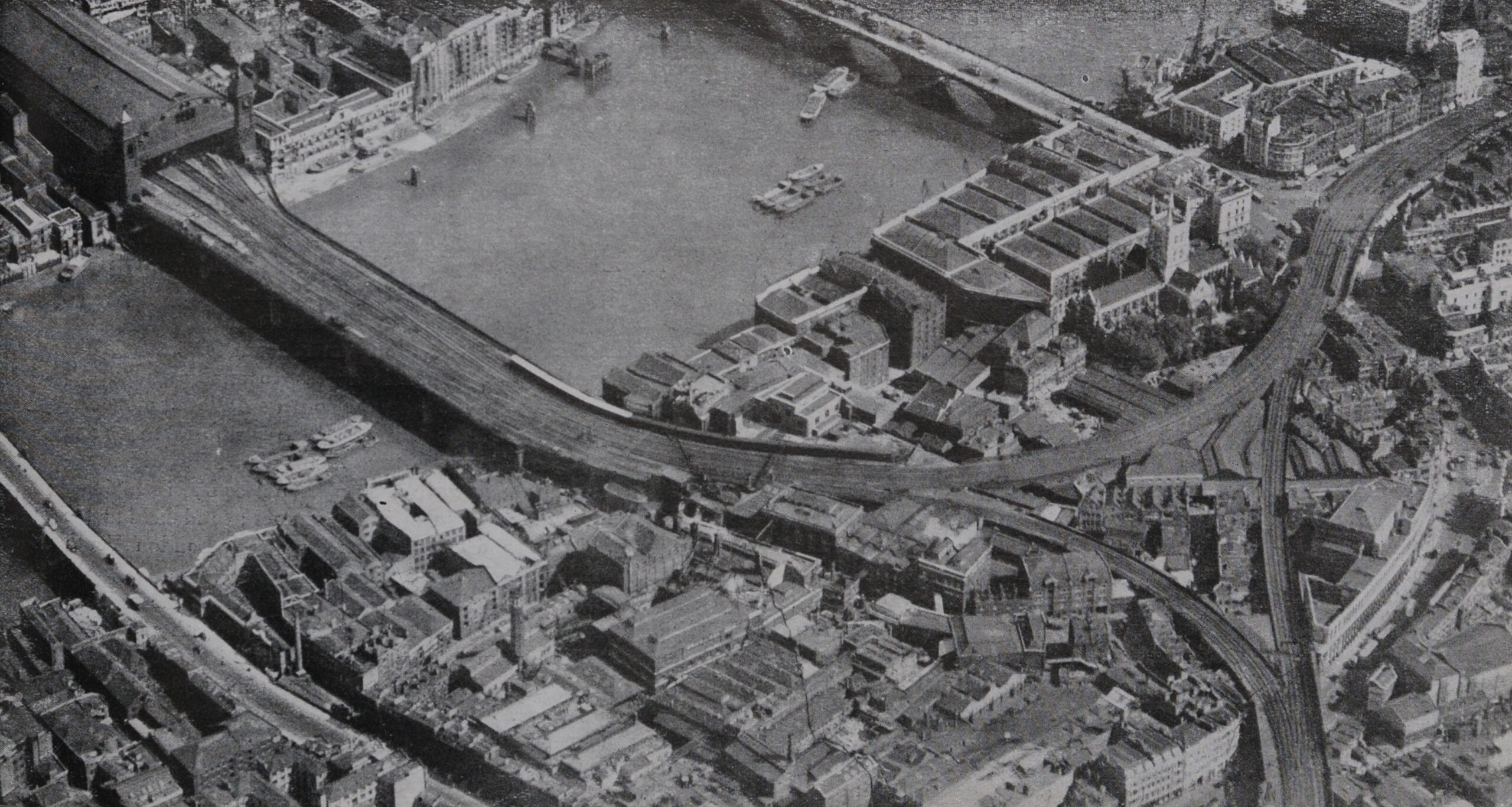
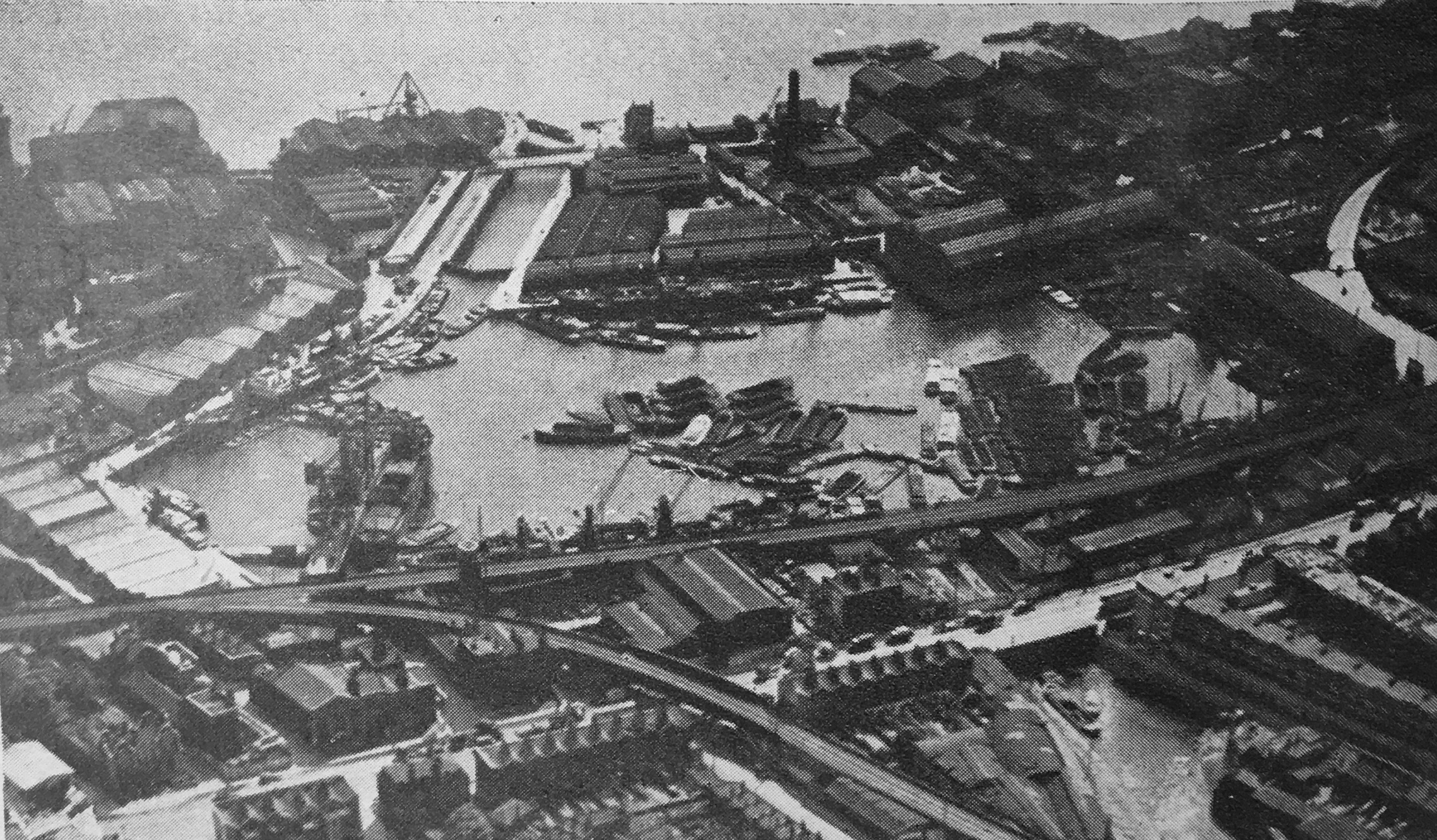
Railways were also considered in the report. A major concern was the impact that railway viaducts had on the city. Viaducts cut through neighbourhoods, dividing areas, and as the booklet described “were signs of incredible squalor, with trains rumbling in front of bedroom windows, day and night”.

The booklet used an aerial photo of Southwark as an example of the impact of viaducts:

Southwark Viaducts

The booklet has a bit of a negative view of rail transport, which probably influenced the following decades of under investment in rail and investment in road transport.

For example, the following paragraph from the booklet covering the London Underground:

“In recent years the Underground Railways have contributed an additional problem for planners. Without thought for the total welfare of London they have pushed their lines out to the open country, encouraging uncontrolled speculative development. It was said at one time that London Transport needed a London of 12,000,000 inhabitants if it was to operate profitably. growth to such dimensions in the districts to the present railway network is the worst possible thing from the point of view of London as a whole.”

The plan makes a number of recommendations for London’s railways, including “increased electrification, better interchange between main lines, underground and suburban services; removal of viaducts; better receiving and distributing services for goods; and possibly the use of air-freight services”.

It is interesting comparing the 1943 plan, with today’s approach, where in 1943 air travel was being suggested as an alternative method for transporting freight, rather than the railways.

The booklet complained that whilst the County of London Plan “tackled the railway problem boldly”, the Central Government or Local Authorities did not have the powers to plan railway companies activities.

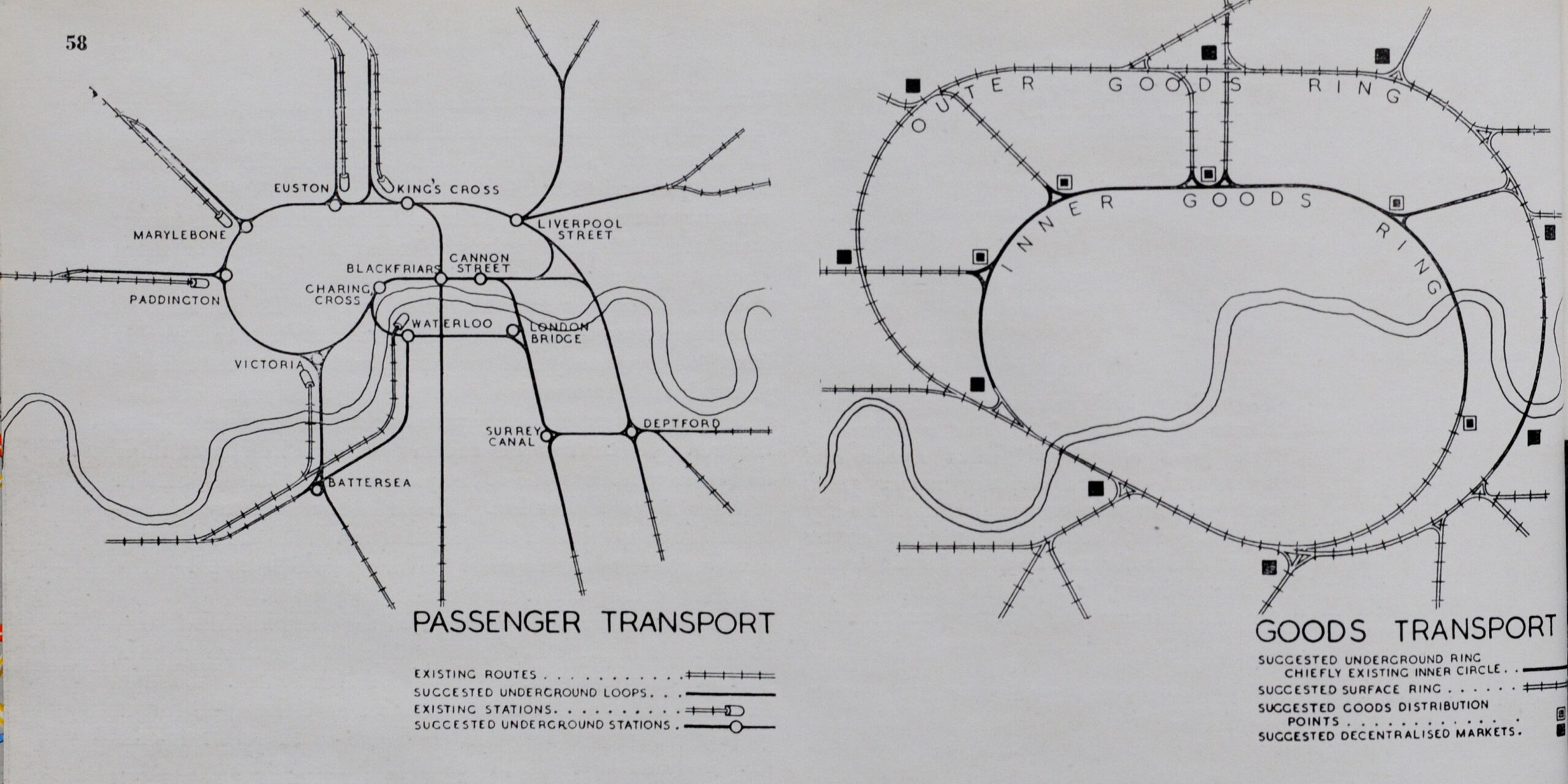
The plan suggested the use of underground loops to link stations, an inner and outer ring for goods traffic and the removal of viaducts. Some of the proposed new routes are shown in the following maps from the booklet:

London Railways

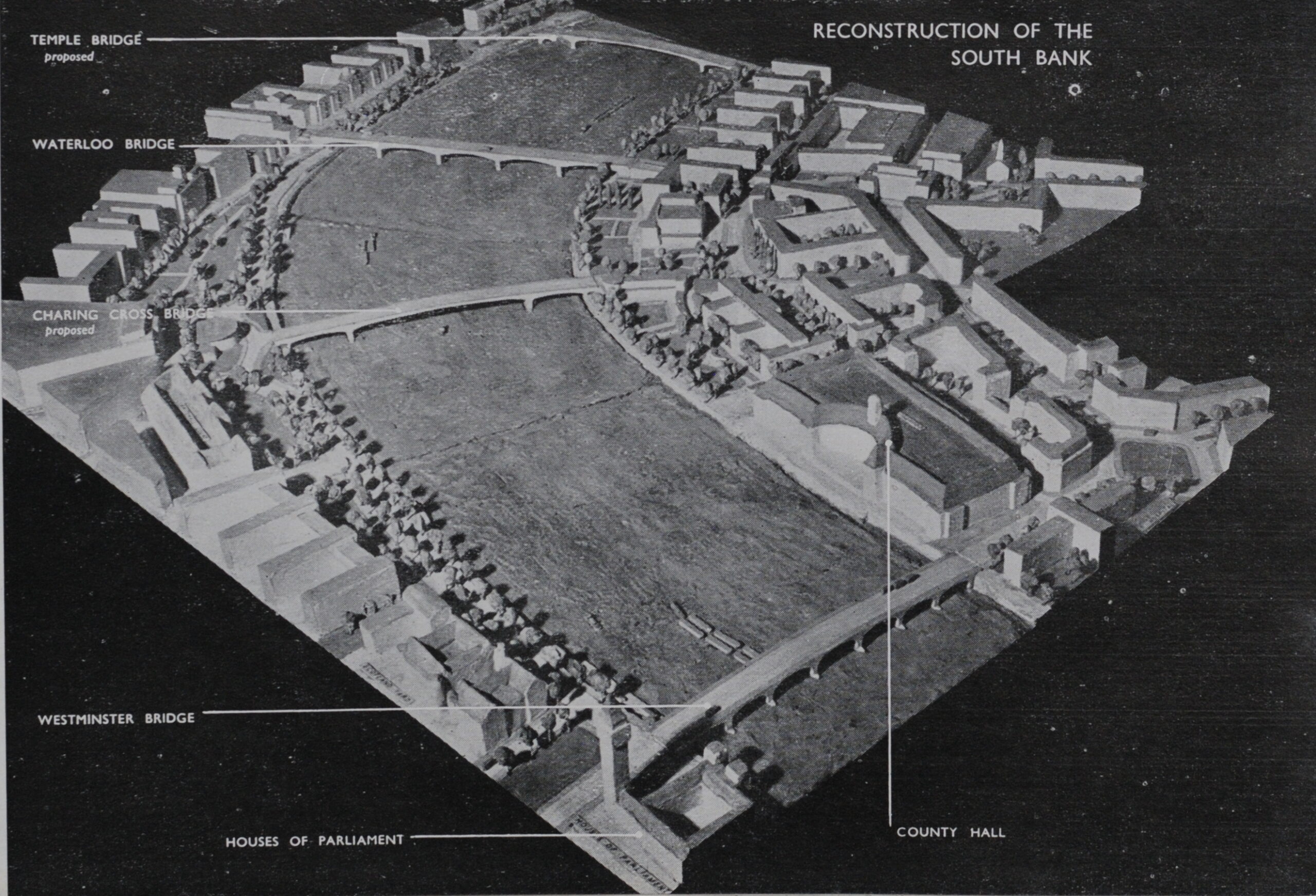
The plan used the South Bank as an example of what could be achieved. The area between Westminster and Blackfriars Bridges had long been the target for improvements. In the late 19th century, newspapers moaned that the area was the first view of London that Americans arriving on the boat train from Southampton would see, and it was an industrialised area with dense, poor terrace housing.

Improvements along the South bank had started in the first couple of decades of the 20th century with the construction of the London County Council’s County Hall, and the plan proposed the South Bank up to Blackfriars Bridge should be transformed as a cultural centre, offices, improved housing, open space and a river walkway.

The plan’s vision for the South Bank was shown using the following model:

South Bank development

As well as the development of the South Bank, proposals included the removal of Hungerford Railway Bridge, and two new road bridges; a new Charing Cross road bridge and a new Temple Bridge. The car rather than the railway was seen as the post-war future of transport.

The booklet includes a section titled “Putting Theory Into Practice”, which deals with the challenges of implementing the complex and extensive plans proposed in the County of London Plan.

It makes a comparison with Russia, stating “We all know the great Russian Plans were actually named by the number of years work they involved – the Stalin Five Year Plans – so in due course the County Plan must be divided up into periods and, if we secure sufficient means and powers, we can get the planners a real confidence that each stage will be completed within a limited and stated time.”

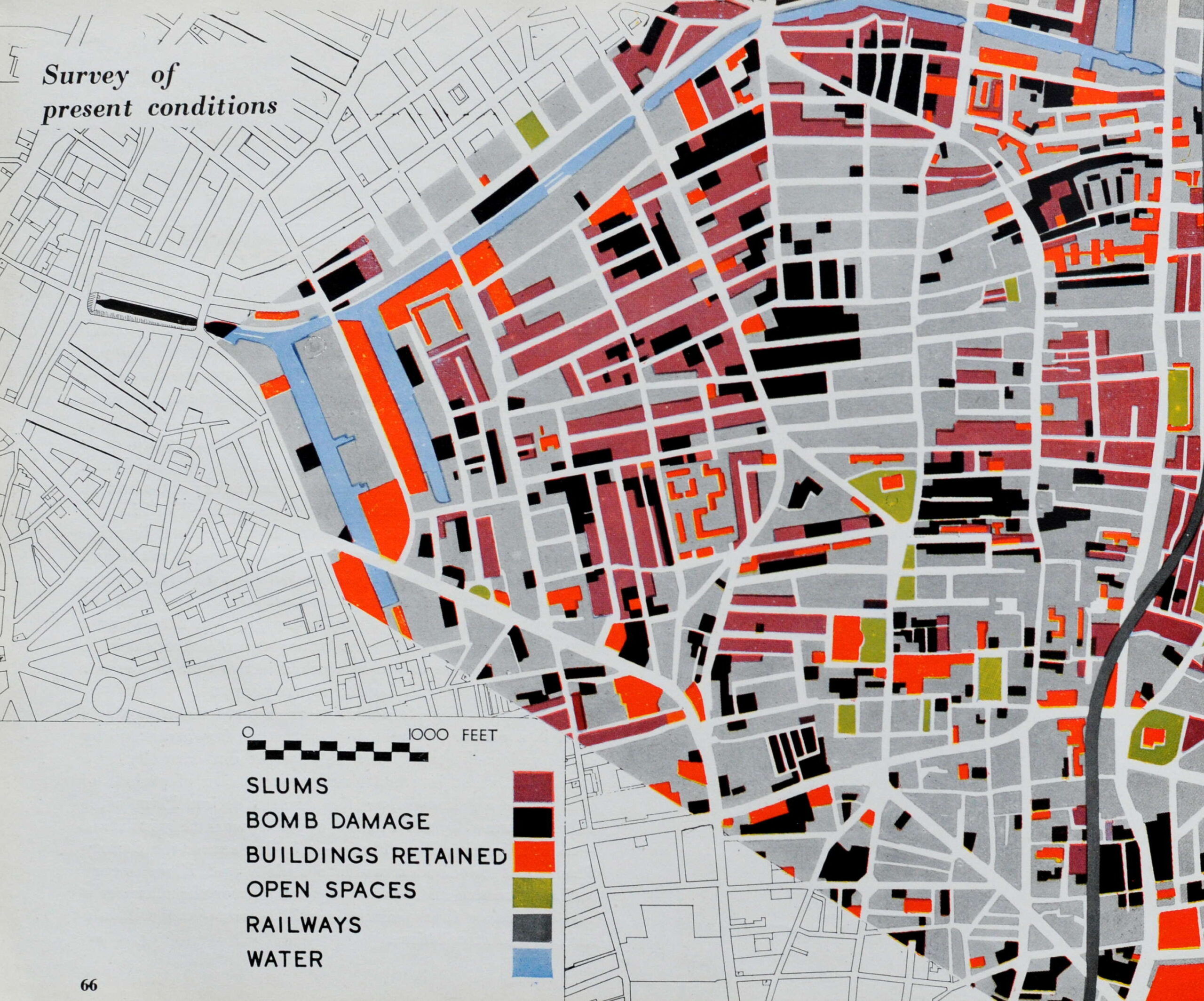
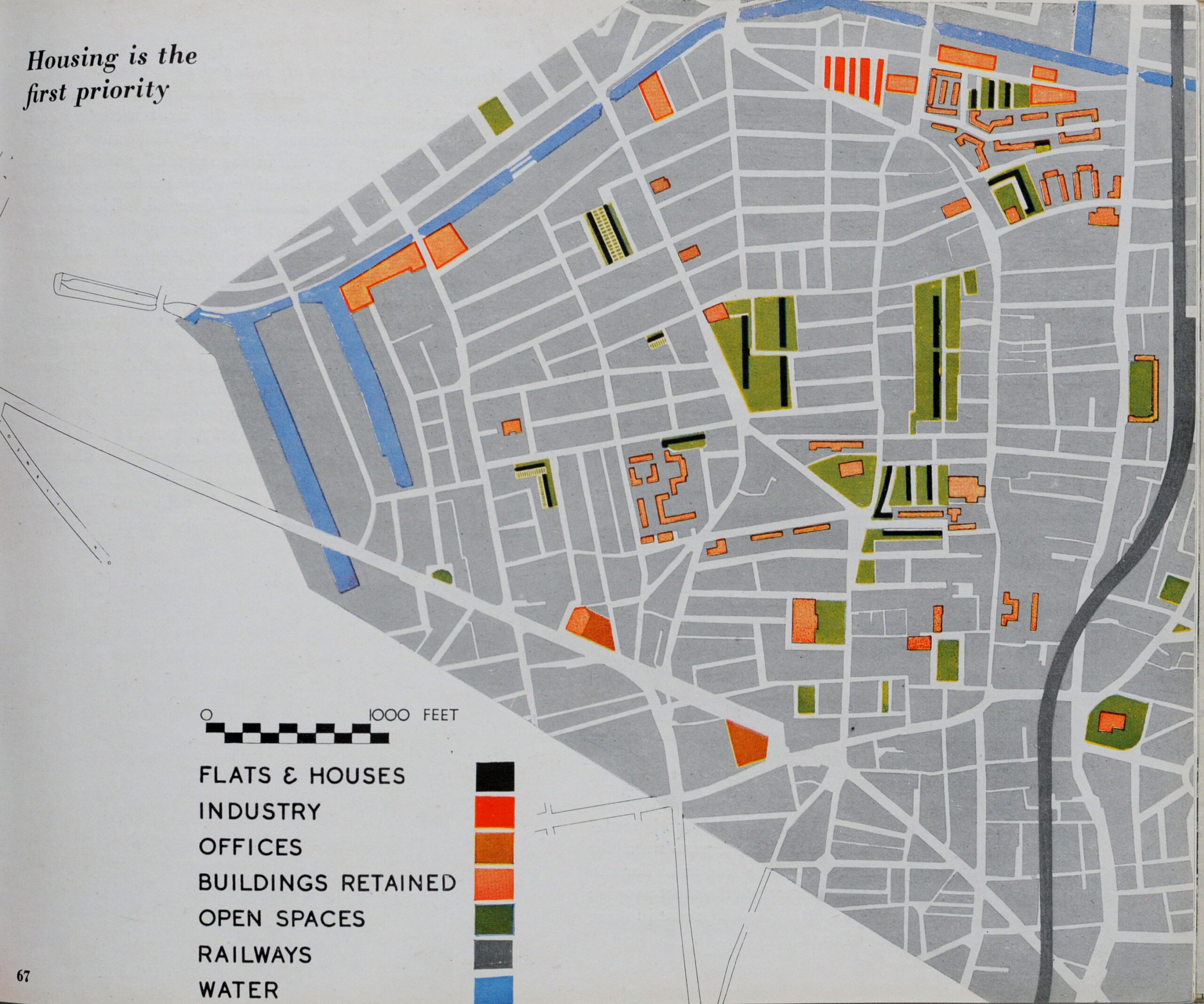
To illustrate how this might happen, the booklet includes a series of maps showing how a area could be transformed, starting of with a “Survey of present conditions”:

County of London Plan

Followed by Housing as the first priority:

County of London Plan

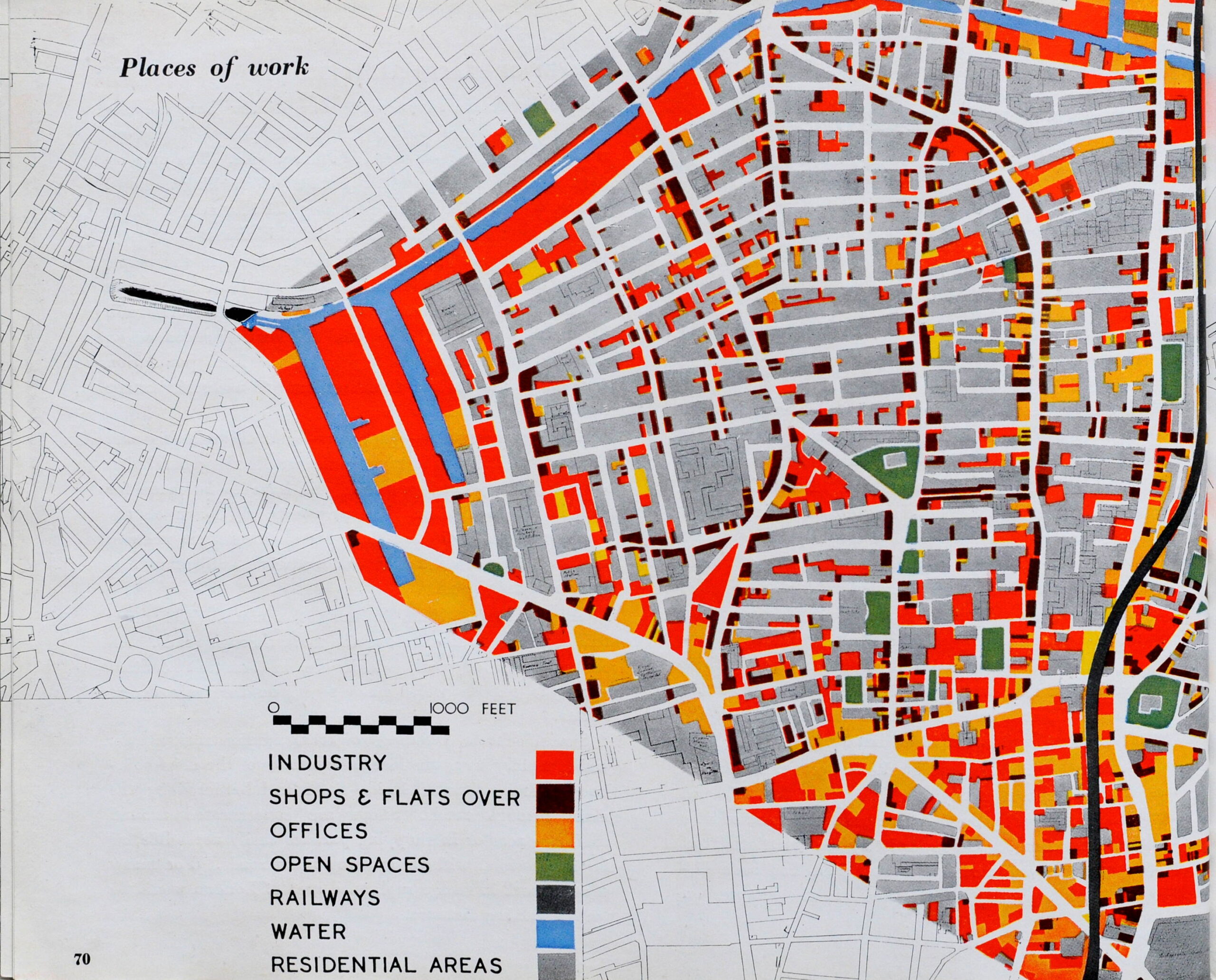
Places of work would be key:

County of London Plan

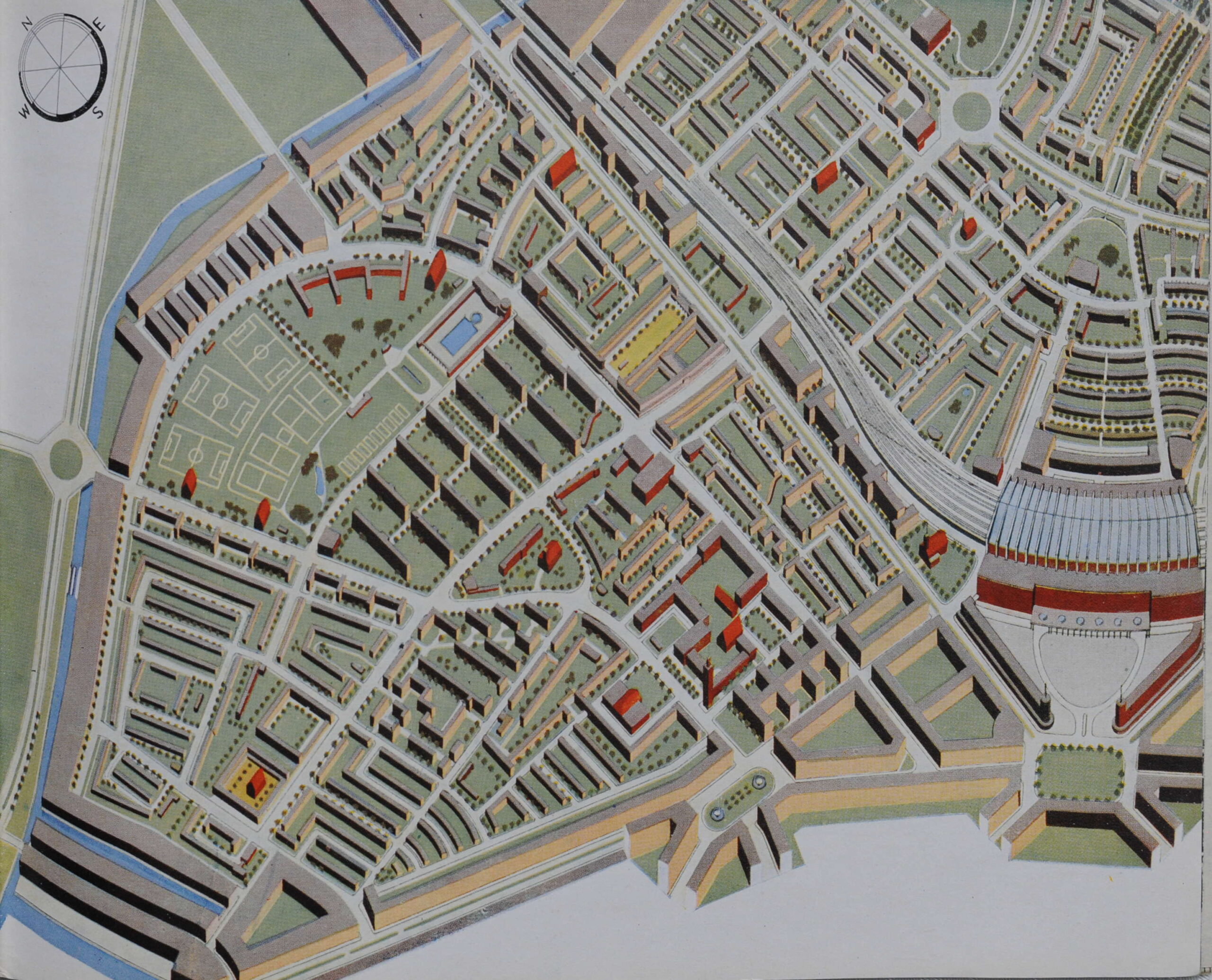
With the need to re-plan the places of work so they move from being packed within areas of housing (above map), to dedicated industrial areas away from residential areas (following map):

County of London Plan

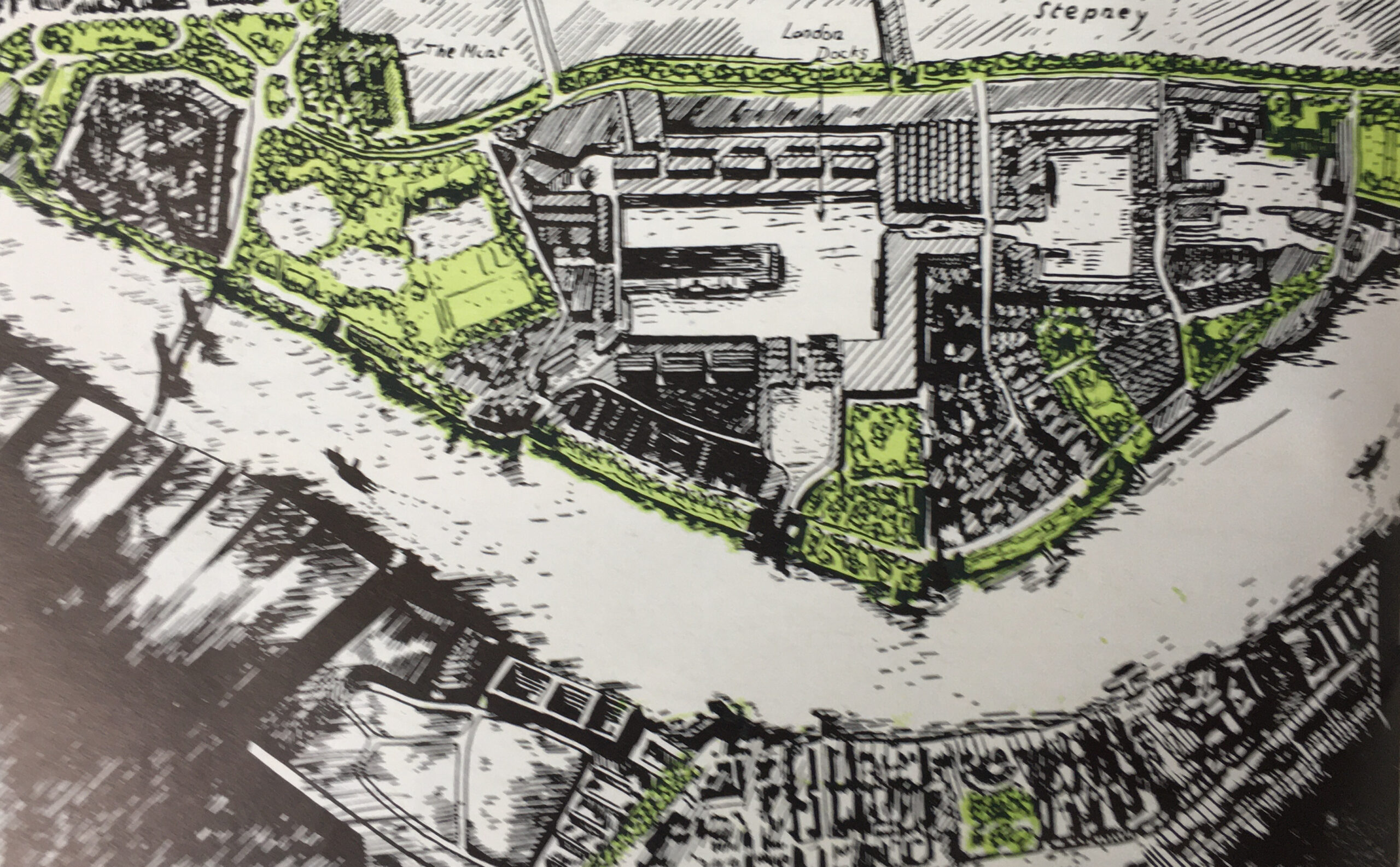
The following diagram shows an aerial view of the completed transformation. A planned and completely rebuilt area of London consisting of ordered residential areas with plenty of public open space. Industrial areas along the edges of the residential to provide local jobs, but not on top of where people lived.

County of London Plan

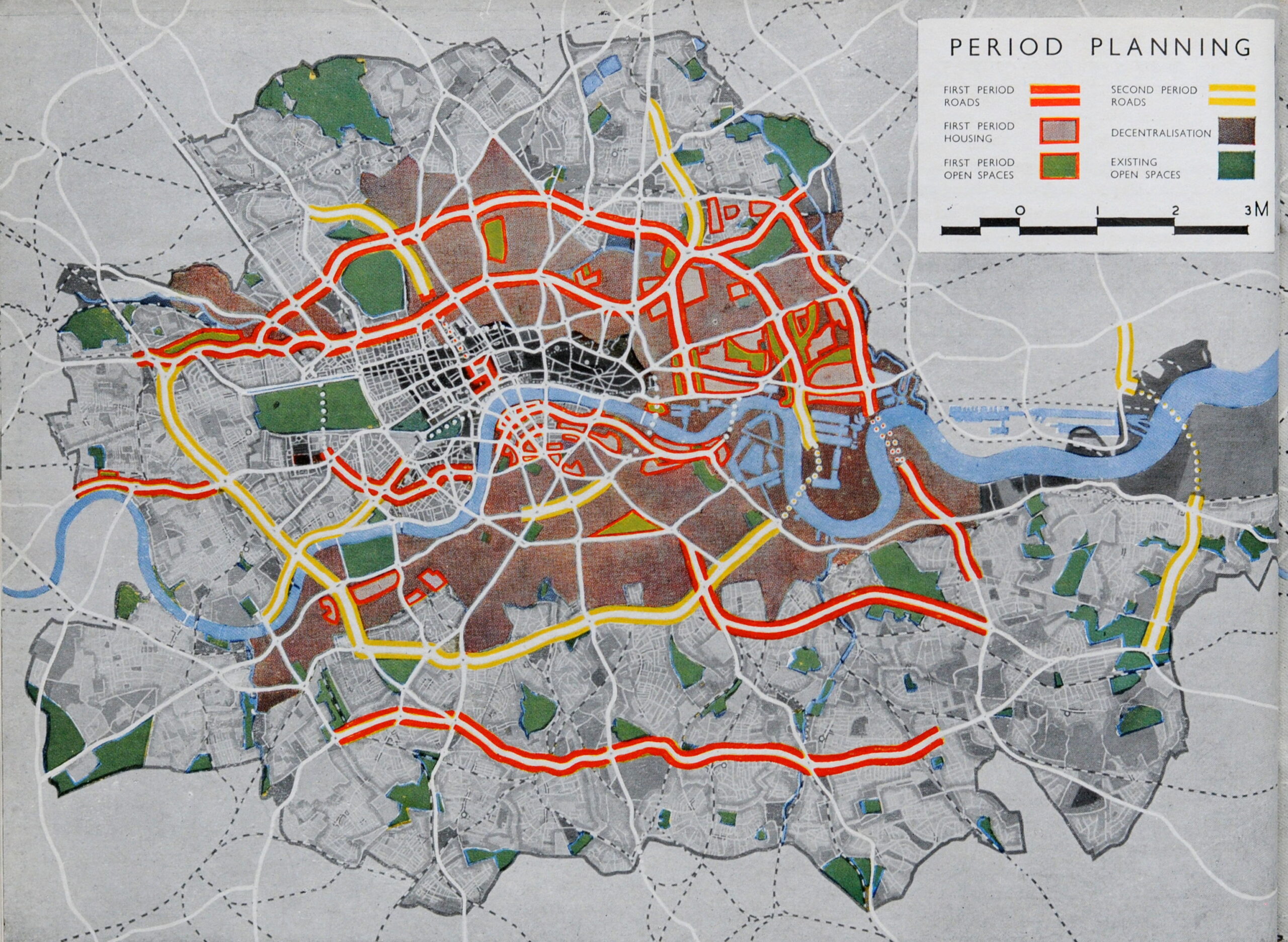
A map titled “Period Planning” identified the priorities for the first period of development, with the key arterial roads and the areas that needed the most attention. The areas outlined in red are those where the plan recommended that work should start immediately.

County of London Plan

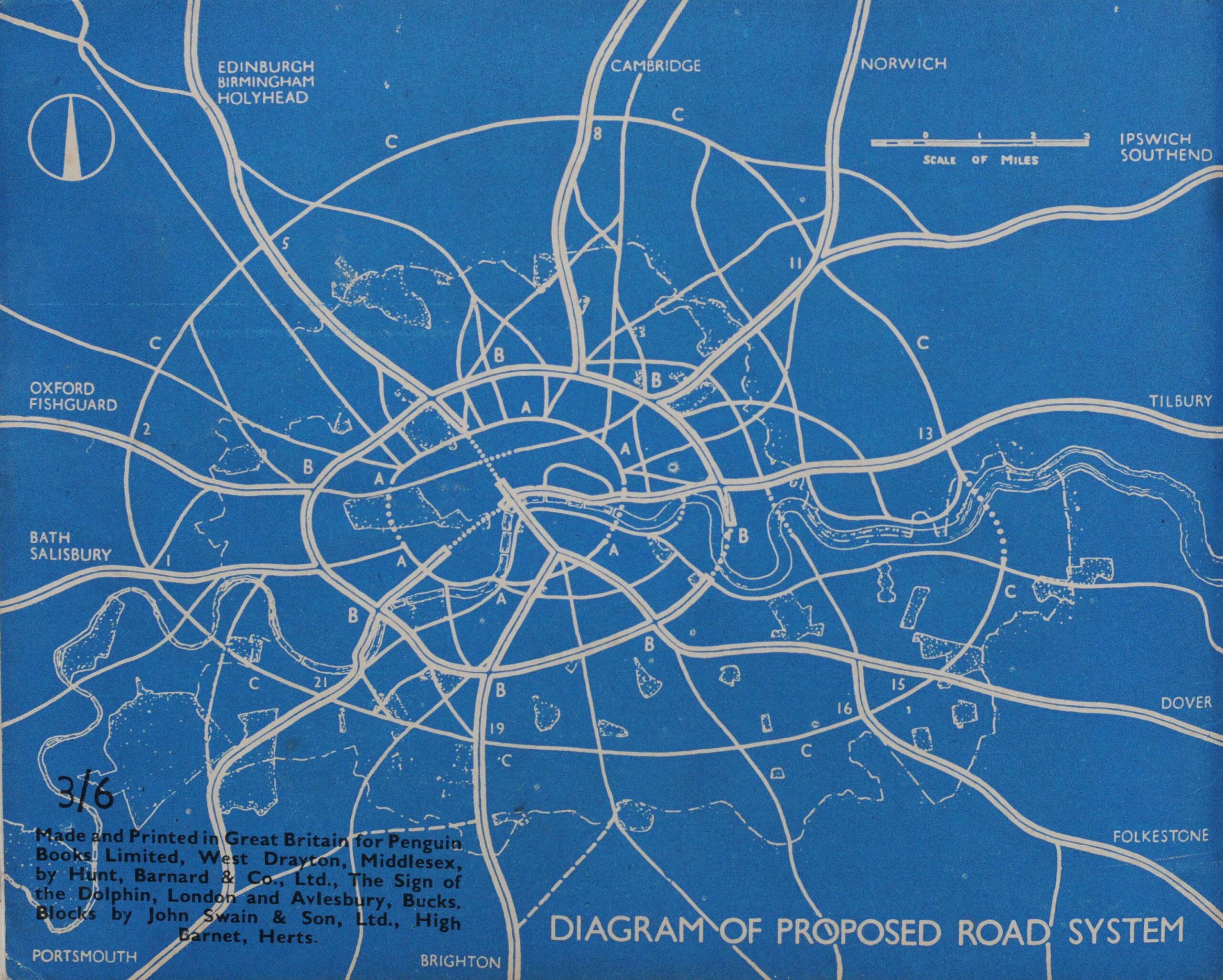
The rear cover of the booklet has a diagram of the proposed road system, with the first indication of an outer ring road, a proposal that many years later would evolve into the M25, although further out from the city than shown in the diagram.

County of London Plan

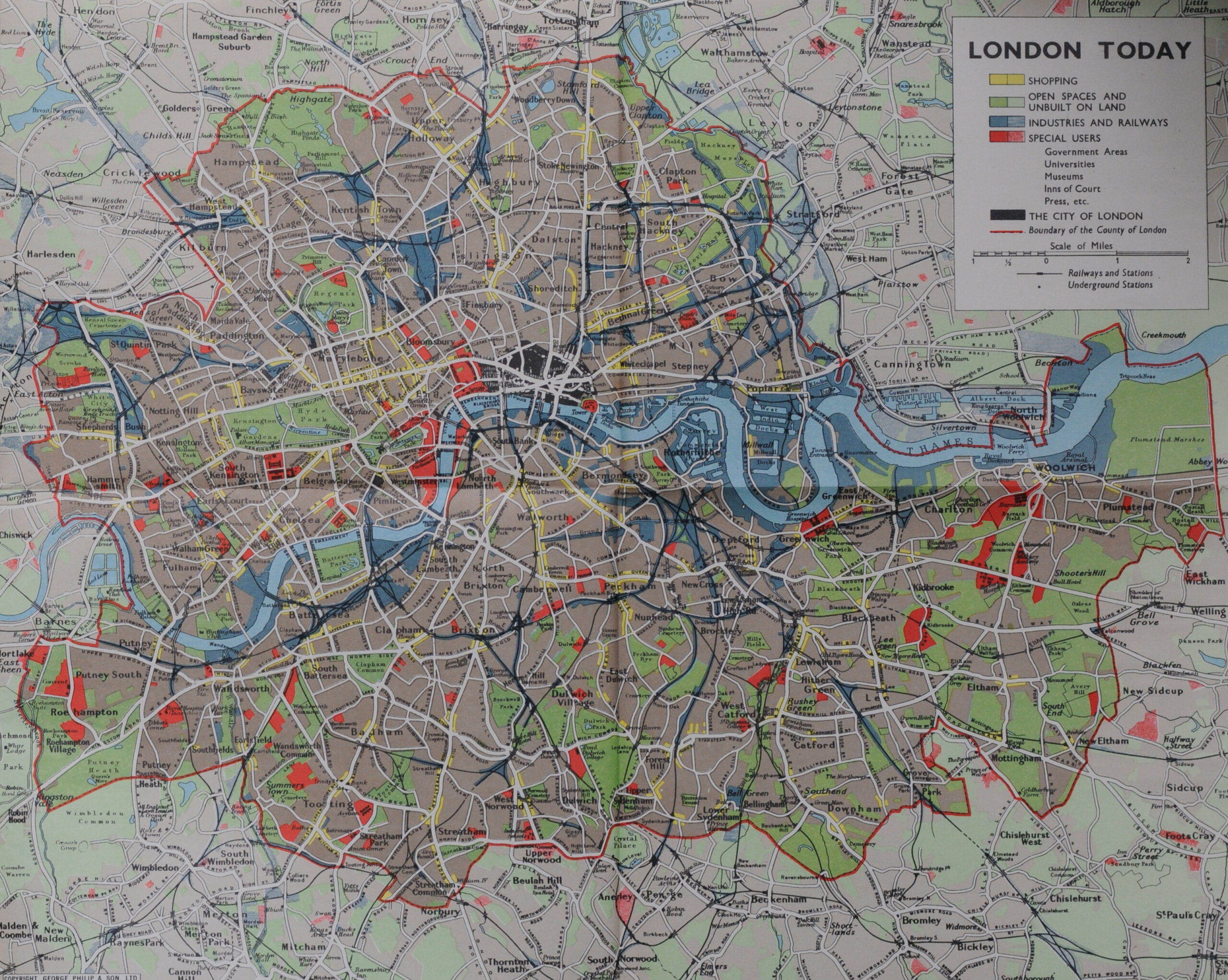
On the inside rear cover of the booklet is a wonderful fold out map titled “London Today”. the map shows a high level view of the use of land within the County of London. What is interesting is that the map shows the boundary of the County of London, with east London places such as Canning Town, Stratford and West Ham being outside the boundary. These were originally within the County of Essex (click on the image to open a larger version).

County of London Plan

The booklet provides a really good summary of the 1943 County of London Plan, and it is interesting that the architect Erno Goldfinger was one of the two authors of the booklet. The planned developments of housing probably aligned with Goldfinger’s view of the possibilities of new residential buildings as can be seen with those he was responsible for, such as the Balfron Tower.

The County of London Plan and the booklet used some really creative graphics to illustrate the key themes of the plan.

Many of the developments proposed within the County of London Plan would not take place. Some would still be debated decades after the plan. If you go back to the map titled period Planning, you will see at the right edge of the map, there is a road in yellow routing under the Thames. This was the original East London crossing that caused major controversy in the early 1990s when the proposed route would take the road through the ancient Oxleas Wood.

That scheme was cancelled, but it is interesting that over 40 years later, there were still plans to implement some of the recommendations of the 1943 County of London Plan.

Planning for London has always been a challenge. Never enough money, changing politics and changing public attitudes.

The Mayor of London continues to produce a London Plan, the latest March 2021 plan can be found here.

The current strategic plan is a total of 526 pages and after wading through it, it would really help if an equivalent to Carter and Goldfinger could produce a booklet explaining the key points of the plan.

I do wonder how much of the current plan will be implemented. The word “should” is used a total of 1,540 times in the document to describe a recommendation or target, rather than words such as “will” or “must”.

There are some fascinating statements in the 2021 plan, for example at paragraph 10.8.6:

“The Mayor will therefore strongly oppose any expansion of Heathrow Airport that would result in additional environmental harm or negative public health impacts. Air quality gains secured by the Mayor or noise reductions resulting from new technology must be used to improve public health, not to support expansion. The Mayor also believes that expansion at Gatwick could deliver significant benefits to London and the UK more quickly, at less cost, and with significantly fewer adverse environmental impacts.”

I always wonder how much politics is involved in these decisions. Are there fewer voters for the London Mayor under Gatwick’s flight paths than under those of Heathrow?

The 2021 plan includes proposals for major transport projects such as the Bakerloo line extension and Crossrail 2. In the section on funding the plan, there is the statement that:

“There is a significant gap between the public-sector funding required to deliver and support London’s growth, and the amount currently committed to London. In many areas of the city, major development projects are not being progressed because of the uncertainty around funding.”

The Covid pandemic has really hit Transport for London’s finances, and a long term reduction in those working five days a week in London will further reduce fare revenue. The national Government also has a focus on the so called “leveling up” agenda which may focus funding on developments outside of London.

Long term planning for a city with the complexity of London is extremely difficult. Funding, politics, the impact of external and unforeseen events all contribute to the very high risk that plans will need to change, will not be implemented, or will be implemented in different ways.

What these plans do help with though, is an understanding of the city at the time the plan was developed, challenges facing the city, and how these challenges were expected to be addressed.

As such, booklets such as that by Carter and Goldfinger really help with understanding how London has developed.

They also include some wonderful graphics and maps.

alondoninheritance.com

St Anne’s Soho, New River Company and Shaftesbury Avenue

St Anne’s Soho, New River Company and Shaftesbury Avenue is a bit of a mix of very different subjects, however the following photo from one of the Wonderful London books provides the connection.

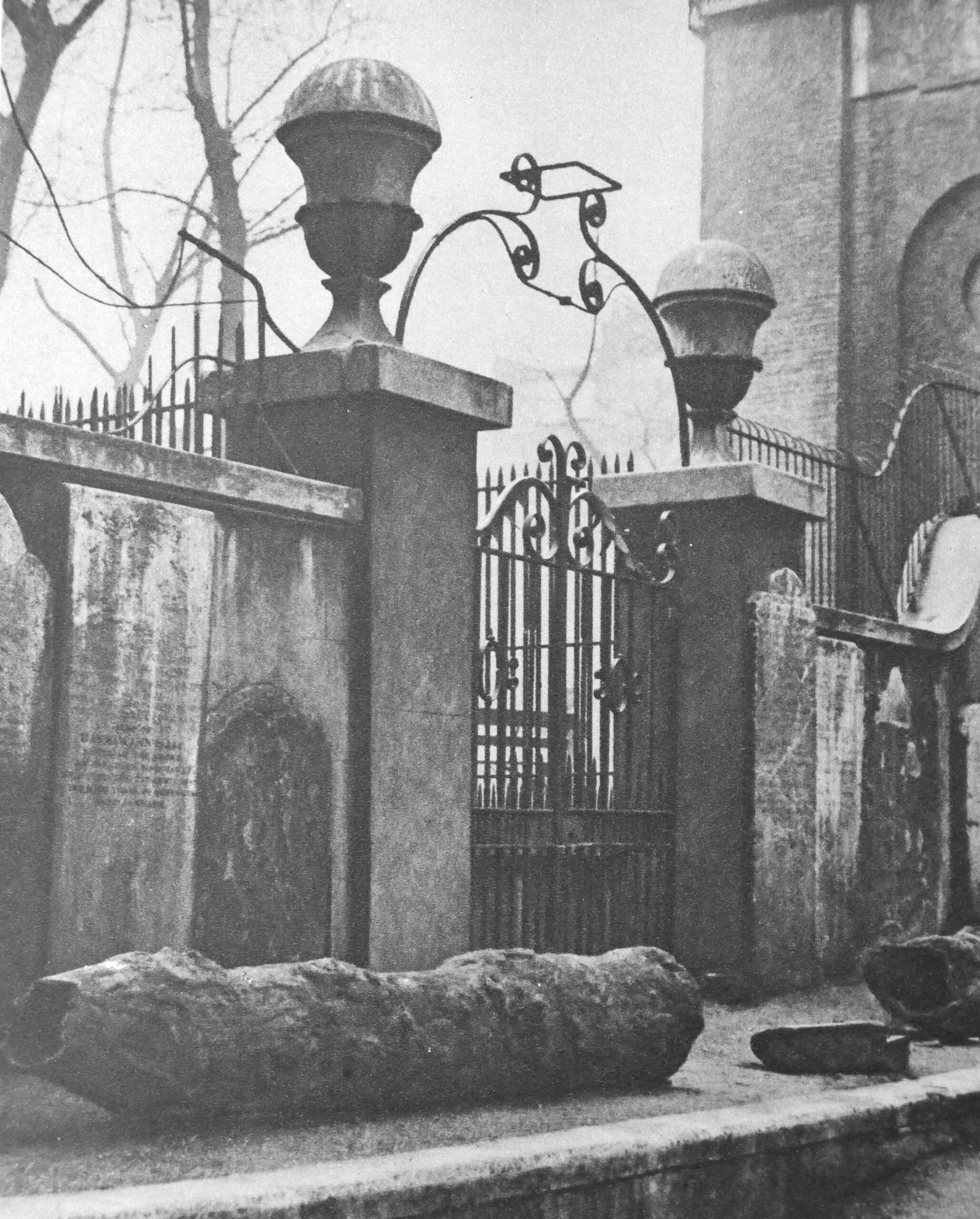
New River Company Elm Pipes

The caption to the photo reads: “Elm Trunks for Conduit Pipes dug up near St Anne’s, Soho. Wooden pipes like these were used to carry water from New River Head over the Holebourne for the citizens. Trunks used for conveying the fresh water supply were of elm which of all the timbers best withstands the exigencies of heat and cold. The New River Co. had a wharf at the bottom of Dorset Street where the elm trunks were landed and bored. Shaftesbury Avenue was opened February 26, 1887, and the excavations laid these old pipes bare.”

There is much to unpack in that single caption, far more than within the scope of a single post, but I will give it a go, starting with the elm trunk in the photo.

When the New River Company started to distribute water across the city from their pond at New River Head, the only method to carry water within pipes was to use bored tree trunks. Iron pipes would not become available for the New River Company to use for well over a hundred years from when the company started operations in 1613.

The photo shows how a tree trunk was converted into use as a pipe. A hole was bored through the centre of the pipe to carry water, and one end of the trunk was shaved down to a point around the hole so that it could be pushed into the next trunk in the series, trying to form as close a seal as possible to prevent the leakage of water.

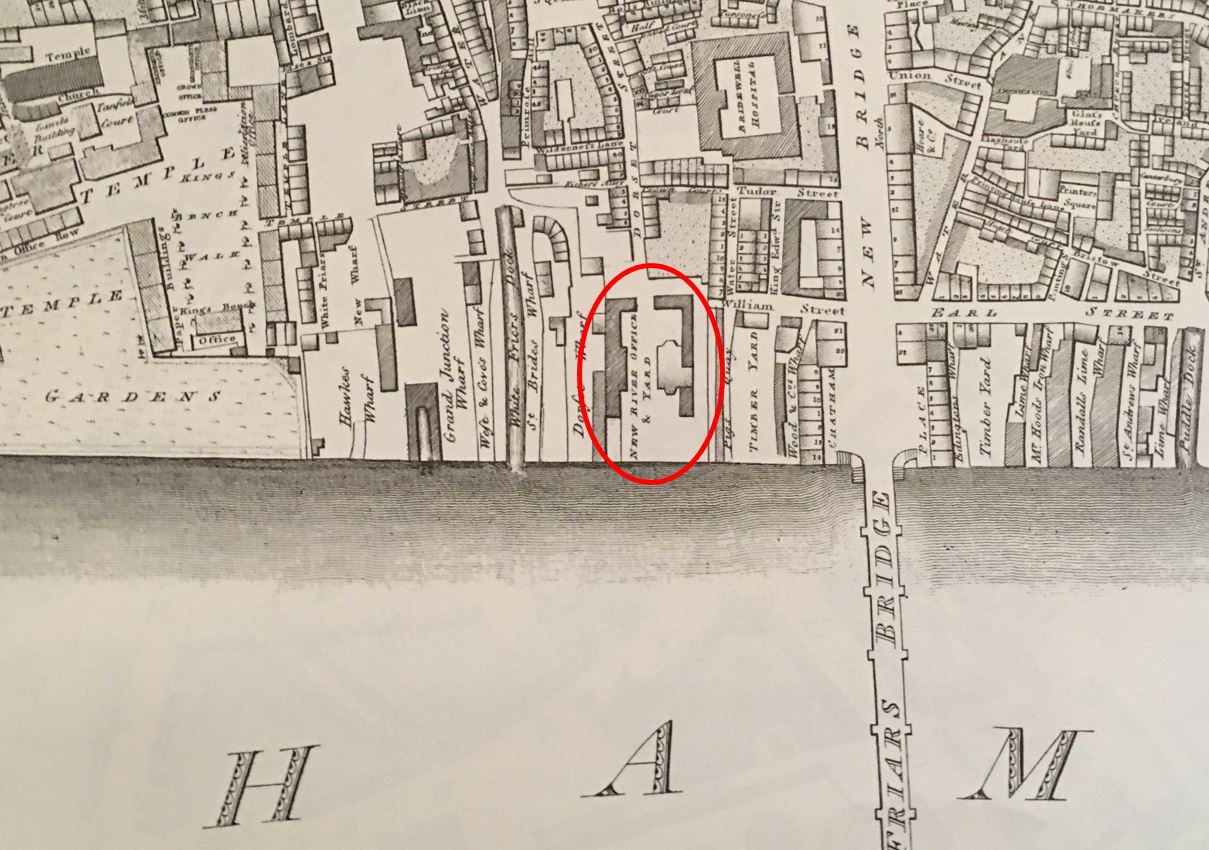
The New River Company had their main pond or reservoir at New River Head in north Clerkenwell, and their offices eventually moved to the same location, however as the caption states, they had a wharf at the bottom of Dorset Street, and their original offices were at the same location. It was here that elm trunks were delivered via the River Thames, bored and shaped ready to be used within their network of pipes.

The caption states that the wharf was at the bottom of Dorset Street. The offices, yard and wharf are marked on Horwood’s 1799 map of London, just to the west of Blackfriars Bridge, circled in the following extract:

New River Company

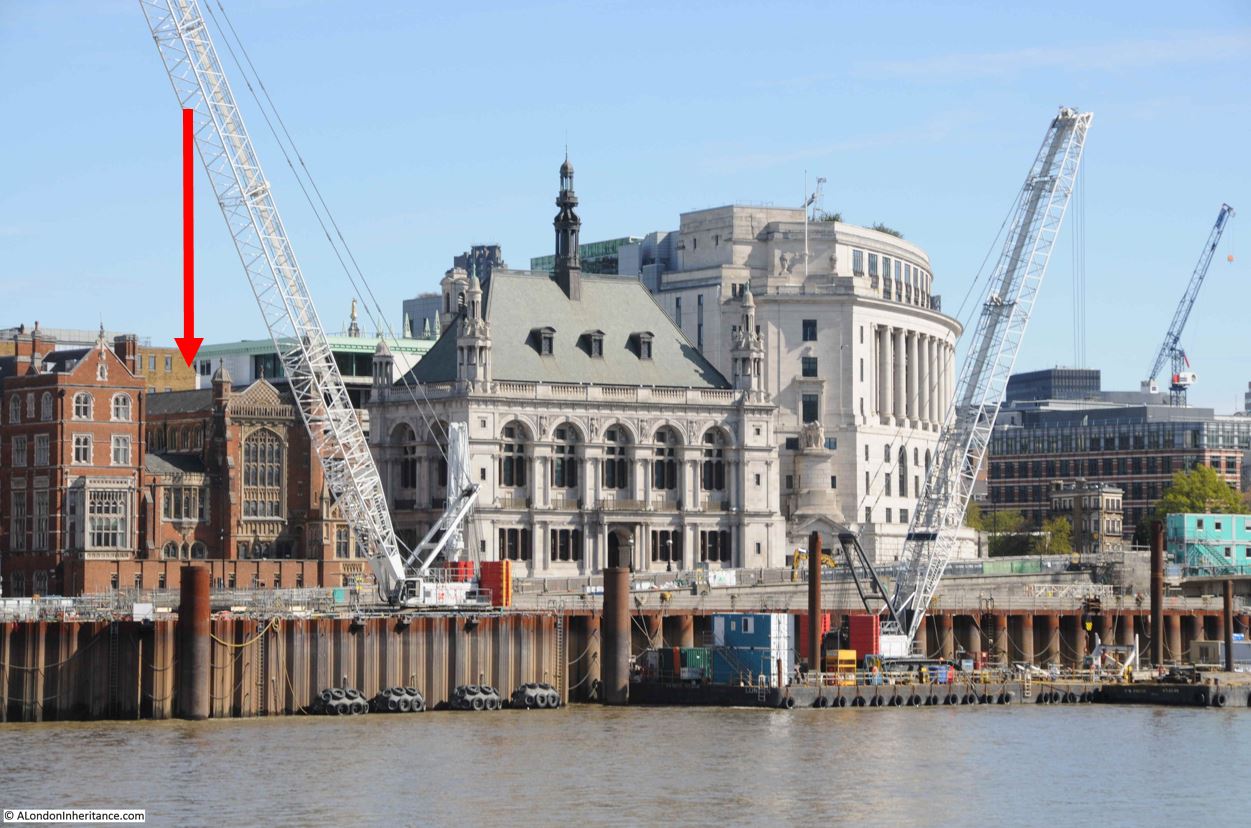
The location of the New River offices, yard and wharf are now separated from the river by the construction of the Victoria Embankment, however I have marked their location with the red arrow in the following photo, now covered by the brick building to the left of the old City of London School.

New River Company

The area served by the New River Company was extensive, for example one of their large industrial customers was the Truman’s Brewery in Brick Lane to the east of the city, and as London expanded to the west, they buried their pipes along the streets to serve the new buildings.

Serving the new west London streets did however bring problems. New River Head was located at a height of 30 metres above sea level. The original customers in the City of London were at a height ranging from 15 metres in the north of the City down to 1 or 2 metres along the river. This worked well when gravity was being used to get the water from New River Head to the City.

The west of the city was a different matter, with the area around Shaftesbury Avenue and Soho being around 22 metres in height, only an 8 metre difference to New River Head and much higher than the City.

This led to supply problems along the new streets of Soho, with a good supply in the City, and poor supply due to low pressure in west London.

The New River Company was also facing competitive pressure from other water companies, and at the end of the 17th century, they brought in Christopher Wren to evaluate their water supply system, and make recommendations for improvements.

Wren’s view was that the system was an unplanned mess, that had grown without any planning or understanding of the areas being served and how water was affected by the length and size of pipes, and the difference in height across London.

Wren could not make any individual recommendations, he compared the system to a diseased body, with the New River Company looking only at one small part of the body to try and work out a cure. Wren recommended a system wide replanning that would take much of the following century to implement.

Wren’s recommendations were also supported by the ex-clergyman John Lowthorpe, also commissioned by the New River Company to examine the system. Lowthorpe also identified that the company had no audit or understanding of their pipe network, and that a single person should be responsible for the system’s design, the role of a Chief Surveyor.

The New River Company did build an upper pond at Claremont Square, and the additional height of this new pond did overcome some of the pressure problems, but it would not be until wooden pipes were replaced with iron pipes, and steam engines were used to pump pressurised water rather than use gravity, that the supply across London would become reliable.

I have written more about New River Head and the New River Company here.

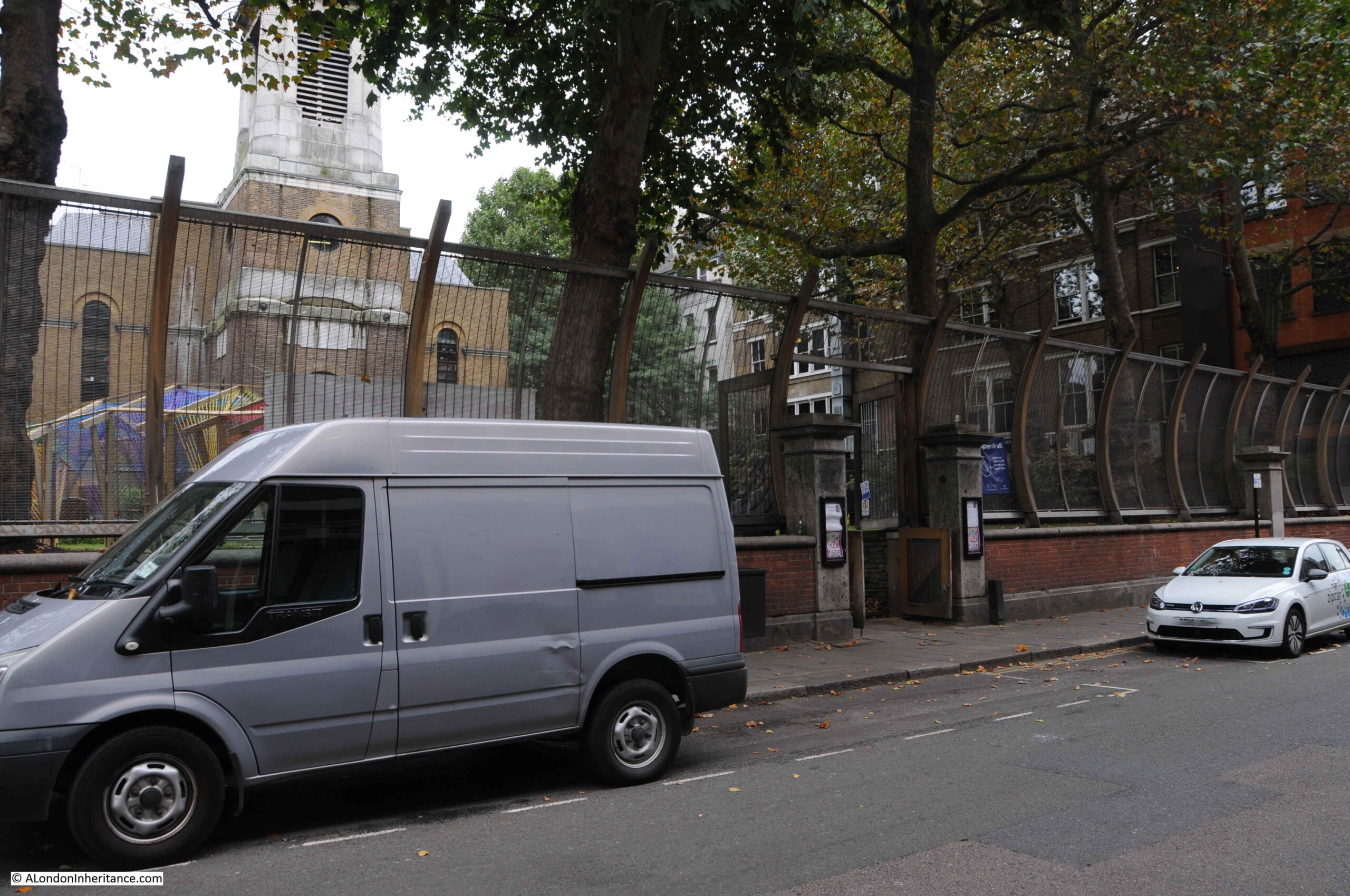
The photo of the elm pipe was taken outside the Wardour Street entrance to the church of St Anne’s, Soho. This is the same view today:

St Anne's Soho

St Anne’s, Soho was built to serve the spiritual needs of those living in the expanding Soho streets. Plans for a new church were first being discussed in the 1670s, along with the search for a suitable location. The land on which the church would be built was owned by two speculators, brewer Joseph Girle and tiler and bricklayer Richard Frith (who would give his name to Frith Street).

There is no firm evidence of the architect of the church, there are references to both Christopher Wren, and one William Talman, but it is impossible at this distance in time, and loss of documentation over the years, to be clear of their individual role.

The new church was ready for use in 1685 and was consecrated by Bishop Henry Compton in either 1685 or 1686.

The church was very badly damaged during the blitz raids of September 1940. The body of the church was completely burnt out, the tower survived, but with considerable damage.

The church was partly restored in the decades after the war, before undergoing a full restoration between 1990 and 1991. The tower survives from the pre-war church, however the rest of the building is a modern rebuild.

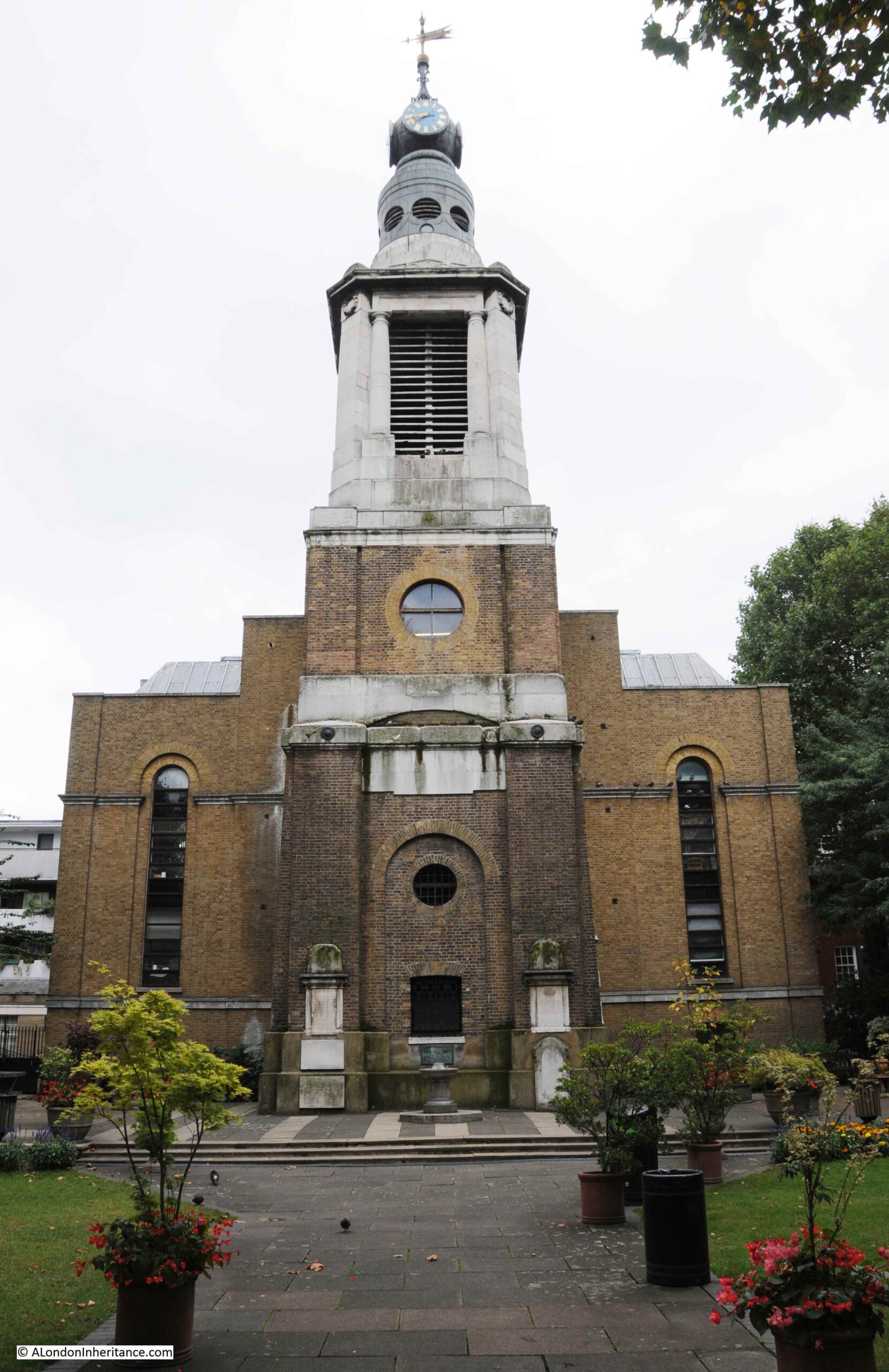
The tower and church of St Anne’s, Soho:

St Anne's Soho

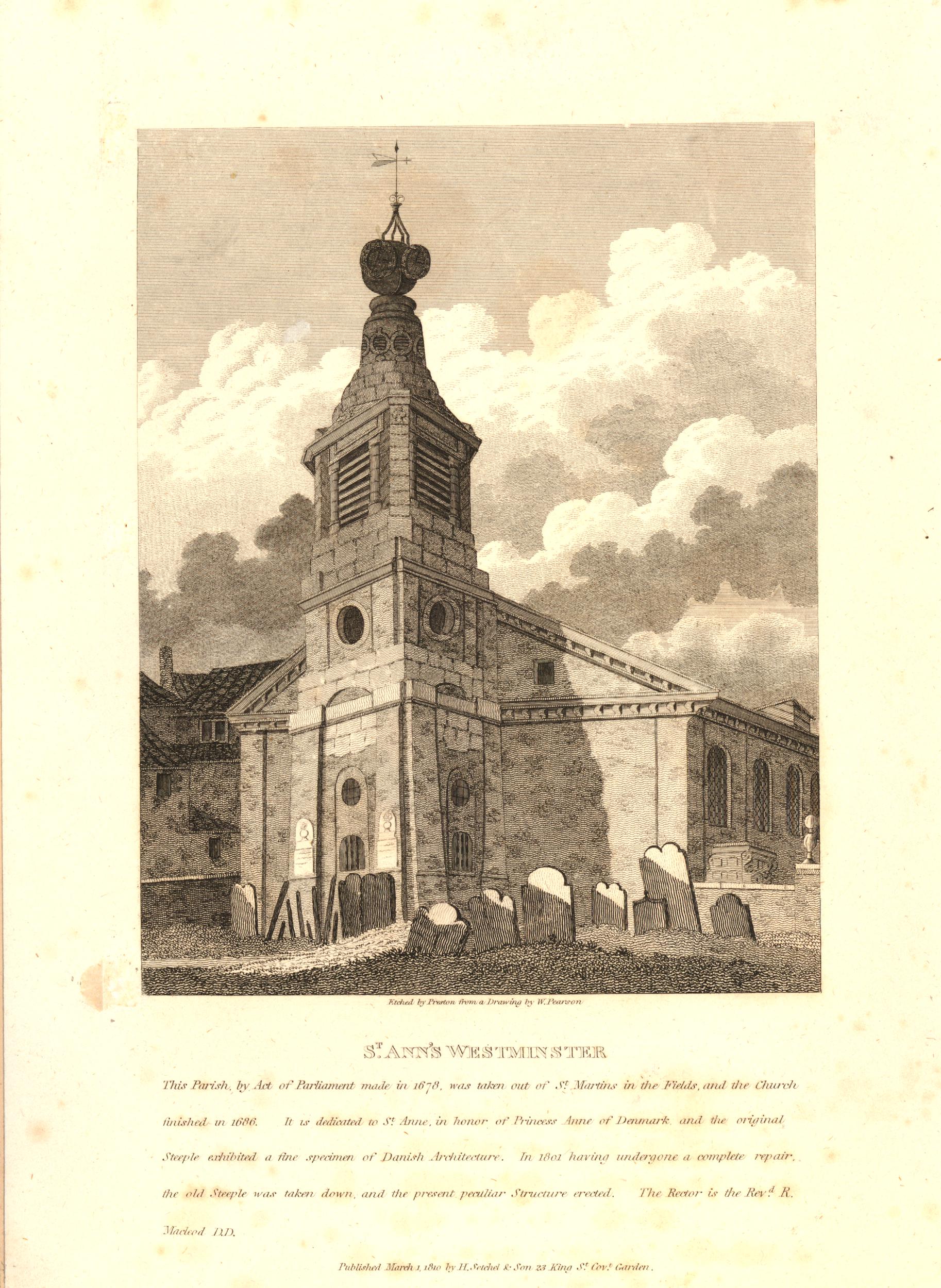
The church in 1810 (with the inclusion of Westminster in the name as it was within the parish):

St Anne's Soho

It is always easy to get distracted by the gravestones in the churchyard of an old London church, and St Anne’s is no exception. Although these are now separated from their original graves, they tell the story of some of the characters who were buried here:

St Anne's Soho

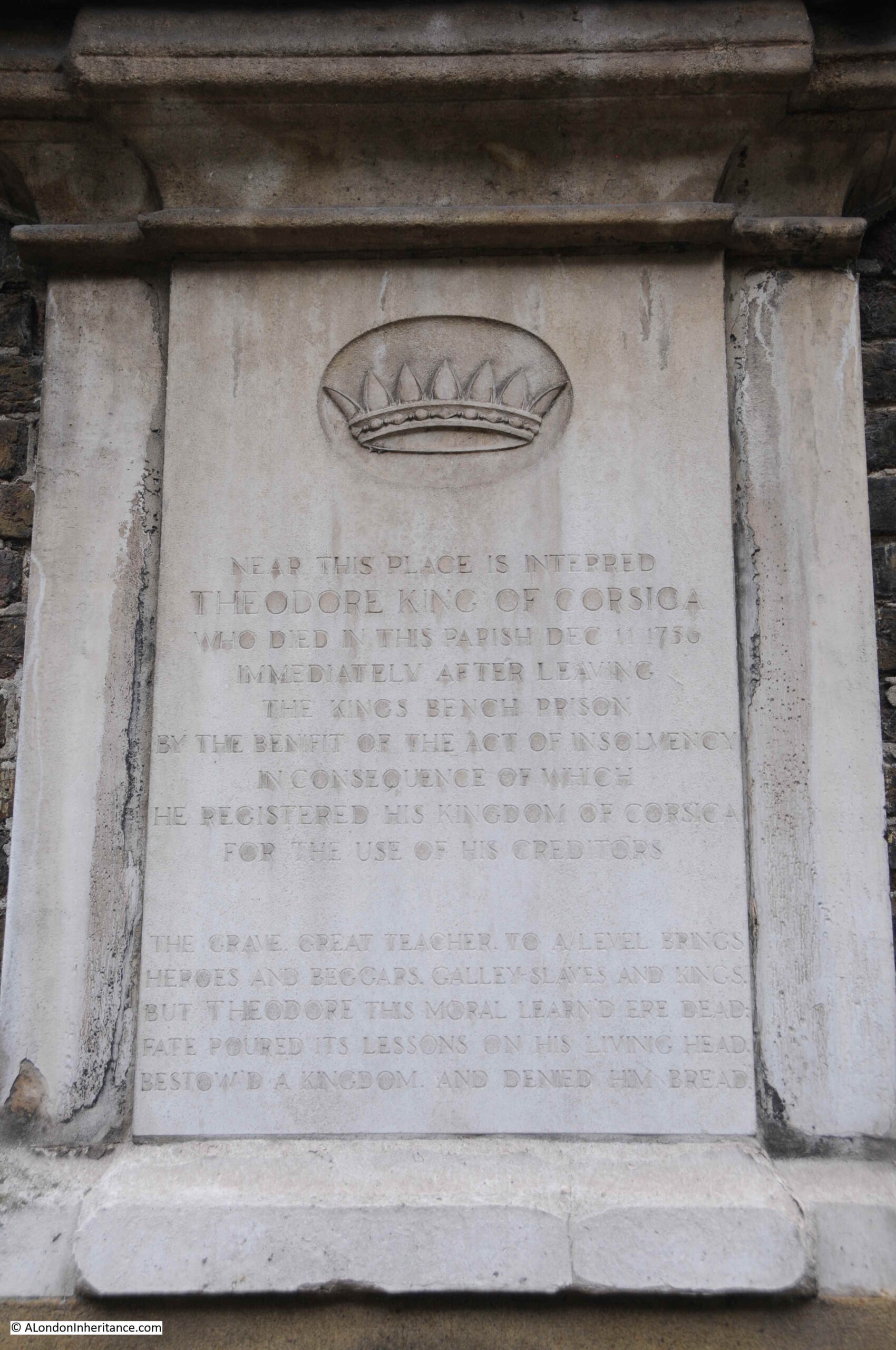
In the above photo, the stone on the upper right is to Theodore, King of Corsica:

Theodore king of Corsica

Theodore was born in Cologne, Germany in 1694, with the full name Theodor Stephan Freiherr von Neuhoff. He had a varied career, service with both the French and Swedish armies, negotiating on behalf of the Swedish king with England and Spain, and travelling widely.

It was whilst traveling in Italy that he became involved with rebels trying to free the island of Corsica from the rule of Genoa, one of the republics that made up Italy in the 18th century.

Theodore landed in Corsica in March 1736, and was made king of the island by the inhabitants. His rule did not last long. Disagreements within the rebels, and the Republic of Genoa putting a price on his head resulted in Theodore leaving the island in November of the same year.

He lived in the Netherlands for a while before moving to London, where he tried to get support for Corsica, and his role as king. He was not successful, had many money problems and ended up in the King’s Bench debtors prison.

Released in 1755 after declaring bankrupt, and registering his Kingdom of Corsica for the use of his creditors. He died the following year in 1756, and the gravestone includes the following text:

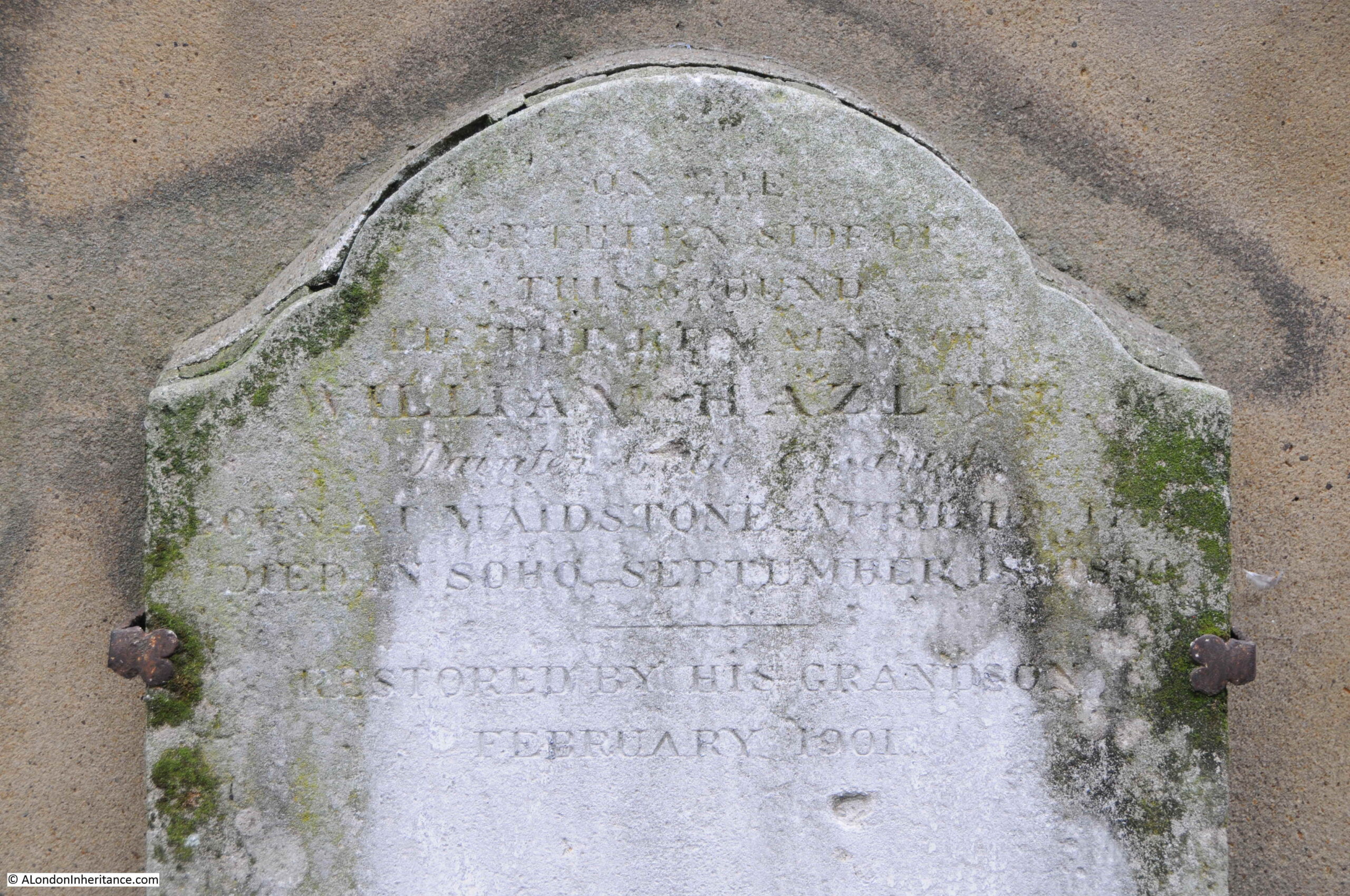
Another gravestone on the base of the tower is that of William Hazlitt, whose grave in the churchyard is marked by a recent memorial.

William Hazlitt

Hazlitt was one of the greatest English essayist’s of the late 18th and early 19th centuries, however he lived his last years in relative obscurity, partly in a flat in Frith Street which explains why he was buried in St Anne’s.

A report in The Atlas (A General Newspaper and Journal of Literature) on the 26th September 1830 finishes with a sentence that will probably ring true with the majority of authors:

“On Thursday last the body of William Hazlitt was borne beneath our windows; till that moment we were not aware that a man of genius, a popular writer – the author of no less that able a work than the life of Napoleon, which alas closed his literary labours – and an amiable man, had been our next door neighbour for months, enduring sickness and at length dying in indigence. We boast of our national generosity, glory on the flourishing state of our literature, and thunder forth the power of the press, the palladium of our liberties; in the meanwhile ‘the spirit of life’ is allowed to burn itself out in penury and privation. Publishers sport their carriages, or fail for a hundred thousand pounds; and those by whom they become publishers die for want of a dinner.”

So that covers a brief looks at the New River Company and their elm pipes, as well as St Anne’s, Soho. The caption to the photo has the following final sentence:

Shaftesbury Avenue was opened February 26, 1887, and the excavations laid these old pipes bare.”

Which implies that the elm pipes were uncovered during the work to create Shaftesbury Avenue, so the creation of this famous West End street is what I wanted to explore next.

Shaftesbury Avenue

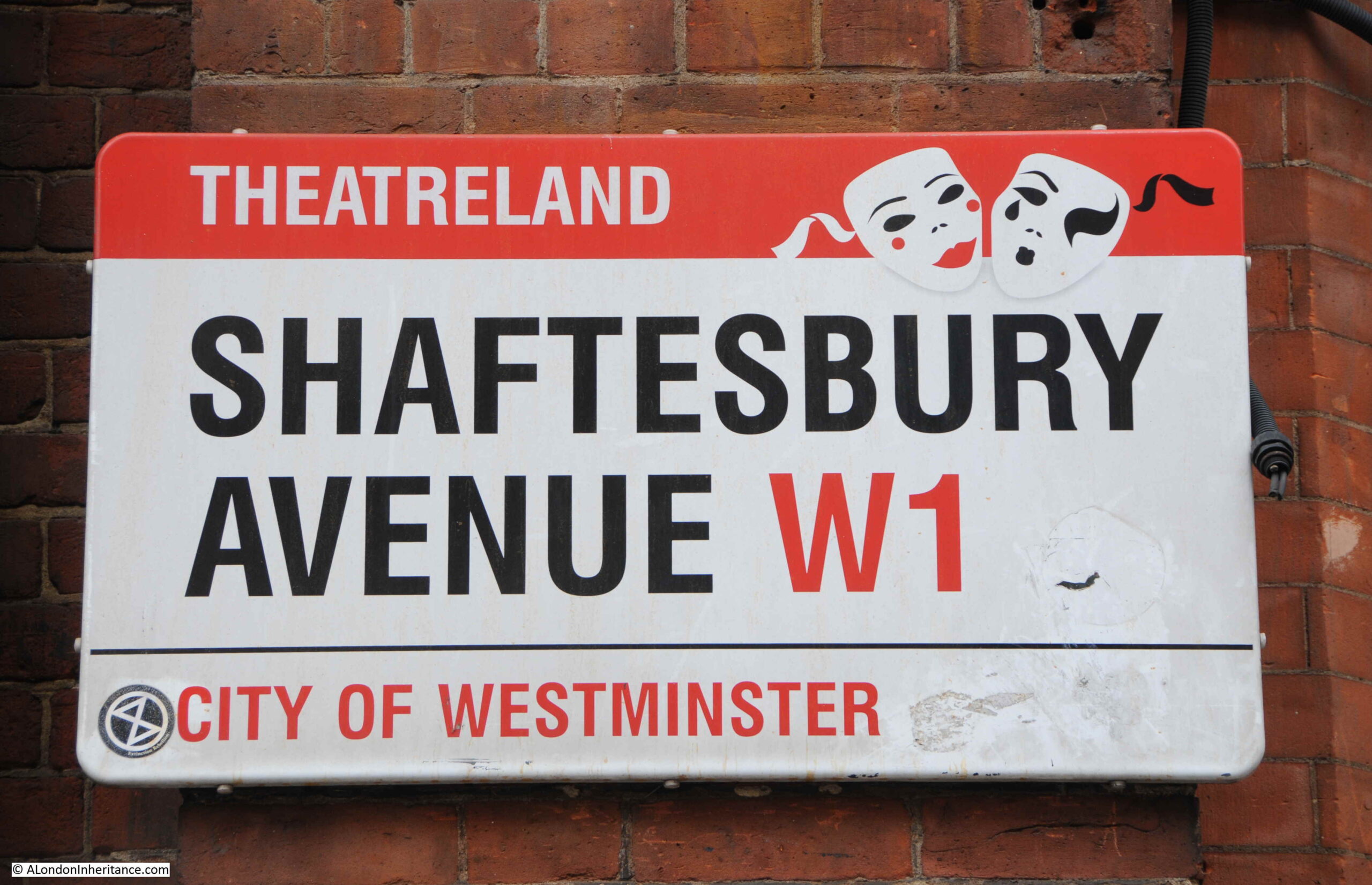
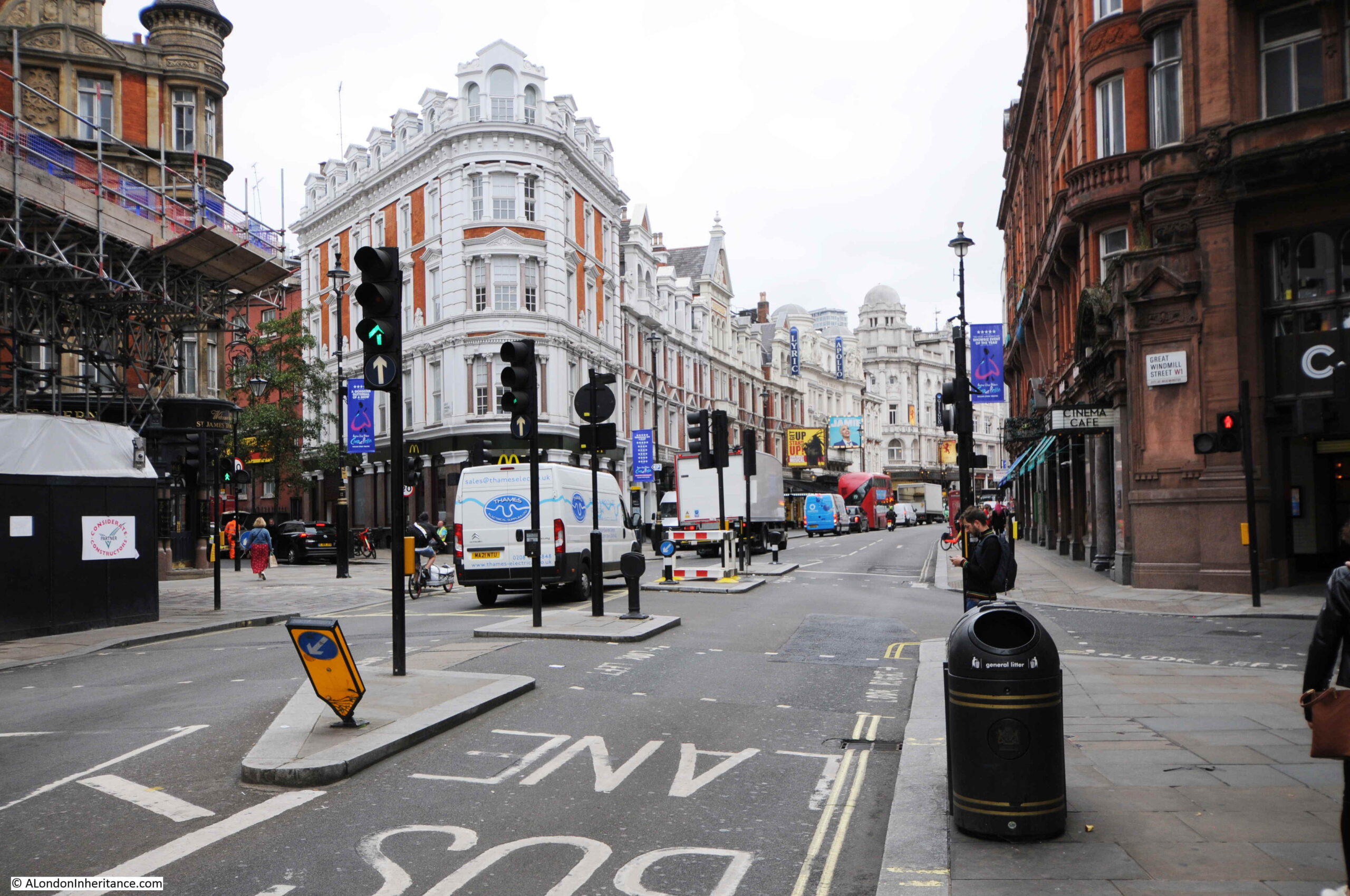
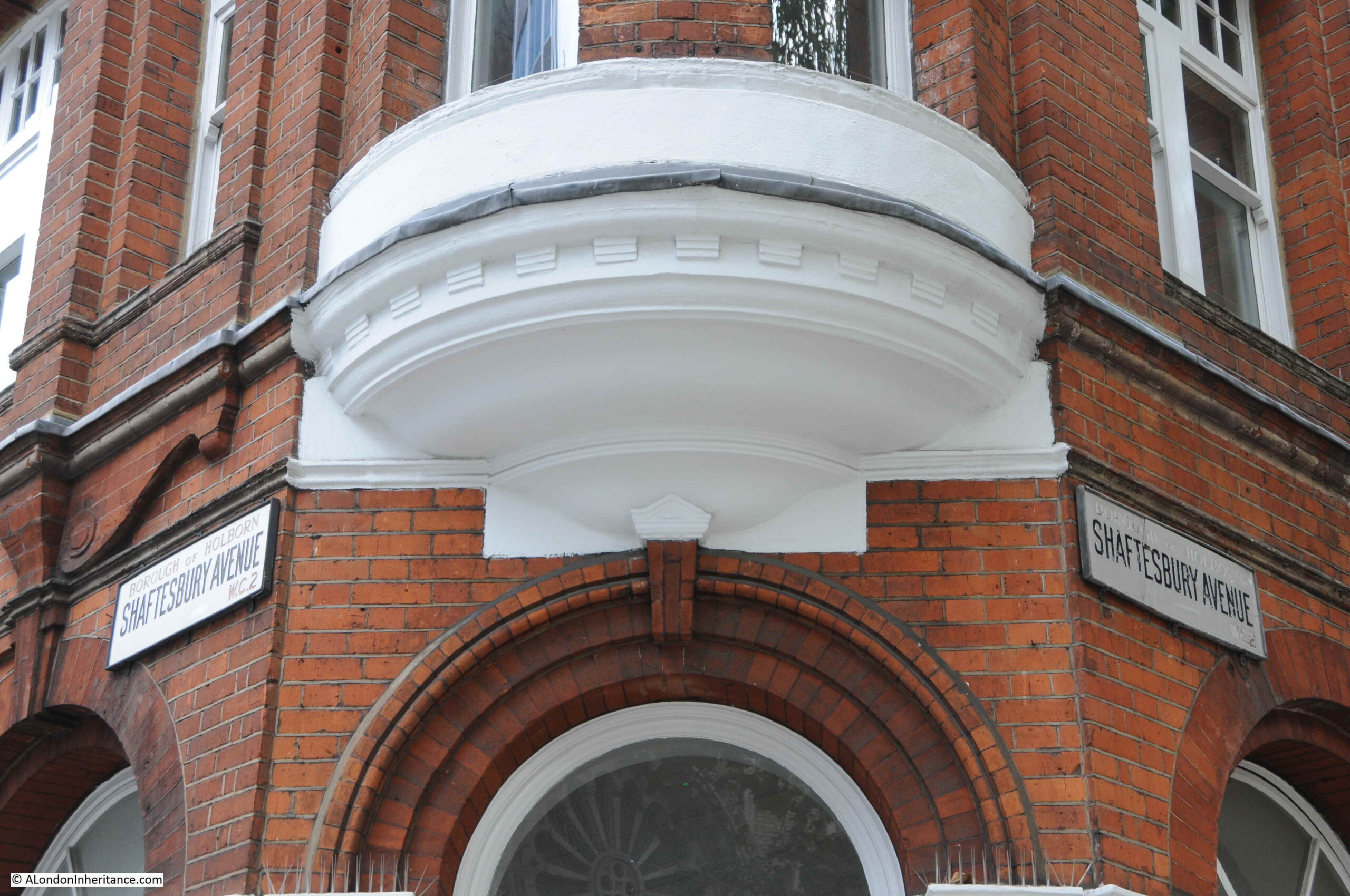
Shaftesbury Avenue is a long street that runs from New Oxford Street in the north down to Piccadilly Circus in the south. The street crosses Charing Cross Road, and it is the lower half that is probably best known as this is where the majority of the street’s theatres are located. As the street sign above confirms, Shaftesbury Avenue is in the heart of London’s theatre land.

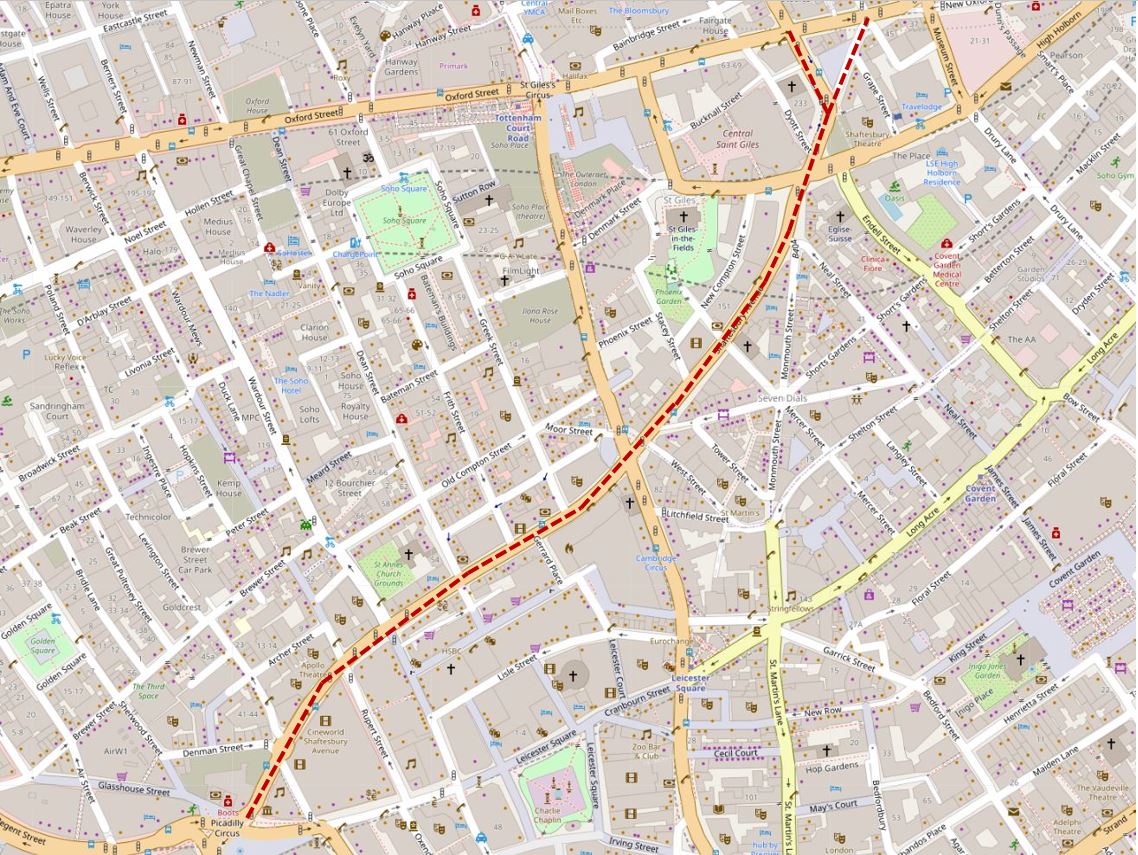
In the following map, I have marked the route of Shaftesbury Avenue with a a red dashed line (Map © OpenStreetMap contributors).

Shaftesbury Avenue

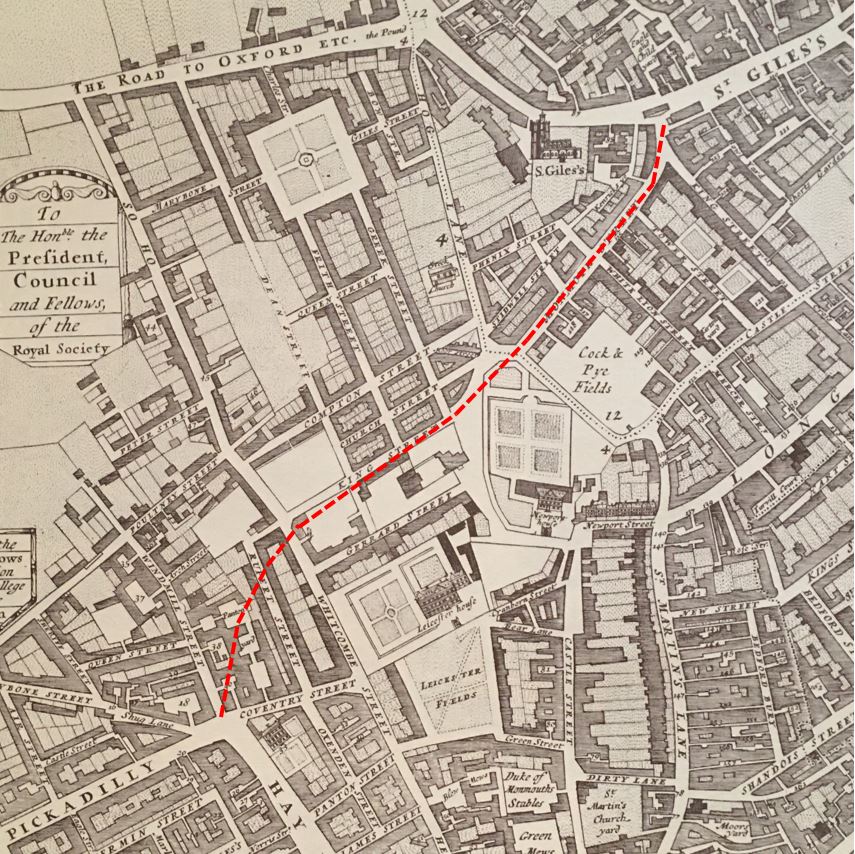
Shaftesbury Avenue cut through a series of streets and buildings that had existed from the time of London’s expansion westwards. The following map is from William Morgan’s 1682 map of London, again the red dashed line marks the future route of Shaftesbury Avenue.

Shaftesbury Avenue

During the second half of the 19th century there were a number of building schemes that carved new roads through what been been dense networks of streets and buildings. I have already written about Roseberry Avenue which was built between 1887 and 1892, and Charing Cross Road which was officially opened on the Saturday 26th February 1887.

Shaftesbury Avenue was part of the same scheme that included Charing Cross Road.

Proposals for roads improvements along the lines of Charing Cross Road and Shaftesbury Avenue dated back to the 1830s, when a Select Committee of the House of Commons stated that “several plans for affording greater convenience of intercourse between the southern and northern divisions of the metropolis” were considered due to increasing traffic flow and the need to provide much more direct and convenient links between locations such as the eastern end of Oxford Street, Charing Cross and Piccadilly Circus.

Nothing would come of these early proposals, and by the 1870s the situation was becoming more critical, with traffic added to by the arrival of railway stations to the north of the city and those along the river such as Charing Cross.

The Metropolitan Board of Works applied to parliament for permission to improve the streets between Oxford Street, Charing Cross and Piccadilly, and they were granted the powers to construct these streets through the Metropolitan Street Improvements Act of 1877.

Details of these improvements, along with so many others throughout London were published by the London County Council in a wonderful book published in 1898 called “History of London Street Improvements, 1855 – 1897”.

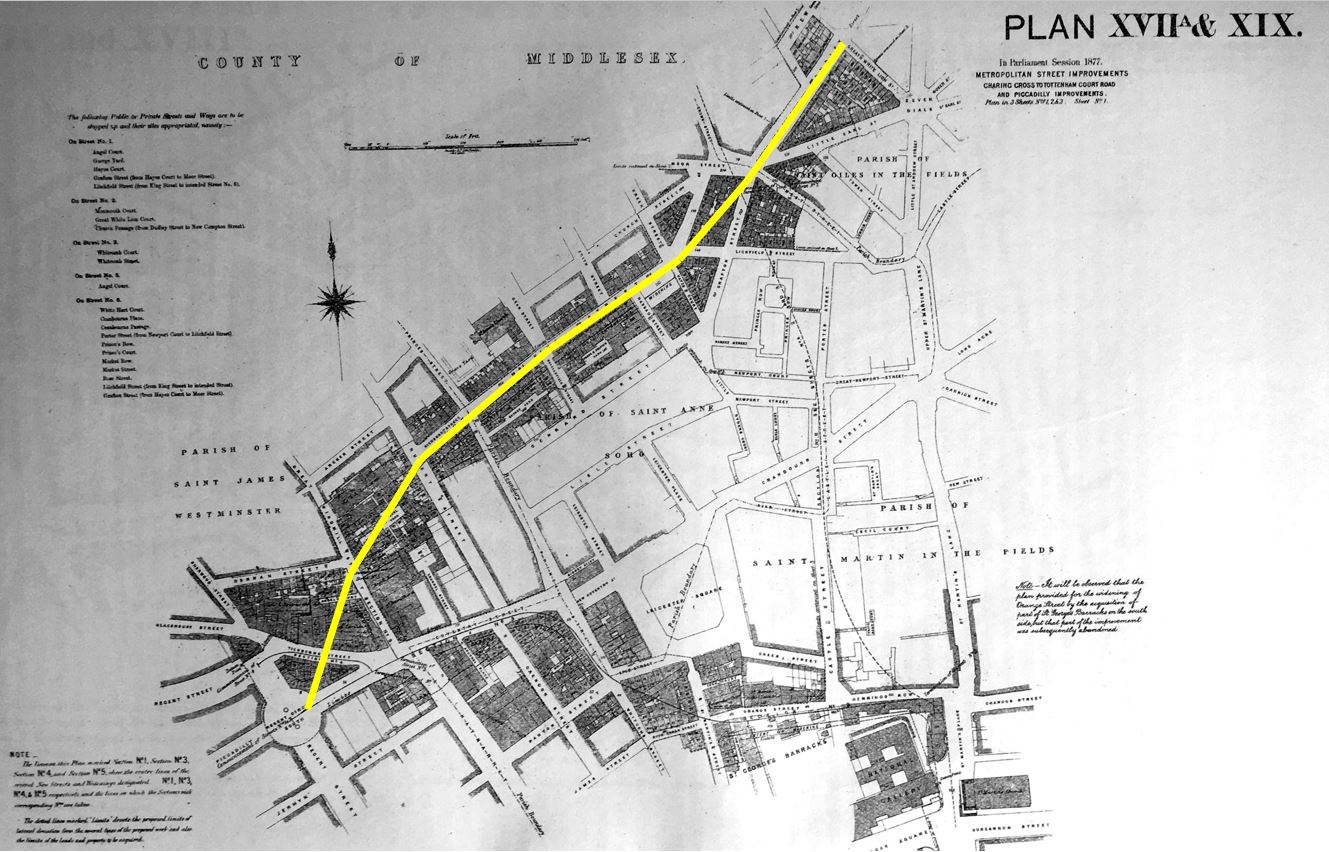
The book includes some detail on the Shaftesbury Avenue development, including the following two maps which detail the route. I have added a yellow line to highlight the route. The first map covers from Piccadilly Circus at lower left to just to the north west of Seven Dials at top right.

Shaftesbury Avenue

The following map includes a short overlap and covers the north eastern section of the street from Greek Street (top left) to New Oxford Street at lower right.

Shaftesbury Avenue

The route of Shaftesbury Avenue would take over and widen a number of existing streets and would run through a number of housing blocks.

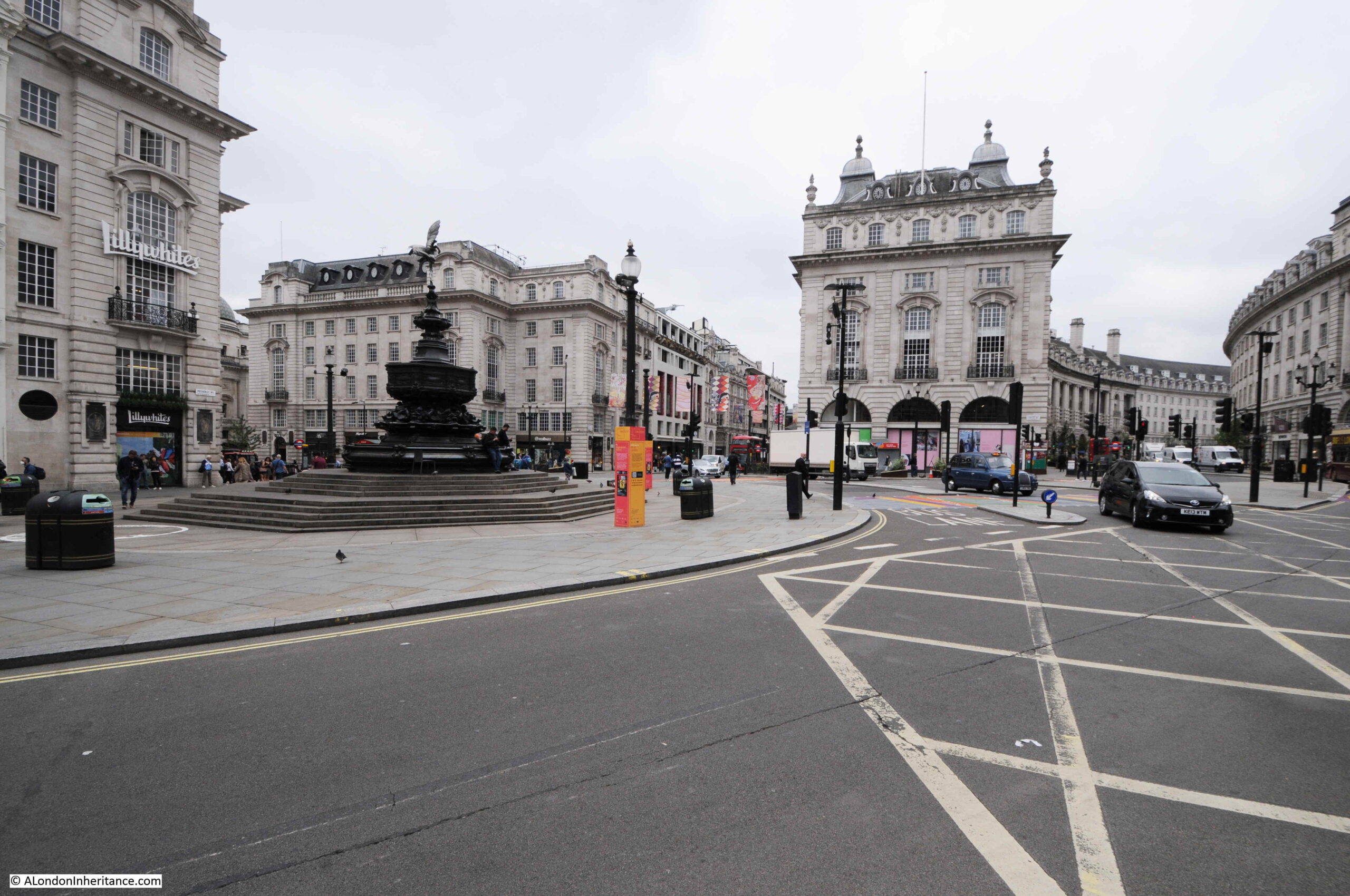
At the southern end of the route, Shaftesbury Avenue opens out onto Piccadilly Circus which is a major junction with Regent Street, Piccadilly, Regent Street St James, and Coventry Street.

Piccadilly Circus

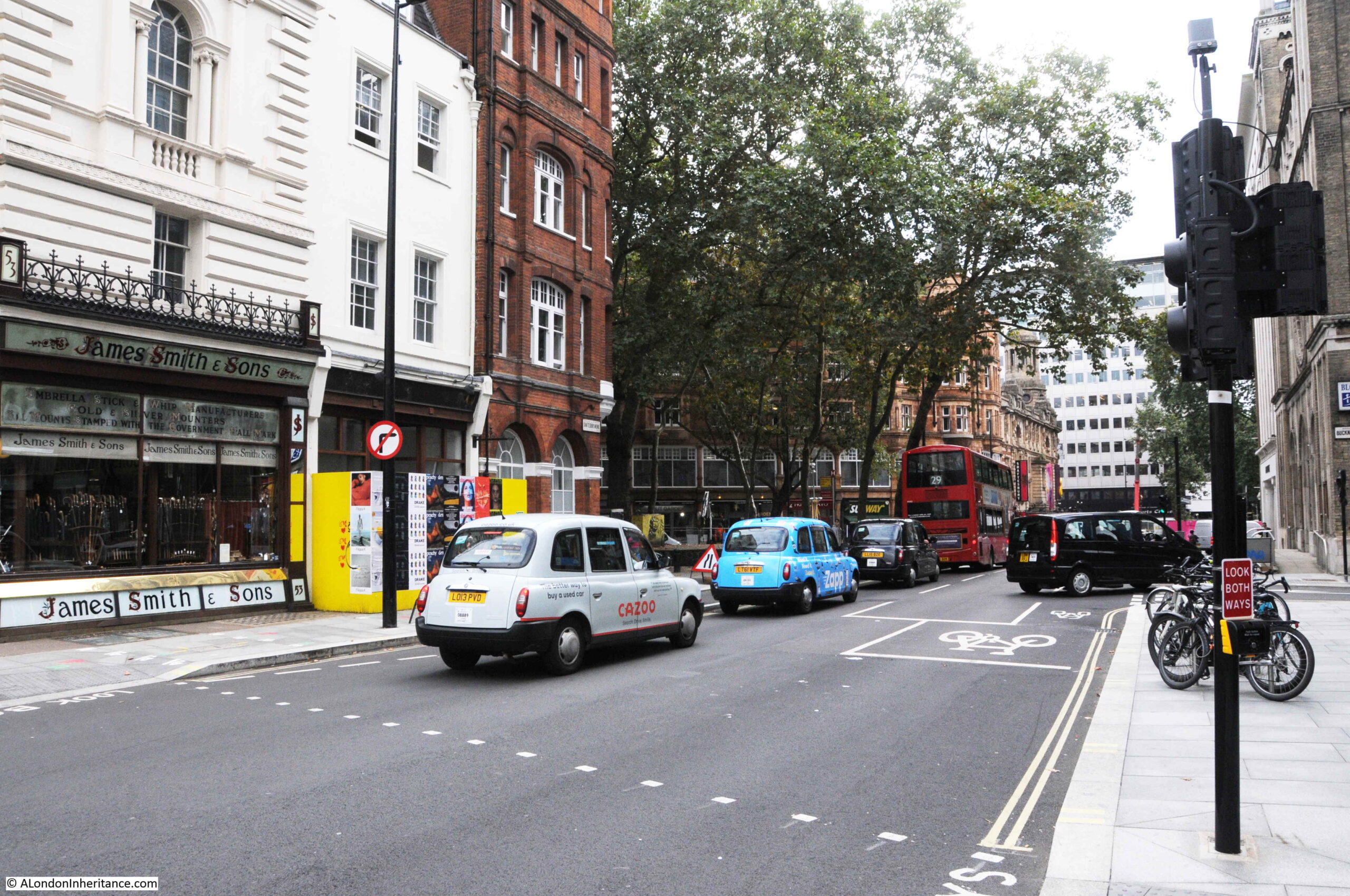
The view along Shaftesbury Avenue from the junction with Piccadilly Circus:

Shaftesbury Avenue

The 1877 Act imposed some difficult conditions on the Metropolitan Board of Works. Previous acts had allowed development to take place with conditions for the rehousing of the “labouring classes” who would be displaced, however the new Act stated that the Metropolitan Board of Works was “forbidden to take, without the consent of the Secretary of State, 15 or more houses occupied wholly or partially by persons of the labouring classes, until the Board had proved to the satisfaction of the Secretary of State that other accommodation in suitable dwellings had been provided”.

The new street would pass through some of the most densely populated parts of London, requiring the rehousing of hundreds of people, so this was a difficult condition for the Board.

The Metropolitan Board of Works tried through the following years to get the condition regarding 15 or more houses either removed or modified, however Parliament refused to change the original Act.

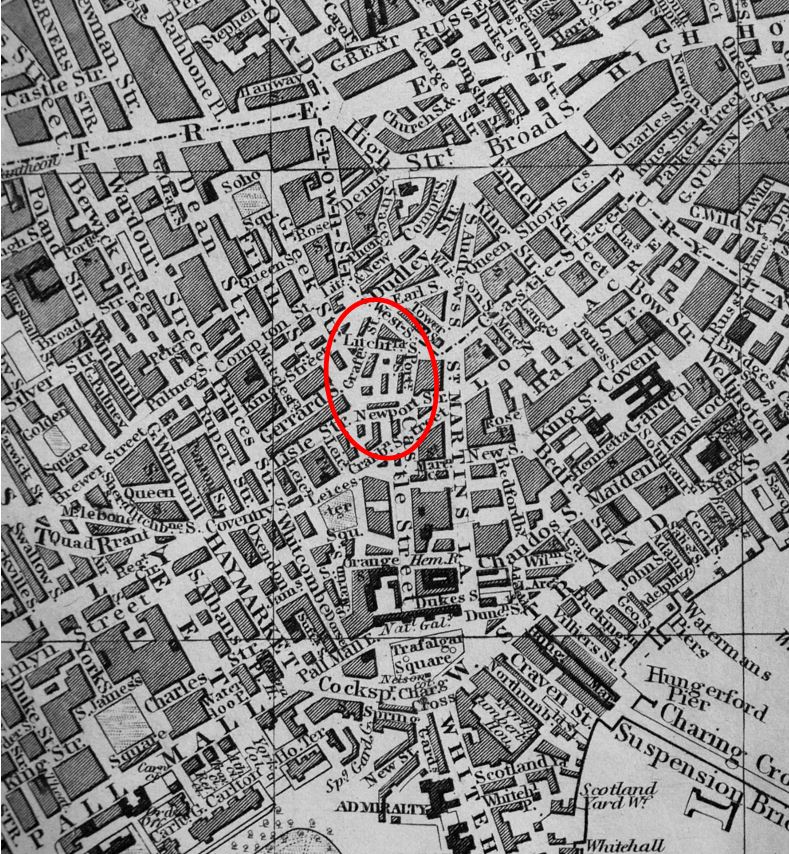
Whilst the Board had been trying to get the Act changed, it had also acquired the land of the old Newport Market and had been building large blocks of working class dwellings ready for those who would be displaced by the development of Charing Cross Road and Shaftesbury Avenue.

Newport Market was an area just to the south of the route of Shaftesbury Avenue. I have ringed the location in the following extract from Reynolds’s 1847 “Splendid New Map of London”:

Newport Market

The projects to build Charing Cross Road and Shaftesbury Avenue would eventually displace a total of 3,044 people, described of being of the “labouring classes”.

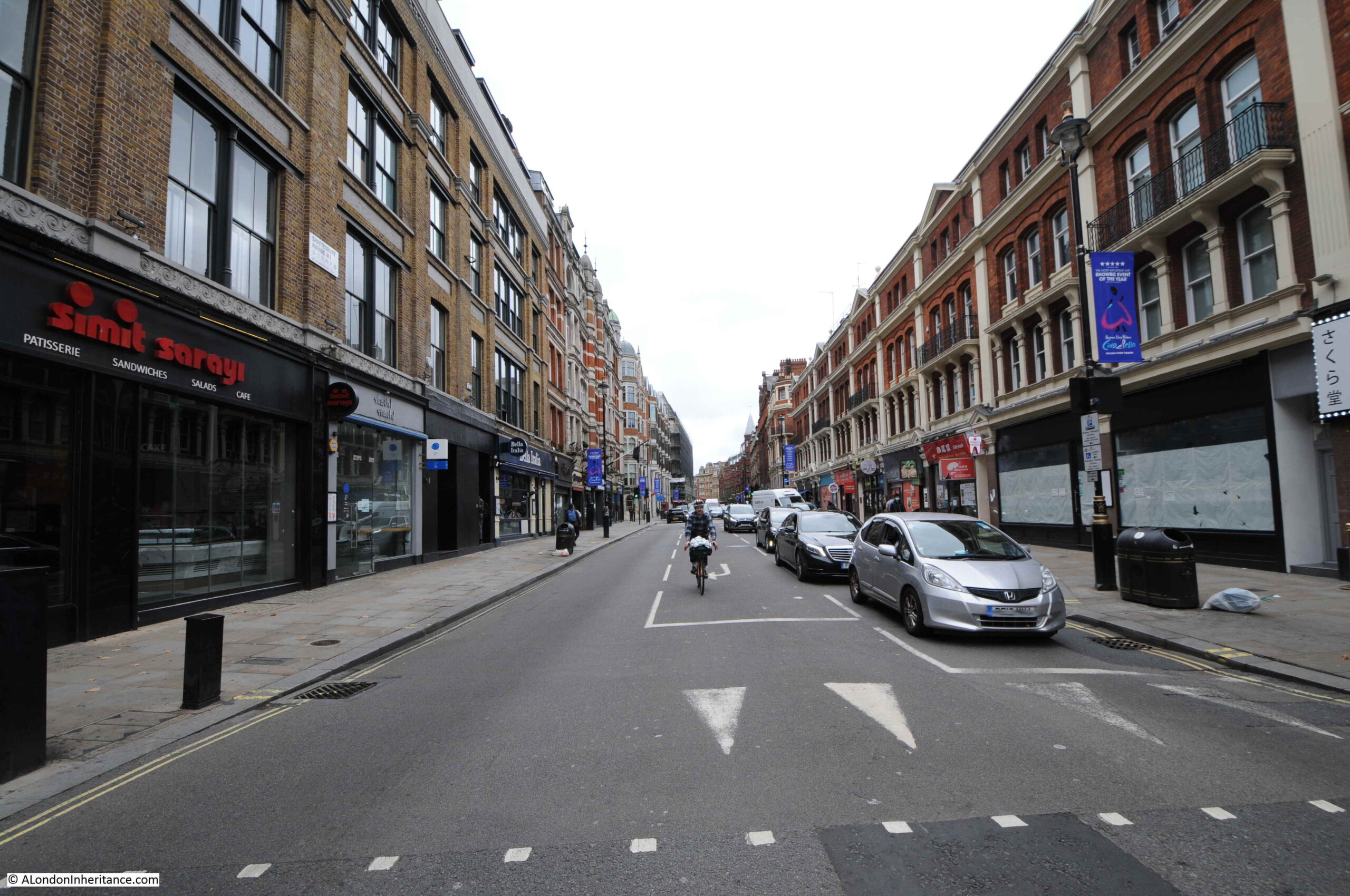
Starting to walk north along Shaftesbury Avenue. This stretch of the new road ran through areas of dense housing:

Shaftesbury Avenue

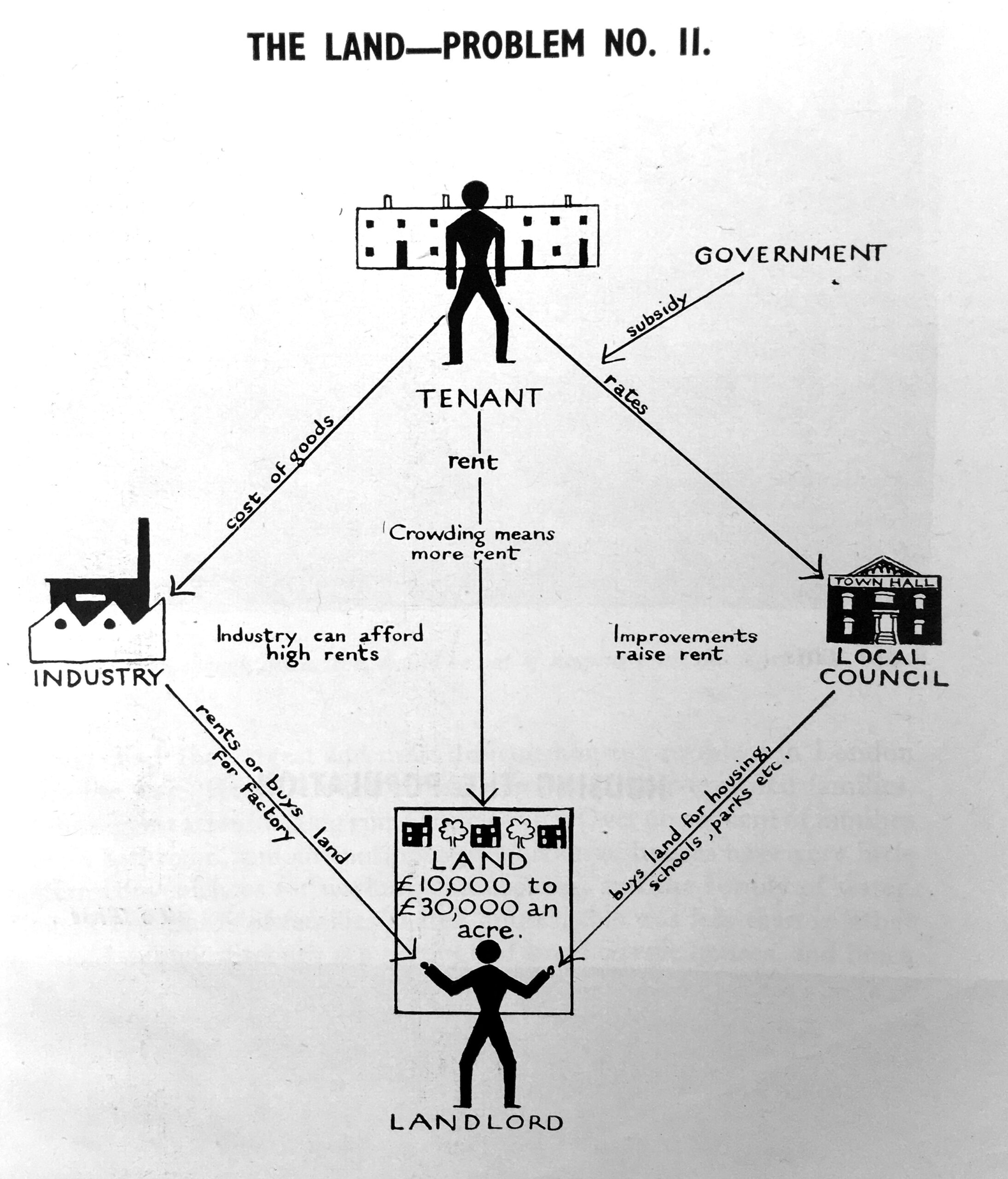
The Metropolitan Board of Works purchased the land for the new street. They tried to keep their purchases to a minimum as the costs were taken from the Rates.

In an example of how the ownership of land always was, and in many ways, continues to be a source of profit, without many of the associated costs, it was complained at the time that whilst the cost of improvements were recovered through the Rates, these were generally paid by the tenants of properties, not by the owner, although in developments such as Shaftesbury Avenue, the owner of land close to the new street would benefit by the increase in the value of his land due to the improvements to the area such a development would bring.

Very similar in the way that Crossrail increases the value of land around new stations.

Land purchased for the new road, often included land running along side. The Board was expected to sell excess land alongside the road to recover part of the construction costs.

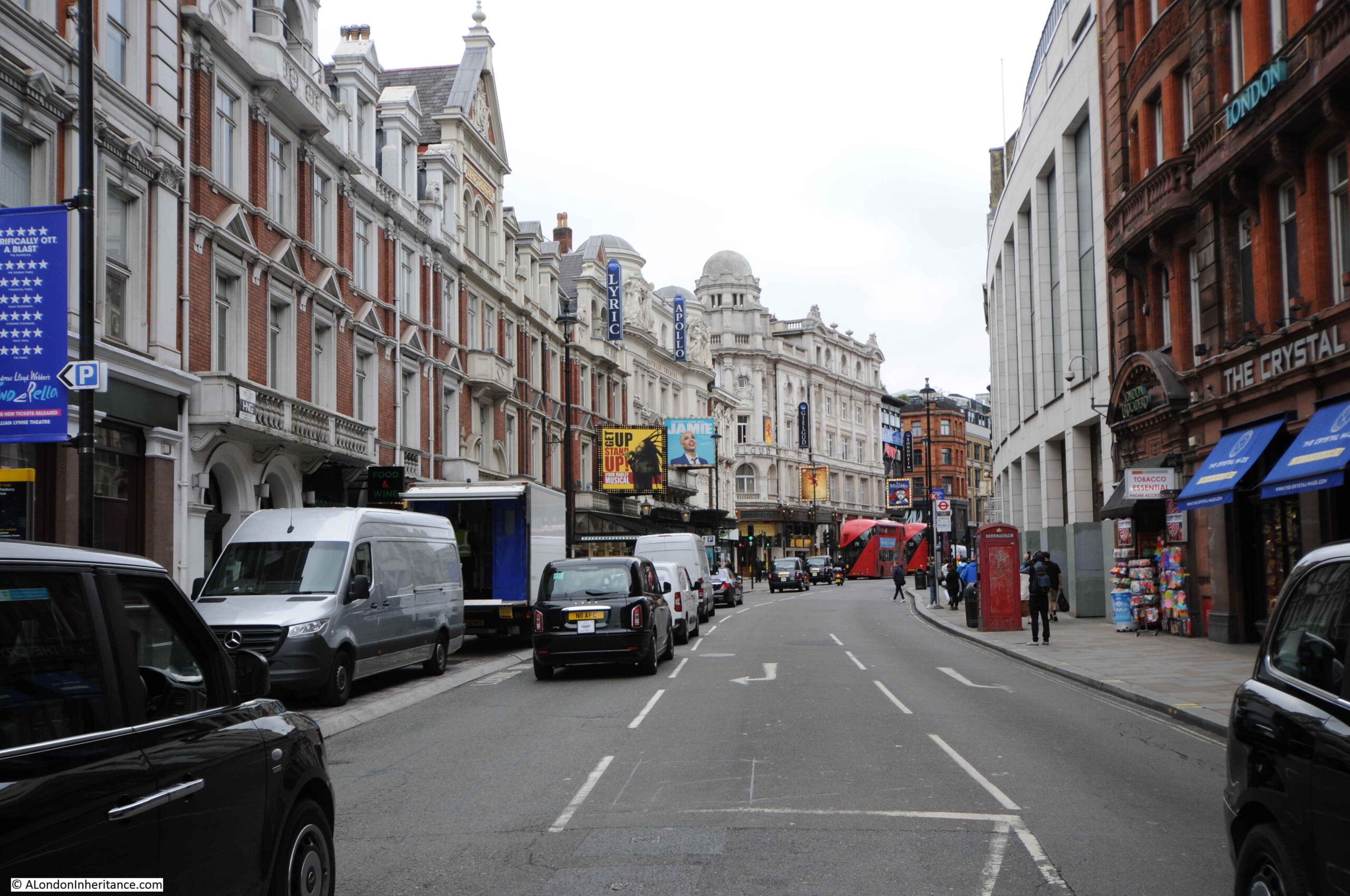
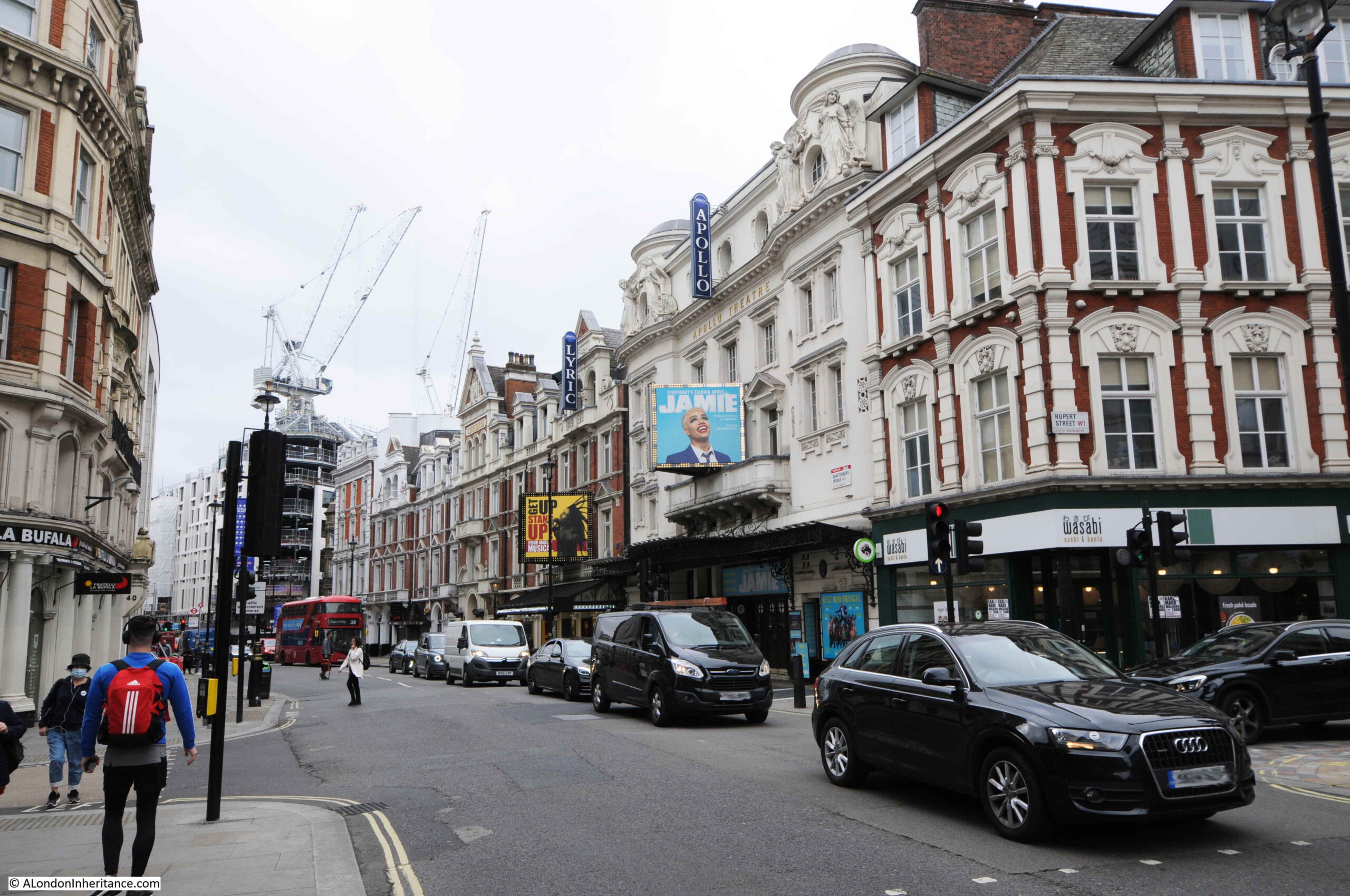
Completion of Shaftesbury Avenue would result in an explosion of building along the new route, which included many of the theatres that today line the street.

Shaftesbury Avenue

In the above photo, further from the camera on the right is the Lyric Theatre (1888) and with the “Jamie” advertising is the Apollo Theatre (1901).

At the junction with Wardour Street. The church of St Anne’s, Soho is just up the street to the right.

Shaftesbury Avenue

Remarkable that as the original buildings and streets were being cleared ready for the construction of Shaftesbury Avenue that the 17th century elm pipes were being removed from the ground, and that in the 1880s these were fortunately considered important enough to photograph.

The following photo is looking north from the junction with Wardour Street, and is the stretch of Shaftesbury Avenue which was a much widened earlier King Street:

Shaftesbury Avenue

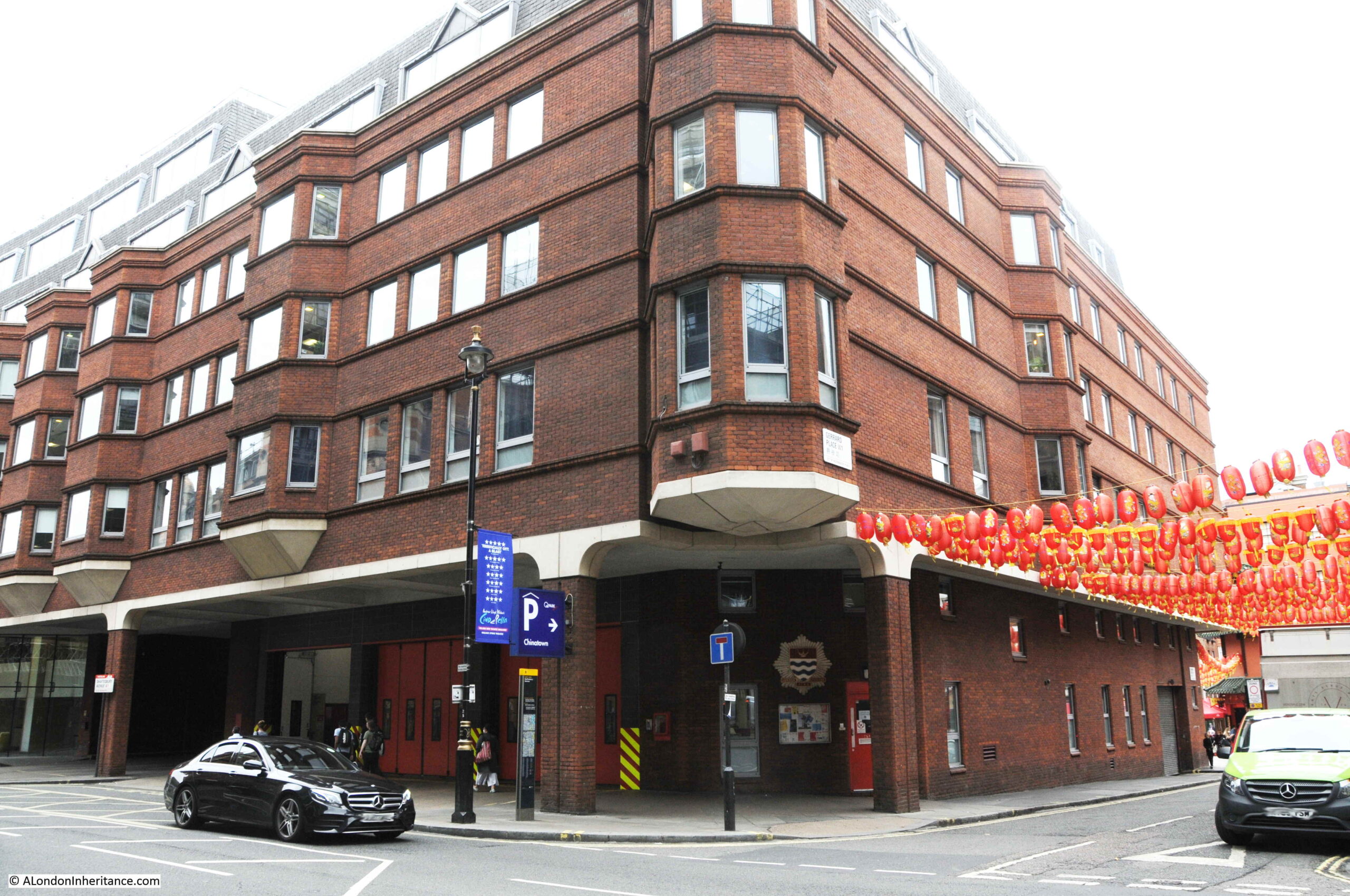
At the junction of Shaftesbury Avenue and Gerrard Place, there is a modern fire station:

Shaftesbury Avenue

The site has been a fire station from the construction of the street. In 1886, the Metropolitan Board of Works leased the land to a private fire fighting organisation, the London Salvage Corps, with the first fire station being built the following year in 1887. In 1920 the site was acquired by the London County Council as a site for the London Fire Brigade.

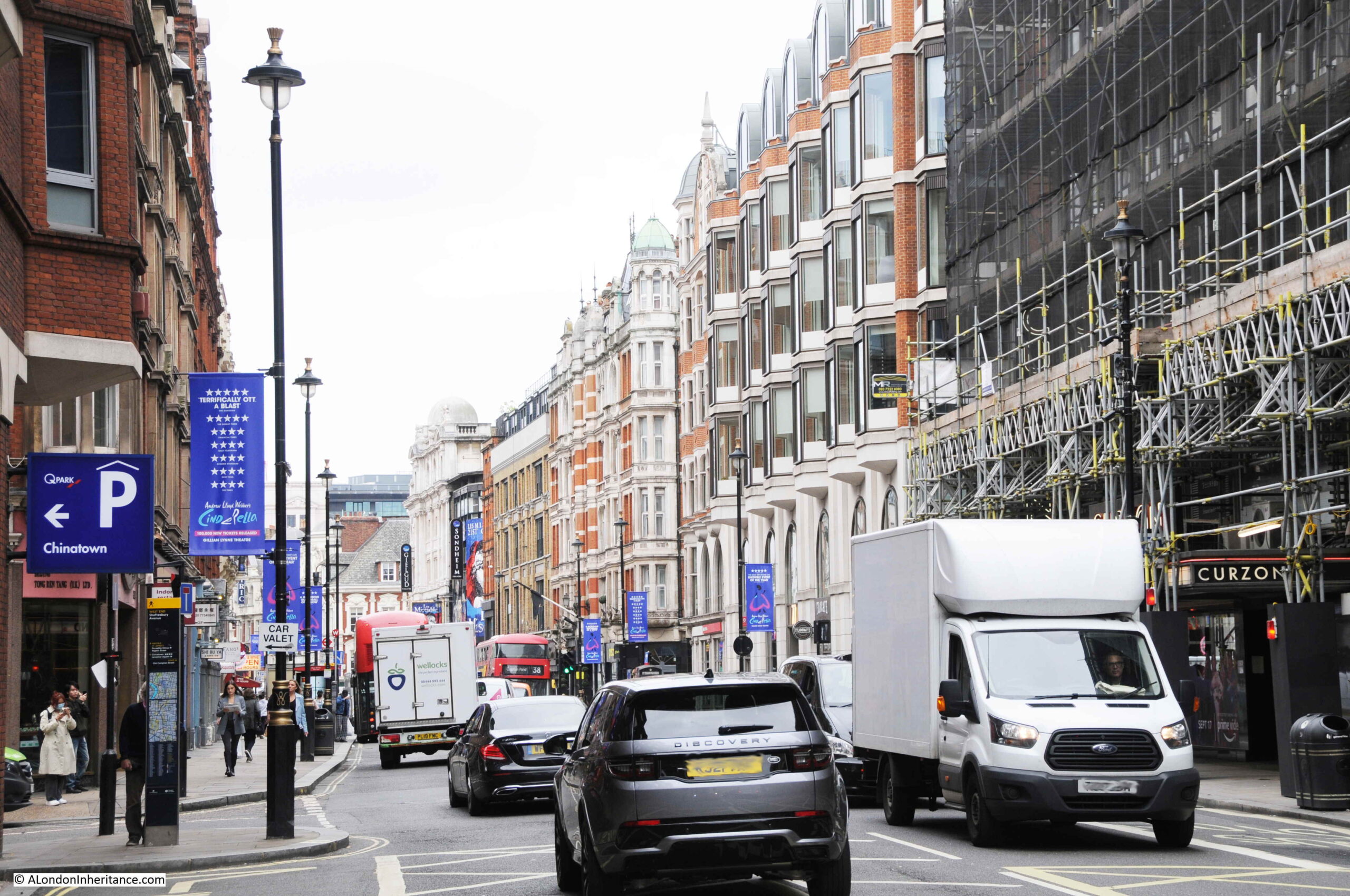
Looking south from outside the fire station:

Shaftesbury Avenue

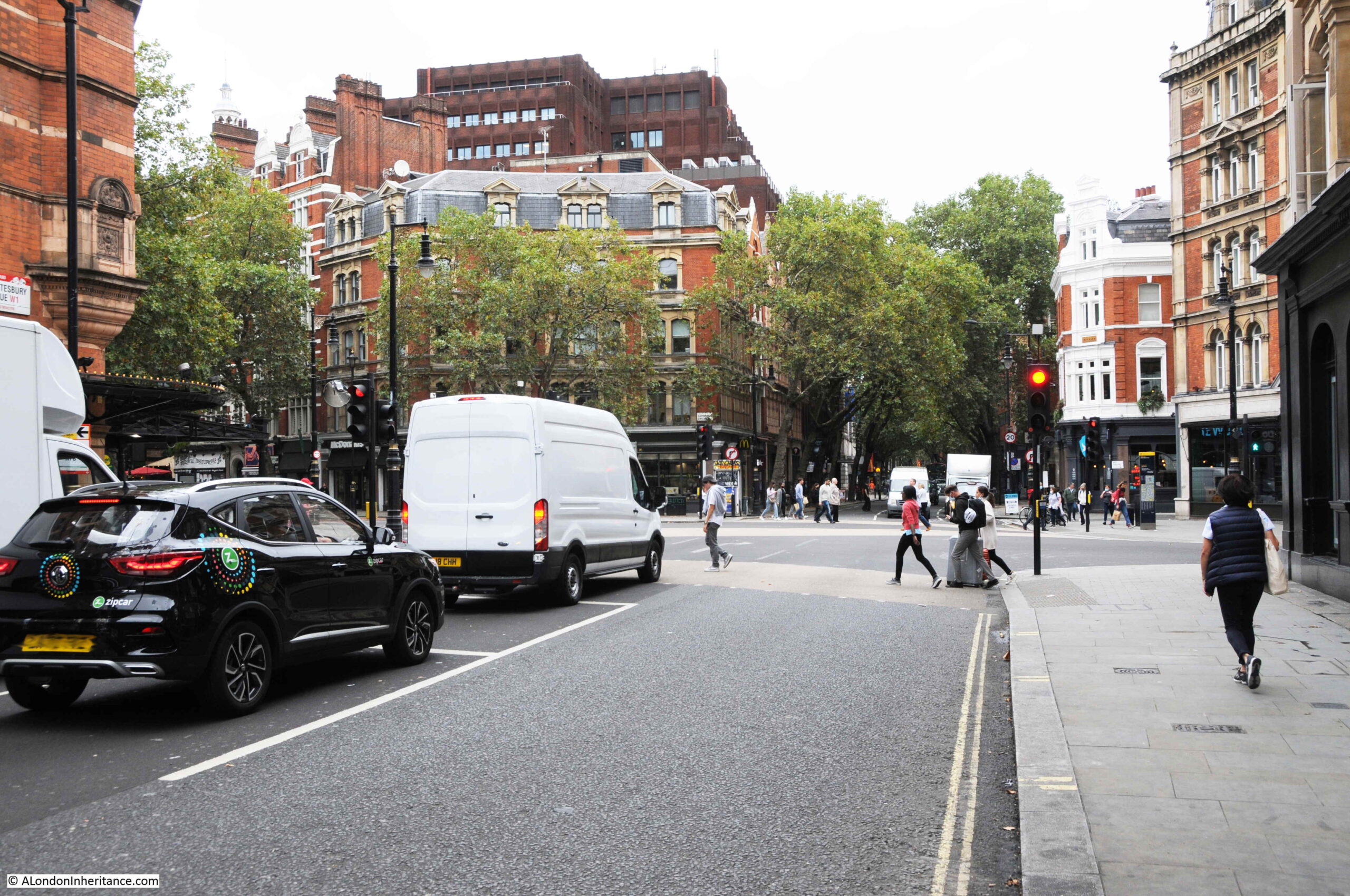
Turning north, and it is here that Shaftesbury Avenue crosses Charing Cross Road, which was also being developed at the same time:

Cambridge Circus

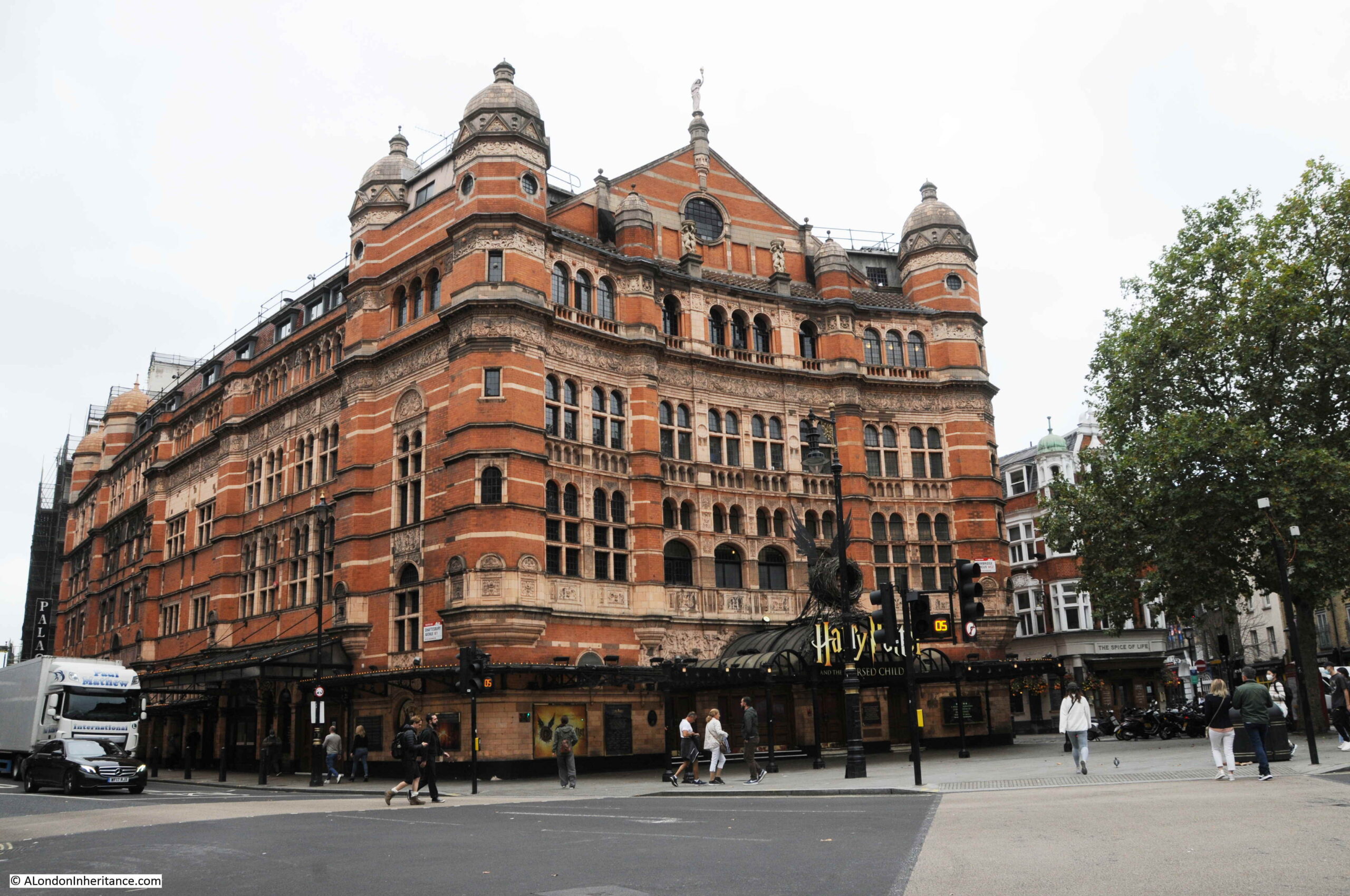
At the junction of Shaftesbury Avenue and Charing Cross Road is the Palace Theatre:

Palace Theatre

The Palace Theatre is a large, red brick building with a capacity for 1,400 theatre goers.

The theatre was opened in 1891 (soon after the completion of the two new streets) for Richard D’Oyly Carte who intended the theatre to be the home of English opera and on opening the theatre was known as the Royal English Opera House. The first production was Arthur Sullivan’s Ivanhoe, however when this closed there was no follow up production and the Royal English Opera House closed.

D’Oyly sold the building and in 1911 it opened as the Palace Theatre of Varieties, commencing a theme of musical productions which have run for most of the theatre’s time. With the emphasis on musicals rather than variety productions, the theatre dropped the last part of the name to become the Palace Theatre.

Today, the Palace Theatre is hosting probably one of the biggest productions in the West End for some years, J.K. Rowling’s “Harry Potter and the Cursed Child”.

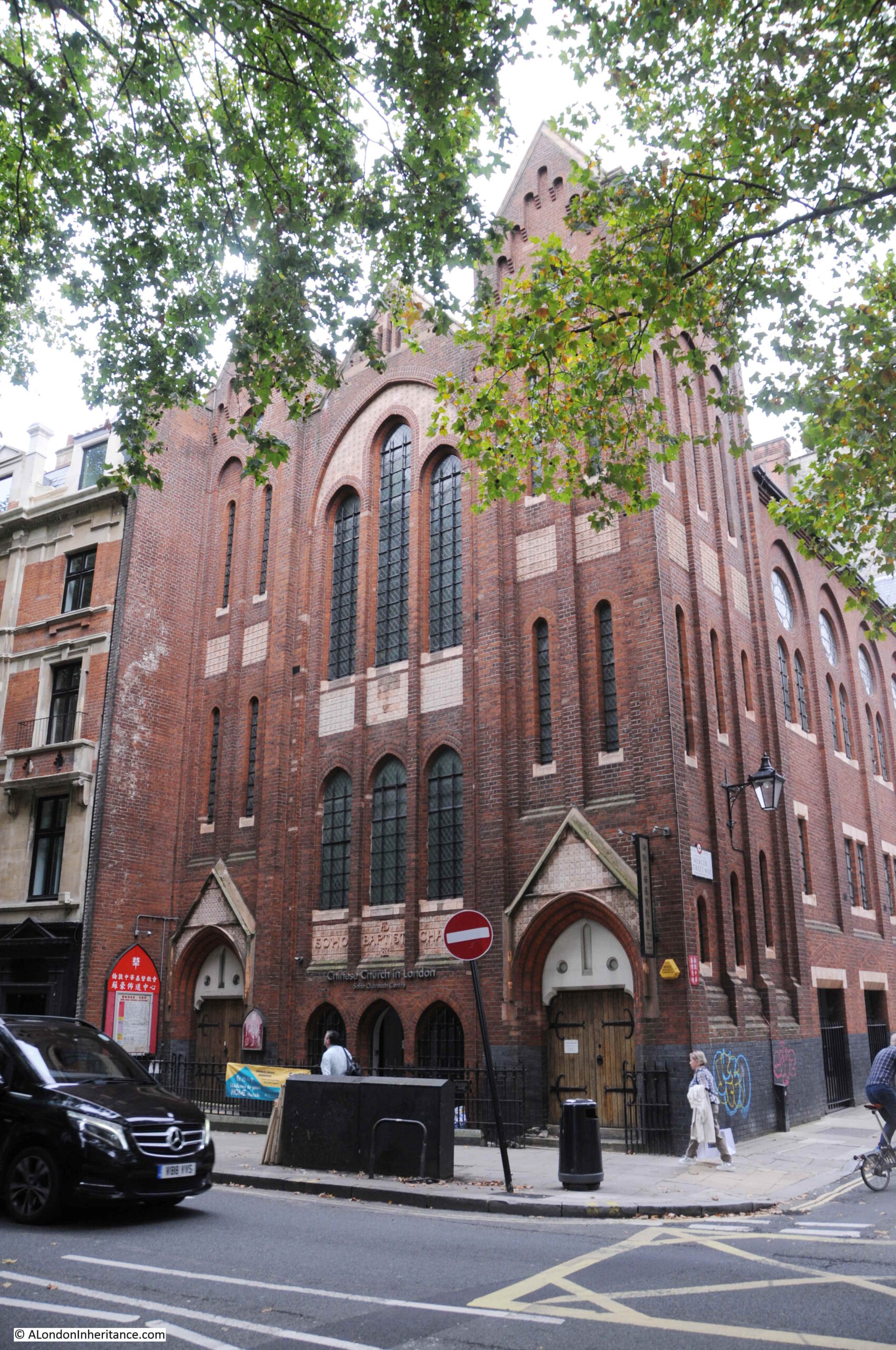
Continuing north along Shaftesbury Avenue and on the corner with Mercer Street is the Soho Baptist Chapel:

Soho Baptist Chapel

Built between 1887 and 1888 (the building work along the street in the few years after completion must have been considerable). The building is now the Chinese Church in London.

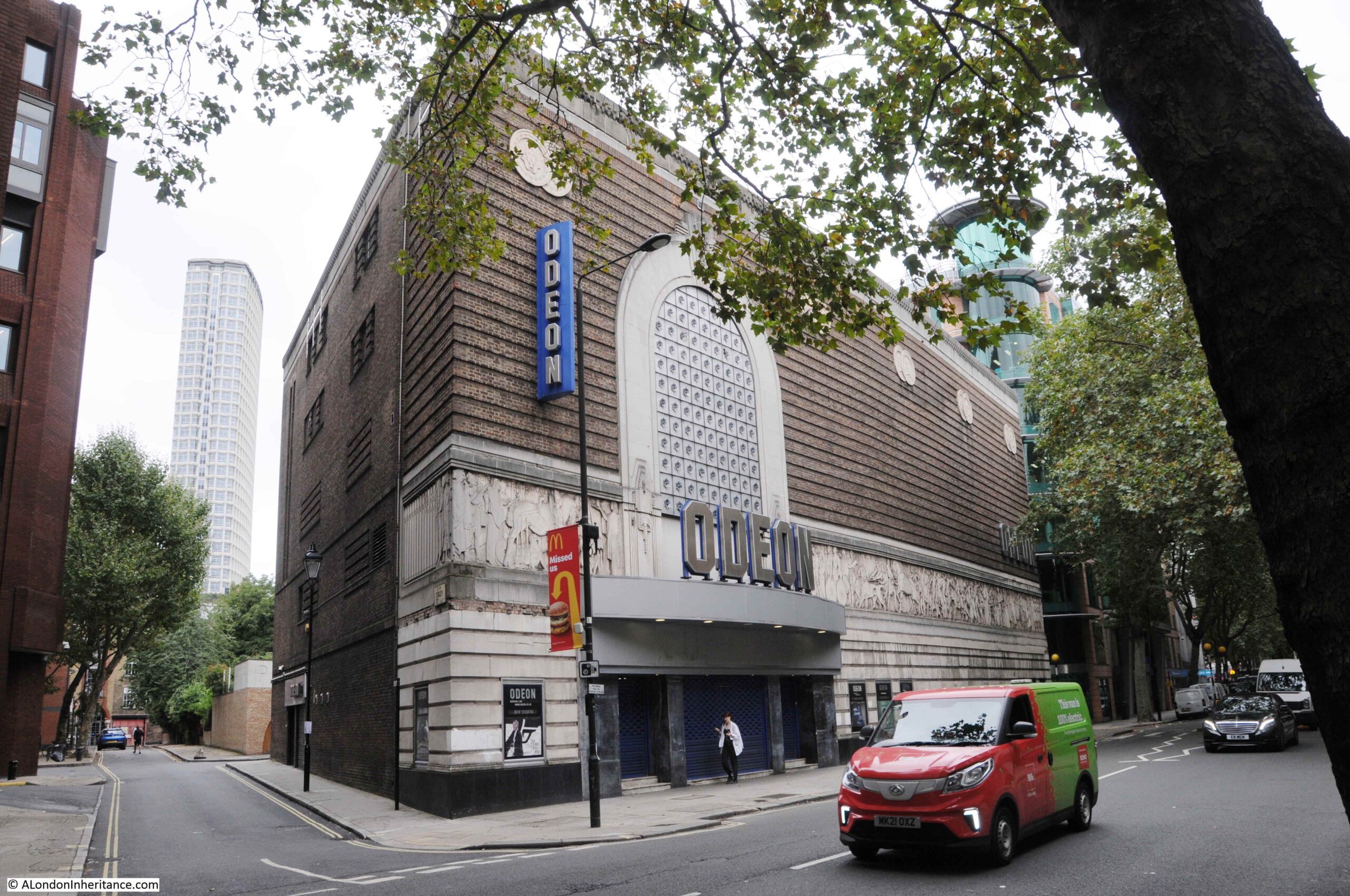
Further along is the Shaftesbury Avenue Odeon:

Odeon Shaftesbury Avenue

The facade is not what you would typically associate with a cinema and gives away the building’s original function. This building was originally the Saville Theatre.

The Saville Theatre opened in 1931 and according to an introduction to the theatre in one of the early theatre programmes was “built by Messrs Gee, Walker and Slater of 32, St. James’s Street, SW1 from plans of the Architects, Messrs T.P. Bennett and Son, of 41 Bedford Row, WC1 who were also responsible for the whole colour scheme, lighting, furnishing etc.”

The exterior of the building looks much the same today as when it first opened as the Saville Theatre, apart from the canopy over the entrance and the glass blocks that now replace the wrought iron windows in the enclosed area above the canopy.

I have written a post on the Saville Theatre and the freeze that runs along the side of the building here.

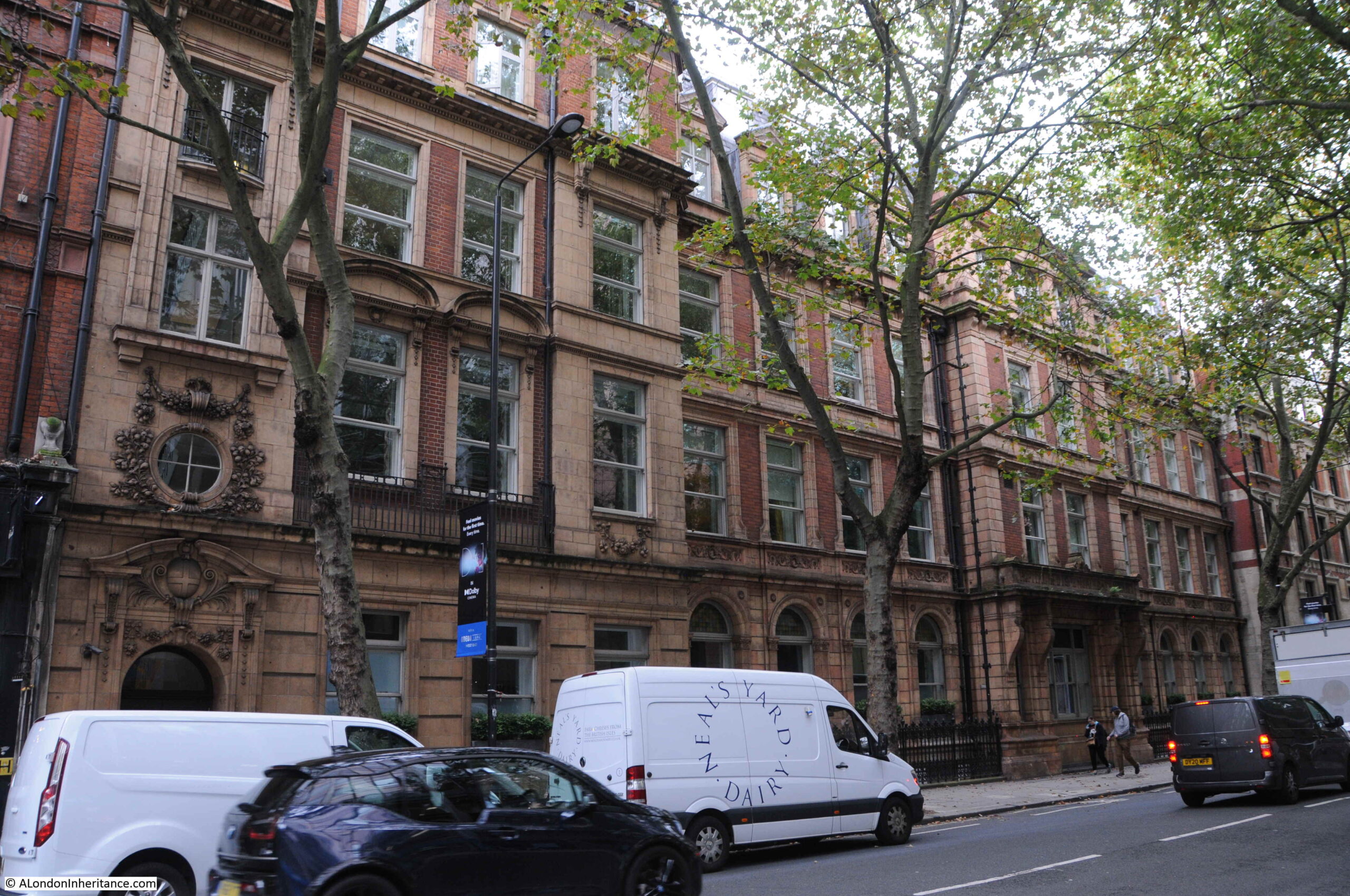
Further along Shaftesbury Avenue is what was the “Hospital et Dispensaire Francais”, or the French Hospital:

French Hospital

The French Hospital was originally at 10 Leicester Place where it had been opened in 1867 by Eugene Rimmel, for “the benefit of distressed foreigners of all nations requiring medical relief”.

The hospital quickly outgrew the original site, and the land adjacent to Shaftesbury Avenue was acquired from the Metropolitan Board of Works, with the new hospital building opening in 1890. A hospital would continue on the site until 1992.

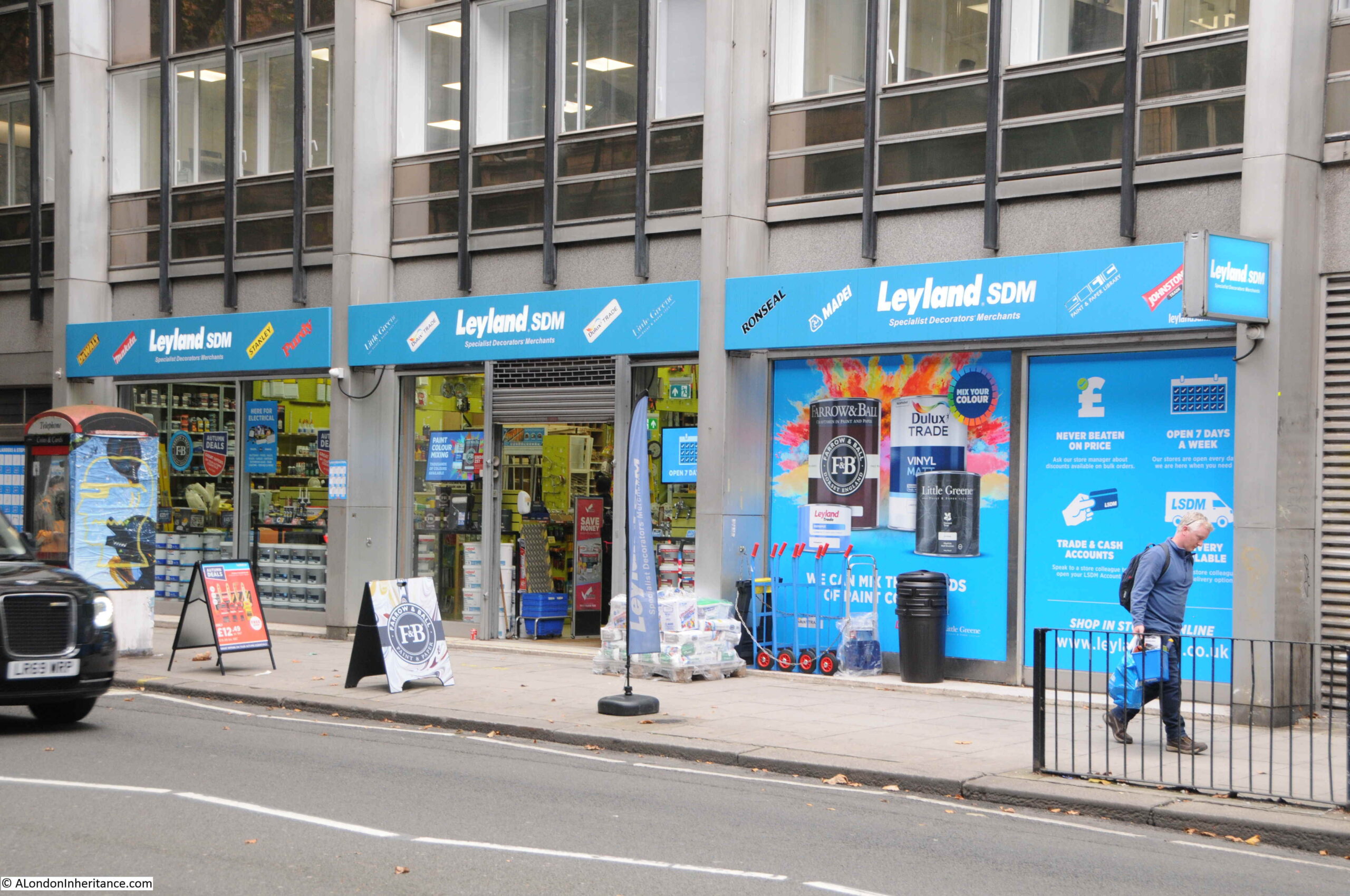
Towards the junction with St Giles High Street and High Holborn, Shaftesbury Avenue has left behind the theatres of the southern part of the street, and we find different types of shops, including a decorating / hardware store:

Leyland

Forbidden Planet:

Forbidden Planet

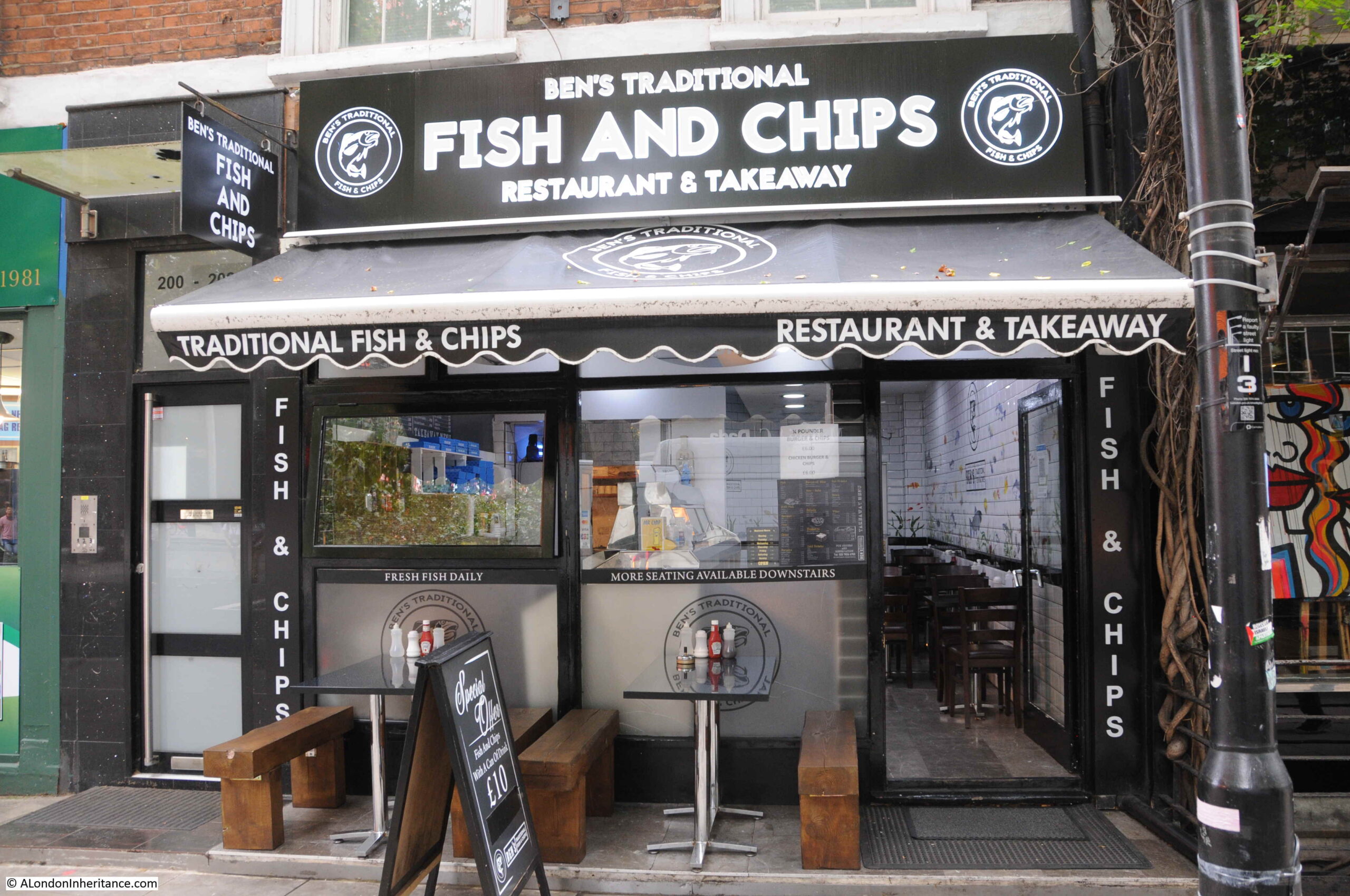
And Ben’s Traditional Fish and Chips:

Fish and Chips

This was also the site of the now closed Arthur Beale, ships chandler.

Looking north across the junction with St Giles High Street on the left and High Holborn on the right with Shaftesbury Avenue continuing north:

St Giles High Street

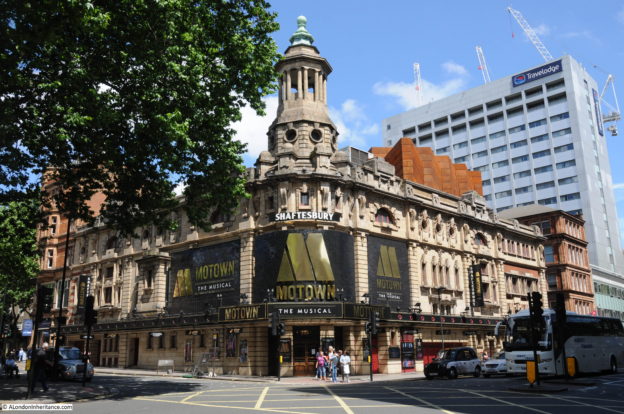
Although the majority of the street’s theatres are in the section of street between Charing Cross Road and Piccadilly Circus, there is another theatre on the corner of Shaftesbury Avenue and High Holborn – the Shaftesbury Theatre:

Shaftesbury Avenue

The Shaftesbury Theatre occupies a prominent corner location. Opened in 1911 it was originally called The Princes Theatre. For over a century the Shaftesbury Theatre has hosted musicals, plays and comedies and in 1968 the run of the musical Hair commenced in September, made possible by the ending of theatre censorship laws on the 26th September 1968 when after 231 years of theatre censorship, the Lord Chamberlain had his powers to censor plays removed.

Hair ran for almost 2,000 performances before it was forced to close owing to structural problems in the building that required urgent restoration work. During closure, there were attempts to redevelop the building, however it was saved as a theatre and reopened in 1974.

We are now coming into the final part of the street, where it joins New Oxford Street, however, there is a change to the original route.

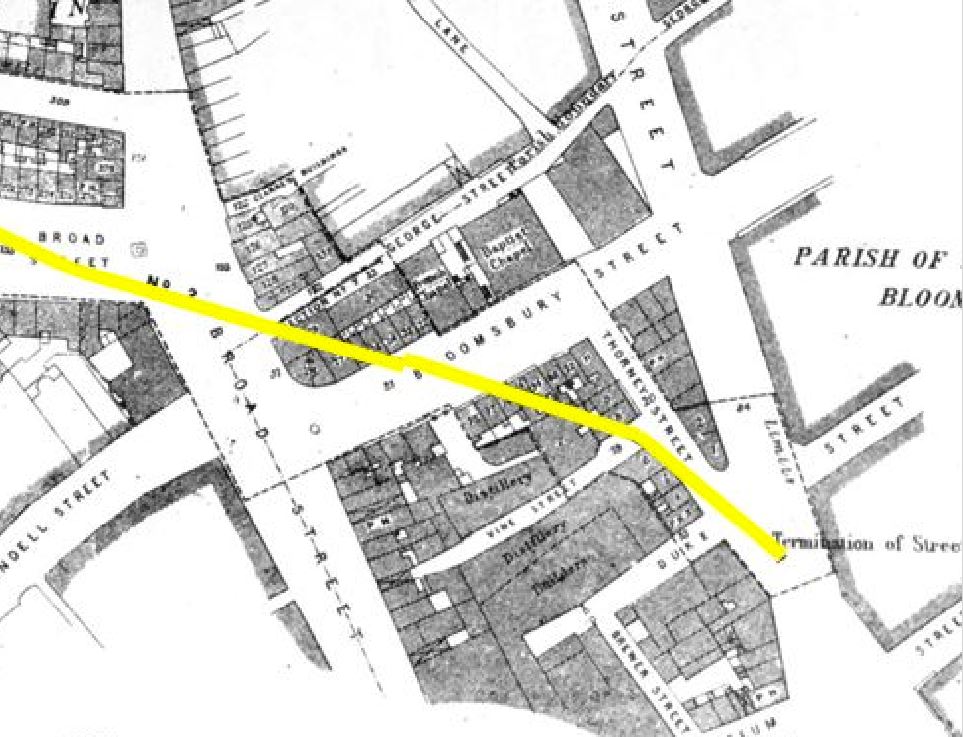
in the following map, the yellow line indicates the route of Shaftesbury Avenue to New Oxford Street on the right, with the text “Termination of Street” showing where the new street would end.

Shaftesbury Avenue

The above map shows the street cutting across a stretch of street labeled Bloomsbury Street, however today, both this small section of Bloomsbury Street and the new street are called Shaftesbury Avenue as shown on the building in the corner where the two sections of the street run to left and right:

Shaftesbury Avenue

Today, the original section of Shaftesbury Avenue is mainly paved, but with a short stretch of street running along one side:

Shaftesbury Avenue

This view is from New Oxford Street looking down where Shaftesbury Avenue originally joined New Oxford Street:

Shaftesbury Avenue

And this is the view down what was the short section of Bloomsbury Street that now forms the junction of Shaftesbury Avenue with New Oxford Street.

Shaftesbury Avenue

Shaftesbury Avenue was completed in January 1886, and provided a new direct route from New Oxford Street to Piccadilly Circus, as well as driving a considerable explosion of building that has resulted in the street we see today, a street that is at the heart of the West End theatre industry.

The street was 3,350 feet long and 60 feet wide. A subway was constructed along the length of the street for gas, water and other assorted pipes.

The gross cost of constructing Shaftesbury Avenue was £1,136,456. The net cost was £758,887 after the sale of surplus land at £377,569.

The street was named after Anthony Ashley-Cooper, 7th Earl of Shaftesbury, who had died in 1885, the year before the new street was completed. The Shaftesbury name was also given to the Shaftesbury Memorial Fountain (probably better known as Eros), in Piccadilly Circus.

Newspapers at the time of his death were full of the philanthropic work of the Earl of Shaftesbury, and his work in Parliament to try and improve working and living conditions. One of these was the so called “Ten Hours Bill”, which although not strictly living up to its name, did look to reduce the hours of work for children.

Considering that this was considered a great improvement, the changes that the bill looked to implement were still horrendous by today’s standards.

With the exception of silk and lace mills, children under the age of nine were not to be employed in factories, while the labour of those under thirteen was to be limited to 48 hours a week, and the employers of all children were required to provide them with not less than two hours schooling a week.

So, going back to the caption at the top of the post, unpacking everything in the photo from the New River Company’s elm pipe excavated when Shaftesbury Avenue was built, and the church of St Anne’s Soho reveals a fascinating history of a small part of the West End.

It would be brilliant to think that there are still some elm pipes buried below the city’s streets just waiting to be discovered.

If you have managed to get to the end of the post, you may be interested in one of my walks. All the Barbican walks have sold out, and there are just a few tickets remaining for the Southbank walk, which can be booked here.

Whitecross Street – Sunday 31st May, 1953

Whitecross Street runs between Old Street and Beech / Chiswell Streets, just north of the Barbican.

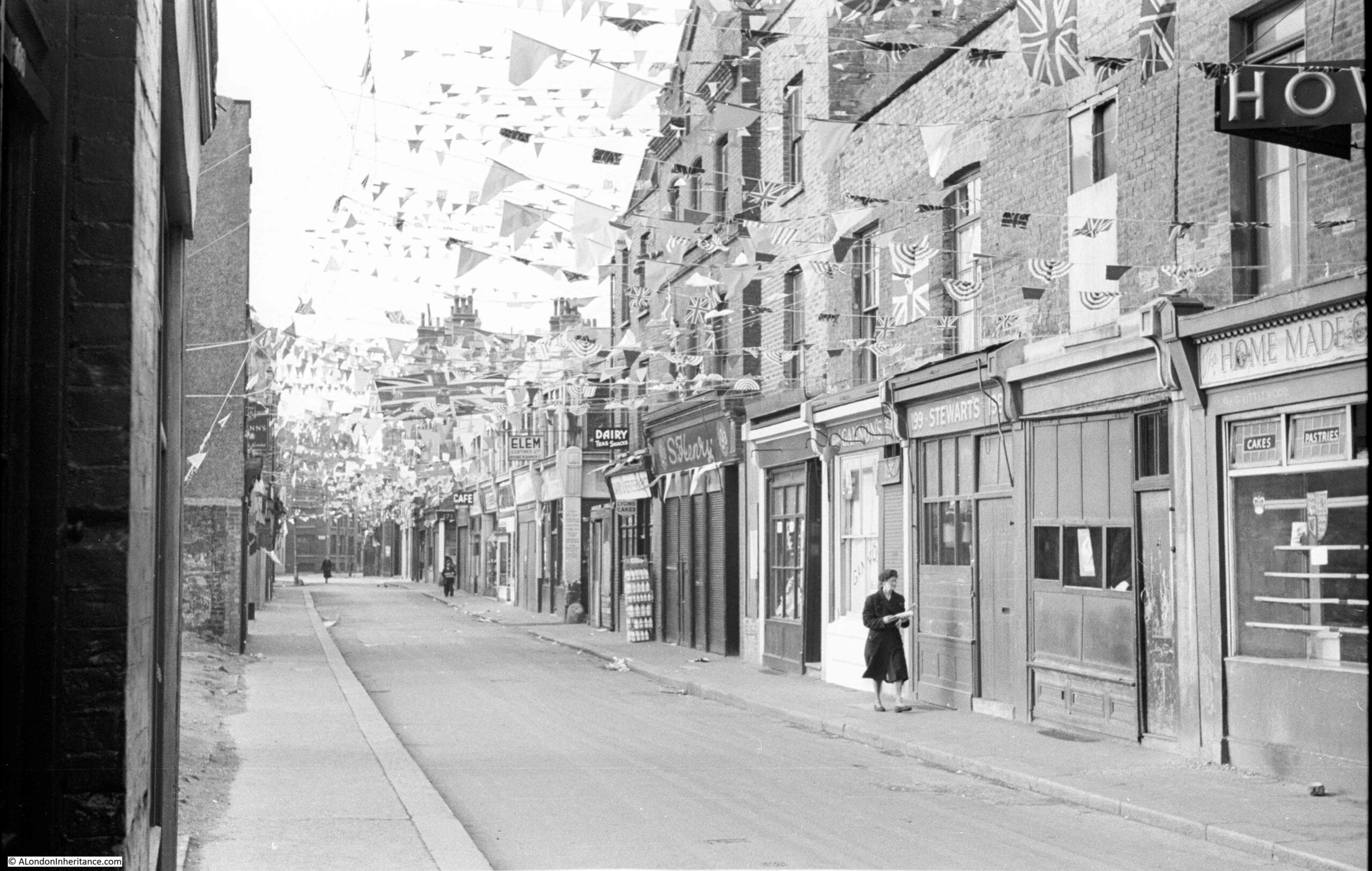
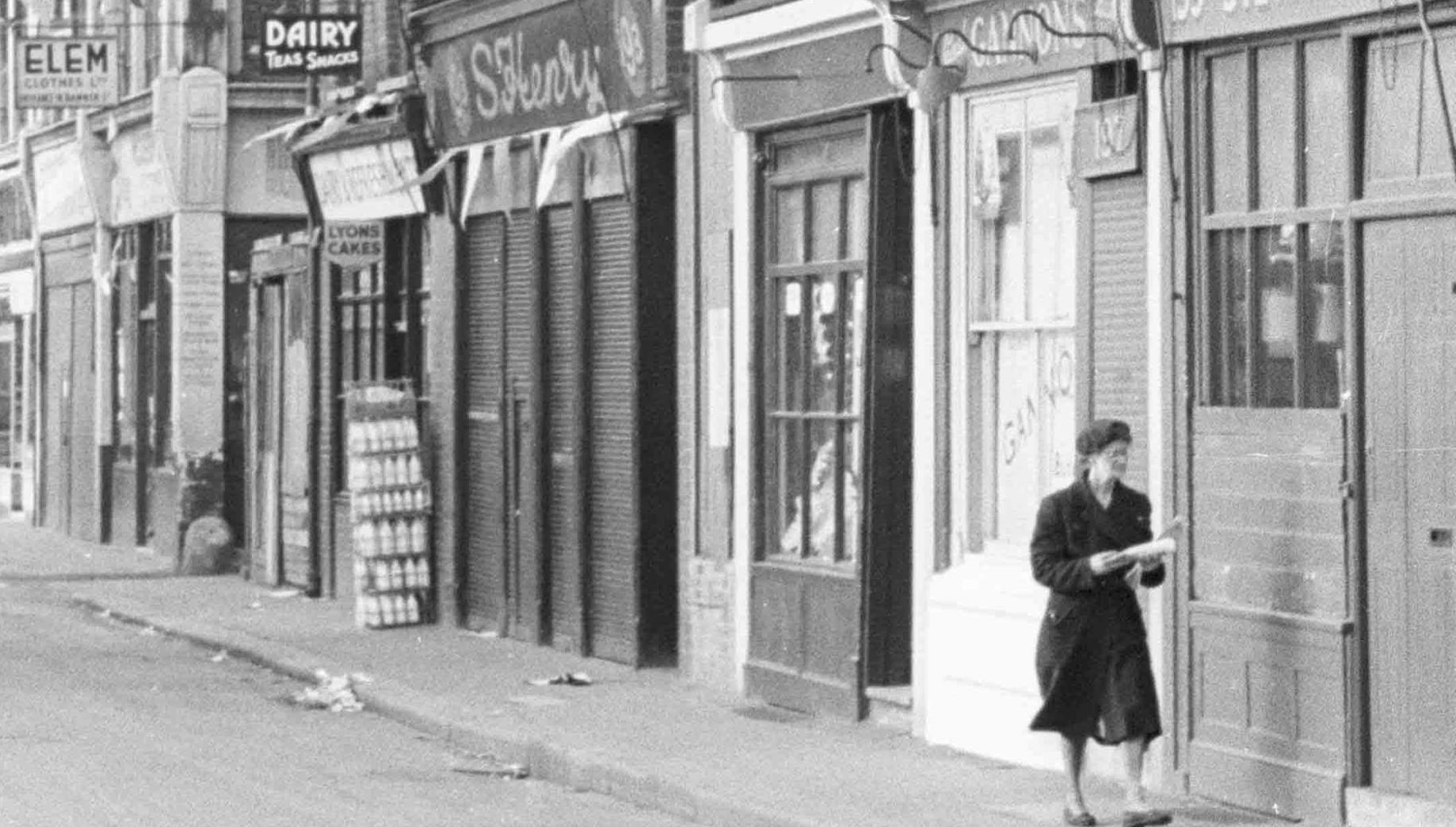
Many of my father’s photos were taken on bike rides around the city, early on a Saturday or Sunday. This worked due to periods away on National Service, work during the week, and other commitments. Early on Sunday, 31st May 1953 he was at the northern end of Whitecross Street and took the following photo looking south along the street:

Whitecross Street

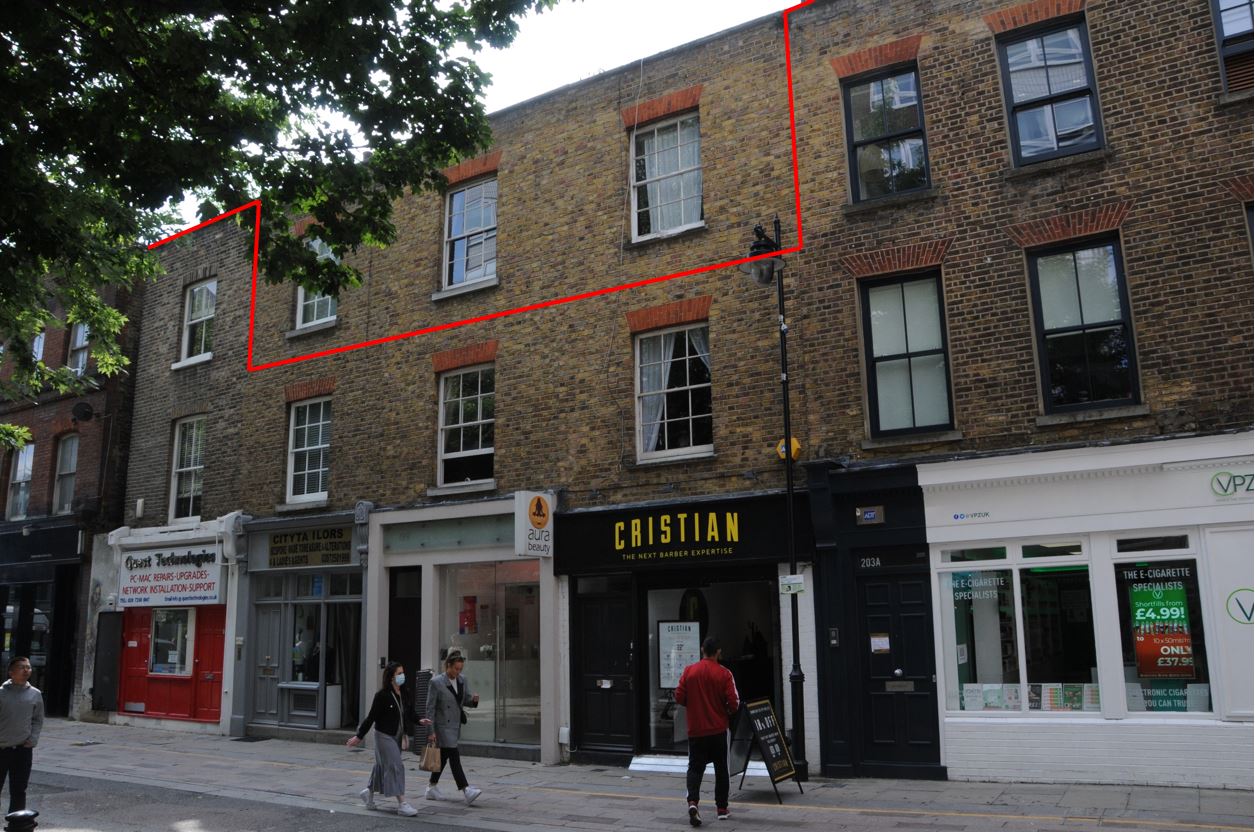
One lunch time a couple of weeks ago I was in the area, and the following photo shows the same view as the above, sixty eight years later:

Whitecross Street

My father’s photo was one of a number he took on the same day in the area of Whitecross Street and also in Hoxton. The 1953 photo was taken a couple of days before the Coronation of Elizabeth II, on Tuesday, 2nd June 1953, and this explains the flags and bunting across the street.

A second photo, a short distance further into Whitecross Street. I suspect he was waiting for the woman to walk further up the street to add a focal point to the photo:

Whitecross Street

The terrace of buildings on the right of the photo have changed in the years between the two photos. The one building that confirms the two views are of the same street is the building with the pediment (the triangular shaped top to the wall) about two thirds of the way down on the right of the street.

Comaprison of the photos also shows that you cannot always trust the age of buildings at first sight. In the above 1953 photos, if we walk towards the camera from the pediment building, there is a narrow, three storey building with a single window at each floor. There is then a terrace of three houses / shops of two storeys, with a shop at ground level and single window / storey above each shop.

in the 2021 photo, this terrace has had an additional floor added to create a three storey terrace along the western side of Whitecross Street.

I have marked how the terrace has changed in the following photo, with the red line indicating the 1953 height of the buildings.

Whitecross Street

In 1953, the shops were the type of local shop serving the daily needs of those who lived in the area. The following is an extract from the second photo. Note the rack of milk bottles standing outside the dairy:

Whitecross Street

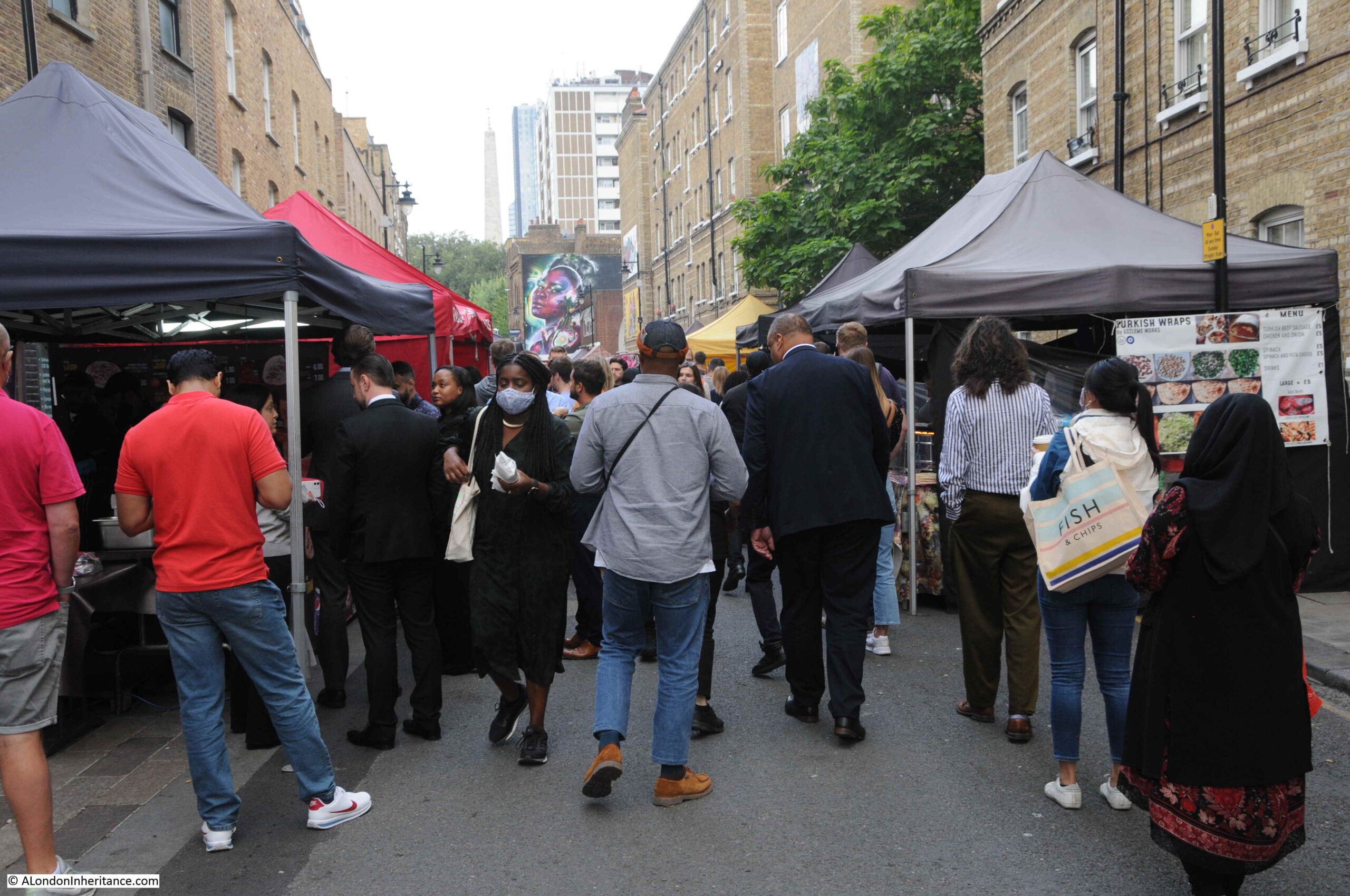
Today, there is a more diverse range of shops, and what was obvious during my walk along Whitecross Street was that the food market running down the centre of the street now serves the local working population, as the street was crowded with those out to buy their lunch.

Whitecross Street can be found just north of the Barbican, linking Beech / Chiswell Streets at the southern end with Old Street to the north. In the following map, Whitecross Street is the street running vertically, in the centre of the map (Map © OpenStreetMap contributors).

Whitecross Street

Whitecross Street was originally much longer than it is now, and it’s southern end was in the heart of Cripplegate. Considerable damage during the last war, and the construction of the Barbican estate has erased roughly one third of the original street.

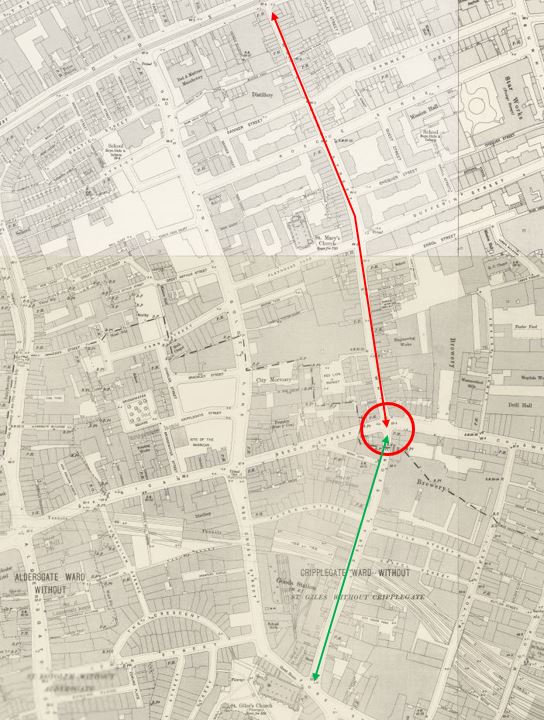
In the following extract from the 1894 Ordnance Survey Map, I have highlighted the street we can walk today by the red arrow (‘Reproduced with the permission of the National Library of Scotland’.

Whitecross Street

The green arrow identifies the missing third of Whitecross Street. Today, a short section is now Silk Street before it terminates at the Barbican.

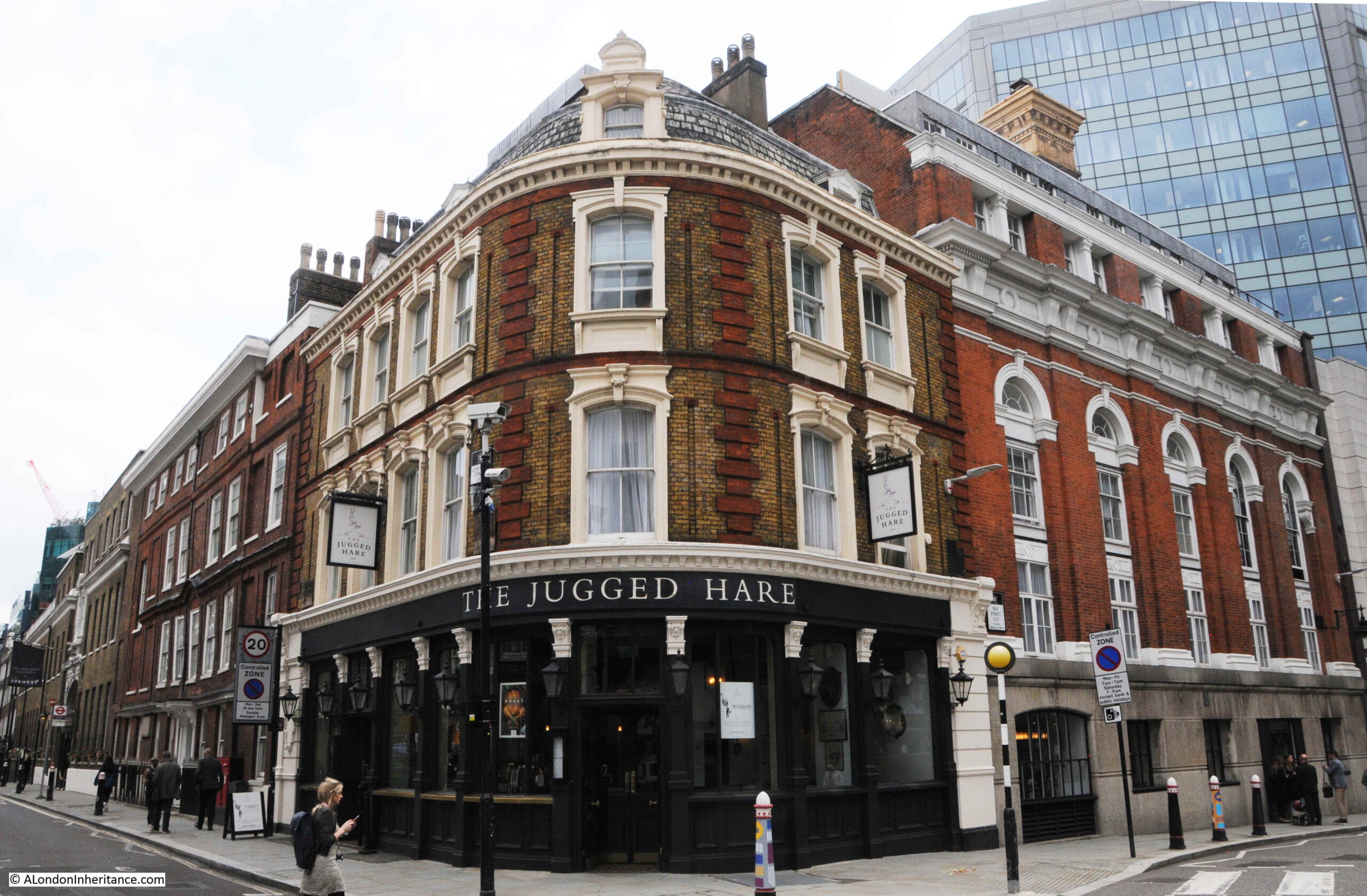
In the red circled area in the above map, there is the PH symbol for a pub on the corner of the lower section of Whitecross Street. The pub, the Jugged Hare, is still there today as shown in the following photo. Originally, Whitecross Street continued to the right, however this has now been renamed Silk Street as it curves to the north of the Barbican to Moor Lane.

Whitecross Street

As can be seen in the 1894 map, Whitecross Street originally joined Fore Street at the north east corner of St Giles, Cripplegate.

In the following photo, this would have been just behind and to the left of the car, and Whitecross Street would have run in front of / underneath the Barbican apartment block Gilbert House, the large block on the left of the photo.

Whitecross Street

Whitecross Street dates back to at least the 13th century, with the first written records of the street as Wytecroychestrate.

The name of the street seems to derive from a white cross located in the street, which seems to be connected to the Abbot of Ramsey who had a house between Whitecross and Redcross Streets (Redcross Street is another old street that was just to the west of Whitecross Street and took its name from another cross in the street. Redcross Street was lost during the construction of the Barbican).

Strype, writing in 1720 includes the following reference to the street: “In this street was a white cross and near it was built an arch of stone under which ran a course of water down to the Moor which is now called Moorfields. Which being too narrow for the free course of water, and so an annoyance to the inhabitants, the twelve men presented it to an inquisition of the Kings Justices, and they presented the Abbot of Ramsey and the Prior of St Trinity, whose predecessors six years past has built a certain stone arch at Whyte Croyse, which arch the aforesaid Abbot and Prior, and their successors ought to maintain and repair.”

Writing in 1756, William Maitland described Whitecross Street as “a place well built and inhabited. It begins in Fore Street and runs northward into Old Street, which is of a great length. But the part within the Ward goes but a little beyond Beech Lane, where the City posts are set up, as they are in Grub Street and in Golden Lane, being the circuits of the Freedom. The street is inhabited by considerable traders and dealers in various branches.”

The Ward that Maitland refers to is Cripplegate Ward and the City posts were the boundary markers showing the extent of the City. The section of the street that was in Cripplegate is now that renamed Silk Street, along with the section under the Barbican.

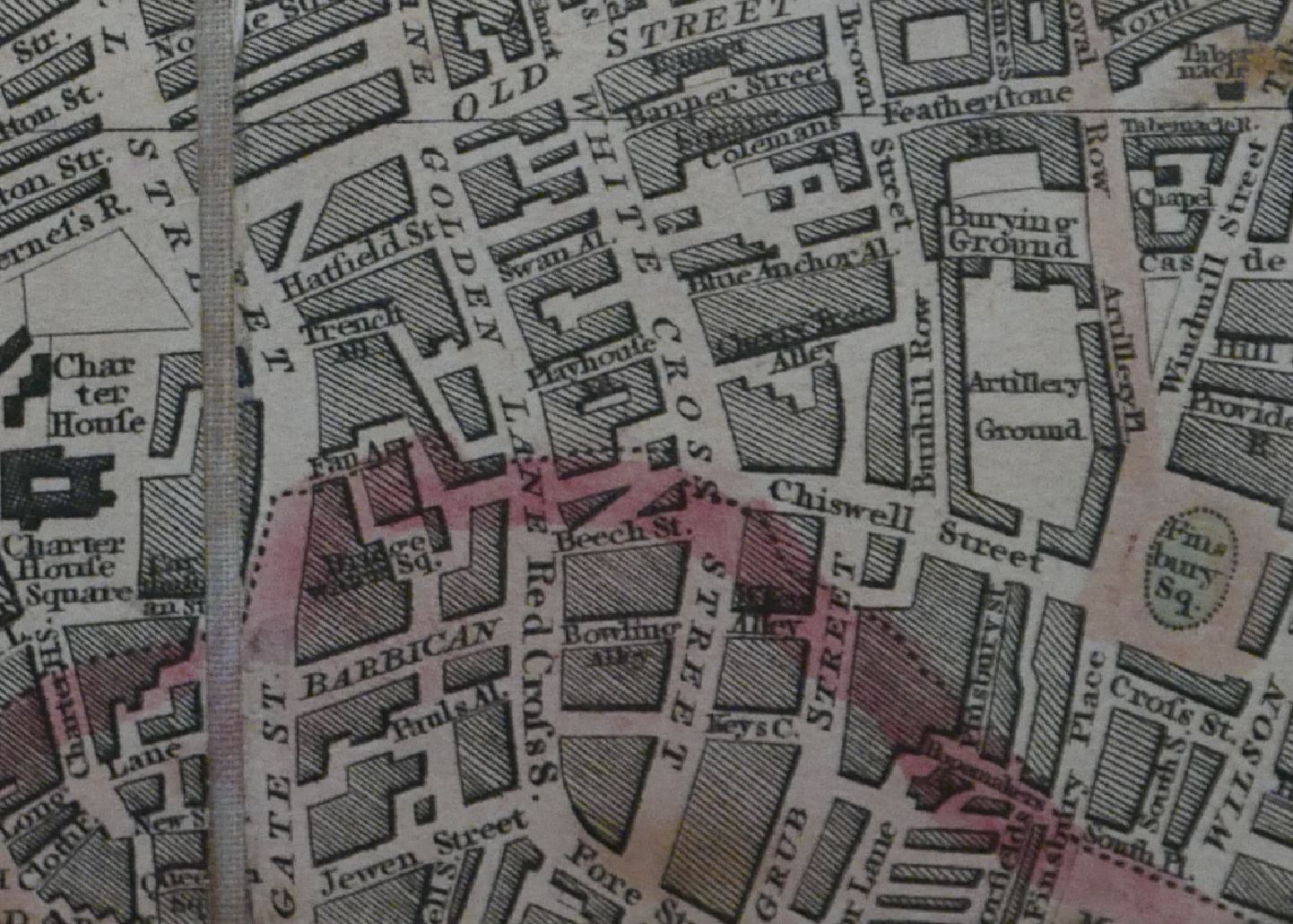
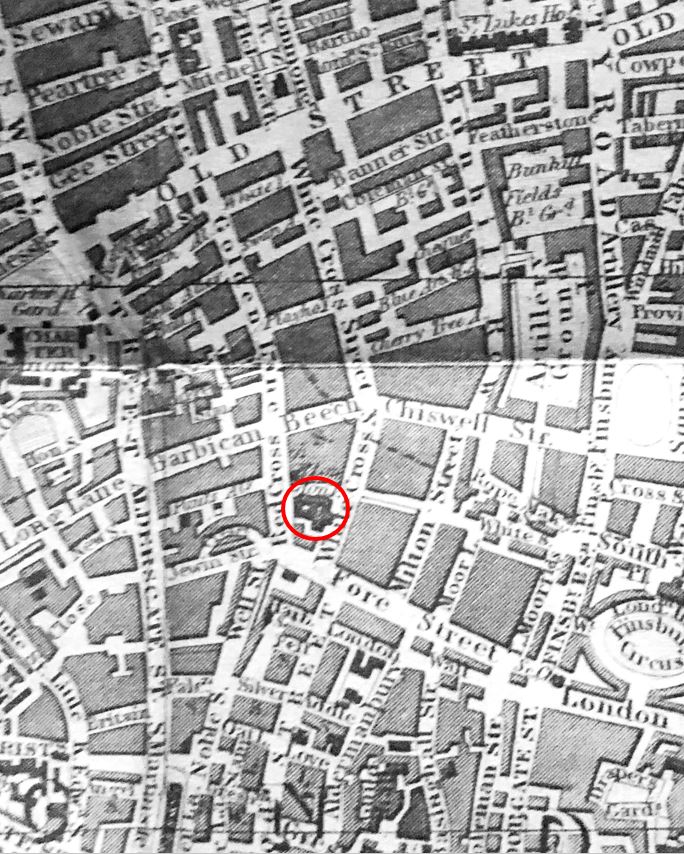
The City boundary can be seen in the following extract from Smith’s 1816 New Plan of London, where the boundary is the dotted line and pink highlighting. The boundary can be seen cutting across Whitecross Street at the junction of Chiswell and Beech Streets.

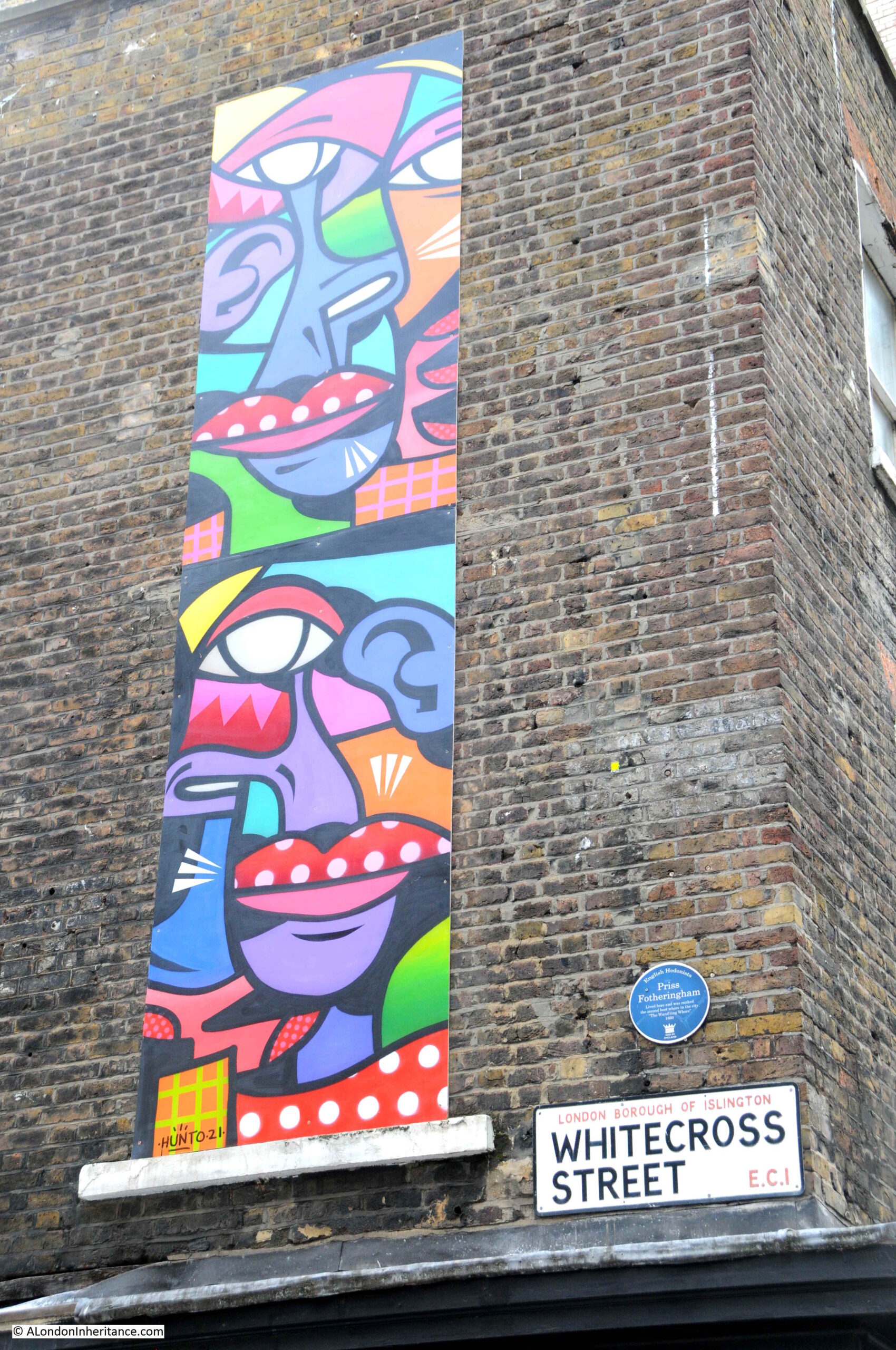
Today, there are still “considerable traders and dealers” in Whitecross Street, and the street is also a centre for public art that can be found covering many of the walls along the street. The entrance to Whitecross Street from Old Street:

Whitecross Street

The blue plaque was put up by English Hedonists, and is to Priss Fotheringham, who “Lived here and was ranked the second best whore in the city”.

Priss was mentioned in the collection of pamphlets under the name of “The Wandering Whore” by John Garfield, published between 1660 and 1661, where, in a contrived conversation between two sex workers (probably invented by the author), the activity which seems to have brought Priss fame and some wealth is described “Priss stood upon her head with naked breech and belly whilst four Cully-Rumpers chuck’t in sixteen Half-crowns into her Comodity”.

Whitecross Street is mentioned a number of times in the pamphlets, including the lists of “Common Whores, Night-walkers, Pick-pockets, Wanders and Shop-Lifters and Whippers”, where for example “Mrs Smith, a Bricklayers wife in Whitecross” is mentioned, along with “Mrs Savage in Whitecross-street, who broke her husband’s head with a marrow-bone, and had liked to have kill’d him with it”.

The street was much improved by 1800, when it was described as “A good street, and has among the buildings, the Peacock brew house, the Green Yard, where strayed cattle are pounded, and where the Lord Mayor’s state coach is kept.”

Walking down the street, and this is the building that helped with identification of my father’s photo:

Whitecross Street

The following building appears further down the street in my father’s photos, so although not an 18th or 19th century brick terrace, the building is pre-war. I obviously read too many archaeology websites and books, as every time I see the café on the corner, Museum of London Archeology is the first thing I think of.

Whitecross Street

The Whitecross Tap:

Whitecross Street

The Whitecross Tap is a relatively recent name, dating from 2018, however a pub has been on the site since the 18th century.

Looking south along Whitecross Street at the junction with Banner Street:

Whitecross Street

The street has a very diverse mix of architectural styles, which make the street interesting. Different heights, materials, windows and function all jostle for prominence.

Whitecross Street

Street art is visible along much of the street:

Public Art

The art along the street is the result of the Whitecross Street Party and the Rise of the Nonconformists exhibition, an annual event that has been taking place for the last 11 or 12 years, taking place over a weekend when there are multiple events in the street, and street artists can be watched as they create new works.

Public Art

A pub that has been converted to a coffee shop. This was the Green Man pub:

Whitecross Street

More art on the side of the Peabody Estate between Whitecross Street and Cahill Street. Most of the estate was built in the 1880s.

Public Art

Whitecross Street has had a market for very many years. It was once a street market that sold the everyday needs of those living in the area; a typical London street market, however like the majority of other London street markets, today it mainly caters for the lunchtime needs of those who work in the area.

Whitecross Street Market

It was a very different place not that many years ago, and the change to the food market we see today has been relatively recent. A newspaper report from February 1871 provides a graphic description of the market as it was;

“Out-dinning the din of the Whitecross-street Sunday morning market, the roar of leather lunged costermongers and barrowmen, the deafening eloquence of the clashing knives and steel of opposition butchers, the shrill cries of women who have potherbs, and children’s toys and second-hand shoes and boots on sale. The wrathful high pitched voice of the street preacher at this corner of an alley, unable to make himself heard amid the laughter created by a quack dealer in sarsaparilla at the other corner, over all these conflicting noises the sound of a bell was heard distinctly – not the measured chiming of a church bell, nor the preemptory clatter of a factory bell, but a fitful and uncertain ringing, now loud and heavy like a fire bell. A gentlemen in the baked potato interest, however, to whom I applied for information on the subject, ruthlessly stripped the bell of everything in the shape of romance. it is the Costers Mission Bell, said he.”

The market seems to have started around 1830. In the Clerkenwell News dated the 2nd November 1865, there is a report of a Vestry meeting, where the work of a recently appointed “street keeper” who was responsible for the upkeep and cleanliness of Whitecross Street and the adjacent alleys, courts and streets was discussed. The concern was the work was too much, as “Amongst other things he was required to be in attendance during the day in Whitecross-street as a market”.

There was consideration given to removing the market, however the Vestry Clerk stated “As to the market in Whitecross-street, stalls had been allowed to be there for upwards of thirty years, and could not very easily be removed now”.

No idea if there is a similar role as a “street keeper” today, however the market is very busy each lunch time.

Whitecross Street Market

With almost any combination of street food you could want:

Whitecross Street Market

With queues forming at many of the stalls:

Whitecross Street Market

There is a plaque on the corner of Whitecross Street and Dufferin Street:

Whitecross Street Prison

The plaque is a long way from the actual location of the prison, which was at the southern end of Whitecross Street, between Whitecross, Redcross and Fore Streets. The following extract from the 1847 edition of Reynolds’s Splendid New Map of London shows the location of the prison, circled in red.

Whitecross Street Prison

Today, the site of the prison is underneath the Barbican. In the following photo, I am looking across to the Barbican Centre from near the tower of St Giles. Gilbert House is on the right. The Whitecross Street prison was on the site of the building with white panels on the lower floors. Redcross Street ran to the left of the photo. Whitecross Street ran under / in front of Gilbert House.

Whitecross Street Prison

The prison was a debtors prison. Prior to Whitecross, if you were in debt and could not pay these off, then you could find yourself in a prison along with those being tried or convicted of a criminal offences ranging from petty crimes to murder.

In the early years of the 19th century there was a campaign to separate debtors from criminals, and the Whitecross Street prison was the result, being built between 1813 and 1815.

Although a prison full of debtors could be just as difficult to manage as a normal prison, as this article from the London Commercial Chronicle on the 17th September, 1816 reports:

“RIOT IN WHITECROSS-STREET PRISON. On Saturday evening another riot broke out in this prison among the confined debtors. it appears that a prisoner had committed some offence, for which the other prisoners thought proper to pump him. Mr. Kirby, the keeper, being informed of the transaction, found out two of the principals, and insisted upon locking them up, which was accordingly done. The rest of the prisoners resisted, and at length broke out into open rebellion, refusing to be locked up in their wards. Finding them continue refractory, a reinforcement of officers was sent for; and the City Marshal, accompanied by a posse of constables, speedily arrived, when the rioters submitted, and tranquility was restored.”

However, by 1834, the prison seems to have established a community feel. The Monthly Magazine reported the views “From an Inmate of Whitecross prison”:

“I have been a wanderer over a large portion of the globe during the last fifteen years, and have had various opportunities of seeing and studying men of many nations. In earlier life I saw much of France and Frenchmen; from them I have received the greatest kindness – and great hospitality. I have dwelt with Germans and Dutchmen, and the most agreeable recollections are connected with my sojourn among them. After years in official life, thousands of miles from ‘fair England’ circumstances threw me into the midst of Swedes, Danes and Spaniards, all of whom have given me opportunities of lending their kindness and generosity; but I have never in my life saw so perfect a display of the best feelings of our nature, as are in daily action and continual exercise under this roof. The society here appears one large brotherhood.

Association in sorrow softens and ameliorates the heart; selfishness is, perhaps, less known in this place than in any other ‘haunt of society’. The poorest captive shares with real pleasure his meagre meal with his less fortunate neighbour; kindness of heart shines in brightest splendour”.

Whitecross Street prison closed in 1870. The number of debtors had been declining, and an Act of Parliament had come into force abolishing imprisonment for debt. A report from the 8th January 1870 illustrates the unusual scenes when the prison was closed:

“SCENE AT WHITECROSS STREET PRISON: Release of the Prisoners – On Saturday, just after twelve, being the 1st of January, the day on which the new act to abolish imprisonment for debt came into force, Mr. Constable, the keeper of Whitecross-street Prison, gave as many as 94 prisoners leave to go out of prison. Of that number 63 prisoners availed themselves of the offer, and 31 asked to remain in the place for another day. Only 41 remain in custody on county court commitments, penalties, and orders for payment by magistrates. About eleven o’clock, a person named Barnacles, who had been twenty-seven years a prisoner, on an order from the Court of Admiralty, was told by Mr. Constable to leave the place, and he went out staring about him after his long imprisonment. Mr. Constable has acted in a humane manner, instead of prolonging the imprisonment of the parties until applications were made to a judge at chambers.”

One can only imagine Barnacles confusion as he left prison. He had been in the Whitecross prison for half of the prison’s existence.

Whitecross Street Prison for Debtors as it appeared in 1850 (© The Trustees of the British Museum):

Whitecross Street Prison

The Two Brewers pub on the corner of Whitecross Street and Fortune Street. A pub has been here since the mid 18th century.

Whitecross Street

More street art:

Public Art

The market occupies the northern section of Whitecross Street, leaving the southern section free. The Barbican can be seen at the end of the view, which now covers the lower section of the original Whitecross Street.

Whitecross Street

Much of Whitecross Street suffered severe damage during the bombing of the early 1940s. Whilst a number of the original brick terrace houses did survive, others have been significantly repaired and some have been rebuilt to look similar to the original building.

At other places along the street, completely new blocks have been constructed over bomb damaged areas, including this large block on the south-eastern side of the street, which includes a Waitrose on the ground floor behind the covered market area.

Whitecross Street

However the pleasure of Whitecross Street is that there are many of the buildings and small shops remaining, similar to those photographed by my father in 1953.

Whitecross Street

Whitecross Street is today much shorter than the pre-war street. As with so many streets in the area between Old Street and London Wall, post war development of the Barbican and Golden Lane estates have obliterated so many historic streets.

The side streets also have much to tell of the history of the area, and it is a fascinating area to explore. Although best not to follow Barnacles example of a long period of imprisonment, his approach on leaving Whitecross Street prison of “staring about” is a good approach when wandering the area.

alondoninheritance.com

Living in Stepney

Build Back Better has been a slogan much in evidence over the last year, however without a clear understanding of the problems that need to be fixed, or a plan for how to fix them, slogans often end up as meaningless statements.

In the 1940s there were a number of studies and plans published, recommending how London should rebuild after the devastation of the war. How this was an opportunity, to use the current slogan, to “Build Back Better”.

I have covered a number of these plans in previous posts such as the 1943 County of London Plan, 1944 Post War Reconstruction of the City of London, and the report of the 1944 Railway (London Plan) Committee.

London’s boroughs also wanted to improve the living conditions of their residents, and to fix many of the problems that had built up over decades of unrestricted growth that had resulted in some boroughs having the most over crowded, densely built housing in the country.

One such borough was Stepney, and the independent Stepney Reconstruction Group, Toynbee Hall published their report in 1945, detailing the past and present in Stepney with proposals for the future.

The report was titled “Living in Stepney”:

Living in Stepney

The Stepney Reconstruction Group was an unofficial group, led by Dr. J.J. Mallon, the Warden of Toynbee Hall. The group had been working through the early years of the 1940s, studying the causes of bad living conditions in the borough and the impact of various London wide plans that were being developed. In 1943 the group held an exhibition titled “Stepney Today and Tomorrow” at the Whitechapel Art Gallery.

The 1945 written report, Living in Stepney, was the group’s attempt to summarise the past, present and possible future of the borough, and to encourage those who lived in Stepney to engage with their elected representatives to ensure that their views were taken into account.

The first chapter of the report gives an indication of the themes that the report would address – Crowding, Congestion and Chaos.

The borough of Stepney was formed in 1900 through the consolidation of a number of east London parishes. It would last as an indepent borough through to 1965 when it was in turn consolidated into the larger London Borough of Tower Hamlets.

The key driver to the growth of Stepney was the Thames, along with the docks that would take over the southern part of the borough along the river. Docks, industry and the need to house thousands of workers created uncontrolled growth that would lead to dense housing with many people to a house. Lack of green space, health problems, poverty and misery would characterise much of the area.

Living in Stepney provides a comparison with the City of Plymouth. Before the war, Stepney had a population almost as large as Plymouth, but occupied less than a fifth of the area of Plymouth.

Proximity to the docks resulted in much damage through wartime bombing. The report highlights the democratic test for the future of the borough “Here came the blitz, where many had died before through poverty and slums, and little was done. Here the sincerity of democracy will be tested”.

The central area in the following map dated from 1833 shows the area that would become the Borough of Stepney.

Living in Stepney

Building had initially extended along the river from the City to the left, and then continued in land to where the original village of Stepney was located, around the church of St. Dunstan And All Saints. In 1833, the area from Bow Common onwards was still mainly open land, but this would change during the rest of the 19th century as London continued its eastward expansion.

The report identifies four phases in the growth of the borough:

  • 1000 to 1800: The Riverside Village
  • 1800 to 1870: Unplanned Growth
  • 1870 to 1914: No More Room
  • 1919 to 1939: Half-Planned Social Services

The period from the end of the First to the start of the Second World Wars were characterised by Borough Council and London County Council attempts to improve housing conditions as these were the only organisations undertaking any new building, apart from some limited building by housing associations and larger private owners. Almost no rebuilding was undertaken by private estate owners and very few houses were reconditioned to modern standards and repairs to the housing stock were frequently neglected.

In the late 19th century, where rebuilding did take place, it was often at the expense of those living in the buildings to be demolished. The following photo from Living in Stepney is titled “Tenants evicted from slums for the new model blocks to be built”.

Living in Stepney

Also illustrated are some of the dense housing and limited outside space of many of the buildings in Stepney, including Paragon Mansions, Stepney Green:

Living in Stepney

Pre-war housing development by the London County Council, also had the effect of reducing the population of Stepney by relocating people as the slums were cleared. The following map shows the distribution of 3,478 Stepney families as they were moved out of the borough to new LCC estates during slum clearances between 1932 and 1938.

Living in Stepney

Whilst these clearances started to reduce overcrowding in the borough, the impact of these relocations was the break-up of established communities. The report states that whilst the new estates to which people were moved were more healthy locations, they “did not have the social amenities of Stepney. There were not enough pubs, or shops, and far too few clubs or social centres”.

Living in Stepney illustrates the pre-war choice offered to those being moved, from: “A crowded flat”:

Living in Stepney

“With work on top of you”:

Living in Stepney

To a “modern house with a garden in the suburbs (in Dagenham)”:

Living in Stepney

“But with a long journey to work”:

Living in Stepney

This was the challenge with pre-war housing strategy. The London County Council was making considerable improvements in housing standards, however these often meant relocation and the break up of communities which would take time to reestablish, along with the failure to provide social facilities in the new estate.

The impact to these communities was very clear to me when I went to find one of my father’s photos from east London in 1949. I wrote about Hardinge Street, Johnson Street And Ratcliffe Gas Works, with Hardinge Street being a street just off Cable Street, a third of a mile east of Shadwell Station. The was the view of the street in 1949:

Hardinge Street

And following post war redevelopment, all the streets, shops and pubs in the above photos were demolished and the population dispersed. This was exactly the same view a couple of years ago:

Hardinge Street

The arch of the railway bridge being the only part of the 1949 view that remains.

Living in Stepney has a section on “community”, and includes a description of the old parishes that consolidated into the Borough of Stepney. These parishes still had their own characteristics which the report describes:

Wapping is an island which lives to itself. Access is not easy, as no buses pass that way, and there is only the underground line from Whitechapel. The nearest market is Watney Street, and there is no cinema nearby. The population is largely Irish in origin and is strongly attached to the area.

The areas adjoining the City are crowded with factories and warehouses. Spitalfields is a largely Jewish area, where old eighteenth century weavers’ houses, factories workshops, and old fashioned tenements jostle with a large number of common lodging houses. There are few open spaces.

Whitechapel is not so crowded, but presents similar problems. It is in these areas that industry has taken over space from housing, and there has been the largest fall in population.

Mile End and Bow Common were laid out at a later date. Around Burdett Road, once lived a wealthy class who kept carriages. The houses are larger, with gardens, and there are trees in the streets. There is not the same congestion as in the other areas in the West of the Borough.

Limehouse is still a place of ships and seamen and many work to provide their needs. It suffers from being cut up by the canal and railways, and from too much industry, but the old centre remains.

St George’s is one of the most crowded areas of Stepney. In the west live foreign seamen, and a coloured population. There are many Jewish people, but they do not extend much east of Cannon Street Road.

Towards Shadwell are to be found some of the most typical East End streets. Shadwell and Ratcliffe merge into St George’s and Limehouse, but across Commercial Road, Stepney is different. Here are better houses and squares and some well laid out streets, and the houses are old. But around the Commercial Road Gas Works, there was, before the blitz, an area of bad houses”

Living in Stepney illustrated a section titled “What is Wrong With Stepney”:

“Old Damp Houses, mostly 100 years old, with no bathrooms, usually only one tap and the lavatory outside and often shared”

Terrace housing

Crowded Houses, with no space for a garden or proper yard, block out light and air. Dull monotonous streets waste space”

Living in Stepney

“Overcrowding, which is intense, mainly hits large families with children. Stepney had more overcrowding than any London borough. 60 per cent of all families share houses”

Living in Stepney

“Small workshops crowd the ground, using valuable space, and creating unhealthy working conditions. This court was partly cleared in 1937, but there are many like it”

Living in Stepney

“Clubs and Social Centres have not proper buildings. Voluntary bodies have done wonders, but all needs have not been met. Some areas are badly served”

Living in Stepney

“Open Spaces hardly exist in Stepney – 45 acres for 200,000 people in 1938. Children have to play in the street, the great playground and meeting place”

Living in Stepney

“Commercial Road – typical combined main road and commercial centre, causing accidents and traffic congestion. With control of advertisements and buildings it could be a fine street”

Living in Stepney

Living in Stepney includes the following graphics which highlight the impact of overcrowding and compares Stepney with the more affluent and less crowded Lewisham:

Living in Stepney

The lower part of the page identifies the causes of crowding, although in 1945, and just before the start of the war, the population of Stepney had been in decline since the start of the 20th century. The report provides the following summary of Stepney’s population:

Stepney population

Along with some facts on the 1938 population:

Housing space

The themes identified in the above graphics from the 1945 report can still be seen today. In 1945 there were a higher number of deaths per thousand in Stepney than Lewisham, and a considerably greater infant mortality.

The same issues can be seen today, both nationally and within London. The following table comes from the Office for National Statistics latest release “Life expectancy for local areas of the UK: between 2001 to 2003 and 2017 to 2019 and shows that for males within Westminster and Tower Hamlets (of which Stepney is now part), the life expectancy in Westminster is currently 4.53 years longer than that in Tower Hamlets:

Life expectancy

The above graphic also identifies land prices as one of the problems with rebuilding at lower densities and with the provision of open space, with land in 1945 being worth between £10,000 and £30,000 per acre.

The situation is probably even worse today, with land prices explaining why most residential building today appears to be high density apartment blocks. According to the Economic Evidence Base published in 2016 by the Mayor of London, residential land prices in East London were £7.3 million per hectare. (A hectare is 2.47 acres, so the equivalent in 1945 would have been £74,100 to today’s £7.3M).

Living in Stepney also includes a graphic which identifies the cause of high land prices, with the landowner benefiting whilst the tenant pays in rent, rates and the cost of goods.

if landlords do not rebuild, the local authority has to house as many people on a site, so opts for higher density housing, and with more rents coming in for both private landlords and local authorities, the value of land increases – a vicious circle.

Land costs

Many of these themes still drive land prices today, and is one of the reasons why London’s skyline is growing taller, and why Vauxhall in now growing a collection of densely built apartment towers.

On the left of the above graphic is Industry, and in 1938 there was a considerable range of industry in Stepney. In addition to the Docks, there were metal working firms, paint and oil seed crushing firms, printing works, drug, soap and other chemical works, wood, furniture and building firms, and the gas and electricity works. The clothing industry was the largest employer as illustrated in the following summary of how the 140,000 workers were employed in the borough (although slightly more were employed in the general business of buying, selling and distribution):

Stepney jobs

Living in Stepney notes that although the Clothing industry was the largest employer, work was carried out in few large factories, with the majority of workers employed in small, unhealthy workshops in houses and backyards.

The 7% unemployed may give the impression that compared to some impressions of employment in east London, the percentage in Stepney was relatively low, however 7% masks the highly variable nature of employment in the Docks and the Clothing trades, as for many work was precarious, and the unemployment figure could rise or fall considerably within a short period of time.

In asking “Who Governs Stepney”, the report illustrated how the rates were spent, by the two authorities responsible for different aspects of Stepney’s governance – the London County Council and the Borough Council.

Firstly, the responsibilities of the London County Council, and the money spent from the rates on each of their responsibilities:

Stepney council rates

The Borough Council was responsible for many local services, such as street lighting, libraries, public bathes, roads and sewers:

Stepney council rates

Living in Stepney makes a number of recommendations for how Stepney should be transformed. Housing was a big concern, for many of the reasons already stated. Over 90% of families in Stepney did not have a bathroom. Two thirds of families lived in a shared house, and whilst this was less than other parts of London, in Stepney, the high number of small terrace houses meant that where they shared, families lived in much smaller and more crowded conditions.
Many houses dated back to the 18th and 19th centuries, and the borough’s character of streets of terrace houses was seen as a positive rather than a borough of streamlined flats which was considered “entirely contrary to the spirit of the East End”. It was the decayed condition of the housing stock, lack of modern facilities and overcrowding that were the problems, not the concept of terrace housing.

Living in Stepney recommended that housing the population should move from this:

Living in Stepney

To this:

Living in Stepney

Where modern terrace housing replaced the old.

it is interesting to compare the photo of the old terrace housing that the report recommended replacing with one of my photos from last week’s post on Roupell Street.
Terrace Housing

Ignore the roof line, and the design of the terrace is basically the same, even the curved top of the doorway. The key issues in Stepney were overcrowding and the lack of maintenance and upgrading the housing stock. Fix these issues and the original terrace housing would probably today be worth a fortune.

The plan also included recommendations for transport through the borough. During the 1940s, the future of personal transport was seen to be the car, and in the majority of planning for post war reconstruction, major road routes were planned through and around London to support the expected growth in car numbers.

This would also impact Stepney, and plans had already been put forward in the 1943 County of London plan. This included new arterial roads. A sub arterial road to the west of Stepney crossing below the river in a new tunnel, along with an arterial road through the eastern side of the river to what was described as a “doubled Rotherhithe tunnel”.

New routes would also traverse the borough from east to west, however all these new arterial routes were mainly for through traffic with few access points recommended within the borough.

These arterial routes are shown in the following map.

Stepney Road Plan

These routes can also be seen in the road plan from the earlier 1943 County of London Plan. I have ringed the route to the left of the above map in red. It is this route that included a new tunnel under the river just to the east of the Tower of London. This would would act as an inner ring road.

County of London road plan

Open space was a critical issue in the report. At the time of the report, Stepney had a total of 45 acres of open space. The County of London Plan recommended 4 acres for every 1,000 people, which would mean 376 acres for Stepney instead of 45, however the London County Council reduced the ratio down to 2.5 acres per 1,000.

The report recommended making use of the river front and stated that the river is the greatest advantage that Stepney has. At the time, there were three miles of river front within Stepney, but of this, only 700 yards were open to the public.

An example of how this could be achieved was provided by the following illustration where a riverside park stretching from St Katherine’s Dock to Shadwell Park would provide nearly one and a half miles of river front open to the public.

Stepney open space

The Port of London Authority were not happy with this approach, stating that the wharves which occupy the space are particularly suited for the trades which use them, and that the approach would provide less employment in Stepney.

The County of London Plan included proposals that the Living In Stepney report did not agree with. The following table compares a number of key statistics for Stepney as they were in 1938 and as proposed in the County of London plan:

Stepney statistics

The County of London plan proposed a significant reduction of people living in the borough. This figure had already been gradually reducing during the early decades of the 20th century, however the plan proposed a significant further reduction (some of which had already been achieved by bomb damage to the housing stock).

Stepney Borough Council wanted the population target to be 130,000 rather than the much lower figure proposed by the County of London plan. The Council also wanted the majority (60 percent) to be in houses, rather than flats, which the council did not regard as the ideal location for families, older residents, or for the development of a community. The County of London plan had a much higher target of 67 per cent living in flats.

The County of London plan also targeted a density of 136 people to the acre, where the Council wanted this to be 100 people or less per acre.

Living in Stepney also recommended that where industries have been bombed, they should not be allowed to rebuild and start up again, unless it was of vital national interest that they remain in Stepney.

Although the council wanted a higher population than the County of London plan proposed, Living in Stepney was not encouraging a large scale return of those who had moved out of the borough during the war – only those who for personal or work reasons needed to live in Stepney.

Mid 1940s ideas for New Towns was part of the thinking for how Stepney would evolve.

New Towns were seen as the logical destination for industry, along with the workers that industry would need.

The report mentions a number of the possible locations for New Towns, with a focus on Essex – the county that has long been the destination for much east London migration.

New Towns were proposed at Chipping Ongar, Harlow and Margaretting, along with expansion around Brentwood, East Tilbury and Romford.

Harlow did become a new town, I was aware of the Chipping Ongar proposals, but not that Margaretting in Essex was a possible location for a new town. Margaretting is a small village on the old A12 to Chelmsford with a church that dates back to the 12th century – it would have looked very different today if it had become a new town.

Living in Stepney finished with a plea to residents to make sure they told their elected officials how they wanted their borough to develop. The report was concerned that very few people voted in local elections, or take an interest in their local councils. At the time, Stepney had 3 members of Parliament, 6 Members of the London County Council, and 60 Members of the Borough Council.

The local population was encouraged to make sure their representatives knew what they wanted.

It was interesting reading the report to see how many of the issues raised are still valid. The price of land, the root cause of land prices and the type of building that this price dictates.

The best type of housing and whether flats or houses are preferred. Maintenance and modernisation of housing and the impact of landlords. Access to open space, and access to the river, and the inner city location of industry.

The build of the new towns would see continued migration to the Essex new towns of Harlow and Basildon as well as many south Essex towns.

Stepney would change considerably in the following decades, much of which was down to issues outside the control of any local planner. Containerisation and the move of cargo ships to much larger ports resulted in the closure of all the docks within Stepney.

Reports such as Living In Stepney tell us much more about life and thinking at the time, rather than how the future would develop, which is almost always influenced by events that at the time seemed impossible to consider.

alondoninheritance.com

A London Inheritance Walks

I hope that for this week’s post, you will excuse a bit of self advertising.

I have walked London for as long as I can remember. Some of my earliest memories are being taken for weekend walks around the city in the late 1960s – not sure it was always what I wanted to do, but those walks left an impression that has lasted.

I started scanning my father’s negatives in the late 1990s. It took many years as there were thousands of photos to scan, with family and work commitments being a priority. There were some notes to identify the locations and I did have a few years where he could identify the locations of scanned photos for me, however a large number still needed tracing.

The blog was started in 2014 to give me the incentive of going out and finding the locations of these photos dating back to 1946. It was also a means of discovering and learning more of London as a weekly post could cover my father’s photos or other areas of London that I wanted to walk and explore.

Looking back through my posts, they tend to focus on a single early photo or place. There are many individual posts that should combine to tell the story of how an area of London has changed, how the history of a place has influenced what we see today, along with the story of those who have lived and worked there.

A chance meeting with one of the tutors of the Islington and Clerkenwell Guiding Course at St Giles Clerkenwell during one of the Barbican at 50 events resulted in the idea of using a guided walk as a means of bringing together the story of a place. Stories that I have told in multiple blog posts, and using some of my father’s photos at the sites they were taken from.

I passed the course last year, however Covid restrictions delayed any further activity, but did allow the time to develop two guided walks (with more in the pipeline).

With restrictions easing, I am really pleased to announce the availability of my first two guided walks. Walks that will focus on a specific area of London. They will discover the history of the area, people who have lived and worked there, how the area has changed and how these changes have resulted in the place we see today.

Each walk will have small groups with a maximum of ten people, and will take around 2 hours with between 10 and 12 stops.

I will also be using some of my father’s photos, as close as possible to the spot from where they were taken, to illustrate 70 years of change.

I look forward to showing you around.

The first is:

The South Bank – Marsh, Industry, Culture and the Festival of Britain

In the 70th anniversary year of the Festival of Britain, come and discover the story of the Festival, the main South Bank site, and how a festival which was meant to deliver a post war “tonic for the nation” created a futuristic view of a united country, and how the people of the country were rooted in the land and seas.

We will also discover the history of the South Bank of the Thames, from Westminster to Blackfriars Bridges, today one of London’s major tourist destinations, and with the Royal Festival Hall and National Theatre, also a significant cultural centre.

Along the South Bank we will discover a story of the tidal river, marsh, a Roman boat, pleasure gardens, industry, housing and crime. The South Bank has been the centre of governance for London, and the area is an example of how wartime plans for the redevelopment of London transformed what was a derelict and neglected place.

Lasting around 2 hours, the walk will start by Waterloo Station and end a short distance from Blackfriars Bridge.

At the end of the walk, we will have covered almost 2,000 years of history, and walked from a causeway running alongside a tidal marsh, to the South Bank we see today.

Dates and links for booking are:

Extra dates added:

The second walk is:

The Lost Streets of the Barbican

On the evening of the 29th December 1940, one of the most devastating raids on London created fires that destroyed much of the area north of St Paul’s Cathedral and between London Wall, almost to Old Street.

The raid destroyed a network of streets that had covered this area of Cripplegate for centuries. Lives, workplaces, homes and buildings were lost. Well-known names such as Shakespeare and Cromwell and their connection with the Barbican and Cripplegate will be discovered, as well as those lost to history such as the woman who sold milk from a half house, and that artisan dining is not a recent invention.

Out of wartime destruction, a new London Wall emerged, along with the Barbican and Golden Lane estates that would dominate post-war reconstruction. Destruction of buildings would also reveal structures that had been hidden for many years.

On this walk, we will start at London Wall, and walk through the Barbican and Golden Lane estates, discovering the streets, buildings and people that have been lost and what can still be found. We will explore post-war reconstruction, and look at the significant estates that now dominate the area.

Lasting just under two hours, by the end of the walk, we will have walked through almost 2,000 years of this unique area of London, the streets of today, and the streets lost to history.

Dates and links for booking are:

Extra dates added:

I have written a number of post over the last 7 years about the South Bank and surroundings of the Barbican. They are both places I find fascinating, and I really look forward to sharing the story of these historic parts of London with you.

I will be adding additional dates and more walks covering new areas in the coming weeks and months.

Normal service will be resumed with next week’s post.

alondoninheritance.com

Three Hundred Years of Hay’s Wharf

Seventy years ago, this coming Friday, at 5.30 p.m. on the 30th April 1951, Mr. L. Elliott Esq. arrived at No. 1, London Bridge to celebrate three hundred years of Hay’s Wharf. The Lord Mayor would also be attending and there were cocktails and music.

Hay's Wharf

The invitation card pictured above opened out to reveal pictures from 1651 and 1951. The following picture shows Hay’s Wharf (with London Bridge on the right) in 1651:

Hay's Wharf

The second photo shows the wharfs occupied by the Hay’s Wharf company in 1951, running from London Bridge at top right, along the left side of the river down to Tower Bridge.

Hay's Wharf

The edge of the river in 1951 appears to be a hive of activity with numerous barges, lighters and ships moored alongside the wharfs, and working in the river.

This was the Hay’s Wharf that the event on the 20th April 1951 was intended to celebrate.

Hay’s Wharf has a rather complicated history, with different owners of land, building and rebuilding of wharfs and warehouses, the Hay’s family, partners in the business and how Hay’s took over most of the river frontage between London and Tower Bridges.

Today’s post is an attempt to provide an overview of the 300 years of Hay’s Wharf and the Hay’s Wharf company.

The year 1651 as the founding of Hay’s Wharf seems to be year when Alexander Hay took over the lease of a brew-house from Robert Houghton, on the site of the current Hay’s Wharf buildings, alongside a small inlet from the river.

Running a brew-house may have meant that Hay realised the importance of clean water supplies. Water was being delivered to London by companies such as the New River Company, and by the London Bridge Waterworks, and these companies needed pipes through which to distribute their water.

Before a method of joining iron pipes was developed in 1785, water pipes were made from hollowed out tree trunks, and Hay set up a business to bore tree trunks and supply wooden pipes to companies such as the New River Company.

This was carried out at the small inlet at Hay’s Wharf, with buildings alongside constructed for the operation of the business.

Pipe boring must have been of such a scale that the Bridge House records, record Pipe Borers Wharf as the official name for Hay’s Wharf

There is one curious story of Hay’s Wharf during the early years of the 18th century. In 1709, the overall lease for the wharfs and properties close to London Bridge were taken over by Charles Cox who had been the MP for Southwark since 1695. It was from Charles Cox that Hay had an individual lease of the properties that formed Hay’s Wharf.

In 1697 the Treaty of Ryswick resulted in the persecution of Lutheran Protestants in parts of what is now Germany. Many of these fled to England as refugees and were granted an allowance of one shilling a day. Following early arrivals from Germany, numbers soon increased as news of the welcome they received in England spread. Numbers became such that there was a public outcry against the number arriving and the grant of a shilling a day. As a result, this grant was soon stopped.

Charles Cox announced that he would give asylum to all who arrived and would cover the cost. His approach to housing new arrivals was to crowd them into buildings at Hay’s Wharf and nearby Bridge House. Conditions grew very insanitary, and the local population were angered by the number of arrivals, and their living conditions so close to the existing residents.

Despite Charles Cox stating that he would fund the costs, the local Poor Rate had to be increased to £700.

Hundreds continued to arrive from Germany, and in desperation Charles Cox sent many to Southern Ireland, where they were not welcomed, and had to return to London.

Eventually, arrangements were made to ship the refugees to America, where they were settled in Carolina. It is interesting to wonder how many of those living in America today are descendants of those who travelled to America via the buildings at Hay’s Wharf and Bridge House.

Warehousing as a major business started from 1714 when the Customs Authorities allowed goods such as tobacco to be stored in warehouses on payment of a small percentage of the import duty.

If the product was then exported, the import duty would be repaid, allowing imported goods meant for export to be stored in warehouses tax free. Previous warehouses had been for the temporary storage of goods and the convenience of merchants, however tax free import followed by export significantly grew warehousing as a business.

By 1789, Hay’s Wharf was just one of a number of sufferance wharfs along the south bank of the river. A sufferance wharf is one where goods can be stored until any tax or duty is paid.

The following map shows the sufferance wharfs lining the south bank of the river in 1789.

Hay's Wharf

Hay’s Wharf was just one of a number that lined the river. From lower left are Chamberlain’s Wharf, Cotton’s Wharf, Hay’s Wharf, Beal’s Wharf, Griffin’s Wharf, Symon’s Wharf, Stanton’s Wharf, Davis Butt & Co Wharf, Hartley’s Wharf, Pearson’s Wharf and Holland’s Wharf.

Hay’s Wharf was used as a place where ships would dock and receive goods and passengers for transport across the country, and abroad. A Hay’s Wharf sailing bill from 1798 provides an indication of how this trade was carried out.

Hay's Wharf

The “Sally” would be sailing from Hay’s Wharf to Plymouth and Plymouth Dock, and the ship would be available for twelve working days at Hay’s Wharf to take goods for transport to Plymouth, from where they could then be forwarded to a range of locations in the West Country. As well as taking goods, the Sally would also carry passengers for Plymouth.

Throughout the 18th century, the Hay’s Wharf business had passed through the Hay’s family. Francis Theodore Hay would be the last of the family connected with the business.

Francis had been apprenticed as a Waterman before taking over the business. He would become Master of the Waterman’s Company and King’s Waterman to George III and George IV.

In the early 19th century, Hay’s business was seeing considerable competition. In earlier years the Customs Authority had granted sufferance, or the right to store goods without paying tax, to a limited number of wharf owners, however they now granted sufferance to any owner of land with a frontage on the river. Competition was also coming from the new docks which were being built east of the Tower of London.

Possibly because of this competition, Francis set up his son in a lighter building business, with a property on the river in Rotherhithe. Lighters were smaller, flat bottomed barges which allowed goods to be transferred from a ship, right up to the wharfs lining the river.

Francis Theodore Hay died in 1838, and was the last of the Hay’s connected with the wharf business. His son carried on running the lighter building business.

Francis Theodore Hay:

Hay's Wharf

Francis Hay’s interest in the business seems to have been mainly financial, and Alderman John Humphrey (who already had a long association with Hay’s), now became the owner of the business. He would bring in two partners who were influential in the future success of Hay’s Wharf.

Hugh Colin Smith was a member of a family long connected with the City’s banking and commercial world. Arthur Magniac’s family was part of the Jardine, Matheson Company, one of the oldest Merchant Adventurers in China, and it was through Magniac that the tea trade was brought to Hay’s Wharf, with tea clippers from China bringing a high percentage of the tea consumed in London to Hay’s.

The trade with China was so successful that Jardine, Matheson referred to Hay’s Wharf as “our wharf in London”.

Humphrey, Smith and Magniac entered a fomal partnership in 1861 known as the “Proprietors of Hay’s Wharf”, although Humphrey would only live for another 18 months, however his sons took over their father’s interest in the partnership and Hay’s Wharf entered a period of considerable expansion and progress.

For the rest of the 19th century, and the early 20th century, Hay’s Wharf introduced mechanisation, purchased land and wharfs along the river between London and Tower Bridges, invested in new buildings and technologies such as a Cold Store. They also purchased the Pickford’s transport business.

It was during the early part of the 20th century that the Hay’s Wharf business was at the peak of its expansion and success.

The following painting by Gordon Ellis shows the tea clipper Flying Spur about to enter the dock at Hay’s Wharf on the 29th of September 1862. The ship is bringing the new season’s tea back from Foochow, China.

Hay's Wharf

The site of the original Hay’s Wharf is now the Hay’s Galleria. Seen from across the Thames, two old warehouse buildings surround an open space covered by a glass and metal frame.

Hay's Wharf

The central open space was once fully occupied by water, the remains of an old inlet from the river that had been turned into a dock so that ships could moor adjacent to the buildings that would store their cargo.

I cannot confirm the exact date of the current buildings. There are references to construction in 1856, however the 1861 fire, named in the press as the “Great Fire in Tooley Street” caused considerable damage to these buildings. The Morning Post of the 24th June 1861 describes the fire catching in the roof of Hay’s Wharf, tall columns of flame, the top floor blazing and the fire descending to the floor below, with the rest of the floors following.

The article described that this was supposed to be a fire proof building, and although it appears to have been considerably damaged by the fire, the fire did take longer to move from floor to floor than in the other warehouses.

Hay’s Wharf was repaired / rebuilt soon after, suffered bomb damage in the last war, and considerable restoration and modification at the end of the 20th century, which included the infill of the old central dock.

The following photo is looking along the interior of Hay’s Wharf, out towards the River Thames.

Hay's Wharf

The following photo shows the interior when it was in use as a dock, with water running up to a narrow walkway alongside the building on either side (the walkway was a later addition to the warehouse buildings. When first built the dock ran directly up to the side of the building and to get between the different arches you would have had to walk through the interior).

Hay's Wharf

The photo dates from 1921 and the ship in the photo is the Quest, the ship that the explorer Earnest Shackleton used for his final expedition to the Antarctic. Shackleton would suffer a fatal heart attack on the 5th of January 1922 whilst at South Georgia, where he would be buried.

The view back along the old dock from the river end of Hay’s Wharf:

Hay's Wharf

The old entrance to the river can still be seen with the indent on the river wall and walkway:

Hay's Wharf

In the late 1920s, the Hay’s Wharf Company decided to build a new head office. This would occupy the site of St Olave’s Church, between Tooley Street and the Thames.

To continue a link with the 11th century saint after who the church was dedicated, the new head office would be called St Olaf House. The photo below shows the view of the building from Tooley Street:

St Olaf House

St Olave’s church just survived the disastrous fire at Tooley Street in 1843. It was rebuilt the following year, however over the coming decades the size of the congregation declined, and in 1908 is was recorded that at one of the rare services at the church there were only five in the congregation.

The body of the church was eventually demolished with only the tower and graveyard remaining. In 1928, Bermondsey Borough Council proposed selling the church to the Hay’s Wharf Company in order to save public money. A bill was presented in Parliament to enable the sale, which requested permission:

“to sell to Hay’s Wharf the site of the Church of St Olave’s and the churchyard, comprising St Olave’s Garden between Tooley Street and the River, together with the right of demolition of the tower and the right to use the ground as a waiting place for vehicles, with loading bays, and to erect buildings upon it.

The sale of the churchyard and the tower (a local landmark) was a contentious issue, but finally went ahead. The flagstaff from the tower was given to St George’s Church, Borough High Street and three bells from the tower were given to the Church of St Olave which was then being built in Mitcham.

The octagonal Portland stone turret, formerly capping the tower of the church was moved to the Tanner Street, Bermondsey park and children’s playground to form a drinking fountain. The playground was funded with some of the proceeds from the sale of the land.

The new head office was designed by H.S. Goodhart-Rendel and opened in 1931.

The Tooley Street entrance to the building is recessed under the building, with parking space and vehicle access between the entrance and Tooley Street.

The main entrance has the arms of the Smith, Humphrey and Magniac families above the door, along with the opening date of 1931. These three families were the partners in the company, and responsible for the considerable development and expansion of the company after 1862.

St Olaf House

A black and gold mosaic of St Olave on the corner of the building:

St Olaf House

On another corner of the building is recorded that it occupies the site of the church and the legend of St Olave:

St Olaf House

Along with an award for the offices from the British Council:

St Olaf House

View of the new Head Office from London Bridge:

St Olaf house

The same view from London Bridge in 1951:

St Olaf house

The focal point of the river facing side of the building is a large set of reliefs framing six of the windows:

St Olaf House

The reliefs were the work of the sculptor Frank Dobson and completed using gilded faience (second time in the last few weeks I have come across this material. Faience is glazed pottery, see also post on Ibex House in the Minories).

The three large panels at the top represent Capital, Labour and Commerce, and the 36 vertical panels represent “The Chain of Distribution”.

Another example of Frank Dobson’s work can be found on the south bank of the river with “London Pride”, designed for the Festival of Britain, now outside the National Theatre.

Another 1951 view from London Bridge showing the head office, and the adjacent wharf (now the London Bridge Hospital). Note the cranes built on a pontoon in the river:

Hay's Wharf

As well as the name of the building, the name of the saint and church continues with the name of the alley from Tooley Street to the river to the west of the building – St Olaf Stairs:

St Olaf Stairs

There are two interesting buildings just to the east of St Olaf House on Tooley Street. The photo below shows Emblem House, now part of London Bridge Hospital.

Bennet Steamship Company

Emblem House was built in 1903 to a design by Charles Stanley Peach. Originally called Colonial House, the building was part of the change from wharfs and warehouses to commercial buildings along this stretch of Tooley Street.

In the photo above, there is a thin, brick built building to the left of Emblem House. This is Denmark House.

Built in 1908 to a design by S.D. Adshead, for the Bennet Steamship Company.

On the side of the building facing St Olaf House, at the very top of the building, there is a stone model of a steamship, with what looks like a funnel, two lifeboats and cranes at front and rear – possibly one of Bennet’s steamships.

Bennet Steamship Company

After the war, some of the wharfs and warehouses lining the Thames between London and Tower Bridges were empty. Wartime damage and the transfer of trade to the docks east of the river had an impact, however there were still ships being loaded and unloaded at the wharfs owned by Hay’s Wharf. My father took the following photo in 1947 from in front of the Tower of London, looking across to the warehouses on the south bank of the river:

Hay's Wharf

A ship is heading towards Tower Bridge, and a second ship is moored up against one of the warehouses, and cranes line the southern bank of the river.

This would not last for too much longer, and from the 1950s the business continued to decline.

By 1970, the Hay’s Wharf company was seen more as an owner of valuable property than a business running wharfs and warehouses. Following the release of the financial results for the company in 1970, newspaper reports commented that the results were “the London group owning 25 acres of prime Thames dockland, is almost as interesting as the takeover rumours surrounding the company”.

The Hay’s Wharf Company had announced a profit of £1.2 million, which “do not take into account the terminal costs on the closure of the Tooley Street wharves and expenditure on properties awaiting development”. The wharf and warehouse business had effectively closed by 1970.

There were various schemes proposed for redevelopment of the area between Tooley Street and the river during the 1970s and early 1980s. A 1981 scheme for a massive office development was the subject of a public enquiry, and in 1983 the Government gave approval for a scheme proposed by the London Docklands Development Corporation, which included a number of new office blocks, along with retention of a couple of the old warehouses, including Hay’s Wharf.

Hay’s Wharf reopened as Hay’s Galleria in 1987, with the old dock filled in.

View from the north bank of the Thames with Hay’s Wharf on the left, running up to London Bridge on the right.

Hay's Wharf

The following photo shows Hay’s Wharf to the right, and the buildings running up to Tower Bridge on the left.

Hay's Wharf

The majority of the above two photos was once part of the Hay’s Wharf Company. Today, the area is known as London Bridge City and is ultimately owned by the Kuwaiti Sovereign Wealth Fund.

I wonder what Mr. L. Elliott would have thought of what the area would become in the next seventy years, as he clutched his invitation and joined the celebrations of three hundred years of Hay’s Wharf.

To research this post, one of the key books I read is a book published to go with the 300 year celebration: “Three Hundred Years on London River – the Hay’s Wharf Story” by Aytoun Ellis. The book is a fascinating account of Hay’s Wharf, the development of this part of the south bank of the river, the families involved, and the commercial and political environment of London during those 300 years.

alondoninheritance.com

William Maitland’s History and Survey of London

“To the Right Honourable Slingsby Bethell, Lord-Mayor. The Right Worshipful the Court of Aldermen and Sheriffs, and the Worshipful the Court of Common-Council of the City of London.

The Proprietors of this voluminous and useful work, undertaken with a pure intention to preserve those monuments of antiquity, which convey a just idea of the wisdom, good governance, loyalty, religion, industry, hospitality and charity of your predecessors in the Magistracy of this City, and to perpetuate down to the latest posterity the present flourishing and prosperous State of this Metropolis, to which is arrived by your Zeal for the Public Good, steady attachment to the true Interest of your fellow Citizens, and unwearied Application in the Support of Trade, National Credit, and Works of Charity; and by Duty and Gratitude, as well as Affection, induced to make this Public Acknowledgment of the many Obligations they owe for your kind Assistance which has enabled them to finish so extensive and chargeable a Plan, and to seek your Patronage and future Recommendation”.

So reads the dedication at the start of William Maitland’s “History and Survey of London From Its Foundation to the Present Time”.

The History and Survey was first published in 1739, with an expanded version in two volumes in 1756. Maitland was a Scottish merchant and antiquary, born around 1693 and died in 1757. He was a Fellow of the Royal Society, but not too much appears to be known about his life.

An obituary after his death in 1757 reads “At Montrose, in an advanced age, William Maitland Esq. F.R.S. author of the histories of London and Edinburgh, and one of the history and antiquities of Scotland, lately published. He was born at Brechin, and had lately returned home to spend the remainder of his days with his relations; who, it is said, have got by his death above £10,000”.

As well as Scotland, he appears to have lived in London for some years, including when he was working on the History and Survey of London.

I cannot find any reference as to how he created the work, however he references previous historians of London, and if his work on Scotland offers a comparison, he would send out letters to vicars, societies, organizations, etc. asking for their respective history and details, which he would compile.

The History and Survey of London provides a very readable history of the city, and a wealth of information about so many aspects of the city in the first half of the 18th century.

I was able to get hold of a copy of Maitland’s History and Survey of London some years ago. Two large volumes comprising 1392 pages of text and tables and numerous drawings and maps, so for today’s post, let me take you through one of the volumes of the History and Survey of London and explore London in the early 18th century through a fraction of the information Maitland offers.

The page photos are directly from the book. Due to the age of the book, the tight binding and condition of the pages, I have not straightened or flattened them out, so some of the photos may look a bit distorted.

Click on any of the pages for a larger view.

The first Ward map is of Aldersgate Ward, which “takes its name from that north gate of the City, and consists of Diverse Streets and Lanes, lying as well within the Gate and Wall, as without”.

The map shows Aldersgate Street as the central street with the “diverse streets and lanes” of the ward radiating out either side.

Interesting that north of the junction with Long Lane and Barbican (now Beech Street), Aldersgate Street was called Pickax Street.

To the right of the map is the wonderfully named Blowbladder Street, and just above is Foster Lane, the home of the Goldsmiths Hall:

Also in Aldersgate Street was the City of London, Lying-In Hospital for Married Women, which had been “instituted on March 30th 1750”.

The description of the hospital provides a clear view of the attitudes of the time, and who was deserving of charity. The name of the hospital indicates that it was only for Married Women, and the text further includes terms such as “the industrious poor” and that it had been set-up for the “Wives of Poor Tradesmen or others labouring under the Terrors, Pains and Hazards of Childbirth”.

We next come to Aldgate Ward, which “takes its name from the East gate of the City, called Aldgate, or anciently Ealdgate”.

The map includes the Ironmongers Hall, the Bricklayers Hall, the synagogues off Beavis Marks and in Magpye Alley, and to the south centre of the map, the East India Warehouse.

Within the dense text of the books, there are numerous tables providing statistics of life in London in the first half of the 18th century. The table below shows the number of people buried between 1704 and 1733, including where they were buried, split by male / female and those who had been christened.

As would be expected, the number of deaths changes year to year, however there is a gradually increasing trend in the total number of deaths per year which probably reflects the growing population of the city, rather than an increased rate of deaths for a given population count.

There are a wealth of statistics in the book, all begging to be entered into an Excel spreadsheet followed by a bit of graphing – perhaps one day.

Next up is Baynards Castle Ward and Farringdon Ward Within.

The map shows the location of Barnards Castle on the river to the south of the map. Farringdon Ward is Within, as it is within the old City walls as shown by the thick line to the left of the streets, along with the Fleet River, or the New Canal.

At the centre of the map is St Paul’s Cathedral, at the end of Ludgate Street (note that the present day street was divided into Ludgate Hill and Street at the location of the city gate). The book includes a print showing the west end of St Paul’s, facing onto Ludgate Street:

Very few drawings seem to get the dome of the cathedral right, and the above drawing seems to have a slightly flattened dome.

The book includes the dimensions of the cathedral, which was still relatively new at the time the book was published:

As well as the dimensions of the cathedral, there is a comparison with St Peter’s Church in Rome, where St Peter’s was apparently still measured in Roman Palm, so the table includes a conversion from Roman Palm to English Feet. The table shows that in all measurements, St Peter’s is larger than St Paul’s.

We next come to Billingsgate Ward and Bridge Ward Within.

The map shows Thames Street running the length of the ward, with the street being described as “a place of very considerable trade on account of its convenient situation near the water, the Custom House, Billingsgate and several Wharfs and Keys for the lading and unlading of Merchants Goods, and is very well built for that purpose”.

The map shows the original location of London Bridge, when Fish Street Hill and Grace Church Street were the main streets leading down from the centre of the City to the river crossing.

The text lists twenty one Keys, Wharfs and Docks that line the river between Dowgate and Tower Wards showing just how busy was this short stretch of the river.

Next up is Bishops Gate Ward Within and Without, showing that the ward covered the area both within and without the old city walls.

Bishops Gate Ward was another ward that took its name from one of the City gates.

The text for each ward describes the streets and buildings of the ward, as well as administrative details covering how the ward was run. For example, for Bishops Gate Ward “There are to watch at Bishopsgate, and the several stands in the Ward, every Night, a Constable, the Beadle, and eighty watchmen, both within and without”.

The ward also had “An Alderman, two deputies, one without the Gate, another within, six Common-Council men, seven Constables, seven Scavengers, thirteen for the Wardmote Inquest, and a Beadle. it is taxed at thirteen Pounds”.

Many of these adminstrative arrangements had not changed for many centuries.

Bread Street Ward and Cordwainers Ward were two relatively small wards in the centre of the City:

Bread Street Ward “takes its name from the principal street therein, called Bread Street, which, in old Time, was the Bread-market”,

Cordwainers Ward takes its name from “the occupation of the principal inhabitants, who were Cordwainers, or Shoemakers, Curriers and other Workers of Leather”.

A large fold out map covers Broad Street and Cornhill Wards:

The text gives the source of the Broad Street name as being a reference to the street before the Great Fire as “there being few before the Fire of London of such a Breadth within the Walls” Cornhill Ward derives its name from Cornhill Street which took its name from the corn market which was “kept there in ancient times”.

In the lower part of the map, above Corn Hill we can see the Royal Exchange, and to the upper left of the Royal Exchange is the Bank of England, then a relatively small building. To the left of the Bank is St Christopher’s Church. This old church would be demolished in 1781 to make way for the extension of the Bank of England along Threadneedle Street as the bank expands to take up the large site it occupies today.

The map of Cheap Ward, includes in the corners, four of the important buildings within the ward – the Guildhall Chapel, the Grocers Hall, the Blackwell Hall and the church of St Mildred in the Poultry.

The text explains that the name Cheap comes from the Saxon word Chepe, meaning a market which was held in this area of the City. Markets and shops selling provisions have long occupied this area of the City, and on the left boundary of the ward, just above Cheap is shown Honey Lane Market. This market is described “as well served every Week, on Mondays, Wednesdays, Fridays and Saturdays, with provisions. The Place being taken up by this Market is spacious, being in length, from East to West 193 feet, and from North to South, 97 feet. In the middle is a large and square Market-house standing on pillars with rooms over it, and a Bell Tower in the middle. There are in the Market 135 standing stalls for Butchers, with Racks to shelter them from the injury of the weather, and also several stalls for Fruiterers”.

Running vertically along the map is Queen Street, then King’s Street, which run up to the Guild Hall. The book includes a print of the Guild Hall as it appeared in the middle of the 18th century:

The next map covers Coleman Street and Bassishaw Wards:

The map shows the streets of Coleman Street Ward to the south of London Wall, and on the other side of the wall we see “The lower quarters of Moor Fields” and the Bethlehem Hospital.

The Moor gate leads into Fore Street and also to the intriguingly named “Road to Doghouse Barr”.

To the left of the above map is Cripplegate Ward, and it is to Cripplegate Ward and Cripplegate Parish without the Freedom that we come to next:

The map shows the ward within the well defined old City wall, with the street London Wall following its original alignment before post war reconstruction diverted the street south and removed the relationship between street and wall.

The bastions we can still see today are along the west of the ward, and outside the ward to the north is the church of St Giles Cripplegate and with further north, the streets that today are buried under the Barbican and Golden Lane estates.

Churches are a feature of all the ward maps, and the book include long lists of all the religious establishments in London in the middle of the 18th century. The shortest list is that covering the location of Quaker meeting places, there being a total number of 12 within London at the time.

The maps also show the main Halls of the most important Guilds and Company’s of the City, the Barbers Hall is shown up against the wall to the left of the Cripplegate map. The text of the book provides details of all the Guilds, Company’s and Fellowships of the City and their order of precedence. There are a number of interesting institutions lower down in the order of precedence.

In last week’s post on St John’s Lane, the role of Carman was listed as the profession of a number of those living in the street. In the book, and at number 89, is the Fellowship of Carmen, constituted as a Fellowship of the City in the reign of Henry VIII.

The text includes all the rules and regulations for each company, and one of the key roles was in regulating how many could practice the trade for which the company was responsible. This effectively established a monopoly for each trade and restricted competition by limiting the number within each trade.

For the Carmen, no more than four hundred and twenty Cars or Carts would “be allowed to work within the City of London, and the Liberties thereof”, with a forty shilling fine for exceeding this limit.

There were some very small Companies, including at number 82, the Longbow String Makers:

The Longbow String Makers were a “Company by prescription, and not by Charter; therefore may be deemed an adulterine Guild”.

An adulterine Guild was a set of traders or a profession that acted as a Guild, but without a Charter, and had to pay an annual fine for the privilege of acting as a Guild.

And in at number 91 were the Watermen (sounds more like a music chart). This profession has featured many times in my posts on the Thames and the River Stairs.

The Watermen were charged with overseeing the watermen’s trade between Gravesend and Windsor, and that those who worked as watermen followed a strict set of rules.

One of the rules was a Table of Rates, listing what a Waterman could charge between specific places on the river. This was important for customers as when you wanted a Waterman to transport you along the river, you would have wanted the assurance of knowing the cost, and that any of the Watermen trading at a specific boarding point should be charging the same rate.

Next comes Farringdon Ward Without:

This is a large ward, and runs up to Temple Bar to the west (an image of which is in the top right corner). We have also moved into legal London with Lincoln’s Inn to upper left. In the centre of the map is the River Fleet, although now the Fleet Ditch below Fleet Street and covered by the Fleet Market between Fleet Street and Holbourn Bridge.

To the upper right of the map is Smithfield, and just to the right of Smithfield are “The Sheep Penns”.

The book includes details from the Smithfield Clerk of the Market’s Account for the Year 1725 which shows the high numbers of animals sold at the market each day.

The tables are too large to include in this post, however a couple of extracts provide a sense of the numbers passing through the market in 1725:

History and Survey of London

The numbers in the bottom row of the above table show the total number of Sheep and Lambs sold during 104 market days at Smithfield Market in 1725. A considerable number, when you also consider that these animals had been driven from their farm or fields, and had come through the streets north of Smithfield to arrive at the market, which, as the upper table illustrates was also selling Bulls, Oxen and Cows.

Limestreet Ward was a small ward, taking its name from Lime Street, which referred to “a Place in ancient Times where Lime was either made or sold in Public Market”.

History and Survey of London

Limestreet Ward is the location of the area now known as Leadenhall Market. The early 18th century version of the market can be seen by the references to Flesh, Fish and Herb Markets to the right of Leaden Hall Street, with the original Leaden Hall being seen to the south of the street.

Portsoken Ward was outside the City walls.

History and Survey of London

A feature of all the ward maps is that at the bottom of the map is a dedication to an alderman of the ward. For Portsoken “this plan is most humbly inscribed to Sr. William Calvert Kt. an Alderman of Portsoken Ward in 1755”.

The description of the ward also mentions Whitechapel as the principle street to the City from the east, which was “a spacious street for entrance into the City Eastward. It is a great thorough-fare, being the Essex Road, and well resorted to, which occasions it to be well inhabited, and accommodated with good inns for the Reception of Travelers, Horses, Coaches and Wagons. Here on the south side of the street is a Hay Market three times a week”.

In the mid 18th century, the affluence of the City was growing based on the trade that was brought to the City along the River Thames. The river today is quiet and it is hard to imagine that the river was the hub of London business for so many centuries, and was extremely busy. The following print shows the Customs House on the river:

History and Survey of London

To get an idea of the scale of trade on the river, the book includes several pages of a list of “the ships that belonged to the City of London in the Year 1732”. The following is the first page of the table:

History and Survey of London

In total, in 1732, there were 1,417 ships, with a total of 178,557 tons, crewed by 21,797 men recorded as belonging to the City of London. It was these ships that transported the trade on which the City grew rich.

Many of those ships could have unloaded their cargo at one of the wharfs that line the river in the second of the wards in the following map of Walbrook and Dowgate Wards.

History and Survey of London

In the description of Dowgate Ward, Thames Street is described as “a great thoroughfare for carts to several wharfs, which renders it a place of considerable trade, and to be well inhabited”.

Much of that trade was run by various trading companies headquartered in the City of London. The book details all these companies, one of which was the Russia Company:

History and Survey of London

And perhaps the most well known of the trading companies – the East India Company:

History and Survey of London

The description of the East india Company provides an indication of the value of these trading companies and the wealth they created.

In 1698 the East India Company was worth Three Million, Three Hundred Thousand Pounds – a considerable sum of money at the end of the 17th century, and in the early years of the 18th century, was generating a dividend of 10%, falling to 8% for investors.

Another source of funds, part of which contributed to the City, including the costs of rebuilding St Paul’s Cathedral after the Great Fire was the Coal Duty.

A Coal-meters Office was based in Church Alley, St Dunstan’s Hill, and in the office the records of all ships entering the Port of London with coals were recorded:

History and Survey of London

Maitland’s Survey of London included areas on the edge of, or were part of the wider London. the following print is of the Charter House Hospital as it appeared in the early 18th century:

History and Survey of London

Map showing the City of Westminster and Duchy of Lancaster:

History and Survey of London

To the left of the map, Tottenham Court Road still ran through fields, Chelsea Water Works are to the right of the map, and along the river are the names of many of the Thames Stairs, all now lost under the 19th century Embankment.

The view of the first Westminster Bridge, with the two towers of Westminster Abbey on the right edge of the print:

History and Survey of London

And to the east of the city, the Parish Church of St John’s at Wapping:

History and Survey of London

The Parish church of St Paul’s at Shadwell:

History and Survey of London

William Maitland provides a very readable history and survey of London. The book really brings to life how the city was administered and operated. The wealth of the city and the trade that generated this wealth. All manner of statistics and lists cover those living in the city, key buildings and organisations.

As written in the dedication at the start of the book, it really does describe “to the latest posterity the present flourishing and prosperous State of this Metropolis

The History and Survey of London is also available online and can be found at here.

alondoninheritance.com

St John’s Gate, Clerkenwell – A Brief Introduction

Walk the side streets of Clerkenwell between Smithfield and Clerkenwell Road, and you will come across a rather ornate gate, standing over a narrow walkway between St John’s Lane and St John’s Square. This is St John’s Gate:

St John's Gate

The reason for the Gate’s existence in Clerkenwell goes back to the founding of a hospital in Jerusalem around the year 1080.

Jerusalem has long been a pilgrimage destination, and in the 11th century a number of Benedictine monks founded the Order of St John and established a hospital to care for the sick of all faiths, and for pilgrims after the long and arduous journey. The work of the Order within a hospital led to them being called Hospitallers. Threats from Muslim forces to retake Jerusalem resulted in the Hospitallers taking on a military role, along with the continuing provision of a hospital and care for the sick.

The Hospitallers expanded across Europe, and their presence in England starts in the early decades of the 12th century with some small grants of land, leading to the foundation of the Priory of the Order of St John of Jerusalem in 1144 when 10 acres of land was granted to Jordan de Bricet in Clerkenwell.

From the construction of a church between 1144 and 1160, the Priory grew to become powerful and wealthy. The ten acres of land was divided into an Inner and Outer Precinct with important buildings such as the Priory Church, the Prior’s Hall and the Great Hall within the Inner Precinct. The Outer Precinct included the houses of the knights of the Order, tenements for servants and workers, gardens along with the buildings needed to maintain an almost self sufficient operation.

The priory flourished until the 16th century, when Henry VIII’s efforts to divorce Catherine of Aragon and marry Anne Boleyn led to the king declaring himself as the Supreme Head of the Church of England, followed by the Dissolution of the Monasteries, when the Crown took control of the buildings, lands and income of religious establishments across the country.

The Clerkenwell priory was taken by the Crown, some officials of the priory were allowed to retain their houses, others were sold or granted to favourites of the king, and the buildings and land of the priory began the process of being broken-up, sold, demolished and rebuilt, that has resulted in this area of Clerkenwell that we see today.

The outline of the priory site can still be seen in the pattern of streets bordering the area.

St John’s Street formed the eastern boundary, Turnmill Street the western boundary, with Cowcross Street in the south and Aylesbury Street / Clerkenwell Green forming the north boundary. I have marked these on the map extract below, including the division of the inner and outer precincts  (Map © OpenStreetMap contributors):

St John's Gate

St John’s Lane formed the main approach to the inner precinct from the south, and the blue rectangle in the wall of the inner precinct is St John’s Gate.

There may have been some form of a gate at the southern entrance to St John’s Lane (shown by the lower blue rectangle). Research and excavations by the Museum of London Archaeology Service found mentions of tenements and possible evidence of a timber gatehouse (MoLAS Monograph 20 – Excavations at the priory of the Order of the Hospital of St John of Jerusalem).

The River Fleet, roughly along the alignment of Farringdon Road was at the western boundary of the site, and St John’s Street which ran up to Islington and was one of the main northern routes out of the City of London formed the eastern boundary.

At the time of the founding of the priory, the area was still mainly countryside, marshy land, springs and streams. The priory almost certainly had its own water supply, with a small tributary of the River Fleet, the Little Torrent rising at the south west corner of the Inner Precinct and flowing through the Outer Precinct to the Fleet.

The original boundaries of the Priory stand out more in William Morgan’s 1682 Map of London which show the area before Clerkenwell Road cut through:

St John's Gate

St John’s Gate can be seen at the end of St John’s Lane, with the Inner Precinct of St John’s Priory above. This is the area that now forms St John’s Square. Just above the number 12 on the map, to the left of St John’s Lane can be seen one of the large houses and gardens that once lined the street leading up to the gate.

I wrote about Albion Place a few weeks ago. This street runs from St John’s Lane through what was the Outer Precinct.

The Dissolution of the Monasteries marked the end of the Order of the Hospital of St John of Jerusalem (apart from a very brief resurrection during the reign of the Catholic Queen Mary I between 1553 and 1558). The original Order continues to this day, headquartered in Rome.

From the 12th century, the original Order had been shifting through southern Europe as military success and loss forced a change. After the loss of Jerusalem, they moved to Acre, then through Cyprus, Rhodes, Malta and finally Rome.

The last prior of the Order in Clerkenwell was William Weston. He appears to have been in favour with Henry VIII for cooperating with the handover of the Clerkenwell priory and was awarded a significant pension of £1,000 a year, however apparently he died on the day that the priory was taken by the Crown.

Over the following centuries, the Gate was used for a number of different purposes.

After the dissolution, the Inner Precinct appears to have been occupied by the Crown’s Office of Tents and Revels, with the rooms of the Gate being occupied by Crown officers.

The building began an association with the printing trade in the 1670s when a printing press was established in the Gate. Matthew Poole wrote a significant commentary on the bible whilst living in the Gate in the late 1660s and 1670s.

Richard Hogarth, the father the artist, opened Hogarth’s Coffee House in the Gate at the start of the 18th century. His unique selling point for the coffee house was that it was a place for gentlemen to meet and converse in Latin. It continued as a coffee house through the 1720s, but under different ownership and later became part of a tavern – the Jerusalem Tavern.

By 1730, one Edward Cave was living at St John’s Gate and it was from here that he established the Gentleman’s Magazine.

The Gentleman’s Magazine used an image of the Gate on its title page, and Edward Cave went so far as to use the image of the gate on the side of his coach, rather than a coat of arms:

St John's Gate

Photograph by MichaelMaggs; original author “SYLVANUS URBAN, Gent”., Public domain, via Wikimedia Commons

Dr Johnson had a small room in the Gate during the publication of the magazine to which he was a contributor whilst also working on one of the best known early editions of the English Dictionary.

Cave died in 1754 and the Gentleman’s Magazine ended publication from St John’s Gate in 1781.

Throughout the rest of the 18th and first half of the 19th century, the Gate went through a number of different uses including being used for storage and providing space for a parish watch house.

By the 1840s, St John’s Gate was in a serious state of repair, and was considered a dangerous structure, and the new Metropolitan Buildings Act enabled an order to be served on the owners of the gate that it had to be either repaired or demolished.

An appeal was made for funds to restore the Gate, but this met with limited success. The City Press of March 16th 1861 reported that: “In 1851 the gate was threatened with total ruin. Repairs were essential to keep it standing. Mr W. Petit-Griffith proposed a subscription for its restoration. This unfortunately he failed to effect; yet with the aid of a few lovers of antiquity, he was able to strengthen the defective portion of the structure, and avert the ruin which seemed inevitable”.

During the mid 19th century, the history of the Gate seems to have attracted a number of societies who would use the large room directly above the arch. The St John’s Gate Debating Society met regularly at the Gate, although in newspaper reports of their meetings there seems to have been more “toasting” than debating. The Gate was also used by the imaginatively named “Friday Knights” as a meeting place – it does seem to have attracted a number of Victorian societies attempting to recreate a link with the medieval foundations of the Order.

The main change to the recent history of St John’s Gate was during the later part of the 19th century when it became the home for a modern version of the Order of St John.

The Victorian workplace was a highly dangerous place and accidents were common, with limited protection for workers and only extremely basic healthcare.

William Montagu, the 7th Duke of Manchester, Sir John Furley and Sir Edmund Lechmere identified a need for an organisation that would provide medical support for workers. They formed the modern Order of St John, and it was granted a royal charter by Queen Victoria to become a Royal Order of Chivalry.

Edmund Lechmere purchased St John’s Gate to be used as the headquarters of the new order, and an extensive series of renovations were carried out.

In 1877, the Order formed the St John Ambulance Organisation, who provided training and first aid equipment. This led to the founding of the St John Ambulance Brigade as a volunteer organisation, trained and equipped to provide medical support.

As well as restoring the main gate, the late 19th century restorations included the construction of a new building, in a similar style and joined to the gate, along the eastern edge of St John’s Lane.

In the following photo, the Gate is to the left, and the new extension to the Gate is visible, with a large door at ground level, sized to take ambulances of the St John Ambulance Brigade.

St John's Gate

Returning to the Gate, and there are a number of shields above the arch:

St John's Gate

These are, from left to right:

  • the arms of Henry VII who was the King at the time the Gate was built
  • the arms of Edward VII, the 1st Grand Prior of the modern order
  • the arms of Queen Victoria, the 1st sovereign head of the modern order
  • the arms of Prince Albert, Duke of Clarence, Edward’s son
  • the arms of Thomas Docwra who was responsible for the rebuild / construction of the Gate in 1504

Walking through the arch in the Gate, and there is a plaque on the wall which gives some additional detail on the history of St John’s Gate:

St John's Gate

The plaque refers to the original gatehouse being burnt down by Wat Tyler during the Peasants Revolt. There is now some doubt as to whether there was much destruction at the Priory during the Peasants Revolt, however the Prior at the time did come to a sticky end.

The Prior was Sir Robert Hale (also written as Hales), known as Hob the Robber for his collection of the Poll Tax through his role as Lord High Treasurer. The unfairness of the Poll Tax, where the tax was the same for any individual regardless of their ability to pay, provoked the Peasants Revolt in 1381.

Looking for Hale, the rebels camped on nearby Clerkenwell Green and possibly ransacked part of the priory. Hale had taken refuge in the Tower of London along with the Archbishop of Canterbury, Simon Sudbury. They were found in the tower by the rebels, carried out to Tower Hill and beheaded.

Walking through the arch, up to Clerkenwell Road and we can view St John’s Gate from the north:

St John's Gate

The Gate would have once presented a more imposing appearance with a taller archway.

Over the centuries, the road has been heightened by around three feet. Evidence for this can be seen in two doors on either side of the northern side of the gate (in the side towers so not visible in the above photo).

The doorway on the eastern side appears to be much smaller or part buried in the ground:

St John's Gate

The doorway on the opposite side is full height:

St John's Gate

The full height doorway was rebuilt in 1866 with the door on the opposite side left in its half buried position.

Photos and prints of St John’s Gate show how the Gate and surroundings, have changed over the years. The following photo is from the late 19th century publication “The Queen’s London” and shows the southern face of the Gate from St John’s Lane.

St John's Gate

Another photo of the Gate, dated 1885, and looking through towards Clerkenwell Road.

St John's Gate

Image credit: London Metropolitan Archives, City of London: catalogue ref: p5369514

Underneath the name sign W.C. Gay are the words Wines and Spirits, indicating the type of business that occupied the Gate during the 19th century.

The south face of the Gate in 1829 (©Trustees of the British Museum):

St John's Gate

All these photos and prints show the archway through the Gate being open for traffic. Today, bollards prevent any traffic passing through, with the route being for pedestrians only. The gate was closed for traffic due to the narrow width and low height of the arch sides, as well as the potential for damage to the Gate from the vibrations caused by traffic passing through.

The following drawing dates from 1720, and again shows the south side of the Gate, facing St John’s Lane (©Trustees of the British Museum):

St John's Gate

The 1504 rebuild of the Gate by Thomas Docwra had included crenellations, or battlements along the top of the gate, however as shown in the drawing above, by 1720 these had been removed and a more traditional sloping roof had been installed, presumably to provide the room at the top of the Gate with additional height and roof space.

The sign above the arch reads “Old Jerusalem Tavern – R. Comberbatch”, from the days when a tavern occupied the Gate.

The following print is one of the earliest views of St John’s Gate. After Wenceslaus Hollar, the print is from the mid 17th century, and shows how impressive the Gate must have been before the construction of the buildings of St John’s Lane and Square which would later crowd around the gate.

St John's Gate

Credit: Gate of the Hospital of the Knights of St. John of Jerusalem, Clerkenwell, London, surrounded by thatched domestic buildings. Engraving after W. Hollar. Credit: Wellcome CollectionAttribution 4.0 International (CC BY 4.0)

The following print, also after Hollar and from the mid 17th century, show some of the surviving buildings of the Priory:St John's Gate

Credit: Hospital of the Knights of St. John of Jerusalem, Clerkenwell, London. Engraving after W. Hollar. Credit: Wellcome CollectionAttribution 4.0 International (CC BY 4.0)

The views are looking from the south east of the Gate and as well as the gate, show the (top right) remains of the western front of the chapel of the House of Hospitallers of St John of Jerusalem, and (lower illustration), the main House of Hospitallers of St. John of Jerusalem.

The print gives a very good impression of how impressive the buildings of the Priory must have been.

As mentioned earlier in the post, one of the activities that took place within the Gate was a coffee house, with Richard Hogarth being the first proprietor of such an establishment, and the following print shows a coffee-room in St John’s Gate:

St John's Gate

Image credit: London Metropolitan Archives, City of London: catalogue ref: SC_PZ_FI_01_091

Although an early 16th century reconstruction, St John’s Gate is still a tangible link with the medieval priory that once occupied 10 acres of land in Clerkenwell. We can still follow the boundaries of the Priory in the streets of Clerkenwell and see where the inner and Outer Precincts were located.

St John’s Square is home to the Priory Church of the Order. A post war rebuild following wartime destruction of the earlier church, however below the church is a crypt with some evidence going back to the 12th century.

St John’s Gate is still home to the modern Order of St John, and the St John Ambulance Brigade which continue their work to this day, and, and during the current pandemic, the organisation has taken on its biggest mobilisation during peacetime.

There is a museum in St John’s Gate and tours are given of the building. Although closed at the moment, St John’s Gate is well worth a visit to discover an intriguing part of London’s history.

alondoninheritance.com

A Roman Wall in a Car Park and a Pottery Kiln in Kensington

Part of the fun of exploring London is finding things in the most unexpected places. Objects that have survived for many years, long after they finished serving their original purpose, and where modern London has been built around them. I have two examples in today’s post, a Roman Wall in a car park and a Pottery Kiln in Kensington.

The Roman Wall in a Car Park

When the street London Wall was rebuilt after the war from Aldersgate Street to Moorgate, it was widened and built along a new alignment. At the time, the car was seen as the future of transport in London, hence the four lane London Wall, and to accommodate the cars that would need to be parked in the City, the opportunity was taken to build a new underground car park that now runs almost the entire length of the new alignment of London Wall.

When London Wall and the car park was being built in 1957 a length of 64m of Roman wall was discovered. Much of the wall was demolished, but a section was retained and occupies a couple of parking bays within the car park.

The part demolished appears to have been mainly medieval rebuilds of the wall, but there must have been Roman within this wall, and the foundations, so a sad loss.

Access to the London Wall car park is either through the main entrance near the Museum of London, or down one of the pedestrian entrances along London Wall. If you enter through the main entrance, it will be a longer walk, as the wall is towards the end of the car park, near Moorgate.

As you walk along the car park, the wall emerges between pillars 51 and 52:

Roman wall in a car park

In the following map extract, the red rectangle shows the location of the wall. The car park extends to the left along the full length of the section of London Wall shown in the map  (Maps © OpenStreetMap contributors).

Roman wall in a car park

Looking from the side, the wall is at an angle to the wall of the car park:

Roman wall in a car park

The alignment of the Roman wall in the car park seems to align with the remains of the Roman wall that can still be found in St Alphage Gardens. In the following map, the rough alignment of the wall in the car park is the solid line in the rectangle, the blue dashed line runs up to the wall remnants in St Alphage Gardens (the grey solid line):

Roman wall in a car park

The side of the wall facing into the car park is the side that would have faced into the Roman City. The side is well preserved and consists of Kentish ragstone with triple tile courses at the base and the next course up, with a double tile course towards the top of the wall.

Roman wall in a car park

The following photo shows the construction of the wall, with on the right, the Kentish ragstone with the layers of tiles, the first along the base of the wall, then the second and third layers further up the wall. To the left is what is left of the core of the wall which had a rubble fill.

Roman wall in a car park

This section of wall is important, as it is the only surviving section of Roman wall in this part of the city that does not have lots of Mediaeval and later additions.

Roman wall in a car park

View to show the location of the wall and the length of London Wall car park. The car park seems to be under the entire length of the newly built four lanes of London Wall, and also runs the full width of the street – a cut and cover car park.

Roman wall in a car park

View of the rear of the wall in the following photo. The external facing facade of the wall has been robbed, demolished or lost at some point over the previous 1500 years. The view does show how substantial the wall must have been.

Roman wall in a car park

The wall in the car park must have been typical of much of the wall surrounding the City. W.F. Grimes in “The Excavations of Roman and Mediaeval London” compares the wall as follows: “A fragment of wall seen and partly preserved beneath the new London Wall is identical in general character with lengths exposed on the eastern side of the city at the Tower of London”.

It is rather strange to be standing in the car park, with the traffic of London Wall overhead, looking at a well preserved section of the Roman Wall. Another out of place structure to be found in London is:

A Pottery Kiln in Kensington

Walk along Walmer Road, towards the south end of the street and the junction with Hippodrome Place, roughly half way been Holland Park and Latimer Road stations, and a rather strange shaped brick structure will appear, jutting out in a gap between two rows of modern terrace houses.

Roman wall in a car park

This brick kiln is all that remains of a pottery industry that existed in this area from the mid 18th century, to the 19th century. The shape of the kiln is known as a bottle kiln and is mainly a chimney to the kiln which would have been at the base of the structure.

The shape of the structure is to create an even airflow and remove smoke through the relatively small hole at the top, retain heat within the kiln, and to protect the interior of the kiln from external weather conditions.

Roman wall in a car park

The kiln in Walmer Road was in use in the mid 19th century, and was part of a factory making products such as flower pots and drain pipes.

Today the kiln sits alongside Walmer Road, in a gap between two rows of recent terrace houses (sorry for the poor photos – I was using my small compact camera and something seems to have gone wrong with the way it handles back lighting).

Roman wall in a car park

The plaque on the base of the kiln provides some background information:

Roman wall in a car park

The Hippodrome Race Course occupied much of the surrounding area for five short years between 1837 and 1842. The race course was not a success for a number of reasons, including one that justified the existence of potteries in the area.

The ground consisted of heavy clay, which was good for making pottery, but not for horse racing. Much of the area was also very poor, with slum housing and the inhabitants were not those that the owners of a race course wanted to have attending or around the race course.

Clay had been dug up within the area for many years with a record dating back to 1781 of a “brickfield of yellow clay covering some 17 acres”.

Charles Dickens refers to the area in an edition of Household Words, where he described the conditions and also referred to the area as being called the Potteries:

“In a neighbourhood studded thickly with elegant villas and mansions, viz., Bayswater and Notting Hill, in the parish of Kensington, is a plague-spot, scarcely equaled for its insalubrity by any other in London; it is called the Potteries. It comprises some seven or eight acres, with about two hundred and sixty houses (if the term can be applied to such hovels), and a population of nine hundred or one thousand.  The occupation of the inhabitants is principally pig-fattening. Many hundreds of pigs, ducks, and fowls, are kept in an incredible state of filth. Dogs abound, for the purpose of guarding the swine. The atmosphere is still further polluted by the process of fat-boiling. In these hovels, discontent, dirt, filth, and misery are unsurpassed by anything known even in Ireland. Water is supplied to only a small number of the houses. There are foul ditches, open sewers, and defective drains, smelling most offensively, and generating large quantities of poisonous gases; stagnant water is found at every turn; not a drop of clean water can be obtained; all is charged to saturation with putrescent matter. Wells have been sunk on some of the premises, but they have become in many instances useless, from organic matter soaking into them”.

Some local street names recall the history of the area. Hippodrome Mews is on the other side of the kiln. Hippodrome Place is at the southern end of Walmer Road, and a short distance further south is Pottery Lane.

A painting by Henry Alken (Junior), titled “The last grand steeplechase at the Hippodrome racecourse, Kensington” shows a smoking kiln in the background:

Roman wall in a car park

The size of the kiln is an impressive 7.5m high and 6m in diameter at the base. The kiln is Grade II listed. Similar kilns would have been scattered across many other areas of London. Wherever suitable clay existed, and there was a need for fired clay products, kilns would have been built.

Roman wall in a car park

The Roman wall in a car park, and the pottery kiln are two very different structures in very different places, but both help tell the story of London’s long history, and both are examples of what you can find in the most unexpected places.

alondoninheritance.com