The Hidden Tunnels Of Charing Cross Underground Station

Charing Cross is a busy underground station on the Northern and Bakerloo lines. Over recent weeks, the excellent London Transport Museum have been running one of their occasional tours of the transport infrastructure below ground and last Saturday I took their Charing Cross Station tour to see the original Jubilee Line platforms along with the tunnels used for station construction and those providing today’s ventilation of the system.

There is so much infrastructure beneath the streets of London and it is fascinating to understand how this supports the London of today, as well as how the development of London is reflected by what is beneath.

The first part of the tour covered the now disused Jubilee Line platforms.

In 1971 construction started on a new underground line which was to have been called the Fleet Line, initially running from Stanmore to Charing Cross, the Fleet name was used due to the expected extension of the line from Charing Cross, along the route of Fleet Street through to stations in the City, including Fenchurch Street and Canon Street.

The planned name was changed to Jubilee Line to mark Queen Elizabeth II’s Silver Jubilee in 1977. The change of name was one of the pledges made by the Conservatives as part of their 1977 GLC election manifesto.

The new Jubilee Line, running from Stanmore to Charing Cross opened in 1979.

Plans for major redevelopment and building across the old London docklands resulted in a change of route for the Jubilee Line extension. The significant developments at Canary Wharf and surroundings and the large number of people who would need to travel out to these areas required additional transport capacity as the area was not served by the underground railway.

The planned Jubilee Line extension was therefore re-routed from Green Park station to take a new route  to Westminster, then along the south of the river, up to Canary Wharf and finally Stratford.

This left Charing Cross at the end of a short spur from Green Park, now bypassed by the new extension of the Jubilee Line, and as a result, the station closed in 1999, with the Jubilee Line then taking the route we see today.

The platforms and their associated access tunnels, escalators etc. are still in excellent condition and are used for occasional operational purposes as well as a film set with several recent films including Skyfall and Paddington being filmed here, along with episodes of the TV series Spooks.

One of the old Jubilee Line platforms at Charing Cross. Still in excellent condition and with live tracks allowing Jubilee Line trains to be routed in from Green Park if needed:
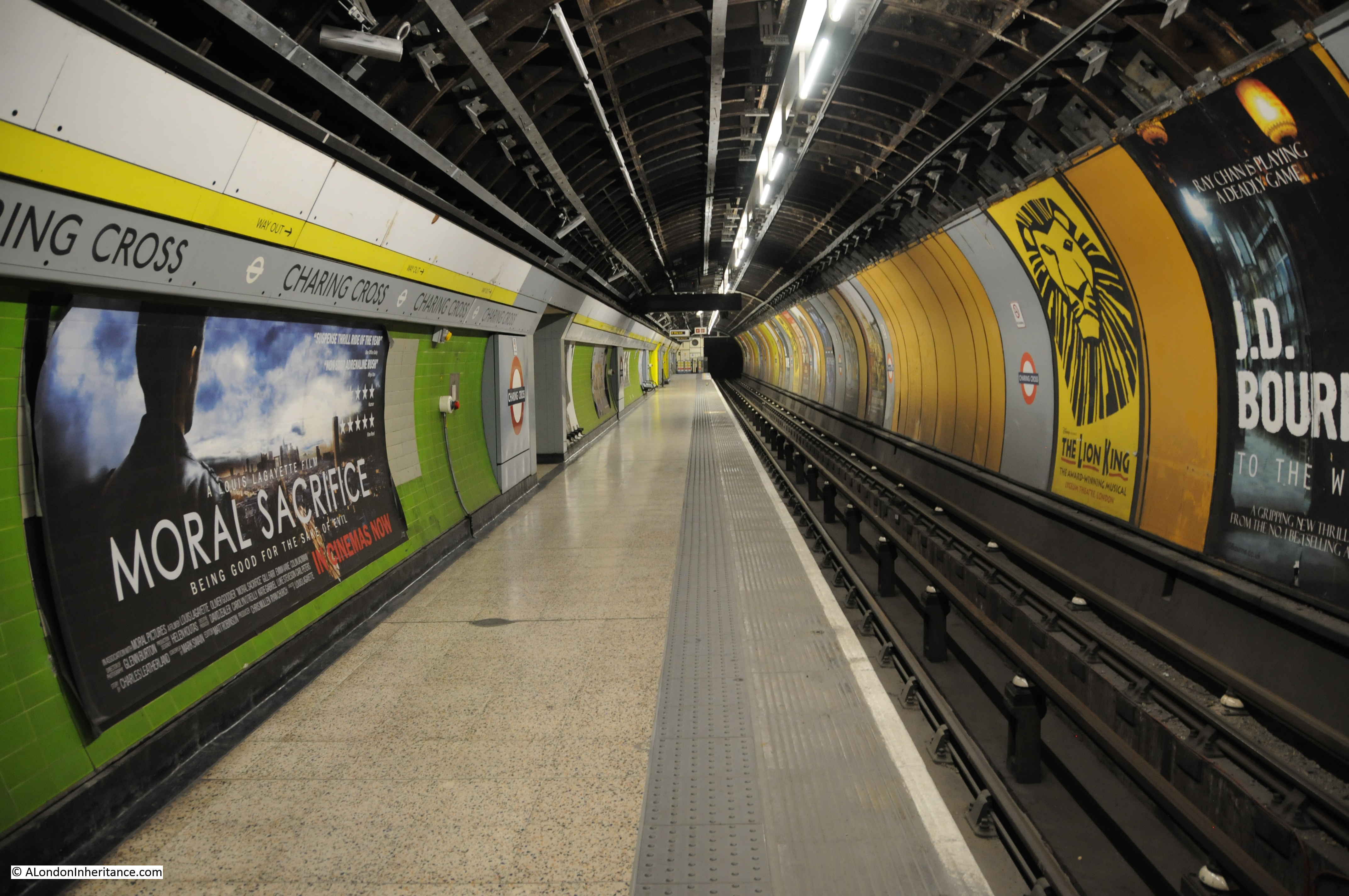
Charing Cross 1As well as running on to join the main Jubilee Line outside off Green Park, the overrun of the old Jubilee Line heads towards Aldwych, nearly reaching the old Piccadilly Line station at Aldwych (now closed, which I visited here). There is sufficient length in the overrun to park two trains and the tunnel stops about 100m short of Aldwych.

The above photo is looking in the direction of the run off tunnel and Aldwych.

The opposite end of the platform looking towards Green Park:
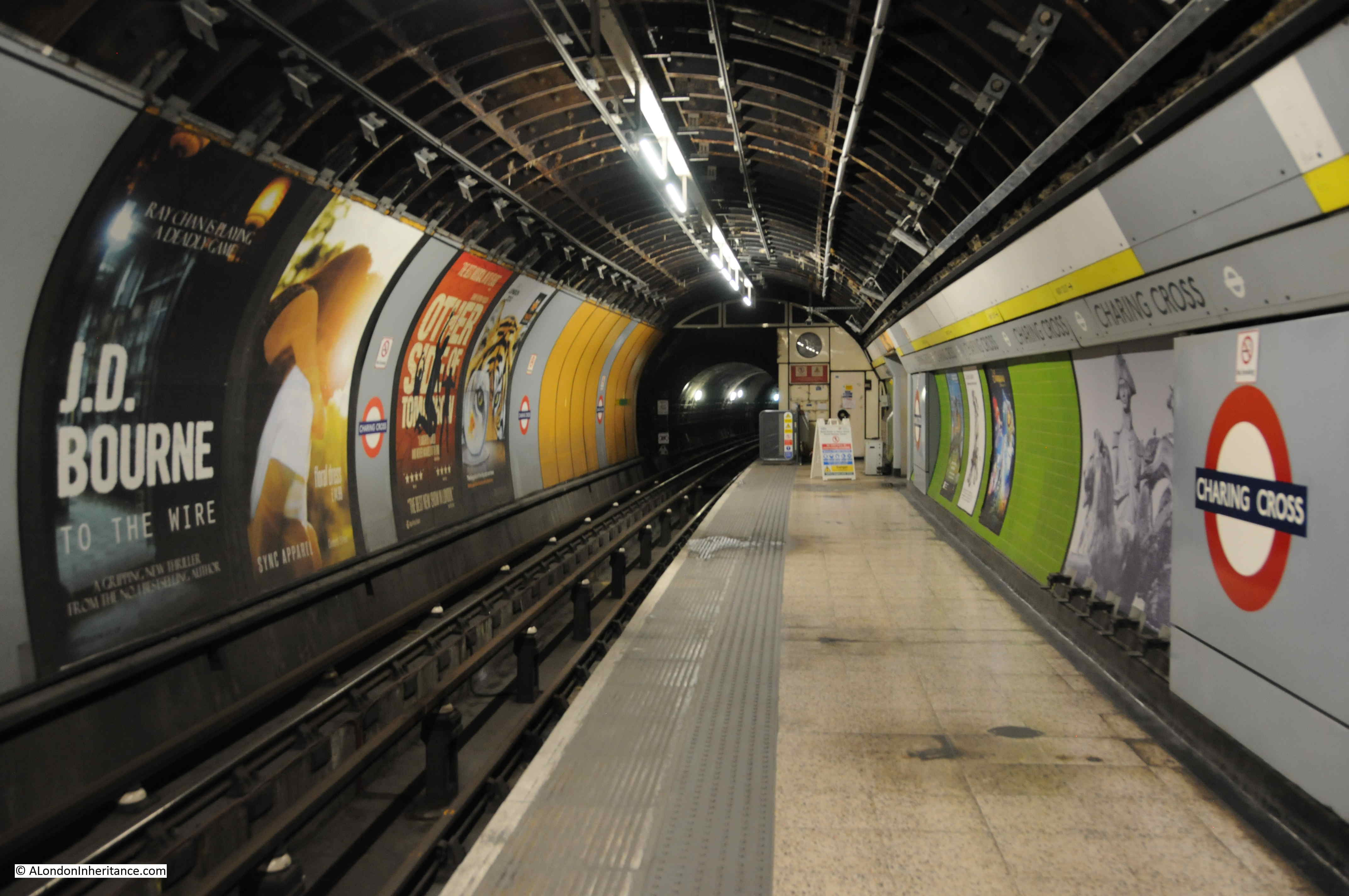
Charing Cross 22

Sign showing the original routing of the Jubilee Line, when it ran from Green Park to terminate at Charing Cross:
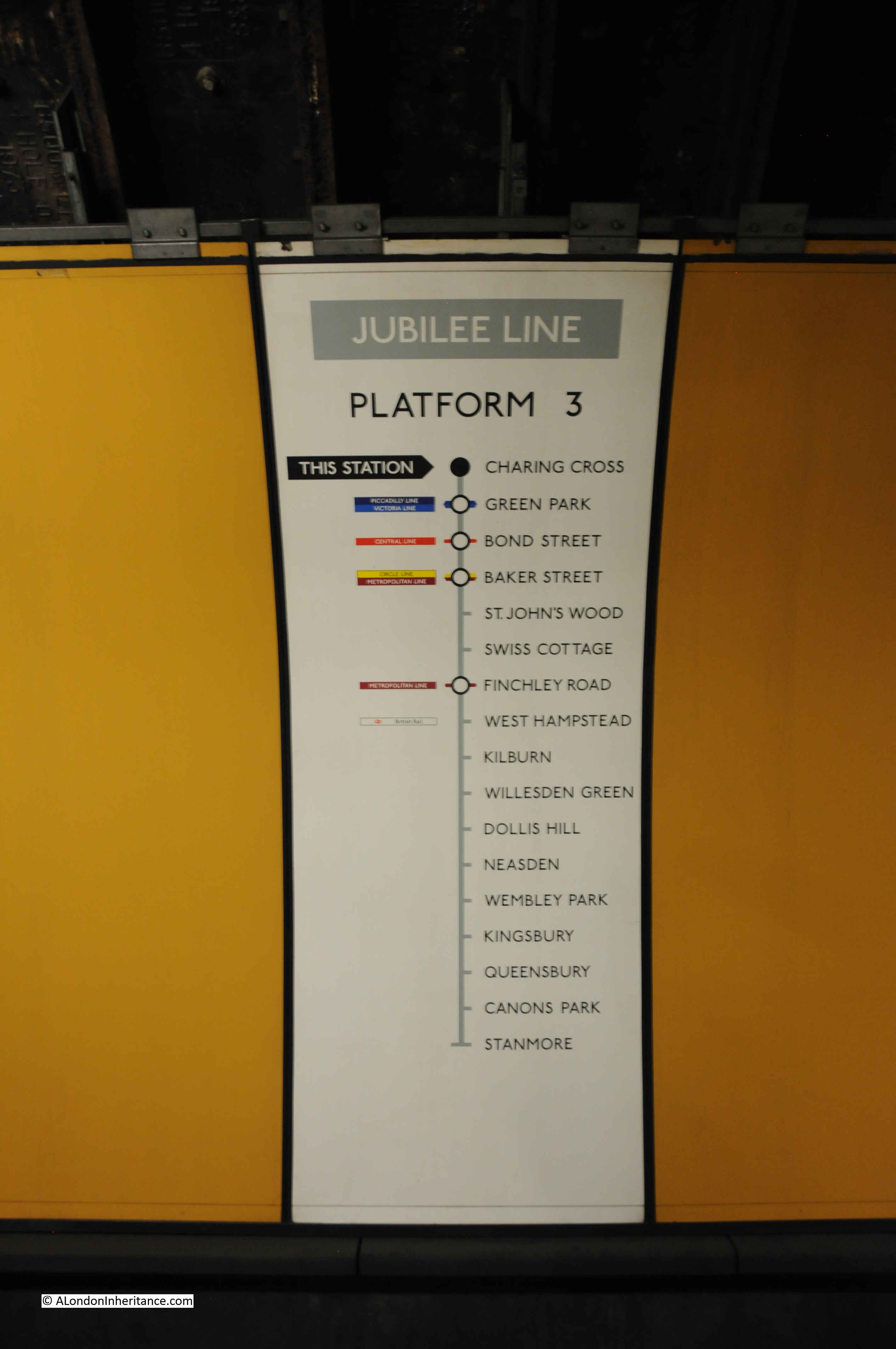
Charing Cross 20The top of the escalators and stairs leading down to the platforms. These were used in one of the underground chase scenes in Skyfall:
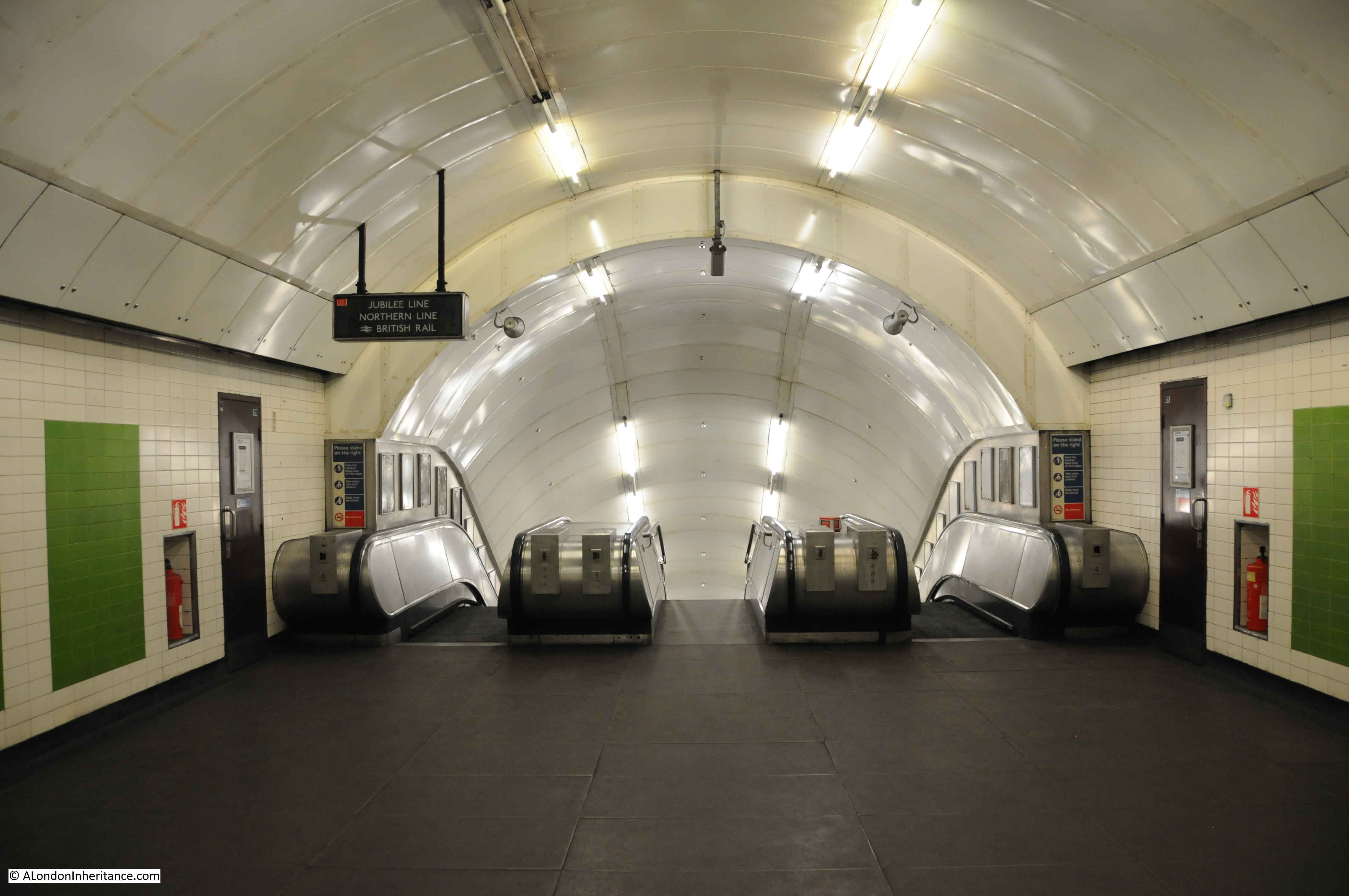
Charing Cross 3The next part of the tour were the tunnels used as part of the construction of the original Jubilee Line and station at Charing Cross.  These are entered from the working passageways and it is always fascinating to see what is behind the many doors along passenger walkways.

Inside the start of one of the construction tunnels looking back at the doors to the passenger walkway:
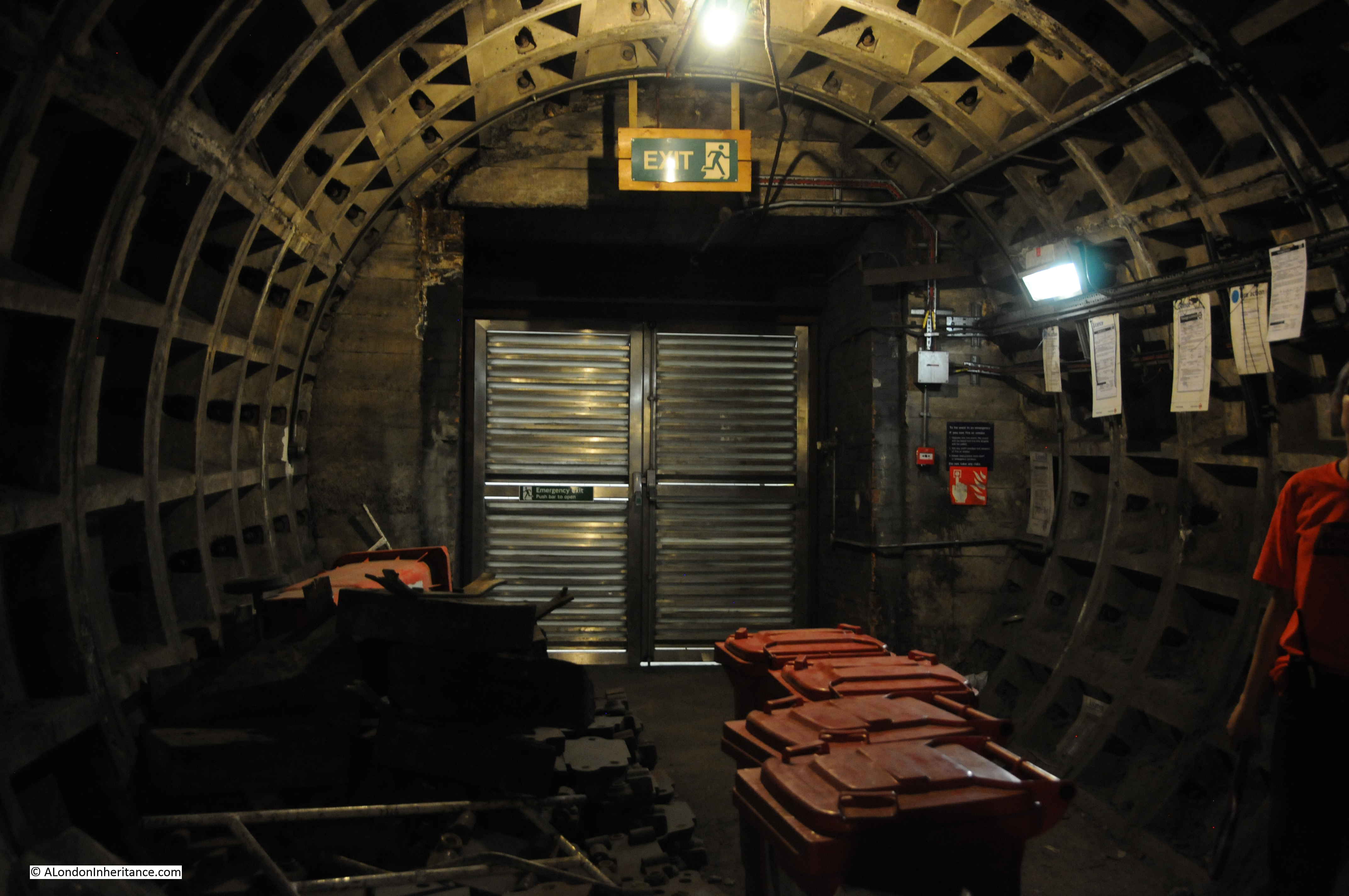
Charing Cross 4This tunnel was used to remove the spoil dug from the station and Jubilee Line. The tunnel runs from Charing Cross station, then under Trafalgar Square passing under the fountain on the right as you look towards the National Portrait Gallery. It now terminates roughly under the 4th plinth at the far corner of Trafalgar Square from Charing Cross. It did run further to where the Sainsbury Wing of the National Gallery is now located. It was here that a shaft to the surface allowed the construction spoil to be removed.

Looking down the tunnel, running under Trafalgar Square:
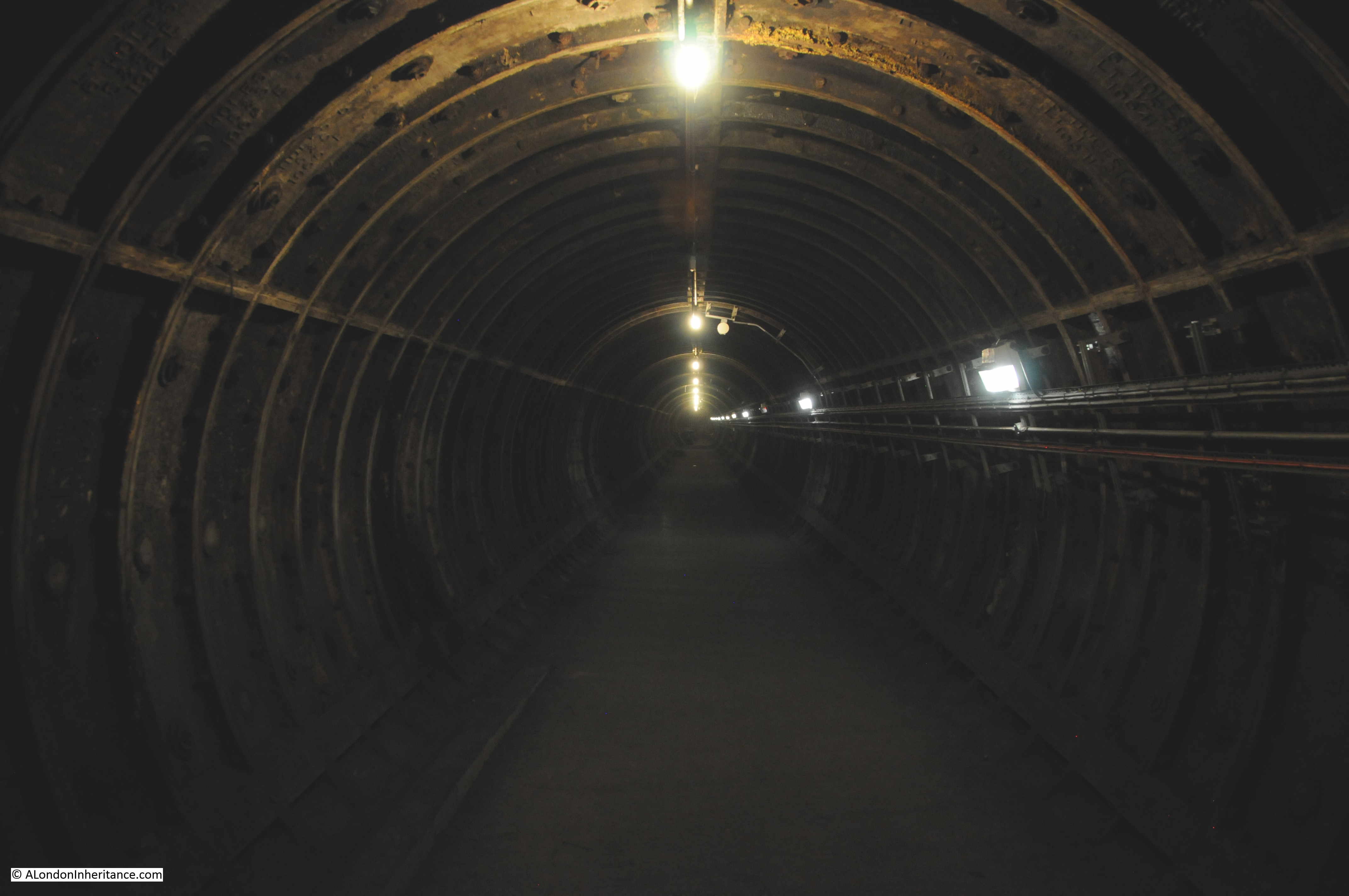
Charing Cross 25

At the far end of the tunnel, roughly under the area of the 4th plinth. The end is now blocked, but this ran onto the shaft that allowed spoil to be removed to the surface.
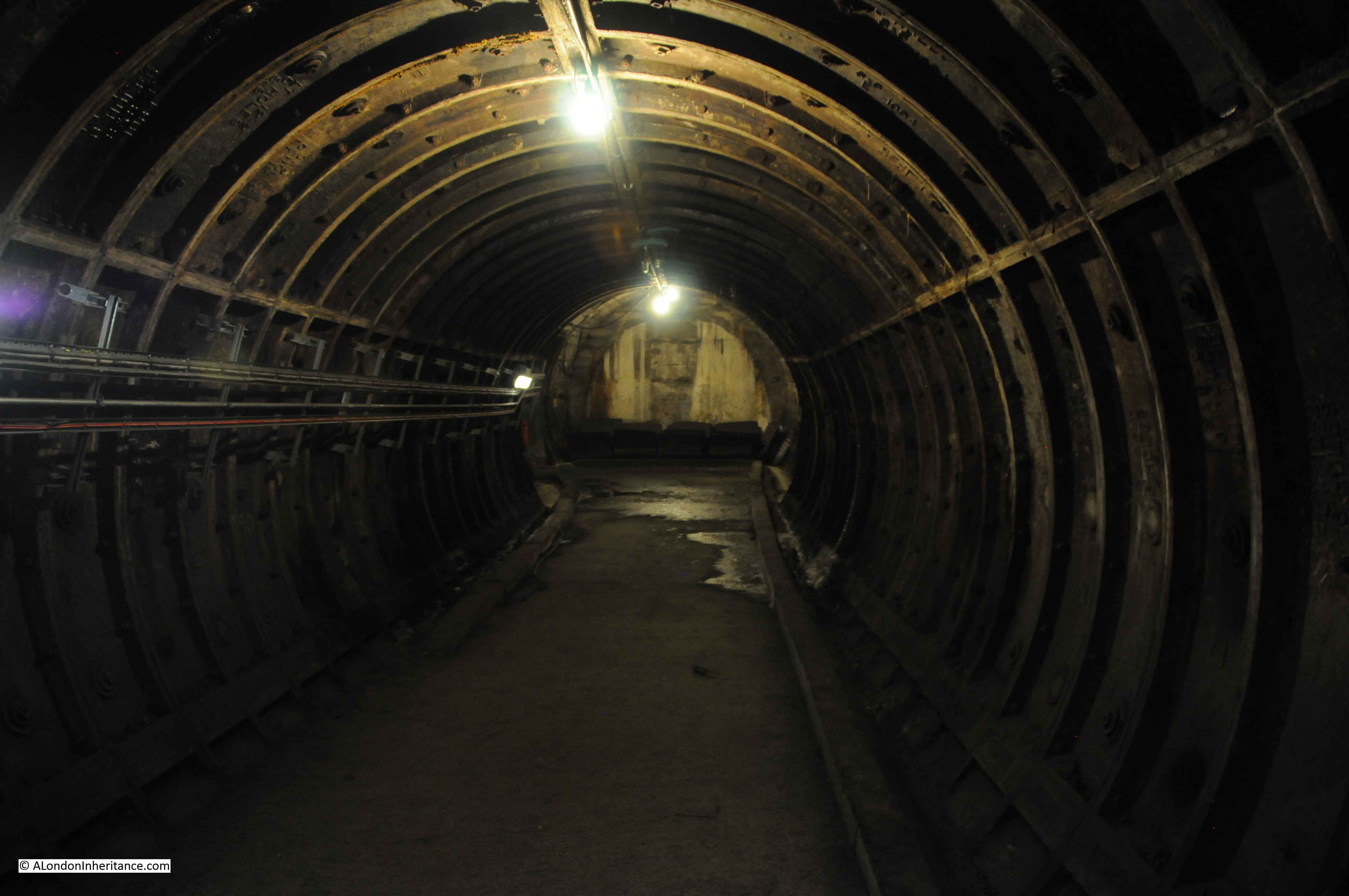
Charing Cross 8At the very end of the tunnel:

Charing Cross 27

A small side tunnel at the end of the construction tunnel:
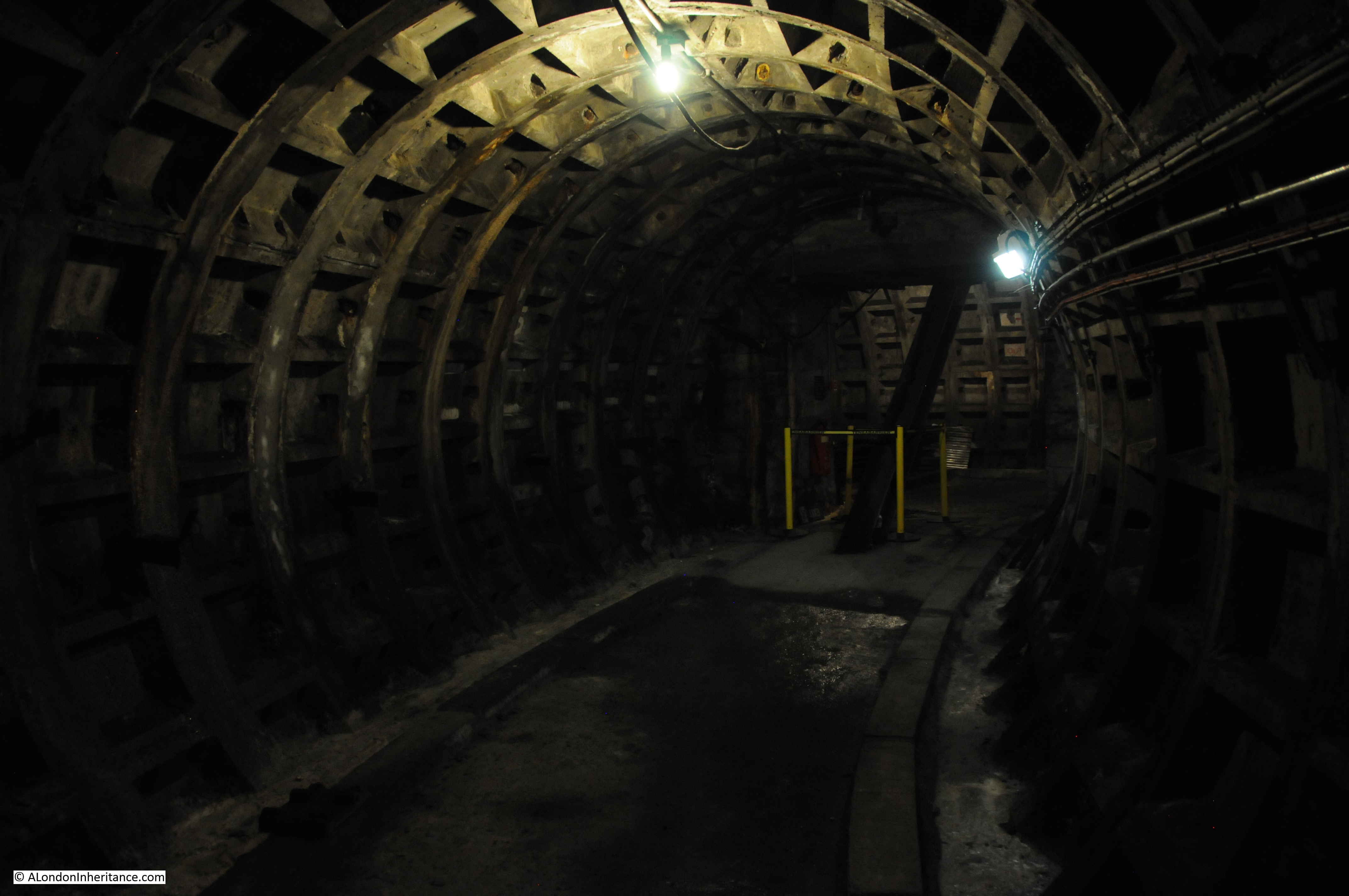
Charing Cross 7Looking back down the construction tunnel:
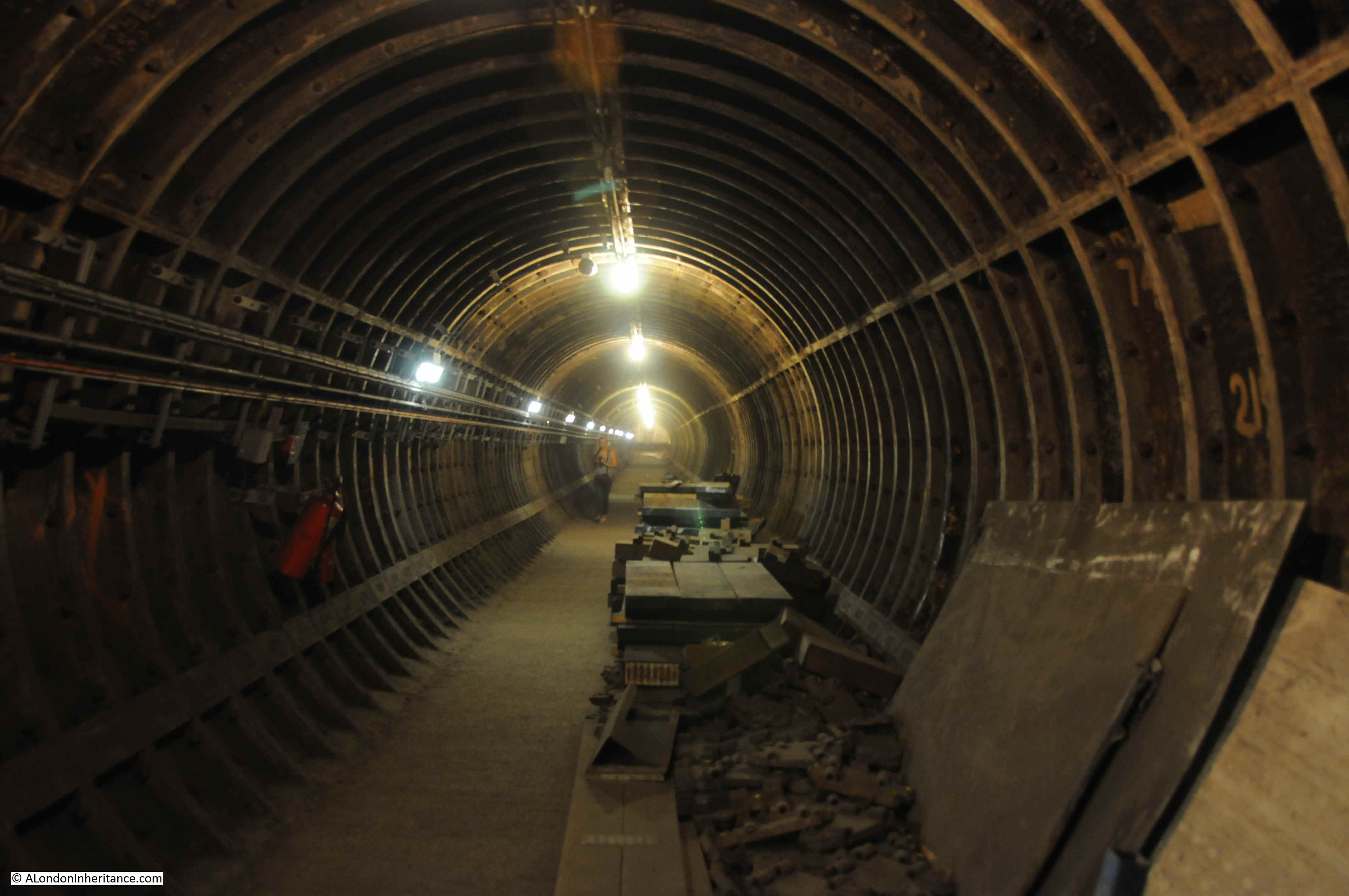
Charing Cross 26

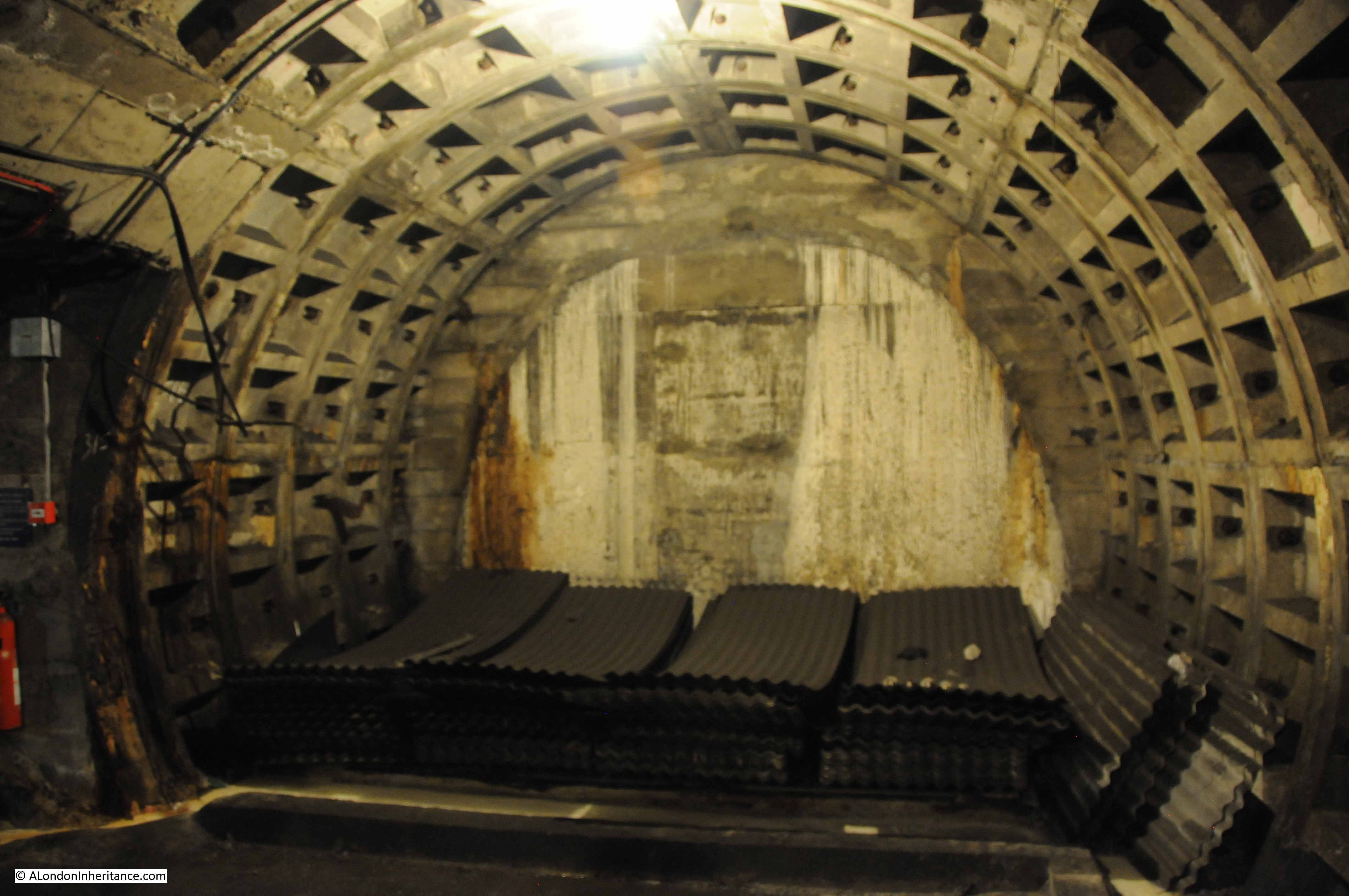
Back near the top of the construction tunnel showing the detail of the construction of the tunnel walls.

Charing Cross 9

Each of the segments forming the tunnel surround are dated with their year of manufacture:
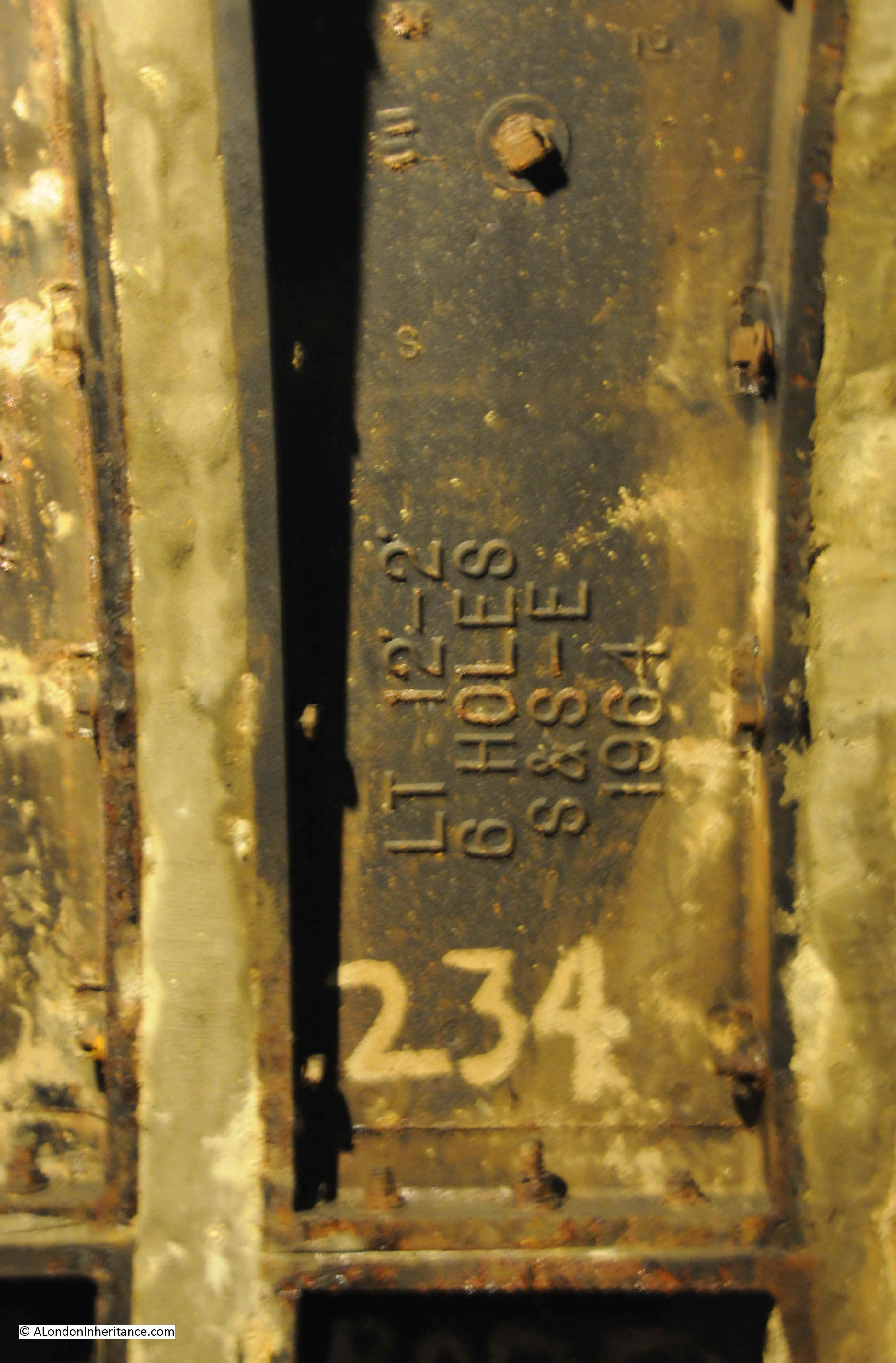
Charing Cross 21The next set of tunnels were those used for the ventilation of the working tunnels. These carried large ventilation pipes and other equipment so hard hats were needed:

Charing Cross 24

Descending down to where the air vents above the working platforms are located:

Charing Cross 11

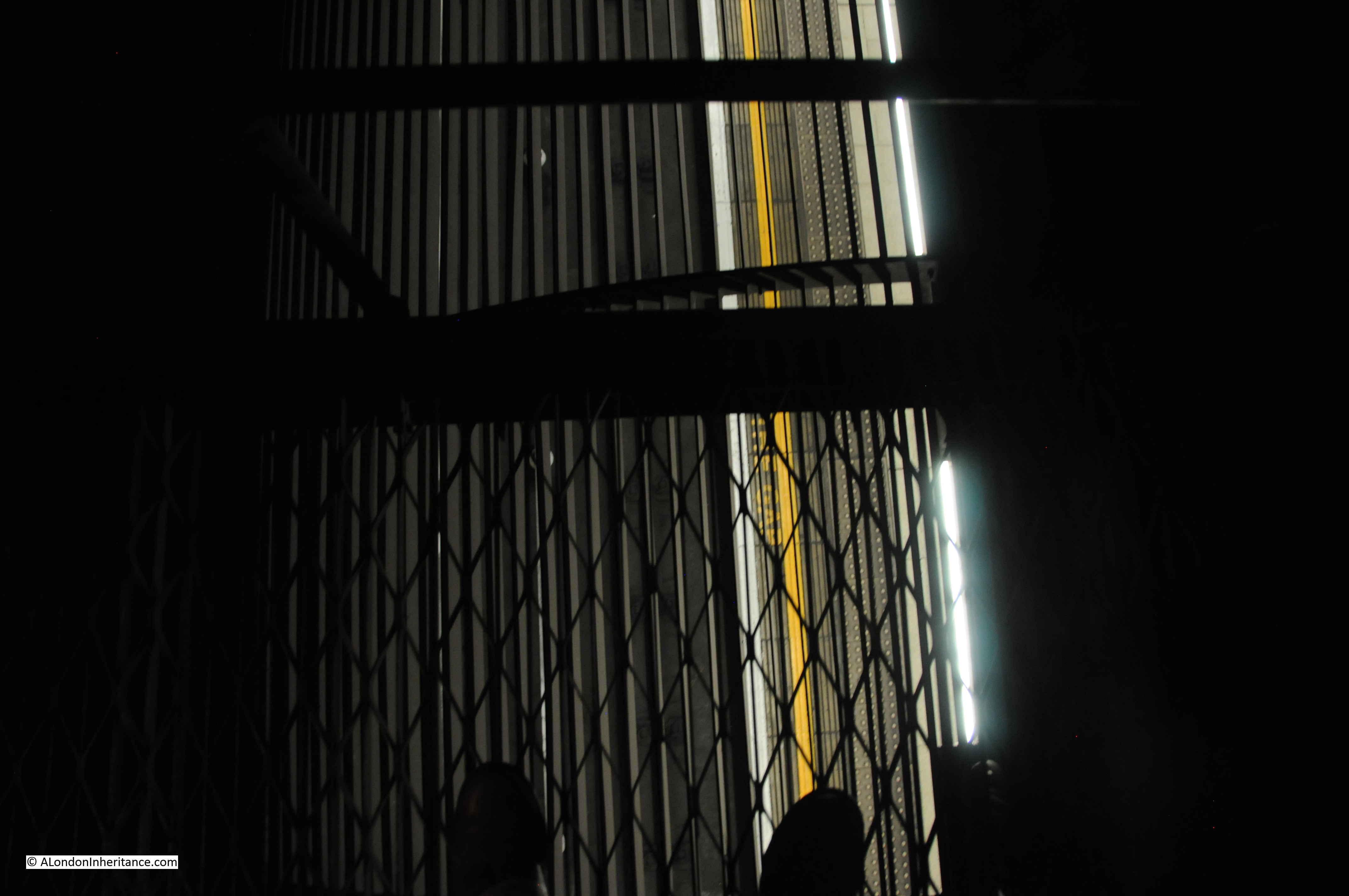
A strange experience to be standing on the grills above working platforms with trains arriving and departing beneath:
Charing Cross 12

Train at the platform from above:

Charing Cross 13

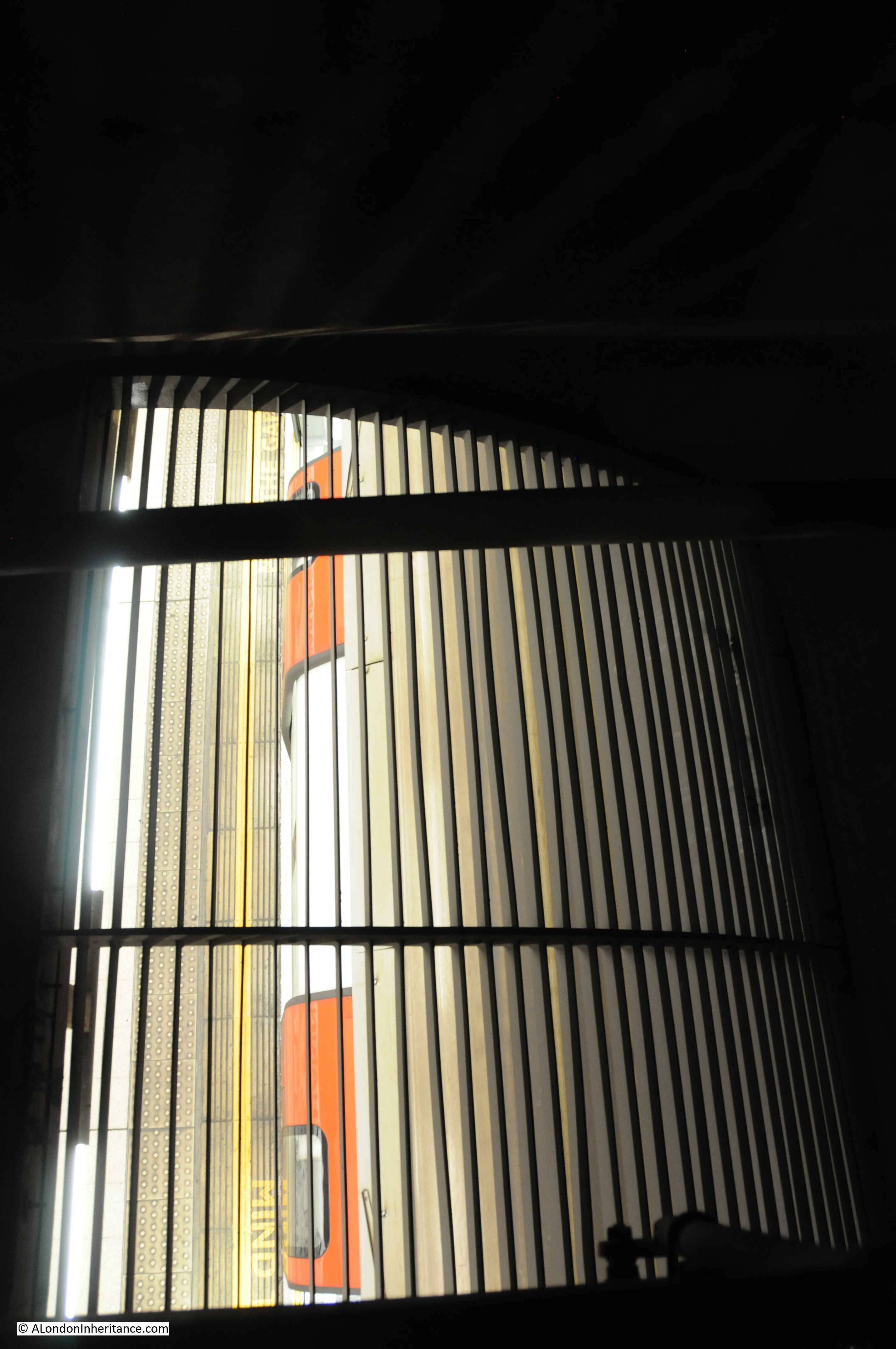
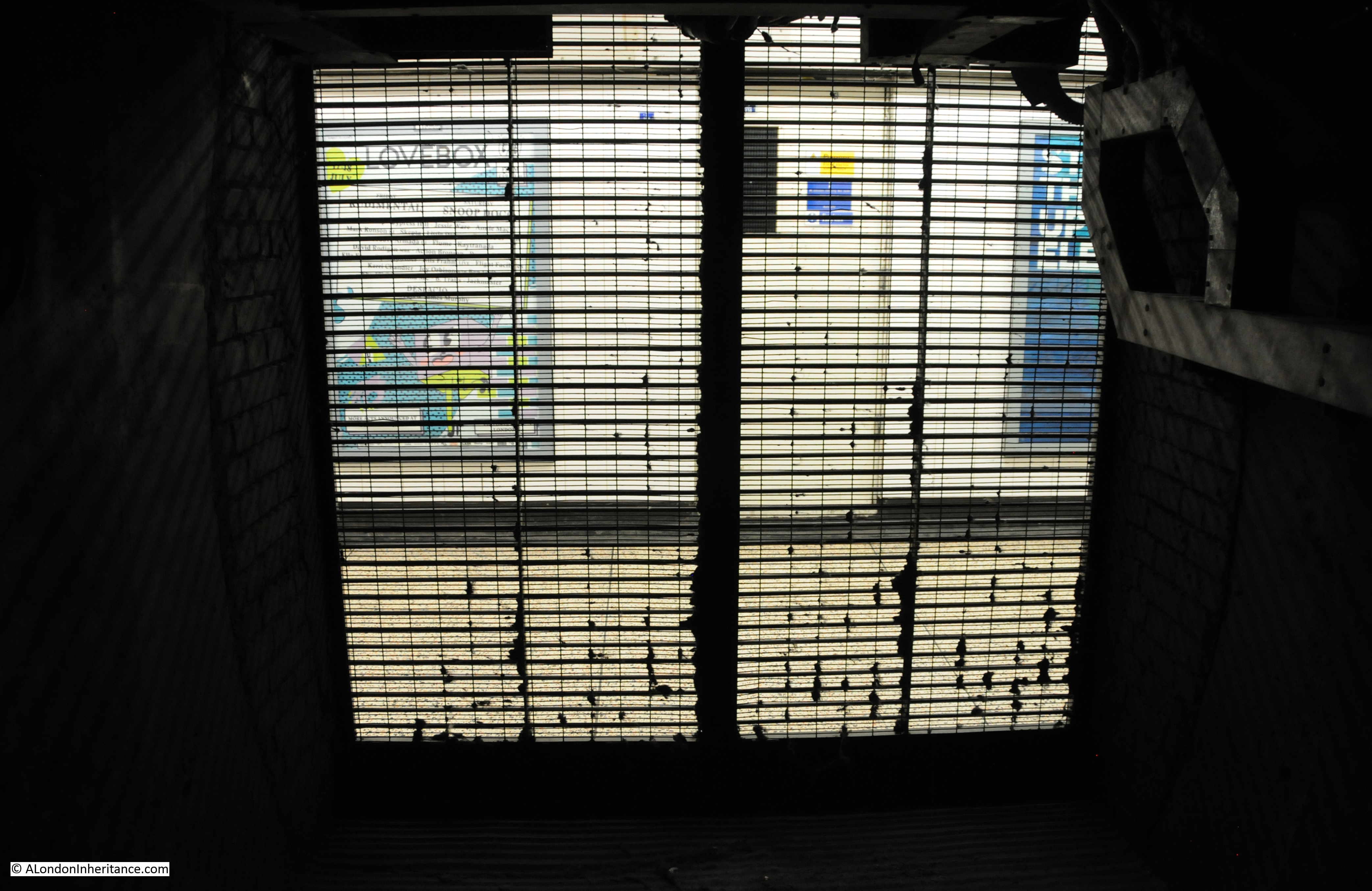
The other side of the grill, looking through to the passenger walkways from the ventilation tunnels:
Charing Cross 14

Walking along the ventilation tunnels. Large ventilation pipes running the length of the tunnel:
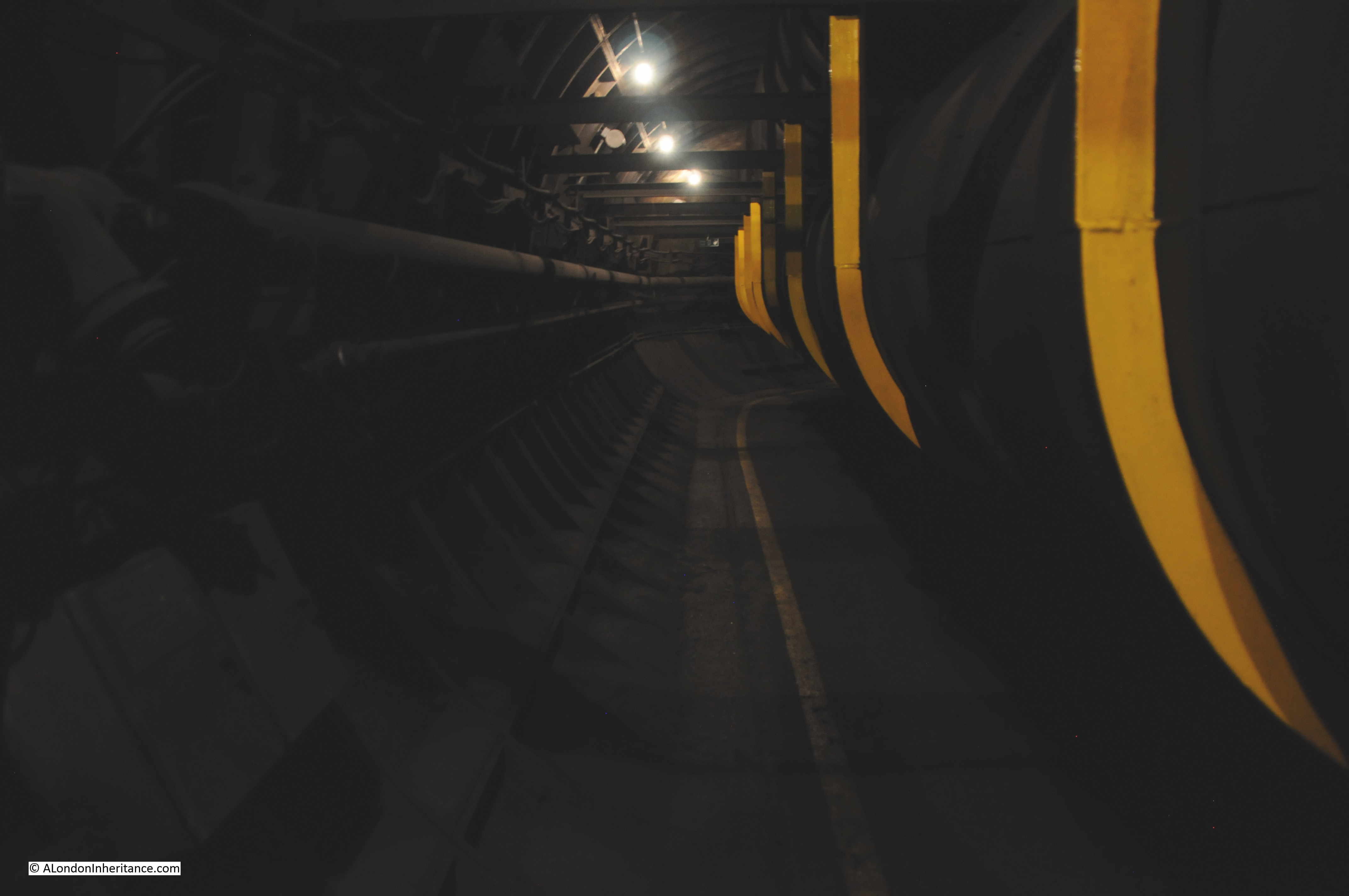
Charing Cross 23

At the end of the tunnel is the shaft that rises up above surface level. This is looking down at the base of the shaft. A further tunnel branching off the base of the shaft to the lower right can just be seen:
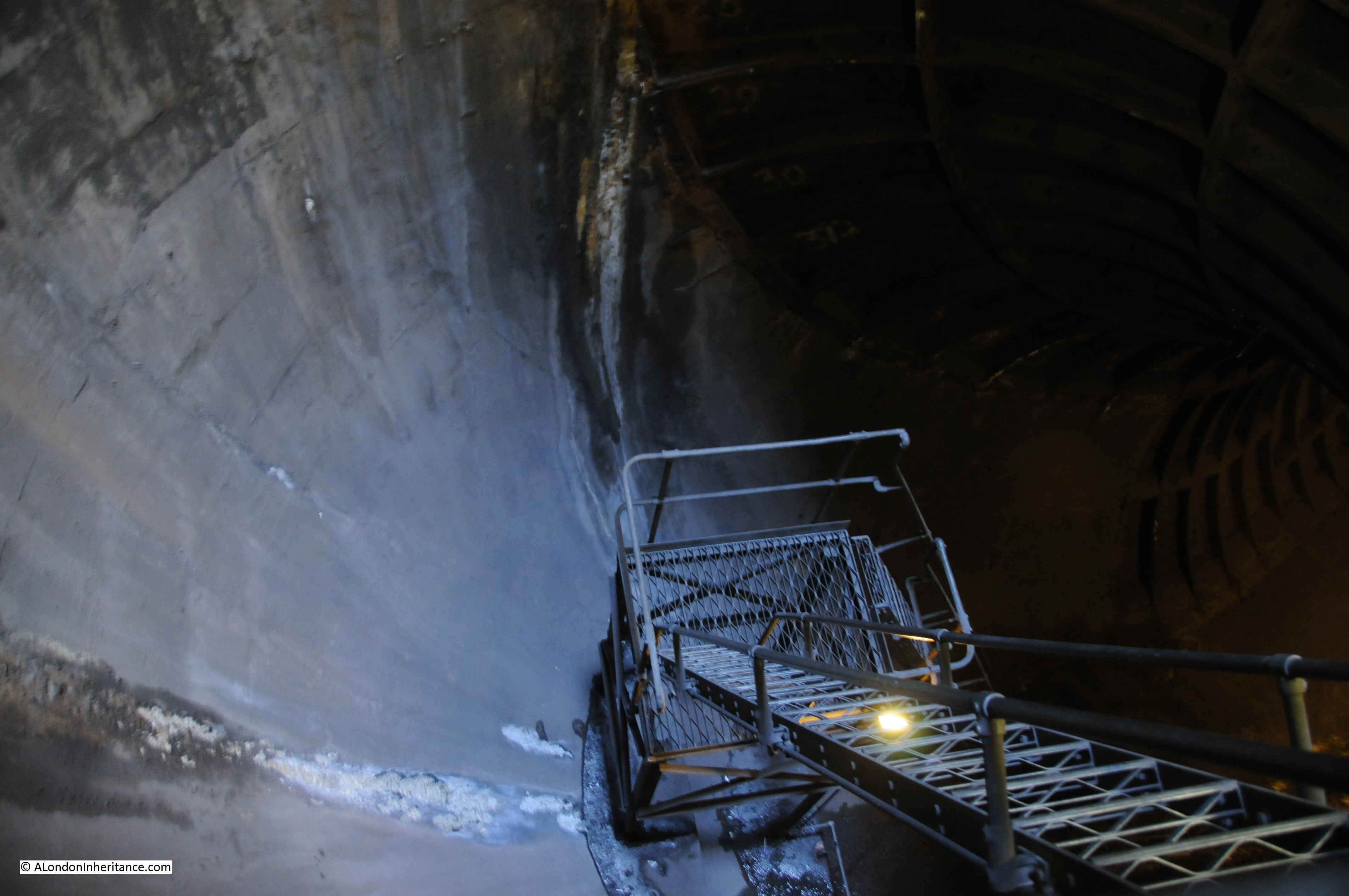
Charing Cross 16

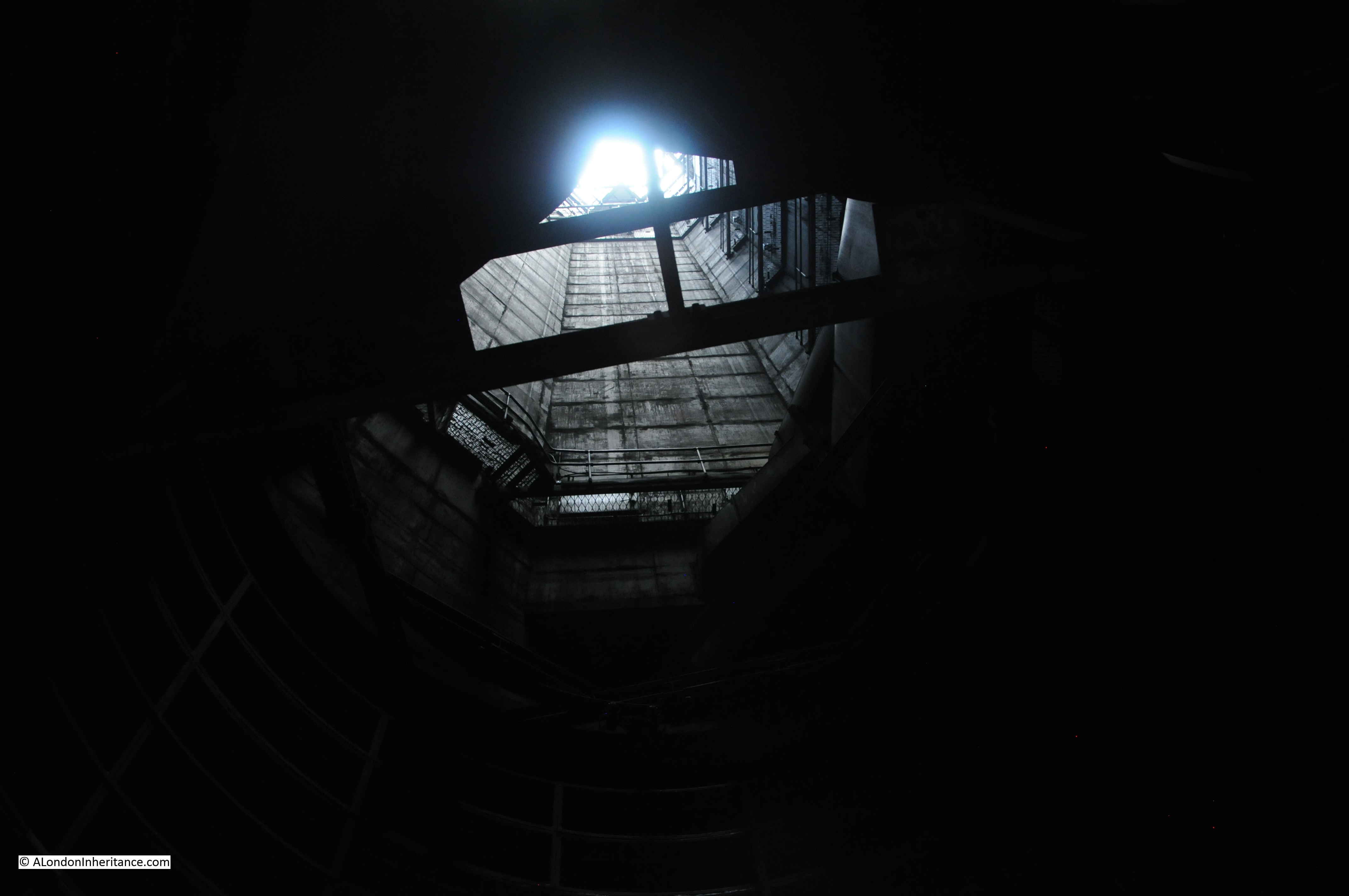
Looking up the shaft:

Charing Cross 17

Again, the segments supporting the sides of the shaft are dated with their year of manufacture:

Charing Cross 18

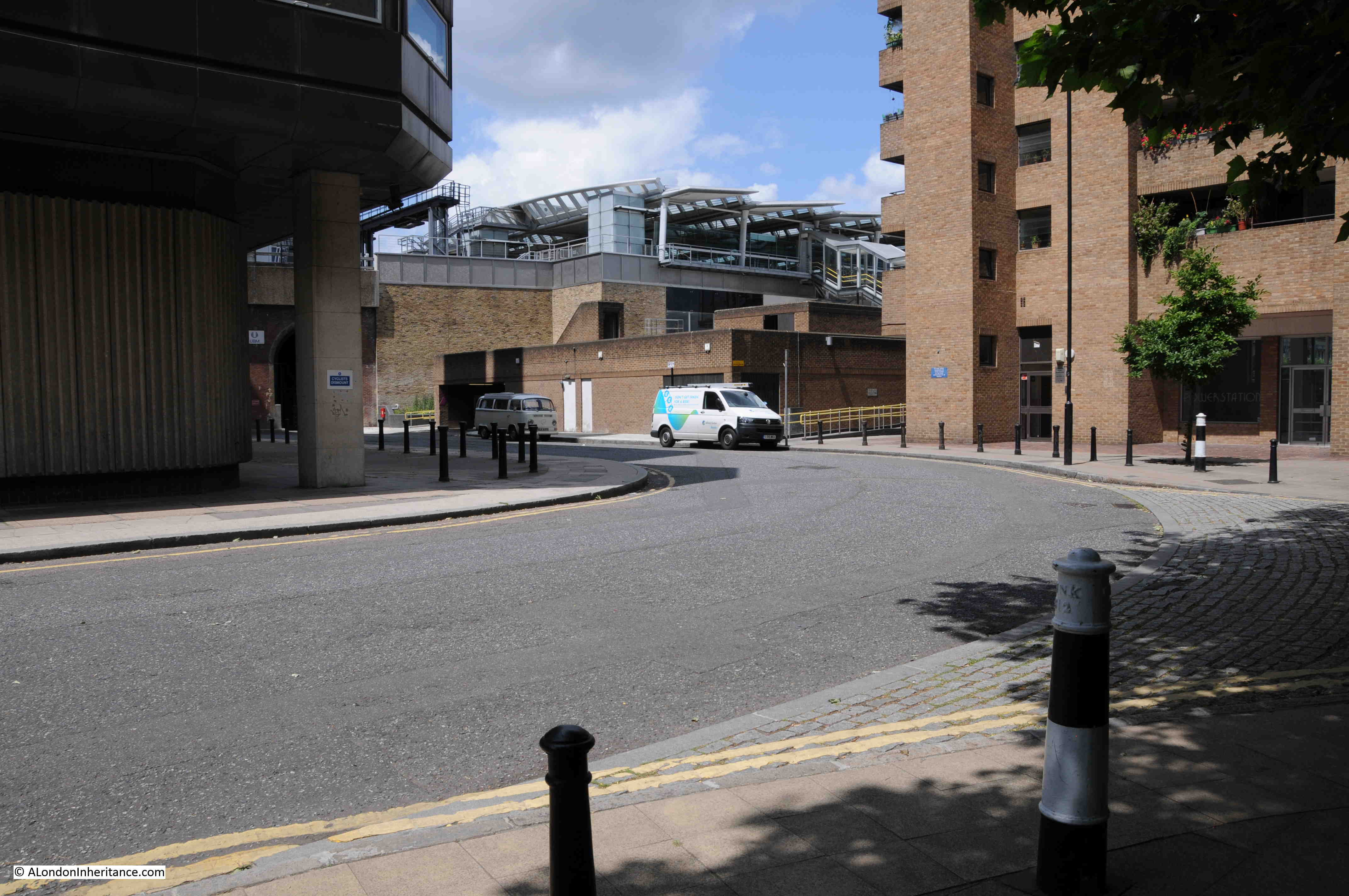
This is what the shaft looks like from outside. In a side street adjacent to Charing Cross Station these look integral to the office block on the site but are really part of the infrastructure supporting the underground:
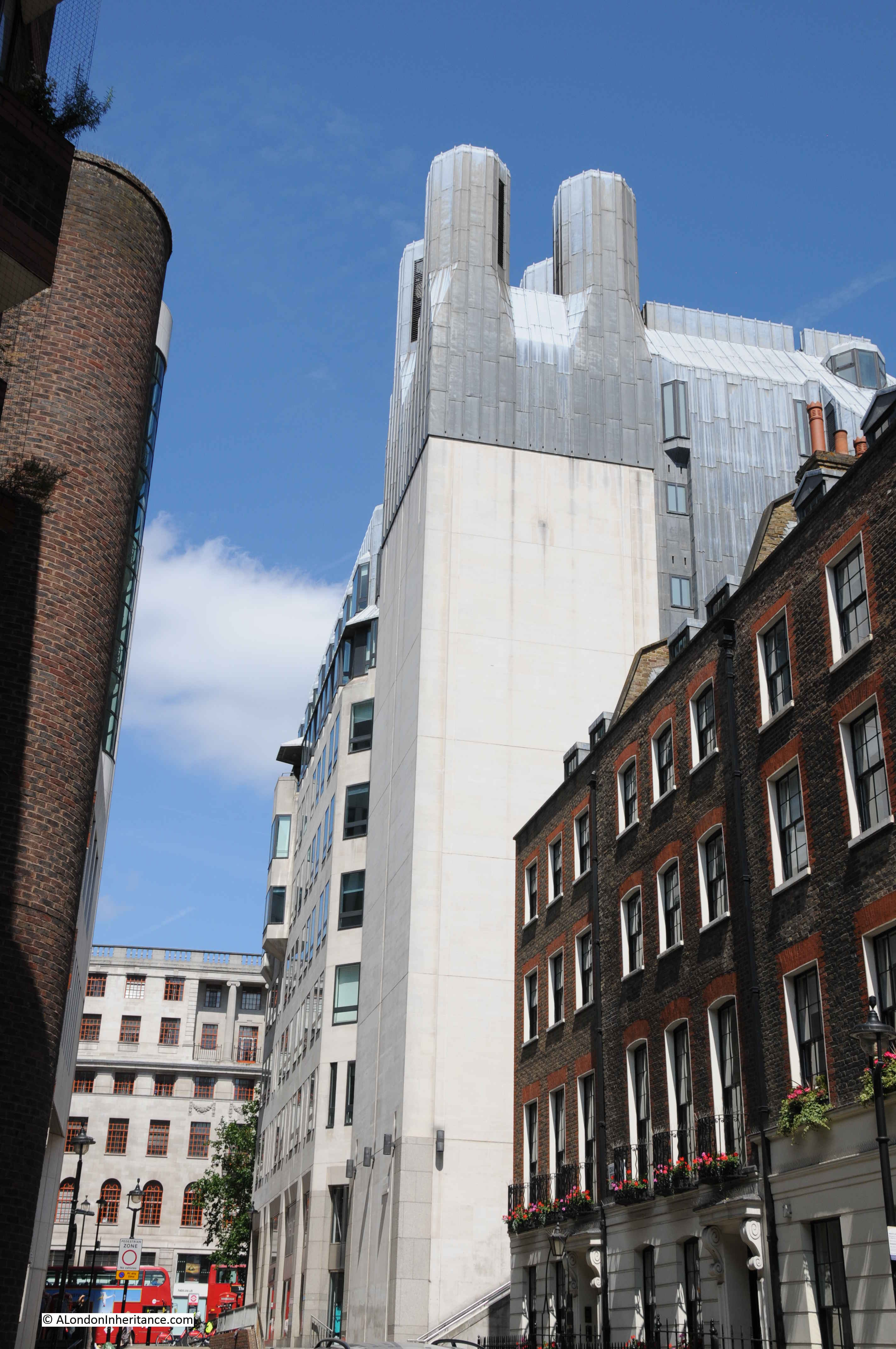
Charing Cross 19

This was a fascinating tour to see part of the history of the London Underground and some of the infrastructure that has supported past construction and current operation.

My thanks to the London Transport Museum and the staff on the day for the tour.
alondoninheritance.com

The Founder’s Arms, Falcon Stairs, A Brothel And Confused Street Names

A couple of week’s ago, my post was on No.49 Bankside, one of the few remaining historic buildings in Bankside, and for this week, I have moved across to the other side of Tate Modern, and found how echoes of London’s long history are still visible today, despite what at first sight, appears to be a very recent landscape.

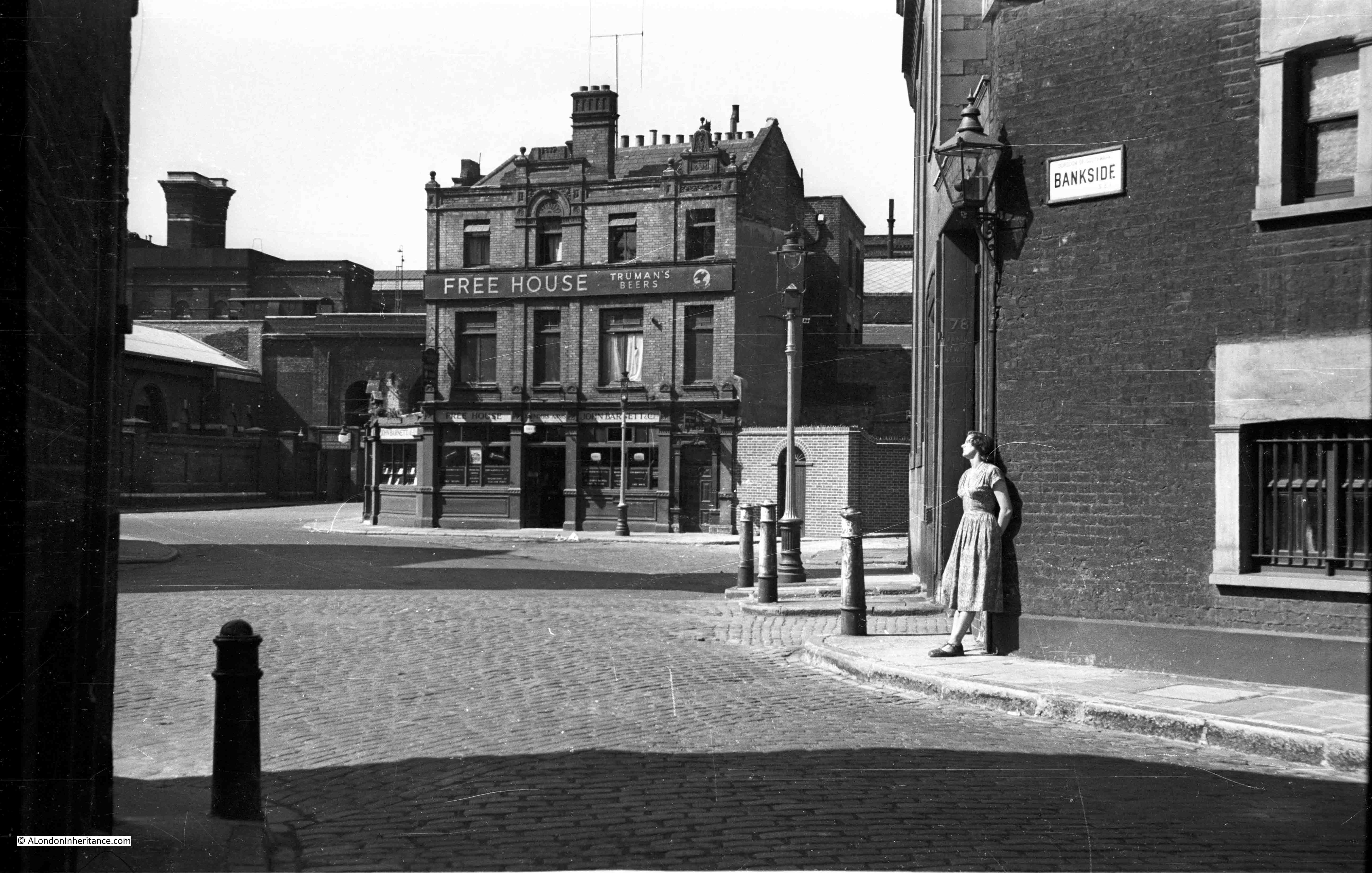
My photo for this week from my father’s collection was taken in 1950. As the street sign confirms, it is on Bankside and looking across to a fine Victorian pub. This is the Founder’s Arms.

Behind the pub is the viaduct, approaching Blackfriars railway bridge, carrying the rail lines across the Thames into Blackfriars Station. A couple of the arches underneath the railway can just be seen to the left of the pub.

Founders 1

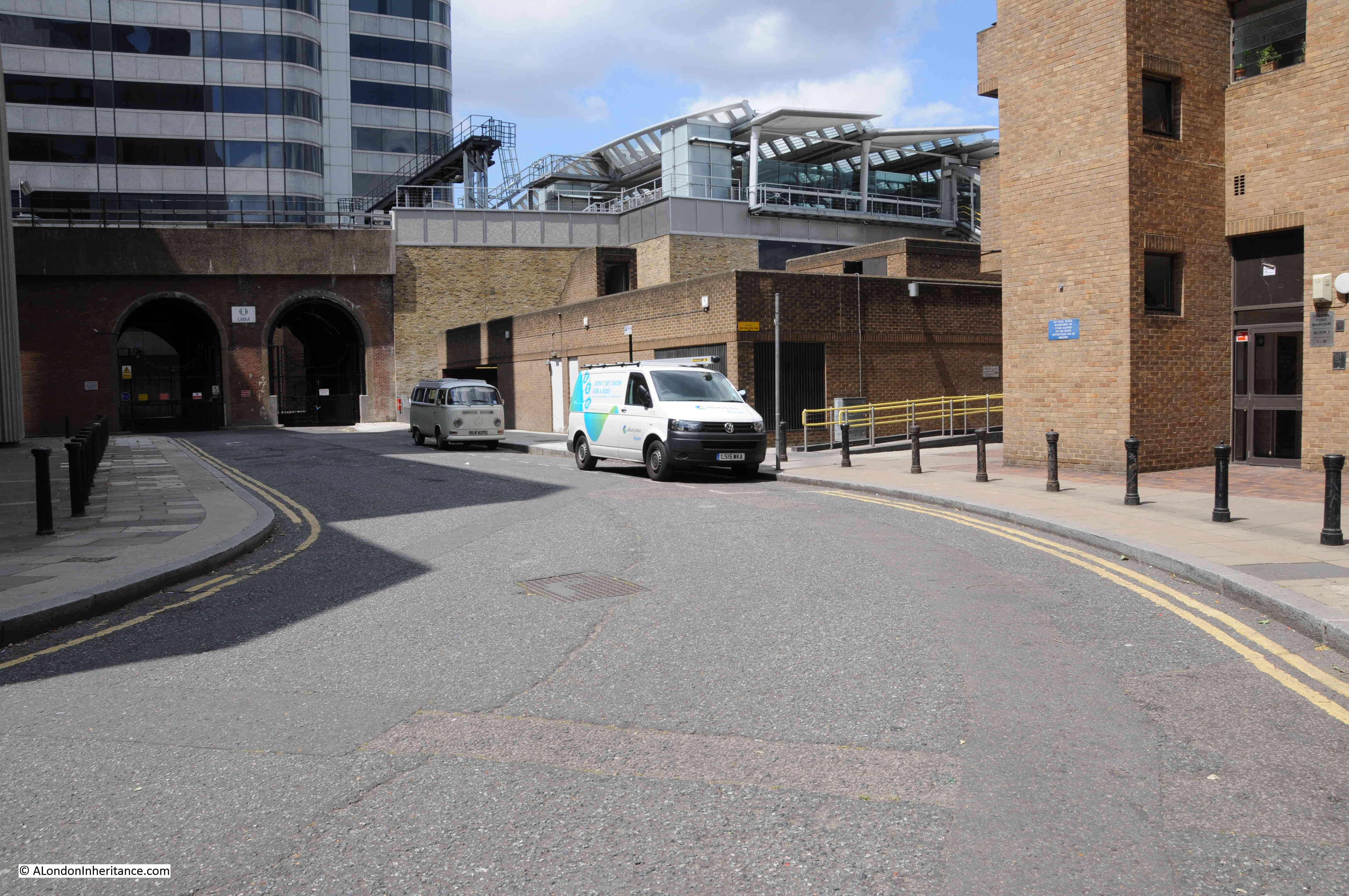
Although this part of Bankside has changed dramatically, it is relatively easy to place the location of the Founder’s Arms. The following is my 2015 photo, taken not quite from the same location as the new buildings on the right hide the view of the location of the pub, but using the arches in the railway viaduct and the road layout as reference points, where the pub once stood is now occupied by the single storey building behind the white van. The arches in the viaduct can just be seen on the left.

To the right of the pub in the 1950 photo, the roadway continues down to the wharfs and stairs on the river. Although not a road, this is still a footpath shown in the 2015 photo by the yellow railings. Bankside still curves to the right (although moved slightly away from the river, the original route now occupied by the buildings on the right), and in the 1950 photo, just visible to the left, two cobbled streets appear to be separated by a small part of pavement that extends into the centre left of the photo.

Founders 2

An alternative viewpoint with a better view of the arches under the viaduct with the position of the Founder’s Arms on the right:

Founders 12

To help understand the area in more detail, maps covering the last few centuries tell so much of how the area has changed, and what has remained.

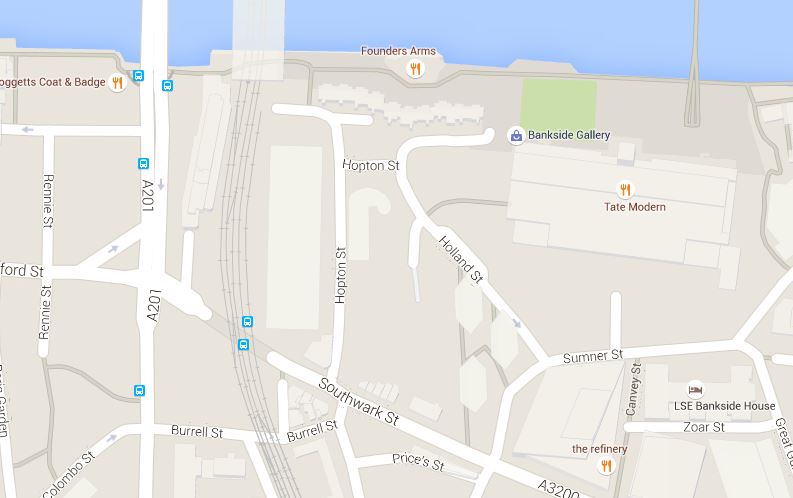
Below is the latest Google map of the location. Hopton Street is seen in the middle of the map, coming up to a T junction at the top, with just before this, a small side extension to join with Holland Street.

Turn left at the T junction and the walkway to the river past the original location of the pub is shown in grey. The map still shows a Founder’s Arms, now directly on the river, I will come back to this later.

2015 map

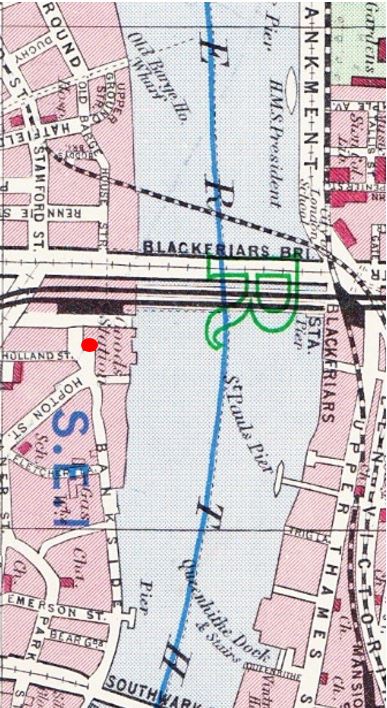
Working back in time, the following map is from the 1940 Bartholomew’s Reference Atlas of Greater London and shows the road layout as it was at the time of the 1950 photo. I have marked the position of the pub with a red dot.

Compare the roads Holland Street and Hopton Street. The 1940 map has these reversed compared to the Google map, and checking on site, Google is accurate, so was this just a map makers error?

1940 map with spot

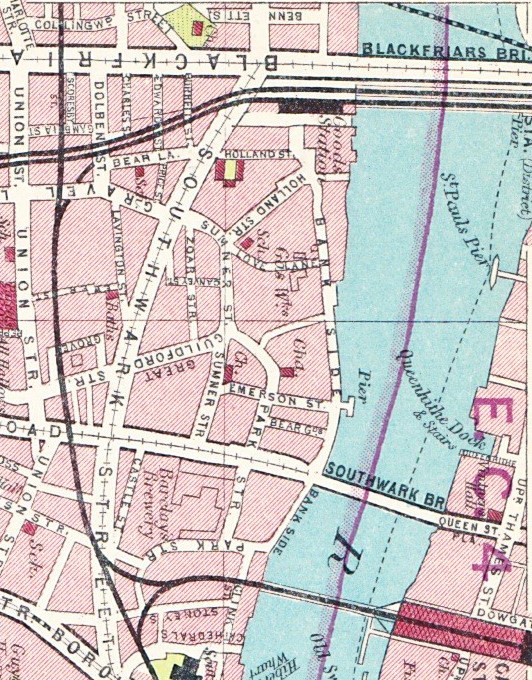
Going back 10 years to the 1930 version of Bartholomew’s Atlas and it is even more confusing. Look at the same location near the top of the following map and now both are called Holland Street with no mention of Hopton Street.

1930 map

I checked the 1913 version of the same Atlas (yes, sadly I do have multiple editions of the same London Maps !!)  and the streets are both called Holland Street in this version as well, so I doubt this was an error.

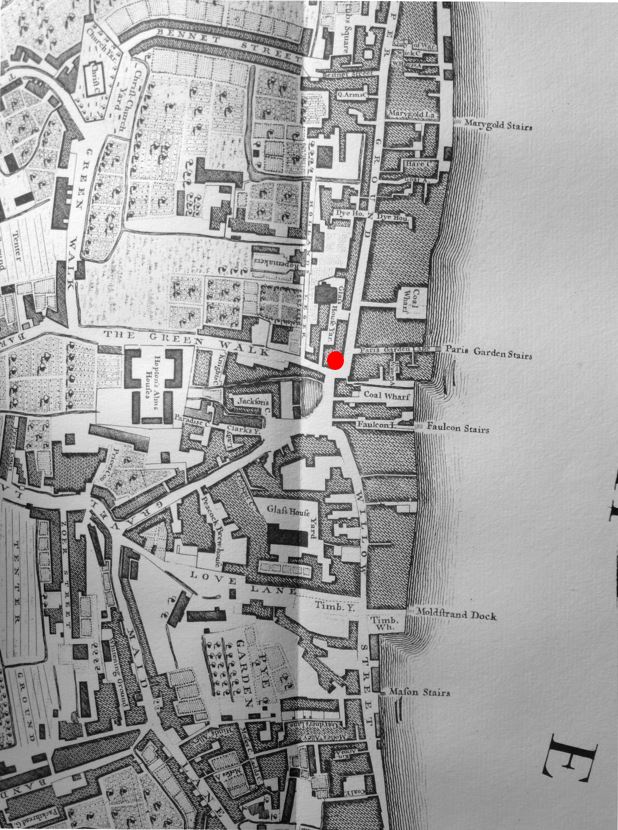
So now, let’s jump back much further to John Rocque’s survey of London from 1746. I have again marked the approximate position of the pub by a red dot. In the John Rocque map, the reference point we can use that is still there today are the Hopton Almshouses which can be seen along The Green Walk. These can also be seen on the Bartholomew maps as the U-shaped building where Holland Street meets Southwark Street.

Founder 6a with spot So, in 1746, neither Hopton or Holland street names existed. Today’s Hopton Street was The Green Walk and today’s Holland Street was part of Gravel Lane.

To start with trying to explain the street name changes, George Cunningham in his survey of London’s streets, buildings and monuments gives an explanation for the name Holland Street:

“Location of the old moated Manor House of Paris Garden, subsequently notorious under the name of Holland’s Leaguer, from Holland, a procuress (an early name for a “woman who procures prostitutes”), who occupied it in Charles I’s time. The old Manor House was a favourite resort of James I and his Court, George Villiers, Duke of Buckingham and the nobility generally.”

Holland was Sarah Holland who in 1631 had been charged as an “incontinent women” and imprisoned in Newgate. The Manor House was very suitable for her needs as she said it was “near the theatres and baiting rings, with their wild beasts and gladiators”.

George Cunningham’s book was published in 1927 and there is no mention of Hopton Street.

So that explains the source of the name Holland Street, but does not explain why or when The Green Walk and Gravel Lane changed their name. The 1913 Bartholomew Atlas is therefore correct by labelling the two streets (which were in effect one, looping back after reaching Bankside) as Holland Street.

In the original The Green Walk are Hopton’s Almshouses. These were built around 1749 for “twenty-six decayed house-keepers, each to have an upper and lower room with £10 per annum and a chaldron of coals.” They have been occupied continuously since July 1752.

The money (and name) for these came from one Charles Hopton who on his death left a large sum of money to his sister, and on her death the money was used to build the Almshouses. Hopton was born around 1654 into a wealthy merchant family and was a member of the Guild of Fishmongers.

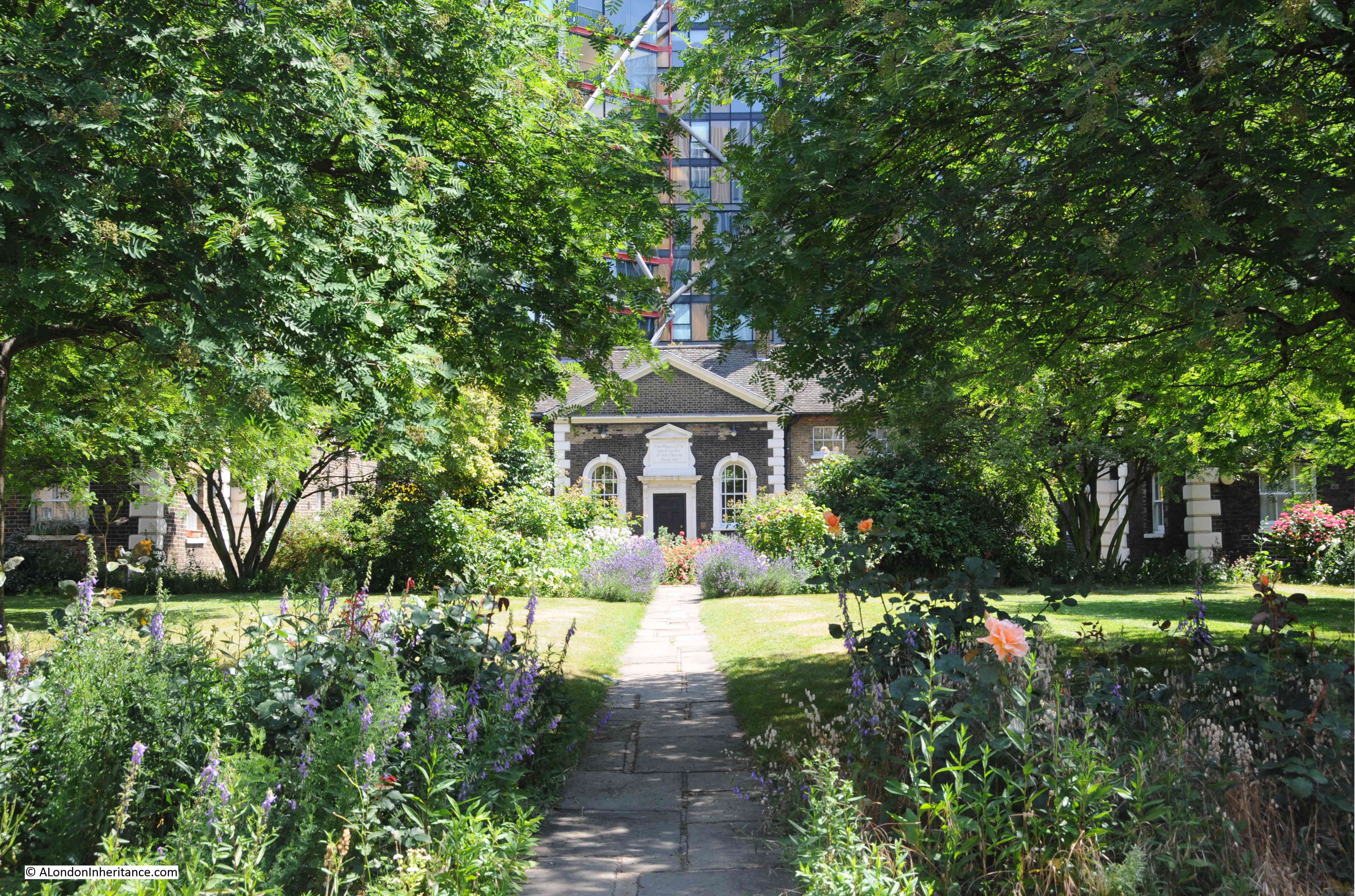
The Almshouses are still there today. A surprise to walk down Hopton Street in the summer and suddenly find these 18th century buildings with at their centre a wonderful colourful garden:

Founders 7

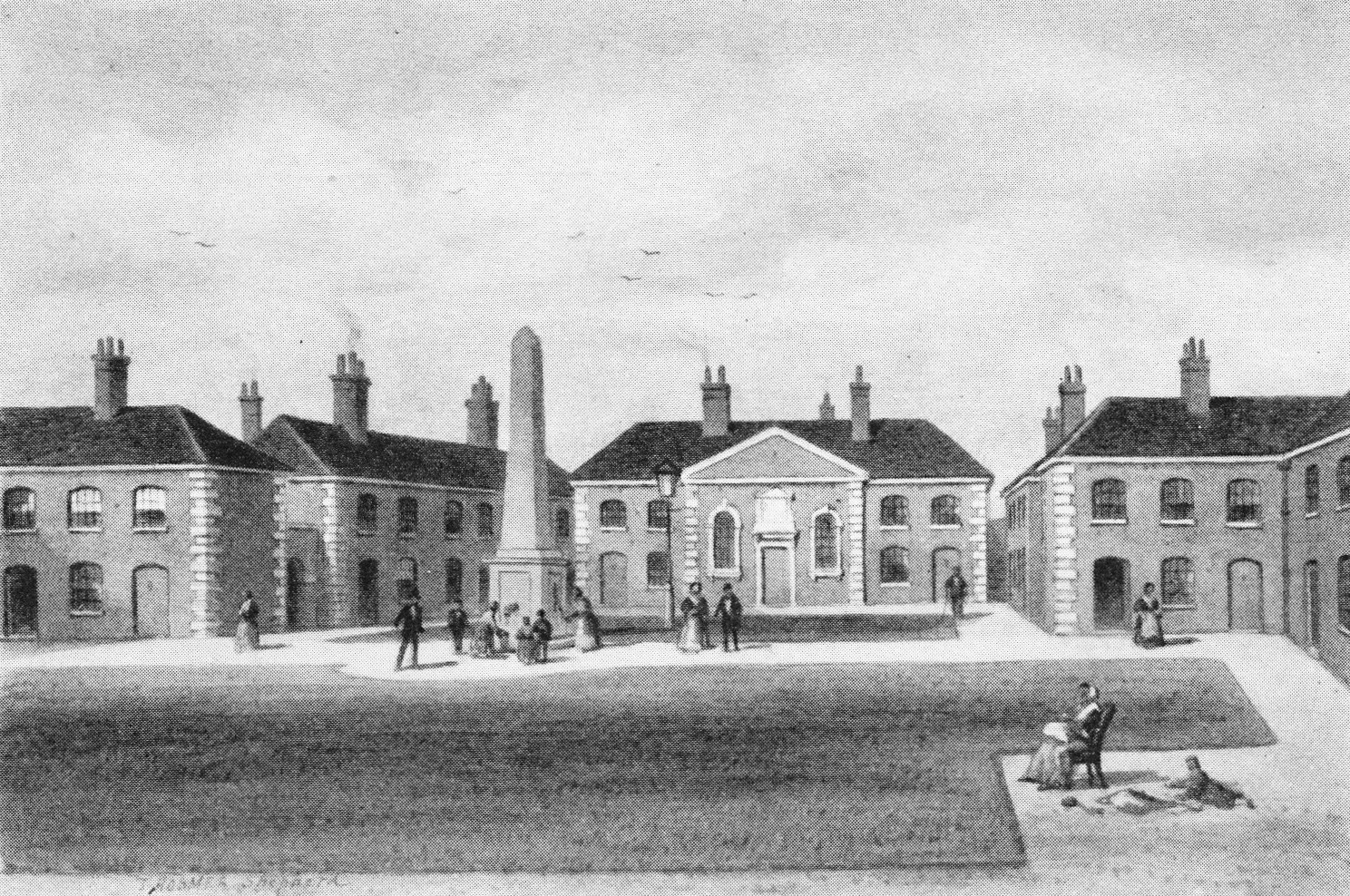
The Almshouses as they appeared around 1850. A far more austere appearance with no gardens:

Founders 11

In 1831 there is a description of these as being “those of Mr Hopton in Green Walk” – so it appears the name had not changed to Holland Street by 1831. By the time of Edward Walfords Old and New London (1890) the name had changed to Holland Street.

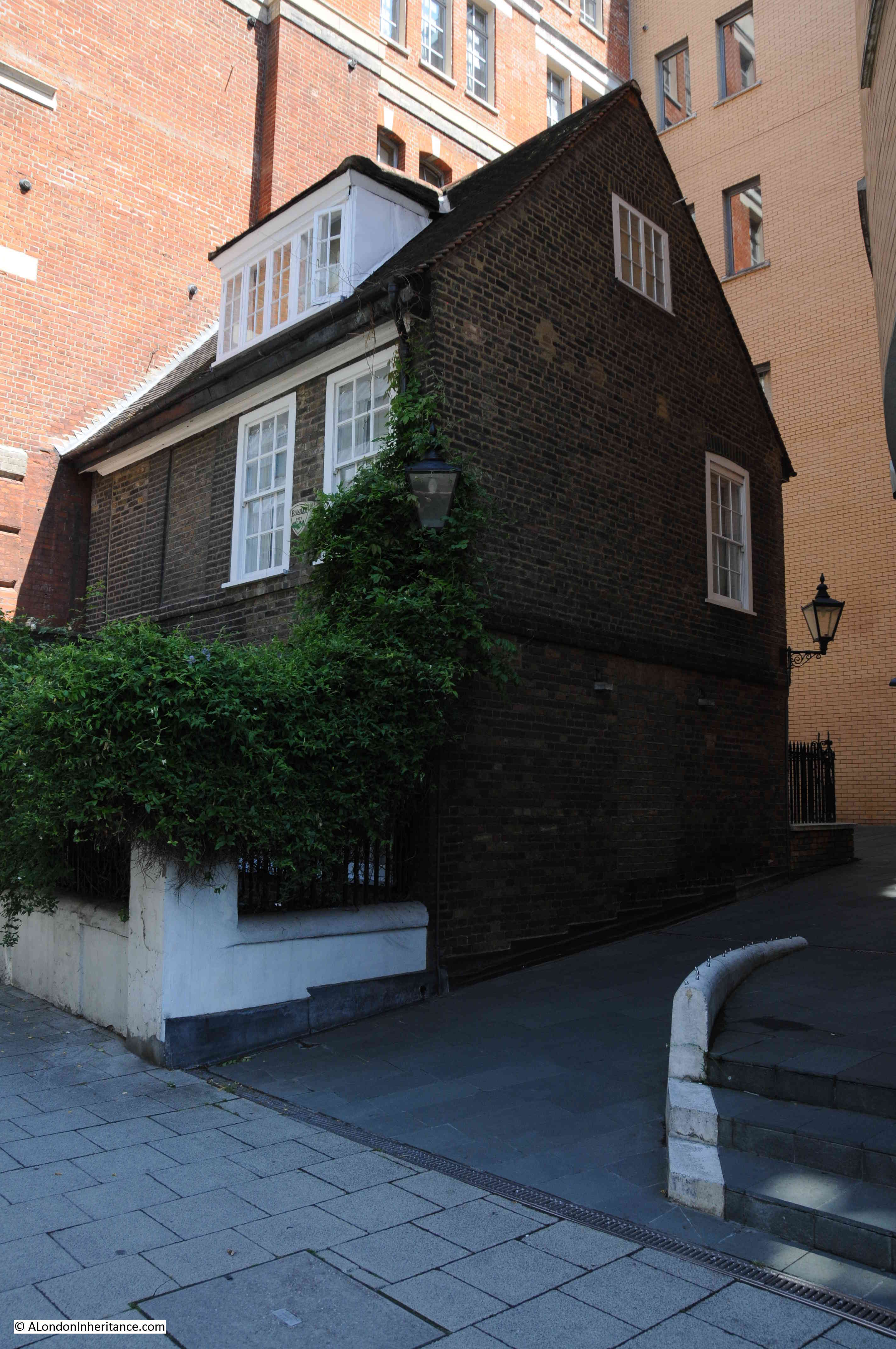
Hopton Street has one further surprise. This is No. 61 Hopton Street, or when it was first built, No. 9 Green Walk and is the oldest building in the area.

One of a number of houses built by James Price around 1703. This is the sole survivor and is surrounded on all sides by much later (and much larger) additions to Hopton Street. The changes that this house has seen over the centuries must be quite remarkable.

Founders 8

The change of part of Holland Street to Hopton Street probably occurred around the mid 1930s.

In Grace Golden’s history of Old Bankside, published in 1951, she refers to: “An apparently puritanical drive has recently changed Holland into Hopton Street, named after Charles Hopton”.

Also, the licensing records for the Founder’s Arms state that the original address was 8 Holland Street and the address was changed to 56 Hopton Street between 1934 and 1938.

From this, I assume that in the 1930s, there was an initiative to change from Holland to Hopton Street to erase the reference to what must have effectively been a brothel kept by Sarah Holland at the old Paris Garden’s Manor House.

The reversal of Holland and Hopton Streets between the 1940 and today’s maps was probably down to it being a very recent change in 1940 and an error in recording which leg of Holland Street had changed (although I cannot find out why only part of the street changed – it may have been down to the Almshouses wanting to have an address of their founder rather than the founder of a brothel !)

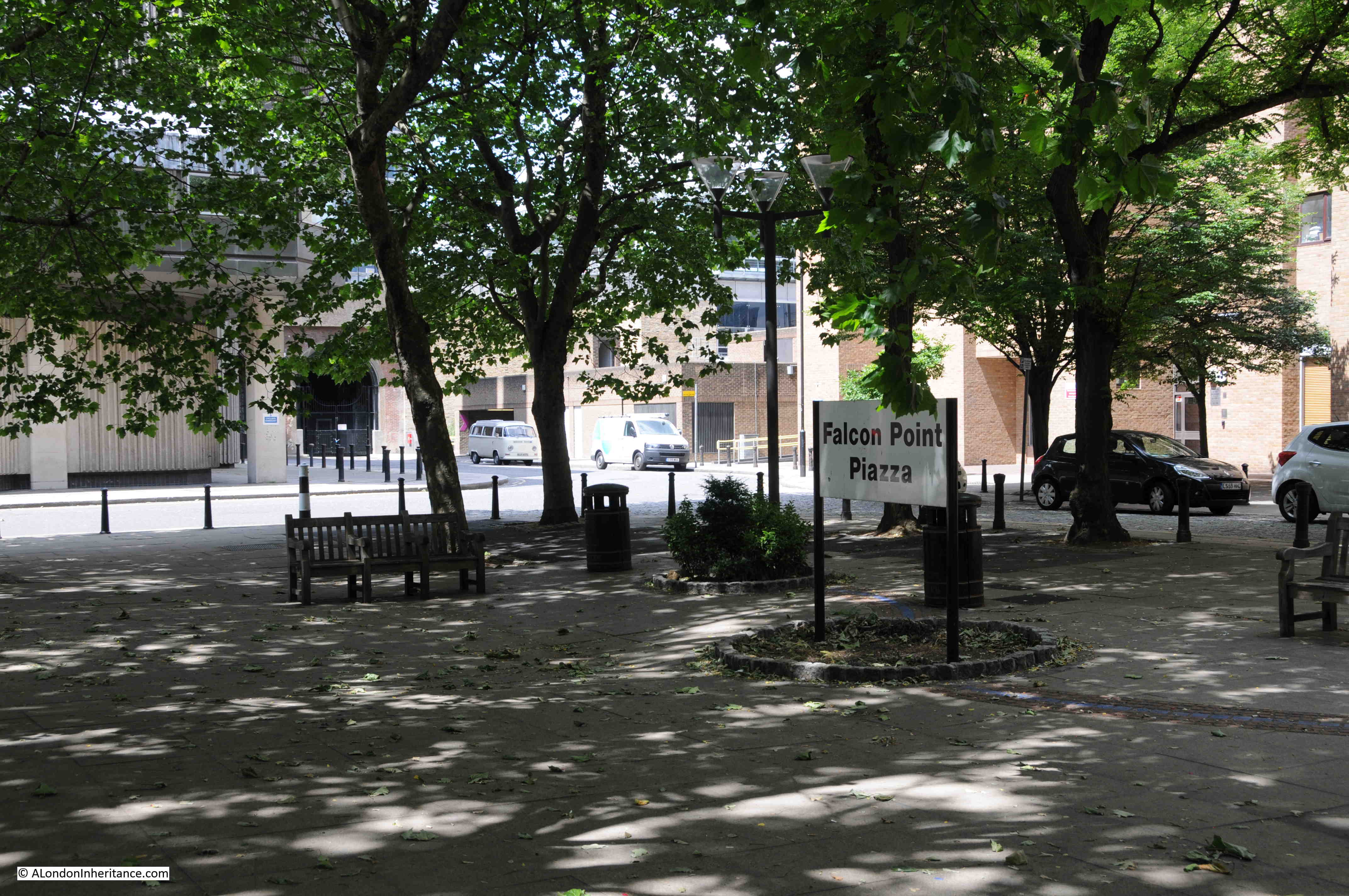
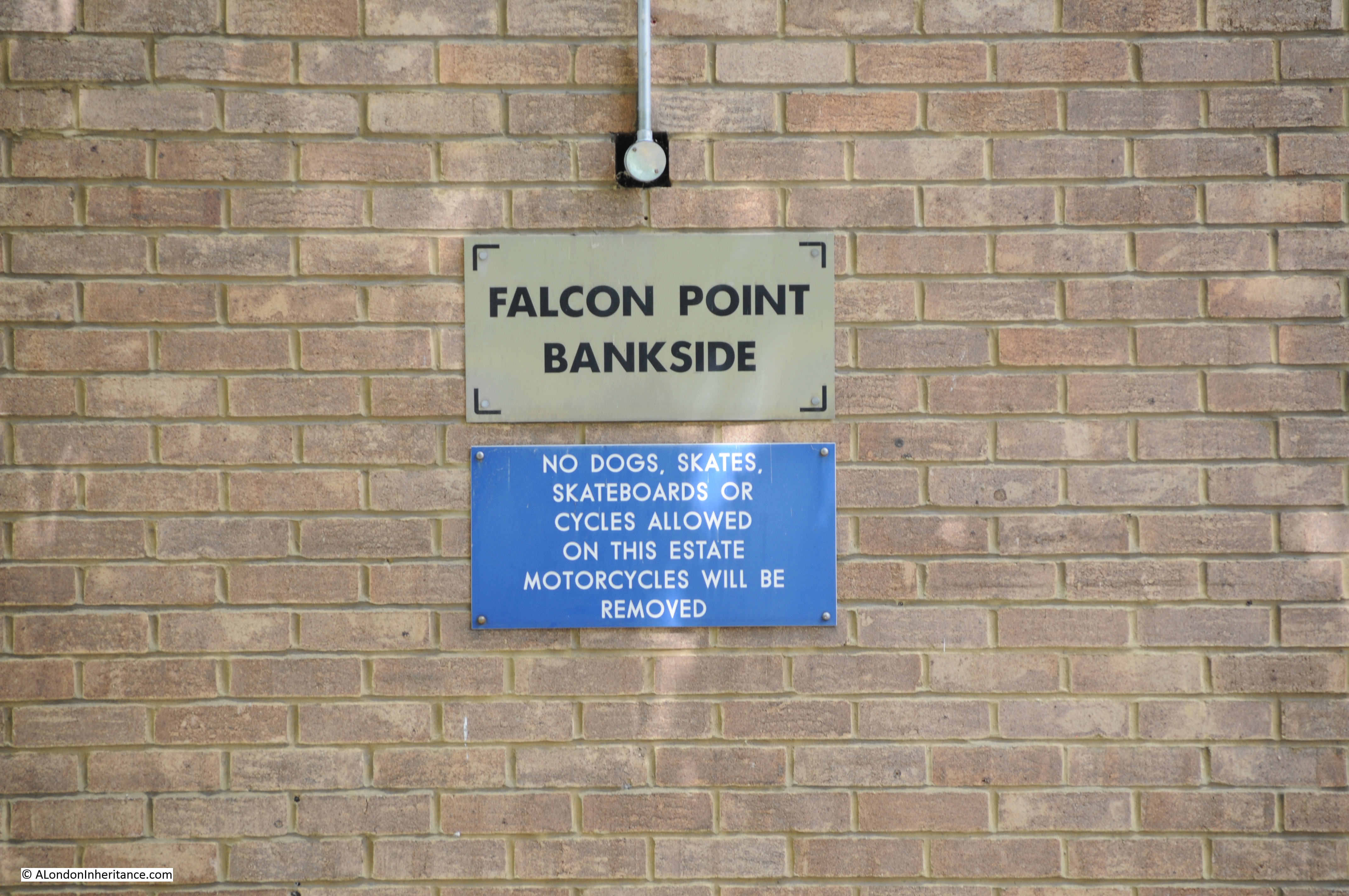
Before I return to the Founder’s Arms, there is one further name that persists in this small area. At the end of Hopton and Holland Streets is a paved area, planted with trees. This is Falcon Point Piazza:

Founders 3

Also, the new buildings to the right of the above photo are named Falcon Point:

Founders 4

If you return to the John Rocque map from 1746 and look on the river’s edge to the lower right of the red circle you will see Faulcon Stairs, one of the many old stairs that led down to the river.

The earliest explanation I can find for the name is from the sport of Falconry that took place in the Paris Gardens that occupied much of this area, so the buildings and the Piazza both retain the name of a sport that took place here hundreds of years ago.

The Falcon name has other associations with the area.

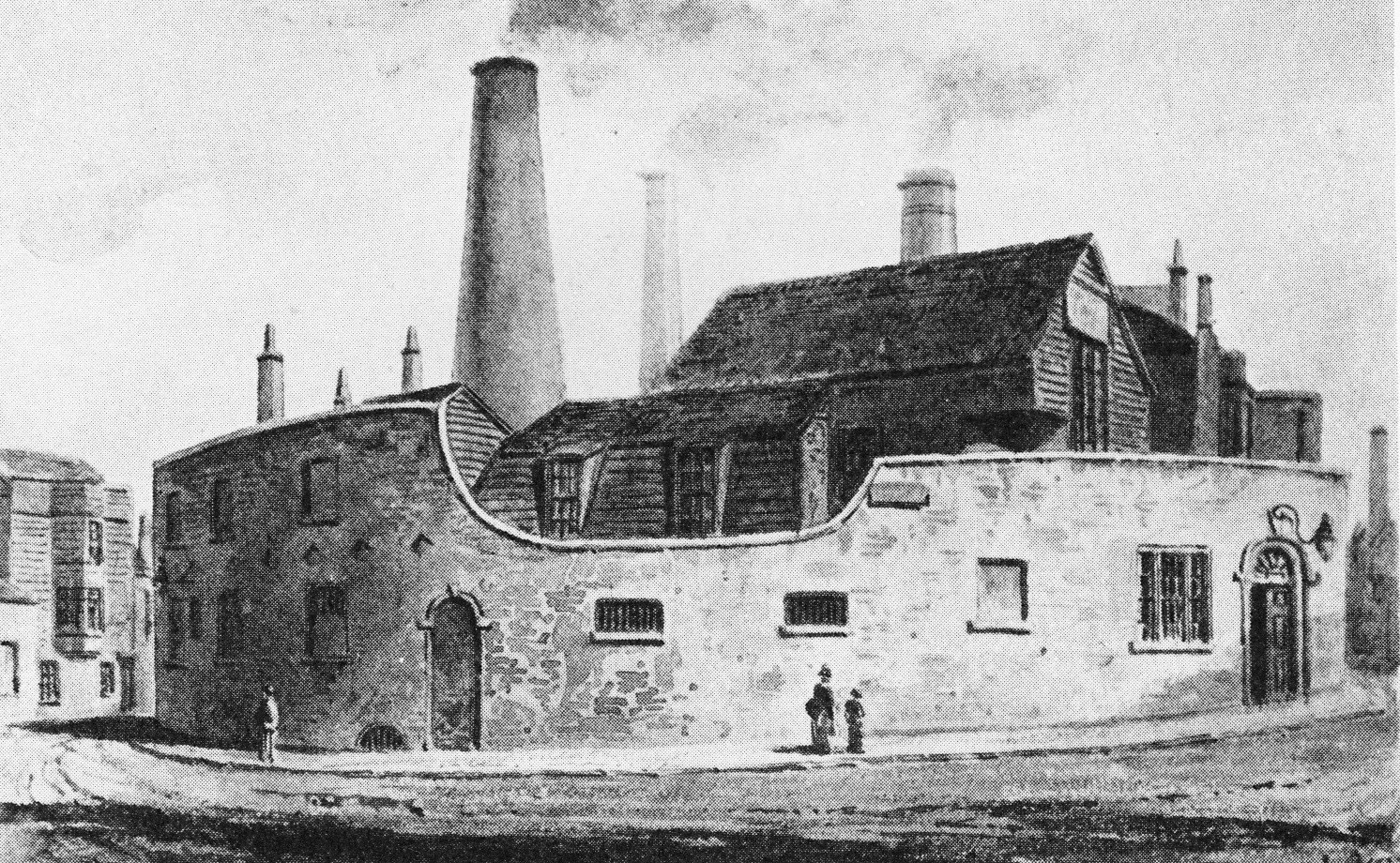
Between the end of Holland / Hopton Streets and the Hopton Almshouses was the Falcon Glass Works. Built in the late 18th century by the firm of Pellatt & Green, partly on the site of a Millpond (the millpond can be seen on John Rocque’s map above. Look slightly below the red dot and to the left and a small shaded area adjacent to the road is the original millpond. The curve of the current road still maintains the outline of the millpond)

Writing of the Glass Works in 1843 in his History of Surrey, Brayley states that “Their present importance and excellence are mainly due to the taste and exertions of the present proprietor and the employment of skilful hands on materials that science and experience approve. By these means the most elegant productions of the Continent are advantageously rivalled, and in some respects surpassed”. 

Falcon Glass Works as they appeared in 1827:

Founders 10

As can be seen, they were located at the point where Hopton / Holland Streets loop round, back to Southwark Street and Sumner Street. The same location now with the curve of the road (due to the original millpond) still very obvious:

Founders 9

I have read, but have been unable to corroborate, that the source of the name Founder’s Arms was due to the Glass Works or Foundry as a “Founder” is also an operator of a Foundry.

In addition to the Founder’s Arms, there was a much earlier pub on the site of the Falcon Drawing Dock, (closer to the river, near the stairs). This was the Falcon Tavern which was allegedly used by Shakespeare, but was definitely a major coaching inn, acting as the terminus for coaches to Kent, Surrey and Sussex. The Falcon Tavern was demolished in 1808.

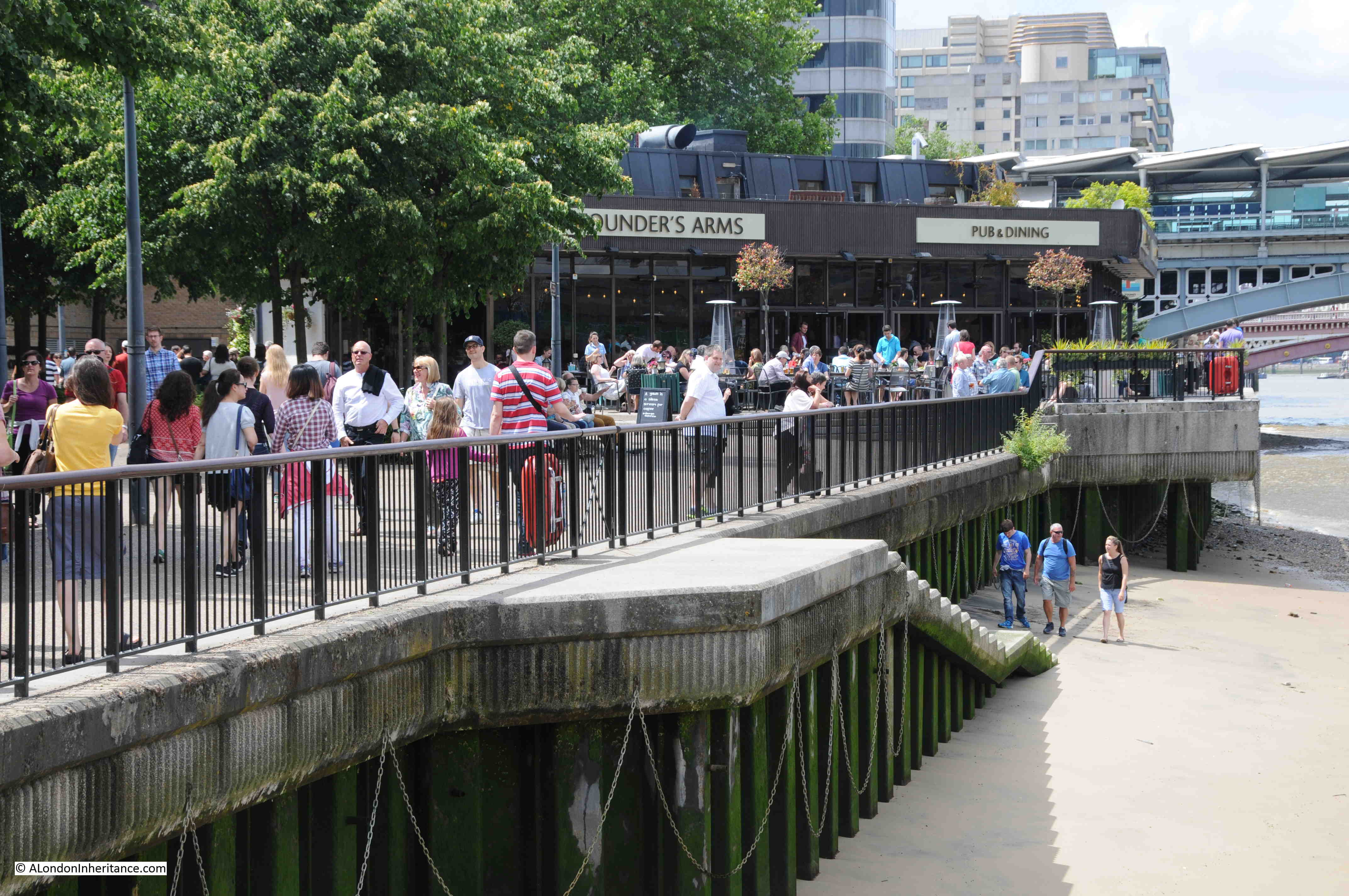
Now if we walk past where the Founder’s Arms use to be back up to the walkway along the river we find both the latest the latest incarnation of the Founder’s Arms and steps leading down to the river, roughly in the location of the Falcon Stairs (I say roughly as with the building of the walkway and other changes it is impossible to be precise).

Founders 5

A very different pub to the Victorian original but good that for at least 176 years (the earliest record I can find for the Founder’s Arms is from 1839) a pub with the same name has been found in this small area of Bankside.

A rather convoluted story, but one that demonstrates how much is to be found in one very small area of London, and that despite so much reconstruction and change, links with the history of the site are still there to be discovered.

The sources I used to research this post are:

  • Old and New London by Walter Thornbury published in 1881
  • London, South of the Thames by Sir Walter Besant published in 1912
  • Survey of London, Volume XXII published by the London County Council in 1950
  • Old Bankside by Grace Golden published in 1951
  • London by George H. Cunningham published in 1927
  • Bartholomew’s Reference Atlas of Greater London, editions published in 1913, 1930 and 1940
  • A Plan of the Cities of London and Westminster and the Borough of Southwark by John Rocque published in 1746

 alondoninheritance.com

Walking The Streets On The Evening Before The 1981 Royal Wedding

A couple of weeks ago I published the photos my father took of people waiting for the Coronation in 1953. That post can be found here.

Just under 30 years later there was another royal event in central London, and on the evening before people were finding the best position along the route to watch the events of the following day.

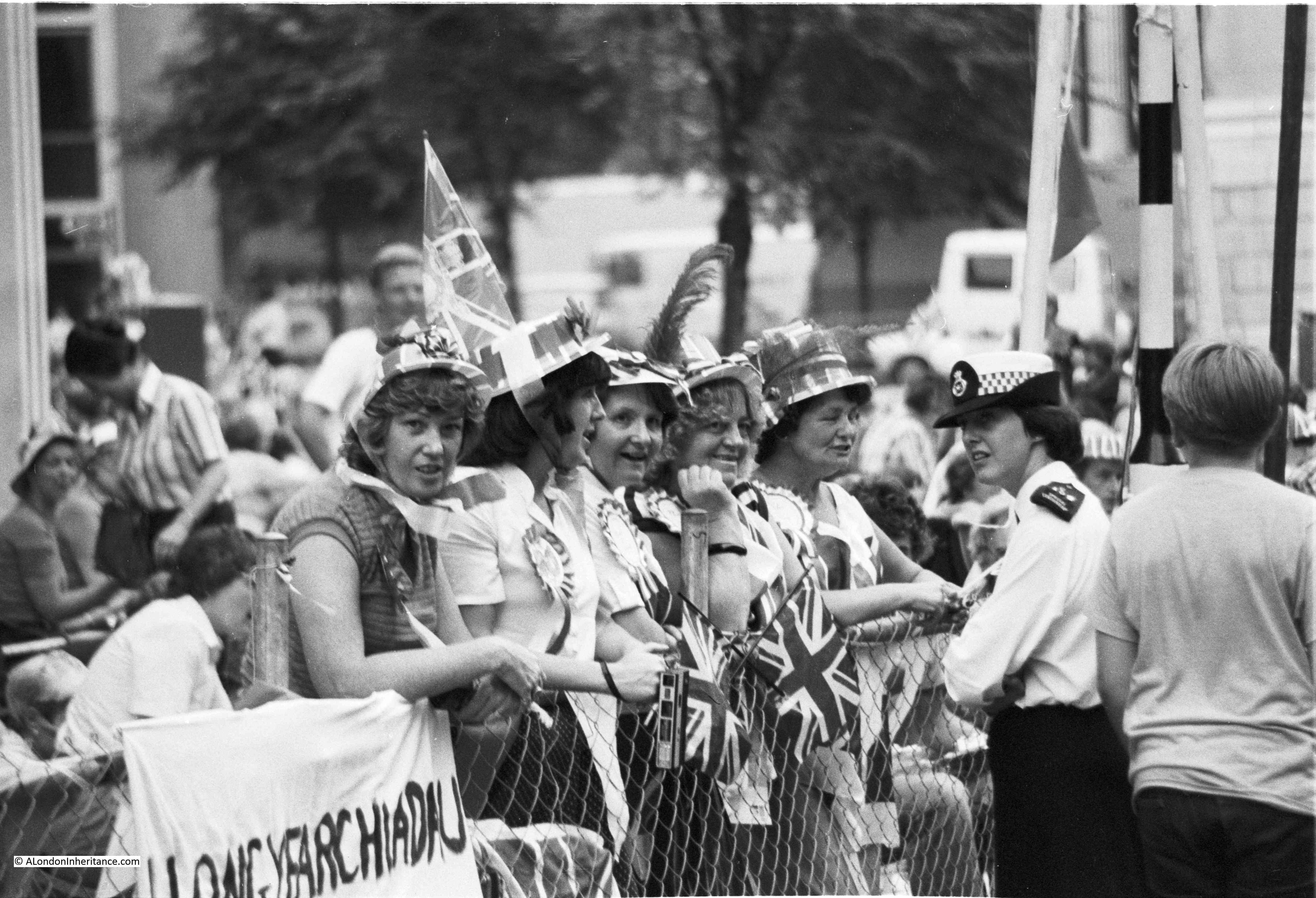
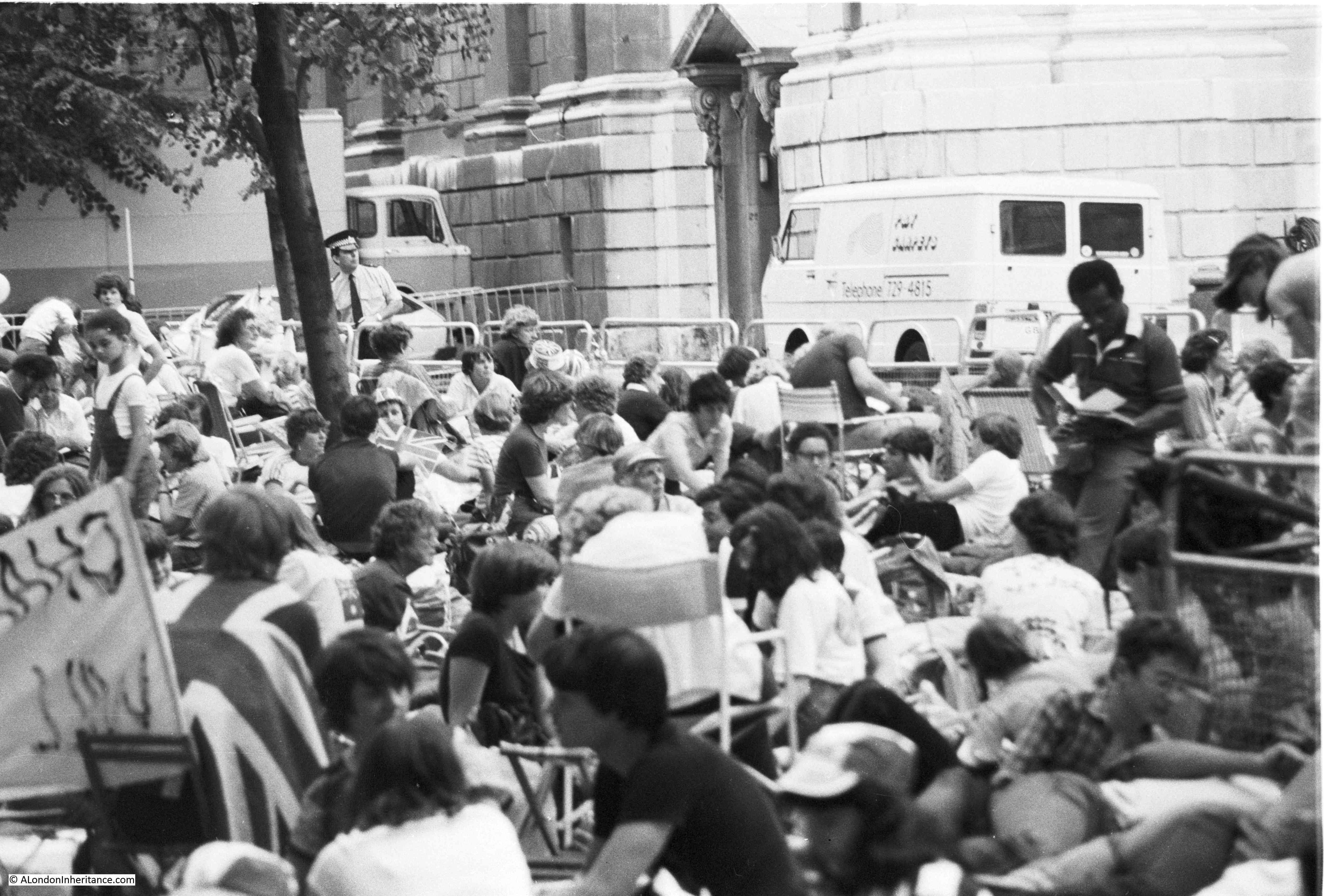
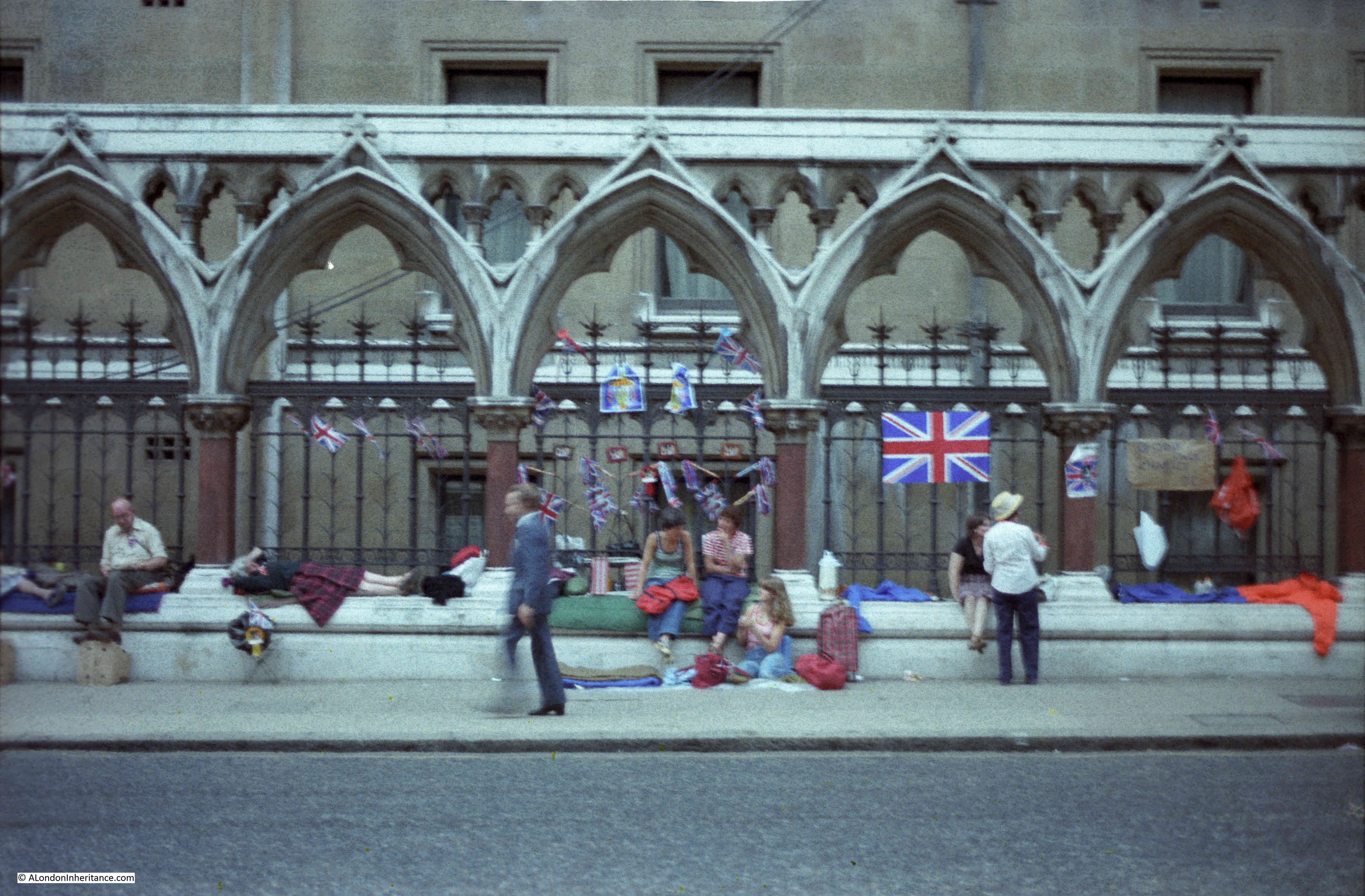
This was the wedding of Charles and Diana that took place on the 29th July 1981 and on the evening of the 28th July I took a walk from St. Paul’s Cathedral and along Fleet Street and the Strand to take some photos.

Starting at St. Paul’s Cathedral, this is where the best positions were and large crowds had already found their place ready for an overnight stay.

I must have had a couple of photos left on some Black and White film before moving to colour.
Outside St. Paul’s Cathedral:

Royal Wedding St. Paul's

Crowds at this perfect position looking across at the steps leading into the Cathedral: Royal Wedding St. Paul'sI must have then switched to a colour film:Royal Wedding St. Paul's

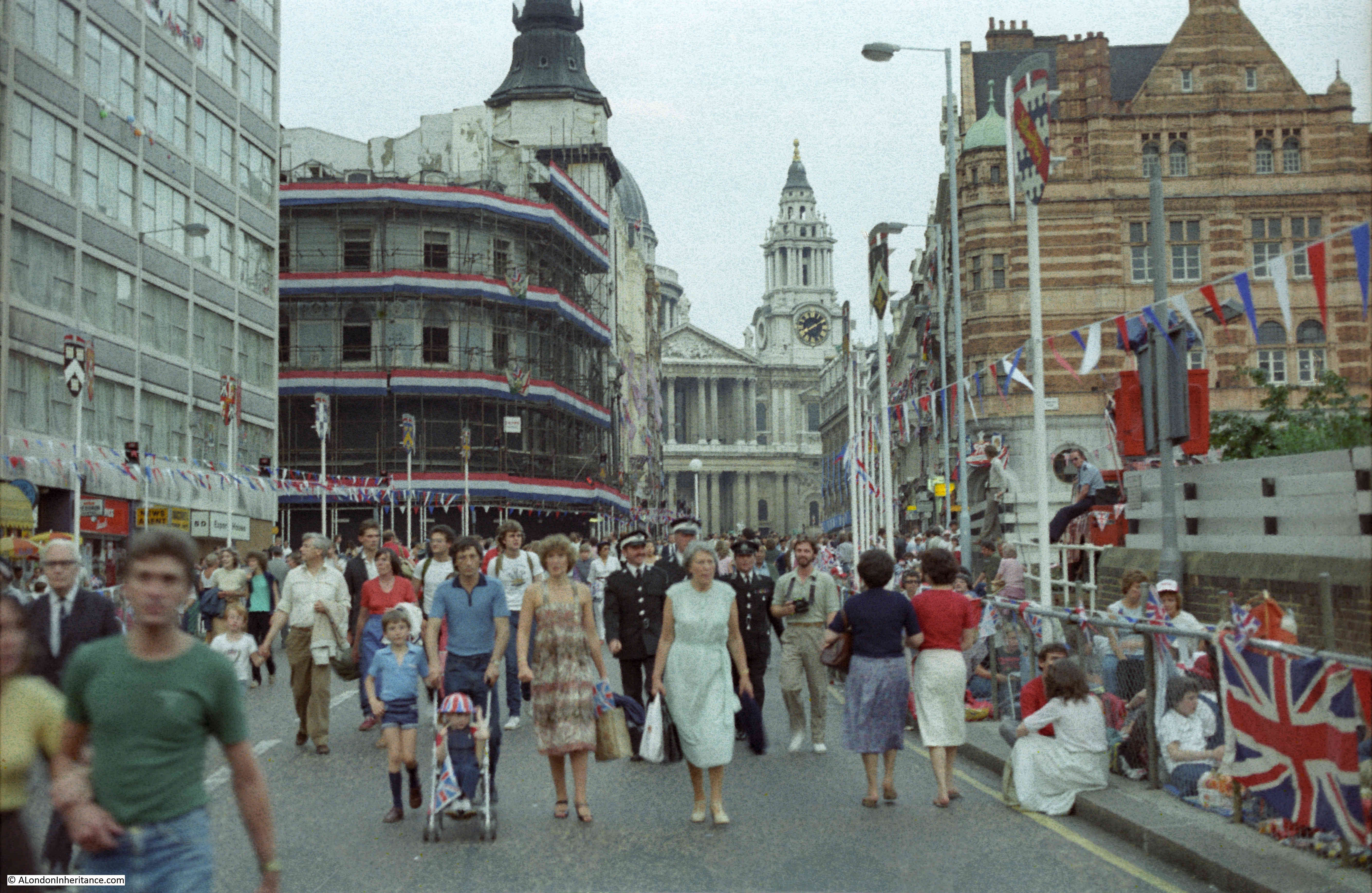
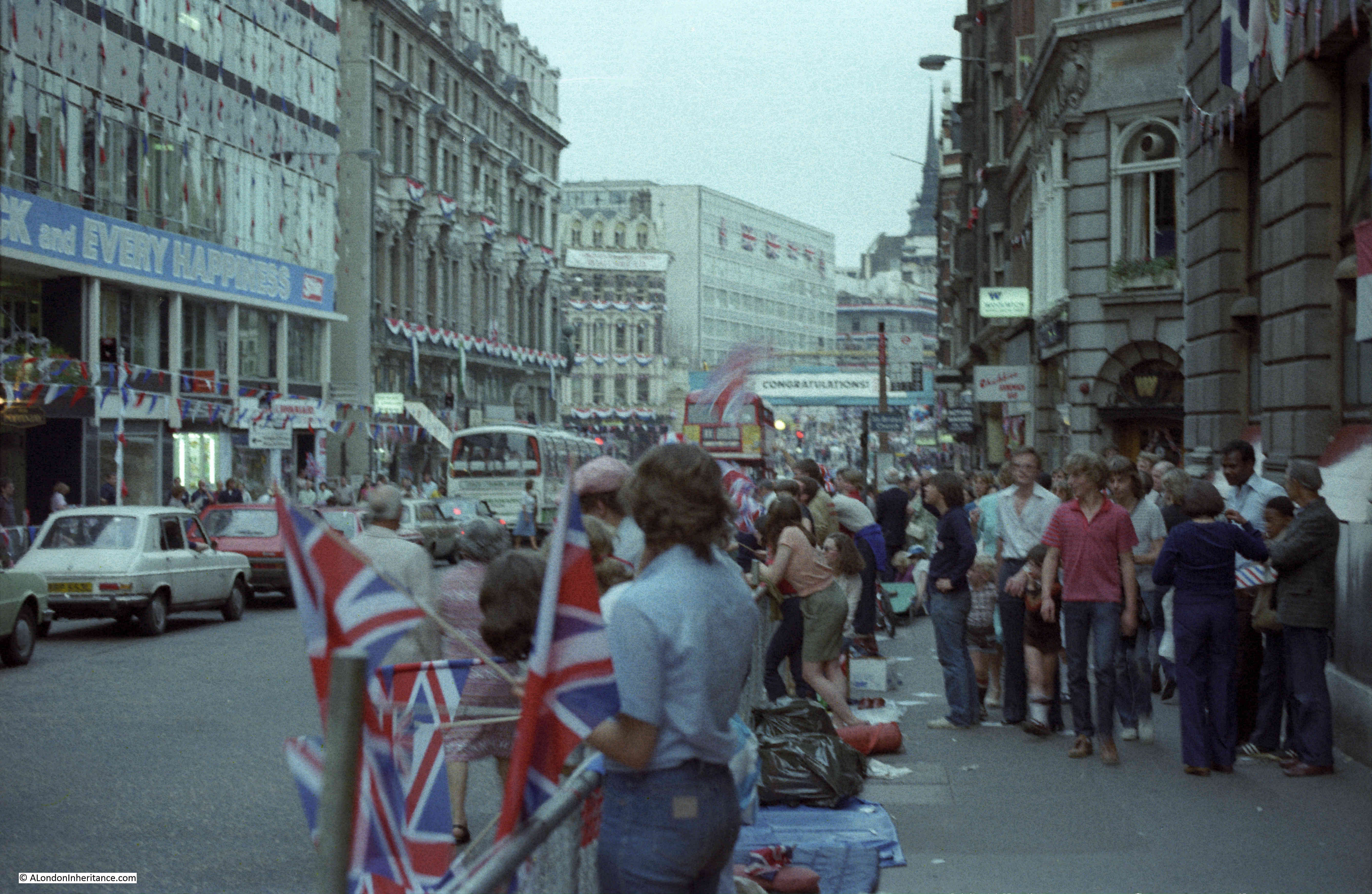
Looking back up Ludgate Hill. Although this was the evening before, the road had been closed and a large number of people were just walking the route, taking in the atmosphere and watching the people who were settling in for the night along the edge of the route. It was a warm evening and I remember there being a real sense of a big event taking place the following day.

Royal Wedding Ludgate Hill

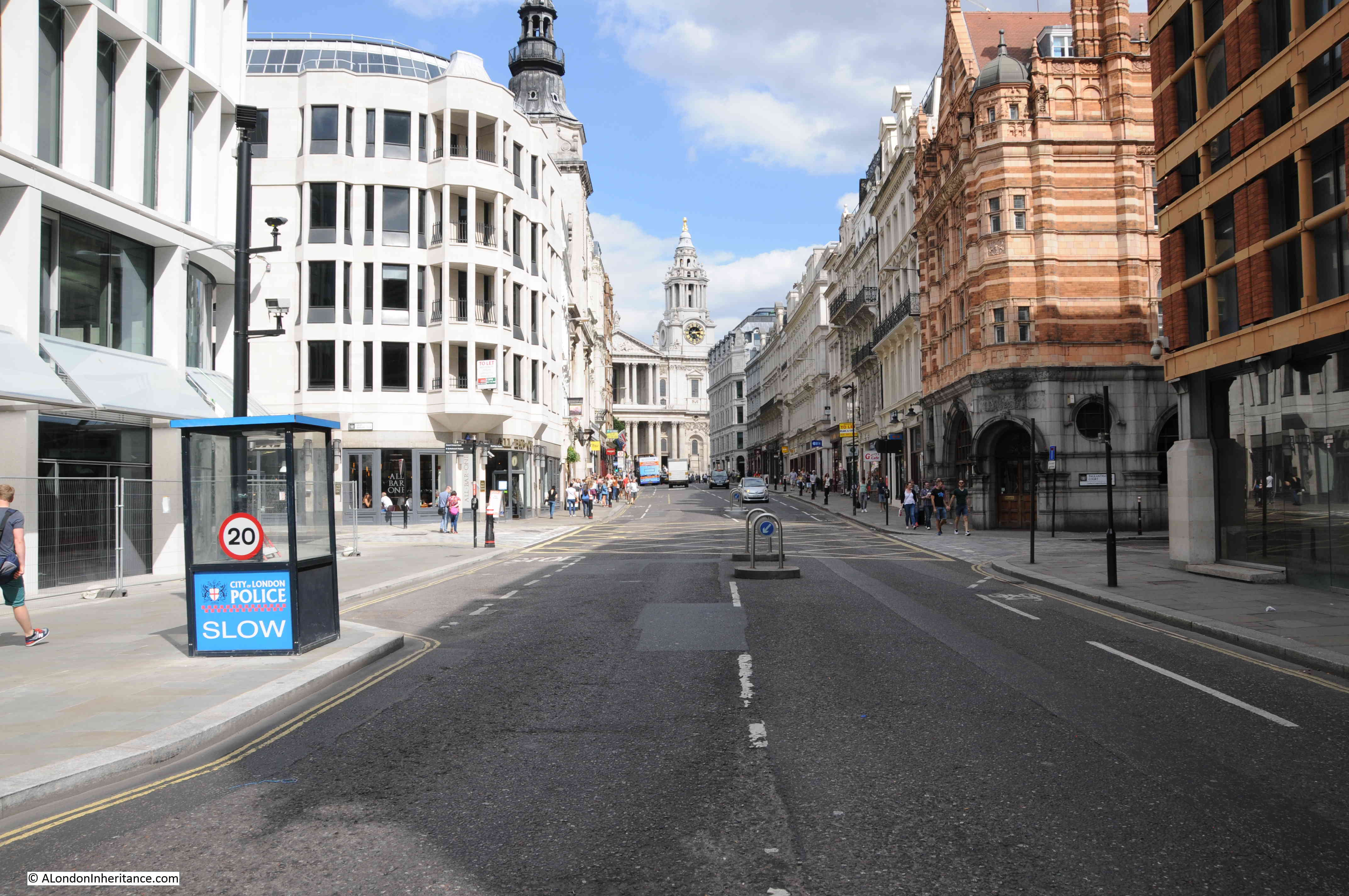
The same view today looking back up Ludgate Hill towards the cathedral. St. Martin Ludgate on the left is still there, along with many of the buildings on the right.

Ludgate Hill

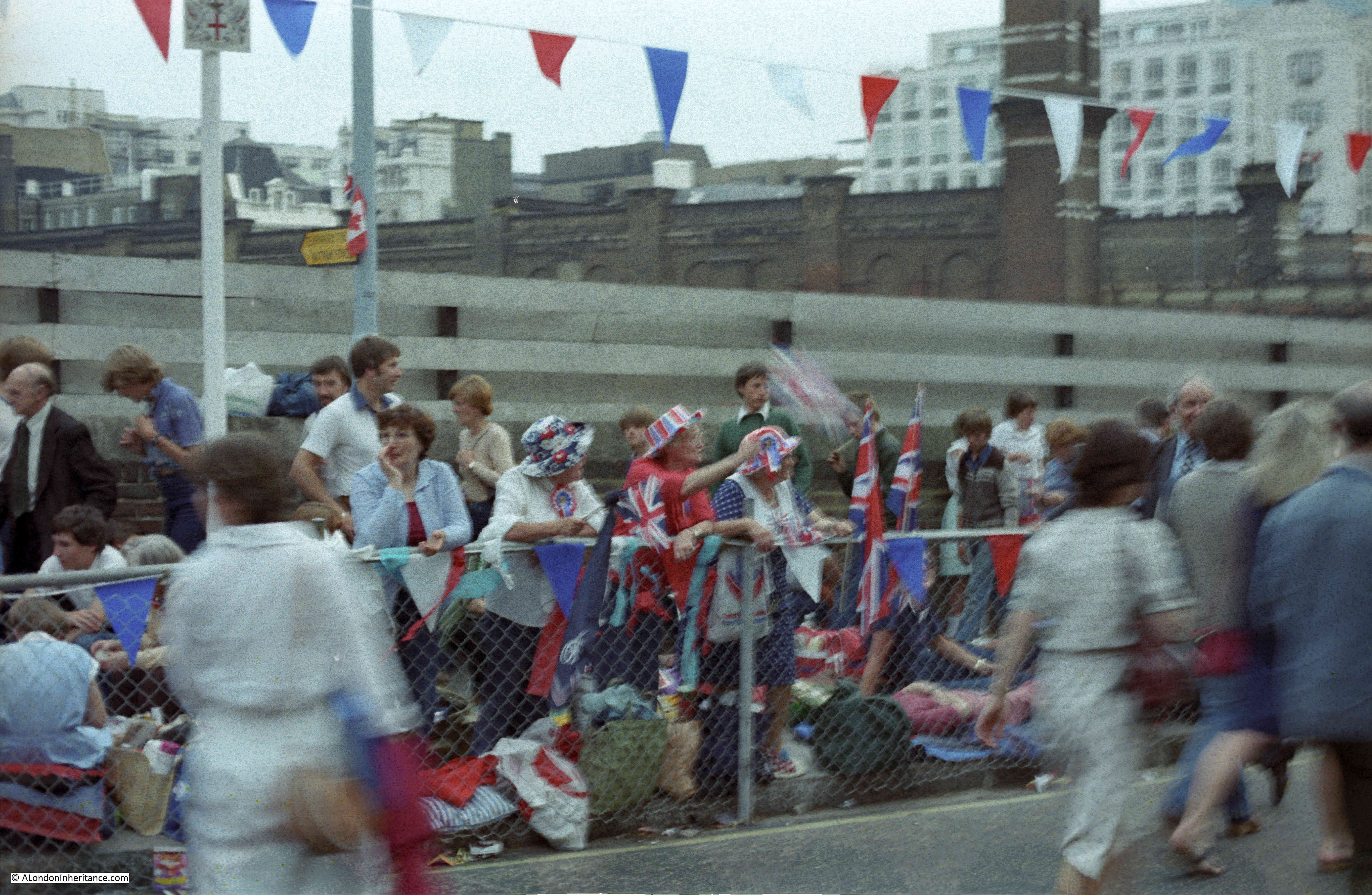
Just to the right in the above photo in 1981:

Royal Wedding Ludgate Hill

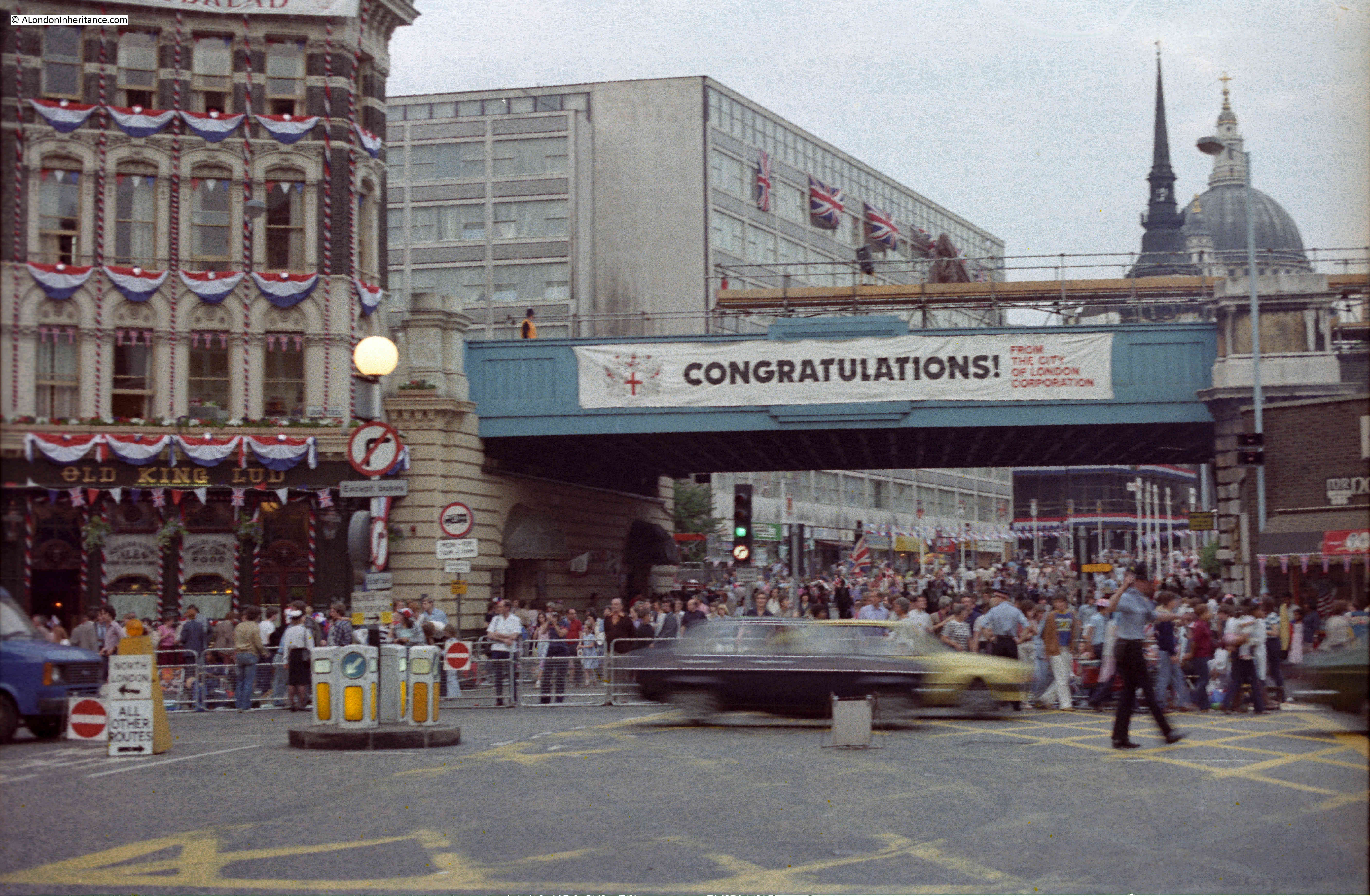
Now in Ludgate Circus. This was when the railway bridge still ran across the start of Ludgate Hill.

Royal Wedding Ludgate Circus

Just to the left of the railway bridge is the Old King Lud pub, decorated for the event. This was a lovely Victorian pub, built-in 1870,

Royal Wedding Ludgate Circus

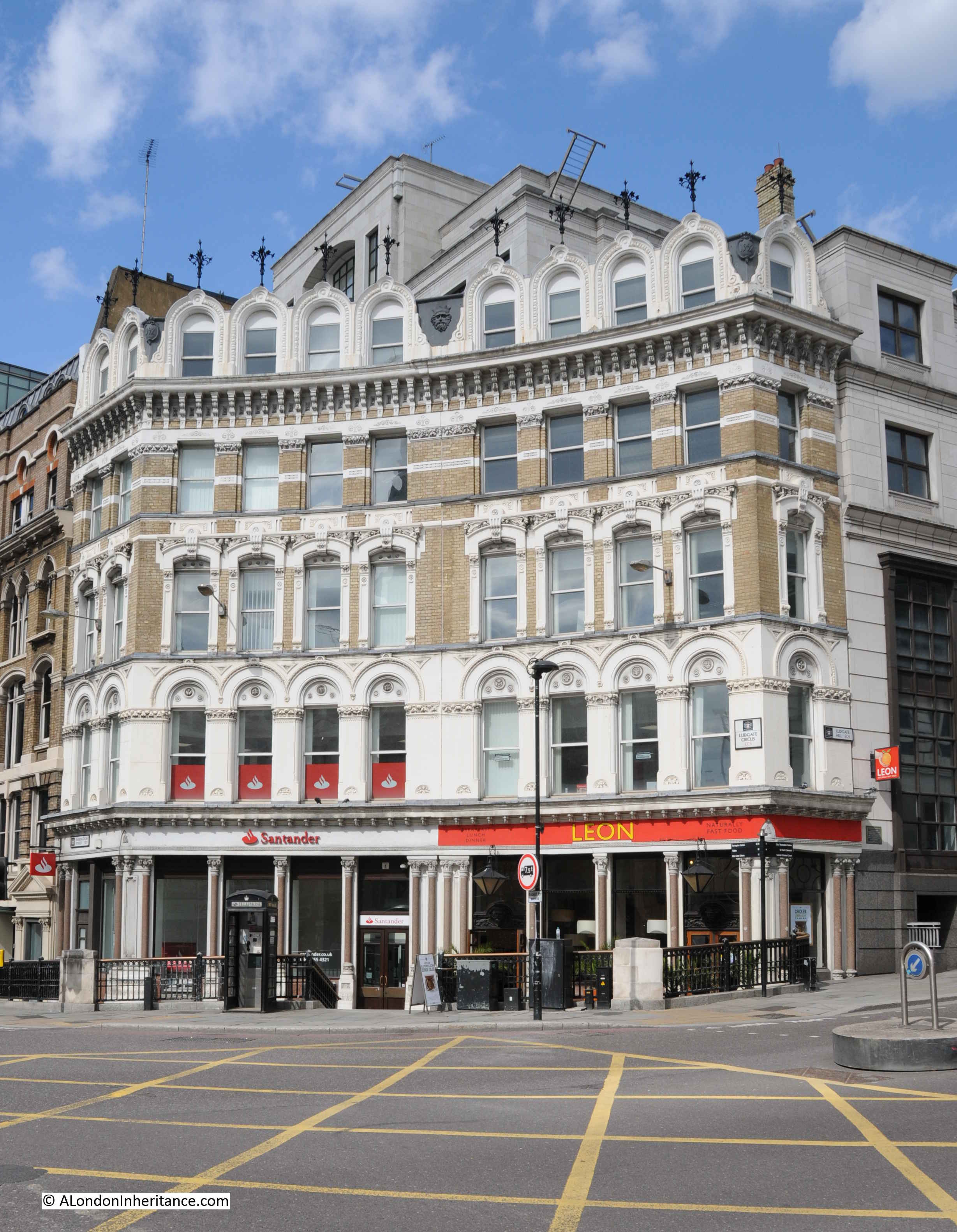
After going through some changes in the 1990s, the pub finally closed in 2005 and became yet another of London’s lost Victorian pubs. The site is now occupied by a fast food store with offices above:

Ludgate Circus

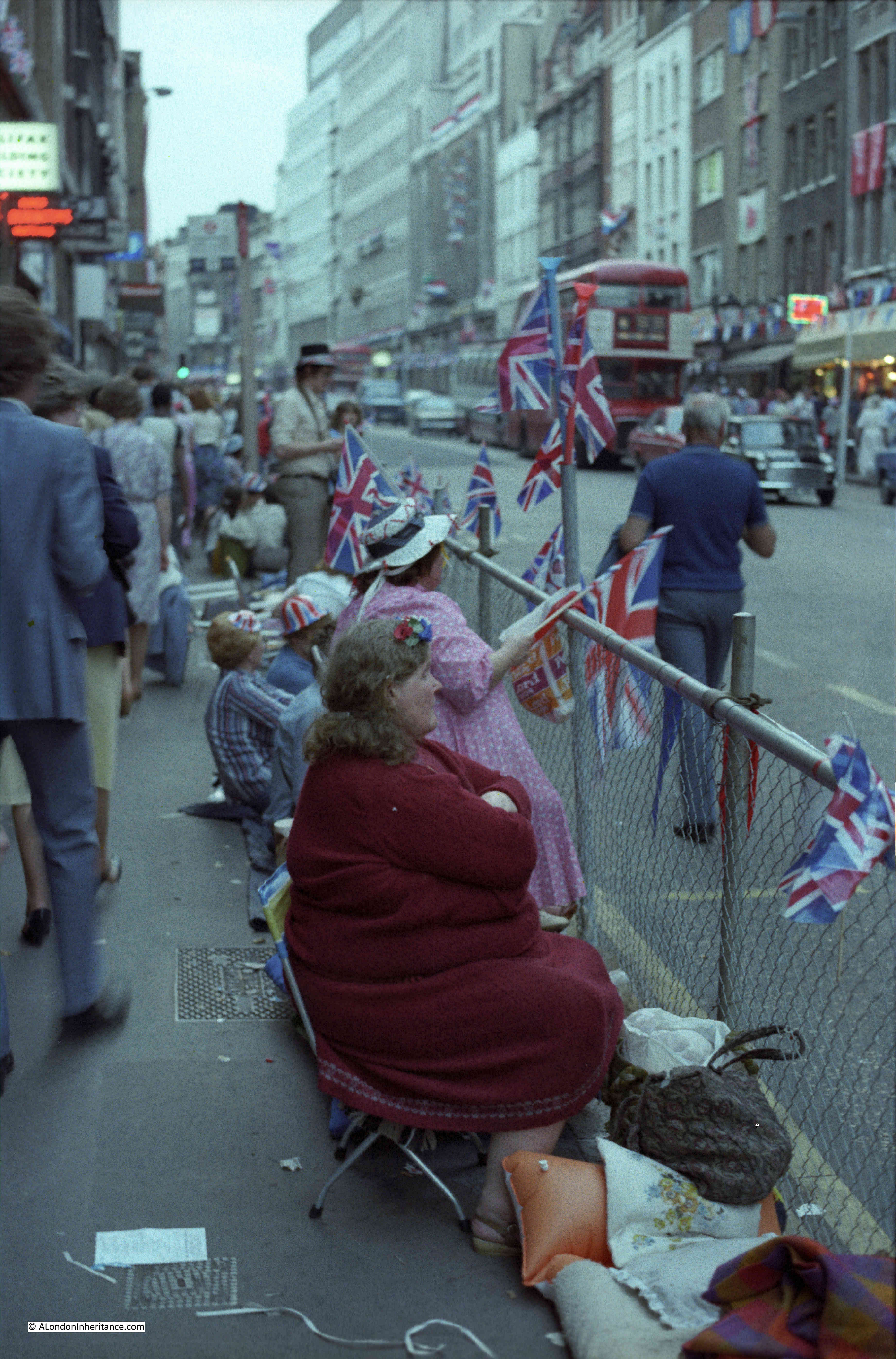
Moving up into Fleet Street. This road was still open and the pavements were busy with those walking and those waiting:

Royal Wedding Fleet Street

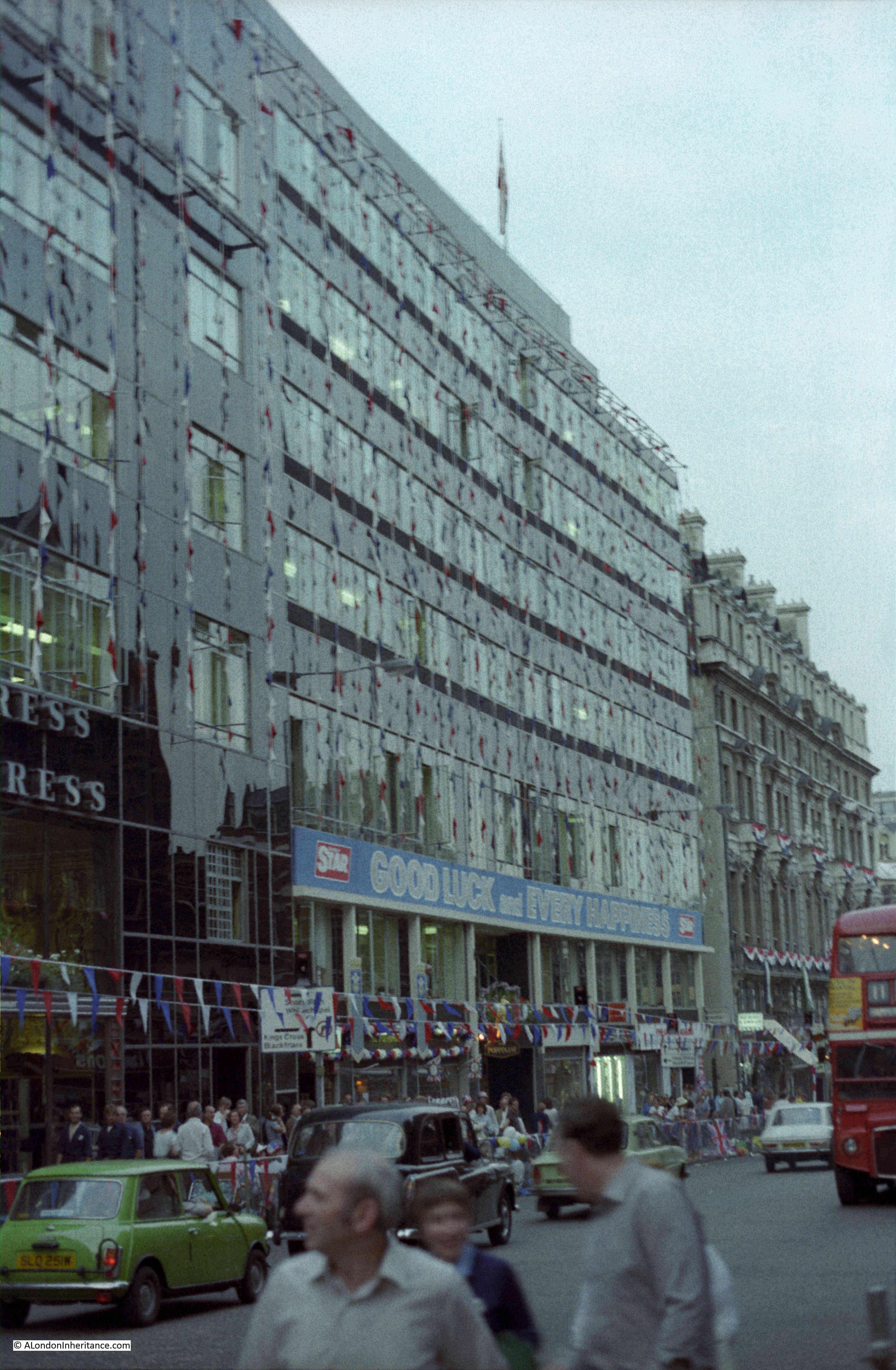
This was when Fleet Street was still occupied by newspaper publishers. The Express offices on the left and those of the Star on the right. I remember walking along Fleet Street and the side roads leading down to the Thames on a late Saturday afternoon / early evening and listening to the sound of the newspapers being printed and the amount of activity to get the next day’s edition distributed. All very exciting when you are young and exploring London.

Royal Wedding Fleet Street

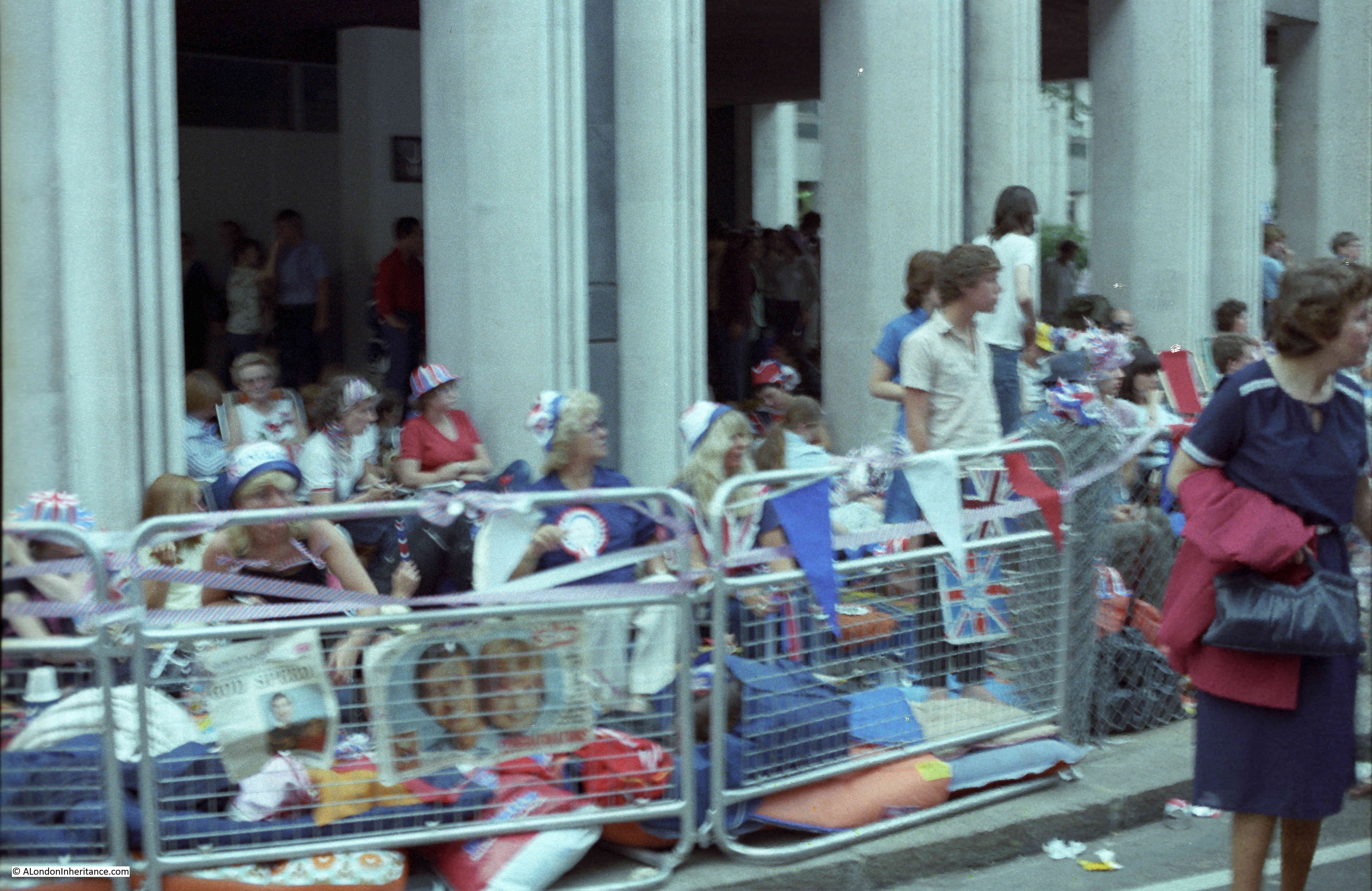
Prepared for a night’s wait:

Royal Wedding Fleet Street

Along the side of the Royal Court’s of Justice:

Royal Wedding Law Courts

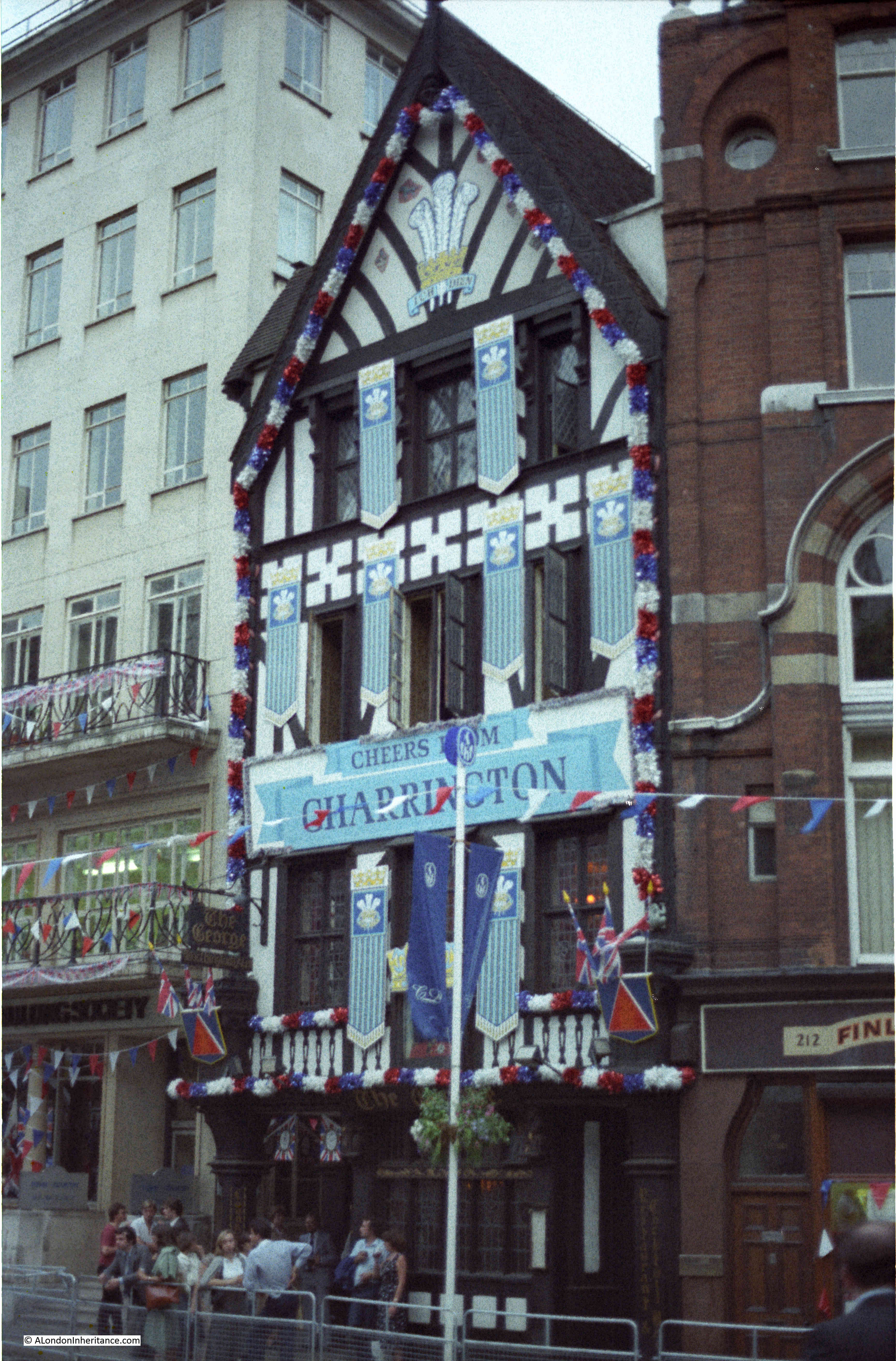
The George pub in the Strand which fortunately is still there:

Royal Wedding Strand

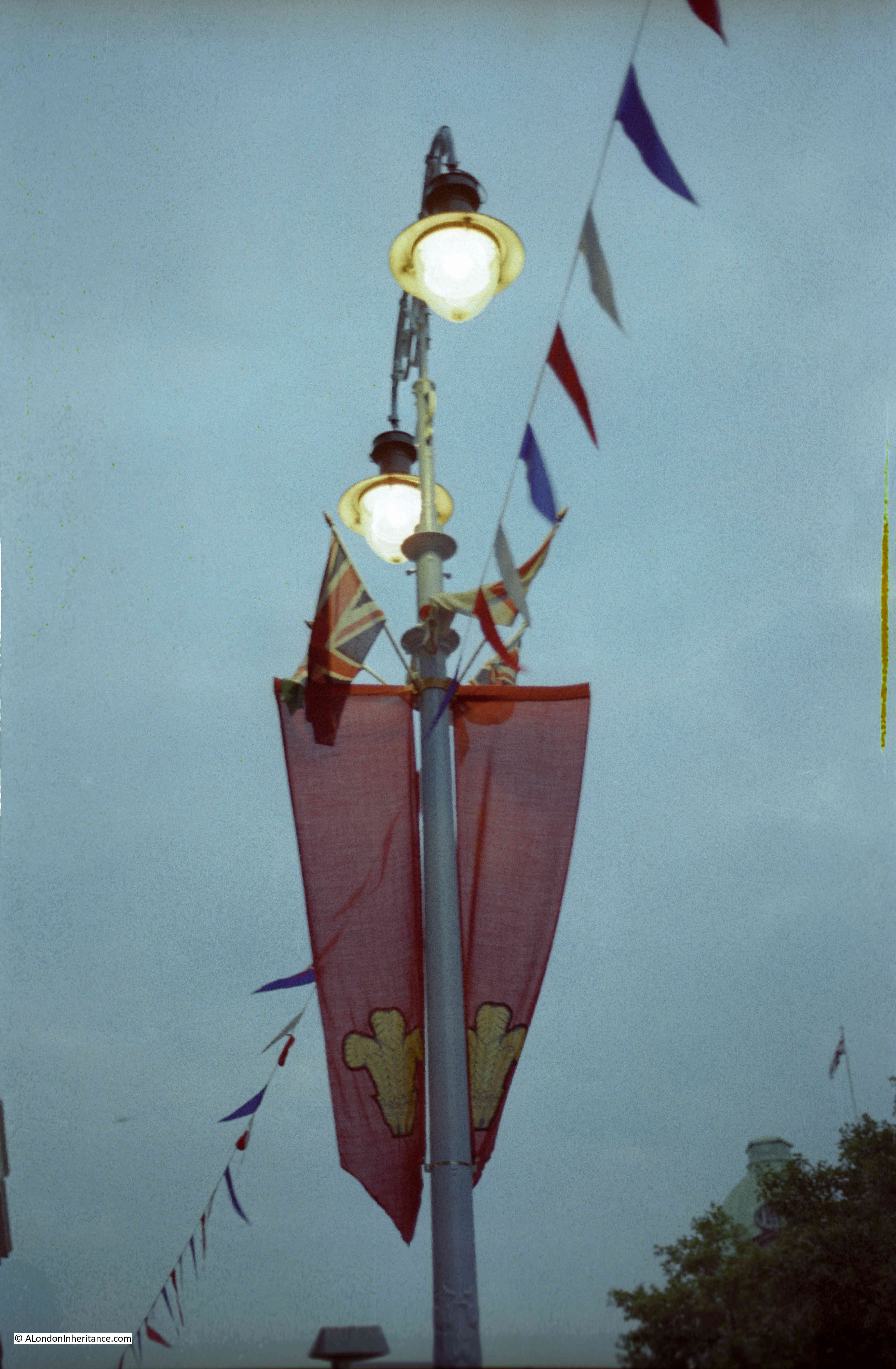
Most of the decorations were put up by the owners of the buildings along the route. “Official” street decoration was very limited, mainly these pennants hanging from lamp posts. Union Jacks along with red, white and blue bunting was out in abundance.

Royal Wedding Strand

One of many events that have taken this route to St. Paul’s Cathedral, but a special event for me as this was my first opportunity to get out and photograph the streets and people preparing for the following day.

alondoninheritance.com


Cardinal Cap Alley And No. 49 Bankside

If you visit Bankside today, by far the main attraction is the reconstruction of Shakespeare’s Globe Theatre, however I would argue that there is a far more important historical building right next door to the Globe.

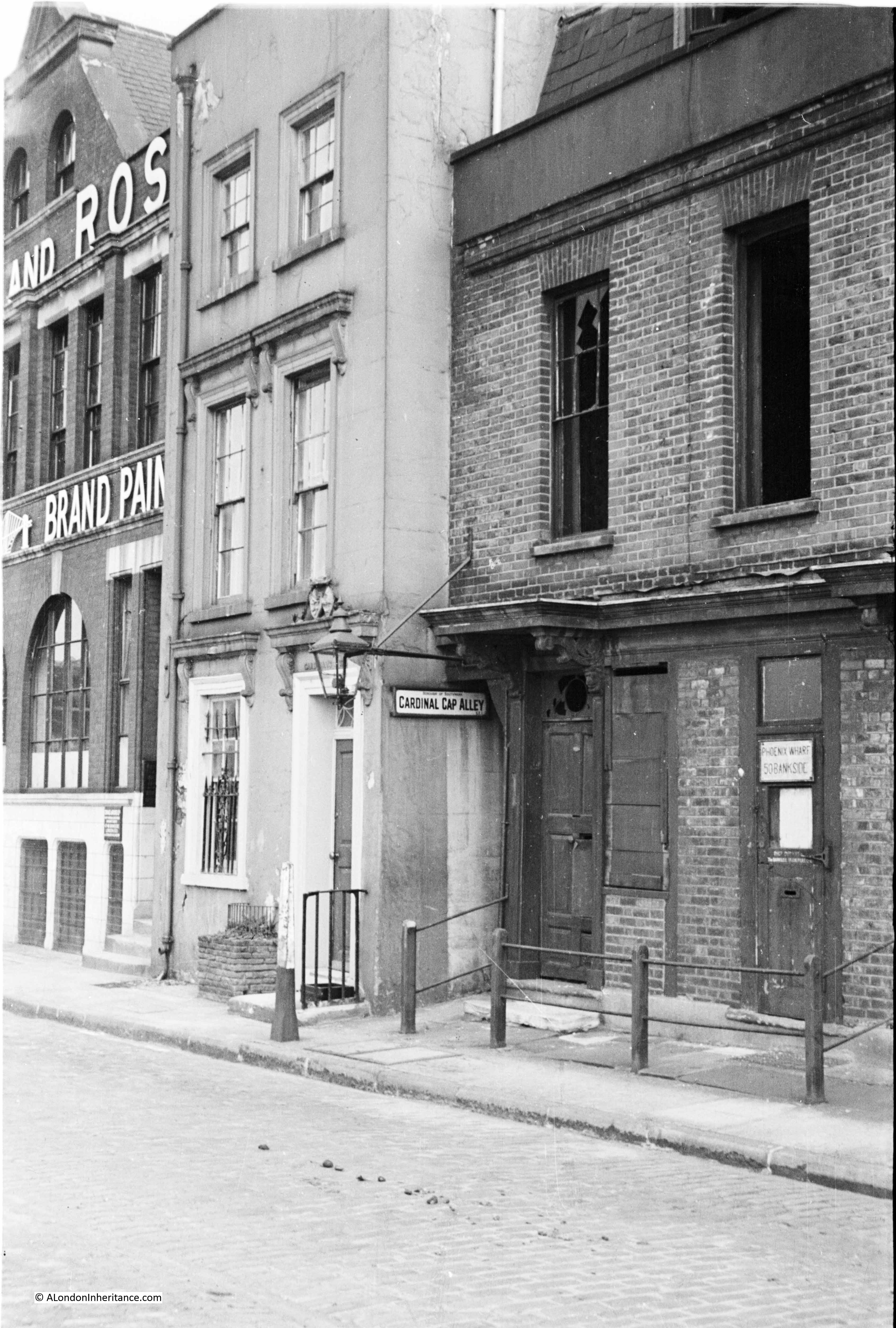
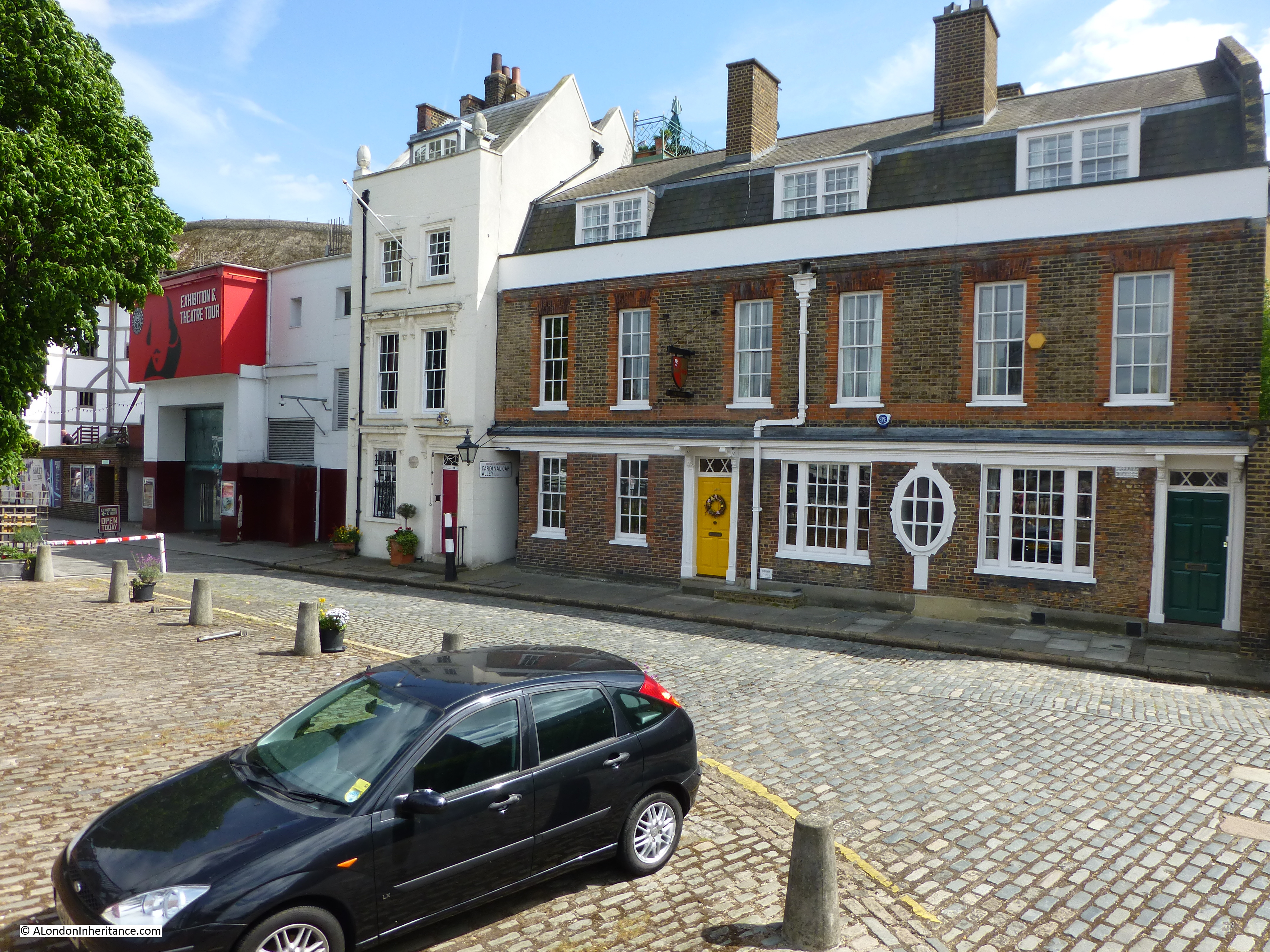
The following photo was taken by my father in 1947 and shows Cardinal Cap Alley. The building on the left of the alley is No. 49 Bankside, a building that exists to this day and has somehow managed to survive the considerable rebuilding along Bankside, and whilst having a well documented history, No. 49 also pretends to be something which it is not.

Cardinal Cap Alley

In the above photo, No. 49 and Cardinal Cap Alley are between one of the many industrial buildings along Bankside (Craig & Rose, paint manufacture’s ) and a short terrace of houses that were damaged by bombing in the last war.
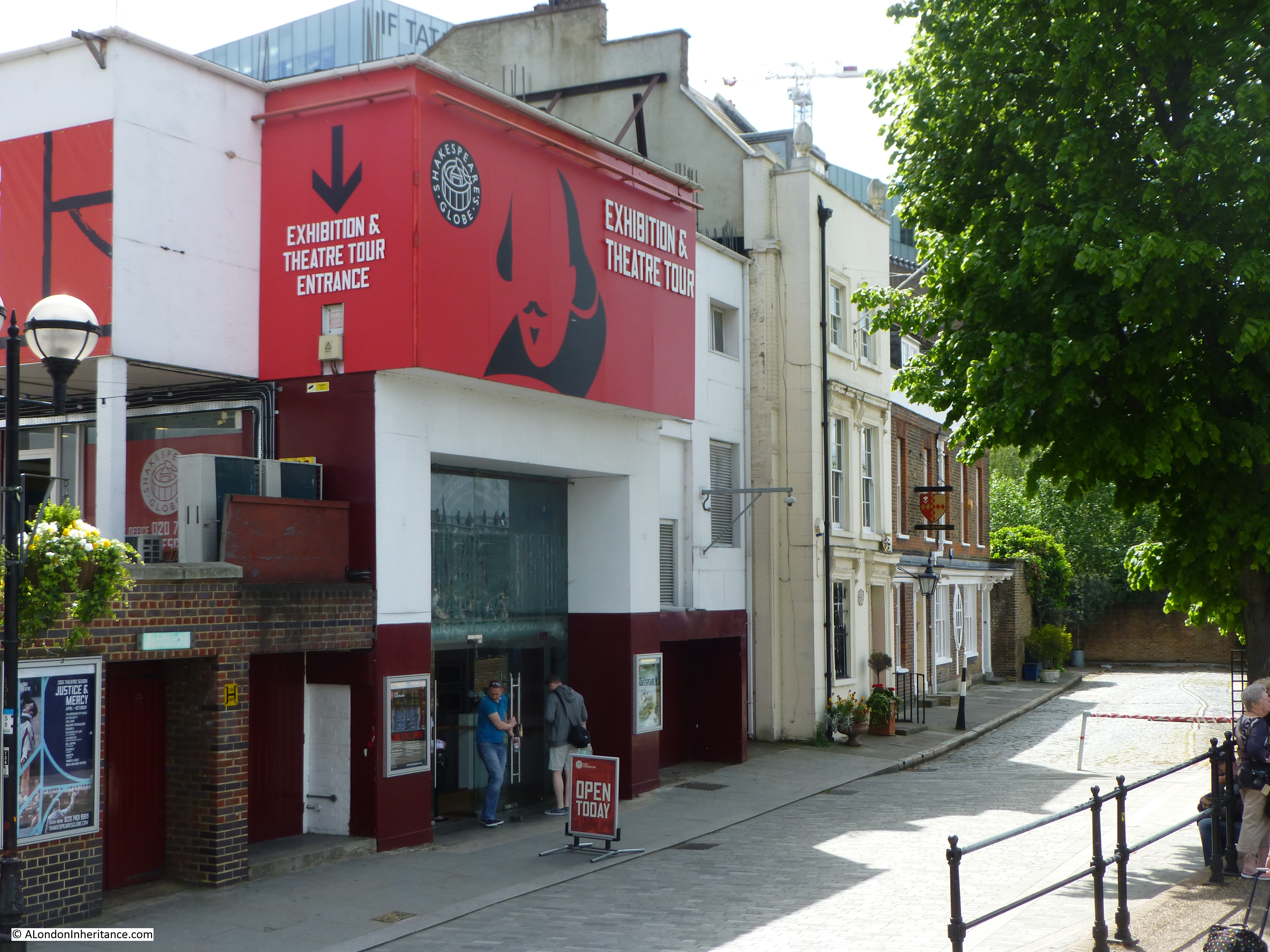
The following photo is my 2015 view of the same area and shows No. 49 and Cardinal Cap Alley are now in between the Globe and the rebuilt terrace of houses, which were also reduced from three down to two houses in the post war reconstruction.
Cardinal Cap Alley

Cardinal Cap Alley and No. 49 have a fascinating history that tell so much about how Bankside has changed, and also how the history of the site can be traced to what we see along Bankside today.

As a starter, the following is from the London County Council Survey of London, Volume XXII published in 1950:

“The name Cardinal’s Hat (or Cap), for a house on the site of the present No. 49 Bankside, and for the narrow alley which runs down beside it, dates from at least the time of Elizabeth and perhaps earlier. The suggestion that it was named in compliment to Cardinal Beaufort is attractive but untenable, for Beaufort died in 1447, and the original Cardinal’s Hat was not built till many years later.
The site was described in 1470 as “a void piece of ground”. It is possible that it was named after Cardinal Wolsey who was Bishop of Winchester from 1529-30, although no buildings are mentioned in a sale of the site from John Merston, fishmonger, to Thomas Tailloure, fishmonger in 1533. Stowe lists the Cardinal’s Hat as one of the Stewhouses but he may possibly have been mistaken, including it only because it was one of the more prominent inns on Bankside in his day.

It is shown in the Token Book for 1593 as in occupation of John Raven and as one of a group of houses which in the book for 1588 is described as “Mr. Broker’s Rentes”. Hugh Browker, later the owner of the Manor of Paris Garden, was in possession of ground there in 1579 and it seems likely that he was responsible for the formation of Cardinal’s Cap Alley if not for the building of the original house.

Thomas Mansfield was the tenant of the inn when Edward Alleyn dined there with the “vestrye men” of St. Saviour’s parish in December 1617.

A few years later John Taylor, the water poet makes reference to having supper with “the players” at the Cardinal’s Hat on Bankside. Milchisedeck Fritter, brewer, who tenanted the house from 1627 to 1674 issued a halfpenny token. He was assessed for seven hearths in the hearth tax rolls.

The freehold was sold by Thomas Browker to Thomas Hudson in 1667. The later died in 1688 leaving his “messuages on Bankside” to his sister Mary Greene, with reversion to his great nieces Mary and Sarah Bruce. It was at about this date that the older part of the present house was built. During the 18th century it was bought by the Sells family who both owned and occupied it until 1830. in 1841 Edward Sells of Grove Lane, Camberwell, bequeathed his freehold messauge and yard and stables, being No. 49 Bankside, then in the tenure of George Holditch, merchant, to his son, Vincent Sells. The house is now owned by Major Malcolm Munthe. It has previously been occupied by Anna Lee, the actress.”

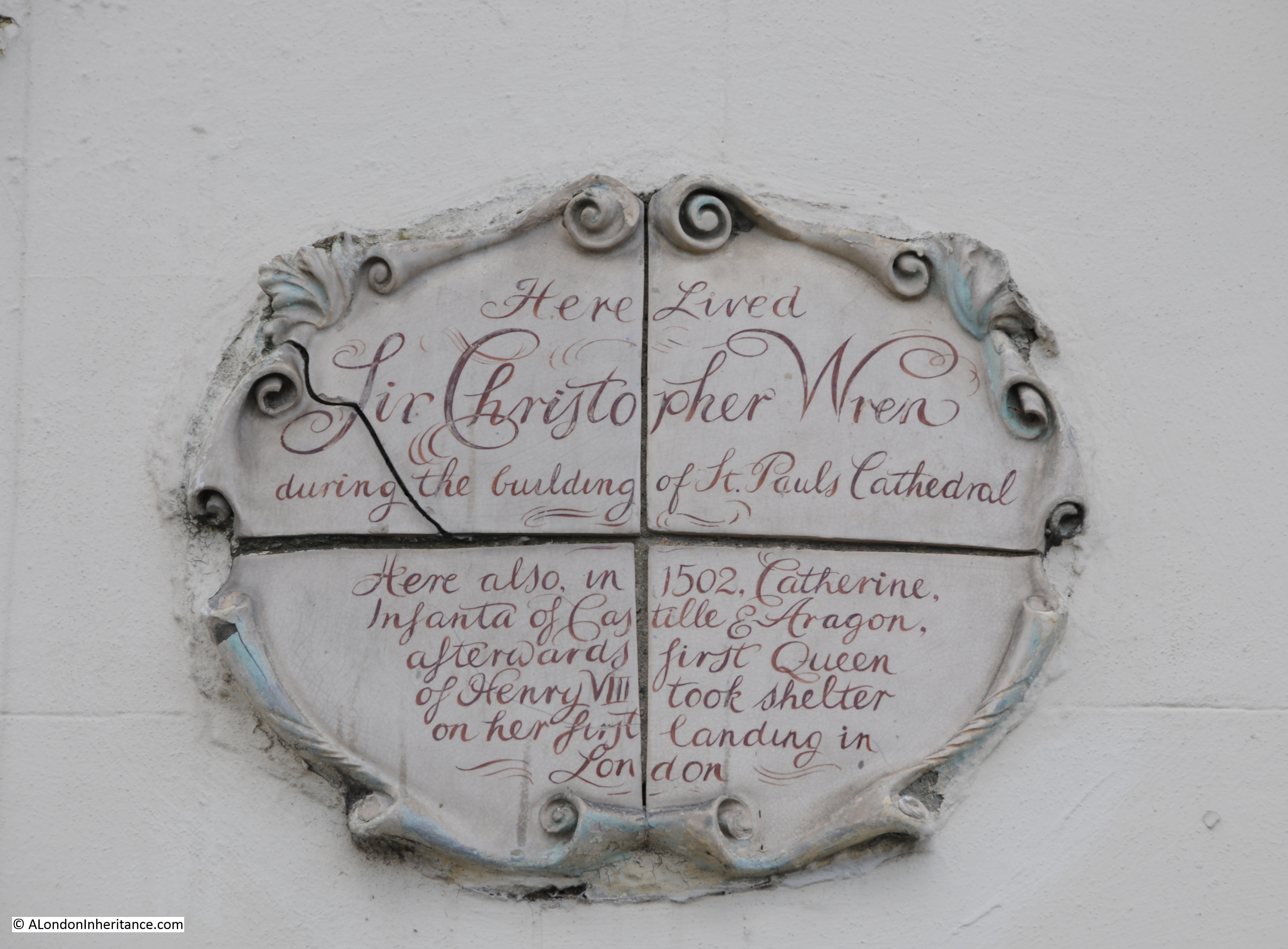
Although today the main Bankside attraction is the adjacent Globe Theatre, what does draw the attention of visitors to Bankside is the old looking plaque on No.49 with ornate script stating that Sir Christopher Wren lived in the building during the construction of St. Paul’s Cathedral and that Catherine of Aragon took shelter in the building on her arrival in London. This can be seen to the left of the doorway to No. 49 in my 2015 photo.

Sir Christopher Wren

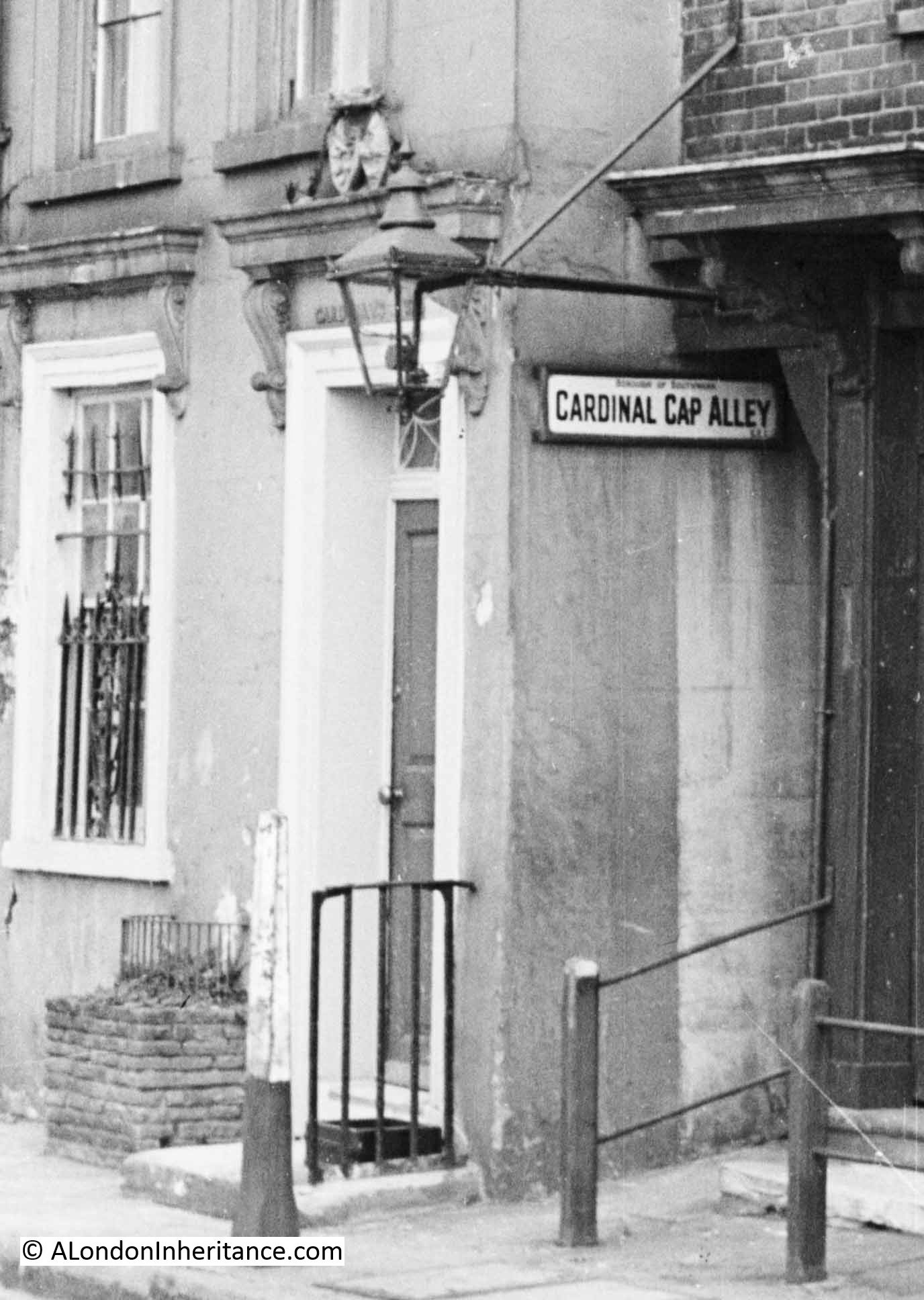
But a close-up of the 1947 photo shows no evidence of the plaque to the left of the door and there is no mention of it in the 1950 Survey of London.

Cardinal Cap Alley

The origin of this plaque is documented in the really excellent book “The House by the Thames” by Gillian Tindall.

As the name suggests, the book is about the history of No. 49 Bankside, the occupiers of the house and the industries around Bankside. It is one of the most interesting and well researched accounts of a single house and its’ surroundings that I have read.

In the book, Tindall confirms that the plaque is a mid 20th Century invention. Malcolm Munthe, who purchased the house just after the end of the war, probably made the plaque himself and installed on the front of the house. There was a plaque on a house further up Bankside, claiming the occupancy of Wren, however this house was pulled down in 1906.

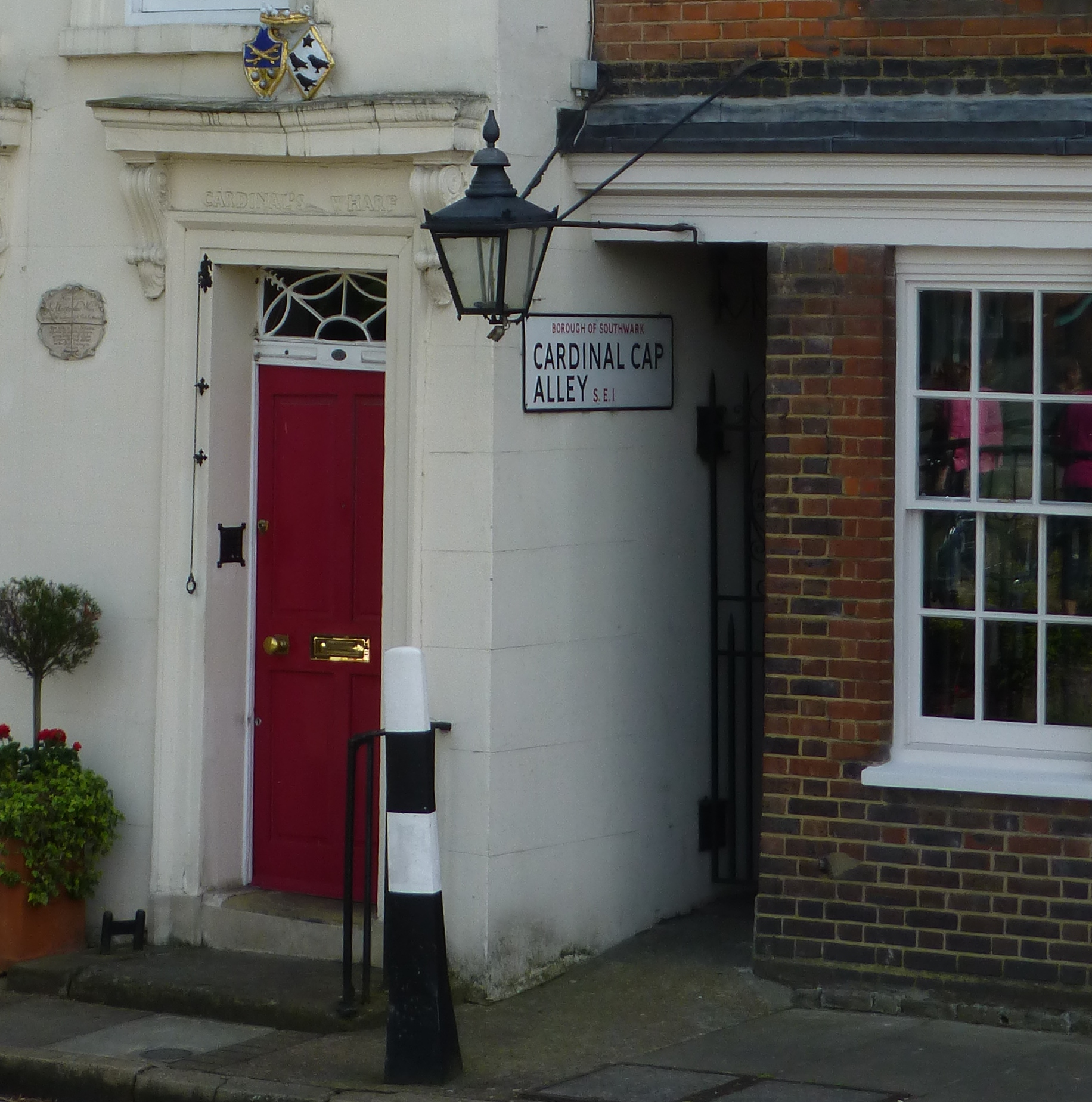
A close-up of Cardinal Cap Alley and the entrance to No. 49, showing the Wren plaque to the left of the door.

Cardinal Cap Alley

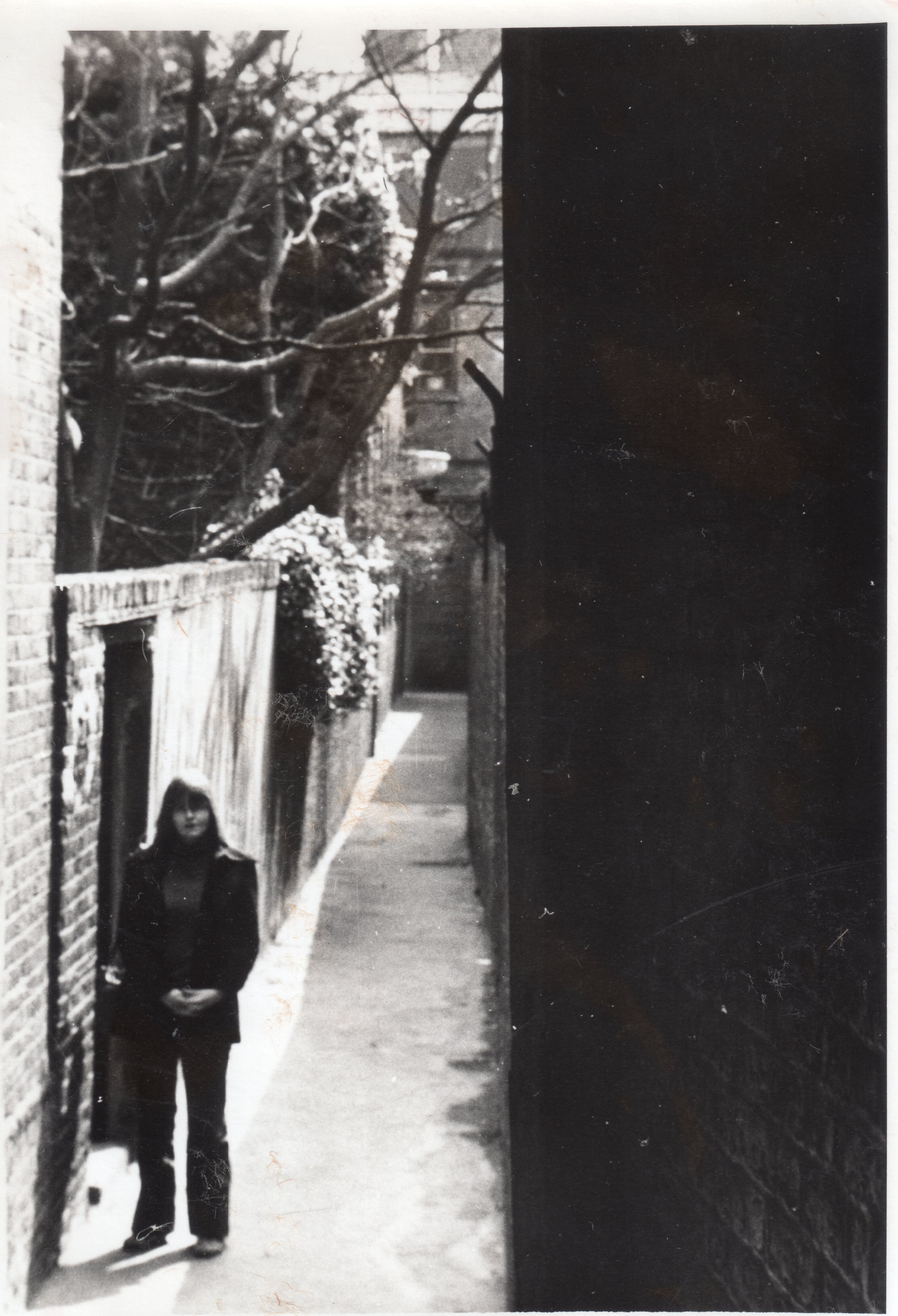
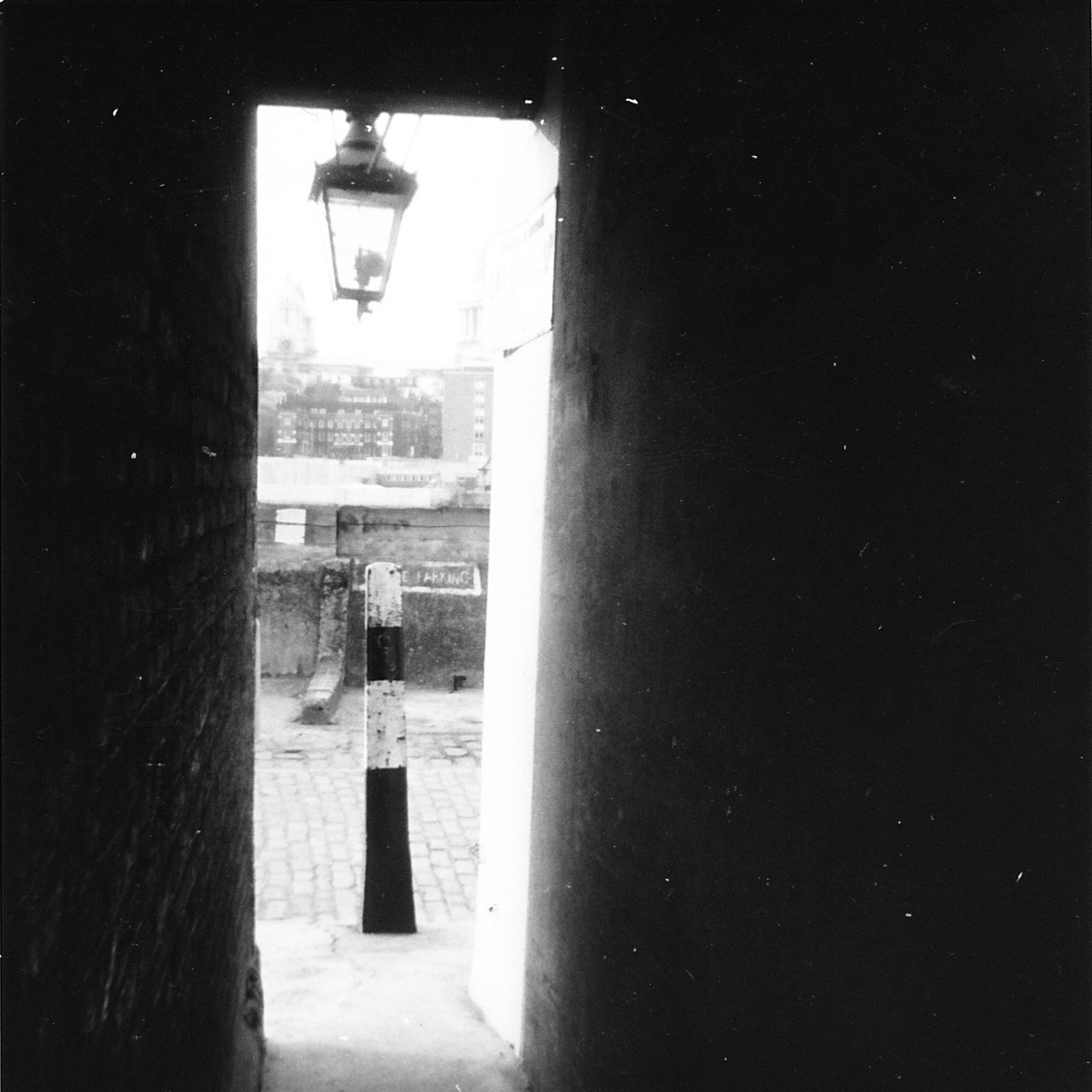
Also note that Cardinal Cap Alley is now gated. This use to be freely accessible and I took the following photo from inside the alley in the 1970s. Could not deal with the contrasting light very well, I was very young and this was with a Kodak Instamatic 126 camera – my very first.

Cardinal Cap 11

I did not take a photo looking down into the alley, probably thinking at the time it was not as good a view as across the river, however it is these views which are so important as they show, what at the time, are the day to day background of the city which are so important to record.

I am very grateful to Geraldine Moyle who sent me the following photo taken in 1973 looking down into Cardinal Cap Alley:

1973 Cardinal Cap Alley

The garden of No. 49 is on the left. Just an ordinary alley, but so typical of all the alleys that would have run back from the water front, between the houses that faced the river.

Tindall’s book runs through the whole history of No.49 and demonstrates how the history of a specific site over the past centuries has influenced the site to this day.

The occupiers of No. 49 and the adjacent buildings ran the ferry boats across the river, were lightermen and watermen and then moved into the coal trade. The Sell’s family who lived in the house for a number of generations, and who built a very successful coal trading business, finally merging with other coal trading companies to form the Charrington, Sells, Dale & Co. business which generally traded under the name of Charrington (a name that will be very familiar to anyone who can remember when there was still domestic coal distribution in the 1960s and 1970s).

How the history of Bankside has evolved over the centuries:

– the original occupations of many Bankside residents of ferrymen, lightermen and watermen. Working on the River Thames with the transportation of people and goods.

–  as the transport of coal became important to London, the development of many coal trading businesses along Bankside, including that of the Sell’s family

– the local coal trading led to the development of coal gas and electricity generation plants at Bankside (the Phoenix Gas Works are shown on the 1875 Ordnance Survey map covering the west side of the current Bankside Power Station / Tate Modern.)

– the first electricity generating plant being replaced by the Bankside Power Station that we see today and is now Tate Modern.

To quote Tindall:

“And this is why at the end of the twentieth century, a huge and distinctive brick red building was there to make an iconic focus for the regeneration of a Bankside from which industrial identity had by then fled.

Thus do patches of London’s ground, which are nothing in themselves but gravel and clay and river mud, and the ground down dust of brick and stone and bones, wood and wormwood and things thrown away, acquire through ancient incidental reasons a kind of genetic programming that persists through time”

This last paragraph sums up my interest in the history of London far better than I could put into words.

I really do recommend “The House by the Thames” by Gillian Tindall.

Going back to 1912, Sir Walter Besant writing in his “London – South of the River” describes Bankside at the height of industrialisation:

“Bankside is closely lined with foundries, engineering shops, dealers in metals, coke, fire-brick, coal, rags, iron and iron girders. the great works of the City of London Electric Lighting Corporation, which lights the city, is also here. On the river-side is a high brick building containing the coal-hoisting machinery. All is automatic; the coal is lifted, conveyed to the furnaces, fed to the fires, and the ashes brought back with hardly any attention whatever, at an immense savings of labour.”

Standing in Bankside today, the area could not be more different.

Another view of No. 49 Bankside. The street in front of these buildings is the original Bankside. As can just be seen, this comes to an abrupt stop due to the land beyond being occupied by the Bankside Power Station complex. It is perhaps surprising that N0.49 and Cardinal Cap Alley have survived this long given the considerable redevelopment along this stretch of the river. It is ironic that perhaps the false plaque claiming Sir Christopher Wren’s occupancy may have contributed to the survival of the building during the last half of the 20th century.

The Globe Bankside

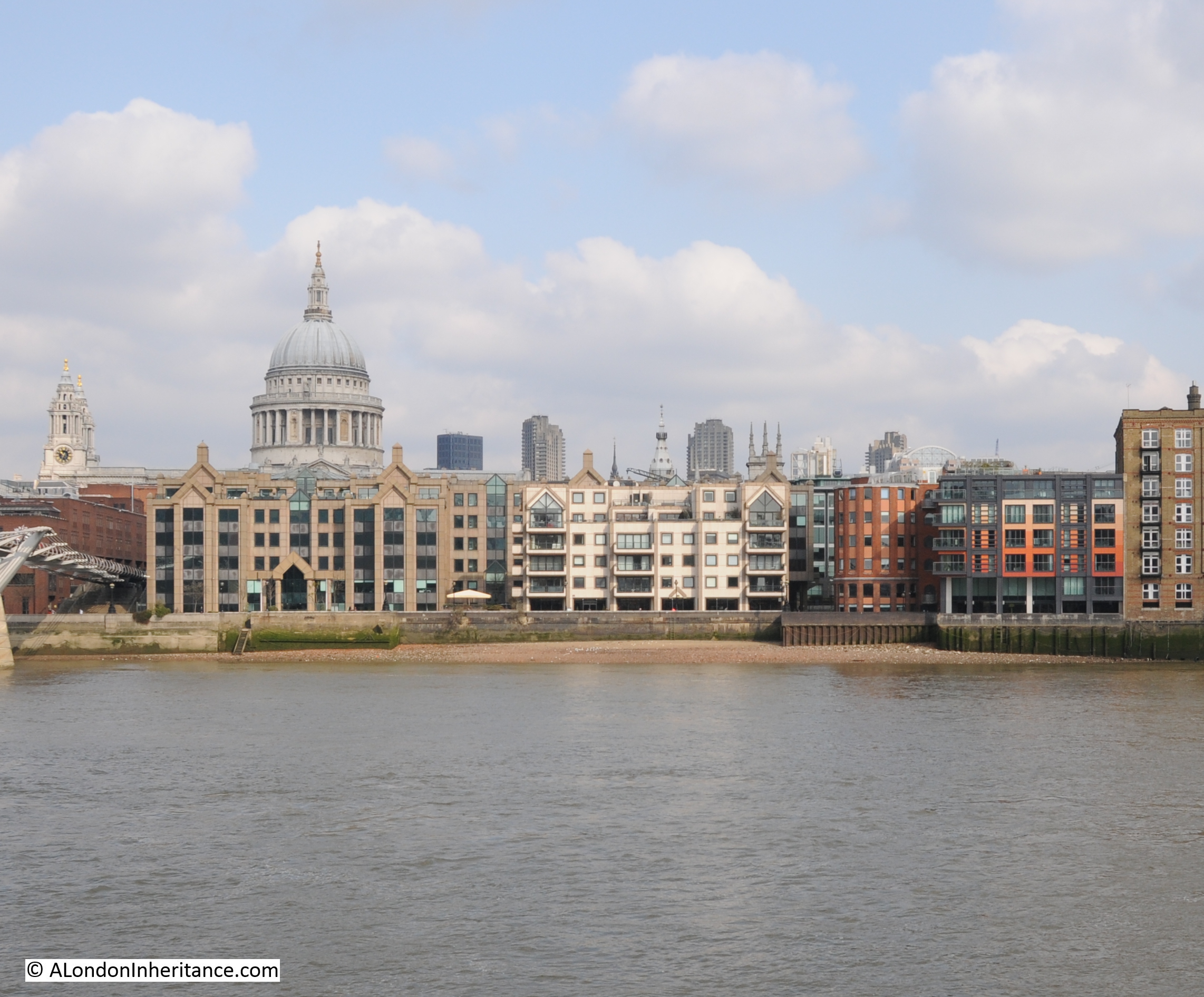
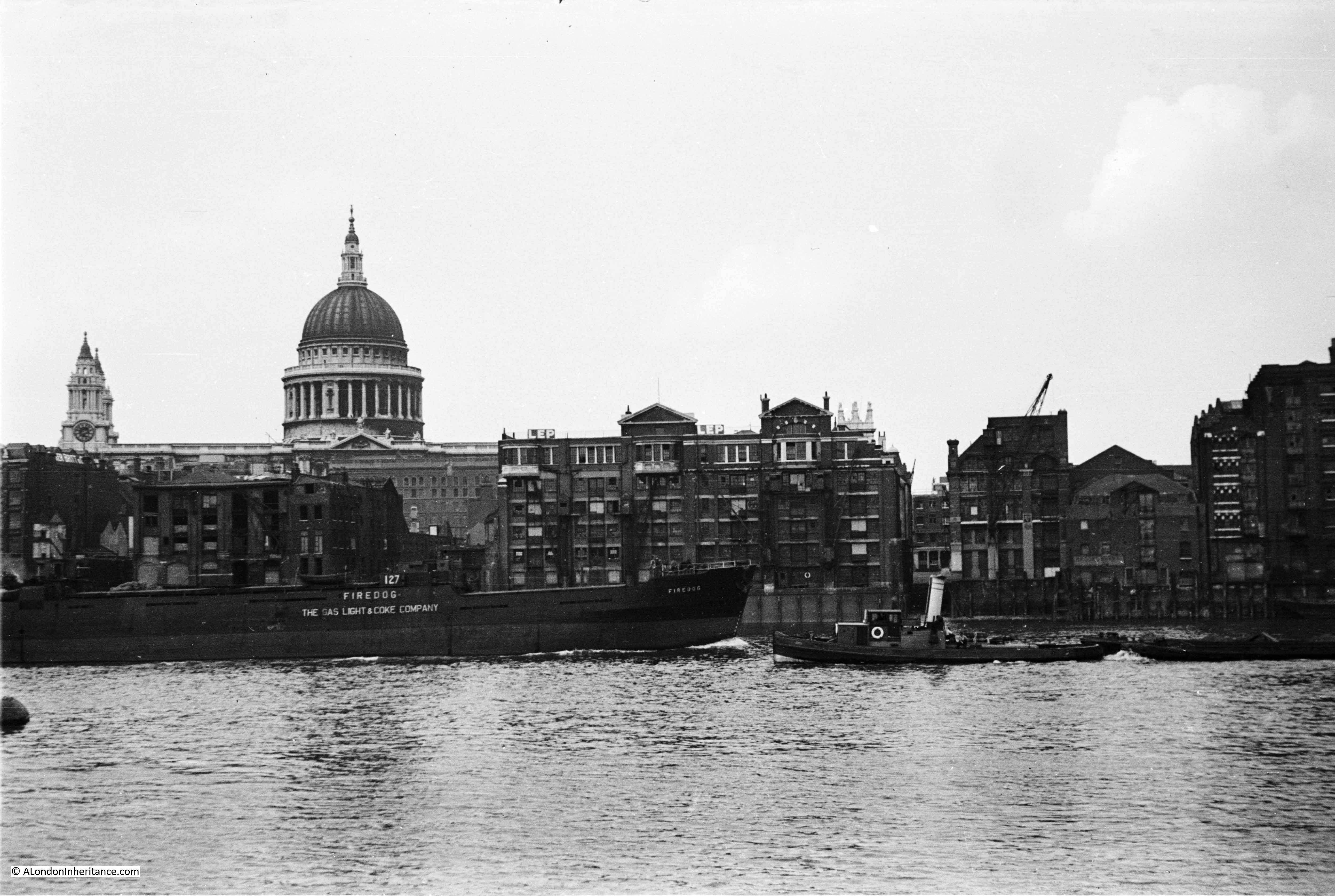
My father also took a photo from Bankside across the river to St. Paul’s Cathedral. The larger ship traveling from left to right is the Firedog, owned by the Gas Light & Coke Company. Originally founded in 1812, the company had a fleet of ships to transport coal to the gas works it operated around London (this was before “natural” gas was discovered in the North Sea. Prior to this, gas was produced from coal). The Gas Light & Coke company absorbed many of the smaller companies across London before being nationalised in 1948 as a major part of North Thames Gas, which was then absorbed into British Gas.

St. Paul's Cathedral

The same view in 2015. The only building on the river front to have survived is the building on the far right.  Note the building in the middle of the 1947 photo. This is the head office of LEP (the letters can just be seen on the roof), the company that operated the last working crane on the Thames in central London, see my earlier post here. It is really good to see that the height of the buildings between the river and St. Paul’s are no higher today than they were in 1947. A very positive result of the planning controls that protect the view of the cathedral.

St. Paul's Cathedral

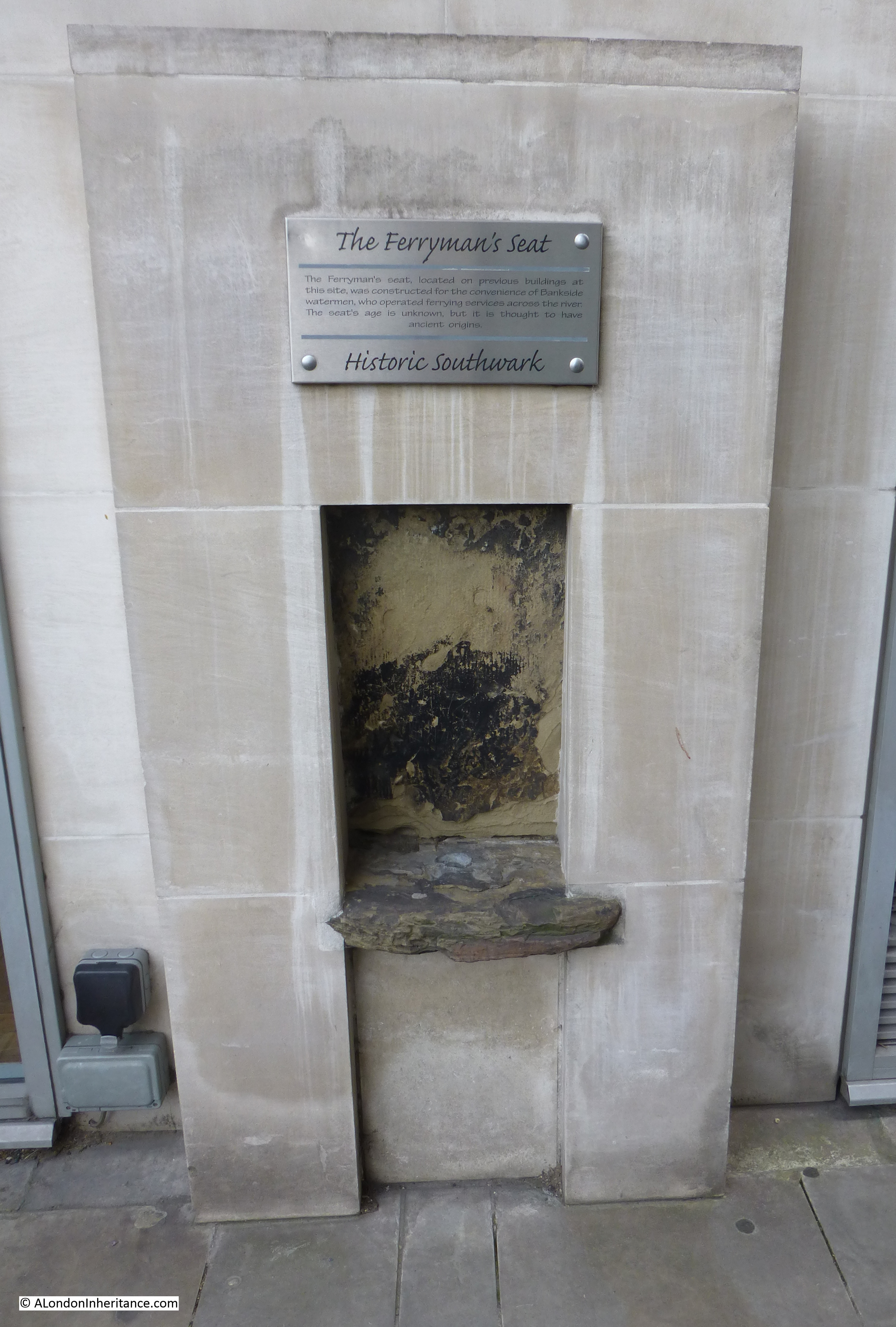
There is one final reminder of Bankside’s past. Walk past the Globe and on the side of a modern building with a Greek restaurant on the ground floor is the Ferryman’s Seat:

Ferryman's Seat

The plaque states;

“The Ferryman’s seat, located on previous buildings at this site was constructed for the convenience of Bankside watermen who operated ferrying services across the river. The seat’s age is unknown, but it is thought to have ancient origins.”

Although there is no firm evidence of the seat’s antiquity, the 1950 Survey of London for Bankside includes a drawing of the seat in the building on the site at the time and states that “Inserted in a modern building at the corner of Bear Gardens and Bankside is an old stone seat said to have been taken from an earlier building and to have been made for the convenience of watermen.”

Ferryman's Seat

Read Gillian Tindall’s book, then visit Bankside. Ignore the crowds around the Globe and reflect on Cardinal Cap Alley, No. 49 and the lives of countless Londoners who have lived and worked on Bankside over the centuries.

alondoninheritance.com


Defending The Thames – Coalhouse Fort

Coalhouse Fort on the River Thames at East Tilbury is a short distance further towards the Thames estuary from Tilbury Fort, the subject of my last post.

As with Tilbury Fort, the purpose of Coalhouse Fort was to protect London and the towns and industries along the river’s edge from any naval force that attempted to penetrate the river.

The location of Coalhouse Fort can be seen in the following map. A key location on a bend in the river enabling any attacking force to be shelled on the approach and as it rounds the bend in the river. Two forts on the opposite bank of the river at Cliffe and Shornemead would also have engaged with any attacking force and if they managed to pass through this part of the river, they would then come into the range of Tilbury Fort.

This level of defence highlights the fear that the River Thames could have provided easy access to London, and shows how well London was protected.

As with Tilbury Fort, the origins of Coalhouse Fort are with one of Henry VIII’s blockhouses, constructed in five locations along the Thames following the break with Rome and fears of invasion from Catholic Europe. Unlike Tilbury Fort, Coalhouse was not upgraded or used during the time of the Armada and it fell into disuse.

The original fort was not utilised during the time of the Dutch Admiral, de Ruyter’s incursion into the River Thames and there are local traditions that during this raid the church at East Tilbury was damaged by cannon fire from the Dutch fleet.

Due to continuing threats of war with France during the late 18th century, new fortifications were planned at East Tilbury and building work finally commenced in 1799. A semi-circular defensive structure was built which could support cannon and behind this were constructed the buildings to house supplies and barracks for those manning the fort.

No attack was forthcoming and after the end of the Napoleonic Wars in 1815, the fort was again abandoned.

Ongoing tensions with France during the 19th century resulted in a plan for significant upgrades at East Tilbury. The original fort was demolished in 1861 and the new fort was constructed at a cost of £130,000.

It is this fort which is still substantially in existence today.


Unlike Tilbury Fort, Coalhouse Fort today is run by a volunteer group, the Coalhouse Fort Project who run occasional open days and are gradually restoring the fort and attempting to stop further decay.

Coalhouse Fort is found at the end of the road that passes through East Tilbury and the original site of the factory and village created by the Bata Shoe Company. (The history of Bata in East Tilbury and the factory / village Bata created is fascinating and there is a website dedicated to the history of the East Tilbury site which can be found here)

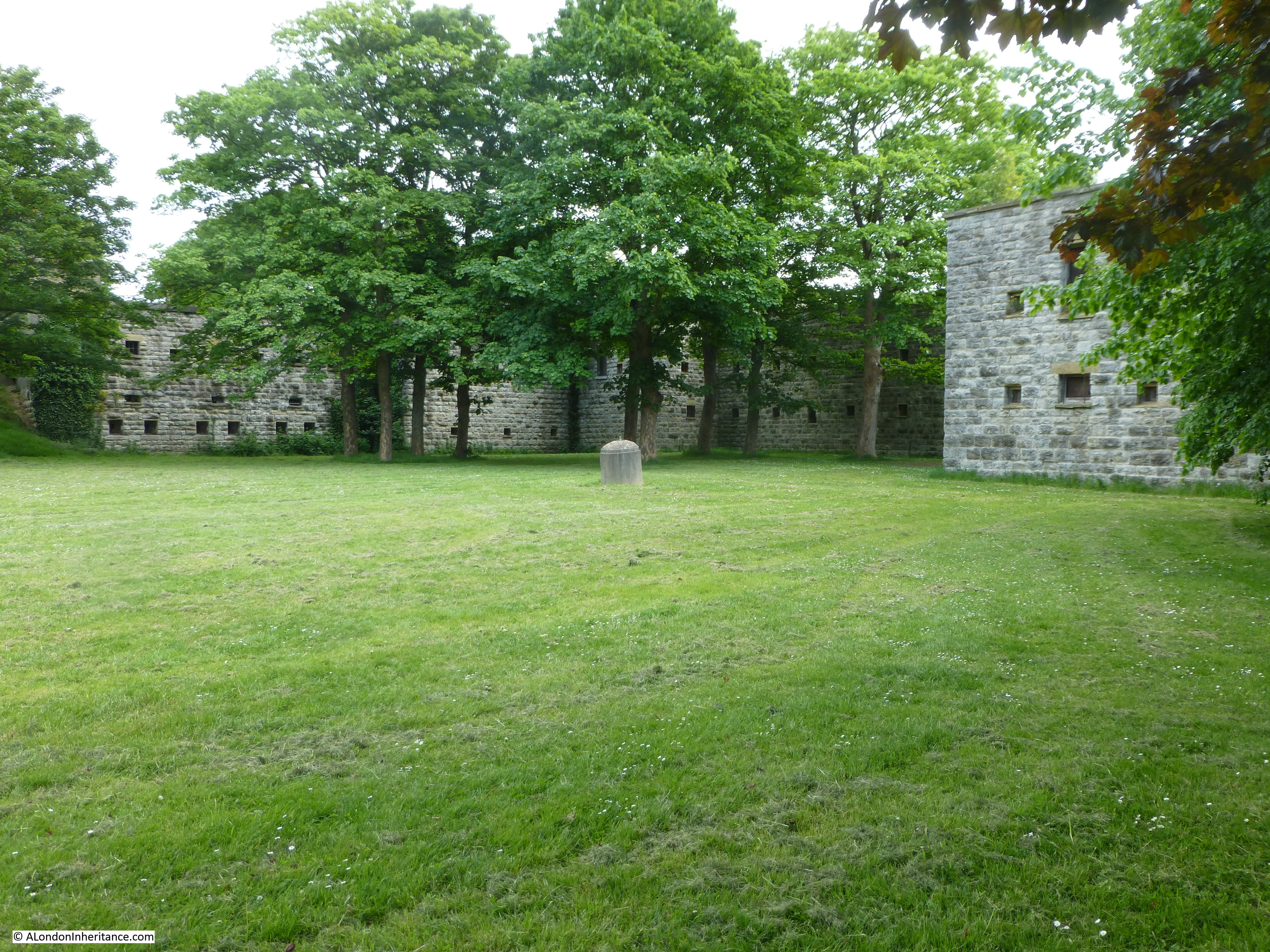
On arrival, the solid construction of the fort is clearly visible, now surrounded by landscaped parklands. The fort was constructed to be defendable from land based attack as well as to attack enemy shipping on the Thames.

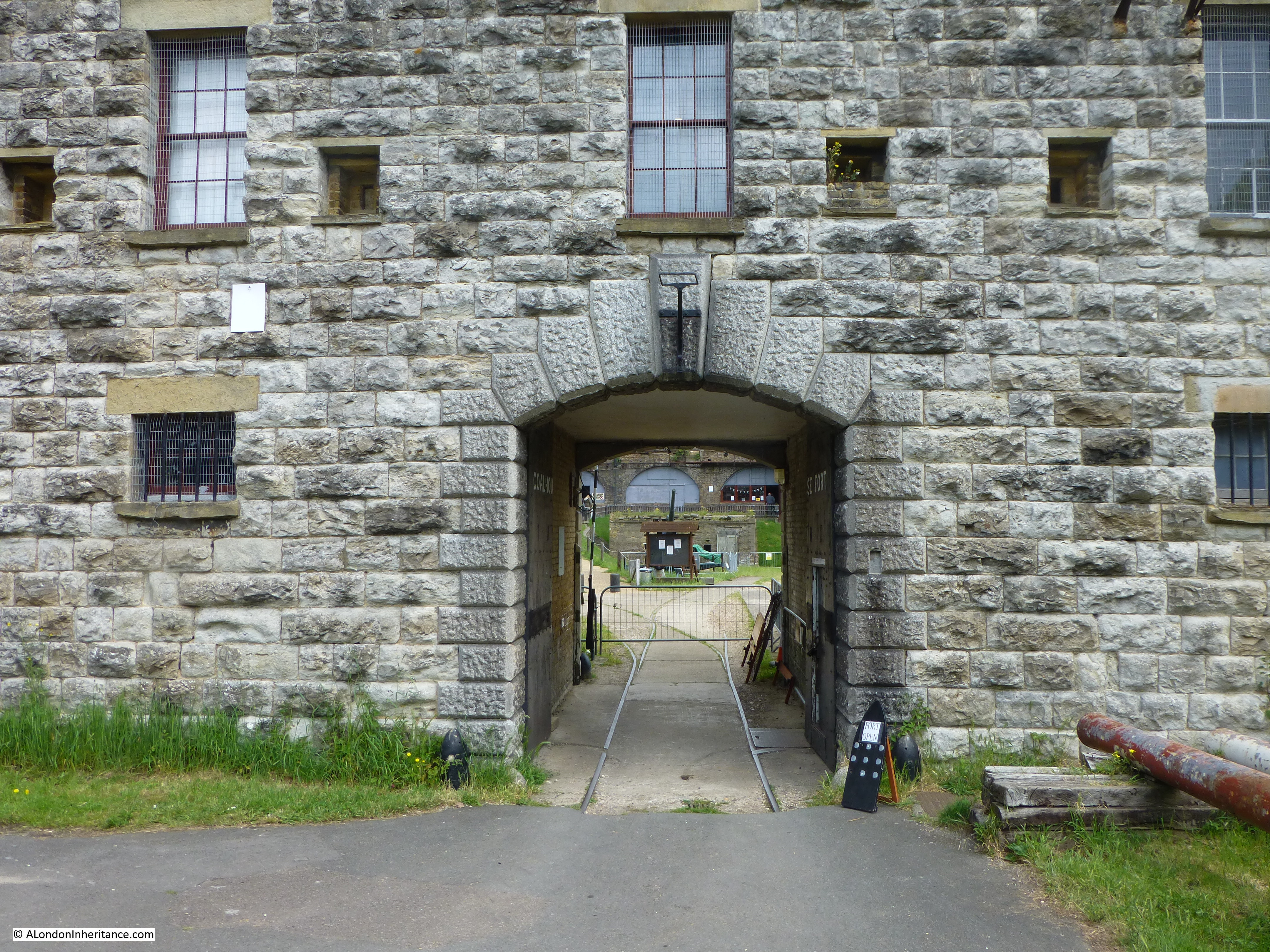
Coalhouse Fort

The entrance gate to the fort:

Coalhouse Fort

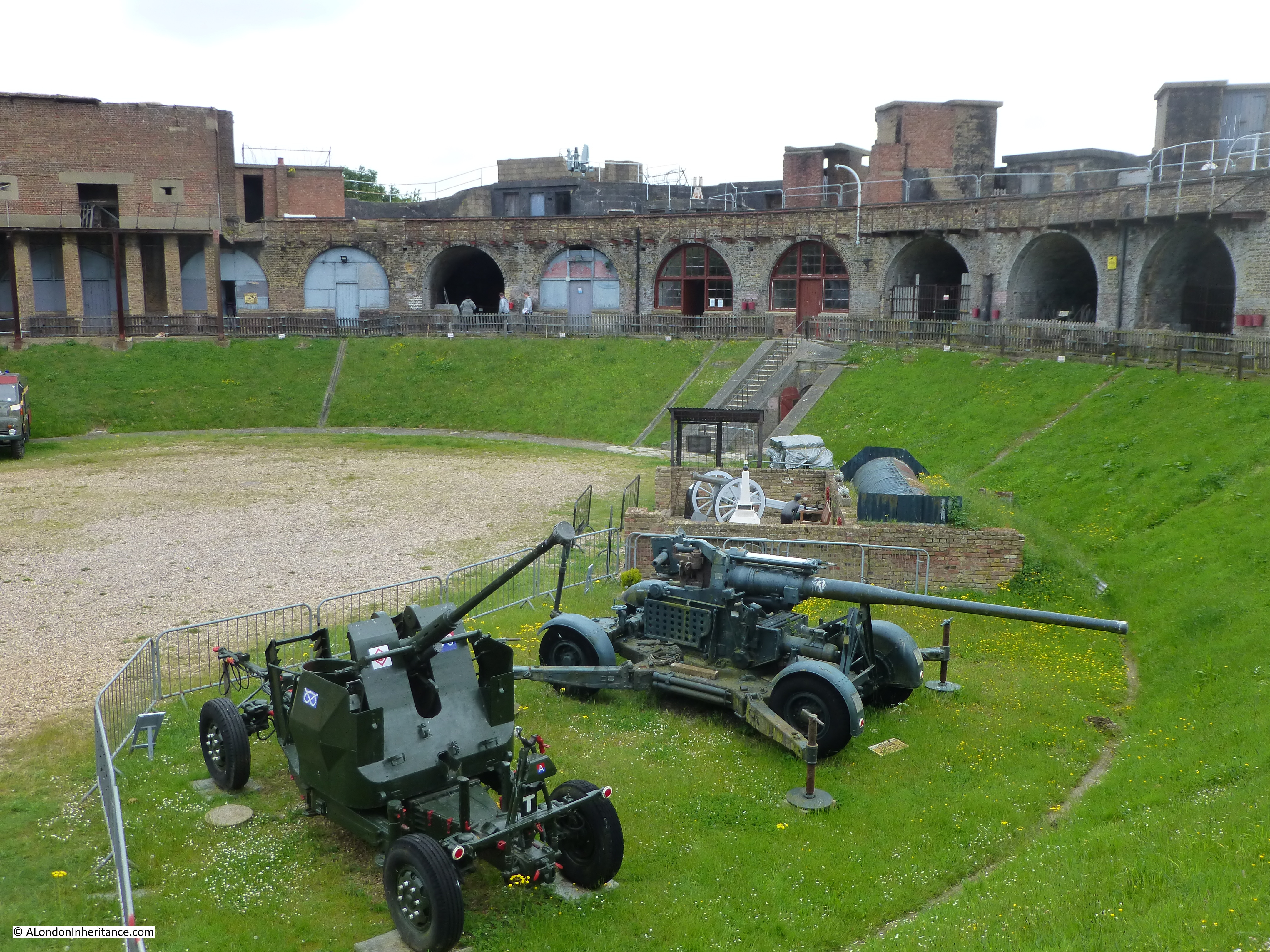
Once inside the fort, the archways ringed around the river facing side of the fort can be seen, these are the gun casements, each originally housing an 11 inch gun (with some 1877 upgrades to 12.5 inch guns), with above the casements, space for a range of 9 inch guns on the roof.

These had a range of 3.1 miles with the whole fort capable of firing many rounds per minute at any attacking force coming up the Thames.

The later brickwork buildings along the top are from the 20th century.

Coalhouse Fort

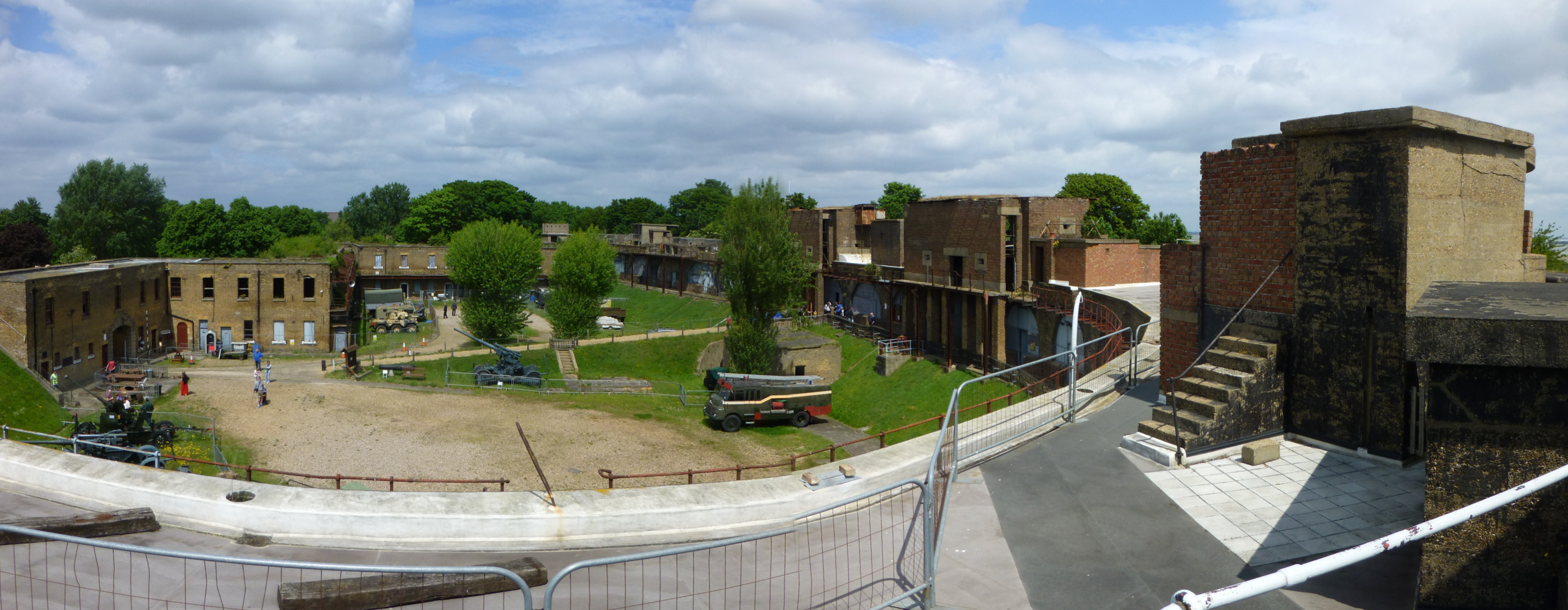
The view of the fort from the roof. The Gatehouse is on the left, with the barracks for those manning the fort to the left and at the far end of the photo:

Coalhouse Fort

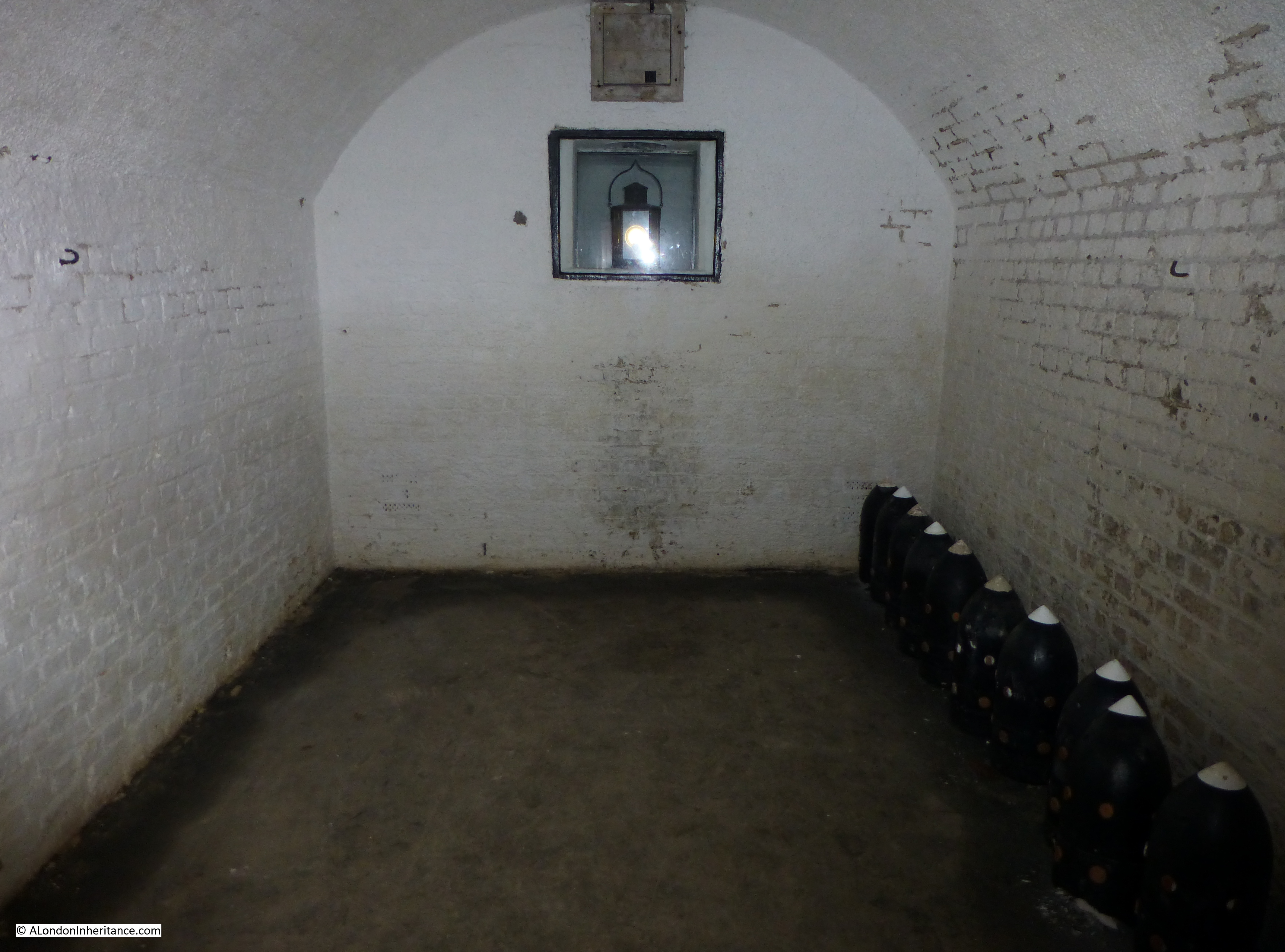
Underneath the gun casements are a series of tunnels and storage rooms to store and move the ammunition needed by the guns. Some of these tunnels are still accessible:

Coalhouse Fort

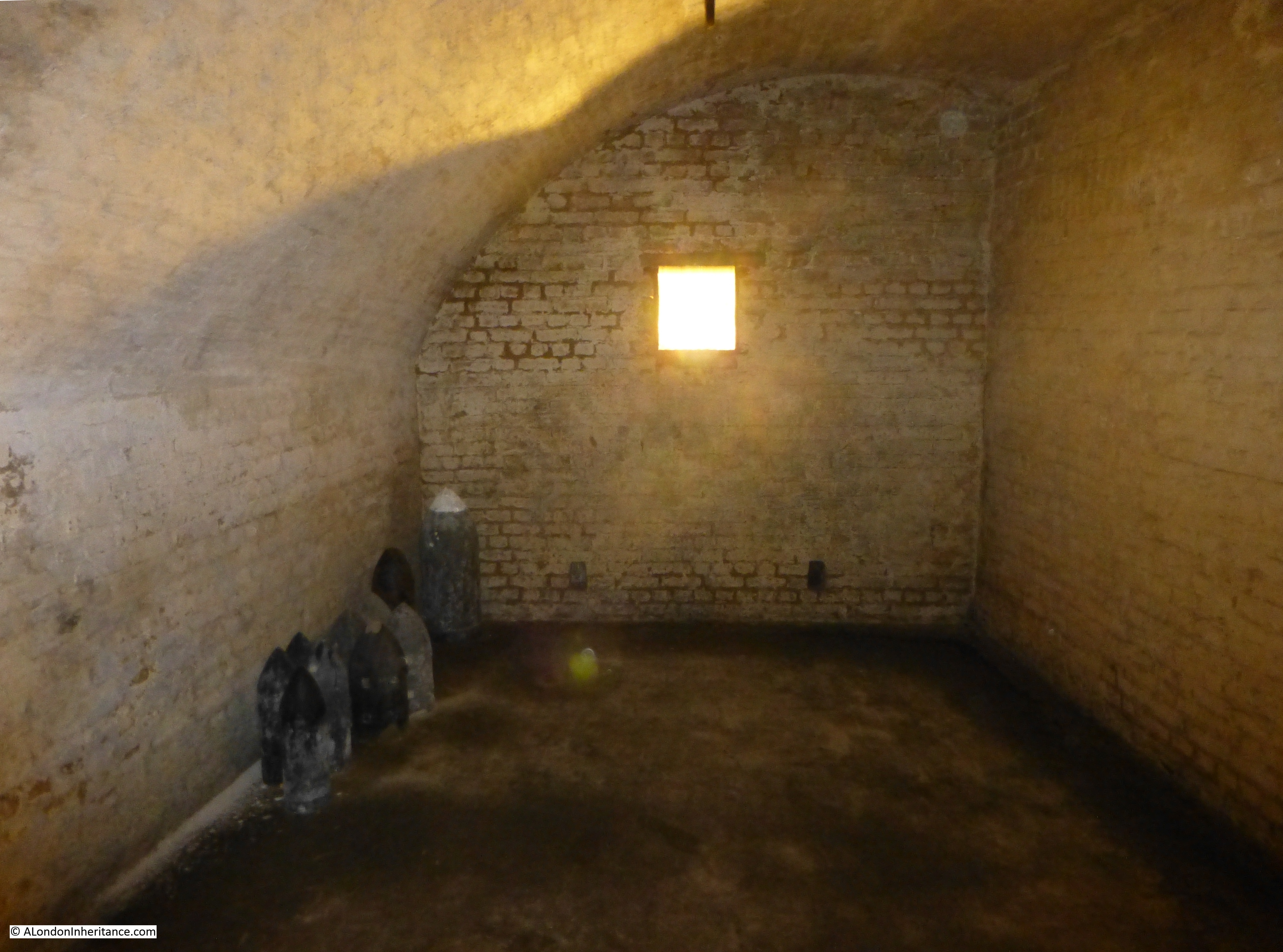
Storage rooms run the length of the tunnel:

Coalhouse Fort

The bright light at the end of the room is an electric light in the original lighting window. The challenge with lighting underground ammunition storage rooms was to eliminate any possibility of sparks or flames, whilst still providing sufficient light for work. The window was completely sealed of from the room, and held an oil lamp which was lit and refueled from a separate set of tunnels which provided access to these lighting windows. This approach ensured that light could be provided whilst separating the two areas and preventing any sparks or flames being exposed to the contents of the ammunition stores.

Following the initial armament of the fort, upgrades continued, including placing quick fire guns, controlled from the fort, nearer to the river to counter new threats from fast-moving torpedo boats.

Guns with increased range (7 miles) were installed and some of the earthen embankments at the front of the fort were added to improve the camouflage of the fort.

During the 1st World War, an Artillery Company along with the 2nd Company of the London Electrical Engineers moved into the fort to man the guns and the searchlights used to monitor traffic on the river.

Minefields were established in the Thames to manage the traffic flow along the river, with tugs in the river checking incoming vessels. In support of this activity, Coalhouse Fort had the role of firing a warning shot at any suspect vessel, or any vessel that refused to stop for examination.

As with Tilbury Fort, Coalhouse Fort was used as a transit and training camp for troops on their way to the battlefields of France and Belgium.

During the 2nd World War, the fort served a number of functions.

Whilst new gun batteries had been set-up closer to the sea, along with greater naval protection, Coalhouse Fort was one of many batteries along the banks of the Thames designated as anti-invasion weapons, tasked to provide protection to the ports and docks of London from any fast moving cruisers and torpedo boats that had evaded the outer defences, as well as being able to attack any mass landing of enemy troops on the flat lands of the Thames estuary or the river.

The whole area around the fort was heavily defended. Bofor anti-aircraft guns were installed on the roof along with further batteries of anti-aircraft guns and searchlights in the immediate locality. These saw a considerable amount of action during the bombing raids on London as the Thames was a perfect navigation aid providing a route direct from the coast to the docks and central London.

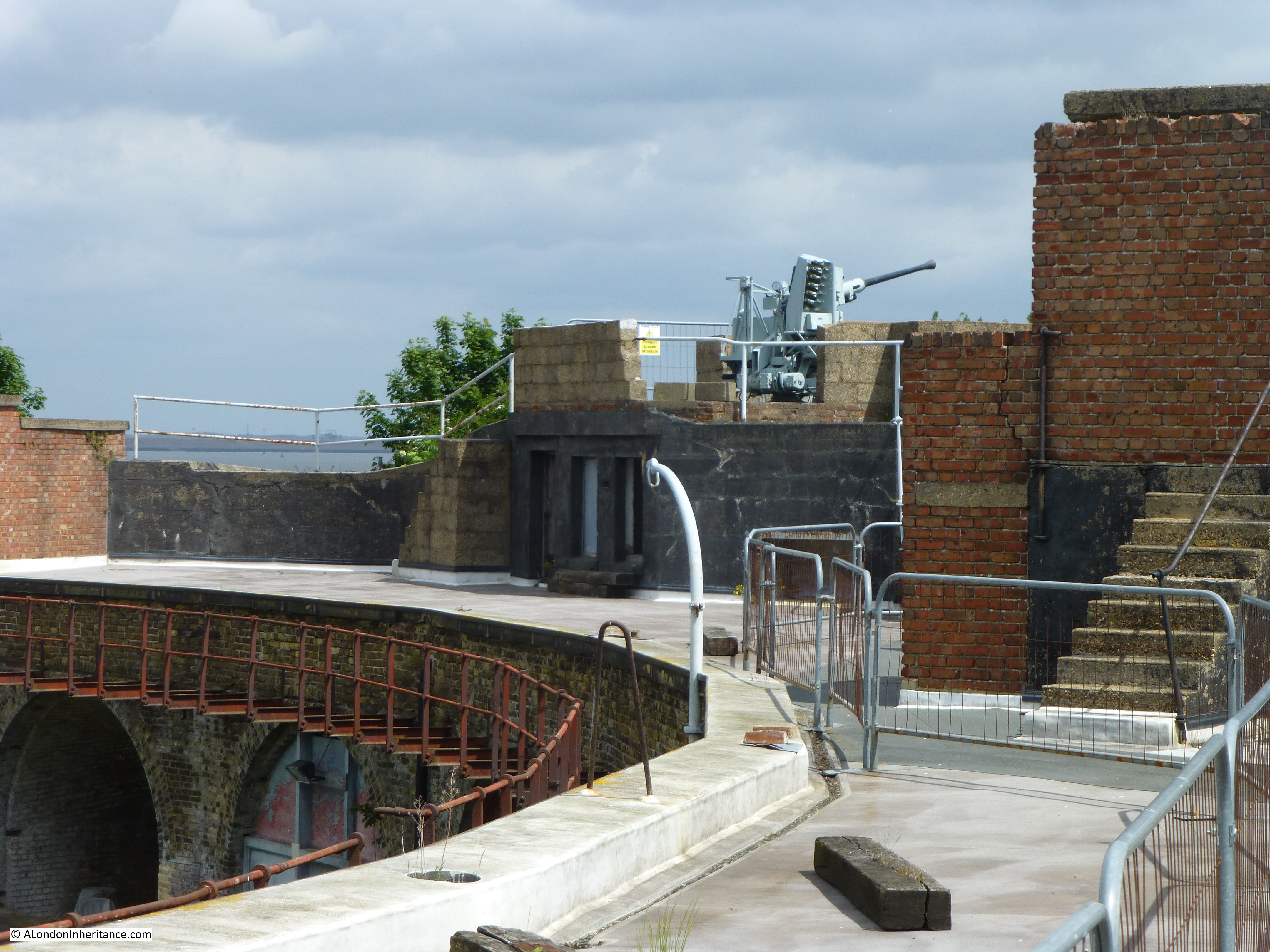
Parts of the roof are still accessible. A single Bofor anti-aircraft gun remains on the roof as an example of the types of weaponry used at the fort and in the locality in the defence of London.

Coalhouse Fort

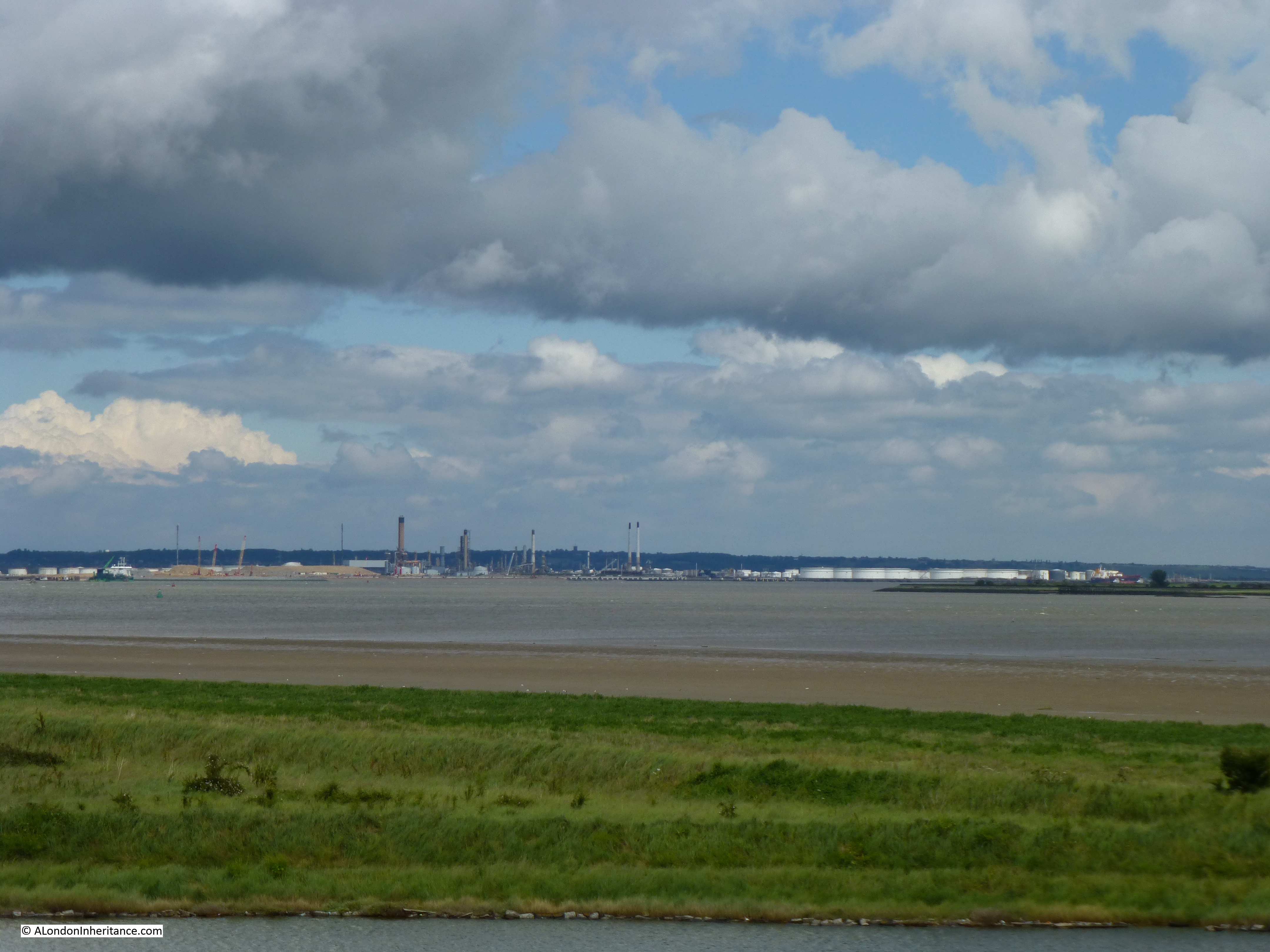
The view from the roof shows why this is an ideal location for defending the river. This is the view looking downstream towards the point where the river curves to the east. The white fuel tanks are those at the Coryton site and Canvey Island. To the left of the tanks is the new DP World London Gateway Port. The latest incarnation of docks along the River Thames, gradually moving further downstream in order to support the ever-growing container ships and the volume of land needed to manage the growth in container storage and movement.

View from Coalhouse Fort

Later additions on the roof including positions for the control of searchlights and also range finder equipment:

Coalhouse Fort

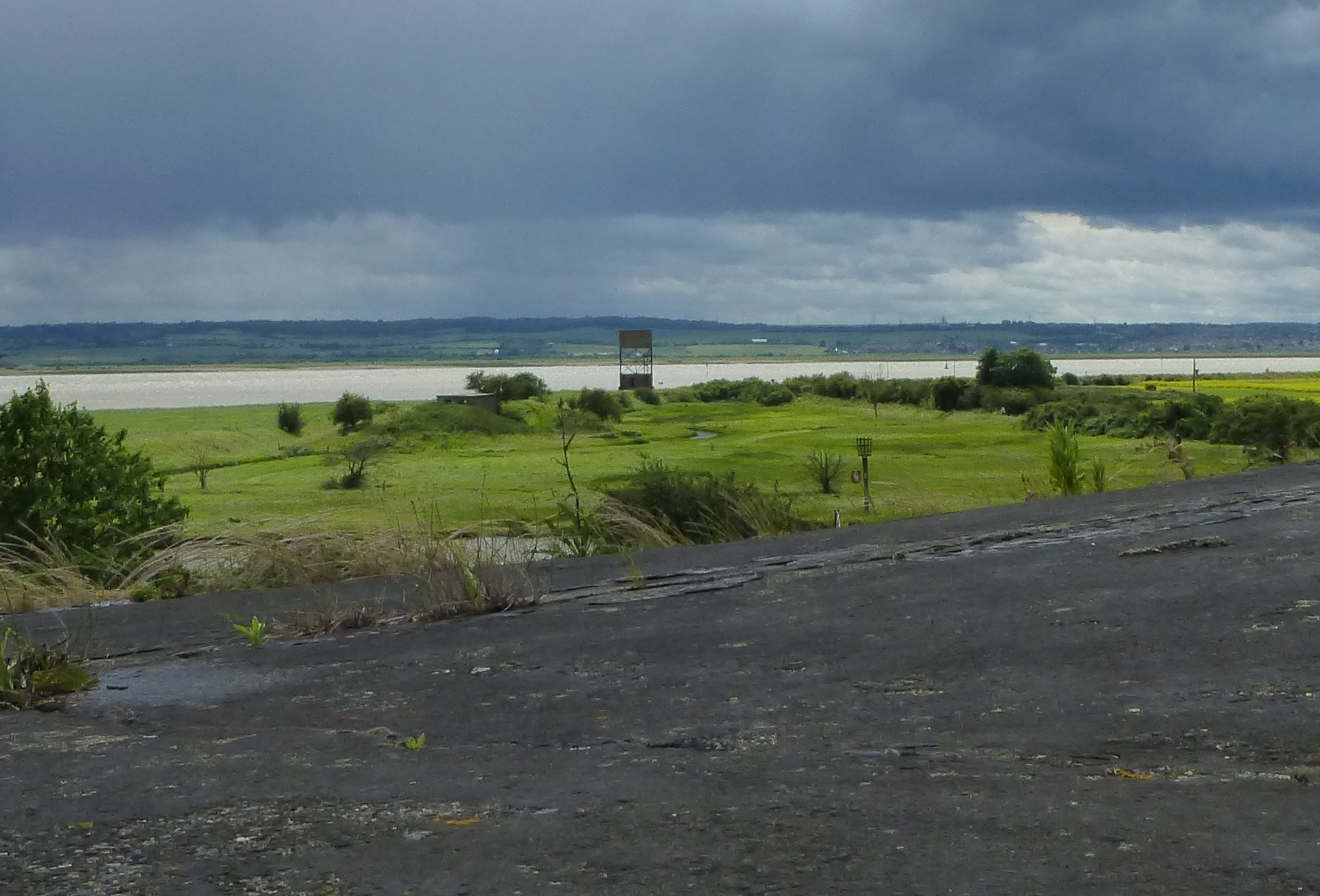
There were many installations around the fort, a few of which remain. The tower in the middle of the following photo adjacent to the Thames is a 2nd World War Radar Tower which was used to control the approaches along the river and through the minefields.

View from Coalhouse Fort

During the war, the fort also had a special role in protecting shipping leaving the London docks. One of the many threats to ships leaving the Thames was the magnetic mine, capable of detonating at a distance from a passing ship without any contact and either sinking or causing considerable damage, without even being seen.

To counter the threat from magnetic mines, it was found that moving a cable with an electric current along the hull of the ship would, for a relatively short time “de-gauss” or remove the ships magnetic field sufficient to allow the ship to leave London, pass out through the Thames estuary and the Channel into open waters where magnetic mines were less of a threat.

To ensure that ships leaving London were sufficiently de-gaussed, sensors placed on the river bed, fed signals back to a monitoring station on the roof of Coalhouse Fort. Ships which still had a magnetic field capable of triggering a mine could be identified, contacted, and sent back for further attention.

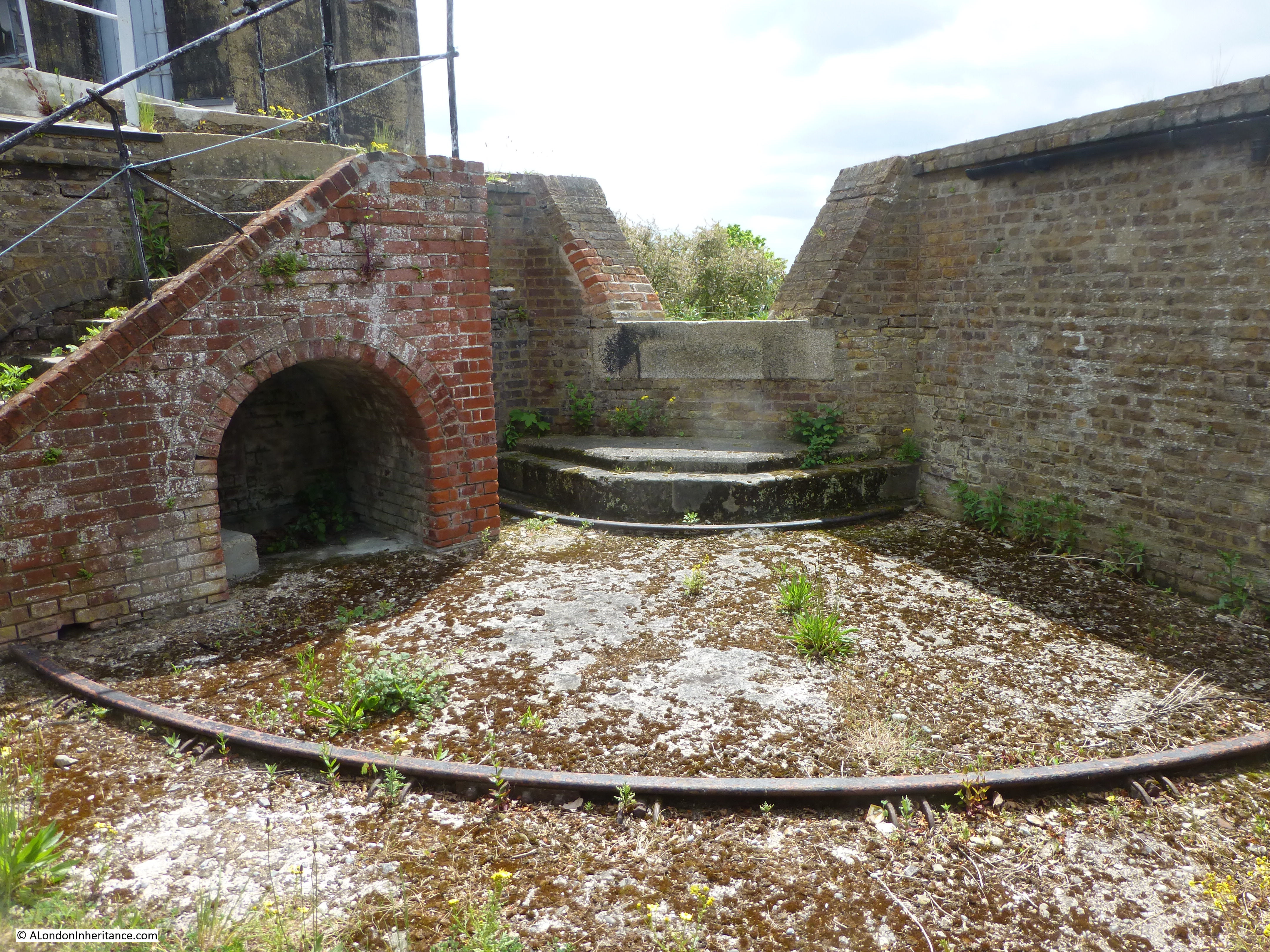
One of the now empty gun emplacements on the roof:

Coalhouse Fort

The construction of the new Coalhouse Fort in 1861 was the result of a Royal Commission recommendation for a whole series of forts around the country to defend strategic rivers, ports, dockyards etc. The recommendation was supported by the Prime Minister of the time, Lord Palmerston. As well as Coalhouse Fort, many others still exist, perhaps the most dramatic being the forts built in the Solent to defend the approaches to Portsmouth and Southampton.

Solent Forts

Although sea based, these forts had exactly the same purpose as the Thames forts, to provide a platform for heavy artillery to fire on any attacking naval force.

After the last war, Coalhouse Fort was used for a short time for the training of sea cadets, and then by the British Bata Shoe Corporation for storage.

The fort is now owned by Thurrock Borough Council with the volunteer Coalhouse Fort Project taking on the task of restoration and enabling open days throughout the year.

Tilbury and Coalhouse Forts provide an example of how London has been dependent on a much wider area around London. For four hundred years Tilbury and Coalhouse Forts have played many roles in the defence of London from the risk of attack along the river and in the last century, from the air.

Details of open days at Coalhouse Fort can be found on the Coalhouse Fort Project website which can be found here.

alondoninheritance.com


Defending The Thames – Tilbury Fort

As well as publishing my father’s photos and tracking down their location, one of my aims with this blog is to give me a push to get out and explore more of London’s fascinating history, locations such as Tilbury Fort.

The history of London is indelibly linked with the surrounding countryside, towns and villages, and what has always interested me is how London’s influence spreads so far beyond the original walled city. Central to London is also the River Thames, without which London would not have come into existence and developed in the way that it has. The influence of the Thames is often somewhat neglected these days, frequently just a scenic backdrop to the developments alongside.

If you follow the river from central London towards the estuary there are two forts at Tilbury that have played a key role in protecting both the River Thames and London from a range of threats over the centuries.

Tilbury today is best known for the Tilbury Docks (the first major commercial docks this far east of London, opened in 1886), as a cruise terminal and with a ferry across the river to Gravesend, however Tilbury has also been the location since Tudor times of a Fort to protect the River Thames and the approaches to London.

The River Thames provided access directly to the City of London, it carried all the import and export trade to the docks, and along the banks of the river were many of the yards that constructed and equipped the countries naval and commercial shipping (for example the Woolwich Arsenal and the Deptford Dockyards).

The relative ease with which these could be attacked was highlighted in June 1667 when a Dutch fleet entered the Thames estuary and sailed up the River Medway to attack the naval shipping at Chatham, burning a number with fire ships, capturing and sailing away a number of others. After this event, the diarist John Evelyn visited Chatham and wrote “a Dreadful Spectacle as ever any Englishman saw and a dishonour to be wiped off”.

The construction of the first Tilbury Fort was a result of Henry VIII’s separation from the Church of Rome. Fearing attack from the Catholic powers of Europe, five “blockhouses” were built along the Thames at West and East Tilbury, Higham, Milton and Gravesend.  The blockhouses had artillery installed on the ground floor and the roof, aligned to provide crossfire across the Thames in conjunction with the blockhouse on the opposite side of the river.

Any attacking force moving up the river would have to pass these five blockhouses, all firing multiple artillery rounds.

Fortunately for Henry VIII, there were no attacks along the river so the blockhouses remained untested. When Mary 1 became queen in 1553, the papal supremacy was restored so the threat of invasion from Catholic Europe was lifted. The blockhouses were disarmed and left.

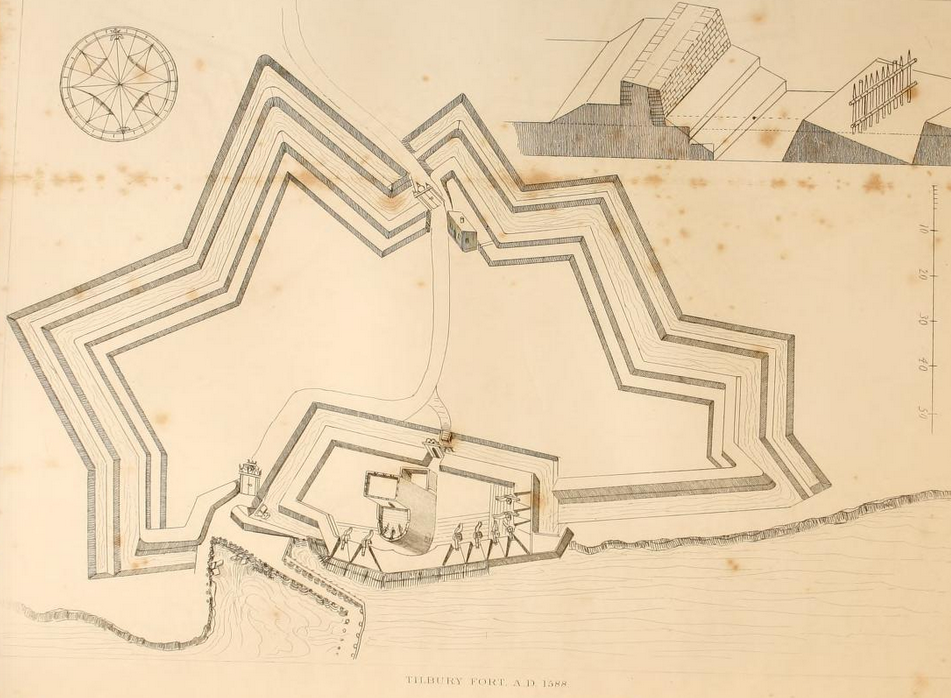
When Elizabeth became queen in 1558 the Tilbury blockhouse was repaired and re-armed with additional reinforcements during the threat from the Spanish Armada in 1588. The following plan from The History of the Town of Gravesend by Robert Peirce Cruden shows the site in 1588 with the blockhouse in the lower centre surrounded by embankment defences.

Tibury_Fort_AD_1588

The site was completely rebuilt after the 1667 Dutch attack, with construction commencing in 1670 and completion in 1685 resulting in one of the most powerful forts in the country, equipped to protect the City of London, the docks and industries along the river from any attacking force that ventured up the Thames. The new Tilbury Fort also included major defences to protect the fort against any land based attack.

It is this Tilbury Fort which is still substantially in existence today.

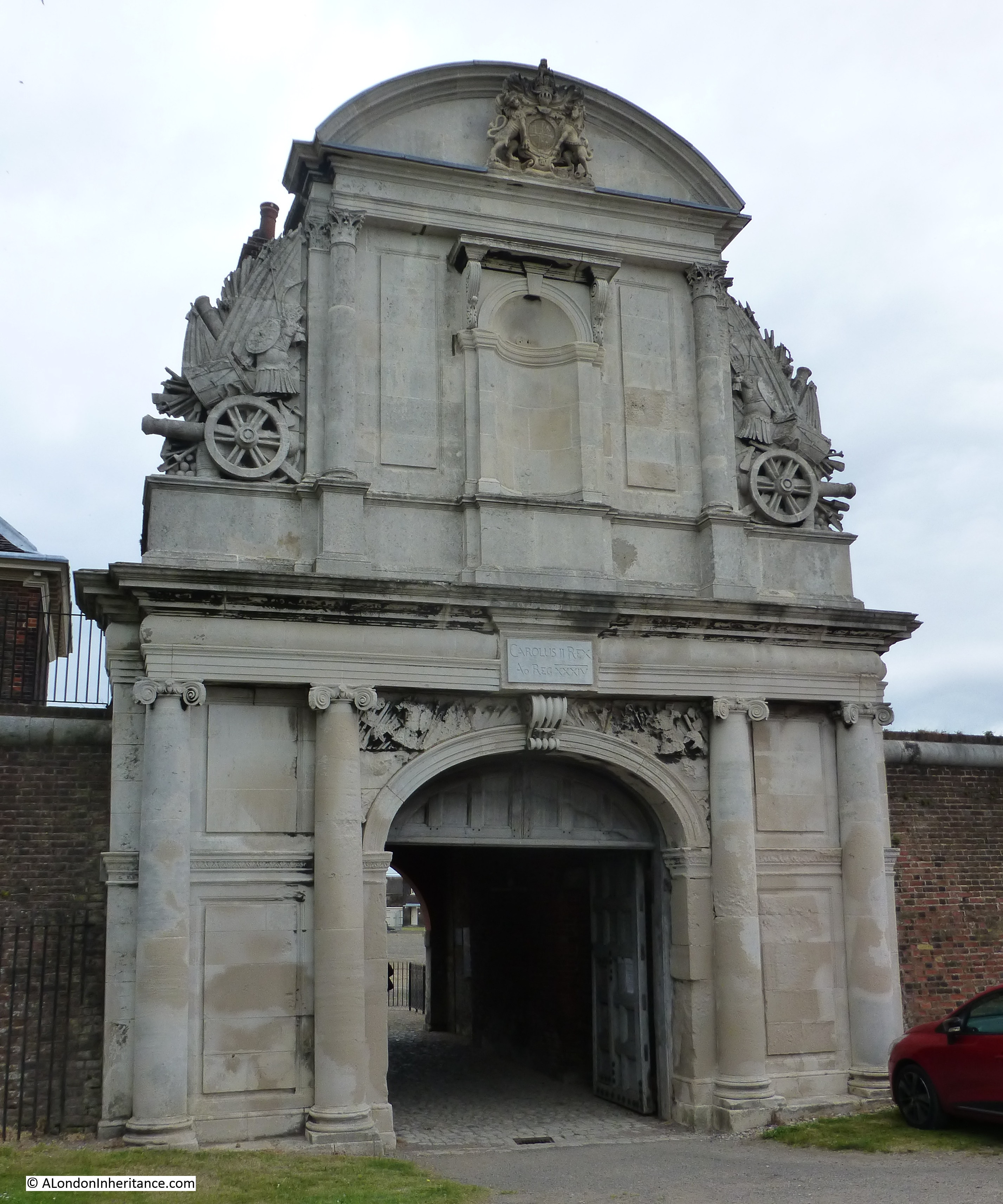
Approaching Tilbury Fort today, walking alongside the River Thames, entrance is through the ornate Water Gate, completed around 1682. The plaque above the main entrance reads “Carolus II Rex” – Charles 2nd and there was probably a statue of the King in the niche above.

Tilbury Fort 1

The Water Gate stands out well in this 1849 painting by Clarkson Frederick Stanfield titled Wind Against Tide (source: commons.wikimedia.org – click on image for original link) showing the fort on the right with shipping on the river experiencing rather rough conditions.

Tilbury_Fort_-_Wind_Against_Tide_by_Clarkson_Stansfield,_1849

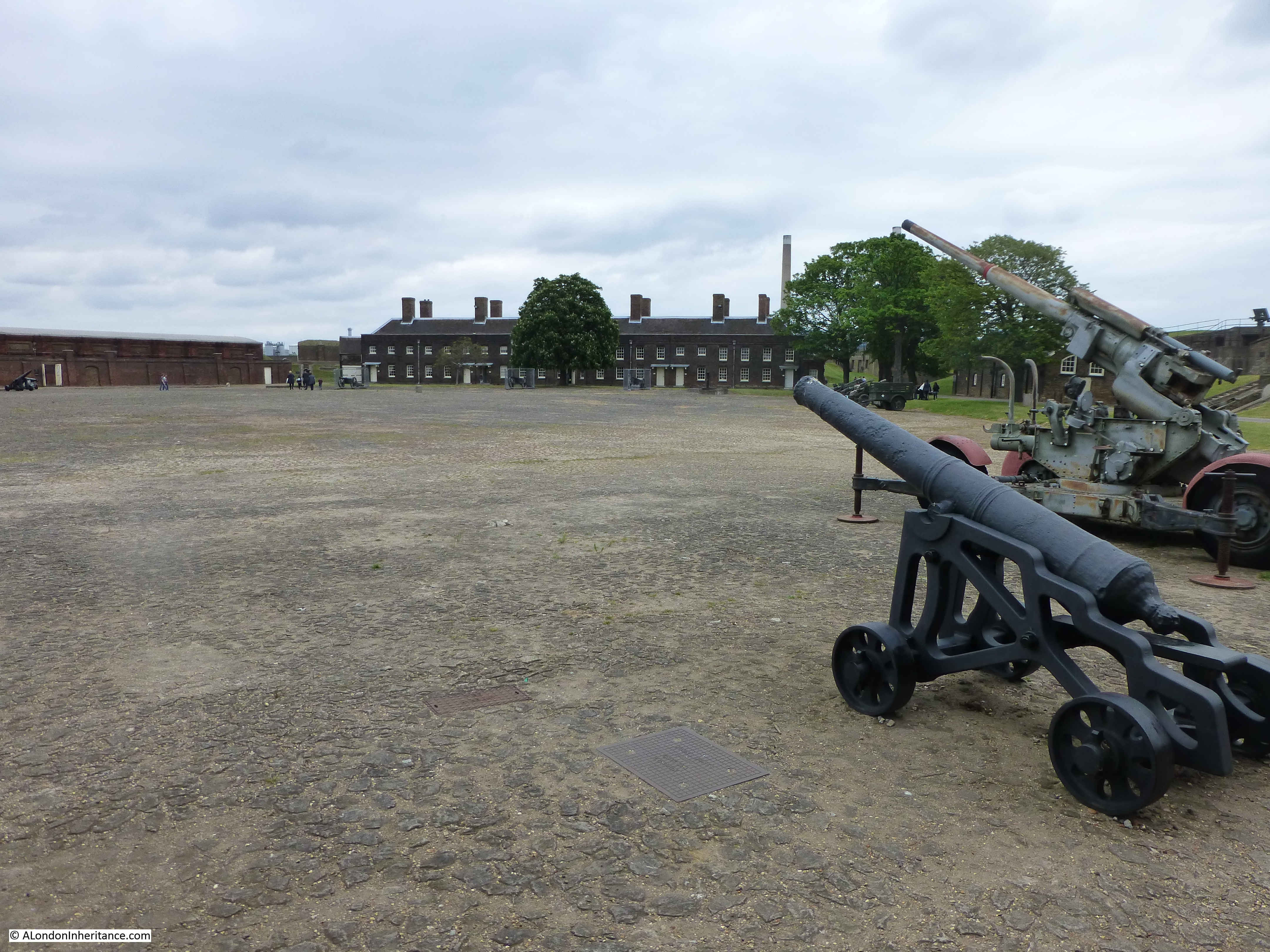
On entering the fort, the large parade ground gives an indication of how many soldiers would have been stationed here at the height of operations. Throughout the life of Tilbury Fort, numbers were in the range of between 100 and 300.

The officers barracks are at the back of the parade ground.

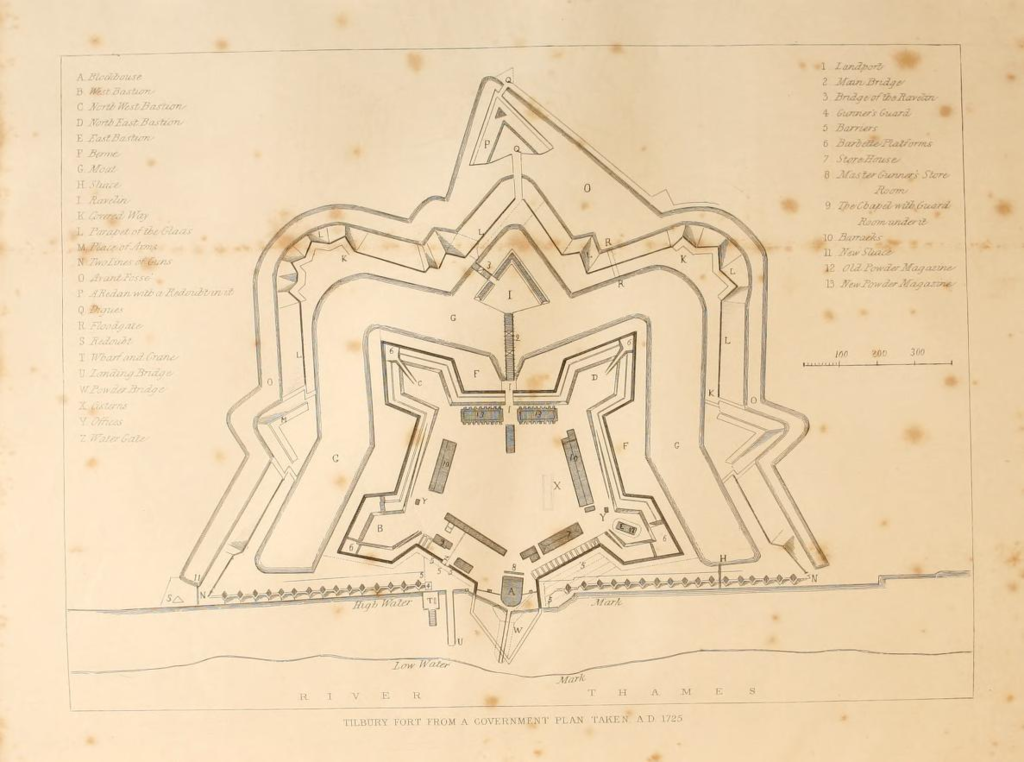
Tilbury Fort 2The layout of the rebuilt Tilbury Fort and the considerable defences can be seen in this plan of the fort in an engraving from a 1725 plan from The History of the Town of Gravesend by Robert Peirce Cruden. The Water Gate is at the lower centre of the plan. Note the markings for low and high water showing that at high water the river originally came up to edge of the fort.

Tibury_Fort_AD_1725

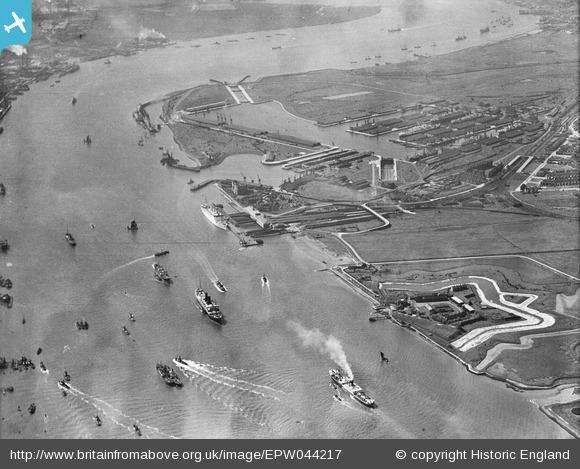
It is hard to get an impression of the overall scale of the fort from ground level. The following photo is from the Britain From Above website and was taken in May 1934. Tilbury Fort can be seen at the lower right of the photo. The defensive moat that runs around the fort was partially dry at the time and shows up as white. The Tilbury Docks can also been seen, along with a considerable amount of shipping in the river between Tilbury and Gravesend on the opposite shore.

EPW044217As well as defending the river, Tilbury was also a mustering point for soldiers from London.

In March 1587, Queen Elizabeth 1st requested the City to provide a force of 10,000 men, fully armed and equipped. The following table lists the numbers of men from each individual ward:

Farringdon Ward Within 807 Broad Street 373
Bassishaw 177 Bridge Ward Within 383
Bread Street 386 Castle Baynard 551
Dowgate 384 Queenhithe 404
Lime Street 99 Tower Street 444
Farringdon Without 1264 Walbrook 290
Aldgate Ward 347 Vintry 364
Billingsate 365 Portsoken 243
Aldersgate 232 Candlewick 215
Cornhill 191 Cripplegate 925
Cheap 358 Bishopsgate 326
Cordwainer 301
Langbourne 349
Coleman Street Ward 229 Total 10007

These numbers give some idea of the population density of each of the wards, The Earl of Leicester was in command at Tilbury and received 1000 of the London force, only on the condition that they brought their own provisions.

The description of their arrival at Tilbury gives the impression of  London men being dressed for show, rather than for work and fighting:

“The London men wore a uniform of white with white caps and the City arms in scarlet on back and front. Some marched in companies according to their arms. Their officers rode beside the men dressed in black velvet. They were preceded by billmen, by a company of whifflers (trumpeters) and in the midst marched six Ensigns in white satin faced with black sarsenet and rich scarves The dress of the officers and men was just as useless and unfit for continued work as could well be devised. It is melancholy to find that the Earl of Leicester who was in command at Tilbury held a very poor opinion of the London men.”

It was also at West Tilbury that Elizabeth 1st met the Earl of Leicester on the 8th August 1588 and the following day addressed the troops with the speech:

“And therefore I come amongst you at this time, not as for my recreation or sport, but being resolved, in the midst and heat of the battle, to live or die amongst you all, to lay down, for my God, and for my kingdom, and for my people, my honor and my blood, even the dust. I know I have the body of a week and feeble woman; but I have the heart and stomach of a king, and of a king of England, too; and think foul scorn that Parma or Spain, or any prince of Europe, should dare to invade the borders of my realms; to which, rather than any dishonour should grow by me, I myself will take up arms.”

Although there are a number of different versions of this speech, the evidence appears to be strong that Tilbury was the location where Elizabeth 1st addressed her troops at the time of the Armada.

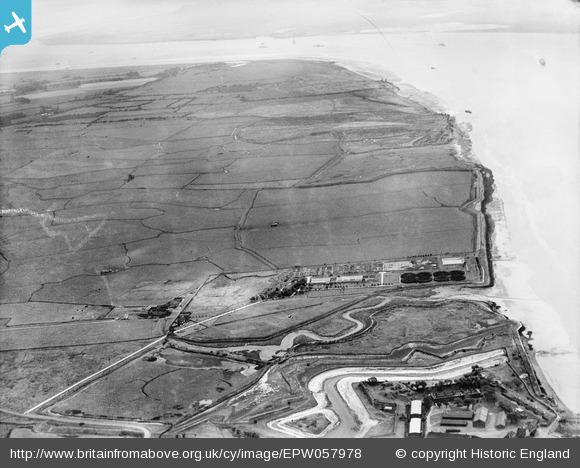
For those stationed at Tilbury Fort, it must have seemed a remote and barren location. Today, the fort is surrounded by docks and a power station, but up to the building of the docks the area was mainly barren, flat land. To get an idea, the following photo from 1938 is also from Britain From Above and shows the fort in the bottom right hand corner with only a water treatment works before flat fields stretch into the distance. Much of this is now occupied by Tilbury Power Station.

EPW057978

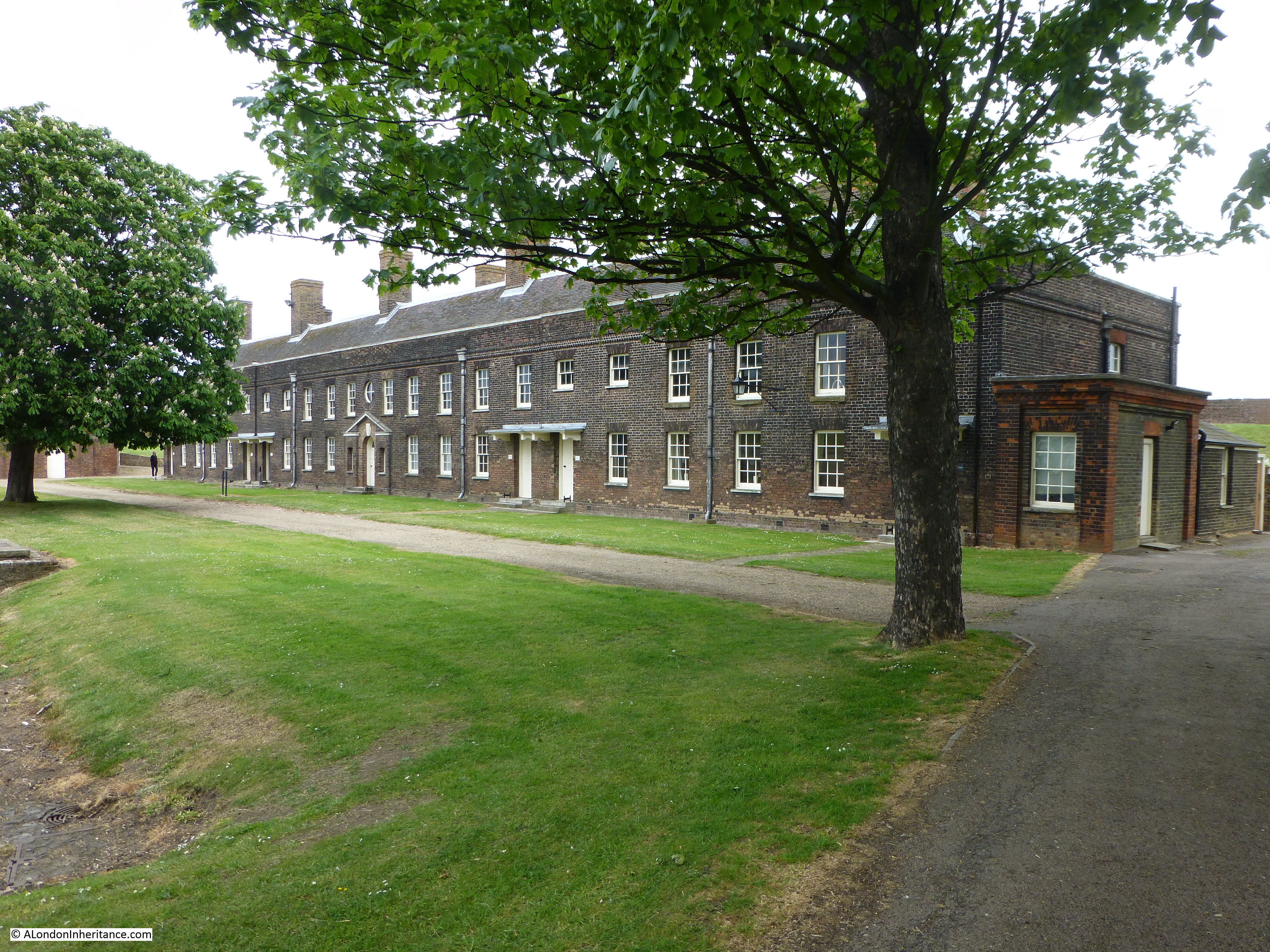
At the far end of the parade ground are the officers barracks. These were originally built in 1685, rebuilt in 1772 with further modifications during the 19th century. These barracks would have been used by the senior officers along with their families. Unfortunately the solders barracks were demolished in the early 1950s. They also faced onto the parade ground.

Tilbury Fort 3

There is an interesting connection between Tilbury and Greenwich. When Charles II approved the construction of the Royal Observatory at Greenwich, the King allowed £500 towards the new building, together with a supply of bricks from Tilbury Fort, where there was a spare stock, so some of the fabric of both locations is from the same stock of bricks.

As well as acting as a mustering points for troops, the main function of the fort was to protect the river.

Tilbury is the point in the Thames where the river starts to narrow on the approach to London, so it is an ideal location to site guns to fire at any invading ships attempting to move up river. Gun emplacements are arranged along the fort providing firing points looking across the river with Gravesend in the background:

Tilbury Fort 8

Shipping still passes Tilbury Fort, but of a very different type from when the fort was in use:

Tilbury Fort 9

The fort also stored a considerable amount of gunpowder and munitions, both for use in the fort and as a general reserve for the army. Two magazines held large quantities of gunpowder. These are the only powder magazines to remain in Britain from the early 18th Century. Very strong, with a large blast wall around the perimeter.

Tilbury Fort 10

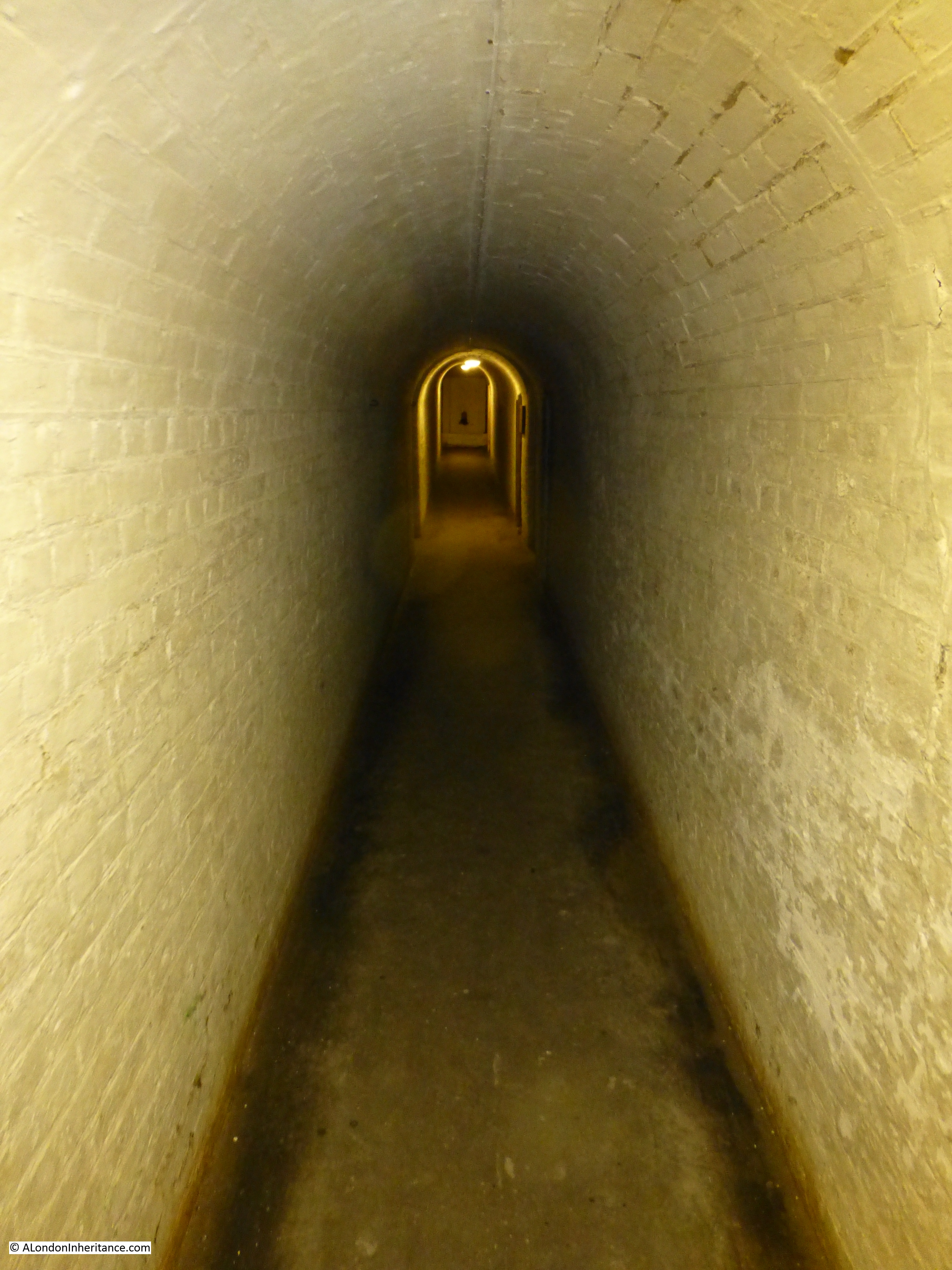
As well as gunpowder, munitions were stored in tunnels constructed under the earthworks. One of the tunnels leading to storage rooms for artillery shells and other munitions:

Tilbury Fort 6

One of the storage rooms leading off the tunnel:

Tilbury Fort 7During the 18th and early 19th centuries there was the occasional threat of an attack on London via the river, although the majority of wars were being fought on the continent or at sea.

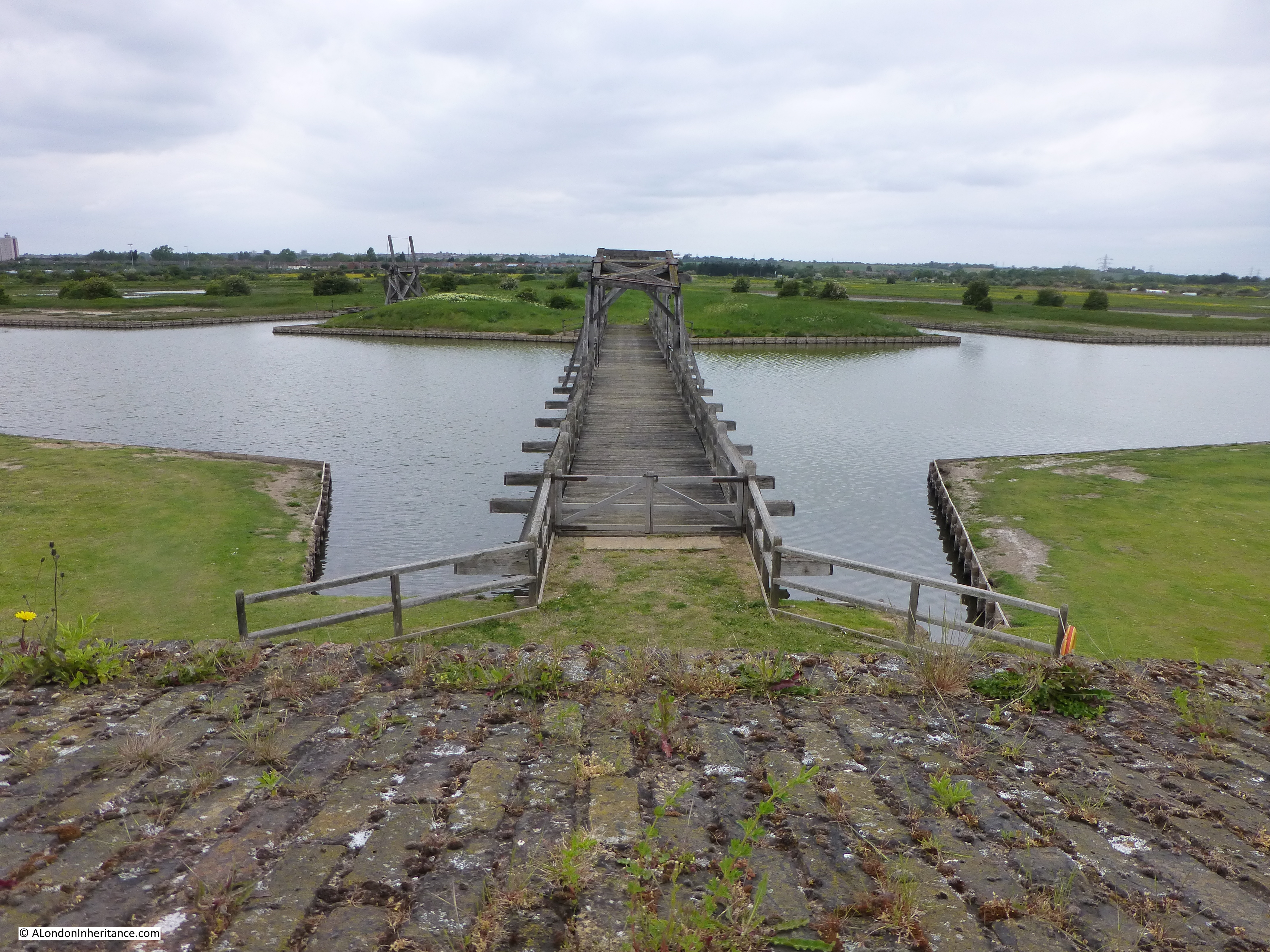
Tilbury Fort was permanently manned with numbers being ramped up or down dependent on the perceived threat level. The troops at the fort were also responsible for defending the fort and surrounding area from any land based attack. The fort was very well protected from land based attack with a series of moats and land defences. To the rear of the fort, a reconstructed bridge leads across to one of the island defensive locations, then on to the flat lands north of the river.

Tilbury Fort 4

Soon after the Jacobite rebellion of 1745-6 Tilbury Fort was used as a prison for survivors of the rebellion whilst they waited for trial in London. Off 303 that sailed from Inverness, 268 survived to Tilbury. They were imprisoned in the gunpowder magazines in such dreadful conditions that a further 50 died. After trial in London in 1747 they were either executed or transported to Barbados and Antigua to work on the sugar plantations as slave labourers.

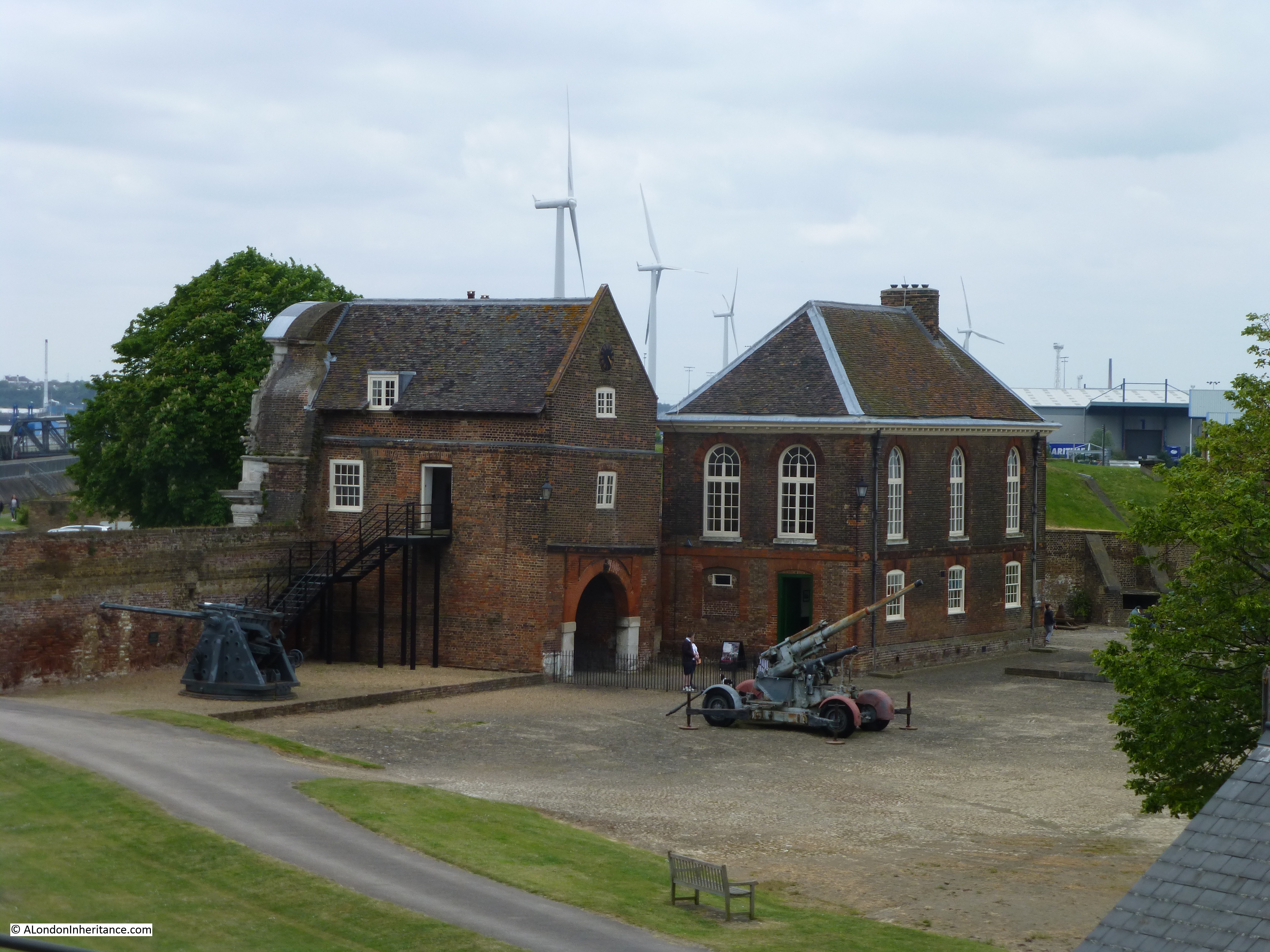
Another view inside the fort. The Water Gate is on the left with the guard-house and chapel on the right:

Tilbury Fort 5

The gunpowder held at the fort was used for many purposes. In May 1838 the Brigg, William had been run down by a steamer opposite the fort and was causing an obstruction in the river. The people of Gravesend petitioned the Government to have it removed and a party of sappers and miners led by a Colonel Paisley arrived to sink a large amount of powder under the wreck by means of a diving bell. A special fused pipe led to the surface allowing the fuse to be lit from the surface and the sappers to get back to shore in time. There was an “awful explosion” with “waters rising mountains high followed by clouds of black coal and pieces of wreck”.

Tilbury Fort continued in use throughout the 19th century with occasional upgrades as technology provided new and more efficient guns and threats changed, however by the start of the 20th century naval technology had increased so much that large shore forts along the river had become obsolete and naval protection of the Thames was considered a more effective form of defence.

The fort continued to be used for storage and also as a transit centre for troops, a key role during the 1st World War, given the adjacent port of Tilbury.

During the 2nd World War, the fort had a brief role as an anti-aircraft operations centre, controlling the fire from guns along the river.

Tilbury Fort finally ceased any military role in 1950 when it was transferred into the Ministry of Works as a historic monument and the fort is now in the care of English heritage.

alondoninheritance.com

2nd June 1953 – Coronation Day In London

The 2nd of June 1953 was Coronation Day in London and a public holiday. As usual for such an event, people started lining the route between Buckingham Palace and Westminster Abbey well before the procession to ensure a good position to see the new Queen.

The weather during the previous May had been excellent with lots of warm, sunny weather broken only by the occasional thunderstorm. This weather broke by the end of May, for the last week of May and the rest of June the country was under many low pressure areas moving from the Atlantic bringing cold temperatures for June and rain.

My father took a number of photos of people as they lined the route, along The Mall and round into Trafalgar Square.

These show people wrapped up for the weather and rather more formally dressed than you would find at such an event today.

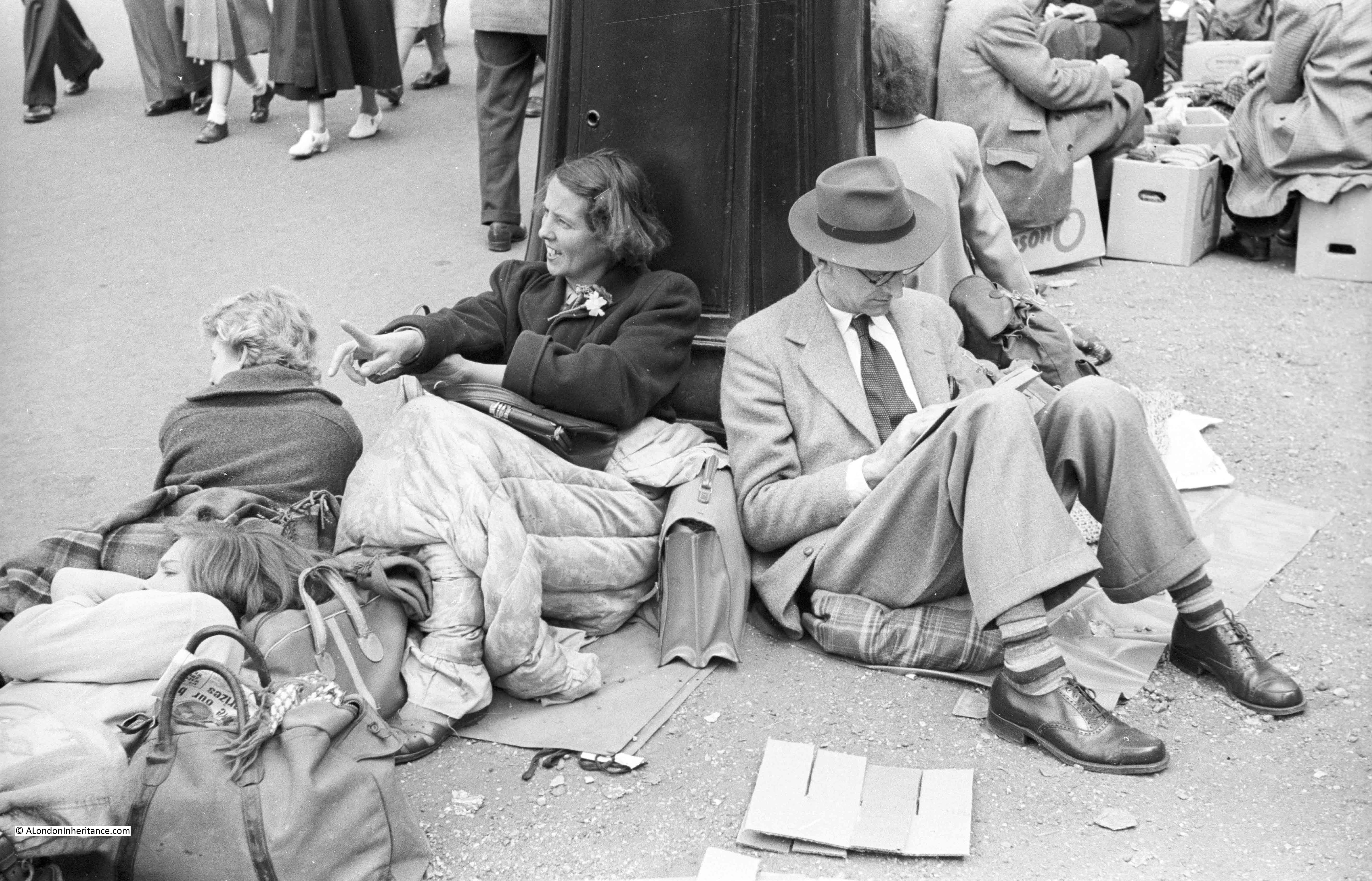
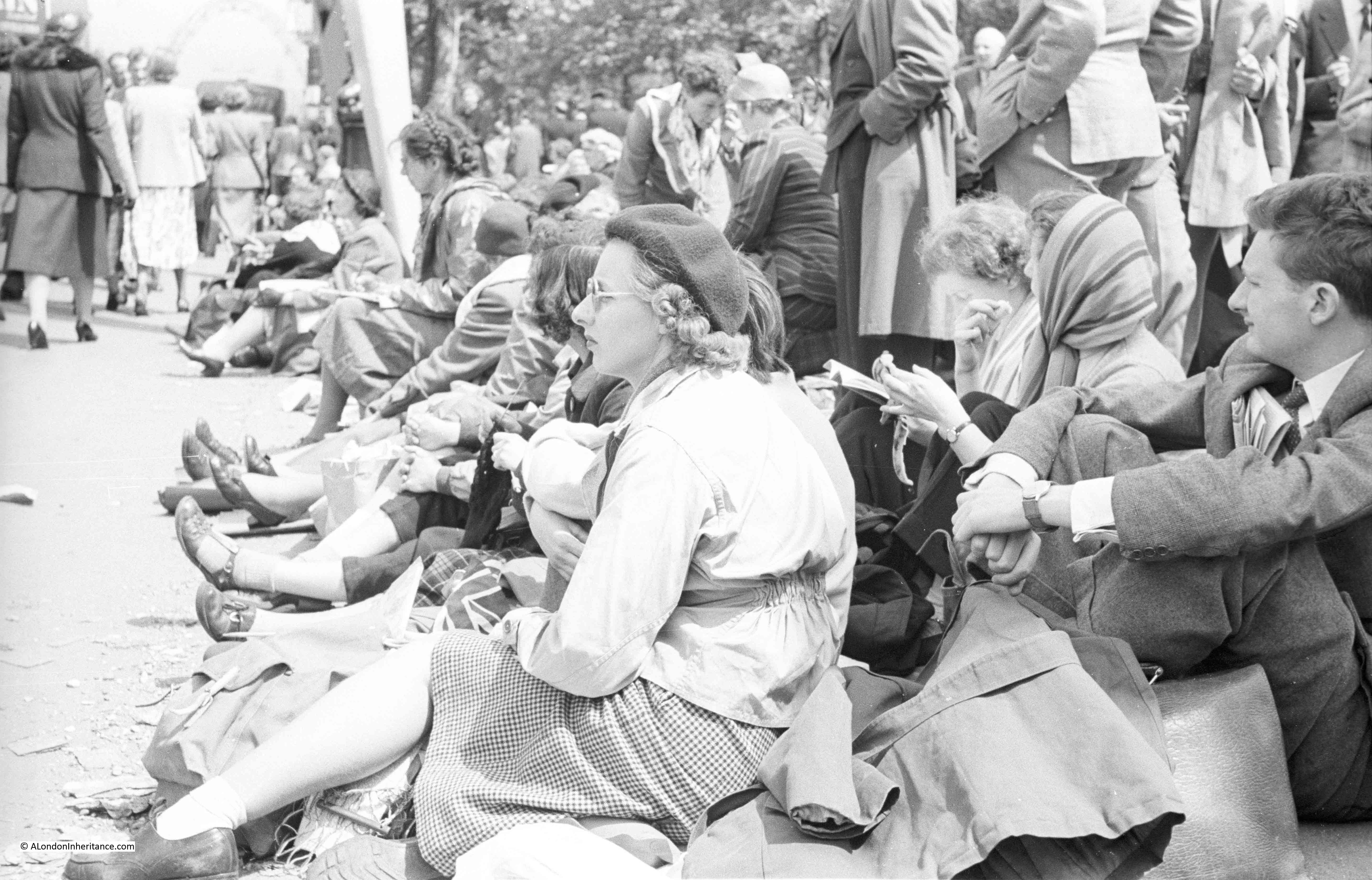
This photo was taken in The Mall. They look well prepared for the wait. The man is obviously not interested in people watching, he looks engrossed in his book. The group in the background also seem very well prepared judging by the number of boxes they have.

Coronation 1

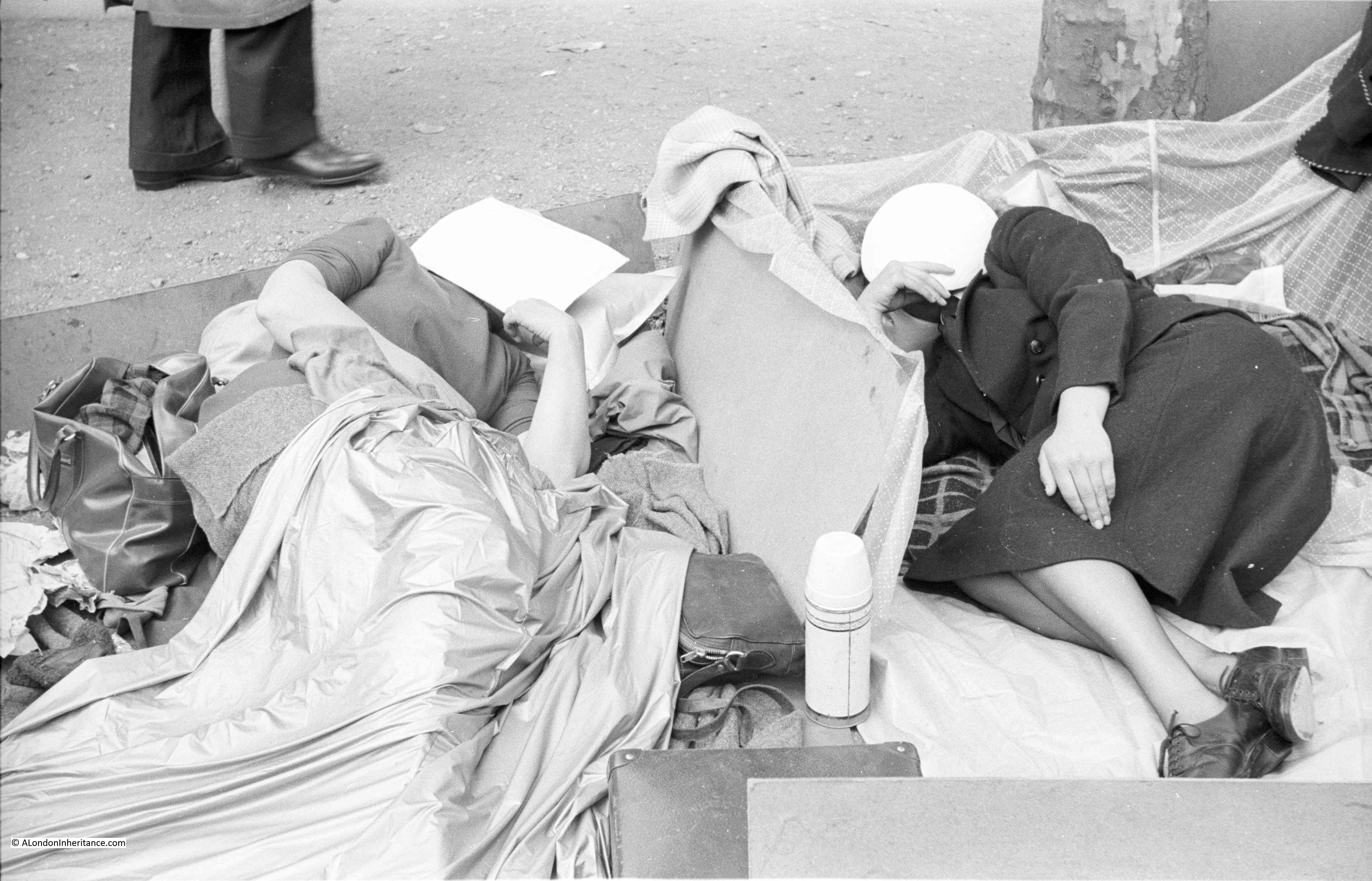
Sleeping in The Mall:

Coronation 2

Again in The Mall and the crowds are growing. In the top left is the faint outline of one of the arched decorations that spanned The Mall:

Coronation 3

A wider view of a very busy Mall.

Coronation 7

The morning of the 2nd of June was more like an autumn day with rain showers and temperatures reaching only 12 degrees centigrade. Very low for early June.

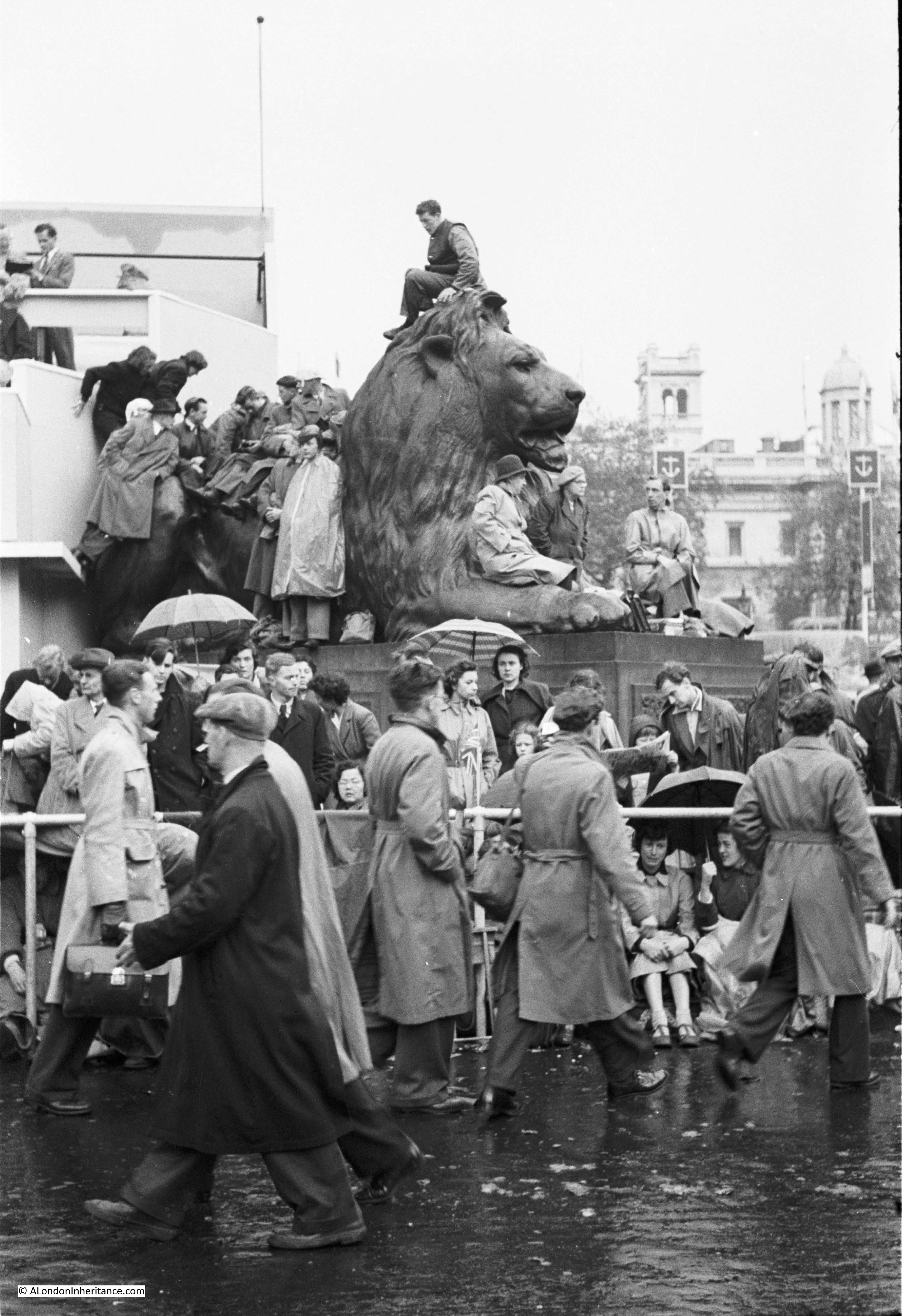
This is Trafalgar Square. On the left is one of the commentary boxes set-up along the route. This was the first Coronation to be televised.

Coronation 4

Photo of the small group of people on the lion. Not sure how long the man on the far left was going to balance in that precarious position:

Coronation 5

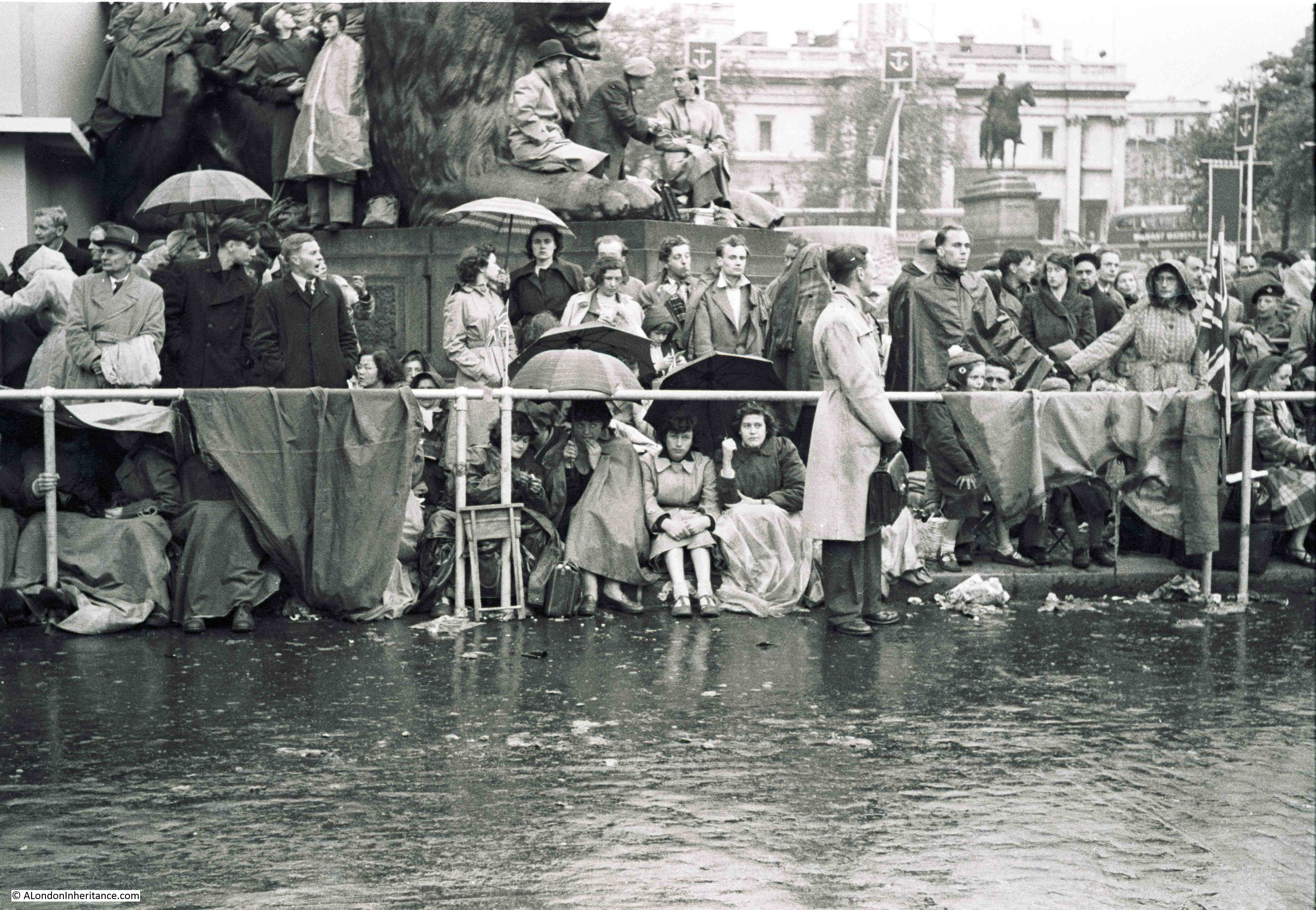
Another view of the same scene:

Coronation 6

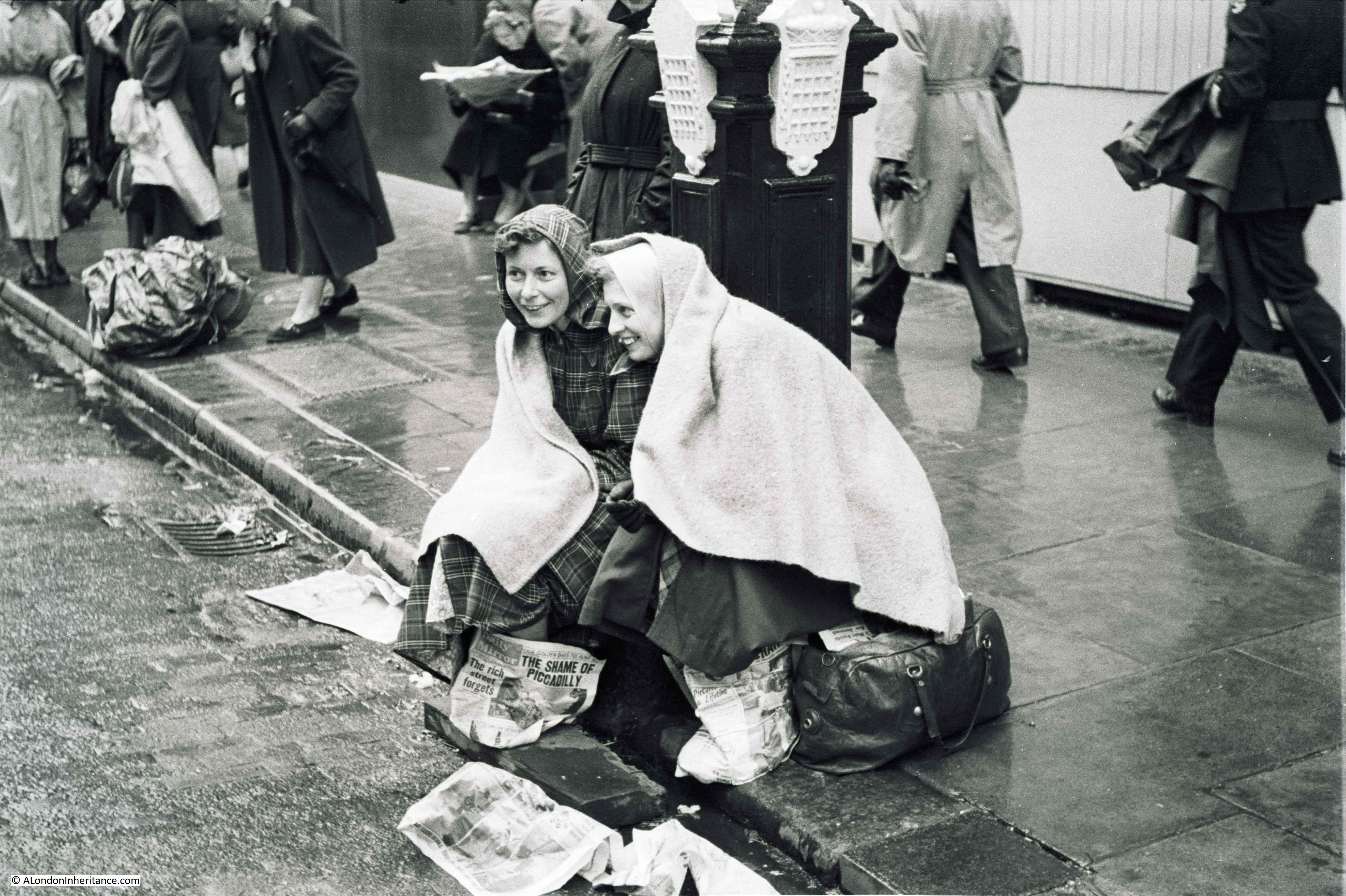
These two look cheerful despite the long wait and the weather:

Coronation 8

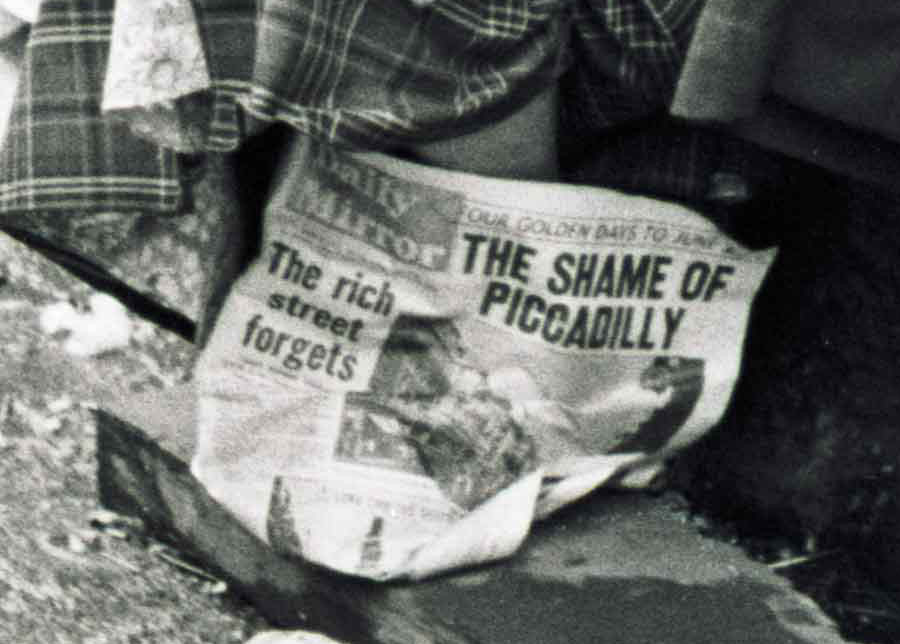
The newspaper between them was the Daily Mirror from the 29th May. The headline “The Shame Of Piccadilly” and “The rich street forgets” refers to the complete lack of decoration in Piccadilly for the Coronation. There are two photos on the page. The top photo shows Piccadilly without any decoration, the bottom photo shows, what is assumed to be an ordinary working class street decorated with flags and bunting and a Long Live The Queen banner stretched across the road. (I also have a series of photos taken in Hoxton showing the street decorations – a subject for a future post)

Coronation 10

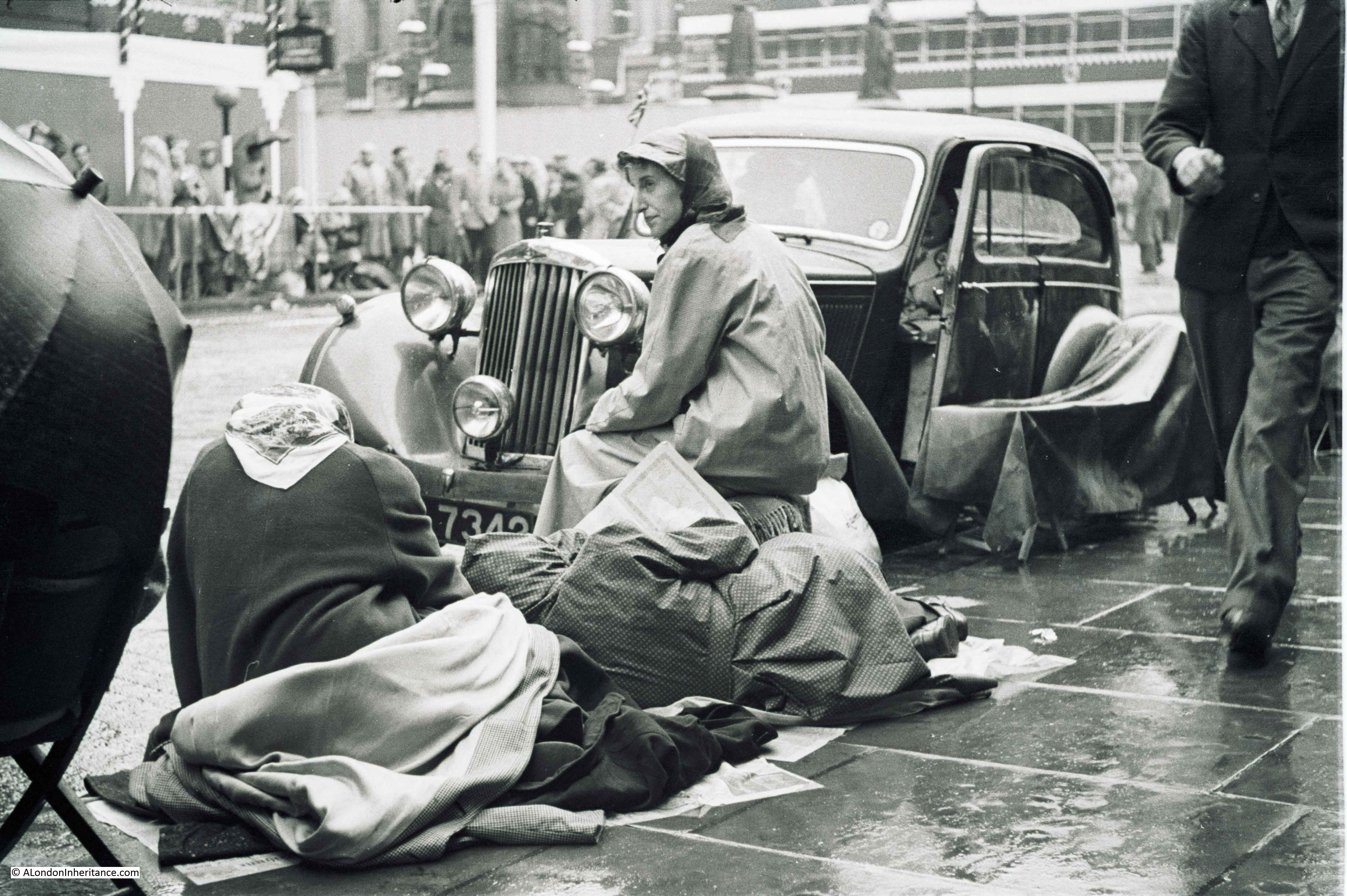
Another group reading and watching the world go by:

Coronation 9

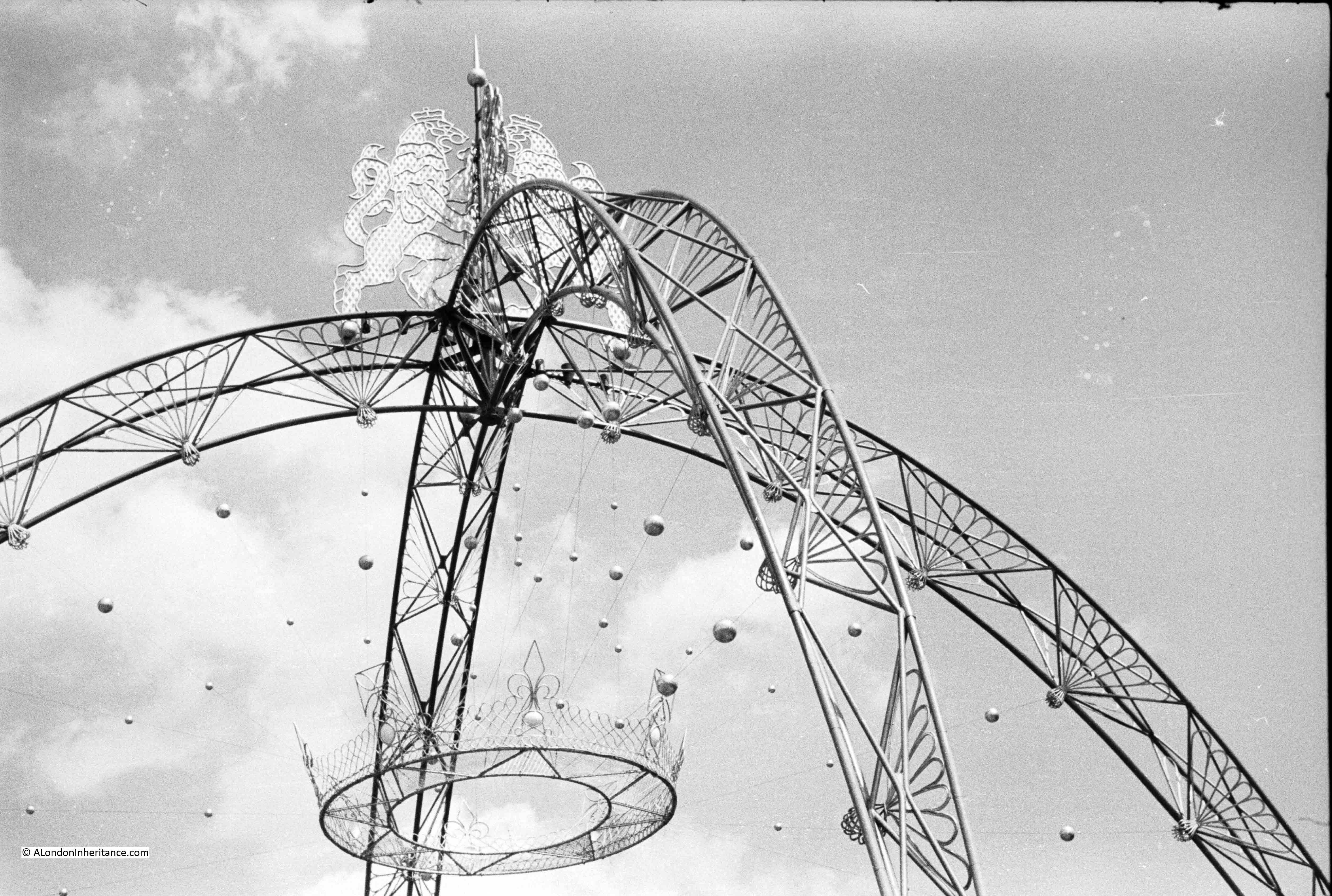
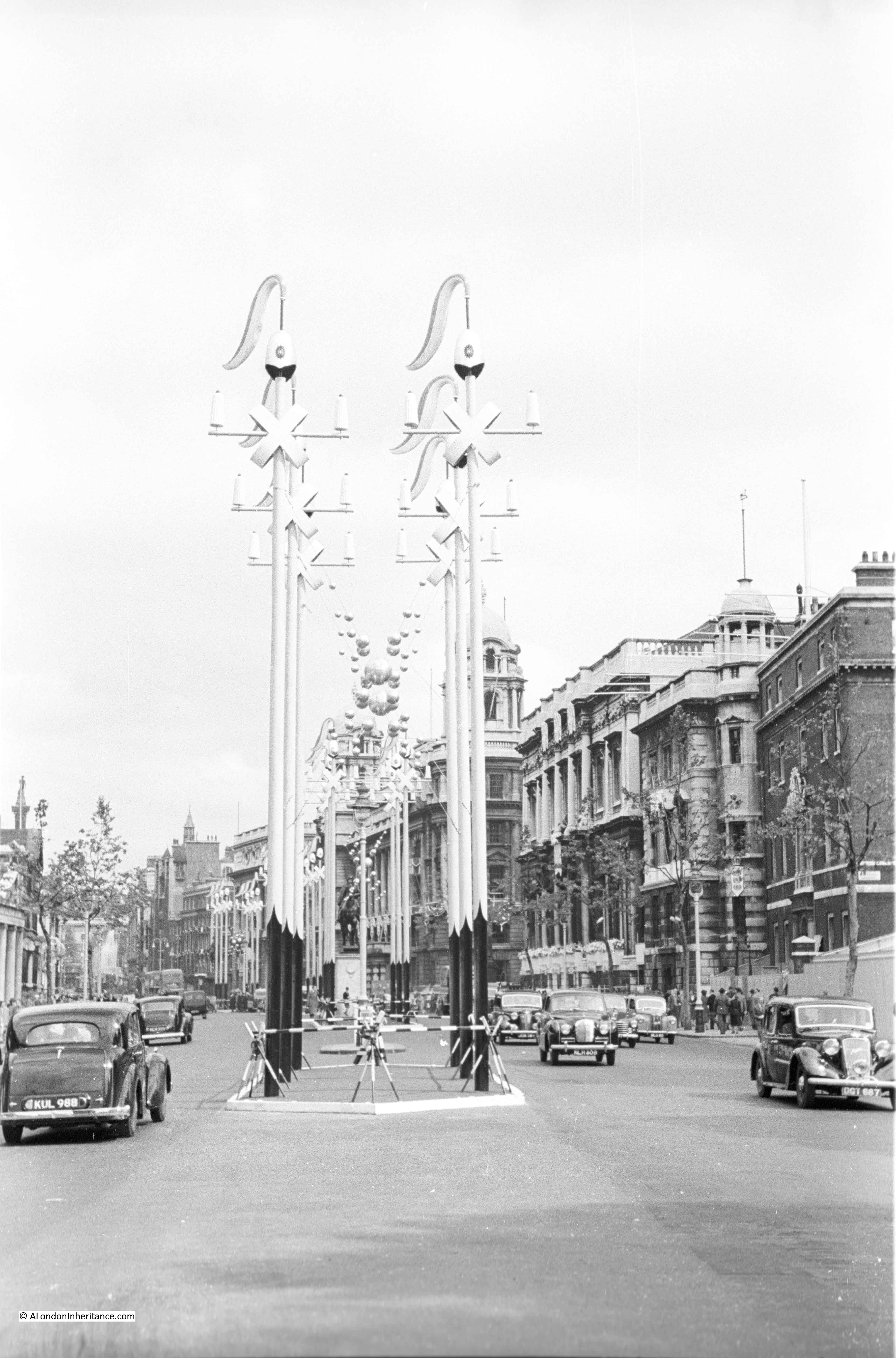
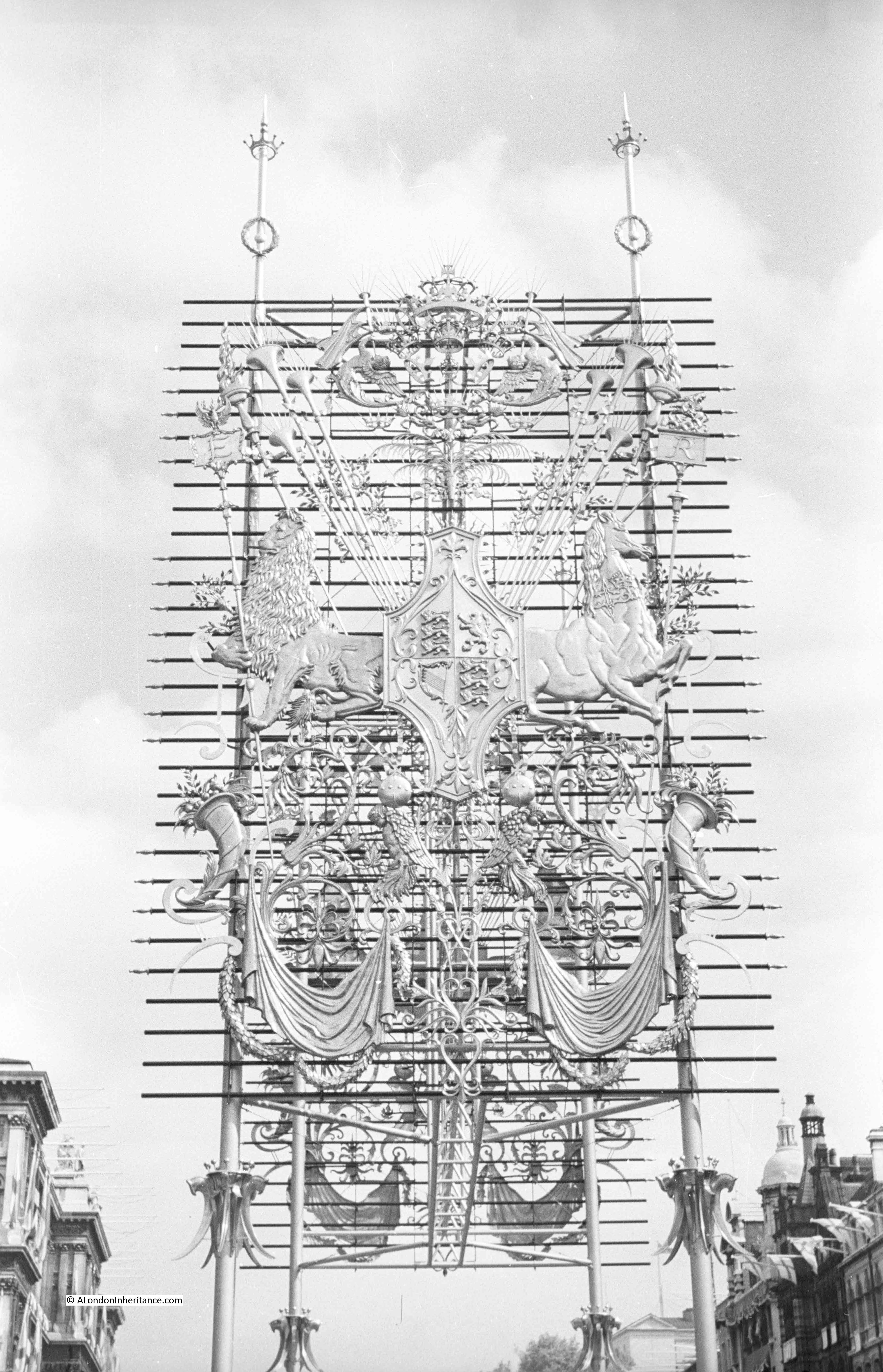
Some of the elaborate decorations that lined the Coronation route:

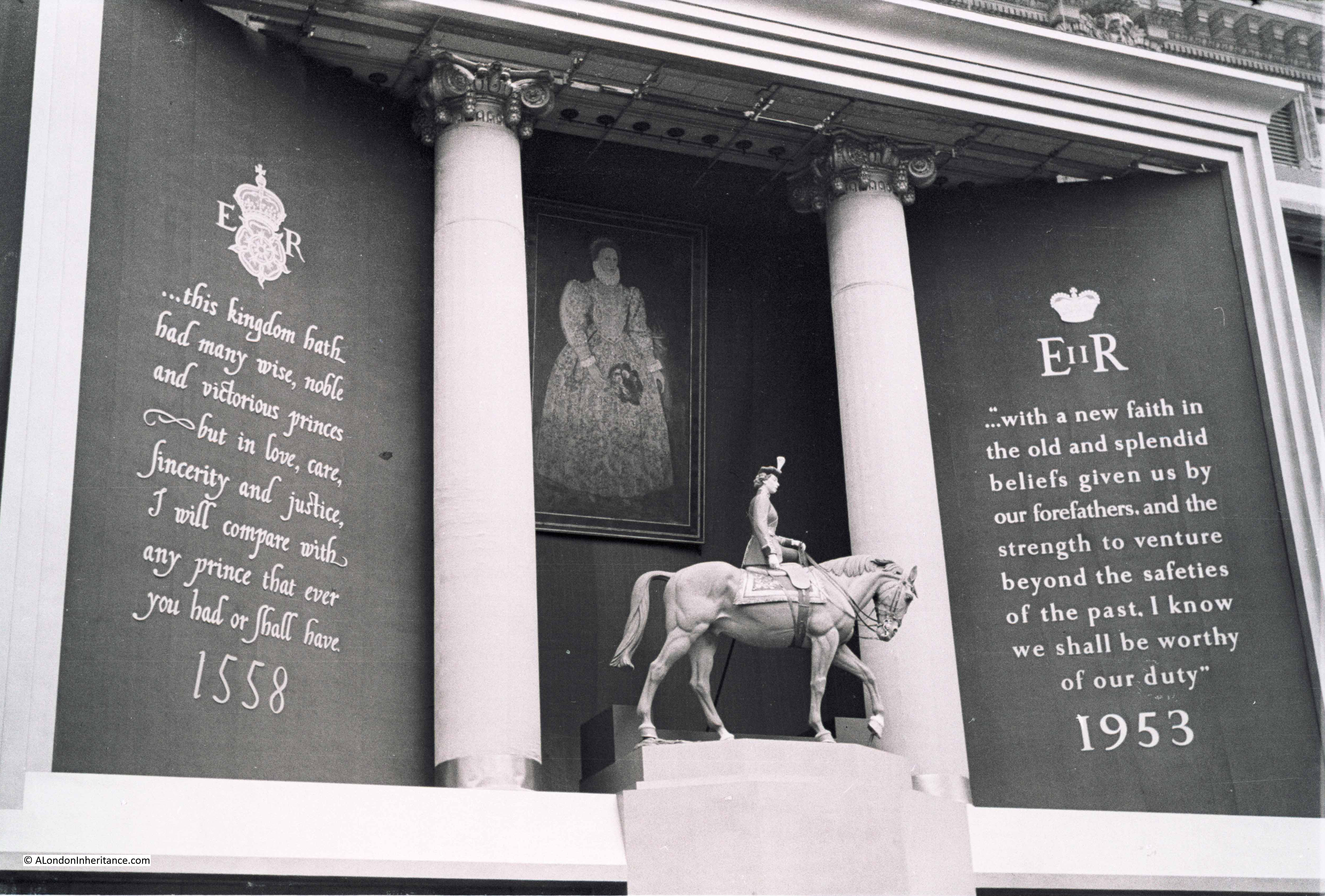
Coronation 11Coronation 12Coronation 13The expectation at the time was of a new Elizabethan era with comparisons back to Queen Elizabeth 1st as shown by the following tableau along the route of the procession. The text on the left is abbreviated from a speech given by Queen Elizabeth 1st to the Houses of Parliament on April 10th 1593 (1558 was the year that Elizabeth 1st became Queen) and that on the right from Queen Elizabeth 2nd from her first Christmas broadcast in 1952. Coronation 14

For those lining the route of the procession, I suspect that despite the weather, it was an event that was well worth the wait and long remembered.

alondoninheritance.com

London Streets In The 1980s

The 1980s in London was a decade of considerable change. Long established industries, street scenes, shops and ways of life were being swept away and the often divisive politics of the time were visible painted along the walls.

The mid 1980s are only 30 years ago but walking along London’s streets today I still find it surprising how considerable the change has been in many areas.

For this week’s post, I would like to take you back through a snapshot of London Streets in the 1980s, with some of the photos we took, mainly of south, east and north London.

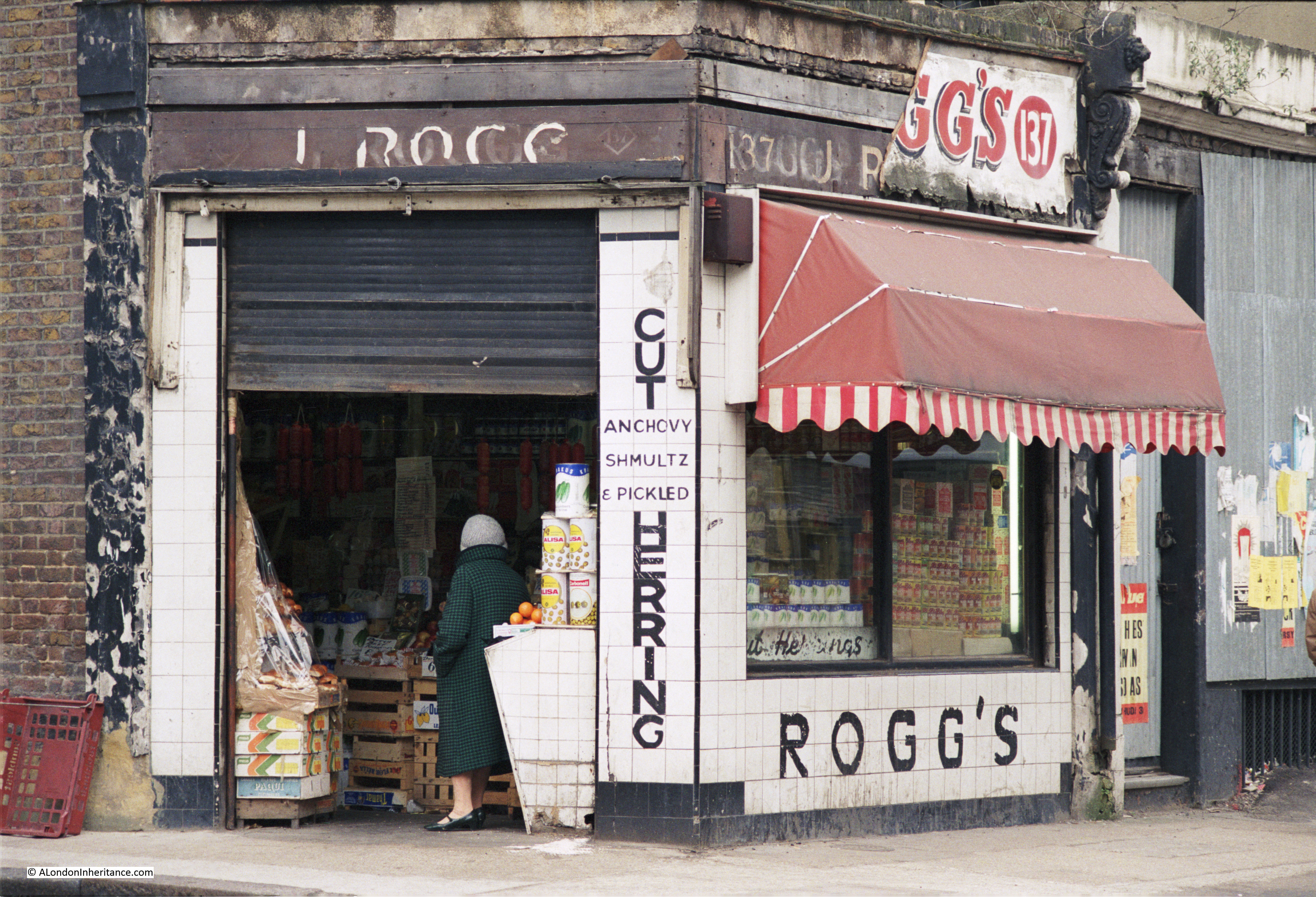
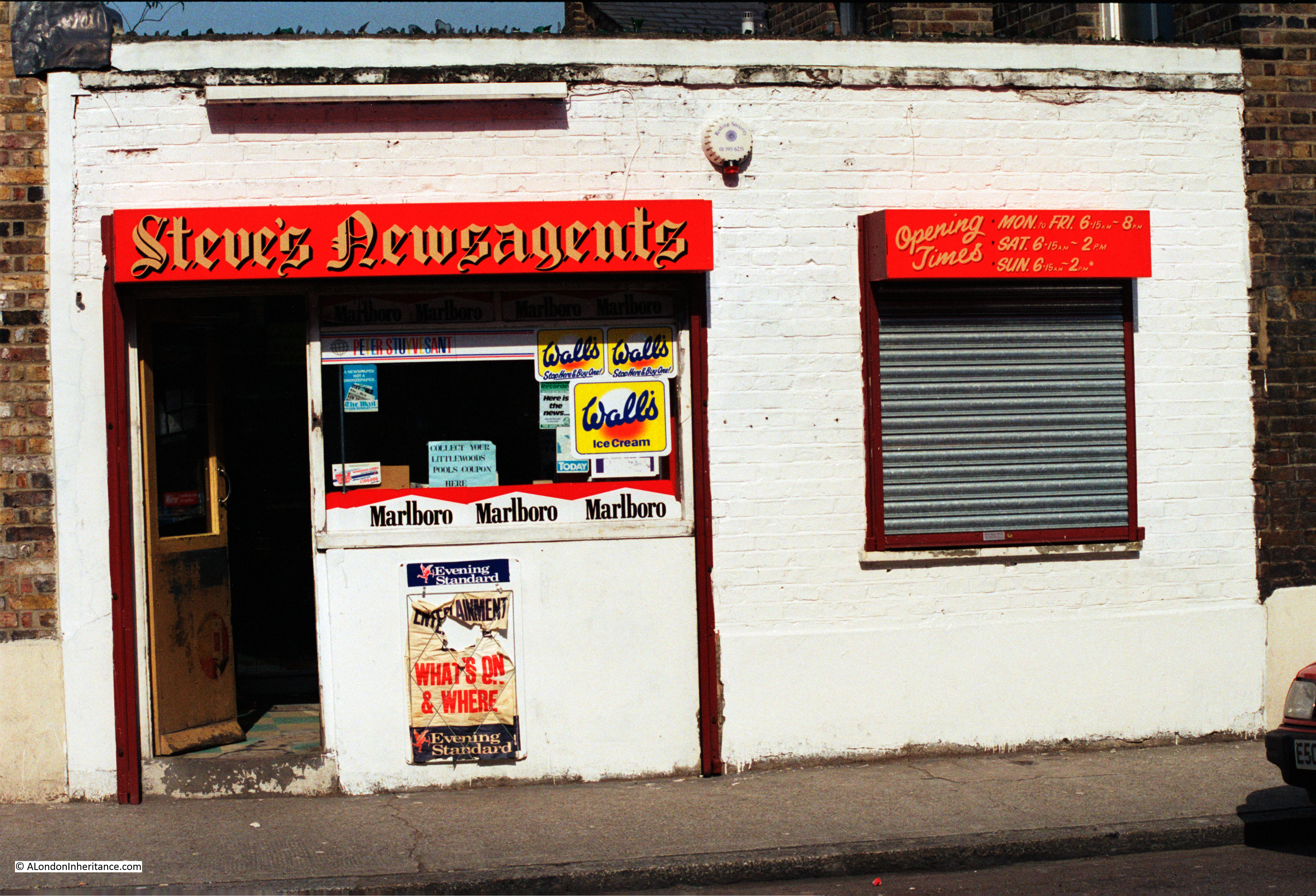
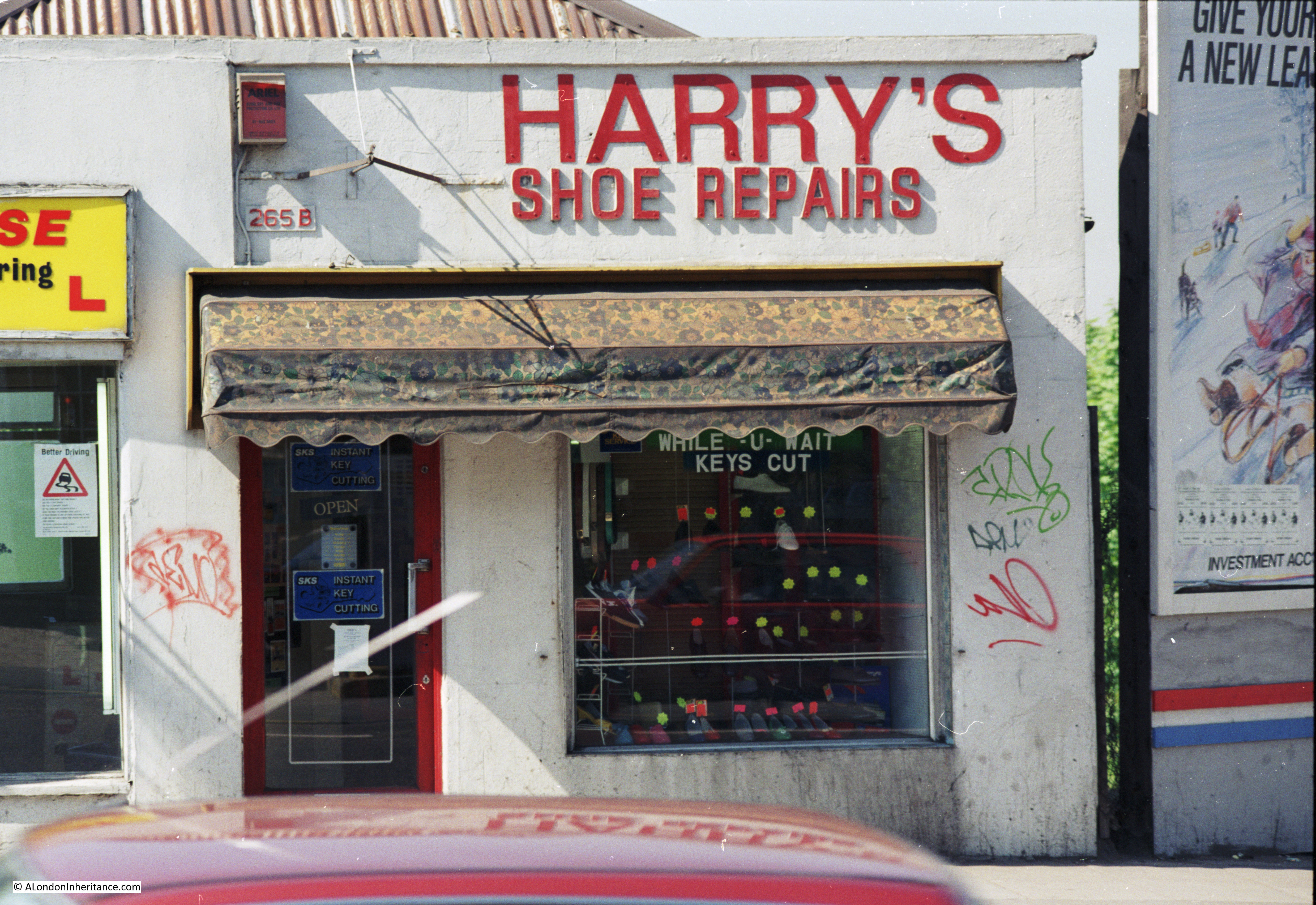
Local, independent shops once served the majority of London’s residents, often run by the same family for many years. Many of these were in their final years, clinging on whilst much around them had closed:

Street Scenes 1


Street Scenes 4


Street Scenes 5

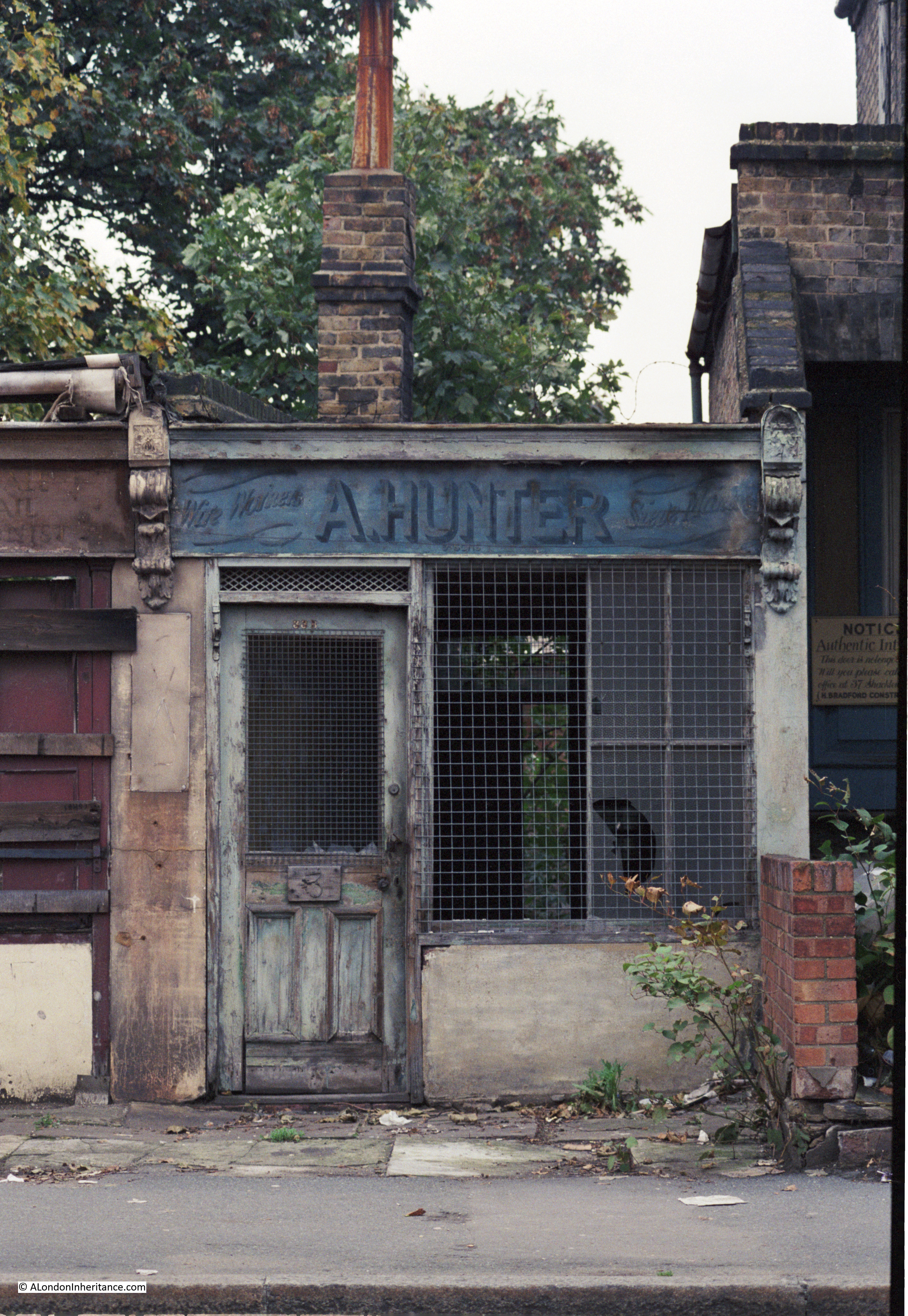
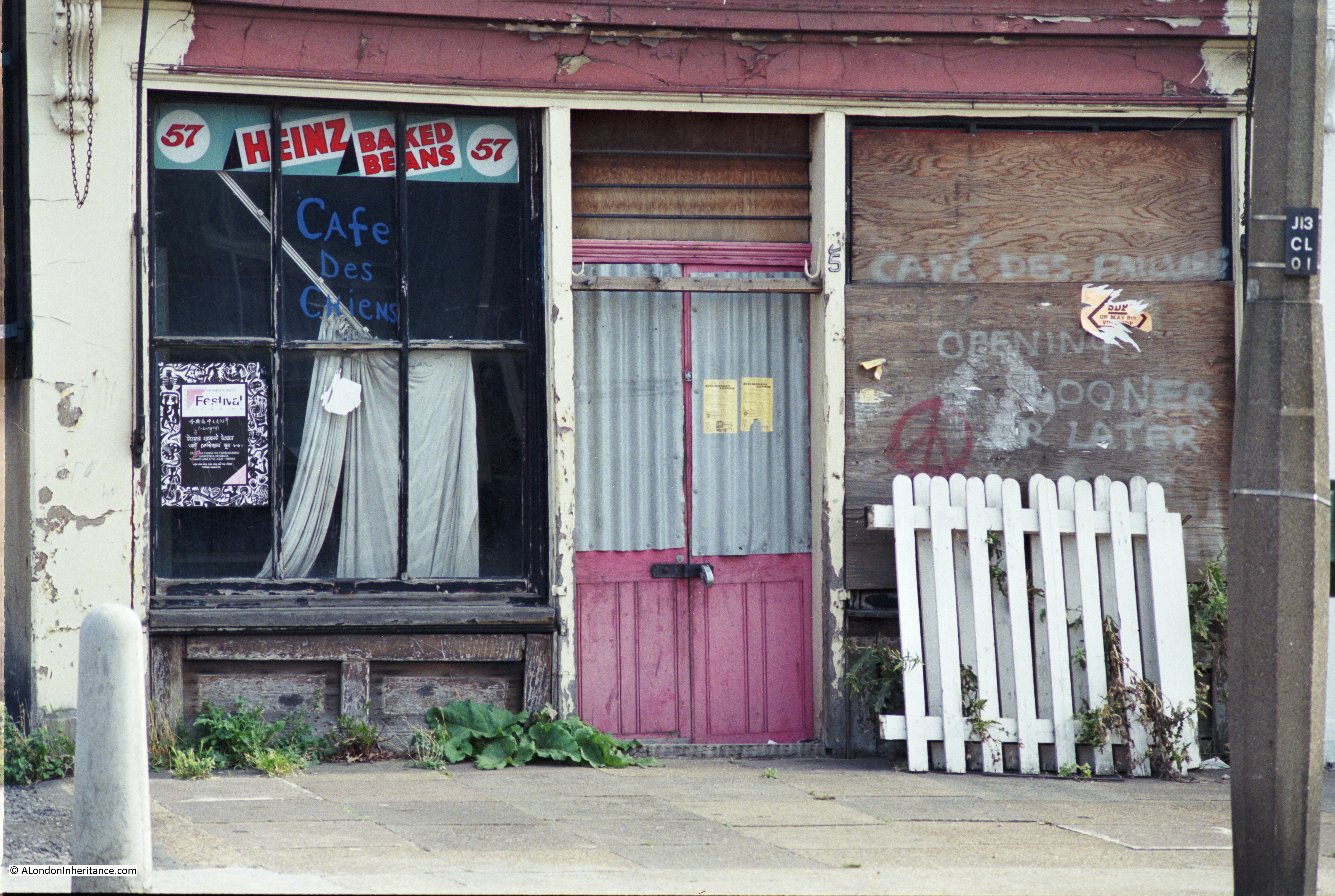
Many had already long closed, waiting for demolition and the rebuilding of whole streets:

Street Scenes 18

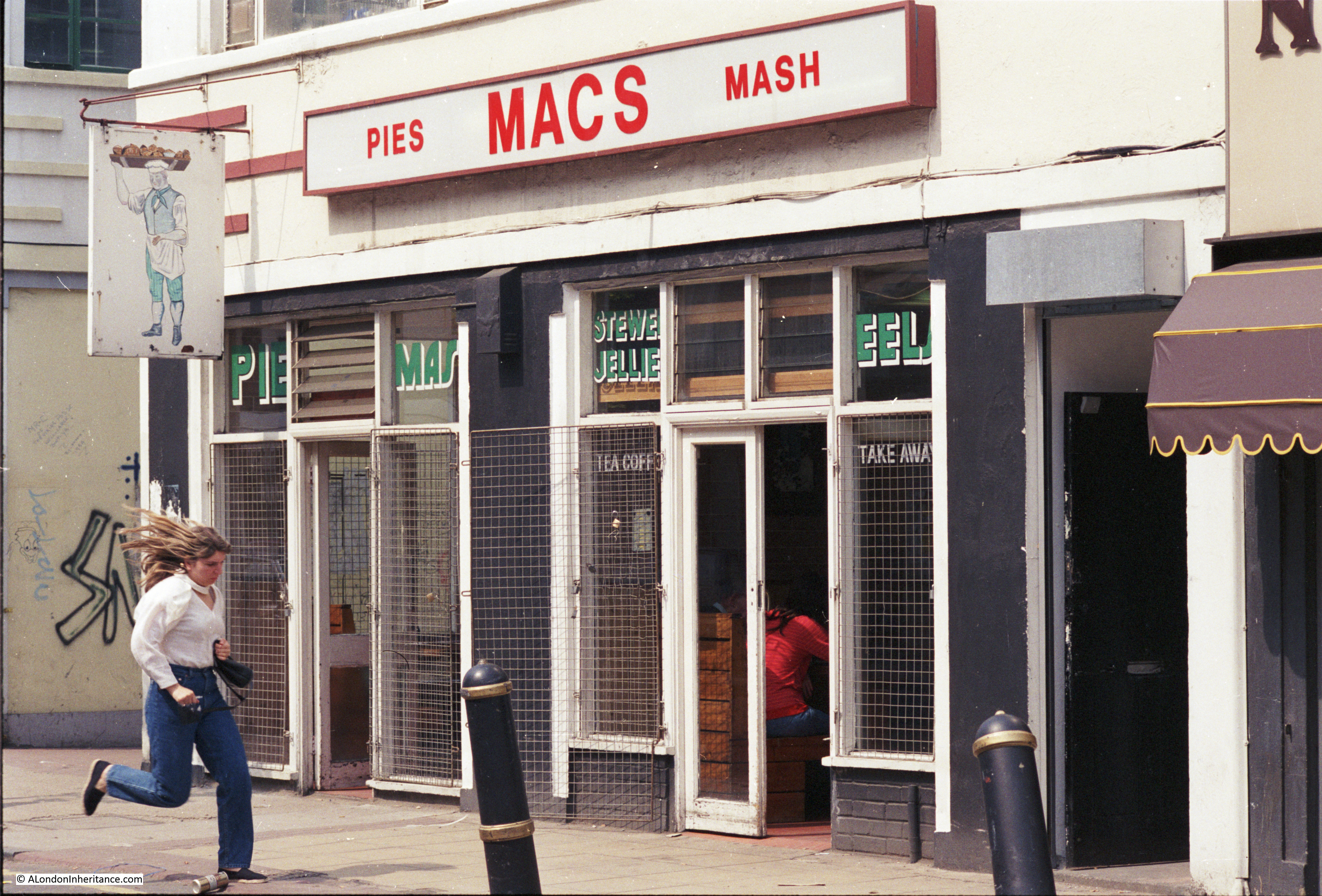
What Londoners would look for when eating out would also soon change. This was before the streets were populated with identical coffee shop brands:

Street Scenes 19

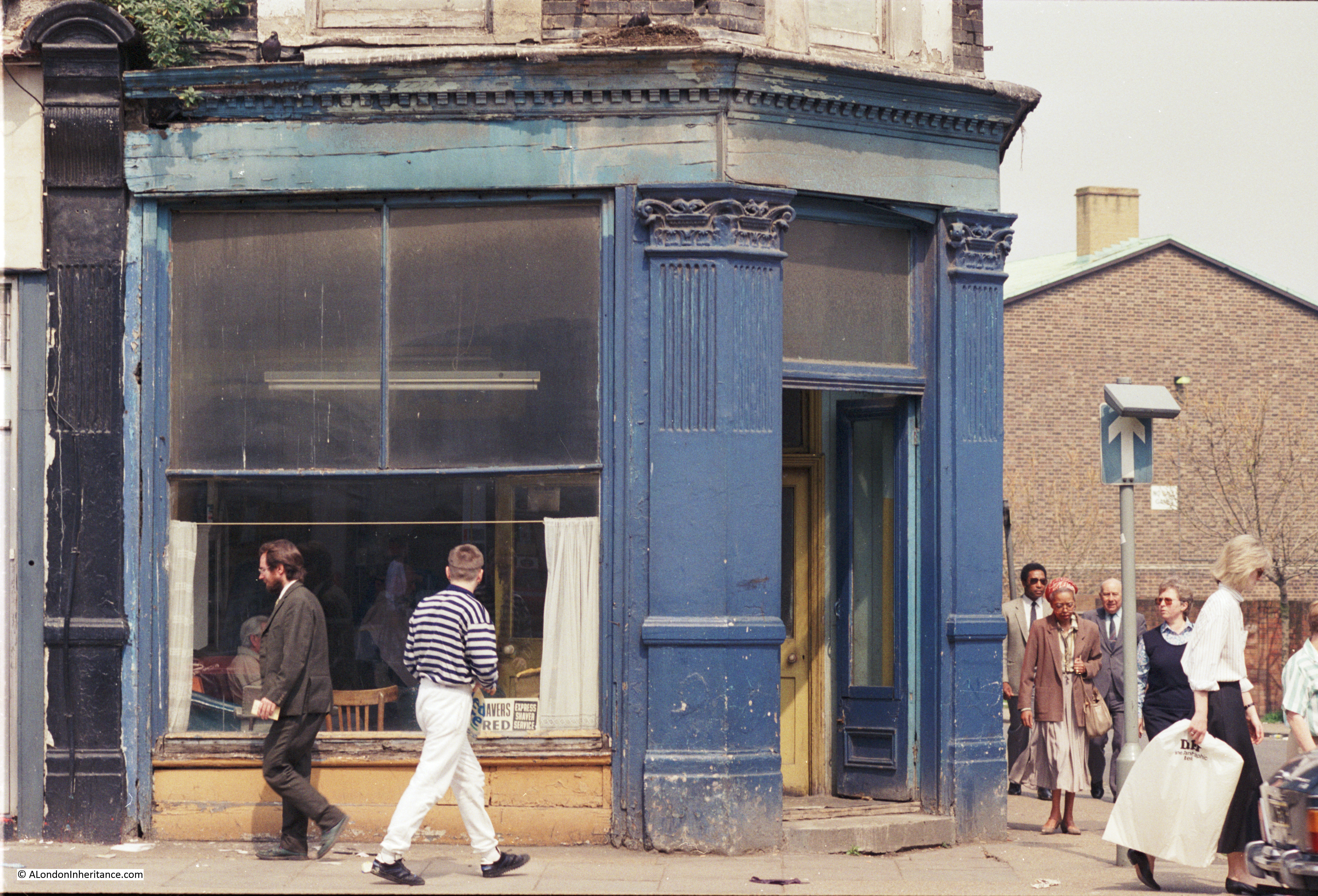
The corner shop was a standard feature of many residential streets. Many of these had closed or were put into some temporary use whilst awaiting either redevelopment or demolition:

Street Scenes 20


Street Scenes 21

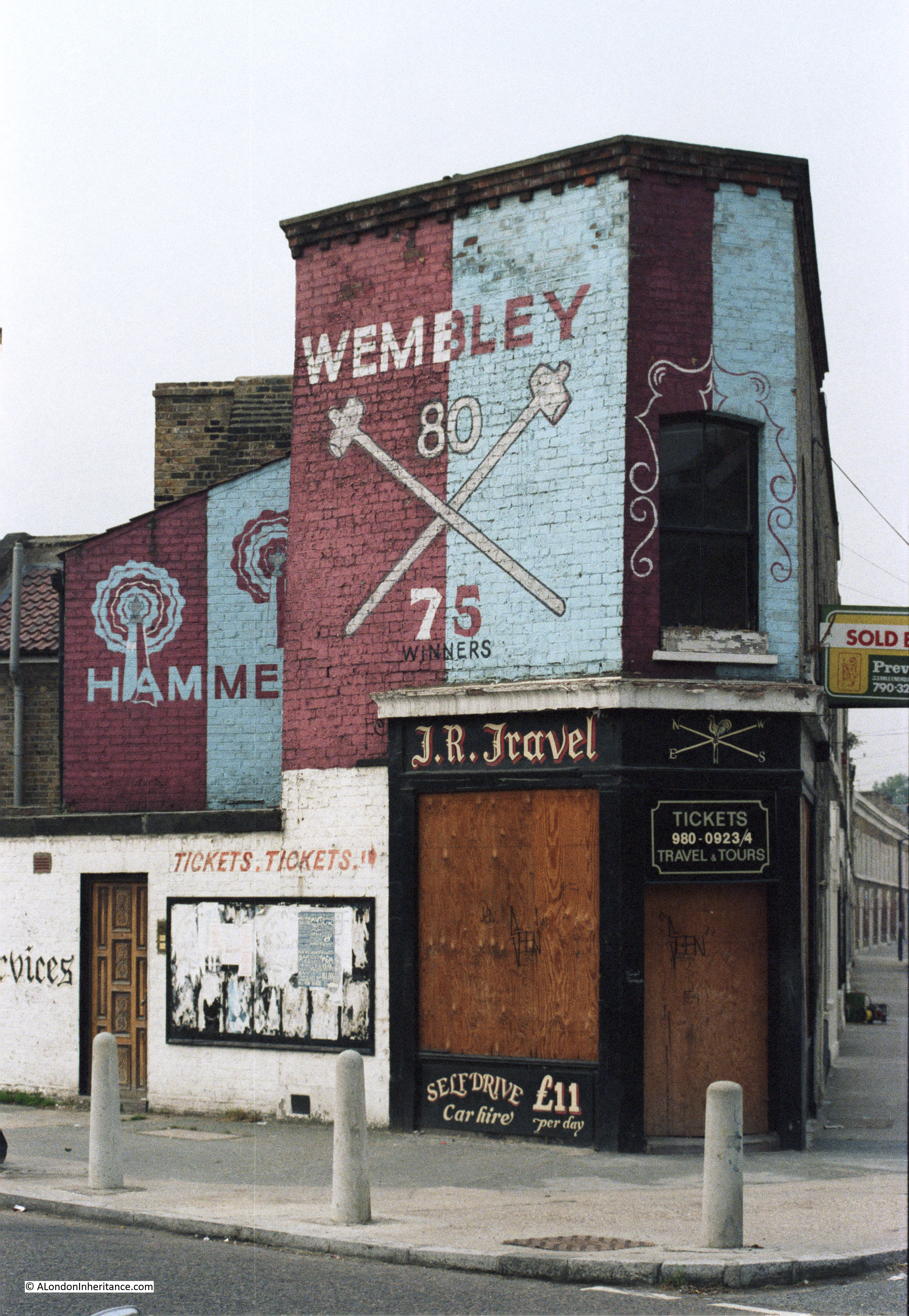
A somewhat forlorn tribute to West Ham waits for what will become of these buildings:

Street Scenes 22

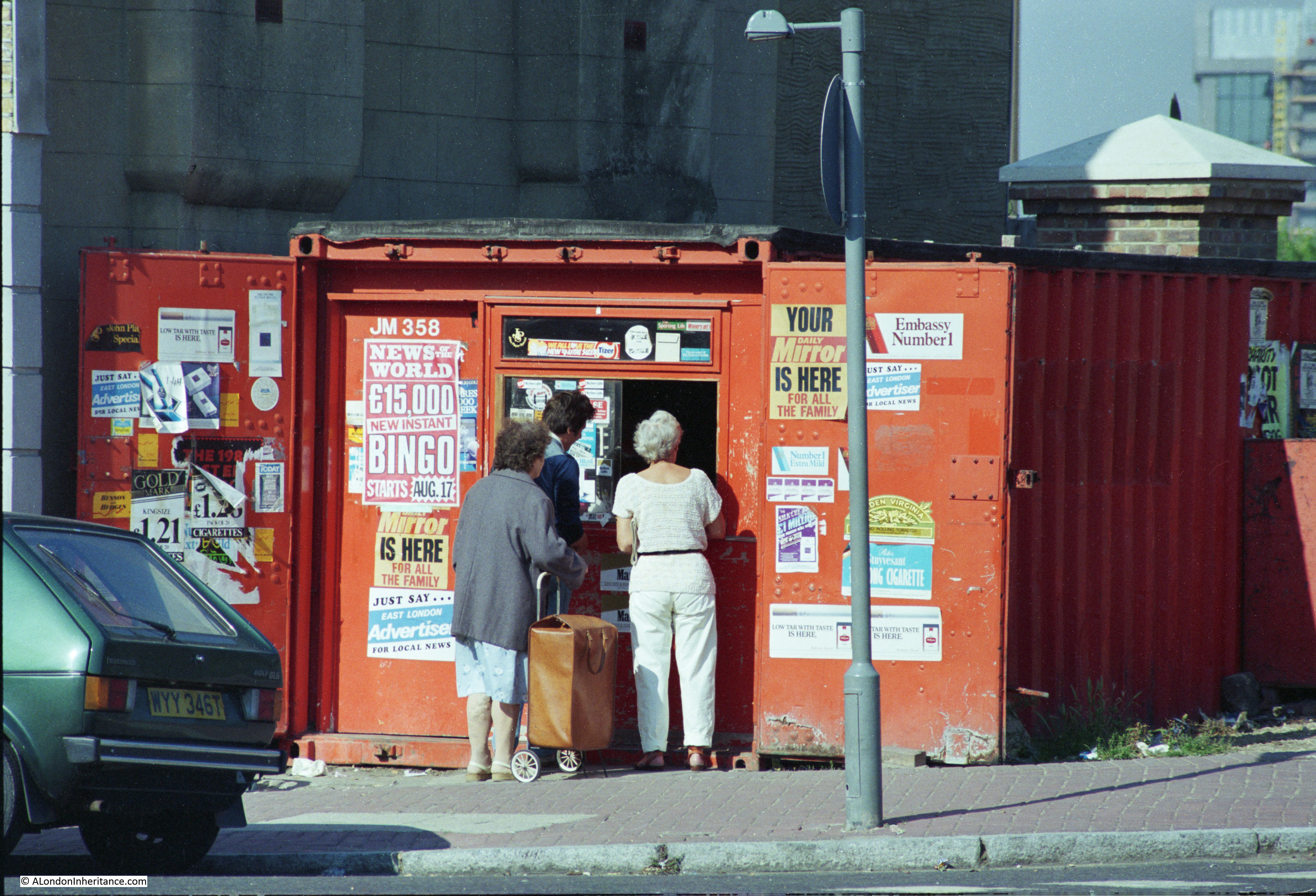
The Isle of Dogs is an area where much has changed beyond all recognition. Here a newsagent has found a novel way of continuing business using a shipping container:

Street Scenes 16

But there were large areas of the Isle of Dogs where businesses had closed down for good:

Street Scenes 15

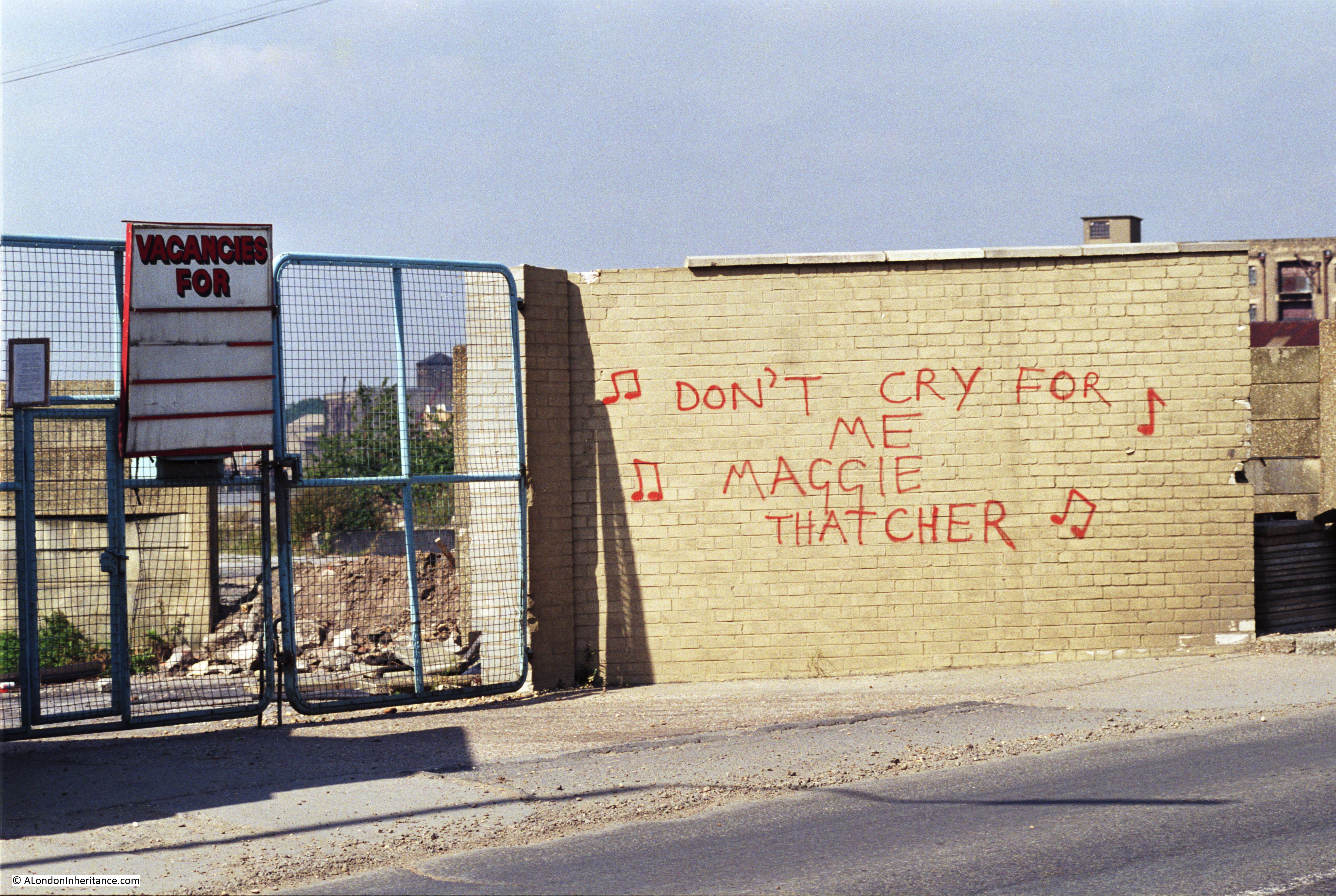
Much of the old industrial and dock areas of the Isle of Dogs were a wasteland with the redevelopment of Canary Wharf, housing and riverside apartments yet to come. Closed gates, vacancy signs that would never again advertise another vacancy sat alongside graffiti that emphasised the perceived lack of concern from the government of the time to the plight of those affected:

Street Scenes 14

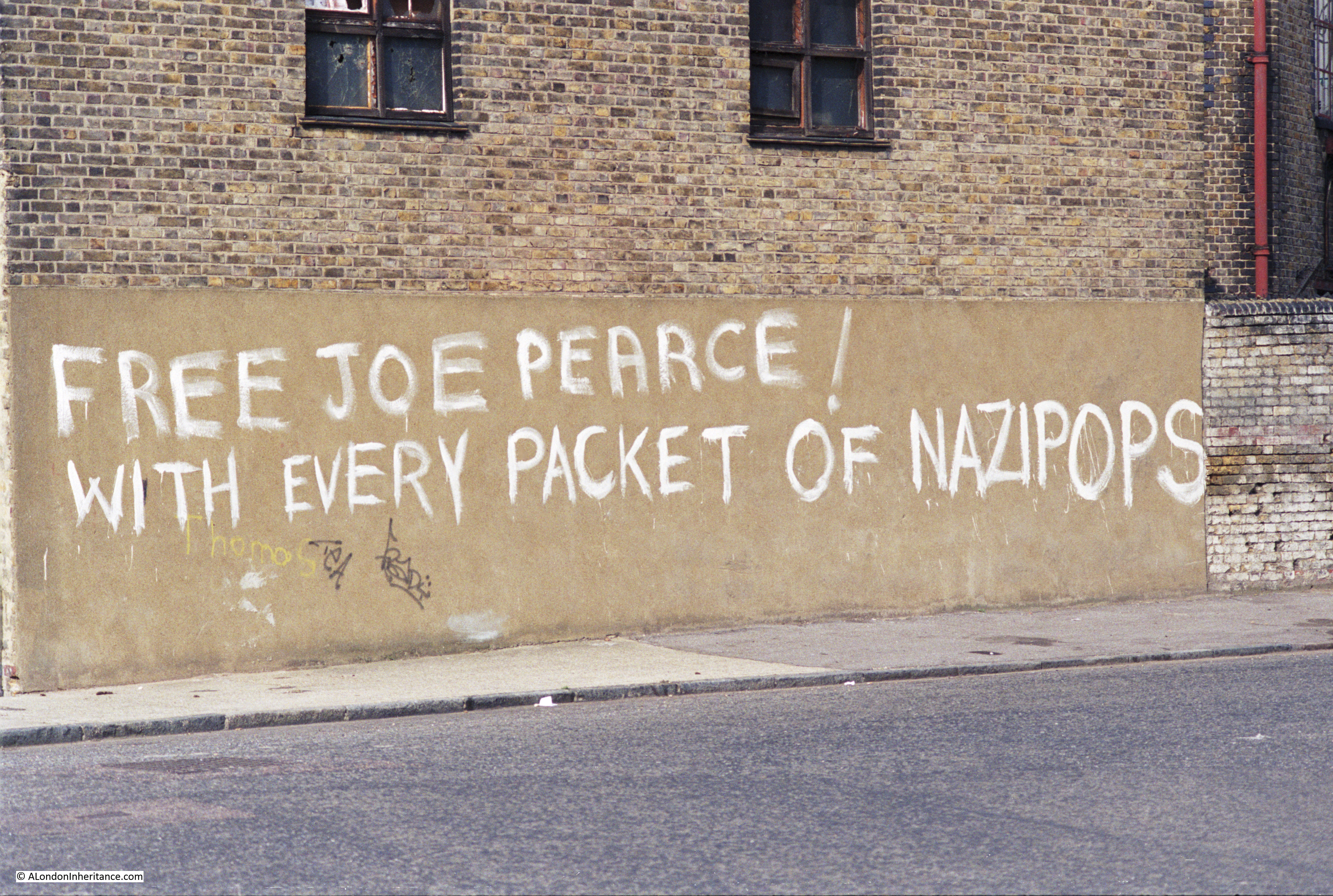
There had also been the rise of far right groups. Joe Pearce was imprisoned under the Race Relations Act for publishing the Bulldog magazine and became a cause celebre for these groups. Free Joe Pearce slogans could be found across the east of London, usually with a different slogan added underneath by groups opposing the far right:

Street Scenes 17

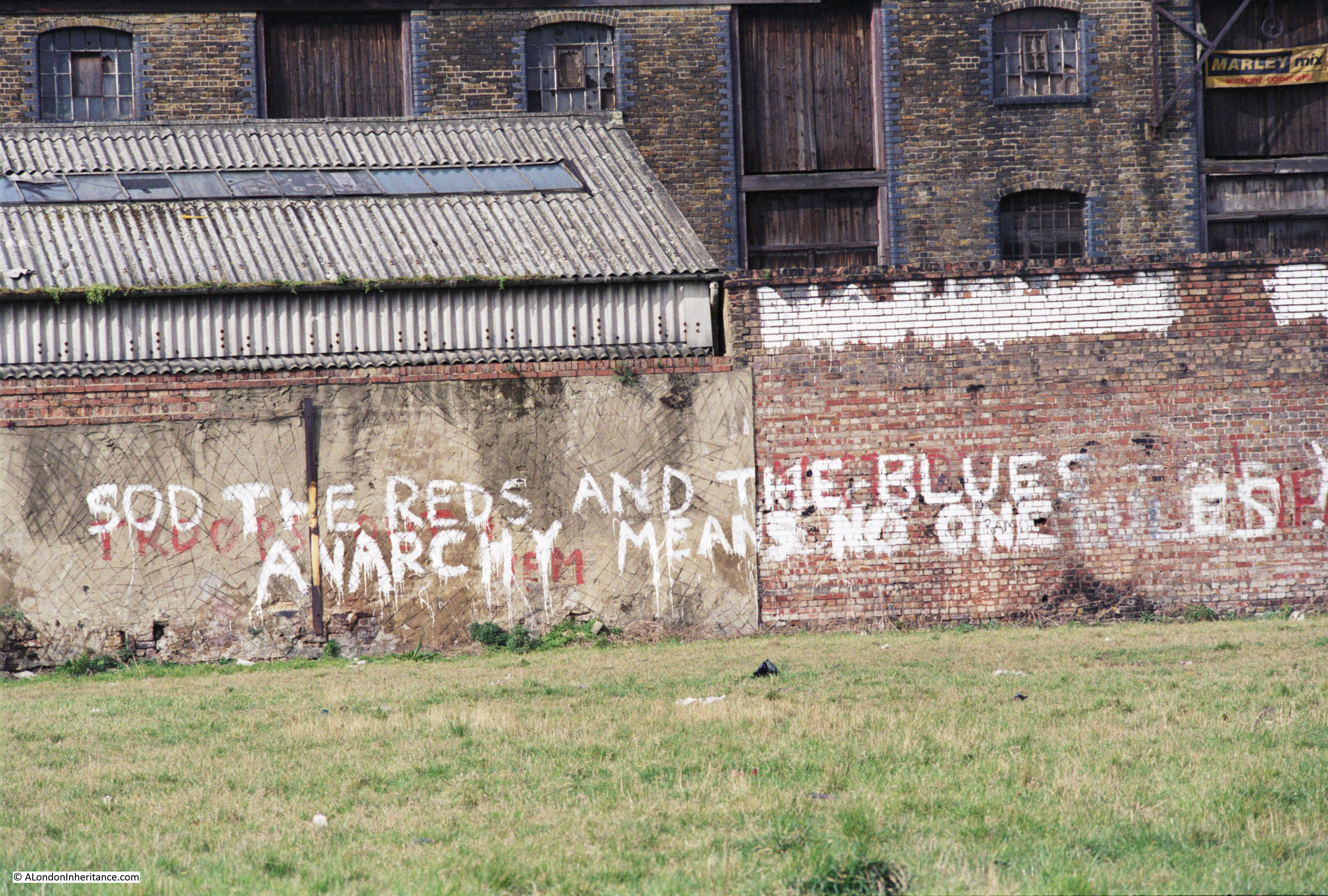
Whilst for some groups, anarchy was the only route:

Street Scenes 23

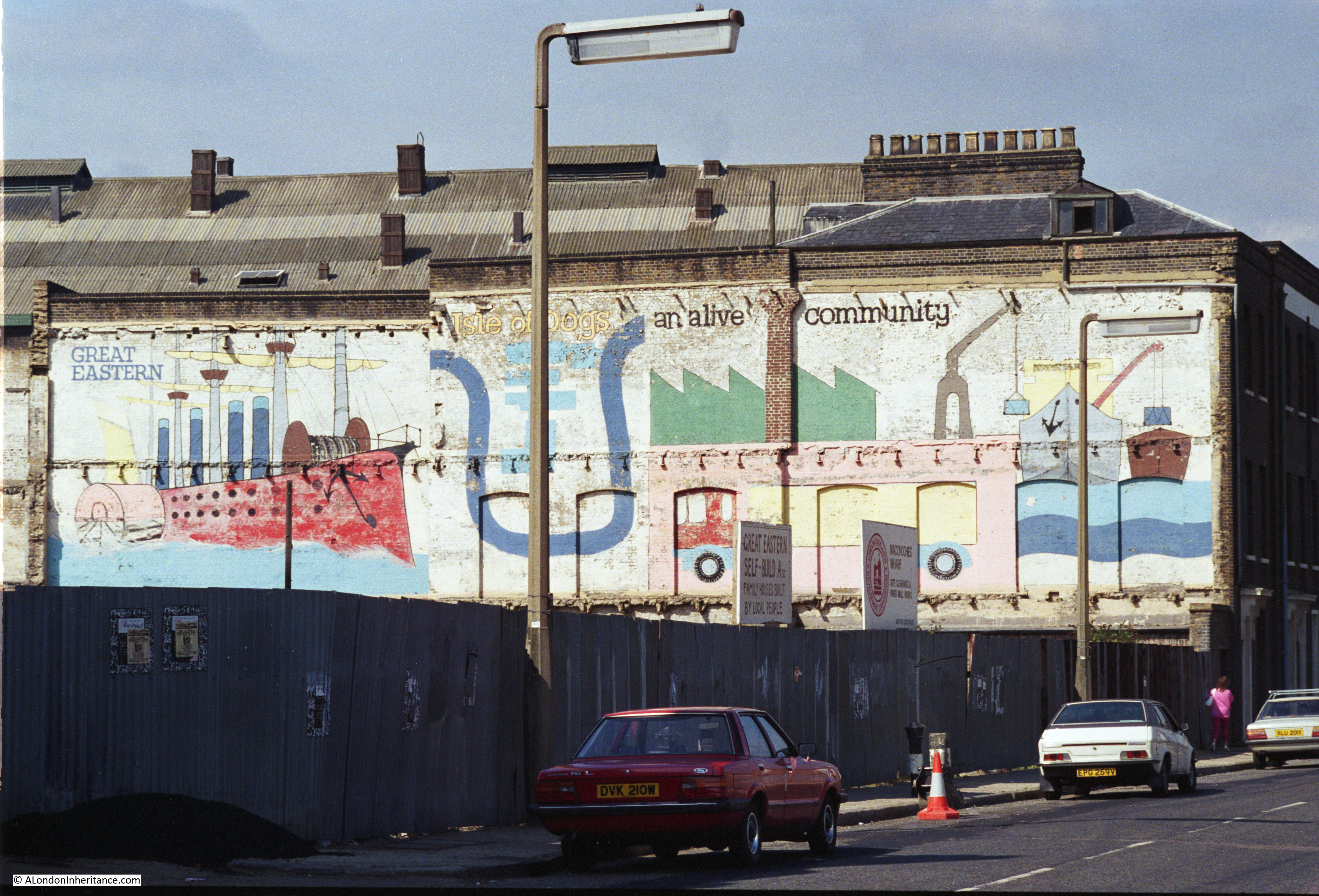
The start of redevelopment was also in evidence across the Isle of Dogs. This is Maconochies Wharf  where clearance and preparation was underway for the building of houses. A mural on the adjacent building emphasising the historical traditions of the Isle of Dogs:

Street Scenes 26

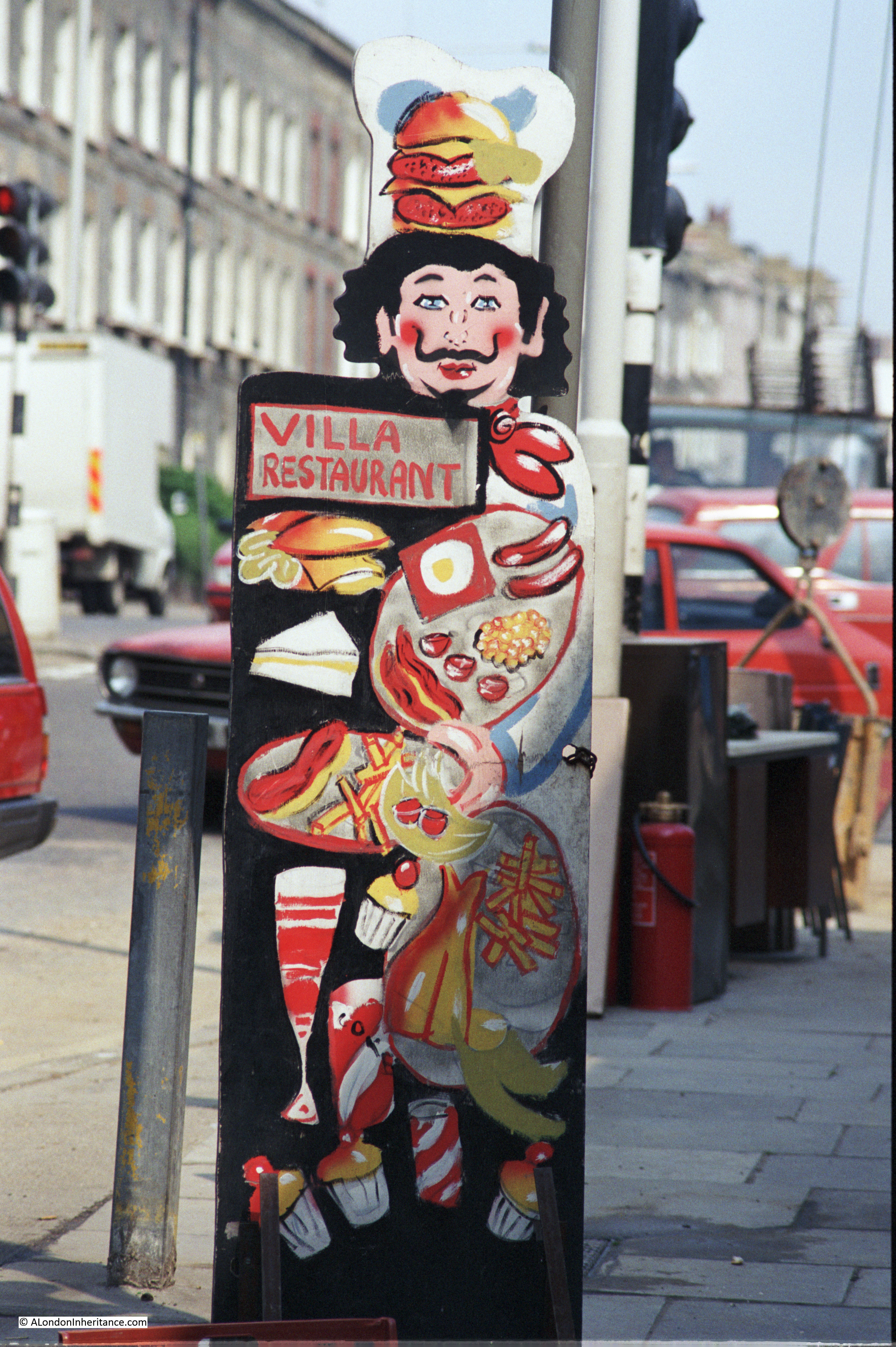
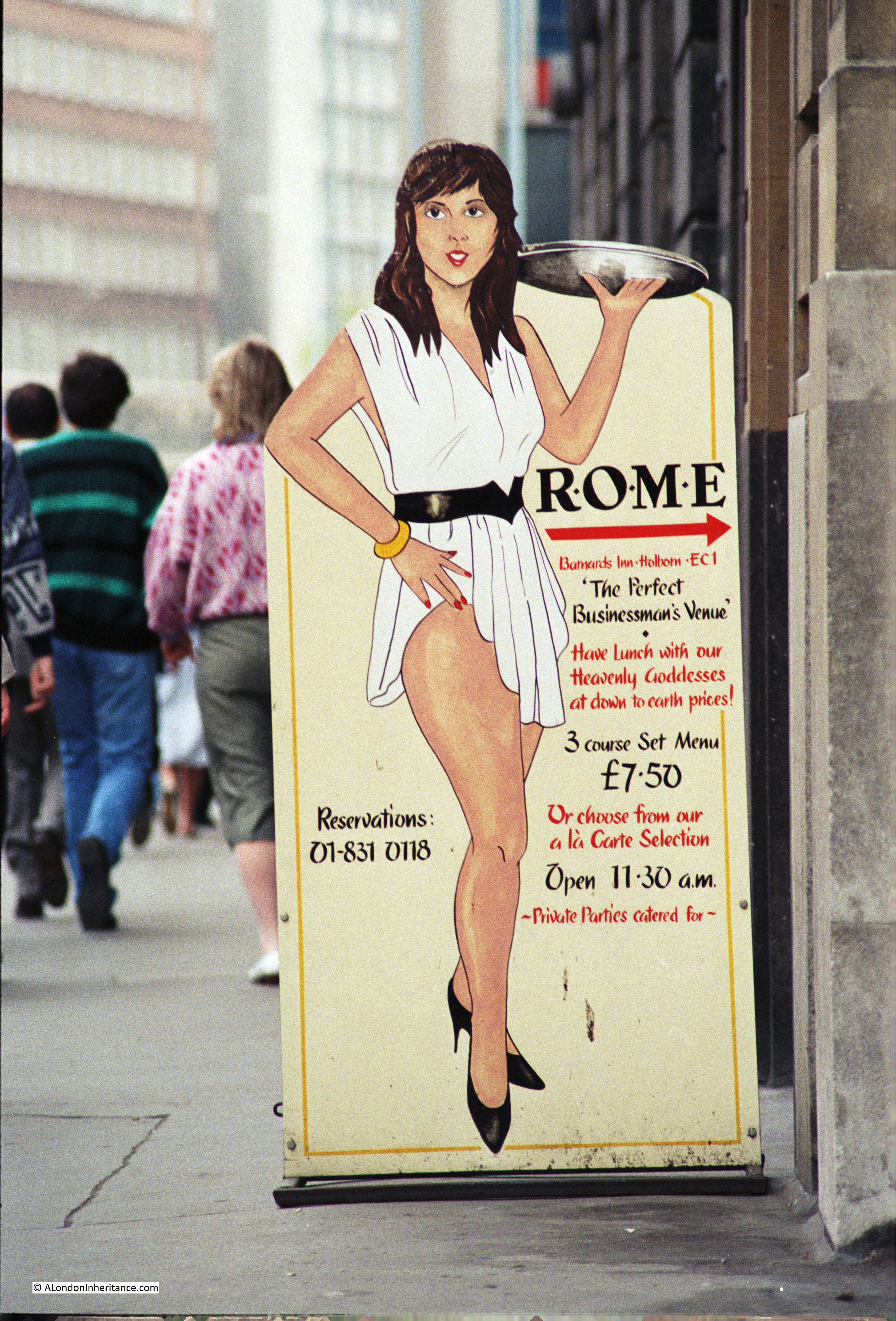
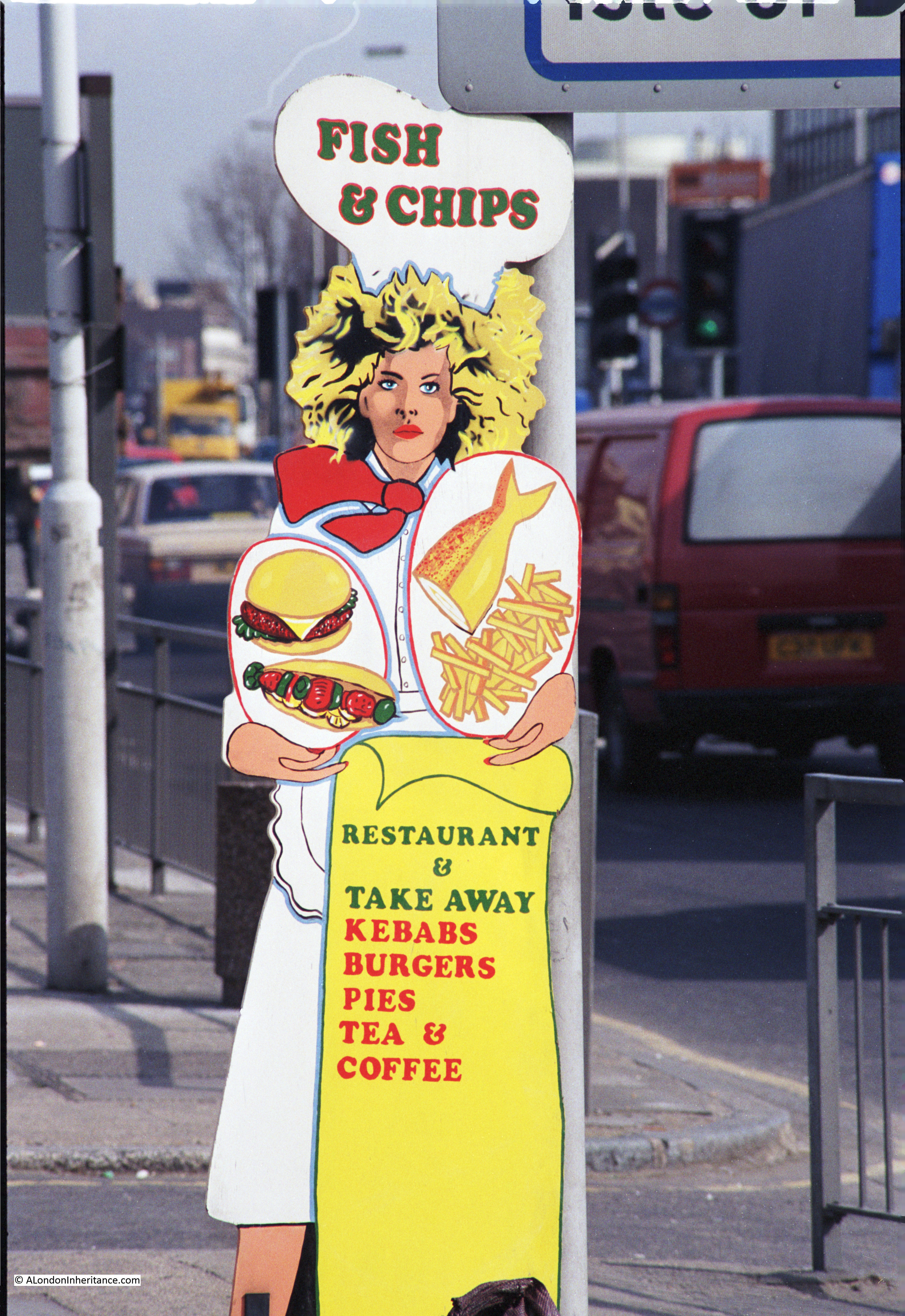
Street advertising for cafes and restaurants was much in evidence. This one in central London at Holborn – the “Perfect Businessman’s Venue” where you could get a 3 course set menu for £7.50

Street Scenes 13

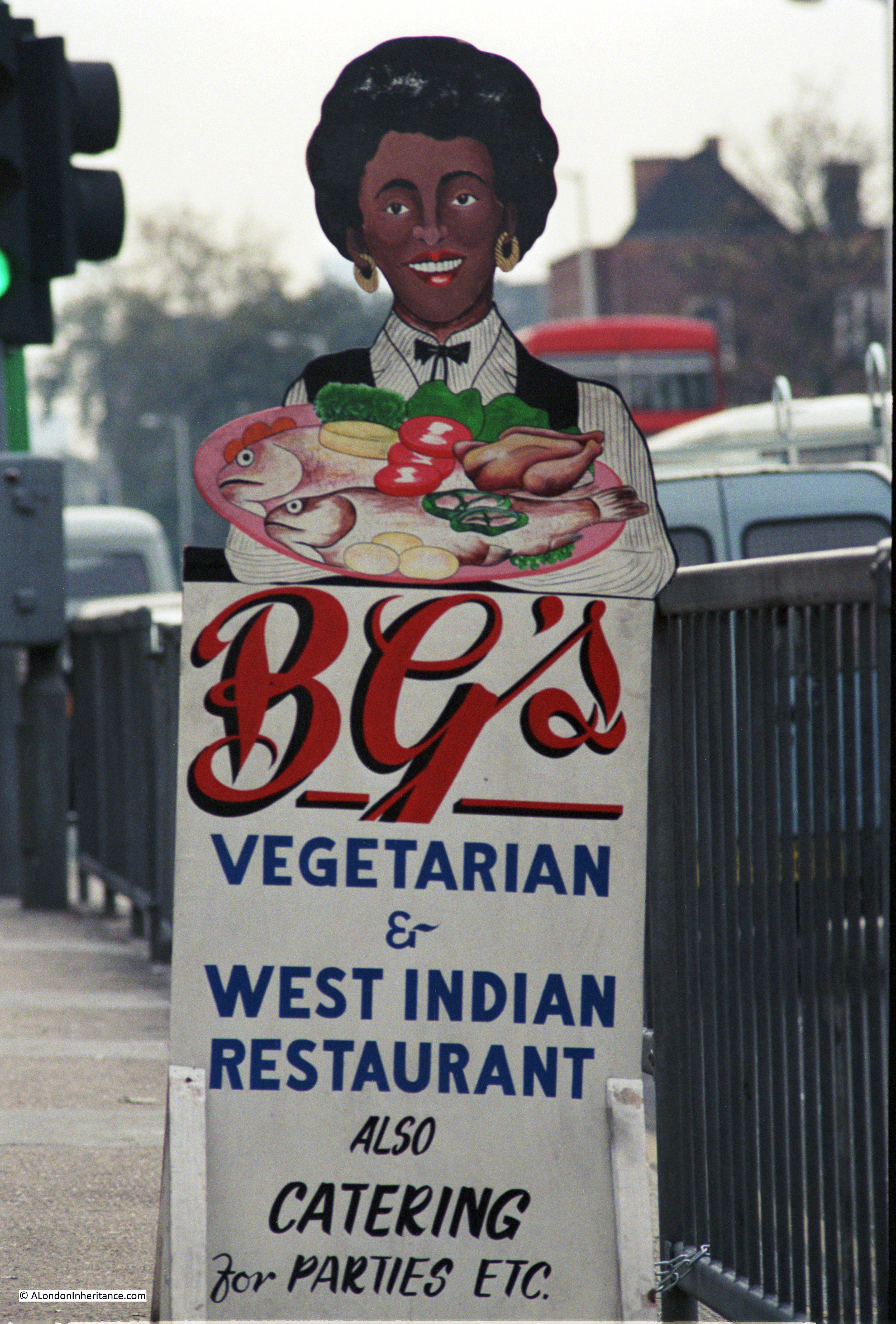
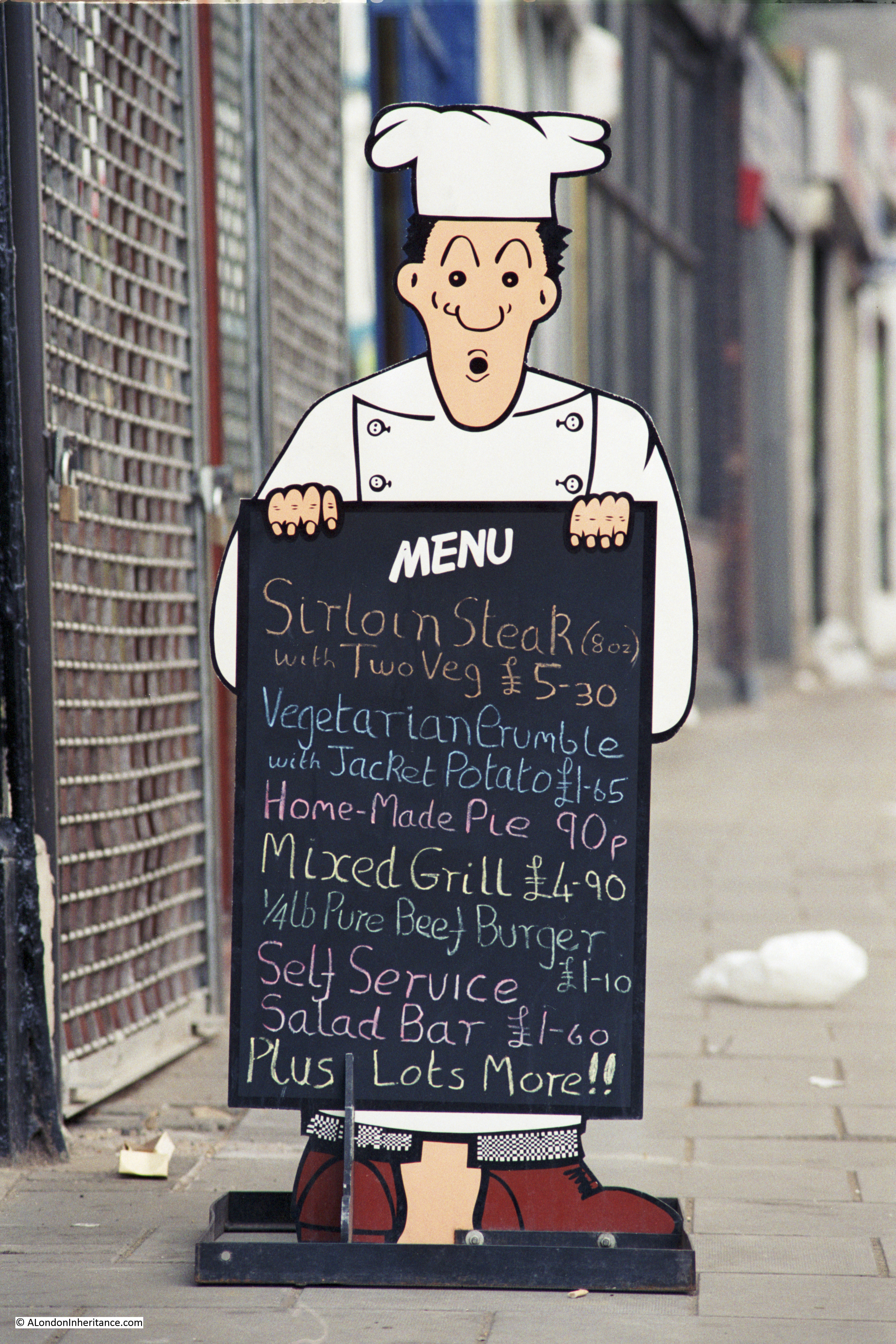
Similar advertising signage could be seen across London’s streets:

Street Scenes 3

At least they were very colourful, even if the representation of what was on offer was probably not very accurate:

Street Scenes 11


Street Scenes 6


Street Scenes 12

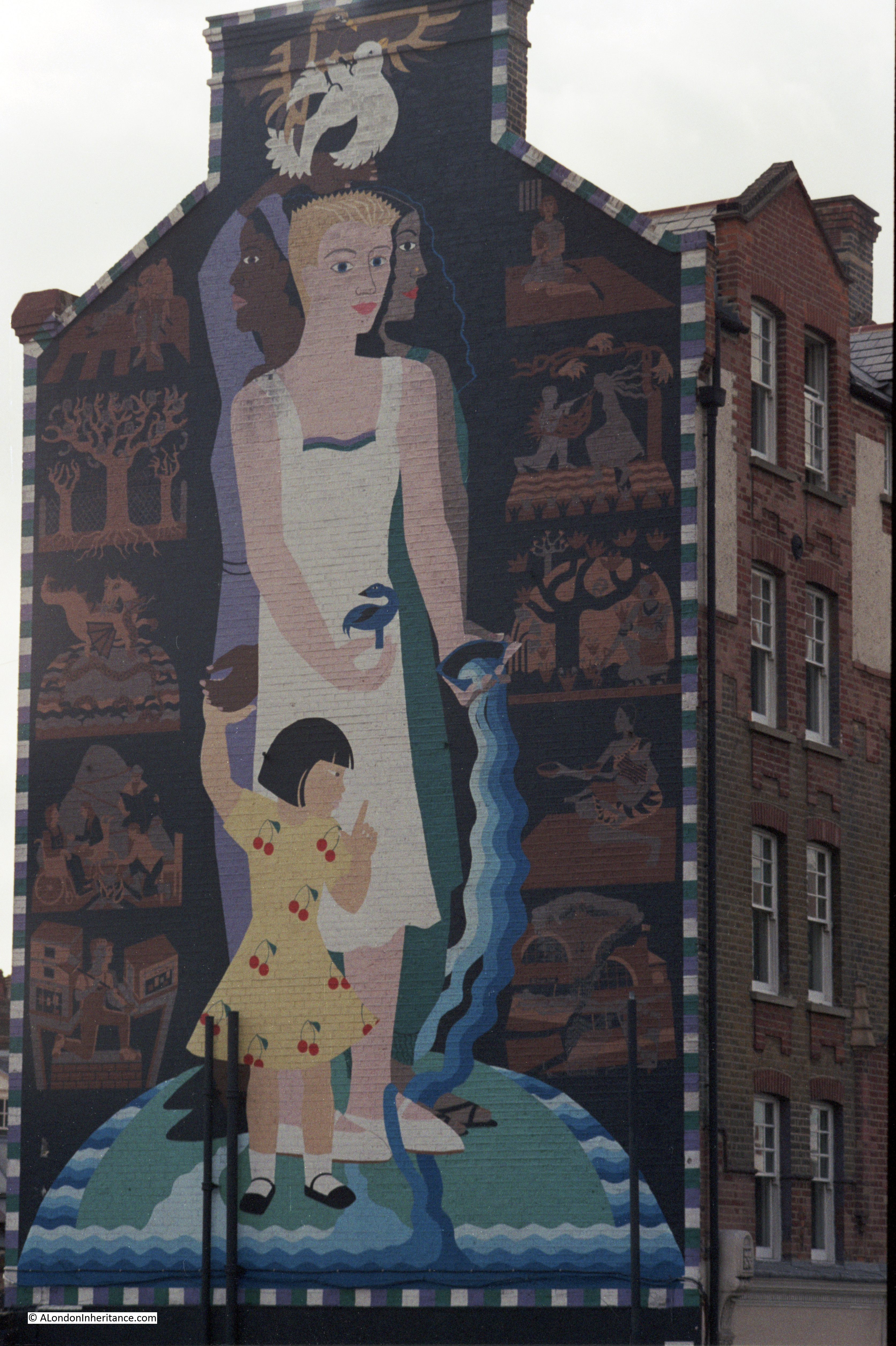
This was a time when murals were very much in evidence. Ranging from those that would cover the whole side of a building:

Street Scenes 24

Street Scenes 25

More London Murals from the 1980s can be found in one of my earlier posts here.

Through to more individual efforts:

Street Scenes 8

Signs from a much earlier period were also much in evidence on buildings that would soon be lost:

Street Scenes 7

Only 30 years ago, but in many ways the London Streets in the 1980s were very different to those of today.

alondoninheritance.com

A Walk Round The Shell Centre Viewing Gallery

Shell Centre is an office complex on the Southbank, located between Hungerford Bridge and the old London County Council building. The most obvious part of the complex is the 26 storey tower.

Designed by Sir Howard Robertson and built between 1957 and 1962 for the Royal Dutch Shell group of oil companies, the office complex set new standards for staff facilities and building automation. Originally two main blocks, one either side of Hungerford Bridge, the “downstream” building to the east of Hungerford Bridge was sold during the 1990’s and converted to apartments.

Although large buildings above ground, there is a significant part of the complex below ground with a large swimming pool, theatre and bar being among the facilities for the original 5,000 staff to enjoy. Two underground tunnels connected the upstream and downstream buildings, running underneath the rail arches leading to Hungerford Bridge and being just above the underground train tunnels running north from Waterloo.

The building also had a tunnel out to the Thames so that river water could be used for cooling.

The “upstream” building to the west of Hungerford Bridge has a “U” shape set of 10 storey offices with the 26 storey, 351 foot tower block being the most obvious feature of the complex.

Shell has temporarily moved out of the complex and there is a proposed redevelopment of the site that will significantly change this part of the Southbank, more on this at the end of this post.

Long before the Shard and the Sky Garden at 20 Fenchurch Street, one of the innovations for the time was that the tower had a public viewing gallery. This was when there were very few tall buildings across London and certainly nothing built or planned in this part of the city. The viewing gallery provided almost continuous all round views of London.

The viewing gallery closed not that long after opening. I was told this was because that sadly there had been a suicide (although I have no verification of this). I was able to visit the viewing gallery in 1980 and took the following photos which show a very different London skyline to that of today. It always surprises me that it was not that long ago that there were very few tall buildings across London.

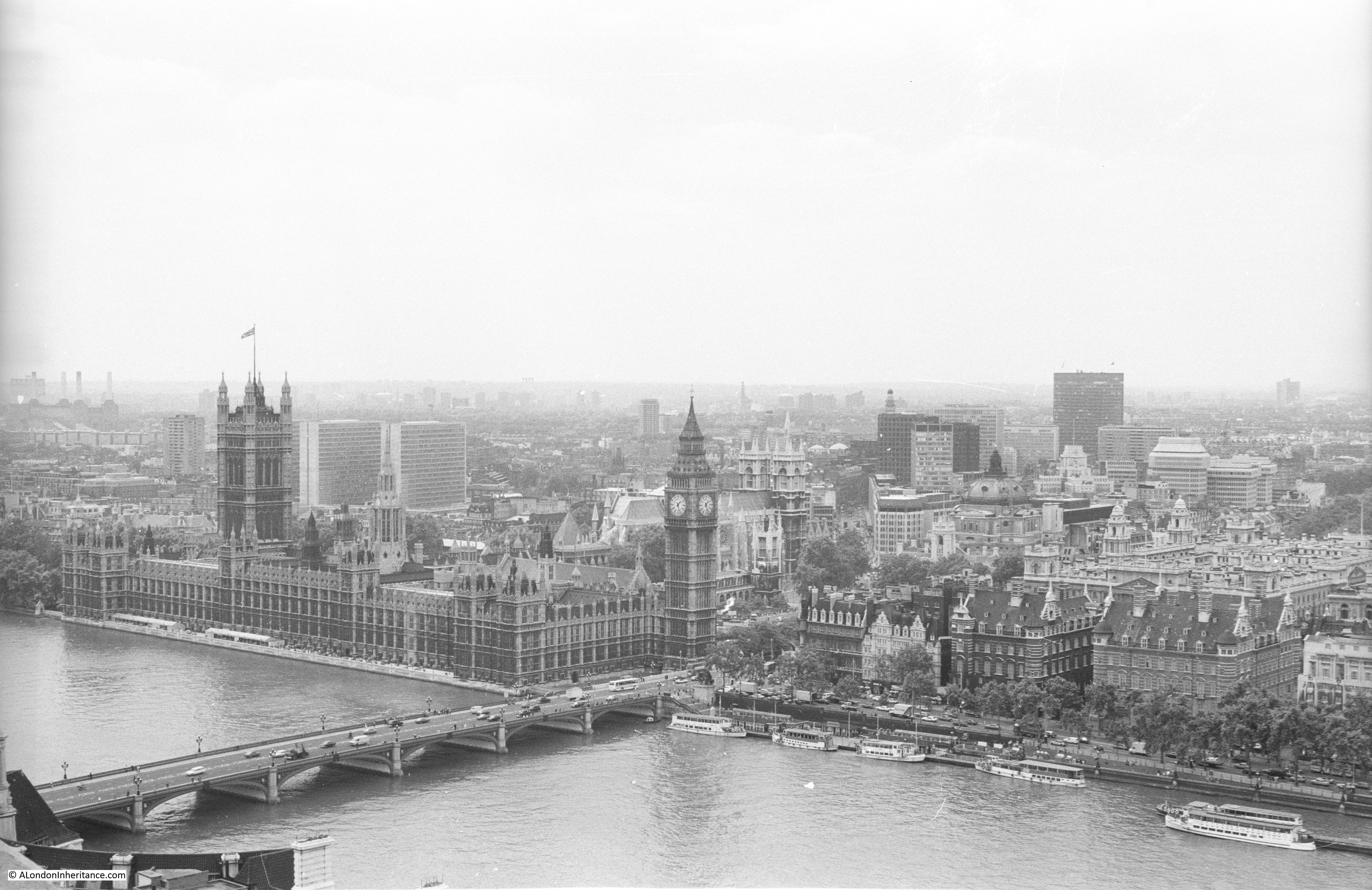
We will start with the view across to the Houses of Parliament and walk round the viewing gallery.

This was long before the construction of the London Eye which would now be the main feature of this view:

Shell Centre Viewing Gallery 3

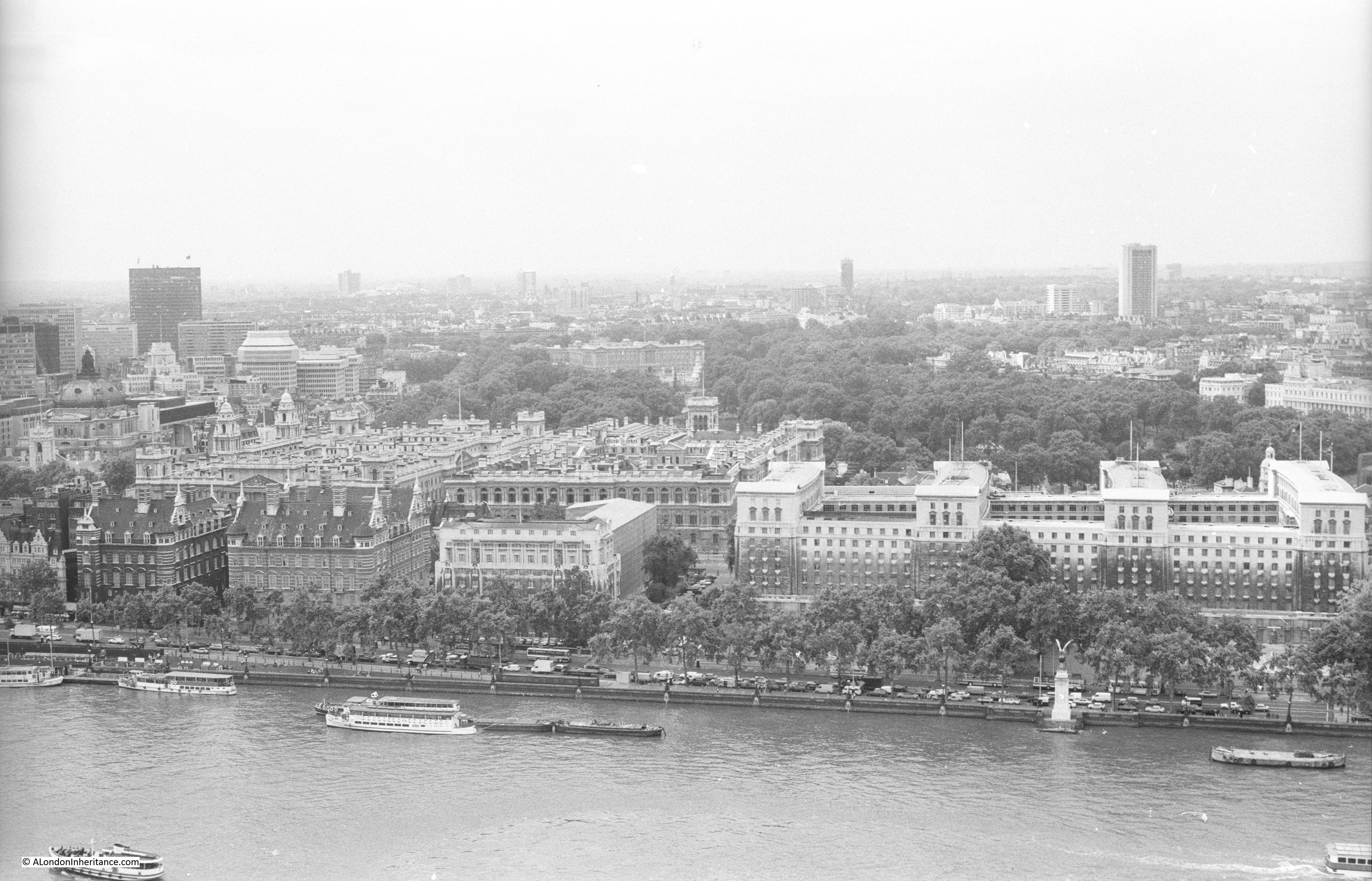
Moving further to the right we can look straight across the river. The large building to the right are the offices of the Ministry of Defence. Buckingham Palace is to the left of centre:

Shell Centre Viewing Gallery 15

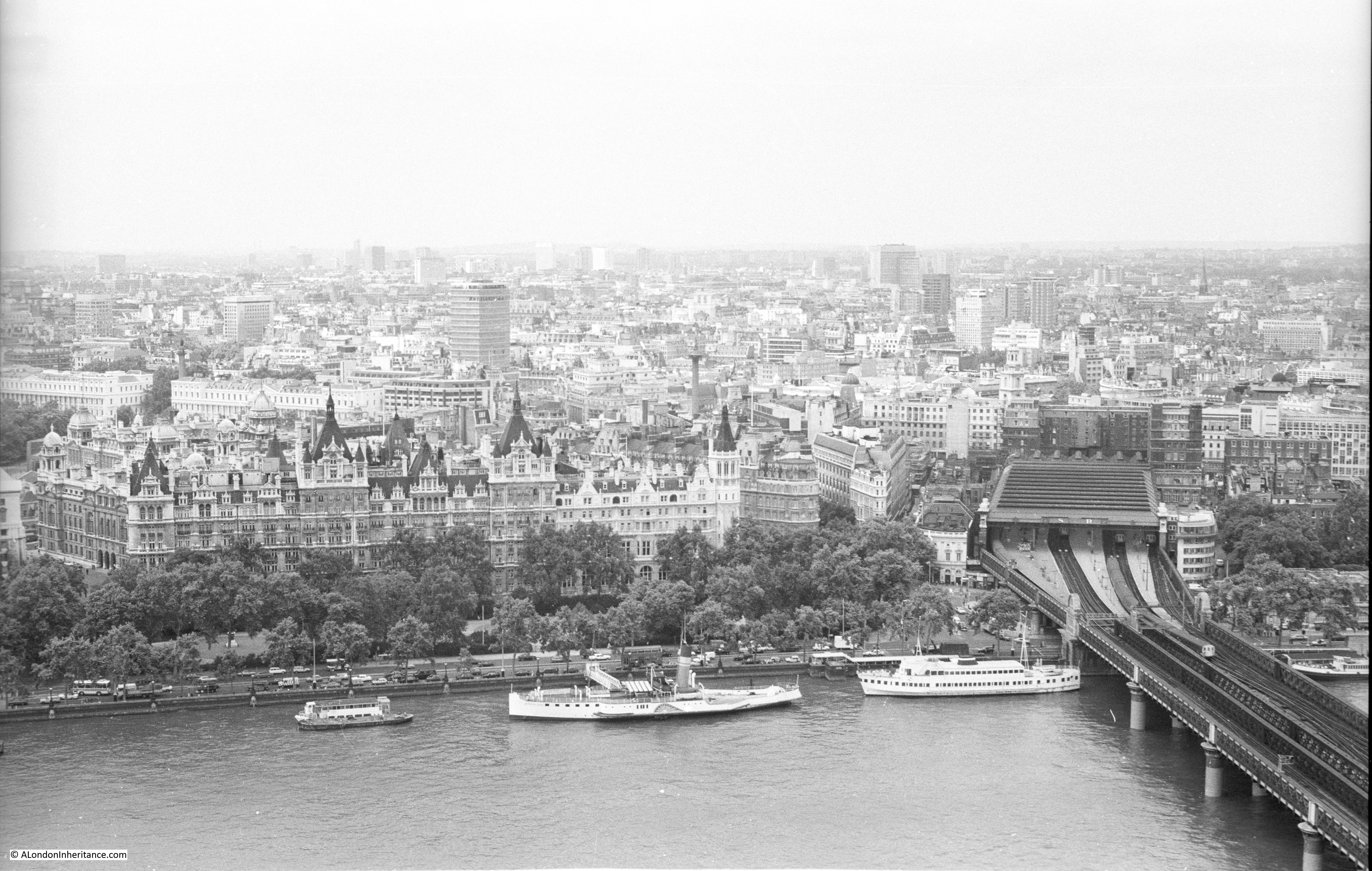
And further to the right, this is the original Charing Cross Station at the end of Hungerford Railway Bridge. In the years after this photo was taken, in common with many other main London stations, office buildings were constructed on top of the station. This was also before the Golden Jubilee foot bridges were added to either side of Hungerford Railway Bridge. At the time the photo was taken there was a single, relatively narrow foot bridge on the east side of the bridge.

Shell Centre Viewing Gallery 4

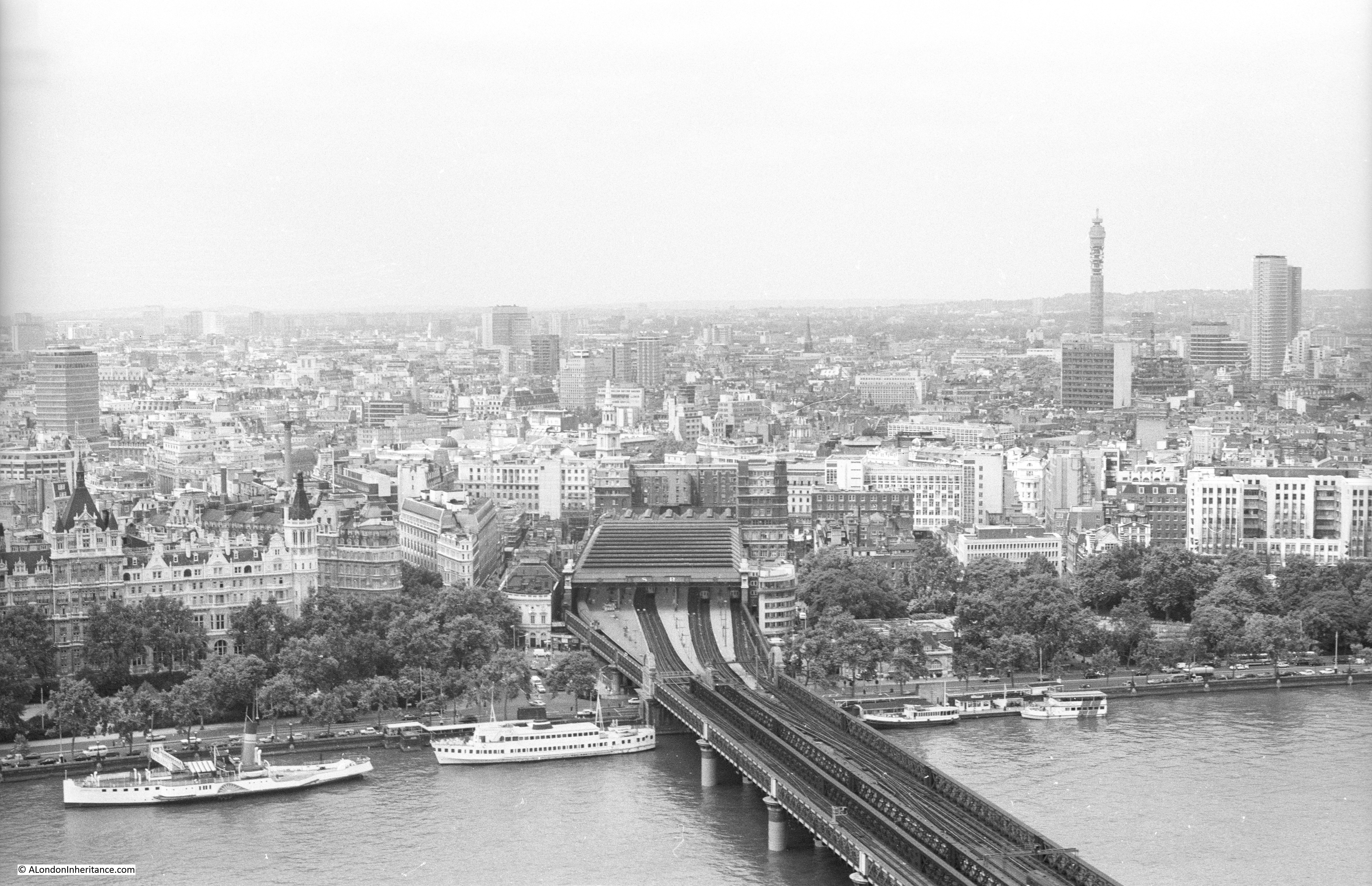
Looking directly onto Charing Cross Station with the Post Office Tower in the background and Centre Point to the right:

Shell Centre Viewing Gallery 2

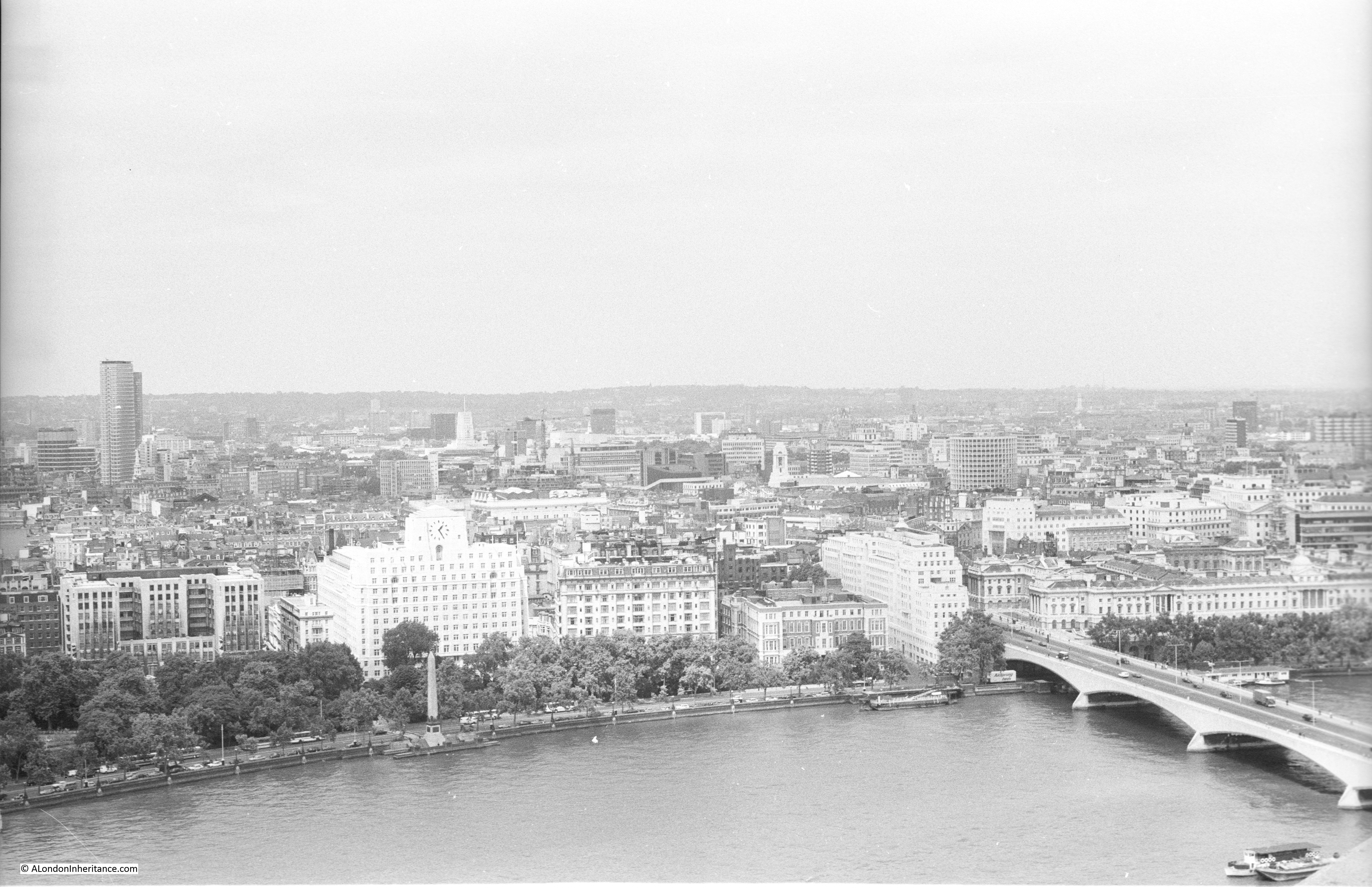
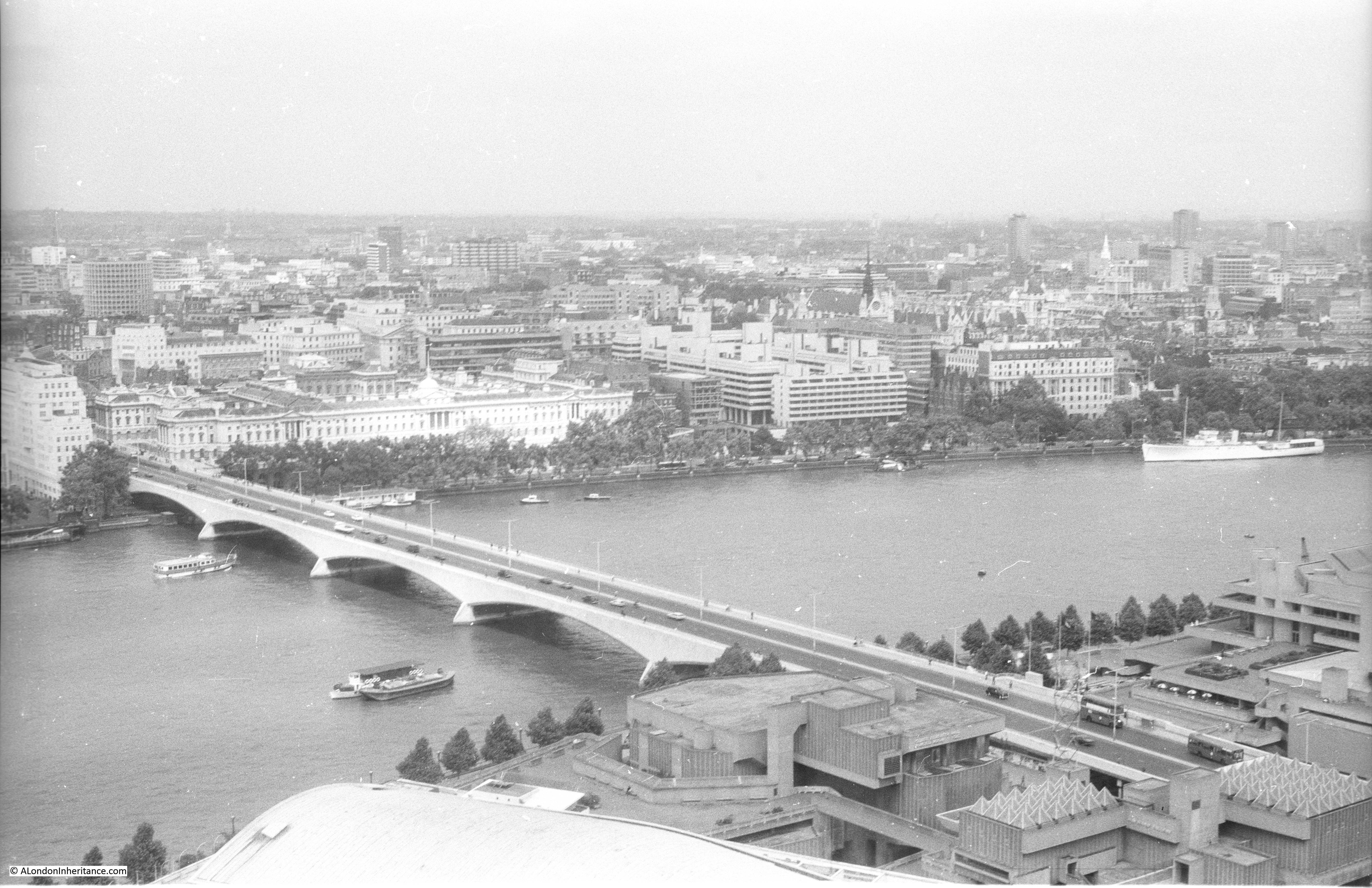
Further to the right, the building left of centre is Shell-Mex House. This was occupied by the UK operating company of Shell. To the right is Waterloo Bridge.

Shell Centre Viewing Gallery 14

And further to the right with the full width of Waterloo Bridge:

Shell Centre Viewing Gallery 13

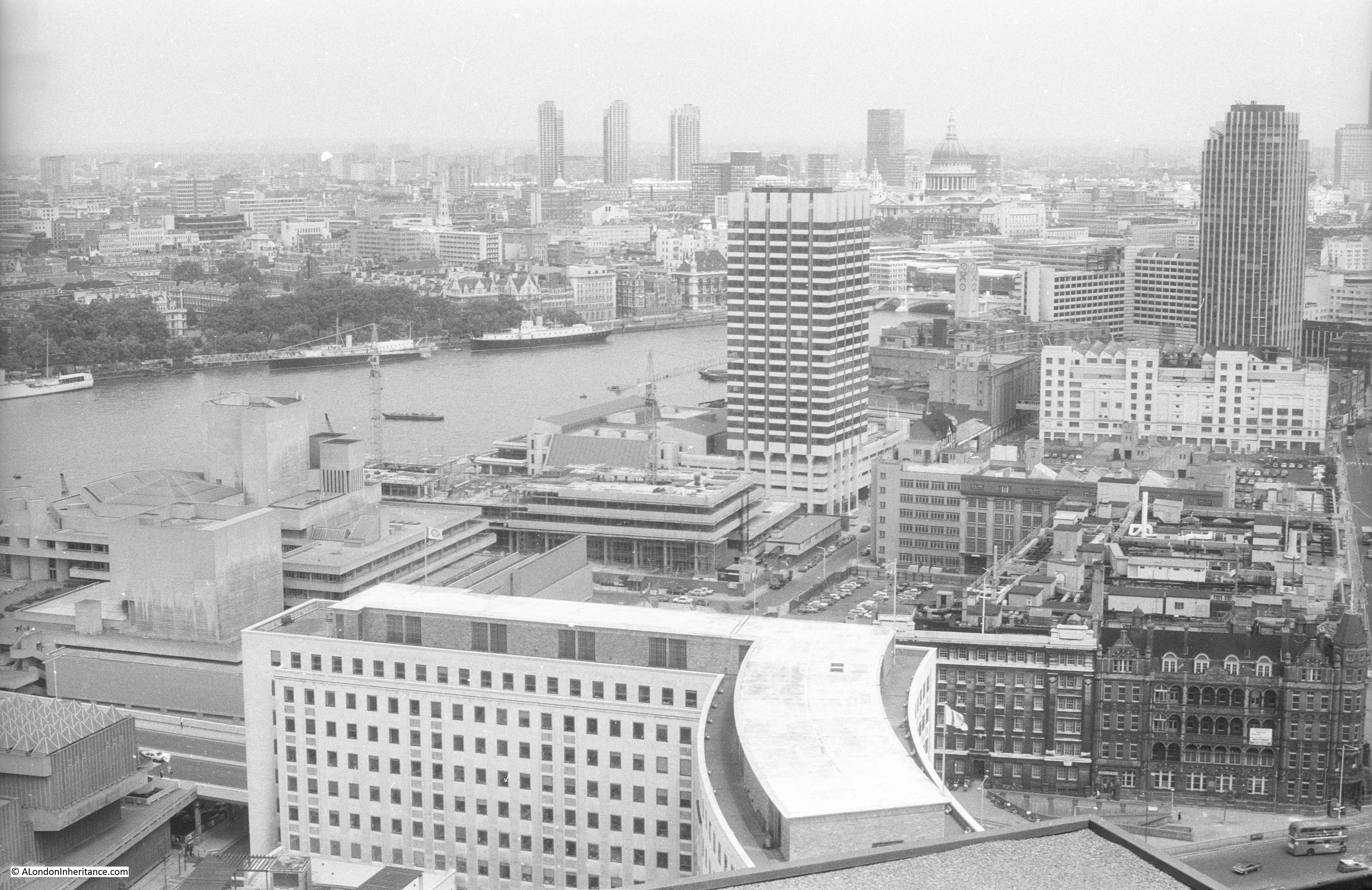
We are now starting to look over towards the City of London, St. Paul’s Cathedral can be seen to the upper right of centre and the three towers of the Barbican to the left.

The L shaped building in the lower foreground is the downstream building of the Shell Centre complex, and just above this building is the tower that was for London Weekend Television. The base of this tower still consists of TV studios, one of the few buildings that have had the same function over the last 35 years.

To the right of this is Kings Reach Tower, occupied at the time by IPC Magazines, publishers of magazines ranging from Loaded to Country Life. IPC Magazines vacated this tower block some years ago and it is now in the process of being converted into, yes you have probably guessed, more apartments. The height of the building is being raised with additional floors being constructed in top.

Shell Centre Viewing Gallery 7

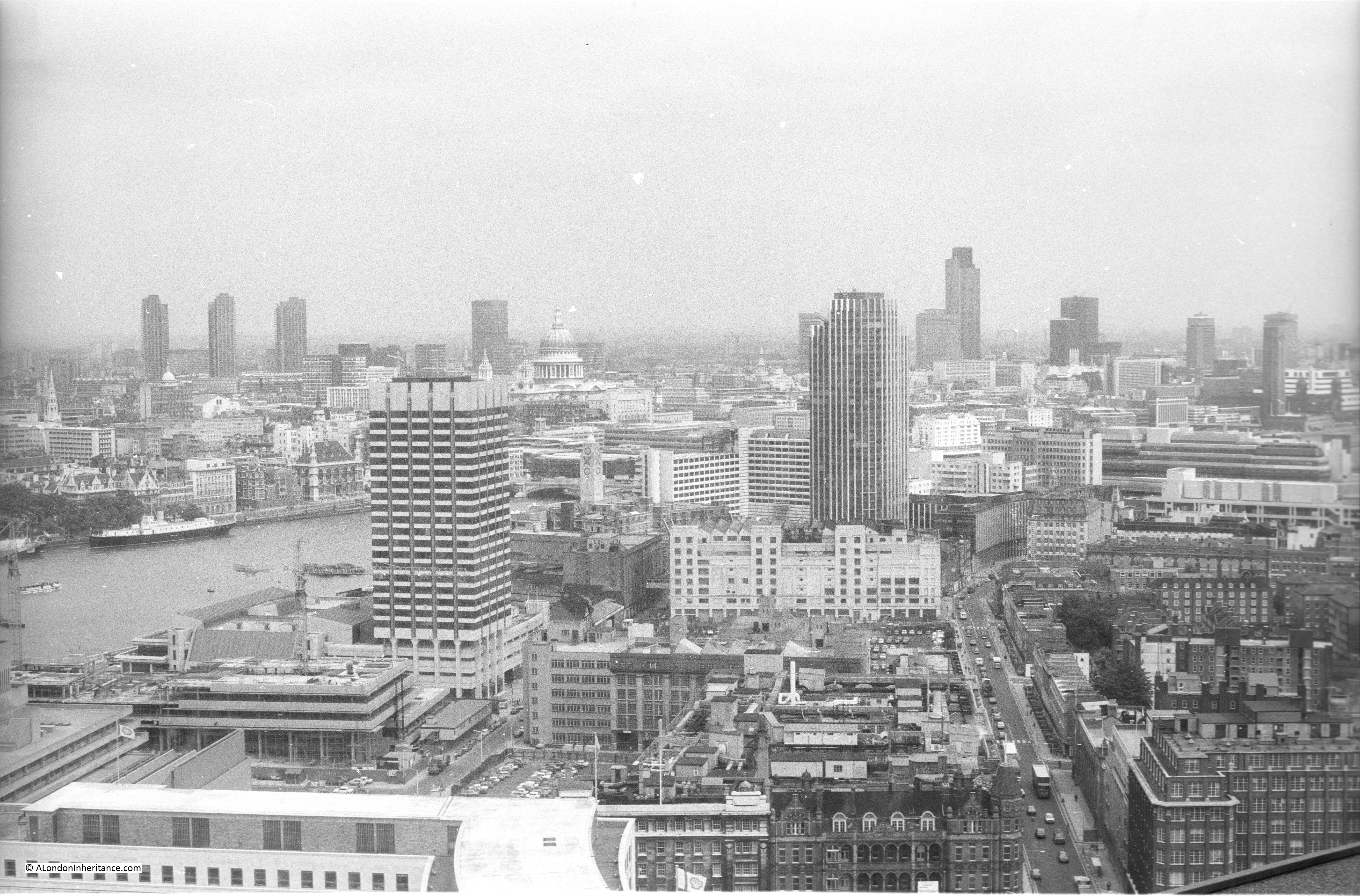
And slightly further to the right, the tower in the distance was at the time the tallest office block in the City of London, the recently completed NatWest Tower, built for the NatWest Bank, now renamed as Tower 42.

Shell Centre Viewing Gallery 1

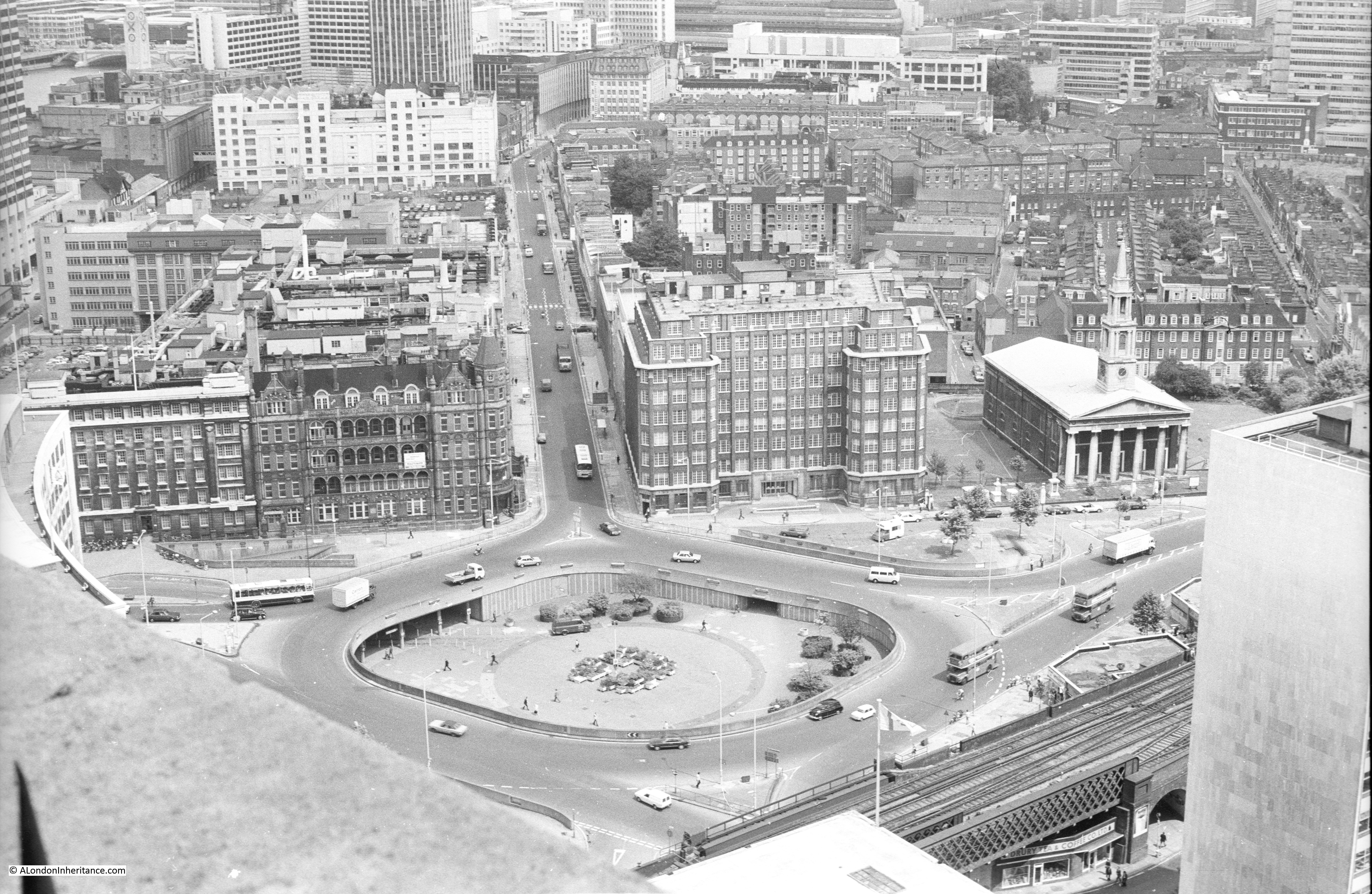
This photo is looking down onto the roundabout at the southern end of Waterloo Bridge. The large space in the centre of the roundabout is now occupied by an IMAX Cinema. The church to the right is St. John’s, Waterloo. The church was built between 1822 and 1824 and due to the marshy land had to be built on piles.  I was told at the time that one of the reasons for so much space below ground level at Shell Centre was also due to the marshy ground and the need to keep the overall weight on the site equal. Excavating below ground level to remove sufficient weight of earth equal to the weight of building on top. No idea if this is true, but it does seem plausible.

Shell Centre Viewing Gallery 5

This photo is looking straight across to the City and Southwark. There is nothing of any height in the far distance. The buildings of Canary Wharf would now be very visible in the distance.

Shell Centre Viewing Gallery 9

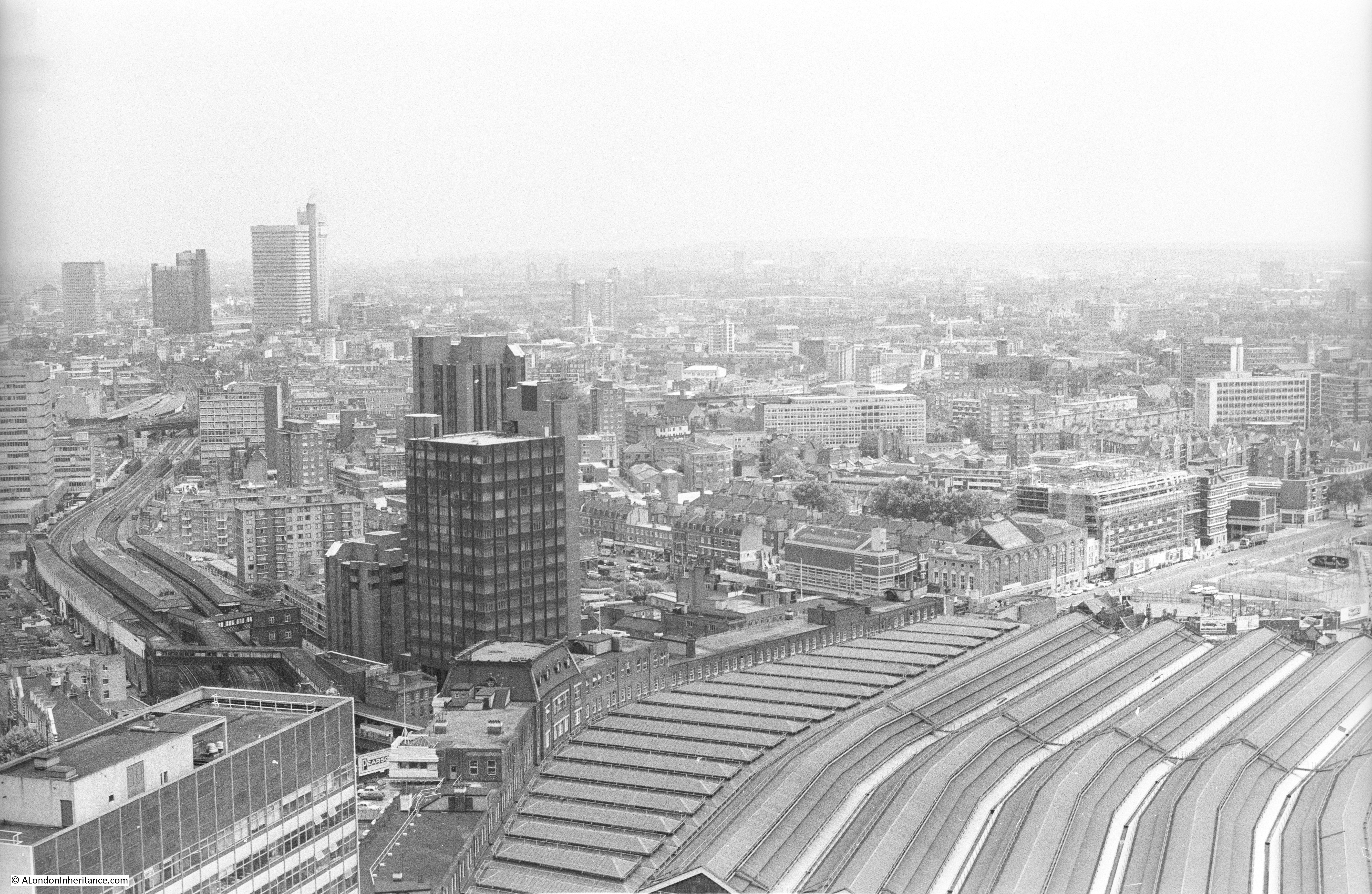
Continuing to move to the right, this is looking over south-east London with the roof of Waterloo Station occupying the bottom right corner of the photo.

Shell Centre Viewing Gallery 8

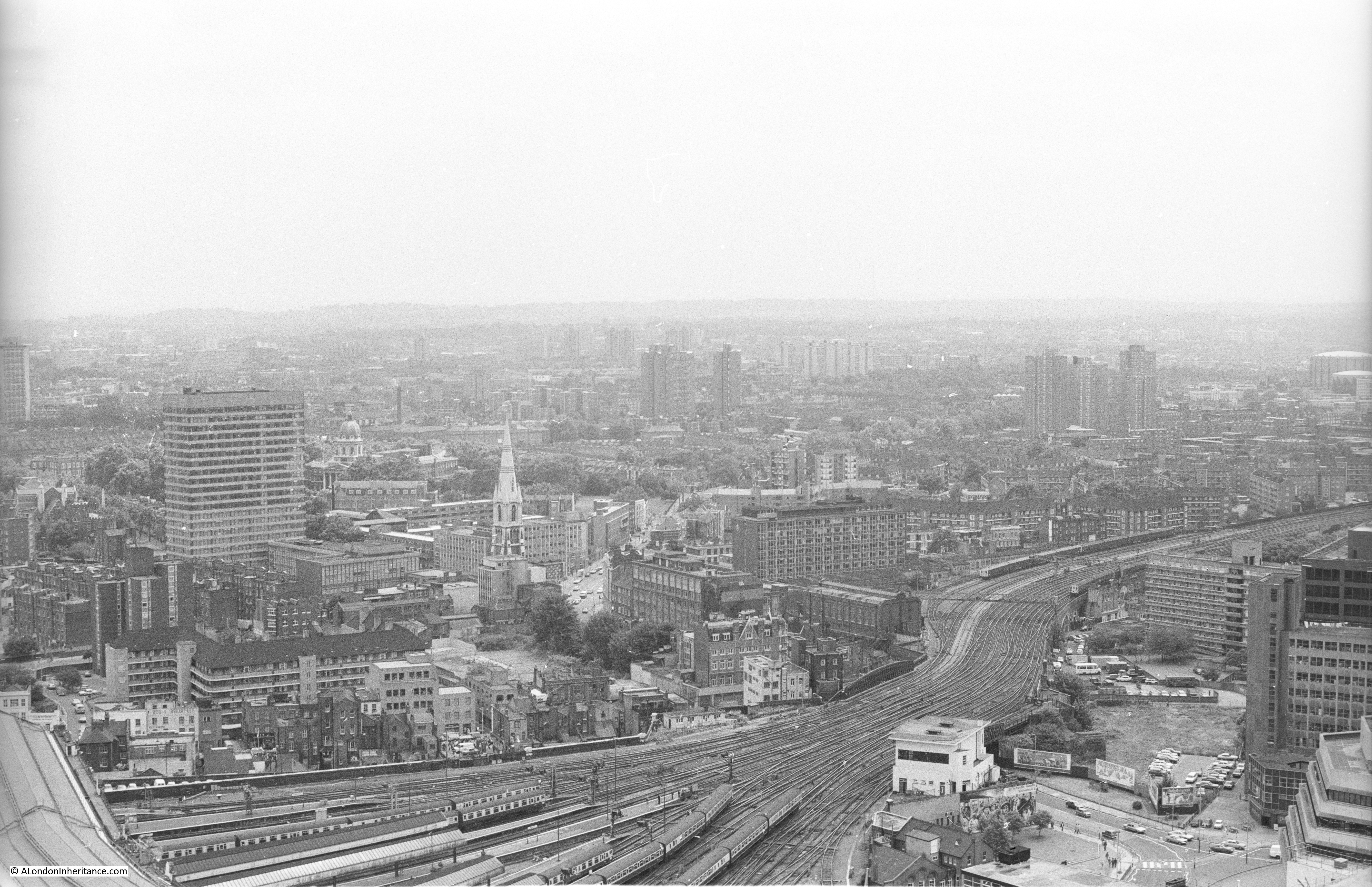
And round to the right again looking over south London with the extensive network of tracks leading into Waterloo Station. The lower section of tracks at the bottom part of the photo would soon be converted to the London terminus of Eurostar prior to the completion of the HS1 rail route which transferred Eurostar trains into St. Pancras.

Shell Centre Viewing Gallery 11

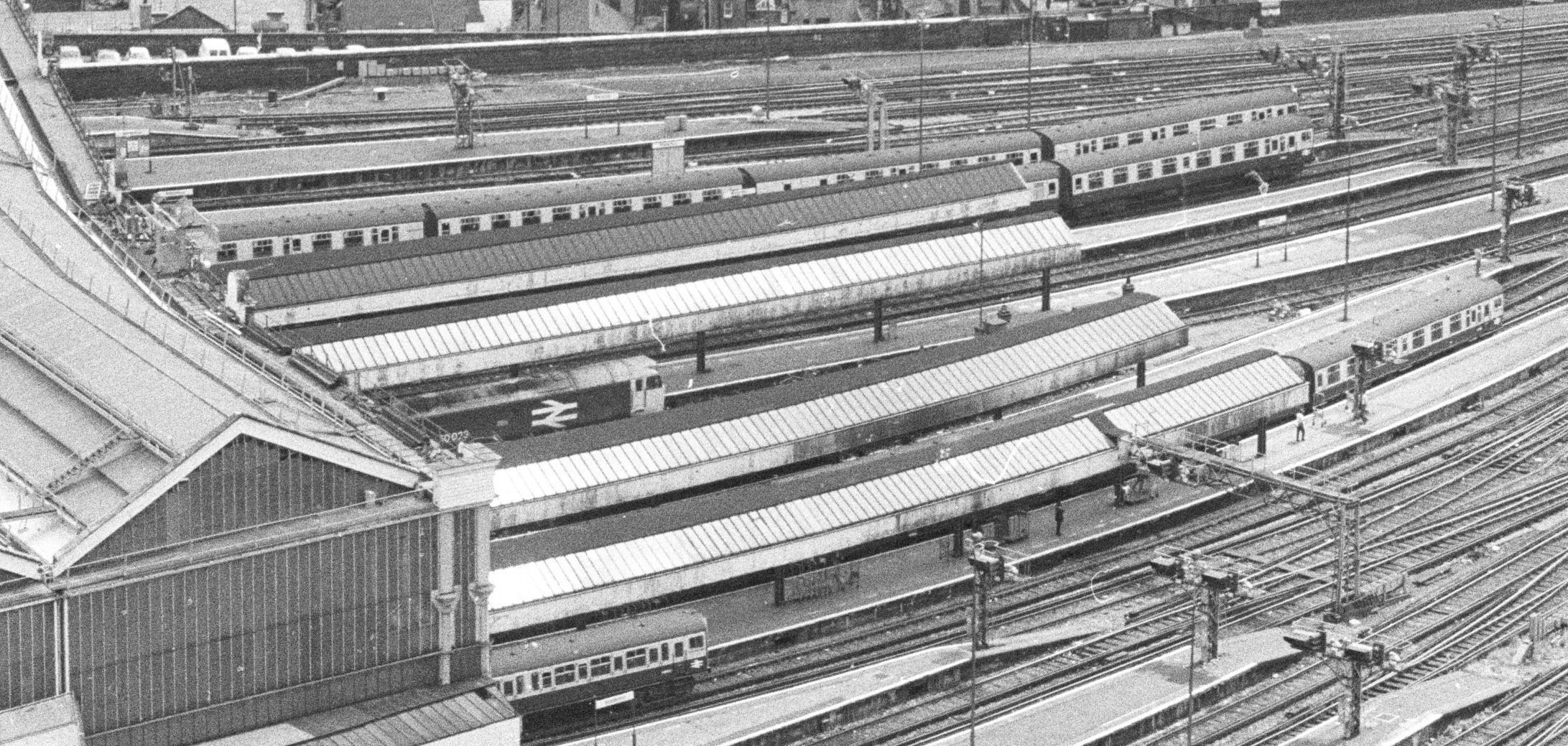
Detail from the above photo showing British Rail rolling stock prior to privatisation of the rail network:

Shell Centre Viewing Gallery 18And a final view over to south west London. This was as far as the viewing gallery would allow, the gallery did not run along the western side of the tower:

Shell Centre Viewing Gallery 12

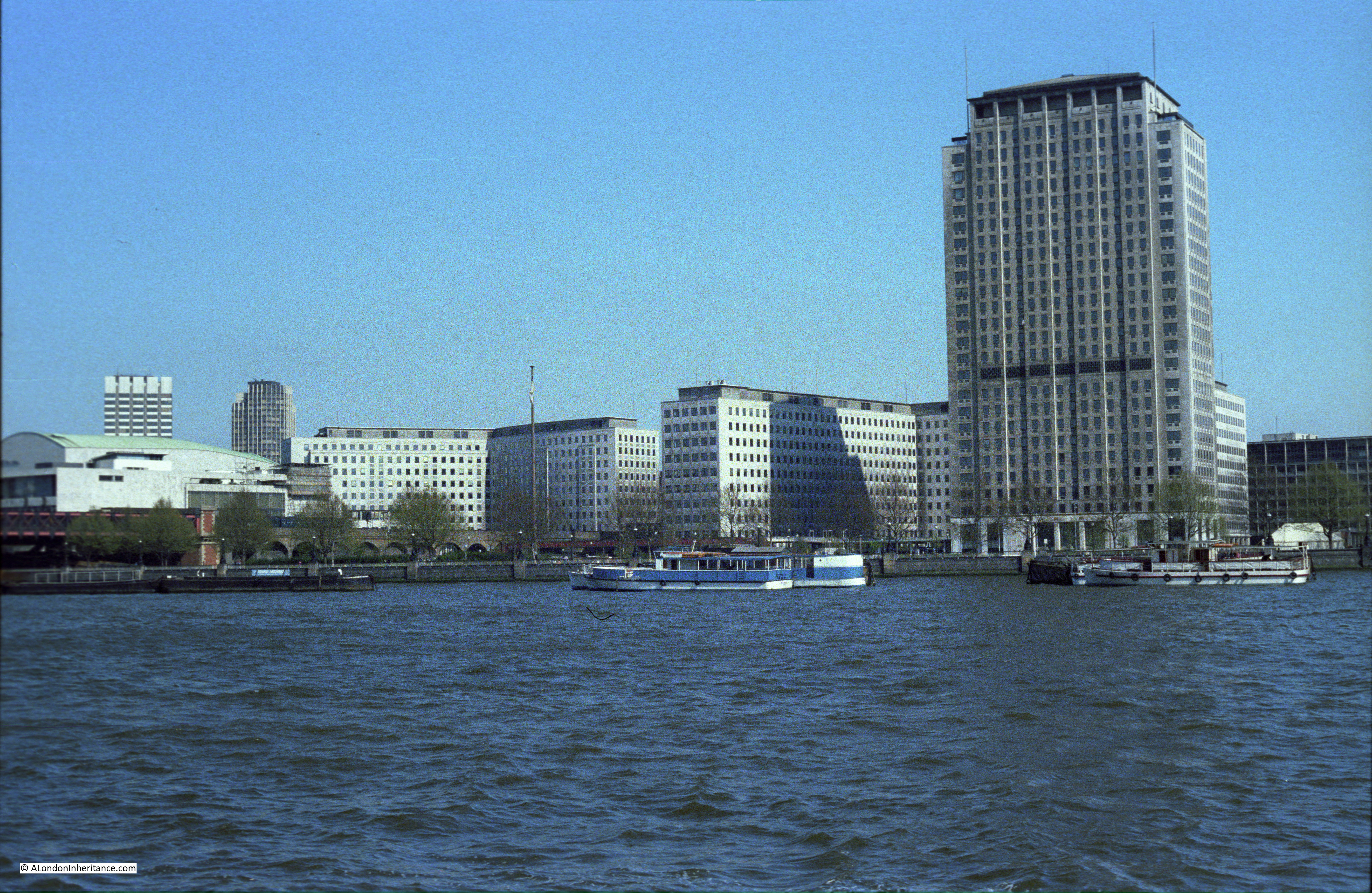
I cannot remember why I was using Black and White film when I took these photos from the viewing gallery. Shortly after taking the above, I took the following photo in colour showing Shell Centre from the north bank of the Thames. The north facing part of the viewing gallery can be clearly seen at the very top.

Shell Centre Viewing Gallery 17

The building is one of the few immediate post war developments that works well. If the proposed redevelopment of the site gets approval, it will be very different. The plans propose the demolition of the “U” shaped 10 storey office block at the base of the tower, and a whole new cluster of towers built around the original tower.

To see the proposed development, look here.

It was quite a surprise to see how much this area will change, and in my view, the close proximity of towers of very different materials and design to the original tower just does not look right.

It was fascinating to look back on these photos of the London skyline from 1980. It looks very different now, and the almost continuous development of tower blocks look set to continue transforming the skyline for many years to come, although unlike the original Shell Centre complex, with almost identical glass and steel towers that are removing so much of the local character of London.

alondoninheritance.com

A Brief History Of Aldersgate Street

The following photo is from 1947 and shows a street with a very large heap of rubble on the land to the right. When I scanned this negative, I was doubtful as to whether I would find the location. There appears to be a sign on the wall to the left of the pillar in the centre of the photo, but this cannot be read when zooming in due to the definition within the original 35mm film stock.

I was sorting through some boxes with photos that my father had printed from the original negatives and I found the same photo, and on the rear was written Aldersgate Street.

Although I cannot be sure where on Aldersgate Street the photo was taken, I am very sure that it is looking north. Most of the wartime damage in this area was to the east of Aldersgate Street on the land that would be redeveloped as the Barbican estate. The west, whilst suffering bomb damage did nor suffer the same extensive fire damage caused by incendiary raids. including the one on the 29th December 1940.

The huge heap of rubble must be from the buildings demolished on the future site of the Barbican. Comparing the height of the rubble with the lamppost gives some idea of how much must have been removed from the site.

Aldersgate 1

It is impossible to know exactly where on Aldersgate Street this photo was taken, but to give an idea of how the area looks now, I took the following photo on Aldersgate Street, looking north. The Barbican development is on the right. The road has been considerably widened, and the photo would have been somewhere along this scene.

Aldersgate 2

Aldersgate Street is an old street and was so named after the northern gate of the city.

Although originally it did not go any distance as Bishopsgate received the traffic from the north, Aldgate from the east, Newgate from the west and Bridge Gate from the south.

Aldersgate appears to have simply opened out upon moor land, but gained greater significance when it was used as an access point to Smithfield when the area began to be used as a market for horses and cattle and a number of religious establishments.

In researching the street, there are a few very different explanations for the name.

Starting with Stow, whose Survey of London is used by many later historians as a source of historical fact, Stow states that:

“The next is AEldresgate, or Aldersgate, so-called not of Aldrich, or of Elders, that is to say, ancient men, builders therefore, nor of Eldarne trees, growing there more abundantly than in other places as some have fabuled, but for the very antiquity of the gate itself, as being one of the first 4 gates of the city and serving for the Northerne parts, as Aldegate for the East.”

Walter Thornbury in Old and New London partly quotes Stowe:

“Aldersgate was one of the four original gates of London, and formed the extreme corner to the north. Some say it was named after Aldrich, a Saxon, who built it; others, says Stowe attribute it to the Alder trees which grew around it.” 

Sir Walter Besant writing in 1910 in his History of the City of London states:

“Stow’s derivation from the “Elder” or “Older” gate is too far-fetched. It is named probably from one Ealdered, its earliest name being “Aldredesgate”.

Two books published in the early 20th century give different interpretations. Harold Clunn in the Face of London writes:

We pass next to Aldersgate Street. This thoroughfare is so names from the northern gate of the City, the name of which in turn is derived from the alder trees which once grew around the gate”.

Whilst Gertrude Rawlings writing in The Street Names of London states:

“In the laws of Ethelred, c 1000, Ealdredsgate (and variations). The gate of Ealdred or Aldred, a Saxon Londoner of whom nothing more is known.”

A number of recent London street name books I have checked seem to be playing safe by not including Aldersgate Street.

I am inclined to go for the Saxon name of Ealdred or Aldred as the source of the name. Fascinating to think that someone living at that time could have given his name to one of London’s major streets, but it also demonstrates the difficult in establishing the truth behind many of the older street names in London and that you should not always believe the explanation given in a single book, always best to seek as much evidence as possible.

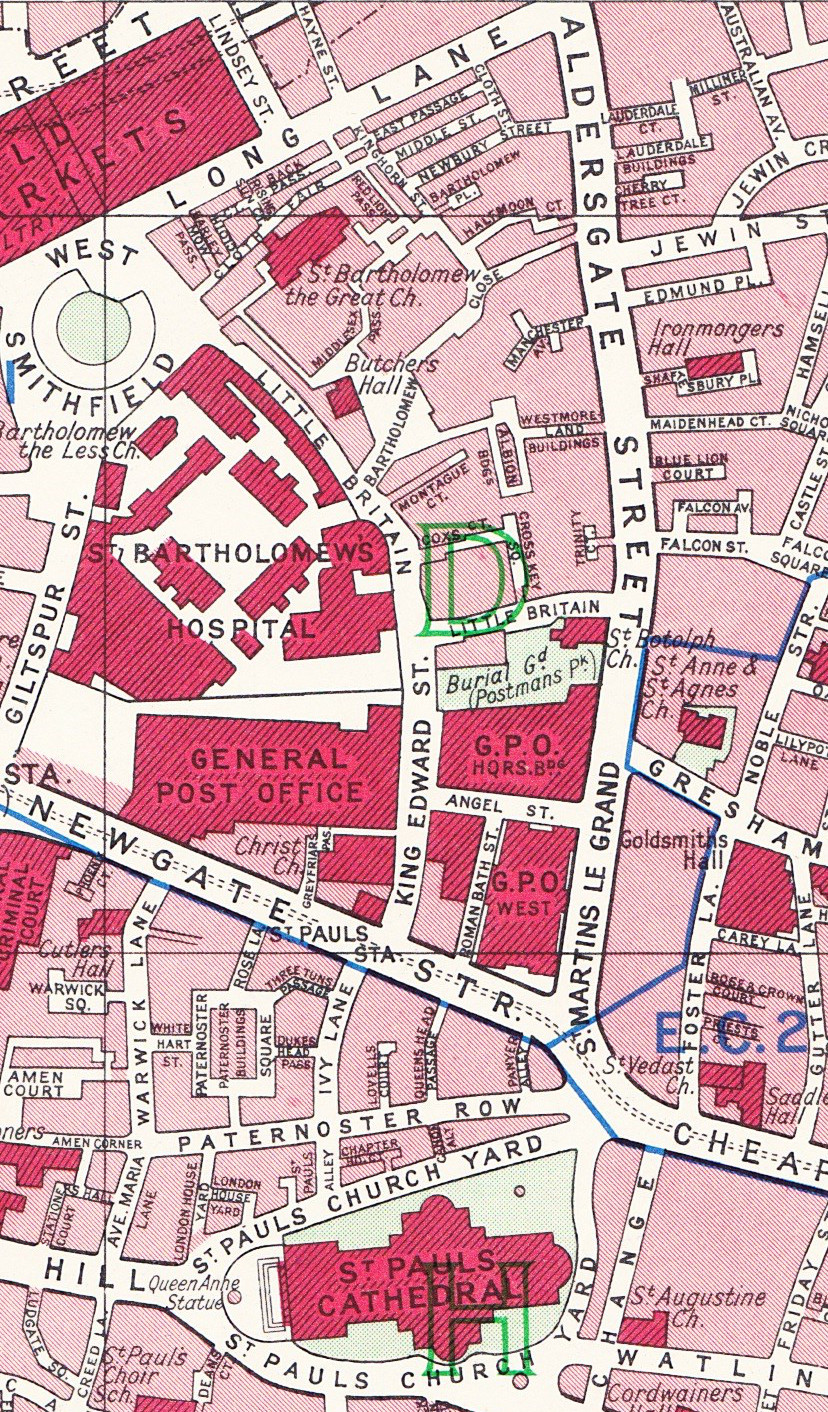
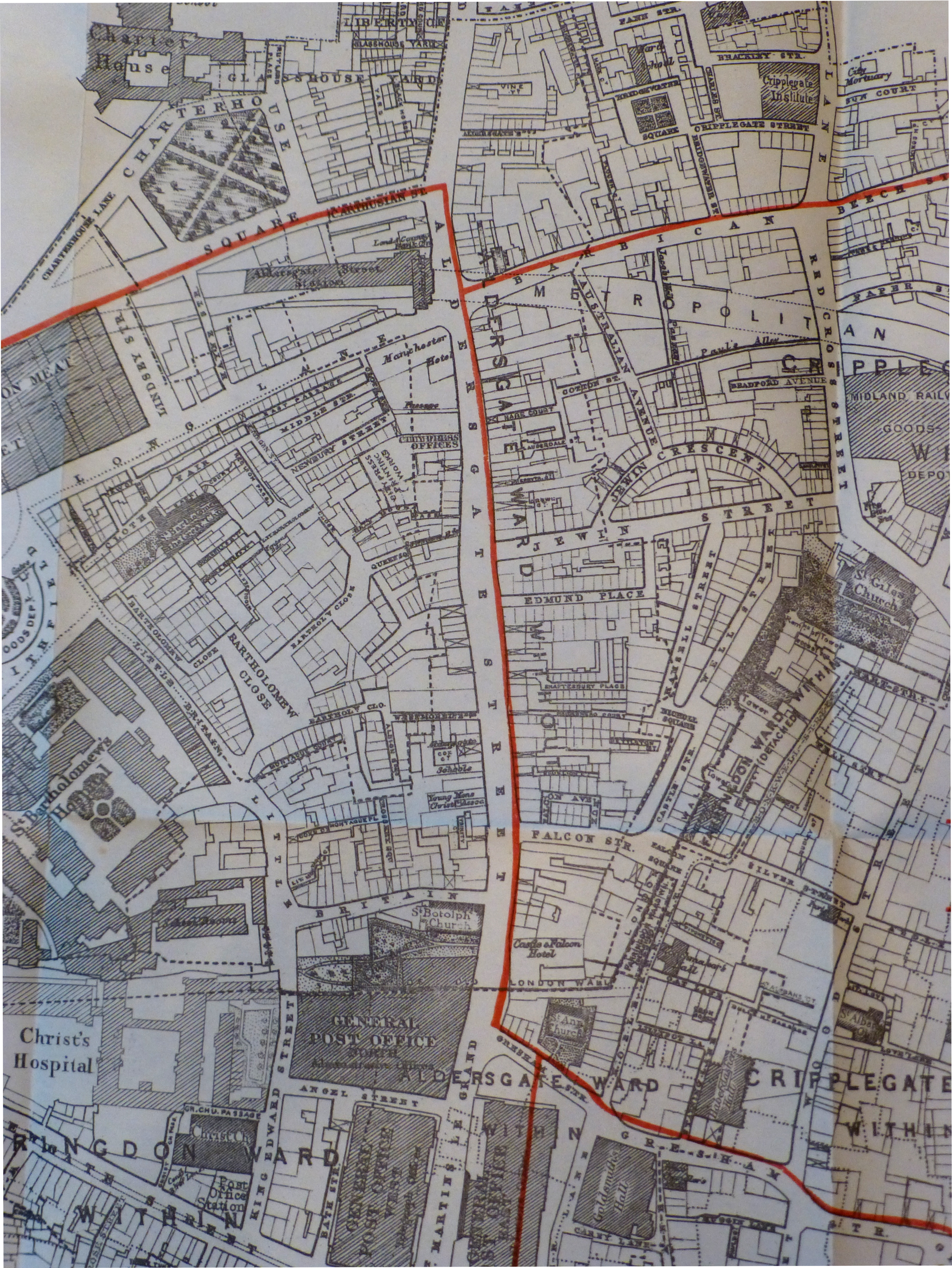
It is interesting to understand what was on the east site of Aldersgate Street as a large network of streets were lost under the Barbican development.

The following map is from the 1940 edition of Bartholomew’s Reference Atlas of Great London. Unfortunately this area is to the edge of the page, but it does show that to the east of Aldersgate Street were a network of streets and courts. All of these have since disappeared, indeed the only remaining landmark is the Ironmongers Hall which is still there, hidden behind the Museum of London which has been built over Maidenhead Court and Blue Lion Court.

Aldersgate 6

The 1910 map published alongside Besant’s History of the City provides more detail of the network of streets and courts to the east of Aldersgate Street:

Aldersgate 5

Going back further to John Rocque’s map of London published in 1746, Aldersgate Street is also on the edge of the map sheet, but we can see the network of streets and courts on the east side that had already been in place for many years, and would last to the second half of the 20th century:

Aldersgate 3

Going back further, Aldersgate is mentioned many times in medieval records, for example:

In 1339 the Chamberlain of Guildhall spent 20s and 4d on the pavement of the gate of Aldersgate, the pavement being one of cobbled stones laid close and rammed. This being an indication that there was a good amount of traffic through Aldersgate as money was only spent on the provision of a cobbled pavement where there was significant traffic.

In 1346 a certain Simon is hanged for robbery at Aldersgate.

In 1350 there are records of the shops within Aldersgate.

In 1391 a scrivener stands in a pillory without Aldersgate for forgery.

The original gate at Aldersgate was in a very bad state by 1510. Recorded in the Presentment of the Wardmote Inquest of the Ward of Aldersgate is:

“Item: we present Aldrygegate in Joberdy of fallyng downe, yt synkys so sore”

The original gate was taken down in 1617 and rebuilt to a new design. In honour of the king an equestrian statue was included in the new gate just above the arch. The cost of the new gate was £1,000 and was funded by a bequest from a certain William Parker, Merchant Taylor.

The new Aldersgate gate:

Aldersgate 7

William Maitland’s History and Survey of London from 1756 provides a view of how the ward was kept safe at night:

“There are to watch at Aldersgate, and other stands in this Ward, every Night, one Constable, the Beadle, and 44 Watchman. And in the liberty of St Martins-le-Grand, which is in this Ward, 12. In all 56.”

Maitland also described the state of the street in 1756:

“Aldersgate Street, very spacious and long, and although the Buildings are old, and not uniform, yet many of them are very good, and well inhabited.”

The gate at Aldersgate was removed in 1761. As with other City gates, it was too narrow and restricting on the amount of traffic that was now travelling in and out of the city.

To mark the northern limits of the City, two pillars were erected in 1874 as shown in the following drawing from the time, looking down Aldersgate Street with St. Paul’s Cathedral in the distance:

Aldersgate 4

The 1932 edition of The Face of London provides a view of Aldersgate Street shortly before the last war:

“Thirty years ago Aldersgate Street was a shabby thoroughfare, but during our own century it has greatly increased in importance. On the west side, at the corner of Long lane, is the Manchester Hotel, and next door is the Metropolitan Railway station which was opened for traffic in 1865.”

As with many other streets across London, the coming of the railway provided an incentive for new developments and new trades in the local area.

The same book also states that in 1932 the Corporation of London was considering an investment of £1,500,000 to widen Aldersgate Street to 80 feet from St. Martins le Grand to Goswell Road as the road was very narrow.

The wartime devastation to the east of Aldersgate Street shown in my father’s photo at the start of this article provided all the opportunity needed to widen the road, and it is this incarnation of Aldersgate Street that we see today.

The sources I used to research this post are:

  • Old and New London by Walter Thornbury published in 1881
  • London, The City by Sir Walter Besant published in 1910
  • The History of London from its Foundations to the Present Time by William Maitland published in 1754
  • The Face of London by Harold P. Clunn published in 1951
  • Stow’s Survey of London . Oxford 1908 reprint of 1603 edition
  • The Streets Names of London by Gertrude Burford Rawlings
  • Bartholomew’s Reference Atlas of Greater London published in 1940

 alondoninheritance.com